Answers to Everyday Issues Part 120
Page 6
A
How fear of truth repeats the story of Tufayl
Khuddam-eAhmadiyyat: Rise, for the hour is nigh
Observations of Irfani: Conversation with an atheist (1926)
Page 10
Page 9
Page 5
THE WEEKLY
www.alhakam.org AL HAKAM | Friday 2 October 2026 | Issue CDXLVI Ahmadiyya Archive & Research Centre (ARC), 22 Deer Park Road, London, SW19 3TL, UK info@alhakam.org | ISSN 2754-7396
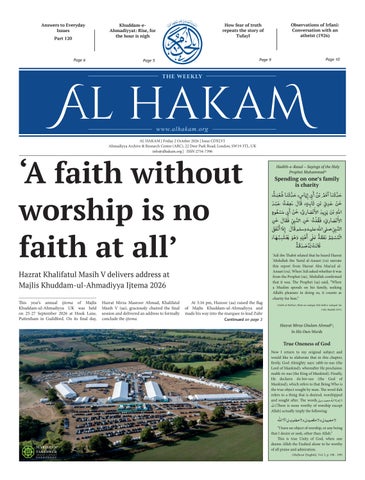
‘A faith without worship is no faith at all’ Hazrat Khalifatul Masih V delivers address at Majlis Khuddam-ul-Ahmadiyya Ijtema 2026 This year’s annual ijtema of Majlis Khuddam-ul-Ahmadiyya UK was held on 25-27 September 2026 at Hook Lane, Puttenham in Guildford. On its final day,
Hazrat Mirza Masroor Ahmad, Khalifatul Masih V (aa), graciously chaired the final session and delivered an address to formally conclude the ijtema.
At 3:16 pm, Huzoor (aa) raised the flag of Majlis Khuddam-ul-Ahmadiyya and made his way into the marquee to lead Zuhr
Hadith-e-Rasul – Sayings of the Holy Prophet Muhammadsa
Spending on one’s family is charity
ُ ُ َ َّ َ َﺣ َّﺪﺛ َ َﻨﺎ َ آد ُم ﺑْ ُﻦ أَ�� إﻳ ، َﺣﺪﺛ َﻨﺎ ﺷ ْﻌ َﺒﺔ،ﺎس ٍ ِ ِ َ َ َ ُ َ َ َ َ ْ َ ﻗﺎل � ِ� ْﻌﺖ ﻋ ْﺒﺪ،ﺖ ٍ ِﻋﻦ ﻋ ِﺪ ِّي ﺑْ ِﻦ َﺛﺎﺑ َ َ َ ّٰ ْ َ ﻋ ْﻦ أ�ِ� َﻣ ْﺴ ُﻌﻮ ٍد،ا�� ِ� ﺑْ َﻦ ﻳ َ ِﺰﻳﺪ ا��ﻧ َﺼﺎ ِر ّي َّ َ َ َ َ ُ ْ َُ ّ َ َْ اﻟﻨ ِ� ِّ� ﻓ َﻘﺎل ﻋ ِﻦ ﺖ ﻋ ِﻦ ﻓﻘﻠ،ا��ﻧﺼﺎ ِر ِي َّ ّٰ َ َ َْ َ َ َ اﻟﻨ ِ� ِّ� ﺻﻠﻰ ا��� �ﻠﻴﻪ وﺳﻠﻢ ﻗﺎل� ِإذا أﻧﻔﻖ ْ َ َ ْ َْ َ ً َََ ،اﻟ ُﻤ ْﺴﻠِ ُﻢ ﻧﻔﻘﺔ َ�ﻠﻰ أﻫ ِ� ِ� َوﻫ َﻮ � ْ�� ِﺴ ُﺒ َﻬﺎ ً ََ َ ْ َ َ ��ﺎﻧﺖ � ُ� َﺻﺪﻗﺔ ‘Adi ibn Thabit related that he heard Hazrat ‘Abdullah ibn Yazid al-Ansari (ra) narrate this report from Hazrat Abu Mas‘ud alAnsari (ra). When ‘Adi asked whether it was from the Prophet (sa), ‘Abdullah confirmed that it was. The Prophet (sa) said, “When a Muslim spends on his family, seeking Allah’s pleasure in doing so, it counts as charity for him.” (Sahih al-Bukhari, Kitab an-nafaqat, Bab fadli n-nafaqati ‘ala l-ahl, Hadith 5351)
Continued on page 3 Hazrat Mirza Ghulam Ahmadas, In His Own Words
True Oneness of God Now I return to my original subject and would like to elaborate that in this chapter, firstly, God Almighty says: rabb-in-nas (the Lord of Mankind), whereafter He proclaims: malik-in-nas (the King of Mankind). Finally, He declares ila-hin-nas (the God of Mankind), which refers to that Being Who is the true object sought by man. The word ilah refers to a thing that is desired, worshipped �ٰ and sought after. The wordsَّلا ِإْلٖہ ِإَّلا الَّلِه ِمَحُمُد َرَسوَل ٰ� (الَّلِهThere is none worthy of worship except Allah) actually imply the following:
�ٰ � َّلا ِمَعَبوَد َلی َو َّلا ِمُقِصوَد َلی َو َّلا ِمِطُلوِّب َلی اَّلا الَّلِه
“I have no object of worship, or any being that I desire or seek, other than Allah.” This is true Unity of God, when one deems Allah the Exalted alone to be worthy of all praise and admiration. (Malfuzat [English], Vol. 2, p. 198 - 199)
Friday 2 October 2026 | AL HAKAM
2
This Week in History 2 - 8 October A glimpse into the rich history of the Ahmadiyya Muslim Jamaat
2 October
5 October
2 October 1928: Hazrat Mirza Sultan Ahmad Sahib, the eldest son of the Promised Messiah (as), announced his allegiance to Jamaat-eAhmadiyya through an announcement in Al Fazl on this day. Later on, he performed bai‘at at the hands of Hazrat Khalifatul Masih II (ra) in 1930. (Al Fazl, 2 October 1928, p. 1)
5 October 1902: The Promised Messiah’s (as) book Kashti-e-Nuh [Noah’s Ark] was published on this day. (Tarikh-e-Ahmadiyyat, Vol. 2, p. 215)
2 October 2009: During his Friday sermon on this day, Hazrat Khalifatul Masih V (aa) mentioned Muhammad Azam Tahir Sahib of Uch Sharif, Pakistan, who had been martyred on 26 September.
3 October 3 October 2003: On this day, Hazrat Khalifatul Masih V (aa) inaugurated the Baitul Futuh Mosque in Morden, UK, by delivering his Friday sermon and prayed that Allah the Almighty would make this mosque a source for spreading the beautiful and peaceful teachings of Islam in Europe. 3 October 2014: During his Friday sermon in Ireland, on this day, Hazrat Khalifatul Masih V (aa) mentioned Mubashar Ahmad Sahib Khosa of Mirpur Khas, Pakistan, who had been martyred on 22 September.
4 October 4 October 2013: On this day, Hazrat Khalifatul Masih V (aa) was interviewed by the Australian Broadcasting Corporation TV and Radio. (“ABC TV and Radio Conducts Interview with Head of Ahmadiyya Muslim Jamaat” www.pressahmadiyya. com) 4 October 1985: On this day, Hazrat Khalifatul Masih IV (rh) delivered his Friday sermon at the Basharat Mosque in Spain. Huzoor (rh) also shared details of his successful tour of Switzerland, Italy and Spain and urged every Ahmadi to become active in tabligh. (Khutbat-e-Tahir, Vol. 4, p. 815)
5 October 2015: On this day, Hazrat Khalifatul Masih V (aa) was interviewed by the Dutch News Agency, Omroep Gelderland. On the same date, Huzoor (aa) was also interviewed by RTV Nunspeet at the Baitun Noor Mosque complex in Nunspeet, the Netherlands. The radio interview was broadcast live and streamed worldwide. (“Blocs forming and risk of another World War – Head of Ahmadiyya Muslim Community”, and “Time for mankind to unite and work together – Head of Ahmadiyya Muslim Community”, www. pressahmadiyya.com)
6 October 6 October 1942: Hazrat Musleh-e-Maud (ra) announced an exclusive scheme for tabligh in India on this day. The first objective of the scheme was to send 1,000 issues of Al Fazl that contained the transcript of his weekly Friday sermon to all Muslim scholars. He also instructed that 1,000 copies of The Moslem Sunrise be sent to them. Secondly, he urged that the message of Islam be conveyed to influential personalities of the country on a regular basis. (Tarikh-eAhmadiyyat, Vol. 8, p. 349) 6 October 2015: On this day, Hazrat Khalifatul Masih V (aa) was interviewed by the Reformatorisch Dagblad newspaper at the Baitun Nur Mosque complex in Nunspeet, the Netherlands. On the same day, Huzoor (aa) delivered a historic address at a special session of the Standing Committee for Foreign Affairs at the Netherlands National Parliament in the country’s capital city of The Hague in front of an audience of more than 100 dignitaries and guests. (“Head of Ahmadiyya Muslim Community delivers
historic address at Dutch National Parliament” pressahmadiyya.com)
7 October 7 October 1915: On this day, Hazrat Mir Qasim Ali (ra) started publication of his newspaper, Faruq from Qadian. This powerful medium of tabligh continued rendering its services until the sad demise of Hazrat Mir Sahib (ra) in April 1942. For further details, please visit: www. ahmadipedia.org 7 October 1954: On this day, Hazrat Sir Chaudhry Muhammad Zafarulla Khan (ra), companion of the Promised Messiah (as), was appointed judge at the International Court of Justice in The Hague. Later, he became the court’s vice president and ultimately served as president. The prophecy of the Promised Messiah (as) that world nations would benefit from members of his community was thus fulfilled in one manner here. (Tehdis-eNemat, p. 606)
8 October 8 October 1897: On this day, the first issue of Al Hakam was published under the editorship of Hazrat Sheikh Yaqub Ali Irfani (ra). In his editorial in the very first issue of Al Hakam, explaining the objectives of this periodical, he wrote: “Al Hakam comes to the stage of journalism to �ٰ َ ُ َ� َ َ fulfil its duty, declaring ُلُت َُعَلی الَّل ِِه [ َتوَّکIn Allah We Trust]. […] The method that is closest to human nature, as suggested by sound reasoning and experience, is Islam. Therefore, Al Hakam will be a true servant of Islam.” For more details, see “Al Hakam: A glimpse into its history and relaunch during the blessed era of Khilafat-e-Khamisa” at alhakam.org (24 March 2023, pp. 12-14). 8 October 1999: On this day, there was a bomb explosion at an Ahmadiyya mosque in Khulna, southern Bangladesh, during the Friday prayer, causing the martyrdom of seven Ahmadis. (Silsila Ahmadiyya, Vol. 4, p. 900)
AL HAKAM | Friday 2 October 2026 Continued from page 1
and Asr prayers. The session began at 3:49 pm with the recitation from the Holy Quran (Surah an-Nur, Ch.24: V.36-39) along with its English translation. Hazrat Khalifatul Masih V (aa) then came to the podium and led all those present in taking the Khuddamul-Ahmadiyya pledge. Afterwards, an Urdu poem written by the Promised Messiah (as) was presented as well as its English translation. (Surma Chashm-e-Arya, Ruhani Khazain, Vol. 2, p. 52) Huzoor (aa) then asked Farhad Ahmad Sahib, Sadr Majlis Khuddam-ul-Ahmadiyya UK, to present the ijtema report. Sadr Sahib said that the theme for this year’s ijtema, graciously given to them by Huzoor (aa), was “Our Paradise Lies in Our God”. He then mentioned key highlights of the ijtema, which included exhibitions, interactive quizzes and education games. There was also a live audience voting for tilawat, nazm and speech competitions. The total attendance at this year’s ijtema was 8,138. After thanking all the volunteers and khuddam who helped make the ijtema successful, Sadr Sahib expressed his gratitude to Hazrat Khalifatul Masih V (aa) for honouring the event with his presence and for his continuous prayers. Thereafter, a short video presentation was shown to Huzoor (aa) with highlights of the ijtema. Naib Sadr Sahib Majlis Khuddam-ul-Ahmadiyya UK was called to announce the Alam-e-In‘ami prize for Atfal-ul-Ahmadiyya and Khuddam-ulAhmadiyya, which Huzoor (aa) awarded to the winning qiadats. At 4:15 pm, Hazrat Khalifatul Masih V (aa) took to the podium to address the khuddam. A brief summary of this address is as follows: Huzoor (aa) stated that khuddam are of an age where they attain a good standard of education, acquire skills and enter professions that can be directly harnessed for the service of the Jamaat and humanity. Although having an education or gaining skills is very important, they must always remember the success of divine religious communities is not contingent on the capabilities of its members. Rather, it is contingent upon the grace of Allah and its members acting with taqwa (righteousness) and establishing a close bond with Allah the Almighty. Here, naturally, the question arises: “how does a person attain the nearness of Allah?” Huzoor (aa) answered that it requires a person to fulfil the rights of Allah’s worship, to act upon His commands and to discharge the rights of mankind. Huzoor (aa) stated that a religious community cannot move forward and attain success if its members are weak in this regard.
Recognise your good fortune As Ahmadis, we must never underestimate how fortunate we are to have been born and raised in this blessed era of the Promised Messiah (as) whose advent was foretold by Allah the Almighty. The Holy Prophet (sa) also prophesied that the initial rise and advancement of Islam would be followed by a sustained period of religious decline. During this time, countless pious people fervently prayed and desperately searched for the prophesied Messiah so that they may accept him and serve his mission.
3
Yet they came and left this world without finding what their hearts yearned for. Ahmadis are those fortunate people who have recognised the one foretold in these prophecies and have pledged their allegiance to him. At the same time, this immeasurable blessing carries a profound responsibility. Having taken the bai‘at of the Promised Messiah (as), we have pledged to always give precedence to our faith over all worldly matters. It requires us to obey the commands of Allah, His Messenger (sa) and the Promised Messiah (as) and to set a noble example of peace and compassion before the world. As Ahmadis, we must regularly reflect upon the ten conditions of bai‘at so that our faith becomes stronger and so we may fully grasp our religious duties. Huzoor (aa) stated that he shall focus on two specific conditions of bai‘at in his address.
Offering Salat saves one from sin and evil Huzoor (aa) stated that a faith that is bereft of the worship of Allah and a connection with Him is no faith at all. Thus, if a person claims to be a Muslim yet fails to fulfil the rights of Allah’s worship, their claim remains hollow and nothing more than empty words. The paramount form of worship is set forth in the third condition of bai‘at which states that he or she shall offer the five daily prayers without fail in accordance with the commandments of Allah the Almighty and the Holy Prophet Muhammad (sa). With regard to Salat, Allah the Almighty says in the Holy Quran: “Surely, Prayer restrains [one] from indecency and manifest evil.” (Surah al‘Ankabut, Ch.29: V.46) Elaborating on this, the Promised Messiah (as) states: “Salat is such a virtue through which satanic weakness is eliminated and this is what is called true prayer and supplication. Therefore, Satan desires for a person to exhibit weakness in Salat because he knows that to whatever extent a person is able to reform, it will be through this means.” (Malfuzat [Urdu], Vol. 4, p. 59) Regarding the blessings of Salat, the Promised Messiah (as) further says: “Keep the love and majesty of Allah forever flowing in your hearts. For this, there is no greater means than namaz.” (Ibid., p. 61)
How to pray before Allah He explains that while other forms of worship, such as fasting and paying Zakat, are essential, Salat is supreme because the period of fasting in Ramadan lasts for just one month in a year, while Zakat is obligatory only for those with sufficient wealth in a year. Salat, however, is a universal obligation – something that every person, regardless of their circumstances or status, is required to offer five times a day. The Promised Messiah (as) thus emphasised that Salat must be offered with intense concentration and a firm conviction that one is standing before that All-Powerful Being who can answer and accept prayers instantly if He so wills. While worldly leaders are constrained by finite resources and remain always in fear that their treasuries may become depleted, the treasury of Allah is limitless and can never
be exhausted. (Ibid., pp. 61-62) Thus, perform your prayers with complete conviction, trust in Allah and with absolute humility instead of just repeating the words out of habit. However, it should also be remembered that the acceptance of prayer is conditional – we must first obey His commands. If one is not acting upon Allah’s commands, then complaining that Allah does not hear their supplications is a baseless and unjust allegation against Him. Allah responds favourably to those who pray with a firm belief in His supreme power and who realise that if they ignore His commands, their prayers will be worthless and even a means of His displeasure. Regarding the power of prayer, the Promised Messiah (as) said, “It is a wellknown truth that namaz is a powerful instrument for safeguarding a person from sin. It is the intrinsic quality of namaz that it repels a person from sin and immorality.” (Malfuzat [Urdu], Vol. 4, p. 232)
Salat is vital for faith Many people offer the excuse that their busy schedule and demanding workloads make it difficult to perform prayer at the prescribed times. Huzoor (aa) stated that the Promised Messiah (as) once recalled an incident when a group of new converts to Islam sought the permission of the Holy Prophet (sa) to be exempted from Salat, he replied that faith without worship is no faith at all. Elaborating on this, the Promised Messiah (as) said, “What is namaz? It is to submit with complete humility your weaknesses and frailties before Allah and seek His help to fulfil all of your needs.” (Malfuzat [Urdu], Vol. 4, p. 340) Regarding how to pray, the Promised Messiah (as) says, “A supplicant should praise Allah by proclaiming His greatness and majesty in order to bring forth His mercy. We often see that when a person wants help from someone, they offer praise to win their favour. Similarly, when we seek Allah’s help, we should praise Him in order to draw His mercy.” (Ibid.) The Promised Messiah (as) states: “Man is utterly needy and dependent on the grace of God; he should continually seek the pleasure of Allah the Almighty.” (Ibid.) He further says only through His grace and mercy can a person accomplish anything. So a person should pray that, “O Allah, grant
us the ability to become wholly Yours. May we walk only on the path that leads to Your pleasure and favour and may Your love enter our hearts.” (Ibid., p. 341) The Promised Messiah (as) continues by saying that the person who seeks to free himself from Salat is no better than an animal as he spends his life eating, sleeping and pursuing vain desires. That is not faith – it is the way of the disbelievers. Thus, a true believer can never be negligent in fulfilling the rights of Allah. Allah says in the Holy Quran: “Therefore remember Me, and I will remember you; and be thankful to Me and do not be ungrateful to Me.” (Surah al-Baqarah, Ch.2: V.153) The Promised Messiah (as) elaborates on this verse by stating that Allah will never abandon those who remain engaged in His remembrance and who remain ever grateful to Him. He will always care for and protect such people and fulfill their needs. Conversely, neglecting Allah’s remembrance and exhibiting ingratitude are indicative of disbelief. (Malfuzat [Urdu], Vol. 4, p. 341) The five daily prayers are the bare minimum of what is required. Otherwise, a true believer should remember Allah at all times so that he may be inspired to give precedence to his faith over all worldly matters. Only then will he recognise that Allah is watching his every deed and abstain from violating His teachings and commands. Allah promises that if a person reaches this spiritual state, their Salat and remembrance of Allah shall protect them from all forms of indecency and immorality. Thus, Salat offered with true devotion becomes a powerful catalyst for moral reformation. It shields believers from the worldly vices and temptations that surround us, whether online, on television, across social media or anywhere else.
Pay attention to Salat despite worldly distractions Generally, young people enjoy good health and physical vigour, so khuddam cannot plead physical infirmity or frailness as an excuse to avoid going to the mosque. Thus, offer your prayers in congregation at all possible times. If there is no one else to pray with, you should still offer your prayers at the correct times. If your intention is pure, Allah can bestow upon you the same reward as those who pray in congregation, since
Friday 2 October 2026 | AL HAKAM
4
the Holy Prophet (sa) taught that deeds are judged by intentions. In this day and age, many are becoming consumed by worldly pursuits, so it is important to pay special effort to our prayers and fulfil the rights of Allah’s worship as observing prayer is the very foundation of faith. The Holy Prophet (sa) said that on the Day of Judgment, Salat will be the first thing Allah calls us to account for. If a person’s record in prayer is complete, they will succeed and attain salvation. However, if their record is deficient, they will fail and suffer the consequences of that failure. (Tirmidhi, Kitab as-salat, Hadith 413) In today’s world, wherever one turns, he is confronted with widespread immorality and vice. To shield yourself from these influences, you must prioritise worshipping Allah above all else. Otherwise, the world is hurtling rapidly towards an ever deeper moral decay – those who fail to protect themselves from such corruption will incur Allah’s displeasure. On one occasion, the Promised Messiah (as) said, “O ye people who consider yourselves members of my community! You will be counted as such in heaven when you truly tread upon the ways of righteousness. So, offer the five daily prayers in such fear and with such complete attention as though you were actually beholding God Almighty.” (Noah’s Ark, pp. 24-25)
How to find pleasure in Salat People sometimes struggle to find pleasure or devotion in prayer. This is why the Promised Messiah (as) instructed that when we pray, we should acknowledge our weaknesses, the fleeting nature of this world and recognise that we shall all return to
Allah. He taught that we must continuously pray that Allah does not take us from this world while we remain spiritually blind and ignorant of His mercy, grace and majesty. Thus, we should plead with Allah to bestow our hearts with such a flame of divine light that it may become filled with love and longing for Him. If one worships and supplicates in this manner, those prayers that once felt like a mere formality or burden will be infused with spiritual light. And that light shall ignite a profound emotion, divine love and pure joy within one’s worship. (Malfuzat [Urdu], Vol. 3, p. 481) Therefore, from a young age, ensure that five daily prayers remain your constant and lifelong companion. Huzoor (aa) stated: “Never assume that you are too young or that you have many years ahead to build your connection with Allah. Instead, I hope and pray that every one of you departs from this ijtema with a firm resolve to strengthen your bond with your Creator and to worship Him with unwavering sincerity and devotion.”
Obedience to Khilafat Huzoor (aa) also drew attention to the tenth and final condition of bai‘at, which states that those who enter into a bond of brotherhood with the Promised Messiah (as) must pledge obedience to him in everything good and remain faithful to it until their death. Huzoor (aa) stated: “This bond of fidelity and brotherhood is no ordinary bond. Rather, it is a means of demonstrating that we have accepted that Messiah and Imam Mahdi who has been sent to the world by Allah according to His promise and according to the prophecies of the Holy Prophet (sa).”
Huzoor (aa) further stated, “If a person is sincere in this pledge, their connection with the Jamaat will naturally grow stronger and they will be shielded from negative thoughts and satanic influences. Their faith in the Promised Messiah (as) and Khilafate-Ahmadiyya will always remain firm and resolute, even if they observe shortcomings in certain office bearers or individuals, it will neither shake their faith nor turn them against the Jamaat or the Promised Messiah (as).”
What does ‘ma‘ruf’ mean? The Quran requires a believer to obey all “ma‘ruf” decisions of a prophet or his successor, i.e., any instruction or decision based upon the command of Allah, the teachings of the Holy Prophet (sa) and the Holy Quran must be obeyed. Naturally, every decision of the Promised Messiah (as) is ma‘ruf because he was the most devoted follower of the Holy Prophet (sa). Neither he nor his true successors could ever direct mankind towards anything that departs from goodness and truth. Hazrat Khalifatul Masih I (ra) observed that some people mistakenly assume that if an order appears wrong in their estimation, they are free to reject it. But if all members of the Jamaat take this attitude and decide for themselves what is ma‘ruf, the unity of the Jamaat will break down and obedience will become impossible to achieve. He explained that the word ma‘ruf has been used in the Holy Quran in relation to the Holy Prophet (sa) and the believing women who took his bai‘at. In this regard, Hazrat Khalifatul Masih I (ra) asked whether the women mentioned in the verse had formed (God forbid), a list of faults or
mistakes of the Holy Prophet (sa) that they would not obey? Clearly not. Similarly, the Promised Messiah (as) has used this term in the condition of bai‘at which means that all those who take the bai‘at are bound to obey all of his instructions and those of the Khalifa of the time. (Khutbat-e-Nur, pp. 420-421) Regarding the limits to obedience, the Holy Prophet (sa) stated that if a leader is appointed over a people and he gives an instruction that is contrary to the commands of Allah or against the teachings of the Holy Prophet (sa), it should not be implemented. However, in our Jamaat, with the grace of Allah, we are blessed with the institution of Khilafat-e-Ahmadiyya and the Khalifatul Masih will never give an instruction that contravenes the Shariah. Where Khilafat is mentioned in the Quran, Allah states in one of the verses that: “And they swear by Allah their strongest oaths that, if thou command them, they will surely go forth. Say, ‘Swear not; [what is required is actual] obedience in what is right. Surely, Allah is well aware of what you do.’” (Surah an-Nur, Ch.24: V.54) In this verse, Allah states that there is no value in just making empty vows or swearing oaths. Here at the ijtema and at other events, our members recite emotional poems or nazms, expressing their loyalty and making grand proclamations of faith. However, proclamations on their own are meaningless. What actually counts is obedience in practice. Responsibilities of Khuddam-ulAhmadiyya Huzoor (aa) said that it is the promise of the Holy Prophet (sa) that the Khilafat of the Promised Messiah (as) shall endure so long
AL HAKAM | Friday 2 October 2026 as his followers continually seek to excel in taqwa and remain obedient to what is good and are ever ready to defend and uphold the true teachings of the Holy Prophet (sa) of Islam. Only then can we truly claim to be living in accordance with the teachings of Islam. Huzoor (aa) stated: “Therefore, as members of Khuddam-
5
ul-Ahmadiyya who pledge to be ready for every sacrifice to protect and safeguard Khilafat, you must especially strive to understand and act upon the guidance of the Promised Messiah (as) – and in this era – the directive of the Khalifa of the time. Every step you take must lead towards righteousness and draw you ever closer to Allah [the Almighty].
“The means of achieving this lie in observing taqwa, fulfilling the rights of Allah [the Almighty] and the rights of His creation and discharging the solemn demands of your bai‘at. [...] At the end, I pray all of you recognise that it lies upon you to be at the forefront of bringing about a true and everlasting spiritual revolution in the world and to live your lives as faithful
and devoted servants of the Promised Messiah (as) and bring the world under the banner of the Holy Prophet (sa). May Allah [the Almighty] enable all of you to rise to this noble challenge. Amin.” Then, Hazrat Khalifatul Masih V (aa) led everyone in silent prayer and the ijtema concluded.
Khuddam-e-Ahmadiyyat: Rise, for the hour is nigh غیلبتادمحتیداینںیماکماانپ
Jalees Ahmad Al Hakam In life, if you are fortunate enough, you may come across such deep writings, poems and compositions that feel like an awakening. Writings that feel as if the words of the heart have been expressed perfectly, as if a conversation is taking place from heart to heart, with the pen that aided in composing it merely working as a medium. Such writings, whether composed today or ages ago, continue to carry a timeless message and enter a realm where they remain relevant for today’s reader. The poem Khuddam-eAhmadiyyat is one such example. Penned by Hazrat Khalifatul Masih IV, Mirza Tahir Ahmad (rh), when he was a young boy, the poem echoes the essence of devotion and service. It describes a sense of sacrifice that has always been associated with the Ahmadiyya Muslim Jamaat. This poem, “Hain baadah mast, baadah aashaam-e-Ahmadiyyat”, is especially recited during MKA ijtemas. The poem repeatedly uses the words “Khuddam-e-Ahmadiyyat”, meaning “Servants of Ahmadiyya.” This title itself holds an important lesson. To be a member of a Jamaat is one thing, but to become its servant is something much greater.
A historical background of this poem During the Partition of India in 1947, the country was in chaos. Muslims, Sikhs, Hindus and members of other faiths were forced to flee their homes and migrate across the newly established India-Pakistan border. All this happened against the backdrop of growing insecurity and violence. Qadian, the headquarters of the Ahmadiyya Muslim Jamaat, was also caught in the upheaval. The Jamaat had, however, previously begun preparing for the possibility of migration. Following this unfortunate saga in history, the partition, the migration of Ahmadis from Qadian to Pakistan began. Several years earlier, Hazrat Musleh-eMaud (ra) had described a vision in which he saw himself migrating from Qadian and establishing a new centre. (Al Fazl, 21 December 1941, p. 3) When the Jamaat migrated from India to Pakistan and founded the town of Rabwah, the area was not yet the lush, green place that had been shown to Hazrat Musleh-e-Maud (ra) in the vision. He therefore suggested that perhaps the greenery he had seen in his vision was to come about through their own
دارالمعلےہوگایاعملامتماانپ “These days, the nizam [system of the Ahmadiyya Jamaat] continues in Rabwah, “Yet Qadian shall forever remain our markaz [epicentre]. “Our mission is to spread Ahmadiyyat throughout the world, “The whole world is our field of action.” The poem moves from Rabwah and Qadian to the statement that “the whole world” is our field of action, showing that the mission of spreading Islam Ahmadiyyat is not limited to Qadian, or even Rabwah, or even to one place, but is intended to reach people everywhere. The third part is the urgent call to action.
اوھٹہکاستعآیئاوروتقاجراہےہ
efforts: by transforming this hilly area into a thriving town, a place of refuge and a home where the Jamaat could again establish itself and flourish. The first group of Ahmadis to migrate to Rabwah did so on 19 September 1948. Their task was to erect temporary tents and accommodation for those who would soon be arriving in Rabwah to build the new town. Among them was the young Sahibzada Mirza Tahir Ahmad (rh). To convey the extent of the hardships and dedication involved in this time, it is worth noting that it was not until April 1949 that the first successful well was sunk (A Man of God, p. 62). This provides some sense of the immense toil and hardship endured by those working tirelessly to establish the new town. Day after day, Ahmadis worked tirelessly to establish the town and make it a home for all those who would come after them. This poem, Khuddam-e-Ahmadiyyat, played a significant role in keeping morale and spirits high. Loudspeakers were erected in the town for announcements to be made. One day, the young Sahibzada Mirza Tahir Ahmad (rh) recited this nazm for all to hear. Hazrat Musleh-e-Maud (ra) had also heard the words of this poem and said that this is exactly the kind of vigour that is needed at a time like this. It was at this time that the young man’s mother, Umm-e-Tahir, told Hazrat Musleh-e-Maud (ra) that this is your son, Mirza Tahir Ahmad (rh), who composed this and who is speaking this on the loudspeaker. (A Man of God, p. 63)
A brief reflection on the poem Those accustomed to the Urdu language will agree that the poem contains words and expressions that are difficult to translate. Even when an attempt is made to translate it into English, much of the original flavour of the Urdu is inevitably lost. Therefore, I will limit myself to discussing just three sections from the poem, which can be found in Kalam-e-Tahir, pp. 13-14. When one looks closely at the words of this poem, it becomes clear that at its core, it is a call to devotion, a call to service and a call to action.
ہنشتوبلںیکاخرطرہتمسوھگےتمںیہ اھتےموہےئوبسےئافلگمادمحتی “For the sake of those whose lips are parched with thirst, we wander in every direction, “Holding the rose-hued pitcher of Ahmadiyyat in our hands.” The followers of the Imam Mahdi are presented as people who have received spiritual guidance, the Jaam-e-Ahmadiyyat and who are now entrusted with carrying that guidance to others and striving for the cause of Islam through their service. Then, the sense of a mission and worldwide responsibility has been alluded to.
روبہںیمآلکجےہاجریاظنماانپ رپاقدایںرےہاگرمزکدماماانپ
“Rise, for the hour has come and time is passing.” Near the end of this poem, the verses relay an expression of rising. “Rise, for the hour has come and time is passing”, making it clear that faith cannot remain stagnant; servants of the Jamaat are being called to get up, pray, work and respond to the challenges facing Islam. For Khuddam today, especially in the West and with the political and global climate we find the world to be in today, the call to “rise” is as relevant as ever. The ordinary Muslim faces challenges not only from outside, but within: from worldly distractions to lack of purpose. The temptation to postpone responsibilities is also a real issue that cannot be ignored. In a world where attention is the new currency, we are called to wake up from the “worldly trance”, find Allah, seek beneficial knowledge and give to humanity; for faith without action is like a seed that is never allowed to grow. The poem ultimately leaves us with a question: Are we merely members of the Ahmadiyya community, or are we truly its servants? If one, in God’s name, develops the spirit of service and uses one’s abilities for the benefit of others, then the call of Khuddam-e-Ahmadiyyat will not just remain a beautiful poem from the past; it will have fulfilled its purpose even today, as it did back then: to ignite a deep desire for service to this noble cause.
اوھٹہکاستعآیئاوروتقاجراہےہ “Rise, for the hour has come and time is passing.”
Friday 2 October 2026 | AL HAKAM
6
Answers to Everyday Issues 120
Gog and Magog, Dajjal, knowledge of the unseen and magic Guidance regarding basic Islamic issues – which Hazrat Amirul Momineen, Khalifatul Masih Vaa has given on various occasions in his written correspondence and during MTA programmes – is being officially published below for everyone’s benefit. How should Muslims understand Gog and Magog [Yajuj and Majuj] in light of current world events? A lady from Sweden asked Hazrat Amirul Momineen, Khalifatul Masih V (aa), about the Quranic prophecies concerning Gog and Magog [Yajuj and Majuj]. She stated that Allah the Exalted had described them as powers that would spread disorder in the earth and that Dhul-Qarnain was a rightly guided reformer who erected a spiritual wall against this disorder. In view of current international political developments, particularly Denmark’s and America’s strategies concerning Greenland, she asked how Ahmadis should understand these Quranic prophecies in light of the teachings of the Promised Messiah (as). In his letter dated 15 March 2026, Huzoor-e-Anwar (aa) provided the following guidance: “Remember that Dajjal and Gog and Magog are different manifestations of the same tribulation. Dajjal denotes its religious aspect, meaning that this group will corrupt people’s religious beliefs and ideas in the Latter Days. The group that would destroy the peace of the world at that time, particularly the peace and security of the Muslim world, has been called Gog and Magog. Both designations refer to the worldly power and religious aspect of the Western Christian nations. “Thus, this is not a matter of the affairs of Greenland, Denmark or America. These nations themselves have no sympathy for Islam; rather, they oppose it and have a hand in the disorder and strife prevailing in the world. These conflicts therefore have no connection with those verses. They are conflicts among these nations themselves. “As for Gog and Magog and the tribulation of Dajjal, it should be understood that Allah the Exalted informed us through His beloved Prophet (sa) that when these
tribulations arose and Islam had become weak, He would raise the Promised Messiah to safeguard Islam. At that time, Muslims would lack material power, but the Jamaat of the Promised Messiah would continue to propagate the faith through prayers, arguments and proofs. It may also be an effect of these very prayers that the nations representing Dajjal are fighting among themselves. However, since they are all united in their opposition to Islam, Allah the Exalted will Himself destroy these tribulations. The Promised Messiah (as) states in this regard: “‘Here, it is also necessary to resolve the matter of the noble and important task for which the Messiah was to come. To suppose that he was to come to kill Dajjal is an exceedingly weak and untenable notion, for killing a single disbeliever is hardly so great a task as to require a Prophet, especially when it has been said that even if the Messiah were not to kill him, Dajjal would nevertheless melt away and perish of his own accord. The truth, rather, is that God Almighty has ordained the Messiah’s advent so that he may conclusively establish the truth of Islam before all nations, leaving every nation of the world without an excuse before God Almighty. This is what is meant by the statement that disbelievers will die through the Messiah’s breath: they will perish through clear arguments and decisive proofs.’ (Izalah-e-Auham, Part I, Ruhani Khazain, Vol. 3, pp. 131-132) “He further states: “‘Among these is the sign recorded concerning the Messiah that the disbeliever will die through his breath. This means that his opponents and deniers will be unable to contend with him in any matter, for they will fall dead before his consummate arguments. Thus, people will soon see that his opponents have indeed died in the face of conclusive reasoning and clear proof.’ (Izalah-e-Auham, Part II, Ruhani Khazain,
Vol. 3, p. 477) “He also states: “‘Nowhere is it written that the Promised Messiah will take up the sword, nor is it written that he will wage war. Rather, it is written that disbelievers will die through the Messiah’s breath, meaning that he will accomplish all his work through prayer. […] God Almighty has invested prayer with great powers. Through revelation, God has repeatedly told me that whatever comes to pass will come to pass through prayer alone. Prayer is our only weapon and I possess no other weapon besides it.’ (Malfuzat, Vol. 8, UK, 2022, p. 267) “Therefore, in these circumstances, Ahmadis should strive earnestly to obtain Allah the Exalted’s support and succour through prayer. Drawing upon the arguments and proofs that the Promised Messiah (as) has expounded so clearly and thoroughly in his writings and pronouncements, they should endeavour to convey the message of Ahmadiyyat, that is, the true Islam, to the entire world. These are our weapons and this is our jihad. “Thus, if Ahmadis are to play a part in the affairs of today’s world, they should do so by improving their spiritual condition, devoting their full attention to prayer and becoming true worshippers of Allah the Exalted. In this way, may we witness the establishment of Islam’s glory and grandeur and the Oneness of Allah the Exalted, see the flag of the Holy Prophet (sa) flying throughout the world and behold the destruction and ruin of Gog and Magog and the forces of Dajjal. May Allah the Exalted enable us to do so.”
If the Promised Messiah (as) has come, why does Dajjal still exist? A lady from Norway asked Hazrat Amirul Momineen, Khalifatul Masih V (aa), about a hadith in Sahih Muslim concerning Dajjal, Gog and Magog and Isa ibn Maryam (as). She explained that the narration described a sequence: first Dajjal, then his being killed by Isa ibn Maryam (as), followed by the emergence of Gog and Magog. Furthermore, it described the signs of Dajjal and those of Gog and Magog differently. She asked whether the continued presence of the signs of Dajjal in the world meant that Gog and Magog had not yet emerged. She added that, according to Ahmadi belief, Dajjal and Gog and Magog were two aspects of the same tribulation. Non-Ahmadis, however, objected that, [according to Ahmadis,] the Imam Mahdi and Promised Messiah had already appeared and passed away, yet Dajjal still existed and Gog and Magog had supposedly not yet emerged, given the sequence described in the hadith. She explained that this had left her confused and asked how this objection should be addressed. In his letter dated 5 April 2026, Huzoore-Anwar (aa) provided the following guidance: “In considering your queries, the first point to bear in mind is that Dajjal is not mentioned anywhere in the Holy Quran; he is mentioned only in the ahadith. Gog and Magog, on the other hand, are mentioned in both the Holy Quran and the ahadith. If Dajjal and Gog and Magog are two separate entities, why has the Holy Quran omitted any mention of Dajjal altogether, when the
AL HAKAM | Friday 2 October 2026 Holy Prophet (sa) described him as the greatest tribulation and stated that every Prophet had warned his followers against him and that he too warned us against him? (Sahih al-Bukhari, Kitab al-jihadi wa s-siyar, Bab kaifa yu‘radu l-islamu ‘ala s-sabiyy) “He also stated that whoever memorises and recites the first 10 and last 10 verses of Surah al-Kahf will be safeguarded against the tribulation of Dajjal. (Sunan Abi Dawud, Kitab al-malahim, Bab khuruji d-dajjal) “When we reflect upon the opening and concluding verses of Surah al-Kahf, we find that they expound the Oneness of Allah the Exalted. They command that those who say that Allah the Exalted has taken a son should be warned. They also mention the People of the Cave and the Inscription, refer to the boundless words of Allah the Exalted that can never be exhausted and admonish us that our God is only One God. “All these signs and indications relate to Christians. The People of the Cave and the Inscription were a group of Christians. It was Christians who invented the doctrine of God Almighty having a son and misled the world by advancing the doctrine of the Trinity in opposition to the Oneness of Allah the Exalted. Explaining this hadith, Hazrat Musleh-e-Maud (ra) states: “‘These signs mention the emergence of Dajjal and Gog and Magog. Upon reflection, it becomes apparent that these two tribulations are closely related and are, in fact, different branches of the same tribulation. This is why the Holy Quran mentions Gog and Magog but does not mention Dajjal, even though the Holy Prophet (sa) placed greater emphasis on the latter. The words of the hadith are:
َ َ ْ َ َ� َ َ َ َ َ� َ� َ َ َ ُ اَل ِإِّن �ی َّلَ�َُنَْذ َُر َُک ُُم وُه ََو َِما ِِم ِْن َن ِِب ٍ �ٍّي ِِإَّلا َأَنَذ ََر ُقوْ َِم ُٖہ ُذ�َر اْلُدَج ِ َ ِ ِ َ اَل َفُق ٌ ُ ْلَُقَ ُْد َأَن ْ ََذ ََر َن ُوح َُقوْ َِمٖہ
“‘That is, mentioning Dajjal, he said, “There has been no Prophet who did not warn his people against Dajjal. Noah (as) also warned his people against him and I too inform you of him and urge my people to remain vigilant.” (Kanz al-‘Ummal, Vol. 7, p. 195, citing Abu Dawud and at-Tirmidhi) “‘Thus, the absence of any mention of so great a tribulation in the Holy Quran, alongside its mention of Gog and Magog, indicates that Gog and Magog and Dajjal are, in reality, two names for the same
7
phenomenon or two branches of the same tribulation. This is further confirmed by the fact that Dajjal and Gog and Magog belong to the same period. We also learn that both will gain ascendancy over the entire world. These points show that the tribulations of Dajjal and Gog and Magog are neither different kinds of tribulation nor tribulations belonging to different periods. Rather, they are different manifestations of the same tribulation. “‘In fact, Dajjal is the name given to its religious aspect. “Dajjal” means one who disguises falsehood with a veneer of truth, a deceiver. Thus, the tribulation of the Latter Days, against which the Prophets of the Children of Israel also warned, was to have two aspects. One concerned the corruption of religious beliefs and ideas, while the other concerned the disruption of political conditions and the destruction of political peace. The spirit instigating the tribulation relating to religious beliefs has been called “Dajjal”, meaning a deceitful and fraudulent entity. The entities instigating the tribulation relating to political affairs have been called “Yajuj” and “Majuj”. “‘The words “Yajuj” and “Majuj” derive َ َ� َ َ from “ajij”. The phrase ا �َج ُِت اْلَّن ُاَر ا َِج َْي ًِجاmeans َََ َتُل �ُه ََب َ ُْت, “The fire blazed up.” When one says � ََ ْ َ َْ ا �َج ِْج َُت اْلَّن َاَر, it means اْل َُه َْب ََت َُها َفاْل ََت َُه ََب ُْت, “You kindled the fire and it blazed up.” (Aqrab) Thus, the ََ word ا �ِجmeans to kindle a fire and the words “Yajuj” and “Majuj” denote entities possessing the power to gain ascendancy over the world through the use of firearms.’ (Tafsir-e-Kabir, Vol. 15, UK, 2023, pp. 357358) “As for the advent of the Promised Messiah and the destruction of Dajjal and Gog and Magog at his hands, this too is true. When Allah the Exalted raised Hazrat Mirza Ghulam Ahmad (as) of Qadian as the Promised Messiah and the awaited Mahdi to revive the faith of the Holy Prophet Muhammad (sa), Islam was in a parlous state. Prominent clerics were abandoning Islam and embracing Christianity. Islam faced a barrage of attacks from every direction and all manner of vile and deeply hurtful allegations were being levelled against the sacred person of the Holy Prophet (sa). “At such a time, by the command of Allah the Exalted, the Promised Messiah (as) undertook the defence of Islam.
Through a jihad of the pen on every front, he delivered a resounding rebuttal to the enemies of Islam, foremost among whom were Christian clergymen and members of the Arya Samaj. This jihad of the pen continued until the last breaths of his life. “After his demise, in keeping with the established divine practice concerning Prophets, Allah the Exalted instituted the succession of Khilafat after him as the Second Manifestation of His Power [Qudrat-e-Thaniyah]. Through its blessings, his mission continues to this day, serving to defend Islam in every corner of the world. This is because the succession of Khilafat following a Prophet is, in essence, a continuation of that Prophet’s own era. “Thus, while digging the trench on the occasion of the Battle of the Trench, the Holy Prophet (sa) witnessed a vision in which he was given the keys to the red and white palaces of Caesar, Chosroes and Yemen and the doors of those lands were opened to him. (Musnad Ahmad ibn Hanbal, Musnad alKufiyyin, Hadith al-Bara’ ibn ‘Azib, Hadith 17946, Part 38, p. 133) All these prophecies were fulfilled after his demise, during the blessed era of the Rightly Guided Khilafat that followed in his footsteps, in the Khilafat of Hazrat Umar (ra). “Therefore, the promises Allah the Exalted has made through the Holy Quran and the Holy Prophet (sa) concerning the era of his true servant, the Promised Messiah and awaited Mahdi (as), will most certainly be fulfilled at their appointed time, insha-Allah. These are the promises and glad tidings concerning the establishment of Islam’s grandeur, the spread of the Oneness of Allah the Exalted throughout the world and the flag of the Holy Prophet (sa) flying across the entire world. “Remember, however, that the people to whom these divine promises have been made bear a great responsibility if they are to witness their fulfilment. They must obey God Almighty’s commandments, bow before Him and seek His help. Disobedience to divine teachings and defiance of God Almighty’s commands delay the fulfilment of these glad tidings. This is what happened to the Children of Israel in the time of Hazrat Moses (as). When they rejected the words of the Prophet of their time, Allah the Exalted deprived them for forty years of the blessings that had been destined for them. (Surah al-Ma’idah, Ch.5: V.21-27) “It is therefore the fundamental responsibility of every member of the Ahmadiyya Muslim Jamaat to improve their spiritual condition, devote their full attention to prayer and fulfil the role of a true Ahmadi by becoming a true worshipper of Allah the Exalted. In this way, may we witness the establishment of Islam’s glory and grandeur and the Oneness of Allah the Exalted, see the flag of the Holy Prophet (sa) flying throughout the world and behold the destruction and ruin of Gog and Magog and the forces of Dajjal. May Allah the Exalted enable us to do so. “As for the sequence of these events in the hadith, the first point to consider is that nowhere is it established that these events must necessarily unfold in the order in which they are mentioned. Secondly, prophecies necessarily contain an element of concealment and their true meaning becomes clear only upon their fulfilment. It is therefore incorrect to understand the
matters described in the ahadith concerning Dajjal, Gog and Magog and the advent of the Promised Messiah solely in their outward, literal sense, particularly when the narrations themselves contain contradictory descriptions of Dajjal. Explaining this point, Hazrat Khalifatul Masih I (ra) states: “‘There were formidable difficulties in the narrations concerning Dajjal and to this day no one has been able to resolve them. One reason is that scholars of Hadith and jurists devoted considerable attention to ahadith concerning religious practice. Just consider how many treatises and books exist investigating the ahadith about saying Amin aloud, raising the hands in prayer and so forth. Yet the narrations concerning prophecies have not been investigated in the same manner. “‘Reflect upon these narrations concerning Dajjal. Look only at Mishkat and see how difficult these narrations are to understand. I shall present some examples. Consider how they can be reconciled on the basis of their outward meaning and explicit wording alone, without interpretation.’ “[Following this, Huzoor (ra) cited various narrations from Mishkat containing mutually contradictory descriptions.] (Badr, Vol. 9, No. 49, 18 July 1907, pp. 9-10) “Thus, wherever necessary, these matters will be interpreted in a manner consistent with the Holy Quran, the sunnah of the Holy Prophet (sa) and authentic ahadith. By the grace of Allah the Exalted, this is the established practice of the Ahmadiyya Muslim Jamaat.”
Could Hazrat Khalifatul Masih II (ra) know what was in people’s hearts? A lady from India asked Hazrat Amirul Momineen, Khalifatul Masih V (aa), whether it was true that Hazrat Khalifatul Masih II (ra) possessed the ability to know what was in people’s hearts or to exert a spiritual influence upon others. She also asked whether magic and the evil eye actually existed and whether they could affect a person. In his letter dated 11 August 2025, Huzoore-Anwar (aa) provided the following guidance: “Allah the Exalted alone is the Knower of the unseen and He alone knows what is in people’s hearts. Thus, Allah the Exalted states in the Holy Quran, ‘He is Allah and there is no God beside Him, the Knower of the unseen and the seen.’ (Surah al-Hashr, Ch.59: V.23) He also states, ‘And with Him are the keys of the unseen; none knows them but He.’ (Surah al-An‘am, Ch.6: V.60) “No human being can ever be the Knower of the unseen. Accordingly, at various places in the Holy Quran, Allah the Exalted instructed the Holy Prophet (sa) to declare that he did not claim to possess knowledge of the unseen. (Surah al-An‘am, Ch.6: V.51; Surah Hud, Ch.11: V.32) “Nevertheless, it is also true that God Almighty’s chosen servants know matters of the unseen to the extent that Allah the Exalted informs them of them. As Allah the Exalted states in the Holy Quran, ‘[He is the] Knower of the unseen; and He reveals not His secrets to any one, except to him whom He chooses, namely a Messenger [of His].’ (Surah al-Jinn, Ch.72: V.27-28)
Friday 2 October 2026 | AL HAKAM
8
“Hazrat Khalifatul Masih II (ra) was also a human being. As a human being, therefore, he certainly did not possess knowledge of what was in people’s hearts. However, as explained above, Allah the Exalted grants His beloved servants as much knowledge of the unseen as He pleases. Thus, if Allah the Exalted granted him some knowledge concerning someone and he conveyed it in accordance with that divinely bestowed knowledge, there is nothing objectionable in this. “Furthermore, the Holy Prophet (sa) said, ‘Beware of the believer’s discernment, for he sees with the light of Allah.’ (Sunan at-Tirmidhi, Kitab tafsiri al-qur’an, Bab wa min surati l-hijr) In this respect too, Allah the Exalted had blessed Hazrat Khalifatul Masih II (ra) with extraordinary discernment. By virtue of this divine gift, he could gauge people’s inner states from their faces with extraordinary discernment. Explaining this saying of the Holy Prophet (sa), the Promised Messiah (as) states: “‘A speaker’s words possess a certain grandeur and awe in proportion to his stature. Observe how, even when approaching worldly officials, one feels some unease and apprehension, conscious that they hold the pen of authority in their hands. Likewise, those who recognise that God is with a believer abandon their opposition to him. If they do not understand, they sit alone and reflect upon the matter, drawing comparisons. “‘It is essential that others follow the one who knows the way and possesses light. Thisَ� ُ is the intent and meaning of the hadith ِِاَّتُقوا ْ َ َ َ ْ ُ ِفَِراَسَة اْلُمْؤ ِِم ِِن, “Beware of the believer’s discernment.” That is, when a believer speaks, one should fear God Almighty, for whatever he says is from God Almighty.
“‘The point is that when a believer loves God, divine light encompasses him. Although that light enfolds him within itself and consumes his human nature to a certain degree, just as iron becomes like fire when placed in it, his servitude to God and his humanity do not cease to exist. This is the ُ ُ ْ َ َ َ َ� ُ secret embedded in ُق ْْل ِإَِّن ََما َأَنا َبََش ٌٌر ِِمْثُلُك ْْم, “Say, ‘I am only a man like yourselves.’” (Surah alKahf, Ch.18: V.111) “‘His humanity remains, but it is concealed beneath the divine hue. All his faculties and limbs, devoted to God’s cause, become so imbued with God Almighty’s purposes that they reflect His wishes. This is the distinction that makes him responsible for the spiritual nurturing of tens of millions of people and makes him a manifestation of perfect divine providence. Were this not so, a Prophet could never guide and lead so vast a multitude.’ (Malfuzat, 2022, Vol. 1, UK, p. 104)”
What is the reality of magic and the evil eye in Islam? “As for your query about magic, magic is, in reality, another name for deception and trickery and the notion of it has existed in the world since ancient times. The Holy Quran also mentions it, but never presents it favourably. Rather, for our guidance, it lays down the principle that a magician can never succeed against God Almighty, whichever direction he may approach from. (Surah Ta Ha, Ch.20: V.70) “As for what you have written concerning the evil eye, it is indeed a reality. This means that the person casting the gaze expresses an intentional or unintentional wish, to which God Almighty gives effect. Thus, it is recorded in a hadith that the Holy Prophet
(sa) said, ‘The evil eye is real.’ (Sahih alBukhari, Kitab at-tibb, Bab al-‘ainu haqq) “This is not simply a matter of whether the gaze is one’s own or another’s, or whether the intention is good or bad. At times, one’s own gaze can have this effect. A mother’s gaze can also affect her child, particularly when she thinks, ‘I have nursed this child’ or ‘I have raised this child’, while overlooking God Almighty’s part in the matter. Such thoughts have a harmful effect on the child. “Therefore, one should depend upon God Almighty alone in every undertaking. Every task should begin with prayer. One should say insha-Allah concerning anything to be done in the future and masha-Allah upon seeing something good that someone possesses. One should also recite the supplication taught by the Holy Prophet َ� َ� َ ُ (sa), َلَا ََحْوْ ََل ََوَلَا ُق �َّوََة ِإَِّلا ِِبالَّل ِِه, ‘There is no power nor strength except through Allah.’ If affected by the evil eye, one should pray by reciting Surah al-Fatihah, Surah al-Falaq, Surah anNas and so forth. “In fact, Allah the Exalted has endowed the human organs with various powers. These are weaker in some people and stronger in others. Among them is the power of the eye and the gaze. When a person sees something and finds it pleasing, envy arises in some people’s hearts. Those whose eyes possess this power to a greater degree affect the object when they look at it with thoughts full of envy. This is commonly called being affected by the evil eye. It is also referred to as hypnotism and mesmerism and is a form of parapsychology. “This is why the remedy described in the hadith is that a person affected by the evil eye should bathe. (Sahih Muslim, Kitab assalam, Bab at-tibbi wa l-maradi wa r-ruqa) When water falls upon their body as they
bathe and stimulates their nervous system, the effect of another person’s gaze upon them will dissipate. “A gentleman once asked Hazrat Muslehe-Maud (ra) whether the common belief that children could be affected by the evil eye was correct and, if so, what the remedy was. Huzoor (ra) dictated the following response: “‘Yes, they can be affected. The reason is that human beings have been endowed with a power through which one person’s thoughts can affect another. When a person regards something with great affection, feelings of love arise in their heart, but alongside them a hidden apprehension also develops. These thoughts are then conveyed to the other person, whether a child or an adult, giving rise to a sense of weakness or despondency that results in illness. “‘This is a natural phenomenon and can also be inferred from certain sayings of the Holy Prophet (sa). The Sharia has not declared it irrational. People whose hearts have little capacity to bear things become intensely preoccupied with even small matters. Such thoughts affect the hearts of others and this is what is called the evil eye. “‘Thus, if someone becomes ill in such �َ ُ َُْ ُ circumstances, َ� � َ Surah al-Fatihah or ُقْل َأُعوُذ ِِبَر ِِّب ََْ اْلَفَل ِِقand اِس ِ ِبَر ِِّب الَّن,ِ seeking refuge in the Lord of the dawn and the Lord of mankind, should be recited and one should blow over the child. If it is an animal or the like rather than a child, one should pass a hand over it. This serves both as a prayer and as an act of repentance.’ (Al Fazl, Qadian, Vol. 11, No. 69, 4 March 1924, p. 5)” (Submitted by Ehsan Ahmad, Murabbi-e-Silsilah, Private Secretariat, Islamabad and translated by Al Hakam)
NEWS Highlights from Lajna Imaillah Canada’s Ijtema 2026 Ayza Anwar Muavina In-Charge Press & Media, Lajna Imaillah Canada Over the course of two sunny days at the Baitul Islam Mosque complex, a record number of over 6,000 members of Lajna Imaillah and Nasirat-ul-Ahmadiyya Canada gathered to attend the 48th annual ijtemas. The theme of this year was “Love of Allah”. The biggest highlight was a special message from Hazrat Khalifatul Masih V (aa) on strengthening one’s relationship with Allah, offering prayers with sincerity and being mindful of our influence in the home – for the education and moral training of our next generations. In her speech, Sadr Lajna Imaillah Canada, Nadia Mahmood Sahiba, reminded all that love for Allah is the key to all of our problems. Following the theme of Ibadat, an art exhibition was also organised that displayed
Lajna’s artwork from across Canada. Members had the opportunity to visit the exhibition and vote for their favourite artwork. A new website for Lajna Imaillah Canada was launched, as well as a Lajna syllabus app and WhatsApp channels. The purpose of this initiative was to allow members to have access to any information related to the auxiliary right at their fingertips. The website will allow members to explore details about future programmes, departments, speeches and upcoming events. The WhatsApp channels will allow members to stay up to date with all current information and announcements. In addition to the competitions, members listened to panel discussions on providing support during times of grief and trauma, and on understanding the journey of converts. This year marked the 100-year jubilee celebration of the Sanat-o-Dastkari (Industry & Handicraft) Department. A
special exhibition was set up to celebrate and recognise the historic contributions of Lajna Imaillah to this department, including furniture and a sewing machine from 1926. The valuable advice of the late Sahibzadi Amtul Jamil Begum Sahiba, granddaughter of the Promised Messiah (as), was shared as well by her daughters. Other presentations included a recap of the blessed AMWSA Canada mulaqat with Huzoor (aa), and a mothers’ meeting on using our faith to teach the school health curriculum. Awards to recognise Lajna Canada’s businesswoman of the year, Art Competition and Pen to Preach initiatives were also presented. The bazaar, fun zone (featuring a rock climbing wall) and seminars appealed to Lajna members of all varieties, including workshops on performing ghusl and Tabligh FAQ, fitness and SEND seminars, an artificial intelligence seminar, resources for supporting caregivers and more. The Nasirat-ul-Ahmadiyya Ijtema
featured a variety of workshops this year for each age group: a ‘sip and chat’ giving the girls an opportunity to provide feedback with organisers, a Salat workshop, as well as a “Who Am I?” workshop aimed to build confidence and reinforce the nasirat’s Muslim identities. A new initiative by the Nasirat Department this year was the STEM competition, where nasirat got to showcase their skills and abilities by finding a solution to a problem in their community related to a sustainable development goal. Another memorable highlight for the nasirat and students was a bonfire night. AMWSA students and nasirat sat together by the fire and shared inspiring stories from the mulaqat with Huzoor (aa). Sports such as football and volleyball games were played by the nasirat, encouraging sisterhood and sportsmanship among the girls. There was also a fun zone, including axe throwing, an obstacle course and zorb ball. A special aspect to this year’s Nasirat Ijtema was Huzoor’s (aa) message to the Nasirat Canada, which was printed and given to each member in their souvenir bags, including a Nasirat drawstring bag, customised notebook, pen and chocolate.
AL HAKAM | Friday 2 October 2026
9
Jamaica Jamaat holds sixth annual back-to-school event Misbah Anmol Tariq Jamaica Correspondent In Jamaica, sending your child to a public school is not entirely free. Public schools may charge tuition and registration fees, while parents also must purchase textbooks separately. These books may be used for only one school year. Uniforms also must be either purchased or made by a tailor. Once these initial expenses are taken care
of, there are ongoing daily expenses of transportation, lunches, school activities, development fees and more. Sending even one child to school isn’t easy. This is why, for the past six years, Jamaate-Ahmadiyya Jamaica has been holding back-to-school programmes in the weeks leading up to the new academic year. Each year, the programme continues to expand. This year it was held at three different locations, helping families prepare
for the new academic year. In preparation for the back-to-school programme, local schools were contacted and asked to invite students from families in need. The registration was also open to the wider community, through which more than 100 parents registered their children. The main event, which was held on 30 August 2026, began with a recitation from the Holy Quran. For many locals, this was their first interaction with Muslims. Therefore, the missionaries welcomed the guests and provided a basic introduction to Islam. The guests also had an opportunity to ask questions. The highlight of the programme was the distribution of more than 200 backto-school packages to the children, bringing smiles and joy to their faces. A special fun
day was also organised for the children. A bouncy castle was provided for the younger children, while volunteers prepared snow cones to help everyone stay cool. The children also enjoyed free snacks, games and other activities, making the event a memorable experience for everyone. In a predominantly Christian country like Jamaica, events such as these often generate interest and surprise. Many people have preconceived notions about Islam based on what they have seen on TV or social media. Events like these provide an opportunity to highlight some of the Jamaat’s efforts to serve humanity and to explain the Islamic teachings that encourage Muslims to help those in need.
How fear of truth repeats the story of Tufayl Daud Abdur-Roqeeb Nigeria Truth is a divine law that can never remain buried, no matter how fiercely the forces of falsehood attempt to conceal it. This is the unshakeable promise of God, woven into the fabric of history. From the very beginning, every prophet faced opposition from those who feared that the light of truth would expose their darkness. Yet, time and again, sincerity has triumphed over fear, and guidance has reached those who genuinely seek it. The same divine principle holds true today. In this era, just as in the past, fear is being used as a tool to turn people away from the message of the Promised Messiah: Hazrat Mirza Ghulam Ahmad (as). The very pattern that played out in the time of the Holy Prophet Muhammad (sa) – where incitement and warnings were employed to block seekers – is being repeated now. But the law of God remains unchanged: truth cannot be suppressed forever and sincere hearts will always find their way to it.
Machinations against the truth Allah says in the Holy Quran:
ْ ْ َ َ َ ً� ُ َ � َ � ُ َ ْ َ َ َ َ َ َ ْ ِس ََواْل ِِج ِ �ِّن ُيُوِحِ ي َوَكَذِل َِك َجَعْلَنا ِلُِك ِِّل َن ِِب ٍٍّي َعُدًّوا َشَيا ِِطيَن اْل ِِإْن ِ ُ َ ُ ُاَء ََر �ُّب ََك ََما َف ََعُلوُه َ َبَ ْْع ُُض ُُه ْْم ِإَلَى َبَ ْْعٍض ُُز ْْخ ُُر ََف اْلَْقَْوِْل ُغُ ُُر ًوًرا ََوَلَْوْ ََش ِ ِ ٍ َ ََف ََذ ْْر ُُه ْْم ََو ََما َيَ ْْفَت َ ُُر وَن “And in like manner have We made for every Prophet an enemy, evil ones from among men and Jinn. They suggest one to another gilded speech in order to deceive.” (Surah al-An‘am, Ch.6: V.113) This verse teaches us that for every prophet, Allah has appointed enemies from among the wrongdoers who actively work to hinder his mission. This is a divine law that has repeated itself throughout history. In the time of the Holy Prophet (sa), his opponents resorted to casting baseless allegations against him, calling him a madman, a
magician and a poet to turn people away from his message. These were not genuine concerns but calculated attempts to instill fear and doubt in the hearts of sincere seekers. Similarly, the same machinations are evident today in the era of the Promised Messiah, Hazrat Mirza Ghulam Ahmad (as). Just as the enemies of the Holy Prophet (sa) sought to obstruct his progress through false accusations and incitement, the opponents of the Promised Messiah (as) employ similar tactics to hinder his mission. They raise alarms, spread misinformation and warn people to stay away – all in an effort to block the path to truth. Yet, as history proves, such machinations cannot succeed against the will of God. The truth continues to shine and those who genuinely seek it are never led astray by the noise of its enemies.
The case of Tufayl ad-Dawsi Tufayl ad-Dawsi was a distinguished Arab chieftain and a reputable poet. He once travelled to Mecca, unaware of the
Holy Prophet’s (sa) claim, when the Quraish immediately warned him with their usual false propaganda. Tufayl went the following morning to perform tawaf around the Ka’bah as an act of worship to the idols. As soon as he entered, he saw the Holy Prophet (sa) standing near the Ka’bah. The Prophet’s (sa) worship captivated him. As the Holy Prophet (sa) left the Ka’aba, Tufayl followed him and said: “O Muhammad, your people have said certain things to me about you. By God, they kept on frightening me away from your message so that I even blocked my ears to keep out your words. Despite this, God caused me to hear something of it and I found it good. So tell me more about your mission.” The Holy Prophet (sa) recited Surah alIkhlas and Surah al-Falaq to him. Tufayl was deeply impressed – he had never heard such beautiful words before nor was a more noble or just mission ever described to him. Thus, he accepted his message without reservation.
Era of the Promised Messiah (as) The same pattern of incitement that targeted the Holy Prophet (sa) has repeated itself in the era of the Promised Messiah, Hazrat Mirza Ghulam Ahmad (as). When the challenge for a public debate was issued in Delhi by Nazir Hussain and other opponents, they did not wish for the truth to be heard. Their sole objective was to incite people against the Promised Messiah (as), warning them not to listen to his words. They went to great lengths to create havoc and establish barriers, hoping that his message would never reach sincere seekers. Their fear was clear: if people engaged with the Promised Messiah (as), they might be drawn to his message and their own influence would diminish. Even today, this incitement continues. Non-Ahmadi elements generally advise that Ahmadis should be left alone and that no debates should be held with them. They caution others to “beware” of engaging with the community, fearing that any interaction might lead sincere hearts toward the truth. This was the same tactic employed by the Quraish against Tufayl, filling ears with fear to block the path to guidance. Thus, this is not merely a coincidence. It is, in fact, a profound sign of the truthfulness of the Promised Messiah (as). The moment people engage with him or with his community, their hearts begin to incline toward the message, just as Tufayl’s heart was inclined the moment he heard the Holy Prophet’s (sa) words. Despite all precautions and fears, Allah’s law prevails; truth finds its way to sincere souls. This very phenomenon stands as a living testament to the divine mission of the Promised Messiah (as), proving that his message carries the same light and power that transformed the hearts of the sincere seekers of truth.
Friday 2 October 2026 | AL HAKAM
10
ago...
100 years
Observations of Irfani: Conversation with an atheist (1926) Hazrat Sheikh Yaqub Ali Irfani (ra) (1875-1957)
Pigott The remembrance of the blessed era of the Promised Messiah (as) stirred a remarkable state in Irfani’s heart today, 30 August 1926. That scene and that state once again unfolded before my eyes: the time when the “Moon of Prophethood” [the Promised Messiah (as)] was seated in splendour on the Shah Nashin at the Mubarak Mosque [in Qadian] and discussions were taking place concerning Mr [John Hugh Smyth] Pigott, the London claimant to Messiahship. The Promised Messiah (as) challenged him and the challenge was published. Pigott did not have the courage to face the challenge and matters of a most disgraceful nature were brought to light. Thereafter, he seemed to have been buried in a forgotten corner of obscurity. Now, however, he may have appeared once again. After years of failure and disappointment, he seems to have returned to London and claims that he heard a voice commanding him to come to London. At that time, Pigott had launched his movement under the name “Abode of Love”, but it ended in the destruction of the Abode of Love. Now he seems to have returned to London once again and wishes to resume his activities. Work has also begun on the repair of his church. However, his followers have advised him not to appear before the public again or launch any kind of movement. There is strong opposition to him in the Abode of Love, and the majority opinion is against him. Nevertheless, we are studying his movement with the greatest interest. I am trying to see this false and defeated claimant, for he is a sign of my master. I hope that, insha-Allah, I shall soon be able to acquaint my friends with an account of his activities.
Science and its influence on morality The modern discoveries of science are causing the people of Europe to become averse to religion. The principal reason for this is that the religion they have been taught cannot withstand the challenge posed by science. It is a distinctive characteristic of Islam that the greater the progress made in science and the modern sciences, the more fully the excellence and perfection of Islam will be manifested.
A conversation with an atheist On 22 August [1926], as was my usual practice, I went to the park in the evening. By chance, a man who was an atheist and a devoted worshipper of the achievements of science came and sat near me. He began the conversation in such a manner that I soon understood what kind of temperament and outlook he possessed. I did not attempt to interrupt him or challenge his arguments; rather, I listened with a degree of unresponsiveness. Eventually, he said: “I am convinced that you will agree with me that if anything is worthy of worship, or if the world cannot continue without belief in God, then people ought to worship science alone. Such foolish people who, (God forbid), cannot live without the idea of God should be told that science itself is god.” Continuing his argument, he said: “I think a movement should be launched whereby, in future, the name ‘God’ is removed from books and replaced with ‘science’. Alternatively, dictionaries should indicate that ‘science’ and ‘God’ are synonymous.” He was quite proud of this novel idea. At that point, I felt that remaining silent would be a sin and I began to engage him in conversation. Irfani: “You have certainly given science a great deal of importance. If your proposal were adopted, what would scientists then be called? Would they, according to your idea, also be gods, or would they be the creators of God?” Atheist: “If fools cannot find satisfaction without believing in God, then, certainly, scientists too may be regarded as gods.” Irfani: “Then, according to your view, the beliefs of the ancient Greeks, Persians and Hindus were not correct when they regarded the forces and phenomena of nature as gods?” Atheist: “No. I do not consider the very concept of God to be correct. All of those beliefs are relics of an age of ignorance.” Irfani: “And yet, in this age of enlightenment, you wish to make essentially the same claim again?” Atheist: “If people cannot live without believing in God, then let them believe in the god who manifests himself through the wonders of science.” Irfani: “It seems that the inventions of science have made such a profound impression upon you that you have even forgotten the remarkable faculties and powers bestowed upon the human being.” Atheist: “It is not merely I; every intelligent person will agree with me that
science alone is worthy of worship.” Irfani: “If by an intelligent person you mean one who agrees with every fool, then I shall be the first to accept the title of fool.” At this, everyone burst out laughing. I continued: “If, however, by intelligence you actually mean the faculty of reflection and the power of judgement that guide a person towards what is correct, then no intelligent person could be so foolish as to mistake his servant for his master. As for you, I cannot say much, because in your dictionary the word ‘intelligence’ is apparently defined as ‘foolishness.” Again, the people laughed. I added: “And I consider it a sin even to purchase such intelligence for a farthing [a historic British denomination worth onequarter of an old penny, or 1/960 of a pound sterling].” Atheist: “I regret that you are resorting to sarcasm. Remarks of this kind are contrary to the ordinary standards of civility expected in a conversation.” Irfani: “I sincerely apologise to you. If I have uttered some cutting remark, I do not recall it. However, I am not yet a complete expert in your dictionary; I have only just learnt a few of its words. If I have failed to understand the meaning of ‘ordinary civility’ according to your dictionary, you should not be displeased. After all, my ignorance itself pleads with you to forgive me.” Those present laughed heartily at my reply, while the atheist appeared embarrassed. Atheist: “This too is an argument of the same kind. I have no dictionary of my own. Everyone understands ordinary civility.” Irfani: “When I refer to your dictionary, I mean that you alter the ordinary meanings of words. For this reason, I regard it as an invention of your own, especially since you are a worshipper of science. I respectfully suggest that perhaps you are also altering the science of philology. And do you not remember that you yourself just said that ‘God’ and ‘science’ should be made synonymous in the dictionary? Therefore, I have not erred in referring to it as your dictionary. “Moreover, you called all those who believe in God fools; I did not call you a fool. Although, as it is written in the Book of Solomon, ‘The fool has said in his heart, “There is no God.”’ [Psalm 14:1]” At this, voices of “Hear, hear!” began to come [from those around us]. “Do not let us become entangled in this particular argument, however, for it would merely become a dispute over words or
terminology. It is quite possible that, in your usage, a fool is called an intelligent person, or an intelligent person is called a fool. It would therefore be better for us simply to consider the meaning intended and proceed from there. Allow me to ask you a question.” Atheist: “I apologise to you. Please, ask whatever you wish to ask.” Note: In ordinary conversation here, expressions such as “Please forgive me”, “Excuse me”, and “I am grateful to you” are very frequently used. Since people in every country enjoy humour, whenever someone utters a particularly striking or witty sentence or phrase, voices of “Hear, hear!” rise from the audience. I, too, have to follow this practice to some extent. Irfani: “There is a difference between your point of view and mine. You regard the inventions of science as the master, whereas I regard them as servants. Therefore, I cannot elevate a servant to the position of a master, let alone to that of God.” Atheist: “You do not acknowledge the benefits that science has bestowed upon us.” Irfani: “That would be like you considering the servant who gets up in the morning and removes the chamber pot from your bedroom to be your master.” Atheist: “No, he is not called the master, although he provides us with a service and makes our lives more comfortable.” Irfani: “Then you have come down from your previous position and agreed with me that these sciences are our servants. Electricity serves us; the wind is for our benefit; water is for us; the sun performs its work for us. All of these are servants, not masters. The true benefactor is the One who created these things for our benefit, and that is God.” Atheist: “Why, then, does this idea of God arise in you?” Irfani: “Because He exists, and the nature of every human being desires that there be a God. Thus, it is the voice of human nature speaking everywhere.” Atheist: “These are merely thoughts. Just as other thoughts arise, this one too has continued to arise because people have heard it repeatedly from the past. Why do thoughts of things that have never been heard of not arise?” Irfani: “You are more familiar with this than I am, but the inventions that come about are themselves the result of ideas. If what you say is correct, then from where do inventors receive these ideas? And why does an actual reality emerge when they experiment on the basis of such an idea?” Atheist: “There is a stream of thoughts
AL HAKAM | Friday 2 October 2026 and necessities become the stimulus for them.” Irfani: “Very well. At the very least, this leads us to the conclusion that these thoughts are the result of a genuine and real stimulus. Therefore, if I call the idea of God the true voice of human nature, you should have no reason to disagree with me – provided, of course, that we do not become entangled in the question of intelligence and foolishness.” At this, the people laughed again, and voices of “Hear, hear!” were heard. Atheist: “You resort to sarcasm and call me a fool.” Irfani: “I apologise most respectfully for calling a person as intelligent as you a fool.” (Laughter) “If it gives you satisfaction, you may call me a fool in future, because I believe in God. I did not complain to you when you called the believers in God fools, even though their number is immeasurable and they are not all present here to answer you.” Atheist: “We should not abandon ordinary civility in our conversation, nor should we say anything that hurts the feelings of others.” Irfani: “I am grateful to you for giving me this valuable advice. But may I respectfully ask what code or rule of etiquette establishes when one person has the right to call another a fool in their absence and under what circumstances that person continues to be regarded as intelligent?” At this, voices of “Hear, hear!” again arose. Atheist: “If you continue speaking in this manner, I consider it a great insult.” Irfani: “I apologise once again. You regard everything I say as sarcasm and insult, which makes matters rather difficult for me. Nevertheless, I have no objection to apologising. Just tell me one thing: what effect has science had upon morality?” Atheist: “Oh! Do you not know? Science has perfected morality.”
Science and the decline of morality Irfani: “May I respectfully make an observation, based on what I have witnessed?” Atheist: “Certainly, certainly.” Irfani: “I wish to make it clear that all modern sciences and inventions are, in one respect, extremely useful and necessary. “However, when I discuss their other aspect, my intention is not to insult science, scientists, or inventors; I am merely expressing an observation of my own. Therefore, I request that you consider my remarks in that light.” Atheist: “Please go ahead. There is no objection.” Irfani: “Thank you. I observe that the more sciences and inventions continue to emerge, the more morality appears to decline. What was the recent war – which you all now call a curse? Was it not also a demonstration of science and invention? It was, in effect, a case of science waging war against science. Poisonous gases, destructive artillery, torpedoes, submarines and aerial warfare – you are familiar with all the developments that took place during the war, the devastation they brought upon the world and the effects of which still remain. “Moreover, an entire science has been developed around every kind of crime and wrongdoing. Science is used to determine how forged documents can be produced; how safes can be opened with ease for the
11
purpose of robbery; and how indulgence in pleasure is presented in the guise of civilisation through the use of birth control.” At this, voices of “Hear, hear!” were heard. “In short, is all the so-called civilisation of today – which includes every kind of revelry, drinking, dancing with unrelated women and so forth – not also the result of the achievements of your science? What, then, remains of morality? Merely words such as ‘I beg your pardon’, ‘Thank you’, and so forth? “If this is what morality means, then we would have been better off remaining uncivilised if it meant avoiding these inventions. These inventions have produced merely an intellectual revolution and that lies outside the control of those who possess them. “Intellectual training is one thing and training of the heart is another. Both, in their respective ways, establish the existence of God Almighty. Philosophers and inventors advance in intellectual training; therefore, such knowledge does not require either morality or purity of character. For example, in order to acquire knowledge of mathematics or engineering, it is not necessary for a person to be of good character. Such knowledge is simply the result of practising certain principles and rules. Anyone can learn it through effort. “Spiritual knowledge, however, which is connected with the heart, cannot be attained without a higher, new and purified life, nor can a person attain perfection in it without such a transformation. This is why there is a distinction between philosophers and Prophets. “Despite all the legitimate respect I have in my heart for a philosopher, I consider it an insult even to place one alongside a Prophet or to mention the two in the same breath. It would be like mentioning a sweeper in comparison with a king. A sweeper is useful and necessary in his own sphere, but he remains a sweeper. In the same way, these inventors and philosophers are useful to a certain extent, but from the moral and spiritual perspective, they cannot be accorded any rank or distinction. “The Prophets of God are the sole possessors of these perfections and they are the ones who teach the world true and sound morality. You may agree with this or not, but consider the condition of your own country: what is its state despite all the inventions of science? How does your intelligent class – the class that is not ‘intelligent’ according to your own definition – regard the condition of society? “You know that I apologise to you for expressing these views, which reveal my disagreement with you. But I am compelled to do so. I judge the greatness and distinction of a person or a nation by their morality, not by their inventions and sciences.” Atheist: “You have considered only one aspect of inventions and left out the other.” Irfani: “I acknowledged their benefits at the very outset. Therefore, you cannot make that objection. And I shall not discuss the matter any further. This much is sufficient for our intellectual digestion. “Ladies and gentlemen, good night.” (Translated by Al Hakam from the original Urdu, published in the 1 October 1926 issue of Al Fazl)
In the footsteps of the Sahaba: A temperament of love and the gift of Khilafat Why did the Companions of the Holy Prophetsa achieve a love for Allah that we can only dream of, and how you can ignite that same flame in your heart today? Read the full article at: www.alhakam.org
Friday 2 October 2026 | AL HAKAM
12
Friday Sermon Mubarak Mosque, Islamabad, UK
4 September 2026 Living tawakkul: The Prophet’s (sa) way After reciting the tashahhud, ta’awwuz and Surah al-Fatihah, Hazrat Khalifatul Masih V (aa) stated:
When Allah the Almighty made the Holy Prophet (sa) a perfect man and established him as an excellent model for all mankind, He instilled every moral quality within his person, elevating each to the highest degree. Furthermore, He instructed the believers that if you wish to develop virtuous qualities within yourselves and attain the highest standards of moral excellence, then you should follow this great Messenger (sa), as this would become the means by which they could attain the pleasure of God Almighty. Where the Holy Prophet (sa), in accordance with the commands of Allah the Almighty, elevated every moral quality to the highest standard, he also instructed the believers to strive to attain these lofty standards. As various aspects of his life are being discussed these days, today I will speak about an aspect of the life of the Holy Prophet (sa) in relation to his trust [i.e., tawakkul] in Allah: his status, his guidance to the believers and his own practical example. Allah the Almighty has mentioned placing one’s trust in Him on various occasions in the Holy Quran. In one place, addressing the Holy Prophet (sa), Allah the Almighty states:
َ َ ٰ ۡ َ ۤ َ� َ� ُ َ ََ � َ َ َ ٰۤیَا �ُّی ََہا الَّن ِِب �ُّیُ ِِاَّنۤا َا ۡۡر ََسۡلٰنَک َشا ِِہ ًًدا �َّو ُُم ََب ِِّش ًًرا �َّوَن ِِذۡیۡ ًًرا �َّو ََدا ِِع ًًیا ِِاَلی ۤ ََ ۡ �ٰ ۡ � ۡ ُ ً َ َ ۡ �ٰ اًجا �ُّم ِِنۡی ًًرا ََوَبَ ِِّش ِِر اۡل ُُم ۡۡؤ ِِم ِِنۡی ََن ِِبَا �َّن َل َ ُُہ ۡۡم �ِِّم ََن ال َّٰل ِِہ الّٰل ِِہ ِِب ِِاۡذِنِ ٖٖہ َو ِِسَر ُ ا۔َوَلَا ُتُ ِِطِع اۡل ۡ ٰٰکِفِرۡیۡ ََن ََواۡل ۡ ُُم ٰٰن ِِف ِِقۡی ۡ ََن ََو ََد ۡۡع َاَ ٰٰذ َ ََف ۡۡضًلًا ََکِبۡی ۡ ًًر ۡٮُہ ۡۡم ََوَتََوََّک �ۡل ِ ِ ِ ِ �ٰ ٰ َ �ٰ َ ََعَلی الّٰل ِِہ� ََوَکٰفی ِِبالّٰل ِِہ ََوِک ِۡۡیًلًا “O Prophet, truly We have sent thee as a Witness over the world, and Bearer of glad tidings for the believers, and a Warner to the disbelievers. And as a Summoner unto Allah by His command, and as a radiant Lamp. And announce to the believers the glad tidings that they will have great bounty from Allah. And follow not the disbelievers and the hypocrites, and ignore their nuisances, and put your trust in Allah; for Allah is sufficient as a Guardian.” [33:46-49] Thus, while this is a glad tidings for the Holy Prophet (sa), it is also a glad tidings for the believers that if they remain established upon faith, act in accordance with the commandments of Allah the Almighty and place their complete trust in the Being of Allah the Almighty, then He too will be sufficient for them in every difficulty.
Then, drawing the attention of the believers, Allah the Almighty says:
َ� ُ ْ َ� ْ َ �ٰ َ �ٰ َ َالّٰل ُُہ َلَٓا ِِاٰلٰ ََہ ِِاَّلا ُُہَوَ ََو ََعَلي الّٰل ِِہ َفْل ََي ََتَوََّك ِِل اْل ُُم ْْٔو ِِمُنْوْ ََن
“Allah! There is no God but He; so in Allah let the believers put their trust.” [64:14] Thus, if you fulfil the right of worshipping Allah the Almighty and place your trust in Him, then you will also witness His signs. We find the most excellent example of this in the person of the Holy Prophet (sa). Through him, his companions also derived benefit from this and set an example for us. The Promised Messiah (as) states: “It is very clear when we study the life of Hadrat Khatamul-Anbiya’ [the Seal of the Prophets], may peace and blessings of Allah be upon him, that he possessed the highest level of uprightness and integrity. He was ever willing to sacrifice his life for God. He was entirely free from fear or hope [from the people] (that is, he turned away completely from fear or hope from people). He placed his trust only in his Lord; that among the accounts of the Prophets, there is not a single example of such circumstances of danger (such occasions or situations of peril) in which someone relied upon God and openly stood against idolatry and the worship of creation, while being so firmly opposed to it, and then remained so steadfast and resolute.” (Barahin-e-Ahmadiyya, Part 4, Ruhani Khazain, Vol. 1, pp. 111-112) The Promised Messiah (as) said that although the status of the other Prophets is lofty, we do not find in their lives these same examples of placing their trust in Allah as demonstrated by the Holy Prophet (sa). The Promised Messiah (as) further states: “It is the Messenger (sa) of Allah, our Prophet, who is the true example of complete devotion towards God, excluding all others. The Holy Prophet (sa) neither cared for anyone’s praise nor for their reproach. (He neither cared for praise nor for criticism of people.) He was faced with countless hardships, but he did not care in the least. No greed or desire could obstruct the Holy Prophet (sa) from the work of God that he had come to accomplish. Until a person is able to see this state within themselves and passes their test, they should never become
unconcerned.” The Promised Messiah (as) instructed us to try to acquire this rank. We should not become carefree, and instead reach such a high rank in terms of placing our trust in Allah that only the Being of Allah the Almighty becomes our sole objective. The Promised Messiah (as) further states: “Moreover, it should also be borne in mind that only when a person becomes completely devoted to God can they nurture trust in Him. That is to say, in order to become a person who trusts God, it is a precondition that one must first become wholly devoted to Him.” In other words, if you wish to place your trust in Allah, you must also submit yourselves before Him. [The Promised Messiah [as] then states:] “For, while one maintains a relationship of trust and dependency on others, how can one purely trust Allah alone? “When he turns completely towards God, He turns him away from the world and attaches him to God. This happens when there is perfect trust in God. Just as our Noble Prophet (sa) was perfectly detached from the world, so too was he perfectly trusting in God. This is why he did not care even slightly for people of great status or the chiefs of nations and tribes, nor was he in the least affected by their opposition. “He possessed an extraordinary certainty in the Being of Allah. This is why he took upon himself such a tremendous burden, opposed the whole world, and considered them of no consequence. This is a great example of trust in God, the like of which cannot be found anywhere in the world. “This is because, in such a state, a person chooses God and makes the world his opponent. But this state cannot develop until, as it were, he sees God, and until he has the hope that another door is about to open for him. When this hope and certainty develops, he is prepared to turn even his loved ones into opponents for the sake of God, because he knows that God will make them his friends. He is prepared to lose his property because he has the certainty that he will be given something better in return. In short, giving precedence to the pleasure of God alone is tabattul [attaching oneself to God], and tabattul and tawakkul [trust in God] are inseparable. (They are
joined together, like twins.) The secret of tawakkul is tabbatul, and the condition for tawakkul is tabattul. This is our teaching regarding this matter.” (Malfuzat, 2022, Vol. 2, p. 302) Only when we turn completely towards Allah and cease relying upon the world will the true state of tawakkul develop within us. And, as I said, and as we all know, the highest example of this is our Master and Leader, Muhammad Mustafa (sa). The Promised Messiah (as) says: “Do not think that Allah the Almighty is weak. He is a Being of immense power. When you place your trust in Him regarding any matter, He will certainly help you.
َ �ٰ َ َ� َ ََو ََم ۡۡن �َّی ََتَوََّک ۡۡل ََعَلی الّٰل ِِہ َف ُُہَوَ ََح ۡۡس ُُب ٗٗہ
“‘And whoever puts his trust in Allah, He is sufficient for him.’ [65:4] “However, those who were primarily addressed by these verses were people devoted to faith. All their concerns were solely related to religious matters, while they entrusted their worldly affairs to God. Thus, Allah the Almighty reassured them: ‘I am with you.’ “In short, one of the blessings of righteousness is that Allah the Almighty delivers the righteous from the difficulties that are unrelated to religious matters. In the same way, Allah especially provides sustenance for the righteous. Here, I will mention the sustenance of spiritual knowledge.” He is not referring to material sustenance; he is speaking of the sustenance of spiritual knowledge. He says, “The Holy Prophet (sa), despite being unlettered, had to confront the entire world, including the People of the Book, philosophers, and people possessing the highest level of intellectual learning. Yet he was granted such abundant spiritual sustenance that he prevailed over them all and exposed the errors in their teachings. “This was spiritual sustenance the like of which has no parallel.” (Malfuzat, 2022, Vol. 1, p. 11) Hazrat Umar bin al-Khattab (ra) relates that the Holy Prophet (sa) said, “If you place your trust in Allah as you ought to place your trust in Him, you will surely be provided for, just as the birds are provided for. (Here, he also mentioned material sustenance – if you
AL HAKAM | Friday 2 October 2026 place your trust in Allah, you will receive it.) They leave in the morning with empty stomachs and return in the evening with their stomachs full.” (Sunan at-Tirmidhi, Abwab az-zuhd, Hadith 2344) It is narrated from Hazrat Abu Dharr (ra) that the Holy Prophet (sa) said, “Renunciation of the world does not mean declaring the lawful to be unlawful, nor does it mean wasting wealth. (It does not mean that we have no interest in wealth and therefore declare even those things which are lawful to be unacceptable, as some so-called spiritual guides and ascetics do nowadays.) Rather, renunciation of the world means that what is in your own hands should not be more reliable to you than what is in the hands of Allah. This is the meaning of renunciation – that you should have greater certainty that what is with Allah will benefit you than what wealth you possess yourself. And with regard to the reward for enduring hardship, you should be such that when a hardship befalls you, you would prefer that it remained with you, because of the reward it brings.” (Sunan at-Tirmidhi, Abwab azzuhd, Hadith 2344) This, then, is trust in Allah – to have greater certainty that Allah the Almighty will fulfil your needs than in the things you currently possess. Some of the things you have may be lost, but what is with Allah can never be lost. And according to his needs, the one who places his trust in Allah and performs righteous deeds continues to receive what he requires. Hazrat Amr bin al-Aas (ra) relates that the Holy Prophet (sa) said, “From the heart of the son of Adam there is a path leading into every valley. Whoever follows all the paths of his heart, Allah has no concern for him, whether He allows him to perish in one valley or another. But whoever places his trust in Allah, Allah will suffice for him while he traverses these various paths.” (Sunan Ibn Majah, Kitab az-zuhd, Hadith 4166) The explanation of this hadith states that its meaning is that whoever makes his heart subject to various desires, anxieties and worldly worries, so that his attention remains scattered in every direction, becomes a person concerning whom Allah the Almighty has no regard. He may go into any valley and perish. In whichever valley he perishes, wherever he lives and wherever he dies, Allah has no concern for him. �ٰ َ َ� َ As for the words, “ ََو ََم ْْن �َّي ََتَوََّك ْْل ََعَلی الّٰل ِِہAnd whoever places his trust in Allah”, they mean that Allah the Almighty takes responsibility for the various needs, anxieties and requirements of one who turns towards Allah, and Allah fulfils them for him. The same meaning is supported by another narration in which the Holy Prophet (sa) said that whoever makes all his concerns into one concern – the concern for faith and religion – who examines his faith, his relationship with Allah and his spiritual condition, Allah the Almighty becomes sufficient for him with regard to all his other concerns of this world and the Hereafter. (Mirqat-ul-Mafatih, Vol. 9, Dar Al-Kotob Al-Ilmiyah, Beirut, 2001, p. 498) This is the meaning of this hadith. How carefully the Holy Prophet (sa) used to pray for his everyday affairs while keeping his reliance upon Allah Almighty
13
foremost in his mind. Hazrat Umm Salamah (ra) narrates that when the Holy Prophet (sa) would leave his home, he would say:
َ َ َ َ َ ُ َ َ� َ �ٰ �ٰ َ ْ َ� َ �ٰ [ِب ْْس ِِم الّٰل ِِه َتَوََّكْل ُُت ََعَلى الّٰل ِِه الّٰل ُُه �َّم ِِإَّنا َن ُُعوُذ ِِبَك ِِم ْْن َأ ْْن َن ِِز �َّل َأ ْْو ِ َ َ َ َ ُْ َ َْ َ َ َ َ ]َن ِِض �ََّل َأ ْْو َنْظ ِِل ََم َأ ْْو ُنْظَل ََم َأ ْْو َن ْْج ََه ََل َأ ْْو ُيُ ْْج ََه ََل ََعَل ْْيَنا۔ The translation is as follows: “In the name of Allah, I placed my trust in Allah. O Allah, we seek Your protection from stumbling or going astray, from committing an injustice or being subjected to injustice, from acting ignorantly or being treated with ignorance.” (Sunan At-Tirmidhi, Abwab adda‘wat, Hadith 3427) Similarly, another narration is mentioned. Hazrat Buraidah (ra) narrates that when the Holy Prophet (sa) would leave his home,ٰ heٰ would say: � َ � َ � َ� َ ُ �ٰ َ ْ َ� َ �ٰ [ َتَوََّكْل ُُت ََعَلى الّٰل ِِه َلَا ََحْوْ ََل ََوَلَا ُق �َّوََة ِِإَّلا ِِبالّٰل ِِه۔َالّٰل ُُھ �َّم ِِاِّن ّْْی،ِِِب ْْس ِِم الّٰلِه َ َ َ َ ُْ َ َْ َ َ َُ َ َ َ َ َ ُ َ َ َ َ ُ َ َا ُُعْوُْذ ِِبَک َا ْْن َاِضِ �ََّل َا ْْو ُاَض �ََّل َا ْْو َاِزِ �َّل َا ْْوُاَز �َّل َا ْْو َاْظِل ََِم َا ْْو ُاْظَل ََم َا ْْو َا ْْج ََھ ََل َا ْْو ُیُ ْْج ََھ ََل َغْی َاَ ْْو ُیُ ْْب ٰٰغی ََعَل َ �َّی۔ َ ْ ْ]َعَل َ �َّیَ َاَ ْْو َاَْب “In the name of Allah, I place my trust in Allah. Only with Allah’s power do I possess the strength to do good and abstain from evil. O Allah, I seek Your protection from going astray or being led astray; from slipping or being caused to slip; from wronging anyone or being wronged; from acting ignorantly or being treated with ignorance; and from transgressing against anyone or having transgression committed against me.” (Kanz-ul-Ummal, Vol. 7, Riwayat 18416, Dar Al-Kotob Al-Ilmiyah, Beirut, p. 54) Thus, all these matters have been covered and encompassed in this prayer. Similarly, there is also a prayer mentioned for entering the home. Hazrat Abu Malik Ash’ari (ra) relates that the Holy Prophet (sa) said, “When a person enters his home, he should say: ْ ْ َْ �ٰ �ٰ َ ْ ْ َ َ ُ َ َ � َ �ٰ [ِالّٰل ُُه �َّم ِِإِّنِي َأ ْْسَأُلَك َخْي ََر اْل ََمْوِْل ِِِج ََوَخْي ََر اْل ََم ْٰخ ََر ِِج ِِب ْْس ِِم َالّٰل ِِه ََوَل َ ْْجَنا ََو ِِب ْْس ِِم الّٰلِه َ ْ� َ َ � َ َ َ ]َخ ََر ْْجَنا ََو ََعَلى الّٰل ِِه ََر �ِِّبَنا َتَوََّكْلَنا “‘O Allah, I ask Thee for good, both when entering the home and when leaving. In the name of Allah we enter, and in the name of Allah we leave, and upon Allah, our Lord, do we place our trust.’” (Sunan Abu Dawud, Kitab al-adab, Hadith 5096) Then one should recite this prayer and then enter the home and greet the members of one’s household. There is another narration regarding the Holy Prophet’s (sa) reliance upon Allah Almighty and his fear of Him. Hazrat Abu Hurairah (ra) relates that the Holy Prophet (sa) went to Hazrat Bilal (ra) and saw a pile of dates with him. He asked, “O Bilal, what is this?” Hazrat Bilal (ra) replied, “These are some dates which I have stored for you.” The Holy Prophet (sa) said, “Woe unto you, O Bilal! Do you not fear that its smoke will rise in hell on the Day of Judgement?” In other words, that it could become a means of punishment. “O Bilal, spend, and do not fear poverty from the Lord of the Throne.” (Al-Mu’jam Al-Ausat, pt. 3, Hadith 2572, Dar-ul-Haramain, Cairo, p. 86) In other words, place your trust in God. The Promised Messiah (as) states in this regard: “There can be progress in man’s faith only when he follows the directives of God Almighty and establishes his trust in God. Once the Noble Messenger, may peace and blessings of Allah be upon him, saw Bilal (ra) gathering dates. He asked Bilal (ra) why he was doing so. Bilal (ra) said that he was collecting them for the next day. The Messenger (sa) of Allah asked him, ‘Do you not believe in the God of tawakkul [trusting
in Him]?’ (The God Who is giving it to you today, will He not grant it tomorrow? Do you not trust Him? The Promised Messiah [as] also clarified that a person shouldn’t spend wastefully. Some people spend freely.) But he said this only to Bilal (ra); he didn’t say it to everyone. Everyone is advised and instructed according to what they can bear.” (Malfuzat, 2022, Vol. 9, p. 210) This was certainly an admonition from the Holy Prophet (sa), because the hadith clearly mentions that when Hazrat Bilal (ra) said that he was storing the dates for the Holy Prophet (sa), he advised Hazrat Bilal (ra) that his trust was in God and that if these were being stored for him then the smoke of the fire would reach him. However, according to the teachings of the Holy Quran, there is also an instruction that one should not be so extravagant that nothing is retained for one’s provisions. One should make the necessary arrangements and then place one’s trust in Allah Almighty, that He may safeguard those means and enable one to derive benefit from them. Trust in God does not mean that one should abandon precaution and make no use of the means available. This too becomes contrary to Islamic teachings. Thus, Hazrat Anas bin Malik (ra) relates that a man asked, “O Messenger (sa) of Allah, should I tie the knee of my camel and place my trust in Allah, or should I leave it untied and place my trust in Allah?” The Holy Prophet (sa) replied, “Tie its knee and place your trust in Allah.” (Sunan at-Tirmidhi, Abwab sifati l-qiyamah, Hadith 2517) This is an example which can be applied to other matters as well. It is related that the Holy Prophet (sa) gave this instruction when a Bedouin – or according to another narration, Hazrat Amr bin Umayyah (ra) – left his camel untied at the door of the mosque of the Holy Prophet (sa) and went inside to offer the prayer. (Takhrij Ahadith Wa Athar Kitab Fi Zalal Al-Quran, Hadith 660, Dar-ul-Hijrah, 1995, p. 342) The Promised Messiah (as) has explained this incident in the following manner: “A person should not abandon righteousness and should place his trust in God; then he cannot suffer any kind of loss. Reliance upon God does not mean that a person should abandon planning and precaution. Rather, it means that after making all the necessary arrangements, one should leave the outcome to God – and this is what is called Tawakkul [trust in Allah]. If he makes no arrangements and merely claims to place his trust in Allah, then his trust is hollow and empty. And if a person relies solely upon his own planning (and thinks, ‘I have made all the necessary arrangements; now that is sufficient’) and there is no need to rely upon Allah, then that planning too is hollow and will come to nothing. “A man was riding upon a camel. When he saw the Holy Prophet (sa), he dismounted out of respect and intended to place his trust in Allah without taking any precaution. Thus, he did not tie the knee of his camel. When he returned after meeting the Holy Prophet (sa), he found that his camel was gone. He came back and complained to the Holy Prophet (sa), saying, ‘I placed my trust in Allah, yet my camel has gone.’ The Holy Prophet (sa) told him, ‘You made a mistake. You should have first tied the knee of your camel and then placed your trust [in Allah].
That would have been correct.’ (Malfuzat, 2022, Vol. 6, pp. 58-59) Hazrat Aisha (ra) relates that the Holy Prophet (sa) received some dinars. He distributed all of them, except for six dinars, which he had kept with one of his blessed wives. According to another narration, during the final illness of the Holy Prophet (sa), while he was reclining against the chest of Hazrat Aisha (ra), he said, “O Aisha, where are those gold dinars?” Hazrat Aisha (ra) replied, “They are safely in my possession.” The Holy Prophet (sa) said, “Spend them in the cause of Allah.” Thereafter, owing to the severity of his illness, the Holy Prophet (sa) became unconscious. He had kept those dinars with the intention that he would distribute them at some point. When he regained consciousness, he asked again, “O Aisha, have you spent those gold dinars?” She replied, “No, by Allah, O Messenger (sa) of Allah, I have not spent them yet.” Hazrat Aisha (ra) relates that the Holy Prophet (sa) asked for the dinars to be brought to him. When they were brought, he placed them upon his palm and counted them, and they were six dinars. He then said, “What reliance would Muhammad have upon his Lord if, at the time of meeting his Lord and departing from this world, these dinars were still in his possession?” Thereafter, the Holy Prophet (sa) gave all those dinars in charity in the cause of Allah, and on that very day, he passed away. (AlTabqat Al-Kubra, Vol. 2, Dar Al-Kotob AlIlmiyah, pp. 182-183) Allah Almighty states in the Holy Quran:
َ َ� ۤ َ ُ َ� ُ �ٰ َ َ َ �ٰ ُق ۡۡل َّل ۡۡن �ُّی ِِص ۡۡی ََبَنۤا ِِاَّلا ََما َک ََت ََب َالّٰل ُُہ َلََنا� ُُہَوَ ََمۡوٰۡلٰٮَنا� ََو ََعَلی الّٰل ِِہ ُ ۡ � َۡ َفۡل ََی ََتَوََّک ِِل اۡل ُُم ۡۡؤ ِِمُنۡوۡ ََن
“Say, ‘Nothing shall befall us except that which Allah has ordained for us. He is our Protector, and in Allah should the believers put their trust.’” [9:51] In the life of the Holy Prophet (sa), we find a magnificent example of trust in Allah and how he demonstrated the highest standard of reliance upon Him. Allah Almighty has commanded us to place our trust in Him, and we see how the Holy Prophet (sa) himself acted upon this command. When Musailimah, the Liar, said that he would submit to the Holy Prophet (sa), but imposed a condition, the Holy Prophet (sa) categorically rejected the condition and firmly refused to accept it. It is narrated by Hazrat Ibn Abbas (ra) that he said: “Musailimah, the Liar, came during the time of the Messenger (sa) of Allah and said, ‘If Muhammad [sa] appoints me as his successor after him, I shall follow him.’” He had come to Medina with his army and a large number of people. According to some narrations, there were 100,000 people with him, i.e. his total followers. Although, in reality, the number who came with him would have been much smaller. The Messenger (sa) of Allah went to him, and Hazrat Thabit bin Qais bin Shammas (ra) was with him. The Messenger (sa) of Allah had a date-palm stick in his hand. He came and stood before Musailimah while he was seated with his companions and said, “Even if you were to ask me for this piece of wood, I would not give it to you. You shall never go beyond what Allah has decreed for you. If you turn your back and depart, Allah Almighty will cut off your root. And I see
Friday 2 October 2026 | AL HAKAM
14
you as the very person concerning whom I have been shown much in a dream.” Prior to this, he had already said to the Holy Prophet (sa), “Appoint me as your successor.” In any case, the Holy Prophet (sa) said that he would not even be given the equivalent of that stick. He then said that he could now see that the person whom he had seen in his dream was before him. And this was Hazrat Thabit, who was with the Holy Prophet (sa). When he said, “And this is Thabit,” he meant that Hazrat Thabit was his representative and would give him a response on his behalf. Having said this, he left him and returned. Hazrat Ibn Abbas (ra) says that he enquired about the saying of the Messenger (sa) of Allah [i.e. the following statement], “You are the very person concerning whom I have been shown in a dream.” Hazrat Abu Hurairah (ra) told him that the Messenger (sa) of Allah said: “Once, while I was asleep, I saw two golden bangles on my hands. Their appearance caused me concern. Then, in my dream, I was commanded to blow upon them. Thus, I blew upon them and they flew away. I interpreted them as two liars who would appear after me. One of them was Al-Aswad Al-Ansi and the other was Musailimah.” (Sahih al-Bukhari, Kitab almaghazi, Hadith 4373-4374, [Translation], Vol. 9, Nazarat Ishaat, pp. 257-258; AlBidayah Wa Al-Nihaya, Part 9, p. 333, 1998) Al-Aswad Al-Ansi and Musailimah were the two who adopted a rebellious attitude. They departed from there at that time, and during the era of Hazrat Abu Bakr (ra), they again fought. Hazrat Musleh-e-Maud (ra) writes in this regard, explaining it in great detail: “The Holy Prophet (sa) had no inclination towards the world and the people of the world in any matter whatsoever, nor would he even raise his eyes towards worldly means. Rather, in every matter, his gaze remained fixed upon God Almighty, that He alone would bring about the desired result. In other words, he was a perfect embodiment of trust in Allah, the like of which is found neither among the earlier Prophets nor was a person possessing such trust in Allah ever born after him. “Thus, history tells us that during the lifetime of the Holy Prophet (sa), Musailimah came to him in Medina with a formidable army and requested that, if he appointed him as his successor after him, he would, along with his entire community, follow him. At that time, Islam was in a weak state, and it would have been desirable, from a worldly point of view, to avail oneself of this means and benefit from his support. But the pure being who had complete trust and reliance upon the power of God Almighty, and who could not pay the slightest heed to human schemes, immediately rejected his request. He said: ‘This cannot be.’ “Hazrat Ibn Abbas (ra) relates that during the time of the Holy Prophet (sa) (this is the same hadith which I have related earlier), Musailimah the Liar came and said that if Muhammad (sa) appointed him as ruler after him, he would become his follower. At that time, he had brought with him a large number of people from among his people. Upon hearing this, the Holy Prophet (sa) went towards him, and Hazrat Thabit bin Qais bin Shammas (ra) was with him. The Holy Prophet (sa) had a piece of a date-palm branch in his hand. He came
until he stood before Musailimah, who was seated among his companions. “The Holy Prophet (sa) said: ‘Even if you were to ask me for this branch, I would not give it to you. You shall not go beyond that which God has decreed for you. And if you turn your back and depart, Allah Almighty shall cut off your roots. And I find you to be the very person concerning whom I was shown the vision that I was shown. And this is Thabit, who shall give you the answer on my behalf.’ “Then he departed from there. “Hazrat Ibn Abbas (ra) says (as I have mentioned previously) that he asked about what the Holy Prophet (sa) meant when he said, ‘I find you to be the very person concerning whom I was shown the vision.’ Hazrat Abu Hurairah (ra) informed me that the Holy Prophet (sa) had said: “‘Once, while I was asleep, I saw two golden bangles in my hands. I found their presence somewhat displeasing. Thereupon, I received revelation in my dream that I should blow upon them. When I blew upon them, both of them flew away. I therefore interpreted this to mean that there would be two liars who would arise after me. One would be Al-Aswad Al-Ansi and the other would be Musailimah.’ “This incident demonstrates the extent of the Holy Prophet’s (sa) certainty in God Almighty and how completely assured he was of the help of God Almighty. All around him were disbelievers who were constantly engaged in causing him pain and distress and would employ every means possible to inflict suffering upon him. Caesar and Chosroes were also sending command after command to their respective governors to oppose him. The Banu Ghassan were making preparations to fight, while the Persians were observing this rising power with jealousy and astonishment, and every government was viewing this new movement with suspicion and doubt. “At such a time, until a formidable army had gathered around the Holy Prophet (sa), it apparently seemed difficult, indeed almost impossible, for him to remain safe from the attacks of his enemies. The victories extending from Medina to Mecca had brought him face to face with every government in the surrounding regions, and farsighted eyes, from the very outset, were already concerned with devising ways to destroy this growing power, for they were convinced that if this power grew any further, it would reduce their great and magnificent palaces to rubble. “Then, whatever preparations the Holy Prophet (sa) could make to face those extraordinary challenges would never be enough. The way human reason, in such circumstances, seeks to bring friends and enemies together and, through various measures, wishes to draw even strangers into its ranks, can easily be understood by those who study history. But my beloved was not of the earth; he was of heaven. The advancing armies, the galloping horses, the rising spears and the flashing swords held no real significance in his eyes. He was witnessing the descent of the angels from heaven, while the Creator of the heavens and the earth was continually speaking words of reassurance in his ear. His heart was filled with certainty, and his breast was full of faith. In short, rather than relying upon worldly means, his reliance was upon
God. How, then, could he ever have been overcome by these difficulties? “He did not deem it appropriate, even for a moment, to place his reliance upon Musailimah and his army. He plainly stated that seeking to win you over by offering you the Caliphate in deceit and thereby obtaining the support of your people was one matter altogether, but even if I had to obtain your support in exchange for a single date-palm branch, I would not so much as cast my eyes towards it. “Consider the state of this honourable heart. Look at the grandeur of this man who placed his complete trust in God. Try to create within your own hearts a sense of the state of certainty within his heart with which he answered Musailimah, and the trust in God upon which his response was founded. Could any king display such courage and bravery at such a time? Can history show us an ordinary man of flesh and blood emerging from such circumstances with such safety? If not, then why? “The reason is simply that it is wrong even to compare the life of the Holy Prophet (sa) with that of ordinary men, for he was a Prophet. If he can be compared with anyone, it can only be with the Prophets. Yet even among the Prophets, no example can be found of the extraordinary rank that he possessed, because he was granted superiority over all the Prophets. “It should also be remembered here that, when the Holy Prophet (sa) responded to Musailimah, he was not motivated by a desire to preserve the right of government for his own progeny. Had this been the case, his refusal would not have been attributed to his trust in Allah, but rather to his love for his children. Yet the Holy Prophet (sa) did not appoint his own children as his successors after him. Rather, he indicated that Abu Bakr would be the Caliph, which shows that his refusal was not motivated by any worldly objective, but was the result of his boundless certainty. “Likewise, it should be remembered that, apparently, there was nothing religiously harmful in obtaining the support of Musailimah the Liar either. If he had stipulated, for example, that he would follow the Holy Prophet (sa) on the condition that he accept his position in certain religious matters, it could perhaps have been said that the Holy Prophet (sa) rejected his demand merely because he did not wish to compromise or make concessions in a matter of principle. In other words, he denied his request to adhere to his principles. But Musailimah made no such demand from which it could be inferred that he wished to bring about any change in religion. Therefore, the refusal was solely the result of the trust and certainty that he had in God Almighty. “There is another point worthy of bearing in mind. Had the Holy Prophet (sa) wished, he could have had Musailimah arrested and killed at that very time. Although he had come with a large following, he was still in Medina and was under the Holy Prophet’s (sa) authority. Yet even in this matter, he placed his trust in Allah the Almighty, believing that He Himself would destroy this mischief-maker.
َ َ َ �ٰ َ َ َ� � ْ َ َ َالّٰل ُُہ �َّم ََص ّ �ِّل ََعٰلٰی ُُم ََح �َّم ٍٍد �َّو ََعٰلٰی ٰٰا ِِل ُُم ََح �َّم ٍٍد �َّوَبَاِرِْک ََو ََس ِّّل ْْم ِِاَّنَک ََح ِِم ْْی ٌٌد َ �َّم ِِج ْْی ٌٌد۔ “[O
Allah,
send
blessings
upon
Muhammad and upon the people of Muhammad, and bless and grant peace to them. Indeed, You are Praiseworthy, Exalted.]” (Sirat-un-Nabi, Anwar-ul-Ulum, Vol. 1, pp. 500-504) After the prayer, I shall offer the funeral prayer in absentia for some deceased members. The first mention is of the respected Mirza Safdar Mahmood Sahib, son of the respected Ghulam Rasul Sahib, a resident of Mandi Bahauddin [Pakistan]. He was martyred in Mandi Bahauddin on 2 September, just a few days ago.
َ ْ َ َ� َ �ٰ َ� اِج ُُعْوْ ََن ِ ِِاَّنا ِلِّٰل ِِہ َو ِِاَّنا ِِاَلْی ِِہ َر
[“Surely, to Allah we belong, and to Him shall we return.”] An unknown assailant pursued him and fired at him from behind, thereby causing his martyrdom. At the time of his martyrdom, the deceased was 65 years of age. According to the details, on the day of the incident, Mirza Safdar Mahmood Sahib left his workshop on his motorcycle to offer the Maghrib prayer. While passing through a deserted area along the way, an unknown person pursued him on a motorcycle and fired at him from behind. The deceased was struck by three bullets and passed away at the scene. After the incident, the assailant fled. Ahmadiyyat entered the family of the deceased martyr through his maternal grandmother, respected Hussain Bibi Sahiba of Kharian, District Gujrat. Usually, the faith enters families through men, but in this case Ahmadiyyat entered their family through a woman, who had the honour of taking the pledge of allegiance during the early period of the Second Khalifa. Later, through the efforts and propagation of his maternal grandmother, respected Hussain Bibi Sahiba, the martyr’s grandfather, Nawab Din Sahib, who was a relative of hers, also took the bai‘at [pledge of allegiance]. The martyr was a prominent Ahmadi in his area and was particularly well known for his profession and expertise. He was a mechanic and owned his own workshop. He had a good business. Truthfulness, adherence to principles and a hatred of falsehood were among his prominent qualities. He met everyone who came to him with great cheerfulness and affection, greeting them with great warmth. No one in need ever left his shop empty-handed. The martyr’s wife, Naveeda Sahiba, relates that he had an immense love for Khilafat. In addition to the five daily prayers, he was regular in offering the Tahajjud prayer and regularly benefited from the programmes of MTA. On the first day of every month, he would complete his income statement, contact the Finance Secretary and regularly pay his contributions. He would personally go to the home of the Finance Secretary to make the payment. He gave charity every day and would also sacrifice a goat for charity each month. He would be the first to contribute towards the mosque and other financial appeals. He himself was part of the Wasiyyat scheme and also enrolled all the members of his family in the Wasiyyat scheme. He took great care of his employees as well. Whenever they had a need or faced financial difficulties, or whenever someone fell ill, he would take care of the matter. He also looked after their children and tried to meet
AL HAKAM | Friday 2 October 2026 their expenses. He owned a workshop. While people generally focus on earning as much as possible, if a traveller’s vehicle broke down, he would repair it for a very small fee, and on some occasions he would even repair people’s vehicles free of charge. No matter how busy he was, he gave priority to Jamaat programmes. The Amir of Mandi Bahauddin District says that, at the time of his martyrdom, the deceased was serving as Naib Sadr Jamaat, Secretary Jaidad, Naib Zaeem Ansarullah and Muntazim Maal Ansarullah in Mandi Bahauddin. He had been entrusted with many responsibilities. The administration and management of the mosque were also entrusted to him, and he had the key to it. He would go to the mosque and open it for every prayer. Businessmen generally do not pay attention to such matters, but he would go to the mosque at the time of every prayer and open it. Muzaffar Mahmood Sahib, a missionary of the Jamaat, says that the deceased told him, “For the past 25 years, every day before coming to the workshop, I have offered two rak‘at of prayer.” The martyr is survived by his wife, Naveeda Safdar Sahiba, and two sons, Kamran Safdar and Luqman Safdar, both of whom are married. May Allah the Almighty elevate the rank of the deceased martyr and grant him an exalted place in the highest paradise. May He grant all the bereaved family members patience and remain their Supporter and Helper. The second mention is of Amatul Aziz, who also passed away recently at the age of 62. She had been quite ill for some time.
َ ْ َ َ� َ �ٰ َ� اِج ُُعْوْ ََن ِ ِِاَّنا ِلِّٰل ِِہ َو ِِاَّنا ِِاَلْی ِِہ َر
[“Surely, to Allah we belong, and to Him shall we return.”] By the grace of Allah the Almighty, she was a musiah. She was the granddaughter of Hazrat Musleh Maud (ra) and Hazrat Sayyidah Umm Tahir Sahiba. She was the daughter of Sahibzadi Amatul Hakim Sahiba and Syed Daud Muzaffar Shah Sahib. Syed Daud Muzaffar Sahib was the nephew of Umm Tahir and the son of Syed Mahmoodullah Shah Sahib. She was also my maternal cousin and the youngest sister of my wife. Her Nikah was announced by Hazrat Khalifatul Masih IV (rh) with Khalid Zufar Sahib. His first wife had passed away, and his marriage to Amatul Aziz was his second marriage. Allah Almighty blessed her with two sons, and both sons are well-educated. One of them, after qualifying as a lawyer, is now a life devotee and is serving in the Nazarat Umur-e-Aama in Rabwah. He is a capable and accomplished lawyer. The other is Hashir Zufar. The first son is Mahmood Iftikhar, and the second is Hashir Ahmad. He also studied in Germany and attained higher education. Both sons served their mother to the best of their ability. May Allah the Almighty reward them and, in the future as well, make them heirs to their mother’s prayers and keep them steadfast upon righteousness. Although her life was marked by great
15
hardship, she bore it with remarkable patience. I have seldom seen anyone who showed the degree of patience that she did. Her brother, Syed Khalid Ahmad Shah Sahib, says: “Our sister served her parents with great devotion, and after our mother’s demise, she cared for our father with exceptional dedication. In sympathy for others and care for the poor, she followed in the footsteps of our mother. Her love and reverence for Khilafat were exemplary, and she also raised her children in an excellent manner. One of her qualities was that she neither spoke ill of anyone nor listened to anything said against others. She kept her heart pure. She could not bear to see anyone in pain. She had great courage and patience in enduring her own suffering.” As I have said, she showed extraordinary patience. In order to avoid disputes, she kept herself away from the entanglements of the world. People said wrong things about her and made comments, but she did not quarrel with anyone. There are typically people who raise opposition everywhere; nevertheless, she neither argued with anyone, nor answered back, nor caused emotional hurt to anyone. She could not bear the suffering of others and would remain restless until she could help them. She was very loving towards young children. She had great selfrespect; she would keep her own needs hidden in her heart and would never express them to others. She possessed extraordinary trust in Allah the Almighty, and Allah the Almighty, too, preserved the dignity of her self-respect, providing for her needs from the unseen. Her sister, Amatul Rauf Sahiba, the wife of the late Dr Tathir Mujtaba, says: “Our sister was very quiet by nature, simple, patient, and exceptionally self-respecting. She cared for the poor and gave a great deal in charity. She had extraordinary respect and reverence for Khilafat.” She says that if ever I said something, she would accept it immediately. When she fell ill and was taken to hospital, she had an idea that her illness was such that survival would be difficult, and she felt there was no benefit in going to the hospital. But when I told her that she should go to the hospital and seek treatment, although she had initially refused, she immediately accepted this and went for treatment. Her son, Mahmud Iftikhar, says: “My mother would advise me, saying, ‘You belong to the family of the Promised Messiah (as); therefore, your responsibility to serve the Jama‘at is doubled.’ In the early period of the Fifth Khilafat, when we were still young children, she immediately had both of us write letters to the Khalifa of the time, and she would continue to advise us to write regularly. She always instructed us to offer prayers and listen to the Friday Sermon. She had great honour and concern for the system of the Jamaat and could not tolerate anyone speaking against it or criticising it.” Her son says that whenever anyone among her siblings dedicated their life for the service of the faith, she would be very happy and would say that such people are never left in financial difficulty. This was also her desire for both her sons – that they should dedicate their lives. One of them did so. He says: “When I dedicated my life, she
advised me, ‘You have now devoted yourself, but you must fulfil this devotion properly.’ And when I was later entrusted with a higher office and appointed Naib Nazir, she said, ‘Now do not take pride in this at all; rather, conduct yourself with humility.’” Regarding office work, he says: “She would pray for me a great deal. She would also keep asking about the circumstances of the Jamaat. On Fridays, she would ask after my well-being, and if she needed something, she would first ask what I was doing. If I told her that I was occupied with Jama‘at work, she would say, ‘That is fine. Finish your Jama‘at work first; afterwards, you can do this work of mine.’” She cared more for others than for herself and was mindful of their needs. Her son writes: “If anyone asked for help, my mother would certainly help them. She had tremendous patience and forbearance. She would endure her own suffering, but could not bear the suffering of another person. She wanted no one else to suffer, and she would always try to remove their pain. “She had a relationship of deep love and affection with all her siblings, their children, and also with the children of my father’s first wife. She always cared for them and would tell us brothers that we must always remain united. She would say that the children from both mothers should live together united as one, and that there should be no quarrelling at all. She never said anything that created any distinction between the children of my father’s first wife and us; rather, she always taught us to live with love and affection.” I myself observed this in her as well. She was very mindful of the children of her husband’s first wife, who had passed away leaving behind young children. She cared for them exactly as her own children, doing whatever she could for them according to the circumstances and opportunities available to her. Her son further writes: “In our childhood, her greatest concern for us was that we should complete the reading of the Holy Quran. For this purpose, she would regularly take us to the Quran teacher herself, leave us there, and then bring us back. She would draw our attention towards offering prayers on time. When she mentioned her parents, she would speak often of their services. She would say, ‘If only they were alive to see this; they endured very difficult circumstances, whereas our circumstances today are far better and more comfortable by comparison.’ She would also serve those who had served her parents and would express gratitude to them.” Her son says further: “Whatever she told us to do, she practised herself. She would relate incidents full of guidance from the lives of our elders. The first book she gave us to read in childhood, once we had learned to read, was about Sayyidna Bilal (ra) and Sahibzada Abdul Latif Sahib (ra). “She was also deeply concerned that her financial contributions should be paid at the very first opportunity and not delayed. She once said that she had written a pledge for financial contributions, but did not have the money and was very worried. She prayed to Allah the Almighty, and soon He arranged the means. “She would also advise us to pay
financial contributions regularly. She would see true dreams. She always maintained the confidence of others. There was a strong quality of covering the faults of others in her nature. Among her true dreams was one in which she saw my name, ‘Mahmud Iftikhar’; Hazrat Khalifatul Masih IV (rh) gave her this name in the dream, and it was after this that I was named Mahmud Iftikhar.” Her son writes: “She faced many severe hardships in her life, yet she never complained of any suffering and always remained grateful to Allah. Even during her final illness, she continued to care for us. If I stayed awake for her in the hospital or at home, she would tell me to go to sleep. If I was asleep, she would not wake me; instead, she would wait until I awoke before asking me to do anything.” He further writes: “She sacrificed her own happiness and gave importance to the happiness of others. She had great respect for life devotees.” Her younger son, Hashir, also writes in a similar manner. He says, “Just like our grandmother, she possessed an open and generous heart and never held back when spending on the poor. She would also tell me, ‘Although you are not formally a life devotee, you should still serve the faith.’” When he told her that he was serving in Germany, she was very pleased. May Allah the Almighty grant her His forgiveness and mercy, and elevate her station. The third mention is of respected Rashid Ahmad Ayaz Sahib, a pensioner of Sadr Anjuman Ahmadiyya, who passed away recently at the age of 86.
َ ْ َ َ� َ �ٰ َ� اِج ُُعْوْ ََن ِ ِِاَّنا ِلِّٰل ِِہ َو ِِاَّنا ِِاَلْی ِِہ َر
[“Surely, to Allah we belong, and to Him shall we return.”] By the grace of Allah, he was a musi. He is survived by his wife, two daughters and four sons. One of his sons, Tahir Ahmad Zafar Sahib, is a missionary of the Jamaat and serves as Vice Principal of Jamiatul Mubashireen Ghana. Owing to his responsibilities and being in the field of duty, he was unable to attend his father’s funeral. May Allah the Almighty grant him patience and steadfastness as well. The missionary [Tahir Ahmad Zafar] writes that Ahmadiyyat entered their family through their great-grandfather, respected Mian Allah Ditta Sahib of Absar Chur, and thereafter spread within the family. Rashid Ayaz Sahib served in various departments of Sadr Anjuman Ahmadiyya, and after retirement, he continued to carry out other services as well. His son writes that he was regular in offering voluntary prayers and punctual in observing the obligatory prayers. He engaged abundantly in the remembrance of Allah and was always occupied in prayer. He had deep devotion to Khilafat. He recited the Holy Quran regularly. He was very regular in paying his financial contributions and kept a complete record of them. As a musi, he also paid his Hissa Jaidad during his lifetime. May Allah the Almighty grant him forgiveness and mercy. (Official Urdu transcript published in the Daily Al Fazl International, 25 September 2026, pp 2-8. Translated by The Review of Religions.)
Editor-in-Chief: Qaasid Muin Ahmad | Associate Editor: Aqeel Ahmed Kang | Current Affairs Editor: Romaan Basit | Faith & Religion Editor: Jazib Mehmood | Science & Technology Editor: Qamar Ahmed | Society & Lifestyle Editor: Ataul Fatir Tahir | Proofreaders: Ata-ul-Haye Nasir, M Adam Ahmad | Design: Jalees Ahmad, Tahmeed Ahmad | Research: Awwab Saad Hayat | Jamaat News: Ata-ul-Haye Nasir | Social Media: Romaan Basit, M Adam Ahmad | © Al Hakam 2026