Accelerating the English translations: US members of Additional Wakalat-e-Tasneef team meet Huzoor
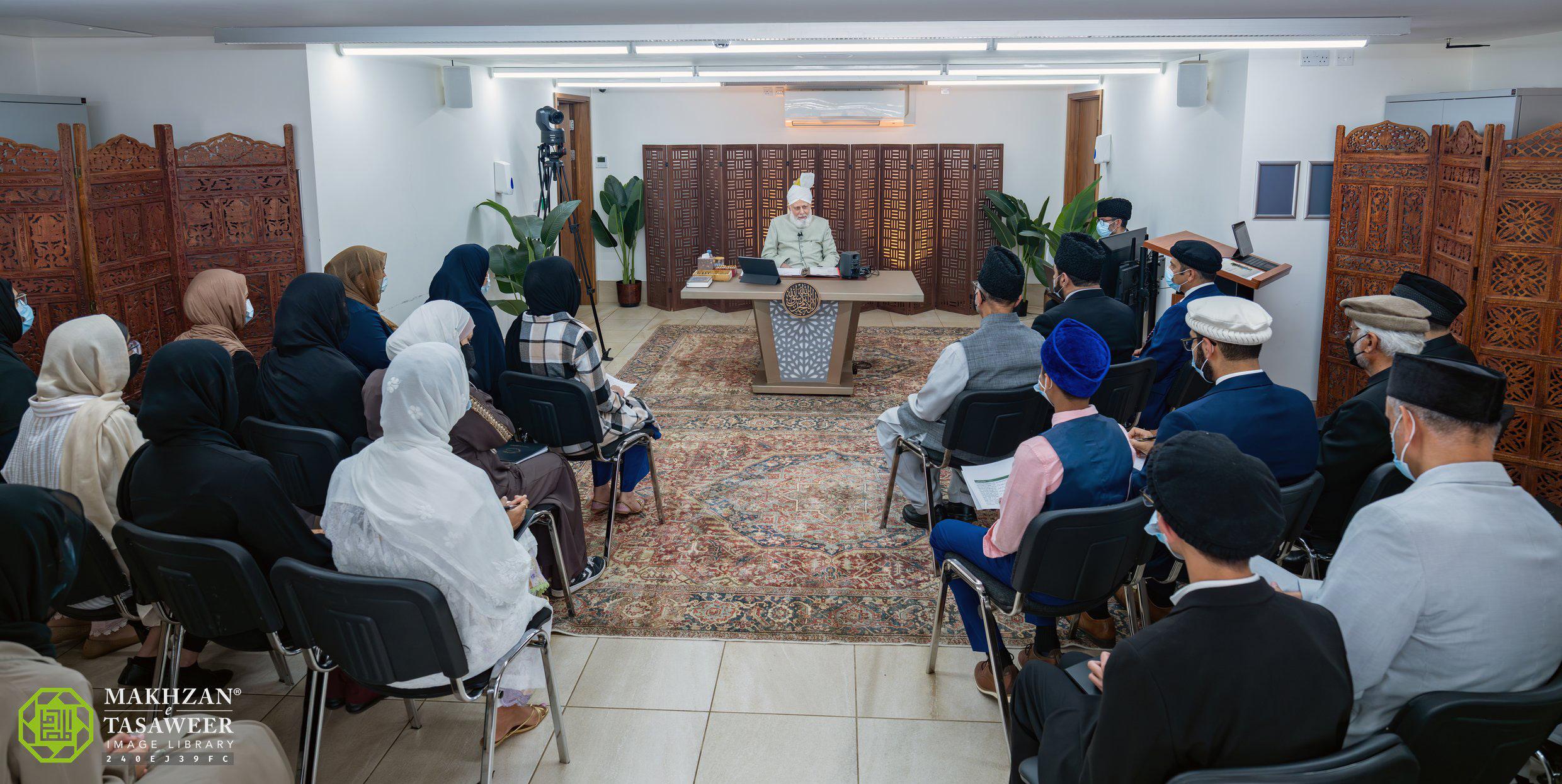
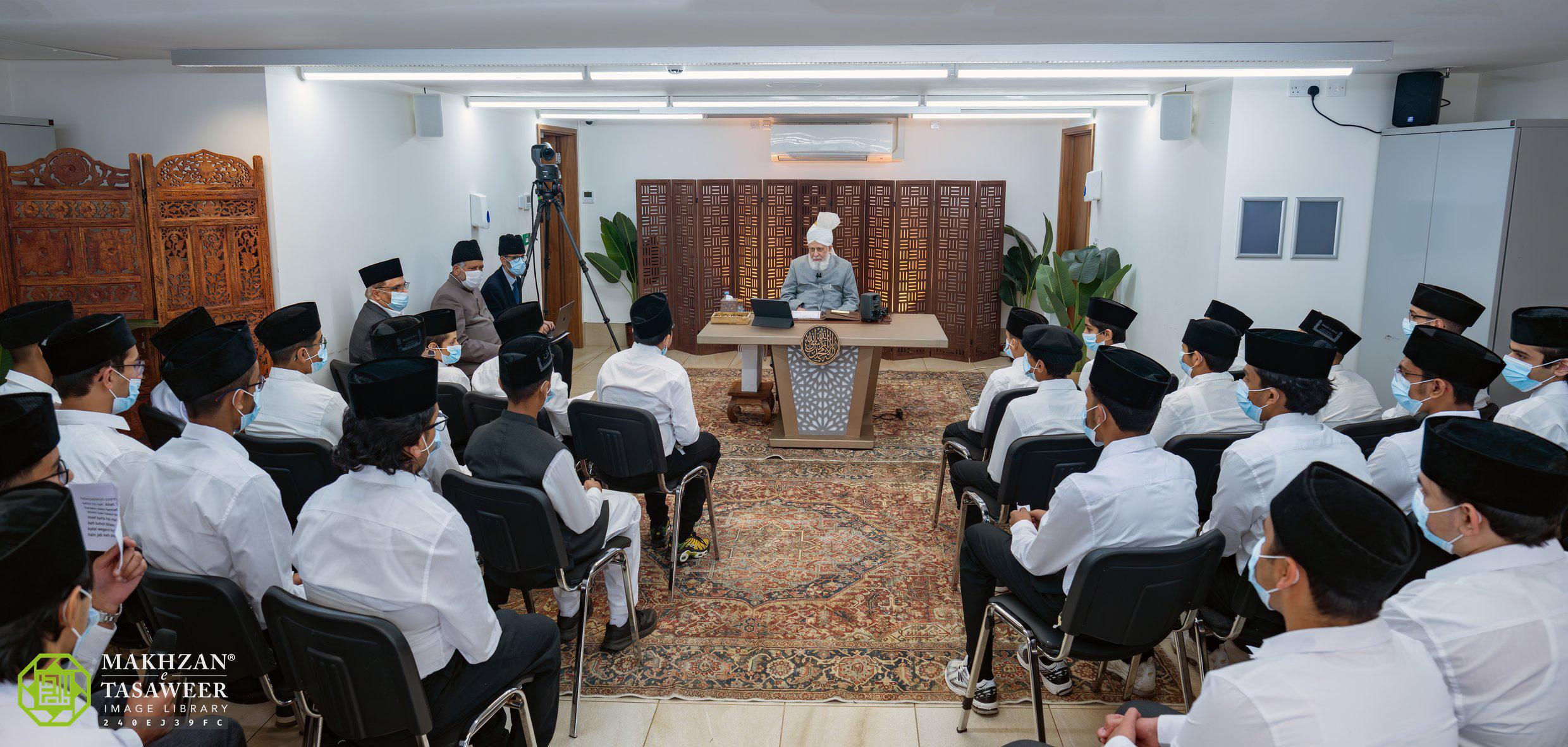
Islamabad, Tilford, UK, 1 June 2026: Members of the wider Additional Wakalate-Tasneef team from the United States were blessed with a mulaqat with Hazrat Mirza Masroor Ahmad, Khalifatul Masih V (aa).
A large team and a great responsibility
At the beginning of the mulaqat, Huzoor (aa) noted the size of the team and drew attention to the scale of the work that remained. He remarked that, with such a large team, the Jamaat’s literature should by now have been translated into English. Thereafter, Maulana Munir-ud-Din Shams Sahiab, Additional Wakil-ut-Tasneef, UK, presented a report on the progress of Additional Wakalat-e-Tasneef. He said that by the time of the previous mulaqat with Huzoor (aa) in 2023, translations of 309 books had been completed, at an average of about 15 books per year. Since then, a further 62 books had been completed, including 29 translated works and 33 formatted books, raising the average to just over 20 books per year. With regard to Ruhani Khazain and Malfuzat, he reported that 76% of the books had been translated. Out of 93 books of the Promised Messiah (as), 71 had been published in English, representing 60% of the total pages.
Continued on page 3
Two rewards for spending charity on family
Muhammadsa
This Week in History
26 June - 2 July
A glimpse into the rich history of the Ahmadiyya Muslim Jamaat
26 June
26 June 1942: During World War II, the Middle East was under severe pressure, and there was a big threat to the sacred land of the Hedjaz. At that critical juncture, in his Friday sermon on this day, Hazrat Musleh-e-Maud (ra) called on the Muslim world to pray and make the utmost efforts to protect the sanctity of those sacred places.
For more details, see “Hazrat Musleh-e-Maud’s services to the Muslim cause: Guidance for Turkey, peace in the Arab world and the Kashmir Movement”, Al Hakam, 19 February 2021, Issue 153, pp. 41-44.
26 June 1970: During his Friday sermon on this day, Hazrat Khalifatul Masih III (rh) called on Ahmadis to devote their lives under the Nusrat Jehan Scheme, and stated that there was a need for at least 30 doctors and 80 teachers.
For more details, see “Nusrat Jehan Scheme: Khilafat’s impetus for ‘Africa to Leap Forward’ –A glimpse into the early years (1970-1982)”, Al Hakam, 27 May 2022, Issue 219, pp. 16-18.
27 June
27 June 1905: Hazrat Hakeem Maulvi Noorud-Deen (ra) celebrated his son, Abdul Haye Sahib’s first reading of the Holy Quran. Under the guidance of the Promised Messiah (as), he also arranged food for people.
On this occasion, Hazrat Sahibzada Bashir-ud-Din Mahmud Ahmad Sahib (ra) wrote a poem, and a special issue of Al Hakam was also published. Hazrat Sheikh Yaqub Ali Irfani (ra) expressed to Hazrat Hakeem Maulvi Noor-ud-Deen (ra) that he wished that a hafiz of the Holy Quran be appointed in Madrasa Talim-ul-Islam who would teach and help others to memorise the Holy Quran. Hazrat Hakeem Maulvi Noor-ud-Deen (ra) agreed and stated that his heart also desired the same. However, it was not possible in the given circumstances. (Tarikh-e-Ahmadiyyat, Vol. 3, pp. 167-168)
27 June 2014: On this day, Hazrat Khalifatul Masih V (aa) delivered his Friday sermon, in which he paid a tribute to Maulvi Abdul Wahab Adam Sahib, who passed away on 22 June 2014. He was
an exemplary Ahmadi missionary and a sincere and devoted servant of Khilafat-e-Ahmadiyya.
28 - 30 June
28 June 1968: During his Friday sermon on this day, Hazrat Khalifatul Masih III (rh) instructed the members of the Jamaat to fulfil their responsibilities and continue to recite istighfar, in addition to praising Allah.
29 June 1938: Hazrat Musleh-e-Maud (ra) sent his son, Mirza Mubarak Ahmad Sahib, to Egypt so he could acquire knowledge of Arabic and excel his experience in agriculture from the land of Egypt.
On this occasion, Hazrat Musleh-e-Maud (ra) wrote down and highlighted some important matters and gave some advice to Mirza Mubarak Ahmad Sahib, which has been recorded on pages 485 to 490 in the seventh volume of Tarikh-eAhmadiyyat
Among many other important matters, Huzoor (ra) mentioned the importance of offering prayer at its prescribed time and in congregation.
29 June 2008: Hazrat Khalifatul Masih V (aa) graced the closing session of Jalsa Salana Canada. In his concluding address, Huzoor (aa) said that the past 100 years of Khilafat-e-Ahmadiyya and 120 years of the Ahmadiyya Muslim Jamaat were sufficient to prove that Allah’s favours were with this Jamaat.
30 June 1902: On this day, the Promised Messiah (as) wrote a touching letter to Hazrat Haji Seith Allah Rakha Abdur Rahman (ra) citing his recent observation. Huzoor (as) said that he saw four cats carry a sparrow’s neck in their jaws, one after the other.
For details of this incident, see “Lessons from four cats and a bird”, at alhakam.org (18 November 2022, p. 13).
1 July
1 July 1931: The education of girls has always remained a salient feature of the Ahmadiyya Jamaat from its beginnings. On this day, Hazrat Musleh-e-Maud (ra) inaugurated the faculty of arts for girls in Qadian.
On this occasion, Huzoor (ra) said, with respect to children’s schooling and education, that an allinclusive school ought to be set up for youngsters under the management of ladies who would then be able to impart extraordinary ethics and morals to them directly from adolescence. Huzoor (ra) added that this could only be achieved once there was a high number of educated women.
1 July 1988: On this day, Hazrat Khalifatul Masih IV (rh) called on the members of Jamaat-eAhmadiyya Canada to raise a fund of $2.5 million for the construction of new mosques. (Silsila Ahmadiyya, Vol. 4, p. 97)
2 July
2 July 1934: Hazrat Musleh-e-Maud (ra) announced the nikah of his son Hazrat Mirza Nasir Ahmad (rh). Huzoor (ra) also announced the nikah of Hazrat Mirza Mansoor Ahmad, son of Hazrat Mirza Sharif Ahmad (ra). Huzoor (ra) emphasised the importance and need of devoting lives to the cause of Islam, especially for members of the family of the Promised Messiah (as). (Khutbat-eMahmud, Vol. 3, p. 336)
2 July 1993: During his tour of Norway, on this day, Hazrat Khalifatul Masih IV (rh) delivered his Friday sermon in Oslo and directed the auxiliary organisations to plan to teach the Arabic language to Ahmadi children. Huzoorrh added that these children should learn Urdu along with Arabic and should master their local language as well so that we can use these three sources to spread the message of Islam in the world. (Khutbat-e-Tahir, Vol. 12, p. 491)
Members then introduced themselves one by one. The responsibilities mentioned included project management, translation, Urdu-to-English review, English review, high-level review, formatting, finalisation, indexing, archiving, cover design, eBooks, Arabic review, children’s books and educational activities.
Translation, review, formatting and publication workflow
During the introductions, several members explained that they were involved in translation and review work from Urdu into English, while others assisted with formatting, finalisation, reference checking, indexing and cover design. One member mentioned that he had been serving with the Tasneef committee since 2003 and was involved in archiving and, previously, cover work. Another member said that he carried out high-level review of Urdu-to-English translations, including formatting and checking references.
Huzoor (aa) also asked one member whether he knew Urdu or relied on AI assistance. The member replied that he knew Urdu, having been born in Pakistan and migrated later in life. Another member explained that, though he did not know Urdu, he assisted in translation and review from Arabic into English.
A member also reported that the department had compiled a list of more than 1,000 approved terms, based on approvals from the time of Hazrat Khalifatul Masih IV (rh) onwards. These terms had been incorporated into the Tasneef style guide so that, where the context was applicable, the approved English wording could be used consistently.
Young volunteers and family participation
Several young members were also present in the mulaqat and introduced their work. One boy in Year 7 said that he helped with formatting. Huzoor (aa) asked him whether he knew Urdu, how he carried out formatting and where he had learnt the technical skills. The boy replied that his father had taught him.
Another young member, who had recently joined Tasneef, introduced himself, upon which Huzoor (aa) encouraged him to
work more than the elders so that they too would be motivated to work.
The presence of several members from the same family was also noted. One Lajna member said she worked on formatting and eBooks, while her daughter explained that she assisted with formatting and cover design. Huzoor (aa) observed that the family had formed a whole team, so to speak, with even the children involved and said that this was a good thing.
Work on children’s books
Members of the children’s book team also introduced themselves. It was mentioned that some worked on translations, review, formatting, editing, indexing and educational activities for children’s books. One Lajna member said that she led the team working on children’s books and reported that, since the previous mulaqat, eight books had been completed.
Huzoor (aa) observed that, while comparatively fewer children’s books were available in Urdu, there were more in English. It was explained that some of the work involved translating books previously published by Majlis Khuddamul-Ahmadiyya of a certain country.
A thirteen-year-old waqifa-e-nau also introduced herself and said that she worked with the children’s team. Another member explained that she helped prepare activities such as word searches for the children’s books.
The English translation of Ruhani Khazain
After hearing the report and speaking with the members, Huzoor (aa) prayed that Allah may enable them to continue their work and drew attention to the need for greater speed in completing the remaining translations. He noted that 71 books from Ruhani Khazain had been completed and instructed that the remaining books should also be completed soon.
Huzoor (aa) then pointed out that the German team had completed the entire Ruhani Khazain in German, despite having begun only around ten years ago and despite having a smaller team. He added that the Arabic team had also completed the translation. Huzoor (aa) said that English had remained behind and that this was now
a challenge for the team.
Studies and Tasneef work
A young member asked how he should balance schoolwork with Tasneef work. He explained that, over the previous six months, he had spent around 12 to 18 hours a week on Tasneef and sometimes more due to deadlines, which meant that he occasionally delayed schoolwork. He added that, by the grace of Allah, he had maintained straight A grades and was passionate about Tasneef work.
Huzoor (aa) advised him clearly that he should do his schoolwork first and then Tasneef. His first priority should be school. Huzoor (aa) explained that once he completes his education and attains a good degree in whichever field he chooses, he can then give extra time to Tasneef work.
Huzoor (aa) said that as a young boy, he may certainly give time to Tasneef, but his first preference must remain his studies. He advised him to prepare a timetable. Huzoor (aa) noted that in the West, schools are only in session for part of the year, while many days remain free. During those free days, he can give time to Tasneef work; but when school is in session, he should give priority to his studies.
‘Tasneef’ means writing, not merely translation
A Lajna member from the children’s team mentioned that, while the team was preparing books for older children and teenagers, there was a shortage of books for children under the age of ten.
Huzoor (aa) said that the team should prepare such books themselves. He said that Allah had granted them fertile minds and ability and they should write and present such books. Huzoor (aa) reminded them that ‘tasneef’ does not mean translation only; it also means writing. Therefore, alongside translation, they should author short books for young children.
Conclusion
As the mulaqat concluded, the members had the opportunity to have photographs taken with Huzoor (aa). They also received pens as gifts.
(Summary prepared by Al Hakam)
Hazrat Amr bin al-Harith (ra) narrated from Hazrat Zainab (ra), the wife of Hazrat Abdullah [ibn Mas‘ud] (ra):
“‘I was in the mosque and saw the Prophet (sa). He said, “Give in charity, even if it be from your jewellery.”’ Zainab (ra) would spend on Abdullah (ra) and on some orphans who were under her care. She said to Abdullah (ra), ‘Ask Allah’s Messenger (sa) whether it will suffice on my behalf if I spend from my sadaqah [charity] on you and on the orphans under my care.’ He replied, ‘You should ask Allah’s Messenger (sa) yourself.’ [She states:] ‘So I went to the Prophet (sa) and found a woman from among the Ansar at the door, whose need was the same as mine. Bilal (ra) passed by us, so we said, “Ask the Prophet (sa) whether it will suffice on my behalf if I spend from my sadaqah on my husband and on orphans under my care” We also said, “Do not tell him who we are.” He went in and asked him. The Prophet (sa) said, “Who are the two women?” Bilal (ra) replied, “Zainab.” He asked, “Which Zainab?” He replied, “The wife of Abdullah [ibn Mas‘ud] (ra).” The Prophet (sa) said, “Yes. She will have two rewards: the reward of maintaining ties of kinship and the reward of sadaqah.””
(Sahih al-Bukhari, Kitab az-zakat, Bab az-zakati ‘ala z-zawji wa l-aytami fi l-hajr, Hadith 1466)
Mirza Ghulam
Serving others
On one occasion, there was a traditional indian-style bedstead (charpoy) in the new house on which Maulvi Abdul-Karim Sahib (ra) was sleeping. The Promised Messiah (as) was strolling there as well. After some time, when he awoke, the Promised Messiah (as) was lying down below the level of the charpoy on the ground. Maulvi Sahib stood up out of respect. The Promised Messiah (as) lovingly asked: “Why have you stood up?” Maulvi Sahib expressed that he had done so out of respect. On this, the Promised Messiah (as) said: “I was standing on guard for you. The boys would make noise and I would stop them so that your sleep would not be disturbed.”
(Malfuzat [English], Vol. 2, p.183)
Hazrat
Ahmadas, In His Own Words
A world in crisis needs Islam’s guidance: Waqifeen-e-nau from Belgium meet Huzoor
Islamabad, Tilford, UK, 31 May 2026: Waqfe-Nau boys from Belgium were blessed with a mulaqat with Hazrat Mirza Masroor Ahmad, Khalifatul Masih V (aa).
During the mulaqat, each had the opportunity to introduce himself and seek guidance from Huzoor (aa) on matters relating to science, salat, concentration, forgiveness, the future world order, good company, Eid-ul-Adha and balancing hifz with studies.
Serving the Jamaat through science and service to humanity
A boy asked how one could serve the Jamaat by becoming a scientist.
Huzoor (aa) said that he should become a scientist and then invent or discover something beneficial for both the Jamaat and the wider world. If, as a scientist, he works for the service of humanity, people will come to know that he is an Ahmadi. This, in turn, will open opportunities for tabligh. Huzoor (aa) explained that serving humanity is itself service to the Jamaat and that a scientist should be a servant of mankind.
Offering salat with open eyes
Another boy asked whether salat could be offered with closed eyes, as they had been taught that the proper way to pray is with open eyes.
Huzoor (aa) said that salat should not be offered with closed eyes. Rather, one should keep the eyes open and look towards the place of prostration. At the same time, one should keep in mind that Allah the Almighty is watching. Huzoor (aa) said that closing the eyes during salat may lead to drowsiness and that closing the eyes in this manner is associated with certain forms of meditation practised by others. The Islamic method is to keep the eyes open, focus on the place of prostration and remember that Allah is watching.
ADHD, concentration and avoiding unnecessary worry
A question was asked about ADHD and concentration difficulties, which are often discussed today.
Huzoor (aa) said that at times, when a child is slightly hyperactive, parents may quickly turn to psychiatrists and labels
such as ADHD, autism or other conditions may be applied. He explained that many children are simply active and energetic and parents should not become unnecessarily worried. Such children should be given the opportunity to study in normal schools where possible and should be supported by their parents.
Huzoor (aa) said that in Pakistan and in poorer countries, many active children are not labelled in this way, yet they still study, progress and become engineers, doctors and successful professionals. He observed that in some societies, such terms are used very frequently and can cause anxiety for parents.
At the same time, Huzoor (aa) clarified that there are some genuine cases in which a child may have such a condition and require treatment. In such cases, treatment should be sought. However, he advised that parents should not become distressed unnecessarily and should recognise that many children are naturally active.
The wisdom behind audible and quiet recitation in prayer
A boy asked why the imam recites aloud in
some prayers but not in Zuhr and Asr. Huzoor (aa) explained that the first principle is that Muslims follow what Allah has taught and what the Holy Prophet (sa) practically demonstrated. The Holy Prophet (sa) recited aloud in Fajr, Maghrib and Isha prayers, while Zuhr and Asr were offered with inaudible Quran recitation.
Huzoor (aa) also mentioned a practical wisdom behind this. In the morning, a person is generally fresh and the voice can travel more easily, so the recitation is aloud. During Zuhr and Asr, people are occupied in worldly activities and there is more noise and movement, so one should focus on one’s own prayer and follow the imam.
Huzoor (aa) advised the boys to read his detailed answers published in Al Fazl and Al Hakam too.
Shirk, forgiveness and sincere repentance
A question was asked about the Quranic teaching that Allah forgives all sins except shirk. The questioner asked why major sins such as murder may be forgiven, while shirk is not forgiven.
Huzoor (aa) explained that shirk is
a direct challenge to Allah’s authority. A person who sets something against Allah or places himself in a position of divine authority stands in opposition to Allah. Huzoor (aa) explained that sometimes even a murderer may display a form of this arrogance by acting as though he has control over life and death. He referred to the example of the king who argued with Prophet Abraham (as) and claimed that he too could give life and death. (Surah alBaqarah, Ch.2: V.259)
Huzoor (aa) said that if a person commits murder and then sincerely repents, Allah can forgive him. He related the account of a man who had killed 99 people and then sought a way of repentance. When one person told him that he could not be forgiven, he killed him too, making the number 100. Later, he was directed towards a righteous place where he could seek forgiveness. On the way, he died. The angels of punishment and the angels of mercy both came and it was decided that the distance should be measured to see whether he was closer to the place he had left or the place towards which he was travelling. Allah arranged that he was found closer to the place of forgiveness and he was forgiven because he had turned towards repentance. (Sahih al-Bukhari, Kitab ahadithi l-anbiya’, Hadith 3470)
Huzoor (aa) explained that if a person repents sincerely, Allah’s mercy can encompass him. Even in the case of shirk, if a person repents before death, Allah may forgive him. However, one who remains in shirk until the end and does not repent stands in opposition to Allah. Likewise, a murderer who persists in oppression and does not seek forgiveness will be punished.
Huzoor (aa) said that Allah may also reduce the weight of a person’s sins due to their good deeds. Ultimately, punishment is according to Allah’s wisdom and mercy. He also explained that a time will come when Hell will become empty after people have undergone their necessary punishment, just as a patient leaves hospital after treatment or a prisoner is released after serving his sentence. (Kanz al-Ummal, Hadith 39506)
Introducing the world to Islam’s spiritual and economic system
A question was asked about the statement of Hazrat Musleh-e-Maud (ra) that a time would come when the world would seek a new system and the Ahmadiyya Muslim Community would present a Nizam-e-Nau. The questioner asked whether, in light of present world conditions and the possibility of global war, such a system could be established after a future war.
In response, Huzoor (aa) explained that he had long been drawing the Jamaat’s attention to this matter. He said, “I have been saying this to the Jamaat for quite some time: when war takes place and devastation comes upon the world, then people will ask and seek [answers].” For this reason, Huzoor (aa) said, Ahmadis should begin introducing people to Jamaat-e-Ahmadiyya and the teachings of Islam before such circumstances arise.
Huzoor (aa) further explained that Ahmadis should tell the world, “It is through the teachings of Islam alone that your world can be saved, and it is through this system alone that the world will benefit.
Therefore, you should turn towards Allah the Almighty.”
He said that when people turn towards Allah the Almighty and Jamaate-Ahmadiyya presents this system, that is when this matter will come to pass. Referring to what he had stated previously in addresses to non-Muslim audiences, Huzoor (aa) said, “You have seen socialism, you have seen communism and you have seen capitalism, yet everywhere you see only disorder. Now adopt the true system of Islam as well and see; then you will come to know that the true system of Islam guarantees the betterment of the poor, the betterment of orphans, the betterment of widows and the economic condition of the world.”
Huzoor (aa) advised that Ahmadis should begin explaining both the economic and spiritual systems of Islam to people from now. He said that Ahmadis should tell them, “If you follow both of these, therein lies your protection; otherwise, there is none.”
Huzoor (aa) added that after people witness the consequences of worldly systems, Ahmadis should do tabligh to those who remain and tell them, “Now come towards this system. Having seen that system, you brought destruction upon yourselves; now come towards this one.”
Two prostrations for sahw in salat
A question was asked about the wisdom behind performing two prostrations of forgetfulness when a mistake occurs during salat
Huzoor (aa) explained that if a mistake is made, one performs two prostrations and seeks forgiveness from Allah. Every human being can make mistakes and when a mistake occurs in prayer, a person should ask Allah to forgive it. Huzoor (aa) explained the point simply by saying that just as a child says sorry to a teacher after making a mistake, the two prostrations are, in effect, a way of saying sorry to Allah for
the error made in salat
Not eating before the Eid-ul-Adha sacrifice
A question was asked about the hadith that the Holy Prophet (sa) would not eat on Eidul-Adha before offering the sacrifice. (Sunan at-Tirmidhi, Abwab al-‘idayn, Hadith 542) The questioner asked how this should be understood, given that fasting on Eid is not permitted.
Huzoor (aa) explained that a formal fast means eating at sehri time and then abstaining from food and drink until the evening. The practice of the Holy Prophet (sa) on Eid-ul-Adha was not a formal fast. He would drink water, but would not eat solid food before the Eid prayer and sacrifice.
Huzoor (aa) said that the Eid-ul-Adha prayer would take place early and after the sacrifice, the Holy Prophet (sa) would eat from the meat of the sacrificed animal. The wisdom was that the first food eaten that day would be from the sacrifice offered before Allah, so that he would partake of its blessing.
Recognising good company
A boy asked how one can recognise good company.
Huzoor (aa) explained that good company means having good friends and being around people who encourage righteousness. Those who advise a person to offer prayers, do good deeds, avoid mischief, refrain from fighting and show good morals are examples of good company.
He said that if a friend is involved in smoking, vaping, watching inappropriate films, fighting, using bad language or other wrong actions, then such company should be avoided. A person should also look at whether a friend is honest and sincere.
Huzoor (aa) gave a practical example, explaining that if someone only treats a
person well because that person has money and can buy food for them, such as taking them to Nando’s and then insults them when they have no money to spend, then that is not true friendship. Such people are not good companions. Good friends are those who are sincere, morally upright, good in their studies and conduct and who encourage what is right. Similarly, elders who advise children towards good deeds are also a form of good company.
Balancing hifz with school studies
A boy said that, by the grace of Allah, he was trying to memorise the Holy Quran, but due to the burden of studies, he was facing difficulty. He asked how he could succeed in memorising the Holy Quran alongside his other responsibilities.
Huzoor (aa) advised that during exam periods, instead of memorising new portions, he should revise what he had already memorised. He could recite those portions in salat or revise them while walking and during other suitable moments. During the exam season, he should give more attention to his schoolwork and examinations. Once exams are over and the holidays begin, he can resume memorising new portions.
Huzoor (aa) explained that those who attend a formal madrasa for hifz often focus only on memorisation for several years, whereas the boy was trying to do both school studies and hifz together. Therefore, during demanding periods, he should revise what he already knows and then continue with new memorisation after exams.
Conclusion
As the mulaqat concluded, the participants had the opportunity to have a group photograph with Huzoor (aa). They also received pens as gifts.
(Summary prepared by Al Hakam)
Answers to Everyday Issues
Divorce, washing hair during menstruation, Wasiyyat form, timeline of the Battle of Uhud and handshakes with the opposite gender
Guidance regarding basic Islamic issues that Hazrat Amirul Momineen, Khalifatul Masih Vaa, has given on various occasions in his written correspondence and during MTA programmes is being published officially below for everyone’s benefit.
What are the various modes of talaq (divorce) in Islam?
A lady from Canada wrote to Hazrat Amirul Momineen, Khalifatul Masih V (aa), stating that 20 years ago, her husband had repeatedly pronounced divorce [talaq] to her and on one occasion had also given it to her in writing. However, when she told him that she had thereby become divorced, he replied that talaq does not take effect in this manner and that the procedure in the Jamaat is different. He further said that if a husband revokes the talaq after pronouncing it, that pronouncement carries no legal effect. She requested guidance regarding the correct legal position.
In his letter dated 20 February 2024, Huzoor-e-Anwar (aa) provided the following guidance in this regard:
“I had previously written to you that
you should set out all the details of this matter before Mufti Sahib and seek a fatwa regarding it.
“As for the Islamic teaching regarding talaq [in principle], Islam grants a man three occasions on which he may divorce his wife. In the first two instances, the law leaves room for revocation [ruju‘], whereas after pronouncing divorce for the third time, the right of revocation no longer remains.
“Furthermore, some people utter the words ‘three divorces’ or ‘talaq, talaq, talaq’ in a single sitting, thinking that in this way they have exercised all three of these rights. This method is incorrect and three divorces do not take effect in this manner; rather, it counts as only one talaq. Evidence for this is also found in the Hadith. (Sunan Abi Dawud, Kitab at-talaq, Bab naskhi l-muraja‘ati ba‘da t-tatliqati th-thalath)
“The Promised Messiah (as) has also
guided us in this regard. Thus, he states:
“‘If three divorces are pronounced at one and the same time, the husband is granted this concession: that even after the expiry of the ‘iddah, he may contract marriage again with that woman, for such a divorce is unlawful and was not pronounced in accordance with the command of Allah and His Messenger (sa).’ (Malfuzat, Vol. 5, UK: 2022, p. 14)
“He further states:
“‘A divorce cannot be completed all at once. For divorce to be completed, three periods of purity [tuhr] are necessary. The jurists have deemed it permissible to pronounce three divorces at one time, yet alongside this, they have also allowed the concession that, after the expiry of the ‘iddah, if the husband wishes to resume the marriage, the woman may marry that same husband, or she may marry another man.’
(Malfuzat, Vol. 5, UK: 2022, pp. 16-17)
“However, if a person divorces his wife and pronounces a separate talaq during each period of purity within the threemonth waiting period, then, after the third pronouncement, that woman becomes unlawful for him. In jurisprudential terminology, this mode of divorce is called talaq hasan. The basis for this mode of divorce is found in the Hadith of the Holy Prophet (sa). (Sunan ad-Daraqutni, Kitab at-talaq wa l-khul‘i wa l-ila’i wa ghayrih, Hadith 4019)
“Seyyiduna Hazrat Mirza Ghulam Ahmad, the Promised Messiah (as), states in this regard:
“‘It is incumbent that those women who have been divorced should wait through three menstrual courses in the hope of ruju‘ During these three courses, which amount to approximately three months, there are to be two pronouncements of talaq – that is, after each menstrual course, the husband should pronounce talaq to the woman. Then, when the third month arrives, the husband ought to realise that he must now do one of two things: either pronounce the third talaq, thereby effecting a permanent parting and severance of ties in a gracious manner or refrain from the third talaq and retain the woman in his home with kind and honourable treatment. Furthermore, it shall not be lawful for him to take back anything of the wealth he had given her before the talaq. However, if he pronounces the third talaq, which comes after the third menstrual course, then that woman is no longer his wife and a fresh marriage with her cannot take place unless she first marries another husband (that is, such is the punishment of one who, despite the above-mentioned guidance, still fails to understand; and since she is now no longer his wife, she is entirely free to marry another man).’ (Arya Dharam, Ruhani Khazain, Vol. 10, pp. 52-53)
“Moreover, the jurists have mentioned another mode of divorce, which is called talaq ahsan. This mode is based on its having been favoured by the noble Companions
Image: Andrei Sidorov/Unsplash
and its procedure is that a single talaq be pronounced and the woman then be left until three menstrual courses have passed. Since this affords greater ease to both parties, the jurists have termed it talaq ahsan
“Seyyiduna Hazrat Musleh-e-Maud (ra) states regarding this mode of divorce:
“‘The words of the Holy Quran,
[“Revocable divorce can only be pronounced twice” (Surah al-Baqarah, Ch.2: V.230)], are unequivocally clear. The preceding verse, makes it clear that the period of divorce extends to three menstrual courses [quru’]. It states:
“‘[“Divorced women shall wait, concerning themselves, for the space of three courses. It is not lawful for them to conceal what Allah may have created in their wombs, if they believe in Allah and the Last Day. If their husbands should desire reconciliation during this period, they would have the stronger right to the continuation of the marriage than that it should be irrevocably dissolved.” (Surah alBaqarah, Ch.2: V.229)]
“‘During this period, a man may resume the marriage by ruju‘ without a fresh nikah Furthermore, the verse appearing shortly after
shows that, after the expiry of the period of divorce, the husband may contract a fresh nikah with her. It states:
“‘[“When you divorce your wives and they reach the end of their waiting period and the divorce becomes irrevocable, do not hinder them from marrying their chosen husbands, if they agree between themselves in an approved manner.” (Surah al-Baqarah, Ch. 2: V. 233)]
“‘The intervening verse, نِتٰرَّمَ
, refers to this first category of divorce and this first category of divorce is precisely that in which ruju‘ is permissible up to three quru’ and after the expiry of the three quru’, nikah is permissible.
“‘In short, the verse
indicates that such a divorce may occur twice. Its plain meaning is that, if the ‘iddah expires after a divorce, the husband retains the right, on two occasions, to contract marriage with her anew. After two such occurrences, if the man divorces her yet again, he no longer retains the right to nikah with her, nor does he retain the right of ruju‘ during the ‘iddah. Thereafter, this right can accrue to him only if that woman formally marries another man and that man subsequently divorces her for some reason.’ (Tafsir-eKabir, Vol. 3, UK: 2023, pp. 353-354)
“Both of these modes of talaq are authoritatively established. Therefore, whichever of these methods a person adopts in divorcing his wife, the rulings relating to revocation and the waiting period shall apply to him in accordance with that particular mode of divorce.”
Is it forbidden for women to wash their hair during menstruation?
A lady from the USA asked Hazrat Amirul Momineen, Khalifatul Masih V (aa), “Someone told me that there is a hadith stating that women cannot wash their
hair during their monthly courses. Is this correct?”
In his letter dated 20 February 2024, Huzoor-e-Anwar (aa) replied as follows:
“I am not aware of any such hadith which mentions that women cannot wash their hair on their heads during their monthly courses. However, it is possible that, from a medical standpoint, using excessively cold water in this condition might cause some degree of harm. But even regarding this, only a doctor or physician can offer the best advice.”
Can a woman act as a witness on a Wasiyyat form?
A lady from Canada wrote to Hazrat Amirul Momineen, Khalifatul Masih V (aa), stating that two witnesses are required on the Wasiyyat form. She asked why a woman cannot serve as one of those witnesses. If, where women are to testify, two women are required, why is no such condition mentioned on the form? Moreover, why has no space been allocated on the form for two female witnesses?
In his letter dated 20 February 2024, Huzoor-e-Anwar (aa) provided the following guidance in this regard:
“Since men are generally more involved in matters of financial transaction, preference has been given to male testimony in such matters. However, if in a particular case men are not available to serve as witnesses and the matter is urgent, Islam has permitted the testimony of a woman in such a case of necessity as well. In that event, as a precaution, another woman is included alongside the female witness, so that if the witnessing woman forgets, the other woman may remind her of the actual matter.
“Previously, only male witnesses were entered on the Wasiyyat form and if a woman had to be included as a witness in
some place, the signature of one additional woman was also obtained alongside hers. However, this has now been changed and, where men are not available, the testimony of one woman is also deemed equivalent to that of one man.
“Besides this, one should not create needless confusion in every matter and then try to link it to the Sharia. Filling in a form is not a command of the Sharia. Indeed, in the time of the Holy Prophet (sa), there were no forms or the like even for nikah. Rather, the process of proposal and its acceptance took place verbally and the witnesses also testified verbally. Moreover, people’s standard of truthfulness, righteousness [taqwa] and integrity was very high. Thus, a woman came to the Holy Prophet (sa) and requested khul‘ from her husband and she herself also stated that whatever her husband had given her was still with her. The Holy Prophet (sa) said that, in that case, she would have to return the mahr she had received from her husband. The woman replied that she was willing to give even more than that. Upon this, the Holy Prophet (sa) said, ‘No more than that – simply return what you have taken.’ (Sahih al-Bukhari, Kitab at-talaq, Bab al-khul‘i wa kayfa t-talaqu fih; Sunan Abi Dawud, Kitab at-talaq, Bab al-khul‘; AsSunan al-Kubra, Al-Bayhaqi, Kitab al-khul‘i wa t-talaq, Bab al-wajhi l-ladhi tahillu bihi l-fidyah, Part 7, p. 314)
“However, people no longer possess that standard of truthfulness and taqwa and many resort to falsehood in order to secure the most trivial worldly gains. Therefore, forms and written documents are prepared in order to avoid legal complications, so that in the event of disagreement or dispute, these documents may be presented as evidence.”
When did the Holy Prophet (sa) leave Medina for the Battle of Uhud?
Someone from Canada wrote to Hazrat Amirul Momineen, Khalifatul Masih V (aa), pointing out what they believed to be an apparent contradiction between the time the Holy Prophet (sa) left his home for the Battle of Uhud, as mentioned in Huzoor’s (aa) Friday sermon and the time mentioned in verse 122 of Surah Aal-e-‘Imran of the Holy Quran. They set out three possible explanations and suggested that the matter be investigated further.
In his letter dated 20 February 2024, Huzoor-e-Anwar (aa) provided the following guidance in this regard:
“I was surprised by your question that, despite being educated, you have said such a thing. You have conflated two separate matters and thereby created a supposed ‘contradiction’ of your own.
“I stated in my sermon that on Friday, after the Friday prayer, the Holy Prophet (sa) set out from Medina for the plain of Uhud and it is recorded in all the books of history and particularly in the meticulously researched work The Life and Character of the Seal of Prophets by Hazrat Sahibzada Mirza Bashir Ahmad (ra), that news of the arrival of the Quraish army had spread in Medina on Thursday and the report of the attack carried out by the Quraish at a place called Urayd had also become widely known. Therefore, a state of severe fear and danger prevailed in Medina that night and certain leading Companions stood guard around the house of the Holy Prophet (sa) throughout the night.
“The following day, which was Friday, the Holy Prophet (sa) gathered the Muslims and sought their counsel regarding the Quraish army, asking whether they should remain
Image: Yasir Gürbüz/Pexels
in Medina or go out to confront the enemy. The Holy Prophet (sa) also mentioned his dream. Then, after the Friday prayer, the Holy Prophet (sa) made a general appeal to the Muslims to join this expedition in jihad in the cause of Allah. After this, Hazrat Abu Bakr (ra) and Hazrat Umar (ra) had the honour of assisting the Holy Prophet (sa) in his military preparations.
“The Holy Prophet (sa) appointed Hazrat Abdullah bin Umm Maktum (ra) to lead the prayers in Medina and, accompanied by a large body of Companions, set out from Medina after the Asr prayer. Mount Uhud lies about three miles to the north of Medina. At the halfway point, at a place called Shaikhain, the Holy Prophet (sa) halted, reviewed the army and sent the underage boys back to Medina. The Holy Prophet (sa) assigned the duty of the night
watch to Hazrat Muhammad bin Maslamah (ra), who, along with 50 Companions, stood guard around the Muslim army throughout the night.
“The following day, Saturday, 15 Shawwal, 3 AH, corresponding to 31 March 624 CE, the Muslim army advanced before dawn, offered the Fajr prayer on the way and reached the foot of Uhud just as morning broke. At this point, the chief of the hypocrites, Abdullah bin Ubayy bin Salul, abandoned the Muslim army with his 300 followers and returned to Medina. However, relying upon the help of God, the Holy Prophet (sa) advanced and pitched camp at the foot of Uhud in such a manner that Mount Uhud lay to the rear of the Muslims. To guard a pass located in this mountain, he appointed fifty archers from among the Companions under the command of Hazrat Abdullah bin Jubair (ra) and likewise drew up the remainder of the army.
“The Holy Prophet (sa) made all these arrangements for the army in the morning, which the Holy Quran has alluded to:
“‘And [remember the time] when thou didst go forth early in the morning from thy household, assigning to the believers their positions for battle. And Allah is
“Thus, by conflating the events of Friday and Saturday in your mind, you have created a ‘contradiction’ of your own making, which is in fact no contradiction at all, but rather the events of two separate days. This is corroborated by the Holy Quran, as well as the books of history and Hadith. Therefore, there is no need for any further investigation in this matter.”
In Islam, is it forbidden to shake hands with the opposite gender?
A gentleman from Morocco sent an enquiry to Hazrat Amirul Momineen, Khalifatul Masih V (aa), asking whether shaking hands with women is haram. If it is haram, with which relatives is it haram to shake hands?
In his letter dated 23 February 2024, Huzoor-e-Anwar (aa) provided the following instructions in this regard:
“Islam does not permit a man and a woman who are outside the prohibited degrees of marriage [non-mahram] to shake hands with one another. Therefore, such a man and woman should not shake hands with each other. It is also mentioned in the ahadith that the Holy Prophet (sa) would not shake hands with non-mahram women.
(Sunan an-Nasa’i, Kitab al-bay‘ah, Bab bay‘ati n-nisa’)
“The Promised Messiah (as) states in this regard:
“‘Look at the righteousness of our Lord and Master, the Greatest of the Prophets, Best of the Virtuous, Muhammad, the Chosen One, peace and blessings of Allah be upon him! He would not shake hands even with chaste and pious women who came to pledge allegiance to him. Instead, he would seat them at a distance and exhort them only verbally regarding repentance.’ (Nur-ul-Quran, Ruhani Khazain, Vol. 9, p. 449)
“Hazrat Maulvi Sher Ali (ra) relates, ‘Once, the late Dr Muhammad Ismail Khan submitted to the Promised Messiah (as) that an English lady doctor worked with him in the hospital and she was an elderly woman. She would sometimes shake his hand; what was the ruling regarding this? Hazrat Sahib (as) replied, “This is not permissible. You should excuse yourself by saying that this is not permissible in our religion.”’ (Sirat-ulMahdi, Part 1, Narration 404, p. 362)
“Thus, Islam forbids handshaking between a non-mahram man and woman. However, where a mahram relationship exists, there appears to be no objection to a man and woman shaking hands.”
(Compiled by Zaheer Ahmad Khan, Head of Records Department, Private Secretariat, London and translated by Al Hakam)
The search for meaning: The burden of human consciousness
Al-Fawaz Ajimoti
Student, Jamia Ahmadiyya International Ghana
In the hierarchical competition of the animal kingdom, the human body is not in any way exceptional. In fact, it is painfully insignificant. Compared to other animals, our body is not the best at doing anything –the cheetah runs faster, the fish swim better, bees are better manufacturers, and nearly every animal in the wild is stronger than man.
Yet all existing philosophy and theology agree that human beings lie at the top of the chain. The Holy Quran also acknowledges the fact that only man was able to bear the trust of the divine command, which neither the heavens nor the earth nor the mountains are able to bear.
What makes man superior and worthy of the Creator’s attention, then, when we can’t even say categorically that he is better than other animals?
The reality is that, despite being handicapped in many ways, we possess something no other animal does or can: The soul – and therein lie all the clues.
Soul and consciousness
It is said that we are not beings of bodies that possess souls; we are beings of souls living in bodies. This is why we discard the body when we die – left buried under heaps of dirt or cremated in blazing furnaces – while our souls continue to live on, though in ways we
may not yet fully comprehend.
The Holy Quran also clarifies that we know close to nothing about the true nature of the soul. It says:
“And they ask thee concerning the soul. Say, ‘The soul is by the command of my Lord; and of the knowledge [thereof] you have been given but a little.’” (Surah Bani Isra’il, Ch.17: V.86)
The human soul is primarily what distinguishes us from other creations. It is from the category of رَّمَأ (God’s command) as opposed to the body, which belongs to the category of قَلٰخَ (God’s creation). It is the powerhouse of consciousness, a portal to the otherworldly and a most powerful entity.
“You are not a drop in the ocean. You are the entire ocean in a drop.” This quote, which is famously ascribed to Maulana Rumi, means that the skin that we wear is the drop, and there is a whole ocean trapped within it, waiting to realise its potential, waiting to fulfil its destiny. That ocean is what we know as the soul.
The soul’s quest for its Creator
As already discussed above, the human soul is not of this world; it is a spiritual entity, belonging to the other world, so it is only right that it seeks beyond the physical world, to find out how it got here, who created it
and for what reason.
The Holy Quran also attests to this natural predisposition of humans to believe in the existence of a higher power and naturally submit themselves to Him. It says:
“And when thy Lord brings forth from Adam’s children – out of their loins – their offspring and makes them witnesses against their own selves [by saying]: ‘Am I not your Lord?’ They say, ‘Yea, we do bear witness.’”
(Surah al-A‘raf, Ch.7: V.173)
In the Five Volume Commentary, it is written:
“The verse may be interpreted [...] to refer to the inborn idea in man about the existence of a Supreme Being Who has created and Who governs the universe. God has embedded this idea in the very nature of man so that he may be admonished thereby and seek a way towards his Maker.” (Five Volume Commentary, Vol. 2, p. 1058)
This same quest is echoed in other religious scriptures. For example, we read in the Psalms:
“As the hart panteth after the water brooks, so panteth my soul after thee, O God.” (42:1 KJV)
Similarly, the Bible says:
“But seek ye first the kingdom of God, and his righteousness; and all these things shall be added unto you.” (Matthew 6:33 KJV)
The search for meaning: A quest for all
Philosophy or the search for the deep meaning of life, is often regarded as being only for the privileged and intellectuals. However, the truth is, the search for meaning is not limited only to the intellectuals. It is for whoever has the ability to think, or at least whoever cares enough to.
No doubt, academic philosophy, with all its jargon and complicated concepts, may be left for the privileged intellectuals who possess the luxury of time and resources, but the essence of philosophy – questioning who brought us here and why, knowing what is right and what is wrong and ascertaining what we are, and what we ought to be – all these are for everyone.
So, although not everyone has the luxury to sit around and debate on metaphysics or complicated paradoxes, everyone is on the search to figure out the enigma of life, albeit
Image: Ron Lach/Pexels
Propagation of Islam Ahmadiyyat in America and Hazrat Khalifatul Masih II’s message to the Ahmadis of Bengal (1926)
Al Fazl, 4 June 1926
Muhammad Yusuf Khan USA
We are immensely grateful to Allah the Almighty that, through the efforts of the Jamaat of the Promised Messiah (as), our Gracious Lord has today granted even the inhabitants of this land of disbelief the opportunity to accept Islam. God has not only bestowed upon them the ability to embrace Islam, but, through His grace and through the blessings of the prayers of His appointed one and his successor, He has also granted them the strength to observe the commandments of Islam.
Among the new convert Muslims in America were some individuals who completed the entire fasts of Ramadan. The names of those who fulfilled the injunctions of the month of Ramadan are as follows:
Mr Abdul Haq Francis, Mrs Aisha Francis, Mr Corf Scenery, Mr Latif Woodland, Professor Barkatullah William, Brother Abdul Hakeem Augustus (Advocate) and Mrs Nimatullah Rice.
Eid-ul-Fitr in Chicago
Here, Eid-ul-Fitr was celebrated on Tuesday, 13 April 1926, concerning which an announcement had been made in advance. Accordingly, people arrived on time as announced and our brother, Lutfur Rahman Sahib, led the Eid prayer.
Thereafter, I delivered the Eid sermon, in which the issues and injunctions relating to Eid were explained. Subsequently, our brother Chaudhry Abdul Hamid Sahib (BS Mechanical Engineer) rose and delivered an impassioned speech, the essence of which was that until we succeed in making the whole of America Muslim, our Eid will not be a true Eid. In other words, he expounded the following verse in detail:
After the speeches, food was served to all and the number of attendees was between forty and fifty.
Consistency in work
As the scope of our tabligh [preaching] continues to expand, our duties and responsibilities are likewise increasing. In the beginning, when a mission is first established, the work is limited. The missionary’s attention is confined only to lectures and the correspondence of the Jamaat. However, the work then gradually begins to expand: lectures, correspondence, meetings, the moral supervision of new converts, their religious instruction and training, and keeping them organised, among other responsibilities.
In yesterday’s mail, I received a blessed letter from my master, Hazrat Mahmud Ahmad [ra], containing extremely excellent instructions regarding tabligh. If only these instructions had been acted upon from the very outset, Ahmadiyya missions would by now have been established in many cities across America. Nevertheless, what is past is past; caution for the future.
Even now, may our Gracious Lord grant us the ability to act upon these instructions, through which the sphere of tabligh will expand and gain strength. Until we adopt consistency as our principle, we shall by no means attain our objectives.
Previously, I had been striving according to my own understanding. Now that these valuable instructions have become available, my preliminary proposals will, God willing, assume the form of an organised system and produce better results.
The first publication of the American Muslim Publishing Society
It has already been mentioned in a previous report that we established here a society under the name American Muslim Publishing Society. By the grace of God, all members paid their contributions, through which the first leaflet will be published. Though it is only a single sheet, every undertaking begins with a small foundation. When the American Bible Publishing Society was established, its foundation too was laid with only a few coins, yet today there is virtually no limit to the extent of its publications.
Ahmadiyya Mission of Trinidad
Shaikh Ibrahim Sahib Mondezi writes:
“I am fully occupied in the tabligh of Islam Ahmadiyyat and many people frequently enquire about Islam. However, I do not possess any literature that I can give to them. At the request of the people, I deliver a lecture every month at Liberty Hall and by the grace of Allah the Almighty, I am hopeful that we shall soon establish ourselves here on a firm footing.”
Mr Jarrett of Central America
Islamic literature is sent to Mr Jarrett from time to time, which he continues to distribute among the people. He writes:
purchase land for laying railway tracks in Chicago, the clergy opposed it and declared that the railway was a satanic invention and contrary to the will of God. Their argument was that the railway had been invented to enable human beings to travel more quickly; if God had intended mankind to travel swiftly, He would have made all people like birds, enabling them to fly and cover great distances in a short time. Since God had not done so, it was evident, in their view, that the railway was contrary to the will of God.
An incident from last year illustrates this further. The clergy throughout the country united in an effort to have a law passed prohibiting the teaching of the science of evolution in schools, and to this day, the case remains under consideration before the Supreme Court.
Last week, one of America’s prominent scientists passed away. He had rendered distinguished services in the Agricultural Department and had also undertaken extensive research work. When he lay upon his deathbed, a clergyman came to hear his confession of sins. However, he replied: “I only regard Jesus as a servant of God and it is my belief that my salvation depends upon my deeds and not upon atonement.”
“For long has the True Faith [of Islam] remained suppressed; we shall raise it above all else – wait and see.”
At the end, it was the turn of our brother Abdul Haq Francis. He also delivered a brief address in which he stated that the presence of even a single Ahmadi student in Chicago is sufficient to fulfil the prophecy of the Promised Messiah (as). Zion City, too, is a sign of the Muhammadan Messiah.
In conclusion, he said that while other people celebrate their respective birthdays and anniversaries, he and his wife celebrate the day of their acceptance of Islam. Islam is dearer to him than his own life, his wife and his children.
I am always concerned lest the American people might reshape Islam in a different form. As Hazrat Khalifatul Masih II [ra] once stated in a sermon, “I am not concerned with how Europe will accept Islam; I am concerned with how I shall safeguard Islam from their hands.” In truth, this is a matter deserving deep reflection and consideration. If it is neglected, the Western nations will do to Islam what they have done to Christianity.
The appeal for Zakat and the response
Two weeks ago, I made an appeal regarding Zakat and the first person to respond to this call was Mrs Nimat Din Rice, who paid her Zakat. May Allah the Almighty grant her the best of rewards. It is hoped that, gradually, others too will be inspired and will seek to fulfil their responsibilities after recognising them.
“I remain engaged in spreading the message of Islam according to my ability, yet I am often astonished as to why these people are unable to comprehend such a simple and beautiful religion. The reason is that the [Christian] clergy have presented Islam before the world in a highly distorted form and have filled people’s hearts with such poison that some time is required to remove it.”
The hostility between science and Christianity
With the advancement of science, people’s aversion to Christianity continues to increase. The clergy know very well that when the world turns towards scientific knowledge and begins to progress, their livelihood will be threatened. For this reason, they have consistently sought to obstruct the advancement of science in every possible way.
Science says that the Earth is round, whereas the Bible says that the Earth is flat. Science teaches that no man can ascend to heaven [with their physical body], whereas Christianity says that their Jesus Christ ascended into heaven.
When railways were first introduced in America and a railway company sought to
Thereupon an uproar arose throughout the country. The clergy branded him an unbeliever and declared it unlawful to conduct his funeral service. From such incidents, friends may judge how deep Christianity’s hostility towards knowledge truly is.
Foreign priests expelled from Mexico
During the previous month, all European and American missionaries were expelled from Mexico by order of the Mexican Government, because they were secretly interfering in the political affairs of the country. I have already written in an earlier report that missionaries often clear political pathways in foreign lands under the guise of religion. In reality, these people are sheep outwardly but wolves inwardly. However, they were expelled from Mexico within a matter of hours because they were considered highly detrimental to the peace and progress of the country.
Mailing address
If any friend requires information or advice concerning America, correspondence may be addressed to me at the following address: M Y Khan, Moslem Ahmadi Missioner, 4448 Wabash Avenue, Chicago, Illinois, USA. – Muhammad Yusuf Khan, Chicago Al Fazl, 18 June 1926
A message from Hazrat Musleh-eMaud to the Ahmadis of Bengal Friends will be aware that our Bengali brethren, through great effort and perseverance, have been publishing a monthly magazine in the Bengali language entitled “Ahmadi”. For the first issue of its new year, Hazrat Khalifatul Masih II [ra] sent a message addressed to the Ahmadiyya Community of Bengal. A copy of this message was forwarded by brother Muhammad Abdul Hafeez Sahib from Calcutta [now Kolkata] for publication in Al Fazl. We reproduce it below with gratitude.
[Hazrat Mirza Bashir-ud-Din Mahmud Ahmad, Khalifatul Masih II (ra) stated]:
“Brothers of Bengal!
“Assalamu alaikum
“Thirty-five years have passed since the advent of the Promised Messiah (as) and eighteen years have elapsed since his demise. During this long period, what have we accomplished and what still remains before us to be achieved? This is a question that ought to arise in the heart of every sincere Ahmadi.
“During these thirty-five years, no more than a few hundred thousand souls have
Continued from page 8
in their own little ways. Because at its core, philosophy is not just the study of theories. It is the ache for clarity, the yearning to make sense of all this chaos. To search for meaning in our existence, not only because we must, but because we care enough to. And in that search, many people eventually realise that the questions point beyond the self.
Perhaps it is true, then what they say: True consciousness lies in knowing God.
Cognisance of God – The purpose of existence
Many people live their lives wandering aimlessly. No purpose to life, no means to attain it. They are simply living, waiting to die.
For the average 21st century man who is not inclined to religion, the search for meaning in life has absolutely nothing to do with God or religion. According to such people, everyone has different purposes which they can fulfil on their own without bringing God into the picture.
Although on the surface, this idea sounds quite logical. However, in reality, it is a highly short-sighted opinion, for we would then all have to agree that while the purpose of Jesus’ life is to save the Jews’ spiritual lives, the ‘purpose’ of Hitler’s life is to wipe out their race. And no one would then have the right to object to whatever purpose everyone decides to give their lives, leaving the entire system of civilisation to just crumble in itself.
However, if we subscribe to the idea of a Creator, Who not only creates and fashions, but also takes an active part in the physical, moral and spiritual upbringing of his creation and upon Whom their sustenance is heavily dependent, then the matter becomes easier to solve.
Allah the Almighty says in the Holy
entered the Ahmadiyya Community. As for those who are active workers and who take part in the system of the Jamaat for its propagation, they do not number more than fifty to sixty thousand. How regrettable is this rate of progress!
“There is no doubt that the Ahmadiyya Jamaat has been established by Allah the Almighty, and there is no doubt that He Himself is responsible for its progress. Yet there is also no doubt that Allah causes works connected with mankind to be carried out through human beings. Had He intended to turn people towards the truth Himself without human agency, He would never have raised a prophet, nor would He have commanded the formation of a separate Jamaat. It is precisely for this reason that God chooses prophets from among human beings and establishes communities, for He desires that His work be carried out through us. Therefore, the thought that this work belongs to God should not become a means of making us indolent; rather, it should make us more active. For do we not perform the work of our loved ones with even greater eagerness and enthusiasm than we perform our own?
“What is kufr [disbelief]? It is a dark cloud accompanied by lightning, whose thunder is capable of shaking hearts. And who are the disbelievers? They are our beloved ones, the very pieces of our hearts, wandering astray in the wilderness, far removed from the path, drenched continually by the rain and exposed to the danger of lightning. Shall we watch these dear ones perish in this manner and make no effort whatsoever to save them?
“Listen, O sons of Bengal! The Messiah of God descended in Western India and with loving eagerness he turned towards you, the inhabitants of Eastern India. He sprinkled upon you the water of life and brought some among you to life; he cast the light of divine understanding and awakened some who were asleep.
“Now Punjab is eager to meet Bengal, but between them stands a barrier like the Wall of Alexander. Yes, the wall of disbelief stands between Punjab and Bengal – a wall which even six hundred years of Pathan and Mughal rule could not demolish. Just as Islam chose Punjab and Bengal for its growth and development, so too has Islam Ahmadiyyat chosen Punjab and Bengal.
Yet the regions lying between them remain empty. Kingdoms could not break down this wall, but two loving hearts shall surely succeed in removing this obstacle.
“Arise, O brothers! Arise with hearts filled with love. Rise like the clouds that drench a land in an instant. Rise like the storms that sweep away all chaff and debris within a moment. Rise like the floods that carry away houses, towns, and cities before them. Yes, rise like the sun whose light dispels every darkness and, carrying the message of God throughout your land, proceed along the banks of the River Ganges towards that region from which the forefathers of your people once turned eastward. From this side, Punjab is striving. Who can prevent the hands of these two sisters, whose hearts beat with the emotions of love, from meeting one another? Yes, who can prevent them? God is with those who truly love; indeed, He becomes their vanguard.” – Mirza Mahmud Ahmad
(Translated by Al Hakam from the original Urdu, published in the 4 and 18 June 1926 issues of Al Fazl)
Quran:
“And I have not created the Jinn and the men but that they may worship Me.” (Surah adh-Dhariyat, Ch.51: V.57)
Commenting on this verse, the Promised Messiah (as) beautifully explains:
“It is obvious that man is not in a position to appoint the purpose of his own life, for he does not come into the world of his own accord, nor will he depart therefrom of his own will. He is a creature and the One Who created him and invested him with better and higher faculties than those of all other animals, has also appointed a purpose for his life. Whether anyone penetrates to it or not, the purpose of man’s creation without a doubt is the worship and the understanding of God and complete devotion to Him.”
(The Philosophy of the Teachings of Islam, pp. 158-159)
There is no doubt in the fact that wealth, prosperity, power, etc., however great and satisfactory they seem, are never enough to quench the intensity of man’s thirst for purpose. This also clearly alludes to the point that such preoccupations are not his major purpose of existence. He further explains:
“An intelligent person can appreciate this problem in this way also, that the purpose of everything is to be determined by its highest performance beyond which its faculties cannot operate. For instance, the highest function of a bullock is ploughing or irrigation or transportation. Its faculties are not adapted to anything else. Therefore, the purpose of a bullock’s life are just these three things. It has no power to do anything else. But when we look into the faculties of man and try to discover what is their highest reach, we find that he seeks after God, the Exalted.” (The Philosophy of the Teachings of Islam, pp. 160)
The effect of God in man’s life
In most countries around the world, religion is fading into irrelevance at a startlingly fast rate, and the reason is obvious – the lives of “religious people” are not in any way better than the irreligious. This causes doubts and scepticism to rise in the hearts of some believers, while others inadvertently abandon faith altogether. So why should the disbelievers care about a God whose sincere believers are not faring better? If cognisance and worship of God is the purpose of our existence, why are “loyal servants” of God suffering just like everybody else or even worse?
Allah the Almighty answers these questions by setting forth an excellent illustration:
less religious counterparts – they however, live comparatively, a far more successful and fulfilled lives than the irreligious people whose “life purposes” are completely material. This is because the soul, being not of this world, cannot be wholly contented by merely materialistic things.
These are the teachings brought by all prophets, and the truth of it has become even more obvious today than ever, as people everywhere keep falling prey to anxiety. Amidst all these, the guidance of the Holy Quran remains ever relevant:
“Aye! it is in the remembrance of Allah that hearts can find comfort.” (Surah arRa’d, Ch.13: V.29)
So even if the entire world of religion is in turmoil, the problem is not with the “path”, it is with the people “following” it.
Conclusion
“Unto Him is the true prayer. And those on whom they call beside Him answer them not at all, except as he is [answered] who stretches forth his two hands toward water that it may reach his mouth, but it reaches it not. And the prayer of the disbelievers is but a thing wasted.” (Surah ar-Ra’d, Ch.13: V.15)
The message here is clear. God remains as He always was – ever ready to uplift His servants unto their highest level of human perfection. But if one treads the wrong path and ends up at the wrong destination, who is to blame?
Those who have placed their beliefs in the “right God,” recognised his perfect attributes, remained steadfast, kept the company of the righteous, engaged in continuous supplications and striving in His cause, have reaped the fruit of belief. And the theory still proves true today, as it has in the past.
Therefore, while it is true that Godly people face trials – in fact more than their
It is an established fact that aside humans, no other animal or species of living things is required to search for meaning in their lives, for they possess neither the intellect nor the consciousness required to do so. Yet, unfortunately, despite all the favours conferred upon us, we do not want to take responsibility for it. We seem to have forgotten that to whom much is given, much is expected.
We keep on talking about God, yet spare neither the time nor the effort to talk to Him. We keep blaming God for every misfortune, yet praise ourselves for every success. We keep straying far from His light, then blame the dark for being dark. We keep covering up the lens, then fault the mirror for not reflecting light.
So perhaps it’s time we set things right. Because in the end, the One who gave us the ability to reason surely expects us to use it.
Friday Sermon
Mubarak Mosque, Islamabad, Tilford, UK
29 May 2026
The Promised Messiah (as) and the continuum of divine humility
After reciting the tashahhud, ta‘awwuz and Surah al-Fatihah, Hazrat Khalifatul Masih V (aa) stated:
Today, I will share some accounts of the humbleness and humility in the life of the ardent devotee of the Holy Prophet (sa), which were owing to his following the teachings and practice of his master and guide, the Holy Prophet (sa). I will also share his guidance with his Jamaat in this regard.
Observing the lofty standard of his humility, Allah the Almighty Himself certified this by means of a revelation. On 18 March 1907, the Promised Messiah (as) received the revelation:
“He is pleased with your humble ways.” (Tadhkirah, 2023, p. 675)
At one place, the Promised Messiah (as) states:
“It has been revealed to this humble one that on account of my meekness, humility, trust in God, sincerity and the Signs and [heavenly] light, I resemble the Messiah [Jesus] in his previous life; and that the nature of this humble one and the nature of the Messiah greatly resemble each other, as if they are two pieces of the same jewel or two fruits of the same tree. The harmony between us is of such a great extent that there is very little that the spiritual eye can distinguish between us. There also exists an overt resemblance, which is that the Messiah was the follower and servant of the faith of a perfect and high-standing Prophet, i.e. Moses, and his Gospel is a branch of the Torah, and this humble one too, is one of the lowliest servants of that majestic Prophet who is “Sayyidur-Rusul – the Chief of all Messengers (as) and the Crown of all Messengers.” (Barahin-e-Ahmadiyya, Part 4, Ruhani Khazain, Vol. 1, pp. 593-594 [subfootnote no. 3])
Once, a person submitted to the Promised Messiah (as) that while writing The Philosophy of Divine Revelation [Haqiqatul-Wahi] – a book written during the latter part of his life – and repeatedly proofreading it, he had exerted himself greatly and this was the cause for his health repeatedly deteriorating. He requested that he should rest completely for a few days and entirely refrain from reading and writing. The Promised Messiah (as) replied: “What effort have we exerted? In fact, we feel ashamed when we look at the effort the Companions (ra) exerted, and how happily they even let their heads be severed for the cause of God.” (Malfuzat, 2022, Vol. 9, p. 182)
At another place, the Promised Messiah (as) states:
“Ignorant people raise the objection that I elevate my own status beyond measure.” In other words, the Promised Messiah (as) elevates his own status excessively. He says:
“I swear by God Almighty that it is not in my nature or disposition to desire praise for myself and to take pleasure in displaying my own greatness. I have always preferred a life of humility and anonymity. However, it was beyond my power and control, for God Almighty Himself brought me forth. And whatever praise and greatness He has expressed regarding me in His words that He revealed to me, in fact, belong entirely to the Holy Prophet (sa).” (Malfuzat, 2022, Vol. 4, p. 114)
He would also guide new converts towards the humility and simplicity taught by Islam. Thus, it is recorded that on 22 October 1903, an Australian convert named Muhammad Abdul-Haq came to visit the Promised Messiah (as). During the conversation, the Promised Messiah (as) said to him: “One of our principles is that we lead a simple life. Our gatherings are free from all those formalities that have at present been declared by Europe to be the essentials of life. We are not bound by customs and traditions. We observe every tradition only to a certain extent lest abandoning them might cause harm or lead to sin. (That is, abandoning it should not cause harm or lead to sin.) Otherwise, with regard to eating, drinking and in our social settings, we prefer a simple life.” (Malfuzat, 2022, Vol. 5, pp. 294 and 298-299)
These were the lofty standards of humility which the Promised Messiah (as) desired to instil in his followers. Furthermore, on one occasion, he stated:
“One should adopt humility. Learning humility is not difficult. In fact, what is there to learn? Man is himself inherently humble, and he was created for humility.
“‘And I have not created the jinn and the men but that they may worship Me.’
“Pride and arrogance, etc., are traits which are all artificial. If a person removes this pretence, then humility alone will be seen as part of his natural disposition.” (Malfuzat, 2022, Vol. 5, p. 38)
Thus, this is the principle through which the nearness of Allah the Almighty is attained.
While further urging people to adopt humility, he states at another place:
“Blessed are those who consider themselves most humble and lowly, speak modestly, respect the poor and needy, and treat the helpless with honour and never ridicule them out of mischief and arrogance. They remember their Gracious Lord and walk with humility on the earth. So I say repeatedly that it is people such as this for whom salvation has been made ready. One who is not free from the hell of mischief,
arrogance, self-conceit, haughtiness, worship of the world, greed, and immorality in this very world will most certainly not be free from them in the hereafter. (That is, the good deeds they carry out in this life will avail them in the next life.) What should I do and from whence should I produce such words that should affect the hearts of this group of people (i.e., his followers)?
“O my Lord! Bestow upon me such words and reveal to me such discourses that should illuminate these hearts with light and remove their poison with their remedial qualities! My entire being throbs with this deep longing that at some point that day should come when I will see in my Community many such people who have in fact forsaken falsehood and have made a sincere pledge with their Lord that they will safeguard themselves against every kind of evil, and will absolutely distance themselves from arrogance, which is the root of all mischief (arrogance is the root of all evil), and will remain fearful of their Lord.” (Shahadatul Quran, Ruhani Khazain, Vol. 6, p. 398)
Some people desire to sit in the front rows at Jalsas, functions or other gatherings. At Jalsas in particular, there are often special areas in the front, such as the Green Area or similar sections, where some people have a strong desire to sit. If the purpose is to hear and see the Khalifa of the time more closely, that is understandable. However, at times it is owing to ego, and this should not be the case. Moreover, such attitudes can create difficulties for those responsible for organising the event. In any case, while advising those who harbour such desires, the Promised Messiah (as) states:
“A person should choose for himself the lowest place whenever he goes somewhere. If he is worthy of a higher place, then the host himself will call him forward, offer him a seat, and honour him.” (Malfuzat, 2022, Vol. 5, p. 93)
If there is a system in place for seating arrangements and someone wishes to sit in a particular area, then that is fine – there is a procedure to follow. One may submit a request, and the administration will consider it. However, if the administration does not approve the request or if circumstances make it impossible to accommodate it, then one should accept that decision without objection and without allowing any complaint or grievance to arise in one’s heart.
Furthermore, humility is also essential for attaining the love of Allah. Regarding this, the Promised Messiah (as) states:
“No one can attain the love and pleasure of Allah until they inculcate two qualities within themselves. Firstly, one must break
their own arrogance in the likeness of a tall-standing mountain that crumbles and is razed to the ground. In the very same manner, one ought to dispel all their thoughts of arrogance and superiority. One must adopt humility and lowliness.
“Secondly, one must sever all of their worldly ties, just as a mountain falls to the ground and is
“[‘rent asunder’]
“(This word has been mentioned in the Holy Quran, i.e., broken into pieces.) In the same manner, a person’s earlier associations, which result in impurity and incur divine displeasure, must all be broken.”
This means that one should sever old associations that were leading to evil and corrupting you. It does not mean that all family ties and relationships should be cut off. Rather, it means removing those harmful connections so that an inclination towards righteousness may develop.
“Then one’s meetings, friendships, loves, and even enmities should be solely for the sake of Allah the Almighty. Whatever action one undertakes should be for the purpose of attaining the pleasure of Allah. (Malfuzat, 2022, Vol. 2, p. 171)
On one occasion, the Promised Messiah (as) said:
“For the protection from sin, Allah the Almighty has taught this prayer:
“(‘Thee alone do we worship and Thee alone do we implore for help.’)
“Those who continue to supplicate before their Lord in humility, hoping that some act of lowliness and meekness may be accepted, find that Allah Himself becomes their Helper.”
In this connection, the Promised Messiah (as) related an anecdote:
“There was a devout worshipper who would pray profusely, saying: ‘O Allah, grant me freedom from sin.’ After praying for a long time, he began to wonder how and by what means he could attain the highest degree of humility. He reflected on what form of humility would be most complete and concluded that no creature was more humble than a dog. So he began to weep, imitating the cry of a dog.
“Another man heard the sound and thought that a dog had entered the mosque. Fearing that it might make his pot impure, he came to investigate. When he looked, there was no dog there; only the worshipper.
“Eventually, he asked, ‘I heard a dog crying here. Who was it?’
“The worshipper replied, ‘It was I. I am the dog.’
“The man asked, ‘Why were you crying like that?’
“He answered, ‘Allah the Almighty loves humility, so I thought that perhaps in this way my humility would be accepted.’”
(Malfuzat, 2022, Vol. 5, p. 210)
This, of course, was his own way of thinking, and he acted according to that understanding. His objective was to become the lowest and most insignificant of beings so that he might somehow attain the nearness of Allah.
In the same context, the Promised Messiah (as) further states:
“Humans, who are a humble creation, begin to consider themselves great because of the result of their own deeds. (It is the result of one’s actions that creates this sense of greatness.) Pride and arrogance overtake that person. In the way of Allah, until a person regards himself as the smallest of all beings, he cannot attain deliverance.”
(Malfuzat, 2022, Vol. 5, p. 138)
While instructing those who entered into his pledge of allegiance to attain the highest standards of humility, the Promised Messiah (as) states:
“This pledge of allegiance, in reality, means to sell oneself. Its blessings and effects are linked to this very condition, just like a seed that is sown in the earth. Its initial state is such that it was sown by the farmer’s hand, and there is no idea as to what will become of it. (It is buried deep within the ground, and is hidden from sight; no one knows what it will become.) But if that seed is excellent and possesses the capacity for growth, then by the grace of God and through the efforts of the farmer, it emerges above the soil. (Its sprouts and shoots appear) and one grain produces thousands of grains. In the same way, a person who enters into the pledge of allegiance must first adopt the utmost humility and meekness and must separate himself from his selfishness and desires. Only then does he become capable of growth. But the person who retains selfishness alongside the pledge of allegiance can never receive any benefit from it. (Without humility, there is no benefit to the Pledge of Allegiance.)” (Malfuzat, 2022, Vol. 5, pp. 306-307)
The Promised Messiah (as) further states, “The more gentleness you adopt and the more humbleness and humility you display, Allah the Almighty will be all the more pleased with you.” (Malfuzat, 2022, Vol. 9, p. 66)
The Promised Messiah (as) further says, “The person who seeks the pleasure of God Almighty through humility, Allah the Almighty becomes pleased with them.” (Malfuzat, 2022, Vol. 9, p. 211)
Then, explaining what is gained through humility and where arrogance ultimately leads a person – regarding this point, he states: “At first Adam committed a sin, as did Satan. However, Adam did not possess arrogance. Therefore, he admitted his fault before Allah the Almighty and his sin was forgiven. From this, humans learn that there is hope for the forgiveness of sins through repentance. (Since Allah Almighty forgave Adam, a person who shows humility and repents should also hope that Allah the Almighty will forgive him.) But Satan became arrogant and thus became accursed. (The curse of Allah fell upon him) Due to something that was not present in human beings. (The traits in Satan are not in humans, for humans can become humble.) An arrogant person always prepares to claim
a quality for himself (in this case, humility). It is not present within human nature to be arrogant, but nevertheless, a person begins to make claims of greatness just as Satan did, without any reason.”
He further states, “The prophets possess many excellences. One of these excellences is the eradication of self – that is, to subdue one’s ego. Selfishness does not reside within them. They bring a kind of death upon their own selves. Greatness belongs to God alone. Those who do not act arrogantly and instead adopt humility are never ruined.” (Malfuzat, 2022, Vol. 9, p. 173)
Then, while advising his Jamaat to adopt humility, the Promised Messiah (as) once said:
“Even now, there are many people within the Jamaat who become angered if they hear even the slightest thing that goes against their personal desires. Yet it is essential to suppress all such emotions so that patience, forbearance, and self-restraint may develop within one’s nature. It is often observed that a discussion begins over a very minor matter, and each person becomes concerned with defeating the other. One wants to subjugate the other, thinking about how they will become victorious. At such times, one should guard oneself against emotional impulses and, for the sake of removing discord, should knowingly choose humility, even in very small matters. One should never strive to humiliate a fellow brother.” (Malfuzat, 2022, Vol. 6, p. 65, footnote)
If we examine this in our lives, we will find many people who possess a false sense of honour and are selfish. Because of this, disputes increase. However, if one truly seeks nearness to Allah the Almighty, one can obtain salvation. Some people even try to harm others. At times, they maliciously file complaints, saying that someone spoke badly to them during a disagreement, and then they attempt to implicate that person in a false case or some form of punishment, even if it is done incorrectly.
On another occasion, while describing the condition of humble people after death, the Promised Messiah (as) said:
“Death has been decreed for everyone. One day, every person must leave this world. Sooner or later, everyone will meet the same fate. However, those who die in poverty, free from pretentiousness, and in a state of meekness and humility are received in such a way that Paradise itself seems to come forward to welcome them, just as Prophet Jesus (sa) has mentioned regarding Lazarus.” (Malfuzat, 2022, Vol. 8, pp. 289290)
Who was Lazarus? This incident is recorded in the Gospel of Luke, chapter 16. There was a wealthy man who dressed in purple garments and fine clothing. He wore colourful, soft, and luxurious garments and lived every day in happiness, celebration, and splendour. The Gospel records this account: “There was also a poor man named Lazarus, covered with sores and afflicted with a skin disease. He was laid at the gate of that rich man and would sit there outside his door.”
His longing was to fill his stomach with the scraps that fell from the rich man’s table – meaning, whatever food was left over and thrown out, he would eat of that too –and even the dogs would come and lick his sores. So wretched and feeble was he that he could not even drive the dogs away, and they would come and lick his wounds. And so it
came to pass – as the Bible records – that the poor man died and the angels carried him away and brought him to Abraham’s side. And the rich man also died and was buried. In the midst of the realm of the dead, tormented in his agony, he lifted up his eyes – according to the Bible – saw Abraham afar off, and Lazarus by his side and cried out: “Father Abraham, have mercy on me, and send Lazarus that he may dip the tip of his finger in water and cool my tongue – send Lazarus to me, deliver me too from this torment, that he may at least place a drop of water upon my tongue, for I am in anguish in this fire.” Abraham said: “Son, remember that in your lifetime you received your good things, while Lazarus received bad things, but now he is comforted here and you are in agony.” (Luke, 16:19-25)
This, he said, is the ultimate end of the arrogant.
“So long as a person does not treat a poor and helpless old woman with the same conduct that he extends – or ought to extend – to one of noble lineage or high station and does not guard himself from every manner of pride, haughtiness, and arrogance, can never, under any circumstances, enter the kingdom of God Almighty.” (Malfuzat, 2022, Vol. 5, p. 138)
The Promised Messiah (as) then says:
“The arrogant one seeks to sit upon the throne of God. Therefore, you should always seek refuge from this vile trait. Even if all the promises of God Almighty are with you, you should still show humility because only the one who shows humility is dear to God.”
(Malfuzat, 2022, Vol. 10, p. 217)
And speaking of an incident in relation to humility and meekness, the Promised Messiah (as) says:
“Humility and lowliness are noble traits. A person who, despite being in need, is arrogant cannot attain their desires. He ought to adopt humility. It is related that the physician Galen was employed by a king. (This is another anecdote.) The king was in the habit of eating such unhealthy food that Galen was certain that the king would contract leprosy. (He had an unhealthy diet. Even today, people try to raise awareness against eating junk food. Even in that era, there must have been similar foods. Nevertheless, Galen was certain that these foods would make him ill, to the extent of causing leprosy.) Therefore, he would always restrain the king, but the king would not desist. Eventually fed up, Galen fled back to his country. (He left the servitude of the king and returned to his homeland). After some time, the signs of leprosy appeared on the body of the king. (What Galen warned of eventually came to pass, and the king was befallen with leprosy). It was then that he realised his mistake and adopted humility. He placed his son upon the throne, clothed himself in simple attire and left. He came to Galen. Galen recognised him and appreciated the humility of the king (that he had realised his mistake and came to him) and began treating him with full attention. Only then did God cure the king.” (Malfuzat, 2022, Vol. 9, pp. 177-178)
In one of his gatherings, while mentioning a divine revelation, the counsel the Promised Messiah (as) gave is recorded in a narration as follows:
After the Fajr prayer, the Promised Messiah (as) came and held a brief gathering – in fact, he arrived even before the Fajr prayer and held a gathering – and spoke
concerning the revelation:
Meaning: “I shall protect all those who dwell within this abode, save those who exalted themselves and were arrogant.”
The Promised Messiah (as) said: “By exaltation and arrogance here is not meant the arrogance of wealth and status; rather, every person who does not present himself before Allah with humility and submission and does not obey His commandments falls under this – even if he is a poor man.” (Malfuzat, 2022, Vol. 3, pp. 443-444)
The one who enters this house will be the one who shows humility. The Promised Messiah (as) then said on one occasion: “When a person attains success and is no longer in a state of helplessness and hardship, the one who at such a time adopts meekness and remembers God – that person is truly a sage.” (Malfuzat, 2022, Vol. 1, p. 417)
And these were not merely counsels he gave to the Jamaat – he demonstrated and proved these things through his own conduct as well, as I gave an example at the outset, showing that his conduct found favour with Allah too. In any case, some of the narrations concern his own personal conduct.
Hazrat Mirza Bashir Ahmad Sahib (ra) narrates that Mirza Sultan Ahmad Sahib told him: Our grandfather used to give a chair to our uncle Mirza Ghulam Qadir Sahib (i.e., the grandfather of Mirza Sultan Ahmad Sahib would give the chair to the elder brother of the Promised Messiah [as]) – that is, when he would come to their grandfather’s gathering he would be seated on a chair – but our father would go and sit down himself on the mat among the ordinary people. Whenever the Promised Messiah (as) attended that gathering, he would go and sit at the back where the common people sat, in the rows. Sometimes their grandfather would ask him to come and sit further forward, but he would say: “I am quite comfortable sitting here.” (Siratul-Mahdi, Vol. 1, Riwayat 192, pp. 199-200) He never had the desire to sit in a place of prominence – he always sat among the ordinary people. Just as he had counselled earlier – that the host himself will seat you where you ought to sit – he himself lived by that principle throughout his life.
Similarly, Hazrat Mirza Bashir Ahmad Sahib (ra) relates another narration, saying: Qazi Amir Husain Sahib told me that on one occasion we asked the Promised Messiah (as): “Your Holiness, it is mentioned in hadith that all the prophets tended goats –Your Holiness, did you ever tend to them?” He replied: “Yes, on one occasion I went out to the fields and there a man was grazing his goats. He said: ‘I have a small errand to attend to – please look after my goats.’ But he went and did not return until the evening and until he came back, I had to tend to his goats.” (Sirat-ul-Mahdi, Vol. 1, Riwayat 108, p. 88)
He spent the entire day grazing that man’s goats – and yet he was the son of the chieftain of that region, a man of standing –but he felt no embarrassment doing it and until evening he continued grazing the goats of that man, who was either a tenant farmer or a labourer in his employment.
In the same vein, speaking of his personal humility, Hazrat Khawaja Abdur Rahman Sahib, a staff member of the Al Fazl office, relates: “I served as gatekeeper
AL HAKAM | Friday 26 june 2026
at the door of the Promised Messiah (as). I would sit outside, standing guard, to carry and convey messages to those coming and going, or to attend to whatever was needed. I would sit outside at his door, and I have also been inside the Promised Messiah’s (as) home for extended periods – I would go inside as well. In all that time, I never heard Hazrat Sahib (ra) utter any word other than ‘jee’ [a respectful manner of addressing someone]. Whenever he spoke to me, he always addressed me with ‘jee’; he never failed to use it when he spoke. I never witnessed any arrogance or pride in him. He always spoke with gentleness. There was always a cheerfulness upon his face. I never saw him frown or furrow his brow – not once did his forehead crease. And I never heard the Promised Messiah (as) use dismissive or informal names or titles to address anyone. He never used them. He always treated people with respect.” (Riwayat Ashab-eAhmad, Vol. 2, pp. 294-295)
Hazrat Mirza Bashir Ahmad Sahib (ra) writes that Dr Mir Muhammad Ismail Sahib (ra) told him: “The Promised Messiah (as) never felt any reluctance about doing domestic work. He would lay out the beds himself, sweep the floor himself – mopping etc. he would do himself – make the beds and sweep with a broom. If it rained unexpectedly in the night, the young children would remain asleep on their beds and the Promised Messiah (as) would take hold of the beds on one side while someone else took the other and move them inside to the veranda.”
In those days there were no air conditioners or fans, and in the summer people would sleep out in the courtyard –and if there was a storm or it rained in the night, the beds had to be lifted and brought indoors to the veranda. So he would help in carrying the children’s beds. If on such an occasion or in the morning, someone wished to wake the children by shaking them abruptly, he would forbid it and say: “Shaking a child suddenly and shouting startles and frightens them – wake them gently by calling softly to them.” (Sirat-ulMahdi, Vol. 1, Riwayat 559, p. 543)
Hazrat Mirza Bashir Ahmad Sahib (ra) relates another narration: “Mirza Sultan Ahmad Sahib, having heard the account from Maulvi Rahim Bakhsh Sahib, told me that his father [the Promised Messiah (as)] would remain outside on the topmost storey of the house and that is where his food would be sent (to the outer portion of the home). The Promised Messiah (as) would eat whatever food was sent to him.” (Siratul-Mahdi, Vol. 1, Riwayat 189, p. 199)
Hazrat Mirza Sultan Ahmad Sahib said that his father, referring to the Promised Messiah (as), would remain outside on the upper storey of the house. There was a room made outside on the second floor of the house in which the Promised Messiah (as) would reside, and that was where his food would be brought to him. Food would even be sent to the Promised Messiah (as) at times when he was fasting, which he would then distribute among the poor. He says that the Promised Messiah’s (as) food would be taken there, and no matter what was presented, the Promised Messiah (as) would eat it without comment or complaint. There is a very famous incident in the history of the Jamaat from the period before the Promised Messiah (as) made his claim. When Maulvi Muhammad Husain
Batalvi Sahib had recently returned to Batala from Delhi as a newly qualified Maulvi and scholar, he became widely renowned throughout the region. In those days, scholarly debates on various issues were common between the Muqallidin –those who followed a particular Imam of jurisprudence, such as the Hanafis, Malikis and others – and the non-Muqallidin; those who did not follow any particular Imam of jurisprudence, such as the Ahl-e-Hadith and others.
When the people of Batala witnessed the uproar and commotion caused by these debates, their attention turned to the Promised Messiah (as),, and they thought that he should be brought forward to face him. They were certain that he alone could silence this young Maulvi. The Promised Messiah (as) was persuaded with great difficulty to take part in this debate. Initially, he was not in favour of doing so, but the people insisted greatly, and eventually he agreed. He was thus brought forward for a debate.
A considerable number of supporters had gathered from both sides. The supporters of each of the two parties stood together. It is written that on that day, the Muqallidin were especially confident of their anticipated victory and understandably so, for they had commissioned this esteemed scholar for the debate. They felt that victory was now assured because the Promised Messiah, Hazrat Mirza Ghulam Ahmad (as) of Qadian, had come forth. Such was his mastery [in debates] that his opponent would become as helpless and powerless as a bird caught in a snare.
When the Promised Messiah (as) arrived at the location of the debate, he asked Maulvi Muhammad Husain Batalvi Sahib to explain his views, ideas and beliefs, so that they could be refuted. Maulvi Muhammad Husain Batalvi Sahib replied, “My belief is that the Holy Quran holds precedence, followed by the Hadith and sayings of the Holy Prophet (sa) and it is in accordance with them that judgment will be made.”
When the Promised Messiah (as) heard Maulvi Sahib’s stance, he said, “In my view, there is nothing in your beliefs or views that is objectionable or needs to be refuted.”
Those who had brought the Promised Messiah (as) forward felt that this would be considered their defeat and that the opposing side would beat the drum of victory. The Promised Messiah (as) had plainly told Maulvi Sahib that he found nothing objectionable in what he had said. Their feeling was that no matter what, in one way or another, Maulvi Sahib should be embarrassed in the debate. But the Promised Messiah (as), wholly unconcerned with the pride of victory or the disgrace of defeat, displayed the utmost humility and modesty and returned from the debate.
Referring to this incident, the Promised Messiah (as) writes:
“A wonderful revelation was vouchsafed to me in Urdu in 1868 or 1869, which seems appropriate to be written here. This is how the circumstances developed for this revelation. Maulavi Abu Sa‘id Muhammad Husain of Batala, who had at one time been my fellow student, came back to Batala after completing his religious studies. The people of Batala looked askance at him on account of some of his notions and ideas. One person was very insistent that my humble self should debate a controversial point with
Maulavi Muhammad Husain. Yielding to his insistence, I accompanied this man in the evening to the home of Maulavi Muhammad Husain and found him in the company of his father in the mosque. To summarise, upon hearing the explanation of the respected Maulavi [Muhammad Husain], this humblest one concluded that there was nothing unfair and objectionable in his statement; consequently, the debate with him was abandoned for the sake of Allah. At night, the Benevolent God addressed me in His revelation and discourse in reference to the same abandonment of the debate and said:
“‘Your God is well-pleased with what you have done, and He will bless you greatly, so much so that kings will seek blessings from your garments.’
“Thereafter, those kings, riding upon horses, were shown in a state of vision. Since the attitude of humility and lowliness was adopted purely for the sake of God and His Messenger, therefore Allah, the Perfect Benefactor, did not desire to leave it unrewarded.” (Barahin-e-Ahmadiyya, Part 4, Ruhani Khazain, Vol. 1, pp. 621-622, [sub footnote no. 3]
Hazrat Sheikh Yaqub Ali Irfani Sahib (ra) has recorded this incident in his book Hayat-e-Ahmad, and has added a note to it as well. He writes:
“People are well acquainted with the general style of public debates and the condition of those who engage in them. They know how extremely difficult it is for a debater to publicly accept a statement of truth from his opponent or rival. I do not wish to disparage the scholars; however, for many scholars, it is easier to lay down their lives than to admit their own mistake, let alone accept a correct and reasonable statement from the other party. (The same holds true even today). However, the nature of the Promised Messiah (as) was steeped in sincerity and seeking the pleasure of Allah. It also becomes clear that, by nature, he did not like Muslims to be engaged in internal conflict and mutual strife, nor that, over differences of opinion, they should abandon the pursuit of truth and speaking the truth.
“His courage and moral bravery were so great that he went to debate a person, and as he arrived at his home, he felt no hesitation or intimidation due to his knowledge or influence. Yet upon hearing him utter a truthful statement, he did not care in the slightest about what people would say –whether they would consider it a form of retreat or consider it being overawed by his opponent – but only because the statement itself was in line with the truth; he accepted it. He acknowledged what was true without concern for what people might say. By acknowledging the statement’s veracity, the Promised Messiah (as) placed his seal upon it.
“The examples of such actions cannot be found anywhere except in the lives of the Prophets (as) and their true followers. Sincerity in religion and the powerful impulse to crush one’s own ego and desires can only be granted by the grace of Allah the Almighty. The signs of God’s acceptance of this act manifested in that very moment, for Allah the Almighty gave glad tidings through His revelation and, as it were, granted him the certificate of ‘Allah is well pleased with him.’
“In this world, one desires to be increasingly accepted and for people to turn
towards him. Allah the Almighty declared, as the fruit of this deed, that kings would seek blessings from his garments. This was a time when the thought of composing and arranging Barahin-e-Ahmadiyya had not yet even arisen, let alone reached the point of making his claim. He was living a life of obscurity from this world. He had already left his employment, and though considerations about the future course of life did not trouble his own heart and mind, members of the household most certainly wondered what he would do. At such a time, the Promised Messiah (as) received the revelation stating that kings would seek blessings from his garments. (This was at a time when he possessed nothing at all, and his respected father was still alive at the time.)
“In short, he was at a stage of life in which a worldly person entertains great hopes and at an age when all manner of ambitions, selfregard and desires for self-display are at their height. One is often insistent and stubborn in defending one’s own position. Yet amidst all these factors, Mirza Sahib went to debate a famous Maulvi, listened to his speech, found it to be correct, and affirmed it.
“He did not concern himself with what people would say, nor did he care that this person was already being widely opposed because of some of his beliefs and that by his own statement, he was, in effect, supporting him. He did not worry that a storm of abuse might arise against him as well. Reflect, then, that in those circumstances when a fierce battle was raging between the Hanafis and the non-Muqallids, and to support any Ahl-e-Hadith scholar was to invite countless troubles upon oneself, Mirza Sahib supported Maulvi Muhammad Husain Sahib, even though he had been commissioned to debate against him.
“To consider that Maulvi Abu Sa‘id Sahib’s knowledge or proficiency silenced the Promised Messiah (as) would be sheer foolishness. Such a notion could potentially have borne some weight if later events had not resulted in direct verbal and written debates with Maulvi Muhammad Husain Sahib and had this valiant servant of Muhammad (sa) not come forward to confront him in a most serious contest.
“It cannot be thought that on that occasion the Promised Messiah (as) was influenced by him, for later events establish that the Promised Messiah (as) challenged Maulvi Muhammad Husain Sahib many times and made clear to him what he was doing wrong and what was right.”
Sheikh Yaqub Ali Irfani Sahib (ra) further writes:
“Never, under any circumstance, could the scholarship or influence of that Maulvi have struck fear in the Promised Messiah (as) even for a mere second. These are historical facts, and no one can deny them. Therefore, to entertain such a thought is sheer ignorance. The only reality that underscores this incident is the Promised Messiah’s (as) sincerity of faith.” (Hayat-eAhmad, Vol. 1, pp. 291-291)
It was the Promised Messiah’s (as) sincere devotion in faith. Thus, when he accepted Maulvi Muhammad Husain Batalvi’s statement on that occasion, he did not do so out of fear of him. Later, he challenged him many times, invited him repeatedly for discourse, and urged him to come to the right path.
On one occasion, the Promised Messiah
(as) wrote a letter to Maulvi Muhammad Husain Batalvi, conveying to him the message of truth. Yet, despite occupying the lofty station of one appointed by God, he expressed the utmost humility and meekness regarding himself. He wrote:
“My respected and honoured brother, Maulvi Sahib, may Allah protect you!
“Your letter has been received. (He also wrote the greeting of peace at the beginning as well.) A matter of great difficulty for this humble one is that my health frequently deteriorates suddenly to such an extent that death appears to be before my eyes. Moreover, a degree of illness remains with me day and night. If I engage in extensive conversation, a bout of illness begins; if I exert myself in deep thought, the same condition overtakes me.
“When your last letter arrived, it appeared that it had been written jointly with Maulvi Abdul Jabbar Sahib; that is, both of you had collaborated in writing it. Therefore, a reply was prepared in this manner.
“This humble servant is being rendered almost entirely ineffective due to the severity of illness. (At the time, he was extremely ill). Where is the strength for me to engage in verbal or written debates? (At this time, I do not possess the strength to engage in debates.)
“It is solely through the grace of Allah the Almighty that these three treatises were written (i.e., Fath-e-Islam, Taudih-eMaram and Izala-e-Auham). Even these were composed in such a manner that, in most cases, another person would write down what this humble one dictated, and it happened only rarely that I wrote anything with my own hand. I do not even have the ability to revise and refine the wording properly.
“Your knowledge of Hadith is extensive (he is addressing Maulvi Sahib, that though he has written these books, however, Maulvi Sahib was a great scholar of Hadith), whereas this humble one is an unlettered and ignorant man. Neither do I possess worship nor spiritual exercises (the Promised Messiah [as] is expressing his utmost humility); neither knowledge nor any competence. In short, I possess nothing whatsoever.
“However, there was a command from Allah the Almighty, and it was clear and definitive. Thus, this humble servant conveyed it. Whether one accepts it or not depends upon one’s own judgement and understanding.” (Maktubat-e-Ahmad, Vol. 1, Letter no. 10, pp. 319-320)
The Promised Messiah (as) conveyed this message to him with utmost humility.
Another published letter of the Promised Messiah (as), addressed to Hazrat Munshi Ahmad Jan Sahib (ra), likewise illustrates his humility and meekness. He writes:
“My respected and honoured friend, I have received your letter. I cannot adequately express gratitude for the favours of Allah the Almighty, Who has provided this lowly servant with such sincere and devoted friends, whose very existence is a source of honour and pride for this insignificant one. May Allah the Gracious keep you happy and prosperous and reward you for your heartfelt attention to this matter.
“This humble servant is utterly incapable
and insignificant. It is entirely through the grace and beneficence of the Most Merciful One that He continues to shower abundant favours upon this unworthy one without the slightest merit or entitlement on my part. (He is bestowing great favours.) He finds fault upon fault in me, yet grants kindness upon kindness. He sees wrongdoing upon wrongdoing, yet continues to confer blessing upon blessing. Truly, He is Most Merciful and Most Generous.
“From where could I find the words with which to render thanks for His favours? This humble one is nothing, lowly, without means, and utterly destitute. He found me in the dust and raised me up (i.e., Allah the Almighty found him in dust, as it were, and raised him in rank). He saw me as completely unworthy, yet concealed my shortcomings. Seeing my weakness, He granted me strength; seeing my ignorance, He bestowed knowledge upon me. (All of the knowledge he possessed was granted to him by Allah the Almighty.)
“The countless favours He has shown me are beyond enumeration. One manifestation of His grace is that He has instilled affection for this humble servant in the hearts of noble brethren such as yourselves. It is my hope that, through His continued beneficence, He will increase this bond of love and bestow His grace upon all those whom He has joined to this Jamaat.” (Maktubat-e-Ahmad, Vol. 3, pp. 25-26)
That is, he will grant success upon those who have entered his Jamaat.
While publishing this letter, Hazrat Sheikh Yaqub Ali Irfani Sahib (ra) wrote in a note:
“This letter clearly demonstrates the extraordinary degree to which the love and majesty of God dominated the heart of the Promised Messiah (as). It also manifests the highest standards of humility, meekness and humbleness. The spirit of gratitude for the divine favours and blessings bestowed upon him speaks through every line.” (Maktubate-Ahmad, Vol. 3, p. 26)
When the Promised Messiah (as) announced his claim of being the Messiah in the likeness of Jesus, Maulvi Muhammad Husain Batalvi Sahib began a vigorous opposition. And he began to write letters to the Promised Messiah (as) employing harsh and discourteous language and used similar language in his journal Ishaat-us-Sunnah He declared that this movement was a source of disorder and asserted that he would disperse its followers. He even claimed that just as he had previously elevated the Promised Messiah (as), he would now bring him down. He felt that since he had raised the Promised Messiah (as) in status due to praising him, now, God forbid, he would bring him down. (Risalah Ishaat-us-Sunnah, 1890, no. 1, Vol. 13, p. 324)
Maulvi Sahib was of the view that his favourable review of Barahin-eAhmadiyya had played a significant role in enhancing the reputation of the Promised Messiah (as). However, in response to this hostile language, and expression of pride in his letters, the Promised Messiah (as) consistently displayed remarkable forbearance, patience, humility and meekness that it even surpassed the patience and forbearance exhibited by Jesus (as).
The following letter of the Promised
Messiah (as) addressed to Maulvi Sahib is presented, which illustrates that, despite the Maulvi Sahib’s harsh language and arrogance, the heart of the Promised Messiah (as) remained filled with sympathy, goodwill, humility and compassion.
Thus, addressing Maulvi Sahib, the Promised Messiah (as) writes:
“I received your letter. Although the Gracious God knows full well that this humble one has been commissioned by Him, when it comes to those matters where there is fear that disorder will spread among the general public, unless something is made manifest to this humble one in a complete, decisive, and certain manner, I never bring it upon my tongue. However, within this, there must be some wisdom of the Gracious God. Concerning the issue of the descent of the Messiah – a matter which bears no relation to the essence and core of Islam, that is, to the reality and very substance of the faith – when its true nature has been made manifest to a fellow Muslim, regarding whom, by virtue of brotherhood, one ought to maintain a favourable opinion, the honourable gentleman has instead been moved to write in opposition to it.
“Firstly, if I stated that Jesus has passed away, then as Muslims, you ought to have supported me, but instead you began speaking against me.” He further states, “The honourable gentleman has been stirred to write against me, and I know that your intention in this is for good. (Perhaps he did this out of sincerity.) Although I have a complaint regarding your haste, and as a result of your swiftness, you are using certain words – and whether I mention this to you or in your absence, I still hold a positive view of your intentions. Despite this, I continue to think well of you, and I regard you as superior to most scholars of the present age, and if you would not be displeased, in terms of striving sincerely in the cause of Allah, I consider you even better than Maulvi Nazeer Hussain Sahib. Although I may complain to you about these matters, nevertheless, on account of your purity of heart, I have the utmost regard for you.
“If I am not recognised, then I shall consider that this was decreed for me. I have no concern with victory or defeat; rather, my concern is with the command of servitude and obedience. (My concern is obedience to the command, not whether I attain victory or not.) Allah the Almighty has commanded me to do this, and in obedience to Him I am doing so. I have made my claim; I know that this disagreement will be with good intentions, but in my view, it would be better if you first converse with me and examine my books – Risalah Thalasah; Fath-e-Islam, Taudih-e-Maram, and Izala-e-Auham – and then write something.
“I have no grief or sorrow that friends such as yourself may become inclined towards opposition, because even this difference of opinion is for the sake of truth. Perhaps you are striving for the truth, but first read my books. Now I have sufficient health to meet you. (His health was better and he could now meet him). If you come to Batala, then although I am unwell and suffer from such severe dizziness that I cannot even offer prayers standing, still, despite any difficulty, I shall come to you.” (Maktubat-
e-Ahmad, Vol. 1, Letter no. 6, pp. 311-312)
In other words, I have enough strength that I can travel, even though I suffer from headaches and dizziness; I shall come.
Then, in another letter addressed to Maulvi Muhammad Husain Batalvi Sahib, the Promised Messiah (as) writes:
“If you would not be displeased, then in the opinion of this humble one, your writing in response to my brother, Maulvi Hakeem Noor-ud-Deen Sahib, contained some harshness. In the letter which Hakeem Maulvi Noor-ud-Deen Sahib wrote to you, you used very harsh words in response. God Almighty always loves humility and meekness, and the morals of scholars towards their brothers ought to be of the highest order. (One’s morals ought to be good.) What does our faith require for which one expends all their efforts day and night in support of it? It is only this: that all our conditions, actions, movements, and states of rest should become in accordance with the will of Allah and His Messenger.
“In my view, among all the qualities that may be acquired, there is no branch of moral excellence more beloved to Allah the Almighty than humility, meekness, lowliness and every form of self-effacement that stands opposed to pride. I recall that my humble self was once having a conversation with a very irreligious Hindu. He exceeded the limits in using contemptuous terms for the mighty faith of Islam. Out of religious zeal, I acted upon the injunction:
“(‘be strict against them’) – to a certain extent. But since that harshness had been directed at a particular individual, I received the revelation: ‘Your statement was very severe. Gentleness is needed, gentleness.’
“Although I had answered him, even then Allah the Almighty instructed me to adopt gentleness. If we look with fairness, what are we, and what is our knowledge? If a sparrow were to dip its beak into the ocean, what decrease would it cause? (If a bird drinks from the sea and strikes the water with its beak, what difference does it make?) Likewise, it is better for us that, since in reality we are humble, we remain as dust. When our Master does not approve of arrogance and pride from us, why should we adopt it? For us, dishonour is better than such honour that incurs divine displeasure.” It is better that we continue to suffer dishonour than displease Allah the Almighty. (Maktubat-e-Ahmad, Vol. 1, Letter no. 8, pp. 315-316)
Thus, every word and action of his was filled with the expression of humility. There was only one pursuit: to attain the pleasure of Allah the Almighty, to convey His message to the world, and to establish His Oneness. Time and again, he gave us the same counsel: adopt humility – therein lies your welfare. And it is this very quality that will also draw you closer to Allah the Almighty.
May Allah the Almighty enable us to adopt the paths of humility.
(Official Urdu transcript published in the Daily Al Fazl International, 19 June 2026, pp. 1-8. Translated by The Review of Religions.)