What is Christmas, and why don’t Muslims celebrate it?
Answers to Everyday Issues
Page 5
Page 8
The diet dilemma: A philosophy of the limit of human reasoning
Part 98
The importance of holding fast to the rope of Allah – Khilafat
Page 6
Page 10
THE WEEKLY
A
www.alhakam.org AL HAKAM | Friday 26 December 2025 | Issue CDVI Ahmadiyya Archive & Research Centre (ARC), 22 Deer Park Road, London, SW19 3TL, UK info@alhakam.org | ISSN 2754-7396
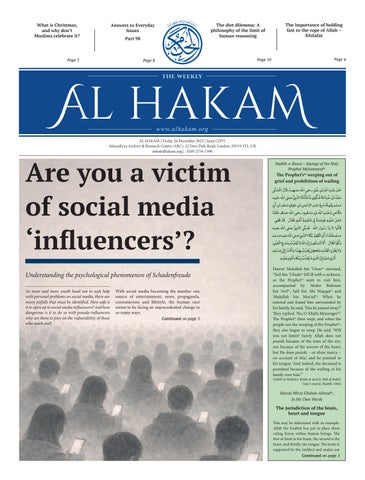
Are you a victim of social media ‘influencers’? Understanding the psychological phenomenon of Schadenfreude As more and more youth head out to seek help with personal problems on social media, there are many pitfalls that must be identified. How safe is it to open up to social media influencers? And how dangerous is it to do so with pseudo-influencers who are there to prey on the vulnerability of those who reach out?
With social media becoming the number one source of entertainment, news, propaganda, consumerism and lifestyle, the human race seems to be facing an unprecedented change in so many ways. Continued on page 3
Hadith-e-Rasul – Sayings of the Holy Prophet Muhammadsa
The Prophet’ssa weeping out of grief and prohibition of wailing
َ ْ َ َ �ٰ �ٰ ُ َ َ ﻋ َْن ﻋ ْﺒ ِۡد ا�� ِ� ۡبْ َِن ﻋ َ� َ� ـ ُرﺿﻰ ا��� ﻋﻨﻬﻤا ـ ﻗال اﺷ َﺘﻜﻰ �ٰ ُ َ� ُ َ َ َ ُ َ َ ْ َ َ َ َ ُ َ ْ ُ ۡبْ َُن الﻨ ِ� �� ﺻٰلﻰ ا��� �ٰلﻴُہ ﺳﻌۡد ﻋﺒادة ﺷ��ى �� ﻓﺄُتاه َ ْ ْ َ َ َ َ� ْ َ َ َ ُ ُ ُ َ ْ ْ �ِ�ا�� ْﺣ َﻤ َِن ۡب َِن ﻋۡو ٍف وﺳﻌ ِۡد ۡب َِن أ وﺳٰلﻢ ۡیﻌۡوده �� ﻋﺒ ِۡد َ� َ �ٰ �ٰ َ� َ َ َ ُ اص َوﻋ ْﺒ ِۡد ا��� ۡبْ َِن َﻣ ْﺴﻌۡو ٍد ـ ُرﺿﻰ ا��� ﻋﻨ�� ـ ﻓٰلﻤا ٍ وﻗ َ َُ َ َ َ َ َ َ َ َ َْ َ ََ َْ �اﺷ َﻴ ِِۃ أﻫ ِ� ِ� ﻓﻘال� ﻗۡد ﻗﻀﻰ ِ � �ِ� دُخﻞ �ٰل ْﻴ ُِہ ﻓ َۡو َﺟۡده َ َ �ٰ َ َ ُ َ �ٰ ُ َ� الﻨ ِ� �� ﺻٰلﻰ ا��� �ٰلﻴُہ ﻗالۡوا ۡلَا ۡیَا َُر ُﺳۡول ا���� ﻓ َﺒﻜﻰ َ� َ َ ُ ُ ْ َ ْ َ َ َ� َ َ �ٰ الﻨ ِ� ِ�� ﺻٰلﻰ ا��� �ٰلﻴُہ وﺳٰلﻢ وﺳٰلﻢ ﻓٰلﻤا ُرأى الﻘۡوم ۡب�اء ْ َ ْ ْ َ ُ � َ ُ َ � ٰ َ� َ ُ َ ْ َ َ َ َ َ َ ْ َ َ ،�ِ �ۡب��ا ﻓﻘال� أۡلَا �ﺴﻤﻌۡون ِإن ا��� ۡلَا ۡیﻌ ِِذب ۡبِۡد� ِ� الﻌ َ َ ََ َ َ َ ُ � َُ ْ ََ ْ َْ ُ َ َ اُر ِإلﻰ ل َِﺴاﻧِ ُِہ ـ �َن ۡیﻌ ِِذب ۡبِﻬِذا ـ وأﺷ ِ � و،وۡلَا ِ�� ْﺰ ِن الﻘٰل ِﺐ َ� َ ْ َ َ َ َْ َ �أ ْو ۡی َ ْﺮ َﺣ ُﻢ َو ِإ �ن ال َﻤ �ِﻴﺖ ۡی ُ َﻌِذ ُب ۡبِ ُﺒ�ا ِء أﻫ ِ� ِ� َ�ٰل ْﻴ ُِہ Hazrat ‘Abdullah bin ‘Umarra narrated, “Sa‘d bin ‘Ubadara fell ill with a sickness, so the Prophetsa went to visit him, accompanied by ‘Abdur Rahman bin ‘Awfra, Sa‘d bin Abi Waqqasra and ‘Abdullah bin Mas‘udra. When he entered and found him surrounded by his family, he said, ‘Has he passed away?’ They replied, ‘No, O Allah’s Messengersa.’ The Prophetsa then wept, and when the people saw the weeping of the Prophetsa, they also began to weep. He said, ‘Will you not listen? Surely Allah does not punish because of the tears of the eye, nor because of the sorrow of the heart; but He does punish – or show mercy – on account of this,’ and he pointed to his tongue. ‘And indeed, the deceased is punished because of the wailing of his family over him.’” (Sahih al-Bukhari, Kitab al-jana’iz, Bab al-buka’i ‘inda l-marid, Hadith 1304)
Hazrat Mirza Ghulam Ahmadas, In His Own Words
The jurisdiction of the brain, heart and tongue This may be elaborated with an example. Allah the Exalted has put in place three ruling forces within human beings. The first of them is the brain, the second is the heart, and thirdly, the tongue. The brain is supported by the intellect and makes use Continued on page 3
Friday 26 December 2025 | AL HAKAM
2
This Week in History
A glimpse into the rich history of the Ahmadiyya Muslim Jamaat
26 December - 1 January 26 December
27 December
26 December 1896: On this day, a three-day conference commenced in Lahore, which was later extended to 29 December upon the unanimous demand of the audience to hear the full speech of Hazrat Mirza Ghulam Ahmadas, titled Islami Usul Ki Falasafi (The Philosophy of the Teachings of Islam).
27 December 1905: On this day, at 10 o’clock in the morning, the Promised Messiahas led the funeral prayer of Hazrat Maulvi Abdul Karim Sialkotira for a second time and reburied him, through which Bahishti Maqbarah saw its inception. Prior to this, on 12 October, Hazrat Maulvi Abdul Karim Sialkoti’sra body was placed in a casket and buried elsewhere as amanat (interim burial). (Tarikh-e-Ahmadiyyat, Vol. 2, p. 403)
The purpose of the conference was to provide representatives of all faiths and groups the opportunity to present the positive teachings of their religions based on their respective scriptures. To read more about this book, see “Khaybar has fallen”: Anniversary of The Philosophy of the Teachings of Islam” at alhakam.org (8 January 2021, pp. 18-19). 26 December 1991: On this day, at 10 am, Hazrat Khalifatul Masih IVrh inaugurated the 100th Jalsa Salana Qadian. This was the first time since the migration from Qadian in 1947 that a Khalifatul Masih was physically present, creating a unique sense of enthusiasm among the attendees. (Silsilah Ahmadiyya, Vol. 4, p. 868) To read more about this historic occasion, see “Retracing Blessed Steps” at alhakam.org (28 December 2018, pp. 14-15).
27 December 1985: On this day, Hazrat Khalifatul Masih IVrh announced the establishment of Waqf-e-Jadid as an international scheme, and said, “From this year, I announce the expansion of the Waqf-e-Jadid scheme to the whole world, instead of limiting it to Pakistan and India alone.” (Khutbate-Tahir, Vol. 4, p. 1020) To read more about this financial scheme, see “A chronology of Waqfe-Jadid’s early years (1957-1965)” at alhakam.org (25 December 2020, pp. 12-14).
28 - 29 December 28 December 1928: On this day, Jamaat-e-Ahmadiyya Australia convened its Jalsa Salana, which was the first-ever Jamaat gathering in that part of the world outside India. Hazrat Sufi Muhammad Hassan Musa Khanra, the pioneering Ahmadi of Australia, narrated the claims of the Promised Messiahas. By the grace of Allah, this proved to have a very great impact on all those present, including other non-Ahmadi guests. (Tarikh-e-Ahmadiyyat, Vol. 5, p. 100) 29 December 1909: Upon the instructions of Hazrat Khalifatul Masih Ira, a series of lectures was arranged in Lahore, commencing on this date, for the next four days. Christians had started a series of lectures in a college in Lahore,
in response to which a series of Islamic lectures was started on the instruction of Hazrat Khalifatul Masih Ira. Aside from other speakers, Hazrat Sahibzada Mirza Bashir-ud-Din Mahmud Ahmadra delivered a lecture on the subject of salvation. (Tarikh-eAhmadiyyat, Vol. 3, p. 299) 29 December 2000: On this day, Hazrat Khalifatul Masih IVrh delivered the last Friday sermon of the 20th century. During his Friday sermon, Huzoorrh presented the words of the Promised Messiahas, which he said on the last Friday of the 19th century, which was 28 December 1900. (Al Fazl International, London, 2 February 2001, p. 5)
30 December 30 December 1921: On this day, Hazrat Musleh-e-Maudra, while delivering the Friday sermon in Masjid Noor, said that Sha‘airullah (Signs of Allah) should always be honoured and respected. Huzoorra said, “Allah the Exalted has designated some Signs. Their honour and respect is of utmost importance. This is so because mischief and evil always arise from [seemingly] trivial matters and progress slowly. Therefore, until the very means of its formation are closed, it cannot be stopped.” 30 December 1932: The famous aviator from India, Mr Ram Nath Chawla, came from Lahore on his aeroplane on this day, around 4pm and landed in the open field near Qadian railway station. Mr Chawla requested Hazrat Musleh-e-Maudra to see his plane. To read more about this historic and interesting event, see: “From the first flight in Qadian to the ‘Khilafat Flight’ during the USA Tour 2022” at alhakam.org (28 October 2022, pp. 6-7).
31 December 31 December 2004: During his Friday sermon on this day, delivered from the Bait-us-Salam Mosque in Paris, France, Hazrat Khalifatul Masih Vaa gave valuable guidance in regards to electing Jamaat office-bearers and shed light on the responsibilities of office-bearers. Huzooraa said that the nizam (system) of the whole Jamaat revolved around the institution of Khilafat. To learn more about this important topic, see, www.alislam.org. 31 December 2010: During his Friday sermon on this day, Hazrat Khalifatul Masih Vaa said that the year 2010 had commenced with a Friday and it was ending on a Friday as well, which is a blessed day. Huzooraa said that the sacrifices of lives that had been made by the martyrs of Pakistan, especially during the year 2010, would never go in vain.
1January 1 January 1906: On this day, the Promised Messiahas was revealed:
� � �� � ��”��ےذ “���
“Three goats will be slaughtered.” (Tadhkirah [English], p. 811) To read more about this revelation, see, “Maulavi Naimatullah Khan: An odyssey of mythic grandeur from Qadian to Kabul” at alhakam. org (10 September 2024). 1 January 1966: There was a risk of famine and drought in Pakistan due to a lack of rain. On this day, Hazrat Khalifatul Masih IIIrh urged Ahmadis to dedicate two prostrations of nawafil for the next seven days and pray for rain. Upon Huzoor’srh instruction, Hazrat Maulana Jalaluddin Shamsra led Salat-ul-Istisqa (prayer for rain) on 6 January in Rabwah. (Al Fazl, 8 and 12 January 1966, p. 1)
AL HAKAM | Friday 26 December 2025 Continued from page 1
The purpose of this article is not to explain what social media is all about, as younger generations (alpha, Z or any new ones that might have emerged) know it all too well. But what is intended to be addressed here is a concept that has become very common with the rise of social media – the “influencer” phenomenon. (The Influencer Industry: The quest for authenticity on social media, Emily Hund, 2023) What is not intended is to address every aspect of its rise and fall, where fall means new technologies taking over in the form of AI influencers or the general public becoming more aware of the staged “unboxing” and “food review” culture and sponsorship-fuelled lifestyles of these socalled influencers. We only intend to address a very dark side of this influencer culture that is still sharp enough to cut through innocent minds, especially those of our youth. Those labelled as influencers are either called so for the influence they have had on public thought, or they are the selfstyled ones who want to be classed as such – “Psuedo-influencers” being a better description. From homemaking women to bodybuilding youth; from students to those who teach them; and from TV hosts to those they interview, everyone seems to be influenced by one influencer or the other. Those who are genuinely influential personalities working towards making the world a better place, there is, of course, no harm in being influenced by their ideas. The danger lies with the pseudo-influencers who not only lack substance in their content but can push their audience towards aspiring to a lifestyle that exists only in the imagination of that pseudo-influencer and is far from attainable for their innocent followers. (“The Dark Side of Social Media Influencers”, Yuksul Ekinci, 17 January 2025) Before moving on, we must emphasise the fact that accepting someone as an influencer automatically means you accept yourself as the influenced. How much we like to see ourselves in such a position is the question we always need to ask before becoming so impressed as to be seen as the “influenced”. You watch these pseudo-influencers eat out at expensive restaurants almost every other day, wear luxury watches and high-end branded clothes, show off their expensive gifts, buy the latest models of any gadget that comes on the market, and, above all, do nothing all day but create and post social media content showcasing their lavish lifestyle. You watch such content, ruminating that the proverbial Jack might not always be a dull boy with all play and no work at all, quite vibrant on the contrary. Not everyone can afford such a lifestyle, but some vulnerable viewers might aspire to it, ending up in nothing but despair and frustration. But then how can these pseudoinfluencers afford to do all this? Well, either by monetised social media accounts that thrive on followers, or by faking a lifestyle that isn’t even their own. How hard is it to borrow a friend’s car, or a luxury watch, or grab a friend’s branded clothes, or tag along with affluent friends to Michelin Star restaurants and just post whatever is served
3
to them by these courteous friends (who don’t stay friends for long as they soon start to see through the pseudo-influencer’s selfobsessed motives)? (“The Psychological Strategies of Influencers”, Manfred FR Kets de Vries, https://knowledge.insead.edu, 28 June 2023) This situation gets even worse when such pseudo-influencers have tried every avenue, and their social media accounts seem to get stuck in reverse gear – little to no new followers; not much appreciation for posts that once brought back likes and comments; followers becoming bored and even expressing their boredom. Then comes the stage we all need to be aware of. The pseudo-influencer now wants to try new avenues. They might start offering advice on relationships, life-struggles, faith, and, most sensitive of all, mental health issues – areas that comprise almost every modern man’s problems. They are usually by no standard capable of giving advice in these areas, but then, after all, they are desperate for more followers, whatever means it may take. Accounts like these can seem to take on a religious tone, says Leigh Stein in her analysis “The Empty Religions of Instagram”. She observes that the comment sections on these accounts can become confessionals, and posts become sermons on how to deal with emotional pain. (“The Empty Religions of Instagram”, nytimes.com, 5 March 2021) In a world full of stressful situations, some vulnerable followers are prone to fall prey to the advice offered by such pseudo-influencers. They open up to them about their problems in the hope that this “influencer”, who seems to be the happiest and most content person on earth, will be able to resolve all issues that have crippled their lives. Little do these vulnerable followers know that the pseudo-influencer is only after more followers and is least interested in alleviating other people’s misery and pain. (Although based on consumer marketing techniques, this article gives a better understanding of unethical practices of social media influencers: “Going Viral: Sharing of Misinformation by Social Media Influencers” by Rory Mulcahy et al in Australasian Marketing Journal, August 2024) A follower might send the pseudoinfluencer a DM and later find it posted on their story, decorated with all kinds of emojis to make it look like a trophy. Even if the sender’s name is hidden, the one who had opened up still feels upset about their sensitive feelings being posted online. But then the pseudo-influencer is there only to use everything that comes their way as their marketing tool. They want other followers to know that people are reaching out to them, hence making them consider opening up to this pseudo-influencer. The one who had their DM posted on the story stops reaching out. What comes to them as an even bigger shock is that the pseudo-influencer, too, doesn’t feel the need to get back. Well, the pseudo-influencer got what they wanted from this poor follower, posted it as part of their malicious marketing technique, and simply moved on. For someone already troubled with personal problems, the feeling of being used only makes things worse, adding to the pain and agony of their already pestering real-life issues.
To understand why someone would show such malicious behaviour, we need to understand what goes on at the back of the mind of such pseudo-influencers. Real influencers did not head to social media to become influencers. Their genuine and original work influenced people, and, as the term suggests, that is what made them influencers. On the other hand, pseudo-influencers set out specifically to be influencers, but without the right type of ingredients – no substance, no thought process, no originality, no authenticity, no values. Since such pseudo-influencers are only out to gain cheap popularity and fame, their aspiration of becoming an influencer too is a means to their end and not their actual goal. They invest so much time and effort in fashioning themselves in various capacities that they end up being too self-possessed and self-obsessed. Knowing that they are not actually the same as their self-styled image, or their online persona that they present to the world, they develop a false image of themselves and begin to believe it to be true.
Narcissism, paranoia and imposter syndrome The self-obsession and the self-carved false ego are the two significant factors that allow narcissistic tendencies to start creeping into their personalities, the first one usually being a lack or complete loss of empathy. Human beings do not remain human beings to them, but merely numbers – clicks, likes, comments, and followers - tools that can potentially enable more followers. As they devote more and more effort and time to their ill-defined end-goal, without the desired outcome, the element of being burnt out or frustrated kicks in. This is quite natural, because where a genuine influencer relies on intrinsic motivation – where they love their art or craft or whatever they are known for – our pseudo-influencer relies on external motivation through clicks, likes, followers and comments. Once caught in this pursuit of external validation, they further lose a stable sense of identity, resulting in identity diffusion, in which they constantly copy others to reinvent themselves. (“How our online identities change our true personality”, Psychology Times, February 2025) When their self-worth becomes heavily dependent on numbers, they become hypersensitive to criticism and even fall into the dark ditch of a paranoia-like feeling, or insecurity, where they constantly live under the fear of people judging them, talking about them, being jealous of them, and wanting them to fail. This is a natural consequence of relying on a false online persona that they have created. Some traits noticeable here are those of impostor syndrome – the fear that one day, the mask might slip and people see their actual worthless self. Audience ambiguity further fuels this insecurity. Since social media audiences are invisible (in the virtual sense of the term), our pseudo-influencer can start imagining hidden critics, jealous peers and silent observers waiting for them to slip. They become so insecure that even good advice or positive criticism can fuel the insecurity, making them turn against even those who mean well for them. This is their
Continued from page 1 of argumentation. The task of the brain is to remain forever engaged in for- mulating and constructing ideas, and to reflect upon new arguments and proofs. The service entrusted to the brain is to compile data and then go on generating results. The heart is the king of man’s entire being. The heart does not operate with the use of argumentation because it holds a connection with the King of all kings, and therefore receives knowledge either by way of manifest revelation, or by means of hidden revelation. It could also be said that the brain is a vizier and since the task of a vizier is to devise plans, therefore, the brain remains engaged in formulating proposals, reflecting on the necessary means, weighing arguments and producing results. In this, the heart has no part. For God Almighty has vested the heart with the faculty of sense. For example, an ant will find its way at once to a location where there is something sweet, although it is moved by no argument which proves that there is something sweet to be found in that location. On the contrary, God Almighty has granted the ant an instinct, which guides it to the relevant location. Likewise, the heart is similar to an ant, because like an ant, it too possesses the same faculty of sense which guides it. The heart does not require argumentation and proofs, nor does it have a need to analyse facts in order to extract results. Notwithstanding that fact, the brain does, nonetheless, provide the heart with these means and resources anyway. (Malfuzat [English], Vol. 2, pp.118-119)
insecurity filling informational gaps with fear-based assumptions. By constantly posting pieces of their lives on social media, and that too without the emotional and intellectual resilience of established influencers, the pseudoinfluencer develops an even graver insecurity about having their life out there and being discussed. This exposure with no control – and no desired results – leads to paranoid thoughts that people “must be” talking behind their back, or even that everyone must be seeing that they are trying too hard. This can eventually lead to cognitive distortion, where the pseudo-influencer starts to believe they can read other people’s minds, to the extent that they start to believe they know what others say to them is not what they actually think about them. Now this is a vicious circle: anxiety leads such pseudo-influencers to try areas that are not their domains, but they believe these domains can earn them respect and, subsequently, more meaningful followers. They have, by now, tried every fun-andgames way and have hit a dead end. Now, in their mind, is the time to rise above and gain followers through respectable means, and it is at this point that they start to present themselves as faith-gurus, life-coaches, or mental health experts who, as they present themselves, are a Godsend messiah for their followers. With all that going on in their mind, as described above, one must not forget that
Friday 26 December 2025 | AL HAKAM
4
they are so full of themselves that the only beneficiary of their new identity is their own false self and no one else. Should you reach out, they will indulge in long-winded interactions, appearing to be good listeners and full of good advice. They will even mention a careful selection of their own anxieties and life issues to create a comfort zone for you where you continue to open up and spill more tea. What one does not realise is that they take you to a point where they have collected enough data from your personal life that they can put it out to lure more people in. They might not name you, but lay out your problems to convince others that they can be trusted with anything, no matter how private it may be.
advice here is to never open up about your vulnerabilities to anyone you do not know well enough. Such pseudo-influencers, on social media or in real life, will pop out of the blue and suddenly pretend to be your close friend. Any friendship or acquaintanceship that is not organic in its genesis and growth isn’t the place for one to open up.
personal faith, or opening up to reliable and trusted friends, the only other people to trust with our vulnerable side are professionally trained personnel who are there to give genuine advice and not to prey on our sensitive information. (Asif M Basit, UK)
NEWS
Ahmadi However, this is not the only motive Muslim youth behind their sinister agenda. The monster behind this behaviour is a psychological phenomenon called schadenfreude, where in Yorkshire one person experiences joy, pleasure and satisfaction through other people’s troubles, help the needy pains, failures and sufferings. Schadenfreude: The psychological phenomenon
Schadenfreude is experienced by people with low self-esteem to protect their selfconception and, hence, the vulnerable people in their company (online company in this particular case) are their favourite prey. If they somehow become aware of your vulnerability, which they naturally develop a very keen eye for, you are exactly who they were looking to prey on. (For various models of schadenfreude, “Schandenfreude deconstructed and reconstructed: A tripartite motivational model”, by Shensheng Wong, S Lilienfeld and Philippe Rochat, in New Ideas in Psychology, January 2019) They listen to you not out of sympathy, or even empathy, but for the satisfaction of their false ego that they have built and are hypersensitive about. They know that they have failed in their goals and derive satisfaction out of your vulnerability and slips that you might have experienced in raw and tender moments of your life. One common sign that you have fallen prey to such a pseudo-influencer is that once you have opened up to them, they will suddenly lose interest in you and your problems. However, they will continue to mention you as a “someone” who reached out to them about such and such life issues and how they have “helped” them, when in fact, they have only helped themselves. Such pseudo-influencers are not only restricted to social media. They could be around you in your friends’ circles, cajoling you to tell your stories; spending a great deal of time with you; listening with great keenness; but then, narrating them to other people in your circle, albeit anonymously, but giving away enough hints so the audience can almost guess who they are talking about. You might soon start to get people around you alluding to the weakness you mentioned only to this self-styled influencer and feel deeply hurt – more hurt to know how your simple story has been embellished and exaggerated by the pseudo-influencer to attract attention. So, whether it is under the guise of a friend or a social media influencer, the
Thus, while trust is the basis when it comes to opening up about our problems to someone, even more important is to know where to place this trust. If one feels, in an overwhelming moment, the need to open up to a friend, then there has to be a history of trust and not just a mushroomed acquaintanceship. Other than seeking help through
Yousaf Ahmed Press & Media Co-ordinator, MKA Yorkshire, UK During the festive season, Muslim youth volunteers from Majlis Khuddam-ulAhmadiyya Yorkshire have been giving back to their local communities, supporting those most in need through a wide range of charitable and community-focused initiatives. Volunteers have prepared and distributed hundreds of homemade hot meals to vulnerable individuals at local soup kitchens, serving food directly to people experiencing hardship and food insecurity across the region in order to ensure no one goes hungry and with the aim of tackling the hunger crisis. In addition, wellbeing parcels have been distributed to people who are homeless or sleeping rough. These parcels included essential items such as thermal socks, gloves, hats and basic toiletries – items that every person should have access to, particularly during the cold winter months. The volunteers have also been visiting residential care homes, spreading festive cheer by delivering gifts and hampers and spending quality time with elderly residents. Alongside social action, the young volunteers have contributed to environmental and conservation efforts, planting over 1,000 trees across South and West Yorkshire to support sustainability and improve local green spaces for future generations. On BBC Radio Sheffield, on 16 December 2025, a spokesperson for the volunteer group said: “Our young people wanted to give back to the communities they are part of. This work is not new; we have been helping our local communities for decades. For us, it is about compassion, service and standing alongside those who are often forgotten – values that are central to our faith and our shared humanity.”
‘Every Child Matters’ event held in Canada Syed Mukarram Nazeer Canada Correspondent On 5 October 2025, Jamaat-e-Ahmadiyya Regina hosted the “Every Child Matters” event at the Mahmood Mosque to promote awareness, reflection and solidarity with Indigenous communities in Canada. The event aimed to build bridges of understanding and friendship between Indigenous and Muslim communities, in accordance with the teachings of Islam on justice, compassion and unity. The programme commenced with a recitation from the Holy Quran, followed by a formal land acknowledgement recognising the traditional territories of Indigenous peoples. After an introduction to Jamaat-eAhmadiyya and its mission of peace and service, Chief Mark Fox of Piapot First Nation delivered a deeply moving
Foundation laid for ‘Guadeloupe Interfaith Committee’ Muhammad Basharat Missionary, Guadeloupe Jamaat-e-Ahmadiyya Guadeloupe hosted an Interfaith Dinner on 17 December 2025, at the Jamaat Mission House in Les Abymes. This gathering marked an important milestone in fostering dialogue and cooperation among the religious communities of the island. In the beginning of the programme, a French-language video presentation introduced the Ahmadiyya Muslim Jamaat, its mission, global humanitarian efforts and its commitment to peace and service to humanity. The guests appreciated this introduction, which helped establish a thoughtful and respectful atmosphere for the discussions that followed. Several distinguished religious leaders participated in the event, including Monsieur Philippe Guiougou, Catholic Bishop of Guadeloupe; Pastor Pierre Thiam, representative of the Protestant Church; Father Michel, priest of the Romanian Orthodox Church; Pandit
address. He spoke about the painful legacy of residential schools, emphasising that reconciliation must be rooted in honesty, compassion and continued dialogue. In a symbolic act of friendship, Chief Mark Fox presented a sacred blanket and headrest to Amir Jamaat-e-Ahmadiyya Prairie Region, Dr Habib ur Rehman Sahib. Elder May Desnomie then led an Indigenous prayer. The Chief and Elder were each presented with traditional gifts and gift bags in appreciation of their participation and partnership. In his address, the Regional Amir highlighted the Islāmic principles of reconciliation and justice, stressing that peace cannot flourish without mutual respect and understanding. The programme concluded with a silent prayer. Total attendance for the event was approximately 65 individuals. The local media also attended the event; prominent among them was the news team of local TV network CTV, which interviewed Regional Amir, while Eagle Feather News interviewed the President of Jamaat Regina, which was published on 4 October 2025.
Vishnu – Elie Shitalou, representative of the Sanatan Dharma of Guadeloupe (Hindu community); and Mr Jean Keller and Ms Christine Goh, representing the Baha‘í community. My humble self represented the Ahmadiyya Muslim Jamaat. The atmosphere throughout the evening was one of warmth, openness and sincere dialogue. Each representative shared reflections from their tradition, highlighting the importance of unity, respect and shared responsibility for the moral and social wellbeing of Guadeloupe. During the event, guests were also offered two books as gifts: The Philosophy of the Teachings of Islam by the Promised Messiahas and World Crisis and the Pathway to Peace by Hazrat Khalifatul Masih Vaa. One of the most significant outcomes of the evening was the collective decision to begin working toward the establishment of an Interfaith Committee of Guadeloupe. All participants agreed that this initiative represents the first foundational step, with the intention to expand and include additional religious traditions in the future. It is noteworthy that this dinner was the first gathering of its kind ever held in Guadeloupe, bringing together leaders from such diverse religious backgrounds in a structured spirit of friendship and collaboration
AL HAKAM | Friday 26 December 2025
5
Jesus’ return: Metaphors and Quranic proof he died Did Jesusas return literally, or was his second advent meant metaphorically? Drawing directly from the Holy Quran and the writings of Hazrat Ahmadas, this concise piece
explains how the Quran testifies to the death of Jesusas and, therefore, to a figurative second coming. Read this artcile at: www.alhakam.org
family and togetherness, rather than strictly religious reasons. You may have seen many traditions, including decorating trees, hanging lights and giving gifts. The actual date of the birth of Jesusas has not been recorded anywhere in the Christian Gospels. As Muslims, we do not believe that Jesusas was born in December. This notion is based on both the Bible and the Quran, which describe warm weather, shepherds in the fields, and the presence of ripe dates; it becomes clear that Jesusas was not born on 25 December, since winter in Judea, Bethlehem, could not have produced such conditions.
What is Christmas, and why don’t Muslims celebrate it? Jalees Ahmad Al Hakam It’s the most wonderful time of the year, as they say. The streets are glowing with Christmas decorations; the familiar colours of the season spread across shop windows and city centres. Joy and smiles fill people’s faces, and of course, you can’t ignore the Christmas sales and advertisements. A single visit to Central London, or any busy London street, makes it clear that Christmas has arrived. But what is Christmas? What exactly is being celebrated? Do Muslims celebrate it, and if not, why?
What is Christmas? The word “Christmas” derives from the phrase “Christ’s Mass.” It appears in earlier forms like Christemasse. “Christ” derives from the Greek word Christos, meaning “anointed”, which translates to the Hebrew word Messiah, and “Mass” comes from the Latin word missa, which is a celebration of the Eucharist. Christmas, as we know, is an annual festival celebrated on 25 December (or 7 January for the Eastern Orthodox Churches), marking, as they say, the birth of Jesus Christ. It is a religious holiday, yet many people celebrate it with the main themes being
A brief history of Christmas, its connection to Roman holidays, and how it is celebrated today It will be interesting to know that in early Christianity, Christians didn’t celebrate the birthday of Jesusas, possibly due to the fact that his date was not recorded. The focus was on, in their belief, his death and resurrection, not his birth. However, by the 4th century, Christians in Rome began celebrating his birth and marking it on 25 December. “The Roman Christian historian Sextus Julius Africanus dated Jesus’ conception to March 25 (the same date upon which he held that the world was created), which, after nine months in his mother’s womb, would result in a December 25 birth.” (“Why Is Christmas in December?”, britannica.com, accessed 9 December 2025) The Romans were a very interesting nation. In December, they celebrated two big holidays. The first was Sol Invictus, which means unconquered sun, in Latin. They celebrated this on 25 December, marking the sun’s return after the shortest day of the year. The second was Saturnalia. This festival lasted for a week, with food, gifts, and parties. Over time, as we learn from history, Christmas traditions have grown into what we see them as today. The decorating of trees – known as Christmas trees, Christmas
carols being sung, gifts, feasting and much more. Many of the customs we see today came from European pagan traditions and were later adapted into Christian practices. So in December, Christians celebrate Christmas, believing it is the birthday of Jesusas, their saviour, who died for their sins on the cross. They use this time to attend special services, remember the story of Jesus’ birth, sing carols, and reflect on his sacrifice, among other things.
Why do Muslims not celebrate Christmas? A common question asked is that if Muslims believe in Jesusas as a prophet, then why don’t they celebrate Christmas? As Muslims, we believe that Jesusas was not the son of God, was not born on 25 December, and did not die on the cross. We believe that Jesusas was a noble Prophet of God, sent to the Children of Israel after Mosesas, with the same message and to revive those teachings. He was the Messiah. The Bible does not mention the exact date of Jesus’as birth, and as Muslims, we believe he was not born in December. Both the Bible and the Quran describe warm weather, shepherds outdoors, and ripe dates, all of which show that Jesusas could not have been born on 25 December. As Muslims, we follow the practices of the Holy Prophetas. We never saw or heard the Holy Prophet Muhammadsa, who loved all prophets, celebrate the birth of any prophet, nor did he command his companions to celebrate his own birthday. Similarly, there is no record of Jesusas ever instructing his followers to celebrate his birthday. The desires of the Prophets of God are very simple and close to their hearts. Their main wish is that we follow the message God sent them with. Therefore, as Muslims, we honour all prophets, including Prophet Muhammadsa, by following their teachings and the guidance they brought from the One God.
Friday 26 December 2025 | AL HAKAM
6
The importance of holding fast to the rope of Allah – Khilafat Hafiz Yunus Omotayo Missionary, Nigeria We are currently passing through a challenging time in which humanity is stuck in precarious, tribulation-laden situations. Where, from Washington to Moscow, and from London to Beijing, the world is rife with a crisis of power imbalance and power struggles among the domineering world leaderships and powers, pushing the world to the brink of a world war. True, we are living in a disturbing time where inhumanity is trumping over humanity and materialism over spirituality, where the forces of atheistic humanism and trans-humanism are seeking to ban the presence and influence of religion and of God from the world He, Himself, created. And, ultimately, where the growing global socio-economic and geo-political crises are deepening the experiences of instabilities and deprivations and lack of peace and security across the world, from Palestine and Ukraine, to Yemen, Sudan, Pakistan, India and Afghanistan, among others. More particularly, it is such a difficult time where the Muslim world, declared by the Quran as “the best community raised for the good of mankind” (Surah Aal-eImran, Ch.3: V.113), is currently divided against itself, with each of its constituents at loggerheads with the other. It is presently wallowing in the whirlpool of moral, spiritual, intellectual, social, economic and political crises. More appallingly, it is locked in devastating intra-religious ideological skirmishes, inter-state and inter-community feuds and wars and inter-sect rivalries and hostilities. This abysmal scenario highlights the question: why is our world, particularly the Muslim world, in disarray? And the answer is not far-fetched: it is, frankly, as a result of the absence of an Islamically established global leadership system within the mainstream Muslim world. No doubt, in a demanding time like ours, there is no gainsaying the relevance of having conversations on an important injunction of Islam: the need to hold fast to the rope of Allah. This is an apt and compelling desideratum, whose importance, in turn, justifies the rationale and relevance of this write-up. Rope, in the language of the Holy Quran, translates to habl. And habl, according to authoritative Arabic lexicons, means a rope or cord or anything with which a thing is tied or made fast; a bond or cause of union or link of connection, such as a bond of love or friendship; mutual connection by such a bond; a covenant or compact; an obligation by which one becomes responsible for the safety of a person or thing; a promise or assurance of security or safety; an artery, vein or verve (Arabic-English Lexicon by EW Lane). It also means alliance and protection
(Aqrab al-Mawarid by Sa’īd al-Khauri alShartūti). To safeguard and protect the Muslim world against the current abysmal state of its affairs, in the Holy Quran, Allah enjoins the Muslims thus: “And hold fast, all together, by the rope of Allah and be not divided; and remember the favour of Allah which He bestowed upon you when you were enemies and He united your hearts in love so that by His grace you became as brothers; and you were on the brink of a pit of fire and He saved you from it. Thus, does Allah explain to you His commandments that you may be guided.” (Surah Aal-e-Imran, Ch.3: V.104). The Holy Prophetsa is reported to have said that, “The Book of Allah (i.e. the Quran) is the strong rope of Allah which has been extended from the heavens to the earth.” (Jami‘ at-Tirmidhi, Hadith 3788) “Broadly speaking,” writes Hazrat Mirza Bashir-ud-Din Mahmud Ahmadra, Khalifatul Masih II, in his exegesis of the foregoing Quranic verse, “there are three things which may be taken to have been here meant by the rope of God, by holding fast to which Muslims may remain united and be safe against disunion and disruption: (1) the Quran; (2) the Messenger of God; (3) the Successors to the Messenger of God.” (Five Volume Commentary [2002], Vol. 2, p. 433) Of course, while the Holy Quran and the Sunnah (the practice) of the Holy Prophetsa would continue to remain preserved till the end of life on earth, the continuity of the physical presence of the Holy Prophetsa was not guaranteed by the law of death. Alternatively, however, through the wisdom and grace of Allah, the Muslim world was destined to continue to feel the presence of the Holy Prophetsa through the chosen Successors that would be appointed through the divinely established institution of Khilafat to lead the Muslim world, as long as the Muslims collectively fulfil the conditions set for its establishment. In this context, Allah declares: “Allah has promised to those among you who believe and do good works that He will surely make them Successors in the earth, as He made Successors from among those who were before them; and that He will surely establish for them their religion which He has chosen for them; and that He will surely give them in exchange security and peace after their fear. They will worship Me, and they will not associate anything with Me. Then whoso is ungrateful after that, they will be the rebellious.” (Surah anNur, Ch.24: V.56) Alongside this promise of Allah, the Holy Prophetsa also prophesied: “Prophethood shall remain among you for as long as Allah will. He will then cause it to end. Then a Khilafat (Caliphate) will be established in the footsteps of prophethood which will last for as long as Allāh wills.
He will then cause it to end. Kinghood will follow which will inflict great pain and misery on its subjects. Its rule will last for as long as Allah wills. He will then cause it to end. After this, tyrannical monarchies will follow. Their rule will last for as long as Allah wills. Then He will cause it to end. The Khilafat will be re-established in the footsteps of prophethood. Thereafter, the Holy Prophetsa became silent.” (Musnad Ahmad, Vol. 5, Hadith 17939) It is thought-provoking to note that, based on the foregoing Quranic and Prophetic prophecies, in the wake of the event of the death of the Holy Prophetsa and the ensuing atmosphere of heart-rending fear and grief that gripped the Companionsra, coupled with the heavy cloud of anarchy and uncertainties that had overshadowed the sudden headless state of the Muslim world of the time, the Companionsra did not let the day pass before electing a Khalifa of Rasul Allah (Successor of the Messenger of Allah). In The Will, Hazrat Mirza Ghulam Ahmadas, the Promised Messiah and Mahdi and the Founder of the worldwide Ahmadiyya Muslim Community, recapitulated the historic development that trailed the death of the Holy Prophetsa: “This is […] what happened at the time of Hadhrat Abu Bakrra. The death of the Holy Prophetsa was considered untimely and many ignorant Bedouins turned apostate. The companions of the Holy Prophetsa were consumed with grief. At that critical hour Allah made Hadhrat Abu Bakrra stand firm and through him He once again showed a manifestation of His Power. Islam was thus saved from annihilation and His following promise was fulfilled, which said: ‘And that He will surely establish for them their religion which He has chosen for them; and that He will surely give them in exchange security and peace after their fear. (Surah Al-Nur, Ch.24: V.56).” (The Will [1997], pp.9-10) The institution of Khilafat was, thus, established to succeed and sustain the blessings of the Prophethood of Muhammadsa. Notably, beginning with the period of Abu Bakrra and through those of Umar bin Khattabra, Uthman bin ‘Affanra and Ali bn Abi Talibra, the affairs of the Muslim world were steered by a single Khalifa who safeguarded their moral and spiritual tenacity, administered justice, settled internal disputes and conflicts, maintained law and order, interfaced in their international relations with other worlds and spread the Islamic religion across the then known world. The Muslim world lived in happiness, peace and security, and gloried in prosperity, stability, development and progress. It is indisputable that the above-noted historical fact, among other implications, clearly demonstrates a powerful point that underscores the necessity of Khilafat as a
rope of Allah to which all members of the Muslim world must always cling. This is because not only does it connect humanity with the Divine, but it also facilitates the unity, cohesion, solidarity and brotherhood of the Muslim world under a divinely established leadership. Sadly, the generations of Muslims that succeeded the golden epoch of the Rightly Guided Khilafat showed ungratefulness to and rebellion against the pristine Khilafat system earlier established. Consequently, the Khilafat on the precepts of prophethood was replaced by the despotic kinghood, and decades later, by tyrannical monarchies which extended for centuries, in different nomenclatures (Caliphate, Imamate, Sultanate), forms, scopes and regions, until 1924 when the Turkish Uthmaniyya (Ottoman) Caliphate was abolished by Mustafa Kamal Ataturk. Today, over a century later, the mainstream Muslim world has continued to fail in its various efforts aimed at re-establishing Khilafat to bring back the ideal Islamic leadership system for Muslims and their unity, solidarity, cohesion, brotherhood, prosperity, peace, security and development in the world. At this juncture, it is essential to note that, by the first decade of the 20th century – precisely on 27 May 1908 – when the sun of the ultimate collapse of the Turkish Caliphate was beginning to set on the horizon of its beleaguered empire, Allah the Almighty reinstituted Khilafat on the footstep of prophethood as earlier prophesied by the Holy Prophetsa. However, this time around, the fulfilment was divinely materialised within the Ahmadiyya Muslim Jamaat – an Islamic revival and Missionary movement established in 1889 by Hazrat Mirza Ghulam Ahmadas in whose person the Quranic and prophetic prophecies of the advent of the Promised Messiah and Mahdi were fulfilled. Ever since then, the world has continued to witness unbroken peaceful successions of five eras of the divinely chosen Khulafa (Caliphs), beginning with Hazrat Hakeem Noor-ud-Deenra (1908-1914), followed by Hazrat Mirza Bashir-ud-Din Mahmud Ahmadra (1914-1965), then Hazrat Hafiz Mirza Nasir Ahmadrh (1965-1982), Hazrat Mirza Tahir Ahmadrh (1982-2003), and presently we are in the blessed era of the Fifth Khalifa, Hazrat Mirza Masroor Ahmad, may Allah be his Helper. Importantly, over a century since the institution of this Khilafat, it has established Islam in all corners of the world through the establishment of missions and mosques across 210 countries and territories. It has translated the Holy Quran into and published it in about 80 world languages. In addition, thousands of Islamic literary works have been published in various languages. In 1992, this Khilafat established the first Islamic satellite TV channel (MTA) in the world and, thereafter, an Islamic website (www.alislam.org) to propagate the pristine, peaceful teachings of Islam. It has built over 30 hospitals and clinics and over 500 schools across many countries. Its international humanitarian NGO – Humanity First International – is recognised by the United Nations and has been providing Continued on page 7
AL HAKAM | Friday 26 December 2025
7
Digital amnesia The phone number we forgot Daniyal Mahmood Ahmad Al Hakam There once was a time when humans had a remarkable quality. In this day and age, it might be considered a superpower, or maybe even a sign of genius. This is the ability known as “memory”. I’m not referring to the legendary gift of memorisation that the Arabs were known to possess around the time of the advent of Islam. What I’m referring to is, on the contrary, relatively recent. It’s about a time when we could, believe it or not, memorise entire phone numbers. Somewhere along the path of technological progress, we’ve lost this capability. Ask anyone around you whether they remember anyone’s phone number aside from their own and maybe one close relative’s. This figure declined from 70% in 2015 to 60% by 2019. That’s only four years. Most people will struggle to recall any more than that, and this figure is declining even further. (Digital Amnesia Revisited, Kaspersky Lab, 2019, p. 2) What has led to such a drastic change in a natural capability? To explore this, let’s return to the very beginning of our human civilisation’s lifecycle. When Adamas and Eve were roaming in the Garden of Eden, God made a covenant with them (Surah Ta Ha, Ch.20: V.116). Although Adamas was a righteous and pious servant of God, he was also like us, a human. And so – like we all do from time to time – he forgot the command. Adamas took responsibility for his sudden lapse and made amends with the Almighty. He was able to do this because Allah said that “We found in him no determination to disobey.” (Ibid.) What we can gauge from this story is that forgetting isn’t inherently an issue, depending on the nature of the matter and the intentions involved. So, in our case, forgetting a phone number isn’t a sin or a
Continued from page 6
humanitarian services globally, regardless of recipients’ religious, racial, ethnic or political backgrounds. This Khilafat has continued to make its presence, influence and impacts felt across the world by constantly providing leadership direction to world governments, leaders and their citizens; proffering viable Islamic guidance aimed at solving contemporary issues; and establishing initiatives and schemes for world educational, religious, social, economic, political, communal, and environmental development, peace, security
crime against humanity. But the issue runs deeper than what’s visible on the surface; it’s not that we are forgetting things more easily, it’s that we are struggling to even remember them in the first place. This inability has been linked to the increase in digital devices and technology to aid us in remembering tasks, essentially outsourcing our cognitive abilities to machines. This is known as “cognitive offloading”, and the result of this is what has been coined as “digital amnesia”. (“Consequences of cognitive offloading: Boosting performance but diminishing memory”, pubmed.ncbi.nlm.nih.gov, 4 April 2021) If we compare the brain to generative AI, it becomes easy to understand how the more it is utilised (by increasing the input of knowledge, information, critical thinking, etc.), the sharper our mind becomes. This applies the other way around, too; if you don’t use it, you’ll lose it. The “lose it” part is a result of hippocampal inactivity when relying on external storage. This leads to what Betsy Sparrow, a neuroscientist from Columbia University, has coined “the Google Effect”, where we remember where to find information instead of remembering the information itself. (“Google effects on memory: cognitive consequences of having information at our fingertips”, pubmed.ncbi. nlm.nih.gov, 5 August 2011) It must be noted that forgetting isn’t always a flaw; sometimes it’s a blessing in disguise. Take the story of Mosesas and
and progress. Above all, it has been striving vibrantly and impactfully to re-establish moral and spiritual values and to reunite humanity with its Creator, the Divine. In light of this re-institution of Khilafat on the precepts of prophethood for the contemporary Muslim world, and the positive impacts it is perpetually making within and outside the Muslim world, it is imperative that members of the mainstream Muslim world should earnestly hold fast by this rope of Allah in our time in response to the divine commandment that Muslims should cling to the rope of Allah and be not divided.
Khizr as an example, when the companion of Mosesas forgets the fish. This causes them to alter their entire journey, but it also leads them to the place they were meant to reach. (Surah al-Kahf, Ch.18: V.62-66) But at our current rate of forgetfulness, the science is alarming. Relying on devices causes the prefrontal cortex to reduce its effort. This leads to memory decay, which contributes to not only forgetfulness, but also anxiety. (“Reduced left dorsolateral prefrontal activation in problematic smartphone users during the Stroop task: An fNIRS study”, pubmed.ncbi.nlm.nih.gov, 9 January 2023) Ever wondered whether you’ve closed the fridge in the middle of the night? Or if you saved a very important document before closing it? That’s the kind of anxiety at issue. Where there is anxiety, there is naturally a lack of presence. In order to employ habits of presence, we must be present. Anxiety is the antithesis of that. So it’s no longer the meagre issue of forgetting phone numbers. The Quran warns against the results of forgetfulness: “And be not like those who forgot Allah, and whom He has consequently caused to forget their own souls.” (Surah alHashr, Ch.59: V.20) Fortunately, though, the solution lies in the problem itself; in order to remember Allah, we must do dhikr (remembrance of Allah). This leads to a step-by-step solution. Memory requires attention, attention requires presence, and presence is the essence of dhikr. As Rumi said: “Now listen to the Prophet of Mankind: “‘No prayer’s complete without a present mind.’” (The Masnavi [English], Book 1, Oxford University Press, 2004, p. 27) In this way, we can begin to cure the anxiety that’s being caused due to our lack of presence: “Aye! it is in the remembrance of Allah that hearts can find comfort”. (Surah
al-Ra’d, Ch.13: V.29) How do we practically employ this method? An effective way to heal our neural focusing ability, according to multiple neuroscience studies, is to enter meditationlike states. In other words, salat. Spiritual benefits aside, salat acts as a cognitive intervention, essentially balancing our state of mind and cognitive abilities. This is in result of an increase in hippocampal grey matter. (“Mindfulness practice leads to increases in regional brain gray matter density”, pmc.ncbi.nlm.nih.gov, 10 November 2010) Other methods to employ can include reducing screen time, as this will reactivate the brain’s natural memory-building circuits, as well as constantly challenging the brain through analytical and memorisation practices. (“Effect of the Use of Electronic Media on the Cognitive Intelligence, Attention, and Academic Trajectory of Medical Students”, pubmed.ncbi.nlm.nih. gov, 23 February 2025; “Frontoparietal connectivity neurofeedback training for promotion of working memory: An fNIRS study in healthy male participants”, arxiv. org, 31 March 2020) In all this, the crux of the matter is that attention is what matters. As the famous English writer, Dr Samuel Johnson, aptly summarises: “The true art of memory is the art of attention.” (The Idler, 1826, p. 80) With enough presence and attention, our memory will thrive. The fact is that forgetting a phone number may seem insignificant, but with all the science-backed research, it’s an ever-increasing danger to our cognitive functions. The solutions are also available. Perhaps – just like a phone line – we need to focus on establishing that very first and primary connection before anything else. As the Almighty says: “Remember Me, and I will remember you.” (Surah al-Baqarah, Ch.2: V.153)
NEWS 3rd National Ijtema held by MKA Czech Republic Imran Ul Haq Motamid MKA Czech Republic Majlis Khuddam-ul-Ahmadiyya Czech Republic held its 3rd annual ijtema on 10-12 October 2025 at the Prague Markaz, with part of the programme taking place in the Bohemian Switzerland region, under the theme “True Loyalty and Obedience to the Imam.” The ijtema opened on Friday with Maghrib and Isha prayers, followed by a brief dars. On Saturday morning, the formal session was chaired by Sadr Majlis Khuddam-ul-Ahmadiyya Czech Republic. Academic competitions were held with full participation from all khuddam. Kashif
Janjua Sahib, National President of Jamaat Czech Republic, delivered an address on loyalty and obedience to Khilafat. Sports and physical activities continued throughout the day. In the evening, Stefan Härter Sahib from Jamaat Germany joined the programme and shared reflections on his spiritual journey and his bond with Khilafat. The concluding session included remarks from Sadr Majlis, who emphasised the importance of Itaa‘at-e-Nizam. After the distribution of prizes, the ijtema concluded with a silent prayer. The following morning, khuddam offered Tahajjud and Fajr prayers before departing for an educational hiking trip in Bohemian Switzerland (České Švýcarsko).
Friday 26 December 2025 | AL HAKAM
8
Answers to Everyday Issues
Part 98
Story of Musa and Khidr, attributing mistakes to Satan, faith vs knowledge of God and car financing Guidance regarding basic Islamic issues that Hazrat Amirul Momineen, Khalifatul Masih Vaa, has given on various occasions in his written correspondence and during MTA programmes is being published officially below for everyone’s benefit. What is the Ahmadiyya interpretation of the story of Musa and Khidr? Someone wrote to Hazrat Amirul Momineen, Khalifatul Masih Vaa, enquiring about the reality of the narrative concerning Prophet Mosesas and Khidr. He asked whether this event actually occurred physically or if it recounts a spiritual journey, noting that a divergence exists within the Jamaat’s literature regarding whether the event was apparent [zahiri] or visionary [kashfi]. He sought the actual position. Huzoor-e-Anwaraa, in his letter dated 16 September 2023, provided the following guidance regarding this matter: “The first point is that the Holy Quran is God Almighty’s final law-bearing Book; its knowledge and insights extend until the Day of Resurrection. Allah the Almighty continues to grant the gnosis of Quranic sciences to His Prophets, saints [awliya] and chosen ones according to the needs of every age, in accordance with the following Quranic teaching:
ُ ْ َ َ َ� ُ ُ � َ ُ ُ ُ َ َ َ َ ْ َ� َ ْ َوِم ٍ ََو ِإَن ِِم َْن � ْی ًٍۢء ِإْلا َِعۡنْدُّنا ��اِئِۡنُه ََو َِما ُّن��ِْلُه ِإْلا ِ�َقْد ٍَر َِمۡعَّل
“‘And there is not a thing but with Us are the treasures thereof and We send it not down except in a known measure.’ (Surah al-Hijr, Ch.15: V.22) “Interpreting this verse, the Promised Messiahas states: “‘It is clearly proved from this verse that everything found in the world has descended from heaven alone. This is in the sense that the causative factors [‘ilale-mujibah] of these things are from that very True Creator and also in the sense that every craft manifests through His revelation [ilham], inspiration [ilqa], instruction and the bestowing of reason and understanding. However, it does not manifest beyond the need of the time and the breadth of knowledge granted to every Divinely Commissioned one [Ma‘mur minallah] is also bestowed in accordance with the need of the time. By this same deduction, the subtleties, deep insights and truths of
the Holy Quran are also unveiled strictly in accordance with the need of the time.’ (Izala-e-Auham, Part 2, Ruhani Khazain, Vol. 3, pp. 450-451) “The second point is that the Holy Prophetsa, upon whose perfectly pure heart this Sharia was revealed, mentioned the vastness of the Holy Quran’s knowledge and spiritual insights and its limitless meanings, by stating:
َ ُ ْ َ ُ ُْْ َ ُْ َ ْ ، َْل ِ� ِ �ۡل ٓاُيَ ٍٍۃ ِِمۡن َِہا َظ ِْہ ٌَر ََوْبَِط ٌَن،ٓاَن ََعَّلﻰ َُس ِْب َۡع ٍِۃ أ َْح ُِر ٍف أُّن َِزِل اْل�ُر ٌ َ �ُ � َ � ُ َ َوْل ِ� ِۡل َح ٍْد ِمِطَّلَع
“‘The Quran has been revealed in seven modes [ahruf]; for every verse within it, there is an apparent aspect [zahr] and a hidden aspect [batn].’ (Mishkat al-Masabih, Kitab al-‘ilm, al-fasl ath-thani, Hadith 238) “Thus, based on these truths expounded by the Holy Quran and Holy Prophetsa, when the Promised Messiahas narrated the incident of Prophet Mosesas and the righteous servant of Allah mentioned in the Quran, he described the apparent [zahiri] meaning of this verse, as this was the interpretation prevalent among the general Muslims of that era. Furthermore, the need of the time dictated that by explaining the apparent meanings of these verses, the erroneous concept held by people – that Allah the Almighty cannot send revelation to anyone other than a Prophet – should be refuted with arguments and this error be rectified. “Accordingly, the Promised Messiahas clarified to the general public and specifically to the scholars of the Ummah, by inferring from the apparent meanings of these verses, that Allah the Almighty can send revelation and inspiration to a non-prophet as well. To support this, he presented four examples from the Holy Quran – referencing the disciples of Jesusas, Mary the mother of Jesusas, the mother of Mosesas and the aforementioned man of God in the incidents of Mosesas – thereby providing proof from the Holy Quran of the descent of revelation upon all these individuals. “Moreover, the Promised Messiahas deduced from the incidents of the mother of
Mosesas and the man of God with Prophet Mosesas that, in addition to a Prophet, the revelation of a wali is also definitive. It was for this reason that the mother of Mosesas, considering her revelation to be true and certain, cast her newborn child into the river, pushing him to the brink of possible destruction. Similarly, that righteous servant, deeming his revelation true and certain, killed a child. Had these individuals not considered their revelation to be true and certain, they would never have done so. “Then, from the incident of Mosesas and this righteous servant, Huzooras drew a third inference: that we should not object to such Friends of Allah [awliyaullah] who are stationed at a high rank of wilayah and whose being recipients of divine revelation is proven with certainty through other arguments and heavenly signs, even if their words and actions are beyond our understanding, for we cannot comprehend their reality. “All these arguments presented by the Promised Messiahas could only be made by explaining the apparent meaning of these verses, not by explaining their hidden [batini] meanings. Therefore, he was content with the apparent meaning of these verses. “Subsequently, during the blessed era of Khilafat-e-Ahmadiyya, when the time came to explain the hidden meanings of these Quranic verses, in exact accordance
with the prophecies of the Holy Prophetsa, the manifestations of Khilafat-e-Haqqah Islamiyyah Ahmadiyyah established through the Promised Messiahas – by means of Divinely bestowed knowledge [‘ilm-eladunni] granted by Allah the Almighty – explained the inner meanings of these verses in their respective times, presenting deeply insightful commentaries. “Thus, Hazrat Khalifatul Masih Ira declared this incident to be a vision [kashf] and termed it the spiritual ascension [mi‘raj] of Prophet Mosesas. He interpreted the person whom Prophet Mosesas set out to meet on this spiritual journey as an angel, stating that the fact that this incident was a spiritual ascension is supported by an ancient book still found among the Jews called Mi‘raj-e-Musa. In it, the angel described as the guide of Mosesas is named Khidr. The purpose of mentioning this spiritual journey in the Holy Quran was to inform the Holy Prophetsa of future events. Regarding the matter of the wall, Hazrat Khalifatul Masih Ira interpreted it to mean that when people corrupted the religion of Abrahamas, that wall was about to fall; to protect it, Allah the Almighty sent Mosesas and our Holy Prophetsa. They raised this crumbling wall again and thus the treasure of pure teachings remained preserved. (Summarised from Haqaiq-ul-Furqan, Vol. 3, pp. 26-32)
AL HAKAM | Friday 26 December 2025 “Similarly, in his commentary on Surah al-Kahf, Hazrat Musleh-e-Maudra presented a detailed exegesis of this event, declaring it to be the mi‘raj of Prophet Mosesas. Through various internal and external pieces of evidence and arguments, he proved it to be a visionary [kashfi] event and interpreted the righteous servant mentioned therein as the personification of our master and lord, the Holy Prophet Muhammad alMustafa, peace and blessings of Allah be upon him. He further explained that this spiritual journey contained news regarding the future conditions of the Muslim Ummah, which were revealed to Prophet Mosesas in a visionary form; within this event, a comparison was drawn between the circumstances of the Muslim Ummah and the Mosaic Dispensation. Additionally, Hazrat Musleh-e-Maudra provided highly insightful and reasoned interpretations of the various objects and matters mentioned in this narrative. (Tafsir-e-Kabir, Vol. 4, Qadian, 2004, pp. 465-490) “Thus, both interpretations and commentaries – those presented by the Promised Messiahas and those by his Khulafa – are entirely correct in their respective places in the light of the Holy Quran and the sayings of the Holy Prophetsa and are exactly in accordance with the needs of the time. There is no contradiction of any kind between them. “As for the questions you have raised regarding this narrative, the answers to all of them are also present in detail in the commentary by Hazrat Musleh-e-Maudra. As I wrote to you previously, you have only had the opportunity to read the Five-Volume Commentary. This is a concise commentary prepared in English by the Ahmadiyya Muslim Jamaat according to its resources for those who understand English, based on the summary of Hazrat Musleh-e-Maud’sra masterpiece Tafsir-e-Kabir and the notes he prepared for it, so that members who read English may understand the subjects of the Holy Quran to some extent. Since it is in the form of a summary, details could not be included. Therefore, if you wish to broaden your knowledge and read a detailed commentary of the Holy Quran, you should also study Tafsir-e-Kabir.”
Why does the Quran attribute human mistakes to Satan? Someone wrote to Hazrat Amirul Momineen, Khalifatul Masih Vaa, noting that in many places in the Holy Quran, the cause and responsibility for errors committed by people are attributed to Satan instead of the people themselves. For instance, when the fish slipped from the hands of the companion of Mosesas, it was attributed to Satan; similarly, the action of the prison companion of Josephas in failing to mention Josephas to the king was also attributed to Satan. What is the reason for this? Huzoor-e-Anwaraa, in his letter dated 26 September 2023, provided the following guidance regarding this question: “The essence of the matter is that at the time of Adam’s creation, Satan declared to Allah the Almighty that he would make every possible effort to mislead the children of Adam and turn them away from the right path until the Day of Judgement. Accepting this challenge, Allah the Almighty declared, ‘You shall have no power over My servants.’ (Surah al-Hijr, Ch.15: V.40-43)
9
“
Image: “Cosmic Cliffs” in the Carina Nebula/NASA
The Being of God Almighty is Eternal, Everlasting and Infinite; human intellect can never encompass it, for man can intellectually comprehend only limited things.
“Therefore, since the source of every error and evil is Satan or the satanic thoughts spread by him, when an error is committed by a human being, it is attributed to Satan. This is because it is Satan and his tribe who are constantly on the lookout to lead man astray from the right path and do not let any opportunity slip by without trying to turn humans away from the path of God Almighty. “However, alongside this, it is also a reality that while Satan tries to mislead man, Allah the Almighty also guides His righteous servants through His angels and the impulses of virtue created by them. Therefore, if a mistake is ever committed by righteous servants, Allah the Almighty does not let those righteous servants persist in that error but reforms them. “Nevertheless, it must be remembered that in both matters – whether it is a case of being led astray or being guided – no human is compelled. Rather, after clarifying the paths of guidance and error, Allah the Almighty has given man the freedom to choose between them. Thus, expounding upon this subject, Hazrat Khalifatul Masih Ira states: “‘The Holy, Blessed, and Pure Being of God Most Exalted has spread guidance throughout the world by endowing man with capacity, the ability to discern good
from evil, reason and an innate disposition; and by sending thousands upon thousands of Prophets and Messengers, and scriptures, and by indicating the means of attaining His pleasure. He has always granted help and support to the Prophets and to their true followers and obedient servants. Indeed, He has not coerced a capable person – seizing him by the neck, as it were – in order to make him perform righteous deeds. The benefit of the existence of Satan and his progeny is that He may bestow upon the obedient among mankind the robe and honour of obedience; yet even so, He has not granted Satan the authority to mislead people by force.’ (Nuruddin Ba Jawab Tarke-Islam, p. 107)”
Can humans truly know God or only believe in Him? Someone from Germany wrote to Hazrat Amirul Momineen, Khalifatul Masih Vaa, stating that an atheist friend had asked, “It is said that we believe in God, but it is not said that we have knowledge of God.” What is the answer to this? Huzoor-e-Anwaraa, in his letter dated 27 September 2023, gave the following reply to this question: “The Being of God Almighty is Eternal, Everlasting and Infinite; human intellect
can never encompass it, for man can intellectually comprehend only limited things. That is why Allah the Almighty states in the Holy Quran:
ُ يُف اْل ْ ََخِب ُ َلَا ُتُ ْْدِر ُُك ُُه اْلَْأَ ْْب ََص ُاُر ََو ُُهَوَ ُيُ ْْدِر ُُك اْلَْأَ ْْب ََص َاَر ََو ُُهَوَ ال �َّّل ِِط يُر ِ ِ ِ
“‘Eyes cannot reach Him, but He manifests Himself before the eyes. He is the Imperceptible, the All-Aware.’ (Surah alAn’am, Ch.6: V.104) “The meaning of this verse is that man cannot see Allah the Almighty through the power of his own knowledge. However, God Almighty, by His grace, comes to him and manifests His glory and in this way, man attains His vision [ru‘yat]. Accordingly, we observe that in past ages, thousands and hundreds of thousands of such people have passed and even now such people exist in the world, to whom Allah the Almighty gave news of His existence in such a way that He heard their prayers, manifested supernatural miracles through them to the world, gave them prior information regarding future events and then caused those events to occur in the world exactly in accordance with those prophecies. Furthermore, for these loved ones, He displayed such supernatural wonders through His power that were impossible to be manifested by human hands. Expressing this theme, the Promised Messiahas says in an Urdu couplet:
دقرتےساینپذاتاکداتیےہقحوبثت ُاُسےباشنںیکرہچہامنیئیہیوتےہ
“‘By His own power, the True One furnishes proof of His very Being; this, indeed, is how the One beyond all outward signs discloses Himself.’ [Majmu‘ah-eIshtiharat, Vol. 1, India, 2019, p. 161] “Similarly, at another place, Huzooras states: ُ َلَا ُت ُ ۡۡدِر ُُک ُُہ اۡلَۡاَۡبۡ ََصis that He “‘The meaning of اُر ِ cannot be recognised solely through intellects; rather, He causes His Being to be recognised only through the means He Himself has appointed.’ (Malfuzat, Vol. 3, Rabwah, 2003, p. 590) “Thus, man cannot attain knowledge of
Friday 26 December 2025 | AL HAKAM
10
this Infinite Being on his own; however, to the extent and when He deems necessary, He provides proof of His Being to His loved ones and grants them knowledge regarding Himself.”
Is buying a car on finance halal in Islam? A lady from Palestine wrote to Hazrat Amirul Momineen, Khalifatul Masih Vaa, stating that many Ahmadi sisters have the question: Is it permissible to buy a car by taking a loan from a bank? Huzoor-e-Anwaraa, in his letter dated 27 September 2023, provided the following guidance regarding this issue: “Any sale, purchase, or financial transaction that is mixed with interest is, categorically, forbidden. However, several methods for the sale and purchase of goods on instalments are prevalent in the world under names such as Hire Purchase (HP) and Personal Contract Purchase (PCP), in which goods can be bought by paying a somewhat higher amount in instalments compared to a lump-sum payment. This method does not fall into the category of interest. Accordingly, a question of this nature was presented to the Promised Messiahas and its answer was published in the Badr newspaper of Qadian in the following words: “‘The smooth running of the newspaper would be facilitated if the subscription price were received in advance. Among those who do not pay in advance and make promises of later payment, some simply delay on the basis of promises alone, while for others, the recovery of payments involves such difficulty
– through repeated correspondence and the keeping of records to collect the payments from them – that in order to mitigate this additional labour and loss to some extent and also to receive compensation for it, the price of the Badr newspaper for postpayment has been increased by one rupee; that is, from those who pay afterwards, the price of the newspaper would be collected as four rupees instead of three. “‘Upon this, a friend from Lyallpur enquired whether this arrangement constituted interest. As this was a matter pertaining to Islamic law, it was presented to the Promised Messiahas with the aforementioned reasons. The reply that he wrote is reproduced below: “‘‘Assalamu alaikum. In my view, this has no connection to interest. The owner has the right to ask for whatever price he wishes, especially as there is also an inconvenience involved in collecting payment later. If a person wishes to receive the newspaper, they can also pay beforehand. This matter lies within his own choice. Wassalam. Mirza Ghulam Ahmad.’’ (Badr, Qadian, No. 7, Vol. 6, 14 February 1907, p. 4) “Therefore, if you wish to buy a car on instalments through this method, in which you would have to pay a somewhat higher amount than the lump-sum price, this is not considered interest and it is permissible. The exception is if the one receiving the payment has named it interest; in such a case, this type of interest-bearing transaction is not permitted.” (Compiled by Zaheer Ahmad Khan, Head of Records Department, Private Secretariat, London and translated by Al Hakam)
The diet dilemma: A philosophy of the limit of human reasoning Ibraheem Lawal Graduate, Mechanical Engineering In a recent discussion I had with a colleague at an exhibition, she highlighted that cruelty to animals has often been enjoyed as a form of sport by humans, particularly bull riding. It is a spectacle in which animals are subjected to a certain level of pain or discomfort to make them aggressive for entertainment. Enjoyable as it may seem to onlookers, such practices stand in contradiction to what the Western ideology often advocates – the conservation of nature and compassion toward animals. Interestingly, this very ideology has led some Western “extremists” to abstain from eating meat altogether and adopt a vegetarian lifestyle. My colleague also mentioned that she would love to adopt a vegetarian lifestyle in the near future. When
I asked why, she explained that she believes animals should be allowed to roam freely, without fear or harm. I responded by acknowledging that cruelty to animals is indeed inhumane and extreme. I also mentioned how, in some parts of Africa, people make rams fight as a form of entertainment. (“Ram fighting continues without regulation despite animal rights concerns”, africanews.com, 13 August 2024) However, I did not agree with the notion that all animals should roam “freely.” In the animal kingdom, a natural hierarchy exists, a cycle of life in which one species depends on another. Carnivores eat herbivores, and the cycle continues. Every creature has been created for its own purpose and role in sustaining balance. The Holy Quran beautifully highlights this, stating: “And the cattle too He has created; you
The tomb of Jesus in Kashmir The Promised Messiah, Rev Weitbrecht and Christian press Follow the evidence that shook Christian missions, divided scholars and sparked a century-long argument still alive today. Read this artcile at: www.alhakam.org
AL HAKAM | Friday 26 December 2025
11
find in them warmth and [other] uses; and some of them you eat.” (Surah an-Nahl, Ch.16: V.6) In the same way, humans have been created for a higher purpose – to worship God, the Cause of all causes. I was reminded of an article written by a friend, in which he explained the Russell Paradox and how it leads to an infinite regression of reasoning problems: “No doubt, relying solely on logic inevitably leads to problems – the greatest of which is, whose logic should we follow?” (“The Russell Paradox: Why God is above philosophy”, alhakam.org, 5 November 2025)
This endless loop exposes the limitations of human intellect, our inability to reach absolute and perfect judgments, for we are bound to err. If we advocate for all animals to live freely, then we alter the balance of nature. This means that, in a way, we stop the lions from preying on the antelope and the antelope from grazing on the grass. This creates a kind of philosophical inconsistency that ultimately leads to extinction. Returning to the main topic, it is this same cruelty toward animals that has driven people to adopt extreme lifestyles, some abstaining from meat altogether in the name of mercy, while others, on the opposite end, embracing the zero-carb diet, consuming mostly meat. Proponents of each school argue from a philosophical and ethical standpoint that the other diet is not sustainable. For instance, the vegetarians often argue from an extreme negative utilitarian standpoint, arguing that to maximise happiness, we have to completely forgo the “suffering” animals are made to go through. (“The Ethics of Veganism and Plant-Based Diets”, oxfordre.com, 21 August 2024) Porphyry, a Neoplatonic philosopher, was one of the popular proponents of vegetarianism. In his letter to his friend, Castricius Firmus, “On Abstinence from Eating Animals,” he argued that animals are rational beings and justice ought to be extended to them. (Porphyry: On Abstinence from Killing Animals, Bloomsbury, 2000, p. 80) His argument takes the form of the argument from marginal case, a proof by contradiction, which opines that “you cannot coherently believe that all humans have moral status, and that all non-humans
lack moral status.” (“Animal Rights and the Argument from Marginal Cases”, scandinavianlaw.se) That is, if we argue that animals can be killed based on their inability to have a concept of self, and to be logically consistent, we need to pass the same judgment towards humans with non-cognitive ability, like the senile, comatose and infants. A counterargument to this is the argument from species normality, which argues upon the intrinsic property of the “human class”. (“The Argument from Marginal Cases: is Species a Relevant Difference”, researchgate.net, January 2011) While there are some people who, at some point in their lives, may lack the normal cognitive operation or moral agency, they still possess this intrinsic capacity and must be respected and protected. This logical back and forth, however, does not end there, and each argument continues to be countered. It is interesting to note that Porphyry, however, does not advocate the vegetarian lifestyle for soldiers or athletes – an interesting gap explained by the Promised Messiahas. In contrast, the carnivore community argue from an extreme human-centred egoism that the natural phenomenon requires that life be sustained by feeding on animals, and that animals lack the moral rectitude or complex mental activity that makes killing them inherently wrong. They often believe that the “good for the self ” outweighs every other moral consideration. A recent proponent of the carnivore diet is Paul Saladino, an American health influencer and former psychiatrist. In his book, The Carnivore Code, he describes
plants as “poison” and advocates a meal exclusively based on meat. This has gained popularity even on social media, in modern times, with influencers like Jordan Peterson and his daughter following a strict type of carnivore diet, popularly known as the “lion diet” on TikTok. (“New TikTok craze the ‘Lion Diet’ has TikTokers eating salt, meat, water and nothing else”, fox9.com, 20 December 2022) Both extremes, as observed by the Promised Messiahas, have psychological effects. Though there may appear to be shortterm benefits, long-term consequences reveal imbalances: vegetarians, often lacking certain nutrients, may develop timidity and reduced courage, while excessive meateaters may become overly aggressive or suffer a decline in humility and meekness. (The Philosophy of the Teachings of Islam, pp. 9-10) The Holy Prophetsa perfectly addressed this by teaching moderation in all aspects of life. (Sahih al-Bukhari, Kitab ar-Riqaq, Hadith 6463) Likewise, the Promised Messiahas advised that human reason should be applied in its proper time and place – not to justify extremes, but to maintain harmony and balance. (The Philosophy of the Teachings of Islam, p. 101) In essence, everything in creation has been designed with a purpose. True wisdom lies in recognising that purpose and living in moderation, neither in excess nor in neglect. And as for where philosophy goes too far, there is no better way to understand its problem save through the lens of religion.
Grief management Understanding and navigating grief Sammar Hafeez Clinical Psychologist, India Grief, although personal, is a universal experience. Every individual – young or old – will have had at least one experience that might have altered their lives in one way or another. Significant life losses such as divorce, tragic accident, death of a loved one (bereavement), end of a relationship, discrimination, major life transitions like moving away from home, shifting jobs, loss of job/unemployment, loss of a home, financial instability, physical disability/ losing health, end of dream or goal and even losing a pet can be difficult to cope with, which even the Holy Prophet Muhammadsa validated by providing comfort to a child whose pet died (Sahih al-Bukhari, Kitab aladab, Hadith 6129). Grief as we know it, is a natural response to loss or any disadvantageous situation. It is a complex phenomenon that has physical, emotional and psychological reactions associated with it. Coping with the loss of something or someone that has been vital
in your life can be an immense challenge and is very likely to cause waves of multiple emotions as we proceed in its depth. The process of grief is known to be nonlinear. It usually does not follow timelines or schedules. It might either be continuous or can be intermittent and some individuals might take weeks, while others take years to grieve. While everyone can grieve differently and every grief journey is unique, there are however, some commonalities in the way we tend to process grief. The five stages of grief: Psychiatrist Kubler Ross introduced the five stages of grief based on her extensive work on thousands of terminally ill patients. (“Understanding the five stages of grief ”, cruse.org.uk, accessed on 13 November 2025) It should be noted that these stages don’t usually occur in the same order as they are mentioned and may shuffle back and forth. Some may experience a few stages instead of all five. Hence, the occurrence is highly subjective and unpredictable. So, here’s what we know about each
stage.
Stage 1: Denial “This cannot be happening to me?” Grief is an overwhelming emotion. The shock around how your world has changed in an instant can make a person go numb. It is normal for someone to deny the strong feelings by pretending the change or loss is not occurring. They might even go on with life as if nothing had happened. Denying is a common defence mechanism that helps us cope with a highly distressful event. It gives the person time to absorb the shock and process it slowly, in a more realistic way. Once the denial stage passes, the healing starts and other suppressed feelings are bought into light.
Stage 2: Anger “Why me? Why is this happening to me? Who is to blame?” Once someone starts to accept reality, he/she can start feeling angry and may look
to blame oneself, family members, friends, doctors or even the person who died for the cause of their grief. Anger is a natural emotion that occurs in reaction to immense pain, discomfort and uncertainty that surrounds the grieving process. Anger can be masked as feelings of resentment and dislike, and sometimes it could manifest in forms of outbursts and rage at insentient things. One might also feel disconnected, abandoned or isolated in their loss. Not everyone goes through this stage, but if one feels that they are lingering in this stage long enough, then it is advisable to seek help from a therapist in order to resolve deeper reasons.
Stage 3: Bargaining “What if I could negotiate my way out of it”? In extreme pain, it is difficult for us to accept that there is nothing we could do to change the uncomfortable situation. It is not uncommon that one might go Continued on page 12
Friday 26 December 2025 | AL HAKAM
12
Striking differences in accounts of Jesus’ crucifixion An analysis of Matthew, Mark, Luke and John If four witnesses told four different stories, would you accept the verdict? By examining contradictions in the crucifixion and resurrection accounts, this study challenges readers to reconsider the reliability of the Bible as we have it today. A sharp, evidence-based critique that invites reflection, debate, and deeper inquiry.
Continued from page 11
over and over the events that occurred in the past and ask a lot of “what if ” questions such as – “what if I had left my house 5 minutes later, then the accident would not have happened”, “what if I worked more during weekends, they would have seen how useful and efficient I am”, “What if I had gone to the doctor few weeks early, then they would have diagnosed the disease earlier” – by thinking in this manner, a person attempts to find moments of peace and tries to regain control over an unexpected and extremely helpless situation.
Stage 4: Depression “I am too sad, and I don’t know how to move forward from here” While denial, anger and bargaining may seem like active stages of grief, depression, however, is called the quiet stage. Feelings of sadness, loneliness and longing are predominant in this stage. A person might also think that life no longer has any meaning attached to it, which can
be particularly alarming for those around a griever. Depression is commonly related to a grieving process, but if the griever shows signs of extreme hopelessness and suicidal ideation, then the caregiver/guardian will want to seek help and guidance for the griever immediately, as this might be indicative of a condition called prolonged grief disorder or a major depressive episode.
Stage 5: Acceptance “I am at peace with what has happened” This stage sees a lot of realisations around the unexpected event that had passed. A person’s emotions may begin to stabilise and they may start to opt for a balanced way of thinking by adjusting or readjusting their perspective around pain and loss. There will be good days and bad days, and sometimes one might even end up getting unintentionally sad, but always remember that this is normal. As one goes through life, the bad days will outnumber good days and one may also realise that finding purpose and the will to live again
Read this artcile at: www.alhakam.org
Smile: Your life depends on it Muhammad Abdul Hayee Nasir Jamia Ahmadiyya International, Ghana
Did you know that the secret to living a longer, healthier and a more peaceful life is not as complicated as you might think it is? The secret is not entirely about making complicated diet plans, or going to the gym regularly, or just generally following routines which are difficult to maintain. Every now and then, the real change comes with things that are easy and more natural. A smile. Yes! You read that correctly, a smile. There is a lot of research which has proven that when you smile, it helps in reducing stress levels, blood pressure levels and most essentially uplifting your overall well-being. It is something so simple yet its benefits reach far beyond our imaginations. (“Grin and Bear It! Smiling Facilitates Stress Recovery”, psychologicalscience.org, 30 July 2012) Smiling does not only make us feel better; it also finds its way to the hearts of the people around us. For instance, when your father or mother gives you a smile; you feel warmth and safety. Or when your doctor smilingly tells you not to worry and that you’ll be fine. At that moment you become so relieved that you forget about the pain or sickness you’re having. Or, for those who are married, when your wife gives you a loving smile, it can brighten your whole day in an instant. Thus, a simple smile possesses incredible strength. It provides comfort, motivation, and lets the people you love know they matter. Even an ordinary moment can become special when it’s shared with a genuine smile.
From an Islamic lens, we can learn a lot from the Sunnah of our beloved Prophet Muhammadsa and what he taught about smiling, as well as the benefits of smiling backed up by scientific research.
The Sunnah of the Holy Prophetsa The Holy Prophetsa had to face numerous hardships and difficulties in his life; he lost his parents at a very tender age and was brought up as an orphan, he lost many of his children during his lifetime, he lost so many devoted companions in the various battles; upon all these hardships the smile never faded away from the face of our beloved Mastersa. Hazrat Ibn Jazra narrates about the Holy Prophetsa that: “I have not seen anyone who smiled more than the Messengersa of Allah.” (Jami’ at-Tirmidhi, Kitab al-manaqab, Hadith 3641) The Holy Prophetsa usually met his devoted companions with a gentle smile, filling the air with comfort and love. Hazrat Jarir bin Abdullahra narrates: “Since I embraced Islam, Allah’s Messengersa never refused to see me, and whenever he saw me, he received me with a smile.” (Sahih Muslim, Kitab fadaʾil al-sahabah, Hadith 2475b) This narration shows how the Holy Prophet’ssa gentle smile made his companions feel honored and loved. Then Hazrat Abu Dharrra narrated that the Holy Prophetsa said: “Don’t consider anything insignificant out of good things even if it is that you meet your brother with a cheerful countenance.” (Sahih Muslim, Kitabul birr was-sila wal-adaab, Hadith 2626) This teaches us an important thing, that greeting others with a cheerful and pleasant
AL HAKAM | Friday 26 December 2025 by keeping the memories of your loved ones close to us is practically possible and that is what they would want you to achieve too. As we move through these series of stages, we might perceive a grieving cycle as a combination of ups and downs, which is, however, a very natural way of healing from grief.
Overcoming grief Everyone responds to loss differently, some may feel the need to cope with it alone, while others may find talking with friends and family members to be soothing. Whatever the approach may be, there are some general strategies that can aid in overcoming grief across all ages: 1. Accept your emotions, feel free to feel: Do not stop yourself from experiencing the variety of emotions that loss ignites. Accept that whatever you are feeling is genuine and you should not be feeling any other emotion other than what you are presently feeling. Do not feel that you are overreacting and do not downgrade or negate the grieving
expression is a righteous act, which has a reward. Smiling is also counted among those deeds that the Holy Prophetsa described as acts of charity. Hazrat Abu Dharrra narrated that the Messengersa of Allah said: “Your smiling in the face of your brother is charity, commanding good and forbidding evil is charity, your giving directions to a man lost in the land is charity for you. Your seeing for a man with bad sight is a charity for you, your removal of a rock, a thorn or a bone from the road is charity for you. Your pouring what remains from your bucket into the bucket of your brother is charity for you.” (Jami’ at-Tirmidhi, Kitab al-birr wa as-sila ‘an rasoolullah sallallahu alaihi wasallam, Hadith 1956) This beautiful narration shows us that even a simple smile contains spiritual value. It is considered an act of charity, an easy yet great way to spread goodness, uplift hearts and earn the pleasure of Allah the Almighty.
Advice from our beloved Imam Hazrat Khalifatul Masih Vaa mentioned the above hadith during his Friday Sermon on 18 July 2003 and stated that: “It is first stated that keep smiling. Smiling does not cost you anything, nor do you lose anything. When you meet one another, meet with a smile. If there were any grievances, then remove them within these three days through your smiles.” (Khutbate-Masroor, Vol. 1, p. 188) Once, Huzooraa was asked by a child how he found time to rest and do other activities whilst managing his very busy schedule. Huzooraa stated that: “I work in my office and also manage to perform other work too, such as listening to the news.” He added, “It is all in the mind; if man becomes lazy and says that he does not get enough sleep, then nothing can be accomplished. You must be firm and tell yourself that you need to get such and such work done.” He further said: “Always smile;
13
process. Sometimes, someone around you might ask you to move on, even before you are ready for it, but do take the time you need. Suppressing emotions that arise during the grieving process only increases them in intensity. 2. Talk about your feelings to those capable of offering comfort: Express yourself whenever you feel, to people whom you think are non-judgemental and understanding. Sharing your loss can lessen the burden and allows you to process the whirlpool of emotions better. Just try to be around people even if you don’t want to talk just yet. The key is to not isolate yourself for long. Alternatively, you could also express your thoughts in writing, keep a journal and pour your feelings and thoughts into it. 3. Reach out to individuals who have been through the same situation: Talking to people who personally understand grief, can offer new practical perspectives and genuine hope, which can be of paramount value during hard times. Moreover, be authentic when people
this will keep you active.” Similarly, it is mentioned in an article that Huzooraa once said to the author: “You don’t laugh very often. You should always keep smiling.” (“Mirza Masroor Ahmad – Spreading Smiles Just Like His Name”, reviewofreligions.org, 15 January 2022) From this we learn that smiling is important when we meet people and it also helps us to be active.
Physical benefits of smiling After presenting the Sunnah of our beloved Prophetsa and the advice of our beloved Huzooraa about the benefits of smiling, I will now mention some physical benefits of smiling backed up by modern science. Smiling – an act which the Holy Prophetsa has described as a form of charity – regarding which science is now proving its physical benefits as well and telling us that a simple smile may seem small, but its effect on our body is surprisingly powerful.
Smiling can help you live longer Every person must have wished to live a long life at a certain point in their lifetime, from movies about elixirs of life to scientific research of our time, humankind has always been fascinated with the topic of longevity. Surprisingly, the simplest contributors to longer life are at our disposal, and the most unexpected among them is a smile. According to Harvard Health Publishing, one study showed that individuals with more optimism usually live longer. These individuals have a far greater chance of living past age 85, which proves the strong relationship between a positive outlook and health over a long period. (“If you are happy and you know it… you may live longer”, health.harvard.edu, 16 October 2019)
Smiling elevates mood and relieves stress A large population of the world suffers
reach out to you, in order to check your well-being. If you respond to “how are you?” with “fine”, then it doesn’t encourage the person to further evaluate your emotional status. So be honest in the way you respond and give your loved ones an opportunity to share your sorrow. 4. Manage your self-talk: We often feel that we should not be thinking or feeling the way we are. But in grief there are no right or wrong ways to feel. Be flexible in whatever you might be experiencing while grieving.
from stress. In 2022, more than threequarters of adults reported symptoms of stress, including headache, tiredness and depression. Stress has a deep effect on our whole being, even our faces. (“Stress statistics 2025: How common is stress, and who’s most affected?”, singlecare.com, 8 April 2025) A study showed that smiling does not only prevent us from looking tired, weary and exhausted, but it also actively helps in reducing our stress. When we smile, our body releases endorphins and other “feel-good” chemicals, which calm the mind, lower tension, and improve overall well-being. Smiling can also boost your happiness. The next time you feel down, try putting on a smile, chances are your mood will improve. (“Grin and Bear It! Smiling Facilitates Stress Recovery”, psychologicalscience.org, 30 July 2012)
Smiling may lower blood pressure While smiling is proven to lower heart rate during stressful moments, research also points out that it can help reduce blood pressure. One of the studies even found out that laughter therapy which encourages you to smile, can help some heart-patients reduce their dependency on heart medications. This makes sense, given the powerful connection between positive expressions and cardiovascular health. (“Laughter therapy cardiac rehabilitation in patients with stable coronary artery disease: a randomized clinical trial”, academic.oup. com, 9 November 2023)
Smiling can boost your immune system: Smiling also boosts our overall health by supporting our immune system. Smiling activates the parasympathetic nervous system, this activation helps in controlling the secretion of certain gut hormones and antibodies that create the anti-inflammatory effect, improving the immune response.
Also, be kind and compassionate to yourself and do not force yourself out of a grieving process thinking that is unrealistic or unfeasible. 5. Adjust unhelpful thinking patterns: Grief can bring strong thoughts and feelings. It is common to blame oneself or others, and express hurt and disappointment when overwhelmed, but these patterns of thinking can prolong the grieving process. Here are some common thoughts that occur with grief, along with the helpful ones. • “I will always feel this awful and I can never regain meaning and purpose of life again” can be replaced with more balanced ones – “There is no guarantee that I would always feel miserable or awful; the situation can improve; I will with the help of God and well wishers overcome this challenge and regain new perspective”. • “Where did I go wrong”, “It is my fault” or “I should have done more to prevent this” can be replaced with – “I did whatever I Continued on page 15
(“Smile – It’s in your blood!”, sciencedirect. com, 1 October 2014) If you’re trying to maintain good health or boost your immunity, try smiling, it offers a simple yet meaningful benefit.
Smiling can make you look attractive: We feel more comfortable around those who smile, you can feel a natural radiance coming from within them and we usually avoid someone with negative expressions like frowns and scowls. Let’s be real, no one likes to be around someone who is always frowning and spreading negativity. So, as negative expressions tend to push people away, positive expressions like a smile does the complete opposite, it attracts people towards you, it makes you feel warm and approachable. People usually link a smiling face with positive personality traits, which means you are more likely to draw others toward you. (“Why Smiling Makes You More Attractive”, franckdental.com, accessed on 17 July 2023) Apart from smiling makes you look more attractive; it can also make you look younger. When we smile the muscles on our face gently lift, giving us a more youthful appearance. So, try to smile more often, it’s a natural way to look younger and feel better.
Conclusion In a world full of depression, anxiety and noise, we must try our best and remain positive no matter the challenges life throws at us. We should try to follow the smiling Sunnah of our beloved Prophetsa and face every difficulty with a smile on our faces. The Holy Prophetsa described smiling as an act of charity, so let’s spread love and comfort in the world with our smiles. Learn to smile more frequently, for your own peace of mind and also for the people whose lives you brighten along the way.
Friday 26 December 2025 | AL HAKAM
14
ago...
100 years Meeting with the UK’s Chief Rabbi and a lecture on Life after Death Hazrat Maulana Abdur Rahim Dardra (1894-1955)
Meeting with the Chief Rabbi On 29 October 1925, I met the Chief Rabbi, the highest religious authority of the Jews in Britain. He was a man of short stature, bearded, and of a clerical appearance. He expressed his sympathy regarding our martyrs of Kabul. I said to him that I had come to convey my gratitude, for our religion teaches that one who does not thank people does not truly thank God either. He remarked that this was an excellent teaching and asked me to write down the exact wording of this expression of gratitude. I recorded it for him word by word.
When will the Messiah come? The Chief Rabbi asked a few questions about the mosque and about the Ahmadiyya Jamaat. After responding to these, I said that, with his permission, I would also like to ask a few questions. He replied that I was most welcome to do so. I said, “You are the foremost Jewish scholar in Britain. Please tell me why no prophet is now born among your people, whereas it is evident from the Bible that prior to the Messiah, prophets continued to arise among the Children of Israel. Yet for the past twenty years, no one has even made such a claim.”
He replied that their law had come to an end, and that although various other kinds of individuals might arise among them, a prophet could not. I then asked whether he believed in the advent of Jesus. He replied in the affirmative. I said, “You are now gathering once again in Palestine. When, then, is the Messiah to come? Is there any sign regarding his advent? How will people recognise him when he comes, and how long is one to wait in expectation of his arrival?” He responded, “I cannot say anything definite. God alone knows when he will come. Forty years ago, could anyone have foretold such great transformations in the world? In the same way, we believe that he will come, but we cannot say when. That knowledge rests with God alone. As for people accepting him, the answer is that truth spreads of its own accord. When he comes, people will recognise him themselves.” I asked, “Will everyone recognise him of their own accord, and will all accept him? Why, then, did Moses have to confront Pharaoh?” He replied, “In fact, these are matters pertaining to our own religion and do not concern you.” I said, “Please do explain the matters of your own religion, so that something may at least become clear.”
He replied, for example, “One principle is that if anyone attempts to come and alter the past history of the Jews, I will not accept him.” I said, “Does this mean that what you understand Judaism to be is itself the true religion and the right path?” He replied, “Yes.”
Challenge I asked, “In your view, what is the true purpose of religion? Is it to reach God and establish a relationship with Him, or is there something more?” He replied, “Yes, that is indeed its purpose.” I said, “Since you regard your religion as true, and I regard Islam as the true faith, let us resolve the matter through a challenge. You should pray for certain patients suffering from incurable diseases, and we, too, shall pray. Then we shall see who God supports.” He replied that he was not prepared for this. I pressed him repeatedly, but he did not agree. He then said, “Present this to the Christians.” I replied, “This shows that you have no real confidence in your own religion.” At this, he fell completely silent. I said, “You too must one day stand before God, as must I. He is my God, just as He is your God and the God of all. Therefore, I wish to state this to you plainly: the one who was to come has already come; apart from him, no one else will come. Your people waited before and will continue waiting until they die, but no one will descend from heaven. My task was to convey this message to you, and I have done so. I have brought this book, Ahmadiyyat, [or the True Islam]. I request you to read it carefully.” He accepted the book with thanks and said, “Very well, I shall read it.”
Lectures in Portsmouth Last week, three lectures by Malik Ghulam Farid Sahib[ra] MA, were held in Portsmouth. This city is the largest among the towns in southern England, and by the grace of God, our Jamaat is also established there. Notices regarding Malik Sahib’s[ra] lectures were published in the local daily newspaper, which also carried brief reports of his addresses. On Saturday evening at 7:30 pm, Malik Sahib[ra] delivered a lecture at the Theosophical Society of Portsmouth on The British Empire and Islam. By presenting statistical evidence, he demonstrated that the British Empire was, in fact, the largest Islamic empire of the time. Whereas the total Muslim population of all other independent Muslim countries amounted to approximately 27 million, the number of Muslims within the British Empire exceeded 115 million. Through the audience present – and, by extension, the British public at large – he drew attention to the fact that while there was reason to take pride in the British Empire being the largest Islamic empire, there was also a
corresponding responsibility to familiarise oneself with the religious, moral, and political needs, aspirations, and conditions of its Muslim subjects. Malik Sahib[ra] further stated that there was a divine wisdom underlying the fact that the British Empire had become the greatest Islamic empire in that era, namely that the Reformer of the Age was destined to be a Muslim. Drawing parallels between the British Empire and the Roman Empire, in relation to the Promised Messiah and Jesus of Nazareth, Malik Sahib[ra] remarked that it would be beneficial for the British nation to study the claims and teachings of that Supreme Reformer, whose servitude they were destined to attain under the decrees of Divine providence. The second lecture, delivered by Malik Sahib[ra], was on The Status of Women in Islam. In it, he explained in detail that the social and inheritance rights, as well as the moral and spiritual status, granted to women by Islam have not been accorded by any other religion. The third lecture, delivered at St John’s Spiritualist Church, was entitled Islam – the Religion of Mankind. One significant benefit of Malik Sahib’s[ra] visit to Portsmouth was that a friend named Bimley, who had previously accepted Islam through Maulvi Abdul Rahim Sahib Nayyar[ra] had later severed ties with us for certain reasons, met Malik Sahib[ra] and formally reaffirmed his entry into Islam. He stated, “I had become an Ahmadi, then I went astray in various ways, but I have now reached the conclusion that peace of heart can only be attained in Ahmadiyyat.” His first Islamic name is Abdullah Bimley. May Allah the Exalted grant him steadfastness, amin.
Miscellaneous By the grace of God, the construction of the mosque is progressing. The November issue of The Review of Religions has been dispatched today. In addition to our esteemed brother Abdul Rahim Khan Sahib Khalid, son of the late Hazrat Nawab Sahib, one of our Nigerian brothers, Gabrial Martin, has also passed the Bar examination on this occasion with exceptionally high marks. He is now preparing for the LLB in London. Instead of three years, he completed the Bar examination in two years with distinction. May Allah the Exalted grant him abundant progress, amin. Our respected brother, Sheikh Zafar Haq Khan Sahib, succeeded in the competitive examination for the ICS [Indian Civil Service]; however, it is regrettable that he was unable to pass the medical examination. For the completion of the [London] mosque, I request friends to offer special prayers. Wassalam, AR Dard.
Lecture on Life after Death
AL HAKAM | Friday 26 December 2025 In its issue of 6 November 1925, the Wandsworth Borough News, London, published a summary of a lecture delivered by Malik Ghulam Farid Sahib[ra] MA at the Ahmadiyya Lecture Hall, 63 Melrose Road, Southfields, on the above-mentioned subject, [i.e., Life after Death]. The newspaper writes as follows: “In order to elucidate his theme, the learned lecturer addressed, from the Islamic point of view and in concise form, the following five fundamental questions: “(1) What is the human soul? (2) The origin of the soul. (3) Where does the soul go after its separation from the body? (4) The growth and development of the soul. (5) The state of the soul after death.
What is the human soul? “In response to the first question, Malik Sahib[ra] explained that Islam teaches that the life and existence of the soul are entirely distinct in themselves. It is the soul through which human beings acquire understanding and perception of matters that lie beyond the grasp of the five senses. “The relationship between humanity and God finds its central point in the human soul, which serves as the recipient and locus of the manifestations of Divine majesty and grandeur. Its connection with the body is of such a subtle nature that it has no parallel among any of the phenomena known to us. “Through this connection with the imaginative faculty of the brain and the perceptive faculty of the heart – both of which exercise complete control over the external senses and are themselves dependent upon them – the soul operates in a manner that remains beyond full human comprehension. “Scientists and psychologists have thus far been unable to fully understand the nature of the relationship between the soul and the heart. Nevertheless, there is not the slightest doubt that a delicate connection exists between the two and that, by virtue of this connection, the soul ascends into the brain in an unknown manner, in much the same way as oil rises in a wick, and then, through the brain, manifests itself in diverse functions and modes of action.
The origin of the soul “With regard to the second question, Malik Sahib[ra] explained that the soul is not brought from somewhere outside and forcibly inserted into the earthly body; rather, it is generated from within it and develops alongside it. “The soul is a subtle essence which, following the various transformations of the body, is formed from it in much the same way as wine is produced from barley. When the relationship between soul and body reaches the stage at which the completion of that phase is intended, movement begins in the heart, and life enters the body. “Thus, the soul possesses its own distinct existence, while the body is a receptacle which, after the soul’s emergence, contains it within itself.
Where does the soul go after separation from the body? “Regarding the third question, Malik Sahib[ra] stated that Islamic teaching holds that it is essential for the soul to reside in some form of body, for it is only through a
15
body that it can manifest its powers. As long as the body remains capable of expressing these powers, the soul remains within it; when it is no longer capable, the soul departs from it. This departure of the soul is called death. “However, upon leaving the earthly body, the soul immediately adopts another ‘body’, for it cannot exist without a body.
The growth and development of the soul “In response to the fourth question, Malik Sahib[ra] explained that just as the human body is formed through stages involving plant and animal elements, and after this formation acquires the shape recognised as human, and then, through various transformations and states of weakness and helplessness, attains all the capacities necessary for entry into worldly life, so too does the soul pass through comparable stages after death. “The first stage through which the soul must pass is the stage of the grave. This should be regarded as analogous to the earliest condition of the human being, when life is instilled in the embryo. During this stage, the soul undergoes innumerable transformations and begins to acquire a new form of life and a new type of sensations. Eventually, just as a child, upon reaching a particular stage within the mother’s womb, becomes the means for the birth of a soul, this soul in turn gives rise to another soul and itself serves as a body for that newly generated soul. “Upon reaching this point, the soul is then transformed into a second state, in exactly the same manner as an embryo is transferred from the womb into an independent existence. Like a newborn child, it has absolutely no awareness or perception of the transformations and changes that occur during this period. “When the duration of this stage also comes to an end, the soul enters a third stage. The condition of the soul at this stage resembles that of a young adult who has reached maturity. It becomes fully conscious of the state of life after death, after which it is placed in Paradise or Hell in accordance with its condition and deeds.
The state of the soul after death “With regard to the fifth question, Malik Sahib[ra] stated that life after death constitutes a link in the chain of this very life. Thus, when we say that a person has died, it means nothing more than that his soul has taken flight from the body, for death does not befall the soul, nor does there ever come a time when the soul becomes lifeless. It is an inherent attribute of the human soul to remain alive, and for this reason, even the faintest signs of lifelessness can never overtake it. “Death is a step in the soul’s advancement, by means of which it becomes capable of manifesting its powers and capacities in an excellent manner. In other words, the period for the full expression of the inherent tendencies of the human soul begins only after it has flown free from the cage of the four elements.” (Translated by Al Hakam from the original English, published in the 8 & 15 December 1925 issue of Al Fazl)
Continued from page 13
could in the time that was given to me; it was God’s will and I will try my best to remain steadfast and patient; everything belongs to God and returns to him”. • “It should have been me” can be replaced with – “All I can do is be present in the moment of acceptance and healing; the decisioning belongs to a higher power, He knows who goes first and who follows; I should let myself believe that they are in a safe and better place”. • “It is their fault” can be replaced with – “blaming won’t help, it does not resolve the situation, all I can do is focus on what I can do in the present moment to support myself and family through this difficult period”. 6. Practice self-care: Although it seems difficult, try restarting or maintaining your daily work and hobbies, routine brings back comfort and a sense of normalcy. Furthermore, eating and sleeping well can aid in providing the energy to keep on going. 7. Draw inspiration and courage from faith: Spirituality has been found to be a protective factor in managing grief. People who are connected to spiritual, religious and community practices during grief seem to heal more quickly than those who are not. (“Spirituality for Coping with the Trauma of a Loved One’s Death During the COVID-19 Pandemic: An Italian Qualitative Study”, pmc.ncbi.nlm.nih.gov, 15 February 2022) Shared community values, meaningful social interactions, structured prayers and spiritual beliefs give a sense of belonging. It also provides solace by giving meaning to a loss and offering sustained hope. “Those who believe, and whose hearts find comfort in the remembrance of Allah. Aye! it is in the remembrance of Allah that hearts can find comfort” (Surah ar-Ra’ad, Ch.13: V.29). You can also find a way to honour your loved one, for instance: you can create a community project that was close to their hearts, support a cause which they wanted, or offer a tribute or donation to a non-profit organisation. Helping others can help you rediscover yourself through grief. 8. Join loss support groups: Therapistled groups can help people who share a loss come together and discuss their thoughts and feelings. These groups provide nonjudgemental options and ways to cope with your personal grief journey. 9. Get all the support you need: Talk to a professional who focuses on prolonged grief. There are evidence-based strategies that can help with unhelpful thinking and belief patterns.
For friends and family members of a grieving person Mindfulness practices that can offer meaningful support: 1. Understand the grieving process and be fully present: Educate yourself in the psychological process related to grief. Give the griever your undivided attention by avoiding any type of distractions. Let them know that you are always available to listen to how they feel. 2. Give space: Do not force them into healing quickly. Give them space to heal at their pace. 3. Reach out: Do not let any types of fears of saying or doing wrong prevent you
from reaching out to the griever. 4. Listen with compassion and empathy: Avoid any type of judgemental statements or opinions that might not be suitable depending on the griever’s background or belief system. 5. Acknowledge their feelings: Validating feelings can help connect deeply with the griever; this increases the receptiveness for future aid. Talk however and about whatever is best depending on the emotional capacity of the griever. 6. Simplistic solutions: Avoid unsolicited or unwanted simplistic solutions like “you have to be strong”, “it happens to everyone in this world”, “get over it”, “you are overthinking or overreacting”, “you are being unreasonable” etc… Do not jump to conclusions and downplay their feelings, as if the grief they are experiencing is not significant or important enough. 7. Allow grief: If it’s a child, then avoid forcing the child to mourn like others. On the other hand, don’t tell a child to stop crying because it can upset others. Allow them into the grieving process by creating a safe environment through honest conversations. 8. Offer practical support: Assist in funeral arrangements, take them to the place of interment, cook for them, run errands, take care of their children etc… in order to provide active presence. Continue such support over the long haul. 9. Be mindful of grief triggers: Keeping in mind the sensitive dates like family milestones, anniversaries and holidays can assist in reaching out to them when it matters. This can bring a sense of belongingness and emotional strength to the griever. 10. Look out for signs of depression: Kindly encourage the griever to seek help if you think they are struggling with daily functioning. You can also schedule an appointment and accompany them to the therapist’s office. 11. Seek professional help: For some people the grief around a loss slowly starts to decrease over time and does not seem to negatively disrupt their daily functioning. If with time these feelings do not show signs of improvements, and it has been causing serious distress in the griever’s daily functioning capacity, then it is always better to get in touch with a therapist/psychologist to check for the presence of a condition called prolonged grief disorder (PGD) and depression. By actively engaging in healing and processing of unresolved grief, you might be preventing serious physical and emotional health consequences in the future. As Muslims, we are extremely fortunate that the Noble Prophetsa has provided us with so many examples of how to deal with grief, such as the prayer: “O Allah! I seek refuge with You from worry and grief [...]” (Sahih al-Bukhari, Kitab al-da’waat, Hadith 6369) Rest assured, as we proceed through the loss, the emotionally difficult periods tend to become more manageable and less threatening. And with God’s help, we would see a light at the end of the tunnel and find a way to revive, repurpose and rebuild our lives using pain as an opportunity.
Friday 26 December 2025 | AL HAKAM
16
Friday Sermon Mubarak Mosque, Islamabad, Tilford, UK
28 November 2025
Muhammadsa: The great exemplar After reciting the tashahhud, ta’awwuz and Surah al-Fatihah, Hazrat Khalifatul Masih Vaa said:
Today, I will mention further details that are recorded in relation to the journey of Tabuk, which I have been mentioning over the previous sermons. As was mentioned, some hypocrites refused to join the expedition, and they presented various excuses. Furthermore, even after the Holy Prophet’ssa arrival back in Medina, we find narrations of the excuses and justifications presented by the hypocrites for not joining in the expedition. As a matter of fact, this is also mentioned in the Holy Quran. It was the Holy Prophet’ssa practice that upon returning to Medina from a journey, he would first go to the mosque and offer two units of [voluntary] prayer. When the Holy Prophetsa returned from Tabuk, he entered Medina in the latter part of the morning, and he first offered two units of [voluntary] prayer in the mosque. This was his practice after returning from a journey, as I just mentioned. After completing the voluntary prayer, the Holy Prophetsa remained in the mosque, and people started gathering in order to meet and visit him. Those who did not join the expedition due to their weak faith and hypocrisy also gathered. The hypocrites in particular, whose hopes had been reduced to dust, started making oaths and extended more excuses and justifications in order to save themselves from further shame and embarrassment. Historians write that these individuals numbered around 80; however, according to some narrations, there were even more. The Holy Prophetsa accepted their superficial excuses, took their pledge of allegiance, prayed for their forgiveness and left their internal state to Allah. (Sahih al-Bukhari, Kitab al-Maghazi, Bab Hadith Ka‘b bin Malik, Hadith 4418, Translated, Vol. 9, p.
308; Musnad Ahmad bin Hanbal, Vol. 5, Musnad Ka‘b bin Malik, Hadith 15865, Alam Al Kotob, Beirut 1998, p. 414; AlLu’lu al-Maknun Sirat Encyclopedia, Vol. 9, Maktabah Dar al-Islam, pp. 561-562) However, this crime of the hypocrites was unforgivable. Therefore, Allah the Almighty informed the Holy Prophetsa about them by way of revelation that they were such impure people that Allah would not be pleased with them. As such, in Surah at-Taubah, Allah the Almighty says in relation to these people:
ُ� َ َ� ُ َ ُ َ َی ۡۡع ََت ِِذ ُُر ۡۡو ََن ِِاَل َ ۡۡیُک ۡۡم ِِاَذا ََر ََج ۡۡع ُُت ۡۡم ِِاَل َ ۡۡی ِِہ ۡۡم� ُق ۡۡل َّلا َت ۡۡع ََت ِِذ ُُر ۡۡوا َل َ ۡۡن ُّن ۡۡؤ ِِم ََن ُ َ �ٰ ُ َۡ �ٰ َ َ َ َ ُ َُ ُ َلَُک ۡۡم َق ۡۡد َن �ََّبَاَنا الّٰل ُُہ ِِم ۡۡن َاۡخ ََباِرُِک ۡۡم� ََو ََسَی َ ََری الّٰل ُُہ ََع ََمَلُک ۡۡم ََو ََر ُُسۡوُۡل ٗٗہ ُث �َّم ُ ُ َ َ َ َ َ� َ ۡ َ ۡ ٰ ٰ َ ۡ ُ� َ ُ ُ َ ُۡ اَد ِِۃ َف ُُیَن �ِِّبُئُک ۡۡم ِِب ََما ُکۡن ُُت ۡۡم َت ۡۡع ََمُلۡوۡ ََن ُتَرُّدۡوَن ِِاٰلی ٰع ِِل ِِم اۡلَغۡی ِِب َوالَّشَہ ۡ ُ َ ۡ ُ َ َ ُ �ٰ َ ُ ُ �ََس ََی ۡۡح ِِلُفۡوۡ ََن ِِبالّٰل ِِہ َلَُک ۡۡم ِِاَذا اۡنَقَل ۡۡبُت ۡۡم ِِاَل ۡۡی ِِہ ۡۡم ِل ُِت ۡۡعِرُِضۡوۡا ََعۡن ُُہ ۡۡم ُ َ ۢ � َ َ ُ َ� َ َ ۡ ُ ٰ ۡ َ َ� ٌ ۡ ۡ ُ َ� ۡ ُ ۡ َ ۡ ُ ۡ َ َ ٓاًۢء ِِب ََما َکاُنۡوۡا َفَاۡع ِِرُضۡوا َعۡنُہۡم� ِِاَّنُہۡم ِرِۡجٌس� َّوَمۡاٰوٮُہۡم َجَہَّنُم� َجَز َ� َ ۡ ُ ۡ َ ۡ َ ۡ َ ۡ َ ۡ ُ ۡ َ ۡ َ ۡ َ ۡ ُ َ َ ۡ ُ ۡ َ َ ۡ ُ ۡ َ َیۡک ِِسُبۡوَن َیۡح ِِلُفۡوَن َلُکۡم ِلَِتۡرَضۡوا َعۡنُہۡم� َف ِِاۡن َتۡرَضۡوا َعۡنُہۡم َف ِِاَّن �ٰ ٰ ۡ ٰۡ َ ۡ الّٰل ََہ َلَا َیَ ۡۡرٰضی ََع ِِن اۡلَقۡوۡ ِِم اۡلٰف ِِس ِِقۡی ََن
“They will make excuses to you when you return to them. Say, ‘Make no excuses; we will not believe you. Allah has already informed us of the facts about you. And Allah will observe your conduct, and also His Messenger; then you will be brought back to Him Who knows the unseen and the seen, and He will tell you all that you used to do.’ They will swear to you by Allah, when you return to them, that you may leave them alone. So leave them alone. Surely, they are an abomination, and their abode is Hell – a fit recompense for that which they used to earn. They will swear to you that you may be pleased with them. But even if you be pleased with them, Allah will not be pleased with the rebellious
AL HAKAM | Friday 26 December 2025 people.” (The Holy Qur’an, 9:94-96) Regarding those who stayed behind from the Battle of Tabuk, Allah expressed His severe displeasure with them, as is evident from this. They were declared to be disobedient. The Holy Prophetsa was forbidden from offering their funeral prayer or praying at their graves. Moreover, they were forbidden from taking part in any future campaigns or being part of any battles. Thus, Allah the Almighty states:
17
Quran has decreed permanent displeasure, severe punishment, and warnings. The fourth category consisted of those who stayed behind only out of laziness. Among them, three companions are especially notable: Hazrat Ka‘b bin Malikra, Hazrat Murarah bin Rabira, and Hazrat Hilal bin Umayyahra. Concerning these three companions, this verse of the Holy Quran was revealed:
َ َ َ �ۤ َ ۡ ُ � ُ َ ۡ َ� َ ٰ َ� َ َ َ� َ اَق ۡۡت ََع ََل ۡۡیِہ ُُم اۡلَۡاَ ۡۡر ُُض ِب ا َم َّوَعَلی الَّثٰلَث ِِۃ اَّل ِِذۡیَن ُخ ِِّلُفۡوا� َحّٰۤتی ِِاَذا َض ِ َ ِ ۡ ُ�َ ۡ َ ُ َ ۤ َ �ٰ َ ُ َ ۡ َ َ َ ۡ َ َ ۡ ۡ َ ۡ ُ ُ ُ ۡ َ َ �ُ ۤۡو�ۤ َ ۡ �َ َ ۡ َ َ َ ٰ� �َ ۤ َف ِِر ََح اۡل ُُمَخَّلُفۡوۡ ََن ِِب ََمۡق ََع ِِد ِِہ ۡۡم ِِخ ٰٰل ََف ََر ُُسۡوۡ ِِل الّٰل ِِہ ََوَک ِِر ُُہۤۡو�ا َا ۡۡن �ُّی ََجا ِِہ ُُد ۡۡوا َ َرُحَبۡت َوَضاَقۡت َعَلۡی ِِہۡم َاۡنُفُسُہۡم َوَظُّن ا َاۡن َّلا َمۡلَجَا ِِمَن الّٰل ِِہ ِِاَّلۤا ُ ۡ ۡ َ ُ َ �ٰ ُ َۡ ِِبَا ۡۡمَوَاِل ِِِہ ۡۡم ََوَاۡنُف ِِس ِِہ ۡۡم ِف ِ ۡۡی ََس ِِب ۡۡی ِِل الّٰل ِِہ ََوَقاُلۡوۡا َلَا َتۡن ِِف ُُر ۡۡوا ِفِی اۡل ََح � ِِّر� ُق ۡۡل َ� َ ُ َ �ٰ َ� ۡ ُ ۡ ُ َ ۡ ۡ َ َ َ َ َ� ُ ۡ َ ُ َالَّت �َّو � اُب الَّرَ ِِح ۡۡی ُُم ِِاَلۡی ِِہ� ُثَّم َتاَب َعَلۡی ِِہۡم ِل َِیُتۡوُبۡوا� ِِاَّن الّٰلَہ ُہَو ُۡ ۡ َ ۡ َ� ً ۡ َ ۡ ُ َ ۡ َ ۡ َ َ ۡ ُ َ ۡ َ ۡ ُ َ ۡ َ ً� َ ُ� َ َ َ َ� َ َ ُ َ َناُر َجَہَّنَم َاَشُّد َحًّرا� َلۡو َکاُنۡوا َیۡفَقُہۡوَن َفۡلَیۡضَحُکۡوا َق ِِلۡیًلا َّوۡلَیۡبُکۡوا “And He has turned with mercy to the َ َ ٰ ُ �ٰ َ َ َ َ� ۡ َ َ ۡ ُ ۡ َ ۡ ُ َ َ ۢ � َ َ ً َ ًۡرthree whose case was deferred until the َک ِِثۡی ا� َجَزٓاًۢء ِِبَما َکاُنۡوا َیۡک ِِسُبۡوَن َف ِِاۡن َّرَجَعَک الّٰلُہ ِِاٰلی َطٓاِئَِف ٍٍۃ ۡ َ َ� ُ َ ُ ۡ َ ُ َ ۡ ۡ َ ۡ ُ ۡ � earth became too strait for them with all its َ َ اۡس ََتۡاَذُنۡوَۡک ِل ِۡلُخ ُُر ۡۡو ِِج َفُق ۡۡل َّل ۡۡن َتۡخ ُُر ُُجۡوۡا ََم ِِعَیَ َاَبًَدً ا �َّوَل َ ۡۡن ِِّمۡنُہۡم َفvastness, and their souls were also straitened َ ُ ۡ ُ َ ُ for them, and they became convinced that � َ ُ َ ً َ ۡ ُ َ ُ ُ ُتَقا ِِتُلۡوۡا ََم ِِعَیَ ََعُد �ًّوا� ِِاَّنُک ۡۡم ََر ِِض ۡۡیُت ۡۡم ِِباۡلُق ُُعۡوۡ ِِد َا �َّو ََل ََم �َّر ٍٍۃ َفاۡق ُُعُد ۡۡواthere was no refuge from Allah save unto ُ َُ َ َ َ َ ۡ َ ۡ ٰۡ َ ََمَع اۡلٰخ ِِل ِِفۡی ََن ََوَلَا ُت ََص ِ �ِّل ََعٰۤلۤی َا ََح ٍٍد �ِِّمۡن ُُہ ۡۡم �َّماَت َاَبًَدً ا �َّوَلَا َتُق ۡۡم ََعٰلٰیHimself. Then He turned to them with ُ َ mercy that they might turn to Him. Surely, ُ ُ ٰ �ٰ َ َ َ� َ َقۡبِۡرِ ٖٖہ� ِِاَّن ُُہ ۡۡم َکَف ُُر ۡۡوا ِِبالّٰل ِِہ ََو ََر ُُسۡوِۡل ِٖٖہ ََو ََماُتۡوۡا ََو ُُہ ۡۡم ٰف ِِسُقۡوۡ ََن ََوَلَا ُت ۡۡع ِِج ۡۡبَکit is Allah Who is Oft-Returning with َ� � ُ� َ �ٰ ۡ ُ� ُ َ َاَ ۡۡمَوَاُل ُ ُُہ ۡۡم ََوَاَ ۡۡوَلcompassion and is Merciful.” (The Holy الُّدۡن ََیا اُد ُُہ ۡۡم� ِِاَّن ََما ُیُِرِۡیۡ ُُد الّٰل ُُہ َا ۡۡن ُّی ََع ِِّذَبَ ُُہ ۡۡم ِِب ََہا ِفِی Qur’an, 9:118) َ ٰ َ� َََوَتَ ۡۡز ََہ ََق َاَۡنۡ ُُف ُُس ُُہ ۡۡم ََو ُُہ ۡۡم ٰٰکِف ُُر ۡۡوَن The details regarding the incident of الَّثٰلَث ِِۃ َ ِ ُۡ� ُ َ ۡ � “Those who were left behind rejoiced in their sitting at home behind the back of the Messenger of Allah, and were averse to striving with their property and their persons in the cause of Allah. And they said, ‘Go not forth in the heat.’ Say, ‘The fire of Hell is more intense in heat.’ Could they but understand! They must laugh little and weep much as a reward for that which they used to earn. And if Allah returns thee to a party of them, and they ask of thee leave to go forth to fight, say then, ‘You shall never go forth with me and shall never fight an enemy with me. You chose to sit at home the first time, so sit now with those who remain behind.’ And never pray thou for any of them that dies, nor stand by his grave; for they disbelieved in Allah and His Messenger and died while they were disobedient. And their possessions and their children should not excite thy wonder; Allah only intends to punish them therewith in this world and that their souls may depart while they are disbelievers.” (The Holy Qur’an, 9:81-85) These verses are also from Surah atTaubah. There were four types of people who stayed behind from the Battle of Tabuk: The first were those fortunate individuals who remained behind under the instruction of the Holy Prophetsa to fulfil a necessary duty, such as Hazrat Alira, Ibn Umm Maktumra, Muhammad bin Maslamahra and others. This was the first category. The second group were those who were excused due to disability or illness. They were extremely poor and weak and did not possess the means for transport. Regarding them, Allah the Almighty declared that they possess a genuine excuse and that He has forgiven them. In fact, as mentioned earlier, the Holy Prophetsa said concerning them that they were with the Muslim army wherever it went – meaning that Allah included them in the same reward and spiritual blessings [as those who had gone forth]. (Sahih al-Bukhari, Kitab al-Maghazi, Hadith 4423, Translated, Vol. 9, p. 320) The third category was the hypocrites, whose conduct has been strongly condemned, and regarding whom the Holy
اَّل ِِذۡیَن ُخ ِِّلُفۡواor “those three who were left behind,” are recorded as follows: In a narration of Sahih al-Bukhari, Hazrat Ka‘b bin Malik himself related this entire account. He states: “I never stayed behind from any expedition that the Holy Prophetsa undertook except the Expedition of Tabuk. Yes, I also stayed behind from the Battle of Badr, but the Holy Prophetsa did not express displeasure with anyone who was absent from that battle. The Holy Prophetsa had only gone forth with the intention of intercepting a caravan of the Quraish, but Allah brought them face to face with the enemy without the intention of fighting. “I was also with the Holy Prophetsa on the night of Aqabah when we pledged firmly to remain steadfast upon Islam, and I would not wish that I had been present at Badr in exchange for that night (he considered the pledge on that night at Aqabah to be greater than this), even if the people of Badr were more well-known. “As for my condition, I had never been so strong and prosperous as I was at the time (he is discussing the incident during the Expedition of Tabuk, when he was very prosperous and strong) when I remained behind the Holy Prophetsa in this expedition. By Allah, never before had I possessed so many mounts; during this expedition, I owned two camels. “Whenever the Holy Prophetsa intended to depart for a campaign (he gives further details), he would usually conceal his true destination by indicating another direction (which was a strategy of war of the Holy Prophetsa at that time). However, when the Expedition of Tabuk took place, the Holy Prophetsa set out during intense heat, and before him lay a long journey through barren land, facing a powerful enemy in vast numbers. “Thus, the Holy Prophetsa openly informed the Muslims about their circumstances. (He did not keep this destination secret, and he told them that they were going on this expedition, so that they might prepare properly for this attack.) In fact, he told them exactly which direction he intended to go. The Muslims were great
in number alongside the Holy Prophetsa, and there was no register or written record in which their numbers could be recorded.” Hazrat Ka‘bra was referring to the fact that there was no register in which it was recorded as to who went or not. Hazrat Ka‘bra would say, “There was no person who wished to be absent except whilst hoping that his absence would remain hidden from the Holy Prophetsa (despite it not being written anywhere, one couldn’t fathom that he would stay hidden from the Holy Prophetsa by being absent) until Allah the Almighty’s revelation concerning him would descend. And the Holy Prophetsa undertook this expedition at a time when the fruits had ripened, and the shades were pleasant. “The Holy Prophetsa began preparing for the journey, and along with him, the Muslims also began their preparation. And I would depart in the morning (he is narrating his own circumstances) so that I may prepare the provisions of the journey alongside them. (He had a firm intention to go). I would return having done nothing. There was laziness, due to which preparations would not be undertaken. I would say in my heart, ‘I can prepare; I will do it tomorrow.’ This thought caused me to procrastinate until the time came when the people felt the urgency of travelling, and the Holy Prophetsa departed one morning, and the Muslims also departed alongside him. And I had not made any preparation for the travel provisions. I thought that one or two days after the Holy Prophet’ssa departure, I would make preparations and then join him. “After he had departed, I went out the next morning so that I might prepare provisions, but still I returned having done nothing. Then I went the next day and returned having completed nothing, and this remained the case until the army, travelling swiftly, went very far ahead. I, too, resolved that I would set out and catch up with them, and I wish that I had done this, but this, too, was not destined for me. “After the Holy Prophetsa departed, whenever I would go out among the people and walk among them, I would be grieved by the fact that I would see only such people who were labelled hypocrites or those who were weak and had been excused by Allah.. And the Holy Prophetsa also remembered me when he reached Tabuk. He was sitting with people in Tabuk at that time, and said, ‘Where is Ka‘b?’ A person from Banu Salama said, ‘O Messengersa of Allah, his two cloaks and his turning to look to his right and left have held him back’ (meaning that perhaps due to arrogance or pride, he did not come). “Upon hearing this, Hazrat Mu‘adh bin Jabalra said (regarding the statement of that companion), ‘What an evil thing you have uttered regarding Ka‘b. By Allah, O Messengersa of Allah, we have only experienced good from him.’ When the Holy Prophetsa heard this, he became silent.” Hazrat Ka‘b bin Malikra used to say, “When news reached me that the Holy Prophetsa was returning, I became worried and began to think of lies through which tomorrow I might save myself from displeasure by making an excuse. And within my household, I consulted every wise person regarding this. When it was said that the Holy Prophetsa had arrived, all such false thoughts vanished from my heart, and I understood that I could never save myself
from the Holy Prophet’ssa anger through anything containing falsehood. Therefore, I resolved that I would truthfully speak to the Holy Prophetsa. “The Holy Prophetsa arrived; whenever he would return from any journey, he would first enter the mosque and perform two units of prayer in it, then sit for a meeting with the people. When he did this, those who had remained behind approached him and began to make excuses and to swear oaths, and such people were a little over eighty. The Holy Prophetsa accepted their outward excuses from them and took their pledge and prayed for their forgiveness and entrusted their inner condition to Allah. “Then I arrived before the Holy Prophetsa. When I conveyed my salutations to him, he smiled with the smile of a displeased person. (It was a smile, but of displeasure). Then he said: ‘Come forward.’ I walked, came forward, and sat in front of him. He asked me, ‘What kept you back? Did you not buy a mount?’ I said, ‘Yes, by Allah, indeed I am such that if I were to sit in front of anyone else in the world besides you, I would think that I would surely be saved from his anger by making an excuse. I have been granted the ability to speak well, but I swear by Allah, I understand well that if today I utter any falsehood to you by which you would become pleased with me, then Allah would soon make you displeased with me. And if I state the truth to you, due to which you will become displeased with me, then I hope for Allah’s forgiveness in this.’” Hazrat Ka‘bra continued, “‘No, by Allah, there was no excuse for me. By Allah, never was I so established and well-off as I was at the time when I remained behind from the Holy Prophetsa.’ When the Holy Prophetsa heard this, he said, ‘He has spoken truthfully. Stand and leave until Allah decides concerning you.’ (He said, ‘You have spoken the truth, but go from here; now Allah will decide concerning how you will be treated.’) “I stood and left, and some people from the Banu Salama also stood up and followed me. They said to me, ‘By Allah, we do not know that you ever committed any wrongdoing before this, and you could not even do this; you should have given an excuse to the Holy Prophetsa like those who remained behind had made such excuses. The prayer of the Messengersa of Allah for your forgiveness would have been enough to have your sin forgiven.’ By Allah, these people continued blaming me until I also formed the intention (he says his intention changed) that I might return and refute what I previously said (i.e., that what I had earlier said was wrong, and that I should make some excuse before the Holy Prophetsa). Then, to those who were encouraging me by saying, ‘Go, seek forgiveness, present some other excuse,’ I asked, ‘Is there anyone else with me who has made this type of admission before the Holy Prophetsa, and presented the true matter?’ They said, ‘Yes, there are two other people who have also said what you said, and they, too, have received the same reply that you have received.’ I said, ‘Who are they?’ They said, ‘Murarah bin Rabi‘ Amrira and Hilal bin Umayyah Waqifira.’ They mentioned two such righteous men who had also participated in the Battle of Badr. In both of them was an example for me. When the people mentioned these two to me, I left. And the Holy Prophetsa forbade
Friday 26 December 2025 | AL HAKAM
18
the Muslims from speaking to us. (That is, he did not return to make an excuse; rather, he went to my house.) “‘The Holy Prophetsa instructed people not to interact with us. (Referring to those who had remained behind. People began to avoid us as though we were total strangers.) This happened until I felt as though the earth would swallow me up. It was no longer as I knew it. We remained in this state for 50 nights. “My other two companions confined themselves to their homes out of grief, spending their days weeping. I was younger than them and so was physically stronger in bearing the pain. I would leave my home to join the Muslims during congregational
prayers and walk around in the markets, but no one would interact with me. I would also go to the Holy Prophetsa and say ‘peace be upon you!’ while he was seated after having offered prayer. I would wonder if he had moved his lips to respond to my greeting. I would try to steal glances at him, praying close to him to try and see him. When I would pray, he would sometimes glance in my direction, but when I looked at him, he would look away. “This continued until the stares of onlookers became unbearable to me, so I left and climbed the wall of Abu Qatadah’sra garden. He was my paternal uncle’s son and was more beloved to me than all people. (He went covertly rather than through the front
door to remain hidden).” He says, “I greeted him with the Islamic greeting, but by God, he did not even respond to me. I asked him, O Abu Qatadah, I ask you to swear by Allah and tell me: do I not love Allah and His Messengersa? “He remained silent. “I asked him again, asking him to swear by himself. He remained silent again. Then I asked him like this once more, and he replied, ‘Allah and His Messengersa know best.’ “These words caused my eyes to well with tears, and I turned around and climbed over the wall and returned.” In this state, Hazrat Ka‘bra describes, “While I walked through the markets of Medina, I observed that one of the Nabateans from Syria who had come to sell grain was asking people to tell him about Ka‘b bin Malik’s whereabouts. People started pointing him toward me, and he approached me, giving me a letter from the King of Ghassan. “The letter said, after greetings, that ‘it has come to my attention that your companion has dealt with you harshly and left you as an abandoned thing, while Allah did not cause you to be born in a household that suffers any humiliation or disgrace such that you should be wasted like this. Come to us, and we will extend leniency to you.’ “When I read this letter, I knew it to be yet another trial.” He was already passing through one trial, and he considered this letter, which the king had sent to entice him, to be certainly another trial. He says, “I took the letter to an oven that was ablaze and threw it in there. When 40 of the 50 nights had elapsed, I saw a messenger carrying a message from the Holy Prophetsa. He said, ‘The Messengersa of Allah commands that you separate yourself from your wife.’ I asked, ‘Shall I divorce her or something else?’ The man replied, ‘Keep away from her and don’t interact with her.’ “The man told both my companions to do the same. I told my wife to go live with her own family until such a time as God Almighty makes a decision concerning me.” Hazrat Ka‘bra continues, “The wife of Hilal bin Umayyah also had the same restriction placed upon her. So, she came to the Holy Prophetsa and said: “‘O Messengersa of Allah, Hilal bin Umayyah is extremely old, and he has no servant. Would you dislike it if I were to serve him (cook his food and wash his clothes)?’ “The Holy Prophetsa replied, ‘No, I do not dislike it – but he must not come near you (you may only serve him in that manner).’ She said, ‘By Allah, he is in no state of being inclined towards any such thing. By Allah, from the very day this matter has befallen him, he has been constantly weeping.’” Hazrat Ka‘bra continues, “Some of my relatives said to me, ‘Why do you not also go to the Messengersa of Allah and ask for similar permission regarding your wife (that she may serve him) just as he gave permission to the wife of Hilal bin Umayyah?’ “I said, ‘By Allah, I will never seek permission for that from the Messengersa of Allah. And I do not know what answer he might give me. Moreover, I am a young man.’ (Hilal was an old man, whereas Ka‘b was younger). “After that, I remained in that condition for ten more nights, until fifty nights had
passed since the time when the Holy Prophetsa had forbidden people from speaking to us. (50 nights had passed in this state). When 50 days of this boycott were completed, I had performed the Fajr prayer one morning and was sitting upon the roof of one of my houses. I was in the very state that Allah has described – my soul felt straitened within me, and the earth, despite all its vastness, had become constricted for me. “In that very state, I suddenly heard the voice of a man calling out from the top of Mount Sala‘ in a loud voice: ‘O Ka‘b bin Malik! Rejoice!’ “Upon hearing this, I fell prostrate, realising at once that the hardship had been lifted. When the Holy Prophetsa had completed the Fajr prayer, he announced that Allah, in His mercy, had forgiven our error. “Upon hearing this proclamation, people rushed to give us glad tidings, and messengers were sent to bring the same joyful news to my two companions. One man came galloping towards me on horseback, while another – a man of the tribe of Aslam – ran on foot and climbed up the mountain to call out the glad tidings. His voice, in fact, reached me faster than the horseman’s. (There was one man who was coming to him on horseback, but another man opted to climb a hillock and announce the news from there). “When the man whose voice I had heard finally arrived with the good news, I immediately took off both my garments and clothed him with them as a gift in gratitude for bringing me the glad tidings.” He says: “By Allah, at that time I possessed nothing else besides those two garments. I then borrowed two other pieces of clothing, put them on, and made my way to the Holy Prophetsa. “As I proceeded, groups of people met me one after another, congratulating me on the acceptance of my repentance. They said, ‘Rejoice, for Allah has shown mercy to you and accepted your repentance.’” Hazrat Ka‘b continues, “Eventually, I entered the mosque and saw the Holy Prophetsa sitting there, surrounded by people. As soon as Talhah bin Ubaidullah saw me, he hurried towards me, shook my hand, and congratulated me. By Allah, no one else from among the Muhajirin rose to greet me except him, and I shall never forget this kindness of Talhah.” Hazrat Ka‘b said: “When I greeted the Holy Prophetsa with greetings of peace, his face was radiant with joy, and he replied by saying, ‘Rejoice on the best day that has ever passed over you since your mother bore you.’ I asked, ‘O Messengersa of Allah, is this glad tiding from you or from Allah the Almighty?’ He replied, ‘No, it is from Allah.’ “When the Holy Prophetsa was happy, his face would shine as though it were a piece of the moon, and we could recognise his happiness by the radiance of his countenance. “When I sat before him, I said, ‘O Messengersa of Allah, in gratitude for the acceptance of my repentance, I wish to give up my entire property as charity for the sake of Allah and His Messenger.’ “The Holy Prophetsa said, ‘Keep some of your wealth for yourself, for that will be better for you.’ “I said, ‘Then I shall keep the portion I
AL HAKAM | Friday 26 December 2025 possess in Khaibar.’ “I further said, ‘O Messengersa of Allah, Allah has saved me because of my truthfulness, and as part of my repentance, I shall speak only the truth for as long as I live. By Allah, I do not know of any Muslim whom Allah has tested more greatly for speaking the truth than He has tested me. From the time I confessed the truth more before the Holy Prophetsa up until this day, I have never deliberately uttered a lie, and I hope that Allah will continue to protect me from falsehood for as long as I live.’ “Then Allah revealed to His Messengersa: “‘Allah has certainly turned with mercy to the Prophet and to the Emigrants and the Helpers who followed him in the hour of distress after the hearts of a party of them had well-nigh swerved. He again turned to them with mercy. Surely, He is to them Compassionate, Merciful.’” Hazrat Ka‘b said, “By Allah, after Allah guided me to Islam, He has never bestowed upon me a blessing greater in my eyes than this – that I told the Holy Prophetsa the truth. Praise be to Allah that I did not lie to him, for had I done so, I would have perished as those who spoke falsehood were ruined.” Hazrat Ka’bra said, “We, the three persons, differed altogether from those whose excuses Allah’s Messengersa accepted when they swore to him. He took their pledge of allegiance and asked Allah to forgive them, but Allah’s Messengersa left our case pending till Allah gave His judgement about it. As for that, Allah said, ‘And He has turned with mercy to the three whose case was deferred.’ What Allah said in this verse does not indicate our failure to take part in the expedition, but it refers to the deferment of making a decision by Allah about our case in contrast to the case of those who had taken an oath before the Holy Prophetsa, and he excused them by accepting their excuses, while we stood by the truth.” (Sahih alBukhari, Kitab al-Maghazi, Bab Hadith Ka‘b bin Malik, Hadith 4418, Translated, Vol. 9, pp. 304-317) At this time, since I am going to mention three deceased members and lead their funeral prayer, I will mention the remainder of these incidents in the future, insha-Allah, which includes what Hazrat Musleh-eMaudra has recorded in his own way. Among the deceased I will mention, the first is Hafiz Muhammad Ibrahim Abid Sahib, who was a missionary. He recently passed away at the age of 72.
ۤ َ� �ٰ َ� ِِاَّنا ِلِّٰل ِِہ ََو ِِاَّنۤا ِِاَل َ ۡۡی ِِہ ٰٰر ِِج ُُعۡوۡ ََن
[“Verily to Allah we belong and to Him shall we return.”] He was born in an area of Chakwal. He pledged allegiance at the hand of Hazrat Khalifatul Masih IIIrh in 1967 and entered the fold of Ahmadiyyat. The deceased was born blind. He committed the Holy Quran to memory whilst he was living in his village. He enrolled in Jamia Ahmadiyya in 1967 and obtained his Shahid Degree from Jamia in 1977, along with passing the examination for Arabi Fadil. As a missionary, he had the opportunity of serving in Islah-o-Irshad Muqami, then as a teacher at Madrasatul Hifz. He also served in a village in Faisalabad. Then he had the
19
opportunity of serving as a missionary in Indonesia for two years. He served in Islaho-Irshad Markaziyyah, and then he was posted as a missionary to Darul Ziyafat. An Association for the Blind was also formed, for which he became the secretary in 2000. He also had the opportunity of rendering services in the Khilafat Library. He also learned Braille. One of his class fellows, Imdadur Rahman Siddiqi Sahib, who is a missionary in Bangladesh, says, “We studied together in Jamia Ahmadiyya Rabwah; Hafiz Sahib was extremely intelligent and wise. He had an excellent memory; if a small portion of a Quranic verse was presented before Hafiz Sahib and he was asked where in the Holy Quran it was from, Hafiz Sahib would think for a minute and then say that the verse was either at the beginning or middle of a certain chapter. Hafiz Sahib would remember well whatever the professors taught at Jamia. Hazrat Khalifatul Masih IIIrh showed particular kindness to Hafiz Sahib, and it was as a result of this that he was given admission into Jamia. He had not received any schooling, yet he obtained an excellent education in Jamia. Whenever he faced any difficulty, he would immediately go to Hazrat Khalifatul Masih IIIrh, and he would seek guidance from him. Hazrat Khalifatul Masih IIIrh showed great kindness to him.” Similarly, Hanif Mahmud Sahib has also written a great deal about him; I will mention some of it. He says, “Once, I returned from Africa after seven and a half years. I shook his hand and firmly held on to it; however, I did not say anything. Hafiz Sahib recognised me immediately; he mentioned my name and said, ‘When did you get back?’ Even after seven and a half years, just by feeling my hand, he was able to recognise me. Hafiz Sahib also took pride in the fact that he would ensure not to make any mistakes in his recitation of the Holy Quran, and this certainly held true.” Then, Hanif Sahib has written the following incident that he came here [to the UK] for Jalsa and met me. He told me that he had seen me. At that moment, I said to him, “How have you seen me if you cannot even see?” He replied, “That which I have seen with my heart cannot be seen by the physical eyes.” He possessed a great deal of sincerity and loyalty. Similarly, he had memorised many references from the books of the Promised Messiahas; this is something which various people have also written to me about. He was able to serve the Jamaat for about 47 years. He had a deeply rooted love for Khilafat. By the grace of Allah, he was a musi. He is survived by his wife, two sons and four daughters. May Allah the Almighty grant him mercy and forgiveness and grant his children patience and forbearance. The second mention is of Sheikh Abu Bakr George Sahib, who was a local missionary in Liberia. He also recently passed away at the age of 70 after a brief illness.
ۤ َ� �ٰ َ� ِِاَّنا ِلِّٰل ِِہ ََو ِِاَّنۤا ِِاَل َ ۡۡی ِِہ ٰٰر ِِج ُُعۡوۡ ََن
[“Verily to Allah we belong and to Him shall we return.”] He had been battling an ailment of the
lungs for some time. He pledged allegiance in 1980 in Sierra Leone and joined the fold of Ahmadiyyat. In terms of worldly means, he was quite well-off. After his retirement, Allah the Almighty placed an extraordinary passion for service to the faith in his heart. Before the age of 60, though he did recite the Holy Quran, it was not much; however, from this age onwards, he placed great emphasis on this and learned the proper recitation of the Holy Quran. He vowed that he would spend the remainder of his life in service to the faith. Despite not formally being a life-devotee, he practically exhibited a spirit far greater than that of a life-devotee. He was always at the forefront of service to the Jamaat and propagating its message. After one year of fundamental education by the Jamaat through a condensed course, he was appointed as a local missionary. In 2012, he was appointed as a local missionary in his own city. He also had his own home in the city of Ganta, which he dedicated as a centre. He also built a small mosque nearby that house, and he would serve the faith. In this way, he was honoured to be the first missionary of Nimba County, and he continued to serve here until his demise. In Ganta, he gave his personal plot for the mosque and mission house, upon which the central mosque and regional mission house now stand. Similarly, he also gifted the Jamaat a plot and a small house on the outskirts of Monrovia. The deceased always maintained a bond of sincerity and loyalty with the Jamaat. Despite old age and weakness, he would continually travel to the remote areas of his county, even though the track was unpaved and extremely difficult. As a result of his preaching efforts, several small towns also came into the fold of Ahmadiyyat. He was regular in fasting, in offering Salat, and in the recitation of the Holy Quran. He was regular in paying financial contributions, was kind to the poor, participated eagerly in financial sacrifices, and was a righteous and sincere person. By the grace of Allah Almighty, he was a musi. Upon his demise, when the Wasiyyat accounts were calculated, there was an additional surplus of approximately 400,000 Liberian Dollars. He had a deep bond with Khilafat. He is survived by two wives, three sons and two daughters. May Allah the Almighty bestow His forgiveness and mercy and enable his progeny to maintain a bond of loyalty with the Jamaat. The third mention is of Samina Bhunnoo Sahiba, who was the wife of Dr Fazal Mahmud Bhunnoo Sahib of Liberia. She too passed away recently.
ۤ َ� �ٰ َ� ِِاَّنا ِلِّٰل ِِہ ََو ِِاَّنۤا ِِاَل َ ۡۡی ِِہ ٰٰر ِِج ُُعۡوۡ ََن
[“Verily to Allah we belong and to Him shall we return.”] She was the granddaughter of Hazrat Maulana Abdur Rahim Dard Sahib, who was a companion of the Promised Messiahas. Dard Sahib also served here [in the UK] as a missionary. The deceased obtained her BA from Rabwah and then completed her MA in Arabic from the Punjab University, Lahore. She spent almost 35 years in
Africa alongside her life-devotee husband, facing all manner of challenges with great courage and remaining steadfast in every circumstance. At every stage of life, she fulfilled the demands of life-devotion cheerfully and with full contentment, and in her married life, she endeavoured to foster love and harmony. Her close relative – her sister-in-law – also writes about her that she played a great role in maintaining and strengthening family relationships and treated everyone with much love and affection. Abdul Ghani Jahangeer Sahib, In-Charge of the French Desk, writes that Samina Sahiba’s husband was from France, and he had a relationship with him; as a result, he knew Samina Sahiba and her mother. He writes, “Once I asked the deceased whether, after Dr Sahib’s retirement, she would prefer to return to Pakistan or go to Mauritius, as her in-laws were from Mauritius.” She replied, “No, I have become an African. I would not like to go to Pakistan, nor Mauritius; I love Africa, and I wish to remain here forever.” Since she lived in French-speaking countries, she had become fluent in French as well. He further relates, “Once her mother-in-law said to me: ‘Samina is my favourite daughter-in-law because she remains content with what she has and never complains. Although doctors sometimes have better circumstances, in certain areas – especially in the early stages – their income can be very low, and they must manage on very little. Yet she very patiently and courageously supported her husband, and her husband also upheld his waqf with great sincerity.” Her mother-in-law relates the following incident: “Her daughter, Anila, who is now a doctor and a life devotee, serving in a hospital, came home from school, and her schoolbag was torn. Instead of buying a new one, she said to her daughter, ‘Wait, I will fix it,’ and she repaired it herself by hand.” The deceased was extremely simple, regular in offering the five daily prayers, sociable, deeply compassionate, kind, caring towards everyone, prayerful, patient, grateful, hospitable, noble in character and kind to the poor. Some of the early missionaries who went to Burkina Faso also wrote to me that she would take great care of them when they were there, and since they were alone, she would always tend to their needs and would give them food and drink. She was extremely devoted to Khilafat and expressed her deep love. By the grace of Allah, she was a musia. She had a deep bond of love with Khilafat. She has a brother, Dr Mahmud Atif Sahib, who works at Fazle-Omar Hospital, Rabwah, and another brother, Hamid Maqsood Atif Sahib, a missionary of the Jamaat. May Allah the Almighty bestow His forgiveness and mercy on the deceased and elevate her station. As I have stated, after the prayers, I will lead their funeral prayers in absentia. (Official Urdu transcript published in the Daily Al Fazl International, 19 December 2025, pp. 2-6. Translated by The Review of Religions.)
Editor-in-Chief: Qaasid Muin Ahmad | Associate Editor: Aqeel Ahmed Kang | Current Affairs Editor: Romaan Basit | Faith & Religion Editor: Jazib Mehmood | Science & Technology Editor: Daniyal Mahmood Ahmad | Society & Lifestyle Editor: Ataul Fatir Tahir | Proofreaders: Ata-ul-Haye Nasir, M Adam Ahmad | Design: Jalees Ahmad, Tahmeed Ahmad | Research: Awwab Saad Hayat | Jamaat News: Ata-ul-Haye Nasir | Social Media: Romaan Basit, M Adam Ahmad | © Al Hakam 2025