Answers to Everyday Issues Part 119
Page 8
A
The splitting of the Moon
Characteristics of a true believer: Huzoor addresses Lajna & Nasirat UK Ijtema 2026
Religious freedom, Christianity and the lessons of history (1926)
Page 11
Page 10
Page 6
THE WEEKLY
www.alhakam.org AL HAKAM | Friday 25 September 2026 | Issue CDXLV Ahmadiyya Archive & Research Centre (ARC), 22 Deer Park Road, London, SW19 3TL, UK info@alhakam.org | ISSN 2754-7396
Hadith-e-Rasul – Sayings of the Holy Prophet Muhammadsa
Marital rights and household conduct
َ ُ َ َ ََ َ ّٰ رﺿﻰ ا��� ﻋﻨﻪ أ ّن َر ُﺳﻮل،ﻋ ْﻦ أ�ِ� ﻫ َﺮﻳْ َﺮة ُّ َ َ َ َ َّ ّٰ ا�� ِ� ﺻﻠﻰ ا��� �ﻠﻴﻪ وﺳﻠﻢ ﻗﺎل� �� � ِ�ﻞ َّ ٌ َ َ ُ ْ َ َ َ ُ َ ْ َ َ ْ َ ْ ��ﺎﻫﺪ ِإ ِ ﻟ ِﻠ��أ ِة أن ﺗ ْﺼﻮم وزوﺟﻬﺎ ﺷ ْ َّ َ َ َ ْ َو َﻣﺎ، َو�� ﺗﺄذ َن �ِ� ﺑ َ ْﻴ ِﺘ ِﻪ ِإ�� ﺑِ ِﺈذﻧِ ِﻪ،ﺑِ ِﺈذﻧِ ِﻪ َ َ ُ َّ َ ْ َ ْ َ َ َ َ َ ْ َ َ َْ أﻧﻔﻘﺖ ِﻣ ْﻦ ﻧﻔﻘ ٍﺔ ﻋ ْﻦ ﻏ� ِ� أ� ِ� ِه ﻓ ِﺈﻧﻪ ﻳُﺆ ّدى ُ ْ َ َ �ِإﻟ ْﻴ ِﻪ ﺷﻄ ُﺮه
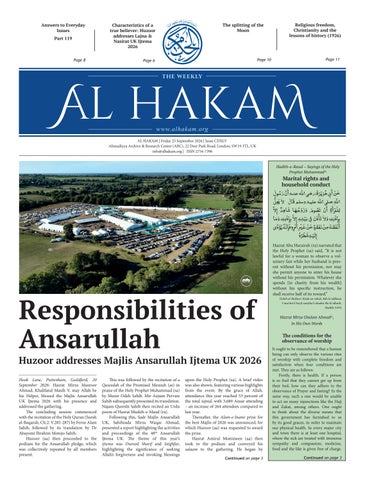
Responsibilities of Ansarullah This was followed by the recitation of a Qaseedah of the Promised Messiah (as) in praise of the Holy Prophet Muhammad (sa) by Munir Odeh Sahib. Mir Anjum Pervaiz Sahib subsequently presented its translation. Najam Qureshi Sahib then recited an Urdu poem of Hazrat Musleh-e-Maud (ra). Following this, Sadr Majlis Ansarullah UK, Sahibzada Mirza Waqas Ahmad, presented a report highlighting the activities and proceedings of the 48th Ansarullah Ijtema UK. The theme of this year’s ijtema was Durood Sharif and Istighfar, highlighting the significance of seeking Allah’s forgiveness and invoking blessings
(Sahih al-Bukhari, Kitab an-nikah, Bab la ta’dhanu l-mar’atu fi bayti zawjiha li ahadin illa bi idhnih, Hadith 5195)
Hazrat Mirza Ghulam Ahmadas, In His Own Words
The conditions for the observance of worship
upon the Holy Prophet (sa). A brief video was also shown, featuring various highlights from the event. By the grace of Allah, attendance this year reached 53 percent of the total tajnid, with 3,689 Ansar attending – an increase of 264 attendees compared to last year. Thereafter, the Alam-e-Inami prize for the best Majlis of 2026 was announced, for which Huzoor (aa) was requested to award the prize. Hazrat Amirul Momineen (aa) then took to the podium and conveyed his salaam to the gathering. He began by
It ought to be remembered that a human being can only observe the various rites of worship with complete freedom and satisfaction when four conditions are met. They are as follows: Firstly, there is health. If a person is so frail that they cannot get up from their bed, how can they adhere to the observance of Prayer and fasting? In the same way, such a one would be unable to act on many injunctions like the Hajj and Zakat, among others. One ought to think about the diverse means that this government has furnished to us by its good graces, in order to maintain our physical health. In every major city and town there is at least one hospital, where the sick are treated with immense sympathy and compassion; medicine, food and the like is given free of charge.
Continued on page 3
Continued on page 3
Huzoor addresses Majlis Ansarullah Ijtema UK 2026 Hook Lane, Puttenham, Guildford, 20 September 2026: Hazrat Mirza Masroor Ahmad, Khalifatul Masih V, may Allah be his Helper, blessed the Majlis Ansarullah UK Ijtema 2026 with his presence and addressed the gathering. The concluding session commenced with the recitation of the Holy Quran (Surah al-Baqarah, Ch.2: V.285-287) by Feroz Alam Sahib, followed by its translation by Dr Abayomi Ibrahim Motojo Sahib. Huzoor (aa) then proceeded to the podium for the Ansarullah pledge, which was collectively repeated by all members present.
Hazrat Abu Hurairah (ra) narrated that the Holy Prophet (sa) said, “It is not lawful for a woman to observe a voluntary fast while her husband is present without his permission, nor may she permit anyone to enter his house without his permission. Whatever she spends [in charity from his wealth] without his specific instruction, he shall receive half of its reward.”
Friday 25 September 2026 | AL HAKAM
2
This Week in History 25 September - 1 October A glimpse into the rich history of the Ahmadiyya Muslim Jamaat
25 September 25 September 1927: On this day, Hazrat Muslehe-Maud (ra) granted an audience to the aggrieved Muslims of Shimla at Kingsley. This joint session of Ahmadi and non-Ahmadi Muslims was held to establish the Jami‘at-ul-Ikhwan, the idea of which was proposed by Huzoor (ra) himself during a lecture on 11 September. On this occasion, Huzoor (ra) delivered a speech as well. For more details of Huzoor’s engagements, see “Coming from every distant track: Sarojini Naidu and other dignitaries meet with Hazrat Musleh-eMaud in Shimla to promote peace and harmony” at alhakam.org (10 February 2023, p. 7). 25 September 1983: On this day, Hazrat Khalifatul Masih IV (rh) laid the foundation of the Rizwan Mosque in Fiji. (Silsila Ahmadiyya, Vol. 4, p. 826)
26 September 26 September 1887: The Promised Messiah (as) was concerned about the deteriorating health of his daughter. On this day, he wrote a letter to one of his close friends, Munshi Rustam Ali Sahib (ra), who lived in a nearby city, asking him to send a pack of soft English biscuits. In those days, Qadian was a small village and didn’t have many basic food items. (Maktubat-e-Ahmad, Vol. 2, p. 521) 26 September 1912: Hazrat Mirza Bashir-ud-Din Mahmud Ahmad (ra) undertook the journey to perform Hajj in late 1912. He was accompanied by his maternal grandfather, Hazrat Mir Nasir Nawab (ra) and another travel companion by the name of Abdul Mohyi Arab Sahib (ra). He left Qadian on this day, boarded the ship to Port Said from Bombay (16 October) and arrived in Mecca via Jeddah on 7 November.
To read more, see: “A young Mahmud’s pilgrimage to Arabia” at alhakam.org (19 February 2021, pp. 30-32). 26 September 1924: On this day, Hazrat Muslehe-Maud (ra) delivered his address in the Dutch Hall in London. The lecture was delivered at the request of the Conservative Party, entitled Hindustan ke halaat-e-haazirah aur itihaad peda karne ke zarai‘ (The current Situation in India and means of establishing unity). (Tarikh-eAhmadiyyat, Vol. 4, p. 454)
27 - 28 September 27 September 2013: During his Friday sermon on this day, delivered from the Taha Mosque in Singapore, Hazrat Khalifatul Masih V (aa) said that he was thankful to Allah the Almighty that He once again enabled him to meet with the Ahmadis there. Huzoor (aa) said that it was difficult for him to visit Malaysia and Indonesia due to the persecution of Ahmadis. Therefore, Singapore was a place where he could meet with the Indonesian and Malaysian Ahmadis. 28 September 1905: On this day, the Promised Messiah (as) received two guests; one from Turkey while the other was Jewish. Huzoor (as) was asked some questions in Arabic, and he gave their answers in Arabic too. The Editor of Al Hakam, Hazrat Sheikh Yaqub Ali Irfani (ra) produced this conversation in his newspaper in Urdu. During this detailed discussion, Huzoor (as) removed many misunderstandings and guided them towards the right path. (Malfuzat, Vol. 7, p. 322) 28 September 1924: On this day, Hazrat Khalifatul Masih II (ra) hosted a tea party at the Ritz Hotel in London in honour of the organisers and delegates of the Wembley conference. For further reading, please visit: www.alhakam.org
29 September 29 September 1933: On this day, Jamaat-eAhmadiyya Bengal held its 17th Jalsa Salana, which was blessed by Hazrat Mirza Sharif Ahmad (ra), son of the Promised Messiah (as) as the chief guest from the markaz. During this journey, Hazrat Mirza Sharif Ahmad (ra), at the behest of Hazrat Musleh-e-Maud (ra), returned from Brahmanbaria and visited all the major jamaats from Calcutta to Qadian. On this historic Jalsa, Hazrat Musleh-e-Maudra sent a special message. (Tarikh-e-Ahmadiyyat, Vol. 6, p. 123) 29 September 1951: Jamaat-e-Ahmadiyya Indonesia was holding its Jalsa Salana and requested Hazrat Musleh-e-Maud (ra) for a message. Upon this, Hazrat Musleh-e-Maud (ra) sent a special message on this day, addressing these devout members of the Jamaat. (Tarikh-eAhmadiyyat, Vol. 13, pp. 384–387)
30 September 30 September 1980: On this day, Hazrat Khalifatul Masih III (rh) inaugurated mission houses in Manchester and Huddersfield in the UK. It was an important and historic event because 55 years had passed since the inauguration of the Fazl Mosque in London, but no new mission house had been inaugurated in England during that time; however, during this blessed visit of Huzoor (rh), five new mission houses were inaugurated. (Silsila-e-Ahmadiyya, Vol. 3, p. 638) 30 September 2011: During his Friday sermon on this day, while inaugurating the Bait-un-Nasr Mosque in Norway, Hazrat Khalifatul Masih V (aa) mentioned some of the facts and figures in relation to the construction of this mosque.
1 October 1 October 2004: During his Friday sermon on this day, while inaugurating the Dar-ul-Barakat Mosque in Birmingham, Hazrat Khalifatul Masih V (aa) narrated the early history of the Jamaat in Birmingham and said that the Jamaat was established in Birmingham in 1960 and initially comprised only five members. 1 October 2013: On this day, Hazrat Khalifatul Masih V (aa) arrived in Australia for the second leg of his Asia Pacific tour. Huzoor (aa) arrived at Sydney’s Kingsford Smith International Airport, following an overnight flight from Singapore and was greeted at the airport by the Rt Hon Kevin Conolly MP, a member of the NSW Legislative Assembly. During a twenty-minute meeting with Kevin Connolly, the MP said he was delighted to welcome Huzooraa to Australia. (‘‘World Islamic Leader Arrives in Australia’’ at www. pressahmadiyya.com)
AL HAKAM | Friday 25 September 2026 Continued from page 1
Certain patients are kept in the hospital and treated, tended to and cared for in a manner that one could not be treated in such ease, facility and comfort even in their own home. A separate department exists to provide healthcare and millions of rupees are spent annually on this service. It has provided extraordinary resources to keep towns and cities clean. A dedicated system is in place for sewage and waste disposal. Then, a wide range of fast-acting medication has been produced and made available at such a low cost that anyone can purchase these medicines and keep them at home to treat themselves at a time of need. Large medical colleges have been established and medical training has been made available so widely that doctors can even be found in rural villages. Moreover, there are separate departments dedicated to deal with other harmful diseases like smallpox, cholera, plague and the like. The measures undertaken recently by the government in connection with the plague is truly worthy of gratitude. In short, the government has provided all the necessary means that are required in the context of health, and in doing so has furnished great support in fulfilling the primary condition for worship. The second condition is faith. If a person does not even believe in God Almighty and His commandments and a person is plagued with the leprosy of disbelief and atheism from within, in this case also, one cannot fulfil the orders of God. There are many who say:
�ا����ا��ڈ
It is this world that is delightful, who has ever seen the hereafter? It is a shame. Before the law, a man can be
Continued from page 1
reciting tashahhud, ta‘awwuz and Surah al-Fatihah, before delivering his address. A brief summary of the key points of his address is given below:
Responsibility of Ansarullah Huzoor (aa) said Ansar are always reminded that those who are called Ansarullah constitute that part of the Jamaat which, in terms of age and experience, has reached the latter stages of life or has entered the group that is approaching the final stage of life. Beyond that lies the next world. Therefore, every nasir should reflect upon the purpose of life: we must understand it for ourselves, for our children and for our future generations. We need to understand our responsibilities. We must assess the extent to which, after becoming Ahmadis, we are fulfilling the covenant we have made and the extent to which we are advising and striving to ensure that it is fulfilled within our homes.
Ansar of the Promised Messiah (as) By joining the auxiliary organisation of Ansarullah, we proclaim, “We are the Helpers of Allah.” We should reflect upon the fact that those who first made this declaration in the Holy Quran pledged that they would be helpers in spreading the mission of the Messiah, conveying his message and supporting him. Now, an even greater responsibility rests upon the Ansar of the Promised Messiah
3
hung on the testimony of two people, but despite the testimony of 124,000 Messengers and countless saints, there is still such widespread disbelief in the hearts of people. In every era, God Almighty declares through ْ َ His powerful signs and miracles: ( اْنا ا ْلَمو ُْﺟوْدI am present). But these unfortunate people do not lend an ear, despite having ears. Therefore, this is also a very important condition. So we ought to be thankful to the British government for this as well because wide-spread knowledge of religion was required in order to strengthen the faith and belief of the people, and religious education depends on the publication of religious books. It is due to the blessings of the printing press and the post office that religious books of all sorts can be obtained and newspapers provide an opportunity for people to exchange views. Good natured people have at their disposal ample opportunity to strengthen their faith and belief. In addition to these points, another important and immensely crucial aspect that is necessary to strengthen faith is the signs of God Almighty, which are manifested at the hand of that individual who comes from God, commissioned by Him, and who revives lost truths and verities through his conduct. Hence, one ought to thank God that the person whom He has appointed to revive faith once again in this era, and whom He has sent to make people stronger in faith, has also appeared in the rule of this blessed government. Who is that person? It is the very same person who stands among you and addresses you now. It is an accepted fact that until man is complete in their faith, they cannot perform virtuous deeds to a level of perfection. The weaker an aspect or pillar of one’s faith, the more indolent and
weak one will be in practice. In this respect, a saint is a person whose every aspect of faith is complete and who is not defective in any respect, whose acts of worship are performed in a perfect and complete manner. Therefore, the second condition is soundness in faith. The third condition is financial ability. The construction of mosques and the advancement of other such endeavours related to Islam depend on financial ability. Without this, civic life and the administration of affairs—particularly those relating to mosques—would become very difficult. Now look at the British government in this respect as well. The government has advanced all sorts of trade. Further, it has promoted education and has made employment available to the citizens of this land, even giving them high positions. By providing means for transport, it has made it possible for citizens to visit other countries and earn money. There are people working as doctors, pleaders, court officials, and also in the department of education etc., and through various means people are earning a substantial salary. Merchants involved in business and trade take their wide array of goods to England and other far-off lands, such as Africa and Australia etc., and return with abounding wealth. In short, the government has made employment available for everyone and has provided many avenues to earn an income. The fourth condition is peace. This condition of peace is not within the power of any one individual. Since the creation of the world, this matter has depended chiefly on the ruling class. The more well-intentioned and sincere a ruling authority, the more this condition will be truly met. In the present era, this condition of peace is being met to
(as) to fulfil this covenant. We must act, with all our strength and capabilities, according to the conditions upon which we have taken the bai‘at. We should also protect and purify our homes from the impurities of the world and make every possible effort to purify society as well. We must strive with all our strength to raise the flag of the Holy Prophet (sa).
but in fact, we should listen to it, continue to reflect upon it and hear it again when it is broadcast on MTA. We must act upon our pledge of bai‘at and consider what the Promised Messiah (as) expects of us after we have entered into his bai‘at. We should enter into the bai‘at with the realisation that we are entering among the latter-day people. Therefore, we must abandon our former pursuits, the wrong activities and worldly desires and turn all our attention towards Allah. Only then will the pledge of bai‘at be fulfilled. In other words, in every matter, the right of Allah the Almighty must take precedence.
Fulfilling the pledge of bai‘at Allah the Almighty states that covenants will be questioned about. We should always keep this before us. The greatest covenant we have made is that, having entered into the bai‘at of the Promised Messiah (as), we will employ all our abilities to abstain from every evil, adopt all virtues, increase our spirituality, attain the nearness of Allah and strive with all our strength and capabilities. We should do so with the conviction that through these efforts, Allah will bestow His grace upon us. We should examine the pledge we have made and ensure that it was not merely a covenant for the sake of making a covenant, but that we made it with the intention of fulfilling it. Every Ahmadi, particularly every nasir, should always keep this matter firmly in view.
Continually reflecting upon our pledge Every Ahmadi and every nasir should continually pay attention to these matters. It should not be the case that once Huzoor (aa) delivers an address, the matter ends there,
the highest degree. I truly believe that even the bright days of Sikh reign are far darker than the dark nights of British rule. There is a village named Butr nearby. If ever a lady had to visit this village, she would go there weeping and crying thinking that perhaps she would never return. Now, the state of affairs is such that anyone can travel to the ends of this land without any danger whatsoever. Various modes of transport have been made so easy that every form of comfort is available. On the rail, one can travel anywhere they please, sitting or sleeping, as though they were at home. A large police department is in place to protect property and life. The courts are open to protect the rights of citizens and a person can pursue a case to the highest authority. How great are these favours which have resulted in freedom of practice. Therefore, in this state when our body and soul is receiving boundless beneficence, if we do not nurture within ourselves a sense of goodwill and gratitude, this would be strange indeed! One who is not thankful to human beings cannot show gratitude to God Almighty either. Why is this the case? It is because human beings too are the ambassadors of God and operate under His will. In short, all of the points that I have mentioned compel a pure-hearted individual to feel a sense of gratitude towards such a benefactor. This is why I mention the favours of the British government again and again in my writings and speeches. For my heart is truly full of pleasure on account of these favours. Those foolish people who are ungrateful, judge my practice—which emanates from sincerity and morality— against their own hypocritical natures, and deem it to be false praise. (Malfuzat [English], Vol. 2, p. 195 - 198)
Progress in faith and spiritual knowledge Are we trying to live our lives with this understanding? The Promised Messiah (as) stated that if one has taken bai‘at at his hand and accepted him as the Hakam [judge] and Adl [just arbiter], then one should progress in faith and spiritual knowledge. We should strive to act upon the instructions of the Promised Messiah (as) and for this purpose, we should also study his books. We should reflect upon whether, during the past year, we have tried to make the words of Allah and His Messenger (sa) a part of our lives, while also striving to fulfil our pledges. If we have not done so or if our efforts do not meet this standard, then this is a matter for serious reflection. Otherwise, the claim, “We are Ansarullah”, remains merely an empty claim.
Abandoning worldly pursuits The Promised Messiah (as) stated that we should remove the garments of our false pursuits and turn all our attention towards Allah the Almighty. God Almighty established this Jamaat and manifested hundreds of signs in its support. Those who enter this Jamaat must remove the garments of false pursuits. This includes all those things that are the frivolities, customs, innovations and erroneous practices of the present age. We must abstain from all such things and abandon them. Only then can we truly be called Ahmadis. The distorted age of 1,000 years, during which religion was corrupted, should not be followed in its corrupted form. Rather, we should reform it, seek the commandments of Allah the Almighty from the Holy Quran and strive to act upon them.
The age of the Promised Messiah (as) The third age is the age of the Promised Messiah (as), in which the teachings of the Holy Prophet (sa) will be revived. Therefore, we should turn our attention towards this matter. This was a prophecy and the Promised Messiah (as) stated that if you have entered into his bai‘at, then you must act upon all the things that he has instructed you to do. Fundamentally, these are the very matters contained in the conditions upon which we have taken his bai‘at. Huzoor (aa) stated that he had already explained them in detail and that they
Friday 25 September 2026 | AL HAKAM
4
were available in book form. He had also repeatedly drawn attention to them in his sermons and addresses. Therefore, we should listen to them carefully again and again and then strive to act upon them.
Establishing the Tawhid The Promised Messiah (as) particularly drew attention to the fact that the Jamaat should profess the Tawhid [Unity of God] and that there should be a special emphasis on repentance towards Allah, the remembrance of Allah and the rights owed to one’s fellow believers. Only when all these qualities are present can we truly be called Ahmadis and true ansar – that is, true helpers who spread the message of the Promised Messiah (as) throughout the world and who raise their generations according to this way.
Rights of Allah and true worship The Promised Messiah (as) stated that the greatest right of Allah the Almighty is that He should be worshipped. This worship should not be performed for any personal objective or to derive some benefit. Even if there were no fear of Hell or hope of entering Paradise, Allah should still be worshipped. Rather, one should worship Him with the profound love that a creature ought to have for its Creator. If we examine ourselves in this regard, there is a great deficiency among us and our worship does not meet this standard.
Sympathy for all of mankind The Promised Messiah (as) stated that it is also the duty of an Ahmadi to show sympathy towards mankind. If we raise the slogan, “Love for all, hatred for none”, then, as the Promised Messiah (as) stated, even one’s heart should be free from enmity towards an enemy. One should pray for one’s enemies and strive to bring them towards the right path. Only then will this sympathy for mankind become a means of removing hatred. Allah the Almighty states, “Pray unto Me; I will answer your prayer.” God does not say that if you pray for an enemy, He will not accept your prayer. Praying for an enemy is itself a practice of the sunnah, as demonstrated by the prayer of the Holy Prophet (sa) for Hazrat Umar (ra). We have no personal enmity with anyone. We should pray for everyone and pray that Allah guides every person to the right path. We should preach with this very thought. Only then will there be blessings in our efforts and new avenues will open.
Reflecting the attributes of Allah The Promised Messiah (as) stated that we should also remember that if we maintain a relationship with him, we should become a people regarding whom Allah the Almighty states that the one who associates with them does not become unfortunate. This is a summary of the teaching expressed through the injunction, “Adopt the attributes of Allah.” We should always reflect upon the extent to which our good deeds have an impact upon others.
Studying and acting upon the Holy Quran The Promised Messiah (as) stated that we should apply the teachings of the Holy
Quran to ourselves and repeatedly read it. We should understand its commandments and apply them to our own lives. Ansar, in particular, should be attentive to reading the Holy Quran, studying its translation and reading its commentary, so that we may acquire as much knowledge of it as possible. We will find every kind of guidance in the Quran and we should also convey this teaching to others.
Manifesting the qualities of Islam Ahmadiyyat We should manifest the excellences of Islam Ahmadiyyat before people. This will make it evident that Islam is not as it is sometimes understood; rather, it is a religion that draws one towards the nearness of God, directs one’s attention towards His worship and draws attention to the rights owed to His creation. It provides solutions to all the various economic and social problems. It draws attention to the upbringing of orphans and their rights and it directs people towards fulfilling the rights of the poor.
Removing doubts through knowledge Nowadays, doubts sometimes arise among some young people, however, if a person possesses complete knowledge, one’s doubts can be removed. Therefore, the Promised Messiah (as) states that we should have firm conviction that we are truthful and that the claim of the Promised Messiah (as) is certainly true, that it is in accordance with the prophecies of the Holy Prophet (sa) and that it is in accordance with what Allah the Almighty has stated in the Holy Quran. If we read the Holy Quran, further arguments will continue to present themselves before us.
Performing prayer with understanding and humility The Promised Messiah (as) states that we should offer prayer in the manner in which the Holy Prophet (sa) offered it. Once, the Holy Prophet (sa) instructed a Companion four times to go back and offer the prayer again. We, too, should offer our prayers calmly and with understanding and we should supplicate before Allah the Almighty. The supplications that we make should be offered in our own language, apart from those supplications that are prescribed from the sunnah.
Reflecting upon Surah al-Fatihah The Promised Messiah (as) also instructed us to recite Surah al-Fatihah carefully and in the best possible manner. Allah the Almighty has taught the manner of supplication in it and has placed this prayer at the beginning of the Quran. Its recitation in prayer is obligatory and the essence of supplication lies in prayer itself. The Promised Messiah (as) stated that one should fulfil the rights of one’s fellow human beings and the rights of Allah the Almighty. Then one should say: “Thee alone do we worship and Thee alone do we implore for help. Guide us in the right path, the path of those upon whom Thou hast bestowed Thy blessings.” We should follow the path of those upon whom Allah has bestowed His blessings, including the paths of the righteous and the
martyrs upon whom He has bestowed His favour. Allah the Almighty has instructed us to follow the example of the prophets and the greatest example is that of the Holy Prophet Muhammad (sa).
Taking advantage of the spiritual fountain The Promised Messiah (as) stated that we should not become proud or complacent, thinking that we have attained everything that we were meant to attain. He said that you have come close to the water that will save you from destruction, but to drink from it requires the grace of Allah the Almighty. Therefore, seek the grace of God that He may enable you to drink from this water and in order to drink from it, fulfil the rights of Allah and the rights of His creation. Allah the Almighty has provided the opportunity by sending the Promised Messiah (as) in this age. We should now benefit from this opportunity. Only those who bring about a transformation in their actions will benefit from it.
Strengthening faith through understanding and prayer Many people come and then fall away, eventually leaving the Jamaat. This is because they do not pray to Allah the Almighty, do not understand true faith, do not delve deeply into it and do not properly understand the message of the Promised Messiah (as). They come, observe it and when they do not derive some personal benefit, they leave. The one who will truly benefit is the person who goes deeply into these matters and understands them, strengthens their faith, seeks Allah’s help and endures the temporary difficulties of this world. The Promised Messiah (as) stated that he certainly knew that whoever drank from this fountain would not perish, because it is life-giving.
The Oneness of God The Promised Messiah (as) stated that we should believe Allah to be One and without partner, just as we affirm in the declaration of faith. In other words, there is none worthy of worship except Allah the Almighty and He has no partner. This is such a beautiful statement that if the Jews, Christians, polytheists and idol-worshippers were taught it and understood it, they would never have been corrupted or ruined. We should not associate anyone with Allah as a partner. We should also fulfil the right of His worship, bow before Him and fulfil His rights.
Giving the love of Allah precedence The Promised Messiah (as) stated that one should give the love of Allah the Almighty precedence over one’s parents, one’s wife, one’s children, one’s own self – in short, over everything. For this reason, Allah the Almighty states in the Holy Quran that one should remember Allah as one remembers one’s fathers and indeed remember Him with even greater and more intense love. If we truly recognise the attributes of Allah the Almighty, we will safeguard ourselves from associating partners with Him and will draw closer to Him.
Becoming spiritually distinct The Promised Messiah (as) stated that after entering his Jamaat, one should become an entirely different person and possess an entirely distinct character. One who holds firmly to God is never in need of anyone. Hard times cannot overcome such a person. When God is one’s Friend and Helper, even if the entire world becomes their enemy, it does not matter. Even when a believer encounters difficulties, they are never truly overcome by distress, for the angels of God take such a person into their protection like a mother taking a child into her lap.
Purifying the heart The Promised Messiah (as) stated that we should purify our hearts. When we purify our hearts, then, in the present state of the world, Allah the Almighty will save us and His angels will take us into their protection. The situation of the world today is before us. We can see how the world is moving towards destruction and a very great calamity appears to be approaching. The world does not understand this. Great nations quietly assume that if they wage war and emerge victorious, it will be to their advantage. But if such a war takes place, they do not realise that these nations themselves will be destroyed.
Turning towards God for the salvation of the world If Ahmadis wish to save themselves, or if they wish to save the world, then we must establish a relationship with Allah the Almighty and make people aware of Him. If they wish to be saved from punishment and destruction – whether destruction comes as a result of human errors, through wars or through the punishment of Allah – the only means of salvation is to turn towards God, fulfil His rights, fulfil the rights of His creation, advance towards righteousness and establish a righteous and peaceful society.
Making the purpose of bai‘at a reality Therefore, we should reflect upon whether we are striving to achieve this objective. If we are not striving to achieve the purpose for which we took the bai‘at, then we have not understood the reality of that bai‘at and cannot benefit from it. As the Promised Messiah (as) stated, one will derive no benefit: one may have come close to the fountain, but may still fail to benefit from it. Therefore, in order to derive benefit, it is essential that we mould our actions according to the teachings of God, according to His commandments and according to the sayings of the Holy Prophet (sa). May Allah the Almighty grant us the ability to do so. May we become true Ansarullah who establish the Tawhid [Unity of God] in the world and play our part in raising the flag of the Holy Prophet (sa) throughout the world. At the end, Hazrat Khalifatul Masih V (aa) led everyone in silent prayer and also mentioned that ansar from Belgium were [virtually] joining the UK gathering, as their own ijtema was also taking place. (Summary prepared by Al Hakam)
AL HAKAM | Friday 25 September 2026
5
Characteristics of a true believer Huzoor addresses Lajna & Nasirat UK Ijtema 2026 Puttenham, Guildford, 19 September 2026: Hazrat Mirza Masroor Ahmad, Khalifatul Masih V, may Allah be his Helper, arrived at 15:32 GMT, conveying salaam to everyone. A recitation of a portion of the Holy Quran (Surah al-Hashr, Ch. 59: V.1922) was recited, commencing the formal proceedings of this blessed gathering. After the English translation of the verses was presented, Huzoor (aa) took to the podium for the Lajna Imaillah pledge, which was repeated in unison by all members present. Thereafter, an Urdu poem composed by the Promised Messiah (as) was beautifully presented followed by its English translation. (Barahin-e-Ahmadiyya Part V [English], p. 25) Sadr Lajna Imaillah UK subsequently presented a report of the ijtema. She expressed gratitude to Huzoor (aa) for gracing the occasion and highlighted that the theme for this year’s ijtema was “taqwa”, i.e. righteousness. She noted that various talks and presentations were delivered on topics including “Taqwa in the Digital Age and Social Media.” Academic competitions were also held and academic excellence awards for university students had been distributed the previous day to those whose names were announced at Jalsa Salana UK 2026. Awards for GCSE and A-Level students were scheduled for the following day. Two special awards were given to those students of Al-Hafizoon who finished memorising the Holy Quran this year. This year’s ijtema attendance was 8,806 as compared to 7,496 last year. Sadr Lajna Imaillah UK concluded her report by offering thanks to all those who had contributed to the success of the ijtema and once again expressed heartfelt gratitude to Huzoor (aa) for his blessed presence and humbly requested his prayers for the future progress of Lajna Imaillah UK. A video presentation was then shown, capturing key aspects of the ijtema and showcasing the new features introduced this year. At 15:57 GMT, Hazrat Khalifatul Masih V (aa) took to the podium again to deliver his address. The following is a summary: After praying that the attendance of Lajna at the ijtema proves beneficial, Huzoor (aa) stated that he would like to speak about the responsibilities and characteristics of a true believer.
Remember and fulfil your pledge Huzoor (aa) said that the basic principle of Islam is that every individual is accountable to Allah the Almighty for their actions. As Ahmadi Muslims, we have all taken the bai‘at of the Promised Messiah (as) and so have pledged to abide by all of Allah’s commands. In terms of fulfilling one’s pledges, Allah says: “And fulfil the covenant; for the covenant shall be questioned about.” (Surah Bani Isra‘il, Ch.17: V.35) Consequently, with a sense of deep anguish and urgency, every Ahmadi,
man and woman, must strive to fulfil the conditions of bai‘at. If an Ahmadi fails to do so, they fail to discharge the rights of being an Ahmadi. The paramount objective of the advent of the Promised Messiah (as) was to draw humanity closer to Allah the Almighty. So, having taken this bai‘at, we must strive to inculcate every quality and virtue that serves as a means of attaining Allah’s nearness and pleasure. Our ultimate return is to Allah; all of us will stand before Allah and be held directly accountable for our actions. Instead of presuming that Allah will be satisfied with us merely because we have accepted the Promised Messiah (as), we must seek to bring about a profound moral and spiritual transformation within ourselves. Huzoor (aa) said, “A faith that is devoid of practice remains hollow and cannot lead to salvation.” Islam teaches us that every person reaps what they sow. Thus, on the Day of Judgment, each person will stand alone before Allah, with only our good deeds accompanying us. Allah says: “And no bearer shall carry the burden of another.” (Surah al-An‘am, Ch.6: V.165)
Fulfil the right of Allah’s worship Salat is the ultimate instrument for purifying a person’s soul and protecting a person from all that Allah dislikes or prohibits. It both guards us in this life and is the means of our salvation in the next. Our challenge is to ensure that we remain firm in our faith at those times when we think that no one is watching, or when we are in the company of people who do not share our religious values. A true believer remains ever fearful of displeasing Allah, irrespective of whether they are on their own or in public. Our fear of Allah should be born out of our love for Him and our appreciation of the limitless blessings He has bestowed upon us.
Looking after children Allah requires a mother to fulfil the rights of her children. She must love, care for them and fulfil their physical and emotional needs. In terms of their character, a mother must strive to instill high moral values in her children. Above all, children must feel that their home is a sanctuary of security and love so that they may grow into well-adjusted, confident individuals who contribute positively to society and are free from any inferiority complex. Although a woman is the guardian and protector of her home, regrettably, some Ahmadi mothers are failing to prioritise the well-being of their children as required. Such children end up seeking companionship outside of the home or increasingly online and are extremely vulnerable to bad company, which invariably affects their behaviour and moral standards. Thus, Ahmadi women should always remember that Allah has placed upon them the primary responsibility of ensuring the
moral, spiritual and physical upbringing of their children.
Guard your honour Huzoor (aa) addressed the older girls present and reminded them that Islam teaches them to guard their honour and modesty in order to be counted among those who are truly obedient to Allah the Almighty, whether at home or outside. Huzoor (aa) stated: “Increasingly, as you get older, there will be times when you are not with your parents, elders, or in the company of other Ahmadis. On such occasions, always remember that Allah is with you and that He is knower of the unseen. Thus, always observe Islamic standards of modesty in your attire, maintain dignity in your interaction, pursue higher education and seek to fulfill your true potential. All the while, ensure that you shield yourselves from the immoral corruption of modern society.”
Offer istighfar and sadaqa No matter how much a person tries to do good, shortcomings naturally remain. Thus, alongside striving towards righteous deeds, we must continuously recite istighfar and seek the forgiveness of Allah for our weaknesses. True istighfar is a means of drawing closer to Allah and purifying a person’s spiritual state. A person who sincerely repents remains ever mindful of their past mistakes and strives to abstain from all things, no matter how small, that may incur the displeasure of Allah. In fact, they develop a deep aversion to everything that the Quran prohibits or that Allah dislikes. Thus, we must recite and study the Holy Quran daily to understand what Allah desires from us. Another excellent method of seeking Allah’s forgiveness and mercy is to offer charity and assist people who are in need or suffering in any way. Treat people with kindness and ensure that your words and actions cause no distress or harm to others. In terms of your close relations, we must strive to strengthen the ties of kinship by treating our relatives with love, generosity and compassion.
Family disputes and their solution It is a source of deep regret and sorrow to observe that disputes between in-laws and spouses are becoming increasingly prevalent within our Jamaat. A root cause of these family breakdowns is that the threshold of patience and tolerance between a husband and wife appears to be diminishing by the day, ultimately leading to divorce. Huzoor (aa) regrettably noted that though men and women frequently fail to discharge the rights owed to one another, ultimately, it is children who are the innocent parties who suffer the most when marriage breaks down. Thus, those Ahmadi couples who fail to make every
effort to safeguard the unity of their homes do not just hurt themselves but are guilty of inflicting immense emotional harm upon their children. Apart from a few genuine cases where separation becomes necessary, it has been noticed that husbands and wives are choosing to separate simply due to a lack of patience and maturity, which is ultimately rooted in a lack of piety. Instead of permitting their egos to overwhelm them, both a husband and a wife ought to bow down before Allah in a state of absolute humility, seeking His forgiveness and help whenever domestic problems arise.
How do we know if Allah has accepted our repentance? Huzoor (aa) said that if a person abandons their past mistakes or weaknesses and is now striving to do good deeds with the fear of Allah ingrained in their heart, it means that their repentance was sincere and has been accepted. Huzoor (aa) said we should assess ourselves daily – to what extent were we able to perform good deeds? To what extent were we able to save ourselves from the immoralities and vices of the world and stay on the right path? A believer may claim to have true faith, but the real test is whether their actions correspond to their words.
Speaking the truth and rejecting falsehood Allah the Almighty has equated falsehood with shirk and states in the Quran: “O ye who believe! be strict in observing justice, [and be] witnesses for Allah, even though it be against yourselves or [against] parents and kindred.” (Surah an-Nisa’, Ch.4: V.136) It is not easy to act upon the highest standard of truth required by the Quran; many people lie or conceal the truth in order to preserve their self-interests. Yet Allah says that if your faith is strong and you desire peace, you must set aside your personal interests and act with absolute integrity.
Speaking the truth can lead to true peace The world today has become consumed by violent conflicts and reckless wars. Suppression of truth and a constant wave of lies and misinformation are being spread in order to serve Western interests. If honesty and justice were to prevail on all sides, many of the conflicts taking place would quickly disappear and peace and reconciliation would occur. In terms of a person’s family life, if a husband and wife speak truthfully and acknowledge their mistakes instead of letting their pride overwhelm them, their arguments or conflicts will quickly come to an end and their homes shall become true havens of peace.
Friday 25 September 2026 | AL HAKAM
6
Our religion teaches us that truth is the foundation of justice and the means of attaining the favour of Allah the Almighty. In a marriage, if one party commits a small mistake, instead of ignoring it or gently addressing it, the other party responds in a hostile and disproportionate way. This, in turn, ignites a bitter cycle of escalating anger and resentment.
Shunning vanity and vulgarity The Holy Quran states: “And when they pass by anything vain, they pass on with dignity.” (Surah al-Furqan, Ch.25: V. 73) In this verse, Allah says that a defining characteristic of a believer is that when encountering anything vulgar or indecent, they pass by with dignity and refuse to engage with it. Social media, the internet, television and other forms of media are all replete with indecent and toxic content that can easily subvert people from the path of righteousness and drive them towards sinful behaviour. All Ahmadis must protect themselves from these corrosive influences. In particular, Ahmadi women have a duty to ensure their homes are free from these malign influences. If a mother remains free from moral vices, she will naturally be in a stronger and better position to safeguard her husband and children from such things. Otherwise, the vile and profane content that exists online and in the media has the potential to corrupt not just the lives of individual families, but the social and moral fabric of entire societies. We must therefore act righteously, strive to do good works, save ourselves from all forms of indecency and vice and be positive examples for others. Above all, we must establish a close bond with Allah the Almighty. Only then can we fulfil our objective of establishing peace in the world and sharing the excellencies of Islam through tabligh. Many mistakenly view Islam as an oppressive or man-made faith. It is therefore our profound duty to demonstrate that Islam is a divine religion designed to establish universal peace and to liberate humanity from all forms of conflict and disorder. Unquestionably, Ahmadi women have a monumental role to play in this noble mission. Accordingly, we must learn the true teachings of Islam and ponder over the signs of Allah the Almighty. Allah the Almighty states: “And those who, when they are reminded of the Signs of their Lord, fall not deaf and blind thereat.” (Surah al-Furqan, Ch.25: V. 74) Here, Allah the Almighty says that the hallmark of a true believer is that when reminded of the signs of Allah, they do not turn a deaf ear or a blind eye. Instead, they listen attentively, increase in faith and act upon Allah’s commands with even greater conviction. As an Ahmadi, whenever or wherever we hear or learn good things, we must seek to incorporate them into our daily lives and elevate our own moral standards and those of our homes and communities.
Expectations of the Promised Messiah (as) The Promised Messiah (as) wrote: “O ye people who consider yourselves
members of my community! You will be counted as such in heaven when you truly tread upon the ways of righteousness.” (Noah’s Ark, pp. 24-25) So we must continue to reflect upon our spiritual and moral state. To what extent are we fulfilling the rights of the bai‘at of the Promised Messiah (as) and fulfilling his teachings? To what extent are we fulfilling the rights of the worship of Allah? To what extent are we acting upon the commands of
the Holy Quran and the instructions of the Holy Prophet (sa)? To what extent are we loyal to the institution of Khilafat and the Jamaat? To what extent are our deeds based in piety? And to what extent are we treating others with love, empathy and compassion? To what extent are we fulfilling our duty to raise our children in the best possible way and ensuring their moral and spiritual development? Huzoor (aa) prayed that may Allah
enable everyone to scale the highest spiritual heights and to live their lives as devoted and faithful servants of Allah the Almighty. May Allah continue to bless Lajna Imaillah in all respects. Amin! Huzoor (aa) then led all attendees in du‘a (silent prayer). Thereafter, Hazrat Amirul Momineen (aa) affectionately listened to a few taranas (choral poems) of Lajna Imaillah and Nasirat. (Report prepared by Al Hakam)
NEWS session came to an end. Lajna members also Jalsa Salana Germany 2026: got the opportunity to visit the exhibitions. The second day of Jalsa Salana Germany to a close with the congregational Highlights from the ladies’ jalsa gah came Maghrib and Isha prayers. At the ladies’ jalsa Fatiha Sarwat Muawina Reporting, Jalsa Salana Germany 2026 The 50th Jalsa Salana Germany was held on 4-6 September 2026, in Mendig.
Day 1 On 4 September 2026, the day began with the Tahajjud prayer, followed by the Fajr prayer and a dars. The Jumuah prayer was offered at 1:30 pm, followed by Asr prayer, after which the atmosphere was further enriched by listening to the live Friday Sermon delivered by Hazrat Khalifatul Masih V (aa), from Islamabad, UK. There was a short lunch break, after which the flag hoisting ceremony took place. The first session of the Jalsa commenced with a recitation from the Holy Quran, followed by messages from two German government representatives and a poem. The session’s first speech was given by the MissionaryIn-Charge, Mubarak Ahmad Tanveer Sahib, about the simplicity and gratitude shown by the Holy Prophet Muhammad (sa). This was followed by a message from Prof Dr Thomas Schumacher and a taranah. The last speech was delivered by Ferhad Ahmed Malik Ghaffar Sahib, a missionary, about the Holy Quran as a guide for daily life. During the session, ladies were able to follow the proceedings from the three designated children’s marquees, including one specifically for younger children, as well as from the main hall. Dedicated volunteers were present to assist with maintaining discipline and guiding the attendees. The total attendance at the ladies’ jalsa gah was 15,898.
Day 2 The second day of Jalsa Salana Germany 2026 began with a sense of anticipation and excitement, as everyone looked forward to seeing and hearing Huzoor (aa). The day began with Tahajjud and Fajr prayers, followed by dars. After breakfast, the Lajna session began with a recitation from the Holy Quran, followed by a poem. The first speech was from Anila Ahmed Sahiba, Regional Sadr,
Lajna Imaillah Hessen-Mitte, on “The True Freedom of Women – Haya.” The second speech was delivered by Amtul Jameed Ghayala Sahiba, National Secretary Talim and Rector of Aisha Academy, on “The Quran is the Word of God.” The third and final speech of this session from the ladies’ side was delivered in German by Hamda Soosn Chaudhry Sahiba, Sadr Lajna Imaillah Germany, on “The Role of the Ahmadi Mother in the Education of Children.” Once everything had been set up and checked by the MTA team, then the moment finally came that everyone was waiting for: Huzoor’s (aa) arrival. The moment everyone saw him on screen, a beautiful silence filled the atmosphere; it was the peaceful silence of finally seeing someone whom our hearts had been longing for. The programme continued with a recitation from the Holy Quran, nazm and the announcement of academic awards. Huzoor’s (aa) address left everyone with something precious to carry in their hearts. Afterwards, we offered Zuhr and Asr prayers. Following the address, there was a short food break. During which people could also visit Jalsa Bazar and the exhibition. A discussion programme was held too, in which several members participated. At the Waqf-e-Nau Department, the members had the opportunity to experience the blessed town of Qadian through VR headsets. After the break, the third session of Jalsa Salana Germany 2026 began with a recitation from the Holy Quran, followed by a message from a former Federal Minister, who appreciated our slogan: Love for all, hatred for none. The first speech of the session was delivered by the guest speaker, Naseer Ahmad Qamar Sahib, Additional Wakil-ul-Ishaat London, who was sent by the Markaz. His speech was about events related to the acceptance of prayers of Hazrat Khalifatul Masih V (aa). It was followed by an Urdu nazm. The last speech of this session was delivered by Cengiz Varli Sahib, Additional Secretary Tarbiyat Nau-Mubai‘een & Waqf-e-Jadid of Jamaat Germany, on “An Ahmadi’s silent tabligh through exemplary behaviour in daily life.” The session ended with Amir Sahib Jamaat Germany introducing new books that are available for purchase and after this, the
gah, approximately 4,500 members were staying in the collective accommodation facilities. The total attendance at the ladies’ side on the second day was 19,494.
Day 3 The final day of the 50th Jalsa Salana Germany began with Tahajjud and Fajr prayers, followed by dars. The fourth and final session began with a recitation from the Holy Quran, followed by a poem. The first speech of the session was delivered by Abdur Rafik Ahmad Sahib, Sadr Qaza Board of Jamaat Germany, on “Divorce in the Light of Islamic Teaching.” This was followed by video messages from individuals from the German government and society. The messages were followed by a beautiful recitation of an Arabic qasidah. The second speech was delivered by Hasan Tahir Syed Bukhari Sahib on “The prominent role of the Promised Messiah (as) in demonstrating the exalted position and truthfulness of the Holy Prophet (sa).” Then, a German taranah was recited. The third and final speech of the session was delivered by Amir Sahib Jamaat Germany, Abdullah Uwe Wagishauser Sahib, on “Extinction of the outdated world order and birth of a new Islamic financial and world order – Nizam-e-Nau.” The speech was followed by important announcements and the session came to an end. Everyone had a lunch break and afterwards, the Zuhr and Asr prayers were offered in congregation. As Huzoor (aa) arrived to deliver the concluding address, a wave of joy and emotion swept through the jalsa gah. The programme continued with a recitation from the Holy Quran, followed by an Urdu nazm and the announcement of academic awards. Huzoor’s (aa) address left everyone with something precious to carry in their hearts. After the final day came to an end, everyone felt emotional and reluctant to leave. On the ladies’ side, Sadr Lajna Imaillah Germany was the Nazima-e-A‘la, who had eight Naib Nazima-e-A‘la, 62 nazimat and approximately 3,500 mu‘awinaat. A total number of 48,330 attended the Jalsa Salana in Mendig and 2,000 attended it at the Mubarak Mosque in Islamabad, UK, making the 50th Jalsa Salana Germany a truly memorable occasion.
AL HAKAM | Friday 25 September 2026
7
Answers to Everyday Issues 119
Satan, menstruation and eye drops while fasting, heart, soul and prayers at graves Guidance regarding basic Islamic issues – which Hazrat Amirul Momineen, Khalifatul Masih Vaa has given on various occasions in his written correspondence and during MTA programmes – is being officially published below for everyone’s benefit. If Satan was created from fire, how can Hell cause him pain? A student from Jamia Ahmadiyya Ghana asked Hazrat Amirul Momineen, Khalifatul Masih V (aa), about the following incident: someone asked a [non-Ahmadi] cleric, “If Satan is made of fire, how will he experience pain in Hell?” The cleric slapped the person and said, “The skin on your cheek is the same as the skin on my hand, so I thought you would not feel any pain from my slap.” The student requested guidance on this matter. Huzoor-e-Anwar (aa) provided the following guidance in his letter dated 27 March 2024: “That was the cleric’s answer, as it occurred to him. However, the reality of the matter is that the Holy Quran and the sayings of the Holy Prophet (sa) describe angels as beings of light and Iblis or Satan as a being of fire. Angels are beings who are submissive and obedient to Allah the Exalted and inspire human beings towards goodness. Concerning them, Allah states:
َ ُون َِما ﻳُ ْﺆ َِمِر َ ون اِل �ّٰلَ َِہ َِما َأَ َِمِرَ َُھ ْﻢ ََو�َ َّْف ََع َُل َ ْلَا �َ َْع ُُّص َون
“‘[They] disobey not Allah in what He commands them and do as they are commanded.’ (Surah at-Tahrim, Ch.66: V.7) “In other words, they do not disobey the commands Allah gives them and do whatever they are instructed to do. By contrast, Iblis or Satan is a being who rejects religion, incites human beings to sin and wrongdoing and prompts them towards evil. Concerning him, Allah states:
ْ ْ َ َ َ َ َ� َ� ً ً ان َْع ُُد �َوا ُِم ِبُّيْنا ِ ِإِن الﺸ ُّْيﻄان �ان ل ِ� ِ�ْن ََس
“‘Surely, Satan is an open enemy to man.’ (Surah Bani Isra’il, Ch.17: V.54) “He also states:
َ ََ ْ َ َ� ان ِِم ََن ال ِﺠ ِ �َن َفَّف ََس َﻖ َْع َْن َأ ِْمِرِ َٰر �ِِب ِِہ
“‘He was [one] of the Jinn; and he
disobeyed the command of his Lord.’ (Surah al-Kahf, Ch.18: V.51) “That is, he was among the jinn and, in accordance with his nature, disobeyed his Lord’s command. “Similarly, the Holy Prophet (sa) said concerning Satan:
َ� َ ْ َ َ ْ ْ َ ْ َ َ َ� َ� الُد ِم ان ِمﺠِرى ِ ِإِن الﺸ ُّْيﻄان ﻳَﺠِرِي ِِمَن اْل ِ�ْنَس
“‘Indeed, Satan courses through a human being as blood does.’ (Sahih al-Bukhari, Kitab al-i‘tikaf, Bab ziyarati l-mar’ati zawjaha fi i‘tikafih, Hadith 2038) “In other words, Satan moves through the human body just as blood circulates through it. “This establishes that these are all metaphors. Otherwise, if Satan were actually made of fire, how could he move through a person’s blood? His body would burn. Thus, these matters are expressed metaphorically and require explanation. Describing the nature of angels and Satan, the Promised Messiah (as) states: “‘What is Satan? Let them remember that two attractions continually act upon the human heart in turn: an attraction towards good and an attraction towards evil. The Islamic Sharia attributes the attraction towards good to an angel and the attraction towards evil to Satan. The point intended is simply that human nature contains these two attractions: at times a person inclines towards good and at others towards evil.’ (Lecture Lahore, Ruhani Khazain, Vol. 20, p. 179) In verse 13 of Surah al-A‘raf, Satan says:
“‘That is, like wet clay, a human being can be moulded into different moral dispositions and, if he chooses, can also submit to a higher power. But, [Satan says,] “Thou hast placed a fiery quality in my nature, so I cannot submit to anyone.” ُ “‘There is an Arabic expression, ﺧَل َِﻖ ِِم َْن َْع َﺠ ٍﻞ, “created of haste?”. This does not mean that haste is some substance from which a human being has been created. Rather, it means that human nature contains a propensity towards hastiness. “‘Likewise, this verse does not mean that human beings have been created from clay and Satan from fire. Rather, it means that human nature possesses the capacity to adapt to different circumstances, whereas Satan’s nature contains a quality resembling fire and he disobeys.’ (Tafsir-e-Saghir, p. 189, footnote) “Thus, creation from fire, clay and light are all metaphorical expressions intended to convey the nature of these beings and the actions they perform. It is incorrect to interpret these words literally.”
“‘Thou hast created me of fire, while him hast Thou created of clay.’ (Surah al-A‘raf, Ch.7: V.13) “Explaining this verse and the meaning of the metaphor concerning humanity’s creation from clay and Satan’s creation from fire, Hazrat Musleh-e-Maud (ra) states:
Someone from Bangladesh asked Hazrat Amirul Momineen, Khalifatul Masih V (aa), whether women could take medication to suppress menstruation in order to observe the fasts of Ramadan, adding that some people claimed Hazrat Khalifatul Masih IV (rh) had permitted this.
َََْ ُ َََْ َ �� ٍ ﺧَلﻘﺘ�ِ� ِِم َْن ْنا ٍٰر ََوﺧَلﻘﺘِہ ِِم َْن ِِط
Can women take medication to delay menstruation for Ramadan fasting?
Huzoor-e-Anwar (aa) provided the following guidance in his letter dated 14 April 2024: “Menstruation is also part of a woman’s natural constitution, so suppressing it can cause various illnesses and complications. How can something that causes illness be permissible? Therefore, this is not permitted at all. “Even in earlier times, there would surely have been various methods and medicines for suppressing menstruation and similar conditions. However, Islam nowhere instructs women to use these to suppress menstruation. Rather, a hadith relates that during the Farewell Pilgrimage, Hazrat Aisha (ra), the blessed wife of the Holy Prophet (sa), began menstruating. The Holy Prophet (sa) therefore instructed her not to perform Umrah during those days. Once her menstruation had ended, he sent her with her brother, Hazrat Abdur-Rahman ibn Abi Bakr (ra), to perform Umrah. (Sahih al-Bukhari, Kitab al-hajj, Bab taqdi l-ha’idu l-manasika kullaha illa t-tawafa bi l-bayt, Hadith 1651) “Moreover, Islam already instructs those who are ill not to fast and commands them to make up the missed fasts later. Rather than developing a lasting illness through the use of such medicines and consequently being deprived of fasting permanently, it is better to benefit from the concessions Islam has granted and receive spiritual reward, instead of trying to please Allah the Exalted through one’s own insistence. “As for the claim that Hazrat Khalifatul
8
“
Friday 25 September 2026 | AL HAKAM
Spiritual matters have a subtle relationship with the heart, and all people of spiritual experience have found that the heart has a profound connection with spirituality. Just as knowledge of the soul, and of its relationship with the body, cannot be obtained through the study of material phenomena, so too the relationship between the heart and the soul cannot be discovered through physical principles. In this matter, therefore, we must place our trust in the observations of those who have experience of these realities, all of whom testify that the heart certainly has a connection with spiritual matters. (Tafsir-e-Kabir, Vol. 4, UK, 2023, p. 132) Masih IV (rh) permitted the use of these medicines, that too is incorrect. Huzoor (rh) did not permit this at all. Rather, he regarded it as impermissible on grounds of health and as harmful, and advised against such practices. He explained that they sometimes cause lasting harm to women and that the possibility of cancer developing as a result of such practices could not be ruled out. (Question-and-answer session, 10 January 1997, Al Fazl International, 29 August-4 September 1997, p. 13) “It therefore appears that either someone conveyed an incorrect translation of Huzoor’s (rh) guidance to you or you did not understand what he said.”
What is the relationship between the soul and the heart in Islam? Someone from the UK asked Hazrat Amirul Momineen, Khalifatul Masih V (aa), about the relationship between the soul and the heart, referring to the following verse: “O mankind! there has indeed come to you an exhortation from your Lord and a cure for whatever [disease] there is in the hearts, and a guidance and a mercy to the believers.” (Surah Yunus, Ch.10: V.58) Huzoor-e-Anwar (aa) gave the following answer in his letter dated 14 April 2024: “The soul and the heart have a profound relationship. Heavenly light from God Almighty first descends upon the soul and then reaches the heart. This is why the Promised Messiah (as) said: “‘The human heart is like the house of God.’ (Malfuzat, Vol. 10, UK, 2022, p. 63) “He also said: “‘The heart is Allah the Exalted’s casket, and He holds its key.’ (Malfuzat, Vol. 8, UK, 2022, p. 239) “However, worldly knowledge cannot disclose the relationship between the soul and the heart. Understanding this also requires spirituality. Explaining this subject, Hazrat Musleh-e-Maud (ra) states: “‘Spiritual matters have a subtle relationship with the heart, and all people of spiritual experience have found that the heart has a profound connection with spirituality. Just as knowledge of the soul, and of its relationship with the body, cannot be obtained through the study of material phenomena, so too the relationship between the heart and the soul cannot be discovered through physical principles. In this matter, therefore, we must place our trust in the observations of those who have experience of these realities, all of whom testify that the heart certainly has a connection with spiritual matters.’ (Tafsir-e-Kabir, Vol. 4, UK, 2023, p. 132)
“It should also be remembered that it is incorrect to understand ‘heart’ as referring solely to a physical piece of flesh in the body. It also refers to the mind, which is the ultimate centre of human thought. The Holy Prophet (sa) likewise used ‘heart’ in this sense when he said: “‘Indeed, there is a piece of flesh in the body: when it is sound, the whole body is sound, and when it becomes corrupt, the whole body becomes corrupt. Listen well: it is the heart.’ (Sahih al-Bukhari, Kitab al-iman, Bab fadli mani istabra’a li dinih, Hadith 52) “Explaining the meanings of heart and mind in connection with the relationship between the soul and the heart, Hazrat Khalifatul Masih III (rh) states: “‘In English, there are the words “mind” and “heart”. These are not used merely to denote the piece of flesh that beats within our chest. Rather, the centre and source of understanding, from which the springs of knowledge flow, is also referred to in English as the “heart” and “mind”, and in Arabic as “aql”. “‘The organ beating within our chest is called the heart, or qalb; these terms are also used for that which becomes the source of understanding and knowledge. Thus, the soul’s relationship is not with the beating of the heart. Its relationship is with God-given reason, insight and knowledge: knowledge that nourishes the soul, guides it towards the paths Allah the Exalted has set out in the Holy Quran for its growth and sustains its striving along those paths.’ (Khutbat-eNasir, Vol. 9, Friday sermon, 10 July 1981, p. 182) “Thus, the soul has a profoundly subtle spiritual relationship with the heart. This cannot be understood through worldly knowledge and the material sciences. Rather, understanding it requires spiritual progress and the development of a relationship with Allah the Exalted.”
Do eye drops break the fast? A missionary from Canada asked Hazrat Amirul Momineen, Khalifatul Masih V (aa), for guidance concerning Hazrat Musleh-e-Maud’s (ra) statement that applying eye drops does not break the fast, whereas an [MTA] programme on Islamic jurisprudence had stated that using eye drops while fasting was prohibited. Huzoor-e-Anwar (aa) gave the following answer in his letter dated 15 April 2024: “It is correct that applying medicine to the eyes does not break the fast. However, alongside the statement of Hazrat Muslehe-Maud (ra) that you mentioned in your letter, he also stated that, concerning kohl
[surmah], the Promised Messiah (as) had said that applying it during the day is disliked [makruh]. (Farmudat-e-Musleh-eMaud Darbarah Fiqhi Masa’il, p. 160) “Since applying kohl to the eyes while fasting is makruh, it follows that applying medicine to the eyes in this state is likewise makruh. Why, then, render one’s fast objectionable by applying medicine? “Moreover, the Just Arbiter [Hakam ‘Adl] of this age has already guided us concerning the application of medicine to the eyes while fasting. When asked whether a person observing a fast could apply medicine to an ailing eye, he said: “‘The question itself is flawed. A person who is ill is not commanded to fast.’ (Malfuzat, Vol. 9, UK, 2022, p. 75)”
Can one pray to Allah for worldly needs at the Promised Messiah’s (as) grave? Someone from India asked Hazrat Amirul Momineen, Khalifatul Masih V (aa), whether, when visiting the grave of the Promised Messiah (as), one could also pray to God Almighty for worldly needs, such as success in examinations or blessings in business. Huzoor-e-Anwar (aa) provided the following guidance in his letter dated 15 April 2024: “The places where righteous and holy people, and those sent by God Almighty, are buried are also places where His grace and mercy descend. Therefore, when praying at such places, one should first praise and glorify God Almighty. For this purpose, Allah the Exalted has bestowed upon us such a great surah as Surah al-Fatihah. “One should then invoke blessings and salutations of peace upon the benefactor of humanity, the Holy Prophet Muhammad, the Chosen One (sa), as every believer has been commanded to do. (Surah al-Ahzab, Ch.33: V.57) “Next, pray for the elevation of the spiritual ranks of the revered persons buried there. Also pray, ‘O Allah, keep their followers steadfast in the virtues and teachings they brought.’ Then offer prayers for spiritual and worldly blessings for yourself and ask Allah the Exalted for whatever you wish. There is no harm in this. “To guide members of the Jamaat, Hazrat Musleh-e-Maud (ra) delivered an address entitled Mazar Hazrat Masih-e-Maud Par Du‘a aur Is Ki Hikmat, which has been published in book form. In this address, Huzoor (ra) drew the attention of Jamaat members to many important matters. You should read it as well. Describing his own
practice in prayer, he states: “‘I shall describe my own practice. Whenever I come to the grave of the Promised Messiah (as) to pray, my established practice is first to pray for the Holy Prophet (sa) and then for the Promised Messiah (as). This is the prayer I offer: “‘“O Allah! I possess nothing that I can present as a gift to these revered personages. Whatever I possess cannot benefit them. Thou, however, possessest all things. I therefore pray and beseech Thee that, out of Thy kindness to me, Thou bestow upon them, on my behalf, a gift in Paradise such as they have never received there before.” “‘They then surely ask, “O Allah! From whom has this gift come?” When God tells them, they pray for that person, and in this way the spiritual ranks of the person offering the prayer are also raised. This is established by the Quran and the Ahadith. It is an established principle of Islam, which no one can deny, that prayers certainly benefit the deceased. “‘The Holy Quran, too, draws attention َ َ ْ to this through the words َف ََح �ُُّيوا ِِبَأ ْْح ََس ََن ِِمْن ََها, “greet ye with a better prayer” [Surah anNisa’, Ch.4: V.87]: when someone presents you with a gift, give them a better gift in return or at least give them as much as they gave you. “‘In accordance with this Quranic verse, when we pray for the Holy Prophet (sa) or the Promised Messiah (as) and invoke blessings and peace upon them, God Almighty will, as a result of that prayer, bestow a gift upon them on our behalf. We do not know all the blessings that exist in Paradise, but Allah the Exalted knows them well. “‘Therefore, when we pray, ‘O God! Bestow upon the Holy Prophet (sa) a gift such as he has never received before,’ it necessarily follows that, when the gift is bestowed upon him, Allah the Exalted will also inform him that it is a gift from suchand-such a person. “‘How, then, could he remain silent after learning this and not pray for the person who sent the gift? At such a moment, his soul will spontaneously fall in supplication at Allah the Exalted’s threshold and say, “O God! Now grant this person, on our behalf, a better reward.” َ “‘In this way, in accordance with َف ََح �ُُّيوا َِبَأ َ ْْح ََس ََن ِِم ْْنَها, “greet ye with a better prayer”, that ِ prayer will return to the person who invoked blessings and will become a means of raising their spiritual rank. This, then, is a means by which both we ourselves and the Jamaat can benefit, without any act of associating partners with Allah [shirk] being involved.’ (Mazar Hazrat Masih-e-Maud Par Du‘a aur Is Ki Hikmat, Anwar-ul-Ulum, Vol.17, pp. 182-183) “Thus, it is permissible to visit the graves of the righteous and pray to Allah the Exalted for those revered persons, as well as to offer various supplications to Allah the Exalted alone for one’s own spiritual and worldly progress and the attainment of blessings. This does not constitute shirk in any way. “However, petitioning those revered persons, asking them to fulfil one’s wishes or believing that those buried there can fulfil our wishes are all acts of shirk and sin.” (Submitted by Ehsan Ahmad, Murabbi-e-Silsilah, Private Secretariat, Islamabad and translated by Al Hakam)
AL HAKAM | Friday 25 September 2026
9
The splitting of the Moon Azhar Ahmad Goraya Missionary of the Ahmadiyya Muslim Community, USA
The Promised Messiah (as) explained that the splitting of the moon was a miracle which occurred during the life of the Holy Prophet Muhammad (sa). In Surah alQamar, Allah testifies to the occurrence of this miracle in the following words: The Hour has drawn nigh and the moon is rent asunder. And if they see a Sign, they turn away and say, ‘A passing feat of magic.’ They reject the truth and follow their own fancies. But every decree of God shall certainly come to pass. (Surah al-Qamar, Ch.54: V.2-4) The Promised Messiah (as) explained that this sign is attested to by numerous sources and therefore the occurrence of something extraordinary cannot be denied. In his work Surma Chashma Arya, he wrote that the Quran reached millions of Muslims and non-Muslims during and immediately after the lifetime of the Prophet (sa), but even its opponents did not dare deny the occurrence of this miracle. Their silence despite the claim of such an open miracle to have occurred demonstrates that they were witnesses to its occurrence. He wrote:
“If the Holy Prophet (sa) – who had publicly and openly proclaimed the claim that the miracle of the splitting of the moon had occurred at his hands and the disbelievers had witnessed it with their own eyes but dismissed it as magic – was not truthful in his claim, then why did the opponents of the Holy Prophet (sa) living in that very era, to whom these reports had reached as loudly and clearly as the sounding of a drum, remain silent? And why did they not hold the Holy Prophet, peace and blessings of Allah be upon him, accountable, demanding from him that when did you ever split the moon into two pieces and when did we call it magic and turn our faces away from accepting it? Why did they maintain silence until their dying breath and keep their mouths shut to the extent that they passed away from this world? Does this silence of theirs – which completely contradicted their state of opposition and competitive fervor – not provide certainty that there was some severe constraint due to which they could say nothing except to witness the manifestation of truth? And what constraint was it? This miracle had manifested in Mecca and the Muslims were still very weak, poor and helpless. Then, the surprising thing is that even their sons or grandsons did not speak
out in denial, although it was incumbent upon them to do so. If such a massive claim was mere fabrication and had become famous for hundreds of miles around, they would have written books in its refutation and published and publicized them throughout the world. And while among those millions of people – Christians, Arabs, Jews, Magians, etc. – none had the courage to write a refutation, the people who were Muslims were openly giving eyewitness testimony before thousands of people. Their testimonies are found to this day recorded in the books of that era. This is clear proof that the opponents had certainly witnessed the splitting of the moon and there was absolutely no room left for them to write a refutation. This was the very thing that kept them quiet despite their denying clamor and uproar.” (Surma Chashma Arya, Ruhani Khazain, Vol. 2, pp. 122-124) Moreover, the event of the splitting of the moon has been attested to in the Hindu scriptures and histories. He wrote: “The event of the splitting of the moon is even found in the authoritative books of the Hindus. Vyasa Ji Sahib writes in the Dharma Parva of the Mahabharata that during his era, the moon split into two pieces and then joined back together. And based on his groundless assumption, he attributes this splitting of the moon as a miracle of Vishvamitra. However, from the testimony of Pandit Dayanand Sahib and the statements of European researchers, it is found that the Mahabharata and the Puranas, etc., are not ancient at all; rather, the compilation of some Puranas occurred only eight hundred or nine hundred years ago. Now, it stands to reason that the Mahabharata, or this event within it, was written after witnessing the actual event of the splitting of the moon – the miracle of the Holy Prophet (sa). And the name of Vishvamitra was merely added out of a groundless habit, as is the ancient custom of Hindus regarding their ancestors. It appears that the fame of this event among the Hindus was still quite widespread during the time of the author of Tarikh-eFirishta (The History of Firishta). This is because he, in the eleventh chapter of his book, narrates based on this widespread fame or tradition received from the Hindus, stating that in the city of Dhar – which is situated adjacent to the Chambal River in the province of Malwa (now perhaps called Dharanagari) – the Raja of that place was sitting on the roof of his palace when he suddenly saw the moon split into two pieces and then rejoin. After further investigation, it became clear to the Raja that this was a miracle of the Arabian Prophet (sa) and he subsequently became a Muslim. The people of that land narrate this very reason for his conversion to Islam and it was a well-known event among the Hindus of that vicinity, which is why a researcher and author recorded it in his book.” (Surma Chashma Arya, Ruhani Khazain, Vol. 2, pp. 126-127) As to the precise nature of the miracle, he primarily proposed two possibilities: that it was a kind of eclipse or that it was a vision. On it being a kind of eclipse, he once stated: “The other magnificent miracle that was given to the Holy Prophet (sa) was the splitting of the moon. In reality, the splitting
of the moon was a kind of lunar eclipse and it took place with a gesture from the Holy Prophet (sa). In this era as well, Allah the Exalted has shown the sign of the lunar and solar eclipses.” (Malfuzat [Eng], Vol. 4, pp. 129-130) “I believe it to have been a type of eclipse. I have written about it in my book, Chashma-e-Ma‘rifat.” (Ibid., Vol. 10, p. 480) On it being a vision, he wrote in Surma Chashma Arya: “It is also possible that through the effect of the holy power of the Prophet (sa), those who witnessed it were granted kashfi [visionary] eyes and the form of the splitting which is to take place near the Day of Judgement was brought before their eyes [...].” (Surma Chashma Arya, Ruhani Khazain, vol. 2, p. 277) To those who objected that such an event was impossible according to the laws of nature, he responded that their argument rested on the false premise that we possess complete knowledge of the laws of nature and that these laws operate wholly independent of Allah’s special will or Taqdeer. He wrote: “The ‘law of nature’ is not an established, proven reality before which nothing else can stand. This is because by the law of nature, we mean those actions of God Almighty that have manifested naturally or will manifest in the future. However, since God Almighty has not grown weary of showing His powers, nor has His display of nature become powerless or gone to sleep, or retired to any place, or been forced by some external constraining force and has perforce withdrawn from the wondrous works of the future and left for us only the performance of a few centuries (or understand it as something even more than that). Therefore, all wisdom, philosophy, literature and learning dictate that we should not assume the laws of nature to be restricted to the few currently witnessed powers, in which there still remain hundreds of ambiguities. We must not stubbornly insist, like ignorant people, that the action of God Almighty can never transcend our observed findings, because this is merely a foolish claim that has never been proven, nor can it ever be proven. We accept that religion is not the antithesis of the laws of nature (Nature). However, how can you make us concede that man has already encompassed all the properties of nature? Is there any proof for this, or do you wish to shut mouths by mere assertion? It is completely obvious that if the experiments and observations recorded up to this day were correct and complete, then there would be no room left for modern sciences to advance – even though you yourself say that the door to modern sciences is open forever. I am thinking: how can such things be perfect and absolute criteria for truth or a balance of ultimate reality when many stages of their own full disclosure are still remaining and this intricate, multi-layered enigma has left even the philosophers astonished and bewildered?” (Surma Chashma Arya, Ruhani Khazain vol. 2, pp. 93-94) On this basis, he held that even a literal, physical splitting of the moon could not reasonably be ruled out as a possibility within the realms of the laws of nature.
Friday 25 September 2026 | AL HAKAM
10
ago...
100 years
Religious freedom, Christianity and the lessons of history (1926) Hazrat Maulana Abdur Rahim Dard (ra) (1894-1955)
Freedom and Christianity The Rev William Wilson Cash says in the “Church Missionary Review” for September 1926: “An Arab can visit England, say his prayers in the street if he wishes, call his people to prayer in Woking and Putney without any fear of trouble. Why? Because in England the Christian Faith prevails and it stands for liberty of conscience for all, regardless of creed.”
Did Christianity establish religious liberty in England? It is no doubt true that there is religious liberty in England, everyone should thank the English Government for this; but the Reverend gentleman should excuse us if we point out that nothing could be further from the truth than to assert that it is due to the prevailing of the Christian faith in England. “The empty pews” and the vehement denouncing of the distinctive doctrines of Christianity in broad daylight by means of the “dailies” of England are surely signs of something which must be quite the reverse. However, let us take for granted that even a Jew born in England is Christian. But the Reverend gentleman cannot throw dust in the eyes of the world. The establishment of religious freedom in England is surely not due to Christianity. Christianity and freedom are quite incompatible, says Shaftesbury. The clergy, as a body, have ever been identified with retrogression. The history of the world has been, indeed, blackened by the intolerance and fanaticism of the Christians.
Religious persecution and Christianity Take the case of England alone. People were imprisoned, branded, mutilated, scourged and exposed in the pillory. Many Catholics under false pretences were tortured and hanged. Anabaptists and Arians were burnt alive. The Presbyterians were hunted like criminals over the mountains. Their ears were torn from the roots. They were branded with hot irons. Their fingers were wrenched asunder by the thumbkins. The bones of their legs were shattered in the boots. Women were scourged publicly through the streets. Multitudes were transported to Barbados; infuriated soldiers were let loose upon them and encouraged to exercise all their ingenuity in torturing them.
Pick up, in short, any book on history and you will read: “Persecution among the early Protestants was a distinct and definite doctrine, digested into elaborate treatises, indissolubly connected with a large portion of the received theology, developed by the most enlightened and far-seeing theologians and enforced against the most inoffensive as against the most formidable sects. It was the doctrine of the palmiest days of Protestantism. It was taught by those who are justly esteemed the greatest of its leaders.” Baxter, on the other hand, pronounced universal toleration to be “soul murder.” He says: “Popery, Mahometanism, infidelity, and heathenism are the way to damnation; but liberty to preach up and to practise them is the means to make men Papists, Mahometans, infidels and heathens; therefore this liberty is the way to men’s damnation.” (A Holy Commonwealth, 2nd Preface)
The persecution of Jews and Muslims in Spain Let us take the case of Spain and see how the faithful followers of Christ reflected “the spirit and teaching” of their master in that country. Mr Paul Daniel Alphandery, Professor of the History of Dogma, Paris, the most eminent authority on the subject, says: “Clement IV, in a brief of 1266, exhorted James I of Aragon to expel the Moors from his dominions. In 1278, Nicholas III blamed Peter III for having made a truce with them. One of the canons of the Council of Vienna (1311-1312) denounces as intolerable the fact that Mahommedan prayers were still proclaimed from the top of the mosques and under the influence of this Council, the Spanish Councils of Zamora (1313) and Valladolid (1322) came to decisions which soon led to violent measures against the Mudegars (Mussulmans of the old Christian provinces). “Already, in 1210, massacres of Jews had taken place under the inspiration of Arnold
of Narboune, the papal legate; in 1276 fresh disturbances took place as a result of James I’s refusal to obey the order of Clement IV, who had called upon him to expel the Jews from his dominions. “In 1278, Nicholas IV commanded the General of the Dominicans to send friars into all parts of the kingdom to work for the conversion of the Jews and draw up lists of those who should refuse to be baptized. It was in vain that a few princes such as Peter III or Ferdinand of Castile interfered; the Spanish clergy directed the persecution with ever-increasing zeal. “In the 14th century the massacres increased and during the year 1391 whole towns were destroyed by fire and sword; while at Valencia eleven thousand forced baptism took place. “In the 15th century the persecution continued in the same way; it can only be said that the years 1449, 1462, 1470 and 1473 were marked by the greatest bloodshed. Moreover, the Mudegars were also subjected to these baptisms and massacres en masse.”
AL HAKAM | Friday 25 September 2026 The Holy Prophet’s (sa) charter for the protection of Christians Is this the “idealism” of Christ? Poor Jesus of the Bible! Little did he know that his disciples, after denying him in his life and giving him up into the hands of his bitterest enemies, would also bring upon his name eternal disgrace. Contrast with it the wellknown charter granted to the Christians by the Master of the Prophets, peace and blessings of Allah be upon him, the greatest manifestation of the Mercy of God. “The Prophet (sa) undertook himself and enjoined on his followers to protect the Christians, to guard them from all injuries and to defend their churches and the residences of their priests. They were not to be unfairly taxed; no bishop was to be driven out of his bishopric; no Christian was to be forced to reject his religion; no monk was to be expelled from his monastery; no pilgrim was to be detained from his pilgrimage; nor were the Christian churches to be pulled
11
down for the sake of building mosques or houses for the Muslims. “Christian women married to Muslims were to enjoy their own religion and not to be subjected to compulsion or annoyance of any kind on that account. If the Christians should stand in need of assistance for the repair of their churches or monasteries, or any other matter pertaining to their religion, the Muslims were to assist them.” (History of the Saracens, p. 14)
Christianity and the conduct of its followers The son of Mary was not, unfortunately, placed ever so high in life. The crown of thorns could not invest him with the power of granting any charters which might be called the monuments of enlightened tolerance. It is because of this, we think, that his followers resisted every attempt that was made to establish religious freedom.
The growth of religious liberty was at all times directly opposed to the Church and its triumph was a measure of her depression.
Rationalism and the rise of religious tolerance William Edward Hartpole Lecky, in his monumental work, “Rationalism in Europe”, says that the triumph of toleration and the triumph of civil liberty have been “achieved by laymen in direct opposition to the Church and in the moment of her extreme depression.” He further concludes that the extinction of the spirit of intolerance, both in Catholic and Protestant countries, is due to the spirit of rationalism. He says: “We have seen that in both cases, the clergy were the untiring enemies of this the noblest of all the conquests of civilisation and that it was only by a long series of antiecclesiastical revolutions that the sword was at last wrung from grasp.”
So we may be indebted, no doubt, to the spirit of rationalism and to the English Government, but we are positively sure we do not owe a little to Christianity for anything. All praise, in fact, is due to God the Lord of the worlds! Though Christians do not mind making Christ bear the burden of their sins, yet we think it would be absolutely unjust to hold him responsible for their misdeeds. It is true, no doubt, that a tree is known by its fruit, but it would be unwise to blame a religion simply for the corruption of its adherents. Christianity might not be a bad religion even when Christians are. So may Islam be a perfect religion however un-Islamic the Muslims might at times make themselves. – AR Dard (Transcribed and edited by Al Hakam from the original English, published in the September 1926 issue of The Review of Religions)
NEWS Expanding surgical care at Ahmadiyya Muslim Hospital, Kenema, Sierra Leone Dr Hasseeb Ahmed Yaqub UK
The recent surgical visits to the Ahmadiyya Muslim Hospital in Kenema, Sierra Leone, are not isolated events, but part of a longer story of sacrifice, planning and service. Many members of the Jamaat travel for waqf-e-arzi and volunteer medical service around the world. However, what makes the Kenema project particularly significant is the work undertaken over the past few years by the Ahmadiyya Muslim Medical Association UK (AMMA UK) to upgrade the surgical wing of the hospital. The early discussions around the project go back to 2021, when AMMA UK began exploring how it could support and improve facilities at the Ahmadiyya Muslim Hospital, Kenema, with Dr Daud Tahir Sahib visiting Kenema and meeting local colleagues including Dr Sheku Tamu Sahib and Dr Fateh-ud-Din Sahib. In October 2022, a team including Dr Syed Muzaffar Ahmad Sahib (AMMA UK President at the time), Dr Masood Majoka Sahib and Dr Muzaffar Chaudhery Sahib travelled to Sierra Leone to assess the hospital and consider how AMMA UK could contribute towards its development. Following appeals and fundraising efforts, the work began to take shape. In May 2023, after the success of a fundraising event at the Baitul Futuh Mosque Complex earlier that month, work towards the Kenema hospital project had started. This included modification of the existing structure and plans to provide equipment for an operating theatre. Dr Daud Tahir Sahib, together with the support of Amir Jamaat Sierra Leone, played a key role on the ground in helping to manage and oversee the upgrade work. The project required patience and persistence; progress was at times delayed
by practical challenges, including heavy rains and the difficulty of completing technical work in an environment where local guidance and specialist support were limited. Despite these challenges, the work continued. The ongoing improvements to the surgical unit, including the operation theatre, installation of equipment, fitting of theatre lights, installation of the anaesthetic machine and making the theatre more suitable for surgical work occurred in the year 2024. The operating theatre was made dust-proof and equipped with air conditioning, with much of the work only possible through continued financial support. Alongside the surgical development, AMMA UK also supported other healthcare initiatives. Free dental camps were organised in Kenema and surrounding areas, including Bo and Freetown, where patients were treated without charge. The need for such services was clear. Kenema has a population of over 200,000, yet access to affordable specialist healthcare remains limited. It was highlighted that there was no dentist in the government hospital and private dental care, though available, was often beyond the reach of many local people. By January 2025, the upgraded surgical wing was ready to support visiting surgical teams. AMMA UK organised a team of three doctors, led by Dr Syed Muzaffar Ahmad Sahib, UK Consultant general and colorectal surgeon, to travel to Kenema for a free surgical camp. The surgical camp attracted coverage by local and regional radio and television channels. It was reported that around 230 patients had registered themselves and the team aimed to complete as many operations as possible during the week-long visit. The initial message to recruit doctors for this effort had been circulated in October 2024,
highlighting the growing need for repeated specialist visits. Since then, three surgical visits have taken place between January 2025 and January 2026. Across these visits, nearly 90 procedures have been performed, including inguinal hernia repairs, ventral wall hernia repairs and minor soft tissue procedures, with hernia surgeries accounting for around 70-80% of the caseload. The most recent visit took place in January 2026. Over four operating days, 28 procedures were performed. These included inguinal hernia repairs, ventral wall hernia repairs and minor soft tissue or scrotal procedures. All were carried out successfully under local anaesthesia, with patients generally discharged the same day. The team worked despite resource limitations, including intermittent electricity outages and limited equipment. Local staff, nurses and theatre assistants worked tirelessly alongside the visiting team. This visit also provided valuable supervised training exposure for junior doctors and registrars. Under the guidance of senior clinicians, junior members of the team assisted in theatre, observed surgical decision-making in a resourcelimited setting and learned the importance of safe, simple and reproducible surgical techniques. It was a reminder that serving humanity requires not only good intentions, but also skill, preparation and humility. The impact of the project has also extended beyond the hospital itself. A programme evaluation of these surgical visits was presented as a short oral paper at the Association of Surgeons of Great Britain and Ireland (ASGBI) International Surgical Congress 2026 in the UK. The presentation highlighted the feasibility of delivering selected common general surgical procedures under local anaesthesia
in a lower-income country, including early safety outcomes, same-day discharge and the value of such programmes for both patient care and supervised surgical training. However, work is still developing. There remain patients waiting for surgery and further visits will be required. Future goals include more structured patient followup, better long-term outcome data, formal cost evaluation, usage of mesh repair where appropriate and possibly spinal anaesthesia for more complex cases. There is also potential for the hospital to support other visiting specialists in future, including medical, dental and ophthalmology camps, provided sufficient planning and local coordination are in place. The Kenema project is a reminder of what can be achieved when prayers, sacrifice, professional expertise and organised effort come together.
Ahmadis in Malaysia invited to the Independence Day celebrations Abdul Aziz Bin Mohd Ibrahim Secretary Tabligh, Jamaat Penang, Malaysia
Jamaat-e-Ahmadiyya Penang, Malaysia, was invited by the Jabatan Penerangan Negeri Pulau Pinang (Penang State Information Department) to participate in the Independence Day celebrations on 31 August 2026. A delegation of the Jamaat took the opportunity to contribute to this occasion through a humanitarian initiative by distributing food to students with disabilities (OKU). This initiative reflects the Jamaat’s commitment to serving humanity and contributing positively to society.
Friday 25 September 2026 | AL HAKAM
12
Friday Sermon Mubarak Mosque, Islamabad, UK
21 August 2026 In his own words: The Promised Messiah’s (as) gratitude to the Companions (ra) in the cause After reciting the tashahhud, ta’awwuz and Surah al-Fatihah, Hazrat Khalifatul Masih V (aa) stated:
The efforts of the Promised Messiah (as) to raise the flag of the Holy Prophet (sa) across the world are evident. However, he was also extremely grateful to those helpers of his, who assisted in fulfilling his mission in any shape or form. In an announcement on 4 October 1899, the Promised Messiah (as) started an initiative to mention the names of those sincere individuals of the Jamaat, who offered financial assistance. He stated: “Allah has so ordained that the party of His men always needs financial assistance in the beginning. Even our Holy Prophet (sa) received financial contribution from his Companions on various occasions, of whom Hazrat Abu Bakr (ra) was foremost. So,
come forward to assist with manly courage and without hesitation.” At that time, the Promised Messiah (as) had launched an appeal for [financial assistance towards] the Langar Khana [communal kitchen], because this too served an important purpose as guests would come in order to learn about Islam and to hear his claim. The Promised Messiah (as) further stated: “All should contribute towards the Langar Khana according to their capacity. I wish, if possible, for such arrangements to be made that we can be relieved from the burden of the Langar Khana and devote ourselves to our mission.” That is, he desired to pay even greater attention towards his
mission of spreading Islam and propagating the message of the Holy Prophet (sa) across the world. And he desired for separate arrangements to be made for those guests that came for this purpose. In any case, the Promised Messiah (as) stated: “[…] and devote ourselves to our mission and so that our time will not be adversely affected. Those who help us today will witness Allah’s help.” He further stated: “I cannot refrain from stating that the foremost individual in this support and devotion is our most sincere and beloved for the sake of Allah, Maulvi Hakeem Noor-ud-Deen Sahib. He has not only assisted financially, but has cut all ties
with the world, and adopting ways similar to the poor, migrated from his home and remained in Qadian until his demise. He remains ever-ready to serve. If I wish, I can send him east or west (in order to propagate the message of Islam). In my opinion, it is these individuals who are spoken of in the revelation found in Barahin-e-Ahmadiyya:
َ� ُ� ُ َ ْ َ َ َ ٰ ْ َ َ َ َ� ُ� ُ َ ْ َ الُّصَّف ِِة َاْصَحاُب الُّصَّف ِِة َوَما َاْدٰرَک َما َاْصَحاُب
“‘The People of Suffah. And what will make you know who the People of the Suffah are?’” He then stated: “Following this distinguished person, on the second rank is my beloved for the sake of Allah,
AL HAKAM | Friday 25 September 2026 Maulvi Abdul Karim Sahib of Sialkot. God Almighty had already endowed him with an inclination to disassociate from worldly affairs or seeking worldly ranks, but now he has completely given up worldly thoughts as well and sits at this threshold, devoting himself day and night to serving the faith, utilising his mind to its utmost capacity. During the Friday prayers, he presents many verities and insights of the Holy Quran and thereby benefits the Muslims. Then, there is a fellow townsman of Maulvi Hakeem Noorud-Deen Sahib, namely Hakeem Fazl Din Sahib. He also lives nearby and is engaged in this service. One of our sincere friends is Dr Buddhay Khan Sahib. Although he has passed away, there is cause for gratitude as there are four other sincere doctors in our Jamaat; Dr Khalifa Rashiduddin Sahib of Lahore, Dr Mirza Yaqub Baig Sahib of Kalanaur, Dr Muhammad Ismail Sahib and Dr Abdul Hakim Khan Sahib. “Similarly, there were also some extremely sincere people who took up residence here. Among them was Mirza Khuda Bakhsh Sahib, as well as Sahibzada Siraj-ul-Haq Sahib Sarsawi, who migrated from his homeland of Sarsawa and came to Qadian, and there are several others. We pray that the migration of all these gentlemen may be blessed for them. And Maulvi Hakeem Noor-ud-Deen Sahib (ra), meanwhile, is one of the shining lanterns of our Jamaat. Every day, he delivers lectures on the Holy Quran and Hadith and expounds such profound insights and truths of the Quran that, if this is not the help of God, then what else could it be? Hazrat Maulvi Sahib and my beloved brother for the sake of God, Maulvi Abdul Karim, both sincerely desire that they should live in Qadian and die in Qadian. Among those sincere members of our Jamaat who are engaged in trade and business, my beloved brother for the sake of God, Seth Abdul Rahman Sahib, a merchant from Madras, is worthy of praise. He has earned many opportunities to attain spiritual reward. He is such an ardent lover that, despite living so far away, he remains close to us, and he greatly assists the Langar Khana of our Jamaat. His truthfulness and continuous services, filled with love, conviction and faith, are an example for all the wealthy members of the Jamaat, for there are few who are like him. He sends 100 rupees every month without fail, and to this day he has repeatedly sent as much as 500 rupees purely out of the fervour of his love and sincerity. (At that time, this was a considerable sum, which he would send for the propagation of the faith and for the expenditure of guests.) The 100 rupees that he sends every month are in addition to this. Similarly, there is my beloved brother for the sake of God, Sheikh Rahmatullah Sahib, a merchant from Lahore. I know very well that the aforementioned Sheikh Sahib is our devoted lover, with all his heart and soul. And using a considerable amount of his own money in the criminal cases that had been brought against me, he greatly assisted me, and driven by the fervour of his love, he remained tirelessly engaged in showing me his sympathy. Now after having spent hundreds of rupees on our work, he is currently in London. May Allah the Almighty bring him back soon in safety and good health.” This was at the time when he had gone to London. The Promised Messiah (as) further states, “It is also worthy of
13
mention that my beloved brother for the sake of God, Sardar Nawab Muhammad Ali Khan Sahib, has made great progress in love and sincerity. And our sound insight bears witness that he will very soon reach a level of sincerity and love that will be a source of envy. He has always assisted, to the best of his ability, with financial contributions, and it is hoped that he will sacrifice even more of his wealth in the way of God. God Almighty sees everyone’s deeds, and there is no need for me to say or write anything further about them.” The Promised Messiah (as) said, “Similarly there are many other sincere people […]” but, regrettably, if he were to write all their names, then the announcement which he was making would turn into a very lengthy article. He says, “I prayed for all their sakes, that God may grant them happiness in both worlds. Whatever they do, or will do in the future, for the sake of God is all beneath the watchful eye of God Almighty.” (Majmu‘ah-e-Ishtiharat, 2019, Vol. 2, pp. 542-546) These were the ways in which the true servant of the Holy Prophet (sa) expressed his gratitude to his helpers. The Promised Messiah (as) would express immense gratitude even for the smallest service by anyone. Thus, Hazrat Munshi Mahboob Alam Sahib relates, “There was a nonAhmadi in our neighbourhood who used to prepare falooda. When the Promised Messiah (as) came to the house of Khawaja Kamaluddin Sahib, this person who made falooda said to me, ‘If you could obtain permission from the Promised Messiah (as), I would like to serve him falooda.’ Accordingly, I presented his request to the Promised Messiah (as), and he granted permission. The man therefore brought all the necessary ingredients and went there. The Promised Messiah (as) was seated on a bed in the courtyard of Khawaja Kamaluddin Sahib. I presented the man to him, and the Promised Messiah (as) said to make the falooda. Thus, he sat outside and prepared a bowl of falooda and presented it to Huzoor (as). Huzoor (as) drank it and expressed his appreciation, saying that it was very good. The man then sent 10 or 12 more bowls inside and served everyone. Upon this, the Promised Messiah (as) then took out two rupees (at that time, two rupees was a considerable amount) and gave them to me, telling me to give them to the man. I took the two rupees to him, but he refused to accept them and said to me, ‘Take me into the company of the Promised Messiah (as).’ Thus, I took him to the Promised Messiah (as). “He joined his hands before the Promised Messiah (as) and said, ‘I do not need the two rupees. I presented the falooda as a gift.’ Upon his insistence, the Promised Messiah (as) did not give him the money. Instead, he prayed for him and said, ‘may Allah grant you the best of rewards.’” The narrator says that, through the blessing of this prayer, his children went on to attain very good positions. (Riwayat Ashab-eAhmad, Vol. 4, pp. 278-279) Hazrat Maulvi Ibrahim Sahib Baqapuri relates, “On one occasion, Jamaat-eAhmadiyya – including the late Hazrat Mir Hamid Shah Sahib, the late Chaudhry Nasrullah Khan Sahib and this humble servant – presented some money to the Promised Messiah (as) as a gift. The Promised
Messiah (as) took the handkerchief in which the money was tied and first said, ‘All praise belongs to Allah’, and then, ‘May Allah reward you’. This increased our faith in a way, for the Promised Messiah (as) first thanked God and then prayed for us.” (Riwayat Ashab-e-Ahmad, Vol. 4, p. 56) I have mentioned previously that the Promised Messiah (as) said that one should first offer thanks to Allah and then express gratitude to people. (Hayat-e-Qudsi, p. 134) Hazrat Zulfiqar Ali Khan Gohar Sahib relates an incident: “On one occasion, the Promised Messiah (as) emerged from the Bait-ud-Dua – which was on the lower floor – at around 10 o’clock after having applied henna [to his hair]. (The Promised Messiah [as] had dyed his beard and hair. In those days, henna was used in this manner, and the Promised Messiah [as] would apply it). There was a small room adjoining the Baitud-Dua, with one door opening into the courtyard and another towards my room. Since I lived nearby, I would wait in this room for the Promised Messiah (as) to come out. “The Promised Messiah (as) came out of the Bait al-Dua and sat on a charpoy. He said to me, ‘Tell Maulvi Syed Sarwar Shah Sahib to bring some food here for us.’ (At that time, guests had come and food was cooked collectively, and Sarwar Shah Sahib was responsible for the arrangements.) I went and conveyed the message. We had just finished eating ourselves. Hardly 10 minutes had passed, but there was no food left. (There was no food after just 10 minutes, for the people had eaten it.) “When I conveyed the message, Maulvi Syed Sarwar Shah Sahib’s face turned pale. Nevertheless, he took some milk in a small bowl and placed three pieces of toast on a plate, along with sugar, and brought them. His face was downcast and he was deeply distressed that the Promised Messiah (as) had asked for food, but there was none available. He said, ‘Your Holiness, there is nothing else left at present.’” Hazrat Zulfiqar Ali Khan Sahib says that, “I was extremely astonished that there was no food kept for the Promised Messiah (as). What kind of arrangement was this? The Promised Messiah (as), however, expressed his gratitude in a manner that was clearly visible on his countenance. It was not merely an outward or artificial expression; rather, his genuine gratitude was apparent from his face. He took the two pieces of toast, dipped them in sugar and ate them, and then drank some water.” The narrator says, “At that moment, it occurred to me that Allah the Almighty had caused this oversight so that the Promised Messiah’s (as) patience, gratitude and spiritual rank might be manifested to the world.” (Riwayat Ashab-e-Ahmad, Vol. 3, p. 54) The Companions would take note even of the smallest incidents. On 7 August 1900, the Promised Messiah (as) wrote a letter of thanks to Hazrat Nawab Muhammad Ali Khan Sahib (ra), who had sent him a gift of some clothes. He wrote: “I have received the precious and excellent articles of clothing which you sent with such deep love and sincerity, and I express my gratitude for them. Looking at each piece, it is evident that my dear friend had them prepared with great effort and devotion. May Allah the Almighty, in
return, bestow upon you His boundless and incomprehensible grace and favour, and may He clothe you completely in the garment of righteousness, honouring you with the hue of His saints and the righteous.” (Ashab-e-Ahmad, Vol. 2, pp. 686-687) Thus, in return for a gift of physical clothing, the Promised Messiah (as) expressed not only gratitude, but prayed that Allah the Almighty should grant the sender the true garment of righteousness, and adorn him with the qualities of the pious. In a letter to Hazrat Munshi Ahmad Jan Sahib (ra), the Promised Messiah (as) wrote: “My honourable and esteemed brother, Munshi Ahmad Jan Sahib, may Allah the Almighty keep you safe and reward you with the best of rewards. Peace be upon you. “I have received your letter. The favours of the Generous Lord cannot be adequately appreciated, for He has provided this humblest of servants with such heartfelt friends, whose very existence is a source of honour and pride for this insignificant one. May the Generous Lord keep you happy and joyful, and may He reward you for your heartfelt intentions. “(The Promised Messiah [as] expressed great humility and said:) This humble one is utterly weak, useless and insignificant. It is purely the grace and favour of He Who is the Most Merciful of all who show mercy that, without even the slightest entitlement on my part, that He is showering countless blessings upon one so unworthy. (Consider the Promised Messiah’s [as] rank, yet such was his humility). I find fault upon fault within myself, yet He bestows favour upon favour. He sees me doing wrong upon wrong, yet He grants bounty upon bounty. In truth, He is Most Merciful and Most Generous. Wherefrom can I find words sufficient enough to express thanks to Him? “This humble one is nothing, lowly, without means, and utterly poor. He found me in the dust and raised me up. He saw me utterly unworthy and covered my faults. Seeing my weakness, He Himself granted me strength. Seeing my ignorance, He Himself bestowed knowledge upon me. He has shown me favours that I cannot count. One manifestation of His favour is that He has placed love for this most humble one in the hearts of noble brothers such as yourself.” (This was the gratitude which the Promised Messiah [as] expressed for those who supported him). It is among the favours of God that He causes this love to grow, and would bestow His grace upon all those whom He had joined in this bond.” After writing this letter, the following couplet of a saint was revealed to him. The Promised Messiah (as) wrote:
� � �� ِب � ِ ِع � �� رہزگ َریِمَن�َ ْْدآہکن ِِدَل َ ْْشِزِدنہ �دُشد ِ ْْش ِِق �� �� ت ِ َِدْیَٔہ �اَعامَل ََد واِم � ااَم ��� ْتْبَثَا �َتْسْرَبِْرَج ْ�
“One whose heart is brought to life by love can never die. Our eternity has been inscribed upon the register of the world.” (Maktubat-e-Ahmad, Vol. 3, pp. 25-26) In another letter, addressed to Hazrat Qazi Zahooruddin Akmal Sahib (ra), the Promised Messiah (as) wrote in response to three books he had sent in support of him: “I have received your gift of three books. May Allah grant you an excellent reward. I have skimmed through all three of them.
Friday 25 September 2026 | AL HAKAM
14
The discourse is excellent and well-argued. May Allah grant you a good reward. Amin. You should publish and circulate them wherever and whenever appropriate, so that the reward may be doubled.” (Maktubat-eAhmad, Vol. 5, p. 245) Similarly, in a letter to Dr Khalifa Rashiduddin Sahib – who was the father of Hazrat Umm-e-Nasir and the father-inlaw of Hazrat Musleh-e-Maud (ra) – the Promised Messiah (as) wrote: “My beloved brother, Dr Khalifa Rashiuddin Sahib, peace be upon you. “I have received the sum of fifty rupees which you had sent. At such a delicate and necessary time, when ill-natured and envious people have brought a case against me in court, your repeated financial assistance is truly deserving of gratitude. May Allah reward you with the best of rewards. “The next court date in the case is 24 February 1899, and it will likely be the day after Eid. Eid will most likely fall on Sunday, and the next day, Monday, I shall have to go to Pathankot for the case. Allah knows best. “I have now resolved that I shall continue praying for you for some time. (Out of gratitude, the Promised Messiah [as] said that he would continue praying for him). May Allah grant you safe, sound and complete deliverance from distance and separation (he said this as he had been posted far away and he wished to return home). Amin, and again, Amin.” (Maktubate-Ahmad, Vol. 4, p. 214) In another letter, written to Hazrat Sahibzada Sirajul Haq Sahib, the Promised Messiah (as) stated: “To my honoured brother Sahibzada Sirajul Haq Sahib. “May the peace and blessings of Allah be upon you. “Your letter has been received. I am grateful to you for the friendly gift of the turban and perfume which you sent. (This was something small, yet the Promised Messiah [as] still wrote a letter to express thanks). May Allah reward you with the best reward, and may He deal graciously with you in this world and the next. May Allah the Almighty keep you very happy and protect you from the disliked things of both faith and world.” (Maktubat-e-Ahmad, Vol. 3, p. 110) Along with his gratitude, the Promised Messiah (as) would also pray for the spiritual progress of others. Syed Mahmud Alam Sahib (ra) relates that Hazrat Maulvi Noor-ud-Deen Sahib (ra) used to say that when the Promised Messiah (as) delivered the Arabic sermon on Eid-ul-Adha, he was later asked about the state in which he had delivered it. The Promised Messiah (as) replied that angels kept bringing tablets before him, written in large letters, and he would read from them as they appeared. When one tablet came, he would recite what was written upon it; then another would appear and the first would disappear. This sequence of tablets continued. If one of the scribes asked him to repeat something – there were two people who had been seated to write the sermon down – the tablet that had gone would return, and he would look at it and repeat the words. When the sermon concluded, the Promised Messiah (as) fell into prostration out of gratitude. All those present joined him in
that prostration of thanks. After raising his head, he said, “I have just seen [in a vision] in red letters the word: [ مبارکFelicitations]. This means that the address has found acceptance [with God]. (Tadhkirah [English], p. 488) Hazrat Mian Ferozuddin Sahib (ra) relates that the Promised Messiah (as) wrote Lecture Sialkot on the roof of Mir Hisamuddin Sahib’s house. Four inkpots had been placed upon the four low parapet walls of the roof. The Promised Messiah (as) would write as he walked. It was around the time of Asr [late afternoon prayer]. He would walk while writing, and at times would suddenly fall into prostration. It seemed that when Allah the Almighty disclosed a certain point to him, he would offer a prostration of gratitude. While writing, he would pause and fall into prostration. He says, “We watched this entire scene from the roof of our own house. Many others had also gathered there to witness it. Our house was close by and stood higher than any other house, it provided a clear view of the whole scene,” as to how the Promised Messiah (as) was writing the book, and how, alongside his writing, he was continually thanking Allah the Almighty. (Riwayat Ashab-e-Ahmad, Vol. 4, p. 375) Describing the Promised Messiah’s (as) characteristic of gratitude, one Companion, Hazrat Khairuddin Sahib (ra), relates: “Once, the Promised Messiah (as) came to our village, Qadirabad. My mother, Taj Bibi Sahiba, filled a tray with sugar and presented it to him. The Promised Messiah (as) placed that sugar into my grandmother’s lap, who was sitting there at the time, and gave it to her. He said, ‘May Allah reward you,’ and prayed for us.” (Riwayat Ashab-eAhmad, Vol. 3, p. 89) Thus, the Promised Messiah (as) expressed gratitude even for the smallest of gifts. Haji Muhammad Din Sahib (ra) relates: “Once, I came to know that the Promised Messiah (as) was coming to Sialkot on the occasion of some gathering. On the appointed date, I too went there with an eager desire to see him. The Promised Messiah (as) was staying on the upper floor of a house, while those devoted to him, like moths drawn to a flame, stood below in a large crowd, eagerly awaiting a glimpse of him. After a while, he came downstairs and afforded those present the honour of beholding him. “When an elderly man met the Promised Messiah (as), he began weeping uncontrollably. The Promised Messiah (as) comforted him and inquired about his circumstances. He submitted, ‘Your Holiness, I used to pray that I might live until the advent of the Imam Mahdi.’ The Promised Messiah (as) replied, ‘Then, O elder, Allah the Almighty has indeed accepted your prayer.’ Upon hearing this, he became very happy. He then presented one of his grandsons before the Promised Messiah (as) and requested that he place his blessed hand upon him and pray for him. The Promised Messiah (as) prayed for him and then went upstairs.” Moving forward, he mentions the actual incident that highlights the Promised Messiah’s (as) gratefulness. This was just a preamble of the details surrounding the incident. He continues with the incident and says:
“By coincidence, as the Promised Messiah (as) was going upstairs, one of his shoes, which was a very simple one, slipped off his foot and fell down below. This humble servant picked it up and personally put it back on his foot. Upon this, the Promised Messiah (as), with a smiling countenance, lovingly said, ‘May Allah reward you,’ and expressed his thanks most graciously.” (Riwayat Ashab-e-Ahmad, Vo. 5, p. 334) The Promised Messiah (as) would never miss an opportunity to express his gratitude. The Promised Messiah (as) wrote the following in a letter to Hazrat Munshi Rustam Ali Sahib (ra): “Munshi Rustam Ali Sahib, may Allah keep him safe. “Peace and blessings of Allah be upon you. “The sum of fifty rupees sent through Mian Imamuddin Sahib has been received. For all the efforts you and Chaudhry Muhammad Bakhsh Sahib have made, may the Gracious Lord, Glorified is His Majesty, bestow upon you a great reward and grant you success in this world and the Hereafter. At the time of writing, all is well here.” The Promised Messiah (as) informed him of his own circumstances. (Maktubate-Ahmad, Vol. 2, pp. 467-468) The Promised Messiah (as) would express his gratitude to everyone for everything, even when someone had done something very small for him. There is another incident that Hazrat Mian Miran Bakhsh (ra) Sahib relates: “I pledged allegiance to the Promised Messiah and Imam Mahdi (as) around 1897 or 1898, but for some time I did not disclose this to my father. However, how long could the matter remain concealed? When the secret came to light, my father plainly refused to accept me and turned me out of the house, saying, ‘You have become an Ahmadi. Now leave my house.’ “Putting my trust in God, the Provider, I rented a separate shop. Although I was experiencing financial hardship, I had a strong desire that, in whatever way I could and according to my means, I should prepare a garment for the Promised Messiah (as), sew it with my own hands (as he was a tailor), and present it to him. “With this thought in mind, I purchased a muslin kurta, a latha shalwar, a black coat and a muslin turban. I stitched them myself and prepared the outfit. I then somehow managed to collect the fare from here and there and travelled to Qadian. “The following day was Friday, and I thought that, if possible, this humble person might present this simple gift to the Promised Messiah (as) that very day. Perhaps the Promised Messiah (as) would wear it before the Friday prayer and thereby gladden the heart of this poor man. “Thus, while contemplating how I might accomplish this, I reached the shop of Qazi Ziauddin Sahib and expressed my heartfelt desire to him. As soon as he heard it, he said, ‘Come, I will take you to the Promised Messiah (as).’ “He immediately got up and took me into the presence of the Promised Messiah (as). At that time, the Promised Messiah (as) was seated upon a bench, writing something, while Khawaja Kamaluddin Sahib was seated on a mat in front of him. We both sat there beside Khawaja Sahib. “Khawaja Sahib asked the reason for my
visit, whereupon Qazi Sahib explained my desire. Khawaja Sahib remained silent for a while. Then, addressing me, he said, ‘Well, shall I represent you?’ Khawaja Sahib was a lawyer, so even on this occasion he used professional terminology. “I replied, ‘That would be extremely kind of you. Please represent me.’ “Upon this, Khawaja Sahib took the clothes from me and presented them to the Promised Messiah (as). At the same time, he submitted, ‘Your Holiness, this boy wishes that you would wear these clothes and offer the Friday prayer in them.’ “Upon hearing this, the Promised Messiah (as) took up the clothes and began putting them on. However, when he put on the coat, it was very tight. I submitted, ‘Your Holiness, the coat is very tight. If you take it off, I can loosen it a little.’” The Promised Messiah (as) would not have worn it there, but would have left his work and then put the clothes on, thereafter returning to them. He says that when the Promised Messiah (as) wore the coat, it was tight. The Promised Messiah (as) took the coat off and gave it to him and he said that he would have it altered as it was a bit tight. He continues: “I immediately got up, took it to the market, and, sitting at a tailor’s shop, opened up the entire back of the coat. I then returned to the presence of the Promised Messiah (as). “The Promised Messiah (as) put it on again, but even then the buttons of the coat would not come together and fasten properly as he desired. Nevertheless, in order to spare my feelings, the Promised Messiah (as) pulled and adjusted the coat and fastened the buttons, without giving any thought to whether these clothes were actually suitable for wearing.” (Riwayat Ashab-e-Ahmad, Vol. 1, pp. 368-369) The Promised Messiah (as) wore the coat in this condition out of consideration for the feelings of that boy, who had only recently become an Ahmadi and had come with a gift. He then expressed his gratitude to him very warmly as well. Hazrat Mian Saifullah Sahib (ra) relates: “Once, I went to Qadian. Someone placed a heap of 50 or 60 rupees in front of the Promised Messiah (as), but he did not even turn his attention towards it.” Normally, he would express his thanks when people gave him something, but perhaps there was some particular reason on this occasion. In any case, he relates that the person gave the money in cash, but the Promised Messiah (as) paid no attention to it. “Meanwhile, an old woman, who was probably a Hindu woman, arrived with a child. She had a lump of jaggery tied up in a piece of cloth. The woman submitted, ‘Your Holiness, this child has brought this piece of jaggery for you. Please pray for him.’ “The Promised Messiah (as) said, ‘Very good,’ and became very pleased. He took the lump of jaggery, together with the cloth, from the child’s hand and placed it over his shoulder.” (Riwayat Ashab-e-Ahmad, Vol. 4, p. 453) Thus, even though it was only an ordinary gift from this poor child, he received it with great appreciation, expressed his gratitude for it, and also prayed for the child. The Promised Messiah (as) wrote the following in a letter addressed to Jamaat-e-
AL HAKAM | Friday 25 September 2026 Ahmadiyya: “First and foremost, my heart is filled with gratitude to Allah the Almighty, Who has granted my Jamaat sincere resolve, love and sympathy. Had the grace of God Almighty not been with them, they would never have been granted the opportunity to demonstrate such obedience in the footsteps of the Companions (ra), that despite their own financial difficulties and meagre incomes, they are engaged in financial service beyond their means. “I pray that Allah the Almighty may bless all their wealth, and that the help and assistance they are rendering for the fulfilment of religious objectives may become a means of their welfare in both this life and the hereafter.” (Maktubat-e-Ahmad, Vol. 5, p. 365) Then, while imparting guidance, the Promised Messiah (as) states: “Treating His creation with kindness and compassion is, in fact, the way for those who have been blessed by Almighty Allah to show their gratitude to Him. They should not show arrogance for the grace that God has bestowed upon them and should not be like uncivilised brutes who viciously beat the poor.” (Malfuzat [English], Vol. 7, p. 468) Thus, he also drew attention towards helping the poor. Having received knowledge from Allah the Almighty, he would at times also inform people beforehand concerning certain matters relating to them. Likewise, having received knowledge from Allah the Almighty regarding his opponents, he would tell them that such and such would happen to them. However, at times, owing to the wisdom of Allah the Almighty, it would take time for these things to come to pass. On such occasions, the Promised Messiah (as) would become anxious and engage himself in prayers, fearing that the opponents would raise an uproar about the matter. But when it would come to pass, he would prostrate himself before Allah the Almighty with the utmost gratitude. Thus, the Promised Messiah (as) states: “I had, at one point, prophesied about Bishambar Das, a brother of Sharampat Khatri, that although he would not be acquitted outright in the criminal case in which he was implicated, the term of his imprisonment would be reduced by half. “Later, when Bishambar Das was released after serving half the term of his imprisonment, as was intimated in the prophecy, his kin falsely announced that Bishambar Das had been acquitted. It was night-time and I had gone to our main mosque for offering Prayer when Ali Muhammad, a mullah, resident of Qadian, narrated it in the mosque that Bishambar Das had been acquitted and that he was being congratulated in the marketplace. “I was shocked when I heard the news and was rather apprehensive that the bigoted Hindus would now object and say: ‘You had prophesied that Bishambar Das would not be acquitted. Know now that he has, in fact, been acquitted!’ Under the stress of this grief, each rak‘at of the prayer felt as long as a year, and when I prostrated at the end of a rak‘at, my distress reached the extreme. Then, in that very state of prostration, God, addressing me aloud, said:
15
َ َ ْ َ َ ّ� َ َ َلَا َتَخ ْْف ِإَِّنَك َأْن ََت اْلَْأ ْْعَل ٰٰى
“Meaning that, have no fear at all; you indeed are victorious. “After this, I waited as to how this prophecy would be fulfilled. But no Sign appeared. I enquired of the very same Sharampat over and over again if it was true that Bishambar Das had been acquitted. He would give the same answer: ‘Yes, he has, in fact, been acquitted and why should I lie?’ In the village, anyone whom I enquired would invariably reply, ‘We too have heard that he has been acquitted.’ “Meanwhile, six months or thereabouts passed. Mischievous people would mock and jeer as is their wont. But Sharampat did not mock or jeer, which convinced me that he had behaved decently towards me on that occasion. Still I felt embarrassed in his presence, [thinking] how emphatically I had communicated to him the news of his brother’s non-acquittal! And now the situation had come to such a pass! Despite all this, I had firm faith in my God and I was certain that He would demonstrate some Sign of His providence and may be he would be apprehended again after acquittal. But I knew not that the very news of his acquittal was a mere fabrication. Then it so happened that one Tehsildar of Batala, Hafiz Hidayat ‘Ali, whom I have mentioned earlier, came to Qadian at eight o’clock in the morning on an official visit to Qadian, for Qadian is part of Tehsil Batala. He came to our residence and had not yet dismounted his horse when a few Hindus, as is their wont, assembled to greet him, and Bishambar Das was among them. On seeing Bishambar Das, the Tehsildar said, ‘Bishambar Das, I was pleased to hear that you had been released from jail, but alas you were not acquitted.’ On hearing this, I fell in grateful prostration to God. “Immediately I summoned Sharampat and asked him why he had lied to me for so long that Bishambar Das had been acquitted and aggrieved me for nothing. He said he had to lie because of a consideration— namely, that his people are highly critical of even minor flaws when they choose to enter into new marital relationships, and it is very hard to obtain agreement from the girl’s side when someone is proven to be guilty of a wrongdoing. It was because of this consideration that he continued to misrepresent the facts and publicise this falsehood.” (The Philosophy of Divine Revelation, pp. 380-382) While mentioning one of his signs, the Promised Messiah (as) states: “A prophecy was fulfilled in the presence of some Aryas who are the followers of Pundit Dayanand, a detailed account of which will not be without benefit for the readers. Even though its description here might be somewhat long, it is being recorded for the benefit of people who are unaware of the grandeur of Islam. “Before this prophecy was fulfilled, unusual difficulties and undesirable events were experienced. (The Promised Messiah [as] presented this prophecy so as to exhibit the grandeur of Islam and raise the banner of the Holy Prophet [sa] in the world). Finally, the Benevolent God removed all difficulties and fulfilled this prophecy on Monday, 10 September 1883. The detail of this is that, on
Thursday, 6 September 1883, the Benevolent God gave glad tidings to this humble one through His blessed word to give solace to me at the exact time of need:
تسب ََو ک �کَیروہیپ
“‘Twenty and one rupees are coming.’ “This glad tiding had the special aspect that the exact amount to be received was mentioned, and to give intimation of a specific amount is special to the Knower of the unseen; no one else can do so. (It was no ordinary matter that the exact amount was being disclosed). The other, even more wonderful aspect is that this amount was of an unusual nature, because it had no relationship to the price that had been fixed for the book. (The Promised Messiah [as] had never even thought of this amount). Because of these special aspects this revelation was communicated to some Aryas ahead of time. Then a revelation was received emphatically for the third time on 10 September 1883:
���� ْکَیروہیپآےئںیہ ْ ْ � � ْتْسَب ََو
“‘Twenty and one rupees have arrived.’ “It was understood from this revelation that the prophecy would be fulfilled that same day. Perhaps not even three minutes had elapsed from receipt of this revelation when a man by the name of Wazir Singh, tending to a sick man, arrived and presented a gift of one rupee upon his arrival. Even though this humble one does not practise as a physician, if perchance some sick person comes and I am able to think of a medicine, I give it away for the sake of Allah and solely to earn [His] blessings. (The Promised Messiah [as] says he typically didn’t take money for this). However, I accepted this rupee from him for it suddenly passed through my mind that it was a part of that prophecy (regarding 21 rupees). Thereafter, I sent a trusted person to the post office thinking that the other part may be fulfilled through the post office. The postal clerk, a Hindu, replied that he had only one money order valued at five rupees to which a card was attached – which had arrived from Dera Ghazi Khan – but that he did not have any money with him and would remit this money as soon as he would receive it. I was so surprised and perturbed upon receiving this information as cannot be described in words. (This was because the Promised Messiah [as] had mentioned this prophecy before non-Muslims in order to prove the truthfulness of Islam.) During this perturbation, while I had bowed down my head, thinking that five and one would make only six, how will they turn into twenty-one, I begged Allah about the matter. During this very contemplation, I suddenly received this revelation:
���� ْکَیآےئںیہاسںیمکشںیہن ْ ْ � � ْتْسَب ََو
“‘Twenty and one have arrived, there is no doubt in this.’ “Not even six hours had elapsed from [the time of ] this revelation on that very day, when an Aryah, who heard the postal clerk’s message, happened to go to the post office and in the course of conversation, the postal clerk informed him that, in fact, twenty rupees had arrived, but by a slip of
the tongue he mentioned the amount of five rupees. Thus, the same Aryah brought twenty rupees with a post card from Munshi Ilahi Bakhsh, Accountant, and it was discovered that the post card had not been attached to the money order and it was further discovered that the money had arrived. Moreover, it was known from the writing of Munshi Ilahi Bakhsh, as a receipt in care of the post office, that the money order had arrived in Qadian on 6 September 1883; that is, the same day of the revelation. Thus, the whole statement of the postal clerk was proven wrong and the entire disclosure of the Knower of the unseen was proven correct. Thus, in memory of this blessed day, one rupee’s worth of sweets were distributed to some Aryas as well. (Out of happiness of the fulfilment of this prophecy, the Promised Messiah [as] distributed sweets to the Aryas as well since he had mentioned this prophecy to them).
ُ َ �ٰ ْ َ َفاْل ََح ْْم ُُدِلِّٰل ِِہ ََعٰلٰی آَلَاِئِ ٖٖہ ََوُن ََع ََماِئِ ِِہ َظا ِِھِرِ ََھا ََوَبَا ِِط ِِن ََھا
“[So Allah be praised for all His favours and His bounties, manifest and hidden].” (Barahin-e-Ahmadiyya Part IV [English], pp. 402-404) The Promised Messiah (as) further states: “There is not a single nation among whom the Signs in my favour have not appeared, and there is not a sect that is not a witness to my Signs. It would be no exaggeration to say that the number of witnesses to these Signs is as much as 100,000,000. But the plight of the opponents is pitiable indeed, that they did not derive any benefit from these Signs. Had these Signs that have been shown to them been shown to the Jews at the time of Jesus, son of Mary (as), they would not have been characterised as ‘those smitten with abasement’ (as has been mentioned in the Holy Quran). Had Lot’s (as) people witnessed these Signs, they would not have been buried under the earth on account of that massive earthquake. But woe be upon these hearts that proved to be harder than stone! The darkness that has overtaken their hearts exceeds every kind of darkness. The fact of the matter is that just as the world has progressed in respect of all kinds of material means, so has it advanced in disbelief and lack of faith. Hence this ‘advanced’ disbelief requires that it should not be visited by any ordinary chastisement; rather it should be overtaken by a chastisement the like of which has never descended since the beginning of the world. At any rate, thousands of thanks be to God that the light that our opponents refused to accept and remained blind, the same light became the cause of advancement of our own sight and spiritual insight.” (The Philosophy of Divine Revelation, p. 378) The Promised Messiah (as) wrote this in The Philosophy of Divine Revelation. May Allah the Almighty grant us a true understanding of gratitude and, having enabled us to pledge allegiance to the true servant of the Holy Prophet (sa), may He also bestow upon us true spiritual light, insight and Divine knowledge. (Official Urdu transcript published in the Daily Al Fazl International, 18 September 2026, pp. 2-7. Translated by The Review of Religions.)
Editor-in-Chief: Qaasid Muin Ahmad | Associate Editor: Aqeel Ahmed Kang | Current Affairs Editor: Romaan Basit | Faith & Religion Editor: Jazib Mehmood | Science & Technology Editor: Qamar Ahmed | Society & Lifestyle Editor: Ataul Fatir Tahir | Proofreaders: Ata-ul-Haye Nasir, M Adam Ahmad | Design: Jalees Ahmad, Tahmeed Ahmad | Research: Awwab Saad Hayat | Jamaat News: Ata-ul-Haye Nasir | Social Media: Romaan Basit, M Adam Ahmad | © Al Hakam 2026