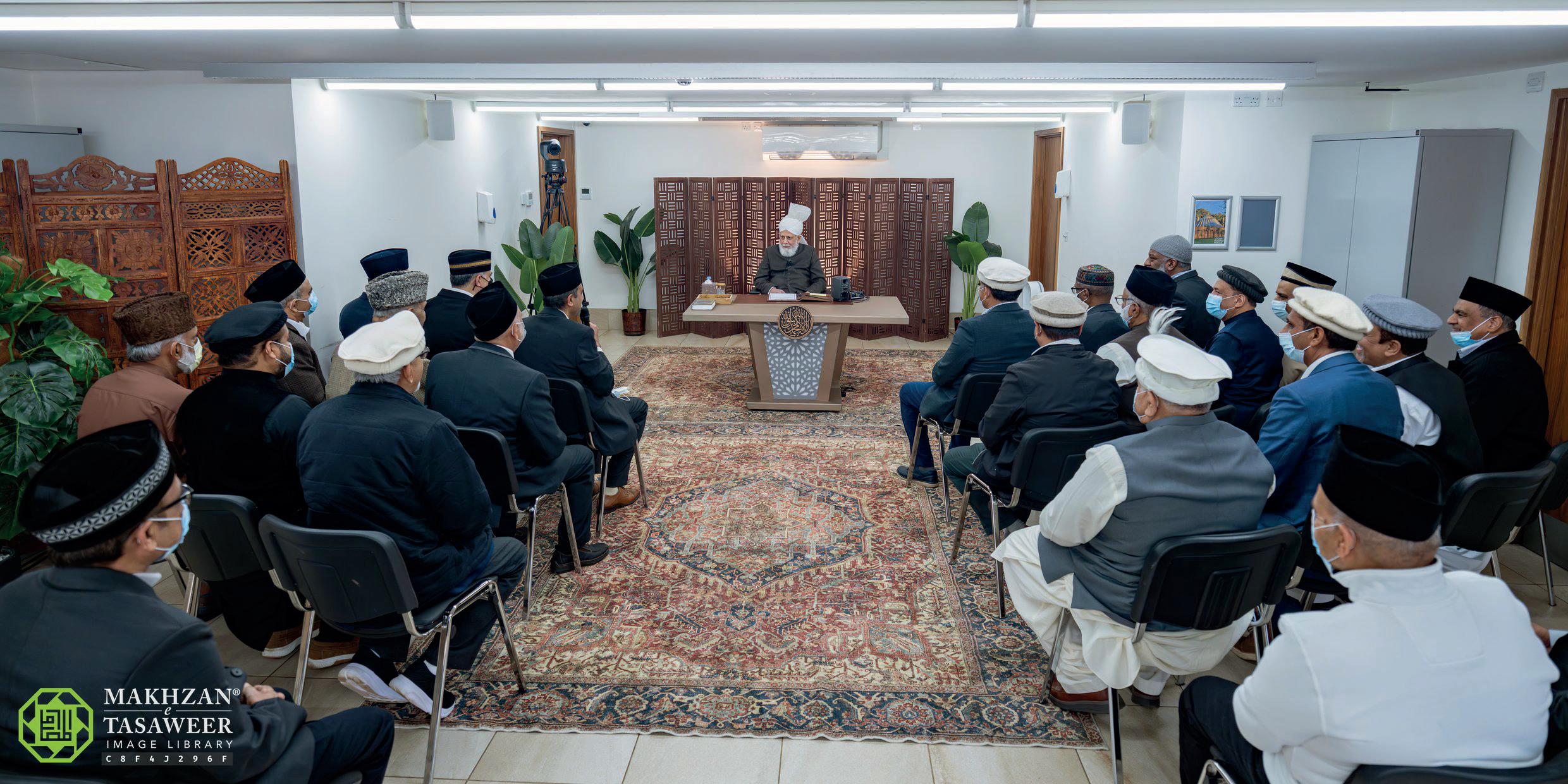
Lajna members and nasirat from Germany meet Huzoor
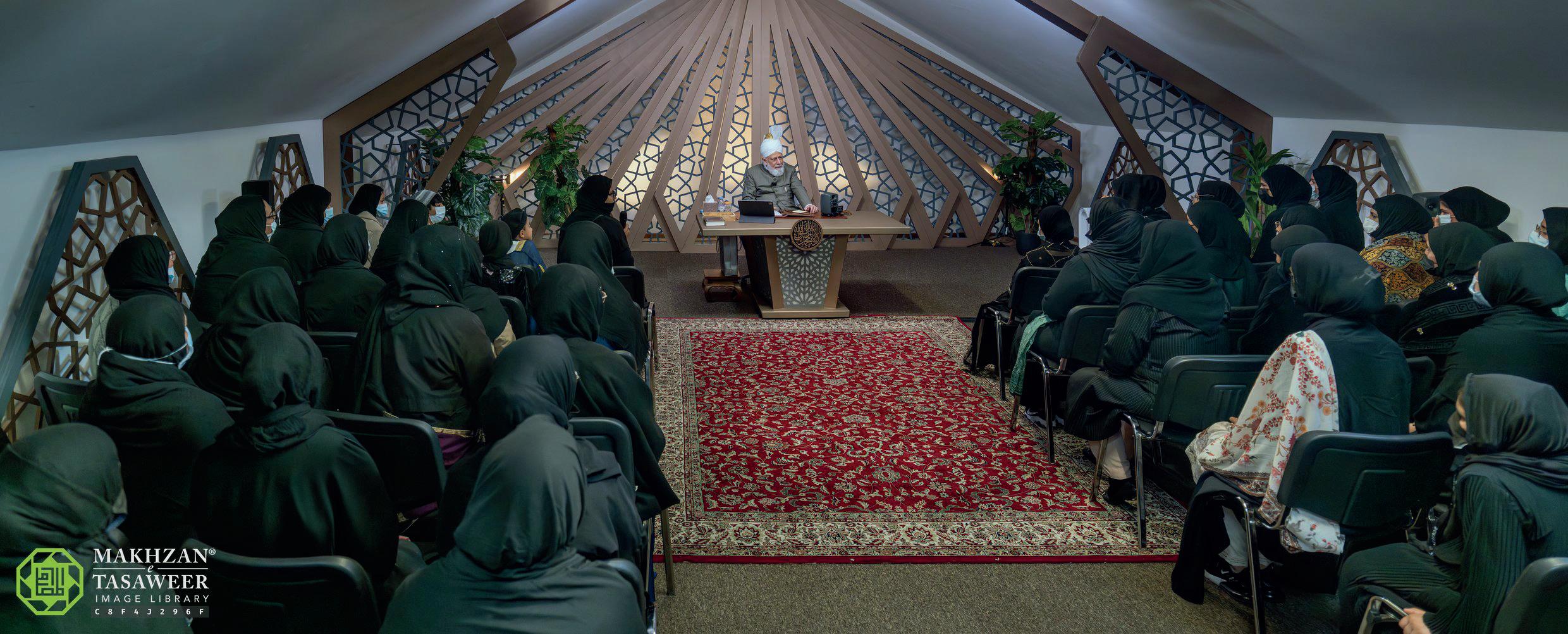
Islamabad, Tilford, UK, 11 April 2026: Lajna members and nasirat from Riedstadt and some other majalis of Lajna Imaillah Germany were blessed with a mulaqat with Hazrat Mirza Masroor Ahmad, Khalifatul Masih V (aa).
Upon arriving, Huzoor (aa) greeted those present and took his seat. Following a brief interaction, the attendees were granted the opportunity to ask questions on a range of religious, moral and contemporary matters.
Strengthen one’s bond with Allah before complaining that prayers have not been accepted
One student asked how a person could remain certain that Allah’s plan was good when it seemed that everything was going wrong and prayers for certain things were not fulfilled.
At the outset, Huzoor (aa) drew attention to the lack of clarity in the way the question had been framed and asked what exactly was meant by things “going wrong”. When the questioner explained that at times one prays for something and does not receive it, Huzoor (aa) referred to
Spend in Allah’s way and be blessed by Him
Hazrat Abu Hurairah (ra) narrated that he heard Allah’s Messenger (sa) say, “We are the last [to appear], yet the foremost on the Day of Resurrection.” And through the same chain of narration, it is reported: Allah said, “Spend, and I shall spend upon you.”
(Sahih al-Bukhari, Kitab at-tawhid, Bab qawlillahi ta‘ala ‘yuriduna ’an yubaddilu kalamAllah’, Hadith 7495, 7496)
Residing in the centre must be for a religious purpose
On one occasion, a friend submitted to the Promised Messiah (as) that they would like to come to Qadian for the purpose of business. On this, the Promised Messiah (as) said: “This very intention is corrupt. You should repent. One ought to come here for the sake of religion and should reside here with the intention of reforming their life to come. This should be the intention, and then, if along with this, a person engages in business as well to attain the objectives of their residing here, there is no harm. The actual intention must be religious and not worldly in nature. Are other cities not more well-suited to do business? The actual purpose in coming to Qadian should be nothing other than religious. After that, whatever you receive, consider it to be the grace of God.”
(Malfuzat [English], Vol. 2, pp.176)
Hazrat Mirza Ghulam Ahmadas, In His Own Words
This Week in History
24 April
24 April 1902: On this day, the Promised Messiah (as) wrote a letter to his companion, Hazrat Maulvi Ghulam Hassan Khan Peshawari (ra) and asked for the hand of his daughter, Sarwar Sultan (ra), for marriage with his son, Sahibzada Mirza Bashir Ahmad (ra).
To read more about this son of the Promised Messiah, see: www.ahmadipedia.org
24 April 1908: This day was a Friday and was the Promised Messiah’sas last Friday in Qadian, as he would soon depart for his last journey to Lahore. Hazrat Hakeem Maulvi Noor-ud-Deen (ra) delivered the Friday sermon and led the Jumua Prayer. (Tarikh-e-Ahmadiyyat, Vol. 3, p. 176)
25 April
25 April 1966: Sardar Soran Singh, the Foreign Minister of India at the time, visited Qadian on this day. He was given a grand welcome in the Ahmadiyya Mohalla; a reception was held in his honour and a gift of the Holy Quran was presented. India’s leading newspapers, like The Tribune, The Times of India and The Indian Express, published detailed news about this visit. (Tarikh-e-Ahmadiyyat, Vol. 23, p. 620)
25 April 2006: On this day, during his visit to the Far East, Hazrat Khalifatul Masih V (aa) arrived at Nadi Airport in Fiji, which is called the edge of the world. Huzoor (aa) was interviewed by a correspondent for a national TV station. Delegations from neighbouring countries like Tonga, Tuvalu, Kiribati, etc. also came to receive Huzoor (aa) . (Al Fazl International, 9 June 2006, pp. 1-2)
26 - 27 April
26 April 1984: On this day, the infamous dictator of Pakistan, General Zia-ul-Haq, issued Ordinance
XX, which made it unlawful for Ahmadis to engage in any kind of Islamic practice, from modes of worship to dress code, from greetings to using any terms that were Islamic and it also included not having Muslim names.
To read more, see: “The Ahmadi Muslims of Pakistan: A loyal community under siege since 1974” at alhakam.org (13 September 2024, pp. 6-7).
27 April 2006: On this day, during his tour of Fiji, Hazrat Khalifatul Masih V (aa) granted an audience to the then-president of Fiji. In the evening, Huzoor (aa) addressed a reception held in his honour at the capital city of Suva’s central hotel, which was attended by various dignitaries as well. (Al Fazl International, 9 June 2006, pp. 9-10)
28 April
28 April 1888: On this day, the Promised Messiah (as) wrote a reply to the letter of Maulvi Imamuddin Sahib of Montgomery (present-day Sahiwal, Pakistan), rebutting his view concerning heavenly books. This Maulvi Sahib was of the notion that heavenly books still needed to be practised, even after the revelation of the Holy Quran. (Maktubat-e-Ahmad, Vol. 1, pp. 410-412)
28 April 1970: On this day, during his visit to the Ivory Coast, Hazrat Khalifatul Masih III (rh) addressed the Jamaat members who were present. The address was translated simultaneously into French and Abidjan’s local language. (Tarikh-e-Ahmadiyyat, Vol. 26, p. 54)
28 April 2005: On this day, the 40th Jalsa Salana of Jamaat-e-Ahmadiyya Kenya commenced. This Jalsa was historic, as it was the first Jalsa Salana of Kenya, which was graced by the presence of any Khalifatul Masih. The vice president of the country also addressed the inaugural session of the Jalsa. The attendance was five times more than the previous year. On his day, in addition
to other engagements, Hazrat Khalifatul Masih V (aa) attended a reception in the evening to which the country’s political, diplomatic and higher judicial and administrative officials were invited. (Al Fazl International, 13 May 2005, pp. 8-9)
29 - 30 April
29 April 2005: On this day, during the proceedings of Jalsa Salana Kenya of 2005, while Hazrat Khalifatul Masih V (aa) was present, there was heavy rainfall in the evening of the last day of Jalsa The guests of the Jalsa spent the night awake with great patience. The Jalsa was relocated in a very short time and the Friday sermon was broadcast live from Kenya. (Al Fazl International, 13 May 2005, p. 5)
30 April 1931: On this day, Hazrat Musleh-eMaud (ra) travelled from Mansoori to Dehradun, now the interim capital of Uttarakhand, a state in India. During this tour, Huzoor (ra) left Qadian on 19 April and returned to Qadian on 14 May and visited Mansoori, Dehradun, Delhi, Malirkotla and Ludhiana. Tarikh-e-Ahmadiyyat reports that during this trip, Huzoor (ra) had to stay awake until three in the morning and remain busy with religious and national activities, like presiding over jalsas, meeting with local Ahmadis and guiding their attention towards tarbiyat matters. During his stay in Delhi, Huzoor (ra) met with Khwaja Hassan Nizami. Al Fazl reported among his many engagements that on 31 May, a public jalsa was held in Islamia School Mansoori, presided over by Khan Bahadur Zille-Hussain Sahib, Honorary Magistrate. Hindus, Muslims and many other people attended in huge numbers. Huzoor (ra) spoke for nearly two hours on the Hindu-Muslim relations, the need for their reformation and the reasons for the disputes between these two nations. This was very much appreciated by the attendees. (Tarikhe-Ahmadiyyat, Vol. 5, pp. 273-275)
Continued from page 1
the guidance he had given in the previous day’s Friday sermon regarding prayer and the teachings of the Promised Messiah (as).
Huzoor (aa) explained that before asking for worldly matters, a person must first pray for their faith and for a living relationship with Allah the Exalted. If that relationship becomes strong, then prayers are accepted in the right spirit. (Malfuzat [English], Vol.2, p. 110) He said that many people do not build a relationship with Allah, yet they expect every worldly desire to be fulfilled, whether it relates to examinations, marriage, children, wealth, a house, comfort or other such matters. However, he explained, this was not the purpose for which Allah created mankind. Allah has made it clear that human beings have been created for worship and therefore a person must first examine whether they are fulfilling the due of worship and whether love of Allah has truly taken root in the heart. (Surah adhDhariyat, Ch.51: V.57)
Huzoor (aa) further said that no one has any right over Allah. Everything a person receives is His favour. (Dunya Mein Taraqqi Karnay Ke Gur, Anwar-ul-Ulum, Vol. 16, pp. 309-316) If someone offers prayers with attention for a few days, keeps the fasts of Ramadan and offers Tahajjud, this does not create a claim over Allah whereby He must fulfil every wish. Rather, a person should strive to become a grateful servant who continues to fulfil the due of worship. Once this is being done, Allah then opens the way for further prayers to be accepted.
Using the questioner’s own studies as an example, Huzoor (aa) asked what class she was in and learned that she was in Year 12 and preparing for her Abitur. He explained that just as a student must work hard in accordance with the method taught by the teacher in order to gain marks, so too a believer must strive. Allah has also created a law of nature under which each person receives the fruit of their labour, whether they are Muslim, Christian or even an atheist. Thus, if another student works harder, that student may receive better marks. In such a case, a believer cannot complain that Allah’s plan was wrong.
Huzoor (aa) explained that Allah has established both the religious law and the law of nature. The Sharia requires a person to pray, to strengthen faith and to seek Allah
sincerely; the law of nature requires effort and hard work. A believer must therefore fulfil the due owed to Allah and also strive properly in worldly matters. Then Allah places blessing in that well-directed and sustained effort.
Blessed relics [tabarrukat] of the Holy Prophet (sa) should be treated with favourable presumption, while avoiding exaggeration and shirk
Another attendee asked to what extent the blessed relics [tabarrukat] of the Holy Prophet (sa) and his noble Companions preserved in Türkiye could be regarded as genuine.
Huzoor (aa) said that he had not personally visited and examined them himself. However, he noted that it is claimed that certain Companions did travel to those regions and that tabarrukat of the Holy Prophet (sa) were brought there. Huzoor (aa) said that, especially during the Ottoman period and perhaps even earlier, such tabarrukat may have been brought to Türkiye. Therefore, if those who have preserved them state that they are genuine and if the accompanying reports concerning their authenticity are recorded, then one may generally accept them as such.
At the same time, Huzoor (aa) cautioned that with such old historical matters, absolute certainty is not always possible and at times exaggerations or replicas may also have entered the picture. He therefore advised maintaining husn-ezann, a favourable presumption, while also recognising that some things may have been embellished.
By way of example, Huzoor (aa) referred to a site in Sindh, where there is said to be the grave of a Companion. Yet the grave there has been made extremely long in a clearly exaggerated form. Even so, Huzoor (aa) said that it may still be the grave of a Companion and he mentioned that Hazrat Musleh-eMaud (ra) and other Khulafa had also gone there and prayed. He said that he too used to pray there; if it was indeed the grave of a Companion, then may Allah elevate his rank and not let that place become a means of shirk
Huzoor (aa) added that, unfortunately,
in some such places, people turn them into centres of un-Islamic practices by placing offerings, bowls, flowers and other such things there. This should not happen. Nonetheless, he said that where relics have been preserved, one should generally keep a favourable view and accept that many among them are indeed genuine.
Children born with disabilities are innocent and everlasting life is in the Hereafter
A question was then asked about children who are born disabled. It was said that such children are innocent, yet they endure suffering and become a great trial for their parents. The questioner asked what the wisdom of Allah the Exalted was in this.
Huzoor (aa) explained that such children are indeed innocent and that this world is not the complete and final life. The true and everlasting life is the life to come. He said that in this world, even a long life is only seventy or eighty years. However, Allah the Exalted has already forgiven such children and in Paradise they will be kept healthy and granted an existence of comfort and delight.
Huzoor (aa) added that it is mentioned in Hadith that, in Paradise, such little children will be happy and healthy and they will be under the care of Hazrat Ibrahim (as). (Sahih al-Bukhari, Kitab al-jana’iz, Bab ma qila fi awladi l-mushrikin) Thus, a believer should not look only at the suffering of this world, but should keep before them the reality of the next life.
Huzoor (aa) then turned to the parents and explained that those who show patience, care properly for such children and remain righteous are also rewarded by Allah. If they are worshippers of Allah, then He can grant them Paradise as well. Even where there are shortcomings, Allah may forgive sins, greatly reduce them, or lessen punishment on account of such trials.
He further explained that such disabilities should not be understood as though Allah had some hostility towards mankind. Rather, these are often connected with human errors, bodily weaknesses or deficiencies in the physical order. This too becomes a trial through which people may pass and if they endure it with patience and righteousness, Allah grants immense
reward in the next life.
The foundation of spirituality is salat offered with concentration and reflection
One Lajna member asked what a Lajna member should especially focus on in the present age in order to keep spirituality strong, observing that people are weak and often make religion easier for themselves by combining prayers or becoming lax in matters such as hijab.
Huzoor (aa) explained that the obligations of a Muslim begin with the worship of Allah and that the five daily prayers are the essential means by which spirituality is strengthened. If a person offers the prayers on time and with due attention, spirituality is increased, for Allah Himself has said that prayer restrains from indecency and wrongdoing. (Surah al‘Ankabut, Ch.29: V.46)
Huzoor (aa) emphasised that it is not enough merely to recite the words mechanically. While reciting Surah alFatihah in salat, many people’s minds wander elsewhere and they do not even know the meanings of what they are saying. Huzoor (aa) referred to his recent Eid-ulFitr sermon and said that the meanings of
[“Thee alone do we worship and Thee alone do we implore for help.” (Surah al-Fatihah, Ch.1: V.4)] had also just been explained there. If a person reflects upon Surah al-Fatihah while reciting it, spirituality is increased.
Huzoor (aa) explained that all five daily prayers should be offered with supplications, humility and concentration. When one begins with Bismillah, one should become conscious that one is entering upon a spiritual act. During the salat, one’s thoughts should remain with the salat itself. If, during salat, the mind turns towards jewellery, clothes, studies or other worldly matters, then spirituality is lost.
He concluded by saying that the most necessary thing is full attention and concentration in salat. Alongside this, a person must act upon the commandments of Allah and perform good deeds. Huzoor (aa) then stressed once more that the most basic thing was salat itself and that if one began offering prayer properly and with reflection, many other problems would also
The true essence of hijab
A little seven-year-old girl then asked what age Ahmadi children should begin to observe hijab.
Huzoor (aa) replied that she was still very small and that there was no immediate need for it yet. He explained that when girls grow older and begin to feel that they are no longer little children, they may begin observing hijab, generally around the age of 13 or 14, though in some cases it may begin a little earlier or later, depending on individual physical development.
Huzoor (aa) then explained that the real thing is haya, modesty, within the heart. A girl should have the inner awareness that she is an Ahmadi Muslim girl and must not do wrong. Thereafter comes Allah’s command that women and girls should keep themselves covered properly, including the head, hair and body and avoid revealing dress.
Ahmadi girls should pursue fields that benefit humanity
A waqifh-e-nau girl asked which field Ahmadi girls should study.
Huzoor (aa) answered that girls should study in whichever field they genuinely have an interest in, provided it is beneficial and serves humanity. He mentioned that if a girl is good at science, medicine, chemistry or biology, she may become a doctor. He also mentioned teaching, nursing and dental surgery, along with other professions through which people can be benefited.
At the same time, Huzoor (aa) said that some girls write that they wish to become pilots, footballers or pursue sports professionally. He described such pursuits as frivolous and said that one should instead choose fields through which one can be of service to mankind. The essential principle, he said, is that a girl should pursue an area of genuine interest that brings benefit to mankind.
Parents should pray for their children and remove feelings of inferiority
A mother then asked how she could make her two daughters confident.
Huzoor (aa) replied that he had already explained matters to both of them and that, Insha-Allah, they would become so. He then said that the mother’s duty was to pray for them: to pray that Allah the Exalted keeps goodness alive within them, keeps them attached to faith and creates in them love for Allah.
Huzoor (aa) referred to his recent sermons on divine love, Tawhid and worship and advised that such sermons should be listened to carefully, their points drawn out and prayers made accordingly. He said that if parents began praying properly for their children, then, Insha-Allah, the children would become upright and confident. He also instructed that any complexes or feelings of inferiority should be removed from children. If other girls at school dressed immodestly, uncovered their hair or mocked Ahmadi girls for wearing a scarf or covering their heads, then the children should be told that there was no need to feel hurt or insecure. Rather, they should understand that they are acting for the sake
of Allah and that it is to Him that every person must return.
Huzoor (aa) further said that children should be taught from an early age the matters of faith and be accustomed to religion. They should be instilled with the confidence that what they are doing is right and that Ahmadis are not to follow the world. Islam came to guide mankind, the Holy Prophet (sa) came to bring that guidance and in complete obedience to him the Promised Messiah (as) also came. Ahmadis, therefore, can become firm Ahmadi Muslims only by setting an example for the world rather than following the world.
Good company protects faith, while harmful company should be left
A 15-year-old attendee asked how a person should stop a friend from doing something wrong and how to choose good friends.
Huzoor (aa) first asked her age and then replied that if a friend is doing something wrong, one should stop her by telling her clearly that it is wrong and should not be done. However, if that friend continues and the questioner feels that the bad conduct is beginning to influence her, then Allah’s command is that such company should be left and better friends should be made instead.
Huzoor (aa) explained that good friends are those who possess the spirit of sacrifice, listen well and have good morals. Even if they are not Muslims and even if they do not believe in God, if they do not mock others, do not abuse God and possess goodness in their nature, then friendship with them may be maintained and through one’s own righteousness, one may gradually influence them.
To illustrate the effect of the company, Huzoor (aa) related an incident from the time of the Promised Messiah (as). A Sikh student once sent a message to the Promised Messiah (as) saying that although he had been a religious man, he was becoming an atheist and moving away from belief in God. The Promised Messiah (as) told him that the classmate sitting with him in college appeared to be an atheist and that he should leave that place and sit elsewhere. The man later wrote back saying that the Promised Messiah (as) had been right: simply through that company, even without much conversation, he had been influenced towards atheism. After leaving that seat, his religious thoughts returned. (Apnay Andar Yakjehti Payda Karo..., Anwar-ul-Uloom, Vol. 24, p. 422)
Huzoor (aa) said that in the same way, when a person finds themselves in harmful gatherings with bad influences, they should leave them. Only then can they save themselves. He added that young Ahmadis should develop courage and confidence and should not live in fear of what others will say. They should make themselves leaders, for the world is to follow them, not the other way round.
Materialism is the root of depression and family disputes
Another questioner said that depression was increasing among children and that, as a result, quarrels within families were also increasing. She asked how loving and strong family relationships could be maintained
and what should be done when someone in the family seems to be facing depression or mental health difficulties.
Huzoor (aa) replied that quarrels often arise because people have become too inclined towards worldly things and materialism. As worldly desires increase, disappointment also increases when those desires are not fulfilled. People compare themselves with others, seeing someone else’s money, house, car or apparent prosperity and then become discontented with their own condition. This gives rise to depression and once such thinking takes hold, quarrels begin between husbands and wives and children are also disturbed by what they witness.
Huzoor (aa) then quoted the Promised Messiah (as) and explained that if a person tries to hold on to Allah, the world comes after them, whereas if a person runs after the world, the world flees from them. (Malfuzat, Vol. 8, p. 134; Jami’ at-Tirmidhi, Kitab sifati l-qiyamati wa r-raqa’iqi wa l-wara‘i ‘an rasulillahsa, Hadith 2465) He said that the first thing, therefore, is to develop a relationship with Allah. Ahmadi Muslims claim to be true Muslims, so if they are truly Ahmadi Muslims, they should not let worldly desires become the source of depression, quarrels and disputes.
Huzoor (aa) also advised such families to remember their own background and roots, especially those who had come from humble circumstances and then settled in large European cities. They should reflect on how many favours Allah has already bestowed upon them. If a person counts Allah’s favours, then there remains no room for depression, quarrels or disputes.
He further referred to the guidance of the Holy Prophet (sa): that in matters of faith and spirituality, one should look at those above oneself so as to acquire virtues, but in worldly matters, one should look at those below oneself and recognise that there are many in the world in far more difficult circumstances. (Sahih Muslim, Kitab az-zuhdi wa r-raqa’iq, Hadith 5250; Jami’ at-Tirmidhi, Kitab sifati l-qiyamati wa r-raqa’iqi wa l-wara‘i ‘an rasulillahsa, Hadith 2512) Huzoor (aa) remarked that there are countless people in Africa, Pakistan, India, other Asian countries and even Europe who do not have food, whereas many people who complain still enjoy meals, drinks and comforts every day. If they look at those less fortunate and become grateful to Allah, then Allah increases His favours. (Surah Ibrahim, Ch. 14: V. 8)
Huzoor (aa) concluded that the first step in overcoming depression is to reduce excessive worldliness and materialism and to remember Allah, engage in His remembrance and offer prayers. In order to strengthen relationships, one should explain to close family members that the world is temporary and that real life is the next one. Even within this world, life is short, so why should it be spent in quarrelling? A pleasant life can be created by remembering Allah, improving morals, meeting others kindly, greeting them with salsam, smiling and avoiding speaking ill of others. In that way, life passes happily without depression.
A global war has, in effect, already begun; the remedy is prayer, tabligh and turning the world towards Allah
The final question asked how Muslims could remain steadfast in the present uncertain times and what spiritual and practical steps should be taken if a global war were to begin, so that faith, family and Jamaat might be safeguarded.
Huzoor (aa) replied that he had repeatedly been telling members to pray. He then said that uncertain conditions certainly existed, but that, in reality, global war had already begun. He pointed to the fact that countries across the world were already attacking one another: America attacking Iran from afar, Israel attacking and carrying out strikes in the region, Russia attacking Ukraine and dangerous tensions building elsewhere too, including over Taiwan. He explained that even the First and Second World Wars did not engulf the entire world in one instant; rather, they began with one or two nations and then widened. The same conditions, he said, were now present.
Huzoor (aa) therefore urged that people must pray that Allah the Exalted grants mankind sense and that matters do not escalate further, especially to the point where nuclear weapons are used, for then a vast amount of humanity would perish.
He said that in such circumstances Ahmadis must strengthen their state of faith and attach their hearts to Allah the Exalted, praying that He keeps them firm upon faith. He added that others should also be told that there is only one solution: to turn towards Allah. This, he said, was why he had long been urging members to engage in tabligh and to call people towards God, for in the end, mankind’s salvation and survival lie only with Him.
Huzoor (aa) further said that if the message reaches people beforehand, then those who survive such turmoil may at least remember that they had been warned and told to turn to Allah by Ahmadi Muslims. Thus, it is the duty of Ahmadis to bring not only their own family members, but also the wider society and their friends, in this direction.
Huzoor (aa) referred to the following Urdu couplet of the Promised Messiah (as):
(“There is a fire, but all those shall be saved from this fire who possess love for the God of Great Wonders.”)
Huzoor (aa) said that there is fire on every side and only those who love the Wondrous God will be saved from it. If people wish to witness Divine signs and be saved, they must therefore form a relationship with Allah.
Huzoor (aa) concluded by saying that we must not fall into backbiting, talebearing, mutual harm or jealousy. Rather, there should be friendship, love, affection, fulfilment of the rights of Allah and a spirit of sacrifice for one another. If this spirit is established, then individuals, families and ultimately the wider world may be saved.
Conclusion
At the conclusion of the mulaqat, Huzoor (aa) took leave and the meeting came to an end.
(Summary prepared by Al Hakam)
From the markaz Train khuddam to remain resilient in times of crisis
Amila of the Muqami Region of MKA Canada meets Huzoor
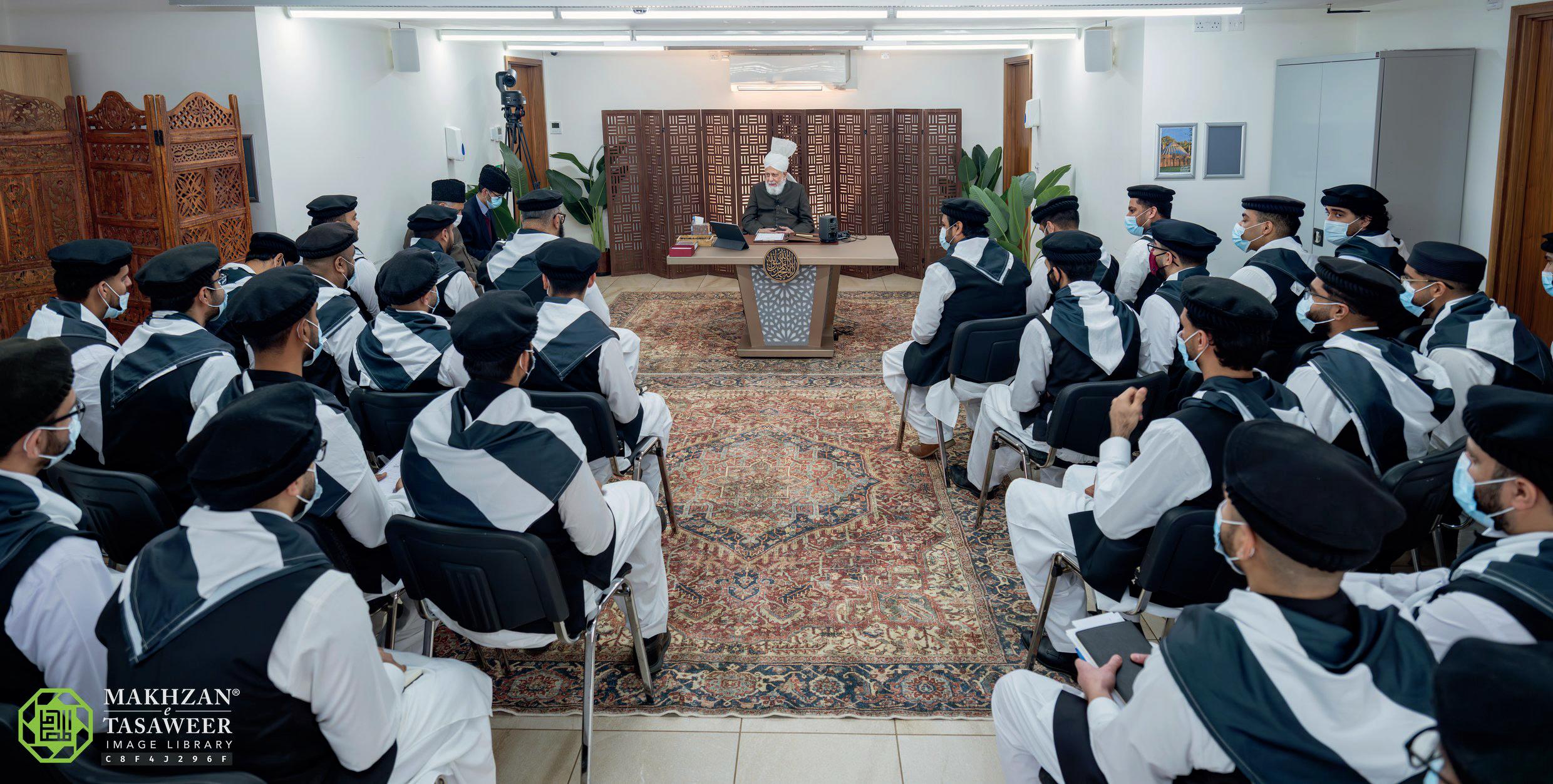
Islamabad, Tilford, 5 April 2026: Amila of the Muqami Region of Majlis Khuddamul-Ahmadiyya Canada had the blessed opportunity to meet Hazrat Mirza Masroor Ahmad, Khalifatul Masih V (aa) at Islamabad, Tilford, UK.
Each of the khuddam serving on the amila introduced himself to Huzoor (aa) and briefly outlined his department and responsibilities.
Huzoor (aa) directs office-bearers to lead by personal example
Ta‘lim
During the introductory exchanges, Huzoor (aa) asked the Nazim Ta‘lim about the nature of his work. The nazim explained that his role was to encourage khuddam to study Jamaat literature, the books of the Promised Messiah (as) and the Holy Quran. When Huzoor (aa) asked how many books he himself had read, he replied that he had read 60 books of the Promised Messiah (as). Huzoor (aa) then asked whether the
members of the amila were also being encouraged to read. Upon hearing that they were, Huzoor (aa) advised that the office-bearers should first be given full attention in this regard, for once the amila members themselves were reading properly, the khuddam would naturally follow their example.
Tabligh
Huzoor (aa) then asked the Nazim Tabligh what target had been set for tabligh. He was informed that the local target for the year was 100 bai‘ats. Huzoor (aa) advised that the amila members themselves should also be set clear responsibilities. He pointed out that if there were around 40 members on the amila and each was charged with striving for one bai‘at, then a substantial part of the target would already be addressed. He emphasised that the office-bearers must first present their own example.
Waqar-e-Amal
In his conversation with the Nazim Waqar-
e-Amal, Huzoor (aa) asked where waqare-amal was being carried out. The nazim replied that priority was given to the mosque and to holding waqar-e-amal activities in Peace Village. Huzoor (aa) specifically asked whether the grounds behind the hall were also being cleaned and maintained. He was informed that they were and that a waqar-eamal session had also been held before Eid.
Khidmat-e-Khalq
When speaking to the Nazim Khidmate-Khalq, Huzoor (aa) asked what kind of work was being carried out under the department. Mention was made of various forms of service, including a recent food drive. Huzoor (aa) then asked whether any project had been started in Africa. When told that none had been launched this year, Huzoor (aa) instructed that such a project should be undertaken.
Sehat-e-Jismani
Huzoor (aa) also asked the Nazim Sehate-Jismani what kind of work was being
done in his department. He explained that weekly gym sessions were being organised by renting facilities in schools. Huzoor (aa) asked whether a gym had been opened permanently or whether premises were being rented and also enquired whether this was a daily arrangement or limited to particular days. He was informed that it was not seven days a week, but rather three days a week for the various majalis
This was followed by a question-andanswer session.
Khuddam should be mentally trained to remain firm during an economic crisis
One questioner referred to increasing tensions between the United States and Iran, rising oil prices, inflation and the risk of recession and asked what khuddam should do to prepare.
Huzoor (aa) replied that khuddam did not control oil wells, refineries or the global oil trade and therefore the issue was not one of directly managing or international
supply. Rather, the real matter was that the world may face inflation, recession and widespread economic strain and khuddam should be prepared mentally for such conditions.
Huzoor (aa) instructed that khuddam should be trained in such a way that, when crises come, they do not lose courage. He observed that many worldly people, when struck by financial loss, bankruptcy or severe economic hardship, fall into depression, despair and in some cases even attempt suicide. Referring to a well-known observation, Huzoor (aa) noted that when an economic crisis affects the world, it is called a recession, but when it comes upon an individual personally, it becomes a depression.
He said that while Ahmadis too would have to endure the broader effects of economic decline along with the rest of society, the task of khuddam was to build courage and resilience within people. In such circumstances, instead of losing hope, Ahmadis should incline even more towards Allah the Almighty, seek His help and pray that He grants them the strength to pass through the crisis with steadfastness.
The remedy for vaping lies in tarbiyat, prayer and good company
Another question was asked regarding khuddam who were involved in vaping and did not consider it to be haram
Huzoor (aa) replied that such behaviour reflected distance from Allah, weak attachment to the Jamaat and neglect of salat. He added that wasting excessive time on the internet and social media, along with falling into bad company, also contributed to such conduct.
Huzoor (aa) said that this was first and foremost a matter of tarbiyat. He instructed that the Tarbiyat Department should become more active and keep an eye on those who had fallen into harmful company. Rather than showing aversion towards them, they should be brought closer with sympathy and understanding. Those who were firm in faith and strong in character should be encouraged to form friendships with such individuals so that they might help bring about their reformation.
Huzoor (aa) acknowledged that some efforts were already being made and that a number of boys had improved. He suggested that those who had reformed could be used to help others in different cities, or that others could be brought to them for support and improvement. At the same time, Huzoor (aa) noted that true reform can only be achieved in the case of one who wishes to be reformed; where a person does not want improvement, reform cannot be forced beyond lawful restrictions.
When told that the legal age in Canada in this regard was 19, Huzoor (aa) said that attention should especially be given before that age and that parents and home conditions should also be examined. He stressed that such matters are not solved by one auxiliary alone, but require coordinated tarbiyat by the Jamaat, Khuddam-ulAhmadiyya, Ansarullah and Lajna, together with the home environment.
‘This world is a prison for the believer’ is a matter of perspective
A question was asked regarding the wellknown hadith which states, “The world is a prison for the believer and a paradise for the non-believer.” (Sahih Muslim, Kitab azzuhdi wa r-raqa’iq, Hadith 5242) Guidance was sought on how khuddam should understand this “prison” and how they can avoid treating this world as a Paradise.
Huzoor (aa) provided a detailed explanation, clarifying that this concept is entirely about the difference between worldly perception and the spiritual reality of a believer.
Huzoor (aa) began by referencing a recurring theme in the Holy Quran regarding the Day of Judgement: humanity will be divided into two groups. Those who spent this worldly life indulging in endless luxuries and materialistic joy will find themselves in difficulty in the Hereafter (e.g., Surah al-Inshiqaq, Ch.84: V.14-15). Conversely, those who endured difficulties in this world – by strictly obeying Allah’s commands and committing themselves to His worship – will find ultimate happiness and ease in the next world.
Huzoor (aa) clarified a crucial point: the believer does not actually view his life as a prison. Instead, it is the worldly people who look at the believer and perceive him to be imprisoned.
• The worldly view: Society looks at a true believer and sees a life of heavy restrictions. They see that a believer does not dance in clubs, drink alcohol, vape, engage in addictions, pursue immoral relationships, or partake in misdeeds. To a worldly person, living without these indulgences seems like a strict, restrictive prison.
• The believer’s view: The believer, however, is deeply content. He understands that these restrictions are self-imposed to attain the pleasure of Allah. His heart finds peace not in clubs, but in good morals, righteous deeds and worship, just as Allah states in the Holy Quran: “Aye! it is in the remembrance of Allah that hearts can find comfort.” (Surah ar-Ra‘d, Ch.13: V.29)
To illustrate that this “prison” is not a source of suffering, Huzoor (aa) pointed out that no Prophet of God has ever complained, “O Allah, this is a prison, free me so I can indulge.” Instead, they find immense joy in their worship and possess a deep yearning to meet their Creator.
Huzoor (aa) cited the final moments of the Holy Prophet Muhammad (sa), whose last words were, “Ar-Rafiq al-A‘la” (To the Exalted Companion), demonstrating his ultimate desire to be united with Allah, his greatest Friend. (Sahih al-Bukhari, Kitab almaghazi, Hadith 4463)
Similarly, the Promised Messiah (as) expressed this exact same longing and devotion in this era. The ultimate goal for all righteous people is simply to seek Allah’s forgiveness and a good end.
Contrasting this with the mindset of those who view this world as their Paradise, Huzoor (aa) quoted a famous Persian proverb attributed to Emperor Babur:
(“O Babur, strive for joyous indulgence, for this world is not to be experienced twice.”)
Huzoor (aa) explained that worldly people live by this philosophy, assuming
that just as they enjoyed a life of ease and lack of restraint here, they will automatically be granted ease in the Hereafter. However, the Holy Quran warns that such people will face the torment of Hell. In the Hereafter, they will be shocked, questioning why they are facing punishment when they were accustomed to such ease in the world (e.g., Surah al-Haqqah, Ch.69: V.26-34).
Ultimately, Huzoor (aa) concluded that a believer happily accepts the self-imposed restrictions of this “prison” because they are fully aware that it is the only path to attaining an eternal reward and true Paradise in the Hereafter.
After global conflict, Ahmadis will need both faith and practical expertise
Another question asked what skills or traits would be most useful to the world after the end of a Third World War.
Huzoor (aa) replied that before thinking about practical skills, Ahmadis must first strengthen their own faith and relationship with Allah. Only then can they guide others to the right path. He said that after such destruction, people would need to be told that these calamities came about because of worldly conflict, worldly greed and wrong actions and that the only lasting solution lies in turning back to Allah.
Huzoor (aa) explained that, along with this spiritual guidance, worldly skills would still remain necessary. Those who already possess expertise in technology, information technology, engineering, medicine and other disciplines would need to use that existing knowledge to reorganise society according to the new conditions. He pointed out that after the First and Second World Wars, the world had rebuilt itself and he specifically referred to the rebuilding of Hiroshima and Nagasaki after the atomic bombings.
Huzoor (aa) stated that Ahmadis would have a twofold responsibility in such circumstances: first, to give people courage and hope; and second, to show them the straight path towards Allah.
Self-doubt is overcome through istighfar, trust in Allah and confidence in one’s purpose
A question was then asked about how a believer should deal with self-doubt.
Huzoor (aa) advised the frequent recitation of istighfar. He then clarified that such self-doubt often stemmed from negative assumptions and from underestimating one’s own ability. He instructed the questioner not to belittle himself, but rather to place trust [tawakkul] in Allah, use properly whatever he had studied and continue to increase in knowledge.
Huzoor (aa) said that one should pray to Allah for confidence and courage and should continue learning and building one’s knowledge. In this way, self-doubt gradually recedes. He added that when a person keeps before him the target that Ahmadis are to lead the world, confidence is naturally generated and self-doubt begins to disappear. He concluded by asking why a believer should live in fear at all.
Love for Jamaat literature should be developed through relevance, strategy and feedback
One khadim asked how love for reading Jamaat books could be developed among khuddam
Huzoor (aa) responded by referring to the example of the khadim who had himself already read 60 books. He then said that for khuddam generally, interest must first be developed through smaller, relevant and accessible means. He advised that short extracts on subjects of interest should be selected and shared through the website or social media platforms in use. These could include quotations from the Promised Messiah (as), verses of the Holy Quran, ahadith and brief passages that take only a minute or two to read.
Huzoor (aa) said that once such interest is created, people can then be informed which book the material comes from, thereby leading them naturally to the source text. He also referred to the Essence of Islam volumes and said that topic-based material from such published collections could regularly be shared in this way.
Importantly, Huzoor (aa) stressed the need for feedback. The interests of the people should be identified: what topics they are thinking about, what contemporary issues concern them and what questions they want answered. From there, a proper plan and strategy should be developed. He said that one must understand what Islam, the Holy Quran and Hadith say about those issues and then present that material in a way that builds interest.
By way of illustration, Huzoor (aa) noted that in the world, governments, companies and researchers gather information and data before launching any major strategy. Even if a company wishes to make biscuits, it first studies what kinds of tastes appeal to children and adults, gathers information, then advertises and only afterwards launches the product more widely. Huzoor (aa) said that, in the same way, those serving the Jamaat should also work with planning, information and strategy in order to develop people’s interest in religion and Jamaat literature.
Huzoor’s (aa) Canada visits
In the final question, a khadim asked what Huzoor’s (aa) favourite memories of Canada were from his visits there.
Huzoor (aa) replied briefly that it had now been some years and that every tour had been successful. He said that the sincerity, devotion and good qualities of the members had always pleased him and that he had already mentioned such impressions in his sermons after those visits. He therefore directed the questioner to go back and read those sermons again.
Conclusion
After the question-and-answer session, the khuddam had the honour of having a group photograph taken with Huzoor (aa). Thereafter, each khadim received pens as a gift and the mulaqat came to an end.
(Summary prepared by Al Hakam)
Guidance on marriage, retirement and community support: Ansar from the Central East Region of the US meet Huzoor
Islamabad, Tilford, UK, 6 April 2026: A delegation of ansar from the Central East Region of the United States had the honour of a mulaqat with Hazrat Mirza Masroor Ahmad, Khalifatul Masih V (aa).
During the mulaqat, the ansar had the opportunity to introduce themselves and present various questions before Huzoor (aa), seeking guidance on a range of matters. In the course of these introductions, Huzoor (aa) also briefly spoke with some of them regarding their responsibilities and efforts in Jamaat service.
One nasir mentioned that he had recently been appointed to serve in the Tabligh Department at the local level. Upon hearing this, Huzoor (aa) remarked that one’s target should be a strong one. When the nasir mentioned that he had only been appointed around two months earlier, Huzoor (aa) said that within two months he should already have prepared a full plan so that the remaining ten months could then be spent implementing it. Huzoor (aa) further emphasised that the task was to convey the message to every person; whether others accepted it or not was their own choice. Huzoor (aa) added that the work of tabligh needed to be made more active and that there was a great need for this.
Another nasir mentioned that he was serving in the External Affairs Department. Huzoor (aa) asked whether he was in contact
with politicians, councillors, congressmen and senators and whether they attended Jamaat functions. When the ansar explained that such contacts did exist and that political representatives had also attended a recent iftar event, Huzoor (aa) asked about the nature of their response. The nasir explained that the response had been better before COVID-19, but that efforts were now being rebuilt and relations were improving again.
Another nasir from Central Jersey mentioned that he ran a business and that much of his day-to-day effort was devoted to tabligh. He explained that he operated a billboard truck through which, by the grace of Allah, the message was being conveyed daily to around 20,000 to 25,000 people. Huzoor (aa) prayed that Allah the Exalted place blessings in this effort. On hearing that the wider population of the area was around four to five million, Huzoor (aa) observed that if 25,000 people were being reached each day, this amounted to around 750,000 in a month and approximately 8.4 million over the course of a year. Huzoor (aa) remarked that by now the message should have reached the whole population of the area and that everyone ought to know the message of Islam and Ahmadiyyat.
This was followed by a question-andanswer session.
Guidance on moral training and the issue of delayed marriages
One nasir asked how members of Majlis Ansarullah should guide children who were delaying marriage or refusing it altogether.
In response, Huzoor (aa) said that he had repeatedly given guidance on this matter and explained that the issue should be addressed from the perspective of parents. Huzoor (aa) stated that children should be given moral training from a young age and referred to the example of Hazrat Nusrat Jehan Begum (ra), who would advise even very young girls to start praying for a pious match.
Huzoor (aa) explained that when parents provide proper moral training from an early age, children come to understand their responsibilities and also begin praying regarding their future. In some cases, highly educated girls are unable to find suitably matched boys, while boys, owing to their own expectations and the excessive freedom of modern society, may develop unrealistic demands and reject many potential matches.
Huzoor (aa) said that ansar should focus on the moral training of their households. He added that this process should begin from the age of Khuddamul-Ahmadiyya and continue thereafter, so that young people may properly recognise their responsibilities. Huzoor (aa) also
pointed out that, for this reason, Markaz has appointed more than one Secretary Rishta Nata in various jamaats and that Rishta Nata committees have also been formed, comprising representatives from Ansarullah, Lajna Imaillah, Khuddam-ulAhmadiyya and the Jamaat administration. If all such office-bearers and bodies work together in a spirit of cooperation and collaboration, Huzoor (aa) said, much good work can be achieved.
Nevertheless, Huzoor (aa) emphasised that the most important factor remains moral training within the home. Parents, he said, should help their children realise their responsibilities from an early age. Referring to the wider environment in the West, Huzoor (aa) observed that children attend colleges and universities where the atmosphere is very open and free, while parents are often preoccupied with their work and livelihood and therefore fail to spend sufficient time with their children. Huzoor (aa) remarked that many ansar may now be retired and able to give time to their children, but perhaps were not able to do so in earlier years. Even so, if they had succeeded in helping their children understand these matters from a young age, that would have been beneficial.
Huzoor (aa) also addressed the issue of marrying outside the Jamaat, noting that sometimes both boys and girls wish to do
so. In such cases, Huzoor (aa) explained, permission is at times granted if the proposed spouse is Muslim and that such permission is often given. However, he stressed that the Ahmadi party must remain firm in its faith. If proper moral training has been given and faith has been accorded due importance, then such problems do not usually arise.
Huzoor (aa) said that these kinds of issues arise in many places and urged the ansar to pray and also work actively in this regard, adding that this too formed part of the duty of Ansarullah.
Preserving the sanctity of the mosque and its premises
Another nasir asked about the practice, common in some mosques in the United States, of setting up fundraising activities on mosque property. He explained that while such stalls were not placed in the main prayer area, they were sometimes set up in overflow prayer spaces and halls, especially during the winter months.
Huzoor (aa) instructed that where there is an actual prayer hall in a purposebuilt mosque, such arrangements should not be made there. However, if there is a room, lobby or some separate outer space, arrangements may be made there for the collection of donations. Huzoor (aa) also said that if people are arriving for salat and a fundraising setup has been placed in the mosque at that time, this should not be done.
Referring to the practice of non-Ahmadi Muslims, Huzoor (aa) observed that in many of their mosques, donation boxes are placed outside and worshippers place their contributions in them as they leave. Since in the Jamaat there is also a need to issue receipts, Huzoor (aa) said that notices or posters may be placed at the entrance or on the outside walls, encouraging donations. However, he made clear that tables should not be placed inside the mosque for the collection of donations, except perhaps on a particular occasion that has been specially organised and not during prayer times and even then only very briefly.
When it was clarified that the question related to bazaar-like setups, such as ladies’ stalls for henna, bangles and clothes, Huzoor (aa) stated plainly that such activities were not permissible inside the mosque. He said that if such arrangements were to be made, they should be made within the mosque premises but outside the mosque building itself. If the weather were cold during winter, Huzoor (aa) said that a small tent, gazebo or some other arrangement could be made outside instead.
Huzoor (aa) reiterated that if there is an outer area or courtyard, such things should be kept there. He further stated that even when the matter concerns mosque donations, the system of physical collection should remain outside. Announcements, however, may be made where they relate to religious service, because the general principle is that worldly announcements are not to be made in mosques. Huzoor (aa) explained that if ordinary worldly announcements are not permitted in a mosque, then conducting business there is likewise not permissible. (Jami‘ at-Tirmidhi, Kitab an-nahyi ‘ani l-bay‘i fi l-masjid, Hadith 1321)
Guidance on organised economic support and professional mentoring
A nasir asked how Ahmadis in the United States could establish systems of collective economic cooperation and guidance, similar to those seen in other communities, while remaining in harmony with Jamaat values and Islamic principles.
In reply, Huzoor (aa) said that this was one of the very purposes for which the department of Sanat-o-Tijarat had been established in the Jamaat as well as in the auxiliary organisations. Huzoor (aa) explained that such departments should organise this work properly and maintain complete data regarding members of the Jamaat, including which skills they possess, which professions they belong to and what kind of work they do.
Huzoor (aa) said that, on this basis, proper counselling and guidance should be provided to those who are newcomers so that they may be directed towards suitable fields of study and professions in which they could succeed. Likewise, if some among the newcomers are educated and are to be guided towards business, they should be advised regarding those forms of business that are more suitable in that environment and are likely to produce good results.
Huzoor (aa) further stated that where there are experienced professionals and knowledgeable individuals within the Jamaat, they should be asked to help guide and advise others. As for financial assistance, Huzoor (aa) said that if funds are not available on a large scale, then at least a limited number of people may be helped with small amounts so that they can begin a small business. Beyond this, they may also be guided regarding how to obtain financing through banks or other agencies and how such loans may be repaid in a manageable way over time. Huzoor (aa) emphasised, however, that such matters should not be pursued in an overly high-risk manner that could later lead people into serious financial difficulty or liquidation.
Making the years after retirement beneficial
A nasir asked what advice Huzoor (aa) would give regarding the best way to spend time after retirement, especially since many ansar of Asian background do not tend to have hobbies.
In reply, Huzoor (aa) remarked that most such people do not truly retire in any case and often continue working for as long as they remain physically able. He further observed that in America, many people cannot really afford to retire in the same way as they might in some other countries, because the kind of social support available elsewhere is not present there to the same extent.
Huzoor (aa) said that ansar should consider each person’s individual interests and capacities and then utilise such people in Jamaat work accordingly. If a person is free and has a source of income, Huzoor (aa) said, then he may use that freedom sensibly for the benefit of his household and in the service of faith. Where homes have become fully paid off and there is no mortgage or similar burden, some may be in a position to devote more time. Others may even choose
to move to a smaller house if circumstances require it.
In any case, Huzoor (aa) said that if someone is no longer able to perform physical work but can still undertake light intellectual, administrative or desk-based tasks, the Jamaat should assign such work to him so that he remains engaged. If a person possesses knowledge and expertise, Huzoor (aa) suggested that he could be given responsibilities such as translation work. Referring to the committees that had been formed, Huzoor (aa) said that one of their purposes was precisely to consider how the abilities of elderly members could be properly utilised.
Huzoor (aa) added that extensive guidance had already been given in previous years regarding the need to spread the true message of Islam Ahmadiyyat more widely. He said that if elderly members can do little else, they can at least take part in such work, since it is a matter of spiritual reward and preparation for the next life. Having earned what they needed to earn for this world, Huzoor (aa) said, they should now use the additional years granted by Allah the Exalted in a correct and beneficial manner for the service of faith.
Artificial Intelligence and the limits of reliance in medicine
A doctor then sought guidance regarding the growing use of Artificial Intelligence in healthcare. He explained that as an infectious disease specialist, he increasingly encountered situations in which patients consulted AI and then challenged a doctor’s diagnosis or prescription, even to the extent of questioning whether an antibiotic was correct or needed at all.
Huzoor (aa) responded by drawing attention to the fact that Artificial Intelligence itself is fed by human beings, including doctors and specialists and therefore does not possess any independent wisdom of its own. He pointed out that even within the medical profession, different specialists may suggest different courses of treatment for the same illness. Thus, disagreement is not something unique to AI, but part of the reality of human expertise as well.
Referring to the period of COVID-19, Huzoor (aa) remarked that many medical professionals advocated particular injections and treatments and that some companies appeared to have acted primarily for profit. He observed that public reaction later developed against some of those measures, particularly where side effects and complications became apparent. Yet, Huzoor (aa) noted, the medical profession often responds by saying that a treatment worked successfully for a high percentage of people and that unfavourable outcomes affected only a smaller proportion. Even where more than 70% of results are considered professionally promising, Huzoor (aa) indicated that the smaller percentage of adverse outcomes often creates the louder public reaction, while those who experienced benefit remain silent. He further noted that even within the medical field, some doctors themselves opposed such measures.
Turning specifically to AI, Huzoor (aa) said that its limitations had also been demonstrated in religious questions. He referred to an instance in which a question
had been fed into AI and it produced an answer based on a hadith reference. When it was then challenged and told that the relevant hadith in fact contradicted its conclusion, it admitted that its answer had been wrong. Through this, Huzoor (aa) illustrated that AI can produce an answer and then accept the opposite when challenged, which shows that it cannot be relied upon uncritically.
Huzoor (aa) said that doctors should explain to patients that AI does not possess the full clinical picture. It does not examine the patient, nor does it necessarily have access to all the laboratory tests, scans and other investigations on which a diagnosis is based. He also observed that modern medicine itself now relies heavily on diagnostic tests such as blood tests, urine tests, MRIs and scans, whereas in earlier times, doctors often diagnosed illnesses more directly through close examination of symptoms. Huzoor (aa) mentioned older physicians and also referred to Hazrat Khalifatul Masih I (ra), regarding whom it is mentioned that he could often identify illness through the pulse alone.
By contrast, Huzoor (aa) said, contemporary doctors should tell patients that their recommendations are based on actual clinical examination and medical tests, while AI may speak without possessing all the facts. He also highlighted the psychological reassurance that patients derive from personal medical attention. He noted that when a doctor examines a patient carefully, even that careful manner itself can contribute towards relief.
In this connection, Huzoor (aa) narrated an incident from Rabwah concerning a lady who had become unwell and was seen by Dr Mirza Munawwar Ahmad Sahib. After he checked her blood pressure and prescribed medicine, she later returned asking for the same injection she believed had been given to her previously, even though no injection had in fact been administered. Through this example, Huzoor (aa) showed that a patient may at times derive relief from the sense of being examined and cared for. He said that when a doctor listens attentively to a patient’s concerns, much of the patient’s anxiety is already reduced, whereas AI cannot provide that kind of reassurance.
Huzoor (aa) concluded by noting that some people are naturally very inclined towards believing in AI, just as some patients become alarmed when they read the lengthy warning leaflets included with medicines. Pharmaceutical companies include such information to protect themselves, but if patients were to focus only on those warnings, many would refuse even beneficial treatment. In the same way, Huzoor (aa) indicated that AI should not be treated as an unquestionable authority over the judgement of a careful and conscientious doctor.
Equal treatment of sons and daughters
Another nasir observed that many young women seem to excel in education and remain focused, while some young men appear less engaged. He asked what advice Huzoor (aa) would give to motivate young men towards better education.
In reply, Huzoor (aa) said that in many families, boys are given greater importance,
while girls are not valued to the same degree. As a result, boys sometimes grow up with the mindset that they are already favoured and need not strive, whereas girls often work harder because they realise that they must build their own futures.
Huzoor (aa) said that this pattern is especially found in certain cultural settings, including within many families of Pakistani background. However, he also noted that there are many families in which both sons and daughters are given their due rights and responsibilities. In such homes, he said, it is common to find boys attaining higher education, including PhDs and professional qualifications, just as girls do.
Huzoor (aa) emphasised that even a small degree of discrimination between boys and girls can begin to produce serious problems. Therefore, such discrimination should not be allowed to develop at all. He further said that this matter is not confined to worldly education but extends into religious life as well.
As an example, Huzoor (aa) referred to a recent letter from a girl who explained that her mother was regular in prayers and encouraged her daughters to pray and that the daughters also offered their prayers, but their brother had stopped praying after reaching a certain age. According to the girl, when the brother was reminded to pray, he responded by suggesting that prayer was for girls and not for boys. Huzoor (aa) explained that this attitude had arisen in a home where the father himself was not regular in prayer. He said that if such mindsets are present in one place, they are likely present elsewhere too. Thus, Huzoor (aa) stressed the need for equality, consistent moral training and the absence of discrimination in the upbringing of both boys and girls.
Helping those unable to store three months of food
A nasir then mentioned Huzoor’s repeated guidance to store up to three months’ worth of food supplies in case of emergency. He asked what should be done in the case of those who cannot even afford daily necessities such as food, gas and medicine.
Huzoor (aa) replied that those who are able should certainly store sufficient food for a few months. As for those who are unable to do so and are Ahmadis, the Jamaat should organise itself and make arrangements for them. Huzoor (aa) mentioned that at Islamabad itself, provisions such as rice, flour and other essentials have been stored for nearly three months in order to feed those who are needy or cannot afford such supplies.
Huzoor (aa) explained that this is the responsibility of the Jamaat. He then referred to the example of the Holy Prophet (sa) after the migration from Mecca to Medina, when many migrants were in severe hardship and some could barely secure their daily bread. Huzoor (aa) said that it was then that the Holy Prophet (sa) established the system of brotherhood, through which the residents of Medina were asked to take responsibility for those who had migrated from Mecca. (The Life & Character of the Seal of Prophets (sa), Vol. 2, pp. 22-24)
Huzoor (aa) said that the same principle should be adopted today. Those who can afford to store food for themselves should also help their neighbours and brothers in
faith. Even if someone can only contribute ten or fifteen days’ worth of food to another person and others do the same, then through collective effort, the end result will be that those in need also come to possess sufficient provisions for a substantial period. In this way, Huzoor (aa) explained,
the wider objective of preparedness and mutual support can be achieved through cooperation and brotherhood.
Conclusion
As the mulaqat came to an end, the ansar
NEWS
had the honour of having a photograph taken with Huzoor (aa).
(Summary prepared by Al Hakam)
Over 100 cyclists take part in Ride4Peace
Spain 2026
Masood Nawaz Malik
Ride4Peace Spain 2026
Four years on, Ride4Peace has grown into something far greater than a cycling trip. What began modestly has evolved into an international effort rooted in unity, discipline and purpose. Preparations began six months in advance, with coordination spanning the UK, Spain, Canada and the USA.
This year brought together over a hundred cyclists from these regions, alongside a small number of non-Ahmadi participants. In the weeks leading up to departure, cyclists prepared their bikes, packing them carefully into cardboard boxes, now instinctive. Riders arrived with whatever they had, from entry-level setups to high-end machines, each according to their means.
Departure day unfolded naturally, with small groups forming as riders travelled towards their respective airports. Those departing from Islamabad gathered early, forming a core group. Sadr Majlis Ansarullah UK, Sahibzada Mirza Waqas Ahmad, met individuals, especially first-time riders, ensuring they felt part of something greater. Before departure, he addressed the group
and led a silent prayer. By the time all riders arrived in Seville and boarded the coach to Pedro Abad, those individual journeys had merged into one.
The following day centred around Jumuah prayer and preparation. By evening, the marquee inside the Basharat Mosque had become a space of collective effort, as bikes were assembled, tools shared and conversations flowed freely. There was no distinction between experienced riders and newcomers; everyone contributed and supported one another. Alongside this, a dedicated food team worked tirelessly in the background, ensuring that every individual was looked after.
The first ride, just over 100 kilometres with significant climbing, set the tone. For many, this level of elevation was unfamiliar, adding both challenge and meaning to the day. Mechanical issues inevitably arose, but each one was met collectively. Those with experience supported those without and no rider was left behind. That spirit was tested further when, later that day, it became apparent that one cyclist had not returned. What followed reflected the group’s maturity. The search effort was conducted, calmly organising teams to cover the route in both directions. Within a short time, the
cyclist was located safely and brought back, looked after, fed and reassured.
The second ride towards Jaen and the final return to Pedro Abad carried a growing sense of confidence and cohesion. Riders who may have struggled initially began to find their stride. The landscape of Andalusia, with its open roads and clear skies, provided a fitting backdrop, but it was the shared experience that left the greater impression.
By the final evening, the physical challenge had given way to reflection. Bikes were packed once more and an opportunity was arranged for the group to spend time together in Cordoba, allowing everyone to unwind and appreciate the journey they had completed. The following morning, riders gathered again, not to ride, but to clean, organise and prepare for departure, a simple act reflecting the same spirit carried throughout the trip.
What becomes clearer with each year is that Ride4Peace continues to fulfil its purpose in deeper ways. It is not simply about cycling long distances, but about building physical, mental and spiritual endurance, while conveying a message of peace through collective effort.
National Waqf-e-Nau Ijtema held in New Zealand
Muhammad Yaseen Chaudhry
Secretary Waqf-e-Nau, New Zealand
Jamaat-e-Ahmadiyya New Zealand held its National Waqf-e-Nau Ijtema on 4 April 2026.
The opening session commenced with a recitation from the Holy Quran, followed by a poem and an introductory speech by my humble self. Following the opening session, an address was delivered by the missionary, Mustenser Ahmad Qamar Sahib, on “Consider the Service of Faith as a Blessing from God.” He emphasised that Waqifeen-e-Nau should regard their dedication as a divine blessing and strive to serve the Jamaat with sincerity and commitment.
After this, a presentation competition was held for which waqifeen-e-nau and waqifaat-e-nau were divided into three age groups: 7-11 years, 12-15 years and 16 years onwards. This provided an opportunity for the members to express their knowledge and build confidence. The session was followed by a lunch break.
In the afternoon, an interactive session was conducted by the missionaries in which the members were given the opportunity to ask questions in an open and supportive environment. This allowed them to reflect on their responsibilities and gain valuable guidance. Thereafter, Zuhr and Asr prayers were offered in congregation.
Following the prayers, an assessment
was conducted in which participants were evaluated individually based on the Waqf-eNau syllabus according to their age groups. This was followed by a tea break.
The concluding session commenced with a recitation from the Holy Quran, followed by a poem and prize distribution.
The concluding address was delivered by the National President, Bashir Khan Sahib, who reminded the members of their responsibilities and encouraged them to remain steadfast in their pledge. The event concluded with a silent prayer. A total of 147 attendees participated, with members travelling from across the country, including Wellington, Masterton and Hamilton.
Message of the Promised Messiah conveyed to two thousand Americans (1926) 100 years ago...
Respected Brother Muhammad Yusuf Khan Sahib, in-charge of the Ahmadiyya Mission in America, is engaged in the work of tabligh (preaching) with such diligence and vigour that it can be gauged from his latest report. By the grace of Allah the Almighty, he is not only devoted to the edification and moral training of new converts but is also actively striving to bring others under the banner of Islam. Indeed, Allah the Almighty is granting him remarkable success in these endeavours.
We earnestly request our friends to offer special prayers for the continued success of this devoted brother and we extend our heartfelt congratulations to him on his achievements. His latest letter reads as follows:
Twenty-nine new converts
Over the past one and a half months, by the grace of Allah the Almighty and through the
blessings of the prayers of my master, Hazrat Khalifatul Masih II [ra], 29 new individuals have accepted Islam Ahmadiyyat and left Christianity. Friends are requested to pray for these new converts, that Allah the Almighty may enable them to remain steadfast upon the straight path and make their lives a source of blessing for Islam.
The rise of Islam
Christianity continued to keep the creation of God distant from the straight path only so long as it did not encounter Islam in open contest. However, the moment the Promised Messiah (as) emerged onto the battlefield as the champion of Islam, a state of lamentation began to prevail for Christianity in every quarter.
Just as light and darkness cannot coexist in the same space, so too can a Christian not withstand the intellectual and spiritual force of an Ahmadi Muslim. The time has now arrived for Islam to be conveyed to the furthest corners of the world.
The advent of the Promised Messiah (as) signified the decline of Christianity and the era of Fazl-e-Umar [Hazrat Muslehe-Maud (ra)] marks a period of its further dissolution and lamentation. Everywhere, voices are being raised against the activities of Christian missionaries.
Expansion of Islam across American cities
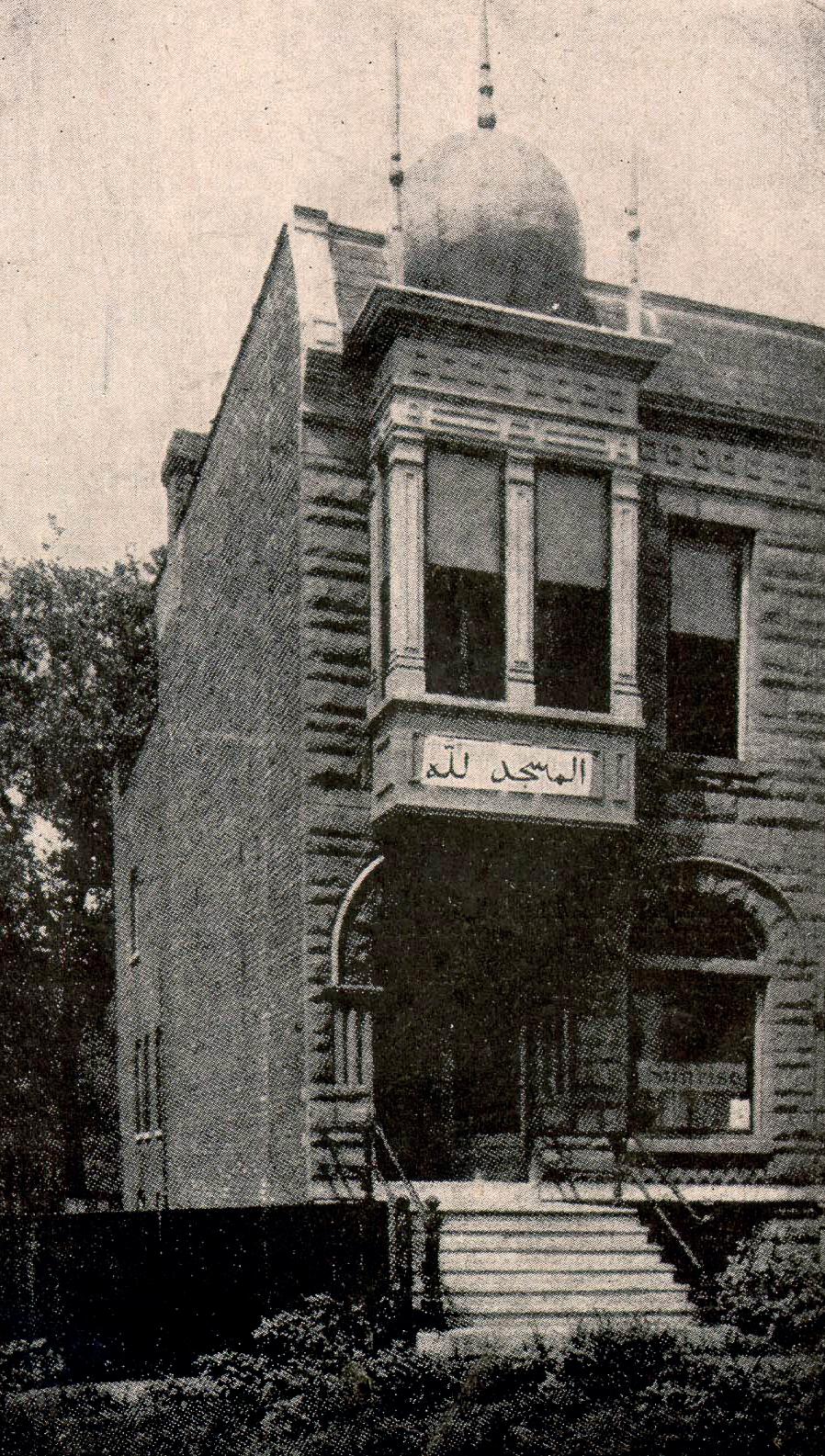
In brief, the allotted time of Christianity has run its course and pathways are now opening of themselves for the progress of Islam. Of the twenty-nine new converts, 13 accepted Islam in the city of Chicago, 9 in Philadelphia, 3 in New York and 5 in Indianapolis. Their Islamic names, alongside their former Christian names, are as follows: Mr Adolphus (Lucknow) – Sheikh Abdul Majeed; Mr Samuel (Chicago) –Shamsuddin; Mr Rice (Chicago) – Alim Din; Mr Rice (Chicago) – Nimat Din; Mr Smith (Chicago) – Muhammad Akbar; Mrs Ransom (Chicago) – Rahat; Mr Borner (Chicago) – Hikmat Ilahi; Mrs Anderson (Chicago) – Zinatullah; Mrs Jackson (Chicago) – Khadijah; Mr Clark (Chicago) – Fazlur Rahman; Miss Good (Chicago) –Ulfat; Miss Logan (Chicago) – Fatimah; Mr Dayo (New York) – Yusuf; Mr Alvero (New York) – Mahboob Ahmad; Mr Taylor (New York) – Abdul Ghaffar; Mr Ward Spencer (Philadelphia) – Inayat Muhammad; Mr Ward Jr. (Philadelphia) – Inayat Ahmad; Miss Elaikum Ward (Philadelphia) – Ulfat; Miss Dorothy Ward (Philadelphia) – Bushra; Mr Albert Ward (Philadelphia) – Fazil; Miss Ruth Ward (Philadelphia) – Zainab; Mr Ester Ward (Philadelphia) – Fatih; Miss U Seal Ward (Philadelphia) – Rahmat; Mr Herman Ward (Philadelphia) – Mubashir;
Mr William (Indianapolis) – Abdul Rasool; Mr Brandon (Indianapolis) – Khaseem; Mr Alexander (Indianapolis) – Abdullah; Mr Smith (Indianapolis) – Shahab and Mr Joseph (Indianapolis) – Abu Hurairah.
Growth and training of the new converts
Sheikh Karam Ilahi Sahib of Indianapolis writes that the number of the local jamaat has now reached seventeen members. He further notes that he imparts all new converts the fundamental beliefs of Islam to the best of his ability and consistently emphasises that, if they wish to become recipients of divine favour, they must observe the five daily prayers with regularity. Prayer, he explains, is the distinguishing mark between a Muslim and a non-Muslim and it is the primary means through which unity and mutual affection can be cultivated among them. Additionally, a regular weekly gathering is held every Sunday, in which all the newly converted Muslims participate.
Personal testimony of spiritual transformation
Mrs Ummat Subhan of Indianapolis writes that from the very day she began observing the five daily prayers, she has experienced a distinct inner tranquillity and a profound sense of divine comfort. She attributes this spiritual transformation to the dedicated efforts of Sheikh Karam Ilahi Sahib.
The conversion of Sheikh Abdul Majeed
Sheikh Abdul Majeed Sahib is of AngloIndian background and is originally a resident of Lucknow. After graduating from Glasgow, he came to America in search of employment and is presently working as a mechanical engineer in a railway company.
He had been under tabligh since the time of Maulvi Muhammad Din Sahib [ra]. Having studied our literature in depth, he read Ahmadiyyat [or the True Islam], a recent work by Hazrat Khalifatul Masih II [ra], no fewer than three times.
Following approximately five months of regular attendance at lectures, he formally accepted Islam Ahmadiyyat last night. He possesses a deep passion for the preaching of Islam and has expressed his intention that, when he returns to India and God grants him further knowledge, he will devote himself to preaching among the Anglo-Indians.
He further stated that on the forthcoming occasion of Christmas, he intends to send a copy of Ahmadiyyat [or the True Islam] as a gift to his father, as it
Continued on page 11
Martin Luther and the question of conscience
Moeez Krishen Ahmad
Europe on the eve of reform
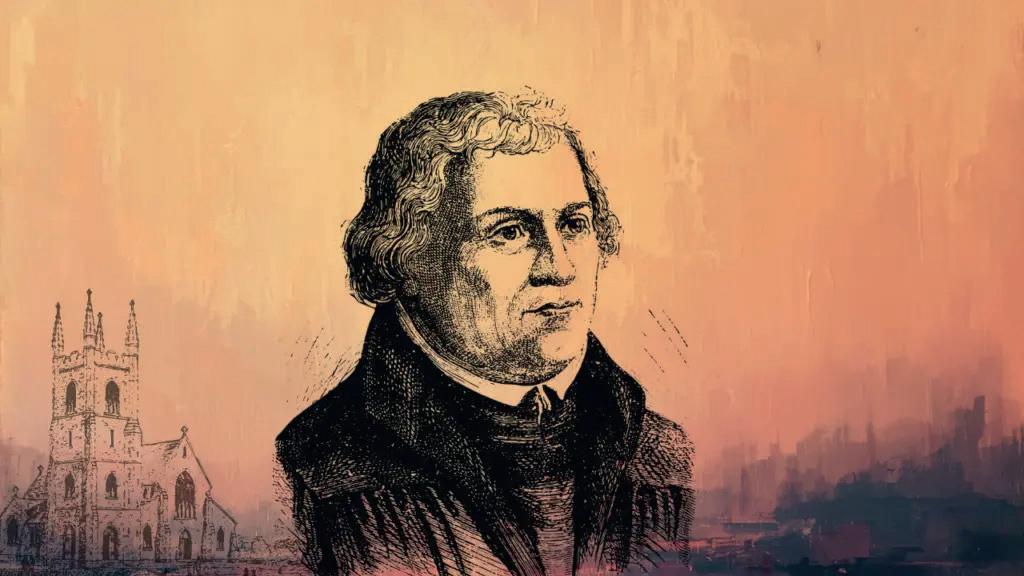
When the name “Martin Luther” is mentioned today, many instinctively think of the 20th-century civil rights leader whose words and actions helped transform American society. Yet four centuries earlier, another Martin Luther stood at the centre of a different kind of struggle – one that reshaped the religious and political landscape of Europe. In distinct circumstances, both figures would come to challenge powerful systems of authority, guided by conscience rather than personal ambition.
The early 16th-century was an age of intellectual revival and institutional power. As the Renaissance reached its height, debates surrounding humanism, classical learning, and religious authority became increasingly prominent. At the heart of
Continued from page 10
presents a clear and accurate portrayal of Islam – indeed, a gift superior to any other.
Additionally, he has pledged a monthly chanda (monetary sacrifice) of three dollars.
Establishment of the American Muslim Publishing Society
Under the title of American Muslim Publishing Society, Brother Rahman and I have jointly established an association, which to date has enrolled thirty-nine members. Each member has pledged a monthly contribution of twelve annas towards this fund.
The objectives of the society are as follows:
1. To publish Islamic literature.
2. To bear the expenses of advertisements.
3. To invite non-Muslims towards Islam.
4. To initiate the publication of The Muslim Sunrise, once sufficient capital has been accumulated.
This society will be formally incorporated in accordance with American law and efforts will be made to encourage all new Muslims across the United States to join it.
The message of Muhammadan Messiah conveyed to a gathering of two thousand
For the past six weeks, I had been attending a large public hall every Sunday with the hope of being granted an opportunity to deliver a lecture.
Each week, I would sit there for three hours in anticipation that my wish might be fulfilled. Despite the absence of success for six consecutive weeks, I did not lose heart and continued to attend regularly.
At last, the appointed time arrived when God fulfilled my desire: the past Sunday, the chairman of the gathering, Mr Wallace, granted me permission to speak for five
European life stood the medieval Church, an institution whose immense spiritual influence had become closely intertwined with governance, economics and social order. While it offered moral and religious structure, many of its practices appeared increasingly distant from the original teachings of Christianity. Scripture itself remained inaccessible to most, preserved largely in Latin and mediated through clerical authority.
It was within this fractured landscape that Martin Luther, a German monk and
minutes.
In five minutes, a formal lecture was scarcely possible; nevertheless, the divine message was conveyed. It was proclaimed that the Messiah for whom they had long been awaiting had indeed come and that those who wished to partake of true spiritual baptism should come to the mosque, the address of which was duly provided to them.
Public engagement and continuing outreach
At the conclusion of the address, Brother Muhammad Akbar Sahib and I stood at the exit and distributed our cards. Some individuals posed questions, which were duly answered, while others promised to visit the mosque.
In addition, every Sunday evening, I deliver lectures on Islam at various public venues.
The mosque has now reached a point where it can no longer accommodate all those who come for prayers and we are therefore considering arrangements to address this matter. It is hoped that Allah the Almighty will soon provide a most suitable solution.
Missionary tours and future plans
Invitations to deliver lectures have been received from two cities; however, owing to the severity of the weather, travel at present remains difficult. With the conclusion of the winter season, we intend – within the limits of our capacity – to undertake a vigorous and extensive campaign.
In order to facilitate missionary visits to nearby cities, we are also considering the purchase of a car. By the grace of God, we remain hopeful of attaining significant success in these endeavours.
– Muhammad Yusuf Khan, Ahmadi Muslim Missionary, Chicago
(Translated by Al Hakam from the original Urdu, published in the 23 April 1926 issue of Al Fazl)
theologian, emerged as an unexpected challenger. He did not seek to establish a new church, nor did he envision the upheaval that would follow. Rather, compelled by conscience and conviction, Luther questioned the authority of practices he believed contradicted foundational Christian principles. In doing so, he initiated a movement that would permanently alter Europe’s religious, intellectual, and political trajectory.
The medieval Church and the growing crisis of authority
To fully appreciate Luther’s impact, it is necessary to understand the conditions that preceded him. The late medieval Church enjoyed immense authority; however, with that authority came internal weaknesses. One of these was the selling of indulgences – essentially buying passage to heaven by paying the Church before death. This was one of the most controversial manifestations of this system. Many followers viewed these transactions as a distortion of the message of repentance and forgiveness that was taught by Jesus (as).
Dissatisfaction among believers continued to grow as cases of clerical abuse and political entanglements contributed to the widening gap between the clerical elite and ordinary followers. It was within this fracturing landscape that Luther began to study, reflect, and eventually ask questions that many others had silently harboured.
Faith, grace and the challenge to church authority
Luther’s moment came in 1517 when he articulated the belief that a true believer required only faith and divine grace to attain salvation. This led him to compose a document containing 95 questions and propositions for discussion. Legend says that he nailed the Ninety-five Theses to the door of the Wittenberg Castle Church as an act of defiance, while others say he intended to initiate an academic discussion regarding his concerns.
What he could not have anticipated was the speed with which his ideas would spread. The printing press, then a relatively recent invention, enabled his arguments to reach audiences far beyond the intended academic circles. This occurred during the height of the Renaissance, a period that laid important foundations for the later Enlightenment. Widespread intellectual exchange and the dissemination of new ideas were becoming increasingly common.
His stance against the Church required significant personal courage. Luther faced excommunication, political threats and the possibility of execution. Before his official trial, he was asked to recant his writings, which he famously refused, maintaining that he could not abandon what he believed to be true. In front of the Diet of Worms (meeting of the assembly of the Holy Roman Empire held at Worms in Germany), Luther stood by his principles and the Holy Roman Emperor Charles V issued an edict ordering the burning of all of Luther’s writings.
Scripture for the people and the spread of reform
The following year, Luther remained in
hiding and worked on his German rendering of the Bible, which provided ordinary believers with direct access to scripture in their own language. In the years that followed, Luther returned to Wittenberg, and although the Reformation had grown beyond his sole leadership, his writings and ideas continued to shape its direction.
Luther’s opposition to the Church emboldened others to challenge established authority. His actions ignited the Protestant Reformation, shattering the previously impenetrable unity of the Church. Several German princes aligned themselves with the movement, seeing both theological justification and political opportunity, thereby granting it crucial protection.
The Reformation was not confined to Germany alone. Scandinavian kingdoms adopted Protestantism as the state religion, reform movements emerged in France through Calvinism, and in England, these developments laid the groundwork for the Church of England. Luther’s influence was therefore not limited to theology but extended into the political and social fabric of Europe. His conscience and subsequent actions were the root cause of widespread fragmentation in Europe. (The Cambridge Companion to Martin Luther, pp. 227-238)
Reform, conscience and divine guidance
Through an Islamic lens, the history of religious reform raises a deeper question: is conscience alone enough to cause lasting spiritual renewal? While moral conviction plays an important role in challenging injustice and corruption, Islamic theology emphasises that enduring religious renewal occurs through reformers sent by God in response to specific spiritual conditions.
The Ahmadiyya Muslim Jamaat holds that the Promised Messiah and Mahdi, Hazrat Mirza Ghulam Ahmad (as), is a divinely guided reformer. He emerged in a religious landscape marked by internal inertia, sectarian disputes and external ideological challenges to Islam itself. Rather than confronting a single institution, his mission addressed widespread spiritual decline, misconceptions about jihad and the erosion of faith in the face of modern materialism.
The defining distinction between this model of reform and that of Martin Luther comes down to the role of divine intervention. Luther’s stand, though rooted in sincerity and conscience, relied solely upon personal interpretation of scripture and the ensuing resistance to institutional authority. By contrast, the Promised Messiah (as) consistently presented his reform as originating from divine revelation and God’s direct guidance. His claim went beyond correcting religious practice, rather to revive faith itself through spiritual signs, reasoned argument and moral reformation.
Seen together, these two figures illustrate a critical distinction between reform initiated through conscience alone and reform sustained by divine guidance. Whilst conscience may provoke necessary challenge, Islamic thought holds that it is through God’s intervention alone that reform leads to unity, stability and lasting spiritual renewal.
Mubarak Mosque, Islamabad, Tilford, UK
27 March 2026
The Prophet’s (sa) protective zeal for Tawhid
After reciting the tashahhud, ta‘awwuz and Surah al-Fatihah, Hazrat Khalifatul Masih V (may Allah be his Helper) stated:
Incidents in the life of the Holy Prophet (sa), particularly related to Tawhid [the Oneness of God] were previously being discussed. Details of breaking the idols at the time of the Conquest of Mecca have already been mentioned in previous sermons. He did all of this as a proclamation of the unity of Allah the Almighty; to demonstrate that this is the state of the idols that they worship. As such, we saw that the main idols around Mecca, such as Manat, ‘Uzza and Suwa’, etc., had been destroyed.
With regards to the idol of the people of Ta’if, Lat – which they referred to as Rabba, i.e., their goddess – it is recorded that the people of Ta’if requested that it not be destroyed for three years. This request was presented before the Holy Prophet (sa). The Holy Prophet’s (sa) honour for the Unity of God did not allow for such an agreement. The people of Ta‘if again requested that it not be destroyed for at least one year. However, the Holy Prophet (sa) rejected their request once again. They then requested that it not be destroyed for at least one month so that people could enter Islam and so that ignorant men and women would not leave Islam as a result of destroying it.
However, the Holy Prophet (sa) did not grant this concession either and sent Hazrat Abu Sufyan and Hazrat Mughira bin Shu’ba and had the idol destroyed. His honour for Tawhid did not permit such idols to remain standing under any circumstances, especially since an Islamic state had been established. (Al-Sirah al-Halabiyyah, Vol. 3, pp. 304-305, Dar Al-Kotob Al-Ilmiyah, Beirut)
Abu al Hayyaj Asadi relates that Hazrat Ali bin Abi Talib said to me: “Shall I not send you on the same mission on which the Holy Prophet (sa) sent me; [He instructed] to not leave any idol standing and to destroy it, and also not to leave any high grave without levelling it?” (Sahih Muslim [Translated], Vol. 4, Noor Foundation, Rabwah, p. 133, Kitab al-jana’iz, Bab al-amri bi taswiyati l-qabr, Hadith 1597)
Why was this? Because such things negate Tawhid and within an Islamic state, such practices cannot be tolerated at all. However, it is unfortunate that nowadays, a large number of Muslims have fallen into venerating and prostrating before graves. Instead of beseeching God Almighty, they seek from those buried in these graves and
they go to extremes in this regard.
There is no doubt that for the establishment of Tawhid, the Holy Prophet (sa) confronted a powerful nation like the idolaters of Mecca and ultimately, he purified the Ka‘bah of 360 idols. However, alongside this, he also waged a magnificent and blessed jihad [struggle] to establish Tawhid within the hearts of those who accepted Islam and through his spiritual power, he established a community that loved Tawhid He morally trained his Companions in such a profound and excellent manner that not even the slightest trace of shirk [association of partners with Allah] arose in their minds. For this, he even prevented his Companions from exaggerating in praising him.
Hazrat Ibn Abbas relates that he heard Hazrat ‘Umar (ra) saying upon the pulpit: “I heard the Holy Prophet (sa) say: ‘Do not exaggerate in praising me as the Christians exaggerated in praising the son of Mary. I am only His servant – (a servant of Allah) – so say, ‘the servant of Allah and His Messenger.’” (Sahih al-Bukhari, Kitab ahadithi l-anbiya’, Bab qailillahi ta‘ala ‘wa dh-kur fi l-kitabi maryam’, Hadith 3445)
It is narrated from Hazrat ‘Abdullah bin
‘Umar (ra) that the Messenger (sa) of Allah once met Hazrat ‘Umar bin al-Khattab (ra) while he was travelling with a caravan and was swearing by his father. The Holy Prophet (sa) said:
“Listen! Allah forbids you from swearing by your forefathers. Whoever wishes to swear should swear by Allah, or remain silent.” (Sahih al-Bukhari, Kitab al-imani wa n-nudhur, Bab la tahlifu bi aba’ikum, Hadith 6646)
The Holy Prophet (sa) could not tolerate even the slightest association with the oneness of Allah the Almighty.
Regarding the rank of one who recites the declaration of unity, a narration mentions the following:
‘Ubaidullah bin ‘Adiyy bin Khiyar relates that Hazrat Miqdad bin ‘Amr al-Kindi (ra), an ally of Banu Zuhrah – and among those who had participated in the Battle of Badr with the Messenger (sa) of Allah – said that he once asked the Holy Prophet (sa):
“Tell me, if I encounter a man from among the disbelievers and we begin fighting, and he strikes one of my hands with his sword and cuts it off, then he hides behind a tree and says: ‘I have become a
Muslim for the sake of Allah.’ O Messenger (sa) of Allah, should I still kill him after he has said this (i.e., the Kalimah)?”
The Messenger (sa) of Allah replied:
“Do not kill him.”
Hazrat Miqdad (ra) said:
“O Messenger (sa) of Allah, he has cut off one of my hands, and after cutting it off, he then said: “There is none worthy of worship except Allah.”
The Messenger (sa) of Allah again said:
“Do not kill him. For if you kill him, then he will attain the position that you held before killing him, and you will assume the position that he held before uttering the words which he has now spoken.” (Sahih alBukhari, Kitab al-maghazi, Bab 12, Hadith 4019)
Thus, even if some of the earlier Companions committed such an act, the Holy Prophet (sa) strongly expressed his displeasure over it. But if we look at the condition of the so-called scholars today, it is quite different. In Pakistan, the extent of the persecution inflicted upon Ahmadis – despite their reciting the Kalimah –knows no bounds. The Holy Prophet (sa) has already given the verdict regarding such oppressors in this very narration. In any case, those people who follow these extremist clerics should reflect carefully.
In this regard, it is mentioned in another narration that Hazrat Usamah bin Zaid (ra) said:
“The Messenger (sa) of Allah sent us on an expedition. In the morning, we reached Huraqat of Juhainah. (Huraqat was the name of a village in the area belonging to the tribe of Juhainah.) There, I overtook a man and captured him. He said [
There is none worthy of worship except Allah] but I still struck him with my spear.
“Afterwards, I felt uneasy in my heart because he had said
and yet I had killed him. So I mentioned this to the Holy Prophet (sa). The Messenger (sa) of Allah said:
“‘Did he say
and you still killed him?’
“I replied, ‘O Allah’s Messenger (sa), he only said it out of fear of the weapon.’
“The Holy Prophet (sa) said, ‘Why did you not cut open his heart to see whether he said it sincerely or not?’
“The Holy Prophet (sa) kept repeating this to me until I wished that I had only accepted Islam on that very day.” (Sahih Muslim [Translated], Vol. 1, Noor Foundation, Rabwah, pp. 88-89, Kitab aliman, Bab tahrimi qatli l-kafiri ba‘da ’an qala ‘la ilaha illallah’, Hadith 132)
In another narration, Hazrat Jabir (ra) relates that a man came to the Holy Prophet (sa) and asked:
“O Messenger (sa) of Allah, which two things make paradise and hell inevitable?”
The Holy Prophet (sa) replied, “Whoever dies without associating anything as a partner with Allah will enter paradise; and whoever dies while associating partners with Allah will enter the fire.” (Sahih Muslim [Translated], Vol. 1, pp. 84-85, Kitab aliman, Bab ad-dalili ‘ala ’an mun mata la yushriku billahi shay’an dakhala l-jannah, Hadith 127)
Mahmud bin Labid relates that the Messenger (sa) of Allah said, “The thing I fear most for you is subtle shirk.” The Companions asked, “O Messenger of Allah, what is a subtle shirk?”
The Holy Prophet (sa) replied, “It is ostentation (i.e., showing off).” On the Day of Judgement, when people are recompensed for their deeds, Allah the Almighty will say to such people:
“Go to those for whom you used to show off your deeds in the world and see whether you find any reward with them.”
If they now seek forgiveness, they should seek it from those very people, and then see whether they receive anything from them.
(Musnad al-Imam Ahmad bin Hanbal, Vol. 7, Alam al-Kutub, 1998, p. 799, Hadith 24030)
Thus, displaying one’s deeds or flattering others to gain worldly benefit from them is akin to putting someone alongside Allah the Almighty – and this is shirk, which Allah the Almighty greatly dislikes.
Hazrat Abdullah (ra) narrates that when this verse was revealed:
“Those who believe and mix not up their belief with injustice […]” the Companions of the Holy Prophet (sa) said, “Which one of us has not committed injustice?” We may have committed injustices many times and often may not have even realised when we did so. Then Allah the Almighty revealed:
“Indeed, associating partners with God is a grievous wrong.” (Sahih al-Bukhari, Kitab al-iman, Bab zulmin duna zulm, Hadith 32)
Thus, this answer came from Allah the Almighty, that associating partners with Him is a great injustice. Therefore, to be dependent on anything other than Allah the Almighty is to associate partners with Him. By going into subtle detail, we must examine ourselves lest there be any aspect of associating partners with Allah within us, because this is a very great injustice.
In the commentary of Sahih al-Bukhari by Hazrat Waliullah Shah Sahib, which we have published, it is written:
“Surely, associating partners (with God) is a grievous wrong.”]
The meaning of “Zulm” (grievous wrong) is:
“To place something where it does not belong.” Every type of evil trait and unlawful thing is included within the meaning of “Grievous wrong”. Under the heading “a lesser form of disbelief,” shirk, i.e., associating partners with Allah, has been declared the greatest form of disbelief and even lesser bad morals has also been termed as a form of disbelief. This is the subtle meaning of this.
Then, under the heading “a lesser form of injustice,” associating partners with Allah has been declared the greatest injustice, and it has been explained why it is such a grave sin: because within it, the special attributes of divinity belonging to Allah the Almighty are attributed to others. For example; others are set up as equals to Allah in worship, which is another meaning of love and obedience and is the reality, the right of Allah the Almighty alone. A human, who was His servant and was created to fulfil His will, becomes instead a servant of his own self, or of another human like himself, or even of lowly creations and thus lowers himself far below the station upon which he
was created to stand.
With respect to the rights owed to mankind, giving undue possession to another is an injustice, but in the rights of Allah, giving undue possession to another is an even greater injustice. (Injustice in the rights owed to humans is indeed injustice, but failing to properly fulfil the rights of Allah is also an injustice.)
This is the concept of “injustice” that corresponds completely with associating partners with Allah. In reality, associating partners with God destroys the ultimate purpose of a human being. By reasoning from the verses and ahadith, Imam Bukhari (rh) has explained that complete faith is that which is entirely pure from the adulteration of associating partners with Allah.
(The Holy Quran, 6:83)
Perfect faith and guidance belong only to those whose faith is free from any addition of associating partners with God and injustice. Faith is not complete until, on one hand, it is accompanied by righteous deeds, and on the other hand, it is free from every form of injustice, because associating partners with God, sin, and every type of disbelief continues to weaken it.” (Sahih alBukhari, Vol. 1, Nazarat Isha‘at, p. 79)
Thus, this is the standard of establishing the Oneness of Allah and being pure from associating partners with Him, which the Holy Prophet (sa) has taught us.
Abu Hurairah (ra) narrates that the Holy Prophet (sa) said, “Allah the Almighty says: ‘The son of Adam denied Me and he had no right to do so. And the son of Adam uttered profanities against Me and he had no right to do so. As for his denial of Me, it was due to his saying that ‘I will not resurrect him again (as in, if he denies the life to come, then this is denying Allah), as I created him in the beginning. And as for his uttering profanities against Me, it is his saying that “He has taken a son”, even though I am the independent and besought of all. I beget not nor was I begotten, and there is none like unto me.’ He begets not, nor was He begotten and there is none who share His attributes.”
(Sahih al-Bukhari, Kitab tafsiri l-qur’an, Bab qawluhu ‘Allahu s-samad’, Hadith 4975)
While explaining Surah al-Ikhlas at one place, the Promised Messiah (as) states, “Allah the Almighty says:
“Allah is the Being upon whom all are dependent, but He is not dependent upon anyone.
“Observe with what elegance and excellence in this brief statement, which is not even one line long, the Being of the Maker has been described as free from every kind of association. The explanation of this is that, according to the reckoning of reason, association can be of four types. Sometimes, association is in respect of number, and at other times in rank, sometimes in respect of descent, and sometimes in respect of action and effect. So, in this surah, it has been declared that God is free from association with all four of these types. It has been made clear that He is One in number and is not two or three. He is Samad; that is, He is Unique and Incomparable in His station of being the Necessary Existence and Needed by all, while everything besides Him has only a contingent and mortal existence and
is ever dependent upon Him. And He is
, which means that He has no son so that he, by virtue of being His son, should be His partner; He is
, which means that He has no father so that, by virtue of being His father, he should be His partner; and He is مل
, which means that no one can be His equal in His works to claim partnership with Him on account of the working relationship. Thus, it has been made clear that God Almighty is free from associates of all four types, and is One, without associate.” (Barahin-e-Ahmadiyya – Part IV, English Translation, pp. 323-324)
Hazrat Aisha (ra) narrates that the Holy Prophet (sa) appointed a man as the leader of a military expedition. During the Prayer, he would recite for his companions and would conclude his recitation with [ہلّٰلاِ
Say, ‘He is Allah, the One;] that is, he would recite Surah al-Ikhlas at the end. When they returned, they mentioned this to the Holy Prophet (sa). The Holy Prophet (sa) said, “Ask him why he does this.” Thus, they asked him, to which he replied, “Because it contains the attributes of the Gracious God, and I love to recite it.” The Holy Prophet (sa) then said, “Inform him that Allah loves him.” As it is a proclamation of the Unity of Allah the Almighty, he should know that Allah also loves him. (Sahih al-Bukhari, Kitab at-tawhid, Bab ma ja’a fi du‘ai n-nabiyyi (sa) ummatahu ila tawhidillahi tabaraka w ta‘ala, Hadith 7375)
Many examples filled with the recognition of the love of Allah the Almighty and love for His Unity are also found among the Companions. In one narration, Hazrat Anas bin Malik (ra) relates that a man from among the Ansar used to lead them in prayer at Masjid Quba. Whenever he recited a chapter for them in the prayer, he would begin with Surah al-Ikhlas until he completed it, and then he would recite another Surah along with it, and he would do this in every rak‘ah [unit of prayer]. The first incident was of a group sent on an expedition; this, however, was the consistent practice of an Imam of a locality.
His companions spoke to him and said, “You recite this chapter, then you consider that it is not sufficient for you until you recite another chapter as well. Either recite only this – that is, Surah al-Ikhlas – or leave it and recite another chapter.” He replied, “I will not abandon it. If you like that I lead you in prayer in this manner, then I shall do so, and if you dislike it, then I shall leave you; I have no need of leading the prayer.” They considered him to be the most excellent among them, and they disliked that anyone other than him should lead them.
When the Holy Prophet (sa) came to them, they mentioned this matter to him – that this person recites Surah al-Ikhlas in every rak‘ah and before every Surah. The Holy Prophet (sa) said, “O so-and-so, what prevents you from acting upon what your companions say, and what causes you to recite this chapter in every rak‘ah?” He submitted, “O Messenger (sa) of Allah, I love it.” The Messenger (sa) of Allah said, “Indeed, your love for it has admitted you into Paradise” – that is, the love of Surah al-Ikhlas has admitted him into Paradise. (Jami‘ at-Tirmidhi, Kitab fada’ili l-qur’an, Bab ma ja’a fi surati l-ikhlas, Hadith 2901) The spiritual power and training of the Holy Prophet (sa) had made the Companions themselves a beacon for
guiding others towards the Unity of God. In a narration of Sahih al-Bukhari, it is also stated that the Holy Prophet (sa) declared this chapter to be one-third of the Quran, that is, a third part of the Quran. (Sahih alBukhari, Kitab fada’ili l-quran, Bab fadli qul huallahu ahad, Hadith 5013)
In its commentary, Hazrat Musleh-eMaud (ra) has written:
“The meaning of this chapter being onethird of the Quran is not that it constitutes one-third of the physical volume of the Holy Quran; rather, it signifies that its subject matter holds special importance.
“From studying the Holy Quran and the ahadith, it becomes evident that in the latter days two great trials were to arise: one, the trial of Dajjal [The Antichrist] and the other, the trial of Gog and Magog. These two trials were to confront Islam one after the other. One trial holds the belief in three gods instead of the One God – namely, God the Father, god the Son, and god the Holy Spirit – and the other trial is that of materialism, which altogether denies the existence of God. The Holy Quran has refuted the beliefs of both these trials and has expounded on the correct doctrines.
“The Holy Quran is filled with the praise of God the Father, and it affirms that He alone is the Sustainer and the One God –that is, it proclaims the praise of the One God, Allah the Almighty and affirms His Unity. At the same time, it strongly rejects the notions of god the son and god the Holy Spirit. Allah the Almighty denies that there are any other gods besides Him. Thus, the Holy Quran has established the Godhood of God the Father and has refuted the concepts of god the Son and god the Holy Spirit.
“Therefore, it is evident that since affirming the Godhood of God the Father constitutes one-third of the subject matter of the Holy Quran, Surah al-Ikhlas also amounts to one-third of the Quran. In reality, the purpose of the Holy Quran is to establish the Unity of God and to eradicate false beliefs. Hence, when this chapter has, in the most comprehensive and concise words, conveyed that subject which refutes false doctrines, proves them to be false, and sets forth the reality of Divine Unity, then this Surah is not merely one-third of the Quran, but is, in fact, equal to the whole Quran.
“Thus, the Holy Prophet (sa) declaring this Surah to be one-third of the Quran is not an exaggeration; rather, in view of the importance of its subject matter, he stated this on account of its profound significance.” (Tafsir-e-Kabir, Vol. 15, pp. 372-373)
The Promised Messiah (as) states:
“Know for sure, therefore, that certainty of Tawhid can be achieved only through a Prophet, as our Holy Prophet, may peace and blessings of Allah be upon him, convinced the atheists and pagans of Arabia of the existence of God Almighty by showing them thousands of heavenly Signs. Even to this day, true and perfect followers of the Holy Prophet, may peace and blessings of Allah be upon him, present those Signs to the atheists. What is really true is that, until a person observes the living powers of the Living God, Satan does not depart from his heart, nor does true Tawhid enter into it, nor can he be convinced with certainty of the existence of God. This pure and perfect Tawhid is attained only through the Holy Prophet (sa).” (The Philosophy of Divine
Revelation, pp. 140-141)
In this age, even those who outwardly profess belief in the Oneness of God have turned their eyes away from its true essence. Aside from the external evil ploys of Gog and Magog, internally, the Muslims themselves have forgotten the true understanding of Tawhid [Unity of God].
Thus, in such circumstances, it was necessary that the devoted servant of the Holy Prophet (sa) should appear in the form of the Promised Messiah and Mahdi. In accordance with the promise of Allah the Almighty, he did indeed appear and opposed every attack against Tawhid [Unity of God].
Therefore, we can only truly fulfil the pledge of our Bai‘at when we become true believers in Tawhid [Unity of God]. When the Promised Messiah (as) established the Jamaat on 23 March – and we are currently passing through the month of March and we hold various Jalsas to commemorate “the Promised Messiah (as) Day” – it is to remind us that the devoted servant of the Holy Prophet (sa) was sent by Allah for the establishment of Tawhid [Unity of God]. Hence, by entering into this Jamaat, we have pledged to remain steadfast upon Tawhid [Unity of God]. Its true fulfilment lies in striving to establish it within ourselves, within our families, and within our society.
May Allah the Almighty grant all the Muslims the ability to accept the one sent by God Almighty, so that they may establish Tawhid [Unity of God] and repel the evil ploy of Gog and Magog and of the Dajjal, which are nowadays attacking with great intensity.
With reference to the Night Journey [Isra’], a narration is reported by Hazrat Abdullah ibn Mas‘ud (ra), that the Holy Prophet (sa) said:
“I met Abraham (as), on the night of the Isra’. He said: ‘O Muhammad (sa), convey my greetings to your community and inform them that Paradise has pure soil and sweet water and is a vast plain, and its plants are: SubhanAllah [Holy is Allah], Alhamdulillah [All praise belongs to Allah], La ilaha illAllah [There is none worthy of worship except Allah], and Allahu Akbar [Allah is the Greatest].’” (Jami‘ at-Tirmidhi, Kitab ad-da‘wat, Bab 59, Hadith 3462)
Thus, a believer should engage in these remembrances with deep understanding and with a complete realisation of Tawhid [Unity of God] – for therein lies success. We believe in Allah as the One and Only.
In another narration, a qudsi hadith is reported by Hazrat Anas ibn Malik (ra). He relates that he heard the Holy Prophet (sa) say:
“Allah the Blessed and Exalted says:
“‘O son of Adam! Verily, as long as you called upon Me and hoped in Me, I forgave you, despite whatever may have occurred from you, and I did not mind. (That is, despite their weaknesses and shortcomings, Allah the Almighty granted His forgiveness because they were supplicating to Him.)
“O son of Adam! Were your sins to reach the heights of the sky, then you sought forgiveness from Me, I would forgive you, and I would not mind. (Irrespective of the number of sins committed, God Almighty can forgive them all for He is the Master and can do so whatever He wills.) So, O son of Adam! If you came to me with sins nearly as great as the earth, and then you met Me not
associating anything with Me, I would come to you with forgiveness equal to them.
“If a person has sins equal to the size of the earth, but as long as he has not committed shirk and remained fearful of Allah the Almighty and proclaimed His unity and strived to act upon it, then I shall grant His forgiveness.’” (Jami‘ at-Tirmidhi, Kitab ad-da‘wat, Hadith 3540)
Thus, all sins are forgiven by Allah the Almighty when a person turns to Him in humility. However, the condition is that one must not commit shirk [associating partners with God] and must fulfil the due rights of His Divine Unity. Mere verbal belief is not sufficient; just as I mentioned earlier, in fact, one must prove through every action that God Almighty is One.
Regarding the exalted station of Tawhid [Divine Unity], a narration from Abu Sa‘id al-Khudri (ra) relates that the Holy Prophet (sa) said:
“Prophet Moses (as) supplicated: ‘O my Lord, teach me something by which I may remember You and supplicate to You.’
“Allah the Almighty said: ‘O Moses, say: La ilaha illallah [there is none worthy of worship except Allah].’
“Moses (as) submitted: ‘My Lord, all Your servants say this.’ (That is, they all proclaim that there is none worthy of worship except Allah.)
“Allah the Almighty replied: ‘O Moses, say: La ilaha illallah.’
“Moses (as) said: ‘There is none worthy of worship but You, my Lord, but I seek something particular for myself.’
“Allah the Almighty said: ‘O Moses, if the seven heavens and all their inhabitants, and the seven earths, were placed in one scale, and La ilaha illallah in the other, then La ilaha illallah would outweigh them all.”
(Al-Mustadrak ala al-Sahihayn, Vol. 1, Dar Al-Kotob Al-Ilmiyah, p. 710, Kitab addu`‘a, Hadith 1936)
That is, all the creations of the heavens and the earth, with all their goodness, when placed on one side, would still be outweighed by the declaration of La ilaha illAllah [i.e., Divine Unity].
While responding to an objection and explaining the reality of the Islamic creed that “there is none worthy of worship except Allah”, the Promised Messiah (as) states:
“Your statement that the Holy Prophet (sa) has taught that reciting the words:
[‘There is none worthy of worship except Allah.’] dispels all sins, is absolutely true. This indeed is the truth that whosoever considers only God to be One without a partner and believes that Muhammad, the Chosen One, peace and blessings of Allah be upon him, has been sent by the same Omnipotent and Unique God, then –without any doubt – if such a person meets his end upholding this belief, he will surely attain salvation. There is absolutely no salvation under the heavens through the suicide of someone else. Certainly not! And who could be more insane than one who even entertains such a thought? However, to hold the belief that God is One and has no partner and that He is so Compassionate that – showing great mercy – He sent His Messenger, whose name is Muhammad, the Chosen One, peace and blessings of Allah be upon him, to deliver the world from its error is such a doctrine that believing in it dispels the darkness of the soul, egotism is eliminated, and Tawhid [Oneness of God]
takes its place. And, ultimately, the passion of Tawhid so engulfs the heart that the life in Paradise begins in this very world. Just as you see that darkness cannot survive when light arrives, in the same way, when the luminosity of:
“falls upon a person’s heart, all the passions of the darkness of the ego become, as if, extinct. The reality of sin is none other than that there should be a cacophony of egoistic passions admixed with rebellion, and a person is labelled a sinner when he is in the state of subservience to them. (When a person acts contrary to this, he is labelled a sinner.)
“And the meanings of
that we understand from the usage of Arabic lexicons is:
“Meaning that, with the exception of God, there is none whom I desire, or whom I love, or whom I worship, or whom I obey. Now, it is clear that these meanings are completely at odds with the essence of sin and the real source of sin. Therefore, the person who allows these meanings to occupy his soul with heartfelt sincerity (and these are words are worth deeply pondering over), the meaning counter to it [i.e., submitting to false idols] will, of a necessity, leave his heart, (nothing else will remain in the heart of such a person, because he will act in accordance with God’s commands and acknowledge His Oneness) because two opposites cannot coexist at one place.
“Thus, when egoistic passions get purged, then this is precisely the state that is called true piety and real righteousness. And the need to believe in the one sent by God – which is the purport of the second part of this declaration of faith – is that faith in God’s word should also be attained. This is because it is necessary for anyone who declares that he wishes to become obedient to God, that he should also believe in His commandments. And it is not possible to believe in His commandments without believing in the person through whom the commandments came into the world. (It is also necessary to believe in the bearer of the Divine teachings.) This is the true purport of this declaration of faith.” (The Light of the Holy Quran – Number II, pp. 118-119)
Hazrat Abu Musa al-Ashari (ra) narrates that one day the Holy Prophet (sa) addressed us and said, “Beware of shirk, for it is subtler than the footprint of an ant.” That is, it is more subtle than the trace left by an ant’s foot. Someone asked, “O Messenger of Allah, how can we guard ourselves against it when it is subtler than the footprint of an ant?” The Holy Prophet (sa) replied, “Recite this prayer:
“O Allah, we seek refuge in You from knowingly associating anything with You, and we seek Your forgiveness for what we do unknowingly.” Always continue to seek help. (Musnad al-Imam Ahmad bin Hanbal, Vol. 6, Alam al-Kutub, Beirut, 1998, pp. 614615; Musnad Abu Musa al-Ashari, Hadith 19835)
Hazrat Abdur Rahman bin Abza relates that the Holy Prophet (sa) would recite this supplication upon waking in the morning:
“We have entered the morning upon the natural state of Islam, upon the word of sincere devotion to Tawhid, upon the religion of our Prophet Muhammad (sa), and upon the way of our father Abraham, who was upright, a Muslim, and not among the polytheists.” Upon waking, one should always remember Allah. (Musnad al-Imam Ahmad bin Hanbal, Vol. 5, Alam al-Kutub, Beirut, 1998, pp. 294-295, Musnad Abd alRahman bin Abzi, Hadith 15434)
Hazrat Abdullah bin Masud (ra) relates that when evening fell, the Messenger (sa) of Allah would recite:
“We and the entire creation have entered the evening for Allah’s sake. All praise is for Allah. There is no god but Allah, He is One and has no partner.” (Sahih Muslim, Kitab adh-dhikri wa d-du‘a, Bab at-ta‘awwuzi min sharri ma ’amala wa min sharri ma lum ya‘mal, Hadith 2723)
Abdullah bin Buraidah al-Aslami narrates from his father that the Holy Prophet (sa) heard a man supplicating and saying, “O Allah, I ask You by virtue of my testimony that You are Allah, there is none worthy of worship but You. You are the One, Self Sufficient, He who neither begets nor is begotten, and none is equal to Him.” Upon hearing this, the Holy Prophet (sa) said, “By Him in Whose hand is my soul, he has asked Allah by His Greatest Name. When one supplicates through it, He answers, and when one asks through it, He grants.” (Jami‘ at-Tirmidhi, Kitab al-Da‘wat, Bab Ma Ja’a fi Jami al-Da‘wat an Rasulillah [sa], Hadith 3475)
Hazrat Asma bint Umais (ra) narrates that the Messenger (sa) of Allah said to her, “Shall I not teach you words that you should recite in times of hardship and affliction?” They are:
“Allah, Allah is my Lord. I do not associate anything with Him.” (Sunan Abi Dawud, Kitab al-Witr, Bab Fi l-istighfar, Hadith 1525)
When people ask what they should recite in times of difficulty, this is one of the supplications.
In another narration, Hazrat Ibn Abbas (ra) relates that in times of distress the Holy Prophet (sa) would supplicate:
“There is no god but Allah, the Most Great, the Most Forbearing. There is no god but Allah, Lord of the heavens and the earth, and Lord of the Mighty Throne.” (Sahih alBukhari, Kitab al-Da‘wat, Bab al-Du‘a Inda al-Karb, Hadith 6345)
Just observe the subtlety with which the Holy Prophet (sa) would instruct the establishment of the Oneness of God. In one narration, Abu Rimsah (ra) relates that his father said to the Messenger (sa) of Allah, “Show me the mark upon your back,”
meaning the Seal of Prophethood, “for I am a physician.” The Holy Prophet (sa) replied, “The true physician is Allah. You are merely a companion who gives comfort and reassurance. The physician is He who created him and He alone grants healing.” (Sunan Abi Dawud, Kitab at-tarajjul, Bab fi l-khidab, Hadith 4207; Aun al-Ma‘bud, Vol. 11, Dar Al-Kotob Al-Ilmiyah, Beirut, 1990, p. 175, Kitab at-tarajjul, Bab 17, Hadith 4201)
Hazrat Ubadah bin Samit (ra) relates that the Messenger (sa) of Allah said, “Whoever testifies that there is no god but Allah, He is One and has no partner, and that Muhammad (sa) is His servant and Messenger, and that Jesus is the servant of Allah and the son of His maidservant, and His word which He cast to Mary and a spirit from Him, and that Paradise is true and Hell is true, Allah will admit him into Paradise through whichever of its eight gates He wills.”
Umair bin Hani relates the same narration with the same chain and affirms it, and he stated that the Holy Prophet (sa) said, “Whatever his deeds may have been, God will admit him into paradise.” However, he did not corroborate the statement about the eight gates of paradise. In this second narration, the reference to the eight gates is not mentioned. (Sahih Muslim, Kitab al-iman, Bab ad-dalil ‘ala mun mata ‘ala t-tawhidi dakhala l-jannah, Hadith 28)
It is narrated by Hazrat Ibn Umar (ra) that the Holy Prophet (sa) said: “Islam is founded upon five things: that Allah alone be worshipped and that all others be rejected as objects of worship; the establishment of Prayer (Salat); the payment of Zakat; the pilgrimage to the House of Allah; and the fasting in Ramadan.” (Sahih Muslim, Kitab al-iman, Bab bayani arkani l-islam, Hadith 16)
It is narrated by Hazrat Yasirah (ra), who was among the female migrants, that the Holy Prophet (sa) said: “It is incumbent upon you, O women, to engage in tasbih [sanctification of God], tahlil [sending salutations], and taqdis [glorification of God], and do not fall into heedlessness lest you forget the Unity of God. Count upon your fingers, for indeed the fingers will be questioned on the Day of Judgment and will be made to speak.” That is, one should also count while engaging in the remembrance of Allah, proclaiming His purity, declaring His Oneness, and glorifying Him. (AlMustadrak ala al-Sahihayn, Kitab ad-du‘a, Vol. 1, Dar Al-Kotob Al-Ilmiyah, p. 732, Hadith 2007)
Thus, the Holy Prophet (sa) never missed any opportunity, whether in a gathering, an assembly, or among any group, to instil within the hearts of his people the truth of Divine Unity and the greatness of Allah.
In this regard, Hazrat Musleh-e-Maud (ra) has stated in one instance in a sermon:
“The Holy Prophet (sa) was so fervent in this matter that even his opponents acknowledge that, whether standing, sitting, or moving about, he would constantly proclaim the name of God.
“A French historian writes that whatever accusations may be levelled against Muhammad (sa), (the historian says) there is one thing that stands out to him (about
the Holy Prophet [sa]) which he has not observed in any other person since the beginning of the world. He states that from the moment the Holy Prophet (sa) declared his prophethood until the time of his death, there remained only one word upon his tongue, and that was ‘Allah.’ It was as though he was consumed with a single passion, even a kind of obsession: to establish belief in God and to make Him apparent to the world.
“Thus, those who describe this condition of the Holy Prophet (sa) as a form of ‘obsession’ still concede that his foremost and greatest mission was to establish belief in God and His Unity. If it be called ‘obsession’, then indeed it is such an ‘obsession’ that later generations recognised its bearer as perfect; or at the very least acknowledged that a person who spends day and night proclaiming God, striving constantly to establish His Unity and attributes, cannot be an evil person.
“In any case, observing this state of the Holy Prophet (sa) makes it clear that the purpose of his advent – indeed the advent of all prophets – is to eradicate shirk, to establish belief in God, and to spread the teaching of His Unity throughout the world.”
(Khutbat-e-Mahmud, Vol. 9, pp. 260-261)
At another instance, Hazrat Musleh-eMaud (ra) writes:
“One must bear in mind that no matter how exalted the rank of the Holy Prophet (sa) may be, and no matter how deep our love for him, (he mentioned this in a sermon), the station of Allah the Almighty is infinitely higher than his. Allah is Eternal and Everlasting, while Muhammad (sa) is one of the greatest manifestations of His grace.
“To ascribe to the Holy Prophet (sa) a station that diminishes the rank of Allah would, in fact, be an act of enmity towards him, for he himself never approved of being given a status higher than that of God.”
As has been mentioned earlier through ahadith, he did not approve of being elevated above Allah, and every aspect of his life testifies to this. Whatever great achievements he accomplished were such mighty works that no human being could accomplish them independently; they could only be achieved through the power of Allah. Even the strongest of men could not perform such feats. Yet, when he was in the throes of death – a time of immense suffering – Hazrat Aisha (ra) relates: “I used to think that a person who suffers greatly at the time of death is not a good person. (She thought that one who is in agony at the time of death is not a good person.)
However, when I witnessed the condition of the Holy Prophet (sa), I was compelled to change my opinion. Even in that extreme state of suffering, he was so mindful of the rank of Allah the Almighty that, knowing the intense love his followers bore for him and fearing that they might exaggerate his status, he repeatedly uttered:
“‘May Allah curse the Jews and the Christians, for they made the graves of their prophets into places of worship.’”
He continued to repeat these words again and again. Thus, the final lesson he imparted to his people was this: “do not assign to me a status that leads to shirk. If you do so, do not
think that I will be pleased; rather, my soul will curse those who commit such an act.”
Therefore, even if it concerns the Holy Prophet (sa), attributing to him a station that dishonours the rank of Allah is not a source of his pleasure, but rather invites his curse. And a curse uttered at the time of death carries immense gravity.
Even those who do not follow a true religion – such as many among the Hindus – fear the curse uttered at the time of death. People fear even the supplications or curses of their parents at the time of their passing. Then how significant must it be when the Holy Prophet (sa), the Chief of All Prophets, utters such words at the moment of death! How grave a warning this is, and how necessary it is for us to guard ourselves against it.
Although such practices are not carried out at the blessed resting place of the Holy Prophet (sa), as I have mentioned before, they are indeed practised at the shrines of saints and so-called holy men. Such practices fall under the very curse that the Holy Prophet (sa) pronounced. (Khutbat-eMahmud, Vol. 20, pp. 600-601)
Therefore, we who claim to follow the True Servant of the Holy Prophet (sa) must be especially mindful. We must strive to understand the true reality of Divine Unity, comprehend the deep anguish and concern the Holy Prophet (sa) had for establishing it, and make every effort to become true monotheists. May Allah grant us the ability to do so.
The conditions of war in the world are also becoming increasingly severe. The United States and Israel are intent on establishing their dominance across the world, particularly in the Muslim world. As was stated by the Prime Minister of Israel at the outset of the conflict in Palestine, the map of the region and even that of the Arab world would be altered. These are indeed attempts to reshape the geopolitical landscape, and the Muslim world must awaken to the direction in which these forces are moving. Unity among Muslim nations is absolutely essential.
It has been reported that Pakistan is attempting to broker peace between Iran and certain other countries with the United States. Since the Arab countries themselves are also suffering losses, Pakistan is making efforts from that perspective. However, certain factions in Iran have developed suspicions regarding these efforts. Some experts and commentators in Iran have even gone so far as to allege that Pakistan is assisting in the training of American forces or aiding groups that might act against Iran along its border. Such claims are entirely baseless. Pakistan has categorically denied them. The enemy seeks to exploit these circumstances to create discord, so that Muslim countries may never unite or support one another.
Therefore, there is a great need for prayers. May Allah grant us the ability to pray earnestly in this regard as well, and may He enable the Muslim nations to be united in a bond of true unity.
(Official Urdu transcript published in the Daily Al Fazl International, 17 April 2026, pp. 1-8. Translated by The Review of Religions.)