How justice and peace can protect future generations
Hazrat Khalifatul Masih V delivers keynote address at UK Peace Symposium 2026
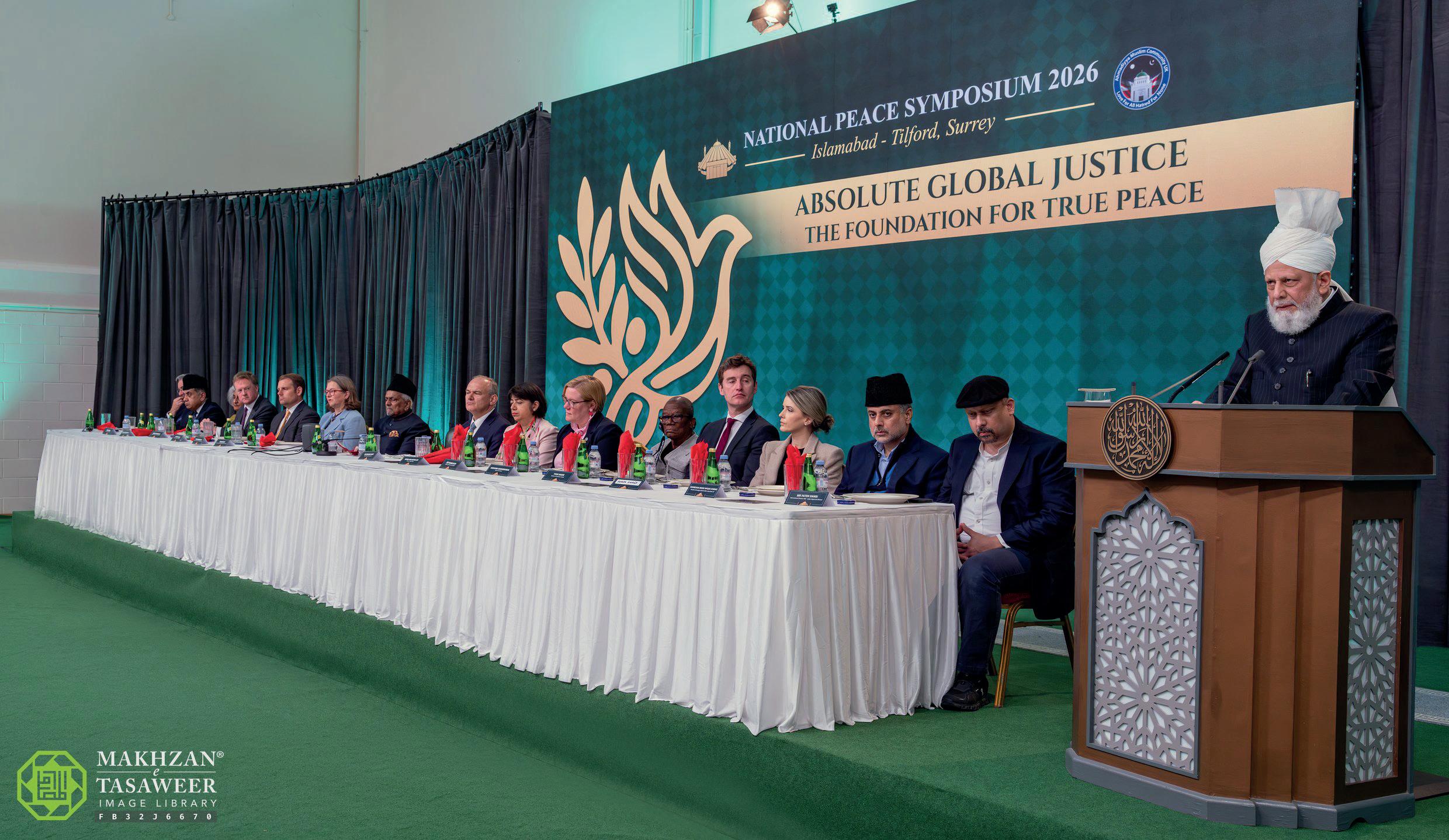
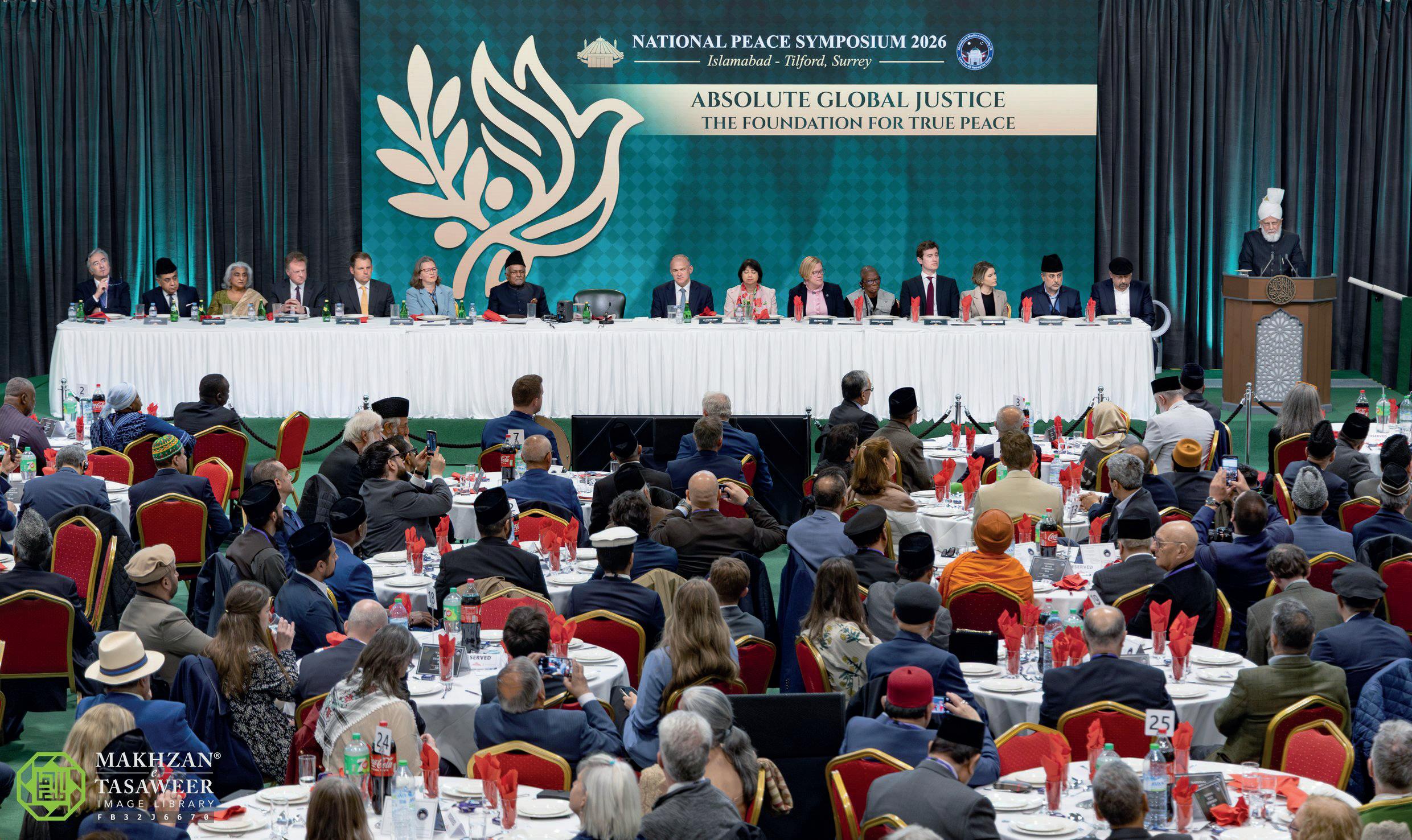
Islamabad, Tilford, UK: On 16 May 2026, Hazrat Mirza Masroor Ahmad, Khalifatul Masih V, may Allah be his Helper, graced the Ahmadiyya Muslim Jamaat UK’s National Peace Symposium 2026.
The event commenced with a recitation from the Holy Quran – Surah an-Nisa, verses 135-136, followed by their English translation. Amir Jamaat-e-Ahmadiyya UK, Rafiq Ahmad Hayat Sahib, then gave the welcome speech and an introduction to the Peace Symposium. This event marks the 19th National Peace Symposium hosted by the Ahmadiyya Muslim Jamaat UK. This year’s theme is: “Absolute Global Justice –The Foundation for True Peace.”
Rafiq Ahmad Hayat Sahib introduced Hazrat Amirul Momineen’s (aa) efforts to establish world peace and his efforts to help humanity throughout the world. Hazrat Khalifatul Masih V (aa) frequently meets with faith leaders and heads of state and has delivered keynote addresses at the United
Hadith-e-Rasul
Sayings of the Holy Prophet Muhammadsa
Wealth spent in Allah’s
This Week in History
A glimpse into the rich history of the Ahmadiyya Muslim Jamaat
22 May
22 May 1893: A debate that took place between the Promised Messiah (as) and Abdullah Atham (representing Christianity) started on this day and continued until 5 June 1893. Huzoor (as) mentioned that he spent those days like a warrior, giving precedence to this historic debate and ignoring everything else, at times even meals. This debate was titled Jang-e-Muqaddas (The Holy War). (Tarikh-e-Ahmadiyyat, Vol. 1, p. 484)
To read more, see: ‘‘Abdullah Athim: A life reduced to ‘footnotes’’’ at alhakam.org (31 October 2025, pp. 12-15)
22 May 1948: On this day, Hazrat Musleh-eMaud (ra) issued a written message under the title, “Aap Ki Talash Hei” (I Need You). This announcement was made in search of young waqifeen. (“I need you”, Al Hakam, 14 February 2020, Issue 100, p. 6)
23 May
23 May 1970: On this day, Hazrat Khalifatul Masih III (rh) inaugurated the newly-built Mahmood Hall at the London Mission. This building consisted of a hall, offices and three residential flats for missionaries. Huzoor (rh) had laid the foundation of this building during his previous European tour on 30 July 1967. Its expenses were provided by Hazrat Sir Chaudhry Muhammad Zafrulla Khan (ra), something that became openly known only after his demise. (Tarikh-e-Ahmadiyyat, Vol. 26, p. 75)
23 May 2015: Hazrat Khailfatul Masih V (aa) inaugurated the Mansoor Mosque in the German city of Aachen. Huzoor (aa) officially inaugurated the mosque by unveiling a commemorative plaque and offering a silent prayer. In the evening, a special reception, attended by more
than 210 dignitaries and guests, was held to mark the opening of the mosque.
In his address, Huzoor (aa) said: “The main purpose of a mosque is to act as a place to worship God and to serve His creation and fulfil their rights. There are so many people who are suffering in the world through poverty, who are ill or who cannot afford education and so helping them is a means of fulfilling the rights of a Mosque.” (“New Ahmadiyya Mosque opened in Aachen, Germany by Head of Ahmadiyya Muslim Community”, www.pressahmadiyya.com, 25 May 2015)
24 - 25 May
24 May 1932: On this day, Hazrat Mir Muhammad Ishaq (ra) read out his research paper in Lahore during a session arranged by Sanatana Dharma Hindus. His topic was, “Is religion an obstacle to a nation’s development?” (Tarikh-e-Ahmadiyyat, Vol. 6, p. 88)
25 May 1908: On this day, the Promised Messiah (as) addressed his followers for the last time. Availing the moment, Hazrat Chaudhry Jahan Khan (ra) from Mangat, district Hafizabad, held the hand of the Promised Messiah (as) and pledged allegiance [bai‘at]. He was the last fortunate person to enter the fold of Ahmadiyyat at the hand of the Promised Messiah (as) in this way during his life. (Tarikh-e-Ahmadiyyat, Vol. 2, p. 532)
25 May 2015: Die Zeit, the German national weekly, interviewed Hazrat Khalifatul Masih V (aa). Huzoor (as) was interviewed by reporter Tahir Chaudhry about the role of Islam in the modern world, the threat of extremism and various other global issues. During the interview, Huzoor (aa) was asked about the greatest threat to civilisation, to which he replied: “I believe that the biggest threat today is the increasing distance between mankind and God
Almighty. We are seeing fairness and justice decrease, whilst cruelty and hatred rise. Such behaviour and trends can only lead to the punishment of God Almighty.” (“Head of Ahmadiyya Muslim Community says Germany should protect integrity and unity of Europe”, www.pressahmadiyya.com, 29 May 2015)
26 - 28 May
26 May 1908: On this day, the Promised Messiah, Hazrat Mirza Ghulam Ahmadas passed away at Lahore. At Fajr, Huzoor (as) performed tayammum [alternative for ablution] and offered salat whilst lying down. In a state of semi-consciousness, he would repeat the words, “Allah! Merey piyarey Allah!” – “O Allah! My beloved Allah!” At 8:30 am, Huzoor (as) attempted to write something down about his health, but was unable to complete the sentence. At 9 am, his health deteriorated and at 10:30 am, the soul of Hazrat Mirza Ghulam Ahmad (as) returned to his Lord.
“Surely, to Allah we belong and to Him shall we return.”
Hazrat Hakeem Noor-ud-Deen (ra) led the funeral prayer of the Promised Messiah (as) in Lahore at noon. Then, in the evening, the rail journey started from Lahore station to take the coffin to Qadian for burial. (Tarikh-e-Ahmadiyyat, Vol. 2, p. 542)
27
27 May 2008: On this day, upon the completion of 100 years of Khilafat-e-Ahmadiyya, Hazrat Khalifatul Masih V (as) delivered an address at London’s ExCel Centre. (“Ahmadiyya Muslim Khilafat Centenary Jalsa held at Excel Centre on 27th May, 2008”, www.reviewofreligions.org)
28
28 May 1953:n On this day, Hazrat Mirza Sharif Ahmad Sahib (ra) and Hazrat Hafiz Mirza Nasir Ahmad Sahib (rh) were released from jail after being unjustly imprisoned for two months due to their faith in Islam Ahmadiyyat. (Tarikh-eAhmadiyyat, Vol. 15, p. 254)
28 May 2010: On this day, two Ahmadi mosques in Lahore, Pakistan, were attacked during the Friday prayer.
To read more on this topic, see: ‘‘28 May: Yaume-Takbir and the Lahore Martyrs’’ at www. alhakam.org (22 May 2020, p. 32)
Hazrat Abu Dharr (ra) narrated:
“I was walking with the Prophet (sa) at night in [Harrah], the stony plain of Medina, when Mount Uhud came into view before us. He said, ‘O Abu Dharr, I would not like to have gold equal to Uhud and then have a night – or three nights – pass over me while a single dinar of it remained with me, except for what I had set aside to repay a debt. Rather, I would distribute it among the servants of Allah like this, like this and like this.’ He showed us with his hand.
“Then he said, ‘O Abu Dharr.’ I replied, ‘Labbayka wa sa‘dayka, O Allah’s Messenger (sa).’ He said, ‘Those who possess the most will be the least, except those who distribute like this and like this.’
“Then he said to me, ‘Stay where you are, O Abu Dharr, and do not move until I return.’ He went away until he disappeared from my sight. I then heard a sound and feared that something might have happened to Allah’s Messenger (sa), so I intended to go, but then I remembered the words of Allah’s Messenger (sa): ‘Do not move.’ So I remained there.
“I said, ‘O Allah’s Messenger (sa), I heard a sound and feared that something might have happened to you; then I remembered your instruction, so I stayed.’ The Prophet (sa) said, ‘That was Jibril. He came to me and informed me that whoever from my Ummah dies without associating anything with Allah will enter Paradise.’ I said, ‘O Allah’s Messenger (sa), even if he committed adultery and theft?’ He said, ‘Even if he committed adultery and theft.’”
(Sahih al-Bukhari, Kitab al-isti’dhan, Bab man ajaba bi labbayka wa sa‘dayk, Hadith 6268)
Hazrat Mirza Ghulam Ahmadas, In His Own Words
A vision about the future of the Community
The Promised Messiah (as) states: “It was disclosed to me by way of a true vision that kings too would enter this community. I was even shown these kings. They were mounted on horseback. Further, Allah the Exalted also stated: ‘I shall bless you to such an extent that kings shall seek blessings from your garments.’
After a period in time, Allah the Exalted shall bring such people into the fold of our community, and with them, a multitude of people shall join us.”
(Malfuzat [English], Vol. 2, p.177)
States Congress, the European Parliament, the UK Parliament, the Dutch Parliament and the Conference of World Religions in London.
Following the welcome and introductory remarks, Gregory James Stafford MP, Sir Edward Jonathan Davey MP and Seema Malhotra MP each spoke on the current state of the world, ongoing conflicts, and the challenges of achieving lasting peace and international stability. They acknowledged the efforts of the Ahmadiyya Muslim Jamaat in establishing peace and justice across the globe.
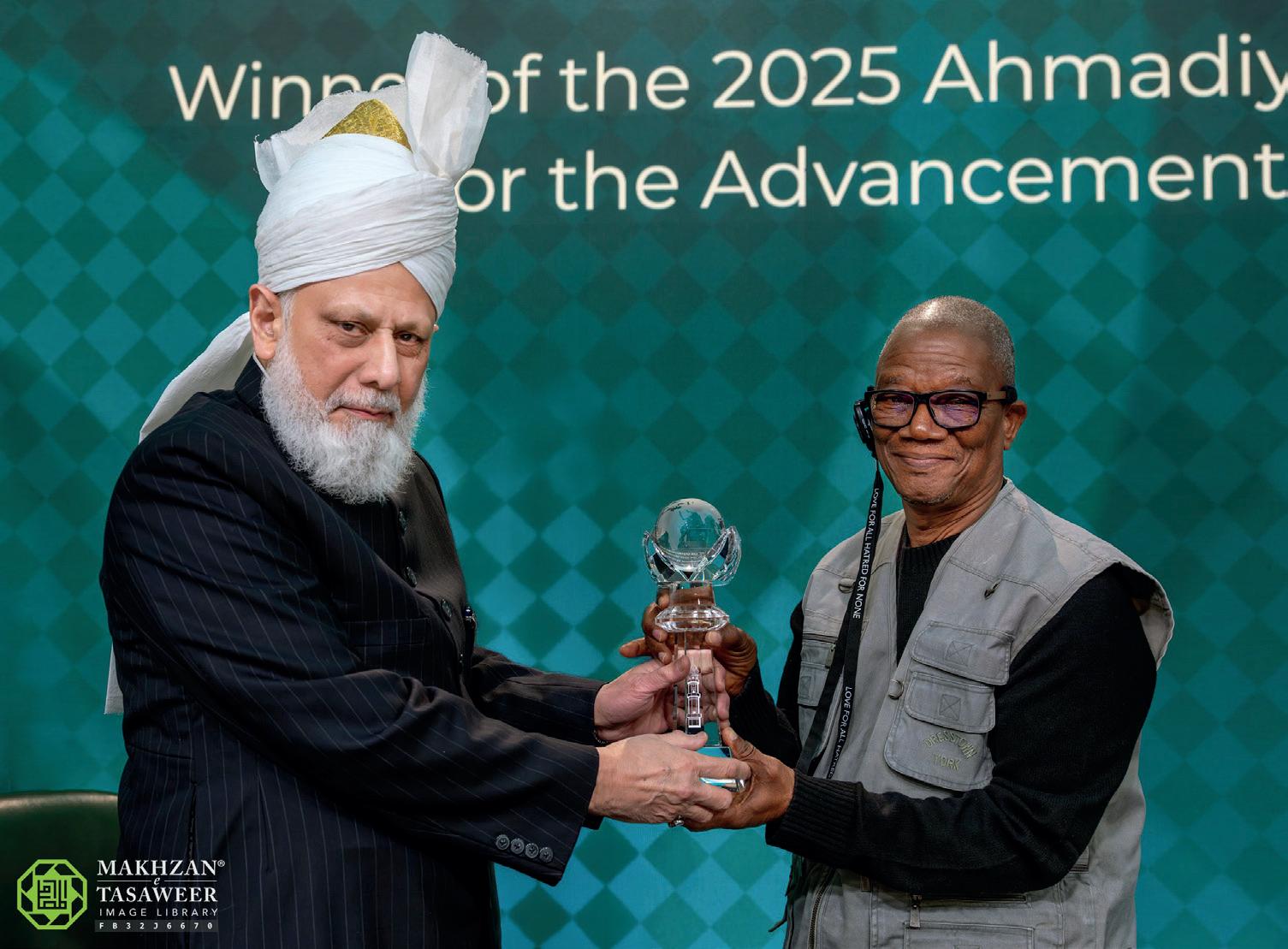
Subsequently, the announcement of the Ahmadiyya Muslim Prize for the Advancement of Peace highlighted the contributions of the 2025 recipient: Grégoire Ahongbonon. A presentation video was then shown, after which he received the award from Hazrat Amirul Momineen (aa). Thereafter, he expressed happiness and conveyed his gratitude to all present.
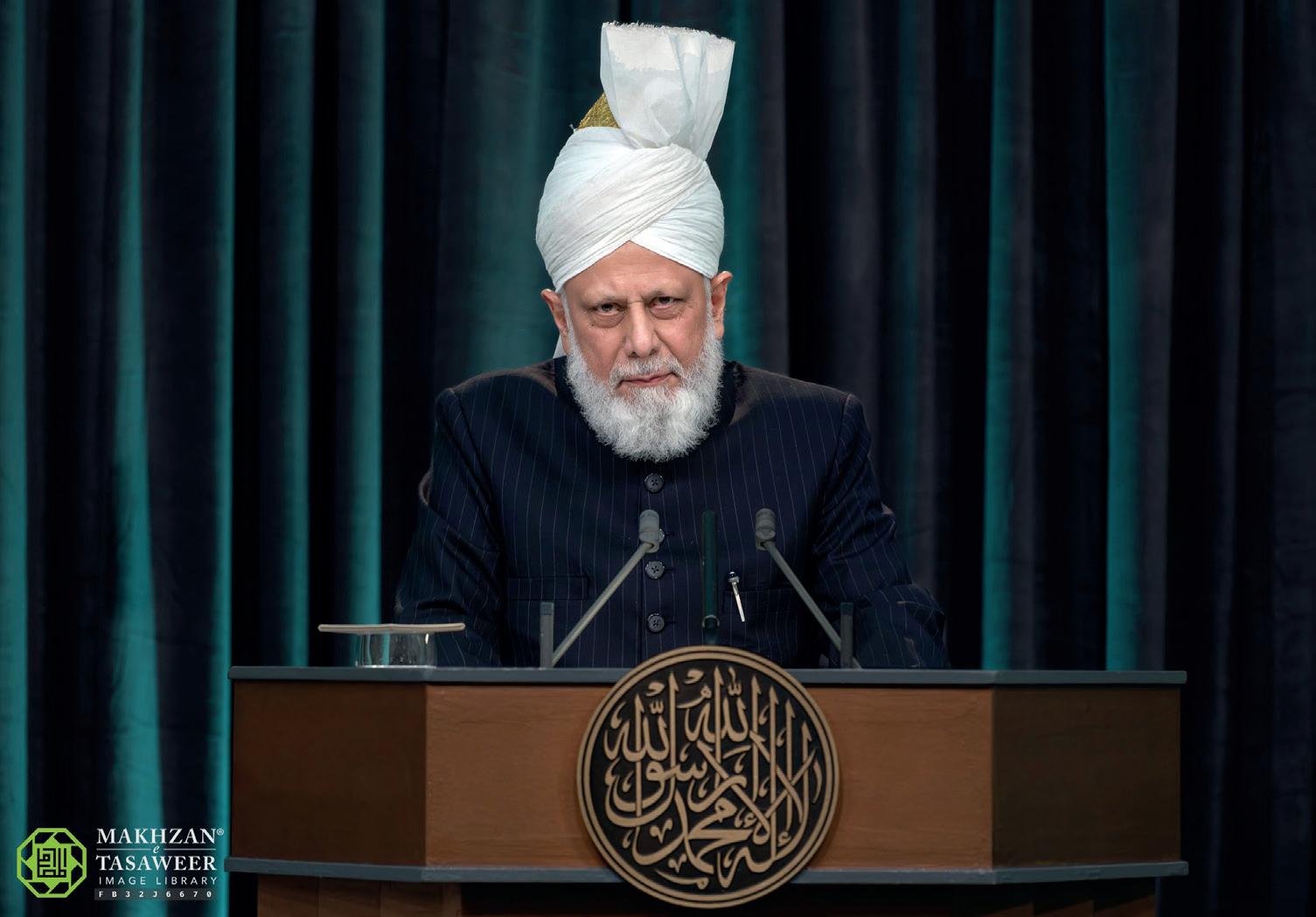
Hazrat Khalifatul Masih V (aa) then took to the podium to deliver the keynote address. A summary of this address is presented below:
Huzoor (aa) extended his heartfelt gratitude to all the distinguished guests who had joined for the gathering.
Hazrat Amirul Momineen (aa) remarked that such symposiums have been organised continuously for decades. This year, when the organisers proposed holding this Peace Symposium once again, some people questioned what practical benefit has emerged from these efforts.
Many politicians and religious leaders across the world have expressed concern regarding the prevailing state of injustice and instability. At this critical juncture, peace and security must be prioritised above all else. The question is indeed legitimate: what benefit has resulted from more than two decades of Peace Symposiums?
However, Islam teaches us that we must continue striving tirelessly for positive transformation in the world. What endeavour could be nobler than striving for the survival and preservation of humanity itself?
If war, disorder, hatred, injustice and unrest are not addressed, then civilisation, culture and human progress will gradually deteriorate. Humanity will witness catastrophic destruction whose consequences will extend far beyond the present generation and continue to affect generations yet to come.
The catastrophic consequences of war
Approximately 70 million people lost their lives during the Second World War, many of whom were innocent women, children, and civilians. It was by the grace of Allah that the devastation remained geographically limited.
However, Japan – the only country to have suffered two nuclear attacks –continues to bear the consequences decades later, with studies indicating that the effects persisted across generations.
In 1945, the United States was the sole possessor of nuclear weapons. Today, however, numerous nations possess such arsenals. God forbid that even one or two nuclear weapons be deployed in any conflict
– the resulting devastation would far exceed human imagination.
Many influential individuals now openly acknowledge that the world is moving towards circumstances whose consequences could be horrifying beyond precedent. Such turmoil and provocation may lead to destruction unseen in human history.
Consequently, sincere voices are attempting to urge nations towards patience, restraint and reconciliation. We labour throughout our lives for the welfare of our families and children – why then should innocent lives be sacrificed in the pursuit of war?
Those promoting conflict are not merely preparing for war against others; they are, in reality, preparing destruction for their own children and future generations.
Global voices warning against escalation
Recently, various commentators, analysts and intellectuals have voiced similar concerns. Last year, Ireland’s then President, Michael D Higgins, affirmed that humanity has entered an era in which threats of
war are rapidly increasing. Rather than diplomatic initiatives being pursued, such efforts are being sidelined, while a mentality encouraging bloodshed is becoming increasingly widespread.
Similarly, the Prime Minister of Slovakia has openly stated that discussions surrounding war and military preparedness have become alarmingly normalised. Regarding Ukraine, he observed that one standard is applied, whereas entirely different standards are employed concerning Gaza and Iran. He further remarked that he could not comprehend why the contemporary world appears so eager for war, despite the immense anxiety and instability such attitudes create.
The Islamic principle of universal justice
The fundamental teaching of Islam is that a person should desire for others what he desires for himself. Huzoor (aa) stated that if humanity were truly to uphold this golden principle, the world would become a paradise of peace, mutual understanding and harmony.
Concerning the conflict involving Iran, even Germany’s Vice Chancellor has publicly spoken against war. Huzoor (aa) remarked that while he appreciates all those who speak against warfare, practical measures remain almost non-existent. Mere rhetoric, regardless of how appealing it may sound, cannot establish peace and security.
During his visit to Türkiye, the Pope similarly warned that a “Third World War” was gradually being fought in stages, placing the future of humanity at stake. Huzoor (aa) observed that many people are now acknowledging the very warnings he has been issuing for years – namely, that humanity is sleepwalking towards darkness and destruction.
Double standards and the failure of global leadership
The Prime Minister of Spain recently stated that one illegality cannot be remedied through another illegality. Wars often begin through a chain of smaller reactions and retaliations. If injustice is committed by one party, the other must not respond with further injustice.
Today, many powerful states place themselves above international law, driven primarily by self-interest. Yet unlawful actions do not remain isolated – they spread and their consequences become uncontrollable.
Injustice is like a deadly virus that spreads rapidly. If major powers assume that their actions will never invite accountability and that they may disregard law, morality, civilisation and human life without consequence, then the global disorder and instability we witness today are inevitable outcomes of such thinking.
The duty of governments is to alleviate the suffering of their people and improve their quality of life – not to make life increasingly difficult. Unfortunately, many contemporary politicians have failed in this regard. They use war as a means to conceal their failures, while some even derive financial benefit from conflict, deceiving their populations in pursuit of economic interests. Instead of investing resources in
hospitals and human welfare, trillions are being spent on instruments of destruction.
Militarism and the crisis of international institutions
A prominent American intellectual observed that particularly in the West – and especially in the United States – excessive reliance is placed upon military power. Rather than pursuing diplomacy, force is often treated as the primary solution. Regarding Iran, the situation remains extremely tense, and if not contained, the world may soon face a severe economic crisis.
Islam teaches that both the oppressor and the oppressed must be assisted: the oppressed through support and justice, and the oppressor by restraining him from oppression. Islam also emphasises proportionality and restraint, discouraging vengeance and escalation.
Another American scholar urged humanity to learn from history, noting that major international institutions and legal systems appear increasingly ineffective.
Just as the League of Nations failed during the 1930s, the United Nations also appears unable to fulfil its intended role. The concentration of veto power in the hands of five nations represents a fundamental structural flaw. If diplomacy is abandoned, the only remaining outcome is war.
Recently, Canadian Prime Minister Mark Carney remarked that the world is increasingly operating under the logic that the strong dictate outcomes and the weak suffer the consequences. Yet coercion and force may produce temporary gains while yielding disastrous long-term consequences.
Exploitation, hypocrisy and the abuse of human rights narratives
Huzoor (aa) highlighted that many powerful and developed nations sustain their dominance through injustice and exploitation, while remaining silent regarding the oppression committed by their allies.
At times, wars are justified under the pretext of protecting women’s rights, despite the fact that countless women and girls themselves become victims of those very conflicts.
A Spanish parliamentarian remarked regarding the Iran conflict that the rhetoric of women’s rights is frequently instrumentalised to preserve geopolitical dominance and justify military intervention. Similar justifications were presented in relation to Syria, Iraq, Lebanon, Afghanistan, and Iran, despite the devastating humanitarian consequences suffered by civilians.
Misrepresentation of Islam
As Muslims, we recognise that there are individuals who commit violence and disorder in the name of Islam. The media often amplifies their actions, leading to false portrayals of Islam itself.
However, it is fundamentally incorrect to blame Islam – or any religion – for the misconduct of individuals acting contrary to its teachings.
The mission of the Ahmadiyya Muslim Jamaat
The promotion of peace, harmony and mutual understanding remains among the foremost objectives of the Ahmadiyya Muslim Jamaat. We shall continue organising such events, even if the message reaches only a small number of people.
Huzoor (aa) stated that he has personally written to numerous world leaders, urging them to work for the betterment of humanity. He mentioned writing to the Prime Minister of Israel. He also highlighted writing to the President of Iran and various Muslim leaders, inviting them – in light of the teachings of the Holy Quran – towards justice, fairness and mutual understanding.
Huzoor (aa) further stated that he continues to convey the same message to the President of the United States and the President of China, urging them to reflect upon the increasing global tensions and the growing threat facing humanity itself.
Regrettably, the escalating chaos, unrest and instability in the world demonstrate that these warnings are not being adequately heeded.
Racism,
prejudice and the need for justice Nations are increasingly consumed by
conflict, while minorities are frequently targeted within states. Racism and prejudice are becoming more widespread. Rather than recognising the virtues and strengths of other nations, societies increasingly focus upon perceived faults and hostilities. Misconceptions regarding Islam are similarly spread through sections of the media.
Yet Islam’s teachings transcend time and place. The Holy Quran commands believers to uphold justice firmly, even if doing so requires bearing witness against one’s own parents, relatives or nation.
The Holy Quran further teaches that neither wealth nor poverty should influence justice and that personal desires must never lead one away from fairness. In other words, social status holds no value before Allah. True worth lies in sincerity, truthfulness and steadfastness in bearing honest witness.
Allah the Almighty further commands that hostility towards others must never cause believers to abandon justice, for justice is closest to righteousness. Islam thus requires fairness not only towards allies but even towards opponents and adversaries.
Islamic
teachings regarding conflict resolution
Regarding conflict between nations, the Holy Quran teaches that if two parties fall into dispute, efforts should first be made towards reconciliation and peace. If one party continues aggression, then collective action may be taken to restrain it. However, once aggression ceases, no further vengeance or oppression should follow.
This principle is designed to establish lasting peace, regardless of whether the parties involved are strong or weak, oppressors or oppressed. Islam fundamentally advocates justice and fairness.
Islam also teaches that wisdom should be accepted regardless of its source. If a truthful and wise statement is heard from a Christian, a Jew or even an atheist, it should be embraced.
Such openness not only improves individual character but also fosters peace and harmony within society.
A warning and prayer for humanity
Huzoor (aa) stated that, in light of everything presented, he firmly believes that certain individuals and nations driven by greed for the wealth and resources of others fail to recognise that the overwhelming majority of humanity still desires peace. Therefore, every individual must play his or her role, and the need for such efforts grows more urgent with each passing day.
He expressed deep fear that if these wars continue, the scale of destruction and loss of life will surpass anything previously witnessed in human history. The devastation will not remain confined to a single generation – future generations will also bear its consequences.
Hence, it is our collective responsibility to leave behind a world in which our children and future generations may live in peace. Our actions today must ensure that future generations are not forced to suffer because of our failures. Otherwise, they will rightly hold us responsible for leaving
behind a world consumed by flames and conflict.
Huzoor (aa) emphasised that peace cannot be achieved merely through holding symposiums; meaningful and practical action is essential. Nevertheless, he expressed his sincere hope and prayer that this Peace Symposium may become a first ray of light leading humanity towards positive transformation.
May humanity come to understand the urgency of this moment, rising above differences of belief, ideology and religion, and striving collectively for justice and compassion.
May the dark clouds of war that hover above humanity disperse, revealing once again a bright and peaceful sky founded upon love, tolerance, brotherhood and sacrifice.
At the end, Huzoor (aa) once again
thanked all those who attended the symposium and expressed his deep appreciation for their participation. Hazrat Amirul Momineen (aa) then led everyone in silent prayer to conclude the event. (Summary prepared by Al Hakam)
“
My heart bursts with grief for the people due to the plague; nay, this is no plague, it is a raging storm.
Hazrat Mirza Ghulam Ahmad, the Promised Messiah & Imam Mahdias
Answers to Everyday Issues
Zamzam, eclipse prayer, riba and the meaning of durood
Guidance regarding basic Islamic issues that Hazrat Amirul Momineen, Khalifatul Masih Vaa, has given on various occasions in his written correspondence and during MTA programmes is being published officially below for everyone’s benefit.
Who struck the ground to create the spring of Zamzam?
Someone from Kerala, India, wrote to Hazrat Amirul Momineen, Khalifatul Masih V (aa), stating that Hazrat Sahibzada Mirza Bashir Ahmad (ra) has written in Sirat Khatam-un-Nabiyyin [The Life & Character of the Seal of Prophets] regarding the incident of Hagar and Prophet Ishmael (as) that the spring of water gushed forth as a result of the angel striking his heel. However, since childhood, I have always read that the spring emerged due to Prophet Ishmael (as) striking his feet against the ground.
In his letter dated 17 December 2023, Huzoor-e-Anwar (aa) provided the following guidance regarding this question:
“There is no cause for confusion in this matter. Both of these narratives are found in the books of Hadith, history, biographical accounts [sirah], and exegesis [tafsir]. Accordingly, it is written that this spring emerged where the angel scraped the earth with his heel or his wing or arm. (Sahih alBukhari, Kitab al-anbiya, Bab [‘yaziffuna’ an-naslanu fi l-mashy]) It is also written that this spring gushed forth from the place where Prophet Ishmael (as), weeping from extreme thirst, was striking his heels. (Tafsir at-Tabari, Vol. 13, Dar Ihya al-Turath al-Arabi, Beirut, Lebanon, 2001, Surah Ibrahim, Verse 38, p. 272; Al-Kamil fi at-Tarikh by Muhammad Ibn al-Athir al-Jazari, d. 630 AH, Vol. 1, Dar Al-Kotob Al-Ilmiyah, Beirut, Lebanon, 1971, p. 80)
“Therefore, since both traditions exist in classical sources, both accounts have therefore been presented in the literature of the Jamaat. In one place in Tafsir-e-Kabir, Hazrat Musleh-e-Maud (ra) states that he [the angel] said, ‘Go Hagar and see that God Almighty has caused a spring to gush forth beneath the feet of Ishmael.’ (Tafsire-Kabir, Vol. 3, UK: 2023, p. 73) In another place, he stated that the name ‘Isma‘il’ is derived from the Arabic root sami‘a. This signified that God would hear his prayer. Consequently, Prophet Ishmael (as) struck his feet and a spring gushed forth. (Tafsir-eKabir, Vol. 7, UK: 2023, p. 324) And as you
wrote in your letter, Hazrat Sahibzada Mirza Bashir Ahmad (ra) has written concerning this incident in Sirat Khatam-un-Nabiyyin that when Hagar’s anguish reached its peak, after the seventh circuit, she heard a voice from the unseen saying, ‘O Hagar, Allah has heard your voice and the voice of your child.’ Upon hearing this voice, she returned and found an angel standing exactly where the child had been writhing in restless agony due to extreme thirst. He was striking his heel against the ground as though unearthing something. When Hagar stepped forward, she found a spring gushing with water at the very spot where he was striking his heel. (Sirat Khatam-un-Nabiyyin, p. 75)
“Thus, both accounts of this incident are found in the traditions. From this, it can be deduced that the angel likely struck his heel at the exact spot where Prophet Ishmael (as) was striking his heels out of extreme thirst and thus, the spring emerged from the very place where both had struck their heels.”
Is the eclipse prayer mandatory in Islam?
Someone from the United States sent an enquiry to Hazrat Amirul Momineen, Khalifatul Masih V (aa), asking about the expiation or kaffarah for failing to offer the prayer during a solar eclipse. He further stated, “I am due to visit my [non-Muslim] friend to observe the solar eclipse. If I am unable to offer the solar eclipse prayer [salat al-kusoof] there, can this expiation be discharged through almsgiving [sadaqah], voluntary prayers [nawafil] and seeking forgiveness [istighfar]?”
In his letter dated 17 December 2023, Huzoor-e-Anwar (aa) provided the following answer to this question:
“The solar and lunar eclipse prayers are not obligatory [fardh] prayers, the omission of which constitutes a sin that necessitates an expiation as a remedy. Rather, this prayer is a sunnah of the Holy Prophet (sa) such that offering it merits reward, but if one is unable to offer it, there is no sin.
“This prayer can be offered both individually and in congregation. Therefore,
when you visit your friend, you may offer this prayer individually there. The recitation in this prayer is lengthier than in regular prayers and there are two or more ruku‘ in each rak‘at.”
What is the difference between permissible profit and forbidden interest in Islam?
Someone from the UK submitted various questions regarding interest [riba] to Huzoor-e-Anwar (aa), referencing some statements of Hazrat Musleh-e-Maud (ra), a letter of Hazrat Amirul Momineen, Khalifatul Masih V (aa) and a note published in The Review of Religions
In his letter dated 19 December 2023, Huzoor-e-Anwar (aa) provided the following guidance regarding these questions:
“In reality, the definition of interest formulated by Hazrat Musleh-e-Maud (ra) in Islam Ka Iqtisadi Nizam [Islam’s Economic System] pertains not solely to loan transactions, but rather he has included within it several other financial dealings that are detrimental to mankind. This is why, before setting out this definition, he observes that Islam has defined interest in such a manner that certain practices not conventionally considered interest also fall within its purview, thereby rendering them impermissible for mankind. (Islam Ka Iqtisadi Nizam, Anwar-ul-Ulum, Vol. 18, p. 49) Thereafter, he elaborated upon the Islamic teachings against these matters by mentioning various types of trusts that cause harm to others, illicit business manoeuvres, commercial systems detrimental to small businesses, hoarding and intentionally undercutting the price of one’s goods to inflict loss upon
competitors. However, where he has defined interest specifically in the context of loan transactions, he states:
“‘In the Sharia, the definition of interest is that a person lends money to another for their own benefit and stipulates a gain that is acquired solely in exchange for the money and with which there is no rational possibility of loss. This financial benefit is determined in advance for a fixed period, either in the form of a quantity of goods or cash.’ (Al Fazl, Rabwah, No. 50, Vol. 50/15, 2 March 1961, p. 4)
“Thus, this definition applies to any loan where the lender, at the time of advancing the loan, imposes a condition to receive an additional sum upon repayment. Therefore, according to Islam, any loan upon which profit is derived through interest is impermissible. However, if the borrower, without any prior stipulation, voluntarily gives something extra at the time of repaying the loan, this does not fall under the category of interest. Accordingly, the Promised Messiah (as) states in this regard:
“‘In the Sharia, interest is defined as follows: a person lends money to another for his own benefit and stipulates an [additional] gain. Wherever this description applies, it is interest [riba]. However, if the borrower makes no undertaking, neither promise nor commitment, but of his own accord pays back more, then this falls outside interest. Thus, the Prophets have always been scrupulous regarding stipulated conditions. Likewise, if a king takes a sum and, of his own accord, returns more and the giver does not advance it with the intention of interest, then it too does not fall within interest; rather, it is a benefaction from the sovereign. The Prophet (sa) of God did not take a loan from
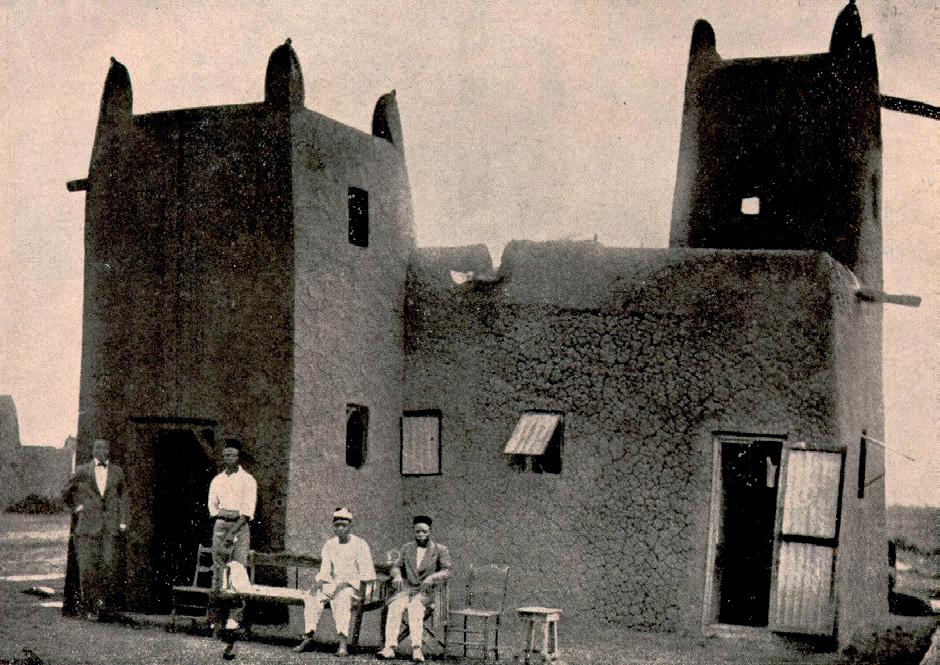
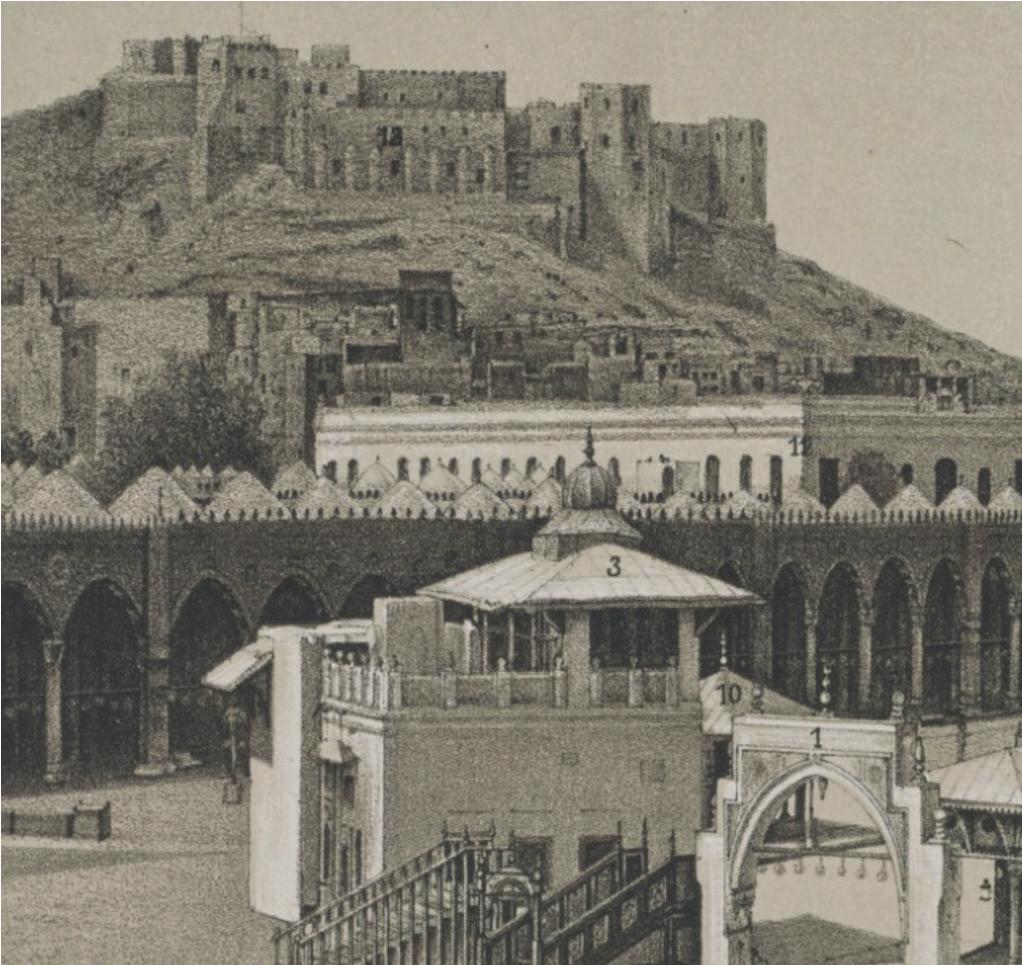
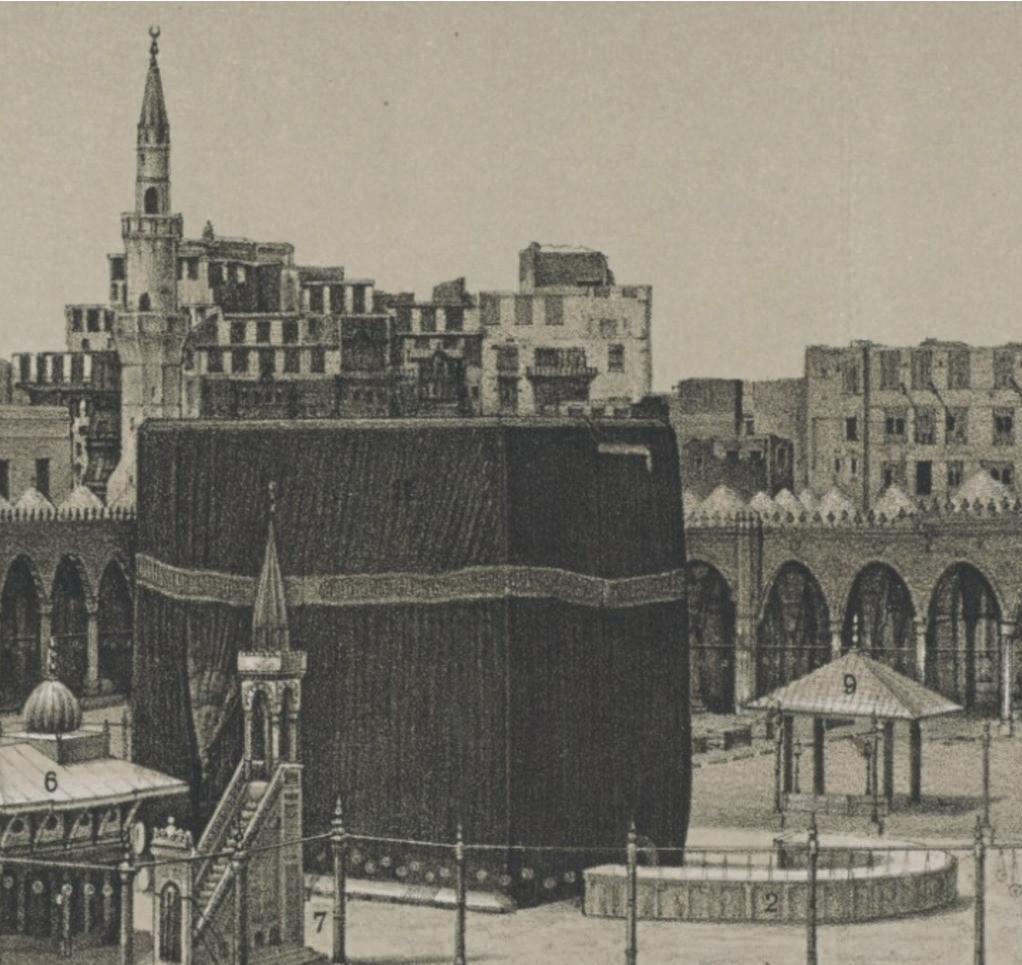
Image: Building over the Zamzam well (3), 1888 CE | Wikimedia Commons
anyone, but that, at the time of repayment, he would return something additional; yet it must be borne in mind that there should be no desire or expectation for the excess. Any increase received contrary to one’s desire is not included within interest.’ (Al Badr, No. 10, Vol. 2, 27 March 1903, p. 75)
“As for your mention of receiving an additional amount by investing money in government schemes, that is a separate matter.
“If there is a financial institution that is wholly state-owned (such as National Savings in Pakistan) which deploys its funds in various public welfare endeavours and uses this money for the broader benefit of the public, thereby contributing to economic development, creating employment opportunities and increasing the state’s revenue, then the benefit is not confined to the depositors alone; rather, the wider public also benefits through those welfare endeavours. In such circumstances, if that state institution includes its depositors in its surplus and labels the payment ‘profit’ and depositors may withdraw their funds when required, then the additional amount paid to depositors under the name of ‘profit’ does not fall within the category of riba. Instead, it is to be regarded [as a discretionary favour on the part of the state,] akin to a benefaction from the sovereign. Accordingly, such an amount may be utilised for one’s personal needs.
“Similarly, purchasing government bonds and the like and utilising the prize money received from them for one’s personal needs is not prohibited, because purchasing bonds involves no form of gambling, nor does the prize received on them fall into the category of interest.
“As for the matter of simply buying the shares of various companies, there is no harm in that, because this too is a form of business with a partnership in profit and loss, although a great deal of caution is required in it, as there is a high possibility of deceit in this business. However, if this business is conducted with integrity, then even though share prices fluctuate, the shares themselves remain intact and the investment is maintained. And if you wish to exit, you can also sell these shares. The only exception is if the company whose shares were purchased becomes bankrupt, in which case the value of its shares also vanishes.
“However, in this business of stocks and shares, if one is buying shares one moment and selling them the next, with their gaze fixated on the stock market index from morning till evening, this would resemble a lottery, the prohibition of which no one denies.
“As for the other contemporary financial transactions, the Promised Messiah (as) has said:
“‘In recent times, most jurisprudential issues in this country have become convoluted. There is one or the other element of interest [riba] involved in every trade. This is why renewed ijtihad is needed in this age.’ (Al Badr, Nos. 41 & 42, Vol. 3, 1 & 8 November 1904, p. 8)
“In light of this directive, the matter is currently being deliberated upon by a Markazi committee. When a definite opinion is formed, the members of the Jamaat will, insha-Allah, be informed of it.”
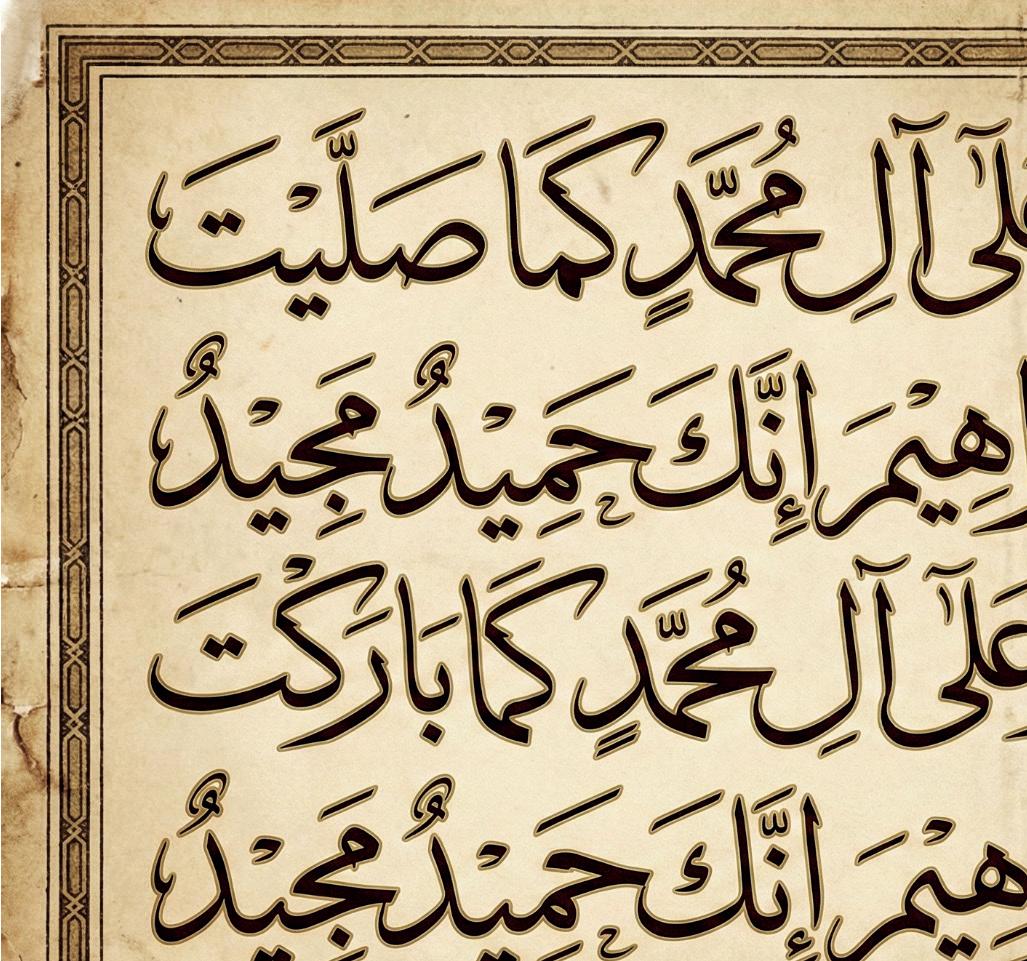
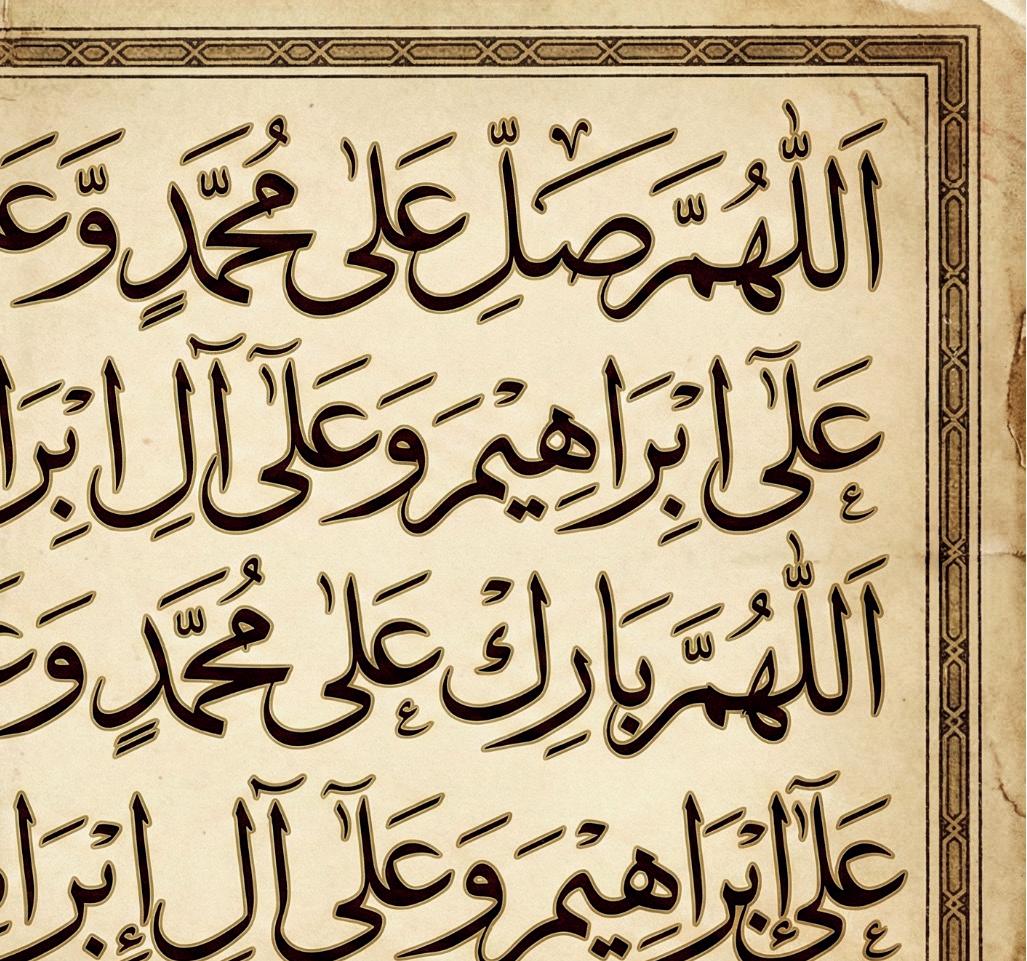
What is the meaning of the words of durood (salawat)?
Someone from Canada wrote to Hazrat Amirul Momineen, Khalifatul Masih V (aa), asking about the correct meaning and essence of the prayer ‘
and durood
In his letter dated 28 December 2023, Huzoor-e-Anwar (aa) provided the following answer to this enquiry:
“In the prayer of
the holiness and praise of Allah the Exalted are articulated; it signifies that the Being of Allah the Exalted is free from all kinds of flaws and shortcomings and all forms of praise and glorification belong solely to Him and befit Him alone. The ahadith ascribe profound merit to this prayer. Accordingly, there is a narration from Hazrat Abu Hurairah (ra) that the Holy Prophet (sa) said there are two phrases that are deeply beloved to Allah the Exalted; these phrases are very light on the tongue (meaning they are very easy to utter), but on the Day of Judgement, they will be very heavy on the scales of deeds. And those blessed phrases are:
“[‘Holy is Allah and worthy of all praise; Holy is Allah, the Great’]. (Sahih al-Bukhari, Kitab ad-da‘awat, Bab fadli t-tasbih)
“Furthermore, the Promised Messiah (as) was also taught this prayer through revelation, alongside which a portion of durood is also included. Thus, he states:
“‘Just as God Almighty taught prayers to certain of His Prophets to attain deliverance from afflictions, God has also taught me a prayer through revelation and it is this:
“‘[“Holy is Allah and worthy of all Praise; Holy is Allah, the Great. Allah, bestow Your blessings on Muhammad and the people of Muhammad.”]’ (Tiryaq-ul-Qulub, Ruhani Khazain, Vol. 15, p. 208, footnote)
“As for the prescribed durood established by the sunnah, it is a supplication before Allah the Exalted for mercy and blessings to descend upon the holy personage of the Holy Prophet (sa). Allah the Exalted has commanded us to do so in the Holy Quran, as He states:
“[‘Allah and His angels send blessings on the Prophet. O ye who believe! you [also] should invoke blessings on him and salute [him] with the salutation of peace.’ (Surah al-Ahzab, Ch.33: V.57)]
“The translation of the masnoon durood is: ‘O Allah, send mercy upon Muhammad (sa) and upon the people of Muhammad (sa), just as You sent mercy upon Abraham (as) and upon the people of Abraham (as); indeed, You are Praiseworthy and Glorious. O Allah, bless Muhammad (sa) and the people of Muhammad (sa), just as You blessed Abraham (as) and the people of Abraham (as); indeed, You are Praiseworthy and Glorious.’
“I have previously explained in various Friday sermons and addresses the significance of ‘
and
appearing separately in this durood. I will outline it here in summary. The prayer of ‘
means: ‘O Allah, grant greatness to Muhammad (sa) in this world by exalting his name, by granting success and triumph to his message and by decreeing endurance and eternity for his Sharia. And in the Hereafter, grant him greatness by accepting his intercession in favour of his followers [Ummah] and by multiplying his reward and recompense manifold.’ And the meaning of ‘
is: ‘O Allah, establish for him whatever honour, greatness, magnificent stature and eminence You have decreed for the Holy Prophet (sa) and grant it eternal permanence. May it endure forever.’
“Thus, the summary is that in ‘یلَعُ
there is a prayer for the triumph and everlasting endurance of his Sharia and for his followers to be graced by his intercession. And in ‘
there is a prayer for the honour, greatness, stature and eminence of the Holy Prophet (sa) to remain established forever.
“Immense excellence has been attributed to durood in the ahadith Accordingly, it is narrated by Hazrat Ubayy bin Ka‘b (ra) that he submitted to the Holy Prophet (sa), ‘I invoke blessings upon you abundantly. So, what portion of my supplication should I dedicate to you?’ He replied, ‘As much as you wish.’ I submitted, ‘A quarter?’ He replied, ‘As much as you
wish, but if you do more, it will be better for you.’ I submitted, ‘A half?’ He replied, ‘As much as you wish, but if you do even more, it will be better for you.’ I submitted, ‘Twothirds?’ He replied, ‘As much as you wish and if you do even more, it will be better for you.’ I submitted, ‘Henceforth, I shall dedicate my entire supplication exclusively to you.’ He replied, ‘In that case, all your desires of this world and the Hereafter will be fulfilled and your sins will be forgiven.’ (Sunan at-Tirmidhi, Kitab sifati l-qiyamati wa r-raqa’iqi wa l-wara‘, Bab ma ja’a fi sifati awani al-hawd)
“Elucidating the excellence of durood, the Promised Messiah (as) states:
“‘On one occasion, it so happened that I remained very much occupied with calling down blessings on the Holy Prophet, may peace and blessings of Allah be upon him, for a long time, for I believed that the ways leading to God are very fine and cannot be discovered except through the agency of the Holy Prophet, as Allah says too:
“‘[“And seek the way of approach unto Him.” (Surah al-Ma’idah, Ch.5: V.36)].
“‘After a time, I saw, in a vision, that two water carriers came and entered into my house, one by the outer entrance and the other by the inner entrance, carrying on their shoulders water-skins full of divine light and they said:
“‘[“This is on account of the blessings you invoked upon Muhammad”].’ (Haqiqatul-Wahi, Ruhani Khazain, Vol. 22, p. 131, footnote)
“I have also extensively discussed the excellence and importance of durood on multiple occasions in my Friday sermons and addresses in light of the Holy Quran, the ahadith and the pronouncements of the Promised Messiah (as) and Hazrat Musleh-e-Maud (ra). You may read these sermons and addresses in Al Fazl and you can also listen to them on the Jamaat’s website, alislam.org.”
(Compiled by Zaheer Ahmad Khan, Head of Records Department, Private Secretariat, London and translated by Al Hakam)
The idleness of idols: Lessons from the peoples of yore
Jalees Ahmad Al Hakam
How much time do you give to your phone? Have you ever really thought about it? We often don’t realise how effortlessly our devices distract us from our daily responsibilities, from the people we love and from moments that deserve our full attention. Think about how many times someone has been speaking to you while you were glued to a screen. It’s so common now that we hardly notice it, yet it happens all the time.
But there’s a deeper question here: does it get in the way of your relationship with God?
As Muslims, our declaration of faith is the proclamation that there is only one God and that He alone is worthy of worship. Yet when the time for worship comes, where are we? Are we physically, mentally and spiritually present? Or are our hearts occupied by the “idols” of our time: our phones, our screens and our constant distractions?
The things around us aren’t idols in the traditional sense, but anything that takes priority over God, anything that steals our attention and devotion, becomes an idol in practice. And sometimes these everyday habits slowly haul us away without us even noticing.
A common theme that we find in the Quran regarding idols is that they neither benefit nor hear; they are simply idle and powerless. Now, I shall highlight this idleness of idols by looking at various
passages where the Quran describes them and how the prophets of Allah stood against idol worship. Whether it was the people of ‘Ad, the people of Thamud or even the people of Midian, each community had fallen into idolatry. The Quraish themselves worshipped hundreds of idols in and around the Ka‘bah.
Abraham (as) reveals the idols’ inability to help themselves
The Holy Quran presents Prophet Abraham (as) as a man of great wisdom and insight: “We gave Abraham his guidance and We knew him well.” (Surah al-Anbiya’, Ch.21: V.52) It also, whilst elucidating his bravery and wisdom, presents a unique story about him. Abraham (as), at a young age, was surrounded by staunch idol worshippers.
On one occasion, Hazrat Abraham (as) observed his community revering and worshipping sculpted statues, and he questioned them directly: “What are these images to which you are so devoted?” (Ch.21: V.53) Hearing the young Abraham (as), the people’s only reason and justification was tradition: “We found our fathers worshipping them.” (Ch.21: V.54) Then, when Abraham (as) tells them plainly that both they and their ancestors are in “manifest error’” (Ch.21: V.55), he also questions the very foundations of their traditions which they inherited and exposes the absence of a rational foundation behind the practice.
To demonstrate the idols’ powerlessness, Abraham (as) later carries out a brave and symbolic act. In private, he destroys all the idols except the largest one of them. This
It has been observed throughout history that whenever a prophet is sent to his people, it is commonly seen that he finds them misguided.
The Holy Quran states that the people of Noah (as) were steeped in idol worship. His people are recorded as having said to one another, “Forsake not your gods [under any circumstances]. And forsake neither Wadd, nor Suwa‘, nor Yaghuth and Ya‘uq and Nasr.” (Ch.71: V.24)
The astonishing part of this entire episode is how deeply steeped these people were in their ways. Chapter 71 of the Quran drives this point home. It begins with God stating that He sent Noah (as) as a messenger. It then recounts what Noah (as) said to his people, how he preached to them, and how he called upon them day and night. After that, it shifts to what Noah (as) said to God, explaining that he had done everything he could, yet his people still refused to pay heed.
The Surah goes on to list the signs of God that Noah (as) presented to his people: their own creation, the heavens, the earth, the rain, the sun, the moon and so on. Even then, the people responded arrogantly, insisting that they would never abandon their idols.
The way they stood so firmly by the idols that brought them no benefit is, to say the least, quite astonishing. It makes one think: how deeply engrossed can people be in things that do not benefit them?
was a planned demonstration on Abraham’s (as) part meant to prompt them to reflect. When the people came to know of this, they accused the young Abraham (as), who pointed toward the largest idol and remarked: “Somebody has surely done this. Here is their chief. But ask them if they can speak.” (Ch.21: V.64)
This clear-cut answer was a serious blow to their intellect. It exposed the contradiction in their worship. The Quran says they momentarily realised their error and turned to each other, saying, “You yourselves are surely in the wrong.” (Ch.21: V.65)
But this temporary self-awareness swiftly collapses, and they revert to anger, showing how emotionally imbalanced they are: “Burn him and help your gods, if [at all] you [mean to] do [anything].” (Ch.21: V.69)
At this point, the one true God intervened and miraculously helped His servant and messenger: “O fire, be thou cold and [a means of] safety for Abraham!” (Ch.21: V.70)
Indeed, this was a method utilised by Prophet Abraham (as) to demonstrate the idol’s powerlessness and idleness.
There are valuable lessons to be learned from this story. The idol worshippers were made to reflect on their own foolishness. They were emotionally imbalanced, and their god could not even protect itself. In stark contrast, God helped His servant against them. Ultimately, the idleness of idols has been highlighted here.
The origins and spread of idolatry from Noah’s (as) time to the Quraish
The disbelievers at the time of Noah (as) had various idols. The Holy Quran mentions five in this verse. Alluding to the idols, Hazrat Khalifatul Masih I (ra), in his tafsir, explains that each idol represented something for the people and says that some had the figure of a man and others of a horse. (Haqaiqul Furqan, 2024, Vol. 4, p. 218)
In Sahih al-Bukhari, Kitab al-Tafsir, it is stated that many of the idols worshipped by the Arabs were actually the same idols once worshipped by the people of Noah (as). Different Arab tribes adopted them: Wadd, Suwa‘, Yaghuth, Ya‘uq and Nasr, each becoming tied to a specific community.
What’s striking is how these idols began. They were originally the names of righteous men from Noah’s (as) time. After those men died, people made statues just to remember them. At first, no one worshipped these statues. But as generations passed and the original purpose was forgotten, people eventually started treating them as gods. So idolatry didn’t start with open disbelief; it began with harmless memorials that slowly morphed into objects of worship once their meaning faded. (Sahih al-Bukhari, Hadith 4920)
From this, we learn many lessons. Indeed, the story of Noah (as) is like a mirror for later generations. God frequently mentions stories of the past nations in the Holy Quran as mirrors to illustrate to the believers so that they may recognise their own tendencies. By naming these idols explicitly, God calls out to the reader and tells us to look carefully within and learn, as this can happen to us as well.
We also learn about human emotions. People who are led solely by emotions can be led astray spiritually. These idols, as mentioned above in Sahih al-Bukhari were originally honoured and beloved people. The Quran shows that emotions like grief,
Majlis Ansarullah Scotland holds its annual ijtema 2026
Arshad Mehmood Khan Glasgow
Majlis Ansarullah Scotland held its regional annual ijtema on 10 May 2026. The theme of the ijtema was “Durood & Istighfar”.
After registration and breakfast at 10 am, the opening session commenced, chaired by Dr Abdul Hayee Sahib, Regional Amir of Scotland. Following the recitation from the Holy Quran, the Ansar Pledge and poem, Fakhar Ahmad Aftab Sahib delivered a speech on the theme of the ijtema. The opening session concluded with a silent prayer, followed by a brief presentation from the Rishta Nata Department.
This was followed by the academic
love, attachment and nostalgia can all be manipulated into forms of worship.
It must be noted that shirk often survives across eras; by observing forefathers, generations are likely to continue their traditions and practices. These idols existed long before the Arabs, yet they are found even in the times of the Holy Prophet (sa).
However, when observed closely, these idols bore no favour upon the people who worshipped them.
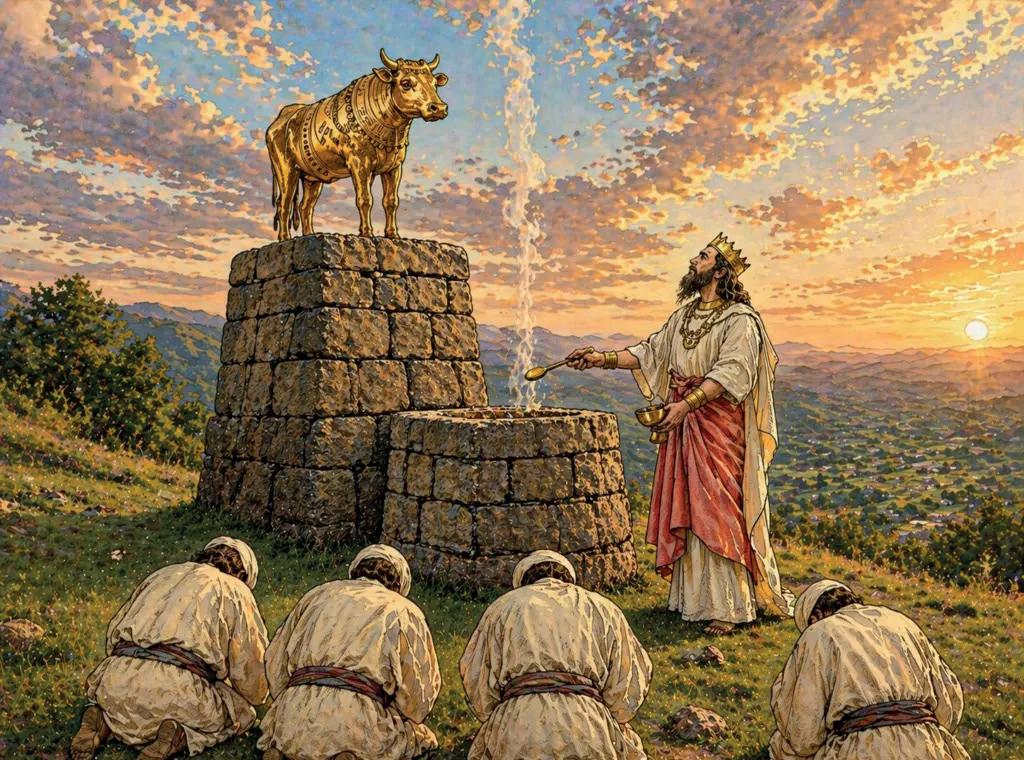
When Bani Israel fell into idolatry: The story of the golden calf
After God rescued the Bani Israel (Children of Israel) by bringing them safely across the sea, they passed by a tribe that was worshipping idols. Still influenced by their former mentality and not fully understanding pure monotheism, some of them said to Moses (as), “make for us a god just as they have gods.” (Ch.7: V.139) Moses (as) responded firmly that they were acting ignorantly, reminding them that God had just saved them and that no created thing could be a god.
This part of the story offers us an insight into the people of Moses (as) and what they were thinking, even after receiving guidance. The Holy Quran goes on to narrate a deep episode from the history of Bani Israel: the worship of the Golden Calf during the 40day absence of Prophet Moses (as).
This episode has been recorded in various places in the Quran. After studying all the instances, I have put them together to explain the events that unfolded.
In Moses’s (as) absence, his people fell into trial by Samiri, who “led them astray” towards idol worship. (Ch.20: V.86) When asked why they had become deceived, they later explained: “We were laden with loads of people’s ornaments and we threw them away, and likewise did the Samiri cast.’” (Ch.20: V.88)
From these ornaments was made a calf, which the Quran describes as “a [lifeless] body producing a lowing sound” (Ch.7:
competitions. After lunch and the Zuhr and Asr prayers, Ahmad Owusu Konadu Sahib, Chairman of Beacon of Peace Scotland, talked about the upcoming charity walk to be held in Edinburgh.
Raja Burhan Ahmad Sahib, Qaid Ishaat Majlis Ansarullah UK and representative of Sadr Majlis Ansarullah UK, chaired the closing session. The session began with a recitation from the Holy Quran, followed by a poem, the Ansar Pledge and the ijtema report by the Nazim-e-A‘la Ijtema, Ahmad Owusu Konadu Sahib. This was followed by the prize distribution ceremony and the concluding speech by the chairman of the session. The ijtema concluded with a silent prayer. The total attendance was 92.
V.149). Subsequently, they gave up the religion of Moses. (Ch.20: V.89)
Aaron (as), the brother of Moses (as), had warned them: “O my people, you have only been tried by means of it (the calf), and surely the Gracious [God] is your Lord; so follow me and obey my command.” (Ch.20: V.91) Yet, they replied that they would not cease to worship it until Moses returned. (Ch.20: V.92)
When God informed Moses (as) of what was happening to his people, he returned, “indignant and grieved” (Ch.7: V.151) and said: “‘Evil is that which you did in my place in my absence.’” (Ch.7: V.150) Addressing his people, he told them how they had wronged themselves “by taking the calf [for worship].” (Ch.2: V.55) They acknowledged their error: “And when they were smitten with remorse and saw that they had indeed gone astray, they said, ‘If our Lord do not have mercy on us and forgive us, we shall surely be among the losers.’” (Ch.7: V.150)
Moses (as) then turned to Samiri to see what he had to say. Having done such a thing, what would he have to say? What response would he have? (Ch.20: V.96)
Samiri simply replied that “my mind commended to me.” (Ch.20: V.97) Hearing this response, Moses (as) declared: “Now look at thy god of which thou hast become a devoted worshipper. We will certainly burn it and then scatter it away into the sea.”
(Ch.20: V.98)
The Holy Quran then closes this account with the final affirmation: “Your God is only Allah, beside Whom there is no God. He embraces all things in [his] knowledge.”
(Ch.20: V.99)
The lesson we learn here is that idols (in this case the golden calf) are powerless. This calf was lifeless and could neither speak, guide nor benefit anyone. When one truly thinks about it, the roots of idolatry are often embedded in human weakness.
The people of Israel were led astray due to reasons mentioned in the Quran, i.e., impatience and manipulation. Despite
seeing miracles, some of the Bani Israel said, “This is your god,” a sign of how ingrained they had become in idol worship.
This episode shows that, more often than not, idol worship originates from a mixture of emotional impulses and societal pressures, not from truth or reason. The idleness of idols reveals their inability to protect or forgive. When Prophet Moses (as) returned, his people feared punishment and sought forgiveness, but the calf could do nothing to help or save them. Only Allah could grant mercy.
The story also stresses that idols are useless and powerless. We also learn that blind imitation, emotional weakness or manipulation can lead people to worship what cannot help them, while God alone guides, protects and forgives.
The people of Elijah gripped in idol worship
Regarding the people in the time of Elijah (as), we find that they too had become deeply engrossed in idol worship. Prophet Elias (as), also referred to as Elijah (as), was a noble prophet and a believing servant of Allah. (Ch.37: V.133) It is said that he was a descendant of Aaron (as) (Ibn Kathir, Qasas al-Anbiya [Urdu], under Prophet Elias (as), p. 543); however, some claim that he was sent to the residents of Baalbek and its surrounding areas. (Tafsir al-Jalalayn, Vol. 3, Maktabatul Bushra, p. 167)
Elijah (as) lived during 900 BC. He lived in Gilead, east of Jordan. (Five Volume Commentary, Vol. 2, p. 891; 1 Kings, 17:1)
Elijah (as) stood as a brave challenger of idol worship. His central mission was to confront his people’s devotion to false gods and to call them back to the remembrance of the “Best of creators.” (Ch.37: V.125)
He was an uncompromising voice urging his people to return to the true God. He appealed to their own history, their lineage and the faith of their ancestors by saying: “Do you call on Ba‘l, and forsake the Best of creators, Allah, your Lord and the Lord of your forefathers of old?” (Ch.37: V.126-127) By this, he was trying to revive the knowledge of God that was already within them.
The name of the idol they worshipped was Ba‘l. These people worshipped the sun. Ba‘l may also stand for the sun-god, which belonged to the people of a town in Syria now called Baalbek. (Five Volume Commentary, Vol. 4, p. 2702)
If we think about it, the worship of Ba‘l represented an entire belief system deeply embedded in that society. Ba‘l was associated with the sun-god. Elijah’s (as) mission was not merely to deny an idol but to confront a view that had taken hold of the civilisation.
From the Bible, it is clear that Elijah (as) was not only calling his people to the true God; he was also standing against an entire system that promoted false gods. The Bible says that King Ahab, encouraged by Queen Jezebel, officially supported Ba‘l worship. (1 Kings 16:31-32) This means idol worship wasn’t a small mistake; it was the state religion, backed by political power.
Elijah’s (as) call was therefore both spiritual and ethical: to abandon a false order built on injustice and return to the worship of the one true God. Studying this particular story, we learn that even idols thrive when a society normalises them. Though idols
are powerless, people give them power through their own fears and desires. Idols gain influence not because they have power, but because people project their hopes and needs onto them.
Sun worship of the people of Sheba (Queen Bilqis)
Another example of sun worship is found in the Quran, whilst speaking of the people of Queen Bilqis of Sheba. During the time of Prophet Solomon (as), there was a people who practised sun worship. The Quran explains that Satan had made their deeds appear attractive to them, preventing them from recognising the truth. (Ch.27: V.25)
Saba’, or Sheba, was a city in Yemen. The Queen of Sheba was given might and a high degree of civilisation. (Five Volume Commentary, Vol. 4, p. 2402) The Sabaeans used to worship the sun and the stars. It is said that such an act was most likely brought into Yemen from Iraq. (Ibid. p. 2403)
The people of Sheba were sunworshippers rather than worshippers of carved idols. Although their queen later accepted the one true God through Solomon (as), the story stresses how even those at the highest levels of society can fall into forms of idol worship.
To read about this story in more detail, see the article about Prophet Solomon (as). In brief, through Solomon’s guidance, Queen Bilqis abandoned her idol worship and submitted to the one true God, saying: “My Lord, have I indeed wronged my soul; and I submit myself with Solomon to Allah, the Lord of the worlds.” (Ch.27: V.45)
The message we learn here reflects themes that repeatedly appear throughout the Holy Quran. They are mentioned above in each story: 1) the idleness of idols and 2) how such practices are simply inherited from the ways of one’s forefathers.
In this story of Sheba, however, one important point stands out: Satan made worshipping the sun appear attractive to them. In the Quran, God warns us not to follow in the footsteps of Satan, who gradually leads people away from God toward foolish or harmful practices: “and follow not the footsteps of Satan.” (Ch.6: V.143) Satan’s whispers are often subtle, like following one footprint after another, so people may not even realise when they have come under his sway. This shows that Satan’s whispers are gradual, not sudden and that caution is always necessary.
The meaning and significance of the creed: ‘There is none worthy of worship except Allah’
Having now studied and read about the nations of old, lost in the shadows of their idols, it is apparent for those whose hearts are awake and minds are clear that one cannot linger long in doubt. Islam provides a clear and simple guide to avoid such deception: there is nothing worthy of worship except Allah.
He alone deserves worship and turning to Him protects the heart from following the misleading footsteps of Satan. From these stories, we learn many important lessons, yet the one that stands out most is that idols are anything that draws us away from God. In truth, idols are just that, simply idle.
Islam Ahmadiyyat in Mauritius, modernism and the question of divine assistance (1926) 100 years ago...
Mauritius
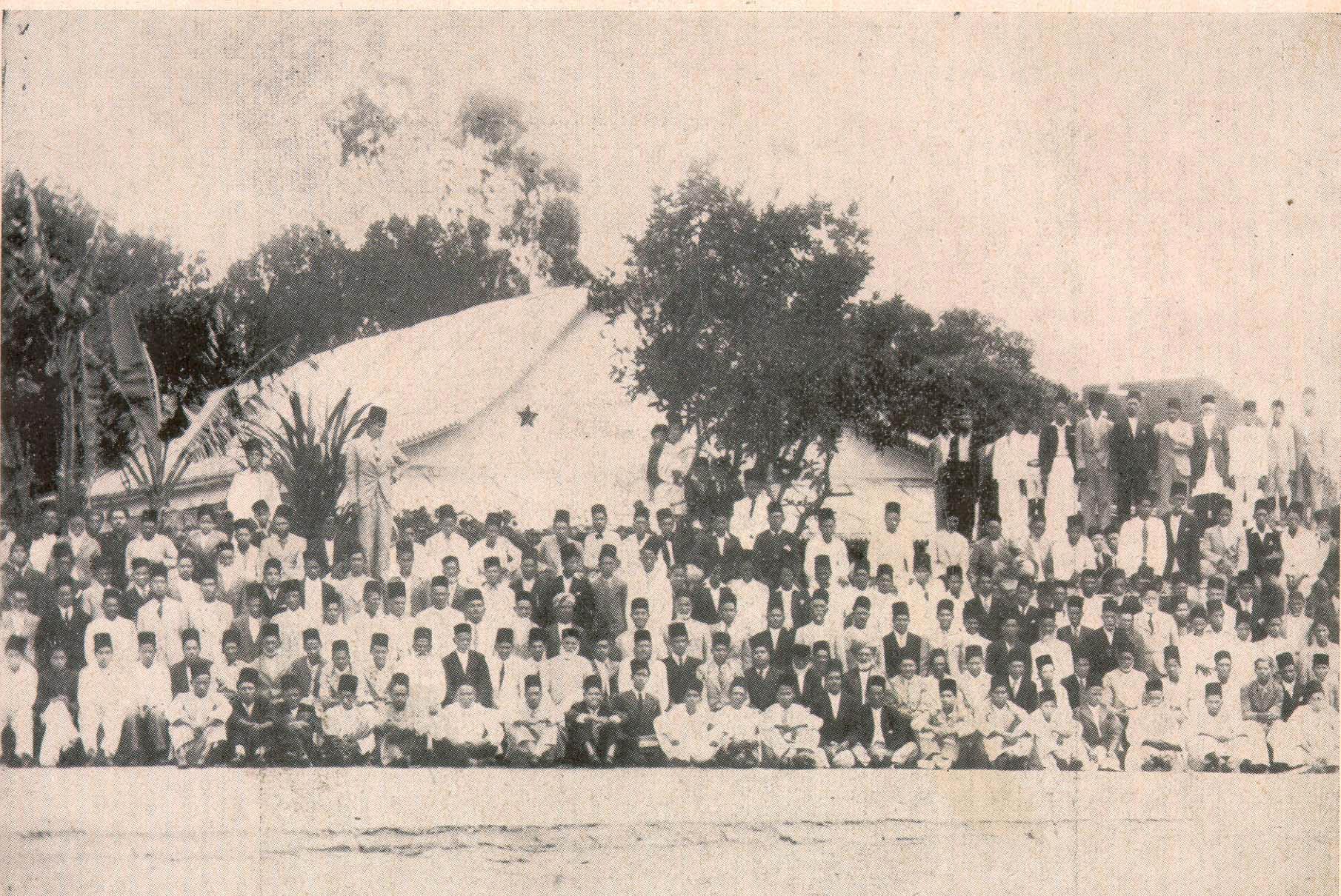
Hafiz Ghulam Muhammad Sahib [ra] is our first missionary to Mauritius. Before he was sent to that country in 1915, he worked for some years as a teacher of Arabic and theology at the Talim-ul-Islam High School, Qadian. He is, moreover, the second regular missionary of the Ahmadiyya Community to foreign lands, the first being Chaudhry Fateh Muhammad Sayal [ra] MA, who came to England in 1913. To him, however, goes the credit of being the first foreign missionary in the time of Hazrat Mirza Bashir-ud-Din Mahmud Ahmad [ra], second successor of the Promised Messiah (as) and the present head of the Ahmadiyya Muslim Community.
On reaching Mauritius in 1915, Hafiz Ghulam Muhammad [ra] met with strong opposition from the orthodox Muhammadans, but through constant prayer and unremitting efforts, in a short time, he succeeded in winning many converts to Islam Ahmadiyyat.
So ready, indeed, was the acceptance of the claims of Hazrat Ahmad (as) by the Mauritians and so steady and rapid was the progress of the cause of truth, that shortly afterwards, Maulvi Obaidullah (ra), died in Mauritius in 1923, was sent to assist him and we have at the present time in Mauritius a community numerically and financially strong.
Now [in 1926], after 11 years’ strenuous and successful work, Hafiz Ghulam Muhammad Sahib [ra] is going back to Qadian.
We would add that Hafiz Ghulam Muhammad Sahib [ra] is a good scholar of Islamic theology; he knows the whole Quran by heart and is a graduate of Punjab University. We wish him a long life devoted to the cause of Islam.
Prophet Adam (as) was not the first human
In the 30 May 1908 issue of Al Hakam (Urdu), the Promised Messiah (sa) is reported to have said:
“We do not believe that the world, as stated in the Bible, began with the creation of Adam about six or seven thousand years ago, that there was nothing before this and that God was then only inactive.
“Neither do we believe that the whole human race now inhabiting the various parts of the globe has descended from the same last Adam. We believe that man existed even before Adam. The Holy Quran refers to this fact in these words: ‘I am about to place a vicegerent in the earth.’ Adam has been
called a khalifa in this verse, which means ‘one who succeeds, so that God’s creation did not begin with him.’
“We cannot say, therefore, whether the Aborigines of America and Australia are the descendants of this last Adam, or have as their progenitor some other Adam.”
Islam and ‘The Coming Religious Revival’
In an article under the heading “The Coming Religious Revival”, Miss Sheila Kaye-Smith, the distinguished novelist, describes in The Sunday Express the signs of a new spirit of religion in England, maintaining that the English people stand in need of an international religion.
“We specially need today”, she writes, “a reaction from the insular ideas which dominated the last century, when the English regarded themselves as the Lord’s Chosen and took for granted that English ways and English ideas were always the best, as possibly they were for English people.”
“Industrialism is entering a new phase. It has long broken its national bonds and become an international society.
“Indeed, there is a tendency for all art and thought likewise to become international and if English religion does not follow suit, it will miss the opportunity it was brave enough to take at the beginning of the last century.
“The world grows smaller every day, as railways, motorcars, aeroplanes, telephones, newspapers and wireless bring people and countries nearer and nearer together.
“It will be a terrible thing if the only human spirit uniting these nations, being brought so physically and mechanically close to each other, is the spirit of temporal
advantage and material prosperity.”
It is Islam alone that can satisfy this need.
Divine assistance is necessary
The Times says, “In the depths of human nature there is something which gives man the power to know God, to respond to Him, to live in Him. Man is made out of the dust of the ground, but he lives by the breath of divine life. There is in him an inward light, a divine law in his heart, or, to use the language of the older Quakers, a divine seed capable of growth, enabling him to come to an ever-truer communion with God whose spirit dwells within him. It may be unrecognized, stunted by neglect or weakened by perversity, but it is there and when once it is allowed its full liberty, it goes out to God as its true centre and perfect satisfaction.”
This must not, however, be taken to mean that all our higher divine knowledge springs from within. The most direct means of knowing God is not only to apprehend the significance of human conscience and reason as insisted by the Neo-Platonists [but also to attain the knowledge of God’s existence through divine revelation].
Mere human devices can never reveal to us the shining face of the living and supporting God. Human nature no doubt “responds” to Him, but the truth of Divine existence can only be realised through divine assistance [as witnessed by Hazrat Ahmad (as) and his followers in this age].
A question for modernists
Mr W Maurice Pryke BD, Rector of Risby, Bury St Edmunds, in his recently published book, “Modernism as a Working Faith”, says
that a Modernist “believes wholeheartedly in the doctrine of progressive revelation; his God is a living God, who speaks to the men of today no less directly and authoritatively than He spoke to those of an earlier age.”
Will any modernist kindly let us know the name and address of any living person who claims that God speaks to him just as He spoke to the Prophets of yore?
We read in the Bible, “And the Lord spake unto Moses, saying: Speak unto the children of Israel and say unto them, I am the Lord your God” and it teems with verses in which God is alleged to say, “I am the Lord, I am the Lord.”
Is there anyone who receives such messages now? If not, why?
The Moslem World and the prophecies of Hazrat Ahmad (as)
A certain contributor to “The Moslem World” says that “the Great War was a gigantic course of education to the Orient.”
He further alleges that “the success of the Moslem arms has opened the eyes of the whole Islamic world... It has made them dream and caused them to follow their dreams.”
“So”, he continues, “today the Orthodox Mohammadans are eagerly expecting the coming of the Messiah and the dawn of the Millennium, Imamites are looking forward to the glorious return of their last Imam, the followers of the New Islam are awaiting the revival of the departed glory of the Moslem nations and the Ahmadis are already making use of the prophecies of their Founder, ‘the days are approaching and are very near when the religion preached by me will be the only religion that will be regarded with honor upon the face of the earth and Kings will seek blessings from thy (Ghulam Ahmad’s) clothes.’”
The above prophecies, it should be remarked, were made and published by Hazrat Ahmad (as) in 1903 and 1902, i.e., twelve years before the Great War, when the shrewdest statesmen of the world could not even dream of such a catastrophe, yet this “blind guide” seems to suggest that they owe their inspiration to the Great War. To get “picked volunteers” for a crusade against Islam, Christian missionaries should not throw sinister reflections upon a law-abiding country which is endeavouring to establish perfect peace throughout the world.
(Transcribed and edited by Al Hakam from the original English, published in the May 1926 issue of The Review of Religions)
At the far edge of North America, where the first light of dawn brushes the continent awake, two lighthouses stand watch. One is built of stone and timber, its beam cutting through fog and storm. The other is built of prayer and prophecy, its light carried in the hearts of a small but steadfast community. Both rise from Newfoundland’s rugged coast, and together they tell a story of geography, destiny, and a promise that travelled farther than anyone could have imagined.
To understand the weight of this story, one must first understand the land on which it unfolds.
Cape Spear is not merely a scenic lookout; it is a geographical landmark of continental significance. Located just south of St. John’s on the island of Newfoundland, the easternmost province of Canada, it is widely recognised as the easternmost point of North America, the first place on the continent to greet the sunrise each morning. The land juts into the ocean like a stone finger pointing towards Europe, standing firm against winds that have shaped its cliffs for millennia.
Atop this rugged headland stands the Cape Spear Lighthouse, built in 1836, the oldest surviving lighthouse in Newfoundland and Labrador. For generations, its beam has pierced through fog and storm, guiding sailors safely to shore. Its presence on this edge of the world symbolises vigilance, endurance and the human need for guidance in the face of vast uncertainty.
While the original 1836 lighthouse
today stands as a preserved historic site and monument, a newer lighthouse constructed nearby in 1955 continues to operate as the active navigational beacon for the area.
A small academic debate occasionally arises over whether Greenland’s Cape Nordostrundingen lies farther east. But this argument rests on geological classification rather than cultural or political geography. The overwhelming majority of authoritative sources, Parks Canada, Natural Resources Canada, the National Geographic Society, the Government of Newfoundland and Labrador, and Encyclopaedia Britannica, all identify Cape Spear as the easternmost point of North America in the continental and cultural sense.
This distinction matters. When people speak of North America, they speak of Canada, the United States, and Mexico, not the ice-covered expanses of Greenland. Under this universally accepted definition, Cape Spear stands uncontested as the continent’s easternmost edge.
And it is precisely this edge, this meeting point of land, light and limitless ocean, that gives Cape Spear its profound symbolic power. For if a message has reached this point, it has reached the very boundary of the continent. If a community has taken root here, it has taken root at one of the farthest corners of the Western world.
From this geography, the prophecy begins to unfold.
In 1898, in the quiet village of Qadian, Hazrat Mirza Ghulam Ahmad (as) received a revelation whose scope defied the imagination of his time:
“I shall cause thy message to reach the corners of the earth.” (Tadhkirah, p. 405)
It was a declaration made long before
aeroplanes, radio waves or global migration would shrink the world. Yet it carried within it a divine certainty that a message born in a remote corner of India would one day touch the farthest edges of the earth, places the Promised Messiah (as) himself would never physically see.
More than a century before a single Ahmadi ever stood on these cliffs, a voice in Qadian had already proclaimed that his message would reach the corners of the earth. Now, on this eastern edge of North America, two lights rise: one of stone guiding sailors through the Atlantic, and one of spirit, Baitul Ehsan Mosque, guiding souls toward their Creator.
Thus, when one stands at Cape Spear and watches the first light of dawn rise over the Atlantic, one witnesses more than a sunrise. One witnesses a promise fulfilled, a message that has travelled across oceans, across generations, and across the vast sweep of history to shine on this rugged coast.
The story of how this spiritual lighthouse came to shine in Newfoundland is one of quiet perseverance and divine grace, a narrative far richer than can be captured here. Its full telling, insha-Allah, is a chapter for another day; for now, we offer only a brief glimpse of its beginnings.
The history of Ahmadiyyat in Newfoundland stretches back to the 1990s, when a few Ahmadi Muslim families began moving in and out of the province for work and study. Among them was a young Ahmadi, Mansoor Ahmad Khan of Peshawar, who arrived as a student at Memorial University of Newfoundland (MUN) in late 1997 and, by the grace of Allah, still calls Newfoundland home today.
His presence became a steady anchor for the Jamaat in a place where Ahmadis were few and far between, and where the nearest missionary was hundreds of kilometres away in another province.
Over time, more families arrived, each one adding a new thread to the fabric of the community. What began as a handful of believers gradually grew into a small but devoted Jamaat, united by faith and strengthened by the challenges of living in one of Canada’s most isolated regions. Today, 15 Ahmadi Muslim families live across Newfoundland, each one a living testament to this grand prophecy.
Then, in 2019, Allah bestowed a remarkable blessing: the establishment of Baitul Ehsan Mosque, the first Ahmadiyya mosque in Newfoundland. For a province where the Jamaat had once gathered in living rooms and rented halls, this mosque became a symbol of permanence, progress and divine favour, a spiritual lighthouse raised on the continent’s edge, echoing the very prophecy that brought this community here.
In 2021, another milestone was reached. For the first time in history, Newfoundland received its own stationed missionary, dedicated solely to serving this province. Before this, a single missionary was responsible for all four Atlantic provinces, travelling thousands of kilometres to support communities spread across vast distances. The appointment of a resident missionary, under the guidance and prayers of Khilafat, marked a new chapter of growth, stability and renewed commitment to tabligh and tarbiyyat in Newfoundland.
Today, these 15 families, their mosque, and their missionary stand as quiet but powerful signs that even here, at the edge of the continent, the promise still shines. In their prayers, their service, and their steadfast presence, they embody the quiet miracle of a prophecy unfolding one sunrise, one soul, one coastline at a time.
And so, at the far eastern rim of North America, where the continent meets the open Atlantic and the first light of dawn breaks upon its shores, two lighthouses continue their vigil. One stands upon the cliffs of Cape Spear, its beam cutting through wind and storm as it has for generations. The other stands in the hearts of a small but steadfast community, its radiance shaped not by stone or timber, but by prayer, sacrifice and a prophecy spoken more than a century ago.
Together, these two lighthouses, one physical, one spiritual, testify to a remarkable truth: that no corner of the earth is beyond the reach of divine promise. What began as a distant revelation in Qadian now lives, breathes and shines on the easternmost edge of the Western world. In the homes of 15 families, in the walls of Baitul Ehsan Mosque, and under the guidance and prayers of Khilafat, the light continues to spread steadily, humbly and enduringly.
Here, at the continent’s threshold, the prophecy does not merely echo; it stands fulfilled. And as long as these two lighthouses remain, one guiding ships, the other guiding souls, the story of Newfoundland will continue to illuminate the promise that travelled across oceans, across generations, and into the hearts of those who now call this rugged island home.
Friday Sermon
Mubarak Mosque, Islamabad, Tilford, UK
24 April 2026
The Prophet (sa): Nurturing truthfulness and trustworthiness amongst the companions
After reciting the tashahhud, ta‘awwuz and Surah al-Fatihah, Hazrat Khalifatul Masih V (aa) stated:
In the previous Friday sermon, the high standards of the truthfulness of the Holy Prophet (sa), his excellent model and his advice and guidance to the believers were mentioned. I will mention further details about these aspects today as well. In relation to the high standards of truthfulness to which the Holy Prophet (sa) wished to see us adopt, the following is recorded in a tradition: Hafs bin ‘Asim relates that the Holy Prophet (sa) said: “It is sufficient for a person to be considered a liar that he goes about repeating everything he hears to others.” (Sahih Muslim, Muqaddammah, Bab an-nahyi ‘ani al-hadithi bi kulli ma sami’a, Hadith 5)
We observe that this is a common habit found among people. Even within the Jamaat, this ill-habit is considerably prevalent in some individuals. Some people even write to me about others, saying that they have done this or that. However, when an investigation is conducted, the matter turns out to be false. And when the one who wrote is asked as to who told him, since the allegation is untrue, he simply replies that I only heard about it. And merely based on this hearsay, they cause a commotion everywhere. Such people ought to reflect that the Holy Prophet (sa) has deemed such individuals to be liars.
Then, in another tradition, it is recorded that Hazrat Aisha (ra) relates that the companions of the Holy Prophet (sa) were not averse to any trait more than falsehood. If a person were to tell a lie in the presence of the Holy Prophet (sa), that matter would
remain in his heart. If he knew someone had lied, it would cause him immense pain, and he would keep it in his heart until he came to know that the person had repented, reformed himself and completely refrained from telling lies. (Musnad Ahmad bin Hanbal, Vol. 8, Hadith 25698, Maktab alKutub, p. 280)
In another tradition, it is recorded that Hazrat Asma relates that a woman came to the Holy Prophet (sa) and said that I have a co-wife (that is, my husband has another wife). Would I be guilty of sin if I gave the impression that I am completely satisfied with the provisions of my husband? In other words, if I show her that our husband gives me a lot; he gives me this and that. Whereas he has not actually given those things to me. I merely wish to provoke and tease her. The Holy Prophet (sa) replied: “The one who pretends to be satisfied with something that he has not been given is like one clothed in two garments of falsehood.” The reason for this is that she said those things to hurt her emotionally and to provoke her. Nevertheless, the Holy Prophet (sa) said that this is completely wrong. (Sahih Muslim, Kitab al-libas wa z-zinah, Bab an-nahyi ‘ani t-tazwir […], Hadith 3959, Vol. 11, Noor Foundation, p. 233)
In commentary on this, it is written that the word “garment” has been used here as a metaphor, and it means that the person is one who uses falsehood and deception. He has clothed himself in two garments of falsehood – one as an upper covering and the other as a lower garment. In other words,
he is a liar through and through. (Umdah al-Qari, Vol. 20, pp. 289-290, Dar Al-Kotob Al-Ilmiyah, Beirut; Fath al-Bari, Vol. 9, pp. 228-229, dar al-Rayyan li at-Turath)
Thus, in a very subtle and profound manner, he instructed his followers to avoid falsehood. In one narration, it is reported from Hazrat Abdullah bin Amr (ra) that the Holy Prophet (sa) said:
“There are four traits – whoever possesses them is a complete hypocrite, and whoever has even one of these traits has within him a characteristic of hypocrisy until he abandons it:
“If something is entrusted to him, he betrays the trust; when he speaks, he tells a lie; when he makes a promise, he breaks it; and when he quarrels, he uses abusive language.” (Sahih al-Bukhari, Kitab al-iman, Bab ‘alamati l-munafiq, Vol. 1, Nizarat Ishaat, pp. 80-81)
All of these are such traits that, in one way or another, directly or indirectly lead to falsehood or are expressions of it.
Therefore, these moral weaknesses are signs of hypocrisy. Keeping this in mind, we should examine ourselves and reflect on the extent to which such weaknesses exist within us. These are traits that lead towards hypocrisy, and no person ever wishes to be counted among the hypocrites.
Then, regarding those who spread falsehoods, he gave a very stern warning. In one narration, Hazrat Samurah bin Jundub (ra) relates that the Holy Prophet (sa) would often ask his companions whether any of them had seen a dream. Hazrat Samurah
(ra) further relates, “When he asked this, those whom Allah willed would relate them to him. (That is, those who saw dreams would relate them to him.)
“One morning, the Holy Prophet (sa) said that during the night, he (i.e., speaking about himself) had seen a vision. He said: ‘Two people came to me, woke me, and said, “Come along.” I went with them until we came to a man who was lying flat on his back. Another man was standing beside him, holding an iron hook (he was standing holding something like a large clamp or pliers). He would go to one side of the man’s mouth and tear it open all the way to the back of his head. (That is, he would tear open the entire side of his mouth from one side.) Then he would move to the other cheek (first he did the right side, then the left) and do exactly the same as he had done to the first side of the mouth. Before he could even finish, the first side (which he previously tore open) would return to its normal state, just as it had been before being torn. Then he would return to it and do the same again, tearing it open repeatedly in this manner.
“The Holy Prophet (sa) said: ‘I exclaimed, Holy is Allah! Who are these people?’ They replied, ‘Listen, we will tell you the reality. The person you came to whose mouth was torn to the back of his head, whose nostril and eye were ripped in that manner, is the one who leaves his home in the morning and fabricates a lie which then spreads far and wide.’” (Sahih al-Bukhari, Kitab alTa’bir, Bab Ta’bir al-Ru’ya Ba’d Salat al-Subh, Vol. 16, pp. 246-252, Hadith 7047, Nizarat
Ishaat)
This refers to those who spread rumours and false statements about others. Some people speak merely for the sake of conversation or for amusement; at times, such statements are also intended to defame others in society. In any case, what they say causes harm.
Therefore, such people should always remember that this is something for which they will be held accountable. Allah the Almighty will take them to task and punish them. It is a matter of deep reflection, and one should seek forgiveness in abundance.
There is a narration from Abdullah bin Harith, who conveyed it from Hazrat Hakim bin Hizam (ra). He said that the Holy Prophet (sa) stated, “The seller and the buyer both have the option to cancel the transaction (that is, whatever deal has been made, they have the right to cancel it) until they separate from one another.” As long as they are still together, this option remains, but once they part from each other, then they cannot. He further said, “If both of them act truthfully and speak honestly, then blessings will be placed in both of their transactions. But if they conceal something and speak falsely, then the blessing in their transaction will be erased.” (Sahih al-Bukhari, Kitab albuyu’, Bab idha bayyana l-bayyi’an wa lum yaktuma wa nasaha, Hadith 2079, Vol. 4, Nizarat Ishaat, pp. 38-39)
Many business disputes arise because of false actions and statements, and Allah Almighty does not place blessings in the dealings or affairs of such people. In this world, they suffer the losses they must bear, and with Allah Almighty, they are also considered sinful and earn punishment.
Hazrat Ibn Umar (ra) narrates that the Holy Prophet (sa) said: “When a person tells a lie, an angel moves a mile away from him because of the foul smell of what he has intentionally committed.” (Jami’ atTirmidhi, Kitab al-birri wa s-silah, Bab ma ja’a fi s-sidqi wa l-kidhb, Hadith 1972)
In a narration, it is reported from Hazrat Abu Hurairah (ra) that the Holy Prophet (sa) once passed by a heap of grain. He placed his hand into it, and his fingers felt moisture (he sensed that there was moisture inside), so he said, “O seller of grain, this grain you are selling (whether it is wheat, corn, or something else) – what is the matter, is it wet inside?” The man replied, “O Messenger (sa) of Allah, rain had fallen on it.” The Holy Prophet (sa) said, “Then why did you not place the wet grain on top?” Instead of hiding it underneath, if rain had fallen on it, you should have put it on top so that people could see it. He then said, “Whoever deceives is not from me.” (Sahih Muslim, Kitab al-iman, Bab qawli n-nabiyy [sa]: ‘mun ghashsha fa laysa minna’, Hadith 139, Noor Foundation, Vol. 1, p. 93)
Thus, those in business should examine themselves over such minute details and criticism. This is the standard that he wished to establish for Muslims, but unfortunately, today it is the Muslims themselves who are defamed in the world due to deceitful business practices and calumny. Therefore, today, we who claim to believe in the Promised Messiah (as) and to have true faith in the Holy Prophet (sa) must uphold the highest standard of truthfulness in every word and action. Otherwise, the Holy Prophet (sa) has said that if this is not the case, then you are not from me, and I have
no connection with you. He gave countless lessons and guidance, urging people to adopt truthfulness with great precision, and no person can be a true Muslim unless they fully abide by truth.
With regard to his character, I now present some aspects. The Holy Prophet (sa) was always known among people as the most truthful and trustworthy because of his constant truthfulness and his excellence in honesty and integrity. Thus, one author has written, “Muhammad (sa) was sent in an age of ignorance, when no warner had come to his people, prior to him. (No prophet had come to their nation.) The people worshipped idols, false deities and shrines. Even among them, the Holy Prophet (sa) was granted understanding and wisdom from his childhood; despite being surrounded by the followers of Satan and idolaters, the Holy Prophet (sa) never inclined toward any idol, nor did he ever participate in any festival with them. No lie was ever heard from him. People regarded him as ‘Sudooq’, meaning extremely truthful, and ‘Amin’, i.e., forbearing and extremely gracious.” (Imta’ al-Asma’, Vol. 4, Dar Al-Kotob Al-Ilmiyah, Beirut, p. 212)
It is even narrated that before the advent of his prophethood, during the age of ignorance, people would seek out judgment from the Holy Prophet (sa). (Subul al-Huda wa al-Rashad, Vol. 2, Dar Al-Kotob AlIlmiyah, Beirut, p. 147)
While describing his excellent example, Hazrat Musleh-e-Maud (ra) has stated in one place:
“The collective testimony regarding the noble moral character of the Holy Prophet (sa) is that which was accepted by his own people – that even before his claim to prophethood, his nation had conferred upon him the titles of Amin [the Trustworthy] and Sadiq [the Truthful]. There are many in the world against whom there is no proof of dishonesty. Likewise, there are many who are never subjected to trials; rather, they pass through only ordinary tests, and their integrity remains intact. Yet despite this, their people do not assign them any special title. This is because distinctive titles are only bestowed when a person surpasses all others in a particular quality.
“Every soldier who participates in battle places his life in danger; yet the British do not award every soldier the Victoria Cross, nor does Germany confer upon every soldier the Iron Cross. In France, there are millions engaged in intellectual pursuits, yet not every individual is awarded the Legion of Honour. Thus, the mere fact that a person is honest and truthful does not, in itself, cast any special light upon his greatness. However, for an entire nation to confer upon someone the titles of Amin and Sadiq is indeed extraordinary. Even if the people of Mecca had been accustomed to granting such titles to individuals across different generations, the one who received these titles would still be considered a great person. But Arabian history shows that the Arabs did not bestow such titles upon individuals in every generation. Rather, in the span of hundreds of years of Arab history, only one example is found – Muhammad, the Messenger (sa) of Allah – upon whom the people of Arabia conferred the titles of Amin and Sadiq.” (Dibacha Tafsir-ul-Quran, Anwar-ul-Ulum, Vol. 20, pp. 374-375)
Thus, the fact that throughout
centuries of Arab history, the entire nation granted these titles to only one individual demonstrates that his trustworthiness and truthfulness were of the highest order, such that no other example comparable to him was known among them. The Arabs were distinguished in the world for their perceptiveness. Therefore, whatever they declared to be rare is indeed worthy of being regarded as rare in the world.
The Promised Messiah (as) states:
“The state of the world today has become rather precarious. From whichever way one looks at things, false testimony is fabricated. Filing a false case is a trivial matter. Fraudulent documents are manufactured. If they state something, they will do so while evading the truth. Now, someone should ask those who do not understand the need for this [Ahmadiyya] Movement whether this was the religion that the Holy Prophet, may peace and blessings of Allah be upon him, had brought. Allah the Exalted had said that lying is an abomination, so avoid it:
“[Shun therefore the abomination of idols, and shun all words of untruth.] (The Holy Quran, 22:31)
“God had equated lying with idol worship; just as a foolish man abandons Allah the Exalted in order to bow his head before an idol […].” Allah says to avoid impurity, as it is a grave sin, because falsehood is like falling into impurity and evil deeds. Idol worship, too, is wrong and a very impure act. The Promised Messiah (as) states:
“God had equated lying with idol worship; just as a foolish man abandons Allah the Exalted in order to bow his head before an idol, in the same way, abandoning truth and honesty, a person makes an idol out of falsehood to achieve his purpose. This is why Allah the Exalted joined lying with idolatry.” Abstain from idolatry, for it is a grave sin, and falsehood is of the same nature.
The Promised Messiah (as) states, “An idolater seeking salvation from an idol. A liar also carves out an idol for himself and imagines that he will attain salvation through this idol […]. What could be a greater misfortune than believing that one’s life depends on falsehood?
“When they are asked why they do not abandon falsehood, they say they must resort to falsehood in order to attain their own benefit.” The Promised Messiah (as) said, “What could be a greater misfortune than believing that their life depends on falsehood? Nevertheless, I assure you that truth alone triumphs in the end. Virtue and victory belong to it.” (Malfuzat, Vol. 8, pp. 270-271)
While describing the life of the Holy Prophet (sa), Hazrat Musleh-e-Maud (ra) writes at one instance:
“When the Holy Prophet (sa) informed his wife about the revelation he had received, she did not say, ‘What stories have you begun fabricating?’ Rather, she said, ‘Do not be anxious. What you have seen is true. Allah will never forsake you, for you uphold ties of kinship, you bear the burdens of the needy, you restore lost virtues, you show hospitality to guests, and you support the truth.’
“Then she took him to her cousin Waraqah bin Naufal, who was a scholar
of the Israelite scriptures. Upon hearing the account, he immediately said that this was the same kind of revelation that had descended upon Moses (as), and that the commandments contained within it were similar to those received by Moses (as). (Hazrat Musleh-e-Maud [ra] continues narrating testimonies. I have briefly mentioned this in a previous sermon. After presenting the testimony of Waraqah bin Naufal, Hazrat Musleh-e-Maud [ra] presents another testimony:)
“Then there was a young relative in the household, approaching maturity; someone who could become an effective means of propagation among the youth. When he heard his brother and sister-in-law – that is, the Holy Prophet (sa) and Khadija (ra) – speaking with great seriousness about this profound change, he stepped forward with composure and said, ‘I too believe that you are truthful, and that Allah has indeed spoken to you and appointed you for the reformation of the world.’
“Then there is the testimony of a freed slave, who, captivated by the noble character of the Holy Prophet (sa), had forsaken his parents and remained at his doorstep. When he heard these unfolding events and observed the signs of concern upon his master’s face, he stepped forward, held on to his master’s mantle, and said, ‘O my master, what you have seen is true; what you have said is true. Divine power cannot deceive a person like you. You are the embodiment of truthfulness. How could Divine power ever deceive you? The time has now come for the reformation of the world through your hands. Grant me the permission to remain with you and to serve you.’”
There is another testimony of his, one close and intimate friend, as though a second pearl nurtured within the same shell. When he hears that his companion has begun to speak in an unfamiliar manner and that people are saying perhaps his mind has been affected, he hastens to him, opens the door and asks: “Is what I hear true?”
When the Holy Prophet (sa) begins to explain the matter to him, he says: “By God, do not present arguments. Just tell me whether these things are true.” And when he affirms it, he replies: “My truthful friend, I believe in your prophethood. You were about to do me a disservice by offering proofs and thereby casting doubt upon my faith. I have witnessed so much of your truthfulness that I have no need of arguments.” Then, Hazrat Abu Bakr said: “My friend, how can one who has seen your face ever doubt your word?”
There is no doubt that opposition was bound to arise, for, as Waraqah bin Naufal said:
“No man has ever brought a message similar to yours without being persecuted.” But observe the design of God: before the storm of opposition could break, how He raised up Companions for him. Among the people of Mecca, that one learned man of the scriptures, Waraqah, bowed before him at the very first encounter. His life companion, Khadija, upon hearing the revelation, was overcome with love and support for him. The young kinsman Ali, who constantly observed his domestic character, offered his services. The freed servant Zaid, who had closely and deeply studied his dealings and his treatment of
the poor, swore by his truthfulness. The childhood friend, the benefactor of Mecca, the embodiment of nobility, Abu Bakr, merely upon hearing that he had claimed to receive revelation, placed himself in complete devotion at his doorstep.
“How immense must have been the joy these unparalleled manifestations of love and sincerity produced in the Holy Prophet’s (sa) heart. When he heard the uproar of Mecca and their taunts, how he must have smiled and said: ‘This is the verdict of those who do not know me, who call me a sorcerer and by other names. Now listen also to the verdict of those who know me, how they stand by my side, even ready to give their lives for me.’
“Moses prayed for a helper to share his burden. Here, in interpreting the verse, a comparison is drawn between the companions of Prophet Moses (as) and those of the Holy Prophet Muhammad (sa). For this reason, the example of Moses was stated. Moses asked for one helper to assist him, but Muhammad, the Messenger (sa) of Allah, was granted five helpers without him asking, and such helpers who excelled in sharing his burden. Waraqah, though he soon passed away, left behind an indelible testimony to his truthfulness. For 12 subsequent years, what Khadija demonstrated with her devotion would humble even the bravest of men. Zaid, for twenty years, displayed unparalleled sacrifice and ultimately proved it by shedding his blood before drawn swords, thereby establishing the true standard of the helpers of the Holy Prophet Muhammad (sa). Abu Bakr and Ali remained even after his passing, and as caliphs they demonstrated their service in a new and profound manner.” (Tafsir-e-Kabir, 2023, Vol. 13, pp. 201-202)
Then, describing the example of the Holy Prophet (sa), Hazrat Musleh-e-Maud (ra) states:
“One of the most powerful proofs of the truthful and upright person is his own self, which proclaims aloud, addressing both opponents and supporters, the unacquainted and the familiar, strangers and confidants alike: ‘Look at me, and before you call me a liar, reflect on whether you truly can. If you declare me false, will you not deprive yourselves of all the means by which you discern truth? And by branding me an impostor, will you not close upon yourselves every door through which you might attain your objective?’
“Everything in the world proceeds in continuity and passes through stages. Neither can virtue reach its perfection without passing through intermediate stages, nor can evil reach its extreme without traversing its own degrees. How then is it possible that one running towards the west should suddenly find himself at the farthest edge of the east? (It cannot be that one travels in one direction yet arrives in another), or that one heading south should find himself standing on the northern horizon.
“The Holy Prophet (sa) said: ‘I have spent my entire life among you. I was a child and grew up in your midst. I was a youth and became middle-aged among you. My private and public affairs are all known to you. Nothing of my actions has been hidden from you, nor any word concealed.
Is there anyone among you who can say that I have ever spoken a lie?’ This declaration was made by the Holy Prophet. ‘Is there anyone who can say that I have ever lied, or committed injustice, or deceived, or defrauded, or usurped anyone’s right, or sought personal greatness, or attempted to seize authority? In every field you have tested me, and in every condition you have examined me, yet you have always found my steps upon the path of moderation, always free from every blemish, until both friend and foe alike bestowed upon me the titles of the Trustworthy and the Truthful.’
“What, then, has happened that until yesterday evening I was known among you as trustworthy, truthful, upright – far removed from falsehood, devoted to truth, indeed one upon whom truth itself took pride – and in every matter you placed your trust in me and accepted every word I uttered; yet today, within the span of a single day, such a transformation has occurred that I have become the worst of the worst and the most impure of men? Is it merely because of one claim – that though I had never ascribed lies to men before, but now I have begun to forge lies against Allah?
“Is there any example in the law of nature of such an abrupt and radical change? If it were a matter of a day or two, you might say it was an affectation. If it were a matter of a year or two, you might claim that I had adopted such a course to deceive you. But I have spent my entire life among you. You witnessed my childhood; you observed my youth; and the period of advancing age, when old age begins to set in, has also passed before your very eyes. How could such sustained pretence and fabrication be possible?
“In childhood, when one is scarcely aware even of one’s own good or harm, how could I have contrived such deception? In youth – often called the age of passion –how could I have concealed my true state through deception? Reflect, then: when did this deception occur, and who perpetrated it?
“If, upon reflection, you find my life to be free from blemish and to be completely selfless – indeed, if you behold it as the embodiment of virtue and the very image of truth – then do not, while looking at the sun, proclaim that it is night. The day has fully dawned; do not declare it to be darkness. My condition is such that my words are as manifest as the light of day. Do not complain of darkness when light is present.
“Do you require any proof beyond my own self? My very being is the greatest proof. Is there any need for further evidence after considering my past conduct? My entire past lies before you, yet you still demand a sign. My own self bears witness for me, and my life stands as testimony on my behalf.
“If each one of you were to look within himself, his heart and mind would testify that truth is firmly established in me, and that I stand upon truth; that righteousness takes pride in me, and I take pride in righteousness. Such a one is not in need of any external proofs to establish his truthfulness. His example is like that of the rising sun – it is itself the proof of its existence.
“It was this very compelling evidence
that entered the heart of Hazrat Abu Bakr (ra) and it is this powerful proof that will continue to take root in the hearts of all lovers of truth.
“When the Holy Prophet (sa) made his claim, Hazrat Abu Bakr (ra) was at the house of a friend. There, a freed bondwoman informed him that the wife of his friend was saying that her husband had become a Prophet like the Prophet Moses (as) whom they spoke of. At once, he rose and went to the house of the Holy Prophet (sa) and asked: ‘Have you indeed declared that you are the Messenger (sa) of Allah?’
The Holy Prophet (sa) replied, ‘Yes, I am the Messenger (sa) of Allah.’ Upon hearing this, Hazrat Abu Bakr (ra) immediately accepted his claim.
“Thus, the Holy Prophet (sa) would later say regarding his faith: ‘I invited people to Islam, and in every case there appeared some hesitation, reflection, or doubt; but when the message of Islam was presented to Abu Bakr, he showed not the slightest hesitation – rather, he accepted it at once.’
“What was it that compelled Hazrat Abu Bakr (ra) to believe without witnessing any outward sign? It was the very being of the Holy Prophet (sa) which was brimming with honesty and truthfulness and his very being itself bore witness to his truth.’
“Similarly, as I have already mentioned, Hazrat Khadija (ra), Hazrat Ali (ra) and Hazrat Zaid bin Harithah (ra) all testified to his truth, having witnessed his truthfulness.
“In short, the first inner proof of a Prophet’s truthfulness is his own self, which bears witness to his truth. Such testimony is so overwhelming that, in its presence, there remains no need for any other miracle or sign.” (Da’wat-ul-Amir, Anwar-ul-Ulum, Vol. 7, pp. 425-428)
The Promised Messiah (as) states:
“The Word of God states that the righteous are those who walk with humility and modesty and do not speak arrogantly. They speak as though they were a lowly person addressing their senior. In any case, we should act in a manner that brings about our prosperity. None can claim a monopoly over Allah Almighty, for He desires righteousness alone. One who adopts righteousness shall attain a lofty status. The Holy Prophet, peace and blessings of Allah be upon him, or Abraham, on whom be peace, did not receive honour by any inheritance. Although we believe that Abdullah, the revered father of the Holy Prophet, peace and blessings of Allah be upon him, was not an idolater, (people often as this question, this is the answer, that the Holy Prophet’s respected father was not an idolater), but it was not on this account that the Prophet of Islam was conferred his prophethood. Prophethood was endowed to him by divine grace due to the virtues present in his nature. This is what drew in God’s grace. It was sincerity and righteousness which led Abraham, on whom be peace, the Father of the Prophets, to sacrifice his son without hesitation. Even he himself was cast into a fire. Just reflect upon the sincerity and devotion of our Chief and Master, Muhammad, the Messenger of Allah, peace and blessings of Allah be upon him. The Holy Prophet (sa) stood firm against all forms of evil. He bore diverse
trials and tribulations, but did not care in the least. It was this sincerity and devotion which moved Allah the Exalted to shower His grace. It is for this reason that He states:
“Allah Almighty and all His angels send blessings upon the Messenger. O ye who believe! You also should invoke blessings and peace upon the Prophet (sa). [The Holy Quran, 33:57] This verse establishes that the deeds of the Noble Messenger (sa) were such that Allah Almighty did not use any specific word to praise them or outline his attributes. Although words could be found, God Himself chose not to use any in particular. For the pious deeds of the Holy Prophet (sa) were beyond the confines of praise. A verse of this nature does not exist in praise of any other Prophet. The soul of the Holy Prophet (sa) was imbued with such sincerity and purity, and his deeds were so praiseworthy in the sight of God that Allah the Almighty decreed for all times to come that all future generations would send blessings upon the Holy Prophet as an expression of gratitude. The resolve and devotion of the Holy Prophet (sa) is such that we would find no equal, either before him or after him, who could match him. One may reflect upon the time of the Messiah (as) to see the extent to which his resolve, or spiritual sincerity and devotion, impressed an effect upon his disciples. Anyone can appreciate how difficult it is to put right an ill habit. It is truly challenging to relinquish firmly rooted habits. However, our Holy Prophet, peace and blessings of Allah be upon him, reformed thousands of people who were worse than animals. There were some who, like animals, thought nothing of having relations with their mothers and sisters; they would devour the wealth of orphans and usurp the inheritance of those who were no more. Some worshipped the stars, while others were atheists, and others still worshipped the elements. What was the Arab Peninsula? It was home to diverse religious thought.
“One benefit of this is that the Holy Quran possesses within itself every necessary teaching. Its tenets are more than sufficient to uproot every false doctrine or ill teaching that could possibly exist in the world. This is the deep wisdom and power of Allah the Exalted.” (Malfuzat, Vol. 1, pp. 36-37)
In that, he sent the Holy Prophet (sa) and sent him at a time when ignorance was at its peak. And then he transformed those animals into men.
[O Allah, exalt Muhammad and His family, and bestow blessings and peace on him. Surely, You are the Praiseworthy, Exalted].
May Allah the Almighty enable us to follow the example of the Holy Prophet (sa) as well as the commandments mentioned in the Holy Quran and elevate the standards of truthfulness to ever new heights.
(Official Urdu transcript published in the Daily Al Fazl International, 15 May 2026, pp. 2-8. Translated by The Review of Religions.)