‘Strive to achieve the pinnacle of your chosen path’
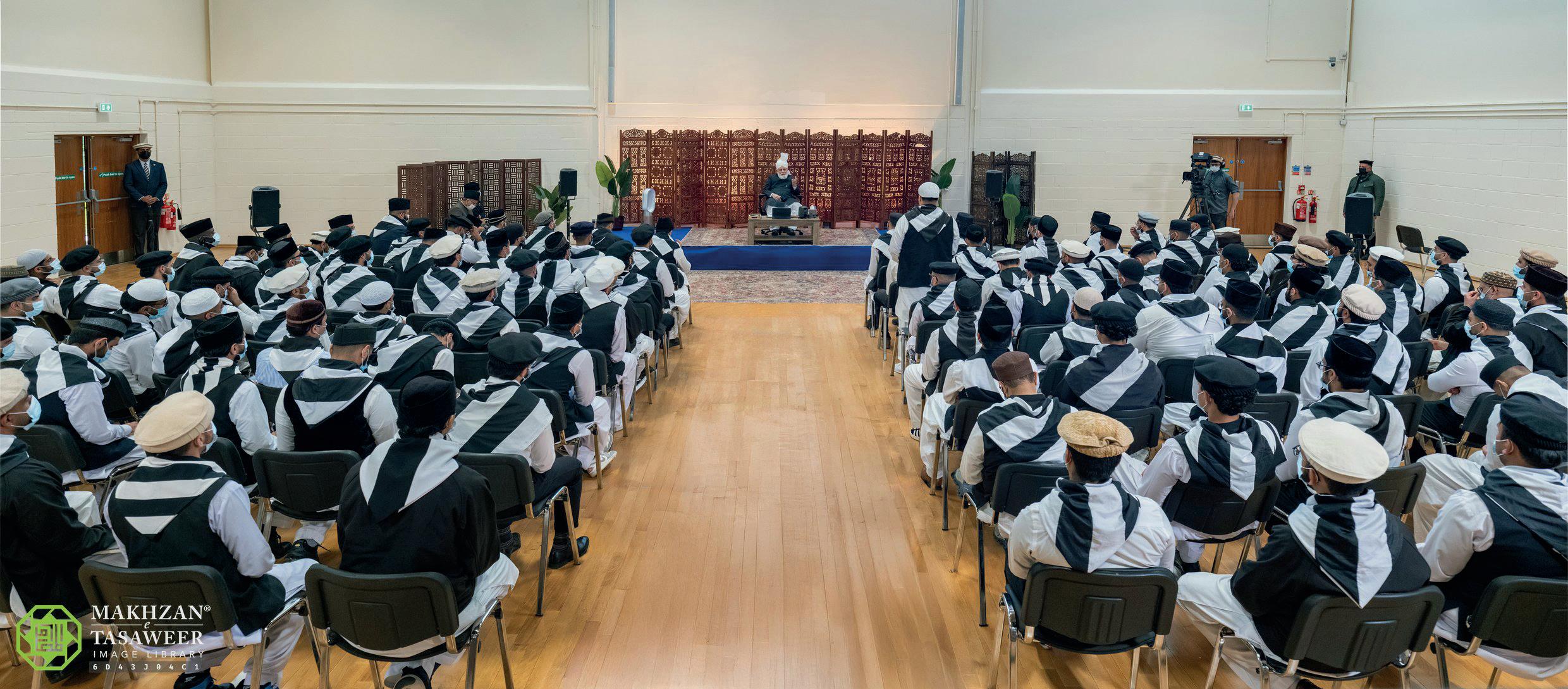
Huzoor addresses Waqifeen-e-Nau at UK Ijtema 2026
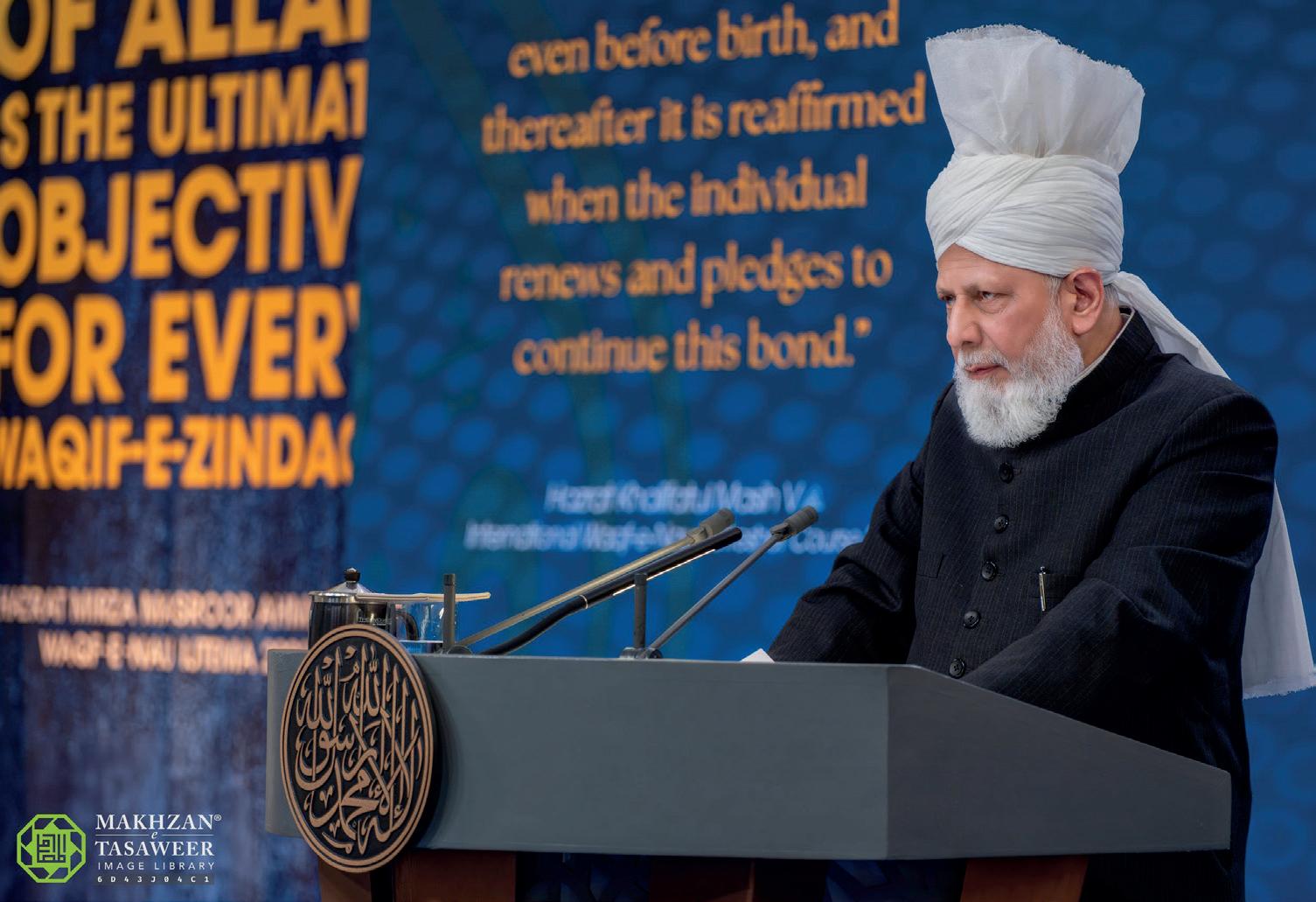
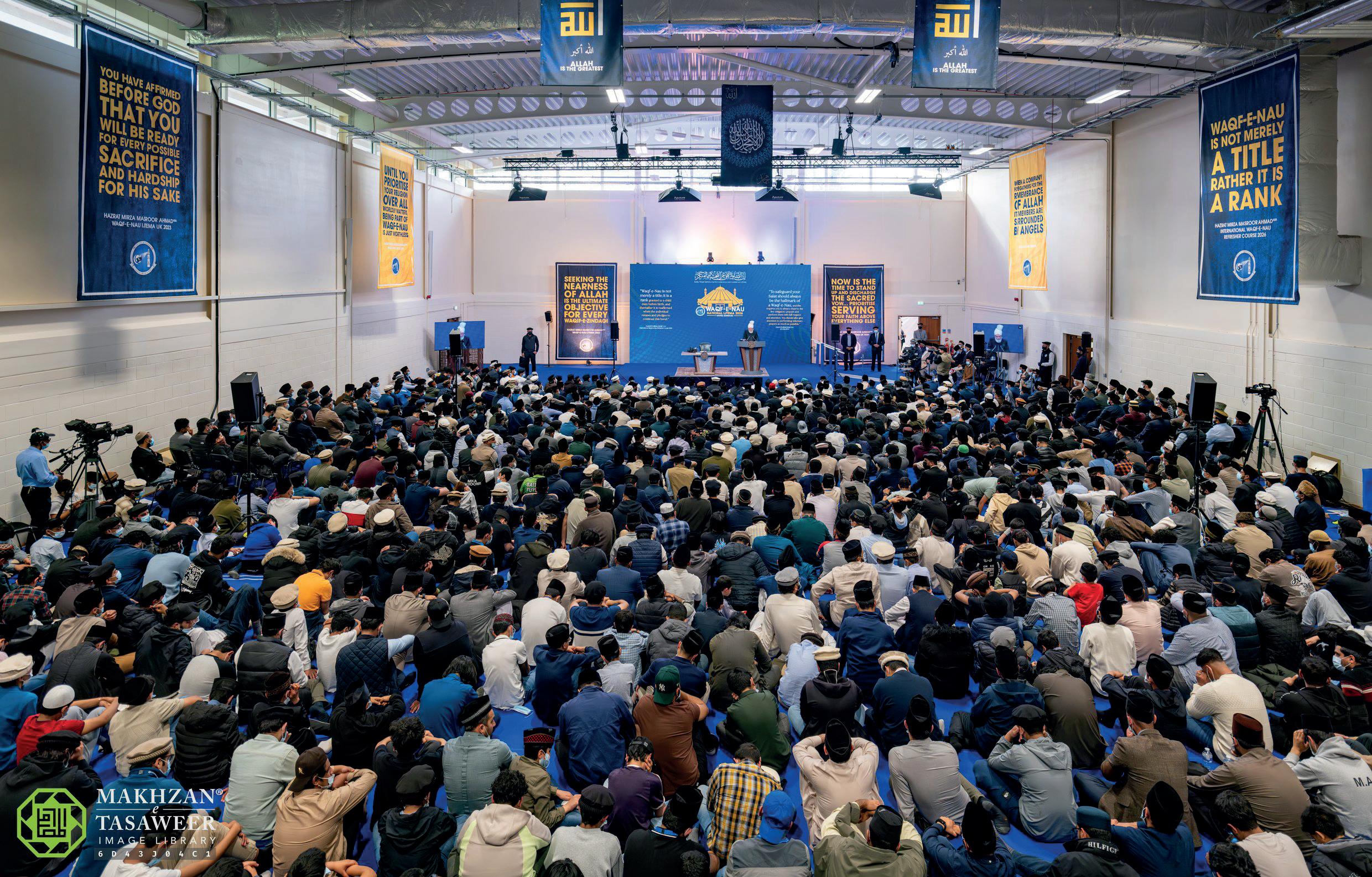
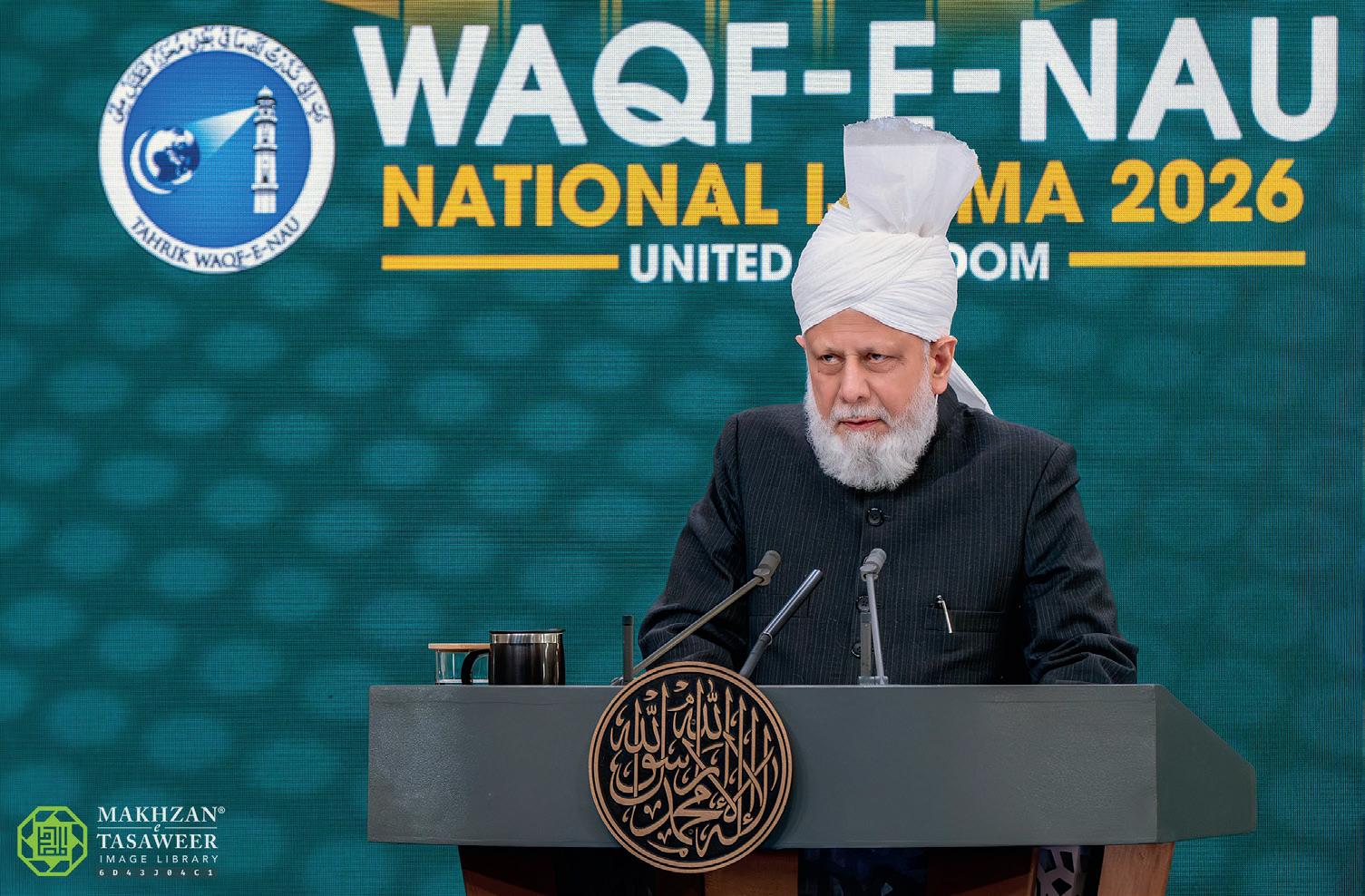
On Sunday, 26 April 2026, at approximately 5 pm local time, Hazrat Mirza Masroor Ahmad, Khalifatul Masih V, may Allah be his Helper, presided over the UK Waqf-eNau Ijtema 2026 at Islamabad, Tilford, UK. After conveying assalamu alaikum, Huzoor (aa) invited Ehsan Ahmad Sahib to recite a portion of the Holy Quran – Surah ar-Ra’d, Ch.13: V.20-23. Ghaalib Khan Sahib then presented the English translation of these verses. Abdul Haye Sarmad Sahib subsequently recited an Urdu poem of the Promised Messiah (as), followed by its English translation presented by Frasat Cheema Sahib.
Hazrat Amirul Momineen (aa) then invited Abdul Quddus Arif Sahib, Secretary Waqf-e-Nau UK, to present the Ijtema report.
He expressed his gratitude to Huzoor (aa) for gracing the occasion with his esteemed presence and for the opportunity to hold the ijtema in Islamabad. He stated that the participants were divided into age-based groups, each participating in its respective activities. The sessions at the Ijtema covered topics such as the role of MTA International in tabligh and tarbiyyat, an introduction to Jamia Ahmadiyya UK, responding to allegations, and inspirational
A charity that suffers no
loss
Hazrat Abu Hurairah (ra) narrated: “I heard the Prophet (sa) say, ‘Whoever spends a pair [of anything] in the way of Allah will be called by the gatekeepers of Paradise, who will say, “O so-and-so, come here!”’ Hazrat Abu Bakr (ra) said, ‘Such a person is one who will suffer no loss.’ The Prophet (sa) said, ‘I hope that you will be among them.’”
(Sahih al-Bukhari, Kitab bada’i l-khalq, Bab dhikri l-mala’ikah, Hadith 3216)
Hazrat Mirza Ghulam Ahmadas, In His
Sympathy for humanity
The Promised Messiah (as) states: “My state of affairs is that whilst engaged in Prayer if someone is in pain and their cry reaches my ears, I feel moved to go to their aid and give them sympathy insofar as possible, even if I am compelled to break my Prayer. It is against the principles of morality to not stand by a brother who is in pain and distress. If you can do nothing else, at least pray for them. What to talk of our own, I even say that you ought to show the same example of morality and sympathy to Hindus and others. One must not possess a thoughtless nature.
Own Words
This Week in History
1 - 7 May
A glimpse into the rich history of the Ahmadiyya Muslim Jamaat
1 May
1 May 1893: On this day, the Promised Messiah (as) issued a detailed notification about Barahine-Ahmadiyya. Hazrat Ahmadas was informed that some buyers were still waiting for the next parts of the book as promised earlier. Earlier, in September 1886, Huzoor (as) had announced that as the original plan of the book was altered, he did not think it was necessary to produce the 300 parts he had intended and still later, when he found that he could not complete the book at all on the previous lines – as God had commissioned him as a Reformer – he announced that he was prepared to return the money received for the book if its published portion was duly returned to him. Many people took advantage of the offer and got their money back. This announcement was repeated several times, in 1895 and on 15 December 1900, etc. Huzoor (as) had never intended to make money out of this holy undertaking, and it is a fact that he did not gain any monetary profit from it. (Majmuah-eIshtiharat [2019], Vol. 1, pp. 423-430)
To read more, see: “Barahin-e-Ahmadiyya: Its place in Epistemology, Sociolinguistics and Psychology” at alhakam.org
1 May 1947: On this day, Hazrat Musleh-eMaud (ra) delivered a speech titled “Hindustani uljhanon ka aasaan tareen hal” – A simple solution to the problems of India. During this speech, Huzoor (ra) advocated that the people of India deserved the right to determine their future
themselves, instead of the foreigners deciding it unilaterally and said that since freedom is the birthright of everyone, Indians also hold the same right.
For more details, see: “Freedom is the birthright of everyone: Hazrat Mirza Bashir-ud-Din Mahmud Ahmad’sra guidance regarding India’s independence and partition”, at alhakam.org (3 June 2022, Issue 220, pp. 18-19).
2-3 May
2 May 1970: On this day, during his visit to Africa, Hazrat Mirza Nasir Ahmad, Khalifatul Masih III (rh), met with President Daud Ajuara of Gambia and attended a banquet hosted by Sir FM Singhate. During his stay in Gambia, on the same visit, he was divinely inspired to establish the Nusrat Jehan Scheme to help the African nations. (Tarikh-e-Ahmadiyyat, Vol. 26, p. 58)
3
3 May 1905: On this day, Allah revealed the following to Hazrat Ahmad (as):
“Alas; where has Nadir Shah disappeared?” (Al Hakam, 10 May 1905, Vol. 9, No. 16, p. 1, Tadhkirah [English], p. 748 [2018]) This proved to be a remarkable prophecy that predicted the unlikely rise to power of an ordinary person and his sudden death.
For more details, see: “Alas! Where has Nadir Shah disappeared?”: Afghanistan and a prophecy of Hazrat Mirza Ghulam Ahmad fulfilled” at alhakam.org (29 July 2022, pp. 12-14).
3 May 1955: On this day, Hazrat Musleh-e-Maud (ra) was in Damascus and sent a letter to Hazrat Mirza Bashir Ahmad (ra), MA, who was Amir Muqami in Rabwah, in which he spoke about his journey. In the letter, Hazrat Musleh-e-Maud (ra) praised the family of Munir al-Husni Sahib for their sincerity.
To read more about Hazrat Musleh-e-Maud’s (ra) visits to Syria, see: “A brilliant sign of ‘the devotees of Syria’: Hazrat Musleh-e-Maud’s 1955 visit to Damascus” at www.alhakam.org (17 February 2023, pp. 9-10).
4 May
4 May 1973: A resolution was presented in the legislative assembly of the Pakistan-administered region of Kashmir to declare Ahmadis as nonMuslims. In response, during his Friday sermon on this day, Hazrat Khalifatul Masih III (rh) commented on the matter, the summary of which was that a true believer’s faith in Islam is so robust that it requires neither political validation nor the endorsement of those who possess only superficial religious knowledge. (Khutbat-e-Nasir, Vol. 5, p. 121) Moreover, after a few weeks, in view of the wave of systematic opposition to the Ahmadiyya Jamaat in Pakistan, a special session of the Majlis-e-Shura was held, in which Hazrat Khalifatul Masih III (rh) shared some information about the emerging political and general situation
of Pakistan and gave guidance to the delegates. Around 500 delegates of different local jamaats attended this important event on very short notice of just two days. (Tarikh-e-Ahmadiyyat, Vol. 29, pp. 125-131)
4 May 1984: On this day, Hazrat Khalifatul Masih IV (rh) delivered the first Friday sermon at Masjid Fazl in London after migrating from Rabwah, Pakistan. During his sermon, he called upon Ahmadis worldwide with the question “
[Who will be my helpers in the cause of Allah?]. (Khutbat-e-Tahir, Vol. 3, p. 229)
5 May
5 May 1913: On this day, the Jamaat publication Tashheez-ul-Azhan, published a letter written by Sultan Muhammad stating that he believed that the prophecy regarding Muhammadi Begum was fulfilled and that he had developed the fear of God in his heart.
To learn more about this, see: “New historical evidence about the Muhammadi Begum prophecy” at www.alhakam.org (22 September 2023, pp. 1-5).
5 May 1931: On this day, during his visit to Delhi, Hazrat Musleh-e-Maud (ra) visited the tomb of Hazrat Nizamuddin Auliya (rh).
For more details, see “A call for interfaith harmony and tabligh: Hazrat Musleh-e-Maud’s visit to Mussoorie, Dehradun and Delhi, 1931”, at alhakam.org (2 June 2023, p. 8).
6 May
6 May 1955: On this day, Hazrat Musleh-e-Maud (ra) delivered a Friday sermon in Damascus. (Tarikh-e-Ahmadiyyat, Vol. 16, p. 508)
6 May 2007: On this day, Hazrat Khalifatul Masih V (aa) addressed a gathering held in connection with the launch of MTA3 Al-Arabia. (Al Fazl International, 25 May 2007)
This journey continued, and upon the completion of its 15 years, Huzooraa gave a message. To read the English translation of this message, see: “The historic message of Hazrat Khalifatul Masih V for Arabs on 15 years of successful broadcast of MTA3 Al-Arabiyya” at www.alhakam.org.
7 May
7 May 1925: Hazrat Maulvi Abdur Rahim Dard (ra) toured the Netherlands to spread the message of Islam. On this day, he spoke in the main building of De Vrij Religieuse Tempel, Valeriusplein 20, Amsterdam.
To learn more about his tabligh activities, see: “Hazrat Maulvi Abdur Rahim Dard’s historic visit to the Netherlands – 1926 or 1925?” at www. alhakam.org (11 October 2024, pp. 6-7).
7 May 2005: On this day, during his visit to Kenya, Hazrat Khalifatul Masih’s V (aa) granted an audience to the then Minister of Environment and Natural Resources, Hon Kalonzo Musyoka. (Al Fazl International, 27 May 2005, p. 9)
On one occasion, I was going out for a walk. A man named AbdulKarim, who was a village registrar of lands, was also with me. He was somewhat ahead of me and I was walking at some distance behind. On the way, a frail, old lady of about seventy or seventy-five years of age met us. She gave a letter to AbdulKarim and asked him to read it to her, but he scolded her and moved her away. This broke my heart. Then, the old lady gave me the letter. I took the letter and stopped. Then, I read the letter to her and explained its contents to her in detail. At this, Abdul- Karim was deeply ashamed, because he had to wait anyway, and was deprived of spiritual reward as well.”
(Malfuzat [English], Vol. 2, pp.176 - 177)
Continued from page 1
convert stories. The total number of male waqifeen-e-nau was 2144, which is 62% of the total number of waqifeen-e-nau. With guests, the attendance was a total of 2700.
Huzoor (aa) then took to the podium and, after reciting the tashahhud, ta‘awwuz and Surah al-Fatihah, Hazrat Amirul Momineen (aa) commenced his address. A brief summary of this address is presented below.
As waqifeen-e-nau, you hold a unique distinction that you are part of a group of people whose parents, prior to your birth, made a sacred vow to dedicate your lives to the service of the Jamaat. And then, having reached maturity, you have independently chosen to renew this bond. In this way, you have transformed that parental pledge into your own lifelong mission.
This is not a path of compulsion. Upon reaching an age of understanding, the Jamaat gives each member the option to either reaffirm the parents’ pledge or withdraw from the scheme. If you choose to leave, you are not guilty of any sin, nor should you be judged in such a way.
If you are open and honest, and say you are unable to fulfil your waqf, it is your right. Over the years, a number of people have expressed their desire to withdraw from the scheme, and they are excused. While they are allowed, they must not forget their responsibilities as Ahmadi Muslims and strive to honour the conditions of bai’at and the rights of Allah the Almighty and mankind.
Those who willingly renew the pledge must strive with complete sincerity to fulfil it, recognising that the standard of devotion which is expected of a waqf-e-nau exceeds that of other Ahmadis.
Huzoor (aa) said that, as this Ijtema is specifically for waqf-e-nau, he will outline the core values you must seek to instil in yourselves to fulfil your duties and become outstanding servants of the Jamaat.
Having reached maturity, many of you are now married and have children of your own, so you must recognise that now is the time to fully manifest and fulfil your pledge. Huzoor (aa) said he will outline the
expectations of the Promised Messiah (as) about fulfilling our religious duties and attaining the ranks of true believers.
As waqifeen-e-nau, your mindset must be that you are the primary recipient of these instructions, and must strive to fulfil them with greater zeal and devotion than anyone else. If you do, you will live as true Ahmadi Muslims and fulfil your pledge as a waqf-e-nau
The Promised Messiah (as) emphasised that his followers must manifest the highest moral standards and etiquette at all times. A person must never allow their emotions to overpower their speech or conduct, nor must they ever let them incite them to injure the feelings of others. He further explained that Allah desires for those who have associated themselves with him to be beacons of moral excellence for others to emulate.
Therefore, as waqf-e-nau, you must not only manifest such morals yourself, but also become catalysts for the reformation of others, too. While every Ahmadi must strive for this, the responsibility for waqifeen-enau is greater. As you have not only accepted the Promised Messiah (as) but also vowed to stand on the frontlines of service and to give precedence to your faith over all worldly matters.
If you fail to uphold your basic duties, the world will rightly wonder as to how it is that you claim to prioritise your faith but the standard of your worship remains poor, as well as your conduct. People will dismiss your claims as hollow and insincere. It is your duty to set a compelling, powerful example for others so they are naturally inclined toward you.
Furthermore, the Promised Messiah (as) instructed that our belief in the oneness of God (tawhid) must be unshakable. A true believer must be so confident in Allah’s power that it instils within him a fear that he must never commit an act that may displease Him. When the world looks in your direction, they should know that the followers of the Promised Messiah (as) are those who exhibit superior morals and are consumed by the awe of Allah’s greatness and mercy.
The Promised Messiah (as) said that his followers must excel in righteousness and taqwa. Every action must be governed by these two things. This is a theme, Huzoor (aa) said, that he often addresses in his Friday Sermons. The Promised Messiah (as) taught that taqwa is the essence of Islamic teachings and fundamental to our faith. Allah the Almighty commands us about the importance of taqwa in the Holy Quran on over one hundred occasions. The Promised Messiah (as) taught that righteousness requires our words and deeds to exist in complete harmony. If this is not the case, it means hypocrisy has entered our hearts, and we do not fear displeasing Allah.
You must all reflect upon whether you are truly striving to achieve these high standards. If you have exhibited moral weaknesses in the past, you must pledge from this moment that you will strive to bring about a spiritual transformation in your life. The doors to Allah’s mercy are always open to those who seek them. The Promised Messiah (as) explains that Allah has bestowed upon us many faculties and abilities, but they are not given to be wasted, and rather are for a noble purpose. We must
use them in pursuit of goodness, and never for evil or immoral purposes.
Today, we often hear about the technological revolution that has taken place in recent decades. Yet instead of propelling humanity forward, these modern technologies all too often drive people towards vices and corrupting forces. The internet, social media, gaming and other platforms are fuelling a tide of immorality and misinformation. They are polluting minds and propelling young people onto a destructive path.
In the face of such destructive influences, you must exercise absolute self-control and discipline. Instead of surrendering your moral values, you must maintain control over your emotions and ensure your Godgiven abilities are used for good. Those who do so will be rewarded by Allah. In the Holy Quran, Allah says that surely success comes to the believers. For this success, salat is fundamental, as taught by the Promised Messiah (as). The prayers must be offered with complete sincerity, and the focus should be on Allah alone. They must not be rushed. When you begin every namaz, your mindset should be that you are entering the throne of Allah in order to present all your desires and needs before Him.
You should immerse yourself so fervently in prayer that tears naturally fall from your eyes as you submit and bow down before your Creator. Beseech Him for His help and mercy so that you may be among the righteous and that you are able to abstain from sin. This is the key to success, which leads to the acceptance of one’s prayers.
In today’s world, people are very quick to voice frustration and lament their misfortune without exhibiting patience or self-reflection. People are quick to complain about worldly desires that have not immediately been fulfilled; however, the Promised Messiah (as) taught us that our greatest concern over all worldly worries should be whether we are truly walking on the path of righteousness.
He taught that if a person is truly griefstricken over their spiritual state and yearns for Allah’s love above all else, they will find that success and prosperity will flow toward them. The Promised Messiah (as) further stated that if a person strives to attain the pleasure of Allah, the definitive path to follow is that of the Holy Quran. By following its teachings, not only will such a person attain spiritual peace, but they
will also win the hearts of their families, neighbours, peers and their wider societies.
Thus, always remember that the Holy Quran is our greatest and foremost guiding light. Immerse yourself in the study of the Quran and seek to act upon all of its Divine commands. Allah has clearly defined right from wrong. If you inculcate these Quranic teachings into your character, others will naturally gravitate towards you, and your words will have a powerful effect.
Sometimes, complexes emerge among young people that lead them to feel they must conceal their faith to fit in with society. However, remember that others will respect and value you if you are sincere in your faith and practice what you preach. Therefore, submerge yourselves in the Quran’s heavenly light and strive to act upon every one of its injunctions.
On another occasion, the Promised Messiah (as) stated that to have a strong and positive effect on the hearts and minds of others, you must first better your own state and make sure your actions are governed by righteousness. A person must always seek to eliminate their weaknesses and always seek instruction directly from the Holy Quran to discern right from wrong.
Furthermore, the Promised Messiah (as) urged his followers to pursue knowledge, teaching that true intelligence and understanding correlate directly with righteousness and that wisdom and foresight are unattainable without turning towards Allah. It is easy to claim to believe in Allah, but in order to prove that claim, we must turn towards Him at all times.
An atheist or non-believer may credit their hard work, intelligence and personal efforts for their achievements. Certainly, if they work hard, they will attain a degree of success. However, because they are bereft of divine guidance, their faculties can only take them so far. Hence, if an atheist and a sincere believer work in the same field, the believer who seeks Allah’s guidance and help will achieve far greater success.
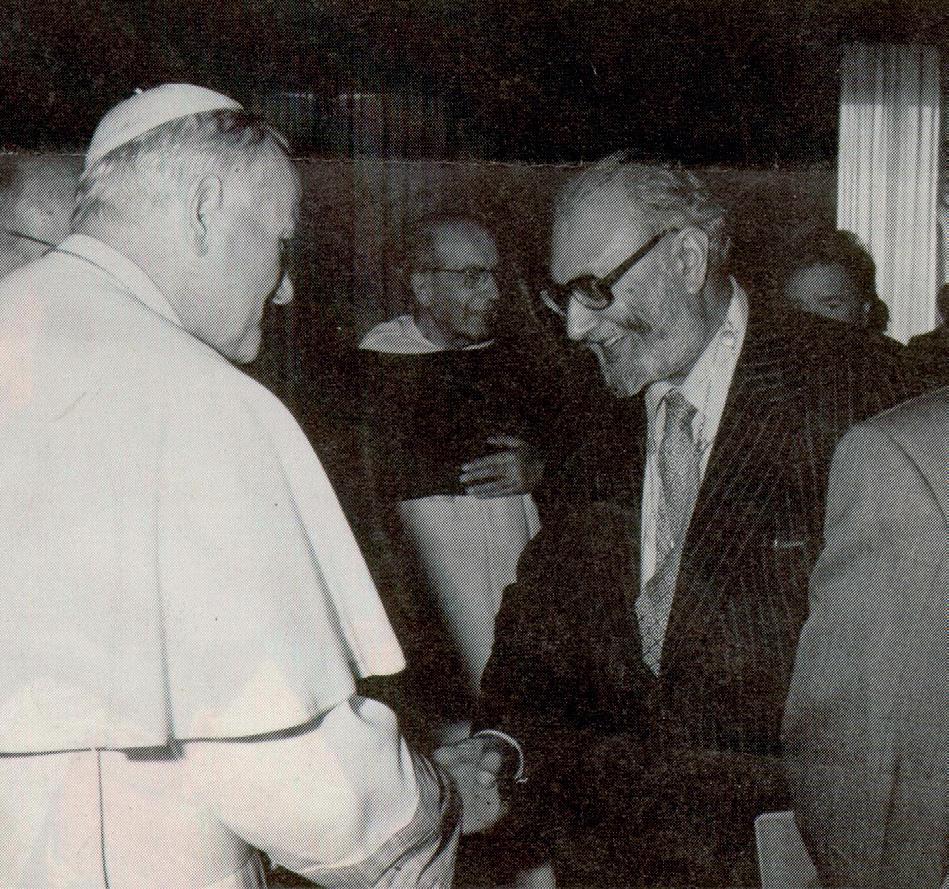
In terms of our Jamaat, so far we have had only one truly outstanding example of an Ahmadi who reached the pinnacle of the scientific world, Dr Abdus Salam Sahib. In all his works, he drew inspiration from the Holy Quran at every step. Today, with the grace of Allah, many Ahmadis are excelling in academia, research and a wide range of professional disciplines. Their work is being recognised by their peers, and their
contributions are having a positive impact in their respective fields.
Yet, there is much further to go. Our Jamaat must seek to produce many more people who, whilst bearing witness to the Glory of Allah, scale the peaks of human knowledge. It was during the time of Hazrat Khalifatul Masih III (rh) that Dr Abdus Salam Sahib won the Nobel prize. Huzoor (rh) himself had a great passion for learning and education, so he launched a scheme urging Ahmadis to excel in science and to strive to follow in the footsteps of Dr Abdus Salam Sahib.
Huzoor (rh) said that achieving this required Ahmadis to relentlessly pursue excellence in their fields whilst also striving to develop an intimate bond with Allah the Almighty. The believer who dismisses Allah’s help and believes his achievements to be a result of his efforts alone shall be guilty of hypocrisy. Hence, to succeed, a believer must act upon Allah’s commands and combine this with hard work and sincere prayer.
If an Ahmadi pursues knowledge in this way, they will witness Allah’s blessings rain down on them, and they will be granted success after success.
Regarding the pursuit of knowledge, the Promised Messiah (as) stated that some religious clerics believed that science led people away from God. The Promised Messiah (as) rejected this opinion categorically and said that human
knowledge and enlightenment emanate from Allah, and hence, there is no reason to fear scientific discoveries. He urged his followers to learn modern sciences and affirmed that rationality and reason were entirely in keeping with the teachings of Islam.
The Promised Messiah (as) taught that believers should acquire scientific knowledge and not harbour any sort of anxiety or inferiority in this regard, explaining that reason and knowledge descended from Heaven as a form of spiritual light. He gave the example that when rain falls from Heaven, its effect depends on the soil it lands upon – if it falls on fertile ground, the earth benefits and produces fragrant flowers and rich crops. If it drops upon barren land, there is no result. The same is true, the Promised Messiah (as) said, with human intelligence. If a person sincerely believes Allah to be the Creator of the worlds and seeks to sincerely understand his creation, then Allah opens their minds in a way that enables them to surpass others. Their minds become a fertile ground.
The Promised Messiah (as) refuted those clerics who said science was dangerous and to be shunned, describing the souls of such clerics as trembling in the face of philosophy and modern research. They feared science because they did not understand it, nor did they possess the wisdom to know that it went hand in hand with the teachings of Islam. Hence, the Promised Messiah
(as) urged his followers not only to pursue scientific knowledge but to harness their discoveries in support of Islam and to prove its truth.
This is a great challenge for all waqifeene-nau. Whereas atheists try to use science to disprove the existence of God, it is your duty to use it to prove His existence. Seek to dismantle the allegations laid against religion through the power of reason and rationality.
Regardless of your chosen path, you must strive to achieve its pinnacle. Thereafter, whenever you achieve success or make a breakthrough, proclaim to the world that the knowledge you gained was inspired by the Word of God, and that the practical manifestation of Allah’s teachings is revealed through science, nature and the world around us.
At the same time, never let the pursuit of knowledge breed arrogance or take you away from your faith. The Promised Messiah (as) warned that some people become so infatuated by their knowledge that instead of getting closer to Allah, they join the ranks of those who believe science and religion oppose one another. As a result, they focus purely on secular knowledge and distance themselves from God. Therefore, as waqf-e-nau, you must heed this warning and remain vigilant from all forms of pride.
Crucially, you must never miss any of the five daily prayers. You must read and study the Holy Quran on a daily basis, as
well as read the books of the Promised Messiah (as) and other religious books. Moreover, the Promised Messiah (as) said we must adopt the highest moral standards within our homes. Thus, treat your family with love and compassion, and ensure that such an atmosphere remains in your home at all times.
Huzoor (aa) said that as the Ijtema draws to a close, he wishes to conclude by reminding us that the Promised Messiah (as) taught us that the key to attaining all forms of success and prosperity is righteousness. Strive to adopt this by acting in accordance with the commands of Allah at all times. Only then will we gain the nearness of Allah and the rewards and blessings of our faith. Only then will our homes be content, only then will we become true role models, and only then will we do justice to the pledge of waqf-e-nau
At the end, Huzoor (aa) prayed: May Allah the Almighty enable you to understand what I have said, and may you act upon it so that you fulfil the purpose of your lives and guide others towards Allah the Almighty. May you all prove to be a source of lasting benefit for all of mankind, and may you fulfil the demands of being a waqf-e-nau and serve the cause of Islam Ahmadiyyat with the utmost distinction throughout your lives. Amin.
Hazrat Amirul Momineen (aa) then led everyone in silent prayer.
From the markaz
True peace and contentment lie in the nearness of Allah: Huzoor’s address to waqifaat-e-nau at UK Ijtema 2026
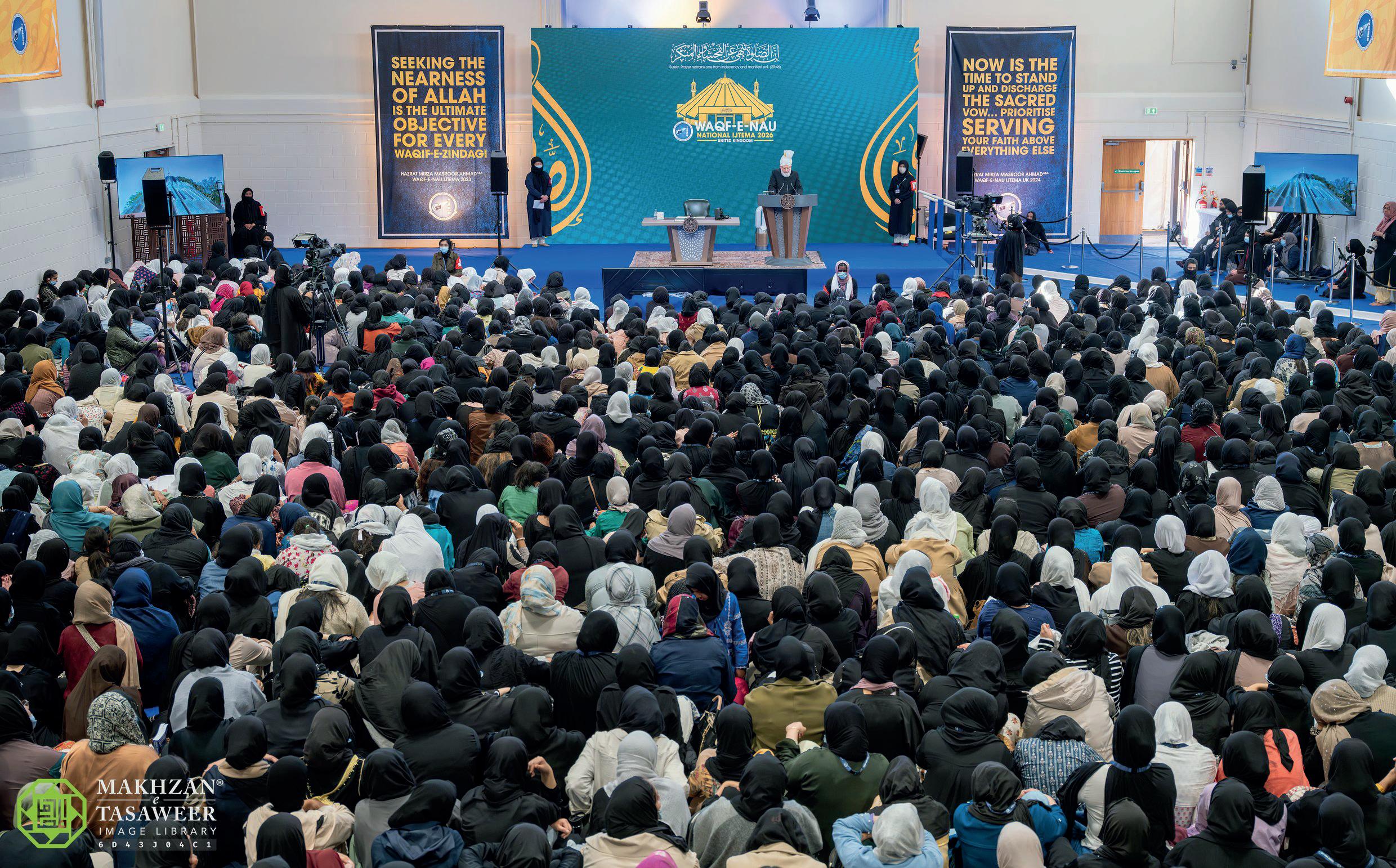
On Saturday, 25 April 2026, shortly after 5pm local time, Hazrat Mirza Masroor Ahmad, Khalifatul Masih V, may Allah be his Helper, presided over the UK Waqifaate-Nau Ijtema 2026, at Islamabad, Tilford, UK.
After conveying assalamu alaikum, Huzoor (aa) invited Sajeelah-Noor Teyeeb Sahiba to recite a portion of the Holy Quran – Surah Aal-e-‘Imran, verses 36-37. Mashel Chaudhry Sahiba then presented the English translation of these verses. Aylah Uddin Sahiba subsequently recited an Urdu poem composed by Hazrat Musleh-e-Maud (ra), followed by its English translation presented by Baariah Tahir Sahiba.
Hazrat Amirul Momineen (aa) then invited the Muavina Sadr Waqifaat-eNau UK to present the Ijtema report. She expressed her gratitude to Huzoor (aa) for gracing the occasion with his esteemed presence. Huzoor (aa) was apprised of the various workshops and activities conducted throughout the Ijtema, all aimed at enhancing the spiritual development and religious understanding of waqifaat-e-nau The theme of this year’s Ijtema was “Salat –The Pillar of our Faith.” She further reported that this year’s Ijtema was attended by 1,700 participants, reflecting an increase of 321 from last year’s attendance.
Huzoor (aa) then took to the podium and, after reciting the tashahhud and ta‘awwuz, Hazrat Amirul Momineen (aa) commenced his address. A brief summary of this address is presented below:
By the grace of Allah, nearly 40 years have passed since Waqf-e-Nau scheme was launched. Many of you are now in their 20s or 30s, and many have become mothers to a new generation.
Now an even greater responsibility rests upon your shoulders. You should not only live up to your pledge and act according to Islamic teachings, but you must also ensure the moral and religious upbringing of your children.
Although this is the duty of both parents, mothers generally spend more time with their children; thus, the responsibility upon them is greater.
Role of
in shaping the future
As waqifaat-e-nau, you must continually strive to elevate your spiritual and moral standards, while also guiding your children so that they may become pious, excellent and beneficial members of society. In this way, you will play your part in safeguarding the future prosperity of the Jamaat.
Those who have grown up here and benefited from the educational system have attained a higher level of education than their mothers or grandmothers. This blessing carries with it a profound responsibility – that you must harness your knowledge and the opportunities you have received to enlighten and guide your children.
Strengthening faith within the home
You must empower your children to navigate the challenges of the present age while remaining anchoured to Islamic teachings. Sadly, many mothers write expressing their heartbreak that, as their children pass through adolescence, they begin to drift away from the faith and fail to maintain a close bond with the Jamaat.
Thus, keeping your children attached to their faith is your foremost responsibility. For
this, you must ensure that your own bond with Allah the Almighty is unshakeable.
Offer salat with devotion and sincerity, and immerse yourself in the timeless wisdom of the Holy Quran. If your conduct is a living testament to your love for Allah and conviction in the truth of Islam, your children will naturally learn from your example.
Challenges in the West
Unfortunately, among those who have migrated to Western countries, this spiritual focus is often lacking. Rather than strengthening their bond with Allah, many become more concerned with attaining worldly rights.
Such frustrations often surface after marriage when domestic challenges arise. While genuine hardships and injustices must be addressed, you must never allow personal trials to eclipse your commitment to your faith. Your priority must be to cultivate a deep bond with Allah and instil a lasting love for Him in the hearts of your children.
Importance of religious knowledge
You must help your children acquire religious knowledge. Indeed, most of you –whether mothers, young adults or teenagers
– must realise that attaining religious knowledge is fundamental to safeguarding your faith and that of future generations.
Do not imagine that tabligh is a duty reserved only for men. Islamic history testifies that, from the very beginning, Muslim women made monumental sacrifices for their faith. The example of Hazrat Aisha (ra) is often cited, as the Holy Prophet (sa) declared that half of faith can be learnt from her. Many companions, including men, sat before her to learn about Islam.
Defending Islam and addressing allegations
Thus, to take on this responsibility, women are required to speak and attend public events. As waqifaat-e-nau, you should strive to increase your religious knowledge in order to respond to baseless allegations raised against Islam.
One such allegation is that Islam denies rights to women. With full conviction, you should be able to respond that Islam recognised and granted rights to women many centuries before the modern world acknowledged them even to a limited degree. You should be at the forefront of defending Islam and illuminating mankind with its noble teachings.
Huzoor (aa) noted that, in the UK and elsewhere, Ahmadi women have effectively presented Islam with eloquence and clarity, leaving critics who falsely claim that Islam oppresses women silenced.
Purdah and public engagement
While observing purdah, Ahmadi women can present Islam’s true teachings and address allegations. Hazrat Musleh-eMaud (ra), during his Khilafat, explained that women can defend Islam before men or in a public setting. He also gave the example of Hazrat Aisha (ra).
True concept of women’s rights
In recent times, the world has witnessed how, under the guise of freedom, certain Western powers have waged wars in which countless defenceless women have been killed or decimated, and their schools and
waqifaat-e-nau
institutions destroyed. Is this what is meant by granting rights to women?
From the outset, Islam unequivocally enshrined the principle of equality between men and women. No Ahmadi girl or woman should harbour any doubt – embrace your identity as a Muslim woman and recognise your God-given value.
Allah has prescribed certain roles for men and women according to human nature, yet ensured that their rights remain equal and just. In Islamic teachings, gender confers no superiority.
Islamic teachings on equality
Islam provides remarkable detail regarding equality. For example, the Holy Quran teaches that weaning a child is a mutual decision between husband and wife; it is not permissible for the husband alone or his family to dictate this matter.
Islam has also stipulated haq mahr [dowry] as a fundamental right to preserve the dignity and honour of women.
Similarly, the claim that Islam confines women to the home is utterly false. Women may pursue various professions, provided they observe purdah.
Mission of waqifaat-e-nau
Thus, as waqifaat-e-nau, it is your mission to enlighten mankind and convey these teachings to those unaware of them. Many of you are capable of addressing allegations against Islam; therefore, you should strive to increase your religious knowledge.
The best way to learn about Islam is to
study the Holy Quran. Through it, you will understand your spiritual, civic and social responsibilities, and learn how best to fulfil your roles in society and family life.
Balancing education and faith
Many Ahmadi girls have attained higher education. Alongside your studies and careers, you must allocate time for religious learning. Only then will you truly embody the spirit of Waqf-e-Nau and be able to guide your children effectively.
Patience in family life
You should always act with patience and prayer. Domestic challenges may arise – for example, when a husband fails to fulfil his responsibilities. While addressing such issues, give precedence to faith over worldly matters and strive to resolve matters amicably with patience and trust in Allah. Always safeguard your family unit and prioritise the moral and spiritual upbringing of your children.
Sincerity and sacrifice
Every Ahmadi woman, especially waqifaat-e-nau, should exhibit humility. Whether performing duties or good deeds, never seek praise from others; rather, act solely to attain the pleasure of Allah.
At the heart of your waqf lies sacrifice. Fulfilling the obligations of worship is paramount. By prioritising faith, you will, insha-Allah, bequeath a legacy of piety, high morals and strong faith to future generations.
A higher purpose
Never forget that you have been born with a grand purpose – to lead the world back to its Creator. If people claim that you are restricted by your faith, prove them wrong. Show them your strength and declare confidently that you are liberated from materialism and moral decline.
Never underestimate yourself; strive to ignite a spiritual and moral revolution that transforms the world into a place of peace, love and prosperity. This is the jihad of our time.
Examples from history
History shows that women have always been at the forefront of sacrifice for their faith. For example, the Gospel of Matthew in the Bible records how women followers of Prophet Jesus (as) courageously went to his tomb after the crucifixion, while many male disciples remained in hiding. Their devotion and courage were exemplary.
Similarly, throughout Islamic history, countless women have made sacrifices for their faith. The scholarly contributions of Hazrat Aisha (ra) are well known, and many women served Islam in various capacities, including caring for the wounded during battles.
The duty waqifaat-e-nau
Now it is your duty to follow in their footsteps and be ready to make every sacrifice for your faith. This is the responsibility of every Ahmadi woman, especially those who have devoted their lives as waqifaat-e-nau
Alongside secular education, strive to increase your religious knowledge by studying the Holy Quran, its commentaries and the writings of the Promised Messiah (as) and the Khulafa.
Guidance for nasirat
For the younger girls – the nasirat – you should also strive to excel in your studies and remain firm in your faith. You should never feel embarrassed about your religion. If you are ever mocked for observing modest clothing, you may respond that others are free to mock as they wish, but they cannot weaken your beliefs or your religious practice. Explain to them that you have a higher purpose – to stand against the moral decline of the world and to bridge the gap between humanity and Allah the Almighty.
Be confident in yourself and in your identity. True peace and contentment lie in the nearness of Allah the Almighty, and to attain this, you must fulfil His rights as well as your duties towards humanity.
Prayer
Towards the end, Huzoor (aa) prayed: May Allah the Almighty enable all of you to fulfil the pledge you have made to your faith throughout your lives. May you become those whose noble and righteous qualities manifest the truth and beauty of Islam for the world to see. Amin
Hazrat Amirul Momineen (aa) then led everyone in silent prayer.
(Summary prepared by Al Hakam)
Answers to Everyday Issues
Divine guidance for extraterrestrial life, Jumu‘ah with two people, artificial hair, kufr, nifaq and fisq
Guidance regarding basic Islamic issues that Hazrat Amirul Momineen, Khalifatul Masih Vaa, has given on various occasions in his written correspondence and during MTA programmes is being published officially below for everyone’s benefit.
that there is no other system beyond this heaven and earth. On the contrary, our God affirms that He is Rabb-ul-‘Alamin [Lord of all the worlds]; meaning that He is the Lord of all worlds and that wherever any population exists, there He has verily sent Messengers. Absence of knowledge does not necessarily imply absence of existence. Why wouldn’t the God who created such vast provision for this lone little tiny earth, have created any provision for all the other inhabitations? He is equally the Lord of all and aware of the needs of all.’ (Ibid.)”
Can a husband and wife pray Jumuah together at home?
Someone from Egypt forwarded an individual’s question to Hazrat Amirul Momineen, Khalifatul Masih V (aa), stating that no other Ahmadi resides near them. Can he, therefore, offer the Jumuah prayer at home with his wife? If he can, who will call the azan and who will call the iqamah? Huzoor-e-Anwar (aa), in his letter dated 4 December 2023, gave the following reply to this question:
Is there divine guidance for extraterrestrial life too?
Someone from Germany wrote to Hazrat Amirul Momineen, Khalifatul Masih V (aa), asking: If there are other worlds as well, then what religion would there be for those other worlds? Would there be more than one Muhammad, peace and blessings of Allah be upon him, and would there be different versions of the Holy Quran? In that case, should it not have been stated in the Holy Quran that Allah the Almighty would safeguard every version of the Quran?
“Huzoor-e-Anwar (aa), in his letter dated 2 December 2023, granted the following guidance regarding this question:
“Allah the Exalted states in the Holy Quran:
command comes down in their midst, that you may know that Allah has power over all things and that Allah encompasses all things in [His] knowledge.’ (Surah at-Talaq, Ch.65: V.13)
“‘Allah is He Who created seven heavens and of the earth the like thereof. The [divine]
“From this Quranic verse, it is clear that Allah the Exalted has, throughout His vast universe, sent down commands everywhere exactly in accordance with what was required there and under these commands the order of the universe continues to function. Upon this earth, Allah the Exalted also created human beings and for their reformation and guidance, He instituted, in this world, the chain of Prophets. Thus, our belief is that only those human beings are subject to the obligations of this system of divine law to whom the message of such laws has been conveyed. If, apart from this earth, there are other such worlds inhabited by beings like the people of this earth, then, until the message of our Sharia reaches them, they are not subject to its obligations. And if Allah the Exalted has granted them some other sharia, then they will certainly be subject to that. What the sharias granted
to them are like or who the Prophets sent to them may be, is known only to Allah the Exalted. However, once contact is established with the inhabitants of those worlds and we convey to them the message of this Sharia of Allah the Exalted, then they too will become subject to its obligations and this teaching and this Messenger (sa) will also be applicable to them and worthy of emulation.
“As yet, aliens exist only in stories and it is the people of this earth who are searching for them. As far as their side is concerned, no contact with us has yet been established.
“An English professor, Mr Wragge, submitted to the Promised Messiah (as):
“‘This issue is beyond my comprehension: When God has created billions of other [celestial] systems apart from this earth with which we are connected, why restrict the powers and favours of God Almighty to this earth alone?’ (Malfuzat, 2022, Vol. 10, p. 309)
“To this, the Promised Messiah (as) replied:
“‘This is not our belief. We do not assert
“As you have described that no other Ahmadi resides near them, this is in itself an extenuating circumstance in which both the husband and wife can jointly offer the Friday prayer. However, in this scenario, as mentioned in the ahadith, the husband will stand in the front row as the imam and the wife will stand in the back row. (Sunan an-Nasa’i, Kitab al-imamah, Bab mawqifi l-imami idha kaana ma‘ahu sabiyyun wa imra’ah)
“A similar question of law was presented in the august presence of the Promised Messiah (as): if only two Ahmadis are present in a village, should they nevertheless offer the Jumuah prayer or should they not?
“[The Promised Messiah (as)] addressed Maulvi Muhammad Ahsan Sahib, who submitted, ‘Two persons suffice to constitute a congregation; therefore, the Jumuah prayer too may validly be offered.’
“[The Promised Messiah (as) then said, ‘Yes, they should offer it. The jurists have stipulated three persons. If someone is alone, he may complete the required number by having his wife, or another [person], stand behind him.’ (Badr, No. 11, Vol. 6, 14 March 1907, p. 5)
“As far as calling the azan is concerned, prayer used to be offered even before the practice of calling the azan had commenced. Thus, if all the people who intend to pray are already present, there is no harm if the azan is not called. Hazrat Musleh-e-Maud (ra)
Image: Shiasun/Wikimedia
was asked whether the azan is necessary for a congregation. He stated:
“‘Yes, the azan should be called. However, if those who are to join the congregation are already present there, there is no harm if the azan is not called. People have expressed various views regarding this. But I was once travelling to Gurdaspur with Hazrat Sahib [i.e., the Promised Messiah (as)]. Along the way, the time for prayer arrived. It was asked, “Should the azan be called?” He replied, “The friends are already gathered. What is the need?” Therefore, if such a situation arises, the azan need not be called. Otherwise, calling the azan is necessary because it prompts others to pray as well.’ (Al Fazl, Qadian, 19 January 1922, No. 56, Vol. 9, p. 8)
“Thus, in the scenario you have described, there is no need to call the azan Furthermore, a woman will not call the iqamah either, even if the prayer is being offered at home, because the Holy Prophet (sa) did not permit this. (As-Sunan al-Kubra by al-Bayhaqi, Kitab as-salat, Bab laysa ‘ala n-nisa’i adhanun wa la iqamah)
“It is also recorded regarding the Promised Messiah (as) that when he would offer prayer at home due to some constraint and out of necessity had Hazrat Amma Jan (ra) stand alongside him in prayer [because the Promised Messiah (as) would sometimes experience dizziness while standing, therefore he would have Hazrat Amma Jan (ra) stand alongside him in prayer] (Siratul-Mahdi, Vol. 1, Narration No. 696, p. 636), it is nowhere mentioned that he instructed Hazrat Amma Jan (ra) to call the iqamah Therefore, the man will call the iqamah himself. It is also mentioned in the hadith regarding the iqamah that, where necessary, the imam can call it himself. (Jami‘ atTirmidhi, Kitab as-salat, Bab ma ja’a fi s-salati ‘ala d-dabbati fi t-tini wa l-matar)”
What is the difference between a fasiq, a kafir and a munafiq?
A lady from Rabwah, Pakistan, wrote to Hazrat Amirul Momineen, Khalifatul Masih V (aa), asking what the difference is between a kafir [disbeliever], a munafiq [hypocrite] and a fasiq [transgressor]. In one place, the Holy Quran states that the kafir are in fact munafiq and in another place it states that the munafiq are themselves fasiq. The distinction between these terms is not clear to me. Guidance is requested.
Huzoor-e-Anwar (aa), in his letter dated 5 December 2023, gave the following reply:
“From the lexical point of view, the root of kufr [disbelief/denial] is kaf-fa-ra and in Arabic usage this root fundamentally conveys the sense of concealing or covering something over. Thus, when a soldier conceals their coat of mail beneath a garment or the like, the Arabs say,
, meaning that they concealed their armour. By the same semantic association, a farmer, too, has been called a kafir, because they also hide the seed within the earth. Accordingly, the notion of concealment is found in most of the derivatives formed from this root.
“In technical religious usage, kufr signifies that, after having recognised something, a person still refuses to accept it, rejects it and denies it, just as Allah the Exalted states in the Holy Quran:
“‘And when there came to them a Book from Allah, fulfilling that which is with them – and before that they had prayed for victory over the disbelievers – yet when there came to them that which they knew, they rejected it. The curse of Allah be on the disbelievers.’ (Surah al-Baqarah, Ch.2: V.90)
“Here too, because those who deny the truth draw a veil over it after having come to know it, the word kufr has been used in reference to them.
“Likewise, one of the meanings of kufr is to declare oneself dissociated from a matter or from a person and to claim freedom from responsibility in relation to it, as the Holy Quran states:
they regarded coming to the Holy Prophet (sa) and obeying him as a humiliation of their chieftainship; and for them, it was their pride and sense of superiority that served as the veil and became the cause of their kufr.’ (Khutbat-e-Nur, Friday sermon of 10 April 1908, p. 328)
“Hazrat Khalifatul Masih II (ra), while setting forth the categories of kufr in its technical sense, states:
“‘Kufr is of two kinds: one by which a person is expelled from the millah [religious community] and the other by which they are not expelled from the millah. Denial of the Islamic declaration of faith constitutes the first kind of kufr. The second kind of kufr arises from doctrinal errors of a lesser degree.’ (Tahqiqati ‘Adalat Mein Hazrat Imam Jamaat Ahmadiyya ka Bayan, Anwarul-Ulum, Vol. 24, p. 363)
will be applied to them.”
Is it haram for Muslim women to wear hair extensions?
A lady from Tanzania quoted various ahadith and, in light of them, sought guidance from Hazrat Amirul Momineen, Khalifatul Masih V (aa), regarding the prohibition of women wearing artificial hair.
Huzoor-e-Anwar (aa), in his letter dated 12 December 2023, gave the following guidance regarding this issue:
“It is correct that in the ahadith there is a prohibition regarding women having artificial hair attached to their hair solely for the sake of beautification. (Sahih al-Bukhari, Kitab al-libas, Bab al-mutafallijati li l-husn)
“‘And he said, “Verily you have taken for yourselves idols beside Allah, out of love for each other in the present life. Then on the Day of Resurrection, you will deny each other and curse each other. And your abode will be the Fire; and you will have no helpers.”’ (Surah al-‘Ankabut, Ch.29: V.26)
“Thus, the semantic range of kafir includes one who conceals something, one who denies it, one who rejects it, one who refuses to acknowledge it and one who declares oneself absolved of it.
“Hazrat Khalifatul Masih I (ra), while elucidating the word kafir, states:
“‘The word kafir in the Arabic idiom was not such that calling someone a kafir was tantamount to setting the world ablaze, as it has become in our country. Since those people were native speakers, they fully understood that one who does not accept another’s statement is, in that respect, their kafir; and since we do not accept what you say, you therefore address us in this manner. In the Holy Quran, kufr has even been mentioned as an attribute of Muslims themselves, where Allah states
[he rejects those who hinder people from following the right path]. (Surah al-Baqarah, Ch.2: V.258) This shows that kufr may also be an attribute of a Muslim. But nowadays, in our country, the word has come to be used in the most incorrect and indeed the most dangerous way. Someone calls another a kafir and the two are at once at each other’s throats.
“‘In reality, the word kafir was not intended to wound anyone’s feelings; rather, it was simply the expression and description of an actual state of affairs. Those people would readily accept this term and mode of address.
“‘
means: O ye kafirs! Be alert and listen carefully to what I say.
means: I do not submit to those idols, those notions, those customs and usages and those conjectures to which you submit.
“‘Most of those people were, in fact, immersed in the worship of customs, habits, idols, conjectures and vain suppositions. There were, of course, some among them who were atheists, but the greater part belonged to the former category. They acknowledged God as the Supreme God and did not deny His existence. There were also some kafirs who believed in God and remained apart from idols. Nor had they become ensnared in customary usages. Yet
“The meanings of fasiq include one who is disobedient and sinful and one who deviates from the path of truth. Likewise, a fasiq is also one who, despite being a Muslim, does not obey Allah and commits major sins or persists obstinately in minor sins. Hazrat Musleh-e-Maud (ra), while explaining this word, states:
“The meanings of fasiq are: one who rejects the command of Allah the Almighty and one who departs from the straight path. The word fasiq is most commonly used for a person who at first observes the injunctions of the Sharia and acknowledges them to be true and binding, but thereafter abandons all or some of the injunctions of the Sharia.
“Thus, the meanings of fasiq are: 1. Disobedient. 2. One who abandons and rejects the command of Allah the Almighty. 3. One who accepts the truth and then forsakes it.’ (Abridged from Tafsir-e-Kabir, Vol. 1, UK: 2023, p. 374)
The word munafiq is used for a person who verbally claims to be a Muslim, but inwardly denies Islam. In the hadith, the signs of a hypocrite are stated to be these: when they speak, they lie; when they make a promise, they break it; when they are entrusted with something, they betray that trust; and when they quarrel, they become abusive. (Sahih al-Bukhari, Kitab al-iman, Bab ‘alamati a-munafiq)
“Hazrat Musleh-e-Maud (ra) states in this regard:
“‘Allah the Almighty has mentioned two groups of hypocrites. […] One class of munafiqin are those who are deniers at heart, yet outwardly profess that they are believers. The second are those who inwardly possess true conviction and belief, but out of fear of people, they do not make it manifest and lack the strength to act accordingly. They become overcome with anxiety through fear of people. Out of fear for their property and their lives, they are unable to profess their faith openly.’ (Khutbat-e-Mahmud, Friday sermon of 20 February 1914, delivered at Qadian, Vol. 4, p. 38)
“Thus, in its lexical sense, the word kafir may be applied to both a Muslim and a nonMuslim. In its technical sense, however, it applies to one who denies God Almighty, the Holy Prophet (sa) and the other Prophets sent by God Almighty. Furthermore, a kafir may also be a fasiq and a Muslim too may be a fasiq. Likewise, the word munafiq may also be used for both a Muslim and a kafir. In reality, all these terms denote different states of the human being. Whatever the condition of a person may be, the corresponding term
“If these ahadith are considered authentic, then one reason underlying this prohibition is that during the time of the Holy Prophet (sa), sexual immorality was rife among the Jews and centres of vice also existed in Medina. The women involved in such vice would resort to ploys of this kind in order to attain beauty and then attract men towards themselves. For this reason, Allah’s Messenger (sa) expounded upon the abomination of these acts and forbade believing women from engaging in such practices.
“Whilst clarifying the prohibition mentioned in a hadith of this nature, Hazrat Aisha (ra) states that al-wasilah [the woman who attaches hair extensions] does not mean the woman you perceive it to mean. For there is no harm if a woman has very little hair, so thin that the skin of her scalp is visible and she attaches braids of black wool or a plait to her hair. Remember, such a woman is by no means an al-wasilah In reality, an al-wasilah is one who was a prostitute in her youth and when she grows old, she attaches a plait to her head to work as a procurer. [Because of her old age] no client comes to her. And [if any old client comes to her] both of them [this woman and her client] are introduced to one another due to this immorality. (Kitab ad-Du‘afa al-Kabir by Al-Uqayli, Bab ash-shin, Hadith 717)
“Thus, the fundamental principle is that it is not forbidden for a person to adopt any lawful means for their beauty while remaining within the permissible limits. Hence, it is mentioned in a hadith that a person asked, ‘Allah the Almighty has granted me beauty and I too like to remain beautiful and I desire that my clothes be fine and my shoes be fine; does this amount to arrogance?’ Upon this, the Holy Prophet (sa) replied that this was not arrogance and further stated:
“‘Allah is most Beautiful and loves beauty.’ (Sahih Muslim, Kitab al-iman, Bab tahrimi l-kibri wa bayanih)
“Similarly, the ahadith mention that when women were married, they too would be prepared, adorned and made beautiful according to the custom of that time. (Sahih al-Bukhari, Kitab al-hibah wa fadliha wa t-tahridi ‘alaiha, Bab al-isti‘arah li l-‘arusi ‘inda l-bina’; Fath al-Bari Sharh Sahih alBukhari, Kitab an-nikah, Bab isti‘arati ththiyabi li l-‘arusi wa ghairiha)”
(Compiled by Zaheer Ahmad Khan, Head of Records Department, Private Secretariat, London and translated by Al Hakam)
From the markaz
Excel in your fields and turn the world towards Allah: German khuddam students meet Huzoor
Islamabad, Tilford, UK, 18 April 2026: Students from Majlis Khuddam-ulAhmadiyya Germany were blessed with a mulaqat with Hazrat Mirza Masroor Ahmad, Khalifatul Masih V (aa).
During the mulaqat, the students had the opportunity to seek guidance from Huzoor (aa) on matters relating to military service, global conflict, hijrah, preaching in Europe, Wasiyyat, the tarbiyat of children, spiritual decline, education, career choices and trust in Allah.
Compulsory military service, loyalty to one’s country and the reality of modern wars
A question was asked regarding what khuddam should do if, in a state of war, a government compels men to defend the country, even though such wars may be the result of the government’s own past mistakes.
Huzoor (aa) explained that as long as a person lives in a country, loyalty to that country and obedience to its laws require that, if military service is compulsory, one should take part in it. If a person cannot do so, then the other option is to leave the country. Huzoor (aa) said that these are the two possible courses in such circumstances.
Huzoor (aa) then spoke about the nature of wars taking place in the world today. He said that such wars are not being fought for any noble purpose but are generally driven by greed, the desire to seize the resources of others or the wish to keep other nations suppressed. He referred to policies of powerful countries and regional powers and mentioned how territorial ambitions and the desire to control oil, uranium and other resources have fuelled conflicts. Huzoor (aa) said:
“This is the policy of America; this
is the policy of Israel. The Israelis seek to expand their territories. For instance, they have occupied a large area of Lebanon and now they say that even if there is a ceasefire, they will not relinquish it. Similarly, there are other regions such as the Golan Heights and areas in Syria and Jordan that have been occupied. All of this stems from greed, which is the root cause of these wars. And as for Mr Trump in America, he seeks control over Iran’s resources – its uranium and oil. His stance is essentially: ‘Let us have these resources and then do as you wish.’”
Huzoor (aa) also referred to wars and unrest in various Muslim and African countries, observing that vested interests and the desire to control resources lie behind many of these conflicts.
Huzoor (aa) said that the Holy Quran teaches that one should not look greedily at the resources and wealth of others. (Surah al-Hijr, Ch.15: V.89)
He explained that where one lives in such countries, one must either fulfil the legal obligations of that country or leave. At the same time, Ahmadis should try to make people understand that such wars bring no benefit and only lead the world towards destruction.
Huzoor (aa) said that the First World War and the Second World War also demonstrated this reality and that in the present age, too, there is a severe lack of justice.
Tahrik-e-Jadid, Wasiyyat and the establishment of a new order
A question was then asked about the new order mentioned by Hazrat Musleh-e-Maud (ra) and whether the system connected with Wasiyyat and Tahrik-e-Jadid would begin after a future war.
Huzoor (aa) explained that Nizam-e-
Nau refers to a new economic and social order for the world in which systems such as capitalism, socialism and other economic structures have been discussed. He said that Tahrik-e-Jadid was described as a precursor to the system of Wasiyyat, as it develops the habit of sacrifice among members of the Jamaat. Through smaller financial sacrifices, members become accustomed to giving in the way of Allah and this then creates within them a desire and readiness for the greater sacrifice required under the system of Wasiyyat.
Huzoor (aa) said that in Tahrik-e-Jadid, the financial sacrifice is comparatively small, whereas under Wasiyyat, a person may give a larger portion of their income and property, up to one-third. He explained that smaller sacrifices prepare a person for larger sacrifices and cultivate the spirit needed to take part in the wider system.
Huzoor (aa) further said that the system of Wasiyyat is a vast and strong system. It is not merely a financial arrangement; rather, it is a system that cares for widows and orphans, supports the propagation of Islam and enables service to humanity. Through its financial system, the arrangements for tabligh, literature, missionaries, schools, hospitals and other humanitarian projects can be strengthened.
Huzoor (aa) said that the question was not whether this system would begin before or after a war. He reminded the youth that he had been urging members for many years to enter the system of Wasiyyat, even when people did not necessarily see the possibility of major wars, though he had repeatedly warned that wars could take place. The matter, therefore, is not tied to war itself, but to the level of one’s faith.
Huzoor (aa) explained that if a person has accepted the Promised Messiah (as) in order to fulfil his mission, then they must understand what that mission was: to bring people closer to Allah and to fulfil the rights of His creation. The system of Wasiyyat serves both purposes. The more faith increases among Ahmadis, the sooner this system will become established in practice. He added that if the world is broken after war and this system is established, then those who survive and possess resources will be able to come under this system and help reconstruct the world.
Hijrah, religious freedom and the purpose for which Ahmadis left their homelands
Another student asked, from the Islamic point of view, when it becomes permissible for a racial, religious or ideological group to separate from an existing state [through migration].
Huzoor (aa) replied that the example before Muslims is that of the Holy Prophet (sa). He said that the Holy Prophet (sa) remained in Mecca for 13 years and endured severe persecution. The disbelievers of Mecca opposed Muslims religiously and their social and racial standards were extremely low, including the exploitation of slaves. There was also a vast ideological difference between the Muslims, who believed in the One God and the Meccans, who worshipped idols.
Despite all this, the Holy Prophet (sa) did not wage war against them in Mecca. Earlier, he had permitted some Muslims
to migrate to Abyssinia, but he himself did not migrate until Allah commanded him to do so. When Allah’s command came, he migrated.
Huzoor (aa) said that in the case of a Prophet, Allah directly informs him when the time for migration has come. For others, one has to assess when circumstances have become such that migration is necessary in order to live in peace, free from racial discrimination and with religious freedom.
Huzoor (aa) then applied this to Ahmadis who migrated from Pakistan. He said that they migrated because they lacked religious freedom: they could not give the azan, say salam, recite the kalimah, call themselves Muslims freely or offer prayers without restrictions. For this reason, many migrated to Europe, America and other countries. However, Huzoor (aa) observed that after arriving in the West, many forgot the very purpose for which they had migrated and became absorbed in worldliness. They forgot Allah and His Messenger (sa) and only worldly pursuits remained before them.
Huzoor (aa) said that before expecting Allah’s help, such people should ask themselves whether they had fulfilled the purpose for which they migrated. Those who do fulfil that purpose and remain attached to Allah are rewarded by Him.
Huzoor (aa) explained that hijrah becomes justified when restrictions on religious freedom become severe. He also referred to the Quranic principle that those who are unable to migrate due to a genuine lack of means or closed routes are treated differently by Allah; but where people have the ability and resources to migrate in order to preserve religious freedom, they should do so. (Surah an-Nisa, Ch.4: V.99-101)
Turning to the current global situation, Huzoor (aa) said that the world today is filled with disorder. The Quranic description that corruption has appeared on land and sea applies to the state of the world. (Surah ar-Rum, Ch.30: V.42) In such conditions, he said, the duty of an Ahmadi is to become a person of courage and effort and to bring the world towards Allah with zeal. Since many have already migrated for religious freedom, they should now fulfil the purpose of that migration by working for a spiritual revolution.
Huzoor (aa) said:
“These are, however, secular states that claim to provide religious freedom – for now. But they will only allow that freedom as long as their own interests are not affected. When those interests are impacted, you will face similar treatment here as well. Then you will say, ‘Let us go to Africa or to some other country or to the Far East.’ When such difficult conditions arise, Allah the Almighty says that you should migrate. But then you have to see where in the world you can go. Everywhere there is disorder –‘corruption has spread on land and sea.’ In such conditions, the duty of an Ahmadi is to stand firm like a person of resolve and, with passion, bring the world closer to God and bring about a transformation in the world, rather than saying we should migrate. All countries are now alike in this regard. There is no purely Islamic country, no purely Christian country, neither in Europe, nor in Africa, nor in America. Where will you go? This is the world we have and we must live
in it and adjust within it. So now our task is to bring the world closer to Allah. You have already migrated for that purpose, so fulfil the purpose of that migration. Even now, you can do something.”
Speaking about Palestine with wisdom and working at the grassroots level
A question was asked about the difficulty faced in Germany when discussing the Israel-Palestine war. It was mentioned that politicians and the media often avoid criticism of the Israeli government due to fear of being labelled antisemitic and that critics are often dismissed under that label. The student asked how Ahmadis should convey the message of justice in such an atmosphere.
Huzoor (aa) advised that wisdom requires explaining to the world that what has happened in Palestine is oppression and has nothing to do with antisemitism. He said that references should be sought from those Jews themselves who have spoken against the injustices being committed. He mentioned that there are Jews in America, Europe and even within Israel who openly acknowledge the wrongs that have been done. Such references should be collected and presented so that the point is made through the words of those whom the audience will be more likely to accept.
Huzoor (aa) explained that this is a method of tabligh and public engagement. If Ahmadis simply say that this is what the Holy Quran says, people who do not accept the Quran or Islam may reject it. Therefore, in such circumstances, one should show them the statements of their own people and ask them to reflect on what solution should be adopted.
Huzoor (aa) instructed that efforts should be made in this regard. The youth should read the news, follow relevant material and collect references. He suggested that a social media cell should be established to gather comments and statements from prominent worldly figures and commentators regarding Palestine, Israel, Europe and America. This material could then be used effectively, presenting the words of their own people rather than merely stating what Ahmadis themselves say.
Huzoor (aa) further said that it is not the case that the German people are unaware. Whatever politicians or the chancellor may say, there are many among the German public who speak openly against the Israeli government’s actions and do not fear being labelled antisemitic. Therefore, Ahmadis should go to the public. Huzoor (aa) said that they are not going to convert the chancellor; rather, they should move the masses. When public opinion shifts, change will come of its own accord. He therefore advised the students to work at the grassroots level.
The
tarbiyat
of children begins with self-reform
A question was asked regarding which aspects should be given special attention in the tarbiyat of children in view of the present world situation.
Huzoor (aa) asked what attention would have been given under normal circumstances. When the questioner
mentioned prayer, belief in Allah and studying Islam, Huzoor (aa) said that acting upon the teachings of Islam remains the same in all circumstances.
He explained that the Promised Messiah (as) had stated two great purposes: bringing people closer to Allah and fulfilling the rights of His creation. These are the two objectives upon which the tarbiyat of children should be based.
Huzoor (aa) emphasised that such tarbiyat cannot take place until parents and elders reform their own conduct. If a person quarrels with his wife, relatives or brothers, commits fraud, evades taxes or acts dishonestly, then he cannot properly train his children. He said that if parents reform themselves, the training of their children will also begin to take place naturally.
Huzoor (aa) said that the two essential purposes are attachment to Allah and His Messenger (sa) and the fulfilment of the rights of people. If this tarbiyat is placed firmly in the minds of children, then high moral qualities will also be produced. He referred to a sermon of Hazrat Khalifatul Masih IV (rh) about five fundamental morals and said that all of these are included within the broad and concise principles stated by the Promised Messiah (as). (Friday sermon [Translation], 24 November 1989, The Review of Religions, Vol. LXXXV, No. 1, January 1990, pp. 3-10)
The greatest spiritual disease is forgetting Allah
A student asked what, in Huzoor’s (aa) view, was the most dangerous spiritual disease among today’s youth and what remedy he would prescribe for protection from it.
Huzoor (aa) explained that the worst decline and moral condition existed in the time before the advent of the Holy Prophet (sa), when shirk had spread everywhere, including among Christians and Jews. The Holy Prophet (sa) came with Divine teaching. Thereafter, according to his prophecy, a period of decline came after the first centuries of Islam and then the Promised Messiah (as) was to appear. When the Promised Messiah (as) came, he too said that the world had again fallen into severe decline.
Huzoor (aa) said that the answer to the question lay in the points already being discussed: people have forgotten Allah and forgotten the rights due to His creation. When Allah is forgotten, spiritual disease increases; and when spiritual disease increases, moral decline follows. As a result, fraud, theft, lies and other immoralities spread.
Huzoor (aa) urged the youth to assess themselves. He asked whether they offer all five daily prayers and whether those prayers are offered merely in a hurried manner or with genuine supplication in ruku‘ and sajdah. “Do you also offer two nawafil in addition to the obligatory prayers? Fine, if you do not wish to offer voluntary prayers, do you at least fulfil the obligatory ones properly?” Huzoor (aa) referred to the hadith in which a man came to the Holy Prophet (sa) and asked about the obligations. When the man said he would do no more than the obligations, the Holy Prophet (sa) said that if he fulfilled even those obligations properly, he would enter Paradise. (Sahih al-Bukhari, Kitab az-zakat, Hadith 1397)
Huzoor (aa) said that students should first examine whether they wake for Fajr on time and offer Zuhr, Asr, Maghrib and Isha properly. The five daily prayers create discipline in a person’s life. Once discipline is established, attention turns towards Allah and towards fulfilling the rights of people. This improves spirituality.
Huzoor (aa) explained that people in today’s world have moved away from religion and from God because there is no longer any fear of Allah. An Ahmadi should always keep in mind that Allah is watching. Huzoor (aa) said:
“The greatest system of discipline in Islam is this: that you offer the five daily prayers. When a person becomes disciplined, attention is developed within him towards God and also towards the rights of fellow beings. Spirituality also improves. And for those in the world today who are far from religion and far from God, it is because no fear remains. There is no fear. [...] If one realises that God is watching us, a person would not commit those evils.”
Huzoor (aa) compared this to how people avoid doing wrong when CCTV cameras are present, fearing that their actions may be recorded and seen. Huzoor (aa) said that Allah’s knowledge and observation are not limited like a camera fixed at one angle; Allah is watching from every angle at all times. If a person keeps this thought firmly in mind, spiritual diseases will not take root.
Huzoor (aa) said that many moral evils have become widespread, including drinking, fornication, immoral relationships, wrong friendships, theft and other forms of corruption. These exist not only in Western countries but also in countries such as Pakistan and other Muslim countries. If people truly believe that Allah is watching them, they will avoid such evils. Huzoor (aa) said that this is the remedy.
Students should excel and prepare to help rebuild the world
A question referred to Huzoor’s (aa) guidance that the world has already entered the era of a Third World War and that it may reach its peak in a couple of years. The student asked what effect this would have on students and what advice Huzoor (aa) would give.
Huzoor (aa) advised students to excel in whichever field they are pursuing and to strive to reach the highest level. He said that as the world suffers destruction, students will need to think about how they can help reconstruct it.
Huzoor (aa) said that students should focus on their studies. One effect of war may be that, after students graduate, job opportunities become much scarcer. In such circumstances, they will have to explore different means of livelihood. They may have to enter business, trade or innovate their own forms of employment. He said that they should think about how to create self-generated opportunities and how to progress despite difficult circumstances.
Huzoor (aa) added that not every place will necessarily be affected in the same way. Those who survive will then need to work for the progress of the world. Before that, however, Ahmadis must convey the message to the world.
Prayer,
fear of Allah and avoiding harmful media protect faith in educational environments
A student asked how faith could be strengthened in schools and universities during an age of fitan [pl. of fitnah; i.e., strife or tribulations]. When Huzoor (aa) asked what kind of fitan were meant, the student referred to mixed gatherings and the environment of boys and girls studying together.
Huzoor (aa) asked whether the student himself had remained protected. When the student replied that he had, by praying and offering salat, Huzoor (aa) said that he should tell others the same method.
Huzoor (aa) explained that the five daily prayers should be offered and supplications should be made during them. He referred to the Quranic teaching that prayer restrains one from indecency and manifest evil. (Surah al-Ankabut, Ch.29: V.46) He said this is Allah’s claim and if prayer is offered properly, a person is saved from fitan
Huzoor (aa) said that every Ahmadi, especially students and youth, should remember before every action that Allah is watching them. If they remember this, fulfil the right of worship and act upon the commandments of the Holy Quran, they can protect themselves from fitan and strengthen their faith.
He warned against wasting time watching inappropriate material on television, mobile phones, iPads, tablets and other forms of media. Such habits remove the fear of Allah and cause spirituality to decline. Huzoor (aa) said that the student had shared his own experience that Allah had protected him through prayer; therefore, this same method should be conveyed to others.
Mecca and Medina will be protected and Ahmadis must play their role through prayer
A question was asked about the warning of Hazrat Khalifatul Masih IV (rh) that antiIslamic forces would attempt to conquer Mecca and Medina.
Huzoor (aa) said that such forces do indeed wish to reach Mecca and Medina. He referred to the series of Friday sermons delivered by Hazrat Khalifatul Masih IV (rh) during the Gulf Crisis, which are available in Urdu and English and said that in those sermons it was also stated that such forces would not ultimately succeed.
Huzoor (aa) said that the Promised Messiah (as) had also stated that such people would not be imposed upon true believers. Those sincere Ahmadis who remain attached to the Jamaat, strive to fulfil the mission of the Promised Messiah (as) and act upon the true teachings of Islam, will not be overcome by such forces, nor will Islam be defeated by them.
Huzoor (aa) then referred to the Quranic promise to the Holy Prophet (sa) that Allah would protect him from people and said that this protection continues even after his physical demise. (Surah al-Ma’idah, Ch.5: V. 68) Allah will also safeguard those Muslims who truly follow the teachings of the Holy Prophet (sa) and, insha-Allah, He will protect Mecca and Medina as well. Huzoor (aa) said:
“As far as the person of the Holy Prophet
(sa) is concerned – regarding whether they might despoil Medina or, God forbid, do something to his tomb, etc. – I understand that what Allah the Almighty stated in the Holy Quran to the Holy Prophet (sa) that
(‘Allah will safeguard thee against harm by people.’ [Surah al-Ma’idah, Ch.5: V.68]) – this continues even after his passing. It remains even after his demise.”
Huzoor (aa) said that the role of the Ahmadiyya Muslim Jamaat is to defeat these designs through prayer. Referring to Quranic prophecies concerning the Israelites, he said that those who transgress are removed and that in the latter case, this will not be through weapons or war, but through prayers. (“What does the Quran say about Israel and Palestine?”, www.alhakam. org) The role of Ahmadis is therefore to pray, strengthen their relationship with Allah and increase in spirituality. He said that if Ahmadis establish such a state, then, insha-Allah, they will play the role through which Islam will triumph.
Huzoor (aa) said that the matter ultimately returns to one central point: the relationship with Allah. Allah is the axis around which everything revolves; if one remains attached to Him, everything else will follow.
A teacher’s success lies in their relationship with Allah and good morals
A student training to become a teacher asked how he could preserve his Islamic values while teaching in the Western education system and, at the same time, be a fair and excellent teacher for all his students.
Huzoor (aa) said that the answer is the same for every role: whether as a teacher, student, husband, son, brother, office bearer or member of the Jamaat, the essence is to establish a relationship with Allah and to show good morals.
Huzoor (aa) advised him to read the Holy Quran and its commentary, to understand its commandments and then to act upon them. Once a person acts upon these teachings himself, he can then convey them to others. Huzoor (aa) said that this is the real work of a teacher: first to act oneself and then to guide others.
Huzoor (aa) referred to the following Urdu couplet of Hazrat Musleh-e-Maud (ra) from Kalam-e-Mahmud (p. 184), which expresses that what a student gains is from the wealth of the teacher:
Huzoor (aa) said that the teaching of Ahmadis is the same teaching brought by the Holy Prophet (sa). If one acts upon it, one can become a successful teacher, a successful student and successful in all the roles mentioned.
Tawakkul in career choices requires istikharah, prayer and practical decision-making
A student asked how tawakkul or trust in Allah, can be adopted practically, especially when making difficult career decisions and how one can know whether the right path has been chosen.
Huzoor (aa) explained that one should
not expect revelation or necessarily wait for dreams. When making a decision, one should perform istikharah. He explained that istikharah means seeking goodness from Allah. One should pray that if a matter is better, Allah may create ease and facility in it; and if it is not better, Allah may place obstacles in the way and create unease in the heart.
Huzoor (aa) said that if the heart becomes content and inclined towards a course of action after prayer, one should place trust in Allah and proceed and Allah will bring good results from it. If, however, the heart does not find peace after praying regularly, including offering two nawafil daily for at least 40 days, then one should leave that matter and pray that Allah enables one to pursue what is better.
Huzoor (aa) said that sometimes people have several options and write, asking which they should choose. If he feels they are sincere in seeking advice and will act upon it, he sometimes advises them to choose a particular field and by Allah’s grace, they often find success. However, he said that people can also make such decisions themselves by praying to Allah and asking Him to guide them. If one option is better, Allah opens the heart towards it; and if it is not, He turns the heart elsewhere. One should then adopt that path with tawakkul Huzoor (aa) clarified that tawakkul does not mean waiting for a dream or revelation. Rather, one should pray, seek Allah’s help, observe where the heart is opened and then proceed with trust in Allah.
Higher education should produce humility and benefit humanity
The final question asked about the spiritual importance of acquiring the highest forms of knowledge.
Huzoor (aa) said that from a spiritual point of view, acquiring knowledge is a good thing. Allah has instructed believers to seek knowledge and there is a saying that knowledge should be pursued throughout one’s life. Therefore, a person should always continue acquiring knowledge.
However, Huzoor (aa) warned that if knowledge becomes a cause of pride or arrogance, then it is no longer true knowledge, but a form of ignorance. A person should acquire knowledge and then develop humility within himself. When humility is produced, that knowledge becomes beneficial.
Huzoor (aa) said that such a person will then share knowledge with others in a humble manner so that others may also benefit from what he has gained. Knowledge acquired in this way improves a person’s moral values; and when moral values improve, the fear of Allah also develops. Huzoor (aa) explained that spirituality and moral conduct are connected with one another. A person should therefore pray that Allah may increase his knowledge so that he may benefit from it himself and also benefit humanity. In this way, spirituality also increases.
Conclusion
At the conclusion of the mulaqat, the students had the opportunity to have a group photograph with Huzoor (aa), after which the mulaqat came to an end.
(Summary prepared by Al Hakam)
form the
The five ‘abrogated’ verses: Evolution of the naskh (abrogation) theory in the Quran and its resolution in Ahmadiyya thought Archives
Romaan M Basit Ahmadiyya Archive & Research Centre
Muslim scholars throughout history have grappled with the doctrine of abrogation, frequently seeking to resolve apparent contradictions and minimise the number of “abrogated” verses. Jalal al-Din al-Suyuti reduced this number to twenty, while Shah Wali Allah famously narrowed the list down to just five remaining instances. Building on this scholarly trajectory, the Ahmadiyya scholarship provides a comprehensive reconciliation of these final five verses, bringing the total count of abrogation to zero. (Note: All verse numbering includes the basmalah)
Introduction
The Quran is considered by Muslims to be the final and universal law revealed by an All-Knowing God, which has been perfectly preserved and remains unchanged since its revelation to Prophet Muhammad (sa). Yet, whilst maintaining this belief, the majority of Muslim scholars throughout the ages have accepted that certain verses in the Quran were completely cancelled and replaced by others. They also believed that certain verses were revealed to the Prophet (sa) but are not included in the Quran we have today. The number of such “abrogated” verses varies drastically, but the higher end of these counts reaches into the hundreds and as much as 8% of the entire Quran.[1] Perhaps most striking is the claim that one single verse (the “Sword Verse”) abrogated a total of 124 verses in one clean strike.[2]
The doctrine of abrogation (naskh), which gradually became a genre in its own right in the eighth century during the era of the tabi‘un (successors of the Companions), is one of the most contentious topics within the Quranic sciences. Scholars disagree on most aspects of the theory: the very definition of naskh, the methods of its application, and whether the theory is even valid in the context of the Quran. A minority of scholars even rejected this doctrine altogether, asserting that any perceived contradiction between two verses of the Quran can, and should, be explained and reconciled.
Early evidence suggests that the Companions of Prophet Muhammad (sa) did not use the term naskh in the rigid, technical sense that later scholars developed – which is how most Muslims understand it today. Their usage was very fluid and figurative, and did not always connote complete cancellation. Over time, however, as the genre developed and tight technical definitions were formed, a dramatic inflation in the number of supposedly “abrogated” verses occurred. Three types of Quranic abrogation were eventually formalised: the verse is present in the Quran but its ruling has been abrogated and replaced; both the verse and its ruling have been abrogated and are not present in the Quran; and finally, the verse is not present in the Quran, but its ruling remains operative.
The implications of this theory cannot be ignored. If parts of the Quran were permanently cancelled, in what sense can it be deemed perfectly preserved, eternally valid and universal? What is to be made of certain passages that were meant to be a part of the Quran but are not,
irrespective of whether it was just the text of the verse, or both text and ruling, that were left out? Narrations of this nature suggest that roughly 10% of the Quran could have been lost.[3] For a believer in a preserved scripture, revealed by an All-Knowing God, such implications raise serious theological problems.
Such challenges form the basis of this study. The historical evolution of the doctrine of abrogation, from its early usage to its later technical expansion and formalisation, is traced. The three types of abrogation are examined, after which a reconciliation and explanation of the five remaining “abrogated” verses as recognised by Shah Wali Allah (d. 1762) in his al-Fawz al-Kabir is presented in light of Ahmadiyya scholarship. Each pairing of “abrogated” and “abrogating” verses is independently discussed. The perceived count of abrogation has thus been brought down to zero, thereby rejecting the application of the abrogation theory to the Quran.
Development of the naskh phenomenon
According to commentators of the Quran, the sanction of abrogation can be found in four verses.[4] The term naskh itself, however, only appears twice. The first instance is found in Surah al-Baqarah (2:107), which is widely accepted to mean: “whatever verse We replace (nansakh) or cause to be forgotten, We bring a better or the like to it.”[5] In the second instance, yansakh is understood to mean cancel, annul or remove, as seen in the verse: “We never sent any messenger or prophet before thee, but that Satan cast into his fancy, when he was fancying; but God annuls
(yansakh) what Satan casts.”[6]
While the Companions of Prophet Muhammad (sa) are reported to have discussed and even disagreed on the abrogation of specific verses, references to them in formal naskh literature are infrequent.[7] It was in the eighth century, during the era of the tabi‘un, that it emerged as a genre of its own. Frequently cited figures include Nakha‘i (d. 712), Mujahid ibn Jabr (d. 722), Sha‘bi (d. 722), alDahhak ibn Muzahim (d. 723), al-Hasan al-Basri (d. 728), Muhammad al-Baqir (d. 732), Qatada (d. 736), and Muqatil ibn Sulayman (d. 767), who often disagreed with one another. The earliest treatises on abrogation were by scholars such as Qatada, Ibn Shihab al-Zuhri (d. 742), alHarith ibn Abd al-Rahman (d.747), Ata al-Khurasani (d. 757), Muqatil, and Abd al-Rahman ibn Zayd (d. 798). Eventually, well-established standard texts were produced, most notably Kitab al-nasikh wa al-mansukh fi al-Quran al-karim by al-Nahhas (d. 949), al-Nasikh wa al-mansukh by Hibat Allah ibn Salama (d. 1020), and al-Nasikh wa almansukh by Ibn al-Ata‘iqi (d. 1308).[8]
As will be explored, the Companions’ usage of this term was in a broad, fluid sense; however, as the genre developed through the aforementioned works, scholars further tightened its definitions. Al-Nahhas defined naskh as “removal or elimination”, while Ibn Salama described it as the “raising or removal (raf‘) of something” because the abrogating verse removes the legal content (hukm) of the abrogated one. When defining, Al Fadali, the modern editor of Ibn al-Ata‘iqi, cites al-Layth (d. 791) and al-Farra’ (d. 822), both of whom defined naskh as the abandonment,
Image: mohamed abdelghaffar/Pexels
removal or cancellation of the legal force of an earlier verse by a later one.[9]
Over time, three different modes of abrogation were formed: legal abrogation (naskh al-hukm dun al-tilawa), legal-textual abrogation (naskh al-hukm wa al-tilawa) and textual abrogation (naskh al-tilawa dun al-hukm).[10] The scholarly definitions cited above align with these three modes, and these will be explored later in the article.
What the Companions meant: Figurative vs actual abrogation
The semantic gap between how the Companions used the term “abrogated” and the technical definitions later generations formulated and used is a frequent source of confusion among scholars and lay Muslims alike. The Companions were speaking in an era before formal legal canonisations and specific technical definitions. They used the term in a fluid, often figurative sense rather than in the absolute sense adopted by later scholars. Ibn Qayyim alJawziyya (d. 1350) highlights this:
“The general meaning of the righteous predecessors when using the words ‘abrogating’ and ‘abrogated’ […] sometimes the removal of the general, absolute and outward meaning or otherwise, whether by specification, restriction, interpreting an absolute as limited, or by explanation and clarification. Even then, they would refer to it as exceptional and conditional.”[11]
Likewise, Shah Wali Allah explains in al-Fawz al-Kabir that the Companions and tabi‘un used the word abrogation in its grammatical sense – meaning, the “removal of one thing by another” – rather than the technical definition used by later scholars. According to this early understanding, abrogation simply referred to the removal of certain qualities of one verse by another. This broad definition encompassed a wide range of scenarios, including the introduction of a specific restriction to a general ruling and the replacement of a preceding law (shari‘a) or pre-Islamic pagan customs. Because the subject was viewed so broadly, Shah Wali Allah notes that while some commentators counted five hundred abrogated verses, if one thinks deeply according to this early methodology, such verses are actually “countless”, as the scope is so vast.[12]
Therefore, early Muslims often labelled a verse as “abrogated” if there was any sort of change to the original rule, even if the change was partial or exceptional.[13] These various types of partial abrogation eventually became identified by more specific technical terms, such as “specification” (takhsis), “restriction” (taqyid), “explanation” (tafsir), “clarification” (tabyin), “exceptional” (istithna’) and “conditional” (shart). In these instances, the previous rule was not cancelled in its entirety, but rather adjusted to account for a new situation.[14]
This subtle difference can be better understood by making a distinction between “actual” and “figurative” abrogation, as articulated by Ibn Aqilah al-Makki (d. 1737):
“Regarding specification and clarification, I say that this is a type of figurative abrogation, as abrogation is the lifting of the original ruling and this specification and clarification in the verses are mentioned as exceptions. Indeed, it is referred to as ‘abrogation’ because it lifts the general ruling; otherwise it is not truly abrogation.”[15]
Ibn Abbas (d. 687) would often use the term “abrogation” in its limited, partial sense. This is corroborated by several classical authorities. Al-Shatibi (d. 1388) notes that, “Makki said that Ibn Abbas would mention several things in the Quran for which an exception was made and he would say: ‘It is abrogated.’” Similarly, Al-Sakhawi (d. 1497) writes, “In our view, the terms abrogation, specification, and exception occurred after the time of Ibn Abbas, and Ibn Abbas would refer to all of that as abrogation.” Al-Qurtubi (d. 1273) mentions, “The predecessors would intend specification by the word abrogation, figuratively and metaphorically.”[16]
Therefore, while the concept of naskh was present from the earliest period, its precise technical definition and sharp distinctions only crystallised much later. For the Companions, the term served a figurative and metaphoric function rather than a formal juristic one in the absolute sense.
Inflation in the number of ‘abrogated’ verses: Jurists and commentators
Between the eighth and eleventh centuries, the number of verses that were considered to have been abrogated increased rapidly. This growth is evidenced by the evolving counts provided by major authorities: al-Zuhri identified approximately 42 instances, al-Nahhas cited 138, and Ibn Salama seems to have reached an upper limit of 238 – nearly half of which he attributed to being abrogated by the “Sword Verse.”[17]
Two major factors contributed to this inflation. First, the doctrine of abrogation may have been invoked after the death of Prophet Muhammad (sa) to reconcile apparent discrepancies that developed between the Quran and the maturing schools of legal thought (fiqh). Second, and more importantly, was the “expansion of the semantic range of the term naskh to include phenomena that did not originally fall within its scope.”[18] The jurists and commentators differed on the scope of naskh Naskh usuli (of the jurists) was used strictly to mean the termination of one legal ruling and its replacement, whereas naskh tafsiri (of the commentators) also included partial abrogations, such as specification and exception (as mentioned above).[19]
Thus, this redefinition of the technical term by the commentators brought large numbers of verses within the scope of abrogation. By indexing every instance of figurative “change” as a formal case of abrogation, the number skyrocketed. In this way, the Companions’ broad, figurative and partial usage was formalised, and their oral habit was turned into expansive catalogues.
This historical trajectory directly connects with the “maximalist” commentators on one side with those who sought to whittle the list of abrogated verses down. By applying stricter juristic criteria and separating figurative “change” from absolute abrogation, Jalal al-Din al-Suyuti (d. 1505) famously reduced the count to twenty, offering a reconciliation for most abrogated verses in his al-Itqan fi Ulum al-Quran. Shah Wali Allah further refined this to just five instances in al-Fawz al-Kabir fi Usul al-Tafsir
Having established how the scope of abrogation as a definition was expanded, we can now examine the three technical modes of abrogation that eventually formed and were recognised by the authorities.
The three types of abrogation
Scholars have identified three main types of abrogation:
1. Legal abrogation (naskh al-hukm dun al-tilawa): of the ruling but not the text
2. Legal-textual abrogation (naskh al-hukm wa altilawa): of both the ruling and the text
3. Textual abrogation (naskh al-tilawa dun al-hukm): of the text but not the ruling
While there are other debates, such as whether abrogation in Surah al-Baqarah (2:107) can refer to the abrogation of previous religious law (shari‘a), or whether the sunnah can abrogate the Quran, this article will focus only on the supposed abrogation within the Quran itself. Even though Hadith narrations are largely the source for these claims, the focus will remain on the Quranic text and rulings.
Legal abrogation: Ruling but not text
The first type is known as “legal abrogation.” The technical term for this is naskh al-hukm dun al-tilawa, which translates to “abrogation of the ruling, but not the text.” This means that although the verse’s text is found in the Quran, the law or ruling it contains is supposedly no longer in effect and has been replaced by another verse. This category accounts for the largest part of the abrogation theory, with most “abrogated” verses falling under it. The other two types are much rarer.
Early sources indicate that this was the first type of abrogation to be formulated to explain instances in which scholars perceived two Quranic verses as in direct contradiction and irreconcilable.[20] To solve this problem, one verse was declared to be “abrogated” by the other. John Burton uses the word “perceived,” which is key, as it makes the process extremely subjective.[21] This is evident in the
degree of disagreement regarding the number of abrogated. Louay Fatoohi argues that this type is actually the fruit of misunderstanding the Quranic text – essentially a misinterpretation of verses that scholars wrongly perceived as “contradictions.”[22]
Examples of this type of abrogation are many. For instance, it is said that the verse (58:13) requiring charity to be given before meeting the Holy Prophet (sa) was abrogated by the next verse, which provided an exemption to the supposed commandment. The key point is that, although both verses are present in the Quran, the legal ruling of the former has been replaced by that of the latter. Another example is the night prayer in Surah alMuzzammil; initially, the Prophet (sa) was told to pray for a long part of the night, but this was supposedly abrogated by the last verse of the same chapter, which lightened this requirement. Other examples include verses concerning the rights of widowed women and the number of enemies Muslims should fight (both will be discussed at length later). The biggest and most shocking example is the “Verse of the Sword,” which is claimed to have abrogated the peaceable verses revealed before it, such as those on forgiving enemies and the absence of compulsion in religion. The total number of abrogated verses by this one verse is given as 124.[23]
Critics argue that legal abrogation poses significant theological and methodological challenges. Primarily, that it undermines the doctrine of Quranic preservation. They argue that it is logically inconsistent with divine wisdom to suggest that Allah would reveal a command, completely cancel and replace it, and yet keep the nullified text within the universal book intended for all time. From this perspective, declaring a verse abrogated is often viewed as a “cop-out” used to bypass the more difficult task of reconciling the text.[24]
Methodologically, this mode has been criticised for being inherently subjective. As John Burton mentions, every alleged instance of legal abrogation depends entirely on how a scholar perceives the interpretation and meaning of a verse and the relationship between two verses. Fatoohi asserts that abrogation is effectively the “fruit of misunderstanding the Quranic text” – a systemic misinterpretation of verses that scholars wrongly labelled as “contradictions.” In every case of such abrogation, he states, a more plausible and convincing interpretation exists that allows both verses to remain operative.[25]
Furthermore, it is argued that the reliance on Hadith literature to establish abrogation is fundamentally flawed. Extra-Quranic literature is not reliable enough on its own to serve as the primary lens for interpreting the Quran, says Fatoohi. For those who take this view, relying on narrations often leads to “manipulating” the Quranic text to fit a hadith. Burton observes that the Quran itself does not endorse a general “theory” of abrogation. The theory was later developed by scholars to reconcile maturing schools of legal thought (fiqh) with their scriptural sources. Consequently, there is no solid foundation to suggest that abrogation is a principle of any prominence within the Quranic text.[26]
Legal-textual abrogation: Both ruling and text
The second type is “legal-textual abrogation.” The technical term is naskh al-hukm wa al-tilawa, which means that both the legal injunction and the text itself have been abrogated. In other words, neither the law nor the verse is found in the Quran as we have it today. This mode was devised by scholars to explain the problematic existence of “missing verses” – reports found in the Hadith literature that claim certain words or verses were once a part of the Quran. We find out about such supposed verses only through the Hadith. One example is the incident of Bir Ma‘una, where a verse was reportedly recited, but not included in the final Quranic text.[27] Another is the famous “Son of Adam” passage: “If the son of Adam possessed a valley of gold, he would want another. Nothing fills the soul of the son of Adam but dust […].”[28] Similarly, it is reported that a verse requiring ten sucklings to establish a mahram relationship (rendering marriage between two parties forbidden) once existed but was subsequently abrogated by a five-suckling
ruling. For the ten-suckling verse, therefore, both the text and the legal injunction were supposedly removed and thus abrogated. Interestingly, the five-suckling verse falls under textual abrogation, where the text was removed but the ruling remains in effect.[29]
Critics argue that the implications of this type of abrogation are extremely severe, as it directly challenges the completeness of the Quranic mushaf. The mushaf we possess was ordered and structured by Prophet Muhammad (sa) and then compiled under the directive of Hazrat Uthman (ra); to suggest that entire passages are “missing” is to claim that the mushaf does not contain the entirety of God’s revelation. It has been pointed out that this mode was essentially a scholarly device to explain Hadith reports that mention verses not found in the Quran. However, this creates a theological crisis: if a chapter like alAhzab purportedly lost over 200 verses, as some narrations claim, the historical indifference to such a massive loss is impossible to reconcile with the key belief that the Quran is preserved by Allah Himself.[30]
Furthermore, as mentioned, the reliance on extraQuranic literature to interpret the Quran in this manner is methodologically flawed. For this, the hadith relied on represents a collection of often contradictory reports, as mentioned by Fatoohi: “Not only are completely contradictory views expressed by different individuals, but we find contradictory statements attributed to the same person.”[31]
Moreover, the suggestion that any Quranic material was lost due to human error is historically unrealistic. The Quran was the primary material for Muslim worship, requiring perfectly accurate recitation in every daily prayer. The memorisation of the entire Quran was also a widely practised habit. Also, the rapid spread of Islam across diverse regions made it impossible for anyone to alter or omit verses without detection. Ultimately, the existence of a single, universally accepted mushaf, accepted by Sunnis and Shias alike, serves as definitive evidence of the Quran’s complete preservation from its very inception.[32]
Ultimately, the acceptance of this mode forces a choice: either the mushaf is an unreliable record of the Quran, or the Hadith literature pertaining to this is an
unreliable record of history.[33] John Burton argues that this mode of abrogation was introduced merely to rationalise the exclusion of certain verses and quell uncomfortable questions. For those who uphold the perfect preservation of the Quran, this mode of abrogation must be rejected as an attempt to harmonise unreliable reports with a divine, preserved text.
Textual abrogation: Text but not ruling
The third type of abrogation is “textual abrogation,” which is naskh al-tilawa dun al-hukm. This means “abrogation of the text but not the ruling.” It refers to a situation in which the text/writing of a verse is absent from the Quran, yet the legal ruling it contained remains operative. Like the previous category, we only know about these instances through certain Hadith.
The most famous example of this is the claim regarding stoning as a punishment for adultery. While the Quran explicitly prescribes a hundred lashes (24:3), certain narrations suggest a “Stoning Verse” once existed, and its ruling remains in force even though the text was removed. The second example involves the rules of suckling (rida‘a), as mentioned earlier. Hadith reports suggest that initially, ten sucklings were required to establish a mahram relationship (rendering marriage between two parties forbidden), which was later abrogated and replaced by a verse which mentioned five sucklings. The ten-suckling verse, being both missing from the text and inoperative in law, falls under the previous category of legal-textual abrogation. However, the five-suckling verse is placed in this category, as the ruling is still followed by some schools of law, despite the verse not being in the Quranic mushaf. A final example is found in the verse concerning the expiation of breaking an oath. Some reports claim that a missing word – mutatabi‘at (consecutively) – was once part of the text, requiring the three expiational fasts to be kept in a row.
The critique of textual abrogation rests on the same theological and methodological foundations as the previous modes, specifically regarding the reliance on extra-Quranic literature to interpret and explain the Quran, as well as the doctrine of complete Quranic preservation. However, as
Fatoohi points out, a severe logical problem arises when this mode is compared to legal abrogation. Scholars who accept both categories fail to provide a convincing explanation for a glaring contradiction: why would God allow the text of an inoperative ruling to remain in the mushaf (as in legal abrogation), yet remove the text of a ruling that remains operative (textual abrogation)? There is no rational basis for why a law intended to be followed would have its scriptural evidence erased while a law that is abrogated remains in the Quran.[34]
Furthermore, the inclusion of these specific cases under the banner of abrogation highlights sheer confusion. Aside from the “stoning verse,” which is the only instance claimed to actually replace a Quranic ruling, the other two examples explain or clarify existing laws rather than abrogate them. This excludes them from the standard definition of naskh, which requires the replacement of one ruling by another. Ultimately, these reports are no more reliable than the narrations pertaining to legal-textual abrogation mentioned earlier.
Ahmadiyya stance on abrogation
While the view that the Quran is free from actual abrogation has historically been a minority position, it is not without significant precedent. Abu Muslim al-Isfahani (d. 934) was a tenth-century commentator who rejected the doctrine of abrogation in the Quran. In more recent times, reformists such as Muhammad Abduh (d. 1905), Rashid Rida (d. 1935) and Muhammad Ghazali (d. 1996) also challenged this. Within this intellectual lineage, the Ahmadiyya scholarship represents a thorough rejection of the doctrine, moving beyond purely theoretical critique to presenting practical reconciliations of all such verses in the Quran.
The founder of the Ahmadiyya Muslim Community, Hazrat Mirza Ghulam Ahmad (d. 1908), framed the issue around the perfect preservation of the Quran. He maintained that as the final and perfect law, the Quran is immutable:
“And we have complete confidence in the fact that Holy Quran is the last divine book, and that not an iota or dot can be added or detracted from its laws, limits, commandments and orders. Now, there is no revelation or inspiration from Allah that can alter, change or abrogate any command of the Holy Quran.”[35]
Likewise, he mentions that any form of abrogation or addition to the Quran and its injunctions would falsify it:
“The truth is that the Quran cannot be truly abrogated (haqiqi naskh) or added to (haqiqi ziyadat) because this would falsify it.”[36]
As discussed, haqiqi naskh (true abrogation) here implies actual abrogation as opposed to partial or figurative abrogation, which in reality is not abrogation in the true sense.
The first Caliph of the Ahmadiyya Muslim Community, Hazrat Hakeem Maulvi Noor-ud-Deen (d. 1914), approached the problem through the lens of historical evidence, or rather the absence of it. He noted that the doctrine of abrogation lacked any clear scriptural or early historical basis. He observed that neither Prophet Muhammad (sa) nor the first two Caliphs, Abu Bakr (ra) and Umar (ra), “ever stated anything that supports the idea that [abrogated] verses are part of the Quran.” He stated: “Up to now, I have not seen any verse that is abrogated and yet remains within the Quran.”[37]
From a historiographical perspective, this maintains that the technical categories of naskh were later scholarly constructs superimposed on and back-projected onto a text originally understood as fully operative.
Hazrat Hakeem Maulvi Noor-ud-Deen (ra) also mentions an incident from his time as a student of knowledge in Medina. He sought to deepen his understanding of the Quran by memorising the “abrogated” verses. For this, he purchased a book that listed nearly 600 abrogated verses, intending to memorise them. However, he found himself unable to agree with the author’s broad claims of such abrogation. His search for a more refined understanding led him to Jalal al-Din al-Suyuti’s al-Itqan fi Ulum al-Quran, which reduced the count of abrogated verses to approximately twenty. The relief of finding this
Image: LACMA/The Madina Collection of Islamic Art, gift of Camilla Chandler Frost (M.2002.1.383)
was so immense that he described the discovery as if he had “become a king.”
Continuing this scholarly investigation, he eventually reached Shah Wali Allah’s al-Fawz al-Kabir, where the list was narrowed further to just five instances. Ultimately, Hazrat Hakeem Maulvi Noor-ud-Deen (ra) was able to find reconciliations for even these final cases within classical works of tafasir such as Fakhr al-Din al-Razi’s al-Tafsir al-Kabir. Thus, according to his research, the count of abrogation in the Quran was nil. He concluded that the inflation of the theory was largely a result of the human limitation of scholars; upon encountering verses they struggled to reconcile, they often resorted to declaring them abrogated rather than striving to uncover their deeper meanings.[38]
This stance of no abrogation was further refined by the second Caliph, Hazrat Mirza Bashir-ud-Din Mahmud Ahmad (d. 1965), who emphasised the necessity of rejecting abrogation. He argued that belief in abrogation is intellectually stifling; if a believer suspects a verse might be “cancelled,” they lose the incentive to engage in tadabbur (deep reflection) in order to reconcile the verses. He stated: “When I read the different discussions about naskh in various commentaries, I do not find even one verse that is abrogated.”[39]
He recounted the insight of Hazrat Mirza Ghulam Ahmad (as), noting that once a person believes there are abrogated verses in the Quran, it not only stops him from pondering over the reconciliatory meanings but also from acting upon the verse, as later he may find out it was abrogated:
“I fully remember the words of the Promised Messiah (as), [Hazrat Mirza Ghulam Ahmad], where he said that when someone is convinced that there are certain verses in the Quran that are abrogated, then why would he ponder and meditate over it or endeavour to act according to its commandments? He would say, ‘Why should I waste my time pondering over such a book that has abrogated verses? It is possible that the verse I reflect upon may later turn out to be abrogated.’ But the person who states that this entire text is valid and every iota of it is meant to be acted upon will try to understand it, and this way the Quran will become the means of progress for his spiritual understanding.”[40]
Thus, the Quran is viewed as a perfectly preserved book in which every verse remains legally valid and operative, and from which no verse has been omitted.
Reconciling the five verses: A case study in Quranic preservation
To demonstrate the shift from a minimal list of five verses to a total count of zero, the specific pairings that Shah Wali Allah identified as the remaining instances of naskh will be used as case studies and examined in light of Ahmadiyya literature. These verses represent the most difficult challenges for commentators, where rulings appear to be most directly in conflict. The verses in question are as follows:
1. Will and inheritance (Surah al-Baqarah, Ch.2: V.181 by Surah an-Nisa, Ch.4: V.12)
2. Rights of a widow (Surah al-Baqarah Ch.2: V.241 by V.235)
3. Fighting fewer enemies (Surah al-Anfal Ch.8: V.66 with V.67)
4. Marriages of the Prophet (Surah al-Ahzab Ch.33: V.53 with V.51)
5. Charity before meeting the Prophet (Surah alMujadalah, Ch.58: V.13 with V.14)
(Additionally, the shift in the night prayer requirement in Surah al-Muzzammil, Ch.73: V.3 and V.21 has been mentioned by Shah Wali Allah. He states that while the ta‘keed [strict emphasis] of the command was abrogated, its status as a highly recommended act [mustahabb] remains fully operative, therefore not constituting actual abrogation.[41])
1. Will and inheritance (Surah al-Baqarah, Ch.2: V.181 by Surah an-Nisa, Ch.4: V.12)
The first instance of perceived abrogation involves the
“bequest verse” in Surah al-Baqarah and the detailed verse of inheritance in Surah an-Nisa:
“It is prescribed for you, when death comes to any one of you, if he leave much wealth, that he make a will to parents and near relatives to act with fairness; it is an obligation on those who fear God.” (2:181)
“Allah commands you concerning your children: a male shall have as much as the share of two females; but if there be females only, numbering more than two, then they shall have two-thirds of what the deceased leaves; and if there be one, she shall have the half. And his parents shall have each of them a sixth of the inheritance, if he have a child; but if he have no child and his parents be his heirs, then his mother shall have a third; and if he have brothers and sisters, then his mother shall have a sixth, after the payment of any bequests he may have bequeathed or of debt. Your fathers and your children, you know not which of them is nearest to you in benefit. This fixing of portions is from Allah. Surely, Allah is All-Knowing, Wise.” (4:12)
Those who believe this to be a case of abrogation assert that because Surah an-Nisa provides a strict, mandatory list of who gets what in inheritance, the earlier instruction to “make a will” became null and void – i.e. abrogated. However, Hazrat Mirza Bashir-ud-Din Mahmud Ahmad (ra) explains that these verses are not contradictory but rather serve different, complementary functions.
One primary function of the bequest verse is to serve as a preventative measure against family quarrels and disputes. By making a manifest will, a person makes it undeniably clear in it that their estate should be distributed strictly according to the Islamic law of inheritance. This prevents relatives or friends from coming forward, claiming they were “promised” a specific asset, thereby acting as a shield for the prescribed portions of inheritance.[42]
Also, while the fixed portions in Surah an-Nisa are mandatory, the Islamic framework allows for up to onethird of one’s wealth to be allocated to any one of the deceased’s choosing (provided they are not already fixed heirs, and will not use the wealth against Islam). This creates a necessary “expansion” to the law, which allows for people not directly included in the inheritance verse to be left a portion, such as:
• Distant but deserving relatives: It allows a person to provide for relatives who may be distant in lineage but “close in love” or in financial need.
• Non-Muslim relatives: Since the fixed inheritance law applies to Muslim heirs, this verse allows a person to provide for non-Muslim parents or children, ensuring the wealth will not be used against Islam.
• Grandchildren: Often, if a person’s own child has passed away, the grandchildren may fall out of the primary fixed shares. A will ensures these grandchildren are not left destitute.[43]
The verses before and after the bequest verse discuss warfare. Historically, those who partook in battle at the time were generally young men who were often at an age where they either did not have children or their children were too young to practically manage the estate if left behind. In such a situation, the primary concern would naturally be
parents and close relatives. This explains why children were not the primary focus of the specific instruction, whereas they became a part of the general inheritance law.[44]
Some scholars have argued that the hadith “There is no bequest for an heir” abrogated the former verse, whereas this can be taken as a mufassir (explainer) of the verse. It does not cancel the verse, but rather explains whom it applies to. The commentator al-Baydawi notes that the hadith and the verse do not oppose each other. Instead, the hadith provides ta‘keed (reinforcement and confirmation) to the verse. Furthermore, as the hadith is ahad (isolated narration) rather than mutawatir (widely transmitted), it lacks the strength to be a reliable narration, let alone one which abrogates a definitive Quranic injunction.[45]
Furthermore, a grammatical analysis of the bequest verse supports this reconciliation, specifically regarding the prefix lām (meaning “for” or “to”) in the phrase lil-walidayni wa-l-aqrabin (“for the parents and near relatives”). In his treatise on the subject, Qazi Muhammad Nazir Lyallpuri, an erudite Ahmadi scholar, outlines two grammatical explanations that harmonise this verse with the law of inheritance.
First, the lam in this verse can be understood not as the lam of istighraq (which encompasses all members of a category universally), but as the lam of ‘ahd (which refers to specific, known entities). According to this interpretation, the verse refers specifically to those parents and relatives who are excluded from receiving the fixed shares of inheritance outlined in Surah an-Nisa, for example, nonMuslim parents or relatives. Since Prophet Muhammad (sa) explicitly stated that “there is no bequest for an heir,” this verse serves to instruct the believer to make a bequest specifically for these non-inheriting relatives.[46]
Additionally, Qadhi Sahib notes that the prefix can alternatively be read as the lam of ifada (indicating benefit or advantage). Under this reading, the verse translates to making a will for the benefit of the parents and relatives. In this scenario, the Quran instructs the dying person to make a clear will, detailing any debts owed or discretionary gifts given to non-heirs in the presence of their primary heirs. The ultimate “benefit” of this injunction is the protection of the family, in that it ensures that after the person passes away, no internal disputes will arise and no outsider can come forward with false claims, as mentioned earlier. Rather than contradicting the inheritance verse, the bequest verse acts as a legal shield to protect the fixed shares of the heirs.[47]
There is another benefit in both verses being operative, which can especially be applied in the modern day. In lands in which Islamic law is not state law, a believer can use the bequest verse as a legal tool to mandate that their estate be distributed according to Sharia. If we declare this verse to be abrogated, we lose a vital Quranic mechanism that allows Muslims living under different legal systems to fulfil their religious obligations.[48]
Finally, the verse specifies that the “will” in question is for those who leave behind khairan, which can mean substantial and abundant wealth according to al-Raghib al-Isfahani’s al-Mufradat and also the sayings of the Companions. If one’s wealth is limited, the fixed shares of Surah an-Nisa are sufficient. However, if one possesses maal-e-kathir (abundant wealth), they should use the “discretionary third” by way of a will to provide for those outside the inheritance law, as has been mentioned, without violating the rights of the primary heirs.[49]
The inheritance verse in Surah an-Nisa provides the mandatory skeleton of the estate’s distribution, while the bequest verse in Surah al-Baqarah ensures clarity and the flexibility to provide for unique cases. In light of this reconciliation, both verses remain operative and essential, upholding the perfect preservation of the Quran.
2. Rights of a widow: four months and ten days or a year? (Surah al-Baqarah Ch.2: V.241 by V.235)
The second instance of perceived abrogation involves the waiting period (iddah) and financial provision (mata’) for a widow. The two verses in question are:
“And those of you who die and leave behind wives shall bequeath to their wives provision for a year without their
Image: Khalili Collections/CC-BY-SA 3.0 IGO
being turned out. But if they themselves go out, there shall be no blame upon you in regard to any proper thing which they do concerning themselves. And Allah is Mighty, Wise.” (2:241)
“And those of you who die and leave wives behind, these (wives) shall wait concerning themselves four months and ten days. And when they have reached the end of their period, no sin shall lie on you in anything that they do with regard to themselves according to what is fair. And Allah is aware of what you do.” (2:235)
It has been argued that the shorter period of four months and ten days abrogated the requirement for a full year of provision from the family of the deceased (his heirs). However, upon closer inspection, these verses address two entirely different topics.
Conceptually, for abrogation to take place, the two verses must address the exact same subject (thus being in direct conflict). In this case, two separate topics are addressed and clarified.[50] Verse 235 establishes the iddah for a widow, which is a strict legal waiting period before a woman is allowed to remarry. Verse 241, however, establishes the ruling pertaining to mata‘, which is a period of provision she has been allowed, which is a moral recommendation upon the heirs of the deceased for a prescribed period of time after her husband’s death. One is a legal restriction on the woman, while the other is a favour. This is not an obligation (wajib) upon the heirs, but a recommended act of benevolence (mustahabb).
To further clarify the nature of this year-long provision, it is essential to distinguish between an obligatory legal ruling and a moral recommendation. Shah Wali Allah asserts that the phrase “there is no sin” (la junaha) in verse 241 evidences that if the widow does not leave of her own accord, it would be a sin upon the family of the deceased to stop providing the maintenance (mata‘).[51] Under this interpretation, the provision for a full year is claimed to be obligatory (wajib) upon the heirs. However, as noted by Hazrat Mirza Bashir-ud-Din Mahmud Ahmad (ra), this verse is better understood as a “kind exhortation” rather than a rigid legal obligation.[52]
The phrase “there is no sin” has been used in the Quran to reassure believers against a perceived sin, rather than to highlight what is otherwise a sin. A parallel is found in the command regarding the tawaf between Safa and Marwa (2:159), where the Quran similarly states there is “no sin” (la junaha) in performing it. This was revealed because such a tawaf may be considered by some in society to be an act of sin; thus, the wording was used to absolve them of a perceived sin, not to imply the act was inherently wrong.[53]
The Quran uses this phrase here because in pre-Islamic Arabia, the iddah of a widow was observed for an entire year. During this time, she was forbidden to remarry. By stating there is “no sin” if the woman chooses to leave after her legal waiting period (of four months and ten days) but before the full year elapses, the Quran protects her from the social stigma of the old custom. It clarifies that her leaving early is not a sin upon her, nor is it a sin upon the heirs if they do not stop her (from leaving). Consequently, the one-year provision remains a highly recommended act of benevolence (mustahabb) and mercy for the widow, rather than a legally binding mandate that would render the heirs sinful for her early departure. Ibn Abbas also noted that this makes the one-year provision mustahab (recommended/ preferred) rather than wajib (obligatory). It is a matter of jawaz (permission) and istijab (recommendation).[54]
Islam shortened the waiting period to four months and ten days; however, as a mercy, the right to remain and be provided for a full year was granted as a blessing for the woman. If she chooses to utilise that year, perhaps due to the pain of grief or a pregnancy, as noted by Abu Muslim al-Isfahani, the family has a moral responsibility to support her. This, however, is not an obligation (wajib). As the yearlong period is mustahabb and a favour in addition to her iddat right, this provision is not a part of her inheritance (which legally must be given).[55]
The context of these verses shows that the commandment regarding four months and ten days had to have already been revealed before the commandment of a year. Had that not been the case, there would be no established iddah, and she would thus be allowed to leave
without sin on the first day, or anytime within the year, and able to remarry instantly without a waiting period. This is something God would not seem to allow. Since the oneyear period cannot be the iddat, it must have already been revealed.[56]
The asbab al-nuzul also causes confusion here. Historical reports, including those in Bukhari from Ibn Zubair and Mujahid, suggest that the four months and ten days verse was actually revealed before the verse of the one-year provision. Logically, an abrogating verse (nasikh) cannot be revealed before the verse it is supposed to cancel (mansukh). Furthermore, in the final compilation of the Quran, the “abrogating” verse is placed before the “abrogated” one. If this were a case of abrogation, such placement would not be logical and would further the confusion.[57]
By separating the legal requirement of the waiting period from the moral recommendation of financial provision for the year, the perceived contradiction disappears. The Quran provides a legal minimum for the woman and a moral maximum for the family, ensuring the widow is both legally free and socially protected.
3. Fighting fewer enemies (Surah al-Anfal, Ch.8: V.66 with V.67)
The third instance of perceived abrogation is regarding the apparent shift in the number of enemies Muslims must face on the battlefield. The two verses in question are found in Surah al-Anfal:
“O Prophet, urge the believers to fight. If there be of you twenty who are steadfast, they shall overcome two hundred; and if there be a hundred of you, they shall overcome a thousand of those who disbelieve, because they are a people who do not understand.” (8:66)
“For the present Allah has lightened your burden, for He knows that there is weakness in you. So, if there be a hundred of you who are steadfast, they shall overcome two hundred; and if there be a thousand of you, they shall overcome two thousand by the command of Allah. And Allah is with those who are steadfast.” (8:67)
Classical commentators generally argue that the second verse (8:67) abrogated the first (8:66), suggesting that the initial command to fight at a 1:10 ratio (20 facing 200 and 100 facing 1000) was too difficult and was therefore permanently replaced by a 1:2 ratio (100 facing 200 and 1,000 facing 2,000). However, these verses can be reconciled as representing two different “states” (halat) of the Muslim community, both of which remain legally operative depending on the context.
The purpose of both verses was to serve as encouragement for the Muslims to partake in jihad. The first verse introducing the 1:10 ratio had a dual purpose: it was not only a command but also an aspiration for the Muslims. It refers to a time of glory and majesty (shokat ka zamana) in the future, when Muslims would be fully trained, equipped and in a position to face such large numbers of enemies.
To set a high sense of aspiration, Allah revealed the ideal standard of courage. The second verse (8:67) was then revealed, however, to address the condition of the Muslims at the time. Historically, in the very early days of Islam, Muslims were not seasoned fighters, as evidenced by the Battle of Badr, where they were inexperienced, ill-equipped and heavily outnumbered in comparison to the enemy.[58]
The “time of glory” referred to in the first verse did eventually manifest for the Muslims, such as in the Battle of Yarmuk, where Muslim armies faced and overcame massive forces of disbelievers, far exceeding the 1:2 ratio. The first verse remains a standard of excellence for a strong, prepared army, while the second is a protection for a weak or struggling one.
This shift can be understood through the categories of azeema (the ideal, normative position) and rukhsa (the merciful concession). As al-Nahhas records from Ibn Abbas, the second verse provides takhfif (a lightening or easing) rather than naskh (absolute cancellation). A perfect parallel can be found in the laws of fasting. While fasting is mandatory, a concession (rukhsa) is given to travellers or the sick. No jurist argues that the concession for travellers “abrogates” the general command to fast. Similarly, the 1:2
ratio is a permanent concession for a state of weakness, while the 1:10 ratio remains the operative ideal (azeema) for those with the strength and ability to meet it. Both rulings coexist in the Quranic framework to accommodate the changing realities.[59]
Linguistically, this can be viewed as a conditional command. Citing al-Khudari and Abu Muslim al-Isfahani, Lyallpuri Sahib notes that the first verse only applies if the believers possess the necessary strength and ability (istita‘a). In Arabic grammar, the response to the condition (jaza al-shart) is sometimes omitted (mahduf) but implied: “If you have twenty steadfast men [then they should fight].” Allah uses the word yukhaffifa (to lighten) to describe this shift. Just as a free man is given a concession to marry a bondwoman if he lacks the means to marry a free woman (4:26), the 1:2 ratio is a legal mercy for the disadvantaged. If a community possesses the strength to follow the higher command, it cannot claim the concession. If it lacks it, the concession is a legal right.[60]
Additionally, if abrogation was to be conceded in this case, critics could argue that if God is all-knowing as claimed by Muslims, why would He reveal such a commandment knowing full well the Muslims did not have the ability to fulfil it at the time, only to then abrogate it Himself, forever? Allah explicitly states in the Quran that He does not burden a soul beyond its capacity. Therefore, to reveal such a verse and then abrogate it does not befit the majesty of God.
This transition is a form of rukhsa (merciful concession) granted during a period when the believers’ faith was temporarily weaker. Crucially, this shift is defined as a legal commandment rather than a prophecy; it mandates that believers must not turn back even when facing opponents twice their size, as retreating in such circumstances would be sinful. While the earlier instruction required facing a 1:10 ratio, this command was limited by the later verse to accommodate the community’s immediate condition. Over time, as the Muslims witnessed divine signs and achieved greater organisation, their faith matured and strengthened, allowing them to eventually meet and even exceed the original, higher standard of courage.[61]
This historical progression is exemplified by the Battle of Yarmuk, where the Muslim force decisively defeated an enemy force that was manifold larger than it, according to historical accounts, proving that the ideal standard remained a practical reality for a strengthened and organised community.[62]
Therefore, by viewing this as a shift from the ideal standard (azeema) to a merciful concession (rukhsa and takhfif), the need for abrogation is removed. Instead of the higher standard being cancelled forever, a realistic concession for times of hardship was put in place. The higher standard remained in the Quran for when the community would possess the requisite strength, as it eventually did. Both verses remain perfectly preserved as guides for the different states a community may find itself in.
4. Marriages of the Prophet (Surah al-Ahzab, Ch.33: V.53 with V.51)
This fourth instance of perceived abrogation is regarding the rulings pertaining to the marriages of the Holy Prophet (sa). The verses in Surah al-Ahzab are:
“It is not allowed to thee to marry women after that, not to change them for other wives even though their goodness please thee, except any that thy right hand possesses. And Allah is Watchful over all things.” (33:53)
“O Prophet, We have made lawful to thee thy wives whom thou hast paid their dowries, and those whom thy right hand possesses from among those whom Allah has given thee as gains of war, and the daughters of thy paternal uncle, and the daughters of thy paternal aunts, and the daughters of thy maternal uncle, and the daughters of thy maternal aunts who have emigrated with thee, and any other believing woman if she offers herself for marriage to the Prophet provided the Prophet desires to marry her; this is only for thee, as against other believers – We have already made known what We have enjoined on them concerning their wives and those whom their right hands possess – in order that there may be no difficulty for thee in the discharge of thy work. And Allah is Most Forgiving,
Merciful.” (33:51)
It has been argued that the verse which allowed Prophet Muhammad (sa) to marry certain categories of women (33:51), was revealed after the restrictive verse of prohibition (the nature of which will be discussed). Thus, the permissive verse, revealed after, abrogated any prohibition and restored broader permission for the Holy Prophet (sa).
The claim that the restriction (la yahillu) was revealed first is based on opinion (rai) and analogical reasoning (qias), notes Lyallpuri Sahib, as opposed to definitive historical evidence (qat‘i tarikhi thubut) to support this. Rather, there is an absence of such evidence. In the final compilation of the Quran, the verse granting permissibility has been placed first, followed by the verse pronouncing restriction. Many prominent authorities among the tabi’un – including Ubay bin Kab, Mujahid, Ikrima, Dahhak, and Qatada – maintained that the restrictive verse was actually revealed later. As recorded by Tirmidhi from Ibn Abbas, the restrictive verse served to affirm that it was prohibited to marry any woman outside the specific permissible categories.[63]
Therefore, the permissive verse was revealed first, clearly outlining the types of women the Prophet (sa) could marry. Then, in the restrictive verse, Allah affirms that anything outside of these categories was impermissible, as well as replacing his current wives.
To understand the prohibition on replacing his current wives, the historical context is important. Prior to these verses, the wives of the Prophet (sa) were given a choice mentioned in the Quran: they could either be released from the marriage contract and seek the comforts of this world, or choose Allah and His messenger and remain married to him (33:29-30). They chose the latter, displaying immense sacrifice and devotion. In response to this choice, Allah revealed the restrictive verse (33:53) as a divine mercy, thereby indicating His pleasure. It served as a favour upon the wives for this sacrifice, ensuring that the Prophet (sa) would not marry further women beyond the categories already defined, nor would he replace his existing wives with others. In this way, Allah honoured the status of the women who had chosen to stand by the Prophet (sa).[64]
Rather than contradiction, these verses refine one another. The permissive verse (33:51) explains the mashrut muthbit hukm of permissiveness – a conditional affirmation of the specific categories of women that were lawful for the Prophet (sa) to marry. The second verse (33:53) provides a clarification of the hukm of hurmat – that any women from outside these categories are categorically forbidden.[65]
It would be against the majesty and mercy of Allah to grant a reward to the wives and then immediately “abrogate” that honour by restoring a broader permission later. Which would mean the restriction is cancelled completely. Rather than one verse cancelling the other, these verses, when understood together, also represent a progression of divine law. The Quran first defined the legal categories and then, as a specific honour for the Prophet’s (sa) wives and to affirm and emphasise that anything outside those categories is forbidden without exception, restricted them.
If these verses are to be considered a case of abrogation, this would pose a significant problem regarding the nature of God. Some commentators argue that God first revealed the restrictive verses to honour the wives (acknowledge and appreciate their sacrifice), but then lifted that restriction to ease the Prophet’s (sa) burden. However, one must ask: would an All-Knowing God not be aware of such potential hardship when issuing the restriction in the first place? To grant a status of honour to the wives and then revoke it is fundamentally at odds with the Majesty of God.
This is why the chronology provided by early authorities is so vital. Since the restrictive verse was revealed after the permissive one – according to Ubayy bin Ka‘b and others – the phrase “you can take who you want and leave who you want” (33:52) in the verse between the two cannot mean the Prophet (sa) was permitted to divorce his wives at will. If the permissive verses had abrogated the restrictive ones, it would imply that God took away a reward for the sacrifice of the wives without any reason or fault on their part.[66]
read in their correct historical order, the verses do not conflict. The permissive section (33:51) can refer to the Prophet’s (sa) discretion in deciding the order and turns among his wives, which he would rotate on a daily basis, clarifying that he had no restriction in his ordering of which wife he would visit in which order. While he could marry from the specific categories mentioned, the latter restrictive verse (33:53) meant that any women he would henceforth marry could no longer be divorced to replace them. This, as mentioned, was a lasting recognition of the initial wives’ sacrifice. Any woman who chose to marry the Prophet (sa) after this point did so with full knowledge of the worldly sacrifice required.[67]
The 19th-century commentator al-Alusi further corroborates this by noting that this sequence and chronology of revelation prove there was no abrogation. Instead, God revealed the final restriction to demonstrate the honour of the wives of the Prophet (sa) and to offer them a unique status of divine pleasure.[68] By preserving both rulings, the Quran establishes a clear progression: first defining the legal categories of marriage, and then honouring the Prophet’s (sa) household by making those bonds permanent and protected from divorce.
5. Charity before meeting the Prophet (Surah alMujadalah, Ch.58: V.13 with V.14)
The fifth and final instance of perceived abrogation is regarding the giving of charity prior to private consultation with the Holy Prophet (sa). The two verses in question are:
“O ye who believe! when you consult the Messenger in private, give alms before your consultation. That is better for you and purer. But if you find not anything to give, then Allah is Most Forgiving, Merciful.” (58:13)
“Are you afraid of giving alms before your consultation? So, when you do not do so and Allah has been merciful to you, then observe Prayer and pay the Zakat and obey Allah and His Messenger. And Allah is Well-Aware of what you do.” (58:14)
Traditional commentators almost universally label this a clear-cut case of abrogation. They argue that 58:13 imposed a mandatory commandment to give charity before the private consultation with the Prophet (sa), as people used to crowd him with questions and requests, so they had to give charity first. Then, 58:14 abrogated this requirement, as the believers found it too difficult to implement. However, we find that the theory of abrogation is unnecessary when the context and nuances are understood.
The first verse (58:13) explicitly acknowledges that this command, like others in the Quran, might be too difficult for some to implement. It states within the verse that the poor, who clearly could not afford to give, were excused: “But if you find not the means, then surely Allah is Most
Forgiving, Merciful.” Because the verse already contains a built-in exception for those unable to implement it, the argument that the law had to be removed because it was too hard becomes unnecessary. The Quran had already provided an exception within the commandment itself. Alongside this, the first verse mentions that giving alms is “better for you and purer,” but it adds a crucial exception: “if you find not the means.” This phrasing indicates that the commandment was never an obligation (wajib) like the five daily prayers. Rather, it was a highly recommended act (mustahabb) of etiquette intended to teach the believers to value the Prophet’s (sa) time and to support the poor, and in doing so, seek the pleasure and blessings of Allah.[69] Linguistically, the terms “better for you” and “purer” (khayrun lakum wa athar) are superlative (ism tafdeel) in Arabic grammar, which are used for the highest state. This implies that while purity can be attained without charity, the act of giving increases the level of purity. Therefore, this shows the command was mandub (recommended) rather than being obligatory. Verse 14 then provides a rukhsa (merciful concession). As Lyallpuri Sahib observes, a concession does not abrogate the high standard; it simply provides a realistic option for the general community. Both remain operative: the standard of excellence for those who can meet it, and the path of mercy for those who cannot.[70]
In the second verse, a type of fear has been mentioned: “Are you afraid of giving alms […]?” It has been claimed that the Companions “feared” giving charity out of stinginess; however, this is not befitting of the Islamic understanding of the character of the Companions. Instead, their apprehension stemmed from the absence of a minimum amount tied to the word sadaqa; it was left open as to how much one should give, so as not to overburden a person. Their fear, rooted in piety, was whether they had given enough to have truly complied with God’s command. God addresses this psychological burden in verse 14 by clarifying that if they were willing to give and were simply anxious about the quantity, they were already forgiven. It affirms that God does not require from a person more than they have the capacity to give, and this “forgiveness” was intended to remove a spiritual anxiety, not to cancel a mandatory law.[71]
Abu Muslim al-Isfahani argues, as noted by Lyallpuri Sahib, that the command of giving alms was a temporary ruling (hukm mu’aqqat) designed to distinguish between true believers and hypocrites. The hypocrites at the time would not want to spend their wealth in the path of God, and from among the hypocrites, people had accepted Islam and become believers. Therefore, this was to see who would comply willingly. Once this “test of sincerity” had fulfilled its purpose, the requirement naturally expired
When
(saqit). According to Shah Wali Allah’s own admission and principle in al-Fawz al-Kabir, the expiration of a temporary ruling does not constitute technical abrogation; it is at most an abrogation in a linguistic sense (naskh lughwi), rather than a technical abrogation (naskh istilahi).[72]
That God says in verse 14 that if you are not able to, then Allah is merciful to you, i.e. you will not be held accountable, and that God is Forgiving and Merciful, has been used to evidence that not giving charity was a sin that required abrogation. However, Lyallpuri Sahib points to a parallel in Surah al-Ahzab regarding the Prophet’s (sa) marriages. There, the words Ghafurun Rahim (He is Forgiving and Merciful) appear after a concession (rukhsa) where no sin was committed. This proves that, in Quranic terminology, such a phrase often refers to the removal of a hardship or protection against future ill effects, rather than forgiveness for a committed sin, and that such wording can follow a rukhsa (concession) or mandub (recommended) act, not only a sinful one. Thus, verse 14 serves as a tafsir (explanation) of the first verse, not its nasikh (abrogator).
By applying these points of reconciliation, this perceived contradiction in Surah al-Mujadalah disappears.[73]
Conclusion
The historical evolution of the naskh theory, from its fluid and figurative use by the Companions to the tightening of definitions by scholars and inflation in the number of abrogated verses, reveals more about the development of human legal thought and interpretation than it does about the nature of the Quranic text itself. The “problem” of abrogation was largely a product of a semantic gap and the reliance on extra-Quranic literature. For there to be any sort of “change” in the ruling of a verse does not mean the verse is abrogated in the absolute sense. To have any discussion on the topic of abrogation, it is imperative that definitions are clearly defined first.
By addressing the remaining five verses that even the most rigorous reformers found challenging to reconcile, a clear pattern emerges. Perceived contradictions
Endnotes:
[1] The number of verses which can be considered abrogated in a loose sense can reach up to 500 according to Shah Wali Allah Sahib (as mentioned in al-Fawz alKabir), which is roughly 8% of the Quran.
[2] Ibn Salama, Abu al-Qasim Hibat Allah, al-Nasikh wa al-mansukh, 2nd edn (Cairo: Mustafa al-Babi al-Halabi, 1967), p. 46
[3] Fatoohi, Louay, Abrogation in the Qur’an and Islamic Law (London and New York: Routledge, 2013), p. 150
[4] Powers, David S., ‘The Exegetical Genre nasikh al-Qur‘an wa mansukhuhu’, in Approaches to the History of the Interpretation of the Qur‘an, ed. by Andrew Rippin (Piscataway, NJ: Gorgias Press, 2013), p. 118
[5] Other interpretations exist, such as ayah referring to previous divine laws that have been replaced.
[6] Powers, nasikh al-Qur‘an, p. 118
[7] Ibid., p. 119
[8] Ibid., p. 119
[9] Ibid., p. 124
[10] Burton, John. ‘The Exegesis of q. 2:106 and the Islamic Theories of naskh: mā nansakh min āya aw nansahā na ti bi khairin minhā aw mithlihā’, Bulletin of the School of Oriental and African Studies 483 (1985), pp. 45269; Powers, nasikh al-Qur‘an, p. 125; Martin Nguyen, ‘Sunni Hermeneutical Literature’, in Oxford Handbook of Quranic Studies, ed. by Mustafa Shah and Muhammad Abdel Haleem, p. 839; Fatoohi, Abrogation in the Quran
[11] Ibn Qayyim al-Jawziyah, Iʻlam al-Muwaqqiʻin an Rabb al- Alamin (Beirut: Dar al-Kutub al- Ilmiyyah, 1991), Vol. 1, p. 29. Referenced in Justin Parrott, “Abrogated Rulings in the Qur’an: Discerning Their Divine Wisdom”, yaqeeninstitute.org, 27 December 2023
[12] Shah Wali Allah, al-Fawz al-Kabir (Cairo: Dar alSahwah, 1986), p. 83
[13] Fatoohi, Abrogation, p. 13
[14] “Abrogated Rulings in the Qur‘an: Discerning their Divine Wisdom”, yaqeeninstitute.org, 27 December 2023
[15] Ibn ’Aqīlah, Al-Ziyādah wa al-Ihsān fī ’Ulūm al-Qur’ān (al-Shāriqah: Markaz al-Buḥūth wal-Dirāsāt al-Shāriqah, 2008), Vol. 5, p. 298. Referenced in Justin Parrott, “Abrogated Rulings in the Qur’an: Discerning Their Divine Wisdom”, yaqeeninstitute.org, 27 December 2023
[16] al-Shāṭibī, Al-Muwāfaqāt (Cairo: Dār Ibn ‘Affān, 1997), Vol. 3, p. 346; al-Sakhāwī, Jamāl al-Qurrā’ wa Kamāl al-Iqrā’ (Beirut: Mu’ssasat al-Kutub al-Thaqāfīyah, 1999), Vol. 2, p. 589; al-Qurṭubī, Jāmiʻ li-Aḥkām alQur’an (Cairo: Dār al-Kutūb al-Miṣrīyah, 1964) Vol
2, p. 65, verse 2:106; all referenced in Justin Parrott, “Abrogated Rulings in the Qur’an: Discerning Their Divine Wisdom”, yaqeeninstitute.org, 27 December 2023
[17] Powers, nasikh al-Qur‘an, p. 122
[18] Ibid., p. 122
[19] Ibid., p. 122. This important distinction between naskh usuli and naskh tafsiri was made by Al-Fadali, the modern editor of Ibn al-Ata‘iqi.
[20] Fatoohi, Abrogation, p. 9, 93
[21] Burton, The Sources of Islamic Law: Islamic Theories of Abrogation (Edinburgh: Edinburgh University Press, 1990), p. 56; Fatoohi, Abrogation, p. 93
[22] Fatoohi, Abrogation, p. 93
[23] Ibn Salama, al-Nasikh wa al-mansukh, p. 46.
[24] Hazrat Hakeem Maulvi Noor-ud-Deen, Irshadat-eNoor, Vol. 1, p. 15
[25] Fatoohi, Abrogation, p. 93
[26] Burton, Theories of Abrogation, p. 198; Fatoohi, Abrogation, p. 93
[27] Sahih al-Bukhari, Hadith 4091
[28] Ahmad b. Hanbal, Musnad Ahmad ibn Hanbal ed. by Shu‘aib al-Arna’ūt et al., 50 vols, Beirut: Mu’assasat alRisāla, 1995–2001, Vol. 5, Hadith 3501, p. 451.
[29] Sahih Muslim, Hadith 1452a
[30] Fatoohi, Abrogation, p. 148
[31] Ibid., p. 150
[32] Ibid., p. 154
[33] Ibid., p. 152
[34] Ibid., p. 206
[35] Hazrat Mirza Ghulam Ahmad, Izala-e-Auham, Ruhani Khazain, Vol. 3, p. 170
[36] Hazrat Mirza Ghulam Ahmad, Al Haqq Mubahitha Ludhiana, Ruhani Khazain, Vol. 4, p. 93
[38] Hazrat Hakeem Maulvi Noor-ud-Deen, Irshadat-eNoor, Vol. 1, pp. 14-16
[39] Hazrat Mirza Bashir-ud-Din Mahmud Ahmad, Tafsire-Kabir, Vol. 2, pp. 363-364
[40] Ibid., p. 363
[41] Shah Wali Allah, al-Fawz al-Kabir (Cairo: Dar alSahwah, 1986), p. 93
[42] Hazrat Mirza Bashir-ud-Din Mahmud Ahmad, Tafsir-
disappear when verses are read with the firm intention of reconciliation instead of rejection, and through the lens of situational exegesis and historical context rather than as isolated fragments. We find that the Quran does not contain “expired” or discarded parts which are no longer operational or, worse still, no longer a part of the Quran; rather, it provides a diverse set of laws where different rulings apply to the varying conditions – such as of strength, weakness or social need – that humanity faces throughout history and even today.
Bringing the count of absolute abrogation to zero resolves not only a technical debate but also restores the Muslim belief in the Quran’s perfect preservation. It affirms that the Quran today is exactly as it was intended by the All-Knowing God, Who was, and is, aware of the wisdom and purpose behind every verse that was revealed. In this light, every iota of the text remains operational, serving as an eternal guide for all people, in all times and for every situation.
e-Kabir, Vol. 3, pp. 153-156
[43] Hazrat Hakeem Maulvi Noor-ud-Deen, Haqaiq al-Furqan, Vol. 1, p. 299; Hazrat Mirza Bashir-ud-Din Mahmud Ahmad, Tafsir-e-Kabir, Vol. 3, pp. 153-156
[44] Hazrat Mirza Bashir-ud-Din Mahmud Ahmad, Tafsire-Kabir, Vol. 3, pp. 153-156
[45] Qadi Muhammad Nadhir Lyallpuri, La Naskh fi alQuran: Quran Majeed Mein Koi Ayat Mansukh Nahin, in al-Furqan, ed. By Abul Ata Jalandhari, January 1958, pp. 21-22
[71] Hazrat Mirza Bashir-ud-Din Mahmud Ahmad, Tafsir Saghir, under Ch.58: V.14
[72] Lyallpuri, La Naskh, pp. 51-62
[73] Ibid.
A global call to nations: Guidance from the second Khalifa of the Promised Messiah (1926) 100 years ago...
Around a century ago, Hazrat Mirza Bashirud-Din Mahmud Ahmad, Khalifatul Masih II (ra) addressed the world with the simple words, “Sisters and brothers.” He reminded humanity that true success is not in worldly progress but in drawing closer to God and gaining lasting knowledge and peace. His message was for everyone – a call to wake up, recognise the Creator, unite under the Promised Messiah sent for all mankind, and step into the open door of God’s mercy.
What is the purpose of life?
[Hazrat Khalifatul Masih II (ra) said]:
“Sisters and brothers, God has created us so that we may become manifestations of His glory and absorb His attributes in our own persons. Until we have attained this object, we cannot be called successful.
“Of what significance is our worldly advancement? It has no greater value than a mere pastime. Of what use can all this advancement be to us if we displease our God and shut upon us the door of eternal advancement?
Why material progress is not enough
“Even if we are great inventors in the sphere of this material world, but if we do not turn our attention to that knowledge by means of which we may attain to light in our eternal life, our case is like that of a schoolboy who plays the whole day long and is pleased with the idea that he has overcome his adversary in a play competition but pays no heed to that contest which will reform his whole life.
True life, knowledge and pleasure
“Real life is that which knows no end and real pleasure is that which is never destroyed and real knowledge is that which is always increasing.
“So, turn to eternal life, everlasting pleasure and real knowledge, so that you may enjoy the peace of both the worlds and may please God just as you seek to please the people of the world.
Step into the door of God’s mercy
“Sisters and brothers, seeing you in perplexity and distress, God has thrown open for you the door of His Mercy and has Himself come to call you.
“So, prize this favour and this love of His and reject not His blessings and look not down upon His favours and turn not away from them, for He is the Creator and the Master and the pride of any conceited person avails not before Him.
“Come forward and enter the door of
His grace so that His mercy may take you in its embrace and the mantle of His grace may wrap you in its folds.
O people of England!
“O people of England, God has bestowed honour upon you in this world but with this honour your responsibility has increased, for everyone who is under a greater obligation has greater responsibilities. Through the grace of God, you have ruled the oceans for hundreds of years, and your country is styled the Queen of the oceans, but did you ever turn your attention to that King Who is the Fountainhead of all honours and a glance of Whose favour has raised you to this dignity? Did you ever seek the ocean of divine knowledge which rolls in the heart of him who seeks it.
“Ah! you went to the North and you went to the South, and you examined every cubit of water that is on the face of the Earth and you have discovered all depths, but alas! you have never dived to sound the depths of the ocean of spiritual knowledge, nor did you send out expeditions for its discovery. You have traversed every span of Earth in search of islands and in the exploration of lands, and your fleets have steered in all directions, but you never went forth in search of the Beloved One who is the Creator of all these lands and the Maker of all these islands. Is it wise to collect the dry leaves that drop from a tree and to abandon its fruit?
“Sisters and brothers, I convey to you the glad tidings that the Mercy of God has now been excited just as it was excited hundreds of years ago, just as it was excited in the days of Muhammad, may peace and the blessings of God be upon him, just as it was excited in the days of Jesus of Nazareth, just as it was excited in the days of Moses, just as it was excited in the days of Isaac, just as it was excited in the days of Abraham, just as it was excited in the days of Noah, [peace be upon them all].
“The Sun of His knowledge has today risen in the same way just as it used to arise in the time of the previous prophets. So come forth and instead of the close air of the rooms inhale the cool and refreshing air of Divine Mercy in the vast regions of the spiritual world, and brighten your eyes with the pleasant light and glamour of the Sun of Divine Knowledge, for such suns do not rise every day.
“I say to you and to all these peoples who are leading a life of peace under the banner of the British government: See! God has laid the hand of His blessings on your head, so respectfully bend your knees before Him.
O people of Wales!
“I say to the people of Wales: O Wales! look at thy industry and labour and see how much of thy labour is for God.
O people of Scotland!
“O Scotland! thou art proud of thy freedom and liberty, but hast thou displayed the same liberty in understanding and accepting the words of God as in other matters?
O people of Ireland!
“O people of Ireland! your patriotism and zeal are proverbial but have you set apart any portion of this love for God also? Have you displayed the same zeal for finding God as you have done for the attainment of home rule?
O people of Colonies!
“O people of the colonies, you possess the aptitude for establishing new colonies and eagerly colonise new lands, but why are you indifferent to the colonisation of that island of Divine Wisdom which has made its appearance in the ocean of knowledge?
“I again say to you all: See! God has laid the hand of His blessings on your heads. So respectfully bend your knees before Him, for He is the King of kings and the Emperor of emperors. Bend your heads before Him so that He may anoint them with the blessings of Faith just as He has anointed them with the blessings of this world.
“The blessings of God are unlimited. He is the God of every country and every people, and His true worshipper also does not like to be bound by limitations and forms. Indeed, he is a well-wisher of his country and of his nation but the range of his sympathy extends far beyond his own country and his own people. He is far above such limitations. He is a well-wisher of all mankind and he sees in all men the signs of that brotherhood which are to be found in them as being the creation of God Who is the Lord of the Worlds.
“The black and the white, the Western and the Eastern people, members of his own nation and the foreigners are alike in his eyes as human beings. Sympathy for everyone of them is deeply rooted in his mind and love of all men swells in his breast. He is in reality a true manifestation of the Lord of the worlds.
“So, I do not confine my address to any particular nation or to any particular country. But I invite all nations of the earth to the message of that God Who has not been niggardly towards any nation in the distribution of His boons, Who has kept
open the doors of His mercy for the people of all countries alike.
A universal call to all nations
“And I say: O people of America and Europe! O inhabitants of Australasia and Africa! and O residents of Asia! Wake up from your sleep of indifference and open your eyes, for the Sun of the love of God has arisen from the unknown land of Qadian, so that it may remind everyone of the Love of the eternal King which He bears towards His servants, that the darkness of doubt and suspicion may be dispelled, that the coolness of indifference and carelessness may be removed, that the highwaymen of vice, wickedness, oppression, murder, disturbance and all sorts of evils who are always lying in ambush to rob man of the wealth of his faith and peace, may run away and hide themselves in dark caves which are their real abode, that pure-minded and holy men who are like angels on this earth may, in the light of this Sun, bruise the head of the serpent which had bitten the heels of Adam and Eve, and may break the poisonous fangs of Satan to deliver the world from his mischief.
“O ye that dwell in the lands of East and West, cheer up and banish dejection from your minds, for at last the bridegroom has come whose advent you awaited. It does not behove you today to feel sad and sorrowful. Now is not the time of grief and sorrow but it is the time of rejoicing and exultation. Now it is not the time of despair but of hopefulness and aspirations. So, deck yourselves with the garland of holiness and adorn yourselves with the ornaments of purity, for your old desires have been fulfilled and that for which you have been longing for centuries has come to pass.
Unity of humanity under One God
“Your Lord has Himself come to your homes, and your Master Himself seeks to please you. Come, come, so that having forgotten our petty disputes, we may all be united on the hands of the blessed Messenger [as] of God, may sing the songs of His praise and chant the hymns of His adoration, and may lay such a firm hold of His skirts that that Beloved One may never again be separated from us. Amin!
“And our last words are that all praise is due to Allah, the Lord of the worlds.” –Khalifatul Masih II
(Transcribed and edited by Al Hakam from the original English, published in the April 1926 issue of The Review of Religions)
Friday Sermon
Mubarak Mosque, Islamabad, Tilford, UK
3 April 2026
The Prophet’s (sa) unyielding struggle for Divine Unity
After reciting the tashahhud, ta‘awwuz and Surah al-Fatihah, Hazrat Khalifatul Masih V (may Allah be his Helper) stated:
In the previous sermons we had been learning about the heartfelt desire of the Holy Prophet (sa) for the establishment of Tawhid [Oneness of God] in the world, his effort, courage, how he stood like an unshakeable rock in opposition to any form of shirk [associating partners with God] and how he proclaimed the truth against the concepts of shirk of every nation and their teachings. In relation to this, the Promised Messiah (as) states:
“Just think how, to his last breath, the Holy Prophet (sa) steadfastly and unwaveringly held on to his claim of Prophethood in the face of countless perils and so many enemies, detractors and threateners. The persecution and hardship he endured for years seemed to preclude all possibility of success and were increasing day by day. His patient response to them clearly rules out any plans for material gain. On the contrary, the very moment he made his claim to Prophethood, he lost even the little support he already
had.” That is, he lost even those who were close to him. “With a single announcement, he made innumerable enemies and brought upon himself countless tribulations. He was forced into exile, pursued by bloodthirsty enemies, his home and property were destroyed, and repeated attempts were made to poison him. Those who were once his well-wishers turned against him, and friends became foes. The severe hardship he endured for so long and with such fortitude could not have been tolerated by a deceiving imposter.”
The Promised Messiah (as) states:
“Such was his truthfulness and candour that he did not hesitate to proclaim Tawhid [Oneness of God] even at the cost of antagonising all the people and tribes –indeed, the whole world of idolaters. His own kith and kin were the first to oppose him when he forbade them from worshipping idols. The Jewish community became his bitterest enemy and continuously plotted
to assassinate him when he tried to wean them away from diverse forms of creatureworship, blind following of the saints, various forms of malpractices, and from blaspheming against the Messiah [Jesus (as)]. (The Holy Prophet (sa) prohibited the Jewish community from speaking ill of Jesus [as].) The Christians were similarly antagonised when he declared that, contrary to their beliefs, Jesus (as) was neither God nor the son of God, nor did he atone for their sins through Crucifixion. Fire-worshippers and star-worshippers were also enraged when he forbade them from worshipping their deities and exhorted them instead to turn to the One God for their salvation.”
The Promised Messiah (as) states:
“Now, honestly, are these the means by which one could hope to achieve success in this world?” The people at that time alleged that the Holy Prophet (sa) tried to achieve worldly success. “If he had worldly ambitions, was it prudent to attack the beliefs
of all religions and provoke them in such a way that they were all heartbroken and turned against him? They were so disturbed as to become thirsty for his blood, while he did not have any significant following to defend him against their onslaught.” Even today, orientalists and opponents of Islam raise the same allegations against the Holy Prophet (sa). However, while doing so, they do not think about why someone would put themselves through such circumstances to gain something.
The Promised Messiah (as) states: “Would it not have been more in keeping with the ways of the world to criticise some and praise others, (if one had to follow the common practices of the world to such an extent, then just as some were declared false, others could also have been declared truthful in order to please them), so that where he had enemies, he might also have some friends? For instance, if he had conceded to the Arabs that Lat and ‘Uzza
were true gods, they would have obeyed him and followed him without question, for they were a people who placed great importance on family and tribal affiliations and national honour. (They were related and fellow tribesmen, and were ever-ready to make any sacrifice for this sake.) They were in agreement with everything [the Holy Prophet (sa) taught]. The only thing he needed was to permit idol-worship to win their heartfelt obedience.
“(If he had merely said that it was fine for them to worship idols, they would have been content and obeyed him completely. This is the request they presented to him. Thus, one should ponder:) What worldly expediency could have led the Holy Prophet (sa) to alienate one and all for the sake of holding firmly to Tawhid – a creed that was deeply unpopular at the time and the profession of which spelt many a trouble and even the risk of death? And what earthly motive could he have for continuing to insist on the doctrine that had taken away everything from him and the very expression of which could cause new converts to Islam to suffer confinement and torture? (He not only had to endure suffering by proclaiming the oneness of God, but his followers also had to face this.)
“How could anyone hope to attain material success by telling people what was against their temperament, customs and beliefs, thereby making them his mortal enemies, and not keeping ties with anyone? Is this the way cheats and liars scheme? (i.e., those who are driven by greed, who desire something, or who try to show cleverness or cunningness) Do schemers turn their friends into enemies? Do those who plan on gaining material reward through their clever devices challenge the whole world at once and live in constant fear for their lives? Far from it, they are keen to humour everyone and eager to award the certificate of truth to every religion. It is not in their character to show fortitude for the sake of God and take pains to uphold their belief in His Oneness and Greatness. Indeed, why should they do so when their aim is to lay their nets where the prey is most easily caught (if they wish to capture someone or bring them under control through deception, then they lay traps like a hunter) and to employ tactics that require the least toil and bring the greatest material gain? Hypocrisy is their profession, and flattery is their habit. Sweet talk and cultivating the favour of both sides is their favourite principle. They say ‘Allah, Allah’ with the Muslims as readily as they chant ‘Ram, Ram’ with the Hindus. They readily agree with everyone. (They mould themselves according to the situation.)
“They have nothing to do with God and no concern to show fidelity for Him. They would never court trials and tribulations to introduce pain and anguish into their happy life. Their mentor teaches them only one thing: to tell everyone that they agree with their beliefs, opinions, and understandings. They are not concerned with right or wrong, truth or falsehood, and good or evil. Whoever greases their palms is good and virtuous and a gentleman; whoever praises them to feed their ego is given the glad tidings of salvation, heaven and everlasting life. (They become everything for them.)
“On the other hand, it is very clear when we study the life of Hazrat KhatamulAnbiya’ [the Seal of the Prophets], may peace
and blessings of Allah be upon him, that he possessed the highest level of uprightness and integrity. He was ever willing to sacrifice his life for God. He was entirely free from fear or hope from the people and placed his trust only in his Lord. So complete was his submission and devotion to the will of God that he preached His oneness without fear of the calamities that would befall him and the pain and suffering that he would have to endure at the hands of idolaters. In carrying out his Lord’s command, he embraced every tribulation, hardship and affliction. Undaunted by threats, he fulfilled all the requirements of spiritual exercise, preaching and exhortation. I tell you truly that throughout the history of all other prophets, there is not one who showed such trust in God, preached His oneness, forbade idolatry in the face of so much danger, and remained ever-steadfast and firm while facing so many enemies. (Look at the history of the prophets, and you will not find a single one as steadfast as he was.)
Anyone who ponders over these events with any degree of honesty will find them bearing witness to the inner truth of the Holy Prophet (sa).
“Upon deeper reflection, a reasonable person will also realise that the age in which the Holy Prophet (sa) appeared stood in dire need of a great heavenly reformer and spiritual guide and that the teachings he brought were certainly true and met all the needs of the time and encompassed all the requirements of the age. (The age was so corrupted that there was a need for a guide, a reformer, a leader – and it was then that he came in that very age. And the teachings met all the needs of the time and encompassed all the requirements of the age.) So effective and forceful was his teaching that thousands were drawn towards the truth, and the words
[There is none worthy of worship but Allah] were engraved upon their hearts. The ultimate purpose of prophethood – which is to impart teachings that lead to salvation – was accomplished to perfection [by the Holy Prophet (sa)]. This is far more than what any other prophet had ever achieved.
“Anyone pondering over this will spontaneously testify that the Holy Prophet (sa) is the true guide sent by God. There is no cure for those who persist in denial out of prejudice and stubbornness – such people deny even the existence of God – but it is impossible to show, in the life of any other prophet, even one of those signs of truth as are found to the brim in the Holy Prophet (sa). If someone thinks otherwise, let him come forward.”
The Promised Messiah (as) further states:
“The Hindus sing the praises of the Vedas, considering them to be the sum total of all guidance, while denying the truthfulness of all other scriptures and Prophets. Also, the Christians consider the Gospels to be the last Word, forgetting that the merit of a scripture can only be measured by the extent to which it establishes God’s Oneness. A Book that excels in establishing the Oneness of God can alone be judged higher in status. (The real purpose of a divine scripture is that it establishes Tawhid). This is why a denier of Tawhid, even if he is a paragon of virtue, cannot attain salvation. (If a person contains all virtues within them, yet they deny the Oneness of God, then in the eyes of Allah,
they cannot attain salvation.) Hence, these people should first ask themselves: which of these Books has done the most to promote the concept of God’s Oneness, upon which salvation depends? Can the Vedas boast of one country in which they have introduced the Oneness of God? [...] There is no land in which the Gospels became the means for spreading Tawhid. On the contrary, its followers consider monotheists unworthy of salvation. Their priests give monotheists tidings of a dark inferno (they claim that those who follow Tawhid, and believe in One God and reject the Trinity, will be thrown into the fire), where there will be much wailing and gnashing of teeth. According to them, only those will be saved from it who believe that God suffers death, suffering, hunger, thirst, pain and that he entered a mortal body and became flesh; otherwise, there is no hope of salvation. (i.e., referring to Jesus [as]) In other words, they believe that the paradise of their imagination will be divided among the two great nations of Europe – the British and the Russians.”
Now other big nations are including themselves in this; the USA also makes this claim. In fact, some supporters of the President of the USA claim that Trump is the second coming of Jesus – God forbid.
The Promised Messiah (as) states:
“It will be divided in half, while all monotheists will be cast into hell for the crime of considering God to be free from every fault and imperfection. What I am trying to demonstrate by writing all this is that Tawhid, in its purest form, is not to be found among any people on the face of the earth except the followers of the Holy Prophet, may peace and blessings of Allah be upon him. And there is no book upon the earth, other than the Holy Quran, that has firmly committed millions to this holy doctrine and that leads mankind so reverentially towards the One True God. People of every religion have created artificial gods for themselves, whereas the God of the Muslims is the One, Eternal and Immutable God, whose attributes are the same today as they were before. All this goes to show the truth of the Prophethood of the Founder of Islam (sa) beyond any shadow of doubt (as bright as the sun), for it is only in his blessed person that the essence and purpose of Prophethood is demonstrably fulfilled. Just as a creator is recognised through his creation, so do the wise and knowledgeable recognise this Divine Reformer by the reformation he has brought about. (If an inventor has made something, whether a small part or something else, they will be judged according to the quality of that creation. In the same way, a divine reformer can be recognised according to the teachings of Tawhid.) There are countless other signs to prove that the Holy Prophet (sa) enjoyed divine support. For instance, is it anything less than a miracle that a poor, helpless, unlettered orphan came with such an enlightened teaching – at a time when powerful nations prided themselves on their economic, military and intellectual strength – that he rendered them speechless with his flawless logic and arguments and even pointed out the blunders of their socalled scholars and philosophers? And did he not, despite his vulnerable state, bring down mighty rulers and replace them with common people? If this was not a sign of divine help, then what else was it? Is it
possible for anyone to overcome the whole world in reason, knowledge, power and strength without divine support?” (Barahine-Ahmadiyya, Part II, Ruhani Khazain, Vol. 1, pp. 109-119 [English Translation: pp. 127138])
The Promised Messiah (as) states:
“History clearly testifies, as do several verses of the Holy Quran […] that the Holy Prophet, may peace and blessings of Allah be upon him, appeared in an age when idolatry, creature-worship and all kinds of misguided beliefs were rampant in the world. All People had forsaken the true principles and strayed from the right path, and the followers of every religious denomination were merely following the paths of their own invention. The Arabs were steeped in idol-worship, the Persians were prostrating before fire (the Iranians in that time were fire worshipers), and the Indians had succumbed to hundreds of forms of creature-worship in addition to idolatry. It was at that time that several ancient writings and books had been written containing myths whereby scores of men of God were deified, and the foundation was laid for the worship of avatars. And according to the admission of Reverend Davenport, many reputable scholars say that Christianity was in the worst state of all. (This was mentioned by John Davenport and other Christian historians in the time of the Promised Messiah [as].) It had become severely tainted due to the immorality and faithlessness of its clergy, and its doctrines, too, raised not one or two but several to the status of gods.
“The fact that the Holy Prophet (sa) appeared at a time of spiritual decadence, when the need for a great spiritual physician and reformer and extraordinary divine guidance was keenly felt, and with his advent, lit the world with the light of Tawhid and righteous conduct, doing away with idolatry and creature-worship – which is the mother of all evils – is clear evidence that not only was he a true Prophet of God, but he was also the greatest of all Prophets.
“His truth is evident because in those times of darkness, the law of Providence demanded a light-bearer, and God’s own eternal practice required that He should send a true guide into the world. (It is the eternal practise of God Almighty that when people go astray, He sends His Prophets.) It is God’s eternal law that when suffering and hardship reach their extreme, His mercy is aroused and He creates the means for the alleviation of the world’s woes. For example, when drought causes a severe famine, and people are about to perish, God the Noble, causes rain to fall; when there is an epidemic and thousands begin to die, He causes some means for purifying the air or some remedy to be found; when a nation is in the grip of a tyrant, he is ultimately replaced by a just and benevolent ruler. In the same way, when people forsake the path of God and renounce Tawhid and worship of God, He raises someone whom He grants perfect vision and honours him with His word and revelation in order to guide mankind and bring about a reformation of the evil that has occurred. The truth is that God is the Sustainer, on whom depends the existence and continuity of the universe. He does not deprive His creatures of His benevolent attributes, nor does He suspend them. Rather, they instantly come into play when they are required.
“Having arrived at the logical and unavoidable conclusion that whenever a calamity strikes the world, an opposite Divine attribute comes into operation to break its hold; and having learnt from history, from the very admission of the opponents [of Islam] and from the textual evidence of the Holy Quran that, at the time of the Holy Prophet, may peace and blessings of Allah be upon him, the world was in an upheaval because all people had turned their backs on the path of Tawhid, sincerity and godliness; and having known that the man who delivered the world from the darkness of idolatry and polytheism and established Tawhid was none other than the Holy Prophet (sa), we cannot help but draw the conclusion that the Holy Prophet (sa) is a true guide from God.” (Barahin-eAhmadiyya, Part II, Ruhani Khazain, Vol. 1, pp. 112-114, Footnote Number 10, [English Translation: pp. 131-132])
Thus, it is the Holy Prophet (sa) who established Divine Unity in its true and perfect form in the world. In previous sermons, I have already presented numerous incidents demonstrating how earnestly the Holy Prophet (sa) strove for the establishment of Tawhid [Unity of God].
In this age as well, we observe that, in accordance with the promise of Allah the Almighty, He commissioned the true and ardent devotee of the Holy Prophet (sa) for the re-establishment of Divine Unity. In this era, Hazrat Mirza Ghulam Ahmad (as) of Qadian – who is the Promised Messiah and the Mahdi – was the practical embodiment of the teachings and Sunnah of the Holy Prophet (sa). His heart, in complete obedience to his Master, was filled with a profound, heartfelt desire for the propagation of Divine Unity.
Accordingly, we find numerous examples of this in his writings and in his practical life. I shall present a few of these. The Promised Messiah (as) states:
“Allah the Exalted has dealt with us in a most wondrous manner. This revelation granted to me:
[You are to Me like My Unity and Uniqueness] –is of a unique nature. I have not previously seen such words in any revealed expression.
“Its meaning, as it occurs to me, is that a person who is commissioned at a time when Divine Unity has been gravely dishonoured and looked upon with extreme contempt, becomes, as it were, the very embodiment of Unity.” (Malfuzat [2022], Vol. 5, p. 1)
The Promised Messiah (as) mentioned this in a gathering once and was quoted in this manner by a newspaper [of the Jamaat]. Another newspaper [of the Jamaat], Al Badr, has recorded this in more detail as follows:
“Such a commissioned person is granted such an intense thirst for the establishment of Divine Unity that he sets aside all personal aims and objectives and becomes wholly absorbed in its cause – indeed, he becomes a living manifestation of Tawhid. In his rising, sitting, movement, stillness, and in every word and action, the flame of Divine Unity burns within him.” (Al Badr, Vol. 2, No. 12, 10 April 1903, p. 91)
The Promised Messiah (as) states:
“Every person sets for himself some goal and objective, but the purpose of such a one – who is immersed in the love of Allah – is nothing but the establishment of Divine Unity. He gives precedence to Divine Unity even over his natural desires and personal needs, placing all his necessities behind it.
“Just as every person has an idol in the form of his objective, which he strives to attain, yet it remains in the hand of Allah whether he attains it or meets his end beforehand.”
People have a great desire to attain their objectives – whether it be related to their business or any other worldly pursuit; they form a personal target, and either Allah the Almighty enables them to achieve it, or they meet their end before it.
“They become so restless in their pursuit, whether it be wealth, honour, family, or other needs, and, at times, some people become so embroiled in the pursuit of these objectives that they commit suicide, but the one commissioned by God directs all such passion and fervour towards the establishment of Divine Unity. Instead of his personal desires, he eagerly desires and becomes restless for the establishment of Divine Unity.
“I consider that it is at such times that these words descend from Allah:
[You are to Me like My Unity and Uniqueness] for Divine Unity is exceedingly dear to Allah. Indeed, it is for the sake of this Divine Unity that at times Allah has sent epidemics, at times famine, and at times caused thousands of polytheists to perish at the hands of His beloved Prophets, peace be upon them all. The events of Makkah and Madinah, too, became intricate solely for this cause. The mission of Moses, peace be upon him, was likewise for the sake of Divine Unity.”
(Malfuzat [2022], Vol. 5, pp. 1-2)
The Promised Messiah (as) further elaborates upon shirk and its subtle forms, stating that:
“One should also abstain from shirk [associating partners with God] and should worship neither the sun, nor the moon, nor the stars, nor air, nor fire, nor water, nor anything else. He should also not put his faith in the physical means as though they were God’s partners. Nor should he depend upon his own prowess, for this also amounts to idolatry – shirk. Having done everything in his power, he should consider it of no consequence and should not pride himself on his knowledge or his efforts and should think himself ignorant and worthless. His soul should always lie prostrate at the threshold of the Almighty, seeking His grace through prayer and supplication (after making all the efforts, one prostrates before Allah, understanding that everything will come together only by His grace) […] Man depends upon a teacher for his knowledge and is limited (one’s knowledge requires a teacher even then their knowledge is limited), yet His knowledge does not depend on anyone; (God needs no teacher), for His knowledge knows no bounds (it is limitless). Man depends upon the air for his hearing, which is limited, but God’s hearing is inherent and unlimited. Man depends upon the light of the sun or other sources of light to see, and his sight is restricted, but God sees by His own light, and His sight encompasses everything. In order to create, man is dependent upon matter and requires time, and his power of creation is confined, but God’s power of creation is not dependent upon matter or time, nor is it in any way limited. This is because all His attributes are unique like Himself, and if even one of them were flawed, they would all be considered flawed. His unity –Tawhid – cannot be established unless He is
seen to be peerless both in His Person and in His attributes.” (Lecture Lahore, Ruhani Khazain, Vol. 20, pp. 154-155)
This is the Unity of God that the Holy Quran has taught – the very foundation upon which faith rests. In these times, under various influences, such questions sometimes arise even in the minds of children, and they write asking: Who created Allah the Almighty? Where did Allah come from? Perhaps such things are suggested to them by adults, or perhaps these questions arise in their own minds. However, the attributes of Allah the Almighty are such that He has always existed and will always exist. He is without limit. Therefore, it is He Who created everyone and everything; He Himself was not created by anyone. Whatever conception may be formed of an ultimate being – one that exists of itself and is not brought into existence by another –that can only be God Almighty.
The Promised Messiah (as) states:
“Remember, the true Tawhid, which God wants us to profess and on which true salvation depends, is to believe that God has no associate – be it an idol, a man, the sun, the moon, our own selves, our devices or our cunning – and to consider Him alone as the Source of all power and sustenance, honour and humiliation, help and succour, and to make Him the object of all our love, worship, supplication, hope and fear. Hence, no concept of Tawhid is complete without the following three aspects:
(1) Tawhid in the context of God’s Person: To consider everything beside Him to be as good as non-existent, mortal, and of no consequence (i.e., everything besides Him is to come to an end and lacks perfection).
(2) Tawhid in the context of God’s Attributes: To believe that no one possesses the attributes of Lordship and Divinity except the Person of the Almighty, and that all those who appear to sustain and benefit creation are only a part of the Divine scheme of things. (Not America, not Israel, nor any other power of the world compares, for there is only the power of God Almighty. If the Muslims were to recognise this, then they would certainly realise success.)
(3) Tawhid in the context of love, sincerity and devotion: Not to associate anyone with God in terms of love and devotion and to immerse oneself completely in Him.” (Sirajud-Din Isai‘ ke Chaar Sawalon ka Jawab, Ruhani Khazain, Vol. 12, pp. 349-350)
That a person loves none other in the manner that they are meant to love Allah the Almighty.
Then, the Promised Messiah (as) states: “Now, in this age, when God saw that the earth had become corrupted and countless people had adopted the path of shirk and more than four hundred million people had arisen in the world who were deifying the son of Mary, a humble human being (Christians numbered four hundred million at the time). Along with this, drunkenness, illicitness, worldliness, and a heedless mode of life had reached their extreme, then God Almighty commissioned me for this task, so that I may reform these evils. Thus, up to this point, nearly one hundred thousand people have repented at my hand from wickedness, false beliefs, and evil conduct. (This was at the time when he made this statement. Now, by the grace of Allah, millions have entered his Jamaat. He also mentioned the signs and said that) more than 150 signs have
already appeared, to which many hundreds of thousands of people in this country are witnesses.
“I have been sent so that I may once again establish Divine Unity upon the earth and, by delivering people from the worship of man and the worship of idols, turn them towards the One God without partner and direct their attention towards inner purity and righteousness.
“Thus, I observe that a movement has arisen among the people, and thousands upon thousands continue to repent at my hand. A wind is now blowing from the heavens such that people are naturally becoming inclined toward the Unity of God. It is plainly evident that God Almighty now intends to eradicate the worship of man from the world. For the fulfilment of this Divine purpose, hundreds of means have been brought to fruition.” (Maktubat-eAhmad, Vol. 1, pp. 256-257)
Allah the Almighty has also granted those same means to us, and through them we also propagate the message. It is the duty of every Ahmadi to strive for the propagation of the Unity of God.
The Promised Messiah (as) further states:
“As for the question of what defines idolatry and what it is that renders people idolaters, it is necessary that we explain these matters.
“One must understand that worship is the result of one’s beliefs, and the beliefs of the truthful are: God is One, and the attributes of Allah the Almighty have always existed and shall always remain. That is to say, there is neither alteration nor transformation in His attributes. (No change can occur in them; no variation can take place in them.) They have neither beginning nor end.
The true and real God is eternal and without beginning. He is not a created being who came into existence through some process of birth. (As I mentioned earlier, some people’s questions are answered here as well: the true and real God is eternal and everlasting; He was not born, nor brought into existence.)
“He is exalted far above any such attributes, the very acceptance of which causes revulsion in our hearts. Rather, His attributes are those to which our hearts themselves bear witness and with which our hearts are naturally familiar. He has been One from all eternity. What heart is there that denies His Oneness? He has been One since eternity. And what heart is there that can truly affirm His Trinity?” (Maktubat-eAhmad, Vol. 5, pp. 489-490)
This, of course, is the teaching of Christianity: that there are three gods. But no sound and noble nature can truly assent to such a doctrine.
The Promised Messiah (as) states:
“I have been sent to reform the corruptions of the doctrine of the Trinity. (He was sent to correct the corruptions that have arisen within Christianity). Thus, the heartbreaking spectacle that there exist in the world more than 400 million people who consider Jesus (as) to be God has caused my heart such anguish that I cannot imagine any grief in my entire life greater than this.
“Indeed, if it were possible for me to die merely from sorrow and grief, then this grief alone would have destroyed me: Why are these people abandoning the One God Who is without partner and worshipping a
humble human being? And why do they not believe in that Prophet who came into the world bearing true guidance and the straight path (that is, why do they not believe in the Holy Prophet Muhammad [sa]?)
“At every moment I remained fearful that the shocks of this grief might cause me to die.”
The Promised Messiah (as) further states:
“God has indeed spoken the truth in the Holy Quran when He says that the heavens are close to bursting asunder because of the slander that a helpless human being has been turned into a god. The degree of my pain is such that if others desire Paradise, then my Paradise is only that, in my lifetime, I may see mankind delivered from this shirk and may behold the manifestation of the majesty of God.
“My soul constantly prays: ‘O God! If I am from You, and if the shadow of Your grace covers me, then show me that day when this false accusation is removed from Jesus (as) that, God forbid, he ever claimed divinity.’
“For quite some time, it has remained my supplication in all five daily prayers that God may grant sight to these people, that they may come to believe in His Unity, recognise His Messenger (sa), and repent of their belief in the Trinity.” (Majmu‘ah-eIshtiharat [2018], Vol. 2, pp. 547-548)
In practice, Christianity is gradually diminishing, and the doctrine of Trinity has, for many, become nothing more than what is written in books. Very few are truly practising it, particularly in Europe. In Africa and South America, there are still many who do, but even those who are moving away from the doctrine of Trinity are not necessarily turning toward belief in the One God. Thus, we must exhaust our utmost efforts to preach the message in order to establish the concept of Tawhid [unity of God]. May Allah the Almighty enable us to help fulfil the purpose of the advent of the Promised Messiah (as) and act upon the true concept of Tawhid, which was proclaimed by the Holy Prophet (sa), and not only act upon it ourselves, but may we also propagate this teaching across the world. This is the only means of salvation for humanity, and there is no other means besides this. May Allah the Almighty grant us the ability to do this.
After the prayer, I shall lead two funeral prayers in absentia.
The first is of respected Khawaja Zafar Ahmad Sahib, who was formerly Amir of District Sialkot and had been residing in America in recent years. He passed away recently at the age of 91.
[Surely to Allah we belong and to Him shall we return.]
The deceased was a musi. His daughter Hafsa Hayy states that from childhood, they saw him dedicate his life to the service of the Jamaat with sincerity, humility, and complete devotion. His deep attachment to Khilafat was a prominent feature of his personality, which played a fundamental role in instilling love and loyalty for Khilafat in the hearts of his children and family. This is indeed true. He was extremely loyal,
sincere and deeply devoted to the system of the Jamaat. From youth until the end of his life, he was granted opportunities to render service for the Jamaat. He served as Qaid in Khuddam-ul-Ahmadiyya at the district level, as Muqami Qaid, as Muqami Amir, and as District Amir.
He had a great passion for serving the guests of the Promised Messiah (as). Whenever delegations would arrive from the Markaz, he would host them in his home and serve them wholeheartedly. He would show hospitality with great cheerfulness, and a special contentment would be visible on his face while engaged in this service. He never spoke inappropriately about any office bearer, nor would he tolerate listening to such criticism. He did not permit such undue criticism in his presence. He possessed complete trust in Allah the Almighty. Whenever any trial arose, whether in Jamaat service or in his personal life, he always turned fully toward prayer and relied entirely upon Allah the Almighty. His daughter says that they witnessed many occasions when Allah the Almighty granted him abundant help and accepted his prayers. He also served his mother devotedly during her prolonged illness, caring for her for many years with patience and love.
He is survived by his wife, three daughters, grandchildren and greatgrandchildren. May Allah the Almighty grant him His forgiveness and mercy. Administratively, as district Amir, he was aware of every Jamaat, even the local jamaats in the smallest villages. He knew all the routes and maintained a deep understanding of the district’s conditions.
He did not merely remain in the city as Amir, but travelled everywhere. When conditions were favourable, and special trains would run from Sialkot for participants attending Jalsa Salana, he would organise them with great discipline and order. He was a loving personality, filled with sincerity and loyalty, and extremely humble. May Allah the Almighty grant him forgiveness.
The second mention is of respected Ouedraogo Halidou Sahib from Burkina Faso, a local Ahmadi. He was employed in the army and was recently stationed in a village in the Ouahigouya region, where terrorists had caused considerable unrest. On 3 March, during duty, he was martyred in a terrorist attack.
[Surely to Allah we belong and to Him shall we return.]
He was 40 years old. He was a sincere khadim. He accepted Ahmadiyyat in 2007. He and his wife were the only Ahmadis in their respective families. No one else in their families had accepted Ahmadiyyat.
Regional Missionary, Saadat Sahib, states that the deceased was a very active member of the Jamaat and had a deep attachment to the Jamaat and Khilafat. He was a righteous, devoted, and sincere Ahmadi youth. He had served as Qaid Majlis Khuddam-ul-Ahmadiyya. He was regular in paying chanda and participated enthusiastically in Jamaat programmes. Despite his military employment, he attended Jalsa Salana in Burkina Faso every year. He treated missionaries and preachers with great respect and assisted them. In
2008, when I visited Ghana – although I had visited Burkina Faso in 2005 – a delegation of khuddam arrived there from Burkina Faso by bicycle, travelling more than 1,000 kilometres. Their bicycles were not like those we have here, but broken bicycles on broken roads, yet they covered more than a thousand kilometres. They reached Ghana and met me there. He would also travel to Jalsas by bicycle.
Local missionary, Simpore Abdoul Rehman Sahib, states that he was selflessly devoted to Jamaat service and always ready for any task. Whenever called, he responded immediately. He worked responsibly during Jalsa Salana and other organisational gatherings. People were so impressed by his dedication that they would call him a “small preacher”, for even some appointed preachers did not serve with the level of devotion he demonstrated. When he had not yet secured employment in the army, he would worry greatly, saying that he was poor and wondered how he could contribute to the progress of the Jamaat. When he eventually obtained employment, he began paying chanda regularly. He maintained a deep bond with the Jamaat. Wherever he was transferred, he would first seek out the Jamaat centre or mosque and attend Friday prayers regularly.
He is survived by his mother, his wife, one son and two daughters. May Allah the Almighty grant him His forgiveness and mercy.
(Original Urdu transcript published in the Daily Al Fazl International, 24 April 2026, pp. 2-8. Translated by The Review of Religions.)