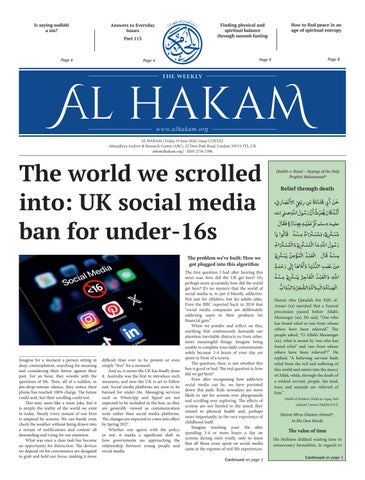
The world we scrolled into: UK social media ban for under-16s
Imagine for a moment a person sitting in deep contemplation, searching for meaning and considering their future against their past. For an hour, they wrestle with the questions of life. Then, all of a sudden, in pin-drop-intense silence, they notice their phone has reached 100% charge. The future could wait, but their scrolling could not.
This may seem like a mere joke, but it is simply the reality of the world we exist in today. Nearly every instant of our lives is umpired by screens. We can barely even check the weather without being drawn into a stream of notifications and content all demanding and vying for our attention.
What was once a clear task has become an opportunity for distraction. The devices we depend on for convenience are designed to grab and hold our focus, making it more
difficult than ever to be present or even simply “free” for a moment.
And so, it seems the UK has finally done it. Australia was the first to introduce such measures, and now the UK is set to follow suit. Social media platforms are soon to be banned for under-16s. Messaging services such as WhatsApp and Signal are not expected to be included in the ban, as they are generally viewed as communication tools rather than social media platforms. The changes are expected to come into effect by Spring 2027.
Whether one agrees with the policy or not, it marks a significant shift in how governments are approaching the relationship between young people and social media.
The problem we’ve built: How we got plugged into this algorithm
The first question I had after hearing this news was: how did the UK get here? Or, perhaps more accurately, how did the world get here? It’s no mystery that the world of social media is, to put it bluntly, addictive. Not just for children, but for adults alike. Even the BBC reported back in 2018 that “social media companies are deliberately addicting users to their products for financial gain.”
When we ponder and reflect on this, anything that continuously demands our attention inevitably distracts us from other, more meaningful things. Imagine being unable to complete your daily commitments solely because 3-4 hours of your day are spent in front of a screen.
The question, then, is not whether this ban is good or bad. The real question is, how did we get here?
Even after recognising how addictive social media can be, we have persisted down this path. Kids nowadays are more likely to opt for screens over playgrounds and scrolling over exploring. The effects of screens are not limited to the mind; they extend to physical health and, perhaps more importantly, to the very experience of childhood itself.
Imagine reaching your 30s after spending 3-4 or more hours a day on screens during one’s youth, only to learn that all those years spent on social media came at the expense of real-life experiences.
Relief through death
Hazrat Abu Qatadah bin Rib‘i alAnsari (ra) narrated that a funeral procession passed before Allah’s Messenger (sa). He said, “One who has found relief or one from whom others have been relieved.” The people asked, “O Allah’s Messenger (sa), what is meant by ‘one who has found relief’ and ‘one from whom others have been relieved’?” He replied, “A believing servant finds relief from the toil and suffering of this world and enters into the mercy of Allah, while, through the death of a wicked servant, people, the land, trees and animals are relieved of him.”
(Sahih al-Bukhari, Kitab ar-riqaq, Bab sakarati l-mawt, Hadith 6512)
Hazrat Mirza Ghulam Ahmadas, In His Own Words
The value of time
His Holiness disliked wasting time in unnecessary formalities. In regards to
This Week in History
19 - 25 June
A glimpse into the rich history of the Ahmadiyya Muslim Jamaat
19 June
19 June 1887: The Promised Messiah (as) informed Hazrat Munshi Rustam Ali (ra) by postcard that he was setting out for Ambala Cantonment, where his father-in-law, Hazrat Mir Nasir Nawab (ra), was then staying. Hazrat Mir Sahib (ra) had informed Huzoor (as) that his wife was gravely ill and that there was little hope for her life. Huzoor (as), therefore, immediately set out for Ambala with his wife, Hazrat Nusrat Jehan Begum (ra), so that she could see her ailing mother at that critical time. This incident also illustrates Huzoor’s (as) compassionate treatment of his wife and his consideration for her parents. (Maktubat-e-Ahmad, Vol. 2, p. 503)
19 June 2012: During his tour of the USA, on this day, Hazrat Khalifatul Masih V (aa) visited the Bait-un-Nasir Mosque in Columbus, Ohio. (“Head of Ahmadiyya Muslim Jama’at Continues Tour of USA”, www.pressahmadiyya.com)
20 - 21 June
20 June 2009: On this day, Major Afzaal Mahmood Sahib’s body was brought to Rabwah and was buried with full army protocol. This Ahmadi member of the Pakistan Armed Forces was martyred a day before, on 19 June, while fighting against militants in Bajaur Agency.
For more details, see “Forbidden history: Monumental services of Ahmadis in the Pakistani Armed Forces”, at alhakam.org (16 July 2021, pp. 10-11).
21 June 2013: During his Friday sermon, Hazrat Khalifatul Masih V (aa) announced the martyrdom of Jawad Karim Sahib, who lived in Lahore, Pakistan. He was from Green Town, Lahore and was martyred on 17 June by four unknown assailants who entered his house and fired at him. He was killed due to his belief in Ahmadiyyat. Jawad Sahib lived on the first floor while his brother and mother resided on the ground floor. At 7:45 pm, unknown assailants entered the house and called out for him. They shot at him, and a bullet struck him in the heart. On hearing the commotion, his brother emerged from the house; the assailants shot in the air and said to his brother that he was next and fled. Jawad Sahib was taken to the hospital, but he passed away on his way there.
His mother, Razia Karim Dehlvi Sahiba, born in 1947, suffered a heart attack at the time of Jawad Sahib’s burial and passed away. She was a retired school headmistress who was active in Jamaat work.
22 June
22 June 1885: The Promised Messiah (as) replied to a letter of Mir Abbas Ali Sahib of Ludhiana. In this detailed letter, Huzoor (as) examined the religion of Hinduism: its scriptures, beliefs and sects. This extended piece covered many misunderstandings of Pandit Dayanand, Dara Shikoh, Mirza Mazhar Jan-e-Janaan, etc., regarding the Vedas. (Maktubat-e-Ahmad, Vol. 1, pp. 613-627)
22 June 1957: On this day, Hazrat Sir Chaudhry Zafrulla Khan (ra) inaugurated the first Ahmadiyya mosque in Hamburg, Germany. Many distinguished guests from England, Holland, Switzerland and Sweden participated in the ceremony, including journalists and press and television correspondents. Sahibzada Mirza Mubarak Ahmad Sahib read out the special message of Hazrat Musleh-e-Maud (ra). (Tarikh-e-Ahmadiyyat, Vol. 18, p. 467)
23 - 24 June
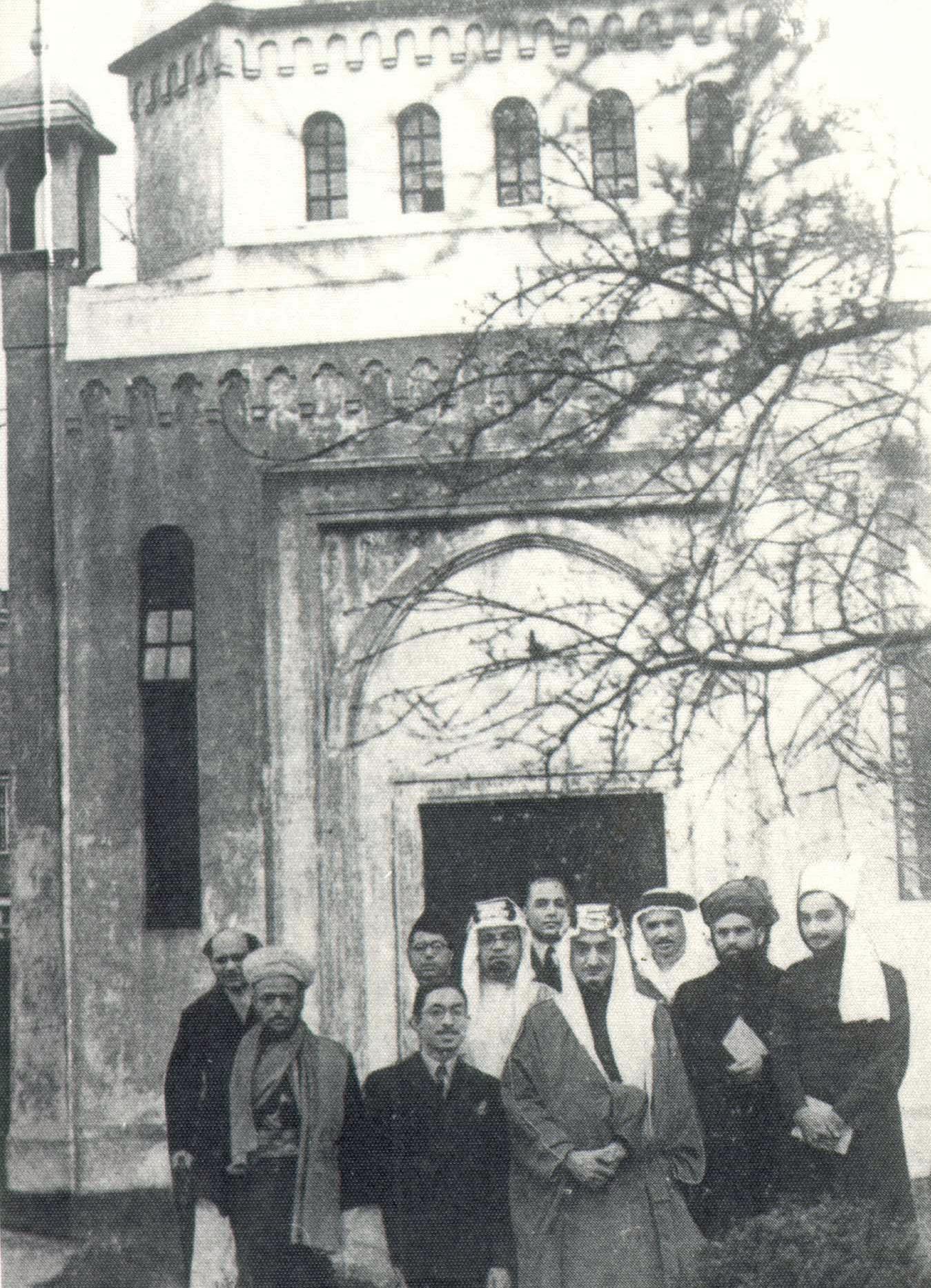
23 June 1921: On this day, Hazrat Musleh-eMaud (ra) sent a delegation of Ahmadis to present an address to the Viceroy of India, Lord Reading. The address touched on the issue of Turkey and advocated the autonomy of the Hedjaz and the greater interests of the Muslims.
For more details, see “Hazrat Musleh-e-Maud’s services to the Muslim cause: Guidance for Turkey, peace in the Arab world and the Kashmir Movement”, Al Hakam, 19 February 2021, Issue 153, pp. 41-44.
24 May 1932: On this day, Hazrat Mir Muhammad Ishaq (ra) read out his research paper in Lahore during a session arranged by Sanatana Dharma Hindus. His topic was, “Is religion an obstacle to a nation’s development?” (Tarikh-e-Ahmadiyyat, Vol. 6, p. 88)
24 June 2016: Hazrat Khalifatul Masih V (aa) announced in his Friday sermon that Dr Chaudhry Khaliq Ahmed Sahib of Gulzar-e-Hijri, Karachi,
was martyred by opponents of Ahmadiyyat at the age of 49. This unfortunate event took place on 20 June 2016 at around 9:30 pm in his clinic. Huzoor (aa) said that two unidentified men wearing helmets came to the clinic and opened fire on Chaudhry Khaliq Ahmed Sahib. Two bullets hit him in the head and two in the chest.
Huzoor (aa) said that Chaudhry Khaliq Ahmed Sahib had countless virtues. He had a great passion for preaching. He also used to preach to non-Jamaat members at his clinic. Chaudhry Khaliq Ahmed Sahib was a very compassionate man.
25 June
25 June 2008: Jamaat-e-Ahmadiyya Canada held a Khilafat centenary jubilee event in which Hazrat Khalifatul Masih V (aa) delivered an address in front of about 800 distinguished guests. In his address, Huzoor (aa) spoke about the history of Islam and the true essence of the Islamic teachings. (Al Fazl International, 22 August 2008, p. 10)
25 June 2012: Daniel Ohene Agyekum, Ghana’s Ambassador to the United States, in the presence of Hazrat Khalifatul Masih V (aa) at the Baitur Rahman Mosque in Maryland, spoke of his longstanding ties with the Ahmadiyya Muslim Jamaat in the United States and said he had visited the Baitur Rahman Mosque on several occasions. He said:
“I, our current Government and indeed all previous Ghanaian Governments, as well as the people of Ghana, truly appreciate your leadership and the work of your Community in all spheres of life. When you come to Ghana, you enlighten not just the people of Ghana but, in fact, millions of people across the region. […] And so I wish to express my gratitude to Your Holiness for meeting with me and sharing your wisdom with me.”
(“Ambassador of Ghana to the United States calls on Khalifa of the Ahmadiyya Muslim Community”, www.pressahmadiyya.com, 26 June 2012)
You watched countless videos of sunsets, but rarely stopped to watch one yourself. You never went fishing, never climbed a tree, never followed a stream to see where it led, never cycled through the countryside or hiked to a viewpoint and earned the view, or even pitched a tent under the stars.
Yes, social media does offer a window into the world, but for many, it has slowly replaced the experience of actually living in it.
Are parents at fault? When children no longer know what to do without screens
The BBC posted a video in which a reporter asked a young schoolgirl how much screen time she had over the weekend. She replied that she had spent 9 hours on screens.
The reporter then, alluding to the social media ban, suggested that she would now have plenty of free time to do other things and asked what she planned to do instead. Her response was simple: “Stare at a wall.”
For many of us, especially the youth, screens have become the go-to to fill free time. Without them, even relaxation can feel strangely empty. It seems that the cost of constant screen usage is far greater than we often realise, not just in the time we spend on devices but also in how it shapes our ability to enjoy time away from them.
As parents of the next generation, it seems as though we often underestimate the importance of raising children with purpose and care.
In Islam, we are taught that the upbringing of children should equip them to thrive in the society they live in while remaining grounded in good character and values. The goal is to enable them to make a positive impact not only in their own lives but also in the lives of those around them.
The Promised Messiah (as), Hazrat Mirza Ghulam Ahmad, the founder of the
Ahmadiyya Muslim Jamaat, has given a very beautiful explanation that I wish to share. Although the explanation is regarding the acceptance of prayer, we can also learn a lesson from it in this scenario. He says:
“One may observe how dear a mother holds her child. She desires that no harm should come to her child. But if a child should cry and insist upon the absurd idea that they be handed a sharp dagger or a bright and glowing piece of coal, would the mother, despite her true love and compassion, ever approve of her child taking hold of a flaming piece of coal and subsequently burning their hand, or cutting their hand on the sharp blade of a dagger? Of course not.” (Malfuzat [English], Vol. 1, p. 102)
After understanding the dangers of social media and its impact on young people, would any parent willingly put a tablet in their child’s hands, knowing what it can do to their developing minds?
Whether it is the effect on the brain’s reward system, the way it shapes attention and concentration or its influence on overall lifestyle and habits – the risks are becoming increasingly difficult to ignore. If we are to guard our children from physical harm, should we not be just as concerned about the things that may impact their mental well-being?
Protecting the family from harm
There is no doubt that social media also has its advantages. It connects us to the world and we can learn a great deal from it. So, it is not completely negative. However, a more balanced and monitored approach is necessary when it comes to its use.
In Islam, the principle that preventing harm takes precedence over pursuing benefit is well established. If there is evidence that free and full access to social media exposes children to risks such as bullying, exploitation, addictive behaviour,
inappropriate content or mental health challenges, then reasonable restrictions can be seen as a fair protective measure.
The Holy Quran makes it clear that anything that can lead to misbehaviour or is unsuitable for one’s family must be stopped or, at the very least, controlled. Hence, we read in the Quran that Allah says:
“O ye who believe! Save yourselves and your families from a Fire” (Surah at-Tahrim, Ch.66: V.7)
This means it becomes the duty of the parent to safeguard their family, starting with themselves, from all vices, including those that may lead them astray. As we know, excessive and unmonitored use of social media is known to impact children’s well-being and brain development.
Islam places great value on guarding one’s speech, gaze, time and heart. Each of which shapes a person’s character and spiritual well-being. In many ways, these are exactly the areas social media aims to capture and influence.
What we say is often shaped by what we hear, what we see influences what we desire and how we spend our time shapes the direction of our lives. Prolonged and excessive screen use can, therefore, impact not only our habits but also our attention and emotional state, eventually affecting the heart itself.
This is why safeguarding oneself from harmful influences is such an important principle.
A message to those growing up in a digital age
However, when all is said and done, it is clear that many young people are unhappy with this new ban. Any parent knows how challenging it can be to take a screen away from a child, and after becoming so attached to them, many youngsters may initially wonder: what do we do now?
this, the Promised Messiah (as) said: “My state is that I even feel regret when answering the call of nature, for all the time that is wasted. This time too could be better spent in some religious work.” The Promised Messiah (as) also said: “When an important task of a religious nature arises, I deem food and drink, and sleep to be forbidden on me, until I have completed the task at hand.” The Promised Messiah (as) further stated: “I am devoted to the cause of religion, in fact, I live for the sake of religion. Therefore, all I desire is that nothing obstructs my way in the path of religion.”
Yet this moment can also be seen differently. If used well, it could become a chance for growth and self-improvement. Without the constant influence of social media, you may begin to shape yourself intentionally, rather than being shaped by an algorithm that feeds you endless content. Here, a verse from the Holy Quran comes to mind and is good to reflect on situations like this:
“It may be that you dislike a thing while it is good for you, and it may be that you like a thing while it is bad for you.” (Surah al-Baqarah, Ch.2: V.217)
With the right approach, this change could have a meaningful and lasting positive impact. I would also be interested in hearing your honest point of view on it. Do you see yourself benefiting from this, or do you also feel like you might struggle at first with not knowing how to spend your free time?
(Jalees Ahmad, Al Hakam)
(Malfuzat [English], Vol. 2, pp.182-183)
Answers to Everyday Issues
The ‘hidden treasure’ hadith, philosophy of Umrah and Hajj, tabligh, al-Akhirah, destiny, trials and Waqf-e-Nau
Guidance regarding basic Islamic issues that Hazrat Amirul Momineen, Khalifatul Masih Vaa, has given on various occasions in his written correspondence and during MTA programmes is being published officially below for everyone’s benefit.
Is the hadith ‘I was a hidden treasure…’ authentic?
Someone from Australia sent the following hadith to Hazrat Amirul Momineen, Khalifatul Masih V (aa):
“I was a hidden treasure and I willed to be recognised, so I created the creation that I might be recognised.”
He wrote that most scholars classify this hadith as fabricated [maudu‘] or weak [da‘if], but the Promised Messiah (as) also received a revelation in these very words. So, can we say that this hadith is, in fact, sound?
In his letter dated 4 February 2024, Huzoor-e-Anwar (aa) provided the following guidance in response to this question:
“Firstly, the Just Arbiter [Hakam ‘Adl] of this age, the Promised Messiah (as), laid down the following criterion for ahadith to be regarded as authoritative: any hadith which does not contradict or oppose the Holy Quran, the practice [sunnah] of the Holy Prophet (sa) and authentic ahadith is a sound hadith. Accordingly, he states:
“‘It is incumbent on my Jamaat to follow any hadith which does not oppose and contradict the Holy Quran and sunnah, regardless of its authenticity and give preference to it over man-made jurisprudence.’ (Review bar Mubahathah Batalavi wa Chakrhalavi, Ruhani Khazain, Vol. 19, p. 212)
“He further states:
“‘Regarding the Book and the sunnah being Islamic legal proofs, my belief is that the Book of Allah is the supreme authority and guide. In any matter where the meanings ascribed to the Prophetic ahadith do not contradict the Book of Allah, those meanings shall be accepted as Islamic legal proof. However, we shall never accept those meanings that contradict the clear and decisive injunctions of the Quran. Rather, as far as possible for us, we shall interpret such
a hadith in a manner that accords with and conforms to the clear text of the Book of Allah. And if we come across a hadith that contradicts the text of the Holy Quran and we are entirely unable to reconcile it in any way, we shall declare such a hadith to be maudu‘, because Allah, Glorified be His Majesty, says:
That is, in what hadith after Allah and His verses, will you believe? (Surah al-Jathiyah, Ch. 45: V. 7)’ (Al-Haqq Mubahathah Ludhiana, Ruhani Khazain, Vol. 4, pp. 11-12)
“Thus, the hadith you have mentioned neither contradicts the Quran and the sunnah nor do we need to interpret it in any other way. Rather, in terms of its manifest and hidden meanings, it perfectly meets the criteria of authentic ahadith. Therefore, it is incorrect to declare it maudu‘ or da‘if
“Secondly, certain well-known and widely recognised ahadith are not mentioned in authoritative collections of Hadith, yet in terms of their meaning and purport, there is nothing in them that indicates any unsoundness. Such reports also stand at the level of a sound hadith. An example of this is the famous hadith:
[‘But for you, I would not have created the heavens’]. Accordingly, the Promised Messiah (as) was asked whether this hadith was correct, to which Huzoor (as) replied:
“‘According to the rules governing the authenticity of narrations, this hadith is not found in the authentic collections [sihah], but in terms of its meaning and purport, this hadith is sound.’ (Zikr-e-Habib, by Hazrat Mufti Muhammad Sadiq [ra], under the heading ‘Hadith Law Laka’, Zia-ul-Islam Press, p. 130)
“Thirdly, it is the practice of Allah the Exalted that He sometimes vouchsafes revelations to His loved ones in the very words of certain verses of the Holy Quran or certain ahadith. Hence, the Promised Messiah (as) also received the following revelation from Allah the Exalted:
“‘I was a hidden treasure and I willed to be recognised.’ (Barahin-e-Ahmadiyya, Part IV, Ruhani Khazain, Vol. 1, p. 611)
“Thus, this serves as a robust proof that these are indeed words conveyed by Allah’s Messenger (sa), as he narrated this qudsi hadith having received knowledge from Allah the Exalted and subsequently, Allah also revealed these very same words to the Holy Prophet’s (sa) most ardent devotee.”
What is the philosophy and true purpose of performing Umrah or Hajj?
Someone from Mauritius asked Hazrat Amirul Momineen, Khalifatul Masih V (aa), what the true purpose of performing Umrah [the minor pilgrimage] is. He also enquired about the significance of circumambulating the Ka‘bah [tawaf], the ritual going back and forth between Safa and Marwah [sa‘i] and the Black Stone [al-Hajar al-Aswad].
In his letter dated 5 February 2024, Huzoor-e-Anwar (aa) gave the following answer in this regard:
“Umrah, like other Islamic acts of worship and particularly Hajj, is an act of worship mandated by Allah the Exalted. (Surah al-Baqarah, Ch. 2: V. 197) The Holy Prophet (sa) established it through his
sunnah. Great importance and merit are attributed to Umrah in the ahadith. While Hajj can only be performed once a year during a specific month and on specific days, there is no fixed time for Umrah; other than the days of Hajj, it can be performed at any time of the year.
“As for performing tawaf of the Ka‘bah, doing sa‘i between Safa and Marwah and kissing the Black Stone, as I have stated, we perform all these acts in obedience to the commandment of Allah the Exalted and our master and guide, the Holy Prophet Muhammad al-Mustafa, the Chosen One (sa), also personally demonstrated them through his own practice. Therefore, performing these acts of worship in accordance with the command of Allah the Exalted and the practice of His Messenger (sa) is certainly deserving of reward and merit. On one occasion, Hazrat Umar (ra) kissed the Black Stone and then, addressing it, said, ‘I know well that you are but a stone that can neither cause harm nor bring benefit. Had I not seen the Holy Prophet (sa) kissing you, I would not have kissed you.’ (Sahih al-Bukhari, Kitab al-hajj, Bab ma dhukira fi l-hajari l-aswad)
“Thus, we observe all these acts of worship in submission to the commandment of Allah the Exalted and the practice of His Messenger (sa) and our purpose in doing so is to attain the pleasure of Allah the Exalted.
Image: Ali Akdemir/Pexels
Expounding upon the philosophy of Hajj, the Promised Messiah (as) states:
“‘In the realm of love, the human soul perpetually circles its beloved and kisses their threshold. In exactly the same manner, the Holy Ka‘bah has been granted as a physical manifestation for the sincere lovers [of God]. God has, as it were, declared: ‘Behold, this is My House and the Black Stone is the stone of My threshold.’ He ordained this so that man may physically express the ardour of his love and devotion. Thus, those who perform the Hajj physically circumambulate that House, adopting the appearance of those who are wholly consumed and intoxicated by the love of God. They forsake all adornment, shave their heads and, assuming the appearance of those lost in Divine attraction, perform a passionate circumambulation of His House; and they kiss that stone, envisioning it as the stone of God’s threshold.
“‘This physical passion kindles spiritual ardour and love; as the body circumambulates this House and kisses the stone of the threshold, the soul concurrently circumambulates the True Beloved and kisses His spiritual threshold. There is no trace of associating partners with God [shirk] in this practice. Upon receiving a letter from a bosom friend, a friend will kiss it too. No Muslim worships the Ka‘bah, nor do they seek the fulfilment of their desires from the Black Stone; rather, it is solely regarded as a physical symbol appointed by God and nothing more. Just as we prostrate ourselves upon the earth, yet that prostration is not for the earth, similarly do we kiss the Black Stone, but that kiss is not for the stone itself. A stone is but a stone; it can neither benefit nor harm anyone, but it has been bestowed by the hand of that Beloved Who has designated it as the symbol of His threshold.’ (Chashma-e-Ma‘rifat, Ruhani Khazain, Vol. 23, pp. 100-101)”
What is the meaning of alAkhirah?
“Someone wrote to Hazrat Amirul Momineen, Khalifatul Masih V (aa), asking about preaching to his female classmate and also raising certain questions concerning some Arabic words.
In his letter dated 6 February 2024, Huzoor-e-Anwar (aa) gave the following reply in this regard:
“Regarding your question about preaching to your female classmate, the answer is that if you are engaged in tabligh with a righteous intention and pure motive while observing the Islamic commandment of hijab and purdah, then there is no harm in conveying the message of truth to anyone, whether men or women.
“Furthermore, you have written that you are composing a tafsir of the Holy Quran. May Allah the Exalted place blessings in your endeavour, illumine your mind and increase your spiritual knowledge.
“With regard to the word al-akhirah, what you have written, namely that it means only the life of the Hereafter and cannot signify the promised time yet to come, is not correct, for, in exposition and exegesis, a single word may bear several meanings. Hence, it is not correct to confine a word to one meaning alone, so long as the other meanings are not contrary to any Quranic teaching or to the sunnah of Allah’s Messenger (sa).
“Thus, both meanings of
(Surah al-Baqarah, Ch.2: V.5) are valid: that ‘they have firm faith in the Hereafter’ and also that ‘they have firm faith in the things promised for the future.’
“In the latter sense, namely ‘they have firm faith in the things promised for the future’, this theme becomes connected with the second advent of the Holy Prophet (sa) mentioned in Surah al-Jumu‘ah, in that true and perfect believers are those who believe in this second advent of the Holy Prophet (sa) just as they believe in his first advent, for when, upon the revelation of those verses of Surah al-Jumu‘ah, the Companions of Allah’s Messenger (sa) asked, ‘Who are these latter ones?’, he placed his hand on the shoulder of Hazrat Salman Farsi (ra) and said:
“‘If faith were to ascend to the Pleiades, a man, or men, from among these (the people of Salman al-Farisi) would surely attain it.’ (Sahih al-Bukhari, Kitab at-tafsir, Bab qawlihi wa akharina minhum lamma yalhaqu bihim)
“In this, there is, in fact, a prophecy of the advent of the Promised Messiah and Awaited Mahdi (as) and of the Khilafat that would continue after him. The Holy Prophet (sa) emphasised belief in this Messiah and Mahdi so strongly that he said:
“‘When you see him, then take the bai‘at at his hand, even if you have to go to him crawling over snow, for he is Allah’s Khalifa, the Mahdi.’ (Sunan Ibn Majah, Kitab alfitan, Bab khuruji l-mahdiyy)
“Moreover, in the Holy Quran, the word al-akhirah has also been used for the time yet to come. Thus, while giving glad tidings to the Holy Prophet (sa), Allah the Exalted says:
“‘Surely [every hour] that follows is better for thee than [the one] that precedes.’
(Surah ad-Duha, Ch.93: V.5)
“Explaining this verse, Hazrat Khalifatul Masih I (ra) states:
“‘In this blessed verse there is mention of the Holy Prophet’s (sa) endless progress, day by day and hour by hour. Every later step of his surpassed the earlier one. Whatever excellences the Ummah possesses, and whatever durud is being recited for him throughout the world, no other founder of a religion is the recipient of so many prayers and blessings.
O Allah, bless Muhammad and the people of Muhammad and bestow Thy blessings and peace.’ (Supplement to Badr, Qadian, 8 August 1912, Haqaiq-ul-Furqan, Vol. 4, p. 405)”
Destiny, fate, burials, trials, Satan, Waqf-e-Nau, letters to Huzoor (aa) and reciting the Holy Quran
“A lady from the UK wrote to Hazrat Amirul Momineen, Khalifatul Masih V (aa), raising various questions concerning qismat [fate], the burial of the deceased, Allah the Exalted putting human beings through trials, the existence of Satan, the Waqf-e-Nau scheme and the children included in it and the recitation of the Holy Quran.
In his letter dated 8 February 2024, Huzoor-e-Anwar (aa) gave the following reply:
Destiny, fate, luck
“If by qismat you mean what some people say – that a person’s fate was simply bad and that is why such-and-such happened – then Islam recognises no such concept of fate. Islam emphasises the performance of righteous deeds and the keeping of good intentions, for it is through a person’s deeds that they reap good or evil consequences. Good deeds yield good results and evil deeds lead to evil consequences, whereby a person suffers loss. There is no question of fate in
this sense. At times, a person undertakes some task and thinks that they have done everything properly, but if the matter is examined carefully, some deficiency will be found somewhere or some mistake will have been made, which is why the result does not turn out according to their desire.
“Yes, if a person exerts themselves fully and also prays, yet despite this does not attain success in some matter, then some wisdom from Allah the Exalted lies hidden in their not being granted success at that time. It may be that the accomplishment of that matter at that moment would have proved the precursor to some greater harm for them, from which Allah the Exalted, through the blessing of prayer, saves them. Allah the Exalted sets forth this theme in the Holy Quran as follows: ‘And it may be that you dislike a thing while it is good for you, and it may be that you like a thing while it is bad for you. Allah knows [all things], and you know not.’ (Surah al-Baqarah, Ch.2: V.217) Therefore, the task of a believer is that, after acting with righteous intent and utmost effort, they should leave the matter of the outcome to Allah the Exalted.”
The Islamic way of burying the dead
“In reply to your question concerning whether the dead should be buried or cremated, the answer is that different religions and different societies in the world have adopted different practices regarding the final rites of the deceased. All these methods are intended to show respect to the deceased, whether one cremates the body, buries it or leaves it for beasts and birds to consume. However, the method which Islam has prescribed in this regard is nearer to nature and is the more natural way. By relating the incident of the sons of Hazrat Adam (as) [Surah al-Ma’idah, Ch.5: V.32], the Holy Quran has informed us that the natural way is for the deceased to be buried in the earth, because man was created from
Image: Fatih Beki/Unsplash
dust and into dust should he be laid.”
Why does God try us?
“In reply to your question regarding hardships befalling human beings, some afflictions come upon a person because of their own mistakes, while others come from Allah the Exalted by way of trial. These afflictions are just as, in worldly life, one passes an examination and thereby advances to the next stage. If we do not endure the hardship of the examination, we cannot progress to the next stage. These worldly trials come most upon the beloved ones of Allah the Exalted. Thus, the Holy Prophet (sa) said that among people, the Prophets are tried the most and then, according to rank, others are tried. (Sunan at-Tirmidhi, Kitab az-zuhd, Bab ma ja’a fi s-sabri ‘ala l-bala’) Hazrat Aisha (ra) states, ‘I never saw anyone in greater suffering than the Holy Prophet (sa).’ (Sahih al-Bukhari, Kitab almarda, Bab shiddati l-marad)
“In truth, many divine wisdoms lie hidden in worldly sufferings and trials and at times human reason cannot attain to them. Therefore, one should try to bear them with patience and prayer. Sayyiduna Hazrat Mirza Ghulam Ahmad, the Promised
Messiah (as), states:
“‘At times, divine wisdom so ordains that a person’s wishes are not fulfilled in this world. Various afflictions, calamities, illnesses and frustrated hopes befall them, but one should not lose heart on account of them.’ (Malfuzat, Vol. 5, UK: 2022, p. 23)”
Why does Satan exist?
“In reply to your question concerning the existence of Satan, the existence of Satan is also one of the trials of this world for man. Allah the Exalted, having made man the noblest of His creation, has plainly set forth for them the paths of righteousness (i.e., the path of the angels) and of evil (i.e., the path of Satan) and then granted them the choice. Whichever path they follow, the result of their deeds will appear accordingly. If they do good, they will receive reward and if they commit sin, they will incur punishment.”
How to surpass those who are in Waqf-e-Nau
“In reply to your questions regarding Waqfe-Nau, children are dedicated in this scheme before birth because Hazrat Khalifatul Masih IV (rh) founded this scheme upon the sacrifice of the mother of Hazrat Maryam
(as), as mentioned in the Holy Quran and the mother of Hazrat Maryam (as) dedicated her to Allah the Exalted before her birth. Therefore, the children presented in this scheme are likewise dedicated by their parents before they are born. Since these children are dedicated by their parents before their birth and before they attain an age of understanding, in which the parents’ will is involved but not the children’s own choice, when these children reach the age of reason and awareness, they are asked whether they wish to continue in this dedication or not. Earlier, it was their parents who dedicated them, but now they themselves must state what they wish. This is why they are asked again about this dedication upon growing up.
“Merely being included in the Waqf-eNau scheme does not make children ‘special’. There is no difference between them and other children and those who make such a distinction are mistaken. This is why I have repeatedly drawn the attention of parents to the fact that they should not differentiate between their children. In the same way, I have also said on many occasions to Waqfe-Nau children themselves that they are not ‘special’ in comparison with other children. Of course, those children who do
Is saying wallahi a sin?
good deeds do become distinguished by virtue of those good deeds. If you are not in Waqf-e-Nau, that does not matter. You can study, achieve something and then dedicate yourself and by doing good deeds, you may even surpass those who are in Waqf-e-Nau.”
I give due attention to all the letters I receive
“You asked which letters I give preference to. The answer is that I give preference to every letter that is written to me, whatever language it may be in. It is not a matter of English or Urdu alone. People write to me in many languages from around the world and I give attention to all these letters and also reply to them.”
Tilawat should be done in Arabic
“The Holy Quran should first be recited in the language in which it was revealed. Thereafter, its translation should be read in English, Urdu or whatever one’s own language may be. The recitation of the Arabic words is called tilawat; the translation is not tilawat.”
(Compiled by Zaheer Ahmad Khan, Head of Records Department, Private Secretariat, London and translated by Al Hakam)
Qamar Ahmed Ahmadiyya Archive & Research Centre
If we all had the chance to go back in time twenty years with the opportunity to invest in something, most people would probably choose stocks, Bitcoin, property or Charizard (those £1 Pokémon packs really took everyone by surprise!). Me personally?
I’d copyright the word wallahi and retire early because if I had £1 for every time I heard that phrase being thrown around, I’d… well, let’s talk about it.
You see, growing up in Southfields in South London, every conversation seemed to include “swear down”, “oh my God”, “Jesus!” or “wallahi” (and if you went to Southfields Secondary School, you also heard the Somali brothers augment the experience with “billahi” and “tallahi”). Your Total 90’s turf astroturf boots and JD locker bag weren’t a complete fit without the complimentary: “wallahi those are cold.”
Fast forward twenty years, and I genuinely cannot believe I am writing this... I was walking through Worcester Park and overheard a very posh lady casually tell her friend, “wallahi it’s so hot today.” Keep in mind, this was the kind of person who says “water”, not “wo’ah”. The moment she realised I heard her, she looked slightly embarrassed, which honestly made it even funnier, but something inside unsettled me… how did this even become normal? Should it ever be normal?
She wasn’t a Muslim, but then again, everyone does it in some form. Muslims say “wallahi”, Christians say “Jesus Christ” and people with no religion still say “oh my God” without even thinking about it. These phrases have now become part of everyday speech.
Islamically, take a breather, Allah the Almighty tells us that we are not held accountable for careless or unintentional oaths said without real intent: “Allah will not call you to account for such of your oaths as are vain […]” (Surah al-Baqarah, Ch.2: V.226) But that does not mean we should become comfortable casually throwing around the name Allah.
This is because the danger is not always in the one-off phrase. The danger is when it becomes a habit. When sacred words become filler words. There are three problems with that.
Firstly, we should recognise that religious phrases carry meaning for people. Most Muslims would feel uncomfortable hearing someone casually say “oh my Allah” as a joke or throwaway phrase. In the same way, Christians may feel uncomfortable hearing “Jesus Christ” used carelessly. Respect matters.
Secondly, when wallahi becomes part
of everyday slang, we risk forgetting how serious an oath by Allah actually is. One day, you may genuinely use it to convince someone you are telling the truth: “wallahi I’ll pay you back” or “wallahi I’m being serious, I promise.” At that point, those words carry real weight because the second part of the Quranic verse in Surah al-Baqarah does remind us that we will definitely be held accountable for the intentional oaths that we make:
“[...]He will call you to account for what your hearts have earned. And Allah is Most Forgiving, Forbearing.” (Surah al-Baqarah, Ch.2: V.226)
The Prophet (sa) said, “Allah has prohibited you from taking an oath by your fathers. He who must take an oath, may do so by swearing in the Name of Allah or he should remain silent.” (Riyad as-Salihin, 1707) It is as clear as day that if you are using the name of Allah to take an oath, that is formally accepted as the proper
method to make an oath that we will be held accountable for.
Thirdly, it may seem these phrases have entered slang territory, but their usage was never intended to be so; this means that the misapplication of phrases like wallahi, billahi and tallahi is simply a vain endeavour. Something we need to be really careful about:
“The fact that such oaths are not liable to be punished does not, however, mean that indulgence in them is permitted. It only means that a person who swears vain oaths will not be punished on the basis of such oaths, i.e. these oaths will not be legally treated as oaths. But he will certainly suffer the consequences of indulging in vain and useless talk. A Muslim is expected to avoid all things that are vain or purposeless and the Quran clearly enjoins it (23:4).” (Five Volume Commentary, Surah al-Baqarah, Ch.2 V:226)
So, perhaps the issue is not simply whether we mean it or not, but whether we have forgotten what these words were meant to mean in the first place:
For those of us who are sitting on the fence about whether they should give up on taking Allah’s name in vain, the Holy Prophet (sa) has a message: “Beware of excessive swearing in sale, because it may promote trade but this practice will eliminate the blessing.” (Riyad as-Salihin, 1721)
The tongue becomes accustomed to whatever the heart treats lightly. Perhaps that is why Islam teaches us to be careful with our words, because if the name of Allah becomes nothing more than a reaction or punchline in our tongues, then we should not be surprised when it slowly stops carrying weight in our hearts as well. God forbid.
Why William R Barker accepted Islam Ahmadiyyat and Hidayat Budd’s response to Dr Zwemer’s false claims (1926)
Mr William R Barker was an Englishman and a second engineer on a ship who formally declared his acceptance of Islam Ahmadiyyat in London. He wrote the following article in the June 1926 issue of The Review of Religions:
What led me to Islam?
I am naturally religious and read a good deal. Everyone has read the New Testament in the Bible, but many do not know that these Gospels are only a few out of many Christian Gospels, the others being called ‘apocryphal’ and even spurious by the accepted Christian Church.
The truth is, apparently, that such Gospels as did not teach exactly the doctrine of the reigning Church were destroyed and those Christians who read them were persecuted as heretics. All this occurred before the Holy Prophet Muhammad, peace be upon him, was born.
The Christians of the 1st and 2nd centuries must have been in close touch with the sources of the Gospels and yet they believed very differently from what the Church teaches today.
Personally, I believe that their faith and the faith of Jesus of Nazareth was Islam. In that very old Gospel to the Hebrews (by the Church called ‘apocryphal’), it was taught and believed by that early Christian community, the Ebionites, that Jesus was only a “man” and was chosen as a prophet by God. So, by the choice of God, he was called the son of God from the holy ghost that came unto him from above in the likeness of a dove. These early Christians also deny that he was begotten of God the Father, but say that he was created like one of the archangels and that he came and taught the word as set out in the Gospel according to the Hebrews.
The Ebionites also repudiated the apostle Paul as an apostate.
Again, in that ancient Gospel, the Book of James, it is told how Jesus came to be born of the virgin Mary by the ministrations of the angel Gabriel, much in the same way as is described in the Holy Quran. (Book of James, chapters 11, 12 & 14; Epistle of the Apostles, chapter 14; Gospel or History of Joseph, verses 5-6; and Acts of Paul, chapter 7, verses 4-6 & 12-19).
Again, according to the true Islamic teachings, God will not punish mankind forever and ever unto all eternity in Hell Fire, but when man is purified through sufferings by the mercy of Allah the All-Merciful, he will at length attain to Heaven and enter into communion with God and this is what the early Christians also believed.
In the Second Book of Sibylline Oracles, it is written in verses 310 to 318:
“He shall grant them to save men out of the fierce fire and gnashing of teeth; he will gather them again out of the everlasting flame and remove them into another life, eternal and immortal.”
These things are also stated in the Apocalypse of Peter and in the Coptic Apocalypse of Elias.
Again, I notice the present-day Church stigmatises the Gospel of Barnabas as a forgery and the work of a renegade Italian of the 16th century, because it testifies directly in prophecy to the Prophet Muhammad, may peace and blessings be upon him. Yet the Gospel of Barnabas is named in the Gelasian Decree (6th century) of Books as one not to be received by the Church. How, then, can it be a forgery of the 16th century?
I believe that all the Gospels have some truth in them, that the Church has picked out what suited her, and that wholesale alterations have been made in the Gospels until it is impossible to sift falsehood from truth.
Anyone can verify all the above references to the Gospels in the Apocryphal New Testament, translated by Montague Rhodes James and published in Oxford at the Clarendon Press, 1924.
You will not wonder, therefore, that after so much study I am convinced that the teaching of Jesus was pure Islam, and that the religion most pleasing to God today is Ahmadiyyat in Islam, a natural, pure religion, which all men can comprehend and science confirms.
As a fitting end to this article, I will close with a few lines from the Gospel of Bartholomew, chapter 5, verses 7-9:
“Bartholomew saith: ‘Oh Lord and if any sin with the sin of the body, what is their reward? And Jesus saith: ‘It is good, if he present his baptism blameless. A single marriage belongeth to sobriety… Verily I say unto thee, he that sinneth after the third wife is unworthy of God, and virginity is best.” – William R Barker
Dr Zwemer’s false assertion corrected by a new convert
As our readers are aware, the pages of our magazine, [The Review of Religions] are open to the advocates of all religions, and we think
that it is a pity that the same policy is not adopted by our Christian contemporaries.
Our energetic sister Miss Hidayat Budd (Holland) sent an article a few days ago to be published in The Moslem World, but the editor refused to publish it.
So far, we need not perhaps complain, but there is a fact which cannot be left unnoticed. Dr Zwemer, the editor of the journal, in the course of his letter to Miss Budd, says:
“I fear that the picture of Muhammad the Prophet [sa] given by the Ahmadiyyas in their literature is not true to the facts. May I ask you to investigate the subject for yourself?”
It would have been better if Dr Zwemer had declared himself as an avowed enemy of Islam Ahmadiyyat, but doubtless he had not the courage to make this vain assertion in the open forum.
We do not mind; indeed, we respect an open enemy, but Dr Zwemer will excuse us if we point out that this method of doing things is hardly consistent with the spirit which he is sometimes so eager to display
on ceremonious occasions.
Let him be frank always, so that there may be fair play. We challenge Dr Zwemer to come forward and prove the truth of his assertion, and in default of this, we advise him to refrain from misrepresenting the teachings of other faiths.
We need say nothing as regards the second portion of his quotation, as we give below the reply which our sister, God bless her, has promptly sent to him […]:
Miss Hidayat Budd’s reply
Dr SM Zwemer, Cairo, Egypt. [From] Amsterdam, 2 May 1926.
Dear Sir,
With the present, I beg to acknowledge receipt of your letter of the 22nd ult. [22 June 1926], from which I note that space does not allow you to publish my letter in your quarterly.
In reply to your requesting me to investigate the subject of Muhammad’s [sa] character for myself, please allow me to inform you that this, of course, was done by
me before I openly accepted Islam, since it is not my custom to first accept a thing and then start to examine afterwards whether it was right or not.
Before I accepted Islam, I had studied this religion and the life and character of its Prophet [sa] for more than four years, and, since I was not acquainted with any Muslim literature at that time, I was obliged to study these exclusively from the books written by the opponents of this religion.
Thus, I had to form my opinion only and exclusively from these sources. Then, quite by accident, I came into contact with one of the missionaries of the Ahmadiyya Movement of Qadian and after studying their literature again and finding it to agree with the opinion which I had formed already myself since long of this religion and its Prophet [sa], I accepted Islam openly.
So, in my case, the Ahmadiyyas cannot be made a ‘reproach’ of having led me astray by giving in their literature a ‘false’ picture of Muhammad the Prophet [sa].
For the rest, I again emphasise, what I wrote in my letter of 16 March [1926], but
which you do not seem to have noticed, namely this, that I consider Muhammad [sa] a true and faithful servant of Allah and His Prophet (not because the Muslims tell me this or notwithstanding many Western authors see this man and his character in quite another light), but only and exclusively because I have followed him on the path he showed us, and in so doing I have personally experienced that this path is the right path and, consequently, Muhammad [sa] a true and reliable guide.
Were I to follow Islam (as you seem to think I have done) because our Khalifa or other Muslims tell me that Islam is the only true religion, then for that reason I might as well follow every other creed, for as yet I have not met with a religion of which the followers did not declare that it was the true one (and of which its opponents did not declare that it was a ruinous, false doctrine). I am, dear sir, yours faithfully, Hidayat Budd.
(Transcribed and edited by Al Hakam from the original published in the June 1926 issue of The Review of Religions)
How to find peace in an age of spiritual entropy
Dr Nasim Rehmatullah Naib Amir USA & Chairman Markazi Al Islam Team
Whether it’s a new year or a milestone, it usually brings with it a longing for peace, a hope that the world and our lives will somehow grow calmer, kinder and more stable. Yet year after year, that peace seems to slip through our fingers. The turmoil that engulfs us is not just political or economic, but deeply spiritual and existential. Our modern age, with its advances and conveniences, has also brought a fatigue of spirit, a condition where moral clarity fades, cynicism hardens and the sense of sacred purpose is lost in the noise of daily survival.
What we suffer today is spiritual entropy: the gradual decline of meaning and connectedness both with God and
with each other. Behaviours once widely condemned are now normalised, while genuine self-examination and communal accountability appear outmoded. The rise of moral relativism (i.e., morals are not absolute or universally set) and the collapse of shared values have been amplified by unprecedented global challenges, war, inequality, environmental degradation and the numbing onslaught of information. This collective weariness is not merely the outcome of political failures, but a symptom of hearts becoming distant from the true source of peace itself: Allah.
The Quran outlines this historical pattern. When societies forget God and begin relying solely on their own wit and turning away from the pursuit of righteousness, they drift toward calamity.
(Surah Bani Isra‘il, Ch.17: V.17) This truth
was echoed by Abraham Lincoln, who lamented a nation “too proud to pray to the God that made us.” (Proclamation 97) Laws and government, while necessary, cannot legislate virtue or ensure justice for all, especially when interior conviction has eroded.
Religion is not immune to this crisis. Hypocrisy and self-righteousness frequently infect spiritual communities, substituting empty ritual for deep transformation. Yet, authentic faith at its core asserts a radical idea: real peace comes not from the absence of hardship, but from God’s presence within the struggle. As the Promised Messiah (as) explained, spiritual maturity is forged in adversity; trials are not punishments, but opportunities for growth. He reminds us that perfection comes through trials.
(Malfuzat, 2022, Vol. 3, p. 2)
Salat (prayer), when invested with inward truth, becomes the heart’s awakening, not just a bodily action or empty recitation. Its purpose is to anchor each moment in the remembrance of God, so that the sacred is woven into the mundane, from work and family to facing adversity with patience and gratitude.
But none of us completes this journey alone. The power of transformation begins with recognising our need for divine help, seeking istighfar and taubah (forgiveness and repentance) and strength from God before attempting to reform ourselves. Gratitude and humility return us to what matters: every breath, every small act of honesty or kindness is meaningful.
If we wish to shift society, this inward renewal must ripple outward. Each act of private goodness, each moment of selfrestraint or truthfulness, helps preserve the world around us. Spiritual consciousness, as traditions teach, can protect and uplift whole families and communities, gradually
strengthening the fabric of society. True peace only arises when dignity, equity and respect are extended to all, regardless of societal trends or fleeting public opinion.
The role of genuine leadership becomes crucial in such times and matters greatly. We need leaders who lead by example with honesty, integrity and high morals. Leaders who control the narrative and challenge the self-destructive and dehumanising drift of our society by speaking out clearly, creating awareness and emphasising mindfulness of the consequences of our words and actions. Prophet Muhammad (sa) was one such leader and history demonstrates how he revived the world through his prayers and pleadings in the dark of night.
Today, Hazrat Mirza Masroor Ahmad, Khalifatul Masih V (aa), is calling us all to come to God and to adopt a life of prayer, love and compassion. His guidance calls us to reject complacency and embrace lives of service and justice.
In practical terms, that means defining success in spiritual and ethical terms rather than financial or superficial ones; disciplining ourselves in daily habits of prayer, gratitude and learning; curating our environments and relationships for goodness; and confronting injustice even when it is not popular to do so. We remember that happiness is fleeting, but contentment is found in gratitude, the realisation that hearts can truly find peace only in the remembrance of God.
As the world grows ever more interconnected and complex, the call to spiritual awakening is not a retreat from life’s messiness but an urgent summons to engage it with integrity and faith. Now more than ever, our work must be to bridge the sacred and the contemporary, bringing compassion, justice and humility into each private and public act.
Finding physical and spiritual balance through sunnah fasting
Rahma Roshadi Indonesia
Eid-ul-Fitr is often seen as the ultimate victory after a whole month of battling hunger and thirst. But behind the celebratory echoes of the takbir, there’s a common trend I notice every Shawwal: friends complaining about digestive issues. From diarrhoea and bloating to sudden spikes in cholesterol and blood sugar – you name it.
Medically speaking, it’s pretty straightforward – it’s just the result of a drastic change in eating habits. But if we look deeper through the lens of Islamic teachings, this “post-Eid sickness” is actually a spiritual wake-up call. It reminds us of the importance of balance (tawassut), i.e., moderation, a principle we often toss out the window the moment the holiday celebrations begin.
Spiritual roots behind the physical symptoms
It’s almost like an unwritten ritual: during Eid-ul-Fitr – especially here in Indonesia –dining tables are packed with rich, coconut milk-based dishes. Not to mention the sodas and sweet treats found in practically every home.
After a whole month of training our self-control through Ramadan, there’s this very human urge to go on a “revenge” eating and drinking spree. And that’s where the irony lies. We celebrate our victory over our desires by letting those very same desires take back the wheel.
Islam isn’t just about rituals; it’s a complete guide for living that cares deeply about human well-being. Those complaints of diarrhoea and stomach issues after Eid are actually signals from our bodies. They’re telling us that we’ve ignored the principle of consuming what is tayyib, i.e., good, and the importance of moderation in enjoying the blessings Allah has provided.
“Eat and drink, but be not excessive. Indeed, He does not like those who commit excess.” (Surah al-A‘raf, Ch.7: V.32)
This verse isn’t just a moral rule; it’s actually a very accurate health prescription. When we ignore these limits, our body’s balance gets thrown off, and sickness arrives as a little “reminder”.
Right in the middle of all that food
eat. He used the analogy of a vessel: fill 1/3 with food, 1/3 with water, and leave 1/3 for air (breathing room).
“A human being fills no vessel worse than his own stomach. It is enough for the son of Adam to eat a few mouthfuls to keep his back straight. But if he must fill it, then one-third (of his stomach) should be for his food, one-third for his drink, and one-third for his breath.” (Sunan Ibn Majah, Kitab alAt‘imah, Hadith 3349)
Interestingly, this advice from the Prophet Muhammad (sa) was scientifically proven in the 20th century. In a 2005 study at UCLA, researchers found that mice given a calorie-restricted diet – just enough to survive – actually lived longer than mice that were given regular, full-portioned meals.
A second piece of evidence came in 2006, when Christiaan Leeuwenburgh from the University of Florida’s Institute on Ageing discovered that cutting food portions by just 8% can prevent a lot of organ damage caused by ageing. To put that into perspective, the “portion” he’s referring to is the typical “eat-until-you’refull” amount that people usually consume every day.
euphoria, Islam offers a beautiful solution: the recommendation of six days of sunnah fasting in the month of Shawwal. The Holy Prophet Muhammad (sa) said: “Whoever fasts Ramadan and follows it with six days of Shawwal, it is as if he fasted for the entire year.” (Sahih Muslim, Kitab as-siyam, Hadith 1969)
Theologically, the reward is massive. But let’s look at it from the perspective of selfcontrol. Why are we encouraged to jump back into fasting right after we’ve just been “freed” from the mandatory one?
First, psychologically, Shawwal fasting acts as a cooling-down period or a transition phase. After a full month of our stomachs resting during the day, hitting it with heavy, rich foods all of a sudden on Eid can give our digestive system a total shock. By fasting those six days, we’re slowly bringing our metabolism back to a more regular pattern, preventing an out-of-control spike in our appetite.
Secondly, the beauty of Islam lies in the lesson that worship doesn’t just stop when Ramadan ends. The Shawwal fast is the first real test after “graduation”. It proves whether the self-control we practised during Ramadan was actually deep-rooted, or if we were just “ticking a box” to get it over with.
The philosophy of balance in Islam Islamic teachings are strongly against any form of extremism and that includes how we consume food. We have to keep a balance between our soul and our physical body so we can function at our best as servants of God.
The Prophet Muhammad (sa) actually gave us a very “scientific” guide on how to
with luxury, choosing to fast again is a powerful spiritual statement. In a world that seems to give us a “green light” to party and overindulge, a Muslim fasting in Shawwal chooses to feel hunger again. It’s a reminder that for some people out there, hunger isn’t a spiritual choice – it’s a harsh, daily reality.
This is a manifestation of the beauty of Islam: it doesn’t let its followers get swept away in selfish euphoria. While Eid-ul-Fitr is indeed celebrated with great joy, Islam tucks in this sunnah fasting recommendation as a “brake”, ensuring that our happiness doesn’t turn into indifference toward others. By holding back amidst the abundance of post-Lebaran food, we are training our social sensitivity so it doesn’t get numbed by excessive fullness.
Furthermore, the Shawwal fast reinforces that self-control is a continuous journey, not just a “30-day project”. If Ramadan was the school where we were forged, then Shawwal is the first real-world test. The phenomenon of so many people falling ill with digestive issues after Eid shows just how fragile our self-control can be if we only view fasting as a mandatory chore.
Another discovery from molecular biologist Kalluri Suba Rao in 2004 showed that eating less actually allows the body to “concentrate” more on repairing itself. This means things like DNA repair, flushing out toxins and replacing damaged cells with healthy ones can happen much more effectively.
On the flip side, when we overeat, our body gets way too busy with “catabolism” (basically just working overtime to break down all that food) and doesn’t have the time to fix itself. This is one of the main reasons behind many of today’s health issues, like high blood pressure and high cholesterol, which can ultimately shorten our life expectancy.
So if we actually applied this formula during our Eid, the risk of digestive issues would drop significantly. This balance teaches us that we can still enjoy delicious food without actually hurting our own bodies.
In the eyes of Islam, our bodies aren’t entirely ours to do whatever we want with; they are a trust from the Creator. Taking care of our health by not overeating is a form of gratitude and responsibility for that trust. Getting sick because of greed doesn’t just hurt us physically – it also gets in the way of our worship and our social lives.
Ongoing social dimensions and empathy
Fasting for six days in Shawwal acts as a guardian for the embers of empathy that were lit during Ramadan. While others might still be immersed in a feast of delicacies, those who fast are reminded once again of the hunger faced by our less fortunate brothers and sisters.
When the echoes of the takbir slowly fade and dining tables are still overflowing
This is where the wisdom of Sharia lies. Islam doesn’t want us to be pious only during the holy month, only to flip back to being impulsive and uncontrolled consumers the rest of the year. Instead, we’re invited to have a “soft landing” from the discipline of Ramadan back into normal life. It teaches us that a true winner isn’t just someone who survived a month of hunger, but someone who carries that spirit of restraint into their behaviour in the months that follow.
Ultimately, this beauty boils down to a fundamental concept in Islam: the art of feeling “enough”. In a social framework, when someone controls their appetite, they are indirectly protecting an ecosystem of shared benefits. Someone who doesn’t overconsume has more room – both financially and mentally – to share with others.
This is the most authentic form of gratitude: using our health and the blessing of food to improve our character, rather than letting it become a source of sickness for our bodies.
Celebrating with responsibility
Ultimately, Islamic teachings on Shawwal fasting offer a perspective where physical health and spiritual clarity are two sides of the same coin. The phenomenon of digestive issues after Eid is a valuable lesson; it brings us back to the realisation that anything excessive – even when celebrating something good – will eventually lead to bad results.
Through this taught balance, we are invited to be graceful individuals. Of course, anyone is welcome to enjoy a feast as a form of gratitude, but we must keep ourselves in check as a form of faith. That way, the victory of Eid-ul-Fitr won’t just evaporate as the food runs out. Instead, it leaves a lasting mark on a healthy body and a soul that consistently cares for others. True victory is the continuity of goodness itself.
Islam has provided a complete “toolkit” to keep humans healthy, both inside and out, through fasting and the principle of simplicity. It invites us to keep our feet on the ground, even while we are celebrating a victory in the heavens.
Friday Sermon
Mubarak Mosque, Islamabad, Tilford, UK
22 May 2026
Every step in humility: The Prophet (sa)
After reciting the tashahhud, ta‘awwuz and Surah al-Fatihah, Hazrat Khalifatul Masih V (aa) stated:
In relation to the life and character of the Holy Prophet (sa), his humility and meekness were being discussed. I will continue doing so today as well. What was the standard of the humility of the Holy Prophet (sa)? He would express this by giving small examples. Yahya bin Abi Kathir relates that the Holy Prophet (sa) said: “I eat just as a servant eats and I sit just as a servant sits, for I too am only a servant.” (AlBaihaqi, Al-Jami’ li Shu’ab al-Iman, Vol. 8, narration 5572, Al-Rushd, Riyadh, 2003, p. 116)
In other words, the arrogance, selfconceit and ostentation of chiefs and rulers are not present within me.
In another narration, Hazrat Anas (ra) relates that the Holy Prophet (sa) had a she-camel named ‘Adba, and she was so fast that no other camel could overtake her. A Bedouin came riding a young camel of his and in the race, his camel overtook ‘Adba. The Muslims were displeased at the fact that ‘Adba had been left behind and that she had been overtaken by him. Or even if his camel were going to get ahead, then he should have stopped his camel since it was
the camel of the Holy Prophet (sa) ahead. However, in response to their conduct, the Holy Prophet (sa) said: “It is the right of Allah that whatever He raises in this world, He also causes it to decline.” (Sahih al-Bukhari, Kitab ar-riqaq, Bab at-tawadu‘, Hadith 6501)
There is no reason, therefore, to get angry, as this is the practice of Allah the Almighty, whereby there are always highs and lows. Ordinary people would become jealous over such a matter. However, the Holy Prophet (sa) always had the Being of God Almighty in sight, and he only desired to demonstrate His superiority to the world. With what humility does he say, ‘Why do you need to get angry over this? There is no need for this, as this only manifests the superiority of Allah the Almighty.’
Hazrat Umar (ra) relates another example of his humility. He says: “I sought permission from the Holy Prophet (sa) to perform ‘Umrah. He graciously granted me permission and said, ‘O my brother, do not forget me in your prayers.’” Hazrat Umar (ra) says: “The Holy Prophet (sa) uttered such words that even if I had been given the
entire world in exchange for them, it would not have given me such happiness.” (Sunan Abi Dawud, Kitab al-witr, Bab ad-du‘a, Hadith 1498)
Allah the Almighty has made it essential to invoke blessings [Durood] upon the Holy Prophet (sa) and He has also made it an essential means for the acceptance of prayers. Yet such was the height of his humility that he was asking one of his followers to pray for him. Likewise, he did not feel ashamed of performing any task. He would perform even the smallest of tasks by himself in order to demonstrate it to others and teach them. Thus, in a narration, Hazrat Abu Sa‘eed Khudri (ra) relates: “The Holy Prophet (sa) passed by a boy who was skinning a goat. The Holy Prophet (sa) moved him aside and said, ‘Step back so that I may show you the proper method, for it appears to me that you are not skilled in skinning.’ The Holy Prophet (sa) then placed his hand between the skin and the flesh and pushed his hand inside until his whole arm, right up to his shoulder, was no longer visible. He then said, ‘This is how it should be done. Young man, skin it in
this manner.’” The Holy Prophet (sa) did all his work and taught him at the same time. (Sunan Abi Dawud, Kitab at-taharah, Bab al-wudu’i min massi l-lahm… Hadith 185)
Similarly, there is another narration demonstrating how the Holy Prophet (sa), in all humility, would personally carry out tasks for others.
It is narrated by the daughter of Hazrat Khabbab (ra) that she came to the Holy Prophet (sa) with a goat to be milked. The Holy Prophet (sa) tied the goat and milked it himself. He then said to her: “Bring me your large vessel.”
She had already brought a container, but the Holy Prophet (sa) said: “No, bring a larger vessel than this.”
So she brought a larger vessel, and the Holy Prophet (sa) milked the goat into it until it became full. He then said: “Drink from it yourselves and also give some to your neighbours.” (Musnad Abi Dawud alTayalisi, Vol. 3, Hadith 1768, Dar Hijr, pp. 239-240)
Certainly, it would appear that through the blessings of the Holy Prophet’s (sa) prayer, the milk increased in an
extraordinary manner. Thus, he instructed her to share this blessing with others as well, as twice the usual amount of milk was obtained from the goat.
There are also examples of the Holy Prophet’s (sa) humility and lofty moral character in the matter of greeting others and sitting in gatherings.
Hazrat Anas bin Malik (ra) relates:
“When a person came before the Holy Prophet (sa), he would shake hands with him, and he would not withdraw his hand until the other person himself withdrew his hand first. Nor would the Holy Prophet (sa) turn his blessed face away from the person until that person himself turned away first. And he was never seen sitting in such a way that his knees were extended before his companion.” (Jami’ at-Tirmidhi, Kitab sifati l-qiyamah wa r-riqaq, Bab 46, Hadith 2490)
Another narration from Hazrat Abu Muthanna al-Amluki states:
“The Holy Prophet (sa), as well as the prophets before him, would walk with the support of a staff and lean upon it.” (Subul al-Huda wa al-Rashad, Vol. 7, Dar Al-Kotob Al-Ilmiyah, p. 32)
This staff was not used to create awe or display greatness. Rather, it was a symbol of humility and meekness before Allah the Almighty. And the humility of the Holy Prophet (sa) surpassed that of all others.
The Holy Prophet (sa) would also advise people towards humility in a most wise and profound manner.
Accordingly, Ibn Hazm narrates that once there arose a dispute of pride and boasting between camel owners and goat owners. Each group was boasting over the other. The camel owners – those possessing many camels – would say, “We are greater than you and possess more wealth and means.” The goat owners, in turn, claimed superiority for themselves.
The Holy Prophet (sa) happened to come there while this discussion and rivalry were taking place, and he said:
“Moses (as) was sent as a prophet, and he used to herd goats. David (as) was sent as a prophet, and he used to herd goats. And I too have been sent as a prophet, and I used to herd the goats of my family at Ajyad.” (Al-Sunan al-Kubra, li al-Nisa’i, Kitab attafsir, Surah Taha, Hadith 11262, Vol. 10, Mu’assasat al-Risalah, Beirut, 2001, pp. 171172)
Thus, he advised those who were boasting and, at the same time, comforted those over whom superiority was being asserted and who were being looked down upon because they tended goats.
The place mentioned by the Holy Prophet (sa), Ajyad, is an area near Safa in Mecca, also known as Jiyad. (Mu’jam alBuldan, Vol. 1, p. 130)
There was no pride whatsoever in the Holy Prophet (sa). He would meet even the poor with humility and would comfort and honour them.
Hazrat Anas bin Malik (ra) narrates that among the Bedouins – i.e., the villagers –there was a man named Zahir. He would often bring gifts from the countryside for the Holy Prophet (sa), various items typical of village life. Whenever he prepared to leave, the Holy Prophet (sa) would also send him back with plentiful provisions and goods.
The Holy Prophet (sa) would say: “Zahir is our friend from the desert (i.e., the villager), and we are his friends from the
city.”
One day, Zahir was selling some goods in the marketplace when the Holy Prophet (sa) came up behind him and embraced him from behind against his chest. Hazrat Zahir could not see who it was, so he said, “Who is this? Let me go!” But when he turned and recognised the Holy Prophet (sa), he began pressing his back affectionately against the blessed chest of the Holy Prophet (sa).
Then the Holy Prophet (sa) began saying: “Who will buy this servant?”
Hazrat Zahir replied: “O Messenger (sa) of Allah, then you will find me to be a worthless bargain. Who would buy me?”
Upon this, the Holy Prophet (sa) said: “No, in the sight of Allah you are not worthless.” Or he said: “In the sight of Allah, you are very precious.” (Sahih Ibn Haban, Kitab al-hazar wa l-abahah, Bab al-mazah wa d-dahak, Hadith 5790, Dar al-Ma’rifah, 2004, p. 1543)
While mentioning this incident in one of his sermons, Hazrat Musleh-e-Maud (ra) explained it in the following manner:
“One of the companions of the Holy Prophet (sa) had a congenital defect due to which he was extremely unattractive in appearance (i.e., he was not very attractive), and he was also exceedingly poor. His body and clothes were covered in dust, and in that condition, drenched in sweat, he was in the marketplace selling some goods for someone. However, that companion possessed something of immense value in the eyes of the Holy Prophet (sa). (The Holy Prophet [sa] held him in great esteem.)
“At that moment, while the companion himself likely felt disgusted by his own condition – thinking that he was soaked in sweat and covered in dust – the Holy Prophet (sa) approached him from behind and, in a playful manner like one plays with children, covered his eyes with his hands.
“The companion felt the hands and realised they belonged to the Holy Prophet (sa), because the Holy Prophet’s (sa) body had no or very little hair and was exceptionally soft. Upon recognising him, he, too, lovingly began rubbing his body against the blessed body of the Holy Prophet (sa), causing the Holy Prophet’s (sa) clothes and body also to become soiled. Yet, the Holy Prophet (sa) did not mind in the slightest.
“Then the Holy Prophet (sa) placed his hand upon him and said: ‘This is my servant. Is there anyone who will buy him?’
“At this, he (the companion) became emotional and said: ‘O my beloved master, this is a useless and valueless thing. Who would buy him?’
“The Holy Prophet (sa) replied: ‘Never! In the sight of Allah the Almighty, he is of immense worth.’” (Khutbat-e-Mahmud, Vol. 3, p. 663)
Whilst describing the Holy Prophet’s (sa) lofty morals, his humility and his noble character whilst dealing with people, and his beautiful appearance, Hazrat Hasan bin Ali (ra) once said: “I asked my maternal uncle, Hind bin Abi Halah, about the blessed appearance of the Holy Prophet (sa), and he used to describe the appearance of the Holy Prophet (sa) in great detail. I wished that he would mention some of it before me. Thus, he related that the Holy Prophet (sa) possessed an awe-inspiring and beautiful appearance. His blessed countenance would shine like the full moon on the fourteenth night.”
Then he narrated the entire Hadith in detail, describing everything. Hazrat Hasan (ra) says, “For some time, I concealed this narration from Hazrat Husain (ra) (i.e., the information he had received from his uncle). Later, I narrated it to him but discovered that he had already surpassed me in this matter and had asked these same questions before I did. In fact, I also learned that he had asked his father about the coming and going of the Holy Prophet (sa) within the home and about his appearance and has not left any detail unasked.” Hazrat Imam Husain (ra) states, “I asked my father about the manner in which the Holy Prophet (sa) would enter his home. (The previous discussions concerned his life outside, but regarding the matters inside the home, when he asked Hazrat Ali (ra), he replied:) ‘When the Holy Prophet (sa) would enter his home, he would divide his time into three portions. He dedicated one portion to Allah the Almighty, one portion to his family, and one portion to himself. Then he would even further divide his personal portion between himself and the people. With this, through some selected companions, he conveyed religious teachings to the general public and wouldn’t withhold anything from them. And during his life, division of his time for the Ummah was that – while granting permission for meetings – he would give preference to those among the people who possessed excellence and distinction, and they would be ranked in accordance with whose faith was greater. Among them, some had one question, some had two, and some had many. He would remain occupied in answering their questions, and upon their requests, he would engage them in matters that would reform both themselves and the community. And he informed them of things that were beneficial for them and would say: “Those of you who are present should convey these matters to those who are absent. And convey to me the needs of those who are unable to present their needs themselves, because whoever conveys the need of a person to a ruler when that person himself lacks the ability to do so, Allah the Almighty will grant them steadfastness and resoluteness on the Day of Judgment.”’” Thus, there is also a lesson in this for office bearers appointed in various places: they should certainly convey the needs of the people to the Markaz [headquarters]. The Holy Prophet (sa) would be asked about such matters, and he would not accept anyone else’s testimony aside from theirs. People came to him as seekers, and they never returned empty-handed. Rather, they departed as guides for others toward righteousness. Hazrat Imam Husain (ra) says, “Then I asked my father about the conduct of the Holy Prophet (sa) outside of his home as to what he would do during this time?”
He replied: “The Holy Prophet (sa) would not speak except for a purposeful reason. He would create harmony and peace of heart among his companions and would never alienate them. He honoured the respected person of every tribe and nation and would appoint them as leaders over the people. He cautioned the people and would remain careful around them, yet without allowing this caution to affect his cheerfulness or good character toward them.” Meaning that even when he warned others about someone or was cautious
concerning a person, his outward conduct and graciousness toward that person did not change. He continued treating everyone with kindness and good manners, although, where caution was necessary, he exercised caution. He kept watch over his companions and asked people about the conditions of others. He praised good deeds and would help strengthen them, and he pointed out evil deeds and broke their influence. He was moderate in every matter and free from contradiction. He never became heedless lest others should become heedless or exhausted. He remained prepared for every situation. He neither stepped back regarding what was right nor exceeded the bounds. He did exactly as much as was his due right. Among people, those closest to him were the best among them. The most excellent in his sight was the one who was greatest in sincerity and kindness, and the one highest in rank near him was the one who showed the greatest sympathy and assistance toward others. The person who would do this the most would be closest to him, and he would like them.” Hazrat Imam Husain (ra) says, “Then I asked about the gatherings of the Holy Prophet (sa). He replied, ‘Whether sitting or standing, he remained engaged in the remembrance of God. Whenever he joined a gathering, he sat wherever there was space at the end of the assembly, and he instructed others to do the same. He gave every person sitting with him his due right, so much so that no one felt another person was more honoured than him in his presence. Whoever sat with him regarding a need or matter, he remained with that person until the person himself departed. Whoever asked him for something, he would never send them back without either receiving something or at least receiving a kind and gentle reply. (If someone came seeking assistance, he either gave him something or, if unable to do so, answered him with great gentleness.)
“‘His cheerfulness, generosity, and excellent character were for everyone. He became like a father to the people, and in matters of rights, all were equal in his sight. His gatherings were gatherings of knowledge, modesty, patience, and trustworthiness. Voices were not raised there, sacred things were not dishonoured, and the weaknesses of others were not discussed. Everyone was equal, and they would be ranked only on the basis of their level of righteousness. (The weaknesses of others would never be discussed in his gatherings.) In his gatherings, people behaved toward one another with humility. They honoured the elderly, showed mercy to the young, gave preference to those in need, and took care of strangers as well. It was not the case that if an unfamiliar person came, he would be ignored; rather, care was also shown toward him.’” (Shama’il al-Nabi [sa], Bab ma ja’a fi tawad’ui rasulillah [sa], narration 321, Noor Foundation, pp. 137140)
The Promised Messiah (as) states:
“Those who are completely devoted to the pleasure of God do not desire for any rank or leadership to be bestowed upon them. Instead of such ranks, they greatly prefer the delights of seclusion and solitary worship. Yet God Almighty forces them to the forefront and commissions them for the betterment of humanity.
“Our Noble Prophet (sa) would also
remain in a cave and wished for no one to know about him. But ultimately, Allah the Almighty brought him forth and entrusted him with the burden of guiding the world. Thousands of poets would visit the Holy Prophet (sa) and compose verses in his praise, but cursed indeed is the heart that imagines that the Holy Prophet (sa) would become elated by their praise (i.e., he became happy over this). He regarded such praises as no more than dead insects. True praise is only that which God proclaims from the heavens. Such people are wholly absorbed in the love of God and have no concern whatsoever for the praise and adulation of the world. Their station becomes such that God Himself praises and extols them from the heavens and from His Throne.” (Malfuzat, 2022, Vol. 4, pp. 338-339)
The Promised Messiah (as) further states:
“A Christian once went to the Holy Prophet (sa), who showed him great kindness and hospitality. The man was extremely hungry, and the Holy Prophet (sa) fed him abundantly to his complete fill. At night, the Holy Prophet (sa) graciously gave him his own quilt. When the man fell asleep, he suffered a severe bout of diarrhoea and was unable to contain himself, causing him to relieve himself in the quilt. The next morning, he thought to himself that the Holy Prophet (sa) would be disgusted upon seeing his condition. Out of shame, he quietly departed. When the people noticed, they informed the Holy Prophet (sa) that the Christian guest had soiled the quilt with excrement. The Holy Prophet (sa) said, ‘Bring it to me so that I may clean it.’ The people submitted, ‘O Messenger (sa) of Allah, why should you trouble yourself? We are present and can clean it.’ However, the Holy Prophet (sa) replied, ‘He was my guest; therefore, it is my duty.’ He then called for water and personally began washing the quilt himself. (With the utmost humility, he cleaned the filth left by his guest.)
“When the Christian had travelled about two miles away, he remembered that he had forgotten his golden cross upon the bed. He therefore returned, only to find the Holy Prophet (sa) personally washing the filth from the quilt. Overcome with remorse, he said, ‘Had this happened to me, I would never have washed it myself.’ As a result, the Christian man realised that a person possessing such selflessness and humility must certainly be commissioned by God Almighty. Thus, as a result of witnessing this, the Christian man accepted Islam.” (Malfuzat, 2022, Vol. 5, pp. 205-206)
The Holy Prophet’s (sa) humility and meekness were also exhibited even at the time when he received his first revelation. Hazrat Musleh-e-Maud (ra), while describing the incident at the Cave of Hira, states:
“The very first revelation descended in the Cave of Hira, when Gabriel appeared before the Holy Prophet (sa) and said, ‘Read.’ In response, the Holy Prophet (sa) said:
“‘I do not know how to read.’” (Faz’ailul Quran II, Anwar-ul-Ulum, Vol. 11, p. 109)
By this, the Holy Prophet (sa) meant that such a burden should not be placed upon him. This did not mean that a book was placed before the Holy Prophet (sa) from which he was unable to read; rather, whatever Gabriel
conveyed was to be repeated verbally by the Holy Prophet (sa), and this was something which he was certainly capable of doing. Yet the Holy Prophet (sa) expressed humility. However, since Allah the Almighty had specifically chosen him for this task, Gabriel repeatedly instructed him to read. Finally, upon the third command, the Holy Prophet (sa) recited.” Thus, Gabriel taught him the verses:
“Read in the name of thy Lord Who created.”]
At another instance, with regard to the same incident, Hazrat Musleh-e-Maud (ra) writes in Tafsir-e-Kabir, while explaining Surah al-Kauthar:
“When the Holy Prophet (sa) received the revelation, he demonstrated extraordinary humility. We observe that if ordinary people receive a revelation or see a dream, they hastily run to others and proclaim, ‘I have received such-and-such revelation,’ or ‘I have seen such-and-such dream.’ But when Gabriel came to the Holy Prophet (sa) and said, ‘Read,’ he replied:
“‘I do not know how to read.’
“He repeated this three times. But when he realised that Allah the Almighty was insisting upon this matter, he obeyed the command. Indeed, he obeyed it with such courage that, unlike Moses (as), he did not say, ‘My Lord, appoint for me a helper.’ Rather, he shouldered the entire burden alone and did not request for a companion to assist him.” (Tafsir-e-Kabir, 2023, Vol. 15, pp. 138-139)
Hazrat Musleh-e-Maud (ra) further states:
“Another example of his humility is that one day a man from among the Ansar fell ill, and the Holy Prophet (sa) went to visit him. As the Holy Prophet (sa) was departing, the man from the Ansar gave the Holy Prophet (sa) a horse to ride and instructed his son, ‘Go with the Messenger (sa) of Allah. Perhaps he may find it difficult to find another companion on the way [meaning he may not find another travel companion). Also, bring the horse back afterwards.’
“After a short while, the boy returned home. His father asked, ‘I sent you with the Messenger (sa) of Allah so that you could accompany him on the journey and ensure his safety and that the horse remained tame.
Why have you returned?’
“The boy replied, ‘I was compelled to return. When the Messenger (sa) of Allah came outside, he said to me, “Sit behind me upon the horse.” I replied, “O Messenger (sa) of Allah, I cannot commit such disrespect.”
The Holy Prophet (sa) then said, “Then I also cannot bear that you should walk while I ride upon the horse. Either you ride with me or else return home.” (The boy said:) Therefore, I considered it better to return home, and the Holy Prophet (sa) rode on alone.’” (Tafsir-e-Kabir, 2023, Vol. 15, p. 157)
There is a narration in which Hazrat Abdullah (ra) relates:
“The Messenger (sa) of Allah once slept upon a reed mat. When he arose, marks from the mat were visible upon his side. We submitted, ‘O Messenger (sa) of Allah, allow us to prepare soft bedding for you.’
“The Holy Prophet (sa) replied, ‘What have I to do with this world? My example in this world is merely that of a traveller who rests beneath the shade of a tree for a while
and then departs, leaving it behind.’” (Jami’ at-Tirmidhi, Kitab az-zuhd, Hadith 2377)
In Sahih al-Bukhari, there is a narration relayed by Hazrat Umar (ra), who states: “Once I went to meet the Holy Prophet (sa). He was in an upper room, reclining upon a woven mat. There was nothing between him and the mat. Beneath his head was a leather pillow stuffed with datepalm fibre. Near his feet was a pile of acacia leaves, and near his head, some untanned leather skins were hanging. I could also see the marks of the mat upon his blessed side (due to the hard mat he was lying on). Upon witnessing this, I began to weep. The Holy Prophet (sa) asked, ‘Why are you crying?’ I replied, ‘O Messenger (sa) of Allah, Chosroes and Caesar live in great luxury, while you are the Messenger (sa) of Allah.’
The Holy Prophet (sa) responded: ‘Are you not pleased that for them is this world, while for us is the Hereafter?’” (Sahih al-Bukhari, Kitab tafsiri l-qur’an, Bab tabtaghi mardata azwajik, Hadith 4913, Vol. 12, Nazarat Ishaat, pp. 264, 267)
The Promised Messiah (as), while recounting this very incident, says:
“Such was the Holy Prophet’s (sa) contentment in his worldly provisions that on one occasion Hazrat Umar (ra) went to visit him, sending a boy ahead to seek permission to enter. The Holy Prophet (sa) was lying upon a mat of palm leaves, and when Hazrat Umar (ra) came in, the Holy Prophet (sa) sat up. Hazrat Umar (ra) looked around and found the house entirely bare, with nothing in it by way of adornment – only a sword hanging from a peg and that mat upon which he had been lying, the marks of which were imprinted upon his blessed back. At the sight of this, Hazrat Umar (ra) wept. The Holy Prophet (sa) asked: ‘O Umar, what has made you weep?’ Umar (ra) submitted: ‘Chosroes and Caesar have all the comforts and luxuries of the world, while you, who are the Messenger (sa) of Allah and the king of both worlds, live in such a condition.’ The Holy Prophet (sa) replied: ‘O Umar, what have I to do with this world? I pass through it as a traveller who journeys on camelback towards his destination – and finding along the desert road a tree, sits for a while in its shade on account of the fierce heat, and the moment his perspiration has barely dried, moves on again.’” (Malfuzat, 2022, Vol. 6, pp. 228-229)
Even with ill-mannered people, the Holy Prophet (sa) always displayed the finest qualities of gentleness and humility. It is narrated by Hazrat Abu Hurairah (ra) that a man came to the Holy Prophet (sa) to claim what was owed to him and did so in a harsh and abrasive tone. The Companions were angered by this, but the Holy Prophet (sa) said: “Leave him – for one who is owed a right has the right to speak his mind. I must give him what he is owed regardless; he has the right to express this.” He then said: “Buy him a camel and give it to him.” He had come to collect his debt, and so they were instructed to purchase a camel and give it to him. The Companions said: “We could not find a camel of equal value to what is owed – only one of greater value is available.” The Holy Prophet (sa) replied: “Then buy that one and give it to him, for the best among you is the one who is best in repaying debts.”
(Mishkat al-Masabih, Kitab al-buyu’, Bab al-iflasi wa l-nzar, al-Fasl al-Awwal, Hadith 2906, Vol. 1, Dar al-Kutub al-Ilmiyyah, p.
537)
Now, in many of the disputes that arise today, people will not even pay the original amount that is owed and will instead quarrel and demand that even that be reduced. If we could only truly understand these things, a great many of our disputes would come to an end.
Similarly, another instance of his humility is found in the account of the Conquest of Mecca, when the Holy Prophet (sa) entered the Sacred Mosque. Hazrat Abu Bakr (ra) came before him bringing his father. When the Holy Prophet (sa) saw him, he said: “O Abu Bakr, you should have left this elderly man at home – I would have come to him myself.” Hazrat Abu Bakr (ra) submitted: “O Messenger (sa) of Allah, it is more fitting that he should come to you than that you should go to him.” Hazrat Abu Bakr (ra) seated his father before the Holy Prophet (sa), who passed his hand over his chest and said: “Accept Islam and you shall enter into peace.” And so Abu Quhafah accepted Islam. (Al-Asabah fi Tamyiz, alSahabah, Vol. 4, Dar Al-Kotob Al-Ilmiyah, 1995, p. 375)
Similarly, regarding his simple manner of living at home, it is narrated on the authority of Hazrat Hasan that the doors of the Holy Prophet (sa) were open to all –no gatekeeper stood at his door, nor were elaborate meals served to him morning and evening in large vessels; no fine food was presented to him. Whoever wished to meet the Holy Prophet (sa) could do so with ease. He would sit upon the ground and place his food on the ground as well. He wore simple, coarse garments, rode upon a donkey, would seat others behind him on his mount, and after eating would lick his fingers clean. (AlBaihaqi, Al-Sunan al-Kubra, Vol. 10, Hadith 20838, Al-Rushd, p. 171)
On the matter of licking one’s fingers, there is a hadith in Bukhari in which the Holy Prophet (sa) said that after eating, before washing one’s hands, one should lick one’s fingers clean. (Sahih al-Bukhari, Kitab al-at’imah, Bab la’qi l-asabi‘i wa massiha… Hadith 5456)
Regarding this practice, Hazrat Zainul-Abidin Waliullah Shah Sahib (ra) has recorded a note in his commentary on Bukhari, in which Hazrat Sayyid Dr Mir Muhammad Ismail Sahib (ra) states: It is a matter established by the experience of all physicians and agreed upon by all practitioners of medicine that there is a particular power of touch concentrated in the fingers of the human hand. If, for example, one wishes to gauge the softness of a fabric, it cannot be assessed except through the fingers – even though the sense of touch is present throughout the entire body. If one were to try gauging softness with the foot, for instance, one would not be fully successful. There is a particular electrical quality that is confined not merely to the hand but to the fingers specifically and the fingers have a special connection to the eye, which is an instrument of focused attention. This is why those who practise focused concentration direct their gaze primarily at the fingers of the subject upon whom they are working and are able through this means to exert the influences of mesmerism most effectively and thereby achieve their purpose. Likewise, medicines prepared by hand yield greater benefit than those prepared otherwise. In our times, everything is manufactured by
machines, but in those days, physicians and practitioners of medicine alike held this view – and Dr Ismail Sahib was himself a highly educated surgeon and physician – and he stated that such practices are of greater benefit than those medicines prepared by machines. In accordance with this same principle, when a person eats with his fingers, his eyes fall upon the tips of those fingers with each morsel taken. And so when, after eating, a person licks his fingers before washing or wiping them, it is evident that whatever fat has attached to them is carried directly into the stomach, thereby strengthening its function – that is, the process of digestion – so that the food is digested more readily. This was the view held by physicians and practitioners of that era; whether doctors today would agree or disagree is another matter. In any case, the Holy Prophet (sa) said that there is benefit in licking what remains on the hand after eating.
The narration in Bukhari reads:
“One should not wipe his hand until he has licked it himself or has had it licked.” Some commentators, regarding the phrase “having it licked,” have written that this means having one’s servant lick it, or one’s son, or someone who would not find the licking of fingers distasteful. Now one who has been eating has no need for that – he can perfectly well lick his own fingers. Commentators sometimes arrive at rather far-fetched conclusions. In any case, such an interpretation is unseemly and contrary to human dignity – that one should ask another person to lick one’s fingers. What it can reasonably mean is that a person should, after eating, lick his own fingers clean himself and should also instruct those in his care and under his guardianship to do likewise with their own fingers – so that they too may obtain those medical benefits and other purposes that are contained within this guidance of the Holy Prophet (sa). (Sahih al-Bukhari, Kitab al-at‘imah, Bab la‘qi l-asabi‘i wa massiha…, Islam International Publications, London)
The Holy Prophet (sa) never considered even the work of cleaning and dusting the mosque to be beneath him. Thus, there is a narration from Hazrat Ya‘qub bin Zaid that the Holy Prophet (sa) used to wipe away the dust and dirt that gathered in the mosque with a stick, i.e., perhaps it means that a cloth or something similar would be attached to the end of the stick and he would use it for dusting and cleaning. (Ibn Abi Shaibah, Al-Musannaf, Vol. 2, Hadith 4044, Al-Faruq al-Hadithiyah li al-Taba’ah wa alNashr, 2008, p. 321)
Hazrat Abu Hurairah (ra) relates that Gabriel was sitting with the Holy Prophet (sa) when the Holy Prophet (sa) looked towards the sky and saw an angel descending. Gabriel said, “This is an angel who, from the day of his creation until this very moment, has never descended before.” When that angel descended, he said, “O Muhammad (sa), your Lord has sent me to you. Allah the Almighty asks whether He should make you a king prophet or a servant messenger.” Gabriel said, “O Muhammad (sa), adopt humility before your Lord.” Thereupon, the
Holy Prophet (sa) said, “Very well, I would prefer to be sent as a servant messenger.” (Musnad Ahmad bin Hanbal, Vol. 3, Musnad Abi Hurairah, Hadith 7160, ‘Alam al-Kutub, 1998, p. 13)
Indeed, this was the very nature of the Holy Prophet (sa). Even if Gabriel had not said this, the Holy Prophet (sa) would still have given the same reply. This is what he always taught and what he continually instructed. He also taught his followers, “I am but a man sent as a messenger.” Nonetheless, the purport of this narration is that, when such an occasion arose, the Holy Prophet (sa), out of humility, declared that he did not wish to be a messenger with the status of a king; rather, he desired to be Allah’s humble servant, a humble human being, and His messenger. This very principle is also mentioned in our declaration of faith [kalimah].
To what extent must a true Muslim adopt humility? In one narration, Hazrat ‘Iyad bin Himar relates that the Holy Prophet (sa) said: “Surely, Allah the Almighty has revealed to me that you should adopt humility to such an extent that no one should transgress against another, nor should anyone boast over another.” (Sunan Abu Dawud, Kitab aladab, Bab fi t-tawadu’, Hadith 4895)
Whilst counselling us, the Promised Messiah (as) – the true servant of the Holy Prophet (sa) – states:
“One ought to adopt humility. Learning humility is not something difficult. Indeed, what is there to learn in it? Man himself is humble by nature, and it is for humility that he has been created.
“That is, ‘I have not created the jinn and mankind except that they may worship Me.’
“Pride and arrogance are all artificial things. If a person casts off this artificiality, then humility alone will become manifest in his nature.” (Malfuzat, 2022, Vol. 5, p. 38)
Whilst advising us and explaining the station of humility of the Holy Prophet (sa), the Promised Messiah (as) states in one place:
“Almighty Allah is Most Merciful and Munificent. He nurtures man in every way and has mercy on him, and it is on account of this very mercy that He sends His Appointees and Messengers to deliver the people of the world from sinful life.
But arrogance is a very dangerous disease. It means spiritual death for the person in whom it develops. I know for sure that this disease is worse than murder. An arrogant person becomes the brother of Satan because it was indeed arrogance that humiliated and ruined Satan. This is why it is a requirement for a believer that there should be no arrogance in him; rather, he ought to have humility, humbleness, and meekness, and this is the distinctive nature of God’s Appointees. They possess an extreme degree of humility and meekness. The Prophet, may peace and blessings of Allah be upon him, possessed this virtue more than anyone else. One of his servants was asked how the Holy Prophet (sa) dealt with him. He replied that the truth is that he served me more than I served him.
“‘O Allah, send down Your blessings upon Muhammad and upon the progeny of Muhammad and grant him prosperity and peace.’
“This is the standard of the highest morality and meekness. And this point is also true that most of those who serve [someone] are from among their loved ones who are around them all the time. Therefore, if one wants to see the level of humility and meekness, patience, and forbearance of someone, then it can be best ascertained from them. Some men or women are such that at the slightest mistake of the servant – if, for example, there was some defect in the way the tea was made –they immediately start to verbally abuse the servant or start beating him with a whip; or, if there was a slight excess of salt in the broth, it spells disaster for the poor servants. The other occasion is in their dealings with the poor. They do not care about the poor despite knowing that they are starving and surviving only on dry bread. They put them to the test when they come seeking help. (When a poor person comes to a wealthy person seeking help, they are in fact being placed in a test at the time. And true piety is to fulfil their needs at that time.) God Almighty is the Creator of every particle; no one can compete with Him. Only through the treatment of the poor can it be known how God-fearing or non-God-fearing one is.” (Malfuzat, 2022, Vol. 7, pp. 312-313) How God-fearing a person is, is
determined by how one treats the poor and not how one deals with the rich.
May Allah the Almighty enable us to adopt the paths of humility by following the teachings of the Holy Prophet (sa) and by acting in accordance with his blessed Sunnah.
After the prayer, I shall also lead a funeral prayer in absentia for Malik Daud Mahmood Sahib, son of Muhammad Ishaq Sahib, who was originally from Vehari and later resided in Karachi. He passed away recently.
[“Surely to Allah we belong and to Him shall we return.”]
By the grace of Allah the Almighty, he was a musi
His grandfather, Muhammad Din Sahib, was a resident of the village Barhtanwala in the district of Sialkot. In 1914, he had the honour of taking Bai‘at at the hand of Hazrat Khalifatul Masih II (ra).
Malik Daud Sahib had the opportunity to serve the Jamaat locally as Sadr Jamaat, Secretary Maal and also in Majlis Ansarullah. He is survived by three daughters and four sons. One of his sons, Muhammad Akmal Sahib, is serving as a missionary of the Jamaat in The Gambia. Owing to being engaged in the field of service, he was unable to attend his father’s funeral.
His son Akmal Sahib, who is a missionary, writes:
“My father was a very cheerful, warmhearted, and lively person. He had a great passion for tabligh. Whenever he visited his agricultural lands in Sindh, he would look for opportunities for tabligh. Until restrictive laws were enacted in Pakistan, he would even carry pamphlets with him and would continue preaching regularly. As a result, he greatly influenced many people.
“He was exceedingly hospitable. Whether guests from the Markaz or any other visitors came, he would honour them with great hospitality. In his home, he had established a Salat centre until a formal Salat centre was built, and regular congregational prayers would be held there. After the Fajr prayer, he would recite the Holy Quran in a loud and melodious voice.
“People from other jamaats would also come to his centre to offer the Jumuah prayers. He would often say that whenever he went to his fields, he would offer voluntary prayers in every corner of his land, and because of this, Allah the Almighty would bless his crops, resulting in yields twice as abundant as those of others.
“Likewise, regarding the house he built in his village, he told his children that he wished to dedicate it permanently to the Jamaat so that it could become a Jamaat centre. Subsequently, he indeed donated it.”
Hospitality was one of his most outstanding qualities, alongside serving humanity, complete obedience to the Jamaat, and regularly listening to the Friday sermons. May Allah the Almighty grant him forgiveness and mercy.
(Official Urdu transcript published in the Daily Al Fazl International, 12 June 2026, pp. 2-8. Translated by The Review of Religions.)