Answers to Everyday Issues Part 118
Page 5
A
Observations of Irfani: Consequences of war, mutual sympathy, honesty of criminals and witnesses (1926)
The Moon’s influence on plant growth and development: Myth or mystery?
32nd Majlis-e-Shura held by Majlis Khuddam-ulAhmadiyya USA
Page 11
Page 9
Page 7
THE WEEKLY
www.alhakam.org AL HAKAM | Friday 18 September 2026 | Issue CDXLIV Ahmadiyya Archive & Research Centre (ARC), 22 Deer Park Road, London, SW19 3TL, UK info@alhakam.org | ISSN 2754-7396
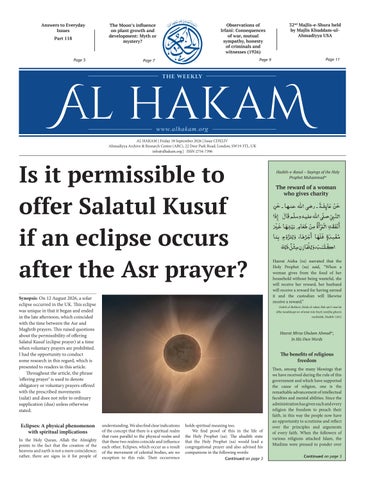
Is it permissible to offer Salatul Kusuf if an eclipse occurs after the Asr prayer? Synopsis: On 12 August 2026, a solar eclipse occurred in the UK. This eclipse was unique in that it began and ended in the late afternoon, which coincided with the time between the Asr and Maghrib prayers. This raised questions about the permissibility of offering Salatul Kusuf (eclipse prayer) at a time when voluntary prayers are prohibited. I had the opportunity to conduct some research in this regard, which is presented to readers in this article. Throughout the article, the phrase ‘offering prayer’ is used to denote obligatory or voluntary prayers offered with the prescribed movements (salat) and does not refer to ordinary supplication (dua) unless otherwise stated.
Eclipses: A physical phenomenon with spiritual implications In the Holy Quran, Allah the Almighty points to the fact that the creation of the heavens and earth is not a mere coincidence; rather, there are signs in it for people of
Hadith-e-Rasul – Sayings of the Holy Prophet Muhammadsa
The reward of a woman who gives charity
َ َ ٰ َ َ ﻋ ْﻦ َ�ﺎ�ِﺸﺔ ـ رﺿﻰ ا��ّ� ﻋﻨﻬﺎ ـ ﻋ ِﻦ َّ َ َ َ ّ ّٰ ّ اﻟﻨ ِ� ِّ� ﺻﻠﻰ ا��� �ﻠﻴﻪ وﺳﻠﻢ ﻗﺎل� ِإذا ْ َ َ َ ْ ُ َ ْ َ ْ أَﻧْ َﻔ َﻘ �َ �ﺎم ﺑ َ ْﻴ ِﺘ َﻬﺎ ﻏ ِ ِ ﺖ اﻟ��أة ِﻣﻦ ﻃﻌ َ َ َ َ ّ َوﻟ،ُﻣ ْﻔ ِﺴ َﺪ ٍة ﻓﻠ َﻬﺎ أ ْﺟ ُﺮ َﻫﺎ ِﻠﺰ ْو ِج ﺑِ َﻤﺎ َ ْ َْ َ َ ُ ْ � َوﻟ ِ��ﺎ ِز ِن ِﻣﺜﻞ ذﻟ ِﻚ،ا�� َﺴ َﺐ Hazrat Aisha (ra) narrated that the Holy Prophet (sa) said, “When a woman gives from the food of her household without being wasteful, she will receive her reward, her husband will receive a reward for having earned it and the custodian will likewise receive a reward.” (Sahih al-Bukhari, Kitab al-zakat, Bab ajri l-mar’ati idha tasaddaqat aw at‘amat min bayti zawjiha ghayra mufsidah, Hadith 1441)
Hazrat Mirza Ghulam Ahmadas, In His Own Words
The benefits of religious freedom
understanding. We also find clear indications of the concept that there is a spiritual realm that runs parallel to the physical realm and that these two realms coincide and influence each other. Eclipses, which occur as a result of the movement of celestial bodies, are no exception to this rule. Their occurrence
holds spiritual meaning too. We find proof of this in the life of the Holy Prophet (sa). The ahadith state that the Holy Prophet (sa) would lead a congregational prayer and also advised his companions in the following words: Continued on page 3
Then, among the many blessings that we have received during the rule of this government and which have supported the cause of religion, one is the remarkable advancement of intellectual faculties and mental abilities. Since the administration has given each and every religion the freedom to preach their faith, in this way the people now have an opportunity to scrutinise and reflect over the principles and arguments of every faith. When the followers of various religions attacked Islam, the Muslims were pressed to ponder over Continued on page 3
Friday 18 September 2026 | AL HAKAM
2
This Week in History 18-24 September
18 September 1894: The Promised Messiah (as) received the following revelation:
داغ هجرت “Stigma of migration.” (Tadhkirah [English], p. 340) 18 September 2009: During his Friday sermon on this day, Hazrat Khalifatul Masih V (aa) mentioned the Jamaat-e-Ahmadiyya’s services for Hadith. Huzoor (aa) also mentioned the establishment of the Nur Foundation and shared that the books of Hadith were being published, and many volumes of Sahih al-Bukhari and Sahih Muslim, etc, had been published with translation. To read these translations, see: new.alislam.org/library/ ahadith. 19 September 1885: On this day, which was 9 Dhul-Hijjah 1302 AH, Hazrat Sufi Ahmad Jan Sahib read out a prayer in the field of Arafat, which was written by the Promised Messiah (aa). In the early days of this year, when Hazrat Sufi Sahib was about to embark on Hajj, the Promised Messiah (as) wrote down a prayer and asked him to read it upon seeing the veil of the Ka‘bah. The wording and gist of this prayer show his steadfastness, righteousness and deep desire for the revival of Islam. (Tarikh-e-Ahmadiyyat, Vol. 1, pp. 264-265) 19 September 1924: On this day, Sir Edward Dennison Ross, President of the Wembley Conference, had an audience with Hazrat Muslehe-Maud (ra). That same evening, Huzoor (ra) addressed a gathering at St Luke Hall, London, on the topic of life after death. (Tarikh-eAhmadiyyat, Vol. 4, p. 451)
22 September 22 September 1895: The Promised Messiah (as) endeavoured his utmost to revamp the style and class of religious debates being conducted in the Indian subcontinent. On this day, he drafted a meticulous announcement on the abovementioned topic. This was printed in Zia-ul-Islam Press, Qadian, carrying supporting signatures of hundreds of honourable Muslim persons of influence. (Majmua-e-Ishtiharat, Vol. 2, pp. 4650) 22 September 2013: Hazrat Khalifatul Masih V (aa) arrived in Singapore on this day.
A glimpse into the rich history of the Ahmadiyya Muslim Jamaat
18 - 19 September
persecution and martyrdoms of Ahmadis in Karachi and the Punjab province of Pakistan, Huzoor (aa) urged the Jamaat to pray for those Ahmadis.
19 September 1932: On this date, Hazrat Musleh-e-Maud (ra) stressed the need to safeguard the rights of the so-called “Achhut” (Untouchables) in India. (Tarikh-e-Ahmadiyyat, Vol. 6, pp. 67-68)
20 - 21 September 20 September 1948: On this day, the new Markaz, Rabwah, was inaugurated. According to the schedule, Hazrat Musleh-e-Maud (ra) left Lahore by car at 9:20 in the morning and arrived in Rabwah at 13:20. Huzoor (ra) was accompanied by Hazrat Mirza Bashir Ahmad (ra) and various other members of the Jamaat. The Zuhr prayer was offered at around 1:30 pm with the participation of approximately 250 in congregation. This was the first congregational prayer that took place in this land, led by Hazrat Khalifatul Masih II (ra). Huzoor (ra) then delivered a speech and led all members in silent prayer. (Tarikh-e-Ahmadiyyat, Vol. 11, pp. 429-444) 21 September 1957: On this day, Dr Muhammad Rashidi, Ambassador of Indonesia to Pakistan, visited Rabwah and expressed his desire to meet Hazrat Musleh-e-Maud (ra), which was fulfilled. Before his return, on 23 September, he also attended a reception organised by the people of Rabwah. (Tarikh-e-Ahmadiyyat, Vol. 18, pp. 484 – 496) 21 September 2012: During his Friday sermon on this day, Hazrat Khalifatul Masih V (aa) mentioned Naveed Ahmad Sahib of Karachi, Pakistan, who had been martyred on 14 September. Huzoor (aa) also mentioned Muhammad Ahmad Siddiqui Sahib of Karachi, who had been martyred on 15 September. While mentioning the increasing
Huzoor (aa) was greeted at Singapore’s Changi Airport by the delegates of the Jamaat from Singapore, Indonesia and Malaysia. Later in the day, Huzoor (aa) travelled to the Taha Mosque, where he was greeted by Ahmadis and then led the Maghrib and Isha prayers. (“Head of Ahmadiyya Muslim Jamaat Arrives in Singapore”, pressahmadiyya.com)
23 - 24 September 23 September 1924: On this day, Hazrat Sir Chaudhry Zafrulla Khan (ra) read out an article written by Hazrat Musleh-e-Maud (ra) at the Wembley Conference. This essay was admired by many people who attended the event. Remembering this day, Hazrat Sir Chaudhry Zafrulla Khan (ra), in his book, Tehdis-e-Nemat, writes: “When the time came to read the address, the Imam leaned toward me to say in a most affectionate manner, ‘Do not worry, I will continue to pray for you.’ Every seat in the hall was taken. A large number had to stand. The entire address was heard in eerie silence.” (Tehdis-e-Nemat, pp. 212-213) 23 September 1983: During the tour of Fiji, on this day, Hazrat Khalifatul Masih IV (rh) delivered a lecture at the University of the South Pacific in Suva on “Ahmadiyyat and the Philosophy of Revival of Religions.” (Silsila Ahmadiyya, Vol. 4, p. 826) This lecture was later published in book form under the title: Revival of Religion. 24 September 2014: On this day, Hazrat Khalifatul Masih V (aa) visited the National Parliament of Ireland, the Oireachtas, at Leinster House in Dublin. More than 20 parliamentarians welcomed Huzoor (aa) to Ireland. Following his meeting with the parliamentarians, Huzoor (aa) was escorted to the galleries of both the Lower and the Upper Houses of Parliament, where he observed the parliamentary proceedings. (“Head of Ahmadiyya Muslim Community Visits Irish National Parliament”, www.pressahmadiyya.com)
AL HAKAM | Friday 18 September 2026 Continued from page 1
their own religious texts in support of their religion and to prove its truthfulness, and in this way their intellectual faculties were refined. It is a matter of principle that just as physical strengths improve with exercise, spiritual faculties also are developed and nurtured with exercise, just as a horse is disciplined by a trainer. Similarly, with the
Continued from page 1
َ ْ ْ َ َ َُ ْ َ ُ َْ َ اَس َِّتﻐﻔاَرِ ُِه ِفا��َعوا ِِإَّلى ِذ� َِر ُِه ْودَعاِئِ ِﻪ ْو
“Proceed to remember Allah, invoke Him and ask for His forgiveness. (Sahih alBukhari, Kitab al-kusuf, Bab fi zikr al-kusuf) However, the recent eclipse raised the question: Is the Kusuf prayer mandatory at every occurrence of an eclipse, especially at times when prayer (in the form of salat) is generally forbidden or discouraged? To gain a sound understanding of this matter, it is important to analyse the relevant ahadith and find out what course of action the Promised Messiah (as) and his khulafa adopted in similar circumstances.
Makruh (discouraged) and mamnu‘ (forbidden) times Before delving further into the topic, it is important to understand that the times during which prayer should not be offered are of two types. There are mamnu‘ (forbidden) times, during which offering prayer is categorically impermissible. These times are: 1. When the sun begins rising on the horizon until it has risen fully. 2. When the sun is at its zenith. 3. When the sun begins to set on the horizon until it has completely set. These three timings have a typical duration of about five to ten minutes. Apart from these times, there are two other times during which offering prayer is deemed makruh (discouraged). These are: 1. After the Fajr prayer has been offered until sunrise. 2. After the Asr prayer has been offered until sunset. These times are longer in duration. The offering of nawafil (voluntary prayers) is prohibited during these times. It should be noted here that Salatul Kusuf is a voluntary prayer. Hence, even at a glance, it is apparent that this prayer should not be offered during any of the aforementioned times based purely on this premise. The prophetic injunctions in the ahadith apart from offering the prayer, such as turning towards the remembrance of Allah and giving alms, which should be utilised as alternatives in such cases, are alternatives that have been provided in the case when offering the prayer is impermissible.
Are prayers completely forbidden after Asr? This viewpoint raises questions about whether prayer as a whole is forbidden after Asr. Scholars throughout history have had minor differences on this issue.
3
arrival of the British, people have received an opportunity to reflect over the principles of religion. Those who reflect have in turn become more firm and steadfast in Islam— the Religion of Truth. Further, wherever an opponent of the Holy Quran has put their finger to object, it is from that very place that those who contemplate have found a treasure of divine insight. Moreover, due to this freedom, the field of dialectics has also
advanced a considerable degree, especially here. Now if someone from Turkey or Syria was to come here—no matter how knowledgeable and learned a scholar— they would not be able to sufficiently refute the objections raised by the Christians or Aryas, because that individual would not have been as able to receive such free and wide exposure to the principles of various religions so as to cross-examine between
them. Therefore, just as the country has found physical peace through the British government, so too we have attained spiritual peace as well. Since I am concerned with spiritual and religious affairs, I will speak mostly of those favours granted to us by the government, which have facilitated us in fulfilling our religious obligations.
This is because certain narrations in the ahadith support offering prayer after Asr. Based on these narrations, the following counterarguments have to be examined carefully: 1. According to authentic narrations, the Holy Prophet (sa) consistently offered two nawafil after offering the Asr prayer. 2. It is permissible to offer the salat-uljanazah (funeral prayer) after Asr. 3. In the view of some Companions and jurists, it is permissible to offer the two nawafil after performing tawaf of the Ka‘bah during the makruh timings. These points are examined below.
for him and he would offer many of his prayers sitting.” She was referring to the two raka‘at after the Asr prayer. “And the Prophet (sa) would offer them, but he would not offer them in the mosque for fear of overburdening his ummah. He loved to ease [the burden] for them.” (Sahih al-Bukhari, Hadith 590) It is also important to note that the offering of these nawafil has only been narrated by two blessed wives of the Holy Prophet (sa), namely Hazrat Aisha (ra) and Hazrat Umm-e-Salamah (ra), who were more aware of the domestic life of the Holy Prophet (sa), and it has not been narrated by any male Companion. This makes it even clearer that this was a personal practice of the Holy Prophet (sa). Is it possible, then, to forsake a clear prohibition of the Holy Prophet (sa) on the basis of one of his personal actions which he did not wish his people to emulate?
the Holy Quran:
The Holy Prophet’s (sa) nawafil after Asr It should be noted that the Holy Prophet (sa) very explicitly stated that no prayer should be offered after the Asr prayer. The following narration is found in Sahih al-Bukhari: Hazrat Abu Hurairah (ra) stated: “He forbade offering prayer after the Fajr prayer before sunrise and after the Asr prayer before sunset.” (Sahih al-Bukhari, Hadith 584) We also find a similar narration from Hazrat Abu Sa‘id al-Khudri (ra), who heard the Holy Prophet (sa) say: “There is no prayer after daybreak and before the sun has risen high, nor is there any prayer after the Asr prayer and before the sun disappears.” (Sahih al-Bukhari, Hadith 586) In the book on the timings of prayer in Sahih al-Bukhari, this prohibition is narrated by revered Companions of the Holy Prophet (sa), such as Hazrat Abu Hurairah (ra), Hazrat Abu Sa‘id al-Khudri (ra), Hazrat Muawiyah (ra) and Hazrat Abdullah ibn Umar (ra). This shows that this prohibition has been mass-transmitted by well-known Companions of the Holy Prophet (sa), some of whom were prolific narrators of ahadith. Thus, the prohibition of offering prayers at these times is undoubtedly an injunction of the Holy Prophet (sa) to his ummah. Having said that, we also find narrations in the same section of Sahih al-Bukhari that state that the Holy Prophet (sa) did offer two units of voluntary prayer after offering the Asr prayer. However, there is a clear mention of the fact that these nawafil were a personal endeavour and that the Holy Prophet (sa) did not wish this to be emulated by his ummah. The narration of Hazrat Aisha (ra) makes it clear that there is no contradiction in this. She states: “By Him Who has taken him [the Prophet (sa)] away, he did not miss out these two raka‘at until he met Allah the Exalted. He did not meet Allah the Exalted until [standing in] prayer became difficult
The shariah is based on obedience to the Holy Prophet (sa) Hazrat Syed Zainul Abidin Waliullah Shah Sahib (ra), a revered Companion of the Promised Messiah (as) and commentator on Sahih al-Bukhari, makes a very beautiful point in this regard. He states: “In summary, [Imam Bukhari] has resolved the differences between the narrations with this precise order. After the Asr prayer, the Holy Prophet (sa) reserved two raka‘at for himself, which he would offer at home rather than in the mosque. “For fear of overburdening his ummah. He loved to ease [the burden] for them. (Hadith 590) “It is evident from this that nawafil after the Asr prayer are not forbidden (haram), but makruh. A further reason for them being considered makruh is that the Holy Prophet (sa) did not wish to overburden his ummah. Thus, even if the Holy Prophet (sa) forbids something good, true reverence is demonstrated by refraining from it, as the essence of faith lies in obedience, rather than performing a lot of deeds.” (Sahih alBukhari, Translation and Commentary, Islam International Publications Limited, Vol. 1, p. 1020) This is an incredibly important point.
Offering the janazah prayer after Asr It should be noted that the janazah prayer is unlike other prayers (salat); it is rather a supplication of mercy for the deceased. In Arabic, the expression used for the funeral � prayer is اﻟﺼﻼة ﲇﻋ اﳉﻨﺎزة, in which the root َﺻﲆ ََ ﲇﻋis translated according to the context in which it appears. For example, we find in
(Malfuzat [English], Vol. 2, p. 195)
ُ� ُ ُ� َ� َ َ� ُ َ َ �ٰ َ ِا �َن ا�� َ� َْو َْم �َّل ِ�ُك ََّت ٗﻪ ُيُ ََصَّلوۡ ََن ََع�ي اَّلًن ِ� ِ�ي � �ُيا �ُي ََها اَّل ِﺬُيۡ َْن ٰا َْمًنوۡا َﺻَّلوۡا َ َ � ََعَّل ۡي ِﻪ َْو ََس َِّل َُموۡا ُت ُۡس َِّل ۡي ًَما This translates as: “Allah and His angels send blessings on the Prophet. O ye who believe! you also should invoke blessings on him and salute him with the salutation of peace.” (Surah al-Ahzab, Ch.33: V.57) ََ � The expression َﺻﲆ ﲇﻋhas been used twice but does not mean offering prayer (salat). It means ‘to send blessings’ and, when believers are the subject, may be translated as ‘to pray for’ the Prophet (sa). Arabic dictionaries and lexicons are in agreement. We find in the Dictionary of the Holy Quran by Hazrat Malik Ghulam Farid Sahib: � “The word َﺻﲆhas different meanings with reference to different objects.” (Dictionary of the Holy Quran, p. 488) In Lane’s Lexicon, we find under the ََ � َ expression ﺻﲆ ﲇﻋ: “Said of an angel, means he prayed for, or begged, forgiveness, or pardon, for him: and thus the verb sometimes means when said of other than an angel; as in the trad. of ُ ْ ا َ�ذا ﻣ ِْﺘ َﻨﺎ َﺻ �ﲆ ﻟَ َﻨﺎ ُﻋ ْ َﺎﻤﺜ ُن Sowdeh, in which it is said, ﻦﺑ َْ ُ ﻮن ٍ [ ﻣﻈﻌWhen we die, ‘Othman Ibn-Madh‘oon will pray for forgiveness for us]; he having then died. (TA.) – [And, said of a man, he blessed him, meaning he invoked God’s blessing upon him; namely, the Prophet (sa).]” (Lane’s Lexicon) There are other such verses in the Holy Quran that utilise this expression and are translated in a similar manner. (See Surah al-Ahzab, Ch.33: V.44; Surah al-Baqarah, Ch.2: V.158 and Surah at-Taubah, Ch.9: V.103.) A brief study of the hadith corpus also reveals that the Holy Prophet (sa) used the same expression to refer to the janazah prayer. We find in Sahih al-Bukhari, in the book of funerals, under the chapter titled “The legal way of offering the funeral prayer” (before Hadith 1322):
َ� َ َ� َ� َ ُ� َ� َ َ َ َ َ ْ َ َ� َْم ْْن َ ُﺻَّلى ََعَّلى اَّل َجًناز ُِة؟:ﺻَّلى ا�� ُ� ََعَّل ْي ِﻪ َْو ََسَّل َْم ْوَقاَل اَّلًن�ي َ� َ َ � َ َ َ َ ْ ُ َ َ َ ُ� َ ِ َ َ َ َ �ا�ي ِ ِ ﺻَّلوا َعَّلى اَّلًنج: ﺻَّلوا َعَّلى ﺻا ِِح ِْبُكْم ْوَقاَل:ْوَقاَل
We do not find in the hadith corpus an instance where the Holy Prophet (sa) used the construction ;ﺻﻼة اﳉﻨﺎزةrather, we only ََ � find the expression َﺻﲆ ﲇﻋin his words. The jurists and hadith scholars later added the term ﺻﻼة اﳉﻨﺎزةfor ease of understanding. For this reason, scholars and jurists have differed about whether this is just a supplication (dua) or an offered prayer (salat). (Sahih alBukhari, Translation and Commentary by Syed Zainul Abidin Waliullah Shah [Urdu], Vol. 2, p. 698) With regard to funerals, the Holy
Friday 18 September 2026 | AL HAKAM
4
Prophet (sa) also gave the following instruction which was recorded by Hazrat Ali (ra): “Ali! Three are not to be delayed: salat when its time comes, a funeral when it [a prepared body] is present and [the marriage of] a single woman when there is an equal for her.” (Jami‘ at-Tirmidhi, Hadith 171) The wisdom behind this prophetic injunction is that funerals are a distressing time for the grieving family. The family has to make arrangements for the burial of the deceased and facilitate mourners and friends. Hence, to create ease for the grieving family, the funeral prayer may be offered during the discouraged times so as not to become an obstacle for them. It is also useful to note that we do not offer any bowing motion (ruku‘) or prostration (sajdah) during the funeral prayer. This also points to the fact that it is a supplication for the deceased.
The nawafil offered after tawaf of the Ka‘bah Regarding the two nawafil after tawaf, the Companions of the Holy Prophet (sa) and the jurists have differed on whether it is permissible to offer them during the makruh timings. However, many senior Companions have opined that these nawafil should be delayed until after the makruh timings have finished. We find in Sahih alBukhari that Hazrat Abdullah ibn Umar (ra) would not offer these nawafil until the sun had risen, and Hazrat Umar (ra) also did the same by completing tawaf after the Fajr prayer and then going to Dhi Tuwa and offering his nawafil there, to allow the sun to rise and avoid the makruh timing. Similarly, we also find mention of Hazrat Aisha (ra) disapproving of others offering these nawafil after the Asr prayer. (Sahih al-Bukhari, Book of Pilgrimage, chapter on tawaf after the Fajr and Asr prayers, Hadith 1628) This shows that there is a difference of opinion in the offering of these nawafil, hence this matter cannot be deemed evidence in support of offering the Salatul Kusuf after the Asr prayer. With regard to Hajj, it may be possible that these nawafil may be offered in the makruh timings, however it should be noted that these are days with very specific acts of worship that are exceptions to worship in everyday life. For example, we find the prohibition of hunting animals on land for pilgrims in the Holy Quran. This injunction is specific to the pilgrims. Similarly, there are also other commands that have been established with the goal of creating a unique spiritual atmosphere and a sense of community and cohesion between Muslims from all over the world. If, on those very specific days, pilgrims have to offer these nawafil during the makruh timings, then this can only be considered an exception to the rule, not the rule itself.
The rulings of the four schools of fiqh Based on the aforementioned points, the majority of jurists have ruled that it is not permissible to offer Salatul Kusuf during the makruh timings, such as after the Asr prayer. In Hanafi fiqh, this has been the recorded stance of Hazrat Imam Abu Hanifa (rh), narrated by his students without contradiction. Allama al-Sarakhsi records
the following from the great Imam (rh) himself:
َ� َ َ ْ ُ ُ ْ َ� َ َ َ َ ِالَّثَلَاَثَ ِِة اَّل�َِتي ُتُ ْْك ََر ُُه ِف يَها اِت َق ِ ََوَلا ُيُ ََصَّلى اْلُك ُُس َوُف ِفِي اْلَأ ْْوَق:اَل ِ َ ُ َ َ � َ ُ َ َ� ُ َ َ� اِت ِ الَّصَلاُة ِلَِأَّن ََها َتَط �ُّو ٌٌع َك ََساِئِِرِ الَّتَط �ُّو ََع Imam Abu Hanifa (rh) said: “The Kusuf prayer is not offered during the three makruh timings because it is a voluntary prayer like other voluntary prayers.” (AlMabsut, Book on Salat, chapter on the Kusuf prayer, Vol. 2, p. 76) This viewpoint has also been recorded by al-Kasani in his book Bada’i al-Sana’i. The Hanafi viewpoint has also been recorded in non-Hanafi texts such as Al-Tamhid by Ibn Abd al-Barr (rh). In the Maliki and Hanbali schools of thought, there seem to be contradictory reports about what ruling each respective Imam gave; however, with the passage of time, the majority of scholars of both schools of fiqh have favoured the Hanafi viewpoint. It is only the Shafi‘i school of fiqh that has differed entirely from this ruling, with Hazrat Imam Shafi‘i (rh) holding that the prayer should be offered. However, most jurists disagree with this ruling.
The Promised Messiah (as) A study of Jamaat history reveals that there was one occasion during the lifetime of the Promised Messiah (as) when it can be said that a solar eclipse prayer was offered at a similar time. We find in Ashab-e-Ahmad, Vol. 2, a narration copied from the diary of Hazrat Nawab Muhammad Ali Khan Sahib (ra), dated 22 January 1898: “Thereafter, we went to the Jami‘
Mosque to offer the Kusuf prayer. First, the Zuhr and Asr prayers were combined and then the Kusuf prayer was offered, and the pain and weeping with which the prayer was offered was an astonishing sight. After the conclusion of the eclipse prayer, a prayer of gratitude was also offered. The day was spent almost entirely in worship. The opponents should come and see whether their opposition is based on justice.” (Ashabe-Ahmad, Vol. 2, p. 518) On this occasion, the Zuhr and Asr prayers were combined, and then the Kusuf prayer was offered. This means that the eclipse actually occurred at Zuhr time, at which point both Zuhr and Asr prayers were combined early, and then the Kusuf prayer was offered. Therefore, this narration does not establish that the prayer was offered after Asr time. This is also supported by the NASA database of solar eclipses, which suggests that the eclipse was visible in Qadian from around 12 pm to 3 pm. (“Catalog of Solar Eclipses: 1801 to 1900”, eclipse.gsfc.nasa.gov, 21 July 2010) A very significant aspect of this narration is that nowhere has mention been made of the Promised Messiah (as) himself, the chosen Arbiter of the Latter Days, offering this prayer or being present with the Companions who offered it at that time. In fact, if we look at the Kusuf prayer in general, there is an instance recorded in 1907 when the Kusuf prayer was offered in Qadian but was led by Hazrat Khalifatul Masih I (ra), and there is no mention of the Promised Messiah (as) being present. (Khutbat-e-Nur, p. 242)
Hazrat Musleh-e-Maud (ra) A solar eclipse was recorded during the Khilafat of Hazrat Musleh-e-Maud (ra) that took place in Ramadan and after Asr. This was recorded in Al Fazl on 23 August 1914 in the following words: “Hazrat Khalifatul Masih was noticeably unwell on Friday; however, Huzoor [ra] led the Jumu‘ah prayer himself. In his sermon, he drew attention to the current war and emphasised the importance of fulfilling our pledge to the government, thus following the teachings of the Promised Messiah (as).” “On Friday, a solar eclipse took place at around half past six. The eclipse prayer (Salatul Kusuf) was not offered. The injunctions to seek forgiveness for one’s sins (istighfar) and give alms (sadqa) were followed.” (Al Fazl, Qadian, No. 29, Vol. 2, 23 August 1914, p. 1) It is possible that one may say that perhaps the prayer was not offered by Huzoor (ra) due to his illness. However, we must remember that Huzoor’s (ra) commitment to his duties in the face of personal illness was exemplary and a hallmark of his Khilafat. This can be seen from the fact that, despite his illness, he still led the Jumu‘ah prayer. Then there is also the question that, if Huzoor (ra) did not lead the eclipse prayer due to his illness, he could easily have appointed someone else in his place to lead it. However, this also did not take place. Rather, we find explicit mention of the injunctions to engage in istighfar and give sadqa at the time. This makes it apparent that, in the view of Hazrat Muslehe-Maud (ra), it was not permissible to offer this prayer between the Asr and Maghrib prayers. This is why he drew the Jamaat’s attention to the other commands given to us by the Holy Prophet (sa), namely, engaging in istighfar and giving sadqa. This is also a sunnah of the Holy Prophet (sa) and, by this method, we can follow both sunnahs of the Holy Prophet (sa): not offering any prayer after Asr and turning towards Allah the Almighty at the time of an eclipse.
Hazrat Khalifatul Masih V (aa) When this matter was presented to Huzoor (aa), he instructed that the eclipse prayer should not be offered after the Asr prayer. Hence, the Jamaat in the UK did not offer the eclipse prayer on this occasion. Huzoor’s (aa) ruling is in accordance with the directives of the Holy Prophet (sa), the course of action adopted by the Promised Messiah (as), his khulafa and the majority of jurists. As Ahmadi Muslims, it is incumbent upon us to cherish the blessing of having a system of Khilafat on the precepts of prophethood. This means that we receive adequate guidance on complex matters through this unrivalled blessing. Hence, we must follow the directive of the Holy Prophet (sa): “The Imam is like a shelter, for whose safety the Muslims should fight and where they should seek protection.” (Sahih alBukhari, Hadith 2957) In this way, we can safeguard our spirituality and that of our future generations. May Allah the Almighty enable us to do so. Amin. (Sarfraz Ahmad, Graduate, Jamia Ahmadiyya UK)
AL HAKAM | Friday 18 September 2026
5
Answers to Everyday Issues 118
Female voice and purdah, forex trading, Flat Earth, women and prophethood, feminism, letters to Huzoor, piety, Palestine in Surah Bani Isra’il, Surah Fil and music Guidance regarding basic Islamic issues – which Hazrat Amirul Momineen, Khalifatul Masih Vaa has given on various occasions in his written correspondence and during MTA programmes – is being officially published below for everyone’s benefit. Does Islam prohibit men from hearing a woman’s voice? A lady asked Hazrat Amirul Momineen, Khalifatul Masih V (aa), whether, in Islam, a woman’s voice is also subject to purdah. Nowadays, working as a voice-over artist or making YouTube videos using only one’s voice in the background has become very common and girls are able to benefit from this while remaining at home. She asked whether Ahmadi girls could do this kind of work. In his letter dated 25 March 2024, Huzoor-e-Anwar (aa) provided the following guidance in this regard: “I am not aware of any injunction in Islam that makes it categorically unlawful merely to hear a woman’s voice. If that were the case, why would the Holy Quran instruct the wives of the Holy Prophet (sa), ‘So be not soft in speech, lest he in whose heart is a disease should feel tempted; and speak a decent speech’? (Surah al-Ahzab, Ch. 33: V. 33) “It is clear from this verse that a woman may speak to men, but her speech should be good. Even then, a woman should remain fully mindful of her purdah. She should not speak to men in a soft or alluring tone; rather, she should speak to them in a firm tone. By firmness, I mean that her voice should not be such that it unnecessarily attracts a man towards her, because this may lead men to improper thoughts. “Furthermore, it is also mentioned in the ahadith that women used to take part in battles in the early days of Islam, where people would hear their voices. Similarly, the Companions and their successors, the Tabi‘un, would ask Hazrat Aisha (ra) and the other blessed wives of the Holy Prophet (sa) religious questions and they would answer them.
“Today, too, we see women working in various walks of life and reading the news on television channels, while men hear their voices. Therefore, as for the claim made nowadays that a woman’s voice must not be heard and that, if one hears it, molten lead will be poured into one’s ears, as some clerics narrate in a hadith, if that hadith is authentic, its meaning is that the Holy Prophet (sa) warned us against listening to the indecent voices of women engaged in singing and dancing, which incline people towards nudity, indecency and filth. However, if the voice is used for the sake of faith, such as when women recite religious poems or speak about Allah and His Messenger (sa) and such a voice reaches a man’s ears, it does not give rise to thoughts of indecency. Therefore, there is no harm in it. “Thus, there is no harm in a woman working as a voice-over artist or providing background narration for a programme on YouTube, provided it is for a good, noble and religious purpose. However, if such use of her voice is for something indecent or satanic, it is not permitted.”
Is online forex trading halal or haram in Islam? Someone wrote to Hazrat Amirul Momineen, Khalifatul Masih V (aa), asking whether forex trading, involving the online trading of gold and currencies, is permissible. In his letter dated 26 March 2024, Huzoor-e-Anwar (aa) provided the following answer to this question: “If forex trading remains confined to the buying and selling of the relevant assets, there is no harm in it and it is permissible. However, if it turns into speculative betting, as frequently happens in forex trading
nowadays, then, since this is a form of gambling and gambling is forbidden in Islam, such forex trading is not permissible. Similarly, if interest-based transactions are carried out at any point or interestbased dealings become involved in forex trading, then such forex trading is also not permissible. “Some contemporary scholars argue that forex trading is forbidden because the buyer does not obtain possession of the assets and the entire business is merely verbal and is therefore impermissible. However, if one considers the matter, most business nowadays is conducted online: A person purchases an item online from one place and sells it online elsewhere. The nature of business has completely changed in this age. The hand-to-hand transactions of earlier times can no longer take precisely the same form in most modern businesses. Instead, business dealings today are conducted through correspondence and written communication by email, which, in one sense, is itself compliance with the Islamic injunction to put business transactions into writing. Therefore, there is no harm in conducting business online when it is recorded in writing through emails and the like. “Thus, in my view, there is no harm in forex trading so long as it does not involve interest or gambling. However, if any element of interest or gambling becomes involved in it, then it is not permissible.”
Does the Holy Quran state that the earth is flat or round? Someone from Singapore wrote to Hazrat Amirul Momineen, Khalifatul Masih V (aa), stating, “I do not think the earth is round or that it rotates. The Holy Quran has also described the earth as flat. Similarly, I do not think the Americans went to the moon. If my view about the earth is correct, please guide me.” In his letter dated 26 March 2024, Huzoor-e-Anwar (aa) provided the following answers to these questions: “Where matters have already been established through knowledge and observation, have been confirmed by learned people and experts in the relevant field and are accepted by the majority of the world, a mere conjectural statement concerning those established and proven matters, such as, ‘I do not think this is so’, carries no weight. Thus, when scientists throughout the world agree that the earth is round and revolves in its orbit, on what evidence can you say that the earth is neither round nor revolves? “Moreover, in Surah al-Anbiya, after mentioning various celestial bodies and things associated with them, such as the earth, sky, mountains, night, day, sun and َ � ُ �ٌْل ِفي َِف ََّلﻚ ُيَ ُْس َْب ُﺤ moon, the Holy Quran states: وَن ٍ ِ (Surah al-Anbiya, Ch. 21: V. 34), meaning, ‘each gliding along smoothly in its orbit.’ “Hazrat Khalifatul Masih IV (rh), in his
Friday 18 September 2026 | AL HAKAM
6
book Revelation, Rationality, Knowledge and Truth, has discussed at considerable length the movements and states of various things in the universe, particularly celestial bodies. You should read the entire discussion there. “The Promised Messiah (as) has also discussed these matters in various places. Thus, in one place, regarding the shape of the earth and its diameter, he states: “‘The earth is spherical in shape and its diameter, according to the estimate of some, is approximately 4,000 standard kose [a kose being approximately two English miles].’ (Barahin-e-Ahmadiyya, Part IV, Ruhani Khazain, Vol. 1, p. 515, sub-footnote no. 3)”
Can a woman become a Prophet in Islam? Someone from the USA asked Hazrat Amirul Momineen, Khalifatul Masih V (aa), with reference to verse 70 of Surah an-Nisa, whether a woman, while progressing in faith, can reach the station of prophethood, in which Allah the Exalted grants her abundant revelation, visions and true dreams, a state referred to as prophethood. Or, if a woman cannot become a prophet, what is the reason for this? Can a woman, while advancing in faith, surpass ordinary men? In his letter dated 26 March 2024, Huzoor-e-Anwar (aa) provided the following guidance in this regard: “Allah the Exalted has created two distinct sexes among human beings, male and female, making their physical conditions similar in some respects and different in others. He has given them some commandments that are the same and some that are different. He has also prescribed for both religious and worldly rights and duties that are similar in some respects and different in others. “Given the difficult and important responsibilities associated with the station of prophethood, Allah the Exalted has made only men capable of bearing it and has not placed the burden of this responsibility upon women, because a woman cannot bear the burden of this office on account of her weaker faculties in comparison with a man. Accordingly, Allah the Exalted states in the Holy Quran: ‘And We sent not [as Messengers] before thee but men to whom We sent revelation, so ask those who possess the Reminder, if you know not.’ (Surah anNahl, Ch. 16: V. 44)
“Yes, a woman can advance in spirituality, attain nearness to Allah the Exalted and surpass many men. Thus, in the Holy Quran, Allah the Exalted has described such a lofty station for Hazrat Maryam (as) that thousands, even hundreds of thousands, of men cannot even imagine it. Accordingly, when, upon her birth, her mother expressed regret that she had given birth to a girl, Allah the Exalted stated that this girl would be far better than the boy her mother had in mind. (Surah Aal-e-Imran, Ch. 3: V. 37) “Regarding why a woman cannot be a prophet, Hazrat Musleh-e-Maud (ra) writes: “‘A woman is not appointed to this office for certain wise reasons. The fact is that Allah the Exalted has created men and women for different tasks. Since the office of prophethood lies outside a woman’s sphere of activity, only men are appointed to it. As for the remaining rewards, since they do not lie outside women’s sphere, women share them with men. A woman can be a siddiqah [a woman of outstanding truthfulness] and women have attained this rank. She can be a waliyyah [a saintly woman] and women have attained this rank. She can be a qanitah [a devoutly obedient woman] and women have attained this rank. In short, apart from prophethood, which is an office, women can receive all other rewards and have continued to receive them.’ (Tafsir-e-Kabir, Vol. 4, UK, 2023, p. 529) “A question was presented to the Promised Messiah (as), the Hakam and Adl [Judge and Arbiter] of this age, as to whether a woman could be a prophetess. He replied: َ اْم ُ َاَل ََق �و ُ ا �َّلر َﺟ “‘No. Allah the Exalted states, وَن ِ �َ ََ َعَّلى اَّلًنُِسا ِء, “Men are guardians over women” َ َ � َ (Surah an-Nisa, Ch. 4: V. 35) and اَل ََعَّل ْي َِه �َْن ِ ْوَّل ِِ�َرﺟ ٌَ ََ دَرﺟِة, “but men have a rank above them” (Surah al-Baqarah, Ch. 2: V. 229). Women are, in fact, subordinate to men. When a door has been closed to those who possess rank and status, then where do these poor women, who are weaker in mental strength, stand?’ (Malfuzat, Vol. 5, UK, 2022, p. 65) “Thus, prophethood is an office that carries many responsibilities. Therefore, in view of men’s stronger faculties, Allah the Exalted has chosen them for this office. A woman, being of a more delicate physical constitution, cannot bear the burden of discharging the duties of this office and so she has not been charged with it.”
Feminism, letters to Huzoor (aa), piety, Surah Bani Isra’il, Surah Fil, music Someone from Canada sent the following enquiries to Hazrat Amirul Momineen, Khalifatul Masih V (aa): (1) What does Islam say about feminism and is there any connection between Islam and feminism? (2) When people are told to write to Huzoor (aa) about their problems, some say that Huzoor (aa) does not have time for such matters. What should one say in response? (3) I write one or more letters to Huzoor (aa) every day. Does this displease you? (4) When people say that, in order to establish a relationship with Allah, a person must give up their own desires and wishes, what does this entail? (5) Is verse 5 of Surah Bani Isra’il about the current situation in Palestine? (6) Is there a prophecy in Surah al-Fil? (7) Why does Islam discourage music? In his letter dated 31 March 2024, Huzoor-e-Anwar (aa) provided the following guidance in this regard: “1. The answer to your first question is that Islam has explained in great detail the rights and duties of both men and women in accordance with their respective responsibilities. Regarding this worldly life, َ� ْ َ َ ْ َ َ it states: ْوُف ِ ُ( َْوَّل َُه �ْن ِْمَّث ُْل اَّل ِﺬي ََعَّل ْي َِه �ْن ِِباَّل ََم ْﻌرSurah alBaqarah, Ch. 2: V. 229), meaning, ‘And they [the women] have rights similar to those [of men] over them in equity.’ Furthermore, men have been commanded concerning ْ َ ُ women: ْوُف ِ ُ( َْو ََعا ِ� َُرْوه �ْن ِِباَّل ََم ْﻌرSurah an-Nisa, Ch. 4: V. 20), meaning, ‘and consort with them in kindness.’ However, alongside this, because of certain responsibilities assigned to men in this worldly life, Islam also recognises that they have a degree of advantage over women, as it states: ‘Men are guardians over women because Allah has made some of them excel others and because they [men] spend of their wealth.’ (Surah an-Nisa, Ch. 4: V. 35) Similarly, it states that men have a rank above them. (Surah alBaqarah, Ch. 2: V. 229) “Regarding life of ُ the Hereafter, it َ� ُ َ the َْ َ ََ ً َ states: َْم ْْن ََع َِم َْل َﺻاَّل ًِﺤا ِْم ْْن ذ� ٍَر َأ ْْو َأَّنَّثى َْو ُهوَ َ ُْم ْﺆ ِْم َ ٌْن ِفَّلًن ْﺤ َ ِي َيًن ُﻪ َِح َياُة َ ( َﻃ �ي َْب ًِة َْوَّل َ ًَن ْجﺰُيَ �ًن َُه ْْم َأ ْﺟرَ ُه ْْم ِبﺄ ِْح َُسْن َْما �َاَّنُوا �َ ْﻌ ََم َُّلSurah anوَن ِ ِ ِ ِ Nahl, Ch. 16: V. 98), meaning, ‘Whoso acts righteously, whether male or female and is a believer, We will surely grant him a pure life; and We will surely bestow on such their reward according to the best of their works.’ “Thus, both men and women have their respective station in Islam and each has an important role in society. This is why Islam has explained in great detail the rights and duties of both women and men. If both men and women act upon these teachings of Islam, their life in this world also becomes a paradise and no conflict over rights arises between them. “In several of my addresses at the annual conventions of the UK and Germany, I have discussed these subjects in great detail in relation to the rights and duties of men and women, in light of the Holy Quran, the ahadith of the Holy Prophet (sa) and the statements of the Promised Messiah (as). You should listen to those again. “2. The answer to your second question is that people continue to write to me about various matters and I reply to them. Many of these replies are also published in
Al Fazl and Al Hakam in Urdu and English. If you have a serious matter in mind, you may write as well. The answer will benefit you and others will also be able to benefit from it. “3. Regarding your question about writing to me, it is very important to observe moderation in writing letters. If there is an important matter, you should certainly write. However, as for an ordinary letter requesting prayers, you should write one once a month. “4. Your next question is that when people say that, in order to establish a relationship with Allah, a person must give up their own desires and wishes, what does this entail? The answer is that the most important and fundamental thing in establishing a relationship with Allah the Exalted is to live in accordance with His pleasure. Therefore, one should act upon what God the Exalted has commanded and must abandon the evils He has forbidden. “5. The answer to your next question is that the Holy Quran is a complete and comprehensive Book. It contains spiritual teachings for humankind until the Day of Judgement and events that are to occur in future ages have also been indicated allusively in the form of prophecies. Surah Bani Isra’il describes the future circumstances of the Jews and the Muslims in accordance with their respective conditions. Hazrat Musleh-e-Maud (ra) has explained this in detail in Tafsir-e-Kabir. That is why I instructed the jamaats throughout the world to deliver durus on this section of Tafsir-e-Kabir in their respective jamaats, so that members of the Jamaat may become aware of it and strive to mould their state of faith in accordance with Islamic teachings. “6. The answer to your question regarding Surah al-Fil is that there certainly is a prophecy concerning a future age in Surah al-Fil. It states that in the Latter Days, anti-Islam powers will once again rise in strength and attempt to destroy Islam. However, just as in the past Allah the Exalted protected His House and utterly destroyed the enemy that attacked it, in the future too Allah the Exalted will protect His religion and thwart its opponents. But for this, Muslims need to change their own condition. Until Muslims mould their conditions in accordance with Islamic teachings and respond to the call of the Messiah of Muhammad (sa), sent by God the Exalted, they will continue to suffer defeat at the hands of anti-Islam powers. “Hazrat Musleh-e-Maud (ra), in his commentary on Surah al-Fil in Tafsir-eKabir, has discussed this prophecy in detail. You can read the details there. “7. The answer to your question about music is that music has been discouraged because when a person becomes immersed in music, they become heedless of Allah the Exalted and wrong thoughts arise in their heart. Islam has included it among vain pursuits. The Holy Quran has stated that one of the signs of a good believer is that they ‘shun all that which is vain’. (Surah al-Mu’minun, Ch. 23: V. 4) However, there is no harm in occasionally listening to good, wholesome music.” (Submitted by Ehsan Ahmad, Murabbi-e-Silsilah, Private Secretariat, Islamabad and translated by Al Hakam)
AL HAKAM | Friday 18 September 2026
7
The Moon’s influence on plant growth and development: Myth or mystery? Dr Tasneem Mubarak is the Chief Scientist (Agronomy) at MRCFC-SKUAST, Indianadministered Jammu and Kashmir, while Dr Nadeem Mubarik is a DNA Expert at the Forensic Science Laboratory, Bamina, Srinagar, Indian-administered Jammu and Kashmir. In response to a question about the role of the Moon in human life, posed by Professor Clement Lindley Wragge, who met the Promised Messiah (as) for the second time in 1908, Huzoor (as) elaborated on its significance in human life, particularly its influence on fruits. From his detailed explanation, we present an excerpt relevant to our article: “The effect of moonlight upon plants is clearly evident. They become plump and sweet on account of it. Sometimes people have heard noises of pomegranates cracking, which occurs under the influence of moonlight. Anything beyond this, which is complicated and unproven, I am not ready to accept. It is clearly mentioned in the Holy Quran that the moon, the sun, and all the planets are useful servants of man and beneficial. And there are benefits for man centred in them.” (Malfuzat [Eng], Vol. 10, p. 554) In addition, Huzoor (as) mentioned the Moon’s influence on fruits and vegetables at several other occasions. While many people object that there is no empirical evidence supporting the moon’s impact on crops, in this article we delve into this subject and demonstrate that the lunar influence on crops is not merely a traditional belief but is supported by substantial scientific evidence.
Historical background of lunar influence on plant growth and development Since antiquity, celestial bodies such as the Sun, the Moon and the planets have been regarded as influential forces shaping life and environmental processes on Earth. The Sun’s role in driving photosynthesis, diurnal rhythms and thermal regimes is well established, while the Moon’s gravitational and luminous effects have been linked with tidal movements, reproductive cycles of marine organisms, animal migration and plant development. Early naturalists and agrarian societies recognised these periodic interactions between celestial and terrestrial systems, forming the basis for traditional beliefs and empirical observations that associated lunar phases with various biological and agricultural phenomena. Human fascination with the Moon and its influence on earthly life dates back to ancient civilisations. The Moon’s visible phases and its role in governing tides made it one of the earliest celestial bodies to be linked with natural rhythms and agricultural activities. Historical records and information available online reveal that many traditional societies associated the lunar cycle with fertility, growth and reproduction, not only in animals and humans but also in plants. In Mesopotamia, Egypt and Greece, the
Moon was revered as a deity connected to moisture and fertility, both vital for plant life. The ancient Egyptians observed lunar phases to determine optimal times for sowing and harvesting, believing that the Moon’s light enhanced seed vigour. Similarly, Greek and Roman farmers followed lunar calendars, assuming that waxing moons (new moon-full moon) favoured vegetative growth while waning moons (full moonnew moon) promoted root development and crop maturation. In India, traditional agricultural practices under Vedic and later Hindu systems also considered the lunar cycle for determining auspicious sowing days. The Panchang (Hindu lunar calendar) was often consulted to synchronise planting with favourable lunar phases. (Anonymous 2025a) During the Middle Ages, European farmers formalised these ideas through “moon gardening”, a practice later popularised in the Farmer’s Almanac. It suggested sowing leafy crops during the waxing moon and root crops during the waning moon (Anonymous 2025b). Such beliefs persisted into the 20th century and were incorporated into biodynamic agriculture, introduced by Rudolf Steiner in 1924, which explicitly recognised lunar and cosmic rhythms in plant development.
Transition to scientific inquiry The scientific evaluation of lunar influence began in the 19th and early 20th centuries, when researchers started to test these traditional claims. Rudolf Steiner, regarded as the founder of biodynamic agriculture, emphasised that truly healthy farming must account not only for practical aspects like crop rotation, appropriate stocking densities and organic fertilisation, but also for cosmic influences. Early experiments explored whether moonlight intensity or gravitational effects could measurably influence seed germination, plant metabolism, or water uptake. Although most results were inconclusive or showed minimal direct effects, the idea that subtle lunar-related cycles might interact with plant physiology persisted. With advances in chronobiology and environmental physics during the late 20th century, attention shifted toward understanding possible indirect effects, such as lunar modulation of nocturnal light, humidity and gravitational forces influencing soil water movement or sap flow. Recent studies using controlled conditions and modern sensors continue to revisit these phenomena, aiming to discern whether lunar periodicities can affect circadian rhythms, flowering or fruit development.
It is an established fact that plant growth and development are influenced by the interaction between biotic and abiotic factors. The impact of the Moon can therefore not be rejected for lack of substantial scientific evidence. Numerous studies have explored the possible influence of lunar phases on plant growth and development and until recently the findings remained inconsistent and often contentious. While some studies report subtle physiological or phenological responses associated with lunar cycles, others dismiss these claims as pseudo-scientific, citing limited empirical evidence and methodological constraints. Nonetheless, as a general rule in exploring the science behind a phenomenon, the absence of conclusive data does not necessarily imply the nonexistence of such phenomena. Historically, many physiological processes in plants, such as photosynthesis, transpiration, hormone regulation and circadian rhythms, remained unexplained for centuries due to the lack of suitable observational tools and analytical methods. These mechanisms became scientifically established only after technological advances enabled precise measurement and experimentation. This progression underscores that scientific understanding evolves with improvements in instrumentation and methodology.
Studies highlighting lunar influence on crops In ‘An Encyclopaedia of Plants in Myth, Legend, Magic and Lore’, which includes over 200 entries connecting plants with stars and natural elements, Phillips (2012) mentions that garlic (Allium sativum L.) has long been linked to the Moon and was believed to grow stronger as the Moon waned. According to the author, some farmers believe that Potato (Solanum tuberosum L.) growing is also supposed to be influenced by the Moon, so they suggest that this underground crop should be planted during the black moon (when the moon is waning).
According to Restrepo (2004), ocean water rises and falls in a regular rhythm depending on the Moon’s position. This same effect is also believed to influence the movement of sap in plants. So, talking specifically about the impact on fruit size, the movement of sap could play a pivotal role in determining fruit size by regulating the supply of water, nutrients and assimilates required for cell expansion and growth. Xylem sap transports water and minerals from the roots to the developing fruit, maintaining turgor pressure essential for cell enlargement, particularly during the early stages of fruit development. Phloem sap delivers photosynthates, primarily sugars, which not only provide energy for metabolic processes but also create osmotic gradients that draw water into fruit tissues, sustaining continued expansion (Anonymous 2025c). Littlewood (2009) in his book ‘Gardening by the Moon Calendar’ makes recommendations based on the statements: “The best rate of germination is achieved just before a full moon, when moonlight and the Moon’s gravitational pull are both at their maximum, grafting should be done on a waxing moon, because sap rises in plants during this period and this will help a graft to establish, pruning should be done on a waning moon, because the sap is now falling and this will help cut surfaces to heal quickly and crops for storage should be harvested while the Moon is waning.” Studies conducted by biodynamic researchers Thun and Thun (1963) indicated a relationship between the Moon’s position relative to the zodiac (sidereal rhythms), planting dates and crop growth. Their findings gained wide attention through the publication of biodynamic calendars and related research reports. The influence of these and other such studies has been considerable, with some documents and materials even being made available online by companies (Bussagli, 2019). Spiess (1990) concluded that the largest effects of lunar influences were apparent during early growth stages and
Friday 18 September 2026 | AL HAKAM
8
especially at emergence. Early influences on the formation of yield were modified by compensatory mechanisms, resulting in little impact on final yield. Nevertheless, lunar influences were still evident in the crude protein content of rye grain. These observations suggest that further research into this debated phenomenon cannot be dismissed. Similarly, Barlow et al. (2010) noted that “lunar gravity alone could influence stem diameter variation and that, under certain circumstances, additional regulation may arise from geomagnetic flux.”
Conclusive evidence from recent research advancements In a paper recently published in Plants journal (Singiri, JR; et al, 2023), new insights have been incorporated in the understanding of the lunar influence on plant life. This piece of research, besides authenticating some of the inferences drawn over the last decade in understanding the effects, has come up with some interesting facts that shed new light on our understanding of the effects of this abiotic factor on plant life. The authors selected the tobacco plant for these studies and the results were subsequently authenticated by conducting similar studies on a member of Brassicaceae (B. juncea). The research has suggested that though the lunar light is far lower than the Photosynthetically Active Radiation (PAR) of the electromagnetic spectrum yet it certainly affects plant life in many other processes. These changes have been found to influence nuclear structuring, growth and development, metabolite profiling, plant stress response, etc. Full moonlight (FML) has been seen to substantially increase the nuclear size as compared to dark-grown seedlings which could be due to genome reorganisation coupled with chromatin decondensation. At the molecular level, it was observed that there is considerable reduction in CG methylation, a natural process in which certain enzymes called DNA methyltransferases (DNMT’s) transfer a methyl group from a cytosine residue to guanine, thereby altering the gene expression levels. Similarly, a dynamic modification of H3 Histone, which is an essential component for nucleosome formation and hence very essential for tight packaging of the genome inside nucleus (Freeman, L; et al, 1996), has also been observed due to FML similar to sunlight. Using Gas chromatographymass spectrophotometry (GC-MS) it was observed by the researchers that there is differential expression of a variety of metabolites. During this study specifically it was seen that there is substantial increase in the variety of amino acids when exposed to over 5 hour FML yet it was seen that there is a significant decrease in the levels of glycine amino acid. Similarly, the levels of Raffinose, a trisaccharide found in beans, cabbage, etc., have been seen to increase in FML. Proteome analysis during the study revealed that there is a substantial change in the expression of various proteins with both upregulation as well as downregulation as a result of considerable exposure to FML. These proteins were found to be involved in various important mechanisms of the plant like photoreceptors (phytochrome B & phototropin 2), multiple stress response proteins (chaperones, chaperonins, reactive oxygen species, etc). The results so
obtained were authenticated by seeing the corresponding increase in the expression of mRNAs as the underlying causes. Taking this research forward, Priyanka et al.,(2025) in a very recent research article on Mustard (Brassica juncea) gave substantial evidence on the effect of moonlight. In the summary of the research, they state “Lunar farming, often regarded as a myth, is regularly practised in many places around the world (e.g., India) where farmers organise their agricultural activities according to moon phases. Early and recent work showed that exposure to moonlight affects the life cycle of plants, from seed germination and vegetative growth to fruit maturation and dispersal. Here we addressed the long-term effect of short exposure to full moonlight (FML) on cellular activities in Brassica juncea by analysing protein and metabolite profiles immediately after 3-night-exposure (3NE) or 7 and 15 days after exposure (DAE) to FML. This study shows an increase in nuclear size following 3NE to FML, which was accompanied by changes in protein and metabolite profiles. We identified significant alterations in protein and metabolite profiles between FML and dark-treated plants in conjunction with developmental stages, which persisted long after exposure to FML. Most notable are the changes in the composition of metabolite interconversion enzymes (MIEs) at various developmental stages which were intensified in FML-treated plants. Changes in MIEs were accompanied by significant alterations in metabolite composition and level, particularly at 15DAE, including branched-chain amino acids (e.g., Valine, Leucine), multiple sugars (Raffinose, glucose, sucrose) as well as the tricarboxylic acid (TCA) cycle intermediates malic acid and citric acid. Thus, our results show that short-term exposure to FML triggers a developmental switch resulting in a longterm impact on plant performance that brings about an increase in cell activities and consequently enhanced growth. Our results call for meticulous research on this lunar phenomenon and its potential to enhance crop plant growth and development.” The subject matter needs further discussion as the findings are based on some fascinating experiments where almost all the parameters have been considered. Every living organism, whether it be a plant, animal or a microbe, is a complex entity having a direct influence of surrounding biotic and abiotic factors. These influences are perceived as signals from the environment and the individual shows a definite reaction to them. Light is one such abiotic factor which is perceived at the cellular level by the cell surface receptors. There is a variety of such receptors at the cellular surfaces which perceive the signals and then transfer them to the interior of the cell through a complex process called as signal transduction. This signal transduction involves a variety of protein molecules in the form of second messengers and downstream signalling molecules which ultimately reach the nucleus which is the control centre and where gene expression is regulated for the effects to take place. Nature has also employed a feedback mechanism which also acts in downregulating the processes as and when needed. This down-regulation loop is very essential to check overexpression of genes. The FML for a required time period
has yielded results that are in congruence to the general principles of plant physiology and molecular genetics. Its effects on genome packaging and decondensation of chromatin are suggestive of the fact that, besides the direct effects of FML, it prepares the genetic material for full potential expression after the dawn. Therefore, when the FML is considerably altering the gene expression, it can modulate any dynamic character of the plant, starting from growth, quantity and quality of its products and the vigor of the plant as such. The regulation of metabolites due to FML in the form of amino acids and sugars is one such example where the quality of the plant products is definitely going to show a reasonable change. The production of stress response factors by the plant during exposure to FML over a minimum required period of time indicates that the plant perceives the moonlight as a stress signal and subsequently employs its machinery for the production of stress response factors, which could help in the survival of the plant. As we know these amino acids are the precursors of various stress response factors like arginine for polyamines (Janowitz, T; et al, 2003), methionine for ethylene (Adams, DO & Yang, SF; 1979) and phenyl alanine for salicylic acid (Khan, MI; et al, 2015), such plants are definitely going to have some additional ingredients that the other non-exposed plants won’t have. A plant that is exposed to various harsh environmental conditions at high altitudes develops some of the most desired characters that the other plants lack. Thus, moonlight is perceived as a stress signal, as a result of which the plant accumulates some of the most desired metabolites to counter the stress, which is actually not a stress. Therefore, all these observations are suggestive of the fact that besides performing photosynthesis, there are various other phenomena underlying the existence of plant life that have a definite dependence on moonlight. Yet it would not be out of place to mention here that it is only because of the recent research that we have started to understand the effects of the Moon on life on Earth. It is very sure that we are going to see some fascinating facts coming to light for humans to understand the lunar effects in the near future. There are various other indirect effects that the Moon has on both biotic as well as abiotic factors on the planet Earth. The gravitational pull of the moon, which is responsible for maintaining a uniform rotation of Earth around its axis, making days and nights, is very essential, especially for the long-day plants that require longer durations of sunlight for flowering. Similarly, some of the important nocturnal pollinators and seed dispersers require some minimum amount of light during nights for their functioning, which is provided by the moon. As the Earth rotates, the Moon’s gravity pulls the ocean water from the side nearest to the Moon, creating a bulge and the centrifugal force caused by the rotation of Earth bulges the waters on the opposite side, creating high and low tides mixing the waters. The lunar Nodal Cycle, an 18.6-year cycle when the lunar orbit wobbles between a maximum and a minimum of plus and minus 5 degrees relative to Earth’s equator, raises and lowers the tides, which in turn has been seen to change the demography of flora & fauna in and around the coastal areas, thus disturbing the ecological balance
(Katherine Latham, BBC, 2021).
Conclusion The studies and references discussed above indicate that lunar phases may exert a notable influence on crop growth and development, suggesting that the Moon’s impact is not a mere myth but a mystery gradually being unravelled through scientific advancement. Exploring this potential role of the Moon in agriculture could yield valuable insights for optimising planting schedules, enhancing crop performance, and harmonising traditional wisdom with modern farming practices. Thus, research on lunar influence holds both scientific and practical significance for sustainable agriculture
References 1. Malfuzat Volume 10, English edition, 2022, p. 554 2. Anonymous 2025a: From Seed to Harvest: Panchang’s Guidance for Successful Farming – Personalised Astrology : Horoscope Predictions By Vedic Astrologers (Accessed on 10/10/2025 ) 3. Anonymous 2025b. Planting by the Moon Phase: How It Works | The Old Farmer’s Almanac (Accessed on 10/10/2025 ) 4. Phillips, S. An Encyclopaedia of Plants in Myth, Legend, Magic and Lore (The Crowood Press Ltd., Marlborough, UK, 2012). 5. Restrepo, J. La Luna: El sol Nocturno en los Trópicos y su Influencia en la Agricultura (Servicio de Información Mesoamericano sobre Agricultura Sostenible, Managua, Nicaragua, 2004). 6. Anonymous 2025c. 30.16: Transport of Water and Solutes in Plants - Transportation of Photosynthates in the Phloem - Biology LibreTextss 7. Littlewood, M. A Guide to Gardening by the Moon (Gaby Bartai, Glasgow, UK, 2009). 8. Thun, M. & Thun, M. K. Aussaattage. Consecutive Years (Aussaattage-M. Thun-Verlag, Biedenkopf, 1963) 9. Bussagli, M. Calendario Lunar de las Siembras y Labores Agrícolas (Pequeñas Joyas) (Susaeta, Madrid, Spain, 2019). 10. Spiess, H. Chronobiological investigations of crops grown under biodynamic management. I. Experiments with seeding dates to ascertain the effects of lunar rhythms on the growth of winter rye (Secale cereale cv. Nomaro). Biol. Agric. Hortic. 7, 165–178 (1990). https://doi.org/10.1080/014487 65.1990.9754543 11. Barlow, P. W., Mikulecký, M. & Střeštík, J. Treestem diameter fluctuates with the lunar tides and perhaps with geomagnetic activity. Protoplasma 247, 25–43 (2010). https://doi.org/10.1007/ s00709-010-0136-6 12. Priyanka, G., Singiri, J. R., Novoplansky, N. & Grafi, G. Short exposure to full moonlight has a long-term impact on Brassica juncea cell activity and growth. Plant Cell Environ. 48, 3038–3051 (2025). https://doi.org/10.1111/pce.15333 13. Freeman, L.; Kurumizaka, H.; Wolffe, A.P. Functional domains for assembly of histones H3 and H4 into the chromatin of Xenopus embryos. Proc. Natl. Acad. Sci. USA 1996, 93, 12780–12785. 14. Janowitz, T.; Kneifel, H.; Piotrowski, M. Identification and characterisation of plant agmatine iminohydrolase, the last missing link in polyamine biosynthesis of plants. FEBS Lett. 2003, 544, 258–261. 15. Khan, M.I.; Fatma, M.; Per, T.S.; Anjum, N.A.; Khan, N.A. Salicylic acid-induced abiotic stress tolerance and underlying mechanisms in plants. Front. Plant Sci. 2015, 6, 462. 16. Katherine Latham, BBC; 24 August 2021. The subtle influence of the Moon on Earth’s weather. https://www.bbc.com/future/article/20210820the-subtle-influence-of-the-moon-on-earthsweather 17. Adams, D.O.; Yang, S.F. Ethylene biosynthesis: Identification of 1-aminocyclopropane-1-carboxylic acid as an intermediate in the conversion of methionine to ethylene. Proc. Natl. Acad. Sci. USA 1979, 76, 170–174. 18. Singiri, J.R.; Priyanka, G.; Trishla, V.S.; AdlerAgmon, Z.; Grafi, G. Moonlight Is Perceived as a Signal Promoting Genome Reorganisation, Changes in Protein and Metabolite Profiles and Plant Growth. Plants 2023, 12, 1121. https://doi. org/ 10.3390/plants12051121.
AL HAKAM | Friday 18 September 2026
9
ago...
100 years
Observations of Irfani: Consequences of war, mutual sympathy, honesty of criminals and witnesses (1926) Hazrat Sheikh Yaqub Ali Irfani (ra) (1875-1957)
The holiday season The month of August is generally regarded here [in London] as the holiday season. People, according to their means and circumstances, usually travel to various seaside resorts in England or to other European countries for recreation and leisure. They do so in such large numbers that it is astonishing. Hundreds of thousands leave the country in a single day, while thousands and even hundreds of thousands of people arrive during the same period from America and other countries. Thus, despite the holiday season, there is no noticeable decline in London’s population or liveliness. The sessions of Parliament have also been suspended. At the final sitting, held on 4 August 1926, the Socialist members moved a resolution proposing that, on this occasion, the parliamentary recess should last only until 17 August, in view of the pressing issue of the coal miners’ strike. However, the proposal was defeated by 173 votes to 49, and Parliament was closed, as usual, until 9 November. People from every walk of life are leaving the city to enjoy a period of rest. For our missionaries, however, there is no holiday; rather, it is an exceedingly joyful and blessed engagement for them.
Germany’s economic and material progress The London newspapers are observing Germany’s steadily increasing material and economic progress with astonishment. The suffering inflicted upon Germany by the Great War is evident, yet the country is making great efforts to improve its condition and is advancing in the commercial sphere with such remarkable vigour that it is a matter of wonder. A report on electrical equipment and requirements, published here recently, has revealed some astonishing facts about Germany. It states that Germany is increasing the value of the goods it exports to other countries by between £100 million and £150 million. At the same time, the cost of living in Germany is being reduced considerably.
A highly distinguished and prudent Englishman writes that he did not see anyone in Germany selling boxes of matches. Here in London, many people who are unable to find other work stand in the streets selling matchboxes. He draws attention to this contrast. In reality, courage, determination and hope are qualities of great importance. If a person does not give up, God Almighty grants such an individual tremendous assistance. This is a lesson taught by Islam, which broadens the horizons of hope and inspires people to work hard and exert themselves.
Thefts in churches Thefts take place in some churches. We, too, have certain individuals who enter mosques to steal shoes. A priest at one church has established his own CID department to address this problem. The church in question is a prominent and well-known church in southeast London, built in the name of St Peter. Last year, it celebrated its centenary. For several months, thefts had been occurring there regularly, almost every day. In addition to the theft of property belonging to the church, the handbags of women attending
worship were also being stolen. The priest therefore established his own CID department. The volunteers who join this team will work for one hour each day. He has named this protective unit the Guardians’ Unit. The priest is confident that his proposal will bring these thefts to an end. Indeed, unless sincere and enthusiastic individuals come forward to offer their services on such occasions, it is not possible to reduce the incidence of such offences. There is a need for such devoted members of our Jamaat everywhere, so that they may contribute to the training of its members and the protection of Jamaat property. A scientist’s prediction Sir Daniel Hall is a renowned scientist and an adviser on scientific matters to the Ministry of Agriculture. He recently stated that the time is approaching when, owing to overpopulation, people will no longer have access to food in the manner they do today. In the future, meat and alcoholic beverages may no longer be available to people. In other words, they will become vegetarians and teetotallers. In his speech, while discussing the future dangers of overpopulation, Sir Daniel also revealed that England devotes 1.5 million acres of land to the cultivation of barley, which is used to produce alcoholic beverages, while France devotes four million acres to the same purpose. This gives some indication, albeit a limited one, of the extent of alcohol consumption in these countries. In short, a discussion took place concerning the prediction of this grave danger, and a doctor remarked that the only remedy was to have fewer children. This problem is already prevalent in this country. On the one hand, scientists warn of the dangers of overpopulation; on the other, there is another group lamenting the declining birth rate in England, stating that the number of births is decreasing every year and opposing birth control and similar principles. On a third front, there is yet another group that, God forbid, regards marriage as a curse and seeks freedom from its obligations altogether. From this, one can understand the nature of the struggles taking place here. All these movements will eventually lead this nation towards Islam when their faith grows in accordance with
[the following verse]: َ ْ َ ْ َ ُ َ َ َلَا َتَ ْْق ُُت ُُلوا َأَ ْْوَل اٍق ٍ اَدُك ْْم َخْش ََيَة ِإِْمَل [“Kill not your children for fear of poverty.” (17:32)] Then the solution to these difficulties will become easy. These philosophers and scientists have come to regard the world as dependent solely upon their own proposals and schemes. Consequently, they continue to express all manner of strange ideas.
The newspapers here For me, the most interesting thing and the ultimate source of intellectual indulgence is the newspaper. I purchase and read various kinds of newspapers. The newspapers here are a world of their own. I cannot describe their statistics and influence in detail. These days, their annual figures are being compiled and their circulation figures are formally audited and subsequently announced. The Daily Mail, which I mentioned in my previous letter, had a circulation of 1,734,350 copies in July 1926. Its income is duly recorded. The combined circulation of all the newspapers of India does not equal that of this one newspaper. There is also a weekly newspaper called News of the World, whose weekly circulation is three million. These newspapers pay their contributors thousands of pounds. A few days ago, the Daily Mail sent a delegation to America to investigate the conditions of workers, spending thousands of pounds on the undertaking. The leading workers from every branch of industry in England were selected for this purpose. All their expenses were paid at first-class hotels. During their stay, each member was provided with a reasonable daily allowance for personal expenses. Their dependents continued to receive their salaries in England, and their lives were insured separately. In short, the newspaper sent this delegation abroad and published a detailed report covering all the circumstances. Every newspaper strives to publish news of any matter before its competitors, regardless of the expense involved. Photographs of the installation of the Maharaja of Kashmir were brought here by special aircraft and aeroplanes. There
Friday 18 September 2026 | AL HAKAM
10
are not merely one or two such examples, but thousands. Every day, I observe their remarkable enterprise and can only marvel at it. There are separate newspapers devoted to every subject and every field.
Criminals and witnesses Crimes of every kind are committed in every part of the world and investigations are conducted and punishments imposed for such offences everywhere. The criminals and witnesses here are also worthy of observation. Indeed, I would go so far as to say that, in one respect, they are worthy of admiration. I have carefully read the accounts of various court cases. It has often been observed that when criminals have committed offences with considerable boldness and composure, they have not hesitated to confess them. I cannot say that they never attempt to lie, for there are bad characters everywhere. However, the majority here do not lie. This is because they have been brought up in this manner from childhood, and because, being members of a ruling nation, they possess courage and self-confidence. Lying is regarded as a sign of cowardice and is therefore relatively uncommon among them. A young man strangled and killed his paternal aunt, who was also his beloved. The girl had asked him to strangle her and he did so merely to please her, resulting in her death. The young man was arrested, and his father had to appear as a witness. He knew what the outcome would be, yet praise be given to such a father and countless commendations to that young man. The young man gave a truthful account of all the events, and the father, by giving honest testimony, caused his son to be sentenced to death by hanging. Natural grief is one matter, but both of them were satisfied that they had acted truthfully and that whatever punishment followed was justified. There are thousands of examples of this kind. Only a few days ago, ancient Greek and Roman coins were stolen from the Victoria and Albert Museum, named after the late Queen Victoria and her husband. The police arrested the culprit and the case was brought before the court. What is remarkable, however, is that the accused disclosed all the facts with complete candour. He had given one of the coins to a girl, who had sold it for five pounds. She appeared in court and despite all the feelings of love and attachment she may have had for the young man, gave preference to the truth. She knew that she herself would be punished. The identity of the jeweller to whom the coins had been sold was unknown. He could have escaped the attention of the police without fear or concern. Yet he did not do so. He himself informed the police that some of the coins had been sold to him. Do these remarkable examples not shed light upon the mentality of the people of this country? This young man had previously maintained an excellent character. He had committed the offence under certain circumstances, but he explained his conduct before the court and stated: “I committed this offence because I was driven to it by my needs and distress. I am
prepared to undergo the punishment for this crime and even if I am released after serving my sentence, I shall make good use of the opportunity and live as a respectable man.” If such a spirit exists even among the criminals of a nation, what can we, the people of [British] India, do in comparison, when our moral standards have fallen so low that we give false testimony and tell lies at the slightest inducement? To attain prevalence, we need those moral qualities that are characteristic of human dignity. Another murder case was heard here. The father of the murderer was a highly astute and influential political figure who had demonstrated exceptional ability in Europe and China. He possessed a revolutionary spirit. He was prohibited from entering England and had, for some time, gone to Ceylon, where he became a Buddhist monk. However, when he learned that his son had committed murder, he came to London for his sake. Permission was granted for him to meet his son, but certain circumstances prevented him from arriving in time and he had to return. I am not relating his story, although it is highly interesting. The son was sentenced to death. His mother and brother bade him farewell with remarkable courage and he regarded facing death like a man as a source of true comfort. When the circumstances surrounding his walk to the gallows were published, it became evident that he was an exceptionally brave young man. The courage, fortitude and fearlessness of death that he displayed were derived from the truthfulness he had demonstrated in confessing his crime. In short, the criminals, witnesses, judges and police here are all remarkable. The police do not need to resort to harsh treatment to extract confessions from criminals. Nor do they need to fabricate confessions or obtain false admissions. If a person has not committed a crime, he declares courageously that he is innocent. Even if, under certain circumstances, he falls victim to a conspiracy and the evidence or circumstances against him are such that he appears to be guilty, he continues to maintain that he is innocent. The relatives and friends who visit an accused person do not teach him false excuses or explanations. Rather, the first thing they say is: “If you have committed this act, then tell the truth and be a man.” Lying is regarded as an offence against humanity and manliness. Consequently, criminals, conscious of the consequences they may face, generally speak the truth. The world of judges is the most extraordinary of all. No one can exert influence there. A few days ago, a minor case involving indecent conduct in Hyde Park was heard. The accused was a man of considerable standing. He had formerly been a senior police officer and had been awarded a knighthood. Many prominent individuals appeared as witnesses in his defence. However, the account of the case established his guilt and the judge sentenced him without hesitation. This is a lengthy account, but it reveals a particular aspect of the character of the nation. If I am granted the opportunity, I shall, insha-Allah, record my observations
of the courts here in greater detail. The police here believe that they are required to serve the country and seek to benefit others. Their purpose is not merely to make arrests and secure convictions or to ruin respectable people in order to maintain their authority. The London police are regarded as the finest police force in the world. I regret to say that police officers from here go to [British] India with exceptionally good intentions, but at times our own brethren poison their outlook. Judges and magistrates do not have merely the objective of imposing punishment; their purpose is also reformation. When accused persons are found guilty, they do not simply sentence them; they also offer necessary counsel. In cases involving husbands and wives, as well as minor offences against the law, they act as thorough advisers. For offences committed by young children, they maintain a staff of clergymen to provide sermons and moral instruction. Their aim is not to damage the character of young people. Rather, they recognise the delicate responsibility of determining whether, at a particular stage, a young person requires guidance and training or punishment. They understand that punishment may turn such an individual into a habitual criminal. The manner in which they adopt the approach of education and reform is truly unparalleled. There is a need to adopt similar methods to protect the coming generation of India from becoming criminals. I therefore do not hesitate to respectfully draw the attention of the judicial authorities to the fact that punishment is not the only means of reformation. We should acknowledge our weaknesses with courage and assist judges fully in reaching the correct conclusions. If we have made a mistake, we should admit it. When the time comes to give evidence, we should testify truthfully, even if our testimony is against someone. This is an Islamic teaching and I see it being practised here. That is why I often say that, in practice, Europe is Muslim to a very great extent.
Consequences of the Great War Since the Great War is one of the magnificent signs of the Promised Messiah (as), I have always taken a keen interest in collecting books and information about it. I also wish that, if the means become available, I may return after visiting the battlefields, God willing. I still possess a considerable collection of material on this subject in my library. Nevertheless, I wish to add to it whatever new books are published on the war. With this purpose in mind, I read all kinds of reports concerning the consequences of the war. France recently published a report containing statistics on the reconstruction of buildings and places destroyed during the war. On the one hand, there is the enormous amount of debt owed to America. England’s debt is a separate burden, while the expenses of the war in Syria are an additional liability. The internal situation is also such that the government has collapsed several times and the franc has fallen so sharply that it once declined to approximately the value of a penny. Even now, its exchange rate remains above 160.
The reconstruction of the devastated places is yet another difficulty. However, among the qualities that contribute to the progress of nations are perseverance and manly courage. Despite all its luxuries, France is fully prepared to do everything necessary to preserve its democracy, national identity and strength. Although all kinds of heated and restrained debates take place in its Parliament, every individual in the country is making every possible sacrifice to save the nation. A tobacco merchant has donated tens of millions of pounds. The report published by France states that, by December 1925, the total number of claims submitted to the government in connection with the losses suffered during the Great War had reached 3,087,666. Even if the exchange rate of the franc were fixed at 100 francs to the pound, the total compensation payable would amount to £380 million. However, the total compensation claimed is £1.24 billion, as it is expected that the amount demanded may be reduced. Consequently, the final sum may come down to approximately £850 million. In short, the country is facing an extraordinary ordeal. The reconstruction and restoration of the devastated areas will require another two years of work and the interest being paid on these sums since 1914 is an additional burden. A study of these circumstances reveals the truly magnificent nature of the war as a sign. It is impossible to gain a proper understanding of the situation merely by sitting in [British] India or relying solely on news reports. This is such a momentous prophecy that the world will remember it forever and even its remembrance will cause a tremor.
An example of sacrifice for mutual sympathy Naturally, various kinds of accidents and incidents occur here. Everyday occurrences include people being struck by cars and falling or losing their lives on the roads, as well as fires and incidents in which people fall into canals or rivers. Despite being commonplace, such incidents are not viewed by people with indifference or merely as spectacles. Rather, everyone immediately becomes ready to
AL HAKAM | Friday 18 September 2026 assist those in distress, regardless of their rank, status or age. I have witnessed many such incidents. Everyone tries to offer help. No one thinks, “This is my responsibility”, or “This is someone else’s responsibility.” Instead, each person believes that it is their own duty. This spirit is not confined to young people or adult women and men; it is found even among small children. An incident occurred on 11 August 1926 involving a five-year-old girl and a four-year-old boy who were playing near their home, close to a canal. By chance, the boy fell into the canal. Consider the courage of this five-year-old girl and the manly action she took. Instead of raising an alarm, crying, screaming or running away, she immediately jumped into the canal and attempted to rescue the four-year-old boy. However, the task was too great for her strength and courage. She herself began to drown and was struggling in the water when another person saw her and jumped into the canal to rescue her. Meanwhile, the boy was carried further away by the current. Another young man, aged 21, saw him, climbed over a ten-foot-high wall and jumped into the canal fully clothed. He caught hold of the boy and efforts were made to revive them both. The girl’s condition was improving, while the boy’s condition was critical.
11
Imagine what kind of spirit this fiveyear-old girl possessed. Had an incident of this kind occurred in our country, she would have run home and if she had reported it to her mother, the immediate response would probably have been, “Be quiet, or your name will be mentioned.” But the situation is not like this here. We need to cultivate the spirit of saving the lives of others and helping them in times of difficulty. I shall never forget the incident when a fire broke out at the residence of Dr Fazal Karim Sahib and Hazrat Khalifatul Masih II [ra] was personally present and taking part in the efforts. With deep insight and heartfelt awareness, I know that he wishes to cultivate this spirit among us. He has repeatedly stated that our friends should come forward at the forefront to help others on such occasions and he has presented the achievements of members of the Royal Humane Society as examples for us on such occasions. I cannot proceed without drawing the attention of the respected head of the education and edification department, whose natural sympathy and courageous character are known to all. Surely, he must have some such training scheme in mind. There is a need to establish, first of all in Qadian, a brigade of this kind whose
plan of action should be to assist others in accidental emergencies. I also regret having to point out that, although Hazrat Khalifatul Masih II [ra] has repeatedly called for the establishment of the Boy Scout movement, the responsible friends have so far not paid attention to it. It would therefore be highly appropriate if the [aforementioned] head of department were to incorporate this movement into the same scheme.
A successful attempt to cross the English Channel Readers of Al Fazl are familiar with the English Channel. Every year, attempts are made to cross it by swimming. Around this time last year, an American girl attempted to cross it but was unsuccessful. Nevertheless, she did not lose her determination or courage. This year, an eighteen-year-old American girl named Miss Gertrude Ederle, the daughter of a butcher, crossed the Channel in the fastest time. She was also the first woman to accomplish the feat. She swam across it in 14 hours and 42 minutes. The first successful attempt to cross the Channel was made in 1875, but until then no woman had succeeded. The young Ederle, however, achieved this remarkable feat with great distinction.
Her father and her nurse accompanied her, as did her coach. Special newspaper correspondents and photographers were also following the attempt. When the shore was still some distance away, her coach and companions thought that she might not succeed and even told her to give up and let it go. She replied, in effect, “Why should I give up? I will cross it.” Her father had promised to buy her a fine car if she succeeded. Accordingly, after completing the swim, the first thing she asked about was the car. Her father had remained with her throughout and encouraged her. She had attempted the crossing the previous year as well but had not succeeded. Her father had spent thousands of pounds on her pursuit. Throughout the swim, wireless communications were continuously transmitting reports of her progress and speed to London and from there to America. The newspapers expressed great excitement and joy at her success. This is not the first example of such enterprise. The people of these countries are always ready to encourage and appreciate individuals who display such determination and courage. I shall reserve a detailed account of this subject for Ta’dib-un-Nisa. (Translated by Al Hakam from the original Urdu, published in the 10 September 1926 issue of Al Fazl)
NEWS 32nd Majlis-e-Shura held by Majlis Khuddam-ul-Ahmadiyya USA Syed Raza Ahmad Motamid, MKA USA
Majlis Khuddam-ul-Ahmadiyya USA held its 32nd Majlis-e-Shura from 2123 August 2026 at the Baitur Rahman Mosque, Maryland. Delegates from all over the country convened to provide their recommendations on the Shura proposals. The formal proceedings commenced with a recitation from the Holy Quran, followed by the Khuddam Pledge and an address by Abdullah Dibba Sahib, Sadr Majlis Khuddam-ul-Ahmadiyya USA. The Shura proposals were then presented by my humble self, followed by the budget presentation by Zubair Ali Sahib, Mohtamim Maal. After that, an overview of Shura procedures and etiquette was presented by Mahmood Kauser Sahib, Naib Sadr Majlis. The formation of subcommittees started after this presentation. Two subcommittees were formed to discuss the two proposals. All subcommittees had around 25 members each. The first session adjourned at 5:15 pm and the subcommittees went to their respective locations for deliberations shortly
after. For non-subcommittee members, two sessions were organised in parallel. The first session was with Abdul Naseer MK, Naib Sadr Majlis, on the topic of the Holy Quran. The second session was led by Syed Shamshad Ahmad Nasir Sahib, who narrated inspiring incidents from the lives of the Companions of the Promised Messiah (as). The subcommittees took a break for Maghrib and Isha prayers and dinner and resumed their deliberations at 9:30 pm, which went late into the night. The first session for the second day started at 10 am with a recitation from the Holy Quran. The Sadr Majlis invited Ibrahim Chaudhry Sahib, Naib Sadr Majlis, to the stage for assistance. My humble self then read out the received proposals which were not accepted to be presented this year, along with a brief explanation. This was followed by the presentation of the Maal subcommittee recommendations by the Chairman, Ahmed Mustafa Malik Sahib. Sadr Majlis then invited Shura delegates who wished to express their views to present their names. These delegates were called one by one to share their views and
comments. Shura delegates voted to approve the finalised recommendations. The first session concluded around 1:30 pm with a break for Zuhr and Asr prayers and lunch. The second session of the second day started at 4 pm with silent prayer. The Sadr Majlis invited Ashfaq Khan Sahib, Naib Sadr Majlis, to the stage for assistance. The Mohtamimeen and Mu‘avinin Sadr presented the annual progress reports of their respective departments. The second session concluded at 8:15 pm, followed by Maghrib and Isha prayers. A special sitdown dinner was organised in the honour of Shura delegates. After dinner, a brief programme was organised to recognise the office holders who are joining Majlis Ansarullah next year. They were presented with a token of appreciation, after which they shared faith-inspiring experiences from their time of service in Khuddam-ulAhmadiyya. The final session on the last day of Shura started at 10 am with a recitation from the Holy Quran. The Sadr Majlis invited Abdul Naseer Sahib, Naib Sadr Majlis, to the stage for assistance. Zeeshan Ahmad Sahib, chairman of the Talim subcommittee, presented the recommendations, followed by discussion, the procedure for amendments and voting on the finalised set of recommendations. Majlis-e-Shura concluded at 1:20 pm with concluding remarks and silent prayer led by Sadr Majlis. This year, a total of 277 delegates participated in Majlis-e-Shura.
Independence Day open house held in Quito, Ecuador Abdul Basit Khawaja President Jamaat-e-Ahmadiyya Ecuador As Ecuador celebrated its National Independence Day on 10 August 2026, Jamaat-e-Ahmadiyya Ecuador hosted its annual open house on 8 August 2026, welcoming neighbours and guests to learn about Islam. This year, the open house featured several informative stalls, including displays dedicated to the Holy Quran, the concept of hijab, salat and Jamaat literature. The volunteers were present at the stations to guide guests, introduce the topic and answer any questions. For many first-time guests, the event cleared widespread misconceptions. Several visitors noted that they had been curious about Islam, but assumed non-Muslims were not permitted to enter a mosque. The attendees expressed their appreciation for the warm hospitality and shared that they left with a clearer, more authentic understanding of Islam. The open house bridged communities, offering guests a memorable experience and fostering stronger ties of friendship. It was attended by over 30 guests.
Friday 18 September 2026 | AL HAKAM
12
Friday Sermon Mubarak Mosque, Islamabad, UK
21 August 2026
The Promised Messiah’s (as) counsel to his companions on gratitude After reciting the tashahhud, ta’awwuz and Surah al-Fatihah, Hazrat Khalifatul Masih V (aa) stated:
The Promised Messiah (as) greatly encouraged his Companions with regard to gratitude. Regarding this, Hazrat Pir Sirajul-Haqq Sahib Nu’mani (ra) relates that, on one occasion, the Promised Messiah (as) said to him: “What were you and Miran Bakhsh Saudai quarrelling about today?” There was a mentally impaired individual, whom Pir Sahib (ra) must have quarrelled with. He says, “I got scared, wondering what the Promised Messiah (as) would say, as he must have heard everything we said. With some trepidation, I told him everything that had transpired.” Upon this, the Promised Messiah (as) said: “A ‘saudai’ is one who is mentally impaired and cannot be held accountable.” That is, someone who lacks sound reasoning and whose deeds, according to the Sharia [Islamic law], are
not recorded as good or evil, nor is he held accountable for his sins. The Promised Messiah (as) said that people who are in such a state are not held accountable for what they say or do. After all, how can they be held accountable if they lack reason? Only one who possesses reason can be held accountable. The Promised Messiah (as) said: “The world refers to such individuals as majzub [someone drawn to God], a waliullah [friend of God], a qutb [saint] and one who is commissioned to serve humanity. However, they are wrong in doing so. In reality, such people are not majzub or waliullah. Rather, they are deprived. That is, they are deprived of all the favours of God. They are deprived of reason, understanding, clothing, the pleasures of eating and drinking, and from the blessings
and rewards associated with caring for the wife and children and raising them. They are deprived of the knowledge and recognition of Allah the Almighty, the knowledge of the Being of Allah the Almighty and His attributes and recognising the status of His Prophets and Messengers and following them. They are deprived of reciting the Holy Quran and understanding its meanings, intricacies, insights and subtleties. They are deprived of the Sharia and its observance. They are deprived of prayer, which is the spiritual apex of the believers, of fasting, the special reward of which is Allah Himself, of the observance of Hajj [pilgrimage] and Zakat [giving alms], as well as the rewards and spiritual ranks associated with these deeds. When you see such people, instead of arguing or quarrelling with them, you
should thank God for having enabled you to benefit from all these blessings and favours and not having deprived you of them. He has given you reason and understanding. He has granted you the recitation of the Holy Quran and understanding of its knowledge, intricacies, insights and subtleties. He has given you the ability to distinguish between what is lawful and unlawful. He has enabled you to recognise the Messengers. He has granted you knowledge of His Being and His attributes.” (Tadhkira-tul-Mahdi, Part 1, pp. 182-183) Thus, where the Promised Messiah (as) instructed not to argue with such people, but rather to treat them with kindness, he also taught to be grateful for the blessings bestowed by Allah the Almighty. That is, when we see such people, we should thank
AL HAKAM | Friday 18 September 2026 Allah the Almighty for having granted us all these blessings. Similarly, Hazrat Malik Muhammad Hasan Muhammad Sahib (ra) relates that the Promised Messiah (as) came for the Fajr prayer. Following the prayer, he addressed those in attendance and said: “Where were the sarangis [bowed string instrument] and drums being played during the night?” Instruments were being played, and songs were being sung in the neighbourhood. Someone said: “Huzoor, Mirza Nizam-udDin Sahib had invited a female dancer (he used to engage in such practices) and had promised her 20 rupees for the night. As such, the dancing in Mirza Nizam-ud-Din’s house continued throughout the night.” The Promised Messiah (as) took a deep sigh and said: “Allah! How remarkably devoted she is!” He was referring to the dancer. He said: “She is extremely devoted for having stayed up dancing and singing the entire night for 20 rupees. On the other hand, we cannot stay up even one or two hours for the sake of our Creator and Master, Who has given us countless blessings.” The Promised Messiah (as) repeated these words two or three times. (Riwayat Ashab-e-Ahmad, Vol. 3, p. 278) Even upon learning of the actions of such immoral women, his attention was drawn towards fulfilling the rights owed to God Almighty. With great pain, he expressed that such people were willing to sacrifice their sleep for a few rupees, yet we do not even express gratitude for the countless blessings of Allah the Almighty. We do not pay attention to voluntary prayers and [obligatory] prayers and are unable to remain awake. In fact, there are many who are negligent even regarding the obligatory prayers and getting up for the Fajr prayer becomes difficult for them. Thus, every Ahmadi should assess himself in this regard and consider to what extent we are fulfilling our duty of gratitude to Allah the Almighty. Hazrat Sheikh Muhammad Ismail Sahib Sarsawi (ra) describes the expression of gratitude of the Promised Messiah (as) in relation the manner of his eating as follows: “It was the habit of the Promised Messiah (as) to say, ‘Subhanallah, Alhamdulillah’ while eating and he would eat as though he were searching for something.” (Riwayat Ashab-e-Ahmad, Vol. 2, p. 413) In other words, even while eating, he would remember the blessings of Allah the Almighty with every morsel and express his gratitude. Hazrat Musleh-e-Maud (ra) said in relation to this, “We also observed the Promised Messiah (as). It was his practice that when he ate bread [roti], he would break off a small piece and put it into his mouth and would continue chewing it thoroughly until his teeth had properly chewed it. It was not his habit to take large morsels; rather, he would always take a small morsel. While he continued chewing the first morsel for a long time, he would take another piece of bread and roll it between his fingers, all the while saying, ‘Subhanallah, Subhanallah [Holy is Allah].’ After some time, he would dip one of the pieces into the curry and put it into his mouth.” (Tafsir-e-Kabir, 2023, Vol. 9, pp. 261-262) Hazrat Syed Zain-ul-Abidin Waliullah Shah Sahib (ra) relates, “Owing to my young age, and also because the Promised Messiah
13
(as) would accommodate my father, Hazrat Dr Syed Abdul Sattar Shah Sahib (ra), as a guest in his own home, we lived in the house as though we were members of the same family. We would freely come and go inside and outside the house, and would sleep in the home of the Promised Messiah (as).” He says, “I remember very well that whenever the plague appeared in the surrounding area or in the city, the Promised Messiah (as) would not only instruct that his own home be cleaned, but would also make arrangements for the boarding house to be cleaned. He would similarly instruct all the members to make arrangements in their homes to use sulphur, fire, phenyl and guggal (which is the resin of a tree and is used as incense to kill bacteria) to eliminate germs, among other things. “The Promised Messiah (as) would say that making use of the available means is also a way of expressing gratitude for the blessings of Allah the Almighty.” This too is a blessing of Allah the Almighty, and we should be grateful that He has created such things which serve as a remedy for these illnesses – particularly during epidemics, when the environment becomes polluted, dirt accumulates, or harmful substances spread. These means help to purify the environment. “He would say that making use of these means is also a way of expressing gratitude for the blessings of Allah the Almighty and is equivalent to obeying His command. To abandon the available means is contrary to the divine law.” In other words, not making use of the available means is also contrary to the Sharia. “The station of trust in Allah comes afterwards. That is, one should adopt the available means but should not place one’s reliance upon the means themselves. Rather, true spiritual insight lies in recognising the hand of Allah the Almighty behind the means.” (Riwayat Ashab-e-Ahmad, Vol. 5, p. 35; Urdu Lughat, Vol. 16, p. 304, Urdu Board Karachi) One should realise that these things that I am using have also been created by Allah the Almighty. May Allah create through them the means of benefit for us. And one should give thanks to Him. If a person thinks in this manner, he will continue expressing gratitude to Allah the Almighty at all times. Hazrat Muhammad Ibrahim Sahib (ra) relates, “Once, when the Promised Messiah (as) was staying in Gurdaspur in 1904 in connection with the case of Karam Din, this humble one also remained in Gurdaspur for a month in the company of the Promised Messiah (as). “One day, a friend from Multan brought some freshly ripened dates. Someone remarked that these dates have characteristics which increase heat in the body. The person who had brought them said, ‘Eat as many of these dates as you like, and eat a little onion afterwards – you will not suffer any harm.’ (This was also one of the remedies that elders in former times would suggest – if you had eaten something considered ‘hot’ in nature, eat some onion afterwards and its effect would be neutralised.) “The Promised Messiah (as) said, ‘Allah the Almighty had made excellent provision, in that He had also created a corrective for everything.’ (That is, He had provided
something else to counteract its effects.) “He said, ‘Eat as many mangoes as you like.’ Diabetics are generally advised not to eat mangoes because they contain a great deal of sugar. ‘Then eat a few jamuns afterwards. (Jamuns are also considered beneficial for those suffering from diabetes.) You will not suffer any harm. As for bananas, they too have their disadvantages as well as their benefits. Eat as many as you like, and then chew a few uncooked grains of rice afterwards. Everything will be digested.’ “On this occasion, the Promised Messiah (as) also delivered an address explaining the excellent physical and spiritual provisions that Allah the Almighty has made for human beings – provisions for which man can never fully express his gratitude.” (Riwayat Ashab-e-Ahmad, Vol. 2, p. 172) While writing his book Tadhkirat-ushShahadatain, the Promised Messiah (as) expressed his gratitude upon being cured of an illness and wrote: “When I began writing this book, my intention was to complete this treatise before I went to Gurdaspur on 16 October 1903 in connection with a criminal case that had been filed against me by an opponent, and to take it with me. It so happened, however, that I was suddenly afflicted with severe kidney pain. I thought that the work had been left unfinished. There were only a few days remaining. If I continued to suffer from this kidney pain, which is a fatal illness, I would not be able to complete the book. “At that time, God Almighty drew my attention towards prayer. At night, when approximately three hours had passed after midnight, I said to the members of my household, ‘I am now going to pray. You say amin.’ (He gathered all the members of the household together.) In that painful condition, I prayed while keeping Sahibzada Maulvi Abdul Latif in mind, saying, ‘O Allah, I wish to write this book for this deceased one.’ “When I offered this prayer, I immediately became drowsy and received the revelation:
َ ٌ ََ اٌم َقْوًْلًا ِِم ْْن ََر ٍ�ٍّب ََر ِِح ْْی ٍٍم َسَل
“‘Peace and security – a word from a Merciful Lord.’ “By Him in Whose hand is my life, I swear that it was not yet six o’clock in the morning when I had become completely healthy, and on that very day I wrote approximately half of the book. All praise belongs to Allah for this.” (Tadhkirat-ush-Shahadatain, Ruhani Khazain, Vol. 20, pp. 74-75) One shining aspect of the life of the Promised Messiah (as) was that he possessed such a great appreciation for even the smallest kindnesses and such deep gratitude that he would express his thanks even for seemingly minor services and gestures. Hazrat Maulvi Abdul Karim Sahib (ra) relates, “During the week (in which he was giving this account), the most extraordinary and interesting incident that took place, and which greatly strengthened our faith, was the arrival of a letter addressed to the Promised Messiah (as). “The letter stated, with firm evidence and in detail, that in the Jalalabad area of Kabul there was a platform associated with Yuz Asaf, a Prophet, and that it was commonly known there that approximately two thousand years ago this Prophet had
come there from Syria. It also stated that the Kabul government had granted some land in the name of this platform. There is no need to go into further detail here.” Maulvi Sahib writes that the Promised Messiah (as) was extremely pleased by this letter. He said: “Allah is Witness and All-Knowing.” The Promised Messiah (as) then said, “If someone were to bring me millions of rupees, I would never be as happy as this letter has made me.” Hazrat Maulvi Abdul Karim Sahib (ra) says: “Brothers! Is this happiness over a religious matter not a sign that it is from Allah? Who is there today who would experience such happiness at the prospect of the exaltation of the word of Allah? “I swear by Allah that when I saw and appreciated the happiness of the Promised Messiah (as) at that time, I felt deeply ashamed within myself. Even though I was also happy, and the friends were rejoicing that another avenue had opened for the defeat of falsehood, and that the complete picture of the journey of Jesus (as) had now been discovered, there was simply no comparison with the happiness of the Promised Messiah (as).” (Al Hakam, Vol. 3, No. 24, 10 July 1899, p. 3, Column 1) When the Promised Messiah (as) wrote Barahin-e-Ahmadiyya, he recorded in the book the names of those who had provided financial assistance for its publication. While expressing his gratitude to them, he encouraged others to pray for them. This list of those to be remembered in prayer included even those who had contributed five rupees, two rupees and even two annas. The Promised Messiah (as) writes: “How can I express my gratitude to the Lord of the worlds, who first made it possible for my humble self to write this book by His help, grace and divine support, and then brought it to the attention of Muslim leaders, elders, noblemen and other brothers-in-faith, and invested them with the desire that it should be printed, published and promoted. I must express my gratitude to all those who helped me and whose generosity kept my religious objectives and efforts from going in vain. Indeed, I am so obliged to them for their help that I have no words with which to thank them. When I observe how so many of them have done their utmost to help this noble cause and some of them have promised to make even more contributions, it further deepens my feelings of gratitude towards them.” He then recorded the names of those who had provided assistance and stated: “At the end of this statement, I have recorded the worthy names of all the generous and dedicated people who have helped this cause by purchasing copies of the book or contributing towards its publication. I will continue to acknowledge such contributions until the whole book has been printed, (he wrote all their names and stated) so that, as long as it continues to be a source of benefit for the world (as long as people will benefit from this, these names will be written, so that we pray for them), anyone who profits from it and spends a pleasant time reading it may pray for me and all who have helped me.” (Barahin-eAhmadiyya, Part 1, Ruhani Khazain, Vol. 1, p. 5)
Friday 18 September 2026 | AL HAKAM
14
Those who benefit from it should keep him and his helpers in their prayers. The Promised Messiah (as) also authored a book entitled Minan-ur-Rahman, in which he proved that the Arabic language is the mother of all languages. In this connection, while expressing his gratitude to those friends who had assisted him in locating various references, he stated: “Here I cannot keep myself from expressing gratitude to my friends who have helped me in my task of proving the existence of relationships between languages. It gives me great pleasure to acknowledge that, in order to prove the existence of relationships between languages, my sincere friends have exerted themselves with such zeal, which will surely be remembered in this world as long as this world remains inhabited. These men of God bravely dedicated their important time to me and, by undertaking great toil and hard work day and night, they accomplished this momentous task. I believe that they will be tremendously rewarded by God Almighty because they partook in such a war in which, very soon, the trumpets of the victory of Islam will be sounded. Thus, each and every one of them deserves to be decorated with a heavenly medal. I cannot describe how, in every academic session, they would venture hundreds of miles within [their research] in order to discover the common ties of words [between languages], and how they would return with success, and present the gift of a cognate word. This process continued until the languages of the world were collected before us. I will never forget that in this momentous undertaking, my loyal friends provided such help that I do not have the words with which I can express its measure. I pray that may God Almighty accept their efforts, and may He accept them for Himself, and may He always keep them distant and protected from an impure existence, and may He grant them His affinity and an eager longing for Him, and may He be with them. Amin! Amin!” He then recorded the names of those who had assisted him, among whom he mentioned Hazrat Hakeem Maulvi Noorud-Deen Sahib (ra) first, followed by Hazrat Maulvi Abdul Karim Sahib (ra), along with many other Companions. He states: “Only God Almighty knows whose efforts in this task are greater; He will not let the effort of any true devotee go to waste. But as far as my personal knowledge and observation attests, the greatest effort was made by my dear brother Hakeem Maulvi Noor-ud-Deen, and my dear brother Maulvi Abdul Karim who, leaving behind all relations, have been present with me for this task for many months. Furthermore, Hazrat Maulvi Noor-ud-Deen not only rendered such service as mentioned, rather for this task he also procured by purchasing – from his own pocket – English books of very fine quality, and gathered a collection of valuable books for this objective. May Allah grant them the best reward. And Allah causes not the reward of those who do good, to be lost. Amin!” (Minan-ur-Rahman, Ruhani Khazain, Vol. 9, pp. 143-144) While mentioning Mian Manzur Muhammad Sahib (ra), the Promised Messiah (as) wrote: “It is incumbent upon me, as an expression of gratitude for the blessings of Allah the Almighty, to mention that
in my important work of writing and publication, God, by His grace, has granted me a sincere helper of great worth; my dear Mian Manzur Muhammad, who serves as a scribe and possesses remarkably beautiful handwriting. He works not for the world, but purely out of love for the faith. He has left his hometown and taken up residence here in Qadian. This is a great blessing of Allah the Almighty, that He has provided me, according to my need and desire, with such a devoted and energetic helper. At any hour of the day or night, I take from him the service of copying manuscripts, and he carries out this work with complete dedication, purely for the pleasure of Allah the Almighty. It is for this reason that, in this age of spiritual battle, tracts that defeat the opponents are being sent forth from my side in rapid succession, like volleys of fire against the adversaries. In truth, the provision of such supporting means is itself a sign from Allah the Almighty. From every direction, all beneficial means have been made available to me. In writing, I have been given such power that it seems as though it is not I who write, but angels, though outwardly it is through my own hand.” (Majmu’ah-e-Ishtiharat, 2019, Vol. 2, p. 546) The Promised Messiah (as) would never miss an opportunity to thank those who assisted him, even for the smallest service. He would openly acknowledge his companions, praise them, and say that through their help, his work had been made easier. Hazrat Sheikh Yaqub Ali Irfani Sahib (ra) relates that the Promised Messiah (as) always valued even the smallest services of his devotees and would show great consideration for their feelings. He would give them more than their labour warranted. In the days when a book or pamphlet had to be printed and published urgently, and work continued through the night, he would make special arrangements for milk and other refreshments for those working in the press. He would pay them more than the usual wage, and would express not merely pleasure at their work, but gratitude. (Sirat Hazrat Masih-e-Maud [as], Part 3, p. 348) Hazrat Musleh-e-Maud (ra) writes that the hearts of Prophets are deeply grateful. They would express their gratitude for even the smallest of acts. He says: “I have seen that when the books of the Promised Messiah (as) were being printed day and night, then although he himself would sometimes remain awake for several nights at a stretch, whenever someone brought a proof at night and called out, he would personally rise to receive it. As he did so, he would say, ‘May Allah grant you the best reward. How much trouble he has taken. How much hardship these people endure. May God reward them well.’ He would say this despite himself having stayed up the entire night as well.” Hazrat Musleh-e-Maud (ra) further says: “Many times, I fell asleep while watching the Promised Messiah (as) work; and when I awoke, I found him still working, until the morning. The others were certainly working for the sake of God, but the Promised Messiah (as) still felt their hardship. Why? Because the hearts of Prophets have an extraordinary sense of gratitude.” (Al Fazl, 19 August 1916, Vol. 4, No. 13, p. 7, Column
3)
Hazrat Mirza Bashir Ahmad Sahib (ra) relates another incident. Hafiz Nabi Bakhsh Sahib (ra) of Faizullah Chak said: “Once, the Promised Messiah (as) went for a walk in his garden. In his blessed hand he was holding a willow cane. He struck at a fruit on a tree with the cane, but the cane became lodged among the branches. It had been thrown from a distance and became so firmly caught that it would not come down. The companions tried repeatedly to dislodge it, but without success. I submitted, ‘Your Holiness, I can climb the tree and bring it down.’ I quickly climbed up and brought down the blessed cane. The Promised Messiah (as) was so pleased and astonished that he repeatedly said, with great affection, ‘Mian Nabi Bakhsh, you have done something remarkable. You climbed the tree and brought the cane down at once. How did you climb the tree? Where did you learn to climb like that? This cane is from our father’s time; today, it is as though you have given it back to us anew.’ Even on the way back, the Promised Messiah (as) kept repeating, ‘Mian Nabi Bakhsh has shown great skill in climbing the tree and retrieving the cane.’ “It was also the habit of the Promised Messiah (as) that, whether a person was young or old, he would never address anyone in the words ‘Tu’ [an informal manner of saying ‘you’].” He says, ‘Although I was only a small child, the Promised Messiah (as) never once addressed me in such a way.” (Sirat-ul-Mahdi, Vol. 1, Part 3, Riwayat No. 543, p. 536) Hazrat Mirza Bashir Ahmad Sahib (ra) writes that Dr Mir Muhammad Ismail Sahib (ra) told him that whenever someone brought a gift for the Promised Messiah (as), he would show deep gratitude. He would also mention that person’s sincerity at home and say that such and such a person had sent this gift. (Sirat-ul-Mahdi, Vol. 1, Part 3, Riwayat No. 713, p. 647) How deeply the Promised Messiah (as) appreciated even small gifts is illustrated by another account recorded by Hazrat Mirza Bashir Ahmad Sahib (ra). The wife of the late Dr Khalifa Rashiduddin Sahib (ra) wrote: “On one occasion, Dr Sahib (ra) took three months’ leave from Agra and came to Qadian. In Agra, there was a sweet called khurma, (something like balushahi), which was made there very well and in large pieces. This was something the Promised Messiah (as) liked. Whenever Dr Sahib (ra) came, he would always bring khurmas for the Promised Messiah (as). One day, when he arrived, the Promised Messiah (as) had not eaten since morning. I came into the house around the time of Asr, and he was very pleased to see me. He asked about the journey. Hazrat Amma Jan (ra) said, ‘The food is ready.’ The Promised Messiah (as) replied, ‘I do not feel like eating.’ Then Hazrat Amma Jan (ra) said, ‘Murad Khatoon has brought khurmas for you from Agra.’ Hearing this, the Promised Messiah (as) was delighted and said, ‘I like those. Bring them; I shall eat some.’ When they were brought before him, he praised them greatly and said, ‘So many!’ He then ate some and said, ‘Keep them for me. I have eaten some now, and I shall eat more later.’” The manner in which the Promised
Messiah (as) ate has already been mentioned; he would eat very little at a time, and would do so while engaged in prayer. In any case, she writes: “My heart was filled with such joy at the way he appreciated such a small thing that I cannot describe it. When I told Dr Sahib (ra), he too became very happy. For a long while, he kept raising his face towards the sky and saying, ‘Holy is Allah, Holy is Allah.’” Dr Sahib himself was also a person of great sincerity. (Sirat-ul-Mahdi, Vol. 2, Part 5, Riwayat No. 1297, pp. 193-194; Urdu Lughat, Vol. 8, p. 540) Hazrat Musleh Maud (ra) narrates that when a case was filed against the Promised Messiah (as) in Gurdaspur by Maulvi Karam Din of Bhain, there was at that time a great scarcity of money, and expenses had increased considerably. On that occasion, under divine guidance, certain individuals were approached, and among those approached was Dr Khalifa Rashiduddin Sahib (ra). At that moment, he gathered everything that was in his home and sent it all, writing that he would continue to send whatever income came to him in future. And so whatever he received from his salary and his medical practice, he would send it to the Promised Messiah (as). A friend who was his guest in those days recounted: “I said to him, ‘You send everything there and keep nothing for yourself.’ He replied, ‘Yes, these are such times that demand it.’” At that time the Promised Messiah (as) also wrote him a letter, which Hazrat Musleh-e-Maud (ra) says he himself read. Dr Sahib had said that these are such times that require us to help the Promised Messiah (as). In any case, the Promised Messiah (as) wrote him a letter at that time, and Hazrat Musleh-e-Maud (ra) says he read that letter himself, and in it the Promised Messiah (as) had written: “You have taken sacrifice to its very highest limit. You need not give any more contributions.” He was giving so much, and yet, Hazrat Musleh-e-Maud (ra) notes, the Promised Messiah (as) would ordinarily counsel people to give their contributions regularly, and had even said that one who does not give for three months cannot remain part of the Jamaat. Hazrat Musleh-eMaud (ra) says that this letter may perhaps still be in the late Khalifa Sahib’s (ra) home. He continued to give contributions after that too, and he should have; it is not that after receiving that letter he stopped giving altogether. He carried on giving nonetheless, and he should have. Hazrat Musleh-e-Maud (ra) says he should have continued, because what he had been doing before was fulfilling an obligation and what he gave afterwards was out of gratitude. The Promised Messiah (as), in his treatise, The Will, written as a result of divine revelation, exempted his own children from paying the Wasiyyat contribution. Hazrat Musleh-e-Maud (ra) says: “In it he exempted us – that is, his own children.” Hazrat Musleh-e-Maud (ra) says: “There was always a nagging sense within me that we had been deprived of one opportunity for sacrifice. But then the thought came to me that the Holy Prophet (sa) would worship with such intensity that, as Hazrat Aisha (ra) says, his feet would become swollen. Seeing this, she once said: ‘When Allah has forgiven all your sins, why do you put yourself through such hardship?’ He replied:
AL HAKAM | Friday 18 September 2026 ُ َ َُ ََ َاَفَلَا َاُکْوْ ََن ََع ْْب ًًدا َشُکْوْ ًًرا “That is, ‘should I not then be a grateful servant?’ “Having reached such a station”, Hazrat Musleh-e-Maud (ra) says, “even if something is not obligatory, it ought to be done out of gratitude. Even if it is not a duty, it should be done as an expression of thanks. This thought came to me: although we have been exempted from the Wasiyyat contribution, gratitude should still be expressed. And so after that I adopted the practice of ensuring that my own contributions exceeded even those of the musian [members of the Wasiyyat system]. Then I also remembered a revelation I had received. A short while after the passing of the Promised Messiah (as), I received the revelation:
ْ ُ ُ ِا ْْع ََمُلْوْا ٰٰا ََل ََد ٗاٗو ََد ُشْک ًًرا ِ
“[‘Work ye, O House of David gratefully;’] Allah the Almighty had referred to the Promised Messiah (as) as David, as in the words:
َ� ْ َ ُ ٗ َ َ ً َ ًْ اِس ِرِْفًقا �َّو ُُح ْْسًنا ِ َیا َداٗوُد َعا ِِمْل ِِبالَّن
“‘O David, deal with people with gentleness and goodness.’ That is to say, Allah lifts certain burdens from certain people, but it remains their duty to act in gratitude nonetheless. Perhaps that revelation was given to me to dispel precisely this doubt of mine.” (Khutbat-e-Mahmud, Vol. 1, pp. 220-221 & footnote, pp. 224-225; Tadhkirah, 1956, pp. 109 and 120; Tadhkirah, 2023, pp. 91 and 255) And so, Hazrat Musleh-e-Maud (ra) says that after that he gave very generously in contributions. I also wish to clarify a question that has, in fact, reached me as well. People raise the question that perhaps all members of the family of the Promised Messiah (as) or the Khulafa are exempt from giving contributions. Let it be clear: this exemption was for his five children only – not for the wives of his sons, not for the husbands of his daughters and not for their descendants. Whoever makes the pledge of Wasiyyat is obligated to pay the Wasiyyat contribution and to give contributions in the same way as any other musi, including giving their share of property just as other musian do. I should also make clear that the Promised Messiah (as) had donated the land of Bahishti Maqbarah in Qadian and perhaps this was one reason among many in the sight of Allah why He exempted his five children from the Wasiyyat contribution and granted them permission to be buried in Bahishti Maqbarah. But the sacrifices these individuals have made have been immense. Hazrat Amma Jan (ra) made great sacrifices, and her children too have made extraordinary sacrifices at every point in history. In any case, just as Hazrat Musleh-eMaud (ra) stated that he made financial sacrifices for the objectives of the Jamaat that exceeded even those of a musi, the same has been the case for the rest of the Promised Messiah’s (as) children. And let it also be clear that no Khalifa after Hazrat Musleh-e-Maud (ra) is exempt from this; rather, all have made the pledge of Wasiyyat and pay their Wasiyyat contributions
15
accordingly. Likewise, all have participated in every other appeal and financial initiative launched by the Khulafa, contributing to the best of their ability and beyond. There is no exemption – not for any Khalifa and not for any member of the family of the Promised Messiah (as). The exemption was solely for those five children. I am making this clarification because I had received this question on this matter. Hazrat Mirza Bashir Sahib (ra) relates that Munshi Abdul Aziz Sahib Aujlawi (ra) stated to him in writing that, “When Maulvi Muhammad Husain Sahib Batalvi had initiated a criminal case against the Promised Messiah (as) in Gurdaspur, the Promised Messiah (as) was residing at the house of Khan Sahib Ali Muhammad Sahib, a pensioner, in a house adjoining the Hajjamah Mosque. This humble one, along with Mian Jamal-ud-Din, Imam-ud-Din and Khair-ud-Din, residents of Sekhwan, were accompanying the Promised Messiah (as). There were other people as well who were staying at a different location. “One day, the Promised Messiah (as) suffered from an upset stomach. He generally suffered from [gastro] intestinal trouble, and in this instance he had to go repeatedly to relieve himself. The Promised Messiah (as) instructed us to remain asleep, saying, ‘I shall get up; you people should not get up.’ Whenever the Promised Messiah (as) arose to relieve himself, this humble one would immediately get up, take a can of water and accompany the Promised Messiah (as). This continued throughout the entire night. Each time, the Promised Messiah (as) would say, ‘You remain asleep.’ “In the morning, while seated in a gathering, the Promised Messiah (as) mentioned to me that there is a marked difference between the disciples of the Messiah [Jesus] and our companions. When a time of hardship fell upon the Messiah, he had to awaken his disciples, saying, ‘Remain awake and pray,’ but they fell asleep. He awakens them repeatedly, yet they fall asleep again. But such is the condition of the disciples of the Messiah of Prophet Muhammad (sa): we repeatedly urge our friends to remain asleep, yet they continue to remain awake. “Then, mentioning the humble one by name, the Promised Messiah (as) said, ‘I do not know whether Mian Abdul Aziz slept at all throughout the night. Whenever I got up, he would immediately rise with great attentiveness, and despite my repeatedly telling him to remain asleep, he would get up.’” Hazrat Mirza Bashir Ahmad Sahib (ra) has commented upon this that the saying of the Messiah of Nazareth is true and indeed accurate: that a tree is known by its fruit. Thus, every unbiased person will have to acknowledge that the sweet fruits which the company of the Promised Messiah (as) produced could never have been produced by remaining in the company of the Messiah of Nazareth. The blessed influence of the Promised Messiah (as) created a Jamaat of thousands and hundreds of thousands who considered it a greater honour than all other honours to sacrifice their lives for him, and indeed continue to consider it so even today. They were, and remain, ready to sacrifice
every comfort and ease of their own upon experiencing the slightest hardship suffered by him. Yet the Messiah of Nazareth could not even maintain a small community of twelve people, and one of them accepted thirty pieces of silver, had him arrested and informed the authorities about him. (Siratul-Mahdi, Vol. 1, Riwayat No. 701, pp. 639640) Hazrat Inayatullah Sahib (ra) relates that when he came to Qadian for the first time, he brought a bottle of perfume with him. He had travelled on foot. He spent the night in Batala and says that when he looked at the bottle, he found that all but a single drop had been lost. He felt very saddened by this. At the time of the evening prayer, when the Promised Messiah (as) came to the roof of Masjid Mubarak, he shook hands with him and began to massage the Promised Messiah (as). He said, “I had brought a bottle of perfume, but it leaked on the way.” He presented the bottle to the Promised Messiah (as), containing only that single drop. The Promised Messiah (as) said, “You have received the reward of the entire bottle. JazakAllah.” (Riwayat Ashab-e-Ahmad, Vol. 1, p. 131) Hazrat Muhammad Ismail Sahib (ra) relates that he was approximately 20 years old when, in Gurdaspur, the judgement in the case of Karam Din of Jhelumi Bhain. Bhain, which is in the district of Jhelum – or perhaps in the district of Chakwal as it is known today. In any case, the judgement in his case was to be passed. He arrived there from his village a day earlier. The Promised Messiah (as) was also staying at a house there. It was the summer season and the Promised Messiah (as) was sitting in a room. His [Muhammad Ismail’s] father, Mian Jamal-ud-Din Sahib, Mian Muhammad Din Sahib Sekhwani and Chaudhry Abdul Aziz Sahib were also present. He went and began fanning the Promised Messiah (as). The Promised Messiah (as) looked towards him and, pointing towards his father, Mian Jamal-ud-Din Sahib, smiled and said, “Mian Ismail has also come and taken a share of the reward.” He relates that even now, whenever he recalls how pleased the Promised Messiah (as) would become with the smallest and most humble act of service, a feeling of delight arises within him. (Riwayat Ashabe-Ahmad, Vol. 2, p. 139) Hazrat Mian Sadr-ud-Din Sahib (ra) relates that the Promised Messiah (as) would wear a woollen shawl, which he would drape over his shoulder when he came outside. On one occasion, Chaudhry Bhola told me that he once accompanied the Promised Messiah (as) to Batala. The Promised Messiah (as) had a horse with him. For some time, he himself remained mounted upon it, and then he helped me mount the horse. In other words, he first rode himself and then had him mount it. After riding for some time, he allowed the horse to proceed without a rider so that it, too, might have some rest. Similarly, the father of Chiragh, who worked as the peon at the Ahmadiyya School, told him that on one occasion the Promised Messiah (as) took him to the well known as the well of Fajja Kashmiri, so that
He might bathe there. On the way, he gave him some money and asked him to bring some rewri [a sweet made of sesame seeds and sugar]. He is relating a personal account of his, but the actual incident concerning gratitude begins here. He relates that the Promised Messiah (as) gave him some money and asked him to bring some rewri. When he returned with it, the Promised Messiah (as) divided the rewri into two portions and began giving one portion to him. He refused to accept it. The Promised Messiah (as) then said: “How can I eat all of this by myself? The money was mine, and I had it brought; but the effort was yours. You went and brought it, and thus you made the effort.” Subsequently, the Promised Messiah (as) gave half of the rewri to him. (Riwayat Ashab-e-Ahmad, Vol. 4, p. 93) This, too, was an example of his gratitude for the service rendered by another person. Whether someone was young or old, whoever served him in any capacity, he would express his gratitude for their service. I have already mentioned several such examples. Hazrat Sher Muhammad Sahib (ra) also relates, “When the Promised Messiah (as) went to Jhelum for a court case in connection with the case of Karam Din, some of my friends in Batala had arranged tea and invited us. We all went together, including the Promised Messiah (as), and Hazrat Maulvi Abdul Latif Sahib Shaheed (ra) was also with us. “On that occasion, the Promised Messiah (as) asked, ‘Who is serving the tea?’ The friends had invited us for tea, and I humbly submitted, ‘Huzoor, these are servants.’ They were the cooks and household servants of those English ladies – the wives of British officers – who used to proclaim that Christ was God and the son of God. In other words, these were the people who served those who believed and proclaimed that Jesus Christ, the Messiah of Nazareth, was the son of God. “In any case, the Promised Messiah (as) heard this and expressed his pleasure and conveyed his appreciation and gratitude to those who had made arrangements for the tea. Whether they were Christians, non-Muslims or friends of some other background, he thanked those who had served him. “And he did not merely express his gratitude to them personally. It is recorded that he subsequently published an announcement of his appreciation in the newspaper as well, stating that these people had served him there. Thus, he accorded such importance to their service that he did not simply thank them verbally; rather, he publicly acknowledged and expressed his gratitude for their service.” (Riwayat Ashabe-Ahmad, Vol. 2, p. 376) May Allah Almighty enable us also to adopt the highest standards of gratitude and thankfulness. (Official Urdu transcript published in the Daily Al Fazl International, 11 September 2026, pp. 2-7. Translated by The Review of Religions.)
Editor-in-Chief: Qaasid Muin Ahmad | Associate Editor: Aqeel Ahmed Kang | Current Affairs Editor: Romaan Basit | Faith & Religion Editor: Jazib Mehmood | Science & Technology Editor: Qamar Ahmed | Society & Lifestyle Editor: Ataul Fatir Tahir | Proofreaders: Ata-ul-Haye Nasir, M Adam Ahmad | Design: Jalees Ahmad, Tahmeed Ahmad | Research: Awwab Saad Hayat | Jamaat News: Ata-ul-Haye Nasir | Social Media: Romaan Basit, M Adam Ahmad | © Al Hakam 2026