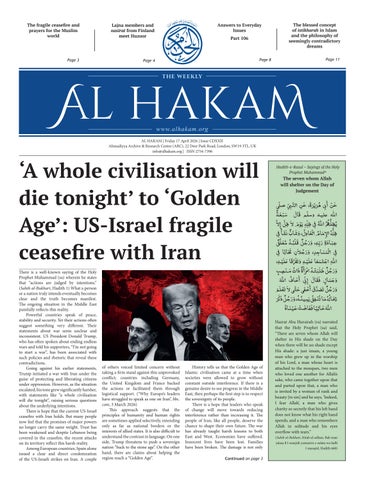
‘A whole civilisation will die tonight’ to ‘Golden Age’: US-Israel fragile ceasefire with Iran
There is a well-known saying of the Holy Prophet Muhammad (sa) wherein he states that “actions are judged by intentions.”
(Sahih al-Bukhari, Hadith 1) What a person or a nation truly intends eventually becomes clear and the truth becomes manifest. The ongoing situation in the Middle East painfully reflects this reality.
Powerful countries speak of peace, stability and security. Yet their actions often suggest something very different. Their statements about war seem unclear and inconsistent. US President Donald Trump, who has often spoken about ending endless wars and told his supporters, “I’m not going to start a war”, has been associated with such policies and rhetoric that reveal these contradictions.
Going against his earlier statements, Trump initiated a war with Iran under the guise of protecting and liberating citizens under oppression. However, as the situation escalated, his tone grew significantly harsher, with statements like “a whole civilisation will die tonight”, raising serious questions about the underlying intentions.
There is hope that the current US-Israel ceasefire with Iran holds. But many people now feel that the promises of major powers no longer carry the same weight. Trust has been weakened and despite Lebanon being covered in the ceasefire, the recent attacks on its territory reflect this harsh reality.
Among European countries, Spain alone issued a clear and direct condemnation of the US-Israeli strikes on Iran. A couple
of others voiced limited concern without taking a firm stand against this unprovoked conflict; countries including Germany, the United Kingdom and France backed the actions or facilitated them through logistical support. (“Why Europe’s leaders have struggled to speak as one on Iran”, bbc. com, 3 March 2026) This approach suggests that the principles of humanity and human rights are sometimes applied selectively, extending only as far as national borders or the interests of allied states. It is also difficult to understand the contrast in language. On one side, Trump threatens to push a sovereign nation “back to the stone age”. On the other hand, there are claims about helping the region reach a “Golden Age”.
History tells us that the Golden Age of Islamic civilisation came at a time when societies were allowed to grow without constant outside interference. If there is a genuine desire to see progress in the Middle East, then perhaps the first step is to respect the sovereignty of its people.
There is a hope that leaders who speak of change will move towards reducing interference rather than increasing it. The people of Iran, like all people, deserve the chance to shape their own future. The war has already taught harsh lessons to both East and West. Economies have suffered. Innocent lives have been lost. Families have been broken. The damage is not only
Hazrat Abu Hurairah (ra) narrated that the Holy Prophet (sa) said, “There are seven whom Allah will shelter in His shade on the Day when there will be no shade except His shade: a just imam, a young man who grew up in the worship of his Lord, a man whose heart is attached to the mosques, two men who loved one another for Allah’s sake, who came together upon that and parted upon that, a man who is invited by a woman of rank and beauty [to sin] and he says, ‘Indeed, I fear Allah’, a man who gives charity so secretly that his left hand does not know what his right hand spends, and a man who remembers Allah in solitude and his eyes overflow with tears.”
(Sahih al-Bukhari, Kitab al-adhan, Bab man jalasa fi l-masjidi yantaziru s-salata wa fadli l-masajid, Hadith 660)
The seven whom Allah will shelter on the Day of Judgement
This Week in History
Muslim Jamaat 17 - 23 April
A glimpse into the rich history of the
17 April
17 April 1903: On this day, some residents of Qadian, like Buddha Mal, Ghanayya Lal, Bur Singh Narain and Dasawar Singh, complained to the authorities that the white minaret being built by Ahmadis would be used to peer into the houses of neighbours, breaching their privacy.
For more details about this white minaret, see “A brief history of the construction of Minarat-ulMasih Qadian”, at alhakam.org (6 January 2023, pp. 10-11).
17 April 1905: On this day, Hazrat Hakeem Maulvi Noor-ud-Din (ra) authored an exquisite article about the earthquake in Kangra, India, in accordance with the prophecy of the Promised Messiahas. (Tarikh-e-Ahmadiyyat, Vol. 4, p. 166)
17 April 1970: On this day, during his visit to Nigeria, Hazrat Khalifatul Masih III (rh) delivered his Friday sermon from the Muslim Teachers Training College in Lagos. After the Friday prayer, Huzoor (rh) granted an audience to the students and professors of Lagos University. On the same day, the Pakistani High Commissioner, SM Qureshi Sahib, gave a reception in Huzoor’s (rh) honour, which was also attended by the ambassadors of Sudan, Indonesia, Niger and Sierra Leone. (Tarikhe-Ahmadiyyat, Vol. 26, pp. 45-46)
18 April
18 April 1936: On this day, Hazrat Maulvi Muhammad-uddin Sahib began his journey from Qadian for Albania to serve as a missionary. To read more, see: ‘‘Pioneer Missionaries: Part 8 –Forever in service: Maulvi Muhammaduddin’’ at alhakam.org.
18 April 2017: On this day, Hazrat Khalifatul Masih V (aa) laid the foundation stone for the first Ahmadiyya Muslim mosque in the German town of Raunheim. (“Head of Ahmadiyya Muslim Community lays foundation stone for new Mosque
in Raunheim”, Germany, www.pressahmadiyya. com, 20 April 2017)
19 April
19 April 1964: On this day, the Waqf-e-Jadid headquarters were inaugurated in Rabwah, Pakistan. The foundation was laid on 29 December 1962.
For more details, see “A chronology of Waqf-eJadid’s early years (1957-1965)”, at alhakam.org (25 December 2020, p. 12).
19 April 2006: On this day, Hazrat Khalifatul Masih V (aa) travelled from Sydney to Canberra, where he attended a reception hosted by Australian political, religious and scholarly figures. Huzoor (aa) addressed the guests, met them and returned to Sydney at night. (Al Fazl International, 2 June 2006, pp. 1-2)
20 April
20 April 1983: On this day, Hazrat Khalifatul Masih IV (rh) encouraged the Jamaat Canada to collect six million dollars to build new mission houses and mosques in different cities of Canada. (Silsila Ahmadiyya, Vol. 4, p. 822)
20 April 1984: On this day, Hazrat Khalifatul Masih IV (rh) delivered his Friday Sermon in the Ahmadiyya mosque in Islamabad, Pakistan. It was his last sermon in Pakistan before migrating to London. (Khutbat-e-Tahir, Vol. 3, p. 215)
21 April
21 April 2008: On this day, during his tour of Ghana, Hazrat Khalifatul Masih V (aa) attended a reception held in his honour at the central mission. The event was also attended by His Excellency Alhaj Aliu Mahama, the Vice President
of the Republic of Ghana. The evening concluded with a brief address by Huzoor (aa) in which he thanked His Excellency for having been a long and loyal friend of the Jamaat. (The Khilafat Centenary Tour of West Africa, pp. 29-30)
22 April
22 April 1952: On this day, the funeral prayer of Hazrat Amma Jan (ra) was led by Hazrat Muslehe-Maud (ra) in Rabwah, Pakistan. She sadly passed away in Rabwah on the night of 20 April 1952 at the age of 86.
For more details, see: “Hazrat Amma Jan: Syeda Nusrat Jahan Begum” at alhakam.org (16 June 2023, pp. 16-17)
22 April 2003: On this day, Hazrat Mirza Masroor Ahmad (aa) was elected as Khalifatul Masih V. The election was held in the Fazl Mosque, London.
To learn more about this election process, see: ‘‘How is Khalifatul Masih elected?’’ at www. alislam.org.
23 April
23 April 1910: On this day, Hazrat Khalifatul Masih I (ra) inaugurated the Nur Mosque in Qadian with the Asr prayer. Afterwards, Huzoorra delivered a dars of the Holy Quran before du‘a. (Tarikh-e-Ahmadiyyat, Vol. 3, pp. 311-312)
23 April 1951: On this day, the Punjab’s Rehabilitation Minister, Sheikh Fazal Ilahi Pracha, visited Rabwah and had a meeting with Hazrat Musleh-e-Maudra
For more details, see “75 years of Rabwah: A glimpse into its early years”, at alhakam.org (22 September 2023, p. 9)
The fragile ceasefire and prayers for the Muslim world
During his Friday sermon, delivered on 10 April 2026, Hazrat Mirza Masroor Ahmad, Khalifatul Masih V (aa), highlighted the precarious nature of the current ceasefire and ongoing Israeli provocations in the Middle East, noting the limited resolve of the international community and urged continued prayers for the Muslim world. He said:
“Much prayer is needed for the state of
Continued from page 1
physical but also emotional. In the end, humanity as a whole has paid the price.
Serious questions are now being asked. Who should truly be called a terrorist – those who attack unarmed civilians or those who bomb schools and kill innocent children in violation of international law? These are not easy questions, but they cannot be ignored.
At the same time, Muslims in the Middle East face an important responsibility. Internal divisions have often made the region weaker. Rising above theological differences could be a step towards unity and strength.
There are also questions about foreign military presence. Are military bases in the region truly there to protect local interests or do they serve other purposes? People are beginning to question long-held assumptions.
the world and especially for the condition of the Muslim world – everyone knows well what is happening.
“They may speak of a ceasefire, but it does not appear likely to last. Indeed, cracks have already begun to appear in it. The Israeli government is trying, somehow, to launch an attack on Lebanon and provoke the Iranians, so that they respond. By now, even some European leaders have
Another important issue concerns public opinion. Do the majority of people in Iran actually want a change in their leadership through external intervention?
“The Iranian people don’t want regime change forced by external powers”, Germany’s defence minister Boris Pistorius warned at a joint press conference with EU foreign policy chief Kaja Kallas, following their meeting in Berlin. If this is the case, then harming innocent civilians in the name of “liberation” raises serious moral concerns.
Likewise, surveys in the United States show that a clear majority of the public does not support the war with Iran, with many believing that the decision to strike was wrong. If people do not want conflict, why do their leaders continue to move in that direction?
It is also worth asking what the real objectives of this war were. How many
condemned this action of theirs. In any case, at least some voice has been raised and these people have shown at least some moral concern. But that is where it will end. That is the extent of the morality within them. Beyond this, they neither wish to make any effort, nor do they possess the courage or the strength.
“In any case, we should pray that Allah the Exalted may have mercy on the Muslim world.” [Amin]
of those goals have been achieved? If the answer is none, then the cost becomes even harder to justify. Lives have been lost and uncertainty has spread across the world.
This uncertainty has only increased since the first round of talks between Iran and the US ended without reaching a deal.
Trump’s response to the scrapped talks was to announce a blockade of some shipping in the Strait of Hormuz, a vital trade route that most of the world relies on. Although a second round of negotiations is under discussion, it remains to be seen whether it will be more successful than the first.
The ceasefire ends on 21 April, but even now, there is still time to choose a different path. A path based on justice, fairness and the equal value of every human life. Because if this lesson is not learned, the consequences may be far greater than any nation expects. And in the end, there may be little left to govern at all.
(M Adam Ahmad, Al Hakam)
Prayer and Divine Decree
The Promised Messiah (as) states: “When the grace of Allah Almighty draws near, He furnishes the means that are necessary for the acceptance of prayer. The heart develops a fervour, passion and emotion. However, when a prayer is not meant to be accepted, the heart is unable to feel contentment and inclination. No matter the extent that a person forces their disposition, one is unable to develop focus in prayer. The reason for this is because on certain occasions, God Almighty desires for us to submit to His decree, whilst on other occasions, He accepts our prayers. Therefore, until I perceive signs of God’s permission, I have little expectation of a prayer being accepted. I become content with the decree of God and feel even more joy than that which is experienced on the acceptance of prayer, because the fruits and blessings that are received in being content with the will of God are far greater.”
(Malfuzat [English], Vol. 2, pp.174)
Hazrat Mirza Ghulam Ahmadas, In His Own Words
From the markaz
In an uncertain world, where can one find safety?
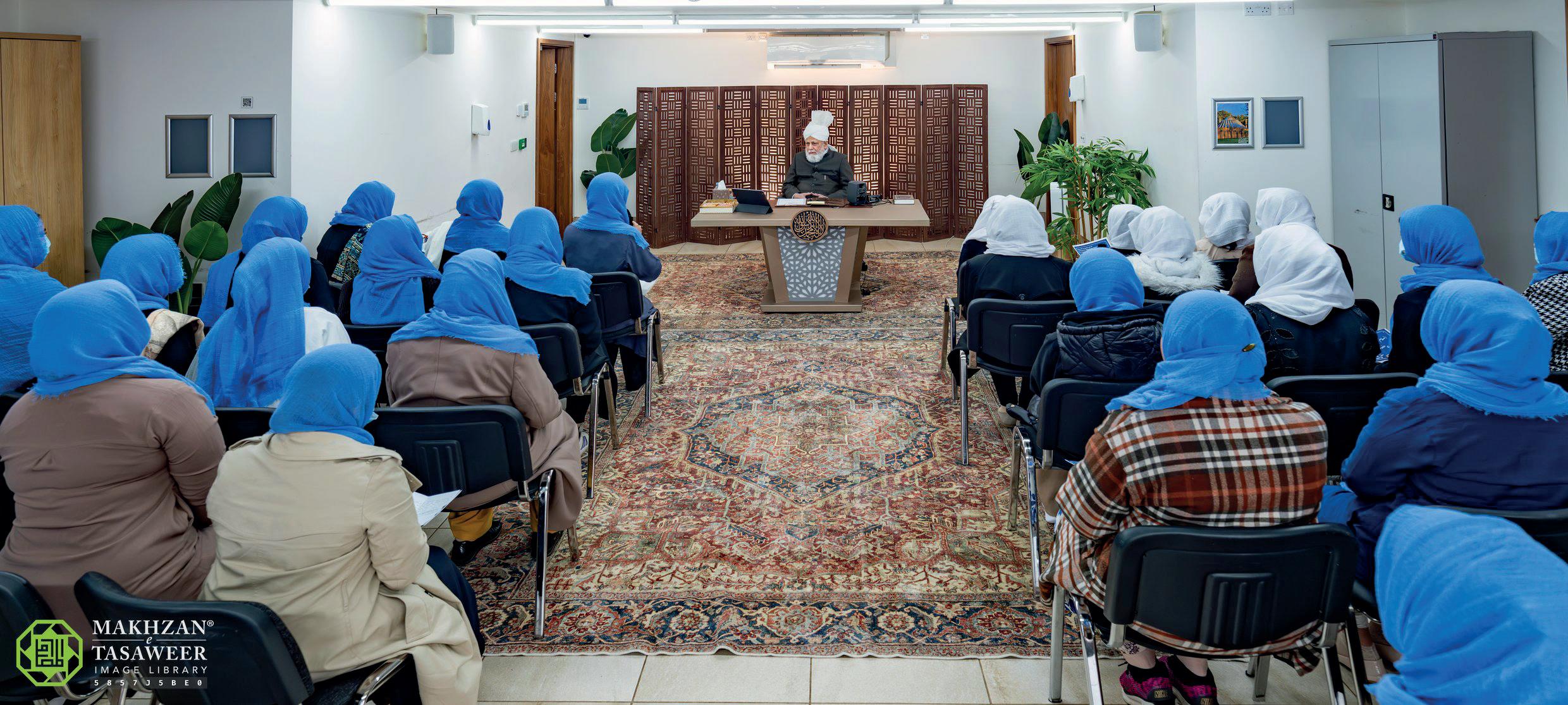
Lajna members and nasirat from Finland meet Huzoor
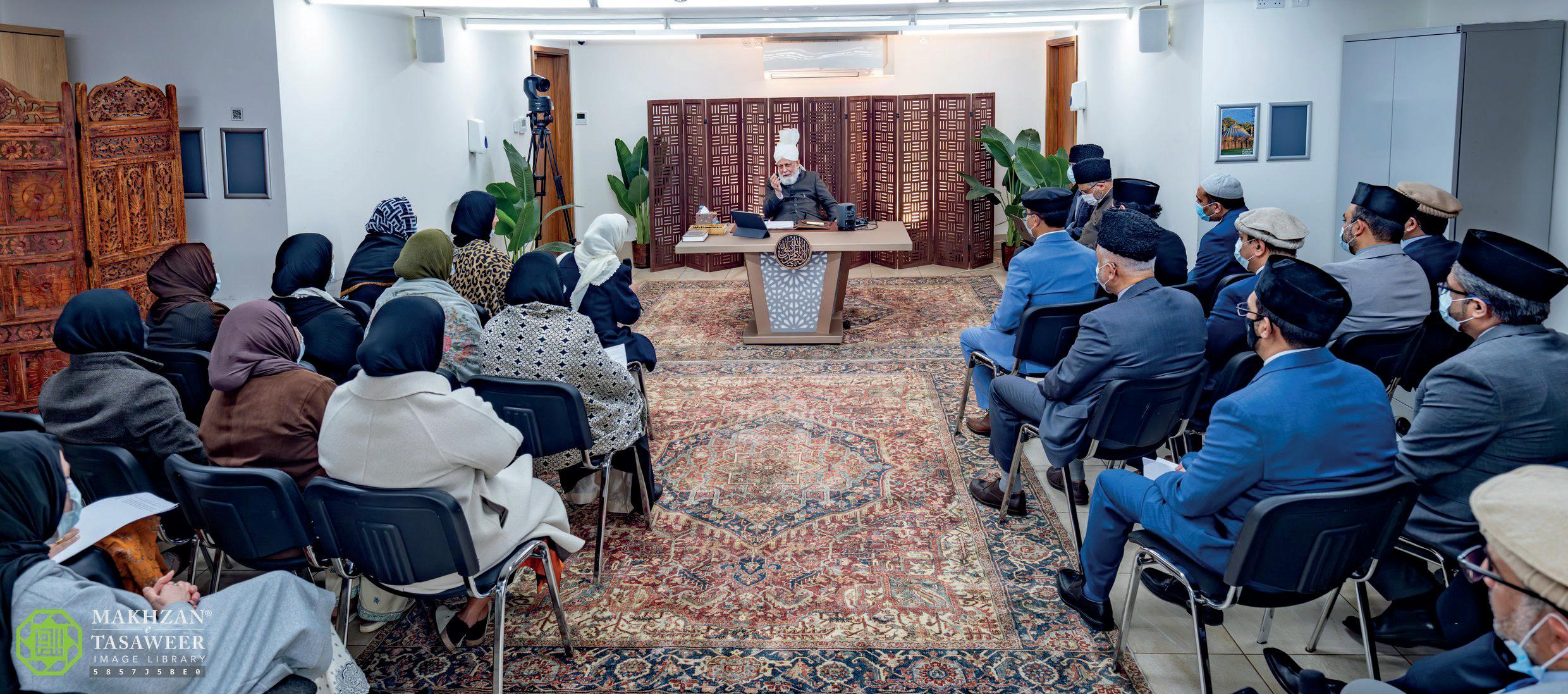
Islamabad, Tilford, 28 March 2026: 35 members of Lajna Imaillah and nasirat from Finland were blessed with a mulaqat with Hazrat Mirza Masroor Ahmad, Khalifatul Masih V (aa), at Islamabad, Tilford, UK.
Upon arriving, Huzoor (aa) greeted those present and took his seat. Following brief introductions, the floor was opened for a question-and-answer session, during which attendees sought guidance on a range of religious and contemporary matters.
Making proper use of time in the digital age
A girl said that her parents did not allow her to use social media or messaging applications and had also advised her not to listen to music. She sought Huzoor’s (aa) guidance in this regard.
Huzoor (aa) said that her parents were doing the right thing. He noted that even governments had begun to recognise the harmful effects of excessive screen use and social media on children, mentioning that
certain restrictions had also been introduced in countries such as Australia.
Huzoor (aa) explained that listening to music and spending time chatting on WhatsApp, etc., were, in reality, a waste of time. Instead, he directed her attention towards beneficial and constructive pursuits. He advised her to watch good children’s programmes and documentaries on MTA, to read books, to recite the Holy Quran and to observe the five daily prayers. Huzoor (aa) stated that if one filled one’s time with such worthwhile activities, there would be little opportunity left for idle and unhelpful habits.
Huzoor (aa) further advised the girl not to compare herself to her friends or follow what others were doing merely because it was common among them. Rather, he encouraged her to become an exemplary model for her friends.
The importance of reciting the Holy Quran daily
A nasirah asked why it was necessary to recite the Holy Quran every day and what benefit this brought.
Huzoor (aa) explained that the Holy Quran is the Word of Allah the Almighty, revealed to the Holy Prophet Muhammad (sa). He said that Allah the Almighty has instructed believers to read it and grants His bounties and grace through its recitation. He further explained that the Holy Quran enables a person to do good deeds, protects them from evil and serves as a means of purification.
Huzoor (aa) said that even children who do not yet understand the meanings of the Holy Quran still derive benefit from its recitation, for Allah the Almighty grants blessings through it and protects them from wrongdoing. Upon learning that the girl was nine years old, Huzoor (aa) advised her to begin learning the translation gradually. He especially directed her to learn the
translation of Surah al-Fatihah, which is recited daily in salat and thereafter to learn the translations of the last three chapters of the Holy Quran.
Huzoor (aa) explained that in these chapters, as throughout the Holy Quran, Allah the Almighty has taught human beings what is good and what is bad, what leads to reward and what leads to punishment. He said that as children grow older, they should continue to learn the translation so that they may understand what Allah the Almighty has taught and derive ever greater benefit from it. At the same time, he said that even before full understanding develops, the blessings of reciting the Holy Quran continue to benefit a person. Huzoor (aa) said:
“As you grow older, as your age increases, as your years advance, learn its translation as well. Then you will come to know what is written in the Holy Quran. Then it will benefit you. And until you come to know it, even then, Allah the Almighty will continue to benefit you all the same –
such is its blessing. Now, you recite Surah al-Fatihah every day, do you not, in your prayers? You offer five daily prayers, do you not? Memorise its translation and you will come to realise how many blessings it contains.”
Confidence and modesty in school attire
Another young girl said that she wore a long shirt and scarf to school, but that her classmates mocked her because of her clothing and kept their distance from her. She asked Huzoor (aa) what she should do in such a situation.
After asking her age and enquiring whether her school had a uniform, Huzoor (aa) was informed that there was no school uniform. He then advised that she could wear a shirt reaching to the knees along with tights. He said that it was not necessary for her to wear a shalwar to school and that trousers could also be worn if that made matters easier.
Huzoor (aa) said that there was no reason for her to develop any inferiority complex. He advised her to explain to others, where appropriate, that this was her dress and that just as others chose the clothing they preferred, she too had the right to wear what she liked. He made it clear that she should not feel embarrassed or pressured on account of the comments of others.
Huzoor (aa) further advised that when others made remarks, she should not be disturbed by them but should instead laugh such things off. He said that among her classmates, there would certainly be good girls as well and that she should form friendships with those of good character. In this way, she would find support and companionship.
Huzoor (aa) reminded her that an Ahmadi should be strong and should not be overcome by fear or weakness. He said that since she believed in Allah the Almighty and sought His pleasure, she should remain steadfast and not be afraid of people.
The arrangement of the Surahs and verses of the Holy Quran
In response to a question about who arranged the Surahs of the Holy Quran, Huzoor (aa) explained that the Quran was revealed gradually over different periods of time. He said that some Surahs were revealed in parts, with certain portions revealed before the Hijrah and other portions after it. As verses continued to be revealed on different occasions, Allah the Almighty guided the Holy Prophet (sa) regarding where each verse was to be placed. Huzoor (aa) stated that the Holy Prophet (sa) would then instruct those who were writing down the revelation to place each verse in its proper position within the relevant Surah. In this way, the Surahs were established and their arrangement was completed under divine guidance. Huzoor (aa) further explained that this arrangement carries wisdom, inasmuch as the subject matter of each Surah is connected and each verse has its own place, linking meaningfully with what comes before and after it. Thus, he said, the order of the Holy Quran was determined according to the guidance of Allah the Almighty conveyed to the Holy Prophet (sa).
Guidance regarding drawing living things
A question was then asked regarding whether it was permissible in Islam to make sketches of living things, including cartoon characters.
Huzoor (aa) explained that one should not sketch human beings. He said that when human figures are drawn by hand, they cannot be depicted accurately and the resulting distortion can easily lead to offence, dispute, etc.
Huzoor (aa) clarified, however, that taking photographs with a camera is permissible, as the camera captures details as they are. As for hand-drawn images, he said that animals, scenery and similar subjects could be drawn or painted. He mentioned that a person could draw things such as a lion, an elephant or a cheetah. He also indicated that if an imaginary figure was drawn, this would be permissible, provided it was done appropriately.
Remaining firm when incorrect religious teachings are presented
One attendee said that in school Islam classes, certain incorrect teachings were sometimes presented, such as the assertion that no Prophet could come after the Holy Prophet (sa) or the age of Hazrat Aisha (ra) at the time of her marriage. She added that when students wrote what they believed to be the correct Islamic teaching in examinations, marks were deducted. She asked Huzoor (aa) what should be done in such circumstances.
Huzoor (aa) first asked whether the teachers were Muslims and, upon hearing that they were, advised the questioner to raise such matters respectfully during the lesson itself. He said that when something incorrect was being taught, she should ask her question openly in class.
With regard to the issue of prophethood, Huzoor (aa) advised that reference could be made to the hadith in which the Promised Messiah has been described as a Prophet of God and that the teacher should be asked how that narration was to be understood if their explanation was correct. (Sahih Muslim, Kitab al-fitani wa ashrati s-sa‘ah) In this way, the teacher would be required either to answer the question or to confront the weakness in the claim being made.
Regarding the allegation about Hazrat Aisha (ra), Huzoor (aa) said that this had been raised by opponents of Islam and that historical analysis did not support the age often alleged. He stated that Hazrat Aisha (ra) was approximately 13 or 14 years old at the time of marriage and that this was the customary age in that era. He further said that it was not a forced marriage.
Huzoor (aa) directed that this issue should be studied in The Life & Character of the Seal of the Prophets as well as in the writings of Hazrat Musleh-e-Maud (ra). He also mentioned that an answer on this subject has already been published in Al Hakam and indicated that such material could also be used.
Huzoor (aa) then emphasised the importance of giving precedence to faith over worldly matters. He said that if marks were deducted for writing the truth, then one should still not abandon the truth. He reminded the attendee that to give
precedence to faith means remaining firm upon what is correct and refusing to adopt falsehood for worldly advantage. Huzoor (aa) further advised that if a teacher responded harshly instead of answering a reasonable question, the matter could be taken to the headteacher.
Safety in an increasingly uncertain world
A question was then asked about whether Muslims should migrate if war were to break out in a country and what kinds of countries might be safer to move to.
Huzoor (aa) replied by drawing attention to the state of the world at present and asked where, in truth, complete safety could be found. He observed that many Muslim countries, including those in the Middle East, as well as countries such as Turkey and Pakistan were under threat. He also pointed out that European countries were not free from danger either, mentioning that Finland itself shares a border with Russia.
Huzoor (aa) said that while some countries in Africa might be comparatively safer than others, it was not possible to identify any country as completely secure. He therefore directed attention to the reality that ultimate safety lies with Allah the Almighty. For this reason, he advised that the real solution was to pray to Allah the Almighty for protection and safety.
Joining in prayers for peace
Another attendee asked whether it would be possible to establish a regular worldwide arrangement for the Jamaat to pray behind Huzoor (aa) once a week, specifically for peace and for an end to suffering in the world.
Huzoor (aa) explained that during Jalsas and other major functions, prayers were already being offered in which members of the Jamaat around the world joined. He said that in such prayers, supplications were regularly made for the peace of the world, for the betterment of mankind and for protection from the evils of Satan.
At the same time, Huzoor (aa) clarified that formal salat could not be organised in the proposed manner, as the proper requirements of congregational prayer were different. He therefore explained that the arrangement possible on a worldwide basis was that of silent prayer and collective supplication [du‘a], which was already taking place on many occasions.
Huzoor (aa) further stated that it was not sufficient to think that prayer on one designated day alone would fulfil this duty. Rather, every individual should make such supplications regularly in their own five daily prayers and during Jamaat functions. He noted that he had repeatedly instructed Ahmadis, including in his Friday sermon, to pray for the Muslim world, for global peace and for the betterment of Ahmadis. He added that when members say amin to his prayers, they thereby join in those supplications.
Tabligh through personal example
Towards the end of the mulaqat, guidance was sought regarding tabligh. It was mentioned that good relationships could be established with non-Ahmadi women and that many of them agreed with Islamic
teachings when they were discussed, yet they did not appear inclined towards religion itself. Guidance was therefore sought on how their hearts might be drawn towards Islam Ahmadiyyat.
Huzoor (aa) said that the first requirement was to present one’s own example. Through good conduct and sincere friendship, one should demonstrate the true teachings of Islam in practical form. He explained that this in itself was tabligh: to convey the teachings of Islam and to manifest them in one’s conduct.
Huzoor (aa) said that when others, whether non-Muslims or non-Ahmadi Muslims, observed Ahmadis acting upon the true teachings of Islam, this would gradually influence them. They would begin to recognise that Ahmadis were following the right path and, at the very least, their opposition would diminish.
Huzoor (aa) reminded those present that Allah the Almighty has placed upon believers the responsibility of conveying the message, but that guidance itself rests with Allah. It is He alone Who opens hearts and enables people to accept Ahmadiyyat. Thus, the success of tabligh should not be measured merely by the number of bai‘ats. Rather, every Ahmadi should strive to become such a virtuous example that others recognise the beauty of true Islam through their conduct. Those whom Allah the Almighty sees to be sincere and good-natured will, in the end, be guided by Him.
Keeping one’s heart pure in an age of insincerity
A Lajna member asked how one should respond in a society where people often appear outwardly courteous and affectionate yet may inwardly harbour ill-thinking or hypocrisy or speak against others behind their backs. She asked what guidance Islam offers so that a person may keep their own heart pure and live with sincerity and good intention.
In reply, Huzoor (aa) said that the duty of a believer is to present their own righteous example. As for those who act with hypocrisy, that is a matter for Allah the Almighty, for human beings do not know the true state of another person’s heart. Huzoor (aa) explained that if a person behaves with riya’, that is, by showing off or acting merely for display, or performs deeds to please others rather than for the sake of Allah, then Allah does not approve of such conduct. He said that the reckoning of such people belongs to Allah in the next world and it is not for human beings to decide who is sincere and who is hypocritical by claiming knowledge of hearts. Referring to a hadith of the Holy Prophet (sa), Huzoor (aa) made clear that one is not entitled to judge what lies hidden within another person. Rather, a believer should keep their own heart clean, remain sincere, act with good intention and continue to show a practical example of purity and righteousness while leaving the matter of others to Allah the Almighty.
As the mulaqat came to an end, all attendees had the honour of receiving pens from Hazrat Amirul Momineen (aa).
(Summary prepared by Al Hakam)
From the markaz
‘Allah is the Healer’: Doctors and medical professionals from the USA and Canada meet Huzoor
Islamabad, Tilford, 29 March 2026: 34 doctors and medical professionals from the United States of America and Canada were blessed with a mulaqat with Hazrat Mirza Masroor Ahmad, Khalifatul Masih V (aa), at Islamabad, Tilford, UK.
All members of the delegation had the opportunity to introduce themselves before a question-and-answer session commenced, during which they sought guidance on matters relating to medicine, waqf, mental health, patient care and faith.
Huzoor (aa) encourages doctors to undertake Waqf-e-Arzi
During the mulaqat, Huzoor (aa) guided the delegation regarding the importance of Waqf-e-Arzi. He said that doctors and medical professionals should participate in Waqf-e-Arzi and should also encourage others, especially specialists, to do the same.
Huzoor (aa) acknowledged that those travelling from abroad sometimes find it difficult to adjust to the local environment and that, at times, suggestions made by visiting professionals cannot be implemented in the same way owing to local limitations and circumstances. Nevertheless, he emphasised that the first matter of importance was to take part in
Waqf-e-Arzi.
Huzoor (aa) then reminded the delegation that Allah the Almighty is the True Healer. Huzoor (aa) also referred to the following guidance he had given in his Friday sermon of 27 March 2026:
“Just observe the subtlety with which the Holy Prophet (sa) would instruct the establishment of the Oneness of God [Tawhid]. In one narration, Abu Rimsah (ra) relates that his father said to Allah’s Messenger (sa), ‘Show me the mark upon your back,’ meaning the Seal of Prophethood, ‘for I am a physician.’ The Holy Prophet (sa) replied, ‘The true Physician is Allah. You are merely a Companion who gives comfort and reassurance. The Physician is He who created him and He alone grants healing.’” (“The Prophet’s [sa] Protective Zeal for Tawheed”, www.alislam.org)
Huzoor (aa) reiterated that while doctors treat and console patients, healing comes from Allah. He instructed that whenever a doctor examines a patient, they should first pray to Allah the Almighty.
Huzoor (aa) further said that every doctor should have a distinctive way of treating patients. If they travelled to countries such as Pakistan for service, they should not concern themselves with
whether they considered themselves more competent than local doctors. Rather, they should focus on the grace of Allah the Almighty and benefit from one another’s experience. He explained that doctors serving locally have their own experience of the environment there, while those coming from abroad bring their own clinical experience from elsewhere.
In this context, Huzoor (aa) drew attention to the fact that patients in Pakistan may differ from the kinds of patients doctors are used to treating in North America. Their treatment and the way they are counselled must therefore take local circumstances and temperaments into account. He also said that such patients may ask many questions or disagree or debate and even doctors may differ among themselves. For that reason, he advised the delegation to work with patience, composure and forbearance. He concluded by again urging that as many people as possible should be encouraged to go for Waqf-e-Arzi.
Guidance for Waqf-e-Nau medical students
A question was then asked about what guidance Huzoor (aa) would give to medical students, especially those who were
members of the Waqf-e-Nau scheme, so that they might become not only competent doctors, but also attain closeness to Allah the Almighty and Khilafat and be inspired to serve through Waqf-e-Arzi and, where applicable, Waqf-e-Zindagi.
Huzoor (aa) replied that the essential principle was to remember Allah at all times and to keep firmly in mind that Allah is the Healer. He said that when examining a patient, a doctor should always remember that it is Allah the Almighty Who grants recovery.
Huzoor (aa) recalled that he had once advised doctors that they should write Huwa ash-Shafi at the top of their prescriptions so that they remain mindful that health and healing come from Allah. He said that doctors should keep this reality before them at all times, observe the five daily prayers and, in critical cases, pray even more for their patients.
He further mentioned that senior doctors and elders, including Hazrat Dr Mir Muhammad Ismail Sahib (ra), used to offer extra nawafil for their patients. Huzoor (aa) said that Waqf-e-Nau doctors should be even more mindful in this regard. He concluded by reiterating that the key matter was to remember Allah constantly, while
the worldly affairs of life would continue alongside this.
Building confidence in mental health care
A psychiatrist then mentioned that many members of the Jamaat still hesitate to speak openly about emotional and psychiatric difficulties and sought guidance on how such individuals might be encouraged to open up.
Huzoor (aa) observed that people respond in different ways: some are hesitant and shy, while others speak with excessive openness. He said that many people hold back because they fear their personal matters may not remain confidential, especially when they are consulting someone from a familiar cultural background. He acknowledged that some individuals are more accustomed to discussing matters within the family and therefore hesitate before a psychiatrist from their own community.
Huzoor (aa) said that the key was to build confidence in patients by assuring them that what they disclose will remain confidential. He stated that it is the duty of a psychiatrist to keep such matters private and not share them with others. Once a patient develops confidence in the doctor, treatment can proceed more effectively.
At the same time, Huzoor (aa) noted that when some patients consult doctors outside their own linguistic or cultural setting, they may face language barriers and find it difficult to express themselves properly. He also cautioned that at times, psychiatrists can misguide patients by encouraging them to discuss certain matters in an unnecessarily open manner, which may embolden them in vice rather than lead to treatment and reform.
Huzoor (aa) therefore advised that treatment should be administered with wisdom, within the moral limits laid down by faith and in a manner consistent with the responsibilities of the medical profession.
Balancing professional duties with Jamaat responsibilities
One of the attendees then asked what guidance Huzoor (aa) would give to doctors and medical professionals regarding balancing their non-medical Jamaat service roles with their professional responsibilities.
In response, Huzoor (aa) asked what additional responsibilities the questioner had and was informed that she was involved in Tahir Academy as well as Lajna work. Huzoor (aa) said that her primary responsibility remained her profession. As for Lajna work, he noted that such duties generally required only a limited number of hours each week and could ordinarily be managed over the weekend.
Regarding Tahir Academy, Huzoor (aa) said that one should assess one’s own capacity and determine how much time could reasonably be given. When told that there were only two or three classes a month, he indicated that this did not amount to an unmanageable burden. Even when additional related work was included, he suggested that this was still something that people generally managed without major difficulty.
Huzoor (aa) explained that the real difficulty often arises when a person overthinks matters and places unnecessary
burdens on themselves. He said that some people feel that whatever they do must be done with complete perfection, whereas no worldly task can ever be entirely perfect. Minor shortcomings always remain and one should learn to overlook them.
He therefore advised the questioner to do as much as could be done comfortably and with ease, to create ease for herself, to pray to Allah the Almighty for guidance and not to burden herself unnecessarily. He added that people should work in a relaxed manner and not worry excessively.
Conveying Islam through patient care and good character
A family physician then asked how doctors could effectively convey Islam’s message of peace, compassion and service through clinical practice and patient interactions with people of different religious and social backgrounds.
Huzoor (aa) said that whether patients were atheists, Christians, Buddhists, Sikhs or from any other background, the first and foremost duty of a doctor was to display good moral character. If a doctor’s conduct was exemplary, their treatment of people was kind and their interactions were positive, patients would naturally be drawn to them.
Huzoor (aa) said that, as he had mentioned earlier, a significant part of a patient’s illness is alleviated through this very approach. Patients who are treated with kindness and competence go on to tell others and a doctor’s good reputation spreads. Referring to the modern age, he noted that many doctors now receive reviews and recommendations through social media and other means and that a practitioner who treats patients effectively and with good conduct becomes widely known. He remarked that while some misuse social media, others use it beneficially.
Despite this, Huzoor (aa) said that the fundamental principle remained unchanged: an Ahmadi doctor should combine good moral conduct with prayer. Patients may come from any background, but if a doctor’s character is good, they will be influenced by that character. He said that along with treatment, doctors also bear the responsibility of praying for their patients.
Huzoor (aa) further explained that sometimes the effect is simply psychological and that this in itself can be very strong. Where a person has trust in someone, even that can bring about an effect. In this connection, Huzoor (aa) narrated an incident concerning Hazrat Mirza Sharif Ahmad (ra). In Qadian, there was once a patient suffering from severe stomach pain who was crying out loudly. Although two or three doctors were present, he had found no relief. When Hazrat Mirza Sharif Ahmad (ra) was informed, he went to see the patient, placed his hand in his pocket for a short while and prayed. He then asked the patient to open his mouth, placed what appeared to be a pill inside it and told him to drink some water. Within fifteen minutes, the patient experienced relief. When people later asked Hazrat Mirza Sharif Ahmad (ra) what medicine he had given, he explained that it was nothing more than a small piece of paper that he had shaped like a pill and given after prayer. Huzoor (aa) said that this showed that sometimes there is also a psychological effect.
The true spirit of Waqf and Waqfe-Arzi
Another questioner asked about the true spirit of Waqf and Waqf-e-Arzi and how these could become a means of lasting selfreform and nearness to Allah, rather than remaining only a temporary form of service.
Huzoor (aa) replied that the foundation of this lay in establishing a relationship with Allah the Almighty. He explained that Allah has instructed believers to pray five times a day and that this system itself regulates life and creates discipline.
Huzoor (aa) elaborated that the daily prayers organise the whole day: one rises for Fajr, offers prayer, recites the Holy Quran and may even exercise before beginning the day’s work; then, throughout the day, Zuhr, Asr, Maghrib and Isha continue to regulate one’s routine and maintain one’s connection with Allah. He said that this is the proper way to bring discipline into life. Huzoor (aa) said:
“You require something to regulate your life and establish discipline. [...] Allah the Almighty has created a system whereby you can regulate your life through the five daily prayers; you wake up in the morning for Fajr, offer prayer and recite the Holy Quran and exercise. If you have some time before your office time begins, then you can take a short nap. People do sleep in the morning and become well-rested. Then, as you work all day, there are the Zuhr, Asr, Maghrib and Isha prayers. This helps establish discipline in one’s life and enables one to establish a connection with Allah the Almighty. This is the proper manner.”
He then turned to the acquisition of knowledge and said that, alongside salat, one must also study the Holy Quran. It is not enough merely to listen to the Friday sermon once a week or to read the Holy Quran occasionally. He said that educated people should study and reflect upon it regularly for at least 30 to 45 minutes.
Huzoor (aa) gave the example of Hazrat Dr Mir Muhammad Ismail Sahib (ra), who was a doctor and surgeon of remarkable range and accomplishment. He said that although modern doctors often specialise in only one area, Hazrat Dr Mir Muhammad Ismail Sahib (ra) worked in multiple fields, including ENT, gynaecology and general surgery and was highly successful. At the same time, he also composed fine Persian and Urdu poetry. Huzoor (aa) added that even today, many doctors around the world combine professional accomplishment with broader intellectual and spiritual development.
He then said that an Ahmadi doctor should first establish a connection with Allah, then acquire knowledge from the Holy Quran, remain humble, place full reliance on Allah the Almighty and possess good morals. If these qualities are found in an Ahmadi doctor, Huzoor (aa) said, they can become truly successful and can please Allah while also serving people well.
Islamic guidance on assisted dying
One of the doctors then asked about medically assisted dying, mentioning that many elderly patients, including those suffering from dementia or Alzheimer’s disease, sometimes raise this matter.
Huzoor (aa) asked whether this referred to “mercy killing” and, upon hearing that
it did, said that this was not acceptable in Islam. He drew attention to the state of many elderly people in increasingly secular societies, where parents are often placed in care homes and rarely visited. He said that in such circumstances, it is understandable that some people lose morale and, as a result, begin to desire death.
Huzoor (aa) said that the correct response in such situations was not to end life, but to show compassion, raise morale and give people the will to live. As for those suffering from dementia and similar conditions, he explained that such individuals often are not fully aware of their own state and may forget what they themselves have said after a short time. In such a case, the question arises as to who is truly making the decision. If their children are insisting on such a course, then this amounts to cruelty.
Huzoor (aa) therefore stated clearly that this concept was wrong and that Islam does not permit it. Those who are ill should be cared for and looked after. He further observed that among Asian and African cultures, there remains a stronger ethos of serving and caring for elders and that a religious outlook does not support ending the life of the elderly for convenience.
At the same time, Huzoor (aa) acknowledged that there are patients with severe illnesses such as advanced cancer who may express the wish that their life should end. In such cases, he said, measures such as an induced coma may be used for pain management, but life itself should not be deliberately ended. So long as a person is breathing, they should be allowed to continue breathing.
Memories of Waqf-e-Zindagi doctors in Ghana
Towards the end of the mulaqat, Huzoor (aa) was asked to share his memories of the Waqf-e-Zindagi doctors who had served in Ghana, along with a few accounts of their sacrifices.
Huzoor (aa) said that, by the grace of Allah, the Jamaat’s hospitals in Ghana became widely renowned. He recalled how doctors who had been physicians in Pakistan would become surgeons in Ghana, adapting to the needs before them. At times, when an operating table was not available, they would even perform operations on a dining table and Allah the Almighty would bless their efforts.
Huzoor (aa) also recalled, in a lighthearted manner, that during his time in Africa, when he would occasionally fall ill, some doctors would prescribe medicine and say that it had benefited other patients. Yet, he noted, it would not always bring him relief. He would then remark to them that they had the prayers of the Khalifa of the Time for their service to the African people and thus, by the grace of Allah, they were able to become a means of treatment for the Africans, but that their treatment did not appear to work on him.
Huzoor (aa) said that those life-devotee doctors served with great devotion and sincerity, working day and night. They treated the poor and also took fees from wealthier patients, which enabled them to live and continue their service there successfully. Huzoor (aa) then conveyed his salaam and took his leave.
(Summary prepared by Al Hakam)
Answers to Everyday Issues
Descent of angels, God’s pronouns, degrees of punishment and cosmetic surgery
Guidance regarding basic Islamic issues that Hazrat Amirul Momineen, Khalifatul Masih Vaa, has given on various occasions in his written correspondence and during MTA programmes is being published officially below for everyone’s benefit.
What is the meaning of the two angels descending with the Son of Mary (as)?
Someone from Kenya wrote to Hazrat Amirul Momineen, Khalifatul Masih V (aa), stating that regarding the hadith that the Son of Mary will appear from Heaven in the company of two angels, has this hadith been fulfilled in the person of Hazrat Khalifatul Masih IV (rh)? His mother’s name is Maryam and MTA was launched through him. Do the two angels refer to the audio and video systems? Is my deduction correct?
Huzoor-e-Anwar (aa), in his letter dated 23 November 2023, granted the following guidance on this matter:
“This is your own subjective interpretation. The actual interpretation of this hadith is the very one which the Promised Messiah (as) has elucidated in his various books and sayings. Accordingly, whilst expounding upon this hadith in his work Fath-e-Islam, the Promised Messiah (as) states:
“‘I have descended from Heaven with those holy angels who were on my right and left, whom my God, who is with me, shall cause – nay, is causing – to enter every willing and worthy heart to accomplish my mission. Were I to remain silent and should my pen cease to write, even then, those angels who have descended with me could not stop their work. Within their hands are massive maces which have been granted to break the Cross and demolish the temple of creature worship. Perhaps some uninformed person might wonder what is meant by the ‘descent of angels’. Let it be clear that the practice of Allah has always operated in this manner that whenever a Messenger, Prophet, or Muhaddath descends from Heaven for the reformation of mankind, such angels inevitably descend with him and alongside him who instil guidance in willing and worthy hearts and bestow upon them a desire for virtue. They continue to descend until the darkness of disbelief and misguidance is dispelled and the dawn of faith and righteousness makes its appearance, as Allah the Glorious has
said:
“‘[‘Therein descend angels and the Spirit by the command of their Lord with their Lord’s decrees concerning every matter. It is all peace, till the break of dawn.’ (Surah alQadr: Ch.97: V.5-6)]
“‘So, the descent of the angels and the Holy Spirit – that is, their coming down from Heaven – takes place only when a man of magnificent glory, donning the robe of Khilafat [successorship] and being honoured with Divine discourse, descends upon the earth.
“‘The Holy Spirit is bestowed upon this Khalifah in a special way, and the angels who accompany him descend upon willing and worthy hearts throughout the entire world. Thereupon, the rays of that light descend upon deserving gems wherever they are found in the world, and a refulgence radiates throughout the entire world. Through the purifying effect of the angels, virtuous thoughts spontaneously proceed to arise in [people’s] hearts and Tauhid [the Oneness of God] begins to appear attractive. A spirit of love for righteousness and pursuit of truth is breathed into upright souls, and the weak are granted strength. A kind of breeze begins to blow in every direction, which extends support to the aim and objective of that Muslih [Reformer].
“‘People are naturally moved towards virtue through the prompting of a Hidden Hand, and a restlessness begins to stir across nations. Thereupon, the ignorant folk surmise that the inclinations of the world have reverted to righteousness on their own, but in reality, this is the work of those angels who descend from Heaven alongside the Khalifatullah [Vicegerent of God] and bestow extraordinary abilities for the acceptance and understanding of truth. They awaken those in slumber, they sober up those who are intoxicated, and they open the ears of the deaf. They breathe the spirit of life into the dead and raise those lying in graves. Thereupon, people suddenly begin to open their eyes and their minds begin to
perceive those insights which had heretofore remained concealed.
“‘In reality, these angels are not distinct from the Khalifatullah. They are the light of his very countenance and the manifest marks of his very resolve, who – through their magnetic energy – draw every worthy one towards themselves, whether he be physically near or far, whether he be an intimate friend or a complete stranger unaware of so much as his [i.e. the Khalifatullah’s] name.
“‘In short, whatever movement takes place towards virtue during that age and whatever zeal is generated for embracing truth – whether that zeal be generated in the Asian people, the inhabitants of Europe, or those living in America – is really brought about through the promptings of those very angels who descend with the Khalifatullah This is the law of God wherein you will find no deviation. It is very clear and easy to understand, and it will be your misfortune should you fail to ponder over it.
“‘As this humble one has come from God Almighty with truth and rectitude, you will find the Signs of truthfulness from everywhere. The time is not far – nay, it is very near – when you will witness armies of angels descending from Heaven upon the hearts of Asia, Europe, and America. You have come to know from the Holy Quran that it is essential for angels to descend along with the descent of the Khalifatullah so that they may direct the hearts towards truth.
“‘Await ye, therefore, this Sign. If the descent of angels does not occur and you do not see the clear effects of their descent in the world, or you do not find the movement of hearts towards truth to be more than ordinary, then you should know that no one has descended from Heaven. However, if all these things come to pass, then desist from denial lest you be deemed a rebellious nation in the estimation of God Almighty.’
(Fath-e-Islam, Ruhani Khazain, Vol. 3, pp. 11-14, footnote)
“Similarly, whilst expounding upon this hadith in the light of the writings of the Promised Messiah (as), Hazrat Musleh-eMaud (ra) states:
“‘By the two angels are meant two kinds of unseen support for him, upon which the conclusive establishment of the truth of his claim [itmam al-hujjah] depends: first, divinely bestowed knowledge relating to reason and transmitted sources, which will be granted to him without personal effort or acquired learning and by means of which the decisive proof will be completed; second, the conclusive establishment of the truth through signs that will descend from God without any human intervention.’
(Khuda Ke Firistadey Par Iman Lao, Anwarul-Ulum, Vol. 1, p. 409)
“Thus, the actual interpretation of this hadith is the very one which the Promised Messiah (as) himself articulated after receiving knowledge from God Almighty, or which his Khulafa have expressed in the light of his writings and sayings.”
Why does Allah use the masculine pronoun ‘He’?
A lady from the UK sent an enquiry to Hazrat Amirul Momineen, Khalifatul Masih V (aa), asking why God Almighty has used the masculine pronoun “He” for Himself, even though He does not belong to any
gender.
Huzoor-e-Anwar (aa), in his letter dated 23 November 2023, granted the following reply to this question:
“In the diverse languages of the world, masculine and feminine pronouns are used to differentiate between the sexes among humans. However, the Being of Allah the Exalted is One without a partner and is transcendent of such divisions. Indeed, to facilitate our understanding, Allah the Exalted has stated certain matters regarding Himself, but all such descriptions are metaphorical in nature; otherwise, Allah the Exalted is neither male nor female and He is free from every kind of gender.
“Similarly, in almost all societies of the world, the female is considered weaker compared to the male. At the advent of Islam, the same notion was also found in Arabia. Accordingly, Allah the Exalted states in the Holy Quran regarding the disbelievers that they have chosen sons for themselves whilst assigning daughters to Allah the Exalted. That is, they referred to the angels in the feminine and declared them to be the daughters of Allah the Exalted. Allah the Exalted states regarding this that it is an exceedingly unjust division they make. He states:
“‘“What! for you the males and for Him the females!” That indeed is an unfair division.’ (Surah an-Najm: Ch.53: 22-23)
“Thus, from the very dawn of creation, the feminine has been perceived as weak and the masculine has been regarded as supreme and powerful. In the Arabic language as well, the masculine form denotes one possessing perfect strength and power. For this reason, Allah the Exalted, Who is the Source of all powers and the Master of transcendent powers, has used for Himself that form which is deemed the closest to His Being even in the eyes of mankind.
“Otherwise, all the similitudes described in the Holy Quran and the Hadith concerning the Being of Allah the Exalted serve as metaphors, because the Being of Allah the Exalted is the true manifestation of
as He states:
“‘[He is] the Maker of the heavens and the earth. He has made for you pairs of your own selves, and of the cattle also [He has made pairs]. He multiplies you therein. There is nothing whatever like unto Him; and He is the All-Hearing, the All-Seeing.’
(Surah ash-Shura: Ch.42: V.12)
“Whilst expounding upon the exegesis of this verse, the Promised Messiah (as) states:
“‘Keeping to the middle in relation to God means that in expounding Divine attributes one should not lean towards negating Divine attributes nor describe God as resembling material things. This is the way that the Holy Quran has adopted with reference to Divine attributes. It affirms that God sees, hears, knows, and speaks; and as a safeguard against His being understood as resembling His creation it also affirms:
“‘Meaning there is nothing like unto Him.
[...] This means that there is no partner in the Being and attributes of God.’ (Islami Usul Ki Falasafi, Ruhani Khazain, Vol. 10, pp. 376-377)
“Furthermore, he stated:
“‘Since eternity and since times ancient, God possesses two [kinds of] attributes: one is the attribute of similitude [tashbihi] and the other is the transcendent attribute [tanzihi]. Since it was essential to articulate both attributes in the Word of God, meaning the tashbihi attribute as well as the tanzihi attribute, God described His attributes of the hand, eye, love, wrath and so forth in the Holy Quran to express the tashbihi attributes. Then, lest any notion of anthropomorphism arise, He declared in some places: …
[i.e. there is nothing like unto Him].’ (Chashma-e-Ma‘rifat, Ruhani Khazain, Vol. 23, p. 277)”
Do the commentaries of Hazrat Khalifatul Masih IV (rh) and Hazrat Musleh-e-Maud (ra) differ regarding the punishment of misleaders in Hell?
A missionary from Canada wrote to Hazrat Amirul Momineen, Khalifatul Masih V (aa), stating that it had emerged from his research that Hazrat Musleh-e-Maud (ra) held the view that one who deliberately leads others astray would receive a double punishment, whereas Hazrat Khalifatul Masih IV (rh) stated in the Tarjamat-ulQuran Class on Surah al-A‘raf that, when the disbelievers in Hell say, “Give our leaders a double punishment,” Allah will reply that all of them will receive a double punishment. What is the answer to this?
Huzoor-e-Anwar (aa), in his letter dated 26 November 2023, gave the following reply to this enquiry:
“The fact of the matter is that you have not studied the issue properly and, after only cursory research, have assumed that there is a contradiction between the translations of Hazrat Musleh-e-Maud (ra) and Hazrat Khalifatul Masih IV (rh), whereas there is absolutely no contradiction between them.
“Thus, in Tafsir-e-Saghir, the translation of this verse of Surah al-A‘raf is given as follows:
“‘[...] until, when they have all entered it [the Fire], the last of them [the group entering later] will say regarding the first of them, “Our Lord, these are the ones who led us astray; so give them a punishment in the Fire many times greater.” He will say, “Everyone is receiving an increased punishment*, but you do not know.”’
“Furthermore, the footnote to this translation states: *‘Punishment always appears greater [to the one suffering it]. To such an extent that every sick person thinks that perhaps their illness is greater and the other’s is less.’
“Similarly, in Hazrat Khalifatul Masih IV’s (rh) translation of the Holy Quran, this verse is rendered as:
“‘[...] until, when they are all gathered together therein, those who come later will say regarding those who came before them, “Our Lord, these are the ones who led us astray; so give them a double punishment of the Fire.” He will say, “Everyone is receiving a double punishment, but you do not know.”’
“Furthermore, Hazrat Khalifatul Masih IV (rh) states while explaining this verse: “‘When any people enter it, they will
heap curses upon their fellows, until, when they are all gathered together therein, those who come later will say of those who came earlier: “Our Lord, these are the ones who led us astray, so give them a double punishment of the Fire.”
“‘Here, one can also discern their nature: it is a vile nature. They have no real bond with their companions
[their hearts are divided]. Instead of feeling compassion for them and saying, “O God, forgive us and forgive them too; both were great sinners,” both are afflicted with sadism. They derive pleasure from seeing someone else suffer pain and torment. Since they cannot cool their own fire, they say, “There would at least be some satisfaction in this –that they burn more than we do. Since they came before us and were responsible for us, give them a double punishment.” He will reply, “What do you know? Everyone’s punishment is exceedingly severe; it is doubling and tripling. Only the one who experiences it truly knows. You have your suffering and they have theirs, but you are unaware of what the other is feeling.”’
(Tarjamat-ul-Quran Class, No. 88, Surah alA‘raf, V. 39)
“Thus, both translations speak of both groups in Hell receiving a greater punishment. Therefore, there is no contradiction or discrepancy of any kind between these two translations and explanations.”
Is cosmetic surgery allowed in Islam?
A lady from the UK wrote to Hazrat Amirul Momineen, Khalifatul Masih V (aa), stating that nowadays women undergo bodily alterations through surgery, such as reducing or enlarging their noses, lips and the like. Is this permissible?
Huzoor-e-Anwar (aa), in his letter dated 12 December 2023, granted the following reply to this question:
“If there is a physical defect which is intended to be removed, then to seek treatment for that defect through this medical procedure is permissible. However, such procedures are not permissible when undertaken purely for fashion. This is because the Holy Prophet (sa) prohibited such practices when done solely for the sake of beautification, amounting to an attempt to alter the creation of God Almighty. (Sahih al-Bukhari, Kitab al-libas, Bab almutafallijati li l-husn)
“Another reason underlying this prohibition is that during the time of the Holy Prophet (sa), sexual immorality was rife among the Jews, and centres of vice also existed in Medina. The women involved in such vice would resort to practices such as tattooing their bodies, removing facial hair, creating gaps between their front teeth and attaching hair extensions to attain beauty in order to attract men towards themselves. For this reason, Allah’s Messenger (sa) expounded upon the abomination of these acts and forbade believing women from engaging in such practices.
“Whilst clarifying a hadith of this nature, Hazrat Aisha (ra) states that alwasilah [the woman who attaches hair extensions] does not mean the woman you perceive it to mean. For there is no harm if
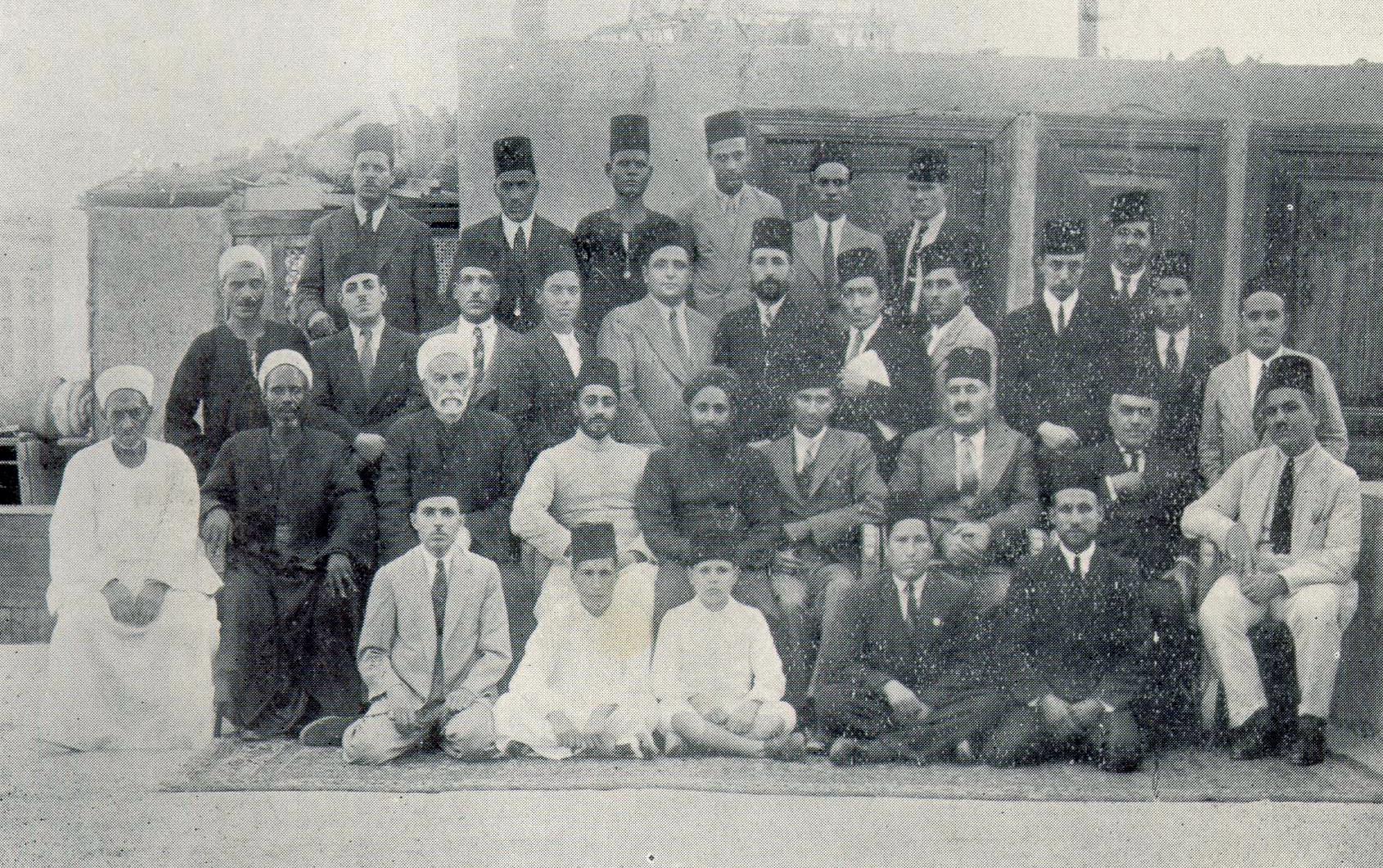
Unjust restrictions on Ahmadis in Iraq and efforts of
Syed Zainul Abidin Waliullah Shah (1926)
Unwarranted restrictions were imposed upon Ahmadis in Iraq (1926); however, through the commendable efforts of Hazrat Syed Zainul Abidin Waliullah Shah (ra), a measure of relief and limited freedom was attained.
Restrictions on Ahmadis
In Iraq, Christian missionaries are granted the liberty to engage Muslims on matters of monotheism, drawing them instead towards the doctrine of the Trinity, thereby diverting them from belief in the Living God to the worship of a deceased human figure.
Likewise, Arya [preachers] are permitted to employ various methods and inducements to lead those who call themselves Muslims into apostasy, even to the extent of inciting them to use foul and abusive language against Islam and its Holy Founder (sa) – descendants of those who once nurtured Islam with their very blood.
Yet, in stark contrast, Ahmadis – who regard the preaching and defence of Islam as the foremost and most sacred duty of their lives and who, despite limited resources, traverse the farthest corners of the world for this very cause – were not granted even the minimal freedom to speak in support of Islam. They were denied the basic right to respond to objections raised against Islam by Arya or Christian [preachers] and were further restrained from refuting
Continued from page 9
a woman has very little hair, so thin that the skin of her scalp is visible and she attaches braids of black wool or a plait to her hair. Remember, such a woman is by no means an al-wasilah. In reality, an al-wasilah is one who was a prostitute in her youth and when she grows old, she attaches a plait to her head to work as a procurer. [Because of her old age] no client comes to her. And [if any old client comes to her] both of them [this woman and her client] are introduced to one another due to this immorality. (Kitab ad-Du‘afa al-Kabir by Al-Uqayli, Bab ashshin, Hadith 717)
“Thus, Islam has based the outcome of actions upon intentions. Therefore, if there is a physical defect or an illness and a surgical treatment of this nature is adopted to rectify that physical flaw, that is permissible. However, such acts are not permissible when done merely for outward display before others.”
(Compiled by Zaheer Ahmad Khan, Head of Records Department, Private Secretariat, London and translated by Al Hakam)
the falsehoods and allegations propagated by opponents of the Ahmadiyya Muslim Jamaat.
Underlying
causes of restrictions
It had been presumed that such severe and unjust restrictions were enacted under the direct authority or tacit approval of the Iraqi government. However, it has recently come to light – following the arrival of Syed Zainul Abidin Waliullah Shah Sahib (ra), an Ahmadi missionary, in Baghdad – that the true cause lies elsewhere.
The instigators of these measures were certain Indian [Muslims] employed in the offices of senior British officials, who maintained close associations with colonial authorities. Motivated by the animosity and prejudice they had carried with them from India against the Ahmadiyya Community, these individuals became instrumental in securing orders that curtailed the Ahmadiyya mission of preaching Islam.
Not only were they themselves inactive and lacking the capacity to contribute to the spread of Islam, but they were also unwilling to tolerate that Ahmadis should courageously stand in defence of the faith –protecting uninformed Muslims from falling prey to hostile influences and extending the invitation of Islam to adherents of other religions.
Religious apathy and disunity
What greater example could there be of disregard for Islam and moral indifference than this? The need of the hour was that all Muslims, united in purpose and strength, should have collectively confronted the opponents of Islam – responding not only to their objections and allegations, but also presenting before them the inherent beauties of Islam.
Furthermore, arrangements ought to have been made to educate uninformed Muslims in the true teachings of their faith, so that they might remain safeguarded from falling into the snares of Christians [missionaries] and Arya [propagandists].
Yet, instead of adopting such a course, what transpired was quite the opposite. Through an unjust exercise of influence, even the small number of Ahmadi Muslims present were prevented from engaging in the preaching of Islam and formal prohibitory orders were issued against them.
These restrictions were enforced with such severity that some Ahmadis were declared “criminals” merely for preaching Islam and were consequently expelled from Baghdad.
Intervention and advocacy
In order to have these unjust and indeed inequitable restrictions lifted, Syed Zainul Abidin Waliullah Shah Sahib (ra) travelled to Baghdad and secured an audience with His Majesty King Faisal. He presented the matter before him with such clarity and effectiveness that the King remarked there was no justification for denying Ahmadis the same rights in Iraq that Christians and adherents of other religions enjoyed in propagating their faith. Not only did he express this view, but he also issued written instructions to one of his ministers to take practical action in this regard.
However, it later came to light that the British adviser to the said minister had recommended that the matter be deferred for some time.
In response, Shah Sahib (ra) met with the High Commissioner. Under the instructions of Hazrat Khalifatul Masih II [ra], repeated representations had already been made to the Government of India on this issue and the High Commissioner had been formally apprised of the matter. Consequently, he listened to Shah Sahib’s (ra) presentation with careful attention and consideration.
Partial relief and hope for full freedom
Subsequently, Hazrat Khalifatul Masih II [ra] received a telegram from Brother Jafar Sadiq Sahib, the amir of the Ahmadiyya Jamaat in Baghdad, conveying that, by the grace of God, a measure of relief had been secured. Letters received from Baghdad further indicate that, for the time being, Ahmadis have been granted limited permission to respond to allegations and accusations directed against Islam Ahmadiyyat. It is
hoped that complete freedom will soon be attained.
Acknowledgement
On the attainment of this partial success, we extend our heartfelt congratulations, on behalf of the Jamaat, to Syed Zainul Abidin Waliullah Shah Sahib (ra). Considering the circumstances under which he undertook this effort, the significance of his achievement is greatly magnified.
The opinion of senior British officials was unfavourable towards Ahmadis, while those responsible for fostering such misconceptions remained resolute in their opposition. Moreover, the Ahmadis residing there found no avenue through which their grievances might be heard. That Shah Sahib assumed responsibility for this matter and through nearly two months of continuous effort, perseverance and diligent endeavour, succeeded – by the grace and favour of God – in securing this outcome, is indeed a remarkable accomplishment.
For rendering this highly important service, one which carries far-reaching implications for the interests of the Ahmadiyya Jamaat, we express our profound gratitude to him and pray that God Almighty may continue to grant him abundant opportunities to serve the faith.
Expressions of gratitude to authorities
We are also deeply grateful to His Majesty King Faisal, who not only granted an audience to a respected representative of our Jamaat, but also gave thoughtful and sympathetic consideration to his submissions, ultimately recognising for Ahmadis the same rights that are afforded to followers of other communities within his realm.
Likewise, we extend our thanks to the government of India, which facilitated the conveyance of accurate information regarding our Jamaat to the High Commissioner in Iraq.
A new convert from Albania
A young man from Albania, named Sulaiman Kazim, who is presently residing in America and had been studying the literature of the Ahmadiyya Muslim Community for some time, has now formally entered the Jamaat with full conviction and satisfaction of heart. May God Almighty grant him steadfastness, Amin
(Translated by Al Hakam from the original Urdu, published in the 13 April 1926 issue of Al Fazl)
The blessed concept of istikharah in Islam and the philosophy of seemingly contradictory dreams
Among the countless mercies of Islam, one very great mercy is the blessed system of istikharah [seeking divine guidance concerning what is best], through which the Holy Prophet (sa), may my soul be sacrificed for him, bound the members of his Ummah to the mantle of the mercy of Allah, the AllKnowing and All-Powerful, by means of a wondrous spiritual bond in every important matter of faith and worldly life. Our master, the Holy Prophet (sa), says that whenever a Muslim is faced with some matter which does not fall among those prescribed timebound obligations laid down by Allah, His Messenger (sa) and those in authority, for in the case of fixed obligations there is no question of istikharah, but is instead a matter whose adoption or abandonment or whose form and timing, have been left to each person’s reason, understanding and circumstances, then on such an occasion they should turn to Allah the Exalted in istikharah, seeking His help, guidance and good. They should pray:
“O my heavenly Master, guide me concerning this matter which is presently before me. Should I undertake it or leave it? Should I carry it out in the form that is presently in my mind or should I fulfil it in some other way? Should I do it now or defer it to some later time? For, O my AllKnowing and Holy God, You alone know in what form and at what time this matter will prove more beneficial and more blessed for me with respect to my religious and worldly welfare, both immediate and ultimate.”
This prayer, which in technical usage is called the prayer of istikharah, has been taught for every such matter in which there exists no fixed command from Allah, His Messenger (sa) or those in authority. That is to say, where there exists no command directing that a certain act must necessarily be performed at a specified time and under specified conditions. For example, the five daily prayers, the fasts of Ramadan or the obligation of paying zakat once a person’s qualifying wealth has remained in their possession for a full year, are all binding duties. In such fixed and definite commands, there is no question of istikharah. Indeed, the person who seeks istikharah in such matters makes a mockery of religion, because despite the existence of a clear and time-bound command, they seek, under the cover of istikharah, to render the divine command doubtful and to postpone it. But apart from such commands, in all other matters, however outwardly beneficial and righteous they may appear, the teaching of istikharah has been given. And this teaching
is so filled with blessed and spiritual bounties that through it every true believer has been attached to the mantle of divine mercy in every matter and their lap has been kept perpetually spread for the reception of divine favours.
This system of istikharah contains a twofold blessing: First, through it, a person repeatedly and abundantly finds occasion to turn towards God and to knock at His door. Whether or not any other outward result appears, the prayer of istikharah nevertheless becomes a means of extraordinary blessing, purification of the self and humble turning to Allah. Secondly, frail human beings, whose knowledge is deficient and whose power is deficient, derive benefit from the limitless knowledge and limitless power of Allah, the All-Knowing and All-Powerful and thus are saved from innumerable stumbles and missteps in life. These two magnificent benefits of istikharah are so certain and so
definite that no person of faith can deny their blessings. This is why the saints and great righteous ones of the Ummah of Muhammad (sa) have, in every age, made istikharah their way and have not allowed any movement or repose of life to remain deprived of the blessing of istikharah. The Promised Messiah (as) also practised it very frequently. Therefore, it is the duty of our Jamaat to strive to derive full benefit from this blessed system in all its affairs and to establish the habit of istikharah so firmly that it is never neglected in any important matter. Indeed, one should include not only oneself in it but also one’s wife, children and friends as well.
The prayer of istikharah and its method
The prayer of istikharah is narrated from the Holy Prophet (sa) in the following words:
“O my God, I seek from You what is best [khair] by virtue of Your knowledge and I ask You to grant me strength and ability [and divine enabling in my affairs] by virtue of Your power. And I ask You out of Your immense bounty, for You have power and I have no power and You know and I know not and You are the Great Knower of all hidden things [and of what is yet to come]. O my God, if in Your knowledge this matter [which is presently before me] is good for me with respect to my faith, my worldly life and the ultimate outcome of my affairs, then ordain it for me [that is, grant me the ability to undertake it], make it easy for me and then place blessing in it for me. But if in Your knowledge this matter is not good for me with respect to my faith, my worldly life and the ultimate outcome of my affairs, then keep it away from me and keep me away from it. And ordain for me the good, wherever it may be [and grant me the ability to attain it], then make me content with it [bestowing tranquillity and cheerfulness upon my heart through it].” (Sahih al-Bukhari, Kitab ad-da‘wat, Bab addu‘a’i ‘inda l-istikharah)
The prescribed method of istikharah is that at night, before going to sleep, a person should offer two rak‘at of voluntary prayer. During those two rak‘at they should make the above supplication. At that time, they should produce in their heart the certainty that God is watching me and I am watching God and that at this moment I am standing before my Creator and Master, seeking from Him good and blessing, right direction and guidance. This prayer should be offered with such pain, fervour and presence of heart as though one had melted one’s heart and placed it before God. Thereafter, without occupying oneself in any other matter, one should go to bed and lie down. Even while falling asleep, one should keep one’s attention fixed upon the purport of this prayer. The Promised Messiah (as) used to say that whoever does not remember the prescribed prayer of istikharah may still pray in their own tongue and in their own words, provided the substance remains that of istikharah. He also used to say that while going to sleep, one should recite the following brief prayer as well:
Hazrat Mirza Bashir Ahmad (ra), MA (1893-1963)
“O my All-Aware Master, inform me of Your will. O my All-Seeing God, grant me insight in this matter. And O my AllKnowing Creator and Master, bestow upon me knowledge from Yourself.” [Sirat-ulMahdi, narration 682, p. 629]
This form of istikharah should be continued for seven consecutive nights. If such an opportunity is not available, then it should be continued for at least three nights. And if, because of some necessity, even that is not possible, then one night alone may suffice. Indeed, the Promised Messiah (as) would even say that in a case of urgent necessity, where even a single intervening night is not available, istikharah may also be performed during the day, because istikharah is, after all, a prayer and
“Allah burdens not any soul beyond its capacity.” [Surah al-Baqarah, Ch.2, V.287]
Four possible outcomes of istikharah
The result of istikharah may manifest itself in four possible ways.
1. First, Allah the Exalted may disclose His will through some revelation [ilham] or dream, whether He discloses it to the person performing istikharah themselves or to some elder, relative or friend of theirs, for, as the Holy Prophet (sa) says:
] that is, sometimes a believer is himself shown a dream and sometimes a dream is shown to another on his behalf. (Sunan at-Tirmidhi, Kitab ar-ru’ya’, Bab qawluhu ‘lahumu l-bushra fi l-hayati d-dunya’)
2. Secondly, no revelation or dream may be vouchsafed, yet the heart of the person performing istikharah may become settled upon a particular course, because the will of God is at times manifested in this manner as well, that no verbal answer is received, yet the heart attains satisfaction.
3. Thirdly, the person performing istikharah may receive from their relatives or friends some such counsel as accords with the will of God, for this too is an indirect form of tura lahu
4. Fourthly, it is also possible and our friends should know this aspect as well; otherwise, they may stumble, that in the mode of prayer’s acceptance, no outward result of istikharah may appear at all. Rather, out of some wisdom, Allah the Exalted may leave the person performing istikharah free to exercise their own reason. For God is in no way subject to His servants. Just as He can accept their prayers, so too, on account of some wisdom, He may reject their prayer or remain silent. Yet even in that case, the person performing istikharah will at the very least receive the spiritual blessing of prayer. And the Gracious and Merciful God will surely be pleased that My servant called upon Me, taking Me to be the One who disposes of their affairs. It is probably with all these aspects before him that the Promised Messiah (as) wrote the following verses:
“Who is there in this world that has called upon You and then gone away empty, stricken by misfortune?
“How great, then, is the support granted to the one to whom You are dearest of all.” [Durr-e-Sameen [Urdu], Qadian: 2002, p. 35]
In the first couplet, ordinary people are being spoken of, whose prayer, even if apparently rejected, nevertheless produces some aspect of mercy. And in the second couplet, the Promised Messiah (as) has spoken of himself, for all that he had belonged to God and the whole mercy of God cast its shade over him. This is why he says elsewhere, “Your mercy is the central beam of my house”, meaning that my entire enterprise rests solely upon the support of Your mercy. [Ibid., p. 34]
The philosophy of seemingly contradictory dreams
Now I take up one aspect of the question of istikharah, which becomes a cause of distress for many people who are unfamiliar with it. Indeed, such a situation has recently arisen even within my own household. Some time ago, in connection with a private matter, I wrote to certain friends and elders asking them to perform istikharah. The replies that I received from various friends were, for the most part, outwardly contradictory. That is to say, one friend wrote one thing as the outcome of his istikharah, while another friend offered altogether different advice. Some also related their dreams, which outwardly appeared to negate one another. By the grace of God, I understood the philosophy behind this apparent difference, but some of my dear ones became greatly troubled and said, “What kind of strange situation is this, that in one and the same matter, different elders who have performed istikharah are seeing different, indeed contradictory, dreams? For example, one friend says that as a result of his istikharah, he saw a dream in favour of Zaid; another says that in response to his istikharah, Umar appeared preferable; and a third friend says that upon performing istikharah, Khalid seemed to have precedence” and so forth.
Since this doubt may arise in the hearts of many people, friends ought to understand its answer properly. But before giving the actual answer, it is necessary to explain one point of principle. That point is that, as the Promised Messiah (as) has written, it is the established way of Allah the Exalted that, for the training of believers and the trial of opponents, He keeps over tidings of future events a certain veil of concealment and, except in special circumstances, does not grant complete disclosure. This wise divine practice extends so far that it applies even to Prophets, let alone ordinary people. Accordingly, even in the prophecies of Prophets there remains, to a greater or lesser degree, a veil of concealment. Matters are not disclosed in such a way as may be likened to the rising of the sun. The Promised Messiah (as) has illustrated this hiddenness by the example of moonlight on such a night in which, alongside the moon, there are also some clouds. There is light, but not such intense light that no distinction remains between those who see and those who do not see. (Barahin-e-Ahmadiyya, Part V, p. 60) Or it is like the case of a pregnant woman,
about whom one may say that she is going to bear a child, yet one cannot say whether that child will be a boy or a girl. (Izala-eAuham, Part 1, p. 308) Thus, when even the spiritual disclosures vouchsafed to Prophets are attended by a veil of hiddenness, how can it be expected in the case of the dreams and revelations of ordinary people that their dreams will in every instance be as bright as the noonday sun?
After this explanation in principle, it should be remembered that when outwardly contradictory dreams arise as the result of istikharah, there are generally three reasons for them.
Three reasons for seemingly contradictory dreams
1. The first reason is that, in keeping with His law of concealment, Allah the Exalted shows to different people performing istikharah different aspects of the matter under consideration. For example, if the question concerns a marriage and one has to choose one person out of several prospective brides or bridegrooms, then at times Allah the Exalted shows to one person in a dream the religious aspect of the boy or girl, makes another aware of their means of livelihood, indicates to another something concerning their health, shows another a scene connected with future offspring and discloses to yet another the matter from the point of view of the future harmony and affection between husband and wife and so on. Such disclosure generally occurs in accordance with the personal inclination of the one performing istikharah. And in showing these varied scenes, the purpose of Allah the Exalted is as though to say: “Behold, We have shown you the different aspects of the matter before you. Now employ your own intellect and reflection and decide for yourselves which match is the more suitable.” It is obvious that in the matter of marriage, there are many factors which affect the married life of husband and wife and which may brighten or darken domestic happiness. At times, there is affection between husband and wife, but the husband is not religious. At other times, the husband is religious, but his health is poor. Or his health may be sound, but there may be financial difficulty. Or there may be no financial difficulty, but as a consequence of a particular match, troubled offspring may be destined and so on. Therefore, in a
case where one aspect of future life appears bright and another dark, Allah the Exalted, by showing different aspects to different people, indicates for the training of the human mind that the various sides of the picture have now been placed before you. So use the reason We have given you, think for yourselves and decide.
2. The second reason is that at times the interpretation of different dreams is wrongly understood. In reality, there is no contradiction, but people, owing to their lack of understanding, imagine the dreams to be contradictory and become distressed, whereas, according to their true interpretation, there is no contradiction at all. In truth, the science of dream interpretation is exceedingly subtle and delicate. Sometimes weeping is seen in a dream, yet laughter is intended by it. And sometimes laughter is seen in a dream, yet weeping is intended by it. Or in one set of circumstances, the interpretation of weeping may be joy, while in another set of circumstances, the interpretation of weeping may be sorrow. In the same way, in certain cases, seeing certain blessed personages in a dream may outwardly signify a life of grief. For example, seeing Hazrat Fatima (ra) in a dream sometimes carries the interpretation that the person who saw the dream will face some grief in life, even though Hazrat Fatima az-Zahra (ra) is a crown among the believing women. Thus, another reason for apparently contradictory dreams arising from istikharah may be that either the dreamer or those hearing the dream make a mistake in its interpretation out of unfamiliarity and begin to regard the dreams as contradictory, whereas in terms of their true interpretation, no contradiction exists.
3. A third possible reason is that sometimes, even in the dreams of righteous people, there may enter an element of the lower self or of satanic influence. Indeed, the truth is that, apart from Prophets and certain elect friends of God, in the dreams of all other people there remains, to a greater or lesser degree, open to some influence of the self or of Satan. Thus, in his well-known book Izala-e-Auham, [Part 1, p. 439], while speaking of istikharah, the Promised Messiah (as) says that sometimes when a person performs istikharah while fixing some particular thought firmly in the heart, the influence of the self enters their
dream or revelation and with the exception of Prophets and muhaddathin [those spoken to by God], the spiritual disclosures of all others may be affected by such influence. I do not mean in any way, God forbid, that the revelations or dreams of all other righteous people are therefore doubtful. Far from it. What I mean is only this, that although most of their revelations and dreams are indeed from God, it is nevertheless possible that in some dream or revelation there may have entered the influence of the heart’s own desire or the inclination of the self. Therefore, one possible explanation of contradictory dreams arising from istikharah must also be remembered to be this: one friend’s dream may be divine, while in another’s dream, there may have become mingled the effect of their personal opinion or psychological inclination.
Different kinds of dreams
It is also necessary, by the way, to mention here that, as is stated in the hadith, dreams are generally of three kinds: rahmani [divine], nafsani [psychological] and shaytani [satanic].
A rahmani dream is one that comes from God. Even if a veil of hiddenness or an error of interpretation is involved, there remains no doubt concerning its truth. A nafsani, or more precisely, a psychological dream, is one in which the personal condition or personal inclination of the dreamer becomes mixed in. And a shaytani dream is one in which there is included the influence of Satan or of satanic thoughts arising within a person. These three kinds of dreams are recognised by their signs, just as thousands of different kinds of trees are recognised by their fruits.
But to what extent shall one weep over the state of the intellect of today’s Muslims, who beat their heads in admiration over Sigmund Freud’s so-called discovery that the psychological condition of man enters into dreams, yet remain oblivious to the magnificent intellectual benefaction of that Unlettered Prophet, may my soul be sacrificed for him, who was born in the deserts of Arabia and who, 1400 years ago, by explaining the three kinds of dreams, brought about a veritable revolution in the science of dreams. Sigmund Freud drew but a single bucket from that very fountain and even that, after muddying it with various impurities, he presented before the world as only one-third of the actual reality. Yet the world, having forgotten its greatest benefactor, continues to raise cries of praise for the incomplete discovery of this 20thcentury inventor. How astonishing! Indeed, how astonishing!
Concluding remarks
To sum up, the system of istikharah in Islam is a most blessed and wondrous system. And although some of its subtle aspects may cast those unfamiliar with it into error or anxiety, this in no way diminishes its magnificent blessings. Rather, like a treasure buried in the hidden depths of the earth, its worth and dignity are increased all the more. Therefore, our friends should cultivate the habit of istikharah in all their affairs, whether they pertain to the field of religion or to the field of worldly life and should adopt the way of turning to their heavenly Master in every matter. Then, if as a result of istikharah they receive any guidance, they should act upon
Promised Messiah Day commemorated in Ivory Coast
Shahid Ahmad Masud
Regional Missionary, Ivory
Coast
The Promised Messiah Day was commemorated across the Ivory Coast in multiple regions, including Abidjan, Bondoukou, Bouaké, Man, Sinfra, Ferké, Issia and other localities. In all these regions, special gatherings were organised to mark the occasion.
During these events, speakers highlighted the advent of the Promised Messiah (as), explaining his divine mission and spiritual status in the light of the Holy Quran and teachings of Islam. The importance of accepting the Promised Messiah (as) and the role of his mission in the revival of Islam were also emphasised.
These programmes were well attended not only by members of the Jamaat but also
Promised Messiah Day celebrated in Quito, Ecuador
Abdul Basit Khawaja Missionary, Ecuador
On 29 March 2026, Jamaat-e-Ahmadiyya Ecuador held Jalsa Yaum-e-Masih-e-Maud at the mission house in the city of Quito.
The programme began with a recitation from the Holy Quran, followed by an introductory video about Ahmadiyyat, a
poem and a reading of an extract from the Promised Messiah’s (as) writings.
I gave the concluding presentation on “Fulfilment of Biblical Prophecies regarding the coming of the Messiah.” After this, guests had a chance to engage in a questionand-answer session. The event concluded with congregational prayers and dinner.
On 29 March 2026, Lajna Imaillah Canada organised a tabligh event on the theme “Eid Celebration and Learn More About Islam,” bringing together community members for an evening of dialogue, education and outreach.
The event was attended by 17 guests. Discussions throughout the programme focused on addressing common questions about Islam, including the benefits of
it and be grateful to God. And if no guidance is received, they should be patient and regard istikharah as a prayer and a remembrance of Allah, thereby taking their share of its blessings. And if, as a result of istikharah, outwardly contradictory dreams arise, they should not become troubled by them, for such dreams come in order to illuminate your minds, to create within your hearts a search for true knowledge and to open for you new treasures of wisdom. I am
learning about religion, the diversity of sects within Islam and an introduction to the teachings of Islam Ahmadiyyat. It also featured an interactive session on women’s rights in Islam.
Guests found the event both informative and insightful. Many were particularly surprised to learn about the significant role of Hazrat Khadija (ra), including her proposal to the Holy Prophet Muhammad (sa) and her distinction as the first person to accept Islam. Another message highlighted during the event was Islam’s emphasis on service to humanity and the dual
astonished at the intelligence and understanding of the person who runs after the advice of Zaid and Bakr and ‘Umar in matters of faith and worldly life, yet does not turn to that All-Knowing and All-Powerful God whose knowledge and power know no limit and whose love and compassion are far greater even than those of one’s own mother.
Alas, a hundred alas, that
“They do not make a just estimate of Allah.”
(Surah al-An‘am, Ch.6: V.92)
by a significant number of non-Ahmadi guests, who showed keen interest in the message presented.
In addition to these events, several radio programmes were also arranged in different regions. Through these broadcasts, the message of the Promised Messiah (as) reached a wider audience, helping to spread awareness about his advent and teachings.
Regional Jalsa
Yaum-e-Masih-e-Maud held by Lajna Imaillah Bondoukou, Ivory Coast
Faryal Afia Shahid Ivory Coast
On 25 March 2026, Lajna Imaillah Bondoukou Region, Ivory Coast, organised its first Regional Jalsa Yaum-e-Masih-eMaud (as). Participants from five villages took part in this blessed event. The total attendance was 104.
A lady representative of the Sub-Prefect of Alanikro also attended. The event featured speeches highlighting the advent, mission and status of the Promised Messiah (as). This event was covered by a national online newspaper, the Ivorian Press Agency (AIP).
responsibility of fulfilling the rights of God and fulfilling the rights of mankind. In line with this principle, Lajna Imaillah Canada presented a $10,000 donation cheque to Hill House Hospice in support of compassionate end-of-life care.
The afternoon concluded with a guided tour of the Baitul Islam Mosque and a special dinner in celebration of Eidul-Fitr, providing further opportunity for community building and informal discussion.
[“And the conclusion of our prayer shall be, ‘All praise be to Allah, the Lord of the worlds.’”]
(Written on 21 November 1954; published in the Daily Al Fazl, Lahore, on 28 November 1954; later published in Mazamin-e-Bashir, Vol. 3, pp. 183-191; translated by Syed Adil Ahmad, USA)
20 March 2026
The Promised Messiah (as): A Momin’s hallmark – World becomes subservient to Faith
After reciting the tashahhud, ta‘awwuz and Surah al-Fatihah, Hazrat Khalifatul Masih V (may Allah be his Helper) stated:
Today I have also delivered the Eid sermon, so at this time I will deliver a relatively short sermon. For this purpose, I have taken an excerpt from the writings of the Promised Messiah (as), to which we should always pay attention. He states:
“The more diverse a believer’s worldly associations, the more they advance in higher ranks, because their prime objective is religion.”
Even his worldly relationships are good and expansive only because their purpose is religion. In other words, the purpose of worldly relationships should itself be religion, and this is the hallmark of a believer.
“And the world, along with its wealth and honour, serves the Faith. Hence, the fundamental point is that the world must not be one’s ultimate objective. As a matter of fact, in pursuing worldly affairs, the primary purpose must be religion.”
“And the world ought to be pursued in a manner that serves the Faith. For example, when a person travels from one place to another, they will take a mount and pack their provisions. They do this because their actual purpose is to reach their final destination, not because they seek the mount itself or the provisions for the journey.”
All these things are taken merely to make the journey easier, so that one may travel comfortably and reach the intended destination, not so that one may simply indulge in them along the way.
“In the same manner, one ought to strive in the world, but only so that this may serve the Faith. Allah the Exalted has taught us the following prayer:
“‘Our Lord, grant us good in this world as well as good in the world to come, and protect us from the torment of the Fire.’”
[Surah al-Baqarah, Ch.2: V.202]
That is, O Allah, grant us both the good of this world and that of the Hereafter.
“In this prayer, the world has been given precedence, but what ‘world’ exactly? It is the good of this world (hasanat-ud-dunya) which becomes a means by which to reap good in the Hereafter.”
Thus, the real principle is that the world should not be the ultimate objective in itself; rather, the true aim in acquiring the world should be the acquisition of faith. That is, even if you earn worldly wealth, the intention should be that our faith becomes better and that we may serve our religion. If we earn worldly means, it should be for the improvement of our faith, not by engaging in wrongful acts that ruin both our world and our Hereafter. Rather, we should earn in a way that adorns our hereafter and strengthens our faith.
Such a world, which, after attaining it,
brings benefit in the Hereafter. We should obtain such things in this world which lead to the good in the next life, rather than them becoming a cause of shame and regret in the Hereafter. If a person becomes completely absorbed in the world alone, he will inevitably face regret in the Hereafter. The Promised Messiah (as) further states:
“The fact that we have been taught this prayer clearly demonstrates that in attaining the world, a believer ought to have in view the good of the Hereafter. The words hasanat-ud-dunya, as mentioned here, encompass all the best means by which a Muslim believer ought to pursue the world. Pursue the world in every such way that leads to benefit and goodness, not in a manner that causes pain to another human being, nor in a manner that is disgraceful or ignoble amongst the people. Engaging in the world in such a manner would definitely enable one to reap the good of the Hereafter (hasanat-ul-akhirah).” (Malfuzat, 1984, Vol. 2, pp. 91-91; Malfuzat [English], Vol. 2, pp. 264-265)
Earn such worldly wealth that not only benefits you, but also benefits humanity. Let there be no actions in your worldly life that become a cause of shame for you, your family or your relatives. Rather, your life should be pure and upright, a life that proceeds upon piety and righteousness. When such a life is established, and you
dedicate your life to earning the world in this manner, then it will bring you blessings in both this world and the Hereafter.
Therefore, today, when the world in general has become absorbed in the pursuit of its own aims and interests and when personal interests are given priority, for example, if we look at nations, they are concerned only for their own people and not for humanity as a whole. By becoming engrossed in this attitude, they are in fact preparing the means of their own destruction.
In such circumstances, we should turn our attention toward seeking the blessings of both this world and the Hereafter from Allah the Almighty. In these conditions, we need to focus on this even more so that we may set right both our worldly life and our Hereafter and remain protected from every kind of calamity.
As I have mentioned, the world is moving toward a pit of destruction. May Allah the Almighty protect us from it. May Allah enable us to improve our deeds and grant us the ability to offer sincere prayers, as I mentioned in the sermon earlier. May Allah grant us the ability to truly attain these blessings, enable us to offer the best of prayers, and also accept them.
(Official Urdu transcript published in the Daily Al Fazl International, 10 April 2026, p. 2. Translated by The Review of Religions.)