Ansar from USA’s Gulf States meet Huzoor


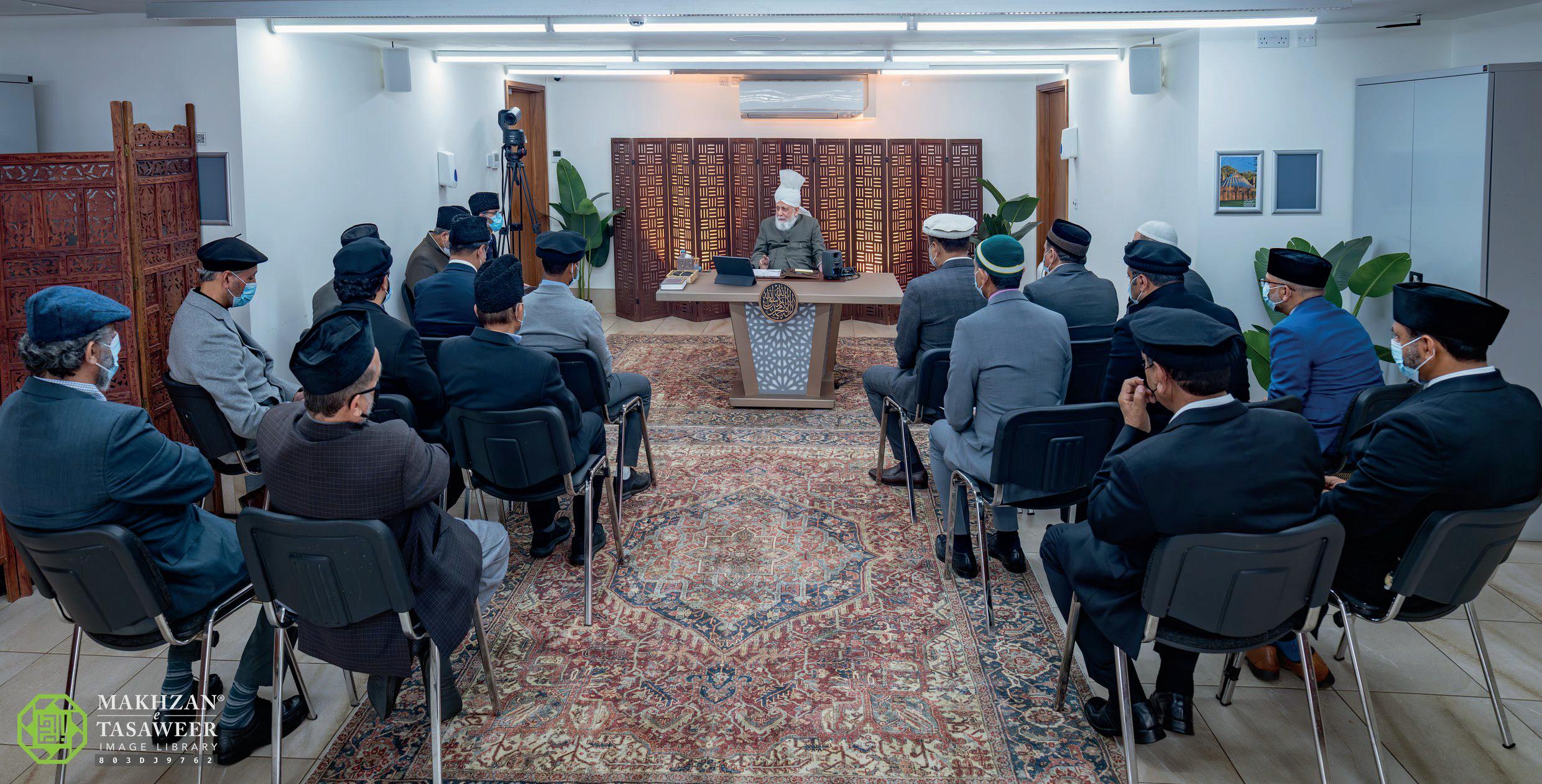
Islamabad, Tilford, UK, 21 April 2026: Members of Majlis Ansarullah from the Gulf States Region of the United States were blessed with a mulaqat with Hazrat Mirza Masroor Ahmad, Khalifatul Masih V (aa). During the meeting, all attendees had

the opportunity to introduce themselves before seeking guidance from Huzoor (aa) on matters relating to spiritual love, humility, Jumuah, brotherhood, civic duties, peaceful protest and personal reform.
True love for the Holy Prophet (sa) lies in obedience
A member asked how one could develop deep love for Allah, the Holy Prophet (sa), the Promised Messiah (as) and the Khulafa, in the way one feels love for parents and sometimes sees them in dreams after their passing.
Huzoor (aa) explained that the bond with parents develops naturally over many years, from childhood onwards and that this personal attachment brings comfort. However, he said that seeing someone in a dream is not the real objective. Referring to the guidance of the Promised Messiah (as), Huzoor (aa) explained that even seeing the Holy Prophet (sa) in a dream is not, in itself, the highest virtue; the real virtue is to act upon his commandments, teachings and blessed example.
Huzoor (aa) advised that if a person wishes to increase in love for the Holy Prophet (sa), they should abundantly invoke durood, give attention to salat and strive to act upon the Sharia that Allah revealed through him. This practical obedience is what brings a person close to Allah and His Messenger (sa). If Allah so wills, He may also
Hazrat Abu Hurairah (ra) narrated, “I heard Allah’s Messenger (sa) say, ‘Whoever gives a pair of anything in the way of Allah will be called from the gates [of Paradise]. [It will be said:] “O servant of Allah, [come here]; this is good.” Whoever is among the people of salat will be called from the Gate of Salat; whoever is among the people of jihad will be called from the Gate of Jihad; whoever is among the people of charity will be called from the Gate of Charity; and whoever is among the people of fasting will be called from the Gate of Fasting, the Gate of ar-Rayyan.’”
Hazrat Abu Bakr (ra) said, “The one who is called from those gates will have no need [of anything else].” He then asked, “O Allah’s Messenger (sa), will anyone be called from all of them?” He replied, “Yes; and I hope that you, O Abu Bakr, will be among them.”
(Sahih al-Bukhari, Kitab fada’ili ashabi n-nabiyy, Bab qawli n-nabiyyi ‘Law kuntu muttakhidhan khalilan’ qalahu abu sa‘id, Hadith 3666)
Gates of Paradise
This Week in History
A glimpse into the rich history of the Ahmadiyya Muslim Jamaat 15 - 21 MAy
15 - 16 May
15 May 1908: On this day, The Daily Paisa Akhbar and Akhbar Ahl-e-Hadith published a prophecy made by Dr Abdul Hakeem Khan, who announced that the Promised Messiah (as) would pass away on 4 August 1908. Arrogantly, he claimed: “Mirza will fall prey to a fatal illness and shall die on 21 Sawan 1965 [i.e., 4 August 1908].” The Promised Messiah (as) passed away on 26 May 1908.
For more details, see: “Hazrat Mirza Ghulam Ahmad’s demise and Abdul Hakeem”, at alhakam. org (10 February 2023, p. 17).
16 May 1878: Munshi Gurdiyal, a teacher at the middle school in Chiniot, Punjab, published an article in Aftab-e-Punjab advocating the Samajist belief that all souls are uncreated and addressing the Promised Messiah (as). In reply, on this day, the Promised Messiah (as) penned a decisive rebuttal that silenced the Munshi and brought the debate to an end. (Purani Tahrirein, Ruhani Khazain, Vol. 2, p. 46a)
16 May 1947: Delhi’s newspaper Riasat commented in its editorial that Ahmadis were supporting the Pakistan Movement, but soon after the creation of Pakistan, the non-Ahmadi Muslims would treat them exactly as the Afghan government had treated them in the past.
In response, during his speech on this day, Hazrat Musleh-e-Maud (ra) stated that in a situation like this, a divine community which is purely based on religion, morals and justice will keep in mind the rights of the people while making any decision instead of seeking its own benefit. Huzoor (ra) emphasised that the Jamaat would give precedence to the interest of the Muslim community and that “it is our obligation to help the oppressed nation, no matter if they kill us or harm us. We have been harmed by every nation.”
For more details, see “Hazrat Musleh-e-Maud’s services to the Muslim cause: Guidance and support to leaders of the Pakistan Movement”, at alhakam.org (5 March 2021, p. 20).

17 May
17 May 1946: On this day, two Ahmadi missionaries – Malik Ataur Rahman Sahib and Chaudhry Ataullah Sahib – reached Paris to establish the Ahmadiyya mission there. They rented a room in a hotel and commenced their respective activities. (Tarikh-e-Ahmadiyyat, Vol. 11, p. 12)
17 May 2013: On this day, Hazrat Khalifatul Masih V (aa) inaugurated the Baitur Rahman Mosque in Vancouver, Canada, by delivering his Friday sermon from the new mosque. (‘‘Thousands attend opening of new Ahmadiyya Mosque in Vancouver’’ www.pressahmadiyya.com)
18 - 19 May
18 May 1908: On this day, Professor Clement Lindley Wragge enjoyed the privilege of having an audience with the Promised Messiah (as) once again, this time with some new questions. Hazrat Mirza Masroor Ahmad, Khalifatul Masih V (aa) visited Professor Clement Wragge’s grave during his 2006 New Zealand tour on 7 May.
To read more about this, see: ‘‘Professor Clement Wragge’s second meeting with the Promised Messiah’’ at www.alhakam.org (2 April 2021).
19 May 1955: On this day, Hazrat Musleh-eMaud (ra) was in Zurich and sent Eid greetings to members of the Jamaat through a telegram. He wrote:
“Eid Mubarak to all Ahmadis of Pakistan, India and around the world. I pray for the removal of their worries and problems and for their spiritual progress.” (Tarikh-e-Ahmadiyyat, Vol. 16, p. 515)
19 May 1989: On this day, Hazrat Khalifatul Masih IV (rh) delivered his Friday sermon at the Mahmud Mosque of Zurich, in which he highlighted the schemes employed by some Baháʼís in Pakistan to undermine the faith of some economically
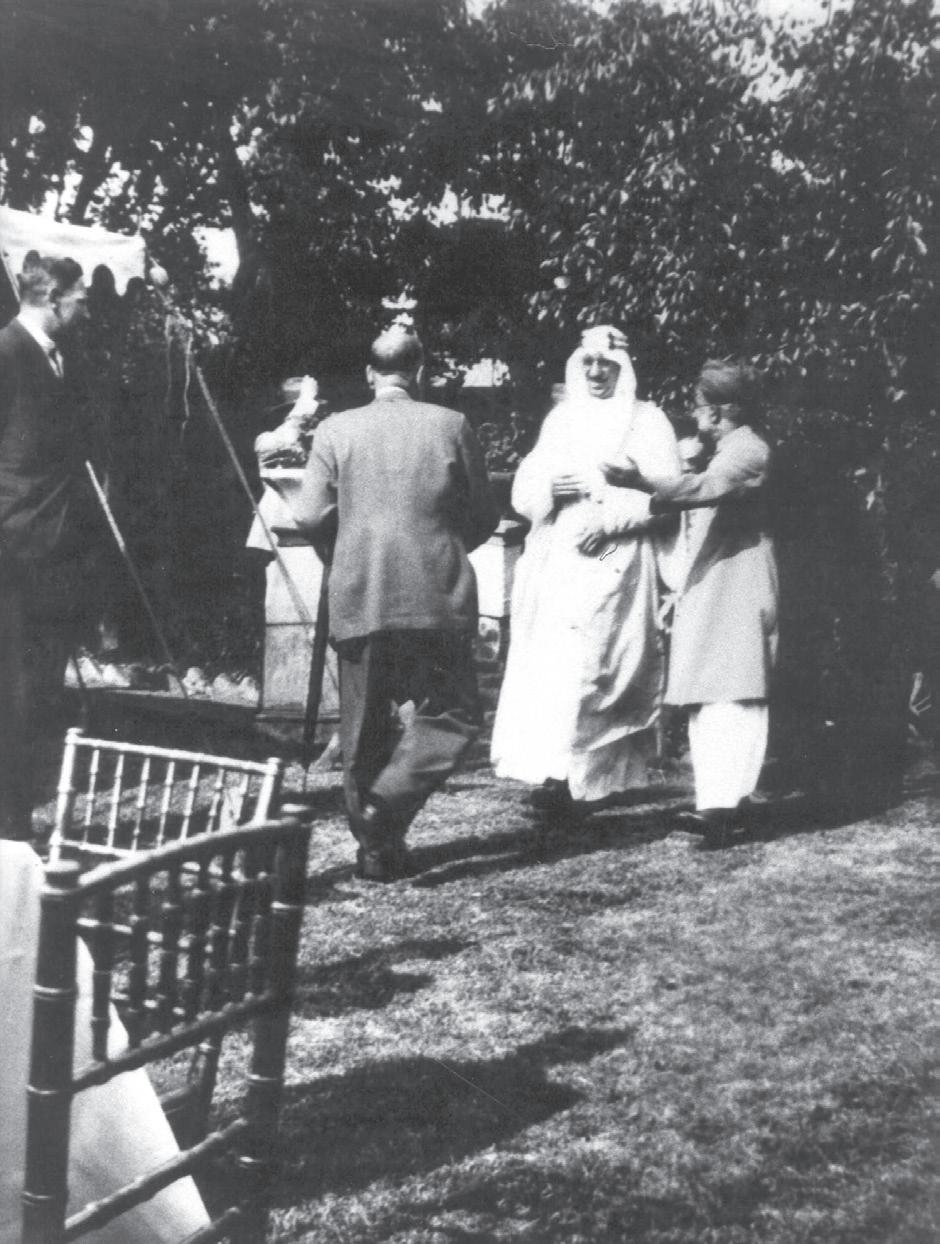
disadvantaged Ahmadis, enticing them with financial incentives and the allure of material benefits in an attempt to sway their allegiance away from Islam Ahmadiyyat. Huzoor (rh) emphatically stated that, despite their economic hardships, Ahmadis possess a resolute and unwavering faith, rendering these tactics ineffective. (Khutbat-e-Tahir, Vol. 8, p. 323)
20 - 21 May
20 May 1928: Madrasa Ahmadiyya in Qadian gained the status of an Arabic college. Now known as Jamia Ahmadiyya, this prestigious institution’s branches have been established today in more than a dozen countries on five continents since its humble beginning. On this day, Hazrat Musleh-e-Maud (ra) inaugurated this new institution with a powerful speech. (Tarikhe-Ahmadiyyat, Vol. 5, p. 21)
Hazrat Sufi Muti-ur-Rahman was sent to serve as the person in charge of the Ahmadiyya Mission in America on this day, too.
For more details about his career in serving Jamaat, see: “Pioneer Missionaries: Part 2 –Serving till their last days” at alhakam.org (16 September 2022, p. 9).
21 May 1948: When Israel was established on 14 May 1948, Hazrat Musleh-e-Maud (ra) wrote an article to awaken the Muslim world, titled “Al-Kufru Millatun Wahidah” and called on all Muslims to unite as one. This article was published on this day in Al Fazl.
For more details, see “The Ahmadiyya Khilafat’s call for Muslim unity: The solution to the IsraelPalestine issue” at alhakam.org (21 May 2021, p. 21).
21 May 2005: On this day, during his tour of Uganda, Hazrat Khalifatul Masih V (aa) inaugurated a mosque in Busia. Later, Huzoor (aa) went to Mbale to inspect an Ahmadiyya hospital there. (Al Fazl International, 24 June 2005)
grant good dreams, but such experiences are a matter of His grace and belong to a high spiritual rank. Huzoor (aa) said that if a person is acting upon the teachings and finds peace in the heart, then that itself is a sign of success. Any good dream should be considered a blessing from Allah, linked to one’s love, prayers, durood and desire for nearness.
Humility, istighfar and recognising the subtle traces of arrogance
Another member asked how one can recognise and overcome the subtle traces of arrogance that may exist unknowingly in the heart, so that one may be accepted by Allah and attain His love.
Huzoor (aa) explained that Allah alone knows the true condition of hearts. A person’s duty is to sincerely seek forgiveness, ask Allah for pardon, strive to avoid sin and protect oneself from arrogance. If a person does this with sincerity, Allah is Most Forgiving. Whether and when such efforts are accepted lies with Allah; human beings cannot know that fully.
Huzoor (aa) advised keeping in mind the couplets of the Promised Messiah (as), especially the one in which he taught that a person should consider themselves lower than everyone else, for perhaps through such humility they may gain entrance into the abode of nearness to Allah (Barahin-eAhmadiyya Part V, p. 26):
person should pause, reflect and suppress it rather than let it grow. Regular istighfar, repeated throughout the day, helps to empty the mind of arrogance.
Huzoor (aa) warned that when a person achieves success, receives praise or gains an award and begins to attribute it to their own knowledge, greatness or special qualities, this gradually leads towards arrogance. Instead, one should remember that they are a humble human being. He also referred to the Quranic teaching that no matter how much one may walk with pride, one cannot reach the height of the mountains. (Surah Bani Isra’il, Ch.17: V.38) Thus, humility should always be adopted.
Missing
Jumuah due to genuine compulsion
A question was asked about cases where one is unable to attend Jumuah due to unavoidable circumstances or an emergency and feels deprived of both the prayer and the special time of acceptance of prayers on Friday.
Huzoor (aa) said that Allah is not unjust and He knows a person’s constraints. If, at the time of Jumuah, someone becomes ill or is genuinely unable to attend despite having the intention to do so, Allah knows that person’s state. Huzoor (aa) referred to the fundamental Islamic principle taught by the Holy Prophet (sa), that actions are judged according to intentions. (Sahih al-Bukhari, Hadith 1) If a person’s intention is pure, the matter is different; accountability arises when the intention itself is faulty.
a far greater reward. (Mathnawi, Book II, sections 62-75; Mecmûa-i Sâz ü Söz, BL Sloane MS 3114, c. 1650, p. 248; cf. BnF Turc 292, fol. 298r) In the same way, if someone misses Jumuah due to genuine compulsion and spends that time remembering Allah and seeking forgiveness, Allah can grant reward from His grace.
Digital communication can strengthen brotherhood if hearts are sincere
A member said that members of the Jamaat increasingly rely on WhatsApp, text messages and email for communication. Although these tools provide ease, he asked how personal connection and heartfelt closeness could be maintained and strengthened.
Huzoor (aa) explained that digital communication, when used with sincerity, could become a means of increasing love rather than diminishing it. He drew a parallel with the earlier practice of writing letters, spoke of the thousands of letters he receives from members around the world and emphasised that love is strengthened through prayer, sincere concern and brotherhood for the sake of Allah. Huzoor (aa) said:
The company of the righteous
The Promised Messiah (as) states: “It is mentioned in the Holy Quran:
Meaning, one who purifies their soul has found salvation. To purify one’s soul, seek the company of the righteous, or fostering a relationship with those who are pious and virtuous is very beneficial. One ought to shun ignoble morals such as falsehood and the like, and seek guidance from one who already treads this path. One ought to correct their errors along the way. Just as one cannot improve their writing without identifying one’s mistakes, so too morals cannot be rectified until one identifies their errors. Man is the sort of creature that remains on the right path only if he is purified continuously as he goes along, otherwise he will deviate.”
(Malfuzat [English], Vol. 2, p.177)
Jamaat has grown so large; it has reached hundreds of thousands and tens of millions. People write letters; I receive thousands of letters every day. Now, regarding those whom I have not seen, what do you think – is there no love for them? They ask for prayers. Prayers are offered for them at that very moment when I am reading the letter. And later, at the time of prayer, prayers are also offered for them. I do not remember everyone’s names, so prayers are offered generally. This is how love increases.
Huzoor (aa) explained that whenever a thought of arrogance arises, this teaching should come to mind.
Huzoor (aa) also referred to an incident in the life of the Promised Messiah (as), when, during a discussion, he accepted that the opposing party was correct on a certain point for the sake of Allah’s pleasure. Upon this, Allah revealed to him that He was pleased with how he acted with humility. (Barahin-e-Ahmadiyya Part IV, p. 400) Huzoor (aa) said that when a situation arises in which one’s ego may become inflamed, a
Huzoor (aa) clarified that the hadith warning about the heart being darkened does not apply to missing a single Jumuah due to compulsion. (Sunan Abi Dawud, Kitab as-salat, Bab at-tashdidi fi tarki l-jumu‘ah, Hadith 1052) The warning is for one who knowingly and repeatedly misses Jumuah without excuse. If a person is prevented due to genuine circumstances, then even during that time, they can remember Allah, pray and seek forgiveness.
Huzoor (aa) said that Allah is Forgiving and also grants reward. He gave the example of a king who once missed Fajr, but then spent the day in istighfar and was granted
“This is your own way of thinking, is it not? If I send someone a text message or I am compelled to do so, or I remain in contact with someone, then their value increases even more in my heart when they reply and when loving replies come. Or when I respond to someone with love. Or there is correspondence. You are speaking of text messages. There was once an age of correspondence through letters; hence, a saying developed in Urdu that letters are half a meeting. In the same way, a text message is even quicker than that. A letter, in earlier times, would arrive after 15 days or a month. Nowadays, you write a text message, send it and it reaches the other person in the very next second. A loving reply comes from them. They develop the feeling: ‘Yes, my brother remembered me; my friend remembered me.’ So, to say that love is decreasing because of this – that may be your thought, but it is not mine. Alright? I do not feel that any love is decreasing.
“People write countless letters. Now the
“At night, when you go to sleep, imagine: ‘These are my brothers and sisters. I must pray for them before I sleep.’ Then love will remain established in the heart. So, to say that love only increases by meeting is not correct. Of course, love is gained through meeting and one should certainly meet. And it is mentioned in the hadith that you should invite one another; this, too, increases love.
[Al-Tabarani, Al-Mu‘jam al-Kabir, Vol. 13, p. 70, Hadith 173; Al-Albani, Sahih al-Jami‘, Hadith 3568]
“You live in one city. You hold functions; there are Ansar meetings. You go there, do you not? Meet there. You go for Jumuah; meet there. There are five daily prayers. Develop the habit of attending them and attention will turn towards meeting one another. Through this, the bond of love will remain established.
“Allah the Almighty says that you should love for My sake and you will receive reward. If you love for the sake of the world, there is no reward. So, when you are doing this for the sake of Allah, you will also have love for those who come for prayers; there will be love for those who come for Jumuah. On Eid, you even embrace one another.”
Huzoor (aa) further said:
Hazrat Mirza Ghulam Ahmadas, In His Own Words
“Therefore, the feeling should always arise in the heart that believers are brothers to one another and a brother should care for his brother. And remember the hadith that whatever you desire for yourself, desire the same for your brother. [Sahih al-Bukhari, Kitab al-iman, Hadith 13] When your thoughts are like this, when these are the ideas you hold, then the virtuous thoughts that arise in your heart, the noble thoughts that arise in your heart for your own children, should also arise for your brother and for your brother’s children and for your friend’s children too. Then they become a means of love.
“Then, when you meet, even if you meet after two months, after six months or after a year, they weep. There are countless people in Africa; they live in villages, in remote areas. They write letters to me. And when our people go there, if someone goes as my representative and conveys my salaam, they become emotional and begin to weep. They have love in their hearts, do they not? Allah the Almighty has created that love in their hearts.
“Therefore, one should pray to Allah the Almighty that Allah the Almighty may create love in our hearts and that distance may not arise because of these small matters and worldly grievances.
“So, to say that [mutual love diminishes] merely because of sending text messages – I believe that text messaging has become an easy means of expanding love. Previously, a letter would take a month; now, in a single day, you can do this, you can speak to one another, you can speak on FaceTime and you can even show your face. You also receive a reply to your text. In fact, you should have asked, ‘Love has increased through this; now, how can we increase it even further?’”
When it was mentioned that some newly arrived ansar from Pakistan may not be used to such means of communication, Huzoor (aa) observed that people in such countries often know even more about texting and mobile phones. However, if there are some who do not have access to phones or cannot afford them, then they should be met personally, invited to the mosque and included in different functions.
Huzoor (aa) advised that gatherings need not always be formal meetings. Weekend picnics, meals and informal get-togethers can also be arranged. He referred to the tradition of eating together called Kuloo Jami‘an and said that such programmes can also be organised in Ansarullah, just as they are arranged in other auxiliary organisations and local settings. Such gatherings can include food, conversation and religious discussion. He said that if one has the intention to do a good deed, then it can be done; but if one keeps delaying it in pursuit of worldly matters, then it does not happen.
When a member said that they had considered arranging a monthly meal together, Huzoor (aa) encouraged this and added that those who can afford it should bring extra food for those who may not be able to prepare or bring anything themselves.
Military draft, obedience to law and the question of just cause
A member asked about discussions in some circles regarding a possible military draft in the United States and how Jamaat members between the ages of 20 and 25 should respond if such a situation arises.
Huzoor (aa) said that as long as one
lives in a country, one must follow its laws. Either one migrates from that country or one takes part in the service required by law. He explained that this is the principle: wherever one lives, one must abide by the law and fulfil the obligations of citizenship.
Huzoor (aa) referred to the example of the Holy Prophet (sa), who did not take up arms during the 13 years in Mecca, because the Muslims were living under another authority. Later, when they had their own government and were attacked, they took up arms in self-defence. Thus, the law of the land must be obeyed, whether the government is Christian, secular or otherwise, so long as one chooses to live there.
At the same time, Huzoor (aa) advised that members should explain matters to people around them. He said that Ahmadis should create awareness within their society, surroundings and environment. Many people are now recognising that certain attacks and policies, whether by America or Israel, involve oppression. Ahmadis should explain these matters to others.
Huzoor (aa) said that if a war is being fought for a just cause, then the matter is different. He referred to the Second World War, when the British government recruited many people from India, including for different regiments and later offered benefits to some. He mentioned that the Jamaat also had a territorial force at that time and that Hazrat Mirza Sharif Ahmad Sahib (ra) was connected with it in a command capacity. Huzoor (aa) also referred to the Furqan Battalion, which was formed after the partition of India, and took part at the front. Huzoor (aa) said that the cause must be examined; if it is a just cause, one may serve, but if there is oppression, then one should strive against oppression.
When the member asked whether this meant he should move his family to Canada, Huzoor (aa) said that this was his own choice and that there was no need to move unless compulsory service actually arose. He then emphasised the power of prayer and said:
“Prayer has great power. Allah the Almighty has great power. If Allah the Almighty is asked sincerely, then Allah the Almighty accepts your prayers for the benefit of humanity. It may be that He does not do so for your personal matter, but if you are doing it for humanity, for the purpose of Allah the Almighty or for some noble purpose, then it is accepted.”
The positive effect of travelling for
During the discussion, reference was made to the large number of Germany and Norway who had visited over the weekend.
Huzoor (aa) said that, just as this meeting was being held with them, similar meetings had been held with those He mentioned that 104 had come from Germany and 91 from Norway and that they had also been seated in the hall for their mulaqats Allah, such visits leave a positive effect. Even if nothing else, those who come to Islamabad have to offer the five daily prayers, which itself is beneficial.
were comparatively close, travelling by bus or short flights, whereas the American members had travelled much farther. This, too, became a source of encouragement for them.
Participation in peaceful protests
A member asked about protests in America against the current political situation and mentioned that he had been invited to attend.
Huzoor (aa) said that if a protest is peaceful, then one may attend it. However, there must be no violence, no destruction of government property and no physical assault. If one participates peacefully, then protest is permissible.
When the member mentioned that he had prepared a banner bearing the Jamaat’s message of love for all and hatred for none, Huzoor (aa) approved of this approach. He said that peaceful participation of this nature takes place in the UK and Germany as well.
Huzoor (aa) also referred to the time when the Maharaja of Kashmir committed injustices and Hazrat Musleh-e-Maud (ra) instructed Ahmadis to organise and participate in peaceful protest against that oppression. Thus, peaceful protest against injustice is permissible when conducted within proper limits.

Acting upon the commandments of the Holy Quran
At the end of the mulaqat, one member requested prayers that he may act upon all the commandments of the Holy Quran and remain away from all evils.
Huzoor (aa) advised him to make a list of those commandments and then strive to act upon them. When the member referred to the many commandments of the Holy Quran, Huzoor (aa) said that he should prepare the list and then act upon it and prayed that Allah may grant His grace.
Remembering the simplicity of the Holy Prophet (sa)
During the final moments, Huzoor (aa) also gave guidance regarding accommodation and personal comfort. He said that if any member were to complain that a bed was comfortable or uncomfortable, they should think of how the Holy Prophet (sa) used to sleep. If one reflects on that example, complaints about the comfort or discomfort of beds will disappear.
Conclusion At the conclusion of the mulaqat, the attendees had the honour of a group photograph with Huzoor (aa). Huzoor (aa) also gave pens as gifts to the members and the mulaqat came to an end.
(Summary prepared by Al Hakam)
Huzoor (aa) added that the khuddam had expressed that their faith was refreshed by seeing members who had travelled from America. Those from Germany and Norway

Answers to Everyday Issues
Usury, interest and trials of life
Guidance regarding basic Islamic issues that Hazrat Amirul Momineen, Khalifatul Masih Vaa, has given on various occasions in his written correspondence and during MTA programmes is being published officially below for everyone’s benefit.
Did earlier religions originally prohibit interest and usury?
Someone from the UK wrote to Hazrat Amirul Momineen, Khalifatul Masih V (aa), stating that the meanings of ‘qayyim’ are powerful, firm, right and straight. It also includes the meanings of straightening and correcting. This is why the term Din alQayyim [the everlasting faith] has been used in the Holy Quran and ancient scriptures for the true religions revealed by God Almighty. In this context, my question is whether we can say that the prohibition of interest or usury is a part of Din al-Qayyim Huzoor-e-Anwar (aa), in his letter dated 5 December 2023, granted the following guidance regarding this question:
“You have fetched an argument from afar in your question, whereas your straightforward question should have been whether the prohibition of interest is found in the true religions revealed by Allah the Exalted. The answer to this question is that the prohibition of interest is indeed found in the religious teachings revealed by God Almighty.
“Accordingly, on the one hand, the Holy Quran completely forbade Muslims from this evil and admonished them to avoid it, stating that, ‘Whatever you lay out at interest that it may foster the wealth of the people, it does not increase in the sight of Allah; but whatever you remit as Zakat, seeking the pleasure of Allah, that is multiplied manifold.’ (Surah ar-Rum, Ch. 30: V. 40)
“Whilst expounding upon the exegesis of this verse, Hazrat Musleh-e-Maud (ra) states that the Holy Quran has described two types of interest. The usurious business conducted with the poor has also been forbidden, but this verse clearly indicates that it refers to the usurious business conducted with the wealthy, so that they may invest it in trade and the wealth of the lender may also increase. Some Muslims suppose that lending money on interest to the wealthy or to companies, or investing money in a bank on interest, is not forbidden in Islam. However, this verse clarifies that this type of usurious business is also forbidden. If their supposition were correct, why would this verse have been revealed and what would be its purpose? God, the Revealer of the Holy Quran, is the Knower of the Unseen; He
knew that in a certain era, Muslims would attempt to make interest lawful. Thus, He dispelled even the doubts that would arise in the future within this verse. (Tafsir-e-Saghir, p. 530, footnote 1)
“Furthermore, He stated, ‘And do not bestow a favour in the expectation of receiving more in return.’ (Surah alMuddaththir, Ch. 74: V. 8) Then, He commanded the abandonment of an evil like interest in clear terms and warned those who do not abandon it to be prepared for war with Allah and His Messenger (sa). Alongside this, He also advised that if a debtor is in straitened circumstances, he should be granted respite until he attains ease and if you remit even your principal amount [ra’s al-mal] as charity for that person, it is the best act. (Surah al-Baqarah, Ch. 2: V. 279-281)
“On the other hand, regarding the Jews, He stated, ‘We barred them from the enjoyment of Our spiritual favours which had been allowed to them and We have prepared for those of them who disbelieve a painful torment.’ (Surah an-Nisa, Ch. 4: V. 162)
“Whilst expounding upon the exegesis of this verse, Hazrat Musleh-e-Maud (ra) states:
“‘In Exodus chapter 22, verse 25 and Leviticus chapter 25, verses 36 and 37, the taking of interest by Jews is declared forbidden. However, in Deuteronomy, chapter 23, verse 20, the Children of Israel are permitted to take interest from people other than the Jews. In reality, this is an interpolation which, according to the Holy Quran, the Jews made in the Bible for their commercial business. Otherwise, Allah the Exalted had forbidden them from every kind of usurious business. Thus, whatever is written in the Bible is the result of Jewish interpolation.’ (Tafsir-e-Saghir, p. 136, footnote 4)
“We observe that although the Bible has been interpolated to a great extent, the prohibition of usury is still present within it. Accordingly, in addition to the aforementioned references, the Bible states: ‘Lord, who shall abide in Thy tabernacle? Who shall dwell in Thy holy hill? [...] he that putteth not out his money to usury, nor taketh a bribe against the innocent. He that doeth these things shall never be moved.’

(KJV, Psalms, 15:1, 5)
“Then it is written: ‘The soul that sinneth, it shall die. [...] But if a man be just and do that which is lawful and right, and hath not eaten upon the mountains, neither hath lifted up his eyes to the idols. [...] He that hath not given forth upon usury, neither hath taken any increase, that hath withdrawn his hand from iniquity, hath executed true judgment between man and man [...] he shall surely live.’ (KJV, Ezekiel, 18:4-6, 8-9)
“In the Gospel as well, there are various such sayings attributed to Prophet Jesus (as) from which not only the prohibition of usury is deduced, but they also impart the teaching of great leniency in lending. As he states in one place:
“‘And if ye lend to them from whom ye hope to receive, what thanks have ye? For sinners also lend to sinners, to receive as much again. But love ye your enemies, and do good and lend, hoping for nothing in return; and your reward shall be great, and ye shall be the children of the Highest; for He is kind unto the unthankful and to the evil. Be ye therefore merciful, as your Father also is merciful.’ (KJV, Luke, 6:34-36)
“Likewise, in Hinduism and Buddhism, too, one finds a strong aversion to usury. Some of their texts state that Brahmins and Kshatriyas of the higher castes may not engage in lending on interest, and that only a hypocritical ascetic engages in usurious dealings. (L C Jain, Indigenous Banking in India, Macmillan, London, 1929, pp. 5-6)
“Thus, the essence of the matter is that Allah the Exalted strongly condemned the evil of interest in the teachings of all the religions He revealed. However, since earlier religions were for a specific time, people altered them over the passage of time and incorporated matters of their own choosing into them. For this reason, they did not remain Din al-Qayyim. But since the Islamic Sharia is until the Day
of Resurrection and God Almighty has Himself taken the responsibility for its protection and preservation, Islam is the true Din al-Qayyim in the real sense. It has forbidden interest in remarkably clear and decisive words and regarding those who consume interest, it states that Satan confounds them with his attack and they lose the ability to even stand up straight due to Satan’s attack. Therefore, neither do they themselves remain established upon the straight path nor can they show the straight path to anyone else.”
Why does Allah make some people rich and others poor?
Someone from Senegal sent an enquiry to Hazrat Amirul Momineen, Khalifatul Masih V (aa), stating that we were not given the choice to select our parents, race and region. Why did those born into wealthy families receive this blessing and what was the fault of those born into poor families? Similarly, why did those born into pious families receive this blessing as opposed to those born into wicked and wayward families? In both circumstances, how is it possible for a person to transition to a superior state?
Huzoor-e-Anwar (aa), in his letter dated 12 December 2023, granted the following reply to this question:
“Allah the Exalted states in the Holy Quran:
“‘And if Allah had [enforced] His will, He would have made you [all] one people, but [He wishes] to try you by that which He has given you. Vie, then, with one another in good works. To Allah shall you all return; then will He inform you of that wherein you differed.’ (Surah al-Ma‘idah, Ch. 5: V. 49)
“Now, if all people were identical, the very purpose of life would cease to exist; there would be no test, nor would the promise of any reward remain and spiritual and physical progress would halt entirely. We observe in our daily lives that if Allah

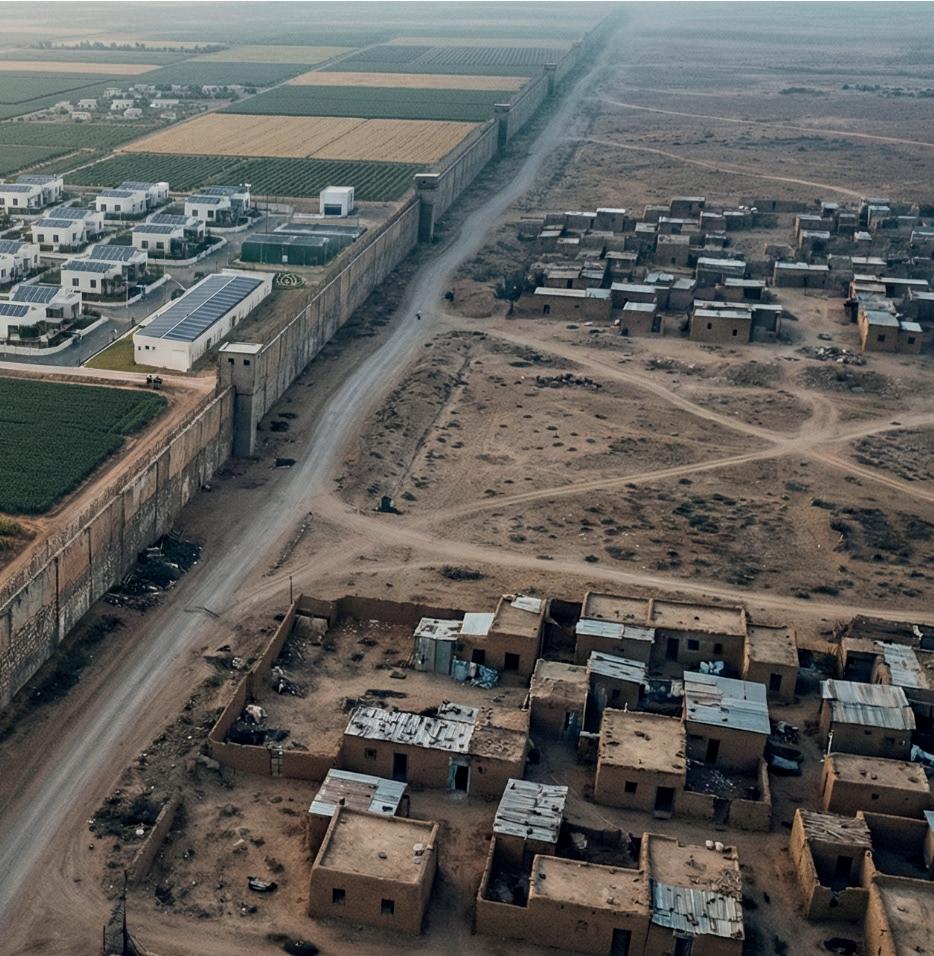

the Exalted had created everyone exactly the same, the system of the world could not function and there would be chaos in life.
“Thus, to run this entire system, Allah the Exalted has placed a distinction among people and socio-economic strata so that He may see who has performed what kind of deeds under which circumstances. Hazrat Khalifatul Masih I (ra), whilst expounding upon the exegesis of this verse, states:
“‘
meaning, He would have established you upon a single religion. However, this would have been compulsion. But through these faculties which We have bestowed,
, He desired to reward you. Therefore, you should excel one another in good deeds and receive the reward. If you do not perform good deeds of your own volition but rather out of instinct, then what is the reward for?’ (Haqaiq-ul-Furqan, Vol. 2, p. 106)
“The reality is that the poverty of this world is temporary and its wealth is also temporary; the true and eternal life is the life of the Hereafter. To attain the eternal gardens in that life of the Hereafter, man must pass through the trials of this world. For some, wealth and riches become a source of trial, and for others, destitution and poverty become a means of testing.
“Furthermore, it is not necessary that only pious children are born into the home of every pious person, nor is it necessary that only wicked children are born into the home of every wicked person. Regarding the son of Prophet Noah (as), it is mentioned in the Holy Quran that on account of the son’s evil deeds, Allah the Exalted addressed Prophet Noah (as) and stated that he is by no means of your family. (Surah Hud, Ch. 11: V. 47)
“Allah the Exalted has also stated in the Holy Quran that, ‘He brings forth the living from the dead and it is He Who brings forth the dead from the living.’ (Surah al-An‘am, Ch. 6: V. 96) Hazrat Khalifatul Masih I (ra), whilst explaining this verse, states:
“‘He creates the pure in the homes of the impure. The dead are born from the greatest of the living.’ (Haqaiq-ul-Furqan, Vol. 2, p. 168)
“In the narrative of Prophet Moses (as) in the Holy Quran, mention is made of Korah [Qarun], an associate of Pharaoh, to whom Allah the Exalted had entrusted the keys to a vast treasure in this life. He began to exult in this and started to consider his own academic prowess as the cause of this favour from Allah. Seeing his pomp and splendour, some ignorant ones among the followers of Prophet Moses (as) also began to desire
a worldly life like his. However, when the chastisement of Allah the Exalted seized Korah, those very people who had yearned for his status the day before expressed regret upon seeing Korah’s condition and thanked Allah the Exalted that He had bestowed His favour upon them and had not afflicted them with a destruction like that of Korah. Upon this, Allah the Exalted stated that ‘We bestow the Home of the Hereafter on those who desire not self-aggrandisement in the earth, nor corruption; and the happy end is for the righteous.’ (Surah al-Qasas, Ch. 28: V. 77-84)
“While the poverty of this temporary world brings with it various kinds of hardships and trials, there is also this favour of Allah the Exalted upon the poor person that He grants him the opportunity to join the community of the Prophets early on. Hazrat Musleh-e-Maud (ra) states regarding this:
“‘I have observed that humility and meekness are found more among the poor. This is why it is generally the poor who join the communities of the Prophets. This does not mean that God wishes to keep them poor. Rather, God grants these poor people the opportunity to serve the faith because they are free from greed and the capacity for gratitude is greater within them.’ (Tafsir-eKabir, Vol. 10, UK: 2023, p. 294)
“Moreover, for the life of the Hereafter, there is also this promise of Allah the Exalted that a poor person will enter Paradise five hundred years before a wealthy person. (Sunan Abi Dawud, Kitab al-‘ilm, Bab fi l-qasas)
“Thus, the essence of the matter is that Allah the Exalted has made this world, which is a temporary abode and an abode of action [Dar al-‘Amal], a place of various trials so that He may enable the distinction between the pure and the impure. This is why He afflicts His loved ones more in these trials. And the world of the Hereafter has been appointed for the reward and punishment of the deeds performed in this world, where everyone’s deeds will be accounted for and the decision of reward and torment will be made according to those deeds. Therefore, in whatever condition Allah the Exalted places a person, it is the duty of that person in that very condition to perform such deeds that become the means of attaining the pleasure and approval of God Almighty.” [...]
(Compiled by Zaheer Ahmad Khan, Head of Records Department, Private Secretariat, London and translated by Al Hakam)
NEWS
Quran exhibition held in Joensuu,
Finland
Basharat ur Rehman
Secretary Tarbiyat, Jamaat Finland
On 21 April 2026, an exhibition of the Holy Quran was inaugurated in the City Library of Joensuu, Finland and continued for the next three weeks. The Holy Quran’s translation was displayed in 36 languages, including the recently published Finnish translation.
The exhibition was formally inaugurated by the Mayor of Joensuu, Mr Jere Penttilä. The event was attended by the Director of the local library, Ms Suvi Pirnes-Toivanen, as well. In his opening remarks, Mayor Penttilä described the exhibition as a highly positive and commendable initiative.
Also present at the event was Mr Aaro Virolainen, a reporter from the local newspaper Karjalainen, who covered the exhibition and conducted an interview with the Missionary-In-Charge Finland, Shahid Mahmood Kahloon Sahib. During the interview, he introduced the Jamaat and the advent of the Promised Messiah and his teachings.
The news, along with the interview, was published in the digital version of Karjalainen on 23 April 2026, while in the printed version on 24 April. Karjalainen has a readership (print) of 80,000-100,000, while its digital reach is significantly higher, with tens of thousands of daily online users.
18th annual walkathon held in New Zealand
Muhammad Yaseen Chaudhry
Sadr Majlis Ansarullah New Zealand
Majlis Ansarullah New Zealand hosted its 18th annual charity walkathon on 11 April 2026 at Barry Curtis Park in Auckland.
By approximately 9:30 am, participants had gathered and safety instructions along with guidelines for the walkathon track were given.
The event formally commenced with a silent prayer; thereafter, the walkathon officially began. Over 100 participants took
part in the walk according to their pledged commitments. The participants included representatives from Blind Low Vision NZ, who actively joined the event. At the conclusion of the walkathon, lunch was served to all participants.
During the closing ceremony, the total funds raised were announced and a representative from Blind Low Vision NZ shared a few words of appreciation. The event concluded with brief remarks and a silent prayer.
Interfaith event held in Saskatoon, Canada
Syed Mukarram Nazeer
Canada Correspondent
Jamaat-e-Ahmadiyya Saskatoon Southwest, Canada, in collaboration with Multi-faith Saskatchewan, hosted an interfaith event on 29 March 2026, focused on “Combating Hate: An Interfaith Response.” The gathering brought together faith, civic and community leaders to promote peace, solidarity and collective action against religious discrimination. The participants included more than 100 non-Ahmadi guests.
The programme opened with a recitation from the Holy Quran, followed by an address from Saskatoon Chief of Police Cameron McBride, who emphasised the importance of strong partnerships between law enforcement and community organisations in preventing discrimination and hate.
A panel discussion followed, featuring
faith leaders from diverse traditions alongside respected community representatives. Panellists shared teachings from their respective faiths on compassionate action, addressing prejudice and building trust across differences. The panel included representatives from Makwa Sahghaiehcan First Nation, Congregation Agudas Israel, Hindu Society of Saskatchewan, The Church of Jesus Christ of Latter-day Saints, Saskatoon, Saskatchewan, Mennonite Church Saskatchewan, Sikh Society of Saskatchewan and Jamaat-e-Ahmadiyya.
Throughout the evening, speakers consistently identified dialogue, mutual respect and co-operation as vital tools for strengthening resilient and inclusive communities.
Echoing these sentiments, the Ahmadi missionary, Saad Hayat Sahib, emphasised the Jamaat’s core message of compassion and universal love.
How interest fuels war: The US-Iran conflict as a case study
Ahmed Danyal Arif MA Economics & Politics, UK
In 2026, the United States reached a new turning point that revealed this cycle in real time: federal interest payments on public debt surpassed defence spending for the first time in American history. According to the US Treasury Department’s Quarterly Statement (Q1 FY2026), net interest payments reached $270.3 billion, exceeding the Pentagon’s $266.9 billion spent in the same quarter.
On an annual basis, this equals around $1.04 trillion a year. It’s higher than America’s entire 2025 defence budget, which stood at roughly $839 billion before the current conflict, per the Congressional Budget Office (CBO, 2025 baseline). In effect, the US now pays nearly $3 billion per day just to service existing debt. When such levels become unsustainable under peacetime budgets, war increasingly serves as an instrument to justify further borrowing.
Interest-based debt doesn’t just fund wars it structurally requires them. When debt grows faster than production, the economy must always find new areas to absorb that excess borrowing.
The interest trap: How compound debt forces perpetual growth
Modern financial systems are built on compound interest debts that grow continuously even without new productivity. To visualise this, consider a simple scenario: if the US borrows $200 billion at 4% interest to finance a war, the annual interest bill alone is $8 billion. Over 30 years, total repayments have risen to around $440 billion, more than doubling the original loan. This exponential expansion echoes what Albert Einstein famously described when he referred to compound interest as “the eighth wonder of the world”, highlighting its extraordinary power to generate growth far beyond what seems naturally possible.
The problem is that real economies don’t grow exponentially. Civilian sectors such as housing, transport, or consumer goods eventually saturate. People only need so many homes or cars. But interest on debt keeps compounding and demands permanent expansion. When peaceful borrowing and consumption reach their limits, governments turn to something that has no saturation threshold: military spending. Unlike private consumption, which slows once needs are met, military procurement can always justify “more” one more missile, one more drone, one more base.
War is the only infinite market War, by its very nature, removes the normal ceilings of production. Facing a perceived threat, the logic of national security transforms limitless production into a patriotic duty. A country that fears 100 enemy missiles will feel it must build 150 of its own, then 200, then 400 when the enemy upgrades. The cycle has no natural end. Defence spending is “the ultimate claim upon the produce of a nation” because no
government dares limit it when security is at stake.
This is precisely why large defence contractors consistently outperform civilian manufacturers. Public reports from Lockheed Martin, Raytheon and Northrop Grumman show operating profit margins in the range of 15-20%, compared with only 3-5% across consumer-goods firms in the S&P 500. For banks and investors, the benefits are equally clear. Military spending is financed primarily through US Treasury securities, widely seen as the safest assets in global finance. These securities form the “risk-free anchor” of world credit markets, meaning war-linked borrowing not only enriches defence firms but also underpins the global banking system itself.
The US-Iran war
of 2026
At the start of fiscal 2026, the Pentagon’s approved budget stood at $839 billion, already a historic high (US Department of Defence, FY2026 Budget Justification). However, following two weeks of strikes between US and Iranian forces in the Persian Gulf, the pace of expenditure skyrocketed. According to operational figures from the Centre for Strategic and International Studies (CSIS) Missile Defences Project, US munitions use reached $11.3 billion by Day 6 and $16.5 billion by Day 12, equivalent to about $1-2 billion burned per day just on precision-guided weapons such as Tomahawk Cruise Missiles and Joint Direct Attack Munitions (JDAMs). By comparison, the entire Gulf War of 1991 cost about $61 billion total (adjusted for inflation; CRS Report R43835).
In mid-February 2026, President Trump formally requested $200 billion in supplemental war funding. Defence Secretary Pete Hegseth justified it bluntly: “It takes money to kill bad guys.” The CSIS Defence Budget Analysis estimated that this figure finances roughly 145 additional days of sustained bombing, at $1.38 billion per day. But when financed through debt at an average Treasury yield near 4%, that $200 billion will translate into approximately $440 billion in total obligations over three decades – effectively doubling the true cost (Peter G Peterson Foundation Interest Tracker).
How the money chains up: From bonds to banks to contractors
The financing process follows a predictable pipeline. First, the US Treasury issues new bonds to raise the $200 billion, offering yields between 3% and 5%. Major underwriting banks (JPMorgan Chase & Co, Citi, Goldman Sachs) facilitate the bond sales, taking about 1-2% in underwriting fees (around $2-4 billion total). Institutional investors like BlackRock and Vanguard purchase large shares of these bonds, earning between $610 billion per year in interest payments. The Treasury then transfers the funds to the Pentagon, which disperses them through prime contractors: for instance, Lockheed Martin’s missile and F-35 divisions received contract extensions exceeding $50 billion, Raytheon Technologies added $4 billion in
Patriot missile resupply orders, and Boeing expanded ordnance manufacturing lines (Pentagon Contract Announcements and Federal Procurement Data System, Jan-Mar 2026).
What happens next is crucial: the immediate spending inflates measured GDP/growth as factories produce more equipment, wages rise locally, and output appears to grow. Yet, in economic terms, this is not real wealth creation as it is debtfuelled production of instruments that do not generate future income. The interest on that new debt then becomes part of America’s structural fiscal burden, paid through taxation between now and 2050. The banks that earned the underwriting and interest profits face no corresponding liability. The cycle completes itself neatly: borrow, spend, enrich financiers and contractors, then pass the repayment to taxpayers under patriotic rhetoric.
The warning of the Holy Quran
1,400 years ago
This structural connection between interestbased debt and warfare is not new. Islamic thought identified it with remarkable clarity long before modern data could confirm it.
“O ye who believe! fear Allah and relinquish what remains of interest, if you are believers. But if you do it not, then beware of war from Allah and His Messenger; and if you repent, then you shall have your original sums; thus you shall not wrong, nor shall you be wronged”. (Surah alBaqarah, Ch.2: V. 279-280)
Hazrat Khalifatul Masih IV (rh) addressed these verses directly and his interpretation cuts to the heart of the argument presented here. The verses, he explained, are not a call to arms against usurers, nor a prophecy of Muslims fighting those who hold interest-based ideologies. It is a statement of economic law: those who persist in interest-based systems will inevitably be drawn into wars as a direct consequence and it is through those wars that destruction reaches them. The divinely ordered system governing economic life operates by this logic and no society that defies it escapes the consequences. (Khutbate-Tahir, Vol. 2, p. 173, Friday Sermon, 25 March 1983)
In other words, the scripture does not treat interest as a minor moral fault but as a mechanism that inevitably breeds large-scale violence once it becomes the foundation of public finance.
The argument is straightforward: when governments can borrow vast sums at interest, wars that would otherwise be financially impossible suddenly become easy to launch and easy to prolong. Instead of having to raise taxes immediately and face public resistance, states tap into “cheap” loans, delaying the true cost of war into the future.
During the conflict, citizens do not fully feel the burden; only after the guns fall silent do they discover that they have inherited enormous national debts, with interest stretching across generations. Without such interest-based loans, many governments

would hesitate to start long, devastating wars, and even if they entered them, they would be forced to seek peace far earlier, as their treasuries would empty and their populations would rebel against the cost. Seen through this lens, the events of 2026 are not an accident but a textbook example. Because interest-bearing credit is available on a massive scale, the United States can add $200 billion in new war spending with the stroke of a pen, knowing that repayment will be spread over decades in the form of invisible interest charges. The same financial logic applies to other belligerents, including Israel, which approved a $12.5 billion defense budget boost for 2025-2026 amid ongoing multi-front operations. With the total 2026 military spending reaching $49.8 billion according to the Defense Budget Project, these costs mirror the same debtfuelled escalation pattern seen in the US. What looks like “easy money” in the short term becomes a heavy chain of obligations in the long term, bending future generations under the weight of debt repayment. This is precisely the dynamic that Islamic teachings warned against: a credit system that enriches a small financial elite, enables wars far beyond what societies would otherwise tolerate, and then traps entire nations in a cycle of debt, interest and recurring conflict.
The mechanism in motion
• US annual interest bill: $1.04 trillion (Treasury Q1 FY2026)
• Defence spending pre-Iran conflict: $839 billion (CBO 2025 baseline)
• Additional war budget: $200 billion (White House FY2026 supplemental request)
• Resulting total obligation with 4% interest: ~$440 billion by 2056 (PGPF Interest Tracker)
• Financial sector profits: ~$240 billion interest + $2-4 billion underwriting fees
• GDP/Growth distortion: nominal expansion through debt-financed spending, masking long-term insolvency No conspiracy is needed to explain this. The logic of compound interest on sovereign debt automatically creates pressures for expansion, and war is the most politically and economically “acceptable” form of that expansion. Islamic teachings foresaw this clearly: interest-based loans let governments wage ruinous struggles that would otherwise collapse under public revolt. The data from 2026 proves this analysis as relevant today as ever. When interest surpasses defence spending, conflict becomes not only a moral failure, but a systemic inevitability.
Hazrat Khalifatul Masih II travels to Lahore (1926) – Part II
Meetings with educational figures and address to students
On 1 May 1926, after Hazrat Khalifatul Masih II [ra] led the Zuhr and Asr prayers in congregation, Sheikh Nur Ilahi Sahib (inspector of schools) came for a meeting. They remained engaged for a considerable time in discussion on various matters.
Following the Maghrib and Isha prayers, Hazrat Musleh-e-Maud [ra] proceeded, at the request of the students of the Ahmadiyya Hostel, to attend one of their gatherings.
Under the chairmanship of Hazrat Khalifatul Masih, Qazi Muhammad Aslam MA, a professor at Government College, delivered a speech in English on the subjects of religion and morality. Hazrat Khalifatul Masih II [ra] expressed great appreciation for the professor’s speech. After Professor Aslam Sahib concluded his speech, Hazrat Musleh-e-Maud [ra] himself rose to speak and delivered an hour-long lecture in which he offered the students highly beneficial and practical counsel.
Visitors from various regions
On 2 May 1926, as it was Sunday, a large number of friends arrived to pay their respects to Hazrat Khalifatul Masih from places including Mian Mir, Gujrat, Ferozepur and Rawalpindi, as well as from numerous villages. In the morning, Hazrat Khalifatul Masih II [ra] graciously granted them audience and blessed them with his company for several hours.
During the course of the conversation, Hazrat Musleh-e-Maud [ra] remarked that he would often put forward a question to the Shiites concerning the doctrine of taqiyyah (dissimulation under threat). He would ask whether taqiyyah, when practised in circumstances of danger, ought to be regarded as something superior or inferior. If they answered that it was inferior, then, [according to their own beliefs], an allegation would arise against Hazrat Ali (ra). If, however, they claimed it to be superior, then the same objection would apply to Hazrat Hussain (ra). [Hazrat Khalifatul Masih II (ra) explained] that, according to Shiite belief, Hazrat Ali (ra) pledged allegiance to Hazrat Abu Bakr (ra), Hazrat Umar (ra) and Hazrat Uthman (ra) as an act of taqiyyah, [although they maintain that] he himself was the immediate and rightful successor [of the Holy Prophet (sa)].
Thus, if taqiyyah was something inferior, why did Hazrat Ali (ra) adopt it? Conversely, if it was something superior, then why did Hazrat Hussain (ra) not preserve his own life through the same means by outwardly pledging allegiance [to the caliph of his time] as an act of taqiyyah?
Discussion on religious and political reform of Muslims
At approximately two o’clock, Mir Maqbool Mahmood (member of the council) arrived for a meeting with Hazrat Khalifatul Masih II [ra]. After learning of Hazrat Musleh-eMaud’s views and methods regarding the religious and political reform of Muslims, he was deeply impressed. He proposed that, if Hazrat Khalifatul Masih were to gather together certain individuals who were actively striving for the progress and reformation of Muslims and who also held him in sincere esteem, much benefit could be derived from Huzoor’s ideas and proposals.
Initiations into Islam Ahmadiyyat
After the Zuhr and Asr prayers, three individuals formally took the pledge of allegiance (bai‘at). Their names were as follows:
1. Ghulam Sarwar Sahib, Isa Khel
2. Mehr Muhammad Sahib, Dulmial
3. Ghulam Muhammad Sahib, Chunian, Lahore
Following the bai‘at, one devotee submitted, with great emotion, that although they were people of limited means, they were ready to lay down their lives for
Hazrat Khalifatul Masih. He emphasised that this was no mere verbal claim; if ever required, he was prepared, with his own hands and without the slightest hesitation, to offer even his own blood and flesh in the service of Hazrat Khalifatul Masih II [ra].
Inquiry regarding a concealed bai‘at
A non-Ahmadi individual submitted the question that one of his relatives wished to enter into bai‘at, but owing to certain personal circumstances, he desired that his initiation remain undisclosed. He therefore inquired whether such a form of bai‘at would be permissible. Hazrat Khalifatul Masih II [ra] replied that he could only reach a decision if the individual himself were to present his circumstances directly. Only then could it be determined whether his situation genuinely warranted permission for the pledge to remain unannounced. Without knowing the particulars of the case, Huzoor [ra] stated that he could not issue any ruling.
Meeting with Dr Saifuddin Kitchlew
At approximately four o’clock, Dr Saifuddin Kitchlew Sahib arrived from Amritsar
to meet Hazrat Khalifatul Masih II [ra]. During the meeting, Hazrat Musleh-eMaud [ra] sought from him a detailed account concerning the organisation of the Muslims. Their discussion continued until nearly eight o’clock in the evening.
Visit of Arya Samaj representatives
During this same period, three gentlemen belonging to the Arya Samaj, one of whom was a preacher and lecturer of the movement, came to pay a visit to Hazrat Khalifatul Masih II [ra]. They explained that their sole purpose was to obtain “darshan” (an audience or viewing). After a brief conversation, they departed.
Visit of Professor Syed Abdul Qadir
Around the time of Maghrib, Syed Abdul Qadir Sahib, Professor at Islamia College, came to meet Hazrat Khalifatul Masih II [ra]. The professor held a special affection and deep regard for Huzoor [ra], who received him with great warmth and cordiality.
Professor Abdul Qadir Sahib expressed that he had only arrived from Amritsar that very day and was due to return on the evening train; otherwise, he would have come earlier. Since the time for the Maghrib prayer had arrived, the conversation remained brief before Hazrat Khalifatul Masih proceeded to lead the prayer.
New initiates into the Jamaat
After the prayer, six individuals entered into bai‘at. Their names were as follows:
1. Mian Nasiruddin (tailor), Railway Rd
2. Mian Bashir Ahmad (tailor), Railway Rd, Lahore
3. Mian Muhammad Saeed (third year), Islamia College
4. Syed Muhammad Ashraf Afghan
5. Mian Muhammad Umar (student), Railway School, Lahore
6. Munshi Ahmad Hussain Rohtasi, Lahore
Banquet hosted by the family of Mian Chiraghuddin
In the evening, the family of the late Mian Chiraghuddin Sahib, together with Mian Mirajuddin Sahib and others, hosted an elaborate banquet in honour of Hazrat Khalifatul Masih II [ra], his companions and the other guests accompanying him.
After the meal, the guests were further entertained with an offering of fruits. This entire household, which by the grace of God is a large and distinguished family, possesses remarkable sincerity and devotion towards Hazrat Khalifatul Masih II [ra] and the Ahmadiyya Jamaat. Their loyalty and
affection were truly enviable. It was owing to this deep attachment that the family had consistently remained recipients of the special blessings and affection of the Promised Messiah (as), Hazrat Khalifatul Masih I (ra) and [now] Hazrat Khalifatul Masih II [ra] and continued to do so.
Another bai‘at
Following the banquet, another individual, Nazar Muhammad Qureshi of Lahore, formally entered into bai‘at and then, after carrying out dua (silent prayer), Hazrat Khalifatul Masih II [ra] left the gathering.
Discussion with Maulvi Ismatullah Sahib
On 3 May 1926, at approximately eight o’clock in the morning, Hazrat Musleh-eMaud [ra] once again granted an audience to Maulvi Ismatullah Sahib. Maulvi Sahib raised questions concerning matters upon which extensive and detailed clarification had already repeatedly been provided and regarding which any reader of the Jamaat’s literature could easily acquaint himself. Nevertheless, Hazrat Khalifatul Masih continued answering his questions for nearly an hour.
Recovery of Hazrat Khalifatul Masih’s wife
The condition of Hazrat Khalifatul Masih II’s first wife, whose health had suddenly deteriorated and become extremely alarming, improved by the grace of God Almighty. All cause for concern had now passed, alhamdulillah
Bai‘at and meetings with prominent individuals
After the Zuhr and Asr prayers, an individual named Babu Muhammad Ali Sahib (train clerk, Moghalpura station) entered into bai‘at. Thereafter, Hazrat Khalifatul Masih II [ra] granted an audience to Dr Muhammad Abdul Haq Sahib, who belonged to the family of Dr Karam Ilahi Sahib. Shortly afterwards, Hazrat Musleh-e-Maud [ra] departed to attend a tea reception hosted in his honour at the residence of Nawab Zulfiqar Ali Khan, the younger brother of Nawab Muhammad Ali Khan. Upon returning, Hazrat Khalifatul Masih met with Mr Abdul Razzaq Sahib (barrister), nephew of the late Sheikh Rahmatullah Sahib, as well as Malik Ghulam Muhammad Sahib.
Bai‘at and dinner
After the Maghrib and Isha prayers, another individual, Mr Muhammad Yusuf Sahib of Androon Mochi Gate, Lahore, took bai‘at
Subsequently, Hazrat Musleh-e-Maud [ra], accompanied by his companions, proceeded to attend a dinner hosted by Babu Abdul Hamid Sahib (railway auditor).
Approximately thirty guests had been invited by the host. Upon returning from the gathering, Hazrat Khalifatul Masih granted an audience to Dr Noor Muhammad Sahib.
Guidance for Ahmadi students
On 4 May 1926, Hazrat Musleh-e-Maud [ra] graciously granted an audience to Ahmadi students studying in colleges and offered them several important pieces of advice and guidance.
In this connection, Hazrat Khalifatul Masih instructed Sufi Ghulam Muhammad Sahib, Superintendent of the Ahmadiyya Hostel, that a register should be maintained for the hostel recording how many Ahmadi students enrolled each year and how many completed their examinations and departed. In this way, it would remain possible to monitor the rate at which the number of students was increasing.
Tea reception at Lahore Cantonment
At approximately five o’clock, Hazrat Khalifatul Masih II (ra) attended a tea reception at the invitation of the Ahmadi members residing in the Lahore Cantonment. Several other companions accompanied him. The hosts served tea, biscuits and fruit. Following the refreshments, Dr Muhammad Rizwan Sahib expressed gratitude for Hazrat Khalifatul Masih’s visit, while Dr Abdul Aziz Khan recited one of his poems. Thereafter, Hazrat Musleh-e-Maud [ra] delivered an address before returning to Lahore.
Morning meetings and religious discussions
On 5 May 1926, at approximately seven o’clock in the morning, Sheikh Maula Bakhsh Lyallpuri arrived to meet Hazrat Khalifatul Masih II (ra). Thereafter, Dr Noor Muhammad Sahib continued seeking answers to a number of objections commonly raised by members of the Arya Samaj concerning Islamic teachings and doctrines. During this, Hazrat Khalifatul Masih II [ra] also met with Raja Rahimullah Khan, son of the late Khan Bahadur Raja Painda Khan.
Meeting with the Governor of Punjab
After three o’clock in the afternoon, Hazrat Khalifatul Masih II [ra] departed for a meeting with His Excellency, the Governor of Punjab.
Upon returning from this engagement, he held discussions on various matters with two distinguished officials from the Secretariat office.
Return from Lahore
On the night of 5 May 1926, Hazrat Khalifatul Masih II [ra] departed from Lahore by the nine o’clock train. A large number of friends were present at the railway station to bid him farewell. Floral garlands were placed around his neck as a mark of affection and respect.
At the Moghalpura Station, members of the jamaats of Lahore Cantonment and Mauza Gang were also present to obtain the honour of meeting him.
At the Amritsar station, members of the Amritsar Jamaat had an audience with Hazrat Khalifatul Masih. They had arranged charpoys and other necessities at the station. Hazrat Khalifatul Masih II [ra], together with his companions, spent the remainder of the night there before departing in the morning and returning to [Qadian], Darul Aman (Abode of Peace), where he arrived safely.
(Translated by Al Hakam from the original Urdu, published in the 7 & 11 May 1926 issue of Al Fazl)
The gender of Allah debate: Can feminine pronouns be used for Allah?

Iftekhar Ahmed Ahmadiyya Archive & Research Centre
For some years now, a claim has been circulating, particularly among Englishspeaking Muslims, which has become so widespread that it is worth addressing it directly rather than merely mentioning it in passing: that Allah can be referred to as hiya or “She” or can be addressed alternately with various pronouns in order to correct the patriarchal distortions under which Muslim women have suffered at the hands of Muslim men.
This claim has both a scholarly form, developed over the last three decades in Western academic circles, and a popular form, which is now disseminated in personal accounts, devotional narratives and memes. For reasons that will become clear, it has not found its way into Arabic, Urdu, Turkish or Malay discourse, yet it has found adherents within the English-speaking diaspora, and its argumentation deserves a response.
Allah is neither male nor female. Allah is not a physical being, has no gender, is not a gendered entity and does not fall into any category in which gender is a meaningful characteristic.
“There is nothing whatever like unto Him.” (Surah ash-Shura, Ch.42: V.12)
“He begets not, nor is He begotten.” (Surah al-Ikhlas, Ch.112: V.4)
Scholars have been in agreement on this matter since the early days of the Islamic tradition. When a Muslim woman says, “Allah is beyond gender”, she is repeating a tenet of faith that is more than a thousand years old.
The point of contention lies not in this, but in what can be inferred from it. The argument in favour of using the feminine form of address is as follows: since no human pronoun does justice to the Transcendent, Muslims may address Allah as “She,” or alternate between forms or otherwise reform the manner in which Allah is addressed in prayer and speech. The traditional view takes the opposite stance. Since human language already reaches its limits when it comes to addressing the Absolute, we adhere all the more carefully to what revelation has given us rather than letting go of it.
The grammar Grammatical gender in Arabic is not the same as the use of gender-specific
Image: Sedanur Kunuk/Pexels
pronouns in English, and almost every argument in favour of referring to Allah in the feminine form has overlooked this distinction. The Arabic masculine is morphosyntactically unmarked: it functions both as a specifically masculine form and as the default designation for referents that are not explicitly female. The feminine is marked: hiya refers to a specific woman, to a grammatically feminine noun (shams, the sun, is feminine; qamar, the moon, is masculine, though in neither case is there any gender implication) or to specific morphological categories. Huwa for Allah is the only option Arabic offers for not attributing a specific gender to the Absolute, as the only alternative is marked as feminine.
The argument that “‘He’ is just as gendered a reference to Allah as ‘She’ is, so why only use gendered terms in one direction?” is therefore based on a misunderstanding of how the two pronouns function. In Arabic, the masculine form already fulfils the function that the generic “one” fulfils in English. Using hiya instead of huwa does not mean switching from a marked form to an unmarked one, but rather from the unmarked to the marked, assigning a specific feminine reference to Allah where previously there was no gender-specific reference. Referring to Allah as hiya is more anthropomorphic than referring to Him as huwa, not less so. The apparent symmetry between “He” and “She” in English does not exist in the language of revelation.
This also explains why the suggestion has not spread beyond the English-speaking world. Arabic speakers do not adopt it, as the grammar of the Quran does not create the kind of grammatical dissonance that would prompt them to do so. Nor do Urdu or Persian speakers adopt it, as these languages do not have grammatical gender for pronouns at all. What is presented as a theological insight is, in fact, an artefact of the translation into English.
At this point, there is a tempting response that I would like to set aside before it is put forward. If huwa is grammatically neutral, one might say, then the choice between the pronouns is irrelevant and the use of hiya where this offers comfort to a woman in pain cannot really matter. That does not follow.
The masculine form of address for Allah is the expression chosen by the revelation itself, and the linguistic form of the Quran is not a disposable shell that can be exchanged as required.
The principle of tawqif applies: the names and forms by which Allah may be addressed are known only through what the revelation has authorised. Muslims are taught how they should address Allah. It is not left to us to figure this out for ourselves. Using hiya instead of huwa in public teaching or devotional practice is not linguistic freedom, but a presumption of authority over divine naming that has never been granted to us. “Call upon Allah or call upon Rahman; (by) whichever name you call (Him), His are the most beautiful names” (Surah Bani Isra’il, Ch.17: V.111) points us to His names, which He has taught us and not to any form of address we might find helpful.
Rahma and rahim
One argument in favour of the feminine

form is of an etymological nature. ArRahman and ar-Rahim, the two great names of divine mercy with which all but one of the surahs begin, share the same root as rahim, the womb. The hadith explicitly establishes this connection: “I am ar-Rahman. I created the rahim and derived its name from My name.” (Sahih al-Bukhari, Kitab al-Adab, 5988) Every act of devotion begins with an invocation whose root is the womb. The Holy Prophet (sa) taught divine mercy using the image of a nursing mother reunited with her lost child: “Allah is more merciful towards His servants than this woman is towards her child.” (Sahih al-Bukhari, Kitab al-Adab, 5999; Sahih Muslim, Kitab at-Tawba, 2754)
This is part of the teaching of the tradition itself and the point must be acknowledged. Yet the etymology does not prove what the suggestion requires it to prove. The direction of derivation in the hadith is clear: the womb is named after the divine attribute, not the attribute after the womb. If the etymology were taken as proof that Allah is female, one would, by the same logic, have to conclude that because Allah is al-Basir, the All-Seeing, He possesses eyes and that because He is al-Qahhar, the Overwhelming, He exercises physical force. Such reasoning collapses into tashbih, the likening of Creator to creation, the very error that tanzih, the affirmation of divine transcendence, exists to correct.
Divine attributes, whenever they are conveyed in words drawn from human experience, function as pointers to perfections befitting the majesty of Allah alone and must be freed from the material, bodily and biological connotations that those words carry in ordinary usage. The connection between rahma and rahim, accordingly, tells us something about the nature of divine mercy, namely that it surpasses even the deepest biological intimacy known to human beings. It does not tell us that Allah has a womb, nor does it render the divine Essence feminine.
The hermeneutical argument
The argument underpinning the academic literature goes something like this: Tawhid requires that Allah transcend gender roles. In practice, the patriarchal interpretation has projected masculinity onto God. An interpretation faithful to Tawhid must therefore dismantle this projection. The use of feminine, gender-neutral or alternating pronouns is proposed as a means of resolving this.
The first premise is orthodox and the second applies to many Muslim
communities. The problem lies in the transition to the third premise, which causes a confusion between two very different things that the word “interpretation” is supposed to cover. One is the subjective conception of ordinary believers, who imagine God in anthropomorphic terms, which constitutes an ancient and real pastoral problem. The other is the revealed linguistic form in which Allah addresses us. These are not the same objects. Correcting what a believer imagines when she hears huwa does not justify revising the word huwa itself. The traditional response to the first problem is not to alter the pronouns of the Quran, but to teach tanzih and al-asma’ al-husna until the false image dissolves from within.
Furthermore, there is another error to consider. What is being proposed here is not actually an act of tafsir at all, it is a change in the way Muslims address Allah in prayer and in speech, which is presented as if it were an interpretative step. Tafsir interprets what a verse says. Pronoun substitution alters what the community says to the One to whom the verses are addressed. The traditional interpretative tools, that is, contextual reading, asbab an-nuzul, muhkamat and mutashabihat, etc., perform legitimate and sometimes important work in addressing patriarchal readings of scripture. However, it does not extend to revising the forms in which Muslims have traditionally addressed their Lord.
There is also an internal problem within the argument of incorrect gender assignment. If every human pronoun assigns gender to God equally incorrectly, then hiya assigns gender to Allah just as incorrectly as huwa. Alternating between them does not solve the problem highlighted by the argument; it commits the same error in the opposite direction. The honest conclusion from the premise is not pronoun rotation, but apophatic humility within revealed language, i.e., affirming the forms of address prescribed by the Quran whilst restraining the imagination from treating these forms as descriptions of divine anatomy.
The pain beneath the proposal
A potential factor that may drive some women to this practice in the first place is not theoretical, but rooted in lived experience. Women may have turned to the feminine discourse and applied it to God due to bad experiences with men and male authority in their lives, such as dealing with a toxic husband or father. The pain and trauma caused by such experiences may be
real. This must be acknowledged. However, to then project the feminist discourse onto God is not the solution.
If a woman has been presented with a bad experience of the male gender in her life, the answer does not lie in reimagining Allah. It lies in guiding her to Allah as Allah has actually revealed Himself: Whose rahma “encompasses all things” (Surah al-A‘raf, Ch.7: V:157), Who is closer to her than her jugular vein (Surah Qaf, Ch.50: V.17), Who has called himself al-Wadud, al-Latif, al-Halim, ar-Ra’uf and al-Karim and Who, when He names the two greatest human examples of iman, that is, faith, presents two women as role models not only for women, but for the entire community of believers, whom the faithful are to emulate, “Allah sets forth for those who believe the example of the wife of Pharaoh […] And (the example of) Mary, the daughter of ‘Imran” (Surah at-Tahrim, Ch.66: V.12-13). The Promised Messiah (as) read the passage precisely in this sense, noting that the spiritual journey of every true believer is mapped onto the likeness of these two women. (Malfuzat [English], Vol. 3, pp. 232-233)
A woman who switches from huwa to hiya in her du‘a’ imagines God in anthropomorphic terms; she has merely reversed the gender of the image. What is needed is to dissolve the image entirely, and tradition possesses the means to do so: tanzih, taught alongside the complete alasma’ al-husna, together with the immense corpus of female scholarship in Islamic history, which Muslim communities have allowed to slip from view and which no change of pronoun can restore.
The very meaning of Islam Behind the debate over pronouns lies a more profound question: whether one accepts Allah as He has revealed Himself or whether one reinterprets this self-revelation so that it conforms to the categories one applies to it. Islam is the word for the first choice. It means submission, in the specific sense that one allows one’s linguistic, imaginative and devotional habits to be shaped by revelation, including those parts of revelation that one did not expect and would not have chosen. This is not because reason is worthless, but because, when addressing the One who is not part of creation, one cannot rely on the trained imagination of the created to invent the language of its own devotion. The current dispute is, frankly speaking, not a dispute over pronouns. It is a dispute over whether the manner in which Allah has taught us to address Him – the names, the attributes, the forms of invocation given in the Quran and the Sunnah – is within our power to revise if some of it becomes disagreeable to us. That is not the case. Without this realisation, a person may well continue to pray, continue to feel, continue to yearn for God, yet the act of devotion that defines taslim has, in that respect, been tacitly set aside. The Promised Messiah (as) has put it with characteristic plainness: “We neither add to, nor remove anything from the Shariah, even by the weight of an atom. We accept everything that has come to us from the Messenger of Allah, may peace and blessings of Allah be upon him, whether or not we understand its mystery or comprehend its reality.” (The Light of Truth, p. 9)
Friday Sermon
Mubarak Mosque, Islamabad, Tilford, UK
17 April 2026
The Prophet (sa) – Al-Sadiq wa Al-Amin: The truthful and the trustworthy
After reciting the tashahhud, ta‘awwuz and Surah al-Fatihah, Hazrat Khalifatul Masih V (aa) recited verses 17 and 18 of Surah Yunus and stated:
The translation of the verses is as follows: “Say, ‘If Allah had [so] willed, I should not have recited it to you nor would He have made it known to you. I have indeed lived among you a [whole] lifetime before this. Will you not then understand?’ Who is then more unjust than he who forges a lie against Allah or [he] who treats His Signs as lies? Surely, the guilty shall never prosper.”
Various aspects of the life and character of the Holy Prophet (sa) were being mentioned. Today, his morals, truthfulness, honesty and integrity will be discussed. Among incidents pertaining to the life and character of the Holy Prophet (sa), we find most excellent examples of his truthfulness, so much so that even his enemies could not refrain from acknowledging his exceptional standard of honesty and truthfulness. Allah the Almighty has described this very standard of his truthfulness in [the verses of] the Holy Quran, which I have just recited. And He instructed the Holy Prophet (sa) to say to them that I have never spoken a lie under any circumstances. I have never abandoned truthfulness, and you are witnesses to this. Would I then fabricate a lie against God Almighty by bringing a religion
that is not from God? This is impossible. At the same time, he also instructed his followers that now that you are following me and have made an oath to obey me, you must uphold the highest standards of truthfulness.
As such, today, all of us must examine ourselves in this regard, as it is these very high standards of truthfulness which guarantee success in every moment of our lives, and they will also open for us the doors for tabligh [propagating the true message of Islam].
Discussing the pure life of the Holy Prophet (sa), Hazrat Musleh-e-Maud (ra) wrote at one place, or said in a sermon that “With regards to the Holy Prophet (sa), we observe that even his enemies acknowledged that he was Sadiq [truthful] and Amin [trustworthy] and they never levelled any allegation against him [in this regard]. In fact, even the staunchest of enemies bore witness to his purity and truthfulness. For example, a gathering was held in Mecca to decide what to say to outsiders visiting Mecca and enquiring about the Holy Prophet (sa). They said that they should agree upon a single response
so that there would be no disagreement, as they were already being humiliated because one person would say one thing and another person would say something else. Thus, when people come for Hajj [pilgrimage], they should decide upon one response.
“Upon this, one of them suggested saying that he has the habit of lying and that whatever he says is false. Hearing this, a man named Nazr bin Harith stood up and said, ‘This should not be said. If you say this, no one will believe you. People will respond by saying that Muhammad [sa] lived among you during his youth, and at that time, he was regarded as the most righteous among you, the most truthful and the most trustworthy, so much so that when the hair at his temples started turning grey and he brought to you the teaching that he brought, i.e., the teachings of Islam, you started saying that he is a liar. By God! Under such circumstances, he cannot be a liar.’ Upon hearing the response of this individual, they all acknowledged their mistake and started thinking of another objection instead. What a truthful statement that man presented. Had they previously ever attributed falsehood to the Holy Prophet (sa), then
someone could possibly have believed this to be true. However, when throughout his entire life they had called him truthful, how could anyone suddenly believe the allegation that he was a liar?
“Similarly, when Heraclius asked Abu Sufyan about the Holy Prophet (sa) –whether he had ever told a lie – Abu Sufyan replied, ‘Until today he has never lied.’ He said that he added the words ‘until today’ only so that some doubt might remain, implying perhaps that he might lie in the future.
“Likewise, on one occasion, the Holy Prophet (sa) climbed a mountain and called the people to gather. (I have mentioned this incident before as well, but now it is in relation to his truthfulness.) When they assembled, he said: ‘If I were to tell you that in such-and-such valley an army has gathered and is about to attack you, would you believe me?’ They replied, ‘Yes, we would believe you,’ even though it was impossible for such a large army to assemble so close to Mecca without the people knowing about it.
“Thus, the fact that they were prepared to believe even such a statement, which outwardly seemed impossible (it was
impossible for such an incident to happen), simply upon hearing it from his mouth, shows that they had such firm conviction in his truthfulness that they considered it impossible for him to lie or deceive.” (Hastie-Bari Ta‘ala, Anwar-ul-Ulum, Vol. 6, pp. 309-310)
Further explaining this point, Hazrat Musleh-e-Maud (ra) states:
“What was it about the Holy Prophet (sa) that influenced even his opponents? Initially, they were not influenced by the Holy Quran. (The teachings of the Holy Quran did not immediately affect them in a way that would lead them to act upon its teachings or enter into his allegiance.) Rather, what influenced them was the earlier life of Hazrat Muhammad (sa). He had lived among them; they had witnessed his honesty, his truthfulness, his sympathy for mankind, and his spirit of sacrifice – and this is what affected them.
“Before his claim, he did not openly forbid them from associating partners with God, because the command from Allah had not yet come. However, he himself was never a polytheist. The excellence of his conduct and way of life itself had its effect, and this influence was working quietly within them (i.e., this was influencing the people. His righteousness, his example, and his noble character were most certainly influencing people), and they could not raise their eyes in opposition to it.”
As mentioned earlier, when he climbed the mountain in Mecca and called the people and said, “If I were to tell you that a large army is approaching, would you believe me?” – even though such a thing was impossible – the people replied, “Yes, we would believe you.” They said this because they knew that he had never spoken falsely. They said, “We have never heard you utter a lie. You have always been trustworthy and have always spoken the truth. Therefore, we would believe this as well.”
[He continues:] “At that point, he said, ‘If that is the case, then I tell you another true thing – and that truth is that God is One and associating partners with Him is evil. (Worship the One God and abandon shirk.) Otherwise, a punishment will come upon you.’
This statement did not influence them in the same way. His life had influenced them; his actions, his truthfulness, his righteousness, and his goodness had affected them. But when this claim was presented, they did not accept it, and they rejected it.
Therefore, the real thing is that a person’s example and conduct should be such that it influences people. When this happens, then at some point Allah the Almighty creates the means through which the paths of preaching open up, and those same people who were once opponents begin to enter the fold of Islam and come to understand the true teachings of Islam.” (Khutbat-eMahmud, Vol. 7, pp. 374-375)
The Promised Messiah (as) states:
“God the Almighty granted our master and chief, the Holy Prophet Muhammad (sa) – who was the leader of the righteous – victory and support through many kinds of divine help. Although in the beginning, like Moses (as) and Jesus (as), he too was destined to experience the trial of migration, yet that very migration contained within it the seeds of triumph and victory.
“Therefore, O friends, understand with
certainty that a righteous person is never destroyed. When two parties become enemies of one another and carry their hostility to the extreme, then the party which, in the sight of God Almighty, is righteous and God-fearing receives help from heaven. In this way, through a heavenly decree, religious disputes are ultimately settled. (A decision is made in religious disputes.)
“Just reflect – how our master and chief, our Prophet Muhammad (sa), first appeared in Mecca in a state of weakness. At that time, the disbelievers, such as Abu Jahl, were at the height of their power, and hundreds of thousands of people had become deadly enemies of the Holy Prophet (sa). So what was it that ultimately granted our Holy Prophet (sa) victory and success? Certainly understand that it was his truthfulness, sincerity, purity of heart, and honesty that led to these triumphs.” (Raaz-e-Haqiqat, Ruhani Khazain, Vol. 14, pp. 155-156)
The Promised Messiah (as) further states:
“Allah the Exalted addresses our Holy Prophet (sa) and says:
“[‘Thou dost surely possess high moral excellences.’]
“This means that all kinds of noble qualities – generosity, courage, justice, mercy, kindness, truthfulness, and fortitude – are gathered within you. In short, all the faculties that are found within the human heart – such as courtesy, modesty, honesty, nobility, honour, steadfastness, chastity, abstinence, moderation, sympathy (i.e., compassion) for others – as well as courage, generosity, forgiveness, patience, benevolence, truthfulness, loyalty, and so on – when these natural qualities are expressed in their proper place and occasion with the guidance of wisdom and reflection, they are collectively called akhlaq (moral excellences).” (Islami Usool Ki Falasafi, Ruhani Khazain, Vol. 10, p. 333)
Therefore, good morals do not simply mean meeting someone politely or offering a greeting. Rather, according to the example of the Holy Prophet (sa), true moral excellence is the manifestation of all virtues and the proper conduct in all dealings with people. It is towards this that attention must be paid.
The Holy Prophet (sa) came to spread truth in the world. Therefore, on various occasions, he also exhorted those who believed in him to remain steadfast upon truth. In one narration, Hazrat Abdullah bin Mas’ud (ra) relates that the Messenger (sa) of Allah said: “Truthfulness is incumbent upon you, for truth leads to righteousness, and righteousness leads to Paradise. A person continues to speak the truth and strives to adhere to truth until he is declared by Allah to be a Siddiq [truthful person]. And beware of falsehood, for falsehood leads to wickedness, and wickedness leads to the Fire. A person continues to lie and persists in falsehood until he is declared by Allah as a liar. When he is declared as a liar, he is destined for the Fire.” Thus, one ought to pay great heed to this. (Jami’ at-Tirmidhi, Kitab al-birri wa s-silah, Hadith 1971)
There is another narration from Hazrat Abdullah (ra), in which he states that the Holy Prophet (sa), stated, “Lying is never
permissible under any circumstance, neither in seriousness nor in jest.” Some people claim that they were joking when they lied. Even jokingly, it is not permissible. “Nor is it permissible for a person to make a promise to his child and then fail to fulfil it. Truthfulness leads to righteousness, and righteousness leads to Paradise. Undoubtedly, falsehood leads to evil, and evil leads to the Fire. Regarding a truthful person, it is said that he spoke the truth and did good, and regarding a liar it is said that he lied and committed evil.” (Al-Jami’ Li Shu’bil Iman Li Al-Behqai, Vol. 6, Hadith 4453, Maktabat-ul-Rushd, p. 441)
Verse 119 of Surah at-Taubah states:
That is, “O ye who believe! fear Allah and be with the truthful.”
In the commentary of this verse, Allama Razi states that a man came to the Holy Prophet (sa) and said: “O Messenger (sa) of Allah, I wish to avoid wrongdoing, but I am deeply attached to drinking, adultery, theft, and lying. I am heavily embroiled in these habits, while people say that you have deemed such practices as unlawful. I would like to believe in you, but you have declared these practices to be unlawful; however, I possess many such weaknesses. I do not have the strength to abandon them all. If you allow me to leave only one of them, I will accept faith.” The Holy Prophet (sa) replied, “Then abandon lying.” The man agreed and accepted Islam.
After taking leave from the Holy Prophet (sa), he was offered wine. He reflected that if he drank and the Holy Prophet (sa) later asked him about it, he would either have to lie, thus breaking his promise, or tell the truth and face punishment. So, he refrained. Then he was tempted with adultery and reflected similarly and abandoned it. The same occurred with theft. He returned to the Holy Prophet (sa) and said: “What you commanded was excellent. When you forbade me from lying, all other doors of sin were closed for me.” Thus, he repented of every evil. (Al-Tafsir Al-Kabir, Imam Razi, Vol. 16, Dar-ul-Fikr, Beirut, 1981, p. 227)
Regarding the acceptance of Islam by Hazrat Abu Bakr (ra), it is recorded that the Mother of Believers, Hazrat Umm Salamah (ra) narrates that Hazrat Abu Bakr Siddiq (ra) was a close and sincere friend of the Holy Prophet (sa). When the Holy Prophet (sa) was commissioned by God Almighty, the leaders of the Quraish went to Hazrat Abu Bakr (ra) and said, “Your companion has become mad (God-forbid).” He asked what had happened. They said that he was calling people in the Sacred Mosque towards Tawhid (One God) and claiming to be a Prophet. Hazrat Abu Bakr (ra) asked whether he had truly said this. They replied in the affirmative and stated that he was professing this in the Sacred Mosque. Thus, Hazrat Abu Bakr (ra) went to the Holy Prophet (sa) and knocked at his door, beckoning him to come outside. When the Holy Prophet (sa) came out, Hazrat Abu Bakr (ra) asked, “O Abu al-Qasim, what is this I have heard about you?” The Holy Prophet (sa) replied, “O Abu Bakr, what have you heard about me?” Hazrat Abu Bakr (ra) replied, “I heard that you are calling toward the Oneness of God and that you are a Prophet of God.” The Holy Prophet
(sa) confirmed and said, “Yes, O Abu Bakr. My Lord, the Mighty and Exalted, has appointed me as a bearer of glad tidings and a warner and has made me the fulfilment of the prayer of Abraham (as) and has raised me for all of humanity.” Hazrat Abu Bakr (ra) replied, “By Allah, I have never known you to lie. You are most deserving of Prophethood due to your trustworthiness, your noble character, your maintenance of ties of kinship, and your good deeds. Extend your hand so that I may pledge allegiance to you.” The Holy Prophet (sa) extended his hand, and Hazrat Abu Bakr (ra) pledged his allegiance, testified to his truth, and proclaimed that the teaching brought by him was the truth. By Allah, Hazrat Abu Bakr (ra) neither delayed nor hesitated when the Holy Prophet (sa) invited him to Islam. (Riyad-ul-Nadra, Vol. 1 [translation], Chishti Kutub Khana, Lahore, 2017, pp. 154-156)
The Promised Messiah (as) states in this regard:
“When the Holy Prophet, peace and blessings of Allah be upon him, made his claim to prophethood, Hazrat Abu Bakr Siddiq, may Allah be pleased with him, had travelled to Syria. On his return, he was still en route when he happened to meet someone. Hazrat Abu Bakr (ra) enquired of him as to the circumstances in Mecca and asked him if there was any current news. It is commonly observed that when a person returns from a journey, they will ask their fellow countrymen about the circumstances of their homeland. The individual responded: ‘What is new is that your friend [Muhammad (sa)] has made a claim to prophethood.’ As soon as Hazrat Abu Bakr (ra) heard this, he responded: ‘If he has made such a claim, then he is truthful indeed.’ This shows the degree to which Hazrat Abu Bakr (ra) thought well of the Holy Prophet (sa). He felt no need to ask for a miracle. In actuality, only such a one who is uninformed of a claimant’s circumstances or who is unrelated to them, will ask to be shown a miracle for their heart’s satisfaction. But as for the one who has no objection, what need does he have for a miracle? In short, Hazrat Abu Bakr Siddiq (ra) affirmed his belief in the Holy Prophet (sa) even before he had returned home. When he arrived in Mecca, he presented himself before the Holy Prophet, peace and blessings of Allah be upon him, and enquired, ‘Have you claimed to be a Prophet?’ The Holy Prophet, peace and blessings of Allah be upon him, said: ‘Yes, this is correct.’ At this, Hazrat Abu Bakr Siddiq (ra) said: ‘Bear witness that I am the first of those who have affirmed your truthfulness.’” (Malfuzat [2022], Vol. 1, p. 337)
Then, at another instance, the Promised Messiah (as) explains this in the following way:
“It is indeed one’s great fortune to accept the message at the outset, because one who does not attain it in the earliest period possesses no real merit or excellence. (One who hears the message and accepts it and pledges allegiance at the outset is worthy and is blessed in nature. A person who engages in evasions and arguments has no merit nor any virtue.) But when God Himself makes the matter manifest, then even stones and trees begin to attest (that is, when everything becomes completely clear, when signs begin to appear, then upon acceptance, virtually
everything begins to accept this truth). The person of greater worth, however, is the one who accepts at the very beginning, as Hazrat Abu Bakr (ra) did. He did not demand any miracle; indeed, he had not even yet heard the claim in the blessed words of the Holy Prophet (sa) himself, yet he believed.”
The Promised Messiah (as) then relates the entire account that Hazrat Abu Bakr (ra) had gone out on a trading journey and that along the way, Hazrat Abu Bakr (ra) encountered a man and inquired about the latest news. The man informed him that his friend had claimed prophethood. Upon hearing this, Hazrat Abu Bakr Siddiq (ra) said, “If he has claimed prophethood, then he is truthful.”
The Promised Messiah (as) further states:
“Reflect carefully upon the fact that Hazrat Abu Bakr (ra) did not ask for any sign or miracle; rather, he believed immediately upon hearing it. He had not even heard the claim directly from the Holy Prophet (sa) himself, but only from another person, and yet he accepted it at once. What extraordinary faith this was! Upon merely hearing the report attributed to the Holy Prophet (sa), he entertained not the slightest possibility of falsehood, for he knew that the Holy Prophet (sa) could never utter a lie. Observe that Hazrat Abu Bakr (ra) did not demand any sign; it was for this reason that he was given the title of Siddiq – one brimming with truthfulness. Merely by seeing his countenance, he recognised that he could not be false. Thus, recognising the truthful and accepting them is not a difficult matter, for their signs are manifest.”
(Malfuzat [2022], Vol. 4, pp. 122-123)
In this regard, Hazrat Khalifatul Masih I (ra) states at one instance:
“I cannot overlook the testimony of Hazrat Khadija (ra), which she gave at the very outset of the Holy Prophet’s (sa) claim of prophethood. When the Holy Prophet (sa) heard the Divine call and perceived that the whole world would oppose this message, and when he said, ‘Khadija, I fear for my life,’ she replied, ‘Rejoice! By Allah, He will never disgrace you.’ Hazrat Khadija (ra) said, ‘Let people say what they may; you should take comfort. If this is indeed true, then Allah will never disgrace you, for you always uphold the ties of kinship, you speak the truth, you bear the burdens of those in distress, you provide for the destitute, you show hospitality, and you assist in various virtuous causes.’”
Hazrat Khalifatul Masih I (ra) says, “Reflect upon the testimony of a 55-yearold lady, who was a fellow townswoman and countrywoman, who had been married to him for 15 years. The testimony of Khadija (ra) at such a moment, when the Holy Prophet (sa) was sorrowful and anxious, is worthy of deep reflection. Had these qualities not truly been present in him, her statement would never have served as a source of consolation.” (Irshadaat-e-Nur, Vol. 2, pp. 330-331, [footnote])
During the period of complete boycott [imposed by the disbelievers] in Shi‘b Abi Talib, when the third year [of the boycott] was approaching, the Holy Prophet (sa), having been informed by Allah the Almighty, told his uncle Abu Talib that the document of boycott by the Banu Hashim which was hanging at the Ka‘bah had been eaten away by termites, except for the portion which
mentioned the name of Allah. Abu Talib had such firm conviction in the words of the Holy Prophet (sa) that he said to his brothers, “By Allah, Muhammad (sa) has never spoken a lie to me.” He then went with them to the leaders of the Quraish and said, “My nephew – who has never told me a lie –has informed me that Allah has set termites upon your document, and they have eaten away at it except the portion mentioning the name of Allah. If my nephew proves truthful, then you must withdraw from your decision of boycott; but if he is proven false, I will hand him over to you and you may either kill him or spare him, as you please.” They said, “This is indeed just.” When the document was examined, it was found exactly as the Holy Prophet (sa) had stated, and thus the Quraish were humiliated before their people. (Al-Wafa bi Ahwal al-Mustafa, Vol. 1, Al-Mathitha Al-Saidiya, pp. 315-316)
On one occasion, the Quraish sent one of their chiefs, Utbah, as a representative to the Holy Prophet (sa). He said, “Why do you speak ill of our deities and declare our forefathers to be misguided? Whatever you desire, we will fulfil it. All you must do is desist from these statements.” The Holy Prophet (sa) listened patiently and in silence. When Utbah had finished speaking, the Holy Prophet (sa) recited a few verses from Surah Ha Mim al-Sajdah. When he reached the verse, “I warn you of a punishment like that of ‘Ad and Thamud,” Utbah stopped him, saying, “That is enough.” He then returned to his comrades and said to the Quraish, “I know that when Muhammad (sa) speaks, he never utters a lie. I fear lest such a punishment should befall you.”
(Sirat-ul-Halabiyyah, Vol. 1, Dar-ul-Kotob Al-Ilmiyah, Beirut, 2002, pp. 428-429)
There is also the testimony of Abu Jahl. Hazrat Ali (ra) relates that Abu Jahl said to the Holy Prophet (sa), “We do not call you a liar; rather, we deny that which you have brought; that is, we reject your religion.”
(Jami’ at-Tirmidhi, Kitab tafsiri l-quran, Hadith 3064)
In another narration, it is mentioned that on the day of Badr, Akhnas bin Shariq met Abu Jahl and said, “O Abu al-Hakam, there is no one here besides you and me who can hear our conversation. Tell me truthfully whether Muhammad (sa) is truthful or a liar.” Abu Jahl replied, “By Allah, Muhammad [sa] is certainly truthful, and he has never spoken a lie.” (Sharah AlShifa, Vol. 1, Dar-ul-Kotob Al-Ilmiyah, Beirut, 2001, pp. 303-304)
At once instance, Hazrat Musleh-eMaud (ra) states:
“Did the enemies of the Holy Prophet (sa) not recognise their Messenger and instead rejected him? That is to say, how astonishing is the fact that for 40 years they observed Muhammad, the Messenger (sa) of Allah! They witnessed his morals and habits, and through their own direct testimony, they acknowledged that the Holy Prophet (sa) was an exceptionally truthful person. Yet when this truthful man declared, ‘I have been sent by God for your guidance,’ they rose in opposition against him. If a stranger had made such a claim [to oppose him], he could have been excused, and it could have been assumed that since he had not seen the Holy Prophet (sa), he was claiming that he had fabricated a claim against Allah the Almighty. However, the inhabitants of Mecca, before whom the entire life of the
Holy Prophet (sa), lay open like a clear book – how did they end up declaring him to be an imposter? How was it possible for them to call him a liar, while in their hearts they knew him to be truthful?
“How great an enemy was Abu Jahl of the Holy Prophet (sa). (This testimony was mentioned earlier as well.) Yet on one occasion, even he admitted (as related by Hazrat Musleh-e-Maud [ra]): ‘We do not call you a liar; rather, we deny the teaching which you have brought.’ Thus, even the heart of such a vehement opponent and evilnatured person as Abu Jahl was not prepared to declare the Holy Prophet (sa) a liar. It was as though his conscience reproached him at the thought of calling him false, and his heart trembled at the gravity of such a vile act. Therefore, he resorted to the excuse that he was rejecting the teaching of the Holy Prophet (sa), and not calling him a liar. This is akin to the proverb: ‘Offering an excuse is worse than the sin itself.’ Nevertheless, it demonstrates the profound impression that the truthfulness and integrity of the Holy Prophet (sa) had established even in the hearts of the fiercest opponents.
“Umayyah bin Khalf was also among his severe adversaries, yet on one occasion these words escaped his lips: ‘By God, when Muhammad (sa) speaks, he speaks only the truth; he does not lie.’ It is said that true enchantment is that which completely captivates the other. How great, then, is this ‘enchantment’ of the Holy Prophet (sa), that even his enemies were compelled to acknowledge his truthfulness and integrity.”
(Tafsir-e-Kabir [2023], Vol. 8, pp. 3363-364)
Hazrat Abdullah bin Salam (ra) relates that when the Holy Prophet (sa) arrived in Medina, people rushed to meet him. It was announced: “The Messenger (sa) of Allah has arrived! The Messenger (sa) of Allah has arrived! The Messenger (sa) of Allah has arrived!” – this was announced three times. He then says: “I too went along with the people in order to see him. When I looked carefully towards his face, I recognised that his countenance was not that of a liar. The very first words that I heard him say were: ‘O people, make it a habit to greet each other with the greetings of peace, feed others, maintain ties of kinship, and offer Prayer at night when people are asleep; you shall enter Paradise in peace.’” (Sunan Ibn Majah, Kitab al-ati’mah, Hadith 3251)
There is also testimony from the Jews of Medina. There was a pact of mutual cooperation between the Muslims and the Jewish tribe of Banu Quraizah. During the Battle of Ahzab, the chief of Banu Nadir, Huyayy bin Akhtab, went to Ka‘b bin Asad Qurazi, the leader of Banu Quraizah, and sought to persuade him to break his agreement with the Muslims and assist the Quraish, so that the Muslims might be defeated. On that occasion, Ka‘b bin Asad –who was the leader of Banu Quraizah and an opponent of the Muslims – declared: “I have a covenant with Muhammad (sa) and I shall never break this agreement; I have seen nothing in him but loyalty and truthfulness.” (Al-Bidayah Wa Al-Nihayah, Vol. 6, Dar Hijr Li Taba’at Wa Al-Nashr, 1997, pp. 35-36)
Similarly, it is narrated that ‘Ubayd bin ‘Umayr relates that he heard a person say to Hazrat Ibn ‘Umar: “Did you not hear the Messenger (sa) of Allah say, ‘I do indeed engage in light-hearted speech, but even in that I speak nothing but the truth’?” He
replied, “Yes.” (Al-Mu’jim Al-Kabir, AlTabarani, Vol. 12, Hadith 13443, Maktaba Ibn Taymiyyah, p. 391)
Bahz bin Hakim narrates from his grandfather that he heard the Messenger (sa) of Allah say: “Woe to the one who speaks and lies so that people may laugh because of it. Woe to him! Woe to him!” Thus, even the slightest falsehood was strictly forbidden by him and he issued a stern warning against it. (Sunan Abi Dawud, Kitab-ul-Adab, Hadith 4990)
Hazrat ‘Abdullah bin ‘Amr (ra) relates: “Whatever I heard from the Messenger (sa) of Allah, I would write it down, with the desire to commit it to memory. Then the Quraish stopped me and said, ‘Do you write down everything you hear, whereas the Messenger (sa) of Allah is a human being? He speaks in anger and also in happiness.’ So I refrained from writing. Thereafter, I mentioned this to the Messenger (sa) of Allah. He gestured towards his mouth with his finger and said, ‘Continue to write.’ Then, pointing to his mouth, he said, ‘By Him in Whose hand is my life, nothing emerges from it except truth and righteousness.’”(Sunan Abi Dawud, Kitabul-Ilm, Hadith 3646). Thus, he instructed that it should indeed be written.
The Holy Prophet (sa) would admonish against falsehood even in its subtlest form; this was mentioned earlier as well.
In one narration, it is related that Hazrat ‘Abdullah bin ‘Amir (ra) states: “One day my mother called me, while the Messenger (sa) of Allah was present in our home. She said, ‘Come here, I will give you something.’ The Messenger (sa) of Allah asked her, ‘What do you intend to give him?’ She replied, ‘I shall give him a date.’ The Messenger (sa) of Allah said to her, ‘If you were not to give him anything, a lie would have been recorded against you.’” He upheld truthfulness to such a degree. (Sunan Abi Dawud, Kitab aladab, Hadith 4991)
Hazrat Musleh-e-Maud (ra) states:
“The personal rank of the Holy Prophet (sa) in relation to truthfulness was so lofty that his own people had given him the title al-Siddiq (the Truthful). He consistently exhorted his community to remain steadfast upon truth. He personally possessed a lofty rank in this regard, but he also instructed his followers to adhere firmly to truthfulness and endeavoured to raise them to such a lofty standard of honesty that would be entirely free from even the slightest taint of falsehood. He would say that truth leads to righteousness, and righteousness leads a person to Paradise; and that the ultimate station of truth is that a person continues to speak the truth until he is regarded as truthful even in the sight of Allah.
“On one occasion, a man was brought before the Holy Prophet (sa) as a prisoner, who had been responsible for the killing of many Muslims. Hazrat Umar (ra) considered that this man deserved the death penalty and repeatedly looked towards the face of the Holy Prophet (sa), hoping for a signal so that he might execute him. When the man was eventually released and departed, Hazrat Umar (ra) said, ‘O Messenger (sa) of Allah, he was deserving of death.’ The Holy Prophet (sa) replied, ‘If he was deserving of death, why did you not kill him?’ Hazrat Umar (ra) responded, ‘O Messenger (sa) of Allah, had you indicated with your eyes as a sign, I would have done so.’ The Holy
Prophet (sa) then said, ‘A Prophet does not act deceitfully. How could it be that I would speak kindly to him with my tongue while signalling with my eyes for his execution? This would be deception, and such conduct is impossible for me.’” (Dibacha Tafsir-ulQuran, Anwar-ul-Ulum, Vol. 20, p. 418)
Thus, while he established such standards of truthfulness and honesty that even his enemies could not but acknowledge them, he also instructed his followers to attain the highest standards of truthfulness.
Therefore, today it is the duty of every Ahmadi to examine themselves and reflect on their own standards of truthfulness and to strive to remove any weaknesses in them. May Allah the Almighty grant us the ability to do so.
After the Prayer, I shall also lead a funeral prayer in absentia for Shahida Ahmad Sahiba, the wife of the late Mirza Naseem Ahmad Sahib, who passed away recently at the age of 91.
[Surely, to Allah we belong and to Him shall we return.]
The deceased was a musia. She was the daughter of Nawab Abdullah Khan Sahib and Sahibzadi Amatul Hafeez Begum, and she was the granddaughter of the Promised Messiah (as).
She is survived by four sons. Her eldest son, Nauman, writes that everyone testifies to her deep affection and exemplary kindness towards others. He relates that she always desired a home filled with people and had a great passion for hospitality; indeed, she would even wish for a larger house with more rooms so that more guests could be accommodated with ease. Similarly, her younger son, Rizwan, writes that she possessed many noble qualities. Messages continue to be received from people of all backgrounds – rich and poor, young and old – bearing witness to how she shared her love with all and formed personal bonds with them. She had a natural desire to help others and a loving nature and would win the hearts of all. In particular, she showed special care for those facing difficulties or hardships and always stood by the weak. She would also advise her children to support the weak. She possessed remarkable determination and courage – something I have personally observed as well, that she had great determination and courage, masha-Allah
Her sister, Fauzia Shameem Sahiba, who has served as Sadr Lajna Lahore, says that if she were to summarise her in a few words, she would describe her as an embodiment of sacrifice, patience, courage and love.
Her daughter-in-law, Amatul Wakeel, writes that her hospitality was especially outstanding. This has been mentioned by all her children and by many others as well – that her manner of hosting guests was entirely free from undue formalities. In her later years, she suffered a fall, which resulted in a hip injury, after which she became confined to a wheelchair. Yet she endured her illness with great patience and gratitude and never uttered even the slightest complaint. She was a courageous patient and never caused any inconvenience
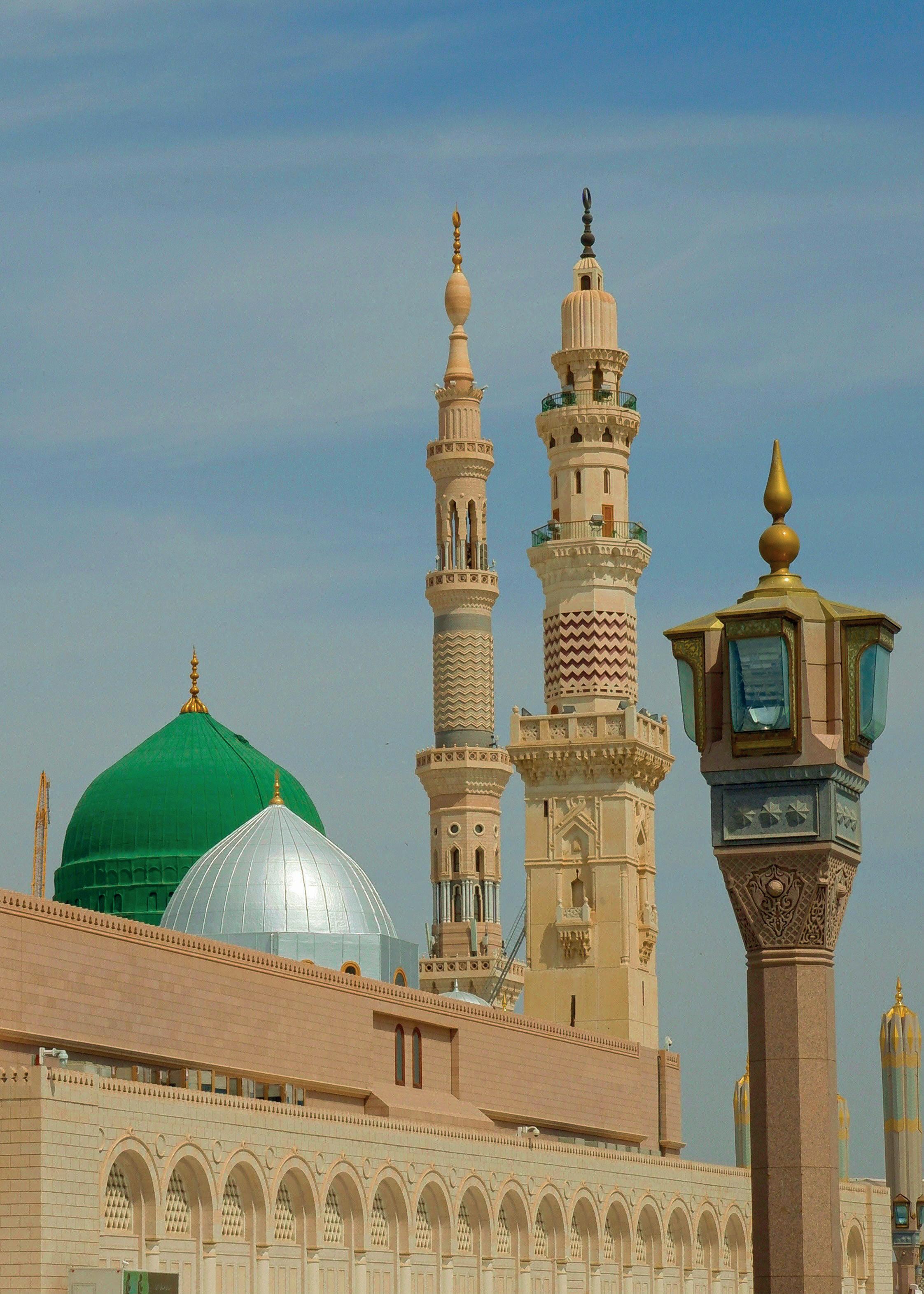
to others.
Her granddaughter, Khadija, has also written about her hospitality and also that she was a loving and compassionate lady and that in recent years she would complete the recitation of the Holy Quran two or three times a month. She had great sympathy for the poor and would also advise others to pray for them.
Her niece’s daughter, Neha, who resides here, writes that she maintained a positive
outlook in all circumstances, valued every moment of life and took great care of household staff as though they were her own family. This, too, I have observed –that she would avoid speaking negatively about others or saying anything that might hurt someone’s feelings, always remaining mindful of the sentiments of others.
It is related that when one of her household staff was leaving upon marriage, she felt sorrow as one does at the departure
of one’s own daughter, as the house would now feel empty. Often, there are virtues that remain hidden during a person’s life but become known afterwards through those who experienced them. She was among such people. May Allah the Almighty grant her forgiveness and have mercy upon her.
(Official Urdu transcript published in the Daily Al Fazl International, 8 May 2026, pp. 2-8. Translated by The Review of Religions.)