Call for Muslim unity and prayers for the Ummah amidst the escalating Middle East conflict
Introducing Prophet Abraham: An analysis from the Holy Quran
Page 3
Page 8
A
Answers to Everyday Issues Part 103
Voice of Islam Radio UK holds 10year anniversary conference
Page 4
Page 5
THE WEEKLY
www.alhakam.org AL HAKAM | Friday 13 March 2026 | Issue CDXVII Ahmadiyya Archive & Research Centre (ARC), 22 Deer Park Road, London, SW19 3TL, UK info@alhakam.org | ISSN 2754-7396
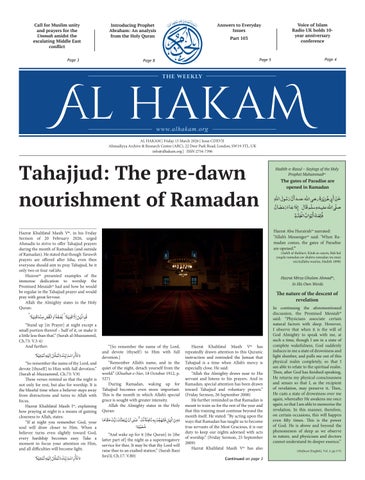
Tahajjud: The pre-dawn nourishment of Ramadan
“So remember the name of thy Lord, and devote [thyself] to Him with full devotion.” (Surah al-Muzzammil, Ch.73: V.9) These verses remind us that the night is not only for rest, but also for worship. It is the blissful time when a believer steps away from distractions and turns to Allah with focus. Hazrat Khalifatul Masih Ira, explaining how praying at night is a means of gaining closeness to Allah, states: “If at night you remember God, your soul will draw closer to Him. When a believer turns even slightly toward God, every hardship becomes easy. Take a moment to focus your attention on Him, and all difficulties will become light.
َ� َ َ ۡ ُ ۡ َ َ اْس َۡم ًَر �ِِّبَك ََوَّت َِبٰت ْۡل ِاَل َ ۡۡی ُِہ َّت ِۡب ِٰت ۡۡیًلًَا َواُذِك ِِر
َ ُ َ َ ََ �ٰ َ �ٰ ِع َْن أ�ِی َہ َﺮﻳْ َﺮة ٌرﺿﻰ الّٰلِہ ِعِنٖہ أ �ن ٌَر ُﺳۡول الّٰل ِِہ َ َ � �ٰ � ُ اَء ٌَر َُّم َﻀ َ الٮ إ َۡذا ََج ان َق ۡم َّوﺳل �لًیٖہ ِہ ﺻلﻰ الّٰل ِ ْ َ� َ ُ َ ْ َ ْ َ ُ َف ِ��ﺖ أِبۡواب ا�ُجِن ِﺔٮ
(Sahih al-Bukhari, Kitab as-sawm, Bab hal yuqalu ramadan aw shahru ramadan wa mun ra’a kullahu wasi‘an, Hadith 1898)
Hazrat Mirza Ghulam Ahmadas, In His Own Words
The nature of the descent of revelation
َ ۡ َ َ� َ� ُ ُۡ َۤ َ � � َق ِۡم اَل ۡۡی َْل ِاۡلَا َق ِۡل ۡۡیًلًَا � ُنِ َّۡصَف ُٗہ ا َِو اْنِق ۡﺺ ِِّمَن ُُہ َق ِۡل ۡۡیًلًَا
َ� َ َ ۡ ُ ۡ َ َ اْس َۡم ًَر �ِِّبَك ََوَّت َِبٰت ْۡل ِاَل َ ۡۡی ُِہ َّت ِۡب ِٰت ۡۡیًلًَا َواُذِك ِِر
The gates of Paradise are opened in Ramadan
Hazrat Abu Hurairahra narrated: “Allah’s Messengersa said: ‘When Ramadan comes, the gates of Paradise are opened.’”
Hazrat Khalifatul Masih Vaa, in his Friday Sermon of 20 February 2026, urged Ahmadis to strive to offer Tahajjud prayers during the month of Ramadan (and outside of Ramadan). He stated that though Tarawih prayers are offered after Isha, even then everyone should aim to pray Tahajjud, be it only two or four rak‘ahs. Huzooraa presented examples of the immense dedication to worship the Promised Messiahas had and how he would be regular in the Tahajjud prayer and would pray with great fervour. Allah the Almighty states in the Holy Quran: “Stand up [in Prayer] at night except a small portion thereof – half of it, or make it a little less than that.” (Surah al-Muzzammil, Ch.73: V.3-4) And further:
Hadith-e-Rasul – Sayings of the Holy Prophet Muhammadsa
“[So remember the name of thy Lord, and devote (thyself) to Him with full devotion.] “Remember Allah’s name, and in the quiet of the night, detach yourself from the world.” (Khutbat-e-Nur, 18 October 1912, p. 527) During Ramadan, waking up for Tahajjud becomes even more important. This is the month in which Allah’s special grace is sought with greater intensity. Allah the Almighty states in the Holy Quran:
ً َََو ِِّم َۡن اَل�َ ۡۡیْل َْف َٰت ََہ �ََج ۡۡد ِّب ُٖہ ُنَۤاْفِ َۡل ًَة َل�َ ََك � ََع ۤ�ُّي اَ ٌۡن �ُّیَ ِۡب ََع ََّث ََك ًَر �ِّبُ ََك َِّمِق ۤاِّمۤا ِ ِ َ �ِّم ِۡح ُٰمۡوۡ ًَدا
“And wake up for it [the Quran] in [the latter part of] the night as a supererogatory service for thee. It may be that thy Lord will raise thee to an exalted station.” (Surah Bani Isra’il, Ch.17: V.80)
Hazrat Khalifatul Masih Vaa has repeatedly drawn attention to this Quranic instruction and reminded the Jamaat that Tahajjud is a time when Allah’s mercy is especially close. He said: “Allah the Almighty draws near to His servant and listens to his prayers. And in Ramadan, special attention has been drawn toward Tahajjud and voluntary prayers.” (Friday Sermon, 26 September 2008) He further reminded us that Ramadan is meant to train us for the rest of the year and that this training must continue beyond the month itself. He stated: “By acting upon the ways that Ramadan has taught us to become true servants of the Most Gracious, it is our duty to keep our nights adorned with acts of worship.” (Friday Sermon, 25 September 2009) Hazrat Khalifatul Masih Vaa has also Continued on page 3
In continuing the aforementioned discussion, the Promised Messiahas said: “Physicians associate certain natural factors with sleep. However, I observe that when it is the will of God Almighty to speak with me, at such a time, though I am in a state of complete wakefulness, God suddenly induces in me a state of drowsiness and light slumber, and pulls me out of this physical realm completely, so that I am able to relate to the spiritual realm. Then, after God has finished speaking, He returns my physical consciousness and senses so that I, as the recipient of revelation, may preserve it. Then, He casts a state of drowsiness over me again, whereafter He awakens me once again, so that I am able to memorise the revelation. In this manner, therefore, on certain occasions, this will happen even fifty times. This is the power of God. He is above and beyond the phenomenon of sleep as we observe in nature, and physicians and doctors cannot understand its deeper essence.” (Malfuzat [English], Vol. 2, pp.173)
Friday 13 March 2026 | AL HAKAM
2
This Week in History A glimpse into the rich history of the Ahmadiyya Muslim Jamaat
13 - 19 March 13 - 14 March 13 March 1971: On this day, Hazrat Khalifatul Masih IIIrh graced the farewell ceremony held for 13 doctors who were going to West Africa under the Nusrat Jehan Leap Forward programme. (Tarikh-e-Ahamdiyyat, Vol. 27, pp. 31-32) 14 March 1986: On this day, while delivering his Friday sermon at the Fazl Mosque in London, Hazrat Khalifatul Masih IVrh announced the establishment of the Syedna Bilal Fund for the families of Ahmadi martyrs and those imprisoned in Jamaat-related legal cases. In this sermon, Huzoorrh also mentioned the high spirits of the innocent Ahmadis imprisoned in Sukkur Jail and Sahiwal Jail at that time in Pakistan. (Khutbat-e-Tahir, Vol. 5, pp. 213223) To read the heartbreaking yet faith-inspiring story of an Ahmadi imprisoned in Sukkur, see: www. alhakam.org. 14 March 2015: On this day, Hazrat Khalifatul Masih Vaa addressed the 12th National Peace Symposium of Jamaat
UK. (“Muslim Leader says Justice and Honesty required to prevent Outbreak of third World War” at pressahmadiyya.com)
15 March 15 March 1907: On this day, the Promised Messiahas issued an announcement for Muslim clerics and invited them to read his book, Haqiqat-ul-Wahi, with deep consideration. (Haqiqat-ul-Wahi, Ruhani Khazain, Vol. 22, p. 611) 15 March 1971: On this day, a group of 20 American students, accompanied by their teachers, arrived in Qadian to explore its historical and spiritual significance. The group consisted of 11 girls and 9 boys, along with three professors from Baring College, Batala. They were warmly welcomed and given a guided tour through the sacred sites of Qadian. To read the full report, see: ‘‘Coming from every distant track: Qadian welcomes American students (1971)’’ at www. alhakam.org (7 March 2025, p. 7). 15 March 2004: During his tour of Ghana, on this day, Hazrat Khalifatul Masih Vaa met with the then-president of Ghana, John Kofi Agyekum Kufuor. (Al Fazl International, 26 March 2004, p. 16)
16 March 16 March 1919: On this day, on the second day of Jalsa Salana Qadian, Hazrat Khalifatul Masih IIra addressed the Jalsa on the important topic of Irfane-Ilahi [Cognisance of God]. 16 March 1919: On this same day, an Ahmadi, Ghulam Muhammad Khan MA of Firozpur, interviewed Maulvi Muhammad Hussain Batalvi, who was once
a proponent and supporter of Hazrat Mirza Ghulam Ahmadas and, unfortunately, became one of the fiercest opponents of the Promised Messiahas. However, when the time came for him to consider his children’s welfare, with the advice of Hazrat Sheikh Yaqub Ali Irfanira, he chose Talim-ul-Islam School, Qadian, for their education. To read the full interview, see: ‘‘100 Years Ago… – An interesting encounter with Maulvi Muhammad Hussain Batalvi’’ at www.alhakam. org (12 April 2019)
17 March 17 March 1914: Soon after his election as Khalifatul Masih, despite the period of immense difficulties, Hazrat Sahibzada Mirza Bashir-ud-Din Mahmud Ahmadra, on this day, started delivering his dars of the Holy Quran in Masjid Aqsa, Qadian. He started by explaining the commentary of Surah al-Mujadalah, which was being published in Al Fazl from 8 April. This valuable deliberation was later published in book form, titled Haqaiq-ul-Quran. In those early days, Hazrat Muslehe-Maudra initiated the dars of the Holy Quran for the ladies too, in accordance with the will of his predecessor, Hazrat Khalifatul Masih Ira. After being elected as Khalifa, the daily activities of Hazrat Musleh-e-Maudra multiplied, as Huzoorra began gracing questionand-answer sessions daily after Maghrib prayers. Hazrat Maulvi Muhammad Ismael Halalpurira was assigned to assist Huzoorra in daily correspondence and arrange Huzoor’sra daily official and personal mulaqat schedule. (Tarikh-e-Ahmadiyyat, Vol. 4, p. 135) 17 March 1925: On this day, Hazrat Musleh-eMaudra established Madrasat-ulKhawatin – an educational institute – to enhance the education of Ahmadi women. Huzoorra spared
time to lecture the classes for a considerable amount of time until his tight schedule made it impossible for him to continue teaching them. (Tarikh-eAhmadiyyat, Vol. 4 p. 518)
18 - 19 March 18 March 1948: On this day, Hazrat Musleh-eMaudra delivered a lecture at the Theosophical Hall, Karachi, as part of a series of lectures titled “Istihkam-e-Pakistan”. It was organised by the local Lajna Imaillah and thus attended by around 600 Ahmadi and non-Ahmadi women, including Lady Abdullah Haroon (former president of All India Women Muslim League & VicePresident of All Pakistan Women’s Association), Begum Shaban (a prominent leader of the Pakistan Movement) and Begum Afridi, etc. For more details, see “‘Consolidation of Pakistan’: Lectures by Hazrat Musleh-e-Maud on how Pakistan can see success” at alhakam.org (6 May 2022, p. 10). 18 March 2011: During his Friday sermon on this day, Hazrat Khalifatul Masih Vaa mentioned Rana Zafrullah Sahib of Sanghar, Pakistan, who had been martyred there. He was serving as the Qaid Majlis and Secretary Maal. 19 March 1937: In his Friday sermon, on this day, Hazrat Musleh-e-Maudra, while explaining the meaning of ��لۡقۡوا ِباﺧ��ق �ٰ الّٰلِہ, advised that Ahmadis should be a manifestation of the attribute of God Almighty, Rabb-ul-Aalamin (Lord of the All Worlds). And since there was no pause or hindrance in this attribute of Allah, Huzoorra said, there should not be any hindrance or pause in the acts of worship and good deeds of the members of the Jamaat. (Khutbat-e-Mahmud, Vol. 18, p. 61)
AL HAKAM | Friday 13 March 2026
3
Call for Muslim unity and prayers for the Ummah amidst the escalating Middle East conflict During his Friday sermon, delivered on 6 March 2026 (16 Ramadan 1447 AH) at Masjid Mubarak, Islamabad, Tilford, UK, Hazrat Mirza Masroor Ahmad, Khalifatul Masih Vaa, addressed the catastrophic effects of the ongoing war in the Middle East, emphasising that the profound disunity among Muslim nations has allowed worldly powers to exploit their resources and urgently called for global Islamic solidarity and fervent prayer. Huzooraa explained that Western nations have established military bases in Arab countries under the false pretext of protection, actively fuelling divisions – particularly against Iran – to maintain regional dominance and secure their own economic interests. Highlighting the devastating consequences of these geopolitical schemes, including the tragic loss of innocent Muslim lives, the severe
economic toll on Arab nations, and the looming threat of a global world war, he urged Muslim governments to recognise that they are being manipulated into shedding the blood of their brethren. To avert further destruction, he stressed the collective responsibility of the Islamic world, stating, “Therefore, instead of trying to achieve their vested interests only, Muslim governments, politicians and monarchies should try their level best to unite as one Muslim Ummah.” Reminding them of their fundamental spiritual duty, he noted, “In any case, may Allah the Exalted grant the Muslims wisdom so that they act with understanding and endeavour to resolve their issues by sitting together with one another. When they claim belief in the Oneness of God, then for the establishment of this Oneness, they ought to become united.”
Huzooraa condemned the hypocrisy of major powers who initiate conflicts based on hypothetical scenarios and use false claims of liberation to justify aggression, calling instead for Muslims to adhere strictly to the Quranic injunctions of justice and brotherhood under the divinely guided system of the Promised Messiahas. Huzooraa said, “What is that Divine system which we can implement or adopt to safeguard ourselves from these things and instead become united as one nation? That system established by Allah the Almighty was the advent of the Promised Messiahas to create one united Community.” Addressing the specific role of the Ahmadiyya Muslim Jamaat amidst this turmoil, he declared, “Nevertheless, as Ahmadis, it is our effort and prayer that may Allah the Almighty unite the Muslim Ummah and may He protect them from this
mischief and these injustices which they are currently facing.” Acknowledging the Jamaat’s material limitations yet profound spiritual responsibility, he added, “However, we Ahmadis – despite feeling deep pain – are helpless. We cannot do anything except warn them, pray for them and try to make them understand that what is happening is wrong.” Finally, he urged Ahmadis to intensify their supplications for the wider world, instructing, “Thus, especially during these days, it is our duty to bow before Allah the Almighty in prayer; praying especially for the Muslim world, as there is a great need for this at this time,” and concluded with the following directive: “During the month of Ramadan especially, one should not focus solely on personal prayers but should also pray for the Muslim Ummah.”
Continued from page 1
what is the benefit of merely staying hungry and thirsty?” (Khutbat-e-Mahmud, Vol. 8, p. 365) Hazrat Khalifatul Masih IVrh also stressed the importance of Tahajjud during Ramadan. He stated: “In reality, Ramadan is not merely about eating suhoor; rather, the true Ramadan is to partake of spiritual nourishment before suhoor – that is, to offer voluntary prayers.” (Friday Sermon, 7 April 1989)
heartfelt words were: “So tomorrow, as we enter Ramadan, all those Ahmadi mothers to whom my voice has reached, as well as parents and children who are hearing me directly, should keep this especially in mind: there should not be a single Ahmadi in the world who does not develop the habit of offering Tahajjud during the blessed month of Ramadan.” (Friday Sermon, 7 April 1989) If our aim this Ramadan is to attain
closeness to Allah the Almighty and to attain His love, then we must shorten our nights of sleep and awaken our nights of worship. Only then can we spend our Ramadan with firm belief that we are getting closer to our Lord. This was the practice of the Holy Prophetsa which we should all follow to reap the benefits of Ramadan and continue this worship after as well.
highlighted the lofty standard of the Holy Prophet’ssa night worship. He said: “Then we see that even in the worship of the night, such lofty standards were established that no example of them can be found. Regarding this, there is the testimony of Hazrat Aishara. When she was asked about the prayer of the Messenger of Allah – that is, the Tahajjud prayer – she said: ‘The Holy Prophet, peace and blessings be upon him, would not offer more than 11 rak‘ahs in Ramadan or outside of it. But they were such long, beautiful and excellent prayers that do not even ask about their length, beauty and excellence.’” (Friday Sermon, 18 February 2005)
A time of acceptance of prayer The Holy Prophetsa, describing the bounties of Tahajjud, said:
ُ� َ� َ َ ْ َ َ� ُ َ َ َ َ َ َ َ َ َ ُ� َ ُ ْ َ َ ًح،َلۡدُن ْ َۡیۤا ۡیٌن ُّی��َِل ًرِّبَنۤا َّتِب َۤاًرَك َوَتَعۤاَلى َكْل َلۡیۡل ٍَة ِِإَلى ا ِ َ َلَّس َٰمۤا َِء ا ُ ُ َْف َۡیِق،ُّیَ ِْبِقَى ُثُ ُۡل ُُث ا �َلۡل ْۡیْل اۡلْ�� ُِِر َۡوَل� َِّم ْۡن ُّیَ ْۡد َُعۡوِّني َْفْأ ْْس َٰتَجۡیٌب ِ ِ ُ َ ُِ َ َ ْ َ ْ َل َ ُُہ؟ َِّم ْۡن ُّیَ َّْسْأَلِنُِّي ْفْأ َْع َِط َۡی ُُہ؟ َِّم ْۡن ُّیَ َّْس َٰتْغ ِِف ُْرِّنِي ْفْأَغ ِِف َْر َل َ ُُہ؟
“Our Lord descends every night to the lowest heaven when the last third of the night remains, and He says: ‘Who is calling upon Me so that I may answer him? Who is asking Me so that I may give him? Who is seeking My forgiveness so that I may forgive him?’” (Sahih al-Bukhari, Hadith 1145) This hadith draws our attention to a precious daily moment when Allah’s mercy is near and the doors of prayer and forgiveness are wide open.
The essence of fasting Hazrat Musleh-e-Maudra explains: “The life and spirit of fasting lie in the time of suhoor [pre-dawn] and in performing Tahajjud. If a person does not wake up for suhoor and does not pray Tahajjud, then
A means of attaining closeness to Allah Hazrat Musleh-e-Maudra narrated an incident in which the Holy Prophet’ssa anguish for his companions to read Tahajjud becomes clear. He narrated: “Since offering Tahajjud is a great means of attaining closeness to God, the Holy Prophetsa said about one of his companions that he was a very good man – if only he would rise at night (for prayer). Therefore, continue this practice and do not let what you began in Ramadan come to an end.” (Khutbat-e-Mahmud, Vol. 1, p. 95) Explaining how Tahajjud serves as a means of correcting our morals, Hazrat Musleh-e-Maudra states: “Tahajjud is a blessing from the blessings of God and it is mentioned in the Holy ۡ َ َ ً ۡ ُ� َ َ ً Quran – it says it is: ��اِشۡد ََّوﻃا �َّواَق َۡو ُم َِق ًۡی, meaning Tahajjud is a great tool for the reformation of the nafs [soul] and through it all actions are set right.” (Ibid.) Tahajjud is, therefore, a spiritual training exercise too. It shapes the soul and helps a person become steadier in conduct, speech and self-control.
All Ahmadis should offer Tahajjud Hazrat Khalifatul Masih IVrh, in one of his sermons, strongly urged Ahmadis to be regular in Tahajjud during Ramadan. His
(Tanzeel Khurram, Student, Jamia Ahmadiyya UK)
Friday 13 March 2026 | AL HAKAM
4
NEWS Jamaat Finland’s delegation meets the Mayor of Parainen
Voice of Islam Radio UK holds 10-year anniversary conference Mujeeb Mirza General Secretary, VOI Radio UK The Voice of Islam Radio UK held its 10year anniversary conference on 15 February 2026 at the Baitul Futuh Mosque Complex in London. This historic gathering marked a decade since the station first began broadcasting on DAB on 7 February 2016 under the blessed guidance of Hazrat Khalifatul Masih Vaa. Workers and volunteers of the station, including presenters, producers, technical staff, missionaries, Lajna members and board members, travelled from across the United Kingdom and abroad to participate in what proved to be a deeply spiritual, intellectually enriching and forwardlooking occasion. The proceedings commenced at 10 am under the chairmanship of Abid Khan Sahib, Press Secretary to Hazrat Khalifatul Masih Vaa. The session began with a recitation from the Holy Quran, followed by the showing of the video of the historic inauguration of the station by Huzooraa. In my opening remarks, my humble self reflected upon the journey of the station and reminded all those present that the Voice of Islam is not merely a radio platform but a sacred trust granted under the guidance of Khilafat. This was followed by an address delivered by Abid Khan Sahib, who spoke about the special blessings attached to the establishment of the station under Khilafat. He urged all volunteers to recognise the honour of this opportunity and to ensure that their work always reflects the highest standards of sincerity, humility and obedience. The opening session concluded with a silent prayer. The first presentation of the day was delivered by Athar Ahmad Sahib of University College London, who explained the essential principles of effective radio communication, drawing attention to the importance of understanding the listener, structuring narratives in a compelling way and using the human voice with clarity and emotion. This was followed by a panel discussion with Ibrahim Ikhlaf Sahib, Voice of Islam Board Member and National Tabligh Secretary UK, which focused on how programme topics are selected. A video presentation was then shown, highlighting the station’s national recognition at the London Dangoor Awards, where the Voice of Islam received the award for Outstanding Services to Faith and Belief in Greater London in November 2025. Throughout the day, attendees were also able to visit a dedicated exhibition marking the 10-year journey of the station, which illustrated its development from a modest studio to a national broadcaster and showcased the breadth of its programming and production processes. The conference then turned to the
subject of leadership, with a presentation by Sitara Akbar Sahiba titled “Leading Teams with Grace.” She spoke about the Islamic concept of leadership as service and humility, drawing inspiration from the life of Hazrat Sir Zafrulla Khanra. The technical development of the station over the past decade was then explored in a panel discussion with Mian Safdar Ali Sahib and Zaki Ullah Ahmad Sahib. They described the early challenges faced in establishing the station, the decision to broadcast on DAB, the formation of the technical team and the continuous efforts required to maintain a 24-hour broadcast. A further session with Fareed Ahmad Sahib examined the growing importance of social media and digital outreach. After Zuhr and Asr prayers and lunch, the conference resumed with a discussion on the production of recorded programmes by Zawar Butt Sahib and Haider Hameed Sahib. They took the audience through the complete journey of a programme from its initial concept to its final broadcast and spoke about the careful planning, scripting, editing and teamwork required at every stage. This theme was developed further in a dedicated presentation on artificial intelligence by Shermeen Butt Sahiba, who explained both the opportunities and the risks associated with these new technologies. An interactive session with my humble self provided insight into the day-to-day running of the station and the internal systems that ensure quality and consistency. An extended question-and-answer session with the board members allowed volunteers to contribute ideas and seek guidance. A dedicated exhibition displayed throughout the day illustrated the 10-year journey of the Voice of Islam, from its modest beginnings to its current position as a recognised national broadcaster. The closing session was chaired by Rafiq Ahmad Hayat Sahib, Amir Jamaat UK, bringing the formal proceedings to a conclusion. Following the awards ceremony recognising outstanding service, he reflected upon the remarkable progress made over the past decade and reminded all present that the station must now strive to meet the highest professional standards in line with leading broadcasters, whilst always remaining firmly rooted in its spiritual mission. The highlight of the conference was the reading of the special message of Hazrat Khalifatul Masih Vaa. Huzooraa graciously acknowledged the sincerity and devotion of those who have served the Voice of Islam during the past decade and noted its expanding reach through DAB, online streaming and podcasts. At the same time, he also granted valuable guidance as well. Huzooraa urged all workers to continually reflect upon their efforts, to raise the
Syed Abdul Samad Finland Correspondent
standard of every programme and to study the teachings of Islam in depth so that they may convey them in a manner that resonates with people and enriches their lives. The conference ended with a silent prayer led by Amir Sahib Jamaat UK, followed by dinner. The total attendance was 350 in-person and 200 people were able to watch the live stream online provided by MTA International.
On 20 January 2026, a delegation of Jamaate-Ahmadiyya Finland had a meeting with the Mayor of Parainen, Mr Tom Simula. The meeting was held in a warm and respectful atmosphere, with meaningful discussions on the peaceful teachings of Islam. We presented to the Mayor a copy of the Holy Quran with Finnish translation, which was received with sincere appreciation. Additionally, one copy of the Holy Quran was donated to the city library for the benefit of the wider community.
Interfaith fasting event held in Malta Laiq Ahmed Atif President, Jamaat-e-Ahmadiyya Malta Jamaat-e-Ahmadiyya Malta held an Interfaith Fasting Event on 27 February 2026, in collaboration with a local Roman Catholic Church of Bahar ic-Cagħaq village. The event was held in the parvis of the church and was very well attended, with participants warmly embracing the interfaith spirit and expressing appreciation for this meaningful manifestation of unity and peace. Children from diverse religious and faith communities delivered inspiring messages, sharing reflections and messages centred on fasting, respect and love for others. The programme continued with addresses by Rev Dr Joseph Ellul OP, Chairperson of the Archdiocesan Commission for Interreligious Dialogue; my humble self and Rev Mark Ciantar OFM, Rector of Bahar ic-Cagħaq Church. The event concluded with an address by Her Excellency, Marie-Louise Coleiro Preca,
Huddersfield Jamaat hosts iftar event Fatihul-Haq President, Jamaat Huddersfield, UK On 28 February 2026, Jamaat-e-Ahmadiyya hosted a Community Iftar, bringing together people of different faiths, backgrounds and civic institutions. More than 150 guests attended the event. Among the distinguished attendees were the Lord Mayor of Kirklees, Cllr Liz Smaje; the Leader of Kirklees Council, Cllr Carole Pattinson; local MP Harpreet Uppal; the Bishop of Huddersfield, Rev Smitha Prasadam; Deputy Lord Mayor Cllr Munir Ahmad; Interfaith Chairman Kiran Bali; Inspector Alex Langley; along with fellow councillors, faith leaders and representatives
President Emeritus of Malta. After the speeches, guests were served dates and milk for the breaking of the fast, followed by dinner. Seven religions or religious organisations were represented at the event. In total, around 120 people from various religions attended the Interfaith Fasting Event, including a significant number of Muslims. During the meal, members of the Jamaat engaged in conversations with the guests, which created opportunities for further introductions and outreach. Guests were also presented with two Maltese-language issues of Jamaat’s tabligh magazine Id-Dawl, which were published in connection with the blessed month of Ramadan. Many expressed heartfelt thanks to the Jamaat for its hospitality and for organising the event. Malta’s national television provided special coverage of the event and presented a detailed report in its nightly news bulletin, which is watched in almost every household in the country. of the police and community organisations. The local missionary, Sabahat Karim Sahib, delivered a speech and provided an insightful presentation on the significance of Ramadan and the true purpose of fasting in Islam. Speakers throughout the evening highlighted the importance of dialogue, respect and cooperation between communities. Many acknowledged the continued efforts of the Jamaat in promoting peace, loyalty to one’s nation and service to humanity. My humble self, alongside Yousaf Aftab Sahib, thanked guests for their presence and ongoing support. The evening concluded with guests sharing a meal together in a warm and welcoming atmosphere. Conversations continued long after the fast was broken, strengthening friendships and building bridges across communities.
AL HAKAM | Friday 13 March 2026
5
Answers to Everyday Issues 103
Inheritance of Prophets, nur, angels, science vs religion and free will Guidance regarding basic Islamic issues that Hazrat Amirul Momineen, Khalifatul Masih Vaa, has given on various occasions in his written correspondence and during MTA programmes is being published officially below for everyone’s benefit. How does the Ahmadiyya Muslim Community explain the inheritance of the Promised Messiah (as)? Someone sent Hazrat Amirul Momineen, Khalifatul Masih Vaa, the following objection raised by a relative of theirs: “According to ahadith, the heirs of the Holy Prophetsa continued to benefit from his property according to circumstances, but did not become its owners as heirs. However, the property of the Promised Messiahas was distributed among his heirs as an inheritance. Furthermore, the Promised َ Messiahُ as has written in the exegesis of ََّو ِ�� �ا َ ٌَر َز َۡق ِٰن� ۡ� ﻳ ُ ِۡنَف ُۡق ۡۡونthat Prophets spend whatever ِ ownership they possess and do not save even a single dinar in their homes.” Upon this, he asked how this should be answered. Huzoor-e-Anwaraa, in his letter dated 7 November 2023, provided the following guidance regarding this question: “The first point is that this objection contradicts the teaching of the Holy Quran because the Holy Quran states in clear words:
َ َ ََو ََوًرِث ُْسۡل ۡۡی ٰٰم ُۡن ََد ٗاَو ََد
“‘Solomon inherited from David.’ (Surah an-Naml, Ch.27: V.17) “Thus, your assertion that the inheritance of Prophets is not divided is an entirely false objection. Prophet Davidas was a Prophet and his inheritance was received by Prophet Solomonas, who was also a Prophet himself. “Hazrat Qatadahra states:
َ َ َ ُ َْ َ ََو �ًَر َث ال �ّٰلَ ُِہ َتَ ََعۤاَلَى ُْس َۡل ْۡی َٰم ۤاٌن ِِّم ْۡن ََد ُاَو ََد ُِّمۡل َُک ُُہ ََوُن ُِب �ۡوََّت ُُہ ََوَز َاَد ُُه ََعۡل ْۡی ُِہ َ َأَ ِّْمۡرَُّیْۡن َْس �َ� َِر َل َ ُُہ ا �َلۡر َ ُّیﺢ ََوا �َلْش َۡیۤاﻃ �ۡیٌن ِ ِ ِ
“‘Allah the Almighty made Solomon the heir to both the kingdom and prophethood of Davidas and further subjugated the winds and rebellious [men] for Solomonas.’ (Tafsir al-Kabir by ar-Razi, Surah al-Anbiya, verse 79) “Thus, Hazrat Solomonas became the recipient of the worldly and religious, physical and spiritual inheritance of his father, Hazrat Davidas, who was a Prophet. “The second point is that regarding what
is mentioned in the hadith that the Holy Prophetsa said, ‘We have no heirs; whatever we leave behind is charity’, Hazrat Umarra stated that this referred specifically to the person of the Holy Prophetsa himself. (Sahih al-Bukhari, Kitab al-maghazi, Bab hadithi bani n-nadir) “Therefore, firstly, this statement of the Holy Prophetsa specifically referred to his own person and this was not a principle for the rest of the Prophets. Secondly, in this hadith, the Holy Prophetsa is declaring his estate as charity, whereas in another hadith, while removing a date of charity from the mouth of Hazrat Imam Hasanra with his finger, the Holy Prophetsa said, ‘Do you not know that we do not eat charity?’ (Sahih alBukhari, Kitab az-zakat, Bab ma yudhkaru fi s-sadaqati li-n-nabiyyisa) How, then, did his heirs continue to benefit from this charity according to the circumstances? “In reality, this means that from the wealth and properties that Allah the Almighty bestowed upon the Holy Prophetsa during various conquests, he spent much of it in the way of Allah. He retained some property, which included the garden of Fadak in Khaibar and the land of Banu Nadir in Medina, for his own living expenses and those of his household. He continued to fulfil his own and his household’s living expenses from it during his lifetime and even after his demise, his heirs continued to benefit from this property in the same manner. However, Hazrat Umarra entrusted this inheritance to the Holy Prophet’ssa heirs, Hazrat Abbasra and Hazrat Alira, during the second year of his Khilafat. (Sahih alBukhari, Kitab al-maghazi, Bab hadithi bani n-nadir) Therefore, it is incorrect to say that the Holy Prophet’ssa inheritance was not received by his heirs. “As for the inheritance of the Promised Messiahas, Huzooras had dedicated his most valuable property in the way of Allah; that is, he granted his own personally owned land for Bahishti Maqbarah, Qadian. At the time of his demise, his home was completely empty of worldly wealth and riches. Accordingly, upon his demise, Hazrat Amma Janra gave the following advice to the children: ‘Children! Seeing the house empty,
do not think that your father has left nothing for you. He has left a tremendously heavy treasure of prayers for you in heaven, which you will continue to receive at the appropriate times.’ (Daily Al Fazl, Rabwah, No. 16, Vol. 51, dated 19 January 1962, ُ ٰ ۡ َ p. 15) َ In light of the Quranic verse �ۡ �ََّو ِ�� �ا ٌَرزَقِن َﻳ ُ ِۡنَف ُۡق ۡۡون, his stance and practice were exactly ِ this: that Prophets spend whatever ownership they possess in the way of Allah and do not save even a single dinar in their homes. “Apart from the land for the Bahishti Maqbarah Qadian, the remaining land had no significance or value whatsoever. It remained useless for a long period and the heirs derived absolutely no benefit from it. Later, during the era of the Khilafat of Hazrat Khalifatul Masih IIra, when this land was sold in the form of residential plots, only then did this land acquire some significance and value. Even at that time, Hazrat Khalifatul Masih IIra spent the majority of the income from this land strictly on the works of the Jamaat.”
What is the meaning of ‘nur’ (light) in the Holy Quran? Someone from Indonesia enquired from Hazrat Amirul Momineen, Khalifatul Masih Vaa, whether “nur” is synonymous with “light.” Furthermore, what is the difference between physical light and spiritual light? Are angels physical light? Huzoor-e-Anwaraa, in his letter dated 13 November 2023, provided the following answer: “Allah the Almighty has described ‘nur’ as guidance and ‘zulmah’ as misguidance and this has been stated at numerous places in the Holy Quran. The words ‘nur’ and ‘zulmah’ have actually been used allegorically; they cannot be likened merely to physical light and physical darkness, as it is stated: “‘Allah is the friend of those who believe: He brings them out of every [kind of] darkness into light. And those who disbelieve, their friends are the transgressors who bring them out of light into every [kind of] darkness. These are the inmates of the Fire; therein shall they abide.’ (Surah al-
Friday 13 March 2026 | AL HAKAM
6
Baqarah, Ch.2: V.258) “The Promised Messiahas states while expounding upon this subject: “‘Light comes from God Almighty to remedy the Age of Darkness and that light is His Messenger and His Book. With this light, God shows the way to those who seek His pleasure and so God delivers them out of every kind of darkness into light and guides them to the right path.’ (Barahin-eAhmadiyya, Part IV, Ruhani Khazain, Vol. 1, pp. 648-649) “Allah the Almighty has also used the word ‘nur’ for the Holy Quran, which is the fountainhead of guidance, as He states:
َ� َ ُ� َ ۤ ُ ُ َۤۡ َۡ ُ َ ٌ ٓاَءُک ُ ۡۡم ُبُ ۡۡر ََہ ُ الَّن َ اُس ََق ۡۡد ََج اٌن �ِِّم ۡۡن �َّر �ِِّبُک ۡۡم ََوَاۡن ََزۡلَنۤا ِِاَل َ ۡۡیُک ۡۡم ُنۡوۡ ًًرا ٰۤیَاُّیَہا ً ۡ ُ� ُّم ِِبۡیًنا
(Surah an-Nisa’, Ch.4: V.175) “Translating this verse, the Promised Messiahas states: “‘O mankind! The Quran is a conclusive proof that you have received from God Almighty and it is a manifest light that has been sent down to you.’ (Karamat-usSadiqeen, Ruhani Khazain, Vol. 7, p. 56) “The word ‘nur’ has also been used for the sharias revealed to earlier Prophets. As it is stated: “‘Say: ‘Who revealed the Book which Moses brought, a light and guidance for the people?’’ (Surah al-An‘am, Ch.6: V.92) “The word ‘nur’ has also been used for the holy personage of the Holy Prophetsa, as it is stated:
َُ َ َۡ َ ُ �ٰ ۡ ُ ٓاَءُک ۡۡم �ِِّم ََن الّٰل ِِہ ُنۡوۡ ٌٌر �َّوِک ِٰٰت ٌٌب �ُّم ِِبۡی ٌٌن َقۡد َج
“‘There has come to you indeed from Allah a Light and a clear Book.’ (Surah alMa’idah, Ch.5: V.16) “In the exegesis of this verse, the Promised Messiahas states: “Prophets are those high personages who have partaken of this inner light so abundantly and so perfectly that they have become the very embodiment of light. This is why the Holy Quran calls the Holy Prophet, peace and blessings of Allah be upon him, nur [light] and siraj-e-munir [a lamp that gives bright as it is said: ُ َ َ light], ۡ ُ ٰ َ ُ �ٰ َۡ — َقۡد َجPart number 6 ٓاَء َُک ۡۡم ٰ ِ�ِّم ََن الّٰل ِِہ ُن ۡۡو ٌٌر �َّوِکِٰت ٌٌب �ُّم ِِبۡی ٌٌن ۡ ُ ً َ َ ۡ � ََ اًجا �ُّم ِِنۡی ًًرا اِع ًًیا ِاَِلی الّٰل ِِہ ِبِِاِۡذِنِ ٖٖہ َو ِِسَر ِ — �َّوَدPart number 22 “Herein lies the wisdom as to why such light of revelation – for which extraordinary and perfect inner light is a requirement – was bestowed only upon Prophets and was confined to them alone.” (Barahin-eAhmadiyya, Parts I-IV, Ruhani Khazain, Vol. 1, p. 196, footnote 11) “Thus, ‘nur’ is that divine essence which is bestowed by Allah the Almighty upon every righteous and pure person according to their spiritual capacity, righteousness and piety. Since Allah the Almighty is the source of this light, He has used this word for Himself as well. As it is stated:
ۡ َ ۡ َ ٰ ٰ َ� ُ ۡ ُ ُ �ٰ َ ِض ِ َالّٰلُہ ُنۡوُر الَّسٰمٰو ِِت َواۡلَاۡر
“‘Allah is the Light of the heavens and the earth.’ (Surah an-Nur, Ch.24: V.36) “Explaining this verse, the Promised Messiahas states: “‘Allah is the Light of the heavens and the earth. That is to say, every light that is visible in the heights or in the depths, whether in souls or bodies, whether innate or acquired, whether overt or covert, whether internal or external, is a bounty of His grace.
“‘This is an indication that the general grace of Hazrat Rabb-ul-‘Alamin [Lord of all the worlds] encompasses everything and that nothing is deprived of His grace. He is the Source of all grace and the ultimate Cause of all light and the Fountainhead of all mercies.’ (Barahin-e-Ahmadiyya, Parts I-IV, Ruhani Khazain, Vol. 1, p. 191, footnote 11) “As for your question regarding angels, it is written that angels are also such a creation of Allah the Almighty that has been created from the very light of Allah the Almighty. Hazrat Musleh-e-Maudra states concerning angels: “‘The second point to remember regarding angels is that they are such a spiritual creation that man cannot see them in their original bodies with these physical eyes. If they were to be seen with these eyes, they would manifest in a form other than their original being. In other words, to see angels, one would require spiritual eyes rather than these physical ones; and if they were to be seen with these physical eyes, the angels would not be in their original bodies. Accordingly, Allah the Almighty states:
ۡ َ َ َ َ َ ٰ ۡ َ� ً َ ٰ ۡ ََوَلَۡوۡ ََج ََعۡلٰن ُُہ ََمَلًکا َّل ََج ََعۡلٰن ُُہ ََر ُُجًلًا �َّوَلََل ََب ۡۡسَنا ََعَل ۡۡی ِِہ ۡۡم �َّما َیَۡل ِِب ُُسۡوۡ ََن
“[Here, in Surah al-An‘am, Ch.6: V.10, Allah states that] ‘These people ask why an angel does not descend. However, if an angel were to come, it would do so in the form of a man; only then would they be able to see it. And when it comes in the form of a human, the ambiguity would remain: is this an angel or a man? Thus, the very doubt they are raising now would still persist, that this is not the Word of God but a human fabrication. Therefore, We would only send an angel if there were some benefit in doing so. But since people cannot see an angel with these physical eyes and if they do see one, it can only be in the form of a man, which would again lead them to object, an angel is not sent down. Hence, the existence of angels is hidden; they cannot be seen with these physical eyes.’’ (Malaikatullah, Anwarul-Ulum, Vol. 5, p. 490) “Thus, ‘nur’ is not the name of ordinary light; rather, it is such a highly exalted essence bestowed by Allah the Almighty. It is this very light that becomes the cause of bringing one from misguidance to guidance and it is from this divine light that angels have been created. Man cannot see their original being with their physical eyes; rather, possessing spiritual eyes is essential to see their true existence.”
Is there a conflict between science and religion according to Islam? A lady from the UK wrote to Hazrat Amirul Momineen, Khalifatul Masih Vaa, asking whether science and God can coexist. She also asked if there is no such thing as free will. She requested guidance in this regard. Huzoor-e-Anwaraa, in his letter dated 18 November 2023, provided the following guidance regarding this matter: “It is an entirely false notion and there is no evidence for it, that science and God cannot coexist. This is not our belief; rather, our belief is that there is absolutely no conflict between science and religion. Science is the act of God which has manifested in the world in the form of action and religion is His word, which reveals His intent through
revelation and inspiration. When there can be no contradiction between the word and act of an ordinary intelligent human being, how can a contradiction be possible in the word and act of an All-Knowing and All-Wise Being like God? Therefore, if an apparent conflict is observed between religion and science on any matter, it should not be considered a real contradiction. Instead, such a conflict only appears because sometimes shortsighted people begin to consider even those things as established facts of science which are not actually established facts, but are merely theoretical constructs predicated on conjecture rather than empirical observation. “Accordingly, while answering questions on various subjects from an English professor of astronomy, Professor Wragge, the Promised Messiahas stated regarding religion and science: “‘This is exactly what my mission is and this is what I have been proving: that there is absolutely no conflict between science and religion. Rather, religion is in complete accord with science. And no matter how much science advances, it will never be able to show that the teachings of the Holy Quran and the principles of Islam are false.’ (Malfuzat, Vol. 10, UK: 2022, p. 378) “Upon the request of the Science Union of Islamia College Lahore, Hazrat Muslehe-Maudra delivered a masterpiece lecture entitled ‘Religion and Science’ on 3 March 1927 at Habibiya Hall, Lahore, under the chairmanship of Dr Sir Muhammad Iqbal. In it, he states: “‘There is absolutely no conflict between religion and science, for religion is the Word of God and science is the Act of God. There can be no contradiction between the word and act of a wise being. Yes, if someone is a liar or insane, a contradiction may occur. Neither of these applies to God, for God is neither deficient in intellect nor deficient in morals. Thus, there is no disparity between the word and act of God; therefore, there is no clash between religion and science.’ (Mazhab aur Science, Anwar-ul-Ulum, Vol. 9, p. 499) “He further stated: “‘If a clash does appear, one must concede that either the religion has been misinterpreted (since the One who issues religious commandments is neither a liar nor insane), meaning people have misunderstood the religion or there has been an error in understanding the Act of God (science). Otherwise, both religion and science emanate from an Infallible Being, in Whose word and act a contradiction is impossible.’ (Mazhab aur Science, Anwarul-Ulum, Vol. 9, p. 500) “In this lecture, Huzoorra also proved through various examples that religion and science are two streams flowing from the same source, between which there can be no conflict whatsoever. For detailed information, you should also study this lecture.
Does Islam believe in free will? “The answer to your question regarding Free Will is that the actual objective of Islamic teaching is precisely that God Almighty has not compelled any human being to do good or evil. On the contrary, Allah the Almighty has clearly expounded the paths of both good and evil and has
granted man the choice to tread whichever path he pleases, thereby making his life in the Hereafter one of Paradise or Hell. The as , explaining the verse Promised Messiah َ( َفََاَۡل ۡ ََہ ََم ََہا ُفُُجُ ۡۡو ََر ََہا ََوَت َ ۡۡق ٰٰوٮَہاSurah ash-Shams, Ch.91: V.9), meaning, ‘And He revealed to it what is wrong for it and what is right for it’, states: “‘With the creation of the soul of man, God has thrown open the doors to light and darkness, luxuriance and aridity. He who opts for the ways of darkness and sin or, in other words, the paths of evil, is allowed to approximate to the extreme logical end so much so that he comes to bear close resemblance to a dark night. He loses all taste except for sinfulness and depravity; he begins to enjoy and think evil; he likes evil companions and evil pastimes alone. Consistent with his evil-mindedness, he is motivated by sinfulness alone; he always thinks of vice and depravity and never of what is moral and good. On the other hand, if he chooses the enlightened path of piety, he is constantly guided by revelations which sustain the light. In other words, through special revelations, God helps the innate light, which is present like a seed in the seeker’s heart, attain perfection and thus He sets afire the spark of Divine communication. It is at this stage that on beholding his own inner light, which is so bright and after experiencing its inherent property to radiate and absorb light to benefit and be benefited, one comes to believe with absolute conviction that in his own self too is present the light of the Sun as well as that of the Moon; that like the expansive, lofty and starry heavens, his bosom too is the repository of enlightened belief and courage and that his head and heart are the seat of capabilities which are resplendent quite like the stars. At this stage, he does not at all need any external evidence to comprehend this truth. Instead, the perennial spring of perfect truth now dwells within him and continues to quench his thirsty heart.’ (Taudhih-e-Maram, Ruhani Khazain, Vol. 3, pp. 82-83) “Expounding upon this same subject, Hazrat Khalifatul Masih Ira states: “‘The Holy, Blessed and Pure Being of God Almighty, by granting man capacity, the distinction between good and evil, intellect and nature and by sending thousands upon thousands of Prophets, Messengers and Books and by revealing the means of attaining His pleasure, has spread guidance in the world; and He has always granted succour and aid to the Prophets and their true followers and obedient servants. Yes! He has not compelled capable man by seizing him by the neck to force him to perform good deeds. The benefit of the existence of Satan and his progeny is that He may grant the robe and honour of obedience to the obedient among men; yet, He has not given Satan the authority to forcibly mislead people.’ (Nur-ud-Din ba Jawab Tark-e-Islam, p. 107) “Thus, in both matters, whether it is a case of misguidance or guidance, no compulsion has been exerted upon any human being. Rather, after clarifying the paths of guidance and misguidance, Allah the Almighty has given the choice of selecting them solely to man.” (Compiled by Zaheer Ahmad Khan, Head of Records Department, Private Secretariat, London and translated by Al Hakam)
AL HAKAM | Friday 13 March 2026
7
ago...
100 years
Tabligh during the Great Syrian Revolt and acceptance of Ahmadiyyat in Sumatra (1926) Hazrat Maulana Jalaluddin Shamsra (1901-1966)
neighbourhood of Srinagar in Kashmir – widely known as the grave of Yuz Asaf and also referred to as the tomb of Isa Nabi [Prophet Jesusas] – is in fact the resting place of Jesusas of Nazareth. The book also contains a reference to the claim of the Promised Messiahas. Copies are given to people for study and those who read them express appreciation and satisfaction. In conclusion, all friends are requested to pray that Allah the Almighty may soon establish a strong and permanent jamaat here, Amin. – Jalaluddin, Damascus.
Syria The situation in Damascus remains much the same. At times, the rebels enter the city, kill a few soldiers and then depart. Every day, the sounds of gunfire and pistol shots can be heard. Under these circumstances, tabligh is carried out by visiting people in their homes and those who come to meet are also conveyed the message of Islam Ahmadiyyat. Previously, a residence had been taken outside the city, where opportunities to meet people were limited. However, a house has now been obtained within the city, and despite these dangerous conditions, the work of preaching continues in some measure. During the past week, another friend has entered the Ahmadiyya Muslim Jamaat and friends are requested to pray for his steadfastness.
Christian missions in Damascus There are two Christian missions here. One is headed by a Danish priest and the other by an American priest. The American priest’s representative visited on two occasions and discussions took place on various religious issues. When he attempted to prove the superiority of Jesusas from the Holy Quran, I replied that it is not possible to establish from the Quran that the status of Jesusas is superior to that of the Holy Prophet Muhammadsa. Rather, according to the Quran, Jesusas appears in a position akin to the disciples of the Holy Prophetsa.
Quranic arguments In the Holy Quran, Jesus is described as “ghulaman zakiyya” [a pure son], whereas the Holy Prophetsa is described as “wa yuzakkihim” – [the one who purifies others], the purifier who renders people pure. Furthermore, regarding Jesusas, it is stated: “ayyadnahu biruh al-qudus” – [that he was strengthened by the Spirit of holiness]. In contrast, regarding the Holy Prophetsa it is stated: “ʿallamahu shadid alquwa” – [that he was taught by one mighty in power]. The rank of shadid al-quwa is far greater than that of the Holy Spirit. The descent of the Holy Spirit upon Jesusas took place in the form of a dove, whereas upon the Holy Prophetsa the manifestation of the Holy Spirit appeared in the form of shadid al-quwa. The entire horizon was filled with its manifestation. The difference between these two prophets, therefore, is comparable to the as
Tabligh in Sumatra
difference between these two manifestations: on the one hand, a dove, which even a cat could capture and kill; and on the other, a magnificent manifestation that filled the space between the heavens and the earth. Furthermore, the Quran states “wa ayyadahum bi ruhin minhu”, meaning that the Companionsra were also supported by the Holy Spirit. Thus, from the Holy Quran one cannot establish the superiority of Jesusas.
The purity of Jesusas’ family The representative [of the Christian priest] then argued that the Quran mentions the innocence of Jesusas and the purity of his family, whereas the families of other prophets are not mentioned in this way. I replied that exoneration becomes necessary only when an accusation has been made. The purity of the families of other prophets was already accepted among people, but accusations had been levelled against the family of Jesusas, which is why their innocence was explicitly declared.
Parallel Quranic examples A similar example appears elsewhere in the Holy Quran. God Almighty states: “ma kafara sulayman” – Prophet Solomonas did not disbelieve. Disbelief is thus specifically negated in relation to Solomonas. Yet disbelief is not negated in this particular manner with regard to other Prophets. Does this imply, God forbid, that the other Prophets were disbelievers? Certainly not. The specific mention of Solomonas was made because disbelief had been attributed to him. Likewise, an accusation of falsehood was directed against Prophet Abrahamas.
His innocence was established through the words “siddiqan nabiyya”, meaning that he was a most truthful Prophet.
Conclusion of the discussion At this point, when he was unable to produce any further response, he said that he would bring his priest. Two weeks have passed since then, yet neither he nor his priest has returned.
A gathering at the house of a Kurd A Kurd had invited us to his home. When we arrived, we stayed there for the night. Two sheikhs had also been invited and around twenty men were present. A discussion ensued on various disputed theological matters, particularly the life of Jesusas and the question of prophethood. When they were unable to produce any satisfactory response, they declared that merely holding such a belief constituted disbelief. At this point, the respected [Hazrat Syed Zainul Abideen Waliullah] Shah Sahib[ra] remarked that to maintain the belief in the life of Jesusas [after his death has been established by the Quran] was, in fact, an act of shirk [associating partners with God]. This statement produced a favourable impression upon those present.
A book on the death of Jesusas The book by Shah Sahib[ra] entitled Hayat al-Masih wa Wafatuhu min Wujuhatihi al-Thalathah has now been published. In this work, he has demonstrated the death of Jesusas through three distinct lines of argument: from the Gospel, from the Holy Quran and from historical evidence. Within the book, it is also argued that the tomb located in the Khanyar
By the grace of God, the work of preaching continues here. This week as well, seven individuals have entered the Ahmadiyya Muslim Jamaat by the grace of Allah the Almighty. Their letters of bai‘at have been sent to Hazrat Khalifatul Masih II[ra]. Among them is a distinguished religious scholar who has also accepted Islam Ahmadiyyat. Friends are requested to pray for his steadfastness. His sphere of influence extends to roughly three to four hundred individuals and the message is now being conveyed to them as well. Another individual, who is extremely enthusiastic and courageous, has also joined the Jamaat. Through him, the work of preaching is progressing remarkably. Carrying copies of Sahih al-Bukhari, Sahih Muslim and the Holy Quran, he visits scholars and prominent figures of the town and challenges them by asking: Show where it is written that Jesusas ascended bodily to heaven.
Opposition and false allegations Some non-Ahmadis, in their opposition, have become exceedingly blind and circulate strange allegations against Islam Ahmadiyyat. On one occasion, a sermon was delivered among the people in which it was claimed that the Ahmadis’ Mecca is Qadian and that if a person does not go there, his Hajj is not valid. In response, the Amir of the Ahmadiyya Jamaat [Sumatra] wrote to them asking for proof: from whom had they heard this claim, or where had they read it? In contrast, we can point to many Ahmadis who have performed Hajj and they completed their pilgrimage without having visited Qadian beforehand. Friends are especially requested to pray for the success of these efforts. – Rahmat Ali, Sumatra. (Translated by Al Hakam from the original Urdu, published in the 2 and 16 March 1926 issue of Al Fazl)
Friday 13 March 2026 | AL HAKAM
8
Introducing Prophet Abraham: An analysis from the Holy Quran Mosesas. In the Quran, it says:
ُ� َ� � ُ َ ْ َ َ َ َ الُّن ُُب �َّوَ ََة ََواْل ْ ِِك ََت اَب َوَجَعْلَنا ِفِي ُذِّرَِّي ِِت ِِه
“And We placed [the gift of] prophethood and the Book among his descendants.” (Surah al-Ankabut, Ch.29: V.28) Accordingly, no prophet appeared after Hazrat Abrahamas outside of his progeny. Every divine book was revealed to his progeny, including the Quran. This is also one of the reasons why Hazrat Abrahamas received the title “Father of the Prophets.”
Status of Abrahamas as a friend of God He enjoyed a unique friendship with Allah. This relationship is referred to in Islamic texts as “martabat al-khulla” (status of friendship). In the entire history of prophets known to us, there is no prophet who attained this level of friendship except two: Hazrat Abrahamas and Hazrat Muhammadsa. This demonstrates the exalted status of this relationship. In the Quran, Allah states:
َ َ َ ْ ُ َ� َ َ َ� َ يَم َخ ِِليًلًا َواَّتَخَذ الَّلُه ِِإْبَرا ِِه
“And Allah took Abraham for a special friend.” (Surah an-Nisa, Ch.4: V.126) In a narration, the Holy Prophetsa stated: “I declare before Allah that I have no khalil (close friend) amongst you, for Allah the Exalted has made me His khalil, just as He made Abrahamas His khalil. And if I were to take a khalil from my Ummah, I would take Abu Bakr as my khalil.” (Sahih Muslim, Kitab al-Masajid wa Mawadi’ asSalat, Hadith 532)
Zafir Ahmad Ahmadiyya Archive & Research Centre Hazrat Abrahamas is such a special prophet of Allah that He granted him the status of “Father of the Prophets.” Hazrat Abrahamas is mentioned 69 times in the Holy Quran in 25 different chapters, which makes his story the second most frequently mentioned story in the Quran after the story of Hazrat Mosesas. His name, along with his lineage, is mentioned in the Quran at two places. Allah states:
َ َ َ ْ َ َ َ َ ْ َ َ ً ُ َ َ َ َ َ ْ َ َ� َ� اَن ََعَلى ِِإَّن الَّلَه اْصَطَفى آَدَم َوُنوًحا َوآَل ِِإْبَرا ِِهيَم َوآَل ِِعْمَر َ اْل ْ ََعاَلَِم يَن ِ
“Allah did choose Adam and Noah and the family of Abraham and the family of ‘Imran above all peoples.” (Surah Aal-eImran, Ch.3: V.34-35) The progeny of Imran is from Hazrat Abrahamas, and Hazrat Abrahamas was from the progeny of Hazrat Noahas, and Hazrat
Noahas was from the progeny of Hazrat Adamas. Interestingly, all three Prophets bore the title “Father.” Hazrat Adamas is referred to as the Father of Humanity (Abu al-Bashr). Hazrat Noahas is referred to as the second father of humanity (Abu al-Bashr athThani). Hazrat Abrahamas is referred to as the Father of the Prophets (Abu al-Anbiya). According to the research of Imam Tabari, Hazrat Abrahamas was born in Iraq under the rule of Nimrod, a tyrant mentioned several times in the Quran. (The History of at-Tabari (trans. William M Brinner), Vol. 2, p. 49) The Quran does not mention his birthplace.
Status of Abrahamas as ‘Father of the Prophets’ Hazrat Abrahamas enjoys a very high status among the prophets. In Islamic scholarship, after the Holy Prophet Muhammadsa, Abrahamas is granted the second-highest rank, even before Hazrat
Status of Abrahamas as ‘milla’ (community) In the Quran, the path of faith is designated as “millat Ibrahim”, which represents the faith of Allah’s Prophet Abrahamas. This path embodies the pure belief in tawhid, the unwavering devotion to the Oneness of Allah. This path requires a believer to consistently dissociate from any form of idolatry. Allah commands us Muslims to follow this path. Allah says in the Quran:
ً َ َ َ ْ َ َ� ْ َ� َ َ ْ َ َ ْ َ ْ َ َ� ُ َ َ يًفا ََو ََما َك اَن ِِم ََن ُثَّم َأْوَحْيَنا ِِإَلْيَك َأ ِِن اَّت ِِبْع ِِمَّلَة ِِإْبَرا ِِهيَم َح ِِن َ اْل ْ ُُم ْْشِرِك ِيَن ِ
“And [now] We have revealed to thee, [saying], ‘Follow the way of Abraham [who was] ever inclined [to God] and was not of those who set up equals [to Him].’” (Surah an-Nahl, Ch.16: V.124) In this verse, Allah mentions a quality of Hazrat Abrahamas: “hanif”. Hazrat Khalifatul Masih IIra has comprehensively explained this term and cited four principal meanings as follows:
“Hanif is someone who turns from error to right guidance. Someone who steadfastly follows the right faith and never deviates from it. Someone who inclines towards Islam in a perfect manner and remains steadfast in it. Someone who follows the religion of Abrahamas. (Tafsir-e-Kabir [2023], Vol. 2, p. 504) Hazrat Khalifatul Masih Ira also outlined several levels of meaning for this term. Hanif is one who shows no deficiency or shortcomings in his actions. His behaviour and actions revealed no exaggeration or excessive inclination towards any matter. He who commits no idolatry, that means he does not beseech others besides Allah for the fulfilment of his needs, nor does he neglect his duties towards God. (Haqaiq-ulFurqan [2024], Vol. 2, pp. 84-85) In a narration from Ibn-e-‘Abbas, Prophet Muhammadsa was asked which religious way of life is the best. The Prophetsa of Allah said: “The simple ‘al-hanafiyyatul as-samha.’” (Al-Adab al-Mufrad, Kitab husan al-khulq, Hadith 287) We have already addressed the quality of “Hanif”. The Prophet Muhammadsa, however, added the quality of “as-samha”, which signifies ease and simplicity. Taken together, this teaches us that Islam rejects extremism. The person who follows the Prophet Muhammadsa automatically follows the example of Hazrat Abrahamas. For Allah says in the Quran:
َ� َ َ َ ُ ُ َ َ� َ َ� َ َ َ ْ َ� َ ْ َ َ� َ الَّنِب �ُّيُ ََواَّل�َ ِِذ يَن ِ ِإَِّن َأْوَلى الَّن ِ اِس ِِب ِِإْبَرا ُِِهيَم َلَّل �َ ِِذيَن ا َّْتَبُعوُه َوَهَذا َ آَمُنوا ََوالَّل ُُه ََوِل �ُّيُ اْل ُُم ْْؤِم ِِن َ يَن ِ ِ
“Surely, the nearest of men to Abraham are those who followed him, and this Prophet and those who believe; and Allah is the friend of believers.” (Surah Aal-eImran, Ch.3: V.69) The Jews and Christians claim that they are very close to Hazrat Abrahamas. But Allah says that among the Abrahamic religions, only Islam truly follows the path of Hazrat Abrahamas, and the Prophet Muhammadsa is the closest to Hazrat Abrahamas. In summary, if we follow the Prophet Muhammadsa, accept faith in Allah and what has been revealed by Allah, without introducing innovations, and do not follow the Quran and the Sunnah according to personal desires, but rather implement them practically in daily life through our actions, this steadfastness and pursuit of truth, free from exaggeration or deficiency, reflect the spirit of Hazrat Abrahamas, who serves as the exemplar for the Hanif religion (millat Ibrahim).
Status of Abrahamas as ‘Ummah’ Hazrat Abrahamas was also given another title in the Quran. This title underscores his degree of piety and his esteem in all Abrahamic religions (Judaism, Christianity, Islam). This title is “Ummah.” Describing this, Allah reveals:
ً َ َ� ً َ ً َ� ُ َ َ َ َ ْ َ� َ يًفا ََوَل َ ْْم َيَ ُُك ِم ََن اْل ْ ُُم ْْشِرِك ِيَن ِِإَّن ِِإْبَرا ِِهيَم َكاَنُأَّمًة َقاِنًِتا ِلَِّل ِِه َح ِِن ِ ِ
“Abraham was indeed a paragon of virtue, obedient to Allah, ever inclined [to Him], and he was not of those who set up equals [to God].” (Surah an-Nahl, Ch.16: V.121) There are various interpretations regarding its meaning. The term ummah
AL HAKAM | Friday 13 March 2026 can be attributed to a person who imparts goodness to people. In other words, a spiritual teacher who is accepted by people and regarded as a leader. (Jami‘ al-Bayan fi Ta’wil Ay al-Qur’an, Ch.16: V.120) It has also been said that Hazrat Abrahamas combined in his being so many praiseworthy qualities that he represented an entire community (ummah). Other scholars explained that Hazrat Abrahamas was the reason why his followers (ummah) had true faith in one God (tawhid). Because he was so important, Allah called him “ummah”, as if he were the reason for this community. The Promised Messiahas also explained this: “When a servant renounces his own will and frees himself from his worldly attachments, and when he immerses himself in the essence of Allah, in His ways and His worship, and when he recognises his Lord Who has nurtured him with His care, and when he praises Allah in all his moments and loves Him with his whole heart, indeed with all his particles, then at that time he becomes a world among the worlds. For this reason, Hazrat Abrahamas was called ‘Ummah’ in the scripture of the Knower of the Worlds [Allah].” (I‘jaz-ul-Masih, Ruhani Khazain, Vol. 18, p. 138)
Abraham’s characteristics in relation to the relationship with Allah as
When it comes to the characteristics and morals of people, many think of those that exist in relation to people. In doing so, they often forget what characteristics and morals a servant should have in relation to his Lord and Creator. A person should first pay attention to the goodness of his morals towards Allah. Whoever has good morals towards Allah will also show good morals towards Allah’s servants. Man is unjust and ignorant without divine guidance. Because of his injustice, he leans towards excess and, due to his ignorance, knows neither his limits nor his rights. If he is not disciplined by the rules of faith, he shows injustice, exceeds limits, and violates rights, often simply because he cannot do better. Hazrat Abrahamas had praiseworthy characteristics and noble morals towards Allah, as well as beautiful characteristics and noble morals towards Allah’s servants. I will first mention the characteristics of Hazrat Abrahamas that relate to the relationship with Allah, which Allah Himself mentioned in the Quran.
Truth, courage and guidance to the right path Hazrat Abrahamas was a model of virtue who tirelessly strove for the truth and guided people to the true path of Allah. With unshakeable courage, he turned away from false idols and resolutely proclaimed the oneness of Allah, even under the most difficult circumstances.
َ ُ ْ َ َْ َ َ يِه ََو ََقْوِْم ِِه ِإَّن�َِني َبََرَ ٌاٌء ِم �ََّما َتَ ْْع ُُب ُُد وَن ِ ِ ِ ِ ِ َو ِِإْذ َقاَل ِِإْبَرَا ِِهيُمِلَِأ ِِب
“And [remember] when Abraham said to his father and his people: ‘I [positively] disown what you worship.” (Surah azZukhruf, Ch.43: V.27)
9
Sacrifice and trust in Allah One could write an entire book about his sacrifices. Hazrat Abrahamas embodied extraordinary willingness to sacrifice and unshakeable trust in Allah. However, I would like to mention only one impressive example: when he left his wife and his son, Hazrat Ismaelas, in an inhospitable desert without water and food. This sacrifice demonstrates his absolute trust in God, as he followed Allah’s command, in the certainty that Allah would provide for them.
ْ َْ َ � ََ َ َ ُ َ َْ ََر �َّبَنا ِِإِّنِي َأ ْْسَكْن ُُت ِِم ْْن ُذ �ِّرِ �َّيِتِي ِِبَوَا ٍٍد َغْيِرِ ِِذي َز ْْر ٍٍع ِِعْن ََد َبَ ْْي ِِتَك َ َ� َ ً َ ْ َ ْ َ ْ َ َ َ َ� ُ ُ َ َ� َ َ� َ ُ ْ اِس َت ْْه ِِوي ِ اْلُمَحَّر ِِم َرَّبَنا ِل ُِي ِِقيُمُ ْوا الَّصَلاَة َف �َاْجَعْل َأْف �َِِئَدًة ِِمْ َُن الَّن َ َ اِت َل َ ََعَّل ُُه ْْم َيَْشُك ُُر وَن ِ َِِإَل ْْي ِِه ْْم ََو ْاْرُزْق ُُه ْْم ِِم ََن الَّث ََمَر
“‘Our Lord, I have settled some of my children in an uncultivable valley near Thy Sacred House – our Lord – that they may observe Prayer. So make men’s hearts incline towards them and provide them with fruits, that they may be thankful.’” (Surah Ibrahim, Ch.14: V.38)
‘Awwah’ meaning tender-hearted Allah the Almighty states:
ٌ يَم َلََأَ �ََّو ٌاٌه ََح ِِل َ ِإ �ََّن ِإ ْْبَرَا ِِه يٌم ِ ِ
“Surely, Abraham was most tenderhearted, forbearing.” (Surah at-Taubah, Ch.9: V.114) An outstanding characteristic of Hazrat Abraham’sas was his deep compassion. When Allah announced the destruction of the people of Prophet Lotas, Hazrat Abrahamas showed his tender-hearted nature by speaking with Allah about it, in the hope of saving the people. His compassion is reflected in his concern for others, even in moments of divine judgment. We read in the Quran:
ُ َ َُ وٍط ٍ ُيُ ََج ِاِدُلَنا ِفِي َقْوْ ِِم ُل
“He began disputing with Us about the people of Lot.” (Surah Hud, Ch.11: V.75)
‘Muneeb’ meaning oft-returning Another characteristic that Allah Himself mentions in the Quran is “Muneeb,” someone who returns to God with knowledge and love for Him, turns to Him and turns away from everything else. (Surah Hud, Ch.11: V.76) Hazrat Zaid bin Aslamra has explained it to mean someone who obeys God, who turns to obedience towards God and His command, and turns away from the things he has done before. (Jalaluddin as-Suyuti, Ad-Durr al-Manthur fi Tafsir bil-Ma’thur, Beirut: Dar al-Fikr, 2011, Vol. 4, p. 455) Al-Hasan al-Basrirh explained this characteristic as follows: “When Abrahamas spoke, he spoke for God; when he acted, he acted for God; and when he had an intention, his intention was for God.” (Ibn Manzur, Mukhtasar Tarikh Dimashq li-Ibn Asakir, Damascus: Dar alFikr, 1984, p. 367) Thus, his actions, intentions, and endeavours were directed towards Allah. His words were always marked by Godconsciousness and truth. His actions were pleasing to God, righteous, and aimed at fulfilling God’s will. His inner intentions were pure and exclusively directed towards God, without worldly or self-serving
motives.
‘Qanit’ meaning humble Allah mentions in the Quran another characteristic of Hazrat Abrahamas as follows:
ً َ َ� ً َ ً َ� ُ َ َ َ َ ْ َ� َ يًفا ََوَل َ ْْم َيَ ُُك ِم ََن اْل ْ ُُم ْْشِرِك ِيَن ِإَِّن ِإِْبَرا ِِهيَم َكاَنُأَّمًة َقاِنًِتا ِلَِّل ِِه َح ِِن ِ ِ
“Abraham was indeed a paragon of virtue, obedient to Allah, ever inclined [to Him], and he was not of those who set up equals [to God].” (Surah an-Nahl, Ch.16: V.121) Hazrat Khalifatul Masih IIra explained this to mean someone who submits to Allah in humility and adopts an attitude of complete submission. Furthermore, “qaanit” carries the meaning “he prayed” in the sense of a supplication, as well as “he began the prayer,” which refers to standing in prayer. It also encompasses the meaning “he refrained from speaking,” which relates to restraint during prayer, in order to devote oneself entirely to worship. (Tafsir-e-Kabir [2023], Vol. 6, p. 242) Hazrat Ibn-e-Qayyimrh also said this word traces back to constant obedience. (Misbah at-Tafasir al-Qur’aniyya al-Jami‘, Al-Maktaba ash-Shamila adh-Dhahabiyya, Vol. 8, p. 370) Simply put, this means that the constancy of worship is upheld; that is, someone adopts an attitude of complete submission. However, the focus here is on the constancy of obedience.
‘Shakir’ meaning grateful Another characteristic of Hazrat Abrahamas is gratitude. Allah mentions this in the Quran as follows:
َ ْ ُ اُه ََو ََه ََد ُاُه ِإَلَى ِص ََر ُ اْج ََت ََب ْ ََشاِكِ ًًرا ِلَِأَْنْ ُُعِم ِِه يٍم ٍ ِ ِ ِ ٍ اٍط ُمْسَت ِِق
“Grateful for His favours; He chose him and guided him to a straight path.” (Surah an-Nahl, Ch.16: V.122) Gratitude is an essential part of our lives. Gratitude means that in every situation of one’s life, one returns to God with thankfulness and is content with what Allah has decreed for him. The matter of a believing person is always positive. This state is explained to us by the Holy Prophetsa as follows: “Wonderful is the affair of the believer: His entire affair is good, and this applies to no one but the believer. When joy befalls him, he is grateful – and that is good for him. When hardship befalls him, he is patient – and that is good for him.” (Sahih Muslim, Kitab az-Zuhd wa ar-Raqa’iq, Bab al-Mu’min amruhu kulluhu khayr, Hadith 2999)
‘Siddiq’ meaning truthful Hazrat Abrahamas was described in the Quran with the characteristic of “Siddiq” (the truthful):
َ ً َ َ يَم ِإَّن�َ ُُه َك َ ْ ََو ْاْذُكُ ْْر ِفي اْل ْ ِِك ََت اَن ِِص �ِِّديًقاَن ِِب �ًًّيا ِ اِب ِِإْبَرَا ِِه ِ ِ
“And relate [the story of] Abraham [as mentioned] in the Book. He was [a] truthful [man and] a Prophet.” (Surah Maryam, Ch.19: V.42) As written by Hazrat Khalifatul Masih IIra, the title “siddiq” has the following meanings: 1. The first meaning of siddiq is someone who speaks much truth.
2. The second meaning is someone who never lies and speaks with extreme caution. A person who lives free of lies through conscious care. 3. The third meaning is that someone whose habit of truth makes lying impossible. Truth becomes their nature. 4. The fourth meaning is someone truthful in their words and faith, and whose truthfulness is realised through their actions. Hazrat Khalifatul Masih IIra explains which of these meanings suits Hazrat Abrahamas: “Therefore, we must necessarily attribute to him those meanings that correspond to his exalted stature as Abraham, and these can only be the third and fourth meanings. That is, he was so accustomed to the truth that he could not lie at all.” (Tafsir-e-Kabir, Vol. 7, p. 319)
‘Wafi’ meaning loyal or faithful Loyalty to Allah is a characteristic for which Hazrat Abrahamas was worthy. As he was always loyal to Allah. When Hazrat Abrahamas was about to sacrifice his son, Allah described him in the Quran as follows:
َ� َ� َ َ ْ َ يَم اَّل ِِذي ََوَّفى َوِإِْبَرا ِِه
“And [of] Abraham who fulfilled [the commandments]?” (Surah an-Najm, Ch.53: V.38) Hazrat Abrahamas faithfully fulfilled the covenant he had made with God. He meticulously followed all divine commandments. He went through severe trials and tribulations, and he successfully passed these tests. When God commanded Hazrat Abrahamas to leave his only son, Hazrat Ismaelas, alone in the desert, Hazrat Abrahamas obeyed and left the young child, along with his mother, in the dry, barren desert near Mecca. When Hazrat Ismaelas later grew into a young man, Hazrat Abrahamas understood per divine revelation that he was supposed to slaughter his son. He was immediately ready to carry out this command without hesitation. Due to his loyalty and devotion, God bestowed upon him the title of “the faithful.”
‘Muslim’ meaning obedient Hazrat Abrahamas was sincere in his obedience to Allah. Allah states:
َ اَل َأَ ْْس ََل ْْم ُُتِل َِرَ �ِّب اْل ْ ََعاَلَِم َ اَل َل َ ُُه ََر �ُّبُ ُُه َأَ ْْس ِِل ْْم ََق َ ِإ ْْذ ََق يَن ِ ِ ِ
“When his Lord said to him, ‘Submit,’ he said, ‘I have submitted to the Lord of the worlds.’” (Surah al-Baqarah, Ch.2: V.132)
‘Imam’ meaning leader Allah says in the Quran:
َ� َ ُ َ � َ َ ً ِلَّناِس ِإ ََم اًما ِ َقاَل ِِإِّنِي َج ِ ِ اِعُلَكِل
“He said, ‘I will make thee a Leader of men.’” (Surah al-Baqarah, Ch.2: V.125) This characteristic of Hazrat Abrahamas is very special. He is regarded as a leader of people. Every prophet is a leader of his time, but not every prophet is a role model for the entire world. The Holy Prophetsa came as the Seal of the Prophets and is a role model for the entire world, and Hazrat Abrahamas is also considered a role model. The Islamic rite of pilgrimage (Hajj), as performed by the Holy Prophetsa, was based on the example of
Friday 13 March 2026 | AL HAKAM
10
Hazrat Abrahamas.
‘Hikma’ meaning wisdom The characteristic of “hikma,” or wisdom, is a very important quality. Wisdom means performing the best action most appropriately at the most suitable time. Allah describes Hazrat Abrahamas in the Quran as follows:
ًْ ُ َ َْ َ ََْ ْ َ َ َ ْ َ َْ َ َ َْ ْ َ َ اُه ْْم ُُمْلًكا َفَقْد آَتْيَنا آَل ِِإْبَرا ِِهيَم اْل ِِكَتاَب َواْل ِِحْكَمَة َوآَتْيَن ً ََع ِِظ يًما
“[If that is so], surely, We gave the Book and Wisdom to the children of Abraham [also] and We [also] gave them a great kingdom.” (Surah an-Nisa, Ch.4: V.55)
‘Hilm’ meaning gentleness or forbearance Hazrat Abrahamas was very gentle. Allah says in the Quran:
ٌ يٌم َأَ �ََّو ٌاٌه ُُم ِِن ٌ يَم َل َ ََح ِِل َ ِإ �ََّن ِإ ْْبَرَا ِِه يٌب ِ ِ
“Indeed, Abraham was clement, tenderhearted, and oft-turning [to God].” (Surah Hud, Ch.11: V.76) “Halim” is also a characteristic of Allah Himself, mentioned for Allah 11 times. In relation to Hazrat Abrahamas, “halim” means: “A person who shows no haste in seeking revenge against someone who has harmed him.” (Ruh al-Maani fi Tafsir alQuran al-Azim wa-al-Sab al-Mathani, alAlusi, Shihab al-Din, Vol. 7, p. 301)
‘Birr al-walidayn’ meaning kindness to parents Hazrat Abrahamas was a person who maintained his family ties. His uncle was an idol-worshipper, and he tried with love and patience to guide his uncle to the right path. For his parents, he prayed to Allah, asking for their forgiveness. Allah mentions his prayer in the Quran as follows:
ْ َ َ� ُ َ َ ْ ْ َ� َ ُ وُم اْلِْح ََس اُب ِ ُ ََرَّبَنا اْغ ِِف ْْر ِلِي ََوِلَِوَاِل َِدَّي ََوِل ِْل ُُمْؤ ِِم ِِنيَن َيَْوْ ََم َيُق
“Our Lord, grant forgiveness to me and to my parents and to the believers on the day when the reckoning will take place.” (Surah Ibrahim, Ch.14: V.42) This is also the prayer that Muslims recite in the final part of Salat, and will be discussed later on in this article.
‘Rushd’ meaning insight This refers to the divinely bestowed ability to distinguish between right and wrong, the correct insight, and the moral maturity to recognise the truth and act upon it. Allah says in the Quran:
َ يَم ُُر ْْش ََد ُُهِم ْْن ََق ْْب ُُل ََوُك ُ �ََّنا ِب ِِه ََعاِلِِم َ ََوَلََقَ ْْد آَتَ ْْي ََنا ِإ ْْبَرَا ِِه يَن ِ ِ ِ ِ
“And before [this] We gave Abraham his guidance and We knew him well.” (Surah al-Anbiya, Ch.21: V.52)
‘Kareem’ meaning hospitable We read in the Quran:
َ ُ َ ْ َ َ ُْْ َ َْ ْ َ ُ َ َ ََ ْ َ يَن ِِإْذ ََدَخُلوا ََعَل ْْي ِِه ِف ِِإْبَرا ِِهيَم اْلُمْكَر ِِم ِ َهْل َأَتاَك َح ِِديُث َضْي َ اٌم ََقْوْ ٌٌم ُُم ْْن ََك ُُر ً َ ََفَقَاُلُوا ََسَل ٌ َ اَل ََسَل َوَن َف َ ََر َاَغ ِإَلَى َأَ ْْه ِِل ِِه ََف ََجاَء َ اًما ََق ُِ ُ ْ َ َ َ َ اَل َأَلَا َتْأُكُل ْ َ يٍن ََف ََق �ََّرَبَ ُُه ِإَل َ ْْيِه ْْم َق وَن ٍ ِبِ ِِعْج ٍٍل ََس ِِم ِ ِ
“Has the story of Abraham’s honoured guests reached thee? When they entered upon him and said, ‘Peace!’ he said, ‘Peace!’ [They were] all strangers. And he went
quietly to his household, and brought a fatted calf, and he placed it before them. He said, ‘Will you not eat?’” (Surah adhDhariyat, Ch.51: V.25-28) Hazrat Abraham’sas outstanding generosity is evident in every small detail of the narrative. The fact that God refers to his guests as “honoured” is reflected in Hazrat Abraham’sas respectful actions. Instead of simply placing the food before them, he personally served it and invited his guests to eat with a kind and welcoming gesture.
‘Sahib al-Qalb as-Salim’, meaning the one with a sound heart Having a pure heart is a blessing. Whoever returns to Allah with a pure heart will receive a great reward. Allah testifies to the purity of Abraham’sas heart in the Quran as follows:
َ ْ َ ُ َ� َ َ َ ْ َ َ ْ َ َ ْ َ� َ يٍم ٍ َو ِِإَّن ِِمْن ِِشيَع ِِت ِِه َل ِِإْبَرا ِِهيَم ِِإْذ َجاَء َرَّبُه ِِبَقْل ٍٍبَس ِِل
to his people, ‘Worship Allah and fear Him. That is better for you if you understand.” (Surah al-Ankabut, Ch.29: V.17) From these teachings, we learn that we should always carry out tabligh with the intention of helping to raise the flag of tawhid in this world. It is made clear that the first topic for non-Muslims should be tawhid, because everything else comes after tawhid. The acceptance of the prophets also follows after one accepts tawhid. This was one of the reasons why the prophets lived and taught tawhid.
Aversion to idol worship Hazrat Abrahamas courageously pointed out the mistakes of his people. This is also very important in tabligh: to have no fear in speaking the truth and to wisely call out errors by name. We see this example in Abraham’s life, which Allah also mentions in the Quran. We read in the Quran as follows:
َ ُ َْ َ َ ْ َ َ َ َ � ً َ ً َ ْ َ ُ َ� َ َ َ َ “And verily of his party was Abraham; اَك يِه آَزَر َأَتَّت ِِخُذ َأْصَناًما آِل َِهًة ِِإِّنِي َأَر َو ِِإْذ َقاَل ِِإْبَرا ِِه ِ يُم ِلَِأ ِِب When he came to his Lord with a sound َ َ َََْ َ ُ يٍن ٍ اٍل ُم ِِب ٍ َوَقْوَمَك ِفِي َضَل heart.” (Surah as-Saffat, Ch.37: V.84-85)
Hazrat Khalifatul Masih Ira describes a pure heart as a heart that is free from greed, envy, lustful thoughts, and their accompanying traits such as ignorance, laziness, recklessness, and anger. He writes that such a heart is pure from these evils and obedient to its Lord.” (Haqaiq-ul-Furqan [2024], Vol. 5, p. 34) The purity of the heart is a fundamental basis for spiritual growth and progress. Here, I would also like to mention a tradition that clarifies how important the purity of the heart is for those devoted to God. The Holy Prophetsa said: “Verily, Allah does not look at your bodies or your appearances, but He looks at your hearts and your deeds.” (Sahih Muslim, Kitab al-Birr wa as-Sila wa al-Adab, Hadith 2564b) This tradition also makes it clear that Allah sees the condition of the heart, whether the intentions, goals, and purposes of the heart align with the pure nature of His teachings. Humans do not have access to the conditions of people’s hearts, and therefore, we cannot judge the intentions and states of their hearts.
Characteristics of Hazrat Abraham’sas tabligh Every prophet proclaims the message he receives from Allah. However, when we read the Quran, it becomes evident that Allah mentions Hazrat Abraham’sas manner of delivering the message several times. The task of every prophet is the same, but to varying degrees. We also read this in a tradition: “The prophets are brothers from different mothers, but their faith is one and the same.” (Sahih Muslim, Kitab al-Fada’il, Hadith 2365c)
‘Tawhid’ (the Oneness of Allah) Hazrat Abrahamas, like all other prophets, preached tawhid. Hazrat Abrahamas was very courageous and spread these teachings without fear of worldly consequences. Allah mentions in the Quran as follows:
ُ ْ َ ُ َ ُ ُ َ� َ َ َ� ُ ُ ْ ْ َ َ َ ْ َ َ ْ َ وُه َذِل ُِك ْْم َخْي ٌٌر َلَُك ْْم ِإِ ْْن َوِإِْبَرا ِِهيَم ِإِْذ َقاَل ِل َِقْو ِِم ِِه اْعُبُدوا الَّلَه َواَّتُق َ ُُك ْْن ُُت ْْم َتَ ْْع ََل ُُم وَن
“And remember Abraham when he said
“And remember the time when Abraham said to his father, Azar: ‘Dost thou take idols for gods? Surely, I see thee and thy people in manifest error.’” (Surah al-An’am, Ch.6: V.75) From this teaching, we also learn that tabligh begins within the walls of one’s own home. There are enough examples showing that some people are afraid or unable to point out the mistakes of their own relatives, as they fear it might change the family atmosphere. We do not see this approach in Hazrat Abrahamas. He first conveyed Allah’s message to his uncle. Of course, this approach is not easy, but with prayer and wisdom, we should guide ourselves and others towards betterment. In this, one should first become an example, as Hazrat Abrahamas showed us. He first embodied tawhid in his being and then preached to others. In Hazrat Abraham’sas life, we see that when he noticed errors in people and pointed them out, but they were not willing to accept their mistakes, Abraham distanced himself from such people. He also made it clear that he would not accept their godless actions. This shows us how we should courageously speak the truth and never be afraid to do so. Thus, we read in the Quran as follows:
َ ُ ْ َ َْ َ َ يِه ََو ََقْوِْم ِِه ِإَّن�َِنيَبََرَ ٌاٌء ِم �ََّما َتَ ْْع ُُب ُُد وَن ِ ِ ِ ِ ِ َو ِِإْذ َقاَل ِِإْبَرَا ِِهيُم ِلَِأ ِِب
“And remember the time when Abraham said to his father, Azar: ‘Dost thou take idols for gods? Surely, I see thee and thy people in manifest error.’” (Surah al-An’am, Ch.6: V.75) There are, for example, psychological reasons why a believer should disassociate from people who exhibit wrongful behaviour. Firstly, our duty is only to convey Allah’s message to others. As individuals, we are not responsible for the misdeeds of others. If we do not adopt this mindset and instead question ourselves for every person who does wrong, we will experience a great deal of mental stress, which affects our memory and mental health. Therefore, Allah tells us that there will be people who will not believe even if they have spoken with angels or the dead. Thus, we read in the Quran:
َ� َ َ َ ْ َ َ َ َ ْ َ ْ َ َ َ َ� َ ََوَلَْوْ َأَّنَنا َن �َّزْلَنا ِِإَل َ ْْي ِِه ُُم اْل ََمَلَاِئَِكَة ََوَكَّل ََم ُُه ُُم اْل ََمْوَْتى ََو ََحَش ْْرَنا ََعَل ْْي ِِه ْْم َ َْ َ� َ َ َ ْ َ َ� ُ ْ ُ ُ َ َ ً ُ ُ ْ َ َ� ُ اَء الَّل ُُه ََوَل َ ِِك �ََّن َأْكَث ََر ُُه ْْم ُكَّل َشْي ٍٍء ُقُبًلا َما َكاُنوا ِل ُِيْؤ ِِمُنوا ِِإَّلا َأْن َيَش َ َيَ ْْج ََه ُُل وَن “And even if We send down unto them angels, and the dead speak to them, and We gather to them all things face to face, they would not believe, unless Allah enforced His will. But most of them behave ignorantly.” (Surah al-An’am, Ch.6: V.112) This verse shows that we cannot, through our human strength, make such people believe in tawhid. Since Hazrat Abrahamas recognised this situation, he continued to carry out the further aspects of his divine mission. From this, we also learn to pursue our goal in tabligh, to do everything solely for Allah, and to place our hope in Allah, as only Allah can guide a person.
Migration When Hazrat Abrahamas noticed the condition of the people, he migrated to complete his mission as a prophet. This also shows us that it is important to carry out tabligh first where one lives, but it should not be limited to that if one has the ability. As Ahmadis, we have fled from our Muslim countries to freely practice our religion. In doing so, we should also act according to the example of Hazrat Abrahamas and the Holy Prophetsa and carry out tabligh in the places where we have sought refuge. Allah mentions Hazrat Abraham’sas migration in the Quran as follows:
ََ َ َ َْ ُ ُْ َ ً َُْ َُ ُْ ُ َ يِم َفَأ ََر ُاُدوا ِِب ِِه َك ْْي ًًدا ِ َقاُل َوا اْب ُْن َوا َلُه ُب َْنَي َاًنا َفَأْل َُقوُه ِف ِ �ي َاْلَج ِِح َْ َ �َ َ ٌ َ َ َ ْ ْ ُُ ََ يِن ِ َفَجَعْلَناُهُم اْلَأْسَف ِِليَن َوَقاَل ِِإِّنِي َذا ِِهٌب ِِإَلى َرِّبِي َسَيْه ِِد
“They said, ‘Build for him a structure and cast him into the fire.’ Thus they intended an evil design against him, but We made them most humiliated. And he said, ‘I am going to my Lord, Who will guide me.’” (Surah asSaffat, Ch.37: V.98-101) In this verse, Hazrat Abrahamas says that he is going to Allah, meaning he is leaving his current place and migrating. The reason for his migration was tabligh, per divine instructions.
Abraham’sas methods of tabligh The variety of tabligh methods is something to which Allah has guided His messengers and prophets; for every situation, there is an appropriate statement, and for every event, a suitable address. The method that is appropriate in one place may not be suitable in another. This is part of the wisdom that Allah granted to the Hazrat Abrahamas. He applied both theoretical and practical methods in his call to his people, which we will present as follows. I will mention from the Quran the theoretical methods as well as the practical methods of Abraham.
The dialogue The first theoretical method of Hazrat Abrahamas was dialogue with people. In the Quran, some of his dialogues are mentioned, such as the one with his uncle, where Hazrat Abrahamas tried through dialogue to guide his uncle to tawhid. His approach to guidance was filled with gentleness and kindness. He addressed his uncle with a respectful form of address. Additionally, Hazrat Abrahamas did not
AL HAKAM | Friday 13 March 2026 accuse his uncle of ignorance but instead made him feel that his knowledge was acknowledged, while informing him that Allah had granted him additional knowledge. Although his uncle treated him harshly and even threatened to stone Hazrat Abrahamas if he did not stop delivering the message of tawhid, Abraham’s response demonstrates his gentleness in his statement, which Allah mentions in the Quran as follows:
َ َ اٌم ََع ََل ْْي ََك ََسَأ َ ْْس ََت ْْغِف ُُر َل َ ََك ََرِّب �ي ِإَّن�َ ُُه َك ٌ َ اَل ََسَل َ ََق اَن ِبِي ََح ِِف �ًًّيا ِ ِ ِ
“Abraham said, ‘Peace be on thee.’ I will ask forgiveness of my Lord for thee. He is indeed gracious to me.” (Surah Maryam, Ch.19: V.48)
The hint and the reference Hazrat Abrahamas also used the method of irony for his tabligh. We read this example in the following: “And when the night darkened upon him, he saw a star. He said: ‘This is my Lord!’ But when it set, he said: ‘I like not those that set.’ And when he saw the moon rise with spreading light, he said: ‘This is my Lord.’ But when it set, he said, ‘If my Lord guide me not, I shall surely be of the people who go astray.’ And when he saw the sun rise with spreading light, he said: ‘This is my Lord, this is the greatest.’ But when it set, he said, ‘O my people, surely I am clear of that which you associate with God.” (Surah alAn’am, Ch.6: V.77-79) On one occasion, when his people worshipped the stars, Hazrat Abrahamas engaged with them to expose their false beliefs, without any true intention of worship. Through his actions, he demonstrated that the stars, which come and go, are not worthy of worship, as a true God should always be present. This was a clever method to highlight the weakness of their beliefs without confrontation. Hazrat Abrahamas used wisdom and tact to guide people to the truth. He adapted his methods to the situation – sometimes through direct, respectful conversations and sometimes through subtler hints to make people reflect. And it was part of his wisdom that he began with the smaller, to show that if it does not remain permanently visible, it is not worthy of worship. Then he moved on to the larger, the moon, as it might be more enduring and could perhaps deserve worship because it remains visible longer. But when it too disappeared, he made it clear that it was unworthy of worship. Finally, he turned to the sun, whose benefit was greater, but it followed the same pattern as the others by disappearing. Thus, he came to the same conclusion: It too is not worthy of worship.
Invitation to reflection and contemplation Hazrat Abrahamas uses the rhetorical technique of logos here, employing logical arguments and rational questions to encourage his people to reflect on the inadequacy of their gods. This method is a direct invitation to intellectually engage with their beliefs. This method is mentioned as follows: “And recite unto them the story of Abraham. When he said to his father and his people, ‘What do you worship?’ They said, ‘We worship idols, and we continue to be
11
devoted to them.’ He said, ‘Can they listen to you when you call on them? ‘Or do you good or harm you?’” (Surah ash-Shu’ara, Ch.26: V.71-74) He called on them to reflect on the nature of their gods and to consider: Do these gods possess the qualities that make them worthy of worship? Do they hear their prayers? Can they bring them benefit? Can they ward off harm? They replied that this was a practice they had inherited from their forefathers and followed. He explained to them that this did not justify their actions.
Arguing and debating Hazrat Abrahamas employs the rhetorical technique of dialectic, where he questions and refutes his counterpart’s position through logical argumentation and targeted questions, sparking a discussion. In both situations – facing his people and Nimrod – he uses argumentative engagement to expose the inadequacy of their beliefs and to clarify the truth about Allah’s oneness. This method aims to lead listeners to insight through rational discussion and confrontation of false assumptions. The first situation is as follows: “And his people argued with him. He said: ‘Do you argue with me concerning Allah when He has guided me aright? And I fear not that which you associate with Him, unless my Lord will something. My Lord comprehends all things in His knowledge. Will you not then be admonished? ‘And why should I fear that which you associate with God, when you fear not to associate with Allah that for which He has sent down to you no authority?’ Which, then, of the two parties has greater right to security, if indeed you know? Those who believe and mix not up their belief with injustice – it is they who shall have peace, and who are rightly guided. And that is Our argument which We gave to Abraham against his people. We exalt in degrees of rank whomso We please. Thy Lord is indeed Wise, All-Knowing.” (Surah al-An‘am, Ch.6: V.81-84) The second incident we read is as follows: “Hast thou not heard of him who disputed with Abraham about his Lord, because Allah had given him kingdom? When Abraham said, ‘My Lord is He Who gives life and causes death,’ he said, ‘I also give life and cause death.’ Abraham said, ‘Well, Allah brings the sun from the East; bring it thou from the West.’ Thereupon the infidel was dumbfounded. And Allah guides not the unjust people.” (Surah al-Baqarah, Ch.2: V.259)
An ambiguous statement In the Quran, we learn that Hazrat Abrahamas made an ambiguous statement, also referred to as tauriyah. The Promised Messiahas says regarding this: “It is true that some ahadith contain a semblance of justification for tauriyah, but the same has been termed as falsehood in order to create aversion to it. [...] But tauriyah is not actual falsehood, though it bears a semblance of falsehood. Justification for it can be inferred from [some] hadith for common people in desperate circumstances.” (The Light of the Holy Qur’an – Number Two, p. 103) In the Quran, we read:
ُ اَل َبَ ْْل ََف ََع ََل ُُه ََكِب ُ ََقاُلُوا َأََأَْن ْ ََت ََف ََع ْْل ََت ََه ََذا ِبآِل ََِه ِِت ََنا َيَاِإ ْْبَرَا ِِه َ يُم ََق يُر ُُه ْْم ِ ِ ِ
ُ َُ ْ َ َ َ َ ُوُه ْْم ِإ ْْن َكَاُنُوا َيَ ْْن ِِطُق وَن ِ َهَذا َفاْسَأُل
“Then they said to Abraham, ‘Is it thou who hast done this to our gods, O Abraham?’ He replied, ‘Aye, somebody has surely done this. Here is their chief. But ask them if they can speak.’” (Surah al-Anbiya, Ch.21: V.63-64) In these verses, we find out that Hazrat Abrahamas destroyed the smaller idol statues while leaving the largest statue, which the people most revered, intact. When the idolworshippers noticed what had happened to the smaller statues, they asked Hazrat Abrahamas if he was the culprit. However, he did not give a clear answer, nor did he lie. Instead, he made an ambiguous statement: Someone has done this. Ask the broken statues, since you believe they can answer you. The largest statue is still standing here. The listeners understood it as suggesting that the largest statue, being intact, might have committed the act. This statement is deliberately ambiguous: Literal meaning: Hazrat Abrahamas says that “someone” committed the act and points to the largest statue, which is intact. He urges the people to ask the broken statues if they can speak. Since the statues are obviously lifeless and cannot speak, this request is ironic and aims to expose the absurdity of idol worship. Understanding of the listeners: The idol-worshippers might have understood Hazrat Abraham’sas words to mean that the largest statue, being undamaged, could have broken the smaller ones. However, this is not what Hazrat Abrahamas actually meant. He used the ambiguity of language to make people reflect without directly lying. Tauriyah: Hazrat Abrahamas did not lie, as he did not explicitly say that the largest statue was the culprit. Instead, he phrased his response in a way that could be misunderstood by the listeners, while he himself spoke the truth. This is a classic example of tauriyah, a form of linguistic ambiguity permitted in Islam that may be used in certain situations. Hazrat Abraham’sas actions and his ambiguous statement had multiple objectives. By destroying the smaller statues and leaving the largest one standing, he aimed to demonstrate the powerlessness of the idols. His call to question the statues highlighted that these lifeless objects could neither speak nor act, underscoring the absurdity of their worship. His response was crafted to make the idol-worshippers reflect on the logic of their beliefs. If the idols were truly powerful, why could they not defend themselves or respond? By using an ambiguous statement, Hazrat Abrahamas avoided confrontation that could have put him in danger while still conveying his message.
Summary of lessons from the life of Hazrat Abrahamas As the lessons derived from the life of Hazrat Abrahamas, whom Allah mentions in the Quran, are numerous, it is impossible to cover them all in a single article. This would exceed the scope of my piece. Nevertheless, I aim to summarise these lessons here and provide the relevant Quranic sources, so that anyone wishing to explore further can do so. 1. Sacrifice for Allah:
Whoever gives up something for Allah will be rewarded with something better. Hazrat Abrahamas left his people for Allah and was named His khalil (friend). (Surah an-Nisa, Ch.4: V.126) 2. Imamate through patience and certainty: Through his patience and unwavering faith, Hazrat Abrahamas was appointed as a leader for mankind. (Surah al-Baqarah, Ch.2: V.125) 3. Remembrance of Allah: Whoever remembers Allah will have their legacy preserved by Him. Hazrat Abraham’sas devotion exemplifies this. (Surah al-Baqarah, Ch.2: V.153) 4. Reward for tabligh: Whoever calls to the oneness of Allah will have their prayers answered, whether people follow or not. (Surah Hud, Ch.11: V.75) 5. Hazrat Abraham’sas prayer and legacy: His prayer against idolatry and his admonition to his children highlight the constant danger of losing faith. (Surah Abraham, Ch.14: V.37) 6. Prayer for offspring: It is vital to pray for the well-being of one’s children in this world and the hereafter, not against them. (Surah Abraham, Ch.14: V.40-41) 7. Kindness to parents: Even if parents are not Muslims, one should treat them respectfully and invite them to Islam with wisdom. (Surah Maryam, Ch.19: V.41-45) 8. Submission to Allah: A true believer submits to Allah in all circumstances. (Surah an-Nahl, Ch.16: V.121) 9. Grief over disbelief: Believers feel pain when people turn away from Allah, out of love for faith and compassion. (Surah Hud, Ch.11: V.76) 10. Persistent prayer: A believer persists in humble prayer to Allah, seeking forgiveness and His pleasure. (Surah ash-Shu‘ara, Ch.26: V.84-90) 11. Loyalty to Allah: True fulfilment of the covenant with Allah means placing His love above all else. (Surah at-Taubah, Ch.9: V.24) 12. Virtues of a believer: A believer should be wise, generous, righteous, and courageous. (Surah an-Nahl, Ch.16: V.121-122) 13. Purity of heart: Hazrat Abrahamas achieved this through: a. Rejecting shirk (polytheism). b. Calling to tawhid (monotheism). c. Abandoning sins and their places. d. Promoting good and preventing evil. e. Steadfastness in faith despite challenges. f. Prioritising love for Allah. g. Raising children in tawhid. h. Freedom from hatred, envy, and pride. (Surah as-Saffat, Ch.37: V.84-85) 14. Power of prayer: Prayers for children are crucial for their righteousness. (Surah Abraham, Ch.14: V.41) 15. The greatest legacy: The most important advice is to remain steadfast in faith. (Surah al-Baqarah, Ch.2: V.133)
Friday 13 March 2026 | AL HAKAM
12
Friday Sermon Mubarak Mosque, Islamabad, Tilford, UK
13 February 2026
The Promised Messiahas: The perfect follower and reflective exemplar of the Prophetsa After reciting the tashahhud, ta‘awwuz and Surah al-Fatihah, Hazrat Khalifatul Masih Vaa stated:
In this era, no one has followed the blessed example of the Holy Prophetsa more than his true servant, the Promised Messiah and Mahdias. In previous sermons, various accounts were mentioned in relation to the worship of the Holy Prophetsa, the guidance he imparted in relation to this to his followers, and accounts related to the methods he taught to worship Allah and the remembrance of Allah. Today, I shall relate those accounts from the life of the Promised Messiahas which he carried in subservience to his Master, the Holy Prophetsa and which have been conveyed to us. Hazrat Mirza Bashir Ahmad Sahibra relates that Mirza Muhammad Din Sahib, resident of Langarwal, Gurdaspur, wrote to him stating: “From my childhood, I had the opportunity to observe the Promised Messiahas. The very first time I saw him was during the lifetime of Mirza Ghulam Murtaza Sahib, when I was but a small child. It was his practice that after offering the Isha prayer, he would go to sleep early. Then, at approximately one o’clock, he would rise for Tahajjud. After offering the Tahajjud prayer, he would remain engaged in the recitation of the Holy Quran. When the call for Fajr was made, he would offer the sunnah prayers at home and then proceed to the mosque for prayer and he would offer the prayer in congregation. At times, he himself would lead the prayer, and at other times, Mian Jan Muhammad, the Imam of the mosque, would lead it. Upon returning from the prayer, he would rest for a short while. I never observed him offering sunnah prayers in the mosque; rather, he would offer them at home.” (Sirat-ul-Mahdi, Vol. 1,
Part 3, Narration 491, pp. 513-514) The Promised Messiahas, speaking of his worship, explained how Allah the Almighty granted him the strength to engage in worship. However, he clarified that such a state is not prescribed for everyone in the same manner, and they should not strive beyond their capacities. The Promised Messiahas explained that Allah the Almighty had bestowed upon him a special strength. In any case, the Promised Messiahas has explained his condition of worship in the following manner. He states: “I have never submitted myself to rigorous physical discipline, nor have I subjected myself to hard exercises like some contemporary Sufis, nor did I undertake a retreat in complete mystic solitude. Nor, indeed, have I done anything by way of asceticism which is contrary to the practice of the Holy Prophetsa, or which may be objectionable according to the Word of God Almighty. Indeed, I have always felt abhorred by the fakirs and those who introduce all sorts of innovations in faith.” The Promised Messiahas further states: “However, during the lifetime of my father, when his death was approaching, it so happened that I saw in a dream a holy man who was elderly and had a pure countenance, and he pointed out to me that it is the tradition of the family of the Holy Prophetsa to observe some days of fasting in order to attract the heavenly lights.” That is, observing fasts in order to become the recipient of spiritual light is the tradition of the family of the Holy Prophetsa. Allah the Almighty had thus indicated to the Promised Messiahas through a dream that he was going to bestow upon him a special rank. The Promised Messiahas further states:
‘Thus, pointing out that I too should observe this tradition. Hence, I thought it appropriate to observe fasts for some time. But, at the same time, I felt that it would be better not to disclose this to anyone. So I would have my meals delivered to me in the men’s quarters of the house and give them away to some orphans with whom I had arranged that they should come at specified times. Thus, I would spend all day fasting. No one, except God, knew about these fasts. After a few weeks, I surmised that it was no difficult matter for me to fast when I was still having one full meal every day. I, therefore, decided to start cutting down on my food intake. I started reducing my food gradually until I subsisted on one roti for the entire day and night. I continued reducing my food intake in the same manner until I reduced my food intake to a few ounces of roti in 24 hours. (He had very little to eat during the 24-hour period.) I continued this for approximately eight or nine months. Although I was taking so little food as could not suffice even for an infant two or three months old, God Almighty protected me from all ill effects and illness. “Among the wonders of this kind of fasting that I experienced are the fine visions which were bestowed upon me during that time. I met some past Prophetsas and some of the exalted Muslim Auliya’ [saints]. Once, in a state of complete wakefulness, I met the Holy Prophetsa along with Hassanra, Hussainra, Alira and Fatimara. This was not a dream, but something that I experienced in a state of wakefulness. I met many holy people in this manner, but it would take long to describe all those meetings. Moreover, I was granted views of spiritual lights that were represented in columns of red and green, the beauty of which cannot
possibly be described in words. These columns of light, some of them shining white and others green and red, rose straight towards heaven, and their sight filled my heart with delight. Nothing can compare to the joy that my heart and soul experienced in beholding these columns. I believe that these columns were a representation of the love between God and man. It was a light that proceeded from the heart upwards, and there was another light that descended from above, and the two together took on the shape of a column (i.e., these columns were ascending upwards and also descending from above and then would connect in the form of a pillar). These are spiritual matters which are beyond the ken of the world. The world cannot recognise them, as they are far removed from its eyes, but there are some in the world who are made aware of them. In short, due to this prolonged fasting, wonders were revealed to me in the form of visions of various kinds and forms. In addition, one benefit that I derived from this prolonged practice of fasting was that after having subjected myself to this discipline, I found myself capable of enduring hunger and thirst over long periods, if the need should ever arise. I have often thought that if a corpulent person, who is also a wrestler, had to starve along with me, he would die before I could feel any acute need for food. This experience taught me that one can progress stage by stage in starving oneself and that until one’s body becomes accustomed to such privations, a comfortloving person is not fit to accomplish stages of spiritual progress. But I would not advise everyone to embark upon such a discipline, nor did I do so of my own accord. (He did it upon the command of God Almighty.) I have known many ignorant dervishes who
AL HAKAM | Friday 13 March 2026 adopted a course of hard physical discipline and, in the end, lost their sanity (they lost their mental faculties) and spent the rest of their lives in madness or became afflicted with various diseases, such as tuberculosis, etc. “Not all humans possess similar mental faculties. Those whose faculties are naturally weak cannot bear any physical discipline. Very soon, they are afflicted with some dangerous disease.” Islam, however, is a comprehensive religion. Moreover, the Promised Messiahas was especially granted divine succour for this; hence, he stated that not everyone should attempt this just because he did it. The Promised Messiahas further states: “It is better that one should not subject oneself to a rigorous physical discipline on one’s own. Rather, one should adopt the faith of simple people. (One should adopt the general teachings of the faith and follow the sunnah.) Of course, if one receives a revelation from God and it is not opposed to the magnificent Sharia of Islam, it must be carried out. However, the foolish fakirs of today teach disciplines which do not result in any good. One should stay away from them.” (Kitab-ul-Bariyyah, Ruhani Khazain, Vol. 13, pp. 196-200, footnote) Even now, there are some people who prescribe certain practices, and in these days, such notions are even propagated through television programmes. However, one ought not to be swayed by such voices. Rather, a believer should adopt the path of moderation, striving – within the limits of one’s God-given capacity – to fulfil the rights owed to Allah and the rights owed to His creation. At the very least, one must endeavour to attain the standards and methods of worship taught by the Holy Prophetsa, and then seek to progress gradually therein. Spiritual advancement does indeed occur step by step. Islam has, in any case, forbidden imposing unnecessary hardship upon oneself, and the Promised Messiahas likewise discouraged such excess. Regarding his condition from childhood, it is related in a narration that Mistari Faqir Muhammad Sahib said: “My father, whose name was Jeewa, used to relate that on one occasion Mirza Sahib fell from the roof and was severely injured. When we heard of this, we went to enquire after his health. When he regained consciousness, his first words were: ‘Has the time for prayer come or not?’ Such was his love for prayer. I was but a child at the time my father used to recount this incident.” (Register Rawayat Sahabah [Unpublished], Vol. 1, Narration from Mistari Faqir Muhammad Tarkhan Qadirabad, p. 58) Hazrat Mirza Bashir Ahmad Sahibra has also recorded a narration from Doctor Mir Muhammad Ismail Sahibra. He states that in 1895, when he had the opportunity to spend the month of Ramadan in Qadian, he offered the entire month’s Tahajjud (i.e., Tarawih) prayer behind the Promised Messiahas. It was his practice to offer the witr prayer in the early part of the night and then to perform eight rak‘at of Tahajjud in the latter part, in units of two rak‘at each. In the first rak‘ah he would invariably recite Ayat al-Kursi – from “Allahu la ilaha illa Huwa” to “wa Huwa al-‘Aliyyu-l-‘Azim” – and in the second rak‘ah he would recite Surah al-Ikhlas. In his bowing (ruku‘) and prostrations (sajdah), he would supplicate:
13
ُ ْ وُم ِبَرَ ْْح ََم ِِت ََك ُ ُ� َ َ ُ� َ َ اْس ََت ِِغ ْْيُث ِ َيا َحُّي َيا َقُّي
[O Living, O Self-Subsisting and AllSustaining Allah, grant me Thy mercy.] He recited in a tone that was audible to me – softly and gently, neither loud nor inaudible. He would always partake of the pre-dawn meal [sehri] after the Tahajjud prayer, often delaying it to such an extent that at times the call to Fajr prayer would be made while he was still eating. On some occasions, he would continue eating until the conclusion of the adhan. Hazrat Mirza Bashir Ahmad Sahibra further explains that, in principle, the matter is this: it is permissible to partake of sehri until the appearance of light in the eastern horizon. The adhan itself is not directly linked to this; rather, its time is appointed in accordance with the appearance of light. Hence, people often assume that the adhan itself marks the absolute end of sehri. He then gave the example that in Qadian, since the adhan for Fajr was called immediately upon the appearance of dawn – and it was possible that, due to error or lack of caution, it might occasionally be called even slightly earlier – therefore the Promised Messiahas did not attach undue weight to the mere sound of the adhan but continued eating until the break of dawn became evident. Indeed, the intent of the Sharia in this matter is not that one must cease eating precisely at the moment the time of dawn has been ascertained through astronomical calculations. Rather, the intent is that one should stop when the whiteness of dawn becomes visible to the ordinary observer. The very word tabayyun [clear manifestation] in the Quran indicates this understanding. It is also narrated in Hadith that the Holy Prophetsa instructed: “Do not stop eating your sehri upon the adhan of Bilal, but continue eating and drinking until the adhan of Ibn Umm Maktum,” for he was blind and would not give the adhan until the people had announced that dawn had truly appeared. (Sirat-ul-Mahdi, Vol. 1, Part 2, Narration 320, pp. 295-296) In this present age, however, the means of determining the precise time of true dawn have become far more advanced, and accurate instruments now enable its exact calculation. Consequently, the timings of the adhan are generally fixed with precision to the most accurate time of the appearance of true dawn. Although occasional human error cannot be entirely ruled out, even if the adhan is called earlier, the established principle remains as stated earlier. Since the month of Ramadan is commencing, I have explained this guidance. At the same time, people should not become so relaxed as to delay until daylight is clearly visible before ceasing to eat. Our timings for the adhan are prepared with careful calculation and due consideration. Given that the methods of calculation in our era are far more advanced than those of that era, the likelihood of error is minimal. Therefore, one should adhere to the officially prepared timetable and follow it in accordance with the prescribed timings for one’s respective region. Hazrat Mirza Bashir Ahmad Sahibra has narrated that Mufti Muhammad Sadiq Sahibra related: “During the time of the Promised Messiahas, on one occasion the Prayer for Rain was offered, in which
the Promised Messiahas was present, and perhaps the late Maulvi Muhammad Hasan Sahib was the Imam. The people wept greatly in this prayer, but the Promised Messiah’ssa self-control was extraordinary; therefore, I did not see him weeping. I remember that soon after that, clouds gathered, and rain fell; rather, perhaps it rained the very same day.” (Sirat-ul-Mahdi, Vol. 1, Part 2, Narration 435, p. 393) However, no one should think from this that the Promised Messiahas did not weep in prayer. Following his Mastersa, narrations are also found regarding his worship that while he was in prostration, sounds would come from his chest as though a pot were boiling. He would be in prostration and would be crying and supplicating with deep pain and anguish. Hazrat Mirza Bashir Ahmad Sahibra mentions a narration from Hazrat Amma Jan, Nusrat Jahan Begum Sahibara: “My mother related that apart from the five daily prayers, the Promised Messiahas generally used to offer two kinds of voluntary prayers. One was the Ishraq prayer, two or four units of prayer, which he would sometimes offer, but not consistently. The second was the Tahajjud prayer of eight units of prayer; this he would always offer, except when he was very ill. And even in such a condition, at the time of Tahajjud he would supplicate while lying in bed. In the latter part of his life, due to weakness, he would generally offer the Tahajjud prayer sitting down.” (Sirat-ulMahdi, Vol. 1, Part 1, Narration 3, p. 4) Hazrat Maulvi Yaqub Ali Sahibra writes that when the Promised Messiahas would travel to attend to legal cases, he went in order to fulfil the duty of obedience to his father. There, he would take great care that during the proceedings no prayer would ever be missed, nor would he ever offer a prayer late. Likewise, he was never heedless of those obligations which relate to the rights of Allah the Almighty. Right in the compound of the courts, he would become occupied in prayer at its appointed time as though he had no other work at all. And oftentimes, it happened that he was engaged in prayer, and meanwhile, he was called to appear in the court hearing, yet he remained engaged in prayer with complete peace of heart. On one occasion, he stated, “I went to Batala to pursue a case when the time of prayer arrived, and I began to pray” that is, the Promised Messiahas began to offer prayer. “The attendant at the court called out, but I was busy in prayer. The opposing party appeared and wanted to take advantage of one-sided proceedings, arguing that since the other party had not appeared, a one-sided decision should be given. He pressed this point strongly, but the court paid no attention and decided the case against him, granting the decision in my favour. When I finished the prayer and went, I thought perhaps the judge had legally noted my absence (because the law says that if one party does not appear, judgment may be given against him.) But when I appeared and said that I had been offering prayer, he replied, ‘I have already granted the decision in your favour.’ These too are blessings of worship, that Allah the Almighty granted His blessings in this way.” Hazrat Mirza Bashir Ahmad Sahibra has narrated another narration of Hazrat Amma Janra. He writes that when the Promised Messiahas would lead the Maghrib prayer
at home, he would often recite that verse of Surah Yusuf in which the words come:
َ� � ُ ْ َ َ� ِإَِّن ََما َأْشُكوا َبَِّثِي ََو ُُح ْْزِنِي ِإَِلَى الَّل ِِه
“I only complain of my sorrow and grief to Allah the Almighty.” Hazrat Mirza Bashir Ahmad Sahibra says that “I should mention that the voice of the Promised Messiahas carried great fervency and pain in it, and his recitation was very melodious.” (Siratul-Mahdi, Vol. 1, Part 1, Narration 85, p. 61) Similarly, Mirza Muhammad Din Sahib stated that the Promised Messiahas would offer the obligatory prayers in the mosque, while he would offer the sunnah and voluntary prayers at home. After the Isha prayer, he would go to sleep, and after half the night had passed, he would awaken and offer voluntary prayers. After that, he would recite the Holy Quran. He would light an earthen lamp and would continue reciting the Quran until the adhan of the Fajr prayer. (The Daily Al Fazl Qadian, 2 December 1941, p. 3) Another biographer has written that he possessed a profound love and devotion for the Holy Quran and the sunnah of the Holy Prophetsa, and that all his acts of worship remained strictly within the bounds of the Quran and sunnah, never exceeding them. In addition to the five daily prayers, he was particularly regular in offering Tahajjud. He would also, at times, perform the Ishraq prayer, yet it was Tahajjud for which he had an exceptional love. During prayer, his concentration and focus on the remembrance of Allah was so intense that it seemed as though he were no longer present in this world. In Tahajjud especially, he would recite Surah al-Fatihah with deep anguish and earnest attention, engaging in abundant supplication. In the earlier period of his life, if on occasion he felt that full concentration had not been attained in prayer, he would continue to pray repeatedly and would remark: “I have learned this method from a drunkard.” The Promised Messiahas explained that once, when he found himself not being able to fully acquire the presence of heart in prayer, he set out towards the jungle so that he might offer prayer there in greater solitude. On the way, he passed through a marketplace where he overheard a Hindu man saying to a companion: “Last night I took one peg of alcohol, but I did not become intoxicated. So I took a second cup; when that too did not suffice, I took a third.” And thus he continued drinking until he finally became intoxicated. The Promised Messiahas related that upon hearing this, he reflected: “I too shall continue offering prayers repeatedly until I attain spiritual intoxication.” (Dr Basharat Ahmad, Mujaddid-e-A’zam, Vol. 1, Ahmadiyya Anjuman Ishaat-e-Islam, Lahore, p. 26) The obligatory prayers cannot be repeated in this manner; rather, his attention in this regard was towards voluntary prayers. He mentioned this regarding the voluntary prayers that he would offer them again and again so that the desired “intoxication” – that is, true presence of heart – might be attained. Apart from the salat, he also regularly recited the Holy Quran, invoking salutations upon the Holy Prophetsa [durood], and seeking forgiveness [istighfar]. He had
Friday 13 March 2026 | AL HAKAM
14
a deep and profound love for the Holy Quran. He would recite it day and night – while sitting, standing, or walking – and would weep profusely in the course of its recitation. As mentioned earlier, if on some occasion he was not seen weeping during the congregational prayer, it did not imply that he did not weep at all. Indeed, upon reciting the Holy Quran, he would often be overcome with deep emotion and fervency. He recited durood frequently, with deep understanding, and he would do so with such intensity and anguish that it would be accompanied by tears and weeping. On one occasion, while mentioning the Ishraq prayer, the Promised Messiahas mentioned the importance and wisdom concerning honey, and the discussion concluded on the subject of worship. The discussion had arisen regarding whether honey should be consumed by those who have diabetes. The Promised Messiahas stated: “I suffered greatly from diabetes. Physicians declare sweetness to be extremely harmful in this condition.” Consuming sugar is extremely harmful to those who are suffering from diabetes. The Promised Messiahas further states: “Today, I was thinking about this when the thought occurred [to me] that the various sugars available in the market are often made by immoral, sinful people, so it would not be surprising if they were harmful, but honey is prepared under God’s wahy [revelation]. Therefore, its properties would certainly not be like other sweets. َ� َ “Had it been like them, then: اِس ِ ِِشَفآء ِل ِلَّن [a healing for the people] would have been said for all sweets. However, only honey has been explicitly mentioned in this regard. So, this distinction is an argument in favour of its advantages. Since its preparation is regulated through the means of wahy [revelation], the bee that sucks the nectar from the flowers would certainly extract only the beneficial ingredients. With this idea in mind, I mixed some keorha [a type of plant] with a bit of honey and drank it. Soon after that, I felt much improvement to the extent that I even found myself able to walk around and then took the men of the house and went to the garden and offered 10 rak‘aat of Ishraq Prayer.” (Malfuzat, 2022, Vol. 7, pp. 34-35) Hazrat Mufti Muhammad Sadiq Sahib relates that on one occasion, a most severe earthquake struck. Buildings and objects began to shake violently, and people, overwhelmed with fear and confusion, became greatly agitated. At such a moment, the condition of God’s Messiah was truly worth beholding. We read in the ahadith that whenever extraordinary heavenly or earthly phenomena occurred, the fear of God would be visibly manifest upon the countenance of the Holy Prophetsa. Even the mere appearance of a cloud would cause him unease – he would step outside and then return indoors in concern. Thus, at that time too, the Prophet of God demonstrated in practice the truth of the Persian maxim:
رہہکاعرفرتاتسرتاسںرت “The greater a person’s recognition of the Divine, the more one fears Him.” As soon as the earthquake commenced, he gathered the members of his household and children and became engaged in
supplication before Allah the Almighty. He prostrated himself before his Lord. For a considerable time, the entire household – together with attendants – remained in supplication, trembling in awe before the greatness and self-sufficiency of Allah the Almighty. (Zikr-e-Habib, p. 102) Hazrat Musleh-e-Maudra, while expounding upon the importance of congregational salat, once observed that in earlier times, people often lived at great distances from mosques, and means of transport were limited. As a result, some had fallen into the habit of offering prayers individually at home. He instructed that prayers should not be offered separately in such circumstances; rather, they should be offered in congregation. He explained that one practical method of establishing congregational prayer is that one should gather one’s wife and children and lead them in prayer at home if one is unable to attend the mosque. Due to distances, the habit of individual prayer had developed, and consequently, the importance of congregational salat had diminished in people’s hearts. We observe similar tendencies even today. Therefore, he urged that this habit be abandoned and that the practice of congregational salat be established. Even today, wherever such shortcomings exist, attention should be given to offering prayer at home in congregation with one’s children. This also instils in children the habit and love of regular prayer. He further cited the example of the Promised Messiahas that whenever he was unable to go to the mosque for prayer, he would offer it in congregation at home. Only in rare cases of unavoidable necessity would he offer prayer alone. Most often, he would include our mother in the congregation, and other women of the household would join alongside her. (Ba’z Eham aur Zaruri Umur, Anwar-ul-Ulum, Vol. 16, p. 493) Hazrat Syed Zain-ul-Abidin Waliullah Shah Sahibra relates: “In 1935, I travelled to Sialkot, where I had the opportunity to meet a very elderly lady, Mai Hayat Bibi, who was the daughter of Fazl Din Sahib and the respected mother of Hafiz Muhammad Shafi‘ Sahib Qari. We had the opportunity to meet her; she was seated upon the threshold of her home. We did not recognise her, but she recognised us. She greeted us with Assalamu ‘alaikum and said, ‘Please come this way.’ “At that time, Mai Sahiba was 105 years old. She recounted that during the days of the Mutiny, when chaos had overtaken the area (by this she explained how old she was) and government offices and courts were being set ablaze, she was a young woman. “During the course of conversation, she stated: ‘I have known Mirza Sahib – that is, the Promised Messiahas – from the time when he first came to Sialkot and resided here during his period of employment. At that time, he was so young that the first signs of beard had only just begun to appear upon his face; his beard had not yet fully grown.’ “She related that after arriving in Sialkot, Hazrat Mirza Sahib came to her father’s house, called out to him, and said: ‘Mian Fazl Din Sahib, kindly let me have your other house for my residence.’ It was to be taken on rent. My father opened the door, and he entered. Water, a charpoy, and a prayer mat were arranged by my father, and my father
also placed Mirza Sahib’s belongings there. “She said that it was his practice that whenever he returned from the court, he would first call for my father and then proceed with him to the residence. Most of his association and sitting was with my father. His meals were also prepared in our home, and it was my father who would deliver the food to him. “Mirza Sahib would then go inside and close the door, and in the courtyard, he would remain engaged in the recitation of the Holy Quran. My father used to say that while reciting the Quran, Mirza Sahib would sometimes fall into prostration and perform exceedingly long prostrations, weeping so profusely that the ground would become wet.” While narrating these accounts of the Promised Messiahas Mai Sahiba repeatedly said, ‘May I be sacrificed for his blessed name.’ She delivered this testimony in the presence of her son.” (Sirat-ul-Mahdi, Vol. 1, Part 3, Narration 625, pp. 594-595) Hazrat Sheikh Yaqub Ali Irfani Sahib has recorded a narration from Maulvi Mir Hassan Sahib – who was the teacher of Dr Allama Iqbal Sahib – that the Promised Messiahas resided on rent in a house belonging to a Kashmiri named ‘Umrah, situated near the dwelling of this humble one in the Mahalla Kashmirian. When he would return from the court, he would engage himself in the recitation of the Holy Quran – reciting sometimes while seated, sometimes standing, and sometimes walking. He would weep profusely during his recitation. He recited with such emotion and fervency that one could seldom find its equal. He further writes that it was customary in those days for people to approach officials with requests and recommendations concerning their legal cases, hoping thereby to secure favourable judgments. It was the habit of people to come to the officials of the court to gain favourable consideration. In the same way, people would come to the Promised Messiahas. The owner of the house, ‘Umrah, had an elder brother named Fazl Din Sahib, who was held in esteem in the local area. On one occasion, seeing people seated with him in connection with court affairs, the Promised Messiahas called Mian Fazl Din and said: “Kindly explain to these people that they should not come here. They are wasting their own time and mine. I can do nothing for them. I am not a magistrate. Whatever duties pertain to me, I discharge at the court itself.” Thereafter, Mian Fazl Din would advise such visitors accordingly and send them away. (Hayat-e-Ahmad, Vol. 1, Part 3, pp. 370-371) A non-Ahmadi clerk from Patiala, Munshi ‘Abdul Wahid Sahib, relates regarding the Promised Messiah’sas recitation of the Holy Quran that at the age of 14 or 15, he would spend the entire day reading the Quran and writing notes in its margins. (Tarikh-e-Ahmadiyyat, Vol. 1, p. 64) Hazrat Musleh-e-Maudra has also written in relation to the Promised Messiahas that even during his childhood, in the lifetime of his father, he witnessed such bitter examples [of the unreliable nature of worldly life] that his heart became detached from the world. From his earliest years, all his aspirations were directed solely towards attaining the pleasure of Allah.
Whilst writing his biography, Sheikh Yaqub Ali Irfani Sahibra records a remarkable incident from his very early childhood. He writes that when he was still of tender age, he would say to a girl of his own age – who later became his wife – “O unfortunate one, pray that God may grant me the ability to perform prayer.” This brief utterance, belonging to his earliest years, reveals the profound spiritual emotions that were already stirring within his heart and shows how entirely his desires were centred upon God alone. It also reflects the intelligence granted to him from childhood, because, through these words, it reveals that even at that age, he recognised that the fulfilment of all desires is through God alone and that the very capacity to worship is bestowed only by Him. To long for prayer, to understand that its attainment depends solely upon Allah, and to express such sentiments while being raised in an environment where many – young and old alike – were preoccupied with worldly pursuits is something that could issue only from a heart wholly pure of worldly stain and divinely supported for the purpose of bringing about a mighty spiritual transformation in the world. (Sirat Hazrat Masih-e-Maudas, published by Majlis Khuddam-ul-Ahmadiyya Pakistan, p. 9) Hazrat Mufti Muhammad Sadiq Sahib relates that the Promised Messiahas once said: “I have been accustomed to fasting from my youth. On one occasion in my youth, I kept a fast and fell ill; however, thereafter I completed 29 fasts without difficulty. That was truly an Eid of joy for me. Fasting possesses special blessings. Just as every fruit has its own distinct flavour, so too every form of worship has its own unique delight. Within these acts of devotion lies a spirituality which cannot be fully described. When there is true longing, pain and hardship diminish. Worship should be performed in such a manner that the human soul melts, flowing like water until it reaches God.” (Zikr-e-Habib, p. 193) Maulvi Siraj-ud-Din Sahib – the father of the well-known leader Zafar Ali Khan, editor of the newspaper Zamindar – writes in relation to the period of the Promised Messiah’sas residence in Sialkot that in 1877 they once had the honour of being his guests in Qadian for a night. Even in those days, he was so deeply absorbed in worship and prayers that he would converse but little even with his guests. (Hayat-e-Ahmad, Vol. 1, p. 374) Hazrat Mirza Bashir Ahmad Sahibra has also recorded another narration. Hazrat Bhai ‘Abdur Rahman Sahib Qadiani relates that on the day preceding Eid-ul-Adha in 1900 – the Day of Hajj – the Promised Messiahas said to Hazrat Maulvi Noor-udDeen Sahib, Khalifatul Masih Ira: “I desire to spend this Day of Hajj in special prayers. Therefore, those friends who wish to have prayers offered on their behalf should submit their names to you in a list and have it sent to me.” Accordingly, Bhai Sahib states that on that day numerous requests for prayer were conveyed to the Promised Messiahas through Hazrat Maulvi Noor-ud-Deen Sahibra, and some Companions also sent written requests directly to him. In those days, it was customary for many friends from outlying regions to travel to Qadian
AL HAKAM | Friday 13 March 2026 for Eid prayers and to be blessed with the honour of meeting the Promised Messiahas. They too joined in this moment, inspired by Divine inspiration. Thus, that day in Qadian was spent in special supplications, and extraordinary fervency and humility before Allah and great blessings. (Sirat-eTayyabah, p. 204) Describing his heartfelt desire in relation to congregational salat, the Promised Messiahas once mentioned in a gathering: “The condition of my head is not good today again, and I am experiencing dizziness (i.e., he was suffering from bouts of dizziness). When the time for the congregational salat approaches, the thought comes to me that everyone will be standing together in prayer, and I will not be among them. (That is, people would be gathered for congregational salat, and I will not be present among them.) This fills me with a sense of regret, and so I rise and, despite my unsteady condition, make my way here. (Although he was experiencing dizziness, yet despite this, he stumbled along the way and came to the mosque.) In any case, I make an effort and come to the mosque. This has not happened only once, but on several occasions – and it has happened again today.” (Malfuzat, 2022, Vol. 7, p. 1) Even during periods of illness, he would strive to go to the mosque. Hazrat Maulvi Abdul Karim Sialkoti Sahib states that the usual place to meet the Promised Messiahas was the mosque. If he were not unwell, he would regularly offer all five daily prayers in congregation. He laid great emphasis on congregational prayer and repeatedly declared: “Nothing grieves me more than that prayer should not be offered in congregation.” Maulvi Sahib further writes that he remembers a time when the number of visitors was small. In those days, the Promised Messiahas would express a deep longing, saying: “Would that I had a community of my own with whom I might join in offering the five daily prayers.” He would add, “I am engaged in supplication, and I am hopeful that Allah the Almighty will accept my prayer.” Maulvi Sahib notes that by the time he was writing this account, by the grace of Allah, the number of worshippers attending congregational prayer had reached 80 or 90. Today, by Allah’s grace, the Jamaat has mosques established in many countries. Therefore, we too should strive to keep our mosques filled with worshippers and make every effort to offer all five daily prayers in congregation. Maulvi Sahib further writes that after offering the obligatory prayer, the Promised Messiahas would immediately return inside and occupy himself with writing books. After the Maghrib prayer, however, he would remain seated in the mosque, partake of his meal there in the company of friends, and after offering the Isha prayer, he would then retire indoors. (Sirat Hazrat Masih-eMaudas, p. 43) Hazrat Abdul Sattar Sahib relates that prior to the formal announcement of his claim, when the small Mubarak Mosque had been built, the Promised Messiahas
15
would lead the congregational prayers of Zuhr, Asr, Maghrib and Isha. At that time, only three of us would pray behind him – Mian Ghulam, Abdul Sattar and Mian Jan Muhammad – who would stand behind him in congregation. He says: “I still remember the manner in which he led the prayer. He would offer each prayer at its proper time, with utmost humility, meekness, and earnest supplication – like a child weeping before his parents while seeking something from them. Such was the effect of his prayer that it left a deep impression upon the hearts of us who stood behind him. This was the very first lesson we received. When the Promised Messiahas concluded the prayer and remained seated, we would gaze upon his countenance, which appeared radiant and luminous, captivating our hearts.” (Rawayat Ashab-e-Ahmadas, Vol. 2, p. 457) Pir Siraj-ul-Haq Numani Sahib relates the following: “The funeral prayer which the Promised Messiahas would lead – Subhanallah! Subhanallah! – How excellent and how perfectly in accordance with the sunnah it was! On hundreds of occasions, this humble one had the opportunity to witness him leading the funeral prayer, both in the presence of the deceased and in absentia, and to offer it behind him. “On one occasion, Mian Jan Muhammad of Qadian passed away. The Promised Messiahas also accompanied the funeral. The deceased was among the devoted, ardent and sincere followers of the Promised Messiahas. The Promised Messiah and Mahdias also bore great affection for him. No matter how occupied he might be, whenever this Companion would come to visit, he would set aside his work to meet him. “When the funeral procession reached the graveyard, the Promised Messiahas himself led the prayer. The prayer lasted so long that we, standing behind him, began to feel pain in our legs and arms from standing with folded hands. I cannot speak for others, but as for myself, my condition deteriorated while standing – something I had never previously experienced. This was because we had been accustomed to seeing the funeral prayer concluded within two minutes. “Then I realised that this indeed is what true prayer should be! Thereafter, I steadied myself, and a sweetness and spiritual delight began to rise within me. Indeed, I desired that he prolong the prayer even further.” In this way, the Promised Messiahas instilled within his Companions the true delight and pleasure of prayer, and they themselves acknowledged the spiritual joy it brought. He continues: “When the funeral prayer concluded, the Promised Messiahas proceeded towards his residence. A person submitted, ‘Huzoor, the prayer was so lengthy that we became tired. How must you have felt?’ (i.e., he too may have become tired). The Promised Messiahas replied: ‘What has fatigue to do with us? We were supplicating before Allah the Almighty, seeking His forgiveness for the deceased. Does a beggar ever grow weary of asking? The one who tires of asking is left deprived. We are those who ask, and He is the One Who grants
– then what question is there of growing tired? Even when one has the slightest hope from someone, a seeker persists firmly at his door. And in the court of the One God, all hopes reside. He is the Bestower (Mu‘ti), the Ever-Giving (Wahhab), the Most Gracious (Rahman), the Most Merciful (Rahim), the Sovereign and Mighty – so how can there be any question of weariness?’” (Tadhkirat-ulMahdi, pp. 75-78) May Allah, the Almighty, grant us the ability to offer our prayers with the same awareness. Indeed, we have pledged Bai‘at to the Promised Messiahas with the commitment that we will perform our prayers strictly in accordance with the commands of Allah and His Messengersa. We have vowed to remember Allah’s countless blessings and to praise Him while performing our prayers. May Allah the Almighty grant us the ability to fulfil this pledge we have taken. After the prayers, I will lead two funeral prayers in absentia. The first is for respected Amatul Sharif Sahiba, the wife of Mahmood Ahmad Butt Sahib of Dairyanwala, Narowal, who passed away recently at the age of 84.
ۤ َ� �ٰ َ� ِِاَّنا ِلِّٰل ِِہ ََو ِِاَّنۤا ِِاَل َ ۡۡی ِِہ ٰٰر ِِج ُُعۡوۡ ََن
[‘Surely, to Allah we belong and to Him shall we return.’] By the grace of Allah the Almighty, she was a musia. She was the daughter of a Companion of the Promised Messiahas, Hazrat Maulvi Umar Din Sahibra from Shadiwal, District Gujrat, who, on the basis of a dream of his, had the honour of pledging Bai‘at to the Promised Messiahas in 1903 during his journey to Jhelum. She is survived by her husband, six sons, five daughters and numerous grandchildren. One of her sons, Asif Mahmood Butt Sahib, is a missionary of the Jamaat serving in Dar es Salaam, Tanzania, and due to being in the field, he was unable to attend his mother’s funeral or burial. One of her grandsons, Usama Butt, is also a missionary serving here [in the UK], as is one of her sons-inlaw. There are many life devotees in her family. Her son, Asif Mahmood Butt sahib, who is a missionary of the Jamaat serving in Tanzania, writes that she possessed countless virtues, the most prominent of which was her deep connection with Allah. She used to experience true dreams, which would be fulfilled in such clarity. She had immense love for the Holy Quran, a blessing she inherited from her respected father. Every day after Fajr, she would teach the Holy Quran to both Ahmadi and nonAhmadi children of her neighbourhood. She loved both reciting and listening to the Holy Quran. She would sometimes listen to me as well, and if I paused, even in her old age, to determine whether she was able to remember it or not, she would immediately continue to read the words that followed on. She had almost the entire Quran memorised. She used to say that although she had forgotten much in her old age, the Quran remained fully in her memory by Allah the Almighty’s grace. She had an extraordinary love for the books of the Promised Messiahas and
always kept at least one book with her, which she would read. Similarly, she was deeply attached to Durr-e-Sameen and Kalam-e-Mahmud and the poems of Hazrat Khalifatul Masih IVrh and could recall many poems by heart. Her son-in-law, a missionary of the Jamaat, Masood Sahib, recalls that when he visited Qadian, she advised him to walk as much as possible because the Promised Messiahas would walk through the streets of Qadian. May Allah Almighty grant her His forgiveness and have mercy upon her, and accept her prayers on behalf of her progeny. The second funeral prayer [in absentia] is for respected Sheikh Bashir Ahmad Sahib of Lahore, who passed away recently at the age of 97:
ۤ َ� �ٰ َ� ِِاَّنا ِلِّٰل ِِہ ََو ِِاَّنۤا ِِاَل َ ۡۡی ِِہ ٰٰر ِِج ُُعۡوۡ ََن
[‘Surely, to Allah we belong and to Him shall we return.’] By the grace of Allah, he was a musi. He is survived by three sons and five daughters. He was the younger son of the late Sheikh Muhammad Din Sahib, who served as Mukhtar-e-Aam of Sadr Anjuman Ahmadiyya. He was also the younger brother of the late Sheikh Mubarak Ahmad Sahib, former Amir and Missionary-InCharge of East Africa, the UK and the USA, and Sheikh Noor Ahmad Sahib Munir, a missionary who served in the Arab countries. He was regular in his Tahajjud, fasting and prayers; very sociable; and possessed high moral standards. He was a sincere worker of Jamaat-e-Ahmadiyya Lahore and an active member of the district Amila under Chaudhry Asadullah Khan Sahib and Chaudhry Hamid Nasrullah Sahib. For over 20 years, he served as the president of his local Jamaat, managing the affairs of the Jamaat in an exceptional manner. He played a pivotal role in constructing mosques and acquiring other Jamaat properties, and he participated enthusiastically in the financial initiatives of the Jamaat, encouraging his children to do the same. He had a bond of profound loyalty to Khilafat, always fulfilling this bond and imparted this guidance to his children and close relatives. I have also observed that he was an extremely humble person and interacted with everyone with great humility. His daughter, Asifa Saeedullah, recalls that he would recite the Quran after Fajr with a beautiful and melodious voice, which greatly influenced the upbringing of all the children. Another daughter, who resides locally, says that she was married in Rabwah and he told her she was very fortunate to go to the Markaz in Rabwah and prayed that Allah grant her the ability to raise her children rightly. Although he was a businessman, instead of focusing on worldly matters, he prioritised teaching his children about faith. May Allah Almighty grant him His forgiveness, have mercy on him, and accept his prayers for his progeny. (Official Urdu published in the Daily Al Fazl International, 6 March 2026, pp. 2-8. Translated by The Review of Religions.)
Editor-in-Chief: Qaasid Muin Ahmad | Associate Editor: Aqeel Ahmed Kang | Current Affairs Editor: Romaan Basit | Faith & Religion Editor: Jazib Mehmood | Science & Technology Editor: Daniyal Mahmood Ahmad | Society & Lifestyle Editor: Ataul Fatir Tahir | Proofreaders: Ata-ul-Haye Nasir, M Adam Ahmad | Design: Jalees Ahmad, Tahmeed Ahmad | Research: Awwab Saad Hayat | Jamaat News: Ata-ul-Haye Nasir | Social Media: Romaan Basit, M Adam Ahmad | © Al Hakam 2026