Why nuclear tensions are a matter of global concern
Many people feel that working for peace in another country is like watering the neighbour’s plants – something noble perhaps, but unnecessary and unrelated to one’s own life. People often ask, “Why should we worry about conflicts elsewhere when we have enough problems at home?”
In today’s interconnected world, this thinking is deeply flawed. Conflict and injustice do not remain confined within national borders. A war in one part of the world quickly affects others through rising energy prices, economic instability, refugee movements, food insecurity, climate stress,
and global political uncertainty. Peace is not a regional concern; it is a shared global responsibility.
The world is entering one of its most dangerous periods since the Cold War. The gradual dismantling of nuclear arms control agreements between major powers has significantly increased the risk of a catastrophic conflict. With the expiry of the last remaining treaty limiting strategic nuclear weapons between the United States and Russia, humanity has entered an era with no legally binding constraints on the largest nuclear arsenals. (“The expiration of New START: what it means and what’s next”, icanw.org, 4 February 2026)
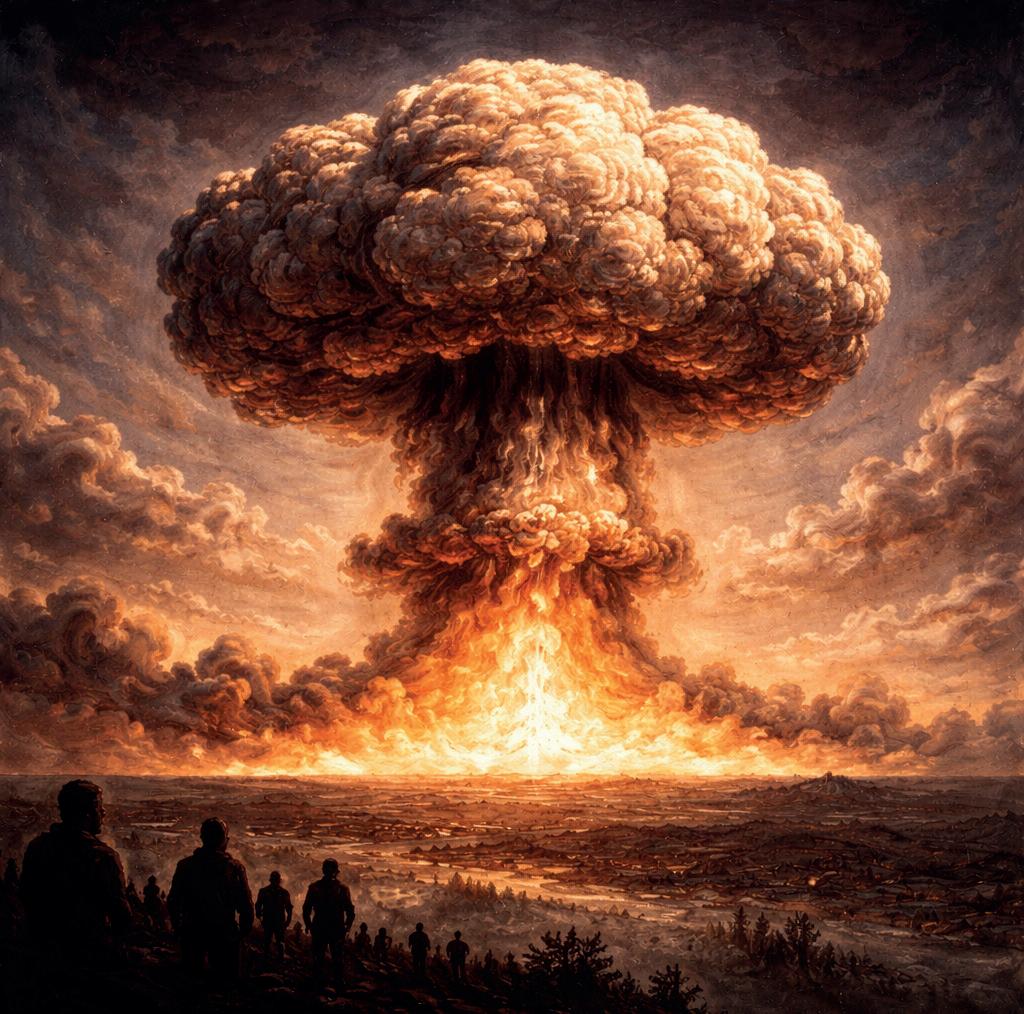
These agreements were never merely about reducing numbers; they ensured transparency, predictability, and communication. Their absence creates uncertainty, and uncertainty in nuclear affairs is profoundly dangerous. Nuclear war is fundamentally different from conventional warfare. Its consequences do not end with destroyed cities or immediate casualties.
Radiation contaminates land, water, and air, rendering vast areas uninhabitable for generations. Agricultural systems collapse, food chains are disrupted, and long-term health crises emerge. Even regions far from the conflict zones suffer through environmental damage, economic shockwaves, and global instability. The most disturbing consequence lies in what nuclear war does to the future of humanity. Radiation exposure damages genetic
Charity from pure earnings Hazrat Abu Hurairah (ra) narrated that Allah’s Messenger (sa) said, “Whoever gives in charity even the equivalent of a single date from pure earnings – and Allah accepts only what is pure – Allah accepts it with His right hand, then nurtures it for its giver just as one of you raises his foal, until it becomes like a mountain.”
(Sahih al-Bukhari, Kitab az-zakat, Bab as-sadaqati min kasbin tayyibin, Hadith 1410)
Prayer and Divine Decree
The Promised Messiah (as) states: “When the grace of Allah Almighty draws near, He furnishes the means that are necessary for the acceptance of prayer. The heart develops a fervour, passion and emotion. However, when a prayer is not meant to be accepted, the heart is unable to feel contentment and inclination. No matter the extent that a person forces their disposition, one is unable to develop focus in prayer. The reason for this is because on certain occasions, God Almighty desires for us to submit to His decree, whilst on other occasions, He accepts our prayers. Therefore, until I perceive signs of God’s permission, I have little expectation of a prayer being accepted. I become content with the decree of God and feel even more joy than that which is experienced on the acceptance of prayer, because the fruits and blessings that are received in being content with the will of God are far greater.”
(Malfuzat [English], Vol. 2, pp.174)
Hazrat Mirza Ghulam Ahmadas, In His Own Words
This Week in History
- 16 April
Muslim Jamaat
10 - 11 April
10 April 2017: On this date, whilst in Germany, Hazrat Khalifatul Masih V (aa) inaugurated the Aafiyat Mosque located in the city of WaldshutTiengen. This mosque is historic in the sense that it is the 50th mosque of the Ahmadiyya Muslim Jamaat in Germany.
Marking the opening of this mosque, a special reception was held, which was attended by 110 dignitaries and guests.
In his address, Huzoor (aa) explained the purpose of mosques and explained the beautiful teachings of Islam. (“50th Ahmadiyya Mosque in Germany opened in Waldshut-Tiengen by Head of Ahmadiyya Muslim Community”, www. pressahmadiyya.com, 13 April 2017)
11 April 2006: On this day, Hazrat Khalifatul Masih V (aa) arrived in Australia on his first visit to the country. Huzoor (aa) arrived in Masjid Baitul Huda and inspected the mosque. (Al Fazl International, 12 May 2006)
11 April 2014: Khutbah-e-Ilhamiyyah (The Revealed Sermon) was delivered by the Promised Messiah (as) on 11 April 1900 at the Aqsa Mosque in Qadian. On this day, 11 April 2014, in his Friday sermon, Hazrat Khalifatul Masih V (aa) explained the details of this grand sign and shed light on its greatness. (Khutbat-e-Masroor, Vol. 12, pp. 218-233)
12 April
12 April 1920: On this day, Hazrat Musleh-e-Maud (ra) was in Sialkot and delivered an hour-long speech in the Punjabi language, particularly addressing the Lajna. This speech was later published and titled Faraiz-e-Masturat. (Tarikh-eAhmadiyyat, Vol. 4, p. 255)
13 April
13 April 1891: On this day, the Promised Messiah (as) wrote a letter to his Companion, Hazrat Munshi Rustam Ali (ra). This fortunate person was the deputy inspector at the railroad police, Lahore and had a close relationship and was in regular contact with the Promised Messiah (as). In this postcard, Huzoor (as) reminded this trusted Companion to buy and dispatch a certain English remedy from merchants in the cantonment area of Jalandhar. (Maktubat-e-Ahmad, Vol. 2, p. 577)
13 April 1970: On this day, during his tour of Africa, Hazrat Khalifatul Masih III (rh) met the then Head of State of Nigeria, Yakubu Gowon. Huzoor (rh) also addressed a gathering arranged at the University of Ibadan. (Tarikh-eAhmadiyyat, Vol. 26, pp. 43-44)
14 April
14 April 1887: On this day, the Promised Messiah (as) wrote a letter to Hazrat Hakeem Maulvi Noor-ud-Deen (ra). In it, among other important matters, Huzoor (as) informed him that today he was sending him five copies of his latest book, Shahna-e-Haq, along with one part of the Rigveda through recorded-delivery post. (Maktubat-eAhmad, Vol. 2, p. 31)
The details of this meeting have already been published in our article, titled “Coming from every distant track: Sir Maharaja Yadavindra Singh of Patiala visits Qadian” in Al Hakam, 23 July 2021, Issue 175, p. 13.
15 - 16 April
15 April 1922: The first Shura of the Jamaat was held at Talim-ul-Islam High School, Qadian, on this day. Taking part were 52 delegates from various regions of India and 30 delegates from the Markaz
For more details, see “First Majlis-e-Shura” at alhakam.org (29 June 2018, p. 3).
15 April 1949: On this day, the first-ever Jalsa Salana Rabwah took place. Hazrat Musleh-e-Maud (ra) delivered the inaugural speech and Friday sermon. A Shura session was also conducted after the Isha prayer. The number of attendees reached 16,000. During the speech on the second day of Jalsa, Huzoor (ra) announced a concise scheme consisting of printing and distributing books for the educational uplifting of Jamaat members. This idea shows Hazrat Musleh-e-Maud’s (ra) outstanding and firm resolution as the whole country was still coping with the scars of the 1947 partition. (Tarikhe-e-Ahmadiyyat, Vol. 12, p. 174)
16 April 1939: Sir John Douglas Young, Chief Justice of the Lahore High Court, visited Qadian on this day. (Tarikhe-e-Ahmadiyyat, Vol. 7, p. 621)
16 April 2010:On this day, Hazrat Khalifatul Masih V (aa) delivered his Friday sermon from Baitul Tauheed in San Pietro in Casale, Italy – the first live sermon broadcast from Italy. Huzoor (aa) spoke about Allah’s grace in enabling the Jamaat to build mosques in Europe despite opposition, including local resistance to the mosque in Italy. He urged prayers for removing these hurdles and mentioned hopes for a mosque and a mission house in Rome. (Khutbat-e-Masroor, Vol. 8, pp. 178-187) A glimpse
12 April 1914: On this day, Hazrat Musleh-e-Maud (ra) addressed the representatives gathered at the Mubarak Mosque, Qadian, for a sitting of the Majlis-e-Mushawarat. Huzoor’s (ra) wise words on this special occasion were later printed in book form titled Mansab-e-Khilafat. During this historic gathering, Huzoor (ra) laid the foundation of Anjuman-e-Taraqqi-e-Islam to propagate the message of Islam in the world. (Tarikhe-eAhmadiyyat, Vol. 4, p. 141)
14 April 1941: On this day, Yadvinder Singh Mahendra, the last Maharaja of Patiala, reached Qadian for his two-day visit. Patiala State was a significant princely state in British India that enjoyed a degree of self-governance. It was located near Qadian. The Maharaja was given a warm welcome, and he had the honour of meeting Hazrat Musleh-e-Maud (ra).
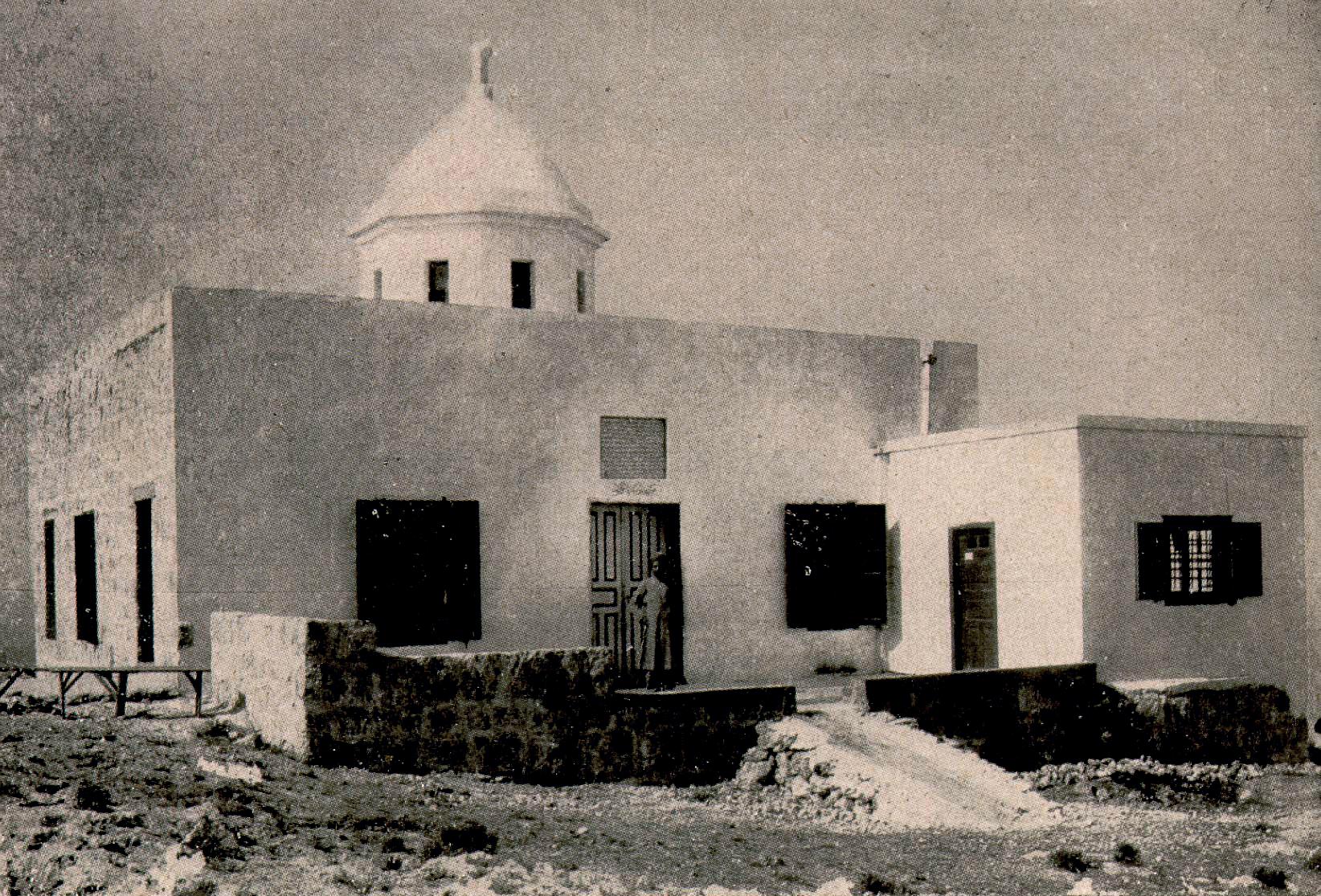
Ahmadiyya Mosque, Kababir
material, increasing the likelihood of severe physical and developmental impairments in children born long after the conflict has ended.
Reflecting on this moral responsibility, Hazrat Mirza Masroor Ahmad, Khalifatul Masih V (aa), has warned:
“If we want our children and future generations to look back at us fondly, rather than with anger that we left them disabled and handicapped, we must act in accordance with the standards of equity I have spoken of. If we fail to do so, then there will be nowhere left to hide and no escape from destruction.
“I purposely used the word ‘disabled’ in terms of the legacy we leave to our future generations. This is because it is extremely likely that if a world war takes place, nuclear weapons will be used. The effects of atomic warfare are beyond our imaginations and will last for generations to come.
“Therefore, the standard of justice I have described needs to be implemented across the board, not just by Muslims, but also by non-Muslims and all nations. No one will be spared the effects of a nuclear war, which will be devastating, because its path of destruction will be impossible to contain. The people of the East, and the people of the West, will be affected.” (“The Critical State of World Peace”, reviewofreligions.org, 30 May 2013)
These realities should deeply concern all societies striving for stability and development. A global nuclear conflict would destabilise economies, disrupt food systems, alter climate patterns, and overwhelm public health infrastructure
worldwide. The burden of such devastation would fall most heavily on vulnerable populations, regardless of their involvement in the conflict.
There is also a profound moral dimension to this crisis. Scientific advancement without ethical responsibility becomes a danger rather than a benefit. Weapons created in the name of security now threaten the very survival of civilisation. History shows that meaningful progress in arms control has often emerged only when leaders confronted the human cost of nuclear war, not merely its strategic calculations.
In this context, Hazrat Mirza Masroor Ahmad (aa) has further observed:
“The threat of a world war is the biggest threat to today’s civilisation. It is a real threat and to prevent such an outcome we will have to think in a fair and just way, so that we can save the world from ruin.” (“The Critical State of World Peace”, reviewofreligions.org, 30 May 2013)
Preventing a nuclear catastrophe requires fairness in international relations, sincere dialogue among rival powers, and a willingness to place humanity above narrow national interests. Restraint, transparency, and cooperation are no longer idealistic aspirations; they are urgent necessities.
Peace is not sustained through fear, but through justice, trust, and moral clarity. If the present generation fails to act responsibly, future generations will not judge humanity by its technological achievements or political strength, but by the disabled lives it leaves behind as a legacy.
(Ihsan Ali, India)
Delegation of Jamaat Niger meets the President of the Islamic Association of Niger
On 6 March 2026, a delegation of Jamaate-Ahmadiyya Niger had a meeting with Mr Djibril Soumaila Karanta, President of the Islamic Association of Niger, at his residence. The delegation was led by Amir Jamaat Niger Asad Majeeb Sahib. Mr Karanta also serves as the imam of the largest government mosque in the country.
During the meeting, Amir Sahib introduced the delegation and presented a brief overview of the beliefs, objectives and peaceful mission of Jamaat-e-Ahmadiyya.
On this occasion, he presented Mr Karanta with a copy of the Holy Quran with a French translation, along with other literature of the Jamaat.
Referring to a recent Friday sermon of Hazrat Khalifatul Masih V (aa), Amir Sahib highlighted that many of the challenges currently faced by the Muslim world, including the situation in Iran and the Middle East, stem from the lack of unity among Muslims and their distance from God. He emphasised that in such circumstances, Muslims should strive for unity and righteousness, standing together against the forces of the Dajjal (Antichrist).
Muhammad Jamal Niger Correspondent
Cosmic cycles and creation: A fresh look at Revelation, Rationality, Knowledge and Truth
Australia
Hazrat Khalifatul Masih IV’s (rh) 1998 work, Revelation, Rationality, Knowledge and Truth, presents a reflective and intellectually engaging discussion on the concept of a cyclic universe, framed through both the Holy Quran and, at that time, the contemporary scientific thought. In exploring the relationship between divine revelation and modern cosmology, he proposes that the universe does not simply begin once and end once; rather, it moves through recurring phases of creation, dissolution and rebirth.
Harmonising scientific evidence with the Quranic perspective
A central theme in the book is the idea of a universal collapse and regeneration. Huzoor (rh) draws upon the Quranic imagery of the heavens being “rolled up like the rolling up of written scrolls” (Surah al-Anbiya, Ch.21:
V.105), suggesting a parallel to scientific notions such as the “Big Crunch,” in which the universe’s expansion eventually halts and reverses into a cosmic implosion. He posits that just as the universe emerged from an initial singularity, this same process may unfold repeatedly as implied from the verse. After collapsing, the universe could be reborn in a new “Big Bang”, initiating another cycle of cosmic evolution. In his view, these recurring cycles underscore God’s attribute as the perpetual Creator, continuously bringing new universes into existence rather than acting through a singular, isolated act of creation. Although Huzoor’s (rh) perspective is rooted in interpreting the verses and predates various contemporary cosmological models, it resonates intriguingly with Sir Roger Penrose’s later proposal of Conformal Cyclic Cosmology (CCC). Both frameworks challenge the notion of a single, absolute beginning to the universe, proposing instead that our known cosmos may be one phase in an ongoing sequence of cosmic epochs.
However, the mechanisms differ: whereas Huzoor (rh) invokes a model similar to the “Big Bounce” or oscillatory universe – where expansion is followed by collapse – Penrose’s CCC avoids a collapse altogether. Instead, CCC envisions an infinitely expanded, low-energy universe that is mathematically rescaled to give rise to a new Big Bang. Despite these differences, both perspectives converge on the profound idea that cosmic history may extend far beyond the confines of a single beginning and a single end. In my humble view, Penrose’s model not only harmonises remarkably well with the verse but may in fact be seen as an advancement upon earlier cosmological interpretations.
We also note that in another verse, Allah has said:
“Allah originates creation; then He repeats it; then to Him shall you be brought back.” (Surah ar-Rum, Ch.30: V.12)
In the 20th century, humankind was able to understand that it all began at one point,
a singularity called “Big Bang”. This was prophesied to be understood by humans one day,
“Do not the disbelievers see that the heavens and the earth were a closed-up mass, then We opened them out?” (Surah al-Anbiya, Ch.21: V.31)
Huzoor (rh) contrasts these Quranic verses with the scientific theories prevalent in the late 1990s. He observes that, at the time, many cosmologists leaned toward a model of perpetual expansion, envisioning a universe that would continue stretching outward indefinitely. In contrast, he highlights that the Quranic narrative alludes to a dramatic reversal of this expansion – a cosmic contraction resembling what modern cosmology terms the “Big Crunch.”
The ever-expanding universe
Brian P Schmidt, an Australian astrophysicist, received the 2011 Nobel
Imran Ahsan Karim-Mirza
Prize in Physics for his role in the dramatic discovery that the universe is not merely expanding, but expanding at an accelerating rate. Before 1998, the prevailing expectation among cosmologists was that gravity would gradually slow the universe’s expansion. However, Schmidt’s observations of distant supernovae revealed a startlingly different reality: the expansion is not decelerating but accelerating. This discovery reshaped modern cosmology, leading to the widely accepted interpretation that the universe will not reverse into a collapse, but will instead continue expanding indefinitely – its growth driven by the mysterious force known as dark energy, potentially culminating in a dramatic “Big Rip.”
“In the Big Rip theory the universe’s rapid expansion will continue accelerating to a point where the universe will travel faster than the speed of light.”
Penrose’s Conformal Cyclic Cosmology (CCC)
Sir Roger Penrose, awarded the Nobel Prize in 2020, introduced an audacious and deeply imaginative cosmological model known as Conformal Cyclic Cosmology (CCC). In this vision, our universe is not a one-time phenomenon that began with a singular Big Bang. Instead, Penrose proposes that what we call “the universe” is merely one aeon in an endless chain of cosmic epochs – each aeon giving way to the next in a seamless cosmic rhythm. This could be as high as the heat-death timescale of 10¹⁰⁰ years.
“Never-ending story : the spacelike crossover is simultaneously the conformal infinity at the end of one aeon and the Big
Bang singularity of the next.”
A central pillar of CCC is Penrose’s reinterpretation of the Big Bang itself. Rather than viewing it as an absolute beginning arising from nothingness, he describes it as a transition from the infinitely distant future of a previous aeon. In this framework, the death of one universe becomes the birth of the next. The Big Bang, therefore, is not an origin point but a boundary linking two consecutive cosmic eras.
To make such a transition mathematically and conceptually coherent, Penrose relies on the idea of conformal rescaling. In the unimaginably distant future – after all stars have burned out, all matter has decayed, and black holes have evaporated through Hawking radiation –the universe will consist entirely of massless particles such as photons. In a world without mass, the notions of scale, size and even the passage of time lose their meaning. Penrose shows that when this scale-free, cold and diffuse universe is mathematically “rescaled,” it becomes indistinguishable from the hot, dense conditions associated with a Big Bang. In other words, the end state of one aeon smoothly transforms into the beginning of the next.
CCC also offers an elegant response to one of cosmology’s persistent puzzles: the low-entropy state of the early universe. According to the second law of thermodynamics, entropy-often understood as disorder-should increase over time. Yet the universe’s beginning appears improbably ordered. Penrose suggests that black hole evaporation plays a crucial role in resolving this paradox. As black holes disappear, they take with them an enormous
amount of entropy, effectively resetting the cosmic entropy level. This cleansing process allows each new aeon to start in a state of remarkable order, consistent with what we observe of our own universe’s early conditions.
Penrose further contends that traces of earlier aeons may still be visible in our universe today, pointing to what he calls “Hawking Points” unusual, localised hot spots in the Cosmic Microwave Background that he interprets as the final radiation bursts from supermassive black holes evaporating in a previous aeon – and to concentric circular patterns in the CMB, which he suggests could be the lingering gravitational-wave imprints of black hole collisions that occurred before our own cosmic cycle began. There is some evidence of his model providing evidence of CCC’s validation. I hope in the future, more research can decisively prove it.
Conclusion
We know an attribute of Allah, known as the “Originator”, as a verse states:
“[He is] the Originator of the heavens and the earth.” (Surah al-Baqarah, Ch.2: V.118)
“(Originator) is derived from عدب, which means, he originated a thing or brought it into existence newly (i.e. for the first time, the thing not having existed before) and not after the similitude of anything pre-existing (Lane). The word عادبا (which is the infinitive form of عیدب ), when used about God, means originating a thing without any tool or instrument or pattern and without matter
NEWS
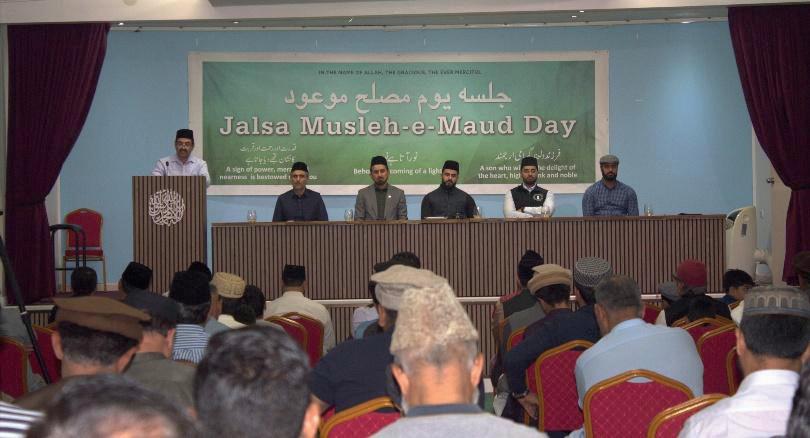
Jalsa Yaum-e-Musleh-e-Maud held in Australia
e-Maud (ra).
Jalsa Yaum-e-Musleh-e-Maud was commemorated across various jamaats throughout Australia in February 2026. Across the country, jamaats held spiritually uplifting gatherings that included recitation from the Holy Quran, poems, presentations and speeches reflecting upon the life and achievements of Hazrat Musleh-
In several locations, the programmes also featured documentary presentations, interactive quizzes and speeches delivered by members of different auxiliary organisations. These contributions enriched the gatherings and ensured active participation from members of all ages while deepening their understanding of the historical and spiritual significance of the prophecy.
Jalsa Yaum-e-Musleh-e-Maud was
(Mufradat). Thus, the word combines the idea of originating and creating.” (The Holy Quran with English Translation and Commentary, 2:118, p. 213)
The prevailing cosmological models suggest that the universe eventually reaches a state in which all matter dissolves into a profound emptiness, only for creation to unfold anew as a fresh beginning emerges from that abyss.
Huzoor’s (rh) perspective, though grounded primarily in the reflective study of Quranic verses and formulated well before many contemporary cosmological models, nevertheless aligns in remarkably thought-provoking ways with Sir Roger Penrose’s later framework of Conformal Cyclic Cosmology. Both views challenge the assumption of a singular, absolute beginning to the universe, proposing instead that our cosmos represents a recurring sequence of cosmic cycles. In doing so, this perspective also stands in contrast to the notion of an endlessly expanding universe inflating into infinity. Seen through this lens, Penrose’s CCC appears to harmonise strikingly with the Quranic proclamation: “Remember the day when We shall roll up the heavens like the rolling up of written scrolls by a scribe. As We began the first creation, so shall We repeat it – a promise binding upon Us; We shall certainly perform it.” (Surah al-Anbiya, Ch.21: V.105)
Such resonance reveals a compelling convergence between Quranic insight and modern cosmological thought, encouraging a deeper appreciation of the universe as a dynamic, recurring creation.
Jalsa Yaum-e-Masih-e-Maud held across jamaats in the Philippines
Zaki Ahmed
National Sadr, Jamaat Philippines
Jamaat-e-Ahmadiyya Philippines held Jalsa Yaum-e-Masih-e-Maud (as) on 29 March 2026, across various jamaats. Owing to the ongoing fuel crisis, the Jalsa was held online this year, enabling wider participation from members across the country who were able to benefit collectively from its blessings.
Approximately 350 members participated in the Jalsa. Members from Manila joined the proceedings from their homes, while in Zamboanga, Simunul, Mapun and Sigangang, members gathered in mosques to participate in the programme. However, a few jamaats located in the most remote island areas were unable to join the
observed in all Australian states and capital cities, including Sydney (NSW), Canberra (ACT), Melbourne (VIC), Perth (WA), Brisbane (QLD), Adelaide (SA), Darwin (NT) and Hobart (TAS), reflecting the nationwide devotion and unity of the Jamaat.
proceedings due to the absence of electricity and internet facilities at present. In addition, owing to the fuel crisis, travel from these areas was also not possible this year.
The programme commenced with a recitation from the Holy Quran, followed by an Arabic qasida and a speech by my humble self. I explained the significance and purpose of holding Jalsa Yaum-e-Masihe-Maud (as), highlighted some signs of the truthfulness of the Promised Messiah (as) and shared faith-inspiring incidents demonstrating the Promised Messiah’s (as) love for humanity, brotherhood and hospitality. The speech was translated into the Sama and Sinama languages as well.
The Jalsa concluded with a silent prayer led by Felan Heding Sahib, a mu‘allim
Attendance across these programmes demonstrated strong engagement, with over 2600 members participating in major centres as well as participation in smaller jamaats
Hamaad Ahmad National Tarbiyat Team, Jamaat Australia
The neuroscience of prayer: How prayer rewires our brain
Samar Hafeez Consultant psychologist, India
Scholars and scientists in recent times have been endorsing the potent and positive effect that spirituality and spiritual practice have to offer to our overall well-being. Researchers have explored the constructive impact of spirituality on mental health. Applied spirituality is getting increasingly recognised in psychiatric literature as both a preventive and a healing strategy.
Spirituality is defined as something consisting of or having the nature of spirit and it is something that is intangible or immaterial in nature. The word “spirit” originates from the Latin term “spiritus”, which means “to breathe” or “to blow”.
The spiritual realm mainly deals with questions around man’s ultimate nature and objective of life, as well as the motive of the universe. In addition, spirituality involves a connection to something greater than oneself, which includes an emotional or transcendental world and therefore can be a person’s experience of and relationship with a fundamental, self-sustaining and non-material aspect of the universe that is referred to as God.
The role of spirituality in overall health is significant. Its ability to foster a sense of purpose and direction in life and to facilitate and format various goals, aspirations, values and actions, which are some of the integral aspects of the psychotherapy process across diverse schools of thought and treatment, appears to be invaluable.
Why is prayer important?
Prayer (solo or congregational) is a part of spirituality that aims at developing communion with God. It enhances our experience in the realm of our spiritual quest and serves as a vital tool for anyone who has a desire to progress in spirituality. It is an act of communicating with a higher power, which drives us towards realising and materialising our intentions and thoughts towards understanding the meaning, purpose and role of our existence.
Prayer can be a set of words or a spontaneous, heartfelt appreciation or conversation. Whatever the form might be, it is assuredly a transformative act that helps us reflect on our strengths, shortcomings and how we relate to ourselves and others daily, forming the crux of a healthy overall functioning.
Apart from helping us align with higher values, it also propels us towards productive behaviours and actions that contribute to our psychological, societal and physical well-being, proving to be an effective tool for redemption.
Additionally, prayer is not to be considered as a passive act, but rather an active procedure that provides us with guidance through which we achieve everything that we could possibly achieve.
Moreover, it serves as an anchor that stabilises our life, offers hope, rejuvenates our spirit and vitality and helps us navigate through difficulties, challenges and recovery.
Prayer, meditation and psychological well-being
Better psychological outcomes have been achieved when traditional psychotherapy integrates some spiritual, religious and/ or community-based strategies into its treatment protocols. Prayer as a tool to uplift mental health has been shown to enhance emotional resilience, especially by helping individuals cope with stress, anxiety, loneliness, trauma, hopelessness, depression, reduce attentional bias and even suicidal ideation among people who participate in spiritual practice that includes offering regular prayers.
Furthermore, research has shown that spirituality and prayer build a sound moral compass and a trajectory towards emotional
support, there is a shift in our psychological states that eventually influences our behaviours and interactions. As a result, our actions, decisions, and responses are shaped.
Meditation and mental health
Meditation is another popular form of practice that is studied to be an effective tool to reduce or alleviate mental and emotional distress among people across all age groups. Prayer and breath control exercises, which are also known as mind-body exercises, have immense therapeutic value. Integrating these in psychotherapeutic frameworks has shown better treatment outcomes.
A very specific type of meditation called mindfulness meditation has shown promising results in enhancing positive emotions and mental clarity. It serves as a buffer in reducing distressing thoughts and feelings from taking over your life.
Mindfulness meditation cultivates a state of calmness and awareness by
stability among youth. It enhances their decision-making capacity, lowers the stress around academic pressures and reduces cognitive dissonance (psychological tension between conflicting feelings and ideas) that occurs as a result of facing certain difficult situations in life.
Moreover, youth who believe that they are a part of a greater spiritual and community plan have a greater self-efficacy, may foster healthy social connections and are free from the negative influences of existential crises and aimlessness. Interestingly, religious beliefs and practices can help in protecting mental health by reducing the risk for substance use disorders and criminal behaviour among adolescents.
When we offer prayer as a means of
encouraging an individual to focus on the present moment. Mindfulness-based practices can break the cycle of rumination and negative thinking patterns – both of which are linked to the development of mental health complications such as depression and anxiety.
Prayer is a powerful form of mindfulness meditation when performed with dedication, presence, and focused intention. As a matter of fact, prayer and meditation are two sides of the same coin, serving a similar purpose.
Mindfulness in Islam is practised through zikr (remembrance), dua (supplication), istighfar (seeking forgiveness), contemplating his creation (tafakkur), and muraqaba (awareness of Allah and spiritual self). Incorporating
these behaviours and attitudes on a daily basis serves as an efficient and effective countermeasure for anxiety, anger, sadness and stress.
Neuroscience of prayer and meditation
The brain is a complex human organ that also regulates important body functions such as breathing, motor functions, vision, hunger, satiety, temperature, etc. It is also the control centre of our thoughts, emotions and behaviours.
Through understanding the inner workings of the brain, we can analyse how the brain processes complex information (both sensory and emotional), regulates emotions and directs behaviour(s).
Are we hardwired for spirituality?
It is exciting to know that just like a computer is hardwired with electrical connections, the brain is hardwired with neuronal connections. Neuroscience, psychology, and theology are exploring the neuronal and/or biological basis of prayer and meditation. They are hopeful that the research findings related to the functions or workings of the nervous system could be applied to the modern-day treatment protocols.
The latest interdisciplinary field within neuroscience, called “neurotheology” has begun its research around investigating the relationship between the human brain and spiritual/religious practices. It began its research on how brain activity/functioning relates to spiritual experiences such as prayer or deep meditation. Scientists are making their first attempts to understand spiritual experience and what happens in the minds and bodies of people who believe they connect with the Divine. Interestingly, neurotheology has been drawing its inspiration and understanding from the fastest-growing religion in the world, which is “Islam” due to its highly structured and consistent forms of spiritual worship.
How do prayer and meditation improve brain health and mental well-being?
“Those who believe, and whose hearts find comfort in the remembrance of Allah. Aye! it is in the remembrance of Allah that hearts can find comfort.” (Surah ar-Ra’d, Ch.13: V.29)
Prayer activates the parasympathetic nervous system
The parasympathetic nervous system, also known as the “rest and digest” state, counters the stress response in the body and induces calm and peace. Consistent, deliberate and focused repetition of words and rhythmic postures along with controlled breathing reduces cortisol levels
Continued on page 8
My struggle with Umrah: How everyone experiences spirituality differently
USA
I’ve heard a lot of people describe how emotional they were when they first saw the Ka‘bah. You’ve probably heard people’s experiences as well. However, these experiences reach us through a survivorship bias, because the people who didn’t have such an inspiring experience would not be as motivated to tell their story. I ended up with expectations that set me up for disappointment. I’ll share how I suffered in that disappointment so perhaps you won’t have to.
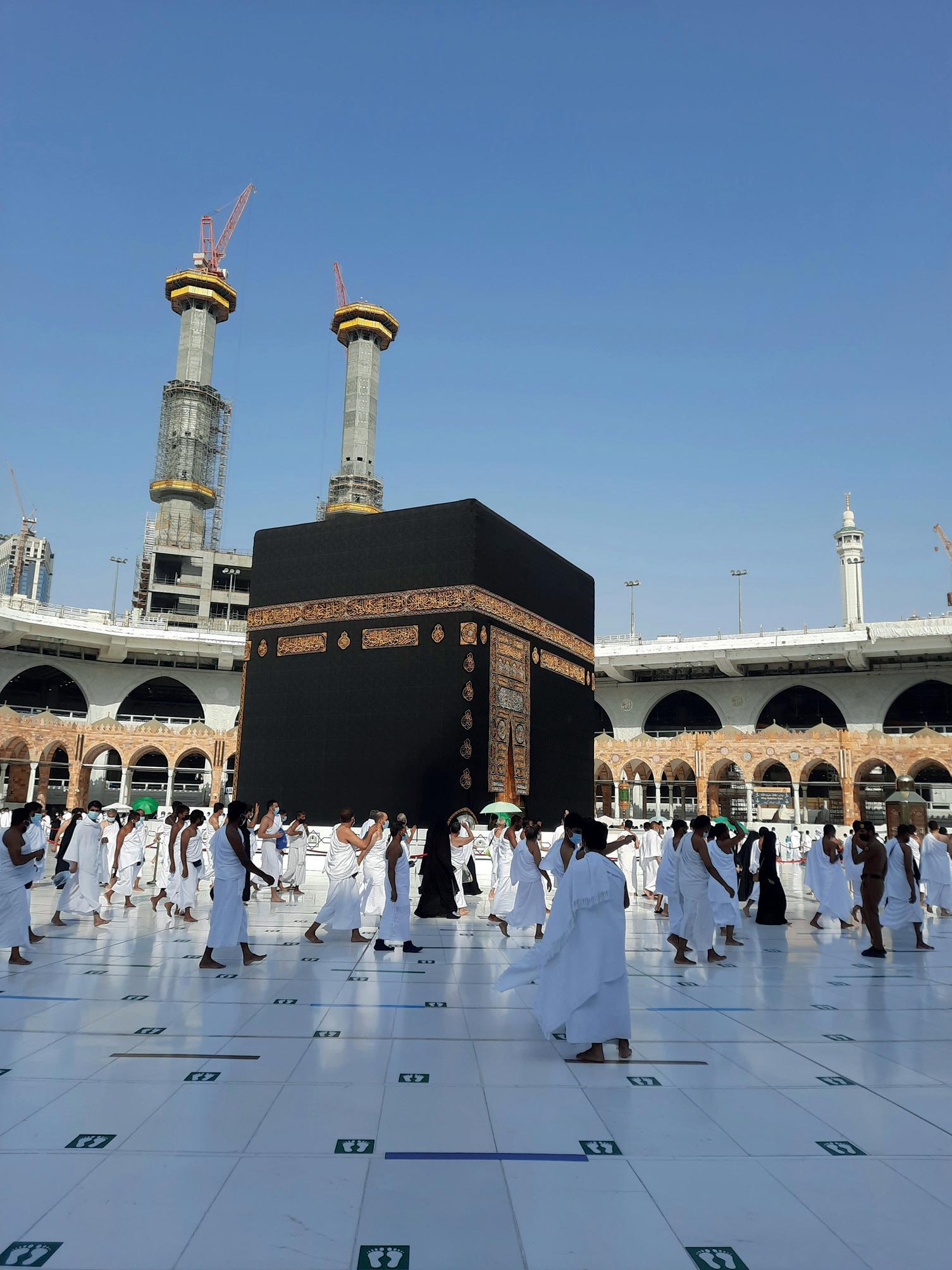
When I first saw the Ka‘bah, I wanted to feel emotional. I wanted to feel all the emotions people had described, but I didn’t. Someone had told me that pictures cannot capture what it’s like to actually see the Ka‘bah for the first time. But when I saw it, I couldn’t help but think this is exactly what it is in pictures.
It’s not that I was unfamiliar with the feeling they were describing. I had seen in dreams that I was approaching the Ka‘bah and crying at seeing it for the first time. I knew the feeling, but I just didn’t feel it when I physically saw the Ka‘bah for the first time. Several of the people I was with felt overwhelmed at first seeing the Ka‘bah and stood crying and praying. I sat to the side feeling inadequate, and being with people who knew me made me self-conscious of that inadequacy. I came all this way and had a once-in-a-lifetime experience, and felt I wasted it.
When I began the tawaf, I thought it would be better. I was looking forward to expressing my love to Allah the Almighty by circling the Ka‘bah. But as I did tawaf, I became increasingly disappointed in myself as I realised that I wasn’t feeling what I thought I should feel. I was distracted by how to navigate the crowd, by people bumping into me, and by how uncomfortable and out
of my element I was. By the time I finished tawaf, I felt confused by how chaotic it was, and how I felt I hadn’t gotten anything out of it. I didn’t know what was wrong with me. I tried to ignore a painful feeling I didn’t want to think about: the thought that I actually wanted to go home now and not stay for the rest of my days here. I kept thinking of something the Promised Messiah (as) had said:
“Some people go to Hajj. At that time there is great fervour and sincerity in their heart, but it has often been seen that the zeal and warmth with which they go, they do not return with that same zeal and sincerity. Rather, when they come back, they often become worse than before.
“It is easy to go with veneration, but it is hard to come back with veneration.
“Upon return, there is no significant change for the better in their morals; rather, that change becomes a change for the worse. Before they go, they think that there will be a magnificent manifestation of light in the Ka‘bah and blessings and light will be pouring forth therefrom and there will be a population of angels there, but when they go there, what they see is that the Ka‘bah –which they have pictured in their mind and imagination to be something else – is just a building […]
“There is absolutely no doubt that the House of the Ka‘bah is the site of manifestation of illumination and blessings and there is no question or doubt about its greatness. Its greatness is also mentioned in the earlier scriptures, but these manifestations, light, and blessings cannot be seen by the external eye. Another eye is needed for this. If that eye is open, then surely a person will see what kind of blessings are descending in the House of the Ka‘bah.” (Malfuzat, Vol. 7, pp. 426-427)
That night when I laid down, I pulled my blanket over me so no one could see my face and went to sleep in sadness. It had been a terrible day.
The next day I went for tawaf again. I thought that the previous day’s tawaf may have been affected by the fact that I was jet-lagged and disoriented, and also that I was with other people. This time, if I did it with privacy from people who knew me, and in a different state of mind, I’d be able to appreciate it better.
But as I made my second attempt, I felt similar to the way I had the previous day and my heart felt closed. I was trying to get involved, trying to force myself to feel what I was supposed to feel, but it wasn’t working. Eventually, at one point during tawaf I remember looking around and thinking, “I just don’t like this.” It wasn’t because of the jet lag or the fatigue or the people I was with, it was just because of me. The previous
day I felt lost because I didn’t know what tawaf was, and today I realised I felt lost despite knowing what tawaf was. I prayed to Allah, “I can’t hide that I don’t like tawaf, but I can’t change it to be what I want it to be, so change me to be what you want me to be.” The only thing that made me emotional was expressing the helplessness of my condition in the two rak‘ahs after tawaf
The fact that I didn’t like it made me want to do it more. I wanted to figure it out. As a start, I at least wanted to feel emotional during tawaf, but my heart wouldn’t budge. So I came up with a way that I knew would work, and prayed to Allah as a child would say in naive innocence, “If it is possible for me to force You to do something, then now I will force You to open my heart.” I decided to do the next Umrah on behalf of my mother.
Although I devoted my life for my own purpose, my mother had devoted my life before I was born and her sense of purpose in devoting me is much stronger than mine. I have never wavered in my Waqf, but I imagine if my resolve ever did waver, the strength of the resolve with which she sent me forward would not allow me to take one step back. For my trip to Umrah, she had bought my ticket and sent me with hopes and expectations. The thought that I was wasting my trip because of my weaknesses was hard to bear so far, but the thought that I was wasting the hopes and efforts with which she had sent me was a thought I could not bear. During this Umrah, I prayed for her and begged Allah the Almighty to accept my Umrah on her behalf for her sake, and that my failures not affect her.
In this Umrah, I experienced what I felt I had been missing and was emotional throughout. However, I also realised that my purpose is not just to feel emotional. While being emotional is one sign of acceptance from Allah, it is not our purpose. I needed true acceptance, not just a sign of acceptance that I could create from within myself; after all, even misguided people can become emotional when praying. The Promised Messiah (as) explained:
“Remember that if a person at one time happens to experience true immersion and fervour and pleasure in Prayer and remembrance of Allah, it does not prove that he has a true relationship with God, the یمحر [Rahim – Merciful] [...] for there is a whole separate set of signs and indications that would prove the link.” (Barahin-eAhmadiyya, Part V, p. 271)
I was tired of chasing after a sensation. It was the crippling need for a sensation that had gotten me into this mess in the first place. Having heard so much about the emotions people felt upon seeing the Ka‘bah and performing the pilgrimage, I had focused too much on what I thought I was supposed to be feeling.
It was only after having felt the emotions I was looking for that I realised how shortsighted I was being. I submitted to Allah and prayed, “I’m tired of chasing after a sensation, I don’t want this need to feel a certain feeling anymore. I’m only looking for Your acceptance, whether it comes with a feeling or not.”
There is a pattern I always find myself repeating in spirituality, where I start by relying on my own efforts, then eventually reach a breaking point, then give up on relying on my efforts and helplessly submit
Rizwan Khan Missionary,
to Allah. The starting point is always different, but the ending point is always the same – falling helplessly into submission to Allah the Almighty. The same repeated itself in my experience with Umrah. My confusion with Umrah only went away once I accepted that I was completely lost, that I needed Allah to catch me as I was falling.
This would be the end of the story if I were talking about Salat, because Salat is an expression of humility and submission. However, tawaf is fundamentally different from Salat and has a different ending point. Describing the difference between Salat and Hajj, the Promised Messiah (as) wrote:
“Worship is of two kinds: (1) one is humility and submission; (2) the other is love and self-sacrifice.” (Chashma-e-Marfat, Vol. 23, p. 99)
The height of Salat is in offering submission with humility in our prostration. However, the height of love is expressed in tawaf, which the Promised Messiah (as) described as such:
“And such a command was given so that a person may physically express the passion of love. Thus, those who perform Hajj circle around that House in such a manner as if they are intoxicated with the love of God. They remove their adornments, shave their heads, and taking on the appearance of spiritual ecstatics, perform loving circumambulation around His House. They kiss that stone while considering it to be the stone of God’s threshold. This physical fervor gives rise to spiritual warmth and love. The body circles around that House and kisses the threshold stone, while at that moment the soul circles around the True Beloved and kisses His spiritual threshold.” (Ibid., p. 100)
For Salat, we carefully look for a place of solitude, we dress comfortably and we make the optimal environment before we comfortably start our Salat. However, in the passion of love, we let go of control and none of these things matter. For example, when the final session of Jalsa Salana concludes, and after having spent hours sitting in Huzoor’s (aa) presence, when he says goodbye to us before leaving the hall, we feel a passion to express our emotions. At that time, we push forward and wave to him and try to express our love. In that moment we’re not bothered if we’re crowding into people or if people are bumping into us. We don’t worry about how we look in front of people at that moment – we just want to express our love.
Expressions of passion come naturally to some types of people and with difficulty to other types. In order to do tawaf as it is meant to be done, we have to let go of inhibitions in expressing our love for Allah.
In my last Umrah, aside from the prescribed words and prayers for specific parts of tawaf, I only expressed my love for Allah the Almighty. I raised my voice and told Allah that I loved Him as I circled the Ka‘bah, even though I felt shy in doing so. I raised my hands and freely begged Him for His love. I declared my loyalty and expressed how I was His and only His forever.
It was during this Umrah that I understood why men and women circle the Ka‘bah together. Before, when I was doing tawaf out of humility and submission, I was always aware of women around me and trying to avoid them or looking at
them. However, when doing tawaf while only declaring love for Allah, there was no question of being distracted by any woman. To be declaring love for Allah on one hand and to be distracted by any other attraction are so opposed that they cannot possibly exist simultaneously. In this tawaf, there was no question of needing to avoid being distracted by women because their presence was no longer a factor.
In this way, tawaf of the Ka‘bah is a type of worship in Islam that cannot be replicated anywhere else in the world. It stands as an example of how the expression of love can create an exception to what is the rule everywhere else.
Looking back, the reason I had struggled so much with Umrah was because, up until then, I had been doing Umrah within my comfort zone. I had been doing Umrah in the way I do Salat: with humility and submission. However, expressing love requires confidence. Perhaps this is why the practice of raml (walking quickly to show one’s strength) during the first three circuits around the Ka‘bah continues for all time. Pilgrimage is a different type of worship from Salat. The only way to do it is to express our passion and love without inhibition. For someone like me, who is introverted and of a dry philosophical disposition, it was inevitable that I would struggle with Umrah. I had set myself up for disappointment the moment I compared myself with the experiences of people who have a disposition of love, people who are easily able to express their love spontaneously.
There are many people who feel an immediate affinity with tawaf, in the same way that there are many people who feel an immediate affinity with Salat or Fasting. However, there are also many of us who initially struggle with Salat or Fasting before we can see what others see. The same is true with tawaf
Hazrat Musleh-e-Maud (ra) wrote:
“Then Allah the Almighty says: ‘And whoso performs a good work with willing obedience, it is better for him.’ (Surah alBaqarah, Ch.2: V.185)
“Whoever performs any good deed with full cheerfulness and eagerness, even if at the beginning he does it with some effort and feels it as a burden on himself, the result will still turn out well for him. That is, such goodness will ultimately produce the best results for him. In the Arabic language, the word tatawwuʿ (عوطت) is used when a command is obeyed by placing a burden upon one’s self and when cheerfulness is expressed with effort (Mufradat). Thus, in the words ‘And whoso performs a good work with willing obedience, it is better for him,’ Allah the Exalted has drawn attention to the fact that a person who is unable to participate in a good deed with complete openness of heart should at least take part by compelling himself and by deliberately showing cheerfulness on his face. The result will be that Allah the Exalted will open for him the paths of goodness and blessings. In other words, as he continues to progress in good deeds, he will eventually reach such a stage that righteousness will become his nourishment, and acting upon righteous impulses will become as easy for him as it is for believers of the highest rank.” (Tafsir-eKabir, Vol. 2, pp. 186-187)
Continued from page 6
in the body and stimulates the vagus nerve, thereby controlling blood pressure, anxiety and heart rate, improving digestion, better sleep quality and reducing inflammation.
Activation of brain regions that are involved in emotional regulation, attention and empathy
Research using SPECT (single photon emission computed tomography) and fMRI (functional magnetic resonance imaging) scans shows that prayer – especially during prostration – increases activity in the prefrontal cortex (responsible for executive function, attention and impulse control) and reduces activity in the amygdala (responsible in processing emotions such as anxiety, aggression and fear), leading to better emotional regulation and better decision making capacity. Furthermore, deep meditation and prayer have been linked to decreased activity and blood flow through the parietal lobe (this part of the brain enables spatial awareness and handeye coordination), which is associated with a reduction in the sense of self and a greater sense of connection to a higher power.
A counter to mind-wandering, daydreaming and rumination
“O ye who believe! remember Allah with much remembrance.” (Surah al-Ahzab, Ch.33: V.42)
The default mode network is a set of interconnected regions of the brain. It is known to be activated when a person is engaged in ruminating on past experiences, or thinking about themselves and/or imagining future events and it typically gets deactivated when we engage in more focused goal-directed activities. DMN also plays a role in creating a coherent self-talk (internal narrative), which is vital to the establishment of a sense of self. Intentionally focusing on the repetition of Quranic verse and structured contemplation on its meaning, along with physical movements within a prayer or meditation, results in decreased DNM activity
The hypothalamic-pituitary-adrenal axis (HPA)
HPA is the primary neuroendocrine system that is activated by stress, causing stress hormones to be released in the bloodstream. Chronic activation of this system can lead to various physical and mental health issues such as metabolic disorders, infertility, anxiety, and depression.
Furthermore, prayer and mindfulness meditation have great potential to modulate the HPA axis, lower cortisol levels and promote serotonin production in the brain.
Boosts serotonin and dopamine production
“He it is Who sends blessings on you, as [do] His angels, that He may bring you forth from all [kinds of] darkness into light. And He is Merciful to the believers.” (Surah al-Ahzab, Ch.33: V.44)
Prayer acts as a mental practice that boosts the release of “feel-good hormones” named serotonin and dopamine. While serotonin is a neurotransmitter that
influences mood, cognition and emotional regulation, dopamine activates the pleasure and reward system, which reinforces spiritual practices and provides a sense of satisfaction, motivation and achievement. Low levels of dopamine and serotonin in the brain are known to initiate and maintain depressive symptoms in an individual.
Regular prayer and meditation have a replenishing effect on the feel-good hormones and increase their availability, thereby making an individual emotionally resilient to pressures and disappointments and less reactive to stress over time.
Self- directed neuroplasticity: The brain’s ability to restructure and reorganise itself by forming new neuronal connections
Does prayer literally change the structure and function of our brain?
The answer is: Yes, it can!
Regular prayers induce neuroplasticity by strengthening neural pathways and by causing structural changes within the brain regions associated with focus, emotional regulation, decision-making, compassion, memory and language. It is a well-known scientific fact that each and every intended behaviour, action or thought that is repeated tends to strengthen a neural pathway, causing the behaviour or thinking pattern to become habitual.
It was found in a neuroimaging study that individuals who practised mindfulness meditation for eight weeks showed an increase in gray matter (which plays a key role in memory, intelligence, emotional processing and perception) concentration within the hippocampus (responsible for memory, motivation and learning), and decreased matter in the amygdala (responsible for stress and fear).
Islamic prayer with its structured recitations, deep contemplations, moments of observations and slow rhythmic physical movements, fulfils the same conditions used in the neuroscientific studies on mindfulness. Hence, empowering us to develop focused attention, gratitude, empathy, a sense of calm/peace, improve memory, emotional balance, and foster prosocial behaviours and brotherhood.
Furthermore, lifelong prayer can lower the risk for cognitive decline and improve the quality of life of people with dementia and their caregivers by enhancing resilience to stress-related issues, improving social interaction and mental stimulation.
Integrating prayer and meditation can be a great addition to a traditional mental health treatment regimen. Apart from its wonderful brain health benefits, formal prayers serve as a faith-based exercise/ workout that rejuvenates cardio-vascular health, immunity, pain tolerance, and greater muscle flexibility and muscular fitness. It helps individuals improve social ties, social well-being, and reduce the susceptibility to loneliness and suicide, thereby providing additional support in further developing various traditional and innovative neuropharmacological and neuroplasticitybased therapies and approaches.
After all, “the function of prayer is not to influence God, but rather to change the nature of the one who prays.” – Soren Aabye Kierkegaard
Mubarak Mosque, Islamabad, Tilford, UK
13 March 2026
The Prophet (sa) as the guardian and teacher of Tawhid
After reciting the tashahhud, ta‘awwuz and Surah al-Fatihah, Hazrat Khalifatul Masih V (may Allah be his Helper) stated:
Two Fridays ago, I discussed the life of the Holy Prophet (sa) and his zeal for Tawhid [the Oneness of Allah]. Indeed, he was sent with the objective of establishing this. This zeal was not only manifested through his words and actions, but he also instilled this unparalleled spirit and zeal for Tawhid within his Companions and those who followed him, and to remain ever prepared to make every sacrifice for the sake of Tawhid
Today, I will continue discussing this very aspect of the life of the Holy Prophet (sa), and some of the sacrifices made by the Companions in this regard will be mentioned as well.
It was due to the practical example of the Holy Prophet (sa), his zeal and his prayers that the Companions too were given these ranks and were prepared to offer every sacrifice.
The hardships the Holy Prophet (sa) faced for the establishment of Tawhid are recorded in one narration as follows:
Once, the idolaters said to the Holy Prophet (sa): “Do you not say such and such things about our idols?” The Holy Prophet
(sa) replied: “I do.” Upon this, they gathered around him. At that time, someone said to Hazrat Abu Bakr (ra) to check on his friend. Hazrat Abu Bakr (ra) set out and reached the Sacred Mosque and found the Holy Prophet (sa) encircled by people. Hazrat Abu Bakr (ra) said: “Woe to you people!” He then said, as is also stated in the Holy Quran:
“Will you slay a man because he says, ‘My Lord is Allah,’ while he has brought you clear proofs from your Lord?” (The Holy Quran, 40:29)
Upon this, they left the Holy Prophet (sa) and rushed towards Hazrat Abu Bakr (ra) and started beating him. The daughter of Hazrat Abu Bakr (ra), Hazrat Asma’, relates that he returned to us in a state that if he touched his hair, it would come out in his hands. That is, they had pulled his hair so forcefully that it had been torn out from the roots. [However,] Hazrat Abu Bakr (ra) kept repeating:
“Blessed are You, O Possessor of Majesty
and Honour.”
In another narration, it is mentioned that these people pulled the blessed head and the blessed beard of the Holy Prophet (sa) so forcefully that many of his hairs fell out. Upon this, Hazrat Abu Bakr (ra) stood up to defend him and said:
“Will you slay a man because he says, ‘My Lord is Allah?’”
Hazrat Abu Bakr (ra) was also crying [as he said this]. At this, the Holy Prophet (sa) said: “O Abu Bakr, leave them. By the One in Whose hand lies my life, I have been sent to them so that I may be sacrificed.” Upon this, they left the Holy Prophet (sa). That is, when they were oppressing and beating the Holy Prophet (sa) and when Hazrat Abu Bakr (ra) came in between, at that moment the Holy Prophet (sa) said to leave them. (Al-Sirah al-Halabiyyah, Vol. 1, Dar AlKotob Al-Ilmiyah, Beirut, 2002, p. 417)
Similarly, a narrator named Harith bin Harith al-Ghamidi saw injustices against the Holy Prophet (sa). He asked his father, “Who are these people?” This is not a single
incident; countless incidents of this nature occurred. These are similar incidents, but many people witnessed and narrated them. There are multiple narrators. Some gave detailed accounts and some gave fewer details. In any case, when he saw this and asked his father who these people were who were committing injustices, his father replied that “These people had gathered around their Sabi.” The people of Mecca used to mockingly call the Holy Prophet (sa) and the Muslims “Sabi.” The narrator says that “When we also dismounted from our ride, we saw that the Holy Prophet (sa) was calling people to the Oneness of Allah the Exalted, inviting them to believe in Him, and they were rejecting him and were harming him until midday, and the people finally left him.” (Al-Mu’jam al-Kabir, Vol. 3, Al-Harith bin al-Harith al-Ghamdi, Hadith 3373, Ibn Taimiyah Publishers, Cairo, p. 304)
Mention of injustices against him is found in several books of history. Extracting from these, Hazrat Musleh-e-Maud (ra) has also narrated such incidents. In Introduction to the Study of the Holy Quran”, he writes in one place that “Once the Holy Prophet
(sa) was passing through the market when a group of miscreants in Mecca came near him, and throughout the road they kept slapping his neck, saying, ‘People! This is the man who claims that he is a Prophet.” Stones were continuously thrown at his house from the neighbouring houses. Filthy things were thrown into his house. Even into the places where food was cooked, filthy things were thrown, including the intestines of goats and camels. When he stood in prayer, dust was thrown upon him (dirt was thrown over him) until he was forced to hide under a rock that protruded from a cliff in order to offer his prayer. (Dibacha Tafsirul Quran, Anwar-ul-Ulum, Vol. 20, p. 198)
But thousands upon thousands of salutations be upon the blessed person of the Holy Prophet (sa), that the passion which surged in his chest for the establishment of God’s Oneness never diminished even for a single moment, and he accepted all these hardships as though with a smile of cheerfulness (with great happiness). And even then, there was not the slightest decrease in his compassion and love for mankind.
Hazrat Musleh-e-Maud (ra) has also written that “When we look at the incidents of the Holy Prophet’s (sa) life, we see this claim manifesting as reality before us, and at every step we witness such incidents that testify to the immense love and compassion which he possessed for the whole of mankind. Thus, in order to convey the message of the One God, he had to pass through endless hardships for many years. Once, in the Ka‘bah, the disbelievers placed a cloth around his neck and tightened it so severely that his eyes became red and began protruding. When Hazrat Abu Bakr (ra) heard this, he came running and, seeing the Holy Prophet (sa) in such a state of suffering, tears came into his eyes, and while pushing those disbelievers away, he said, ‘Fear God! Are you committing oppression against a man merely because he says, “God is my Lord”?’” (Tafsir-e-Kabir, 2023, Vol. 9, p. 316)
On one occasion, the Holy Prophet (sa) stood in the Sacred Mosque and, addressing the polytheists of Mecca, he said, “Declare that there is none worthy of worship except Allah, and you will succeed (if you say this).” Upon hearing this, the Quraish fell upon the Holy Prophet (sa). A man came shouting loudly (intending to attack him), but Harith bin Abi Halah reached the Holy Prophet (sa) first. Harith began fighting those people and separated them from the Holy Prophet (sa). Then all of them fell upon him until they martyred him (Harith). (Imta’ al-Isma’, Vol. 6, Dar Al-Kotob AlIlmiyah, Beirut, 1999, p. 297)
As a punishment for proclaiming God’s Oneness, the disbelievers of Mecca also confined the Holy Prophet (sa) and his family for three years in the valley of Abu Talib. They confined them in such a manner that every form of social boycott was enforced.
And when this boycott ended, on the one hand, the Holy Prophet (sa) once again began preaching God’s Oneness throughout Mecca with even greater determination and courage than before (spreading the message of the Oneness of God more widely than ever before). On the other hand, the Quraish began committing injustices against
the Holy Prophet (sa) again.
His journey to Ta’if is also a famous incident, and has been narrated many times previously. The oppression inflicted upon him there has also been described in different ways in historical accounts. Regarding this, Hazrat Mirza Bashir Ahmad Sahib (ra) has also written about it and narrated the incident in the following manner at one place:
“When the ban (on the valley of Abu Talib) was lifted, and the Holy Prophet (sa) found a sort of freedom in his movements, he decided to visit Ta’if and invite its people to Islam. (This has been mentioned previously, but there are further details here.) Ta’if is a famous place situated forty miles to the south-east of Mecca. During this era, it was home to the Banu Thaqif. Putting aside the speciality of the Ka‘bah, Ta’if was recognised as equal to Mecca and many eminent, influential and affluent people resided there. The people of Mecca themselves admitted to the importance of Ta’if. As such, it was the very Meccans who said (as is mentioned in the Holy Quran):
“‘Why has not this Quran from God been sent to some great man of Mecca or Ta’if?’
“Therefore, in Shawwal of 10 Nabawi, the Holy Prophet (sa) took a journey to Ta’if by himself. On the authority of other narrations, Zaid bin Harithah (ra) also accompanied him. Upon his arrival, the Holy Prophet (sa) remained there for ten days, and one after another, he met with many chieftains, but like Mecca, it was not in the destiny of this city to accept Islam either. Therefore, all of them refused; as a matter of fact, they mocked the Holy Prophet (sa).
“At last, the Holy Prophet (sa) approached the grand chieftain of Ta’if named ‘Abd Yalil and invited him to Islam, but he also refused, rather, in a manner of mockery he said, ‘If you are truthful, then I have not the strength to speak to you, and if you are a liar, then to speak to you is useless.’ (This is the answer he gave to the Holy Prophet [sa].)
“Then, concerned that the youngsters of the city may become influenced by the Holy Prophet (sa), he said, ‘It is best that you leave this place, for there is nobody here who is willing to listen to you.’
“After that, this evil man had the miscreants of the city start off behind the Holy Prophet (sa). When he left the city, this rabble chased the Holy Prophet (sa) and began to bombard him with rocks, due to which the entire body of the Holy Prophet (sa) became drenched in blood. These people pursued the Holy Prophet (sa) for three miles, more or less, and cursed at him and threw stones at him continuously.
“At a distance of three miles from Ta’if, there was an orchard, which belonged to a Chieftain of Mecca named Utbah bin Rabi‘ah. The Holy Prophet (sa) took refuge in this orchard, and his ruthless enemies returned exhausted. Standing beneath a shadow, the Holy Prophet (sa) prayed before Allah in the following words:
You are the Most Merciful, for You are the Guardian and Protector of the feeble and helpless – You are my Lord. (He also further said, the translation of which is:) I seek refuge in the light of Your countenance. It is You Who dispels all darkness, and it is You Who bestows the inheritance of favour in this world and in the next.’
“At this time, ‘Utbah and Shaibah were in their garden. When they saw the Holy Prophet (sa) in this state, perhaps moved by emotions of near or far relations, or perhaps national responsibility, they sent the Holy Prophet (sa) a tray of grapes in the hand of their Christian slave named Addas. The Holy Prophet (sa) took them and addressed Addas, saying, ‘Where are you from, and a follower of which religion?’ ‘I am from Nineveh,’ responded Addas, ‘and a Christian.’ The Holy Prophet (sa) inquired, ‘The same Nineveh, which was home to the righteous servant of God, Jonah (as) son of Matthew?’ ‘Yes,’ responded Addas, ‘but how are you aware of Jonah (as)?’ ‘He was my brother,’ said the Holy Prophet (sa), ‘for he was a Prophet of Allah, and I am also a Prophet of Allah.’ Then the Holy Prophet (sa) preached the message of Islam to him, which moved him greatly. In his passion of sincerity, he moved forward and kissed the hands of the Holy Prophet (sa). Utbah and Shaibah observed this sight from afar; as such, when Addas returned to them, they said, ‘What happened to you that you began to kiss the hands of this man? This man shall ruin your faith, while your religion is better than his.’
“The Holy Prophet (sa) rested in this orchard for some time. He then departed from here and arrived at Nakhlah, which is situated at a distance of approximately one day’s journey from Mecca, and remained there for a few days. After this, the Holy Prophet (sa) departed and reached the mountain of Hira, and since the apparent failure at Ta’if entailed the possibility of the Meccans growing overly bold (and with the thought that they would increase in their cruelties), the Holy Prophet (sa) sent word to Mut‘im bin ‘Adiyy that I wish to enter Mecca. Can you help me in this regard?
“Although Mut‘im was a firm disbeliever, his disposition possessed graciousness, and in times like these, it was against the nature of noble Arabs to refuse. For this reason, along with his sons and relatives, fully armed, they stood by the Ka‘bah, and sent word to the Holy Prophet (sa) that he may enter. The Holy Prophet (sa) entered and performed the Tawaf of the Ka‘bah, and along with Mut‘im and his children, escorted under the shadow of swords, the Holy Prophet (sa) entered his home.
“On the way, when Abu Jahl witnessed Mut‘im in this state, he was astonished and enquired:
“‘Have you given Muhammad (sa) refuge, or have you become a follower?’ Mut‘im responded, ‘I am only one to give refuge, not a follower.’ Upon this, Abu Jahl said, ‘Alright, then there is no problem.’ Mut‘im died in a state of disbelief.” This was a good deed which he carried out.
the hands of your people.” He then related the circumstances of the journey to Ta’if and said that upon returning from there, the angel of the mountains came to him and said, “Allah has sent me to you so that, if you command, I may cause these two mountains on either side to fall upon these people and destroy them.” (i.e., I shall cause the mountains to the right and left side of them to fall upon them) and destroy them.) The Holy Prophet (sa) said, “No, no. I hope that Allah the Almighty will bring forth from among these very people those who will worship the One God.” (Life and Character of the Seal of Prophets, Vol. 1, pp. 252-255)
Compassion for the people prevailed, and along with it was complete certainty that one day their descendants would accept Islam and establish themselves upon the belief in One God.
Hazrat Musleh-e-Maud (ra) has described the incidents of hardship that the Holy Prophet (sa) endured for the sake of the unity of God. He writes that all the sufferings inflicted upon him by his enemies were due to the propagation of the unity of God. He was beaten, and dogs and boys were set upon him. On one occasion, when he went to Ta’if, the people stoned him so severely that he became covered in blood from head to foot. I have just mentioned the details of this. He would fall down from the pain, and when he rose again, they would throw stones at him once more. Yet even in that state, the words that came from his mouth were, “O my God, forgive these people, for they do not know the truth.”
Passing through all these conditions, he did not abandon preaching the unity of God and continued to say that whatever they might do, he would not cease proclaiming the Oneness of God.
Then, when the time of his demise approached, he departed from this world with the same concern upon his lips, i.e., his whole life had been about the Oneness of God, saying, “After my passing, do not commit shirk [idolatry].” Hazrat Musleh-eMaud (ra) writes that he believes that at the time of the birth of the Holy Prophet (sa), Allah the Exalted demonstrated the proof of His Oneness by causing his father to pass away before his birth and his mother soon after his birth. In other words, through the passing of the Holy Prophet’s (sa) parents, Allah the Almighty conveyed a proof of His unity. The beginning of his life in orphanhood, without father and mother, and his magnificent end, were themselves great proofs of the Oneness of God. (SiratunNabi (sa), Vol. 3, p. 188)
From this, it is evident that the very God Whose Oneness he preached was the One Who sustained him from childhood until the end.
There is also mention of his preaching in the markets of Arabia. It is written that for the establishment of the unity of God, the Holy Prophet (sa) carried out both individual and collective preaching in Mecca, and besides this, he would go to certain markets of Arabia and there deliver the message of the One God, Who has no partner.
“‘O My Lord, I complain to you of my helplessness, and my inability, and my helplessness before the people. O My God,
It is narrated in a hadith that once Hazrat Aisha (ra) asked the Holy Prophet (sa), “Have you ever experienced a day more difficult than the day of Uhud?” He replied, “Aisha, I have faced very severe moments at
Outside Mecca, there were various places where people gathered for trade and assemblies. These were called Aswaq alArab [markets of Arabia]. The Arab markets were similar to fairs we commonly see in Indo-Pakistani culture. Ukkaz, Majannah,
and Dhu al-Majaz were among the markets of Quraish and the Arabs. The largest of these was the market of Ukkaz, situated three nights’ journey from Mecca. The Arabs would stay in Ukkaz for the entire month of Shawwal. Then they would move to the market of Majannah, located a few miles from Mecca at Marr al-Zahran, and remain there until the twentieth of Dhu alQa’dah. Thereafter, they would move to the market of Dhu al-Majaz, three miles from the plain of Arafat, and stay there until the days of Hajj. In all these places, the Holy Prophet (sa) would go and preach.
It is narrated from Hazrat Jabir (ra) that the Messenger of Allah (sa) remained in Mecca for ten years. During the days of Hajj, he would go to the fairs of Ukkaz and Majannah and visit people in their homes and camps, inviting them. He would say, “Who will grant me refuge? Who will help me so that I may convey the message of my Lord, and Paradise shall be for him?” (Ibn Kathir, Al-Sirah al-Nabawiyyah, Vol. 2, Dar al-Ma’rifah, Beirut, 1976, p. 194; Imta’ al-Isma’, Vol. 8, Dar Al-Kotob Al-Ilmiyah, Beirut, p. 309; Farhang-e-Sirat, pp. 205 and 259)
Hazrat Rabi‘ah bin ‘Ibad relates that he, who lived during the age of ignorance and later accepted Islam, saw the Messenger (sa) of Allah in the market of Dhu al-Majaz with his own eyes. He was saying to the people, “O people, say, ‘There is no god but Allah, and you will succeed.” He would move through the lanes of the market while people shouted against him. Yet he did not see anyone telling others to accept his words. Despite this, he did not fall silent and continued to say, “O people, say, ‘There is no god but Allah, and you will prosper.”
(Masnad Ahmad bin Hanbal, Vol. 5, Masnad Rabi’ah bin ‘Ibad, Hadith 16119, Alam Al Kotob, Beirut, 1998, p. 499)
Because of conveying this message of God’s Oneness, he faced hardships from both his own people and others. He could not even worship openly, lest they interfere or attack. Those who accepted Islam were also persecuted. Regarding prayer and the offering of worship, it is narrated that the Holy Prophet (sa) and Hazrat Ali (ra) would go to a valley in the mountains of Mecca and offer prayer hidden from the people, and they continued in this manner for some time. Then Abu Talib came to know of it and saw them praying. He asked the Messenger (sa) of Allah, “O my nephew, what is this religion that you have adopted?” He replied, “O uncle, this is the religion of God, His angels, His messengers, and our father Abraham (as). God has sent me as a Messenger to His servants with this religion. O uncle, you are most deserving that I should advise you and call you to guidance, and that you should accept it and assist me.”
Hazrat Abu Talib said, “O my nephew, I cannot abandon the religion of my forefathers, but as long as I live, no harm from the enemies shall reach you. I will support you.” Hazrat Abu Talib also asked his son Hazrat Ali (ra), “What religion is this that you have adopted?” Hazrat Ali (ra) replied, “I believe in God and His Messenger and affirm what he has brought, and I pray to God with him.” Abu Talib then said, “Indeed, he will always call you to goodness, so remain with him.” Thus, he advised his son to remain with the Holy Prophet (sa). (Tarikh al-Tabari, Vol. 1, Dar Al-Kotob Al-
Ilmiyah, Beirut, 1987, p. 539)
As I mentioned earlier, the Companions also suffered severe persecution for accepting the Oneness of God. On one hand, the Quraish of Mecca used their power and leadership to exert diplomatic pressure and issue threats, attempting in every possible way to prevent the Holy Prophet (sa) from preaching Islam. On the other hand, they unleashed such cruelty and brutality upon those who accepted Islam that neither does the pen possess the strength to record its full details, nor can anyone easily muster the courage to recount it. Even the incidents that have been recorded are enough to shake a person to the core.
When Hazrat Bilal (ra) accepted the Holy Prophet (sa), he was subjected to all kinds of torment. Whenever people intensified their torture upon him, Hazrat Bilal would proclaim, “Ahad, Ahad” [“God is One, God is One.”] They would say to him, “Speak as we speak.” Hazrat Bilal would respond, “My tongue cannot properly pronounce what you are saying.” In another narration, it is reported that when Hazrat Bilal (ra) was tortured, and the idolaters attempted to turn him away from Islam, all he would say was, “Allah, Allah.”
Another narration states that when Hazrat Bilal (ra) accepted Islam, his masters seized him, laid him upon the ground, and placed stones and a cowhide upon him. They said, “Your lord is Lat and Uzza.” Yet he continued to repeat, “Ahad, Ahad.”
At that time, Hazrat Abu Bakr (ra) went to Bilal’s (ra) masters and said, “How long will you continue to torment this man?” Hazrat Abu Bakr (ra) then purchased Hazrat Bilal (ra) and set him free for seven auqiyah. One auqiyah was equal to forty dirhams; thus, he purchased and freed him for 280 dirhams. (Ibn Sa’d, Al-Tabaqat al-Kubra, Vol. 3, Bilal bin Rabah, Dar Al-Kotob AlIlmiyah, Beirut, 1990, pp. 175-176; Usd al-Ghabah, Vol. 1, Bilal bin Rabah, Dar AlKotob Al-Ilmiyah, Beirut, p. 416; Sharh alZarqani, Vol. 11, Dar Al-Kotob Al-Ilmiyah, Beirut, p. 197)
In addition to him, Hazrat Sumayyah (ra), Hazrat Ammar bin Yasir (ra), Hazrat Khubab (ra), and many other slaves and free men and women became the victims of the shameful and painful persecutions of the disbelievers of Mecca as a result of their belief in the Oneness of God.
The disbelievers of Mecca not only oppressed the weak Muslims, but even the blessed personage of the Holy Prophet (sa) himself was not spared from their cruelty, as has already been mentioned earlier. Indeed, if one reflects carefully, it becomes evident that the Holy Prophet (sa) himself endured the greatest suffering, sorrow, and pain.
It was no small hardship that the name of Muhammad (sa) – meaning “the most praised” – was deliberately distorted and people called him Muzammam, meaning “the most condemned.” God forbid. The most truthful man in that entire town was called a liar and an impostor. The greatest well-wisher of that nation was described as deceitful, greedy, and fraudulent. The one who had devoted his youth, his health and strength, indeed every moment of his day and night for the guidance, reform, and welfare of that very people was labelled insane, mad, and diseased.
At times, a cloth would be wrapped around his neck and pulled so forcefully
that it seemed his breath might stop. At other times, stones were hurled at him, and sometimes filth was thrown upon him.
Urwah bin Zubair (ra) relates, “I asked Hazrat Abdullah bin Amr bin al-As (ra) to describe the worst treatment that the idolaters inflicted upon the Holy Prophet (sa). He replied that once the Holy Prophet (sa) was offering prayer in the Sacred Mosque near the Hatim – the empty area adjacent to the Ka‘bah enclosed by a low wall – when Uqbah bin Abi Mu‘ait came and wrapped a cloth around his neck and began to strangle him violently. Just then, Hazrat Abu Bakr (ra) arrived. He seized Uqbah by the shoulder, pushed him away from the Holy Prophet (sa), and said:
“‘Will you slay a man because he says, “My Lord is Allah”?’ (Sahih al-Bukhari [translation], Vol. 7, Kitab manaqibi l-ansar, Bab ma laqiya n-nabiyya [sa] wa ashabihi min al-mushrikina bi makkah, Hadith 3856, Nazarat Ishaat, p. 332)
We also see – as has often been mentioned – that even during battles the Holy Prophet (sa) always demonstrated zeal for the Oneness of God.
The well-known incident of the Battle of Uhud is frequently narrated. When Abu Sufyan called out, mentioning the names of the Holy Prophet (sa), Hazrat Abu Bakr (ra) and Hazrat Umar (ra), asking, “Where are these people?” the Holy Prophet (sa) instructed everyone not to respond. At that moment, responding might have placed the Muslims in danger due to their weakened condition, so he commanded silence.
Then Abu Sufyan declared, “Glory be to Hubal!” When he said this, the Holy Prophet (sa) became restless and said, “Respond to him.” The Companions asked, “What should we say?” He said, “Say: Allah is Most High and Most Great.”
Abu Sufyan then said, “We have Uzza, and you have no Uzza.” The Holy Prophet (sa) said, “Respond to him.” They asked, “What should we say?” He replied, “Say: Allah is our Helper, and you have no helper.” Thus, whenever the honour of Allah and the principle of divine unity were concerned, the Holy Prophet (sa) did not care for any danger.
Therefore, this was the zeal for the Oneness of God at that moment when he instructed the Companions to proclaim: “Allah is Most High and Most Exalted. Allah is Most High and Most Exalted.” You are lying – Hubal is not exalted. Allah alone is without a partner, honoured and supreme. (Sahih al-Bukhari, Kitab al-maghazi, Bab ghazwati uhud, Hadith 4043)
I will now read an excerpt from the Promised Messiah (as), which we should listen to and read repeatedly. It reveals to us the rank and station of the Holy Prophet (sa) in establishing the Oneness of God and serves as guidance for us as to how we should acquire true understanding and realisation of this matter. He states:
“I always wonder what a sublime Prophet this Arabian Prophet is, whose name is Muhammad (thousands upon thousands of blessings and peace be upon him). One cannot fathom the limit of his high rank, nor of his spiritual effectiveness. It is a pity that his rank has not been recognised as it should have been. He is the champion who restored to the world the Tawhid which
had disappeared from the world; he loved God to the extreme, and his soul melted to the extreme out of sympathy for mankind. Therefore, God, Who knew the secret of his heart, exalted him above all the Prophets and all the first ones and the last ones and bestowed upon him all that he desired within his lifetime.”
This is the beauty of his character: he reached the utmost heights in love for Allah the Almighty and the utmost heights in compassion for mankind, so that they might draw near to Allah, remain steadfast upon the Oneness of God, and secure both their worldly life and their hereafter.
The Promised Messiah (as) further states:
“It is he who is the fountainhead of every grace, and anyone who claims any superiority without acknowledging his grace is not a human being but is the spawn of Satan, because he (the Holy Prophet [sa]) has been bestowed the key to every exaltation and he has been given the treasure house of every understanding. He who does not receive through him is deprived forever. I am nothing and possess nothing. What am I, and what do I amount to? I would be ungrateful if I were not to confess that I have found true Tawhid through this very Prophet. I have attained the recognition of the Living God through this same perfect Prophet and through his light. The honour of converse and communion with God, through which I behold His countenance, has been bestowed upon me through the same Great Prophet. The rays from this Sun of Guidance fall upon me like sunshine, and I continue to be illumined only so long as I am facing towards it.”
Thus, in order for one to reach God Almighty, one must adopt absolute Tawhid, and the Holy Prophet (sa) is the medium through which one can achieve this.
The Promised Messiah (as) further says:
“Those who adhere to the notion that one who does not believe in the Holy Prophet, may peace and blessings of Allah be upon him, or turns apostate but remains firm in Tawhid and considers God to be One without any partner will attain salvation and shall suffer no harm on account of his disbelief or apostasy […] such people are indeed ignorant of the true meaning of Tawhid […] But mere belief that He is One is not enough for salvation; rather, salvation depends on two things:
“1. One is the absolute conviction in the Being and Oneness of God Almighty.
“2. Second is that such perfect love for the One Glorious God should be instilled in one’s heart that, as a consequence of its influence and dominance, obedience to God Almighty should truly become the delight of one’s heart, without which he could not live at all. (This should be the level of that dominance.) It should be love for the Divine that tramples and obliterates love for all besides Him.
“This is true Tawhid that can never be achieved except through following our lord and master, Hazrat Muhammad, may peace and blessings of Allah be upon him. Why can it not be achieved? The answer is that the Being of God is unseen beyond the unseen, concealed beyond concealed, and extremely hidden. The reasoning faculties of humans cannot discover Him on their own. No rational argument can constitute an incontrovertible proof of His existence,
because the reach and access of reason is limited to the extent of realising the need for a Creator by reflecting upon the created beings in the universe. However, to acknowledge the need for His existence is one thing, but it is quite another to arrive at the stage of ‘ain-ul-yaqin [certainty by sight] that God, the need for whose existence has been acknowledged, does indeed exist.”
To merely say that there should be a creator for all this is not enough. If one exists, who is he? Is he a living God? If one wishes to enquire about this, then one will only gain this knowledge by following the Holy Prophet (sa).
The Promised Messiah (as) further says: “However, since the methodology of reason is imperfect, incomplete, and doubtful, not every philosopher can recognise God through reason alone. Rather, most people who seek to discover God solely through reason become atheists in the end. Their reflections on the created things in the earth and heavens cannot benefit them at all.”
This is something we witness today as well: many intellectuals among the Muslims are becoming atheists. They reject the existence of God because they do not understand all of this. Despite following the Holy Prophet (sa), they failed to ponder over the directives of the Holy Prophet (sa).
The Promised Messiah (as) says:
“They ridicule and mock God’s elect, contending: There are thousands of things throughout the world whose existence we do not find useful, and our research in them does not indicate any such creativity that would prove the existence of a Creator; on the contrary, the existence of these things is entirely pointless and useless. It is a shame that these people are unaware.”
The argument they present is that there is no creator, and they do not see the need for everything. In reality, they do not know if there is a benefit in it or not, but because they do not have knowledge regarding it, they say such things. The Promised Messiah (as) says:
“It is a pity that such ignorant people do not understand that lack of knowledge about something does not entail its nonexistence. (It does not mean that if a person lacks knowledge about something, it does not exist.) There are hundreds of thousands of such people in the world today who consider themselves superior intellectuals and philosophers, yet they vehemently deny the existence of God Almighty. It is obvious that if they had found any strong rational argument, they would not have denied the existence of God Almighty. Nor would they have repudiated the existence of God Almighty with extreme shamelessness, disdain, and ridicule, had they been proven wrong by an irrefutable rational argument for the existence of the Glorious Maker. So, no one can be delivered from the storm of doubts while sailing in the ark of the philosophers; rather, he would certainly drown and will forever be deprived of the elixir of pure Tawhid
“Now ponder how false and foul the notion is that Tawhid can be achieved, and salvation can be attained, without the medium of the Holy Prophet, may peace and blessings of Allah be upon him. O ignorant ones! How can there be faith in
His Tawhid until there is perfect certainty in the existence of God? Know for sure, therefore, that certainty of Tawhid can be achieved only through a Prophet, as our Holy Prophet, may peace and blessings of Allah be upon him, convinced the atheists and pagans of Arabia of the existence of God Almighty by showing them thousands of heavenly Signs. Even to this day, true and perfect followers of the Holy Prophet, may peace and blessings of Allah be upon him, present those Signs to the atheists. What is really true is that, until a person observes the living powers of the Living God, Satan does not depart from his heart, nor does true Tawhid enter into it, nor can he be convinced with certainty of the existence of God. This pure and perfect Tawhid is attained only through the Holy Prophet, may peace and blessings of Allah be upon him.” (The Philosophy of Divine Revelation, pp. 137-141)
Thus, this is true Tawhid, the pursuit of which we must strive for and seek earnestly. We should endeavour to elevate our faith to such a standard that we are prepared for every sacrifice. We must also cultivate within ourselves a true and sincere love for the Holy Prophet (sa).
In this age, Allah the Almighty has sent the True Servant of the Holy Prophet (sa) in order to continue the task of establishing Tawhid, and we have entered into his Bai‘at (pledge of allegiance) for this very purpose. Therefore, we must exert our utmost efforts to fulfil the rights of this pledge, and we should also pray for this. In the remaining days of Ramadan, especially, we should pray that we may be among those who strive foremost for the establishment of Tawhid and for upholding its honour. May Allah the Almighty grant us the ability to do so and remove our weaknesses.
As for the Muslim Ummah, I mentioned last Friday as well that prayers should be offered for them, that they, too, may come to understand the true reality of Tawhid and act upon it. Only then can their survival be ensured. Only then can they be safeguarded from the deceptive schemes of their adversaries. May Allah the Almighty grant them the ability to do so.
After the prayer, I will also lead a funeral prayer in absentia today for the respected Zikrullah Tayo Ayyuba Sahib, who was serving as a missionary of the Jamaat and passed away a few days ago at the age of 80.
[“Surely, to Allah we belong and to Him shall we return.”]
By the grace of Allah the Almighty, he was a musi. He was from Nigeria.
In 1965, he accepted Ahmadiyyat through a dream. In 1966, he enrolled in the Missionary Training College in Ghana. After completing his initial studies there, he returned to Nigeria in 1969. After serving there for a year, he entered Jamia Ahmadiyya Rabwah in 1970 to pursue the Shahid degree. In 1977, he also passed the Maulvi Fazil examination, and in 1979, he obtained the Shahid degree. Thereafter, he returned to Nigeria and began serving there, remaining in service until his demise. He was granted the opportunity to serve for approximately 47 years.
He served in various places throughout Nigeria and also rendered service as Naib Amir. He had also obtained a postgraduate degree in journalism and thus contributed to this field as well. He was appointed Principal of Jamiatul Mubashireen Nigeria –initially as Acting Principal and later served as Principal for three to four years.
He was also an excellent sportsman and had a great interest in sports, yet he never allowed these activities to become a hindrance to his worship. He was a good writer, a linguist and a poet. He is survived by his wife, three sons and five daughters. His youngest son, Abdul Mujeeb Sahib, is currently serving in Nigeria as a missionary of the Jamaat as well as the Coordinator of The Review of Religions in Nigeria. He is a waqif-e-zindagi (life devotee).
Missionary-In-Charge, Tahir Adnan Sahib, writes that the deceased was very righteous, obedient and ever-ready to serve the Jamaat. He says that he had the opportunity to observe him closely for more than 20 years, during which he witnessed many examples of his high moral character, humility, meekness and his extraordinary loyalty and obedience to Khilafat and the
Nizam-e-Jamaat. He further writes that although the deceased was older than him in age, when he became MissionaryIn-Charge, the deceased demonstrated complete loyalty, responsibility and obedience in accepting and acting upon his instructions.
Similarly, Yusuf Khaliq Sahib, missionary of the Jamaat, writes that as Principal, he paid extraordinary attention to the moral and spiritual training of the students. He instilled within them a sense of responsibility and always advised them never to present excuses for any task. He laid particular emphasis on promptly acting upon the instructions of the Khalifa of the time. For practical training, he would also send students on preaching campaigns. In every matter, he set a personal example, which left a deep impression on the lives of the students.
I myself have seen him; he was extremely sincere, loyal and a very humble individual. May Allah the Almighty grant him forgiveness and mercy and elevate his station.
(Official Urdu published in the Daily Al Fazl International, 4 April 2026, pp. 1-8. Translated by The Review of Religions.)