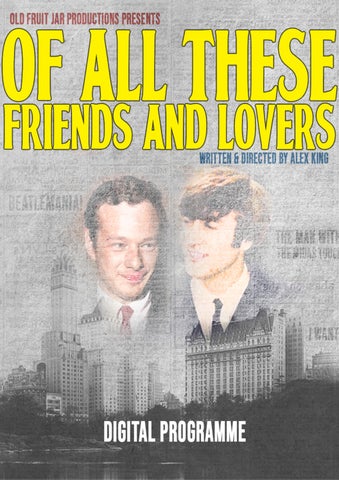
JOHN LENNON JORDAN BARKLEY BRIAN EPSTEIN JOSEPH WINDER WRITTEN & DIRECTED BY ALEX KING TECHNICAL SUPPORT THE HOPE STREET THEATRE SET & COSTUME DESIGN OLD FRUIT JAR PRODUCTIONS ACTION PROPS LTD. ARTWORK ALEX KING PRODUCTION IMAGERY OLD FRUIT JAR PRODUCTIONS PRODUCED BY OLD FRUIT JAR PRODUCTIONS IN ASSOCIATION WITH THE HOPE STREET THEATRE FOR OLD FRUIT JAR ALEX KING PRODUCTIONS FLORENCE KING JORDAN BARKLEY RACHEL McGRATH ANTHONY ROBERTS CHRISTINA ROSE LUKE SEDDON FOR THE HOPE STREET SAM DONOVAN THEATRE NICK ROGERS JILL EASON JOHN McROBERTS SPECIAL THANKS HELEN ANDERSON LIVERPOOL’S ROYAL COURT ARTS CITY LIVERPOOL JOHN BEZZINI LIPA TICKETQUARTER LIVERPOOL BEATLES MUSEUM ELEVATOR STUDIOS Image of John Lennon: United Press International, photographer unknown, Public domain, via Wikimedia Commons Image of Brian Epstein: Joop van Bilsen for Anefo, CC0, via Wikimedia Commons.
ABOUT THE SHOW February, 1964. New York City. Beatlemania has swept the world. Trapped in the eye of the hurricane, John Lennon finds himself unexpectedly alone with manager Brian Epstein. Away from the screaming crowds and flashing cameras, the two men wrestle with the pressures of fame, identity and expectation, as the boundaries between their public personas and private selves begin to blur… Of All These Friends and Lovers is an intimate psychological drama exploring the extraordinary relationship between two men at the epicentre of a cultural phenomenon. While the events depicted in the play are fictional, they are rooted in extensive research into the lives, personalities, and cultural circumstances surrounding both men.
ABOUT OLD FRUIT JAR PRODUCTIONS Old Fruit Jar Productions is a Liverpool-based production company, founded in 2019 by some of Liverpool’s finest creative talents. We thrive on telling stories and producing high-quality theatre, film, and other creative work in the most imaginative, engaging, and thoughtprovoking ways. Past productions include: Woyzeck (The Hope Street Theatre), Twelfth Night (Liverpool’s Royal Court), Climbing From Pluto (Valley Theatre Festival), Love Target (Valley Theatre Festival & Leverhulme Theatre Festival), The Incident Room (The Black-E & Liverpool’s Royal Court), It’s A Wonderful Life (Liverpool’s Royal Court & St George’s Hall), The Execution of Private Slovik (Wirral Theatre Festival & 53Two), At Eternity’s Gate (The Hope Street Theatre).
BEATLEMANIA! In the early 1960s, a cultural earthquake began in Liverpool and rippled across the globe. At its epicentre stood THE BEATLES – four young men whose music, charm, and charisma collided with a generation of young people hungry for change. The result was “BEATLEMANIA,” a term not nearly big enough to capture the scale of the madness that followed… What began as enthusiastic local support, escalated rapidly into unprecedented scenes of devotion. Fans screamed, cried, fainted, and gathered in their thousands at airports, hotels, concert venues, and even lined the streets of Liverpool, London, and New York to catch a glimpse of the mop-haired rockers. Performances by The Beatles were often drowned out by the roar of the crowd – and yet Beatlemania was more than just noise, it marked a profound social shift. For many young people, particularly teenagers, The Beatles represented independence, identity, and a break from the conservatism of the post-World War 2 era. Their arrival in the United States in February 1964 became a defining moment, and the point where Beatlemania exploded internationally. Appearing on THE ED SULLIVAN SHOW, they captivated an audience of over 70 million viewers (nearly one third of the US Population at the time). This moment cemented The Beatles’ global dominance and spearheaded what became known as the “British Invasion”, opening the floodgates for UK artists to find international success. Across the globe, Beatlemania manifested as a shared cultural language. Despited linguistic and political differences, young audiences connected through music that felt immediate and accessible, that spoke to them on a personal level, and that allowed them to be their true selves. This universality was key: The Beatles’ songs – rooted in simple melodies and emotional clarity – transcended borders. United Press International, photographer unknown, Public domain, via Wikimedia Commons
When touring stopped in 1966 after a fateful concert at Shea Stadium, Beatlemania in its purest form ended – but it’s legacy endured. Beatlemania was not merely a moment of mass hysteria; it was a turning point in cultural history. It empowered young people, revolutionised the music industry, and left the world more connected, expressive, and forever changed…
Associated Press, Public domain, via Wikimedia Commons
CAST & CREATIVES JORDAN BARKLEY (John Lennon) Jordan is a Liverpool actor. Theatre includes: Woyzeck (The Hope Street Theatre), The Great Gatsby (The Hope Street Theatre), Twelfth Night (Liverpool’s Royal Court), Climbing From Pluto (Valley Theatre Festival), Love Target (Valley Theatre Festival & Leverhulme Theatre Festival), The Incident Room (The Black-E & Liverpool’s Royal Court), It’s A Wonderful Life (Liverpool’s Royal Court & St George’s Hall), The Execution of Private Slovik (Wirral Theatre Festival & 53Two), Film includes: Being Keegan (2017), Brigette Bardot Forever (2019), Starlet Fever (2024).
JOSEPH WINDER (Brian Epstein) Joseph is a British-born, American-raised actor, writer, and poet based in Liverpool, and a graduate of LIPA with an MA in Acting. Theatre includes: A Midsummer Night’s Dream (University of Idaho), Brief Encounter (LIPA), Unsinkable (The Hope Street Theatre & Arts Bar Liverpool), The Execution of Private Slovik (Wirral Theatre Festival), It’s A Wonderful Life (Liverpool’s Royal Court), At Eternity’s Gate (Camden Fringe, New Wimbledon Theatre & The Hope Street Theatre). Film includes: These Days (2026), The List (2024), Ruin (2022).
ALEX KING (Writer & Director) Alex is an award-winning director and writer from Liverpool, and long-time Beatles fan! Theatre includes: Woyzeck (The Hope Street Theatre), Twelfth Night (Liverpool’s Royal Court), Climbing From Pluto (Valley Theatre Festival), Love Target (Valley Theatre Festival & Leverhulme Theatre Festival), The Incident Room (The Black-E & Liverpool’s Royal Court), It’s A Wonderful Life (Liverpool’s Royal Court & St George’s Hall), The Execution of Private Slovik (Wirral Theatre Festival & 53Two), At Eternity’s Gate (The Hope Street Theatre), Stocking Fillers (Liverpool’s Royal Court). Film includes: Plastic Soup (2018), Needs Must (2022, Best director, best independent short film).
LENNON AND EPSTEIN John Lennon and Brian Epstein were, on the surface, an unlikely pairing. Lennon was sharp-tongued, rebellious and suspicious of authority. Epstein, six years John’s senior, was polished, meticulously dressed and came from the comparatively comfortable world of his family's Liverpool retail business. But when Epstein began managing The Beatles in late 1961, the relationship between the two became an important part of both men's lives. Behind Lennon's swagger was a childhood marked by separation and loss. Raised from the age of five by his Aunt Mimi and Uncle George at Mendips rather than by his mother, Julia. Although John and Julia later became close, she was killed by a car when he was just seventeen. Uncle George, another important parental figure, had died three years earlier. Lennon later spoke and wrote openly about the effect of losing his mother, while those around him remembered the anger and volatility that followed her death. Music became both an outlet and an escape, and his friendship with Paul McCartney, who had also lost his mother as a teenager, gave him someone who understood that grief. Epstein carried a very different burden. He was a gay Jewish man living in Britain at a time when consensual sex between adult men was still a criminal offence. His sexuality was known within his private circle but carefully concealed from the wider public. Epstein had experienced the genuine dangers attached to being a gay man in 1950s Britain: he was arrested after approaching an undercover policeman in London and, later, was assaulted and blackmailed following a sexual encounter in Liverpool. His private life therefore existed alongside the constant possibility of exposure, prosecution and scandal. Epstein recognised The Beatles’ potential remarkably early. He helped transform their presentation, pursued a recording contract after repeated rejection, and over saw the extraordinary rise that took them from clubs in Liverpool and Hamburg, right across Europe, and later the world. Despite being close with all of “the boys”, as he would call them, Epstein shared the closest relationship with Lennon. Their affection was genuine, but so were their differences. Lennon could tease Epstein mercilessly, including about his sexuality and Jewish background, while Epstein remained fiercely committed to the group. Regardless of John’s cruel tongue, The Beatles would vehemently defend Brian from anyone who challenged him. The closeness between Lennon and Epstein inevitably attracted attention. In 1963, shortly after the birth of Lennon's son Julian, John accompanied Brian, alone, on a twelve-day holiday to Barcelona. Rumours about the nature of the trip quickly circulated around Liverpool and have followed both men ever since. Lennon later described his intense relationship with Epstein, and the holiday, as “an almost love affair”.
Within little more than two years of Brian managing the group, The Beatles had become Britain's biggest musical phenomenon. In February 1964 The Beatles arrived in New York to scenes of extraordinary hysteria before appearing on The Ed Sullivan Show and cementing their transformation into international superstars. For Lennon, that extraordinary success also meant surrendering much of his privacy. The rebellious young man who had grown accustomed to protecting himself through humour, aggression and bravado was suddenly being watched almost constantly. Hotels required security, fans pursued the group wherever they went, and their friendships, marriages and behaviour became material for public consumption. That famous Lennon wit remained, but his complicated relationship with fame - craving recognition while resenting the intrusion that accompanied it - would follow him throughout his life. As The Beatles grew, Epstein's role increasingly involved managing not only their career, but the enormous public image surrounding them. That could mean navigating controversy as well as success. In 1966, Lennon's observation that The Beatles had become "more popular than Jesus" caused little reaction when first published in Britain, but its republication in the United States provoked outrage, record burnings, threats and protests ahead of the group's final American tour – echoing Lennon’s earlier paranoia of violence sparked by the Kennedy assassination in November, 1963. Epstein publicly defended Lennon and worked to contain the growing crisis, even offering to cancel performances if necessary. It was an extreme example of the position he had occupied throughout their rise: standing between four increasingly famous young men and a world capable of adoring them one moment and turning against them the next. Epstein remained fiercely devoted to The Beatles until his sudden death in August 1967, aged just 32. His loss left the group without the man who had guided almost every stage of their extraordinary ascent. For Lennon in particular, it was another significant loss in a life already punctuated by them. The Beatles broke up just over three years after Epstein’s death. Their partnership lasted less than six years. In that time, Brian Epstein helped turn John Lennon and three other young musicians from Liverpool into the most famous band in the world, changing the face of popular music culture forever. But beyond the records, contracts and screaming crowds was a relationship between two complicated young men, both ambitious, both vulnerable, and both learning to navigate what the world expected them to be. Of All These Friends and Lovers is dedicated to the memory of John Lennon, Brian Epstein, and those part of The Beatles’ enormous, sweeping story that has captured generations for decades previously, and centuries to come.
Helen Anderson was born in Liverpool in the 1940s. She drew and painted from the age of three and by age twelve was making her own clothes (as well as attending the city's Junior Art School). Helen is a true hands-on creative and highly visual. This enables her to switch comfortably between artistic disciplines and to combine them professionally, inevitably in fresh and interesting ways. Subsequently trained in fine art at Liverpool College of Art (alongside John Lennon and his future wife Cynthia) and - later - the Istituto di Belle Arti (now the Accademia di Belle Arti di Roma). Helen originally enjoyed an exciting career as a portrait painter in Italy and the UK: she numbers a great number of celebrities, aristocrats and dignitaries among her clients. From the early 1960s, Helen became a successful fashion designer, creating twice-yearly collections from her design and production base in Lancashire. She was always a genuine British innovator, pioneering a trend for hand-cut (i.e. before the laser age!), hand-painted couture leather and suede pieces, as well as hand-painted wedding and evening gowns to the UK market, again dressing many celebrities along the way. Helen first designed John Lennon’s iconic leather cap in 1964, just before the Beatles’ visit to America. Helen remarks that John was still wearing the cap in 1975, the last time she saw him. Her iconic design for the cap cap - which has featured in so many photoshoots and videos - saw a revival in 2017 on the occasion of his birthday. And that resulted in the 'return of the cap'! Old Fruit Jar Productions were lucky enough to meet Helen in 2019, and in 2026 when Helen heard about Of All These Friends and Lovers, she kindly allowed the use of one of her caps in the production and shared with us many stories of her friendship with John, Cynthia, and even the few occasions she met Brian Epstein at the infamous Cavern Club.
To own your very own piece of Beatles history, visit Helen’s website: www.helenandersondesigns.com