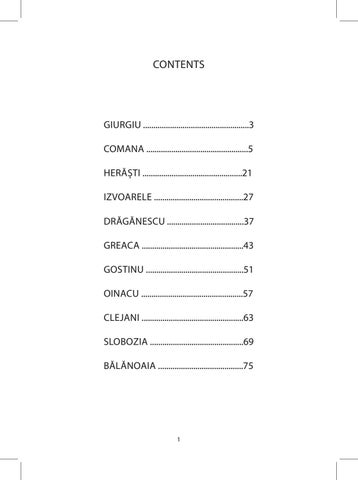
CONTENTS
GIURGIU ...................................................3 COMANA .................................................5 HERĂȘTI ................................................21 IZVOARELE ...........................................27 DRĂGĂNESCU .....................................37 GREACA .................................................43 GOSTINU ...............................................51 OINACU .................................................57 CLEJANI .................................................63 SLOBOZIA .............................................69 BĂLĂNOAIA .........................................75
1
RUSE .......................................................81 BASARBOVA ........................................83 CHERVEN ..............................................90 EKZARH YOSIF ....................................96 IVANOVO ............................................104 KARAN VARBOVKA .........................111 MECHKA .............................................118 NIKOLOVO .........................................127 NISOVO ...............................................136 PEPELINA ...........................................145 RYAHOVO ...........................................153
2
Giurgiu
3
4
CONTENTS COMANA
places to see
places to do
PAG. 04 - 09
PAG. 11 - 13
places to eat
PAG. 15 - 16
5
6
COMANA Few know that just 35 km from Giurgiu and also as many from Bucharest City there are still living trees from the Vlasia Forest where centuries ago ruler Vlad the Impaler himself, the founder of the Comana fortified monastery, dismounted on an island surrounded by swamps. Today, in the same places, trees of the century-old forest are still growing. The swamps of the years past became the Comana Pond, which scientists consider to be a second delta of Romania. Today's visitors can battle the shadows of the Ottomans in a modern adventure park, climbing up secular oak trees, while accommodation places welcome them for rest and relaxation.
decree issued by the Chancellery of Vlad the Impaler that mentioned the border of the monastery should stretch all the way to where it touches the Comana Pond, right into Lake Calnistei. Because the place is filled with the footsteps of many rulers and damsels whose tombs are here, there is a local legend that says the founder, Vlad the Impaler, haunts the enemies in the plains scaring them away. It is said that when he fell prey to his enemies, somewhere between Bucharest and Giurgiu, his body fell into the hands of his rival Basarab Laiota and it was buried without the head, which had been sent to the Porte, and without exquisite ornaments and also without a tombstone, in the nearest monastery founded by him, Comana. In the yard of the Comana Monastery, there is a small billboard with information about the famous mediaeval ruler and a modest tombstone with an inscription almost fully erased that monks claim belongs to the ruler's tomb.
First time travellers at Comana want to walk into the footsteps of Vlad the Impaler and get full of sacredness at the Comana Monastery. Thus, immediately as they get in touch with the local history, they learn that the monastery was in the beginning a small wooden church. For the first time on September 27, 1461, the Comana toponym was officially used in a
7
places to see
8
Comana Monastery Comana Monastery is a religious edifice included in the list of historical monuments in Romania built by Vlad Tepes in 1461, with the role of monastery-fortress (ruined by the end of the sixteenth century). The place where the monastery was built was once an island in the middle of the marshes and the access was done through a door located in the north of the precinct.
9
giurgiu
Heroes Mausoleum Comana mausoleum was built at the initiative of Nicolae Iorga, on the former ruins of the chapel of the Comana Fortress, in the courtyard of the monastery, in the memory of Romanian heroes of the First World War. The graves of the soldiers were in the monastery courtyard but the bones were moved into the mausoleum.
10
places to see
Memorial House "Gellu Naum" Located in Comana, the Memorial House "Gellu Naum" is actually the summer house of the great surrealist poet, which is preserved as it was, back in time, when Gellu Naum spent his summers here. This place was for writer a withdrawal into his own universe of creation, isolation from the external social and political context of the era (1968).
11
Comana Natural Park The Comana Natural Park is a unique reserve in Europe that houses tens of species of plants and animals protected by international laws; it is also deemed Romania's second delta, covering 25,000 hectares and including an ecosystem specific of a delta, known from times past as the Comana Pond. Specialists claim that this delta is second in terms of biodiversity, after the Danube Delta Reserve.
12
The monument of the heroes The monument was built up in the memory of the ones who lost their lives in the war for the independence, in the First World War and in the Second World War. Following the war for the independence, Romania achieved the independence against the Ottoman Empire.
13
places to do
14
Comana Adventures Park Comana Adventures Park has 6 routes for children, 3 for adults of progressive difficulty (easy, medium and difficult), a zip line over the lake and a zip waterfall lines. The park includes a number of suspended elements at different heights, elements to be covered using the proper equipment, by crossing or climbing.
15
Comana Lake Comana Lake is located on the outskirts of the commune of the same name. Although it has a depth of 4.5 m, the lake covers an area not too large, about 600 hectares invaded by vegetation. The lake is a natural one. Fishing is allowed only to those who accommodate at Casa Comana, through the “catch and release� system, being able to hold a fish for consumption. The lake is populated with carp and pike.
16
Crafts Village and Paper Mill The Paper Mill Association has initiated and is developing The Paper Mill and the Crafts Village Complex, that consists of 10 creative workshops based on old crafts, that used to be practiced in the Romanian traditional village: weaving at the hand loom, reed mace processing, blacksmith, pottery and ceramics, woodwork, traditional kitchen, traditional mill and bakery, as well as book-related crafts.
17
places to eat
18
Comana House Combining tradition with modernity, in Comana House Restaurant, delicious dishes of the highest quality are served. The rich and varied menu offers both traditional Romanian cuisine and international specialties.
19
The restaurant "La Lebăda" The restaurant "La Lebăda" is the perfect place for organizing an event in a tourist and natural area.
20
CONTENTS HERĂȘTI
places to see
PAG. 21 - 22
21
22
HERĂȘTI
At the end of the 19th century, the commune was called Herăști-Buciumeni, it was part of the Negoești area of Ilfov county and it contained the villages Buciumeni, Gruiu and Herăști, with 2389 inhabitants living in 616 houses and 22 bordeaux. In the commune there were three churches (one in each village) and two mixed schools (in Herăști and Buciumeni), and the main land owners were C.D. Maratea and A. Stolojan. The Socec Yearbook of 1925 records the change of the name of the commune in Herăști, a commune that was part of the Budești area of the same county and had 3072 inhabitants in the same villages.
Buciumeni and Gruiu villages separated in 1930, forming Gruiu commune. In 1950, the commune was transferred to the Oltenita district in the Bucharest region. In 1968, it returned to Ilfov county, re-established, but was immediately abolished, the village of Herasesti passing to the village of Hotarele, together with the newly established village of Milosesti. In 1981, a regional administrative reorganization resulted in the transfer of Hotarele commune to Giurgiu county. Herăști commune was re-established in 2004, with Herăști and Miloșești villages.
23
places to see
24
Udrişte Năsturel Manor Udrişte Năsturel Manor in Herăşti (also known as 'The Stone House') was built in 1641-1643 by two brothers: Udriște Năsturel and Cazan Postelnicu Năsturel. 1831 saw the mansion sold to Serbian Prince Miloš Obrenović, which lived for a while in Wallachia; the price had the property expanded with stables and other buildings.
25
Church St. Archangels The Church of „Saints Archangels Michael and Gabriel” is is close to the “Stone House” built by brothers Udriste, and Cazan Nasturel, which hosts now wonderful collections of rustic pottery and furniture.
26
CONTENTS IZVOARELE
places to see
places to do
PAG. 27 - 29
PAG. 31 - 32
27
28
IZVOARELE At the end of the 19th century, the commune was named Chiriacu, it was part of the Marginea area of Vlașca county, and was formed by the Beiu, Chiriacu, Moșteni-Calarashani villages, with a total population of 2547 inhabitants, and from the uninhabited Măcărău village. There was a mill and a school with 60 students (of which only one girl). At that time, Ciolanul-Pangăl commune, formed by the villages Ciolanu and Petru Rareș, also operated in the same territory of the commune, with 570 inhabitants. There were also two churches here.
of Ciolanu also joined the village of Petru Rareș, from the commune of Pealesti. In 1950, the communes passed into the administration of the Giurgiu district and then (after 1952) the Drăgănești-Vlașca district from the Bucharest region. In time, Chiriacu commune took the name of Beiu, from the new village of residence, and the commune of Radu Voda, that of Dimitrie Cantemir. The commune and the village of Beiu took the name of Izvoarele in 1964, and the commune and the village of Ciolanu - that of Valea Bujorului. In 1968, the communes moved to Ilfov county, the communes Dimitrie Cantemir and Valea Bujorului being abolished, and their villages included in Izvoarele commune. At the same time, the villages of Buciumeni (merged with Dimitrie Cantemir) and Dimitrie Sturza (merged with Radu Voda) were abolished. In 1981, a regional administrative reorganization led to the transfer of the commune to Giurgiu county.
The Socec Yearbook records the communes in the Danube grid of the same county; Chiriacu commune had 3498 inhabitants in Beiu and Chiriacu villages, and Ciolanu commune had 681 inhabitants in the village of residence. It was then established on the territory of today's commune and Radu Voda commune, with 1392 inhabitants in the villages of Cantemir, Dimitrie A. Sturdza, Moșteni-Călărășani, Radu Voda and in the Trupu-Buciumeni hamlet. In 1931, the village
29
places to see
30
"Cuvioasa Paraschiva" Orthodox Church The "Cuvioasa Paraschiva" Orthodox Church is a historical monument in Izvoarele village, built in 1890.
31
Military monument Military monument erected in front of the Orthodox Church "Cuvioasa Paraschiva"
32
Manafu Forest Manafu Forest is a forest reserve built from natural mixtures of brumari oak, trimmed. Here the pheasants and deer were colonized thus becoming an important hunting center.
33
places to do
34
Izvoarele Natural Reserve with Fishing bays Izvoarele Natural Reserve is located in the locality with the same name in Giurgiu County, about 80 km from Bucharest. The lake is a large one, about 2.5km long and up to 150m wide. The surface of the fishing pond in the springs has 15 ha of water with an average depth of 2.5m. From the point of view of the substrate, the pond is clean, without cracks.
35
"La Joe" Lake Fishing lovers can meet at "La Joe" lake, Izvoarele Basin 1, where they can fish: Romanian carp, caras, saltwater, biban, pike and novac.
36
CONTENTS DRĂGĂNESCU
places to see
PAG. 37 - 38
37
38
DRĂGĂNESCU
The church in Drăgănescu, having as a protector Saint Jerome Nicolae, is a simple village church, which still retains, in the living memory of its community, the godliness and faith of the one who painted it.
The road leads to the town of Malul Spart. Moving away from the national road DN6 and passing through a deserted field, after 5 kilometers on county road 412A, Drăgănescu locality appears as secret. Drăgănescu is a small town in Giurgiu county, located between Mihăilești and Buturugeni, on the bank of the dam built on Arg , at this point.
At the exit from the town of Mihăilești, located on the road that connects the cities of Bucharest and Alexandria, coming from Bucharest, at kilometer 28, a road turns sharply to the right.
39
places to see
40
The Church painted by Priest Arsenie Boca The church of St. Nicholas Drăgănescu was painted by Father Arsenie Boca who worked here almost 16 years, from 1967 to 1983. The painting includes scenes from the New Testament, but also moralizing scenes through which the spiritual transmits faith teachings to the pilgrims of the believers.
41
The accumulation lake on the ArgeČ™ River The accumulation lake on the ArgeČ™ River is beyond the metal fence of the church cemetery. Here is a beautifully arranged alley with benches for meditation.
42
CONTENTS GREACA
places to see
places to do
PAG. 43
PAG. 45 - 46
43
44
GREACA
According to the legend, the estate was owned by a Greek woman who, about 1 km away from the entrance from the east had an inn whose name was "La Greaca". Many of the Greeks who came here for fishing or chopping, settled near the inn. Later, the Mislea Monastery (from Prahova) bought land in Greece, today on the site of the former monastery property being the village hearth. The first documentary attestation of the locality dates from the year 1532, on the occasion of the passage through these places of the Lord of the Romanian Country Vlad Voevod.
Older and newer archaeological researches attest the presence of human settlements from the Neolithic era, over which those from the Geto-Dacian era and then from the early Middle Ages. The vineyards and the Greek wine, the fish of the Baltic, together with the cereal crops, represented an important source of income for the rulers of the Romanian Country.
45
places to see
46
Gorski domain The Gorski domain is restored and transformed into a tourist complex called the Greek Resort Domain which comprises a mansion of 5 daisies with wireless, a chef who serves Argentine beef and foie gras and handmade furniture in Rome.
47
places to do
48
Tennis courts at Greaca Resort Domain There are two tennis courts at Greaca Resort Domain, specially designed for white sports enthusiasts. The complete equipment can be rented, and the night-time installation makes for fun at night.
49
Greaca Resort Domain Pool The platform on which the pool is built in Greaca Resort Domain has 400 places, canopies, own kitchen, two bars, sauna, outdoor fitness, massage canopy, playground and swimming pool for children, showers and toilets. It is a specially designed space for relaxing and swimming during the day. In the evening, the bartender's DJ and show complement the experience of a real party.
50
CONTENTS GOSTINU
places to see
PAG. 51 - 52
51
52
GOSTINU
Gostinu is a commune in Giurgiu county formed only from the village of residence of the same name.
In 1950, the commune was included in the Giurgiu district of the Bucharest region. In 1968, he moved to Ilfov County. In 1981, a regional administrative reorganization led to the transfer of the commune to Giurgiu county.
At the end of the 19th century, the commune was part of the Marginea grid of VlaČ™ca county and was made up of the villages Gostinu-Hagiu, Gostinu-Pietrele and Gostinu-Monastery, with 987 inhabitants. There was a church built in 1885 and a mixed school with 26 students (including 3 girls). The Socec yearbook of 1925 records the commune in the Călugăreni grid of the same county, with 1697 inhabitants in a single village, Gostinu.
The only objective in the Gostinu commune included in the list of historical monuments in Giurgiu county as a monument of local interest is the archeological site of "Grindul Bunei", located west of the village, where traces of settlements from the Latene and Halstatt periods have been found.
53
places to see
54
Gostinu beach At Gostinu, near Giurgiu, a large sandy beach awaits you, and the entrance to the Danube waters is gentle, so many come to bathe in the river.
55
County Festival “Handicraft Get Together� The County Festival "Handicraft Get Together"people of all ages dance to traditional music, perform or recite their own creations, and the elders of the commune wool, knit and make more culinary preparations.
56
CONTENTS OINACU
places to see
PAG. 57 - 58
57
58
OINACU
At the end of the 19th century, the commune was part of the Marginea grid of Vlașca county and was made up only of the village of residence, with 1000 inhabitants. There was a church and a school with 51 students in common. At that time, on the current territory of the commune, the commune of Braniștea also operated in the same net, with only the village of residence, with 579 inhabitants, a church and a communal school mixed with 22 students (all boys). In 1931, Braniștea commune was abolished, her village passing to Oinacu commune.
By 1938, it was established on the territory of the commune and the village Comasca, a new village, with straight streets. In 1950, the commune became part of the regional city of Giurgiu in the Bucharest region. In 1968, he went to Ilfov County, the village of Comasca being then abolished and combined with the village of Braniștea. In 1981, a regional administrative reorganization led to the transfer of the commune to Giurgiu county. Comasca village was re-established in 2006.
59
places to see
60
Oinacu Orthodox Church Oinacu Parish, with the dedication of the Assumption of the Virgin Mary, holds a copy of the Icon of the Virgin Mary - Prodromița, brought from the Holy Mountain Athos, as well as the fragments from the relics of Saint Gheorghe and Saint Catherine.
61
Branistea Orthodox Church The place of worship was erected in 1885 by the parish priest Tucă Stoica, assisted by the inhabitants of the parish. Between 2006 - 2014, by the care of IonuĹŁ Cosmin Voinea, assisted by the parishioners, the holy place was in an extensive restoration process,.
62
CONTENTS CLEJANI
places to see
PAG. 63 - 64
63
64
CLEJANI
Clejani is a commune in Giurgiu County, Romania, about 40 km south of Bucharest, in the Vlașca region (part of Muntenia), on the Danube Plains near the Bulgarian border. It is composed of four villages: Clejani, Neajlovu, Podu Doamnei and Sterea.
Other five objectives are classified as architectural monuments: the church "The Assumption of the Virgin Mary" (1799, rebuilt in 1865) from Neajlovu; the church "Birth of the Virgin Mary" (1850-1902); the inn of Major Mişa Anastasievici (1859), today a library; the church "Saint Archangel Michael" (1864); and the ruins of the School of Trades (1834, rebuilt in 1853), the last four of the village of Clejani. The other two are memorial or funeral monuments, both located in Clejani: the crypt of Major Mişa Anastasievici (1885) and the funeral monuments of some Serbian families, located in the courtyard of the church "Saint Michael".
Nine objectives in the town of Clejani are included in the list of historical monuments in Giurgiu county as monuments of local interest. Two of them are archaeological sites: the ruins of the Babele Shrine (15th-17th centuries) near the "Assumption of the Virgin Mary" church in Neajlovu; and the site "la Carieră" (500 m east of the village of Clejani), containing traces of settlements from the Early Bronze Age (Glina III culture) and from the Halstatt period.
The commune is famous for its lăutari or gypsy musicians, especially the group Taraful Haiducilor (a.k.a. Taraf de Haïdouks) and members of the group Mahala Rai Banda.
65
places to see
66
Church of Saints Michael and Gabriel of Clejani Major Misa Anastasievici, a great philanthropist born in 1803 in Serbia is considered the parent of this settlement. He founded two churches: one in Clejani, painted in 1865 by the great Tattarescu and another in Branceni. Between 1838 and 1848, a school for the children of the village, with classes and bedrooms, operated at the expense of the philanthropist in the church building in Clejani.
67
The bust of Major Mișa Anastasievici Today, the bust of Mișa Anastasievici is in the courtyard of the church he founded, and his tomb is fixed underneath it, in a crypt.
68
CONTENTS SLOBOZIA
places to see
PAG. 69 - 70
69
70
SLOBOZIA
On August 24, 1807, the armistice of Slobozia was concluded between the Russian and Turkish troops in the war of 1806 -1812. At the end of the 19th century, the commune was part of the Marginea square of Vlașca county and had 1753 inhabitants in the only village, a steam mill and a church. The Socec yearbook of 1925 records it in the Danube grid of the same county, with 2864 inhabitants in the villages Slobozia and Florica. In 1931, he acquired the status of suburban commune of the urban commune Giurgiu.
In 1950, the commune was rounded up to the regional city of Giurgiu in the Bucharest region. In 1968, he became a suburban commune of Giurgiu municipality in Ilfov county, a city that in 1981 became the residence of Giurgiu county. In 1989, the concept of suburban commune was renounced, the commune being directly subordinated to Giurgiu county.
71
places to see
72
"Saint George" Orthodox Church The "Saint George" Orthodox Church of Slobozia is an architectural monument built in 1864.
73
War of Independence Monument Monument dedicated to the dead soldiers in the War of Independence (1871-1878)
74
CONTENTS BĂLĂNOAIA
places to see
PAG. 75 - 76
75
76
BĂLĂNOAIA
The village of Bălănoaia was developed around the CFR Bălănoaia train station and, since 1968, has been included in the Cetatea village. Geographically framed in the valley of the great Danube river and a crossing area for the plain, the territory of Frătești commune, in the neat composition is found in the village of Bălănoaia, an offer of favorable conditions for the appearance and could not be offered more time, many of them with continuity of millennia.
The first evidence of human existence on these lands dates from the Paleolithic era, testimony in this regard being a flint carver belonging, in all probability, to the famous "pund culture" (Upper Paleolithic), as well as a flint blade similar to those of the Malul Roșu resort near the city of Giurgiu.
77
places to see
78
St. George's Church The parish of Bトネトハoaia in Giurgiu is also called St. George's Church. The Parish Youth Committee is also set up within the Bトネトハoaia Parish in Giurgiu, which aims to develop organizing skills, strengthen team spirit and form new friends.
79
80
Ruse
81
82
BASARBOVO On the 27th October, a day after the feast of St. Dimitar Basarbovski, in the village of Basarbovo, locals make a sacrificial rite for health and pray for a blessing from God and their Holy Saint Dimitar Basarbovski. If we do not read the stories but listen to the legends that have been passed down for centuries to generations, we will realize that the Saint is not just a person from the history of the village, but he is the foundation, around which the Bulgarians' faith and their prosperity continue to be built. These people said that St. Dimitar was a native of their village, his parents were poor and he was grazing herds. As he walked the forests and fields, he stepped into a sparrow nest by accident and killed the birds. His negligence led Dimitar to the decision to give up his life and devote himself to God and he repented his act for the rest of his life. The foot, which stepped on the nest, he kept bare for the rest of his life. This is exactly how he is depicted in the rock church above the monastery. The legend says that when he felt that the end of his earthly days
was close, Saint Dimitar simply laid between two stones and died. This happened on 1st May — the day of the Prophet Jeremiah, when the ritual for rain are made here in this area. Such a downpour took the body of the Saint into the river and his remains disappeared. A blind girl, for whom the locals claim to be Saint Marina, showed the relics of the saint to the people, in a place that at night was light-lit. The light was so bright sometimes that the natives believed that there was a treasure buried. They asked the valia (the ottoman governor) for permission to start digging and found the relics of the Saint. They laded them on a cow wagon but at one place the animals stopped and refused to continue. People made a church there. The place, where the relics were found, is marked by a two-metre stone even nowadays. The relics of Saint Dimitar were often moved around to different places, but eventually stopped in Bucharest, whose patron is the Saint, with a birthplace in Basarbovo. There, in the Patriarchy, everyone can see the hand of the
83
of the Saint and ask him for mercy. The village of Basarbovo has its history from the time of the Second Bulgarian Kingdom. It was probably owned by the fatherin-law of Tsar Ivan Alexander -Ivanko Bassarab. Later, probably due to the plague, the village was moved and changed the name to Basarbovo.
People believed that the plague would not find them and because of that they made these radical changes. And it probably happened and since then their faith became as hard as the rocks, in which Saint Dimitar lived and lives today.
Places to see: Basarbovo Rock Monastery
84
If the legend of St. Dimitar Basarbovski has thrilled you, the Basarbovo Rock Monastery is the place where you will truly feel the connection with the Saint. It is the only operational rock monastery in Bulgaria remaining as a 13th century heritage for Bulgarians. The monks there are hospitable and do not refuse a talk to anyone, who wants to learn more about their habitation.
85
86
There are suitable conditions for bird watching tourism with a remarkable variety of birds in Basarbovo village region.
87
88
The walk in the village area is a unique experience - the canyon of the river is extremely picturesque.
89
CHERVEN
The road to Cherven crosses the rocks of the Polomie and leads straight to the Medieval city where 12th to the 14th century is a prosperous period for the city described with active, thriving life and its main role is to protect the Danube part of the territory of the Second Bulgarian Kingdom from invaders. Stepping on the stones of the path to the fortress, if one closes his eyes and imagines, he will be sent back in time and feel the urban culture one has once read in books or watched in expensive movie productions. It is quiet now but the bells of the churches and monasteries of this hill can still be heard ringing somewhere back in old times. However, it is noisy in the summer because archaeologists are constantly studying the legacy left by the Cherven Bolyar (the ruler of the city). Once upon a time, centuries ago, Cherven (meaning: beautiful, pretty) was extremely picturesque and was an aristocratic addition to the valley of the Rusenski Lom
River. The inner fortified city is on a high hill and the outer city was at its foot. There used to be many forests here and when the traveller walked out of them, a magnificent urban silhouette appeared in front of him, with churches and dwellings, high and low, large and smaller, amphitheatre buildings that alternated harmoniously. The feudal castle was naturally situated in the most representative and inaccessible place and was very imposing. The churches built in the style of the Tarnovo School of Architecture stood above the residential buildings. Two of the sixteen Cherven churches are the largest in Bulgaria. They looked like the churches in Nessebar - with alternation of belts of stone and bricks for decoration, with rich plastic art decoration and with frescos marking the pinnacle of Bulgarian fine art. The iron, ceramics, gold, silver and other objects found during the excavations prove that people with a special sense of aesthetics lived here, both in their own homes and in the buildings they were constructing.
90
The glory of the city was so great even after its destruction that all travellers up to Felix Kanitz did not miss to visit it. If you are tempted by fine arts, here is a place where you can experience how strong your talent is and how powerful your imagination.
There is a tower, there are buildings foundations - one just need a hand to lift them up and revive the canvas. Here, the spirit of the Middle Ages has cleared its cruelty and has only left its aristocracy.
Places to stay: Guesthouse Neda- www.guesthouseneda.com Guest House Petrova- www.booking.com/hotel/bg/guest-house-petrova.bg.html Guest House Intrigue- www.facebook.com/guesthouseintrigue Places to see: Medieval City of Cherven
91
The neighbouring hills and the foothills, where the craftsmen quarters were located, still retain the story of the fortress turbulent life. When a man walks down the path, having experienced in his imagination the meetings with bolyars and clergy, he continues travelling back in time and seeking the Medieval spirit. He finds its material expression in the foundations of the village houses - all of them stone-built from the fortress but he wants more. It will take time for the locals to realize what golden apple they have in their hands, what heritage they carry, what crafts they hide. 92
Beautiful landscapes and species
93
94
Golden oriole
95
EKZARH YOSIF “We say that our village is “The village of the hundred professors”. We are still looking for more”, says a professor living in Ekzarh Yosif. Since 1934 the name of the village reminds of the higher Bulgarian Orthodox cleric Joseph I, who has contributed greatly for preserving the unity of the Bulgarian Orthodox Church and for the Bulgarian educational and church activity in Macedonia and Odrin, left in the Ottoman Empire after the liberation.
In fact, this village has existed for millennia and the reason for the eternal life in the region is the extremely fertile land. When Prof. Mitkov retired and decided to dedicate himself to his agricultural hobby, he did a survey about the quality of the soil in the region. It turned out that there is the best combination of atmospheric conditions and a generous black soil. Hail has last fallen in 1940 - the village is somehow protected and the harvest is always generous.
Places to eat: Restaurant in the center of the village Places to see: The zoo, Ethnographic collection
96
The first special varieties of apple trees gave abundant fruit harvest at the beginning of this century. Then the professor started producing saplings and looking for solutions for the fruit trees, which make them as resilient as possible and at the same time not treating them with chemicals during the different stages of their growth.
97
This activity was successful and the people of the village were also involved in such an extent that gradually Ekzarh Yosif village became the “capital of apples�. So every year, at the end of summer, the village attracts hundreds of friends and guests having fun, tasting the new varieties of apples and ordering saplings for seedlings. Along with this idea, the town hall building promotes a title with the English wisdom "One apple a day keeps the doctor away."
98
In this plain land village, which is about 5 km away from the main road Ruse-Sofia, another attraction can be seen, a small rural zoo at the village main square. Actually, it's rather strange but still interesting for the guests. For the last few years, a kind of a "Boss" of the zoo is the camel Dido, who does not mind dwelling peacefully both with local animals and the ostrich family. It is quite a different matter regarding the presence of the metal horse and the cow, not so certain what exactly they are -inhabitants or an interior. 99
The square reveals more exhibits: machines - presenting the pride of Soviet engineering. An old combat plane MiG is mounted here on a pedestal and below it there are car models ZAZ and Volga. Aside, there is a machine gun from the time of World War II. None of the listed above has connection to the village of Ekzarh Yosif but visitors are curious, especially teenagers, who have not seen similar cars and war equipment.
100
The village is alive, the people are hardworking, the earth is generous and it is a mystery if the Lord or the Ekzarh protects the area, but locals are sure that they live in the nicest village in the world.
101
Preserved fauna
102
103
IVANOVO
The village of Ivanovo is located both of them donors to the monin the heart of the Rusenski Lom astery. During the Russian-Turkish Nature Park, about 20 km away War the village is a front zone from Ruse. The combination of and it suffered heavy damage. rocks, forests, rivers, caves and On 12 October 1877, during meadows here is the reason for the a military intelligence, Prince extremely rich biodiversity. Over Sergey Romanovsky, a nephew of 900 species of plants can be seen Emperor Alexander II, was killed throughout the park, and the wildjust above the village. There is a life is represented by amphibians, monument, which can be seen on reptiles, fish, crabs, snails, 66 spethe right side of the road to the cies of mammals and 190 species rock churches. of birds. Here the golden eagle The people of Ivanovo preserve (Aquila chrysaetos) or the majestic the traditions and customs of Egyptian vulture, a vigorous butheir folklore, emphasizing that teos (Common buzzard) or a saker the Ivanovo cuisine is a collective falcon (falco cherrug) can fly over image of the culinary traditions of your head, followed by the ruddy the whole region. Ivanovden (The shelduck (Tadorna ferruginea). day of Ivan) is celebrated with a big The village of Ivanovo emerged rural party here, with roast meat during the Second Bulgarian and Pelin wine, the men dance the Kingdom and according to some traditional “Horo� dance in the cold historians Ivanovo was named waters of Lom River. after the Kings Ivan Asen II and Ivan Alexander, Places to stay: Kladenetsa Hotel - www.hotelkladeneca.com Hotel Rusenski Lom - www.hotelrusenskilom.com Guest House in Ivanovo - www.booking.com/hotel/en/guesthouse-in-ivanovo.en-gb.html Monastery Complex - www.hotelkompleksmanastira.com Places to eat: Monastery Complex - www.hotelkompleksmanastira.com Hotel Rusenski Lom - www.hotelrusenskilom.com Places to see: Ivanovo Rock Churches, Rusenski Lom Nature Park 104
The Ivanovo rock churches have been known for centuries. They are UNESCO's favourite cultural site and attract thousands of tourists from around the world every year. All cruise ships that dock on the coast of Ruse never miss to include in their sightseeing tour The Rock Churches. The last became famous with exceptionally well preserved frescos from the 13th century.
105
There are two options to reach the reserve - by car or walking from Ivanovo train station. It is a distance of 9 km walking and it passes through the village (the village was moved years ago near the train station), goes along the spruit near Garvalov Yalak and reaches the parking lot in front of the Rock Churches.
106
The whole complex is worth seeing and its history is best told by the guides from the Ruse Museum available almost all year round except for the cold winter days, when the snow blocks even the roads to the reserve.
107
The walk in Ivanovo should not be restricted to the Rock Churches only, as this will give just a half idea on the area. The pedestrian routes are extremely beneficial because of the light and medium difficulty tracks and the generosity of the views at various points. The “Gramovets� route, for example, provides an opportunity to explore the beautiful landscape of Lom Rivers, the rich biodiversity and many historical sites. It starts at the archaeological reserve of 108
Ivanovo Rock Churches, continues along a beautiful path among the long green vegetation and reaches the blend of the Beli and Cherni Lom rivers, giving the beginning of the Rusenski Lom River. The dirt road passes under impressive rock formations inhabited by different rare bird species and reaches a shelter with a fireplace. The route is about 12 km long and is suitable for a daily hike.
109
While staying in Ivanovo and having kind hosts, ask them for the “echenica”, fried “piperentsa”, or “kukulaza” - lean dishes, which however, carry the taste of the Polomie and remind of the hermit life of the Hesychastic monks, who had indulged themselves in prayers on the rocks all over the canyon.
110
KARAN VARBOVKA If you head at the village of Karan Varbovka and you would like to pray to Saint Marina, you should search the destination in the GPS navigation. Signboards simply do not exist. The other option is to let the faith kept in your heart lead you to the place. Surely, you will reach the destination because the power of Saint Marina is great. While traveling, you will enjoy the natural resources of the area.
The Monastery is nestled in the forest of the plain and here is the reign of tranquillity and cosiness. Although small, this House of God is full of life and living water springs inside it. Why has this monastery been built exactly here in honour of the Holy Martyr Marina? For hundreds of years the flow of pilgrims does not subside and Christians from around and far away seek help and support in the monastery.
111
Father Filaret named nine babies for the last year here, conceived with love, faith and a strong prayer to the Saint. There are an abbot and two volunteers living here in the cloister. They say that Saint Marina helps them in every endeavour and are eager to confirm with evidences. Recently, it happened that the monastery finished the potatoes and the dish washing detergent. There are many people coming here, they leave a lot of things but miraculously an old gentleman came, who pulled out of his car a bag of potatoes and a bottle of detergent. He said that he did not know why he brought these products exactly - something or someone led him. “You see,” says volunteer Mira Bondzhova, “miracles happen every day, as long as we have eyes to see them and a heart to feel them.” The Saint has done something else, says Father Philaret. Before each Feast of the Temple – 17 July, merchants stretch stalls with clothes, sweets and gifts in front of the monastery gates – everything that can be found at a fair. Saint Marina did not like that and sent them away. How? - Well, while they were stretching their stalls, a heavy rain was pouring, that only stopped for the liturgy. This was
repeating every year and after five years, merchants gave up trying to profit from God's people in the home of the Saint. For the feast, however, a third year in a row, Romanian singers come, who together with Bulgarian priests make the service divinely beautiful. Dimitri Alexandru Voichesescu, a graduate of a master in Orthodox singing in Greece, arrived here in Karan Varboka to thank Saint Marina. He asked to show his appreciation by singing at the end of the service. He sang so excitingly and inspiringly that his fame had been spread and the next year pilgrims with different faith were coming to the sanctuary. Muslims asked about him, they stretched blankets in the yard of the monastery and waited for the singers to come, to shake their souls, and call God angelically. Currently, there are no accommodations in the Monastery but this will happen soon. If you go to the Monastery, read a little bit more about the Saint, so that your conversations with Father Philarert and the volunteers be for the spiritual, for God, for the miracles. All three of them speak English, which in such cases does not just remove barriers but creates friendships. Because this is what God does – he gathers people! 112
Places to stay: Aqua Vitae Guest Rooms - www.booking.com/hotel/bg/guest-roomssaint-marina.bg.html Places to see: Monastery of St. Marina, The Healing Holy Spring
113
A legend says that in the "Turkish day" - so the people in the Polomie call the years of Ottoman yoke, a blind born girl happened to stumble and fell in a creek, from which water sprang. There was a miracle and the child could see. His father, a Turkish wealthy man, was amazed and asked the Bulgarians what day it was and to whom the miracle with his child was owed. He was replied that it was the day of Saint Marina. Then the grateful Muslim gave away the land to the Orthodox people to build up their church in praise of Saint Marina. 114
115
116
Up to this day, the holy spring stands in the center of the temple with the springing living water curing the believers with the intercession of Saint Marina for the people before God. That the water is healing has been claimed for centuries. Unlike other places in the world, here this living water flows in abundance and is fully accessible and free for anyone who needs it. Of course, some have tried to bottle and sell it but Saint Marina did not allow that, this trade was ceased and the cure for the people’s pains is there for free. 117
MECHKA
The village of Mechka was named after of the Roman border Castle Ursus, which in translation of modern Bulgarian language is exactly “a bear”. The village is located in a lowland formed due to the folding and the meeting of the three rounded hills called by the Romans - Trimamium. The ancient Roman map Tabula Noi Tengeriana, in the 1st century also called military route map "Tabula Poytengeriana" marks this area with the name of the Roman Limes Castle "Ursus”. The castle was built in the 1st century, when Emperor Vespasian laid the foundation of the Roman fortification border system "Danubius limes".
Ursus existed during the Roman, early Byzantine and Old Bulgarian eras, just like the other fortresses: Sexaginta Prista (Ruse) and Yatrus (Krivina village). Burned and destroyed several times, these fortresses were restored in the 6th century for the last time by Justinian the Great. In the 7th century the Avars and the Slavs destroyed it once again and the new medieval Bulgarian village Mechka aroused on the ruins of the old settlement Trimamium and was named after the castle and its locality. According to the legend, the flag of the fortress has a head of a bear, symbolizing power and might.
Places to stay: Seven Generations Hotel - www.sevengenerations.bg Guest House Mechka - www.pochivka.bg/kashta-za-gosti-o35016 Places to eat: Wine complex Seven Generations - www.sevengenerations.bg Places to see: Orthodox Church of St. St. Peter and Paul Natural Landmark Dekilitash
118
119
The church in the village also attracts newlyweds from outside the village for the wedding vows ceremony.
120
As in many other places in Bulgaria, here too, there is an unwritten and also unhidden rivalry between the villages close to one another and their inhabitants. So it was for centuries between the villages of Pirgovo and Mechka - they shared mutual anti-sympathy, they did not marry women from the neighbours but existing without the neighbours was not possible. In the 21st century, the situation is different but people continue to compete in different spheres. The most severe competition is for the wine produced, as the lands of the two villages are some of the most fertile vineyards in the Danube plain. 121
The village has its own river coast on the Danube in the area called Stalpishte. Now, there is a villa zone and a place for relaxation for the men doing kayaking, who always stop during their kayaking on the river Yantra or from the International Regatta TID (Tour International Danubien), which departs from Ingolstadt and reaches the Danube delta.
122
123
The nature is unique and with preserved biodiversity.
124
125
Despite the change of seasons, however, there is a place that offers its guests delicious food, magnificent views and entertainment opportunities. This is the complex, which Lyuben Rabchev built and, thus, turned the village into a stellar point of the wine tourism for the whole country. His personal history is an example of the fact that blood is thicker than the water. Lyuben Rabchev is the grandson of Iliya Rabhev, who went to France at a very early age to study wine production. Almost a century later Iliya's dream has been realized from his grandson and this happened in the fertile fields along the Danube. Its wine cellar produces red wine and rosĂŠ only from three varieties of grapes grown in its own vineyards - Cabernet Sauvignon, Merlot and Cabernet Franc. For five years exactly the wine develops and stays in oak barrels, after which it is bottled and offered to connoisseurs. The wine complex is included in all guidebooks for this type of tourism and enjoys great popularity among the oenologists. The combination of history, enchanting Danubian landscapes, delicious food and fragrant wine turned the village of Mechka a desirable destination for weekend and adventure tourism.
126
NIKOLOVO
The village of Nikolovo is located only 6-7 kilometers away from Ruse and is a favorite place for walking by big city residents. Nikolovo’s name comes from the memory of a local inter-brigadier who participated in the Spanish Civil War, Nikola Popov. Although, more than 60 years have passed since the village was named, its inhabitants are still divided into those of Gagalya and others of Lipnik - these two settlements were
united by the authorities in 1955 to form the village of Nikolovo. The former village of Lipnik is associated with the large linden forest, later enriched as a forest park with an area of about 20,000 acres. It is the largest linden massif in the whole of Bulgaria and the walk along its alleys at the end of May and the beginning of June is a real holiday for the senses.
Places to stay: Kiparis Hotel - www.kiparis.bg Lipite Complex - www.complex-lipite.com Places to eat: Ovcharska laka - www.facebook.com/Ovcharska.laka Lipite Complex - www.complex-lipite.com Places to see: Lipnik Forest Park
127
128
In Lipak, it is said that there was also a Bulgarian monastery of St. Elias near Alian Teke. There is no memory of when and who has destroyed it but healing water ran into its place. For several years now, St. Elias Day tradition of gathering the people from Nikolovo at the spring with the White Girl, a priest praying for prosperity, and then having festive celebrations, has been revived. There is a legend that when a couple in love visits this spring and throws a coin, their feelings will remain and their relationship will be blessed. So, when people say so, it is so. 129
Walking through a forest park is never boring. Everyone who came has tried to cross the tiles of the artificial lake - the kingdom of water lilies. This is one of the most enjoyable experiences, combining both adrenaline and an extremely beautiful view of the Baba Yaga Lodge.
130
131
There is also a small zoo in the Lesopark for the children to enjoy.
132
The other, larger lake, is fished every year by the Municipality of Ruse, which is why sport fishing is tempting for fishermen. In fact, this is the perfect place where one can light a barbecue with friends, throw a fishing line, enjoy the silence, watch the rowers’ workouts and energize one’s work week. There are always tourists in the forest park, whether they want to run out into the snow or collect violets.
133
134
At the other end of Nikolovo village is the home of motorcyclists. A few years after the kindergarten in the village was closed, most rockers have been gathering there. Men and women with gasoline in the blood inhabited the former entertainer's building and turned it into a wonderful club with a chance for the guests who are far away or do not carry a tent, to find a place to sleep. The owners of Lowlanders MC Rousse organize motorcycle summits, inviting their brothers from all over the country and the neighboring countries, as well as a children's motorcycle camp. The aim is for experienced drivers to show their skills to the young followers and to remind them of the rules for safe road traffic. All such gatherings are sounded by rock music and the grill does not go off from early in the morning until late at night. The free spirit of motorcyclists has made the village a lively place, where youth meets experience and the roar of powerful machines turns into a worry-free trip romance.
135
NISOVO
It is said that in the Polomie there is no bigger one than the Big Nisovsky Rock Monastery. It is named after St. Constantine and Helena and dates back to the time, when monasteries were formed in the rock cavities of the canyon of Rusenski Lom tributaries. In the summer, the path to the monastery is hidden by the sprouting grasses but for enthusiasts it is not a difficulty that can stop them. There is no asphalt, parking or eating area near the monastery. The route is starting from the bridge over Mali Lom river at the end of the village of Nisovo and takes about an hour and a half against the stream on the right river bank. Most of the time, along the river, it is passable by bicycle, but occasionally cyclists have to go by foot. The monastery is visible high above the meadow by the river. It is reached by a dizzying staircase carved into the rock. The remains
are a temple with two buried stone tombs and cells as extensions of existing niches. The crevices, in which the monks have hung wooden structures, can still be seen there. The remains of the medieval mural have been researched by the archaeologist Karel Shkorpil, but in modern times scientists have paid no special attention to it. The Big Nisovsky Rock Monastery was probably created as early as the XI century. Legends tell of Father Paul, who tirelessly copied books with the help of painters from the area. Finally, even Tsar Ivan-Assen II visited the monastery and this is quite possible, since the ruler was a guest of all the monasteries in Polomie. To the north, on the right bank of Mali Lom, is the Little Nisovsky Monastery. Its rocky cells and steps up are destroyed. The church can be reached only if you are a brave climber and have the necessary insurance.
Places to stay & eat Black Stork Family Hotel - wwwblack-stork.com
136
137
138
In fact, Nisovo is a village suitable for short but meaningful tourism. From here, three more routes start, which are different in character. The first is the arboretum path, which introduces the plant species in the area - tree and shrub. The route is 6 km long and starts from the village of Nisovo at the exit to Popovo, in front of the bridge over Mali Lom. One must go left on a dirt road across the river. It runs past a colony of white-chest apus birds - the law-protected birds that fly like arrows and even sleep flying. There is a bridge in the area and a fire place for tourists. The dirt path itself draws a circle about 2 km long. One can see, in different conditions of development, about 20 native tree and shrub species, which are marked with plaques. Then the ascent by a wide path to a rocky site with spectacular panoramic views of the Mali Lom River begins. The trail leads along the edge of the rocks to a hairy oak and from there it goes right and down a steep path to the meadows by the river. From there to the village, it is easy.
139
The whole diversity of animal and plant species is due to the fact that this area falls within the boundaries of the Rusenski Lom Nature Park and Natura 2000, where any human activity is completely prohibited.
140
Of course, there are also domestic animals that walk around freely.
141
There is also a neat church in the village.
142
The village has a cellar for white and red wines and vineyards.
143
144
PEPELINA
In the canyon of the Cherni Lom River, which winds its meanders among steep cliffs and fertile fields, is the smallest village in the Ruse Region. There is no coverage of any of the mobile operators, there is no urban noise, and there are not even people for a polling station. The great lord there is nature. There are three legends about the name of the village of Pepelina. One is romantic, the other is pragmatic and the third is a little scary. According to a beautiful story, there was a girl named Pepelina, who was amazingly beautiful and, in order not to be stolen by the Turks during the Ottoman yoke, her father locked her in a square hole, high in the rocks but they found her, and she jumped off a sheer cliff. The village was named after her.
The second is associated with the ash that raised the coal mined for the blacksmiths in the neighboring village of Cherven. The third, slightly terrifying but credible legend, is that there are many viper snakes in the area that gave the village its name. There is certainly truth in each of the stories but what we can see and experience in Pepelina today is the incredible blend of sports and history. The smallest village is actually a great start for several tourist routes - familiar and unfamiliar. Tourists visiting the area have the opportunity to choose, which direction to go and how difficult their transition is. Two of the routes are circular - depart from one place and return there, and the other two - with a transition.
Places to stay: Guest House Art Villa Orlova Chuka - www.guest-house-artvilla-bg.business.site Places to see: Orlova Chuka Cave, Orthodox Church of St. Dimitar
145
The most popular is the route to the Orlova Chuka Cave, which is cleaned and marked. From the cave itself you can take the old Roman road and go down to the river Cherni Lom, and tourists who have chosen this direction should follow the blue lines of the marking. However, the newest and full with adrenalin route is the Path of the Hesychasts.
146
The exit is on the rock wreath above Pepelina and it is one of the beautiful circular routes. The second one also goes from the Orlova Chuka Cave to the Roman road but after that it goes back to the cave to the left through an attractive rock groove. However, the newest and full with adrenalin route is the Path of the Hesychasts.
147
148
Rock monasteries are known to have existed since early Christianity. Such monasteries have remained in the Holy Land, Egypt, Sinai, Asia Minor, Cappadocia, the Caucasus, the Crimean Peninsula, Romania, Greece, Northern Macedonia and, of course, Bulgaria. The highest concentration of rock monasteries is in the area of the Polomiee - the river Rusenski Lom and all its tributaries. One of the reasons why so many of these rock monasteries are here is the limestone rocks that are easy to process. Some historians call the area "Bulgarian Holy Mountain", which existed from late antiquity to the late Middle Ages. In the rocks above the village of Pepelina is a monastery complex, which has not yet been studied by historians, as it has so far been hidden from bushes and ivy. 600 years after the Hesychasts, adrenaline-loving rock climbers can re-enter their cells, their church, and their monk premises. However, in order to go this route, you need to have special equipment or use the one of the Tourist Association "Prista" in Ruse. 149
A small local church keeps a holy copy of the miraculous icon of the Holy Mother of God nursing Jesus.
150
151
From the summit, where the flat top of the rock is, there is an incredible panoramic view of the canyon of Cherni Lom River. To the left, one can see the wild part of this area, where there is no human activity and is inhabited only by wild animals - deer, badgers, foxes, jackals, wild pigs and many small species of the animal world. One can feel the aroma of fresh herbs at the top, and on the way down to the village of Pepelina one can sip on some wild plums. Bring your own water. This is the only thing that is needed in large quantities in the midst of the heat, rocks and wildlife in this part of Ruse Region. 152
RYAHOVO
The village of Ryahovo is easily Ryahovo is an ancient and friendand quickly reached both by road ly village. It dates back to Roman and by water. It is about 30 km times and was part of the Danube away from Ruse overland and just limes. This is completely underas much on the Danube, going standable, since on both sides of downstream. The mentioning of the river - Bulgarian and Romanian, the river is not accidentally. It is there are synchronous settlements easy to get the boat out of the wafor defense of the territory. ter on the Ryahovo coast, there is Ryahovo is one of the villages a great place for relaxation on the in Ruse Region, which has a very shore and swimming for pleasure good infrastructure and a school is relatively safe. full of children. Places to eat: Fish Restaurant RIBARSKA SRESHTA (Fishing meeting) - www.bit.ly/2ooZeT4 Restaurant Dunav - www.facebook.com/restorantdunav
153
154
Today, Ryahovo is a Bulgarian village famous for preserving the traditions and customs of Bulgarian folklore. On Christmas Eve, the male group goes around the houses and calls for health and well-being - a custom that is still being performed in its authentic form in Ryahovo. The Danube Regatta is also a tradition.
155
The fertile land produces plenty of fruits and vegetables, so here, as well as in the neighboring town of Slivo pole, are the best gardeners in the area.
156
The biggest treasure of the village is the river. Fishermen have always been part of the picture here. It is difficult for them now, as fish in the Danube have decreased and fishing in the fish farms is depreciating their labor. Only the thrill of getting up early in the morning, of the boat, of the nets, of the wind, the waves and the sunset over the mighty Danube, remains.
157
158
159
There is a restaurant right on the shore, where every guest can taste fresh Danube fish. The fish market is adjacent and opens at 7 a.m. in the morning and closes 12 hours later. Yes, you can really buy all kinds of fish here - from the Danubian barbells, silver carp, carp, catfish and bream to the exotic sturgeons that majestically swim in the swimming pools of the complex. The special recipe for Ryahovo fish soup includes at least three types of Danubian fish, vegetables grilled in advance and the lovage spice - a luxury that will make you come back here again.
160