VOLUME 121 NO.2 OCTOBER 2026
Est. 1861
RAIL & R OAD M AG AZIN E
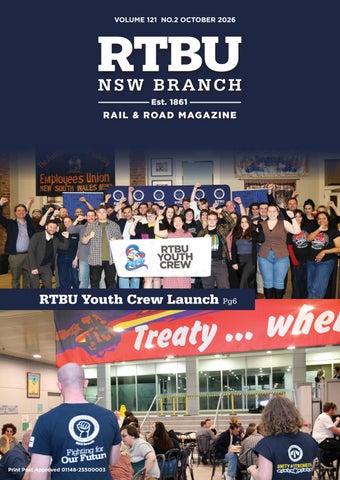
RTBU Youth Crew Launch Pg6
Print Post Approved 01148-25500003
Head Office
Level 4, 321 Pitt Street Sydney NSW 2000 Tel (02) 9264 2511 Email nswho@rtbu-nsw.asn.au Website www.rtbuexpress.com.au
Tram and Bus Division
Level 4, 321 Pitt Street Sydney NSW 2000 Tel (02) 9319 7277 Email nswbus@rtbu-nsw.asn.au
Locomotive Division
Level 4, 321 Pitt Street Sydney NSW 2000 Tel (02) 9264 3400 Email nswloco@rtbu-nsw.asn.au
Andy Holt’s Retirement Pg16 Connecting with RTBU Members Across Regional NSW Pg 9
Newcastle Office
33 Gordon Avenue Hamilton NSW 2303 Tel 02 9264 2511 Email nswho@rtbu-nsw.asn.au
Wollongong Office
Level 1, 306a Crown Street Wollongong 2500 Tel (02) 9264 2511 Email nswho@rtbu-nsw.asn.au Rail & Road is the official journal of the NSW Branch of the Rail, Tram and Bus Union and is produced as part of the union’s communication strategy to inform and report on matters of interest to members. All editorial and advertising inquiries should be addressed to: Swarleen Oberai Communications Officer Mobile: 0455 300 662
2 Rail Road &
RTBU Youth Crew Launch Pg6
Branch Secretary Message
8
Big Win for RTBU Members: Permanent Jobs Secured on the South West Line!
10
Migration is a Class Question
13
The Importance of Flexible Work Arrangements and Work Adjustments Workplace Health and Safety Codes of Practice – Now Enforceable!
14
RTBU Growing at Transport for NSW
15
Locomotive Division Secretary Message
18
RTBU Raises Alarm Over Tangara Crew Safety Sydney Trains Attempts to Put Conditions on Hard-Won Pay Rise
19
Use It or Lose It: Stronger Rights for HSRs
20
Stronger Delegates Start in the Workplace
21
Contents
4
Members Secure Cadwelding Win as Sydney Trains Appeals Decision
Your Super, Your Future: Sydney Trains Members Make Use of New Entitlement
22
Signallers Stand Together to Secure Significant Win
23
Tram and Bus Division President Message
24
Newcastle Bus Drivers Take Their Fight to the Fair Work Commission
25
97% YES! Bus Drivers Across Three Regions Ready to Fight
26
Welcoming the Next Generation of Rail Workers
Rail & Road
3
From the Branch Secretary
‘‘ 4 Rail Road &
The Government cannot keep talking about cost-ofliving relief while leaving entire communities without decent public transport.
Working people across NSW are doing it tough. Petrol prices are going up, household bills aren’t getting any cheaper, and for too many people, getting to work is costing more than it should. The reality is that many people don’t have a choice. If there’s no reliable bus or train service where you live, you’re stuck driving. And when petrol prices rise, you’re the one left paying for it. That’s why we need to be having a serious conversation about public transport investment in NSW. We need more buses, trains and trams connecting people to work, education, healthcare and their communities. That includes regional NSW, where people have been asking for better services for years. And we need good jobs to deliver those services. There’s no point promising better public transport if you’re not prepared to invest in proper staffing, secure jobs and safe working conditions. We’ve seen what happens when our members stand up and demand better. The previous Coalition government didn’t understand this and the current government hasn’t been much better. But we’ve seen that our members are prepared to stand up and demand better. For the recently opened Sydenham to Bankstown metro extension, the staffing agreement our members fought for is finally being delivered. Permanent jobs instead of fixed-term contracts, and a proper staffing model that puts workers on the ground. A massive win for our Metro members and one they worked hard to enforce. Across bus Regions 7, 8 and 9, members delivered a massive 97% YES vote for all forms of protected industrial action. Drivers have made it clear they’re not prepared to keep waiting for fair pay and decent conditions. In Newcastle, our members are still fighting for a fair deal through the Fair Work Commission. Meanwhile, the NSW Government has extended Keolis’ contract for another 12 months. We’ve said it before, and we’ll keep saying it. Privatisation has failed Newcastle. Those buses need to be back in public hands. Safety is another issue we won’t be backing away from. Across rail, tram and bus, members are raising concerns about staffing, fatigue, fleet safety and workplace changes being pushed through without proper consultation.
arrangements and demanding proper risk assessments. Our members know their jobs. When they tell an employer something isn’t safe, that should be taken seriously. We shouldn’t have to fight to get basic safety concerns heard. I also want to mention the launch of our RTBU Youth Crew. We had around 150 expressions of interest, and it was great to see so many young members from across the union getting involved. They’ve got plenty to say about housing, the cost of living, job security and what new AI technology means for their jobs. And they’re right to be asking those questions. I want the Youth Crew to be somewhere young members can raise issues, get involved in their workplaces and have a real say in where this union goes next. As we head towards the end of the year, I want to thank our members, delegates and Health and Safety Representatives for the work they’re doing. We’ve had some good wins, but there’s still plenty to fight for. Better public transport, safer workplaces and fair conditions for the people keeping NSW moving. That’s where our focus needs to stay.
In Solidarity Toby Warnes NSW Branch Secretary
There’s no point promising better public transport if you’re not prepared to invest in proper staffing, secure jobs and safe working conditions.
On the Bankstown Line, our Health and Safety Representatives have been challenging lone working
Rail & Road
5
The Next Generation Is Ready: RTBU Youth Crew Launches!
Young workers aren’t waiting around to have their say, and the RTBU Youth Crew launch proved it!
A
fter a massive 150 expressions of interest, young members from across rail, tram and bus came together on 8 October to meet their fellow unionists, share ideas and have some important conversations about their futures. And they had plenty to say. From the growing fear that owning a home will never be within reach, to concerns about artificial intelligence and what it could mean for their jobs, young members spoke openly about the challenges facing their generation. For many, the future of work is changing rapidly, while the cost of living continues to rise. Questions about job security, affordable housing and whether young workers will have the same opportunities as previous generations were front and centre. These aren’t just issues for the future. They’re already shaping the decisions young workers
6 Rail Road &
Young members wanted a space where they could raise their concerns, learn from more experienced workers and have a genuine say in how their union responds. make about their careers, their finances and their lives. The night also featured speakers from across the union movement, with Thomas Costa and Todd Pinkerton from Unions NSW joining RTBU NSW Secretary Toby Warnes and Farren Campbell, Loco Secretary from the RTBU in addressing the crowd. A highlight of the evening was a lively panel discussion hosted by Catherine Treloar, featuring Alex Reed-Joyce, Swarleen Oberai and Todd Pinkerton. Drawing on their experiences within the union movement, panellists answered questions from young members and shared their perspectives on organising, getting involved and making their voices heard. The conversations throughout the night showed exactly why the Youth Crew matters. Young members wanted a space where they could raise their concerns, learn from more experienced workers and have a genuine say in how their union responds. The launch also showcased the creativity of young workers, with artwork and merchandise developed by talented designers from within the RTBU membership and independent creatives. The Youth Crew was established to give members under 35 a place to connect, seek mentorship, develop their organising skills and take a more active role in their union. With young workers facing some big challenges, it’s important that their voices are heard when decisions are being made about the future of our industries. The launch was a great start, but the real work is what comes next. From protecting secure jobs to making sure new technology benefits workers rather than leaving them behind, there’s plenty for the next generation of RTBU members to get stuck into. And if the conversations on the night were anything to go by, this group won’t be short of ideas or determination. Missed the launch? RTBU members under 35 can still get involved. Scan the QR code to register your interest and help turn generational rage into industrial power.
Rail & Road
7
Big Win for RTBU Members: Permanent Jobs Secured on the South West Line! RTBU members have secured a major win on the South West Line, with the NSW Government delivering on the staffing agreement fought for by members in September 2024. After months of pushing for proper staffing and secure employment, the RTBU has secured confirmation that the agreed staffing model will be implemented, delivering permanent jobs
and stronger staffing arrangements across the line. Under the agreement, MTS will employ workers in permanent positions rather than relying on fixed-term contracts. Existing fixed-term employees will also be converted to permanent employment, providing greater job security for affected members. The agreement also addresses staffing arrangements during the first six months of operation, with a technician stationed at each station to help manage gaps and issues involving platform screen doors. Following this initial period, newly recruited Customer Journey Coordinators (CJCs) will fill the agreed station positions, delivering the permanent staffing model RTBU members fought to secure. This is an important victory for members who have continued to push for proper staffing levels, secure employment and safer working conditions on the South West Line. The RTBU has consistently maintained that stations need properly trained workers on the ground, both to support passengers and to ensure staff are not left dealing with safety and operational issues without adequate support. The outcome is also a reminder of the importance of holding employers and governments to their commitments. Members secured this agreement in September 2024 and continued pushing to make sure it was delivered. Congratulations to all RTBU members and delegates who stood firm throughout this process. Permanent jobs, proper staffing and safer stations. That’s a win worth celebrating!
8 Rail Road &
Connecting
with RTBU Members Across Regional NSW From Dubbo to Albury, RTBU NSW President Craig Turner has been out meeting members and delegates, hearing firsthand about the issues affecting workers across regional NSW.
and represented remains a priority for the RTBU.
The visits provided an opportunity to catch up with members in their workplaces, discuss local concerns and hear about the challenges facing regional rail workers.
Whether it’s fighting for better conditions, addressing safety concerns or making sure members have a say in workplace decisions, strong local representation makes a difference.
For members working outside Sydney, having a strong union presence across the state is important. Regional workplaces face their own challenges, and making sure those issues are heard
The visits were also an opportunity to recognise the work of local delegates, who play an important role in supporting their workmates, raising workplace concerns and keeping members connected with their union.
A big thank you to everyone who took the time to catch up with Craig during his visits!
Rail & Road
9
a s i n o i Migrat uestion Class Q
ews Peter Matth
The tabloids argue about the size of our immigration intake. Unions should be arguing about who it is designed to benefit and making the case for helping those in need, not bosses to suppress workers wages For the best part of two decades the union movement has been uneasy about immigration. We have let the loudest voices in the debate, podcasters, bigots, the Karls,the tabloid front pages, the fringe of the Coalition and the biggest party in the Coalition now known as One Nation, set the terms, and then we have flinched from the whole subject rather than be lumped in with them.
That headline figure is not the permanent program. The permanent Migration Program for 2025–26 is set at 185,000 places, and its shape is the thing worth looking at. Of those places, 132,200 (71 per cent) sit in the Skilled stream. The Family stream gets 52,500. The Humanitarian Program, which is set separately, gets 20,000.
That instinct is understandable. It is also a mistake. Immigration policy is not, at its core, a question about culture or the flag or the boats. It is a question about the price of labour, and about who gets to set it. That makes it ours.
Hold those two numbers next to each other: 132,200 places to fill the labour needs of employers, and 20,000 for the persecuted, the displaced, and the people fleeing for their lives.
So let us start where a unionist should start: not with the number the tabloids shout about, but with the design of the thing. Who is the migration program built to serve? There is a lot of confusion in the public debate, most of it deliberate. Net overseas migration, the figure that gets the headlines, was 306,000 in 2024–25. That is down sharply from 429,000 the year before and from a postpandemic peak of 538,000 in 2022–23, but it is still well above the pre-COVID run rate of around 230,000. Of the 568,000 people who arrived in that year, close to twothirds came on temporary visas, and the single largest group (157,000 people) were international students.
That ratio is a statement of what the program is for. It is, overwhelmingly, an economic instrument, a mechanism for supplying labour and suppressing wages, with a humanitarian component bolted on at the margin. Over the whole stock of permanent migrants who have arrived since 2000, the split tells the same story: around 59 per cent came through the skilled stream, 32 per cent through family, and just 9 per cent on humanitarian grounds. When a Treasury official or an employer lobby says “skills shortage,” a union member should hear the sentence they are actually saying: we would rather import a worker than train one, and we would rather import a worker than pay more.
Peter Matthews is the Director of Legal with the NSW Branch.
e program h t t a h w f o tatement s a omic n is o c io e t a n r a t , a ly h T rwhelming or supplying labour e v o , is It . r is fo chanism f a humanitarian e m a , t n e instrum es, with g a w g in s s in. and suppre bolted on at the marg component
10 Rail Road &
WANT HEALTH COVER THAT KEEPS YOU MOVING? GO TO UNION HEALTH. Reliable, straightforward cover for transport workers and their families.
Get a quote
The GO TO health insurance for transport workers and their families. 1300 661 283 | unionhealth.com.au *Eligibility & T&C’s apply. Teachers Federation Health Limited ABN 86 097 030 414 trading as Union Health.
11
Rail&Road
The importance of flexible work arrangements and work adjustments RTBU members have long been committed to a workplace that is fair, inclusive and safe. For some of us, that means having access to adjustments at work, like modified equipment or shift patterns, due to illness or disability. For others, it can mean having the right to work from home, or work flexibly, to allow us to care for kids, ageing relatives or other loved ones.
their workmates in our case against Transport for NSW in the Industrial Relations Commission.
Over two years ago, the NSW Government attempted to force all public servants back into the office, full time. This would have had a detrimental impact on workers, particularly those who historically have faced discrimination and exclusion from the workforce, including working parents and those with disabilities.
Importantly, if you do have a disability, you are a carer or a parent, you always have the right to request flexible work arrangements, which can include modified working hours, modified shift patterns, reduced hours, job-share arrangements, modifications to equipment or workspaces, and more. Your employer can only deny you these if they have reasonable grounds to do so – which they generally don’t. Contact your delegate for support.
RTBU members stood up against this proposal and defended their rights to a safe workplace to an inclusive workplace free from discrimination Hundreds attended meetings, provided evidence and supported
Over two years ago, the NSW Government attempted to force all public servants back into the office, full time.
As a result, Transport for NSW, Sydney Trains and NSW Trainlink now have some of the most worker friendly flexible work policies in the state. And more than that, we are amongst the last to have to implement any ‘return to the office’ mandate. So, if you are a member at one of these agencies, what are your rights when it comes to flexible work arrangements?
If you are a worker who doesn’t have a public facing role, you have the right to work 50% of the time from home.
If you are a worker, as many of our members are, who works across multiple sites, and sometimes from home, you also have the right to work from home at least some of the time. Contact your delegate, or your Organiser, if you need help applying for Hybrid Work (working from home) or a Flexible Work Arrangement (which includes working from home, but also a lot of other adjustments too). Congratulations to the members who stood up and fought for a workplace that champions our diversity, rather than pushes it out.
Workplace Health and Safety Codes of Practice – Now Enforceable! Did you know that your right to a safe workplace is guided by the Workplace Health and Safety Codes of Practice? The Codes of Practice have, until recently, been considered best practice, but could not be enforced. Thanks to union power, recent legislative changes means that the Codes of Practice are now enforceable, and that employers can face significant fines for breaching the Codes of Practice. To learn more about the Codes of Practice, you can find them via the QR code here. It is a good idea to familiarise yourself with the codes most relevant to you. Many members are finding significant value in reviewing the Code of Practice on Psychological Health and Safety. It can help you identify hazards in your workplace, like lack of role clarity, role overload, or lack of procedural justice. It can also help you identify potential remedies to those hazards. It’s important that you have an elected HSR to support you in identifying and addressing risks at work. We want to get a clear picture of where HSRs are elected across our membership. Please fill out the survey via the QR code here.
12 Rail Road &
Transport for NSW workers have faced a horrific restructure which gutted 1000s of jobs. It has been heartening to see members take the damage caused by that restructure, and turn it into industrial power. RTBU power is growing at Transport for NSW. Building our union means building power across the cluster of Transport agencies. It has been fantastic to see so many members take the horrific damage caused by the restructure, and turn that into industrial power. There are stories from across Transport of members standing up for their rights. In Enterprise Security, Crisis and Emergency Management members successfully rallied against an additional proposed restructure, and won guarantees that their jobs would be safe, and an additional staff psychologist was employed to address the harm caused.
Growing at Transport for NSW
At the Transport Management Centre, members successfully stared down an unfair roster change, and have negotiated for new practices to be in place when any new procedures are introduced, ensuring their safety, and the safety of everyone who uses our public transport infrastructure. In Payroll, delegates led the charge against dangerous levels of overtime and fought for additional resources. Payroll delays and errors are a long standing problem for our members in Sydney Trains and NSW Trainlink, and it is a problem that can be traced back to the poor management practices of the branch. Payroll workers are expected to fulfill 100s of hours of overtime every month to simply meet BAU demands. Of course, the RTBU had warned that this level of chaos and danger would occur when Transport insisted on bringing Payroll services from Sydney Trains in house. There is of course a lot more work to be done across Transport for NSW. The callous disregard management have for worker wellbeing is frightening. Despite this, the RTBU is the union that fights, and wins, and our members at Transport are demonstrating that on a daily basis.
14 Rail Road &
In Payroll, delegates led the charge against dangerous levels of overtime and fought for additional resources.
From the Locomotive Division Secretary The Work Doesn’t Stop When the Agreement Is Signed There’s a misconception that once an enterprise agreement is signed, the hard work is over. Anyone who’s spent time dealing with railway employers knows that’s rarely the case. Across passenger and freight operations, we’re continuing to see employers test agreements, push changes through consultation processes and expect drivers to accept decisions that affect their safety, conditions and livelihoods. For our passenger members, fleet safety and reliability remain critical issues. Drivers know what happens when faults aren’t properly addressed and ageing rolling stock is expected to keep operating without the investment it needs. They place additional pressure on drivers and raise serious questions about safety. In freight, fatigue, rostering, time away from home and changes to established working arrangements continue to be major concerns. With Pacific National heading into another round of enterprise bargaining, these issues will be front and centre. PN members keep freight moving across the country, often working long and demanding hours. They deserve an agreement that recognises their contribution, delivers meaningful improvements to wages and conditions and protects the entitlements they’ve fought for. Across the freight industry, employers continue to push so-called efficiencies that place greater demands on workers. Whether it’s rostering changes or proposals affecting regional jobs and fatigue management, we won’t accept cost-cutting dressed up as progress. And whether you’re driving a passenger service or a freight train, the principle remains the same. Decisions affecting drivers must involve genuine consultation with the people doing the work. That’s why strong delegates and members who know their rights matter just as much between bargaining rounds as they do during them. It was encouraging to see young train drivers joining members from across rail, tram and bus at the recent RTBU Youth Crew launch. Young drivers came together to share their experiences, raise concerns about their futures and make sure their voices are heard on the issues that will shape their working lives. These are the members who will be driving our industry for decades to come, and they deserve a say in its future. We also recently celebrated the retirement of Andy Holt after 47 years on the railway and more than four decades of union involvement. Andy’s contribution to the Locomotive Division has been enormous. From protecting safeworking conditions to mentoring generations of delegates, he’s shown what genuine union representation looks like. At his retirement celebration, Andy shared a message worth remembering: “It’s always about the member, never about an individual.” That sums up what our Division should always stand for. As we head into another period of bargaining and workplace change, our focus remains on defending the conditions members have fought for, protecting safety and ensuring train drivers have a genuine say in their working lives. There’s plenty of work ahead, and as always, our strength comes from members standing together.
We won’t accept cost-cutting dressed up as progress
In Solidarity Farren Campbell Locomotive Divisional Secretary
Rail & Road
15
Celebrating 47 Years
Andy Holt’s Incredible Contribution to the RTBU There wasn’t a single driver in the state who hadn’t benefited from his work over the past 30 years.
A packed room, plenty of tears and 47 years of stories to tell. Andy Holt’s retirement celebration was a night to remember, as friends, family, workmates and union representatives came together in Blacktown to farewell one of the RTBU’s most respected unionists. After 47 years on the railway and more than four decades of union involvement, Andy has left an incredible mark on the people he’s worked alongside. And judging by the turnout, there were plenty of people who wanted to tell him just how much he meant to them. The night was filled with laughter, old stories and heartfelt tributes, with emotions running high as colleagues reflected on the difference Andy had made in their lives, both as a union representative and as a friend. Ask anyone who’s worked alongside Andy, and they’ll tell you just how much he’s meant to the Locomotive Division. RTBU Locomotive Division Secretary Farren Campbell spoke about the enormous impact Andy has had on train drivers across NSW, saying there wasn’t a single driver in the state who hadn’t benefited from his work over the past 30 years. Locomotive Division President Dan Leece described Andy as a mentor to himself and countless others, recognising the guidance and support he has provided to members and delegates throughout his career. The tributes also highlighted Andy’s contribution to improving safety on the railway. RTBU Assistant National Secretary Keith McMahon reflected on working closely with Andy since the late 1990s, including their involvement in protecting safeworking conditions and advocating for important safety improvements following the Waterfall rail disaster. Keith pointed to the introduction of vigilance systems and Automatic Train Protection as part of the lasting legacy of their work together. RTBU National Secretary Alex Claassens also shared memories of working alongside Andy at Eveleigh, recalling their long friendship and Andy’s commitment to the railway community. He spoke warmly about Andy and his wife Leigh, and the care they have always shown for others. But perhaps the most meaningful words of the night came from Andy himself. Reflecting on his union involvement, which began in 1984, Andy spoke about why representing members had remained so important to him throughout his career. “I love helping people,” Andy said. “Always remember to help someone. It’s a great thing, and that’s what our union should be.” For Andy, being a union representative was never about recognition or holding a position. It was about being there for members when they needed someone in their corner. He also encouraged more workers to become union delegates and take on the responsibility of supporting their workmates, something he has spent decades doing himself. The friendships Andy built, the members he supported and the generations of unionists he mentored are all part of the legacy he leaves behind. As Andy put it himself: “It’s always about the members, never about an individual.” After 47 years on the railway, that might be the best way to sum up Andy Holt. A unionist who always put his workmates first. From everyone at the RTBU, thank you, Andy. Enjoy your well-earned retirement.
Rail & Road
17
Raises Alarm Over Tangara Crew Safety
The RTBU is calling for urgent action to improve crew safety on Sydney’s Tangara trains, with serious concerns raised about the security of driver and guard compartments. In September, RTBU NSW Secretary Toby Warnes raised concerns about the slow progress of safety upgrades across the Tangara fleet, with 55 trains affected and only one fully refurbished at the time. For drivers and guards working on
these trains every day, secure crew compartments are an important part of keeping workers safe while carrying out their duties. The RTBU has made it clear that workers should not have to wait years for basic safety improvements, particularly when they are working in an environment where they may be exposed to aggressive or threatening behaviour. The issue also raises broader questions about how quickly safety concerns are addressed across the rail network and whether enough
is being done to protect frontline transport workers. While passengers rightly expect a safe and reliable train service, the workers delivering that service deserve the same level of protection. The RTBU will continue pushing for improvements to crew-cab security and for the safety of drivers and guards to be treated as a priority. Our members deserve to feel safe every time they step onto a train.
Sydney Trains Attempts to Put Conditions on Hard-Won Pay Rise Members fought hard for a longoverdue pay rise for Infrastructure workers. Now Sydney Trains is attempting to attach new competency requirements to an increase members have already won. During the 2025 Enterprise Agreement negotiations, RTBU members stood together to secure a classification uplift for workers in the Track and Structures stream, recognising the important work they do to keep our railway running. That increase is due to take effect on 1 July 2027. But Sydney Trains has since announced consultation on new competencies across several classifications under Section 5 of the Agreement. The problem? Sydney Trains appears to believe workers
18 Rail Road &
must complete these new competencies before receiving their agreed classification uplift. The RTBU strongly disputes that position. Members fought for this increase, and it should not come with additional conditions that weren’t part of the agreement. The union has formally placed the matter into dispute and invoked the status quo provisions of the Enterprise Agreement. Members won this pay rise through collective bargaining. The RTBU will continue fighting to make sure they receive it without new conditions being attached.
Use It or Lose It:
Stronger Rights for HSRs Health and Safety Representatives (HSRs) play a critical role in keeping our workplaces safe. But having strong workplace safety laws is only part of the picture. Knowing your rights and using them is just as important. For years, unions have fought for stronger workplace health and safety laws to protect workers and ensure HSRs have the powers they need to carry out their roles. As part of that fight, Unions NSW launched its Stronger Rights, Safer Workplaces campaign, calling for stronger protections and greater accountability from employers.
• Provisional Improvement Notices (PINs): Employers must provide copies of any issued PINs to SafeWork NSW as soon as practicable, with a maximum fine of $6,418 for failing to comply. PINs must allow at least eight days for the safety breach to be remedied. • Union and Entry Powers: Union rights have been expanded, including stronger powers for WHS entry permit holders to conduct tests, take measurements and photograph or film suspected hazards. Eligible unions also have expanded rights to pursue prosecutions for WHS offences, including Category 3 offences, subject to legal requirements.
The NSW Government has since introduced a range of changes aimed at strengthening the rights of HSRs and giving workers more power to address workplace safety concerns.
• Codes of Practice: Employers now have a legal duty to comply with approved codes of practice or manage workplace hazards and risks to an equivalent or higher safety standard.
One of the key changes involves Provisional Improvement Notices (PINs). Employers are now required to not only display a PIN but also provide a copy to SafeWork NSW as soon as practicable after receiving it.
These changes give HSRs and workers more tools to challenge unsafe conditions and ensure employers meet their responsibilities.
PINs can be issued by trained HSRs when they reasonably believe workplace health and safety laws are being breached. They require the employer to address the breach within a specified period, which must be at least eight days. These changes are an important step towards making sure workplace safety concerns are taken seriously and employers are held accountable. Other Key Changes for HSRs and WHS Laws • Dispute Resolution: The Industrial Relations Commission (IRC) now has clearer powers to resolve workplace health and safety disputes, including those involving work groups, HSR functions and the cessation of unsafe work.
Know Your Rights and Use Them
But stronger laws only make a difference when workers know about them and are prepared to use them. If your workplace doesn’t have an elected HSR, contact your RTBU organiser. The union can assist your work group with the process of electing a representative. Once elected, HSRs are entitled to five days of initial training to help them understand their powers, responsibilities and how to represent their workmates on safety matters. To enrol in HSR training, scan the QR code or visit: For more information about HSR training, contact Wayne Moody at wmoody@rtbu-nsw.asn.au. Safety is union business.
Rail & Road
19
s e t a g e l e D r e g n o Str e c a l p k r o W e h t Start in Ever thought about becoming a workplace delegate but weren’t sure where to start? The RTBU’s Level 1 Delegates Training course is helping members build the skills and confidence to stand up for their workmates and make a difference in their workplaces. RTBU NSW President Craig Turner recently addressed members taking part in the course, which gives new delegates a practical introduction to organising and representing members on the job. From understanding awards and agreements to tackling workplace problems, the training covers the things delegates deal with every day. Members also learn about the history of the union, their role as a delegate and how to have effective one-on-one conversations with workmates. Being a delegate isn’t always easy. It means speaking up when something isn’t right, helping members understand their rights and making sure workplace issues don’t go unanswered. And the more confident and organised our delegates are, the stronger our workplaces become.
20 Rail Road &
Interested in stepping up? Whether you’re a new delegate or looking to sharpen your organising skills, contact your RTBU organiser to enrol in one of our upcoming courses.
Members Secure Cadwelding Win as Sydney Trains Appeals Decision RTBU members have secured an important win in their dispute with Sydney Trains over Cadwelding duties, following a decision handed down by Commissioner Walkaden on 12 August 2026. The decision found that Signal Electricians classified at Level 4.1 or higher can only be lawfully and reasonably directed to perform Cadwelding if they have completed UEERS0024 with specific Cadwelding training, are on the Cadwelding register and have completed the relevant product training. However, Sydney Trains has since lodged an appeal, with the matter scheduled to go before the Full Bench on 10 November 2026.
The RTBU will continue to stand with members and fight to uphold their rights under the Agreement.
It’s a significant win for members who stood together to enforce their rights under the Enterprise Agreement.
Your super, your future: Sydney Trains members make use of new entitlement
When was the last time you checked your superannuation? For many workers, super is something that quietly builds in the background while we get on with our working lives. But whether you’re just starting out on the railway or getting closer to retirement, knowing where your super stands matters. And for Sydney Trains members, there’s now an opportunity to get some answers without having to take time out of their own day. Under clause 11B.3 of the Enterprise Agreement, members are entitled to up to two hours during ordinary
working hours each calendar year to obtain information about their superannuation. It’s a useful entitlement that gives workers time to ask questions, understand their options and make sure they’re keeping track of their retirement savings. Super might not be something you think about every day, particularly when there’s plenty happening at work and at home. But it’s worth paying attention to. After years of working on the railway, you want to know that the money you’ve earned and put away is working for your future. For Sydney Trains members, this is an entitlement worth knowing about and making use of!
Rail & Road
21
s r e l l a Sign Together Stand ure c e S in o W t t n a c fi i Sign
O
n 8 October 2026, RTBU Signaller Sub-Division members achieved a significant victory by demonstrating strong solidarity in supporting the Signaller Sub-Division Executive’s (the Executive) dispute and recommendation. The matter arose on 1 October, when the Signaller SubDivision notified Sydney Trains of a Step 2 dispute under clause 8 of the Disputes Settlement Procedure in the Sydney Trains and NSW TrainLink Enterprise Agreement 2025 (the Agreement). The dispute concerned Sydney Trains’ requirement for Signallers and Area Controllers (ACs) to undergo post-incident drug testing following incidents during infrastructure testing. In addition to the dispute, the Executive issued a recommendation that members decline any request to test signalling infrastructure unless it was conducted under a Work on Track Authority, until further notice. This was due to concerns about the reliability of assurances from qualified workers on track and the exemption for incident response requirements. The Executive considered this measure necessary to protect the safety, mental health and dignity of Signallers and ACs. On 3 October, the Executive met with Sydney Trains via Teams and reiterated that member safety and welfare remain our top priorities. During the meeting, it was established that Sydney Trains had been using an updated SMS Post-Incident Drug and Alcohol Testing document (SMS) without the required consultation under clause 7 of the Agreement. The meeting concluded with the recommendation remaining in place, except for incident response requirements. The Executive also requested regular audits of post-incident testing and the withdrawal of the disputed SMS, with a return to the previous version. On 6 October, the Executive met with Sydney Trains again; however, no outcome was reached.
22 Rail & Road
On 8 October, an agreement was reached with Sydney Trains, allowing the Executive to discontinue the dispute and withdraw its recommendation. Sydney Trains committed to the following: • Conducting a transparent review of post-incident testing decisions made by IMSR over the past 24 months. • Introducing audits of the application of post-incident testing by IMSR. • Rolling back the SMS Post-Incident Drug and Alcohol Testing document to the previous version (1.1), while further engagement and consultation takes place on the procedure. • Sending communications to Duty Control Managers (DCMs) requiring them to notify the Signalling Operations and Incident Management and Service Recovery executives of any activation of post-incident testing. • Ensuring the Executive Director of Signalling Operations communicates with the Senior Manager Signalling Operations (SMSO) or Manager Signalling Operations (SMO) management team where there is uncertainty about a Signaller’s involvement. Where practical and available, supporting information can be shared with Network Incident Managers (NIMs) as part of their decision-making process. • Allowing RTBU Executives and representatives to raise any future concerns about post-incident testing activations directly with the Executive Director of Signalling Operations. We congratulate all members for their courage in standing firm behind the Executive’s recommendation and refusing to back down, particularly given the significant pressure many members faced. This outcome shows what members can achieve when they stand together and refuse to compromise on their rights, safety and dignity at work.
From the Tram and Bus Division President Bus Drivers Have Had Enough
Public transport should serve the communities that rely on it, not the profits of multinational operators.
If there’s one thing the past few months have shown, it’s that bus drivers are no longer prepared to sit back while employers drag their feet on pay and conditions. Across Regions 7, 8 and 9, RTBU members delivered an extraordinary 97% YES vote for all forms of protected industrial action, with 85% of members participating in the ballot. That’s not a result employers can ignore. Three regions, three operators and a clear message from the workers who keep Sydney moving every day. Drivers are tired of being told to be patient while the cost-ofliving climbs and the pressures of the job continue to grow. Split shifts, demanding rosters, fatigue, safety concerns and wages that aren’t keeping pace are issues members have raised for far too long. And in Newcastle, the situation is just as frustrating. Members at Hamilton and Belmont depots have been waiting for a pay rise since November 2024. In October, the RTBU took the fight to the Fair Work Commission, seeking pay increases totalling more than 26% over four years. Our members have continued turning up, keeping services running and doing their jobs while their employer has failed to deliver a fair outcome. Then came the NSW Government’s decision to extend Keolis’ Newcastle contract for another 12 months. It’s the wrong decision. We’ve seen what privatisation has done to Newcastle’s bus network. Drivers have been left dealing with the consequences, and passengers have watched services deteriorate. For years, private operators have promised better services and greater efficiency. Members know the reality is very different. The RTBU will continue pushing for Newcastle’s buses to be returned to public hands. Public transport should serve the communities that rely on it, not the profits of multinational operators. While that fight continues, our priority remains securing better wages, safer workplaces and conditions that recognise the work bus and tram employees do every day. The results across Regions 7, 8 and 9 show the determination of our membership. The fight in Newcastle shows just how much persistence is required to get a fair deal. To every member who voted, attended a meeting, spoke up or supported their workmates, thank you. Employers need to understand that our members are organised, united and prepared to stand up for what they deserve.
In Solidarity Peter Grech Divisional President
Rail & Road
23
Newcastle Bus Drivers Take Their Fight to the Fair Work Commission
Newcastle bus drivers have waited long enough for a fair pay rise, and RTBU members from Hamilton and Belmont depots are refusing to back down. In October, the RTBU took its fight for better wages to the Fair Work Commission, with three days of hearings in the ongoing intractable bargaining dispute with Keolis Downer Hunter. The RTBU is fighting for pay increases totalling more than 26% over four years, as members continue their long-running battle for wages that reflect the work they do and the responsibility they carry every day. Drivers at Hamilton and Belmont have been waiting for a pay increase since November 2024. Despite their efforts to secure a fair agreement, members have continued working without the wage increases they deserve. Throughout the hearings, RTBU members and representatives kept the pressure on, with Belmont Depot member Brett Peters, Toby Warnes RTBU NSW Secretary and RTBU Director of Legal Peter Mathews providing updates on the proceedings and the next steps in the dispute. The hearings came at a particularly frustrating time for Newcastle bus drivers, following the NSW Government’s decision to extend Keolis’ contract to operate Newcastle’s buses for another 12 months.
For RTBU members, the decision was another bitter disappointment after years of dealing with the consequences of privatisation. The latest contract extension means another year under an operator that has still not delivered the pay increases members have been fighting for. The RTBU has made it clear that the decision to extend the contract was the wrong one and will continue pushing the NSW Government to return Newcastle’s buses to public hands when the extension ends. For members at Hamilton and Belmont, the fight is about more than a pay rise. It’s about being properly valued for the essential work they do, securing decent conditions and having a public transport system that puts workers and passengers ahead of private profits. The Fair Work Commission hearings marked another important stage in that fight, with members continuing to stand together despite the long wait for a fair outcome. The RTBU will continue fighting for the wages Newcastle bus drivers deserve and for a publicly operated bus network that delivers for the people of Newcastle. Newcastle bus drivers deserve better. Newcastle passengers deserve better. It’s time for fair pay and buses back in public hands.
Since Newcastle’s bus services were privatised in 2017, the RTBU has consistently raised concerns about the impact on workers and passengers, arguing that private operators have failed to deliver the services Newcastle deserves.
24 Rail Road &
97% YES! Bus Drivers Across Three Regions Ready to Fight Bus drivers across Sydney have sent a clear message to their employers: Enough is enough.
show e v i s s a m a In , of strength oss rs acr e b m e m U RTB and 9 8 , 7 s n o i g Re ingly m l e h w r e v voted o taking f o r u o v a f in rial t s u d n i d e t protec an action, with ES 7% Y 9 e l b i d e r c in forms l l a r o f e t o v of action.
The ballot also recorded an impressive 85% participation rate, demonstrating just how determined members are to fight for better pay and conditions. The result brings together drivers from three major bus operators: Busways in Region 7, Keolis in Region 8 and Transdev John Holland Buses in Region 9. While members across the three regions have their own enterprise agreements and workplace issues, they share a common frustration with employers who have failed to deliver the pay and conditions drivers deserve. Bus drivers are responsible for getting thousands of people to work, school and appointments every day. Yet they continue to face growing pressures on the job, including demanding rosters, fatigue, split shifts and concerns about safety. The overwhelming YES vote demonstrates that members are prepared to stand together and use their industrial rights to push for meaningful improvements. With such strong participation across all three regions, the result sends a powerful message to management that drivers are united and serious about securing a fair deal. The RTBU congratulates every member who participated in the ballot and helped deliver such a decisive result. The ballot was an important step in the bargaining campaigns, giving members the opportunity to take protected industrial action as they continued fighting for better wages and working conditions. Three regions. Three employers. One clear message: bus drivers have had enough, and they’re ready to fight!
Rail & Road
25
Welcoming the Next Generation of Rail Workers Starting an apprenticeship is a big step, and the RTBU is making sure the next generation of rail workers knows the union is there to support them from day one. At an apprentice induction held earlier this year, RTBU Organiser Ricky Keehn met with new apprentices to talk about the importance of union membership, workplace rights and having someone in your corner as you begin your career on the railway. The RTBU has also introduced a new approach to apprentice membership, with first-year union fees reduced to just $1. It’s about making union membership more accessible to young workers and giving apprentices the opportunity to get involved in the union from the beginning of their working lives. Apprentices are the future of our industry, and ensuring they understand their rights, have access to support and feel confident speaking up at work is an important part of building a stronger union.
26 Rail Road &
You’ve earned this view. Less Monday. More Jervis Bay! Want another reason to book your next getaway now? RTBU member rates have just dropped! Enjoy a well-earned break at the RTBU Holiday Park in beautiful Jervis Bay, now for less.
Your next getaway is calling. Book Now!
Call the RTBU office on (02) 9264 2511 Rail & Road
27
Did you know you could join online?