VOLUME 120 NO.1 JULY 2026
Est. 1861
RAIL & R OAD M AG AZIN E
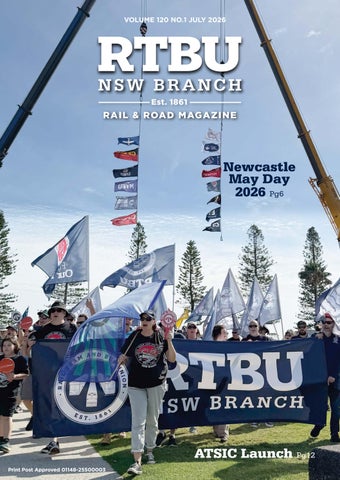
Newcastle May Day 2026 Pg6
ATSIC Launch Pg12 Print Post Approved 01148-25500003
Head Office
Level 4, 321 Pitt Street Sydney NSW 2000 Tel (02) 92642511 Email nswho@rtbu-nsw.asn.au Website www.rtbuexpress.com.au
ATSIC Launch Pg12
Tram and Bus Division
Level 4, 321 Pitt Street Sydney NSW 2000 Tel (02) 93197277 Email nswbus@rtbu-nsw.asn.au
Locomotive Division
Level 4, 321 Pitt Street Sydney NSW 2000 Tel (02) 92643400 Fax (02) 92647679 Email nswloco@rtbu-nsw.asn.au
Newcastle Office
33 Gordon Avenue Hamilton NSW 2303 Tel 02 9264 2511 Email nswho@rtbu-nsw.asn.au
Wollongong Office
Level 1, 306a Crown Street Wollongong 2500 Tel (02) 9264 2511 Email nswho@rtbu-nsw.asn.au Rail & Road is the official journal of the NSW Branch of the Rail, Tram and Bus Union and is produced as part of the union’s communication strategy to inform and report on matters of interest to members. All editorial and advertising inquiries should be addressed to: Swarleen Oberai Communications Officer Mobile: 0455 300 662
2 Rail Road &
Loco 2026 Delegates Conference Pg19-18
Newcastle May Day 2026 Pg6
Branch Secretary Message
10
Members Turn Out Across NSW on Leadership Tour
12
Contents
4
In Pursuit of Penalties: Deterring Bad Employer
14
Members Speak | Union Acts, What the Census Told Us
15
Not on Our Side | One Nation and Workers’ Rights
17
Loco Div Branch Secretary Message
20
Aurizon Bargaining Shows What Workers Are Up Against
21
Five Generations, One Railway, The Player Family Legacy
22
Why the Cessnock Line Matters
23
Tram and Bus Branch Secretary Message
24
Turns Up Pressure on Newcastle Buses
26
It’s a Bloody Mess, and NSW Workers Know It
28
RTBU Financial Statement
Rail & Road
3
From the branch secretary
‘‘ 4 Rail Road &
Welcome to the first edition of Rail & Road for the year.
A major priority is expanding public transport, especially in regional areas that have been left behind for too long.
At the end of last year, thousands of you took part in our member census. You told us clearly what needs to change, on the job, across the network, and in your communities. You spoke about safety, about workloads, about the gaps in services and about the pressure people are under outside of work. This edition is about turning that feedback into a plan we act on. A major priority is expanding public transport, especially in regional areas that have been left behind for too long. Too many communities are dealing with limited, unreliable or non-existent services and that has real consequences for access to jobs and the cost of living. We are already pushing this fight publicly, starting with the campaign to bring buses back into public hands. In Newcastle, members have seen firsthand what privatisation looks like in practice. Cuts, delays, poorer services and workers stretched thinner and thinner. That is why we commissioned and launched the McKell Institute report Private Gain, Public Pain, exposing exactly what happens when profit is put ahead of passengers, their communities, and workers. It makes the case clearly - public transport should be run for the public. Bringing Newcastle buses back into public hands is the starting point, not the end goal. Health and safety remain core union business. It always will be. We are strengthening how we back our workplace leaders and HSRs in their continuing efforts to push back against bosses that are reckless to our safety and work. We are also pushing to make sure new powers given to the Industrial Relations Commission to deal with WHS disputes translate into real change on the ground, not just words on paper. Every member has the right to go to work and come home safe.
compared to non-union workers. That does not happen by accident. It happens because workers stand together and organise. Growing that strength will be critical to everything we want to win. We also know housing and cost of living pressures are biting hard. Public transport is a big part of the solution. When people can move around safely, reliably and affordably, it opens up where they can live and work, especially in regional communities. RTBU members, like everyone else, need somewhere to live, and we will ensure that public transport is front and centre in the housing debate. This year, we are focused on delivering outcomes. Expanding services. Lifting standards. Bringing public transport back into public hands. And building a union that is stronger, louder and more effective for every member.
‘‘
Because when members speak, you must be heard. In Solidarity Toby Warens NSW Branch Secretary
The census also reinforced the value of union membership. Union members consistently achieve better pay, stronger conditions and real protections
Rail & Road
5
Ma y Da y March Sends a Clear Message in the
H unt er
M
ay Day was more than a march in the Hunter this year. It was a clear show of strength from RTBU members and the broader union movement, with hundreds turning out to back workers fighting for fair pay, secure conditions and better public transport.
6 Rail Road &
RTBU members joined fellow unionists on Sunday 3 May 2026 in support of Aurizon train drivers taking protected industrial action and Newcastle bus drivers continuing their fight for a better enterprise agreement under private operator Keolis. RTBU NSW Secretary Toby Warnes told the Newcastle Herald that attending the march was an important way to support local members and delegates who are, in his words, “slogging themselves every day”. For Newcastle bus drivers, the fight is about both their immediate conditions and the future of public transport in the region. Members are pushing for a fairer deal under Keolis, while also calling on the NSW Government to scrap the private contract and return Newcastle buses to public ownership. The Keolis contract is due to renew in June 2027, and the RTBU has been clear that public ownership is the only real path to improving both workplace conditions and service quality. Better jobs and better public transport go hand in hand and Newcastle bus workers have been leading that campaign from the front. The Premier has recently said the government is “looking very closely” at its options. The union will continue to use every opportunity to keep pressure on the government and make sure workers and passengers are heard. The May Day march also coincided with Aurizon workers beginning a 48 hour strike at midnight that Sunday over pay and conditions. RTBU Locomotive Divisional Secretary Farren Campbell told the Newcastle Herald the action was significant because it was the first time this group of workers had
been able to bargain since COVID. Their previous fouryear agreement delivered 2.5% per year and members are now seeking wage repair after years of rising costs and lost purchasing power. May Day has always been a reminder that workers are strongest when they stand together. In the Hunter, RTBU members and delegates showed that message is as relevant as ever. Members from the NSW Teachers Federation, the Mining and Energy Union, the NSW Nurses and Midwives Association, the Maritime Union of Australia and the CFMEU also joined the march, making it a strong display of solidarity across the union movement.
Rail & Road
7
History Made
RTBU Launches First Aboriginal Rail, Bus and Tram Committee
T
he RTBU marked a historic moment on 1 June with the launch of its Aboriginal and Torres Strait Islander Committee at Carriageworks in Eveleigh.
The launch brought together Aboriginal and Torres Strait Islander leaders, RTBU members, representatives from Transport for NSW and supporters from across the union movement to recognise an important step forward for representation, cultural safety and collective power within the transport industry. The day opened with a Welcome to Country from the local Land Council, followed by a smoking ceremony and the reveal of a new artwork. These elements helped ground the launch in culture, respect and the long history of Aboriginal and Torres Strait Islander people in rail, bus and tram work. The new committee will focus on cultural safety, representation, racism, member support and delegate development. It will provide a formal space for Aboriginal and Torres Strait Islander members to raise issues, shape union priorities and build stronger networks across transport workplaces. Warren Kelly, RTBU ATSIC Chair, said the launch was an important milestone not only for the RTBU, but for the broader industry, describing the committee as the first rail, bus and tram Aboriginal committee in Australia.
8 Rail Road &
That significance was felt throughout the room. The committee is not a symbolic gesture. It is a practical organising structure that will help members identify workplace issues, support one another and push for safer, fairer and more respectful workplaces. RTBU NSW Secretary Toby Warnes spoke about the union’s responsibility to recognise the role Aboriginal and Torres Strait Islander workers have always played in the industry. “Aboriginal and Torres Strait Islander workers are not an addition to railway history, they are part of its foundation, part of its labour, part of its sacrifice,” Toby said. “The RTBU carries a responsibility not only to remember that history but to carry it properly, to continue listening, to continue creating space, and to continue building a union grounded in solidarity, respect and collective power.” Farren Campbell, Secretary of the Locomotive Division, also attended the launch, alongside other RTBU members and supporters who came to mark the beginning of the committee’s work. The launch also heard from Lara Watson, Indigenous Officer at the ACTU, who spoke with members about the importance of union structures that support Aboriginal and Torres Strait Islander workers to lead, organise and be heard. “The work of the RTBU is going to be highlighted in the years to come through the committee because of the delegates that you have, the fight that they have, the resilience that they have,” Lara said. Her words captured one of the strongest themes of the day. This committee is about leadership from members, not leadership on behalf of members. It is about creating space for Aboriginal and Torres Strait Islander workers to speak for themselves, raise the issues affecting their workplaces and help guide the union’s response. For the RTBU, the launch is part of the ongoing work of building a union that reflects and represents all members. Transport workplaces are shaped by history, culture, community and power. A union that fights for justice at work must also be prepared to confront racism, support cultural safety and make sure members have real pathways into leadership.
strength of the committee will come from members staying involved, raising issues, supporting one another and building power in their workplaces. The message from the launch was clear. Aboriginal and Torres Strait Islander workers have always been part of the history and strength of transport. The creation of the ATSIC Committee ensures they will also be central to shaping its future. For the RTBU, this is a historic first. More importantly, it is a commitment to keep listening, keep organising and keep building a union grounded in solidarity, respect and collective power.
The committee will have an important role in strengthening member support across workplaces. That includes helping members raise concerns about racism and discrimination, building stronger delegate networks, encouraging recruitment and making sure Aboriginal and Torres Strait Islander voices are present in the union’s organising and campaigning work. It will also provide a space for members to share experiences across divisions and worksites. While the challenges faced by members may differ depending on where they work, the need for respect, safety and representation is shared across the industry. The launch at Carriageworks was a proud day for the RTBU, but it was also the start of ongoing work. The
Rail & Road
9
s r e b t m e M n Ou W Tur oss NS ship AcrLeader on r s to m u o o o r T nch nd RSL u l t o dep alls a ers
rom unity h , memb ng s comming room ut in strors o meet turned BU leade n NSW meet RT the unio s s o acr s to t where r e b num alk abou and t next. goes
F
10 Rail Road &
Over the month of March, NSW Branch Secretary Toby Warnes travelled across the state alongside Divisional Secretaries Farren Campbell and Peter Grech, meeting members face-to-face as part of our RTBU Leadership tour. From regional depots to major metropolitan workplaces, members have been showing up to speak directly about the pressures they are facing and how the union can strengthen its capacity to respond. The tour kicked off in regional NSW, with meetings in Parkes and
Junee, before moving through Blacktown, Katoomba, Central, Lidcombe, Newcastle, Taree, Grafton, Tamworth, Mudgee, Campbelltown and Wollongong. Three online meetings ensured members who could not attend in person were still able to take part. At every stop, members spoke openly about the challenges in their workplaces, including safety concerns, pressure on agreements, and the increasing use of disciplinary processes against them. Toby said the conversations
confirmed what many members are already seeing across the industry. “Employers are pushing harder. They’re testing agreements and safety systems and doing it more strategically than before,” he said. “But what’s been just as clear is that members want a union with the capacity to respond.” A key part of the discussion has been a proposal for a targeted $1 per week levy to strengthen the RTBU’s enforcement and safety capability. The proposal would support dedicated legal enforcement action, stronger legal action to recover stolen wages and entitlements, a dedicated regional organiser to represent members outside of the cities, and increased support for Health and Safety Representatives. For many, the meetings have also been an opportunity to raise local issues directly with union leadership and be part of shaping the union’s direction. The turnout across the state shows members are ready for that conversation. “Members want a union that can enforce agreements, lift safety standards and push back when employers cross the line,” Toby said. “The conversations we’ve had across NSW are about building the RTBU of the future.”
For many, the meetings have also been an opportunity to raise local issues directly with union leadership and be part of shaping the union’s direction.
11
Rail&Road
In Pursuit of Penalties Deterring Bad Employer by Jason Hart, Industrial Officer, RTBU NSW Branch | 6 March 2026
Following Qantas’ staggering defeat at the hands of the Transport Workers’ Union (TWU) last year, Justice Michael Lee of the Federal Court found that Qantas had illegally sacked 1882 ground workers and consequently awarded a $90 million civil penalty – the largest civil penalty ever awarded for a breach of the Fair Work Act 2009 (Cth) (FW Act). Of this windfall, the union was awarded $50 million for relentlessly pursuing the case since 2020. The amount is truly a game changer and will allow the TWU to more vigorously launch proceedings against other corporations who breach workplace laws. Qantas’ response to COVID – ‘11 weeks of cash left’ The phrase ‘the fog of war’ is often invoked to describe the chaos that occurs during the height of war or battles. By mid-March 2020 following the outbreak of the COVID-19 pandemic, Qantas commenced systematically shutting down its international and domestic operations. Customers were told that cancelled flights would be converted to a flight credit with no mention about consumer rights to a full refund. In battening down the hatches amid its plummeting share price down to $2.14 on 19 March 2020, Qantas made the fateful decision to stand down two-thirds of its workforce – some 20,000 people – and outsource the majority of directly employed workers including ramp workers, baggage handlers and cleaners. Senior management at the airline justified the mass sackings along the lines that it was facing an existential crisis. This picture, juxtaposed against Joyce’s record payment of $24 million in 2019 and with cash reserves of $3 billion with another $4.5 billion of unencumbered assts and undrawn loan facilities in March 2020, told a different story – that of an airline that wasn’t about to run out of cash. Landmark decision drives new robust directions
Court’s decision have not been lost on the broader Australian union movement (or corporate Australia) and not least your union.
12 Rail Road &
The lessons of the Court’s decision have not been lost on the broader Australian union movement (or corporate Australia) and not least your union. Your legal team are considering the scope of future legal actions through the lens of whether general damages and penalties are likely to arise where breaches of Australia’s workplace and safety laws arise. The RTBU is laser-focused on strengthening the capacity of the union to deliver specialised enforcement by building the necessary strategic resources aimed at taking action to recover stolen wages and entitlements by pursuing and enforcing millions of dollars on penalties from employers. Success in this area alone will help deliver the strategic aim of reducing the reliance on membership fees whilst simultaneously funding future legal actions across the industry and employer groups to better deliver stronger deterrence and just outcomes for our members.
SUPPORTING RTBU MEMBERS It matters to us that your claim is settled fairly and quickly. Carroll & O’Dea Lawyers can win you compensation and secure your future. When it matters, contact Carroll & O’Dea Lawyers. We are committed to support RTBU members throughout NSW. Whether we assist you with a workplace dispute, property transaction, commercial advice, or a compensation claim, we’ll complete your work to the highest standard. We’re here to help... with a no-obligation and no-charge first consultation for RTBU members.
1800 059 278 enquiry@codea.com.au www.codea.com.au
Liability limited by a scheme approved under Professional Standards Legislation (in NSW and Victoria). Level 18, St James Centre, 111 Elizabeth Street, Sydney NSW 2000
Scan me
, k a e p S s r e b e m h e t t M a h W , s t c Union ATold Us Census Pay and job security came through loud and clear. 83% of members said higher wages and secure jobs are a top priority. That’s not surprising. Costs are going up and too many workers are being asked to carry more risk while getting less back.
RTBU members across NSW showed up in big numbers for the census, and they didn’t hold back. More than 3,600 members took the time to say what’s actually going on at work and what they want the union to fight for. And when you look at the results, there’s no confusion about where the focus needs to be.
Rosters and work life balance aren’t far behind. 69% of members said improving rostering matters to them. That’s about fatigue, time with family and having some control over your life outside work. Safety is right up there too. 50% of members said safer workplaces need to be a priority. That lines up with what we hear every day. People are under pressure and corners get cut. Members want that fixed. There’s also a strong push for long term security. 41% of members said retirement security is a key issue and almost every member backed the union campaigning on it. 98% said yes to stronger action on retirement protections. That says a lot. People are thinking about what happens after decades on the job and they’re not confident the system has their back. On top of that, 30% of members want stronger protections against job loss and 24% pointed to housing as a major issue. That’s the reality right now. Work doesn’t stop at the workplace. It flows into whether you can afford a home and plan your future. Public transport also came through as a clear focus. Around 20% of members want expansion of public transport, especially in areas that are missing out. This isn’t abstract. It’s about access to jobs, services and keeping communities connected. Put it all together and it’s pretty clear what members are saying. Better pay. Safer jobs. More secure work. A system that actually supports people, not just keeps them going week to week. That’s what will drive our campaigns, not just this year but well into the future. This is why the census matters. It’s not about ticking a box. It’s about making sure the union is focused on what members actually want, not what anyone assumes. And we’re not stopping here. We’ll keep running these surveys so we stay grounded in what’s really happening and what needs to change. Members have set the direction. Now we get on with it.
That says a lot. People are thinking about what happens after decades on the job and they’re not confident the system has their back.
14 Rail Road &
Not on Our Side One Nation and Workers’ Rights You can vote for whoever you want. That’s your choice and the beauty of living in a democracy. But with that choice comes a responsibility to understand where the person or party you vote for stands when it comes to your job, your pay and your rights at work. Because when you look at the record, One Nation hasn’t been on the side of workers. This goes back years. In 2014, Pauline Hanson said our penalty rates should be removed “right across the board”. Think your shift penalties, weekend rates, public holiday penalties, overtime, all gone. By 2017, One Nation was actively backing cuts to Sunday penalty rates. When there was legislation put forward to protect them in the Senate, they voted against it. That same year, Hanson dismissed paid parental leave, saying women would get pregnant just to access it and describing workers who rely on it as having a “welfare handout mentality”. That’s not just a throwaway comment. It tells you what they really think about working people.
More recently, in 2024, One Nation voted against a series of changes aimed at lifting standards for workers across the board. They also voted against giving workers the right to disconnect from work outside of hours. But when it came to some of these votes, Pauline Hanson didn’t even bother to turn up.
In 2020, One Nation supported reducing the time workers have to review changes to enterprise agreements from seven days to one.
This is what matters. Workplace rights aren’t abstract. They decide whether you’re paid properly, whether your job is secure, whether you can raise safety concerns and whether you’re protected when something goes wrong. Time and again, when those rights have been on the line, One Nation has voted against them. So yes, you can vote for whoever you want. But a vote for One Nation isn’t neutral. It’s a vote for a party against stronger rights for workers, against better pay and conditions and against protections that workers rely on every day. That’s the reality of a vote for One Nation.
And it lines up with how they vote in parliament. In 2020, One Nation supported reducing the time workers have to review changes to enterprise agreements from seven days to one. One day to understand what are often complex legal documents. That means less time to understand what’s being changed, less time to ask questions and less time to push back. In 2021, they backed laws that allowed employers to keep workers as “permanent casuals”, without the rights that come with permanent jobs. When there was a chance to fix that and protect job security for workers, they voted no. Around the same time, Malcolm Roberts was calling for changes to make it easier to sack workers, including stripping back unfair dismissal protections across a wide range of businesses.
15
Rail&Road
WANT GREAT VALUE HEALTH COVER? GO TO UNION HEALTH. Union Health is the go-to health insurance for union members and their families, providing great value cover suited to your lifestyle and budget. Join the health insurer delivering outstanding customer service and enjoy the benefits of having Union Health as your health partner*.
Scan here for more information *Eligibility criteria applies. Teachers Federation Health Ltd ABN 86 097 030 414 trading as Union Health. A Registered Private Health Insurer.
The GO TO health insurance for transport workers and their families. 1300 661 283 | unionhealth.com.au
From the Loco Div secretary Who Gets a Say? As we head into the year, there’s a pattern already playing out across this industry and most members will recognise it straight away. Big decisions get made, they get dressed up as progress and any input from the people who actually do the work is either ignored or they’re told they’ll understand later. We’re seeing it again in the push for automation and metro-style operations in Sydney. It’s sold as the future, efficient, inevitable. But the reality is a bit less exciting. People don’t catch trains because of branding. They use them because they’re reliable, safe and actually meet their needs. You can spend a fortune on new systems, but if the basics aren’t right, it doesn’t deliver. We’ve seen the same thing with privatisation. Buses and trams handed over with big promises, and what follows is familiar. Public money goes in, private profit comes out, and the service inevitably goes backwards. Freight is no different, it just takes a different shape. Labour hire was used for years to drive down wages and conditions until same job, same pay started to shut that down. Now we’re seeing the next version being pushed, relay van working. Sold by employers as efficient, modern, necessary. It raises the same issues we keep having to fight over: fatigue, safety and what happens to regional jobs when you cut communities out of the network altogether. At the same time, the messaging never quite lines up with what’s actually happening on the ground. At Aurizon, members are told there’s no capacity to move in bargaining. That wages need to be “realistic”. Then the financial results come out and suddenly it’s record demand, rising profits and Facebook posts spruiking newly secured naming rights for a stadium in Queensland. We’ve also seen how bargaining is being handled. Delays, distractions and a refusal to engage properly when it matters. And when members take action, even something as minor as a sticker, the response is what you’d expect. Pressure, intimidation and an attempt to make it harder than it needs to be. It’s not subtle, it’s not mature, and it’s not conducive to collaboration after the dispute is settled. Employers like Aurizon have a visceral reaction to a shift in the usual power dynamic. They can’t stand that workers have power during a bargain and the disdain is written all over their faces and all through their tactics. None of this is new, but it’s going to be a big part of the year ahead. Because across all of these issues, the same question keeps coming up, who actually gets a say? From bargaining rooms to major infrastructure projects, too many decisions are being made without the input of the people who actually understand the work. That’s not an accident. It’s easier to push things through when the people affected aren’t in the room. This year, the focus is simple. We hold employers to account in bargaining. We push back on changes that don’t stack up, whether that’s safety, conditions or common sense. And we make sure projects that are sold as “progress” deliver something for workers and their communities, not just shareholders.
In Solidarity Farren Campbell Locomotive Divisional Secretary
Public money goes in, private profit comes out, and the service inevitably goes backwards.
17
Rail&Road
Delegates in the Driver’s Seat
at Loco Conference
Almost 100 delegates, international guests and keynote speakers came together at Panthers Penrith from 9 to 11 June for the 2026 Locomotive Division Delegates Conference.
Across three days, delegates from across the industry took part in discussions about the issues shaping the future of locomotive work, from safety and industrial campaigning to building stronger union structures in the workplace. The conference was an important opportunity for delegates to step away from the day-to-day demands of the job and come together as the backbone of the Locomotive Division. For locomotive members, the work is highly skilled, high pressure and often performed in difficult conditions. Delegates are the people members turn to when there is a safety concern, a roster issue, a dispute with management or a need to take collective action. That role was front and centre throughout the conference. A key focus across the three days was safety. For Loco members, safety is not an abstract issue or a boxticking exercise. It affects every shift, every route and every decision made on the job. Delegates discussed the importance of keeping safety at the centre of
18 Rail Road &
union organising and making sure workers have a real voice when decisions are made about systems of work, rostering, fatigue and operational change. Farren Campbell, Secretary of the Locomotive Division, also addressed the conference, speaking to the importance of strong workplace representation and the role delegates play in making sure members are heard, supported and organised. The conference also heard from Thomas Costa from Unions NSW, who spoke to delegates and led the RTBU Delegates Panel. The panel gave delegates the chance to hear from one another, share experiences from their workplaces and discuss what effective union leadership looks like on the ground. Those conversations are vital. Every depot and employer may have its own challenges, but many of the pressures facing locomotive members are shared across the industry. When delegates compare experiences and strategies, the whole division becomes stronger. The conference also had a strong international focus,
with speakers and guests from the United Kingdom, New Zealand and Japan in the room. Their presence was a reminder that the challenges facing rail workers are not confined to one state or one country. Across the world, rail workers are dealing with many of the same pressures, including safety, fatigue, privatisation, workforce shortages, technological change and the constant push from employers to do more with less. Hearing from international guests gave delegates the opportunity to look beyond their own workplaces and see how rail unions in other countries are organising, campaigning and responding to change. It also reinforced a simple truth: rail workers are strongest when they stand together, whether that is across a depot, across a state or across borders. Throughout the conference, delegates returned to a clear message. Strong unions are built in the workplace. They are built by members who stay informed, speak to one another and act together. They are built by delegates who do the often unseen work of answering questions,
raising issues, challenging management and making sure members know they are not on their own. The Locomotive Division has a proud history of standing up for safety, fair wages and decent conditions. The 2026 Delegates Conference showed that this work is continuing with energy, focus and determination. It was also a chance to recognise the contribution delegates make every day. Delegates carry a significant responsibility, often balancing their own work and family commitments with the needs of members around them. Conferences like this provide space to build skills, share knowledge and strengthen the relationships that are needed when workplace issues turn into collective fights. By the end of the three days, one thing was clear. Locomotive Delegates are ready to keep building power in their workplaces and continue pushing for the standards members deserve. The RTBU is only as strong as its members and delegates,
Rail & Road
19
Aurizon Bargaining Shows What Workers Are Up Against
The current dispute between RTBU members and Aurizon has shown exactly what workers are up against when employers dig in, delay and try to force members to accept less than they deserve. For months, RTBU members bargaining for the NSW Coal Enterprise Agreement pushed for fair outcomes, real wage growth, safer conditions and secure jobs. Progress was slow. Members faced delays, process arguments and a lack of genuine engagement at the table. That frustration came to a head on Monday 13 April, when workers took protected industrial action. Members stood strong for 30 hours, camping overnight, sharing food and sharing their stories. Families and friends came down to support them. It was not just a stoppage, it was a show of unity and a chance for members to speak openly about the pressure they had been under and the conditions they were dealing with every day. This kind of action does not happen lightly. It comes after months of trying to get movement at the table and getting nowhere. Instead of engaging properly, the company escalated. Members were threatened with having their pay docked and, in some cases, faced intimidation tactics, including threats to contact next of kin and involve
20 Rail Road &
police for welfare checks. That sort of behaviour speaks for itself. But members did not back down. After a hard-fought process, the RTBU negotiating team and Aurizon have now reached an in-principle agreement for a replacement enterprise agreement. The proposed agreement moves Aurizon’s pay offer from 12 per cent over four years to 22 per cent over a backdated four-year agreement, with proposed increases of 7 per cent from November 2025, 6 per cent from November 2026, 5 per cent from November 2027 and 4 per cent from November 2028. By November this year, members would see a 13 per cent increase on their current pay level. The proposed agreement also includes important outcomes around rosters. While the roster was not locked in for the full term of the agreement, a penalty would apply if Aurizon removes it, creating a significant deterrent. Wollongong, which does not have the roster, would receive a 2 per cent penalty from certification. Members also secured a significant win on grain work. Members made it clear they did not want to be forced to work grain trains, while those who enjoy that work wanted the option to continue. After extensive negotiation, Aurizon agreed that all
grain work would be voluntary. These outcomes did not come from goodwill. They came because members were organised, united and prepared to take action. The campaign also exposed a broader issue. Too often, bargaining is treated by employers as something to be managed rather than resolved. Delay becomes a tactic. Pressure becomes a tool. Workers are expected to wear the cost. In this case, members showed what is possible when workers stand together. They shifted the company’s position, improved the offer and put themselves in a stronger position than where bargaining began. It is now up to members to consider the proposed agreement and make an informed decision when the time comes. But whatever members decide, this dispute has already made one thing clear. When workers are united, they can push back against delay, pressure and intimidation, and they can win movement at the table. Because at its core, this was never just about one agreement. It was about whether workers get a fair share of the value they create, whether they have a real say in the conditions they work under, and whether employers can be forced to take their workforce seriously.
All drivers. All tied back to Enfield and Eveleigh. When Mitchell qualified as a driver late last year, Craig mentioned their family history to his shift manager. What followed was a deeper look into the records. The result surprised everyone, the Player name had quietly become part of railway history. For Craig, the milestone did not fully sink in at first. “It did not seem like much,” he says. “It is just what our family has always done.” Craig joined the railway in 2003. Twenty-three years later, he is an XPT driver, a role he worked hard to achieve. He is honest about the demands. “You have to love being a train driver,” he says. “The shift work, the hours, it is tough. But if you love it, it does not feel like work. You want to be there.” That love of the job is what carried through to Mitchell, who started as a second person at Enfield before working his way up to the driver’s seat. At the February event, Craig plans to bring along pieces of family history, his grandfather’s green dust coat, the blue and grey State Rail uniform from the early 2000s, and today’s current kit. More than a century of railway life in fabric and thread. Between them, the Players estimate around 150 years of railway service, and counting.
Five Generations, One Railway, The Player Family Legacy
Union membership has run alongside that history. Craig, his father, his grandfather, and now Mitchell are all members. The union has been part of the job for generations, just as much as the depots and the locomotives. Craig is organising for his father to travel down from Port Macquarie for the day, no small task at 81, but one that matters. Three generations will stand together, representing five. And the story may not be finished. “I have got six grandkids,” Craig says. “Four boys and two girls. Who knows. Maybe one day it will be six generations.” From steam to XPT, from dust coats to modern high vis, the Player name has travelled more than a century on the New South Wales railway. And if history is anything to go by, it is not at the end of the line yet!
When Craig Player talks about the railway, he does not talk about it like a job. He talks about it like a family heirloom. On 25th February, Craig, his son Mitchell, and his 81 year old father John will stand together at Enfield for a remarkable celebration. Five generations on the railways. After digging through records, the railway could not find another confirmed example of five generations from the same family working as drivers, tracing a line from greatgrandfather to great-grandson, all linked by the same calling.
Since this story was first written, John has sadly passed away, but his place in the Player family’s railway legacy lives on. The RTBU was proud to help recognise that legacy, and the generations of service the Player family has given to the New South Wales railway.
It all began around 1910, when William, Bill Player, first stepped onto the railway. The exact date has been lost to time, but the family still holds his gold retirement watch from the Enfield Social Club presented in 1954. From Bill came Ron. From Ron came John. From John came Craig. And now, Mitchell.
Rail & Road
21
Back on Track nes RTBU NSW Secretary Toby War about isn’t k bac line that says bringing needs the ting mee ut abo it’s ia, nostalg current its n row of a region that has outg . ions transport opt More “The Hunter is expanding rapidly. ns tow n wee bet ing mut people are com is ork netw road the and s, and citie r,” he carrying heavier traffic every yea
Why the Cessnock Line Matters It wasn’t that long ago that people in Cessnock could catch a train. For decades, the rail line connected the town to the rest of the Hunter, giving people a simple and reliable way to get to work, access services and stay connected. The tracks are still there. What’s missing is the service.
22 Rail Road &
said. tern “For many residents in the wes ictable, pred is ine rout Hunter, the daily e the hop and c traffi in sit car, get in the es pric fuel trip doesn’t blow out. With ng omi bec is cars on rising, that reliance l.” ssfu stre e mor and ive ens more exp Reopening the Cessnock rail line ht, wouldn’t fix everything overnig a real e mak ld wou it says nes War but ld wou “It nts. difference where it cou to tre cen l ona regi or maj a reconnect people a give and ork netw rail er wid the genuine alternative to driving.” n Part of the frustration is how ofte . ked rloo projects like this get ove
“Too often we see big, headline projects take priority, while practical upgrades like this are pushed aside,” Warnes said. “But the infrastructure already exists. It’s about using what we’ve got and making it work for the community.” Across regional NSW, there are rail corridors just like Cessnock, lines that once played a vital role and could do so again with the right investment. For the communities that rely on them, the impact is immediate. “It would allow people to live in places like Cessnock while still being connected to jobs, education and services across the Hunter,” Warnes said. There are wider benefits too. Fewer cars on the road, less congestion and a transport system that actually supports how people live and work today. “Shifting even a small number of commuters onto trains can ease pressure on major roads and make a real difference day to day.” For Warnes, projects like this are also about how regional communities are treated. “It shows that regional communities are not an afterthought when transport decisions are made.” The opportunity is there. The tracks haven’t gone anywhere. “The next step is simple,” Warnes said. “We need the NSW Government to make the smart decision and use them again.”
From the Bus Div secretary Time to Bring Newcastle Buses Back
Members have led the way, speaking out, backing each other in and making it clear that the current system isn’t good enough.
The release of the McKell Institute report Private Gain, Public Pain is an important moment for bus workers in Newcastle and right across the Tram and Bus Division. For years, members have fighting against what privatisation has done to the network. Services cut back, timetables stretched, pressure increasing on drivers and less support on the ground. What was promised by the former Government and what has been delivered are two very different things. This report confirms what members already know. Privatisation hasn’t worked. It has shifted public money into private hands while services and standards have gone backwards. That’s not a sustainable model for public transport, and it’s not one that delivers for workers or the community. The significance of this report is that it turns those experiences into irrefutable evidence. It backs up what members have been saying and gives the campaign to bring Newcastle buses back into public hands real weight. Because this isn’t just about pointing out what’s gone wrong. It’s about fixing it. Bringing buses back into public hands means a system that is accountable, properly resourced and focused on delivering a service, not extracting profit. It means decisions being made in the interest of the community and the workers who keep the network running. And importantly, it gives us something to build on. There is real momentum behind this campaign now. Members have led the way, speaking out, backing each other in and making it clear that the current system isn’t good enough. The release of this report strengthens that position and gives us a platform to push even harder for change. At the same time, bargaining continues across the Division, particularly in Regions 8 and 9. Those negotiations are ongoing, and the same issues are front and centre - wages that keep up with the cost of living, fair rosters and conditions that reflect the value of the work being done. The outcomes of those bargains matter. They are part of the broader push to lift standards across the bus industry and ensure workers aren’t left carrying the cost of a system that isn’t working. What’s happening in Newcastle, and what’s happening in bargaining, are not separate issues. They are part of the same fight. A fight for a system that works for workers, for passengers and for the communities that rely on it.
In Solidarity Peter Grech Divisional President
Rail & Road
23
Report Launch
Turns Up Pressure on Newcastle Buses
The release of the McKell Institute report Private Gain, Public Pain has shifted the campaign to bring Newcastle buses back into public hands into a new phase.
24 Rail Road &
The issue has now been taken up with the Parliament, putting direct pressure on decision makers to respond.
The report was launched in Newcastle alongside workers and community members who have been living the reality of privatisation. Drivers spoke openly about the pressure they’re under, trying to keep services running in a system that is stretched and under-resourced. For many, the message was simple, they are holding the network together. What the report does is back that up with evidence. It shows declining reliability, reduced services and a system that is costing taxpayers more while delivering less. Public money is still funding the network, but the benefits are not going back into improving services or supporting the workforce, it is going into the pockets of shareholders instead. That’s not a one-off problem. That’s the business model.
The report brings all of that into one place and makes it impossible to ignore. Privatisation hasn’t worked and this is what we need to move forward. Bringing buses back into public hands would allow investment to go where it’s needed, rebuild services and give workers the support they need to do the job properly. The campaign has momentum. The evidence is there. And the pressure is now firmly on NSW Government to act.
The issue has now been taken up with the Parliament, putting direct pressure on decision makers to respond. This is no longer just a local concern, it’s a question about how public transport should be run and who it should serve. With the current contract set to run until July 2027, there is a clear window to act. The evidence is there, the experience of workers is clear and the community is backing change. For our bus workers, this isn’t abstract. It’s the daily reality of trying to meet unrealistic timetables, dealing with service gaps and carrying the strain when things don’t work the way they should. It’s a system that asks more while giving less.
Rail & Road
25
y s r d e o k r o l o B W a W s S ’ N t I d n a , s s e M w It Kno NSW RTBU members know this problem well. Across trains, buses, stations, depots, and out in field, access to a clean and safe toilet can still depend on where you are rostered, what shift you are working, whether a facility is unlocked, whether it has been maintained and whether management has allowed enough time for a break. That is not good enough. The RTBU’s It’s a Bloody Mess campaign has put a national spotlight on what members have been raising for years. Access to clean, safe and appropriate toilet and sanitary facilities is not a convenience. It is a basic workplace right and a serious health and safety issue.
For too long, transport workers have been expected to put up with toilet and sanitary facilities that are unsafe, unhygienic, poorly maintained or simply not available when they are needed.
26 Rail Road &
The campaign was launched by the National RTBU in November 2025 after an anonymous survey of 821 women RTBU members, conducted by the RTBU National Women’s Campaign Committee. The results exposed the scale of the problem across the transport industry. More than 72 per cent of women transport workers reported health issues linked to inadequate workplace toilet facilities, including urinary tract infections, kidney problems, digestive issues, dehydration, menstrual health complications, infections, stress and anxiety. The survey also found that 83 per cent of women had resorted to unsafe or undignified strategies to get through their shifts. That included deliberately drinking less water, delaying bathroom breaks for long periods, relieving themselves in inappropriate locations or carrying used period products during a shift because there was nowhere suitable to dispose of them. Almost half of the women surveyed, 44 per cent, said they did not have access to sanitary bins when needed. Four in five women said the lack of adequate facilities compromised their dignity and respect at work. For NSW members, these figures are not surprising. They reflect what many workers have experienced directly. Alice, a former train driver from NSW, described the condition of some workplace toilets as “absolutely disgusting”. “It isn’t uncommon to have toilets overflowing or they don’t work because they have run out of water,” she said. Alice also spoke about the health impacts of trying to get through long shifts without proper access to facilities. “It’s a well known fact that train crew don’t hydrate well to avoid having to use the toilets. I would try and avoid going to the toilet for almost the whole shift, 10 to 11 hours,” she said. “I have had multiple UTIs on the train and it was extremely painful and I was not able to do my job properly because of them.” That should never be accepted as part of the job.
Inadequate workplace toilet facilities, including urinary tract infections, kidney problems, digestive issues, dehydration, menstrual health complications, infections, stress and anxiety. need them. Toilets must be clean, safe, accessible and properly maintained. Workers must also have access to sanitary facilities designed for women’s needs, including sanitary disposal units that are serviced properly by contractors, not left for workers to manage themselves. Just as importantly, workers must be able to use the toilet when they need to without interference, pressure or humiliation from management. A toilet break should not require a worker to justify themselves over a radio. It should not depend on whether a manager decides it is convenient. It should not mean pushing through pain, risking infection or planning your body around a roster that has failed to account for basic human needs. The RTBU is also calling for a mandatory national amenities standard for transport workers. For NSW members, this matters. Our transport network is large and varied, covering metropolitan, regional and mobile workplaces. Standards should not depend on whether a worker is based at a major depot, out on track, on a train, on a bus, at a station or moving between locations. Every worker deserves safe and dignified access to facilities.
When workers are forced to avoid drinking water, hold on for hours or manage periods without proper facilities, it affects their health, safety and dignity. It also affects their ability to do safety critical work. NSW transport workers are expected to stay alert, manage passengers, operate heavy vehicles, maintain infrastructure, respond to incidents and keep the network moving. Denying those same workers basic access to toilets and sanitary facilities undermines safe work.
This campaign is not only about exposing the problem. It is about forcing change. That means members and delegates in NSW continuing to document unsafe or inadequate facilities, raising issues collectively and making sure employers cannot ignore them.
For women workers, the issue is even more acute. Menstruation, pregnancy, menopause, urinary tract infections and other health needs are too often ignored in workplace planning. Facilities across the transport network have not always kept pace with the reality of a changing workforce.
The RTBU has always fought for safe workplaces. This campaign is part of that fight.
Women are told they belong in transport, but too often the facilities still fail to meet their basic needs. The It’s a Bloody Mess campaign is calling for that to change. The RTBU is demanding that employers guarantee access to appropriate toilet facilities when workers
Blocked toilets, missing sanitary bins, dirty facilities, locked amenities and rosters that do not allow proper breaks are workplace issues. They should be treated as health and safety issues, because that is what they are.
No NSW transport worker should have to risk their health or dignity just to get through a shift. No worker should have to bleed through their clothes, carry used sanitary products, dehydrate themselves or suffer through a UTI because their employer has failed to provide the basics. It is a bloody mess, and NSW members are making it clear that it is time to clean it up.
Rail & Road
27
Members’ Bulletin
RTBU
RAIL, TRAM AND BUS UNION (NSW BRANCH) DATE 08 July 2026
Holiday Park
To ALL RTBU MEMBERS
JERVIS BAY
Be in the Ballot for a Christmas Holiday at the RTBU Jervis Bay Holiday Park A ballot will be held on Friday 25 September 2026 to decide who will spend the peak Christmas holiday period from Saturday 19 December 2026 to Saturday 30 January 2027 at our Holiday Park at Jervis Bay. Members are advised to submit their ballot forms early to ensure they are in the draw. Additional nomination forms can be downloaded from our website www.rtbuexpress.com.au or by contacting the office on (02) 9264 2511 or by email nswho@rtbu-nsw.asn.au Once the draw has been completed you will be contacted and advised of the outcome of the draw. If successful, you will need to complete the registration form with the names of the people attending the booking and agree to the camp rules. If we do not receive your confirmation and payment together with the completed registration form by 19 November 2026, your booking will be automatically cancelled. Bookings are restricted to financial RTBU members only, on the basis of one unit per member for a minimum of one week and a maximum of two weeks from Saturday to Saturday. Cost is $952.00 per week including GST. This price is for one cabin which can hold up to a maximum of six people except for cabin 7 and 8 which hold a maximum of four people. Proof of membership will be required upon arrival.
a water resort in a natural bush setting
For more information about the Holiday Park or any questions, please call the RTBU office on (02) 9264 2511 or email nswho@rtbu-nsw.asn.au. Issued and Authorised By Toby Warnes Branch Secretary
RTBU Holiday Park – Christmas Ballot Nomination Form Sat 19 December 2026 – Sat 30 January 2027 • Ballot Closes by noon Fri 25 Sep 2026 Name Address Mobile Number Membership Number Email Date Requested in order of preference
Number Of Adults in Cabin Number Of Children in Cabin under 18 Cabin Number Preference Please Note: Booking for Christmas holidays are minimum 1 week to a maximum of 2 weeks. Book In: Saturday, 2pm and Book Out: Saturday, 10am Email nswho@rtbu-nsw.asn.au Mailing Address RTBU, Level 4, 321 Pitt Street, Sydney NSW 2000
28 Rail Road &
Australian Rail, Tram and Bus Industry Union New South Wales Branch
AUSTRALIAN RAIL, TRAM AND BUS INDUSTRY UNION – NEW SOUTH WALES BRANCH
Statement Of Comprehensive STATEMENT OF COMPREHENSIVE INCOME Income For Year Ended 31 December 2025 FOR THEthe YEAR ENDED 31 DECEMBER 2025
2025 $
2024 $
7,565,042 1,268,448 8,833,490
7,925,544 722,501 8,648,045
1,487,246 86,464 141,165 1,714,875
676,228 94,845 160,303 931,376
10,548,365
9,579,421
(5,085,910) (1,063,004) (169,586) (58,500) (17,964) (384,213) (1,537) (232,028) (1,043,620) (2,088,682) (10,145,044)
(3,687,132) (1,041,218) (146,622) (58,000) (443,625) (7,286) (25,814) (909,547) (2,046,720) (8,365,964)
Surplus for the year
403,321
1,213,457
Other comprehensive income Revaluation of land and buildings (net of income tax) Revaluation of defined benefit plan (net of income tax) Total comprehensive income for the year
318,529 721,850
1,213,457
Revenue from contracts with customers Membership subscriptions Levies Total revenue from contracts with customers Other income Interest Rental income Other revenue Total other income
Notes 4 4A
4B 4C 4D
Total revenue Expenses Employee expenses Sustentation fees Affiliation fees Audit fees Finance costs Legal costs Grants or donations Depreciation and amortisation Administration expenses Other expenses Total expenses
5A 5B 5C 14 5D 5E 5F 5G 5H 5I
The above statement should be read in conjunction with the notes.
Rail & Road
29
Australian Rail, Tram and Bus Industry Union New South Wales Branch AUSTRALIAN RAIL, TRAM AND BUS INDUSTRY UNION – NEW SOUTH WALES BRANCH
Statement Financial Position STATEMENT OF of FINANCIAL POSITION AS AT 31 DECEMBER 2025 For the Year Ended 31 December 2025
2025 $
2024 $
6A 6B 6C 6D
5,359,468 190,192 541,125 21,628,944 27,719,729
6,876,268 367,576 14,138 19,661,461 26,919,443
6B 7A 7B 7C 7D 7E
875,500 1,095,208 560,419 11,250,000 80,955 113,449 13,975,531
1,003,546 425,908 575,000 11,250,000 111,656 231,896 13,598,006
41,695,260
40,517,449
8A 8B 9A
1,367,971 898,616 1,343,553 3,610,140
1,330,398 680,683 1,231,408 3,242,489
9A
73,002 73,002
-
Total liabilities
3,683,142
3,242,489
Net assets
38,012,118
37,274,960
1,216,761 36,795,357
882,924 36,392,036
38,012,118
37,274,960
Notes ASSETS Current Assets Cash and cash equivalents Trade and other receivables Other current assets Financial assets Total current assets Non-Current Assets Trade and other receivables Financial assets Land and buildings Investment properties Plant and equipment Motor vehicles Total non-current assets Total assets LIABILITIES Current Liabilities Trade payables Other payables Employee provisions Total current liabilities Non-Current Liabilities Employee provisions Total non-current liabilities
EQUITY Reserves Retained earnings Total equity
10
The above statement should be read in conjunction with the notes.
30 Rail Road &
AUSTRALIAN RAIL, TRAM AND BUS INDUSTRY UNION – NEW SOUTH WALES BRANCH
Statement ChangesIN in Equity STATEMENT of OF CHANGES EQUITY FORthe THEYear YEAR Ended ENDED 3131 DECEMBER 2025 2025 For December Retained Earnings
Balance as at 1 January 2024 Surplus for the year Other comprehensive income Closing balance as at 31 December 2024 Surplus for the year
$ 35,178,579 1,213,457 36,392,036
Asset Revaluation Reserve $ 445,875 445,875
403,321 -
-
Other Total equity Reserves $ 437,049 437,049
$ 36,061,503 1,213,457 37,274,960
333,837
403,321 333,837
2025 $
2024 $
12,961 10,245,212 1,024,033
10,531 9,581,906 676,228
(8,743,987) (1,427,304) 1,110,915
(7,261,117) (1,145,340) 1,862,208
(68,299) (1,967,483) (591,933) (2,627,715)
83,485 (198,460) (6,689,822) (6,804,797)
-
-
(1,516,800)
(4,942,589)
6,876,268
11,818,857
5,359,468
6,876,268
Other comprehensive income Closing balance as at 31 December 36,795,357 445,875 770,886 38,012,118 2025 AUSTRALIAN RAIL, TRAM AND BUS INDUSTRY UNION – NEW SOUTH WALES BRANCH STATEMENT OF CASH FLOWS
Statement ofENDED Cash 31 Flows FOR THE YEAR DECEMBER 2025 For the Year Ended 31 December 2025 Notes OPERATING ACTIVITIES Cash received Receipts from other reporting units Receipts from other customers Interest received
11B
Cash used Finance Costs Payments to employees and suppliers Payments to other reporting units Net cash provided by operating activities
11B 11A
INVESTING ACTIVITIES Proceeds from sale of property, plant and equipment Payments for property, plant and equipment Net investment in term deposits Payment for investments Net cash used in investing activities FINANCING ACTIVITIES Net decrease in cash held Cash & cash equivalents at the beginning of the reporting period & statement cash equivalents atread the end of the reporting TheCash above should be in conjunction with the notes 11A period The above statement should be read in conjunction with the notes.
13/61
Rail & Road
31
Australian Rail, Tram and Bus Industry Union New South Wales Branch RAIL, TRAM AND BUS UNION OF NEW SOUTH WALES Statement of Comprehensive Income STATEMENT OFEnded COMPREHENSIVE INCOME 2025 For the Year 31 December FOR THE YEAR ENDED 31 DECEMBER 2025
Revenue from contracts with customers Rental income Total revenue Expenses Administration expense Depreciation Fair value decrease – investment property Other operating expenses Total expenses
Notes 3
4A 4B 4C
Surplus/ (deficit) for the year Other comprehensive income Revaluation of land and buildings (net of income tax) Total comprehensive income for the year
The above statement should be read in conjunction with the notes.
32 Rail Road &
2025 $
2024 $
518,094 518,094
477,496 477,496
(392,279) (20,846) (8,478) (421,603)
(407,581) (24,455) (200,000) (17,684) (649,720)
96,491
(172,224)
-
-
96,491
(172,224)
RAIL, TRAM AND BUS UNION OF NEW SOUTH WALES Statement Of Financial Position STATEMENT OF POSITION For the YearFINANCIAL Ended 31 December 2025 AS AT 31 DECEMBER 2025
2025 $
2024 $
5A 5B 5C
265,110 18,349 83 283,542
253,805 14,121 7,942 275,868
6A 6B 6C 6D 6E
11,500,000 24,373 31,430 698,212 12,254,015
11,500,000 49,534 48,736 685,078 12,283,348
12,537,557
12,559,216
7A 7B
65,537 12,091 77,628
72,667 72,667
7A
875,500 875,500
998,611 998,611
953,128
1,071,278
11,584,429
11,487,938
10,430,854 1,153,575 11,584,429
10,430,854 1,057,084 11,487,938
Notes ASSETS Current Assets Cash and cash equivalents Trade and other receivables Other current assets Total current assets Non-Current Assets Land and buildings Furniture and fixtures Plant and equipment Motor vehicles Investment properties Total non-current assets Total assets LIABILITIES Current Liabilities Trade payables Other payables Total current liabilities Non-Current Liabilities Trade payables Total non-current liabilities Total liabilities Net assets EQUITY Reserves Retained earnings Total equity
9
The above statement should be read in conjunction with the notes.
Rail & Road
33
Australian Rail, Tram and Bus Industry Union New South Wales Branch RAIL, TRAM AND BUS UNION OF NEW SOUTH WALES
Statement ofCHANGES Changes in Equity STATEMENT OF IN EQUITY For Ended December FORthe THE Year YEAR ENDED 31 31 DECEMBER 2025 2025
Balance as at 1 January 2024 Deficit for the year Other comprehensive income Closing balance as at 31 December 2024
Asset Revaluation Reserve $ 10,430,854
$ $ 1,229,308 11,660,162
10,430,854
(172,224) (172,224) 1,057,084 11,487,938
-
Surplus for the year Other comprehensive income Closing balance as at 31 December 2025
10,430,854
Retained Earnings
96,491
96,491
1,153,575 11,584,429
The above statement should be read in conjunction with the notes.
34 Rail Road
Total equity
&
The above statement should be read in conjunction with the notes.
RAIL, TRAM AND BUS UNION OF NEW SOUTH WALES
Statement Cash Flows STATEMENT OFof CASH FLOWS For theYEAR YearENDED Ended 31 December 2025 FOR THE 31 DECEMBER 2025 2025 $
2024 $
OPERATING ACTIVITIES Cash received Receipts from customers
571,476
518,230
Cash used Payments to employees and suppliers Net cash provided by operating activities
(568,658) 2,818
(439,638) 78,592
39,286 (30,799) 8,487
(73,325) (73,325)
FINANCING ACTIVITIES
-
-
Net increase in cash held
11,305
5,267
253,805
248,538
265,110
253,805
Notes
9A
INVESTING ACTIVITIES Proceeds on sale of property, plant and equipment Purchase of property, plant and equipment Net cash used in investing activities
Cash & cash equivalents at the beginning of the reporting period Cash & cash equivalents at the end of the reporting period
9A
The above statement should be read in conjunction with the notes.
The above statement should be read in conjunction with the notes.
Rail & Road
35
Did you know you could join online?