


GAVIN QUINLAN reporter personnel in the college, scheduling individual appointments to discuss an adjustment of their duties based on new office support vacancies caused by retirements and resignations.
SIUE representatives will attend a hearing with the Illinois Educational Labor Relations Board on April 29 and 30 regarding two charges of unfair labor practices filed against the university.
Both charges were filed on Feb. 6 by AFSCME Council 31, the labor union representing clerical, ITS, building service workers and other professional positions at SIUE.
The charges respectively allege that SIUE had violated the Illinois Educational Labor Relations Act by unilaterally changing the work duties of office support personnel without communicating the changes to the union first and retaliating against a union member for telling union representatives about the actions alleged in the first charge.
Count one: ‘No realignment without representation’
On Jan. 8, Dean of the College of Arts and Sciences Kevin Leonard sent an email to each of the office support
sibilities of vacant positions in other departments had that work permanently added to their responsibilities.
Later that day, affected office support personnel replied to Leonard, writing that they would be more comfortable meeting as a group.
AFSCME
Staff Representative Ed LaPorte and Local 2887 President Benedict Kaminski were notified of these meetings by Department of Theater and Dance Office Manager and former Local 2887 President Julie LaTempt-Brazier at this time.
In a Jan. 9 email obtained in a Freedom of Information Act request, LaPorte demanded that Leonard meet with union representatives instead of meeting with each employee individually. Leonard did not respond, instead forwarding the email to Acting Director of Human Resources Deb Talbot and Senior System Counsel Phyleccia Cole.
On Jan. 15, Leonard sent emails to each of the 12 office support personnel in the college, realigning their work duties. Office support personnel who were temporarily given the respon -
“It’s not just happening [in CAS], but in the School of Engineering and in [Academic Advising] … There’s work to be done, and instead of one person being hired to do that work, they’re taking pieces of that job and moving it to different people to overwhelm them. They’re giving more work to people who are already overworked,” Kaminski said.
In a series of emails also obtained in a FOIA request, several office support personnel responded to Leonard, saying that their collective bargaining agreement had been violated as a result of SIUE not communicating these changes of duty with AFSCME ahead of time.
“The union does not contend that the university doesn’t have the right to make these decisions,” LaPorte said. “The university does not have the right to make these changes and then ignore the union and the union’s membership when they demand to have input as to how it’s go
ing to impact their work.”
In a Jan. 16 email to a CAS
DYLAN HEMBROUGH editor-in-chief
For decades, SIUE’s Faculty Senate has completed an annual survey of the chancellor, but Chancellor James T. Minor has refused the validity of the survey.
‘Morale is low’
The 2025 survey report and introductory letter were obtained by The Alestle via a Freedom of Information Act request and are available as a 57-page PDF.
Survey respondents were asked to rate their agreement with Minor’s actions and leadership in a number of different areas. A score of 1 meant the respondent “strongly disagrees” with the chancellor’s leadership, while a score of 5 meant the respondent “strongly agrees.”
Minor’s average score was 2.35.
His highest ratings were in the areas of supporting anti-racism, diversity, equity and inclusion initiatives (3.33), supporting enrollment (3.28), supporting retention goals (3.10) and successfully raising funds (2.84).
Among Minor’s lowest ratings were concerns with his willingness to seek faculty input and feedback about past successes and failures (1.61) and the decision-making process (1.61), as well as seeking faculty input to understand student performance (1.73).
Chair of the Faculty Senate Gover-
nance Council Tim Kalinowski included these scores in the Faculty Senate’s report to Minor, was sent to him on January 16, 2026, inviting him to provide a comment on the results.
“Based upon the survey comments, the faculty recognize efforts addressing enrollment declines, budget constraints, support for equity and inclusion and attempts to improve communication,” Kalinowski wrote. “However, morale is low, faculty feel inadequately compensated and supported and they desire more transparency, updates and communication that flows both directions.”
While Minor did not provide a comment on these surveys, SIU System President Dan Mahony wrote in an email to The Alestle that Minor does participate in the annual review conducted by Mahony and approved by the SIU Board of Trustees.
see SURVEY on page 4
office
support specialist received in a FOIA request, Leonard wrote that the collective bargaining agreement between the union and the university allowed for such a realignment of duties.
“‘The university has and retains all rights to manage its business in accordance with its statutory responsibilities, obligations and judgment,’” Leonard wrote, quoting the collective bargaining agreement. “Specifically, management has the right to determine ‘fiscal, operating and regulatory policies, budget, services to be rendered and duties to be performed.’”
working hours or conditions. The email additionally
DYLAN HEMBROUGH editor-in-chief
The topic of discussion at the March 30 Student Senate pre-meeting, a closed meeting that Chancellor James T. Minor attended, was SIUE administration’s ongoing struggle with the AFSCME Local 2887 union.

There are no known minutes from the meeting, but Minor wrote Student Body President Jenna Nestor a letter shortly after the meeting as a follow-up to their discussion. This letter was obtained via a Freedom of Information Act request. The entirety of the letter is available to read on The Alestle’s website.
The Senate passed Resolution 2026-2009 at their March 16 meeting endorsing AFSCME Local 2887, the resolution having been co-sponsored by every senator. Minor wrote that he agrees with the sentiment of appreciating campus employees, but had questions on the Senate’s plans with the resolution.
“As it is written, I support the resolution’s language expressing appreciation and value
for those who contribute to our campus community,” Minor wrote. “My questions centered on how the resolution is currently being used and whether the outcome is aligned with the intent of Student Government.”
“Flyers associated with AFSCME began circulating that referenced the resolution in the context of ongoing contract negotiations and administrative actions. These materials … include a broad call that could be interpreted as opposing employee discipline,” Minor wrote. “A blanket public call to stop disciplining employees is not practical or appropriate.”
The flyer in question thanks students for their support of the union and contains three demands for Minor: “Stop threatening to discipline workers, respect the work of office support staff [and] fill office support vacancies.” The threat to discipline workers refers to the union’s recent filing of unfair labor practice charges against SIUE, when Department of Theater and Dance Office Manager Julie LaTempt-Brazier was threatened with disciplinary action for refusing to do additional work the union says was in violation of fair labor standards.

English professor, IRIS Center co-founder publishes book on forgotten endangered language, earns distinguished research professor recognition
GAVIN QUINLAN reporter
Kristine Hildebrandt, chair of the Department of English, published a book detailing an endangered language in September and was awarded status as a distinguished research professor in December.
Hildebrandt’s book, “A Grammar of Gurung,” is centered around Gurung, a language spoken in regions of Nepal. She said that “A Grammar of Gurung” is “an attempt to undertake a comprehensive description of all of the nuanced facets of a language.”
Hildebrandt previously created a grammar and dictionary for Manange, another Nepalese language. She said that she was motivated to write “A Grammar of Gurung” due to the lack of circulation of information surrounding the language.
“If you go into a library, you’ll see shelves and shelves of books about English or languages like French, Russian or Chinese, but you barely see even a book about a language like Gurung,” Hildebrandt said. “Other people have described Gurung, but that kind of stuff doesn’t really circulate in the way that Shakespeare circulates.”
Hildebrandt said that documenting languages is important to preserving linguistic traditions and preventing languages from dying out due to beliefs about the superiority and marketability of some languages.
“There are 7,000 different languages, more or less, spoken in the world today. More than half of those are probably going to die out in the next 100 years. Language endangerment is as much of a threat as species endangerment is,” Hildebrandt said. “Languages [could] die without us ever even knowing what they’re like, their true potential, their special attributes and qualities.”
Hildebrandt said her curiosity and comfort with language stemmed from growing up bilingual as a result of having French Canadian relatives. She said she hadn’t known about the field of linguistics until she was an undergraduate.
“In my first linguistics class, our professor showed us examples of Navajo, and I was blown away. That just hooked me on the beautiful puzzle that is human language,” Hildebrandt said.
As a graduate student, Hildebrandt studied Indigenous communities across southern Arizona and northern Mexico. Hildebrandt said her linguistic studies in Nepal began when she was a doctoral student, which is when she became interested in describing languages that lacked documentation.
“It’s a very specific discipline, but the value of it is that we can never fully understand what it means to be a human being if we only ever base our understanding on one or two languages,” Hildebrandt said. “As far as we know, humans uniquely have language, and we are doing our-
selves a huge disservice as a species if we only come to an understanding of ourselves based on a language like English or Chinese.”
Hildebrandt has been teaching at SIUE since 2008. In 2010, she and English Professor Jessica DeSpain founded the Interdisciplinary Research and Informatics Scholarship Center to meet the digital processing needs of people studying the humanities and social sciences.
“She and I both had a need for better computational resources … and we came to find other people in the humanities and social sciences here who had similar needs to us,” Hildebrandt said. “What we decided was that we needed a third space … in which faculty and students could learn how to use these tools and think about how to use them in their research and teaching.”
Hildebrandt said educating their colleagues about the digital humanities and selling the IRIS Center to administrators were the biggest initial obstacles to opening the center.
“We had to make the argument to the people who have the purse strings to give us that investment, and then we would return on that investment by writing grants and by educating students in these really new techniques,” Hildebrandt said. “It takes time to do that, and also stubbornness. I would say that Jessica and I are wonderfully stubborn people.”
Hildebrandt said that she has stepped
back from her role in the IRIS Center since becoming chair of the Department of English, and DeSpain has done the same since becoming director of the Community-Oriented Digital Engagement Scholars program. Hildebrandt said that the IRIS Center has continued to grow and work and is currently in the process of being accredited as a permanent research center by the Illinois Board of Higher Education.
“When we first flagged the need, the digital humanities looked really different then than it does now. It’s really evolved over time and grown,” Hildebrandt said.
In December, the Graduate School at SIUE promoted Hildebrandt to distinguished research professor of English based on her sustained research and contributions to her field. She was recognized at the Provost’s Celebration of Research Reception on March 31 of this year.
Hildebrandt said that her colleagues and collaborators have been instrumental in receiving the honor.
“I don’t adopt what is often called a ‘lone ranger model of research.’ The research I do requires that I network and I collaborate,” Hildebrandt said. “It reflects years and years of collaboration with other people, and not assuming that it’s me and me alone that does this. All of that collaboration has kept my passion going for the work that I do.”
LABOR | COVER
demanded that AFSCME representatives be present at any further in-person discussion about the realignment, and that the union would file an unfair labor practice charge against the school if either demand was not met.
Count two: Disciplinary action for union activity
On Feb. 9, LaTempt-Brazier received an email from Manager of Labor and Employee Relations Kimberly McClellan saying that she had violated the SIU System Code of Conduct and was being served a verbal warning for insubordination.
The warning said that she had intentionally refused to follow directives by not doing work that she had been assigned by Leonard on Jan. 15, including additionally assigned work for the Department of Mass Communications.
“I have a full-time job as the Department of Theater and Dance’s office manager, but they want me to also do the job of office administrator in [the Department of] Mass Communications full-time. Office administrator is one level above me. There’s no extra pay,”
L aTempt-Brazier said.
The official charge alleges that LaTempt-Brazier was the subject of disciplinary action as a result of her notifying union re presentatives after the realignment of her work duties, as well as her past support and leadership of the union.
LaTempt-Brazier said that CAS had used an outdated position description questionnaire to assign work duties beyond the scope of her own responsibilities.
“They took the liberties to completely rewrite my job description, and they used my nine-year-old [position description questionnaire] to do that instead of using the most recent six-month[-old] one that had been altered with my factual responsibilities,” LaTempt-Brazier said.
Beyond the legality: Effects of realignment
“They’ve never granted overtime to anyone,” LaTempt-Brazier said. “They say there’s never any money. They make a suggestion for overtime, but in the past, union members have stated they’ve never been allowed to take overtime because there’s no funding.”
STEM Center Adminis-
trative Aide Dawn Olive said that positions like hers who do
grant work now have to manage more students due to a lack of office support.
“Part of what I do is work with other departments … to make sure students get research materials for their projects, and I work on sending them to various professional conferences to build their portfolio,” Olive said.
“Well, that [was] great when I had 30 students, but with the lack of support staff, I’m now trying to manage 90 students,
“ [Students] pay for and deserve a high-quality education. Part of that involves informed and capable staff.”
Ed LaPorte AFSCME Staff Representative
which means things get delayed and costs go up.”
Olive said that having to work with multiple departments makes it difficult to prioritize work.
“When you split depart-
ments, who’s the boss? When you talk to the director of that department, their work, of course, is going to be the most important. [You] now have three bosses, so who negotiates what [your] priorities are?” Olive said.
Additionally, Kaminski said that the experience and skills of office support personnel are often specific to their departments.
“Just because [someone’s] an office manager in one department doesn’t mean [they] can be an office manager in another department. [Administration] wants people who work in philosophy to work in biology or chemistry, ordering chemicals or live animals,” Kaminski said. “The terminology they’re using to justify moving these people in these jobs is somewhat ridiculous.”
Department of Applied Communication Studies Chair Duff Wrobbel said that, while the lack of office support staff was not a new issue, the realignment felt sudden when it started.
“We knew something like this was coming for a while, because the office support drain started years ago … We had a lot of people who quit or retired and just didn’t get replaced,” Wrobbel said. “We had four or five departments in CAS that had no [office support].”
“When [the realignment] finally came down, I think the reason it felt very sudden is because we were not included in any of the discussions leading up to that. We just kept being told, ‘Okay, we’re working on a plan,’” Wrobbel said. “It was frustrating.”
LaPorte said that the realignment of office support personnel duties will have a “detrimental effect” on student experience.
“[Students] pay for and deserve a high-quality education. Part of that involves informed and capable support staff. [Staff] … are not going to be able to perform and provide the services to the level that they want to because they are going to be stretched even thinner than they are,” LaPorte said.
School of Engineering Dean Cem Karacal declined to comment. The Alestle also reached out to Leonard, McClellan, Talbot and Director of Communications Nicole Franklin for comment.
Franklin replied on behalf of all of these requests via email but gave no comment.
“SIUE does not have an official statement on employment matters,” Franklin wrote.
MADISON STEFFEN reporter
The American Sign Language Club is in ongoing negotiations with Dean of the College of Arts and Sciences Kevin Leonard and Provost Denise Cobb to petition for the creation of a new language minor at SIUE.
ASL classes have been offered at SIUE since the spring of 2024, a movement led in part by ASL Lecturer Jerry Covell, who is also one of the sponsors for the ASL Club. SIUE originally offered two classes, but increased to 10 the following year due to popular demand. In the fall of 2026, SIUE will be adding even more ASL classes, as well as an official ASL prefix on CougarNet.
“They’ve definitely shown a level of growth that’s not seen in many other programs,” Student Government Head Justice Drew Evans said.
According to Evans, the ASL classes have experienced a growth of 336 percent
in the past two years at SIUE.
As part of the process to continue the upward momentum, the ASL Club has officially begun advocating for a minor. According to ASL Club Vice President Katelin Tipton, there has been a desire for the creation of a minor since classes were first offered two years ago, but recent student interest has given strength to the movement behind the idea.
“It’s a lot more than a skill,” Club President Anna Schleyhan said. “It’s a culture.”
Schleyhan said the creation of a minor would require the school to offer more language classes to meet the 18 to 24 credit hours requirement, although the ASL minor would likely be 21 credit hours in total.
The ASL Club spoke at the Student Government meeting on March 16, showing support for this new push through colorful pins and a large crowd. Members, such as junior Jordan Lakin, gave speeches highlighting the importance of
MADISON STEFFEN reporter
SIUE named William Garrison McCuen Jr. on April 1 as the university’s new principal architect, ushering in a new era of sustainability and clean energy to the campus.
McCuen, who has experienced a long and tenured career in architecture and design, is an alumnus of Clemson University, Vanderbilt University and Washington University in St. Louis, where he earned degrees in pre-design, engineering and a master of architecture, respectively. Most recently, McCuen said that he studied at the University of Cambridge, receiving a postgraduate certification in sustainability leadership.
McCuen said he hopes to promote sustainability and a green campus at SIUE, building on the work of original architect Gyo Obata and innovative professor Buckminster Fuller, who have both heavily influenced the modern look, according to McCuen.
“Just come in and go, ‘Okay, what are our goals?’” McCuen said. “‘Who are we? What do we want to be? What have we done right? What can we improve?’ Then how could we, in my mind, really highlight the energy of SIUE, especially in the direction of being a greener place?”
McCuen and his team will begin a master plan for the campus in the near future, coordinating with the chancellor and Facilities Management to create a vision that promotes McCuen’s idea of a green campus.
“You can attract great students [and] retain your students if they have a sense that their campus is trying to do green things in a very good way,” McCuen said.
In his latest project, McCuen contributed to the design of a farmers market in Chillicothe, Ohio, which included building technology that largely minimized the structure’s carbon footprint.
In the professional sphere, McCuen has worked for both small firms and international
agencies, beginning as a design director for CRS Sirrine in 1985 and eventually designing for NASA. He also coordinated educational programs between Clemson University and the Gorbachev Foundation in Russia. McCuen was able to visit the country before the fall of the Soviet Union, something which he said was both insightful and exciting.
McCuen also said he wants to provide opportunities for student involvement within his office, using “the whole spectrum” of possibilities for artists, architecture students and future engineers to develop their own ideas and turn them into physical manifestations on campus through internships and graduate projects.
Most important to McCuen is the idea of campus unity and bringing people together in one shared space. To him, the idea of campus unity in a shared space is the most important part of his job and the best thing about the campus.
“By being here, you’re surrounded by people who are changing their lives,” McCuen said. “And that’s exciting.”
student advocacy for the language and its continued education, calling it “both beautiful and meaningful.” Student Government has passed a resolution committing to supporting the club, as well as the addition of more classes.
The dean’s office has suggested an ASL certificate to the club, rather than a minor, that would be 15 credit hours. However, certificates do not appear on official transcripts, according to Tipton, which is a major drawback to the offer. A minor may be used for graduate school and is generally viewed as a more credible display of skill.
“The minor shows an actual commitment to this language,” Evans said.
Although Schleyhan said that the club would be interested in doing a certificate, and is overall very excited and happy with the progress made thus far, the end goal is still the creation of a minor at SIUE, as indicated by a club discussion held during the April 6 meeting. According to Evans, discussions with the admin-
istration and dean are looking hopeful, though the process may take between six months to multiple years to enact.
Now, what the club is asking for is student support.
“Take the uncomfortable step to learn a different language,” Schleyhan said.
According to Tipton, displays of student interest are the most powerful and important factor in this decision, and the ASL classes have been flourishing more than ever before. Both Tipton and Schleyhan said learning ASL helps foster a more inclusive and understanding campus community as a whole — whether it be for the instructors or potential students who may be Deaf, learning something as simple as the alphabet can help bring the community together.
“I don’t think enough people understand that [English and American Sign Language] are two entirely different languages,” Evans said. “It’s so cool to learn.”

LETTER | COVER with more subtle but critically important tasks.”
Minor also wrote that while he appreciates the contributions of campus employees, he hopes members of the campus community will take a critical eye to the union’s “accusations,” saying that AFSCME Local 2887’s recent actions are “part of the union playbook.”
“We have never struggled to respect, value and support the contributions that every person brings to this university,” Minor wrote. “Every day, I witness the powerful impact that faculty, staff and student workers have on the university, in big ways and sometimes
“Not doing exactly as someone demands, during contract negotiations does not translate into de facto disrespect,” Minor wrote. “I understand that yelling, ‘The administration doesn’t respect us,’ is a part of the union playbook — it has been for a long time. However, I trust that members of a university community will have the instincts to ask the next question earnestly, to critically inspect the accusations, to seek additional information and to invite different perspectives.”
Minor also shared his perspective on SIUE’s “process of modernizing.” He wrote that “the structure” of SIUE cannot
stay the same going forward if SIUE is to continue to survive as an institution.
“Nearly half of the companies on the Fortune 500 list 20 years ago are no longer in business because of their inability to change when it was required,” Minor wrote. “University leaders remain open to discussion and feedback about how changes are playing out across campus, but it is not the role of an employee union to dictate which positions should be filled and when.”
The letter closed with a reiteration of Minor’s hope that the Senate would investigate matters thoroughly to keep in line with their goals as an organization.
“I encourage you to continue engaging thoughtfully and
critically while also considering the importance of due diligence and outreach to other stakeholders,” Minor wrote. “This, I believe, will help ensure that your voice, in representing your peers, is not used in ways that may be inconsistent with your intent.”
Minor did not respond to The Alestle’s request for comment.
“Chancellor Minor values the leadership and contributions of Student Government on campus and attended the closed meeting upon request,” Director of Communications Nicole Franklin wrote in an email. “Therefore, there is no comment on what was discussed.”
“Chancellor Minor actively engages in that annual review process,” Mahony wrote. “It is important to note this review has been very positive with several measurable successes, including growth in enrollment, improvement in retention rates, record years in fundraising and eliminating the structural imbalance in the budget.”
Minor’s decision not to engage with the Faculty Senate’s evaluation became evident shortly after his first evaluation, according to Chair of the Applied Communication Studies Department Duff Wrobbel. Wrobbel, a former president of the Faculty Senate, said Minor wrote to the Faculty Senate to tell them he would not be taking
“ He just will not take feedback, which is really troubling on an entire campus full of experts.”
their feedback into account.
“[Minor] sent a memo to us in the senate that essentially said we don’t have the background knowledge necessary to be able to effectively evaluate an administrator, and so he was just not interested in our evaluation,” Wrobbel said. “He did not have the authority to say that we can’t evaluate him, but he chose to simply not have any response to the evaluation when it was sent.”
“The fact that he didn’t respond to this, that is present in anything he does anywhere,” one faculty member, who requested anonymity due to fear of retaliation, said. “He just will not take feedback, which is really troubling on an entire campus full of experts. We’re experts at lots of different things, and he is ignoring [us].”
Students are encouraged to evaluate their professors at the end of each of their courses — a process Wrobbel said was not that different from faculty evaluating their chancellor.
“If a group of college freshmen are able to evaluate me as a professor … how is it that I don’t know enough to write a competent evaluation [about the chancellor]?” Wrobbel said. “It seems rather ironic, or hypocritical to me, to make the argument that faculty don’t know enough to evaluate a chancellor when at the very same time we make the argument that students have to be able to evaluate faculty.”
“I wanna know what the administration’s response would be if the faculty just decided that we wanted to disregard student teaching evaluation data,” Wrobbel said. “Would that be acceptable? And if not, why not? And
how are those two things that fundamentally different?”
However, Mahony said the two processes are different for a number of reasons.
“They are quite different in several ways,” Mahony wrote. “The student evaluation process includes a lot of faculty input and control — they often determine the questions, how they are used in faculty reviews, etc. Faculty are [also] not expected to provide any response to the students regarding these evaluations.”
“We do not come up with the questions,” the anonymous faculty member said. “Those are dictated [by] a committee. They do test them so there’s validity and internal reliability, but we are required to use those questions. We can add more, and we are required to respond to them in our annual reviews.”
Not common in higher education
Mahony also said that faculty evaluations of chancellors like those done at SIUE are not common at universities, contrasting them with student evaluations of faculty that are done at “pretty much every institution.”
“In my experience, the Faculty Senate annual survey process at SIUE is highly unusual in higher education. The SIUE Faculty Senate annual survey is done independently and not part of the chancellor’s annual review process,” Mahony wrote.
However, Wrobbel and the anonymous faculty member see this as a benefit to SIUE.
“Doesn’t that seem like an opportunity? If you get an overwhelmingly negative course evaluation from your students, then that tells you you need to be responsive to them. Maybe you still need to do all the same things you need to do, but maybe what you need to do is figure out how to explain it to your students so that they get it,” Wrobbel said. “[Students] are not stupid. There are things that they just don’t know yet, but that doesn’t mean you’re not capable of understanding them.”
“He has not received a lot of what I would call ‘glowing evaluations.’ In fairness, I can say that we did have this pretty major budget issue, and we seem to have gotten ahead of it. So, that’s a good thing, and there was no way that we were going to get through that and have everybody be happy,” Wrobbel said. “If I wanna give him the benefit of the doubt, that’s where I would put it. That was just going to be a hard, uncomfortable process, and people were gonna be unhappy about it.”
This year, the Faculty Senate prepared their summary of the evaluation results using Copilot, a Microsoft AI tool, to “eliminate even the appearance of possible bias by the council.” Between this and the wording of the questions on the survey, both Wrobbel and the anonymous faculty member feel that the questions are valid and as objective as possible.
“Anybody can argue with survey items. This is a university

— you’ve got bunches of people here who are methodology nerds. That’s what we do,” Wrobbel said. “The people that put these things together do that for a living. I think that our attempts are always done in good faith and to the best of everybody’s abilities.”
“I feel like [the questions] are valid. If anything, they’re set up to be more complimentary,” the anonymous faculty member said. “Keep in mind, we all research as part of our jobs. We’re pretty good about that, and the fact that they used AI to identify the patterns, that shows very clear objectivity. If you hate [Minor] and you’re the one compi l-
ing, you can really drive the negative [perspective], but this was as objective as you can get.”
The anonymous faculty member said they hope students look into these issues themselves and continue to question the status quo.
“I just want [students] to know that they should continue to always question things. You’re educated. You’re legally adults, but you’re becoming real adults,” the anonymous faculty member said. “Trust yourself — if you see something that doesn’t look right, that might be because it’s not right.”
“If you could encourage students to ask people who work here, ‘What are your experiences?’ you’ll probably get a lot of terrified faces and wishy-washy answers,” the anonymous faculty member said. “The silence is telling.”
Wrobbel also said that feedback — both positive and negative — is just part of higher education.
“I know I’m not perfect. I know we don’t get things right all the time, but you have to be willing to subject yourself to peer review,” Wrobbel said. “It’s part of academia.”
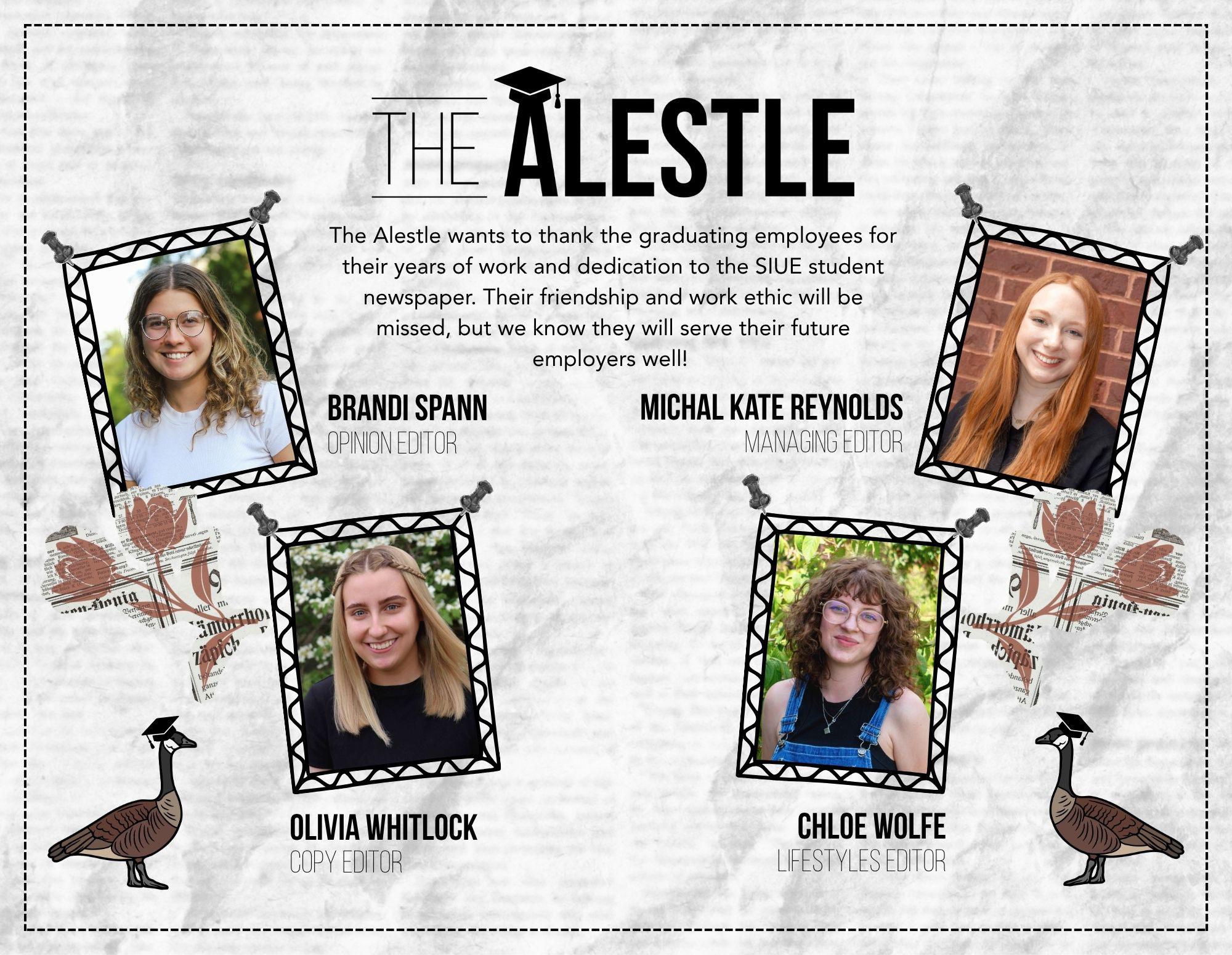

It is almost time to celebrate the end of the semester, so we compiled a list of the best places to celebrate with a drink (alcoholic or not).
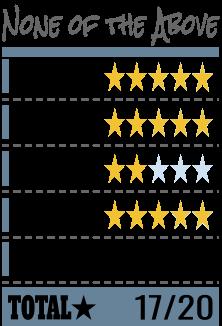
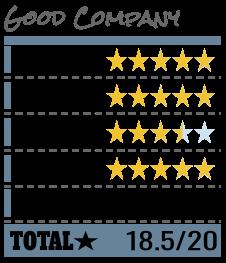
We reviewed some of the many cocktail bars in Edwardsville, Glen Carbon and St. Louis. We rank based on price, service, taste and ambiance.

CHLOE WOLFE lifestyles editor
Hidden behind a secret door and down a dark tunnel, Midtown St. Louis’ None of the Above is a speakeasy cocktail bar you should add to your bucket list. Even though prices are steep, the experience is well worth it.
Located in the City Foundry STL, the unmarked entrance is easy to miss, but just look for a red light over a green door. The entrance is hidden behind a switchboard, which a host will open for you when your table is ready.
After a short walk downstairs through a dark concrete tunnel, another host will be waiting in the dark, cozy bar area to take you to your table for the night.
The bartender who served as our waiter provided excellent service, offering drink recommendations and keeping our waters filled throughout our visit.
The menu changes, but a few staple
drinks are always available. My friend decided to order a “naked and famous” with guajillo, pomegranate, mezcal, aperol and stegra. I opted for the “downpour” with sumac vodka, allspice, saffron, grapefruit cordial and lemon.
Later, our bartender convinced me to order a “New York whiskey sour,” which consisted of clarified whisky, yuzu, tart cherry and black lime cordial with a red wine foam on top. After a conversation about what kind of cocktails I enjoyed, he offered to make the drink extra sour.
All the drinks we tried were unique, delicious and pleasing to the eye. The real standout drink for me was the whiskey sour. I am not a huge whiskey person, but this drink was possibly the best cocktail I’ve ever had.
My bill was very large, but so was my satisfaction with my visit. Not only were the drinks and service great, but the environment was enjoyable and the perfect setting for a good conversation. If I go again, I’ll definitely go during their happy hours.

DYLAN HEMBROUGH editor-in-chief
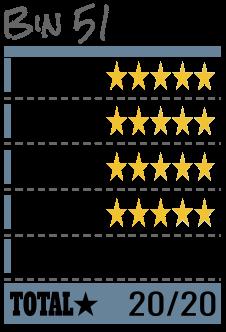
If you haven’t heard of Bin 51 Wine @ Spirits in downtown Edwardsville, you’re missing out. It is the premier place in the area for great drinks, great company and great prices.
I got there around 3:30 p.m. and came in through the back due to ongoing road construction out front. Before I hit the bar area, I was astounded by the racks full of wine and fridges full of beer for sale.
As soon as I got to the actual bar, both the bartender and the customers warmly greeted me. I had never met any of them, but they made me feel like a regular right off the bat.
I started with a glass of chardonnay and observed my surroundings. The bar itself was small, but not cramped, and several tables were available. It was exceptionally clean.
After my wine, I asked the bartender what cocktails he would recommend. For 10
minutes or so, he walked me through options, asking lots of questions to gauge my taste and find the right drink for me.
We settled on a gin fizz, and the bartender brought out a bowl of fruits and began crafting the drink. I cannot put the experience of the first sip into words. It tasted like an alcoholic version of a lemonade shake-up.
After a couple of hours of people coming and going, I realized there was not a single customer the bartender didn’t know by name. An older gentleman helped work the bar for a while, we were poured some samples of red wine and whiskey.
I had a Kölsch beer to wash everything down. The bartender recommended it because of its light and refreshing nature, and once again, it was stellar.
I eventually left around 9:30 p.m. with a day full of memories, new friends and a new favorite bar. And it only cost me $27 before tip.

MATTHEW WOLDEN copy editor
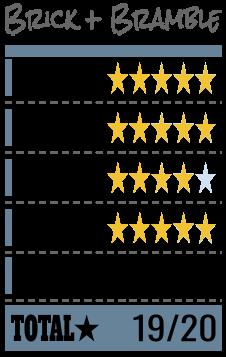
The Brick + Bramble on Plum Street in Edwardsville has a pleasing aesthetic and menu options worth the price.
Many things caught my eye upon entering, including the artistic chandelier and the nice, relaxing interior colors.
That feeling of ease was amplified by the spatial organization of the tables in the bar. Each table was far enough apart in order to prevent bumping into other customers. It was an intimate environment no matter who accompanied me. Honestly, the vibes alone were worth the visit.
I went with a group of my friends. We ordered three drinks and a plate of truffle fries for our first round, followed closely by another order of drinks and fries.
The fries they served were incredible. They were garnished with parmesan and parsley while being lightly spiced. I also tried two of their martinis: the Brambletini and the Chocolate Temptation. The Brambletini had a fruity flavor with a black raspberry
theme. The Chocolate Temptation was like a chocolate cake in a cup. It was a tad too sweet for me, but still good.
The service was yet another high-quality addition to the experience. The server would consistently come around to make sure we had everything we needed and indulged us in a bit of small talk when we felt chatty.
The price was quite reasonable. We went to Tini Tuesday as they had $8 martinis — which cost around $17 for two drinks with tax — and the two orders of fries, along with a dessert order my friend got, cost a bit more than $30. It was a decent amount of fries, but knowing the drinks would cost more on any other given night makes it hard to go if tight on money.
With all that said, I absolutely will be going back. My experience was immaculate, and going with my friends again would be a wonderful experience. I highly recommend this place to anyone, whether you are going with friends or on a date. It is absolutely worth it.



DESTINY ALBRECHT copy editor
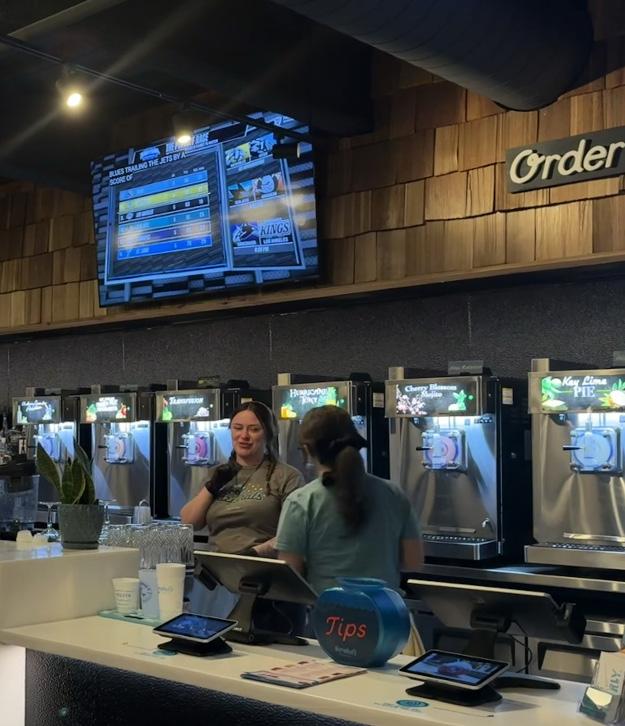
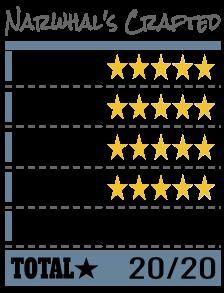
Narwhal’s Crafted in Edwardsville provides a fun, tropical-like atmosphere paired with countless delicious boozy slushies that take you on vacation with a single sip.
After hearing many great things about this place, I had high expectations going in. And they did not disappoint.
Walking in the door, I was kindly greeted by an employee who checked my ID. Apart from needing to be 21 to drink, only people above 21 are allowed after 7 p.m., which was around the time I arrived.
The employees were incredibly nice, striking up conversation within just minutes of being there.
With their extensive menu of flavors — from alcoholic frozen drinks to fresh smoothies — it can be pretty hard to choose
just one drink. Luckily, I was offered free samples to help make that decision.
I decided to get a small of the signature Orange Dreamsicle frozen cocktail that contained spiced rum, whipped cream vodka, Triple sec and homemade orange sherbet. It was around $9.75. I thought the price was pretty reasonable considering how filling it was.
The drink itself was amazing and tasted just like an orange dreamsicle ice cream, which is a favorite of mine.
My favorite part of the bar would probably be the outside patio. I sat out in the pleasant weather with a few of my friends while we enjoyed our drinks. The store also played a wide array of music while I socialized.
It was a simple experience, yet entertaining since I was in good company and drinking even better drinks. I would absolutely come back.

BRANDI SPANN opinion editor
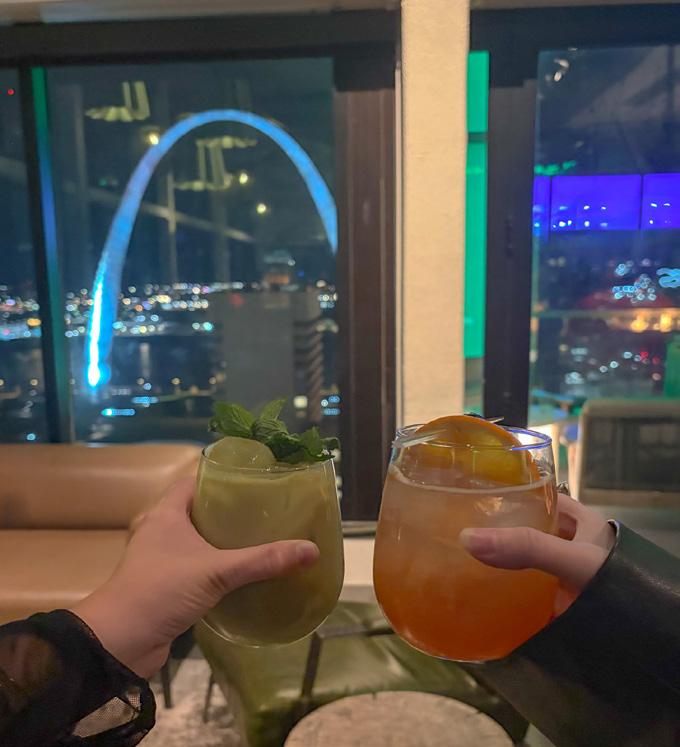
Three Sixty Rooftop Bar does not have to try very hard to pull in a crowd. They are located at the top of Hilton St. Louis at Ballpark Village with a rooftop view of The Gateway Arch and the city skyline. The bar features a waterfall and guest DJs every Friday and Saturday night starting at 9:30 p.m.
The bar is open seating, but our server was prompt, noticing us right as we sat down and providing us with answers to our questions.
The bar provides a full upscale dinner menu and variety of beers, wines, spirits and cocktails. I ordered the Tokyo Drift and Autumn in Milan from
their specialty cocktail menu.
The Tokyo Drift was minty and milky, with white rum, orange, matcha caramel, San Luigi Garden Amaro and lime. The matcha added a unique texture, similar to a crème liqueur. This cocktail was $15.
The Autumn in Milan had Lazaroni Amaretto, aged rum, apple cider, aperol, lemon and Prosecco. The amaretto was absent from the flavor palette, but the cocktail was simple and neutral. It has an orange taste similar to an Aperol spritz, but less aggressive. This cocktail was $14.
The bar opens at 4 p.m. daily. You must be 21 or older to enter after 7 p.m. It’s a great spot for a date or a night out with friends. The unbeatable, luxury view keeps me coming back again and again.

HECTOR CHAIDEZ photographer
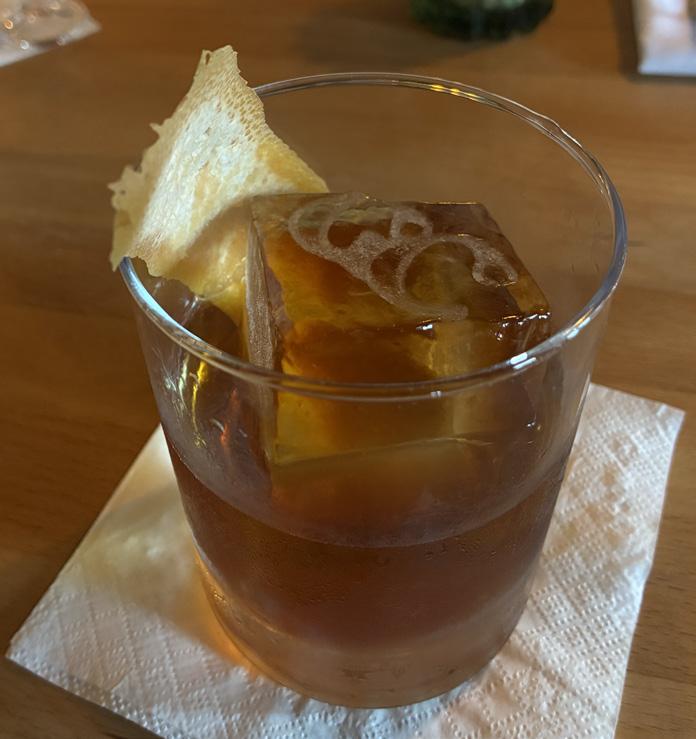
In Forest Park Southeast in the Grove, St. Louis, the small cocktail bar Good Company thrives with enough foot traffic to where reservations are highly recommended, limited seating to create intimacy and moderately dark lighting for warmth.
Upon entering, the exterior decor holds a very simple yet unique look. With the use of a consistent color palette, it brings a friendly tone.
When I entered, I was greeted by a very nice host, then the smell of beverages and freshly cooked food. They played a variety of music.
My friends and I began with a round of drinks and an order of onion rings. I got
the Coffee Liqueur Cocktail, which paired very well with the cheeseburger and fries I ordered for my meal.
My drink was not too strong, but it was sweet with a hint of orange flavor. The onion rings, paired with ketchup and their house-made “good sauce,” were seasoned beautifully, and had a “crunchy on the outside, soft on the inside” combination. The burger was well-cooked, juicy and had perfect ingredient ratios.
Overall, this whole experience was very pleasant, and I would like to try more of their menu items. The only thing holding me back was their expensive prices — roughly $19 for a burger and fries and $16 per alcoholic beverage. Other than that, this was a wonderful experience.

SAM MUREN graphics manager
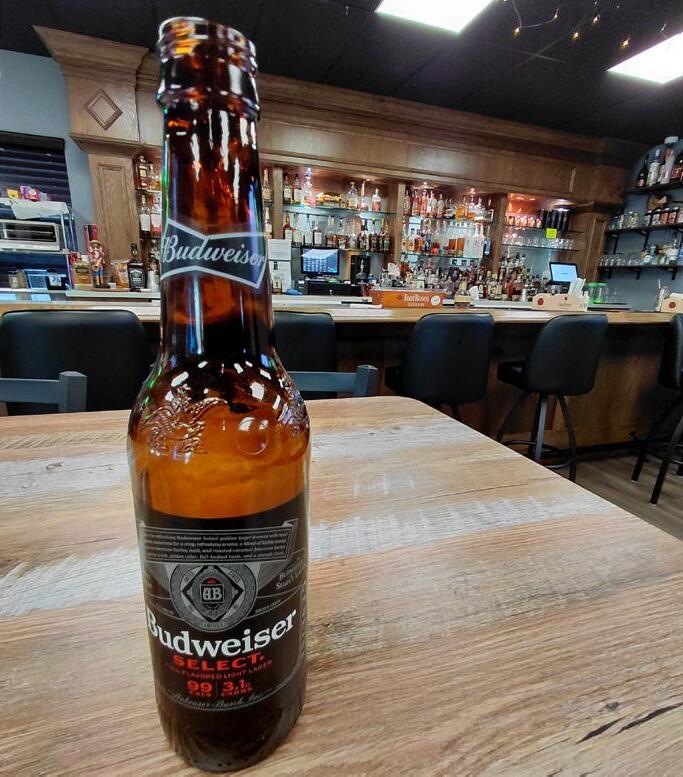
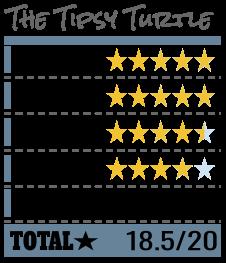
The Tipsy Turtle Bourbon Bar, a newly-opened bar in Glen Carbon, may be one of the most unique bars I’ve ever been to.
Upon arriving, you may think you’ve pulled up to just a convenience store. However, once you step inside, you’ll discover a trove of drink options.
The Tipsy Turtle is a hybrid bar and liquor, smoke and vape shop. You have the option to turn left, take a seat with a glass of liquor and watch TV, or turn right and grab a bottle or smoke of your choice.
This bar is perfect for those who are both extroverted and introverted. The extrovert that I am, I sat at the bar for about
an hour. I wasn’t feeling hard liquor, so I decided to just order a Budweiser Select.
While watching the Masters Tournament on TV, I chatted up the bartender and other patrons. The bartender ended up being a partial owner of the bar, and he told me the bar hosts live music on Friday and Saturday nights.
I really liked the small bar environment. The convenience shop attachment was something I’d never seen before, making this a unique stop.
While I only had a beer, there were so many bourbon options. One of the other patrons ordered a cigar-infused bourbon. That is definitely something I’ll have to try when I come back on a music-filled Friday night.
contact the editor: lifestyles@alestlelive.com (618) 650-3528 THE ALESTLE WILL PUBLISH ONLINE 5/7.
AUDREY O’RENIC sports editor
SIUE Theater and Dance concludes its “Golden” season with the Broadway horror-comedy classic, “Little Shop of Horrors.”
Written by Howard Ashman, the story follows a nerdy florist, Seymour, who chases dreams of success, romance and a better life — all of which seem suddenly within reach after he discovers a mysterious plant that feeds on human blood. As the plant grows, so do the stakes, forcing characters to confront how far they are willing to go to achieve their dreams.
Director and Department of Theater Assistant Professor Adrianna Jones said those dreams are something most people can relate to.
“There’s often things in our life that if we just shift our perspective a little bit, we can achieve that dream that seems like it’s so far away,” Jones said. “I think that’s true for a lot of characters in our show, and that’s why they are more easily manipulated by the plant, because they have these big goals, and the plant sees things that they are not seeing.”
Rather than focusing on the plant as a spectacle, Jones said SIUE’s performance differs from traditional stagings of the musical as it leans into the plant’s influence and how the characters interact with it.
“We’ve been trying to play with how powerful this plant is and how we tell that story — I think that’s what’s unique to our show,” Jones said.
Although this is Jones’ first time directing a musical for the program, senior theater performance student Mia Williams said working with Jones has been a great
experience as she learned to use her voice in a more meaningful way.
“[Jones is] a really great example for any women who are wanting to be in a powerful position,” Williams said. “She’s been really supportive of the cast, of making characters that fit the cohesive unit in her mind, while also giving us the liberty to explore what we like and don’t like about our characters and what we want to create, and what message we want to share.”
Williams, who plays the florist’s love interest Audrey, said that one of the creative liberties she and Jones took was reimagining the character to be more than just the outdated stereotypes that define her.
“Audrey’s one of those characters that’s very classic for being the dumb blonde stereotype, and it was kind of tricky trying to honor the parts of her that people are going to want to see,” Williams said. “We sort of decided that her sweetness is important, and it should stay, but this unintelligent error about her shouldn’t.”
“Little Shop of Horrors” is most notable for its use for puppetry. Jones said she worked closely with actors, technicians and designers to bring the man-eating plant to life.
“[Technical Director and Theater Instr uctor] Roger Speidel has constructed the two biggest plants, plant three and four, and then has helped to basically train all of our student puppeteers that we have,” Jones said. “Our alum, Sylvie Kessler, also has helped a lot with construction of the puppets with plant number one and number two.”
Cayley McReynolds, a freshman theater and dance student, is a member

of the ensemble and assistant choreographer. They said their first-ever musical experience has pushed them to grow as a collaborator.
“When I choreographed before, me and a lot of the other choreographers would have the same ideas because we would learn from the same teacher,” McReynolds said. “So now, when I come here and I’m working with [Choreographer and Theater Assistant Professor Brandon Riley], we have different ideas, and I’m learning how to combine those ideas together to come out with an overall product that we’re both happy with.”
McReynolds said she is proud of what she was able to create, and she looks for-
ward to everything coming together.
“My experience has been such a blast, and it is everything I thought it was going to be,” McReynolds said. “It is honestly very stressful, but stressful in a good way in the end, because you know that all the hard work that you’re putting in comes out to be this amazing work of art.”
SIUE’s production of “Little Shop of Horrors” will run April 22-25 with shows beginning at 7 p.m. in Dunham Hall. There will be an additional 2 p.m. matinee on April 25. Tickets range from $16 to $19 or are free with a valid SIUE ID. Tickets are available for purchase at the line SIUE Box Office.
GAVIN QUINLAN reporter
From hands-on festivities to conversations with academics, the Kimmel Belonging and Engagement Hub’s Diversity Month programming is offering a variety of cultural and historical learning opportunities throughout April.
The Kimmel has scheduled a total of 16 events and exhibits throughout the month, celebrating Arab American Heritage Month, Asian, Asian American, Native Hawaiian, Pacific Islander Heritage Month and Jewish American Heritage Month.
“Student retention is aided by a sense of belonging, so that’s one reason why we want to engage our diverse student body and their experiences,” Interim Kimmel Program Coordinator Trevy Augustin said.
Additionally, Augustin hopes that Diversity Month events will expand students’ perspectives and encourage them to feel more comfortable asking questions.
“I think students, especially college students, should feel comfortable having questions, and then as they learn more, having even more questions,” Augustin said. “That’s what education is — curiosity and continuing to have questions.”
Upcoming events
Upcoming celebrations in-
clude the Jewish American Heritage Month Opening Event, featuring live music by the Central Reform Congregation of St. Louis, and International Night, an evening of activities, food, music and performances from around the world.
More events coming up include Unbound, an art showcase featuring the artwork of students from marginalized communities, and a discussion with authors Nathan Alleman and Sarah Madsen about college food insecurity and their book, “Starving the Dream.”
“Having gone here as an undergraduate, I can honestly say the university has evolved with regard to its offerings over the years,” event attendee Letrice Young said. Young, a program coordinator for SIUE’s Summer Success Program, said that learning about other cultures through the Kimmel is beneficial to her work.
“People need to understand other people’s cultures,” Young said. “We have a diverse variety of students. I would be doing myself a disservice if I did not educate myself on what they bring to this campus.”
Arab American Heritage Month Opening Event
Young attended the Arab American Heritage Month Opening Event on April 6,
which featured a presentation by Layla Goushey, member of the Arab American Studies Association and English professor at St. Louis Community College.
Goushey’s presentation addressed Arab stereotypes, Arab population dynamics and demographics in the U.S., Arab American figures and literature and the struggles Arab Americans face, among other topics. Goushey said that one purpose of the presentation was to help increase cultural awareness among students, including awareness of their own culture.
“Someone will say, ‘I was born in Illinois. I don’t have a culture.’ Yes, you do. Everybody has a culture. It’s just [about] becoming aware of it,” Goushey said. “I consider myself a Texan as much as anything else. I’m living in St. Louis, and I still have these Texas thoughts … because wherever you grow up, you absorb [the culture].”
Goushey said holding events like this is important for schools to reinforce a learning environment and encourage students to learn outside of the classroom.
“For an educational institution, there need to be different forms of learning,” Goushey said. “Even if you can’t make a particular event … maybe you’ll see that topic and say, ‘I’m going to figure out what that is.’ It’s reinforcing learning.”
St. Louis, White Supremacist Groups and the MLK Assassination
On April 7, Lovejoy Library hosted a discussion led by Washington University Sociology Professor David Cunningham and graduate researchers Anne Brown and Molly Schneider about ongoing research surrounding the assassination of Martin Luther King Jr.
The discussion centered around the researchers’ investigation into the possible ties between James Earl Ray — King’s assassin — and white supremacist groups active in St. Louis during the Civil Rights Movement.
“The point isn’t to say that [white supremacy] is the core part of the story, but it is a part of the story that’s important to understand if we want to think about how political struggles like this have unfolded in the past and how they can most effectively unfold today,” Cunningham said. Cunningham said that discussing the forces that suppress cultures and populations can act as a complement to celebrating those same cultures.
“It’s really important when we think about struggles — any sort of freedom struggle, struggle for equity, inclusion — to also understand some of the forces and networks and people that have actively been trying to suppress those values,” Cunningham said.
Senior history and Black
Studies student Nick Geoghegan said that the event was “more than timely” due to the current political climate.
“The title on the flyer simply brought me in as a person who lives in St. Louis and cares about these issues in the 21st century,” Geoghegan said. “Lovejoy Library lets students and members of the community utilize these services … that bring us so many engaging topics and beautiful pieces of history that need to be analyzed, absorbed, cared about and talked about.”
There are six more Diversity Month events remaining in April, hosted by a variety of organizations across campus. Augustin said that Affinity Graduation Celebrations, held by the Kimmel before commencement each semester to celebrate marginalized communities, will begin on April 27 and run through May 1. Augustin said that the Kimmel welcomes student input about their programming as well.
“I was really proud of one student who came up and said, ‘This is my identity, and I don’t see representation,’” Augustin said. “I think it took a lot of courage for her to do that, because she’s felt pretty isolated on campus, and what we do at the Kimmel is [say], ‘Thank you for coming. Tell us about your culture and how you would like to see it celebrated.’”
DESTINY ALBRECHT copy editor

The United States Institute for Theatre Technology has come back to SIUE, sending members to learn more at the national Annual Conference & Stage Expo in Long Beach, California.
After a lull in participation following the COVID-19 pandemic, classmates started the organization back up again at SIUE.
“I led the charge to reignite the club in order to create a space where people interested in the field of technical theatre could not only learn but get real-world experience,” senior theatre technical and design major Connor Kielty said. “Our goal is to make the world of technical theatre a more approachable space, where people from all different backgrounds can get a foot in the door and make some connections while doing it.”
With fundraising events like drag shows and battle of the bands, as well as teaming up with other clubs such as the Student Experimental Theater Organiza tion and the SIUE University Dance Or ganization, USITT is able to fund trips to conferences where they can partici pate in hands-on experience and rebuild their reputation.
“[This] allowed for students in the dance department to choreograph their own pieces to be performed and gave the technical students a chance to design and run a live performance,” Kielty said.
Recently, in collaboration with UDO, the club co-hosted the UDO In formal Concert on April 2. These events provide the opportunity for members to attend the USITT Annual Conference & Stage Expo.
This year, Co-President and senior theatre, technical and design major Melina Huckelberry was named one of three student ambassadors in which she met with a professional in technical theatre in addition to the networking events.

OLIVIA WHITLOCK copy editor
I watched a lot of movies last year, but Eugene Kotlyarenko’s work stood a cut above the rest. I feel fortunate to have had the opportunity to speak with someone I greatly admire, someone working in the industry with fresh, new ideas rather than recycled, predictable concepts we often see flooding the media landscape.
To quote myself, “Kotlyarenko has a unique ability unlike any other director I’ve seen. He’s able to do hyper-realistic media consumption commentary — and do it properly. He seems very in tune with the digital world in a way most productions are not.”
I posed a similar question to Kotlyarenko about being “in tune with the digital world.”
“I’m basically digitally native. [I] wasn’t born into it but basically evolved … with the emergence of the popular internet and social media,” Kotlyarenko said. “[Tech is] an element that I’m incorporating into my work, because it seems integral to day-to-day life … [I] try to synthesize it with tra-
At this conference, attendees are able to have individual conversations with presenters in the field who give advice in designing, training and portfolio tips through workshops and lectures.
“I’ve had the pleasure of being able to speak to [Tony Award-nominated] designers, professors from Scotland, technicians who are veterans in the field and even college students from around the country who share in my passion for the field,” Kielty said.
Members of USITT are able to make connections with big-name artists and institutions more easily. The club has had the opportunity to explore behind-thescenes of The Fabulous Fox in St. Louis, which has hosted many famous plays and musicals from around the world.
“We have [the] opportunities to reach out [to those types of organizations] a little bit more,” Huckleberry said. “And since they recognize the [USITT] name, they’re more likely to [welcome student engagement].”
“[This] organization has a heavy focus on getting students out there with professionals and other like-minded individuals so that when they eventually graduate and leave the school setting, they are more than prepared to take advantage of what comes next in their lives,” Kielty said.
For more information about the club, visit their page on Get Involved or


what you need to know before the Drip
BRANDI SPANN opinion editor
Soulja Boy
Soulja Boy — DeAndre Cortez Way — got his start as one of the first rappers to utilize YouTube to bolster his career. Born in Chicago and raised in Atlanta, Georgia, Way’s self-released single “Crank That (Soulja Boy)” (2007) topped Billboard charts, sparking his rise to popularity. This commercial success was followed up in 2010 after the release of “Pretty Boy Swag.”
fun facts
Way released one episode of a show called “Soulja Boy Tell ‘Em: The Animated Series.”
Way had recorded a verse on Ye’s album ‘Donda,’ but Ye removed his verse without notifying him, sparking public tension between the two artists in 2021.
He founded his own production and management label in 2004 called SODMA (Stacks on Deck Money Gang) Records.
Lil Xan
Lil Xan — Nicholas Diego Leanos — rose to fame in 2017 for his song “Betrayed.” Leanos is from Redlands, California, where he grew up living in motels with his family. He got into photography, photographing his friends who were rappers. When his camera was stolen, he decided to try rapping rather than buying a new camera.
fun facts
Lil Xan has collaborations with major artists like Charli XCX and Noah Cyrus.
Yes, “Lil Xan” is based off of the prescription drug Xanax. Leanos has experienced addiction and uses his platform to encourage anti-drug sentiments. In 2018, Leanos ate too many Flamin’ Hot Cheetos and ended up in the hospital.
Scan this code for a playlist of songs to check out before the concert:


REVIEW: ‘The Drama’ distasteful think-piece,
lacks sensitivity
Exiting the theater following my viewing of the comedy “The Drama,” I found myself wondering: “Am I the problem?”
I interviewed my most-watched director of 2025
ditional film language and traditional filmmaking.”
Kotlyarenko’s film “Spree” (2020), stars Joe Keery as a livestreaming rideshare driver who wants to go viral. He said it was set to be his first wide release, with 800 theaters scheduled to screen the movie — until COVID-19 disrupted those plans.
“A lot of people were stuck at home, and a lot of people streamed [“Spree”], and that’s kind of where it lives and that’s kind of how people associated it … just being an extremely online movie,” Kotlyarenko said. “Things happen the way they happen, and you accept it and you just move on. If you can come up with a clever idea for lots of people to enjoy and see, then that’s great.”
While “Spree” didn’t have the release Kotlyarenko anticipated, it has gone on to be his most widely recognized film, which speaks to how unpredictable the outcome of a movie can be.
“To make films that are so complicated and challenging, [with] rejection and problems at
every turn, you have to be delusional. You have to have really high expectations for the film itself, high goals. You have to really aspire towards making the best, best, best movie you can make,” Kotlyarenko said. “At the same time, you do kind of have to be realistic and say, ‘I don’t know what’s gonna happen to this when it’s done.’ You can’t predict how big something is gonna get. Of course, you want as many people as possible to see it or you wanna make an impact on the discourse, but you don’t really know how anything will go.”
Kotlyarenko said he’s trying to make movies he would personally enjoy seeing. He said he values movies that balance new ideas with strong storytelling or feel like a classic narrative film, as those are the types of movies he admired growing up — ones that had a “unique energy,” but still did what “movies promised to do.”
Making films often requires securing the funding to bring them to life. Kotlyarenko said that those you’re working with
— actors, crew and financiers — need to be able to trust you, your idea and that your idea is worth their commitment.
“The number one way to access [money] is to inspire people with your enthusiasm,” Kotlyarenko said. “Inspire the people who have the money just like you’re going to inspire the actors, just like you’re going to inspire the crew — to trust you because you have an idea, you’re really enthusiastic about it and you’re really excited about it.”
Kotlyarenko also said it is possible to make films with little to no money, as he has done it himself. He said that if you desperately want to make something, it does not always require financial backing, just a vision.
Kotlyarenko said his film “We Are” (2020) was fully improvised and “Wobble Palace” (2018) had an outline, but didn’t have a traditional script.
“When you get into the edit, you just have to be really ruthless, and anything that doesn’t feel natural, or unnatural in a way that you don’t like … you just get
rid of it in the edit,” Kotlyarenko said. “You have to be ruthless enough to say ‘Oh, I love how this shot looks, but I just know the performance isn’t there, and none of these takes are there, so I gotta get rid of this.’”
Kotlyarenko’s approach to dialogue feels natural and unforced, at times even painstakingly awkward in a way that feels deeply human.
Kotlyarenko said his “clearest” characters are inspired by people he knows or wants to work with — people who often have big personalities and are open and performative. He said he draws from their “interpersonal dramas” and includes traits that may not be immediately visible in real life, trying to find the secret thing about an actor they aren’t exploring yet.
Kotlyarenko’s films are risky. He doesn’t seem to follow a playbook written by Hollywood or rely on the kinds of structures audiences are used to. He’s willing to lean into unpredictability rather than ironing things out to make them more palatable.









With unrealistic beauty standards in the entertainment industry on the rise, we are beginning to see a reemergence of the same thinness that defned much of the ‘90s and ‘00s through extreme dieting, eating disorders and a generation’s worth of body image issues.
HAVE A COMMENT?
Let us know by scanning here: Campus Box 1167 Edwardsville, Illinois 62026-1167
LETTERS TO THE EDITOR POLICY:
The editors, staff and publishers of The Alestle believe in the free exchange of ideas, concerns and opinions and will publish as many letters as possible.
Letters may be submitted to: The Alestle Morris University Center Room 0311
All hard copy letters should be typed and double-spaced. Letters should be no longer than 500 words. Include phone number, signature, class rank and major.
We reserve the right to edit the letter for grammar and content. Care will be taken to ensure that the letter’s message is not lost or altered.
Letters to the editor will not be printed anonymously except under extreme circumstances. We reserve the right to reject letters.

It is wrong to comment on someone’s body. However, when it comes to genuine health concerns, it’s important to call attention to harmful portrayals that may cause society to repeat a toxic history.
In the ‘90s, phrases like “nothing tastes as good as skinny feels,” “heroin chic” and “thinspo” normalized fatphobia and created a culture of body shaming, specifcally among women. These trends were seen in media outlets, television and online for years, forming a lifestyle that causes nearly 10,200 deaths each year, as of 2024 — from side effects of eating disorders to depression and suicide from bullying.
After years of presence, the body positivity movement struck gold in the branding department as large

SOPHIE HAWKINS online editor
In an effort to slow down my fast-paced schedule and disconnect from social media, analog hobbies provided a new space to explore my creative and cognitive abilities.
With deadlines, packed schedules and constant notifcations, it can be hard to fnd time for yourself.
Analog, or so-called ‘grandma hobbies’ as social media has coined them, are offine and tactile hobbies that tend to be enjoyed by the older generations
companies began using marketing such as Dove’s Real Beauty Campaign and Aerie’s #AerieREAL Campaign.
This development changed how people viewed themselves through the lens of social media. In 2023, Psychology Today reported that seeing body-positive images encouraged people to feel better about themselves and the concept of the “ideal body.”
While this outlook has increased overall self-esteem over the last decade or so, the recent infation of scarcely thin body types has set society back quite a bit.
After the 2026 Oscars took place, social media wasn’t consumed by discussion of who won what awards. They were instead more concerned with the appearances of the attendees.
The focus on accentuating bones and almost presenting them as artwork when it’s really a sign of severe weight loss is getting out of hand. Dressing up the unhealthy cultural phenomenon in this modeled way pushes a normalized perspective that this is the preferred body image.
It’s hard to say what exactly is causing this culture that is similar to that of the ‘00s. With the increased usage and targeted marketing of GLP-1 medica
tions, as well as standardization of cosmetic surgery, many people are falling victim to the unrealistic societal expectations on people’s bodies.
GLP-1s were originally made for people with diabetes and obesity, but some are being used inappropriately for rapid weight loss. Many celebrities have openly admitted to their use of these drugs, even promoting them in advertisements and on social media.
As for the intense surge of plastic surgery, it’s hard to come by a celebrity that doesn’t have any sort of molded plasticity to them these days — whether it’s small procedures like lip fller and Botox or larger ones such as face lifts and breast augmentation.
According to the Aesthetic Plastic Surgery National Databank, Botox has increased by 54 percent and fller treatments are up by 75 percent from 2019.
While many keep it to a small amount, it’s common to see a person that doesn’t even look like themselves anymore. Brands also continue to promote anti-aging creams and other skincare products to eliminate wrinkles.
It has become so demoralizing that natural processes, like
aging, are frowned upon, and we are being shown that beauty we are born with isn’t enough anymore.
And yet, with this culture being forced upon us through various media, we can’t help but become wishful of the bodies we’ve been taught to desire. Even after knowing that it’s all fabricated, we still fnd ourselves wanting to look like the models we see on social media.
As the ever-changing landscape of body image and self-esteem is publicly judged, we must stay focused on what is real rather than the spectacle that we have tried so hard to reach — despite knowing it’s non-existent.
It’s understood that people just want to ft in and be content with the way others view their appearance. But what really matters is happiness and overall health, and in order to keep prioritizing those goals, we have to continue the body positivity movement rather than revert back to old, self-destructive ways.
Developing a newfound love for ‘grandma hobbies’ helped me
– hence the nickname.
For me, these hobbies have become a creative outlet that is mentally stimulating while providing space to slow down from the stresses of everyday life.
During the height of COVID-19, I was spending hours on my phone doomscrolling and felt that I couldn’t escape the digital cage that the pandemic had put me in as I wasn’t able to hang out with my friends in person.
One day, while searching my basement for something to do, I found a crochet hook and a ball of yarn. Out of curiosity and boredom, I decided to attempt teach-
ing myself how to crochet.
About three YouTube videos and four hours later, I fnished my frst row of crochet with no mistakes. I started by crocheting a square and then keychains, and by the end of the year, I had made blankets, sweaters and gifts for friends and family.
Crocheting became an activity I could focus on when I was bored, overwhelmed or needed a break from schoolwork. The craft allowed me to concentrate on making each row, improving my fne motor skills and patience. And each piece I fnished gave me a new sense of accomplishment –
something I couldn’t acquire by watching TikTok. Since then, I’ve explored other hobbies including sewing, reading, burning CD’s, embroidery and a semi-impressive Sudoku run. Each hobby has given me something new to focus on; from choosing songs to curate the perfect tracklist for my friends to testing my logical thinking with Sudoku puzzles. Though I still do the occasional doomscroll, I prefer to spend my free time expanding my creative abilities doing my ‘grandma hobbies’.
Thursday, 04.16.26
MADISON STEFFEN reporter
Baseball beat the University of Arkansas at Little Rock 2-1 in a three-game series last weekend at Roy E. Lee Field at Simmons Baseball Complex.
Friday’s game began with two scoreless innings. Little Rock took the lead in the third, and despite later hits from senior infielder Chase Bloomer and junior infielder Ryan Niedzwiedz, the Cougars were unable to catch up. The game ended with a score of 3-0, with Little Rock emerging victorious.
Saturday’s game began with a strong showing of the Cougars’ defense, during which redshirt junior pitcher Spencer Sterns threw seven shutout innings with only three hits. He was backed up offensively in the third inning, where graduate student outfielder Gage Franck, junior outfielder Daniel Gierer and Bloomer hit singles, all making it on base for Franck and Bloomer to later score.
“It’s in the defense,” junior pitcher Jase Phillips said. “We really held it down there, played clean baseball every single time.”
This surge of momentum continued into the fifth inning when Bloomer hit a sacrificial pop fly to center, sending freshman outfielder Cooper Eggert home from third base. In the bottom of the seventh, Franck scored on a wild pitch after hitting a double, and
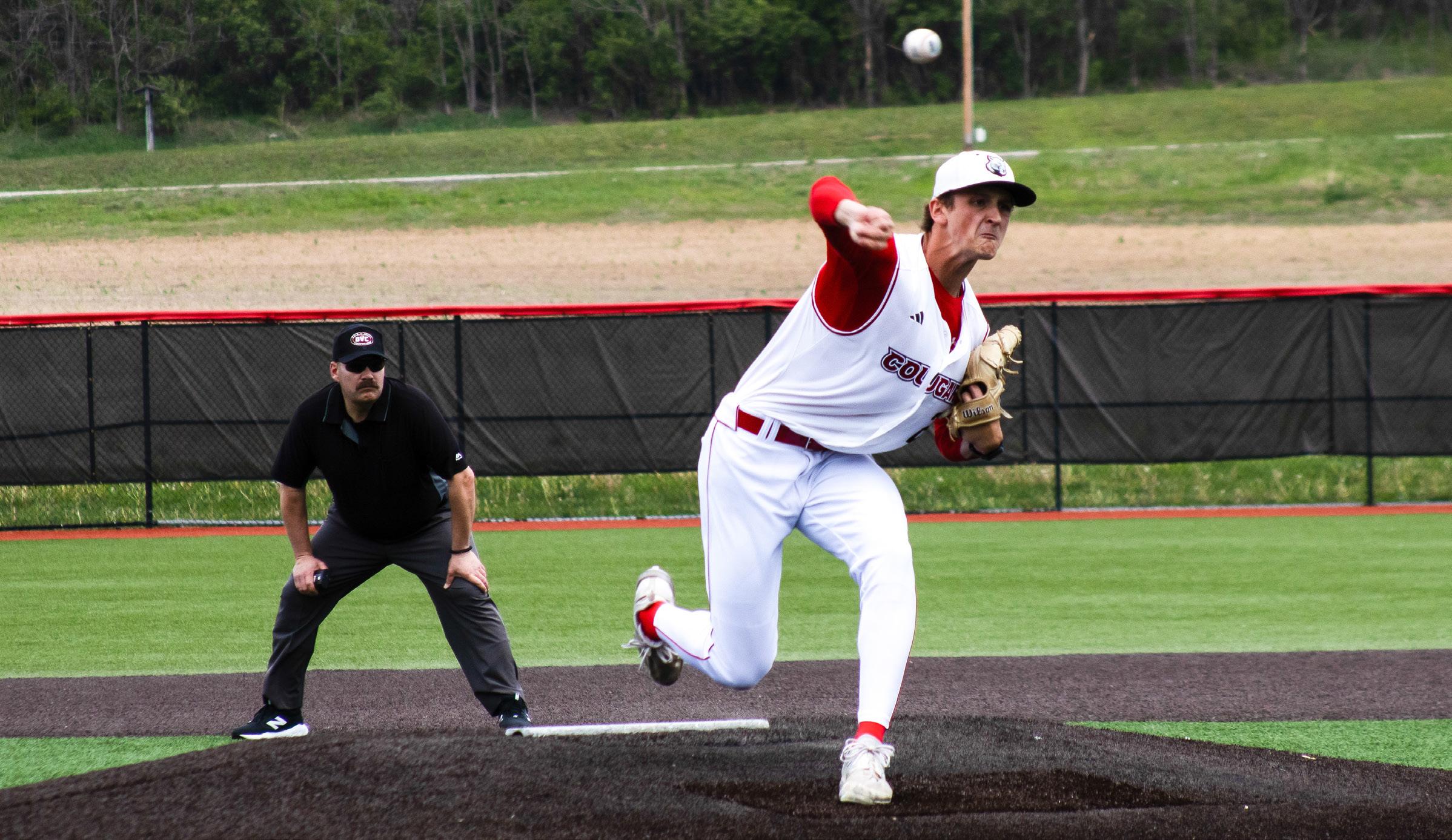
Gierer hit a home run to deep left field, bringing himself and junior catcher Sean Kang around the bases.
In the eighth inning, Little Rock attempted to make a comeback, scoring two off of a single from the Trojans. Ultimately, the Cougars won out, with a final of 6-2.
Sunday’s game started similarly to the first until the Trojans scored in the third
inning. The Cougars responded in the fourth, as graduate student designated hitter Josh Heyder scored off of a pop fly from Franck.
Little Rock matched the pace in the sixth inning when Freund hit a home run to left field, but was quickly overtaken in the bottom of the same inning when Heyder scored from third base.
Senior infielder Ethan Willoughby followed two

As it is generally known, college sports is one of entertainment’s top money-making industries. However, misalignment on several issues have raised contentious cases in court for the NCAA.
The NCAA and college institutions have been deliberating with athletes to determine its structure and relationship between institution and athletes for several years. They looked to Congress for guidance on several issues, but their response time has been rather lackluster.
Name, image, likeness,
or NIL, and revenue sharing are past examples that still are debated today. The question of, ‘Are student-athletes employees of universities?’ remains a debate.
Issues of gambling and TV rights are at large as well. There are so many contentions that have led the NCAA to ask Congress for laws to be passed as the guidelines for college sports moving forward. They need answers to challenging questions, and Congress should be the one to give them the answers.
However, Congress sat too idly on the issue which has now been pushed to the back burner.
On April 7, President Donald Trump signed an executive order entitled “Sav-
plays later when Franck hit another single.
The game closed without any further scoring three innings later with an ending score of 3-2, successfully handing the Cougars the series and placing them in a tie with Eastern Illinois University for first place in the Ohio Valley Conference.
“It was just two good teams all weekend going at it, and you know, we were just fortu-
nate to come out on top,” head coach Sean Lyons said. “Got a couple of big hits … to get us the win.”
“We just keep going,” Willoughby said. “We got each other’s backs, and we know that, so we’re just playing for one another.”
The Cougars will play next in another three-game series against Western Illinois University beginning at 3 p.m. on April 17 in Macomb, IL.
ing College Sports,” using federal authority to enforce NCAA regulations.
“The president’s executive order protects college sports by using federal authority to support enforcement of clear, consistent and fair rules on eligibility, transfers and compensation, while promoting sustainable revenue-sharing and stronger protections for student-athletes,” according to the White House’s website.
This is Trump’s second executive order aimed at “fixing” college sports. This order focuses on transfer and eligibility, NIL compensation and enforcement against schools that violate rules, according to The New York Times.
“The order’s mandates —
such as limiting athletes to one unrestricted transfer as undergraduates and placing a fiveyear cap on college eligibility — would not take effect until August 1,” according to The New York Times.
The question lies in why is the president taking such initiative — at a time of war, no less — but not Congress.
The main issue is that this is only an executive order, holding significantly less weight than statutory laws passed by Congress, and is likely to be instantly challenged in court.
Even if the order is effective, it could easily be overturned by the court or the next sitting president. The overturned order would be an event that may be worse when the NCAA
and student-athletes are looking for stability.
An executive order is not the answer necessary for the desired stability. Congress needs to be the one to determine what should be legally defined for college athletics in the United States. It will be their decision that confines the NCAA and universities to specific expectations.
Funding departments and debating war ethics are probably more important, but college sports has been waiting for resolution. The athletes, the school administrators and even the NCAA deserve some answers in order to properly regulate this continually growing market

Senior Margaux Guibal Britt strikes the ball in Saturday’s match against Western Illinois University. She defeated her opponent, WIU’s Chloe Routier, 6-2, 6-3 in No. 1 singles. | Gavin Rask / The Alestle
AUDREY O’RENIC sports editor
Women’s Tennis earned the Ohio Valley Conference regular season champions title after a 5-2 victory against Western Illinois University on Saturday at the SIUE Tennis Courts.
The Cougars swept the conference 5-0 and secured their first regular season victory since the 2016-17 season. Head coach Adam Albertsen said that in his 16 years of coaching, this year’s team is one of the most notable.
“They work hard, and they’re a lot of fun to be around,” Albertsen said, tearing up. “It’s probably one of my teams that I’ve been most close with, and just to see their work pay off is incredible.”
Senior Margaux Guibal Britt and junior Stefaniya Anikina got straight to work and dominated in No. 1 doubles, 6-2.
Guibal Britt and Anikina have played as doubles partners since the 2024-25 season. Albertsen said the pair have really emerged as a powerhouse this year.
“They’ve just been incredible,” Albertsen said. “They complement each other well — game style, personality and the comfort of playing together has been really big.”
Anikina said she was happy
to share the court with Guibal Britt in the final match of the regular season.
“To win [with Guibal Britt] felt amazing,” Anikina said. “Honestly, I was doing it more for her than for myself because I know it’s her last year — she’s been here all four years, so it’s really, really important for her.”
Senior Cydney Rogers and sophomore Elena Palioura followed with a win of 6-4 in No. 2 doubles, ultimately securing the doubles point for the team. This early advantage brought the momentum for singles.
Rogers swiftly secured the first singles point for SIUE in No. 6 singles, defeating her opponent 6-3, 6-0. Senior Paloma Hennicaux furthered the lead with a 6-0, 6-3 victory in No. 5 singles. Guibal Britt came out on top in No. 1 singles, 6-2, 6-3.
“[The seniors being able] to get the first three [singles] points to clinch the match was super special,” Albertson said.
Junior Jessica Li continued the streak with her 6-2, 6-2 win. However, the momentum halted as Palioura fell to Western Illinois’ Mana Fawcett in a close match in No. 2 singles, 4-6, 4-6. Shortly after, Anikina dropped No. 3 singles to Western Illinois’ Richardlyne Francois, 6-2, 1-6, 9-11.
Guibal Britt said she is grateful for her time with
SIUE Tennis.
“We really came together this year, and I’ve been formed into a completely different person because of the people around me,” Guibal Britt said. “I’m so thankful for my coach, my teammates and my parents who just continue to push me. This is just to have fun at the end of the day, and the results are here.”
Albertsen said the team took the weekend to celebrate, and now are right back to work in preparation for the series.
“This was one of our goals that we set — to win the regular season, get the one seed and lift that trophy up,” Albertsen said. “Now, we want to go to the OVC tournament and punch our ticket to the national tournament.”
Anikina said she is excited to compete in the high-talent tournament.
“All of the teams have really good players, and it’s gonna be competitive for sure,” Anikina said. “I’m looking forward to having a great time with the girls, because [we have] an amazing team.”
The Cougars earned a firstround bye and will take the court in the semifinals of the OVC Championship tournament at 10 a.m. this Saturday at the Dwight Davis Tennis Center in St. Louis. SIUE will take on the winner of the Lindenwood University and Western Illinois University matchup.
LILY BERKENBILE reporter
The men’s and women’s track and field teams secured eight first-place victories and several personal victories during the Cougar Classic tournament held last weekend at Ralph Korte Stadium.
The SIUE 66ers competed against a total of 13 schools, including Cuyahoga Community College, University of Evansville, Harris-Stowe State University, Judson University, Lincoln University, Lindenwood University, Maryville University, Mineral Area College, Missouri Baptist University, University of Missouri at St. Louis, Saint Louis University, Southern Illinois University and Southern Indiana University.
Senior Nyah Williams placed first in the women’s triple jump with a distance of 12.20 meters, a personal record. Additionally, she also set a personal record in the long jump of 5.47m.
“I really wanted to do well in long [jump] because I haven’t done [it] a lot throughout my four years here,” Williams said. “It’s been pretty cool just to get to do long [jump], even if it may be my last time.”
While it may not be Williams’ last time competing in
her events, the Cougar Classic is the last home meet for the teams’ 13 seniors.
Williams said that the support from her hometown of St. Louis is one of the most encouraging things about a home match.
“Just knowing that people are there for you and that they’re representing the Cougars or the 66ers — whichever name we may take upon ourselves — [is really great],” Williams said. “Hearing someone cheer, ‘Go SIUE!’, ‘Go Cougars!’ — even if they don’t know your name, they’re still cheering for you.”
Josie Hapack, a junior thrower for the women’s team, agreed.
“It’s really nice to have a home crowd and a home meet,”
Josie Hapack said.
Josie Hapack was one of many players who was supported by her family in the crowd for her first season back in two years. Among the present relatives was her sister, Sophie Hapack, who has been attending her meets since the sixth grade.
“This is the first of her college meets [here] that I’ve been to. It’s been great,” Sophie Hapack said.
Although she said this meet had highs and lows for her, Josie Hapack saw personal success in the hammer throw.
“I was able to get a legal mark, which is something I’ve been wanting to get,” Josie Hapack said.
Josie Hapack saw this meet as an opportunity to try something new. She said she is testing a new discus throwing method she expects will give her strong, high marks by May.
“It’s kind of like a building, developmental meet,” Josie Hapack said. “We just gotta keep our heads held high.”
Other on-record successes include six more first-place finishes, taken by senior Tyler Bell in the 110m hurdle, sophomore Tanner Emerson in the 3000m, junior Drew Tucker in the high jump on the men’s side.
For the women’s teams, senior thrower Maryiah Menicucci took first in the weight throw, junior jumper Zaria Searcy in the high jump, sophomore distance runner Erica Woodward in the 3000m and the 4x400 Field relay team consisting of freshman Calie Field, senior Kaylee Allen, junior Mia Jackson and sophomore Jazmin West.
In addition, the team also saw six second-place finishes and one third-place finish.
The next meet for SIUE’s track and field teams begins today at the Indiana State University Gibson Invitational in Terre Haute, Indiana.