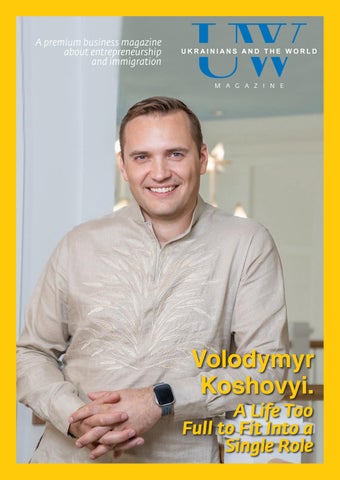
A premium business magazine about entrepreneurship and immigration
UKRAINIANS AND THE WORLD
M A G A Z I N E
Volodymyr Koshovyi. A Life Too Full to Fit Into a Single Role
UKRAINIANS AND THE WORLD
M A G A Z I N E
2
UKRAINIANS AND THE WORLD
M A G A Z I N E
EDITOR-IN-CHIEF’S LETTER “Life Has Many Colors. And Even Through Grief, We Continue to Shape the Future…” Dear Friends and Readers of Ukrainians and the World, This issue is particularly special to me. Perhaps it is the most personal and emotionally meaningful edition in the history of our magazine. We have spent nearly five months preparing it. Five months of dedicated work, new friendships, journeys, inspiring encounters, creative discoveries, and extraordinary human stories. And for almost five months, I have been living without the person with whom I once dreamed of a shared future, made plans, created projects, and believed that we still had a lifetime ahead of us. My beloved husband — Volodymyr Koshevoy. Together, we founded Ukrainians and the World. For us, it was always much more than a publishing project. It was our shared dream: to bring together talented Ukrainians from every corner of the world, celebrate their achievements, and introduce the international community to Ukrainian intellect, culture, entrepreneurship, and human values. Today, Volodymyr is no longer by my side. Yet his ideas remain. His kindness remains. His faith in people remains. And so does our magazine. I believe deeply that love does not end when someone leaves this world. It lives on in the work we created together, in the people we helped, and in the goodness we leave behind. That is why our shared mission must continue. Over these months, the magazine has brought together remarkable individuals — scientists, inventors, entrepreneurs, engineers, artists, and community leaders. Each has a unique story of perseverance, discovery, courage, and achievement. In this issue, we devote particular attention to Ukrainian inventors and researchers whose innovations have the potential to transform entire industries, make lives safer, create new business opportunities, and contribute to society. It gives me immense pride to witness Ukrainian talent and intellectual excellence earning recognition far beyond our homeland. These past months have also taken me on a journey across Europe, where I had the privilege of meeting new members of the International Association of Scientists “Intellectual Leadership.” In cities across Europe, we came together to exchange ideas, share experiences, and discuss future international initiatives, scientific collaborations, and social projects. These encounters reminded me of something fundamental: the greatest strength of any organization lies in its people. Every person who joins our community is special to us. Each brings unique knowledge, experience, talent, and a desire to make a meaningful difference in the world. Our conversations embrace science and innovation, women in business, creativity, art, culture, spiritual growth, and social responsibility. We celebrate women who build successful businesses and inspire others. We share the stories of people courageous enough to begin again. And we honor those who, despite life’s challenges, continue to dream, create, and help others. At the same time, one of the most important directions of our future work is the development of social initiatives supporting Ukrainians whose lives have been profoundly affected by war.
We seek to unite the efforts of the international community to support prisoners of war and those who have returned from captivity, families of missing service members, widows, single mothers, children, and families who have lost someone they love. Psychological support, legal assistance, education, creative expression, employment opportunities, entrepreneurship, and the encouragement of new beginnings — each of these can become a pathway toward healing, independence, and renewed hope. Today, more than ever, I understand the true value of human compassion and support. When you lose the person you love most, the world is never quite the same again. Your understanding of time changes. Your priorities shift. Even the simplest moments take on a different meaning. Yet you also begin to appreciate life more deeply. Its beauty. The people who remain beside you. The opportunity to love, to create, to inspire, and to make a difference in someone else’s life. Life has many colors. There is sorrow and joy, loss and new beginnings, disappointment and hope, tears and beautiful smiles. We cannot change the past. But we can choose the meaning we give to our future. My wish is for Ukrainians and the World to remain a place where people from different generations, cultures, professions, and countries come together. A place where new ideas, partnerships, friendships, and meaningful projects are born. Where every story matters and every person deserves to be heard. I am sincerely grateful to all our writers, journalists, ambassadors, scientists, partners, and friends who have stood beside us throughout this difficult period. Thank you to every person featured in this issue for your trust, openness, and willingness to share your story. And my deepest gratitude belongs to Volodymyr — for his love, for believing in me, for our shared dreams, and for everything beautiful we were able to create together. I dedicate this issue to his loving memory. I believe that the true measure of a person’s life is not simply the number of years lived, but the light they leave in the hearts of others. And if, through our work, we can give even one person hope, help someone fulfill a dream, offer support during a difficult time, or open the door to new opportunities, then we know we are moving in the right direction. We continue to live. We continue to love. We continue to create. Because life is not defined only by what happens to us. It is also defined by what we leave behind. And there are still so many stories to tell, people to meet, discoveries to make, and acts of kindness to share. Together, we carry life forward… With love, faith, and gratitude, Olena Yaremchuk Founder and Editor-in-Chief of the International Magazine “Ukrainians and the World” Honorary President of the International Association of Scientists “Intellectual Leadership”
3
UKRAINIANS AND THE WORLD
M A G A Z I N E
Content Volodymyr Koshovyi. A Life Too Full to Fit Into a Single Role
5
Andriy Horot: “Innovation in Transport Should Serve Safety, the Economy, and the Future”
12
The Most Dangerous Decision: “Maybe” — and What to Do About It
18
Yuriy Karpenko: “My goal is to turn firefighting experience into technologies that save lives”
20
Svitlana Aprelska: “For Three Years I Said ‘No’ to the Life I Live Today”
26
5
From Choreography to Invention: A Ukrainian Innovation Born from the Desire to Make Movement More Accessible 32 Hello! My name is Tetiana, and I am the initiator of the “Poruch” (“By Your Side”) project.
36
Beyond the Ordinary: A Woman Who Chooses a Life Without Borders
38
Yevhen Zrazhevets: “The future of the service industry is not about repairing appliances after they break down, but about technologies that can predict failure before it happens”
42
Vadym Ortynskyi: “The future of industry belongs to those who can transform scientific ideas into scalable international businesses” 50
46 20
26
38
58
70
80
Andriy Kruglikov: “The future of lighting is not about the amount of light, but about the intelligence that controls it” 58 “But Not in My Class”: How the Lisovi Family Is Creating Its Own “LAD” in Warsaw
66
Today, No One Has Died
70
Music Without Borders: The Energy of Rock, the Power of Talent, and the Art of Being Yourself
74
The Light of Actions, Autumn’s Breath, and Eternal Love: How Ukrainians in the Netherlands Are Changing the World
76
Anton Doroshenko: “The technologies of the future must not only drive business growth but also save human lives” 80 Ruslan Myronov: “The future of the restaurant industry belongs to those who bring together tradition, technology, and international entrepreneurship” 86 The Road Home Doesn’t End at Freedom: Helping People Rediscover Their Will to Live
92
Leadership through service to society: European meetings of the international association of scientists “Intellectual leadership” 99 Questionnaires of the magazine’s ambassadors
4
106
UKRAINIANS AND THE WORLD
M A G A Z I N E
Volodymyr Koshovyi. A Life Too Full to Fit Into a Single Role Sometimes a human life passes so quickly that only afterward do we begin to understand how much it contained.
F
or some, life is a quiet road. For others, it is a long Milky Way stretching far beyond the horizon. And then there are people who seem to live as though they are always eager to discover one more thing: learn another language, climb another mountain, step onto the ice again, begin a new project, help someone in need, fall in love, or return to university when most people would say it is far too late to become a student again. Volodymyr Koshovyi was one of those people. When you start listing everything he did, the list sounds almost improbable: information technology, business, fencing, hockey, entrepreneurship, community work, charity, notarial services, education, international cultural projects, spiritual practice. But those who knew him well would hardly begin with his job titles or achievements. They would probably say: “Volodya? You could rely on him.”
Or simply: “You felt calm when he was around.” And perhaps that says more about a person than any biography ever could. The Boy Who Went Skating Instead of Going to School Volodymyr was born in Klaipėda into a Ukrainian family living in the Baltics. His father was an engineer and a sailor. His mother, Valentyna, was raising three lively boys — bright, energetic, and, one can safely assume, not always perfectly obedient. Volodya was the kind of child who always needed to be going somewhere. His greatest childhood passion was hockey. There is one family story that captures his personality wonderfully.
5
UKRAINIANS AND THE WORLD
M A G A Z I N E
Every morning, Volodya would tell his family that he was going to school. At school, meanwhile, he would say that he was ill. And then he would go to the skating rink. Not for a day or two. For almost a month. The arrangement worked beautifully until one day his teacher decided to visit her sick student at home. One can only imagine his mother’s face. Years passed. Countries and cities changed. But hockey never disappeared from Volodymyr’s life. As an adult, he still went onto the ice several times a week, played with his team, fought for the puck, scored goals, and came home happy after a good game. It was as if that boy from Klaipėda had simply grown older, but had never truly left the rink. Fencing became another serious passion. As a young man, Volodymyr became a Lithuanian champion in his youth category. He was competitive and loved to win, but sport was never only about the score for him. He loved the game itself — speed, reaction, strategy, discipline, character. Years later, in the United States, he would coach children and become a well-known figure in the fencing community of Durango. At school he was also drawn to languages, especially German. He became the winner of a school German-language competition. That curiosity — the desire to understand one more thing, learn one more skill — never left him.
6
UKRAINIANS AND THE WORLD
M A G A Z I N E
Twenty Years Old. America. Starting From Zero At the age of twenty, Volodymyr moved to the United States. Anyone who has ever started over in another country knows how much reality is hidden behind a simple sentence like, “He moved to America.” New rules. A different language all around you. Work. Paperwork. Everyday survival. And the constant need to understand a system no one has formally taught you how to navigate. Volodymyr went through all of it. He studied in the United States, pursued political science, worked, and eventually built much of his professional life around information technology and entrepreneurship. His life never followed a perfectly straight line. Perhaps he never wanted it to. There were always too many things that interested him, too many roads worth exploring. There was family. His two daughters, Nastia and Diana. Volodymyr loved them deeply, and no matter how many projects filled his days, being a father remained one of the central parts of his life. There was sport. The mountains. Cycling. Fencing. And later, meditation and an increasingly deep interest
7
UKRAINIANS AND THE WORLD
M A G A Z I N E
in spiritual development. Hockey and meditation. Business and fencing. IT and spiritual practice. On paper, these things may seem unrelated. In Volodymyr, they somehow belonged together perfectly naturally. The Meeting That Changed Our Lives In 2021, Volodymyr was attending an online spiritual retreat. That was where we met. My name is Aliona Yaremchuk, and I still remember my first impression of him very clearly. It was not charisma in the usual sense. It was not an attempt to impress. What struck me was his honesty. There was a rare kind of inner clarity in him. And something else — reliability. You could feel it almost immediately. Our relationship developed quickly. Then came our meeting in Barcelona. After that, I decided that I wanted to discover not only Volodymyr, but also America — the country in which he had spent such a large part of his life. We married in 2022. It is difficult to explain in a few words who he became to me. My husband, yes. But also my friend. My partner. My family. The person with whom I could discuss business until two in the morning and the next day talk about meditation, children, politics, technology, or the meaning of life. He became home to me in the widest possible sense of that word. The Business We Built Together Together we founded Lotus Innovations. The company worked with investment in technology projects, business consulting, startups, inventions, and innovation. We made an interesting team. I brought my Ukrainian business experience, my network, my own way of seeing opportunities. Volodya knew the American environment from the inside. He understood how people thought here, how business relationships worked, how documents were handled, how systems operated. For our clients, that combination proved valuable. We often said that we were building a bridge between two worlds. At the time, we had no idea how literal that bridge would eventually become. February 2022 Changed Everything Then the full-scale war began in Ukraine. Business plans very quickly became secondary. When people call you because they do not know where to take their children, where they can sleep that night, how to cross a border, what documents they need, or how to get to safety, the normal rhythm of life simply disap-
8
pears. We began helping however we could. We organized demonstrations in support of Ukraine. We raised funds. We searched for options. We helped families with children. Through our contacts and projects, more than a hundred families received assistance with evacuation, relocation, or resettlement. Those months had a completely different way of measuring time. It was no longer Monday, Tuesday, Wednesday. It was: This person made it out. This family reached safety. These children are no longer under shelling. That was how the days were counted. As an American citizen and someone who had spent most of his adult life in the United States, Volodymyr personally helped several Ukrainians come to America. But leaving a war zone is only the first part of the journey. Arriving in a new country does not mean you automatically know how to live there. People came frightened and overwhelmed. They did not understand banking, renting, documents, insurance, schools, medicine. And this was where Volodya became indispensable. He never gave people beautiful promises. If something was difficult, he said it was difficult. If he saw a possible solution, he showed it. For many newly arrived Ukrainians, he became the person they could simply call and ask: “Volodya, what do I do now?” And they knew he would not brush them aside.
UKRAINIANS AND THE WORLD
M A G A Z I N E
Intellectual Leadership During that same difficult period, we were developing the International Association of Scientists “Intellectual Leadership.” Volodymyr became the head of its American representation. He had a remarkable gift for organization. He was never the kind of person who spent an hour discussing what needed to be done. He would simply sit down and do it. He could deal with technology, online platforms, documents, logistics, people. If something suddenly stopped working during an event, everyone knew who to call. As part of our projects, we organized cultural and charitable events in support of Ukraine. Together with opera singer Susanna Ingladan, we held concerts of classical and operatic music. At that time, every such event carried a meaning far beyond the event itself. We wanted Ukraine to be heard not only through reports of war. We wanted people to hear Ukraine through music. Through culture. Through human stories. Volodymyr was often the person behind the scenes — arranging, connecting, checking, making sure everything worked. Some people need everyone to know what they have done. Volodymyr was different. What mattered to him was that the work was done well. Miami After his younger daughter finished school, we moved from Durango to Miami. Volodymyr continued working in the IT department of a university. And, naturally, he was involved in another ten things
at the same time. Otherwise, he would not have been Volodya. He became actively involved in organizing an international online film festival, with projects in Durango, Miami, and Chicago. His technical knowledge and IT skills were invaluable, but equally important was his understanding of people. Volodya knew when to insist. When to stay quiet. And when a joke could relieve the tension better than another serious discussion. In Miami, he also became a notary. And even there, something very characteristic of him happened. What might have remained a routine professional service became, in his hands, something personal and human.
9
UKRAINIANS AND THE WORLD
M A G A Z I N E
Marriage ceremonies. Powers of attorney. Apostilles. Documents. Urgent questions. He married many couples. He helped people when documents had to be handled quickly. He explained procedures patiently. Clients returned and recommended him to others. Because they knew one simple thing: If Volodya said he would take care of it, he would.
never even realized had occurred. He became particularly valuable to the Ukrainian community because he understood both worlds. He understood Americans. And he understood Ukrainians. He could explain one to the other. And that is far more difficult than simply translating words from one language into another.
And Still, Hockey In Miami, Volodymyr kept playing hockey. Two, sometimes three times a week. That was his territory of freedom. Friends. A team. Competition. Jokes in the locker room. The rush of the game. He loved coming home after a win. Sometimes he would describe one of his goals as if he had just played in a world championship final. And in some matches, his goals really did decide the game. His teammates loved him. Not simply because he was a good player. Because it felt good to have him around.
Ukrainians and the World In 2025, we created another project together — the magazine “Ukrainians and the World.” We wanted to tell stories about people who live between cultures, build businesses, develop science, create art, and work with emerging technologies. Volodymyr wrote for the magazine.
A Student Again As Volodya became more involved in notarial work, he wanted to understand law more deeply. So he enrolled at KROK University in Ukraine. Imagine it: a man who had lived for many years in America, who was working, raising a family, playing hockey, running community projects — and then sitting down in the evening to study Ukrainian legal terminology. Academic Ukrainian was not easy for him. Sometimes he became frustrated. Sometimes he laughed at his own mistakes. But he passed his exams. At the same time, he was also pursuing an MBA at the university where he worked. Volodymyr simply never understood the phrase, “It is too late to study.” He was always curious about what came next. Ukraine in Florida Our home was always open. We loved having people over. We loved evenings when very different people gathered around the same table — entrepreneurs, artists, scholars, newly arrived immigrants, Americans, Ukrainians. Out of that atmosphere grew the project “Planet Earth Is One: Ukraine–Florida.” We organized more than thirteen art exhibitions in support of Ukraine. There were business gatherings. Cultural events. The “Ukrainian Oscar.” And Volodya was almost always there. Sometimes he was setting up equipment. Sometimes welcoming guests. Sometimes quietly solving a problem that most people
10
He was interested in business, the future, technology. But he also wrote about spirituality and interviewed people whose stories fascinated him. We argued over articles all the time. Sometimes he told me I was making everything too complicated. Sometimes I told him his draft was too dry. Then we would find the right version. Now it is especially strange to open his articles. The person is no longer beside me. But his thoughts are still there. He Was Always There I was studying in Chicago.
UKRAINIANS AND THE WORLD
M A G A Z I N E
It was an important and demanding period in my life. Volodya supported me enormously. He came to see me. He helped me with my studies. Sometimes he simply stayed beside me at moments when presence mattered more than any words. We celebrated the end of my studies at a ball in Chicago. He came to support me as I received my diploma. I remember looking at him and thinking that perhaps life had finally begun to settle. We had already lived through so much. A move. War. Work. Studies. Projects. Our life was becoming calmer, more predictable. We were even planning a cruise. Just an ordinary family cruise. It felt as though there was still so much ahead. That Evening, He Went to Play Hockey That evening, Volodya went to play. To support a friend. To be there for his team. To do something he had loved since childhood. There were no goodbyes. No one thought it was the last evening. His heart stopped. There are things no one can prepare for. Even now, sometimes it feels as though he is simply running late. As though the door might open. As though he will come home after hockey and begin telling me something. As though the phone will ring. As though I will hear his voice. But the door does not open. What Remains After a Person Is Gone Death changes the scale by which we measure things. Titles. Money. Status. All of it suddenly seems very small. Other things remain. How a person treated his mother. How he loved his children. How he treated people from whom he had nothing to gain. Whether he could be trusted. Whether he showed up when someone needed help. Whether people felt warm and safe around him. Volodymyr was deeply loved. By his family. His daughters. His friends. His colleagues. His clients. His hockey teammates. The children he coached. The Ukrainians he helped begin a new life in America. Perhaps that is the most truthful measure of a life. Not what a person could say about himself. But what people say about him when he is no longer in the room. So That His Name Will Continue to Live We thought for a long time about how to preserve Volodymyr’s memory in a way that would be more than photographs and private grief. In the end, the answer felt obvious. We wanted to continue something he had done throughout his life:
help people grow. Learn. Move forward. That is why the International Association of Scientists “Intellectual Leadership” is establishing the Volodymyr Koshovyi Scholarship to support students in their education. I think he would have liked that idea. He himself kept studying almost until the end of his life. He was not afraid to become a student again as an adult. He was never embarrassed not to know something. He was always curious. And now, perhaps because of this scholarship, someone will receive an opportunity to study. Someone will pass a difficult exam. Someone will build a project of their own. Someone, years from now, may say: “At that moment, someone helped me.” And there will be a small part of Volodya in that, too. I often think now about what it means to live a beautiful life. I do not think it means living without mistakes. And it certainly does not mean having a perfect biography. For me, it means something else now. It means leaving behind people who cry because they truly miss you, not because convention requires it. Friends who still remember your jokes. Children who know they were loved. Work that continues after you are gone. Helping someone at a moment when you have nothing to gain in return. And remaining alive in the fullest sense until the very end — curious, learning, loving, arguing, cycling, climbing mountains, stepping onto the ice. That was Volodymyr. And I do not want this article to be only about his death. It is about his life. About the boy who skipped school to go skating. About the young fencing champion. About the immigrant who began again in America. About the father of two daughters. About the husband I loved. About the man who knew how to be a true friend. About someone who remained interested in the world until the very last day. And if there truly is another shore, another world, another stage of our journey, I am almost certain that Volodya has already met someone there, explained something to somebody, found a hockey rink, and most likely started a new project. Because he simply would not know how to do otherwise. In loving memory of Volodymyr Koshovyi. We love you deeply. And we miss you more than words can say.
Olena Yaremchuk
11
UKRAINIANS AND THE WORLD
M A G A Z I N E
Andriy Horot: “Innovation in Transport Should Serve Safety, the Economy, and the Future” Ukrainian entrepreneur, engineer, inventor, and researcher Andriy Horot has worked in international transportation for more than 15 years. Today, his professional activities connect Ukraine, Portugal, Canada, and the United States. He has combined hands-on experience in international logistics with engineering, digital technologies, the Internet of Things, and research into intelligent transportation systems. One of the key outcomes of this work is his invention, the “Automated Vehicle Tire Monitoring and Inflation System.”
12
UKRAINIANS AND THE WORLD
M A G A Z I N E
A
ndriy Horot is the patent owner of the “Automated Vehicle Tire Monitoring and Inflation System” and also the owner of copyrights related to his engineering and technological developments. At the core of the invention is the concept of an autonomous system capable not only of monitoring tire condition, but also of automatically maintaining the required tire pressure while the vehicle is in operation. In the future, the technology may be integrated with IoT platforms, cloud services, artificial intelligence, and predictive maintenance systems. Ukrainians and the World spoke with Andriy Horot about international business, invention, scientific research, and why technological solutions for road transport may be important not only for individual companies, but for the transportation infrastructure of an entire country. — Andriy, your professional activities now span several countries. How would you describe your international journey? — Today, my work connects Ukraine, Portugal, Canada, and the United States. These are different countries, different markets, and different approaches to business, yet the transportation industry faces many of the same challenges everywhere.
I have been involved in international transportation for more than 15 years, and I understand the business from a very practical perspective. It is not simply management or theory. It is hands-on work with heavy-duty vehicles, logistics, technical issues, operating costs, delivery deadlines, and responsibility to clients. International experience has allowed me to look at the industry from a broader perspective. When you encounter the same problem in Ukraine, Europe, Canada, and the United States, you begin to understand that it is no longer a local issue. And if the problem is international, the solution may have international potential as well. — What led you from being a transportation entrepreneur to becoming an inventor as well? — Practical experience. When you work with heavy-duty transportation for many years, you begin to understand exactly how much every technical problem costs. Vehicle downtime costs money. A damaged tire costs money. Excess fuel consumption costs money. A delayed delivery affects a company’s reputation. And when a technical failure creates a dangerous situation on the road, the issue becomes one of human life and safety. At some point, I began thinking not only about how to respond to such problems, but about how they might be
13
UKRAINIANS AND THE WORLD
M A G A Z I N E
prevented through technology. That is how the concept of an automated tire monitoring and inflation system was born. — Why did you choose to focus specifically on tires? — Because tires are among the most important components of a vehicle in terms of both safety and economic efficiency. Correct tire pressure affects vehicle handling, braking, tire lifespan, fuel consumption, and overall road stability. It matters for passenger cars, but for trucks and trailers that carry heavy loads and travel long distances every day, the impact is much greater. The question I asked myself was simple: why merely alert the driver that tire pressure has dropped if it is possible to create a system that can automatically maintain the required pressure? — Is that the main difference between your invention and a conventional tire pressure monitoring system?
14
— Exactly. A conventional sensor primarily serves an informational function. It tells the driver that there is a problem. My system is designed as an active solution. It should be able to monitor the condition of the tire and, when necessary, provide automatic inflation. In other words, the logic is straightforward: not only detect the problem, but help correct it. The technology involves an external module that can be mounted on the wheel of a vehicle or trailer. Another important feature is the possibility of generating electrical energy through the rotation of the wheel. This creates the potential for a much higher level of system autonomy. — Are you already the patent owner of this technology? — Yes. I am the patent owner of the invention “Automated Vehicle Tire Monitoring and Inflation System.” I am also the owner of copyrights relating to engineering developments in the fields of IoT, transportation systems, and energy-efficient technologies. This is a matter of principle for me. An engineering idea should not only have a technical embodiment; it should also be properly protected as intellectual property. This is especially important when we are talking about a technology intended for future expansion into international markets. — To what extent has your invention already gone beyond being a purely mechanical device? — For me, it has long been more than a mechanical inflation system. I see it as a future digital platform. Sensors can monitor tire pressure, temperature, vibration, and other parameters. The information can then be transmitted to a microcontroller, analyzed, and sent to a mobile device or cloud service. The next stage is integration with a fleet management system. At that point, the carrier can monitor not just one tire or even one vehicle, but the condition of an entire fleet. That is where the true Internet of Things begins. — And where does artificial intelligence come into the system? — Artificial intelligence is needed primarily for prediction. Imagine that the system continuously collects data on pressure changes, temperature, vibration, and load. Each individual reading may not mean much. But once a large amount of data has been accumulated, patterns can be identified. For example, a particular combination of indicators may suggest that a tire is beginning to deteriorate or that there is a risk of damage. A machine-learning algorithm could potentially recognize such a trend before the problem becomes obvious to the driver. That is the concept of predictive maintenance. Instead of waiting for a failure to occur, we try to anticipate it.
UKRAINIANS AND THE WORLD
M A G A Z I N E
— You work extensively in the United States. Why is the American market so important for the development of this technology? — The United States has an enormous transportation system. Road freight transportation is critically important to the country’s economy. Trucks supply stores, industrial facilities, warehouses, construction sites, farms, and manufacturing businesses. When such a vast number of commercial vehicles is involved, even a relatively small improvement in efficiency can create a substantial impact on a national scale. That is why I believe this technology has national significance for the United States. We are not talking about a single vehicle. We are talking about a challenge that exists across a large transportation system.
— What exactly do you mean by national significance? — I would highlight four areas. The first is safety. Any technology that helps maintain tires in optimal technical condition on heavy-duty vehicles can potentially reduce risks on the road. The second is economic efficiency. Transportation companies are highly sensitive to operating costs. Fuel, tires, maintenance, and downtime all influence the final cost of transportation. The third area is the stability of supply chains. When vehicles operate more reliably, there are fewer unexpected stops and delivery delays. And the fourth area is environmental performance and energy efficiency.
15
UKRAINIANS AND THE WORLD
M A G A Z I N E
Proper tire operation can contribute to more efficient use of fuel and resources. So one technological product can simultaneously affect safety, the economy, logistics, and environmental performance. — How realistically can your invention address a problem of this scale? — I approach this as an engineer. There is no single technology that can solve every problem in the transportation industry. But there is a specific problem, and it is possible to create a specific solution for it. If a system can detect pressure loss in a timely manner, automatically maintain the required pressure, transmit information about the condition of the wheel, and eventually predict a technical failure, then it is already providing meaningful value to the carrier. After that, scale becomes the key factor. One vehicle produces one result. One hundred vehicles produce another. Thousands of vehicles create a systemwide economic effect. It is this scalability that gives the technology the potential to become important for a major market. — In addition to developing the invention itself, you are also actively publishing scientific research. Why does an entrepreneur need science? — Because innovation needs to be substantiated. It is easy to say, “I have a good product.” But the next question is: why is it good? What is its economic efficiency? What is the payback period? What are the risks? What is the market potential? How does the technology affect ESG performance? What should the commercialization strategy look like? These are precisely the questions we examine in scientific studies together with V. V. Volikov. In 2026, we published research on the economic efficiency of autonomous tire pressure monitoring and automatic inflation systems, the commercialization potential of the technology using PEST and SWOT analysis, and the use of intelligent transportation systems as a tool for implementing ESG strategies at industrial enterprises. We are also continuing our work on ESG efficiency and on a marketing strategy for commercializing the technology. — Why has ESG become a separate area of your research? — Because modern transportation businesses can no longer be assessed solely in terms of profit. The environmental component includes fuel use, emissions, tire lifespan, and the efficient use of materials. The social component involves the safety of drivers, passengers, and other road users. The governance component concerns data quality, technical monitoring, risk management, and forecasting. A technology that brings these areas together can improve both economic performance and sustainability.
16
— You are an honorary member of the Association of Ukrainian Engineers. What does participation in professional and scientific communities mean to you? — It is an opportunity to grow through the exchange of knowledge. I was a member of JCI OLIMP from 2019 to 2021, and in 2020 I served as Vice President for Business. Today, I am also an honorary member of the Association of Ukrainian Engineers and an ambassador of Ukrainians and the World magazine. For me, it is important to be part of professional and academic communities because complex technological projects are rarely created by one person alone. They require communication and cooperation between business, engineering, science, investors, and international partners. — How do you see yourself primarily: as a businessman, an engineer, or an inventor? — I would not want to choose only one of those roles. My experience in transportation business allows me to identify real problems. Engineering helps me search for solutions. Inventing allows me to create something new. Science helps me substantiate it. And entrepreneurship is necessary to turn the technology into a product and bring it to market. For me, the greatest value lies precisely in combining all of these areas. — Your life today stretches across Ukraine, Portugal, Canada, and the United States. Where do you see the future of your technology? — I see it as an international technology. The American market is extremely important to me because of the scale of the transportation industry there. But the technology itself has no geographical limitations. Heavy-duty vehicles operate in Canada, Europe, Ukraine, the United States, and many other parts of the world, and the challenge of maintaining proper tire condition exists everywhere. The goal is to create a scalable product that can be adapted to different types of vehicles and different markets. — What do you envision the system becoming in several years? — I see a comprehensive digital platform. At the wheel level, there is an autonomous module, sensors, and a pressure-maintenance system. At the vehicle level, data is collected. At the company level, a cloud platform monitors the entire fleet. The next stage is artificial intelligence, prediction of technical issues, integration with route management, maintenance systems, and digital twins. At that point, it is no longer merely a tire system.
UKRAINIANS AND THE WORLD
M A G A Z I N E
About Andriy Horot Andriy Yaroslavovych Horot is a Ukrainian entrepreneur, engineer, inventor, and researcher specializing in international transportation, the Internet of Things, intelligent transportation systems, and energy-efficient technologies. His professional and entrepreneurial activities are connected with Ukraine, Portugal, Canada, and the United States of America. He has more than 15 years of practical experience in international transportation and heavy-duty vehicle operations. Patent owner of the “Automated Vehicle Tire Monitoring and Inflation System.” Owner of copyrights relating to engineering and technological developments in the fields of IoT, intelligent transportation systems, and energy efficiency. Andriy Horot’s primary research focus is the development of an autonomous tire pressure monitoring and maintenance system with the potential to integrate IoT technologies, artificial intelligence, machine learning, cloud platforms, and predictive maintenance. He is the co-author of scientific publications on the economic efficiency of autonomous tire pressure monitoring systems, the commercialization of innovative transportation technologies, ESG, and intelligent transportation systems. Honorary member of the Association of Ukrainian Engineers. Member of JCI OLIMP from 2019 to 2021. In 2020, he served as Vice President for Business at JCI OLIMP. Ambassador of Ukrainians and the World magazine. Andriy Horot’s principal professional goal is the international scaling of his engineering technologies and the development of solutions capable of improving the safety, energy efficiency, and economic resilience of the transportation industry, particularly in the United States.
It becomes an element of an intelligent transportation environment. — What would be the main measure of success for you? — Real-world value. When a driver can do his or her job more safely. When a transportation company experiences fewer unexpected stops. When tires last longer. When a business receives accurate information about the technical condition of its vehicles.
When technology helps conserve resources. That is when we can say that the invention has fulfilled its purpose. And there is one more thing that is very important to me: showing the world that Ukrainian engineers and entrepreneurs are capable of creating technologies of international relevance. I work across Ukraine, Portugal, Canada, and the United States, but my Ukrainian engineering identity remains extremely important to me. Ukrainians can do more than participate in the global market. We can create products, patents, and technologies that help shape it.
17
UKRAINIANS AND THE WORLD
M A G A Z I N E
The Most Dangerous Decision: “Maybe” — and What to Do About It We are used to being afraid of making the wrong decisions.
W
hat if I choose the wrong job? The wrong person? Say yes when I should have said no? Or say “no,” only to realize a month later that I missed an opportunity?
18
So, somewhere between two simple answers — “yes” and “no” — we created a very convenient space. It is called “maybe.” At first glance, it seems like the safest place to be. You haven’t lost
anything because you haven’t given anything up. You don’t have to take responsibility because you haven’t made a final decision. It feels as though you’ve left every door open. But there is one problem: you
UKRAINIANS AND THE WORLD
M A G A Z I N E
haven’t walked through any of them. I believe that making the wrong decision is far less dangerous than making no decision at all. You said “yes” and realized you were wrong? Good. Now you know more than you did yesterday. You said “no” and later realized you should have said yes? Then you can look for a way to change the situation. Not every decision turns out to be the right one. And that is perfectly normal. Because a decision creates movement. Even a mistake creates movement. Only “maybe” creates nothing. We often want a guarantee in advance that everything will work out. We want to know that a relationship will be happy, that a new project will succeed, that changing jobs will prove to be the right choice, and that the path we choose will lead exactly where we expect it to. But life rarely offers such guarantees. Sometimes, we have to take the first step, see what happens, and only then understand what works and what doesn’t. That is how experience, growth, and forward movement happen. When life turns into one continuous “maybe,” a person gradually stops trusting themselves. Today, we don’t know whether we should change jobs. Tomorrow, whether we’ll be able to follow through on our plans. Then, whether we want to continue a relationship. And after some time, even a simple question becomes difficult to answer: “What do I actually want?” This is how a state of uncertainty develops. A person may seem to be living, working, making plans, and connecting with others, yet everything around them begins to feel somehow unclear. Because clarity requires responsibility. Saying “yes” means being ready to act and take responsibility. Saying “no” means being ready to let something go. Both require courage at times. You may have to stand by your
decision, change direction, acknowledge your mistakes and, yes, sometimes face the consequences. But this is how we begin to truly understand things. Learn the Hard Way or Understand First? Of course, I am not suggesting that we should deliberately walk into every obstacle. Pain for the sake of pain does not make a person wiser. If there is knowledge that can help us understand what is happening and avoid repeating the same mistakes, we should use it. I also believe that if there are tools that allow us to better understand ourselves, other people, and the reasons behind what happens in our lives, then we should study them and put them into practice. This is precisely the mission we have set for ourselves at the Planet Group. Today, Planet Group teams work
in Kyiv, Warsaw, Almaty, Miami, and other cities around the world. Our specialists help people navigate complex life situations, relationships, personal goals, and internal barriers — the very areas where a person can sometimes remain stuck between “yes” and “no” for months or even years. We want you to have enough knowledge, energy, and understanding of what is happening to look at your situation clearly, make your own decision, and feel confident in it. Because real change does not begin when someone tells you what the right thing to do is. It begins when you make your own decision about how you are going to act. So, my team and I are here to help you explore and master the tools that truly work. Margaryta Sotnykova Founder of the Planet Group
19
UKRAINIANS AND THE WORLD
M A G A Z I N E
Yuriy Karpenko: “My goal is to turn firefighting experience into technologies that save lives” From handson firefighting to innovation in fire safety: Ukrainian inventor, researcher, entrepreneur, and associate member of the Ukrainian Academy of Sciences Yuriy Karpenko discusses his professional journey, scientific work, the economic efficiency of modern firefighting technologies, and their potential significance for the national interests of the United States.
20
UKRAINIANS AND THE WORLD
M A G A Z I N E
1. Mr. Karpenko, please tell us about your personal and professional journey. How did an artist and designer who once worked as a firefighter become an inventor, researcher, and entrepreneur in the United States? — My professional journey has not been conventional, but today I understand that every stage of it played a meaningful role. In 2005, I graduated from Zhytomyr Technological College with a degree in Design. Art and design shaped a distinctive way of thinking in me: the ability to see an object not only as it is, but also as what it could become. For me, design has always been about more than aesthetics. It is the ability to identify new solutions, improve structures, and combine functionality with practicality. However, working as a firefighter had a particularly profound impact on the way I see the world. This profession forces you to assess time, responsibility, the technical capabilities of equipment, and, most importantly, the value of human life differently. Working in firefighting, I realized that even the highest level of professionalism among emergency responders cannot always compensate for technical limitations. The outcome of a rescue operation depends to a significant extent on the equipment available, the speed of response, and the effectiveness of the technology being used. That is why I developed a strong desire not merely to use existing technical tools, but also to look for ways to improve them. Over time, this desire evolved into inventive and research activity. In the United States, I continued developing my professional ideas by combining an engineering approach, scientific analysis, and entrepreneurship. Today, all of my interests are united by one objective: creating practical technologies that can make people’s lives safer. I am convinced that genuine innovation does not begin with the desire to invent something unusual. It begins with a deep understanding of a real problem that needs to be solved. 2. You have direct practical experience as a firefighter. How did that experience influence the creation of your invention, the “Firefighting Installation”? — To someone who has never worked as a firefighter, firefighting may appear to be primarily a battle against flames. In reality, it is a complex process that combines physical danger, limited time, technical capabilities, and the need to make immediate decisions. Practical experience taught me that time is the most
important resource during a fire. The sooner a fire can be contained, the greater the chances of preventing loss of life, significant property damage, and further spread of the flames. That understanding became one of the principal motivations behind my inventive work. I began asking myself whether effective response in every situation necessarily required a large, specialized fire engine. Could more compact and mobile equipment be developed that would be capable of performing certain localized firefighting tasks and complementing existing fire-protection resources? I paid particular attention to the possibility of mounting a firefighting installation on relatively small vehicles, including pickup trucks. This approach may be especially relevant in situations that require mobility, rapid relocation of equipment, and an immediate response to localized fires. My idea was not to replace professional fire departments or their specialized equipment, but to offer them an additional technological tool. The central principle I took away from my professional experience is very simple: technology must help people act faster, more safely, and more effectively. My practical experience as a firefighter allowed me to view the invention not only through the eyes of a designer, but also from the perspective of someone who understands the real-world conditions in which such equipment must be used. 3. You are the author of the invention known as the “Firefighting Installation.” What is its technological novelty, and what problems associated with traditional firefighting systems is it intended to address? — The central idea behind my development is to create a mobile technical solution for delivering extinguishing agents to the area of ignition while taking into account practical requirements related to response speed, resource utilization, and the possibility of deployment on vehicles. In 2026, Ukrainian Patent Application No. u202600687 was filed under the title “Firefighting Installation.” The development belongs to the field of fire-protection technology, specifically to equipment designed to deliver extinguishing agents to the combustion zone. One of the important areas of my work is the study of methods for using extinguishing agents more efficiently and reducing resource and energy consumption. In particular, in joint research with Olena Klymenko, we analyzed a technological approach involving the de-
21
UKRAINIANS AND THE WORLD
M A G A Z I N E
livery of water in combination with carbon dioxide. In such a system, carbon dioxide is considered both a waterdisplacement medium and an additional extinguishing agent. We examined the economic aspects of this principle, including resource consumption, energy use, operating costs, and the time required to eliminate a fire. Mobile solutions involving foam-based extinguishing agents are another area of particular interest. The choice of a specific agent and system design depends on the type of fire, the conditions of use, and the technical characteristics of the equipment. In my view, the promise of such innovations lies in the combination of mobility, rational resource utilization, and the ability to adapt equipment to specific operational needs. At the same time, technological novelty must be demonstrated not only through a description of the design, but also through comparisons with known analogues and the results of appropriate testing. It is fundamentally important to me that the invention be more than an interesting technical concept. It must be a technology with genuine practical value. 4. The principal value of innovation in fire safety is its ability to save lives. How can your installation improve the effectiveness of rescue operations and reduce risks for firefighters and the public? — I am convinced that every firefighting technology must first and foremost be evaluated in terms of its impact on human safety. A fire is an extremely dynamic process. Under unfavorable conditions, a localized ignition can quickly become a large-scale threat to residential buildings, industrial facilities, transportation infrastructure, or natural areas. That is why one of the central objectives of modern technology is to enable the fastest possible response during the initial stage of a fire. Mobile installations may be particularly valuable when firefighting equipment must be delivered rapidly to the source of ignition or when additional localized firefighting capabilities are required. This is precisely where I see the practical potential of my development. As someone with professional firefighting experience, I also place particular emphasis on the safety of emergency responders themselves. Any technology that enables more effective control of a fire may potentially reduce the amount of time people must spend in hazardous conditions. However, I believe that these advantages must be supported by objective data. To evaluate the installation’s effectiveness, it is important to examine deployment speed, the time required to contain a fire, extinguishing-agent consumption, operational reliability, personnel safety, and performance compared with traditional firefighting equipment. My goal is to move from a technical concept and scientific rationale to a properly tested practical solution.
22
The true value of a firefighting invention is determined not by its complexity, or even by its commercial value, but by how effectively it can help people in a critical situation. 5. What problems of national importance in the United States could your technology help address? What is its potential contribution to America’s national interests? — The United States has a large and highly developed fire-protection system, but it also faces serious challenges associated with fires, loss of life, property destruction, and the need to protect critical infrastructure. According to the U.S. Fire Administration, more than 1.4 million fires occurred in the country in 2024, resulting in approximately 3,900 deaths and billions of dollars in property damage. These figures demonstrate that fire safety is not merely a professional concern for fire departments. It is also a significant social and economic issue. I see several areas in which my technological development could potentially benefit the United States. The first is the protection of human life and health. The development of effective localized firefighting tools may support faster responses to certain types of fires and reduce the risk of their spread. The second is the protection of local communities and infrastructure. For remote areas, small communities, agricultural facilities, and industrial sites, mobile equipment could become an important additional fire-safety resource. The third is economic resilience. More effective localized response could potentially reduce losses associated with property damage, business interruptions, and infrastructure restoration. The fourth is technological development and resource efficiency. The American economy has a strong interest in innovative solutions capable of delivering a high level of safety while using financial, material, and energy resources responsibly. At the same time, I understand that potential public benefits must be supported by technical research, testing, and a well-founded assessment of the invention’s possible applications. My long-term objective is for this development to make a practical contribution to improving fire safety in American communities. For me, this is one of the most important aspects of working as an inventor in the United States: creating solutions whose benefits can extend far beyond a single company or commercial project. 6. One of the priorities in the development of modern fire safety is the creation of affordable and energy-efficient technologies. Could your installation become an effective solution for small American cities, rural communities, and businesses? — Affordability is one of the central issues that interests me as both an inventor and an entrepreneur. Even a highly effective technology cannot deliver
UKRAINIANS AND THE WORLD
M A G A Z I N E
broad public value if its purchase, maintenance, and operation are too expensive for potential users. The United States has several different models for organizing fire protection. Alongside large professional fire departments, volunteer fire services and small local units play an important role. Their technical and financial capabilities can vary considerably. That is why I am interested in developing compact equipment that could potentially complement existing firefighting fleets, be adapted to mobile platforms, and perform relevant tasks without requiring excessive resources. In our research, we assess economic efficiency not only through the purchase price of an installation. Energy, water, and other extinguishing-agent consumption, as well as maintenance and repair costs, are equally important. It is also necessary to consider how a particular technology affects the time required to extinguish a fire and the potential losses that may result. This is especially important for warehouses, construction sites, small businesses, agricultural facilities, and geographically remote locations. I see significant potential in creating technologies that are not only effective, but also financially justifiable for a broader range of users. In my view, the future of fire safety will not belong exclusively to large and technologically complex systems. It will also depend on flexible, mobile, and economically rational solutions that can be deployed according to the specific risk involved. 7. You are a co-author of research devoted to the economic efficiency of modern firefighting systems. How have you managed to combine firefighting experience, engineering thinking, and economic science? — For me, scientific work became a natural continuation of my practical experience. At first, I viewed firefighting equipment primarily in terms of its ability to perform its core function: extinguishing a fire. Over time, I realized that a modern technical invention requires a much broader justification. It is necessary to consider not only the physical and structural characteristics of a system, but also its energy consumption, resource intensity, operating costs, and the economic consequences of its use. In 2026, our joint article with Professor Maryna Mashchenko, “Innovative Firefighting Technologies as a Factor in Increasing the Economic Efficiency and Competitiveness of Civil Protection Systems,” was published in the academic journal Economy and Society. In that study, we examined approaches to the comprehensive evaluation of innovative firefighting systems, taking into account both technical and economic parameters. Another joint study with Olena Klymenko, published in the journal Business Inform, focused on the economic efficiency of mobile energy-efficient firefighting installations in local safety systems.
In that work, we applied analytical and computational methods to compare technical solutions according to energy-resource consumption, extinguishing-agent consumption, operating costs, and the duration of the firefighting process. Another area of our research concerns the optimization of fire-safety expenditures throughout the entire life cycle of equipment. We examine five principal components: capital expenditures, operating costs, maintenance, organizational management, and expected losses associated with fire risks. This makes it possible to develop a more comprehensive approach to the selection of technologies. What matters greatly to me is that scientific research allows us to move from an intuitive understanding of the advantages of a particular design to a systematic economic justification of those advantages. I am convinced that combining practical experience, invention, and science creates significant opportunities for modernizing fire safety. Science should not merely explain processes that are already known. It should also help create solutions that serve society.
23
UKRAINIANS AND THE WORLD
M A G A Z I N E
8. You are developing an entrepreneurial business in the United States and lead Car Innovation Company. What is your strategy for commercializing the invention in the American market? — In my view, creating an invention is only the beginning of a much longer journey. For a technical development to become a product that can be used in real-world conditions, it must pass through several important stages: scientific and technical substantiation, experimental research, testing, safety assessment, verification of compliance with applicable standards, production preparation, and the identification of potential customers. As the head of Car Innovation Company, I view entrepreneurship as a tool for translating innovative ideas into practical applications. My interest lies not only in creating a particular installation, but also in developing a viable business model capable of supporting its production, technical advancement, maintenance, and eventual scaling. The American market offers significant opportunities in this regard because it brings together advanced engineering infrastructure, manufacturing companies, research and development centers, investment institutions, and a broad network of potential users of firefighting equipment. One promising direction, in my view, is establishing cooperation with manufacturers of specialized vehicles and firefighting equipment. Partnerships with engineering laboratories, universities, fire departments, and organizations engaged in the research and development of safety technologies could also be important. Innovation requires more than a good idea. It requires a professional team of engineers, designers, testing specialists, manufacturing experts, and managers. Over the long term, the development of this business area could create conditions for new jobs, attract investment, and support the production of advanced technological equipment in the United States. I believe that a successful innovation business must combine economic viability with genuine public benefit. This is particularly true in the field of fire safety, where the results of entrepreneurial activity are directly connected to the protection of people. 9. Your professional work has been recognized through your admission as an associate member of the Ukrainian Academy of Sciences. What does this recognition mean to you, and how do you see the role of Ukrainian inventors in global technological development? — For me, being admitted as an associate member of the Ukrainian Academy of Sciences is an important professional recognition and, at the same time, a significant responsibility. During the review of my candidacy, my practical experience, technical thinking, inventive work, and entrepreneurial and management skills were recognized.
24
I particularly value the fact that attention was paid not only to formal achievements, but also to the combination of professional competencies, practical experience, and a commitment to developing new technological solutions. In my view, modern science requires interdisciplinary cooperation. An inventor may identify a practical problem, an engineer may propose a structural solution, an economist may assess the effectiveness of its implementation, and an entrepreneur may create the conditions for bringing it to market. It is precisely the interaction of these competencies that makes it possible to transform promising ideas into technologies capable of delivering public value. Ukrainian professionals possess substantial intellectual and engineering potential. I am convinced that the experience of Ukrainian inventors can be valuable far beyond the borders of our country. Living in the United States, I consider myself part of two professional environments: the Ukrainian and the American. It is important to me to help strengthen the connections between them, promote Ukrainian engineering achievements, and support the international exchange of knowledge. I also participate in the civic and cultural life of the Ukrainian community and support creative initiatives and educational programs. I am convinced that international recognition begins with meaningful professional work, responsibility, and a willingness to create something new. I would like Ukrainian professionals around the world to be increasingly recognized not only as talented individuals, but also as authors of practical technologies and solutions with international significance. 10. You combine art, science, invention, business, and civic engagement. How do you see your mission over the next decade, and what contribution do you hope to make to the development of American society? — I believe that a person’s true calling lies not only in realizing personal potential, but also in the ability to do something useful for others. My path has brought together several professional areas that, at first glance, may appear unrelated. Art taught me to see new possibilities. Design taught me to seek harmony between form and function. Working as a firefighter taught me to understand the value of human life and the responsibility attached to every decision. Scientific work taught me to substantiate ideas systematically. Entrepreneurship taught me to look for ways to put those ideas into practice. I see my mission as bringing this knowledge and experience together in the service of safety technologies. Over the next ten years, I would like to focus on improving innovative firefighting systems, providing them with scientific support, conducting practical testing, and creating opportunities for implementation. Another important priority for me is the development
UKRAINIANS AND THE WORLD
M A G A Z I N E
of technology entrepreneurship in the United States. I would like the results of this work to benefit American communities, businesses, and organizations responsible for protecting the public and infrastructure. At the same time, I want to develop international cooperation between Ukrainian and American professionals, promote the exchange of engineering knowledge, and support innovation. Supporting young inventors is especially important to me. I would like to tell young Ukrainians that innovative thinking does not necessarily begin in a large scientific laboratory. Sometimes it emerges in an ordinary workplace, where a person encounters problems every day,
recognizes the shortcomings of existing solutions, and begins to consider how something could be done better. There is no need to be afraid of an unconventional professional path. Practical experience can become the foundation for an important invention, and one wellsubstantiated idea can become the beginning of a major technological project. My central conviction is that the most valuable innovations are those that serve people. If the development of new firefighting technologies makes it possible to save even one human life, that will already be an extraordinarily important result. That, in my view, is precisely why it is worth working, researching, inventing, and moving forward.
“Ukrainians and the World” is a magazine about Ukrainians whose professional achievements, ideas, and innovations create new opportunities for international cooperation and contribute to the development of the modern world.
25
UKRAINIANS AND THE WORLD
M A G A Z I N E
Svitlana Aprelska: “For Three Years I Said ‘No’ to the Life I Live Today” Today Svitlana Aprelska runs an international business in the travel industry, travels the world, lives in Rome, raises her children, and leads a team of about a thousand people. But back in 2008, her life looked completely different.
26
UKRAINIANS AND THE WORLD
M A G A Z I N E
M
oving from Donetsk to Spain, living without papers, odd jobs, single motherhood, work from morning till night — it took her years to go from a constant “I have to survive” to finally being able to choose how she wanted to live. We talked with Svitlana about immigration, money, motherhood, the fear of change, leadership — and about the same 95 dollars she refused to pay for almost three years. — Svitlana, today you have a big team, travel, an international business. But who were you when you arrived in Spain in 2008? I left Donetsk chasing a new life — young, in love. I moved to Spain with my young husband, and of course I thought we had a wonderful future ahead of us. But very soon we split up, and I was left alone in a foreign country — no legal papers, no real job, no stability. So the first years weren’t about a beautiful life in Spain at all. They were about survival. I did every kind of work you can imagine: handing out flyers, cleaning apartments, taking whatever job came my way. When you don’t have papers, you don’t sit around asking “what’s my purpose.” You think: how am I going to pay rent next month. I think I went through pretty much every classic
stage of being an immigrant. — But things gradually got better?** Yes. Over time I got my papers, found a real job. It felt like the hardest part was behind me. And then I got pregnant — and the man who was with me left. I was on my own with a child. It was a very hard time. But once you have a child, you can’t just say “I’m tired, I don’t want to do this anymore.” You get up and go to work. I learned to be strong very early — though now I think sometimes what we call strength is really just having no other choice. — And it was during that difficult period that you were first offered INCRUISES? Yes, and it’s almost funny to remember now. People started telling me: “Sveta, there’s this travel project, you can travel, you can build an online business. It costs about 95 dollars to start.” And I’d look at them and think: “Do you even see my life? What cruises, what business — I’m supposed to pay 95 dollars on top of everything?” To me it sounded like some kind of scam. I didn’t even want to look into it properly. They showed me this opportunity more than once, and every time I said no.
27
UKRAINIANS AND THE WORLD
M A G A Z I N E
28
UKRAINIANS AND THE WORLD
M A G A Z I N E
— Why? Did you not believe in the business, or were you just not ready for change? I’ll say something now that maybe not everyone will understand: I think, on some level, suffering was convenient for me. Yes, exactly that. It was easier to feel sorry for myself and say — I have a kid, my life is hard, I have no money, no time, I’m all alone. I always had a reason why I couldn’t. But when someone hands you an opportunity and says “just try it,” responsibility comes with it right away. So it was simpler to say “no, this is some kind of scam” and keep living the way I was living. Today I understand that perfectly. Back then — not at all. — But from the outside, your life seemed to be going pretty well? Absolutely. I was already working as a salesperson in an upscale store, I had a stable job, I’d taken out a mortgage on an apartment, I was paying off a car loan. Looking from the outside — good for her: arrived in Spain with no papers, took whatever work she could find, and then got back on her feet. There was an apartment, a car, a job. But there was one thing missing — life. I barely saw my little daughter. When she woke up, I was already at work. When I came home, she was often already asleep. And at some point I realized something terrifying: I was working so hard to give my daughter a good future that I was missing her childhood right now. That’s when completely different questions started coming up for me. — And in 2019, you’re told about the same business again? Yes, about three years had passed by then. INCRUISES comes back around — the same cruises, the same online business, the same roughly 95 dollars. Only this time I thought: “Sveta, maybe it’s time to stop saying no.” I paid the money — not because I suddenly felt a hundred percent sure it would work. I genuinely had no idea what would come of it. I just decided: fine, I’ll try. Sometimes I think about it — three years! Three years I refused something that ended up completely changing my life. — How quickly did you see results? Nine months later I was able to quit my job. Of course, I didn’t wake up the next morning after paying 95 dollars as a successful businesswoman. I worked, I learned, I talked to people, I heard “no,” I made mistakes, I tried again. But the business started paying off, and after nine months my income let me leave my regular job — I was already earning more than at the store. And you know what mattered most to me? Not the money. Time. I could finally see my daughter — be there when she woke up, spend the evening with her. I could decide for myself what my day looked like. After so many years where my whole life was one long “I have to,” I suddenly felt: I get to live.
— And then the travel business changed your personal life too? Yes, that’s a whole separate story. After the pandemic, once cruise ships started sailing again, I went on a cruise — and that’s where I met my future husband. An Italian. That’s how Rome entered my life: I moved from Spain to Italy, and later we had a son together. Sometimes I think — if you’d shown that Sveta from 2008, the one who arrived in Spain from Donetsk with no papers, handing out flyers, what her life would look like years later, I would have said “no way, that can’t be true.” But it can. — Today your team is about a thousand people. What does that scale mean to you? Behind the number “a thousand,” I haven’t seen just a thousand partners for a long time now — I see people. Everyone has their own reason for joining. Someone wants to travel. Someone wants to earn more. Someone barely sees their kids because of work, like I used to. Someone wants to change their life but is scared. And someone shows up with the exact words I used to say: “it won’t work for me.” And you know why I never laugh at people like that? Because I understand them completely. I was that person.
29
UKRAINIANS AND THE WORLD
M A G A Z I N E
ing, traveling, talking more boldly about what she wants, setting bigger goals for herself. And then she starts leading other people too. That’s what I really love. I don’t want people to just follow me — I want to build leaders who one day say: “now I can do this myself, and I can help someone else.” That, I think, is what real success is. Not how many people are behind you, but how many people next to you have become stronger. — What does being a leader mean to you today? For me, a leader is definitely not someone who just stands in front and tells others what to do. I love seeing potential in people. Sometimes a person can’t yet see what they’re capable of — but you can already see it. And if you can support them, share what you know, show them through your own example that more is possible — that, to me, is leadership.
I was scared too. I didn’t believe either. I said it wasn’t for me too. So these days, just building a big team isn’t enough for me — what I really care about is watching people grow around me. — Your story inspires a lot of people today. Do you feel like you’ve become an example for someone? You know, that’s probably one of the most valuable things about what I do. Because I wasn’t born successful. I didn’t have a ready-made business, or someone who showed up one day and solved all my problems. I know exactly what it’s like to start from zero — cleaning apartments, handing out flyers, counting every dollar, paying off loans, raising a child, and thinking: “what new life, I just need to get through this.” So when people tell me today, “Sveta, your story inspired me,” that means a lot to me. But what inspires me even more is something else: when someone comes to me unsure of themselves, and after a while I see a completely different person standing in front of me. She starts earn-
30
UKRAINIANS AND THE WORLD
M A G A Z I N E
I really love the moment when someone stops needing constant support and becomes a source of support for others instead. Because at that point, it’s not just one life that changes — she moves forward and starts influencing other people too. That’s how the chain keeps going. Someone once showed me an opportunity. I turned it down for three years. Then I finally tried it. Today I show opportunities to others, and tomorrow they’ll show them to their own people. And that story means a lot more to me than just business. — You talk about freedom a lot. What does that word mean to you personally? Before, I probably would have said: a lot of money. Today — no. For me, freedom is time. The ability to decide for myself where I’ll be today, when I’ll work, how much time I’ll spend with my kids, where I’ll go, who I’ll be with. I remember very well what it was like to have an apartment, a car, a job — and still no time to watch my own child grow up. So today I know for sure: you can have plenty of things and still not have freedom. Or you can
build a life where you’re the one making the decisions. That, to me, is worth so much more. — If the Svitlana from 2008 were sitting in front of you today, what would you tell her? I probably wouldn’t say “don’t worry, everything will be fine” — she wouldn’t have believed me anyway. I’d say: “don’t be afraid to try.” You don’t need to know exactly how things will turn out. You don’t need to wait for the perfect conditions — I never had them either. For a long time I thought the circumstances had to change first — I needed money, time, stability, and only then could I change my life. For me it happened the other way around. First I made one small decision — those same 95 dollars that felt like a pointless expense for three years. And a simple “okay, I’ll try.” And then, little by little, everything else started to change. I came to Spain in 2008 chasing a new life. Today I understand: a new life isn’t a country you move to. A new life begins the moment you finally let yourself live differently. Svitlana Aprelska
31
UKRAINIANS AND THE WORLD
M A G A Z I N E
From Choreography to Invention: A Ukrainian Innovation Born from the Desire to Make Movement More Accessible A member of the Academy of Sciences of Ukraine, inventor, creator of SyncBeat™, and entrepreneur, she is building professional recognition, international partnerships, and the development of Ukrainian innovation in the United States.
T
oday, she is known as an inventor and entrepreneur developing SyncBeat™ in the United States and internationally. Recently, her professional journey received another important recognition — she became a member of the Academy of Sciences of Ukraine. Her professional path has brought together choreography, education, working with children, technology, science, and entrepreneurship. It is at the intersection of these fields that SyncBeat™ is being developed — a tactile synchronization system that uses vibration as an additional way of experiencing rhythm and movement. Today, the project is developing not only in the United States. Its creator is building international partnerships and already has pro-
32
fessional agreements and collaborations in several European countries. We spoke with her about professional recognition, the development of SyncBeat™, international cooperation, and the future of Ukrainian innovation. 1. You recently became a member of the Academy of Sciences of Ukraine. What did you feel when you received this recognition, and what does it mean to you personally? For me, it was a very important professional recognition. I felt very proud — not only of myself, but especially of my work and SyncBeat™, into which I have invested a great deal of knowledge, effort, and energy. What is especially meaningful to me is that my work received profes-
sional and scientific recognition and that it has the potential to be useful to society, particularly to children. 2. Your work has also received other professional distinctions. What do they mean to you? Among my professional recognitions, the Order “For International Cooperation” holds a special place for me. I see it as confirmation that I am moving in the right direction — connecting Ukrainian innovations with international opportunities and creating professional relationships between Ukraine and the rest of the world. Recognition in the field of innovation and invention for my work on SyncBeat™ has also been important to me. I value the fact that not only the idea itself was recognized, but
UKRAINIANS AND THE WORLD
M A G A Z I N E
also the work involved in turning it into a practical solution. For me, these recognitions are primarily motivation to continue developing SyncBeat™ and not stop at what has already been achieved. 3. You also became a member of the International Association of Scientists “Intellectual Leadership.” What does this membership mean to you? For me, it is an important stage of professional development and an opportunity to be part of an international scientific community. I enjoy communicating with people from different fields, exchanging experiences, and discovering opportunities for new cooperation. I also see it as an opportunity to gain new knowledge and develop SyncBeat™ not only as a business project, but also as a technology with scientific and practical value. 4. You are developing SyncBeat™ internationally, but the Ukrainian market remains important to you. What potential do you see for this technology in Ukraine? I see potential for SyncBeat™ in Ukraine primarily in education, inclusive programs, dance, and sports. It is especially important to me that children with different educational needs have more opportunities to participate in group activities, interact with others, and develop through movement and rhythm. I believe this is important for their emotional, mental, and physical development. However, the potential of the technology is much broader. Because of the war, many Ukrainian defenders need physical and psychological rehabilitation. In the future, I would like to explore the possibility of using SyncBeat™ as an additional tool in such programs — for movement, rhythm, coordination, and social interaction. It is important to me that the technology can help people gradually return to an active life and become more engaged in society. 5. One of the areas of your
international activity is your cooperation in Spain. How is it developing, and what opportunities does it create for SyncBeat™? The cooperation in Spain has become one of the steps in the international development of SyncBeat™. I signed an agreement with Marianna Moskalenko for the use of my technology, creating an opportunity to represent and use SyncBeat™ in Spain. This is important for SyncBeat™ because every new international connection gives us an opportunity to see how the technology can work in
a different professional environment, gain practical experience, and discover new areas of application. 6. You are also developing professional cooperation in the Netherlands and England. What opportunities does this create for SyncBeat™? For me, working with children is especially important. Through international professional cooperation, I have the opportunity to explore the practical use of SyncBeat™ in different environments. For example, I met Olga Anatoliivna Anisimova during a meeting
33
UKRAINIANS AND THE WORLD
M A G A Z I N E
already developing professional contacts and cooperation in Ukraine, Poland, Spain, the Netherlands, England, and Germany. For me, this is not simply about presenting my invention in other countries. It is about finding partners, exchanging experience, and exploring new ways to apply SyncBeat™ together. I am interested in working with people and organizations in education, dance, inclusion, sports, and rehabilitation. I want the technology to be tested in different countries and to receive professional feedback. I am particularly interested in Latin America. The region has a very strong culture of music, dance, and group interaction, and my own professional journey began with choreography and working with children. I therefore see interesting opportunities there for future partnerships and joint projects. For me, international development is not simply about entering new markets. It is about building a network of people and partners with whom SyncBeat™ can continue to grow.
of honorary members of the International Association of Scientists “Intellectual Leadership.” Olga works in business consulting in the United Kingdom, and during our meeting she became interested in my professional experience and the innovative SyncBeat™ project. I value these professional connections because they open new opportunities for the development of the project. Cooperation in the United Kingdom and the Netherlands allows me to explore the practical use of SyncBeat™ in education, dance, movement-based activities, and inclusive programs. One of the important advantages of the technology, in my opinion, is that a tactile signal does not depend on language. A child does not necessarily need to understand the same language as a teacher or other
34
children in order to feel the rhythm and understand the signal through vibration. This is particularly important in international and inclusive environments. I want to explore how SyncBeat™ can help children better feel rhythm, coordinate their movements, interact with others, and become more engaged in group activities. In the future, international cooperation can become an important step toward practical testing, improvement, and scaling of SyncBeat™. 7. You have already entered the international market. Tell us more about your international cooperation and which countries are currently of interest to you. Yes, today SyncBeat™ is gradually expanding internationally. I am
8. Today, you are developing a Ukrainian innovation in the United States. What have you learned about the American professional environment, and what opportunities do you see for SyncBeat™? Entering the American market has shown me how professional, open, and dynamic this environment is. I currently work in early childhood education in the United States, which gives me the opportunity to work directly with American children, observe them, and better understand their behavior, needs, and learning styles. This experience is very valuable for the development of SyncBeat™ because I can see the children’s environment from the inside rather than thinking about the technology only theoretically. I particularly value the attention given in the United States to children, education, and inclusion. I see significant potential for SyncBeat™
UKRAINIANS AND THE WORLD
M A G A Z I N E
in these areas and want the technology to develop through practical experience, research, and international cooperation. 9. What inspired you to create SyncBeat™, and how did your experience in choreography and working with children influence the development of the technology? The idea for SyncBeat™ grew largely from my professional experience in choreography, teaching, and working with children. My work showed me how important rhythm, movement, and the opportunity for every child to be part of a group can be. I wanted to find a way to make music, movement, and learning more accessible. That is how the idea of using vibration as an additional way of experiencing musical rhythm and movement gradually emerged. I was especially interested in helping children who cannot fully experience music through hearing find another way to feel it through their bodies. 10. What was the most difficult stage in turning the idea into a real technology? The most difficult part was turning the many ideas that initially existed only in my head into one clear concept and then into a real technology and methodology. I had to understand how one application could transmit synchronized signals to multiple bracelets, how musical rhythm could be transformed into vibration signals, and how a person could understand through those signals when to change a movement or rhythm. So it was not simply about creating a device. I had to develop an entire system that would be understandable and practical for the user. That process — moving from many ideas to one clear, functioning system — was one of the most challenging stages for me. 11. If you had to explain in simple terms, what exactly does SyncBeat™ do?
The main idea behind SyncBeat™ is to help people experience music and rhythm through vibration and synchronize their movements with others. The bracelet provides a tactile signal that a person feels through the body. For children with hearing difficulties, this can be much more than simply helping them perform movements. It can provide another way to experience music itself — to feel its rhythm through the body and participate in shared musical and movement activities. At the same time, the technology is not tied to a specific language, which makes it interesting for both international and inclusive environments. 12. How do you see the practical value of SyncBeat™ for education, inclusion, sports, and rehabilitation? I see the practical value of SyncBeat™ as much broader than simply synchronizing movements. In education, the technology can help children better feel rhythm, coordinate movements, and participate in group activities. In rehabilitation, it could potentially serve as an additional tool for working with movement, coordination, and physical recovery. The social aspect is also very important to me. When a person moves together with others, feels a shared rhythm, and interacts with a group, it can create additional opportunities for socialization and communication. That is why I see SyncBeat™ as a technology that could potentially support people’s physical, emotional, and social development. 13. Your work combines education, choreography, technology, science, and entrepreneurship. How do these fields complement each other? For me, all of these fields naturally complement one another. Choreography gave me an understanding of movement and rhythm, while education and working with children gave me an understanding of how people learn and interact.
Technology and science help transform these observations into innovative solutions, while entrepreneurship helps develop and scale them and find opportunities for practical application. SyncBeat™ is being developed precisely at the intersection of these fields. 14. What do you see as the next stage in the development of SyncBeat™ and K-MOVEMENT? The next stage for me is to scale what has already started to develop. Today, SyncBeat™ is already moving beyond a single market: I have partnership agreements and contracts in Spain, England, and the Netherlands, while also developing the project in the United States. I want to continue expanding geographically, finding new partners, and gradually entering new international markets. It is important to me that SyncBeat™ finds applications in education, inclusion, dance, sports, and rehabilitation. In the long term, I would also like to create a social project that helps make inclusive technologies more accessible to more children and people who need them. For me, it is important that SyncBeat™ has not only commercial value, but also social value. 15. What would you like to say to young Ukrainian inventors and innovators who have an idea but are afraid to take the first step? I would say: do not be afraid to start, even if your idea seems imperfect today. Every great project once began with a first step. It is important to believe in your idea, while also being willing to learn, listen to others, accept criticism, and continuously improve it. My own journey is an example that an idea can travel from choreography and working with children to technology, international cooperation, and professional recognition. So I would encourage young inventors not to be afraid to think big, but at the same time to take concrete steps toward their goals.
35
UKRAINIANS AND THE WORLD
M A G A Z I N E
Hello! My name is Tetiana, and I am the initiator of the “Poruch” (“By Your Side”) project. My journey to motherhood was far from easy. Once, I was told that I was infertile. When I finally became pregnant, doctors advised me to terminate the pregnancy. Then came years of fear for my daughter’s life. Every day, I fought for her survival and held on to the hope that she would stay with me.
L
ater, I became the mother of a child with a disability, gave birth to more children, and experienced the joy of being a mother of a large family. Then life took another turn, and I became a single mother. But my story is not about pain and loss. It is about how love gives us the strength to endure. About believing in a brighter future. And about the people who appear by our side precisely when we need them most. Today, I am a happy mother of three children: Viktoriia, Serhii, and Varvara. Viktoriia is 20, Serhii is 14, and Varvara is 12. My two older children currently live abroad, while my youngest is here with me in Ukraine, amid air raid alerts and explosions, despite all the uncertainty we live with. Looking back on my journey, I realize that it was people who gave me the strength to keep moving forward. Family, friends, acquaintances, and complete strangers.
36
Once, when I was told that my child would die, a stranger said to me, “Leave room for a miracle.” I did. And a miracle happened. Viktoriia survived, grew up, and is now studying at the Vienna University of Economics and Business. I could tell you about lonely weeks in the hospital, social isolation, the lack of support, and how I put my own plans on hold for the sake of my family. But what matters most is that, even in the darkest moments, there were people willing to help. I know how much a simple presence, a kind word, or an outstretched hand can change. Now, I want that helping hand to be there for other women, too — single mothers, mothers of large families,
UKRAINIANS AND THE WORLD
M A G A Z I N E
mothers raising children with disabilities, women struggling with infertility, and others. Women who carry the weight of an entire world on their shoulders every day and often have no one to lean on. “Poruch” is an initiative built around support that helps women regain their footing. We want to create a space where women can be heard and supported, where they can learn new skills, train for a new profession, and find employment — either at our own production facility or with partner companies. We are also developing a dedicated employment pathway for mothers raising children with disabilities. Especially now, during the war, women need more than words of sympathy. They need people by their side, opportunities to recover, learn, earn a living, and know they are not alone. We do not want to help just once — we want to give women the opportunity to build their own lives independently. To make this possible, we need funding for psychological support, training, equipment, and the launch of a pro-
for a lifetime.” But I dream of doing even more: showing them where the water is, staying by their side while they cast their line, and celebrating their first catch with them. Because every woman deserves support and the chance to believe in herself. Sometimes, all it takes is someone standing by her side and saying, “You are not alone.” Perhaps that is where a miracle begins.
duction facility that will create the first jobs. We would welcome any form of support: financial contributions, equipment, professional expertise, or partnerships. People often say, “Give someone a fish, and you feed them for a day; teach them to fish, and you feed them
37
UKRAINIANS AND THE WORLD
M A G A Z I N E
Beyond the Ordinary: A Woman Who Chooses a Life Without Borders — Marianna, what do you actually do, in short? Honestly, I can’t answer that in one sentence. I run an online business in the travel industry, I do marketing and content, I’m involved in international projects, I travel a lot. And lately I’ve been looking into investments too — putting myself into ideas I believe have a future. — You didn’t always see it that way? No. I used to think there was something wrong with it — that you had to pick one thing, one profession, one business,
38
one direction, and stick with it for life. I see it completely differently now. I’m 35, and I’ve given myself permission not to choose just one thing. Permission to change. — Where did it all start? Straight into travel? Not at all. I’m from Dnipro, by education an economist — I graduated from Oles Honchar Dnipro National University with a degree in Business Economics. I started in sales and business development. Then came my own projects: event organizing, marketing, photo, video.
UKRAINIANS AND THE WORLD
M A G A Z I N E
— What pulled you toward entrepreneurship? Just “doing the job” was never enough for me. I wanted to come up with things, build them, pull people in around an idea, and watch it turn from nothing into something real. That’s probably what led me into entrepreneurship in the first place. And then Spain came into my life. — What did moving to another country teach you? Moving abroad looks good on Instagram. In real life it’s a new language, new rules, a different mentality, and a long list of things you have to relearn, even the ones you already knew how to do back home. Spain gave me a lot, but the biggest thing it taught me was not to be afraid of starting over. — What did you build there? I built and ran different business projects, worked with entrepreneurs, bloggers, public figures, VIP clients. I started a media studio, worked in photo and video production, marketing, personal brand development. There was also a completely different chapter — I was among the founders of Star Independent, a Spanish-American-Ukrainian film festival. Today I’m also an ambassador for Ukrainians and the World magazine. — Do all these directions actually connect? From the outside, maybe not. But for me it’s always been the same thing underneath: people, communication, opportunity, and the freedom to build your life the way you actually want it. — When did travel come in? Along with the travel business. I’ve been in it for years — dozens of countries, plenty of cruises, a completely different view of the world. But the interesting part isn’t the country count, it’s how travel rewires the way you think. Once you keep seeing new cities, cultures, people from everywhere, at some point you stop thinking inside the borders of one country. You start seeing wider. — Does that give you real freedom too? Yes, and that’s what I love about it — it doesn’t tie me to one place. My phone and laptop are my office. Today I might work from Spain, tomorrow from a cruise ship, the day after from somewhere else entirely. That used to feel like a distant fantasy. Now it’s just my life. — What comes after all that’s already in place? That’s probably just how I’m built — once I know a direction well, I immediately want to see what’s past its edge. Lately I keep coming back to investing, not the “put money in, get more money out” kind. I’m interested in people and their ideas: finding something early and thinking, what if I helped this grow? Could it work in Spain? The US? Latin America? — Did a project like that show up? Yes, recently. I came across a development by Tetiana
Kolodzheieva — her own SyncBeat methodology and a tactile bracelet built around it. — What’s the idea behind it? Imagine a child who can’t hear music. Now imagine she can feel it — not through her ears, through touch. The bracelet sends tactile signals; different vibrations carry rhythm or cues, and a whole group can receive them at once. A teacher gives a signal, and the kids feel it on their wrist at the same moment — start, stop, change. — Why did it grab you? Because there were two things happening at once: a business, and a purpose. That combination matters a lot to me right now. I acquired the rights to use this development and methodology in my business activity in Spain. — What are your plans for it?
39
UKRAINIANS AND THE WORLD
M A G A Z I N E
I’m looking into building a children’s educational dance program around it here — I’m especially interested in how it could work for deaf and hard-of-hearing kids and others with special educational needs. After that, I’m thinking about the US market, and eventually Latin America. Will it play out exactly like that? We’ll see. But I learned a long time ago not to wait for guarantees before taking the first step. — You said you feel close to women who “want more.” What does that mean to you? I feel close to women who wake up one day thinking: “Everything’s fine, technically. But I want something more.” Not necessarily a new partner, a new house, a new country. Sometimes it’s just wanting to feel like yourself again, remembering what you actually want. Trying the career you’ve been thinking about for years. Starting a
small business. Learning to earn online. Taking your first trip without being scared of it. Or just letting yourself say it out loud: “I want more.” — Do you know that feeling yourself? Very well. My life has had different chapters — changing direction, starting over, moving, getting it wrong, starting again. And now I understand: sometimes a new project isn’t just a way for a woman to make money. It’s a way to get herself back. — Is that why you want to do projects for women? Yes. Going forward, I want to build and support more projects for women — about self-realization, financial options, freedom, and the right not to close the book on yourself just because you’re 30, 40, or 50. — You’re 35. How does that feel to you? Like it’s only just starting. I used to think that by a certain age you should already know exactly who you’re supposed to be. Now that idea almost makes me laugh — I still don’t know who I’ll be in ten years. And I like that. — What’s in your life right now? The travel business. Marketing and media. Content. International contacts and partnerships. Investments, increasingly. Tech and social projects I want to grow. And tomorrow, something I haven’t even thought of yet might show up.
40
UKRAINIANS AND THE WORLD
M A G A Z I N E
— You don’t want to choose between directions anymore? No. I don’t want to choose between “serious business” and creativity. Between family and ambition. Between travel and work. Between money and projects that actually mean something. I want room for all of it. — How would you describe yourself today? Not just as someone running a few businesses. What interests me more is building a whole system around myself — meeting talented people, spotting good ideas, connecting people across countries, investing, helping products reach new markets, building my own projects — while still traveling, still being a mother, a wife, a woman, someone genuinely curious about life. — Do you know which project will be the biggest one in five years? No. But I know this: if something interests me, I’ll try it. If I see an opportunity, I want to explore it. If I see a strong idea, I want to figure out how to help it grow. And if one day I want to change everything again, I won’t be afraid of that anymore. — Any final thought? Maybe you don’t find yourself once. Maybe it’s far more interesting to keep building yourself for the rest of your life. Marianna Moskalenko Spain
41
UKRAINIANS AND THE WORLD
M A G A Z I N E
Yevhen Zrazhevets: “The future of the service industry is not about repairing appliances after they break down, but about technologies that can predict failure before it happens” From large-scale business development in Ukraine to technological entrepreneurship in the United States: Ukrainian researcher, inventor, Ph.D. in Finance, and founder of YZ PRO Appliance Repair and YZ PRO Academy, Yevhen Zrazhevets, discusses his professional journey, his innovative method for multiphysics predictive diagnostics of household appliances, the economics of intelligent maintenance, and the potential of his technology to contribute to American technological advancement and economic growth.
42
UKRAINIANS AND THE WORLD
M A G A Z I N E
T
he global economy is gradually moving away from reactive maintenance models toward intelligent systems capable of predicting risks, preventing losses, and optimizing the use of resources. Digitalization, data analytics, advanced algorithms, and automation are transforming not only industrial manufacturing but also traditional service industries. One entrepreneur working to bring these technologies into practical application is Yevhen Zrazhevets, a Ukrainian business executive with extensive management experience, an academic background in finance, and handson expertise in the American appliance repair industry. His invention, a method for multiphysics predictive diagnostics of household appliances, introduces a fundamentally different approach to technical maintenance: analyzing the physical condition of equipment, creating an individualized digital model, and identifying potential failures before they result in complete equipment breakdown. In this exclusive interview with the international magazine Ukrainians and the World, Zrazhevets discusses the relationship between science and entrepreneurship, the economics of technological innovation, and the strategic opportunities his invention could create for the United States. 1. Mr. Zrazhevets, you combine scientific research, extensive entrepreneurial experience, and hands-on engineering expertise. You hold a Ph.D. in Finance, have managed major enterprises in Ukraine, and are now developing a technology-driven business in the United States. How did your professional journey evolve, and how did your background in economics, business management, and practical engineering lead you toward innovation and invention? — I firmly believe that the most valuable technological solutions emerge where scientific thinking meets the real needs of business and society. My professional journey began in finance and economics. I received my higher education at V. N. Karazin Kharkiv National University, graduating with honors with a master’s degree in Finance. I subsequently pursued doctoral studies in Finance at Chernihiv National University of Technology. At the same time, I obtained an engineering education in road construction. This combination shaped my approach to solving complex problems: I evaluate technology not only in terms of its functionality, but also through its economic efficiency, scalability, and practical value to the end user. For many years, I managed businesses in Ukraine, working in construction, real estate development, manufacturing, logistics, and technical asset management. Those experiences taught me to understand the true cost of equipment downtime, the financial risks associated with unexpected repairs, and the importance of effective operational management. After relocating to the United States in 2022, I began studying the American appliance repair and maintenance market in depth. Working directly with equipment, ana-
lyzing recurring technical failures, and communicating with customers gave me an entirely new perspective on the industry. I identified a fundamental problem: a significant portion of the service industry still operates according to a reactive business model. Equipment fails first, and only then does the process of diagnosis, parts procurement, and repair begin. From an economic perspective, this approach is not always efficient. That realization led me to explore an alternative: moving from repairing the consequences of equipment failure to predicting and potentially preventing failures before they occur. For me, becoming an inventor was a natural extension of entrepreneurship. When you understand a problem deeply enough, the next logical step is to develop a systematic technological solution. I believe that genuine innovation is not simply a new algorithm or a technical device. It is a solution capable of transforming the economics of an entire industry. 2. Before moving to the United States, you spent more than 15 years in business management and entrepreneurship in Ukraine. Under your leadership, major construction projects were completed, including seven residential buildings totaling approximately 60,000 square meters, while the organizations you managed employed up to 200 people. How did this experience help you adapt to the American business environment and establish YZ PRO Appliance Repair? Which principles from your entrepreneurial experience in Ukraine have proved particularly valuable in the U.S. market? — My entrepreneurial experience in Ukraine became the foundation upon which I am building my professional activities in the United States. For many years, I managed companies operating in construction and real estate development. In particular, through the activities of Megainvestbud and Megabud, seven residential buildings with a combined area of approximately 60,000 square meters were constructed, around 1,100 apartments were sold, and I managed a workforce of up to 200 employees. Managing projects of this scale requires comprehensive strategic thinking. You must simultaneously oversee finances, production processes, technical documentation, logistics, personnel, quality control, and contractual obligations to customers. I subsequently managed a company involved in petroleum products, road bitumen, and logistics. In that sector, equipment reliability, efficient utilization of technical assets, and operational continuity were particularly important. When I entered the American market, the scale and nature of my new business were different, but the fundamental principles of management remained the same. I believe a service company should function as a wellorganized technological system in which every operation
43
UKRAINIANS AND THE WORLD
M A G A Z I N E
has a measurable cost, defined performance standards, and clear quality indicators. In 2022, I began working in the appliance repair industry in Florida, and since 2024, I have been developing YZ PRO Appliance Repair in Hawaii. This experience allowed me to study the needs of American customers, understand how service businesses operate, and identify the recurring challenges associated with maintaining different categories of household equipment. I recognized that the American market offers substantial opportunities for technological modernization. Customers expect prompt service, transparent pricing, reliable repairs, and minimal disruption to their daily lives. At the same time, service companies constantly face challenges involving replacement-parts logistics, technician scheduling, and repeat service visits. In my view, the next stage of the industry’s development will be driven by systematic data utilization and automation. My management experience in Ukraine helped me understand one essential principle: building a scalable business requires more than delivering high-quality services. It requires establishing processes and technologies that maintain consistent quality as the organization grows. That is precisely the philosophy I seek to implement in the United States. 3. Your hands-on experience in appliance diagnostics and repair became the foundation for developing your method for multiphysics
44
predictive diagnostics of household appliances. What is the central scientific and technological concept behind your invention? What limitations of conventional maintenance practices did you identify while working with American customers, and what motivated you to move from repairing equipment failures to developing a system capable of predicting them? — The central concept behind my invention is to transform the fundamental approach to household appliance maintenance. Today, in many situations, customers contact a service provider only after their washing machine stops working, their refrigerator can no longer maintain the required temperature, or their dryer begins showing obvious signs of malfunction. However, mechanical or electrical failure rarely occurs without preceding changes in the equipment’s operating condition. Progressive bearing wear, changes in motor performance, abnormal vibrations, temperature fluctuations, or variations in electrical consumption may generate diagnostic indicators long before complete equipment failure. The challenge is that conventional maintenance systems frequently lack the tools required to continuously and comprehensively analyze these processes. My proposed method for multiphysics predictive diagnostics combines several categories of physical measurements: vibration, electrical current, and temperature. The signals collected from these sensors are processed using specialized algorithms designed to evaluate the
UKRAINIANS AND THE WORLD
M A G A Z I N E
condition of individual equipment components. A distinguishing characteristic of the approach is that the system does not merely compare current measurements against universal threshold values. Instead, it creates an individualized digital model of a particular appliance and analyzes how its operating characteristics change over time. This is fundamentally important because even two appliances of the same model may have different operating histories, workloads, and levels of component wear. My objective is to develop a technological approach that allows service companies to identify potential maintenance needs before a breakdown occurs. For consumers, this could mean fewer unexpected disruptions and more predictable maintenance expenses. For businesses, it could create opportunities to improve service planning and resource allocation. Essentially, we are discussing a transition from failurebased repairs to maintenance guided by predictive assessments of equipment condition. 4. One of the key elements of your invention is the use of an appliance-specific digital twin combined with the analysis of vibration, electrical, and temperature parameters. Your technical solution incorporates spectral signal analysis, synchronization with equipment operating cycles, and the calculation of individualized degradation indicators. Could you explain how this technology works, what distinguishes it from conventional diagnostic methods, and what advantages it could offer the American market? — The digital twin concept is one of the central components of my proposed diagnostic method. In simplified terms, a digital twin is an individualized mathematical representation of a particular piece of equipment, developed using data that describe its actual operating characteristics. During the initial stage, the system collects information about an appliance’s operation over a specified number of cycles. This information includes vibration characteristics, electrical current parameters, and temperature measurements. Through spectral analysis, including the Fast Fourier Transform (FFT), the collected signals can be decomposed into frequency components, allowing the system to identify characteristics that may not be apparent through conventional observation. Importantly, this analysis is performed with reference to specific technological phases of the appliance’s operating cycle. For example, a washing machine operates under significantly different conditions during washing, drum acceleration, and high-speed spinning. The vibration and electrical characteristics of these phases can differ substantially. Consequently, comparing these measurements without considering the operating mode would be methodologi-
cally inappropriate. My approach involves creating an individualized spectral reference matrix for the relevant operating phases and subsequently comparing current measurements against that baseline. To evaluate changes, the method uses a temporal deviation coefficient that accounts for differences between current and reference spectral characteristics, statistical variations, and weighting factors assigned to critical frequency ranges. An integrated degradation indicator is then generated to identify potential deterioration in the condition of specific components. Another important aspect is multiphysics cross-correlation, which compares vibration characteristics with higher harmonics of electrical current. This approach is intended, among other purposes, to reduce false alarms in situations where temporary load imbalances might otherwise be incorrectly interpreted as mechanical defects. I consider it essential that a diagnostic system should not only be sensitive to changes but also sufficiently reliable for practical use. From a scientific and engineering perspective, the significance of the proposed architecture lies in combining individualized spectral modeling, multiple physical measurement channels, operating-phase synchronization, and automated transmission of diagnostic results. The actual effectiveness of this combination across different operating conditions will need to be demonstrated through experimental testing and practical validation. 5. Your technology provides for estimating the Remaining Useful Life (RUL) of individual components, automatically selecting replacement parts, and scheduling maintenance before equipment failure occurs. To what extent could this approach transform the economics of the American appliance service industry? Could it reduce emergency repairs, equipment downtime, and maintenance costs for American households and businesses? — I view predictive diagnostics as a potential instrument for the systematic transformation of the service industry. The traditional repair model has several economic limitations. When equipment breaks down, a service company must respond to a problem that has already materialized. The company must receive the service request, arrange a technician’s visit, perform diagnostics, determine which replacement parts are required, verify their availability, and, when necessary, schedule an additional visit. Every additional stage generates costs. This is particularly evident when a technician cannot complete a repair during the initial visit because the necessary component is unavailable. My proposed technology introduces a different scenario.
45
UKRAINIANS AND THE WORLD
M A G A Z I N E
When sufficient diagnostic data are available, the system can assess the degree of component degradation and estimate its Remaining Useful Life, or RUL. This information can then be used to support automated parts selection and generate a work order for a scheduled maintenance visit. The concept is to allow service companies to prepare for repairs before equipment becomes completely inoperable. For customers, the potential advantage is fewer unexpected interruptions and greater predictability of maintenance expenses. For service providers, the benefits could include more efficient technician scheduling, fewer unnecessary visits, optimized inventory management, and higher operational productivity. At the same time, I recognize that the economic impact must be demonstrated through measurable results. With my background in finance, I consider several indicators especially important: the average cost per service case, the first-time fix rate, equipment downtime, logistics expenses, the accuracy of failure predictions, and the operating cost of the diagnostic system itself. A technology does not create economic value simply because it uses sophisticated algorithms. Its measurable benefits must exceed the cost of implementing and maintaining it. That is why I see the opportunity not merely in developing a diagnostic device, but in establishing a comprehensive business model for intelligent maintenance services. 6. An important feature of your invention is the ability to install diagnostic sensors without modifying an appliance’s internal electrical circuitry. The system also provides for local data processing and transmission of information to the service network only when predetermined degradation thresholds are exceeded. How do these features facilitate large-scale deployment? Could your technology be applied not only to new appliances but also to equipment already operating in millions of American homes, residential complexes, hotels, and commercial facilities? — I consider the ability to adapt this technology to existing equipment one of its most promising practical applications. The United States has a substantial installed base of household appliances manufactured by different companies, representing numerous models and generations of equipment. If a new diagnostic technology can operate only on specially designed appliances, its deployment becomes heavily dependent on manufacturing cycles and the strategic decisions of individual manufacturers. For that reason, my proposed method incorporates sensors that can be installed without requiring modifications to an appliance’s internal electrical circuitry. For washing machines and dryers, for example, the
46
method provides for vibration and temperature sensors with magnetic mounting systems, while electrical current can be monitored using a dedicated power adapter. This architecture creates opportunities to simplify installation and integrate diagnostic monitoring into existing maintenance practices. Another important aspect is the ability to establish a digital twin for equipment that has already accumulated a certain amount of operating time. In such cases, the system can take into account factory reference characteristics for the relevant appliance model together with actual operating measurements collected during the initial diagnostic cycles. The influence of the factory reference data is adjusted according to the equipment’s accumulated operating life, while an initial degradation assessment is performed before establishing the individualized digital model. From an economic perspective, this is important because the potential market would not necessarily be limited to newly manufactured appliances. I see possible applications in residential communities, apartment buildings, hotels, property management companies, and professional service networks. However, before pursuing large-scale commercialization, it will be necessary to evaluate compatibility with different appliance categories, installation safety, algorithmic accuracy, and the financial feasibility of deployment for specific customer groups. My strategic objective is to make intelligent diagnostics accessible not only to major appliance manufacturers but also to independent service companies. This could open a new direction for technological development among small and medium-sized businesses in the United States. 7. As a researcher with an academic background in finance and extensive entrepreneurial experience, you evaluate innovation from both technical and economic perspectives. What economic potential do you see in deploying multiphysics predictive diagnostics across the American market? Could your technology reduce repair costs, optimize spare-parts utilization, extend appliance service life, and improve the productivity of service companies? Which performance indicators would be most important in assessing its commercial viability? — In my view, the most important question concerning any technological innovation is not how sophisticated its architecture may be, but what real economic problem it solves. In appliance maintenance, several cost categories must be considered: direct repair expenses, diagnostic labor, transportation and logistics, replacement-parts inventory, unproductive working hours, and the financial consequences of equipment downtime. When a system can identify an emerging malfunction at an early stage, it creates opportunities to optimize this entire process.
UKRAINIANS AND THE WORLD
M A G A Z I N E
For example, if a service company receives advance information suggesting degradation of a washing machine’s bearing assembly, it can potentially schedule maintenance according to parts availability, technician routes, and the customer’s preferred time. Another important area is extending the economically justified service life of equipment. In some circumstances, timely replacement of a relatively small component may help prevent more serious damage to other mechanical assemblies. However, this does not mean that every predicted malfunction should automatically result in a repair. An effective system should also support economically informed decisions about whether to repair the equipment, continue operating it under monitored conditions, or replace it. I identify several key indicators for evaluating performance. First is diagnostic accuracy, including the balance between correctly identified failures and false alerts. Second is the reduction of unplanned downtime and repeat service visits. Third is the potential reduction in average maintenance costs per appliance over a defined period. Fourth is technician productivity and the efficiency of replacement-parts utilization. Finally, the system’s return on investment for the end user will be essential. I believe a promising commercial model could involve not only the initial installation of diagnostic equipment, but also long-term maintenance services delivered through subscriptions or corporate service agreements. Such a model could potentially provide service companies with more predictable recurring revenue while offering customers clearer terms for preventive maintenance. Over time, technologies of this kind could help move the service industry away from a predominantly transaction-based repair model toward long-term equipment reliability management. To me, this is more than a technological concept. It represents the possibility of an entirely new economic model for the service industry. 8. Another important part of your work in the United States is YZ PRO Academy, an educational initiative focused on training appliance repair professionals. How important is modern vocational education to the American economy? Do you intend to incorporate predictive diagnostic technologies into your training programs, create employment opportunities, and prepare specialists capable of working with nextgeneration intelligent maintenance systems? — I firmly believe that technological transformation is impossible without preparing people to work with new solutions.
47
UKRAINIANS AND THE WORLD
M A G A Z I N E
Even the most advanced diagnostic system requires qualified professionals who understand how equipment operates, can correctly interpret analytical results, and are capable of performing the necessary technical procedures. That is why vocational education has become a separate and important direction of my entrepreneurial activities. In 2024, I founded YZ PRO Academy, an educational initiative focused on professional training in appliance diagnostics and repair. Our curriculum covers washing machines, dryers, refrigerators, dishwashers, cooking ranges, ovens, and other categories of household equipment. I place particular emphasis on combining theoretical knowledge with hands-on technical skills. A qualified specialist should not simply memorize a sequence of repair procedures. They should understand the physical processes occurring inside equipment, the principles of electrical and mechanical diagnostics, workplace safety requirements, customer service, and the fundamentals of organizing professional operations. The next promising direction, in my view, is integrating advanced equipment-condition monitoring methods into vocational training. I see opportunities to develop specialized educational modules covering digital diagnostics, vibration signal analysis, electric motor condition assessment, degradation forecasting, and software-based service management systems. This would help combine the traditional profession of appliance repair technician with modern digital competencies. The broader socioeconomic dimension is equally important. The development of vocational education can support workforce preparation, expand employment opportunities, and encourage small-business entrepreneurship. I would like YZ PRO Academy to become more than a place where students acquire technical skills. My longerterm vision is to develop a platform that helps prepare a new generation of technically competent entrepreneurs. In the future, this model could potentially be adapted to different American states, taking into account their respective labor markets and industry needs. I believe the future of the service industry will not be defined by competition between human workers and automation, but by their effective collaboration. Technology should strengthen the capabilities of skilled professionals, increase labor productivity, and create new career opportunities. 9. The United States places considerable emphasis on technological innovation, economic competitiveness, energy efficiency, smallbusiness development, and the modernization of its industrial infrastructure. What national significance do you see in your invention for the United States? How could its implementation
48
contribute to resource conservation, reduced electronic waste, improved appliance reliability, technological entrepreneurship, and new opportunities for the American workforce? — I view my invention within the broader context of technological modernization and economic development in the United States. In my opinion, the national significance of an innovation is determined not only by its technical originality, but also by its potential to address systemic problems, improve productivity, reduce economic losses, and contribute to the development of new technological capabilities. My proposed method for multiphysics predictive diagnostics has several potentially important areas of application. The first is improving the reliability of household and commercial equipment. Washing machines, dryers, refrigerators, and other appliances play an essential role in the daily lives of American families and in the operations of businesses across the country. Unexpected equipment failures can create additional expenses, interrupt routine activities, and require urgent technical intervention. The development of predictive maintenance systems could help reduce these risks. The second area is improving productivity within the service industry. Better maintenance planning, more efficient utilization of technicians’ time, optimized logistics, and improved spare-parts inventory management could strengthen the economic performance of service businesses. The third area involves more efficient use of material resources. If diagnostic technologies enable early identification of component degradation and support informed repair decisions, they could help extend equipment service life and reduce premature replacement. Over time, such an approach could also contribute to reducing electronic waste and promoting more efficient use of the resources required to manufacture new appliances. The fourth area is the development of American technological entrepreneurship. I see opportunities to create new hardware and software solutions, digital service platforms, partnerships with appliance manufacturers, and specialized vocational training programs. Another important consideration is making technological innovation accessible to small businesses. If advanced diagnostic systems become financially viable for independent service companies, they could strengthen their competitive position and expand their operational capabilities. At the same time, I recognize that the broader economic and societal benefits of any technology must be demonstrated through actual implementation, independent evaluations, and measurable performance indicators. That is why I consider pilot programs, cooperation
UKRAINIANS AND THE WORLD
M A G A Z I N E
with American businesses, and systematic evaluation of economic outcomes essential to the future development of this technology. My objective is for this invention to become more than a technical solution. I want it to develop into a practical instrument for improving the efficiency of America’s maintenance and service infrastructure. I believe an inventor’s contribution to a country should ultimately be measured by the value their technology can create for individuals, businesses, and the economy as a whole. 10. Your invention also envisions the future possibility of using robotic systems to perform maintenance and repair operations. This points toward a new model of intelligent service delivery that combines digital twins, predictive algorithms, automated scheduling, and robotics. How do you envision the commercialization of your technology in the United States? Do you plan to expand YZ PRO Appliance Repair, develop partnerships with appliance manufacturers and American technology companies, and contribute to the country’s technological and economic development over the next decade? — I believe the service industry could undergo a profound technological transformation over the next ten years. Today, we generally think of appliance repair as a physical service performed by a technician who visits a customer’s property, diagnoses a problem, and repairs the equipment. However, I see the potential for a much more sophisticated and intelligently coordinated system. At the foundation of this model would be an appliancespecific digital twin capable of monitoring changes in the technical condition of individual equipment. Local analytical algorithms could evaluate sensor signals, identify potential signs of component degradation, and transmit relevant diagnostic information to a centralized service platform. At the next level, the system could estimate the remaining useful life of components, assist with maintenance planning, check replacement-parts availability, and generate service assignments for technicians. In the longer term, certain operations could potentially be integrated with robotic systems. The claims of my utility model include the possibility of employing a humanoid robot to perform repair tasks. I regard this as a prospective direction for further research that would require additional engineering development, safety verification, and practical implementation. Nevertheless, I do not believe automation should be designed simply to replace human professionals. On the contrary, technological progress may redefine the role of service specialists. Instead of focusing primarily on routine diagnostic tasks, they could concentrate on complex technical operations, system supervision, and professional decision-making.
Regarding commercialization, I see several interconnected areas of development. The first is the continued growth of YZ PRO Appliance Repair as a practical foundation for implementing advanced maintenance technologies. The second is the development of a hardware-and-software predictive diagnostics platform that could eventually be used by different service providers. The third is establishing partnerships with appliance manufacturers, property management companies, technology businesses, and professional maintenance networks. The fourth is further developing YZ PRO Academy as an educational platform capable of preparing specialists to work with advanced diagnostic technologies. I fully understand that transforming an inventive concept into a scalable commercial product requires substantial work. This includes technical validation, prototype development, reliability testing, building a sustainable economic model, and establishing strategic partnerships. However, I believe this systematic process is precisely what distinguishes technology-driven entrepreneurship from simply pursuing new business ideas. Over the next decade, I would like to focus on creating an integrated ecosystem that brings together practical maintenance services, technological innovation, data analytics, and professional education. It is important to me that these efforts generate lasting economic value in the United States by creating opportunities for employment, developing specialized professional competencies, strengthening small businesses, and improving the efficiency of equipment maintenance. I also consider the development of professional and technological cooperation between Ukraine and the United States particularly important. Ukrainian specialists possess considerable engineering, scientific, and entrepreneurial capabilities that can find meaningful applications in international markets. My own professional journey has shown me that successful experience gained in one country can become the foundation for developing new solutions in another. Ultimately, however, what matters most to me is not the geography of my business activities, but the results they produce. I want to develop technologies that improve people’s lives, help businesses operate more efficiently, and create new economic opportunities. I firmly believe that the future will belong not simply to companies that respond to problems the fastest, but to those that learn to anticipate them before they occur. That is where I see the next stage in the evolution of the modern service industry. Ukrainians and the World — International Magazine Exclusive Interview with Yevhen Zrazhevets, Ukrainian Researcher, Inventor, Entrepreneur, and Founder of YZ PRO Appliance Repair and YZ PRO Academy.
49
UKRAINIANS AND THE WORLD
M A G A Z I N E
Vadym Ortynskyi: “The future of industry belongs to those who can transform scientific ideas into scalable international businesses”
U
Exclusive Interview for the International Publication “Ukrainians and the World”
krainian entrepreneur, inventor, engineering innovator, founder of ARTY / TM ARTI, and Associate Member of the Ukrainian Academy of Sciences, Vadym Ortynskyi represents a new generation of business leaders for whom science, innovation, and entrepreneurship are integral components of a unified development strategy. His professional journey encompasses engineering, manufacturing management, research in textile technologies, the creation of proprietary intellectual property, and the development of opportunities for international expansion. As the inventor of a patented method for applying logos to sportswear, Ortynskyi views his innovation not merely as a technological improvement in manufacturing, but as the foundation for a potential international business model capable of integrating advanced technologies, manufacturing partnerships, licensing, and franchising. In this exclusive interview with the international publication Ukrainians and the World, Vadym Ortynskyi shares his vision for the future of modern industry, the prospects of entering the U.S. market, the economic significance of technological innovation for the United States, and the role of international intellectual networks in building globally competitive businesses. 1. Mr. Ortynskyi, your professional journey reflects a remarkable transformation from a mechanical engineer into an entrepreneur, inventor, and founder of your own technologydriven business. How did your entrepreneurial experience develop, and which decisions proved decisive to your success? Vadym Ortynskyi: I have always believed that a true entrepreneur must understand not only how to sell a product, but also how that product is created, what problem it solves, and how to ensure its long-term competitiveness. The foundation of my professional career is my engineering education at the Technological University of Podillia. It was there that I developed a systematic approach to manufacturing processes, quality management, resource efficiency, and the search for innovative technological solutions. Over time, I realized that engineering knowledge alone was not sufficient to build a business capable of sig-
50
UKRAINIANS AND THE WORLD
M A G A Z I N E
nificant growth. An entrepreneur must learn to think in terms of markets, investment, partnerships, operational efficiency, and strategic development. The establishment of ARTY / TM ARTI was the result of bringing these competencies together. For me, ARTY / TM ARTI is much more than a sportswear manufacturing company. I view it as a technology platform where manufacturing, textile personalization, engineering research, and intellectual property management operate as an integrated system. Throughout my entrepreneurial career, I have gradually developed three fundamental principles. First, product quality should be the outcome of a properly designed technological process, not a matter of chance. Second, a business must continuously evolve. If a company fails to invest in knowledge, equipment, research, and human capital, it will gradually lose its competitive advantages. Third, the true value of an enterprise is determined not only by its current sales but also by its ability to scale its business model. Today, I evaluate my professional experience through the broader perspective of international development. My ambition is not simply to introduce a Ukrainian product into foreign markets. I want to establish a system in which Ukrainian technology can become the foundation for international manufacturing, an extensive partnership network, and sustainable long-term economic development. My core entrepreneurial philosophy is that a business becomes genuinely strong when its competitive advantage is built on knowledge, technology, and intellectual property. 2. You have consistently invested in your professional development, pursuing additional education in strategic management, entrepreneurship, and business advocacy. How has this knowledge influenced your management approach? Vadym Ortynskyi: At a certain stage in an entrepreneur’s career, it becomes clear that personal professional experience, while extremely valuable, is not sufficient to sustain further growth. Developing a company requires systematic knowledge of finance, management, organizational structures, international competition, and strategic planning. That is why I have always attached considerable importance to continuing business education. My studies at the Nova Poshta Business School, participation in the SURE — Strategic Ukrainian Regional Entrepreneurship — program, and training in business advocacy helped me develop a broader understanding of entrepreneurship. I began to view a manufacturing company not merely as a combination of equipment, employees, and customer orders, but as an organizational system that must be
manageable, predictable, and capable of operating under different economic conditions. My involvement in Podillia Fashion Cluster also played an important role in my professional development. The cluster model clearly demonstrates how productive collaboration can be among manufacturers, researchers, designers, educational institutions, and other industry participants. I gained additional valuable experience as a jury member for City Accelerator 2025 and the Barvy Podillia competitions for emerging fashion designers. When evaluating innovative projects, one begins to recognize more clearly the distinction between an interesting idea and a solution with genuine implementation potential. For me, the originality of a product is only one consideration. Equally important are technological feasibility, practical value, economic viability, competitive advantages, and scalability. Today, I am convinced that the leader of a modern technology-driven company must combine the competencies of an engineer, entrepreneur, strategist, and international communicator. In the global economy, competitive advantage belongs not simply to companies that grow rapidly, but to those capable of managing that growth systematically and sustainably. 3. You are an Associate Member of the Ukrainian Academy of Sciences, a co-author of scientific publications, and a researcher specializing in textile manufacturing technologies. How did your practical experience lead you into scientific research, and what role does research play in your business? Vadym Ortynskyi: For me, science has never been an activity disconnected from real-world manufacturing. On the contrary, the practical challenges encountered in production often become the source of the most compelling scientific questions. The textile industry presents a wide range of technological challenges, from the properties of materials and their behavior during processing to ergonomics, wear resistance, functionality, and the interaction between a garment and the human body. This is particularly important in sportswear manufacturing. Sportswear is not simply a textile product. It is a functional system that must meet demanding requirements for mobility, comfort, durability, elasticity, and prolonged use. My scientific work focuses on investigating precisely these relationships. Together with my academic colleagues, I have contributed to research publications examining the psychophysiological aspects of garment design, including papers published in the peer-reviewed journal Herald of Khmelnytskyi National University: Technical Sciences.
51
UKRAINIANS AND THE WORLD
M A G A Z I N E
This field has substantial practical significance because contemporary design must consider not only the visual appearance of a product, but also human physiological characteristics, material functionality, and the conditions under which garments are used. In July 2026, I was elected an Associate Member of the Ukrainian Academy of Sciences. For me, this recognition represents, above all, a professional responsibility and an additional motivation to continue my research activities. I strongly believe that one of the most promising approaches is a model in which business serves both as a driving force behind scientific research and as a practical environment for its implementation. Manufacturing identifies the problem. Science provides the methods to solve it. Engineering transforms those methods into technology. Business ensures implementation and commercialization. In my view, this integrated approach should form the foundation of modern industrial development. For international markets, it is particularly important that Ukrainian entrepreneurs move beyond the role of manufacturers of finished products and become developers of proprietary technological solutions. A country becomes technologically competitive when it is capable not only of manufacturing products, but also of generating intellectual property that helps shape the manufacturing standards of the future. 4. One of your most significant achievements is Ukrainian Utility Model Patent No. 162803, “Method for Applying Logos to Sportswear.” What makes this technology innovative, and which challenges in the modern textile industry is it designed to address? Vadym Ortynskyi: The development of this technology originated from a specific manufacturing need. In the process of sportswear personalization, manufacturers face a complex technical challenge: ensuring the reliable adhesion of logos and other graphic elements to elastic materials that are continuously subjected to mechanical stress. Sportswear stretches, deforms during movement, undergoes repeated washing, and is frequently used under conditions of increased humidity and temperature fluctuations. These factors create additional requirements for the quality and durability of applied graphics. Conventional methods do not always provide an optimal combination of material elasticity, image durability, and manufacturing efficiency. My invention is designed to address precisely this combination of challenges. The patented technological solution integrates several interconnected processes. The first is cold-plasma treatment of the textile surface. This treatment can modify the surface properties of fibers, creating more favorable conditions for the adhe-
52
sion of applied materials. The second is two-stage thermal fixation, designed to facilitate the controlled formation and stabilization of the bond between the applied image and the textile substrate. The third is the application of a protective polyurethane coating, intended to improve the resistance of the applied graphics to mechanical stress and operational wear. I see the innovation not merely in the individual technological operations, but in their systematic integration and controlled execution. We approach the entire application process as a unified technological sequence in which the outcome of each stage influences the quality of the finished product. For industrial implementation, reproducibility is especially important. In other words, the technology must perform reliably not only in an isolated experiment, but also throughout repeated manufacturing cycles. That is why I place particular emphasis on the standardization of processing parameters, quality control, laboratory testing, and the continuous optimization of production processes. The potential advantages of the technology include improved durability of personalized garments, a reduction in manufacturing defects, more efficient resource utilization, and the creation of conditions for more effective sportswear production. The actual extent of these advantages must be established through comparative testing under relevant manufacturing conditions. For me, obtaining a patent does not mark the completion of the development process. It marks the beginning of the next stage. The objective of an inventor is not simply to secure legal protection for a technical solution. The objective is to transform that solution into a technology capable of generating measurable economic value for an entire industry. 5. Your invention has potential applications not only in sportswear but also across the broader personalized textile industry. How do you envision its economic and technological impact on the international market? Vadym Ortynskyi: The modern textile and apparel industry is undergoing a significant structural transformation. Consumers increasingly expect more than standardized, mass-produced products. They seek products tailored to their individual needs and preferences. This trend extends to sports teams, fitness clubs, corporate customers, educational institutions, professional organizations, and individual consumers. For manufacturers, this shift presents both an opportunity and a challenge. On the one hand, personalization enables companies to generate added value and serve specialized market segments. On the other hand, smaller production batches, diverse
UKRAINIANS AND THE WORLD
M A G A Z I N E
design requirements, and higher quality expectations can complicate manufacturing processes and increase production costs. This is precisely where technological innovation becomes particularly important. I see the potential of my technology in establishing a more standardized and reproducible model for the personalization of elastic textile materials. 6. You view the United States as a promising market for developing and scaling your technologies. What is your strategy for entering the American market, and what challenges facing the U.S. economy can your business help address? Vadym Ortynskyi: I firmly believe that international competitiveness today is determined not so much by the size of a company as by its ability to deliver technologies that address specific economic challenges. For me, entering the American market is about much more than geographical expansion. It represents an opportunity to integrate Ukrainian engineering expertise, intellectual property, and technological innovation into the manufacturing ecosystem of one of the world’s largest economies. My professional background allows me to approach this challenge from three complementary perspectives: as an engineer, an inventor, and an entrepreneur. An engineer evaluates technological efficiency, an inventor seeks fundamentally new solutions, and an entrepreneur must ensure their economic viability. The combination of these competencies forms the foundation of my business philosophy. The technology I developed for applying logos to sportswear, protected by Ukrainian Utility Model Patent No. 162803, is designed to improve the technological processes involved in personalizing elastic textile materials. The central challenge I sought to address was how to achieve durable, high-quality image application on fabrics subjected to continuous stretching, friction, repeated washing, and intensive physical activity. Conventional application methods can face limitations in image durability, elasticity, and the stability of their performance characteristics throughout a garment’s useful life. My technological approach integrates cold-plasma surface preparation, two-stage thermal fixation, and a protective polyurethane coating. The objective of combining these processes is to improve application reliability and establish a technological framework that can be standardized for commercial manufacturing. I see the potential value of this innovation to the American economy in four strategic areas. First, technological modernization of manufacturing. American companies operating in sportswear, personalized textiles, and apparel branding increasingly require consistent product quality and efficient manufacturing
processes. My technology has the potential to provide an additional tool for improving production performance. Second, the development of small and medium-sized enterprises. I envision a manufacturing model that could be adopted by regional businesses, local entrepreneurs, and specialized textile manufacturers. Such an approach would allow the technology to serve not only major corporations but also create new opportunities for smaller American businesses. Third, job creation and workforce development. Localizing the technology in the United States could involve training specialists, developing engineering expertise, managing production facilities, implementing quality assurance systems, and building customer service operations. Fourth, strengthening domestic manufacturing supply chains. I see considerable potential in a model where sports-
53
UKRAINIANS AND THE WORLD
M A G A Z I N E
Relevant metrics would include the number of jobs created, investment generated, manufacturing productivity, demand from American customers, and the economic efficiency of implementation. I view the U.S. national interest through the lens of tangible economic impact. Innovation should contribute to American business development, strengthen domestic manufacturing capabilities, and generate added value within the country. That is precisely my long-term objective: not merely to sell products in the United States, but to establish a technological system capable of becoming an integral part of the American manufacturing economy.
wear personalization takes place closer to the American end customer. This approach could help reduce order fulfillment times, increase manufacturing flexibility, and decrease dependence on certain external suppliers. My strategy is based on phased development: adapting the technology to U.S. market requirements, validating the commercial model, establishing strategic partnerships, and subsequently scaling through regional operators. Importantly, these outcomes must be demonstrated through measurable indicators rather than declarations.
54
7. International expansion in technologydriven industries is impossible without reliable American partners. What opportunities do you see for cooperation with Lotus Innovations and other members of the U.S. business community? Vadym Ortynskyi: My experience has taught me an essential principle: a technological innovation may be unique, but its international success depends largely on the strength and structure of the partnerships supporting it. In my view, a strong international partnership is much more than cooperation between two companies. It is a combination of intellectual capital, technological expertise, managerial resources, and access to markets. This is the perspective from which I assess potential cooperation with the American company Lotus Innovations and other businesses interested in advancing innovative manufacturing technologies. I see several promising areas for collaboration. The first is technological partnership, through which Ukrainian engineering innovations could be adapted to meet the operational needs of American manufacturers. For me, it is essential that technology should not remain merely an intellectual property asset. It must become a practical instrument that can be implemented, evaluated, refined, and successfully commercialized. The second area is intellectual property commercialization. Obtaining a patent is an important milestone, but the true economic potential of an invention is realized through licensing, manufacturing agreements, technological partnerships, and the development of new products. The third area is the joint development of a scalable business model. I see opportunities to establish standardized manufacturing processes that could be adapted to different companies, geographic regions, and customer segments. The fourth area is access to new segments of the American market. The sports industry encompasses professional clubs, university and school teams, sports academies, fitness networks, corporate customers, and manufacturers of branded apparel.
UKRAINIANS AND THE WORLD
M A G A Z I N E
Each segment has its own requirements, but they all share a need for reliable product personalization. For me, cooperation with American companies is not solely about commercial growth. I am interested in building a sustainable, long-term ecosystem in which Ukrainian technological expertise is combined with American entrepreneurial culture, access to capital, and sophisticated business infrastructure. At the same time, international cooperation requires a clearly defined legal and economic framework. It is essential to establish intellectual property rights, partner responsibilities, investment commitments, quality standards, and effective risk-management mechanisms. I believe that transparency in these relationships is fundamental to their long-term sustainability. My strategic principle is straightforward: a partnership must generate new economic value rather than merely provide a formal exchange of opportunities. My ambition is for future American partnerships to become a foundation for systematic technology transfer, manufacturing development, and the international expansion of an innovation-driven business. 8. Franchising remains one of the most effective instruments for international business expansion. Are you considering establishing a U.S. franchise network based on the ARTY / TM ARTI brand and your patented technology? Vadym Ortynskyi: Yes. I view franchising as one of the most promising instruments for expanding my business in the American market. However, to me, franchising means much more than granting permission to use a trademark. The true value of a technology-based franchise lies in the ability to transfer a comprehensive, standardized business system to a partner. Such a system must include the technology itself, manufacturing processes, professional training, quality control, order management, and ongoing commercial support. Many entrepreneurs mistakenly believe that scaling begins with opening new locations. I believe that scaling begins with standardization. If a technological process cannot be reliably reproduced under different manufacturing conditions while maintaining consistent quality, building a large network will only multiply operational risks. That is why I place particular emphasis on developing technological protocols, production standards, and quality-control systems. Within a potential American ARTY / TM ARTI franchise model, I envision several interconnected components. First, the use of a unified technological methodology for applying graphics and branding to sportswear. Second, the training of regional partners and the transfer of standardized manufacturing procedures.
Third, the establishment of a quality-control system capable of ensuring that products meet defined technical requirements regardless of their manufacturing location. Fourth, centralized support for partners in branding, marketing, technological assistance, and sales development. Fifth, a unified intellectual property management framework, including properly structured licensing rights and the protection of proprietary technological documentation. Potential partners could include established American textile-personalization businesses as well as entrepreneurs interested in launching their own manufacturing operations. I consider the integration of this technology into existing businesses particularly promising. Such an approach could reduce initial capital requirements and accelerate entry into local markets. Nevertheless, before launching a franchise program in the United States, it would be necessary to validate its financial performance, adapt contractual arrangements to U.S. law, prepare the required franchise disclosure documentation, and establish an appropriate intellectual property protection strategy. My approach follows a clear sequence: first, a proven technology and commercially viable business model; second, pilot partners; and only then, systematic expansion. In the long term, I envision the possibility of establishing a network of manufacturing partners across multiple U.S. states. This model could contribute not only to the growth of my brand but also to new entrepreneurial opportunities, job creation, local manufacturing expertise, and demand for supporting services. I want to build a business whose success does not depend on my personal presence at every manufacturing facility, but on the effectiveness of the technological and managerial system I have created. That, in my opinion, is what distinguishes a local enterprise from a company capable of operating internationally. 9. You actively engage with the scientific and business communities and are interested in international cooperation through the International Association of Scientists “Intellectual Leadership.” What strategic significance does participation in such an international intellectual community hold for you? Vadym Ortynskyi: I am convinced that one of the most valuable assets a modern entrepreneur can possess is a strong intellectual and professional network. Today, major innovations rarely emerge in isolation. They are developed at the intersection of different disciplines, scientific traditions, engineering competencies, entrepreneurial experience, and international collaboration.
55
UKRAINIANS AND THE WORLD
M A G A Z I N E
For this reason, I consider integration into the international scientific community a strategically important aspect of my professional development. My work already connects several fields: engineering, materials science, manufacturing, design, business management, and intellectual property. My involvement in scientific research, academic publications, university collaborations, and membership in the Ukrainian Academy of Sciences has strengthened my understanding that the commercial success of a technology depends significantly on its scientific foundation. I have also had the opportunity to evaluate innovative projects through City Accelerator and serve on the jury of the Barvy Podillia competitions for emerging fashion designers. These experiences demonstrated how important it is to cultivate an environment in which scientific ideas can evolve into practical solutions. This is precisely how I view potential cooperation with the International Association of Scientists “Intellectual Leadership.” For me, the value of such an organization lies primarily in its ability to bring together individuals with diverse expertise who share a common mission: advancing science, innovation, and international entrepreneurship. I see several strategic areas for collaboration. First, the development of joint scientific and applied research projects involving Ukrainian and American specialists. Second, the advancement of international technology transfer, enabling research outcomes to find practical applications in manufacturing. Third, support for inventors and entrepreneurs in commercializing their intellectual property. Fourth, the creation of professional connections among scientists, business leaders, investors, and international experts. Fifth, the development of the next generation of engineers and entrepreneurs through mentorship, collaborative research, and participation in innovation programs. Personally, I believe that scientific associations should not limit themselves to conferences or academic discussions. I would like to see concrete outcomes: new inventions, collaborative research programs, technological partnerships, successful startups, and commercially viable projects. Cooperation between Ukraine and the United States is particularly significant in this context. Ukraine possesses substantial engineering and scientific talent. The United States offers a sophisticated investment ecosystem, an extensive domestic market, and significant opportunities for technology commercialization. Combining these strengths could facilitate the development of internationally competitive enterprises. I believe that intellectual leadership is not defined solely by individual scientific achievements or professional recognition. It is the ability to unite knowledge, people,
56
and resources around solutions that generate meaningful benefits for society and the economy. This is the approach I strive to apply throughout my scientific and entrepreneurial activities. 10. Looking ahead five to ten years, how do you envision the future of ARTY / TM ARTI and your technology in the international market? What advice would you offer Ukrainian entrepreneurs seeking to enter the United States? Vadym Ortynskyi: I have always regarded entrepreneurship as a process of creating long-term value. For me, the primary measure of success is not simply a company’s current revenue or the number of its customers. What matters far more is whether a business can evolve, remain competitive, create new opportunities for people, and operate sustainably under changing market conditions. Over the next five to ten years, I envision ARTY / TM ARTI becoming more than a sportswear manufacturer. My ambition is to develop it into an international technology platform specializing in textile personalization. My strategic objective is to move beyond an individual manufacturing operation toward a comprehensive model for the international commercialization of technology. To achieve this vision, I have identified several priorities. The first is the continued development of technology and research activities. Every innovation requires ongoing improvement. I intend to continue researching textile material properties, surface-treatment technologies, image-application methods, and ways to enhance the performance characteristics of sportswear. The second priority is the international commercialization of intellectual property. My goal is to ensure that the technology finds practical applications in international markets. This requires appropriate legal protection, adaptation to the regulatory and technical requirements of different countries, the establishment of partnerships, and the development of effective commercial mechanisms. The third priority is business development in the United States. I consider the American market one of the key directions for strategic growth. At the same time, I recognize that entering this market requires far more than a high-quality product. It demands a thorough understanding of the competitive landscape, local standards, financial planning, legal safeguards, and the practical realities of doing business in the United States. The fourth priority is the development of international partnerships and expansion through licensing and franchising. I believe the future of technology companies depends substantially on their ability to create business models
UKRAINIANS AND THE WORLD
M A G A Z I N E
that can be replicated across multiple regions without compromising quality. The fifth priority is human capital development. In any technology-driven business, people remain the most important resource: engineers, researchers, designers, technologists, and entrepreneurs. I would like the international development of my business to create opportunities not only for the company itself but also for talented professionals seeking to realize their potential. As for my advice to Ukrainian entrepreneurs planning to enter international markets, I would emphasize several fundamental principles. First and foremost, do not confuse entering an international market with simply registering a company abroad. Establishing a legal entity is an administrative task. Building an internationally competitive business requires an entirely different level of responsibility. You must clearly understand the problem your product solves, why customers should choose your company, and what constitutes your sustainable competitive advantage. My second recommendation is to invest in knowledge. My own professional journey has demonstrated the importance of combining formal education, practical manufacturing experience, continued professional training, and the constant development of managerial competencies. My third recommendation is to protect your intellec-
tual property. For a technology company, patents, trademarks, knowhow, and properly documented ownership rights can become fundamental drivers of long-term business value. However, it is essential to understand that obtaining a patent in one country does not automatically provide equivalent protection in other jurisdictions. My fourth recommendation is to build a strong professional network. No entrepreneur can be an expert in everything. True leadership lies in identifying competent partners, bringing people together, and creating a system in which every participant strengthens the overall result. My fifth, and perhaps most important, recommendation is to think strategically. An international business cannot be built overnight. It requires discipline, trust, consistency, adaptability, and the willingness to make difficult decisions. Ukrainian entrepreneurs possess important competitive strengths: a strong engineering tradition, adaptability, practical experience, and the ability to operate under conditions of considerable uncertainty. However, these qualities alone are not enough to succeed in the United States. They must be supported by professional management, high-quality products, a transparent business model, and a genuine understanding of the needs of the American market. I believe the future of Ukrainian international entrepreneurship lies not only in exporting goods, but above all in exporting intellectual capital, technology, managerial expertise, and innovative business models. My personal ambition is to contribute to that transformation. I want Ukrainian engineering innovations to be represented in international markets not merely as promising ideas, but as fully developed, competitive technologies capable of generating measurable economic value. And if, ten years from now, my technology is being utilized by manufacturing companies across different markets, supporting entrepreneurial development, and contributing to the creation of new jobs, I will consider that a significant professional achievement. Because, in my view, the true value of an invention is determined not only by its technical novelty, but also by the meaningful benefits it can deliver to individuals, businesses, and society as a whole. About Vadym Ortynskyi Vadym Ortynskyi is a Ukrainian entrepreneur, engineering innovator, founder of ARTY / TM ARTI, developer of a patented method for applying logos to sportswear, and Associate Member of the Ukrainian Academy of Sciences. International Publication: Ukrainians and the World Interview by Nadiia Stsetyshun
57
UKRAINIANS AND THE WORLD
M A G A Z I N E
Andriy Kruglikov: “The future of lighting is not about the amount of light, but about the intelligence that controls it” From Nearly 30 Years of Entrepreneurial Experience to Innovative Technologies and Business Development in the United States
58
UKRAINIANS AND THE WORLD
M A G A Z I N E
A
ndriy Kruglikov is a Ukrainian entrepreneur, economist, researcher, and inventor whose professional career spans nearly three decades in the electrical engineering and lighting industries. Having launched his entrepreneurial journey in Kharkiv in 1996, he has accumulated extensive experience in lighting equipment, energy-efficient technologies, and strategic business development. In 2024, Kruglikov founded LUXEL GROUP LLC in the United States, marking a new chapter in his professional career and connecting his long-term ambitions with the American market for innovative technologies. Today, his scientific interests focus on intelligent adaptive lighting systems, digital integration, and emerging methods of spatial communication. His innovative development, “Method of Adaptive Spatial Lighting and Spectral-Graphic Communication,” introduces a new approach to lighting technology by combining illumination, information delivery, and adaptive functionality within a unified system. We spoke with Andriy Kruglikov about the intersection of science and entrepreneurship, the economic potential of innovation, technological competitiveness, and his vision for business development in the United States. 1. From Ukrainian Entrepreneurship to the American Market Marina Sorochynska: — Mr. Kruglikov, you began your entrepreneurial career in 1996. For nearly three decades, you have worked in electrical products, lighting equipment, and energy-efficient technologies. Today, your professional experience has found a new direction in the United States, where you established LUXEL GROUP LLC. How has your extensive experience in building and developing a business in Ukraine helped you enter the American market? Which management principles, professional competencies, and entrepreneurial decisions have proved most valuable in developing your company in the United States? Andriy Kruglikov: — I firmly believe that the true value of entrepreneurial experience is measured not by the number of years spent in business, but by the ability to transform accumulated knowledge into new opportunities. My entrepreneurial journey began in 1996, when Ukraine’s electrical products market was still undergoing structural development. At that time, entrepreneurs had to master multiple disciplines simultaneously: management, marketing, finance, logistics, product portfolio development, and the establishment of reliable business relationships. Through developing operations under the LUXEL brand, I gradually acquired a comprehensive understanding of how the lighting equipment market operates — from the technological characteristics of products to the actual economic needs of consumers. Over time, I came to recognize an important principle: a company cannot maintain long-term competitiveness
if its development depends exclusively on distributing existing products. The next stage of business evolution involves creating proprietary intellectual value — new technologies, methodologies, and innovative solutions. That realization became one of the defining factors in my subsequent professional development. In 2024, I founded LUXEL GROUP LLC in the United States. For me, this step represents more than the geographical expansion of a business. It marks a transition toward a different development model, one in which technology, innovation, and intellectual property play central roles. The American market is particularly attractive because of its scale, sophisticated entrepreneurial infrastructure, and highly competitive environment. At the same time, succeeding in this market requires a thorough understanding of its regulatory framework, consumer expectations, and mechanisms for technology commercialization. My Ukrainian experience provides an essential foundation. I understand not only how a product is developed and marketed, but also how to establish a business model that supports its long-term economic viability. To me, successful entrepreneurship is not simply about the ability to sell. It is about anticipating the solutions the market will need tomorrow and beginning to develop them today. 2. Transforming Practical Experience into Scientific Innovation Marina Sorochynska: — You combine extensive practical experience in lighting technologies with scientific research. This work has resulted in your innovative development, “Method of
59
UKRAINIANS AND THE WORLD
M A G A Z I N E
Adaptive Spatial Lighting and Spectral-Graphic Communication,” for which a Ukrainian utility model application has been filed. What specific challenges encountered throughout your years in the industry inspired you to develop this invention? What constitutes its technological novelty, and how does it fundamentally differ from conventional lighting systems? Andriy Kruglikov: — Many technological innovations originate not at the moment of scientific discovery, but much earlier — when an experienced professional begins questioning conventional approaches to solving a particular problem. Throughout decades of working with lighting equipment, I have witnessed the industry’s technological transformation: from traditional light sources to LED systems, automated controls, and digitally integrated solutions.
60
Yet for a considerable period, the fundamental purpose of lighting devices remained largely unchanged: to provide a specified level of illumination. I began asking a different question: Could a lighting system perform several functions simultaneously — adapt the surrounding space, communicate information, respond to environmental conditions, and interact with people? The search for an answer led me to develop the Method of Adaptive Spatial Lighting and Spectral-Graphic Communication. The concept is based on integrating illumination-spectrum and information-visual channels into a single intelligent system. The technological solution involves flexible LED panels arranged on cylindrical or spherical three-dimensional surfaces, with individually addressable control of
UKRAINIANS AND THE WORLD
M A G A Z I N E
light-emitting elements. A defining feature is its adaptability. The system’s operating parameters can change in response to time, spatial conditions, ambient illumination, movement, and other input signals. This architecture creates opportunities for personalized lighting environments that require minimal continuous manual intervention. In August 2026, I filed Ukrainian Utility Model Application No. u202604839. For me, this development represents the convergence of practical engineering and commercial experience, economic reasoning, and scientific analysis. I view light not merely as a physical phenomenon, but as a technological resource capable of creating an entirely new level of interaction between people and their surrounding environments. 3. A Technology That Redefines the Function of Light Marina Sorochynska: — Your development incorporates flexible LED panels mounted on three-dimensional surfaces, intelligent control algorithms, sensor technologies, and the integration of illumination with visual-information functions. In effect, you propose viewing light not only as a source of illumination but also as a new instrument of spatial and digital communication. What practical opportunities could this technology create for residential buildings, commercial real estate, hotels, shopping centers, and public spaces? Could your invention become part of the next generation of intelligent buildings and Smart Home systems? Andriy Kruglikov: — We are witnessing a fundamental transformation in how the environments in which people live and work are designed and managed. Buildings are gradually evolving from passive physical structures into intelligent systems capable of responding to user behavior, regulating resource consumption, and providing personalized comfort. Lighting is an integral part of this transformation. My technology is designed to combine three principal functions: the creation of a lighting environment, adaptive control, and information communication. In residential applications, such a system could potentially create personalized lighting scenarios that adjust according to the time of day, occupancy, or user-defined preferences. In the hospitality industry, it could integrate decorative illumination, elements of digital design, and information services for guests. For shopping centers and commercial premises, one promising application involves illuminated surfaces that simultaneously provide lighting, visual communication, and spatial navigation. Another area of potential application is public infrastructure, exhibition facilities, and architectural installations, where light could become part of a dynamic infor-
mation environment. From a technological perspective, an important feature is the ability to control the system through a smartphone and potentially integrate it with Smart Home platforms. This means the technology can be considered not merely as a standalone lighting device, but as a potential component of a broader digital ecosystem. However, practical implementation requires compatibility with specific automation systems, operational reliability, and appropriate data protection safeguards. I believe the future of intelligent buildings will be determined not by how many connected devices they contain, but by how effectively those devices function together as one intuitive, integrated system. 4. Scientific Research and the Economic Potential of Innovation Marina Sorochynska: — In your joint scientific study with Olena Klimenko, “Market Potential of Intelligent Adaptive Lighting Systems in the Context of Consumer Environment Digitalization,” you examine the relationship between technological capabilities, consumer value, market readiness for innovation, and the economic feasibility of implementation. Particular attention is devoted to energy consumption and operating costs. What are the most important economic conclusions you have drawn from this research? How do you assess the commercial potential of your technology in the American market, and what financial advantages could its implementation offer American businesses and consumers? Andriy Kruglikov: — My background in economics has always reinforced one fundamental principle: technological innovation acquires genuine market value only when it addresses a specific consumer need. This idea became the foundation of the scientific research I conducted jointly with Olena Klimenko. We examined the market potential of intelligent adaptive lighting systems not simply as a forecast of future sales, but as the result of interactions among four interconnected categories of factors: technological, valuerelated, behavioral, and market factors. Technological sophistication creates the possibility of innovation. However, commercial success depends on whether consumers perceive meaningful benefits, whether they are prepared to adopt digital solutions, and whether the market provides favorable conditions for implementation. One particularly revealing finding concerned Eurostat data from 2024. Among respondents in the European Union who did not use internet-connected devices, 41% cited a lack of perceived need as the main reason, while only 9% identified high cost. This leads to an important economic conclusion: the primary obstacle to adopting an innovation is often not its price, but the absence of a clearly understood practical benefit.
61
UKRAINIANS AND THE WORLD
M A G A Z I N E
In our scientific article, we also conducted a scenariobased assessment of the energy consumption associated with one implementation of the proposed technological solution. For a device with an LED surface area of approximately 1.6 square meters, we considered a power consumption range of 150 to 350 watts. Depending on the operating mode and duration of use, estimated annual electricity consumption ranged from 164.3 to 766.5 kWh. It is important to emphasize that these calculations describe potential operating costs rather than demonstrated energy savings compared with conventional lighting fixtures. Our proposed system combines multiple functions, so its economic feasibility must be evaluated comprehensively. For the American market, this means conducting separate technical and economic assessments that reflect local electricity prices, building characteristics, and specific usage scenarios. I see potential value in automated control, personalization, digital integration, and the consolidation of multiple functions within a single technological system. My position as an economist is straightforward: the market does not pay for technological complexity. It pays for clearly demonstrated value. The inventor’s responsibility is to transform an engineering solution into an economically viable product. 5. Scientific Collaboration and International Professional Recognition Marina Sorochynska: — Your professional activities extend far beyond entrepreneurship. You are the author of scientific publications, including research in journals indexed in the international Scopus database. Scientific collaboration also plays an important role in your professional development, particularly through the scientific community, the Academy of Sciences of Ukraine, and the International Association of Scientists “Intellectual Leadership.” How important is the intellectual environment in which a contemporary inventor operates? How do scientific publications, professional discussions, international connections, and collaboration with other researchers influence the quality of your developments, the generation of new ideas, and opportunities for international commercialization? Andriy Kruglikov: — Modern innovations are increasingly unlikely to emerge entirely within the boundaries of a single profession or scientific discipline. I believe the most promising technologies arise at the intersection of engineering, economics, digital systems, behavioral research, and entrepreneurship. That is why I place considerable importance on scientific research and professional collaboration. My academic background in enterprise economics provided me with analytical tools for assessing economic efficiency, managing resources, and developing businesses.
62
My extensive practical experience in the electrical engineering industry complemented this knowledge with a deeper understanding of technological processes and market requirements. Scientific research, however, adds another essential dimension: systematic thinking, methodological rigor, and the discipline of testing one’s assumptions. Scientific publications, particularly those appearing in specialized journals represented in international scientometric databases, are especially important to me. They make it possible not only to present research findings but also to contribute to broader international scientific discussions. I also consider engagement with scientific communities, including the Academy of Sciences of Ukraine and the International Association of Scientists “Intellectual Leadership,” an important direction for professional development. Such environments create opportunities for interdisciplinary exchange, expert evaluation, and collaboration among researchers, inventors, and entrepreneurs. I believe projects that combine fundamental scientific knowledge with practical business challenges are particularly valuable. International scientific cooperation can accelerate innovation and help adapt technological solutions to the requirements of different economies. A professional environment shapes more than the knowledge we acquire. It shapes the scale of our thinking — and the scale of our thinking often determines the scale of our achievements.
UKRAINIANS AND THE WORLD
M A G A Z I N E
6. Expert Evaluation and Judging Invention Competitions Marina Sorochynska: — In addition to developing your own inventions, you participate in evaluating innovative projects as a judge in invention competitions. This carries a particular professional responsibility, as experts must assess not only the originality of a technical solution but also its practical and societal significance. What criteria guide you when selecting winners? Which factors matter most to you: scientific novelty, technological feasibility, economic potential, social impact, or the ability to scale an invention internationally? Andriy Kruglikov: — Evaluating inventions is a responsibility I take seriously because every technological idea represents intellectual effort, professional experience, and an inventor’s ambition to bring meaningful change to a particular field. I believe an expert’s primary responsibility is not simply to identify the most technically sophisticated project, but to recognize solutions that demonstrate sound scientific reasoning and realistic prospects for practical application. Several criteria are particularly important to me. The first is scientific and technological novelty. It is essential to understand precisely what the inventor proposes, how the solution differs from existing approaches, and how convincingly those differences are substantiated. The second is practical feasibility. Even the most compelling concept must have a credible technological pathway toward implementation. The third is economic viability. I assess the potential to develop a marketable product, anticipated costs, the existence of a target market, and prospects for commercialization. The fourth criterion is societal significance. In my view, innovations that contribute to energy efficiency, safety, productivity, or improved quality of life deserve particular attention. The fifth is scalability. Can the technology be applied across different industries, countries, and economic environments? I also pay close attention to the quality of supporting evidence, including calculations, experimental findings, comparisons with existing technologies, and the strength of the conclusions. My entrepreneurial experience has taught me to distinguish between an attractive idea and a solution with a realistic prospect of becoming a commercially viable product. The true value of an invention lies not only in its originality, but in its capacity to generate measurable improvements in the economy, technology, or society. 7. U.S. National Interests and the Practical Significance of the Invention Marina Sorochynska: — The United States places considerable emphasis
on technological innovation, infrastructure modernization, energy efficiency, and the development of intelligent building management systems. Your adaptive spatial lighting technology potentially brings several of these priorities together. What specific challenges facing the American economy and technological infrastructure could your invention help address? How do you see its relevance to U.S. national interests, particularly in improving energy efficiency, reducing operating costs, modernizing buildings through digital technologies, and strengthening the competitiveness of American businesses? Andriy Kruglikov: — I assess the potential significance of my development for the United States through several interconnected areas: energy efficiency, technological modernization, intelligent infrastructure, and the creation of new economic opportunities. The American economy has an extensive stock of residential, commercial, and public buildings. Operating these facilities requires substantial energy and financial resources. Conventional lighting systems often operate according to predefined scenarios that do not always adequately reflect the actual conditions in which spaces are used. One potential objective of my technology is to enable more flexible management of lighting environments based on time, spatial conditions, occupancy, and other parameters. This creates a technological foundation for the more efficient use of lighting functions, although actual energy performance must be verified through testing in specific buildings. The second area is infrastructure modernization. My development proposes integrating illumination, information communication, and digital control functions within a single technological solution. Potential applications include commercial buildings, hotels, retail environments, and public facilities. The third area is the development of innovative entrepreneurship. If successfully commercialized, the technology could create opportunities for collaboration among American engineering companies, electronic component manufacturers, building automation integrators, and real estate development firms. I also see potential for developing specialized expertise in the design, programming, maintenance, and deployment of intelligent lighting systems. From the perspective of U.S. national interests, technologies of this kind may contribute to broader objectives involving energy modernization, building digitalization, and technological entrepreneurship. However, I make a clear distinction between potential benefits and demonstrated results. Confirming economic and societal impact will require pilot deployments in the United States, independent technical evaluations, and rigorous economic analysis. My principal objective is not merely to enter the
63
UKRAINIANS AND THE WORLD
M A G A Z I N E
American market, but to develop a technological solution whose practical value can be demonstrated for American consumers and businesses. 8. The American Market and Strategic Business Partnerships Marina Sorochynska: — Since 2024, you have been developing LUXEL GROUP LLC in the United States, particularly in Florida. The American market for lighting and intelligent technologies offers significant opportunities for collaboration among inventors, equipment manufacturers, real estate developers, engineering firms, and technology companies. What professional and business connections have you established in the United States? Which American companies, industry specialists, engineering organizations, or potential investors are you currently working with or engaging in discussions? What role do international partnerships play in your company’s development strategy? Andriy Kruglikov: — International business cannot be developed in isolation. This is particularly true in technology-intensive industries, where success depends on effective collaboration among developers, manufacturers, engineers, investors, suppliers, and end customers. Establishing LUXEL GROUP LLC in the United States is part of my long-term international development strategy. Florida is particularly interesting to me because of its established entrepreneurial infrastructure, internationally connected business community, and opportunities in real estate, construction, and technology services. I see several categories of potential strategic partners. First are American companies specializing in lighting equipment, LED technologies, and electronic components. The second category includes engineering firms and systems integrators working with Smart Home solutions, building automation, and intelligent management systems. The third comprises real estate developers, hospitality businesses, and commercial property operators for whom modern design, functionality, and optimized building operations are important priorities. I am also interested in opportunities for collaboration with research organizations and technology partners. For me, a meaningful partnership should extend beyond a single commercial transaction and provide a foundation for long-term development. At the same time, I believe it is professionally appropriate to discuss specific companies and joint projects publicly only after the relevant agreements have been confirmed. In the American market, trust is built through fulfilled commitments, measurable results, and professional reputation. My strategy is to build a network of partners in which scientific ideas, technological production, and market op-
64
portunities reinforce one another. 9. From an Innovative Invention to a Scalable Business Marina Sorochynska: — Your experience encompasses not only technological innovation but also enterprise economics, strategic management, and market development. In your scientific research, you emphasize that even a technologically sophisticated invention must respond to genuine consumer needs, be economically justified, and offer a practical pathway to implementation. Which business model do you consider most promising for commercializing your technology in the United States: proprietary manufacturing, intellectual property licensing, technological partnerships, or franchising? Are you considering attracting American investment, creating jobs, and expanding LUXEL GROUP LLC into additional states? Andriy Kruglikov: — In my opinion, one of the most common mistakes in technology entrepreneurship is attempting to scale a product before its commercial viability has been adequately validated. My years in business have convinced me that sustainable growth must be based on a proven economic model. For this reason, I view the development of my technology in the United States as a structured, sequential process. The first stage involves further technological development, preparation for practical testing, and identification of the most promising market segments. The second stage involves pilot projects designed to evaluate system functionality, actual operating costs, consumer interest, and the feasibility of integration into existing infrastructure. The third stage involves establishing a commercial model based on the results of those evaluations. I see considerable potential in a hybrid approach that could combine technology licensing, partnerships with equipment manufacturers, and cooperation with companies specializing in the design and installation of intelligent systems. Intellectual property licensing is particularly interesting because it may allow technology to reach a broader market without requiring the developer to establish an entire manufacturing infrastructure independently. At the same time, the choice of business model will depend on technological readiness, intellectual property protection, cost structures, and demonstrated market demand. In the longer term, I am also considering opportunities to attract investment, build a professional team, and expand the company’s geographical presence across the United States. However, it is important to me that each stage of expansion be economically justified. This approach directly reflects the conclusions of our scientific research: technological capability alone does
UKRAINIANS AND THE WORLD
M A G A Z I N E
not create demand. A company must demonstrate the usefulness of its product, make it accessible, and understand the behavior of potential consumers. True scalability begins not when a company enters another state, but when its business model can consistently reproduce value under new market conditions. 10. The Future of LUXEL GROUP LLC and a Long-Term Vision for America Marina Sorochynska: — Your professional journey encompasses nearly 30 years of entrepreneurship, scientific research, international business activity, and the creation of your own innovative technological solution. You are now entering a new stage: developing a technology-driven business in one of the world’s most competitive economies. How do you envision the next five to ten years of your professional career in the United States? What specific goals have you set for LUXEL GROUP LLC in terms of business expansion, commercialization of your invention, American partnerships, and international market development? Most importantly, what lasting contribution do you hope to make to the American economy, technological progress, and innovation industry? Andriy Kruglikov: — I believe one of the greatest advantages of extensive entrepreneurial experience is the ability to view business development not only through the lens of immediate objectives, but also over the course of decades. When I began my entrepreneurial career in 1996, the global lighting industry was at an entirely different stage of technological development. Since then, light sources, materials, control technologies, manufacturing processes, business models, and consumer behavior have all undergone profound changes. Today, we are approaching another major transformation, in which lighting will become increasingly integrated with digital technologies, sensor systems, automation algorithms, and intelligent spatial management. This is the direction in which I see my professional future. Over the next several years, I intend to focus on advancing the Method of Adaptive Spatial Lighting and Spectral-Graphic Communication, improving its technical capabilities, and evaluating opportunities for practical implementation. Another important objective is to establish the conditions necessary for commercializing the technology in the American market. Achieving this will require building relationships with engineering companies, manufacturers, technology businesses, and commercial partners. In the medium term, I envision opportunities for LUXEL GROUP LLC to develop as a company that brings together technological expertise, innovative solutions, and international business relationships. Gradual expansion into additional states, the development of a professional team, and potential investment may become components of this strategy, provided that
the relevant projects demonstrate commercial viability. I also intend to continue my scientific research because I am convinced that the intersection of science and entrepreneurship creates some of the most promising opportunities for technological advancement. For me, the objective is not simply to introduce a particular invention to the American market. My broader ambition is to contribute to technological solutions that can improve building functionality, support digital modernization, generate economic value, and create new opportunities for businesses. I deeply appreciate the American entrepreneurial culture, in which an idea can evolve into a product, a product into a company, and a company into a meaningful contributor to economic development. At the same time, I value my Ukrainian experience, which shaped my professional judgment, strengthened my ability to operate under uncertainty, and inspired my commitment to continuous development. My task today is to combine that experience with the opportunities offered by the American market. I believe the future belongs to entrepreneurs who are capable not only of adapting to technological change, but also of actively shaping it. My goal is to transform knowledge into technology, technology into economic value, and professional experience into solutions that can make a lasting contribution to society. Interview prepared by Marina Sorochynska International Magazine “Ukrainians and the World” 2026
65
UKRAINIANS AND THE WORLD
M A G A Z I N E
“But Not in My Class”: How the Lisovi Family Is Creating Its Own “LAD” The Music Never Stopped in Warsaw None of them knew then that, years later, this strange mix of classical music, rock, jazz, Ukrainian songs, and musical fairy tales would find an address of its own in Warsaw, beneath a sign that read: LAD — Music Development Studio. What Comes Next? Until very recently, even Ruslana Lisova herself could hardly have imagined any of this. A composer and educator well known in Ukraine, she had devoted 37 years to public music education. Over those decades, she taught hundreds of talented students and earned recognition for her music, her teaching publications, and more than twenty collections of sheet music which are used as teaching materials in arts education institutions across the country. Her path seemed steady. Familiar. Almost mapped out. But life was already preparing a turn of its own for Ruslana. Or perhaps — a chance to finally hear herself. It all began one morning with a short message: “I’m sorry, pani Ruslano, but I won’t be able to hire you because…” A new position, a new chapter in her career — suddenly dissolved into a few lines on a screen. “The funding was cut.” Of course. In such unsettled times, no matter who you are, certainty is a fragile thing. That morning, Chernihiv was waking once again to the sound of explosions. Regina had not slept all night. Ruslana remembers standing in the middle of the room with a strange feeling of weightlessness and a single question:
G
rowing up as the youngest in the family, Regina Lisova didn’t have much say in what music was playing. In the mornings, she woke to her mother at the piano — “she’s writing music again.” By afternoon, the speakers were blasting “rock stuff” — System of a Down, Limp Bizkit, Korn — while she could hear her brother Anton “jamming on bass” with some amateur band, all while practicing his scream vocals. In the evenings, with their father home, they might even turn the room into a dance floor to the sound of all-time classics. With Grandma Nadia, they sang Ukrainian songs. At bedtime came musical fairy tales — simply another part of growing up in the family.
66
“What comes next?” “When God Shuts the Door, He Opens One More” That strange sense of weightlessness, so unlike the constant rush of everyday life, became an invitation to look inward — to listen for the signal of her own voice somewhere beneath the anxiety, doubt, and uncertainty. Thoughts that had been hovering in the background for some time began to return — especially since Regina had chosen not to teach in a public music school. “I supported her, although at first I honestly couldn’t imagine it: how could you simply not work in a public music school? But then I realized she had made the right choice.” The dream had been quietly taking shape for a while, but no one treated it as entirely real. Even when Anton kept telling her, “Mom, you need to start something of your own,” the most they imagined was giving private
UKRAINIANS AND THE WORLD
M A G A Z I N E
lessons together with Regina. Then things began to unfold almost miraculously. Still without solid ground beneath her feet, Ruslana simply decided to visit her son. In Warsaw, Anton introduced her to psychologist Natalia Ross**. The next day, Natalia invited her to a gathering where the participants were playing Leela, a transformational board game. To enter the game, a player had to keep rolling a die until it landed on six — naming their deepest wish before each attempt. “I have sooo many wishes! I start listing them all — material things, immaterial things — but the die stubbornly refuses to land on six. Finally, I look deeper and say, ‘I WANT to open my own music school!’ And there it is — six!” After the game, one of the participants, Liudmyla Huzun**, approached Ruslana. She had a space available for rent and offered to show it to her right then and there.
Within hours, a dream the family had discussed as some distant possibility had acquired walls: a large, bright room in Warsaw. You can call it coincidence. You can call it a sign. For Ruslana, something else mattered more: she had finally spoken her desire out loud — and this time, she did not tuck it away again. The room was an opportunity. But she still had to open the door to a new life herself. So a Child Will Want to Play “It was scary. Sometimes it still is. But my children supported me.” And within that fear, a new story had already begun. “At 56, I realized that if I don’t try to express myself as a musician in a different way right now, I never will. That was when what was real began to reveal itself — why I need this studio, what I can give the world through it.”
67
UKRAINIANS AND THE WORLD
M A G A Z I N E
mother’s path as an educator. She is a musician of another generation, with a perspective of her own. Her world is jazz piano and improvisation. “I want to show just how varied and exciting music can be — from classical and jazz to contemporary styles. I choose repertoire around each student’s interests, teach them to really hear music, play by ear, and improvise. I love it when there is room in a lesson for experiments, unexpected ideas, and little musical discoveries.” Anton Lisovyi brought an entirely different world into the family studio — the stage, groove, rhythm, and the live music industry. “When we were kids, Mom would sit me and my friends down in a room, put on Red Hot Chili Peppers, and we’d just stare, thinking, ‘How cool is this!’ And now, thanks in part to her, I play drums, bass, and guitar. I have extensive stage and professional experience, I run the concert agency Legacy Imperial, and I can teach what a drummer actually does inside a band: how to hold down the groove, listen to the other musicians, support the song, and feel confident onstage. And most importantly — how to love the instrument and genuinely have a blast playing it!” Regina and Anton’s grandmother, Nadiia Oleksandrivna, taught her children and grandchildren to play the bandura and raised an entire dynasty of bandura players — which is why the studio now offers bandura lessons.
Academic training taught Ruslana discipline, structure, and respect for a strong professional foundation. Composing taught her to hear music not simply as a score to be reproduced correctly, but as a living thought. And decades of teaching gradually shaped her own understanding of what music education could be. Ruslana asks a simple question: What is music for in a child’s life? Is it about playing the right notes? Or about learning, one day, to speak through them? “What would I like to change? First of all, I want children to learn without stress. I don’t want them to be afraid of performing, or of challenging repertoire. I want them to learn with joy, with love. And not only children — adults, too. I find it fascinating to teach adults, work with motivated people, and give them the chance to discover themselves, to play their own melody into the world.” Today, Ruslana’s children work alongside her. Regina Lisova is not simply continuing her
68
UKRAINIANS AND THE WORLD
M A G A Z I N E
those years felt like suffering. And here, there is neither grandiosity nor hesitation in her voice: “But not in my class.” * The studio’s name carries a layered meaning. In Ukrainian, лад (lad) can mean harmony, accord, order, or balance; in music, it also refers to the system of relationships between tones. In Polish, ład likewise means order, harmony, or a state of things being well arranged. The name “LAD” was chosen to hold all of these meanings at once. ** Natalia Ross — a talented psychologist and mentor. Liudmyla Huzun — an experienced special education teacher and founder of the Planeta Shchastia Children’s Center.
LAD for Everyone* Today, children and adults study at the studio: piano, bandura, recorder, and drums; voice, practical musicmaking, and rhythm-and-movement classes; musical theatre and family ensembles. Ruslana brought her teaching system and her own music. Regina brought jazz, experience in private education, and a willingness to find a different way to reach each student. Anton brought the rock stage, groove, and the experience of both a working musician and a leader. In music, lad does not mean that all sounds are the same. Quite the opposite: some are high, some low; some soft, some sharp; some stable, others full of tension. Lad emerges when those different sounds find a relationship with one another. Perhaps that is why the name fits this family so well. In their home, piano and rock, Ukrainian songs and scream vocals, academic tradition and the desire to break beyond its limits have always lived side by side. Ruslana Lisova says that far too many people finish years of music education only to never want to look at an instrument again, because
69
UKRAINIANS AND THE WORLD
M A G A Z I N E
T
Today, No One Has Died When we speak of a “state of temporariness” in the context of Russia’s full-scale war against Ukraine, at first glance it seems that we are referring to something entirely clear. Something that requires no further clarification. And it is precisely for this reason that the concept slips away from us, seeming too obvious to be fully grasped.
70
his sense of something not being obvious precisely because it is so obvious became central to my experience of Marianna Dzhulai’s exhibition State of Temporariness, which opened in late April in Aalsmeer, the Netherlands. Rather than offering an answer, the exhibition seemed to return me to the question itself: what exactly do we mean when we use this phrase? For millions of Ukrainians living under temporary protection in different countries, “temporariness” has a very concrete dimension. It is formally enshrined in temporary protection documents. Yet, at the same time, this formal status has gradually transformed into an existential condition—a way of being in the world where certainty is constantly deferred. One might expect this very experience to become the dominant focus of the curatorial concept. Yet the exhibition demonstrates that a “state of temporariness” need not be a universal category, even when it appears to describe a shared reality. For Ukrainian refugees, a state of temporariness is the experience of prolonged waiting for an unattainable sense of certainty, in which time ceases to be linear and instead resembles a delay, a pause with no clearly defined end. For a Dutch viewer, it may offer a different perspective: temporariness as a period of hospitality, an interim state preceding a return to a supposedly “normal” life. For Dutch artists observing this situation from the outside, it may already be a defined, and perhaps even partly concluded, fragment of reality following the beginning of the full-scale invasion in 2022—a fragment that can be reflected upon as an event belonging to the past. For artists who remain in Ukraine, “temporariness” may take on a different meaning: an attempt to capture the fragile, unstable moments of a life unfolding under constant threat. And finally, for a Ukrainian artist forced into migration, it is often a state of being “in between”—between places, languages, and contexts, none of which becomes definitive. Thus, at first glance, the exhibition seems not so much to consolidate meanings as to multiply them. It breaks down the “state of temporariness” into a series of distinct experiences that cannot be reduced to a common denominator, yet coexist, sometimes intersecting and sometimes remaining parallel. But I came to understand that this was not the case. First, what unites these different perspectives is that temporariness is almost never understood as a neutral condition. It implies incompleteness and vulnerability. It always points towards something that is supposed to change. In this sense, “temporariness” becomes not merely a description of a condition but also a form of waiting. To be precise, waiting for the war to end.
UKRAINIANS AND THE WORLD
M A G A Z I N E
Second, the “state of temporariness” has an even more concrete and universal meaning, one that is obvious to everyone yet remains unspoken because it is frightening to say aloud: It is a state of survival. Everyone who has stayed in Ukraine or decided to leave the country is not simply waiting for the war to end as if it were some abstract event. These are people living in a state of perpetual survival amid the genocide of the Ukrainian people that Russia perpetrates every day. In
71
UKRAINIANS AND THE WORLD
M A G A Z I N E
2022, Russia chose to occupy Ukrainian territory in its entirety, and it continues its daily terror through shelling attacks on civilians, the torture of prisoners of war, and the killing of Ukrainians whose bodies are buried in mass graves in occupied territories. So, what states of temporariness—in other words, states of survival—do we see in the works presented by the women artists? Dutch artists Ilse Olbers and Marijke Greve focus their sculptures on the moment of the evacuation of Ukrainian refugees at the beginning of Russia’s full-scale invasion of Ukraine in 2022. More specifically, they focus on the material objects Ukrainians carried with them: small bundles of belongings or the clothes a refugee happened
to be wearing when setting out from home into the unknown. This is interesting because we might assume that a person who has never experienced displacement but imagines themselves in such a situation would first ask: “What would I take with me?” Ukrainians, by contrast, tend to be more indifferent to this question or approach it with irony. The artistic duo EtchingRoom1 (Khrystyna Yarosh and Anna Khodkova) illustrates this beautifully in their triptych Unexpected Journey, which consists of images of three boxes: An
72
Important Box, Another Box, and A Box of Unnecessary Things. In wartime, material possessions turned out to be the least important thing of all. Even those who had time to take something with them during evacuation often ended up bringing things that had simply lost their value and usefulness in the context of war. The loss of material value is also evident in the photographs by Hanna Grabarska, who documented the journey she made with her mother from Kryvyi Rih to the Netherlands, as well as their arrival. At this most critical moment, her gaze is fixed on the person dearest to her—her mother—and on the stoicism with which she endures one of life’s most tragic events: the loss of normality and the arrival of war at her doorstep. In Maria Kulikovska’s work, the material is represented quite literally by a cast of the artist’s own body, made in transparent resin with tulips and medicinal herbs embedded inside. This transforms the body, in the curator’s words, “into an archive of time, emotions, trauma, and hope.” In other words, amid the genocide of the Ukrainian people and the full-scale war, the most precious things a person can preserve are their own life and the lives of those closest to them. As is well known, the majority of refugees who fled Ukraine in 2022 were women. This was also what prompted the curator to bring together different female artistic perspectives in the exhibition. This sense of sisterhood and solidarity is particularly palpable in Marfa
UKRAINIANS AND THE WORLD
M A G A Z I N E
Vasylieva’s photographic series Breaking Fragility, documenting a performance involving 63 Ukrainian women. The participants were invited to live through their own stories using their bodies, movement, screams, and breath. In this way, the artist speaks of women supporting one another, both within families across generations and throughout society, as we face some of the most difficult challenges of our time. The artist Anna Kakhiani also speaks of the body as material, but through metaphor. In her photographic diptych, we see a tree uprooted in Amsterdam’s Sloterpark after Storm Poly in 2024, followed by an image of the same tree cut into pieces. The work bears the evocative title Flesh. “These images reflect how society and the individual respond to what is broken, damaged, or unsettling. The uprooted tree was cut into pieces and quickly removed from view,” we read in Dzhulai’s curatorial text. A chilling realization sets in: a body rescued from war, labelled with the negatively charged word “refugee,” is itself uprooted—not only physically but also emotionally—and may, undoubtedly, be broken. Such a body can be unsettling to a society that has not faced the challenges of war. That tree is me, a Ukrainian refugee, and looking at this photograph makes me feel physical pain. Are we really such an inconvenience to society? The question freezes inside me, unanswered. War, suffering, and the experience of being a refugee are genuinely uncomfortable and painful subjects. When given the opportunity to turn away and look elsewhere, a person instinctively wants to do just that when confronted with them—even if these horrors are not part of their own life but are encountered in an exhibition space. And this can be painful for us as Ukrainians, too, because we want to be seen and heard. Turning away from horror is a natural reaction, and however unpleasant it may be for me, I can understand it. What matters more to me is that we do not turn away from the reason why we, as Ukrainians, find ourselves in
this state of temporariness—or, more precisely, this state of survival. Alevtina Kakhidze captures this brilliantly in her work Sincere Wishes. It depicts three groups of people who do not want war. Europeans who do not want war sit at café tables; Ukrainians who do not want war defend themselves, shelter in bunkers, and suffer from missile attacks; Russians who do not want war shoot and kill Ukrainians. Throughout the exhibition, two gazes from another work by EtchingRoom1 stay with me. They belong to two morgue workers who are smoking and staring straight ahead, their pupils rendered as four tiny dots. They have nothing to do. “Today, no one has died,” the work reads. I feel deeply unsettled by the realization that THIS, precisely, is what the temporary state is. But do all the exhibition’s visitors understand this? Almost automatically, I open a notification on my phone. I read that today, on the day the exhibition opened, April 25, Russia continued its missile attacks on a residential neighbourhood in Dnipro, both overnight and during the day. One person killed, 46 injured, including five children. When was the last day in Ukraine when “today, no one has died” at the hands of the Russians? It is difficult to remember. So how can we convey THIS PARTICULAR state of temporariness through art? As a writer, I have no choice but to say it plainly, as it is: As a people, and as individuals, Ukrainians are doing everything they can to survive. Please, do not look away.
73
UKRAINIANS AND THE WORLD
M A G A Z I N E
Music Without Borders: The Energy of Rock, the Power of Talent, and the Art of Being Yourself It is rare to meet people who do not simply live for the stage, but literally build new worlds through it. Meet Anton Lisovyi — musician and executive producer with an extensive wealth of hands-on experience.
H
e has been performing on stage since the age of five. His journey has taken him from playing bass guitar and drums to performing as a vocalist in bands spanning a wide range of genres, and ultimately to becoming a formally trained music professional with a degree in event management. For more than three and a half years, he led operations as Head Producer and Artist at Royal Tributes, delivering successful projects and drawing audiences to sold-out venues. A musician at heart and a strategist by design, he embodies a rare combination: a leader who understands
74
every nuance of live sound from the inside while simultaneously envisioning the entire architecture of a show. Today, Anton is building his own concert agency, Legacy Imperial Concerts — a world of cinematic lighting, signature sound, and an uncompromising commitment to stagecraft. Anton is currently developing new musical projects, alongside an ambitious expansion that will extend far beyond Poland to reach markets across the entire European Union.
UKRAINIANS AND THE WORLD
M A G A Z I N E
75
UKRAINIANS AND THE WORLD
M A G A Z I N E
The Light of Actions, Autumn’s Breath, and Eternal Love: How Ukrainians in the Netherlands Are Changing the World Life in the Netherlands takes on a special rhythm in autumn. While golden leaves drift onto the mirrored surfaces of the canals and the North Sea wind brings a sense of change, the Ukrainian community here is shaping a new reality. September and October have become a season of synergy, vital meetings, human warmth, and deep integration. We act and build the future with an unwavering belief: light always triumphs over darkness. THE ROTTERDAM PULSE OF PEACE: ROTARY EUROPEAN SUMMIT n the heart of Rotterdam — a city that literally rose from the ashes to become a symbol of architectural modernism — the large-scale Rotary European Summit took place. The event brought together hundreds of leaders from across Europe to exchange ideas and launch new humanitarian programs. As co-founder and secretary of the Inter-Country Committee Rotary ICC Ukraine – Netherlands, I worked in the specialized section dedicated to peace and security. We approached peacebuilding not as an abstract concept, but as a daily practical effort: creating infrastructure
I 76
UKRAINIANS AND THE WORLD
M A G A Z I N E
bridges, rehabilitating people, and developing educational and medical initiatives. Rotterdam demonstrated the immense scale of European support: international colleagues openly admire the resilience of Ukrainians and stand ready to assist on a long-term basis. THE ORDER OF SAINT PANTELEIMON: RECOGNITION OF MERCY Another significant milestone of the autumn was the presentation of the Order of Saint Panteleimon, widely and deservedly known as the “Medical Oscar of Ukraine.” This diplomatic and humanitarian mission united doctors, volunteers, diplomats, and public figures in the Netherlands.
77
UKRAINIANS AND THE WORLD
M A G A Z I N E
Olga Gershuni, Chair of the Foreign Council of the Order in the Netherlands, served as the coordinator and the beating heart of the project. Thanks to her organizational approach and tireless energy, the event transformed into a powerful manifesto of solidarity between the two nations. Honoring Dutch and Ukrainian medical professionals and benefactors proved once again that true mercy and professional duty know no borders. LIVING MEMORY AND A CONTINUING LEGACY: THE IMPACT OF VOLODYMYR KOSHOVYI Great international victories are always intertwined with the personal stories of the people who brought those achievements closer. Four months have passed since Volodymyr Koshovyi prematurely passed away due to a sudden cardiac arrest. Time does not erase the pain of loss, but it transforms it into a profound gratitude for how much he managed to accomplish. Volodymyr was a man of rare stature — a brilliant lawyer, IT expert, passionate hockey player, and fencer. He possessed a unique gift for bringing people together, filling them with confidence and optimism in even the most complex situations. For his family, Volodymyr was always a rock and a reliable protector. His wife, Alyona Yaremchuk — editor-in-chief and founder of the NGO “Intellectual Leadership,” co-owner of a law firm, and cofounder of the “Ukrainians and the World” magazine — carries on their shared mission today. Volodymyr Koshovyi did not leave behind a void, but a massive legacy. His energy continues to live on in his daughters, in the projects of the NGO “Intellectual Leadership,” in the pages of the magazine you hold in your hands, and in every initiative he touched. Our duty as
78
UKRAINIANS AND THE WORLD
M A G A Z I N E
friends and colleagues is to stand by Alyona, cherish this memory, and work with redoubled strength. Autumn in the Netherlands will turn to winter, and then spring will arrive. The Ukrainian community continues to forge international ties, support the diaspora, and fill every single day with action, meaning, and light. Rest in peace, Volodymyr. Your compass continues to guide us forward. Author: Oleksiy Tryfonov (Founder and Secretary of Rotary ICC Ukraine – Netherlands, Charter President RC Kharkiv Unity of Leaders, Ambassador of the “Ukrainians and the World” Magazine in the Netherlands)
79
UKRAINIANS AND THE WORLD
M A G A Z I N E
Anton Doroshenko: “The technologies of the future must not only drive business growth but also save human lives”
80
UKRAINIANS AND THE WORLD
M A G A Z I N E
Ukrainian entrepreneur, inventor, and researcher Anton Doroshenko discusses business development in the United States, scientific innovation, artificial intelligence, the future of road safety, and technologies with the potential to transform the global logistics industry. 1. Mr. Doroshenko, you have worked in information technology and the logistics industry for many years, and today you are actively engaged in scientific research and invention. How has your extensive professional and entrepreneurial experience helped shape your own scientific approach? Which problems in the transportation industry did you first identify as a businessman and subsequently decide to address as an inventor? — My experience in IT and logistics has allowed me to combine technical expertise with an understanding of real business needs. Working in the transportation industry, I realized that accidents, vehicle downtime, technical failures, and delivery delays not only result in financial losses but also pose serious risks to human life. This is why I focused on developing technologies capable of not only responding to danger but also predicting it. That is how the idea emerged to integrate artificial intelligence, sensor systems, and automated vehicle control. I firmly believe that a truly valuable invention must solve a specific problem, be economically viable, and benefit society. 2. You are the founder and director of DOROSHTRANS LOGISTIC LLC, an American company. Running a business in the United States requires strategic thinking, innovative solutions, and continuous adaptation to a highly competitive environment. What principles form the foundation of your entrepreneurial strategy? How do you balance company management, technological development, and scientific research?
— The foundation of my entrepreneurial strategy is built on a systematic approach, technological innovation, and responsibility. In logistics, it is essential to manage costs, service quality, safety, and transportation reliability simultaneously. I strive to combine company management with scientific research through a practical approach: I evaluate every technology not only in terms of its technical novelty but also its value to businesses, scalability, and economic efficiency. Scientific research helps me recognize the industry’s future opportunities, while my entrepreneurial experience allows me to understand which solutions the market genuinely needs. 3. You are the author of scientific publications focusing on intelligent transportation systems, logistics digitalization, and the economic efficiency of innovation. In particular, together with Professor Maryna Mashchenko, you have been studying the impact of predictive vehicle stability control systems on the competitiveness of transportation companies. Which key findings do you consider your most significant scientific contribution? To what extent could they transform traditional approaches to transportation business management? — The principal outcome of our research is the demonstration that intelligent safety systems can generate not only technological benefits but also economic value. Reducing accident rates can potentially lower repair costs, minimize vehicle downtime and cargo losses, and improve delivery reliability. We have also proposed evaluating the feasibility of implementing such technologies
81
UKRAINIANS AND THE WORLD
M A G A Z I N E
through competitiveness indicators and return on investment. The scientific novelty of our research lies in integrating engineering, information technology, and economic approaches. This makes it possible to consider transportation safety an essential component of effective business management. 4. Your invention, “Method of Predictive Vehicle Stability Control,” involves the use of artificial intelligence, intelligent sensors, and vehicle-tovehicle communication. What fundamentally distinguishes your invention from conventional automotive safety systems such as ABS and ESC? How exactly can your technology help a vehicle anticipate a dangerous situation before it occurs? — ABS and ESC primarily respond to existing signs of reduced stability or traction. My invention introduces an additional predictive layer of vehicle control. The system can utilize data from radars, cameras, temperature and humidity sensors, crosswind sensors, and information received from other vehicles. Using artificial intelligence and Model Predictive Control algorithms, it evaluates road conditions and predicts potential risks of skidding or loss of vehicle stability.
82
When a potential hazard is identified, the system can warn the driver in advance or transmit appropriate signals to compatible vehicle control systems. In other words, the goal is not to replace ABS or ESC but to enhance them with an intelligent predictive mechanism. 5. Road safety remains one of the most significant public challenges in the United States. Your technological solutions aim to reduce accident risks, protect human lives, and improve transportation reliability. What practical contribution could your invention potentially make to improving road safety in the United States? What testing and implementation stages are necessary before this technology can genuinely assist American drivers? — I see the practical value of my invention in creating an additional layer of protection against potentially dangerous driving situations. The system could identify risks of reduced traction or vehicle instability in advance, warn the driver, and interact with the vehicle’s active safety systems. Such technology could be particularly valuable in snowy or icy conditions, heavy rain, strong crosswinds, or situations involving sudden changes in road surface
UKRAINIANS AND THE WORLD
M A G A Z I N E
conditions. For logistics companies, this could also mean fewer accidents, reduced vehicle downtime, and lower unexpected operating expenses. Implementation should follow a structured, step-bystep process. The initial stage involves mathematical modeling, followed by laboratory and bench testing, evaluation at specialized proving grounds, and only then pilot projects conducted in cooperation with transportation companies. It is also essential to evaluate cybersecurity, sensor reliability, prediction accuracy, potential false alerts, and compliance with applicable U.S. regulatory requirements. I want to emphasize that this technology is not intended to replace the driver. Its purpose is to help drivers recognize risks earlier and make safer decisions. 6. Your scientific research addresses not only the technological performance but also the economic efficiency of intelligent transportation systems. You examine opportunities to reduce traffic accident rates, vehicle repair costs, fuel consumption, and vehicle downtime. What economic potential do you see in implementing your innovation within American logistics companies? Could such technology become an instrument for enhancing the competitiveness of the U.S. transportation industry? — I firmly believe that the future of the transportation industry will be determined not only by the speed of transportation services but also by companies’ ability to anticipate risks, optimize operating costs, and ensure the stability and reliability of logistics processes. In a joint scientific study conducted with Professor Maryna Mashchenko, we examined the economic potential of predictive vehicle motion stabilization systems. Our proposed scenario-based estimates suggest the possibility of reducing accident rates by 15–35%, vehicle repair costs by 10–20%, fuel and energy expenditures by 5–12%, and vehicle downtime by 12–25%. These figures represent projected outcomes that require validation through empirical research and practical testing. For American logistics companies, even the partial realization of these anticipated improvements could generate substantial economic benefits. Lower accident rates could translate into reduced expenditures on vehicle repairs, insurance, and damage compensation. Minimizing vehicle downtime could improve fleet utilization and operational productivity, while greater delivery reliability could strengthen customer confidence and long-term commercial relationships. Of particular importance is the ability to assess the economic feasibility of technological implementation through return on investment (ROI). From my perspective, an innovation must be not only scientifically substantiated but also economically viable and capable of generating measurable operational value. I believe that intelligent transportation systems have the potential to become an important driver of competi-
tiveness in the U.S. logistics sector by reducing operational risks, improving resource efficiency, and supporting the development of a technologically advanced and resilient transportation infrastructure. 7. The United States considers the advancement of emerging technologies, artificial intelligence, infrastructure modernization, and economic resilience to be strategically important priorities. How do you assess the significance of your scientific research and invention in relation to U.S. national interests? In your view, what potential benefits could your technologies provide to the American economy, transportation infrastructure, public safety, and innovationdriven entrepreneurship? — In my view, scientific research acquires particular significance when its findings are directed toward addressing major economic and societal challenges. My invention in the field of predictive vehicle stability control is aligned with several areas of strategic importance to the United States, including improving road safety, advancing artificial intelligence, modernizing transportation technologies, and strengthening the reliability and resilience of logistics and supply chains. The foremost priority is the protection of human life. If an intelligent system can identify the risk of a hazardous driving situation before it develops, it may contribute to accident prevention, reduced traffic-related injuries, and improved transportation safety. The second important dimension is economic resilience. The U.S. transportation system supports industrial production, commerce, goods distribution, and numerous other sectors of the national economy. Technologies that improve transportation reliability and mitigate operational risks can potentially enhance the efficiency and continuity of these economic activities. The third dimension concerns the development of the American innovation ecosystem. My proposed methodology integrates artificial intelligence, sensor-based monitoring, predictive algorithms, and vehicle-to-vehicle (V2V) communication. Further development of such solutions could create opportunities for scientific investigation, engineering collaboration, technological partnerships, and the development of new commercial products. I regard my invention as a potential contribution to these strategic objectives, while recognizing that its practical effectiveness must be established through experimental validation, systematic performance evaluation, and independent verification. My professional objective is to develop technologies in the United States that can simultaneously generate economic value, strengthen transportation safety, and deliver tangible benefits to American society. 8. You have become an honorary member of the International Association of Scientists “Intellectual Leadership” and have also joined other professional scientific and engineering
83
UKRAINIANS AND THE WORLD
M A G A Z I N E
organizations. What does international recognition within the professional scientific community mean to you? How does participation in these organizations contribute to your research, facilitate international collaboration, and create new opportunities for implementing innovative projects in the United States? — To me, international professional recognition represents, above all, a responsibility and an opportunity to participate in an intellectual environment where new scientific concepts and technological solutions are developed. I regard my honorary membership in the International Association of Scientists “Intellectual Leadership,” as well as my involvement in professional scientific and engineering organizations, as an important stage in my professional development. Contemporary innovations increasingly emerge at the intersection of multiple disciplines. For example, the development of intelligent transportation systems requires expertise in software engineering, automotive engineering, mathematical modeling, economics, and artificial intelligence. International scientific communities provide valuable opportunities for exchanging knowledge, discussing emerging technologies, conducting professional evaluations of research, and identifying partners for interdisciplinary projects. I consider the development of cooperation between Ukrainian and American specialists particularly promising. Ukraine has a strong tradition in engineering and mathematics, while the United States offers extensive opportunities for technology-driven entrepreneurship, investment, and the commercialization of innovations. I am convinced that international scientific cooperation not only advances individual research initiatives but also
84
helps establish a collaborative environment capable of supporting larger and more ambitious projects. For me, intellectual leadership is not merely a professional title or status. It represents the ability to generate original ideas, assume responsibility for their development, share knowledge, and facilitate the practical application of scientific achievements. 9. Another dimension of your professional activities involves serving on juries for invention competitions and participating in the expert evaluation of innovative developments. What criteria guide your assessment of the scientific novelty, practical significance, and commercial potential of inventions? How does this expert activity contribute to your professional development, entrepreneurial thinking, and ability to identify promising technologies of the future? — I regard participation in the expert evaluation of innovative developments as an opportunity to contribute to the advancement of inventive activity while continuously refining my own professional and analytical capabilities. In my assessment, several fundamental criteria are essential when evaluating an invention. The first is scientific and technological novelty. It is important to determine the originality of the proposed solution, identify the specific problems it addresses, and establish how it differs from existing technologies and approaches. The second criterion is practical significance. I believe that a promising invention should have a clearly identifiable field of application, while its potential benefits should be comprehensible and, wherever possible, objectively measurable.
UKRAINIANS AND THE WORLD
M A G A Z I N E
The third criterion involves technological feasibility and scalability. Even a highly innovative concept requires a reasoned assessment of its technical implementation, the resources necessary for its development, and the potential risks associated with its deployment. The fourth criterion is economic value. From an entrepreneurial perspective, I consider potential market demand, investment attractiveness, implementation costs, and prospects for commercialization. Equally important is the societal value of an invention, particularly its potential to improve safety, enhance quality of life, and contribute to technological progress. Expert evaluation also provides an opportunity to become familiar with emerging scientific approaches and assess promising directions in innovation. This activity encourages critical analysis not only of other researchers’ ideas but also of my own scientific work. It reinforces the importance of rigorous evidence, objective performance assessment, and realistic evaluation of commercial prospects. In my opinion, the integration of scientific expertise, independent expert judgment, and entrepreneurial experience is essential for identifying technologies that may eventually provide the foundation for emerging markets
and innovative business models. 10. Today, you combine several professional roles: an American entrepreneur, an IT specialist, a scientific researcher, an inventor, and a member of the international scientific community. How do you envision your professional mission in the United States over the next five to ten years? Do you intend to scale your technologies, attract American investors, collaborate with automotive corporations, and develop new innovative products? What legacy would you like to establish as a Ukrainian inventor building an international career? — Over the next five to ten years, I see my primary professional mission as advancing intelligent transportation technologies and translating scientific research into practical, innovation-driven solutions. My immediate priority is to continue refining the methodology for predictive vehicle stability control. The next essential stages should include mathematical modeling, experimental validation of algorithms, prototype development, and investigation of opportunities for integrating these technologies into contemporary automotive systems. In the longer term, I am interested in establishing collaborations with American technology companies, automotive manufacturers, logistics operators, research institutions, and potential investors. It is particularly important to me that such partnerships be grounded in demonstrated technological effectiveness, economic feasibility, and the long-term potential for practical implementation. I also see substantial opportunities in the development of intelligent logistics platforms, transportation risk prediction systems, and vehicle-to-vehicle information exchange technologies. At the same time, an essential component of my professional mission remains the advancement of international scientific cooperation, particularly between Ukraine and the United States. I would like Ukrainian inventors and engineers to be recognized globally not only for their high level of professional expertise but also for their original technologies, innovative enterprises, and meaningful contributions to the advancement of modern science. For me, success is not defined solely by business expansion or commercial recognition. Above all, it means creating a technology that delivers enduring value to society. I want the results of my work to be measured not only by economic indicators but also by their contribution to making transportation safer, businesses more efficient, and human lives better protected. This is what I consider the true purpose of innovation, entrepreneurship, and scientific leadership. Interview conducted by Alona Kovbasiuk International Magazine “Ukrainians and the World”
85
UKRAINIANS AND THE WORLD
M A G A Z I N E
Ruslan Myronov: “The future of the restaurant industry belongs to those who bring together tradition, technology, and international entrepreneurship” From Ukraine’s culinary records to innovative technologies for the American market: Ukrainian restaurateur, inventor, and entrepreneur Ruslan Myronov discusses his 17-year journey in business, his patented invention, energy efficiency, the economic potential of innovation, and the promotion of Ukrainian culture worldwide.
T
he Ukrainian restaurant industry has long evolved beyond the boundaries of traditional gastronomy. Today, its representatives are building international brands, developing technological solutions, introducing new business models, and demonstrating Ukraine’s economic and cultural potential to the world. Among these entrepreneurs is Ruslan Myronov, a restaurateur with more than 17 years of professional experience, a member of the Restaurateurs Guild, an organizer of major gastronomic festivals, including Halytska Defiliada, Korop Fest, and Ternopilska Brama, a participant in record-setting culinary projects, and an inventor. His professional journey began in Ternopil, Ukraine, and today also extends to New York City—one of the most demanding and competitive restaurant markets in the world. A particularly important dimension of his professional activities is technological entrepreneurship. In 2026, Ukrainian Utility Model Patent No. 164243, entitled Pizza Baking Oven, was published. Myronov’s scientific research focuses on improving the energy efficiency of professional kitchen equipment and optimizing food preparation technologies. In this exclusive interview with Ukrainians and the World, Ruslan Myronov discusses how the restaurant business is evolving into a technology-driven industry, why gastronomy has become an instrument of cultural
86
diplomacy, and how Ukrainian innovations could contribute to the economic development and national interests of the United States. 1. Mr. Myronov, you have worked in the restaurant industry for more than 17 years. How did your professional journey begin, and what principles have been fundamental to your entrepreneurial success? Ruslan Myronov: For me, the restaurant business has never been limited to preparing food or providing hospitality services. I have always viewed it as a complex entrepreneurial ecosystem in which economics, management, marketing, technology, and consumer psychology are closely interconnected. Over more than 17 years in the industry, I have learned that a successful restaurant begins with an idea, but its long-term sustainability depends on strategy, discipline, and the ability to adapt to change. The restaurant industry is one of the most competitive sectors of the economy. It is impossible to operate successfully for years while relying on an unchanged business model. Consumer preferences evolve, production costs fluctuate, technologies advance, and customer expectations continue to rise.
UKRAINIANS AND THE WORLD
M A G A Z I N E
An entrepreneur must not simply react to these developments but anticipate them. An essential part of my professional journey has been the ambition to create more than individual restaurants or events. I have always sought to develop projects capable of shaping new markets, strengthening regional economies, and promoting Ukrainian gastronomic culture. I firmly believe that true entrepreneurial success should be measured not only by financial performance but also by the value a business creates for society. This principle defines my approach to entrepreneurship and my ambition to develop projects with international potential.
Beyond their immediate economic impact, such events create long-term marketing value by strengthening a city’s identity and establishing its reputation as a gastronomic destination. For me, it was particularly important to demonstrate that Ukrainian regions possess distinctive cultural and culinary identities that can successfully compete for international tourism. Today, I consider this experience a strong foundation for potentially developing international gastronomic festivals, including in the United States. I believe that culinary tourism can serve as a powerful mechanism for stimulating local economies while introducing international audiences to Ukrainian culture.
2. You organized major gastronomic festivals, including Halytska Defiliada, Korop Fest, and Ternopilska Brama. What impact did these initiatives have on regional economic development and Ukraine’s attractiveness as a tourist destination? Ruslan Myronov: When we began developing gastronomic festivals, our ambitions extended far beyond organizing large public events. Our objective was to demonstrate that Ukrainian gastronomy could become an independent tourism product—one capable of attracting visitors, stimulating entrepreneurship, and generating additional economic opportunities for local communities. Projects such as Halytska Defiliada, Korop Fest, and Ternopilska Brama brought together restaurateurs, food manufacturers, farmers, artists, tourism professionals, and local entrepreneurs. A gastronomic festival is essentially a temporary economic ecosystem. It generates demand for locally produced goods, logistics services, hotels, restaurants, transportation, and a wide range of related businesses.
3. Your name is associated with record-setting gastronomic achievements in Ukraine. How did these large-scale projects contribute to your development as an entrepreneur and business leader? Ruslan Myronov: For me, setting a record is primarily a demonstration of what can be achieved through strategic planning, effective leadership, and coordinated teamwork. Organizing a large-scale gastronomic event requires the integration of numerous operational processes, including logistics, production technologies, food safety, quality control, partnership development, and communication with large audiences. During our festivals, we implemented ambitious culinary projects involving food preparation on an exceptional scale. These initiatives attracted attention from the media, tourists, and the professional community. However, I have always emphasized that every major achievement is the result of collective effort. The contribution of an organizer is important, but it is the team that transforms an ambitious idea into a measurable result. This experience significantly shaped my understanding of operational management. When you successfully coordinate complex gastronomic processes involving numerous participants, suppliers, and technological operations, you begin to recognize the broader possibilities of business scalability. For me, these records were never an end in themselves. They demonstrated that a strong idea, a professional team, and effective organization can produce achievements of national significance. 4. You have extensive entrepreneurial experience in Ukraine and are developing professional connections in New York. What are the key differences between the Ukrainian and American restaurant markets? Ruslan Myronov: The American restaurant market is particularly attractive because of its scale, diversity, and intense competition. This is especially evident in New York City, where nearly every major international culinary tradition and
87
UKRAINIANS AND THE WORLD
M A G A Z I N E
restaurant concept is represented. American consumers have an extraordinary range of choices. As a result, every restaurant must establish a clear competitive advantage. That advantage may come from a distinctive product, exceptional quality, service efficiency, atmosphere, technological innovation, or a highly effective business model. One of the defining characteristics of the American market is the importance of operational efficiency. Labor costs, commercial rents, energy expenses, equipment investments, and regulatory compliance requirements compel restaurateurs to carefully evaluate the economics of every process. This is precisely why technological innovation can play such a significant role in strengthening the competitiveness of restaurant businesses. I believe Ukrainian entrepreneurs possess an important advantage: the ability to adapt quickly, develop unconventional solutions, and operate effectively under resource constraints. Nevertheless, these qualities alone are not sufficient to succeed in the United States. Sustainable success requires structured management, financial planning, standardized processes, and a longterm growth strategy. My objective is to combine Ukrainian entrepreneurial experience with the opportunities available in the American market. 5. Ukrainian cuisine is gaining increasing international recognition. Do you believe gastronomy can become a powerful instrument of cultural diplomacy for Ukraine? Ruslan Myronov: Absolutely. I consider gastronomy one of the most accessible and effective instruments of international cultural communication. A person may know little about a country’s history, may not speak its language, and may not fully understand its cultural traditions. Yet through national cuisine, that person can establish an immediate and meaningful connection with its heritage.
88
Ukrainian gastronomy has extraordinary potential. It extends far beyond internationally recognized dishes such as borscht and varenyky. Our culinary heritage encompasses centuries of regional traditions, distinctive preparation techniques, local ingredients, and diverse gastronomic identities. However, achieving international success requires more than simply opening a restaurant with a Ukrainian name. It requires the creation of a professional gastronomic brand that meets international standards, communicates a compelling concept, and preserves an authentic Ukrainian identity. I see considerable potential in developing Ukrainian gastronomic festivals in the United States, establishing partnerships between Ukrainian and American restaurateurs, and organizing culinary masterclasses, cultural presentations, and regional food showcases. Such initiatives could promote Ukrainian culture while also supporting trade, tourism, food exports, and international entrepreneurship. Ukrainian cuisine has the potential to become a globally recognized brand. To achieve this, however, we must learn to present it not only through tradition but also through modern business models, innovation, and professional marketing. 6. You are a member of the Restaurateurs Guild. How important are professional associations and international partnerships to the development of the hospitality industry? Ruslan Myronov: At a certain stage of professional development, an entrepreneur realizes that large-scale projects cannot be built through individual effort alone. Professional associations provide opportunities to exchange experience, establish partnerships, develop common industry standards, and represent the interests of the business community. This is particularly important in the restaurant industry, which encompasses numerous interconnected sectors, including food manufacturing, engineering, logistics, interior design, technology, marketing, and customer service. Membership in the Restaurateurs Guild has been an important component of my professional network. I strongly believe that entrepreneurial development depends, to a considerable extent, on the quality of professional relationships. International partnerships are especially valuable today. Cooperation between Ukrainian and American entrepreneurs can create opportunities for investment, technology transfer, joint manufacturing, and market expansion. I see this as one of the most promising directions for the Ukrainian restaurant industry in the United States. Our objective should not be limited to opening individual establishments. We should focus on developing sustainable interna-
UKRAINIANS AND THE WORLD
M A G A Z I N E
tional business partnerships that support innovation, generate economic value, and create opportunities for long-term growth. 7. Artificial intelligence, automation, and digital technologies are transforming the global restaurant industry. Which innovations do you believe will define its future? Ruslan Myronov: The future of the restaurant industry will depend on the ability of businesses to deliver consistent product quality while using resources as efficiently as possible. Traditionally, the restaurant business has been associated primarily with culinary expertise. Today, however, engineering, energy efficiency, automation, and data analytics are becoming increasingly important. Modern management systems can already help restaurants forecast demand, optimize purchasing, minimize food waste, and improve workforce productivity. Artificial intelligence offers additional opportunities to predict customer traffic, develop production schedules, optimize inventory management, and monitor financial performance. Nevertheless, I believe that one of the most underestimated areas of innovation is professional kitchen equipment. Even relatively modest improvements in heating technology, heat transfer, or production cycles can significantly influence operating costs, service speed, and overall profitability. It was my practical understanding of these challenges that became one of the driving forces behind my inventive work. I am convinced that the next stage in the evolution of the restaurant industry will be defined by the integration of culinary expertise, engineering technologies, and economic efficiency. Restaurants of the future will not simply prepare excellent food. They will operate as highly optimized technological systems in which quality, productivity, and resource efficiency reinforce one another. 8. You are the inventor of a patented pizza oven. What makes your invention technologically distinctive, and how could its implementation advance the national economic interests of the United States? Ruslan Myronov: The idea behind my innovative pizza oven emerged directly from my practical experience in the restaurant industry and my understanding of the technological limitations of conventional equipment. Throughout my professional career, I repeatedly observed how the efficiency of kitchen equipment directly affects a restaurant’s financial performance. Traditional ovens may require considerable time to reach operating temperature, consume substantial en-
ergy, and experience uneven heat distribution. For restaurant operators, these limitations can result in additional expenses, inconsistent product quality, and reduced production capacity. I therefore focused on developing a technological solution that could improve the transfer and circulation of thermal energy within the oven. The foundation of my invention is an integrated method of thermo-aerodynamic recirculation for high-efficiency ovens, combining principles of thermodynamics, aerodynamics, and optimized heat exchange. The proposed design incorporates a double-dome structure with a recuperative intermediate space, specially configured elements that guide airflow, and passive aerodynamic dampers intended to maintain a more stable temperature regime. Another important feature is the possibility of operating the hybrid oven using either wood or gas as a fuel source. In 2026, Ukrainian Utility Model Patent No. 164243, entitled Pizza Baking Oven, was published. In addition, the results of a scientific and technical study conducted in collaboration with L. L. Vesper were published in the academic journal Food Science and Technology. According to the findings presented in that research, the proposed oven design can reach temperatures of approximately 500°C within 20–30 minutes, maintain temperature stability within approximately ±10°C, and potentially bake a pizza in approximately 60 seconds. These results demonstrate the technological potential of the invention. However, further testing and performance evaluation under different operating conditions are necessary before large-scale commercialization. With regard to the United States, I see several areas in which this technology could create meaningful economic value. The first is energy efficiency. The American restaurant industry consumes substantial energy resources. Technologies capable of reducing energy consumption per unit of production could generate practical benefits for businesses. Improving thermal efficiency could help restaurant operators manage operating expenses while contributing to broader efforts to optimize energy use. The second is improved productivity among small and medium-sized businesses. Reducing cooking times and improving the consistency of production processes could allow restaurants to increase output, minimize operational inefficiencies, and strengthen their competitiveness. Small and medium-sized enterprises play an important role in the American economy, and technological solutions that improve their efficiency have the potential to generate benefits beyond individual businesses. The third is the development of innovative domestic manufacturing. In the longer term, this technology could provide a foundation for manufacturing professional kitchen equipment in the United States.
89
UKRAINIANS AND THE WORLD
M A G A Z I N E
Such an initiative could involve American engineers, industrial designers, equipment manufacturers, technology specialists, and maintenance providers. The fourth is the creation of new economic opportunities and potential employment. Commercializing innovative restaurant equipment could support related activities, including engineering design, metal fabrication, equipment assembly, installation, technical maintenance, and distribution. I also recognize that the economic value of innovation must be demonstrated through more than technical specifications. It must be supported by practical performance results, independent testing, a viable commercialization strategy, and verifiable market demand. My ambition is not simply to introduce a new oven design. It is to develop a technological product capable of generating measurable economic benefits for American businesses. I believe the potential alignment of this innovation with U.S. national economic interests lies in its capacity to contribute to energy efficiency, business productivity, domestic manufacturing, and job creation. These potential benefits must, of course, be validated through further research, commercial testing, and practical implementation. My ultimate objective is to transform a real operational challenge in the restaurant industry into an engineering solution capable of creating measurable value for businesses and the broader economy. 9. What opportunities do you see for expanding your business in the United States? Are you considering restaurant chains, franchising, or the commercialization of your proprietary technologies? Ruslan Myronov: What interests me most about the American market is its potential for systematic business expansion. My years of entrepreneurial experience have taught me that a successful business should be built around a model that can be replicated, managed, and continuously improved. I see several promising directions for future development. The first is the establishment of contemporary gastronomic concepts that combine high product quality, operational efficiency, and elements of Ukrainian cultural identity. The second is the development of standardized business processes that could eventually support franchising opportunities. The third is the commercialization of engineering innovations, particularly my high-efficiency oven technology. I see the potential for creating a business model that serves not only individual restaurants as end users but also the broader business-to-business market. This could include manufacturers of professional
90
kitchen equipment, distributors, commercial suppliers, and restaurant chains. However, successful commercialization requires a systematic approach. The process would involve adapting the technology to American regulatory and technical requirements, conducting additional performance testing, evaluating manufacturing costs, building strategic partnerships, and assessing commercial demand. I also consider cooperation with American engineering and manufacturing companies particularly promising. Developing an innovative product is only the first step. The greater challenge is building an effective ecosystem around that product—one that integrates manufacturing, distribution, service, and long-term strategic development. My goal is not merely to open another restaurant in America. I want to develop a scalable entrepreneurial model that brings together gastronomy, technology, and international business. 10. You have become an ambassador of the international magazine Ukrainians and the World. Why is this mission important to you, and what initiatives would you like to pursue through international cooperation? Ruslan Myronov: For me, becoming an ambassador of the international magazine Ukrainians and the World is an opportunity to contribute to the development of Ukraine’s contemporary international image. I believe it is extremely important for the global community to recognize not only the challenges Ukraine faces but also the professional achievements of Ukrainians, their entrepreneurial capabilities, scientific potential, and ability to create innovative solutions. Ukrainians are successfully building businesses, conducting research, developing technologies, and contributing to economic growth in countries around the world. These stories deserve international attention. I see Ukrainians and the World as an important media platform capable of connecting entrepreneurs, scientists, cultural leaders, and representatives of civil society. Personally, I am particularly committed to promoting Ukrainian gastronomy as an instrument of cultural diplomacy. In the future, I would welcome opportunities to participate in joint culinary and cultural initiatives, international festivals, professional forums, and business presentations. Another important direction could be supporting Ukrainian restaurateurs who aspire to enter the American market. We need to create an environment in which professional relationships develop into meaningful partnerships and tangible economic opportunities. I want Ukraine to be recognized internationally not only as a country with an extraordinary cultural heritage but also as a nation of talented entrepreneurs, inventors,
UKRAINIANS AND THE WORLD
M A G A Z I N E
and innovators capable of creating globally competitive products. This is the message I would like to advance through my work as an ambassador. 11. Looking ahead to the next ten years, how do you envision your professional mission? What legacy would you like to leave in the restaurant industries of Ukraine and the United States? Ruslan Myronov: Over the years, I have come to understand one fundamental principle: meaningful development begins when an entrepreneur stops thinking exclusively in terms of the size of their own business. Today, I am increasingly focused on creating long-term value—technological, economic, and social. I would like to develop international gastronomic projects, contribute to the global recognition of Ukrainian cuisine, and participate in establishing new standards of efficiency within the restaurant industry. The continued development of my inventive work is particularly important to me. I strongly believe that practical entrepreneurial experience can become a foundation for meaningful technological innovation. Innovations do not always originate in research laboratories. Very often, they emerge directly from production environments, when professionals encounter recurring operational challenges and begin searching for better ways to solve them. I see my professional future at the intersection of restaurant entrepreneurship, engineering technology, international partnerships, and innovative business models. I also consider it important to share my experience with the next generation of Ukrainian entrepreneurs. Ukraine has an extraordinary pool of talented young people capable of developing competitive products for international markets. However, realizing that potential requires knowledge, professional networks, access to investment, and successful examples of international business expansion. In the long term, I would like the projects I develop to contribute to modern restaurant infrastructure, create employment opportunities, and increase recognition of Ukrainian innovation abroad. My philosophy is quite simple: never allow the size of the market in which you started to define the limits of your ambition. If your idea solves a real problem, it has the potential to succeed internationally. For me, the journey from Ternopil to New York represents far more than a geographical expansion of my professional activities. It represents an opportunity to demonstrate that Ukrainian entrepreneurial experience, combined with scientific thinking and technological innovation, can produce competitive solutions for the global economy.
From Ukrainian Gastronomic Festivals to Innovative Technologies for the Global Restaurant Industry Ruslan Myronov’s professional journey illustrates the evolution of modern entrepreneurship—an evolution in which practical business management experience becomes the foundation for technological research, intellectual property development, and international market expansion. His combination of restaurant industry expertise, experience in organizing major gastronomic events, and inventive activity represents a promising model of entrepreneurship at the intersection of food technology and international business. Of particular interest is his patented design for a highefficiency pizza oven, whose potential industrial applications may contribute to improved energy efficiency, optimized production costs, and the development of innovative professional kitchen equipment. Further research, technical validation, and commercialization efforts will be important in determining the scale of its potential economic impact. Myronov’s experience demonstrates that Ukrainian gastronomy can be more than an expression of national cultural heritage. It can also serve as a platform for technological innovation, international cooperation, and entrepreneurial development. As Ukrainian businesses increasingly enter global markets, stories such as his highlight the importance of combining practical expertise, scientific research, strategic thinking, and cultural identity. The international magazine Ukrainians and the World continues to introduce its readers to Ukrainians whose professional achievements, entrepreneurial initiatives, and intellectual contributions create new opportunities for Ukraine’s international development. Nataliya Ross Journalist, International Magazine Ukrainians and the World
EDITORIAL AFTERWORD
91
UKRAINIANS AND THE WORLD
M A G A Z I N E
By Artem Tykhonskyi, Ukrainian service member, former prisoner of war, and advocate for long-term recovery and reintegration.
The Road Home Doesn’t End at Freedom: Helping People Rediscover Their Will to Live Freedom Is the Beginning of a New Journey know what it means to lose the world you once knew and to learn how to live again when it feels as though life itself has stopped. My name is Artem Tykhonskyi. In 2022, I was taken captive by Russian forces. On December 30, 2024, I was released. Those dates mark an experience that words can never fully capture. After returning to freedom, I faced another difficult chapter: a long process of physical, psychological, and emotional
I 92
rehabilitation. We often think of release from captivity as the happy ending to a painful story. In reality, it is only the beginning of a new chapter. A person may return home without immediately feeling at home. The body needs medical care. The mind needs time and safety. And the spirit needs the chance to believe again—in other people, in the future, and in its own strength. I know this not from books or professional recommen-
UKRAINIANS AND THE WORLD
M A G A Z I N E
Фото після 3 тижнів з повернення полону рф та лікування у військовому госпіталі міста Немирів
Фото після 18 місяців лікування та реабілітація після повернення з полону рф
dations, but from personal experience. That is why I believe support for veterans, former prisoners of war, and families of service members missing in action must be more than a formality. It must be a coordinated, long-term system of care that restores not only a person’s health, but also their sense of worth, freedom of choice, and hope for the future. Bringing someone home from war is not enough. We must also help them find their way back to life. The Wounds We Cannot Always See Ukrainian veterans face challenges that can transform their physical health, worldview, relationships, and expectations for the future. For some, returning home means learning to live with combat injuries or a disability. For others, it means finding their place again after losing fellow service members, a familiar team, or the sense that they still have a meaningful role to play. Many also face difficulties finding employment, securing housing, navigating paperwork, and accessing quality rehabilitation. Those who have survived captivity need particular understanding. Even after release, the effects of what they
93
UKRAINIANS AND THE WORLD
M A G A Z I N E
94
UKRAINIANS AND THE WORLD
M A G A Z I N E
endured may surface as insomnia, anxiety, exhaustion, difficulty concentrating, or challenges in social interactions. Reintegrating into civilian life takes time. No one should expect a person to become exactly who they were before the war overnight. Nor should we measure someone’s strength by how successfully they conceal their pain. Families of service members missing in action face a different but equally devastating ordeal. For months or
even years, they may live suspended between hope and fear, waiting for news, searching for information, contacting government agencies, and trying to maintain some semblance of normal life. The uncertainty takes an enormous emotional toll. Without clear guidance and consistent support, families are often left to navigate complex bureaucratic systems precisely when they are least equipped to do so alone. These experiences share one essential truth: no one should have to face the aftermath of war in isolation. Support should begin when a person first reaches out—not only when a crisis occurs—and continue for as long as it is genuinely needed. From Recovery to New Possibilities I believe an effective support system must bring together medical care, psychological rehabilitation, social services, education, sports, and economic opportunity. It is not enough to offer someone an isolated service. We must help them move from their first request for assistance toward meaningful, lasting progress. Retreats and psychological recovery. Sometimes, the first step toward finding yourself again is simply having a place to be still. Time in nature, fresh air, a calmer daily rhythm, a safe environment, and access to professional psychological support can help ease the internal tension that so often follows trauma. Retreats for veterans, former POWs, and their families should be more than opportunities to take a break. They should offer a supportive environment where people can finally exhale, spend time with others who understand their experiences, and begin rebuilding their inner sense of stability. A retreat is not a substitute for medical treatment or ongoing psychotherapy when those are needed. It is one
95
UKRAINIANS AND THE WORLD
M A G A Z I N E
component of a comprehensive recovery approach—one that should be accessible, appropriate to each person’s needs, and safe. Adaptive sports. Physical activity can be an important step toward regaining a sense of control over one’s body. Adaptive training, swimming, accessible fitness programs, team sports, and competitions can help people rebuild physical abilities in ways that account for their health and individual circumstances. But the value of sports goes far beyond physical performance. It gives people a tangible sense of progress, helps them recognize their own achievements, creates new social connections, and restores the feeling of belonging to a team. The goal is not to demand records or prove one’s strength to anyone else. It is to discover what remains possible, overcome barriers at an individual pace, and experience the satisfaction of realizing that today, you can do something you could not do yesterday. Education and a new professional direction. Returning to civilian life often requires new goals and a new sense of direction. Some people need to refresh their existing qualifications. Others want to learn new technologies, while some discover professions they had never previously considered. Veterans and former POWs should have access to career counseling, affordable or tuition-free education, retraining programs, language courses, and professional development opportunities. Education restores a sense of possibility. It allows people to see themselves not only through the lens of what they have endured, but also through what they can still create. Training programs must account for a person’s health, circumstances, and previous experience rather than offering the same solution to everyone. Employment and entrepreneurship. Work is
96
about more than earning a paycheck. It provides independence, social connection, a sense of contribution, and the opportunity to build a future. Veterans need employers who are willing to make reasonable workplace accommodations, recognize their skills without prejudice, and create opportunities for professional growth. We must also support those who want to start their own businesses. Grants, accessible financing, business mentoring, and legal and accounting assistance can help veterans turn their experience, discipline, and leadership skills into successful enterprises. A veteran should have the opportunity not only to seek employment, but also to become an employer—building a business, creating jobs, and contributing to the economic recovery of the country they defended. I hold a master’s degree in applied mathematics, and I understand the value of knowledge, analytical thinking, and continuous learning. The war changed my life, but it did not erase my desire to dream, learn, or contribute. That is why I believe in approaches that do more than help people adjust to changed circumstances. They must also help them discover their own direction and realize their potential.
UKRAINIANS AND THE WORLD
M A G A Z I N E
Support That Unites Ukraine and the World Recovery must be continuous and coordinated. People should not have to retell the most painful chapters of their lives at every new appointment, repeatedly prove that they deserve help, or search on their own for dozens of different organizations. We need professionals who can coordinate medical, psychological, legal, and social services; help families of missing service members navigate official procedures; and support former POWs as they gradually rebuild their connections with society. This responsibility does not belong to the government alone. Local communities, civil society organizations, businesses, medical and educational institutions, charitable foundations, and the Ukrainian diaspora all have a role to play. International support can help fund rehabilitation programs, scholarships, adaptive sports, vocational training, veteran-owned businesses, and long-term assistance for families of service members whose whereabouts remain unknown. We must also learn what it truly means to stand beside someone who has experienced trauma. Respect people rather than pity them. Ask what kind of help they need instead of imposing our own ideas. Do not demand that they return to their former lives on someone else’s timetable. And never reduce a person to their trauma, because behind every wartime experience is an individual with talents, dreams, and a future. I survived captivity, and I know how difficult the road after release can be. But I also know that life does not end with what we have endured. It can gradually open up again through support, education, sports, meaningful work, friendship, and the freedom to determine our own path.
To Ukrainians around the world, I make this appeal: let us help those who defended our freedom experience freedom in their own lives again. Let us support those still waiting for news of loved ones and those who have returned but are still searching for their way back to themselves. Let us build lasting opportunities rather than rely on isolated acts of charity. Ukraine’s strength lies not only in its ability to withstand war. It also lies in its ability to care for every person who has endured its hardships.
97
UKRAINIANS AND THE WORLD
M A G A Z I N E
Our shared responsibility is to ensure that, after the darkest chapter, people have more than a chance to survive. They must have the opportunity to live, grow, love, work, create, and dream. Because the true journey home is complete only when a person can once again feel that they matter, that they are heard and respected, and that a future awaits them. And that future is something we can build together. From Words to Action: Together, We Can Help Rebuild Lives We believe that true leadership is measured not only by knowledge, achievement, or professional recognition. It is measured by the willingness to stand beside people in their most difficult moments, take responsibility, and turn compassion into meaningful action. That is why the International Association of Scientists “INTELLECTUAL LEADERSHIP” is launching a social initiative called “Recovery for Heroes and Their Families.” The initiative is dedicated to supporting Ukrainian veterans, former prisoners of war released from Russian captivity, families of fallen and missing service members, widows, and mothers raising children on their own who need additional support. Our mission is to help people who have endured war, loss, and extraordinary hardship find the support they need to begin a new chapter of life. We aim to expand access to psychological recovery, civilian reintegration, restorative retreats, adaptive sports, education, vocational retraining, and employment opportunities. We want our heroes and their families to receive more than words of gratitude. They deserve real opportunities to recover, develop new skills, work, raise their children, and build a future on their own terms. This initiative is about dignity, humanity, and our shared responsibility to one another. No one should be left to navigate the aftermath of captivity, military service, or the loss of a loved one alone. We invite Ukrainians in Ukraine and abroad, members of the Ukrainian diaspora, the international scientific community, business leaders, philanthropists, and everyone who cares about Ukraine’s future to join us. Support “Recovery for Heroes and Their Families.” Your contribution can help create opportunities for psychological recovery, professional development, social reintegration, and a return to a fulfilling civilian life. You do not have to make a large donation to make a difference. What matters is that each of us contributes what we can. Behind every donation is more than a monetary amount: it is an opportunity to help a real person take another step forward. Join Our Fundraiser: “A Second Breath for Heroes” We have established a charitable Monobank fundraising jar with a goal of UAH 100,000 to support veterans, former POWs, families of missing service members, widows, and mothers raising children on their own. Fundraiser name: A Second Breath for Heroes Fundraising goal: UAH 100,000
98
Monobank donation link: send.monobank.ua/jar/7oaNLMd3Jc Monobank jar card number: 4874 1000 2339 5182 For supporters in the United States who wish to contribute through Zelle, the listed recipient name is: Zelle: Intellectualleadership Please contact the Association to confirm the recipient’s payment details and any instructions before sending a Zelle contribution. Our ambition is to build more than a one-time fundraiser. We want to establish a lasting initiative that brings individuals, organizations, and international partners together around a common purpose: restoring human potential and helping Ukraine build a stronger future. We cannot erase what our heroes have endured. But together, we can help ensure that their future is not defined solely by the pain of their past. We cannot bring the fallen back to their families. But we can support those who must learn to live with that loss. We cannot immediately end the uncertainty faced by families of missing service members. But we can stand beside them, help them navigate the challenges ahead, and make sure they do not have to face the waiting alone. Helping our heroes recover is not only their personal journey. It is a test of our collective humanity. And it is a test we must meet with dignity. Together, we can do more than offer assistance. We can restore hope, open doors to new opportunities, and show people that life can continue even after the most difficult experiences. Let us stand with those who defended our future. Let us help them build their own. International Association of Scientists “INTELLECTUAL LEADERSHIP” “Recovery for Heroes and Their Families” — helping people find a second breath, reclaim their dignity, and build a future.
UKRAINIANS AND THE WORLD
M A G A Z I N E
Leadership through service to society: European meetings of the international association of scientists “Intellectual leadership” Spain, the Netherlands, Montenegro, and Poland — new connections, international partnerships, the exchange of experience, and a growing community of people committed to making a positive difference in the world.
99
UKRAINIANS AND THE WORLD
M A G A Z I N E
Leadership Begins with People he world is changing at an extraordinary pace. Countries, economic conditions, professional opportunities, and social challenges are constantly evolving. Yet certain values remain timeless: human connection, intellectual growth, mutual support, and the desire to contribute meaningfully to society. These principles form the foundation of the International Association of Scientists “Intellectual Leadership.”
T
Our mission is “Leadership Through Service to Society.” For us, this is far more than an inspiring statement. It is a philosophy that brings together scientists, entrepreneurs, inventors, civic leaders, cultural figures, educators, and representatives of international business. We believe that a true leader is not simply someone who has achieved personal success. A true leader is someone who uses knowledge, experience, professional expertise, and compassion to create opportunities for oth-
100
ers and contribute to the advancement of society. Every day, our organization welcomes remarkable new individuals whose ideas, accomplishments, and personal journeys enrich our international community. With every new encounter, I become increasingly convinced of one fundamental truth: the greatest capital of the modern world is its people. Since July 2026, we have held a series of meetings across Europe. Each gathering has had its own unique atmosphere, inspiring stories, and opportunities for meaningful international cooperation. Spain: New Connections, Entrepreneurship, and International Dialogue Spain became one of the important destinations on our European journey. Here, we enjoyed exceptionally warm and engaging meetings with Mariana, Natalia, and Yana — wonderful, dynamic women whose creativity, determination, and enthusiasm for personal and professional growth made a
UKRAINIANS AND THE WORLD
M A G A Z I N E
lasting impression. I am always inspired by people who, regardless of where they live, continue to develop their talents, create opportunities, and maintain meaningful connections with Ukrainian society. Another particularly memorable encounter was with Mamadou, originally from Africa and now living in Barcelona, who joined our growing international network. Our conversations explored a wide range of topics, including extraordinary life experiences, international entrepreneurship, business development, social policy, and the opportunities that emerge when people from different cultures exchange knowledge and perspectives. Encounters like these broaden our horizons and remind us that intellectual leadership knows no national boundaries. When individuals from different cultural backgrounds unite around shared values, they create a powerful environment for innovation, cooperation, and initiatives that benefit society.
The Netherlands: Remarkable Individuals and the Power of an Intellectual Community Our meetings in the Netherlands became another particularly memorable chapter of this European journey. Victoria Gryshko, Oleksii Tryfanov, Marianna, Marianna Dzhulai, Kateryna Serdiuk, and Pavel Kirpulyansky are among the remarkable people whose perspectives, experiences, and personalities made these encounters truly special. Each person has a unique story, professional journey, life philosophy, and perspective on the modern world. Indeed, each of them deserves a separate interview. I am particularly interested in how Ukrainians and members of the international community establish them-
101
UKRAINIANS AND THE WORLD
M A G A Z I N E
selves abroad, develop businesses, expand their professional expertise, discover new opportunities, and build networks of like-minded individuals. Behind every successful person lies much more than the achievements visible today. There is a personal history of choices, difficult decisions, risks, perseverance, and continuous growth. This is precisely why the international magazine Ukrainians and the World places such importance on highlighting individuals whose achievements demonstrate the strength of Ukrainian intellectual potential, entrepreneurship, and international integration. Readers will have the opportunity to discover some of these inspiring personalities in greater depth in our upcoming magazine features. Our purpose is not merely to tell stories of success. We strive to create an environment in which personal experience, expertise, and achievement can inspire others and generate meaningful practical value. Montenegro: Natural Beauty and a New Understanding of Emigration Montenegro offered us an entirely different perspective on European life. This is a country of extraordinary natural beauty, where majestic mountains meet the Adriatic Sea and a distinctive atmosphere invites reflection on harmony, quality of life, and human values.
102
UKRAINIANS AND THE WORLD
M A G A Z I N E
Thanks to Victoria Stetsyshyn, we had the opportunity to discover the beauty of this wonderful country from a fresh perspective and gain a deeper understanding of the experiences of Ukrainians living in Montenegro. Our meetings inspired thoughtful conversations about emigration, adaptation, professional fulfillment, and the preservation of national identity. After all, emigration is much more than a geographical relocation. It often involves redefining one’s life, building new social connections, establishing a professional future, and sometimes finding the courage to begin again almost from scratch. It is especially important that Ukrainians living abroad do not have to face these challenges alone. They should have access to supportive communities, opportunities for professional exchange, and international networks that help them integrate successfully while preserving their cultural identity. This is one of the essential roles we envision for our Association: to serve as a platform for intellectual, professional, and human connection across borders. Warsaw: Ukrainian Culture, Personal Branding, and a New Generation of Leaders Warsaw became another important destination in our European program — a city that now plays a particularly significant role in the lives of Ukrainian communities across Europe.
I would like to express my sincere gratitude to Margarita Sotnikova and the entire Planeta team for their hospitality, cooperation, and support in organizing our meeting in such an inspiring environment. Planeta is much more than a venue for events. It is a vibrant center of Ukrainian culture, education, communication, and personal development in Warsaw. The organization hosts numerous engaging meetings, lectures, workshops, and discussions dedicated to entrepreneurship, effective management, professional growth, and contemporary leadership. Among the important subjects explored through its educational programs is leadership effectiveness — a topic of increasing significance in an era of constant change and global competition. It was here that, together with Natalia Ross, Vice President of the International Association of Scientists “Intellectual Leadership,” we held a special meeting entitled: “Developing a Personal Brand in a Changing World.” The topic proved particularly relevant to entrepreneurs, executives, civic leaders, and professionals seeking to strengthen their position in an increasingly interconnected international environment. Today, personal branding is not simply about social media visibility or the ability to present oneself attractively. More importantly, it is about reputation, professional
103
UKRAINIANS AND THE WORLD
M A G A Z I N E
competence, personal values, trust, and the ability to make a genuine contribution to society. Our event brought together an impressive group of inspiring individuals — leaders, entrepreneurs, and active members of the Ukrainian community. It was a genuine pleasure to meet everyone in person, listen to different life stories, exchange ideas, and experience an atmosphere of openness, mutual respect, and shared ambition. No form of online communication can fully replace the richness of face-to-face interaction, the sincerity of personal encounters, or the remarkable energy that emerges when people gather around a common purpose. I am deeply grateful to everyone who participated in this meeting. I firmly believe that events of this kind should become an integral and systematic part of our Association’s activities in countries around the world. From Personal Connections to Meaningful Social Change Our European meetings have once again confirmed an important truth: international cooperation does not necessarily begin with major agreements or official declarations.
104
It begins when two people meet and are willing to listen to one another. It begins with a conversation that develops into an idea. With trust that becomes the foundation of a partnership. And with a shared willingness to combine knowledge, experience, and resources in pursuit of a common goal. For the International Association of Scientists “Intellectual Leadership,” these meetings represent far more than enjoyable social occasions. They are an essential part of building an international network dedicated to intellectual cooperation, professional development, and public service. We are committed to advancing long-term initiatives in science, education, innovation, entrepreneurship, culture, and social policy. A particularly important priority is supporting Ukrainians who face new social and professional challenges, as well as developing initiatives focused on social reintegration, employment opportunities, psychological assistance, and legal support for veterans, military personnel, and individuals returning from captivity. We believe that scientific knowledge, entrepreneurial experience, the potential of young professionals, and international partnerships can become powerful instru-
UKRAINIANS AND THE WORLD
M A G A Z I N E
ments for addressing complex social challenges. Our ambition is to bring together people who are prepared not only to discuss the future but also to take an active role in shaping it. Our Future Lies in Cooperation Today, the activities of the International Association of Scientists “Intellectual Leadership” extend far beyond the borders of any single country. Spain, the Netherlands, Montenegro, and Poland represent only part of the geography of our international meetings. Ahead of us lie new cities, new relationships, new partnerships, and ambitious international initiatives. Yet, for me personally, the most valuable outcome will always be the people we meet along the way. People who are not afraid of change. People who have the courage to think beyond conventional boundaries. People who combine exceptional professional expertise with humanity and compassion. People who recognize that genuine success is measured not only by personal accomplishments, but also by the positive impact we have on the lives of others. I warmly invite scientists, entrepreneurs, in-
ventors, educators, creative professionals, civic leaders, and proactive individuals from around the world to become members of the International Association of Scientists “Intellectual Leadership.” Join our international community. Participate in our meetings, educational programs, social initiatives, and collaborative projects. We welcome new ideas, meaningful partnerships, and individuals who share our vision and values. Perhaps your next meeting will become the beginning of an extraordinary project, an important international partnership, or an initiative capable of transforming someone’s life. Because intellectual leadership is not about exercising power over others. It is about the power of knowledge, responsibility toward society, and the ability to bring people together in pursuit of a better future. Leadership Through Service to Society is our mission, our choice, and our shared responsibility. Olena Yaremchuk International Association of Scientists “Intellectual Leadership” International Magazine Ukrainians and the World Europe | July–October 2026
105
UKRAINIANS AND THE WORLD
M A G A Z I N E
Anton Olkhovskyi
Yurii Karpenko
Hollywood, Florida, USA. Entrepreneur, inventor, and researcher specializing in agricultural technologies, agricultural machinery, agribusiness digitalization, and international trade. Director of Tomi Group LLC and co-inventor of the patented Vibro-Pneumatic Separator (Ukrainian Patent No. 160032). I am a Ukrainian entrepreneur with over 16 years of experience in agricultural production and international exports. I combine business management with scientific research, innovative seed-processing technologies, and international cooperation. My goal is to introduce Ukrainian agricultural innovations to the U.S. market. Member of the Ukrainian Academy of Sciences, expert jury member at ABC Expo 2025, and co-author of three scientific publications on agricultural economics and logistics. According to Leaders of the 21st Century, I received the “Knight of the Fatherland” distinction in 2025. I have also supported the Armed Forces of Ukraine and received a letter of appreciation from Military Unit A7278. Why Did You Decide to Become an Ambassador of “Ukrainians and the World” Magazine? I want to promote Ukrainian entrepreneurs, scientists, and inventors internationally, showcase Ukrainian innovations, and strengthen cooperation between Ukraine and the United States. I believe Ukrainian technologies have significant potential to contribute to global markets.
United States of America, Chicago, Illinois Art, design, invention, engineering development, innovative firefighting technologies, and the creation of technical solutions to enhance public safety. I am an artist, designer, inventor, and developer of innovative projects at the intersection of art, engineering, and modern technology. I have hands-on experience working as a firefighter, which has become the foundation of my professional interest in developing effective firefighting systems. One of the key areas of my work is the development of an innovative foam-based fire suppression unit that can be installed on specialized firefighting vehicles, including pickup trucks. I actively promote Ukrainian culture abroad and participate in organizing creative events, art exhibitions, and workshops aimed at promoting Ukrainian art and cultural heritage. Why did you decide to become an ambassador for the magazine Ukrainians and the World? For me, becoming an ambassador for the international magazine Ukrainians and the World is an opportunity to represent Ukrainian culture, creativity, and scientific and engineering achievements on the international stage..
Phone / WhatsApp: +1 (954) 658-1613 Email: olhovskey@gmail.com ORCID: orcid.org/0009-0001-1991-6815
106
Phone: +1 (907) 415-1953 WhatsApp: +380 97 947 9412 Email: karpenkojura@ukr.net www.linkedin.com/in/yurii-karpenko-8141453b4 www.facebook.com/share/1DYAUMQPHg
UKRAINIANS AND THE WORLD
M A G A Z I N E
Yevhenii Shevchenko
Andriy Kruglikov
Ukraine, Dnipro / United States of America, Fort Lauderdale, Florida Entrepreneurship, international business, the food industry, ready-meal production, wholesale food distribution, food service outsourcing, and innovative food preparation and long-term preservation technologies. I have over 20 years of hands-on experience in the food business. I specialize in the development and commercialization of innovative technologies for producing ready-to-eat culinary meals with an extended shelf life. I consider the development of technologies that can ensure access to ready-to-eat meals in situations involving limited infrastructure, emergencies, and humanitarian crises to be a particularly important area of my work. Why did you decide to become an ambassador for the magazine Ukrainians and the World? For me, becoming an ambassador for the international magazine Ukrainians and the World is an opportunity to represent Ukraine’s entrepreneurial, intellectual, and scientific potential on the international stage, foster cooperation between Ukraine and the United States, and support Ukrainian inventors and entrepreneurs in bringing their innovations and businesses to global markets.
Ukraine, Kharkiv. My international professional and business activities are also connected with the United States of America, particularly Miami Beach, Florida. Entrepreneurship, strategic international business development, business economics, the electrical engineering industry, innovative lighting technologies, energy efficiency, and the development of modern energy-saving systems. I am an entrepreneur, economist, researcher, and inventor with nearly 30 years of experience in electrical engineering, lighting, and energy-efficient technologies. I combine practical international business experience with scientific research, original publications, and the development of innovative solutions, including methodologies for adaptive spatial lighting and spectral-graphic communication. My professional conviction is that science, technology, and entrepreneurship must work together to create tangible economic and social value. Why did you decide to become an ambassador for the magazine Ukrainians and the World? For me, becoming an ambassador for the international magazine Ukrainians and the World is an opportunity to represent Ukraine’s intellectual, scientific, and entrepreneurial potential on the international stage, bring talented people together, and foster cooperation between Ukraine, the United States, and other countries around the world.
Phone / WhatsApp: +380 67 522 01 61 Email: 0027sheva@gmail.com www.facebook.com/share/1D1HYEdxVT/ www.linkedin.com/in/yevhenii-shevchenko-356661367
Phone / WhatsApp: +380 67 572 2020; +1 (954) 445-3633 Email: andrey@luxel.ua LinkedIn: Andriy Kruglikov — Company Development Manager, LUXEL GROUP LLC, Miami Beach, Florida, USA www.luxelbulbs.com; www.luxelcarts.com
107
UKRAINIANS AND THE WORLD
M A G A Z I N E
Anton Doroshenko
Andriy Horot
USA, Orlando, Florida IT, Logistics, Innovative Technologies DOROSHTRANS LOGISTIC LLC Entrepreneur and specialist in information technology and logistics. Focused on implementing modern solutions for business process automation and developing innovative systems. Working at the intersection of technology and real-world business. Supports technology initiatives and business digitalization, contributing to the implementation of modern solutions in logistics and IT sectors. I aim to contribute to the global Ukrainian community by sharing expertise in technology and supporting the development of modern Ukrainian business worldwide.
USA (Orlando, Florida) / Portugal (Cartaxo) / Ukraine International entrepreneur, founder of a technology company, engineering researcher, and inventor specializing in transportation systems, autonomous energy generation, and automated transport safety solutions. Areas of focus include international logistics, transport safety, and the implementation of mobility innovations. Entrepreneur with over 15 years of international experience in freight transportation across the European Union and North America. Founder of PRIMARILY LLC (USA) and developer of engineering innovations in automated transportation systems. I combine hands-on transport operations experience with technical and financial education to create practical, innovation-driven solutions for the global market. Vice President of the International Association of Young Scientists for International Relations (Portugal) – www.ilysa.cc; Member of the Association of Engineers of Ukraine – www. aui.org.ua; Former Vice President for Business, JCI OLIMP (Kyiv) – www. jci.cc; Author of more than 10 scientific publications in transportation engineering and applied technologies. Why did you decide to become an ambassador of “Ukrainians and the World” magazine? I believe it is strategically important to build a strong and positive international image of Ukrainians as innovators, entrepreneurs, and scientists. Serving as an ambassador provides an opportunity to demonstrate the global potential of Ukrainian engineering thought and entrepreneurial culture. Phone: +1 313 559 6440 WhatsApp: +1 313 559 6440 Email: horotandriy79@gmail.com LinkedIn: www.linkedin.com/in/andriy-horot-1bb138182 Facebook: www.facebook.com/share/185q4yHwhm/ Instagram: @andriyhorot Адреса: Rua Nova do Soares 37, Cartaxo 2070-110, Portugal
Professional Honors & Memberships: Honorary Member of the International Association of Scientists “Intellectual Leadership” iasil.net/en/honorary-members/ Honorary Member of the Association of Ukrainian Engineers iasil.net/en/honorary-members/ Honorary Member of the Academy of Sciences of Ukraine uan.ua/chleny-akademiyi/ Contacts: Phone: +1 701 527 6969 WhatsApp: +1 701 527 6969 (Anton Doroshenko) Email: polopolo605@gmail.com LinkedIn: Anton Doroshenko www.linkedin.com/in/antondoroshenko-705139172?utm_source=share_via&utm_ content=profile&utm_medium=member_ios Facebook: Anton Doroshenko Instagram: Anton Doroshenko
108
UKRAINIANS AND THE WORLD
M A G A Z I N E
Tetiana Kolodzheieva
Vadym Ortynskyi
United States of America, Seattle, Washington Entrepreneurship, choreography, inclusive education, social innovation, sensory and tactile technologies, and the development of nonverbal communication methodologies. I am a choreographer, teacher of classical and folk dance, entrepreneur, and developer of innovative solutions, with over 10 years of experience in dance and education. I have international experience in stage performance and teaching, and today I am developing my own company, K-MOVEMENT LLC, in the United States, bringing together art, education, and modern technology. My professional mission is to create an inclusive environment in which every child, regardless of their hearing abilities, has greater opportunities for creativity, movement, and self-expression. Why did you decide to become an ambassador for the magazine Ukrainians and the World? For me, becoming an ambassador for the international magazine Ukrainians and the World is an opportunity to represent Ukraine’s creative, intellectual, and innovative potential in the United States and on the international stage. I firmly believe that art and technology can bring people together, overcome communication barriers, and create new opportunities for children who require additional support.
Ukraine / Currently residing temporarily in Albania My professional and entrepreneurial activities are connected with Ukraine, as well as with the development of international cooperation and expansion into new markets. Entrepreneurship, engineering, sportswear manufacturing, textile product customization technologies, innovative logo application methods, and international business development. I actively support sports, youth, social, and charitable initiatives in Ukraine. I am a member of the Podillia Fashion Cluster, a professional association that promotes the development of the light industry, manufacturing cooperation, and entrepreneurship. I also place great emphasis on professional development and international cooperation. I completed the “Business Efficiency” program at Nova Poshta Business School, participated in the “School of Lobbying,” and took part in the SURE (Strategic Ukrainian Regional Entrepreneurship) program, which focuses on developing strategic management and entrepreneurship. Why did you decide to become an ambassador for the magazine Ukrainians and the World? For me, becoming an ambassador for the international magazine Ukrainians and the World is an opportunity to represent Ukrainian entrepreneurship, engineering expertise, and innovative achievements on the international stage.
Phone / WhatsApp: +1 253-921-3038 Email: tanya.kolodzheieva@gmail.com www.linkedin.com/in/tetiana-kolodzheieva-35a911357
Phone / WhatsApp: +380 98 262 5998 Email: arty.vadym@gmail.com, vadikov24@gmail.com www.facebook.com/Vadym.Ortynskyi www.linkedin.com/in/vadym-ortynskyi
109