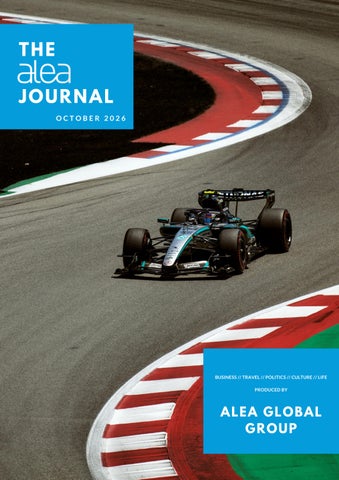
THE JOURNAL OCTOBER 2026
BUSINESS // TRAVEL // POLITICS // CULTURE // LIFE PRODUCED BY
ALEA GLOBAL GROUP
Contents PAGE 2
FOREWORD
PAGE 5
W H E R E G L O B A L FA M I L Y O F F I C E S A R E I N V E S T I N G : PRIORITIES, THEMES, AND EMERGING OPPORTUNITIES
PAGE 13
G U L F P R O D U C E R S E X PA N D R O U T E S A R O U N D T H E STRAIT OF HORMUZ
PAGE 19
DHIRAJ OBEROI: THE KUWAIT SNACK PIONEER BEHIND KITCO
PAGE 23
KIMI ANTONELLI: THE 20-YEAR-OLD ON COURSE TO REWRITE FORMULA 1'S RECORD BOOKS
PAGE 27
SAINT LEVANT'S FIRST SEASON AS A PRADA AMBASSADOR
PAGE 29
SNAP PRESENTS ITS FIRST CONSUMER AR GLASSES AS META WIDENS ITS LEAD IN SMART EYEWEAR
PAGE 33
ROOM WITH A VIEW: THE MOON HOTEL TAKING BOOKINGS FOR 2032
WELCOME
OCTOBER 2026
The alea journal FOREWORD BY MOHAMMAD AL DUAIJ CEO OF ALEA GLOBAL GROUP
Welcome to another edition of The Alea Journal. IWe’re digging deep right now to prepare for something we’ve never done before – a truly global event. Where other summits have focused on one region at a time, our Alea Global Family Office Summit in November will be for and about family offices everywhere. In this edition we look at global trends in family office investment, ahead of that summit. We also cover the latest news about movements around the Strait of Hormuz, so vital for the oil industry and for many of you..
some imminent holidays on the moon.
On a lighter note, we pay our respects to the Snack King of Kuwait, the record-breaking F1 driver from Italy, and the latest Prada ambassafor from Palestine.
We hope to see you at the Global Family Office Summit in London next month, and you’ll find details for this and our other upcoming events at the back of this issue as usual.
There’s also a look into the future
Do you have something we should cover?
with Snap’s new AR glasses, and
Contact me at info@aleaglobalgroup.com
2
Where Global Family Offices Are Investing: Priorities, Themes, and Emerging Opportunities
Alea Global Group's next event is our Alea Global Family Office Summit, bringing together family office investors and investment opportunities from around the world to London. Family offices enter the final quarter of 2026 in a world that has tested every assumption about portfolio construction.
Momentum in the technology sector helped offset the drop in energy supplies, though energy prices remained around 25% higher than before the conflict and the Fund raised its 2026 inflation forecast to 4.7%.
The war in the Middle East that began in February, the closure of the Strait of Hormuz and the energy shock that followed came on top of tariffs, elevated government debt and an AI investment boom that some fear has run ahead of itself. Yet the global economy has proved more resilient than many expected, and family offices are responding not by retreating, but by repositioning.
The data cited in this article draws primarily on the UBS Global Family Office Report 2026, which surveyed 307 family offices across more than 30 markets between January and March 2026, J.P. Morgan Private Bank's 2026 Global Family Office Report, which surveyed 333 single family offices in 30 countries (59% of them US-based), and Goldman Sachs' 2025 Family Office Investment Insights report, which surveyed 245 institutional family offices in mid-2025. Survey timing matters: the J.P. Morgan and Goldman Sachs data predates the 2026 Middle East conflict, and figures from different surveys are not directly comparable.
In its July 2026 World Economic Outlook update, the IMF projected global growth of 3.0% in 2026, rising to 3.4% in 2027, and said the world economy had so far weathered the shock from the war better than feared.
What follows is a picture of where family offices around the world are directing capital, and why.
5
Key Allocation Themes for Global Family Offices Artificial Intelligence and the Infrastructure Behind It AI remains the defining investment theme for family offices worldwide. According to the UBS Global Family Office Report 2026, 65% of family offices are already invested in AI, and around half of those invest in data centre infrastructure, AI software and platforms, and semiconductor producers. Despite concerns that parts of the market may be overheating, the vast majority plan to maintain or increase their exposure. The more interesting story is the broadening of the theme. Family offices are increasingly backing the physical ecosystem that AI depends on: UBS found that 37% are allocating to power and resources, 37% to infrastructure and 33% to AI-enabled healthcare. J.P. Morgan's research suggests there is still a gap between ambition and execution. While 65% of its respondents plan to prioritise AI investments, only 43% have any venture capital or growth equity exposure, and just 21% hold any infrastructure, at an average allocation of 0.7%. J.P. Morgan's strategists identify power as the key bottleneck for AI, making power generation and transmission a natural next step for family capital. Rethinking the US Dollar and US Concentration Family offices are increasingly questioning their reliance on the United States. UBS found that 65% of family offices expect confidence in the US dollar's reserve currency role to weaken over the coming year, and 47% describe themselves as over-exposed to the dollar. The Swiss franc and the euro have emerged as the preferred diversification currencies. North America still dominates, accounting for 52% of planned 2026 allocations, and US-based family offices have actually increased their home bias to 88%. Elsewhere, the direction of travel is clear: family offices in Europe and Asia Pacific are looking to rebalance toward Western Europe and Asia Pacific, and portfolios globally are tilting gradually toward emerging market equities.
6
Private Markets: Recalibrated, Not
allocation changes, UBS data shows real
Retreating
estate falling from 11% of portfolios in 2025 to 8% in 2026, while infrastructure doubles
Private markets remain central to family office portfolios, but the mix is shifting. Goldman Sachs found that average private equity allocations fell from 26% in 2023 to 21% in 2025 as muted exits weighed on new commitments, yet 39% of family offices expect to increase their private equity exposure, the largest share of any asset class. Secondaries and private credit are the growth areas. Across family offices globally, 72% now invest in secondaries, up from 60% in 2023, according to Goldman Sachs, attracted by access to more mature portfolios, shorter duration and greater transparency. The share of family offices with no private credit exposure fell from 36% to 26%, and 26% intend to increase their allocation. J.P. Morgan found that family offices most concerned about inflation are leaning hardest into alternatives, allocating around 60% of their portfolios to the asset class, roughly 22 percentage points above the average. Real Assets: Infrastructure Up, Real Estate Down, Gold in Focus The composition of real asset portfolios is changing. Among family offices planning
7
from 1% to 2% and gold rises from 2% to 3%. J.P. Morgan likewise reported a meaningful decline in real estate exposure since its 2024 report, in favour of public equities. Gold is the asset to watch. Family offices that hold it describe it as both a long-term allocation and protection against geopolitical risk, and some are using it to reduce their exposure to the US dollar. Even so, holdings remain modest: J.P. Morgan found that only 28% of family offices have any allocation to gold, at an average of 0.9% of portfolios, against the 3% to 5% its strategists suggest. Defence, Security and the New Frontiers A new generation of themes is emerging alongside AI. According to UBS, 29% of family offices are already allocated to defence and security infrastructure, rising to 39% among US family offices, with a further 11% globally planning to add exposure in the next 12 months. Automation and robotics (28%), longevity (25%), the space economy (20%), nuclear (16%) and quantum computing (15%) are also attracting capital.
Digital assets remain a niche but maturing allocation. UBS found that 24% of family offices hold crypto, typically at around 1% of portfolios, but 44% of those investors now treat it as part of their strategic asset allocation. Goldman Sachs also identified sports as a growing theme, with 25% of family offices already invested and a further 25% interested.
What Shapes Family Office DecisionMaking A Record Appetite for Repositioning Strategic asset allocation has traditionally been the most stable element of a family office portfolio. That is changing. UBS found that 60% of family offices plan to change their strategic asset allocation in the next 12 months, the highest level in the history of its report and up from 35% a year earlier. The appetite for change varies sharply by region, from 82% in the Middle East and 81% in Southeast Asia to 67% in Europe and just 21% in the United States. The emphasis is on measured adjustment rather than wholesale reallocation. Developed market equities and bonds remain the backbone of portfolios, but family offices are making targeted tilts toward emerging markets, infrastructure and gold while trimming real estate and US dollar exposure. A Longer and More Complex Risk Horizon Geopolitical conflict is the dominant concern. UBS found that 64% of family offices see a major geopolitical conflict as a risk over the next 12 months, and 61% over the nex t five years. Longerterm worri es are broadening: over five years, 56% are concerned about a debt crisis, 51% about a financial market crisis and 50% about a global recession, while concern about a global trade war is expected to ease. Priorities differ by geography. J.P. Morgan found that geopolitics was the primary concern for family offices outside the United States, while US family offices were more focused on interest rates and inflation. How families respond also varies: those most worried about geopolitics hold almost double the average allocation to fixed income, while those most worried about inflation lean heavily into alternatives.
8
Succession: The Governance Gap The generational transfer of wealth is the most consequential long-term issue facing family offices. UBS points to an estimated US$83 trillion moving between generations over the next two decades or more, yet only 35% of family offices have a succession plan for the family office itself, and just 27% have an organised process to prepare the next generation for future roles. J.P. Morgan's findings reinforce the point. A third of its respondents rank family conflict or misalignment on strategy and values among their top three risks to the family office, and another third cite the lack of a succession plan for key decision-makers. Families that still own operating businesses are about twice as likely to worry about internal conflict, and are more likely to respond with formal governance, including written constitutions or bylaws. Professionalisation and the Rising Cost of Talent Family offices continue to adopt institutional-grade practices. According to UBS, 68% have formal performance measurement processes and 60% operate with an investment committee, though fewer than half have a governance framework with board-level oversight. That professionalisation comes at a cost. J.P. Morgan found that the average annual operating cost for a family office with USD 1 billion or more in assets has risen to USD 6.6 million, up from USD 6.1 million in its 2024 report, driven largely by competition for specialist talent. Around eight in ten family offices outsource at least part of their investment portfolio, and cost is not among the top reasons for doing so: access to high-quality managers, performance track record and expertise rank highest.
9
Challenges to Navigate The energy sh ock remains a live risk. The IMF has warned that a renewed conflict in the Middle East would catch the global economy in a weaker position than the first time, with many countries having already drawn down their oil reserves. Alongside trade fragmentation, the Fund also flagged the risk of a correction in market expectations for AI, a concern echoed by the many family offices that see parts of the AI market as overheating. Return expectations may also need recalibrating. J.P. Morgan found that almost a third of the family offices it surveyed are targeting annual returns above 11%, yet none of the major asset classes in its long-term capital market assumptions is forecast to return more than 10%. Closing that gap points to greater use of alternatives and direct investment, with the additional complexity, illiquidity and due diligence that brings. And the generational transition, while an opportunity, also brings complexity. Formalising governance, preparing heirs and managing the dynamics of a growing family require as much care and expertise as any portfolio decision. The global picture is one of adaptation rather than retreat. Family offices are deepening their commitment to artificial intelligence and the infrastructure behind it, diversifying away from concentrated dollar and US exposure, recalibrating their private markets programmes, rebalancing real assets toward infrastructure and gold, and exploring new frontiers from defence to longevity. The combination of record levels of portfolio repositioning, a once-in-a-generation transfer of wealth and a rapidly professionalising industry creates a genuinely multi-dimensional opportunity set for family offices navigating the decade ahead. By attending our Alea Global Family Office Summit you can network with potential partners from around the world and find out everything you need to know to expertly navigate these opportunities. Find out more at aleafamilyoffice.com
10
G U L F P R O D U C E R S E X PA N D R O U T E S AROUND THE STRAIT OF HORMUZ Saudi Arabia and the United Arab Emirates are expanding infrastructure that lets them export oil w ithout sending tankers through the Strait of Hormuz. The strait has been severely disrupted since the United States and Israel went to war with Iran on 28 February.
13
No joint Saudi-UAE project has been announced. Each country is building on routes that existed before the war. Saudi Arabia pipes crude west across the country to the Red Sea. The UAE pipes crude east to the Gulf of Oman and is expanding its ports on that coast.
Why the strait matters The Strait of Hormuz carried about 20 million barrels a day in 2024, according to UN data, roughly a fifth of the world's oil. Before the war, around 125 vessels passed through each day. On 21 September, preliminary data recorded only two commercial vessels passing through, a figure that excludes ships with tracking transponders switched off. Among the Gulf's largest exporters, Saudi Arabia and the UAE have the most significant routes that avoid the strait. Iraq has a northern pipeline to Turkey's Mediterranean coast, and Oman's coastline lies largely outside Hormuz. Iran, Iraq, Kuwait, Qatar and Bahrain still depend on the strait for the vast majority of their exports. Saudi Arabia: the East-West pipeline Saudi Arabia's main bypass is the East-West pipeline, also known as Petroline. It runs about 1,200km from the Abqaiq processing centre near the Gulf coast to the port of Yanbu on the Red Sea. The pipeline was built in the 1980s, during the Iran-Iraq war, and has been upgraded since. Its capacity is usually given as 5 million barrels a day. Aramco temporarily raised this to 7 million in 2019 by converting some gas liquids lines to carry crude. In late March, Bloomberg reported, citing a person familiar with the matter, that the pipeline was pumping at that full 7 million-barrel rate. In April and May, all of Saudi Arabia's seaborne crude exports left from Yanbu, according to the ship-tracking firm Kpler. Riyadh is now considering adding 1 to 2 million barrels a day of capacity, according to people familiar with the discussions who spoke to Reuters and Kpler. Kpler's sources say the expansion under discussion may involve a parallel pipeline for refined products rather than crude.
14
The UAE: pipelines and eastern ports The UAE's existing bypass is the Abu Dhabi Crude Oil Pipeline (ADCOP), which runs fr om the Habsha n oilfields to Fujairah on the Gulf of Oman. It has a maximum capacity of about 1.8 million barrels a day. The UAE is building a second pipeline to Fujairah, which will double the export capacity of the route. The government said in May that it was fast-tracking the project, and UAE officials said that month it was nearly 50% complete, with operation expected in 2027. Kpler judges mid-2027 the more likely start date, because the port at Fujairah must also be expanded. A third pipeline is also under consideration. The UAE is also redirecting trade to three existing ports on its eastern coast: Dibba, Fujairah and Khor Fakkan. Feasibility studies are under way for at least one further harbour on the same coast. Road, rail and pipeline links are planned to connect these ports to the country's oilfields and population centres. Thani Al Zeyoudi, the UAE's minister of foreign trade, told Bloomberg the country was moving towards zero dependency on Hormuz, whether or not the strait is open. The eastern ports have already taken on far more traffic. Container volumes at Khor Fakkan rose roughly 25-fold after the war began, according to Reuters. Even so, the UAE still relies heavily on Jebel Ali and Khalifa Port inside the Gulf for imports. Moving LNG and aluminium exports away from the strait would also be harder than moving crude.
15
Limits and risks The bypass routes cannot replace the strait. Before the war, the seven Gulf states exported about 23 million barrels a day. Goldman Sachs analysts estimate regional pipeline capacity could exceed 14 million barrels a day by the end of 2028 if the projects now planned or under construction go ahead. The routes have also come under attack. An Iranian strike on a pumping station on the Saudi pipeline in April cut throughput by 700,000 barrels a day. On 13 September, drone attacks damaged pumping infrastructure and forced the pipeline to shut, halting loadings at Yanbu. Aramco restarted it at a reduced rate on 22 September, according to Reuters. While the pipeline was shut, Saudi shipments through the strait itself rose sharply, averaging 2.9 million barrels a day in the six days to 18 September, according to JP Morgan. That compared with about 700,000 barrels a day in August. Shipping from Yanbu faces its own threat. Since late July, Yemen's Houthis have declared a maritime blockade of Saudi Arabia and have claimed attacks on Saudi tankers in the Red Sea, including off Yanbu. In early August, Aramco's chief executive, Amin Nasser, said the attacks had had no material impact on the company's capabilities. The outlook for the strait itself is uncertain. On 22 September, a senior Iranian official told Reuters that Iran was prepared to reopen it within a week if the US eased military pressure and lifted its blockade of Iranian ports.
16
Dhiraj Oberoi:
the Kuwait snack pioneer behind KITCO For many people who grew up in Kuwait, KITCO crisps are a familiar part of childhood. The brand was built over more than half a century by Dhiraj Oberoi, one of the founders of the Kuwait Indo Trading Company (KITCO). Oberoi co-founded KITCO in 1962. I t began as a food trading warehouse and moved into manufacturing and distribution in 1976. The business was a partnership with the Al Wazzan family, the founders of Mezzan Holding, and together they later built other household brands, including Kuwait Biscuit Company and Gulf Pastry Manufacturing Company, known for Sara Cake. The step into manufacturing marked a turning point. KITCO and the Al Wazzans had been importing crisps into Kuwait, and when shipments were disrupted, they decided to open a local factory.
19
It opened in 1976 using machinery imported from the Netherlands. The Indian Business Council in Kuwait has honoured Oberoi for opening the country's first snack factory. In a Times Kuwait interview, Oberoi recalled coming to Kuwait from New Delhi as a teenager. When his father, who ran a grocery shop there, fell ill, he gave up his education to take over the shop. He described the move from trading into manufacturing as daunting, with a steep learning curve and tight finances, and credited the backing of the Al Wazzan family and his brother Sudhir, who later joined the business. He also said the company's first product, KITCO Rings, was the first of its kind in the region.
Th e business survived major setbacks. Oberoi has described how the 1990 Iraqi invasion of Kuwait halted the company's factories and caused heavy losses, and said the company chose to rebuild rather than dwell on what had been lost. In Jun e 2014, Mezzan Holding bought the Oberoi family's 49% stake in KITCO Group, making it a wholly owned subsidiary, while keeping the family on as operators. Mezzan now describes itself as on e of the Gulf's largest manufacturers and distributors of food, beverage, consumer and pharmaceutical products. Oberoi's link with the group has continued. In May 2024, Mezzan expanded its board from five to seven seats and appointed him a non-executive director. Shareholders re-elected him in April 2025 for a three -year term. Beyond his own company, Oberoi was the first chairman of the Indian Business Council in Kuwait, working to strengthen business ties between India and Kuwait. In 2014, Forbes Middle East named him among the top 100 Indian leaders in the Arab world. He has credited KITCO's success to hard work, ethics and his staff rather than to himself. He has said he believes in promoting capable people from within, so that someone who starts as a salesman can become a sales manager. His advice to young entrepreneurs is to find work they love, as he put it: "Without passion, there is nothing."
20
Kimi Antonelli: the 20-year-old on course to rewrite Formula 1's record books Italian Kimi Antonelli remains the runaway leader of the Formula 1 world championship. He is 84 points clear of his Mercedes team-mate George Russell, and Lewi s Hamilton is 106 points behind in third.
Andre a Kim i Antonelli was born in Bologna on 25 August 2006. His father, Marco, has been a constant presence in his career. After his first pole position, Antonelli described him as a rock he could always rely on.
For readers who don't follow motor racing, it helps to understand the scale of that. Formula 1 is the top level of the sport: 22 of the best drivers in the world racing cars that cost many millions of USD to develop, on circuits across five continents. Winning a single race is a career highlight for most drivers. Antonelli has won eight, in only his second year in the sport.
His rise through the junior ranks was unusually fast. After back-to-back European karting titles, he moved into single-seater cars in 2022, aged 15. In his first season he won both the Italian and German Formula 4 championships, and Mercedes signed him to its young driver programme. He then took the Formula Regional Middle East and European titles in 2023 and raced in Formula 2, one step below F1, in 2024.
23
Replacing a legend In Januar y 2025, aged 18, Antonelli took the seat vacated by seven-time world champion Lewis Hamilton when Hamilton moved to Ferrari. It was one of the most closely watched debuts in years: a teenager stepping into the car of the most successful driver of the modern era. He made an early mark. In May 2025, in only his sixth race weekend, he qualified fastest for the sprint race at the Miami Grand Prix. That made him the youngest driver ever to start an F1 race from pole position, the front of the grid, in any format. He beat Sebastian Vettel's record from 2008 by more than two years. He finished his debut season seventh overall with 150 points. A record-breaking 2026 Everything came together this year. Antonelli won his first race at the Chinese Grand Prix in March, then won again in Japan and Miami. That made him the youngest driver in history to win three races in a row.
In Azerbaijan, he recovered from a qualifying crash that left him starting 16th to finish fifth, while Russell took the victory. His only two rounds without points this season, in Barcelona and Britain, were caused by mechanical failures rather than driver errors.
Only two other drivers, Damon Hill and Mika Häkkinen, had won three consecutive races starting with their first win. He also became the youngest driver ever to lead the world championship, and the first teenager to do so.
What comes next Antonelli now leads the championship with 320 points to Russell's 236.
The wins kept coming. By the summer break he had won in China, Japan, Miami, Canada, Monaco and Belgium. At his home race in Monza, Italy, he started 19th, near the very back of the grid, because of an engine penalty, and still won.
The title isn't decided yet, since several races remain and a lead can shrink quickly in F1. But with an 84-point cushion, Antonelli is in the strongest position of anyone on the grid. If he wins, he will be the youngest world champion ever, a record held since 2010 by Sebastian Vettel, who won his first title at 23.
Overtaking almost the entire field is rare, and on Italian soil it was an especially popular victory. He then won the firstever Formula 1 race on Madrid's new street circuit in September, his eighth victory of the season.
For a driver who was still racing in the junior categories two years ago, that would be a remarkable achievement.
24
SAINT LEVANT'S FIRST SEASON AS A PRADA AMBASSADOR
Saint Levant is now several months into his role as a Prada ambassador. The Italian luxury house appointed the musician in June, making him the first Palestine-born figure on its global ambassador roster. The appointment was announced during Milan Men's Fashion Week, shortly after he sat in the front row at the brand's Spring/Summer 2027 menswear show. Prada confirmed the partnership with a social media post showing the artist in the brand's clothing. Saint Levant was born Marwan Abdelhamid in Jerusalem to a French-Algerian mother and a Palestinian-Serbian father. He spent part of his childhood in Gaza before his family moved to Jordan in 2007. He came to international attention in 2022 with the viral single Very Few Friends. His songs mix Arabic, English and French lyrics and deal with identity, displacement and cultural belonging. He has since released two EPs and two studio albums and has toured the Middle East, Europe, the US and Australia.
The Prada appointment followed several years of work with luxury fashion houses. In 2023 he became Dior's first fragrance ambassador for the Middle East. He later attended Saint Laurent's autumn/winter 2025 menswear show in Paris and appeared in a campaign for the house by creative director Anthony Vaccarello. He first attended a Prada show at the house's Fall 2026 menswear presentation in January. Brand ambassadors typically attend the house's shows and events, wear its clothing in public appearances, and feature in its promotional content. Prada presented the collaboration as highlighting the artist's growing international profile. Asked about representing Palestine, Saint Levant described it as "a huge privilege", saying his work draws on his people, food and music. Saint Levant joined PalestinianAmerican model Bella Hadid, whom Prada named its first global beauty ambassador in March. At the time of his appointment, Prada's roster also included K-pop artists Karina, Sana and Enhypen, and actors Maya Hawke, Letitia Wright, Carey Mulligan, Louis Partridge and Damson Idris. At the June show he sat alongside fellow ambassadors Jaehyun and Troye Sivan.
His debut album, Deira, came out in June 2024. Its title track is dedicated to his father's hotel in Gaza, which was destroyed in an Israeli bombing. His second album, Love Letters, followed in 2025. He made his Coachella debut in 2024.
28
Snap presents its first consumer AR glasses as Meta widens its lead in smart eyewear
Snap, the company behind Snap chat, is preparing to ship Specs, its first augmented reality glasses aimed at the general public. It is betting that consumers will pay a premium for see-through glasses that place digital content in their field of view. The company unveiled Specs at the Augmented World Expo (AWE) in Long Beach, California, in June. Pre-orders opened at $2,195 with a $200 refundable deposit, and shipping is expected this autumn in the US, UK and France. Evan Spiegel, Snap's co-founder and chief executive, said at the launch that Specs were "the beginning of a new era in computing". He argued that computers have long required people to look down at screens or step out of the moment, whereas the glasses bring computing into the world around them.
What Specs do Specs are standalone: they do not need a separate processing unit or a cable to another device. They run on two Qualcomm Snapdragon chips, one for computer vision and one for AR experiences, which Snap calls "Lenses". The g lasses have a 51-degree field of view, which Snap says gives a 30% larger display area than the previous generation. Their lenses tint automatically in about 10 seconds for outdoor use. Battery life is up to four hours of mixed use, or around 20 hours in total with the charging case. The glasses come in two sizes, weighing 132g and 136g, which makes them about 40% lighter than the previous version. Prescription inserts are supported. Snap is promoting AI as a central feature, saying the glasses can see what the wearer sees and offer help in context. On privacy, the company highlights on-device processing, permission prompts for sensitive information, and an LED light that shows when the glasses are recording.
29
Some key specifications have not been disclosed, including display resolution, brightness, storage and camera details.
Chief executive Mark Zuckerberg said Meta's AI glasses would be available in more than 100 styles by the end of the year.
Specs follow more than a decade of work on eyewear. Snap said last year that it had spent 11 years and more than $3bn developing the technology since its first Spectacles, a $130 camera-only product, launched in 2016. Two further camera-only consumer versions followed in 2018 and 2019. Since 2021, Snap has released AR versions only to developers, including a fifth-generation model in 2024, to encourage apps to be built ahead of a consumer launch. Meta's expanding lineup Specs will enter a market dominated by Meta. In the first quarter of 2026, Meta held 69.2% of global smart glasses shipments, according to the research firm IDC. RayNeo was second with 3.4% and Xiaomi third with 3.1%. Meta's partner EssilorLuxottica, the eyewear group behind the Ray-Ban and Oakley brands, sold more than 7 million Meta AI glasses in 2025, more than triple the previous year. Meta widened its range again at its annual Connect conference on 23 September. It announced the third-generation Ray-Ban Meta glasses, which have longer battery life and new frame styles, starting at $449. It also unveiled Ray-Ban Meta Audio, its first camera-free glasses, priced from $349 and shipping from 13 October. Other announcements included an ultra-thin headset called Meta VR Glasses, priced at $1,299 for release next spring, and updates to its Meta Ray-Ban Display glasses.
30
Most of Meta's best-selling glasses are camera-and-audio devices built around a voice assistant, with no display. Snap's Specs instead overlay graphics onto the real world through see-through lenses, a more technically demanding approach at a much higher price. Snap has described the market as a trade-of f: AI glasses are easy to wear but limited, while headsets are powerf ul but cut users of f from their surroundings. A growin g categor y The smart glasses market has grow n quickly. IDC recorded roughly 2.25 million units shipped in the first quarter of 2026, up 167% year on year, while eyewear with displays grew 86%. For display-less glasses alone, IDC forecasts $5.1bn in revenue this year and expects average prices, currently around $376, to fall to about $229 by 2030. Competition is expected to intensif y, with Google, Samsung and possibly Apple preparing products. Meta's dominance has also draw n scrutiny: it faces pressure from civil society groups, regulators and US senators over its reported facial recognition plans. Whether consumers will pay nearly five times the price of Meta's f lagship RayBans for f ull augmented reality is likely to become clearer once Specs reach customers.
Room with a view: the Moon hotel taking bookings for 2032 A Californian start-up wants $1m to hold your room on the Moon. We checked the small print, and packed accordingly. In an age of overtourism, when Venice charges day-trippers at the door and Santorini's sunsets come with elbows, one company has found a destination with no crowds, no queues and, crucially, no hotel yet. Galactic Resource Utilization Space, or GRU Space, is a San Francisco start-up that says it is building the world's first hotel on the Moon. It is already taking reservations. Would-be guests pay a non-refundable $1,000 application fee. If selected, they can place a refundable deposit of either $250,000 or $1m. Final pricing has not been set, but GRU Space says a stay will likely exceed $10m. The plan comes in stages. In 2029, GRU aims to send a 10kg payload on a commercial lunar lander to test an inflatable structure and a way of turning lunar soil into "Moon bricks". A second mission in 2031 would place a larger test structure inside a lunar pit, a natural cave chosen for its shelter from radiation and temperature extremes.
The first hotel would follow in 2032: an inflatable structure built on Earth and landed on the Moon, hosting up to four guests for multi-day stays over a planned ten-year lifespan. Planned activities include moonwalks, driving and golf. A later, larger version built from lunar material would hold up to ten guests and is to be styled on San Francisco's Palace of Fine Arts. The company was founded in 2025 by Skyler Chan, a recent Berkeley graduate who previously worked on vehicle software at Tesla. It is backed by Y Combinator and part of Nvidia's start-up programme. In March, the Canadian investment firm Planet Ventures announced a $100,000 investment. Chan sees tourism as the missing link in space development. In his words, SpaceX is building the FedEx to get us there, but there has to be a destination. Sceptics note that in late December, according to Ars Technica, GRU had one full-time employee besides Chan himself. The company, for its part, points to its whitepaper.
33
Planning your trip: a practical guide When to go. Early booking is strongly advised: the first hotel has four beds and a 2032 launch window. School holidays are best avoided, as are years when the rocket is not ready. Getting there. The Moon is about 384,000km away, which rules out the Eurostar. GRU's own whitepaper says even the first hotel will need a Starship-sized vehicle to get there. Be warned that the headline price reportedly covers the hotel only; transport, via a launch provider such as SpaceX or Blue Origin, adds several million more. This is the first holiday in history where the flight costs more than a house and is still classed as an add-on. Budget. One local report put the price for the first hotel's average five-night stay at around $416,667 per person per night. Seasoned travellers will recognise the trick: once you've paid for the rocket, the minibar feels reasonable. Packing. Leave the swimwear. A lunar day lasts about two Earth weeks, with surface temperatures swinging from well above boiling point to far below freezing. The hand-luggage liquids rule will feel quaint in a place with no atmosphere at all. Apollo astronauts reported that lunar dust clings to everything and is abrasive, so avoid bringing the good linen. request a full refund of your deposit at any time after the first 30 days. Few Earth-based holiday bookings offer as much, although few Earthbased hotels are still waiting for their foundations to be invented.
Activities. Golf is on the itinerary, and there is precedent: Alan Shepard hit two golf balls on the Moon during Apollo 14 in 1971. With onesixth of Earth's gravity, even the most mediocre executive can expect personal-best drives. Caddies are not yet confirmed.
Getting home. Advisable.
The view. Unbeatable, with Earth hanging in a black sky. Guests who find the sight of their home planet uncomfortably reminiscent of their inbox may request a room facing the other way, although with four guests, requests are limited.
Verdict For now, the world's most exclusive hotel is a whitepaper, a website, a waiting list and a rendering. That doesn't make it a joke: space tourism was once a punchline too, and the investors are real.
Reviews. There are none yet. The hotel doesn't exist, which puts it, for once, ahead of several properties with glowing reviews.
But for your next vacation, there's still something to be said for a regular city break. It has gravity, oxygen and, crucially, rooms.
Cancellation policy. Surprisingly generous. According to GRU's reservation terms, you can
34
Upcoming Events 20-21 October 2026 APAC Family Office Investment Summit Shanghai, China 10-11 November 2026 Alea Global Family Office Summit London, UK 23-24 March 2027 Middle East Family Office Investment Summit Dubai, UAE 20-21 April 2027 LATAM Family Office Investment Summit Mexico City, Mexico 25-26 May 2027 Europe Family Office Investment Summit Rome, Italy 9-10 November 2027 Africa Family Office Investment Summit Johannesburg, South Africa
See aleaglobalgroup.com for updates
Published by