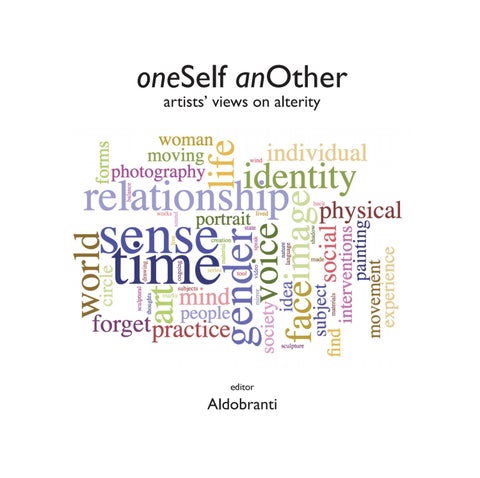
oneSelf anOther artists’ views on alterity
editor
Aldobranti
This collection reflects the many ways of seeing the self and other, and of understanding our own identity. This has particular significance now for two reasons. First, our comfort bubble has become more encompassing over the past five years, which makes it harder to see and understand the other, resulting in polarity of opinion. Second, the ubiquity of the perfect image, by which I mean heavily edited photography, and the notion of promoting the self as a brand have played a huge role in shaping expectations for gender and appearance, especially for the young. These trends have combined to result in an upsurge in political activism in response to the unsustainable and unpalatable picture of the world we are presented with. When the people with power, such as political leaders and media owners, only purvey images which reflect their own world, and bear little resemblance to the lives of vast numbers of the population trouble surely follows. The unrepresented are left wondering who they are and whether they have a place in today’s world : an unsettling and potentially threatening experience. This uncertainty feeds into the concentration of the comfort bubble : it is so much easier to maintain our own stance than deal with the discomfort of challenge. In considering the other, many artists went back to look at the self, and where our notions of that come from. We understand ourselves through interactions with others and with the material environment. We all start life puzzled, searching to understand who we are, how we are and how to interact with others. Sometimes we feel we have to fight against outside constraints to be our real selves. If we are handed a traditional or manufactured view of gender, for example, that does not reflect who we are, we still have to do our growing up in the presence of those expectations. This generates tension and conflict, seen in some of the works here, and makes it hard to accept that we learn ourselves by reacting to others. Even the above thoughts and observations are the upshot of my own experiences and beliefs, which will inevitably be different from those of the artists shown here. In spite of all these sources of difference and uncertainty, we still seek to connect, to communicate : that is what these artists are trying to do. Fiona Harvey May 2018
oneSelf anOther an international project of 19 artists
Aldobranti (editor)
2018
Searchin’ 2003 (after Bas Jan Ader, 1973) photograph
Robert Moon (Britain) I took this photograph whilst driving on the 10 freeway in Los Angeles in 2003 where I was living at the time. I drove this route on an almost daily basis - westwards in the morning and eastwards in the late afternoon. Being familiar with Bas Jan Ader’s great photowork from 1973, In Search of the Miraculous (One Night in LA) I felt that I might actually be passing the spot where he is seen from behind walking along the hard shoulder of the freeway. I eventually kept a photocopy of the work in my car, and when I was in the vicinity of Bundy, Barrington and the 405 heading eastwards, I would be scanning the area for the location; I had decided it was somewhere here. It was always a glimpsed and snatched view though, since I was always moving and was not brave enough to stop on the freeway. I eventually took one photo whilst driving, as my best guess. It almost seemed like the right place, I felt I was almost there - but perhaps the freeway and signs had changed since 1973? Perhaps I was on the wrong freeway entirely. I gave up the task disillusioned after that shot and didn’t continue with my idea. When I got the print back from processing a while later, I noticed the two round conjoined white circles on my image. It was probably just a chance reflection on my windscreen, I’m not sure where it came from. But this form seemed to symbolise something for me - my desperately trying to connect to Bas Jan Ader, me trying to reconnect to this lost moment. One circle was me, and one circle was Bas Jan Ader, or one circle was 2003 and one was 1973? Or one was his work and one was my work. Like twins, or partners? The circles could also be two eyes looking at me, observing my preoccupation.
4
5
I Swipe Therefore I Am
Alice Sleeper-Atkins (UK) ‘I Swipe Therefore I Am’ is a conceptual project which explores the extension of the self in a digital age. Cartesian dualism and its presence in the 21st century have been explored, concluding that as society becomes more digitised, so does our sense of self. In this project the handheld device has been reconsidered and redesigned to be more organic, sensorially advanced and to increase user-connection while highlighting the fragility of the self. In a technologically driven world, how has the self adapted? With the use of social media platforms and unlimited internet profiles, the self is becoming ever-more scattered and elusive. Digital handheld devices are becoming physical extensions of the self in miniature. We are glued to these man-made objects, which, while they allow for direct and immediate contact between people, as a society we feel more disconnected than ever, and reports of isolation and loneliness are on the rise. Meanwhile, human and machine hybridisation is ever-prescient; we wear our devices on our sleeves and robots are granted rights before humans. All of these occurrences must be addressed.
6
7
Abandoned Thoughts (2016) photography
digital image
Jamie F Simpson (UK) We are ourselves because we cannot forget We each carry with us an impression of other people; a trace of others etched and imprinted like a ghost in the mind. They diminish and decay and after the voice and image have departed the idea still appears unblemished as the remnant of what once was. Think of a name and an image appears; sometimes a voice or a video plays out in your mind, other times it’s as if they’re there with you. We cannot always choose what we desire to retain and what we want to erase. Forgetting becomes a temporary fix; transitory storage in the mind’s filing cabinet in which deleting a file initiates the inevitable paradox of remembering to forget. We remember to learn and forget to move on and vice versa. We require thinking, remembering, and forgetting to exist, in recent years dementia has shown this and without either one, we become a shell, a shadow, a vestige, no longer present yet not entirely absent. Think. Stop. Forget. Repeat
8
9
JonĂĄs, (2012)
photography from the Portraits series. GiclĂŠe Print on Methacrilate 125x156cm
Jorge Fuembuena (Spain) The portrait is associated with the history of representation and the self-representation of the individual, whose simple evocation is equivalent to recognize that the genre of the portrait has shaped our relationship with the body, with ourselves and with the other as no other practice. We have thus learned something about the indefinable relationship between the individual and his image, between presence and absence. In this essay I do not proceed to construct the image of any group, to affirm as a collective identity a series of individualities, but I extract from the collective or the community the individual giving to each subject the representation of himself. Photography allows me to interact with others and with the world. I use photography as a tool to reflect upon the nature of the social and the individual being. It helps us build a vision of who we are. My will is to find emotional correspondences, to generate horizontality with the world being photographed and, as Serge Tisseron says, to have a psychic assimilation of the world. In this series that I present for the book the subjects can not control their appearances because they have a mental shock such as death of any member of the family, fire from work, change of sex, faith, loose of memories,...and the pictures are with the background of their houses, in a domestic environment, in their intimate and familiar context.
10
11
Paul (2017)
Acrylic on recycled card 11.5in x16.5in
Isabelle Plowman (UK) My work aims to explore the complex subject of identity as well as the relationship between the Self and the Other by concealing and revealing aspects of my sitters to present them as something other than how they are viewed in reality. Drawing on influences of psychoanalytic and social theories such as Lacan’s ‘mirror self’, Freud’s ‘ideal self’ and the theory of the other, my ongoing research aims to support the complex issues that surround the subject of identity. Being a volunteer at a local homeless shelter, I am interested in exploring the notion of human connection and how the dynamics change between the interaction between viewer and the subject when presented as an artwork. I find it interesting how the relationship changes towards the depicted subjects when painted as a portrait in the eyes of the viewer. The fact that the people are presented in a beautiful and colourful way is to show a contrast between how they are viewed as a group by society and challenges these opinions when presented in a gallery or street setting.
12
13
Self-portrait in Margate, 2017-2018
oil on canvas
70cm x 116cm
Charlie Schaffer (UK) Art should reflect life back to us. In order for it to have life, it must have the experience of life within it. The artist imbues their experiences into the works. Therefore, powerful work must be autobiographical. Not in the sense that each work should be a diary entry, or a snapshot of what was eaten for lunch, but in the sense that it must stem from something truly lived. This can range from a Rembrandt (self) portrait, to a Rothko mind-scape - it is the ingrained experience of being alive that makes works able to stand the test of time. My own work slides along the scale between being either more or less mimetic. As my work primarily involves spending extended periods of time with other people, the work is very much directed by the relationship that is formed with the sitter, as well as my own mental state at the time of painting. As I go through periods where I turn more inwards, the paintings (through the way they are painted) become more self-reflective and explorative. The work is always and inevitably governed by experience.
14
15
Witness (Testigo) , 2018 Jessica Gonpra (Spain)
acrylic painting 100cm x 81cm (unframed)
- The suffering and hard work of the shared art with the receiver “Witness” Ideas constructed through poetry. As a poetry writer and winner of a national prize for young poetry in Spain. Some of the latest ideas about how to materialize artistically those concepts taken from the poetry that corresponds to this work: “Well, the real anger that arose it is pain to take claws, that more than grab the rage with such force, it usually springs red tear from your palms.” “Meat prison, see in body appearance, [...]” “The sores are accesses of graves dug of evils.” “While there is a smile or an empty heartbeat pulse, there will not be calmness in my head, that emphatically calm this emptiness.” “Fortuitous Witness of words that I dictate; [...] “ “Well here who exposed in verse; it was the messenger and not the message. “
16
17
A Text From Vic (2018) screen print
42cm x 59cm
Han Fleming (UK) A text from Vic (2018) I am in a constant state of flux. I am one hundred entries On a single page. 99 of them You will never see. The common misconception to believe personality belongs to a fixed, static and unchanging mechanism is as familiar as it is absurd. The sentence ‘It’s not you.’ implies dishonesty to oneself and others, a conspicuous behaviour that attempts to impress or deceive, that attempts to be something else. As an artist, the idea that another may know me better than I know myself, that they are fully educated in every aspect of my being both inside and out, is implausible. The black eyes in the self-portraits represent this, emphasising a closing down and containment of the Self and the unwillingness to engage post-communication. This work explores the Self through the perceptions of an Other and considers the disillusioned belief that the human psyche is singular, passive or restricted, questioning; does anyone actually know me and do I actually know myself?
18
19
PAINTING 19 (2018)
Oil on Canvas
Ronis Varlaam (UK) THE LABYRINTH OF THE STRAIGHT LINE * I am going to state something very obvious (probably the most obvious fact of our existence) but at the same time I think quite surprising. We never see our faces. The most important part of our body perhaps what gives us our sense of I, of who we are, we never see. We can only see it in a mirror. And what is more ‘other’ than a mirror. Or we can, in a way, see it in the faces of others of how they react to us. Do they give us admiring glances, do they turn their faces away, do they just ignore us? Our sense of self, our identity depends entirely on others. I have been trying to find a way of painting this fact. What is there? Instead of heads we have images and thoughts. Memories and desires. This particular painting ‘PAINTING 19’ is also concerned with male and female identity in the way we see each other and to what extent that is true. Ultimately the other will always remain a mystery and we are a mystery to ourselves because we can only know ourselves through the other. * Jorge Luis Borges
20
21
MySelf HerSelf (2018)
Charcoal on paper / digital photograph
Elizabeth Hindle (UK) My Other Self exists somewhere both above me and within me. She is fleeting, fragile and largely unattainable. She is my escape, my refuge and my downfall. I crave Her. Accessing this Other Self can only be done though Making – through letting go, ignoring the Now and chasing only marks and gesture and creation itself. I access Her through drawing, and use My Self to contact Her Self as I draw marks across paper. For my most recent works, which I am looking to develop into a performance or video piece, I use my face – my identity itself – as my drawing tool, with which to drag and draw and put down marks on paper, using all of the muscles and movement that I can in my head, neck and face to move myself across the surface of the paper in whichever way I please, caressing and marking it as if we were lovers. By working in this way, I am diverting all of my senses towards my work; meaning that I forget, I lose time, I devote My Self - and I gain a momentary glimpse of this Other Self. This quiet, raging, beautiful Other Me.
22
23
#1033 (2017)
photography from the series I, Butades
Aldobranti (UK) Quite early on in my own researches into the visual art of my cast and separate Shadow I was becoming very aware of an Otherness waiting to break through and play a part in the artwork. To try and crystallise this sensation I used a laser pointer to mark out this sense of the Other and found a rich source of ideas to follow through on. Here I reframe the myth of Butades as performance, the long duration of the shot principally registers the trace of the laser spot. Butades a potter of Corinth, recorded that his daughter traced the outline of her lover’s shadow as he slept before departing for the wars. Through this myth, it seemed that Butades “invented� painting and allowed the patriarchy to ascribe to the masculine the prerogative of depicting form. Whereas, in this work I offer myself as both the traced and the tracer. I frame myself as the art object and the artist. I use my own body as a mirror to question all gaze.
24
25
Tricyclic Transform, 2014-2017
Photography / Video / Performance
Mélanie Ménard (UK) ‘Tricyclic Transform’ is a photography, video and performance project theatricalizing the gender queer experience by documenting the creation and self-destruction of my ‘biologicallychallenged drag-queen’ alter-ego Miss Liliane. They try to negotiate restrictive gender-roles by performing symbolic rituals, but the inability of their mind to comfortably inhabit any predefined role causes them to get trapped in an endless loop of repeated, pointless gestures. ‘Tricyclic Transform’ presents gender as a cyclical spectrum: Miss Liliane tries on identities as they try on clothes and body language . But each time new inner conflicts arise, propelling them further round the gender wheel, until they come back full circle, to a genderless, endlessly questioning, naked body. Tricyclic Transform goes beyond the ‘private confessional’ nature of many queer solo performance and body art, using ‘Lynchian’ cabaret and German Expressionism aesthetics to explore the alienation of enforced gender roles and social expectations on individuals from a full spectrum of psychological perspectives and gender archetypes: Sacrificial femininity, Lilith (Predatory Femininity), Androgyne, Dionysos (Broken Man).
26
27
Untitled, 2017
photography
double exposure
Maiada Aboud (UK) I am not even a body – I am a voice. The loud voice of the bell I once placed between my legs, many lives ago, during my first performance ever, at Haifa University. The voice of a phallus controlled by the movement of my gentle woman’s limbs. In spite of what tradition dictates, I survive. My vagina is no weaker than a phallus. I am the uncomfortable, disturbing ringing that you cannot hide from or ignore.You can lock a woman in a room, you can place a citizen under arrest, you can trap a body behind bars; but sound is unstoppable, freely carried by the air. No matter how hard life was, or might become, this was the only definition I would ever accept: a voice. Having no words to describe my pain, I had to use my body as a means of rebellion against my society. My Arab Israeli culture views ‘woman’ as virginal, gentle, trusting, emotional, kind, accepting, accommodating, compassionate, loyal, sensitive, shy, soft, understanding, devoted, dependent, caring, passive, traditional, faithful, committed and stable. In spite of or because of this cultural tendency, I dreamed of becoming something totally different: assertive, athletic, competitive, dominant, forceful, independent, unique, and strong. I wanted to take on no roles but my own; to be the author, activator, director and designer of my own life. I chose performance as my means of challenging the patriarchy through the language of the body, by exploring gender and sexuality embedded in the female body, and the absent female sexual body that my culture has labeled as evil. I wanted and still want to inscribe my body in order to speak, using this art as a stage across which I could express my frustration and anger, and as a platform for my rebellion against the traditional conceptions of the image of ‘woman’ in the Arab world.
28
29
Pervert Conversation (2016) Rehearsal for Performance
with Carola Lingelbach, Moritz Stotzka and Michael Rybakov
Mira Hirtz (Germany and UK) The research practice and final performance grew out of the reflection upon the figure of the barbarian: he/she is insurmountably different from myself. The term serves for stigmatising a person as the other, foreign, potentially dangerous and unpredictable. In the last years the term barbarian was increasingly used within press and media, referring to terrorism, refugees and sexual violence at the same time. In Ancient Greek the barbarian named the (male) persona who wasn‘t capable to speak the proper language but would only say br br. Thus, communication sets cultural and civic membership. We explored the material of foam and the thereby developing movements, touches, costumes, and scenes. It is a pervert participation, a pervert equality of fleshes and things. We approach a conversation which is not understandable, yet humorous, queer, and moving – both bodily and emotional –, which is simultaneous and stumbling. Three moving performers meet with one performer reading associations, reacting only atmospheric and not content wise. We improvise: getting into the material and expanding our bodies; melting and separating. We talked about Latour‘s parliament of things. And about Deleuze‘s body without organs. Which forms of bodies are manifesting? Which methods of performing conversations? Which sounds and voices occur? How soft will the conversation be?
30
31
As Yet Unknown (2017)
performance
6ft metal interactive sculpture, ongoing exploration with artist
Vivienne Gibbon (UK) Sculpture, movement, and the body’s relationship to created forms are presently the focus of my practice. I have begun to make sculptural structures as a basis for this exploration, using the physicality of my body to manipulate materials and then further alter these initial forms by directly interacting with them in live interventions, therefore both challenging the idea of finite sculpture and creating an ongoing dialog between myself and the materials. Thoughts of the balance between revealing and concealing- the need to be seen and the need to be hidden - are also explored in these interventions through which interior thoughts are expressed via manipulating a physical object. As well as using my body in these pieces, it is important to expand sensorial elements offered by the materials to further enhance immersive qualities. This involves collecting sound made by ‘playing’ the sculptural elements then subsequently playing the edited recordings back while the live interventions take place. The recorded sounds are at times dissonant and out of step with the live physical interactions , yet amongst them are softer tones which help to balance out the creation/destruction process of the performed interventions. I find I am unable to distance myself from these sculptures, as though we are somehow irrevocably connected in an ongoing, ever expanding dance of sorts.
32
33
Wind Sculpture no.41 (2016)
performed photograph
The Observatory Residency, Lymington
Julie Brixey-Williams (UK) My sculptural practice is an embodied investigation of the materiality of gesture aiming to reveal the strength of bond between the Site and Self, which articulates the idea of a perceiver as a whole body in motion as it perceives. Performative processes generate material responses that bear witness - “visible inscriptions” - that create a bridge connecting the landscape and the physical self. As place shifts, during alterations in structure, time or elements, it is able to “speak meaningfully” to create dynamic conversations, open a space for listening and for that moment change the sense of Self in that location. Wind Sculpture No. 41 (The Observatory Residency, Lymington 2016) is from a series of eighty photographs created to expose the sculpting possibilities of wind. Over two hours, the wind sculpted a tubular mylar tent around my body, simultaneously influencing my ability to perform inside a set of movement hieroglyphs, inspired by forms observed in the surrounding salt marshes. Inhabiting the fabric produced a second micro-environment endlessly buffeted, noisy and shimmering with a sense of risk on the end of the jetty that was magnified as I became progressively tired. As the fabric shredded over time, my body was ultimately exposed, changing the visible balance between body and location.
34
35
red, red, red (2017) performance 20’
photo: Alex Huddleston, GSA
Stephanie Black-Daniels (Scotland) I use costume, sound, text, and objects, as well as performance and theatrical references to deconstruct our relationship with the made, mundane, familiar and the everyday. In ‘EXTENSIONS’ and ‘red, red, red’ I performed with objects, such as ribbon, as if they were another collaborator: controllable yet unattainable at the same time. My work sees me: casting actions in plaster, attaching drawing materials to my limbs, carving lines into gallery walls, making body-tape sculptures and working with: tracing paper, skin-like materials, mounds of slate, clay and graphite as if they were ‘other’ bodies or performers. I use my body as a tool of measurement to consider questions around the self. And through my physical and action-based work I want to dismantle subjects through personal, lived and process-driven experiences.
36
37
Mountain Heart (2018)
Amanda Humphries watercolour, gouache and embroidery on paper, 100 x 150cm
Lucinda Coleman & Amanda Humphries (Australia) In our artistic practice, we leave traces within our own lives and within others’ lived experiences. How do we justify our markings of an Other? In moving from Self towards the Other, we are confronted with the person of an Other and alterity is disrupted through face-toface encounters. We have an ethical obligation for the Other and there is endless, infinite responsibility to care for the persons we are meeting and marking. Walking together, smiling together, sharing space together, even the occasional bumping into each other, enables us to acknowledge our own responsibility in the world. In moving to encounter the Other, my ethical responsibility is responsive face-to-face. This is the ethics of art practice: how might I respond to an Other, to whom I am now beholden through creative engagement within the entanglement of life itself? How might we locate the infinite in the care of the finite which arguably holds each one of us accountable for each Other? Lucinda Coleman
38
39
Curator’s Notes This project had its beginnings in the sense of dislocation that emerged in the UK after the EU Referendum of June 23rd, 2016. Many people woke the next morning to the knowledge that UK society was more divided than they had known, social bubbles had obscured a reality. Moving on from a blame culture an understanding emerged that neither side could ultimately be satisfied: that more conversation was essential for the long term health of society. The psychoanalyst Carl Jung identified patterns of human behaviour to model character traits and identifies a Shadow archetype as a repository for responses that we are unwilling or unable to own for ourselves. Though commonly assumed to be negative aspects of Self, Jung is quite clear that we should in some sense reclaim all these aspects, to reassert a unity in ourselves. Jung understood that the Shadow can also be a ground of insight and creativity. The call to this project asked that artists should make this effort to engage with Otherness where they might find it but in the certainty that it was beyond their comfort zone, their social bubble of day to day existence. I believe that the extent to which we can connect with our own Shadow nature is matched in the degree of honesty in which we connect with the difficulties that other people face. The locus of an encounter with a sense of Otherness is an organising feature of this collection. The locus can be explicitly non-geographic, from a state of mind to a gaze in a mirror, from accident in working-method to engaging with physical risk. Immediately therefore Robert Moon finds strange, unexpected visual effects in his photographic prints, an accidental and disruptive discovery of another as a driver for enquiry. Alice Sleeper-Atkins hints at the new boundaries and directions for the self as augmented in digital space and in a temporal domain Jamie Simpson demonstrates the passage of time as a revising mechanism for memory, that sense in which we are not as we think that we used to be in ourselves. To continue the spatial metaphor for this locus of encounter we might move outwards from the supposed security of a sense of self and consider the portraitist’s gaze towards the outside world of others. Widely claimed, less demonstrable is the ability of the portrait to reveal the inner life of the sitter but in the photography of Jorge Fuembuena we observe moments in which the subject is caught off-balance and with Isabelle Plowman a considered attempt to building outwards with an empathic response towards the subject. The gaze into the mirror and the self-portrait become the next consideration, of the artist beginning to imagine their self viewed from outside. For honesty Charlie Schaffer paints a self-portrait, with another viewer in frame, to depict himself as others see him. Jessica Gonpra balances her intensely autobiographical poetry with the questioning of the self-portrait while Han Fleming exploits a tension between self revelation and the communication mechanisms of text messages. Again exploring the limits of self-
knowledge, Ronis Varlaam reflects the question of identity of the mirrored Self into a gender-divided uncertainty of the Other. Returning to the accidental qualities of mark-making, Elizabeth Hindle is seen to exert herself away from the embodied self into the mark-making space, marks that are technically a self-portrait though everything but. The undecided elements of that marking compare with Aldobranti using a laser spot to chase his shadow, hoping to define and delimit only to mark something that is not there, the motion of the body over time. In this development the question “does the Other have gender and if so, in what measure” comes to the fore with Mélanie Ménard tackling gender issues from a wide range of psychological toolsets: perhaps to find that the extremes of gender identity are nearer to each other than we suspect. Maiada Aboud works through voice and performance to resist the effacement of woman in her culture, in this work the covering of the head initiates many resonances. Vivienne Gibbon and Julie Brixey-Williams very clearly identify as sculptors but their structures firmly embed the performer in the machine demanding response from the artist, even presenting real risks to performance in open air. Stephanie Black-Daniels introduces a massive costume with almost a life of its own. She notes the similarity of this interaction with the complexities of working collaboratively. Mira Hirtz works in a group setting to consider the nature of Othering through language and in this sense of openness, Lucinda Coleman as choreographer with Amanda Humphries as artist see that their work becomes entangled and neatly returns our problem area to the ethics of joint and shared responsibility to another. In summary, this group set out to explore their relationship to the Other and two major themes have emerged. Beginning at the human response to the Other initiated by the sensitive portraits of Fuembuena, Plowman and self-portrait work from Schaffer, amply explored by Hindle and Hirtz. Coleman more directly identifies this as an issue in ethical relationships which more often than not have to be explored in the second thematic, that of gender. That the Other is gendered seems certain: at an extreme sexism is the othering of a whole gender class.Varlaam makes work that is indicative of an opportunity to bring responsibility for the avoidance of othering within the self. The 70’s feminist movement was empowered within the maxim “the personal is political” and we have an opportunity to secure the converse, of owning, taking responsibility for the political within ourselves, an interior sense of the Other is a strength. The original call invited fellow artists to reach beyond their comfort zones, to explore any sense of connection with another. In the completion of this book and emerging connections among the contributors it is to be judged a success. Aldobranti Hampshire, May 2018
Call For Artists Since the Renaissance the purpose of Art has moved more to the individual and the personal together with its intention. In practice however this purpose and intention may be perturbed, perhaps when the meaning of the artwork is unclear, when the results are in conflict with an inner visualisation or when the artist falters in some sense of struggle with the effort of creation. At these points in development the Artist may feel not alone with the artwork and a sensation of Otherness, alterity may be noticed. Self and Identity have become major themes of our connected lives.The heroic stance of the Artist must be demonstrated by feats of daring-do and self-doubt can seem an unwanted diversion. It becomes easier to associate with like-minded people.We build “bubbles” of comfort and only sometimes manage to discern the difference between ourselves and other people.The bubble remains intact; wars, elections, referenda rattle our security but for many life continues as before. Engagement with the Other can be a significant step in the development process. As artists, we need to reach further than most.We need to challenge the Othering of the outside world in more generosity.To accept that possibly we cannot answer questions about selfhood without a recognition that the differences between people, experienced as alienation and separation, are unreal: following Paul Ricoeur and his work “Oneself as Another”, we must accept that we have too much Otherness within ourselves. First Version of call with deadline 31/01/2018, full text at https://goo.gl/yi9JY7 Clarification and extension until 31/03/2018, https://goo.gl/3fExWm
Copyright Statement The contributing artists without exception retain copyright in their statement and images which are reprinted here by permission. No part of this book may be copied, reprinted or stored in an electronic system or other form without written permission of the publishers.
Contacts Fiona Harvey Robert Moon Alice Sleeper-Atkins Jamie F Simpson Jorge Fuembuena Isabelle Plowman Charlie Schaffer Jessica Gonpra Han Fleming Ronis Varlaam Elizabeth Hindle Aldobranti MĂŠlanie MĂŠnard Maiada Aboud Mira Hirtz Vivienne Gibbon Julie Brixey-Williams Stephanie Black-Daniels Lucinda Coleman Amanda Humphries
fiona@fionaharvey.com robertmoon@me.com alice.sleeper@gmail.com jamie_simpson64@hotmail.com info@jorgefuembuena.com plowmanisabelle@gmail.com charlie_schaffer@yahoo.com jessicagonpra@gmail.com hanfleming@hotmail.co.uk ronisvarlaam@hotmail.com elizabeth.hindle@outlook.com aldobranti@gmail.com contact@melaniemenard.com drmaiadaaboud@gmail.com miraj.hirtz@web.de vgibbon@hotmail.co.uk juliebw@hotmail.com stephanie.elaine.black@gmail.com dancemaker@remnantdance.com.au contact.redartshed@gmail.com
http://fionaharvey.com/ http://www.robertmoon.co.uk/ http://asa-design.tumblr.com http://www.jamieflemingsimpson.co.uk/ http://jorgefuembuena.com/ http://www.hanfleming.com/ https://www.charlieschaffer.com/ http://jessicagonpra.wixsite.com/portfolio http://www.hanfleming.com/ http://www.ronisvarlaam.com https://www.elizabethhindle.com/ https://aldobranti.eu/ http://www.melaniemenard.com/ http://www.maiadaaboud.com/ http://mirahirtz.de/ http://www.juliebrixey-williams.co.uk/ https://stephanieelaineblack.com/ http://www.remnantdance.com.au/ http://www.amandahumphries.com/
Book design by Aldobranti, typeface is Gill Sans MT. Printed by Micropress Print, Reydon, Suffolk. Published by edizioni Fosco Fornio, 2018. All Rights Reserved.
44
This collection reflects the many ways of seeing the self and other, and of understanding our own identity. In considering the other, many artists went back to look at the self, and where our notions of that come from. We understand ourselves through interactions with others. We all start life puzzled, searching to understand who we are, how we are and how to interact with others. If we are handed a traditional or manufactured view of gender, for example that does not reflect who we are, we still have to do our growing up in the presence of those expectations. This generates tension and conflict, seen in some of the works here, and makes it hard to accept that we ourselves learn by reacting to others.
ISBN 9781999584719
9 781999
584719
edizioni