Albertus Magnus College N E W H AV E N , C O N N E C T I C U T
2 0 1 3 – 2 0 1 4 C O U R S E C ATA L O G U E N e w D i me n s i o n s A Catholic College in the Dominican Tradition
ALBERTUS MAGNUS COLLEGE
New Dimensions Program Course Catalogue 2013–2014 New Dimensions Main Campus Offices 700 Prospect Street Aquinas Hall New Haven, CT 06511 203-773-8505 Fax: 203-773-5257
New Dimensions East Hartford Learning Center 111 Founders Plaza East Hartford, Connecticut 06108 877-624-6872 860-289-1182 Fax: 860-622-0785
http://www.albertus.edu
Detailed Table of Contents Albertus Magnus College . . . . . . . . . . . . . . . . . . . . . . . . . . . . . . . . . . . . . . . . .
3
New Dimensions Mission Statement . . . . . . . . . . . . . . . . . . . . . . . . . . . . . . . . .
6
Program Design . . . . . . . . . . . . . . . . . . . . . . . . . . . . . . . . . . . . . . . . . . . . . . . .
7
Locations . . . . . . . . . . . . . . . . . . . . . . . . . . . . . . . . . . . . . . . . . . . . . . . . . . . . .
8
Calendar . . . . . . . . . . . . . . . . . . . . . . . . . . . . . . . . . . . . . . . . . . . . . . . . . . . . . .
9
Undergraduate Programs . . . . . . . . . . . . . . . . . . . . . . . . . . . . . . . . . . . . . . . . . .
10
Associate of Science in Business Management . . . . . . . . . . . . . . . . . . . . . . . .
12
Bachelor of Science in Business Management . . . . . . . . . . . . . . . . . . . . . . . .
16
Bachelor of Science in Business Management (Healthcare Management Concentration) . . . . . . . . . . . . . . . . . . . . . . . . . . .
20
Bachelor of Arts in Criminal Justice . . . . . . . . . . . . . . . . . . . . . . . . . . . . . . .
24
Bachelor of Science in Human Services . . . . . . . . . . . . . . . . . . . . . . . . . . . . .
29
Graduate Degree Programs . . . . . . . . . . . . . . . . . . . . . . . . . . . . . . . . . . . . . . . .
35
Master of Arts in Leadership . . . . . . . . . . . . . . . . . . . . . . . . . . . . . . . . . . . . .
36
Master of Business Administration . . . . . . . . . . . . . . . . . . . . . . . . . . . . . . . .
40
M.B.A. Concentration in Project Management . . . . . . . . . . . . . . . . . . . . .
44
Master of Science in Management and Organizational Leadership . . . . . . . . .
45
Master of Science in Education . . . . . . . . . . . . . . . . . . . . . . . . . . . . . . . . . . .
49
Application Process . . . . . . . . . . . . . . . . . . . . . . . . . . . . . . . . . . . . . . . . . . . . . .
53
Tuition and Fees . . . . . . . . . . . . . . . . . . . . . . . . . . . . . . . . . . . . . . . . . . . . . . . .
54
Financial Aid . . . . . . . . . . . . . . . . . . . . . . . . . . . . . . . . . . . . . . . . . . . . . . . . . . .
56
Academic Policies and Procedures . . . . . . . . . . . . . . . . . . . . . . . . . . . . . . . . . . .
64
Student and Campus Services . . . . . . . . . . . . . . . . . . . . . . . . . . . . . . . . . . . . . .
75
Administration and Staff . . . . . . . . . . . . . . . . . . . . . . . . . . . . . . . . . . . . . . . . . .
80
New Dimensions Instructors . . . . . . . . . . . . . . . . . . . . . . . . . . . . . . . . . . . . . . .
81
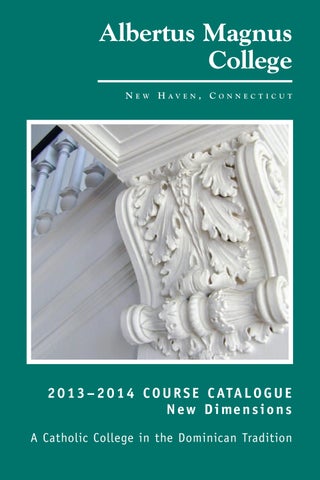
The contents of this catalogue were as accurate as possible at the time of printing. This catalogue is for informational purposes only and does not constitute a contract. The College reserves the right to change, at any time, without notice, graduation requirements, fees and other charges, curriculum, course structure and content, and other such matters as may be within its control, notwithstanding any information set forth in this catalog. Students should always consult with their college advisors to confirm all information. Cover: Architectural detail of Rosary Hall. Photo by Carolyn Behan Kraus ’86.
ALBERTUS MAGNUS COLLEGE
3
Albertus Magnus College Introduction Albertus Magnus College is committed to educating well-prepared, capable, forwardlooking, and liberally-educated men and women fully able to work productively in a career and live enriched and enriching lives. At Albertus the learning environment provides a rigorous academic framework, along with close interaction between faculty and students. This experience offers broad opportunities for challenge and growth. This atmosphere of dialogue and intimacy stretches the minds of students, stimulates their inquisitiveness, and encourages the realization of their full potential as both scholars and human beings. From its founding in 1925, Albertus Magnus College has placed strong emphasis on the liberal arts, preserving the long tradition of scholarly inquiry and the search for truth. As an independent, coeducational college, Albertus Magnus continues its dedication to liberal learning as an indispensable element in the education it offers to all of its undergraduate and graduate students while, at the same time, preparing them to pursue careers in their chosen fields. The mission of Albertus Magnus College is to provide men and women with an education that promotes the search for truth in all its dimensions and is practical in its application. Founded by the Dominican Sisters of Saint Mary of the Springs (now known as the Dominican Sisters of Peace), Albertus Magnus College, faithful to its Catholic heritage and the Judeo-Christian tradition, remains dedicated to the academic needs and ethical challenges of its students and of society. In an innovative spirit, Albertus Magnus College understands the special requirements of adults who are interested in receiving Associate, Bachelor, or Master’s degrees in select disciplines but must also continue meeting their professional and personal commitments. By combining theory and practical experience, The New Dimensions Program is uniquely designed for those working adults. The New Dimensions Program challenges the adult learner to develop knowledge and awareness of human problems and personal values through a well-planned, sequenced curriculum which integrates—within the curriculum—increasingly advanced cognitive skills, awareness of self and others, values and ethic clarification, and social and interpersonal skills. These educational goals form the basis of the program and aim to develop within each person: 1. Critical thinking and reasoning skills to identify problems and to utilize effective problem-solving abilities. 2. Expertise in a particular field. 3. Mutual responsibility, respect, trust, and fairness. 4. Written and spoken communications skills. 5. Understanding of the functional components of business—economics, marketing, accounting, finance, law, and management—combined with the human aspects of conducting business within physical and social environments.
4
ALBERTUS MAGNUS COLLEGE
6. Judgment, deliberation, and analysis required to perform basic business research, including research evaluation and design, statistical analysis, bibliographic and information search techniques, and report writing. 7. Qualitative human relations abilities, as well as quantitative abilities, in preparation for cross-functional roles within an organization. Research shows that adults learn best in an environment where they are active participants in the learning process rather than passive receivers of information. Professional and personal growth requires that individuals develop the skills necessary for managing their own learning. The New Dimensions Program is designed to provide structure and support that encourages independence, individual responsibility, and self-direction in the learning process. In such an environment, most courses have limited formal lecturing. The role of the instructors is to facilitate students’ active collaborative learning in a variety of instructional formats. Because class time is limited, many topics covered in reading and in homework assignments are not always directly reviewed in the classroom, unless clarification is required. This places much responsibility on the student and the learning team, and, at this accelerated pace, every meeting is unique and critical.
Student Code of Conduct It is expected that, as participants in the New Dimensions Program, all students will treat each other, their instructors, and administrative staff with courtesy and respect at all times in verbal and written communication. At no time should any individual be made to feel threatened or offended. The use of obscene, profane and/or offensive language, loss of temper, aggressive behavior, and disruptive outbursts are considered inappropriate and, therefore, unacceptable. Additionally, it is expected that New Dimensions students will adhere to all the general policies of Albertus Magnus College such as the policy on drugs and alcohol, the policy on sexual harassment, and the policy on racism and acts of intolerance. The New Dimensions administration will review each violation of the Code of Conduct on an individual basis. Failure to comply with the Code of Conduct could result in administrative withdrawal.
Intellectual Honesty and Plagiarism A degree from Albertus Magnus College represents not only a high quality of intellectual achievement, but also the completion of the work in accordance with the highest standards of academic honesty and integrity.
Intellectual Honesty Standards of academic honesty dictate that students will observe the following principles: • The student’s work shall be the result of his/her own effort. • The student shall give the appropriate acknowledgement of others’ work that is cited in papers and/or presentations. • No paper or presentation may be offered in more than one course without permission of the instructor. • In completing written assignments, the student must work independently unless the instructor indicates otherwise.
ALBERTUS MAGNUS COLLEGE
5
Plagiarism Plagiarism is a serious offense against academic integrity and intellectual honesty. The appropriation of another’s writing or work as one’s own, including the use of specific words, phrases, or ideas, is dishonest and constitutes plagiarism. Use of any quotation, paraphrase, or summary from another author must be acknowledged and individually cited. All incidents of plagiarism will result in a penalty and be promptly reported to the Director of Student Services. Penalties for first-time plagiarism are at the discretion of the instructor and may include failure of the assignment or failure for the course. An academic committee designated by the Dean of the New Dimensions Program will decide penalties for any incidents of plagiarism, after the first. If students have any questions about plagiarism, they are strongly encouraged to ask their instructor.
6
ALBERTUS MAGNUS COLLEGE
The New Dimensions Program Mission Statement The mission of the New Dimensions Program is to provide high-quality, non-traditional education leading to Associate, Bachelor, or Master’s degrees. New Dimensions is designed for adult learners who have work experience and who wish to maintain their professional and personal activities while pursuing their educational goals. New Dimensions provides its students with a unique combination of quality, service, and convenience in contemporary academic study by blending proven academic practices with an innovative instructional delivery system. New Dimensions strives to provide the most up-to-date and practical education possible through: • The use of academically qualified professionals to teach professionally-oriented courses, integrating theory and practice in a meaningful way. • Emphasis on an instructional model utilizing small groups of experienced adults working in teams to solve problems. • Reliance on highly motivated adult learners making effective use of out-of-class learning time. • Thoughtful attention to the ethical issues which arise in business and management activities. • Regular review and updating of curriculum by business and education leaders. New Dimensions facilitates degree completion for working adults by scheduling classes at convenient times and convenient locations; providing pre-planned, logical course sequences in a compressed time frame; and by providing extensive student support through simplified registration, delivery of all study materials to class sites, electronic library searches, and personalized educational advising, among others. New Dimensions strives to provide its students with organizational skills, built upon a holistic foundation, in preparation for assuming significant roles in education, business and in life.
ALBERTUS MAGNUS COLLEGE
7
Program Design Cohort Structure The basic learning structure of the New Dimensions Program is a cohort, collaborative learning community of approximately 14 to 20 students. Students are assigned to specific cohorts as the result of their interest in a particular degree program, learning center location, and the timeframe within which they wish to pursue their education. The cohort schedule automatically incorporates the necessary courses to complete the program curriculum. The program is designed so that students will usually stay with the same cohort throughout their program.
Learning Teams Learning teams are an integral part of the New Dimensions educational model. Typically, learning teams consist of 3–5 students, and assignments are designed to be completed by groups of that size. Learning teams have the flexibility to choose their meeting place and how they meet. Teams may meet face-to-face, in a structured on-line “learning team club,” or in combination. Participation in the learning team is an important element of most programs. Learning teams function as mutual support mechanisms through which students can learn more efficient problem-solving techniques from the professional expertise of peers, and a portion of each course evaluation/grade is based on the group performance. Additionally, most courses require a group project in the form of a written and/or oral report, presented to the class for discussion and critique. The ability to incorporate each member’s participation becomes the responsibility of all group members and is reflected in students’ grades.
Variety of Instructional Formats Instructional modalities include on-ground, flex on-line and all on-line approaches. Teaching strategies in New Dimensions include: seminars, small groups, simulations, experiential learning, presentations, problem solving, and brainstorming. Case studies and research projects are used extensively.
8
ALBERTUS MAGNUS COLLEGE
Locations Albertus Magnus College, 700 Prospect Street, New Haven, CT The Offices of New Dimensions are located in Aquinas Hall. East Hartford Learning Center, 111 Founders Plaza, 7th floor, East Hartford, CT The East Hartford Center is the administrative hub for the Greater Hartford region. This facility houses classrooms, as well as administrative and faculty offices.
ALBERTUS MAGNUS COLLEGE
9
Calendar The New Dimensions Program has a 12-month academic year, enabling students to enter the program during any given month and to earn up to 30 credits within a 12-month period. Each student is given a cohort Class Schedule at registration. This schedule contains a complete list of classes and their meeting dates for the student’s group. In general, all classes meet on the same evening throughout the program. Classes postponed because of inclement weather or facilities problems are rescheduled to the Friday of that week unless otherwise announced. Academic dates are specified in the calendar published on the website.
10
ALBERTUS MAGNUS COLLEGE
Undergraduate Programs The New Dimensions Undergraduate Programs are designed to help students achieve an undergraduate degree while pursuing a career. The degree programs are structured sequentially, with students taking one course at a time for four hours one night per week over five weeks. Students become a member of a learning team, meeting weekly for collaboration and peer support. By devoting 15 –20 hours per week to schoolwork, including attending one class per week, meeting with a learning team, and completing course assignments, students can graduate in about two years. New Dimensions is a “computer enhanced” program, which means that on-line applications may be utilized to augment the learning experience. Organizations are increasingly relying on production through cross-functional teams, and New Dimensions has a long history of fostering effective learning through diverse teams. In addition to class sessions, each student in New Dimensions works on team projects with other learning team members for a minimum of four hours per week. In keeping with the demands of global trends and new technology, learning teams are an essential part of all our courses, and they are conducted in either an on-line or on-ground format, or a combination of both. Documentation of this work is reviewed by the course Instructor each week.
Undergraduate Degree Programs • Associate of Science in Business Management • Bachelor of Science in Business Management • Bachelor of Science in Business Management (Healthcare Management Concentration)
Admission Requirements for undergraduate programs: • Proof of high school graduation or GED certificate. • One year of full-time relevant work experience. • Recommended minimum age of 22. • Two letters of recommendation from a professional or educational source qualified to judge the applicant’s professional expertise, character, and capacity for college level study. • Applicants whose native language is not English must demonstrate the ability to read, write, and understand English and submit evidence of proficiency in English by scoring 550 or above on the Test of English as a Foreign Language, TOEFL. • A valid Connecticut Driver’s License for fully online programs.
ALBERTUS MAGNUS COLLEGE
General graduation requirements for undergraduate degree programs: Associate of Science degree: 60 semester credits are required for graduation: 18 Credits of Core Business Management courses 33 Credits of Liberal Arts core courses: 3 – College Writing 3 – Literary Genres 6 – Humanities I, II 3 – History 3 – Fine Arts 3 – Philosophy 3 – Religious Studies 3 – Social Sciences 3 – Mathematics 3 – Science 9 – Elective credits in Interdisciplinary Liberal Arts Studies, from at least 2 disciplines Bachelor of Science degree: 120 semester credits are required for graduation 54 Credits of Core Business Management courses 27 Credits of Liberal Arts core courses: 3 – College Writing 3 – Literary Genres 6 – Humanities I, II 3 – History 3 – Fine Arts 3 – Religious Studies 3 – Mathematics 3 – Science 9 – Credits of Interdisciplinary Liberal Arts Studies, from at least 2 disciplines 30 Elective credits
11
12
ALBERTUS MAGNUS COLLEGE
Associate of Science in Business Management (ASBM) The Associate of Science in Business Management is for those in the early stages of their management or professional career and includes introductory courses in management and business principles as well as a solid foundation in general studies and the liberal arts. Today's fast-paced business world demands strong leadership and management skills together with technical competence and communication skills. Professional education in business management can help students develop the capabilities needed to assume positions of leadership and responsibility at all levels of management in our society. Business managers formulate the policies and direct the operations of corporations, non-profit institutions and government agencies. Business management is found in every business and industry, including government, education, health care, not-for-profit and military organizations. The ASBM degree program emphasizes a strong base of business fundamentals including critical thinking and decision-making skills. Students can learn practical, real-world applications from instructors with extensive business experience. The degree program is designed to provide both a broad general education background and a strong professional education. In addition to important undergraduate foundation studies in areas including English, math, and humanities, students can learn presentation techniques, technology applications and research basics. The ASBM degree program satisfies the course requirements for the first two years of the Albertus Magnus New Dimensions Program Bachelor of Science in Business Management (BSBM) degree program. ASBM Degree Program Objectives Students who successfully complete the ASBM degree program should be able to: • Demonstrate skills in: Teamwork Collaborative Writing Scientific Method • Demonstrate knowledge of: Management Principles Economics Organizational Management Financial Management • Demonstrate the ability to meet College benchmarks in core skills including: Written/oral communications Reading comprehension Information literacy • Demonstrate the ability to meet College benchmarks in critical thinking skills including: Interpretation Analysis Evaluation Reflection • Demonstrate the capacity for creative thinking • Demonstrate the ability to effectively apply the methods and insights of the following disciplines to an understanding of the world: Literature Philosophy Social Science Mathematics Religious studies Natural Science History • Demonstrate an ability to formulate basic ethical questions and define moral decisionmaking at the individual and societal level. • Apply learning from diverse disciplines to foundational strategic management issues
ALBERTUS MAGNUS COLLEGE
Course Sequence CC 101A Preparation for College Study EN 105A Collaborative College Writing EN 104A Introduction to Literary Genres CO 141A Speech Communications MA 105A Mathematics for Managers HI 252A Topics in Historical Study BE 104A Applied Economic Theory RS 105A Religion in the Workplace HU 111A Humanities I HU 112A Humanities II SC 105A Science in the News BE 106A Leadership Studies for Business PO 122A American Government PY 111A Psychological Concepts SO 111A Sociology of Work PH 261A Social and Political Philosophy BE 121A Industrial Organization BE161A Financial Accounting BE 215A Introduction to Finance BE 240A Business Case Studies
13
(3) (3) (3) (3) (3) (3) (3) (3) (3) (3) (3) (3) (3) (3) (3) (3) (3) (3) (3) (3) TOTAL Credits: 60
COURSE DESCRIPTIONS New Dimensions is an innovative program that seeks to prepare professionals to function in a state-of-the-art environment. Therefore, its curriculum is subject to change in response to new technologies and global trends. Albertus Magnus College reserves the right to alter curriculum, class schedules, and cohort assignments. BE 104A Applied Economic Theory (5 weeks) 3 credits Overview of Economics, focusing on a limited but crucial set of macroeconomic and microeconomic principles as tools of analysis. BE 106A Leadership Studies for Business (5 weeks) 3 credits Overview of characteristics that are inherent to being a successful leader. Management theories are explored and leadership qualities are put into practice. This course also introduces learners to the use of case studies in solving business problems and uses role-plays, team and individual presentations, and personal journals in the accomplishment of the main objective, helping the learner to understand leadership behaviors.
14
ALBERTUS MAGNUS COLLEGE
BE 121A Industrial Organization (5 weeks) 3 credits Economic analysis of American Industry in terms of market structure, conduct, and performance, application of anti-trust laws, and economic effects of mergers and corporate “take-overs” on economic efficiency. Special topics in the regulation and deregulation of business examined. BE 161A Financial Accounting (5 weeks) 3 credits In this introductory course, we will introduce students to accounting principles and procedures, and to the processes by which financial transactions are recorded, classified, and analyzed to help business decision-makers. Students will learn to prepare and interpret financial statements. BE 215A Introduction to Finance (5 weeks) 3 credits This course reviews basic principles of finance, including money and credit, how the financial system functions, the role of the Federal Reserve, and the structure of financial markets. Specific investments will be examined, including bonds and how interest rates are determined, equities and how the stock market works, the efficiency of financial markets, and the management of risk. Problems, classroom debates, and a financial planning project are used to apply course concepts to real-world business and personal situations. BE 240A Business Case Studies (5 weeks) 3 credits Presentation and discussion of innovative approaches to solutions of a variety of contemporary business issues. CC 101A Preparation for College Study (6 weeks) 3 credits Introduction for adult students seeking to complete an undergraduate degree. Overview of important concepts of self-management and an awareness of effective skills for implementation in college-level study. Emphasis is placed on the development of the written and verbal communication skills as well as critical thinking. CO 141A Speech Communications (5 weeks) 3 credits Comprehensive approach to organization, presentation, and theory associated with the practice of oral communications. Through classroom exercises and formal student speech presentations, students improve their ability to speak publicly. Special attention is given to perceptual skills, listening skills, and leadership styles necessary for effective speaking in family, social, and business contexts. EN 105A Collaborative College Writing (5 weeks) 3 credits This course emphasizes the standard Writing Process, the learning of rhetorical strategies in expository writing, and the use of proper composition mechanics. It employs collaborative writing and peer editing as vehicles for enhanced writing, reading, and critical thinking skills. Transfer credits cannot apply to this course. EN 104A Introduction to Literary Genres (5 weeks) 3 credits Exploration of the comprehension and analysis of fiction, poetry, drama and the essay, and the articulate and cogent explication of literary texts. HI 252A Topics in Historical Study (5 weeks) 3 credits Study of a single topic or theme in business in European, American, or world history.
ALBERTUS MAGNUS COLLEGE
15
HU 111A Humanities I (5 weeks) 3 credits Study of classical and medieval texts from the broad range of liberal arts disciplines enhancing students’ ability to intelligently read texts. HU 112A Humanities II (5 weeks) 3 credits Study of Renaissance and contemporary texts ranging from Shakespeare to Voltaire to Frederick Douglass. MA 105A Mathematics for Managers (5 weeks) 3 credits Introduction to mathematical skills needed by business managers. Topics include algebraic equations, percents, fractions, decimals and their use in solving business related problems. Also included are markups, markdowns, simple interest, depreciation, inventory, and cost control. PH 261A Social and Political Philosophy (5 weeks) 3 credits Tracing of the development of social and political theory. Critically considers questions regarding the relationship between the individual and the state, particularly in the context of the contemporary alienation of the individual from society. Various contemporary social issues, such as racism, sexism, and war and peace are examined. PO 122A American Government (5 weeks) 3 credits Description, analysis, and evaluation of the primary national governmental institutions in the United States: the Congress, the Presidency, the Bureaucracy, and the Federal Court system. Focus on the powers of these institutions, the behavior of the people within them, the way the institutions operate, and the quality and nature of the policies they produce. PY 111A Psychological Concepts (5 weeks) 3 credits Introduction to the major areas, theories, concepts, and methods of contemporary psychology. RS 105A Religion in the Workplace (5 weeks) 3 credits Study of the influence of religious beliefs on the world of work and the impact of the Judeo-Christian work ethic on business behavior. SC 105A Science in the News (5 weeks) 3 credits Exploration of current issues in Physics, Science, Biology, Health and Medicine which have appeared in the popular press. Provides an understanding of how science is done and how to critically evaluate the news media’s interpretation of current research from a scientific perspective. SO 111A Sociology of Work (5 weeks) 3 credits Presents the perspective and terminology of the discipline of sociology and its insight into the world of work. Examines the motivations for working, the principal ways of classifying occupations, the factors affecting the placement of individuals in specific occupations, the organizational context of work, and the “future” of work.
16
ALBERTUS MAGNUS COLLEGE
Bachelor of Science in Business Management (BSBM) The Bachelor of Science in Business Management degree is designed for those working adult professionals looking to develop their business and management skills. The curriculum for the Business Management program builds a solid foundation covering all the functional areas of business such as accounting, management, marketing, public speaking, business law, team building and finance. This program provides students with a curriculum to prepare them for entry and promotion into a rapidly changing business and professional environment. Professional education in business management can help students develop the capabilities needed to assume positions of leadership and responsibility at all levels of management in our society. Business managers formulate the policies and direct the operations of corporations, non-profit institutions and government agencies. Business management is found in every business and industry, including government, education, health care, not-for-profit and military organizations. The BSBM degree program emphasizes a strong base of business fundamentals including critical thinking and decisionmaking skills. Students can learn practical, real-world applications from instructors with extensive business experience. BSBM Degree Program Objectives Students who successfully complete the BSBM degree program should be able to: • Demonstrate skills in: Quantitative Analysis Teamwork Scientific Method • Demonstrate knowledge of: Management Principles Business Law Business Ethics Statistics Economics Marketing Organizational Management Accounting Financial Management Information Systems Human Resources International Business • Demonstrate the ability to meet College benchmarks in core skills including: Written and oral communications Reading comprehension Information literacy • Demonstrate the ability to meet College benchmarks in critical thinking skills including: Interpretation Analysis Evaluation • Demonstrate the capacity for creative thinking • Demonstrate the ability to effectively apply the methods and insights of the following disciplines to an understanding of the world: Literature Philosophy Social Science Mathematics Religious studies Natural Science History
ALBERTUS MAGNUS COLLEGE
17
• Demonstrate an ability to formulate ethical questions and engage in moral decisionmaking at the individual and societal level. • Apply learning from diverse disciplines to advanced strategic management issues Course Sequence BE 301M Principles of Self-Management EN 305M Written Communication in Business BE 303M Management and Leadership in Business PH 307M Business Ethics BE 327M Business Law BE 317M Business Statistics BE 315M Marketing for Managers BE 311M Economics for Managers I: Microecon BE 312M Economics for Managers II: Macroecon BE 308M Information Systems BE 319M Leadership in Quality Improvement BE 309M Fundamentals of Financial Accounting I BE 310M Financial Accounting: Statement Analysis and Decision Making BE 323M Human Resource Management BE 329M International Business Management BE 325M Corporate Financial Management BE 332M Strategic Management and Policy BE 396M Business Case Project I BE 397M Business Case Project II General Education Requirements
(2) (3) (3) (3) (3) (3) (3) (3) (3) (3) (2) (3) (3) (3) (3) (3) (4) (3) (1) (6)
TOTAL Core Business Management Credits: 60
COURSE DESCRIPTIONS New Dimensions is an innovative program that seeks to prepare professionals to function in a state-of-the-art environment. Therefore, its curriculum is subject to change in response to new technologies and global trends. Albertus Magnus College reserves the right to alter curriculum, class schedules, and cohort assignments. BE 301M Principles of Self-Management (5 weeks) 2 credits Orientation for adult students returning to higher education to complete an undergraduate degree. Topics include academic program planning, time management, group interaction, professional/personal growth, library resource utilization, and other items relevant to goal accomplishment in an academic setting.
18
ALBERTUS MAGNUS COLLEGE
BE 303M Management and Leadership in Business (5 weeks) 3 credits Study of the management techniques of planning, organizing, leading, and controlling with an emphasis on decision making, efficiency, and effectiveness. BE 308M Information Systems (5 weeks) 3 credits Overview of fundamentals of information systems and their role in the organization. Emphasis on organizational and technical foundations of computer-based information systems, tools, techniques, and approaches to systems analysis and design, security issues, data administration, and project management. BE 309M The Fundamentals of Financial Accounting I (5 weeks) 3 credits Presentation of the concepts, principles, and applications of accounting information that serve as the foundation of economically sound business management. BE 310M Financial Accounting: Statement Analysis & Decision Making (5 weeks) 3 credits Continuation of BE-309M. Examination of the acquisition, analysis, and reporting of accounting information from the perspective of effective management decision-making. Special emphasis placed on long-term investment and financial statement analysis. BE 311M Economics for Managers I: Microeconomics (5 weeks) 3 credits Overview of the applications of microeconomics. Topics include supply and demand, consumer and producer choice, resource markets, earnings, investments, governmental roles, market structure, competition, and international aspects of microeconomics. BE 312M Economics for Managers II: Macroeconomics (5 weeks) 3 credits Overview of the applications of macroeconomics. Topics include classical and Keynesian theory; business cycles, inflation, unemployment, government deficit spending, the global economy, GDP, fiscal and monetary policy, and the banking system. BE 315M Marketing for Managers (5 weeks) 3 credits Study of organization planning and implementation process of product, promotion, price, and channels of distribution as it strives to satisfy market needs. Emphasis on factors affecting consumer behavior, development of marketing strategies, and recognition of marketing variables. BE 317M Business Statistics (5 weeks) 3 credits Survey of descriptive statistics with emphasis on practical applications of statistical analysis. Examination of the role of statistics in research, statistical terminology, the appropriate use of statistical techniques, and the interpretation of statistical findings in business and business research. BE 319M Leadership in Quality Improvement (3 weeks) 2 credits Overview of how organizations, using various approaches to quality and value management, can create and sustain value for customers and maintain an effective organization in a competitive environment. Focus is on the role of leadership in committing to quality and value management as a “way of being” in the organization, and also reviews the history of the quality/value paradigm and explores some of the more recent tools for quality improvement such as Six Sigma.
ALBERTUS MAGNUS COLLEGE
19
BE 323M Human Resource Management (5 weeks) 3 credits Study of the function of Human Resource Management in the vital role of effectively utilizing people to meet organizational objectives. Exploration of planning personnel needs, recruiting and selecting employees, training and developing the work force, performance evaluation, compensation, and labor management relations. BE 325M Corporate Financial Management (5 weeks) 3 credits Analysis of financing, valuation, and organization of business firms. Topics include: financial analysis, capital budgeting, valuation of corporate assets, investment decision under conditions of uncertainty, long- and short-term sources of funds, optimal financial structure, the cost of capital, dividend policy, working capital, management mergers, leveraged buyouts, and bankruptcy and reorganization. BE 327M Business Law (5 weeks) 3 credits Examination, analysis and application of the nature, formation, and system of law in the United States to the modern business environment. BE 329M International Business Management (5 weeks) 3 credits Survey of economic, political, and social environment of international business and the management and international dimensions of traditional business operations. Emphasis on economic activity and its relationship between the multinational corporation and its host country, and the establishment of international business operations. BE 332M Strategic Management and Policy (6 weeks) 4 credits Exploration of the concepts and techniques for effective strategic thinking. An integrative case-oriented business Capstone course designed to exercise the analytic skills learners have acquired in previous course work and to develop and exercise learners’ skills in critical thinking within the context of complex and ambiguous decision-making environments. BE 396M Business Case Project I (5 weeks) 3 credits Capstone of all learning experience marshaled by students in Bachelor’s program. Requires the use of those experiences in the creation, development, and writing of a business case study on an issue or problem related to a student’s business experience or career. Case study will focus on area of interest or concentration chosen by student such as Human Resources, Marketing, or Management and will require the writing of a substantial formal case study. BE 397M Business Case Project II (2 weeks) 1 credit Presentation and defense of student’s Capstone business case study written in BE 396M. Student will refine and polish all the presentation and speaking skills developed in the Bachelor’s degree program. EN 305M Written Communication in Business (5 weeks) 3 credits Focus on the process of communication skills that are essential for communicating successfully in organizations through the use of simulations, case studies, and application assignments.
20
ALBERTUS MAGNUS COLLEGE
PH 307M Business Ethics (5 weeks) 3 credits Examination of the ethical questions raised by the practice of business. Review of ethical theory as it is applied to business practice. Examination of specific cases related to corporate, social, and environment responsibility; employee rights and obligations; regulations of business, legal, and ethical standards of fair contract practices.
Bachelor of Science in Business Management (BSBM-HCM) (Healthcare Management Concentration) The Bachelor of Science in Business Management with a Healthcare Management Concentration is designed to address the needs of the healthcare professional who has been placed in a management role. Traditionally, healthcare professionals have tremendous depth of education in their specialties. Now, however, there is an increasing demand for specialists with general management skills as well. Today’s healthcare managers must be aware of the dramatic changes in the areas of human resources, financial reimbursement, marketing, and legal and regulatory constraints. This program affords an excellent opportunity for healthcare professionals to examine the challenges in today’s healthcare industry and to work together to provide solutions to those challenges. BSBM (HCM) Degree Program Objectives Students who successfully complete the BSBM (HCM) degree program should be able to: • Demonstrate skills in: Quantitative Analysis Problem Solving Teamwork Scientific Method • Demonstrate knowledge of: Management Principles Business Law Healthcare Regulations Business Ethics Statistics Marketing International Business Economics Accounting Financial Management Information Systems Human Resources Organizational Management • Demonstrate the ability to meet College benchmarks in core skills including: eading comprehension Written and oral communications Information literacy • Demonstrate the ability to meet College benchmarks in critical thinking skills including: Interpretation Analysis Evaluation • Demonstrate the capacity for creative thinking • Demonstrate the ability to effectively apply the methods and insights of the following disciplines to an understanding of the world: Literature Philosophy Social Science Mathematics Religious Studies Natural Science History
ALBERTUS MAGNUS COLLEGE
21
• Demonstrate an ability to formulate ethical questions and engage in moral decisionmaking at the individual and societal level. • Apply learning from diverse disciplines to advanced strategic management issues Course Sequence BE 301M Principles of Self-Management EN 305M Written Communication in Business BE 235M Healthcare Management PH 307M Business Ethics BE 336M Legal Aspects of Healthcare Management BE 317M Business Statistics BE 243M Marketing Healthcare BE 311M Economics for Managers I: Microeconomics BE 241M The American Healthcare System BE 308M Information Systems BE 319M Leadership in Quality Improvement BE 309M Fundamentals of Financial Accounting I BE 310M Financial Accounting: Statement Analysis and Decision Making BE 329M International Business Management BE 323M Human Resource Management BE 244M Financial Aspects of Healthcare Management BE 332M Strategic Management and Policy BE 396M Business Case Project I BE 397M Business Case Project II General Education Requirements
(2) (3) (3) (3) (3) (3) (3) (3) (3) (3) (2) (3) (3) (3) (3) (3) (4) (3) (1) (6)
TOTAL Core Business Management Credits: 60
COURSE DESCRIPTIONS New Dimensions is an innovative program that seeks to prepare professionals to function in a state-of-the-art environment. Therefore, its curriculum is subject to change in response to new technologies and global trends. Albertus Magnus College reserves the right to alter curriculum, class schedules, and cohort assignments. BE 235M Healthcare Management (5 weeks) 3 credits Healthcare management is a dynamic field of study. Today’s healthcare manager must be able to adapt the changing environment while ensuring that patients receive quality care. This course will examine the following skills: planning, evaluation, budgeting, decisionmaking, marketing, team building, and managing change.
22
ALBERTUS MAGNUS COLLEGE
BE 241M The American Healthcare System (5 weeks) 3 credits A study and analysis of the American healthcare system. This course covers the historical development, current organization, and complex issues facing the healthcare system today. It also compares the U.S. system to other healthcare systems and explores alternative strategies for improving the U.S. system. BE 243M Marketing Healthcare (5 weeks) 3 credits An application of the principles of marketing to healthcare products and services. Emphasis is placed on defining the needs and wants of customers, defining creative products and services, examining channels of distribution, planning and implementing promotion/communication campaigns, establishing price, and evaluating marketing efforts. BE 244M Financial Aspects of Healthcare Management (5 weeks) 3 credits This course is designed to provide the learner with basic knowledge of accounting and finance principles and provide application to healthcare delivery. This course provides the manager in a healthcare organization the general financial skills necessary to understand financial statements, prepare budgets, and evaluate capital projects and expenditures. BE 301M Principles of Self-Management (5 weeks) 2 credits Orientation for adult students returning to higher education to complete an undergraduate degree. Topics include academic program planning, time management, group interaction, professional/personal growth, library resource utilization, and other items relevant to goal accomplishment in an academic setting. BE 308M Information Systems (5 weeks) 3 credits Overview of fundamentals of information systems and their role in the organization. Emphasis on organizational and technical foundations of computer-based information systems, tools, techniques, and approaches to systems analysis and design, security issues, data administration, and project management. BE 309M The Fundamentals of Financial Accounting I (5 weeks) 3 credits Presentation of the concepts, principles, and applications of accounting information that serve as the foundation of economically sound business management. BE 310M Financial Accounting: Statement Analysis & Decision Making (5 weeks) 3 credits Continuation of BE-309M. Examination of the acquisition, analysis, and reporting of accounting information from the perspective of effective management decision-making. Special emphasis placed on long-term investment and financial statement analysis. BE 311M Economics for Managers I: Microeconomics (5 weeks) 3 credits Overview of the applications of microeconomics. Topics include supply and demand, consumer and producer choice, resource markets, earnings, investments, governmental roles, market structure, competition, and international aspects of microeconomics.
ALBERTUS MAGNUS COLLEGE
23
BE 317M Business Statistics (5 weeks) 3 credits Survey of descriptive statistics with emphasis on practical applications of statistical analysis. Examination of the role of statistics in research, statistical terminology, the appropriate use of statistical techniques, and the interpretation of statistical findings in business and business research. BE 319M Leadership in Quality Improvement (3 weeks) 2 credits Overview of how organizations, using various approaches to quality and value management, can create and sustain value for customers and maintain an effective organization in a competitive environment. Focus is on the role of leadership in committing to quality and value management as a “way of being” in the organization, and also reviews the history of the quality/value paradigm and explores some of the more recent tools for quality improvement such as Six Sigma. BE 323M Human Resource Management (5 weeks) 3 credits Study of the function of Human Resource Management in the vital role of effectively utilizing people to meet organizational objectives. Exploration of planning personnel needs, recruiting and selecting employees, training and developing the work force, performance evaluation, compensation, and labor management relations. BE 329M International Business Management (5 weeks) 3 credits Survey of economic, political, and social environment of international business and the management and international dimensions of traditional business operations. Emphasis on economic activity and its relationship between the multinational corporation and its host country, and the establishment of international business operations. BE 332M Strategic Management and Policy (6 weeks) 4 credits Exploration of the concepts and techniques for effective strategic thinking. An integrative case-oriented business Capstone course designed to exercise the analytic skills learners have acquired in previous course work and to develop and exercise learners’ skills in critical thinking within the context of complex and ambiguous decision-making environments. BE 336 Legal Aspects of Healthcare Management (5 weeks) 3 credits An examination of the laws and regulations which protect and govern healthcare facilities and programs. Special attention to the rights and protections afforded to users of healthcare facilities. BE 396M Business Case Project I (5 weeks) 3 credits Capstone of all learning experience marshaled by students in Bachelor’s program. Requires the use of those experiences in the creation, development, and writing of a business case study on an issue or problem related to a student’s business experience or career. Case study will focus on area of interest or concentration chosen by student such as Human Resources, Marketing, or Management and will require the writing of a substantial formal case study. BE 397M Business Case Project II (2 weeks) 1 credit Presentation and defense of student’s Capstone business case study written in BE 396M. Student will refine and polish all the presentation and speaking skills developed in the Bachelor’s degree program.
24
ALBERTUS MAGNUS COLLEGE
EN 305M Written Communication in Business (5 weeks) 3 credits Focus on the process of communication skills that are essential for communicating successfully in organizations through the use of simulations, case studies, and application assignments. PH 307M Business Ethics (5 weeks) 3 credits Examination of the ethical questions raised by the practice of business. Review of ethical theory as it is applied to business practice. Examination of specific cases related to corporate, social, and environment responsibility; employee rights and obligations; regulations of business, legal, and ethical standards of fair contract practices.
Bachelor of Arts in Criminal Justice The criminal justice program at Albertus Magnus College builds on students’ strengths in psychology and sociology and takes place within the humanities-oriented context of our liberal arts curriculum. As students review cases from the United States Supreme Court, they’ll learn sociological theories of crime causation and develop abilities in critical reading, writing and ethical reasoning. To prepare for careers in social services and criminal justice that directly support police and government law enforcement efforts, students will explore the basis for their own beliefs, read and analyze facts and circumstances of a variety of cases, and gain appreciation for the multiple perspectives at play in every situation. By understanding the relationship of gender, class structure, race and ethnicity to the criminal justice system in the United States, students will develop a more personcentered view of crime and law enforcement. As students acquire counseling skills and awareness of individuals’ behavior within families and societal groups, they will be able to take on leadership roles in their profession and community that demonstrate respectful and effective interactions with all citizens. This program in the New Dimensions format will be offered at the East Hartford Learning Center. BACJ Degree Program Objectives Students who successfully complete the BACJ degree program should be able to: • Develop a basic understanding of overall criminal justice system, from issues of policing in America, the court system, and the correctional system • Develop a specialized criminal justice vocabulary • Develop an understanding of the foundations of American criminal law • Develop an understanding how the Constitution affects policing and criminal suspects in America • Develop an understanding of basic criminal theory • Develop analytical reading and writing ability • Experience a hands-on internship in the professional field of criminal justice learning appropriate behaviors, procedures, and processes. • Analyze different issues, problems areas, and agencies in the criminal justice field, and develop analytical and problem-solving strategies to deal with issues in a professional, humanistic and ethical manner
ALBERTUS MAGNUS COLLEGE
25
Admission Requirements • A minimum of 48 credits from a regionally accredited degree granting institution • Non-matriculated students need proof of high school graduation or GED certificate • One year of full-time relevant work experience • Recommended minimum age of 22* • Two letters of recommendation from a professional or educational source qualified to judge the applicant’s professional experience, character, and capacity for college-level study • Proof of immunization in accordance with Connecticut state requirements • Applicants whose native language is not English must demonstrate the ability to read, write, and understand English and submit evidence of proficiency in English by scoring 550 or above on the Test of English as a Foreign Language, TOEFL • A valid Connecticut Driver’s License for fully online programs * Students under the age of 22 may be granted admission on a case by case basis. Applicants with a previous G.P.A. under 2.0 will be granted conditional/provisional acceptance. Those students must obtain a B or better in their first two courses Graduation Requirements • 120 semester hours are required for graduation 54 Credits of Core Criminal Justice courses • Core includes 1 credit internship 27 Credits of Liberal Arts core courses • 3 Credits – College Writing • 3 Credits – Literary Genres • 6 Credits – Humanities I, II • 3 Credits – History • 3 Credits – Fine Arts • 3 Credits – Religious Studies • 3 Credits – Mathematics • 3 Credits – Science 9 Interdisciplinary Liberal Arts Studies, from at least two disciplines 30 – Elective Credits • Successful completion of courses, with a minimum cumulative grade point average of 2.0 • Payment of all tuition and fees. Sequence (One course, CJ 395M, Criminal Justice Independent Study and Internship, will run without learning teams.) 1. CJ 111A Introduction to the Criminal Justice System (6 weeks, 3 credits) 2. EN 307M Writing in the Social Sciences (5 weeks, 3 credits) 3. SO 111A Introduction to Sociology (5 weeks, 3 credits) 4. CJ 232A Juvenile Delinquency (5 weeks, 3 credits) 5. CJ 231A Deviance and Criminology (5 weeks, 3 credits)
26
ALBERTUS MAGNUS COLLEGE
6. SO 121A 7. CJ 233A 8. CJ 335M 9. CJ 337M 10. RS 383M 11. SO 242A 12. CJ 310M 13. CJ 255A 14. PY 111A 15. PY 211A 16. PY 235A 17. SO 218A 18. SO 219A 19. CJ 395M 20. CJ 391M
Contemporary Social Problems Corrections Constitutional Criminal Law Substantive and Procedural Criminal Law Religion and Social Concerns Minorities and Multicultural Diversity Sociology of Law and Social Control Special Topics Introduction to Psychology Abnormal Psychology Drug and Alcohol Abuse Statistics for the Behavioral Sciences Research Methods Criminal Justice Independent Study and Internship Senior Seminar: Ethics in Criminal Justice
(5 weeks, 3 credits) (5 weeks, 3 credits) (6 weeks, 3 credits) (6 weeks, 3 credits) (5 weeks, 3 credits) (5 weeks, 3 credits) (5 weeks, 3 credits) (5 weeks, 3 credits) (5 weeks, 3 credits) (5 weeks, 3 credits) (5 weeks, 3 credits) (5 weeks, 3 credits) (5 weeks, 3 credits) (10 weeks, 3 credits) (5 weeks, 3 credits)
COURSE DESCRIPTIONS New Dimensions is an innovative program that seeks to prepare professionals to function in a state-of-the-art environment. Therefore, its curriculum is subject to change in response to new technologies and global trends. Albertus Magnus College reserves the right to alter curriculum, class schedules, and cohort assignments. (listed alphabetically, not by sequence) CJ 111A Introduction to the Criminal Justice System Students will review the origins and foundations of our American system of policing, the relationship between the individual citizen and the state/federal governments’ police powers. Included in this section of the course will be an overview of the Fourth Amendment, the Fifth Amendment, and the Sixth Amendment. Students will also review the judicial system, and become familiar with the procedures followed in a criminal trial. Finally, the students will examine sentencing issues and the sanctions available against a criminal convict, including incarceration in jail or prison, probation, and parole. 3 credits CJ 231A Deviance and Criminology Consideration of deviant behavior and crime as behavioral and social phenomena, with analysis of data and theories of the causation of crime. The effects of labeling deviants are also considered. P: SO/CJ 111 or permission of Program Coordinator. 3 credits (Cross referenced with SO 231A) CJ 232A Juvenile Delinquency Investigation of delinquency as a separate phenomenon, including its theories of causation and particular patterns of delinquency, as well as consideration of the variables which affect the rates of delinquency. P: SO 111 and CJ 111. 3 credits
ALBERTUS MAGNUS COLLEGE
27
CJ 233A Corrections Examination of philosophy, theory, and practice of criminal punishment and of the processes which characterize arrest, prosecution, trial, and sentencing. Formal and informal operation of law enforcement agencies are studied, with special attention to patterns of differential treatment accorded different social and economic groups. P: CJ 111. 3 credits CJ 335M Constitutional and Criminal Law This course is designed for students interested in studying law as it applies to the relationship between the individual American and state/federal governments. Among the topics covered will be the Fourth Amendment’s warrant clause and the right against unreasonable searches and seizures, the Fifth Amendment’s right against self-incrimination, and the Sixth Amendment’s right to counsel. A research paper component is a requirement in this course. P: CJ 111. 3 credits CJ 337M Foundations of Criminal Law This course familiarizes students with the origins of our present day substantive and procedural criminal laws. Students will be exposed to early attempts to codify a body of criminal law, from the Code of Hammurabi through Roman law and English common law to the present day. Issues of due process, conspiracy, and causation are among the many topics covered. A research paper component is a requirement in this course. P: CJ 111. 3 credits CJ 255A Special Topics Selected topics or issues with respect to the criminal justice system are studied in-depth. [Topics may include but are not limited to, Organized Crime, Military Criminal Justice, American Judicial System, Police Patrol, Criminal Investigation, Crime Scene Forensics] P: CJ 111. 3 credits CJ 3XXM Criminal Justice Independent Study and Internship This course includes both an internship (1 credit) and an academic (2 credits) component. The student intern is required to work a minimum of 40 hours at the internship agency. In addition to the hours worked, the student must write, under the supervision of the faculty advisor, a research paper or comparable project, to receive three hours of academic credit. Students are expected to devote an average of twelve hours per week on the combined components of the course over a ten week period. Students will work with the internship coordinator five weeks prior to the course start to identify the exploratory experience that will best provide a real-world career environment. In addition, students must complete a preparatory workshop prior to on-site work. 3 credits CJ 391 Senior Seminar: Ethics [in Criminal Justice] In this seminar-based course, students in Criminal Justice will study the difficult ethical issues faced by criminal justice practitioners on a daily basis and how the ethical challenges faced by police, prosecutors, judges and corrections officers can be effectively addressed. 3 credits
28
ALBERTUS MAGNUS COLLEGE
EN-307M Writing in the Social Sciences The course is intended to enhance skills used in writing mechanics (grammar, punctuation, and style), research practices, and guidelines for writing and supporting arguments using the APA reference style. Focus will be on both written and oral communication used by academic researchers and professionals in the field of human behavior and the social sciences. 3 credits PY 111A Introduction to Psychology Introduction to the major areas, theories, concepts, and methods of contemporary psychology. Topics may include ways of perceiving, learning, and thinking about the world; emotions; motivation; the relationship between brain events and inner experience; child development and adult personality; self-concept; attitudes toward others and behavior in social situations; stress, coping, and the diagnosis and treatment of mental disorders. Special attention will be paid to the application of scientific methods to the study of human cognition and behavior. 3 credits PY 211A Abnormal Psychology Psychological functioning is said to be abnormal when it is atypical and causes distress to the individual or to other members of that person’s community. Viewed through a medical lens, these behaviors are regarded as signs of psychopathology (mental illness). This course provides a thorough grounding in the psychiatric diagnostic classification system, covering most of the major categories of mental disorder: anxiety, depression, schizophrenia, and more. Theories explaining the various forms of mental disorder, research findings on their social, psychological, and biological correlates, and treatment options are also considered. P: PY 111. 3 credits PY 235A Drug and Alcohol Abuse An introductory survey covering a variety of issues in the addiction arena, including the psychology of addiction, biological issues, the impact of addiction on families, identification of addictions, and methods of intervention. P: PY 111. 3 credits RS 383M Religion and Social Concerns A consideration of the social and public policy implications of religious faith, particularly the Christian tradition, for questions of economic justice, war and militarism, racism, and the ecological crisis. 3 credits SO 111A Introduction to Sociology This course invites you to see the world sociologically. We will examine culture, social structure, inequality, gender, race, deviance, and socialization from the sociological perspective. 3 credits SO 121A Contemporary Social Problems Focuses on how institutional and organizational features of societies generate problems for people. Particular attention is directed at a set of problems related to political and economic inequalities, health and illness, education, the environment, and the criminal justice system. P: SO 111. 3 credits
ALBERTUS MAGNUS COLLEGE
29
SO 218A Statistics for the Behavioral Sciences Addresses basic concepts and methods of statistical data analysis as applied in psychology and other social/behavioral sciences, including organizing, analyzing, and interpreting data. The course will provide students with a foundation in descriptive and inferential statistics, touching on frequency distributions, probability sampling, and hypothesis testing. Analyses conducted by hand and using SPSS. P: Fulfillment of a Level 100 math requirement. 3 credits SO 219A Research Methods This course is a “hands on” approach to research in which the student will learn to design and carry out field observations, experiments, content analyses, or surveys. P: SO 111. 3 credits SO 242A Minorities and Multicultural Diversity This course examines the positions of “minorities” in the status hierarchy of the United States, and teaches a critical perspective on the economic, political, and social oppression of subordinate groups by dominants. Multiculturalism will be examined from this perspective: since the United States comprises various racial and ethnic groups, what does it mean to be “American” and who gets to define this? 3 credits CJ 310M Sociology of Law and Social Control A consideration of social control, law creation and law enforcement in their social and political context. Discusses major theories of law and the modern state. Law will be considered as both a cause and effect of social change P: SO 111 and CJ 111. 3 credits
Bachelor of Science in Human Services Through a blend of Albertus Magnus College’s rigorous liberal arts education and a special focus on several disciplines, including psychology, sociology, management and philosophy, students in the human services program will establish the foundation for a future career in such professional capacities as community outreach worker, case manager, community support counselor, clinician, mental health worker and job coach. In the human services major, students will explore topics ranging from bioethics, peace and justice, drug and alcohol abuse, death and dying, the sociology of AIDS and juvenile delinquency to domestic violence, child psychology, minorities and multicultural diversity, principles of management and contemporary social problems. Students will also benefit from supervised internship experiences in local human services agencies This program in the New Dimensions format will be offered at the East Hartford Learning Center. BSHS Degree Program Objectives Students who successfully complete the BSHS degree program should be able to: • Incorporate different areas of knowledge and have global and specific awareness and appreciate for human problems and concerns • Equip students with written and oral communication skills through a variety of educational experiences to work effectively in an organizational setting
30
ALBERTUS MAGNUS COLLEGE
• Provide students with hands-on internship experiences in the professional fields of the human services where they learn appropriate procedures when dealing with clients. • Expose students to different issues, problems areas, and agencies in the human services field, whereby students develop analytical and problem-solving strategies to deal with issues in a professional, humanistic and ethical manner. Admission Requirements • A minimum of 48 credits from a regionally accredited degree granting institution • Non-matriculated students need proof of high school graduation or GED certificate • One year of full-time relevant work experience • Recommended minimum age of 23* • Two letters of recommendation from a professional or educational source qualified to judge the applicant’s professional experience, character, and capacity for college level study • Applicants whose native language is not English must demonstrate the ability to read, write, and understand English and submit evidence of proficiency in English by scoring 550 or above on the Test of English as a Foreign Language, TOEFL * Students under the age of 23 may be granted admission on a case by case basis. Applicants with a previous G.P.A. under 2.0 will be granted conditional/provisional acceptance. Those students must obtain a B or better in their first two courses Graduation Requirements • 120 semester hours are required for graduation 54 Credits of Core Human Service courses 27 Credits of Liberal Arts core courses • 3 Credits – College Writing • 3 Credits – Literary Genres • 6 Credits – Humanities I, II • 3 Credits – History • 3 Credits – Fine Arts • 3 Credits – Religious Studies • 3 Credits – Mathematics • 3 Credits – Science 9 Interdisciplinary Liberal Arts Studies, from at least two disciplines 30 – Elective Credits • Successful completion of courses, with a minimum cumulative grade point average of 2.0 • Payment of all tuition and fees. Sequence 1. HS 101 2. EN 3XX 3. PY 111
Introduction to Human Services 6 weeks (6 weeks, 3 credits) (5 week content, 1 week orientation) Writing in the Social Sciences (5 weeks, 3 credits) Introduction to Psychology (5 weeks, 3 credits)
ALBERTUS MAGNUS COLLEGE
4. PY 3XX 5. PY 3XX 6. SO 111 7. SO 242 8. BE 323 9. SO 231 10. PY 211 11. PY/SO 235 12. RS 221 13. PY 250 14. SO 212 15. SO 213 16. PY 213 17. PY 248 18. HS 3XX 19. HS 3XX 20. HS 311
Life Span I: Childhood through Adolescence Life Span II: Adulthood to Aging, Death and Dying Introduction to Sociology Minorities and Multicultural Diversity Human Resource Management Deviance and Criminology Abnormal Psychology Drug and Alcohol Abuse Introduction to World Religions Community Psychology Social Work I Social Work II Counseling Techniques Cultural Psychology Internship Practicum I Internship Practicum II Issues in Human Services
31
(6 weeks, 3 credits) (6 weeks, 3 credits) (5 weeks, 3 credits) (5 weeks, 3 credits) (5 weeks, 3 credits) (5 weeks, 3 credits) (5 weeks, 3 credits) (5 weeks, 3 credits) (5 weeks, 3 credits) (5 weeks, 3 credits) (5 weeks, 3 credits) (5 weeks, 3 credits) (5 weeks, 3 credits) (5 weeks, 3 credits) (8 weeks, 3 credits) (8 weeks, 3 credits) (5 weeks, 3 credits)
COURSE DESCRIPTIONS New Dimensions is an innovative program that seeks to prepare professionals to function in a state-of-the-art environment. Therefore, its curriculum is subject to change in response to new technologies and global trends. Albertus Magnus College reserves the right to alter curriculum, class schedules, and cohort assignments. HS lOlA Introduction to Human Services (6 weeks) 3 credits An overview of the principles and practices of human services, including: concept of “cradle-to-grave” care and its implications; components of the human services delivery system; nature and current status of the various human services professions; social, occupational, and professional outlook for the near future; and personal and ethical issues involved in choosing to enter the human services field. EN-307M Writing in the Social Sciences (5 weeks) 3 credits The course is intended to enhance skills used in writing mechanics (grammar, punctuation, and style), research practices, and guidelines for writing and supporting arguments using the APA reference style. Focus will be on both written and oral communication used by academic researchers and professionals in the field of human behavior and the social sciences.
32
ALBERTUS MAGNUS COLLEGE
PY lllA Introduction to Psychology (5 weeks) 3 credits Introduction to the major areas, theories, concepts, and methods of contemporary psychology. Topics may include ways of perceiving, learning, and thinking about the world; emotions; motivation; the relationship between brain events and inner experience; child development and adult personality; self-concept; attitudes toward others and behavior in social situations; stress, coping, and the diagnosis and treatment of mental disorders. Special attention will be paid to the application of scientific methods to the study of human cognition and behavior. PY 342M Life Span 1: Childhood through Adolescence (5 weeks) 3 credits An examination of the major theories, issues, and research regarding the developing child from conception through adolescence and the transition from childhood to adulthood. Emphasis is on emotional, cognitive, and personality and social development. Current issues, such as the effects of drugs on the fetus, child abuse, and day care centers will be discussed, as well as physical changes, and the influence of family, school, and culture on adolescents. P: PY 111 PY 352M Life Span II: Adulthood to Aging, Death and Dying (5 weeks) 3 credits An overview of adulthood, maturity, old age, and death from both physical and psychological perspectives. Personal adjustment and psychological changes over the chronology of adult experience will be emphasized. Topics will include family, career, personality continuity and change, sexuality, the process of aging, death, and bereavement, as well as factors that influence the needs of patients and survivors; theories of attachment; stages of grief; suicides; and living wills. SO 111A Introduction to Sociology (5 weeks) 3 credits This course invites you to see the world sociologically. We will examine culture, social structure, inequality, gender, race, deviance, and socialization from the sociological perspective. SO 242A Minorities and Multicultural Diversity(5 weeks) 3 credits This course examines the positions of “minorities” in the status hierarchy of the United States, and teaches a critical perspective on the economic, political, and social oppression of subordinate groups by dominants. Multiculturalism will be examined from this perspective: since the United States comprises various racial and ethnic groups, what does it mean to be “American” and who gets to define this? BE 323M Human Resource Management (5 weeks) 3 credits Study of the function of Human Resource Management in the vital role of effectively utilizing people to meet organizational objectives. Exploration of planning personnel needs, recruiting and selecting employees, training and developing the work force, performance evaluation, compensation, and labor management relations. SO 231A Deviance and Criminology (5 weeks) 3 credits Consideration of deviant behavior and crime as behavioral and social phenomena, with analysis of data and theories of the causation of crime. The effects of labeling deviants are also considered. P: SO/CJ 111or permission of Program Coordinator.
ALBERTUS MAGNUS COLLEGE
33
PY211A Abnormal Psychology (5 weeks) 3 credits Psychological functioning is said to be abnormal when it is atypical and causes distress to the individual or to other members of that person’s community. Viewed through a medical lens, these behaviors are regarded as signs of psychopathology (mental illness). This course provides a thorough grounding in the psychiatric diagnostic classification system, covering most of the major categories of mental disorder: anxiety, depression, schizophrenia, and more. Theories explaining the various forms of mental disorder, research findings on their social, psychological, and biological correlates, and treatment options are also considered. PY 235A Drug and Alcohol Abuse (5 weeks) 3 credits An introductory survey covering a variety of issues in the addiction arena, including the psychology of addiction, biological issues, the impact of addiction on families, identification of addictions, and methods of intervention. RS 383M Religion and Social Concerns (5 weeks) 3 credits A consideration of the social and public policy implications of religious faith, particularly the Christian tradition, for questions of economic justice, war and militarism, racism, and the ecological crisis. PY 250A Community Psychology (5 weeks) 3 credits A multidisciplinary approach emphasizing the prevention and treatment of psychological problems in a community setting. SO 212A Social Work: History and Practice (5 weeks) 3 credits After reviewing the history of Social Work in the United States, this course examines the practice settings of social work as a profession: case work, group work, community organization and advocacy, and policy and planning. Includes the study of the values and assumptions of social work with an eye towards problem-solving applications with specific populations, as well as social welfare policy critique. SO 213A Social Work: Populations and Policies (5 weeks) 3 credits An examination of human behavior in the social environment as we study the individual in families, groups, and society. We will further explore the special needs of specific populations such as families, youth, the elderly, the poor, women, and minorities, and investigate social welfare policy as a means to meet those human needs. Establishing a knowledge base as well as effective communication techniques will be stressed. PY 213A Counseling Techniques (5 weeks) 3 credits A didactic-experiential course addressing contemporary procedures for counseling clients with emphasis on acquiring interviewing skills and understanding the counselor-client dyad as an effective working relationship.
34
ALBERTUS MAGNUS COLLEGE
PY 248A Cultural Psychology (5 weeks) 3 credits This course examines the importance of cultural factors in explaining and understanding human behavior, providing students with a cross-cultural framework to evaluate the relevance of traditionally held beliefs and theories to different cultural groups. Students will explore the role of culture in development, cognition, gender, emotion, language and communication, personality, abnormal psychology, development of self and identity, and interpersonal and intergroup relations. To develop a better understanding of self in relation to the world, students will research their own cultural background and norms in comparison to mainstream society in the United States. Finally, students will develop a deeper, more complex understanding of the nature of culture, its relationship to the psychological processes, and the differences and similarities between cultures in our increasingly globalized world. HS 380M, 381M Human Services Internship I, II (10 weeks each) 3 credits each The internship, consisting of 120 on-site commitment hours over each of two 10 week internships, will provide the student with the opportunity to participate in field experience with a Human Services agency. Students will work with the internship coordinator 5 weeks prior to the course start to identify the exploratory experience that will best provide a real-world career environment. In addition, students must complete a preparatory workshop prior to on-site work. HS311M Issues in Human Services (5 weeks) 3 credits An in-depth examination of professional and personal issues relative to the human services professional. Consideration will be given to the position of human services organizations in government policy and the place of human services professionals in both public and private education, health care, and social welfare systems. Attention will also be given to the personal challenges faced by human services professionals, including typical occupational stressors and their impact, the importance of professionally ethical behavior, and ethical dilemmas that may be encountered.
ALBERTUS MAGNUS COLLEGE
35
Graduate Degree Programs The New Dimensions graduate programs are designed to help students achieve a Master’s degree while pursuing a career. The degree programs are structured sequentially, with students taking one course at a time for four hours one night per week over six to eight weeks. Students become a member of a learning team, meeting weekly for collaboration and peer support. By devoting 15–20 hours per week to schoolwork, including attending one session class per week, meeting with a learning team, and completing course assignments, students can graduate in about two years. In addition to class sessions, each student works on team projects with other learning team members for a minimum of four hours per week. Learning teams are an essential part of most courses, and they are conducted in either an on-line or on-ground format, or a combination of both. Documentation of this work is reviewed by the course Instructor each week.
Graduate Programs offered: • Master of Arts in Leadership • Master of Business Administration • Master of Science in Management and Organizational Leadership • Master of Science in Education
Admission requirements for Master’s degrees • A bachelor’s degree from an accredited college or university. • A minimum grade point average of 2.5 or 2.7 on a 4.0 system depending on the program. • Three years of professional and/or related experience (a minimum of two years’ requisite experience in an organization). • Proficiency in the business application of personal computers. • Proficiency in the English language which may be demonstrated by the completion of two years of successful academic work in the United States at the college level or by passing the Test of English as a Foreign Language (TOEFL) with a score of 600 or better.
Prerequisites: • A working knowledge of computers (Word, Excel, and PowerPoint) is also required.
An applicant must submit: • Official transcripts from all degree-granting institutions attended. • An essay (of 500–600 words, double-spaced) on: Career interests Reasons for entering the program Expectations of the program The essay must cite a specific example of the most effective organizational team of which they have been a member, and how leadership factored into its success.
36
ALBERTUS MAGNUS COLLEGE
General graduation requirements for Master’s degrees • Completion of all requirements within seven years of matriculation, including completion of the Master Research Project. • 3.0 overall G.P.A. on a scale of 4.0. Students receiving a final grade of C- or lower in any course will be required to repeat that course. • Satisfactory completion of a Capstone project. • Payment of all tuition and fees.
Master of Arts in Leadership The mission of the Master’s in Leadership program at Albertus Magnus College is to provide an educational experience that offers its participants ample opportunity to learn about and to practice leadership in a nurturing and intellectually invigorating environment. Participants in the program are encouraged to reflect on and develop a type of leadership that is rooted in service to others and build on a vision of reciprocal trust and ethical behavior. The Master’s in Leadership program at Albertus Magnus College views leadership as a relational process that is inclusive of the people and diverse points of view, is purposeful and builds commitment towards a shared vision, empowers those involved, and is rooted in ethical reasoning and cultural and self-awareness. The 33-credit hour graduate program is designed to help build skills in critical leadership areas through courses that meet for 8 weeks. M.A. in Leadership Degree Program Objectives Students who successfully complete the M.A. in Leadership degree program should be able to: • Demonstrate skills in: Decision Making Teamwork Leadership Information Literacy • Demonstrate knowledge of: Management Principles Business Ethics Organizational Behavior Organizational Management Human Resources • Demonstrate the capacity for creative thinking • Demonstrate critical thinking skills through: Developing hypotheses Analyzing data • Apply learning from diverse disciplines to expert strategic management issues Course Sequence LDR 500 Leadership in Practice LDR 506 Moral Leadership: Defining the Character of Individuals in Organizations LDR 514 Resolving Conflict Through Dialogue LDR 502 Leadership & the New Science: Research Design and Methods to Understand Leadership
(1) (3) (3) (3)
ALBERTUS MAGNUS COLLEGE
LDR 512 LDR 504 LDR 508 LDR 510 LDR 550 LDR 600 LDR 602 LDR 604
Leadership and Diversity Cultural Anthropology and Leadership Servant Leadership Human Resource Management in a Changing Environment Special Topics in Leadership Team Building and Leadership Leadership, Imagination and Communication Strategic Leadership in a Changing Society
37
(3) (3) (3) (3) (3) (1) (3) (4)
TOTAL Credits: 33
COURSE DESCRIPTIONS New Dimensions is an innovative program that seeks to prepare professionals to function in a state-of-the-art environment. Therefore, its curriculum is subject to change in response to new technologies and global trends. Albertus Magnus College reserves the right to alter curriculum, class schedules, and cohort assignments. LDR 500 Leadership in Practice (3 weeks) 1 credit In this 1-credit, three week course participants will be introduced to the Master of Arts in Leadership. Participants will be presented with the seminal theories of leadership and asked to begin applying them to contemporary environments. The course will outline program requirements including the Capstone project (journaling, film analysis, and ethnographic/applied leadership analysis) and will prepare participants for the expected program and graduate outcomes. LDR 500 is a pre- or co-requisite class for students in the Master of Arts in Leadership. LDR 502 Leadership & the New Science: Research Design & Methods to Understand Leadership (8 weeks) 3 credits This course provides a wide-view background of the relationship between scientific thinking, research processes and design, leadership and organizational life. Seminar members will explore the implications of the “new sciences” of quantum theory, fractal and chaos theory, information and field theory, and theories of change on our ideas and practices of leadership in organizations. Seminar members will also review fundamentals of the scientific research process and will focus on the use of qualitative and quantitative research methods as an appropriate response to understanding how and why organizations and leadership within them function as they do. LDR 504 Cultural Anthropology & Leadership: Organizations as Culture (8 weeks) 3 credits In this course, students will analyze organizations as cultures. Experts attribute the success or failure of enterprises to their “organizational culture.” What is culture? What are the distinctive methods that leaders and consultants borrow from cultural anthropology to deepen their understanding of their organizations? How does analysis of an organization’s culture help its leaders achieve their mission? The seminar will focus on the interplay of leadership, culture, and organizational effectiveness. How do leaders create,
38
ALBERTUS MAGNUS COLLEGE
embed, and change the values of the organizations they lead? Case studies include the leader of an agrarian revolt in Mexico and a financial services company which upset an industry. We will consider the case of a joint venture of two companies with conflicting cultures. Participants will begin to learn the skills of ethnography, culminating in a miniethnographic study of an organization and a report of their findings. LDR 506 Moral Leadership: Defining the Character of Individuals in Organizations (8 weeks) 3 credits In this course we will explore two important and related topics: leadership and ethics in organizations. Questions that will be explored include: What is leadership? How does it differ from management? Does it have an impact on organizational mission and performance? Where are leaders in organizations, and what are their roles? What roles do leaders play in shaping the culture and in shaping what is considered right and wrong within the organization? Can ethical reasoning be taught, and if so, how can one learn the needed skills? How can one learn to make right vs. right decisions and explain their decisions to others? Since all organizational decisions are ultimately made and implemented by individuals, we will focus primarily on practical aspects of leadership and ethical decision-making as they impact the individual, rather than looking at more broad issues such as the social responsibility of businesses or organizations. LDR 508 Servant Leadership (8 weeks) 3 credits This course is designed as a study of the theory and practice of Servant Leadership. It is also an exploration of how students can apply Servant Leadership in their own lives. Servant Leadership theory was developed by Robert Greenleaf more than 25 years ago. Since that time Servant Leadership has had a profound effect on the business and non-profit world. Students will explore the gulf between those who lead in order to serve others, and those who lead in order to serve self. This exploration will be undertaken from a variety of angles. Students will trace the origins of the Servant Leader concept by reading the book from which Greenleaf obtained the original idea, Herman Hesse’s Journey to the East. Simultaneously students will explore modern-day examples of Servant Leadership in action through the writings of top management thinkers. Students will tie it all together by constructing practical applications of the Servant Leader theory to be used at work, school, and/or in their personal lives. LDR 510 Human Resource Management in a Changing Environment (8 weeks) 3 credits This course is a study of techniques and skills necessary to manage and effectively guide human resources in a rapidly changing technological environment. Emphasis is on formulation and implementation of strategies to understand, guide, and develop human resources within the modern organization. It covers analysis of humanistic and ethical issues facing management and employees in the changing workforce and behavioristic concerns as experienced within organizations. LDR 512 Leadership & Diversity (8 weeks) 3 credits This course will strive to enable students to understand the importance of valuing, as well as managing the diversity or many different kinds of people that are in the workplace. The term diversity goes far beyond race and gender although these two forms of differences have been disadvantaged and underutilized at work. The course will link the potential impact of diversity to individual, group and organizational levels in organizations. There are many employees and managers in organizations who have never
ALBERTUS MAGNUS COLLEGE
39
engaged in such a course thus students will be asked to consider the loss of teamwork, cohesiveness, synergy, productivity, creativity and other forms of potential in organizations. In this regard, students will be asked to make the classroom a very safe place where differing opinions and ideas may be expressed and in fact, serve as a further basis of the learning. Active class participation will be required; both from students of dominant and non-dominant cultures and social groups. Listening deeply to each other as well as expressing deeply to each other will be encouraged and valued with regard to the grading of the participation factor. LDR 514 Resolving Conflict Through Dialogue (8 weeks) 3 credits How do parties make promises and commitments, offer rewards and threaten punishments through discussion and debate that together determine the conditions for a negotiated outcome? How do communication style and negotiation tactics produce successful settlement of disputes? The meaning of conflict resolution adopted in this course is focused on peaceful, non-violent mechanisms, spanning formal and informal interactions and bargaining between disputants to reach procedural and substantive solutions. Levels of conflicts and resolution settings are often differentiated by identifying the adversaries, whether they are nation-states, ethnic groups, business or political organizations, community groups, neighbors, or individuals. We will examine these perspectives in order to understand various layers where conflicts arise, and to make comparisons across issues and participants noting similarities and contrasts in resolution manner, effort, and achievement. LDR 550 Special Topics in Leadership (8 weeks) 3 credits In this course students will be exposed to a current issue in Leadership. Faculty and students will explore the predetermined topic and discuss its relevance to Leadership in practice. LDR 600 Team Building & Leadership: Intensive Off-Site Experience (3 weeks) 1 credit In this 1 credit, 3 week seminar students will be introduced to the Capstone project, will participate in a team-based activity and will participate in a team and leadership assessment. Participants will be guided through team activities where they will learn how the individual skills they have learned through the program will benefit them in team-based activities. LDR 602 Leadership, Imagination & Communication (Pre-Req: Completion of Five 500-level OL Courses) (8 weeks) 3 credits Seminar members will begin to prepare for their Capstone course and project by identifying and exploring a large-scale “leadership change” opportunity of their choosing. In this seminar they will learn to imagine possible futures and discover new ideas. They will explore the role of leaders in imagining futures for themselves as well as their organizations. Seminar members will explore ways to connect the inner life of the soul, with the outer life of organizational change and innovation. They will explore their own creativity, discuss the creativity of successful leaders and organizations, and learn to apply theory to practice in their own personal and professional lives. The seminar will conclude with members creating a project plan which will lead them to express their leadership in a new and novel way.
40
ALBERTUS MAGNUS COLLEGE
LDR 604 Capstone Course: Strategic Leadership in a Changing Society (8 weeks) 4 credits In this culminating course, seminar members put the finishing touches on their Capstone “leadership change project”— working extensively with each-other’s plans and learning to provide positive feedback and work across teams. Teams work on synthesis and final integration of their field research, complete their Capstone project, and conduct analysis of peer team’s projects. The seminar re-capitulates the major themes of the program and explores deeper realms of human purpose and our roles as leaders in shaping future human potential.
Master of Business Administration (M.B.A.) The Master of Business Administration (M.B.A.) degree program is a 48-credit graduate program designed for the adult working professional. The M.B.A. program has been designed to provide a strong conceptual foundation for successful management of business, across the major skill disciplines, and also to emphasize the development of skills related to creating new value for customers and the formulation of business competitiveness. A major component of the program is the completion of a Capstone project which consists of the development of a working business plan for an entrepreneurial endeavor or business consulting activity. The M.B.A. provides the opportunity to profit from practical work-related experiences through a unique and intensive method of collaborative learning and student interaction. The M.B.A. is offered in three formats: on-ground, flex on-line, and fully on-line. This degree program serves a wide range of managers in organizations large and small, particularly those who need to acquire or develop analytical and creative problemsolving skills, thus enabling them to make more effective contributions to the workplace. The program has as its hallmark the exploration and study of ethical issues applicable to concepts, cases, and in-practice experiences inherent throughout the course sequence as well as the concept that team-based effort is an important aspect of organizational success. Distinctive components of the curriculum include a fully integrated sequence of courses that complete the program, which focus on developing individual and team based skills in identifying, analyzing, and communicating effectively about unique value creation opportunities for business competitiveness. A comprehensive Capstone project will be developed throughout the final eight courses. Prerequisites: • Students who have not completed course work in Accounting and Economics will be required to fulfill pre-requisites in these disciplines. M.B.A. Degree Program Objectives Students who successfully complete the M.B.A. degree program should be able to: • Demonstrate skills in: Quantitative Analysis Decision Making Teamwork Leadership Scientific Method Information Literacy Statistical Analysis Problem Solving
ALBERTUS MAGNUS COLLEGE
41
• Demonstrate knowledge of: Accounting Business Law Marketing Organizational Behavior Managerial Economics Organizational Management Financial Management Business Ethics Information Systems Human Resources Management Principles International/Global Business Quantitative Management Entrepreneurship • Demonstrate the capacity for creative thinking • Demonstrate critical thinking skills through: Developing Hypotheses Evaluating Research Methods Conducting Research Analyzing Data Interpreting & Presenting Research Results • Demonstrate strategic thinking skills to: Synthesize Integrate Analyze Assess • Present ideas logically and persuasively in writing and in speech. • Apply learning from diverse disciplines to real world issues from an expert strategic perspective Course Sequence MBA 502 Contemporary Ethical Issues for Managers (3) MBA 514 Information Systems in Management (3) MBA 506 Organizational Behavior (3) MBA 510 Human Resource Management (3) in a Changing Environment MBA 505 Managerial Economics (3) MBA 605 Management Within a Global Environment (3) MBA 520 Managerial Finance (3) MBA 622 Organizational Renewal & Development (3) MBA 618 Value Creation for Customers & Competitiveness (3) MBA 620 Entrepreneurship: Innovation & Creativity (3) in Creating Value MBA 611 Quantitative Research Methods for Quality Improvement (3) MBA 621 Value-Based Marketing & Product Development (3) MBA 624 Operations Management & Value Creation (3) MBA 626 Legal Issues in Management & Entrepreneurship (3) MBA 628 Financial Analysis & Projection (3) MBA 630 Strategic Thinking for Sustainable (3) Business-Level Performance TOTAL Credits: 48
42
ALBERTUS MAGNUS COLLEGE
COURSE DESCRIPTIONS New Dimensions is an innovative program that seeks to prepare professionals to function in a state-of-the-art environment. Therefore, its curriculum is subject to change in response to new technologies and global trends. Albertus Magnus College reserves the right to alter curriculum, class schedules, and cohort assignments. MBA 502 Contemporary Ethical Issues (7 weeks) 3 credits Introduction to ethical and humanistic dimensions of business and business management. Research facilities, techniques, and formats are examined. Formation of study group/learning teams occurs and students are introduced to learning team dynamics and processes as they examine the role business activity and work play in human flourishing and social well-being. Introduction to ethical theory and consideration of contemporary business ethics issues, particularly those raised by changing technology, globalization of commerce, environmental concerns, employee diversity in the workplace, workplace hazards, business organization, employee rights and income distribution. Case studies are used to develop management skills and insights to identify ethical problems and approaches to their solutions. MBA 505 Managerial Economics (6 weeks) 3 credits The key concepts of economics are utilized to examine management decision making. The course looks at the firm as an instrument for optimizing the allocation of resources and examines management processes in light of economic analysis. Principles topics are: demand and supply analysis, optimization theory, demand estimation and forecasting, costs and the production function, market structure and competitive analysis, decision making under risk and uncertainty, and game theory. The course also deals with the social consequences of management decisions. Prerequisite: Undergraduate Economics. MBA 506 Organizational Behavior (6 weeks) 3 credits Organizational Behavior is the study of behavioral issues and concepts faced by organizations and individuals in the organization. The course focuses on the macro-level issues faced by organizational stakeholders in the ever changing environment. Students will investigate concepts and theories of motivation, organizational culture, employee development, and the like, and come away with knowledge of the processes and theories of effective organizational dynamics. MBA 510 Human Resource Management (6 weeks) 3 credits Studies techniques and skills necessary to manage and effectively guide human resources in a rapidly changing business environment. Emphasis on the recruitment, retention and development of human capital within modern business corporations. Specific attention is given to human resources management skills for middle and upper managers. MBA 514 Information Systems in Management (6 weeks) 3 credits Defines information needs for the management of the continually-innovating firm and use of Management Information Systems for operations, control, and planning. Examination of issues of hardware and software systems development, evaluation, and acquisition. Considers the problems of learning, training, privacy, ethical, and security issues.
ALBERTUS MAGNUS COLLEGE
43
MBA 520 Managerial Finance (6 weeks) 3 credits Explores advanced finance for managers stressing the analysis of principles and practices of the finance function. Emphasis on financing methods for internal and external ventures and innovations, capital budgeting, and R & D portfolio analyses. Contrasts strategic perspectives emphasizing innovation and development with those emphasizing short-term return and investment. Consideration of professional standards includes legal and ethical accounting practices. Prerequisite: Undergraduate Financial Accounting. MBA 605 Management Within a Global Environment (6 weeks) 3 credits Explores the unique problems and prospects of cultural diversity in international business and enhances awareness of cultural and ethical practices that influence international business. Through directed readings, discussion, and other activities, participants are afforded opportunities to increase their cross-cultural sensitivities and skills, whether they work in the United States or abroad. MBA 611 Quantitative Research Methods for Quality Improvement (6 weeks) 3 credits This course focuses on the application of quantitative analysis in the business environment. The concepts covered include probability distributions, decision analysis, regression analysis, forecasting techniques, linear programming, sensitivity analysis, project management, and simulation models. These concepts provide quantitative skills for research used in completing the Capstone project. MBA 618 Value Creation for Customers & Competitiveness (6 weeks) 3 credits This course provides an overview of how organizations create and sustain value for customers and how they excel in a competitive environment. The course focuses on the application of systems thinking and measurement tools in assessing and understanding the root causes of sustainable organizational performance. Learners will explore potential ideas for a Capstone project and apply tools from the course where appropriate. MBA 620 Innovation & Creativity in Creating Value: Entrepreneurial Thinking (6 weeks) 3 credits Provides learners with a self-reflective path introducing them to the benefits of creative and innovative thought. Students will review cross-disciplinary theories of innovation, creativity and entrepreneurship written by seminal authors. Learners will apply concepts from the course with case studies and commit to a Capstone project that will extend through the remainder of the program. MBA 621 Value-Based Marketing and Product Development (6 weeks) 3 credits Presents an in-depth analysis of the principles of marketing used to identify the needs of customers. The course addresses issues related to competitive analysis and market segmentation. And, it analyzes how the marketing mix — product, price, channels, and promotion — is used to define marketing strategy.
44
ALBERTUS MAGNUS COLLEGE
MBA 622 Organizational Renewal and Development (6 weeks) 3 credits Focuses on the management skills needed to diagnose, change, and develop a qualityfocused work organization. Participants will explore practices designed to improve quality as well as methods for integrating these practices into an organization’s culture. Organizational design and development strategies will be explored in depth. Learners will have the opportunity to develop and refine their skills for organizational design that are customized to support progress on their Capstone project and analysis track. MBA 624 Operations Management & Value Creation (6 weeks) 3 credits Provides a comprehensive examination of the process of planning, implementing, and controlling the activities required to produce goods and services. Issues related to process and job design, quality and inventory control, vendor selection, and facilities location and layout will be explored. Particular attention will be paid to the use of operations research techniques in process flow analysis, and specific Capstone project related operations plans will be developed MBA 626 Legal Issues in Management & Entrepreneurship (6 weeks) 3 credits Explores the relationship between business activity and the requirements of the law, and addresses the legal ramifications of business decisions, practices, and actions. Specifically, the course will examine the business environment as it relates to domestic and international law, federal and state regulations, as well as local statutes and ordinances. Learners will integrate appropriate legal analysis and casework into their ongoing Capstone project. MBA 628 Financial Analysis and Projection (6 weeks) 3 credits Focuses on the application of managerial finance principles to the development of live and working “pro forma” spreadsheets that provide a detailed financial analysis of the emerging Capstone projects. Using Capstone work from the previous M.B.A. courses, learners will build a financial model of their project and make a preliminary assessment of the financial feasibility of their plan. MBA 630 Strategic Thinking for Sustainable Business Level Performance (6 weeks) 3 credits Recapitulates many of the themes introduced in the M.B.A. program, now within the specific context of completed first drafts (week two of this course) of the Capstone projects. Learners will exercise various strategic thinking tools and skills to integrate, analyze and polish their Capstone projects and project teams will provide critical feedback, as consultants, for improvement to other members. Final Capstone project presentations and paper will be completed.
M.B.A. – Project Management Concentration FORMAT: Students complete 13 core M.B.A. courses (39 credits) and three concentration courses (nine credits) for a total of 48 credits. The three concentration courses are project management (PM) courses. The PM courses are described below. In addition, students would participate in a project management orientation session. Required concentration courses: • Principles of Project Management (3 credits): Covers organizational issues, the project lifecycle, project management process groups
ALBERTUS MAGNUS COLLEGE
45
(initiating, planning, executing, controlling, closing), knowledge areas (integration, cost, quality, scope, time, risk, communications, resource management, procurement), the role of the project manager, and the importance of documentation management. • Management of Projects (3 credits): Advanced course on technical aspects of project management. Covers cost, quality, time, scope management, project plan development using critical path and critical chain analysis tools, change control, management reporting, and use of project management software to support project execution. • Leadership of Projects (3 credits): Advanced course on human aspects of project management. Covers team building and teamwork, communications, stakeholder management, influence without authority, resource management, procurement and negotiations. • Project Management Orientation: These components will be introduced in the Organizational Behavior course, MBA 506. Will include an introduction to project management, project context and environment, professional responsibilities and ethics, and PMP certification process. Students will complete the Project Management concentration courses in place of the following three courses: MBA 620: Entrepreneurial Thinking, MBA 622: Organizational Renewal and Development, and MBA 618: Value Creation. Scheduling details will be developed to integrate with the cohort-based model.
Master of Science in Management and Organizational Leadership The Master of Science in Management and Organizational Leadership (M.S.M.O.L.) program has been designed for the adult working professional whose advancement in the contemporary workplace is increasingly dependent on significant academic achievement in an environment which emphasizes both the theoretical approach to management and leadership issues and the opportunity to profit from practical work-related experiences. Participants deepen their understanding of the ethical, social, behavioral, economic and organizational concepts which are critical to the management and leadership of corporations and businesses. This program serves the needs of a wide range of learners in organizations large and small, particularly those who need to acquire or develop the analytical skills which will enable them to make more effective contributions to the workplace and offers participants ample opportunity to learn about and to practice leadership in a nurturing and intellectually invigorating environment. The program has as its starting point the concept that advances in technology and the impressive effects of globalization dictate that a manager and leader must be ready for change, understand its requirements, and be able to project its significant consequences. Participants bring their own experiences and values to this educational process when they make the commitment to strengthen their personal abilities and skills by contributing in a collegial manner to the success of the group. Participants in the program are encouraged to reflect on and develop a type of leadership that is rooted in service to others and build on a vision of reciprocal trust and ethical behavior. The program focuses on leadership as a relational process that is inclusive of diverse points of view, is
46
ALBERTUS MAGNUS COLLEGE
purposeful and builds commitment towards a shared vision. This program is offered in a sequenced, cohort-based, weekly class session format over an eight week period with classes meeting on-site for 2.5 hours. An additional 2.5 hour on-line element occurs asynchronously each week. M.S.M.O.L. Program Objectives Students who successfully complete the M.S.M.O.L. degree program should be able to: • Demonstrate skills in: Quantitative Analysis Decision Making Conflict Resolution Scientific Method Information Literacy Leadership • Demonstrate knowledge of: Management Principles Organizational Management Quality Management Business Ethics Organizational Behavior Human Resources International/Global Business • Demonstrate critical thinking skills through: Developing Hypothesis Evaluating research methods Conducting Research Analyzing data Interpreting and Presenting Research Results • Demonstrate the Capacity for Creative Thinking • Apply learning from diverse disciplines to real world issues from an expert strategic perspective Course Sequence MOL 501 Leadership in Theory and Practice MOL 509 Professional Writing and Communications MOL 505 Moral Leadership: Defining the Character of Individuals in Organizations MOL 507 Critical Thinking and Applied Decision Making MOL 506 Organizational Behavior MOL 518 Managing Quality MOL 601 Team Building MOL 514 Conflict Resolution MOL 510 Human Resource Management in a Changing Environment MOL 605 Management within a Global Environment MOL 620 Entrepreneurial Thinking: Innovation and Creativity in Creating Value MOL 630 Applied Research Project
(3) (3) (3) (3) (3) (3) (3) (3) (3) (3) (3) (3)
TOTAL Credits 36
ALBERTUS MAGNUS COLLEGE
47
COURSE DESCRIPTIONS New Dimensions is an innovative program that seeks to prepare professionals to function in a state-of-the-art environment. Therefore, its curriculum is subject to change in response to new technologies and global trends. Albertus Magnus College reserves the right to alter curriculum, class schedules, and cohort assignments. MOL 501 Leadership in Theory and Practice (9 weeks) 3 credits Leadership in Theory and Practice introduces students to the study of leadership and management and differentiates between the two disciplines. The course examines seminal and contemporary theories with a focus on the need for and application of both in an organizational setting. Research skills for graduate school are also introduced and explored with students beginning to formulate research ideas which can be developed throughout this graduate program. MOL 509 Professional Writing and Communications (8 weeks) 3 credits This course is designed to enable students to gain a deeper understanding of writing and communications appropriate to professional goals and the demands of the workplace. Emphasis is placed on the development of skills in advanced written and oral communications, research and information literacy, reading and critical thinking. MOL 505 Moral Leadership: Defining the Character of Individuals in Organizations (8 weeks) 3 credits In this course we will explore two important and related topics: leadership and ethics in organizations. Questions that will be explored include: What roles do leaders play in shaping the culture and in shaping what is considered right and wrong within the organization? How can one learn to make right vs. right decisions and explain their decisions to others? MOL 507 Critical Thinking and Applied Decision Making (8 weeks) 3 credits Seminar participants will evaluate their own decision making skills and consider optimal ways of reaching decisions individually and in a group context. The psychology of decision making will be explored with an emphasis on the biases and motivations which may prejudice our decision making abilities. Participants will critically analyze contemporary decisions in society and apply the course material to a positive organizational context. Students will continue to develop their research techniques and will use the critical thinking skills they develop to identify, explore, and research an issue of their choosing. MOL 506 Organizational Behavior (8 weeks) 3 credits Organizational Behavior is the study of behavioral issues and concepts faced by organizations and individuals in the organization. The course focuses on the macro level issues faced by organizational stakeholders in the ever-changing environment. Learners will investigate concepts and theories of motivation, organizational culture, employee development, and the like, and come away with knowledge of the processes and theories of effective organizational dynamics.
48
ALBERTUS MAGNUS COLLEGE
MOL 518 Managing Quality (8 weeks) 3 credits Developing leadership competencies to manage quality processes for organizations today is essential for sustaining long-term growth and competitiveness in all industries for example: Health, Academia, Service and Manufacturing. This class will explore the theories, concepts and best practices of managing quality. Topics will include: Total Quality Management (TQM), Six Sigma, Lean Principles and Agile Processes. The course will assist students to understand the need for aligning quality management with the strategic and leadership objectives in organizations. Students will be able to link their theoretical learning with actual applications in their business world. MOL 601 Team Building (8 weeks) 3 credits Participants will study team leadership and teambuilding through a series of exercises, a behavioral assessment, group discussions, and readings. Key learning components encompass: enhancing the quality of participation in a team environment, modeling effective leadership, leading groups, how to communicate more effectively, creative thinking and purposeful behavior directed towards achieving team goals. Each team will create a Team Covenant that will assist them through their academic career and one where the application will transfer into their professional lives. In addition learners will create a personal leadership development program to guide them in their professional careers. MOL 514 Conflict Resolution (8 weeks) 3 credits The meaning of conflict resolution adopted in this course is focused on peaceful, nonviolent mechanisms, spanning formal and informal interactions and bargaining between disputants to reach procedural and substantive solutions. Levels of conflicts and resolution settings are often differentiated by identifying the adversaries, whether they are nation-states, ethnic groups, business or political organizations, community groups, neighbors, or individuals. We will examine these perspectives in order to understand various layers where conflicts arise, and to make comparisons across issues and participants noting similarities and contrasts in resolution manner, effort, and achievement. MOL 510 Human Resource Management in a Changing Environment (8 weeks) 3 credits This course is a study of techniques and skills necessary to manage and effectively guide human resources in a rapidly changing technological environment. Emphasis is on formulation and implementation of strategies to understand, guide, and develop human resources within the modern organization. It covers analysis of humanistic and ethical issues facing management and employees in the changing workforce and behavioristic concerns as experienced within organizations. MOL 605 Management within a Global Environment (8 weeks) 3 credits Explores the unique problems and prospects of cultural diversity in international business and enhances awareness of cultural and ethical practices that influence international business. Through directed readings, discussion, and other activities, participants are afforded opportunities to increase their cross-cultural sensitivities and skills, whether they work in the United States or abroad.
ALBERTUS MAGNUS COLLEGE
49
MOL 620 Entrepreneurial Thinking: Innovation and Creativity in Creating Value (8 weeks) 3 credits In this course learners will take a self-reflective path introducing them to the benefits of creative and innovative thought. Students will review cross-disciplinary theories of innovation, creativity and entrepreneurship written by seminal authors and will begin to formulate ideas which will be further examined in their applied research project in MOL 640 The culminating project for this course will be a well-crafted proposal which will lead to the Applied Research Project. MOL 630 Applied Research Project (8 weeks) 3 credits The culminating project for the Master of Science in Management and Organizational Leadership will have students apply the research skills they learned throughout the program in conjunction with the leadership and management knowledge they have garnered to complete a research project of their choosing. Students will develop a research methodology best suited to the problem they identified in MOL 620 to explore in this course. Students will collect data and tabulate (quantitative or qualitative) and use their findings to present recommendations towards the problem they identify. The project will include a literature review, methods section, data collection and analysis, and recommendations.
Master of Science in Education The Master of Science in Education program seeks to strengthen the ability of educators to work effectively in promoting literacy and academic achievement in the culturally and ethnically diverse environment of 21st century America. The program stresses the ability to seek out, understand, and apply insights from current educational research, with the fundamental goal of improving literacy skills of all students, including English language learners, as a means of enhancing learning in all content areas. The program is intended to prepare educators to assume leadership roles among their colleagues and within their school districts, particularly in initiatives related to differentiating instruction and improving student literacy levels. After the first course, which is delivered on-ground, this program will utilize a sequenced, cohort-based, weekly class session format over an eight week period with classes meeting on-site for 2.5 hours. An additional 2.5 hour on-line element occurs asynchronously each week. The final two Capstone courses are delivered on-line. The format utilizes learning teams for selected courses with the majority of coursework completed individually. M.S. Ed. Degree Program Objectives Students who successfully complete the M.S.Ed. degree program should be able to: • Demonstrate skills in: Application of analytical tools Effective oral & written communication Research methods Leadership Application of differentiating instruction Technology in classrooms
50
ALBERTUS MAGNUS COLLEGE
• Demonstrate knowledge of: Educational theories Assessing student learning Effective methods to promote literacy & academic achievement in culturally & ethnically diverse populations Educational psychology Literacy instruction & establishment of differentiated classroom instruction Methods for improving student literacy skills • Demonstrate the capacity for creative thinking • Demonstrate critical thinking skills through: Developing hypothesis Evaluating research methods Conducting research Analyzing data Interpreting and presenting research results • Apply learning from diverse disciplines to real world issues in education from an expert strategic perspective Requirements for Admission • Valid Connecticut initial teaching certificate Course Sequence EDU 501 Maps of Education: Tracing the Roots of Contemporary Public Education EDU 502 Educational Psychology: Theories, Learning Development and Teaching Practices EDU 503 Educational Research EDU 601 Literacy Across the Curriculum: Language Acquisition as a Tool for Learning EDU 602 Reading and Writing as Tools for Learning EDU 603 Assessment and Student Learning EDU 604 Culture and Inter-group Relations EDU 605 Differentiated Instruction in the Classroom EDU 606 Technological Applications in the Classroom EDU 680 Capstone Research Practicum EDU 691 Comprehensive Activity
(3) (3) (3) (3) (3) (3) (3) (3) (3) (2) (1)
TOTAL Credits 30
ALBERTUS MAGNUS COLLEGE
51
COURSE DESCRIPTIONS New Dimensions is an innovative program that seeks to prepare educators to function in an ever-changing environment. Therefore, its curriculum is subject to change in response to new technologies and global trends. Albertus Magnus College reserves the right to alter curriculum, class schedules, and cohort assignments. EDU 501 Maps of Education: Tracing the Roots of Contemporary Public Education (9 weeks) 3 credits A detailed study of the historical and philosophical roots of contemporary and public education. In light of the fundamental question of why do we educate children, this course examines the educational interplay of the State, community, family, and teaching professionals in different eras and the consequences, both intended and unintended, of legislative initiatives and educational reforms. This course will include some online components in order to prepare students for future blended coursework (On-ground) EDU 502 Educational Psychology: Theories, Learning, Development, & Teaching Practices (8 weeks) 3 credits This course is a study of the assumptions about learning and development that underlie various educational practices by acquainting students with different theories in both of these areas. It will provide students with opportunities to develop their problem solving skills in the context of education and psychology. Topics covered during the course will include development, learning theories, individual differences (in literacy development), problem solving, instructional objectives and methods, motivation, behavior management and the development of self-regulated learners, and assessment. (Blended) EDU 503 Educational Research (8 weeks) 3 credits This course examines how educators can use both qualitative and quantitative methods of data collection and analysis to conduct research and to improve the learning experience of their students. The focus is on both conducting primary research and becoming skilled critical consumers of published middle and high school educational research. These skills will be cultivated further in subsequent classes all of which will prepare students to complete their Capstone Research Project successfully. In this course, students will begin to develop their research topic and literature reviews for the final research project. (Blended) EDU 601 Literacy Across the Curriculum: Language Acquisition as a Tool for Learning (8 weeks) 3 credits So much of learning is dependent on language. The purpose of this course is to assure candidates’ knowledge of how language operates, in order to enable them to teach students to use language as an effective tool for learning, and for communicating what they know. Prerequisites: EDU 501, 502, 503. (Blended) EDU 602 Reading & Writing as Tools for Learning (8 weeks) 3 credits The premise of this class is that all teachers are teachers of reading and writing. Participants review current research on effective reading and writing instruction, especially as tools for learning across all content areas. In addition, attention is given to integrating reading and writing instruction in all lessons and units of study. Prerequisites: EDU 501, 502, 503. (Blended)
52
ALBERTUS MAGNUS COLLEGE
EDU 603 Assessment & Student Learning (8 weeks) 3 credits Participants in this course investigate current research on classroom assessment, specifically as it relates to their own content areas and instructional levels, and consider the various types and purposes of assessment, including tests for exceptionalities such as talented and gifted, learning differences, and English language learners. Focus is on the relationship of course objectives, instruction, and student assessment. Prerequisites: EDU 501, 502, 503. (Blended) EDU 604 Culture & Inter-group Relations (8 weeks) 3 credits Given the increasingly multicultural student population in American schools of the twenty-first century, it is important for all educators to become sensitive to diverse cultural contexts, and to establish classroom climates in which all students will feel they are welcome and that they have the ability to succeed. This course will address a wide range of issues facing teachers in a multicultural society, and will lead those enrolled in the course to draw parallels and contrasts between their own culture and a variety of other cultures. Prerequisites: EDU 501, 502, 503. (Blended) EDU 605 Differentiating Instruction in the Classroom (8 weeks) 3 credits This course is based on the premise that all students can be successful. Participants study current research on the nature of differentiated instruction and consider various possibilities for application of this research in typical classrooms in both urban and suburban environments. Among other considerations, course content includes a definition of differentiated instruction as both learner and knowledge-centered, and an investigation of various strategies suggested by current research for differentiating both content and skills instruction. Prerequisites: EDU 501, 502, 503. (Blended) EDU 606 Technological Applications in the Classroom (8 weeks) 3 credits The explosion of technology in this century has provided opportunities for innovative approaches to learning, and also to teaching. The purpose of this course is for participants to discover currently available technology for classroom use, to acquire the ability to assess quality of available technology, and to use technology as means for effective instruction. Prerequisites: EDU 501, 502, 503. (Blended) EDU 680 Capstone Research Practicum (12 weeks) 2 credits All those enrolled in this course will work with their instructor and mentor. This course requires completion of an MSED-Research Project (MSED-RP). The course requires each student to identify a challenge in his/her educational environment (research topic), research the problem utilizing primary and secondary data collection, summarize the results, and create a strategy that can lead to the implementation of a concrete solution. Students are encouraged to utilize their research work begun in EDU 503. Prerequisites: EDU 501, 502, 503, 602, 603, 604. (On-line) EDU 691 Comprehensive Activity (2 weeks) 1 credit Candidates will prepare and hand-in a reflective paragraph describing how each course in the MSEd program relates to their teaching career in education. Prerequisites: EDU 501, 502, 503, 602, 603, 604, 680. (On-line)
ALBERTUS MAGNUS COLLEGE
53
Application Process Who May Apply New Dimensions welcomes applications from adult men and women of every nationality, ethnic, racial, and/or religious group. An applicant may be admitted as a first-year student, transfer student with some previous college or graduate school experience, or a graduate student.
How to Apply Potential students should call the New Dimensions office at 203-773-8505 and make an appointment with an Admissions Representative to discuss their plans and previous college coursework.
54
ALBERTUS MAGNUS COLLEGE
Tuition and Fees Tuition Tuition and fees are reviewed and published each July. Students should contact the Business office for a current fee schedule which contains specific information on tuition and fees.
Fees The following fees are charged to students in the New Dimensions Program: • Application Fee—to be included when the application is submitted. Applies to new students. • Registration Fee — to be paid when the student registers for the program. • Educational Resources Fee — to be paid with the tuition for each course. This fee covers the cost of books and materials, delivery of books and materials, audio-visual equipment, maintenance of learning management systems and reproduction of materials supplied by the instructor and is averaged over the entire program. • Technology Fee — is charged to continually develop and expand e-resources and educational technology. • Single Course Fee — tuition paid upon registration for courses outside a student’s scheduled program. • Transcript Fee — accompanies transcript requests. An additional fee is charged if the student needs the transcript on the same day. • Degree Completion Fee — is charged to cover the expenses associated with the awarding of degrees. Students who apply for graduation pay this fee with the Application for Candidacy. This fee must be paid regardless of participation in the commencement ceremony or actual receipt of the diploma. No reduction will be made in the fee for non-attendance at the graduation exercises.
Payments Payment of tuition, educational resource fee, and all other fees is due prior to the course start date. Regardless of financial source, the student is responsible for all costs of the program in which he/she is enrolled. In general, all fees are non-refundable.
Payment procedure 1. PAYMENTS ARE DUE IN 7 DAYS IN ADVANCE of the start date of each new course. 2. If payment is not received, the student will not be allowed to attend class, and we reserve the right to add a 1% monthly interest charge to the outstanding balance of the student’s account until the account is paid in full. 3. No transcripts will be provided to any student with an outstanding balance. 4. Students may be subject to Administrative Dismissal (removal from the program) for failure to meet financial obligations.
ALBERTUS MAGNUS COLLEGE
55
5. Students may not participate in graduation exercises, receive their diplomas, or obtain any documentation indicating the completion of their degree until all financial obligations are met.
Employer Reimbursement The above payment policy applies even if a student anticipates employer reimbursement for tuition fees. It is recommended that a student consider the use of financial aid or auto charge agreement to assure timely payment of all courses.
Direct Employer Billing New Dimensions has arrangements with several employers throughout Connecticut to bill the companies for student tuition. Students who are eligible for this funding source are required to submit a course approval document to New Dimensions in order to complete the billing. These documents should be forwarded to the Business office in New Haven. Billing cannot be processed without these documents and the student may be responsible for payment for all or part of the tuition cost, depending on the employer benefit.
Students Receiving Financial Assistance Students are responsible for all tuition and fees; however, if a student applies for and is awarded financial aid, then the amount awarded will be deducted from the balance owed. If a student does not submit the appropriate paperwork within the time frame required for the Financial Aid department, the student will not be allowed to attend class. Questions regarding appropriate deadlines or other issues should be referred to the Financial Aid office.
Tuition Refund Policy The school application fee and registration fee are non-refundable. The educational resource fee is refundable for materials not yet received or not yet used. The student will not be charged for a class if written notification of withdrawal is received prior to the first class session of a course. To obtain a refund, a student must officially withdraw from the course by submitting a withdrawal form or letter to the New Dimensions office. The date used for the refund calculations is the last date of attendance. The Federal Refund Policy is used for all calculation purposes and is specified in the following: 100% refund – Student withdraws up to one week before or on the first night of class 90% refund – Student withdraws after the first night of class and before the second night 50% refund – Student withdraws after the second night of class and before the third night 0% refund – Student withdraws after the third night of class and beyond Students receiving financial assistance are subject to federal regulation and financial aid policy governing refunds, which determine what portion, if any, of the funds must be returned to the required aid programs. For more information on this policy, inquire at the Financial Aid office or www.new-dimension.org.
56
ALBERTUS MAGNUS COLLEGE
Financial Aid Office of Financial Aid The Albertus Magnus College Financial Aid Office’s mission is to serve the student body, provide financial means, promote financial knowledge, and facilitate access to higher education. The Financial Aid Office assists students in financing their education by using a variety of sources including: scholarships, grants, loans, and work-study programs.
Financial Aid Albertus Magnus College is committed to making every accepted student’s education affordable by making financial aid available in the form of grants, loans, and/or student employment. Financial aid recipients must comply with the requirements in this catalog, which are subject to change. Students must maintain communication with the Financial Aid Office for appropriate instructions.
How to Apply for Financial Aid To apply for financial aid at Albertus Magnus College, students must complete the Free Application for Federal Student Aid (FAFSA) form. • The FAFSA form can be completed online at: www.fafsa.ed.gov • Students will need to include the Albertus Magnus College school code: E00894 Please note that financial assistance is dependent upon the actual federal, state, and institutional funds received by the institution each academic year. It is also important to note that in order to receive financial aid in subsequent years, the FAFSA form must be completed annually, at least 3 weeks prior to the start of the term. It is the responsibility of the student to make note of and complete this process annually.
Financial Aid Awarding Process Financial aid awards are released on a rolling basis. All financial aid recipients must have a completed file in order to have their account processed in a timely manner. Awards for an academic year are credited to the student’s account by the Business Office per term. To qualify for most forms of financial aid, the student must be matriculated.
Need-Based Financial Aid Need-based financial aid is based on a student’s demonstrated financial need. Demonstrated need is defined as the Cost of Attendance (COA) minus the Expected Family Contribution (EFC).
ALBERTUS MAGNUS COLLEGE
57
Types of Financial Aid Available Grants Federal Pell Grants The Pell Grant is a need-based award offered to students with high demonstrated financial need. Awards are prorated based on a student’s EFC. The federal government determines the maximum and minimum amounts annually. Federal Supplemental Educational Opportunity Grants (FSEOG) This grant program is funded by the federal government and is offered to students with the highest need, typically Pell Grant recipients. Connecticut Independent College Grants (CICS) These need-based grants are awarded to students who are Connecticut residents attending private institutions within the State.
Loans Federal Loan Provisions New students must sign and complete a master promissory note, and complete a mandatory Entrance Loan Counseling interview before funds can be credited to their account.
Subsidized Loans Subsidized Loans are loans that the federal government pays the interest on while a student is enrolled at least half-time and during the student’s grace period. Federal Perkins Loan This loan program is funded by the federal government and is offered to students with high demonstrated financial need at a fixed rate of 5%. Repayment begins nine months after graduation. Federal Direct Stafford Loan (Subsidized) This is a federal loan offered to students with demonstrated need. Students may borrow up to $3,500 as a freshman, $4,500 as a sophomore, and $5,500 as a junior or senior. Repayment starts six months after graduation, or when a student falls below half-time enrollment. The interest rate is currently fixed at 3.4% but may be subject to change.
Unsubsidized Loans Unsubsidized Loans are loans that the borrower is responsible for paying all interest accrued from the time that the loan is disbursed. Federal Direct Stafford Loan (Unsubsidized) This is a non-need based federal loan. All undergraduate students are automatically eligible for $2,000 in Unsubsidized Stafford Loan, cost permitting. Some students might qualify for additional Unsubsidized Stafford Loan money if they are independent, or if their parents are denied for a Federal PLUS Loan. Repayment starts six months after graduation, or when a student falls below half-time enrollment. The interest rate is currently fixed at 6.8% but is subject to change.
58
ALBERTUS MAGNUS COLLEGE
Need-Based Employment Federal Work-Study Program Students with financial need may be eligible to participate in the Federal Work-Study Program. This program provides the opportunity for students to be employed on campus. Students work an average of 8 hours each week during the academic year. Students are paid at least the federal minimum wage that is in effect at time of employment and payment is made biweekly. Federal Community Service Work-Study Program Students with financial need may be eligible to participate in the Federal Work-Study Program. This program provides the opportunity for students to work off-campus at nonprofit organizations, primarily to benefit the community. Priority is given to placing students in positions that meet the educational, environmental, and public safety needs of low-income individuals. To participate in this program, students must have their own means of transportation. Students work an average of 8 – 10 hours per week during the academic year. Students are paid at least the federal minimum wage that is in effect at time of employment, and payment is made biweekly.
Scholarships Albertus Magnus College students are encouraged to apply for scholarship assistance. Scholarships enhance gift assistance and allow students to minimize loan debt. The Financial Aid Office encourages students to reference the Financial Aid bulletin board located on the first floor of Aquinas Hall throughout the year. As information from scholarship/grant sources is received, it will be posted for the convenience of students. A list of websites is available from the Financial Aid Office to help search for scholarship funds.
Economic Hardship Appeal Families who have experienced economic hardship as a result of divorce/separation, high medical expenses paid out of pocket, loss of income, or death of a wage earner may appeal to the Financial Aid Office for further consideration. Families must submit a written appeal letter, accompanied by supporting documentation, explaining the extenuating circumstances.
Alternative Financing Options Please refer to the Albertus Magnus College website, www.albertus.edu, for the most up-to-date alternative financing options available.
Student Financial Aid Ombudsman The SFA Ombudsman works with student loan borrowers to informally resolve loan disputes and problems. The Ombudsman helps borrowers having problems with the Stafford, PLUS, Direct, and Perkins loan programs, and can be reached by calling (877) 557-2575 or at: http://www.sfahelp.ed.gov.
ALBERTUS MAGNUS COLLEGE
59
Satisfactory Academic Progress Purpose Federal regulations (668.34) require institutions to establish a reasonable Satisfactory Academic Progress policy for determining a student’s progression toward earning a degree. This policy is consistent with the College’s graduation requirements. All Financial Aid recipients must maintain Satisfactory Academic Progress in order to receive federal, state, and institutional aid. Policy Students must maintain Satisfactory Academic Progress throughout the duration of their academic program to be eligible for federal, state, and institutional aid. Satisfactory Academic Progress is assessed by qualitative and quantitative measures and is evaluated at the end of each completed academic year in the student’s program. Qualitative measures are herein defined as a minimum C Cumulative G.P.A. average at the end of the student’s second academic year, regardless of how many credit accrued. Quantitative measures are herein defined as the student earning a minimum of 67% of credit hours attempted at the College as well as credits/hours transferred from other colleges. A student’s Cumulative G.P.A. is calculated using grades earned at the College.
Satisfactory Academic Standing, Grades, and Pace of Completion To be in good academic standing, undergraduate students must meet the following minimum requirements at the end of the academic year: Grade Level
C.G.P.A.
Freshman Sophomore Junior Senior
1.7 2.0 2.0 2.0
Percentile of Credits Earned and and and and
67% 67% 67% 67%
Federal regulations specify that students who are in a non-term based program may not be awarded Federal Student Aid (FSA) funds for retaking coursework. Students will not be paid for retaking previously passed courses if the student is required to retake those courses because they failed a different course. A student who receives an incomplete in a prior course and is completing the coursework in the subsequent course to erase the prior incomplete, the student is not considered to be enrolled in the overlapping course. Therefore, the hours in the course do not count toward the student’s enrollment status for the subsequent course, and the student may not receive FSA funds for retaking the course. Full-time students making Satisfactory Academic Progress may receive Financial Aid for up to 150% of the published length of the program measured in credit hours attempted. The Financial Aid Office performs annual reviews of Satisfactory Academic Progress at the end of each academic year, at which time students who fail to meet the minimum Satisfactory Academic Progress requirements outlined above will have their Financial Aid
60
ALBERTUS MAGNUS COLLEGE
terminated. Students who fail to meet Satisfactory Academic Progress will receive written notification from the Financial Aid Office, and have the option to submit an appeal to the Financial Aid Office.
SAP Appeal A student who believes his/her failure to meet the Satisfactory Academic Progress standards was due to extenuating circumstances beyond his/her control may appeal in writing to the Financial Aid Office. Students are encouraged to submit appeals as soon as possible after being notified of Unsatisfactory Academic Progress. Appeals should thoroughly describe the student’s extenuating circumstances that contributed to his/her lack of Satisfactory Academic Progress. If appropriate, documentation to substantiate the circumstances should be attached. In addition, the appeal must include the measures the student plans to take to ensure that he/she will demonstrate Satisfactory Academic Progress at the next evaluation. Students who have submitted appeals will receive written notice of the appeal decision. Appeal results are: “Approved” (with an Academic Plan), “Approved” (with a probationary status), or “Denied.” If the appeal result is “Approved” with an Academic Plan, the student must meet the minimum required standards by the end of each payment period as outlined in the appeal results letter. If the appeal result is “Approved” with a probationary status, the student must meet the Satisfactory Academic Progress as outlined above by the end of the payment period. Failure to meet the requirements at the end of any payment period will result in termination of Financial Aid. Students will be notified in writing that their aid has been terminated. Denied appeals will result in the termination of federal, state, and institutional Financial Aid, until the student demonstrates good academic standing. To reestablish FSA eligibility, a student may continue to take courses without utilizing FSA funds or may seek alternative financing options until student meets Satisfactory Academic Progress requirements as outlined above. Please note: students who exceed the maximum timeframe of 150% of the length of the educational program are ineligible for financial aid. This determination cannot be appealed.
Return of Funds The Financial Aid Office at Albertus Magnus College recalculates federal, institutional, and state financial aid eligibility for any student who withdraws, drops, fails to return from a leave of absence, or is administratively withdrawn from the college prior to the end of a payment period. The Financial Aid Office performs a Return of Title IV (R2T4) calculation for all instances listed above to determine the earned and unearned portions of Title IV aid as of the date the student ceased attendance and is based on the amount of time the student spent in attendance. A prorated schedule is used to determine the amount of Title IV funds the student has earned at the time of withdrawal. Please note that after the 60% point in the payment period or period of enrollment, a student has earned 100% of the Title IV funds he or she was scheduled to receive during the period. The R2T4 calculation determines the percentage of aid earned by the student based on the number of calendar days attended divided by the amount of calendar days in the student’s scheduled payment period. The Financial Aid Office will not recalculate aid if a student provides written intent to return to a module based program within 45 days of the end of their previously attended module. Additionally, institutional and state aid will
ALBERTUS MAGNUS COLLEGE
61
be reviewed and recalculated in accordance with the institutional refund policy when appropriate. Official Withdrawals Students who wish to officially withdraw must contact their Academic Advisor’s Office and complete a Withdrawal Form. The date that the student begins the school’s withdrawal process, or notifies the school of their intent to leave the program, is the date of determination. Upon a student’s withdrawal, notification is provided to the Financial Aid Office. The last day of attendance is the last day the student attended class based on attendance records. Unofficial Withdrawals In unforeseen circumstances, when official notification is not received from the student, the date of determination will be the date that the institution becomes aware the student has ceased attendance. When a student fails to return from a scheduled break or Leave of Absence, the date of determination will be the date the student was expected to return. The last date of attendance will be determined from attendance records as the last day the student was present; an excused absence is not an acceptable last date of attendance. Leave of Absence When a student is on an approved Leave of Absence (LOA) from their program of study, and does not return to the program at their scheduled time, an R2T4 is required. A student on an approved LOA will not be considered withdrawn as long as the student returns on the scheduled date. The date of determination for a student who does not return from a LOA is the date the student was expected to return. The last date of attendance is the day the student ceased attendance prior to the LOA. Title IV Aid Disbursed The following funds are reviewed in a R2T4 calculation: • Federal Pell Grant • Iraq and Afghanistan Service Grant • Federal Supplemental Educational Opportunity Grant • Direct Subsidized Loan • Direct Unsubsidized Loan • Federal Perkins Loan • Parent PLUS Loan Funds are considered to be disbursed when they have been applied to a student account prior to the last date of attendance (LDA). Any of the above funds that were not applied to a student account prior to the LDA, and were scheduled to disburse within the payment period, are considered funds that could have been disbursed. Future Attendance: Programs Offered in Modules Programs that offer courses that do not span the entire length of the payment period are considered to be offered in modules. For a student who withdraws, but has intent to return within 45 days from the scheduled end of the module, an R2T4 is not required. A student must provide written and signed confirmation of his/her intent to re-enter.
62
ALBERTUS MAGNUS COLLEGE
Timeframe Returns After the return calculation is completed; the College returns any unearned Title IV aid to its originator within 45 days of the date of determination or last date of attendance whichever comes later. In cases when a refund is needed, the R2T4 calculation for a Direct Loan may result in an amount that includes pennies. Funds will be rounded to the nearest whole dollar amount, using standard rounding rules. That is, if the amount after the decimal point is $0.50 or greater, round up to the next whole dollar amount. If the amount after the decimal point is less than $0.50, simply truncate the cents. For example, if the R2T4 calculation following a borrower’s withdrawal results in a return of $2066.50, the school would round the amount upward to $2067 and return that amount. If the R2T4 calculation resulted in a return of $2066.40, the school would return $2066.00. Post Withdrawal Disbursement If the amount disbursed to the student is less than the amount the student earned, and for which the student is otherwise eligible, he or she is eligible to receive a Postwithdrawal disbursement of the earned aid that was not received. Students eligible for a post withdrawal disbursement of Direct Loan funds will be notified of their eligibility within 30 days of their date of determination. The student’s account will be reviewed, and their estimated owing balance will also be included in the notification. The student must accept or deny these funds within 10 days of notification; failure to accept within 10 days may result in cancellation of the aid. No disbursements will be made to the student’s account after 180 days after withdrawal. Grant funds are not subject to approval by the student. Funds will be disbursed within 45 days of withdrawal. Please note that if a student has already received one disbursement of loan funds in their loan period, they are not eligible for a post withdrawal disbursement of loans. Repayment of Student Loan funds At all times, students are responsible for repaying loan funds that they have earned. If an R2T4 calculation results in an overpayment/unearned aid, the College will return the total percentage of federal loan funds it is responsible for. Additionally, the remaining percentage of federal loan funds that have not been earned, and are not the responsibility of the school to return, must be repaid by the student. Grant Overpayments If an R2T4 calculation results in an overpayment/unearned aid, the College will return grant funds in excess of fifty dollars on behalf of the student. Institutional Charges Institutional charges used in the R2T4 calculation are charges that were assessed during the payment period from which the student withdrew; these charges are generally paid directly to the college. In the event of a rate change, charges will be adjusted to reflect the change as of the date the office was notified. The following is a list of applicable charges included in a return calculation: • Tuition • Resource Fees • Information Technology Fee
ALBERTUS MAGNUS COLLEGE
63
The following charge is not included in a return calculation: • Charges to a student’s account for indirect educational expenses Institutional and State Aid For students who withdraw, drop out, are dismissed, or take a leave of absence from the College, the following refund schedule will be applied towards institutional charges. Please be aware that based on the refund calculations applied, a student is responsible for any outstanding charges owed to Albertus Magnus College. All fees (Resource Fee, Application Fee, Registration Fee, Add/Drop Fee) are non-refundable. 100% refund – Student withdraws up to one week before or on the first night of class 90% refund – Student withdraws after the first night of class and before the second night 50% refund – Student withdraws after the second night of class and before the third night 0% refund – Student withdraws after the third night of class and beyond All students who are subject to an R2T4 calculation will receive a revised award letter detailing their eligibility after all necessary funds are returned. This serves as notification to the student that the return calculation has been completed.
Veterans’ Benefits Veterans should submit all required documentation to the Registrar’s Office, and can refer to the Veteran’s Educational Information Page on the Albertus Magnus College website for more information.
Disclosure The College reserves the right to modify, change, disregard, suspend, or cancel any part of these policies or procedures. The policies and procedures listed above supersede those previously published. Please refer to myAlbertus or www.albertus.edu for the most current version. For additional information please contact: Financial Aid Office Albertus Magnus College 700 Prospect Street New Haven, CT 06511 Telephone: (203) 773-8508 Fax: (203) 773-8972 E-mail: financial_aid@albertus.edu Hours of Operation: Monday – Friday, 8:30 a.m.– 4:30 p.m.
64
ALBERTUS MAGNUS COLLEGE
Academic Policies and Procedures Class Attendance Class and learning team attendance is vital to the educational experience in New Dimensions and, therefore, is mandatory. Class and learning team attendance are both recorded and maintained for administrative, grading, and financial aid purposes. The faculty supplemental syllabus and course guide are made available at the outset of each course and will include a statement of attendance and an explanation of how absenteeism and tardiness will affect the student’s grade. Students who must miss an entire course due to extenuating circumstances must arrange for a temporary leave of absence prior to the beginning of the course. Before withdrawing from a course, students receiving financial assistance should check with the Financial Assistance Office to assure that they will not jeopardize their financial aid status through their absence from class.
Student Late Arrival Tardiness is a major concern in that it represents both missed class time and disruption to the class in session. A student’s grade will be adversely affected by habitual and/or excessive lateness to class.
Instructor Late Arrival If an instructor is late arriving to class, it is recommended that students meet in their learning teams to discuss the assignments that were due at the beginning of the class. Students are expected to wait at least 30 minutes for the instructor’s arrival. However, after 30 minutes, they may leave, and the New Dimensions office will reschedule the class after consultation with the students and the instructor.
Class Postponements In the case of inclement weather or other unexpected circumstances: • Classes are POSTPONED not canceled. • When Albertus Magnus College is closed in the morning due to weather conditions or other unusual circumstances, New Dimensions classes are not automatically postponed. To determine whether classes have been postponed, students should: • Check the College’s website. • Call the “Hotline” at 203-773-5221. • Listen to the radio stations or visit the websites posted on the New Dimensions Campus News page. • Watch the television stations listed on the Campus News page for information relating specifically to the New Dimensions Program of Albertus Magnus College. • Contact the Cohort Representative.
ALBERTUS MAGNUS COLLEGE
65
Evening Classes • Final postponement decision will be made by 4:00 p.m. Saturday Classes • Final postponement decision will be made by 6:30 a.m. Rescheduling of Classes • The first night of missed class due to school closing automatically rolls to the Friday night in that same week. • The second night of missed class in the same week due to school closing automatically rolls to the Friday night of the following week. Exceptions must be approved by New Dimensions administration. • Extreme conditions requiring repeated rescheduling of classes in the same week may result in adjustment to the cohort schedules. Instructor Unable to Hold Class If classes are in session, but an instructor is unable to hold class, he or she must notify the Director of Academic Services to arrange for rescheduling class and notifying the affected students.
Delivery of Books and Materials New Dimensions prepares textbooks and course materials for students prior to the beginning of their next course. Textbooks and course materials must be picked up at either the College bookstore (if attending on main campus) or the East Hartford Learning Center at least two weeks prior to the class start to allow time to complete homework assignments due the first day of class.
Cohort Representatives During the first course in each program, each cohort selects an individual to serve as its Cohort Representative to function as the primary student link to the New Dimensions administration. If more than one Representative is selected, responsibilities might rotate or alternate.
End-of-Course Surveys At the end of each course, students are asked to complete the Student End-of-Course Survey. This survey records information about the curriculum, the faculty, and administrative services. The instructor completes an Instructor’s Course Survey as well. Both documents provide valuable information which allows the administration to address issues and concerns and to continually improve upon the New Dimensions Program.
Leave of Absence To apply for a leave of absence, students must contact the Student Services Office at least 10 days prior to the start date of the leave. Taking a leave of absence could lead to financial aid being recalculated and as a result, may lead to owing balances on a student’s account.
66
ALBERTUS MAGNUS COLLEGE
Refer to the New Dimensions Student Handbook for detailed procedures and instructions. The Student Handbook is available electronically in both the Undergraduate and Master’s Learning Centers.
Student Withdrawal from a Course Students are expected to take the course work in the order presented in their cohort calendar. The courses were developed in a sequential manner and intended to be presented in an order that would enhance the students’ understanding of the discipline. Should extenuating circumstances make it necessary to withdraw from a course, students should contact their Academic Advisor for appropriate instructions. Students missing a significant amount of time may be encouraged to withdraw from a course as outlined in the Leave of Absence policy. Before withdrawing from a course, students receiving financial aid should check with the Financial Assistance Office to assure that they will not jeopardize their financial aid status through their absence from class.
Withdrawal from the Program A student who misses two or more class sessions without contacting a Student Services Academic Advisor may be withdrawn from the program. To withdraw from the program, a student must notify the Student Services office and complete a “Change of Status” form providing information concerning the withdrawal. To re-enter the program the student must fill out a “Change of Status” form. To re-enter the program after an absence of one year or more, the student must apply for readmission and fill out a Change in Status form.
Re-entry Students who have been out of class for less than one year may be readmitted upon submission of a written request for re-entry and the attainment of financial approval. Such re-entry students must immediately start taking New Dimensions courses. Students who have been out of class for more than six months are required to complete an application form and must submit transcripts of any courses taken since leaving the College. All re-entry students are required to meet the college graduation requirements and the departmental major course requirements in effect at the time of re-entry. They are also required to pay current tuition rates. When a student re-enters The New Dimensions Program, New Dimensions will notify the Business office of the student’s “active” status, and financial approval must occur.
Administrative Withdrawal Students may be administratively withdrawn from The New Dimensions Program for failure to meet financial obligations or for violation of the Student Code of Conduct. Reentry into the program will be reviewed on a case-by-case basis.
ALBERTUS MAGNUS COLLEGE
67
Change in Student Status To withdraw from the New Dimensions Program, re-enter the program, or change personal information such as address or telephone number, students must complete a “Change of Status” form and submit it to an Academic Advisor in the Student Services Department of New Dimensions.
Transfer to Another Cohort Because of the nature of the New Dimensions Program and the cohesiveness created within cohorts and learning teams, a student is encouraged to remain with the original group for the entire program. When this is not possible, the student may request a transfer by contacting an Academic Advisor in the Student Services Department of New Dimensions. The student must fill out a “Change of Status” form. All attempts should be made to avoid disrupting the degree program course sequencing. In most cases, transferring will postpone program completion.
Taking More Than One Class at a Time All programs offered in the New Dimensions format are accelerated and students complete one course at a time and are considered to be attending college on a full-time basis. The “doubling up” or the taking of two courses at once is not recommended, and is permitted only with explicit approval of the Director of Student Services, and Vice President for the Division of Professional and Graduate Studies. Such exceptions would be for exceptionally extenuating circumstances and would be handled on a case-by-case basis.
Classification of Students Undergraduate students are classified according to the number of credit hours of work earned. Freshman 0 –24 credits Sophomore 25– 49 credits Junior 50 –74 credits Senior 75–and over Students are considered full-time students at Albertus Magnus College as long as they maintain continuous enrollment in the New Dimensions Program. To be full-time, an undergraduate student must complete 24 credits in a 12-month period.
Grading System Formal grade reports are issued to the student upon completion of each course. Grade reports indicate the course taken, credits earned, and grades assigned. Grading criteria include a policy on absenteeism and tardiness. Grades will not be issued to a student who has failed to make payment of the course tuition, has an outstanding library fine, or an incomplete admission file. Grades can be obtained via the College’s learning management system. In keeping with the Privacy Act of 1974, it is an Albertus Magnus College policy that grades may not be issued to students via the telephone, e-mail, or facsimile. There are no exceptions to this policy.
68
ALBERTUS MAGNUS COLLEGE
The following letter-grade numerical equivalents are suggested. Grade per Credit
Honor Points
A A– B+ B B– C+ C C– D+ D F (Failure) I (Incomplete) WP (Withdrawal Pass) WF (Withdrawal Failure)
4.0 3.7 3.3 3.0 2.7 2.3 2.0 1.7 1.3 1.0
Percentage 94 – 100 90 – 93 87– 89 84 – 86 80 – 83 77– 79 74– 76 70 –73 67–69 60 – 66 0– 59 0.0 0.0 0.0
Grade Point Average As demonstrated in the example below, G.P.A. is obtained by dividing the total number of honor points earned by the total number of credits attempted. Example: Credits 3 3 3 3 12
Grade A C– B+ B
Honor Points 12.0 5.1 9.9 9.0 36.0 36/12 = 3.0 (G.P.A.)
Undergraduate Letter Grade Equivalencies A = Clearly stands out as excellent performance. Has unusually sharp insight into material and initiates thoughtful questions. Sees many sides of an issue. Articulates well and writes logically and clearly. Learns from this and other disciplines. Anticipates next steps in progression of ideas. B = Grasps subject matter at a level considered to be good to very good. Is an active listener and participant in class discussion. Speaks and writes well. Accomplishes more than the minimum requirements. Work in and out of class is of high quality. C = Demonstrates a satisfactory comprehension of the subject matter. Accomplishes only the minimum requirements, and displays little or no initiative. Communicates orally and in writing at an acceptable level for a college student. Has a general acceptable understanding of all basic concepts. D = Produces a quality and quantity of work in and out of class that are below average and barely acceptable. F = Produces a quality and quantity of work in and out of class that are unacceptable.
ALBERTUS MAGNUS COLLEGE
69
Cumulative Grade Point Average The cumulative grade point average is based on credits earned at Albertus Magnus College and transferred from another accredited college.
Incompletes A student who has failed to fulfill all requirements of a course because of a serious illness or other justifiable cause may petition the instructor to grant a grade of Incomplete for the course. Unless there are extenuating circumstances, this request must be made to the instructor by the last class of the course. A student must be doing passing work in the course at the time an Incomplete is requested. Work must be completed within five weeks for undergraduates and six weeks for graduate students from the final meeting date of the course or within the timeframe the instructor requires. If work is not completed on time the Incomplete will convert to a Failure unless special arrangements have been made in advance with the instructor and/or the Director of Student Services. It should be noted that the Incomplete and the resulting grade will be a permanent notation on the student’s record and will be reflected accordingly on the student’s transcript. When a New Dimensions student receives a second grade of Incomplete, the student is prohibited from taking additional courses without having satisfactorily removed at least one Incomplete.
Failure A student who fails a required course must repeat the course in order to remove the failure before they are allowed to graduate or to transfer into the next degree program. If a student successfully repeats a course that has been failed, the second grade received replaces the failure when the average is computed. The original failing grade will remain on the record. A student who fails the first part of a sequenced two-part course cannot take the second part without passing the first course.
Grade Appeals Although students have the right to appeal a grade, actual changes in grades are both rare and at the discretion of the faculty member. The deadline for submission of a Formal Grade Appeal is six weeks after the final meeting date of the course. The burden of proof lies with the student to demonstrate that within the context of the course the grade is clearly unfair. The procedure for filing grade appeals is outlined in the New Dimensions Student Handbook.
Transfer Credits Allowed After Matriculation Prior approval from the Advisor and Assistant Registrar is required when a current matriculated student wishes to enroll in courses at another accredited institution and receive transfer credit from Albertus Magnus College. Approved work at institutions other than Albertus Magnus College must be completed with a grade of C or better to be accepted by this College.
70
ALBERTUS MAGNUS COLLEGE
Transfer Credits Course credits from other institutions will be evaluated on a case-by-case basis. Transfer credits must: • be from a post-secondary, degree-granting institution of higher education accredited by one of the six regional accrediting associations, • not be remedial, non-credit bearing coursework, • reflect an earned grade of “C” or better, • be completed within the last 5 years (to fulfill business core)
CLEP/DSST Examinations Albertus Magnus College will grant credit for appropriate subject examinations according to the policy recommended by the Council on College Level Examinations (CLEP) of the College Entrance Examination Board; i.e., credit will be granted to individuals earning scores at or above the mean score for “C” students on CLEP national norms. Credit for general examinations may be granted on the basis of a score of 420 or more. Students whose professional careers parallel a core course may take the appropriate CLEP/DSST examination to demonstrate college level proficiency in their discipline upon approval from the Director of Student Services. If such proficiency is demonstrated, the student may waive the course. New Dimensions Learning Centers serve as testing sites for DSST exams.
Credit for Employer-Sponsored Coursework or other Prior Learning Job development coursework received through an applicant’s employer, or other prior experience, may be eligible for college credit. The applicant must submit course materials such as a course outline, syllabus, or textbooks for evaluation. Upon review and evaluation by members of the appropriate Department, if the course is in compliance with the National Guide to Educational Credit for Training Programs by the College Credit Recommendation Service of the American Council on Education (ACE) the course may warrant college credit. In the case of coursework or prior learning not covered by ACE, students may receive college credits through the completion of a portfolio which will be reviewed by Charter Oak College. Charter Oak has been designated by the State of Connecticut to evaluate and award credits for documented prior learning. A student may receive up to 12 undergraduate credits for employer-sponsored coursework or a life experience portfolio.
Admission of Students at Entry Point A or Entry Point B Entrance at Entry Point A or B will be evaluated on a case to case basis dependent upon credits received from a regionally accredited college or university, or from CLEP, DSST, ACE or other evaluations which are transferable toward the requirements of the degree.
Transcripts The student’s official transcript is prepared by the Registrar. The transcript will show the courses, grades, credits, and dates of instruction for each course. Requests for transcripts of course work at Albertus Magnus College must conform to the Privacy Act of 1974.
ALBERTUS MAGNUS COLLEGE
71
This requires that all transcript requests be submitted in writing and be signed by the student. There is a fee for each transcript. The fee must accompany the request. An additional fee is charged if the student needs the transcript on the same day. Students may also request and pay for their official transcripts online at www.albertus.edu.
Academic Probation A student is placed on academic probation when the cumulative grade point average falls below 2.0 for an undergraduate or 3.0 for a graduate student. If the student does not raise the grade point average to 2.0 or better for undergraduate students or 3.0 for graduate students over the next two consecutive courses (or six credits), the student will be required to retake courses to raise their G.P.A.
Academic Suspension A student who has two concurrent grades of incomplete, two grades of failure, or a combination thereof at one time on the academic record, will be suspended from continuing in the program until the failing and/or incomplete grades are replaced. When a New Dimensions student receives a second failing grade, the student is prohibited from taking additional courses until both courses have been satisfactorily repeated. This is based on course availability.
Academic Dismissal Academic disqualification results if a student fails to remove academic probation within the probationary period of two consecutive courses. A disqualified student is not eligible for re-admission for six months. A formal application for re-admission must be submitted to the New Dimensions office.
Recognition for Academic Achievement Dean’s List The Dean’s List is an undergraduate designation of academic performance. Traditionally, the Dean’s List is published at the end of the Spring and Fall terms. It contains the names of students who have taken at least 12 credits within a six-month period and who have attained a grade-point average of at least 3.80 or above. Honor Society Kappa Gamma Pi Honor Society Kappa Gamma Pi is the national Catholic college graduate honor society founded in 1926. Members are graduates who have demonstrated academic excellence and service leadership during their college years. As candidates, they pledge to continue to provide examples of scholarship, leadership, and service in their personal and professional lives. This commitment is the difference that distinguishes nomination to Kappa Gamma Pi as the most relevant and prestigious award on campus. Graduation with Honors Outstanding academic performance by a student who meets the general College requirements and the requirements for a particular degree is recognized through graduation with Honors. To be eligible for Honors at graduation, a student must have completed all
72
ALBERTUS MAGNUS COLLEGE
course requirements for the Associate, Bachelor, or Master’s degree programs in Business Management and have satisfied the criteria outlined for each of the following programs: Associate of Science Degree At the Associate level, to be eligible to graduate with honors: • The student must have a cumulative grade point average of 3.90 or above. Bachelor of Science Degree At the baccalaureate level, there are three levels of Honors: • Cum Laude: the student shall have maintained a cumulative grade point average of at least 3.50; • Magna Cum Laude: the student shall have maintained a cumulative grade point average of at least 3.70; • Summa Cum Laude: the student shall have maintained a cumulative grade point average of at least 3.90. Master of Science Degree At the Master’s level, in the Master of Science Degree Program, to be eligible to graduate with honors: • The student must have a cumulative grade point average of 3.90 or above • The student must receive a grade of “A” in all components of the final project. Master of Business Administration Degree At the Master’s level, in the Master of Business Administration Degree Program, to be eligible to graduate with honors: • The student must have a cumulative grade point average of 3.90 or above • The student must receive a grade of “A” in the final Capstone course:
Commencement • A student must submit an application for graduation. • Applications for Candidacy forms are available in the New Dimensions Office or on the College’s learning management system. The application must be accompanied by the Degree Completion fee. Two months prior to the anticipated date of commencement, the candidates for degrees must: • Meet with their academic advisor to ascertain that credits earned outside of Albertus Magnus College are accurately recorded. Credits received for proficiency demonstrated in the CLEP or DSST Examinations must also be recorded if applicable. Although the Commencement ceremony is held annually in May, degrees are also conferred in August and December. Please contact your Academic Advisor for additional information. Bachelor’s degree candidates who are within six credits of graduating may participate in the commencement ceremony provided they have a “C” (2.00) average overall and
ALBERTUS MAGNUS COLLEGE
73
they have met all their financial obligations. Once the outstanding credits have been earned, it is the student’s responsibility to inform the Registrar’s office in writing, to obtain a diploma.
Student Records NOTIFICATION of RIGHTS under FERPA The Family Educational Rights and Privacy Act (FERPA) affords students certain rights with respect to their education records. They are: 1. The right to inspect and review the student’s education records within 45 days of the day the College receives a request for access. Students should submit to the registrar, dean, head of the academic department, or other appropriate official, written request that identify the record(s) they wish to inspect. The College official will make arrangements for access and notify the student of the time and place where the records may be inspected. If the records are not maintained by the College official to whom the request was submitted, that official shall advise the student of the correct official to whom the request should be addressed. 2. The right to request the amendment of the student’s education records that the student believes is inaccurate or misleading. Students may ask the College to amend a record that they believe is inaccurate or misleading. They should write the College official responsible for the record, clearly identify the part of the record they would like changed, and specify why it is inaccurate or misleading. If the College decides not to amend the record as requested by the student, the College will notify the student of the decision and advise the student of his or her right to a hearing regarding the request for amendment. Additional information regarding the hearing procedures will be provided to the student when notified of the right to a hearing. 3. The right to consent to disclosures of personally identifiable information contained in the student’s education records, except to the extent that FERPA authorizes disclosure without consent. One exception which permits disclosure with consent is disclosure to school officials with legitimate educational interests. A school official is a person employed by the College in an administrative, supervisory, academic or research, or support staff position (including law enforcement unit personnel and health staff); a person or company with whom the College has contracted (such as an attorney, auditor, or collection agent); the National Student Loan Clearing house; a person servicing on the Board of Trustees; or a student serving on an official committee, such as a disciplinary or grievance committee, or assisting another school official in performing his or her tasks. A school official has a legitimate educational interest if the official needs to review an education record in order to fulfill his or her professional responsibility. Upon request, the College disclosed education records without consent to officials of another school in which a student seeks or intends to enroll. (FERPA requires an institution to make a reasonable attempt to notify the student of the records request unless the institution states in its annual notification that it intends to forward records on request.)
74
ALBERTUS MAGNUS COLLEGE
4. The right to file a complaint with the U.S. Department of Education concerning alleged failures by Albertus Magnus College to comply with the requirements of FERPA. The name and address of the Office that administers FERPA is: Family Policy Compliance Office U.S. Department of Education 400 Maryland Avenue, SW Washington, DC 20202-5920
Directory Information Notice The office of the Registrar of Albertus Magnus College maintains academic records for all students. Access to these records is governed by the terms of the Family Educational Rights and Privacy Act of 1974. Copies of the College’s policy are available from the Office of the Registrar on request. In accordance with the Act, students have a right to withhold directory information by submitting a written request to the Office of the Registrar no later than the close of the second week of classes in September. Such notification must be made annually. Albertus Magnus College designates the following items as Director Information: student name, address, telephone number, e-mail address, date and place of birth, major field of study, dates of attendance, full or part time status, expected date of degree completion and graduation and awards received, class rosters, the most recent previous educational agency or institution attended by the student, participation in officially recognized activities and sports, and the weight and height of members of athletic teams.
Student Right-To-Know In accordance with the Higher Education Act of 1965, students have the right to know the graduation or completion rate. The can be found on the Web at www.albertus.edu under the Admission page. Any questions may be addressed to the Registrar in Aquinas Hall.
ALBERTUS MAGNUS COLLEGE
75
Student and Campus Services Counseling and Student Services The Student Services staff of the New Dimensions Program is available by appointment to discuss educational objectives with students. From September through June, office hours are Monday through Thursday 9:00 a.m. to 6:30 p.m., Fridays. 8:00 a.m. to 4:00 p.m. Summer hours may vary and are posted on the New Dimensions website. For more information or to schedule an appointment, please call 203-773-8505.
Academic Advising Each student in the New Dimensions Program is assigned an academic advisor who will work with students to evaluate their previous academic experience, assess their educational progress, and plan a program of study. In addition, advisors schedule periodic cohort visits, and assist students in addressing programmatic and/or procedural concerns. For more information or to schedule an appointment, please call 203-773-8505.
Career Services—Hubert Campus Center, Rooms 107 and 108 The resources in the Career Center connect students with information sources and employers. Other services provided by the Center are career counseling, self-assessment, and career workshops. For more information, students should call the Director of Career Services at 203-773-6989. Albertus Magnus College makes no representations or guarantees about positions listed by the Office of Career Services. Albertus Magnus College is not responsible for wages, working conditions, safety, or other aspects of employment at the organizations listed. It is the responsibility of each individual to research the integrity of the organization to which they are applying, and use caution and common sense when following up on job leads. The Office of Career Services assumes no liabilities for acts or omissions by third parties or for material supplied by them. The links to other websites from the Albertus Magnus College site are not under the control of the Office of Career Services; therefore, the Office of Career Services is not responsible for the contents of any linked site. The Trustees of Albertus Magnus College and the Office of Career Services shall not be responsible or liable, directly or indirectly, for any direct or indirect damage or loss caused by or in connection with use of or reliance on any such contents, products, or services available on or through such sites.
Parking Ample parking is available at New Dimensions Learning Centers and sites. Free parking is also available in well-lighted lots on the main campus located a 700 Prospect Street, New Haven, where a campus security guard is on duty at all times. Parking on College property is at the vehicle owner’s risk.
76
ALBERTUS MAGNUS COLLEGE
Library Facilities Library facilities are located in Rosary Hall on the Prospect Street campus. The College has a collection of over 100,000 volumes in print materials, over 650 periodical titles, over 2,000 media titles, as well as an extensive electronic collection and remote access. The Library gives students the capability of accessing thousands of “full-text” academic resources via the World Wide Web, the Interlibrary Loan service, and through Database resources. Librarians are available to assist students with all reference work. An open stack policy ensures that materials are readily accessible for students. The Library maintains the following features: • The Library’s facilities also include student computer stations equipped with Internet, wireless, databases, Microsoft Office access and specific programs that support the curriculum • A Media Center in which students may use audio-visual materials • Cross-circulation privileges with the University of New Haven Regular hours are 8:30 a.m. to 11:00 p.m. Monday through Thursday; 8:30 a.m. to 9:00 p.m. Friday; 10:00 a.m. to 6:00 p.m. Saturday; and 1:00 p.m. to 11:00 p.m. Sunday. Additional hours and summer hours are posted as needed. New Dimensions students receive a library card in the initial class of their program. Students need a library card to access all the databases, on campus as well as at home. For more information, please call the Library at 203-773-8511.
College Bookstore The Bookstore, located in the Prospect Street Hubert Campus Center, posts special extended hours as posted on the Albertus Magnus College website. Regular hours are 9:00 a.m. to 6:00 p.m., Monday and Tuesday; 9:00 a.m. to 5:00 p.m., Wednesday and Thursday; and Friday 9:00 a.m. to 2:00 p.m. Students wishing to sell their books to the Bookstore may consult the website or contact Bookstore personnel for current policy. For more information please call 203-777-7100.
Hubert Campus Center Cafeteria Cafeteria and lounge facilities on the main campus are open to all students. The House of Bollstadt Pub, also located in the Hubert Campus Center, serves beverages Monday through Friday, 5:00 p.m. to 10:00 p.m. Students may purchase a modestly-priced dinner in the campus dining room Monday through Thursday from 5:00 to 6:30 p.m. and Friday from 5:00 to 6:00 p.m. À la carte items are not available during these times. Hours may vary, however, and students may call 203-773-8541 for more information.
Cosgrove, Marcus, Messer Athletic Center The Athletic Center welcomes New Dimensions students to join. The facility offers a six lane (25 yard) pool, Jacuzzi ®, racquetball courts, gymnasium, weight room, dance room, and locker rooms. The Center is typically open Monday, Tuesday, and Thursday 6:30 a.m. to 8:45 p.m.; Wednesday and Friday 6:30 a.m. to 7:45 p.m.; and Saturday and Sunday noon to 3:00 p.m. Membership is available on an individual or family basis. For more information, students should call the Director of Athletics at 203-773-8575, during normal business hours.
ALBERTUS MAGNUS COLLEGE
77
Americans with Disabilities Act (ADA) It is the policy of Albertus Magnus College New Dimensions to comply with all federal and state requirements of the Americans with Disabilities Act (ADA), Rehabilitation Act of 1973 and other similar statutes and regulations as promulgated federally and by the State of Connecticut. Information concerning the provisions of the ADA and the rights provided there under are available from the New Dimensions Department of Student Services. New Dimensions does not discriminate on the basis of disability in the admission process or in access to programs or activities. To this end, New Dimensions has designated an ADA Coordinator to help ensure individuals with disabilities the full benefit of education programs offered by the College in compliance with the above laws. An individual with a documented disability wishing academic accommodations to programs and/or services must contact the ADA Coordinator, 700 Prospect Street, New Haven, CT 06511, 203-773-8590, prior to attending any classes. Documentation, which must be no older than 3 years from the date of application/request for program modification, will consist of medical or other diagnostic documentation of disability or limitations
Accreditation Albertus Magnus College is accredited by the New England Association of Schools and Colleges, Inc., through its Commission on Institutions of Higher Education, a nongovernmental, nationally recognized organization whose affiliated institutions include elementary schools through collegiate institutions offering post-graduate instruction. Accreditation of an institution of higher education by the New England Association indicates that it meets or exceeds criteria for assessment of institutional quality periodically applied through peer review process. An accredited college or university is one which has available the necessary resources to achieve its stated purposes through appropriate educational programs, is substantially doing so, and gives reasonable evidence that it will continue to do so in the foreseeable future. Institutional integrity is also addressed through accreditation. Accreditation by the New England Association is not partial but applies to the institution as a whole. As such, it is not a guarantee of every course or program offered, or the competence of individual graduates. Rather, it provides reasonable assurance about the quality of opportunities available to students who attend the institution. Inquiries regarding the status of an institution’s accreditation by the New England Association should be directed to the administrative staff of the school or college. Individuals may also contact the Association: COMMISSION ON INSTITUTIONS OF HIGHER EDUCATION New England Association of Schools and Colleges 3 Burlington Woods Drive, Ste 100 Burlington, MA 01803-4514 855-886-3272 E-Mail: cihe@neasc.org In addition, A.S., B.S., and M.B.A. Business Programs at Albertus Magnus College (Day Program, Accelerated Degree Program, and New Dimensions) are nationally accredited by the International Assembly for Collegiate Business Education. The Master of Arts in Art Therapy Program is accredited by the American Art Therapy Association.
78
ALBERTUS MAGNUS COLLEGE
Complaint Resolution Albertus Magnus College is committed to the appropriate resolution of complaints and has policies and procedures for addressing grade appeals, faculty and non-faculty grievances, student grievances, academic dishonesty, sexual harassment, and misconduct. These policies may be found in the relevant student, faculty, and employee handbooks and on the College’s website under policies and procedures. In the event that there is a complaint against the College, the following accrediting and state agencies are available to handle student’s complaints: State of Connecticut Department of Higher Education 61 Woodland Street Hartford, CT 06105-2326 http://www.ctohe.org/StudentComplaints.shtml Regional Accrediting Body: New England Association of Schools and Colleges 3 Burlington Woods Drive, Ste 100 Burlington, MA 01803-4514 855-886-3272 E-Mail: cihe@neasc.org
Memberships Albertus Magnus College holds institutional memberships in the: American Alumni Association American Art Therapy Association American Association of College Admissions Counselors American Association of Collegiate Registrars and Admissions Officers American Association of Graduate Schools of Liberal Studies Programs American Council on Education Association of American Colleges and Universities Association of Catholic Colleges and Universities College Entrance Examination Board Conference of Small Private Colleges Connecticut Association for Continuing Education Connecticut Conference of Independent Colleges Connecticut Consortium to Enhance Learning and Teaching Connecticut Distance Learning Consortium Connecticut United for Research Excellence Council for Adult and Experiential Learning Council for the Advancement and Support of Education Council for the Advancement and Support of Education Affiliated Student Advancement Programs Council of Independent Colleges
ALBERTUS MAGNUS COLLEGE
International Assembly for Collegiate Business Education National Academic Advisors Association National Association of Foreign Student Advisors National Association of Independent Colleges and Universities National Catholic Educational Association National Commission on Accrediting New England Association for Cooperative Education and Field Experience New England Faculty Development Consortium United States Association for Small Business and Entrepreneurship
79
80
ALBERTUS MAGNUS COLLEGE
Directories The Administrative Staff of Albertus Magnus College President Julia M. McNamara, Ph.D. Vice President for Academic Affairs Sean O’Connell, Ph.D. Vice President for the Division of Professional and Graduate Studies Lorrie Greenhouse Gardella, J.D., M.S.W., A.C.S.W. Vice President for Finance and Treasurer Jeanne Mann, B.A. Dean for Admission and Financial Aid Richard J. Lolatte, M.S. Vice President for Advancement and Alumni Relations Carolyn Behan Kraus, M.A. Vice President for Information Technology Services Steven Gstalder, M.S., M.I.L.S. Vice President for Marketing Andrea E. Kovacs, M.A. Dean of Students Andrew Foster, M.A. Registrar Angela Haggerty, M.B.A. Director of Financial Aid Michelle Cochran, M.B.A.
The Administrative Staff of Division of Professional and Graduate Studies Director of Academic Services Sharon Shuffitt, M.A. Director of Student Services June Sangapore, M.A. Director of Curriculum Services Bonnie Dingus, M.B.A. Faculty/Academic Officers Associate Professors John Wasserman, M.A., M.B.A. Eric Schoeck, M.A. Wayne Gineo, Ph.D.
ALBERTUS MAGNUS COLLEGE
81
Instructors (including but not limited to): Anthony Bisceglio, Economics; Ph.D., Fordham University, Economics; M.A., Brown University. Economics; M.B.A., University of Rhode Island, Finance; B.A., University of Rhode Island, Economics. * Norman Davis, Management and Leadership; Assistant Professor of Management and Psychology; Ph.D., Union Institute, Organizational Development; M.S., University of New Haven, Psychology; B.A., University of Nebraska, General Education. * Howard Fero, Management and Leadership; Ph.D., Claremont Graduate University, Organizational Behavior; M.S., Baruch College, City University of New York, Industrial and Organizational Psychology; B.A., Hofstra University, Psychology/Marketing. Richard Forselius, Management and Information Systems; Sc.D., University of New Haven; M.B.A., University of New Haven, Computer and Information Science; M.S.I.E., University of New Haven, Industrial Engineering; B.S.E.E., Union College, Electrical Engineering. Aimee Giangrave, Education and Leadership; Ed.D., Central Connecticut State University, Educational Leadership; M.A., St. Joseph College, Elementary Education; B.A., Providence College, United States History. * Wayne Gineo, Economics; Ph.D., University of Minnesota, Agricultural and Applied Economics; M.S., University of Connecticut, Agricultural Economics; B.S., University of New Hampshire, Animal Sciences/Biology. * Lorrie Greenhouse Gardella, Professor, Human Services; J.D., University of Connecticut; M.S.W., University of Connecticut; A.B. Smith College. William Hettinger, Economics and Finance; Ph.D., University of Southern Mississippi, International Development; M.B.A., Rensselaer Polytechnic Institute; B.A., State University of New York, Mathematics and Economics. William Kaplan, Education and Leadership; Ed.D., University of Hartford, Leadership; 6th Year Professional Certificate, Southern Connecticut State University, Administration and Supervision; M.A., Pacific Oaks College, Human Development; B.A., Lake Forest College, Philosophy. Clement Lewis, Management and Leadership; Sc.D., University of New Haven, Management Systems; B.A., Western Connecticut State University, Business Administration. Michael McGivern, Management and Leadership; Ph.D., Walden University, Organizational Development; M.S., Rensselaer Polytechnic Institute, Manufacturing Management; B.S., Central Connecticut State University, Industrial Engineering. Kevin Nash, Management and Leadership; Ph.D., Capella University, Industrial Organizational Psychology; M.A., University of Kent, Management.
82
ALBERTUS MAGNUS COLLEGE
Donald Nowill, Management and Leadership; Ph.D., M.A., Fielding Graduate University, Human Development and Organizational Systems; M.B.A., University of Houston; M.S., University of Houston, Health Care Administration; B.S., Northeastern University, Finance. John Rogers, Management and Marketing; Ph.D., The Johns Hopkins University, Economic and Business History; Advanced Study in Economic History, University of Paris; B.A., Harvard College, History and Economics. * Eric Schoeck, English and Humanities; M.A.L.S. Albertus Magnus College; B.A., Yale University, History. * Joseph Veth, Ethics; Ph.D. University of Connecticut, Adult and Vocational Education; M.A., Maryknoll School of Theology, Theology; B.S., Fordham University, Psychology. * John Wasserman, Management and Leadership; M.A., Columbia University, Sociology; M.B.A., University of Hartford; B.A., Wesleyan University, Sociology. Betty-Lynn White, Social Science; J.D., New York University School of Law; B.A., Gettysburg College, Political Science. Harvey Wiener, Management and Leadership; Ph.D., Ohio State University, Physiological Chemistry; M.B.A., Rensselaer Polytechnic Institute; B.S., Fordham University, Chemistry. Steven Wysowski, Education and Leadership; Ed.D., Nova Southeastern University, Educational Leadership; 6th Year Professional Certificate, Central Connecticut State University, Educational Leadership; M.A., Wesleyan University, Liberal Studies; B.A., Marist College, Spanish. * Full Time Faculty/Staff
ALBERTUS MAGNUS COLLEGE
Notes
83
84
ALBERTUS MAGNUS COLLEGE
Notes
700 Prospect Street New Haven, Connecticut 06511
Albertus Magnus College