HOW DOES THE HEAT EXCHANGER SYSTEM WORK?
Heat Exchanger:
Theheatexchangeristhedevicethattransferstheheatbetweenfluidswithoutmixingorblending them.Therearewallsthathaveahighthermalconductivitywhichseparatesthefluid.Thewallsare thick so that it prevents the mixing of fluids or direct contact between them. There is a working mediathatrejectsorabsorbstheheatfromtheprocessedliquid.Thisprocessresultsinthecooling orheatingofthefluidstream.
Thetransmissionofheatexchangerscomprisestheuseoffluidconvectionandthermalconduction. Heat exchangers differ from fuel, electrical, and nuclear-powered heat transfer devices such as boilers.Thesourceofheatandthereceivingmediummustbefluids.Fluidsaresubstancesthatflow undershearstressoranexternalforceandincludeliquids,gases,andvapors.
Industries such as food, pharmaceuticals, bioprocessing, and chemical manufacturing use heat exchangers.Insuchsectors,heatingorcoolingisthelastorintermediatestageinpreparingfluids for future processing. Industries use this for sterilization of the microorganisms in food and pharmaceuticals.
How do the heat exchangers work?
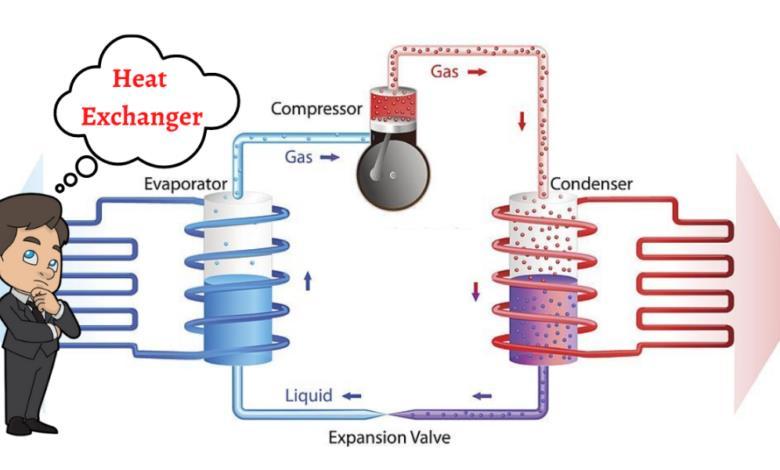
The heat exchanger in a gas furnace is near the combustion chamber. If we talk about an electric furnace, it is near the coil. The heat source heats up the exchanger and warms up the air present outside.
There are two heat exchangers present in some furnaces. They consist of primary and secondary heat-exchangingsystems.Theprimaryexchangersareofaluminizedsteelthattransfersheatbetter thanstainlesssteel.Secondaryheatexchangersaremadeupofaseriesofpinsthatfinishthecycle ofconvertingexhaustgasesintowater.
Mechanism of Heat Transfer-
The mechanism of transfer of heat involves conduction and convection. The driving force of heat transferisthetemperaturedifferencebetweentheinletandtheoutlet.
Approach Temperature-
This method is the difference between the fluid stream’s outlet and inlet temperatures minus the process stream’s inlet and outlet temperatures. In hot approach temperatures, the difference is between the inlet hit inlet and cold outlet temperatures. On the other hand, in the cold approach, thereisacoldandhotoutletapproach.
Everyheatexchangerhasanidealapproachtemperature.Whenbuyingheatexchangers,onemust keepthisinmindwhenbuyingheatexchangers.Sincethemiscalculationcanleadtothewrongheat exchangersforaprocess.
Conduction-
Conductionistheheattransferbydirectcollisionsofadjacentmolecules. Amoleculehavinghigher kinetic energy transfers the kinetic energy to the molecule having lower kinetic energy. This situationgenerallyoccursinsolids.
ReadMore:- HOW DOES THE HEAT EXCHANGER SYSTEM WORK?