Friends of St George & St Mary’s, Church Gresley NEWSLETTER No 3, NOVEMBER 2023
IN THIS ISSUE Your Amazing Memories They Fixed St Wilfrid’s, Barrow How Are We Doing? T G Green of Church Gresley Christmas Fayre report
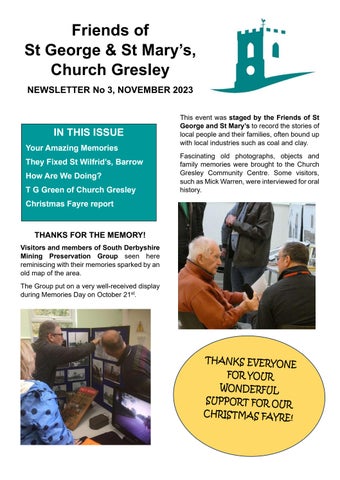
THANKS FOR THE MEMORY! Visitors and members of South Derbyshire Mining Preservation Group seen here reminiscing with their memories sparked by an old map of the area. The Group put on a very well-received display during Memories Day on October 21st.
This event was staged by the Friends of St George and St Mary’s to record the stories of local people and their families, often bound up with local industries such as coal and clay. Fascinating old photographs, objects and family memories were brought to the Church Gresley Community Centre. Some visitors, such as Mick Warren, were interviewed for oral history.
A display of old photographs was a reminder of how immensely the local area has changed. In a recent guided walk led by Dot Morson of the Magic Attic a group were taken over the terrain previously blighted by clay extraction, potteries, and coal workings. Today there are trees, landscaped walks and occasional information boards telling you what you would have seen a relatively few years ago. Personal stories, photographs and old maps are an essential way of ensuring that knowledge of the industries that have shaped this area does not disappear. One of our team, Martyn, who recorded people’s memories on the day, recounted a story told by one of the visiting miners. I was told a great story about two electricians called “Spot” and “Plum” (often pit men only knew their colleagues by nickname and often didn’t remember their real names) who had to make their way underground down the drift from Cadley pit to Gresley to fetch some cable hooks called “twos and threes” (as the hooks were to hold cables and had 2 or 3 hooks on
each one) from Gresley pit and take them back to Cadley pit. When they arrived at the Gresley pit bottom, which although was now shut in the early 1970’s still had a working winding room to operate the cage running up and down the shaft, they called the control room to let them know they had loaded the equipment on the cage so he could raise the cage up with Spot and Plum and the cable hooks inside. Our local miner told me what happened when they got to the door of the winding house “The chap in the winding house greeted us at the door and said “stay there and take your boots off and then you can come in and have a cuppa tea”. We couldner go into his winding house with boots on. Now his winding house gleamed, it wor immaculate. He had the steel checker plate floor oiled so you could see any boot prints on it, so we had to walk across it in our socks. The whole lot shone including all the brasswork on the engine” We get the impression that it would be worth holding another Memories Day next year.
RESTORING ST WILFRID’S, BARROW ON TRENT It was a meeting with part of the team at St Wilfrid’s that inspired us to launch our own scheme to restore St George and St Mary’s, Church Gresley. Project Manager Anne Heathcote describes their project. “Following around 10 years of consulting the local population, our Project Team of eight people, made up of both PCC and nonchurchgoers undertook a massive transformation of the inside of our church building. We intended to return the church to use as a communal building for both worship and other activities. During those 10 years the funding was raised to complete the task. This initial challenge needs determination and tenacity. But it can be done. The second challenge is to take people with you in the vision. Communication is key to ensuring that everyone understands the ultimate outcome, and is willing to support, help and get involved.
team. The Heritage Fund requirements are very demanding, and can create much effort in reporting back each month / quarter. Our main hurdle was the raising of the funds, but the outcome has been well worth the effort. Without exception, the transformed church has been well received by our visitors, with many ‘wow’s when they arrive. In addition to worship, we can also offer our building for many and varied activities; charity events, art exhibitions, concerts, social events, meetings, drama, and many other things that bring people together.
St Wilfrid’s before restoration Our chosen architects suggested a ‘light touch’ as our church is a Grade I Anglo-Saxon building with early mediaeval extensions. This was exactly what we wanted, and we were also lucky to engage a building company that treated the church with empathy and respect. Building work took place during the coronavirus lockdown of 2020, but the builders created their own ‘bubble’ to limit the risks of transmission. We found a way around several unforeseen problems, and no-one contracted Covid during the project! Around half of our funding was provided by the National Lottery Heritage Fund, and this perhaps created the biggest impact on our
Was the effort worthwhile? Absolutely! Would we do it again? Yes, but after having had a holiday please! (Anne is a glutton for punishment, having offered to help our project here in Church Gresley in any way she can.)
T G Green from Church Gresley to the World!
ensure the brand's legacy endures into the 21st century.
Thomas Goodwin Green bought a struggling Church Gresley pottery in 1862 while on his honeymoon! Using building skills he had developed during some years in Australia, by 1871 he established a new factory to rival those in Stoke-on-Trent. Despite modernisation, T.G. Green kept traditional manufacturing methods, an approach still found in Cornishware today.
St George and St Mary’s Image Spread Around the Globe The distinctive trade mark of T. G. Green Pottery is recognised by collectors the world over. The original backstamp was perhaps more detailed…
The close of the 19th century saw T.G. Green's teapots, pudding bowls, and 'nappies,' (cookware) become kitchen staples for working families. The pottery also achieved a thriving export business, reaching markets in Australia, New Zealand, and Europe. The 20th century brought significant changes, with the disappearance of paid cooks after WWI, making decorative kitchenware more desirable for a new generation of housewives. The iconic Cornishware design, with its blue and white stripes, emerged at this time and by the 1930s had become wellestablished and beloved. World War II posed challenges for T.G. Green, but post-war recovery saw the introduction of new ranges and designs reflective of the colourful modernism of the 1950s. Recovery alas was short-lived and the business faced bankruptcy towards the end of the 20th century due to increased competition from abroad. However, in 2008, British investors with a love of Cornishware, came together to revive the brand. Despite challenges and changes in ownership, Cornishware has persevered, using the original Cornish clay and glaze. The business has navigated the uncertainties of COVID-19 with increased online sales and plans to
.. but the modern version is still recognisable as St George and St Mary’s.
So Where is the Project Now? We owe much to those Church members who first applied to the National Lottery Heritage Fund. Although they were not successful, it was an essential learning experience from which the current group has derived a lot of benefit. Also they formed a constructive relationship with the Heritage Fund, which we hope to build on. The current focus is on creating a successful new approach to the Heritage Fund, whose major funding is vital to the success of the project. We hope to be ready to make a fresh application to them in February 2024. Allan Randall writes: We have now completed our heritage research and have a body of knowledge which will underpin our interpretation, that is the stories that will convey our heritage to our visitors. The capital costs have been established but will need to be reviewed. The major work now facing us is to plan a programme of events and activities. This will cover our work with formal and informal learners, our interpretation programme, events such as a proposed Mediaeval Ball based on the Gresley Dance Book, and other activities, such as exhibitions, and presentations that are part of our community engagement programme. Some will be large one off events such as a community archaeology project, and an artist in residence. Others may be regular small scale activities, such as various health and wellbeing activities for identified groups in the community, and visitor support services such as guided tours. Alongside these programmes will be training and promotion and publicity. Probably we will take on a part time community engagement officer to run the programmes. Volunteering will be a key to our success and will be part of our contribution to the cost plan.
THANK YOU, THANK YOU FOR ALL YOUR SUPPORT FOR OUR CHRISTMAS FAYRE! ENORMOUS THANKS for coming and supporting our Christmas Fayre! We really enjoyed meeting you all and we are overwhelmed with your support, kind wishes and generosity. You helped us raise over £700.00. Thank you to the craft stalls who came: Cottage Kitchen Crafts by D. Vennings, Express Earrings, Spa to Go by Debbie Morris and V.J. Swaddy. Thanks too for all who baked cakes, gave sale items, cooked, washed up, looked after stalls, set up/cleared away and of course, thank you to Santa, for his attendance!
IN OUR NEXT NEWSLETTER Who’s buried where? We hope to present the amazing work of Melissa and Greg (and Flo) Martin in mapping and recording the burials in St George and St Mary’s Churchyard. More from Memories Day as we transcribe interviews and present old photos.