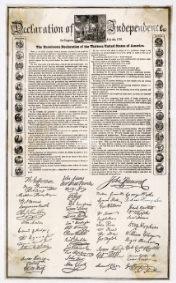
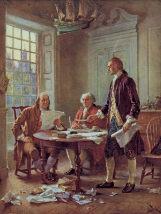
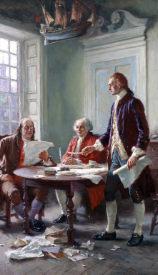
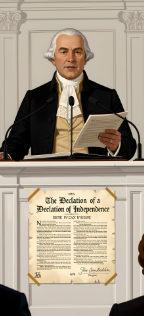
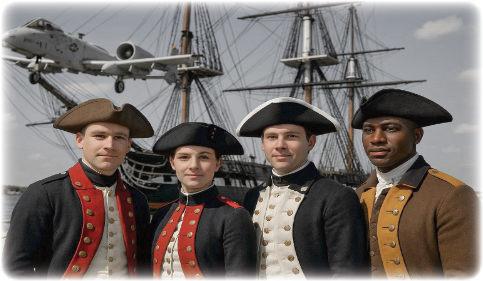
The Declaration of Indepen-dence, formally The unanimous Declaration of the thirteen united States ofAmerica in the original printing, is the foun-ding document of the United States.
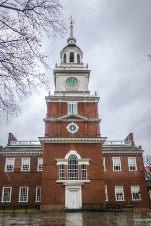
On July 4, 1776, it was adopted unanimously by the Second Continental Congress, who were convened at Pennsylvania State House, later renamed Independence Hall, in the colonial city of Philadelphia. These delegates became known as the nation's Founding Fathers. The Declaration explains why the Thirteen Colonies regarded themselves as independent sovereign states no
longer subject to British colonial rule, and has become one of the most circulated, reprinted, and influential documents in history.
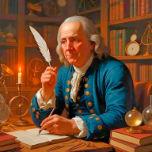
Thomas Jefferson is recognized as the primary author of the Declaration of Independence. He was tasked with drafting the document by the Second Continental Congress.
Jefferson was part of a group known as the Committee of Five, which included:
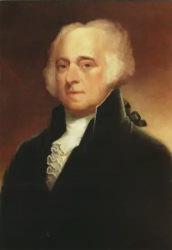
John Adams
Benjamin Franklin
Roger Sherman
Robert R. Livingston
This committee collaborated on the document, with Jefferson drafting the initial version and incorporating feedback from the other
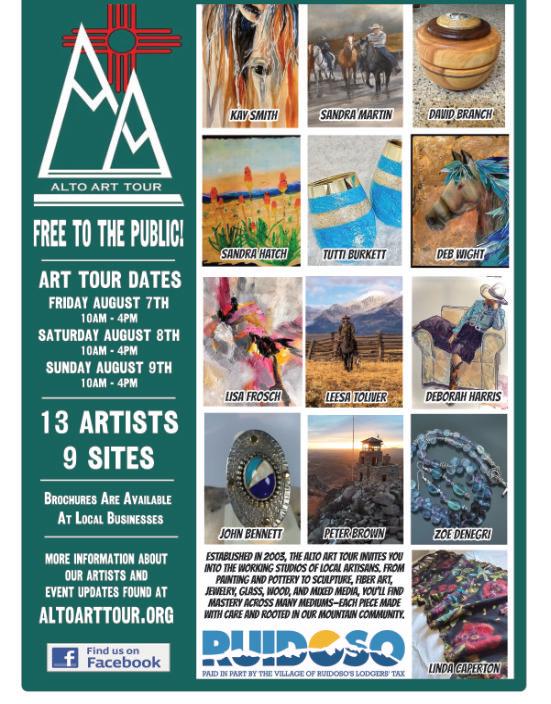
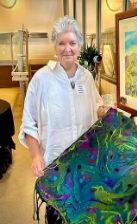
Linda Caperton Fine Art
For over 26 years, Linda Caperton has cultivated her artistic voice in the luminous landscapes of New Mexico. As a dedi-cated fiber and watercolor artist, her work reflects a deep reverence for the textures, colors, and spirtof the Southwest.
Specializing in nuno felt, hand-dyed silk, and eco botanical printing, Linda transforms natural fibers into wearable art. Her garments—wraps, ponchos, and shawls—are created through a thoughtful fusion of silk and wool, layered and felted together to produce pieces that are both lightweight and richly textured.
Through botanical printing and careful dye processes, she captures the organic imprints of leaves and natural elements, allowing the land itself to leave its mark on each creation. Every piece is one of a kind, shaped by hand
Continues next page
Continued from previous page
and guided by an intuitive dialogue with color and form.
In addition to her fiber work, Linda creates original watercolors that showcase iconic South-west imagery. Her pain-tings reflect the region’s expansive skies, desert flora, adobe architecture, and shifting light—cele-brating the quiet beauty and enduring presence of New Mexico’s landscape.
Deb Wight Studios
Captivated by the vibrant interplay of color and ener-gy, Deb finds bound-less inspiration in the dyn-amic medium of glass. Her passion for evoking per-ceived movement is ev-ident in her work, as she often draws upon the natural world as a
Appleknocker
Someone who has not worked in the woods but tries to convince people he has.
Barber Chair
Atree which splits upward along the grain during falling
Bull of the Woods
The big boss.
Choker Setter
He ties steel cables around logs so they can be dragged away. Entry-level job in the woods : hard, dirty, and dangerous
Faller
The man who downs the trees, a very dangerous job. He is obliged to shut off the saw and shout a warning just before the tree falls.
Lumberjack
An entertainer in shows which feature ax-throwing, pole climbing, & etc.Aman who "works in the woods" is a logger not a lumberjack.
Timberbeast
Awild and unruly logger.
Widow Maker
Adead limb above you on a tree
Continued from page 10
muse. Whether crafting exquisite represen-tations of birds, blossoms, cacti, or that surround her. Depending on her location, she adeptly captures the essence of beautiful mountain vistas or the stark allure of desert landscapes.
Occasionally, her artis-try takes a more abstract turn, showcasing her versatility and creativity. Through her work, Deb not only reflects the world around her but also in-vites viewers to see the beauty in every detail.
Tutti Burkett
Tutti Burkett is a visionary artist renowned for her enchanting and distinctive creations. Her work, characterized by the use of resin, mica powder, crystals, and glitter, captivates audiences with its luminous and otherworldly beauty.
Each piece crafted by Tutti is a testament to her innovative spirit and mastery of materials.
Peter Brown
Photography
Peter is inspired by a love for the outdoors, a commitment to service, and a passion for storytelling. His photography captures authentic moments and cre-ates lasting memories, ded-icated to preserving mean-ingful experiences.
Nature is Peter's muse, and the outdoors is his canvas. His photos reveal the beauty and tranquility of the natural world, inviting viewers to appreciate its wonders.
Peter uses his talents for community service, capturing local events, supporting nonprofits, and promoting conservation. His work aims to inspire positive change and connect people with the planet.
The Second Continental Congress appointed a committee of five delegates to write the declaration of Independance.
Jefferson, the main author, penned the first draft in his rented room in central Philadelphia. JohnAdams and Benjamin Franklin offered suggestions before they sent the document to Congress for further revision and approval.
The document that delegates adopted listed 27 complaints against King George III and explained the reasons for revolt. It used four terms for God as it made its case.
In its opening paragraph, Jefferson proposed that “the Laws of Nature and of Nature’s
God” grant humans equal status and entitleAmericans to dissolve “the political bands” with Britain.As historians have shown, Franklin added a phrase to suggest that those rights had been “endowed by their Creator.”
Congress then added two phrases to the final paragraph that portray God as a moral judge and a guiding hand. The delegates mention “the Supreme Judge of the world,” who punishes evil and rewards good — a description that almost all political and religious leaders would have agreed with.
They end by announcing that “with a firm reliance on the protection of divine Providence, we mutually pledge to each other our Lives, our Fortunes and our sacred Honor.”
The reference to “Providence” doesn’t specify how divine influence works, how-
ever, leaving room for the founders’diverging religious interpre-tations. The more conventionally Christian delegates, like John Witherspoon, believed that God intervenes directly in human history.
Others were less conventionally Christian. Rationalists like Jefferson, for example, believed in a creator but rejected biblical miracles and Jesus’divinity. They thought that God’s influence can be seen indirectly, in nature’s order and humans’capacity to discern God-given rights.
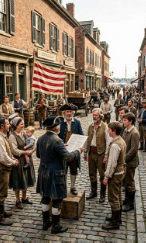
On the Fourth of July 1776, the congressional delegates in Philadelphia adopted the Declaration of Independence, then ordered that it be widely “proclaimed.” Couriers carried the printed version by stagecoach and horseback to every colony, where officials posted it and newspapers circulated it.
But the declaration was also Continuesnextpage
Continuedfrompreviouspage
meant to be read aloud.
Thomas Jefferson’s rough draft has marks signaling where the reader should pause briefly, or take a longer pause. And there were ceremonial public readings: First in Philadelphia and then in town squares, court-houses, churches and taverns up and down the Eastern Seaboard.
Eyewitness accounts offer a few more details about religious language heard at ceremonial public readings of the declaration in 1776.
Some sources show that the declaration was read in churches and discussed by the clergy. Massachusetts, for example, ordered that ministers read it in every congregation.And a soldier’s letter to his father noted that
his brigade’s chaplain offered “an excellent prayer” after the declaration was read in NewYork on July 9, though he gave no other details.
After the second public rea-ding in Philadelphia on July 8 at the State House, now called Independence Hall, eyewitnesses said the crowd gave “three cheers.”And, as the editor of Philadelphia’s German newspaper reported, those cheers were followed by “the cry ‘God bless the Free States of North America.’”
The pattern apparently repeated at other public readings. AbigailAdams wrote to her husband, John, one of the drafters of the declaration, to report that the official reading at Boston’s State House ended with the speaker proclaiming, “God Save ourAmerican States.”
After a reading for soldiers in Ticonderoga, NewYork, on July 28, an officer added, “God save the Free, Independent States of America.”
Aprominent newspaper circulated a firsthand account from Savannah, Georgia, describing four public readings and a mock “funeral” for the king onAug. 10.
The presiding official ended by suggesting that “America is free and independent, that she is, and will be, with the blessing of the Almighty, great among the nations of the earth.”
The official birth flow-ers for July are lark-spurs.These popular orna-mentals have lovely tall flower spikes, typic-ally in pink, white, and laven-der shades.
Often confused with delphiniums because of their similar appearance, larkspurs (Consolida spp.) are annuals, while delphiniums (Delphiniums spp.) are perennials. However, larkspur or perennial larkspur is another common name for delphiniums.
The July birthday flower is also known as lark’s heel, lark’s toes, lark’s claw, and knight’s spur.The name larkspur refers to the shape of the flower’s spurlike petals as they resemble the
claws of a lark bird.According to Greek mythology, the first larkspur plant sprouted on the land whereAjax the Great died during the famous Battle ofTroy.
In floriography, larkspur flowers symbolize love, joy, romanticism, and positivity.The July birth flower holds numerous meanings depending on its color.
Pink larkspur:Affection with a playful feel, great for birthdays and romantic color stories.
White larkspur: Joy, lightness, and new beginnings.
Purple larkspur: First love and a gentle heart, beautiful for anni-versaries and intimate celebrations.
Blue larkspur: Grace and dignity, a strong choice for polished personal or business gifting.
The July birthstone ruby captivates with its fiery red brilliance and rich historical significance. Often called the "King of Colored Stones," this magnificent gem has adorned royalty, warriors, and lovers throughout the centuries.
Throughout history, this vibrant red gemstone has earned the nickname "The King of Colored Stones" and has been treasured by royalty and warriors alike. Today, the July birthstone primarily symbolizes love, passion, and romance. While you can find affordable ruby options, the largest and most beautifully colored specimens command some of the highest per-carat prices of any colored gemstone in existence.
Rubies hold significant historical importance across many cultures:
They appear explicitly in the Bible four times, highlighting their ancient significance.
Royal families worldwide have prized these gems as symbols of power and wealth.
Warriors wore rubies into battle believing they provided protection and enhanced strength.
Many cultures attributed profound healing properties to these red stones.
Beyond being the July birthstone, rubies traditionally commemorate milestone 40th Continuesnextpage
wedding anniversaries, symbolizing the enduring fire of love.
The most coveted ruby color carries the trade name "pigeon's blood" - a rare and highly sought-after shade combining predominantly red hues with subtle purple modifiers.This exceptional color significantly increases a ruby's value.
The color red holds profound significance across human cultures, representing blood, life, and vitality.As the quintessential red gemstone, rubies have symbolized powerful concepts throughout history:
Strength and protection: Warriors wore rubies into battle, believing the stones would
transfer strength and offer protection from harm.
Healing and recovery: Soldiers hoped that the stone's red power would promote healing if injured in combat.
Health restoration: Ordinary citizens suffering from inflam-matory illnesses or blood disorders kept rubies close, hoping their positive energy would ease suffering or even cure ailments.
Royal status: Monarchs and nobility throughout Europe andAsia adorned themselves with rubies to reflect their elite social position and wealth.
Divine favor:Ancient Hindus believed offering rubies to the god Krishna would result in reincarnation as emperors.
The July birthstone also carries emotional associations:
Love and passion:As the color of the heart, red connects rubies with romance and deep emotion.
Emotional balance: Medieval Europeans wore rubies to temper anger and reduce rash behavior associated with fury.
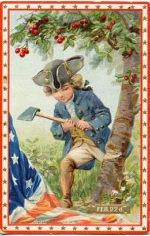
A Cherry Tree Myth
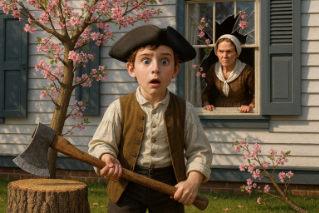
The cherry tree myth is one of the oldest and best-known legends about George Washington.
In the original story, when Washington was six years old, he received a hatchet as a gift and damaged his father’s cherry tree with it. When his father discovered what George had done, he became angry. Young George bravely said, “I cannot tell a lie…I did cut it with my hatchet.”
Washington’s father embraced him and declared that his son’s honesty was worth more than a thousand trees.
This iconic story about the value of honesty was invented by one of Washington’s first biographers, a traveling minister and bookseller named Mason Locke Weems. After Washing-0ton’s death in 1799,
people were anxious to learn about the first President. Weems explained to a publisher in January 1800:
Washington you know is gone! Millions are gaping to read something about him...My plan! I give his history, sufficiently minute…I then go on to show that his unparalleled rise and elevation were due to his Great Virtues."
Weems's biography, The Life of Washington, was first published in 1800. It became an instant bestseller due to its approachable style. However, the cherry tree myth did not appear until the book's fifth edition in 1806.
Weems had several motives when he wrote The Life of Washington. Money was certainly one of them. He rightly guessed that if he wrote a popular history book about Washington it would sell.
AFederalist admirer of order and self-discipline, Weems also wanted to present Washington as the perfect role model, especially for
Continued from previous page
youngAmericans. The cherry tree myth and other stories told readers that Washington's public greatness was due to his private virtues. Washington's achievements as a General and President were familiar to people in the early nineteenth century, but little was known about his relationship with his father, who died when Washington was only eleven years old. There is almost no surviving historical evidence about Washington's relationship with his father, and Weems’ claims have never been verified.
As a result of his success, Weems is now considered one of the fathers of popular history.
Even Abraham Lincoln recalled reading the book as a child.
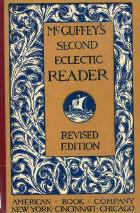
In the 1830s, William Holmes McGuffey turned Weems' tale into a children's story to be included in his textbooks. McGuffey was a Presbyterian minister and a college professor who wrote about teaching morals and
Continues on page 34
Continued from page 32
religion to children. First published in 1836, McGuffey's Readers remained in print for nearly a hundred years and sold over 120 million copies. It taught the myth of the cherry tree to millions of American students.
McGuffey's version of the cherry tree myth appeared in his The Eclectic Second Reader for almost twenty years. McGuffey made Washington's language more formal, and he showed more respect to his father's authority.
For example, when Washington's father explains the sin of lying, Weems says Washington spoke “very seriously while McGuffey has young George respond tearfully. Follow-up
questions at the end of McGuffey’s cherry tree story reinforce its message: “How did his father feel toward him when he made his confession? What may we expect by confessing our faults?"
The Cherry Tree myth also appeared outside of books, as the case of Joice Heth shows. Joice Heth was an elderly enslaved woman purchased by P.T. Barnum in 1835.
He made her into a sideshow attraction, billing her as an enslaved woman who had raised George Washington. (If true, this would have made her 161 years old.)
The stories she told about Washington, including the cherry tree myth, were right out of Weems’ writing. Many people saw Heth as credible because she was telling stories that people already knew.
The cherry tree myth has endured for more than two hundred years. It remains influential in Americans' beliefs about Washington. It has been referenced in countless books, movies, and television shows.
Tom Charles Tours
Slow-Cooked Ranch Potatoes
Ingredients
• 6 bacon strips, chopped
• 2-1/2 pounds small red potatoes, cubed
• 1 package (8 ounces) cream cheese, softened
• 1 can (10-3/4 ounces) condensed cream of potato soup, undiluted
• 1/4 cup 2% milk
• 1 envelope buttermilk ranch salad dressing mix
• 3 tablespoons thinly sliced green onions
Directions
• In a large skillet, cook bacon
over medium heat until crisp, stirring occasionally. Remove with a slotted spoon; drain on paper towels. Drain drippings, reserving 1 tablespoon.
• Place potatoes in a 3-qt. slow cooker. In a bowl, beat cream cheese, soup, milk, dressing mix and reserved drippings until blended; stir into potatoes. Sprinkle with bacon.
• Cook, covered, on low until potatoes are tender, 7-8 hours.Top with green onions.
Nutrition Facts
3/4 cup: 230 calories,
12g fat (6g saturated fat)
33mg cholesterol
545mg sodium
25g carbohydrate (2g sugars)
2g fiber
6g protein
Golden Sweet Onion Cornbread
Ingredients
• 2 tablespoons butter
• 1 large sweet onion, halved and thinly sliced
• 4 teaspoons chopped seeded jalapeno pepper
• 1/2 teaspoon chili powder, divided
• 2 tablespoons brown sugar, divided
• 1-1/2 cups all-purpose flour
• 1 cup yellow cornmeal
• 3 tablespoons sugar
• 2 teaspoons baking powder
• 1/2 teaspoon kosher salt
• 1/2 teaspoon baking soda
• 1-1/4 cups buttermilk
• 2 large eggs, room temperature, lightly beaten
• 1/4 cup butter, melted
• 3/4 cup shredded cheddar cheese
• 1 can (4 ounces) chopped green chiles
CRANBERRYBUTTER:
• 1/2 cup whole-berry cranberry sauce
• 1/2 teaspoon grated lime zest
• 1/2 cup butter, softened
Directions
In a 10-in. cast-iron skillet, melt 2 tablespoons butter and tilt to coat bottom and side.Add onion, jalapeno and 1/4 teaspoon chili powder; cook over mediumlow heat until onion is lightly browned and tender. Stir in 1 tablespoon brown sugar until dissolved; set aside.
In a large bowl, combine flour, cornmeal, sugar, baking powder, salt, baking soda, and remaining chili powder and brown sugar. In a small bowl, whisk buttermilk, eggs and melted butter. Stir into dry ingredients just until moistened. Fold in cheese and chiles.
Continuedfrompreviouspage
Pour over onion mixture in skillet. Bake at 425° for 20-25 minutes or until golden brown. Meanwhile, for cranberry butter, in a small saucepan, cook sauce and zest over low heat until heated through. Cool completely.
Let cornbread stand for 10 minutes. Invert onto a serving platter; cut into wedges. Pour cranberry mixture over softened butter; serve with cornbread.
Nutrition Facts
1 piece with 1 tablespoon butter and 1 tablespoon cranberry mixture:
468 calories,
25g fat (16g saturated fat)
118mg cholesterol
626mg sodium
52g carbohydrate
17g sugars
3g fiber
10g protein
Marina’s Golden Corn
Fritters
Ingredients
• 2-1/2 cups all-purpose flour
• 3 teaspoons baking powder
• 2 teaspoons dried parsley flakes
• 1 teaspoon salt
• 2 large eggs, room temperature
• 3/4 cup 2% milk
Continuesnextpage
Continuedfrompreviouspage
2 tablespoons butter, melted
• 2 teaspoons grated onion
• 1 can (15-1/4 ounces) whole kernel corn, drained
• Oil for deep-fat frying
Directions
• In a large bowl, whisk flour, baking powder, parsley and salt. In another bowl, whisk eggs, milk, butter and onion until blended.Add to dry ingredients, stirring just until moistened. Fold in corn.
• In an electric skillet or deep fryer, heat oil to 375°. Drop batter by tablespoonfuls, oil. Fry 2-3 minutesseveral at a time, into hot on each side or until golden brown. Drain on paper towels.
Nutrition Facts
2 fritters :
162 calories
8g fat (2g saturated fat)
28mg cholesterol 327mg sodium 18g carbohydrate
Grilled Shrimp
Ingredients
1/2 cup butter, melted
3 tablespoons lemon juice
2 teaspoons chili powder
1 teaspoon ground ginger
1/4 teaspoon salt
2 pounds uncooked shrimp (16-20 per pound), peeled and deveined
Directions
In a bowl, combine first 5 ingredients; set aside 1/4 cup mixture. Thread shrimp onto 8 metal or soaked wooden skewers.
Grill, covered, over medium heat 3-5 minutes on each side or until shrimp turn pink, basting occasionally with butter mixture. Remove from grill; brush with reserved 1/4 cup butter mixture.
Sweet Sriracha Wings
Ingredients
• 12 chicken wings (about 3 pounds)
• 1 tablespoon canola oil
• 2 teaspoons ground coriander
• 1/2 teaspoon garlic salt
• 1/4 teaspoon pepper
• sauce:
• 1/4 cup butter, cubed
• 1/2 cup orange juice
• 1/3 cup Sriracha chili sauce
• 3 tablespoons honey
• 2 tablespoons lime juice
• 1/4 cup chopped fresh cilantro
Directions
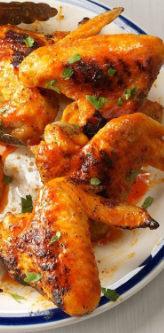
• Place chicken wings in a large bowl. Mix oil, coriander, garlic salt and pepper; add to wings and toss to coat. Refrigerate, covered, 2 hours or overnight.
• For sauce, in a small saucepan, melt butter. Stir in orange juice, chili sauce, honey and lime juice until blended.
• Grill wings, covered, over medium heat 15-18 minutes or until juices run clear, turning occasionally; brush with some of the sauce during the last 5 minutes of grilling.
• Transfer chicken to a large bowl; add remaining sauce and toss to coat. Sprinkle with cilantro.
Nutrition Facts
• 1 chicken wing:
• 201 calories
• 13g fat (5g saturated fat)
• 46mg cholesterol
• 321mg sodium
• 8g carbohydrate (7g sugars)-0 0 fiber
• 12g protein.
What's the difference between a songbird and a quail? For many Americans who lived before 1918, the answer was: not much
It would take more songbirds to fill a belly than quail, but Colonial and FederalAmericans weren't shy about eating things we wouldn't dream of today. One of those animals is the redbreasted robin you see hopping around the yard in the spring.
. It's illegal to eat them now, but before 1918, most saw robins as a source of meat rather than as a living yard decoration (there used to be a crow meat lover's association, too).
Robins were plentiful in the Northern states in the summer, and in winter the birds flew south in huge flocks that made them easy targets. They hovered near bushes and shrubs, making
it even easier for hunters to secure a meal. The tiny birds are referenced in the 1867 book, "The MarketAssistant," which includes a list of different items commonly sold in that day's marketplaces.
In 1671, Englishman John Josselyn noted them in his writing as being good for meat
The most popular way to eat them was baked into bird meat pies. They were also eaten in stews, and Robins on Toast was an indulgent meal.American citizens of the past also fried robin in lard with a side of sweet potatoes.
One recipe from the 1890 "Wehman's Cook Book" detailed a recipe for a baked robin and beef pie with thin-sliced beef and fat bacon. The next layer is made with a dozen or so robins crammed with an unspecified type of stuffing and rolled in flour. The top layer is made of chopped eschalots, bay leaves, and a few other seasonings. Broth creates a gravy in the dish as it cooks in the oven. It a bit like a pot pie without a top crust.
“Cover the bottom of a piedish with thin slices of beef and fat bacon, over which lay ten or twelve robins, previously rolled in flour, stuffed as above, season with a teaspoonful of salt, a quarter ditto of pepper, one of chopped parsley and one of chopped eschalots, lay a bay-leaf over, add a gill of broth and cover with three quarters of a pound of half puff paste, bake one hour in a moderate oven, shake well to make the gravy in the pie form a kind of sauce and serve quite hot.”
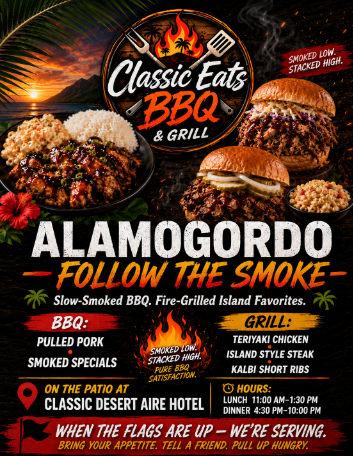
Classic Eats Island BBQ & Grill has quickly become one ofAlamogordo's hidden gems, combining the bold flavors of island cuisine with the rich traditions of authentic slowsmoked barbecue.
More than just a restaurant, Classic Eats Island BBQ & Grill is a reflection of passion, perseverance, and community.
At the center of it all is Pitmaster Dauwin Poe, whose journey from Michigan toAlamogordo helped shape what has become one of the area's most unique culinary destinations.
Originally from Michigan, Poe never imagined that a small desert town in New Mexico would become the place he would call home. Like many visitors who pass throughAlamogordo, he was drawn to the area's beauty, welcoming
atmosphere, and strong sense of community. What began as an opportunity for a fresh start soon became something much greater.
Rather than simply passing through, Poe made the decision to put down roots in Alamogordo and invest in the community that had embraced him. That decision led to the creation of Classic Eats Island BBQ & Grill, a concept inspired by his love of island flavors, barbecue traditions, and the belief that great food has the power to bring people together.
Today, that vision is evident in every meal that leaves the kitchen. Walking into Classic Eats Island BBQ & Grill, guests are greeted by the unmistakable aroma of grilled meats, smoked barbecue, and homemade sides.
The atmosphere is warm and inviting, creating a dining experience that feels both familiar and unique. Whether it's local families gathering for dinner, travelers exploring southern New Mexico, or military personnel from nearby HollomanAir Force Base, guests quickly discover that this is more than just another restaurant.
The menu itself tells the story
Continued from previous page
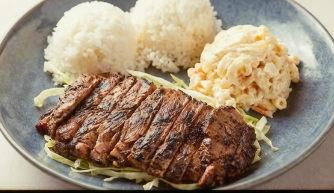
of Poe's culinary journey. One side of the menu celebrates island-inspired cuisine through the restaurant's popular Island Grill selections. Guests can enjoy flavorful teriyaki chicken served with traditional white rice and creamy macaroni salad, creating a plate lunch experience reminiscent of the Hawaiian Islands.
The Island Style Steak has also become a standout favorite, offering bold seasoning, tender cuts of beef, and the unmistakable flavors that define island-style cooking.
These dishes provide customers with something rarely found in southern New Mexico—authentic islandinspired comfort food prepared with care and attention to detail.
But while island flavors play a major role in the restaurant's identity, barbecue remains at the heart of the operation.
Poe's dedication to traditional barbecue methods is evident in every protein served. His pulled pork is slow-smoked until perfectly tender, creating rich flavor that keeps guests returning again and again.
Whether enjoyed on a sandwich or as part of a dinner plate, the pulled pork has
become one of the restaurant's signature items.
The brisket is equally impressive. Smoked low and slow, each serving showcases the patience and craftsmanship that define authentic barbecue. Tender, flavorful, and packed with smoky goodness, it has quickly earned a reputation as one of the area's must-try dishes.
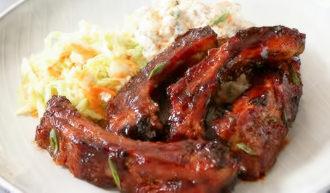
Guests can also enjoy baby back ribs, short ribs, specialty barbecue offerings, and seasonal creations that highlight the versatility of the restaurant's menu.
What separates Classic Eats Island BBQ & Grill from many dining establishments is its commitment to quality across every part of the plate. Side dishes are prepared with the same level of care as the main attractions.
Customers can choose from favorites such as smoked gouda macaroni and cheese, pulled pork baked beans with roasted red peppers, creamy macaroni salad, white rice, and fresh coleslaw.
Each side is designed to complement the restaurant's proteins while contributing its own unique flavor profile.
The result is a dining experience that feels complete from Storycontinuespage58
Continuedfrompage55
the first bite to the last.
Lunch service has become particularly popular among local workers and residents looking for a quick yet satisfying meal. The menu features specialty sandwiches, salad bowls, and islandstyle plate lunches that offer generous portions without sacrificing quality.
Dinner brings even more variety. Guests can customize their meals by selecting proteins and pairing them with their favorite sides, allowing them to create a dining experience tailored to their tastes. Whether someone prefers islandstyle chicken, smoked brisket, pulled pork, or a combination of multiple proteins, the menu offers options for every appetite.
Yet the restaurant's success is about more than food alone. From the beginning, Poe envisioned Classic Eats Island BBQ & Grill as a place where people could gather, connect, and create memories. He understands that some of life's best conversations happen around a dinner table and that food often serves as the centerpiece for celebrations, friendships, and family traditions.
That philosophy is evident in the way customers are treated. Guests are welcomed like family, and many first-time visitors quickly become regulars. The restaurant has developed a loyal following
throughoutAlamogordo, with customers routinely recommending it to friends, family members, and visitors.
Local residents appreciate having a dining option that offers something different while maintaining the welcoming spirit that defines Alamogordo itself.
Travelers visiting White Sands National Park have also discovered Classic Eats Island BBQ & Grill, often making it a memorable stop during their journey through southern New Mexico. Many are surprised to find such a distinctive fusion of island cuisine and authentic barbecue in a small desert community.
For Poe, however, the restaurant's success is measured by more than sales or popularity. His greatest reward comes from seeing customers enjoy a meal, celebrate a special occasion, or introduce friends and family to the restaurant for the first time. Each smiling guest serves as a reminder of why he chose to build his future in Alamogordo.
What started as a move from Michigan has evolved into a lasting commitment to a community that welcomed him with open arms. Through
Story continues next page
Continuedfrompreviouspage
hard work, determination, and a genuine passion for food, Poe has created something special—an establishment that reflects both his personal journey and the spirit of the town he now proudly calls home.
As Classic Eats Island BBQ & Grill continues to grow, its mission remains simple: serve outstanding food, treat every guest like family, and contri-bute positively to the Alamogordo community.
In an industry where restaurants often struggle to find their identity, Classic Eats Island BBQ & Grill has done exactly that. By combining island-inspired comfort food with authentic barbecue traditions, Pitmaster Dauwin Poe has created a destination that stands out from the crowd while remaining deeply rooted in the values of hospitality and community.
ForAlamogordo residents and visitors alike, Classic Eats Island BBQ & Grill offers more than a meal—it offers an experience.And for Dauwin Poe, it represents the fulfill-ment of a dream that began in Michigan and found its home in the heart of southern New Mexico.
In 1936, the residents of Tulsa, Oklahoma were seized with a craving for crow.
Butchers sent children into the fields, offering $1.50 for every dozen crows they brought back for the chopping block. Nurses and dietitians suggested that crow-meat could become a staple food in hospitals.And Miss Maude Firth, a domestic science teacher, established a class in crow-cookery.
Tulsa’s crow craze was due in no small part to the efforts of one Dr. T. W. Stallings, former county health superintendent and self-professed “crow hater.”According to Stallings, crows – with their tendency to descend in droves upon staple
crops – had become a serious problem for Oklahoma farmers in recent years.
With this in mind, Stallings launched a pragmatic attempt to stimulate interest in the extermination and consumption of crow, beginning with a series of ‘crow banquets.’Only after the guests had finished their meals –and expressed their approval –was it revealed that they had dined on crow.
InAugust 1937, it was estimated that an average of two Americans per day wrote to the Department ofAgriculture asking for details on “how crows might be cooked, stewed, fried or roasted and how crow broth can be made.”And in 1941, a group of sportsmen enjoyed “crow en casserole” courtesy of Fernand Pointreau, head chef at the acclaimed Hotel Sherman in Chicago. The crows were prepared as follows:
First they were skinned and dressed and put in a pan with butter to which a small amount of garlic had been added. Then the pan was drenched with one-third of a cup of white wine. Strong veal gravy [three tablespoons] and soy bean sauce were added. This sauce was poured over the crow meat and then the birds were cooked in a covered dish for about two hours.
ColonialAmericans relied on simple tools like brooms made from bundled twigs or straw, wooden scrub brushes, and cloth rags for sweeping and wiping surfaces. They also used lye soap for scrubbing and homemade mops made from coarse cloth strips tied to sticks.
Brooms - Made from bundled twigs or straw, used for sweeping.
Scrub Brushes - Wooden brushes used for scrubbing surfaces.
Cloth Rags - Used for wiping and dusting surfaces.
Mops Homemade mops made from coarse cloth strips tied to sticks.
Lye Soap Acommon cleaning agent for scrubbing and washing.
Brooms were essential for keeping dirt and debris off the floors.
Scrub brushes helped in cleaning tougher stains and grime.
Cloth rags served multiple purposes, from dusting to wiping spills.
Mops were crucial for cleaning larger floor areas, especially in kitchens.
Lye soap was a versatile cleaning product, effective for various cleaning tasks.
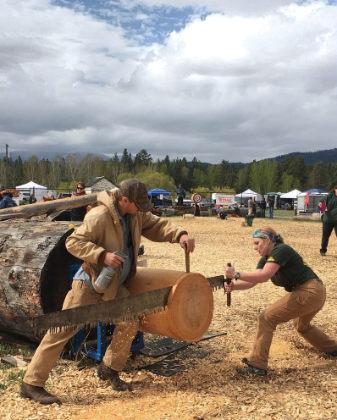
cloudcroft lumberjack day see page 11
French Fried Skunk
Ingredients
• 2 skunks, skinned and cleaned
• 1 tablespoon salt
• water, to cover
• 2 cups lard
• 2 egg yolks, beaten
• 3 cups milk or 3 cups cream
• 1 1⁄2 cups flour
• 1⁄2 teaspoon salt
• 2 tablespoons baking powder
Directions
• Clean and wash the skunks, making sure that the scent glands are removed.
• Cut up into small serving pieces.
• Put a soup kettle on the stove and add the meat.
• Cover with cold water and bring to a boil over high heat.
• Lower the heat and boil until the meat is tender, about 40 minutes.
• Remove all the scum that rises to the surface.
• Make a batter by mixing together the egg yolks, milk, flour, salt and baking powder.
• Mix real good until the batter is about like cake batter.
• Heat the bear fat or lard in a deep fryer to about 360 degrees.
• Dip the pieces of skunk in the batter and then fry them in the deep fryer until golden brown.
• Drain well and serve.
NUTRITION INFO
Serving Size: 1 (352) g
Servings Per Recipe: 3
AMT. PER SERVING
Calories: 421.2
Calories from Fat 110 g
Total Fat 12.2 g
Saturated Fat 6.6 g
Cholesterol 160 mg
Sodium 3564.9 mg
Total Carbohydrate 61.6 g
Dietary Fiber 1.7 g
Sugars 0.2 g
Protein 16.1 g
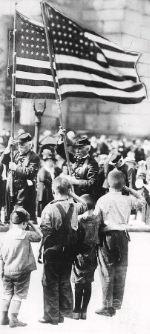
The U.S. Pledge of Allegiance is a patriotic recited verse that promises allegiance to the flag of the United States and the republic of the United States
The first version was written in 1885 by Captain George Thatcher Balch, a Union army officer in the Civil War who later wrote a book on how to teach patriotism to children in public schools.
In 1892, Francis Bellamy revised Balch's verse as part of a magazine promotion surrounding the World's Columbian Expo-sition, which celebrated the 400th anniversary of Chris-topher Columbus' arrival in the Americas.
Bellamy, the circulation manager for The Youth's Companion magazine, helped persuade then-president Benjamin Harrison to institute Columbus Day as a national holiday and lobbied Congress for a national school celebration of the day. The magazine sent leaflets containing part of Bellamy's Pledge of Allegiance to schools across the country and on October 21, 1892, over 10,000 children recited the verse together.
Bellamy's version of the pledge, though his authorship of it is contested, is largely the same as the one formally adopted by Congress 50 years later, in 1942.
The official name of The Pledge of Allegiance was adopted in 1945. The most recent alteration of its wording came on Flag Day (June 14) in 1954, when the words "under God" were added by the 83rd United States Congress and signed into law by President Dwight D. Eisenhower.
Swearing of the Pledge is
accompanied by a salute. An early version of the salute, adopted in 1887, accompanied the Balch pledge and was known as the Balch Salute. This salute instructed students to stand with their right hand outstretched toward the flag, the fingers of which are then brought to the forehead, followed by being placed flat over the heart, and finally falling to the side.
In 1892, Francis Bellamy created what was known as the Bellamy salute to accompany his own version of the Pledge of Allegiance. It started with the hand out-stretched toward the flag, palm down, and ended with the palm up.
Many decades later, during World War II, controversy arose because of the similarity between the Bellamy salute and the Nazi salute, which was adopted in Germany in the 1930s (although, unlike the Bellamy salute, this one did not end with the palm up). As a result, the US Congress stipulated that the hand-over-the-heart gesture would instead be
Cointinued from page 75 rendered by civilians during the Pledge of Allegiance and the national anthem, thereby replacing the Bellamy salute. Removal of the Bellamy salute occurred on December 22, 1942, when Congress amended the Flag Code language first passed into law on June 22, 1942.
Attached to bills passed in Congress in 2008 and then in 2009 (Section 301(b)(1) of title 36, United States Code), language was included which authorized all active duty military personnel and all veterans in civilian clothes to render a proper hand salute during the raising and lowering of the flag, when the colors are presented, and during the National Anthem.
The text of the Pledge of Allegiance is:
"I pledge allegiance to the flag of the United States of America, and to the Republic for which it stands, one Nation under God, indivisible, with liberty and justice for all."
ranch apple festival see ad page 7
Benjamin Franklin Quotes
“The Constitution only gives people the right to pursue happiness. You have to catch it yourself.”
“Work as if you were to live a hundred years. Pray as if you were to die tomorrow.”
“When the people find that they can vote themselves money, that will herald the end of the republic.”
“In free governments, the rulers are the servants, and the people their superiors and sovereigns.”
“Many people die at twentyfive and aren’t buried until they are seventy-five.”
“Without freedom of thought, there can be no such thing as wisdom.”
“Never ruin an apology with an excuse.”
“Pardoning the Bad is injuring the Good.”
“We are all born ignorant, but one must work hard to remain stupid.”
The RuidoSew Quilters and Stitchers, formerly known as “The Stash Sisters”, is a group that meets twice a month to share their love of the fiber arts.
Through the years since their inception in 2007 they have donated quilts to almost every charity organization in the area, but they are presently working on their biggest challenge yet.
On September 18 th they are putting on the first ever statewide quilt retreat. People from all over the state will come to the retreat center at Ft. Stanton for 3 days and 2 nights of quilting and camaraderie.
Fees will benefitAmerica’s veterans and first responders who attend the HealingAmerica’s Heroes camp.
The program, HealingAmer-ica’s Heroes, is a Christian organization that operates a retreat camp at Ft. Stanton. The camp plans to have group, couples and individual therpy sessions. They currently offer equine therapy, fly fishing instruction, and a multitude of other activities purposed to regenerate participants in body and soul.
The funds raised from the quilt retreat will go to the Heroes program so that attendees can experience the camp free of charge.
Activities planned for the quilt retreat in September include a tour of Ft. Stanton, a star gazing party, a crazy pajama contest, s’mores night, a “mystery quilt block” project, horse drawn carriage rides, lots of good food and opportunities to meet up with Storycontinuesnextpage
friends, old and new. There will also be plenty of time to sew and create!!
The RuidoSew Quilters and Stitchers meets on the 1 st and 3 rd Tuesdays of the month at the Ruidoso Community Center at 1:00 pm.At the meetings they present programs involving the quilting arts to teach and inspire one another and to enhance their own creativity.Additionally, several projects a year go to fund raising events for many of the local charities in the Ruidoso area.
The group has donated 14 quilts to High Mountain Youth bunk-house, raffle quilts for EMS and Police departments, the Nest, the Hospice program, both Ruidoso and Capitan
Libraries, the Make a Wish Foundation, the Lincoln County Humane Society and the Community Foundation of Lincoln County.
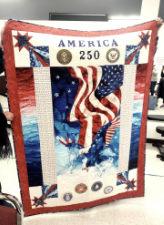
For the past 2 years the group has presented a patriotic quilt to a veteran during the Fort Stan-ton LIVE event. This year group donated a quilt celebrating the 250 th anniversary of our country for the Veterans’Association of New Mexico.
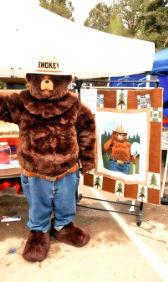
They donated a quilt for the Smokey Bear Days 50 thAnniversary celebration and are coordinating with the Wingfield Museum to make a quilt to be included in the museum’s time capsule event planned for October.
Storycontinuespage93
Continuedfrompage91
The original group, The Stash Sisters, was founded in 2007 by JoAnn Haines, Marilyn Marcott, Carol Myers, VickiArnold, Gayleen Ienatsch, Vivian Lucas and Rita Greenburg. The group changed their name in 2023 to RuidoSew Quilters and Stitches to better describe the vision they wanted to present to the community. They currently have 30 members and remain very active sharing their time and talents with others as well as with one another. Check out their Facebook page to learn some of the group’s history and see pictures of their personal and donation projects.
Anyone wishing to get more information about the group or the retreat should contact Vicki Arnold at 425-829-7762.
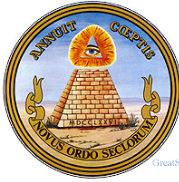
Great Seal of the United States
The Great Seal of the United States is a symbol of our independent Nation and self-govern-ment. It appears on off-icial documents such as proclamations, warrants, treaties, and commissions of high officials of the Government.
The Continental Congress first created a committee to design a seal for the United States on July 4, 1776, the same day that they adopted the Declaration of Indepen-dence. Benjamin Franklin, Thomas Jefferson, and JohnAdams created a design that was eventually rejected, but one element was adopted: the motto E Pluribus Unum, which is Latin for “Out of Many, One.”
In 1780, James Lovell of Massachusetts and John Morin Scott and William Churchill Houston of Virgin-ia developed a second design which was also rejected by Congress. Some elements, such as the olive branch, the thirteen stars, and the shield with red and white
stripes on a blue field, were used in the final design.
In 1782, a third committee used the eagle for the first time. The Secretary of the Continental Congress, Charles Thomson, created a fourth design that was then slightly changed by William Barton. The Continental Congress approved this design on June 20, 1782. The design used the eagle that holds a scroll in its beak with the E Pluribus Unum motto; in one claw is an olive branch, a symbol of peace, and the other claw holds thirteen arrows, a symbol of war.
The seal's reverse side contains a thirteen-step pyramid with the year 1776 in Roman numerals at the base. At the top of the pyra-mid is the Eye of Providence and above is the mottoAnnuit Coeptis, which is Latin for “It [the Eye of Providence] is favorable to our undertakings” or “He favors our undertakings.”
Below the pyramid, a scroll reads, Novus Ordo Seclor-um, which is Latin for “New Order of theAges.” It refers to 1776 as the beginning of a new era of the United States.
Faith of Our Fathers: Quotes from America’s Founding Fathers
53 of the 56 signers of the Declaration of Independence are said to have been deeplycommitted Christians. The other three all professed belief in the Bible as the divine truth, the God of scripture, and His personal intervention.
The first Congress formed the American Bible Society, and immediately after creating the Declaration of Independence, the Continental Congress voted to purchase and import 20,000 copies of scripture for the people of this nation.
“It cannot be emphasized too strongly that this great nation was founded — not by religionists — but
“Do not let anyone claim to be a true American who attempts to remove religion from politics.” — George Washingtion, in his FarewellAddress
“Those who pay no regard to religion and seriousness in the persons whom they send to the legislature of any state are guilty of the greatest absurdity and will soon pay dear for their folly.”– John Witherspoon, Signer of Declaration of Independence & President of Princeton University.
“May every citizen in the army and in the country have a proper sense of Deity upon his mind and an impression of the declaration recorded in the Bible, ‘Him that honoreth Me, I will honor, but he that despiseth Me shall be lightly esteemed'” (I Samuel 2:20). — SamuelAdams, one of the signers of the Declaration of Independence.
“We have no government armed with the power capable of contending with human passions, unbridled by morality and true religion. Our Constitution was made only for a moral and religious people. It is wholly inadequate to the government
by Christians . . . on the Gospel of Jesus Christ.”
of any other.” — JohnAdams, our second president, in an address to military leaders.
“God who gave us life gave us liberty.And can the liberties of a nation be thought secure when we have removed their only firm basis, a conviction in the minds of the people that these liberties are the Gift of God. That they are not to be violated but with His wrath? Indeed, I tremble for my country when I reflect that God is just; that his justice cannot sleep forever.” — Thomas Jefferson quote engraved on the Jefferson Memorial.
“The President, Commander in Chief of theArmy and Navy desires and enjoins the orderly observance of the Sabbath by the officers and men in the military and naval service. The importance for man and beast of the prescribed weekly rest, the sacred rights of Christian soldiers and sailors, a becoming deference to the best sentiment of a Christian people, and a due regard for the Divine Will demand that Sunday labor in theArmy and Navy be reduced to the measure of strict necessity. The discipline and character of the
national forces should not suffer nor the cause they defend be imperiled by the profanation of the day or name of the Most High.”—Abraham Lincoln, general order, Nov. 15, 1862
“[T]he only foundation for a useful education in a republic is to be aid in religion. Without this there can be no virtue, and without virtue there can be no liberty, and liberty is the object and life of all republican governments. Without religion, I believe that learning does real mischief to the morals and principles of mankind.” — Benjamin Rush, Signer of the Declaration of Independence.
“We have staked the whole future ofAmerican civilization, not upon the power of government, far from it. We have staked the future of all of our political institutions upon the capacity of mankind for self-government; upon the capacity of each and all of us to govern ourselves, to control ourselves, to sustain ourselves according to the Ten Commandments of God.” — James Madison
Continued next page
Continued from previous page
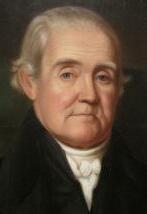
“[T]he Christian religion, in its purity, is the basis, or rather the source of all genuine freedom in government. . . . and I am persuaded that no civil government of a republican form can exist and be durable in which the principles of that religion have not a controlling influence.” — Noah Webster, author of the first American Speller and the first Dictionary.
“I trust that the God of Isaac and of Jacob will protect you, and give you health in my absence. In Him alone we ought to trust; He alone can preserve and guide us through this troublesome world, and I am sure He will hear your Prayers. We are told that the prayers of the righteous prevaileth much, and I add mine for your health and preservation until we meet again.”– Andrew Jackson, in an undated letter to his wife, Rachel
“The man must be bad indeed who can look upon the
events of the American Revolution without feeling the warmest gratitude towards the great Author of the Universe whose divine interposition was so frequently manifested in our behalf. And it is my earnest prayer that we may so conduct ourselves as to merit a continuance of those blessings with which we have hitherto been favored.” — George Washington in a Sept. 28, 1789 letter to the Rev. Samuel Langdon
“No free government, or the blessings of liberty can be preserved to any people, but by frequent recurrence to fundamental principles.” — George Mason, author of the Virginia Declaration of Rights.
“Providence has given to our people the choice of their rulers, and it is the duty as well as the privilege and interest of our Christian Nation to select and prefer Christians for their rulers.” — John Jay, our first Supreme Court Justice
“Can the liberties of a nation Storycontinuespage104
cloudcroft lumberjack day see page 11
be secure when we have removed a conviction that these liberties are of the gift of God?” — Thomas Jefferson (Notes on the State of Virginia, 1785, abbreviated from Jefferson Memorial)
“The destiny of America is to carry the gospel of Jesus Christ to all men, every-where.” — John Adams, Second President of the United States
“[Why] should not the Bible regain the place it once held as a school book? Its morals are pure, its examples captivating and noble. The reverence for the Sacred Book that is thus early impressed lasts long; and probably if not impressed in infancy, never takes firm hold of the mind.” — Fisher Ames author of the final wording for the First Amendment.
“Of all the dispositions and habits which lead to political prosperity, religion and morality are indispensable supports.” — George Washington (Farewell Address, Sept. 19, 1796)
page 106
Continued from page 104
“[F]or avoiding the extremes of despotism or anarchy . . . the only ground of hope must be on the morals of the people. I believe that religion is the only solid base of morals and that morals are the only possible support of free governments. [T]herefore
education should teach the precepts of religion and the duties of man towards God.” — Gouverneur Morris, Penman and Signer of the Constitution.
“It is impossible to govern the world without God and the Bible. Of all the dispositions and habits that lead to polit-ical prosperity, our religion and morality are the indis-pensable supporters. Let us with caution indulge the supposition that morality can be maintained without religion. Reason and experience both forbid us to expect that our national morality can prevail
in exclusion of religious principle.” — George Washingtion in his Farewell Address.
“I am a real Christian, that is to say, a disciple of the doctrines of Jesus. I have little doubt that our whole country will soon be rallied to the unity of our Creator and, I hope, to the pure doctrine of Jesus also.” — Thomas Jefferson
“The Bible is the best of all books, for it is the word of God and teaches us the way to be happy in this world and in the next. Continue therefore to read it and to regulate your life by its precepts.” — John Jay, Original Chief-Justice of the U. S. Supreme Court.
“The highest glory of theAmerican Revolution was this: it connected in one indissoluble bond the principles of civil government with the principles of Christianity.” — John Quincy Adams, July 4, 1821.
“Human law must rest its authority ultimately upon the authority of that law which is divine. . . . Far from being rivals or enemies, religion and law are twin sisters, friends, and mutual assistants. Indeed, these two sciences run into each other.” — James Wilson, Signer of the Constitution; U. S. Supreme Court Justice.
“Men, in a word, must necessarily be controlled either by a power within them or by a power without them; either by the Word of God or by the strong arm of man; either by the Bible or by the bayonet.” —
Storycontinuesnextpage
Continued from previous page
Robert Winthrop, Speaker of the U. S. House.
“The general principles, on which the Fathers achieved independence, were the only Principles in which that beautifulAssembly of young Gentlemen could Unite….And what were these general Principles? I answer, the general Principles of Christianity, in which all these Sects were United.” letter from
JohnAdams toThomas Jefferson, June 28, 1813.
“This is a Christian Nation. More than a half century ago that declaration was written into the decrees of the highest court in this land. It is not without significance that the valiant pioneers who left Europe to establish settlements here, at the very beginning of their colonial enterprises, declared their faith in the Christian religion and made ample provision for its practice and for its support. — HarryTruman in a Letter to Pope Pius XII,August 6, 1947.
cloudcroft lumberjack day see page 11
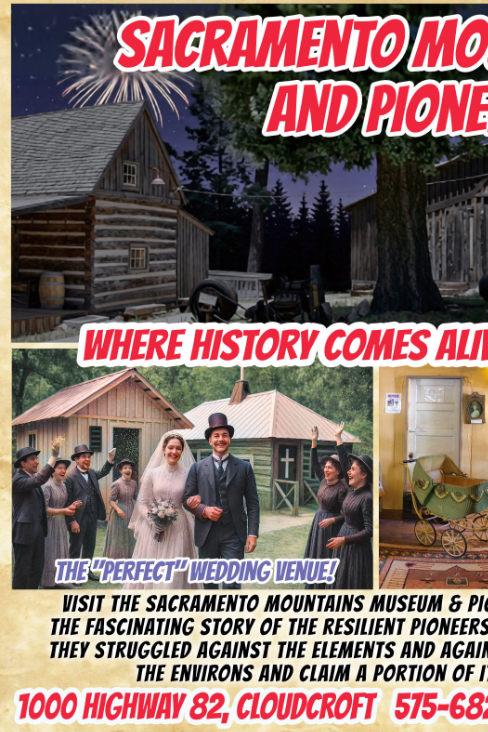
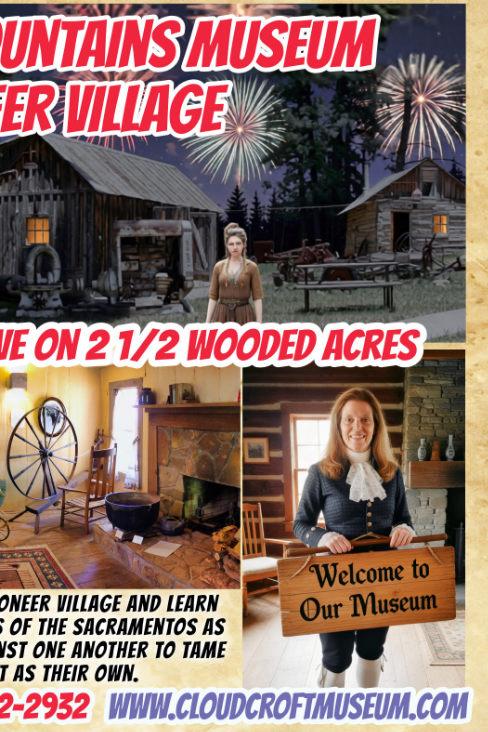
DISCOVER THE SACRAMENTOS
Cloudcroft * Mayhill * High Rolls
Sunspot * Timberon * Pinion * Weed
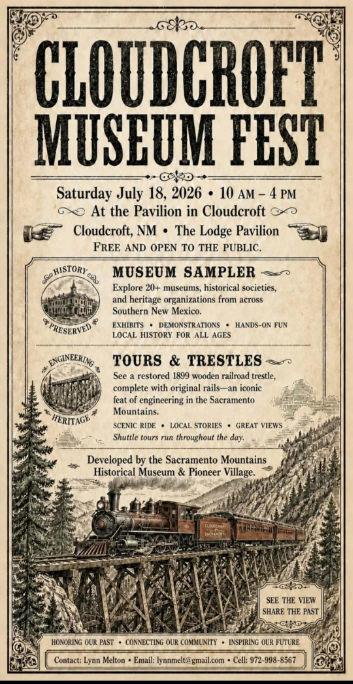
CLOUDCROFT MUSEUM FEST
July 18, 10 AM — 4 PM
Free and Open to the Public, at the Cloudcroft Pavilion on US82.
See exhibits from 20+ Southern New Mexico Museums
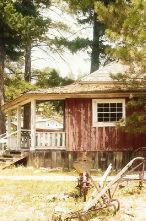
More Details below, but first a little story to introduce folks to Cloudcroft and the Sacramento Mountains Historical Society. The image on the next page shows the surviving two room fragment of an eleven
Story continues page 122
cloudcroft lumberjack day see page 11
Continued from page 117
room summer residence that J.A. Eddy, the founder of Cloudcroft, built 1900-1905. It is on the grounds of the SMHS Pioneer Village, and visitors are welcome to tour the cottage.
In the parlor, they may take a deep breath and imagine that they were lucky (and rich) enough to have been there in 1905 when Mrs. Eddy, clad in silks, presided over an elegant dinner, with the Governor of New Mexico as one of the guests.
Now the connection. J.A. Eddy, in creating Cloudcroft was enticing El Pasoans to enjoy the cool air at the top of the Sacramento Mountains, and the Cloudcroft Museum Fest extends a similar invitation to museum curious folks
to travel to Cloudcroft, enjoy the cool mountain air, and sample the exhibits of many local museums.
Planning is still underway, and the list of participating museums is growing. Who knows? There may be twenty five exhibitors.
A few teasers —
Why would the folks in Truth or Consequences want to name their museum the Geronimo Springs Museum?
Las Cruces has a Railroad Museum. Is it possible that there were railroads in New Mexico other than theAlamogordo and Sacramento Mountains Railroad that ran to Cloudcroft and beyond?
Ruidoso has a Wingfield Heritage House Museum.
Who were the Wingfields?
continued next page
cloudcroft lumberjack day see page 11
How is it that Kingston, with a population less than 100, can put together a Kingston Ghost Town Museum?
The Tularosa Basin Historical Society occupies a historic building at the corner of white Sands and 10th Street inAlamogordo. What is the history of that building?
What is in theAmerican Armed Forces Museum, about mile 2 on US82? How many times, as you sped by, have you asked yourself that question?
The next time you drive to Arizona, you might want to stop at the Deming Luna Mimbres Museum in Deming, and on the way back try Continued from previous page
Continues page 128
nichols ranch apple festival see ad page 7
cloudcroft lumberjack day see page 11
Continued from page 124
out the Lordsburg-Hidalgo County Museum.
How many times, on the way to Las Cruces, have you wondered about the White Sands Missile Range Museum? What went on at the Missile Range that laid the foundation for our current space programs?
Or. if the history of Eastern New Mexico tickles your fancy, museums in Carlsbad, Artesia, Roswell, Lovington (pending), and Hobbs (pending), would be delighted to have you visit.
At the Sacramento Mountains Historical Society museum, there is an exhibit about the Baby Sanitarium that provided cool air relief to fragile children before air conditioning became available.
What is in the archives at NMSU in Las Cruces that could tell folks about our local history? And a bit more about Cloudcroft Museum Fest.
The planning is still under-way. We hope to have raffles, hands on activities, tours focusing on Cloudcroft History, food vendors and more. Stay tuned.
The paragraphs above have focused on the Exhibition at the Cloudcroft Pavilion and nearby SMHS grounds, where museum folks will have exhibits designed to attract visitors.
The same day, museum personnel will be able to participate in a Roundtable, where they can ex-changes ideas and ways to make their efforts better.
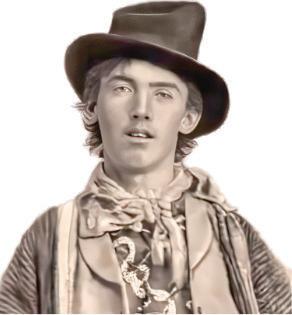
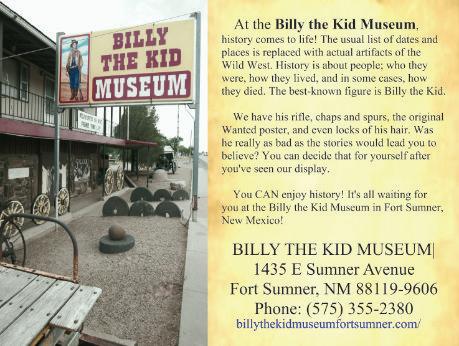
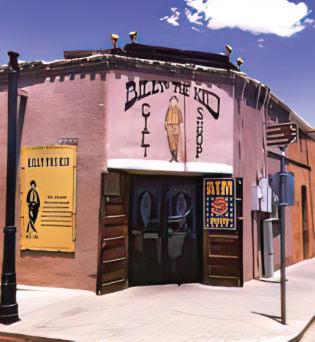
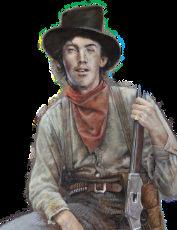
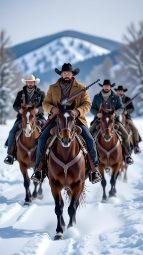
Riding at midnight through deep snow, Sheriff-elect Pat Garrett leads a 13man posse eastward out of Fort Sumner, New Mexico. After questioning several people in Fort Sumner and ascertaining the Kid’s dress (“especially his hat,” which is said to be a Mexican sugarloaf with a green hatband), Garrett decides he won’t take any chances. When the Kid makes his appearance, Garrett will kill him and hope the rest surrender.
After a 10-mile ride to the Brazil-Wilcox Ranch, where Billy the Kid and his compadres were last seen, Garrett picks up their trail clearly in
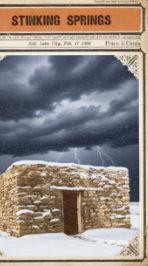
the snow. “Following this trail a short distance,” he recounts, “I [am] convinced that they had made for Stinking Springs.”
A half mile away from the house, Garrett and his men hold a conference. Around three a.m., with Juan Roibal left in charge of the horses, Garrett divides his squad and circles the house with half the force.
Finding a dry arroyo fairly close to the house, the men dig in. Frank Stewart and the rest of the posse conceal themselves about 200 yards from the other side of the building.
They see three horses tied to the vigas (roof
beams sticking out of the wall) outside the stone house and conclude that two mounts must be inside with the outlaws.
Garrett sends a message to Stewart of their plan of attack: “Stealthily enter the house, cover them with our guns and hold them until daylight.”
Lee Hall favors the suggestion; Stewart does not. Garrett is overruled.The men shiver and attempt to stay warm until daylight (about a four-hour wait).
It’s so cold, posse member Charlie Rudolph gets frostbite on his feet. As the posse members wait, they hear snoring from inside the rock
house. The hours drag by and the temperature seems to get colder as the men look for any sign of movement from the “inmates.”
The lanky sheriff commands a direct view of the doorway. While waiting for the Kid’s sombrero to pop into view, Garrett orders his men: “When I bring up my gun, [you] raise and fire.”
As the weak rays of sunlight begin streaking the horizon, the posse hears movement in the house. Shortly, a man appears in the doorway with a nose bag (feed bag for the horses). The man’s head is down, but Garrett sees a Mexican hat with a green band
Continued page 133
and brings his Winches-ter rifle to his shoulder. Seven bullets rip through the pale dawn light.
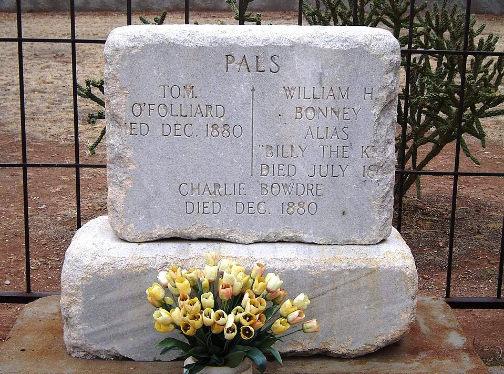
The man reels into the house, and the horses pull at their tethers. The “inmates” inside are now awake, trying to avoid the trampling hooves of their four-legged bunk-mates. Billy Wilson’s voice is heard: “Bowdre is killed and wants to come out.”
Garrett yells for him to come out with his hands up. As Charlie Bowdre staggers to the door, the Kid catches hold of his belt, draws his revolver around in front of Bowdre and says, “They have murdered you, Charlie, but you can get revenge. Kill
some of the sons-ofbitches before you die.”
Bowdre comes out with his hands barely up. He stumbles toward the posse until he recognizes Garrett, and he goes straight at him. Motioning with his hands at the house and strangling in his own blood, he gasps, “I wish... I wish... I wish....” Then with a whisper, “I’m dying,” he falls into Garrett’s arms. The lawman gently lays him on his blankets.
Garrett opens up a conversation with the “inmates,” and the Kid answers as their spokesman. Garrett asks how he is fixed in there.
“Pretty well,” the Kid coolly answers, “but we have no wood to get breakfast.”
“Come out,” Garrett says, “and get some. Be a little sociable.”
“Can’t do it, Pat,” the Kid replies, “business is too confining. No time to run around.”
BIG DOINGS IN OUR NEIGHBORING TOWNS
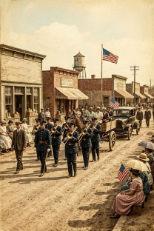
Fourth of July Celebrations
Galore on Nation's Birth day Ushered in on the Wings of Peace.
Carrizozo outlook July 4, 1919
Many Carrizozo homes Were deserted on the Fourth, the major portion of the populace attending celebrations in surrounding towns.
We should have had a celebration of our own this year but
Story continues next page
cloudcroft lumberjack day see page 11
Continued from previous page
seeing that some of our neighbors were possessed of the same idea, we, in Deferance to the spirit of the occasion relaxed our efforts, allowing others to proceed. Concequcntly, our inhabitants mainly, joined withAlamogordo, Corona and Ft. Stanton.
At these places mentioned big celebrations took place. Horse, broncho, mule and men's foot races were had. In fact every thing in the nature of entertainment (except bull fights.)
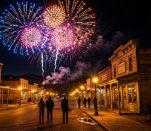
At night, fire works Illuminated the plains and mountains for miles around. People were determined to have a good time. Therefore, book agents and oil stock solicitors remained in the background.
At Ft. Stanton several boxing bouts were staged with the entertainment; at Corona 25 sheep and 15 beeves were barbecued and dancing at every celebration was indulged in day and night.
How come there aren’t any knock-knock jokes about America? Because freedom rings.
What do you call anAmerican revolutionary who draws cartoons? A Yankee Doodler.
Why were the firstAmericans like ants? They lived in colonies.
Why doesn’t fire get to enjoy a day off on the 4th of July? Because fire works.
What did the firecracker eat at the movies? Popcorn.
What’s the difference between a duck and George Washington? One has a bill on his face, and the other has his face on a bill.
I’m sure the fireworks sales around the 4th of July are booming.
What do dads like to eat on the 4th of July? Pop-sicles.
What beverage do you drink on July 4th? Liber-tea.
What did George Washington say to his men before crossing the Delaware?
“Get in the boat, men!”
Why couldn’t George Washington fall asleep? Because he couldn’t lie.
Selections from American newspapers, July-October 1776
NEW HAMPSHIRE. Portsmouth, July 20. The day before yesterday . . . the Independent Company under Col. Sherburne, and the Light Infantry Company under Col. Langdon, were drawn upon the parade [grounds] in their uniforms, when the Declaration of Independence from the Grand Continental Congress was read in the hearing of a numerous and respectable audience. The pleasing Countenances of the many patriots present spoke a hearty concurrence in this interesting measure, which was confirmed by three huzzas and all conducted in peace and good order.
Bill Graham
Dunlap’s Pennsylvania Packet, 5 August 1776
MASSACHUSETTS. Boston, July 25. On Monday last, a number of patriotic gentlemen of this town, animated with a love of their
country and to show their approbation of the measures lately taken by the Grand Council ofAmerica, assembled on the green near the Liberty Pole where, after having displayed the colors of the Thirteen Confederate Colonies ofAmerica, the bells were set a-ringing and the drums a-beating, after which the Declaration of Independency of the United States was read to a large and respectable body assembled on the occasion, who testified their approbation by repeated huzzas, firing of musketry and cannon, bonfires, and other demonstrations of joy.
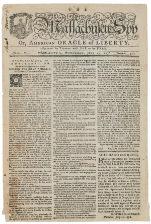
Massachusetts Spy: 24 July 1776
RHODE ISLAND. Newport. July 22. The Declaration itself was then read. Next thirteen cannon were discharged at Fort Liberty. The brigade then drew up and fired in thirteen divisions, from east to west, agreeable to the number and situation of the United States. The Declaration was received with joy
Continues page 147
Photo by JIM SHEPKA
Photograph by CHANEL FLORES
Continued from page 145
and applause by all ranks. The whole was conducted with great solemnity and decorum.
The Pennsylvania Evening Post, 1 August 1776
NEWYORK. New York City, July 15. On Wednesday the Congress’s Declaration of the Independence of the United States ofAmerica was read at the Head of each Brigade of the ContinentalArmy posted in and near this City, and everywhere received with the utmost Demonstrations of Joy. The Same Evening the Equestrian statue of George III, erected in the Year 1770, was thrown from its Pedestal and Broken in Pieces, and we hear the Lead wherewith this monument was made is to be run into Bullets.
Connecticut Journal, 17 July 1776
PENNSYLVANIA. Philadelphia, July 10. On Monday last at twelve o’clock the Declaration of INDEPENDENCE was proclaimed at the State-House in this city, in the presence of many thousand spectators, who testified their approbation by repeated acclimations.
Photograph by Jim Shepka
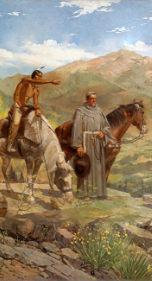
Fray
Francisco
Atanasio Dominguez had arrived in Santa Fe, New Mexico on March 22, 1776.
The instructions he received from his superiors were to “make a complete detailed report on both the spiritual and economic status of the New Mexico missions, and this entailed the gathering of much geographical and ethnological data”.
Dominguez in his report described “the wretched panic stricken state in which the nomadic Indian attacks had reduced the settlements and missions of New Mexico.”
Generally, he described in detail the conditions he found
in New Mexico in 1776.
He recorded the “utter pover-ty and loneliness” the Hispanic folk who for generations had survived among perils and hardships that might have driven other people to deser-tion, if not extinction.”
Father Dominguez in his Visitor Report also made a valuable detailed description of the Taos Pueblo and the second San Jeronimo mission church at Taos Pueblo, built between 1706 and 1726. Today only the ruins remain of this structure that was destroyed by the United StatesArmy in the Taos Revolt/Resistance of 1847.
In addition, during his visit Father Dominguez teamed up with Father Velez de Escalante for the purpose of leading an expedition to find a new route to Monterey California. The Domiguez/ Escalante Expedition departed Santa Fe on July 29, 1776 and explored throughout the Western Slope of Colorado and into Utah and Arizona but failed to reach California.
They blazed a new trail for over a thousand miles in unexplored and uncharted wilderness and documented geographical information and
Continue next page
Continuedfrompreviouspage
the topography of the area and the existence of other tribes such as the Yutas.
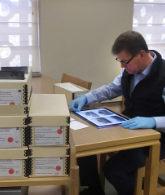
Father Dominguez’s lengthy 1776 Report was filed away and then discovered in 1928 by Dr. Frances V. Scholes in the National Library of Mexico among
unsorted papers . It was a “meticulous re-cord of the most common place appurtenances of everyday life” in New Mexico in the 1700s. So while the “Second Continental Congress was drafting at Philadelphia” the Declaration of Independence that marked the birth of a new nation, the Spanish Empire and its colonists were busy living, surviving, and documenting a historical treasure trove of information about life and “society in eighteenth century New Mexico.”