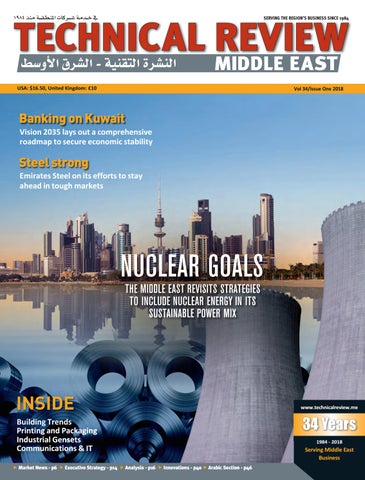
TRME 1 2018 - Cover_cover.qxd 26/01/2018 10:16 Page 1
SERVING THE REGION’S BUSINESS SINCE 1984 9 4
TECHNICAL REVIEW MIDDLE EAST
USA: $16.50, United Kingdom: £10
Vol 34/Issue One 2018
Banking on Kuwait
Vision 2035 lays out a comprehensive roadmap to secure economic stability
Steel strong
Emirates Steel on its efforts to stay ahead in tough markets
Volume 34/Issue One 2018
NUCLEAR GOALS THE MIDDLE EAST REVISITS STRATEGIES TO INCLUDE NUCLEAR ENERGY IN ITS SUSTAINABLE POWER MIX
INSIDE www.technicalreview.me
Building Trends Printing and Packaging Industrial Gensets Communications & IT
Market News - p6 Executive Strategy - p14 Analysis - p16 Innovations - p40 Arabic Section - p46
34 Years
www.technicalreview.me
1984 - 2018
Serving Middle East Business
S01 TRME 1 2018 - Start_Layout 1 26/01/2018 10:08 Page 2
S01 TRME 1 2018 - Start_Layout 1 26/01/2018 10:08 Page 3
S01 TRME 1 2018 - Start_Layout 1 26/01/2018 16:14 Page 4
4
Contents
EDITOR’S NOTE HAPPY NEW YEAR. While value-added tax (VAT) was introduced in the UAE and Saudi Arabia on 1 January 2018, other GCC nations, such as Kuwait and Oman, are poised to follow suit in 2019. Kuwait, especially, has a lot riding on VAT in order to ratchet up its home economy. Economist Moin Siddiqi provides an indepth analysis of Kuwait’s financial plans (p16). In a bid to diversify from oil and gas and move towards sustainability, there is large-scale adoption of nuclear energy in Saudi Arabia, Egypt, Jordan and, of course, the UAE. Read all about progress of these nuclear projects on p20. Meanwhile, it’s not just utilities and manufacturing sectors that are getting a boost. Governments across the Middle East are taking steps to further ICT developments (p30). Turn to p40 for the latest industrial and machinery innovations in the region.
At Technical Review we always welcome readers’ comments to trme@alaincharles.com
14
CONTENTS bUSINESS & MANAGEMENT
Market News
6
GCC construction markets records 30 per cent growth in 2017; Algeria partners with China firm to launch telecoms satellite; PDO headquarters to be fully solarpowered by 2018; Genavco celebrates 50 years in UAE
ExECUTIvE STRATEGy
Full Speed Ahead
Ford Trucks appoints Alghanim Auto as its official dealer for heavy commercial vehicles in Kuwait
ANALySIS
Gaining Growth
14
16
Kuwait’s economy is on the path to recovery. Economist Moin Siddiqi analyses why it is the next financial hub
NUCLEAR ENERGy
In The Mix
COMMUNICATIONS & IT
ICT In Focus
30
A report by Tim Guest on how the Middle East is bridging the digital divide in remote communities
EvENTS
Middle East Electricity
34
Intersec 2018
38
INNOvATIONS
Products & Progress
40
Featuring Volvo Construction Equipment, HIMOINSA, Doosan Portable Power, TIL, MB Crushers, ABB, Omicron, Megger and Johnson Controls
ARAbIC
20
News
4
Analysis
6
Middle East governments are investing heavily in nuclear energy for sustainable electricity generation
CONSTRUCTION
Steel Success
24
Exclusive products and a better market are creating new inroads for Emirates Steel
25
44
SERVING THE REGION’S BUSINESS SINCE 1984
Editor: Rhonita Patnaik - Email: rhonita.patnaik@alaincharles.com. Editorial and Design team: Prashanth AP, Hiriyti Bairu, Miriam Brtkova, Ranganath GS, Samantha Payne, Rahul Puthenveedu, Deblina Roy, Nicky Valsamakis, Vani Venugopal and Louise Waters Managing Editor: Georgia Lewis Publisher: Nick Fordham Sales Director: Michael Ferridge Magazine Sales Manager: Graham Brown - Email: graham.brown@alaincharles.com Tel: +971 4 448 9260, Fax: +971 4 448 9261 Special Projects Manager: Jane Wellman - Email: jane.wellman@alaincharles.com Production: Srinidhi Chikkars, Nelly Mendes and Rakshith Shivakumar Email: production@alaincharles.com Subscriptions: circulation@alaincharles.com Chairman: Derek Fordham
Head Office: Alain Charles Publishing Ltd University House, 11-13 Lower Grosvenor Place, London, SW1W 0EX, UK Tel: +44 20 7834 7676, Fax: +44 20 7973 0076
Technical Review Middle East - Issue One 2018
Country India Nigeria UK USA
Representative Tanmay Mishra Bola Olowo Michael Ferridge Michael Tomashefsky
Telephone Fax +91 80 65684483 +234 8034349299 +44 20 7834 7676 +44 20 79730076 +1 203 226 2882 +1 203 226 7447
Email tanmay.mishra@alaincharles.com bola.olowo@alaincharles.com michael.ferridge@alaincharles.com michael.tomashefsky@alaincharles.com
US MAILING AGENT: Technical Review Middle East ISSN 0267 5307 is published eight times a year for US$99 per year by Alain Charles Publishing, University House, 11-13 Lower Grosvenor Place, London, SW1W 0EX, UK. Periodicals postage paid at Rahway, NJ.
POSTMASTER: Send corrections to Alain Charles Publishing Ltd, c/o Mercury Airfreight International Ltd, 365 Blair Road, Avenel, NJ 07001. US Agent: Pronto Mailers International, 200 Wood Avenue, Middlesex, NJ 08846. Printed by: Buxton Press
Printed in: January 2018
Arabic Translation: Ezzeddin M. Ali - Email: ezzeddin@movistar.es Arabic Typesetting: Lunad Publicity, Dubai
© Technical Review Middle East ISSN: 0267-5307
Middle East Regional Office: Alain Charles Middle East FZ-LLC Office L2- 112, Loft Office 2, Entrance B, Dubai Media City, Dubai, UAE Tel: +971 4 448 9260, Fax: +971 4 448 9261
Audit Bureau of Circulations Business Magazines Serving the world of business
www.technicalreview.me
S01 TRME 1 2018 - Start_Layout 1 26/01/2018 10:08 Page 5
S02 TRME 1 2018 - News_Layout 1 26/01/2018 10:09 Page 6
Market News
Briefly Jordan invested more than US$1bn in water projects last year
more Than us$1bn was invested in the water projects in 2017 to improve and increase water supply, link more households to the sewage network and expand the sector’s reliance on renewable energy, a senior government official was quoted as saying by Jordan Times. Last year, the ministry of Water and irrigation completed the mega national Water carrier project, which interlinks water projects across the country, minister of water and irrigation hazem el nasser said. The strategic project seeks to connect water projects in the south of the country to projects in the central and northern regions, in order to better supply waterdistressed areas via an expansive network of 600km of pipelines, ministry spokesperson omar salameh stated. The national carrier is one of the 10 projects listed under the ministry’s water supply strategy for the northern governorates, launched in December 2015, which said that the strategy entails implementing projects worth us$308mn to provide irbid, Jerash, ajloun and mafraq with freshwater, in addition to renovating water networks in irbid, Jerash and ajloun.
Algeria partners with China firm to launch first telecoms satellite
aLGeria has LauncheD alcomsat-1 by china Great Wall industry corporation (cGWic) aboard a Long march 3b rocket, which is expected to support television broadcasting and broadband communications for services including remote education and e-government. The alcomsat-1, with a design life of about 15 years, will be operated by the algerian space agency (asaL). apart from building the satellite, cGWic also provided the launch vehicle, sidestepping manufacturing and rocket restrictions. according to cGWic, the launch of alcomsat-1 is seen to be a good beginning of space cooperation between china and algeria. The company further stressed that more space programmes are to be initiated in a short period of time.
GCC construction market records 30 per cent growth in 2017 The consTrucTion markeT showed relative resilience in its performance, depicting a 30 per cent pick-up in 2017, according to a new study by mena research Partners (mrP). With total Gcc active projects at around us$2.6 trillion – equivalent to 160 per cent of GDP, the regional construction market presents sufficient depth and opportunities for investors and regional market participants over the years to come. Despite the recent years’ headwinds that extended from oil price slump to budget adjustments in many Gcc countries, the region witnessed us$130bn of completed projects during 2017, versus us$100bn for the full-year in 2016. such numbers remain on par with an annual average of us$135bn during the 2009-2014 period. anthony hobeika, chief executive officer at mena research Partners, said, “This surge is driven by economic diversification away from hydrocarbons in leading Gcc countries, with a particular focus on sectors like transportation, power and water, manufacturing and energy projects totalling in excess of us$1 trillion of projects in the pipeline, along with a shift from oil into renewables where many Gcc countries have set ambitious targets to expand their alternative energy generation.” Governments remain the key drivers of construction activity, as part of their firm commitment to the long-term sustainable economic development. Looking at the recent project announcements, their main focus has been on large
The region witnessed US$130bn of completed projects during 2017, vis-à-vis US$100bn for the full-year in 2016.
scale strategic developments, like flagship real estate projects, energy, and airports, among others. in return, the role of the private sector has been on a rapid upward trajectory, primarily targeting consumer-driven sectors like retail, logistics and industrial sectors. The uae and saudi arabia account jointly for 70 per cent of the value of active projects, both countries increasingly present compelling new opportunities for investors and market participants and remain key markets in the region. as they lead economic growth, and driven by young and fast-growing demographics in addition to long-term transformational plans with saudi Vision 2030 and the uae Vision 2021, Gcc governments have been promoting many significant infrastructure projects that aim to catalyse business activity in specific sectors.
Largest man-made desalinated water reserve in UAE ABU DHABI HAS unveiled the world’s largest reserve of high quality desalinated water, secured in a network of 315 recovery wells lying up to 80 metres below the Liwa Desert. The wells are fed by one of UAE’s longest water pipeline networks which runs the water from Shuweihat desalination plant at a rate of seven million imperial gallons per day over 27 months. The reserve, which has at its core an infiltration and recovery system sitting atop a natural fresh water underground aquifer, was first investigated in 2002 and has been extensively researched by the Environment Agency – Abu Dhabi (EAD). The project was undertaken as a collaborative venture between EAD, delivering the vital scientific studies, feasibility, risk and mitigation scenarios as well as strategic planning Abu Dhabi Water and Electricity Authority (ADWEA) and its TRANSCO subsidiary, which managed the construction and on-the-ground implementation. Dr Saif Saleh Al Seairi, acting director general
Technical Review Middle East - Issue One 2018
Photo Credit : Falk Schaaf/sxc.hu
6
of ADEWA, said, “The reserve acts as a safety net for the provision of water and is now being regarded as an excellent regional model for foresight and planning. This project has positioned Abu Dhabi. The project has addressed Abu Dhabi’s water security and its resilience through the recharge of groundwater aquifers with high-quality desalinated water, which cannot be stored above ground due to contamination and other factors. The Liwa desert was chosen for the project after it met strict specification criteria. These included an extremely light water basin trajectory to prevent leakage; capable of sustaining a ‘tank’ thickness to handle significant storage volumes; safe surroundings free of human activities which could contaminate the reserve and where groundwater quality was of sufficient quality to allow for ‘recharge and mixing.’ The project ensures continuous water supply for Abu Dhabi city and Al Dhafra region and secures the reserve for future generations. www.technicalreview.me
S02 TRME 1 2018 - News_Layout 1 26/01/2018 10:09 Page 7
S02 TRME 1 2018 - News_Layout 1 26/01/2018 10:09 Page 8
Market News
Briefly Oman’s PDO headquarters to be fully solar-powered by end of 2018
The PeTroLeum DeVeLoPmenT oman (PDo) headquarters at mina al Fahal will become completely powered by solar energy by the end of 2018, according to a press statement by the company. PDo officially opened its first solar car park in which thousands of solar panels have been installed in car parks to provide power for office buildings. The 6mW first phase, that will be completed in march this year, will power nearly half of the headquarter’s 12mW requirements. The capacity will be nearly doubled by november to fulfill all power needs of the offices at mina al Fahal concession area. “by november, our headquarters at PDo will be independent of power from the grid. The first phase powers nearly 50 per cent of our requirements and second phase will be nearly the same capacity to make us power PDo offices only by solar energy,”mohammed al aghbari, infrastructure and power systems manager at PDo, said.
Bahrain International Airport to see better improvements
bahrain WiLL uPGraDe the air navigation system and instrument landing system (iLs) in a bid to improve standards and the flow of air traffic at bahrain international airport. The project is expected to significantly improve navigation and instrument landing services during times of low visibility, contributing to reduced flight delays and diversions and improvements to the overall service offered from bahrain international airport, said minister of transportation and telecommunications kamal bin ahmed mohammed. The project will be completed by the end of 2018, he added. according to CPI Financial reports, the tourism sector witnessed rapid growth in the past year, with the total number of tourists visiting bahrain increasing by 12.8 per cent in the first nine months of 2017. “The tourism sector is one of the key investment sectors we recognise as having a strong competitive advantage for bahrain,” said simon Galpin, managing director of bahrain eDb.
Genavco celebrates 50 years in the UAE
GeneraL naViGaTion anD commerce company (Genavco) celebrated its 50th year anniversary at Jumeirah beach hotel on 5 December 2017. The Golden Jubilee celebration was attended by Genavco’s principal customers, Juma al majid Group companies’ heads, Jam Group corporate business units chiefs, and current and ex-staff. established in 1967 on Zaábeel road in karama, Dubai, as a flagship company of Juma al majid Group, the company started its operation with Detroit Diesel engine (DDc), allison Transmission and Terex construction equipment followed by bP, isuzu, Wirtgen, Liebherr, JLG, John Deere and compair. in the 50 years, Genavco has become one of the largest and most trusted names in the region’s commercial vehicle and heavy equipment market. as the nation celebrates 46th Year of union – be it infrastructural developments of airports, seaports, highways and race tracks, Genavco has been involved in every major project across the uae. according to Genavco, behind its success and longevity is the leadership and guidance of its founder and chairman Juma al majid, vice-chairman khalid al majid and a dedicated work force. This has propelled Genavco to win some of the most prestigious awards and accolades from the global and local industries to become ‘Your Perfect Partner’ for the millions of customers. but what truly sets Genavco apart, according to the company, is not just the best customer support, market
Juma Al Majid chairman with Isuzu president during the celebrations in Dubai.
coverage and prompt delivery, but the passion and commitment of the 300-plus employees. Genavco has set the road to success in the uae by becoming a leading name in road construction equipment with franchises of leading equipment brands that include Wirtgen, Vogele, hamm, Weiro, kleemann and benninghoven. more milestones followed in Genavco’s journey with its partnership with leading brands in material handling and access equipment. it forged relationship with crown, sToW, Flexi and JLG to offer its customers the very best. Genavco continues to invest in its employees by making them the best trained workers in business and is proud to have satisfied customer by offering 100 per cent genuine zero defects parts only, the company reiterates.
Emirates signs US$16bn deal for new A380 aircraft EMIRATES AIRLINE HAS signed a US$16bn deal for 36 additional Airbus A380 aircraft, with 20 firm orders and 16 options. Emirates’ A380 fleet operates both GE and Rolls-Royce engines, and the airline is evaluating engine options for its latest A380 order. The additional Airbus A380s will be delivered to Emirates from 2020 onwards. Together with the airline’s 101-strong A380 fleet and its current order backlog for 41 aircraft, this new order brings Emirates’ commitment to the A380 programme to 178 aircraft, worth over US$60bn. HH Sheikh Mohammed bin Rashid Al Maktoum, Vice-President and Prime Minister of the UAE and Ruler of Dubai, said, “Emirates truly represents Dubai’s spirit of growth, innovation and resilience. It also epitomises the city’s increasing role in connecting the world in terms of people, capital and information flows. This deal reflects Emirates’ confidence in shaping the future, and its commitment to advancing Dubai’s vision to grow further as a world-class destination and
Technical Review Middle East - Issue One 2018
Photo Credit : Genavco
8
aviation hub.” Sheikh Ahmed bin Saeed Al Maktoum, chairman and chief executive, Emirates Airline and Group, signed the MoU with John Leahy, chief operating officer Customers, Airbus Commercial Aircraft at the airline’s headquarters in Dubai. Sheikh Ahmed added, “We’ve made no secret of the fact that the A380 has been a success for Emirates. Our customers love it, and we’ve been able to deploy it on different missions across our network, giving us flexibility in terms of range and passenger mix. He added, “Some of the new A380s we’ve just ordered will be used as fleet replacements. This order will provide stability to the A380 production line. We will continue to work closely with Airbus to further enhance the aircraft and onboard product, so as to offer our passengers the best possible experience. The beauty of this aircraft is that the technology and real estate on board gives us plenty of room to do something different with the interiors.” www.technicalreview.me
S03 TRME 1 2018 - Calendar events_Layout 1 26/01/2018 10:10 Page 9
S03 TRME 1 2018 - Calendar events_Layout 1 26/01/2018 10:10 Page 10
10
Developments
ON THE WEB
A round up of the leading developments and innovations recently featured on Technical Review Middle East’s online portal. to read more or to stay up to date with the latest industry news, visit www.technicalreview.me
Photo Credit : Daniel Cossio/Flickr
The GlOBal SOlaR ePC company Sterling and Wilson has selected NeXTracker to supply 325MW of its single-axis solar trackers to the Benban solar park project in aswan, egypt. after completion in 2019, the 37 sq km Benban solar park is expected The Benban Solar Park is set to provide Egypt with the clean energy to host a total capacity of more to drive economic growth. than 1.6 GW, making it one of the largest planned solar installations in the world. according to the Bloomberg New Energy Finance reports, egypt plans to generate 20 per cent of its electricity from the renewable energy sources by 2022. www.technicalreview.me/power-a-water
SOHAR Port wins world’s best dry bulk port award
SOHAR PORt And Freezone has won the world’s ‘Best dry Bulk Port Award’ at IBJ Awards ceremony, which took place in Amsterdam, netherlands. SOHAR is equipped with deep-water jetties capable of handling the Valemax class of Very Large Ore Carriers, which at 400,000-tonne capacity are among the world’s largest ships. Commenting on the latest IBJ Award, SOHAR CEO Mark Geilenkirchen, said, “We are all immensely proud to be named dry Bulk Port of the Year. dry bulk imports are essential for our metals cluster in SOHAR and our aim is to manage this in an environmentally sound and sustainable way.” www.technicalreview.me/logistics
The 120MW Khalladi wind power plant in Morocco has started injecting its first kWh into the high voltage network. The wind farm, developed by aCWa Power Khalladi in collaboration with aRIF investment fund and located at Jbel Sendouq, 30km from Tangiers, represents an investment of Mad US$460mn. The Khalladi wind power plant is the first aCWa Power project to be developed within the framework of the law 13-09 on renewable energies. The law encourages the development of renewable sources in order to promote energy security and access, sustainable development, and integration of Morocco’s renewable energy production with other markets. aCWa Power Khalladi is the second private company to succeed the launching of a large wind farm within the framework of this law. www.technicalreview.me/power-a-water
GII buys Amazon’s logistics centres for US$114mn
GUlF ISlaMIC INveSTMeNTS (GII), Uae-based Islamic financial services company, has announced the acquisition of nearly one million square feet of logistics centres for amazon, on behalf of its investors, for US$144mn. The two state-ofMohammed Al-Hassan is the CEO of GII. the-art Grade a logistics centres, are located in dortmund Germany, serves as amazon’s key logistics centres supplying goods to 29 other facilities. www.technicalreview.me/logistics
‘Three per cent GDP growth for MENA’
EGA signs deal to build chemical complex at KIZAD
Photo Credit : EGA
eMIRaTeS GlOBal alUMINIUM (eGa) has signed a supply agreement with Shaheen Chem Investments llC to ease Shaheen’s construction of a chemical complex at Khalifa Industrial Zone abu dhabi The construction of the plant is (KIZad). Once it starts production expected to boost KIZAD’s role as an industrial centre for Abu Dhabi and early next decade, Shaheen’s the UAE. ethylene dichloride and caustic soda plant will supply all its caustic soda output to eGa’s al Taweelah alumina refinery for a period of 15 years. www.technicalreview.me/manufacturing Technical Review Middle East - Issue One 2018
ACWA Power’s wind farm takes off in Morocco
Photo Credit : GII
NEXTracker delivers solar trackers to Egypt’s Benban solar park
The WORld BaNK Group’s annual forecast has predicted an average of three per cent GdP growth across the Middle east and North africa (MeNa) region in 2018, which is up from 1.8 per cent in 2017 according to the report, the GdP growth in the MeNa region will increase significantly, mostly due to the increase in exports and industrial operations. egypt is expected to boost North africa’s economy with its GdP which is forecasted to stand at 4.5 per cent, up from 4.2 per cent in 2017. algeria’s GdP has been projected to be 3.6 per cent in 2018, an increase from 2.2 per cent in 2017. Morocco and Tunisia are expected to progress by 3.1 per cent and 2.7 per cent respectively. among the GCC countries, the GdP for Bahrain is projected to stand at two per cent, down from 2.4 per cent in 2017. Saudi arabia and the Uae are expected to progress by 1.2 per cent and 3.1 per cent respectively. www.technicalreview.me/business-a-management www.technicalreview.me
S03 TRME 1 2018 - Calendar events_Layout 1 26/01/2018 10:10 Page 11
S03 TRME 1 2018 - Calendar events_Layout 1 26/01/2018 16:45 Page 12
12
Calendar
EXECUTIVES’ CALENDAR 2018 FEBRUARY
14-15
Buildex 2018
VANCOUVER
www.buildexvancouver.com
5-8
The Big 5 Saudi
JEDDAH
www.thebigfivesaudi.com
6-8
Middle East Electricity 2018
DUBAI
www.middleeastelectricity.com
Middle East Rail
DUBAI
www.terrapinn.com/events
15-18
BUILDEX 2018
DAMMAM
24-26
Gulf Construction Expo
MANAMA
MARCH
6-8 6-8
12-13 26-29
APRIL
23-28
Global Smart Energy Summit
DUBAI
ISNR 2018
ABU DHABI
The Big 5 Heavy
DUBAI
INTERMAT
www.middleeastelectricity.com www.isnrabudhabi.com
www.thebig5heavy.com www.buildex-sa.com
PARIS
www.paris-en.intermatconstruction.com
Oman Energy & Water
MUSCAT
www.energyandwater.com
7-10
Project Qatar 2018
DOHA
www.projectqatar.com
15-17
The Big 5 Construct Egypt
CAIRO
www.thebigfiveconstructegypt.com
30-2 May
MAY
SEPTEMBER
www.gulfconstructionexpo.com
Readers should verify dates and location with sponsoring organisations, as this information may be subject to change.
SteelFab 2018 showcases latest industry technology and innovation SEARCH FOR BETTER efficiency, customised solutions and consistent quality are key factors that drive fabricators to newer technology and high-tech machinery. Held at Expo Centre Sharjah from 15-18 January 2018, the 14th SteelFab brought global manufacturers, suppliers and industry experts together at a single platform. Leveraging on the success of the previous edition held in 2017, SteelFab strengthened its position as the region’s largest and longest running trade fair dedicated to the metal working industry. Besides, for the first time, the event brought the renowned German excellence in technology, engineering and innovation to the region through its tie-up with Messe Essen and International Tube Association (ITA). “Foreign partnerships have always been the mainstay of SteelFab. In our latest
endeavour, the tie-up with Messe Essen saw the launch of a special pavilion – Essen Welding & Cutting Pavilion, while the partnership with ITA for the second consecutive year helped us focus more on pipes and tubes machinery and tools. Both the tie-ups are important to us since they underscore our commitment to introduce better technology and machinery to the region,” said Saif Mohammed Al Midfa, CEO of Expo Centre Sharjah. Messe Essen and ITA joined the list of supporting foreign industry associations such as Ucimu Sistemi Per Produrre (Association of Italian Manufacturers of Machine Tools, Robots, Automation Systems and Ancillary Products), DVS and Auma from Germany, Taiwan Association of Machinery Industry and UAE Contractors Association. “Messe Essen organises the Schweissen &
Technical Review Middle East - Issue One 2018
Schneiden Fair, one of Europe’s largest gatherings of welding, cutting, and finishing industry professionals, while the ITA is the world’s largest association for tube and pipe industries,” added Al Midfa. The regional metal working industry is embracing technological innovations to build better products, operate more efficiently, and satisfy the rising expectations of customers. The regional units also need the necessary knowhow and expertise to fully leverage the new technology strategically. SteelFab 2018 helped visitors take the technological leap forward. SteelFab 2018 saw more than 1,000 brands from 28 countries taking part in the exhibtion, which covered an area of 24,000 square metres. The show was inaugurated by Sheikh Fahim bin Sultan Al Qasimi, chairman of the Department of Government Relations. www.technicalreview.me
S04 TRME 1 2018 - Executive Strategy_Layout 1 26/01/2018 09:48 Page 13
S04 TRME 1 2018 - Executive Strategy_Layout 1 26/01/2018 09:48 Page 14
14
Executive Strategy
Ford Trucks continues ME expansion in full speed With the appointment of Alghanim Auto as the official dealer for Ford Trucks Heavy Commercial Vehicles in Kuwait, Ford Trucks is looking to strengthen its presence in the country.
Mustafa Caner Sinanoglu is the Middle East managing director at Ford Trucks.
Photo Credit : Ford Trucks
I
management systems with built-in connectivity as a standard on all truck models. Mustafa Caner Sinanoglu, Middle East managing director at Ford Trucks, said, “Our main purpose is not to only provide products but also share the load. From day one, we support them while delivering a well-prepared training session for customers’ teams to ensure we offer competent after sales support with professional technical teams in our dealer’s mobile workshops. Alghanim Auto is the official dealer for Ford Trucks Heavy Commercial Vehicles in Kuwait and part of the Alghanim Industries Automotive Group, which includes Ford Motor Company and
Lincoln Motor Company. It is a trusted and official dealer since both sides share the same aim of serving the best quality and service to their customers.” Sinanoglu added that Kuwait has been a strong market with a significant GDP growth rate in the past five years. Also, its geopolitical position in northern Arabian Gulf is very beneficial and provides a suitable location for entering markets in various directions. “Rather than simply pushing its product to meet customer demand for vehicles in Kuwait, the company is prepared to get out in the field and provide help, advice and assistance wherever and whenever needed.” Ford Trucks constitutes of three main segments – Road Series, Tractor Head and Construction Series. All the series are designed with state-of-the-art solutions and services beneficial to the community. Targeting mainly the construction and waste management sectors and focused on enlarging the presence of the robust construction and road series, according to Sinanoglu, has managed to establish itself in the market by showing a willingness to get close to contractors and fleet owners while supporting them with a rigorous after sales effort. ■
Photo Credit : Ford Trucks
N NOVEMBER 2017, Ford Trucks, one of the largest international heavy truck manufacturers in the world, announced that it has appointed Alghanim Auto as the official dealer for Ford Trucks Heavy Commercial Vehicles in Kuwait. Alghanim Auto is part of the Alghanim Industries Automotive Group, which includes Ford Motor Company and Lincoln Motor Company. This new partnership was celebrated in Kuwait and the event was attended by the CEO of Alghanim Industries Omar K Alghanim; Director of International Markets at Ford Trucks Ercan Emrah Duman; Ambassador of the USA Lawrence Silverman; the First Counsellor of the Republic of Turkey Ali Bozçalışkan; executives from Ford Trucks and Alghanim Auto; and other prominent guests. The new Ford Trucks facilities for sales, service and parts will be open soon in Ahmadi in Kuwait. Partner Alghanim Auto will offer various transportation solutions ranging from international extended warranty programmes backed by the manufacturer, customised maintenance packages for up to five years, a mobile workshop service to provide repairs and maintenance to increase vehicle uptime, 24/7 roadside assistance, technician and driver training for customers, as well as fleet
Ford Trucks executives with partner Alghanim Auto in Kuwait.
Technical Review Middle East - Issue One 2018
www.technicalreview.me
S04 TRME 1 2018 - Executive Strategy_Layout 1 26/01/2018 09:48 Page 15
S05 TRME 1 2018 - Kuwait Analysis 01_Layout 1 26/01/2018 16:21 Page 16
16
Analysis
Banking on the future Photo Credit : Arlo Magicman/Adobe Stock
Kuwait’s plan to transform into a regional and financial hub by 2035, by boosting foreign direct investment, may well be on track with many projects already beginning to see the light of the day. Economist Moin Siddiqi reports.
Timetric’s Construction Intelligence Centre predicts a compound annual growth rate (CAGR) of 6.44 per cent for Kuwait’s construction sector from 2016 to 2020.
uwait is facing ‘lower-forlonger” oil prices from a position of strength, owing to large financial buffers, low debt, and a sound financial sector. As the government adjusts to the new oil price reality, the need for a vibrant private sector employing more Kuwaiti nationals has heightened,” said the International Monetary Fund (IMF) in 2017 Article IV Consultation with Kuwait. The government is pursuing a programme of economic diversification to re-energise the private sector via investing in key infrastructure projects and enhancing the country’s competitiveness as a destination for foreign direct investment (FDI). The development strategy “Kuwait Vision 2035” laid out a comprehensive roadmap to secure future economic sustainability (free of oil). “Our country is undergoing a transitional journey where reforms, both fiscal and economic, are indispensable for our prosperity,” Prime Minister Sheikh Jaber Al Mubarak Al Hamad Al Sabah told UKbased Oxford Business Group. The plan seeks to re-kindle Kuwait history as a trading centre, while developing an enlarged economy based on high-productivity finance and service industries. It also focuses on integrating the private sector into real economy by increasing the non-oil sector’s GDP contribution to two-thirds by
“K
2020, up from 45 per cent in 2014. Low oil prices and high population growth provide the catalyst for faster diversification and job creation for Kuwaiti nationals. Longer-term priorities of the “New Kuwait” blueprint are reflected in 164 programmes and initiatives to increase FDI inflows three-fold, developing US$100bn worth of infrastructure through publicprivate partnerships (PPPs) and enhancing Kuwait’s position as a global centre for petrochemicals industry. Around one-third of capital spending is expected to come from PPP projects. Faisal Sarkhou, CEO of
Technical Review Middle East - Issue One 2018
Kuwait Vision 2035 crystalises the private efforts for backing the economy, and sets more effective policies for attracting foreign investments.
KAMCO Investment firm (capital market player), said, “Kuwait must reform the economy, moving away from the public sector and into the private sector, as well as moving away from an oil-based economy to a more diverse economy that can attract foreign investment.”
non-oil expansion
The economy is bouncing back from 2015 slowdown, which was induced by a fiscal adjustment in the wake of oil price collapse. Non-oil growth has risen and is driven by improved confidence, uptick in capital spending and higher domestic demand. A strong and profitable banking sector under the ‘Basel 111’ regulations for capital, liquidity, and leverage supports local businesses. Project activity remains quite healthy – estimated US$93bn worth of projects were awarded over last five years through end2017. National Bank of Kuwait (NBK) noted, “We feel that momentum has been sustained and should continue to provide a solid impetus to the economy through 2019 and possibly beyond.” It added, “Substantial fiscal buffers, large foreign reserves and a relatively low fiscal breakeven oil price, provide Kuwait with significantly more space to move gradually on fiscal adjustment than some of its GCC www.technicalreview.me
S05 TRME 1 2018 - Kuwait Analysis 01_Layout 1 26/01/2018 09:49 Page 17
Analysis
17
neighbours. The bank predicts non-oil growth at 3.5 and four per cent in 2018 and 2019, respectively; almost double the real GDP growth projections for those years. Looking ahead, structural reforms have the potential to increase Kuwait’s non-oil growth to well above five per cent by boosting fixed investment and raising total factor productivity growth, according to the IMF. Short- to medium-term objectives are reflected in the US$ 113.61bn Kuwait Development Plan (KDP) 2015-20, which includes some 92 new initiatives, in addition to 420 projects rolled over from the partially executed first development plan and is part of a longer-term strategy to boost industry and diversify the economy. A key element is the proposed use of PPPs to finance infrastructure development following the adoption of a new PPP law in 2014. According to NBK, there is a further KD10bn (US$33.1bn) in PPP projects in pipeline for schemes ranging from energy and utilities to transport and social services. With Kuwait gradually clearing a backlog of major projects, the construction sector has seen a resurgence of activity in recent years. Furthermore, US$24bn of government contracts could be awarded in 2018. Capital spending remains robust with plans to invest US$112.5bn by end-decade, thus providing strong ‘multiplier effects’ upon non-oil economy.
Megaprojects underway
One of the biggest transport projects is a US$7bn metro network. The Partnerships Technical Bureau (PTB) has prepared the feasibility study and finalised its layout, which includes 61 stations and constructing almost 70km of track (due online 2020). Other mega-scheme is the proposed
www.technicalreview.me
Mubarak Al Kabeer Port on Boubyan Island.
US$27.5bn rail system linking Kuwait with GCC neighbours through the GCC rail network. According to PTB, the Kuwait National Rail Road will eventually serve as an integrated rail network with 511km of track. Additionally, about US$6.2bn is budgeted for building new motorways across Kuwait, plus US$3.2bn for expanding facilities at Kuwait International Airport. The first phase of Mubarak Al Kabeer Port on Boubyan Island is now well advanced. The port on completion will boast a total of 18 container berths in operation with annual handling capacity of 3.6mn twentyfoot equivalent unit (TEU) at estimated cost of US$16bn. It will be among the largest container ports in the GCC and could rival Abu Dhabi and Dubai as a major transit hub between the GCC, Europe and Asia. Kuwait also intends raising powergenerating capacity to 25 GW by 2020 to meet anticipated surge in demand by tapping more private capital through PPP and independent water and power projects (IWPPs). The government, in a partnership
Photo Credit : AECOM
KDP as growth catalyst
with Sumitomo (Japan), ENGIE (France) and local-based AH Al-Sagar & Brothers is building the first IWPP, Al-Zour North (in four phases) – with a total installed capacity of 4.8 GW – structured on a build-operatetransfer contract with a 40-year power purchase agreement. A new expansion drive will see Kuwait investing US$120bn in hydrocarbons projects (both upstream-and downstream) through to 2030 – aimed at capitalising on growing energy demand. Falling oil revenue has given greater impetus to long-term plans to increase upstream efficiency and develop value-added downstream capabilities such as the US$16bn ‘Clean Fuels’ project run by Kuwait National Petroleum Company to expand state’s refining capacity by more than half to 1.4mn-bpd by 2019. It entails the rehabilitation and upgrade of two existing refineries – Mina Al Ahmadi and Mina Abdullah. Other projects include a new Al Zour refinery costing US$16bn expected online 2020 – with a planned capacity of 615,000
Technical Review Middle East - Issue One 2018
S05 TRME 1 2018 - Kuwait Analysis 01_Layout 1 26/01/2018 09:49 Page 18
18
Analysis
bpd. The GCC’s largest greenfield refining project will utilise clean technology to process sour reserves while meeting higher emissions standards. It is expected to produce 225,000 bpd of low-sulphur fuel oil to power local plants, alongside jet fuel, kerosene and naphtha feedstock. The US$10bn Olefins-3 petrochemicals plant, currently in the pre-execution phase, will house Kuwait’s third olefins cracker, significantly exceeding output from (Olefins 1&2) which came on-stream in 1997 and 2009, respectively. Olefins-3’s annual production capacity, according to industry sources, will include 1.4mn tonnes of ethylene, 450,000 tonnes of low-density polyethylene, 450,000 tonnes of highdensity polyethylene, and 625,000-tonnes of ethylene glycol.
Manufacturing base
Industrial expansion is a national priority in light of an uncertain oil market outlook. The largest industrial segments by output are metal products, chemicals, petroleum products, cement, coal, rubber and plastics. Export-focused industries include leather tanning, paper, prefabricated steel buildings, electrical cables and metal pipes. Plans to boost the country’s industrial output by 25 per cent in coming years bode well for sector growth. Most of industrial machinery, manufacturing equipment and
Matched by consistent oil reserves, modern infrastructure, robust legal framework, strong macroeconomics, sound banking system and low political risk, Kuwait, according to the experts, surpasses its peers in the GCC.
Kuwait selected Macroeconomic indicators DOMEstic EcOnOMY Nominal GDP (US$bn) Real GDP growth (%) annual Real non-oil GDP growth (%) CPI inflation (average) Budget balance (%) of GDP * Total gross debt, year-end (%) of GDP
EXtERnaL sEctOR (us$bn) EXPORTS, FOB of which: Non-hydrocarbons IMPORTS, FOB Merchandise Trade balance International reserves // Import-cover (months of total imports)
2016
Est.
Projections 2019
2017
2018
111 3.5 2.0 3.5 -17.6 9.9
124 -1.0 3.0 1.8 -15.9 19.1
130 3.9 3.5 2.5 -15.5 27.0
136 3.3 4.0 3.7 -15.3 32.3
141 3.2 3.5 3.2 -15.3 36.8
46.5 5.0 26.4 20.1 31.2 6.8
50.7 5.4 27.0 23.7 31.8 6.7
53.1 5.8 28.0 25.1 32.9 6.7
55.5 6.1 28.8 26.7 34.5 6.7
58.0 6.5 29.8 28.2 36.4 6.8
*after transfer to future generations fund and excludes investment income // Exclude foreign assets held by Kuwait investment authority. Sources: National Bank of Kuwait and International Monetary Fund.
consumer goods are imported. New zone openings and expansions will underpin manufacturing activities. The Public Authority for Industry (PAI) launched the US$530.94mn Al Naayem Industrial Zone in 2016 for heavy industry. A recent greenfield development is the US$265.75mn Al Shadadiyah Industrial Zone for which Kuwait Industrial Union plans to release 1,056 industrial plots to kick-start development in the area. Supportive infrastructure is also underway. Manufacturers benefit from inexpensive utilities, tax exemptions and government priority on domestic procurement. Total industrial investment in Kuwait in 2016 amounted to US$13.9bn, according to PAI. There are calls for deeper reforms to further stimulate industrial investment.
2020
consumer sector bounces back
According to Arab Times, the consumer sector continues to be well-supported by steady growth in employment and salaries, particularly in the government sector. Employment growth among Kuwaiti nationals remains relatively solid, with public sector employment growing by around two per cent year-on-year (y-o-y) through June 2017. Expatriate employment remains healthy at 3.6 per cent y-o-y. In sum, the new vision for economic transformation over the next two decades bodes well for private businesses. With billions of dollars worth of capital projects under-way or in pipeline, Kuwait is seeking foreign expertise to support a bold development programme and invest in highquality infrastructure. ■
KUWAIT FACT FILE
area (sq km): 17,818. Population (2017): 4.45mn – 70 per cent expatriates. gDP Purchasing Power Parity (2017): US$288.4bn. GDP Per Capita (2017): US$29,240. five-year compound annual growth Rate: 4 per cent. Proved Oil Reserves: 102bn barrels – world’s sixth largest and represent 100 years plus of production. Current maximum oil production capacity: 3.2mn bpd. foreign Direct investment stock (2016): US$16.26bn. Installed power capacity (2015): 15.7 gigawatts. Sovereign Credit Rating (2017): Moody’s (Aa2); Standard & Poor’s (AA); Fitch Ratings (AA) – stable outlook. Currency: Kuwaiti Dinar. *The state-owned oil industry is by far the largest sector in Kuwait’s economy, comprising half of GDP, 95percent of exports and two-thirds of state revenues. *Kuwait Investment Authority (KIA) is the fourth-largest global SWF with total assets of US$524bn or 422 per cent of GDP as of June 2017, Sovereign Wealth Fund Institute (data). The assets are split between the Future Generations Fund (FGF) and the General Reserve Fund (GRF). The latter, whose holdings are mostly in liquid assets, is generally available to finance budget deficit. *FDI regime permits 100 per cent foreign ownership in infrastructure (water, power and communications), petrochemicals, tourism, healthcare, financial services, IT and software innovation. Kuwait also welcomes foreign capital in transport (air, land and sea freight), real estate and urban development.
Technical Review Middle East - Issue One 2018
www.technicalreview.me
S06 TRME 1 2018 - Nuclear Energy 01_Layout 1 26/01/2018 09:52 Page 19
S06 TRME 1 2018 - Nuclear Energy 01_Layout 1 26/01/2018 09:52 Page 20
Nuclear Energy Nuclear power plans rely heavily on government support because its development requires hefty, longterm investments in complex technologies, often making commercial financing difficult to secure.
Photo Credit : Adobe Stock
20
Nuclear resurgence in Middle East With the UAE and Saudi Arabia well ahead in harnessing their nuclear power capabilities for power generation, it has not been overlooked in the rest of the region. Infact, it is now a well-established fact that nuclear energy can play a greater role in pushing further the energy mix. Lynda Davies reports.
The investment in nuclear energy will help the UAE to develop more diversified and environmentally friendly energy solutions for both domestic use and foreign distribution.
UCLEAR POWER WENT out of fashion in much of the world, especially following the reactor meltdowns at the Fukushima Daiichi nuclear power plant (NPP) in Japan in 2011. But several countries in the Middle East and North Africa (MENA) are pursuing their plans to embrace nuclear power as part of their future energy mix. Iran has had a Russian-design 1,000MW reactor in commercial operation at Bushehr since 2013. But, among Arab nations, the UAE is the first country with construction of an NPP underway, and according to its energy minister, the first reactor is set to be operational this year. The APR-1400 reactor – the first of four – at the Barakah NPP in the Al Dhafra Region of Abu Dhabi is currently undergoing commissioning and testing. According to the project’s backer, state-run Emirates Nuclear Energy Corporation (ENEC), plans are at ‘full tilt’ for its operational readiness. ENEC last May was forced to
N
Technical Review Middle East - Issue One 2018
delay its start-up by a year as it had not received an operating licence to ensure sufficient time for international assessments and safety standards. Nawah Energy Company, the jointventure company set up by ENEC and its joint-venture partner and prime contractor Korea Electric Power Corporation (KEPCO), to operate the Barakah NPP, is currently working with the International Atomic Energy Agency (IAEA) and the World Association of Nuclear Operators (WANO) on the timetable for their operational readiness assessments for the first reactor, ENEC said. Only when Emirates Federal Authority for Nuclear Regulation (FANR) grants the operating licence, will Nawah proceed with the nuclear fuel loadup and start-up. ENEC and KEPCO are building four APR1400 reactors simultaneously. The second reactor already is 90 per cent complete, while reactors three and four are respectively 79 per cent and 60 per cent complete. All www.technicalreview.me
S06 TRME 1 2018 - Nuclear Energy 01_Layout 1 26/01/2018 09:52 Page 21
S06 TRME 1 2018 - Nuclear Energy 01_Layout 1 26/01/2018 09:52 Page 22
22
Nuclear Energy struggling to keep pace with demand and its electricity requirements expected to grow by some six per cent a year through to 2035, El Dabaa, once fully operational, is anticipated to not only cover the country’s energy needs, but also produce an excess that can be exported. Saudi Arabia is progressing the region’s most ambitious nuclear power plans, and is targeting the building of 17.6 GW of nuclear capacity – the equivalent of 16 or 17 standard reactors – by 2032 to provide a projected 15 per cent of its power needs. The kingdom sees nuclear power as a route to reducing its dependence on oil for power generation and free up more oil for export. According to industry sources, Saudi Arabia wants to award a construction contract for its first two reactors by the end Photo Credit : ENEC
four reactors are targeted to be online by 2020 and, with a combined 5,600MW of electricity-generating capacity, will deliver up to a quarter of the UAE’s electricity needs. They are anticipated to save up to 21mn tonnes of carbon emissions annually. Short of oil and gas resources of their own, Egypt and Jordan are pursuing the nuclear option to shore up the security of their energy supplies. Egypt’s long-held plans for nuclear power took a major step forward this past December with the signing of “notices to proceed” with contracts with Russia to start work on the construction of the country’s first NPP. The plant will contain four VVER-1,200 reactors and will be built at El Dabaa on the Mediterranean coast. Russia’s state-owned nuclear operator Rosatom, a co-signee with Egypt’s
The Barakah NPP in Abu Dhabi.
Electricity and Renewable Energy Ministry, said it expects the plant to be completed in 2028-2029, and that it will supply the nuclear fuel throughout the operational life of the four reactors. The first reactor is expected to be commissioned in 2026. Although talks about building a nuclear plant in Egypt have been on going since the 1980s, it was not until 2015 that the plans took a decisive step forward, with Cairo and Moscow signing an initial agreement for the NPP, including provision for a loan from Russia. Rosatom has put the cost of the El Dabaa plant at US$21bn, and last month said the Russian loan is expected to provide 85 percent of the facility's funding. The balance will be raised from private local investors. Other sources, however, believe the cost of the project could come in much higher. With Egypt’s installed power capacity
of this year, with a combined capacity of up to 2.8 GW being considered. In a first step towards a formal tender, the kingdom in the last weeks of 2017 sent out a ‘request for information’ to vendors to build two reactors. Rosatom is among those that has submitted initial proposals; Russia signed an intergovernmental agreement with Saudi Arabia in 2015 and has said it is ready to build 16 NPPs in the kingdom. Last December, Rosatom and Saudi Arabia's King Abdullah City for Atomic and Renewable Energy (KACARE) signed a roadmap deal to implement a civil nuclear cooperation. The Saudis have also reached out to vendors from South Korea, China, France, Japan and the United States for their first two reactors. Jordan, which currently is reliant on imports to meet around 97 per cent of its
Technical Review Middle East - Issue One 2018
energy needs, equating to about one-fifth of its GDP, is looking to nuclear as part of its quest to achieve greater energy security. But the key problem for the cashstrapped country is finance. In March 2015, it signed an inter-governmental agreement with Russia to build and operate a nuclear plant with two reactors of 1,000MW each. Under the original agreement, Rosatom would put up 49 per cent of the project's costs, which have been put at an estimated US$10bn. Jordan would be responsible for the remainder, but talks remain ongoing to secure the best financing solution for the project. Jordan is also considering small modular reactors. The kingdom’s Atomic Energy Commission this past November signed an MoU with US-based X Energy LLC, a reactor design and fuel fabrication company, to evaluate X-Energy’s Xe-100, a 200MW modular reactor in development, and its potential for deployment in Jordan. The kingdom is making some progress with personnel training for a future NNP, however, completing a 5MW nuclear research reactor at Irbid in late 2016. Elsewhere in the region, Algeria, which has run two research reactors since the early 1990s at Draria and Ain Oussera, as well as Morocco and Tunisia are also investigating their nuclear options. Certainly, governments in the region can point to many justifications for their pursuit of nuclear energy, not least the desire to meet a rapidly rising demand for electricity and support economic growth, as well as to diversify and/or achieve greater security of energy supply, and to reduce their carbon footprint. But nuclear power development requires hefty, long-term investments in complex technologies, often making commercial financing difficult to secure, particularly since the Fukushima Daiichi meltdown in 2011 upped the perception of the environmental and safety risks associated with nuclear energy. Nuclear power plans, thus, rely heavily on government support. Much of the UAE’s Barakah NNP’s success is down to the government’s ability to finance the project. Such privilege is not afforded to non-oil rich countries such as Jordan or Egypt, where government financing is severely constrained. Even Kuwait recently reportedly scrapped its plans to build a NPP due to cost concerns. Security concerns too loom large, with nuclear power plans a more controversial issue in the region’s tense geopolitical environment than in many other parts of the world. ■ www.technicalreview.me
S07 TRME 1 2018 - MESIA 01_Layout 1 26/01/2018 09:54 Page 23
S07 TRME 1 2018 - MESIA 01_Layout 1 26/01/2018 09:54 Page 24
Steel
Photo Credit : Emirates Steel
24
Emirates Steel plays a vital role in contributing to the country’s progress and its industrial infrastructure, creating further opportunities for downstream manufacturing industries, and providing for the increased demand for steel products in the region.
Emirates Steel forges ahead Emirates Steel has maintained its position in the UAE domestic market through a policy of actively developing long-term supply contracts for finished steel products to meet customer needs, on-time deliveries and an absolute focus on customer service.
The scope of Emirates Steel’s growth continues to expand in line with the 2030 Dubai Industrial Strategy and Abu Dhabi Economic Vision 2030.
Technical Review Middle East - Issue One 2018
MIRATES STEEL HAS increased its production of steel piles by two per cent from 2016 to 2017. The SENAAT-owned company is the only integrated steel plant in the UAE and the only manufacturer of hot rolled sheet piles in the Middle East. The company started its operations in 1998 with a capacity of 500,000 tonnes a year. Today, Emirates Steel produces 3.5mn tonnes a year that include about two million tonnes of rebar, one million tonnes of sections and 500,000 tonnes of wire rods. Speaking with Technical Review Middle East, the company’s vicepresident – marketing, Mohammed Salem Al Afari shed optimism with regards to the steel industry due to the ongoing construction activities in the emirates. “During 2017, we did see the GCC market slow down a bit but that is not the case in the UAE as the country doesn’t depend too much on oil prices. On the contrary, the construction activities for
E
www.technicalreview.me
S07 TRME 1 2018 - MESIA 01_Layout 1 26/01/2018 09:54 Page 25
Steel
25
Photo Credit : Emirates Steel
Dubai Expo 2020 have brought in a good support to the steel consumption locally. So 2017 has not been a bad year for us. Also, we do not just depend on the local market. Emirates Steel exports sections and wire rods to more than 40 countries across the globe but 80 per cent of the rebar business continues to dominate the local UAE market.” Another area that Emirates Steel is really pushing currently is the sheet pile business. Introduced in 2015, the sheet piles are Zshaped long structural sections with a vertical interlocking system that creates a continuous wall. Interlocked sheet piles form a wall, which is water-resistant, and are commonly used for the construction of retaining walls, cofferdams, bulkheads and seawalls. Al Afari stated, “Mainly used in waterworks and ports, this product has seen a growth of two per cent from 2016 and we are in the process of adding more sizes and families to this portfolio. Emirates Steel is producing ESZ sheet piles according to standard EN 102481/2 and comes along with a 3.1 Material Test Certificate (MTC), in accordance with EN Mohammed Salem Al Afari is Emirates 10204.” Steel’s vice-president – marketing. He also revealed that Emirates Steel’s sheet piles were used for the Suez Canal project, besides many other projects across the globe. Recently, the company supplied 5,000 tonnes of sheet piles to Apart from carbon capture, the other green initiatives by Emirates Steel Fujairah Port. They are many projects related to ports in Abu Dhabi include waste reduction, energy conservation and slag management. and Sharjah. “The next goal is to produce U-shaped sheet piles,” Al Another aspect of the 2030 Vision is to provide more jobs for UAE Afari noted. nationals and today Emirates Steel is a good platform that attracts The V-P also reiterated that Emirates Steel is not just a commodity Emiratis, Al Afari opines. “Our strategy is to employ more nationals seller but focuses more on value-added services. “This is a shift we in 2018. We are aiming that this year 23 per cent of our local have taken since 2015; introducing new products and adding valuemanpower consists of Emiratis and we are almost there.” added products to certain markets. However, the value added Emirates Steel, being the only integrated steel maker in the services are mainly consumed outside the UAE due to the absence country, plays a vital role in contributing to the country’s progress of a downstream market here. For example, the majority of our wire and its industrial infrastructure, creating further opportunities for rod products go to the East Asian markets.” downstream manufacturing industries, and providing for the That said, the scope of Emirates Steel’s growth continues to increased demand for steel products in the region. expand in line with the 2030 Dubai Industrial Strategy and Abu Emirates Steel is also the only supplier of high-value steel Dhabi Economic Vision 2030. With diversification towards non-oil products used in the nuclear plants for the first peaceful nuclear economy and UAE’s push for industrialisation, Emirates Steel’s energy programme for power generation in the UAE. ■ strategy includes manufacturing steel in a sustainable way. Emirates Steel is an integral part of Masdar and ADNOC’s first CO2 capture, usage and storage initiative in the region (CCUS), which is the first in the Middle East. “It is part of the government’s continued efforts to create a low-carbon steel industry and enhance CO2 management in UAE. The CCUS project consists of three steps – beginning with captured the CO2 from the Emirates Steel plants, and secondly, compressing the CO2 and transporting it along the 50km pipeline by Masdar to oil fields operated by ADNOC. Finally, the third and last step is when ADNOC will inject the CO2 into their oilfields to enhance oil recovery, while storing the injected CO2 underground. This initiative will not only allow industrial capture of CO2 from Emirates Steel's facilities, but it will also allow for it to be utilised enhancing oil recovery. This project will also liberate natural methane gas, traditionally used to pressurise oil wells and oil recovery, to use it for other traditional power generation and water desalination. www.technicalreview.me
Technical Review Middle East - Issue One 2018
S08 TRME 1 2018 Road building - Logistics_Layout 1 26/01/2018 09:56 Page 26
26
Buildings
Building for better
Photo Credit : Alexmar/Adobe Stock
A number of high-value buildings in the region are aging so there is a greater need for managing these assets to maintain their quality and performance.
Saeed Al Abbar, managing director at AESG and chairman of the Emirates Green Building Council, shares his views on the strategies that will shape the building industry in 2018. hilst still challenging, the last 12 months have definitely seen an uptake in the market as regional governments and the private sector have adapted to the new paradigm of lower oil prices and set in place strategies and programmes that provide a more economically sustainable development pathway. As a result of these programmes, this year holds much promise for the industry particularly for those well placed to capitalise on the new trends in the market. Therefore, with a sense of cautious optimism, I would like to lay out the key trends and areas of focus for the building industry in 2018.
W
Zero and near-zero energy buildings
The Paris Climate Change Agreement in 2015 has led the world to set in place a clear roadmap for decarbonising the global economy. And buildings account for more than 40 per cent of global carbon emissions. In order to reach the objectives of the Paris Agreement, we need to reach a point where the building stock is net zero by 2050. With regional governments being signatories to the Paris Agreement, the Middle East’s building industry will be faced with the challenge of adapting to this requirement. Those that act now will have a competitive advantage once such targets make their way into regional building codes and regulations – something that has already commenced in Europe. We are now at a stage where nearzero energy buildings are a reality and can be made possible through cost-effective means.
Fire and life safety codes
All the countries in the Middle East have
well-established fire and life safety codes that are continuously updated. It will become increasingly necessary for fire and life safety teams to work together with teams to ensure that the façade designs themselves are developed following best practices for fire safety. In addition to these efforts put into new developments, it is the maintenance and operation of existing fire safety systems that will largely impact the efforts to reduce fire related incidents. Upgrading these systems at existing properties is the key and we will see developers taking retroactive steps to make sure their properties to meet new fire codes.
commissioning
We are now seeing greater focus on this area and most developers are now employing the services of third party commissioning specialists to manage and oversee the commissioning process right from the start of design until handover. This, in turn, will create greater professionalism and accountability in the MEP sector and significantly improve quality, which is much needed in the region.
Value engineering
With oil prices unlikely to bounce back to previous highs, a premium will be placed on value engineering and innovation. Reflecting the importance of this has been the emergence of consultancy service providers and contractors whose approach to value engineering is led by technical specialists and supported by cost consultants rather than the other way around. This has proven to be more
Technical Review Middle East - Issue One 2018
effective as it enables value and system function to be clearly understood and defined so that value engineering does not become a simple cost-cutting exercise. With the knowledge of the local market, AESG has been successful at applying value engineering methodology to a number of projects. I strongly believe that consultants and contractors who are successful in 2018 will be those that integrate value engineering into their processes and are able to provide more value at lower cost to the client.
Management of existing assets
A number of high-value buildings in the region are aging so there is a greater need for managing these assets to maintain their quality and performance. A developing trend has been for property owners to request recommissioning for their buildings, which requires a holistic diagnosis of all systems in the building to ensure their proper functionality. This includes a thorough review of vital systems such as air conditioning, BMS, and fire and life safety systems. Organisations that decided to take this up in 2018 would do well to treat building management system (BMS) as the starting point, as this is not only where building systems are orchestrated but BMS will also help pinpoint where systems are not working in harmony. Overall, the outlook for the building industry is bright. As with any industry, there will be challenges to overcome. However, by paying careful attention and adapting to the changes and new trends in the industry, developers will be able to safeguard their investments and ensure smooth operations for years to come. ■ www.technicalreview.me
S08 TRME 1 2018 Road building - Logistics_Layout 1 26/01/2018 09:56 Page 27
S08 TRME 1 2018 Road building - Logistics_Layout 1 26/01/2018 09:56 Page 28
28
On-site Power
KD Series footprints reach Egypt n OctOber 2016, KOHLER-SDMO had unveiled its large industrial generators – KD Series with state-of-the-art Kohler engines – in Europe and then in 2017 at Middle East Electricity in Dubai. The company continued to expand the market reach to North Africa with the showcase of its new gensets in Egypt during Electricx 2017 from 3-5 December. And the response has been exceptional. Speaking with Technical Review Middle East at the show in Cairo, Ahmed Shouman, managing director, SDMO Cairo office, said that 2017 saw three units of the KD Series gensets being sold in Egypt and the four more units are on the way to the buyers in the country. The three individual units were sold to a wastewater plant and two data centres of a national bank in Egypt. Based on strong worldwide response to the initially-launched models – utilising KOHLER’s own diesel engines ranging from 800kVA/800kW to 2800kVA/2500kW – KOHLER-SDMO officially expanded the KD Series with the rollout of several new generators ranging up to 3500kVA/3250kW in November 2017. Since the launch of the KD Series in 2016, 500 units have been sold across the world. Philippe Forest, communication manager at KOHLER-SDMO, added that the manufacturer plans to sell more genset units in the Middle East and North Africa region because it is an apt product for the oil and gas, mining and data centres – the sectors
Photo Credit : KOHLER-SDMO
I
The KOHLER-SDMO flagship industrial gensets continued to impress visitors at the Electricx 2017 that was held in Cairo.
that the region is most dependent on. “We launched two new expanded genset series in November 2017 with 10 gensets ranging up to 3.5MW and have kept improvising on that. It has been the biggest genset range we have ever made and we will soon upgrade the engines to 4.2MW.” In a bid to promote sustainable economic growth and attract new investments, Egypt’s Parliament approved the New Investment Law in May 2017. Under this new law, the government will provide tax incentives and guarantees, liberalise the foreign exchange system and adopt VAT systems to attract more domestic and foreign investment into the country for sectors including oil and gas, construction and mining.
Ahmed Hamdan, CEO of TAWAKOL, speaks at the KOHLER-SDMO partner event in Cairo on 18 December.
Technical Review Middle East - Issue One 2018
This is why KOHLER-SDMO’s presence in the Egyptian market is so relevant and timely, Forest reasserted, adding that KOHLER-SDMO is the only manufacturer in the world who provides three years warranty on the genset engines in the world. “The durability of the engines is incredible and can run up to 24,000 hours; the maximum for our competitors is 16,000 hours.” The Egypt market is rife with genset manufacturers but this does not deter KOHLER-SDMO from bringing in their best products at a cost-competitive price. Shouman said, “We provide ideal customised solution for each one, not one solution for all. More often than not, the customer is short of choices for customised solutions in markets such as Egypt. Our specific solutions can beat both local and international competitions.” Besides customisation, locatisation is another key strategy for KOHLER-SDMO in Egypt. To further this, in partnership with TAWAKOL Enterprises, KOHLER-SDMO conducted an event in capital Cairo in December with clients, users and consultants to engage and learn about KD Series gensets. The attendees, who came from every region in Egypt, got the opportunity to learn more about the company’s offerings in the country. “We cannot launch the engine without the trust of the users,” Shouman states. ■ www.technicalreview.me
S09 TRME 1 2018 Communications IT_Layout 1 26/01/2018 12:17 Page 29
S09 TRME 1 2018 Communications IT_Layout 1 26/01/2018 10:02 Page 30
30
Communications & IT
A region of extreme ICTs The Middle East boasts of some of the most sophisticated business end-user ICT services in the world. However, a digital divide must still be bridged before many of the region’s remote and isolated communities become ‘connected’. Tim Guest reports.
ROM BUSINESSES TO schools, universities and domestic households, the availability of highspeed broadband, regardless of location, is a crucial tool on the path to socioeconomic health and progress. It means a brighter future for all who can avail of such services, allowing teaching establishments to link into affiliated education networks and share work, information and courses with institutions across the world, as well as enabling businesses to participate in the global market economy. This ‘being connected’ creates real economic opportunities for any countries whose ICT infrastructure can support such growth. Unfortunately, there are still many geographic regions in the developing parts of the Middle East, where the cost of rolling out terrestrial networks remains extremely high. Reaching out across such challenging terrain to populations in either remote rural or remote enterprise communities continues to be very difficult and, from a business case perspective for a service provider, unviable. It is quite a paradox for a region where, in the UAE alone, spending on ICT is reported to have hit US$4bn in 2016, as a result of both the public and private sectors’ thirst for the latest tech products and associated services. According to analysis from the Dubai Chamber of Commerce some of that was down to recent increases in computing hardware and peripheral sales, such as desktop and laptop computers, monitors, printers and tablets for business and domestic use. And all those things need network services to function. In addition, the region is also experiencing more and more growth in the Internet of Things (IoT), where new IoT technologies are enabling machine-tomachine (M2M) communication across a wide range of sectors, from logistics in the UAE to the oil industry and utilities in other regions. And while this means such sectors
F
are spending vast sums on their IT and ICT, in parallel in urban centres smart-city solutions in telecommunications and unified communications are also driving a race to the top of the global IT/ICT board. On that last point – because in the Gulf Cooperation Council (GCC) nations UC is gathering pace – Gartner defines Unified Communications (UC) products, whether equipment, software and services, as those that facilitate the interactive use of multiple enterprise communications methods. This includes control, management and integration of these methods. UC products integrate a range of communications channels, or media, networks and systems, as well as IT business applications and, in some cases, consumer applications and devices. This is exactly what is happening in the UAE in its various urban projects and smart city locales where latest services and technologies, M2M solutions are finding favour with ruling stakeholders who wish to see the region lead in everything ICT. And it appears to be happening. A report published last year by Frost & Sullivan highlights the massive opportunities across the GCC region for UC. It states that collaboration solutions (UC applications and services) play a key role in binding stakeholders in business, whether customers, employees, suppliers, or other decision makers; it makes communication seamless across channels, devices, and touchpoints and while many cities in the region are advanced in their ICT, this part of the world is still counted among emerging markets. As a result, there are substantial growth opportunities for UC vendors and services providers, with Saudi Arabia, the UAE, and Bahrain making high investments in digitalisation and economic development. It is perhaps worth mentioning that Cisco won the ‘Unified Communications Vendor of the Year’ award at the 13th Network Middle East Innovation Awards 2017.
Technical Review Middle East - Issue One 2018
Digital Divide Conundrum
While some regions of the Middle East are racing ahead with UC, there is still a digital divide to be bridged elsewhere, where remote, dispersed populations and communities have yet to claim the benefits of being connected with almost any form of communications, let alone high-speed broadband. For them, UC is not even a consideration. The major problem over the years has been the high cost associated with rolling out terrestrial infrastructure over long distances and difficult terrain. Satellite solutions have helped, but these, too, were hindered by the high costs of satellite bandwidth; so while the technology could solve the problem, operational costs remained too high for all but the wealthiest remote enterprise communities. Today, however, satellite bandwidth costs have fallen making solutions even more affordable and, as a result, a technology driver that has seen several new satellite broadband tech solutions come to market. Global communications company OneWeb says that it is committed to bridging the digital divide around the world by 2027, using affordable and turnkey broadband quality access to connect people even in remotest areas. In Q4 2017, it signed an MoU with Saudi Arabia’s Ministry of Communications and Information Technology (MCIT) for cooperation on the development of broadband solutions up to 2020 and beyond. These will help connect 237,000 homes throughout the kingdom bringing much needed affordable, highspeed, low-latency broadband access to those living in rural and remote areas. This MoU comes within the efforts of MCIT to extend all the kingdom’s areas of highspeed Internet and to enhance the infrastructure of communications and data networks in line with the National Transformation Plan aiming to reach highspeed Internet for the vast majority of rural and remote areas by 2020. ■ www.technicalreview.me
S09 TRME 1 2018 Communications IT_Layout 1 26/01/2018 10:02 Page 31
S10 TRME 1 2018 - Packaging_Layout 1 26/01/2018 10:14 Page 32
32
Print & Packaging Photo Credit : Photographee.eu/Adobe Stock
The global packaging industry’s investments in the GCC region already exceed US$2bn, with most production (around 70 per cent) concentrated in Saudi Arabia.
Leader of the pack Saudi Arabia’s prominent role in the Middle East’s print and packaging industry, coupled with strong and sustained market growth, has not been lost on investors. Martin Clark reports. HE PACKAGING MARKET in the Middle East is growing at a strong rate alongside the broader regional economy, supporting areas as diverse as oil and gas, manufacturing and even food production. And major industry events, such as the Saudi Print & Pack Show – to be held in Riyadh later this month – highlighting the importance of this area to big business. As well as helping manufacturers differentiate and support their products, packaging is also an industry caught up in the great environmental debate. The Saudi Arabian exhibition, for instance, highlights sustainability and the optimal use of natural resources as an important industrial concept for future generations. It is a truly global industry: a heavy Chinese presence will be at the print and packaging show, reflecting the emergence of Asian players in this niche, as well as numerous local players plus traditional European partners. Across important industries such as food packaging, manufacturing and the region’s mighty oil and gas sector, the Middle East represents a tremendous opportunity for companies to showcase leading edge technology.
T
The global packaging industry’s investments in the GCC region already exceed US$2bn, with most production (around 70 per cent) concentrated in Saudi Arabia. Investors include global giant Tetra Pak, which in 2013 consolidated its Middle East operations under one company, Tetra Pak Arabia, to better manage growth in the region. In 2016, it celebrated 40 years of working with its leading dairy customer in Saudi Arabia, SADAFCO, highlighting its long history in the kingdom. It’s also an industry that’s expanding rapidly, at a rate estimated to be anything from five to 15 per cent annually. In the print sector, which is also growing at about 8 per cent, Saudi Arabia is just as much a dominant player; its printing industry is the third largest in the Arab world, after Lebanon and Egypt. Again, manufacturers and investors are always on the lookout for quality and innovation, as well as increasingly eco-friendly solutions.
Competitive edge
Leaders in the field include the likes of Germany’s Bosch, which scooped the prestigious German Packaging Award last
Technical Review Middle East - Issue One 2018
year with its vertical form, fill and seal SVC 1820 BH machine, designed to package food. Its patented sensor-controlled detection allows it to detect a product while it is falling, adjusting the sealing process automatically. Usually, if a product is caught between the sealing jaws, a machine stops and may need cleaning, resulting in downtime. With sensor-controlled product detection, the sealing jaws only close when there is no product in between. The company says it also reduces the risk of contamination, thereby complying with ever-demanding food safety regulations, and contributes to more sustainable production by reducing waste product, film and energy. Austria’s injection moulding machine manufacturer and expert, Engel, which will be at the Riyadh show, says the goal is always to help manufacturers improve the way they work. “Our top priority is to give our customers a competitive edge,” says Engel’s Andreas Leitner, its sales director for the Middle East. Of course, Saudi Arabia has a strong local talent base too, with a multitude of companies offering print and packaging solutions for the nation’s industrial sectors. Headquartered in Dammam, SAPIN operates factories that print metal sheets, www.technicalreview.me
S10 TRME 1 2018 - Packaging_Layout 1 26/01/2018 10:14 Page 33
manufacture food, aerosol and industrial cans, plus plastic pails and can components. Like its competitors, it is squaring up to key industry challenges such as the changing environmental landscape. Indeed, it became the first Saudi-based company to partner with the EmiratesWildlife Society in association with the WWF (EWS-WWF), with aims to become a more eco-friendly business. It is a trend that is set to continue in the years ahead as more companies align themselves with cleaner, greener business. Wells Plastics is a major packaging player in Saudi Arabia and the UAE which is very keen to focus on environmentally friendly
Photo Credit : Marsel Minga/Flickr
Print & Packaging
Plastic packaging that won’t biodegrade is a major issue for the industry.
Across important industries such as food packaging, manufacturing and the oil and gas sector, the Middle East offers opportunities to showcase technology
www.technicalreview.me
33
packaging technology. At the Flexible Packaging Middle East Conference, held in Dubai in December 2017, Dr Gary Ogden, the company’s technical manager, presented a paper on Reverte™ masterbatches, which is utilised to make laminated packaging fully oxo-biodegradable. Dr Ogden presented the science behind Reverte™ oxo-biodegradable technology to the conference, showing delegates at the latest independent third party test data, which was the culmination of over five years work, for polyethylene (PE), polypropylene (PP) and polyethylene terephthalate (PET), which are primarily used for manufacturing laminated flexible packaging. The company also completed its own testing of the multilayer laminates to demonstrate that they will oxo-biodegrade if they end up in the open environment. Another shift is the increasing localisation of operations by firms, with more and more food packaging being locally produced. Lightweight food containers are driving the trend, which stems from a desire to be more independent of imports. ■
Technical Review Middle East - Issue One 2018
S11 TRME 1 2018 MEE - Middle East Solar_Layout 1 26/01/2018 10:14 Page 34
exhibition preview sponsored by
34
MEE continues to boost GCC’s power sector In March, industry experts and key decision makers from around the world will converge in Dubai to discuss and invest in the booming electricity market. OWER SECTOR INVESTMENTS are expected to remain unaffected although GCC governments have registered budget deficits and tightened expenditures due to fluctuating oil prices. Over the last two decades, the private public partnership (PPP) model has become the most attractive financing mechanism for the GCC power market. The model also helps reduce strain on government finances in delivering complex engineering solutions and benefits from the most advanced technology solutions private power companies have to offer. According to industry experts, there also arises the need for the power sector to establish a regulatory framework to push for private sector’s participation. The GCC countries’ reliance on independent power producers (IPPs) is set to witness a growing trend. APICORP predicts that the GCC governments need to ensure that IPPs play a larger role power generation and not be looked upon as a short-term fix to the increasing demand. Oman was the first country to implement IPP and state utilities such as Dubai Electricity and Water Authority (DEWA) and Abu Dhabi Water and Electricity Authority (ADWEA) although allow for IPPs but participate as major equity shareholders. Factors such as population growth, an expanding economy, and climatic changes are increasing power demand in the GCC countries. According to APICORP, the GCC represents 43 per cent, or 157 GW, of current MENA power-generating capacity. Despite this large capacity, APICORP predicts the GCC will require US$81bn for the addition of 62 GW of generating capacity and another US$50bn for transmission and distribution (T&D) over the next five years. Few GCC countries have also recently increased electricity prices and introduced power sector reforms, which will in turn help balance demand rises.
Renewable Energy in Focus
GCC countries are shifting towards renewable resources for energy generation especially through solar and wind. Currently, renewables form the fastest growing energy source for electricity generation. GCC countries are investing heavily on renewable energy to achieve significant targets by 2030-2040. According to Masdar Institute experts, GCC countries are expected to procure power from renewable sources by 2050 to address climate change. In the GCC alone, which accounts for 47 per cent of MENA generating capacity, US$316bn worth of renewables investments are needed by 2020, according to Informa Energy Group. The GCC government has prioritised renewable energy targets and plans into their policies and frameworks. There has been a strong focus on solar power as the region’s climate is best suited for its deployment. According to Frost & Sullivan, the GCC region’s installed solar capacity is forecast to reach76 GW by 2020. The UAE is considered Technical Review Middle East - Issue One 2018
Photo Credit : Informa
P
MEE 2018 will be held at Dubai World Trade Centre from 6-8 March.
among the world’s leading countries to develop efficient renewable energy solutions. The country has announced a power strategy to achieve 50 per cent clean energy by 2050. Solar power is given high importance in its plans and is expected to account for 25 per cent of the generation mix once the US$13.7bn 5 GW solar park is fully commissioned in 2030. The UAE is the first GCC country to start on the new energy strategy, which involves the nuclear power and solar energy in addition to natural gas, which covers the majority of the UAE’s needs. The UAE provides lucrative opportunities for launching solar energy generation projects. According to BMI Research, forecasts solar capacity to expand by an annual average of 55 per cent between 2017 and 2026 wherein the segment would account for 7.9 per cent of total power generating capacity in the UAE in 2026. In October, Saudi Arabia’s first solar power project initiated as part of its National Renewable Energy Programme received the world’s lowest bids for a PV project. The kingdom is likely to invest US$500bn from the public investment fund on a fully automated city called Neom, spanning an area of 26,500 sq km, stretching across the borders of northwest KSA into Jordan and Egypt. Neom will be the world’s largest city to be entirely powered by renewable energy and is part of the kingdom’s Vision 2030. Crown Prince Mohammed bin Salman has announced that the main city is expected to be ready by 2025. The prince also announced that the Neom City project will provide benefits to other GCC countries. Middle East Electricity, region’s leading international trade event for the power industry, will have a dedicated product sectors for power generation, transmission and distribution, lighting, solar and brand new in 2018 – Energy Storage & Management Solutions. The event will take place in Dubai World Trade Centre from 6-8 March 2018. ■ www.technicalreview.me
S11 TRME 1 2018 MEE - Middle East Solar_Layout 1 26/01/2018 10:14 Page 35
S11 TRME 1 2018 MEE - Middle East Solar_Layout 1 26/01/2018 10:14 Page 36
exhibition preview sponsored by
36
Smart grid market gets smarter The Global Smart Energy Summit will unite the GCC governments’ energy leaders, regulators, utility companies, contractors, consultants and end-users for three days of dialogue, thought leadership and networking with smart energy pioneers from around the world.
T
Content streams at Global Smart Energy Summit will focus on the latest in smart transmission and distribution, energy storage and management, renewable energy and energy efficiency.
Photo Credit : wayne_0216/Adobe Stock
HE GCC SMART grid market, which is gaining prominence, is projected to grow to US$1.68bn by 2026 due to the deployment of smart grid infrastructure by GCC governments, according to TechSci Research. Smart grid technologies help in the integration of renewable energy to the grid. According to a report by Northeast Group, the UAE is the fourth largest market for smart grids and showcases potential for advanced metering infrastructure (AMI) and automatic meter reading activity (AMR) in the MENA region. The UAE’s vision to deploy smart grid and meter solutions is expected to increase the renewables contribution, which is in line with the country’s Energy Plan 2050, according to Networked Energy Services Corporation (NES). Siemens AG, ABB, Schneider Electric, General Electric, CISCO Systems Inc, IBM Corporation, Oracle Corporation, Accenture PLC, Landis+Gyr, DTS Solution, etc. are some of the leading players in GCC smart grid market. Smart city projects in the GCC region are likely to provide the necessary incentives to the growth of the smart grid market. In the UAE, Dubai Electricity and Water Authority (DEWA) is also a pioneer in innovations in smart grids. The authority invests heavily is influencing developments such as Shams Dubai, which connects solar power in homes and buildings to DEWA’s grid. The Sharjah Electricity and Water Authority (SEWA) has replaced around 18,000 analogue meters with smart meters. The new meters were installed in SEWA’s service territories including in Muwaileh and Shuwaihean cities. SEWA will install smart meters in all of its residential, commercial and industrial customers by 2020.
The trend in energy storage systems is catching up fast in the GCC as it forms a crucial component in the development of smarter grids. New technologies are helping deployment of renewable generation, which helps people have control over their energy supply and consumption, according to Frank Ackland, managing director, Eaton Middle East. Battery-based energy operating systems help in expediting response balancing services to the electric grid. According to Dun & Bradstreet, GCC countries’ grid interconnectivity is expected to generate US$33bn in investments, economic and energy savings over the next 25 years. The GCC Interconnection Authority (GCCIA) reported that the grid interconnection contributed over US$1bn in savings over the past three years. Currently, the GCCIA is working on the development of GCC
Technical Review Middle East - Issue One 2018
region’s power market. If smart grid is rolled out in the right manner, it will lead to sustainable electricity supply in the future, according to experts. The introduction of VAT in the GCC is likely to bring some changes to the power sector, especially for companies dealing with solar power. Middle East Electricity is undergoing major expansion in 2018 to service the shifting demand dynamics of the regional sector. To aid ongoing growth, event organiser Informa Exhibitions has launched a dedicated Energy Storage & Management Solutions sector for the show, which will be hosted by the UAE Ministry of Energy and runs at the Dubai World Trade Centre from 6-8 March. Informa will also debut the thoughtleading Global Smart Energy Summit alongside the mega exhibition. ■ www.technicalreview.me
S12 TRME 1 2018 WFES - HVACR Expo Saudi_Layout 1 26/01/2018 11:58 Page 37
S12 TRME 1 2018 WFES - HVACR Expo Saudi_Layout 1 26/01/2018 10:20 Page 38
All eyes on the future AI and robotics take centre-stage with new technologies changing security, safety and fire protection landscape. HE LATEST TRENDS in artificial intelligence (AI) and robotics in policing societies, along with major projects fuelling growth in the Middle East commercial security landscape, were among many talking points, as Intersec concluded its 20th edition in Dubai on 23 January. The world’s leading trade fair for security, safety, and fire protection featured 1,337 exhibitors from 59 countries, while 29,532 visitors from 129 countries visited the Dubai International Convention and Exhibition Centre. Sharing centre-stage were dozens of product launches, while live demonstrations of fire protection equipment and drones used across a wide range of applications kept thousands of buyers and industry professionals entertained and informed. The Dubai Police is one of Intersec’s long-standing government partners, along with the Dubai Civil Defence, Dubai Police Academy, the Security Industry Regulatory Agency (SIRA), and for the first time in 2018, the Dubai Municipality. This year from its exhibition stand, the Dubai Police had a strong focus on AI and smarter technologies to keep residents, visitors, and communities safe. It also showcased Robocop prototypes and new smart services that are already in place in its fully automated smart police station, which recently opened in September 2017. Brig. Khalid Nasser Al Razooqi, Dubai Police’s director general of artificial intelligence, gave an overview of the UAE government body’s vision toward using AI and robots in policing and protection. “The Dubai Police has a target to be the smartest police force in the world, and we’ve been working on a new strategy based on AI that will ultimately increase the happiness of our residents and build Dubai to be the safest city in the world,” said Al Razooqi. “We plan to use AI to help us not only reduce crimes, but increase our ability to predict potential crimes before they happen, along with reducing traffic accidents. We’ve introduced a crime prediction system as well as accident prediction system that can study the behaviours of drivers. Organised by Messe Frankfurt Middle East, Intersec spans seven show sections of Commercial Security, Fire & Rescue, Safety & Health, Homeland Security & Policing, Information & Cyber Security, Smart Home & Building Automation, and Physical & Perimeter Security. With 483 exhibitors in 2018, Commercial Security represents the largest show section, and features two-thirds of the world’s top 50 providers of video surveillance, access control, intrusion detection, analytics, and video management software. Intersec is held under the patronage of HH Sheikh Mansoor bin Mohammed bin Rashid Al Maktoum. The 21st edition will take place from 20-22 January 2019. ■
T
S12 TRME 1 2018 WFES - HVACR Expo Saudi_Layout 1 26/01/2018 10:20 Page 39
39
Jeddah opens doors to HVACR Expo Saudi The HVACR market in KSA is expected to double at a CAGR of around 13 per cent from 2017-2022 on the back of developing energy tariffs, increased public awareness and an increased sense of responsibility, driving HVACR Expo Saudi to be 20 per cent larger than the previous edition. VACR EXPO SAUDI, co-located FM Expo Saudi & Saudi Clean Expo, was inaugurated by Sufyan Al-Irhayim, director of conformity assessment department and acting director of standards and metrology department, GCC Standardization Organization; Lucie Berger, head of trade and economic affairs, delegation of the European Union; and Giorgio Elia, vice-president, UTC Climate, Controls & Security. The third edition of the largest dedicated indoor climate and refrigeration event was opened with the first ever EU – Saudi Arabia Energy Efficiency Meeting, organised in partnership with Eurovent ME, to address collaboration opportunities between Saudi Arabia and the European Union on HVAC standards, certification and labeling. “Energy efficiency and sustainability is a growing concern all over the world for apparent reasons. In a region like the Middle East, with its extreme temperatures, it is even more important to have adequate standards and regulations in place to keep energy consumption at a reasonable level,” evaluates Markus Lattner – director of Eurovent Middle East. The meeting played a fundamental role in helping preserve the kingdom’s wealth of energy resources and strengthen the national economy complementing the Saudi National energy efficiency program. The meeting comes under the initiative of the EU GCC Clean Energy Technology Network and the European Union Delegation to Saudi Arabia. Over 100 VIP delegates attended the meeting, which was made up of keynote speeches as well as an engaging panel discussion to gain insight from high profile speakers that included the Ambassador of the European Union of the Kingdom of Saudi Arabia Michele Cervone D’Urso; manager of international standards at ISSO Jaap Hogeling; and Frank Wouters, director of the EUGCC Clean Energy Technology Network. Beyond the high level meeting, the educational offering at HVACR Expo Saudi featured a total of 18 free-to-attend CPD (continued professional development) certified workshops to promote best practices and innovative solutions for the Saudi HVAC-R industry. A range of topics on the agenda cover the latest solutions for Energy Optimisation, better IEQ (Indoor Environment Quality) and Green Technology HVAC Systems. Alongside a collection of carefully selected exhibitors to compliment scheduled sessions, the free-to-attend CPD offering includes topics such as legionella, the emergence of the Internet of Things, and shifting financial influencers like privatisation and VAT. More than 80 local and international manufacturers are showcasing the most innovative HVACR solutions and equipment at
H
www.technicalreview.me
HVACR Expo Saudi 2018, from 14-16 January. Along with market leaders such as Carrier, Zamil Air Conditioners, Midea, HH-Shaker, Samsung, LG and Al Salem Johnson Controls - YORK, products at the exhibition will include Ecofrigo’s refrigerated trucks and containers, Grant Ice Systems’ Flake Ice Machine and curtain type fire dampers by J C Cooling and Williams’ Air Curtains. Organised by dmg events Middle East, Asia & Africa and MICE Arabia, HVACR Expo Saudi is co-located with FM Expo Saudi and Saudi Clean Expo – the only dedicated facilities management, cleaning and hygiene event in the Kingdom of Saudi Arabia and featuring the high-level Facility Management Leaders’ Summit. ■
Technical Review Middle East - Issue One 2018
S13 TRME 1 2018 Innovs - AES Arabia_Layout 1 26/01/2018 10:02 Page 40
Innovations
TIL launches new cranes and reach stacker for materials handling
tIl lIMIteD, ProVIDers of infrastructure equipment, has launched MobIloaD 315 with a maximum capacity of 15 metric tonnes (Mt) at 2.5-metre radius over front for pick-n-carry operations and eight Mt at 2.5-metre radius for 360º slew on-tyre duties.
Hyster-TIL ReachStacker.
the Mobiload 315 features a four section boom with extended length reaching up to 17 metres. the first three sections are fully powered and synchronised and the fourth section is power-positioned. there is an optional five-metre jib extension, allowing for a total boom tip height of 24 metres. Pinaki niyogy, V-P and chief technology officer at tIl, said that MobIloaD focuses on epitomising productivity, technology and performance in the 15-tonne mobile crane segment. tIl also launched rt 750, which has a maximum capacity of 50 Mt at 2.5-metre radius with 360º slew on outriggers and 12 Mt with 360º slew on tyres. the carrier has 4x4 wheel drive and four wheel steer. another addition by tIl is the Hyster-tIl reachstacker for container handling applications to meet the demands of ports and other tough container handling applications. “the new Hyster tIl rs45 aims to set a standard in low cost of ownership. these trucks offer the same quality components, durability and toughness as any Hyster big truck, alongside intelligent Hyster design to deliver lower fuel consumption and longer tyre life,” said rajesh wazarkar, managing director of Hyster-Yale lift trucks India Pvt ltd.
Doosan launches 20-60kVA generators for Middle East and Africa Doosan Portable Power has launched a new range of four generators from 20-60kVa, available in both 50Hz and 60Hz versions. beyond construction and rental, the new generators extend the Doosan portfolio to a wider audience to cover applications such as home standby, telecommunications and backup power for small businesses. the four new generators – G20, G30, G45 and G60 – provide prime power outputs of 20, 30, 45 and 63kVa, respectively, and all four units are available as open units (XF) or sound attenuated versions (Xw). the equivalent 60Hz versions are also available in a range of voltages between 220V and 480V (Phase to Phase). Improved warranty terms and dealer coverage they are powered by well-proven Cummins diesel engines and are covered by the best standard warranty on the market – two years and/or 4,000 hours on the complete powertrain. the new generators are fully supported by the extensive Doosan Portable Power dealer network for the Middle east and africa, from unit start-up to complete servicing, maintenance and troubleshooting back-up. In addition to dealer parts stock for planned servicing or emergency needs, parts are also available through the Doosan network and from within the Doosan Parts warehouse in Dubai.
Safe and flexible operation sharing the same design and characteristics, the new generators offer robustness and reliability, high performance and a wide choice of features to meet the needs of a very wide range of power applications from prime power in remote areas to stationary units in grid back up. the standard frame-fuel tank configuration of the generators
Safe and easy access to operation and maintenance areas has been a priority throughout the design of the new generators.
Photo Credit : Doosan
40
ensures autonomy of at least 15 hours at 75 per cent of the load, allowing users to work regular shifts without refuelling concerns. safe and easy access to operation and maintenance areas has been a priority throughout the design of the new generators. accessibility to key areas, including the engine radiator compartment and maintenance points, has been enhanced. the air flow has been optimised throughout the generator unit to meet cooling requirements for locations with high ambient temperatures, without impact on the electrical output performance. a user-friendly feature is the electrical control and power compartment, which has been designed to meet the highest safety, reliability and flexibility requirements. all control functions are grouped together on the 6010 Deep sea electronics simple-to-use operator control panel, displaying critical operating parameters at a glance. the output performance stability of the generators is ensured by an efficient powertrain featuring a combination of the Cummins engines and stamford alternators.
ABB’s new smart circuit breaker helps gensets work longer A EuropEAn cEntrAl bank has installed Emax 2, ABB’s groundbreaking smart circuit breaker, to upgrade the backup power in rome, increasing security and system resilience. the ABB all-in-one circuit breaker technology, which controls, protects and coordinates microgrids, has enabled the bank, which cannot be named for confidentiality reasons, to downsize its backup power investment while reinforcing its energy security strategy. Banks use backup generators to ensure they can operate as a standalone low-voltage microgrid if the utility power should fail for any reason. Having several layers of redundancy in their power supply guarantees that security
Technical Review Middle East - Issue One 2018
systems stay online and that transactions can still proceed as normal. uninterruptible power supply (upS) systems provide backup as the last resort. Giuseppe Scali, global product management manager for ABB’s low-voltage circuit breakers business, said, “For critical power applications like banks, Emax 2 is the smartest way to give their energy supply an extra layer of resilience without additional genset investments or complex programming.” Emax 2 provides advanced protection, programmable logic, full connectivity, easy integration and comprehensive microgrid energy management – all in one device.
www.technicalreview.me
S13 TRME 1 2018 Innovs - AES Arabia_Layout 1 26/01/2018 10:02 Page 41
S13 TRME 1 2018 Innovs - AES Arabia_Layout 1 26/01/2018 10:02 Page 42
42
Innovations
new FroM VolVo Construction equipment – the l260H wheel loader delivers optimum performance, including up to 10 per cent fuel efficiency improvement and an up to 15 per cent increase in productivity. the first to present a 35-tonne wheel loader to the market in 2011 – with the l250G – Volvo Construction equipment now introduces the l260H, the latest addition to the H-series range. built in response to evolving business demands, the machine is designed for heavyduty applications and has been upgraded with the latest technology. the l260H boasts up to 15 per cent greater productivity, due to the intelligently-redesigned wheel base, which has been increased by 50mm, and the optimised weight distribution of the front frame and lifting arm system; together, these two features allow for larger buckets to be used. Primed for productivity, the l260H is equipped with a powerful D13 engine, delivering six per cent more power and five per cent more torque than the l250G. the next generation load-sensing hydraulics has been designed to enhance the responsiveness of attachments and improve the lifting and lowering speed of the boom. For faster cycle times, the new Htl310 transmission works in harmony with the powerful engine and axles, and the new converter delivers increased torque output, resulting in better performance. Moreover, steps between gears have been reduced for faster acceleration. Fuel efficiency has been increased by up to 10 per cent because of a host of improved features. the next generation hydraulics save hydraulic pump power for other functions, by reducing fluid flow when lowering and dumping; and the new dry P-brake eliminates
Photo Credit : Volvo Construction Equipment
Volvo L260H provides profit in every bucket
Built to work hard, the L260H is uniquely designed to deliver an efficient work environment.
drag losses caused by the internal wet multi-disk brake. In addition, the upgraded optishift technology integrates the reverse by braking (rbb) function patented by Volvo and a new torque converter with lock-up, creating a direct drive between the engine and transmission, reducing fuel consumption significantly. also contributing to fuel efficiency is Fully automatic Power shift (FaPs), which shifts the gears to match the engine and travel speed to the best gear ratio. the l260H is also equipped with an eco pedal – a feature unique to Volvo – which encourages economical operation by applying a mechanical push-back force in response to excess use of the accelerator. the l260H comes with four new buckets – the Volvo rock bucket, Volvo sand bucket and two Volvo rehandling buckets – specifically designed to fit the machine. optimised for the application, the buckets enable the wheel loader to perform at maximum capacity, helping customers save time, money and effort.
HIMOINSA’s gas-powered gensets save costs and environment
Technical Review Middle East - Issue One 2018
emissions of co, co2 and particles into the atmosphere, but also noise. All the gas-powered generator sets of HIMoInSA, irrespective of their sizes, include a full gas train with safety elements. the HIMoInSA engineering team works continuously to develop ever more efficient units as far as the optimal utilisation of space is concerned. the aim is to incorporate larger tanks without increasing the actual size of the genset. the service intervals are increasingly longer. In fact an entire range of gas-powered generator sets run by Yanmar engines have service periods of up to 10,000 hours. All these aspects, not to mention the low cost of the fuel, implies a radical reduction in the opEX of these gensets. HIMoInSA also manufactures versatile and intuitive controllers, designed for gas-powered generator sets, which simplify their management and control, and guarantee safe operation of the equipment. “the new gas control units offer the well-known advantages of HIMoInSA control units, such as ease of use, power and durability, but also make the most of gas generation technology, as well as providing the necessary extra safety that our clients demand,” added Manuel Aguilera, gas product manager at HIMoInSA. Photo Credit : HIMOINSA
tHE EnErGY MIX is being remodelled to make way for cleaner forms of energy, without sacrificing the stability of supply. companies are looking towards greener solutions and the global trend is to combine different technologies to eliminate the negative aspects they each have when used individually, and to reduce dependency on fossil fuels. “the falling price of solar panels is making the transition much smoother and countries such as the uAE, Saudi Arabia and Qatar, have started to encourage renewable energy projects with this goal,” states Massimo Brotto, HIMoInSA sales engineering manager. “Solutions that combine diesel and gas generator sets with photovoltaic systems and with batteries considerably reduce fuel consumption, operation costs and co2 emissions, taking advantage of the, in this case, solar resources in those places where there is a high level of radiation.” the search for power generation units with a reduced environmental impact is boosting the sale of gas-powered generator sets. they provide the clean and at the same time safe and reliable power that the international energy market requires. HIMoInSA manufactures gas generator sets with a wide power range, from 12kVA up to 3,000kVA. using natural gas, lpG, biogas, they provide an ongoing supply of power that not only achieves an important reduction in
www.technicalreview.me
S13 TRME 1 2018 Innovs - AES Arabia_Layout 1 26/01/2018 10:02 Page 43
Innovations
43
Beautiful to look at, built to last Mb-l and Mb-ls crusher buckets are fitted to a skid loader, loader or backhoe and operate by utilising the machine’s hydraulic system. the Mb-l models collect and crush debris from demolitions or excavations. the size of the output material can be controlled by
Happen to have the oldest functioning SVERKER test set? IF YoU Do, then Megger has an exciting opportunity for you. the company that has the oldest functioning sVerKer relay test set could win a limited edition Golden sVerKer. named after the product developer, sverker Haraldsson, the first sVerKer model was released in 1977, making this year its 40th anniversary. since then more than 20,000 testers have entered use worldwide. there have been several generations of the sVerKer, each taking another step in the evolution of safer and more efficient secondary injection testing. to celebrate the anniversary of the sVerKer, Megger are giving customers with older models the chance to win a sVerKer 750 or 780 in a gold painted case, along with a transport case and test lead set. the sVerKer750 and sVerKer780 features many functions that make relay testing more efficient. To win your own set, visit: http://en.megger.com/promotion/goldensverker/win-a-free-limited-edition-goldensverker
www.technicalreview.me
The MB-L160 for skid loaders.
spacers inserted into the bucket. Mb-ls models are used to separate waste material, whether natural or construction debris, resulting from any type of work. the screened material can be reused in drainage work, to cover underground pipes and to refill excavation sites. or it can be resold. all Mb-ls models are equipped with interchangeable modular panels. this allows the client to quickly change the size of the output material. the basket’s unique and innovative conical shape is specially designed to increase hourly production performances and to screen all collected material. the Mb-l and Mb-ls series are also ‘Made In Italy’ and ‘Hardox in My body’ certified, which means they are manufactured with high quality, wearresistant, heavy-duty materials. From demolition site to cleaning furnaces It’s easy to find an Mb-l crusher bucket or an Mb-ls screening bucket at work. Many clients have chosen to transform their
compact machinery into crushing and screening tools, in various areas of application like screen ferrous waste, in demolition sites, during pipeline construction, beach cleaning or reclamation of public green areas. the smallest models are especially suited for recycling metals and steel slag from periodic furnace cleaning. In this case the waste is cleaned of residual dust and made resalable as good quality steel.
to each their own Mb Crusher has created a complete range of crusher buckets and screening buckets for use with loaders, skid loaders and backhoes. • Mb-l Crusher bucket • Mb-l120 for skid loaders from 2.80 tonnes and backhoes and loaders between 5 and 7 tonnes • Mb-l140 for skid loaders from 3 tonnes and backhoes and loaders between 6 and 8 tonnes • Mb-l160 for skid loaders from 4.5 tonnes and backhoes and loaders between 7 and 10 tonnes • Mb-l200 for skid loaders from 6 tons and backhoes and loaders between 7 and 10 tonnes • Mb-ls screening buckets • Mb-ls140: for skid loaders from 2.6 tonnes • Mb-ls170: for backhoes and loaders from 6.5 to 11 tonnes • Mb-ls220: for loaders and backhoes from 12 to 25 tonnes
Johnson Controls’ new sprinkler for light hazard occupancies
JoHnson Controls annoUnCes the new tyco® rFIII extended Coverage Horizontal sidewall sprinkler. this 8.0 K-factor sprinkler is rated for light hazard occupancies and designed to provide protection for coverage areas up to 4.9 metres by 7.3 metres and 5.9 metres by 6.7 metres. the rFIII features a unique flat cover that conceals the sprinkler within the wall, making it an ideal choice for architecturally sensitive installations such as hotel rooms, reception areas, banqueting facilities, conference rooms and hospitals. In addition to a clean look, the sprinkler’s flat The new Tyco® RFIII Extended Coverage profile helps prevent damage and interruption from Horizontal Sidewall Sprinkler. accidental activations caused by objects being hung from or striking the sprinkler. the cover plate assembly is available in a variety of standard colours, as well as factory-painted custom colours for a seamless, discreet design option. the push-on closure of the sprinkler allows for 12.7mm of adjustment. the quick response unit also features a sprinkler activation temperature of 71°C and a cover plate temperature rating of 59°C. the sprinkler is Ul- and C-Ul-listed. the rFIII joins the Johnson Controls family of tyco aesthetic sprinklers, which includes rFII flat-plate concealed pendant sprinklers, also available in a range of standard and custom colours, and the raven studio sprinkler, available in custom colours or with a paint-in-place escutcheon.
Photo Credit : Johnson Controls
Mb CrUsHer Has designed and produced machinery that transforms loaders, skid loaders and backhoe loaders into mobile crushing and screening tools. Mb-l crusher buckets and Mb-ls screening buckets can be used with any size of skid loader, loader or backhoe loader, from 2.4 to 25 tonnes. they work very simply, just like the range of crusher and screening buckets for excavators. they enable crushing and screening of inert materials to be carried out on-site. they offer many benefits to companies: savings in terms of personnel because they only require one machine operator; reduced costs and processing times, because the material is processed on-site without the need for transportation to landfill or the need to buy new material; greater agility on-site, especially in smaller sites or inside warehouses, because the Mb-l and Mb-ls models are compact and easy-to-use; they are environmentally-friendly as waste material is recycled on-site, reducing transportation to landfill.
Photo Credit : MB Crusher
Transforming loaders into crushing and screening tools
Technical Review Middle East - Issue One 2018
S13 TRME 1 2018 Innovs - AES Arabia_Layout 1 26/01/2018 10:02 Page 44
44
Innovations
Improving quality with end-to-end tests While dedicated test plans and sequences have been created for every test set and every test case, they have to be calculated and evaluated individually. By combining the three core functions of the test process in a software package, OMICRON is raising the security and dependability of system test results to a new level. HEn coMMISSIonInG A protection system, utilities always endeavor to test relays in a way that reflects how they will later be used in operation. line differential protection fulfills its function using two or more relays that communicate with each other. the relays are distributed across various substations. the testing of line differential protection under operational conditions, or as realistically as possible, requires the extremely precise time-synchronised simulation of a fault scenario at each end of the protected line, also referred to as an end-to-end test. to date, a separate test sequence has been created for each end of the line. In the facility, a phone call is made to a colleague at the opposite end so that the respective pair of test cases can be started at exactly the same instant. this methodology has stood the test of time. However, what is evident is that the costs involved and the susceptibility to errors of this approach – in its preparation, execution and troubleshooting – are very high. this has led to the scope of the test being kept to a minimum and even avoiding end-to-end testing altogether, relying instead on the self-tests carried out by the relays. but it is precisely the end-to-end test that guarantees that the protection is working securely, dependably and selectively.
the right tool
three core functions have been combined to create innovative testing software to improve the end-to-end test process: transient power system simulation to calculate the test variables, central control of test sets from a single PC and iterative closed-loop as a patented solution for testing distributed logic. simulating the power system has two benefits. a system test based on power system data can pick up errors in the
Photo Credit : OMICRON
W
Over recent years, this innovative testing solution has detected many faults and saved commissioning engineers a great deal of time.
settings. the integrated power system simulation also saves a huge amount of time and greatly simplifies the preparation and execution of an end-to-end test. In the bestcase scenario, the only data that need to be entered are the primary line impedance, the transformer ratios and, if desired, the shortcircuit currents on the busbar. then, all that needs to be done for the individual test cases is to create a fault at the required point and define its evaluation criteria. this takes no more than a couple of minutes and only needs to be done once since the test sets are controlled by the main application. a main application, in this sense, refers to a PC-based application that is controlling several test sets in a time-synchronised manner. the integrated power system simulation correctly calculates the signals for all ends simultaneously at the moment of execution. the signal paths are recorded on the respective test sets and the synchronous starting time for all the sets is defined. on completion of the test, the test system fetches the recorded binary traces from all the test sets and evaluates them.
Technical Review Middle East - Issue One 2018
one test engineer can initiate the entire process by pressing the start button. not only is the test evaluated immediately, a comprehensive test report is also produced. should the test fail, necessitating a modification, the on-site test engineer can move the fault and repeat the test immediately. the connection between the PC and the test set can be established directly or via a simple internet connection. over recent years, this innovative testing solution has detected many faults and saved commissioning engineers a great deal of time. an end-to-end test should, therefore, be an indispensable part of the commissioning of every line protection (differential and distance protection with signal comparison). It is also worth noting that a testing solution like this can also be used with other distributed protection systems, such as busbar differential protection, reverse interlocking, Cb failure, etc., to name just a few. the transient simulation also enables transient ground fault protection, power swing blocking and other transient functions to be tested. â– www.technicalreview.me
S14 TRME 1 2018 - Arabic_Layout 1 26/01/2018 09:54 Page 45
S14 TRME 1 2018 - Arabic_Layout 1 26/01/2018 09:54 Page 46
S14 TRME 1 2018 - Arabic_Layout 1 26/01/2018 09:54 Page 47
S14 TRME 1 2018 - Arabic_Layout 1 26/01/2018 09:54 Page 48
S14 TRME 1 2018 - Arabic_Layout 1 26/01/2018 09:54 Page 49
S14 TRME 1 2018 - Arabic_Layout 1 31/01/2018 12:34 Page 50
ADVERTISER INDEX Company ................................................................................................Page
Jotun Paints UAE Ltd (LLC) ..........................................................................7
AJ Power Limited ......................................................................................23
Kaeser Kompressoren FZE ........................................................................11
Ashida Electronics Pvt. Ltd. ......................................................................45
Liebherr Export AG....................................................................................27
CompAir ..................................................................................................17
Lovato Electric S.p.A.................................................................................38
Cummins Middle East FZE ..........................................................................9
Okada Aiyon Corporation ........................................................................29
Emerson Industrial Automation ..................................................................2
Omicron Electronics Middle East ..............................................................51
Energy Exemplar Pty Ltd..............................................................................3
Perkins Engines Company Limited ............................................................35
Eurovent Certita Certification ......................................................................5
Peter Berghaus GmbH ..............................................................................39
Ford Middle East ......................................................................................19
Ranco Group ............................................................................................21
Galva Coat for Galvanizing & Lighting Poles ..............................................41
Terex Equipment Middle East ....................................................................31
Gustav Bertram GmbH ..............................................................................25
Volvo Penta, AB (VPEN) ............................................................................13
Inmesol SL ..............................................................................................33
WSK Development Pte Ltd ........................................................................29
Iveco SPA..................................................................................................15
S14 TRME 1 2018 - Arabic_Layout 1 26/01/2018 09:54 Page 51
S14 TRME 1 2018 - Arabic_Layout 1 26/01/2018 09:54 Page 52