ORME 8 2017 Cover_ORMETHREE05COVER.qxd 14/12/2017 14:39 Page 2
UK £10, USA $16.50
www.oilreview.me
VOLUME 20 | ISSUE 8 2017 Oil Review Middle East - Volume 20 - Issue Eight 2017
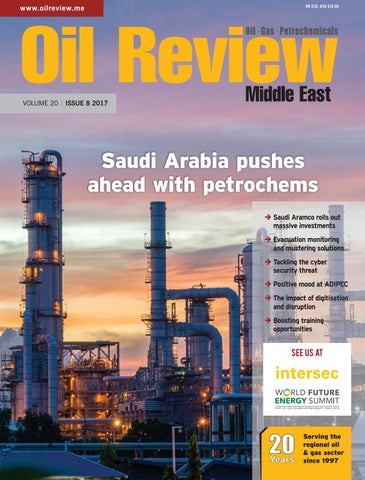
Saudi Arabia pushes ahead with petrochems Saudi Aramco rolls out massive investments Evacuation monitoring and mustering solutions Tackling the cyber security threat Positive mood at ADIPEC
The impact of digitisation and disruption Boosting training opportunities
SEE US AT
www.oilreview.me
20
Serving the regional oil & gas sector since 1997
S01 ORME 8 2017 - Start_Layout 1 14/12/2017 05:00 Page 2
S01 ORME 8 2017 - Start_Layout 1 18/12/2017 13:04 Page 3
Editor’s note SAUDI ARABIA AND Saudi Aramco are the focus of this issue. 2018 looks like being a big year for the state oil giant, with an IPO lined up and massive investments being rolled out. The focus is on the expansion of its downstream portfolio, in line with its ambition to become a major global integrated energy/chemicals firm by 2020 and the Kingdom’s Vision 2030 blueprint to boost investment, diversify the economy and create new jobs. (See our articles on p12 and p16). Meanwhile, the localisation initiative (IKTVA) is yielding results (see p20). We also report on ADIPEC, where the mood was decidedly upbeat, with the oil price topping US$60 and sustained efforts to improve operational efficiencies and diversify operations starting to pay off. Exhibitors generally expressed optimism about prospects for the development of their business in the region.
Serving the world of business
Editor: Louise Waters - orme@alaincharles.com Editorial and Design team: Prashant AP, Hiriyti Bairu, Miriam Brtkova, Kestell Duxbury, Ranganath GS, Samantha Payne, Rahul Puthenveedu, Rhonita Patnaik, Deblina Roy, Nicky Valsamakis and Vani Venugopal Managing Editor: Georgia Lewis
Publisher: Nick Fordham Sales Director: Michael Ferridge Group Magazine Manager: Graham Brown +971 4 448 9260 graham.brown@alaincharles.com Magazine Sales Manager: Tanmay Mishra +91 80 65684483 tanmay.mishra@alaincharles.com
Calendar 4
USA
Bola Olowo +234 8034349299 bola.olowo@alaincharles.com Michael Tomashefsky +1 203 226 2882 +1 203 226 7447 michael.tomashefsky@alaincharles.com
Head Office: Alain Charles Publishing Ltd University House, 11-13 Lower Grosvenor Place, London SW1W 0EX, United Kingdom +44 (0) 20 7834 7676 +44 (0) 20 7973 0076 Middle East Regional Office: Alain Charles Middle East FZ-LLC Office L2-112, Loft Office 2, Entrance B, P.O. Box 502207, Dubai Media City, UAE +971 4 448 9260, +971 4 448 9261 Production: Shaheen Shaikh, Rakshith Shivakumar, Srinidhi Chikkars and Eugenia Nelly Mendes production@alaincharles.com
Executives’ calendar and event news
Evacuation monitoring and mustering solutions Technological advancements in evacuation monitoring and mustering systems
ADIPEC Review Oil & Gas News 8
36
40
Analysis 12
16
46
Saudi Aramco gears up for a big year
Advancing women in the oil and gas workforce The ADIPEC Women in Energy conference highlighted the growing importance of women in the oil and gas industry
Saudi Arabia’s oil giant is rolling out huge new investment plans, with an IPO lined up for 2018
Chairman: Derek Fordham
Bringing fire-fighting technology to the Middle East Turkey-based VOLKAN discusses prospects for its business in the Middle East
Moving ahead with petrochems production Saudi Arabia is emerging as a significant player in the global chemicals market
Positive vibes at ADIPEC The mood at ADIPEC was upbeat, with exhibitors optimistic about business opportunities in the region
Developments A round-up of the latest news from across the region
Subscriptions: circulation@alaincharles.com
Technology
Printed by: Buxton Press Printed in: December 2017
32
Event news and a preview of Middle East Electricity
International Representatives Nigeria
Contents
20
Increasing the local contribution
48
A new report from APICORP assesses the progress of Saudi Arabia’s In-Kingdom Total Value Add (IKTVA) programme
© Oil Review Middle East ISSN: 1464-9314
Training & Development 24
The impact of digitalisation and disruption on capital projects
50
Award for BP Khazzan project BP Oman has won the ‘Advancements in Asset Performance’ category in Bentley’s Be Inspired Awards programme, for the Khazzan Gas Production project in Oman
Developing skills of Kuwaiti engineers A programme organised jointly by Fluor and the Kuwait Fund for Arab Economic Development is providing valuable training for Kuwaiti graduate engineers
Transforming innovation through digital disruption
Project focus 55
Saudi Arabia project list
Safety & Security 29
www.oilreview.me email: orme@alaincharles.com
Tackling the cyber security threat Strategies to combat complex cyber and critical infrastructure security threats were discussed at the ADIPEC Security in Energy conference
Arabic 5
News/Analysis Cover pic: Chalermchai K
Issue 8 2017
oilreview.me
3
S01 ORME 8 2017 - Start_Layout 1 14/12/2017 10:37 Page 4
Calendar 2018
Executives’ Calendar 2018 JANUARY 15 - 18
World Future Energy Summit
ABU DHABI
www.worldfutureenergysummit.com
21 - 23
Intersec
DUBAI
www.intersecexpo.com
22 - 24
Homeland Security Masterclass
MUSCAT
www.homelandsecurityseries.com
FEBRUARY 12 - 14
Egypt Petroleum Show
CAIRO
www.egyps.com
19 - 21
ME-TECH 2018
DUBAI
www.europetro.com/events
5-8
GEO 2018
MANAMA
www.geo2018.com
6-8
Middle East Electricity (MEE) 2018
DUBAI
www.middleeastelectricity.com
6-7
Saudi Downstream Forum
YANBU
www.saudidownstream.com
11 - 13
GPCA Research & Innovation Summit
DUBAI
www.gpcaresearch.com
26 - 28
Oman Oil & Gas Exhibition & Conference (OGWA)
MUSCAT
www.ogwaexpo.com
26 - 27
OpEx MENA 2018
MANAMA
www.europetro.com
28 - 29
Gulf Safety Forum
MANAMA
www.europetro.com
Kuwait Oil & Gas Summit
KUWAIT
www.cwckuwait.com
29 - 3 May SOGAT 2018
ABU DHABI
www.sogat.org
30 - 3 May OTC 2018
HOUSTON
www.2018.otcnet.org
DUBAI
www.gulfhomelandsecurity.com
BAKU
www.caspianoilgas.az
MARCH
APRIL 17 - 18
MAY 7-8
Homeland Security Middle East
29 - 1 June Caspian Oil & Gas
Readers should verify dates and location with sponsoring organisations, as this information is sometimes subject to change.
4
oilreview.me
Issue 8 2017
S02 ORME 8 2017 - Oil gas and petrochems News_Layout 1 13/12/2017 06:44 Page 5
S02 ORME 8 2017 - Oil gas and petrochems News_Layout 1 13/12/2017 06:44 Page 6
Events
Middle East Electricity is forecast to attract its highest ever turnout for the 2018 edition
MEE evolves in response to
regional demands Middle East Electricity (MEE), the region’s leading annual international trade event for the power industry, is undergoing major expansion in 2018 to service the shifting demand dynamics of the regional sector. O AID ONGOING growth, Informa Exhibitions, the event organiser, has launched a dedicated Energy Storage & Management Solutions sector for the show, which is hosted by the UAE Ministry of Energy and runs at the Dubai World Trade Centre from March 6-8 2018. Informa will also debut the thought-leading Global Smart Energy Summit alongside the mega exhibition. “Middle East Electricity is evolving in line with the regional industry, which is now one of the world’s most vibrant,” said Anita Mathews, group director – Industrial Portfolio at Informa Exhibitions. “Our new dedicated product sector will launch as the Middle East and Africa's most comprehensive coming together of local, regional and international energy storage and management providers, with international manufacturers demonstrating the latest technologies transforming industry practices to regional audiences. “With governments looking to meet spiraling demand of between seven to eight per cent a year caused by population growth and industrialisation, change is the name of the game across the entire Middle East and Africa power gambit. There is also a tremendous appetite to embrace technologies and renewables to combat climate change, deliver smart cities and make local ecosystems more resilient.” Energy Storage & Management Solutions will join the Transmission & Distribution, Power
T
6
oilreview.me
Issue 8 2017
Generation and Lighting specialised sectors at the show, along with Solar, which joins the MEE fold as a dedicated sector after six years as a co-located event. “Solar is now undoubtedly one of the fastest-growing sectors in the region, with the Middle East Solar Industry Association putting the number of solar projects under execution throughout MENA at 3,610 with another 1,300 under tender,” added Matthews. “Mega projects are being jumpstarted across both North Africa and the GCC, while there is increasing acceptance and uptake of rooftop solutions, which have witnessed a 10-fold demand surge in the UAE in the last 12 months alone. This advancing sector, now benefitting from region-wide clean energy policies, holds out enormous opportunities for developers, EPC contactors, equipment suppliers and financiers,” she added. The 2018 edition will host more than 1,615 companies from 66 countries, supported by 24 dedicated country pavilions. Covering the entire value chain of electricity products and services across the show’s five sectors, Informa anticipates its highest turnout ever for MEE 2018, reflecting the transformation currently underway throughout the MENA power industry. “This scale of evolution is nothing short of breathtaking, with APICORP forecasting the GCC investment requirement at US$85bn for an additional 69 GW of generation capacity, and US$52bn for transmission and
distribution over the next five years.” APICORP says GCC power capacity needs to expand at an average of eight per cent annually up to 2020, with Saudi Arabia facing the biggest demand and needing to invest US$71bn to increase capacity to 114GW. “With regional governments increasingly focused on economic diversification, demand is unlikely to slow for some considerable time. This has more keenly focused the global industry’s attention on the region and the show will reflect this with an international exhibitor base looking to engage with local players,” concluded Mathews. Alongside MEE 2018, Informa will also debut the Global Smart Energy Summit, a high-level summit featuring some of the biggest corporate champions in sector transformation, including Tesla, US National Renewable Energy Laboratory, US Department of Energy and NASA. The Summit sessions will lay out the future of the international sector and are expected to attract over 700 attendees exploring reform patterns across the entire power spectrum. Middle East Electricity is held under the patronage of HH Sheikh Maktoum Bin Mohammed Bin Rashid Al Maktoum, Dubai Deputy Ruler, and is hosted by the UAE Ministry of Energy. n For more information, please visit www.middleeastelectricity.com.
S02 ORME 8 2017 - Oil gas and petrochems News_Layout 1 13/12/2017 06:44 Page 7
S02 ORME 8 2017 - Oil gas and petrochems News_Layout 1 18/12/2017 16:08 Page 8
CB&I receives EPC award for SASREF’s refinery in Al-Jubail
ABDULAZIZ M AL-JUDAIMi, senior vice president of Downstream at Saudi Aramco, has inaugurated Saudi Aramco Trading Singapore (SATS). The expansion of Aramco Trading in Singapore is part of Aramco’s strategy to optimise value across the whole oil and products chain, as well as Representatives of Saudi Aramco support the company’s during the inauguration ceremony. expanding refining operations and petrochemical output. Oil product demand in Asia Pacific has grown in the past decade to reach 32.6 mn bpd in 2016. According to Wood Mackenzie’s forecast, the growth is expected to continue based on an average GDP growth of 3.7 per cent between 2016 and 2035. Demand is expected to reach about 41mn bpd in 2035, with China and India projecting to account for more than 75 per cent of the demand growth in Asia Pacific. Aramco said that being the largest physical oil trading hub and price discovery centre in Asia, Singapore also has the largest concentration of oil storage in Asia, with 10mn cu/m of independent oil storage capacity.
SAUDI ARAMCO SHELL Refinery (SASREF) has awarded a contract worth US$95mn to CB&I to provide engineering, procurement and construction management for SASREF's existing refinery in Al-Jubail city in Saudi Arabia. CB&I has completed the conceptual design and FEED phases of the project, while working with SASREF to optimise investment on the new refinery configuration. CB&I's integrated solutions are expected to give SASREF the operating flexibility for generating maximum returns SASREF’s refinery in Al-Jubail is through sustainable fuels one of the world's most production, which meets Euro V technologically advanced regulations for cleaner refineries. emissions. According to Duncan Wigney, executive vice-president of engineering and construction at CB&I, “This award demonstrates CB&I's ability to deliver value to SASREF and our other customers in the Middle East. It also enhances CB&I's position in the region as a leading provider of energy infrastructure solutions, from conceptual design to fabrication to EPC delivery.”
Image Credit : Saudi Aramco
Aramco Trading inaugurates first international office in Singapore
ADNOC Distribution offer price set at AED2.50 (US$0.68) per ordinary share ABU DHABI NATIONAl Oil Company for Distribution PJSC has set the pricing for the initial public offering at US$0.68 per ordinary share. Based on the offer price, the company’s market capitalisation at listing is expected to be approximately US$8.5bn. The number of shares included in the offering is 1,250,000,000, which represents 10 per cent of the share capital. The company said that immediately after the offering, Abu Dhabi National Oil Company (ADNOC Group), the Company’s parent, will continue to own 90 per cent of the share capital. The value of ordinary shares sold in the offering totals US$851mn. Speaking about the IPO, Dr Sultan Ahmed Al Jaber, CEO of ADNOC Group, said, “This important and strategic offering represents a unique opportunity for investors to own a stake in the UAE’s number one fuel retail brand, and largest network of retail convenience stores.” At listing, the company is expected to have the fourth largest capitalisation on the Abu Dhabi Securities Exchange (ADX). The transaction marks the first IPO on the ADX using a book building process, in line with international best practice. This has led to substantial interest and engagement from high quality, global institutional investors allowing for increased Foreign Direct Investment into the UAE, on top of the high demand and interest from local retail investors. The IPO represents the first IPO of an ADNOC subsidiary company, and creates a new platform and route for further value creation. The offering represents a further step in ADNOC’s new value creation strategy, and the more proactive management of its portfolio of assets and capital, to unlock value and drive growth. ADNOC retains a 90 per cent shareholding in the company and is fully aligned with other shareholders as the company looks to further growth. According to ADNOC, significant interest and demand from UAE-based investors paves the way for further interest and investment in future transactions.
8
oilreview.me
Issue 8 2017
Image Credit : SASREF
News
S02 ORME 8 2017 - Oil gas and petrochems News_Layout 1 13/12/2017 06:44 Page 9
S02 ORME 8 2017 - Oil gas and petrochems News_Layout 1 13/12/2017 06:44 Page 10
News
TechnipFMC awarded Bapco Sitra refinery expansion in Bahrain UK-BASED TECHNIPFMC, jointly with Samsung Engineering and Tecnicas Reunidas, has been awarded a US$4.2bn contract from Bahrain Petroleum Company (Bapco) for the Bapco modernisation programme (BMP). The project is located on the eastern coast of Bahrain and entails the expansion of the capacity of the existing Sitra oil refinery from 267,000 to 360,000 bpd. The partnership is expected to improve energy efficiency and valorise the heavy part of the crude oil barrel with the aim to enhance the products slate and meet environmental compliance. The project will be executed on an engineering, procurement, construction and commissioning (EPCC) lump sum turnkey basis and is slated for completion in 2022, said TechnipFMC. Main units include: Residue Hydrocracking Unit, Hydrocracker Unit, Hydro Desulfurisation Unit, Crude Distillation Unit, Vacuum Distillation Unit, Saturated Gas Plant, Hydrogen Production Unit, Hydrogen Recovery Unit, Sulphur Recovery Unit, Tail Gas Treatment Unit, Sour Water Stripper Unit, Amine Recovery Unit, Bulk Acid Gas Removal Unit, Sulphur Solidification Unit and Sulphur Handling Facilities. The BMP project is seen to capitalise on the vast experience of the joint venture partners in Bahrain as well as in the region. Nello Uccelletti, president of onshore offshore business at TechnipFMC, stated, “This award is one of the strategic early engagement achievements, following the successful completion by TechnipFMC of the FEED contract.” The company is looking forward to successfully execute the contract and aims to build a long-term partnership with Bapco to strengthen its presence in the refining sector.
Saudi Aramco’s Jazan refinery project to be completed by mid-2018 The company's corporate management visit the Jazan refinery and terminal mega-project.
Image Credit : Saudi Aramco
AMIN NASSER, PRESIDENT and CEO of Saudi Aramco, has visited the company’s Jazan refinery to receive progress updates on the Jazan Economic City (JEC) and refinery and terminal mega-projects in Saudi Arabia. During the site visit, Nasser said that the project is expected to herald the beginning of a historic new economic era for both the region and the Kingdom.
At the Jazan Project Management office, corporate management received a comprehensive progress update by Khalid S Al-Gazlan, manager of the Jazan Integrated Gasification Combined Cycle (IGCC) Projects Department. Nasser added that he also had discussions with the corporate management team on the project and underlined the company’s support for the work of the Jazan project management team. He further noted that the complex is scheduled to be completed by mid-2018, with full operation to be achieved by 2019. The Jazan project aims to enable an industrial springboard to achieve the vision of a diversified economy under Kingdom’s strategic Vision 2030 economic road map. The 106 sq km JEC will host the refinery complex as its anchor tenant, and is viewed as pivotal to deliver economic transformation in the region, while attracting foreign investment. “It’s a shared effort,” Nasser said. “We need to continue to move ahead as we are in the midst of creating a new and thriving era in Jazan.” The corporate management delegation also toured the underconstruction port, where massive dredgers could be seen at work, and were briefed on the progress of complex engineering and construction packages that are expected to be integrated to reach the processing capacity of more than 400,000 bpd of crude oil. Nasser said that this could provide fuel for domestic and international customers. “The complex will be entirely self-sufficient and provide power to locally owned manufacturing and service companies,” Aramco noted. Nasser thanked to the Jazan management team for their effort in addressing and overcoming several challenges as the programme accelerates toward completion. He said, “Jazan is a major project, considering the size of other facilities that we have built, and we have good teams working here to deliver the project successfully.” 10
oilreview.me
Issue 8 2017
S03 ORME 8 2017 - Analysis 1_Layout 1 13/12/2017 06:50 Page 11
S03 ORME 8 2017 - Analysis 1_Layout 1 13/12/2017 06:50 Page 12
Saudi Arabia
Moving ahead with
petrochems production Saudi Arabia is emerging as a significant player in the global chemicals market, says Moin Siddiqui, economist. HE PETROCHEMICALS INDUSTRY of today is Table 1: The top 10 chemical companies ranked by 2016 sales fundamental to other key industrial sectors, (US$mn) producing a wide range of products including Company Country Sales Operating Total R&D Capex Workforce cosmetics, paint, gels, pharmaceuticals, polar profits assets solvents, plastic, rubber, dyne liquids, detergents, BASF Germany 60,557 6,639 80,493 1,960 4,606 113,830 textiles, fibres, resins, elastomers and lubricants. Sinopec China 48,225 2,970 Including the pharmaceutical sector, the chemical Dow Chemical USA 48,158 5,075 79,511 1,584 3,804 56,000 industry generates over US$4 trillion of revenue KSA 35,415 7,140 84,492 3,492 35,000 globally. The 21st century has seen a marked shift from SABIC west to east in the petrochemicals business, with the INEOS UK 32,870 4,652 GCC region emerging as “the foremost global Mitsubishi Chemical Japan 30,296 2,590 40,055 1,133 1,853 69,291 petrochemical hub,” according to Dow Chemical. Holdings Major consumption centres are shifting to emerging Lyondell Basell Holland 29,183 5,060 23,442 99 2,243 13,000 Asia, driven by robust demand in China and India. Industries Saudi Arabia accounts for two thirds of the GCC’s ExxonMobil Chemical USA 26,058 5,917 30,053 2,207 chemical capacity, which in 2016 totalled 150mn DuPont USA 24,594 4,640 39,964 1,641 1,038 46,000 tonnes, according to the Gulf Petrochemicals and Air Liquide France 19,083 3,220 46,423 67,000 Chemicals Association (GPCA). The region’s chemical production grew faster than the global average of 2.2 Source: ICIS Chemical Business September 2017 per cent in 2016 due to new capacity added in Saudi Arabia. GPCA figures show that GCC chemicals capacity utilisation has exceeded 90 per cent over past five years – remain the most competitive globally. In early 2016, feedstock prices surpassing the global utilisation average of 78 per cent. Between 2020 for ethane and methane were raised to US$1.75 and US$1.25 per and 2024, eight million tonnes of new capacity is expected online in million British thermal units (Btu) from US$0.75/mn Btu. The costs of the region. electricity and water also rose by 40 per cent.
T
Downstream specialty
Despite higher energy prices, Saudi producers remain the most competitive globally” The Kingdom’s petrochemical sector – contributing 10 per cent of total exports – received US$150bn in total cumulative investments by 2016. Saudi Basic Industries Corporation (SABIC) ranks among the world’s top five chemicals companies (Table 1). SABIC is one of the biggest producers of polyethylene, ethylene glycol, propylene, polyolefin and polycarbonate, among others. By 2020, SABIC is projected to produce over 135mn tonnes, up from 98.8mn tonnes in 2016. The heavy usage of ethane and liquid petroleum gas (LPG) as feedstock means production of olefins such as ethylene and methanol largely dominates Saudi capacity; whilst aromatics obtained from oil derivative (naphtha) comprises under one fifth of total output. Furthermore, the lack of chemical conversion units in Saudi Arabia and other GCC states implies output is geared mainly towards basic commodity chemicals with low downstream capabilities (i.e. more sophisticated products). Despite higher energy prices, Saudi producers 12
oilreview.me
Issue 8 2017
Saudi Aramco aims to become a major global integrated energy/chemicals firm by 2020 and to rank among the top three aromatics producers in 2018. It plans to invest US$100bn over 10 years in downstream sectors. New sophisticated projects bode well for the Kingdom’s strategy to diversify its economy. These include the US$20bn Sadara Chemical joint venture between Saudi Aramco and the USA’s Dow Chemical, PetroRabigh 11 (JV between Saudi Aramco and Japan’s Sumitomo Chemicals) and the US$3.4bn Kemya Elastomers facility, an affiliate of SABIC and Exxon Chemical Arabia. The latter is the first synthetic rubber plant in Saudi Arabia, producing 400,000 tonnes/year of rubber, thermoplastic speciality polymers and carbon black. Sadara at Jubail is the world’s largest integrated chemicals plant ever built in a single phase, with 26 manufacturing units utilising multi-feed cracker (the first in the Gulf) to produce 3.2mn tonnes/year of chemicals (previously imported). These include pygas, pyoil, isocyanates, amines, polyols, propylene glycol and PE/elastomers. The JV is beneficial for both partners; Aramco gains access to Dow Chemical’s proprietary technology, whilst Dow gains from subsidised feedstocks. Sadara is forecast to yield annual revenues of US$10bn by 2020. Meanwhile, the expanded PetroRabigh 11 complex (costing US$7bn) is near completion also at Jubail, which has a 2.4mn
S03 ORME 8 2017 - Analysis 1_Layout 1 13/12/2017 06:50 Page 13
S03 ORME 8 2017 - Analysis 1_Layout 1 14/12/2017 11:21 Page 14
Saudi Arabia Chart 2: Saudi petrochemical feedstock usage 2016 % of total
tonnes/year of petrochemicals capacity plus 400,000 bpd of refined petroleum capacity. A planned mega project is the ‘Oil-to-Chemicals’ complex in Yanbu (at a reported cost of US$30bn). SABIC and Aramco agreed to conduct a feasibility study on an integrated plant to process crude directly into chemicals, cutting out the costly intermediate link in the production of plastics and diversifying the feedstock mix.
Riyadh-based Jadwa Investment explained, “The creation of a downstream specialty and end-product sector is vital not only for establishing a higher value adding manufacturing base, but also for pushing the Kingdom’s non-oil exports.” Hence the need for greater specialisation and innovation in the sector. New technologies have helped global chemicals firms to reduce output cost and gain product superiority, while achieving a higher return on assets. S&P Global Platts noted, “For the Saudi Arabian petrochemical industries to be a real global competitor, the authorities might need to assess the overall industry and take the appropriate measures, such as merging entities. This (if well planned and well executed and monitored) will make Saudi petrochemical industries a global player and not a follower.” Value-added specialty chemicals require developing or acquiring the requisite technology and know-how. According to GPCA, the Gulf countries accounted for just two per cent of global chemicals research and development spending in 2015. Experts suggest moving up the value chain into more complex derivative products could increase returns from US$500 to around US$2,000/tonne by 2040 and boost employment. In fact, each direct job created in the chemicals sector can potentially create four additional indirect jobs, according to GPCA estimates.
Chart 1: KSA petrochemical capacity 2016 2%
% of total
9%
13% 20%
40%
Aromatics
Propylene
Methanol
Butadiene
Ethylene
Inorganic chemicals
Source: Jadwa Investment Research February 2017
14
oilreview.me
Issue 8 2017
9%
12%
Challenges for Gulf producers
13%
7%
46%
26%
Ethane
Propane
Naphtha
Methane
Butane
Source: Jadwa Investment Research February 2017 The next decade is likely to see a significant hike in global petrochemicals capacity. US chemicals firms are helped by cheap and abundant feedstock supply, thanks to the shale gas boom. Between 2007 and 2016, US natural gas output rose nearly two-fifths to 749.2bn cubic metres – making the country the number one gas producer (BP figures). Concurrently, ethane/propane prices saw steep falls in recent years – leading to more investment in supply chain infrastructure. The Energy Information Administration (EIA) expects a 40 per cent surge in US ethylene capacity during 2017-18, or one-fifth of global ethylene capacity. The development of coal-based technologies such as methanol-toolefins (MTO) and coal-to-olefins (CTO) can boost future petrochemical supply. China, number one coal producer (with the third largest global reserves) – is investing into alternatives in order to compensate for relatively modest hydrocarbons resources and satisfy domestic demand. Industry sources predict steep hikes in MTO and CTO capacities of China from three million tonnes in 2015 to 10mn tonnes by 2025. Iran – the world’s largest holder of gas reserves – plans to double petrochemicals capacity (which totalled 60mn tonnes in 2014) by 2021, according to National Petrochemical Co. This ambitious target depends on attracting foreign direct investment estimated at US$7-10bn/year and new technologies to upgrade infrastructure and build new units after decades of decay caused by international sanctions. Some European and Asian companies have expressed interest in investing in the sector.
Full value chains To remain competitive in regional and global markets, Saudi Arabia devised a new initiative ‘National Industrial Clusters Development Programme’ aimed at exploiting the value-added potential of local resources. It targets investment and growth in five key industries: plastics/packaging, metals/minerals, automotives, home appliances and solar energy. These sectors rely in some way on chemicals – hence benefiting from ample raw materials and cheap energy supply. The non-oil sectors are being encouraged to grow horizontally into various conversion industries. A 2014 report by American Institute of Chemical Engineers (AIChE) highlighted the importance of the chemicals sector in the industrialisation of the Kingdom; for example: • The plastics packaging sector requires a polymer-conversion industry; • Home appliances need upgraded polymers, such as acrylonitrile
S03 ORME 8 2017 - Analysis 1_Layout 1 15/12/2017 12:53 Page 15
Saudi Arabia
butadience styrene (ABS) and nylon for casings and other assorted components; • Carmakers use huge volumes of plastics and composites in vehicles to reduce weight and for essential components (tyres); • Solar panels contain polymers such as ethylene vinyl acetate (EVA) film; • Downstream processing of metals requires processing fluids, which are oil and chemical-based to produce higher value products.
Table 2: Saudi Arabian ethylene feedstocks (%) 2015
2024
Naphtha
11
17
Ethane
62
57
Propane
25
25
Butane
1
1
Source: S&P Global Platts
“The government has, and still is, investing heavily in the sector, encouraging investor participation and supporting Saudi-foreign joint ventures for new petrochemical projects. Ultimately, sustainable growth for the sector over the long term can really only be achieved by moving down and across the petrochemical value chain, and this is currently beginning to take place in the Kingdom,” noted Jadwa Investment in its February 2017 report. In sum, refinery/petrochemical integration and building new plants for producing specialty chemicals will enable Saudi producers to compete more effectively with their European and US counterparts. As
part of the “Vision 2030”, the petrochemical industry is poised to expand three-fold over the next decade.
Notes *Petrochemicals are chemical products derived from petroleum. Some chemical composites are also derived from other fossil fuels like natural gas, coal or renewable sources such as sugar cane or corn. The two most typical petrochemical classes are olefins and aromatics. Oil refineries produce both substances by fluid catalytic cracking of petroleum fractions. *Chemical production is classified into two distinct categories: ‘Speciality chemicals’, which are more expensive and produced by fewer manufacturers. ‘Basic chemicals’ and intermediaries are often produced in large volumes by commodity manufacturers, but lower in value compared to specialty chemicals. *Polymers and plastics are the main chemical products, comprising around four fifths of the industry’s production volume. Ethylene and its derivatives are also widely used products. China is the largest single consumer of ethylene. The chemical industry is the second largest consumer of energy in the manufacturing sector. *Gas produced in Saudi Arabia is mostly ‘wet’, which in addition to methane and ethane also contains natural gas liquids (i.e. propane and butanes). Proved gas reserves (excluding the Neutral Zone) at end-2016 were 8.4 trillion cubic metres, with an estimated 16.9tn cubic metres of unconventional shale gas. Dry natgas output in 2016 was 3.9 trillion cubic feet (EIA figures). Aramco plans to double gas output capacity in a decade, including shale gas developments to provide feedstock to the petrochemical industry and limit oil usage in power generation. n
Issue 8 2017
oilreview.me
15
S04 ORME 8 2017 - Analysis 2_Layout 1 15/12/2017 12:56 Page 16
Saudi Aramco
Image Credit : Chalermchai/Adobe Stock)
Saudi Aramco is focusing increasingly on downstream development, in line with Vision 2030 aims to diversify the economy, boost investment and create jobs
Saudi Aramco gears up for a
big year Times are changing for Saudi Aramco, Saudi Arabia’s state oil giant, with an IPO lined up for 2018 and huge new investment plans being rolled out, says Martin Clark. HESE ARE EVENTFUL times for all at Saudi Aramco. Perhaps the most significant change of all, however, is the national oil champion’s proposed listing on the stock market during 2018. It has been estimated that this could value the flagship company at a staggering US$2 trillion. The proposed sale is a centrepiece of Vision 2030, an ambitious government-backed reform plan to diversify the Saudi economy beyond crude oil exports. Plans are still taking shape, but officials insist that the initial public offering (IPO) – which will only offer around five per cent of the company to investors – is still on track for next year, although there remains much work to do. That includes a decision on where the IPO will be listed, with Saudi officials looking at both domestic and international stock exchanges such as New York, London, Tokyo and Hong Kong. The fact that a decision on which exchange will secure the listing is yet to be made has inevitably fuelled speculation in the markets that the IPO could be delayed beyond 2018 – or even shelved – amid concerns about the feasibility of an international listing. International markets have been queuing up to court Saudi officials in a bid to secure the deal. The UK, for instance, has said it will provide US$2bn in credit guarantees to Aramco so it can buy British goods more easily. The timing of the IPO could also be influenced by the oil price, currently below US$60 per barrel. Nonetheless, Saudi Arabia’s Crown
T
Aramco has been rolling out massive investments in its downstream capacity”
16
oilreview.me
Issue 8 2017
Prince Mohammad bin Salman insists that the deal will go ahead in 2018 as scheduled. He hopes to raise cash from the IPO sale to finance investments to help wean the kingdom off its dependency on oil exports, another key strategy in the nation’s long-term economic plans.
Massive investment In some ways, this is already taking place, irrespective of the planned Aramco IPO. For years, the company has been rolling out massive investments in its downstream capacity, working alongside foreign investors, and also nurturing the nation’s gas sector. Most recently, Aramco agreed to join a US$20bn venture to convert crude oil to chemicals, in partnership with petrochemicals producer Saudi Basic Industries Corp (SABIC). The crude oil to chemicals (COTC) complex will process 400,000 bpd of oil, to produce nine million tons of chemicals and base oils annually. It is expected to start operating in 2025. Aramco’s president and chief executive Amin H. Nasser called it a vital new strategic direction for the group. “COTC will also help expand our downstream portfolio, reducing our focus on the transportation sector and securing new and promising commercial opportunities.” The venture also sits well with Saudi’s Vision 2030 blueprint, by boosting investment, diversifying the economy and creating new jobs for Saudi nationals. The complex is expected to create an estimated 30,000 direct and indirect jobs by the time it opens. Aramco and SABIC – the two largest Saudi global entities – estimate that by 2030 the COTC complex will boost the nation’s gross domestic product (GDP) by as much as 1.5 per cent. It marks the first time the country’s two largest economic entities have entered into a strategic partnership to develop a pioneering and innovative new technology; it also hedges the enormous cost and associated risks. Once completed, the project will be the largest crude oil to chemicals complex in the world, and spin off a new outlet for Saudi
S04 ORME 8 2017 - Analysis 2_Layout 1 13/12/2017 06:53 Page 17
S04 ORME 8 2017 - Analysis 2_Layout 1 13/12/2017 06:53 Page 18
Saudi Aramco Saudi Arabia oil, gas and petrochemicals Aramco’s immense oil production. A final investment decision is anticipated by the end of 2019, although it could be the first of more projects to come, according to Nasser. “It’s a starting point,” he told Reuters. “There will be others in the future as we develop our technologies to shift or turn more barrels of crude into chemicals. We are looking at chemicals as a very attractive market for diversification.”
Upstream initiatives That does not mean Aramco has taken its eye off the ball when it comes to its core upstream activities, which continue to bankroll the economy. As well as being the world’s greatest oil producer, this also means continued strengthening of the gas sector. Aramco recently confirmed a clutch of agreements with local and international contractors for major upstream projects worth nearly US$4.5bn as it seeks to upgrade infrastructure on key gas fields [see box]. Nasser said that these works form a part of the group’s natural gas expansion plans, to add about one billion standard cubic feet per day (scfd) to overall production. “This reflects our commitment to introducing new supplies of cleanburning natural gas,” he said. “These new supplies will help reduce domestic reliance on liquid fuels for power generation, enable increased liquids exports, provide feedstock to petrochemical industries, and reduce carbon emissions.” Saudi Arabia is still a heavy user of oil in its power plants, although there is a clear shift to gas. And there are more ambitious plans shaping up too. The company continues to push new frontiers upstream, including mapping its offshore Red Sea territory – an area of almost 200,000 sq km – an exercise that first began a decade ago. Just like the Eastern Province in
2013
2014
2015
Crude oil & condensate reserves (bn barrels) 260.2
261.1
261.1
2016 260.8
Crude oil production (mn bpd)
9.4
9.5
10.2
10.5
Crude oil exports (mn barrels)
2,677.0 2,544.0 2,603.0 2,799.0
Gas reserves (trillion scf)
288.4
294.0
297.6
298.7
Raw gas processed (bn scfd)
11.0
11.3
11.6
12.0
NGL from hydrocarbon gases (mn barrels)
455.9
471.3
474.4
497.5
Total NGL sales (mn barrels)
320.7
329.9
331.2
365.5
Refined products production (mn bbl)
494.0
561.0
641.0
665.0
Refined products export (mn bbl)
121.0
168.0
232.0
296.0
Source: Saudi Aramco
the early 1940s, the Red Sea was, and still largely is, frontier territory – but Aramco chiefs hope it could one day be a catalyst to spur growth and industry in the country’s Western Region. Early 2D seismic data revealed positive signs for the presence of hydrocarbons in geological traps. More recently, this prompted a largescale hydrographic survey to better understand seafloor conditions, and help support any future oil field operations, including rig movements, laying of pipelines and the routes of supply vessels. This was followed by more precise 3D mapping of the Red Sea, which is still in full swing but yielding “unprecedented results”, according to company sources. It is early days and not clear yet what the potential of this area is – nor when any first drilling might commence – but it is an exciting new play for Aramco to test its skills when ready. Like the push into new markets, such as chemicals, or even the financial markets, it holds great promise for the future. n
Saudi Aramco: current upstream projects North, South and Satellite Gas Compression Plants: improving and sustaining gas production from the Haradh and Hawiyah fields by reducing wellhead choke pressure. The programme will also boost production by around 1.3bn standard cubic feet per day, supplementing sales gas and condensate production. Contracts awarded to Técnicas Reunidas. Hawiyah Gas Plant (HGP) Expansion: provide additional gas processing facilities to process 1,070mn standard cubic feet per day of raw sweet gas, to be on stream by June 2021. Once completed, the project will make Hawiyah one of the largest gas processing facilities in the world. Contract awarded to Snamprogetti. Free Flow Pipeline Contract: installing 450 km of pipelines by early 2019 to allow for free flowing gas from the Haradh field to the Hawiyah Gas Plant to ensure a sustained gas production from Haradh and Hawiyah fields until the completion of compression plants. Contract awarded to China Petroleum Pipelines (CPP) Company. Zuluf Field Development Programme: will provide facilities to process Arab heavy crude from the Zuluf offshore field. The scope of work includes water injection and oil wellhead platforms, tie-in platforms, trunk lines and flowlines. EPC contract awarded to Jacobs Engineering Inc. TP 21, Trunklines 14 & 15 at Safaniyah Field: one tie-in platform (jacket and deck) to serve as an additional gathering hub for future oil wellhead platforms at the Safaniyah field. It will also provide an additional power supply for the Safaniya field via a 20 km subsea cable. Contract awarded to Abu Dhabi-based National Petroleum Construction Company (NPCC). Slipover Platforms & Electrical Distribution Platform, Safaniyah Field: installation of 10 new slipover platforms in the South Safaniya field to enhance the crude oil production, plus a new electrical distribution platform to serve as an offshore power substation. Contracts awarded to McDermott Middle East (Dubai).
18
oilreview.me
Issue 8 2017
S05 ORME 8 2017 - Saudi Arabia - Pdn optimisation_Layout 1 14/12/2017 05:28 Page 19
S05 ORME 8 2017 - Saudi Arabia - Pdn optimisation_Layout 1 14/12/2017 11:32 Page 20
Saudi Arabia
Increasing the
local contribution A new report from APICORP assesses the progress of Saudi Arabia’s In-Kingdom Total Value Add (IKTVA) programme. HE PROMOTION OF local content in Saudi Arabia has gained prominence ever since the launch of the IKTVA programme in 2015, which seeks to maximise participation and value for Saudi nationals and companies. IKTVA applies to every Saudi Aramco supplier. When it was launched, Saudi Aramco’s Local Content Requirement (LCR) stood at 30 per cent. The target is 70 per cent by 2021. Saudi Arabia’s IKTVA programme also aims to export 30 per cent of its output from local energy goods and services industries by 2021, and over the long-term, deliver 500,000 direct and indirect jobs for Saudis. To put this into perspective, Saudi Arabia’s average spend on oilfield services alone over the past five years has been approximately US$23bn. A 70 per cent target would crudely translate into a US$16bn benefit per annum back to Saudi Arabia. The promotion of local employment opportunities also provides broader economic benefits to the country. IKTVA mandates preference for qualified nationals where costs and skillsets are comparable to nonnationals. An increase in local jobs will also enhance overall economic activity through greater consumption and investment. An example is the two joint ventures set up with US firms Rowan and Nabors in 2016, providing opportunities to localise the drilling industry and enhance domestic capabilities. The aim is to invest between US$6-7bn on onshore rigs and offshore jackups manufactured locally, to maintain in-country spending. The total initial value of the JVs is estimated at US$2.2bn and could lead to the creation of up to 5,000 jobs. Saudi Aramco is pursuing an integrated programme to encourage suppliers to procure their goods and services locally, evaluating the existing IKTVA scores of its top suppliers and creating five-year plans to help them improve their ratio.
T
Local sourcing is key Mandating companies to source locally manufactured equipment and machinery – where price and quality are comparable to those available internationally – will accelerate technical progress, the report argues. Saudi Aramco has outlined plans to spend US$300bn on its supply chain over a 10-year period, to boost local manufacturing, and by December 2016, over US$16bn worth of contracts were signed in compliance with IKTVA, with companies being given awards in categories such as Saudi workforce training and development, in recognition of their contribution towards IKTVA goals. Saudi Aramco also signed agreements with Jubail Energy Services and ArcelorMittal to develop the local manufacture of tubes used in oil and gas production, which could also represent a cost saving for IOCs. Foreign firms are often required to bring some level of technology and perform R&D to boost competitiveness, encourage start-ups and increase technology patents. Saudi Arabia and Siemens, for example, have negotiated joint R&D agreements on renewable energy and digitisation as part of the Kingdom’s efforts to diversify beyond fossil fuels, as well as bringing in advanced analytics and the latest cloud technology. The report argues that there are challenges to the implementation of LCR polices. For example, measures need to be provided to provide 20
oilreview.me
Issue 8 2017
Saudi Aramco spend on oilfield services ($bn) 30
25
Average = $23bn
20 70% = $16bn
15 10 5 0 2010
2011
2012
2013
2014
2015
Source: Rystad Energy
Saudi Aramco spend on oilfield services (US$bn)
companies and their workforces with the means to grow and develop, such as in ensuring adequate training is provided. IKTVA has partnered with the Technical and Vocational Training Corporation to increase the number of national training centres from 12 to 28 by 2030. Secondly, some flexibility is needed to create the right incentives. And thirdly, the role of government and its ongoing support and engagement with operators, both domestic and foreign, is crucial.
Ensuring success and sustainability The report argues that key to the successful implementation of a local content policy will be the creation of an enabling environment for both local and foreign firms. Localisation plans need to be coordinated and reflect the current state of the industry. Therefore, targeted investment from both government and foreign investors is required to ensure the development of human capital as well as technical progress. The success of the programme will hinge on the establishment of effective monitoring institutions, with tools needed to measure progress, demonstrate results and communicate them publicly. IKTVA has laid the foundation, APICORP argues, by establishing clear targets, creating a registration process and pooling together local suppliers. It has already partnered with several international firms in a series of joint ventures that will see a greater proportion of locally manufactured goods, investments into R&D to help accelerate technological progress, and supporting employment of locals by developing specific and industry-focused jobs. Effective monitoring will ensure that where there are gaps in capacity, they can be addressed, including the alignment of talent development initiatives with employment needs. This will help put firms, particularly foreign firms, at ease, knowing that the country has the domestic capabilities required. n See the full report at www.apicorp-arabia.com/research.
S05 ORME 8 2017 - Saudi Arabia - Pdn optimisation_Layout 1 14/12/2017 05:28 Page 21
S05 ORME 8 2017 - Saudi Arabia - Pdn optimisation_Layout 1 15/12/2017 13:02 Page 22
Events
THE BAHRAIN INTERNATIONAL Exhibition and Convention Centre is set to play host to a critical exchange of oil and gas insights during the 13th Middle East Geosciences Conference and Exhibition (GEO 2018) from 5-8 March 2018. Held under the patronage of the Prime Minister of Bahrain HRH Prince Khalifa bin Salman Al Khalifa, more than 3,500 geoscientists and petroleum industry professionals from 50+ countries will gather to debate and shape the future of the industry, build skills, network with peers and purchase products and services that will take their E&P programmes to the next level. The biannual event, established 24 years ago, incorporates a four-day high-level conference under the theme ‘Pushing the Technical Limits: Shaping the Energy Landscape’ organised by the world’s three largest professional geoscience associations (AAPG, EAGE and SEG) and a parallel three-day exhibition organised by UBM. GEO 2018 is also supported by an organising committee of NOCs, IOCs and major service providers. Pre-registration for GEO 2018 opened in October at www.geo2018.com. An early bird discount is offered on conference fees up until 5 February 2018. “The conference will host a number of executive sessions led by technical influencers and we encourage professionals to take this opportunity to participate and share valuable ideas and knowledge. The conference will focus on geological studies, reservoir challenges and the role of geoscience in the environment, safety, risk management and innovation,” said Ahmad Al Eidan,
The exhibition will cover all areas of the oil and gas exploration industry
Image Credit: UBM
GEO 2018: shaping the energy landscape
GEO 2018 general chair and deputy CEO – Drilling & Technology Directorate, Kuwait Oil Company. “We are certain that GEO 2018 will be an extraordinary platform which will provide all participants with unlimited benefits and will open new frontiers for the current oil industry challenges,” he continued. A three-day exhibition of oil and gas products and services will run parallel to the conference from 6-8 March. Set to feature over 120 exhibitors from 20 countries, the exhibition covers all areas of the oil and gas exploration industry.
For further information, see the website at www.geo2018.com.
SAFETY AND SECURITY is imperative in the oil and gas The last edition of Intersec in January 2017 featured 1,304 exhibitors and welcomed 32,750 industry. With ever-growing challenges in the field and visitors from 129 countries unforeseen threats to infrastructure, security needs constant reinforcement. Modern-day science and the industrial culture of security at the workplace drive industry experts in safety to keep all aspects of oil and gas protected, be it onshore, offshore, pipelines or distribution channels. Intersec 2018 will bring together the very best brands in oil and gas security featuring their new products and services, with specialists who will cover a diverse spectrum of issues faced by the industry. Visitors will be able to connect with the top brands in security and fire protection at the show, which celebrates its 20th anniversary this year. The leading international trade fair for security, safety and fire protection, Intersec 2018 takes place at the Dubai International Convention and Exhibition Centre from 21-23 January. It will occupy 60,000 sq m across 13 halls, with the show’s seven sections covering Commercial Security, Homeland Security, Fire & Rescue, Perimeter & Physical Security, Information & Cyber Security, Safety & Health, and Smart Home & Building Automation. New developments include a Drones Pavilion and an indoor Drone Zone, while returning features include the Safety Design in Buildings Pavilion in the Fire & Rescue section, as well as an Outdoor Demonstration Zone of the latest fire rescue applications in action. A comprehensive three-day conference programme will be spearheaded by Dubai’s Security Industry Regulatory Agency (SIRA) Forum, while other topics will cover cyber security, drones, artificial intelligence, commercial security and fire protection. Intersec 2018 is held under the patronage of His Highness Sheikh Mansoor bin Mohammed bin Rashid Al Maktoum, and supported by Dubai Police, Dubai Civil Defence, the Dubai Police Academy, SIRA, and Dubai Municipality.
More information is available at: www.intersecexpo.com.
22
oilreview.me
Issue 8 2017
Image Credit: Messe Frankfurt
Intersec 2018 to drive safety improvements in the oil and gas industry
S06 ORME 8 2017 - Training and Development_Layout 1 13/12/2017 06:58 Page 23
S06 ORME 8 2017 - Training and Development_Layout 1 13/12/2017 06:58 Page 24
Training & Development
Developing skills of
Kuwaiti engineers EPRESENTATIVES FROM THE Kuwait Fund for Arab Economic Development (Kuwait Fund), recently visited Fluor’s UK office to monitor its ongoing training initiative for Kuwaiti engineers. The engineers are spending six months in the UK working with Fluor’s engineering teams as part of a one-year training programme organised jointly by Fluor and the Kuwait Fund. “Fluor is proud of its long relationship with the Kuwait Fund and role in training Kuwaiti graduate engineers so that they can work effectively in the engineering and construction sector to bring knowledge and experience back to Kuwait,” said Al Collins, president of Fluor’s Energy & Chemicals business in Europe, Africa and Middle East. “This collaboration has been beneficial for all involved, as seeing young engineers develop their technical skills as well as witnessing their personal development is extremely rewarding.” Fluor UK’s involvement in this training programme began in 2013 when the company hosted the first Kuwaiti engineers at Fluor’s Farnborough office. The graduates, holding degrees in engineering disciplines including chemical, electrical, mechanical, telecommunications and civil engineering, travelled to Fluor’s Farnborough office for the six-month practical experience training period. Training and development plans were created for each trainee who were assigned an experienced mentor to manage the training content, including the use of Fluor’s systems and tools as well as software to simulate real-time engineering tasks. “Fluor is a valuable partner in the success of the training programme for Kuwaiti newly graduated engineers and architects,” said Nedhal Al Olayan, director of the Training Center Department at Kuwait Fund. “Our programme provides many opportunities for high-performing graduates to enhance their knowledge in engineering and to provide them with skills required by the private sector in the
R
24
oilreview.me
Issue 8 2017
Nedhal Al-Olayan, Kuwait Fund director of Training Center Department; Ashley Rees, managing director and vice president of Fluor in the UK; and Basel Abdulrahim, Kuwait Fund training coordinator
shortest period possible. Fluor has been instrumental to the success of meeting this objective and has played a major role in working with the UK Government and other
Training and development plans were created for each trainee”
regulatory establishments to meet required procedures.” One of the earliest graduates was Noura Almansour, a recently qualified chemical engineer, who travelled to the UK in 2013 for her first experience of living abroad and independently. In addition to undertaking training relevant to her core process engineering skills, Almansour was an active member of Fluor’s Graduates Advancing SM towards Professionalism (GAP ) organisation. Almansour said, “Participating in the GAP events allowed me to meet many interesting people from different backgrounds and origins which enriched my knowledge and inspired me to pursue higher education, as most GAP members have post-graduate degrees. I found the experience fulfilling as it has had a positive impact on my life.” A more recent graduate, Meshal Adel Abdulsalam, a civil engineering trainee in the Kuwait Fund programme, has just completed his assignment with Fluor and said, “I joined the civil, structural and architectural team in Farnborough, and working with my mentor, I enhanced my knowledge from an academic approach to that of a professional engineer. Upon completion of my training I will take up a job offer from one of Kuwait’s national petroleum companies where I will put my experience to good use for my new employer.” After the trainees have completed a sixmonth assignment, they join companies based in Kuwait, including Fluor’s office, for the final three-month on-the-job training element of the programme. Graduates are provided with the opportunity to implement their acquired knowledge and experience to work on actual projects. “Fluor’s office in Kuwait is proud to have been involved with the Kuwait Fund trainees during their final phase of on-the-job construction training as part of Fluor's projects with Kuwait Oil Company, as well as projects for Kuwait National Petroleum Company," said Zouzou Khalil, Fluor programme project director in Kuwait. n
Image Credit : Fluor
A programme organised jointly by Fluor and the Kuwait Fund for Arab Economic Development is providing practical training for Kuwaiti graduate engineers.
S06 ORME 8 2017 - Training and Development_Layout 1 13/12/2017 06:58 Page 25
S07 ORME 8 2017 - Offshore Construction_Layout 1 13/12/2017 07:04 Page 26
Offshore Construction
A multi-dimensional
rental company Byrne Equipment Rental is pursuing a two-pronged growth strategy which sees it expanding its geographical footprint as well as its rental fleet. Pat Fallon, Byrne’s COO, spoke exclusively to Oil Review at ADIPEC. OUNDED IN THE UAE in the early 1990s, Byrne has grown to become one of the largest plant and equipment rental companies in the Middle East, with more than 800 employees and 15 offices covering the UAE, Qatar, Saudi Arabia, Bahrain, Kuwait and Oman. The business focuses on the rental needs of a wide range of industries, providing a diverse range of equipment including power generation, compressed air, welding equipment, temporary buildings and operated plant. 2017 has been a good year for Byrne, says Fallon, despite the changing economic landscape of the last few years. “The last year or 18 months has been a settling-down period of getting used to the ‘new normal’ of lower oil prices,” he comments. “This year we’ve seen strong growth in business generally. When you have a downturn you have people who would normally buy rather than rent looking for an alternative to a capex spend, and that’s where we come into play, as we provide exactly that solution. “That trend still prevails, because this recovery from the recent downturn has been slower and steadier than previous recoveries. The idea of presenting your customer with an opex solution when they have traditionally been used to a capex solution is gaining tremendous traction, more so now than ever before.” Outlining the company’s growth strategy, Fallon explains that it has a two-pronged approach – growth in terms of geographical coverage, and growth in its product lines. Over the past two years the company has accelerated the pace of growth geographically. “We closed 2016 with 13 depots across four countries; we’re going to close 2017 with 15 depots in six countries,” he says. “So by this year we’ll have expanded into two new countries, Kuwait and Bahrain. In Bahrain, we are re-entering the market – we were there in the mid-1990s on a contract providing temporary power to visiting navy vessels – because there are specific projects we are pursuing there. We stood back from Kuwait for many years, keeping it under close review, but we feel that now the time is right to enter this market. Elsewhere, UAE is looking very steady, Oman and Qatar are somewhat slower and behind expectations, while Saudi Arabia has been a tremendous area of stable growth in the course of 2017. 2018 is looking promising, as we’ve clear visibility on reasonable business until the late second quarter of next year.” In addition 2018 could see the company expanding beyond the GCC, to Asia or Africa, he adds.
F
Over the past two years the company has accelerated the pace of growth geographically”
26
oilreview.me
Issue 8 2017
Pat Fallon, COO of Byrne Equipment Rental, at the Byrne stand at ADIPEC
As for the expansion of product lines, Fallon goes on to say that the company is now pursuing a new initiative by developing the oil and gas business beyond the traditional lines of the last 25 years. “Through the development of a whole suite of new products, we’re delving into new areas where offshore ATEX products are coming into play. We’ve also developed a strong business in blast-rated buildings for operating in hazardous areas typically in the oil and gas space. These buildings are built to protect human life and assets in the event of explosion. The oil and gas industry and others have become increasingly conscious of the need for such solutions. Oil and gas is a business that’s driven by safety. The new range of ATEX products we’re rolling out at the moment is something which we see as a growth area for the company. “Another area we are focusing on at the moment is inflatable habitats, which provide an airconditioned, clean working environment allowing specialised work to be carried out where protection is needed against, for example, the sun, contamination, or hazardous areas.” Over the past 14 months the company has also recently added hoist and mast climbing work platforms to its rental fleet supplied by the global market leader, Alimak Hek. “These have typically been used for high rise buildings in the course of construction, but nowadays we deploy them in other areas like refinery stacks for repairs and
S07 ORME 8 2017 - Offshore Construction_Layout 1 13/12/2017 07:04 Page 27
S07 ORME 8 2017 - Offshore Construction_Layout 1 13/12/2017 07:04 Page 28
Offshore Construction
maintenance,” comments Fallon. “It’s an interesting departure and a real growth area for us. Finally our newly added ATEX Zone 1 electric lighting and power distribution systems also offer growth potential.”
We’ve sought to build a multidimensional rental company serving multiple industries across multiple geographies” To what extent does the company try to keep ahead of the game in terms of technology development? “Since the establishment of the business, we’ve sought to build a multi-dimensional rental company serving multiple industries across multiple geographies,” says Fallon. “We carry what we define as proven high-end, recognised international brands, and keep up to date in as far as is possible with the latest in terms of what technology has to offer, for example using equipment tracking systems and remote monitoring. That helps not only with the preventive maintenance and corrective maintenance side of things but also with security. If high-value assets are moving out of an area they should be in, we know about it straight away. It also enhances our ability to manage our people. We employ as a group collectively more than 800 people, many of whom are in the field, so tracking them enables us to know where they are at any given time of the day or night. “I should also emphasise that one of the core principles of the business, is that each year around 15-20 per cent of our total fleet, which comprises more than 10,000 items of plant, comes up for
28
oilreview.me
Issue 8 2017
replacement, which forms a natural progression in remaining updated in terms of fleet. Standing still is a recipe for disaster, because our customers are constantly looking for new ways of doing things and new solutions. For example, 10 years ago we wouldn’t have heard of blast-rated buildings in the Middle East, but because that became established technology and a solution in the Byrne services the needs of a wide range of western world, it has industries, providing a diverse range of gradually now moved equipment across the GCC. The oil and gas industry in our region follows health and safety standards that are every bit as stringent as any mature energy market. “The mantra that our business operates by is ‘Enabling operational efficiency through equipment rental and lease solutions,’” concludes Fallon. “If we want to continue to be the leader in providing equipment rental and lease solutions in the Middle East market and beyond, we have no option but to continually grow our fleets and our geographies.” n
S08 ORME 8 2017 - Safety and Security_Layout 1 13/12/2017 07:15 Page 29
Safety & Security
Tackling the
cyber security threat Strategies to combat complex cyber and critical infrastructure security threats were the focus of a session at the ADIPEC Security in Energy conference in November. N AN OPENING address to delegates, Ibrahim Al Shamrani, executive director of Operations at Saudi Arabia’s National Cyber Security Center, said 300 new malware samples were being discovered each day, and that his organisation was facing a growing number of attacks on the energy industry. “The energy sector is trending to be the second most targeted sector in the country in 2017, behind the government and ahead of the financial and telecommunications sectors,” Al Shamrani said. “However, attackers are three times more successful in compromising energy companies than they are in the financial sector. In this era, if oil and gas companies think they haven’t been attacked, or even compromised, I can tell them, “You are not looking hard enough.” Recent figures from McAfee estimate the global cost of cyberrelated crime, or illicit activity, is between US$375bn and US$550bn per year. In a keynote address, Don Randall, former head of security and chief information security officer, Bank of England, said, “When we look at the types of issues that could affect the oil and gas or energy industries, the three principles are still hacking, phishing and false identity. It doesn’t matter if you’re in the financial sector, in energy, utilities, the government, or anything else – the cyberattack will be the same, it’s just the consequences that are different.” For those making attacks, the chances of getting caught are low, he added.
I
Randall also advised that companies should have a single point of intelligence gathering, interpretation and response, and that attention should be given to geopolitical analysis. He highlighted the need for collaboration and partnership between the public and private sector to tackle the cyber security threat. "Law enforcement bodies can't deal with this on their own, the enforcement agencies need to talk to each other, private companies need to talk to each other." Sharing information is critical, he said, adding "the key word is trust." Educating staff on cyber and fraud could reduce the risk of fraud by 80 per cent, he said, advising, "Share with your staff the basic philosophies and practices."
If oil and gas companies think they haven’t been attacked, or even compromised, I can tell them, “You are not looking hard enough”” “I think we have to be quite radical in how we structure the responsibility and role of those who are there to police cyber activities,” Randall went on, posing the question "Who is policing your IT? Is it the same person as the one who is managing and maintaining it, and possibly covering it up?" While the CIO (chief information officer) and CISO (chief information security officer) should work in harmony, the two functions should be independent, he argued, whatever the type of organisation. In his Bank of England role, Randall helped develop new security protocols, including the creation of a specific Information Security division, headed by himself as the chief information security officer, reporting directly to the board. That model is now widespread in banking, completely separating the department that runs the IT infrastructure, from the team responsible for recognising and responding to threats.
Issue 8 2017
oilreview.me
29
S08 ORME 8 2017 - Safety and Security_Layout 1 13/12/2017 07:15 Page 30
ďƒ¨ Safety & Security
Cyber security should be a board level concern, he concluded. Following on from Mr Randall's keynotes address, delegates heard from Mohamed Al Jneibi, representing the UAE's Global Defense Centre, Alfio Rapisarda, senior vice president of security, Eni, and Dr Zhang Jian, chief technology officer, CNPC.
The moderator, Irene Copruz, section head, planning and IT security, Western Region Municipality, said that data security is "very critical" because of the risk of exposure for "billions of dollars worth of information". "The systems we use for our workers to work remotely are the same systems the hackers are using," she said. Mr Al Jneibi said that the UAE's oil and gas industry was the first priority for cyber security protocols and that the "convergence of both OT and IT was our area of concern". Mr Rapisarda said that he had the "crazy idea" of putting IT and security together because "nobody was looking after why we are attacked or when we are attacked." He said this means of intelligencegathering has proven to be "very effective, very efficient". "We are embedded in the system and we are at board level," said Mr Rapisarda, reflecting Mr Randall's comments in regard to ensuring that cyber security leaders are represented at board level for all organisations. Mr Rapisarda said that without taking into account all considerations, including geopolitical, financial, technical, industrial and environmental factors along with security, operators will only achieve "compliance without being effective". He also advocated cooperation between private and public sector players rather than "fighting one against the other". He said that this was not an option when dealing with cyber security threats. Dr Zhang said that the challenges presented by CNPC working with the UAE were considerable because of ambitious targets, such as 70 per cent oil recovery. One of the main challenges is meeting human resources requirements, according to Dr Zhang. He stressed the importance of finding the right people and developing a strong talent pool. "The first step to a more oil and gas-specific set of standards is to establish working groups with oil and gas," said Dr Zhang. He echoed the sentiments of Mr Randall and Mr Rapisarda when he said that private and public cooperation was essential. Referring back to the need for a strong talent pool, Dr Zhang said that he had found that often government employees are "behind internationally recognised standards and need to catch up".
30
oilreview.me
Issue 8 2017
Image Credit : Wallis
Data security critical
Ibrahim Al Shamrani, executive director of operations at Saudi Arabia’s National Cyber Security Center
He added that working in the Middle East present its own challenges because "it is in a unique position geographically" and geopolitical events are a consideration for all cyber security systems. A risk-based approach with a focus on cooperation and rapid integration was advocated by Dr Zhang to ensure public and private stakeholders are all engaged. "Geopolitical instability makes cyber security more complicated," said Dr Zhang. "We always talk with local authorities in each of the countries where we operate." n
S08 ORME 8 2017 - Safety and Security_Layout 1 13/12/2017 07:15 Page 31
S08 ORME 8 2017 - Safety and Security_Layout 1 13/12/2017 07:15 Page 32
ďƒ¨ Safety & Security
Evacuation monitoring &
mustering solutions Zahir Abji, president and CEO, GuardRFID, discusses technological advancements in evacuation monitoring and mustering systems. HILE EXHIBITING AT the Abu Dhabi International Petroleum Exhibition and Conference (ADIPEC) last year, I met vice presidents, division managers and engineers from oil and gas companies including ADCO, ADMA, GASCO and ARAMCO. All of them expressed a desire for continued enhancement of their safety systems using the latest technologies available, and to move away from legacy systems that did not fully meet expectations. When an emergency or disaster strikes, accounting for all personnel is of paramount importance. Paper-based rosters have long been the staple for this activity. In the last decade or so, electronic means of collecting this data has been employed, using either passive or active Radio Frequency Identification (RFID), Real-time Location Systems (RTLS), or SMS messages on cell phones. Systems that require any sort of manual intervention, such as paper or electronic rosters, or even personnel having to present their badge at designated readers, are error-prone, and therefore not very accurate. In this day and age, systems that offer automatic detection of personnel exiting a site, and arriving at a muster point, is the preferred method for accounting of personnel during emergencies. There are three technological advancements to consider in finding a mustering solution that delivers a higher standard of safety and compliance.
W
Zahir Abji, president and CEO, GuardRFID
Continuous real-time perimeter and assembly point detection Active RFID technology lends itself well to such applications, as it offers long range detection, and can therefore monitor the movement of tagged personnel in real-time, without any manual intervention. Dualfrequency active RFID systems go a step further, by augmenting the long-range capabilities with proximity detection, which can be used at choke points such as at exit gates, to confirm entry and exit of personnel. Furthermore, the combination of the long range and proximity detection capabilities can be utilised at muster points for automatic roll-call of personnel arriving at these locations. Unlike a system that merely records the arrival of personnel, active RFID systems provide continuous presence detection, ensuring that anyone straying from the immediate vicinity is immediately identified. We have deployed a trial system at a refinery in Abu Dhabi, for automatically detecting personnel exiting at a gate during a mustering exercise, and confirming their arrival at a single assembly point. Two choke points are created at the gate, to sense the direction of motion,
Such a basic system can provide accurate real-time demographics of personnel� 32
oilreview.me
Issue 8 2017
as detection at a single choke point does not unequivocally signify passage through the choke point, significantly enhancing the accuracy of the data. A mustering solution must account for where people are in real-time in order to reduce the magnitude of workplace emergencies.
Effective response times for tagged personnel Such a basic system can provide accurate real-time demographics of personnel, identifying who managed to exit the facility, those that arrived at the assembly point, and personnel who remain within the facility. However, active RFID technology offers much more than just automatic perimeter and assembly point detection, which are key to effective mustering. Its long-range detection capabilities can be put to use by employing readers within the facility to enable Real-Time Location (RTLS), and thus monitor and manage tagged personnel and equipment in real-time. RTLS can enhance the demographic information obtained from the system during a mustering event by providing the location of personnel remaining within the facility, or specifying their last known location, making response activities more effective. In an evacuation, a mustering solution must be equally adept at monitoring people that are
S08 ORME 8 2017 - Safety and Security_Layout 1 13/12/2017 07:15 Page 33
Safety & Security ďƒ§
not at choke points but remain in the facility, or whose last-known whereabouts can be quickly discovered.
Day-to-day facility safety concerns In addition to this, RTLS can also allow real-time monitoring and management of day-to-day safety concerns within the facilities, hence increasing the scope of ROI outside of evacuation and emergency situations. Virtual zones can be created within the facility, to control access to them; the tragic incident at Shah Field in the UAE in 2009 when three people died as a result of exposure to H2S gas, occurred at a corrosion coupon pit, where a foreman and five labourers proceeded to work without obtaining a work permit. Some RTLS systems can be configured to create warnings or alarms if personnel are detected venturing into zones for which they are unauthorised or not certified.
Technological advancements are meeting the demand for a higher bar of safety and compliance� The system can also be used for hands-free access control into the site, or into specific zones, and to provide automatic time and attendance records. Active RFID tags carried by personnel can be paired, for detecting proximity of buddies, or escorts and their visitors, to each other, and alarms created in the event they are separated beyond a predefined distance. Badges that incorporate buttons can be used by personnel to call for help, with the location of the signal being identified by the system. The system can also be set up to provide warnings or alarms when motion sensors within a tag fail to detect movement for a configurable period, perhaps indicating a motionless worker, or alerting security when a fall is detected. Maximum dwell times for personnel can be set up, so that security and safety staff can be immediately alerted if this time is exceeded. Assets, such as equipment and vehicles, can be tagged for continuous real-time visibility and location, saving time and preventing loss.
Not all RFID systems are created equal Environmental Health and Safety (EHS) rules and regulations in the Middle East continue to be updated and enhanced, in an attempt to reduce workplace injuries and productivity losses, and promote a safe environment. Technological advancements in evacuation monitoring and mustering solutions are meeting the demands for a higher bar of safety and compliance, whether this is for indoor or outdoor installations in emergency scenarios or in day-to-day operations. In addition to technological advancements to be aware of, there are several factors to consider when choosing an evacuation monitoring and mustering system most suitable for a site. Oil and gas operations require equipment to be Ex certified, with a Class 1 Division 1 rating for items such as tags entering Zone 0 environments. Some locations, such as muster points located outside the facility, may not have access to power or network connectivity. The natural question to ask, for these type of sites, is whether the system can offer self-powered and wireless readers that can be used in those locations, given that it is a mission critical system. It is also important that it operates on a dedicated network, rather than a shared one, to avoid being undermined. User-carried items (tags and badges) should not require regular maintenance, such as frequent battery charging, as this can be a point of failure at the most critical time. Every second counts in an evacuation, and systems that remove dependency on manual interventions can provide the most accurate information. This visibility can also extend into facility operations in order to enhance safety procedures and meet regulatory compliance. Real-time visibility is critical during emergency events, to ensure the safety of the most valuable asset of all – the people. n Issue 8 2017
oilreview.me
33
S08 ORME 8 2017 - Safety and Security_Layout 1 15/12/2017 14:41 Page 34
Events
Driving the global energy
transformation Part of Abu Dhabi Sustainability Week, the annual World Future Energy Summit (WFES) is the foremost global platform dedicated to advancing renewable energy and clean technology. OSTED BY MASDAR, WFES 2018 takes place from 15-18 January at the Abu Dhabi National Exhibition Centre (ADNEC), and is co-located with Solar Expo, Energy Storage & Batteries Expo, Energy Efficiency Expo, International Water Summit, Smart Water Expo and Eco Waste Exhibition. WFES brings together thousands of global industry leaders, decision-makers, policymakers, investors, project developers and experts from 175 countries to source cuttingedge technologies, network with solution providers, do business and discover new solutions to the world’s growing energy challenges. The WFES exhibition brings together more than 639 leading technology providers, innovators, manufacturers and suppliers to showcase the latest solutions in the sector. The four-day educational conference will see international government and business experts come together to discuss critical global and regional sustainability issues. The extensive programme includes in-depth panels, breakout sessions and expert talks, providing attendees with access to the best thinking, best practices and innovations in clean energy deployment. Attended by over 3,500 delegates – from world leaders and policymakers to business leaders, scientists and academics – the 2018 conference will focus on energy efficiency in buildings, digitalisation in renewable energy, urbanisation, the rapidly evolving storage landscape, and project plans in the region’s major economies. A wide range of technical seminars will cover topics including advanced PV technologies, innovations in CSP and storage and solar panel maintenance. New this year is the Mobility Conference, where key players in the mobility industry will discuss the future of low emission vehicles in the UAE and GCC, focusing on the barriers, enablers and subsequent opportunities for the market to accelerate and take off. As regional businesses and governments increase their focus on achieving energy efficiency, Energy Efficiency Expo introduces
34
oilreview.me
Issue 8 2017
Image Credit: Reed Expo
H
The show will provide a forum for doing business and debating global energy challenges
the latest cost-efficient technologies aligned to the rapidly evolving needs of fast-growing cities in the region. It also hosts the new Energy Efficiency in Buildings Forum. With a strong focus on retrofitting of buildings, this will demonstrate how a stronger alliance between engineering and design at the architectural stage can improve sustainability outcomes and minimise costly changes over time. With solar power set to dominate the world energy supply in the next 15 years, the Solar Expo will show how the latest solar technology innovations will impact the way we create, consume, store and distribute solar energy globally. While the co-located International Water Summit, the leading event for promoting water sustainability in arid regions, will provide a unique opportunity for stakeholders to learn more about the latest innovative technologies impacting the industry. Hosted in partnership
with ADWEA (Abu Dhabi Water and Energy Authority), it aims to build knowledge, expertise and partnerships to execute the massive investments in water infrastructure being made in the region. This year’s conference focuses on the impact of big data on water management, improving water reuse, developing more efficient desalination, GCC water and waste water projects, and the role of smart software monitoring systems in water provision. Smart Water Expo, the region’s first event dedicated to smart water networks, water efficiency and distribution solutions, will showcase the impact of smart data, automation and connectivity with IoT technologies on water consumption and the efficiency of supply. n For further information see the website at www.worldfutureenergysummit.com.
S09 ORME 8 2017 - ADIPEC Review - Saudi Abrasives_Layout 1 13/12/2017 17:29 Page 35
S09 ORME 8 2017 - ADIPEC Review - Saudi Abrasives_Layout 1 13/12/2017 17:29 Page 36
ADIPEC Review
Positive vibes at
ADIPEC 2017 The atmosphere at ADIPEC was decidedly upbeat, with exhibitors optimistic about business prospects in the region. ELD UNDER THE theme ‘Forging Ties, Driving Growth’, ADIPEC’s 20th edition was the largest yet, with an exhibition bringing together more than 2,200 exhibiting companies, 27 country pavilions, and 100,000 trade professionals from more than 125 countries. For the first time, the exhibition and conference included the downstream petroleum industry, including refining and petrochemicals, alongside its established focus on upstream and midstream businesses, reflecting the increasingly diversified operations of NOCs and IOCs as they move to generate revenue from multiple layers of the petroleum value chain. ADIPEC’s strategic and technical conference programmes featured more than 900 speakers, in 185 conference sessions, with more than 82 ministers and industry leaders speaking at the event. This year’s event was held against the backdrop of global oil prices topping US$60 per barrel for the first time in more than two years, and the prospect of continued cooperation between OPEC and key nonOPEC producers to shore up prices. At the same time, the industry is now benefiting from sustained and significant efforts to improve operational efficiencies and diversify operations as it adjusts to a changing energy landscape. Speaking at the opening ceremony, HE Dr Sultan Ahmed Al Jaber, UAE Minister of State and ADNOC Group CEO, said, “The fundamentals of the global economy are positive, the future is promising, and the state of our industry is very strong. Despite this positive outlook, we cannot ignore the shifting
It is going to be a very strong recovery year, and we will see more investments coming to the region”
36
oilreview.me
Issue 8 2017
Image Credit : Wallis
H
ADIPEC 2017 was the biggest edition of the show yet
dynamics of global energy use. We must act nimbly, think creatively, and challenge our traditional business models.” The minister took the opportunity to confirm ADNOC’s intention to issue the firstever IPO for ADNOC Distribution, one of its subsidiary companies, and discuss ADNOC’s new, expanded partnership model. HE Suhail Mohammad Faraj Al Mazrouei, UAE Minister of Energy, said, “Today I am optimistic about the whole of 2018. I think it is going to be a very strong recovery year, and we will see more investments coming to the region.” He added that the industry needs to take advantage of new technologies such as artificial intelligence to make it smarter, more efficient and cost-effective. There was plenty of opportunity to discuss new technologies at ADIPEC, with digitalisation, IIOT, cloud technology, automation being strong themes at the conference and at the stands of industry giants such as Emerson, Rockwell Automation, BHGE, Honeywelll and Siemens. As in previous years, a number of
companies took the opportunity to launch or showcase new products and services. Weir Oil & Gas introduced its WMSS10 mudline suspension system for offshore, as well as debuting its mobile iron RFID asset solution. Parker Hannifin introduced its new clearcurrent PRO SP+ cartridge filter for gas turbines protection, designed specifically for the harsh environment of the Middle East, and Halliburton launched its new high-speed telemetry service. Exhibitors were positive about business prospects in the region, and the openness to new technologies. Nicholas Kjaer, general manager of Churchill Drilling Tools in the Middle East, which is expanding its presence in the UAE and introduced its SFF Trigger™ float system at ADIPEC, said the company is receiving a ‘record demand’ for its products and services. “Whenever we introduce new equipment or new technology to the market, we receive great interest from clients, even in this price conscious environment. If we can help them improve their operations and drill faster and safer, they are ready to listen.” n
S09 ORME 8 2017 - ADIPEC Review - Saudi Abrasives_Layout 1 13/12/2017 17:29 Page 37
S09 ORME 8 2017 - ADIPEC Review - Saudi Abrasives_Layout 1 13/12/2017 17:29 Page 38
ADIPEC Review
AUSTRIA-BASED KRAL AG, which specialises in pumps and flow measurement, is looking to boost growth in its oil and gas business with the launch of a new twin screw pump next year. Speaking to Oil Review Middle East at ADIPEC, Matthias Kaufmann, head of Business Unit Pumps at KRAL, said that the company had taken the decision to exhibit at the show as it is stepping up its business development activities in the Middle East, and has been focusing on applications for oil and gas over the past five years or so. “We are just starting out in the region and have received a few orders already. We believe the market will develop well for us, especially with the introduction of a new twin screw pump next year,” said Kaufmann. He explained that the new product will be particularly suitable for oil and gas industry applications, due to the higher capacities and technical parameters. This type of pump is typically used in tank farms and also as cargo pumps for tankers, he said. “I think it is good timing for KRAL to enter the market because there are big changes in the way the pump industry is going at the moment.” Kaufmann said that while the company has
38
oilreview.me
Issue 8 2017
Image Credit : KRAL
KRAL steps up Middle East business development activity
Matthias Kaufmann at the KRAL stand at ADIPEC
dealers in Iran and Pakistan, it mainly does business direct in the Middle East, through EPC contractors. However, KRAL is now looking to intensify its presence in the region, and is open to other sales models. “We’ve hired a new sales engineer for the Middle East, and we’re definitely looking either to establish a subsidiary here in the UAE or look for a sales partner. We have not made a final decision yet; we need to acquire more market knowledge before we do so.” He stressed that the launch of the new twin screw pump to take place at the ACHEMA Exhibition 11- 15 June 2018 in Frankfurt is an important new milestone for the company, as KRAL is known for three screw pumps rather than twin screw. “We have invested a lot in engineering and sales capacity in the last eighteen months, almost doubling the number of staff in sales and engineering. We really want to grow the company now, and we are investing in business development.” “It’s a very interesting time for KRAL,” he concluded.
S09 ORME 8 2017 - ADIPEC Review - Saudi Abrasives_Layout 1 13/12/2017 17:29 Page 39
S09 ORME 8 2017 - ADIPEC Review - Saudi Abrasives_Layout 1 13/12/2017 17:29 Page 40
ADIPEC Review
Bringing firefighting technologies
to the Middle East Tutku Ağsakal, international sales and marketing manager at VOLKAN, discusses prospects for the company’s business in the Middle East. How do you view the Middle East market for your firefighting equipment? Strengthening commercial relations with the Middle East and positive economic developments have turned the region into an attractive market for Turkish companies. Investors and exporters are playing a more active role in that market, which is located in close proximity to our country. Taking all these factors into account, it is clear that the Middle East has opened its gates wide open to Turkish industry, and trade between Turkey and the region is increasing day by day. With political, cultural and economic developments, as well as the readiness and dynamism of Turkish companies, Turkey is an example for Middle East countries. Founded in 1974, VOLKAN, which specialises in firefighting technologies and is one of Turkey’s leading companies, has attracted great attention and won recognition in Turkey. We are looking to develop our business with major Middle East markets such as Iran, Iraq, UAE, Kuwait, Oman, Qatar and Saudi Arabia.
The LION ARFF vehicle
How are you looking to develop your business further in the region? We have supported our international sales and marketing team with new and dynamic members in order to increase our activities in the Middle East and other international markets. With our new team, we aim to play a more active and aggressive role in foreign markets and attend exhibitions held in the region, listening to the needs of users and producing solutions for their problems, thereby increasing VOLKAN’s international activities.
number of airports, is attracting great interest in foreign markets too. The structure of this vehicle, which is available in many variations, makes it possible for it to be easily adapted to the needs of the customer. Furthermore, our Aerial Ladder Fire Fighting Vehicles set us apart from other companies; VOLKAN is one of the three pioneering companies in the world to supply Aerial Ladder Fire Fighting Vehicles that have the ability to access 55 metres in height. Additionally, VOLKAN manufactures complementary components for firefighting vehicles, which makes it a preferred manufacturer for end users.
What do you think is the secret of your company’s success? High quality products which have the same quality as European products but are available to customers at a lower price. VOLKAN products are more attractive when compared with others. Also, given the geographical location of Turkey, after-sales services can be provided in a quick and effective manner.
Which of your products are the most popular? Our leading products that show VOLKAN culture in the best possible way are LION Aircraft Rescue Fire Fighting Vehicles (ARFF) and Aerial Ladder Fire Fighting Vehicles. Totally different from other manufactured fire fighting vehicles, the LION ARFF family of vehicles is designed by engineers at VOLKAN and is mounted on a VOLKAN chassis. LION ARFF, which is currently being used in a
How much importance do you attach to providing the latest technologies and innovations? We established the VOLKAN Research and Development Centre in 2015 to be competitive and innovative, being aware of the significance of technology and innovation. With approximately 30 engineers, we have many research projects underway in order to develop rapid and effective firefighting technologies. We are also co-operating with
How have you benefited from exhibiting at ADIPEC? At ADIPEC we aimed to present solutions with industrial firefighting vehicles and equipment that we manufacture to companies active in the field of oil and gas. During the show, we had the opportunity to negotiate with many companies and to present information to them about VOLKAN products, purchasing processes and aftersales services. n
40
oilreview.me
Issue 8 2017
universities in Turkey with the aim of keeping both VOLKAN and the new generation up to speed with the new age of technology.
S10 ORME 8 2017 - Toscelik edit - Emirates steel edit_Layout 1 13/12/2017 07:19 Page 41
S10 ORME 8 2017 - Toscelik edit - Emirates steel edit_Layout 1 13/12/2017 07:19 Page 42
ADIPEC Review
Protecting against crush and pinch injuries CRUSH AND PINCH injuries can be extremely serious, with significant morbidity. Extraction sites are hazardous places. Crush, pinch and impact injuries to hands cause bruising and bone fractures that not only put workers in the hospital, but can also have severe long term effects. Despite these potential consequences, 81 per cent of injured workers say they weren’t wearing gloves at the time of the injury, according to a study in the Journal of Occupational and Environmental Hygiene. The requirements and hazards involved in oil and gas-related work call for hand protection equipment that helps workers get the job done and stay protected against serious injuries. Fatigue, poor grip and poor visibility can all lead to impact, crush and pinch injuries of the hand. And that translates to increased down time and decreased productivity, lost revenue and higher costs. In the oil and gas industry, and particularly on drilling rigs,‘stuck-by’ and ‘caught between objects’ injuries account for 56 per cent of all recordable incidents, according to a study published in Occupational Health & Safety magazine. Impact protection solutions from Ansell can help protect workers against serious impact, crush and pinch injuries without compromising the grip and dexterity. Targeted protection helps reduce injuries in the most vulnerable areas of the hand. Our extensive field research shows us precisely the types of injuries oil workers sustain most frequently, and we turn that insight into user-driven solutions. The ActivArmr® 97-125 glove is packed with effective impact protection. With lab-certified (EN 388:2016) back-of-hand impact protection covering 85 per cent of the hand’s most prone area to injury, the hands are safeguarded from shocks, crushes, impacts and pinches, while the innovative bumper design with perforations allows the fingers to bend naturally.
Image Credit : Ansell
For more information and product samples, please visit protection.ansell.com.au/extraction.
The ActivArmr® 97-125 glove
42
oilreview.me
Issue 8 2017
S10 ORME 8 2017 - Toscelik edit - Emirates steel edit_Layout 1 14/12/2017 11:40 Page 43
ADIPEC Review
Leading in integrated steel production LEADING TURKISH STEEL producer Tosyali Group’s affiliate,Tosçelik Spiral Pipe Production Industry Co, participated at ADIPEC for the second time, to explore the potential for developing its business in the Middle East market. Giving some background to the Tosyali Group, Can Bahadan, deputy general manager of Tosçelik Sprial Pipe Production says, “We have integrated mills located in Osmaniye, southeast Turkey, in Oran, Algeria, and in Serbia and Monenegro. In total we have 15 group companies and more than 30 mills, all providing carbon steel products, which export to more than 80 countries. “In our Turkey facilities located in Osmaniye and Iskenderun we have our own steel making shop – EAF, where we process steel from scrap, integrated rolling mills to perform flat products and final product with an integrated ERW longitudinal pipe mill, with a capacity of three million tonnes a year, where we are the leader in Turkey and the Mesopotamia region. We also have a 400,000 tonne capacity spiral pipe mill located in the same complex, from which we have executed the Trans-Anatolian gas pipeline project (TANAP).” Bahadan points out that while Tosçelik is a long-established steel company, its involvement in the oil and gas business has been relatively recent. “We have been producing for the oil and gas sector for just seven years, but in this short period we have executed one of the largest pipeline contracts in the world, worth more than US$315mn,” he says, referring to the 1,800km Transanatolian natural gas pipeline project. Tosçelik is the major supplier, executing a 500 km high pressure X70M gas pipes supply. The company’s Algeria plant currently focuses on production of rebars and wire rods, with a production capacity of four million tonnes. A spiral pipes mill to focus on the oil and gas sector and supply Sonatrach group projects will start production in February 2018, with a 400,000 tonne capacity. “One of our most interesting investments is the Oran plant, which will be operational in 2018, with direct reduced iron technology, where we will produce steel from pure iron. After completion we will put in another rolling mill for coil and plate, and in that facility we can target the automotive and oil and gas industry with the ability to produce materials up to any steel grade, such as X80-X100 API grades. It will be an integrated mill for oil and gas pipes. With completion of all scheduled investments, the Algeria facilities will reach a production capacity of eight million tonnes a year in total. “We also have an ongoing investment in south east Turkey to make shipments from integrated mills, starting shortly, with a targeted production level of 10 million tonnes by 2023,” he continues. This date is significant for Turkey, he explains, as it marks the centenary of the foundation of the Republic. Another ongoing project in Turkey is a facility to produce LSAW pipes, starting in 2019-2020, which will service the offshore sector, complementing
The group’s facilities in Osmaniye
the spiral and longitudinal product range which is suitable for onshore projects. This represents a breakthrough in pipe production, as these pipes have not been produced before in Turkey. “We are also considering another possible investment in Algeria in seamless pipes,” adds Bahadan. Turning to the steel market, he comments, “2017 was a good year for us as a result of Chinese government policies to reduce pollution and decrease steel production and exports. This, along with the increase in the oil price, has boosted demand for steel, and the price has started to rise.” He expressed the hope that the oil price would rise further to enable exploration and large-scale projects to go ahead, particularly in Algeria, which requires an oil price of more than 70 /bbl for this to be economic. As far as business in the Middle East goes, the company is starting to investigate the market, says Bahadan, and is exploring local partnership or distributorship options, but needs to acquire more experience before making an investment. The company is also hoping to start business with Syria, Iraq and Libya as these countries are very close to its production locations, and will require post-war reconstruction. “We also see a future for the company in Africa, and are investigating the possibility of investing in sub-Sahara as well as North Africa, because every government now is supporting national production,” he adds. Bahadan’s view is that the company’s success is due to its ability to offer quality at a competitive price. Integration is key, he says. “Our people are very experienced in the steel and pipe business, and with integration we can give the best price.” He adds that one of the best mills in the world is an operation where they have integrated a rolling coil and plate mill. “This is what we plan to do in Turkey and Algeria.” The Group’s aim is to provide a complete product portfolio and integrated solution to serve the oil and gas sector and the steel market, he concludes.
Issue 8 2017
oilreview.me
43
S11 ORME 8 2017 - ADIPEC_Layout 1 14/12/2017 16:52 Page 44
S11 ORME 8 2017 - ADIPEC_Layout 1 14/12/2017 04:57 Page 45
ADIPEC
ABU DHABI SHIP Building (ADSB), provider of construction, repair and refit services for naval, military and commercial vessels, has expanded its services portfolio to the oil and gas industry. This is the company’s first foray outside of the naval, marine and defence sector, as it opens up to opportunities beyond its traditional industries of focus. Khaled Al Mazrouei, CEO of ADSB, said, “With ADSB’s strong performance and recent win on providing marine support services for the UAE’s naval fleet, we are leveraging our relationships with our core government clients in the region to move into a new industry, as we feel that oil and gas has the potential to grow our business beyond ship building.” The instability in oil prices since early 2014 has led the oil and gas majors into rethinking their capital expenditures, a move that has benefitted companies like ADSB, according to Al Mazrouei. “Today, the supermajors and national oil companies are tightening their spending. Investments into new offshore and onshore assets are being put on hold, and they are instead funnelling their spending into routine maintenance work – a core ADSB capability.
Image Credit : ADSB
ADSB expands into oil and gas industry despite low oil prices
Khaled Al Mazrouei is the CEO of ADSB
“When the oil and gas industry finally gathers its momentum for major refurbishments and upgrades, there will be a huge demand on shipyards like ours. Our move into this sector demonstrates that we are gearing ourselves to
meet this challenge,” he explained. “In the near to medium term, analysts have predicted that oil companies will spend tens of billions in refurbishment, upgrading and purchasing new offshore and onshore assets, meaning that we have a unique opportunity to grow our portfolio in this sector.” Over the last year, the company has completed six oil and gas projects from regional, national and international companies. Its local client base has grown to 135 from 31 UAE entities within the last three years, with its international customer portfolio growing tenfold in the same period, announced Al Mazrouei. The shipyard is tapping into new revenue streams in the merchant and offshore sectors, and has partnered with international marine sales services and agents in 17 countries that promote new build and repair services on behalf of the company. Al Mazrouei added, “We have the expertise and experience in the given sectors. We are confident that our 1,200-strong team can expand our capabilities to ensure the longevity of our organisation, while helping our customers realise their business goals.”
Issue 8 2017
oilreview.me
45
S11 ORME 8 2017 - ADIPEC_Layout 1 14/12/2017 16:47 Page 46
ADIPEC Review
MESC looks beyond oil and gas, forays into renewable energy industry AT ADIPEC 2017, Saudi Arabia-based Middle East Specialized Cables Company (MESC) showcased its instrumentation cables for the global oil and gas sector. Tamer Salama, vice-president for sales and marketing, also talked abou the reorganisation of MESC’s structure for better business efficiency. Speaking with Oil Review Middle East, Mr Salama said that the company has been supplying instrumentation cables globally for 25 years to the oil and gas sector, with more than 35,000 types, thus also customising to suit the clients’ requirements. “Our strong R&D department also ensures that we constantly innovate on cabling solutions, and now we are looking to cater to sectors beyond oil and gas.” Elaborating on this, he added that the company manufactures cables for the transportation sector as well as nuclear and renewables industries. “We have seen a dynamic economic change in the Saudi Arabian market over the past two years. Until the end of 2016, it was still heavily dependent on the oil and gas. Now with Vision 2030 in place, the market dependency is diversifying from oil and gas. Saudi Arabia’s oil and gas market is starting to become saturated, but other sectors like renewable energy, transportation and manufacturing are developing much faster. So, we are adapting our portfolio to address such segments as solar and nuclear.” Mr Salama pointed out that the cables for nuclear projects are mainly instrumentation and control cables but a very specific
requirement from clients is to address radiation issues. So MESC is doing advanced R&D on producing such cables so that they can be a part of a nuclear power plant in Saudi Arabia, he noted. Transportation is another sector that MESC is involved in a big way in Saudi Arabia, being part of all major projects like Haramain High Speed Rail and Riyadh Metro for signalling cables. “We are already manufacturing such cables, and have global certifications from VDE Germany, which can be sold anywhere worldwide.” Besides working on all major Saudi Aramco projects, the company has recently secured a supply contract with the Kuwait National Petroleum Company’s (KNPC) new refinery for instrumentation and control cables for the main processing unit. Even as the company continues to procure contracts, the Middle East’s economic downturn has had a major impact on the business of MESC. And Mr Salama’s first job after his appointment as a V-P in October 2015 was to restructure the sales and marketing organisation, to be “customer centric”, and better serve MESC customers. “I have created a new sales support organisation, which handles all after sales-related issues so that our sales team can focus more on the customers. We also have an R&D centre in Saudi Arabia with an extended support team in Ras Al Khaimah, UAE.” Mr Salama reiterated that MESC’s strategy will continue to focus on oil and gas, while expanding its cabling business for other industries, and further geographies beyond the MENA region.
THE ADIPEC WOMEN in Energy conference, held on the closing day of ADIPEC, highlighted the growing importance of women in the oil and gas workforce, with participation from leading industry role models. More than 200 delegates attended the event, which featured a full day of discussions aimed at promoting diversity and inclusion within the global oil and gas industry. It focused on the contribution women are making in the industry, both in terms of how women can be further empowered towards achieving their career ambitions, and by offering space for women to share their own professional expertise with their peers. Speakers included women working at several international and local companies, including Petronas, Lukoil, Nova Chemicals and Tatweer Petroleum, sharing their knowledge and experience, and exploring strategies for promoting diversity across the board. In the conference’s keynote address, Marcelle M. Wahba, former US ambassador to the UAE, and now president of the Arab Gulf States Institute in Washington, said many industries continued to have a built-in bias that men were better suited to certain roles. “This is the glass ceiling that women contend with in male dominated professions or industries,” Wahba said. “When it comes to glass ceilings, I understand that there’s none tougher to crack than the one that women face in the oil and gas industry.” Women in Energy includes an emphasis on supporting a new generation of female
46
oilreview.me
Issue 8 2017
Speakers at the ADIPEC Women in Energy Conference
professionals seeking careers in scientific or technical roles. Research by the Boston Consulting Group, for the World Petroleum Council, has found that fewer than a fifth of oil and gas workers are female. The disparity is particularly acute in offshore and marine, refining, and petrochemicals, in which women hold just 15 per cent of entrylevel technical and field positions. By comparison, female graduates hold half of entry-level office and business-support positions. “While the number of women enrolling in the science and technology programmes at university level is very high, the number of women entering the STEM workforce is not accelerating at the same pace,” commented Wahba. “Some social stigmas and stereotyped gender roles persist, and
those jobs are often viewed as more demanding or more dangerous. That’s true not only in the UAE, it’s also true in other countries, in Europe and in the United States.” While noting that the glass ceiling is faced by women worldwide, Wahba added that it is cracking, and praised the UAE for its commitment to expanding the role of women in both business and government. “The UAE leadership has for decades championed women’s issues from education to employment, and everything in between,” she said. “The progress is very visible, and also quite unique, not only for this part of the world, but globally. I believe the role of women in the UAE demonstrates the progressive vision of this society and its leaders.”
Image Credit : Wallis
Advancing women in the oil and gas workforce
S11 ORME 8 2017 - ADIPEC_Layout 1 14/12/2017 04:57 Page 47
ADIPEC Review
Raccortubi Middle East looks forward to continued growth FOLLOWING ADIPEC, WHICH is such an important exhibition for the Middle East region, coinciding with the end of the year, it is timely for Raccortubi Middle East to present its postevent review in light of its plans for 2018. Sunzeev Swami, Raccortubi Middle East managing director, commented that ADIPEC 2017 proved to be a success for the company. “We had a large number of interesting customers visiting our stand from the whole Middle East area, including EPCs, end users and fabricators,” he stated. This was the fifth year that the company participated in ADIPEC as an exhibitor,
with a focus on reinforcing relationships with existing clients as well as developing new contacts with potential customers. “In 2017, when the market scenario has continued to be challenging, we have seen year over year growth for our Middle East business thanks to our business model, which is very attractive for our customers,” Swami continued, adding that the company experienced growth in duplex stainless steel (DSS) and super duplex stainless steel (SDSS) requirements. Turning to Raccortubi’s plans for 2018, Swami expressed confidence that the company can consolidate its strong presence in the region. “We are planning to keep customers highly satisfied, as customer service has always been the main focus of our business strategy, irrespective of the market scenario,” he said. A subsidiary of Italian Group Raccortubi, manufacturer and stockholder of piping materials for critical applications such as chemical and petrochemical plants, oil and gas applications, power plants, shipyards, fertilizer and desalination plants, Dubai-based Raccortubi Middle East acts locally as a
The Raccortubi stand at ADIPEC
stockist and supplier to serve clients in the area directly. It has a significant stock availability of pipes, tubes, fitting and flanges in austenitic stainless steel, duplex, superduplex, 6Mo, nickel alloys and titanium.
Delivering fluid handling systems worldwide DESPITE EXPERIENCING A decline in oil and gas market demand in recent years, the Middle East remains an important region for Alfagomma, the leading global manufacturer of hydraulic and industrial fluid handling systems. “Moreover, lately we have been noticing some encouraging signs of recovery, too,” says Danilo A. Ferrari, sales manager at Alfagomma. Ferrari adds that Saudi Arabia is currently the company’s main target, and that it generally does business through specialised distributors. Commenting on the company’s experience at ADIPEC, Ferrari says, “We have been participating at ADIPEC for a long time through our distributor Al Masaood. This year we have found the exhibition particularly busy and have received many relevant visits to our stand.” What is the secret of Afagomma’s success? “I would chose two words: stability and innovation,” says Ferrari. ”Since 1956 Alfagomma has manufactured and delivered top quality products worldwide. During this long time we are just constantly growing in sales volume, employees and product portfolio. At the same time, we continue to be the same approachable Italian family company, small enough to minimise bureaucracy and assure a fast response. In terms of innovation, Alfagomma is constantly oriented to continuous new product research and development, technical innovation and, last but not least, customised solutions with innovative and reliable integrated systems.” Headquartered in Italy, Alfagomma provides hydraulic industrial integrated fluid handling systems for a wide range of sectors including oil and gas, industry, agriculture, construction, petrochemicals, shipbuilding and mining, with the strategy to be a single source integrated system supplier.
Issue 8 2017
oilreview.me
47
S12 ORME 8 2017 - Intergraph edit - Rittal Middle East_Layout 1 13/12/2017 07:23 Page 48
Technology
Digitalisation can significantly improve business processes
Transforming innovation through
digital disruption Rafi Hattar, VP Middle East & Africa, Hexagon PPM, discusses the impact of digitalisation and disruption on the execution of capital projects.
E
VEN THE MOST committed techno-sceptics understand that digitalisation has the potential to deeply reshape the way enterprises interact and serve their customers.
The impact of digitalisation depends on the type of business, industry and work processes, but it drives to one common consequence: disruption. Disruption should be seen as a positive force that interferes with the existing way of doing business not to distract, but to improve the prevailing processes. Digital disruption transforms innovation and radically changes consolidated business models. Companies often fail in moving to a digital business model due to different circumstances, but the indications are that problems originate more from management errors than technology failures. Some key issues to consider are: 1. Not all digital technologies and innovations bring real value to a company. 2. Digital disruption provides value as soon as: a. it enables real breakthrough in the way people work; b. it facilitates cooperation and faster collaboration among stakeholders; c. it breaks communication silos; d. it allows digital synergies among companies as well as internally; e. It enhances management enabling faster, wider and deeper control on business critical work processes, so that more informed – and therefore better – decisions can be taken. The capital project industry is a good example when discussing digitalisation and disruption. At least three drivers deserve attention: internet connectivity and cloud experience; data-centric technology; and data analysis and mobile solutions.
Internet connectivity and cloud experience Over the past few years, the cost of internet connectivity has significantly dropped, while bandwidth availability has grown 48
oilreview.me
Issue 8 2017
exponentially. This process has come together with the need for decreasing total costs of ownership in maintaining complex system infrastructures. Due to this, sophisticated software is now available to a wider spectrum of users to optimise complex operations, e.g. in project control, supply chain and construction management domains. A real-world example of such software is EcoSys EPC™ Enterprise Planning & Control. It is a fully web-based projects and costs control platform, which is fully configurable to enable the widest span of control on costs, budgets, and progress, from the lowest and smallest cost element up to enterprise level. It comes complete with a large collection of web-services, restful APIs, gateways, and software adapters, providing smooth integration to virtually any third party system. Should the user require bringing or delivering information from/to other project stakeholders, appropriate integration and communication links are ready to be digitally configured. This capability constitutes a significant disruption, and a game changer since it immediately allows either project control or costs control engineers to remove low-level actions from their daily practice. First, this gives more time for executing higher-level actions in costsensitive and mission critical disciplines, such as controlling project performance. Secondly, it empowers stakeholders to forecast ‘Estimate to Complete’ and ‘Estimate at Completion’ in several “what if” scenarios, so that risks can be analysed in advance and remedial actions can be undertaken before given problem will escalate. Another example of innovative software is Intergraph Smart® Materials Supplier Portal by Hexagon PPM. This is e-procurement and SRM (Supplier Relationship Management) software, providing a digital approach to a traditionally manual process as a fully web-based system. The main disruption here is the ability to cooperate and share the execution of important work processes in real time that would take days and weeks instead of hours and days, if not using a digital solution. This provides a significant improvement with respect to the
S12 ORME 8 2017 - Intergraph edit - Rittal Middle East_Layout 1 13/12/2017 07:23 Page 49
Technology
traditional customer-supplier experience. In both of the examples mentioned above, all that a user needs is a web browser, which allows them to access the system from anywhere in the world.
Data-centric technology The decreasing costs of new data processing and data storing technologies have boosted the need and the ability to deliver datacentric software, also known as “Smart Technology”. Data-centric technology delivers full coverage of work process requirements; it provides comprehensive and consistent data structures, and allows effective storage of all relevant information. The data-centric approach provides the ability to utilise very granular and detailed information and secondly, enable flexible data modelling by means of smart, fully configurable functions with no customising required. Digital disruption from adopting Hexagon PPM and EcoSys data-centric technology provides companies and stakeholders with several benefits: Objects correlation, which is a digital ability to recognise objects in the system and automatically understand how they work together Multi-discipline coordinated consistency: as soon as all the data describing given objects is in the standard database, the system can recognise whether a component (any physical object having a virtual representation in 3D) in the project is same among several tools. This is a key feature to maintain and reuse consistent information across different disciplines and functions. Multiple objects design change implication: as soon as a design change has to be executed on a given component, the database will know and point out which objects will be impacted, supporting the 3D designer accordingly. Automatic roll up and drill down: the ability to aggregate results with the possibility at the same time to link details in the background that originate given summary. Work sharing over internet or on the cloud on a global basis, therefore maximising cooperation and collaboration among all stakeholders. It enables a huge productivity increase for the engineering side and massively reduces coordination costs. Automation, which enables automatic rule-based data processing to either execute transactions or get outputs from a system, such as reports or notifications. The consequence? Powerful execution control, with no additional costs, fewer risks, less error-prone manual executions and an enormous decrease in contingencies amounts. Change tracking and management in real time, which is key in executing and controlling detailed design, especially with today’s fast track projects.
Dynamic analysis on data and HTML 5-based mobile execution A data-centric approach to developing digital applications has actually created an increased need for storing and processing data. Thus, an important part of these new technologies is analytics and new data processing capabilities. Depending upon both business and work processes, analytic data processing might be either real-time or a-synchronous. Real-time analytics and advanced process control enable errors and quality lapses to be picked up immediately. A-synchronous analytics typically work at a higher level, to define and deliver important performance parameters, which, in most of the cases, go to management. Good examples of digital disruption by means of dynamic analytics come with implementation of either EcoSys EPC or Smart Materials Business Intelligence Reporting. EcoSys EPC is changing the game by providing dynamic data processing on reported figures, so that the whole set of analysed data can be subject for additional analysis. The next level of disruption comes from adopting HTML 5 protocol to develop and then deliver relevant functionality on mobile devices, regardless of the operating system on which these devices are actually running, delivering key information to relevant stakeholders with unprecedented speed and accuracy.
Figure 1: EcoSys EPC – Enterprise Planning & Control - Project Dashboard
Figure 2: Smart™ Materials Business Intelligent Reporting
Conclusion Digitalisation requires collaboration between all departments to capture joint benefits for the whole business. Moreover, because digitalisation has a major impact on how people work, it is essential to anticipate concerns and build a business case for employees. No organisation achieves a successful digital transformation without a thoughtful approach to change management: the people who apply the technology in their daily jobs are those who will create the additional value. The pace of innovation and the ability to benefit from the disruption that digitalisation is generating are becoming key success factors in global competition. This increases the pressure on enterprises, and opens up new business opportunities at the same time. To survive disruption and thrive in the digital era, incumbents need to become digital enterprises as well. This requires that management has to rethink every element of the business, and assign relevant priority to each of those elements. Management should identify the technologies and applications that will have the greatest potential impact. As far as companies focusing on project execution are concerned, investing in a project control and costs control platform should be one of the top priorities. Similarly, enterprises willing to improve materials, procurement, sub-contracting, and construction management would benefit from exploring solutions such as Smart Materials. Finally, those who wait too long to embrace the digital disruption run the risk of becoming obsolete. n Intergraph Smart Technology is Intergraph brand identifying all tools supporting engineering and design, materials procurement, subcontracting, and construction management. Hexagon PPM is the world’s leading provider of asset life cycle solutions for design, construction, and operation of industrial facilities. hexagonppm.com Issue 8 2017
oilreview.me
49
S12 ORME 8 2017 - Intergraph edit - Rittal Middle East_Layout 1 13/12/2017 07:23 Page 50
Image courtesy of BP
Technology
Overview of the Khazzan Project
Award for
BP Khazzan Project BP Oman has won the ‘Advancements in Asset Performance’ category in Bentley’s Be Inspired Awards programme, for the Khazzan Gas Production project in Oman. P OMAN HAS won the prestigious BIM Advancements in Asset Performance of Utilities and Industrial Facilities category in Bentley’s Be Inspired Awards programme. The announcement was made during Bentley’s annual Year in Infrastructure Conference, held in Singapore in October. The Khazzan Project in Oman is one of BP’s seven major projects in 2017, and started its production in September 2017. BP Oman was selected as a finalist from more than 400 nominations of projects around the world, and as the winner out of the three finalists in its category. BP Oman has created a Central Information Store (CIS) to manage and maintain information needed for operations, including all documents, tags, associated metadata and 3D model visualization. It identified the Bentley solution, as it enables seamless migration of all this information from the project CIS, that is supporting the capital project process, to the operations CIS in an efficient way to support safe and reliable operations. With safety at the heart of all operations, BP ensures it continuously maintains the integrity of operational information. BP is leveraging its many years of experience using Bentley’s AssetWise for engineering content management. The solution is deployed in projects around the
B
50
oilreview.me
Issue 8 2017
world, and BP Oman is the first operating company to deploy AssetWise to support operations. The CIS supports the BP operations in Oman and its support offices, as well as certain third parties with whom they contract work. The CIS maintains the integrity of BP asset information to provide an accurate, up-todate, and comprehensive digital baseline for configuration. It shortens approval times when changes are required and ensures the latest information is always available. It also provides a master set of information that supports information sharing across both the project and operations teams.
The AssetWise deployment was a global first for BP operations” Dave Campbell, COO and VP Operations, BP Oman, said, “I’m delighted we have received this award, which recognises the robust and integrated information management solution we have put in place to manage and maintain the integrity of our information, in support of safe and reliable operations, at our new Khazzan facility in Oman.” He added, “We have approximately 60,000 documents and 160,000 tags, so the
deployment of AssetWise gives me the assurance we have the right tool in place to manage this scale of information, and provide easy access, 24/7, for my operations team.” Bentley’s Process Industry marketing director Anne-Marie Walters, said, “BP’s Khazzan project stands out for its degree of complexity, scope, and innovation in replacing handover with seamless migration of asset lifecycle information—from the design phase through construction and into operations. Using a Microsoft Azure-based cloud deployment of Bentley’s AssetWise, the project team delivered information integrity to support a safe, reliable, and efficient operation throughout the life of their assets.” Andy Hunter, operations information manager for BP Oman, advised: “It was essential to deliver on our mandate of implementing a fully integrated information management solution, that will ensure information integrity, in support of the Khazzan Operations Readiness Plan. The AssetWise deployment was a global first for BP Operations, and needed a ‘One Team’ approach to ensure successful delivery, which we have achieved, and winning this award is a solid endorsement that the team got it right.” n BP has implemented Bentley’s connected data environment through AssetWise on Microsoft Azure.
S12 ORME 8 2017 - Intergraph edit - Rittal Middle East_Layout 1 13/12/2017 07:23 Page 51
S12 ORME 8 2017 - Intergraph edit - Rittal Middle East_Layout 1 13/12/2017 07:23 Page 52
Technology
Blended source ocean bottom seismic data, offshore Abu Dhabi BLENDED OR SIMULTANEOUS seismic sources have been successfully applied onshore in the Middle East with dramatic improvements in both operational performance and data quality. Using blended sources to acquire ocean bottom seismic (OBS) data can significantly reduce the duration of an OBS survey without compromising the source effort. One of the challenges in applying this technology offshore Abu Dhabi, however, is the very high level of spatially aliased, shot generated guided wave energy which dominates the seismic data recorded in the area’s shallow water hard seabed conditions. Following the successful application of pseudorandom shot spaced blended sources in areas with “soft” seabeds, tests were undertaken offshore Abu Dhabi during the start-up phase of a non-blended survey to examine the effectiveness of applying this approach to blending sources. Pre-determined pseudo-random shot intervals provide a robust and repeatable way of randomising both shots from different source
vessels and also subsequent shots from the same vessel which is essential for successful deblending. The results from these tests are very encouraging. Initial AVO intercept and gradient comparisons of unblended and de-blended data, as seen in Figure 1, show that blending/deblending has minimal, if any, impact on the AVO characteristics of the “raw” data. This leads us to believe that further studies, examining the impact of post de-blending residual interference on high resolution reservoir characterisation for instance, will show that simultaneous source acquisition can allow the increased shot density and consequently improved spatial sampling necessary to deliver the higher quality data needed for enhanced appraisal and development in this area.
Figure 1 - Robust AVO intercept displays (Above – unblended, below – de-blended)
Dr Chris Walker, Seabed Geosolutions Thanks are due to ADNOC for allowing us to present these results
Bringing the latest in fluid sealing products to the Middle East
52
oilreview.me
Issue 8 2017
Inmarco products are used throughout the oil and gas industry in the Middle East
Image Credit: Christian Lagerek/Shutterstock
INMARCO, A LEADING manufacturer of fluid sealing products, is developing its business with the Middle East through partnerships with Alpha Associates Europe GmbH and JEIL E&S, through which it has successfully achieved brand awareness and brought high quality products to the region. Inmarco entered the Middle East in 2006 to extend technical support for the region’s existing customer base. From modest beginnings, Inmarco has grown 10 times since its inception. With manufacturing operations in Sharjah and a sales office in Abu Dhabi, Inmarco has a wide network of distributors and sales agents across the GCC. Today it is an approved supplier for leading companies across the oil and gas sector in the Middle East, such as ADNOC, PDO and QP. Inmarco has always focused on bringing the latest innovations in fluid sealing and thermal innovations to the market, which have been implemented in many industries. Its latest ecofriendly solvent-free gasketing sheets and high performance gasket insulation kits have won orders from prestigious companies and projects such as EMAL Phase 2, Saudi Aramco, Dubai Hills, and a specialised rehabilitation hospital. Furthermore, the company is the only producer of compression packing in the region. Inmarco has recently entered into partnership with a leading global manufacturer of thermal insulation, Alpha Associates Europe GmbH, based in Moers, Germany, which was founded as a manufacturer of specialty materials for the US Space Programme. Alpha offers the full range of product development and manufacturing capabilities, including thermal insulation, welding protection, expansion joints and PTFE-coated fabrics, providing innovative, cost-effective solutions for challenging insulation and protection requirements. Its core technologies are available to create highperformance fabrics, laminates and composites for critical energy conservation, safety and process-specific applications. Many of its highly specialised products have been developed in response to customer specifications and requirements, including significant breakthroughs in flexible industrial ducting and removable insulation blankets. In 2012 Inmarco was identified as a prospective representative for the Middle East region by JEIL E&S, a gasket manufacturer which provides dedicated support to South Korea-based shipbuilding and EPCs including Hyundai, Samsung, GS E&C and SK. Inmarco now brings in all recent technological advances made by JEIL, which now has a large manufacturing base and research centre in the Yangsan industrial area in South Korea. It recently brought to the market the latest solvent-free gasket, branded
LEAKBLOK® manufacturing technology together with high performance dielectric corrosion resistant gasket insulation kits, the STARTEC® series. In 2016 JEIL was approved by Saudi Aramco, and now through an extensive marketing network, these gasket kits are supplied globally to major oil and gas companies such as Total, BP, Shell, Aramco, NPCC, Petrofac, Petronash and KOC/KNPC. Other innovations introduced by JEIL include high performance valve covers, which are currently undergoing testing in harsh conditions at various installations.
S13 ORME 8 2017 - Rig count - DMS - Saudi Arabia_Layout 1 15/12/2017 12:45 Page 53
Innovations
Well-Centric introduces new milling tool WELL-CENTRIC, A leading independent specialist in well integrity and production technology solutions for the oil and gas industry, has launched a new compact milling tool. The Well-Centric Gate Valve Milling Tool is a milling tool designed to provide access to restricted wells by drilling through stuck gate valves or other blockages. Stuck valves can result in a well being out of action for months, if not years, with lost production potentially amounting to millions. The Gate Valve Milling Tool helps reinstate production safely, quickly and efficiently with minimal operator downtime. Mill bits can be changed out for magnets, brushes or scrapers, providing additional clean-out capability. Additional drill rods can also be added to reach deeper into the well, past the Xmas tree, to mill obstructions at the tubing hanger. The Gate Valve Milling Tool can be used both onshore and offshore and boasts a modular design, small footprint and extended stroke to reach deeper into the wellbore. Lubricators are not required to install drill rods, enabling more efficient rig-up and a reduced overall footprint. With a powerful hydraulic motor and safer operation, thanks to fewer exposed rotating parts, the Gate Valve Milling Tool means demanding jobs are completed quickly and efficiently, milling out a gate valve in under three hours. Matt Manning, Well-Centric’s engineering manager, said, “The Gate Valve Milling Tool is a major success story not only for Well-Centric, but for the industry as a whole. Our team has worked tirelessly from the initial stages of research and development through to testing and bringing the tool to market. “As the sector adjusts to operating in a lower oil price environment, innovation is vital. Solutions must be developed which enable continued or enhanced production at a cost-effective price, whilst The Well-Centric Gate Valve Milling Tool maintaining safe and efficient operation.”
Drilling Systems launches training simulator package DRILLING SYSTEMS, A leading expert in simulation solutions, has announced the release of its new “On the Rig” (OTR) portable work-site simulator package. This advanced simulator provides flexible multi-discipline training modules and many other features to enable comprehensive training, development and personnel assessment in a fully mobile solution. In an offshore environment, safety is of paramount importance. Operators face the challenge of ensuring skills and competencies are up to date and HSE targets met, while trying to meet increasing efficiency and operational performance goals. The OTR simulator addresses this challenge by providing high quality training without the need to leave the rig. Designed in a modular form, the system assesses and trains at every level of capability and can be used on multiple platform types across various operational disciplines. The OTR system offers comprehensive training and competence modules for operations including well control, drilling practices, BOP landing, lower marine rising packages (LMRP) disconnects, managed pressure drilling, drill-well-on-sim (DWOS), complex lifts, banksman, human factors/CRM, operational readiness, lifting and deck operations. With 3D simulation and an easy to use learning management interface, the system provides both self-led or instructor supported learning in a way that helps personnel better retain information and learn how to apply theoretical knowledge.
The simulator provides high quality training without the need to leave the rig
Schlumberger launches expanded reservoir rock and fluid analysis lab SCHLUMBERGER HAS INAUGURATED the newly expanded reservoir rock and fluid analysis laboratory in Houston, Texas. The laboratory enables petrotechnical experts to better leverage physical and digital rock and fluid analysis for comprehensive reservoir characterisation. The integration of data and insight from field and lab measurements in the DELFI cognitive E&P environment enhances collaboration across exploration and production teams to realise the potential of data and science in optimising oil and gas assets. “Digital technology is changing the way the E&P industry works,” said Hinda Gharbi, president, Reservoir Characterization Group, Schlumberger. “The expansion of the Houston Reservoir Laboratory accelerates our customers’ access to our proprietary technologies, digital models and petrotechnical domain expertise to overcome technical challenges across the life of the field.” The 123,000 sq ft facility is staffed by scientists, engineers and technicians working on the reservoir rock and fluid analysis.
The Schlumberger Reservoir Laboratory provides a comprehensive range of physical and digital rock and fluid analysis services for the life of the reservoir
Issue 8 2017
oilreview.me
53
S13 ORME 8 2017 - Rig count - DMS - Saudi Arabia_Layout 1 13/12/2017 14:50 Page 54
RIG COUNT Middle East & North Africa The Baker Hughes Rig Count tracks industry-wide rigs engaged in drilling and related operations, which include drilling, logging, cementing, coring, well testing, waiting on weather, running casing and blowout preventer (BOP) testing.
Country
Land
THIS MONTH OffShore Total
VARIANCE From Last Month
LAST MONTH Land OffShore Total
Land
LAST YEAR OffShore Total
Middle East ABU DHABI DUBAI
38 0
14 2
52 2
2 0
35 0
15 2
50 2
29 1
IRAQ JORDAN
52
0
52
-3
0
0
0
0
55
0
55
0
0
0
KUWAIT
49
0
49
-4
53
0
OMAN
54
0
PAKISTAN
20
0
54
-1
55
20
-6
26
QATAR
3
5
8
-2
101
20
121
SUDAN
0
0
SYRIA
0
0
SAUDI ARABIA
21 3
50 4
42
0
42
0
0
0
53
48
0
48
0
55
64
0
64
0
26
21
0
21
4
6
10
5
7
12
4
99
18
117
110
16
126
0
0
0
0
0
0
0
0
0
0
0
0
0
0
0
0
YEMEN
0
0
0
0
0
0
0
0
0
0
TOTAL
317
41
358
-10
327
41
368
320
47
367
ALGERIA
55
0
55
5
50
0
50
53
0
53
EGYPT
20
3
23
0
18
5
23
18
5
23
LIBYA TUNISIA
0 0
1 0
1 0
0 0
0 0
1 0
1 0
0 1
1 1
1 2
TOTAL
75
4
79
5
68
6
74
73
7
79
North Africa
Source: Baker Hughes
Weld overlay cladding - catering to future demands WITH THE DEMAND for weld overlay cladding increasing day by day, especially in the Middle East region with more and more pipes, vessels and BOPs to be cladded, Fronius International GmbH introduced its latest technology for cladding in the ‘Materials Performance and Welding Technology Conference’ organised by Saudi Aramco in Dammam in September 2017. The company’s high performance TIG Hot Wire Twin and TIG Hot Wire Advanced technology was introduced by Nitin Raheja, key account manager Perfect Welding, during the conference.
Fronius International GmbH has been serving the weld overlay cladding industry for many years with the latest technological innovations, and has been a market leader for weld overlay systems, being a total solution provider for the industry. The company’s state of the art R&D facility in Austria understands the needs of the future and is continuously working to develop new and advanced processes to cater to the needs of the cladding industry. With the latest technological solutions, Fronius ensures that its processes are capable of significantly increasing productivity and reliability.
A leader in carbon steel wire ropes BHARAT WIRE ROPES Ltd (BWRL) is making great strides in the manufacture of all types of high carbon steel wire ropes. One of the world’s largest manufacturers of steel wire ropes, the company has a state of the art plant in Chalisgaon, near Mumbai, with a capcity of 80,000MT, the largest ever investment in India in the field of wire rope manufacturing. BWRL caters to a wide range of industries including shipping, railways, oil and gas, mining,
54
oilreview.me
Issue 8 2017
cranes, defense, infrastructure and fishing. It is accredited by British Standard Institute and ANSI. The company has a track record of exporting to more than 40 countries across the globe, including USA, Canada, Germany, Netherlands, Spain, Belgium, Denmark, South Africa, Egypt, Uganda, Dubai, Oman, Kuwait, Singapore, Australia, Poland, Vietnam and Italy. The efficient team of professionals is capable of executing all kinds of wire rope requirements.
The Production and Quality Management System has been designed and is accredited by BSI-UK for ISO9001:2015. The plants are fully equipped to manufacture to various national and international specifications such as IS2365, BSEN12385-Part5, API9A, ISO4344 and JIS-G-3525. It is the company’s aim to provide the highest level of quality and efficiency to its customers, at an unmatched value proposition.
S13 ORME 8 2017 - Rig count - DMS - Saudi Arabia_Layout 1 14/12/2017 11:49 Page 55
Project Databank Compiled by Data Media Systems
OIL, GAS AND PETROCHEMICAL PROJECTS, SAUDI ARABIA Project
City
Facility
Budget (US$)
Status
Advanced Petrochemical Company - Jubail Pyoil & Pygas Plant
Jubail
Industrial Production
580,000,000
Project Announced
Aramco - Berri - Gas-Oil Separation Plant Expansion
Berri
GOSP
1,700,000,000
FEED
Aramco - Manifa Oilfield Upgrade
Manifa
Oil Field Development
500,000,000
Engineering & Procurement
Aramco - Ras Tanura Pipeline
Ras Tanura
Oil
270,000,000
Construction
Aramco - Safaniyah IV Expansion
Safaniyah
Offshore Platform
1,427,000,000
Construction
Bahri - Very Large Crude Carriers (VLCCs) Construction
Various
Very Large Crude Carriers 1,000,000,000 (VLCCs)
Construction
Dow - Jubail - Polymers Production Facility
Jubail
Polymers
100,000,000
Feasibility Study
Farabi Petrochemicals Company Yanbu Linear Alkyl Benzene (LAB) Plant
Yanbu
Linear Alkyl Benzene (LAB)
450,000,000
Construction
Maaden - Sabic - Mosaic - Waad Al Shamaal Phosphate City - Sulphuric Acid Plant & Power Plant
Ras Al Khair
Sulphuric Acid
1,500,000,000
Commissioning
Pan Asia - Jizan City for Basic & Downstream Industries - Jizan Purified Terephthalic Acid (PTA) Plant
Petrochemical Plant
3,800,000,000
Feasibility Study
Petro Rabigh Refinery & Petrochemical Complex Expansion - Phase 2 (Overview)
Rabigh
Aromatics
5,000,000,000
Construction
Petro Rabigh Refinery & Petrochemical Complex Expansion - Phase 2 - Common Facilities (UO2) & Tank Farm Package (UO3)
Rabigh
Naptha
500,000,000
Construction
Petro Rabigh Refinery & Petrochemical Complex Expansion - Phase 2 - Clean Fuel - Naphtha Hydrotreater and SRU
Rabigh
Sulphur Recovery
150,000,000
Engineering & Procurement
Petro Rabigh Refinery & Petrochemical Complex Expansion - Phase 2 - Clean Fuel Package
Rabigh
Naptha
950,000,000
Construction
SABIC - ARAMCO - Yanbu - Crude Oil To Chemicals (COTC) Complex
Yanbu
Petrochemical Complex
20,000,000,000
FEED ITB
Sabic - Debottlenecking and Expansion of Petrokemya Butadiene Extraction Plant
Jubail
Butadiene
450,000,000
Construction
Saudi Aramco - Yanbu to North Jeddah NGL Pipeline
Yanbu
Gas
600,000,000
Construction
Saudi Aramco - Annual Onshore Maintain Potential Program (MPP)
Red Sea
Maintenance
5,000,000,000
Construction
Saudi Aramco - Arab Heavy Pipeline to Yanbu Crude Oil Terminal (YCOT)
Various
Oil
250,000,000
FEED
Saudi Aramco - Arabiyah and Hasbah Gas Field Development
Arabiyah
Gas Field
3,000,000,000
Construction
Saudi Aramco - Bapco - AB Pipeline
Abqaiq - Sitra
Oil
350,000,000
Construction
Saudi Aramco - Fadhili Gas Plant (Overview)
Eastern Region
Gas Treatment Plant
6,600,000,000
Construction
Saudi Aramco - Fadhili Gas Plant - Downstream Packages
Eastern Region
Gas Processing
650,000,000
Construction
Saudi Aramco - Fadhili Gas Plant - Main Processing Facilities (Package 1)
Eastern Region
Gas Treatment Plant
2,500,000,000
Construction
Saudi Aramco - Fadhili Gas Plant - Sulphur Recovery Unit SRU (Package 2)
Eastern Region
Gas Treatment Plant
2,500,000,000
Construction
Saudi Aramco - Haradh Gas Increment Program (Overview)
Haradh
Gas Compression
1,200,000,000
Engineering & Procurement
Saudi Aramco - Haradh Gas Increment Program - Freeflow Pipelines
Haradh
Flowlines
470,000,000
Engineering & Procurement
Saudi Aramco - Haradh Gas Increment Program North Haradh Field Gas Compression Facilities
Haradh
Gas Compression
1,200,000,000
Engineering & Procurement
Saudi Aramco - Haradh Gas Increment Program Satellite Gas Compression Facilities
Haradh
Gas Compression
1,200,000,000
Engineering & Procurement
S13 ORME 8 2017 - Rig count - DMS - Saudi Arabia_Layout 1 14/12/2017 11:49 Page 56
Project Databank Compiled by Data Media Systems Project
City
Facility
Budget (US$)
Status
Saudi Aramco - Hasbah Field Increment II
Hasbah
Gas Field
1,600,000,000
Construction
Saudi Aramco - Hawiyah Gas Plant Expansion
Hawiyah
Gas Processing
1,200,000,000
Engineering & Procurement
Saudi Aramco - Jizan Export Refinery (Overview)
Jizan
Oil Production
2,100,000,000
Construction
Saudi Aramco - Jizan Export Refinery - Crude Distillation Unit / Vacuum Distillation Unit, Flare & Pipe Rack Complex
Jizan
Crude Oil Distillation Unit
500,000,000
Construction
Saudi Aramco - Jizan Export Refinery - Hydrocracker Unit Jizan
Hydrocracker
250,000,000
Construction
Saudi Aramco - Jizan Export Refinery - Naphtha Processing and Aromatics Complex
Jizan
Hydrotreating
1,040,000,000
Commissioning
Saudi Aramco - Jizan Export Refinery - Sour Water Stripper & Amine Regeneration Unit
Jizan
Oil Production
500,000,000
Construction
Saudi Aramco - Jizan Export Refinery - Tank Farms
Jizan
Oil Storage Tanks
1,500,000,000
Construction
SSaudi Aramco - Khurais Arabian Light Crude Increment Program
Eastern Region
Oil & Gas Field
3,000,000,000
Construction
Saudi Aramco - King Salman International Complex Maritime Industries & Services
Ras Al Khair
Ship Yard
4,000,000,000
Engineering & for Procurement
Saudi Aramco - King Salman International Complex for Maritime Industries & Services - Marine Works
Ras Al Khair
Dredging/ Reclamation
850,000,000
Engineering & Procurement
Saudi Aramco - King Salman International Complex for Maritime Industries & Services - Phase 2
Ras Al Khair
Port
4,000,000,000
EPC ITB
Saudi Aramco - Liquefied Natural Gas (LNG) Receiving Terminal
Jeddah
Liquefied Natural Gas (LNG)
1,000,000,000
Project Announced
Saudi Aramco - Marjan - Oil Field Expansion
Marjan
GOSP
5,000,000,000
FEED
Saudi Aramco - Marjan, Berri, Zuluf and Safaniyah IV Expansion - (Overview)
Various
Oil & Gas Field
7,000,000,000
Construction
Saudi Aramco - Master Gas System Expansion (MGSE) (Overview)
Various
Natural Gas Liquefaction (NGL)
4,050,000,000
Construction
Saudi Aramco - Master Gas System Expansion (MGSE) Phase II - Package 1 - Western Region Pipeline
Western Region
Gas
830,000,000
Construction
Saudi Aramco - Master Gas System Expansion (MGSE) Phase II - Package 3 - Eastern Region Pipeline
Eastern Region
Gas
374,000,000
Construction
Saudi Aramco - Master Gas System Expansion (MGSE) Phase II - Package 2 - Central Region Pipeline
Central Region
Gas
367,000,000
Construction
Saudi Aramco - Master Gas System Expansion (MGSE) Phase I
Various
Gas Pipeline
1,650,000,000
Construction
Saudi Aramco - Master Gas System Expansion (MGSE) Phase II - Booster Compressor Stations
Dammam
Compressor Station
800,000,000
Construction
Saudi Aramco - Midyan Gas Processing Plant
Tabuk
Gas Processing
800,000,000
Commissioning
Saudi Aramco - New Energy Industrial City
Abqaiq
City
4,400,000,000
Project Announced
Saudi Aramco - Offshore Maintain Potential Programme (MPP)
Various
Oil & Gas Field
7,000,000,000
Construction
Saudi Aramco - Qassim to Hail Pipeline
Various
Flowlines
300,000,000
EPC ITB
Saudi Aramco - Ras Tanura Refinery - Clean Fuels Project
Ras Tanura
Aromatics
2,000,000,000
Construction
Saudi Aramco - Shedgum to Yanbu Natural Gas to Liquids (NGL) Pipeline (SHY 1 Loops 4 & 5)
Shedgum
Liquefied Petroleum Gas (LPG) Pipeline
500,000,000
Construction
Saudi Aramco - Unconventional Gas Program Tight Gas Production Systems A and B (Overview)
Turaif
Gas Field Development
3,500,000,000
Construction
SAUDI ARAMCO - Yanbu Refinery And Petrochemical Complex
Red Sea
Petroleum Oil Refinery
20,000,000,000
Feasibility Study
Saudi Methacrylates Company (SAMAC) Alpha 2 Project (Polymethyl Methacrylate {PMMA} Plant / Methyl Methacrylate {MMA} Monomer Plant)
Jubail
Dimethyl Ether (DME)
1,150,000,000
Commissioning
S14 ORME 8 2017 - Arabic_Layout 1 14/12/2017 05:15 Page 57
S14 ORME 8 2017 - Arabic_Layout 1 14/12/2017 05:15 Page 58
ﺗﺤﻠﻴــــــﻼت
Ģēōŗí ĵĎĘĿí ôŔĤĴňĿí óĎĘňĿí www.oilreview.me
وﻳﺘﻠﻘﻰ اﻟﻜﺜري ﻣﻦ اﻟﺪﻋﻢ ﻋﻦ ﻃﺮﻳﻖ اﻟﺘﻄﻮر اﻟﺬي ﺗﺸﻬﺪه ﺗﻜﻨﻮﻟﻮﺟﻴﺎ ﺷﺤﻦ اﻟﻐﺎز اﻟﻄﺒﻴﻌﻲ اﳌﺴﺎل .وﰲ اﻟﻮﻗﺖ ﻋﻴﻨﻪ، ﻳﺘﺴﻊ ﻧﻄﺎق ﺗﻜﻨﻮﻟﻮﺟﻴﺎ اﻟﻄﺎﻗﺔ اﳌﺘﺠﺪدة ذات اﻷﺳﻌﺎر اﻟﺘﻨﺎﻓﺴﻴﺔ )ﻣﺜﻞ ﻃﺎﻗﺔ اﻟﺮﻳﺎح أو اﻟﻄﺎﻗﺔ اﻟﺸﻤﺴﻴﺔ( ،ﻋﲆ اﻟﺮﻏﻢ ﻣﻦ إﻧﺘﺎﺟﻬﺎ اﳌﻨﺨﻔﺾ ﻟﻠﻐﺎﻳﺔ ،وﻫﻲ ﺗﻬﺪف ﻷن ﺗﺤﻞ ﻣﺤﻞ ﻣﺼﺎدر اﻟﻄﺎﻗﺔ اﻟﻘﺎمئﺔ ﻋﲆ اﻟﻬﻴﺪروﻛﺮﺑﻮﻧﺎت ﺑﺸﻜﻞ ﺟﺰيئ .ﻓﻀﻼ ﻋﻦ ذﻟﻚ ،ﺗﻜﺘﺴﺐ اﻟﺴﻴﺎرات اﻟﻜﻬﺮﺑﺎﺋﻴﺔ ،اﻟﺘﻲ ﺗﻈﻞ ﻋﺎﻣﻼ ﺻﻐريا ﰲ ﺳﻮق اﻟﻴﻮم ،ﻣﻴﺰة ﺗﻨﺎﻓﺴﻴﺔ ﻛﺒرية، وﻗﺪ ﺗﻬﺪد ﺑﺘﻘﻠﻴﻞ ﺣﺼﺔ اﻟﻨﻔﻂ ﰲ ﻗﻄﺎع اﻟﻨﻘﻞ ﻋﲆ اﳌﺪى اﻟﺒﻌﻴﺪ.ﻛﻞ ﻫﺬه اﻟﺘﻄﻮرات اﻟﺘﻜﻨﻮﻟﻮﺟﻴﺔ ﺗﻔﴤ إﱃ اﻟﺘﻐﻴري وأﻳﻀﺎ إﱃ اﻟﻐﻤﻮض ،وﻫﻲ ﺗﺘﻴﺢ اﻟﻔﺮص ﳌﻦ ﻳﺘﺒﻨﺎﻫﺎ وﺗﻀﻊ ﻣﻦ ﻻ ﻳﺘﺒﻨﺎﻫﺎ ﰲ ﺧﻀﻢ اﳌﺨﺎﻃﺮ .ذاك ﺑﺎﻟﺘﺤﺪﻳﺪ ﻫﻮ ﻧﻮع اﻟﺒﻴﺌﺔ اﻟﺘﻲ ُوﺿﻊ ﻣﻦ أﺟﻠﻬﺎ ﺗﺨﻄﻴﻂ اﻟﺴﻴﻨﺎرﻳﻮﻫﺎت ،ﺣﻴﺚ ﻳﺘﻴﺢ ﻟﴩﻛﺎت اﻟﻨﻔﻂ واﻟﻐﺎز إﻋﺪاد اﺳﱰاﺗﻴﺠﻴﺎت أﻓﻀﻞ ﻟﺘﻮﻗﻊ اﳌﺴﺘﻘﺒﻞ ،واﻻﺳﺘﻌﺪاد ﳌﺎ ﻗﺪ ﻳﺤﻤﻠﻪ ﻣﻦ ﻣﺨﺎﻃﺮ ﻟﺮﻓﻊ ﻣﺴﺘﻮﻳﺎت اﻟﻘﻴﻤﺔ. وﺗﺨﻄﻴﻂ اﻟﺴﻴﻨﺎرﻳﻮﻫﺎت ﻫﺬا ﻻﻳﺰال أداة ﻻ ﺗﺤﻈﻰ ﺑﺎﻟﻔﻬﻢ اﻟﺠﻴﺪ ،ﻻ ﺳﻴام ﻋﻨﺪﻣﺎ ﻳﺘﻌﻠﻖ اﻷﻣﺮ ﺑﺎﻟﺘﻌﺎﻣﻞ ﻣﻊ اﻟﻔﺮص واﳌﺨﺎﻃﺮ اﳌﺴﺒﺒﺔ ﻟﻼﺿﻄﺮاب وﻏري اﳌﺘﻮﻗﻌﺔ .وﻛﺜريا ﻣﺎ ﻳﺘﻢ اﻟﺘﻌﺎﻣﻞ ﻣﻊ ﻫﺬا اﻷﻣﺮ ﻋﲆ أﺳﺎس أن ﻛﻞ ﳾء ﺟﺎﺋﺰ ،وﻳﺆدي ذﻟﻚ ،ﰲ ﻧﻬﺎﻳﺔ اﳌﻄﺎف ،إﱃ وﺿﻊ ﻋﺪد ﻛﺒري ﻣﻦ اﻟﺴﻴﻨﺎرﻳﻮﻫﺎت ﻏري اﻟﻘﺎﺑﻠﺔ ﻟﻺدارة ﻇﺎﻫﺮﻳﺎ ﺑﻬﺪف أن ﺗﺸﻤﻞ ﻛﺎﻓﺔ أوﺟﻪ اﻟﺘﻄﻮﻳﺮ اﳌﺴﺘﻘﺒﻠﻴﺔ اﳌﻤﻜﻦ ﺗﺼﻮرﻫﺎ ،ﻏري أﻧﻬﺎ ـ ﻣﺠﺘﻤﻌﺔ ـ ﻻ ﺗﺆدى ﺳﻮى إﱃ اﻟﻘﻠﻴﻞ ﻣﻦ اﳌﻌﺮﻓﺔ اﻟﻘ ّﻴﻤﺔ .وﻋﲆ اﻟﺠﺎﻧﺐ اﻵﺧﺮ ،ﻓﺈن اﻟﻔﻬﻢ اﻟﺠﻴﺪ ﻟﻶﻟﻴﺎت، اﻟﺘﻲ ﺗﻌﺰز اﻻﺑﺘﻜﺎر ﰲ اﻟﻌﺎمل اﻟﻮاﻗﻌﻲ ،ﻳﺴﻤﺢ ﺑﺎﺳﺘﺒﻌﺎد أﻏﻠﺐ اﻟﺴﻴﻨﺎرﻳﻮﻫﺎت ﻏري اﳌﺤﺘﻤﻠﺔ ،واﻟﱰﻛﻴﺰ ﻋﲆ ﻣﺠﻤﻮﻋﺔ ﺻﻐرية وﻣﺘﺴﻘﺔ وﻣﻨﻄﻘﻴﺔ ﻣﻨﻬﺎ ﺗﻌﻄﻲ إدراﻛﺎ ﺣﻘﻴﻘﻴﺎ ﺑﺎﳌﺨﺎﻃﺮ واﻟﻔﺮص اﻟﺘﻲ ﻳﺠﺐ أن ﺗﻨﺎل اﻻﻫﺘامم ﻣﻦ ﺧﻼل ﺧﻄﺔ اﺳﱰاﺗﻴﺠﻴﺔ ﺷﺎﻣﻠﺔ. ﻳﻌﻠﻤﻨﺎ اﻟﺘﺎرﻳﺦ أن ﻫﻨﺎك ﺛﻼث ﻣﺤﻔﺰات أﺳﺎﺳﻴﺔ ﺗﺪﻋﻢ ﻋﻤﻠﻴﺔ اﻻﺑﺘﻜﺎر: -١زﻣﻦ اﻟﺘﻄﻮﻳﺮ :ﻗﺪ ﺗﺒﺪأ اﻻﺧﱰاﻋﺎت ﻣﻦ ﻣﺠﺮد وﻣﻀﺎت ﻣﻠﻬﻤﺔ ،ﻏري أن ﺗﺤﻮﻟﻬﺎ إﱃ إﺑﺪاع ﺗﻄﺒﻴﻘﻲ ﻳﺴﺘﻐﺮق ﺑﻌﺾ اﻟﻮﻗﺖ ،ﻻﺳﻴام ﰲ اﻟﺼﻨﺎﻋﺎت ذات اﻟﺪورات اﻟﻄﻮﻳﻠﺔ ﻣﺜﻞ اﻟﻄﺎﻗﺔ ،وﻗﺪ ﻳﻄﻮل ﻫﺬا اﻟﻮﻗﺖ .وﻳﻌﺘﱪ اﻟﻨﻔﻂ اﻟﺼﺨﺮي ﻣﺜﺎﻻ ﺟﻴﺪا ﻋﲆ ذﻟﻚ .إذ أن أﺻﻮل ﺗﻜﻨﻮﻟﻮﺟﻴﺎ اﻟﻨﻔﻂ اﻟﺼﺨﺮي ﺗﻌﻮد إﱃ ﺑﺤﺚ ﻳﺮﺟﻊ ﺗﺎرﻳﺨﻪ إﱃ مثﺎﻧﻴﻨﻴﺎت اﻟﻘﺮن اﳌﺎﴈ أُﺟﺮي ﺑﺮﻋﺎﻳﺔ اﻟﺤﻜﻮﻣﺔ اﻷﻣﺮﻳﻜﻴﺔ ﺣﻮل ﻣﺼﺎدر اﻟﻬﻴﺪروﻛﺮﺑﻮﻧﺎت ﻏري اﻟﺘﻘﻠﻴﺪﻳﺔ ،وأﻋﻘﺒﺘﻪ ﻃﺮق اﻟﺤﻔﺮ اﻷﻓﻘﻲ اﻟﺘﻲ ﺗﻢ ﺗﻄﻮﻳﺮﻫﺎ ﰲ ﻣﻄﻠﻊ ﺗﺴﻌﻴﻨﻴﺎت اﻟﻘﺮن اﳌﺎﴈ.
اﻟﺘﻄﻮر اﻟﴪﻳﻊ ﳌﺼﺎدر اﻟﻄﺎﻗﺔ اﳌﺘﺠﺪدة ﻳﻌﻮد إﱃ اﻟﺪﻋﻢ اﻟﺤﻜﻮﻣﻲ اﻟﻘﻮاﻧني اﻟﺨﺎﺻﺔ ﺑﺎﳌﺤﺎﻓﻈﺔ ﻋﲆ اﻟﺒﻴﺌﺔ
وﻣﻦ ﻫﺬه اﻟﻨﻘﻄﺔ اﻧﻄﻠﻘﺖ ﺗﻜﻨﻮﻟﻮﺟﻴﺎ اﻟﻨﻔﻂ اﻟﺼﺨﺮي ﻧﺤﻮ اﻟﺘﻄﻮﻳﺮ اﻟﺬي ﻛﺎن ﺑﻄﻴﺌﺎ ﰲ ﺑﺎدئ اﻷﻣﺮ ﺛﻢ ازدادت ﴎﻋﺘﻪ ﺗﺪرﻳﺠﻴﺎ .وﰲ ﻣﻄﻠﻊ اﻟﻘﺮن اﻟﺤﺎدي واﻟﻌﴩﻳﻦ ،ﺣﻴﺚ ﺳﻨﻮات ارﺗﻔﺎع أﺳﻌﺎر اﻟﻨﻔﻂ ،ﺷﻬﺪت ﻫﺬه اﻟﺘﻜﻨﻮﻟﻮﺟﻴﺎ منﻮا ﻛﺒريا وﺑﺎﺗﺖ ﻗﺎدرة ﻋﲆ ﺗﻐﻴري ﻗﻮاﻋﺪ اﻟﻠﻌﺒﺔ ﻛام اﻟﺤﺎل اﻟﻴﻮم. -٢اﻟﺠﺪوى اﻻﻗﺘﺼﺎدﻳﺔ :ﻟﻦ ﻳﻨﺠﺢ اﻻﺑﺘﻜﺎر ﻣﻦ دون وﺟﻮد ﺟﺪوى اﻗﺘﺼﺎدﻳﺔ واﺿﺤﺔ .وﺗﻌﺘﱪ ﺻﻨﺎﻋﺔ اﻟﻄﺎﻗﺔ، مبﺨﺎﻃﺮﻫﺎ اﻟﺠﻤﺔ وﻣﺸﺎرﻳﻌﻬﺎ اﻻﺳﺘﺜامرﻳﺔ اﻟﻬﺎﺋﻠﺔ ،أﺑﺮز ﻣﺜﺎل ﻋﲆ ذﻟﻚ .ﻓﻤﻨﺬ ﺑﺪء اﺳﺘﺨﺪام اﻟﺤﻔﺎرات اﻟﺘﻲ ﺗﻌﻤﻞ ﺑﺎﻟﺒﺨﺎر ﰲ ﺳﺒﻌﻴﻨﻴﺎت اﻟﻘﺮن اﻟﺘﺎﺳﻊ ﻋﴩ ،وﺣﺘﻰ ﺗﻄﻮﻳﺮ ﺗﻘﻨﻴﺎت ﺣﻔﺮ اﳌﻴﺎه ﺷﺪﻳﺪة اﻟ ُﻌﻤﻖ واﻟﻨﻔﻂ اﻟﺼﺨﺮي ﰲ أواﺋﻞ اﻟﻘﺮن اﻟﺤﺎدي واﻟﻌﴩﻳﻦ ،ﺷﻬﺪ اﻻﺑﺘﻜﺎر ﰲ ﻣﺠﺎل اﻟﻨﻔﻂ واﻟﻐﺎز ﺗﺤﺴﻨﺎً ﻣﻠﺤﻮﻇﺎً ﻋﻨﺪﻣﺎ ﻛﺎﻧﺖ أﺳﻌﺎر اﻟﻨﻔﻂ اﻟﺴﺎﺋﺪة ﻣﺮﺗﻔﻌﺔ .ﻏري أﻧﻪ ﻳﺤﺪث ،ﰲ ﺑﻌﺾ اﻷﺣﻴﺎن ،أﻻ ﺗﻜﻮن اﻟﺠﺪوى اﻻﻗﺘﺼﺎدﻳﺔ ﻣﺪﻓﻮﻋﺔ ﻓﻘﻂ ﺑﺄﺣﻮال اﻟﺴﻮق وإمنﺎ ﻗﺪ ﺗﻜﻮن ﺑﺘﺤﻔﻴﺰ ﺣﻜﻮﻣﻲ .ﻓﻌﲆ ﺳﺒﻴﻞ اﳌﺜﺎل ﻛﺎن اﻟﺘﻄﻮر اﻟﴪﻳﻊ اﻟﺬي ﺷﻬﺪﺗﻪ ﻣﺼﺎدر اﻟﻄﺎﻗﺔ اﳌﺘﺠﺪدة ذات اﻟﺘﻜﻠﻔﺔ اﻟﺘﻨﺎﻓﺴﻴﺔ ﺧﻼل اﻟﻌﻘﺪﻳﻦ اﳌﺎﺿﻴني ﻳﻌﻮد إﱃ وﺿﻊ اﻟﻜﺜري ﻣﻦ اﻟﺘﻨﻈﻴامت ،وﺗﻮﺟﻴﻪ اﻟﻜﺜري ﻣﻦ اﻹﻋﺎﻧﺎت اﳌﺎﻟﻴﺔ ﻟﻠﻤﺤﺎﻓﻈﺔ ﻋﲆ اﻟﺒﻴﺌﺔ .وأﻓﴣ ذﻟﻚ إﱃ ﺗﺤﻔﻴﺰ اﻻﺑﺘﻜﺎر ﰲ ﻫﺬا اﳌﺠﺎل ،واﻟﺬي ﺣﻘﻖ ﻧﺠﺎﺣﺎ ﻣﻠﺤﻮﻇﺎ .وﻋﲆ أﻳﺔ ﺣﺎل، ﻻ ﺗﻜﻔﻲ اﻷﻓﻜﺎر اﻹﺑﺪاﻋﻴﺔ وﺣﺪﻫﺎ ﻟﺠﺬب اﻻﺳﺘﺜامرات )اﻟﻜﺒرية واﳌﺤﻔﻮﻓﺔ ﺑﺎﳌﺨﺎﻃﺮ ﰲ اﻟﻐﺎﻟﺐ( واﻟﺘﻲ ﺗ ُﻌﺒﺪ 11 ņŃîüĿí ĉĊĬĿí
اﻟﻄﺮﻳﻖ ﻟﻼﺑﺘﻜﺎر ﰲ ﻗﻄﺎع اﻟﻄﺎﻗﺔ .إذ ﻳﺠﺐ أن ﺗﺘﻮﻓﺮ اﻟﺠﺪوى اﻻﻗﺘﺼﺎدﻳﺔ ﺑﺸﻜﻞ ﺣﺘﻤﻲ. -٣اﻟﺒﻴﺌﺔ اﳌﻮاﺗﻴﺔ :وأﺧريا وﻟﻴﺲ آﺧﺮا ،ﻳﻨﺘﻌﺶ اﻻﺑﺘﻜﺎر ﻓﻘﻂ ﰲ اﻟﺒﻴﺌﺎت اﳌﻮاﺗﻴﺔ .وﻟﻴﺴﺖ ﻣﺼﺎدﻓﺔ ﺗﻄﻮﻳﺮ ﺗﻜﻨﻮﻟﻮﺟﻴﺎ اﻟﻨﻔﻂ اﻟﺼﺨﺮي ﻷول ﻣﺮة ﰲ اﻟﻮﻻﻳﺎت اﳌﺘﺤﺪة )وﺗﻜﻨﻮﻟﻮﺟﻴﺎ اﳌﻴﺎه ﺷﺪﻳﺪة اﻟﻌﻤﻖ ﰲ ﺧﻠﻴﺞ اﳌﻜﺴﻴﻚ(، ﻣﺴﺘﻔﻴﺪة ﰲ ذﻟﻚ ﻣﻦ اﻷُﻃﺮ اﻟﺘﻨﻈﻴﻤﻴﺔ اﳌﺒﴩة ﺑﺎﻟﻨﺠﺎح، وﺗﻮاﻓﺮ ﻣﺼﺎدر رأس ﻣﺎل اﳌﺨﺎﻃﺮة ،واﻟﺘﻮﺟﻪ اﻟﺴﺎﺋﺪ ﻹدارة اﳌﺸﺎرﻳﻊ. ﻧﺤﻦ ﻧﺘﻌﻠﻢ ﻣﻦ اﻟﺘﺎرﻳﺦ ﻣﺪى أﻫﻤﻴﺔ ﻫﺬه اﳌﺤﻔﺰات اﻟﺜﻼﺛﺔ ﻹﺣﺪاث اﻻﺑﺘﻜﺎر اﳌﺴﺒﺐ ﻟﻼﺿﻄﺮاب ،وﻣﻦ ﺛﻢ ﺗﻘﻴﻴﺪ ﻧﻄﺎق اﻟﺴﻴﻨﺎرﻳﻮﻫﺎت اﳌﺴﺘﻘﺒﻠﻴﺔ اﳌﻨﻄﻘﻴﺔ إﱃ ﺣﺪ ﻛﺒري ،وﺑﺨﺎﺻ ٍﺔ ﰲ ﻗﻄﺎع اﻟﻨﻔﻂ واﻟﻐﺎز ،ﺣﻴﺚ اﻟﺪورات اﻟﺘﻲ ﺗﺴﺘﻐﺮق اﻟﻜﺜري ﻣﻦ اﻟﻮﻗﺖ وﺗﺘﻄﻠﺐ اﻻﺳﺘﺜامرات اﻟﺮأﺳامﻟﻴﺔ اﻟﻀﺨﻤﺔ .وﻳﺴﺎﻋﺪ اﻟﻔﻬﻢ اﻟﺠﻴﺪ ﻟﻬﺬه اﳌﺤﻔﺰات، ﻋﲆ اﻟﺘﺨﻄﻴﻂ واﻻﺳﺘﻌﺪاد ﻟﻌﺪد ﻣﻦ اﻟﺴﻴﻨﺎرﻳﻮﻫﺎت اﻟﻮاﻗﻌﻴﺔ اﻟﻘﺎﺑﻠﺔ ﻟﻺدارة ،وﻫﻮ ﴍط أﺳﺎﳼ ﺣﺘﻰ ﻳﺤﻘﻖ اﻟﺘﺨﻄﻴﻂ ﻟﻠﺴﻴﻨﺎرﻳﻮﻫﺎت اﻟﻔﺎﺋﺪة اﳌﺮﺟﻮة .ﰲ ﻧﻬﺎﻳﺔ اﳌﻄﺎف ،ميﻜﻦ اﻋﺘﺒﺎر اﻻﺑﺘﻜﺎر اﳌﺴﺒﺐ ﻟﻼﺿﻄﺮاب ﻋﻤﻠﻴﺔ ﺣﻴﻮﻳﺔ ﺗﺤﺘﺎج ﺑﺬورﻫﺎ إﱃ اﻟﻮﻗﺖ وﻛﺜري ﻣﻦ اﳌﺎء، وإﱃ أرض ﺧﺼﺒﺔ ﻟﻺﻧﺒﺎت .وﻻ ﻳﺠﺐ أن ﻧﻨﴗ ذﻟﻚ ﻋﻨﺪ ﺗﺨﻄﻴﻂ اﻟﺴﻴﻨﺎرﻳﻮﻫﺎت ،ﻓﻬﻮ ﻳﻠﻌﺐ دورا ً أﺳﺎﺳﻴﺎً ﰲ ﺗﻄﻮﻳﺮ ﺳﻴﻨﺎرﻳﻮﻫﺎت واﻗﻌﻴﺔ وﻣﺴﺘﻨرية وﻣﻔﻴﺪة ﻣﻦ أﺟﻞ اﻻﺳﺘﻌﺪاد ﻟﻠﻤﺨﺎﻃﺮ ،واﻗﺘﻨﺎص اﻟﻔﺮص اﻟﺘﻲ ﺗﻠﻮح ﰲ اﻷﻓﻖ.
S14 ORME 8 2017 - Arabic_Layout 1 14/12/2017 05:15 Page 59
S14 ORME 8 2017 - Arabic_Layout 1 14/12/2017 05:15 Page 60
ﺗﺤﻠﻴــــــﻼت
Ģēōŗí ĵĎĘĿí ôŔĤĴňĿí óĎĘňĿí www.oilreview.me
أﺻﺒﺤﺖ ﺗﻜﻨﻮﻟﻮﺟﻴﺎ اﻟﻨﻔﻂ اﻟﺼﺨﺮي ﻗﺎدرة ﻋﲆ ﺗﻐﻴري ﻗﻮاﻋﺪ اﻟﻠﻌﺒﺔ
ew! / ò l d G| V G W 7 Ã 4N u0YN wb ﻛﻞ ﻣﻦ إدوارد ﺟﺎرﺳﻴﺎ ،اﳌﺪﻳﺮ ﰲ ﴍﻛﺔ إﻳﻪ يت ﻛريين ،وﺷﻮن وﻳﻠﺰ ،اﻟﴩﻳﻚ ﰲ ﻫﺬا اﳌﻘﺎل ،ﻳﻘﻮل ٌ ﻐري وﺟﻪ ﺻﻨﺎﻋﺔ اﻟﻨﻔﻂ واﻟﻐﺎز ﺑﻮﺗرية وﺣﺠﻢ ﻏري ﰲ إﻳﻪ يت ﻛريين ،إن اﻻﺑﺘﻜﺎر اﳌﺴﺒﺐ ﻟﻼﺿﻄﺮاب ُﻳ ﱡ ﻣﺴﺒﻮﻗني .وﻳﻘﻮﻻن إن ﻫﻨﺎك ﻣﺤﻔﺰات ﺛﻼﺛﺔ ﺗﺪﻋﻢ ﻋﻤﻠﻴﺔ اﻻﺑﺘﻜﺎر؛ ﻫﻲ زﻣﻦ اﻟﺘﻄﻮﻳﺮ ،واﻟﺠﺪوى اﻻﻗﺘﺼﺎدﻳﺔ ،واﻟﺒﻴﺌﺔ اﳌﻮاﺗﻴﺔ ،وإن ﻋﻠﻴﻨﺎ أن ﻧﺘﻌﻠﻢ ﻣﻦ اﻟﺘﺎرﻳﺦ ﻣﺪى أﻫﻤﻴﺔ ﻫﺬه اﳌﺤﻔﺰات اﻟﺜﻼﺛﺔ، وﻣﻦ ﺛﻢ ﺗﻘﻴﻴﺪ ﻧﻄﺎق اﻟﺴﻴﻨﺎرﻳﻮﻫﺎت اﳌﺴﺘﻘﺒﻠﻴﺔ اﳌﻨﻄﻘﻴﺔ إﱃ ﺣﺪ ﻛﺒري ،وﺑﺨﺎﺻ ٍﺔ ﰲ ﻗﻄﺎع اﻟﻨﻔﻂ واﻟﻐﺎز. ﻋﲆ ﻣﺪى اﻟﻌﻘﺪ اﳌﺎﴈ ،أﺣﺪث اﻻﺑﺘﻜﺎر ﺗﻐﻴريا ﻫﺎﺋﻼ ﰲ ﻃﺒﻴﻌﺔ ﻗﻮى اﻟﻌﺮض واﻟﻄﻠﺐ ﻣام ﻛﺎن ﻟﻪ أﺛ ٌﺮ ﰲ ﺧﻠﻖ واﻗﻊ ﺟﺪﻳﺪ ﻟﻘﻄﺎع اﻟﻨﻔﻂ واﻟﻐﺎز .ﻓﻌﲆ ﺟﺎﻧﺐ اﻟﻌﺮض ،دﻓﻌﺖ ﺗﻜﻨﻮﻟﻮﺟﻴﺎ اﻟﻐﺎز اﻟﺼﺨﺮي دورة ﻫﺬا اﻟﻘﻄﺎع ﻟﻠﻤﴤ ﺑﴪﻋﺔ أﻛﱪ ﺑﻌﺪ أن ﻛﺎﻧﺖ ﻛﺎﻓﺔ أوﺟﻪ اﻻﺑﺘﻜﺎر ﰲ ﻣﺠﺎل اﻟﻨﻔﻂ واﻟﻐﺎز ﺗﺘﻮﺟﻪ ﻟﺘﺤﺴني اﻹﻧﺘﺎج ﺑﻨﻔﻘﺎت رأﺳامﻟﻴﺔ أﻋﲆ
وأوﻗﺎت ﺗﺴﻠﻴﻢ أﻃﻮل ﻷﻛرث ﻣﻦ ﻗﺮن ﻣﻦ اﻟﺰﻣﻦ .وأﺻﺒﺢ ﺑﺈﻣﻜﺎن اﻟﴩﻛﺎت اﻟﻌﺎﻣﻠﺔ ﰲ ﻣﺠﺎل اﻟﻨﻔﻂ اﻟﺼﺨﺮي ﺗﻜﻴﻴﻒ إﻧﺘﺎﺟﻬﺎ ﴎﻳﻌﺎ ﻟﻴﻼﺋﻢ أﺣﻮال اﻟﺴﻮق ،ﻣﻊ اﳌﺤﺎﻓﻈﺔ ﻋﲆ اﻧﺨﻔﺎض ﺗﻜﺎﻟﻴﻒ اﻹﻧﺘﺎج ﻟﻜﻞ ﺑﺮﻣﻴﻞ مبﺎ ﻳﻜﻔﻲ ﻹﻛﺴﺎﺑﻬﺎ ﻣﻴﺰة ﺗﻨﺎﻓﺴﻴﺔ ﺣﺘﻰ ﻣﻊ اﻧﺨﻔﺎض اﻷﺳﻌﺎر ﺑﺎﻟﺴﻮق .وﻗﺪ ﺗﺮﺗﺐ ﻋﲆ ذﻟﻚ أن اﺳﺘﻌﺎدت أﻣﺮﻳﻜﺎ اﻟﺸامﻟﻴﺔ ﻣﻜﺎﻧﺘﻬﺎ 09 ņŃîüĿí ĉĊĬĿí
ﺑﻮﺻﻔﻬﺎ اﳌﻨﺘﺞ اﻷول ﻟﻠﻨﻔﻂ واﻟﻐﺎز ،وﻫﻮ ﻣﺎ ﻳﻌﺪ اﻵن أﻛﱪ اﻟﺘﺤﺪﻳﺎت اﻟﺘﻲ ﺗﻮاﺟﻪ ﻣﻨﻈﻤﺔ »أوﺑﻚ« ﻣﻨﺬ إﻧﺸﺎﺋﻬﺎ. أﻣﺎ ﻋﲆ ﺟﺎﻧﺐ اﻟﻄﻠﺐ ،ﻓﺘﻌﻤﻞ اﻟﻀﻐﻮط اﻟﺮاﻣﻴﺔ ﻟﺘﻘﻠﻴﻞ اﻧﺒﻌﺎﺛﺎت اﻟﻜﺮﺑﻮن ﻋﲆ ﺗﻐﻴري ﺳﻠﺴﻠﺔ اﻟﻘﻴﻤﺔ ﻟﻘﻄﺎع اﻟﻄﺎﻗﺔ. إذ ﻳﺴﺘﺤﻮذ اﻟﻐﺎز ،ﺑﻮﺻﻔﻪ وﻗﻮدا ً ﻧﻈﻴﻔﺎً ،ﻋﲆ ﺣﺼﺔ ﻣﻦ اﻟﺴﻮق آﺧﺬة ﰲ اﻟﺘﺰاﻳﺪ ﻋﲆ ﺣﺴﺎب اﻟﻨﻔﻂ واﻟﻔﺤﻢ،
S14 ORME 8 2017 - Arabic_Layout 1 14/12/2017 05:15 Page 61
S14 ORME 8 2017 - Arabic_Layout 1 14/12/2017 05:15 Page 62
čî òćã
Ģēōŗí ĵĎĘĿí ôŔĤĴňĿí óĎĘňĿí www.oilreview.me
0K $= |{ ~b wN y Fep
V UN y X
ﺗﻌﻬﺪت ﴍﻛﺎت ﺑﺮﻳﺘﺶ ﺑﱰوﻟﻴﻮم وإﻳﻨﻲ وإﻛﺴﻮن ﻣﻮﺑﻴﻞ ورﻳﺒﺴﻮل وﺷﻞ وﺳﺘﺎﺗﻮﻳﻞ وﺗﻮﺗﺎل ووﻧﱰﺷﺎل ﺑﺨﻔﺾ اﻧﺒﻌﺎﺛﺎت اﳌﻴﺜﺎن اﻟﺘﻲ ﺗﺼﺪر ﻋﻦ أﺻﻮل اﻟﻐﺎز اﻟﻄﺒﻴﻌﻲ اﻟﺘﻲ ﺗﺪﻳﺮﻫﺎ ﻫﺬه اﻟﴩﻛﺎت ﰲ ﻣﺨﺘﻠﻒ أﻧﺤﺎء اﻟﻌﺎمل .واﺗﻔﻘﺖ ﴍﻛﺎت اﻟﻄﺎﻗﺔ أﻳﻀﺎ ﻋﲆ ﺗﺸﺠﻴﻊ ﻛﺎﻓﺔ اﻷﻃﺮاف اﻷﺧﺮى اﻟﻌﺎﻣﻠﺔ ﰲ ﺳﻠﺴﻠﺔ اﻟﻘﻴﻤﺔ ﻟﻠﻐﺎز اﻟﻄﺒﻴﻌﻲ ،ﻣﻦ ﻣﺮاﺣﻞ اﻹﻧﺘﺎج إﱃ اﳌﺴﺘﻬﻠﻚ اﻟﻨﻬﺎيئ ،ﻷن ﺗﺤﺬو ﻧﻔﺲ اﻟﺤﺬو .وﻗﺪ ﺗﻢ ﺗﺪﺷني ﻫﺬه اﳌﺒﺎدرة ﰲ إﻃﺎر اﻟﺠﻬﻮد اﻷوﺳﻊ ﻧﻄﺎﻗﺎ اﻟﺘﻲ ﻳﺒﺬﻟﻬﺎ اﻟﻘﺎمئﻮن ﻋﲆ ﺻﻨﺎﻋﺔ اﻟﻄﺎﻗﺔ اﻟﻌﺎﳌﻴﺔ ﻟﻠﺘﺄﻛﻴﺪ ﻋﲆ اﺳﺘﻤﺮار اﻟﺪور اﳌﺤﻮري اﻟﺬي ﻳﻠﻌﺒﻪ اﻟﻐﺎز اﻟﻄﺒﻴﻌﻲ ﰲ ﺗﻠﺒﻴﺔ اﺣﺘﻴﺎﺟﺎت اﻟﻄﺎﻗﺔ اﳌﺴﺘﻘﺒﻠﻴﺔ ،وﻣﺠﺎﺑﻬﺔ ﻣﺸﻜﻼت ﺗﻐري اﳌﻨﺎخ .وﺣﻴﺚ ﻳﻌﺪ ﻏﺎز اﳌﻴﺜﺎن ،اﳌﺴﺒﺐ ﻟﻼﺣﺘﺒﺎس اﻟﺤﺮاري ،ﻫﻮ اﳌﻜﻮن اﻟﺮﺋﻴﴘ ﻟﻠﻐﺎز اﻟﻄﺒﻴﻌﻲ ،ﻓﺈن دوره ﰲ اﻟﺘﺤﻮل اﳌﺴﺘﻘﺒﲇ إﱃ ﺧﻔﺾ اﻧﺒﻌﺎﺛﺎت اﻟﻜﺮﺑﻮن ﺳﻴﺘﺄﺛﺮ مبﺪى ﺧﻔﺾ اﻧﺒﻌﺎﺛﺎت اﳌﻴﺜﺎن .وﻗﺪ وﻗﻌﺖ ﴍﻛﺎت اﻟﻄﺎﻗﺔ اﻟﺜامين وﺛﻴﻘﺔ ﻟﻠﻤﺒﺎدئ اﻹرﺷﺎدﻳﺔ ﺗﺮﻛﺰ ﻋﲆ ﻣﻮاﺻﻠﺔ ﺧﻔﺾ اﻧﺒﻌﺎﺛﺎت اﻟﻜﺮﺑﻮن ،وﺗﻌﺰﻳﺰ اﻷداء ﻋﱪ ﺳﻼﺳﻞ اﻟﻘﻴﻤﺔ ﻟﻠﻐﺎز ،إﱃ ﺟﺎﻧﺐ ﺗﺤﺴني دﻗﺔ اﻟﺒﻴﺎﻧﺎت اﻟﺨﺎﺻﺔ ﺑﻬﺬه اﻻﻧﺒﻌﺎﺛﺎت ،وﺗﺒﻨﻲ اﻟﺴﻴﺎﺳﺎت واﻟﻠﻮاﺋﺢ اﻟﺠﻴﺪة ﺑﺸﺄن اﻧﺒﻌﺎﺛﺎت اﳌﻴﺜﺎن ،ﻫﺬا ﻓﻀﻼ ﻋﻦ زﻳﺎدة ﻣﺴﺘﻮﻳﺎت اﻟﺸﻔﺎﻓﻴﺔ .وﻗﺪ ﺗﻢ ﺗﻄﻮﻳﺮ اﳌﺒﺎدئ اﻹرﺷﺎدﻳﺔ ﺑﺎﻟﺘﻌﺎون ﻣﻊ ﺻﻨﺪوق اﻟﺪﻓﺎع ﻋﻦ اﻟﺒﻴﺌﺔ ،واﻟﻮﻛﺎﻟﺔ اﻟﺪوﻟﻴﺔ ﻟﻠﻄﺎﻗﺔ ،واﺗﺤﺎد اﻟﻐﺎز اﻟﻌﺎﳌﻲ ،وﻣﺒﺎدرة اﺳﺘﺜامرات اﳌﻨﺎخ ﰲ ﻣﺠﺎل اﻟﻨﻔﻂ واﻟﻐﺎز ،وﻣﻌﻬﺪ »رويك ﻣﺎوﻧﺘﻨﺰ« ،وﻣﻌﻬﺪ اﻟﻐﺎز اﳌﺴﺘﺪام ،وﻣﻌﻬﺪ اﻟﻄﺎﻗﺔ واﳌﻮارد ،وﺑﺮﻧﺎﻣﺞ اﻷﻣﻢ اﳌﺘﺤﺪة ﻟﻠﺒﻴﺌﺔ .ﻣﻦ ﺟﻬﺘﻪ ،ﻗﺎل ﺗﻴﻢ ﺟﻮﻟﺪ ،رﺋﻴﺲ ﺷﻌﺒﺔ اﻟﺘﻮرﻳﺪ ﰲ ﺗﻘﺮﻳﺮ ﺗﻮﻗﻌﺎت اﻟﻄﺎﻗﺔ اﻟﻌﺎﳌﻴﺔ اﻟﺼﺎدر ﻋﻦ اﻟﻮﻛﺎﻟﺔ اﻟﺪوﻟﻴﺔ ﻟﻠﻄﺎﻗﺔ» :أﻇﻬﺮ ﺗﺤﻠﻴﻠﻨﺎ ﰲ اﻟﻮﻛﺎﻟﺔ اﻟﺪوﻟﻴﺔ ﻟﻠﻄﺎﻗﺔ أﻧﻪ ﻳﺘﻌني اﺗﺨﺎذ إﺟﺮاء ﺟﺪﻳﺮ ﺑﺎﻟﺜﻘﺔ ﻟﺘﻘﻠﻴﻞ اﻧﺒﻌﺎﺛﺎت اﳌﻴﺜﺎن ﻟﺘﺤﻘﻴﻖ اﻷﻫﺪاف اﻟﻌﺎﳌﻴﺔ اﳌﺘﻌﻠﻘﺔ ﺑﺎﳌﻨﺎخ ،وﺗﻌﺰﻳﺰ ﻣﺴﺘﻘﺒﻞ اﺳﺘﺨﺪام اﻟﻐﺎز اﻟﻄﺒﻴﻌﻲ« .وأﺿﺎف» :ﻳﻌﺪ اﻟﺘﺰام اﻟﴩﻛﺎت ﺑﺎﳌﺒﺎدئ اﻹرﺷﺎدﻳﺔ ﺧﻄﻮة ﻣﻬﻤﺔ ﻟﻠﻐﺎﻳﺔ ،وﻧﺘﻄﻠﻊ ﻷن ﻧﺸﻬﺪ ﻧﺘﺎﺋﺞ ﺗﻨﻔﻴﺬﻫﺎ وﺗﻄﺒﻴﻘﻬﺎ ﻋﲆ ﻧﻄﺎق واﺳﻊ .إن ﻟﺪﻳﻨﺎ ﻓﺮﺻﺔ ﻛﺒرية ،إذ أن ﺗﻄﺒﻴﻖ ﺟﻤﻴﻊ إﺟﺮاءات ﺧﻔﺾ اﻧﺒﻌﺎﺛﺎت اﳌﻴﺜﺎن اﳌﺠﺪﻳﺔ ﻣﻦ ﺣﻴﺚ اﻟﺘﻜﻠﻔﺔ ﰲ ﺟﻤﻴﻊ أﻧﺤﺎء اﻟﻌﺎمل ،ﺳﻴﻜﻮن ﻟﻬﺎ ﻧﻔﺲ اﻟﺘﺄﺛري ﻋﲆ اﻟﺘﻐري اﳌﻨﺎﺧﻲ ﻋﲆ اﳌﺪى اﻟﺒﻌﻴﺪ ،ﻣﺜﻞ إﻏﻼق ﺟﻤﻴﻊ ﻣﺼﺎﻧﻊ اﻟﻄﺎﻗﺔ اﻟﺤﺎﻟﻴﺔ اﻟﺘﻲ ﺗﻌﻤﻞ ﺑﺎﻟﻔﺤﻢ ﰲ اﻟﺼني«.
ﴍﻛﺎت اﻟﻄﺎﻗﺔ ﺳﺘﺨﻔﺾ اﻧﺒﻌﺎﺛﺎت اﳌﻴﺜﺎن اﻟﺘﻲ ﺗﺼﺪر ﻋﻦ أﺻﻮل اﻟﻐﺎز اﻟﻄﺒﻴﻌﻲ
}e< cN ~ G eT ~ T CON y CTe g J e| e |{ V leU ﺗﱪﻋﺖ ﴍﻛﺔ إميﺮﺳﻮن ﺑﱰاﺧﻴﺺ ﺑﺮﻣﺠﻴﺎت »روﻛﺴﺎر آر إم إس« ،وﻣﺠﻤﻮﻋﺔ »روﻛﺴﺎر متﺒﺴﺖ« ،و«روﻛﺴﺎر ﻣﻴﺘﻲ« ،اﻟﺨﺎﺻﺔ ﺑﺘﺤﺪﻳﺪ ﺧﺼﺎﺋﺺ وﻫﻨﺪﺳﺔ ﻣﻜﺎﻣﻦ اﻟﻨﻔﻂ واﻟﻐﺎز ،ﻟﻠﺠﺎﻣﻌﺔ اﻷﻣﺮﻳﻜﻴﺔ ﺑﺎﻟﻘﺎﻫﺮة .وﺗﺄيت ﻫﺬه اﻟﺨﻄﻮة ﺿﻤﻦ ﻣﺒﺎدرة ﴍﻛﺔ إميﺮﺳﻮن ﻟﺘﻌﺰﻳﺰ ﻣﺠﺎﻻت اﻟﻌﻠﻮم واﻟﺘﻜﻨﻮﻟﻮﺟﻴﺎ واﻟﻬﻨﺪﺳﺔ واﻟﺮﻳﺎﺿﻴﺎت ) (STEMﰲ ﻣﺨﺘﻠﻒ اﻟﺼﻨﺎﻋﺎت واﻷﻛﺎدميﻴﺎت واﳌﺠﺘﻤﻌﺎت ﻋﲆ ﻣﺴﺘﻮى اﻟﻌﺎمل .وذﻛﺮت إميﺮﺳﻮن أن ﻫﺬه اﻟﱪﻣﺠﻴﺎت ﺗﻬﺪف إﱃ اﳌﺴﺎﻋﺪة ﰲ ﺗﻨﻤﻴﺔ ﻣﻬﺎرات اﻟﺠﻴﻞ اﻟﺘﺎﱄ ﻣﻦ اﳌﻬﻨﺪﺳني ﻟﻠﺘﻌﺎﻣﻞ ﻣﻊ ﺗﻜﻨﻮﻟﻮﺟﻴﺎ ﺑﻨﺎء منﺎذج اﳌﻜﺎﻣﻦ .وﺳﻴﺘﻢ ﺗﺜﺒﻴﺖ ﻫﺬه اﻟﱪﻣﺠﻴﺎت ﻋﲆ أﺟﻬﺰة ﻣﺨﺘﱪات اﻟﺠﺎﻣﻌﺔ ﻛﺠﺰء ﻣﻦ اﳌﻨﺎﻫﺞ اﻟﺪراﺳﻴﺔ. وﺳﺘﻮﻓﺮ ﻣﺠﻤﻮﻋﺔ ﻛﺎﻣﻠﺔ ﻣﻦ أدوات اﻟﻬﻨﺪﺳﺔ واﳌﺤﺎﻛﺎة ذات اﻟﺼﻠﺔ ﺑﺎﳌﻜﺎﻣﻦ .وﺳﻮف ﺗﺴﺎﻋﺪ ﻃﻼب ﻛﻠﻴﺔ اﻟﻬﻨﺪﺳﺔ ﰲ اﻟﺠﺎﻣﻌﺔ اﻷﻣﺮﻳﻜﻴﺔ ﺑﺎﻟﻘﺎﻫﺮة ﻋﲆ اﺳﺘﺨﺪام أﺣﺪث وﺣﺪات اﻟﱪﻣﺠﻴﺎت اﻟﺘﻲ ﺗﺮﻛﺰ ﻋﲆ ﺗﻔﺴري اﻟﺒﻴﺎﻧﺎت اﻟﺰﻟﺰاﻟﻴﺔ ،وﺗﻔﺴري ورﺑﻂ ﺳﺠﻼت اﻵﺑﺎر .ﻫﺬا إﱃ ﺟﺎﻧﺐ رﺳﻢ اﻟﺨﺮاﺋﻂ وﺑﻨﺎء اﻟﻨامذج اﻟﺠﻴﻮﻟﻮﺟﻴﺔ واﻟﺘﺸﺒﻴﻚ .وﻓﻀﻼ ﻋﻦ ذﻟﻚ ،ﺳﺘُﻨﻈﻢ ﴍﻛﺔ إميﺮﺳﻮن ﺗﺪرﻳﺒﺎ أوﻟﻴﺎ ﻋﲆ اﺳﺘﺨﺪام اﻟﱪﻣﺠﻴﺎت ،وﺳﺘُﻄﻮر ﺑﺮﻧﺎﻣﺠﺎ ﻳﺘﻴﺢ ﻟﻠﻄﻼب اﻟﻔﺮﺻﺔ ﻟﺨﻮض ﻓﱰة ﺗﺪرﻳﺐ ﰲ ﴍﻛﺔ إميﺮﺳﻮن .ﻣﻦ ﺟﺎﻧﺒﻪ ،ﻗﺎل ﻣﺎرك داﺗﻮن ،ﻧﺎﺋﺐ رﺋﻴﺲ ﺣﻠﻮل اﻟﺘﺪﻓﻖ ﻟﴩﻛﺔ إميﺮﺳﻮن أوﺗﻮﻣﻴﺸﻦ ﺳﻮﻟﻴﻮﺷﻨﺰ مبﻨﻄﻘﺔ اﻟﴩق اﻷوﺳﻂ وإﻓﺮﻳﻘﻴﺎ» :إن ﺗﺰوﻳﺪ اﻷﺟﻴﺎل اﻟﻘﺎدﻣﺔ ﻣﻦ اﳌﻬﻨﺪﺳني ﺑﺄﺣﺪث اﻷدوات اﳌﻄﻠﻮﺑﺔ ﻟﻔﻬﻢ اﻟﺘﺨﺼﺼﺎت اﻟﺤﻴﻮﻳﺔ ﻟﻠﺠﻴﻮﻟﻮﺟﻴﺎ واﻟﺠﻴﻮﻓﻴﺰﻳﺎء ،ﻫﻮ أﺣﺪ اﻷﻫﺪاف اﻟﺮﺋﻴﺴﻴﺔ اﻟﺘﻲ ﻧﺤﺮص ﻋﲆ ﺗﺤﻘﻴﻘﻬﺎ ﰲ ﻫﺬا اﻟﻘﻄﺎع اﳌﺘﻨﺎﻣﻲ«. وﻗﺎل أﺣﻤﺪ اﻟﺒﻨﺒﻲ ،رﺋﻴﺲ ﻗﺴﻢ ﻫﻨﺪﺳﺔ اﻟﺒﱰول واﻟﻄﺎﻗﺔ ﰲ ﻛﻠﻴﺔ اﻟﻌﻠﻮم واﻟﻬﻨﺪﺳﺔ ﺑﺎﻟﺠﺎﻣﻌﺔ اﻷﻣﺮﻳﻜﻴﺔ» :ﻣﻦ دواﻋﻲ ﴎورﻧﺎ اﻟﺤﺼﻮل ﻋﲆ ﺗﺮاﺧﻴﺺ ﻫﺬه اﻟﱪﻣﺠﻴﺎت اﻟﺘﻲ ﺳﺘﺆدي دورا ﺣﻴﻮﻳﺎ ﰲ ﺗﺪرﻳﺐ ﻃﻼﺑﻨﺎ ﰲ ﺑﻴﺌﺔ ذات ﻣﻌﺎﻳري ﻣﻮﺣﺪة ﻋﲆ ﻣﺴﺘﻮى اﻟﺼﻨﺎﻋﺔ، اﻷﻣﺮ اﻟﺬي ﺳﻴﺴﺎﻋﺪ ﰲ ﺗﻌﺰﻳﺰ ﻣﻬﺎراﺗﻬﻢ ﰲ ﻫﺬا ﻃﻼب اﻟﺠﺎﻣﻌﺔ اﻷﻣﺮﻳﻜﻴﺔ ﺑﺎﻟﻘﺎﻫﺮة ﺳﻴﺴﺘﻔﻴﺪون ﻣﻦ اﻟﱪﻣﺠﻴﺎت اﳌﺠﺎل ﻗﺒﻞ اﻧﺨﺮاﻃﻬﻢ ﰲ ﻣﻴﺪان اﻟﻌﻤﻞ«. 07 ņŃîüĿí ĉĊ Ĭ Ŀí
ﻳﻨﺎﻳﺮ/ﻛﺎﻧﻮن اﻟﺜﺎين
....................................................................
١٥ـ ... ١٨اﻟﻘﻤــــﺔ اﻟﺪوﻟﻴﺔ ﻟﻄــــﺎﻗﺔ اﳌﺴﺘـﻘﺒﻞ ........................................................................................................أﺑﻮﻇﺒﻲ ٢١ـ ... ٢٣ﻣﻌﺮض إﻧﱰﺳﻚ ................................................ديب
ﻓﱪاﻳﺮ/ﺷﺒﺎط
...................................................................................
١٢ـ ... ١٤ﻣﺆمتﺮ وﻣـﻌﺮض ﻣﺼــﺮ اﻟﺪوﱄ ﻟﻠﺒﱰول ........................................................................................................اﻟﻘﺎﻫﺮة
ﻣﺎرس/آذار
........................................................................................
٥ـ ... ٨ﻣﺆمتﺮ وﻣﻌﺮض اﻟﴩق اﻷوﺳﻂ ﻟﻌﻠﻮم اﻷرض ـ ................................................... GEO 2018اﳌﻨﺎﻣﺔ ٦ـ ... ٨ﻣﻌﺮض ﻛﻬﺮﺑﺎء اﻟﴩق اﻷوﺳﻂ ................ديب
S14 ORME 8 2017 - Arabic_Layout 1 14/12/2017 05:15 Page 63
тАлтАкS14 ORME 8 2017 - Arabic_Layout 1 14/12/2017 05:15 Page 64тАмтАм
тАлтАк─Н├о┬Ж┬Ж┬Ж┬Ж┬Ж┬Ж┬Ж┬Ж├▓─З├гтАмтАм
тАлтАк─в─У┼Н┼Ч├н ─╡─О─Ш─┐├н ├┤┼Ф─д─┤┼И─┐├н ├│─О─Ш┼И─┐├нтАмтАм тАлтАкwww.oilreview.meтАмтАм
тАлтАк ~┬С#┬К mN ┬Р/ y ┬Т┬Х ┬ТU┬ТGON UCтАмтАм тАл{┬КтАк├╣ Te┬С┬Кw|N S< 0{ }eF┬АT ┬ТbтАмтАм тАлтАк├нтАмтАм тАля╗Ыя╗Ю я╗гя╗ж ╪г╪▒╪зя╗гя╗Ья╗о ╪зя╗Яя║┤я╗Мя╗о╪пя╗│я║Ф ┘Ия║│я║Оя║Ся╗Ъ я╗гя║мя╗Ыя║о╪й я║Чя╗Фя║Оя╗ля╗в я╗Яя║Шя╗Дя╗оя╗│я║о ┘Пя╗гя║ая╗дя╗К я╗гя║Шя╗Ья║Оя╗гя╗Ю я╗Яя║Шя║дя╗оя╗│я╗ЮтАм тАл┘Ия╗Чя╗Мя║Ц ┘МтАм тАл╪зя╗Яя╗ия╗Фя╗В ╪зя╗Яя║ия║О┘Е ╪ея▒Г я╗Ыя╗┤я╗дя╗┤я║Оя║Ля╗┤я║О╪к я░▓ ╪зя│Мя╗дя╗ая╗Ья║Ф ╪зя╗Яя╗Мя║оя║Ся╗┤я║Ф ╪зя╗Яя║┤я╗Мя╗о╪пя╗│я║ФтАк ╪МтАмя║Ся╗мя║к┘Б ╪е╪п╪з╪▒╪й я║Чя╗ия╗Фя╗┤я║м ╪зя╗Яя║Шя║╝я║Оя╗гя╗┤я╗втАм тАл╪зя╗Яя╗мя╗ия║кя║│я╗┤я║Ф ╪зя╗╖┘Ия╗Яя╗┤я║Ф я╗Чя║Тя╗Ю ╪зя║Чя║ия║О╪░ ╪зя╗Яя╗Шя║о╪з╪▒ ╪зя╗Яя╗ия╗мя║О┘К╪ж я║Ся║╕я║Д┘Ж ╪зя╗╗я║│я║Шя║Ь╪з┘Е╪▒тАк .тАм┘Ия╗гя╗ж ╪зя│Мя║Шя╗оя╗Чя╗К ╪г┘Ж я╗│я╗Мя║Оя╗Яя║Ю ┘Пя╗гя║ая╗дя╗КтАм тАля║Чя║дя╗оя╗│я╗Ю ╪зя╗Яя╗ия╗Фя╗В ╪зя╗Яя║ия║О┘Е ╪ея▒Г я╗Ыя╗┤я╗дя╗┤я║Оя║Ля╗┤я║О╪к тАк ┘д┘а┘атАм╪гя╗Яя╗Т я║Ся║оя╗гя╗┤я╗Ю я╗│я╗оя╗гя╗┤я║О я╗гя╗ж ╪зя╗Яя╗ия╗Фя╗В ╪зя╗Яя║ия║О┘Е я╗╣я╗зя║Шя║О╪м я╗гя║ОтАм тАля╗│я╗Шя║о╪и я╗гя╗ж я║Чя║┤я╗Мя║Ф я╗гя╗╝я╗│┘Ж┘К я╗Гя╗ж я╗гя╗ж ╪зя╗Яя╗Ья╗┤я╗дя╗┤я║Оя║Ля╗┤я║О╪к ┘И╪зя╗Яя║░я╗│я╗о╪к ╪зя╗╖я║│я║Оя║│я╗┤я║Ф я║│я╗ия╗оя╗│я║ОтАк .тАм┘Ия╗гя╗ж ╪зя│Мя╗Шя║о╪▒ ╪зя╗Яя║Тя║к╪бтАм тАля░▓ ╪гя╗Л╪з┘Е┘Д ╪зя╗Яя║Шя║╕я╗Ря╗┤я╗Ю я░▓ тАк.┘в┘а┘в┘етАмтАм тАл┘Ия╗Чя║О┘Д ╪гя╗г┘Ж┘К ╪зя╗Яя╗ия║Оя┤ПтАк ╪МтАм╪▒я║Ля╗┤я║▓ ╪г╪▒╪зя╗гя╗Ья╗о ┘Ия╗Ыя║Т╪▒┘К ╪е╪п╪з╪▒я╗│я╗┤я╗мя║О ╪зя╗Яя║Шя╗ия╗Фя╗┤я║мя╗│┘Ж┘КтАк┬╗ :тАмя╗│я╗Мя║░╪▓ я╗ля║м╪з ╪зя│Мя┤й┘И╪╣ я║Яя╗мя╗о╪птАм тАл╪г╪▒╪зя╗гя╗Ья╗о я░▓ ╪зя╗╗я║│я║Шя║Ь╪з┘Е╪▒ ╪зя╗╖я╗гя║Ья╗Ю я░▓ ╪зя╗Яя║╝я╗ия║Оя╗Ля║О╪к ╪зя╗Яя║Шя║дя╗оя╗│я╗ая╗┤я║Ф ┘Ия╗Ля║к┘Е я║гя┤ля╗ля║О я░▓ я╗Чя╗Дя║О╪╣ ╪зя╗Яя╗ия╗Шя╗Ю ┘И╪зя║│я║Шя╗Ря╗╝┘ДтАм тАл╪зя╗Яя╗Фя║о╪╡ ╪зя╗Яя║Шя║ая║О╪▒я╗│я║Ф ╪зя╗Яя╗Ья║Ь╪▒┘К╪й ┘И╪зя╗Яя╗о╪зя╗Ля║к╪й┬лтАк .тАм┘Ия║Чя║Д┘К╪к я╗ля║м┘З ╪зя│Мя║мя╗Ыя║о╪й я║Ся╗ия║О╪б я╗Ля▓Ж ╪зя╗╗я║Чя╗Фя║О┘В ╪зя│Мя║Тя║к┘К╪ж ╪зя│М ┘Пя╗оя╗Чя╗К я░▓тАм тАля╗│я╗оя╗зя╗┤я╗отАк/тАмя║гя║░я╗│я║о╪з┘Ж тАк ┘в┘а┘б┘жтАмя║С┘Ж┘К ╪зя╗Яя┤йя╗Ыя║Ш┘Ж┘КтАк ╪МтАм┘И╪зя╗Яя║м┘К я╗│я╗Ая╗К ╪ея╗Гя║О╪▒╪з я╗Яя║к╪▒╪зя║│я║Ф я║Яя║к┘И┘Й я║Ся║╕я║Д┘Ж я║Чя╗Дя╗оя╗│я║о ┘Пя╗гя║ая╗дя╗КтАм тАля╗гя║Шя╗Ья║Оя╗гя╗Ю я╗╣я╗зя║Шя║О╪м ╪зя╗Яя║Тя▒░┘Ия╗Ыя╗┤╪з┘Е┘Ия╗│я║О╪к я░▓ ╪зя│Мя╗дя╗ая╗Ья║ФтАк .тАм┘Ия╗гя╗ж ╪зя│Мя║Шя╗оя╗Чя╗К ╪г┘Ж я╗│┘Пя╗оя╗Уя║о ╪зя│Мя┤й┘И╪╣ тАк ┘г┘атАм╪гя╗Яя╗Т я╗Уя║оя║╗я║ФтАм тАля╗Ля╗дя╗Ю я╗гя║Тя║Оя┤Н╪й ┘Ия╗П╪▒┘К я╗гя║Тя║Оя┤Н╪йтАк ╪МтАмя║Ся╗мя║к┘Б ╪зя╗╣я║│я╗мя║О┘Е я░▓ ╪зя╗Яя║Шя╗ия╗оя╗│я╗К ╪зя╗╗я╗Чя║Шя║╝я║О╪п┘К я░▓ ╪зя│Мя╗дя╗ая╗Ья║ФтАк.тАмтАм тАл┘Ия╗Чя║О┘Д я╗│я╗оя║│я╗Т я╗Ля║Тя║к ╪зя╗Яя╗ая╗к ╪зя╗Яя║Тя╗ия╗┤я║О┘ЖтАк ╪МтАмя╗зя║Оя║Ля║Р ╪▒я║Ля╗┤я║▓ я╗гя║ая╗ая║▓ ╪е╪п╪з╪▒╪й я║│я║Оя║Ся╗Ъ ┘И╪зя╗Яя║оя║Ля╗┤я║▓ ╪зя╗Яя║Шя╗ия╗Фя╗┤я║м┘КтАк:тАмтАм тАл┬╗я║│я║Шя║┤я╗мя╗в я╗ля║м┘З ╪зя╗Яя║ия╗Дя╗о╪й я░▓ я║Чя║дя╗Шя╗┤я╗Ц я╗гя║дя╗о╪▒ я╗гя╗мя╗в я╗гя╗ж я╗гя║дя║О┘И╪▒ ╪▒╪дя╗│я║Ф ╪зя╗Яя║┤я╗Мя╗о╪пя╗│я║Ф я╗Яя╗Мя║О┘Е тАк╪М┘в┘а┘г┘атАмтАм тАл╪зя╗Яя║м┘К я╗│я║оя╗Ыя║░ я╗Ля▓Ж я║Чя║дя╗Шя╗┤я╗Ц ╪зя╗Чя║Шя║╝я║О╪п я╗гя║░╪пя╗ля║о я╗Ля▒к я║Чя╗Дя╗оя╗│я║о ╪г╪п┘И╪зя║Чя╗ия║О ╪зя╗╗я║│я║Шя║Ь╪з┘Е╪▒я╗│я║ФтАк ╪МтАм┘Ия║Чя╗ия╗оя╗│я╗К ╪зя╗Чя║Шя║╝я║О╪пя╗зя║ОтАк╪МтАмтАм тАл┘Ия║Чя╗оя╗У╪▒┘К я╗Уя║о╪╡ ╪зя╗Яя╗Мя╗дя╗Ю я╗Яя╗ая║╕я║Тя║О╪и ╪зя╗Яя║┤я╗Мя╗о╪п┘К┬лтАк .тАмя╗Ля╗а╪з┘Е я║Ся║Д┘Ж я╗ля║м╪з ╪зя│Мя┤й┘И╪╣ я╗│я║Шя╗о╪з╪б┘Е я╗гя╗К я║Ся║оя╗зя║Оя╗гя║Ю ╪зя╗Яя║Шя║дя╗о┘ДтАм тАл╪зя╗╗я╗Чя║Шя║╝я║О╪п┘К я░▓ ╪ея╗Гя║О╪▒ ╪▒╪дя╗│я║Ф ╪зя│Мя╗дя╗ая╗Ья║Ф я╗Яя╗Мя║О┘Е тАк ╪М┘в┘а┘г┘атАм┘Ия║│я╗┤я╗Шя║к┘Е я╗Уя║оя║╗я║О я╗Яя║Тя╗ия║О╪б я╗Чя╗Дя║О╪╣ я║╗я╗ия║Оя╗Ля║О╪к я║Чя║дя╗оя╗│я╗ая╗┤я║ФтАм
тАл╪зя│Мя┤й┘И╪╣ я╗│я╗Мя║░╪▓ я║Яя╗мя╗о╪п ╪г╪▒╪зя╗гя╗Ья╗о я░▓ ╪зя╗╗я║│я║Шя║Ь╪з┘Е╪▒ ╪зя╗╖я╗гя║Ья╗Ю я░▓ ╪зя╗Яя║╝я╗ия║Оя╗Ля║О╪к ╪зя╗Яя║Шя║дя╗оя╗│я╗ая╗┤я║ФтАм
тАл╪▒╪зя║Ля║к я░▓ ╪зя│Мя╗дя╗ая╗Ья║ФтАк .тАм┘И┘Ия╗Уя╗Шя║О я╗Яя║ия▒к╪з╪б ╪зя╗Яя║╝я╗ия║Оя╗Ля║ФтАк ╪МтАмя║Чя╗Мя║Шя╗дя║к ╪зя╗Яя║о╪дя╗│я║Ф я╗Ля▓Ж ╪г╪▒я║Ся╗Мя║Ф я╗гя║дя║О┘И╪▒ ╪гя║│я║Оя║│я╗┤я║Ф╪Ы ┘Ия╗ля╗▓тАм тАля║Чя╗Мя║░я╗│я║░ я╗Чя╗┤я╗дя║Ф ╪ея╗зя║Шя║О╪м ╪зя╗Яя╗ия╗Фя╗В ╪зя╗Яя║ия║О┘Е я░▓ ╪зя│Мя╗дя╗ая╗Ья║Ф я╗Ля▒к ╪зя╗Яя║Шя╗Ья║Оя╗гя╗Ю ╪зя╗Яя║╕я║Оя╗гя╗Ю я░▓ я║│я╗ая║┤я╗ая║Ф ╪зя╗Яя║╝я╗ия║Оя╗Ля║О╪ктАм тАл╪зя╗Яя╗мя╗┤я║к╪▒┘Ия╗Ыя║оя║Ся╗оя╗зя╗┤я║ФтАк ╪МтАм┘И╪░я╗Яя╗Ъ я╗Яя║кя╗Ля╗в ╪зя╗Яя║╝я╗ия║Оя╗Ля║О╪к ╪зя╗Яя║Шя║дя╗оя╗│я╗ая╗┤я║Ф ┘Ия║Чя╗Мя║░я╗│я║░ я╗Чя║к╪▒я║Чя╗мя║О я╗Ля▓Ж ╪ея╗зя║Шя║О╪м я╗гя╗о╪з╪п я║Яя║Оя╗ля║░╪йтАм тАля╗Яя╗╝я║│я║Шя╗мя╗╝┘Г ┘Ия║╖я║Тя╗к я║Яя║Оя╗ля║░╪йтАк ╪МтАм┘Ия║Чя╗Дя╗оя╗│я║о ┘И╪зя║Ся║Шя╗Ья║О╪▒ я║Чя╗Шя╗ия╗┤я║О╪к я╗гя║Шя╗Шя║кя╗гя║ФтАк ╪МтАм┘Ия╗гя╗о╪з╪бя╗гя║Ф ╪зя╗Яя╗ия╗дя╗о ╪зя│Мя║┤я║Шя║к╪з┘Е я╗гя╗КтАм тАля║Ся║оя╗зя║Оя╗гя║Ю ╪зя╗Яя║Шя║дя╗о┘Д ╪зя╗Яя╗оя╗Гя╗ия╗▓ я╗Яя╗ая╗дя╗дя╗ая╗Ья║ФтАк.тАмтАм
тАля║│я║Шя║┤я║Шя╗дя║о ╪г╪пя╗зя╗о┘ГтАм тАля░▓ ╪зя╗╗я║│я║Шя║Ь╪з┘Е╪▒ я░▓ я╗гя║ия║Шя╗ая╗ТтАм тАля║Яя╗о╪зя╗зя║Р ╪зя╗Яя║Шя╗Ья╗ия╗оя╗Яя╗оя║Яя╗┤я║ОтАм тАл╪зя╗Яя║дя║кя╗│я║Ья║ФтАк ╪МтАм┘И╪зя╗Яя║Шя╗▓ я║Чя║╕я╗дя╗ЮтАм тАл╪зя╗Яя║мя╗Ыя║О╪б ╪зя╗Яя║╝я╗ия║Оя╗Ля╗▓тАк╪МтАмтАм тАл┘Ия║Чя║дя╗ая╗┤я╗Ю ╪зя╗Яя║Тя╗┤я║Оя╗зя║О╪ктАм тАля╗Ля▒к я╗гя╗Мя║Оя╗Яя║ая║ФтАм тАл╪зя╗Яя║Тя╗┤я║Оя╗зя║О╪к ╪зя╗Яя╗Ая║ия╗дя║ФтАм
тАл тАкD┬КX# uwJ $U| ┬С L┬Йe| ON O kOCUNтАмтАм тАл╪зя╗Ля║Шя╗дя║к ╪зя│Мя║ая╗ая║▓ ╪зя╗╖я╗Ля▓Ж я╗Яя╗ая║Тя▒░┘И┘Д ╪зя╗╣я╗гя║О╪▒╪з┘К╪к я║зя╗Дя╗В ╪г╪пя╗зя╗о┘ГтАм тАля║Ся║Оя║│я║Шя║Ь╪з┘Е╪▒╪з╪к ╪▒╪гя║│╪з┘Ея╗Яя╗┤я║Ф я║Чя║оя║Ся╗о я╗Ля▓Ж тАк ┘б┘а┘и,┘й┘атАмя╗гя╗ая╗┤я║О╪▒ ╪п┘Ия╗╗╪▒ ╪гя╗гя║оя╗│┘К┘ГтАм тАля║зя╗╝┘Д ╪зя╗Яя║┤я╗ия╗о╪з╪к ╪зя╗Яя║ия╗дя║▓ ╪зя│Мя╗Шя║Тя╗ая║ФтАк ╪МтАм┘И╪░я╗Яя╗Ъ я╗Яя║Шя╗ия╗Фя╗┤я║м я╗Ля║к╪п я╗гя╗ж я╗гя║╕я║О╪▒я╗│я╗КтАм тАл┘Ия║зя╗Дя╗В ╪зя╗Яя╗ия╗дя╗отАк ╪МтАм┘И╪зя╗Яя║Шя╗оя║│я╗К я░▓ я╗гя║ая║Оя▒Д ╪зя╗Яя║Шя╗ия╗Шя╗┤я║Р ┘И╪зя╗╣я╗зя║Шя║О╪м ┘И╪зя╗Яя║╝я╗ия║Оя╗Ля║О╪ктАм тАл╪зя╗Яя║Шя║дя╗оя╗│я╗ая╗┤я║ФтАк .тАм┘Ия╗Чя║к ╪зя╗Ля║Шя╗дя║к ╪зя│Мя║ая╗ая║▓тАк ╪МтАм╪зя│Мя╗ия╗о╪╖ я║Ся╗к ╪е╪п╪з╪▒╪й я║╖я║Ж┘И┘Ж ╪зя╗Яя╗ия╗Фя╗ВтАм тАл┘И╪зя╗Яя╗Ря║О╪▓тАк ╪МтАм╪гя╗│я╗Ая║О я║зя╗Дя╗В ╪г╪пя╗зя╗о┘Г я╗╗я║│я║Шя╗Ья║╕я║О┘Б ┘Ия║Чя╗Шя╗┤я╗┤я╗в я╗гя║╝я║О╪п╪▒ ╪зя╗Яя╗Ря║О╪▓ я╗П╪▒┘КтАм тАл╪зя╗Яя║Шя╗Шя╗ая╗┤я║кя╗│я║Ф я░▓ ╪гя║Ся╗оя╗Зя║Тя╗▓тАк ╪МтАмя║зя╗╝┘Д я║│я╗Мя╗▓ ╪зя╗Яя┤йя╗Ыя║Ф я╗Яя║ия╗ая╗Ц я╗Чя╗┤я╗дя║Ф я╗гя║┤я║Шя╗Шя║Тя╗ая╗┤я║ФтАм
тАля╗гя╗ж я╗гя║╝я║О╪п╪▒ ╪зя╗Яя╗Ря║О╪▓ я╗П╪▒┘К ╪зя│Мя║┤я║Шя╗Ря╗ая║Ф я║Ся╗мя║ОтАк .тАмя╗Ы╪з┘Е ┘И╪зя╗Уя╗Ц ╪зя│Мя║ая╗ая║▓ я╗Ля▓ЖтАм тАля║зя╗Дя╗В ╪г╪пя╗зя╗о┘Г я╗Яя║ая║м╪и ╪зя╗╗я║│я║Шя║Ь╪з┘Е╪▒╪з╪к ╪зя╗Яя║к┘Ия╗Яя╗┤я║Ф я░▓ я╗Чя╗Дя║О╪╣ ╪зя╗Яя║╝я╗ия║Оя╗Ля║О╪ктАм тАл╪зя╗Яя║Шя║дя╗оя╗│я╗ая╗┤я║ФтАк ╪МтАм┘И╪зя╗Яя║Шя╗▓ я╗гя╗ж ╪зя│Мя║Шя╗оя╗Чя╗К ╪г┘Ж я║Чя╗Мя║░╪▓ я╗гя╗Ья║Оя╗зя║Ф ╪г╪пя╗зя╗о┘Г ╪зя╗Яя╗Мя║Оя│Мя╗┤я║ФтАм тАля░▓ я╗ля║м╪з ╪зя│Мя║ая║О┘ДтАк .тАм┘Ия║Ся╗мя║м┘З ╪зя│Мя╗ия║Оя║│я║Тя║ФтАк ╪МтАмя╗Чя║О┘Д ╪пя╗Ыя║Шя╗о╪▒ ╪зя╗Яя║ая║Оя║Ся║отАк ╪МтАм┘И╪▓я╗│я║отАм тАл╪зя╗Яя║к┘Ия╗Яя║Ф ╪зя╗Яя║оя║Ля╗┤я║▓ ╪зя╗Яя║Шя╗ия╗Фя╗┤я║м┘К я╗Яя┤йя╗Ыя║Ф ╪г╪пя╗зя╗о┘ГтАк┬╗ :тАм╪е┘Ж ╪зя╗Ля║Ш╪з┘Е╪п ╪зя│Мя║ая╗ая║▓тАм тАл╪зя╗╖я╗Ля▓Ж я╗Яя╗ая║Тя▒░┘И┘Д я╗╗я║│я▒░╪зя║Чя╗┤я║ая╗┤я║Ф ╪г╪пя╗зя╗о┘Г ╪зя│М ┘Пя╗оя║│я╗Мя║Ф ┘Ия║зя╗Дя╗Дя╗мя║О я╗Яя╗ая╗ия╗дя╗отАм тАля╗гя╗ая╗дя╗о╪│ я╗Ля▓Ж ╪зя╗Яя║Шя║дя╗оя╗╗╪к ╪зя│Мя║Шя║┤я║О╪▒я╗Ля║Ф ╪зя╗Яя║Шя╗▓тАм тАл╪пя╗Яя╗┤я╗Ю ╪вя║зя║отАм тАл┘И╪зя╗Яя║Шя╗оя║│я╗КтАк┘М ╪МтАмтАм тАл┘МтАм тАлтАк05тАмтАм тАлтАк┼Ж┼Г├о├╝─┐├н ─Й─К┬Ж─м┬Ж┬Ж─┐├нтАмтАм
тАля║Чя║╕я╗мя║кя╗ля║О ╪г╪пя╗зя╗о┘ГтАк .тАм┘Ия╗ля╗▓ я║Чя╗Мя╗Дя╗▓ ╪ея║╖я║О╪▒╪й ╪зя╗Яя║Тя║к╪б я╗Яя╗ая╗дя║оя║гя╗ая║Ф ╪зя╗Яя║Шя║Оя╗Яя╗┤я║Ф я░▓тАм тАля║Чя╗ия╗Фя╗┤я║м ╪зя║│я▒░╪зя║Чя╗┤я║ая╗┤я║Шя╗ия║О я╗Яя╗Мя║О┘Е тАк ╪М┘в┘а┘г┘атАм┘И╪зя╗Яя║Шя╗▓ я║Чя╗мя║к┘Б ╪ея▒Г я║Чя╗Мя║░я╗│я║░ ╪зя╗Яя╗Шя╗┤я╗дя║ФтАм тАля╗гя╗ж я╗Ыя╗Ю я╗гя╗о╪з╪▒╪пя╗зя║ОтАк ╪МтАм┘Ия║зя╗ая╗Ц я╗Уя║о╪╡ я║Яя║кя╗│я║к╪й я╗Яя╗╝я║│я║Шя║Ь╪з┘Е╪▒╪з╪к ╪зя│Мя║╕я▒░я╗Ыя║ФтАк╪МтАмтАм тАл┘Ия║Чя╗Мя║░я╗│я║░ я╗Чя║к╪▒╪зя║Чя╗ия║О я╗Ля▓Ж я║Чя╗ия╗оя╗│я╗К я╗гя║ая╗дя╗оя╗Ля║Ф я╗гя╗ия║Шя║ая║Оя║Чя╗ия║ОтАк ╪МтАм┘И╪зя╗Яя╗оя║╗я╗о┘Д ╪ея▒ГтАм тАл╪гя║│я╗о╪з┘В я║Яя║кя╗│я║к╪й ┘Е╪кя║Шя║О╪▓ ┘Е╪ия╗Мя║кя╗╗╪к ┘Е┘Жя╗о я╗гя║оя║Чя╗Фя╗Мя║Ф┬лтАк .тАм┘Ия╗Уя╗┤╪з┘Е ┘Е╪кя┤д ╪г╪пя╗зя╗о┘ГтАм тАля░▓ я║Чя╗Дя╗оя╗│я║о ╪зя║│я▒░╪зя║Чя╗┤я║ая╗┤я║Шя╗мя║О тАк ╪М┘в┘а┘г┘атАмя║Чя╗о╪зя║╗я╗Ю ╪гя╗│я╗Ая║О я║Чя║дя║┤┘Ж┘К я╗Ля╗дя╗ая╗┤я║Оя║Чя╗мя║ОтАм тАля░▓ я╗Чя╗Дя║О╪╣ ╪зя╗Яя║Шя╗ия╗Шя╗┤я║Р ┘И╪зя╗╣я╗зя║Шя║О╪мтАк ╪МтАм┘Ия║Чя╗Шя║кя╗│я╗в ╪зя╗Яя║дя╗ая╗о┘Д ╪зя╗Яя║Шя╗▓ я║Чя╗Мя╗дя╗Ю я╗Ля▓ЖтАм тАля║Чя╗Мя║░я╗│я║░ ╪зя║│я║Шя║ия╗╝╪╡ ╪зя╗Яя╗ия╗Фя╗ВтАк ╪МтАмя╗гя╗К ╪зя╗Яя║┤я╗Мя╗▓ ╪ея▒Г я║Чя╗Дя║Тя╗┤я╗Ц ╪зя╗Яя╗Дя║о┘В ╪зя│Мя║ая║кя╗│я║ФтАм тАля╗гя╗ж я║гя╗┤я║Ъ ╪зя╗Яя║Шя╗Ья╗ая╗Фя║Ф я╗╗я╗Ыя║Шя║╕я║О┘Б ┘Ия║Чя║дя║кя╗│я║к я╗Уя║о╪╡ ╪зя║│я║Шя║Ь╪з┘Е╪▒ ╪зя│Мя╗о╪з╪▒╪птАм тАля╗П╪▒┘К ╪зя│Мя║┤я║Шя╗Ря╗ая║ФтАк ╪МтАм┘И╪зя╗╗я║│я║Шя╗Фя║О╪п╪й я╗гя╗ж ┘Ия╗Уя╗о╪▒╪з╪к ╪зя╗Яя╗ия╗Дя║О┘В ╪зя╗Яя║Шя╗Ья╗ия╗оя╗Яя╗оя║Яя╗┤я║Ф я░▓тАм тАл╪зя╗Яя║дя╗Фя║О╪╕ я╗Ля▓Ж ╪зя╗Яя║Шя╗Ья╗ая╗Фя║Ф ╪зя╗Яя║Шя║╕я╗Ря╗┤я╗ая╗┤я║Ф я╗Яя╗ая▒кя╗гя╗┤я╗Ю я╗Ля╗ия║к я╗гя║┤я║Шя╗о┘Й я║Чя╗ия║Оя╗Уя┤ШтАк.тАмтАм тАл┘И╪гя║┐я║О┘Б ╪зя╗Яя║ая║Оя║Ся║отАк┬╗ :тАмя╗зя║ия╗Дя╗В я╗Яя╗ая╗Шя╗┤я║О┘Е я║Ся╗Мя║к╪п я╗гя╗ж ╪зя╗╗я║│я║Шя║Ь╪з┘Е╪▒╪з╪ктАм тАл╪зя╗╗я║│я▒░╪зя║Чя╗┤я║ая╗┤я║Ф ╪зя╗Яя║ия║О╪▒я║Яя╗┤я║Ф я╗Гя╗оя╗│я╗ая║Ф ╪зя╗╖я║Яя╗Ю я╗Ля▒к я║│я╗ая║┤я╗ая║Ф ╪зя╗Яя╗Шя╗┤я╗дя║ФтАм тАля░▓ я╗Чя╗Дя║О╪╣ ╪зя╗Яя║╝я╗ия║Оя╗Ля║О╪к ╪зя╗Яя║Шя║дя╗оя╗│я╗ая╗┤я║ФтАк .тАм┘Ия║│я╗о┘Б я╗зя║оя╗Ыя║░ я░▓ я╗гя║╕я║О╪▒я╗│я╗Мя╗ия║ОтАм тАл╪зя╗Яя║ия║Оя║╗я║Ф ╪г┘И ╪зя│Мя║╕я▒░я╗Ыя║Ф я╗Ля▓Ж ╪зя╗╗я║│я║Шя║Ь╪з┘Е╪▒╪з╪к ╪зя╗Яя║Шя╗▓ я║Чя╗Мя╗дя╗Ю я╗Ля▓Ж ╪▓я╗│я║О╪п╪йтАм тАл╪зя╗╣я╗│я║о╪з╪п╪з╪ктАк ╪МтАм┘И╪▓я╗│я║О╪п╪й ╪зя╗Яя║дя║╝я║Ф ╪зя╗Яя║┤я╗оя╗Чя╗┤я║Ф я│Мя╗ия║Шя║ая║Оя║Чя╗ия║ОтАк ╪МтАм┘Ия║Чя╗Мя║░я╗│я║░ я╗гя╗Ья║Оя╗зя║Шя╗ия║ОтАм тАля░▓ ╪зя╗╖я║│я╗о╪з┘В ╪зя╗Яя╗Мя║Оя│Мя╗┤я║Ф┬лтАк .тАм┘И╪зя║зя║Шя║Шя╗в я║Ся╗Шя╗оя╗Яя╗ктАк┬╗ :тАм┘Е╪кя║Оя║╖я╗┤я║О я╗гя╗К я║Яя╗мя╗о╪п ╪г╪пя╗зя╗о┘ГтАм тАля░▓ ╪зя║│я║Шя┤й╪з┘Б ┘Ия║Чя║Дя╗г┘Ж┘К ╪зя│Мя║┤я║Шя╗Шя║Тя╗ЮтАк ╪МтАмя║│я║Шя║┤я║Шя╗дя║о я░▓ ╪зя╗╗я║│я║Шя║Ь╪з┘Е╪▒ я░▓тАм тАля╗гя║ия║Шя╗ая╗Т я║Яя╗о╪зя╗зя║Р ╪зя╗Яя║Шя╗Ья╗ия╗оя╗Яя╗оя║Яя╗┤я║О ╪зя╗Яя║дя║кя╗│я║Ья║ФтАк ╪МтАм┘И╪зя╗Яя║Шя╗▓ я║Чя║╕я╗дя╗Ю ╪зя╗Яя║мя╗Ыя║О╪бтАм тАл╪зя╗Яя║╝я╗ия║Оя╗Ля╗▓тАк ╪МтАм┘Ия║Чя║дя╗ая╗┤я╗Ю ╪зя╗Яя║Тя╗┤я║Оя╗зя║О╪к я╗Ля▒к я╗гя╗Мя║Оя╗Яя║ая║Ф ╪зя╗Яя║Тя╗┤я║Оя╗зя║О╪к ╪зя╗Яя╗Ая║ия╗дя║ФтАк.тАмтАм тАл┘Ия╗гя╗ж я║зя╗╝┘Д я║Чя╗Мя║░я╗│я║░ я╗Ля╗дя╗ая╗┤я║Ф ╪зя╗Яя║Шя║дя╗о┘Д ╪зя╗Яя║оя╗Чя╗дя╗▓ ┘Ия║Чя╗оя╗Зя╗┤я╗Фя╗мя║ОтАк ╪МтАмя║│я╗о┘БтАм тАля╗зя║Шя╗дя╗Ья╗ж я╗гя╗ж ╪▓я╗│я║О╪п╪й ╪зя╗Яя╗Шя╗┤я╗дя║Ф я╗гя╗ж я╗Ля╗дя╗ая╗┤я║Оя║Чя╗ия║О я░▓ я╗Чя╗Дя║Оя╗Ля╗▓ ╪зя╗Яя║Шя╗ия╗Шя╗┤я║РтАм тАл┘И╪зя╗╣я╗зя║Шя║О╪м ┘И╪зя╗Яя║╝я╗ия║Оя╗Ля║О╪к ╪зя╗Яя║Шя║дя╗оя╗│я╗ая╗┤я║Ф┬лтАк.тАмтАм
S14 ORME 8 2017 - Arabic_Layout 1 18/12/2017 07:19 Page 65
S14 ORME 8 2017 - Arabic_Layout 1 18/12/2017 07:20 Page 66
ﺗ ُﻌﻨﻰ ﺑﺎﻟﻨﻔﻂ واﻟﻐﺎز وﻣﻌﺎﻟﺠﺔ اﻟﻬﻴﺪروﻛﺮﺑﻮن
ﻟــــﻮﻳــــﺰ ووﺗــــﺮز:اﻟﻤﺤﺮرة
اﻟﻘﺴﻢ اﻟﻌﺮﺑﻲ
، ﻣﻴـﺮﻳـﺎم ﺑـﺮوﺗﻜـﻮﻓــﺎ، ﻫﻴـﺮﺗﻲ ﺑﺎﻳـﺮو، ﺑـﺮاﺷــﺎﻧﺖ إﻳﻪ ﺑﻲ: ﻓﺮﻳـﻖ اﻟﺘﺤـﺮﻳـــﺮ واﻟﺘﺼﻤﻴـــﻢ ، راؤول ﺑﻮﺗﻨﻔﻴﺪو، ﺳﺎﻣﻨﺜﺎ ﺑﻴﻦ، روﻧﻴﺘﺎ ﺑﺎﺗﻨﺎك، راﻧﺠﺎﻧﺎت ﺟﻲ إس،ﻛﻴﺴﺘﻞ دوزﺑﺮي . ﻓﺎﻧﻲ ﻓﻴﻨﻮﺟﻮﺑﺎل،ﻧﻜﻲ ﻓﺎﻟﺴﺎﻣﺎﻛﺲ ﺟـــﻮرﺟﻴــﺎ ﻟـﻮﻳــﺲ:ﻣﺤﺮر اﻟﻤﺠﻤﻮﻋﺔ
ﻧــــــــــﻚ ﻓـــــﻮردﻫــــــــﺎم:اﻟﻨﺎﺷﺮ ﻣﺎﻳﻜﻞ ﻓﻴﺮﻳﺪج: ﻣﺪﻳﺮ ﻣﺒﻴﻌﺎت ﺗﺎﻧﻤﻲ ﻣﻴﺸﺮا:ﻣﺪﻳﺮ ﻣﺒﻴﻌﺎت اﻟﻤﺠﻠﺔ tanmay.mishra@alaincharles.com : ﺑﺮﻳﺪ إﻟﻜﺘﺮوﻧﻲ- +٩١٨٠٦٥٦٨٤٤٨٣ : ﻫﺎﺗﻒ
Nigeria
Michael Ferridge
.........................................................................................................................................................................................................................................................................................................
٥ ٥ ٧ ٧
QÉ``ÑNCG
ﺗﻮﻗﻴﻊ ﻣﺬﻛﺮة ﺗﻔﺎﻫﻢ ﻟﺘﻄﻮﻳﺮ ُﻣﺠ ّﻤﻊ ﻟﻠﻜﻴﻤﻴﺎﺋﻴﺎت ﰲ اﻟﺴﻌﻮدﻳﺔ اﳌﺠﻠﺲ اﻷﻋﲆ ﻟﻠﺒﱰول ﻳﻌﺘﻤﺪ ﺧﻄﻂ أدﻧﻮك ﴍﻛﺎت اﻟﻄﺎﻗﺔ ﺗﺘﻌﻬﺪ ﺑﺨﻔﺾ اﻧﺒﻌﺎﺛﺎت اﳌﻴﺜﺎن إميﺮﺳﻮن ﺗﺘﱪع ﺑﱰاﺧﻴﺺ ﺑﺮﻣﺠﻴﺎت ﻟﻠﺠﺎﻣﻌﺔ اﻷﻣﺮﻳﻜﻴﺔ ﺑﺎﻟﻘﺎﻫﺮة
..............................................................................
.....................................................................................................................................................
...............................................................................................................................................
...........................................................................
michael.ferridge@alaincharles.com
.......................................................................................................................................................................................................................................................................................................
٩
ﺻﻮﻓﻴﺎ ﺑﻴﻨﺘﻮ، ﻧﻴﻠﻲ ﻣﻴﻨﺪﻳﺰ، ﻛﺎﻓﻴﺎ ﺟﻴﻪ:اﻹﻧﺘﺎج production@alaincharles.com : ﺑﺮﻳﺪ إﻟﻜﺘﺮوﻧﻲ
.................................................................................................
ezzeddin@movistar.es - ﻋﻠــــﻲ. ﻋــــﺰاﻟﺪﻳــﻦ م:اﻟﻤﺘـــــﺮﺟـــﻢ alnajjar722@gmail.com - ﻣﺤﻤﺪ ﻣﺴﻠﻢ اﻟﻨﺠﺎر: اﻟﺘﺼﻤﻴﻢ واﻹﺧﺮاج اﻟﻔﻨﻲ دﺑﻲ- ﻣﻄﺒﻌﺔ اﻹﻣﺎرات:اﻟﻄﺒﺎﻋﺔ
!ﺣني ﻳﻜﻮن اﻻﺑﺘﻜﺎ ُر ﺳﺒﺒﺎً ﰲ اﺿﻄﺮاب ﻗﻄﺎع اﻟﻨﻔﻂ واﻟﻐﺎز
......................................................................................................................................
¬~ª Å(¸* G* mfM§ktCCH w H . أراﻣﻜﻮ اﻟﺴﻌﻮدﻳﺔ:ﺗﻘﺎرﻳﺮ ﺧﺎﺻﺔ
circulation@alaincharles.com : ﺑﺮﻳﺪ إﻟﻜﺘﺮوﻧﻲ: اﻹﺷﺘﺮاﻛﺎت
درﻳــــــــــــﻚ ﻓــــﻮردﻫــــــﺎم:رﺋﻴﺲ ﻣﺠﻠﺲ اﻹدارة
mѪ ³
.................................................................................................................................................................................................................................................................................................................................................
. اﻟﺘﺪرﻳﺐ واﻟﺘﻄﻮﻳﺮ، اﻟﺴﻼﻣﺔ واﻷﻣﻦ، اﻟﺘﻜﺮﻳﺮ واﻟﺒﱰﻛﻴﻤﻴﺎﺋﻴﺎت:اﺳﺘﻄﻼﻋﺎت
.................................................................................................................................................................................................................................................................................................................................................
. اﻟﺘﻘﻨﻴﺔ اﻟﺮﻗﻤﻴﺔ: ﺗﻜﻨﻮﻟﻮﺟﻴﺎ اﳌﻌﻠﻮﻣﺎت، ﺗﺤﺴني اﻹﻧﺘﺎج:ﺗﻘﻨﻴﺎت
ADVERTISERS INDEX Company ..............................................................................Page Abu Dhabi Ship Building PJSC*..................................................................................7 AES Arabia Ltd................................................................................................................39 ALAA Industrial Equipment Factory Co. ..............................................................38 Ansell Healthcare Europe NV ..................................................................................25 Bentley Systems International Ltd ........................................................................51 Byrne Equipment Rental LLC....................................................................................41 CompAir* ............................................................................................................................4 DMG World Media Abu Dhabi Ltd..........................................................................63 Dolphin Heat Transfer (L.L.C.) ..................................................................................47 Dow Chemical IMEA GmbH ......................................................................................17 Expo Centre Sharjah ....................................................................................................10 Hi-Force Ltd ....................................................................................................................33 Hoerbiger Ventilwerke GmbH & Co KG................................................................45 IIR Exhibitions (MEE 2018)........................................................................................59 Inmarco FZC....................................................................................................................30 International Building Systems Factory Co Ltd ................................................35 Jotun Paints UAE Ltd (LLC)* ........................................................................................5 Kaeser Kompressoren FZE ........................................................................................27
Karcher FZE......................................................................................................................21 M.A. Qaiser Industrietechnik GmbH ......................................................................18 MB S.p.A. ..........................................................................................................................13 Messe Frankfurt Middle East GmbH ......................................................................61 Mohammad Al-Ojaimi Contracting Est.................................................................23 MSA Middle East FZE ....................................................................................................9 National Pipe Co. Ltd ....................................................................................................8 Raccortubi Middle East FZE ........................................................................................2 Reflex Marine Ltd..........................................................................................................37 Ruths Chris Steak House (Fine Dining Ltd) ........................................................44 Sabin Metal Corporation ............................................................................................31 Seabed Geosolutions ..................................................................................................11 Shree Steel Overseas FZCO ......................................................................................43 STAUFF (Walter Stauffenberg GmbH & Co. KG) ................................................42 Sullivan-Palatek, Inc. ..................................................................................................28 Suraj Limited ..................................................................................................................29 Trans Asia Pipeline Services FZC ............................................................................15 Volant Products Inc......................................................................................................19
S14 ORME 8 2017 - Arabic_Layout 1 18/12/2017 07:21 Page 67
S14 ORME 8 2017 - Arabic_Layout 1 14/12/2017 05:15 Page 68