2 minute read
Designing an oil refinery expansion

Designing an oil refinery
expansion
BK Strutture used Bentley Systems’ STAAD to create 3D models of concrete and steel support structures for a pipeline system on the Jebel Ali Refinery Expansion Project. Jana Miller, manager, product marketing, structural analysis at Bentley Systems, explains how this helped to optimise the design process, saving time and costs.
TO HELP MEET the growing demand for energy in the United Arab Emirates, the Emirates National Oil Co. initiated a US$1bn project to expand the Jebel Ali condensate oil refinery and increase its capacity from 140,000 bpd to 210,000 bpd. Covering an area larger than six football fields, the expansion includes a new condensate processing train, a liquid petroleum gas/naphtha hydrotreater, an isomerisation unit, a kerosine hydrotreater, a diesel hydrotreater, 12 storage tanks, interconnecting pipelines, and a 31,000 sq ft (9,448.8 sq m) warehouse.
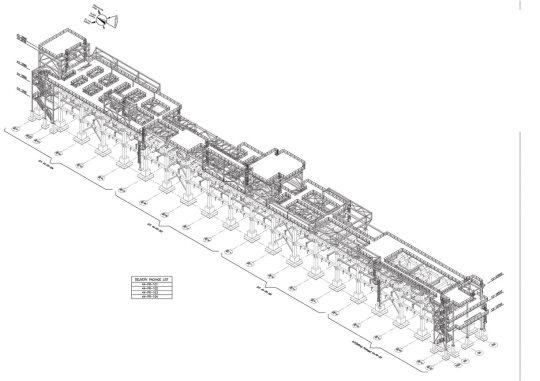
Italian company BK Strutture Srl was retained to design the expansion’s mixed concrete-steel structural components of the main pipe rack and process structures in Unit 44. The massive scale of the project required careful load evaluations, structural analysis, and safety checks.
BK Strutture sought software that would ensure that their design work supported all the piping and electrical components designed by other vendors. Specifically, their rack had to provide a structure for pipes running 175m in length at a maximum height of 30m, with a diameter of up to 61cm. In addition to supporting the pipes, the design needed to incorporate steel structures for air cooler supports, platforms, cable trays, and other elements. The complex design required equally complex analysis from the project owner, including static elastic, p-delta, dynamic, and seismic analysis methods. However, they had to finish the design and analysis in three months. With all these challenges, they knew that traditional workflows would be insufficient.
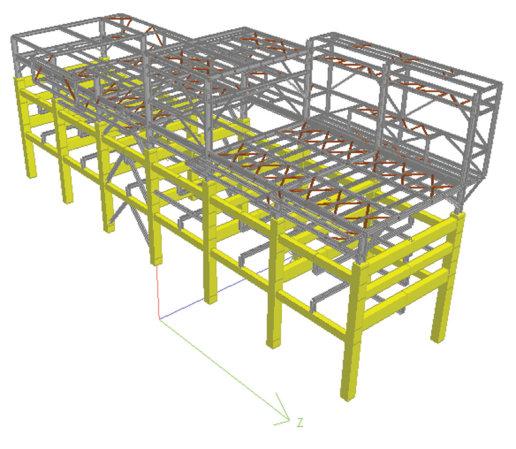
After considering their software options, BK Strutture chose STAAD to effectively design structures and then test them with structural analysis. They began by creating 3D models of the frames and their surrounding environment. Then, they carried out the battery of structural analysis methods the project required. They were able to automate the simulation of varying forces caused by wind and earthquakes, saving time compared to manually inputting different levels of these forces. Results from these analyses allowed them to adjust the support design, integrating comments by team members into STAAD files.
With STAAD, BK Strutture finished the structural designs on time and met the client’s high standard of quality. They estimated that the application helped them reduce the time needed to finish the design by
STAAD enabled BK Strutture to create 3D models, test them with an array of structural analysis methods, and optimise the designs based on analysis results.
15%, compared to using other types of structural design software. Additionally, optimising the design with advanced analysis helped them avoid design errors, reducing costs by 10%. Completing the design on time prevented delays on the overall construction, and the client considers the design of Unit 44 as the best in the plant expansion. n
