ORME 6 2017 Cover _ORMETHREE05COVER.qxd 22/09/2017 10:45 Page 1
UK £10, USA $16.50
www.oilreview.me
VOLUME 20 | ISSUE 6 2017 Oil Review Middle East - Volume 20 - Issue Six 2017
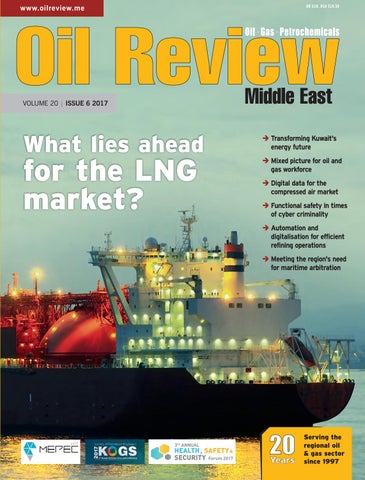
What lies ahead
for the LNG market?
Transforming Kuwait's energy future Mixed picture for oil and gas workforce Digital data for the compressed air market Functional safety in times of cyber criminality Automation and digitalisation for efficient refining operations Meeting the region's need for maritime arbitration
www.oilreview.me
20
Serving the regional oil & gas sector since 1997
S01 ORME 6 2017 - Start_Layout 1 20/09/2017 11:05 Page 2
S01 ORME 6 2017 - Start_Layout 1 22/09/2017 17:08 Page 3
Editor’s note THE KUWAIT OIL & Gas Show and Conference (KOGS) is set to be the single biggest gathering of the oil and gas industry ever seen in Kuwait, according to the organisers. Perhaps this is an indication of the buoyant state of Kuwait’s oil and gas sector, with expenditure over the next five years projected at 34.5bn KD (US$112bn) and an ambitious plan to expand production capacity to four million bpd by 2020 (see p12). Our preview of KOGS includes an interview with Hosnia Hashem, conference programme chair and deputy CEO Olefins and Aromatics, Petrochemical Industries Company (PIC) (p42), who comments on the focus on integration and diversification, and prospects for Kuwait’s energy future. Our cover feature looks at prospects for the LNG market, highlighting the growth in demand in the Middle East (p16), while the technology section includes a look at how the IoT can enable users of compressed air services to optimise and improve their processes (p44).
Serving the world of business
Editor: Louise Waters - louise.waters@alaincharles.com Editorial and Design team: Prashant AP, Hiriyti Bairu, Miriam Brtkova, Kestell Duxbury, Ranganath GS, Samantha Payne, Rahul Puthenveedu, Rhonita Patnaik, Deblina Roy, Nicky Valsamakis and Vani VenugopalManaging Editor: Georgia Lewis
Publisher: Nick Fordham Sales Director: Michael Ferridge Group Magazine Manager: Graham Brown +971 4 448 9260 graham.brown@alaincharles.com Magazine Sales Manager: Tanmay Mishra +91 80 65684483 tanmay.mishra@alaincharles.com
Contents
Security
4
36
Rakesh Puthuvath +971 4 448 9260 +971 4 448 9261 rakesh.r@alaincharles.com
Nigeria
Bola Olowo +234 8034349299 bola.olowo@alaincharles.com
USA
Middle East Regional Office: Alain Charles Middle East FZ-LLC Office L2-112, Loft Office 2, Entrance B, P.O. Box 502207, Dubai Media City, UAE +971 4 448 9260, +971 4 448 9261
8
The security market in Iraq and some advice for selecting a security provider
40
Developments A round-up of the latest news from around the region, including Saudi Aramco’s exploration activities in the Empty Quarter
12
42
16
Technology 44
What future for the LNG market?
Subscriptions: circulation@alaincharles.com
A new era of digital data for the compressed air market How the Internet of Things (IoT) can enable users of compressed air services to optimise and improve their processes
LNG demand is accelerating, but so is the expected supply, says Moin Siddiqi, economist
Chairman: Derek Fordham
Transforming Kuwait’s energy future Hosnia Hashem, conference programme chairperson, discusses the themes of the KOGS conference and prospects for Kuwait’s oil and gas industry
Kuwait’s energy sector embraces change Kuwait Petroleum Corporation and its subsidiaries continue to overhaul the country’s long-established and strategically vital energy sector – at home and abroad
Shaping the future of energy The Kuwait Oil & Gas Show and Conference (KOGS) reflects the ambitions of the country’s oil and gas industry
Analysis
Production: Kavya J and Nelly Mendes production@alaincharles.com
Communications
Printed by: Buxton Press
Refining & Petrochemicals
Printed in: September 2017
20
© Oil Review Middle East ISSN: 1464-9314
Shipping & Marine 26
52
Promoting safe and efficient operations How ABB’s solutions are helping operators to reduce costs while maintaining safety and production efficiency
Company News 58
32
Mixed picture for the oil and gas workforce The employment situation in the region’s oil and gas sector remains positive, despite the challenges
Going from strength to strength The growth of GOFSCO to become one of the largest integrated service providers in Kuwait; the opening of Byrne’s new Kuwait operation and a new product from AkzoNobel
Serving the region’s need for maritime arbitration
Recruitment & Retention
A Swiss success The latest in digital wireless paging technology is supporting a new production field in the Gulf
The role and activities of the Emirates Maritime Arbitration Centre (EMAC)
www.oilreview.me email: oil@alaincharles.com
An effective approach for security
Event Preview - KOGS 2017 Oil & Gas News
Michael Tomashefsky +1 203 226 2882 +1 203 226 7447 michael.tomashefsky@alaincharles.com
Head Office: Alain Charles Publishing Ltd University House, 11-13 Lower Grosvenor Place, London SW1W 0EX, United Kingdom +44 (0) 20 7834 7676 +44 (0) 20 7973 0076
Executives’ calendar and event news Event news as well as a look at MEPEC 2017 and ADIPEC 2017
International Representatives UAE
Contents
Arabic 5
News/Analysis
Front cover pic: Carabay/Adobe Stock
Issue 6 2017
oilreview.me
3
S01 ORME 6 2017 - Start_Layout 1 22/09/2017 12:03 Page 4
Calendar 2017
Executives’ Calendar 2017-18 OCTOBER 8-9
3rd Health, Safety & Security Forum 2017
DUBAI
www.hse-forum.com
9-11
Middle East Process Safety Conference
MANAMA
www.mepsc.org
9-11
Middle East Process Engineering Conference
MANAMA
www.mepec.org
15-18
Kuwait Oil & Gas Show (KOGS)
KUWAIT
www.kogs2017.com
16-17
Basra Oil, Gas & Infrastructure
BEIRUT
www.cwcbasraoilgas.com
17-19
Oil & Money conference
LONDON
www.oilandmoney.com
NOVEMBER 6-7
Gulf Homeland Security
DUBAI
www.gulfhomelandsecurity.com
13-16
ADIPEC
ABU DHABI
www.adipec.com
27-29
12th Annual GPCA Forum
DUBAI
www.gpca.org.ae
DECEMBER 3-5
Solar-Tec
CAIRO
www.solartecegypt.com
5-7
Iraq Oil & Gas Show, Basra
BASRA
www.basraoilgas.com
4-5
Bottom of the Barrel Technology Conference
MANAMA
www.europetro.com
11-13
Kurdistan-Iraq Oil & Gas
LONDON
www.cwckiog.com
JANUARY 2018 15-18
World Future Energy Summit
ABU DHABI
www.worldfutureenergysummit.com
21-23
Intersec
DUBAI
www.intersecexpo.com
CAIRO
www.egyps.com
DOHA
www.dohaenergyexpo.com
FEBRUARY 2018 12-14
Egypt Petroleum Show
MARCH 2018 19-21
Doha Int’l Sustainable Energy Exhibition & Conference
Readers should verify dates and location with sponsoring organisations, as this information is sometimes subject to change.
MEPEC 2017 to focus on global process engineering issues MEPEC 2017, the leading process engineering exhibition in the Middle East, will be held from 9-11 October 2017 at the Bahrain International Exhibition and Convention Centre under the Patronage of His Royal Highness Prince Khalifa bin Salman Al Khalifa, Prime Minister, Kingdom of Bahrain. It is expected to attract more than 2,500 participants, 200 exhibiting companies and thousands of visitors. The conference and exhibition will be inaugurated by H.E. Shaikh Mohamed bin Khalifa Al Khalifa, Minister of Oil, Kingdom of Bahrain. In line with global process engineering issues, this year’s theme is “Sustainable Growth through Process Innovation & Downstream Integration”. Emphasis will be placed on topics focusing on process design and development, process excellence, sustainability and downstream integration for value creation. Keynotes speakers include Ahmad Al Sa’adi (senior VP, Technical Services, Saudi Aramco); Ziad
4
oilreview.me
Issue 6 2017
Al-Labban (CEO, Sadara Chemical Company); Guy Lewis (VP, Strategic Marketing and Planning, UOP, a Honeywell Company); Suleyman Ozmen (Downstream Licensing, VP president, Shell Global Solutions, US Inc); Fuad Mosa (GM, Local Content Unit, Innovation & and Business Development, SABIC); Ed Boufarah VP, Digital Solutions - MEA & India, Baker Hughes, a GE company); and Dave Andrews (VP, Catalysts & Licensing, ExxonMobil Chemical). Subjects covered range from Transformation from Volume to Value to Digitisation Revolution & the Petrochemical Industry. MEPEC will see three co-located events taking place alongside; the Leadership Excellence for Women Awards and Symposium; the Middle East Fine and Specialty Chemicals Conference and Exhibition; and the Middle East Process Safety Conference. These four shows offer a world class networking event for visitors, delegates, investors
Stand discussions at MEPEC 2015
and government related organisations. Witness women in engineering get recognised and celebrated for their excellence, as undergraduates race their chemically powered hand-built cars, as starts-ups showcase their innovation to the process engineering community and as young professionals and students solve design challenges and receive mentoring from the best names in engineering.
For more information on MEPEC and its co-located shows, visit: https://www.mepec.org.
S01 ORME 6 2017 - Start_Layout 1 22/09/2017 07:29 Page 5
S01 ORME 6 2017 - Start_Layout 1 22/09/2017 07:31 Page 6
News
O&G giants to convene at ADIPEC, programme expanded HELD UNDER THE patronage of HH Sheikh Khalifa Bin Zayed Al Nahyan, President of the UAE, hosted by ADNOC, and organised by the Global Energy division of dmg events, the Abu Dhabi International Petroleum Exhibition & Conference (ADIPEC) is one of the world’s leading oil and gas events, and the largest in Africa and the Middle East. This year’s event, to take place from 13-16 November in Abu Dhabi, will feature more than 2,000 exhibiting companies, including 37 leading NOCs and IOCS, and is expected to welcome more than 100,000 visitors. The 2017 technical conference will see a significant increase in scope to include the downstream industry for the first time. The event will also add more sessions for specialised areas, including offshore and marine exploration and production. With around 900 speakers scheduled for more than 200 sessions, the conference will bring together the industry’s most respected experts, global leaders and top decision makers, with around 10,000 delegates attending over the course of four days. “The key to growth for oil and gas companies will be to find new ideas, and to share information in the pursuit of best practice,” said Ali Al Rawahi, reservoir manager at the Abu Dhabi Company for Onshore Petroleum Operations Limited (ADCO) and ADIPEC 2017 technical conference chairman. “ADIPEC is clearly established as the leading platform for knowledge exchange in oil and gas. The focus will continue to be on improving efficiency and reducing cost, which can only be achieved through sharing experience between companies and across borders.” The expansion to include the downstream sector reflects one of the emerging industry trends in oil and gas, as upstream and midstream companies are increasingly looking towards integration, collaboration and diversification across refining and petrochemicals, processing, and
A full-day Women in Energy programme will focus specifically on the opportunities for and achievements of women in the oil and gas industry
end-product sales to boost overall profitability. Conference sessions include exploration and production geoscience; production facilities technologies; field development; operational excellence; drilling and completion technology; health, safety and environment; projects engineering and management; gas technology; unconventional resources; improved and enhanced oil recovery; people and talent; and petroleum advanced analytics. The Conference programme will feature two ministerial sessions, four global business leader sessions and four downstream global business leader sessions, eight panel sessions, three offshore plenary panels, nine C-suite dialogue sessions, three industry breakfasts and three topical luncheons. A full-day Women in Energy programme will focus specifically on the opportunities for, and achievements of, women working in the oil and gas industry. The co-located Security in Energy conference returns for a second year, recognising the increasingly critical importance of cyber and infrastructure security within oil and gas operations.
GEO 2018: shaping the energy landscape
Iraq Oil & Gas Show
THE BAHRAIN INTERNATIONAL Exhibition and Convention Centre is set to play host to a critical exchange of oil and gas insights during the 13th Middle East Geosciences Conference and Exhibition (GEO 2018) from 5 – 8 March 2018. Held under the patronage of the Prime Minister of Bahrain HRH Prince Khalifa bin Salman Al Khalifa, more than 3,500 geoscientists and petroleum industry professionals from 50+ countries will gather to debate and shape the future of the industry, build skills, network with peers and purchase products and services that will take their E&P programmes to the next level. The biannual event, established 24 years ago, incorporates a four-day high level conference under the theme ‘Pushing the Technical Limits: Shaping the Energy Landscape’ organised by the world’s three largest professional geoscience associations (AAPG, EAGE and SEG) and a parallel three-day exhibition organised by UBM. GEO 2018 is also supported by an organising committee of NOCs, IOCs and major service providers. “The conference will host a number of executive sessions led by technical influencers, and we encourage professionals to take this opportunity to participate and share valuable ideas and knowledge. The conference will focus on geological studies, reservoir challenges and the role of geoscience in the environment, safety, risk management and innovation,” said Ahmad Al Eidan, GEO 2018 general chair and deputy CEO - Drilling & Technology Directorate, Kuwait Oil Company. “We are certain that GEO 2018 will be an extraordinary platform which will provide all participants with unlimited benefits and will open new frontiers for the current oil industry challenges,” he continued. A three-day exhibition of oil and gas products and services will run parallel to the conference from 6 - 8 March. Set to feature over 120 exhibitors from 20 countries, the exhibition covers all areas of the oil and gas exploration industry.
THE SEVENTH EDITION of the leading oil and gas show of Iraq, officially sponsored by Iraq’s Ministry of Oil, will be held from 5-7 December 2017 in Basra, Iraq. The second largest OPEC oil producer, with the world’s fifth largest oil reserves, Iraq has immense production potential and is actively seeking investment. The largest fields in the south have relatively low extraction costs owing to uncomplicated geology, multiple supergiant fields, fields located in relatively unpopulated areas, and the proximity of fields to coastal ports. Iraq Oil & Gas Show will be attended by international visitors from 20 different countries (USA, Singapore, Peru, India, Netherlands, Lebanon, China, UAE, UK, Brazil, Russia, Switzerland, Bangladesh, Nigeria, Cameroon, Canada, Ghana, Azerbaijan, Barbados). A wide variety of opportunities will be available, including networking opportunities and B2B meetings, allowing visitors to make contact with the leading local and international industry members in Iraq. With 700 sq m of confirmed stand space, exhibitors confirmed to date include Al Imad Group Companies (IRAQ), Al Tabieaa Paints (IRAQ), AWS Co. (IRAQ), Bahra Cables (SAUDI ARABIA), Basra Oil Company (IRAQ), Consolidated Contractors Group (GREECE), DrawWorks (USA), Fircroft (UK), Gulf Commercial Group (UAE), Gulftainer (UAE), Hydromashservice JSC (RUSSIA), Iraq Energy City (UAE), Ministry of Oil, Republic of Iraq, Najma Al Ajyal (UAE), Red Sea Petrochemical Industries (JORDAN), Royal Crown for Training Technology (IRAQ), RSK (UK), South Gas Company (IRAQ),Tech Equipments General Trading (IRAQ) and Jotun (UAE).
Pre-registration for GEO 2018 opens in October at www.geo2018.com. An early bird discount is offered on conference fees up until 5 February 2018.
6
oilreview.me
Issue 6 2017
Expotim Int’l Fair Organization Inc. is the co-organiser of the event. For further information email info@iraqoilgas.com, or see the website at www.iraqoilgas.com.
S02 ORME 6 2017 - Oil Gas & Petrochems_Layout 1 22/09/2017 07:35 Page 7
S02 ORME 6 2017 - Oil Gas & Petrochems_Layout 1 22/09/2017 11:26 Page 8
News
Baker Hughes wins subsea contract for Zohr field BAKER HUGHES (BHGE), a GE company, has signed a major subsea contract with Egypt’s Petrobel for Phase Two of the ‘supergiant’ Zohr gas field situated in the Mediterranean Sea, offshore Egypt. The project underscores the company’s position as the world’s first and only integrated fullstream provider of cutting-edge subsea technology, products, services and digital solutions.
The officials at the signing ceremony. (Photo: BHGE)
BHGE will provide project management, engineering procurement, fabrication, construction, testing and transportation of a subsea production system, including seven manifolds, tie-in systems, long offset subsea and topside control systems, SemStar5 HIPPS (high integrity pressure protection) Systems, workover systems and tools, and will support installation, commissioning and start-up operations. Tarek El-Molla, Egypt’s minister of petroleum and mineral resources, said, “Maximising domestic energy resources and optimising reliability of their supplies are core elements of Egypt’s vision. We are able to increase the value and efficiency of the sector by driving a sustainable and energy-efficient economy through the ministry’s modernisation programme in partnership with companies such as BHGE. The Zohr gas field is playing a major role in the development of Egypt’s domestic energy resources, revenue generation and economic growth.” Lorenzo Simonelli, CEO at BHGE, added, “The Zohr field is one of the most significant developments of its kind, and through this project we can show the efficiency gains that such complex projects can achieve through our enhanced portfolio. This project has the potential to meet Egypt’s growing gas demand and save the country billions of dollars that would otherwise be spent on importing gas. Together with our partners, BHGE can support Egypt’s needs and vision for the energy sector and demonstrate its leadership in the subsea space.” Petrobel is a joint venture between IEOC (an Eni subsidiary in Egypt) and Egyptian General Petroleum Corporation (EGPC) and is in-charge of the development of Zohr Field on behalf of PetroSherouk, a joint venture between Egyptian Natural Gas Holding Company (EGAS) and IEOC.
PDO contracts boost Omani supply chain PETROLEUM DEVELOPMENT OMAN (PDO) has signed two deals worth US$253.1mn for the local manufacturing of vital equipment like transformers and valves for the oil and gas industry. The deals represent further evidence of PDO’s In-Country Value (ICV) programme to retain more of the wealth of the oil and gas sector in the Sultanate and develop domestic supply chains. PDO managing director Raoul Restucci, said, “We are working hard with our partners to ensure that Oman builds its capacity and capability to competitively and professionally service both the nation’s oil and gas industry but also that beyond our borders. “ICV not only shortens our supply lines and reduces our delivery times and transport costs, but also provides more vocational training and employment opportunities for Omanis. We are delighted to sign these contracts for the provision of important equipment and parts for the oil and gas sector. Beyond the local supply of goods and services to the requisite technical level, they provide the further demonstration of how our contractors and suppliers are playing a greater role in embedding ICV in their operations.”
Approximately 41 per cent of PDO’s overall contracts are now placed with local businesses (Photo: PDO)
PDO has struck deals with Rusayl-based Voltamp Transformers Oman for the supply of power transformers and Al Jizzi Transformers and Switchgears, located in Ma’abella, for the supply of well head transformers. The companies employ almost 100 Omanis in total. Approximately 41 per cent of PDO’s overall contracts are now placed with local businesses, and as much as 53 per cent of its well engineering contracts are awarded to local community contractors, amongst the highest in the region.
Total divests remainder of its Norwegian field stake to KUFPEC FRENCH OIL GIANT total said has signed an agreement to sell its remaining 15 per cent stake in Gina Krog oilfield at Norway to Kuwait Foreign Petroleum Exploration Company (KUFPEC) in a deal worth nearly US$317mn. This agreement builds on the 2016 transaction between Total and the Kuwaiti firm concerning Norwegian North Sea assets, which included a 15 per cent interest in Gina Krog. “We have decided to completely divest our interest in the Gina Krog project and focus on other opportunities in Norway, which remains a key country for Total,” stated Arnaud Breuillac, president for exploration and production at Total. “This sale is in line with our objective to optimise the Group’s allocation of capital by efficiently managing our portfolio of assets. With the recent acquisition of Maersk Oil & Gas, announced on 21 August 2017, the group’s position in the North Sea will be significantly strengthened,” said Breuillac.
8
oilreview.me
Issue 6 2017
Upon completion of the sale, Total will no longer have an interest in the Gina Krog field, while the Kuwaiti group will have a 30 per cent stake alongside Statoil (58.7 per cent, operator), PGNiG Upstream International (8 per cent) and Aker BP (3.3 per cent). The overall consideration for both deals will total US$617mn. The Gina Krog oil and gas field started production in June 2017. KUFPEC was established by its parent company Kuwait Petroleum Corporation in 1981 to engage in exploration, development and production of crude oil and natural gas outside the country. It is currently active in 14 countries with 54 assets in the international upstream sector. KUFPEC will add approximately 34mn barrels of oil equivalent in net reserves and approximately 9,000 boepd of production from Gina Krog, which came on-stream in June 2017 and is operated by Statoil. The addition of the new production will take KUFPEC’s production in Norway close to 25,000 boepd.
S02 ORME 6 2017 - Oil Gas & Petrochems_Layout 1 20/09/2017 10:55 Page 9
S02 ORME 6 2017 - Oil Gas & Petrochems_Layout 1 20/09/2017 10:55 Page 10
News
Saudi Aramco deploys new technology to re-explore Empty Quarter OIL GIANT SAUDI Aramco is using new technology to re-explore areas of the vast Empty Quarter, which could help to bolster its proven reserves of oil and gas before the company offers its shares to the public, according to sources. A team of about 900 people is using advanced seismic technology developed over the last few years to explore 15,400 sq km around Turayqa, Saudi Aramco said in a statement. Turayqa, discovered in 2013, is an onshore conventional gas field that contains no oil. Part of the area was previously explored by joint ventures (JVs) involving Saudi Aramco and foreign companies, Aramco said. The JVs failed to find recoverable quantities of oil and gas. “Data processing is ongoing. The area partially covers areas relinquished by some of the joint ventures,” the company told Reuters. Saudi Aramco set up four consortia in 2003 and 2004 to explore the Empty Quarter, but they ended their search after failing to find commercial volumes of gas. The new seismic technology may improve the chances of successful exploration, though it cannot by itself prove the existence of oil and gas reserves; drilling is needed for that.
The Empty Quarter is the largest continuous sand desert in the world, encompassing most of the southern third of the Arabian Peninsula. (Photo: Flickr)
Seismic technology uses artificially induced shockwaves in the earth. While conventional crews have 9,000 frequencies available to monitor the results, the crew at Turayqa has over 50,000. “The seismic data acquisition technology that is being deployed is truly phenomenal,” said a former executive at the company.
It not only provides a three-dimensional picture of the structure of rock going down several kilometres, but also tells the user about physical characteristics of the rock, such as its density and fluid saturation, he added. “It is something that far exceeds what was achievable on land 10 years ago.”
Shell withdraws from Majnoon, to focus on Basra Gas Company in Iraq OIL MAJOR SHELL has withdrawn from Iraq’s Majnoon oilfield, announcing that it will focus its efforts on the development and growth of the Basra Gas Company after handing over operations of the oil venture back to the Iraqi government, according to a Reuters report. A letter signed by Iraqi oil minister Jabar al-Luaibi, dated 23 August and directed to Shell Iraq Petroleum Development, gave approval for Shell to quit Majnoon, an oilfield near Basra, which started production in 2014. In November last year, industry sources had told Reuters that Shell was considering selling out of its oilfields in Iraq as part of its global US$30bn asset disposal programme. The officials said the Oil Ministry and Shell had been discussing investment budgets and production activities but failed to reach a deal. “We failed to reach an agreement with Shell over its Majnoon operations, including production plans and investments budgets. We think it’s for the interest of all parties that Shell should withdraw,” said an oil official who attended a meeting in August in the Oil Ministry to discuss how to manage Majnoon after the withdrawal of Shell. Shell holds a 45 per cent interest in Majnoon that it operates under a technical service contract that expires in 2030, according to its 2015 annual report. Production from Majnoon, one of Iraq’s largest oilfields, is currently at around 235,000 bpd, according to Iraq’s oil officials. Despite the withdrawal from Majnoon, Shell will keep its operations in gas and petrochemical projects in Iraq, the letter added. “Shell remains firmly committed to Iraq. By handing over the Majnoon operation to the Oil Ministry, Shell will be in a stronger position to maximise value to the government of Iraq and its people as well as our shareholders by focusing its efforts on the development and growth of Basra Gas Company,” a Shell spokesman said. Basra Gas Company is a joint venture between Shell, South Gas Company and Mitsubishi and the Petrochemical Project NEBRAS. Shell is also selling its 20 per cent stake in West Qurna 1 oilfield in the south of the country, which is operated by Exxon Mobil.
10
oilreview.me
Issue 6 2017
S03 ORME 6 2017 - Analysis_Layout 1 21/09/2017 17:55 Page 11
S03 ORME 6 2017 - Analysis_Layout 1 21/09/2017 17:55 Page 12
Analysis
Kuwait’s energy sector
embraces change Kuwait Petroleum Corporation (KPC) and its subsidiaries continue to overhaul the country’s long-established and strategically vital energy sector – at home and abroad. N INCREASINGLY INTERNATIONAL outlook, but with plenty going on at home, these are busy times indeed for Kuwait’s national energy champion. Kuwait Petroleum Corporation (KPC) is at the heart of expanding and modernising the nation’s oil and gas sector, both upstream and downstream, across its various subsidiaries, which span all areas of the energy chain. It is underpinned by KPC’s ambitious 2030 growth strategy, that includes overseeing a massive spending roll-out over the next few years. Upstream, there is an ambitious plan underway to expand oil production capacity to four million barrels per day (bpd) by 2020, while downstream and refining capacity are also being boosted too.
A
KNPC is currently building the Middle East’s largest oil refinery at Ras al-Zour” According to some estimates, total expenditure across the nation’s energy sector for the next five years is projected to amount to around US$112bn, although it could well be higher. Key themes include integration and diversification, as Kuwait seeks to get smart with its natural resources, working alongside foreign partners and investors, and embracing new technologies.
Subsidiaries And KPC’s many subsidiaries are making it all happen on the ground. The broad strategy includes the clean fuels project, with Kuwait upgrading its refinery infrastructure to produce stateof-the-art new eco fuels for local use and export.
12
oilreview.me
Issue 6 2017
Kuwait National Petroleum Co (KNPC) is currently building the Middle East’s largest oil refinery at Ras al-Zour, with a processing capacity of 615,000 bpd. The project’s value is estimated at around US$11.5bn making it one of the single biggest in Kuwait today. It has provided huge work opportunities for contractors. In one recent award, Italian engineering firm Saipem was tasked by Kuwait Oil Company (KOC) to build a 450 km pipeline system for the new refinery, in the south of Kuwait, worth US$850mn. Other major downstream players undertaking new projects include Petrochemical Industries Company (PIC) and EQUATE Petrochemical Company. Earlier this year, it was reported that PIC plans to more than triple its olefins and aromatics production capacity from the current five million mt/year to 16 mn mt/year by 2030, as well as looking to increase investments overseas.
Upstream, KOC, arguably KPC’s flagship subsidiary, is getting to grips with a host of projects, in addition to the management of long-term producing assets such as the mighty Burgan field and the northern Ratqa field. Other upstream projects in Kuwait include the resumption of production with Saudi Arabia from the jointly operated oilfields, mainly Khafji and Wafra, in the Neutral Zone that sits between both countries. Khafji was shut in 2014 for environmental reasons and Wafra has been shut since 2015 due to operating difficulties, with officials seeking to resolve issues since then, including the challenge of market volatility and a possible glut of oil. The Khafji field – operated by Al-Khafji Joint Operations Co, a joint venture between Kuwait Gulf Oil Company and AGOC, a subsidiary of Saudi Aramco – had been producing up to 300,000 bpd until its closure.
Kuwait is focusing increasingly on petrochemicals, both at home and abroad. (Photo: KPI)
S03 ORME 6 2017 - Analysis_Layout 1 21/09/2017 17:55 Page 13
S03 ORME 6 2017 - Analysis_Layout 1 22/09/2017 11:31 Page 14
Analysis Kuwait has begun operating its first solar power plant at the Umm Ghudair oilfield. (Photo: snvv/Adobe Stock)
The Wafra field has an output capacity of around 220,000 bpd of heavy crude.
Technology Just like the evolution of Kuwait’s downstream refining and petrochemicals industry, drawing in new technology to create more advanced fuels, there are changes taking place upstream as well. Last year, Kuwait began operating its first-ever solar power plant at the Umm Gudair oilfield, a development that could hold further implications for the sector, and for KPC. The US$100mn project, Sidrah 500, can produce 10 megawatts of electricity, half of which is supplied to the state power grid, the other half to supply the oilfield itself, which is owned by KOC.
Technology in all forms will play a pivotal role in KPC’s expansion”
as part of Kuwait Petroleum Corporation’s 2030 strategy,” said George Bou Mitri, president, Honeywell Kuwait, Iraq, Jordan, and Lebanon.
International profile While numerous solar projects have taken off across the Gulf, it is a step forward not only for Kuwait, but also a landmark in the delivery of power services to an upstream oil field, all at a time when the region is keen to diversify its energy sources to meet fast growing local demand. Indeed, on a wider level, technology in all its forms will play a pivotal role in KPC’s expansion and upgrade of the energy sector from now on. Industrial giant Honeywell is set to host an inaugural Honeywell Technology Summit in the country in early October, held under the patronage of KNPC, in part, a reflection of this trend. “Technology and human capital are the key driving force behind Kuwait’s ambition to further develop the oil and gas industry
14
oilreview.me
Issue 6 2017
Overseas, KPC is increasingly active too across multiple territories via its various subsidiaries. Upstream, that includes the Kuwait Foreign Petroleum Exploration Company (KUFPEC) subsidiary, which recently acquired an additional 15 per cent interest from Total in Norway’s Gina Krog field, doubling its overall equity holding. Downstream, Kuwait Petroleum International (KPI) manages fuel sales in a range of countries, including across western Europe. But more could be on the way. KPC announced recently that it is currently thinking of establishing a new commercial subsidiary to further market its petroleum derivatives. Once approved, the new company will focus not oil market speculation but
instead on increasing added value to KPC's own products, according to Imad Abdul Kareem, acting managing director for global marketing. KPI also recently announced its first shipment of crude to Vietnam’s new Nghi Son Refinery and Petrochemicals Complex, in preparation for the start of operations. The refinery, which is affiliated with KPI, has a processing capacity of around 200,000 barrels of Kuwaiti crude a day. The project achieves one of KPC's strategic goals to provide a safe long-term outlet for the sale of Kuwaiti crude. KPI owns a 35.1 per cent share in the project, alongside PetroVietnam, Japan's Mitsui and Idemitsu Kosan. What seems certain is that there is more business in the pipeline, as Kuwait continues with the revival of its energy sector and seeks to assert itself abroad. That’s positive news for the country and for all those contractors across the energy and technology spheres that have worked closely with KPC and its operating subsidiaries for decades. n
S04 ORME 6 2017 - Analysis 02_Layout 1 20/09/2017 11:03 Page 15
YOUR TRUSTED SECURITY PAR RTNER IN IRAQ We recognise r e the unique challenges of living, working and travelling in Iraq I and therefore the need for a local reliable seccurity company to help identify, evaluat valuate and mitigate operational risk.
Our know-how fused with interna ational seccurity standards gives you a sense of comfort and d safety allowing you to focus on your core business in Iraq. With the larg gest fleet of B6 armou ured vehiclles in Iraq, q, you can be assured of our ability to mobilise large-scale contracts with the minimum of delay.
WE OFFER PEACE OF MIND www.almurabit.com | info@almurabit.c ab om | T: T +971 4453 9899 / +964 078 1858 67745 45 OďŹƒcially the ďŹ rst Iraqi company to achiev ve e the international standards:
S04 ORME 6 2017 - Analysis 02_Layout 1 20/09/2017 11:03 Page 16
Analysis
What future for the
LNG market? The LNG market is accelerating rapidly, but so is the expected supply, says Moin Siddiqi, economist. HE GLOBAL GAS trade surged by 70 per cent between 2000 and 2016, rising from 620 billion cubic metres (bcm) to around 1,060 bcm, according to the International Energy Agency (IEA). Over this period the ratio between traded piped gas and liquefied natural gas (LNG) has changed noticeably. The former steadily lost share in global traded volumes to LNG; the latter’s share of trade rose from a quarter in 2000 to one-third by 2016, with piped gas falling from 77 to 62 per cent during the reported period. BP projects that the global LNG market will expand seven times faster than the pipeline gas trade and will account for half of global traded gas up to 2035. Global demand for natural gas is expected to increase by two per cent a year between 2015 and 2030 – versus four to five per cent for LNG – fuelled by robust consumption in several emerging markets led by China and India. The IEA anticipates LNG trade to reach 460 bcm by 2022. However, projected demand growth is not enough to absorb the predicted 650 bcm of total liquefaction capacity online that year, hence the ‘supply glut’. Switzerland-based Vitol, the world’s largest independent oil trader, expects the market to remain “significantly oversupplied” for the next five years, but adds that pressure on LNG prices is creating new markets, as well as raising demand among existing importers.
T
Table 1: Top 10 LNG exporters (2016)
Country Qatar Australia Malaysia Nigeria Indonesia Algeria Trinidad & Tobago Russia Federation Oman Papua New Guinea Total (%) of World Total
LNG export volumes (Bn cm) 104.4 56.8 32.1 23.7 28.2 15.9 14.3 14.0 10.6 10.4
Natural gas production (Bn cm) * 181.2 91.2 73.8 44.9 69.7 91.3 34.5 579.4 35.4 N.A.
310.4 89.5
1,201.6 33.8
Proved natgasz reserves Trillion cm * 24.3 3.5 1.2 5.3 2.9 4.5 0.3 32.3 0.7 0.2 75.2 40.3
* 2016 figures; gas output excludes gas flared or recycled. Source: BP Statistical Review of World Energy 2017.
Demand side By 2022, global LNG export capacity is forecast to grow by 160 bcm as the second phase of expansion gets underway. The IEA envisages annual LNG demand rising by 1.5 per cent until 2021 – adding 340 bcm of consumption over a five-year period. The club of LNG importers has grown from only 10 in 2008 to 38 countries by 2016. Japan, South Korea and China accounted for over half of global 2016 LNG imports of 346.6 bcm (BP figures). New importers are Caribbean countries, Egypt, Jordan, Pakistan and Poland. As of June 2017, 29 onshore LNG regasification terminals with total capacity of 117.7 bcm were under development – of which China and India accounted for five each. LNG demand growth is helped by lower fuel prices, environmental directives to use less polluting coal in power generation and the adoption of floating storage and regasification units (FSRUs) technology. FSRUs can be leased and have lower capital costs compared to LNG terminals. Last year, around a tenth of global regasification capacity was reportedly offshore, and its share will increase. Petroleum Economist commented, “The end of the glut is already visible. Cheap, abundant supply and the battle against climate change should lay the seeds of demand growth in future – in maritime shipping, long-haul-vehicle fleets, in power generation and across developing energy-hungry nations.”
Upcoming projects New global supply will increase by more than two-fifths by 2020 to 455mn tonnes/year versus 2015 as LNG construction projects in Australia, the USA and Russia, costing over US$250bn, come online,
16
oilreview.me
Issue 6 2017
Table 2: Projected LNG export capacity & utilisation rate Year 2015 2016 2017 2018 2019 2020 2021
Export capacity (Bn cm) 415 451 490 540 560 590 600
Liquefaction capacity utilisation rate (%) 93 92 91 89 91 92 93
Source: IEA Medium-term Gas Market Report 2016
according to Moody’s Investors Service. As of June 2017, there was 139.4 bcm of new liquefaction capacity under construction globally, three-quarters of which is located in the USA and Australia. In 2016, eight projects (including brownfield) were brought online with annual capacity of 48.8 bcm. This year, 43.9 bcm of new additions to global supply are due online from Australia, the US, Russia, Malaysia, Indonesia and Cameroon. The US shale gas boom has enabled the country to rapidly boost LNG liquefaction and exports. Nameplate capacity from six projects currently under construction is expected to increase by 1.4bn cubic feet per day (cf/d) in 2017, 1.9bn cf/d in 2018 and 3.8bn cf/d in 2019. Once six projects are fully operational, the USA should hold the world’s third-largest liquefaction capacity at 9.4bn cf/d, after Australia and
S04 ORME 6 2017 - Analysis 02_Layout 1 20/09/2017 11:03 Page 17
Analysis
Qatar, according to the Energy Information Administration (EIA) – the statistical arm of the US Energy Department. Australia – endowed with relatively modest gas reserves of 3.5 trillion cm – is poised to become the globe’s biggest LNG producer/exporter with annual liquefaction capacity of 118 bcm by 2018 (IEA figures), ahead of Qatar. The Gorgon LNG plant with a capacity of 21.2-bcm/year (Trains1-3) is among the world’s largest and most expensive hydrocarbon projects (costing US$53bn), which is now fully operational. Wheatstone LNG and Ichthys LNG are the next facilities due online in 2018 – with a price tag of US$34bn each. Additionally, the world’s first mega floating liquefaction facility (Prelude FLNG) is under construction – installed with 4.9 bcm/year capacity that may cost sponsors around US$11bn. Coalbed methane reserves in Queensland will provide feedstock for most projects.
New FIDs Meanwhile, falling Asian spot LNG prices – down by two-thirds since their 2012 peak to US$5.85 per million British thermal units (Btu) in April 2017 – alongside persistent oversupply, are discouraging project final investment
Table 3: Major LNG projects under construction (as of June 2017)
COUNTRY USA
Australia
Russia
Indonesia
Main investors
PROJECT
Annual capacity (Bn cm)
FID year
First cargo
Freeport LNG (T2-3) * Sabine Pass (T3-4) * Corpus Christi LNG (T1-2) / Cameron LNG (T1-2) / Dominion Cove Point LNG / Freeport LNG (T1) / Cameron LNG (T3) * Sabine Pass (T5) *
12.6 12.2 12.2 12.2 7.1 6.3 6.1 6.1
Freeport, Macquarie Cheniere Energy Cheniere Energy Sempra Energy Dominion Freeport, Macquarie Sempra Energy Cheniere Energy
2014 2013 2015 2014 2014 2014 2014 2015
2019 2017 2019 2018 2017 2018 2019 2019
Ichthys LNG (T1-2) / Gorgon LNG (T3) *
12.1 7.1
2012 2009
Wheatstone LNG (T1) /
6.1
2011
2018 Mar 2017 2017
Wheatstone LNG (T2) *
6.1
2011
2018
Prelude Floating (FLNG) /
4.9
Inpex, Total Chevron, Shell, ExxonMobil Chevron, Woodside, KUFPEC # Chevron, Woodside, KUFPEC # Shell, Inpex, Kogas
2011
2018
Yamal LNG (T1) / Yamal LNG (T2) * Yamal LNG (T3) *
7.5 7.5 7.5
Novatek, Total Novatek, Total Novatek, Total
2013 2013 2013
2017 2018 2019
Tangguh LNG (T3) *
5.2
BP
2016
2020
# Kuwait Foreign Petroleum Exploration Company; * Brownfield project (investing in existing facilities); / Greenfield project (constructing new LNG facilities), Source: IEA, Gas Market Report 2017
Issue 6 2017
oilreview.me
17
S04 ORME 6 2017 - Analysis 02_Layout 1 20/09/2017 11:03 Page 18
ďƒ¨ Analysis Fig 1: Key global demand hubs, 2016 Bn cm 14.2
5.75.9 7.7 9.7 10.5
108.5
13.2
34.3
43.9
Japan
France
South Korea
Turkey
China
Mexico
Spain
Italy
United Kingdom
Middle East *
*Includes: Bahrain, Jordan, Kuwait & UAE Source: BP Statistical Review of World Energy 2017 decisions (FIDs), especially on greenfield developments. FIDs on fresh capacity have declined from a yearly average of around 35 bcm over 2011-14, to around 25.9 bcm (four projects) in 2015 and just 8.6 bcm (two projects) in 2016, the lowest approval since 2006, according to energy consultancy Wood Mackenzie. During the first half of 2017, one FID was taken by ENI for the Coral floating (FLNG) facility in Mozambique, with nameplate capacity of 4.5 bcm/year.
Fig 2: Overview of project FIDs 10 9 8 7 6 5 4 3 2 1 1980 1990
2000
2010 MTPA
A Dassault Systèmes company
2020 Year
MTPA= Metric tonnes per year Source: Wood Mackenzie data Q4 2016
18
oilreview.me
Issue 6 2017
2030
2040
2050
S04 ORME 6 2017 - Analysis 02_Layout 1 20/09/2017 11:03 Page 19
Analysis
Fig 3:LNG prices, Japan CIF 2035 2030 2025 2020 2015 2010 2005 2000 1995 1
2
3
4
5
US$ per mn BTU
6
7
8
9
10
Year
CIF= cost+insurance+freight (average prices) BTU= British thermal unit Source: BP Statistical Review of World Energy 2017 In sum, Moody’s thinks the market will not rebalance until the early years of the next decade, when global demand and LNG import infrastructure catches up with supply. Beyond the mid-2020s, investments in new trains are needed to meet growing demand by 2030 – otherwise a tighter market could emerge. n
Sharjah National Oil Company. The IEA expects Middle East gas demand to nearly double by 2040. Last year, natural gas consumption in the region was 603.6 bcm – equivalent to 17 per cent of the global total (BP figures). The Oxford Institute of Energy Studies notes that ME LNG off-take rose from five bcm in 2014 to 24 bcm in 2016. Apicorp, Saudi-based investment bank, estimates that Middle East countries need to invest US$10.3bn in LNG-importing facilities over the medium-term to cope with booming demand. London-based Energy Aspects consultancy predicts that Middle East LNG imports will reach 13.4mn tonnes/year in 2018. In 2016, the Middle East was the world’s largest exporting region, shipping 138.4 bcm of LNG – equivalent to two-fifths of global exports (BP figures). Qatar, with a liquefaction nameplate capacity of 105 bcm, comprised around one-third of global LNG trade. Recently, Qatar Petroleum announced plans to increase natgas production dramatically from its huge Persian Gulf ‘North Field’ which, if followed through, could boost Qatar’s nominal LNG capacity in future years. Other LNG exporters in 2016 were Algeria (15.9 bcm), Oman (10.6 bcm), and the UAE (7.4 bcm). Yemen LNG, with a capacity of 9.1 bcm, went off-line in April 2015 due to the country’s civil war; Total (the operator) closed the plant. Thus far, the largest regional consumers (Iran and Saudi Arabia) have no plans for building either LNG production or importing facilities, though both possess vast proved gas reserves of 33.5 and 8.4 trillion cm respectively.
Footnote: LNG is natural gas cooled to about -260 °F in a liquid state, transported by specially designed tankers, then regasified at a receiving terminal and injected into existing delivery pipeline networks. It contains virtually zero sulphur emissions, plus lower particulates and nitrogen oxide emissions, compared to heavy fuel oil. The shift to low-carbon fuels in the bunkering and transportation markets favours increased LNG use. The 170 members of the International Maritime Organisation have agreed a sulphur limit in shipping fuel of 0.5 per cent from 2020 versus 3.5 per cent specification for bunker fuel today. LNG helps reduce well-to-wheel emissions compared to conventional fuels and offers a cleaner/cheaper alternative to diesel in the heavy-duty vehicle market. Shipping rates represent the largest component in the transportation cost of LNG. As of early 2016, there were 449 LNG tankers operational worldwide. Shipping rates have remained on a downward trend in recent years due to oversupply.
Brisk LNG demand The Middle East (including Algeria, Egypt and Libya) holds almost half of global gas reserves, mostly untapped, yet the volume of LNG imports into the region is rapidly rising as domestic demand exceeds piped gas supply. Within the past three years, LNG imports in the Middle East have surged 380 per cent against relatively saturated markets in other key energy demand hubs (notably Japan and South Korea), according to the Gulf Intelligence LNG Whitepaper (March 2017). Regional LNG buyers are Egypt, Jordan, Kuwait, Bahrain and the UAE. “The Middle East needs a comprehensive and robust infrastructure network to build a world-standard gas hub and meet demand across the region,” said Hatem Al-Mosa, CEO,
Issue 6 2017
oilreview.me
19
S05 ORME 6 2017 - ABB Interview NEW_Layout 1 22/09/2017 07:37 Page 20
Refining & Petrochems
Promoting safe and efficient
operations As refining and chemicals projects increase in size and complexity, ABB’s solutions are helping operators to reduce costs while maintaining safety and production efficiency. Colin Ward, senior VP Chemicals & Refining, ABB, speaks exclusively to Oil Review Middle East. What are your views on prospects for your chemicals and refining business in the Middle East? Increased supply and decreasing demand growth derailed an extended period of high prices, and the industry is now facing what appears to be an extended period of low oil prices. However, the global downstream market is taking mighty strides towards a perpetual recovery and assertive development, mainly on the back of developing economies, which include the Middle East. With the dramatic price drop there is a need to ensure that chemical and refining operators are doing everything within their power to increase efficiency and boost their slender profit margins. In the Middle East, uptake of new technology for the downstream sector is admirable. The region is ahead in the technology curve and is hungry for the implementation of the latest technology. The best example is Sadara, a joint venture developed by the Saudi Arabian Oil Company (Saudi Aramco) and The Dow Chemical Company (Dow) in October 2011. With an investment of over US$20bn, Sadara is poised to change the game in the Middle East’s chemical industry. According to McKinsey, total net additions of distillation capacity out to 2020 are forecast at 9.4mn bpd globally. This is equivalent to a 1.6 per cent annual growth rate in global capacity, versus a 10 year historical rate of 1.2 per cent. New greenfield refineries, particularly in Asia and the Middle East, continue to provide the largest part of this growth. For instance, Saudi Aramco Total Refinery & Petrochemicals Co., a joint venture between Saudi Aramco and Total, started shipments from the 400,000 bpd Jubail refinery in September last year. This is just one of the three such massive facilities planned by the Kingdom. Other Middle Eastern oil producing countries are also adding refining capacities, including the UAE, Kuwait and Oman. According to IHS Analysis, SABIC and
20
oilreview.me
Issue 6 2017
Colin Ward, senior VP Chemicals & Refining, ABB
ExxonMobil Chemical, meanwhile, are investing US$3.4bn to build a rubber and elastomers complex that will introduce ethylene propylene diene monomer rubber, polybutadiene rubber, and carbon black production to Saudi Arabia.
In the Middle East, uptake of new technology for the downstream sector is admirable” How do you plan to grow your business in the Middle East region, and how are you helping operators to cut costs? A modern oil refinery can process several hundred thousand barrels of crude oil a day,
and must operate continuously for months and years at a time. This is made possible by utilising leading automation and electrical systems that operate thousands of separate plant items to perfect a chemical process; separating the hydrocarbon molecules into fuels, lubricants or the feedstock for further petrochemical techniques. Automation is the first step in a journey towards a new generation of ultramodern, high tech refineries and petrochemical plants that will breathe new life into the downstream industry, dramatically sharpening its competitive edge. It will allow for far better integration across the full spectrum of the downstream sector. The exacting requirements of the industry include productivity, efficient utilisation of resources, quality and safe work environment, modular solutions, scalable DCS and minimal adverse effects on the environment. Projects in the chemicals and refining segment are so massive and complex that they normally result in time and cost overruns. With our ‘Intelligent Project’ approach which combines ‘Intelligent Engineering’ and ‘Intelligent Infrastructure’, ABB shortens schedules, cuts costs and minimises risks. ABB has more than 50 years’ experience in providing the power, control and safety systems that make all of this possible, and the leading experts to operate and optimise the process. The aim is to make the plant as safe, energy efficient and reliable as possible. ABB technologies cut an operator’s capital costs by 20 per cent and its operating costs by up to nine per cent. This is done by bidirectional integration with Intergraph’s SmartPlant Instrumentation and Electrical which reduces total engineering costs by 25 per cent. Furthermore ABB as a MAC/MEC (Main Automation Contractor/Main Electrical Contractor) of the project can reduce CAPEX costs by 20 per cent. Also worth mentioning is ABB’s Advanced Process Control, which reduces OPEX costs between three and nine per cent.
S05 ORME 6 2017 - ABB Interview NEW_Layout 1 22/09/2017 17:20 Page 21
KÄRCHER HOT WATER HIGH PRESSURE CLEANER Efficient with high pressure. Even more efficient with hot water. Hot water high-pressure cleaners (HDS) eases the effort in cleaning stubborn dirt with efficiency and with better cleaning results. Kärcher HDS machines are the superior solution, particularly for contamination with oils and lubricants.
HDS 9/50 (Trailer or Stationary)
UAE’s Choice 2017
For more Information: www.karcher.ae | 800-5272437 | customercare@ae.kaercher.com
S05 ORME 6 2017 - ABB Interview NEW_Layout 1 22/09/2017 07:38 Page 22
Refining & Petrochems
Automation and digitalisation can help make chemicals and refining operations more efficient and productive
ABB, as the MAC for the Sadara project, is responsible for all aspects of the supply of the integrated process control and safety systems (IPCS) including design, fabrication, procurement, configuration, programming, integration, inspection and quality assurance, functional and performance testing and documentation. ABB is supplying 18 800xAbased IPCS to Sadara that will control different manufacturing plants – a total of over 150,000 I/Os; cabinets for the control systems which are being assembled in Sugarland, USA, India and Saudi Arabia; a huge fieldbus foundation which will be ABB’s biggest fieldbus foundation in the world; 260 redundant controllers; 450 servers; 260 workstations; and 40 operator consoles across five operator buildings. The six sq km site features 26 integrated, world-scale manufacturing plants that will produce a total of over three million metric tons of high value added plastics and chemical products each year. The largest crude oil refinery in Turkey, the STAR (Socar Turkey Aegean Refinery) refining plant has been powered by ABB which includes the complete electrical transmission and distribution system for the new plant and ensures reliable supply of high-quality power for critical processes to ensure productivity and efficiency. We are leveraging advanced technologies from across ABB, and our extensive system integration capabilities, to deliver this complex project and support the operation of this important new refinery, which is being built on Turkey's Aegean coast and will supply fuels, and feedstock for petrochemicals production. For a Far Eastern refinery, ABB’s predict and control, state space multivariable controller, combined with ABB’s inferential 22
oilreview.me
Issue 6 2017
modelling platform, was used to tightly control the process units. This resulted in an increase of three per cent to nine per cent profitability. ABB, as the MAC, provided the turnkey single point responsibility to install and commission the complete gasoline blending system for a European refinery. The scope included the FTNIR analyser, analyser models, offline and online optimisation, instruments, valves, blend header, composite sampler, prototype fuel tanks, additive systems, etc. The captured benefit was several million dollars per annum return.
How are disruptive technologies transforming the refining and chemicals business, and what key benefits of ABB solutions would you like to highlight? Integrated engineering and operations have paved the way for digitalisation in the chemical industry. Businesses large and small will only succeed at generating significant value from these technologies if they can apply abstract data analysis to their daily operations efficiently, consistently and continuously. Among the key drivers are the increased availability of data, ubiquitous connectivity between and among machines and people, and the exponential growth in processing power. Against this backdrop, ABB is demonstrating how the concepts of automation and digitalisation can be applied to chemicals and refining operations to make them more efficient and productive by significantly reducing costs, schedule and risks. By combining ABB’s deep domain expertise with network connectivity and the latest digital technologies and innovations,
ABB Ability™ creates powerful solutions and services that solve real business problems and produce tangible business opportunities, helping consumption. Digitalisation offers great potential in many areas. We believe that through the better use of data the industry will be able to: • Transform business • Improve operations • Maintain safety ABB is continuing to innovate and introduce new technologies. We are working on the ‘facility of the future’ together with our customers, to look at all aspects of where our technology is going to be, where our customers’ needs are going to be, and how those two things will intersect in the future. Process Power Management is a software solution that helps energy-intensive industries to optimise the way electricity is generated and distributed around their plants. ABB Ability™ System 800xA is a secure way to connect our customers to the power of the Industrial Internet of Things and, through our services and expertise, to go further by turning data insights into the direct action that
ABB technologies can cut an operator’s capital costs by 20 per cent and its operating costs by up to nine per cent ” generates customer value in the physical world. The ABB Ability™ System 800xA collaboration platform and its built in functionality will allow the end user to tackle money saving initiatives and implement productivity enhancing solutions for a fraction of the cost of adding third party software and hardware. In addition to alarm management, advanced control, video systems, safety, electrical integration and power management there are a host of other embedded capabilities in the platform. It has over 10,000 installations world-wide in over 100 countries, monitoring and controlling over 50 million tags, 30 per cent of which are installed in the chemical and refining industry.
How important is the collaborative process, and do you have a preferred model for engaging with your customers? We are working closely with our customers to deploy efficiency programs to improve their competitiveness, with a focus on delivering as efficiently, cost effectively, and as safely as possible. The key elements are: • Strengthening early phase involvement – concept and FEED • Greater standardisation and industrialisation
S05 ORME 6 2017 - ABB Interview NEW_Layout 1 22/09/2017 07:39 Page 23
CLEARING THE WAY FOR BUSINESS AND PEOPLE
LANDMINE & BATTLE AREA CLEARANCE
RISK EDUCATION
thedevelopmentinitiative TDI18
EXPLOSIVE ORDNANCE DISPOSAL
TRAINING
DOG SERVICES
Tel: +44 870 890 1815 info@thedevelopmen�ni�a�ve.com www.thedevelopmen�ni�a�ve.com
S05 ORME 6 2017 - ABB Interview NEW_Layout 1 22/09/2017 07:39 Page 24
Refining & Petrochems
Predictive maintenance/condition monitoring can bring about annual savings of US$4mn” • Enabling operations, maintenance and modifications excellence • Supplier management and efficiency, eg. through supplier frame agreements. We have seen good results with customers such as a Statoil (Grane) and Exxon Mobil. In the current market environment, it is critical to effectively integrate power and automation, which results in CAPEX and OPEX savings. Our integrated EICT solutions, combining engineering, consulting, products and services, permit a reduction of CAPEX by 20-30 per cent with two to three months improved delivery time. ABB has introduced new offerings to support the drive for cost reduction and production efficiency improvement. An example is ABB’s 100 day challenge – advising operators how they can reduce costs while maintaining (or improving) safety and production efficiency – and starting to see benefits within 100 days. Predictive maintenance/condition monitoring can bring about annual savings of US$4mn. ABB’s approach towards plant maintenance is to provide an environment where information is transparently accessible to users in both the process control system and the maintenance system environments, regardless of where the information has originated.
How do ABB solutions enhance health, safety and security? Most plant operators process vast amounts of data to help manage their operations and meet safety requirements. Industry research
ABB solutions can help operators to maintain health and safety standards
shows, however, that most are unable to meet all of their safety management needs, such as testing, adequate process hazard analysis (PHA), safeguards, etc. Those companies operating in high hazard industries should be able to answer the following three questions: 1. Do you understand what can go wrong? 2. Do you know what systems are in place to prevent it from occurring? 3. Do you have information to assure yourself that these systems are working? Answering these three questions not only reduces operating safety risk, but also enables increased operating uptime and supports the identification of opportunities to reduce the maintenance burden. Meeting the safety challenge and answering these three questions requires organising and analysing vast amounts of data from traditionally siloed systems and relating this data to original
design assumptions. This often requires significant manual effort, which is difficult and is prone to inaccuracies as well as inconsistent and incomplete records, all of which can lead to poor management decisions. ABB Ability™ solutions for chemicals and refining encompass ‘Intelligent Infrastructure’, safety instrumentation, digital switchgear, protective relays, alarm insight, safety insight, operations insight, asset insight and safety consulting services. It provides a digital platform that collects engineering data from low-cost sensors across all phases of work and traditional siloes, and then aggregates and analyses the information to support near real-time decision-making. This scalable solution enables the operation and maintenance teams to plan for, and take corrective action, to maintain health and safety standards. n
Shield your Energy Resources…….. Insulate with right materials and Get Endorsed!! High Performance Insulating Fabrics
High Performance Elastomers
• Silicon Coated Fabrics • Fluro Carbon Coated Fabrics • Fiberglass Lagging Fabrics and tapes • Laminated Fabrics • PU/PA – Coated Fabrics
• Flexible Flue duct Expansion • Sealing Gaskets • Industrial belting
• PTFE Coated Fiberglass Fabrics tapes and Belts Release sheets for Aerospace Molds. Leaders for paper plastic, metallic and cloth processing Abrasive wheel manufacturing Separator sheets for uncured rubber
24
oilreview.me
Issue 6 2017
Exclusive Distributor for Alpha Associates GMBH, Germany.
Get In Touch: info@inmarco.ae, +971 6 5578378
S06 ORME 6 2017 - Shipping_Layout 1 20/09/2017 11:19 Page 25
WAVE-4 Your safest crew transfer option at the lowest price
+44 1872 321155 info@reflexmarine.com www.reflexmarine.com
S06 ORME 6 2017 - Shipping_Layout 1 20/09/2017 11:19 Page 26
Shipping & Maritime
Serving the region’s need for
maritime arbitration Majid Obaid bin Bashir, vice chairman and secretary general, Emirates Maritime Arbitration Centre (EMAC), discusses the role and activities of the Centre, which provides arbitration and mediation support to maritime stakeholders. How do you view prospects for the growth of maritime activity in the region, and do you have any comment on oil and gas related activity? The region has a long-standing maritime legacy and the UAE’s geographical location makes perfect sense for the strategic development of a world class maritime infrastructure to advance this vital trading corridor between East and West. Whilst the oil and gas sector is affected by geo-politics and the fluctuations in trading activity, the carriage of these cargoes continue to flow despite the overhang of tonnage in most vessel classes amidst cyclical trading patterns.1 The UAE has been able to capitalise on its positive reputation to attract major international shipping companies to the region. According to a survey conducted by Menon Business Economics², when industry leaders were asked which cities they considered the world’s top shipping centres, Dubai ranked 10th. The criteria included indicators such as infrastructure; maritime finance and law; ports and logistics; maritime technology, competiveness and attractiveness. The Emirates Maritime Arbitration Centre (EMAC) is an impartial maritime centre with the primary objective to provide sound support for disputes arising within the offshore oil and gas sector, and ensure our panel has the expertise and know-how needed to support this.
What was the rationale behind the establishment of the Emirates Maritime Arbitration Centre (EMAC)? The flow of international trade relies heavily on the transport of goods by sea. Maritime business in general has weathered many political and economic challenges over the last few years, and yet, continues to take significant strides towards technological and service improvement. Today, most maritime experts are looking at maximising returns and cutting costs without impeding quality or efficiency. The strength of maritime relies on the willingness of key players from around the world to come together and encourage further innovation and development. This is where the UAE, and notably Dubai, has put together a Maritime Sector Strategy encompassing best practices for ship repairs, port facilities, bunkering, legal services and a whole range of maritime related facilities, positioning itself as a major contributor to the growth and development of the sector.
In response to the changing dynamics of the region’s maritime sector, the need for a specialised dispute resolution centre was warranted” 26
oilreview.me
Issue 6 2017
Majid Obaid bin Bashir, vice chairman and secretary general, EMAC
In response to the changing dynamics of the region's maritime sector, the need for a specialised dispute resolution centre was warranted, to put in place alternative forms of dispute resolution which offer a more efficient and cost-effective way of resolving maritime disagreements. The call for a sector specific arbitration centre was answered with the establishment of the Emirates Maritime Arbitration Centre (EMAC) in April 2016, with a formal launch of its services in November of the same year. Conveniently located in the heart of Dubai, in the Dubai International Financial Centre (DIFC), EMAC provides arbitration and mediation support to maritime stakeholders. EMAC’s arbitration rules are based on the UNCITRAL 2010 rules, which allow for a light touch to ensure its success and speed of dispute resolution. In addition, these rules provide for emergency and fast-track arbitration, meeting market demand and addressing the sector’s need for expedited and efficient services.
What arbitration services does EMAC provide, and what are the advantages of using its services? Arbitration is a flexible, consensual process for resolving business disputes in a binding, enforceable manner. Given the international
S06 ORME 6 2017 - Shipping_Layout 1 20/09/2017 11:19 Page 27
3/$7( %(1',1* 52//6 %<
)25 <285 0267 &+$//(1*,1* 2,/ *$6 352-(&76 35(&,6( %(1',1*
+,*+ 352'8&7,9,7< )25 3,3(/,1(6
+($9< '87< 52//,1* 0$&+,1(
S06 ORME 6 2017 - Shipping_Layout 1 20/09/2017 11:19 Page 28
Shipping & Maritime
nature of maritime, arbitration offers an efficient and effective crossborder resolution process, allowing businesses to continue their day-today operations with minimal disturbance. EMAC offers timely, cost-effective and efficient dispute resolution services for the entire region. Today, EMAC, as the Middle East region’s only specialised maritime arbitration centre, fills a geographical gap and plays an active role in connecting legal and commercial professionals from around the world. The Centre has issued its own set of arbitration and mediation rules, founded on the UNCITRAL 2010 rules. EMAC’s rules are in-line with modern trends, reflecting best international practices, and are designed to be flexible and respect the requests of disputing parties. They give disputing parties the freedom of choice to select the governing law and jurisdiction for their hearing, the absence of which will see the DIFC as the default seat for arbitration. Furthermore, the rules cater for fast track arbitration to meet the expedited demands of the sector. EMAC provides light touch case management support through a professional case management team, supervised by highly qualified members of an executive committee.
How do you think EMAC will contribute to growing the UAE’s position as a centre of excellence for maritime arbitration? Arbitration is used globally as a faster, more private way to end disputes, compared to resolutions through litigation. The launch of EMAC is part of an overall strategy for creating a regional maritime
EMAC is also committed to cultivating the next generation of arbitrators” services cluster within the UAE. In geographic terms, EMAC’s central location between the better known arbitration centres of Singapore and London provides an unparalleled opportunity to fill a regional need. As the only maritime arbitration centre in the region, EMAC brings together highly skilled professionals to support alternative resolution disputes. Through its central location and industry focus, EMAC is bringing confidence and credibility to a sector that aims to make a significant contribution to the country’s economy.
What has the Centre achieved so far? Since our launch in November 2016, we’ve worked to raise awareness of the Centre in the region and around the world. We participated in the Dubai Maritime Week Conference in 2016, and held a presentation for legal professionals in London in January. Our representatives have participated in SeaAsia in Singapore, Nor Shipping in Norway and the IBA Maritime and Transport conference in Rio de Janeiro during the first half of 2017. We will also be presenting at ICMA in Copenhagen in September and attending ADIPEC in November. Embodying the global reach of the shipping industry, these introductions allow EMAC to ensure the global maritime industry has access to both regional and international arbitrators, mediators and experts. In addition to our overseas efforts, EMAC is also committed to cultivating the next generation of arbitrators. During the first-half of 2017, EMAC representatives worked with Middlesex University Dubai to mentor the University’s team for the 24th Annual Willem C. Vis International Commercial Arbitration Moot. Mentoring the team during the Middlesex University Dubai pre-Moot in March and the International Commercial Arbitration Moot in April, the experience not only provided Middlesex University Dubai students with the skills needed for moot, but also those skills needed in the professional space. The outcome of the team’s experience during the Moot will be captured in a white paper format which will be presented at ICMA 2017, later this year. Ensuring our ongoing commitment to foster the future of arbitration, EMAC will continue to partner with Middlesex University Dubai to hold the first EMAC Regional Moot in November. The aim of the moot is to give students a unique and valuable insight on international arbitration, through the lens of a regional perspective exercising the EMAC rules.
Are there any particular cases you would like to highlight? EMAC is still in its infancy. Arbitration cases do take time to materialise. It begins at the conception of an agreement where contracting parties agree to incorporate EMAC’s arbitration or mediation clause as a point of reference should a dispute arise. It is not an overnight development. By spreading awareness of the Centre’s services we aim to encourage the maritime sector to select EMAC as their preferred Centre for resolving arbitration and mediation cases. In our first year of operations, EMAC has made significant strides in engaging its beneficiaries through the media, sharing knowledge through themed seminars and its membership programme. The range of maritime beneficiaries who advocate the services of the Centre is proof the market is warming up to the fact that EMAC is ready and willing to provide top notch support. n OPEC Report 2017 http://www.menon.no/wp-content/uploads/2017-28-LMC-report.pdf
1 2
28
oilreview.me
Issue 6 2017
S07 ORME 6 2017 - Reflex Marine & Recruitment_Layout 1 20/09/2017 11:28 Page 29
International Building Systems Factory Co. LTD. (IBSF) We Design, Manufacture, Deliver & Erect Quality Steel Buildings / Structures For Customer To Buy And Own At Economic Costs
• Pre-Engineered Building (PEB) • Structural Steel • Steel Tanks • Cladding
Waad Al-Shamal Integrated Solar Combined Cycle Power Plant, KSA
2nd industrial City, Riyadh P.O Box: 1737 Riyadh 11441 Tel: + 966 11 265 0004 Fax: + 966 11 265 1756 Email: mail@ibsf.com
www.ibsf.com
Member of Astra Industries Group
S07 ORME 6 2017 - Reflex Marine & Recruitment_Layout 1 20/09/2017 11:28 Page 30
Shipping & Marine
The Wave-4 crew transfer solution in action
Reaping the
rewards Sandra Antonovic, COO of crew transfer solutions provider Reflex Marine, discusses the company’s strategy and operations in the Middle East. What is your strategy for developing your business in the Middle East? Reflex Marine and our products have been supporting offshore crew transfer operations in the Middle East for fifteen years now. Both our FROG-XT range, and our latest product WAVE-4 are a very good fit for all countries in the region. Defining and developing a strategy for any region inevitably includes understanding the wider geopolitical context, market volatility, currency fluctuations, and inevitably, the oil price trend. Having that context helps you define and deliver the strategy that improves, strengthen and facilitates the operations of your clients. What has been your experience of working with the NOCs in the region? Has the focus on cost reduction had an impact on your business? Working with NOCs in any region is always demanding, but it can be very beneficial, and not just in commercial and brand growth terms. Working with NOCs in the Middle East is about skill, expertise, patience, the ability to compromise and readiness to deliver the very best all the time. Working with NOCs in the region is also about understanding the culture and being accepted into it. Middle Eastern countries traditionally have a low cost of oil production, and a lot of their efforts are put into keeping those costs down. This has always provided a great opportunity for Reflex Marine. Our personnel transfer carriers are the safest in the world, rigorously tested and with the widest operating envelope. Marine transfer by crane is also the most cost efficient crew transfer option. When you combine those features – safety, robust operating envelope and cost efficiency, you have a winning combination. If you do a good job in delivering it to the market, and if you keep your focus on improving the clients’ operations and helping them solve their offshore logistics’ challenges, you will have a strong position in the market. We continuously develop and improve our approach to the market, as much as we continuously develop and improve our products.
30
oilreview.me
Issue 6 2017
To what extent is the Middle East a springboard for expanding your business into the wider region? The Middle East will always have a pivotal role in the global energy sector; whether we are talking about conventional sources of energy, or renewables. When we discuss Saudi Arabia, for example, we immediately think about oil reserves; we seldom think about solar or wind farms. Saudi Arabia has set ambitious goals for renewable energy, and is looking to invest around US$50bn in solar and wind by 2023. The Middle East does business in a very different way from the western countries, and success here is a good litmus test of how international your company really is; how adaptable and how client focused is your strategy; and how professional and sophisticated in their communication your market development team is. What has been your experience of growing a business in the Middle East as a woman? I grew up in a culturally and religiously diverse region in Europe, and have travelled a lot throughout my career. Adapting quickly comes very naturally for me. Still, when I moved to England five years ago I struggled a lot to feel comfortable within that mindset, way of life and view of the world. In comparison, moving to the Middle East was much easier for me, and I adapted quickly. I have spent time in Kuwait, Qatar, Oman and the UAE, and I have had very positive working relationships and experiences in all those countries. Working in the Middle East is very much about substance, profound thinking and often finesse. I find that incredibly motivating and encouraging. It drives you to keep being the best version of yourself, both in how you respond to situations and how you do your job. It encourages you to find a balance between a very hands-on and a very academic approach. I learned a lot, and I keep learning. When I apply my learnings and experiences from the Middle East to other regions and parts of the world, the end result is even more rewarding. I am incredibly grateful for the experience. n
S07 ORME 6 2017 - Reflex Marine & Recruitment_Layout 1 22/09/2017 07:41 Page 31
Your Innovative Future. Our Integrated Solutions.
1 BREATHING AIR (FOR FIREFIGHTING & H S PROTECTION) 2
5 N2 GENERATION (FOR COIL TUBING)
3 N2 GENERATION (HIGH VOLUME) 2 HIGH PRESSURE COMPRESSION (FOR MOTION COMPENSATION & RIG TENSIONING)
4
N2 GENERATION DEDICATED FOR BOP
® SNGII N COMPRESSOR & BOOSTER SYSTEM 2
› DEDICATED FOR BOP › IMPROVED SAFETY › TURN-KEY SOLUTIONS
› THE FUTURE REWARDS THOSE THAT INNOVATE. So now is the time to start looking for integrated solutions to help you weather
the next storm. BAUER COMPRESSORS has 5 o shore solutions that will signi cantly decrease your operating costs, like the SNGII®. Connect with us so we can help you determine how our purpose-built o shore systems can be customized to bene t your speci c application – and start looking forward to your innovative future.
www.bauer-kompressoren.de
BAUER KOMPRESSOREN GCC FZE, P.O. Box 261413, Unit # AF07, Jebel Ali Free Zone, Dubai, UAE, Phone +971-4-886 0259, Fax +971-4-886 0260
S07 ORME 6 2017 - Reflex Marine & Recruitment_Layout 1 20/09/2017 11:28 Page 32
Recruitment
Mixed picture for
oil and gas workforce Andy Ryan, senior vice president Middle East at Airswift, says that the employment situation in the region’s oil and gas sector remains positive, despite the challenges. HE AIRSWIFT/ENERGY Jobline recent Global Energy Talent Index (GETI) revealed that the Middle East is the third most popular region for job seekers in the energy sector – behind only North America and Europe. The employment picture does have its challenges, but the mood remains buoyant.
T
The upside A small local population, coupled with a wealth of energy resources, means that there
32
oilreview.me
Issue 6 2017
will always be openings for expatriate workers – even in countries with strict local content policies. Already, there is a wealth of opportunity available to local and expatriate workers in the Middle East’s energy industry, with large capital development projects on the horizon that could provide jobs for up to 20 years. Sabic’s oil-to-chemicals project and Saudi Aramco’s integrated refinery and petrochemicals development, both at Yanbu on the Red Sea coast, are but a couple of examples.
Such ambitious development has left oil and gas workers in the Middle East feeling exceptionally optimistic. GETI 2017 revealed that 48 per cent of workers expect their salaries to increase or stay the same over the next 12 months, and with GETI 2018 open for responses it will be interesting to see whether this optimism was well-founded. Interestingly, hiring managers were more cautious, with only a quarter expecting salaries to increase within the same time period. It’s this more holistic view of the
S07 ORME 6 2017 - Reflex Marine & Recruitment_Layout 1 20/09/2017 11:28 Page 33
Recruitment tm
R HU LP SU
ou
A ce US en A, ER fer AT NT B on US E LA EM ur-c SE AT OV ph A, N sul NT - 9 m/ LA · 6 l.co AT 34 yur N O TH tin LT O at HI BO ore
nd
Fi
17 20
industry that, in my opinion, gives the more accurate understanding. However, you could argue that this disparity in expectation won’t overly affect the workforce, as our research shows that remuneration isn’t the primary motivator for those moving to the Middle East. The area’s strength lies in its generous tax regimes and benefits packages that can include housing and schooling, and end-of-project bonuses. The downturn has impacted some of these packages slightly, and we have seen plenty of evidence from clients on package reductions to support this. These include the likes of smaller bonuses and tighter health plans. However, many of the less experienced workers who are less accustomed to these benefits have not felt the difference too keenly and remain enthusiastic about the industry.
THINK SULPHUR THINK SANDVIK
Such ambitious development has left oil and gas workers in the Middle East feeling exceptionally optimistic” The downside But it’s not all rosy. After all, most hiring managers don’t expect salaries to rise, and reduced packages across the industry have made it harder for operators to retain an experienced workforce. These workers, who have been in the industry for decades, are finding it harder to acclimatise to the new, reduced, benefits packages. In addition, they are likely to feel the biggest comparative pinch because they are the highest earners. Some of this top talent is even transitioning over to other sectors such as the process and infrastructure industries, as these sectors offer comparable pay for higher job security. Specifically, the industry in the Middle East also continues to suffer from skewed Western perceptions, deterring some people from moving their family due to safety and security fears. It’s a shame, as this is almost entirely a misconception, but that doesn’t change the fact that it’s another recruitment challenge for local operators.
We design, manufacture and commission equipment for every aspect of sulphur processing, from upstream handling and a range of granulation options to downstream conveying, storage and bulk loading.
Taken together These two views of the industry, revealed by GETI 2017, may seem contradictory at first. On the one hand, the industry as a whole and the region in particular face continuing headwinds, yet the talent keeps following and remains largely undeterred. Why? Well, despite everything, the positives definitely outweigh the negatives and the proof is in the pudding. Airswift’s average hire per month into oil and gas in the Middle East has been between 25 and 30, and in Q2 of 2017 we have already made over 400 hires. I can personally attest that, despite the myths, the Middle East is a fantastic place to live and make a career in the oil and gas industry. The optimism that runs throughout the GETI 2017 results tells me that many in the sector feel the same. With GETI 2017 being the success it has been, this year’s 2018 survey is even more ambitious. Not only will it build upon a number of last year’s findings to assess the changing landscape, it will also set out to answer an additional set of questions – taking a deep-dive into the rise of automated technology and its potential impact on the future of energy workplaces. n The world’s largest energy recruitment and employment trends report has now opened for 2018 responses. To take the survey, please go to https://www.surveymonkey.co.uk/r/J8PY2MZ.
Q Engineering & consulting Q (Ư FLHQW VXOSKXU GHJDVVLQJ Q Premium Rotoform® pastillation Q High capacity granulation Q High performance remelting Q Handling, storage and loading Q Global service and spare parts
A WORLD LEADER IN SULPHUR PROCESSING AND HANDLING
Sandvik Process Systems, Division of Sandvik Materials Technology Deutschland GmbH, Salierstr. 35, 70736 Fellbach, Germany Tel: +49 711 5105-0 · Fax: +49 711 5105-152 info.spsde@sandvik.com · www.processsystems.sandvik.com
Issue 6 2017
oilreview.me
33 09:35
S08 ORME 6 2017 - Axis Comms - Oil Spill_Layout 1 20/09/2017 11:43 Page 34
Security
A reliable solution for
perimeter protection Network video camera systems offer a flexible, scalable and cost-efficient solution for perimeter protection, says Andrea Sorri, director Business Development, Government, City Surveillance and Critical Infrastructure, Axis Communications. HETHER ON A small, basic scale in a residential setting, or for a critical infrastructure facility, perimeter protection is important for the safety of residents and staff and to safeguard against trespassing, theft and vandalism. Traditionally, perimeter protection measures relied on technologies such as short distance radar, lasers, ground sensors, motion sensors or motion-sensitive fence wires. While these technologies all perform well, they have obvious and significant limitations: they do not let the operator distinguish between real and false alarms – and they provide limited detail. For every alert triggered, a person has to inspect the area in question to confirm if there is an actual breach of the perimeter, and a threat that needs to be dealt with. This is not only time consuming, but frequent false alarms – for instance, set off by a passing animal – can eventually lead to more lax security checks. Recognising how important it is to address this, and to understand the nature of potential threats in real time, organisations are increasingly turning to network cameras to improve perimeter protection. Using live thermal video cameras as detection sensors and high definition video cameras to provide detail and verification, these solutions add important visual information about who or what has triggered the alarm, and about what kind of activity is going on.
W
They can be set up to be as versatile and high performing as the setting requires” In combination with traditional technologies, network cameras can be built into a more intelligent and reliable, IP-based surveillance system. With a vast range of
34
oilreview.me
Issue 6 2017
Andrea Sorri, Axis Communications
cameras available on the market, they can be set up to be as versatile and high performing as the setting requires. Even in difficult light or weather conditions, clear and crisp images on live and recorded video footage facilitate the detection and identification of objects, people and incidents. Automated solutions and video analytics software can further reduce the need for human intervention and monitoring staff.
Challenges and solutions The main objective of any perimeter protection system is to detect a real threat or intrusion at the earliest possible stage – and to do this 24/7. However, the areas that need to be monitored can be vast – rail yards, bus depots, car parks, harbours or the area around an industrial site – and their sheer size can pose significant challenges. Lighting conditions can be a problem, especially at night time if there is little or no electric light available. The combination of thermal cameras with intelligent video applications and pan/tilt/zoom (PTZ) dome camera has proven very effective in handling the protection of these sites in diverse environments.
Thermal network cameras do not need any light at all to operate and are an obvious solution to night-time monitoring. Even in broad daylight, they are useful in detecting people or objects that are obscured by complex backgrounds or deep shadows. The cameras available on the market today are so sensitive and accurate that they provide a perfect first line of defense. When equipped with intelligent video analytics, a thermal camera can be configured so that when it ‘sees’ a suspicious event, it automatically directs a second, PTZ camera to point and zoom in to the right place and provide live HDTV video of the situation. Working in parallel, the two camera types form an extremely secure and accurate protection mechanism. To ensure uninterrupted recording and as much functionality as possible, each camera is independent and is able to provide information as long as it is connected to the IP infrastructure. In case of communication failure, the cameras can record onto an embedded SD card for future analysis.
Fast and appropriate action An effective perimeter protection solution needs to provide both deterrence, and immediate visual verification. The real-time information delivered by network cameras allows security staff to take quick and appropriate action, as well as minimising false alarms. In case of an incident, communication is key: evidence can be collected and transferred to the relevant stakeholders by email, or as an alert on a mobile phone. Security managers can use their mobile phones to view live video from all their network cameras, or log on to the control room server to search recorded footage. The cameras can be set up to automatically trigger a response, such as floodlight or sirens, or network horn speakers can be used to issue verbal warnings. The beauty of IP-based technologies is that they can be integrated with each other, and with existing security systems. Future-
S08 ORME 6 2017 - Axis Comms - Oil Spill_Layout 1 20/09/2017 11:44 Page 35
Security
proof, flexible and fully scalable, network cameras in combination with other sensor systems and technologies such as fence or buried cable detection can cater to the most complex of setups, such as critical infrastructure protection, where the security solution has to be able to effectively manage multiple alarms at once.
A video surveillance system can be largely automated, and very cost effective” But neither technology nor price put network cameras out of reach for smaller businesses and even private homes. With integrated analytic software and other clever applications, a video surveillance system can be largely automated, and very cost effective. Capable of processing video information at the edge, inside the camera itself, modern units require less bandwidth and reduce the need for expensive
The areas that need to be monitored can be vast. (Photo: stnazkil)
storage. Even small and basic systems provide the high image quality required. The versatility of network cameras, in combination with the many available video analytics applications, makes these systems
flexible, scalable and cost efficient. Cutting the effort, stress and problems caused by misinterpreted and false alarms will also pay dividends – if nothing else, in the form of greater peace of mind. n
Issue 6 2017
oilreview.me
35
S08 ORME 6 2017 - Axis Comms - Oil Spill_Layout 1 22/09/2017 11:37 Page 36
Security
An effective approach for
security Value for money and the ability to determine whether you are getting a quality service are key factors in selecting a security provider, says Simon Barry, managing director of Al Murabit Security Services. ECURITY IS THE ultimate grudge spend, even in Iraq for some. The discussions can go on for ever: What is the value in security? How does security add value? And so on. The counter is always along the lines of working out the cost of not having security against the cost of security. The market, even in Iraq, is becoming more commoditised, which often leads to selection being made on the basis of bottom line item cost, rather than what it is needed for the job in the first place. The phrase “closing the stable door after the horse has bolted” comes to mind, based on a scenario where security has failed, after which resources are thrown at a problem that has already occurred. Prevention will always be better than cure, and more cost effective in the long run. The other analogy is the client who keeps asking a Jaguar dealer for a smart Jaguar, but says that he only wants to pay for a Trabant – he ends up with the Trabant! Value for money and the ability to determine whether you are getting what you pay for and also whether that is a quality service, are the key drivers. The security industry is actually well regulated; more accurately, it includes companies who have voluntarily submitted to regulation. Those who have done so are committed to standards, not just in service delivery, but also across a greater spectrum that includes business ethics and human rights. Certifying bodies include UKAS, who are world renowned and trusted. This certification comes at a price, which is what hard-nosed clients often tend to ignore. Even large oil and gas companies will publicise their ethics policies and requirements for compliance, often ignoring the fact that ‘doing the right thing’ will always come at a cost for their service provider. Duty of care actually means ensuring that people who are armed, and operating in areas where security can become a major issue, are effective at their job. You rarely get a second chance in a crisis, so getting it right first time is not just an option, it is the key to survival. Brains rather than brawn tend to get you out
S
36
oilreview.me
Issue 6 2017
Simon Barry, managing director of Al Murabit Security Services
of trouble in better shape. They can also help you to avoid getting into trouble in the first place. With regard to client care, especially in areas where fighting has not long ceased, the requirement is to get them to their task or meeting in perfect shape to enable them to achieve their goals, not unsettled by the activities of those who are supposed to be taking care of them. The challenges facing people doing business in Iraq are constantly evolving. The solutions to yesterday’s problems will not necessarily work with today’s. An understanding of the environment, not just physical but also business and cultural, is key to making progress with the minimum amount of drama. Knowing who to talk to and what to
Prevention will always be better than cure, and more cost effective in the long run”
avoid really helps: the local knowledge and know how. With margins being tighter, efficiency is the order of the day. Ironically, the drop in oil price has driven that, the other side of the ‘do it really cheap’ coin. The ‘do it really cost effectively’ principle is the way forward, combining quality with value for money; harder when margins are tight but certainly possible. Oil and gas still make up much of the demand, but the post conflict reconstruction in Iraq and associated logistics and activities of organisations like the UN and NGOs, still require a form of security that enables them to work in high risk areas in order to make a difference to a long-suffering population. There is investment going into Iraq, but it is being more carefully managed than it was 12 years ago. So, know your client, know your environment and use services that enable you to do your job with the minimum of risk and fuss. That in itself is value for money. It may be a cliché, but international standards combined with local knowledge and knowhow are a powerful combination. n
S08 ORME 6 2017 - Axis Comms - Oil Spill_Layout 1 22/09/2017 07:43 Page 37
Organised by
8th & 9th October 2017 at Habtoor Grand Resort, Autograph Collection, Dubai
REALISING THE UAE’S VISION 2021 SAFETY GOALS
See you at the show! Continuing our highly acclaimed annual HSE event series, the 3rd Annual Health, Safety & Security Forum 2017 is being held on the 8th – 9th October 2017 in Dubai. Focusing on the proposed regulations for Safe Public and Fair Judiciary under the UAE vision 2021, this year’s theme is ‘Realising the UAE’s Vision 2021 safety goals’.
The forum will provide a platform to promote discussions on critical issues such as emergency preparedness and response, unforeseen hazards, legislation for occupational safety etc. through keynote presentations, interactive panel discussions and delegate Q&A sessions.
Network and hear from
• • • • •
Dubai Municipality Abu Dhabi Municipality Dubai Civil Defence Expo 2020 Dubai ENOC
Gold Sponsor
Official Insurance Partner
Get involved Sponsor . Exhibit . Speak . Attend
Silver Sponsor
SPONSORS
Evacuation Partner
Official Mock Trial Partner
Exhibitors
The forum, now in its third year, promises to be a roaring success, providing attendees with a rich networking and learning experience.
To register today, get in touch with our team | Tel: +971 4 4489260 | Email: register@hssreview.me Website: www.hse-forum.com/register-now
S08 ORME 6 2017 - Axis Comms - Oil Spill_Layout 1 22/09/2017 11:37 Page 38
LNG
The changing dynamics in LNG and the impact on planning THE LNG INDUSTRY is changing, says Dennis Ostendorf, business unit director oil & gas, Qintiq. “Planning and scheduling in LNG used to be fairly simple: production needed to be maximised and cargos were delivered to long-term customers based on a pre-agreed annual delivery programme (ADP). What we see more and more is a developing spot market which can yield much better prices for your cargoes than the long-term contracts. However, you can only reap these benefits if you either have over-capacity (beyond the long-term contracts) or if there is flexibility in the long-term contracts to divert the pre-agreed cargoes,” says Ostendorf. “This brings a new dimension to the LNG planning puzzle, namely, how can we deliver to this new spot opportunity, what benefits can we reap from it, and what are the costs of committing to the delivery? “At first glance this may seem like an easy puzzle to solve. Simply compare the revenue of the to-be-diverted pre-agreed cargo and compare it with the potential revenue of the spot opportunity. Then you take into account any penalties that may arise and perhaps even the difference in logistics cost for the delivery. The
38
oilreview.me
Issue 6 2017
The LNG industry is changing
results of these considerations will determine if the spot opportunity is a valuable one. “In practice however, things are more complicated. If lifting dates are not the same, inventory issues may arise. These issues are also likely if the volumes of the diverted cargo and spot opportunities are not the same. You also need to consider the consequences of disruptions arising from taking advantage of a spot opportunity: what if your carrier cannot be back in time for the next cargo to lift? What is the knock on effect on your ADP?
“In order to solve these issues, simple one-toone diversions do not always suffice. In order to maximise the benefits, you need to have full insight into both the economics and the logistics side of the business. “An integrated planning software – accessible to both marketing and planning – can give you this insight. Combined with a powerful optimiser, the right solution enables creative solutions to get the best out of your spot opportunities, while still adhering to your long-term commitments.”
S09 ORME 6 2017 - KOGS - MEPEC_Layout 1 20/09/2017 11:51 Page 39
S09 ORME 6 2017 - KOGS - MEPEC_Layout 1 20/09/2017 11:51 Page 40
KOGS 2017
KOGS 2017 Date: 15-18 October Venue: Kuwait International Fair 3rd
Shaping the
future of energy As the oil and gas business begins to rebound, the 3rd Society of Petroleum Engineers Kuwait Oil & Gas Show and Conference (KOGS) is poised to be the single biggest gathering of the oil and gas industry ever seen in Kuwait. HE COMBINED CONFERENCE and exhibition will take place from 15–18 October 2017 in Kuwait under the patronage of His Highness Sheikh Jaber Mubarak Al-Hamad Al-Sabah, Prime Minister of the State of Kuwait, and is supported by the Ministry of Oil, State of Kuwait, Organization of the Petroleum Exporting Countries (OPEC), and Kuwait Petroleum Corporation (KPC). Organised by the Society of Petroleum Engineers (SPE) and UBM AEM, this year’s event – themed “Shaping the Energy Future: Integration and Diversification” – will bring together industry leaders, experts, stakeholders, and oil and gas professionals from different sectors of the industry, to discuss the latest trends, challenges, and technological advances. “The future of energy is rife with complex uncertainties, which is how we selected this year’s theme,” said Nizar Al-Adsani, CEO,
T
The future of energy is rife with complex uncertainties” 40
oilreview.me
Issue 6 2017
KOGS is expected to attract more than 5,000 visitors
Kuwait Petroleum Corporation, and Conference chairperson. “Global demand growth will be entirely generated by developing nations, while greater energy efficiency from technological developments will keep global demand in check. Staying informed of market developments is necessary to drive long-term strategic decisions. The delegates who attend KOGS will gain knowledge to keep them ahead of the competition.” Delegates at the show can participate in four panel sessions with topics ranging from diversification along the supply chain to upstream innovation and challenges. The event also features seven special sessions, four technical special sessions, a ministerial panel, and an executive plenary session. The call for papers received an excellent response with 628 paper proposals being
submitted from 153 companies across 36 countries. 143 papers have been selected for presentation across 21 technical sessions. More than 200 companies from 20+ countries will be in attendance at the parallel exhibition that takes place from 16–18 October 2017. The 14,000 sq m international showcase features flagship participation from NOCs and IOCs, state-of-the-art equipment, machinery, technological advancements and innovative services in the oil, gas, refining and petrochemical sectors. Over 5,000 attendees are expected to attend KOGS 2017 and exchange technical and business expertise in a highly focused B2B environment. n For further information contact Joy Isaiah, jisaiah@spe.org; Joanne Blundell, jo@aemallworld.com. www.kogs2017.com.
S09 ORME 6 2017 - KOGS - MEPEC_Layout 1 20/09/2017 11:51 Page 41
Oil & Gas ZĞŶƚĂů ^ŽůƵƟŽŶƐ ŝŶ ƚŚĞ GCC
Byrne are rental experts ŽīĞƌŝŶŐ Ă ĨƵůů ƌĂŶŐĞ ŽĨ ĞƋƵŝƉŵĞŶƚ ĚĞƐŝŐŶĞĚ ƚŽ ŵĞĞƚ LJŽƵƌ ƐƉĞĐŝĮĐ ŶĞĞĚƐ ĂŶĚ ƚŚĞ ƉƌĞƐƐƵƌĞƐ ŽĨ ƚŚĞ ŝŶĚƵƐƚƌLJ͕ safely ĂŶĚ ŽŶ ƟŵĞ͘ &ƌŽŵ ŚŝͲƐƉĞĐ Žŝů Θ ŐĂƐ ĐĂŵƉƐ ĂŶĚ ďůĂƐƚ ƌĞƐŝƐƚĂŶƚ ŵŽĚƵůĂƌ ďƵŝůĚŝŶŐƐ ƚŽ ƉŽǁĞƌ͕ ďŽŝůĞƌƐ ĂŶĚ ĐŽŵƉƌĞƐƐŽƌƐ͘ LJƌŶĞ ĚĞůŝǀĞƌ Ă ĮƌƐƚ ĐůĂƐƐ service ĂůŽŶŐ ǁŝƚŚ ŽƵƌ ƚĞĐŚŶŝĐĂů ĂĚǀŝĐĞ ĂŶĚ ŽŶƐŝƚĞ ƐƵƉƉŽƌƚ͘ UAE | KSA | Kuwait | Qatar | Oman | Bahrain
byrnerental.com
Enabling operational efficiency through equipment rental and lease solutions
S09 ORME 6 2017 - KOGS - MEPEC_Layout 1 22/09/2017 17:25 Page 42
KOGS 2017
Transforming Kuwait’s
oil and gas future Hosnia Hashem, conference programme chairperson and deputy CEO Olefins and Aromatics, Petrochemical Industries Company (PIC), speaks exclusively to Oil Review Middle East in the run-up to KOGS 2017. What is the thinking behind the conference theme, ‘Shaping the Energy Future: Integration and Diversification?’ Integration and diversification are very important initiatives in this sector, particularly at this time of low oil prices. The reduction of costs in upstream and downstream is a prime element. It is only through the integration of activities that we can detect the opportunities for optimisation and cost reductions. While the diversification of the pool of resources, production methods and enhancements strategies, as well as the incorporation of more actors in the upstream and downstream, helps in the overall objective of optimising the oil sector. So integration and diversification are the most important drivers of the industry as of today; they are already shaping the energy markets and will shape the energy future. Are there any features of the conference you would like to highlight? KOGS will again be a great opportunity to liaise with the main national and international oil companies operating in Kuwait, their leaders and experts, as well as the private sector that provide services for the industry. I have no doubt that the networking, and most importantly the business opportunities that KOGS represents, will be once more remarkable, now that we have expanded the scope and outreach of this conference and exhibition to a large scale.
We have a huge and solid base of reserves that will sustain our industry for many, many decades to come” What do you think are some of the main issues and challenges facing Kuwait's oil and gas industry? In Kuwait, we have a huge and solid base of reserves that will sustain our industry for many, many decades to come. We have maintained investments in upstream and in downstream, reflecting the trust in our industry capacity to progress and maintain its prime role in the world markets. In upstream, we have engaged in the modernisation and expansion of activities, and in the implementation of new production areas, including non-conventional resources such as heavy oil, supported with agreements with International Oil Companies, to propel this segment to engage in world best practices and technologies. In downstream, and the petrochemical segments, progress is undeniable, with three massive new projects at the Al-Zour complex. The first of these will be a refinery, followed closely by an LNG importing facility, and finally a petrochemicals plant. These investments will raise 42
oilreview.me
Issue 6 2017
Hosnia Hashem, conference programme chairperson and deputy CEO Olefins and Aromatics, Petroleum Industries Company (PIC)
Kuwait’s standing in the downstream sector and increase our refining capacity to 1.4mn bpd, along with the Clean Fuel Project involving the expansion and upgrade of existing refineries. So, I see progress and transformation towards an era of growth very important in my country. The main challenges will be the availability of skilled talent, and the rapid preparation of Kuwaiti human capital to match these great challenges. What are your views on prospects for Kuwait's energy sector and how it will evolve in the future? Kuwait will maintain its prestige as a reliable producer, grounded on solid efficiency. We will have a more diverse portfolio of crude oils and refined products. This evolution will enable the participation of more and more skilled Kuwaitis in the leadership and technical ranks of all the so-called K-companies of Kuwait Petroleum Corporation and its subsidiaries. Most probably, in the future we will also see a more dynamic industry, where closer integration with the private sector will result in new business schemes, adapted to the reality of oil prices that will prevail in the future. My view is optimistic, and cannot be otherwise, given the rooted success I have seen from the new generations of professionals in the upstream and downstream sectors. n
S10 ORME 6 2017 - Compressors_Layout 1 22/09/2017 17:28 Page 43
14:28
The region's leading trade publication
No in its 33rd year of publication, Technical Review Middle East has Now est established an enviable reputation for the breadth and depth of its editorial. It iis distributed throughout the MENA region, contains an exceptional range of subjects, and is read by senior managers, key buyers and specifiers.
Sign up for the FREE fortnightly e-newsletter on
ttechnicalreview.me
MENA ASIA USA EUROPE
Serving the world of business
Tel: +971 4 448 9260 Tel: +91 80 6533 3362 Tel: +1 203 226 2882 Tel: +44 20 7834 7676
ABC audited circulation guarantees your advertisement will be seen throughout the Middle East
E-mail: comms@technicalreview.me Web: www.alaincharles.com www.technicalreview.me
S10 ORME 6 2017 - Compressors_Layout 1 20/09/2017 12:02 Page 44
Technology
A new era of digital data for the
compressed air market Charles Joel, global IoT and analytics director at Gardner Denver, explains how the Internet of Things (IoT) can enable users of compressed air services to optimise and improve their processes. HE FOURTH INDUSTRIAL revolution is driving every business to share and analyse asset data, and the IoT is showing no signs of slowing down. IHS Markit forecasts that the market will grow from an installed base of 15.4 billion devices in 2015 to 30.7 billion devices in 2020, and then 75.4 billion in 20251. It is surprising then that, up until this point, the compressed air market – for all its consumption within industry, leading to its status as the ‘fourth utility’ by many – has yet to truly capitalise on the opportunities that the IoT presents. Indeed, UK industry uses over 20TWh of electricity every year to compress air, equivalent to the output of four power stations and over 8.1mn tonnes of CO2 emissions2. As a result, high-quality energy and performance at a cost-effective price continues to be a key consideration for all businesses, and data-driven insights that can help achieve this are to be encouraged. With generating compressed air accounting for 10 per cent of total energy costs in industry3, ensuring wastage is kept to a minimum should be a key concern for all operators. Industry averages suggest energy costs account for more than 80 per cent of the total cost of ownership of a compressor, so any initiatives that can help companies identify inefficiencies and assist with performance optimisation, leak reduction and practical air management processes should be welcomed. Industry 4.0 and the IoT are, without doubt, the greatest opportunities available today to help organisations work smarter.
T
The trend seems to be to only consider data when an issue arises” Yet many organisations simply do not have the time or resources available to make the most of the data and information they collect. Alternatively, the trend seems to be to only consider data when an issue arises, rather than using it to effectively manage a compressed air system on an on-going basis. In short, there is a danger that data loses its meaning if it is not used in the right way.
44
oilreview.me
Issue 6 2017
The compressed air market has yet to truly capitalise on the opportunities that the IoT presents
Simple data, predictive and cognitive analytics There are three key stages to analytics. The first is as simple data, outlined above, which is where data is collected but not processed in any meaningful way. Most of the world’s digital data is unstructured, and therefore lacking value. The next phase is predictive, whereby analytical tools are used to ‘consume’ data. This will then make predictions about unknown future occurrences, using a range of techniques such as data mining, statistics, modeling and machine learning to do so. ‘Edge analytics’ is a key term within this context too, essentially referring to an analysis that is performed at the point of data being generated. When based upon logical and intelligent rules, predictive analytics can give businesses the right information, when needed. For the IoT to truly be successful in the compressed air market, businesses will need to work collaboratively with an informed and knowledgeable organisation that has the in-depth understanding to establish the right rules within a system. These are the rules that will provide valuable insights into how a compressed air system is running, and offer recommendations into how its operations could be optimised and improved. The final stage is cognitive analytics. This is a strategy that describes how analytics and technologies can be applied to help humans make smarter decisions. A cognitive system will learn through its interactions with data and responses from the end user. It draws inferences from existing data and patterns; draws conclusions from existing knowledge bases; and then learns from this to inform future decision-making and business intelligence. And because a cognitive
S10 ORME 6 2017 - Compressors_Layout 1 20/09/2017 12:02 Page 45
The CompAir Ultima U160 oil-free compressor
system is in a perpetual state of learning, it will keep adapting to deliver the required outcomes in the most efficient way possible. Cognitive analytics is a true blend of human and artificial intelligence, and the desired outcome for those that are really trying to develop the analytical models available on the market. These systems learn automatically, helping to improve a business’ productivity, efficiencies and – as a result – the overall customer experience. The potential for this level of insight is really exciting, as it is technology that will automatically learn from past data and experiences, and create new systems as a result.
A new iConn To meet this need, Gardner Denver has introduced a new digital platform, iConn, to the market. iConn is a cloud-based, air management platform, which has been developed to deliver advanced analytics, enabling operators to stay in control of their installation. The system provides historic, real-time, predictive and cognitive analytics, allowing users to rectify potential issues before they happen.
The potential for this level of insight is really exciting” The platform is particularly beneficial for businesses with multiple remote sites or unmanned installation, as it enables users to monitor compressor performance from a single location, via their mobile device, Issue 6 2017
oilreview.me
45
S10 ORME 6 2017 - Compressors_Layout 1 20/09/2017 12:02 Page 46
Technology
tablet or PC. iConn helps minimise fault incidences for increased uptime, and also provides detailed machine parameters and over-time trend analysis to enable plant managers to optimise system performance. Compressor or ancillary asset data can be transferred securely via GSM, Ethernet or Wi-Fi, to a wide range of connected devices, ensuring data security. iConn’s cloud-based services also allow users to view real-time analytics or access data through open APIs.
The aim is to provide a one-stop digital experience for managing an entire compressed air system”
Most customers will have purchased from lots of different brands over the years and throughout various product lifecycles. iConn, however, is not intended to be solely a Gardner Denver-based system. Indeed, other data provides richer insights into the quality of a compressed air system. Like the IoT, which has been successful exactly because it’s been disruptive, iConn is creating a service that will provide truly meaningful insights no matter who manufactured the technology that is being used. For those seeking a smart manufacturing strategy, data analytics offers organisations the most valuable means of evaluating compressed air generation yet available on the market, helping professionals to manage, optimise and improve usage. The question is: are you making the most of this opportunity? n 1 IHS Markit, IOT Platforms: Enabling the Internet of Things, https://www.ihs.com/Info/0416/internet-of-things.html
2 The Carbon Trust, Compressed air: Opportunities for business, https://www.carbontrust.com/media/20267/ctv050_compressed_air.pdf
An open future One of the biggest changes to the IoT in industry is the move from closed, proprietary mechanisms to open ones. Gardner Denver is assisting organisations with systems integration, helping information technology and operational technology work together. While iConn is available as standard on all new CompAir machines and can be retrofitted to existing compressor installations, a key feature throughout its development has been the fact that the platform also supports ancillary and non-Gardner Denver based products. The aim is to provide a one-stop digital experience for managing an entire compressed air system.
3 The Carbon Trust, Compressed air: Opportunities for business, https://www.carbontrust.com/media/20267/ctv050_compressed_air.pdf
For more information on iConn, please visit www.gardnerdenver.com. Gardner Denver Industrials Group delivers the broadest range of compressors and vacuum products, in a wide array of technologies, to end-user and OEM customers worldwide in the industries it serves. Gardner Denver Industrials Group, part of Gardner Denver, Inc., is headquartered in Milwaukee, Wisconsin, USA. For further information, please visit www.gardnerdenver.com.
OSRL tests and validates remote sensing equipment OIL SPILL RESPONSE Ltd. (OSRL), the international industry-funded cooperative which responds to oil spills anywhere in the world, recently conducted an offshore exercise designed to understand how remote sensing technologies can help detect oil spills at sea more effectively. Utilising the latest in satellite, airborne and in-water surveillance and communications equipment, the highly successful event demonstrated the value of the state-of-the-art technology in identifying and monitoring spills and was conducted with full approval of the Marine Management Organisation (MMO) following a rigorous planning and stakeholder consultation process. The main surveillance tools and providers involved in the exercise included: • Radar and optical satellite imagery (MDA, Earth-I, Airbus, Telespazio) • Infra-red and Ultraviolet sensors on the OSRL UKCS aircraft (2Excel Aviation) • Airborne hyperspectral sensors (2Excel Aviation) • Unmanned Aerial Vehicles (UAVs) (Sky Futures and Bristow Group) • Autonomous Underwater Vehicles (AUVs) (Blue Ocean Monitoring and Planet Ocean) • A surveillance kite with COFDM link (Domo Tactical Communications (DTC)) • IP Mesh Network on vessel and crew (Briggs Marine and DTC) • SCAT (Shoreline Clean-up Assessment Technique) based surveys testing a new SCAT e-tool. The exercise was showcased through OSRL’s Southampton-based Visualisation Centre, which provided a ‘GIS Platform’, integrating data from each of the technology partner’s equipment as well as oil spill modelling platforms and satellite feeds. The exercise took place in open sea off the southern coast of England. A minimal amount of oil was released under carefully controlled conditions and with approval from the MMO. On hand was the full complement of oil spill response equipment and personnel, including a purpose-equipped vessel, containment and recovery equipment, and UK approved dispersant. “Achieving maximum effectiveness in response to an oil spill incident is based on prior preparedness and understanding the capabilities of the equipment contained within our ‘response toolkit’,” commented Robert Limb,
46
oilreview.me
Issue 6 2017
AUVs were used in the exercise
chief executive for Oil Spill Response Ltd. “As a result, we are constantly reviewing the potential impact the latest response technology can have on further negating the impact of a spill incident. Through the course of this exercise we were able to monitor, evaluate and mitigate the oil – giving us, our members and the general public total confidence in our systems and approach.” The remote sensing technology used was able to identify and monitor the controlled spill, and OSRL was satisfied by the performance of the various new technologies involved. In addition, the response equipment and personnel operated in a efficient and effective manner providing validation of OSRL’s approach. “We work closely with technical partners to monitor developments in cutting-edge remote sensing technology to identify development opportunities for OSRL and its members. There is no doubt that as part of any oil spill response, both now and in the future, the technology we used on this exercise will continue to play an ever more significant role. Events such as this are vital to staying at the forefront of our industry and to delivering on our commitment to reducing risk and protecting the environment,” Limb concluded.
S11 ORME 6 2017 - Piping_Layout 1 20/09/2017 12:09 Page 47
S11 ORME 6 2017 - Piping_Layout 1 20/09/2017 12:09 Page 48
Technology
From component manufacturer to
system supplier For over 50 years, Stauff has developed and produced high-quality line components and hydraulic accessories for machine and plant engineering. Jörg Deutz, CEO of the Stauff Group, discusses the evolution of the company to become a complete systems provider, with the launch of ‘Stauff Line’. What is the strategy behind the launch of ‘Stauff Line’? Stauff Line is our key theme in 2017. It is the umbrella brand for all services that Stauff offers in connection with tube and hose lines for hydraulic systems, from the analysis and optimisation of existing line systems and the design of new tube systems to the supply of all components or customised assemblies to the customer’s assembly line. The prerequisite for this is first and foremost our comprehensive components range for mobile and stationary hydraulic systems, which we have systematically grown in recent years. A decisive step in this development was the launch two years ago of our Stauff Connect tube connector range. We are also continuing to invest in the production facilities at our Stauff Group headquarters in Werdohl to facilitate the expected volume growth in this product range. This is in addition to the extensive capacities of the Volz Group in Deilingen, in which we have had an investment since 2013, and our own existing facilities. This summer, the first of several top-class multi-way machines became operational at our own site for the production of large volumes, enabling us to guarantee reliability of supply to our customers in the long term. What role does cooperation with Voswinkel GmbH play? The acquisition of Voswinkel in 2015 and the merger of both companies’ product ranges was a key step in the development of Stauff Line. Voswinkel is one of the five largest manufacturers of quick release couplings globally, and also produces an extensive range of hose valves and fittings – particularly for the high-pressure sector. Voswinkel’s extensive expertise and wealth of experience in the production of customised tubes is naturally directly incorporated in Stauff Line. Many key line components were already part of our range, and we have expanded our development and manufacturing expertise for more line components over the years. These components include flanges, measuring couplings, valves and flow valves and of course Stauff clamps, which have proved themselves over decades, and have become synonymous with fast and simple tube and hose mounting. Stauff Line is the result of our integrated approach: we are now in a position to offer all individual components from our own production facilities, but at the same time we can also combine and supply optimised assemblies for specific applications.
Stauff Line is the result of our integrated approach” 48
oilreview.me
Issue 6 2017
The ‘Stauff Line’ range supplies all components for hydraulic line systems from a single source, pre-assembled into assemblies if required
How are you doing this in practice? Stauff Line is a scalable concept, which, in terms of products, ranges from the supply of all essential individual components of a hydraulic line to pre-assembled and ready-to-install assemblies and systems. It includes all the technical and organisational benefits offered by a coordinated range and one-stop procurement. Naturally with both, there is the possibility of relying on convenient procurement solutions, such as our online shop or EDI link and individually tailored delivery models. These logistics services can also be scaled and range from the Kanban supply at component and assembly level to the use of special equipment carriers, so-called shadow boards or A-frames. Stauff Line products have a consistently high quality design. A large proportion of the range is produced in steel, as standard, and many other components have a high-grade Stauff zinc/nickel surface coating. The latter guarantees reliable corrosion protection far beyond previously accepted market standards – even after transport, machining and assembly of the components – and meets all applicable statutory requirements. The proportion of products with a zinc/nickel surface coating is being consistently extended.
S11 ORME 6 2017 - Piping_Layout 1 20/09/2017 12:09 Page 49
S11 ORME 6 2017 - Piping_Layout 1 20/09/2017 12:09 Page 50
Technology
A good example of the technical coordination of individual components, beyond their high-quality finish, involves the sealing cone hose fittings with block stop, developed by Voswinkel, which close the general safety gap between fitting and tube connector. The full sealing function of the connector continues to be permanently and reproducibly guaranteed even after it has been loosened and retightened multiple times, for instance when replacing a hose line. The Stauff Line concept is based on our expertise in the development and manufacture of components, which has grown over many years. We will continue to invest in research and development, production and logistics, in short to do everything possible to further improve the quality and availability of the individual components. What is the advantage of pre-mounted assemblies and systems? The development and pre-assembly of line modules with all the necessary components, including bent tubes and prefabricated hoses, coupled with supply directly to the manufacturer’s assembly line, reduces procurement costs, assembly times and stock levels. The equipment carriers previously mentioned are used for optimum handling on site, to simplify the identification of components and minimise the risk of confusion, thereby further improving installation safety. Stauff Line thus enables us to take responsibility for the entire hydraulic line, from connection to connection, and we are available to our customers as a key partner, from planning and design through to delivery and assembly on site. How are you positioned internationally? The Stauff Group provides all our services worldwide, with our subsidiaries in some 20 countries worldwide and further authorised
The basis of ‘Stauff Line’ is the comprehensive range of components systematically expanded over the years
system and retail partners in all major industrial regions. Our subsidiary in the UK was pioneering in its systematic approach and has over 30 years of experience in the design, production and pre-assembly of ready-to-install line and tube systems. Stauff Line enables us to be prepared to meet the requirements of cross-sector machine and plant manufacturers, the production and assembly sites of which can access our products and services. That is already an important success factor, independent of Stauff Line, which can only become even more important in the future. n
FlowJet pump enables production logging surveys in wells equipped with artificial lift systems A SIGNIFICANT PROBLEM for artificially lifted wells (ESP, BP, PCP) is the difficulty of running production logging using MPLT while the well is producing by pump, unless a Y-tool or dual string is installed with the pump. This lack of data about reservoir performance has a big negative impact on well reservoir management, particularly on
50
oilreview.me
Issue 6 2017
production optimisation / production restoration. However, there is a solution for artificially produced wells which cannot be evaluated by production logging once artificial lift is being performed in the well. FlowJet pump is a new way to perform essential production logging surveys in oil wells equipped with artificial lift systems. Flow jet technology allows MPLT in artificially produced wells to be done in well flowing mode on an opportunity basis. In the case of a well produced by ESP or BP or PCP, just POOH (pull out of hole) the existing pump and run the special jet pump (FlowJet pump) on workover rig pipes and perform MPLT through it. In this case the FlowJet pump will perform as a standard artificial lift, but it has a provision for pulling the cable or CTU, and logging can be performed in well flowing mode. The following technology video shows how it works: https://www.youtube.com/watch? v=-XsoR58gn0s. FlowJet pump for MPLT will help to increase the quality of any reservoirrelated workovers (water shut off, stimulation, perforation) based on MPLT data acquired on an opportunity basis, and increase oil production from the well. This technology also can help to open up closed-in wells due to high water cut.
S12 ORME 6 2017 - Oilfield Communications_Layout 1 22/09/2017 06:28 Page 51
S12 ORME 6 2017 - Oilfield Communications_Layout 1 22/09/2017 06:28 Page 52
Communications
A Swiss
success The latest in digital wireless paging technology is supporting a new production field in the Gulf.
Swissphone offers proven technologies and best-in-class devices for hazardous areas
EVELOPED ON BEHALF of the Abu Dhabi Marine Operating Company (ADMA-OPCO), the installation will exploit an oilfield which lies beneath the waters of the Arabian Gulf, some 120 km from Abu Dhabi City. It is expected to become operational in the early months of 2018. Centred on two newly constructed artificial islands, the Satah al Razboot (SARB) project provides for the drilling of 86 wells together with a comprehensive range of supporting installations.
D
A key part of the safety system “In our project, let's say that there are 20 different systems. We have to make sure that those different systems are integrated and working together so as to make sure that the larger project, the US$1.5bn, is actually handed over to the customer without any problems. “If they were to select the wrong manufacturer, it may hold up all of the plans. So that's why a company like Swissphone is well regarded and can be accepted in an oil and gas environment. “We are one of the smallest contractors, because our portion was US$15mn – it's really just one per cent! So whilst it's a penny to drop in the ocean, in terms of the larger project all of those pennies must come together in order to deliver the production facility. And if one of those pennies is not right, then the customer will not take over the platform.” Walid Gamali, chief executive of 3W Networks
52
oilreview.me
Issue 6 2017
The wireless alerting system is being supplied by a specialist subcontractor, 3W Networks – a Dubai-based systems integrator which is active in the Middle East and Africa. “The sectors we focus on are the energy sectors, and that is oil and gas and power and water utilities,” explains Walid Gamali, chief executive of 3W Networks. “But, being based in the Middle East, our biggest sector is oil and gas.” Because of the offshore industry's heavy reliance on telecommunications, the ADMA contract is a significant one for 3W Networks. “From the size point of view, for us it is a US$15mn project,” comments Gamali. “The oil and gas project has many telecommunications and security systems. We are building that telecoms infrastructure using different technologies and systems. “Normally when we have any specific telecoms and security project, there are certain products which the customer would qualify as approved products. Being a partner for many OEM suppliers where we are the telecoms system integrator, we select the product where 3W Networks has partnerships and trained resources. For this project, Swissphone was the partner of choice for a key part of the safety system.”
Alerting, announcing Paging equipment from Swissphone is one strand in the web of radio and telecommunications installations that will be needed to operate the oilfield as it opens up; yet it is an essential one for several reasons, not least the safety of personnel. “In most of the oilfields which we deal with, usually they require a paging system as an alarming solution,”says
S12 ORME 6 2017 - Oilfield Communications_Layout 1 22/09/2017 17:33 Page 53
S12 ORME 6 2017 - Oilfield Communications_Layout 1 22/09/2017 06:28 Page 54
Communications
Gamali. “Paging is only for one-way communication – it's for alerting and announcing on-air, mainly.” For a large part of its everyday mobile communication needs across the site, the oilfield operator will be able to use a local TETRA-based digital two-way mobile radio system. TETRA systems are rich in features and very capable – but a paging network based on the POCSAG messaging standard, which has been proven around the world through many years of operation, can deliver the message dependably in even the most difficult radio conditions. However, this reliability was just one of the factors in 3W Networks' choice of Swissphone messaging equipment for this project. “Two-way radio is very easy to use, but paging is required for two reasons”, Mr Gamali continues. “First, it is required as a fallback option if the two-way radio system fails. And another point: in this project, the TETRA system is totally provided by Abu Dhabi police – and so ADMA will not have the full features like interfacing third-party systems or having their own dispatching systems. ADMA will just have portables running on this network. So our client needs a system owned by him for fully integrated alarming options and also as a standby for the TETRA two-way radio. In oil and gas, redundancy is required especially for the outdoor transmitters because if there is any power failure in the main transmitter or any issues, a standby system should take over immediately. “And the third thing is to interface it to other systems like fire and gas systems through an alarm server also provided by Swissphone, if there are any alarms, and also to interface it with our internal systems in the project. All these interfaces and all these possibilities will not be available in TETRA.”
Seeking and finding 3W's engineers have installed Swissphone paging systems on each of the three islands, each one providing indoor coverage within buildings as well as outdoor coverage. Management and message dispatching terminals are provided at each site, and the sites are interconnected over a shared business LAN. The installation is based on Swissphone's modular I.SEARCH concept, an alarm server platform which maintains a database of pagers, messages and settings, and supports a comprehensive range of messaging and alerting services, with automatic logging of calls and transmitter state. Messages can be directed to individuals or groups by telephone, web input or email, together with a callback number or other options. Predefined messages can be triggered automatically in specified circumstances, with instructions on how to respond. The alarm terminal equipments (pagers) selected by 3W Networks are from a range of personal alphanumeric devices supplied by Swissphone. The robust DE920 Ex pager has a three-line text display and a straightforward three-button user interface and is rated for usage in potentially explosive atmosphere or where air and flammable gases mix (formally, ATEX Protection Class II 2G EEx ib IIc T4). Absent employees can have their calls forwarded by the system to someone else. An escalation management function enables unanswered alerts to be handled according a prepared plan. And there is an absence feature for the pagers themselves: Swissphone's multi-slot recharging stations can be monitored remotely by the administrator over the LAN, to find whether an individual pager is available for use or is out on duty. “One most important thing,” adds Gamali, “we can operate the system via a web browser, so there is no need for special software or a special licence to run the system.”
High availability Another element of importance in this messaging application is Swissphone's High Availability Cluster module, which combines two I.SEARCH racks into a cluster. “Our client likes the clustering mode,” comments Gamali. “Instead of having an auto changeover unit for the
54
oilreview.me
Issue 6 2017
Swissphone’s modular, fully IP-based system with expandability of architecture made it the preferred option
main and standby, clustering mode makes the main and standby understand each other and they are monitoring each other without any additional box for auto-changeover.” The whole cluster can be addressed via a single virtual IP address. One further benefit in a multi-site paging network such as the SARB installation is that the Swissphone system is fully asynchronous. “We had experience before with another vendor supplying the paging system, and there was a requirement to have a GPS clock with every transmitter”, Gamali recalls. “If there was any timing issue, this would cause a transmission error. So having an asynchronous system helps us to have outdoor coverage and indoor coverage without having a GPS clock attached to every transmitter.” One final task for Gamali's team before the system can be handed over to the client will be to fine-tune this sequence of operations in the field for optimum performance. “Every project we do is a bespoke project,” comments Gamali. “Every time the client has a requirement, it is different to other clients, so we do a lot of detailed engineering in order to provide the exact solution. One of the key reasons for success in the Middle East is high-quality after-sales service. Being a close partner of Swissphone creates a winwin-win situation; for Swissphone, we are close to the customer, for the customer, we have direct access to Swissphone's expertise.” n
Meeting the users' needs Why was Swissphone equipment chosen for the SARB project? The engineering team manager for 3W Networks, lists several reasons. “At the start of the project I did a presentation for ADMA for possible vendors to supply their paging system. For high-level points, first the Swissphone system was a modular system – so you have one rack, one chassis and you have different options for cards for input/output and also for transmitters. Second point, their system was fully IP-based. This clearly stands out, compared to other vendors.”
New s.QUAD ATEX Swisspone's newest pager, the s.QUAD ATEX can be used in the most sensitive zones without risk thanks to its protective measures and because it is passive to radiation (approved according to (Ex) II 2G Ex Ib IIC T4). The s.QUAD ATEX is available for digital POCSAG networks or analogue radio networks. It has an outstanding reception performance, a multicoloured alarm LED and a very high alerting volume.
S13 ORME 6 2017 - Profiles 1_Layout 1 22/09/2017 07:48 Page 55
Company News
Leading in the
heat transfer industry Dolphin Heat Transfer LLC (DHT) continues to experience growth in the Middle East. OLPHIN HEAT TRANSFER LLC (DHT), a leading company engaged in the field of design and manufacture of shell and tube heat exchangers, air-cooled heat exchangers, pressure vessels, storage tanks, and finned tubes, is experiencing continued success in the Middle East. DHT caters to the requirement of various clients in the oil and gas, petrochemical, chemical, refining, power and refrigeration industries. Dolphin has a state-of-the-art facility covering two manufacturing shops of 3,000m2 each (total area 6,000 m2) with all modern fabrication infrastructure and design software, in the Ajman New Industrial Area. Products can be offered with ASME ‘U’ ‘U2’ & ‘S’ stamps for design and manufacture and with National Board ‘R’ Stamp for repair and alteration. The company is also ISO 9001: 2008, ISO 14001: 2004 & ISO 18001: 2007 certified by TUV. Its ASME authorised inspection agency is Lloyds Verification Ltd. The company says that all products are designed and manufactured by a skilled and dedicated team of engineers and workmen with experienced managerial staff, ensuring economical prices and on-time deliveries.
D
Lower oil prices have put pricing pressures on our end products, but have also made us more efficient” The company carries out thermal and mechanical design, detailed fabrication drawings and fabrication of shell and tube heat exchangers as per ASME Sec VIII Div. 1, Div. 2 & TEMA. Fabrication facilities include CNC drilling machines, orbital welding machine, microprocessor-based telescopic expansion machine, CNC plasma cutting and column and boom SAW machine, in addition to regular machines such as plate bending, TIG / ARC welding, grinding and EOT overhead cranes etc. In air-cooled exchangers (fin fan coolers), DHT carries out thermal and mechanical design. These coolers can be supplied with various types of finned tubes like ‘L’, ‘G’, ‘KL’ & extruded etc. depending on service and operating parameters. The coolers are supplied with forced draught / induced draught fans procured from leading worldwide manufacturers. This equipment is designed generally as per ASME Sec VIII Div. 1 & API 661. All heat exchangers can be manufactured in various materials such as carbon steel, stainless steel, nickel alloy, Monel, Inconel, Hastelloy, titanium, duplex, brass and cupro nickel. DHT has the capability to design and manufacture pressure vessels and tanks, as per ASME Sec VIII Div. 1 in various materials. Finned tubes are manufactured on the latest state of the art McElroy Mark V finning machines from the USA. Various types of fins such as ‘L’, ‘G’ & ‘KL’ can be manufactured with aluminum. Base tube size ranges from 5/8" OD to 2" OD, and tube material can be selected as per application. DHT produces finned tubes for its own air cooler manufacturing as well as for supply for re-tubing purposes.
”Lower oil prices have put pricing pressures on our end products, but have also made us more efficient both in terms of material costs as well as operations,” says DHT. “We are expecting an improvement in the oil and gas business as industry adjusts to the new reality of lower oil prices and new projects start to kick in. Additionally, we expect demand to grow from the new sectors where we have diversified. We have experienced good growth in the power and industrial process cooling sectors where our heat exchangers find applications similar to the oil and gas industry. “Product quality and delivering projects on tight schedules have been the strong points of Dolphin Heat Transfer LLC, in addition to the high level of commitment of our employees who are always enthusiastic to face challenges.” n
Kinetics Controls ontrols & Innovation on Ltd RIGLESS WELL INTEGRITY & INTERVENTION ISOLA ATIONS TIONS
KCI IS A GLOBA AL PROVIDER OF BESPOKE EN NGINEERED LEAK SEALING SOLUTIONS S FOR MAT TURE OR AGEING GEING OIL & GAS FACILITIES. | Wellheads
| Process Plant
| Onshore | Downhole
Units 6 & 7, 1 Kirkhill Place Kirkhill Industrial Estate, Dyce Aberdeen AB21 0GU, UK
T: +44 (0) 1224 255480 80 0 E: info@kciltd.co.uk
kciltd.co.uk
Issue 6 2017
oilreview.me
55
S13 ORME 6 2017 - Profiles 1_Layout 1 20/09/2017 12:19 Page 56
Change Management
Owner operators and the
challenge of change Rafi Hattar, vice president Middle East & Africa, Hexagon PPM discusses the challenge of change management, and how modern engineering technology can help. LL OIL AND gas plants and facilities are subject to continual change – technologies evolve, turnarounds are executed, modification and upgrading projects take place. However, the facilities themselves and the information that describes them are often not consistently updated in line with these changes, creating challenges for the effective and safe operation of the facility. A recent study by Hexagon PPM showed that some of the biggest challenges met by owner operators include the inability to find the necessary information for executing projects and being able to determine whether or not this information is accurate and up-to-date. This is often due to lack of change management and traceability, where companies don’t have an integrated approach to engineering information management. If you have 30 years’ worth of plant documentation in paper format scattered across the facility, it is no wonder that management of change (MOC) becomes a burdensome task.
A
Challenge of efficient change management A paper-based approach does not allow tracking and prevention of unauthorised changes, making maintaining an integrated information asset difficult. In addition, safety issues are often linked to poor management of change, which has too often been a direct or indirect cause of major incidents, claiming lives, and destroying facilities. These issues have led to a growing focus from regulatory authorities on MOC processes, and demands for demonstrable compliance with auditable traceability are continuously increasing. Existing facilities are also often being operated longer than originally planned. In the worst-case scenario, extended lifetime, combined with
56
oilreview.me
Issue 6 2017
Augmented reality solutions bring engineering information live during a plant walk-through
poor traceability and insufficient processes in place, can lead to increased risk of losing one’s license to operate. Managing change in an operating plant is a complex, safety critical work process, where continuous changes need be managed. These changes often have to be controlled in parallel, if the same equipment is impacted by several changes. This can get complex quickly, as multiple alternate solutions to the proposed changes need to
These issues have led to a growing focus from regulatory authorities on MOC processes” be managed simultaneously, changes might be cancelled prior to implementation, or postponed for future turnarounds. Executing the above-mentioned parallel activities in a manual, document-centric
process can easily lead to erroneous decision-making that is based on incorrect or outdated data. The implications of this include extended plant downtime during implementation of changes.
How can software technology help? To address these challenges, owner operators are searching for tools that offer the capability to maintain the dynamic engineering design basis and integrate with other information systems. An example of such a solution is Hexagon PPM’s SmartPlant® Enterprise for Owner Operators that provides preconfigured work process and out of the box integrations with operating systems to provide major improvements for management of plant operation changes. This integration between operating systems and engineering information management allows for maintenance of the digital representation of the plant in an efficient and consistent way. Comprehensive solutions for capturing both
S13 ORME 6 2017 - Profiles 1_Layout 1 20/09/2017 12:19 Page 57
Change Management
Owners are increasingly using laserscanning technology to capture the as-built information of their assets” unstructured and structured data, as well as data validation, ensure the transition from an existing manual, document-driven change process to a state of the art electronic change process.
Creating a virtual representation of the existing asset
Rafi Hattar, vice president Middle East & Africa, Hexagon PPM
As mentioned above, often the existing engineering information and 3D plans of the existing facility might be insufficient, or completely missing. This makes any brownfield project challenging, as there is no way to ensure that the planned changes or upgrades will fit into the existing piping and space. To facilitate this, more and
more owners are using laser-scanning technology to capture the as-built information of their assets. The whole process starts with surveying the plant with a laser scanner. Using the free Leica Truview software the scan data is presented as a point cloud, in which each pixel has X, Y and Z coordinates. This means that even without building a new 3D model, the point cloud can be used for measurements and comparisons with existing CAD models of the plant. Together with the photographs, the captured brownfield data and the point cloud data make it possible to do a virtual walkthrough of the plant, from one scanning station to another, and to take measurements. Based on this information, a virtual presentation of the physical asset can be created, enabling owners to execute datacentric approach to change management, and overcome many of the challenges related to manual processes: inaccuracy, lack of traceability, and error-proneness. n For more information, visit hexagonppm.com.
NEW
s.QUAD ATEX ATEX X – Performance and d piece of mind in hazzardous areas • Certified A ATEX TEX Pag Pager ger for Zone 1 environment envir according to II 2G Ex Ib IIC T4 • Available as text-, vvoice- and combined version
• Simple usage and exchange hange of standard standar AA rechargeable or alkaline e batteries • Extremely robust, dust and waterproof w .swissphone.com www
Issue 6 2017
oilreview.me
57
S13 ORME 6 2017 - Profiles 1_Layout 1 20/09/2017 12:19 Page 58
Kuwait
Going from
strength to strength Now in its 45th year, Gas & Oil Fields Services Company (GOFSCO) has grown to be one of the largest integrated service providers in Kuwait, forging strong relationships with Kuwait’s oil and gas giants. HE ROBUST DEVELOPMENTS in oil exploration and production in the 1960s resulted in Kuwait embarking on a quest to optimise development of infrastructure, equipment, intellectual property and services to oil and gas companies. To meet the growing demands of upstream oil and gas companies operating in Kuwait and the wider region, Gas & Oil Fields Services Company (GOFSCO) was established in 1972 to provide a complete range of oilfield services. The company has since grown to be one of the largest integrated service providers in Kuwait specialising in the upstream oil and gas sector, both onshore and offshore. Now in its 45th year of operation, GOFSCO remains resilient, achieving greater standards of excellence year after year and making a name in the industry by making strategic decisions to pioneer new technologies and services to meet the needs of the evolving oil industry. This has allowed the company to cultivate solid relationships and become integral business partners to Kuwait’s oil and gas giants, namely, Kuwait Oil Company (KOC), Kuwait Gulf Oil Company (KGOC), and other KPC companies. GOFSCO’s game-changing solutions backed by its large well-managed fleet provide petroleum companies with the best tools and team of engineers that work to ensure the successful completion of all projects. The company’s core services rely on slickline services, wellhead maintenance and repair, field services, surface well-testing and manpower services. In addition to oilfield services, GOFSCO also supplies petroleum and energy producing companies with a range of products to support their production
Hussam Ali Marafie, chairman and CEO, GOFSCO
T
58
oilreview.me
Issue 6 2017
processes through the Middle East. Amongst the vast product range, some of GOFSCO’s main product offerings include oilfield lubricants and sealants, fluids and chemicals, instrumentation products, oilfield tools and equipment, well service and production equipment. Steering the company to greater heights is GOFSCO’s chairman and CEO, Hussam Ali Marafie, who has witnessed the robust development and evolution within the industry over the past three decades. “The volatility in
The volatility in the oil industry is often concerning, but has also armed us with the impetus to be game changers” the oil industry is often concerning, but has also armed us with the impetus to be game changers in providing our customers with seamless and reliable solutions. Our key competitive edges in underlining our growth plans have always been our strategic approach in utilising technology and more importantly, our team,” he comments.
To further expand its services to the oil and gas sector, and building on its well services expertise and customer base, GOFSCO has formed a Special Projects department, with KOC as its main customer. The Special Projects department, based in a dedicated office in Ahmadi, manages the projects through a team of highly experienced engineers, project managers and technical experts. GOFSCO’s Engineering, Procurement, and Construction (EPC) capability is enhanced through collaboration with its local and international partners in the UAE and India. All projects are executed with paramount consideration for the health and safety of all personnel and environmental protection for the well-being of all current and future participants in the company’s operations, says the company. Sharing his vision for GOFSCO’s growth plans, Marafie said, “While there is still room to grow further and expand within the local market, there are external factors that still pose restrictions on our growth plans. To overcome this, we have maintained persistence in developing our workforce and equipping them with the latest in engineering technologies to handle the entire oil manufacturing and discovery procedures. We take pride in our customer-centric strategy, which is part of our DNA, and a culture that we collectively embrace to deliver industryleading returns.” n
S14 ORME 6 2017 - Profiles 02_Layout 1 20/09/2017 12:24 Page 59
Company News
Byrne Equipment launches new operation in Kuwait BYRNE EQUIPMENT RENTAL, supplier of diverse equipment and plant across the GCC, has recently launched a further base of operation in Kuwait, with the depot strategically placed in Mina Abdullah and offices located in Fahaheel. This is the Groups fourteenth operational base in the Middle East, with a presence already in UAE, Saudi Arabia, Qatar, Oman & Bahrain. Activities in Kuwait will be complimented by the wider Group, and together they continue to be unique in their ability to offer high quality equipment rental solutions throughout the region. These services will be offered to a broad variety of sectors including but not limited to oil and gas, construction, infrastructure, marine and the leisure and tourism industries. The product range for the Kuwait operation will build upon Byrne’s successful “one-stop-shop” model approach, satisfying all customer requirements in all segments of trade and industry. It will provide specialist oil and gas related products that represent the region’s focus and demand. Products will include blast resistant modules, 100 per cent portable oil free compressors with desiccant dryers, steam boilers, Alimak industrial hoists and mast climber, complete state of the art oil and gas skid-mounted and trailer-mounted support modules to name but a few, besides the already established power and light solutions. Byrne works hard to ensure that its rental fleet is constantly updated to carry the latest and most efficient brands of equipment. The Group’s corporate ambition is to continuously add products to their portfolio in order to further broaden their appeal and enable operational efficiency through equipment rental and lease solutions. The company delivers a dedicated commitment to customer service, unparalleled in the industry and this is supported by providing a 24/7 round the clock service accessible to all customers at any given time.
Blast resistant containers are amongst the products supplied by Byrne
Byrne acknowledges the tremendous opportunity and growth in the Kuwait market, which is currently second to none in the GCC. An aggressive development strategy has been implemented with focus on working with industry leaders in the region. Having been involved in some of the region’s most ambitious projects over the years, working with many internationally recognised contractors, including Saudi Chevron Philips, Saudi Kayan, (SABIC), Saudi Seamless, Saudi Arabian Kentz, Support Air UK, ABB Group, Yanpet (SABIC), SAMREF and Sip-chem, Byrne is keen to foster these relationships Safety is a primary focus for Byrne, which has recently been the recipient of the coveted President’s Contractor Safety Award from Chevron Phillips Chemical Co. LLP for 2016. The company remains very positive in its outlook and is confident in its ability to exceed customer expectations in the new venture.
AkzoNobel introduces new reinforced chemical resistance tank lining AKZONOBEL, A LEADING global paints company, has launched its advanced reinforced chemical resistance tank lining, Enviroline® 405HTR, to the Middle East. The company says that Enviroline® is ideal for maintenance and repair projects, and assures greater operational efficiency, extended service life of assets and fast return to service. Suitable for use as a high temperature lining for storage of crude oil and produced water in storage tanks and pressure vessels, Enviroline® 405HTR highlights the exemplary track-record of AkzoNobel’s linings product range in quality, reliability and corrosion protection, gained over 200 years of history in the industry. A thick film glass reinforced 98 per cent solids polycyclamine cured lining system, Enviroline® 405HTR utilises advanced epoxy novolac technology. Replacing Enviroline® 405HT, the new and improved version delivers enhanced application benefits and chemical resistance improvements while complying with AkzoNobel’s global standards in product stewardship and sustainability. Andrea Meconcelli, director of Performance Coatings, AkzoNobel Middle East, said, “With the oil and gas downstream sector facing a challenging year, Enviroline® 405HTR is an ideal fit for our customers, as it helps achieve significant savings in labour and material cost. It also offers extended service life of assets and fast
The new product is suitable for use in storage tanks and pressure vessels. (Photo: Philip Lange/Shutterstock)
return to service, making it ideal for maintenance and repair projects. By reducing downtime and enhancing the durability of the assets, users are assured of their higher operational efficiency and long-term value. “We are also planning to locally manufacture Enviroline 405HTR in Saudi Arabia, once again strengthening our supply chain capability and customer focus as well as linking to our ambition to bring AkzoNobel’s global technology to the Middle East region.” Enviroline® 405HTR can be applied as a lining directly to properly prepared steel in a single coat with plural component airless spray equipment.
The product is designed to deliver outstanding high temperature (immersion service up to 150°C) and high pressure performance in a range of environments. Specified as a single coat application, with up to 1,500 microns in one coat, it has rapid curing properties, enabling a fast return to service in 14 hours at 25°C, thus minimising process disruption, shut-down time and overall installation costs. AkzoNobel’s range of performance linings are proven to provide long term asset protection and reduced process downtime while protecting even the most aggressive industrial cargoes at a wide range of temperatures, says the company.
Issue 6 2017
oilreview.me
59
S14 ORME 6 2017 - Profiles 02_Layout 1 22/09/2017 07:50 Page 60
Organised by
Gulf Homeland security 6th & 7th November 2017 Dubai, UAE
Critical Infrastructure Protection and Cyber Security AN OFFICIAL OPENING | A THEMATIC CONFERENCE | EXHIBITOR WORKSHOPS
A comprehensive event Dubai’s never ending construction projects increases the need for constant upgraded strategic protection plans. Homeland security is a top priority for the UAE in light of their social and economic development and growth. The UAE has doubled its spending on homeland security from US$ 5.5bn to US$ 10 bn. This event focuses on risks to critical infrastructure, including a range of
potential threats, vulnerabilities and consequences of attacks and incidents. The event aims to provide both theoretical and practical approaches to asses and manage such risks. Join us in Dubai for a unique comprehensive event where emphasis is given to learning. Attend workshops, trainings and a conference, and network with top security professionals from both the Government and private sectors.
Reasons to attend: • Learn about real world protective measures in use • Get a broad overview on protecting critical infrastructures and discuss unique solutions to improve security and resilience • Gain a better understanding of physical and cyber threats affecting critical infrastructure • Discuss methods to improve planning and response to physical and cyber threats • Interact and share perspectives with industry leaders and colleagues
Confirmed speakers include professionals from: • Dubai Police • Roads and Transport Authority • du • Commercial Bank of Dubai
Exhibitor
Official Media Partners
For information, get in touch with our team | Tel: +971 4 4489260 | Email: info@hssreview.me Website: www.gulfhomelandsecurity.com
S14 ORME 6 2017 - Profiles 02_Layout 1 22/09/2017 07:52 Page 61
Safetyďƒ§
Functional safety in times of rising
cyber criminality Dr Alexander Horch, head of the R&D and Product Management business area at safety specialist HIMA Paul Hildebrandt GmbH, offers some advice on achieving safety and security in production processes. VERY PRODUCTION PROCESS has inherent risks. Cyber criminality is now one of these risks. To achieve the greatest possible degree of safety and security in production processes, it is extremely important for enterprises to implement effective separation of their process control and safety systems, as required by standards for functional safety and cyber security. A lot is at stake: the health of employees, the assets of the company and the environment. To better understand the interaction of safety and security, it is helpful to clarify several terms. There are numerous definitions of safety. However, a general definition is that safety is the absence of danger, so a condition is safe when there are no prevailing hazards. It is frequently not possible to eliminate all possible risks, especially in complex systems, so people in the industry often say that safety means the absence of unacceptable risks. Reducing risks to an acceptable level is the task of functional safety. This means that the safety of an application depends on the function of a corresponding technical system, such as a safety controller. If this system fulfills its protective function, the application is regarded as functionally safe. This can be clarified by the following example: if a system cannot prevent icing in a pipeline, even though that is exactly its task, and a critical situation subsequently arises, that is a functional safety issue. Functional safety systems protect people, facilities and the environment. They start up or shut down systems when hazardous situations arise suddenly and people do not
IEC 61511 also prescribes independence, diversity and physical separation for each protection level. To fulfill these requirements, the functions of the different layers must be independent of each other. It is not sufficient to use different I/O modules for the different layers because automation systems are also dependent on functions in I/O bus systems, CPUs and software. To be regarded as autonomous protection layers, in accordance with IEC 61511, safety and process control systems must be based on different platforms, development foundations and philosophies. The system architecture must be designed so that no component in the process control system level or safety level can be used simultaneously.
E
Reducing risks to an acceptable level is the task of functional safety�
Rising risk of cyber attacks
Dr Alexander Horch, head of the R&D and Product Management business area at HIMA Paul Hildebrandt GmbH
respond or are not able to respond, or when other safety precautions are not adequate. Functional safety systems are intended to prevent accidents and avoid costly downtime of equipment or systems.
Separate safety layers reduce the risks Enterprises in the process industry are becoming increasingly aware of the importance of relevant standards for the safety and profitability of their systems. The IEC 61511 standard for functional safety defines the best way to reduce the risk of incidents and downtime. It prescribes separate safety layers for control and monitoring, prevention and containment and emergency measures. Each of these three layers provides specific functions for risk reduction, and collectively they mitigate the hazards arising from a production process.
Since the attack by the Stuxnet virus on an industrial controller in 2010, we know that industrial systems are vulnerable and attractive targets for cyber attacks. In the last decade, the risk of cyber attacks on industrial systems has risen significantly due to increasing digitalisation. In addition to endangering information security, these attacks pose a direct threat to system safety. System operators must be aware of these risks and actively address them by means of various systems and measures to increase cyber security. Unlike functional safety systems, which are mainly intended to protect people, these systems and measures protect technical information systems against intentional or unintentional attacks intended to disrupt production processes or steal industrial secrets. Due to the conditions mentioned above, safety and security have become closely meshed topics. Cyber security plays a key role, particularly for safety-oriented systems, because it forms the last line of defense against a potential catastrophe.
Standards define the framework Compliance with important international standards is necessary in the design,
Issue 6 2017
oilreview.me
61
S14 ORME 6 2017 - Profiles 02_Layout 1 20/09/2017 12:24 Page 62
Safety
operation and specification of safety controllers. The first of these is IEC 61508, the basic standard which applies to all safetyoriented systems (electrical, electronic and programmable electronic devices) in all industry sectors. The previously mentioned IEC 61511 standard, which is derived from the basic standard, is the fundamental standard for the process industry and defines the applicable criteria for the selection of safety function components. The IEC 62443 series of standards for IT security in networks and systems, which effectively forms the standard for cyber security, must also be considered. Among other things, it specifies a management system for IT security, separate protection layers with mutually independent operating and protection facilities, and measures to ensure IT security over the full life cycle of a system. It also requires separate zones for the enterprise network, control room, safety instrumented system (SIS) and basic process control system (BPCS), each of which must be protected by a firewall to prevent unauthorised access.
Cyber security by design Safety and security are closely related aspects of process systems, which must be considered separately and as a whole. Standardised hardware and software in process control systems require regular updates to remedy weaknesses in the software and the operating system. However, the complexity of the software architecture makes it difficult or impossible to analytically assess the risks which could arise from a system update. For instance, updates to the process control system could affect the functions of the safety system integrated into the control system. To avoid critical errors with unforeseeable consequences in safety-relevant processes as a result of control system updates, the process control system must be technologically separate from the safety system. This is the only way to ensure that control system updates do not impair functional safety. For effective cyber security, it isn’t sufficient to upgrade a product by retrofitting additional software functionality. Every solution for functional safety must be conceived and developed with cyber security in mind, right from the start.
Effective protection against cyber attacks A proprietary operating system specifically designed for safety-oriented applications runs on HIMA’s autonomous safety controllers. It includes all functions of a safety PLC and excludes all other functions. It is therefore immune to typical attacks on IT systems. The operating systems of the controllers are tested
62
oilreview.me
Issue 6 2017
Both the safety standard and the cyber security standard require separate safety layers
for resistance to cyber attacks during the development process. In HIMA’s controllers, the CPU and the communication processor are separate, ensuring high operational security even in the event of an attack on the communication processor. The controllers allow several physically separate networks to be operated on a single communication processor or processor module. This prevents direct access to an automation network from a connected development workstation and unused interfaces can be individually disabled.
Cyber security plays a key role, particularly for safetyoriented systems” The SILworX® configuration, programming and diagnostic tool runs in a Windows environment and works in a manner as independent as possible from Windows functions. This concept enables secure operation without interference from other programmes. It provides maximum protection against operator errors and creates a set of proven data components for programming the safety PLC. Nevertheless, SILworX allows automatic import of configuration data from outside systems into the proven data set via interfaces and the programming tool supports two-level user management, allowing user permissions to be set individually, providing optimal protection for both the application and
the safety system. For example, in the event of a password change, there is no need for an update or recertification of the system.
Cyber security is essential for functional safety A noteworthy common feature of the process industry standard and the cyber security standard is that both require separation of the safety system (SIS) and the basic process control system (BPCS). This independence of safety systems is a good idea from practical and economic perspectives because the SIS and BPCS have very different life cycles and rates of change. System operators are thus free to choose “best-of-breed” solutions from different manufacturers. Integration of comprehensive operational and maintenance data is necessary to enable the cost-effective operation of safety systems. Despite the required independence, HIMA systems can easily be integrated into all leading process control systems (Independent Open Integration). so HIMA looks after PLCSIS integration and enables the desired functionality. Integration is implemented using high-performance, manufacturer-independent communication standards. In summary, we can say that systems which are independent of the process technology and which, thanks to the principles of Independent Open Integration, can easily be integrated into process control systems despite physical separation, offer the highest degree of safety and security in safety-critical applications. Practical experience shows that they are the best way to increase the operational reliability and availability of process systems, thereby improving the profitability of production processes. n
S15 ORME 6 2017 - Rig count, DMS_Layout 1 22/09/2017 11:41 Page 63
RIG COUNT 
Middle East & North Africa The Baker Hughes Rig Count tracks industry-wide rigs engaged in drilling and related operations, which include drilling, logging, cementing, coring, well testing, waiting on weather, running casing and blowout preventer (BOP) testing.
Country
Land
THIS MONTH OffShore Total
VARIANCE From Last Month
LAST MONTH Land OffShore Total
Land
LAST YEAR OffShore Total
Middle East ABU DHABI DUBAI
34 0
18 2
52 2
1 0
35 0
IRAQ JORDAN
16 2
51 2
28 0
21 2
49 2
53
0
53
0
0
0
0
0
53
0
53
0
0
0
38
0
38
0
0
KUWAIT
52
0
52
-3
55
0
0
55
47
0
47
OMAN
53
0
53
-1
54
PAKISTAN
25
0
25
1
24
0
54
65
0
65
0
24
21
0
QATAR
4
6
10
0
4
21
6
10
3
2
SAUDI ARABIA
98
17
115
-4
5
102
17
119
107
17
124
SUDAN
0
0
0
SYRIA
0
0
0
0
0
0
0
0
0
0
0
0
0
0
0
0
0
YEMEN
0
0
0
0
0
0
0
0
0
0
TOTAL
319
43
362
-6
327
41
368
309
42
351
North Africa ALGERIA
55
0
55
-3
58
0
58
56
0
56
EGYPT
18
6
24
1
21
2
23
19
8
27
LIBYA TUNISIA
0 0
1 0
1 0
0 0
0 0
1 0
1 0
0 0
1 0
1 0
TOTAL
73
7
80
-2
79
3
80
75
9
84
Source: Baker Hughes
Issue 6 2017
oilreview.me
63
S15 ORME 6 2017 - Rig count, DMS_Layout 1 22/09/2017 07:54 Page 64
Project Databank Compiled by Data Media Systems
OIL, GAS AND PETROCHEMICAL PROJECTS, KUWAIT Project
City
Facility
Budget (US$)
Status
KGOC - Al Khafji Gas and Condensate Export Pipeline
Al-Khafji
Gas pipeline
2,100,000,000
Construction
KIPIC - Al Zour LNG Import And Regasification Terminal
Al Zour
Liquefied Natural Gas (LNG)
3,330,000,000
Engineering & Procurement
KIPIC - Al Zour New Refinery - Overview
Al Zour
Petroleum Oil Refinery
19,000,000,000
Construction
KIPIC - Al Zour New Refinery - Package 1 (Main Process Plant)
Al Zour
Petroleum Oil Refinery
3,000,000,000
Construction
KIPIC - Al Zour New Refinery - Package 2 (Support Process Plant)
Al Zour
Petroleum Oil Refinery
3,000,000,000
Construction
KIPIC - Al Zour New Refinery - Package 3 (Utilities and Offsites)
Al Zour
Offsites & Utilities
2,100,000,000
Construction
KIPIC - Al Zour New Refinery - Package 4 (Tankage)
Al Zour
Oil Storage Tanks
1,600,000,000
Construction
KIPIC - Al Zour New Refinery - Package 5 (Marine Facilities)
Al Zour
Petroleum Oil Refinery
850,000,000
Construction
KNPC - Clean Fuels Project Mina Abdulla Refinery - Package 1
Mina Abdullah
Petroleum Oil Refinery
4,000,000,000
Construction
KNPC - Clean Fuels Project Mina Abdulla Refinery - Package 2
Mina Abdullah
Petroleum Oil Refinery
4,000,000,000
Construction
KNPC - Clean Fuels Project Mina Al Ahmadi Refinery Package
Mina Al Ahmadi
Petroleum Oil Refinery
5,000,000,000
Construction
KNPC - Clean Fuels Project Mina Al Ahmadi Refinery Substation Upgrades
Mina Al Ahmadi
Substations
72,000,000
Construction
KNPC - Clean Fuels Project - Package 1 Mina Abdulla Refinery Units 111, 112, 113 and 216
Mina Abdullah
Petroleum Oil Refinery
550,000,000
Construction
KNPC - Kuwait Clean Fuels Project - Overview
Various
Petroleum Oil Refinery
13,000,000,000
Construction
KNPC - Mina Abdulla Debottlenecking of Coke Unit 20
Mina Abdullah
Petroleum Oil Refinery
100,000,000
EPC ITB
KNPC - Mina Al Ahmadi Refinery Fifth Gas Train
Mina Al Ahmadi
Gas Production
2,000,000,000
Construction
KNPC - Mina Al Ahmadi Sulphur Handling Facilities
Mina Al Ahmadi
Sulphur Recovery
100,000,000
Engineering & Procurement
KOC - Al Zour New Refinery Crude Oil Pipelines
Ahmadi
Oil
1,650,000,000
Engineering & Procurement
KOC - Jurassic Gas Facility (JGF-1)
Ahmadi
Gas Processing
3,500,000,000
FEED
KOC - Kuwait Bay and Divided Zone Offshore Exploration
Various
Exploration
1,000,000,000
Engineering & Procurement
KOC - New 48'' Crude Transit Line From North Kuwait To CMM
Northern Kuwait
Oil pipeline
70,000,000
EPC ITB
KOC - North Kuwait Gathering Center (GC) 24 Upgrade
Northern Kuwait
Gas Gathering Centre
150,000,000
FEED
KOC - North Kuwait Gathering Center (GC) 32
Northern Kuwait
Gas Gathering Centre
1,650,000,000
Engineering & Procurement
KOC - North Kuwait Manifold Gathering System for Gathering Centers (GC) 29, 30, 31
Northern Kuwait
Gas Gathering Centre
2,500,000,000
Construction
KOC - North Kuwait Manifold Group Trunkline (MGT) System
Northern Kuwait
Oil pipeline
800,000,000
Construction
KOC - Southeast Kuwait Replacement of Air System
Southeast Kuwait Flowlines
100,000,000
EPC ITB
KOC - West Kuwait BS-171 Gas Sweetening Facility
West Kuwait
Gas Treatment Plant
400,000,000
EPC ITB
PIC - Olefins 3 Petrochemicals Plant
Al Zour
Petrochemical Plant
5,000,000,000
FEED
S15 ORME 6 2017 - Rig count, DMS_Layout 1 20/09/2017 12:15 Page 65
S16 ORME 6 2017 - ARABIC_Layout 1 20/09/2017 12:28 Page 66
ﺗﺤﻠﻴــــــﻼت
Ģēōŗí ĵĎĘĿí ôŔĤĴňĿí óĎĘňĿí www.oilreview.me
اﻟﺤﺼﺔ اﻟﺴﻮﻗﻴﺔ ﳌﻨﺎﻃﻖ أﺧﺮى ﻣﺜﻞ ﴍق أوروﺑﺎ واﻻﺗﺤﺎد اﻟﺴﻮﻓﻴﻴﺘﻲ اﻟﺴﺎﺑﻖ وآﺳﻴﺎ. وﻳﻈﻞ اﻷﻣﻦ ﺣﺠﺮ ﻋرثة ﰲ ﻃﺮﻳﻖ ﻧﺸﺎط اﻹﻧﺸﺎءات ﰲ اﻟﴩق اﻷوﺳﻂ .وأﺑﺮز ﻣﻈﺎﻫﺮ ذﻟﻚ ﺗﻐﻴري ﻣﺴﺎر ﺧﻂ اﻷﻧﺎﺑﻴﺐ اﻟﺬي ﻳﺮﺑﻂ ﺑني اﻟﻌﺮاق واﻷردن ،واﻟﺒﺎﻟﻎ ﻃﻮﻟﻪ ١٧٧٠ﻛﻴﻠﻮﻣﱰا ﻟﺘﺠﻨﺐ اﳌﻨﻄﻘﺔ اﻟﺨﺎﺿﻌﺔ ﻟﺴﻴﻄﺮة »داﻋﺶ« ﰲ اﻟﻌﺮاق .ﻓﻘﺪ ﻛﺎن ﻣﻦ اﳌﻘﺮر ﰲ اﻷﺳﺎس ﺗﻮﺟﻴﻪ ﻣﺴﺎر ﺧﻂ اﻷﻧﺎﺑﻴﺐ ﻣﻦ اﻟﺒﴫة ﰲ ﺟﻨﻮب اﻟﻌﺮاق إﱃ ﺣﺪﻳﺜﺔ ﰲ اﻟﺸامل اﻟﻐﺮيب ،وﻣﻨﻬﺎ إﱃ اﻟﻌﻘﺒﺔ. ﻏري أن اﳌﺴﺎر اﻟﺠﺪﻳﺪ ﺳﻴﻤﺮ ﻋﱪ اﻟﻨﺠﻒ ﺟﻨﻮب ﺑﻐﺪاد ﺛﻢ ميﺘﺪ ﺑﻄﻮل اﻟﺤﺪود ﻣﻊ اﳌﻤﻠﻜﺔ اﻟﻌﺮﺑﻴﺔ اﻟﺴﻌﻮدﻳﺔ، ﺛﻢ ﻳﻌﱪﻫﺎ إﱃ اﻷردن .وﻫﻨﺎك أﻳﻀﺎ ﻋﺪ ٌد ﻣﻦ اﻟﺘﻌﻘﻴﺪات اﻟﺠﻴﻮﺳﻴﺎﺳﻴﺔ اﻟﺘﻲ ﻛﺎن ﻟﻬﺎ ﺗﺄﺛري ﻋﲆ ﻣﺸﺎرﻳﻊ ﺧﻄﻮط اﻷﻧﺎﺑﻴﺐ اﻟﱪﻳﺔ ﰲ اﳌﻨﻄﻘﺔ ،ﻣﺜﻞ ﺧﻂ أﻧﺎﺑﻴﺐ اﻟﻐﺎز اﻟﻄﺒﻴﻌﻲ اﳌﻘﺮر ﻟﻠﺮﺑﻂ ﺑني إﻳﺮان وﺑﺎﻛﺴﺘﺎن اﻟﺬي ﻳﻌﺪ ﻣﺜﺎﻻ رﺋﻴﺴﻴﺎ ﻋﲆ ذﻟﻚ ،ﺧﺎﺻﺔ أن اﳌﴩوع ﻗﺪ ﺷﻬﺪ اﻟﺘﺄﺟﻴﻞ ﻋﺪة ﻣﺮات ﺑﺴﺒﺐ ﺻﻌﻮﺑﺎت ﻣﺎﻟﻴﺔ ﻣﺘﻌﻠﻘﺔ ﺑﻔﺮض اﻟﻌﻘﻮﺑﺎت اﻟﺪوﻟﻴﺔ ﻋﲆ إﻳﺮان ،ﻓﻀﻼ ﻋﻦ اﻟﺨﻼﻓﺎت ﺑني ﺑﺎﻛﺴﺘﺎن وإﻳﺮان ﻋﲆ أﺳﻌﺎر اﻟﻐﺎز. ﻏري أﻧﻪ ﻣﻦ اﳌﻨﺘﻈﺮ ﻣﻮاﺻﻠﺔ ﺗﻨﻔﻴﺬ ﻋﺪد ﻛﺒري ﻣﻦ اﳌﺸﺎرﻳﻊ ﰲ اﳌﻨﻄﻘﺔ ﻋﲆ اﻟﺮﻏﻢ ﻣﻦ ﻫﺬا اﻟﱰاﺟﻊ واﳌﺸﺎرﻛﺔ ﰲ اﻟﻨﻔﻘﺎت اﻟﺮأﺳامﻟﻴﺔ ﻣﻦ اﻵن وﺣﺘﻰ .٢٠٢١وﺗﻀﻢ اﳌﺸﺎرﻳﻊ اﻟﺮﺋﻴﺴﻴﺔ اﳌﺮﺣﻠﺔ اﻟﺜﺎﻧﻴﺔ ﳌﴩوع ﺗﻮﺳﻌﺔ ﺧﻂ أﻧﺎﺑﻴﺐ اﻟﻐﺎز اﻟﺮﺋﻴﴘ ﺑﺎﳌﻤﻠﻜﺔ اﻟﻌﺮﺑﻴﺔ اﻟﺴﻌﻮدﻳﺔ ،واﻟﺬي ﻳﺘﻀﻤﻦ ﻣﺪ ﺷﺒﻜﺔ ﺧﻄﻮط اﻷﻧﺎﺑﻴﺐ ﺑﺎﳌﻤﻠﻜﺔ إﱃ ﻧﺤﻮ ٨٣٨ﻛﻴﻠﻮﻣﱰا ﺗﻘﺮﻳﺒﺎ ﻟﺰﻳﺎدة إﻣﺪاد ﻣﺼﺎﻧﻊ ﺗﻮﻟﻴﺪ اﻟﻜﻬﺮﺑﺎء وﻣﺮاﻓﻖ ﺻﻨﺎﻋﺔ اﻟﺒﱰوﻛﻴاموﻳﺎت ﺑﺎﻟﻐﺎز.وﻣﻦ اﳌﻘﺮر أن ﻳﺸﻤﻞ ﺑﺮﻧﺎﻣﺞ ﻏﺎز اﻟﻔﺎﺿﲇ إﻧﺸﺎء ﺧﻂ أﻧﺎﺑﻴﺐ ﻳﺒﻠﻎ ﻃﻮﻟﻪ ٣٢٦ﻛﻴﻠﻮﻣﱰا ﺗﻘﺮﻳﺒﺎ ﻟﻨﻘﻞ اﻟﻐﺎز اﻟﻄﺒﻴﻌﻲ واﻟﻨﻔﻂ اﻟﺜﻘﻴﻞ ﻣﻦ وإﱃ ﻣﻌﻤﲇ ﻏﺎز اﻟﻔﺎﺿﲇ وواﺳﻂ. وﰲ ﻋامن ،ﻳﺘﻀﻤﻦ ﻣﴩوع ُﻣﺠﻤﻊ ﻟﻮى ﻟﻠﺼﻨﺎﻋﺎت اﻟﺒﻼﺳﺘﻴﻜﻴﺔ إﻧﺸﺎء ﺧﻂ أﻧﺎﺑﻴﺐ ﻟﺴﻮاﺋﻞ اﻟﻐﺎز اﻟﻄﺒﻴﻌﻲ ﺑﻄﻮل ٣٠٠ﻛﻴﻠﻮﻣﱰ .وﺳﻮف ﻳﺮﺑﻂ ﻫﺬا اﻟﺨﻂ ﻣﺼﻨﻊ ﺳﻮاﺋﻞ اﻟﻐﺎز اﻟﻄﺒﻴﻌﻲ اﻟﺠﺪﻳﺪ ﺑﻔﻬﻮد ﺑﻮﺣﺪة اﻟﺘﻜﺴري ﺑﺎﻟﺒﺨﺎر اﻟﻜﺎﺋﻨﺔ ﰲ ُﺻﺤﺎر. وﻫﻨﺎك ﻣﴩوع IGAT IXاﻟﻌﻤﻼق ﳌﺪ ﺧﻄﻮط أﻧﺎﺑﻴﺐ اﻟﻐﺎز ﺑﻄﻮل ١٨٦٠ﻛﻴﻠﻮﻣﱰا ﻣﻦ ﻋﺴﻠﻮﻳﺔ إﱃ اﻟﺤﺪود اﻟﱰﻛﻴﺔ ﰲ إﻳﺮان .ﻫﺬا وﺗﺘﻮﻗﻊ »وﺳﺖ وود« أن ﺗﺼﺒﺢ
إﻳﺮان أﺣﺪ اﳌﺴﺎﻫﻤني اﻟﺮﺋﻴﺴﻴني ﰲ إﻧﺸﺎءات ﺧﻄﻮط اﻷﻧﺎﺑﻴﺐ ﰲ اﻟﴩق اﻷوﺳﻂ ﻋﲆ ﻣﺪار اﻷﻋﻮام اﻟﺨﻤﺴﺔ اﻟﺘﺎﻟﻴﺔ ،واﻟﺘﻲ متﺘﺪ ﺑﺸﻜﻞ رﺋﻴﴘ ﻋﱪ ﺧﻄﻮط اﻟﺘﺼﺪﻳﺮ إﱃ ﺷامل وﴍق اﻟﺒﻼد .وﻗﺪ ﻋﻤﻞ رﻓﻊ اﻟﻌﻘﻮﺑﺎت اﻟﺪوﻟﻴﺔ ،ذات اﻟﺼﻠﺔ ﺑﺎﻟﺸﺄن اﻟﻨﻮوي ﰲ ،٢٠١٦ﻋﲆ ﻓﺘﺢ آﻓﺎق اﻟﺘﻄﻮﻳﺮ اﻟﺬي ﺳﻬﻞ ﻋﲆ اﻟﺪوﻟﺔ اﻻﻧﻔﺘﺎح ﻋﲆ اﻟﺴﻮق ﻟﺘﺼﺪﻳﺮ ﻏﺎزﻫﺎ إﱃ أوروﺑﺎ ﻋﱪ ﺗﺮﻛﻴﺎ. وﻳﺄيت ﻣﴩوع ﺧﻂ أﻧﺎﺑﻴﺐ اﻟﻐﺎز اﻟﻌﺎﺑﺮ ﻟﻸﻧﺎﺿﻮل ﺿﻤﻦ اﳌﺸﺎرﻳﻊ اﻟﻜﱪى ،واﻟﺬي ﻳﺴﻬﻢ ﰲ ﺗﻨﻮﻳﻊ ﻣﺴﺎرات إﻣﺪاد دول ﻏﺮب أوروﺑﺎ ﺑﺎﻟﻐﺎز اﻟﻄﺒﻴﻌﻲ. وﺧﻂ اﻷﻧﺎﺑﻴﺐ اﻟﺒﺎﻟﻎ ﻃﻮﻟﻪ ١٨٥٣ﻛﻴﻠﻮﻣﱰا )ﻣﻨﻬﺎ ١٨١٧ ﻛﻴﻠﻮﻣﱰا ﺧﻄﻮط ﺑﺮﻳﺔ( ﻣﺼﻤﻢ ﻟﻨﻘﻞ اﻟﻐﺎز ﻣﻦ ﺣﻘﻞ ﺷﺎه دﻧﻴﺰ ٢ﰲ أذرﺑﻴﺠﺎن ،وﻣﻨﺎﻃﻖ ﺑﺤﺮ ﻗﺰوﻳﻦ اﻷﺧﺮى إﱃ أوروﺑﺎ ،وﺳﻮف ميﺮ ﻋﱪ ﺗﺮﻛﻴﺎ وﺟﻮرﺟﻴﺎ ﻗﺒﻞ أن ﻳﺘﺼﻞ ﺑﺨﻂ أﻧﺎﺑﻴﺐ ﻋﱪ اﻷدرﻳﺎيت ﻋﲆ اﻟﺤﺪود اﻟﻴﻮﻧﺎﻧﻴﺔ .وﻣﻦ اﳌﺘﻮﻗﻊ اﻻﻧﺘﻬﺎء ﻣﻦ إﻧﺸﺎﺋﻪ ﰲ .٢٠١٨ﻛام ﻳﻮﻓﺮ ﻣﴩوع ﺧﻂ أﻧﺎﺑﻴﺐ اﻟﻐﺎز اﻟﻌﺎﺑﺮ ﻟﻸﻧﺎﺿﻮل ﺑﻮاﺑﺔ أﺧﺮى ﻣﺤﺘﻤﻠﺔ ﻹﻳﺮان ﻟﺘﺼﺪﻳﺮ اﻟﻐﺎز إﱃ ﻣﻨﺎﻃﻖ ﻏﺮب أوروﺑﺎ. وﻛام اﻟﺤﺎل ﻣﻊ اﻟﺴﻨﻮات اﻟﺨﻤﺲ اﻟﺴﺎﺑﻘﺔ ،ﻣﻦ اﳌﺘﻮﻗﻊ أن ﺗﺴﺘﺤﻮذ ﺗﻜﺎﻟﻴﻒ اﻹﻧﺸﺎءات ﻋﲆ أﻋﲆ ﺣﺼﺔ ﻣﻦ اﻟﻨﻔﻘﺎت اﻟﺮأﺳامﻟﻴﺔ ﳌﺸﺎرﻳﻊ ﺧﻄﻮط اﻷﻧﺎﺑﻴﺐ اﻟﱪﻳﺔ ﰲ اﻟﴩق اﻷوﺳﻂ ﺧﻼل اﳌﺪة اﳌﺸﻤﻮﻟﺔ ﺑﺎﻟﺘﻮﻗﻌﺎت ،إذ ﻣﻦ اﳌﺘﻮﻗﻊ أن متﺜﻞ ٥١ﰲ اﳌﺎﺋﺔ ﻣﻦ اﻹﻧﻔﺎق اﻟﻜﲇ ﺧﻼل اﻟﻔﱰة ﻣﺎ ﺑني ﻋﺎﻣﻲ ٢٠١٧و .٢٠٢١وﻳﲇ ذﻟﻚ ﺗﻜﻠﻔﺔ ﺧﻂ اﻷﻧﺎﺑﻴﺐ واﻟﺘﻲ ﻣﻦ اﳌﻨﺘﻈﺮ أن متﺜﻞ ٢٩ﰲ اﳌﺎﺋﺔ ﻣﻦ اﻟﻨﻔﻘﺎت اﻟﺮأﺳامﻟﻴﺔ اﻹﻗﻠﻴﻤﻴﺔ ﺧﻼل اﻟﺴﻨﻮات اﻟﺨﻤﺲ اﻟﺘﺎﻟﻴﺔ. وﻗﺪ زادت اﻟﻨﻔﻘﺎت اﻟﺘﺸﻐﻴﻠﻴﺔ اﻹﺟامﻟﻴﺔ ﻟﺨﻄﻮط اﻷﻧﺎﺑﻴﺐ اﻟﱪﻳﺔ ﰲ اﻟﴩق اﻷوﺳﻂ مبﻌﺪل منﻮ ﺳﻨﻮي ُﻣﺮﻛﺐ ﻳﺒﻠﻎ ﺛﻼﺛﺔ ﰲ اﳌﺎﺋﺔ ﺧﻼل اﻟﻔﱰة ﻣﺎ ﺑني ٢٠١٢ و ،٢٠١٦وﻣﻦ اﳌﺘﻮﻗﻊ أن ﺗﻮاﺻﻞ اﻟﺰﻳﺎدة ﺣﺘﻰ ١٥ﰲ اﳌﺎﺋﺔ ﺧﻼل اﻟﺴﻨﻮات اﻟﺨﻤﺲ اﳌﻘﺒﻠﺔ ﻟﺘﺒﻠﻎ ٤,٢ﻣﻠﻴﺎر دوﻻر ﺑﺤﻠﻮل .٢٠٢١وﻛام اﻟﺤﺎل ﻣﻊ اﳌﻨﺎﻃﻖ اﻷﺧﺮى ﻓﺈن اﻟﺪواﻓﻊ اﻟﻜﺎﻣﻨﺔ وراء اﻟﻨﻔﻘﺎت ،وﻫﻲ ﻋﲆ وﺟﻪ اﻟﺨﺼﻮص ﺗﻘﺎدم ﺷﺒﻜﺎت ﺧﻄﻮط اﻷﻧﺎﺑﻴﺐ واﻟﺤﺎﺟﺔ ﻹﺟﺮاء أﻋامل اﻟﺼﻴﺎﻧﺔ اﻷﺳﺎﺳﻴﺔ ،مل ﺗﺘﺄﺛﺮ ﻛﺜريا ﺑﺎﻧﺨﻔﺎض أﺳﻌﺎر اﻟﻨﻔﻂ. وﺗﺘﻮﻗﻊ »وﺳﺖ وود« أن ﺗﺸﻬﺪ اﻟﻨﻔﻘﺎت اﻟﺘﺸﻐﻴﻠﻴﺔ اﳌﺨﺼﺼﺔ ﻟﺨﻄﻮط أﻧﺎﺑﻴﺐ اﻟﻐﺎز أﻛﱪ منﻮ ﻟﻬﺎ ﺑﻨﺴﺒﺔ 11 đĉîĔĿí ĉĊĬĿí
ﺗﺼﻞ إﱃ ٦١ﰲ اﳌﺎﺋﺔ ﺧﻼل اﻟﻔﱰة ﺣﺘﻰ .٢٠٢١وﻣﻦ اﳌﺘﻮﻗﻊ أن ﺗﺸﻬﺪ اﻟﻨﻔﻘﺎت اﻟﺘﺸﻐﻴﻠﻴﺔ اﳌﺨﺼﺼﺔ ﻟﺨﻄﻮط أﻧﺎﺑﻴﺐ ﺳﻮاﺋﻞ اﻟﻐﺎز منﻮا ﺑﺴﻴﻄﺎ ﻳﺒﻠﻎ ﻓﻘﻂ ١٠ﰲ اﳌﺎﺋﺔ ﺧﻼل اﻟﻔﱰة ﻣﺎ ﺑني ﻋﺎﻣﻲ ٢٠١٧و.٢٠٢١ وﻋﲆ اﻟﺮﻏﻢ ﻣﻦ ﻫﺬا اﻟﺘﻮﺟﻪ ،ﺳﺘﻮاﺻﻞ ﺧﻄﻮط أﻧﺎﺑﻴﺐ ﺳﻮاﺋﻞ اﻟﻐﺎز اﻻﺳﺘﺤﻮاذ ﻋﲆ أﻛﱪ ﺣﺼﺔ ﻣﻦ اﻟﻨﻔﻘﺎت اﻟﺘﺸﻐﻴﻠﻴﺔ اﻟﻜﻠﻴﺔ ﺧﻼل اﳌﺪة اﳌﺸﻤﻮﻟﺔ ﺑﺎﻟﺘﻮﻗﻌﺎت، وذﻟﻚ ﻧﻈﺮا ﻟﻠﻘﺎﻋﺪة اﻟﻜﺒرية ﻧﺴﺒﻴﺎ اﻟﺘﻲ ﺗﻢ إﻧﺸﺎؤﻫﺎ ﻣﻘﺎرﻧﺔ ﺑﺨﻄﻮط أﻧﺎﺑﻴﺐ اﻟﻐﺎز .ﻏري أﻧﻪ ﻋﻘﺐ اﻟﺰﻳﺎدة اﻟﻬﺎﺋﻠﺔ ﰲ ﻧﺸﺎط إﻧﺸﺎء ﺧﻄﻮط أﻧﺎﺑﻴﺐ اﻟﻐﺎز ﺑني ﻋﺎﻣﻲ ٢٠١٦و ،٢٠١٧ﻣﻦ اﳌﻨﺘﻈﺮ زﻳﺎدة اﻟﺤﺼﺔ اﻟﺴﻮﻗﻴﺔ اﳌﺨﺼﺼﺔ ﻟﺨﻄﻮط أﻧﺎﺑﻴﺐ اﻟﻐﺎز ﺧﻼل اﳌﺪة اﳌﺸﻤﻮﻟﺔ ﺑﺎﻟﺘﻮﻗﻌﺎت ﻟﺘﺒﻠﻎ ١٢ﰲ اﳌﺎﺋﺔ ﺑﻌﺪ أن ﻛﺎﻧﺖ ﺳﺒﻌﺔ ﰲ اﳌﺎﺋﺔ ﰲ .٢٠١٦-٢٠١٢ وأﻳﻀﺎ ﻛام اﻟﺤﺎل ﻣﻊ اﻟﺴﻨﻮات اﻟﺨﻤﺲ اﻟﺴﺎﺑﻘﺔ، ﻳﻨﺘﻈﺮ ﻟﻨﻔﻘﺎت اﻟﻌﻤﻠﻴﺎت ،اﻟﺘﻲ ﺗﻀﻢ اﻷﻧﺸﻄﺔ اﻟﺮوﺗﻴﻨﻴﺔ ذات اﻟﺼﻠﺔ ﺑﺎﻟﺘﺸﻐﻴﻞ اﻟﻴﻮﻣﻲ ﳌﺮاﻓﻖ ﺧﻄﻮط اﻷﻧﺎﺑﻴﺐ )وﺗﺸﻤﻞ اﳌﺮاﻗﺒﺔ واﻟﺘﻨﻈﻴﻒ اﻟﻜﻴﻤﻴﺎيئ واﻟﻜﺸﻂ اﻟﺮوﺗﻴﻨﻲ( ،أن ﺗﻨﺎل أﻛﱪ ﺣﺼﺔ ﻣﻦ اﻟﻨﻔﻘﺎت اﻟﺘﺸﻐﻴﻠﻴﺔ اﻟﻜﻠﻴﺔ ﰲ اﻟﴩق اﻷوﺳﻂ ﺧﻼل اﳌﺪة اﳌﺸﻤﻮﻟﺔ ﺑﺎﻟﺘﻮﻗﻌﺎت ،وذﻟﻚ ﺑﻮاﻗﻊ ٥٩ﰲ اﳌﺎﺋﺔ ﻣﻦ اﻟﺴﻮق. وﻗﺪ أﺻﺒﺢ اﻟﱰﻛﻴﺰ ﻳﻨﺼﺐ ﻋﲆ ﻗﻄﺎع إدارة اﻟﺴﻼﻣﺔ ﺗﻮﺳﻊ ﺑﺸﻜﻞ آﺧﺬ ﰲ اﻟﺘﺰاﻳﺪ ،ﻣﻊ اﻷﺧﺬ ﰲ اﻻﻋﺘﺒﺎر ﱡ اﻟﻘﺎﻋﺪة اﳌ ُﻨﺸﺄة وﺗﻘﺎدم ﺧﻄﻮط اﻷﻧﺎﺑﻴﺐ ،وﻣﻦ اﳌﻨﺘﻈﺮ أن ميﺜﻞ ١٥ﰲ اﳌﺎﺋﺔ ﻣﻦ اﻟﻨﻔﻘﺎت اﻟﺘﺸﻐﻴﻠﻴﺔ ﰲ اﻟﴩق اﻷوﺳﻂ ﺧﻼل .٢٠٢١-٢٠١٧ وﻟﻬﺬا ﻓﺈﻧﻪ ﻋﲆ اﻟﺮﻏﻢ ﻣﻦ ﺗﻮﻗﻌﺎت ﻫﺒﻮط اﻟﻨﻔﻘﺎت اﻟﺮأﺳامﻟﻴﺔ ﺧﻼل اﻟﺴﻨﻮات اﻟﺨﻤﺲ اﳌﻘﺒﻠﺔ ،ﺗﺸري اﻟﺘﻮﻗﻌﺎت إﱃ أن ﻣﻨﻄﻘﺔ اﻟﴩق اﻷوﺳﻂ ﺳﺘﻈﻞ ﻻﻋﺒﺎ ﺑﺎرزا ﰲ أﻧﺸﻄﺔ اﻹﻧﺸﺎءات اﻟﻌﺎﳌﻴﺔ ﺧﻼل اﻟﺴﻨﻮات اﻟﺨﻤﺲ اﳌﻘﺒﻠﺔ ،ﺣﻴﺚ ﻣﻦ اﳌﻘﺮر اﻟﺒﺪء ﰲ ﺗﺸﻐﻴﻞ ﻋﺪد ﻣﻦ اﳌﺸﺎرﻳﻊ ﺧﻼل .٢٠٢١-٢٠١٧ﻏري أن اﻓﺘﻘﺎد اﻷﻣﻦ إﱃ ﺟﺎﻧﺐ اﻟﺘﻌﻘﻴﺪات اﻟﺠﻴﻮﺳﻴﺎﺳﻴﺔ اﻟﺘﻲ ﺗﻮاﺟﻬﻬﺎ اﳌﻨﻄﻘﺔ ﺗﻮاﺻﻞ وﺿﻊ اﻟﻌﻘﺒﺎت أﻣﺎم ﻧﺸﺎط اﻹﻧﺸﺎءات. وﺳﻮف ﻳﻜﻮن منﻮ اﻟﻨﻔﻘﺎت اﻟﺘﺸﻐﻴﻠﻴﺔ ﰲ اﳌﻨﻄﻘﺔ ﻣﺪﻓﻮﻋﺎ ﺑﺘﻘﺎدم ﺷﺒﻜﺎت ﺧﻄﻮط اﻷﻧﺎﺑﻴﺐ واﻟﺤﺎﺟﺔ ﻹﺟﺮاء أﻋامل اﻟﺼﻴﺎﻧﺔ اﻷﺳﺎﺳﻴﺔ ،ﻋﲆ أن ﺗﻮاﺻﻞ ﻧﻔﻘﺎت اﻟﻌﻤﻠﻴﺎت اﻻﺳـــﺘﺤﻮاذ ﻋﲆ أﻛﱪ ﺣﺼــﺔ ﻣﻦ اﻟﺴﻮق ﺧﻼل .٢٠٢١-٢٠١٧
S16 ORME 6 2017 - ARABIC_Layout 1 20/09/2017 12:28 Page 67
S16 ORME 6 2017 - ARABIC_Layout 1 20/09/2017 12:28 Page 68
ﺗﺤﻠﻴــــــﻼت
Ģēōŗí ĵĎĘĿí ôŔĤĴňĿí óĎĘňĿí www.oilreview.me
اﻟﱰﻛﻴﺰ ﻋﲆ اﻟﺴﻼﻣﺔ ﻳﺰداد ﺑﺎﻃﺮاد ﰲ ﻣﺠﺎل ﺻﻨﺎﻋﺔ ﺧﻄﻮط اﻷﻧﺎﺑﻴﺐ
X t wJ ` l M c|mT ~cwYUN / ~ e N ﰲ ﻫﺬا اﳌﻘﺎل ،ﺗﻘﻮل ﻛﻴﺘﻲ ﺳﻤﻴﺚ ،اﻟﺒﺎﺣﺜﺔ ﰲ ﻣﺠﻤﻮﻋﺔ »وﺳﺖ وود ﺟﻠﻮﺑﺎل إﻧﺮﺟﻲ« ،إﻧﻪ ﻣﻦ اﳌﺘﻮﻗﻊ ﺗﺮاﺟﻊ اﻟﻨﻔﻘﺎت اﻟﺮأﺳامﻟﻴﺔ ﻋﲆ ﺧﻄﻮط اﻷﻧﺎﺑﻴﺐ اﻟﱪﻳﺔ ﰲ ﻣﻨﻄﻘﺔ اﻟﴩق اﻷوﺳﻂ ﺧﻼل اﻟﺴﻨﻮات اﻟﺨﻤﺲ اﳌﻘﺒﻠﺔ ،ﰲ ﺣني ﺗﻮاﺻﻞ اﻟﻨﻔﻘﺎت اﻟﺘﺸﻐﻴﻠﻴﺔ اﻟﺰﻳﺎدة ﺑﻔﻌﻞ ﺗﻘﺎدم ﺧﻄﻮط اﻷﻧﺎﺑﻴﺐ واﻟﺤﺎﺟﺔ إﱃ ﺟﺮاء أﻋامل اﻟﺼﻴﺎﻧﺔ اﻷﺳﺎﺳﻴﺔ. ﻋﻘﺐ اﻟﺰﻳﺎدة اﻟﻜﺒرية اﻟﺘﻲ ﺷﻬﺪﺗﻬﺎ اﻟﻨﻔﻘﺎت اﻟﺮأﺳامﻟﻴﺔ ﰲ ،٢٠١٦ﻣﻦ اﳌﺘﻮﻗﻊ ﺗﺮاﺟﻊ ﻫﺬه اﻟﻨﻔﻘﺎت ﳌﺸﺎرﻳﻊ ﺧﻄﻮط اﻷﻧﺎﺑﻴﺐ اﻟﱪﻳﺔ ﰲ اﻟﴩق اﻷوﺳﻂ مبﻌﺪل منﻮ ﺳﻨﻮي ُﻣﺮﻛﺐ ﻳﺒﻠﻎ ١٢ﰲ اﳌﺎﺋﺔ ﺧﻼل اﻟﻔﱰة ﻣﺎ ﺑني ﻋﺎﻣﻲ ٢٠١٧و ،٢٠٢١ﻟﺘﺒﻠﻎ ٣,٤ﻣﻠﻴﺎر دوﻻر
ﰲ .٢٠٢١وﻣﻦ اﳌﻨﺘﻈﺮ أن ﻳﱰاﺟﻊ اﻟﻌﺪد اﻹﺟامﱄ ﻟﻠﻜﻴﻠﻮﻣﱰات اﻹﺿﺎﻓﻴﺔ ،اﻟﺘﻲ ﻳﺘﻢ إﻧﺸﺎؤﻫﺎ ،ﺑﻨﺴﺒﺔ ٣٤ ﰲ اﳌﺎﺋﺔ ﺧﻼل ﻧﻔﺲ اﳌﺪة ،ﻟﻴﺼﻞ إﱃ ٤٠٦٧ﻛﻴﻠﻮﻣﱰا ً ﰲ .٢٠٢١وﻗﺪ ﺗﺄﺛﺮ اﻻﺳﺘﺜامر ﰲ اﳌﻨﻄﻘﺔ ﺑﺎﻧﺨﻔﺎض أﺳﻌﺎر اﻟﻨﻔﻂ ،وﻫﻮ ﻣﺎ ﻧﺘﺞ ﻋﻨﻪ ﺧﻔﺾ ﻋﺪد دراﺳﺎت اﻟﺠﺪوى 09 đĉîĔĿí ĉĊĬĿí
وأﻋامل اﻟﺘﺼﺎﻣﻴﻢ اﻟﻬﻨﺪﺳﻴﺔ اﻷوﻟﻴﺔ ) (FEEDﻟﻠﻤﺸﺎرﻳﻊ اﻟﺠﺪﻳﺪة .وﻟﻬﺬا ﻳﻨﺘﻈﺮ أن ﺗﱰاﺟﻊ ﺣﺼﺔ اﻟﴩق اﻷوﺳﻂ ﻣﻦ اﻟﻨﻔﻘﺎت اﻟﺮأﺳامﻟﻴﺔ اﻟﻌﺎﳌﻴﺔ ﻋﲆ ﻧﺤﻮ ﻃﻔﻴﻒ ﻣﻦ ١٢ﰲ اﳌﺎﺋﺔ ﺧﻼل اﳌﺪة ﻣﺎ ﺑني ﻋﺎﻣﻲ ٢٠١٢و ٢٠١٦إﱃ ١٠ﰲ اﳌﺎﺋﺔ ﻋﱪ اﻟﺴﻨﻮات اﻟﺨﻤﺲ اﳌﻘﺒﻠﺔ ،وذﻟﻚ ﻟﺰﻳﺎدة
S16 ORME 6 2017 - ARABIC_Layout 1 20/09/2017 12:28 Page 69
S16 ORME 6 2017 - ARABIC_Layout 1 20/09/2017 12:28 Page 70
čî òćã
Ģēōŗí ĵĎĘĿí ôŔŔĤ ĤĴňňĿĿí óĎĘňňĿĿí www.oilreview.me
=9 e =G GNN N | N L 8 8 8||NN e ~ ~b b w wNN }9 0 0F |F W m8 W m m8 8|| y b b {{ ﺳﺒﺘﺘﻤﱪ/أﻳﻠﻮل ٢٠١٧ وﻓﻘﺎ ﻟﻠﺘﻘﺮﻳﺮ اﻻﻓﺘﺘﺎﺣﻲ اﻟﺼﺎدر ﰲ ٤ﺳﺒ ﻟﴩﻛﻛﺔ »دﻳﺖ اﻟﺘﺤﻮل ﰲ ﻣﺠﺎل اﻟﻄﺎﻗﺔ« ﻟﴩ ﺑﻌﻨﻮان »ﻣﺴﺘﻘﺒﻞ اﻟﺘﺤﻮل ﻧﻮررﺳﺳﻚ ﻓريﻳﺘﺎس« ،ﺳﻮف ﺗﺸﻬﺪ ﻛﻔﺎءة اﻟﻄﺎﻗﺔ ﺗﺤﺴﻨﺎ أﴎع ﺗﺤﻮل ﻧﻈﺎم ﻟﴪﻋﻋﺔ ﺗﺤﻮل ﻣﻦ اﻟﻨﻤﻮ اﻻﻗﺘﺼﺎدي اﻟﻌﺎﳌﻲ ،وذﻟﻚ ﻧﻈﺮا ﻟﴪ اﻟﻄﺎﻗﺔ اﻟﻌﺎﳌﻲ إﱃ اﺳﺘﺨﺪام اﻟﻜﻬﺮﺑﺎء ،واﻟﺬي ﺳﻴﺆدي ﺑﺪوره ره إﱃ اﺳﺘﻘﺮار اﻟﻄﻠﺐ ﻋﲆ اﻟﻄﺎﻗﺔ ﺑﺪاﻳﺔ ﻣﻦ .٢٠٣٠ ﻟﻠﺘﻘﺮﺮﻳﺮ ،ﺳﺘﻮاﺻﻞ ﻣﺼﺎدر اﻟﻄﺎﻗﺔ اﳌﺘﺠﺪدة اﻟﺼﻌﻮد ووﻓﻘﺎ ﻟﻠﺘﻘ ﺗﻘﺮﺮﻳﺒﺎ ﺑﺤﻠﻮل ﺑﺤﻠﻮل ﺣﺘﻰ متﺜﻞ ﻧﺼﻒ إﻣﺪادات اﻟﻄﺎﻗﺔ اﻟﻌﺎﳌﻴﺔ ﺗﻘ .٢٠٥٠وﺗﺸري اﻟﺘﻮﻗﻌﺎت إﱃ وﺻﻮل إﻣﺪادات اﻟﻐﺎز اﻟﻌﺎﳌﻴﺔ ﻟﻠﻄﺎﺎﻗﺔ ﻣﻨﻔﺮددة أﻛﱪ ﻣﺼﺪر ﻟﻠﻄ إﱃ ذروﺗﻬﺎ ﰲ ٢٠٣٥ﻋﲆ أن ﺗﻈﻞ ﻣﻨﻔﺮ اﻟﴩﻛﻛﺔ ﰲ ﺑﻴﺎن ﻟﻬﺎ» :إن اﻟﻌﺎمل اﻟﻘﺮنن .وﻗﺎﻟﺖ اﻟﴩ ﺑﺤﻠﻮل ﻣﻨﺘﺼﻒ اﻟﻘﺮ ﺑﺤﻠﻮل ﻋﲆ ﻣﻮﻋﺪ ﻣﻊ ﻧﻘﻄﺔ ﺗﺤﻮل .ﻓﻤﻦ اﳌﻘﺮر اﺳﺘﻘﺮار اﻟﻄﻠﺐ ﻋﲆ ﺑﺰﻳﺎﺎدة اﻟﻜﻔﺎءة اﻟﻄﺎﻗﺔ ﺑﺪاﻳﺔ ﻣﻦ ،٢٠٣٠ﻣﺪﻓﻮﻋﺎ ﺑﺰﻳ ﻣﺼﺎدر اﻟﻄﺎﻗﺔ اﻟﺘﺤﻮل إﱃ اﺳﺘﺨﺪام اﻟﻜﻬﺮﺑﺎء ﻋﲆ ﻧﻄﺎق واﺳﻊ. ﻣﻊ ﺗﻄﺒﻴﻖ اﻟﺘﺤﻮل ﻣﺴﺎع ﺣﺜﻴﺜﺔ ﻟﺨﻔﺾ اﻧﺒﻌﺎﺛﺎت اﻟﻜﺮﺑﻮن اﳌﻨﺒﻌﺜﺔ وﻫﻨﺎك ﻣﺴﺎع ﻣﻦ ﻣﺼﺎدر اﻟﻄﺎﻗﺔ اﻟﺤﺎﻟﻴﺔ ،وﻣﻦ اﳌﺘﻮﻗﻊ أن متﺜﻞ اﻟﻄﺎﻗﺔ ﺑﺤﻠﻮل .٢٠٥٠ ارد اﻟﻄﺎﻗﺔ ﺑﺤﻠﻮل ﻳﻘﺮب ﻣﻦ ﻧﺼﻒ ﻣﻮارد اﳌﺘﺠﺪدة ﻣﺎ ﻳﻘﺮب ﻟﻠﻄﺎﻗﺔ ﺣﻴﻨﺬاك«. ﻣﻨﻔﺮددا ـ أأﻛﱪ ﻣﺼﺪر ﻟﻠﻄﺎﻗﺔ ﻏري أن اﻟﻐﺎز ﺳﻴﻤﺜﻞ ـ ﻣﻨﻔﺮ ﺳﻴﻐﻐري ﻃﺮﻳﻘﺔ ﻛﺮ أن اﻟﺘﺤﻮل وﺟﺪﻳﺮ ﺑﺎﻟﺬﻛﺮ اﻟﺘﺤﻮل إﱃ اﺳﺘﺨﺪام اﻟﻄﺎﻗﺔ ﺳﻴُ
إﻣﺪاد اﻟﻄﺎﻗﺔ واﺳﺘﻬﻼﻛﻬﺎ ﰲ ﺟﻤﻴﻊ أﻧﺤﺎء اﻟﻌﺎمل وﺑﺨﺎﺻﺔ ﰲ ﺗﺸري ﺗﻮﻗﻌﺎﺎت ارد اﻟﻄﺎﻗﺔ اﳌﺘﺠﺪدة .ﻫﺬا وﺗﺸري ﻇﻞ اﻹﻗﺒﺎل ﻋﲆ ﻣﻮارد وأﻧﻮاع اع اﳌﺘﺠﺪﺪدة وأ ﻮ ﴍﻛﻛﺔ »دﻳﺖ ﻧﻮررﺳﺳﻚ ﻓريﻳﺘﺎس« إإﱃ أأن اﻟﻄﺎﻗﺔ اﳌﺘﺠ ﴍ اﻟﻮﻗﻮد اﻷﺣﻔﻮري ﺳﻴﻨﺎﻻن ﺣﺼﺘني ﻣﺘﺴﺎوﻳﺘني ﻣﻦ ﻣﺠﻤﻮﻋﺔ ﺑﺤﻠﻮل .٢٠٥٠وﺳﻮف ﺗﻌﺰز ﻃﺎﻗﺔ اﻟﺮﻳﻳﺎح ﻣﺼﺎدر اﻟﻄﺎﻗﺔ ﺑﺤﻠﻮل واﻟﺨﻼﻳﺎ اﻟﻀﻮﺋﻴﺔ اﻟﺸﻤﺴﻴﺔ ﺗﻮﺳﻌﺔ ﻧﻄﺎق اﺳﺘﺨﺪام اﻟﻄﺎﺎﻗﺔ اﳌﺘﺠﺪدة ،ﺑﻴﻨام ﻣﻦ اﳌﺘﻮﻗﻊ أن ﻳﺴﺒﻖ اﻟﻐﺎز اﻟﻨﻔﻂ ﰲ ٢٠٣٤ اﻟﴩﻛﻛﺔ أن ﻣﻨﻔﺮددا ـ أﻛﱪ ﻣﺼﺪر ﻟﻠﻄﺎﻗﺔ .وأوأﺿﺎﻓﺖ اﻟﴩ وﻳﺼﺒﺢ ـ ﻣﻨﻔﺮ اﻟﻄﻠﺐ ﻋﲆ اﻟﻨﻔﻂ ﺳﻴﻜﻮن ﺛﺎﺑﺘﺎ ﻣﻦ ٢٠٢٠ﺣﺘﻰ ،٢٠٢٨ﺛﻢ اﳌﺮﺣﺣﻠﺔ ﻋﻨﺪﻣﺎ ﺗﻜﺘﺴﺐ ﺴﺐ ﻛﺒرية ﺑﺪاﻳﺔ ﻣﻦ ﻫﺬه اﳌﺮ رة ﻛﺒرية ﻳﻨﺨﻔﺾ ﺑﺼﻮرة ﻗﺒﺎل .ﻛﻛﺬﻟﻚ ﻣﻦ اﳌﺘﻮﻗﻊ ﺑﺎﺋﻴﺔ ززﺧﺧام وﺗﺤﻈﻰ ﺑﺎﻹﻗﺒﺎل. اﳌﺮﻛﻛﺒﺎت اﻟﻜﻬﺮﺑﺎﺋﻴﺔ اﳌﺮ أﻳﻀﺎ أن ﺗﺒﻠﻎ ﺗﻜﻠﻔﺔ اﻟﻄﺎﻗﺔ اﻟﻌﺎﳌﻴﺔ أﻗﻞ ﻣﻦ ﺛﻼﺛﺔ ﰲ اﳌﺎﺎﺋﺔ ﻣﻘﺎرﻧﻧﺔ ﺑﺎﳌﺴﺘﻮى اﻟﺤﺤﺎﱄ ﻣﻦ إﺟامﱄ اﻟﻨﺎﺗﺞ اﳌﺤﲇ اﻟﻌﺎﳌﻲ ،ﻣﻘﺎر اﻟﺬي ﻳﺒﻠﻎ ٥ﰲ اﳌﺎﺋﺔ .وﻣﻦ اﳌﻘﺮر اﻧﺨﻔﺎض ﺗﻜﺎﻟﻴﻒ ﺗﻮﻟﻟﻴﺪ ﻃﺎﻗﺔ اﻟﺨﻼﻳﺎ اﻟﻀﻮﺋﻴﺔ اﻟﺸﻤﺴﻴﺔ واﻟﺮﻳﺎح ﺑﻨﺴﺒﺔ ١٨ﰲ اﳌﺎﺎﺋﺔ اﻟﴩﻛﻛﺔ ﻗﺎﺋﻠﺔ» :ﻟﻘﺪ أأﺑﺪﺪت و ١٦ﰲ اﳌﺎﺋﺔ ﻋﲆ اﻟﺘﻮاﱄ .وأأرأرددﻓﺖ اﻟﴩ اﻷﺳﺳﻌﻌﺎر ﻛﺒرية ﺗﺠﺎه اﻧﺨﻔﺎض اﻷ اﺳﺘﺘﺠﺎﺑﺔ ﻛﺒرية ﺻﻨﺎﻋﺔ اﻟﻨﻔﻂ واﻟﻐﺎز اﺳ ﻠﻔﺔ اﻟﺤﺎﱄ ،ﻏري أن ﻣﺼﺎدر اﻟﻄﺎﻗﺔ اﳌﺘﺠﺪدة ﺳﺘﻌﺰز أداء اﻟﺘﻜﻠﻔ ﺗرية أﴎع ،ﻣﺴﺘﻔﻴﺪ ًة ﻣﻦ ﺗﺄﺛري »ﻣﻨﺤﻨﻰ اﻟﺘﻌﻠﻢ« .وﺳﻮﻮف ﺑﻮﺗرية
ﻳﻘﺮب ﻣﻦ ٥٠ﰲ اﳌﺎﺋﺔ ﻣﻦ ﻣﺠﻤﻞ اﻟﻄﺎﻗﺔ ﰲ ٢٠٥٠ أن متﺜﻞ ﻣﺎ ﻳﻘﺮب ﻳﻨﺘﻈﺮ ﻟﻠﻄﺎﻗﺔ اﳌﺘﺠﺪدة ن
ﺑﺎﳌﺮﻛﻛﺒﺎت اﳌﺮﻛﻛﺒﺎت اﻟﻜﻬﺮﺑﺎﺋﻴﺔ ﻣﻊ ﺗﻠﻚ اﻟﺨﺎﺻﺔ ﺑﺎﳌﺮ ﺗﺘﻜﺎﻓﺄ ﺗﻜﻠﻔﺔ اﳌﺮ اﻟﺪاﺧﲇ ﰲ ،٢٠٢٢وﺑﺤﻠﻮل ﲇ مبﺤﺮﻛﻛﺎت اﻻﺣﱰاق اﻟﺘﻲ ﺗﻌﻤﻞ مبﺤﺮ اﻟﺨﻔﻴﻔﺔ اﻟﺠﺪﻳﺪة اﳌﺮﻛﻛﺒﺎﺎت اﻟﺨﻔﻴﻔﺔ ،٢٠٣٣ﺳﻴﻜﻮن ﻧﺼﻒ ﻣﺒﻴﻌﺎت اﳌﺮ اﳌﺮﻛﻛﺒﺎت اﻟﻜﻬﺮﺮﺑﺎﺋﻴﺔ«. ﻣﺴﺘﻮى اﻟﻌﺎمل ﻣﻦ اﳌﺮ ى ﻋﲆ
|N }$ $ $B $B # c c Re e { V U U u0 ~ u0X {~ UY # N / / $ | $ dd |N ~O | ~OmOl ﴍﻛﻛﺔ ﺗﻨﻤﻴﺔ ﻧﻔﻂ ﻋﻋامن ﺻﻔﻘﺘني ﺑﻘﻴﻤﺔ ٢٥٣,١ ﺑﺮﻣﻣﺖ ﴍ أﺑﺮ ﻟﻘﻄﺎع اﻟﻨﻔﻂ دوﻻر ﻟﺘﻮﻃني ﺗﻮﻓري ﻣﻣﻌﺪات ﺣﻴﻮﻳﺔ ﻟﻘﻄﺎع ﻣﻠﻴﻮن دوﻻ ﴍﻛﻛﺔ ﻓﻮﻟﺘامب اﻟﴩﻛﻛﺔ ااﺗﻔﺎﻗﻴﺘني ﻣﻊ ﴍ ﺑﺮﻣﻣﺖ اﻟﴩ واﻟﻐﺎز .وﻗﺪ أﺑﺮ ﻣﺤﻮﻻت اﻟﻄﺎﻗﺔ، اﻟﺮﺳﺳﻴﻞ ،ﻟﺘﻮﻓري ﻣﺤﻮﻻ ﻣﻘﺮﻫﻫﺎ ﺮ اﻟﺮ ﻟﻠﻤﺤﻮﻻت ،وﻣﻘﺮ اﻟﻌامﻧﻴﺔ ﻟﻠﻤﺤﻮﻻ ﻣﻘﺮﻫﻫﺎ ﻟﻠﻤﺤﻮﻻت واﳌﻔﺎﺗﻴﺢ اﻟﻜﻬﺮﺑﺎﺋﻴﺔ ،وﻣﻘﺮ ﴍﻛﻛﺔ اﻟﺠﺰي ﻟﻠﻤﺤﻮﻻ وﻣﻊ ﴍ اﻵﺑﺑﺎر .وﻳﺒﻠﻎ ﻣﺤﻮﻻت ررؤوس اﻵ اﳌﻌﺒﻴﻠﺔ ،ﻟﺘﻮرﻳﺪ ﻣﺤﻮﻻ
ﺗﻢ ﻣﻨﺢ اﻟﻌﻘﻮ ﻟﺘﻮرﻳﺪ اﳌﺤﻮﻻﻻت ت اﳌﺤﻠﻴني رﻳﺪ ﻴني واﻟﺼامﻣﺎت
ﺺ. اﻟﴩﻛﻛﺘني ﻧﺤﻮ ١٠٠ﺷﺨﺺ إﺟامﱄ ﻋﺪد اﻟﻌامﻧﻴني اﻟﻌﺎﻣﻠني ﰲ اﻟﴩ ﴍﻛﻛﺔ »ﺗﻜﻨﻮ ﺖ ﻓﻴﺖ اﻟﴩﻛﻛﺔ أﻳﻀﺎ اﺗﻔﺎﻗﻴﺘني ﻣﻊ ﴍ ﺑﺮﻣﻣﺖ اﻟﴩ وأوأﺑﺮ ﴍﻛﻛﺔ »ووﺗﺸﻮ ﻓﺎﻟﻒ ﻛﻮﻣﺒﺎينين« ﺗﺮﻳﺪﻳﻨﺞ« ،إﺣﺪاﻫام ﻣﻊ ﴍ ﴍﻛﻛﺔ »ﺟﺟني اﻟﺼﻴﻨﻴﺔ ﻟﺘﺼﻨﻴﻊ اﻟﺼامﻣﺎت اﻟﻜﺮوﻳﺔ ،واﻷﺧﺮى ﻣﻊ ﴍ ﺗﻴﻚ ﻛﻮﻧﱰوﻟﺰ« اﻟﻬﻨﺪﻳﺔ ﻟﺘﺼﻨﻴﻊ اﻟﺼامﻣﺎت أﺣﺣﺎﺎدﻳﺔ اﻟﺸﻔﻔﺔ.اﻟﴩﻛﻛﺘني اﻷﺟﻨﺒﻴﺘني ﻋﲆ إﻗﺎﻣﺔ ﻣﺮاﻓﻖ إﻧﺘﺎج ﰲ وواﻓﻘﺖ ﻛﻠﺘﺎ اﻟﴩ اﻟﺮﺋﺋﻴﺴﻴﺔ ﺑﻌﺪ ﺛﻼث ﺳﻨﻮات ﻣﻣﻦ ﻟﺴﻠﻄﻨﺔ ﻟﺘﺼﻨﻴﻊ اﳌﻜﻮﻧﺎت اﻟﺮ اﻻﺗﻔﺎﻗﻴﺘني. ﻴ ني ﴎﻳﺎنن ﻫﺎﺗني ني ﴎﻳ اﻟﴩﻛﻛﺔ ﺗﻮرﻳﺪ وﺗﺼﻨﻴﻨﻴﻊ اﻵن وﻃﱠﻃﻨﻨﺖ اﻟﴩ وﻳُﺬﺬﻛﺮ أﻧﻪ ﺣﺘﻰ اﻵن اﻟﺮﺋﺋﻴﺴﻴﺔ ،ﻣﺜﺜﻞ اﻟﺴﻠﻊ واﻟﺨﺪﻣﺎت ﰲ ﻋﺪد ﻣﻦ اﳌﺠﺎﻻت اﻟﺮ اﻵﺑﺑﺎر ﻟﺴﻘﺎﻻت واﻷﻧﺎﺑﻴﺐ اﻟﻜﺮﺑﻮﻧﻴﺔ وﻣﻌﺪات ﻫﻨﺪﺳﺔ اﻵﺑ وﺗﻮﻓري اﻟﺒﻮﻟﻴﻤﺮ ﻟﻌﻤﻠﻴﺎت اﻻﺳﺘﺨﻼص اﳌﻌﺰز ﻟﻠﻨﻔﻂ .وﺗﺠﺪﺪر امﱄ ﻳﻘﺮب ﻣﻦ ٤١ﰲ اﳌﺎﺋﺔ ﻣﻦ إﺟام ﺷﺎرة إﱃ إﺳﻨﺎد ﻣﺎ ﻳﻘﺮب اﻹﺷﺎرة ﻟﴩﻛﻛﺎت ﻣﺤﻠﻴﺔ ،ﺑﻴﻨام ﺗﻢ ﴍﻛﻛﺔ ﺗﻨﻤﻴﺔ ﻧﻔﻂ ﻋامن ﻟﴩ ﻋﻘﻮد ﴍ ﻟﴩﻛﻛﺎت اﻵﺑﺑﺎر ﻟﴩ ﺳﻨﺎد ﻧﺤﻮ ٥٣ﰲ اﳌﺎﺋﺔ ﻣﻦ ﻋﻘﻮد ﻫﻨﺪﺳﺔ اﻵ ﺠﺘﻤﻊ اﳌﺤﲇ ،وﻫﻲ ﺗﻌﺪ ﺑني أﻋﲆ اﻟﻨﺴﺐ ﰲ اﳌﻨﻄﻘﺔ. 07 đĉîĔĿí ĉĊ Ĭ Ŀí
ﺤ
ديب
ا
.
ﺧ
ديب
S16 ORME 6 2017 - ARABIC_Layout 1 20/09/2017 12:28 Page 71
Gulf Homeland security 6th & 7th November 2017 Dubai, UAE
Critical Infrastructure Protection and Cyber Security
Organised by
AN OFFICIAL OPENING | A THEMATIC CONFERENCE | EXHIBITOR WORKSHOPS
A comprehensive event Dubai’s never ending construction projects increases the need for constant upgraded strategic protection plans. Homeland security is a top priority for the UAE in light of their social and economic development and growth. The UAE has doubled its spending on homeland security from US$ 5.5bn to US$ 10 bn.
This event focuses on risks to critical infrastructure, including a range of potential threats, vulnerabilities and consequences of attacks and incidents. The event aims to provide both theoretical and practical approaches to asses and manage such risks.
Are you a supplier or producer of relevant security solutions? Join us in Dubai for a unique comprehensive event to network with key buyers from the Government and private sectors
Our delegates are looking for solutions in: • • • • • • • • • • • •
Access Controls Biometrics Building Management Systems CCTV Monitoring Intercom & Communication Devices Intruder Alarms IP & Networking Systems Security Systems Surveillance Equipments Digital Door Lock Systems In-room Safes & Room Access Technology Safes & Vaults
Exhibitor
Confirmed speakers include professionals from: • Dubai Police • Roads and Transport Authority • du • Commercial Bank of Dubai
Why your brand needs to be present here? • Demonstrate your solutions to a target platform of consultants and end-users • Limited spaces per category ensures minimal competition • Be a part of an exclusive group of solution providers for the security industry • Generate strong leads and drive ROI • This is the first ever conference on protecting CI with concepts of homeland security
Official Media Partners
Get in touch with our team for more information on our sponsorship packages | Tel: +971 4 4489260 | Email: sponsorship@hssreview.me Website: www.gulfhomelandsecurity.com
S16 ORME 6 2017 - ARABIC_Layout 1 20/09/2017 12:28 Page 72
čî òćã
Ģēōŗí ĵĎĘĿí ôŔĤĴňĿí óĎĘňĿí www.oilreview.me
ﺗﺄﻣﻞ أراﻣﻜﻮ ﰲ ﻣﺰﻳﺪ ﻣﻦ اﻻﺳﺘﻜﺸﺎﻓﺎت اﻟﻨﺎﺟﺤﺔ ﰲ اﻟﺮﺑﻊ اﻟﺨﺎﱄ
N xxKN x eN - qG|l $ { ~ # mN xxxxxGT d ﺗﺴﺘﺨﺪم أراﻣﻜﻮ اﻟﺴﻌﻮدﻳﺔ ﺗﻘﻨﻴﺎت ﺟﺪﻳﺪة ﻹﻋﺎدة اﺳﺘﻜﺸﺎف ﺑﻌﺾ اﳌﻨﺎﻃﻖ ﰲ ﺻﺤﺮاء اﻟﺮﺑﻊ اﻟﺨﺎﱄ ،ﺳﺎﻋﻴﺔ ﺑﺬﻟﻚ إﱃ ﺗﻌﺰﻳﺰ اﺣﺘﻴﺎﻃﻴﺎﺗﻬﺎ ﻣﻦ اﻟﻨﻔﻂ واﻟﻐﺎز ﻗﺒﻞ أن ﺗﻄﺮح أﺳﻬﻤﻬﺎ ﻟﻠﺒﻴﻊ اﳌﻘﺮر ﰲ أواﺧﺮ .٢٠١٨وذﻛﺮت
أراﻣﻜﻮ ﰲ ﺑﻴﺎن ﻟﻬﺎ أن ﻓﺮﻳﻘﺎ ﻣﻜﻮﻧﺎ ﻣﻦ ﻧﺤﻮ ٩٠٠ﺷﺨﺺ ﻳﺴﺘﺨﺪﻣﻮن ﺗﻘﻨﻴﺔ ﺳﻴﺰﻣﻴﺔ ﻣﺘﻄﻮرة ﻻﺳﺘﻜﺸﺎف ١٥أﻟﻔﺎ و ٤٠٠ﻛﻴﻠﻮﻣﱰ ﺣﻮل ﺣﻘﻞ اﻟﻄﺮﻳﻘﺎء ﰲ اﳌﻤﻠﻜﺔ اﻟﻌﺮﺑﻴﺔ اﻟﺴﻌﻮدﻳﺔ اﻟﺬي اﻛﺘُﺸﻒ ﻋﺎم ،٢٠١٣وﻫﻮ ﺣﻘﻞ ﻏﺎز ﺑﺮي
ﺗﻘﻠﻴﺪي ،ومل ﻳﺘﻢ اﻛﺘﺸﺎف اﻟﻨﻔﻂ ﰲ ﻫﺬا اﻟﺤﻘﻞ. وذﻛﺮت أراﻣﻜﻮ أن ﻣﺸﺎرﻳﻊ ﻣﺸﱰﻛﺔ ﺿﻤﺖ أراﻣﻜﻮ اﻟﺴﻌﻮدﻳﺔ وﻏريﻫﺎ ﻣﻦ اﻟﴩﻛﺎت اﻟﺪوﻟﻴﺔ اﻷﺧﺮى ﻗﺎﻣﺖ ﺑﺎﺳﺘﻜﺸﺎف ﺣﻘﻞ اﻟﻨﻔﻂ ،ﻏري أﻧﻬﺎ ﻋﺠﺰت ﻋﻦ اﻟﻌﺜﻮر ﻋﲆ آﺛﺎر ﻟﻠﻨﻔﻂ واﻟﻐﺎز .وﻗﺎﻟﺖ اﻟﴩﻛﺔ ﰲ ﺑﻴﺎن ﻟﻬﺎ ﻟـ »روﻳﱰز«: »إن ﻣﻌﺎﻟﺠﺔ اﻟﺒﻴﺎﻧﺎت ﺟﺎرﻳﺔ .وﺗﻐﻄﻲ اﳌﻨﻄﻘﺔ ﺑﻌﺾ اﳌﻨﺎﻃﻖ اﻟﺘﻲ ﺗﺨﻠﺖ ﻋﻨﻬﺎ ﺑﻌﺾ اﳌﺸﺎرﻳﻊ اﳌﺸﱰﻛﺔ«. وأورد اﳌﺼﺪر أن ﴍﻛﺔ أراﻣﻜﻮ ﺷﻜﻠﺖ أرﺑﻌﺔ ﺗﺤﺎﻟﻔﺎت ﰲ ٢٠٠٣و ٢٠٠٤ﻻﺳﺘﻜﺸﺎف ﻣﻨﺎﻃﻖ ﺷﺎﺳﻌﺔ ﻣﻦ ﺻﺤﺮاء اﻟﺮﺑﻊ اﻟﺨﺎﱄ ،ﻏري أﻧﻬﺎ ﺗﻮﻗﻔﺖ ﻋﻦ اﻟﺒﺤﺚ ﺑﻌﺪ أن ﻋﺠﺰت ﻋﻦ اﻟﻌﺜﻮر ﻋﲆ ﻛﻤﻴﺎت ﺗﺠﺎرﻳﺔ ﻣﻦ اﻟﻐﺎز .ﻫﺬا وﺗﺄﻣﻞ ُﺤﺴﻦ اﻟﺘﻘﻨﻴﺔ اﻟﺴﻴﺰﻣﻴﺔ اﻟﺠﺪﻳﺪة ﻓﺮص أراﻣﻜﻮ ﰲ أن ﺗ ﱢ اﻟﺘﻮﺻﻞ إﱃ ﻛﺸﻒ ﻧﺎﺟﺢ .ومل ﺗﻮﺿﺢ اﻟﴩﻛﺔ ﻣﺎ إذا ﻛﺎن ﻣﻦ ﺷﺄن أﻧﺸﻄﺔ اﻻﺳﺘﻜﺸﺎف اﻟﺠﺪﻳﺪة اﻟﺘﺄﺛري ﻋﲆ ﺗﻘﺪﻳﺮ اﻟﴩﻛﺔ ﻻﺣﺘﻴﺎﻃﻴﺎﺗﻬﺎ ﻣﻦ ﻣﻜﺜﻔﺎت اﻟﻨﻔﻂ واﻟﻐﺎز.
exxx=x Mxxcx8N ~xx exx8 N y xxT$xxKN xx x0Y{ $xxc xx0x{ xxxx < exxxxGx x أﻋﻠﻨﺖ ﴍﻛﺔ ﺑﻴﻜﺮ ﻫﻴﻮز ،إﺣﺪى ﴍﻛﺎت ﺟرنال إﻟﻜﱰﻳﻚ ،ﻋﻦ ﺗﻮﻗﻴﻊ ﻋﻘﺪ ﻣﻊ ﴍﻛﺔ »ﺑﱰوﺑﻞ« ﻟﺘﻨﻔﻴﺬ اﳌﺮﺣﻠﺔ اﻟﺜﺎﻧﻴﺔ ﻣﻦ ﻣﴩوع ﺗﻄﻮﻳﺮ ﺣﻘﻞ ﻇﻬﺮ اﻟﻌﻤﻼق واﻟﻮاﻗﻊ ﰲ اﻟﺒﺤﺮ اﳌﺘﻮﺳﻂ ﻗﺒﺎﻟﺔ اﻟﺴﻮاﺣﻞ اﳌﴫﻳﺔ. وﺳﺘﺘﻮﱃ ﴍﻛﺔ »ﺑﻴﻜﺮ ﻫﻴﻮز« ،ﺑﻮﺻﻔﻬﺎ ﴍﻳﻜﺎ ﻃﻮﻳﻞ اﻷﺟﻞ ﳌﴫ ،ﻣﺴﺆوﻟﻴﺔ إدارة اﳌﴩوع وأﻋامل اﻟﻬﻨﺪﺳﺔ واﻟﺘﺼﻨﻴﻊ واﻟﺘﻮرﻳﺪ واﻹﻧﺸﺎء واﻻﺧﺘﺒﺎر واﻟﻨﻘﻞ ﻟﻨﻈﺎم اﻹﻧﺘﺎج اﻟﺒﺤﺮي اﻟﺬي ﻳﺸﻤﻞ ﺳﺒﻌﺔ ﻋﻨﺎﴏ ،وﻧﻈﻢ رﺑﻂ وﻧﻈﻢ ﺗﺤﻜﻢ ﺳﻄﺤﻴﺔ وﺑﺤﺮﻳﺔ ﻃﻮﻳﻠﺔ اﳌﺪى ،وﻧﻈﻢ ) HIPPS SemStar٥اﳌﺤﺎﻓﻈﺔ ﻋﲆ اﻟﻀﻐﻂ مبﺴﺘﻮﻳﺎت ﺳﻼﻣﺔ ﻋﺎﻟﻴﺔ( ،إﱃ ﺟﺎﻧﺐ ﻧﻈﻢ وأدوات اﻟﺼﻴﺎﻧﺔ .ﻛام ﺳﺘﺪﻋﻢ اﻟﴩﻛﺔ ﻋﻤﻠﻴﺎت اﻹﻧﺸﺎء واﻟﱰﻛﻴﺐ واﻹﻋﺪاد ﻟﻠﺘﺸﻐﻴﻞ. ﻣﻦ ﺟﺎﻧﺒﻪ ،أﻛﺪ اﳌﻬﻨﺪس ﻃﺎرق اﳌﻼ ،وزﻳﺮ اﻟﺒﱰول واﻟرثوة اﳌﻌﺪﻧﻴﺔ ،ﻋﲆ أن »ﺗﻌﻈﻴﻢ اﻻﺳﺘﻔﺎدة ﻣﻦ ﻣﻮارد اﻟﻄﺎﻗﺔ اﳌﺤﻠﻴﺔ وﺗﺤﺴني ﻛﻔﺎءة إﻣﺪاداﺗﻬﺎ ﻣﻦ أﻫﻢ ﻋﻨﺎﴏ رؤﻳﺔ اﻟﺪوﻟﺔ اﳌﺴﺘﻘﺒﻠﻴﺔ .ﺳﻨﺘﻤﻜﻦ ﻣﻦ زﻳﺎدة ﻗﻴﻤﺔ وﻛﻔﺎءة ﻫﺬه اﳌﻮارد وﺻﻮﻻً إﱃ اﻗﺘﺼﺎد أﻛرث اﺳﺘﺪاﻣﺔ وﻛﻔﺎءة ﰲ ﻣﺠﺎل اﻟﻄﺎﻗﺔ ﻣﻦ ﺧﻼل ﻣﴩوع ﺗﺤﺪﻳﺚ وﺗﻄﻮﻳﺮ اﻟﻘﻄﺎع ﺑﺎﻟﴩاﻛﺔ ﻣﻊ ﴍﻛﺎت ﻣﺜﻞ »ﺑﻴﻜﺮ ﻫﻴﻮز ﺟﻲ إي« .وﻳﻠﻌﺐ
ﻣﺮاﺳﻢ ﺗﻮﻗﻴﻊ اﻟﻌﻘﺪ
ﺣﻘﻞ ﻇﻬﺮ دورا أﺳﺎﺳﻴﺎ ﰲ ﺗﻄﻮﻳﺮ ﻣﻮارد ﻣﴫ اﳌﺤﻠﻴﺔ ﻣﻦ اﻟﻄﺎﻗﺔ وزﻳﺎدة ﻋﻮاﺋﺪﻫﺎ ومنﻮﻫﺎ اﻻﻗﺘﺼﺎدي«. و«ﺑﱰوﺑﻞ« ﻫﻲ ﴍﻛﺔ ﻣﺸﱰﻛﺔ ﺑني اﻟﴩﻛﺔ اﳌﴫﻳﺔ ﻟﻠﺰﻳﺖ اﳌﴫي )أﻳﻮك( اﻟﺘﺎﺑﻌﺔ ﻟﴩﻛﺔ »إﻳﻨﻲ« اﻹﻳﻄﺎﻟﻴﺔ ﰲ ﻣﴫ ،واﻟﻬﻴﺌﺔ اﳌﺼـــﺮﻳﺔ اﻟﻌﺎﻣﺔ ﻟﻠﺒﱰول .وﻫﻲ ﻣﺴﺆوﻟﺔ ﻋﻦ ﺗﻄﻮﻳﺮ ﺣﻘﻞ ﻇﻬﺮ ﺑﺎﻟﻨﻴﺎﺑﺔ ﻋﻦ ﴍﻛﺔ »ﺑﱰوﺷـــﺮوق« ،وﻫﻲ ﴍﻛﺔ ﻣﺸﱰﻛﺔ ﺑني اﻟﴩﻛﺔ اﳌﴫﻳﺔ
05 đĉîĔĿí ĉĊ Ĭ Ŀí
اﻟﻘﺎﺑﻀــﺔ ﻟﻠﻐﺎزات اﻟﻄﺒﻴﻌﻴﺔ و«إﻳﻨﻮك«. وﻳﺘﻠﻘﻰ اﳌﴩوع اﻟﺪﻋﻢ اﻟﻬﻨﺪﳼ ﻣﻦ اﳌﻤﻠﻜﺔ اﳌﺘﺤﺪة وإﻳﻄﺎﻟﻴﺎ واﻟرنوﻳﺞ .وﺳﻴﺘﻢ ﺗﺼﻨﻴﻊ اﻟﻬﻴﺎﻛﻞ اﻟﻔﻮﻻذﻳﺔ ﰲ اﻹﺳﻜﻨﺪرﻳﺔ ،ﻣام ﺳﻴﺪﻋﻢ اﻟﻌامﻟﺔ اﳌﺤﻠﻴﺔ ﰲ ﻣﴫ ،إﱃ ﺟﺎﻧﺐ اﳌﻤﻠﻜﺔ اﳌﺘﺤﺪة واﻟرنوﻳﺞ وإﻳﻄﺎﻟﻴﺎ .وﺑﺎﻹﺿﺎﻓﺔ إﱃ ذﻟﻚ ﺗﺤﺼﻞ ﺧﺪﻣﺎت اﻹدارة ﻋﲆ اﻟﺪﻋﻢ ﻣﻦ ﻣﴫ واﳌﻤﻠﻜﺔ اﳌﺘﺤﺪة.
S16 ORME 6 2017 - ARABIC_Layout 1 22/09/2017 07:56 Page 73
January 21 – 23, 2018 Dubai, UAE www.IntersecExpo.com
The leading trade fair for Safety, Security and Fire Protection with more than 1,300 exhibitors and 35,000 visitors. 7 Show Sections Commercial Security Cyber / Information Security Fire & Rescue Safety & Health
Homeland Security & Policing Smart Home & Building Automation Perimeter & Physical Security
Register now to avoid the queues upon arrival!
www.IntersecExpo.com/R
S16 ORME 6 2017 - ARABIC_Layout 1 22/09/2017 13:06 Page 74
ﺗ ُﻌﻨﻰ ﺑﺎﻟﻨﻔﻂ واﻟﻐﺎز وﻣﻌﺎﻟﺠﺔ اﻟﻬﻴﺪروﻛﺮﺑﻮن
ﻟــــﻮﻳــــﺰ ووﺗــــﺮز:اﻟﻤﺤﺮرة
اﻟﻘﺴﻢ اﻟﻌﺮﺑﻲ
، ﻣﻴـﺮﻳـﺎم ﺑـﺮوﺗﻜـﻮﻓــﺎ، ﻫﻴـﺮﺗﻲ ﺑﺎﻳـﺮو، ﺑـﺮاﺷــﺎﻧﺖ إﻳﻪ ﺑﻲ: ﻓﺮﻳـﻖ اﻟﺘﺤـﺮﻳـــﺮ واﻟﺘﺼﻤﻴـــﻢ ، راؤول ﺑﻮﺗﻨﻔﻴﺪو، ﺳﺎﻣﻨﺜﺎ ﺑﻴﻦ، روﻧﻴﺘﺎ ﺑﺎﺗﻨﺎك، راﻧﺠﺎﻧﺎت ﺟﻲ إس،ﻛﻴﺴﺘﻞ دوزﺑﺮي . ﻓﺎﻧﻲ ﻓﻴﻨﻮﺟﻮﺑﺎل،ﻧﻜﻲ ﻓﺎﻟﺴﺎﻣﺎﻛﺲ ﺟـــﻮرﺟﻴــﺎ ﻟـﻮﻳــﺲ:ﻣﺤﺮر اﻟﻤﺠﻤﻮﻋﺔ
ﻧــــــــــﻚ ﻓـــــﻮردﻫــــــــﺎم:اﻟﻨﺎﺷﺮ ﻣﺎﻳﻜﻞ ﻓﻴﺮﻳﺪج: ﻣﺪﻳﺮ ﻣﺒﻴﻌﺎت ﺗﺎﻧﻤﻲ ﻣﻴﺸﺮا:ﻣﺪﻳﺮ ﻣﺒﻴﻌﺎت اﻟﻤﺠﻠﺔ tanmay.mishra@alaincharles.com : ﺑﺮﻳﺪ إﻟﻜﺘﺮوﻧﻲ- +٩١٨٠٦٥٦٨٤٤٨٣ : ﻫﺎﺗﻒ
Nigeria
Michael Ferridge
.........................................................................................................................................................................................................................................................................................................
٥ ٥ ٧ ٧
QÉ``ÑNCG
أراﻣﻜﻮ اﻟﺴﻌﻮدﻳﺔ ﺗﻌﻴﺪ اﺳﺘﻜﺸﺎف اﻟﺮﺑﻊ اﻟﺨﺎﱄ ﺑﻴﻜﺮ ﻫﻴﻮز ﺗﻔﻮز ﺑﻌﻘﺪ ﺗﻨﻔﻴﺬ اﻟﺨﺪﻣﺎت اﻟﺒﺤﺮﻳﺔ ﻟﺤﻘﻞ ﻇﻬﺮ ﺗﻮﻗﻌﺎت ﺑﺘﺤﺴني ﻛﻔﺎءة اﻟﻄﺎﻗﺔ ﻋﱪ اﻟﺘﺤﻮل إﱃ اﻟﻜﻬﺮﺑﺎء ﺗﻨﻤﻴﺔ ﻧﻔﻂ ﻋامن ﺗﱪم ﻋﻘﻮدا ﺟﺪﻳﺪة ﻟﺘﻌﺰﻳﺰ ﺳﻠﺴﻠﺔ اﻟﺘﻮرﻳﺪ ﰲ اﻟﺒﻼد
..........................................................................................................................................
..........................................................................................
.........................................................................................................
.....................................................
michael.ferridge@alaincharles.com
.......................................................................................................................................................................................................................................................................................................
٩
..................................................................................................................................
ﻣﺴﺘﻘﺒﻞ ﺳﻮق ﺧﻄﻮط اﻷﻧﺎﺑﻴﺐ اﻟﱪﻳﺔ ﰲ اﳌﻨﻄﻘﺔ
ﺻﻮﻓﻴﺎ ﺑﻴﻨﺘﻮ، ﻧﻴﻠﻲ ﻣﻴﻨﺪﻳﺰ، ﻛﺎﻓﻴﺎ ﺟﻴﻪ:اﻹﻧﺘﺎج production@alaincharles.com : ﺑﺮﻳﺪ إﻟﻜﺘﺮوﻧﻲ
......................................................................................................................................
circulation@alaincharles.com : ﺑﺮﻳﺪ إﻟﻜﺘﺮوﻧﻲ: اﻹﺷﺘﺮاﻛﺎت
¬~ª Å(¸* G* mfM§ktCCH w H
. ﻣﻌﺮض اﻟﻜﻮﻳﺖ ﻟﻠﻨﻔﻂ واﻟﻐﺎز، اﻟﻜﻮﻳﺖ:ﺗﻘﺎرﻳﺮ ﺧﺎﺻﺔ
درﻳــــــــــــﻚ ﻓــــﻮردﻫــــــﺎم:رﺋﻴﺲ ﻣﺠﻠﺲ اﻹدارة ezzeddin@movistar.es - ﻋﻠــــﻲ. ﻋــــﺰاﻟﺪﻳــﻦ م:اﻟﻤﺘـــــﺮﺟـــﻢ alnajjar722@gmail.com - ﻣﺤﻤﺪ ﻣﺴﻠﻢ اﻟﻨﺠﺎر: اﻟﺘﺼﻤﻴﻢ واﻹﺧﺮاج اﻟﻔﻨﻲ دﺑﻲ- ﻣﻄﺒﻌﺔ اﻹﻣﺎرات:اﻟﻄﺒﺎﻋﺔ
mѪ ³
.................................................................................................................................................................................................................................................................................................................................................
. ﻣﺪ اﻷﻧﺎﺑﻴﺐ، اﳌﻜﺜﻔﺎت:ﺗﻘﻨﻴﺎت
.................................................................................................................................................................................................................................................................................................................................................
. اﺗﺼﺎﻻت ﺣﻘﻮل اﻟﻨﻔﻂ:ﺗﻜﻨﻮﻟﻮﺟﻴﺎ اﳌﻌﻠﻮﻣﺎت
ADVERTISERS INDEX Company ..............................................................................Page Aggreko (Middle East) Ltd ........................................................................................75 AkzoNobel UAE Paints L.L.C. ......................................................................................7 ALAA Industrial Equipment Factory Co. ..............................................................35 Bauer Kompressoren GCC FZE ................................................................................31 Bell Energy ......................................................................................................................38 Byrne Equipment Rental LLC....................................................................................41 CompAir ............................................................................................................................13 Dolphin Heat Transfer (L.L.C.) ..................................................................................10 Dow Chemical IMEA GmbH ......................................................................................11 Faccin srl ..........................................................................................................................27 Fairdeal Group Marine Services LLC......................................................................47 Flir Systems ME FZE ....................................................................................................43 Gas & Oil Field Services Co (GOFSCO)....................................................................2 Harlow DMCC - Dubai ................................................................................................15 Hytera Communications Co. Ltd ............................................................................39 Inmarco FZC....................................................................................................................24 International Building Systems Factory Co Ltd ................................................29 Jotun Paints UAE Ltd (LLC) ..........................................................................................5
Kaeser Kompressoren FZE............................................................................................9 Karcher FZE......................................................................................................................21 KCI - Kinetics Controls & Innovation Ltd ............................................................55 Khalid Y. Al Fulaij & Partners Co. ..........................................................................53 M.A. Qaiser Industrietechnik GmbH ......................................................................28 ME3 Events Middle East Energy Events FZ LLC(MEPEC 2017)....................67 Messe Frankfurt Middle East GmbH ......................................................................73 Q80 Valve Industries ..................................................................................................51 Quintiq Applications B.V. ..........................................................................................18 Reflex Marine Ltd..........................................................................................................25 Ruths Chris Steak House (Fine Dining Ltd) ........................................................69 Sandvik Process Systems ..........................................................................................33 Saudi Leather Industries Company Ltd ................................................................45 Shree Steel Overseas FZCO ......................................................................................14 Suraj Limited ..................................................................................................................19 Swissphone Wireless AG............................................................................................57 The Development Initiative Ltd ..............................................................................23 Topline Pipeline & Process Engineers ..................................................................49 Trans Asia Pipeline Services FZC ............................................................................17
S16 ORME 6 2017 - ARABIC_Layout 1 20/09/2017 12:28 Page 75
Cool Down to Ramp Up A temperature increase of just 5 degrees can have a huge impact on production capacity. Aggreko has an in-house engineering team who specialise in working with refineries to create temporary or seasonal cooling and moisture control packages. Whether you need to overcome seasonal temperature spikes or want help in contingency planning, we have the experience and skills to make a difference to your bottom line.
Aggreko, Power Specialists across the Middle East Aggreko Middle East Ltd PO Box 16875, Dubai, UAE T: +971 (0)4 8086100 E: customer.service@aggreko.ae Abu Dhabi +971 (0)2 5549494
Bahrain +973 17723381
Dammam +966 (0)13 8580301
Dubai +971 (0)4 8086100
Jeddah +966 (0)12 2727640
Kuwait +965 23983648
Oman +968 (0)24 501872
Qatar +974 44606178
Riyadh +966 (0)8 111005060
Sharjah +971 (0)6 5345999
Turkey +90 (0)544 2447356
Yanbu +966 (0)14 3963993
Aggreko operates from over 200 locations throughout the world. For the location nearest you, please go to: www.aggreko.com/contact
09:49
S16 ORME 6 2017 - ARABIC_Layout 1 20/09/2017 12:28 Page 76