ORA 6 2017 - Cover_Layout 1 08/12/2017 05:15 Page 1
Europe €10, Ghana CD18000, Kenya Ksh200, Nigeria N330, South Africa R25, UK £7, USA $12
WWW.OILREVIEWAFRICA.COM
VOLUME 12
|
ISSUE 6 2017
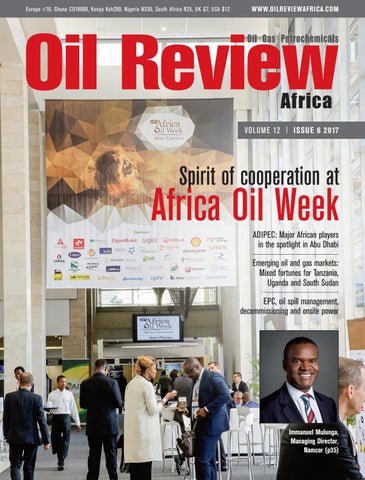
Spirit of cooperation at
Africa Oil Week ADIPEC: Major African players in the spotlight in Abu Dhabi Emerging oil and gas markets: Mixed fortunes for Tanzania, Uganda and South Sudan EPC, oil spill management, decommissioning and onsite power
Immanuel Mulunga, Managing Director, Namcor (p35)
S01 ORA 6 2017 Start_ORA Master Template - 2016 New 07/12/2017 11:41 Page 2
S01 ORA 6 2017 Start_ORA Master Template - 2016 New 06/12/2017 17:02 Page 3
Europe €10, Ghana CD18000, Kenya Ksh200, Nigeria N330, South Africa R25, UK £7, USA $12
WWW.OILREVIEWAFRICA.COM
O
VOLUME 12
|
3
ISSUE 6 2017 • WWW.OILREVIEWAFRICA.COM
ISSUE 6 2017
Spirit of cooperation at
Africa Oil Week ADIPEC: Major African players in the spotlight in Abu Dhabi Emerging oil and gas markets: Mixed fortunes for Tanzania, Uganda and South Sudan EPC, oil spill management, decommissioning and onsite power
Immanuel Mulunga, Managing Director, Namcor (p35)
Africa Oil Week was held in October in Cape Town. Turn to p14 for the full report.
EDITOR’S NOTE Oil Review Africa was a media partner for Africa Oil Week and, as ever, it was a busy, productive conference. There was a strong focus on developing gas reserves, particularly for fuelling domestic gas-to-power plants. Energy security is an ongoing challenge across the continent and gas, rather than oil, is being seen as a winning fuel for its lower emissions compared to other fossil fuels, and as a means of complementing renewables. The other strong theme from Africa Oil Week was increased regional cooperation between neighbouring African countries – and across the entire continent – in developing oil and gas reserves as an important catalyst for economic and industrial development. Exploration across Africa is picking up again with the oil price stabilising and multiple African countries are calling for investment. It looks like 2017 will end on a positive note for the oil and gas industry in many markets across the continent, with plenty of optimism for 2018. Georgia Lewis Managing Editor
CONTENTS Managing Editor: Georgia Lewis ora@alaincharles.com
Editorial and Design team: Prashanth AP, Hiriyti Bairu, Miriam Brtkova, Kestell Duxbury, Ranganath GS, Rhonita Patnaik, Samantha Payne, Rahul Puthenveedu, Deblina Roy, Nicky Valsamakis, Louise Waters
Publisher: Nick Fordham Sales Director: Michael Ferridge Magazine Sales Manager: Chidinma Anah
NEWS AND EVENTS
4 6
Calendar of oil and gas events
23
ADIPEC
26 36
Mozambique Gas Summit
Tel: +44 (0) 20 7834 7676 Fax: +44 (0) 20 7973 0076 E-mail: chidinma.anah@alaincharles.com
International Representatives India Nigeria UAE USA
Tanmay Mishra Bola Olowo Graham Brown Michael Tomashefsky
Head Office: Alain Charles Publishing Ltd University House, 11-13 Lower Grosvenor Place, London SW1W 0EX, United Kingdom Tel: +44 (0) 20 7834 7676 Fax: +44 (0) 20 7973 0076
Middle East Regional Office: Alain Charles Middle East FZ-LLC Office L2-112, Loft Office 2, Entrance B P.O. Box 502207, Dubai Media City, UAE Tel: +971 4 448 9260 Fax: +971 4 448 9261
Dates for the diary for 2018.
African oil and gas news Seven pages of hydrocarbons news from around the continent.
31 32 33
EPC
34
On-site power
35
Interview
37
Innovations
Using technology for best results.
Oil spill management Cleaning up the Niger Delta.
Decommissioning Planning ahead in Africa.
A special report from the global petroleum event in Abu Dhabi.
Updates from this emerging market.
Rig count A bellwether for the industry.
COVER STORY
14
Production: Nelly Mendes and Shaheen Shaikh
Africa Oil Week The focus was on regional cooperation and developing gas projects.
E-mail: production@alaincharles.com
Subscriptions: circulation@alaincharles.com Chairman: Derek Fordham
TECHNOLOGY AND OPERATIONS
COUNTRY REPORTS
Serving offshore operators.
Printed by: Buxton Press © Oil Review Africa
ISSN: 0-9552126-1-8
Serving the world of business
27
South Sudan
29
Uganda and Tanzania
What next for the oil industry of Africa’s newest nation?
Updates from these two promising East African markets.
Immanuel Mulunga, Namcor.
The latest advances for improving operations on- and offshore.
S01 ORA 6 2017 Start_ORA Master Template - 2016 New 06/12/2017 15:20 Page 4
4
EVE NTS CALE N DAR
ISSUE 6 2017 • WWW.OILREVIEWAFRICA.COM
Executives Calendar 2018 JANUARY 15-18
MARCH
World Future Energy Summit
19-12
22-23
Uganda & Tanzania Localisation Forum Kampala www.africa.getenergyevent.com
24-25
25-28
www.dohaenergyexpo.com
APRIL 17-18
Mozambique Localisation Assembly
www.moc-egypt.com
JUNE TBC
Maputo www.oilandgascouncil.com
FEBRUARY 6-8
MOC 2018 (Mediterranean Offshore Conference) Alexandria
Regional Enerrgy Co-operation Summit Abidjan www.regional-energy-cooperation-summit.com
Doha Sustainable Energy Exhibition & Conference Doha
Abu Dhabi www.worldfutureenergysummit.com
Ghana Summit Accra www.cwcghana.com
11-15
World Gas Conference 2018 Washington DC www.wgc2018.org
East Africa Energy & Infrastructure Summit 14-15
Kampala www.energynet.co.uk
East Africa Oil & Gas Summit & Exhibition Nairobi www.eaogs.com
Readers should verify dates and location with sponsoring organisations, as this information is sometimes subject to change.
The PNC forum discusses Nigerian Content policy adoption and implementation across industries THE CWC GROUP and Nigerian Content Development and Monitoring Board organised the 7th annual Practical Nigerian Content (PNC) Forum in Akwa Ibom from 6-9 November 2017. Themed ‘Nigerian ContentThe Next Frontier,’ the forum aimed to provide a platform for public and private sector players to adopt Nigerian local content policy and explore implementation opportunities across midstream and downstream sectors, as well as various industries. During his keynote address, Simbi Kesiye Wabote, executive secretary of the NCDMB, recapped the resolutions of the previous PNC Forum and outlined the progress made on each action point.
Extended networking opportunities for industry leaders and decision makers to explore opportunities in the country.
“One of the first directives I gave upon resumption is that operators can assume they have received our consent if they did not get feedback from us within 15 working days. I am happy to note that we have demonstrated this in the last one year as evidenced in the unprecedented completion time of tendering process for the Zabazaba project.” The event acknowledged the need of collaboration among
government, industry and academia for research and development (R&D). It further focused on outlining plans to increase access to the Nigerian Content Development Fund, shortening industry processes and promoting in-country spend and capacity development by rejuvenating Nigeria’s manufacturing sector. During the panel discussion, Omotayo Alsoadura, Chairman
of Senate Committee on upstream, National Assembly, announced plans to sign the Petroleum Industry Bill by Q1 2018. In addition, Paul McGrath, chairman and managing director of Mobil Producing Nigeria Unlimited, reaffirmed the company’s dedication to deepening Nigerian Content in the industry through operations and investments. More than 400 participants, including senior delegations representing the Akwa Ibom State Government, National Assembly, NNPC, Chevron, Addax Petroleum, SNEPCO , Marine Platforms, MG Vowgas, WAV, Baker Hughes, Siemens, Schlumberger and etc attended the 2017 PNC Forum.
S02 ORA 6 2017 News_ORA Master Template - 2016 New 07/12/2017 11:43 Page 5
S02 ORA 6 2017 News_ORA Master Template - 2016 New 08/12/2017 08:33 Page 6
N EWS
ISSUE 6 2017 • WWW.OILREVIEWAFRICA.COM
Nigeria moves up 24 points on World Bank Ease of Doing Business ranking Speaking at the 55th anniversary of the Oil Producers Trade Section (OPTS) of the Lagos Chambers Of Commerce and Industry (LCCI) in Lagos, Osinbajo said the oil and gas industry in Nigeria stands to benefit greatly from the administration’s Ease of Doing Business reforms. “This is fantastic news, but by no means an excuse for us to slow down. Instead we’re taking it as the very reason why we need to ramp up our reforms, for the benefit of Nigeria. There is still work to be done in reducing bureaucratic bottlenecks in the award of contracts and generally in obtaining approvals. “It is for this reason – the creation of a business environment that catalyses business activity and investment
Image Credit: US Institute of Peace/Flickr
THE WORLD BANK Ease of Doing Business report indicates that Nigeria had moved up by 24 points from 169th position on the 2017 ranking and also 170th position on the 2016 ranking to 145 in the World Bank’s 2018 report. Nigeria is on the list of 10 most improved economies in the world, after carrying out numerous reforms to improve their business environments. Following Nigeria’s imprOVED ranking in the report, the Buhari administration will continue to actively pursue its reform agenda to keep improving the nation’s economy, said vice-president Yemi Osinbajo. He noted that Nigeria’s ranking in the World Bank report was an indication that the Buhari administration’s reforms were producing results.
The improved ranking is an affirmation of the effectiveness of President Buhari’s reforms, Osinbajo said.
– that this year alone we have issued an Executive Order focusing on improving the business environment, and launched two National Action Plans designed to be short-term interventions aimed at implementing specific business environment reforms,” he said.
Kosmos Energy acquires Hess Corp legacy oil assets in Equatorial Guinea THE MINISTRY OF Mines and Hydrocarbons has announced that the assets of Hess Corporation in Equatorial Guinea will be acquired by Kosmos Energy. The landmark sale transfers majority ownership and operatorship of two legacy oil producing areas in the Rio Muni basin, Ceiba and Okume, to Kosmos.
Hess’ exit from Equatorial Guinea comes after nearly two decades of operations at the Ceiba field and Okume complex, which began producing in 2000 and 2006, respectively. The company operates the two producing areas and has an 85 per cent stake. Partners Tullow Oil (15 per cent) and national oil company GEPetrol (five per cent
Image Credit: Ben Sutherland/Flickr
6
This move makes Kosmos the biggest petroleum explorer in Equatorial Guinea’s Rio Muni southern maritime area.
carried interest) will work with new operator Kosmos Energy once the asset sale is finalised by the end of 2017. “We thank Hess for its years of service, for its input of technology, knowledge and financing, and above all for its careful stewardship of these important national resources,” said Minister of Mines and Hydrocarbons Gabriel Mbaga Obiang Lima. “Now, Kosmos Energy brings a new sense of action and commitment to the Ceiba and Okume fields. We are delighted to welcome our new partners as investors and producers, as well as explorers in blocks S, W and EG21 in the same region. This deal is nothing less than historic, and shifts focus towards the hugely promising Rio Muni basin.”
Project to connect US companies to natural gas opportunities in South Africa THE US TRADE and Development Agency (USTDA) has awarded a grant to the GreenCape Sector Development Agency for a feasibility study to assess the market demand, socioeconomic impacts, and main risks of a proposed integrated liquefied natural gas (LNG) importation and gas-to-power project in the Western Cape Province of South Africa. The study will also provide a preferred model for the importation of LNG for gas-topower electricity generation capacity, as well as for industrial, transportation, commercial, and domestic uses.“USTDA is pleased to support this project, which will help increase access to affordable, reliable energy in South Africa,” said Lida Fitts, regional director for sub-Saharan Africa at USTDA. “At the same time, this project will create opportunities for US businesses in one of South Africa's growing sectors.” Mike Mulcahy, CEO of GreenCape, added, “Natural gas has a critical complementary role to renewable energy for power generation in a lowest cost, low carbon, energy future for South Africa.” He commented that GreenCape was grateful to USTDA for its support. GreenCape is a not-for-profit company established by the Western Cape Government's Department of Economic Development and Tourism to develop the green economy by identifying opportunities in the energy sector, the waste sector, as well as the flow of resources in the regional economy.
S02 ORA 6 2017 News_ORA Master Template - 2016 New 06/12/2017 15:05 Page 7
S02 ORA 6 2017 News_ORA Master Template - 2016 New 06/12/2017 16:02 Page 8
N EWS
ISSUE 6 2017 • WWW.OILREVIEWAFRICA.COM
OPEC extends oil production cut to end of 2018 OPEC AND NON-OPEC oil giant Russia have agreed to extend oil production cuts until the end of 2018, after discussions that took place in Vienna in November 2017. However, OPEC has also decided to review progress based on the market fundamentals at its next meeting in June 2018. “In view of the uncertainties associated mainly with supply and, to some extent, demand growth it is intended that in June 2018, the opportunity of further adjustment actions will be considered based on prevailing market conditions and the progress achieved towards re-balancing of the oil market at that time,” said OPEC reporting to the press. The decision to curb oil production was adopted in OPEC’s meeting in November 2016 for a production adjustment of 1.2 mmbbl for six month. On 25
Image Credit: Skeeze/Pixabay
During the meeting, OPEC pledged full and timely conformity of participating countries in accordance with voluntarily agreed production adjustments.
May 2017, OPEC further decided to extend output cut for a further nine months. Viktor Nossek, director of research at WisdomTree in Europe, said, “This highlights oil producing nations’ increased willingness to tighten supply collectively to stave off the threat of shale and force oil prices higher,” Nossek added.
OPEC exempted Nigeria and Libya from the deal, mainly due to uncertainty and below-normal production of both countries. Khalid al-Falih, minister of energy in Saudi Arabia and president of OPEC, said it was too early to talk about reversing the cuts at least for a couple of quarters as the world was entering a season of low winter demand.
Africa Energy to acquire additional interest in South African offshore blocks AFRICA ENERGY CORP has signed an agreement to acquire an effective 4.9 per cent interest in the exploration right for Block 11B/12B offshore South Africa. Block 11B/12B is located in the Outeniqua Basin approximately 175km off the southern coast of the country. The block covers an area of approximately 19,000 sq km with water depths ranging from 200m to 2,000m.
Total E&P South Africa BV, a wholly owned subsidiary of Total SA, is the operator and has a 50 per cent interest in Block 11B/12B. CNR International, a wholly-owned subsidiary of Canadian Natural Resources Limited, owns the remaining 50 per cent. Africa Energy holds 49 per cent of the shares in a new special purpose vehicle, which
Image Credit: Mark Benger/Flickr
8
Africa Energy is building an exploration and production portfolio across Africa.
has entered into farmout agreements with Total and CNRI separately to acquire five per cent from each for an aggregate 10 per cent participating interest in Block 11B/12B (4.9 per cent net to Africa Energy). Garrett Soden, president and CEO of Africa Energy, said in a statement, “This is a unique opportunity for a company of our size to work with majors in what we believe to be the most prospective geology offshore the African continent. Our technical team knows the area well from their previous exploratory work off the southern coast, and we look forward to the proposed exploration well on Block 11B/12B.”
Sonatrach and BHGE aim to boost Algeria’s oil and gas market SONATRACH AND BAKER Hughes have announced the creation of a 20,000 sqm manufacturing facility in Arzew Industrial Zone, to strengthen Algeria’s position in upstream oil and gas market to meet local demand. Sonatrach and BHGE have formed a new company in which SONATRACH and BHGE have 51 per cent and 49 per cent ownership respectively. The project draws on the experience of BHGE in oilfield equipment manufacturing and aims to leverage the company’s global and local scale to provide production solutions from the facility. According to BHGE, the production is scheduled to be started in December 2019. Through an initial combined investment of US$45mn, the new company is expected to provide manufacturing, assembly and maintenance for various types of oilfield equipment including wellheads, Christmas trees, BOPs and valves. The aim is to establish a major base to fulfil Algeria’s increased domestic upstream requirements with the potential for future exports. The facility is also expected to add training capabilities and offer competency development programmes for more than 200 engineers during the first seven years. In addition to reducing dependence on imports, the facility is seen to boost economic competitiveness and strengthen the local supply chain by creating job opportunities in Oran’s Arzew area and the development
S02 ORA 6 2017 News_ORA Master Template - 2016 New 08/12/2017 07:29 Page 9
N EWS
ISSUE 6 2017 • WWW.OILREVIEWAFRICA.COM
UGANDA AND TANZANIA inaugurated the East Africa Crude Oil Pipeline (EACOP), a 1,445km pipeline which will terminate at the Indian Ocean port of Tanga. EACOP, which be used to transport Uganda’s waxy crude, is expected to be one of the longest heated pipelines in the world, with an estimated cost of US$3.5bn. The front-end engineering and design work has been scheduled to be completed by the end of the year and FID is expected in next few months. The construction of the project will bea joint venture company between the governments of Uganda and Tanzania with Total, Tullow Oil and CNOOC. Tanzania offered Uganda a 20-year tax break and a free right of way to construct the pipeline.
The Port of Tanga where the pipeline will terminate upon completion.
Tanzania will receive a transit fee of US$12.20 per barrel. In August 2016, Uganda selected the Albertine Graben Consortium, led by BHGE, as the favoured bidder for the twophase refinery project in Hoima. The project was re-tendered after negotiations with Russia’s
RT Global Resources and South Korea’s SK Engineering & Construction failed. The Ugandan government is planning to keep a 40 per cent stake in the refinery and sell shares to neighbouring countries if they import petroleum products from the facility.
Isabel dos Santos dismissed by Angola President as national oil company chair JOAO LOURENCO, PRESIDENT of Angola, has dismissed Isabel dos Santos from her position as chair of Sonangol, the West African country’s national oil company. It was announced in a statement from the President’s
office that she has been replaced by Carlos Saturnino. Mr Saturnino’s most recent post was secretary of state for oil and he had previously been dismissed from Sonangol by Ms dos Santos. Ms dos Santos is often referred to as the richest woman
Image Credit: GovernmentZA/Flickr
THE BRITISH PRIME Minister’s Trade Envoy to Uganda and Rwanda, Lord Dolar Popat led a delegation of business representatives from the Energy Industries Council on an oil and gas trade mission to Uganda. The mission was focused on seeking investment opportunities for UK companies in the oil and gas supply chain. During the fiveday mission, the delegates met with ministers, government officials, oil and gas companies and corporate entities that have interests in the industry. The delegation attended a business breakfast with the Department for International Trade (DIT) Uganda and Stanbic Bank under the theme ‘Unlocking opportunities in the oil and gas supply chain in Uganda’. At the breakfast, DIT’s oil and gas expert Phil Haymes gave a presentation on supply chain development. He emphasised the need for Ugandan companies to form joint ventures with international companies experienced in the oil and gas industry for them to benefit from capital, skills and technology transfer. The delegation also visited the Roofings Limited plant in Namanve, Mukono District. Roofings is a Ugandan steel processing company that is looking to supply steel products for the oil and gas industry. The team later visited the Albertine oil region in Western Uganda where they toured the proposed oil refinery sites and the site of the proposed Kabaale International Airport. This will be Uganda’s second international airport and will handle cargo and passenger transport.
Tanzania and Uganda inaugurate the East Africa Crude Oil Pipeline
Image Credit: Mikhail Goldovski/Flickr
UK oil and gas trade mission to Uganda
Joao Laurenco was inaugurated as president of Angola in September 2017.
in Africa and is the daughter of former Angolan president, Jose Eduardo dos Santos, who held the position for 38 years. At a Reuters Newsmaker event in London, she told reporters that she keeps her business life separate from her private life separate, but commentators are viewing her dismissal by President Lourenco as a strategic move to reduce the influence of the dos Santos family on Angolan politics and business. According to Reuters, Angolan analysts say the move could be aimed at consolidating President Lourenco's power and preventing an oil production decline. Sonangol has also been criticised by international partners over delays in approving projects.
9
S02 ORA 6 2017 News_ORA Master Template - 2016 New 06/12/2017 15:06 Page 10
N EWS
ISSUE 6 2017 • WWW.OILREVIEWAFRICA.COM
“It is too early to write the obituary of oil”: IEA World Energy Outlook report WITH GLOBAL OIL demand projected to grow to 2040, the International Energy Agency’s annual World Energy Outlook is not sounding the death knell for the oil industry. But the report notes that demand is growing at a “steadily decreasing pace”. Fuel-efficient and electric cars contributed to the slowed pace but demand for oil in sectors such as petrochemicals, aviation and shipping is expected to boost demand to 105mn bpd by 2040. Developing countries in Asia account for two-thirds of global energy growth, with the rest coming mainly from the Middle East, Africa and Latin America.
Dr Fatih Birol, executive director of the IEA, launched the report.
Image Credit: IEA
Improved access to energy has driven up hydrocarbon demand. More than 100mn people per year have gained access to electricity since 2012 compared
with around 60mn per year from 2000 to 2012. In sub-Saharan Africa, electrification efforts outpaced population growth for the first time in 2014
JMMC reports highest-ever production conformity THE OPEC-NON-OPEC PRODUCING Countries’ Joint Ministerial Monitoring Committee stated that for September 2017, OPEC and participating non-OPEC countries achieved a record high conformity level with voluntary production adjustments, reaching 120 per cent. It was noted that some producers have consistently performed beyond voluntary production adjustments, but others are yet to achieve 100 per cent conformity.
NNPC branches out into bio-fuels sector
Our experience allows us to Select, Procure and Deliver the following Equipment: | Crane parts | Forklift parts | Lubricants| | Inspection Equipment | Wellhead Equipment | | Generators | Compressors | Valves | | Specialist hoses |
T: +44 (0)1702 348 340, E: sales@d-jexports.com
www.d-jexports.com
THE NIGERIAN NATIONAL Petroleum Company (NNPC) is set to diversify with plans underway for a bio-fuel plant in the Agasha Guma area of Benue State. The next step in the project will be the announcement of a core investor in the proposed plant. Sugar cane will be a feedstock for the bio-fuels plant. The NNPC said that upon completion, the plant was projected to generate about 1mn direct and indirect jobs. It was noted that the project would link the energy sector with the agricultural sector through the commercial production of biofuels from selected energy crops. Other components of the project include a sugar cane feedstock plantation of about 20,000 hectares; a cane mill and raw and refined sugar plant capable of producing 126,000 tonnes annually. Additionally, the project will include a fuel-ethanol processing plant with an annual production capacity of 84 million litres. The bio-fuels projects will help establish the bio-gas cogeneration power plant which will generate 64 MW; a carbon dioxide recovery and bottling plant that will produce 2, 000 tonnes annually as well as an animal feed plant that will produce 63,000 tons annually.
Image Credit: henskechristine/Flickr
10
S03 ORA 6 2017 News_2_ORA Master Template - 2016 New 06/12/2017 16:00 Page 11
N EWS
ISSUE 6 2017 • WWW.OILREVIEWAFRICA.COM
A NEW TRAINING centre for the West African oil and gas industry, valued at US$8.5mn, has opened in Takoradi, Ghana. The Rigworld Training Centre is equipped with advanced simulators, a helipad, water survival training pool, medical centre, onsite accommodation, restaurant and fitness centre. Takoradi was chosen as the location for the facility because of its importance to Ghana's oil and gas industry. The centre will have a strong focus on building capacity for A simulation of a real-life situation at the training centre. local people as well as improving safety and productivity for operators. The programmes will be led by internationally recognised training leaders with courses including offshore survival training, rope access training, well control, drilling, lift competence, NDT training, hose assembly, and health, safety and environment training. More than 700 guests were present at the opening ceremony including former president Egbert Faibille Jr, acting CEO of the Petroleum Commission, Per Goebel, vice president, Maersk Drilling, and Dr Kofi Abban, CEO and founder of Rigword International Services.
GE to upgrade gas turbines at Azito Power Plant in Côte d’Ivoire GE’S POWER SERVICES business announced it has signed an agreement with Azito Energie to upgrade two gas turbines at the company’s combined-cycle power plant.
The hardware upgrade and digital solutions project will help increase power output by up to 30 MW and aims to equip Azito with the data it needs to increase efficiency and improve
The Azito Power Plant where the gas turbines will be upgraded.
operations at the power plant. The project, located in the Yopougon district of the Ivory Coast, marks GE’s first GT13E2 MXL2 gas turbine upgrade order in sub-Saharan Africa. In addition to increasing power output by up to 30 MW, upgrades on the turbines are expected to deliver a combinedcycle efficiency increase, resulting in significant fuel savings and reduced CO2 emissions. GE’s solutions will also extend inspection intervals for the gas turbines, reducing maintenance and repair expenses, which, in turn, will reduce overall plant costs and result in improving profitability.
Image Credit: Rigword
THE EGYPTIAN MINISTRY of Petroleum and Mineral Resources has announced to offer an oil exploration bid for the oil resources of the Red Sea in Q1 2018. The announcement comes in light of the results of 2D and 3D seismic surveys which are presently being conducted in the Red Sea, as reported by Egypt’s Daily News. The companies conducting surveys are considered to be designated for several areas in the Red Sea, said the source. The results of the surveys are expected to be sold to companies that intend to examine them during preparing for the participation in the bid. According to the source, the bid is planned to be offered by the middle of next year. The Egyptian Holding Company for Natural Gas (EGAS) has granted permission to four international companies to explore oil and gas in four sectors of the Mediterranean. According to the source, there are minimal investments of US$306mn and signing grants of US$10.5mn to dig eight wells and conduct three-dimensional seismic surveys. The winning companies include BP and Eni, a subsidiary of IEOC alliance, to explore sector four in North Ras El Esh, said EGAS. In addition, the IEOC, BP and Total alliance were awarded sector seven and north of Hamad. Italy’s Edison was awarded sector 12, with BP being awarded sector 14, EGAS further added. At Africa Oil Week, Tarek ElMolla, Egypt’s petroleum minister was keen to point out that the country is secure and open for hydrocarbons business.
New oil and gas training centre for West Africa opens in Ghana
Image Credit: GE
Exploration bid for Egyptian oil for Q1 2018
11
S03 ORA 6 2017 News_2_ORA Master Template - 2016 New 06/12/2017 15:02 Page 12
N EWS
ISSUE 6 2017 • WWW.OILREVIEWAFRICA.COM
Hungary plans to import crude oil and LNG from Nigeria THE HUNGARIAN GOVERNMENT has indicated interest to purchase crude oil and liquefied natural gas (LNG) from Nigeria. Gabor Ternak, the Hungarian ambassador to Nigeria, disclosed this during a courtesy call on Maikanti Baru, group managing director of Nigerian National Petroleum Corporation (NNPC). He said that the import of crude oil and LNG are expected to bridge the current supply gap in Hungary. Being a non-oil producing country, Hungary has to import oil to meet its domestic energy needs. By purchasing crude oil and LNG from Nigeria, the country is planning to diversify its sources of these products, Ternak added. The crude oil from Nigeria is expected to boost Hungary’s
Image Credit: Sludge G/Flickr
Hungary has been refining oil for many years. This is a petrochemical plant in 1988.
large-scale commercial refineries. In his remarks, Maikanti Baru stated that NNPC commenced tendering process for the selection of the 2018 crude oil off-takers. He noted that the Hungarian companies may maximise value from direct purchase. Baru explained that
Hungary could purchase LNG through spot cargo, in which excess production is given to registered off-takers with Nigerian Liquified Natuaral Gas Limited. The Hungarian companies could submit their profile to NLNG for engagement as off-takers of spot-cargoes.
Gas and renewables for a sustainable development in Ghana: Eni THE PRIME MINISTER of Italy Paolo Gentiloni and Claudio Descalzi, CEO of Eni, have visited the FPSO Kufuor in Ghana’s offshore, and viewed that gas and renewables have a sustainable future for the development of the country. The
visit took place during Gentiloni’s trip to Ghana as a part of his ongoing state visit to a set of African countries. The FPSO Kufuor is a floating production, storage and offloading unit in Ghana’s offshore. It puts in production
Image Credit: Eni
12
Claudio Descalzi is excited about the opportunities on offer in Ghana.
the Sankofa Main, Sankofa East and Gye-Nyame oil and nonassociated gas field. The project is expected to ensure at least 15 years of reliable gas supply. According to Eni, the visit endorsed the company’s longterm business strategy in Ghana, and was aimed at integrating its traditional business with energy from renewable sources, leveraging all the industrial, logistic, contractual and commercial synergies. “In this country, we produce oil for international markets, but also gas for the domestic market, which we decided to allocate entirely to the domestic market, and are strongly engaged in developing renewable sources,” said Descalzi.
NNPC Retail urges domestic LPG consumption THE RETAIL ARM of the Nigerian National Petroleum Corporation (NNPC), NNPC Retail Limited, announced that it will promote the consumption of liquefied petroleum gas (LPG). Yemi Adetuji, managing director of NNPC Retail, stated that presently the company controls four to five per cent of the country’s LPG market share, noting that it looks forward to growing its share to 10 per cent. Adetuji disclosed this at a press during the commissioning of a new mega filling station near Sagamu, along the Lagos-Ibadan Expressway in Ogun State. He said that the decision to focus on the LPG market comes in line with the federal government’s plan to promote usage of cooking gas in Nigeria. NNPC retail is planning to begin a nationwide monitoring exercise, aiming to ensure that its customers do not suffer from products under-dispensing. “We have a zero-tolerance for under-dispensing. We have a network development and control section that monitors under-dispensing, and policing the sales and our dealers. We have sanctions if they are caught. If it gets to a point, then contracts of dealers will be terminated,” said Adetunji. He noted that the company would be leveraging on its brand equity which remained one of the highest in the industry in the last 15 years to consolidate and grow its retail business portfolio across the country. The establishment of the new mega station is in line with the 12 business focus areas of NNPC. Adetunji stated, “It is a state-ofthe-art 22-nozzle station.”
S03 ORA 6 2017 News_2_ORA Master Template - 2016 New 06/12/2017 16:10 Page 13
N EWS
ISSUE 6 2017 • WWW.OILREVIEWAFRICA.COM
THE WINNERS OF the Big Five Annual Board Awards 2017 where Oil Review Africa was lead media partner were announced at a special ceremony in London. Hosted by the Africa Petroleum Club, oil and gas companies gathered at the Royal Institute on 16 November to celebrate achievements in the African petroleum industry. Paul Dailly, founding partner and SVP, New Ventures, Kosmos Energy, won Distinguished Contribution to the African Industry award for his work in the Equatorial Guinea discoveries with Triton, followed by success with Kosmos Energy in Ghana, Mauritania and Senegal. The second award went to Anadarko Petroleum for Contribution to African Petroleum and Excellence.
Gayle Meikle, President, Africa Petroleum and Energy Club, hosted the event.
Cairn Energy was awarded Independent Player in Africa of the Year. They were the first company to drill in deep-water offshore Senegal, which remains relatively under-explored. ENH won African National Oil Company of the Year. They signed off a US$7bn investment
to export natural gas from Mozambique to Coral South. The fifth award: Service and Supply Company of the Year went to PGS for service delivery in Angola and Namibia, Cote d'Ivoire, North West Africa, São Tomé to Congo, southern and east Africa, and Togo to Nigeria.
Total partners with Sonangol for new upstream and downstream projects in Angola TOTAL AND SONANGOL have signed agreements to develop Zinia Phase 2 project, explore block 48 and several other deals covering upstream and downstream activities in Angola. Patrick Pouyanné, chairman and CEO of Total, and Carlos
Saturnino, chairman of Sonangol, signed the agreements during their meeting with João Lourenço, the president of the Republic of Angola. “Today’s agreements demonstrate Total’s willingness to contribute to this dynamic by
Image Credit: Total.
ENERGYNET WILL HOST the second Regional Energy Cooperation Summit in Côte d’Ivoire from 24-25 January 2018, discussing opportunities for crossborder power projects and potential gas investments across West Africa. The conference is expected to provide a platform for partnership development, said the company. At the first summit in January 2017, Thierry Tanoh, minister of petroleum, energy and renewable energies in Côte d'Ivoire, said that the theme aims to address the need for access to different energy sources, including renewable energies. The 2018 summit will review outcomes from last year’s meeting, identifying next steps and bringing together ECOWAS decisionmakers and investors to advance regional partnerships and interconnection projects. Valeria Aruffo, programme manager, commented, “Given the abundant reserves from many West African gas fields which will firstly be harnessed for power and domestic use, the summit will instigate the conversation surrounding the sub-region’s booming global gas market.” “We’ll focus on export and import capacities, balancing domestic obligation and regional trade and of course the role of LNG in facilitating gas development in the sub-region,” Aruffo added. With the theme of regional integration in West Africa, the energy ministers and government representatives, heads of utilities, regulators, power developers, technology providers, financiers and agencies from across West Africa are expected to attend.
Big Five Annual Board Awards 2017 recognise leaders in the oil and gas industry
Image Credit: Africa Petroleum Club
Energy event to explore African markets
Total has a long history of employing people in Angola’s hydrocarbons industry.
restarting exploration offshore in Angola, launching new projects such as Zinia 2 on Block 17 and extending our cooperation with Sonangol to new businesses in oil product distribution and renewable energy,” said Pouyanné. “In particular, Total is making all necessary efforts to ensure a start-up as soon as possible during summer 2018, for the Kaombo project, currently the most significant investment in the country,” he added. The Zinia Phase 2 is located in Block 17. Under the terms of agreement, Zinia 2 will be connected to the Pazflor FPSO and is expected to produce 40,000 bpd.
13
S04 ORA 6 2017 Cover story - Africa Oil Week_ORA Master Template - 2016 New 06/12/2017 15:00 Page 14
COVE R STORY
ISSUE 6 2017 • WWW.OILREVIEWAFRICA.COM
FOCUS ON GAS AND REGIONAL COOPERATION
AT AFRICA OIL WEEK With an upturn in the oil price, the mood was cautiously optimistic at Africa Oil Week. Oil Review Africa managing editor Georgia Lewis reports on the main themes to come out of this year’s conference. HERE WERE THREE strong themes to come out of Africa Oil Week 2017 development of the gas-topower market, development of domestic markets and downstream infrastructure, and regional cooperation within an ever-closer African Union. Identifying the way forward for the industry, especially with oil prices recovering from the era of sub-US$30 prices, was a strong theme. The continent is competing for investment capital, particularly since serious funds were ploughed into US shale. But there is cause for optimism with the African continent accounting for 16 per cent of active offshore fields and 70 per cent of offshore fields that are either under development or represent potential developments. In his opening address to the conference, David Lloyd, partner, Preng & Associates, an oil and gas recruitment company, said, “With Brent at US$57, the mood is much more encouraging.” Mr Lloyd described the recruitment industry as “a bellwether” for the broader oil and gas industry, saying there have been more inquiries. “It’s a lower cost environment but we can live with that provided things don’t dip below US$50,” Mr Lloyd told delegates. “The industry needs stability as we are coming out of the downturn.”
T
Image Credit: ITE
14
Distinguished speakers from across the African oil and gas markets spoke at Africa Oil Week 2017.
He urged caution, advising operators not to make the same mistakes after past downturns ended and telling the conference to avoid a “feeding frenzy” which drives costs up. This was reflected in an interview Oil Review Africa conducted with Austin Avuru, CEO of Seplat, a Nigerian independent. He said that plans are now made at Seplat as if the oil price is around US$45-$50. Paul McDade, CEO, Tullow, said that before the latest downturn, the oil and gas
industry was “inefficient, complacent and unchallenged”. “In 2014, many people expected a short shock, but if we were honest with ourselves, we had to become more efficient,” Mr McDade said. “Africa can and should be a successful part of the global oil and gas markets – competition is tough, but the lowest-cost producers will win.” Pade Durotoye, CEO of Oando Energy, said Nigeria has come through "dark, grey periods of cutbacks, cutbacks, cutbacks".
When asked if operators would learn lessons from this downturn, Mr Durotoye said that companies "got fat and bloated when times were good – we've seen it over and over" but costs were driven up because of "competitive pressure". He said that now "capacity should be managed better".
Gas to power for Africa Sobering statistics about low rates of energy production and consumption, and poor access to energy for many African
S04 ORA 6 2017 Cover story - Africa Oil Week_ORA Master Template - 2016 New 06/12/2017 15:00 Page 15
COVE R STORY
ISSUE 6 2017 • WWW.OILREVIEWAFRICA.COM
US Energy Secretary Rick Perry addressed the conference on exporting American oil and gas to Africa.
solutions he flagged up included privatising state-owned refineries to create a domestic market, utilising petroleum from Nigerian oil within Nigeria, careful examination of export opportunities, development of the petrochemicals sector, and using gas to deliver power for local consumption. “Gas is an important part of the energy mix,” said Mr McDade. “It has been stable in the last three or four years.” Taking advantage of advances in LNG technology could prove beneficial for African gas-topower projects. The LNG2Africa project is another way for African countries to work more closely, according to Gabriel Mbaga Obiang Lima, Equatorial Guinea's minister of mines and hydrocarbons. Equatorial Guinea, Burkina Faso and Ghana are partners, along with OneLNG and Gunvor. He added that progress is being made in regard to more African countries joining with Angola and Mali's membership under negotiation and future discussions planned for Morocco, South Africa and Guinea Conakry to join. "They are all mining countries, they all need power for industry, they are buyers of
electricity," Mr Obiang Lima said, emphasising the importance of using African natural gas for domestic power projects. Mozambique is another emerging market for gas-topower projects, again with a focus on meeting local energy demands. Jose Branquinho, project manager, INP, told the conference that Mozambique’s industrial development is a challenge and resources, including power, will be needed internally. He said the Mozambique and Rovuma basins mean that there is more than 200tcf of gas currently available in the country, with 15 licenced areas. He said the plan is for at least 25 per cent of Mozambican gas to be used locally. Mr Branquinho said that “multiple law updates” had improved regulation of the Mozambican gas industry, in particular changes made in 2014 which have positively impacted on the LNG and midstream sectors. The Kudu gas-to-power project, on which Namcor has partnered with BW Offshore, is an important part of Namibia's nascent hydrocarbons industry, reflecting the drive towards using African oil and gas for domestic energy security. FID is expected
Image Credit: ITE
countries were repeatedly quoted at Africa Oil Week. "We cannot talk about the future without talking about power," said Daniel Silke, a futurist and former member of the South African Parliament. "In Africa, 620mn people have no power, this is the core issue. Power constraints will hamper growth." "[Access to power] is where the [hydrocarbons] sector should be looking to the future - those people need to live." Governments and operators also need to be mindful of the "shift away from oil" as a fuel for power generation, according to Mr Silke, with Africa "moving toward gas, renewables and hydro going forward". "The industry needs to take advantage of these changing trends ... Natural gas is the great opportunity into the future." The speakers generally agreed that there are big opportunities to use Africa’s substantial gas resources to meet the growing need for power. If successful, this should trigger economic growth with the population of the continent projected to swell to 2bn in 2035. But in order for this to happen, there needs to be greater cooperation to move energy around the continent – another strong theme of the conference. Improved regulatory and fiscal conditions were frequently put forward as ways to attract investment, reignite the development of deepwater plays, and to exploit exploration potential across Africa. Mr Avuru said that back-up power costs US$5bn per year across Africa and that even people with access to energy often suffer frequent outages. In regard to Nigeria, Mr Avuru said that gas-to-power was essential for the country’s progress. He outlined what he believes Nigeria needs to do in order to achieve energy security and a more developed hydrocarbons industry. The
15
between December 2017 and June 2018. Immanuel Mulunga, managing director, Namcor, said that Nampower has a five-year contract with Eskom to provide cheap power to Namibia. "Instead of building a big power station, we are looking at a smaller power station to meet the country's energy demand," he said. "Namibia has done well over the years with its electrification programme." Addressing the “infrastructure deficit” is crucial to developing gas-to-power and improving access to energy, according to Steve Lowden, chairman, New Age. “Sub-Saharan Africa, excluding South Africa, has the lowest energy consumption of any continent,” Mr Lowden says. “Africa needs more gas, more power.” Projects such as Eni’s gas-topower project in CongoBrazzaville and gasfield and FPSO development for the Nigerian domestic economy were mentioned by Mr Lowden as examples of positive steps towards using African gas for energy access. Mr Lowden spoke of Chinese investment and loans from corporations, rather than simply borrowing from Chinese banks,
S04 ORA 6 2017 Cover story - Africa Oil Week_ORA Master Template - 2016 New 06/12/2017 15:00 Page 16
COVE R STORY
ISSUE 6 2017 • WWW.OILREVIEWAFRICA.COM
Regional and continental cooperation
to fund gas-to-power infrastructure for Africa, with companies such as Exim, Hopu, China Overseas Infrastructure Development and Investment Corporation (COIDIC) and SinoSure involved in such projects. COIDIC, for example, is funding FLNG for African gasto-power projects.
Domestic markets and downstream development For South Africa, downstream development means developing the liquid fuels industry, according to David Mahlobo, the country’s energy minister. For Africa overall, Mr Mahlobo said that regional and domestic gas markets are important. “Are we still laying export lines?” Mr Avuru asked the conference. He recounted the trend across the African oil and gas industry over past years to “rush for construction of export infrastructure”, which was done by borrowing money and creating a “rental economy”. “In Nigeria, oil and gas makes up 80 per cent of government revenue but 10 to 14 per cent of GDP,” Mr Avuru said. He cited Cote d’Ivoire, Egypt, Ghana and Tanzania as examples of countries where “new thinking” is taking place in terms of focusing on domestic markets and developing the downstream sector to keep the products and the revenue on the continent. For Nigeria, he recommended this sector be “fully deregulated”, as well as strengthening security against vandalism. The Petroleum Industry Bill (PIB) has edged closer to being passed after 17 years of negotiations and amendments. If passed, this will have an impact on the downstream sector for Nigeria. In regard to the PIB, Mr Durotoye said it was "very difficult to say" when it would be passed but "the rhetoric is that the current senate president is very eager" to see the bill become law,
Image Credit: ITE
16
The Cape Town International Convention Centre again played host to Africa Oil Week, with delegates from Africa and beyond in attendance.
so there is a "strong chance" this will happen in 2018. However, he added that operators should start making positive changes now rather than "wait for the future". Improved security, particularly in the Niger Delta region, has improved confidence, according to Mr Durotoye. Now is the time, he said, "to make investments as quickly as possible, as efficiently as possible". "The stars are aligning and we are able to fulfil that promise," Mr Durotoye said. Uganda is hoping for a focus on refining and gas conversion with its hydrocarbon development plans. This is according to Ernest Rubondo, executive director, Petroleum Authority Uganda. The southern part of the East Africa rift system is already under exploration. Total, Tullow, CNOOC, Oranto and Armour Energy all have interests in Uganda’s emerging oil and gas market. Investment in infrastructure will also help develop the oil and gas industry in Africa with Mr Silke saying that this will cost an estimated US$721bn between 2013 and 2035. In regard to the young population across the continent, he said that bringing
young talent into industries is "an essential challenge for all of us". In contrast to the strong focus on developing local oil and gas for local markets, Rick Perry, US Energy Secretary, talked about the prospect of exporting American oil and gas to Africa. Secretary Perry said that the US has "become an energyabundant country" with ambitions to export more oil and gas to countries which he described as "our friends". "We can export our energy to a growing world ... this is great news for our trading partners around the world," he said. "When you do business with America on energy, you can be assured we will not use that energy as a weapon." "The US seeks partners across the globe so we can grow together and move head together," Secretary Perry told delegates. "Today the US leads the world in oil and gas production," he said. "My department is approving applications for natural gas exports as fast as possible, including [exporting] to Africa." "We will end the dependence on hostile sources [by] exporting to our friends, freeing them energy is a tool of liberation."
There was a broad consensus across the conference that an increasingly closer African Union – with a view to European Union-style free trade – and cooperating on a regional level, would be of enormous benefit to improving revenues from oil and gas, as well as helping individual countries prosper. Boosting the role of regional integration across Africa for the oil and gas industry is vital, according to Fred Kabanda, chief oil sector regulatory officer, African Development Bank (ADB). In his address, he said the ADB in conjunction with the petroleum sector was committed to “lighting up and powering Africa, integrating Africa and improving the quality of life.” Among the positives for integration, Mr Kabanda cited a “growing internal market” and “steady GDP growth”. “The latest growth is attributed to internal markets,” he told delegates. He said that developing infrastructure, such as refineries, as well as promoting intraregional trade were essential for growth to continue across African oil and gas markets. On the African Union, David Mahlobo, South Africa’s energy minister said the countries of the union have a “common future”. “We need to take steps to ensure the continent grows with sustainable development,” said Mr Mahlobo. “Energy is needed to propel the economy for the next 50 years … It should not be a source of conflict.” In line with one of the strong themes of the conference, Mr Silke said that trade between African countries is important for economic growth. He cited the example of the European Union, where 69 per cent of all trade is conducted between member states and south-east Asia, where trade between countries in the region is at 50 per cent. In contrast, only 18-
S04 ORA 6 2017 Cover story - Africa Oil Week_ORA Master Template - 2016 New 06/12/2017 15:00 Page 17
S04 ORA 6 2017 Cover story - Africa Oil Week_ORA Master Template - 2016 New 06/12/2017 15:00 Page 18
COVE R STORY
ISSUE 6 2017 • WWW.OILREVIEWAFRICA.COM
In regard to Uganda, Mr Rubondo said that a national talent register was being compiled to make it easy to identify talented Ugandans and address skills shortages.
Exploration and new frontiers
Image Credit: ITE
18
Daniel Silke offered bold perspectives on the future of African oil and gas.
20 per cent of trade in Africa is within the continent. "Africa needs to trade more with each other," Mr Silke said. Gabriel Mbaga Obiang Lima, Equatorial Guinea's minister of mines and hydrocarbons, outlined why Equatorial Guinea joined OPEC and urged other countries on the continent to follow suit. "I want to thank my brother ministers, I want to thank Nigeria and Angola who urged us to join OPEC," he told the ministerial panel event, which included energy ministers from Côte d'Ivoire, Ghana, Mali, Namibia and Nigeria. He went on to explain that Africa could be seen as a real force at OPEC if it worked together: "Imagine if Africa was one country - it would have 1.216bn population, next to China, oil [production] would be next to Saudi, maybe even higher, with gas, Qatar would be a small player, we'd have power plants to run the entire continent, [African] LNG could supply all Europe so there would be no need for Russian gas, we would be a serious country of OPEC, the most powerful country in the world." "Even if Africa was five countries, we'd still have power," he told the conference. "My conclusion is that joining OPEC is important."
"One small country can't make much difference but all our countries together led by Nigeria, Angola and Algeria can," Mr Obiang Lima said. Namibia is an emerging market keen to take a regional approach to development and monetisation of its nascent oil and gas industry. Plans for exporting refined hydrocarbons are focused on neighbouring African countries, such as Botswana, Democratic Republic of Congo, Zambia and Zimbabwe, with the strategic location of operations at Walvis Bay making it a prime target for further development as a hub for the industry. Developing local content is another important factor for ensuring regional development in multiple oil and gas markets across Africa. Eric Hathorn, exploration director, Cairn Energy, said that in Senegal, the company was “developing capacity through training and education”. “We support local investment in local communities [especially] rural areas, we support local businesses [and we provide] English language training,” Mr Hathorn said. "Senegal has moved from being a frontier basin to an emerging basin with a clear path to commerciality," Mr Hathorn said, adding that the development of the country's oil sector "will benefit the people in Senegal."
While there was a strong downstream focus at Africa Oil Week, exploration hot spots were also discussed. Paul McDade, CEO, Tullow, said that there are rewards for those “willing to take the risks required” and cited Cote d’Ivoire, Ghana, Uganda and Kenya as three countries worth investigating further. Sierra Leone attracted attention at the conference with Raymond Kargbo, director general, Sierra Leone Petroleum Directorate announced a fourth licensing round for offshore blocks. Bids will be accepted between 15 January 2018 and 31 May 2018 for shallow and deepwater blocks which have not yet been developed. A set of 3D seismic data will be available. In March this year, the Petroleum Directorate took ownership of its data and data centres have been set up in Freetown and at Getech's offices in London. The London centre will open in January 2018. Getech is a technical partner for the directorate. "We are currently formulating our plans and would welcome input from interested companies," Mr Kargbo told delegates. "Sierra Leone is a good exploration opportunity - we have favourable legal, regulatory and political framework and we are politically stable." Namibia’s oil and gas potential and ambitions to quickly move from being a frontier region to an emerging market were widely discussed at the conference. Immanuel Mulunga, managing director, Namcor, told Oil Review Africa in an exclusive interview that it is a "very exciting
time" for Namibia, particularly with the calibre of investors that have been attracted. Tullow, Total, Chariot and ONGC already have a strong presence in Namibia and Mr Mulunga said that an announcement in regard to " “a US super-major" can be expected soon. The drilling campaign is expected to start by Q3 or Q4 2018. Namcor, as the NOC, will be participating in operations with a 10 per cent minimum stake. Namcor's working interest in one block is to provide 2D and 3D seismic data, while they have a 100 per cent owner-operator interest in Block 18-11B. "We will work up and bring in bigger companies like everyone's doing," Mr Mulunga said. He is confident of oil discoveries in Namibia because of "very promising" seismic data. In terms of funding projects, Mr Mulunga said that "briefcase companies" have been instrumental in providing finance as well as attracting big companies to Namibia. Gil Holzman, president and CEO of Eco Atlantic, described Namibia as a “highly active underexplored area” with the company planning “near-term drilling” for 2018-2019 in its four blocks in the Walvis basin. It is working with Tullow. Total and Namcor, Namibia’s national oil company, which has a 10 per cent stake. “Namibia is politically stable with favourable fiscal incentives,” Mr Holzman said. Uaapi Utjavari, vice president, Africa, Azinam, has six licences in Namibia, fully funded by Seacrest Capital. The licences are in the Walvis and Ludderitz basins and there are plans to drill two wells in the Walvis basin in 2018-2019, based on promising seismic data. He reiterated Mr Holzman’s comments about the favourable fiscal regime in Namibia, as well as its political stability, having been an independent country since 1990.
S04 ORA 6 2017 Cover story - Africa Oil Week_ORA Master Template - 2016 New 07/12/2017 11:49 Page 19
S04 ORA 6 2017 Cover story - Africa Oil Week_ORA Master Template - 2016 New 06/12/2017 15:00 Page 20
COVE R STORY
“Azinam has 60 leads and prospects mapped within the portfolio,” he told the conference. Mr Utjavari praised the infrastructure already in place in Namibia, including the Walvis Bay port, which he described as “one of the best ports in Africa”. Keith Hill, president, CEO and director, Africa Oil Corp, said East African rift basins in Kenya, Tanzania and Uganda, as well as onshore oil in landlocked South Sudan and Chad, offshore hydrocarbons off the coast of Mauritania and Senegal, and offshore gas in waters shared by Egypt and Israel were worth investigating. “Africa is a good place to be,” Mr Hill said. “But to find things we have to drill wells.” When oil prices recover, [we should] go into rift basins but there has been very little [activity] in the last decade.” Galen Threadgold, executive director of geosciences, AMNI, described the waters off the coast of Ghana as a “productive neighbourhood” with more potential in the Tano basin with its “world class petroleum system” and “functioning infrastructure” already available in Ghana. Mike Adams, head of exploration, Genel Energy, said onshore Somaliland has been “unexplored for political reasons” but with geology that is
ISSUE 6 2017 • WWW.OILREVIEWAFRICA.COM
Image Credit: ITE
20
Ministers shared their views on the development of oil and gas markets.
analogous to Yemen and encouraging survey data, he added that the “first mover” in the east African region will have a strong advantage. Genel has been in Somaliland since 2010, first moving in on the strength of vintage 2D data from the 1990s. Further surveys have been taken and Mr Adams said that 2D seismic surveys will be completed by the end of 2017, PSD processing into 2018 ahead of making drilling decisions, with a view to drilling by 2019. Teklehaimanot Debretsion, director, Hydrocarbon Division, Ministry of Energy & Mines,
Eritrea, put the case forward for exploring the north-east African country with oil and gas seeps near Dahlak Island, oil and gas on the Dahlak archipelago, oil sands on the Red Sea coast and near Defnein Island, and wet gas at Adi Secche. More than 40,000km of 2D seismic data has been obtained and gravity and magnetic surveys are being considered. Any joint ventures in Eritrean hydrocarbons will have a maximum government stake of 45 per cent and the licencing process is by direct negotiation. Phil Loader, executive vice president, Woodside, took a more
cautious view of the future of exploration in Africa. Woodside has interests in Gabon, Morocco and Senegal. “Are we at the bottom? We don’t actually know,” he told the conference. “African exploration investment is still subdued.” However, he advised delegates that “there is no better time to shoot seismic” with prices dropping from around US$16,000 per kilometre to US$2,500. Mr Loader also said that there are new buyers for LNG, which would help justify further gas exploration. Mr McDade summed up the conference:” Africa will need to compete for capital, competition is going to be tough, where the lowest-cost producers will win. In that race Africa has a number of critical advantages, it is perfectly placed between the main global refining centres in the US, Europe, Asia, where demand continues to grow. The quality of the oil in East and West Africa is good generally light, and critically it has low sulphur content… Africa has significant potential to deliver low-cost crude both from new developments and existing operating areas… Africa has got a full range of opportunities onshore, off-shore, deep water, shallow water and can suit all companies large and small … there is immense opportunity”.
S05 ORA 6 2017 ADIPEC_ORA Master Template - 2016 New 07/12/2017 11:54 Page 21
S05 ORA 6 2017 ADIPEC_ORA Master Template - 2016 New 06/12/2017 14:57 Page 22
S05 ORA 6 2017 ADIPEC_ORA Master Template - 2016 New 08/12/2017 08:38 Page 23
EVE NT
ISSUE 6 2017 • WWW.OILREVIEWAFRICA.COM
23
COOPERATION AND CYBER-SECURITY
IN FOCUS AT ADIPEC Strategic collaborations between African countries and the wider world, and ensuring oil and gas operators observe world class cyber-security protocols were high on the agenda at ADIPEC. Georgia Lewis reports. EGIONAL AND INTERNATIONAL cooperation will play a big role in developing the oil and gas industries of African producers and this was a major topic of discussion at ADIPEC, held in November in Abu Dhabi. Additionally, the importance of cyber-security for oil and gas operators was high on the agenda in many of the technical sessions at the conference. OPEC and non-OPEC cooperation was another ongoing theme of the conference. Mohammed Sanusi Barkindo, OPEC Secretary General, was optimistic about the outlook for the global oil industry in light of cooperation on production levels between OPEC and non-OPEC producers. Mr Barkindo cited the "milestones" achieved in Algiers and Vienna in late 2016 when OPEC and non-OPEC producers agreed to take steps to reduce the over-supply and slow down production. He described the landmark Algiers Accord as an "extraordinary decision". "The oil industry and the global economy has benefited from the joint decisions," Mr Barkindo said. He referred in particular to the reduction of global stockpiles of oil by more than 180mn barrels. "The economic outlook is positive into 2018 and global demand for oil is higher ... this is a new chapter in the history of our industry."
Image Credit: DMG Events
R
Mohammed Sanusi Barkindo, OPEC Secretary General, gave an optimistic outlook for the global oil industry.
North African markets Sudan was among the countries putting forward its case for investment in its hydrocarbons industry at ADIPEC. The north African country is seeking to develop its oil and gas industries and reduce reliance on imports. Sudan minister for petroleum and gas, HE Dr Adel Rahman Osman Abdel Rahman, said that with the lifting of sanctions it is time for the country to “introduce itself back to the world petroleum industry”. “The advent of petroleum was not a blessing in itself,” Dr Abdel Rahman told ADIPEC. Sudan
lost vast swathes of its oil resources when the border was redrawn after the formation of South Sudan in 2011. With a desire to move on from being a net importer of hydrocarbons, Dr Abdel Rahman said that Sudan is “very willing to cooperate” with other countries, particularly with energy security being a major priority. Less than 50 per cent of Sudanese people have reliable access to electricity and the energy mix includes gas oil, thermal and “a little bit of hydropower”. “Renewables are hardly used,” Dr Abdel Rahman said, adding
that hydrocarbon development will be a main driver for Sudan’s energy future. “It is incumbent on us to collaborate with the international community to develop many of the reserves that are available.” Despite Sudan being a net importer of oil, he said he is happy about the international production cuts and said that Sudan would “cooperate to the full extent” with OPEC decisions. He said that Sudan would be interested in joining OPEC if it can “reach the levels of production”. Dr Abdel Rahman said that
S05 ORA 6 2017 ADIPEC_ORA Master Template - 2016 New 06/12/2017 14:57 Page 24
EVE NT
developing the Sudanese gas industry is part of the country’s “master plan” and that it will be “pursued vigorously with a schedule for implementation”. He emphasised the importance of using gas to help reduce emissions as it is the cleanestburning fossil fuel. Dr Abdel Rahman said that Sudan’s priority is to attract investment from exploration companies and draw in business from service companies while the country revives its upstream sector. He said this can be achieved via “liberal agreements and better fiscal terms”. “We are a small country in resources and power,” Dr Abdel Rahman said. “We will need the energy to fuel the economy.” HE Tarek El Molla, Egypt's petroleum and mineral resources minister, told the conference that he is optimistic that Egypt is emerging from political turmoil and will become increasingly attractive to investors. “Since 2011, we have had two revolutions in 30 months - this affected negatively on investment - there was no stability [investors were] not very enthusiastic,” Minister El Molla told the conference, adding that oil and gas development needs to reflect the “new aspirations of the Egyptian people” Minister El Molla cited investment by BP and Rosneft as examples of confidence in the Egyptian oil and gas industry. “We took measures years ago to secure our oil and gas facilities," he said when referring to terrorist attacks which have occurred in Egypt. Now, he says, Egypt is looking ahead with "big exploration campaigns, big development projects."
Other African challenges Olu Ogumfowora, representing Oando, an indigenous Nigerian operator, told the conference that he felt the oil price had stabilised and is looking forward to the Nigerian industry overcoming
ISSUE 6 2017 • WWW.OILREVIEWAFRICA.COM
Image Credit: DMG Events
24
Don Randall addressed the conference on the importance of best-practice cyber-security procedures.
challenges which have been compounded by low oil prices and a plunging currency. “Being able to move past the political climate is more important than ever,” Mr Ogumfowora said, referring in particular to the process of passing Nigeria’s Petroleum Industry Bill, a process which has taken 17 years so far. Access to capital, direct investment into Nigerian regions, the payment by the government of historic cash calls, developing and investing in infrastructure, and increased private sector involvement were all cited by Mr Ogumfowora as strategies that are essential for moving the Nigerian oil and gas industry forward. “We cannot afford to have another two or three years or a decade of lost opportunity,” he said. “On that basis, IOCs must feel comfortable to embark on projects.” Kettil Been, CEO and managing partner, Boxley Group consultancy, said that the skills gap needed to be addressed across multiple African oil and gas markets. “The skills that are needed are rapidly changing in oil and gas -
it is a challenge for nations and organisations across the globe and the education systems are not able to keep up with the pace of change,” Mr Been said. “The skills gap is present in most, if not all, nations.” He said that 1mn jobs are set to be created across the oil and gas industries of Kenya, Mozambique and Tanzania in the coming years and this will put the upskilling of local workers under the spotlight. “It is important to invest in local content to limit costs [of using expatriates],” Mr Been told the conference. “Also, [it is important to] invest in competencies that are transferable.” Emma Delaney, CEO, Senegal and Mauritania, BP, said the company started this new part of the business one year ago. With the “lower for longer” oil price outlook, Ms Delaney stressed the importance of “responsible partnerships”. “In Senegal and Mauritania, we need to have a positive impact on communities,” she said. In terms of developing gas from African countries, Ms Delaney said the focus would be on LNG for export to
international markets and gas-topower for domestic markets. “Natural gas will help meet demand while reducing emissions,” she said. “Gas has half the emissions of coal - gas is a transition fuel as well as a destination fuel.” Etienne Anglès d'Auriac, Vice President Strategy, Total E&P, said that during the downturn, the company was able to cut technology costs by 40 per cent while increasing production by seven per cent over the same period. Looking ahead, Mr d’Auriac said that Total was embarking on extensive exploration programmes across Mauritania, Senegal, Guinea, Cote d’Ivoire, Nigeria, Namibia, Egypt and Kenya.
Boosting cyber-security In a keynote address, Don Randall, former head of security and chief information security officer, Bank of England, posed the question "Who is policing your IT? Is is the same person as the one who is managing and maintaining it, and possibly covering it up?" While the CIO (Chief Information Officer) and CISO (Chief Information Security Officer) should work in
S05 ORA 6 2017 ADIPEC_ORA Master Template - 2016 New 06/12/2017 16:12 Page 25
EVE NT
harmony, the two functions should be independent, he argued, whatever the type of organisation. He also advised that companies should have a single point of intelligence gathering, interpretation and response, and that attention should be given to geopolitical analysis. He highlighted the need for collaboration and partnership between the public and private sector to tackle the cyber-security threat. "Law enforcement bodies can't deal with this on their own, the enforcement agencies need to talk to each other, private companies need to talk to each other." Sharing information is critical, he said, adding "the key word is trust." Educating staff on cyber and fraud could reduce the risk of fraud by 80 per cent, he said, advising "Share with your staff the basic philosophies and practices." Cyber-security should be a board level concern, he concluded. Following on from Mr Randall's keynotes address, delegates heard from Mohamed Al Jneibi, representing the UAE's Global Defense Centre, Alfio Rapisarda, senior vice president of security, Eni, and Dr Zhang Jian, chief technology officer, CNPC. The moderator, Irene Copruz, section head, planning and IT security, Western Region Municipality, said that data security is "very critical" because of the risk of exposure for "billions of dollars worth of information". "The systems we use for our workers to work remotely are the same systems the hackers are using," she said. Mr Al Jneibi said the UAE's oil and gas industry was the first priority for cyber security protocols and said the "convergence of both OT and IT was our area of concern". Mr Rapisarda said he had the "crazy idea" of putting IT and security together because "nobody was looking after why
25
Image Credit: DMG Events
ISSUE 6 2017 • WWW.OILREVIEWAFRICA.COM
ADIPEC attracted delegates from all over the world for the learning and networking opportunities.
we are attacked or when we are attacked." He said this means of intelligence-gathering is "very effective, very efficient". "We are embedded in the system and we are at board level," said Mr Rapisarda, reflecting Mr Randall's comments in regard to ensuring that cyber-security leaders are represented at board level for all organisations. Mr Rapisarda said that without taking into account all considerations, including geopolitical, financial, technical, industrial and environmental factors along with security, operators will only achieve "compliance without being effective". He also advocated cooperation between private and
public sector players rather than "fighting one against the other". He said that this was not an option when dealing with cyber security threats. Dr Zhang said that the challenges presented by CNPC working with the UAE were considerable because of ambitious targets, such as 70 per cent oil recovery. One of the main challenges is meeting human resources requirements, according to Dr Zhang. He stressed the importance of finding the right people and developing a strong talent pool. "The first step to a more oil and gas-specific set of standards is to establish working groups with oil and gas," said Dr Zhang.
He echoed the sentiments of Mr Randall and Mr Rapisarda when he said that private and public cooperation was essential. Referring back to the need for a strong talent pool, Dr Zhang said that he had found that often government employees are "behind internationally recognised standards and need to catch up". A risk-based approach with a focus on cooperation and rapid integration was advocated by Dr Zhang to ensure public and private stakeholders are all engaged. "Geopolitical instability makes cyber-security more complicated," said Dr Zhang. "We always talk with local authorities in each of the countries where we operate." ď “
S06 ORA 6 2017 Mozambique Gas Summit_ORA Master Template - 2016 New 08/12/2017 10:25 Page 26
M OZAM B IQU E GAS SU M M IT
ISSUE 6 2017 • WWW.OILREVIEWAFRICA.COM
SOLID PROGRESS FOR DEVELOPING THE
MOZAMBIQUE GAS INDUSTRY Major players in the Mozambican gas industry are upbeat about the progress which has been made so far in developing projects and setting up vital infrastructure.
ITH ITS STRATEGIC location on the east coast of Africa and promising results from the Rovuma Basin, Mozambique could be on the verge of being Africa’s next big gas-producing nation. The focus is on ensuring the infrastructure is in place so that operators can move forward with production and the allimportant development of the downstream sector. The Mozambique Gas Summit, held in Maputo in October, was optimistic in light of encouraging news from Eni and the Mozambican government. It was announced before the conference that Eni and the government had signed off on the Coral South floating LNG facility. It will be the first of its kind for the country. The project was launched in June 2017, after gas waas discovered in the field in May 2012.
W
Discussions were held on developing local content, supporting small- and medium-sized enterprises and attracting investment”
Image Credit: Eni
26
Jocelyne Machevo accepts her “Outstanding Mozambican Woman of the Year” award at the Mozambique Gas Summit.
This marks the start of an implementation phase for the gas industry of Mozambique, with more such deals expected to move from planning phase into fruition. This in turn is expected to benefit the wider economy. Discussions were held during the summit on strategies for the development of local content and in support of small- and medium-sized enterprises, as well as measures to attract investments and promote innovation. In recognition of its extensive work with the Mozambique gas
industry, Eni was awarded two prizes at the summit. The prizes were “International Oil Company of the Year” and “Outstanding Woman of the Year”, which was awarded to Jocelyne Machevo, Coral Project interface coordinator. Representatives from Anadarko were also optimistic at the conference. In July, the company reached an important milestone with its development of LNG in Mozambique. Anadarko finalised two agreements with the government, together known as the "marine
concessions", which allow it to design, build and operate the marine facilities for its LNG project in northern Mozambique. This follows the publication of the Mozambican Government Decrees approving those agreements. John Bretz, head of Anadarko’s Mozambican business said at the summit that he is “very excited” about the company’s prospects in the country. He said that progress is being made towards clearing land for LNG plants with a view to reaching FID on the initial twotrain LNG project.
S06 ORA 6 2017 Mozambique Gas Summit_ORA Master Template - 2016 New 08/12/2017 08:50 Page 27
SOUTH SU DAN
ISSUE 6 2017 • WWW.OILREVIEWAFRICA.COM
27
WHAT NEXT FOR OIL IN
SOUTH SUDAN? As Africa’s newest nation struggles with economic and political turmoil, will oil play a role in turning the country around? Georgia Lewis reports. HEN SOUTH SUDAN was established as a nation in July 2011, after gaining independence from Sudan, there were celebrations on the streets of Juba, the capital city. But in the past six years, the country has struggled economically as well as experiencing civil unrest. Conflict in the past two years had a “significant financial impact” on South Sudan, according to a World Bank report, with GDP contracting by 6.3 per cent between 2015 and 2016. The rate of extreme poverty in South Sudan is at 65.9 per cent. Prior to independence, South Sudan produced around 85 per cent of Sudanese oil output. Sudan started oil production in 1999. Now, oil has the potential to play a significant role in turning around the fortunes of South Sudan, particularly with the oil price stabilising. The country is part of the non-OPEC group of producers which is in a joint agreement with OPEC to cut collective crude oil production through to at least the end of 2018 as part of a global drive to draw down oil inventories and promote longterm price stabilisation. Ezekiel Lol Gatkuouth, South Sudan’s oil minister is optimistic. Speaking after November’s OPEC meeting in Vienna, Minister Gatkuoth told reporters that the rising oil price is “something we
Image Credit: UNMISS
W
Infrastructure development is essential to lift South Sudan out of poverty and boost the oil industry.
need to celebrate because our economy is driven by oil”. At the time of publication, South Sudan’s oil production stood at around 135,000bpd. Minister Gatkuoth told Reuters that the country is looking to double production over the next 12 months and is considering joining OPEC. In early December, he told reporters that the country used to produce 270,000bpd but there are parts of the country that are not producing any oil at present. However, steps have been taken to try and revitalise dormant oil fields, stimulate economic activity and create employment. To revive the oil industries of South Sudan and Sudan, the two
countries agreed to open direct trade along the shared border earlier this year. In June, Minister Gatkuoth claimed that Total and Tullow Oil were looking to invest in South Sudanese blocks. At the time, Total was not commenting on any negotiations. Robin Sutherland, general manager, New Ventures, Africa, told Bloomberg: “We think it’s a good opportunity” and that there are many options in regard to transporting South Sudanese oil via planned pipelines in Uganda and Kenya, reflecting calls at Africa Oil Week for increased regional cooperation between neighbouring countries across the continent.
South Sudan will need to develop infrastructure to support the oil industry. In November 2017, Dr Shepherd Bushiri, a South Africa-based Malawian preacher and founder of Shepherd Bushiri Investments, finalised a US$200mn deal with South Sudan’s finance minister and reserve bank governor for infrastructure, such as roads, as well as mining investments and oil refineries. It is also expected that China will play an increased role in the South Sudanese oil industry. The state-owned China National Petroleum Corporation already controls around 40 per cent of the two main oil consortia in South Sudan.
S06 ORA 6 2017 Mozambique Gas Summit_ORA Master Template - 2016 New 08/12/2017 06:31 Page 28
S07 ORA 6 2017 East Africa update_ORA Master Template - 2016 New 06/12/2017 14:43 Page 29
EAST AFR ICA
ISSUE 6 2017 • WWW.OILREVIEWAFRICA.COM
BRIMMING WITH EASTERN PROMISE?
UGANDA AND TANZANIA Will investing in East African oil and gas projects pay dividends? The markets of Uganda, Tanzania and Kenya were discussed at Africa Oil Week. Georgia Lewis reports. T AFRICA OIL Week, the emerging markets of East Africa were in sharp focus. The potential is there for countries such as Kenya, Uganda and Tanzania to become the next big oil and gas economies in Africa. However, while the surveys and exploration points towards generous deposits of oil and gas, other factors, such as attracting investment and improving fiscal and regulatory conditions may influence outcomes. For example, Chris Bredenhann, Africa oil and gas advisory leader, PwC, has cited Tanzania, along with Nigeria, as “experiencing significant regulatory issues.” Regional cooperation between East African countries will play an important role in
A
It is important for public and private stakeholders to work together in Uganda – I welcome investment”
“definitely” needed for African countries to progress. In a question-and-answer session, Dr Yevi advocated free trade agreements between African countries with a view towards a trade environment “just like the EU”.
Image Credit: Public Domain Pictures
Uganda
Ugandan president Yoweri Museveni has intervened in a dispute between Tullow, CNOOC and Total.
determining the success of oil and gas projects. This is in keeping with the themes of regional trade and the ever-closer African Union which came out of discussions at Africa Oil Week. Dr Gilbert Y. Yevi, senior vice president, Sasol, told the conference that moving towards European Union-style free trade and regional cooperation was
Ernest Rubondo, executive director of the Petroleum Authority of Uganda, told Africa Oil Week that the priorities for using Ugandan oil and gas include gas- and petroleum-topower, refining and the export of crude oil, with first oil expected in Q4 2020. Me Rubondo said that power capacity inititally generated at oil- and gas-fired plants is expected to be at an estimated 100MW. “The avenues to commerciality have to be agreed with government and industry,” Mr Rubondo said. “The government is to put in place the required infrastructure.” He told the conference that it is important for “public and private stakeholders” to work together and that he “welcomes investment”. With more than 21 hydrocarbons discoveries made to date, 87 oil wells drilled and 21 fields in existence, Uganda’s longawaited development phase is in full flow.
29
S07 ORA 6 2017 East Africa update_ORA Master Template - 2016 New 08/12/2017 10:38 Page 30
EAST AFR ICA
Tanzania’s Rovuma assets are world-class and there are incentives for operators to drill more wells”
Image Credit: Oranto
However, the 2016 licensing round did not attract majors. In her address to Africa Oil Week, Lizel Oberholzer, partner, Norton Rose Fulbright, she attributed this to a need to improve regulations and political stability, as well as infrastructure issues, such as delays in refinery construction projects. Additionally, pipeline development is presenting “environmental challenges” and the “social impact [of hydrocarbons development] through the Serengeti” is another cause for concern. The Lake Albert area is very promising for Uganda but the site has not been without its controversies. Tullow, CNOOC and Total operate a three-way joint venture in the area but in January 2017, Tullow announced the sale of a 21.57 per cent stake to Total. Then in March, CNOOC exercised its pre-emptive rights under the agreement to acquire half of the shares floated to Total. Ugandan president, Yoweri Museveni has now intervened to try and ensure that the parties can reach a deal. In October 2017, Oranto Petroleum signed two production sharing agreements (PSA) in the Ngassa Shallow and Deepwater Play of Lake Albert in Uganda. Oranto Petroleum entered the agreement with Uganda’s Ministry of Energy and Mineral Development and will hold 100 per cent participating interests in both licenses. The Ngassa Play comprises 410 square kilometers of shallow and deepwater acreage in Lake Albert, contiguous to major coastal petroleum discoveries. The PSA comprises a first exploration period of two years followed by a second exploration period for a maximum of two years for both licenses. Each first exploration period carries a minimum work program which includes undertaking 2D and 3D seismic shooting and reprocessing and amplitude versus offset studies. Following the first exploration period, Oranto has the option to renew the agreement and commence a second exploration period consisting of additional seismic data acquisition, the drilling of one exploration well and the drilling of one appraisal well contingent upon the success of the first well.
ISSUE 6 2017 • WWW.OILREVIEWAFRICA.COM
Prince Eze was present when the Oranto Uganda PSC was signed.
Image Credit: Afab
30
Development of East Africa’s oil and gas reserves should provide employment for local people.
Reflecting the theme of regional cooperation at Africa Oil Week, Ms Oberholzer said that Tanzania and Uganda will have to work together. South Sudan, the newest African nation, has been keen to promote cooperation with Uganda, its southern neighbour. At Sudan’s first ever energy and infrastructure conference, which aimed to attract investment into oil, gas, power and supporting infrastructure, representatives from Uganda and Sudan attended and delivered keynote addresses.
Tanzania Ms Oberholzer said that Tanzania’s Natural Wealth and Resources Act 2017 represented a “review and renegotiation of unconscionable terms” in regard to factors such as time limits and environmental legislation. The new act means that new agreements should encourage greater responsibility. Jay Bhattacherjee, CEO, Aminex, described Tanzania’s Rovuma assets as “world class”. Reflecting the ambitions of Uganda and well as the growing use of gas across Africa, Mr Bhattacherjee said that gas-to-power, as well as using gas for development and industry would
be priorities for Tanzania. Quick payouts for operators represent “incentives to drill more wells”, he told Africa Oil Week delegates. “We need to work with local governments to ensure people’s needs are met,” said Mr Bhattacherjee in regard to how to best utilise Tanzanian gas, With African countries determined to improve regulation and transparency and mitigate risks to attract investment, Mr Bhatacherjee said that governments and operators “can’t be fly-by-night.” Baker Hughes GE (BHGE) reflects this confidence in Tanzania by investing in the country’s gas sector. In mid-2017, the company’s power services division signed an agreement with Songas to upgrade gas turbines at the Ubungo Power Plant. The upgrades will help Songas increase the efficiency and the plant’s capacity at the Ubungo plant by approximately 10 MW. Today the power plant provides nearly 25 per cent of the power in Tanzania. If Uganda and Tanzania can balance solid regulations with sensible fiscal conditions, both countries could be East Africa’s oil and gas markets to watch in the coming years.
S08 ORA 6 2017 EPC feature - Decommissioning_ORA Master Template - 2016 New 08/12/2017 10:42 Page 31
E PC
ISSUE 6 2017 • WWW.OILREVIEWAFRICA.COM
31
DELIVERING BEST PRACTICE
FOR EPC CONTRACTS Technology and visibility at the heart of achieving best practice on the ground in Africa’s energy sector. Martin Clark presents an overview with case studies from Algeria and Nigeria. PC (ENGINEERING, PROCUREMENT and construction) contracts are a popular form of contract across the energy sector. These are commonly used to undertake construction works by the private sector on complex oil and gas projects, such as big offshore developments or building liquefied natural gas (LNG) plants. Sometimes called ‘turnkey’ projects, it obliges a contractor to deliver a complete facility to the client – for a set price, by a set date and to a specified standard – who need only ‘turn a key’ to start operating the facility. However, the complexities when putting together a multi-billion dollar project, involving a multidisciplinary team of thousands, are plain enough to see. India’s Dodsal netted a $1.1bn EPC contract for a gas-oil plant in Algeria during 2017, while JGC, Samsung Heavy and TechnipFMC landed a deal to build a floating gas platform for Mozambique’s Coral South project, said to be worth around US$2.5bn. Such contracts are put together meticulously by a team of law firms, banks and other
Image Credit: Eni
E
In the foreground, there is a model of the Coral South project, an ambitious floating gas platform for Mozambique.
experts in collaboration with the project sponsors and contractors. Much of this expertise – from Europe, Asia and the Americas – is similarly at play on all major African energy projects. Delivering on the minutiae within such grand schemes, and keeping visibility across the whole scope of works as they progress, is an immense task
The complexities of a multi-billion dollar EPC project are plain to see. Contracts are put together meticulously.”
nonetheless. Within these major project teams, technology is helping EPC contractors deliver on time and on target. Canadian firm Coreworx provides online project management tools to help manage these risks, assisting sponsors and contractors during large-scale EPC work. Its interface management solution is used on a US$12bn project off Nigeria, which includes the construction of a new FPSO facility with an expected peak production of 225,000 barrels of oil per day (bpd). The company is helping to manage ‘technical
deliverables’ across all disciplines during front-end engineering and design work and then will transfer all interface information and responsibilities to the execution phase where responsibility will shift to the project’s EPC contractors. In addition to helping the team manage internal project interfaces, it helps ensure the project is fully compliant with Nigerian local content laws. Behind every headline EPC deal, whatever the value, it’s a team approach and an increasing dependence on technology that’s drawing it all together.
S08 ORA 6 2017 EPC feature - Decommissioning_ORA Master Template - 2016 New 08/12/2017 09:02 Page 32
OI L SPI LL PR EVE NTION
ISSUE 6 2017 • WWW.OILREVIEWAFRICA.COM
CLEAN-UP TIME FOR THE
NIGER DELTA Large-scale clean-up campaigns in the Niger Delta have put oil spill prevention centre stage. Martin Clark reports on how the industry worldwide can learn from the Niger Delta experience. EARLY A DECADE after a number of big oil spills in Nigeria, an extensive clean-up campaign was launched in the southern Niger Delta region, involving local communities, teams of scientists and backed by the oil industry. It’s still an almighty task picking through the dead mangrove roots and blackened, oil-soaked ground of an area blighted by spills a decade ago, for which Shell has admitted responsibility. But it’s an indicator that the industry is working more purposefully to deal with spills, past or present. Under Nigerian law, oil companies must begin cleaning up any spill within 24 hours, yet the remoteness of spills and lax enforcement makes this a challenge. This backdrop is inviting technical expertise from international firms, well versed in dealing with spills elsewhere in the world, from the North Sea to the Middle East. That includes UK-based company SpillConsult Ltd, which has a long history in the African market. “We have provided training, consultancy, and exercises to many major oil companies in Africa,” a spokesperson from the company told Oil Review Africa. The independent consultancy, based in Southampton, serves the global oil industry, providing technical advice, oil spill and incident
N
Image Credit: Julie Gibbons/Flickr
32
Oil spills, whether on- or offshore. wreak terrible destruction on natural environments and are costly to clean up.
We have assisted in running an oil spill exercise in Africa that aims to train key personnel of companies in preparedness”
management training, concept development and aviation support services. That diversity of services spans from emergency response plans to media management plans in times of crisis. Its technical staff have spent their entire careers working in emergency response across a wide range disciplines, from oil spills to earthquakes. Although it will not talk about specific projects, it is helping host nations in Africa to develop skills, competencies and resilience in combating the menace of oil spills and preventative work. “We have, last year, assisted in running an oil spill exercise in Africa that aims to train and exercise key personnel of companies in preparedness,” it said. Like others, it will be taking part in the Interspill 2018 conference in London, a world showcase for the latest oil spill technologies and insight. In 2015, Interspill chairman, Rob Cox, issued a stark warning in the wake of the Montara (Australia) and Macondo (USA) incidents offshore to stay vigilant when it comes to prevention. It comes at a time when the upstream community is more engaged than ever, but also when legislation is hardening and oil prices are weaker. “We must not take our eye off the ball,” he said.
S08 ORA 6 2017 EPC feature - Decommissioning_ORA Master Template - 2016 New 06/12/2017 14:41 Page 33
DECOM M ISSION I NG
ISSUE 6 2017 • WWW.OILREVIEWAFRICA.COM
33
THE COST OF
DECOMMISSIONING Image Credit: IrenicRhonda/Flickr
West Africa has much to learn from more mature producing regions when it comes to decommissioning. Martin Clark shares the lessons that can be learned from projects in the North Sea and the Gulf of Mexico.
When the time comes for decommissioning, African producers can learn from the experiences of North Sea operators.
HILE DECOMMISSIONING HAS yet to impact West Africa’s offshore sector in a significant way, as in other more mature oil and gas territories, it is nonetheless coming into increased focus. Spending on decommissioning is expected to soar in the coming years, although the bulk of this activity will be concentrated in the North Sea and the Gulf of Mexico. An IHS Markit report last year stated that it expects spending on decommissioning projects to jump from US$2.4 billion in 2015 to US$13 billion by 2040. It added that Angola and Nigeria will drive decommissioning spending in Africa, although this will remain small compared to North America and Europe. And cost is
W
the main consideration, irrespective of region. When oil prices are low, putting pressure on spending, decommissioning is effectively another cost that must be factored into the lifecycle of any project. The good news is that operators in Nigeria and Angola will be able to learn the lessons from elsewhere. Indeed, skills training and workshops are already being undertaken in new producing states such as Ghana to prepare for these seemingly distant eventualities. Among others, Norwegian consultancy Petrad has been hosting a series of African training events, including an offshore decommissioning workshop in Accra. In this case, Africa has time on its side – for now. Even in more mature
producing states, like Nigeria, there remains time to learn some lessons from afar. Its first deep offshore oil field, Bonga, was only launched in 2005, for instance, although it has sparked a flurry of other major deepwater developments since. Dave Sinclair, head of decommissioning at Maersk Oil, sees the main challenge for operators active in the North Sea market as boiling down to cost issues. That means changing the “attitude and behaviours” of operators to aim for delivery of decommissioning projects “with a zero dollars per barrel mindset”. His work involves finding collaborative solutions for the lowest cost decommissioning outcomes, safely and environmentally responsibly.
Larry Johnson, decommissioning and abandonment lead at BHP Billiton, has a similar experience working with operators in the US Gulf of Mexico (GoM). “With limited deepwater experience industry-wide to draw on, all GoM operators are challenged to plan, estimate, and deliver decommissioning in a safe, environmentally sound manner, at the lowest possible cost,” he says. Another operator challenge, he adds, is staffing a non-revenue activity to a level that can plan and deliver these predictable, low cost outcomes. Above all, it calls for collaboration across industry and, of course, territories. “The better we do collectively in decommissioning, the more capital we free up for E&P activity.”
S09 ORA 6 2017 Onsite power_ORA Master Template - 2016 New 06/12/2017 16:25 Page 34
ONSITE POWE R
ISSUE 6 2017 • WWW.OILREVIEWAFRICA.COM
NEW MARKETS DRIVE
ONSITE POWER DEMAND Slow development of Africa’s electricity infrastructure and new emerging offshore markets means plenty of potential for onsite power providers. Martin Clark reports on the opportunities. HE MARKET FOR onsite power, used by oil companies to provide energy to remote sites where there is no mains connection such as in the deep offshore, continues to thrive in Africa, despite an uptick in new electrical infrastructure roll-out across the continent. This in large part has been driven by ongoing demand in important territories such as Nigeria and Angola, where new fields continue to be developed by the industry. It also reflects the stark lack of grid-based power supply in these and other African states. Indeed, major onsite power providers, such as GE and Wartsila, have more recently been called on to supply equipment in support of Angola’s national grid too. Finland’s Wartsila said in October that it would supply generating equipment for three new power plant projects being built by China’s Dongfang Electric International Corporation. It’s a move which could, potentially, erode some demand from the oil and gas sector and for onsite power supply, if more sites are better able to hook up to the grid. That may yet be a distant scenario, however, in many emerging markets. Oil companies also demand total dependability and are likely to continue to seek out onsite solutions, including standby
T
Image Credit: Eni
34
Major Ghanaian projects, such as Offshore Cape Three Points, are making significant demands on power resources.
power, for some while yet to come, even with Africa’s electricity network now, albeit gradually, maturing. Not all projects are offshore either, while demand for such onsite services is equally diverse. Clarke Energy, for instance, is supplying gas-fired onsite power to Algerian industrial conglomerate Cevital Group via nine GE Jenbacher engines to two plants in the cities of Setif and Oran. Mining is another industry critically dependent on onsite power. Major recent projects include Wartsila
delivering 40MW of power running on heavy or light fuel oil to Geita Gold in Tanzania. And certainly the emergence of new offshore oil and gas provinces, such as Tanzania and Mozambique in eastern Africa, and Ghana to the west, is driving new demand from the oil and gas sector. Now one of Africa’s most dynamic new gas provinces, Mozambique has provided plenty of work already for leading players such as GE. It is behind Eni’s flagship Coral floating liquefied natural gas (FLNG) project, which launched in 2017.
Four powerful but lightweight gas turbines generate electricity on board the FLNG facility, using components from jet engines designed to power airplanes. Other major projects coming up offshore Mozambique include Anadarko’s Golfinho field, while Tanzania too is looking to follow suit in the development its own gas reserves. They will demand their own onsite power solutions, irrespective of how quickly the host nations can beef up their domestic electricity grid infrastructure.
S10 ORA 6 2017 Baywood editorial - Elper editorial_ORA Master Template - 2016 New 06/12/2017 16:28 Page 35
I NTE RVI EW
ISSUE 6 2017 • WWW.OILREVIEWAFRICA.COM
35
Providing electricity across Namibia is an important goal for Namcor in regard to developing the gas-topower sector.
NAMIBIAN HYDROCARBONS Immanuel Mulunga, managing director, Namcor, spoke to Georgia Lewis, managing editor, Oil Review Africa at Africa Oil Week about the promising future for Namibia’s oil and gas industry.
MMANUEL MULUNGA, MANAGING Director, Namcor, the national oil company of Namibia, was upbeat about the prospects for the country’s emerging oil and gas industry when he spoke to Oil Review Africa during Africa Oil Week, held in Cape Town in October. Mr Mulunga, said that it is a "very exciting time" for Namibia and Namcor, particularly with the calibre of investors that have been attracted. Tullow, Total, Chariot and ONGC already have a strong presence in Namibia. Following seismic data which Mr Mulunga described as “very promising”, the next move will be to commence drilling. This is slated to take place by Q3 or Q4 of 2018. Namcor, as the NOC,
I
will be participating in operations with a 10 per cent minimum stake. Namcor's working interest in one block is to provide 2D and 3D seismic data, while they have a 100 per cent owner-operator interest in Block 18-11B. In keeping with the strong drive towards gas development for domestic use across Africa, Namcor has partnered with BW Offshore on the Kudu gas-topower project. Namcor and the Namibian government identified the Kudu Gas Project as one of its main responses to ensuring the country attains energy security. The Kudu Development Project includes the offshore Kudu Gas Field. The plan is for gas produced from this field to be transported via a 170km pipeline
to a power station that will be built at Uubvlei, 25km north of Oranjemund in southern Namibia. Namcor and its partners will be responsible for drilling production wells, installation of subsea equipment and the floating production system, gas production, conditioning and transportation of the gas to the power plant. Mr Mulunga said that Nampower has a five-year
It is an exciting time for Namibia and the seismic data looks very promising”
contract with Eskom to provide cheap power to Namibia. "Instead of building a big power station, we are looking at a smaller power station to meet the country's energy demand," he said. "Namibia has done well over the years with its electrification programme." Namcor has been buoyed not just by promising data but also by recognition for its status as an employer. The company has been awarded the Gold Seal in Deloitte’s annual Best Company to Work For survey, elevating the company to Employer of Choice. At Africa Oil Week, Mr Mulunga was awarded a lifetime achievement award for his work in transforming Namibia’s oil licensing sector.
Image Credit: jbdodane/Flickr
OPTIMISM AND EXCITEMENT FOR THE FUTURE OF
S11 ORA 6 2017 Innovations - Ad index_ORA Master Template - 2016 New 06/12/2017 15:48 Page 36
36
R IG COU NT
ISSUE 6 2017 • WWW.OILREVIEWAFRICA.COM
AFRICAN RIG COUNT COUNTRY
September 2016
August 2017
September 2017
Annual change
AFRICA OVERALL
77
84
79
2.6%
ALGERIA
53
55
50
N/A
ANGOLA
4
2
3
N/A
CONGO (BRAZZAVILLE)
0
2
2
N/A
GABON
0
1
1
N/A
KENYA
10
8
8
-30%
LIBYA
1
1
1
N/A
NIGERIA
5
8
8
60%
SOUTH AFRICA
0
0
0
N/A
TUNISIA
0
0
0
N/A
OTHER AFRICA
4
7
6
N/A
Source: EnergyEconomist.com
Oil and gas production to drive economic growth across Africa, according to Ecobank report OIL AND GAS production and development will play an important role in the growth of multiple African countries, according to the 2017 Ecobank Research’s Fixed Income, Currency and Commodities (FICC) Guidebook. An economic rebound in sub-Saharan Africa is one of the main trends identified in the report, driven by economic recovery in the established economies of Nigeria and South Africa, and ongoing growth in Ethiopia, Côte d’Ivore and Ghana. In particular, this will be bolstered by an increase in oil production in Ghana, the Republic of Congo, Nigeria and Angola. The increase in production has taken place alongside a moderate improvement in oil prices. While there was a drop in production in Gabon, Equatorial Guinea and South Sudan, output rose to an estimated 9.1mn bpd in 2017 following the return of Nigeria’s Forcados pipeline to full production and higher output in Libya. The report highlights the importance of increased oil production in Ghana to growth in sub-Saharan Africa. Ghana’s oil output has been boosted by three factors. First, the report says that the recovery in output at the Jubilee field from an average of 60,000 bpd in 2016 to 90,000 bpd in 2017. Second, the expected rise in output from
the TEN field from 35,000 bpd in 2017 to 50,000 bpd in 2018. And third, the start of production on the new Sankofa field in July 2016 which will add 15,000 bpd to the country’s output. Together these three fields are expected boost Ghana’s crude production to 190,000 bpd by end-2018. Cameroon’s oil output was flat at 90,000 b/d in 2016 but could fall 2017 owing to the drop in investment in the country’s oil sector. Increases in oil production are expected to help narrow the current account deficit but pressure on currencies in sub-Saharan Africa will remain. Overall, the outlook for Sub-Saharan Africa’s oil industry over the short to medium remains positive, according to the report. Following ExxonMobil’s drilling of a well in Liberia in Q4 2016, more companies have conducted drilling offshore, notably in Senegal, Mauritania and Côte d’Ivoire. Appraisals in offshore Côte d’Ivoire, Guinea, Senegal and Mauritania have led to more discoveries of oil and gas reserves. This has boosted Senegal’s offshore reserves to an estimated 500mn barrels of oil. Reflecting the themes of the Africa Oil Week and ADIPEC conferences, the report points to a flurry of activity in the West African gas sector in 2018. Nigeria and Angola are still two of the
largest gas producers in Africa. In 2016, they produced an estimated 5mn bpd, down from 5.5mn bpd in 2015. This was largely down to outout disruptions in Nigeria which slashed production by more than 250,000 bpd. From Senegal to Angola,the gas sector will benefit from the development of gas pipelines, FLNG platforms and major gasfield projects. Gas-to-power, a strong theme at Africa Oil Week, will become more important, according to the report. To this end, governments in the Gulf of Guinea region and across West Africa have redoubled efforts to secure gas supply for boosting domestic power generation and diversifying revenues away from oil. The report notes that gas production in sub-Saharan Africa has been boosted significantly by rising demand for power following the completion of several gas-fired power plants in Nigeria, Ghana, Gabon and Côte d’Ivoire. With more production expected to come on stream over the medium term in countries such as Mozambique, Tanzania, Cameroon and Angola, the outlook for gas production is largely positive in 2017/18. The return to operation of Angola LNG in 2016 has boosted the region’s gas exports. To read the full report, log on to https://africaficc.ecobank.com
S11 ORA 6 2017 Innovations - Ad index_ORA Master Template - 2016 New 08/12/2017 10:47 Page 37
I N NOVATIONS
ISSUE 6 2017 • WWW.OILREVIEWAFRICA.COM
EMERSON HAS DONATED licenses for Roxar RMS, Roxar Tempest Suite and Roxar METTE, the company’s oil and gas reservoir characterisation and engineering software, to The American University in Cairo (AUC). The donation is part of Emerson’s initiative to promote science, technology, engineering and mathematics in industries, academies and communities. The software will be installed in AUC laboratories as a part of the students’ curriculum to provide a full range of reservoir engineering and simulation tools. It will support AUC’s engineering students in utilising the latest software modules focused in interpreting seismic data, well log interpretation and correlation, mapping and geomodelling and gridding. Emerson will organise software training and develop a programme for students to take an internship with the company. “Providing future generations of engineers, the state-of-the-art tools required understanding the vital disciplines of geology. Geophysics is one of the major goals we have for the growing industry,” according to Mark Dutton, vice-president of flow solutions for Emerson Automation Solutions, Middle East and Africa. “We are pleased to receive this software, which will be vital for training our students in an industry-standard environment, making their skills relevant when they start operating in the real world,” said Ahmed El Banbi, chair of the Department of Petroleum and Energy Engineering at the School of Sciences and Engineering at AUC.
DuPont global business leader addresses conference on refinery technology innovation DURING THE TECHNOLOGY Trendsetters Panel on 14 November 2017, at ERTC, Europe’s largest downstream oil industry event, Eli Ben-Shoshan, global business leader, DuPont Clean Technologies, highlighted the role technology must play in offering refineries flexibility. Speaking to more than 600 refining industry professionals, Ben-Shoshan said, “With so many new refining technologies available in the marketplace today, the focus of refiners should be on efficiently and economically re-configuring processing units to meet current fuel demands and increasingly stringent fuel quality and environmental regulation.” He acknowledged the struggle innovators face with adoption of new technologies, but pointed
Image Credit: DuPont
Emerson donates software to AUC
Eli Ben-Shoshan addresses the conference on early adoption of technology.
out that early adopters will see a competitive advantage. He cited the example of the recently launched DuPont Clean Technologies ConvExSM HF alkylation conversion technology, which provides refineries with the first cost-effective solution to convert volatile and toxic
hydrofluoric acid (HF) alkylation units into safer sulfuric acid alkylation technology. This new technology offers refiners the opportunity to increase capacity for producing high value alkylate at 40 to 60 per cent of the cost of a grassroots sulfuric acid alkylation unit of a similar size.
Caterpillar Oil & Gas introduces new stoichometric gas engine THE CAT G3516 TA gas engine, which is the latest addition to Caterpillar Oil & Gas’ gas compression product range, boasts a power rating of 1029 bkW (1380 bhp) at 1400 rpm. The G3516 TA is designed and
built on the durability of the G3500 engine platform. This is a stoichiometric engine that provides high fuel efficiency and low emissions output with customer supplied three way catalyst. When configured with
an appropriately sized customer supplied three-way catalyst, this product is capable of meeting 0.15 g/bhp-hr NOx emissions. The G3516 TA utiliSes an engine management system which integrates speed control, air/fuel ratio control, and ignition/detonation controls into a complete engine management system. The G3516 TA is available now for order through the Cat dealer network. Cat engines for gas compression have logged more than 2bn operating hours around the world. Built using the Cat diesel platform, these gas-fueled units stand up to the most demanding gas and oil transportation applications, delivering 71 to 6100 bkW (95 to 8180 bhp). www.cat.com
37
S11 ORA 6 2017 Innovations - Ad index_ORA Master Template - 2016 New 06/12/2017 15:48 Page 38
I N NOVATIONS
ISSUE 6 2017 • WWW.OILREVIEWAFRICA.COM
Emerson and Statoil collaborate on reservoir management workflows efficiency project EMERSON HAS SIGNED a collaboration agreement with Statoil to further develop its Roxar RMS reservoir characterisation and modelling software. This is the latest in a series of partnerships between Emerson and Statoil, including North Sea contracts and R&D. Under the terms of the threeyear agreement, Statoil will share with Emerson some of its intellectual property from its internal Fast Model Update (FMU) workflow that operates within Roxar RMS, with the goal being to make both workflows more efficient. The collaboration will include knowledge- and experiencetransfer from existing and future Statoil internal FMU projects within Roxar RMS. Areas that will be covered will include improving efficiencies, quality control of subsurface reservoir
After the first inspection, Bluestream was awarded an order to inspect all accessible areas on the platform. The total height of the platform is 84 metres, of which 62 metres consists of the support jacket. The inspection was carried out following a painting programme, leading to a shorter inspection period. The challenge lay in the fact that the legs of this platform were at an angle, compared with the legs of the platform, which run straight up and down. A submersible platform was moored 30 metres away. Drones were used to supplement the close inspection using rope access. www.bluestreamoffshore.com
www.dnvgl.com
The reservoir characterisation and modelling software aims to boost integration.
models, the handling and analysis of big data, and information management. In particular, the collaboration will support advances in Emerson’s Big Loop solution. Big Loop is an automated workflow that integrates static and dynamic
domains so that they are synchronised throughout the field’s lifetime, providing a comprehensive uncertainty assessment and the bestquantified risk in the reservoir model. www.emerson.com
Multi-disciplinary, multi-industry inspection approach for difficult-to-reach locations transferred to inspections for oil and gas operations. Bluestream developed a comprehensive inspection solution in close consultation with its HVDC client. The first step was to develop a reporting model for assessing damage.
Image Credit: Bluestream
A SUCCESSFUL INSPECTION project on a high voltage direct current (HVDC) electric power plant platform demonstrated rope access capabilities, reporting modelling, diving skills, and specialised use of drones and ROVs, all of which can be
Bluestream specialises in solutions for hard-to-access locations.
Low-emission pipeline solution wins award DNV GL HAS won a competition organised by GRTgaz, who runs a series of challenges each year to identify innovative concepts to optimise their operations. The winning solution is aimed at reducing the carbon emissions associated with pipeline maintenance activities. For the innovation challenge DNV GL proposed to introduce the purging of pipelines with nitrogen for evacuating pipeline segments complementary to existing methods. Under suitable operational conditions purging with nitrogen has the potential to minimise methane and direct CO2-emissions in a safe, costeffective way compared to current methods. DNV GL delivered clear guidelines on how to implement the nitrogen purging technique safely and effectively as well as providing a decision support tool to help select the best method to be applied in specific process conditions. The nitrogen purging option will be added to DNV GL’s existing decision tool Pipeline Evacuation Technology Selector, which is based on a value chain approach, including information on emissions, operational costs and the complexity of the setup. Purging pipelines with nitrogen involves the injection of nitrogen at one side of the pipeline, causing the trapped natural gas being displaced to a downstream pipeline segment. Upon detection of excess nitrogen by means of a continuous measurement system, the pipeline to be evacuated is blocked in. The nitrogen in the pipeline is then vented into the atmosphere.
Image Credit: Emerson
38
S11 ORA 6 2017 Innovations - Ad index_ORA Master Template - 2016 New 06/12/2017 15:48 Page 39
S11 ORA 6 2017 Innovations - Ad index_ORA Master Template - 2016 New 08/12/2017 11:09 Page 40
I N NOVATIONS
40
ISSUE 6 2017 • WWW.OILREVIEWAFRICA.COM
SCHLUMBERGER HAS INAUGURATED the newly expanded reservoir rock and fluid analysis laboratory in Houston, Texas. The laboratory enables petrotechnical experts to better leverage physical and digital rock and fluid analysis for comprehensive reservoir characterisation. The integration of data and insight from field and lab measurements in the DELFI cognitive E&P environment enhances collaboration across exploration and production teams to realise the potential of data and science in optimising oil and gas assets. “Digital technology is changing the way the E&P
Image Credit: Schlumberger
Schlumberger launches advanced digital integration of rock and fluid analysis services for reservoir characterisation
The Schlumberger Reservoir Laboratory provides a comprehensive range of physical and digital rock and fluid analysis services for the life of the reservoir.
industry works,” said Hinda Gharbi, president, Reservoir Characterization Group, Schlumberger. “The expansion of the Houston Reservoir Laboratory accelerates our customers’ access to our proprietary technologies, digital
models and petrotechnical domain expertise to overcome technical challenges across the life of the field.” The 123,000-ft2 facility is staffed by scientists, engineers and technicians working on the reservoir rock and fluid analysis.
OTTO FUCHS Drilling Solutions produces new efficient aluminium alloy pipe
Image Credit: OTTO FUCHS Drilling Solutions
THE FUCHSROHR ALUDRILL aluminum alloy pipe is a lighter, more efficient and highly durable alternative to conventional steel pipes, commonly used in the oil and gas industry, the company claims. As drilling operations in Colorado's Niobrara formation have shown, the pipe’s outstanding material properties
have improved drilling efficiency with up to a 30 per cent ROP increase in sliding capabilities. Comprised of aluminum as well as alloying elements copper and silicon, the speciallydesigned alloy had already demonstrated its lightweight and robust qualities in the aerospace industry before engineers discovered its potential for oil
The aluminum alloy pipe’s outstanding material properties are able to improve drilling efficiency by up to a 30 per cent ROP increase in sliding
and gas drilling operations. Peter Kaufmann, president of OTTO FUCHS Drilling Solutions, the company, which develops the aluminium pipes, points out the advantages for drilling operations in demanding surroundings. He said, “Our pipes are up to 50 per cent lighter than similarlysized steel pipes and are completely stable. This helps our clients to save time and money. Among its many benefits, AluDrill pipe can extend the drilling depths of existing installations, which eliminates the need for costintensive rig upgrades.” OTTO FUCHS Drilling Solutions GmbH (OFDS) is an integrated solutions provider specializing in high strength-toweight ratio metallic solutions to the upstream oil and gas industry.
Well-centric develops tool to deliver dual solution WELL-CENTRIC, AN INDEPENDENT specialist in production technology solutions for the oil and gas industry, has launched a new compact milling tool. The Well-Centric Gate Valve Milling Tool is a milling tool designed to provide access to restricted wells by drilling through stuck gate valves or other blockages. Stuck valves can result in a well being out of action for months, if not years, with lost production potentially amounting to millions. The tool helps reinstate production safely, quickly and efficiently with minimal operator downtime. Matt Manning, Well-Centric’s Engineering Manager, said: “The Gate Valve Milling Tool is a major success story for Well-Centric and for the industry as a whole. Our team has worked tirelessly from the initial stages of research and development through to testing and bringing the tool to market. “As the sector adjusts to operating in a lower oil price environment, innovation is vital. Solutions must be developed which enable continued or enhanced production at a costeffective price, whilst maintaining safe and efficient operation.” Mill components can be changed for magnets, brushes or scrapers, providing additional clean-out capability. Additional drill rods can also be added to reach deeper into the well, past the Christmas tree, to mill obstructions at the tubing hanger. It can be used onshore and offshore and boasts a modular design, small footprint and extended stroke to reach deeper into the wellbore. Lubricators are not required to install drill rods.
S11 ORA 6 2017 Innovations - Ad index_ORA Master Template - 2016 New 08/12/2017 09:21 Page 41
I N NOVATIONS
ISSUE 6 2017 • WWW.OILREVIEWAFRICA.COM
FCC units drive profits and boost performance in refineries Image Credit: Grace
GRACE GMBH (GRACE), the world leader in process catalysts provided an overview on how refineries can increase the profitability of their Fluid Catalytic Cracking (FCC) operation by maximizing the production of propylene. The fluid catalytic cracking (FCC) unit is the main contributor to the refinery’s production of gasoline and light olefins, especially propylene. The FCC unit operates at high severity against velocity, air, and gas constraints. Ljubica Simic, technical sales manager for Grace Refining Technologies showed at the European Refinery Technology Conference on 13 – November
The fluid catalytic cracking (FCC) unit is the main contributor to a refinery’s production of propylene.
2017 how Grace has supported the KMG International refinery, which has operations in Europe, Central Asia and Africa, in achieving the operating
objectives of their FCC unit. This effort included close unit monitoring of the refinery operation, in conjunction with pilot plant testing of an
equilibrium catalyst, both of which were important for the quantification and verification of actual FCC performance. Grace’s early catalyst evaluations in its pilot plant were paramount to the project’s success. Specific focus was given on how to proactively design a strategy that addresses the market demands and allows companies to realise the full value of their FCC units. Since each refinery has a different configuration and processes different types of crude oil, the plan should include predictions of how much gasoline and diesel the refinery produces and how catalyst reformulation and optimization can be used to meet long term goals.
SUBSCRIPTION FORM
ADVERTISER’S INDEX
I wish to subscribe to Oil Review Africa for 1 year (6 issues) starting with the next copy. Europe a 93, Kenya Ksh 2200, Nigeria N3500, South Africa R228, United Kingdom £63, USA $124
Alain Charles Publishing ............................................................................................39
Enclosed is my cheque/draft ❑ Please send us the invoice Please debit my: Amex ❑ Visa ❑ Mastercard ❑ Card number:
❑
oooo oooo oooo oooo oo/oo Security Code: ooo
Bureau Veritas Nigeria Ltd ..........................................................................................5 D&J Exports Ltd ..........................................................................................................10
Expiry date: (Please note that we will debit your account in sterling).
Name ..............................................................................................Position..........................................................
Elper Oilfield Engineering ..........................................................................................44
Organisation .......................................................................................................................................................... Telephone............................................................Fax ............................................................................................
IGPES Gas & Power Limited ....................................................................................17
Address..................................................................................................................................................................... .......................................................................................................................................................................................
International Exhibition Services SRL (MOC 2018) ............................................22
Country .........................................................................Signed ............................................................................ Email:
................................................................................................Date .............................................................
La-Palm Royal Beach Hotel ......................................................................................21
Send this subscription form by airmail together with cheque payable to: Alain Charles Publishing Ltd, University House, 11-13 Lower Grosvenor Place London, SW1W 0EX, UK
Subscription order can also be placed via the web: www.alaincharles.com or email at circulation@alaincharles.com
YOUR JOB TITLE/FUNCTION 01 02 03 04 05
04
Corporate Management Government Municipal, Public Services Executives General Management Technical Management Others, Please specify
06
......................................................................
74
08 10 54 64
YOUR BUSINESS Government/Public/Diplomatic Services Infrastructure 03 Educational/Research Institutes 01 02
Industry/Manufacturing Commercial Services Import/Export Agents, Distributors Commercial Transport Oil & Gas: Exploration, Dirlling and Production Oil & Gas: Downstream Processing Oil & Gas: Other, Please specify
PFL Engineering Services Limited ..........................................................................43 Shree Steel Overseas FZCO ......................................................................................20 Technixs Oilfield Support Ltd ......................................................................................7 Tolmann Allied Services Company Ltd ......................................................................2
............................................................................
16
Others, Please specify ............................................................................
Well Fluid Services ......................................................................................................19
41
S12 ORA 6 2017 Conference quotes_ORA Master Template - 2016 New 06/12/2017 15:18 Page 42
42
QUOTES
ISSUE 6 2017 • WWW.OILREVIEWAFRICA.COM
AFRICA OIL WEEK AND ADIPEC:
QUOTES FROM THE CONFERENCES As ever, Africa Oil Week and ADIPEC provided great insights on the oil and gas industry in Africa, the Middle East and beyond. Here is a selection of insights from the speakers at the events held in Cape Town and Abu Dhabi.
It is incumbent on us to try and collaborate with the international community to develop the majority of the reserves that are availabe. We have to be mindful of the future and reserve whatever we have for others”
Senegal has moved from being a frontier basin to an emerging basin with a clear path to commerciality”
Dr Adel Rahman Osman Abdel Rahman Minister of Petroleum and Gas, Sudan Speaking at ADIPEC on Sudan’s re-entry into the market.
Eric Hathon Exploration Director, Cairn Energy Speaking at Africa Oil Week.
As America continues to seek a more perfect union ... where people of all origins can find a better life, [America also seeks to] reduce our dependence on hostile fuels for energy”
When you see a woman winning an award, it gives you encouragement and it gives a push for young women to achieve more in the industry and to be proud of their work”
Rick Perry US Energy Secretary Speaking at Africa Oil Week, referring to trading in energy with countries that the US does not consider as allies.
Sarah Alsaif Engineer, Saudi Aramco Speaking at the ADIPEC 2017 Awards. She won the Young ADIPEC Engineer prize.
OPEC is greatly supportive of the ongoing development of renewables”
Are we still laying export lines? There is a rush for construction and export infrastructure.”
Mohammad Barkindo OPEC Secretary General Speaking at ADIPEC.
Mohammad Barkindo, OPEC
Eric Hathon, Cairn Energy
Austin Avuru CEO and Managing Director, Seplat Speaking at Africa Oil Week on the importance of ensuring African oil and gas is used to meet domestic demand rather than prioritising the export market in the downstream sector.
S12 ORA 6 2017 Conference quotes_ORA Master Template - 2016 New 07/12/2017 12:00 Page 43
S12 ORA 6 2017 Conference quotes_ORA Master Template - 2016 New 06/12/2017 15:18 Page 44