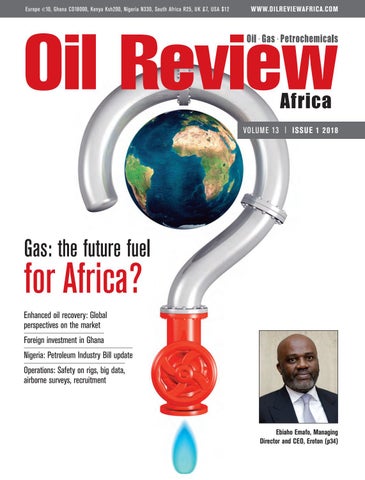
ORA 1 2018 - Cover_Layout 1 19/02/2018 15:36 Page 1
Europe €10, Ghana CD18000, Kenya Ksh200, Nigeria N330, South Africa R25, UK £7, USA $12
WWW.OILREVIEWAFRICA.COM
VOLUME 13
|
ISSUE 1 2018
Gas: the future fuel
for Africa? Enhanced oil recovery: Global perspectives on the market Foreign investment in Ghana Nigeria: Petroleum Industry Bill update Operations: Safety on rigs, big data, airborne surveys, recruitment
Ebiaho Emafo, Managing Director and CEO, Eroton (p34)
S01 ORA 1 2018 Start_ORA Master Template - 2016 New 19/02/2018 15:18 Page 2
S01 ORA 1 2018 Start_ORA Master Template - 2016 New 20/02/2018 10:55 Page 3
Europe €10, Ghana CD18000, Kenya Ksh200, Nigeria N330, South Africa R25, UK £7, USA $12
WWW.OILREVIEWAFRICA.COM
VOLUME 13
|
3
ISSUE 1 2018 • WWW.OILREVIEWAFRICA.COM
ISSUE 1 2018
EDITOR’S NOTE Gas: the future fuel
for Africa? Enhanced oil recovery: Global perspectives on the market Foreign investment in Ghana Nigeria: Petroleum Industry Bill update Operations: Safety on rigs, big data, airborne surveys, recruitment
Ebiaho Emafo, Managing Director and CEO, Eroton (p34)
We seek to answer Africa’s big gas questions on page 12. (Image: Adobe Stock/Frog974)
There is an inexorable shift in the African hydrocarbons landscape away from oil and towards gas. While oil will still play an important role in the continent’s energy mix for many years to come, gas is a cleaner-burning fossil fuel and widely viewed as an effective and efficient bridging fuel as the world moves towards increased use of renewables. On page 12, economist Moin Siddiqi analyses the prospects for gas across differrent parts of Africa. In this issue, we also provide updates on Nigeria and Ghana. While Nigeria’s lawmakers are seeking to get the Petroleum Industry Bill over its final hurdles, Ghana is working to make itself more attractive to foreign investors. We will watch the developments in these two West African countries with much interest. Operators are always seeking new ways to work more efficiently so we have a special feature on leveraging big data in the oil and gas industry, as well as reports on preventing slips and falls on rigs, airborne surveys and the future of the enhanced oil recovery market. Georgia Lewis Managing Editor
CONTENTS Managing Editor: Georgia Lewis ora@alaincharles.com
Editorial and Design team: Prashanth AP, Hiriyti Bairu, Miriam Brtkova, Ranganath GS, Rhonita Patnaik, Samantha Payne, Rahul Puthenveedu, Deblina Roy, Nicky Valsamakis, Louise Waters
Publisher: Nick Fordham
NEWS AND EVENTS
4
Calendar of oil and gas events
6
African hydrocarbons news
32
Rig count
Sales Director: Michael Ferridge Magazine Sales Manager: Chidinma Anah Tel: +44 (0) 20 7834 7676 Fax: +44 (0) 20 7973 0076 E-mail: chidinma.anah@alaincharles.com
International Representatives India Nigeria UAE USA
Tanmay Mishra Bola Olowo Graham Brown Michael Tomashefsky
Head Office: Alain Charles Publishing Ltd University House, 11-13 Lower Grosvenor Place, London SW1W 0EX, United Kingdom Tel: +44 (0) 20 7834 7676 Fax: +44 (0) 20 7973 0076
Middle East Regional Office: Alain Charles Middle East FZ-LLC Office L2-112, Loft Office 2, Entrance B P.O. Box 502207, Dubai Media City, UAE Tel: +971 4 448 9260 Fax: +971 4 448 9261
Production: Srinidhi Chikkars, Nelly Mendes and Rakshith Shivakumar
Important diary dates for the months ahead.
Updates on the oil and gas industry from across the continent.
Monitoring the industry across a range of African countries.
COVER STORY
12
Emerging markets for the African gas industry Economist Moin Siddiqi on the challenges and opportunities.
COUNTRY FOCUS
E-mail: production@alaincharles.com
Subscriptions: circulation@alaincharles.com Chairman: Derek Fordham
18
Nigeria
20 30
Ghana
Printed by: Buxton Press © Oil Review Africa
Will 2018 finally be the year of the Petroleum Industry Bill?
ISSN: 0-9552126-1-8
Serving the world of business
The drive to attract foreign investment.
Bright times ahead EnerMech is upbeat about Nigeria.
TECHNOLOGY AND OPERATIONS
21
Recruitment
22 23 24 26 28 29 32
Big data
The five main factors that will affect the African oil and gas job market.
How data can optimise operations.
Safety systems Preventing slips and falls on rigs.
Dow Enhanced desalination.
Airborne surveys Unlocking Africa’s final frontiers.
Enhanced oil recovery Prospects for the global market.
Mergers and acquisitions Will 2018 be a year of deal-making?
Innovations Technology to improve operations.
INTERVIEWS
17 34
Catobi Dr Okey Ukaegbu, Managing Director
Eroton Ebiaho Emafo, Managing Director and CEO
S01 ORA 1 2018 Start_ORA Master Template - 2016 New 20/02/2018 10:57 Page 4
EVE NTS CALE N DAR
ISSUE 1 2018 • WWW.OILREVIEWAFRICA.COM
Executives Calendar 2018 FEBRUARY 26 Feb1 Mar
APRIL
Nigeria Oil & Gas Conference & Exhibition
MAY Offshore Well Intervention Workshop, West Coast of Africa Accra http://interventionwca.offsnetevents.com/
14-16
Mediterranean Offshore Conference (MOC2018) Alexandria, Egypt www.moc-egypt.com
MARCH 7-8
17-19
Abuja www.cwcnog.com
23-24
London www.africaepsummit.com
29-31
East Africa Oil & Gas Summit & Exhibition Nairobi http://10times.com/the-east-africa-oil-and-gas-summit
Africa E&P Summit
Oil & Gas Expo, Power & Energy Africa 2018 Nairobi www.expogr.com
JUNE 5-6
Ghana Summit Accra www.cwcghana.com
Readers should verify dates and location with sponsoring organisations, as this information is sometimes subject to change.
Most oil and gas projects over budget: new research NEW RESEARCH HAS found that nine out of 10 oil and gas projects worldwide exceed their budgets, leading to higher prices for consumers. This is according to a study by Dr Evans Akwasi Gyasi, an academic from CU Coventry, part of the Coventry University Group, which found that there is a dramatic level of overspending by businesses in the oil and gas industry. Dr Gyasi said that factors such as poor cost estimation, change of scope, lack of proper risk identification and response plan, delays in the supply chain and broader economic factors all play a part in spiralling budgets for oil and gas operators. These are then reflected in the price consumers pay for fuel. The research, sponsored by the Ghanaian government, took place over a four-year period and saw consultations with 33 industry experts from across the UK, Ghana, Angola and Nigeria, each with at least 15 years of experience. Interviews with project managers, engineers and cost estimators highlighted the trend
Image Credit: Coventry University
4
Dr Evans Akwasi Gyasi found that 90 per cent of oil and gas projects run over budget.
in the decade between 2005 and 2015. Dr Gyasi is author of the new book A Bayesian Approach to Cost Estimation for Offshore Deepwater Drilling. He hopes that his findings will not only lead to
change in the oil and gas industry, but other sectors where cost overrun is a common issue. He said: “There are many examples of poor planning in the industry, where companies throw their budgets overboard.
“Time is the biggest cost driver in the oil and gas industry. It costs between £250,000 and £500,000 a day to drill an oil well, and given that it is a 24-hour process, not functioning can cost a company millions. “I chose to focus my study on sub-Saharan countries where companies regularly explore for oil and gas, and after four years of research and analysis, I found that nine out of 10 projects exceed their budgets. “Trends like these are particularly apparent in oil and gas, but are relatable to several other industries so this warning should be heeded by businesses in all sectors.” Dr Gyasi has incorporated his research findings into teaching on the Management & Leadership degree programme at CU Coventry, where students are taught by industry professionals. He added: “Leaders play a critical role in cost management. Educating future leaders on the importance of cost control strategies will help shape the future of a range of industries.”
S02 ORA 1 2018 News_ORA Master Template - 2016 New 19/02/2018 15:23 Page 5
S02 ORA 1 2018 News_ORA Master Template - 2016 New 19/02/2018 15:23 Page 6
N EWS
ISSUE 1 2018 • WWW.OILREVIEWAFRICA.COM
Helium gas to become an important driver of industrialisation in Tanzania HELIUM IS SHOWING early promise as a fuel for industrial purposes across Africa (see cover story, page 12) and Tanzania is one of the countries with high hopes for the development of this gas. Helium One is one of the companies leading the way in the East African country with surveying and exploration activities underway in the Rukwa Region. In partnership with the Geology Department of the University of Dar es Salaam (UDSM) and Oxford University, Helium One organised a workshop at USDM to build local capacity and awareness of the origin, exploration and development of helium in Tanzania. The workshop’s main objectives were to bring together experts, scientists and stakeholders from local, national and international communities to share their expertise, experiences and disseminate research
Image Credit: Helium One
6
Helium One’s CEO, Thomas Abraham-Janes presents a sponsorship certificate for an Oxford University programme to Karim Mtili, a science graduate from the University of Dar es Salaam.
findings on helium in the context of enhancing industrialisation in Tanzania and globally. The workshop featured high level scientists from Oxford University, collaborating with UDSM’s
geology department, decision makers, development partners, policy developers and practitioners from government, researchers, private sectors, and the media.
S02 ORA 1 2018 News_ORA Master Template - 2016 New 19/02/2018 15:23 Page 7
N EWS
ISSUE 1 2018 • WWW.OILREVIEWAFRICA.COM
SIEMENS HAS SIGNED an Operation and Maintenance (O&M) contract with the Sudanese Thermal Power Generating Company (STPGC) which covers the running of the Garri Power Station in the North of the Khartoum, as well as the Port Sudan hydropower plant on the country's Red Sea coast. The Garri Power Station is a gas-fired operation and is set to continue playing an important role in the development of Sudan after many years of civil and political unrest. Sabine Dall’Omo, chief executive of Siemens Southern & Eastern Africa said: “The O&M agreement will indeed minimise the operational risks and maximise plant availability. As the original manufacturer of the
The signing of the contract between Siemens and the STPGC.
turbines, we are best positioned to partner with STPGC. This agreement is also tangible evidence of our mutual long term relationship with the country.” On a full time basis, the O&M contract offers the full benefits that digitalisation brings to the energy sector, such as remote
monitoring and preventative maintenance.” Since the signing of the memorandum of understanding to cooperate in the areas of power supply, industry, transportation and healthcare during WEF Africa, Siemens has established a local company in Sudan.
Africa Oil to boost south and west Africa assets with investment in Impact Oil and Gas AFRICA OIL CORP has entered into agreements that will provide it with an approximately 25.2 per cent equity interest in Impact Oil and Gas, a private UK company with exploration assets in South and West Africa.
The agreement with Impact provides for the purchase by Africa Oil of 59,681,539 ordinary shares and 29,840,769 ordinary share purchase warrants for an aggregate subscription price of approximately US$15 mn.
Image Credit: John Hickey-Fry/Flickr
GHANA IS SET to embrace waste gas as a fuel for power plants in a bid to improve energy security and reduce flaring. GE Power and Marinus Energy have announced a pilot project to capture Isopentane gas and use it as a fuel source for generating electricity. The Atuabo Waste to Power Independent Power Project will be the first TM2500 power plant in sub-Saharan Africa to use Isopentane gas as a fuel source and will run on GE’s latest TM2500 gas turbines. This Isopentane gas would otherwise have been flared. In the first phase, Atuabo will convert the Isopentane fuel into up to 25 MW of power, generating enough electricity to supply power for more than 100,000 households. As additional gas is brought onshore, the plant is expected to add on additional gas generating units up to a capacity of 100 MW. Additional Isopentane fuel will eventually be stripped off an offshore gas supply and processed at Atuabo by the Ghana National Gas Company. The gas turbine will start on lean gas and transfer to Isopentane over time – the plant is intended to operate at base load throughout its life. “Not only is the Atuabo waste to power plant enabling our company to lead in innovative energy solutions in Ghana, but by using a fuel source which would otherwise have been flared as waste, we are further reducing emissions and costs,” said Fred Asamany, strategic advisor of Marinus Energy. “This is good for our business, the climate and eliminates the potential environmental hazards facing the local community..”
Gas-fired electricity plant O&M contract part of Siemens’ plan for Sudan
Image Credit: Siemens
Waste gas-topower plant to be built in Ghana
Impact’s assets include an exploration project off Port Elizabeth, South Africa.
Africa Oil CEO Keith Hill said: "We are very pleased to acquire a significant interest in Impact which holds a highly attractive portfolio in west and south Africa that has the potential for major discoveries in the short and medium term. Impact has done a great job of acquiring these properties at modest prices and bringing in major oil companies to fund upcoming drilling and seismic programs. This investment is a strong complement to our existing holdings in Africa Energy and ECO Atlantic and results in Africa Oil having exposure to some of the most exciting exploration plays in Africa to complement our Kenya development project."
7
S02 ORA 1 2018 News_ORA Master Template - 2016 New 19/02/2018 15:23 Page 8
N EWS
ISSUE 1 2018 • WWW.OILREVIEWAFRICA.COM
NNPC chief urges public-private partnerships for the Nigerian pipeline sector GROUP MANAGING DIRECTOR of the Nigerian National Petroleum Corporation (NNPC), Dr Maikanti Baru, has urged the new board of one of its downstream subsidiary companies, the Nigerian Pipeline Storage Company (NPSC), to partner with the private sector to build more pipelines parallel to existing ones. He made this statement when he was inaugurating the newly formed board in Abuja in January, saying increased public-private partnerships would enhance the profitability of NPSC. “Your work also is to look at refurbishing these pipelines and storage along a Public Private Partnership (PPP) arrangement by getting willing private companies to invest in these pipelines. NNPC Management is very much disposed to supporting your efforts in this regard,” Dr Baru told the board.
Image Credit: Andrew/Flickr
8
Dr Maikanti Baru discussed using Nigerian LPG to meet domestic energy needs.
He urged NPSC to double its pipeline network over the next decade and to use the pipeline network to integrate the butanisation depots which are used as reception points for LPG. Dr Baru said that
“a lot of LP is being exported” and it could be “utilised domestically in line with our vision of providing alternative energy sources for domestic and industrial use nationwide.”
Tullow reports “excellent progress” with 2017 results with debt reduced and disciplined cost management TULLOW HAS RELEASED an upbeat statement following its announcement of full 2017 results, including revenue of US$1.7 bn plus lost production insurance proceeds of US$162 mn; gross profit of US$815 mn; post tax loss of US$189 mn after write-offs and non-cash impairments; and free cash flow of US$543 mn. Tullow CEO Paul McDade said that debt has been reduced and investment in high-return production assets in Ghana has increased thanks to “strong production and disciplined cost management”. West Africa’s 2017 net working interest oil production, including production-equivalent insurance payments, averaged 89,100 bopd; 2018 production is expected to average between 82,000-90,000 bopd.
As well as a solid performance from the company’s West African operations, Mr McDade reported positively on its Kenyan appraisal project: “The assessment of the results from our appraisal campaign in Kenya also fully supports progress towards a major development of the South Lokichar Basin.” Tullow has reset its exploration portfolio via disposals, farm-downs and the addition of new positions in Côte d’Ivore and Peru. Over the next three years, Tullow is planning further exploration campaigns, starting wuth the high-impact Cormorant Well in Namibia, one of the emerging hydrocarbons markets of Africa. Tullow hopes to start this exploration project in the second half of 2019.
S02 ORA 1 2018 News_ORA Master Template - 2016 New 19/02/2018 15:23 Page 9
N EWS
ISSUE 1 2018 • WWW.OILREVIEWAFRICA.COM
EGYPT’S GAS-FUELLED economy is again taking off in the wake of a slew of major offshore discoveries that are now entering production. At the end of 2017, Italy’s Eni launched first gas from the giant Zohr field. Its estimated 30 trillion cubic feet (tfc) of reserves makes it the biggest gas field in the Mediterranean. Other large projects have also commenced, including the Nooros field, another Eni venture. Then there is BP’s offshore Atoll field, north of Port Said, which also delivered first gas at the end of last year. Indeed, BP now expects its net production from Egypt’s Nile Delta to increase six-fold to more than 300 mboed by 2020, from 50 mboed in 2016. Officials are once again bullish about the North African state’s energy future. Indeed, the Egyptian Ministry of Petroleum and Mineral Resources has reportedly signed an 80-plus exploration and production agreements in the past four years alone, with minimum investment commitments tallying more than US$15bn. It has sparked interest from other major international players too, the likes of ExxonMobil, not wanting to miss out on the opportunities.
The enormous Zohr gas field is already proving to be a tremendous success for Egypt.
The turnaround follows a period of political and economic uncertainty, in the wake of the ousting of President Hosni Mubarak in 2011.
Sonatrach, Alnaft and Cepsa sign 25-year Algerian exploration contract ALNAFT, SONATRACH AND Spanish firm Cepsa have signed a new contract for the exploitation of hydrocarbons on the Rhourde El Khrouf oil and gas field, located 320 km south-east of the Hassi Messaoud oilfield.
This 25-year contract provides for a significant development plan for this mature oil field after 19 years of production, with the aim of significantly increasing crude oil production and producing LPG for the first time, thanks to the new
Image Credit: Pieter Edelman/Flickr
ABB’S EOW- I3 Extended Control Room Concept was on show at EGYPS 2018, the Egyptian petroleum show held in February in Cairo. The event brought together private and government stakeholders from across the country’s oil and gas industry. ABB Egypt demonstrated its digital solutions as part of its role in helping the Egyptian government in its ambitious agenda to unlock the potential of the country’s oil and gas sector. The concept shows critical data for oil and gas plants located onshore and offshore on an interactive dashboard. It allows users to remotely monitor all plant aspects while analysing and viewing highly complex data. “The EOW is part of the ABB Ability solutions platform which presents a combination of equipment, systems and services that are digital and seamlessly connected,” said Naji Jreijiri, managing director ABB Egypt North and Central Africa. “There is alignment between our solutions and the Ministry of Petroleum and Mineral Resources new integrated strategy, which aims to realise the petroleum sector’s full potential by the year 2021.” “Some of today’s technical problems didn’t exist a decade ago, such as cyber security threats, broken control loops, safety system failures and rotating equipment downtime. Our ABB Ability solutions for the oil, gas and chemical sector utilise our analytics engine to turn data into collaborative actions across disciplines from various locations,” said Ahmed Sherbini, ABB Egypt oil & gas business unit manager.
Egypt’s gas sector draws in new investment across multiple projects
Image Credit: BP
ABB digital technology on show in Egypt
Algeria’s Rhourde El Khrouf region as seen from above.
facilities that will be built. This development plan includes the drilling of 30 new wells, the construction of a new processing plant, a recovery unit for LPG and facilities for the shipment of LPG, with an estimated investment of US$1.29bn The new processing facilities will have a daily production capacity of 24,000 barrels of crude oil per day and 10,000 bopd of LPG. The contract was signed by Arezki Hocini, chairman of the Alnaft management committee, Abdelmoumen Ould Kaddour, chairman and chief executive officer of Sonatrach, and Pedro Miró, chief executive officer of CEPSA. It remains to be seen where oil and gas from the field will be refined.
9
S02 ORA 1 2018 News_ORA Master Template - 2016 New 19/02/2018 15:23 Page 10
N EWS
ISSUE 1 2018 • WWW.OILREVIEWAFRICA.COM
Libya’s Jikharra oilfields restart production LIBYA’S NATIONAL OIL Corporation (NOC) announced the restart of production at Wintershall AG’s As-Sarah oilfields in the Jikharra municipality, after they were shut down in November 2017 amid protests by people demanding jobs and more local development projects. In a statement, NOC was adamant that the shutdown was “unauthorised” and resulted in the loss of 4.4mn barrels of production and a cost to the Libyan economy of US$281,479,385. “The suspension of production by the company was done without the approval of the NOC as stipulated in the interim operating agreement between the parties,” according to the statement, released at the end of January. NOC chairman Mustafa Sanalla described the restart of production in Jikharra as a “setback” to the parallel Libyan oil administration based in the eastern part of the country.
Image Credit: Wintershall
10
Wintershall’s Libyan operations resumed production after shutting down last year.
Production was restored after a meeting between NOC board member Abulgasem Shingheer and a Wintershall official. The AsSarah oilfields contain Libya’s largest productive deposit.
The news of production restarting in Jikharra comes alongside further signs that the Libyan oil sector is stabilising with Royal Dutch Shell and BP agreeing to annual deals to buy Libyan crude oil.
S03 ORA 1 2018 Cover story - Gas_ORA Master Template - 2016 New 19/02/2018 15:08 Page 11
S03 ORA 1 2018 Cover story - Gas_ORA Master Template - 2016 New 20/02/2018 11:00 Page 12
COVE R STORY
ISSUE 1 2018 • WWW.OILREVIEWAFRICA.COM
The Karoo Basin in South Africa.
Image Credit: Esther Westerweld/Flickr
12
EMERGING BRIGHT SPOTS FOR
AFRICA’S GAS INDUSTRY The scale of Africa’s proven and probable natural gas resources is significant. Challenges are not so much of exploration drilling but rather that of securing long-term capital to develop new gasfields and build local production hubs. Economist Moin Siddiqi shares his analysis. AS DISCOVERIES WORLDWIDE have outsized oil finds by a ratio of two to one over the past two decades. Driven by colossal finds in East Africa, Africa’s gas reserves have risen by some two-thirds in recent years. The continent’s proven gas reserves of 503.3 trillion cubic feet (Tcf) at end-2016 (BP data) were mainly concentrated in Algeria, Egypt, Libya, and Nigeria – accounting for 92 per cent of aggregate. The crown jewels are new players Mozambique and Tanzania boasting recoverable gas estimated at 180Tcf and 57Tcf, respectively. Further exploration and development in
G
the prolific Rovuma Basin could see Mozambique overtaking Nigeria as Africa’s biggest holder of gas reserves. The largest gasfield in West Africa, which was discovered by Kosmos, is off the SenegalMauritania maritime border and could be a game-changer. The Greater Tortue acreage contains over 50Tcf of resource potential – split roughly half between the
two countries – and sufficient for 30-50 years of production. Kosmos reported in January 2017 “After drilling to a total depth of 5,000-plus metres, the well found “101 metres of net gas pay in two excellent quality reservoirs”, which looks to be a “single, large gas accumulation”. UK-based Wood Mackenzie noted: “We think it’s a world-class asset with a good upside.”
The crown jewels are the new players in the African gas industry, such as Mozambique and Tanzania.”
Nigeria also boasts vast gas reservoirs, but not yet developed. The Nigerian National Petroleum Corp (NNPC) estimates probable reserves at 600Tcf, much of which lie in untapped deep and ultra-deep offshore terrain in the Niger Delta. It’s proven reserves are 186.6Tcf. Neighbouring Cameroon has more gas than oil, with a potential of 20Tcf, in the Rio Del Rey (covering 7,000km offshore) and Douala/Kribi-Campo Basins, covering 19,000km area. Angola and Gabon hold sizeable offshore oil-gas resources in the pre-salt acreage. Wood Mackenzie believes South Africa possesses a lot of prospective offshore acreage with
S03 ORA 1 2018 Cover story - Gas_ORA Master Template - 2016 New 19/02/2018 15:08 Page 13
COVE R STORY
Industry challenges Proper infrastructures are needed to exploit and monetise ‘stranded’
Nigeria’s Bonny Island has long been a successful gas project for the country.
gas for domestic usage in powergeneration and exports in the form of liquefied natural gas (LNG), piped gas, and downstream products like GTL. Deepwater gasfields carry higher upstream costs than onshore oilfields. Offshore associated gas in Africa is mostly flared. US-based energy consulting firm,
It’s all about the return on investment metric and companies are unwilling to take risks at the moment.”
Opportune, explained: “SubSaharan Africa lacks infrastructure and local demand to support the development of gas resources. The global LNG glut means that SSA can’t rely on export markets to develop and commercialise its gas. Therefore, the development of a local gas market is becoming essential to [supporting] a large-scale development of indigenous resources.” Africa’s gas output in 2016 was 208.3bn-cm, equivalent to Iran’s total production. While 2016 gas consumption was only 138.2bn-cm (BP data), representing 3.9 percent of global total (3,542.9bn-cm). The economies of building LNG plants in frontier regions are demanding because of ‘added’ infrastructure spending. Paul
Hughes, project director at Worley Parsons, remarked: “It’s all about the return on investment metric and companies are unwilling to take risks at the moment.” Whereas, floating LNG (FLNG) facilities are more economical – mostly smallerscale ones. “FLNG units, compared to onshore plants, require little construction and initial investment,” Opportune noted. There are, however, pitfalls such as limited expansion possibilities and relatively shorter operating life-span (20 years) compared with 25-30 years for most onshore terminals. FLNG though has lower capital expenditure but quite higher operational expenditure.
Commercialisation of gas
Gas could be used to improve access to electricity for communities across South Africa.
Image Credit: Africa Lights 6000.co.za/Flickr
potential for future giant discoveries. Last September, PetroSA and Rosgeo (Russian co.) signed a US$400mn deal to develop exploration areas offSouth Coast of South Africa. The project – carrying out more than 4,000 sq km of 3D seismic operations and more than 13,000km of gravity-magnetic exploration works, as well as drilling exploratory wells – envisages producing 4mn cubic metres (cm) of gas daily as feedstock for PetroSA’s gas-toliquids (GTL) refinery, in Mossel Bay. “Discovery of hydrocarbons on our shores has the potential to bring significant revenues to the country and prove the country’s oil and gas prospectively,” noted PetroSA. Additionally, the U.S. Energy Information Administration (EIA) estimates SA holds 390Tcf of technically recoverable shale gas resources, although estimates by the Petroleum Agency South African put the figure at conservative 40Tcf. The government has yet to issue any exploration permits for shale gas reserves in the semi-arid Karoo Basin, which poses logistical and environmental issues.
13
Image Credit: Chike Roland Oraekwugha/Flickr
ISSUE 1 2018 • WWW.OILREVIEWAFRICA.COM
SSA is the likeliest hotspots for greenfield FLNG projects. Last June, the first final investment decision (FID) was taken for Enioperated Coral South FLNG project in Mozambique. The US$8bn facility, with 3.4mn tonnes of annual liquefaction capacity (expected online 2022) will tap about 16Tcf of gas inplace. BP (off-taker) will purchase the entire output over 20 years from Eni. Project contactors are Samsung Heavy Industries, JGC Construction International and Technip. Eni Area-4 (Mamba complex and Coral site) holds an estimated 85Tcf.
S03 ORA 1 2018 Cover story - Gas_ORA Master Template - 2016 New 19/02/2018 15:08 Page 14
COVE R STORY
ISSUE 1 2018 • WWW.OILREVIEWAFRICA.COM
The region’s first small-scale FLNG project led by Perenco – in partnership with National Oil Co. (SNH) and Golar LNG Ltd – is due online end-2017 with a capacity of 1.6bn-cm/year and Gazprom as the sole offtaker. While Fortuna FLNG export terminal in Equatorial Guinea is poised to become Africa’s first deep-water liquefaction facility situated near the prolific Niger Delta complex. The project, utilising Golar’s FLNG technology, will produce 2.2mn tonnes per year by 2020 and Shell and Vitol (oil-trader) are shortlisted as likely off-takers. Sponsors are Ophir, Golar and Schlumberger – a FID is expected soon. Estimated in-place and recoverable mean resource numbers are 553bn and 426bn cubic feet, respectively, based on Ophir data. There are ample resources for an LNG development, offshore Senegal and Mauritania. An FID is anticipated in 2018 for a 2.5mn-tonnes per year FLNG facility. Kosmos plans to deploy two FLNG units with first export from vessel-1 starting in 2021 followed by vessel-2 in 2023. Kosmos reckons its project could break even at US$142 per 1,000cm. In Nigeria – fourthlargest global LNG exporter in 2016 – a greenfield project ‘Brass LNG Liquefaction Complex’ with two liquefaction trains (total capacity 10mn-tonnes/year) are at initial engineering phases. The project led by NNPC, Total, and Eni is, however, several years behind schedule. The Nigeria LNG (NLNG) facility on Bonny Island also plans expanding its capacity to 30mn tonnes per year by building a seventh train. There are two mega onshore LNG projects in pipeline in East Africa. Anadarko Petroleum in Mozambique plans to produce 12mn-tonnes per year using two trains and later expanding nameplate annual capacity to 20mn-tonnes. The cost of Phase1 is assessed at US$26bn.
Could Africa develop LNG to rival Prelude?
Image Credit: Shell
14
Anadarko Area-1 prospect (Prosperidade and Golfinho/Atum complexes) holds an estimated 75Tcf. FID has yet to be announced. Mozambique has enough gas for about 10 trains producing a total of 5060mn tonnes per year – both from onshore and offshore facilities. This could make the country the fourth-largest LNG producer, after Australia, Qatar and USA. A consortium of Statoil, BG (owned by Royal Dutch Shell), ExxonMobil and Ophir Energy) are planning a US$30bn, 10mntonnes per year LNG plant in Tanzania that could start by 2028
– assuming a FID is sanctioned by 2023 latest. The onshore project is currently in the pre-Front End Engineering Design (FEED) stage. Sponsors are preparing an LNG commercial framework, which outlines the rights/obligations between the government and investors in the process of executing a mega-project. Reports indicate an environmental impact study will be carried out at proposed plant location, Likong’o Village in Lindi Region.
Local benefits Africa’s under-utilised gas reserves can solve chronic power shortages. The World Bank
Gabriel Mbaga Obiang Lima, Equatorial Guinea’s energy minister.
estimates electricity outages on average cost SSA countries about 2.1 per cent of GDP with nearly two-thirds of Africans lacking electricity. Africa relies mostly on expensive and dirty diesel imports. Gas is a cleaner and cheaper alternative. An United Nations report (2014) calculated that gas in East Africa could reach power plants at between US$5-15 per million British thermal units (Btu), depending on proximity to power plants. By contrast, diesel for power generation can cost African industry between US$20-40/mn Btu. Hydrocarbons companies are required to supply natural gas as feedstock for local power generation, industry and for general consumption, prior to exporting the products. One analyst said: “Local beneficiation of hydrocarbon resources is being prioritised to ensure development for the benefit of the local population.” There is huge potential across Africa for about 400 gigawatts of gas-generated power, with Mozambique, Nigeria, and Tanzania alone could account for three-fifths of the total capacity, according to Mckinsey Global Institute. The International Energy Agency (IEA) projects Africa’s electricity generation to quadruple by 2040 with gas-to-
S03 ORA 1 2018 Cover story - Gas_ORA Master Template - 2016 New 19/02/2018 15:08 Page 15
S03 ORA 1 2018 Cover story - Gas_ORA Master Template - 2016 New 20/02/2018 11:05 Page 16
16
COVE R STORY
ISSUE 1 2018 • WWW.OILREVIEWAFRICA.COM
power increasing its share to onequarter from 17 per cent in 2014. In West Africa, gas can fuel half of overall electricity output by 2040, IEA said, driven by reforms in Nigeria – which last March unveiled a US$15bn investment to boost generating capacity by 4,000 megawatts within a decade. Presently, three power plants are
Gas is a cleaner and cheaper alternative to the expensive, dirty diesel imports on which many African countries rely for power.”
In Tanzania, the Lindi region will benefit from gas-to-power. (BCClimate Champions/Flickr)
Exploiting stranded gas reservoirs is a logical target of foreign energy majors. Governments that provide attractive business environment and regulatory framework will be more successful in unlocking their natural resource endowments, which in turn generate future revenue flows and higher economic growth. In sum, East and West Africa waters have great hydrocarbons potential.
under-tender for construction near the Abuja-Kaduna-Kano (AKK) gas pipeline. There remain, however, major hurdles across the region, notably implementing commercial gas pricing to induce private investment needed for building expensive infrastructure and gas value chains.
Author’s note: Proven reserves generally have 90-95 per cent certainty of containing the amount specified. Probable reserves have a probability of 50 per cent, and possible reserves an intended probability of 5-10 per cent. In some producing countries, the majority of reserves claims have not been verified by external audit.
Growing population, urbanisation and gradual shift to low-carbon fuels all favour increased use of clean gas in Africa’s energy mix. The projected increase in SSA’s gas production from currently six billion to 13bn cubic feet per day in the next decade bodes well for regional economic development.
S04 ORA 1 2018 Nigeria update - Ghana_ORA Master Template - 2016 New 19/02/2018 15:08 Page 17
I NTE RVI EW
ISSUE 1 2018 • WWW.OILREVIEWAFRICA.COM
CATOBI NIGERIA SUCCEEDING THROUGH
DISCIPLINE AND INNOVATION Catobi Nigeria has come through some tough times in the oil and gas industry with a strategy of discipline, customer care and encouraging entrepreneurial thinking among employees. We spoke to Dr Okey Ukaegbu, Managing Director, Catobi Nigeria. How was Catobi Nigeria affected by the drop in the oil price?
entrepreneurial in how we encourage our employees to think, act and innovate. We encourage transparency and open-mindedness. Those in top management are disciplined enough to ensure that the organisation’s performance goals are met while the company culture remains intact. We also find ways to add more services or make our products bigger.
Catobi was affected because the drop in the oil price was felt across all our clients, including IOCs, NOCs and EPCs. The total request of our services from our clients dropped from 95 per cent to 50 per cent. There was also room to offer numerous discounts in order to win jobs, even though, at the end, we had to make a lesser profit for the sake of client-business relationships.
How important is it to ensure Nigerian local content requirements are met?
We have an Original Equipment Manufacturer partnership relationship with one of the best valve manufacturers in the world, Hawa Valves India. Our valve maintenance workshop is furnished with state-of-the-art equipment and dedicated valve specialists for reliable solutions. Catobi Nigeria is in affiliation with The Valve Institute Aberdeen, and Hawa Valves India, and has been endorsed by the Nigerian Content Development and Monitoring Board, Oil and Gas Trainers Association of Nigeria, and Petroleum Technology Association of Nigeria to provide valve technology training which is reckoned as the best in Africa We offer courses that are sought after in the oil and gas
Image Credit: Catobi
What have been some of Catobi’s biggest successes?
The development and implementation of local content has had a profound impact on Catobi as well as the oil and gas industry. It has opened up opportunities for we, the Nigerian entrepreneurs, has attracted investment into the economy, and brought about opportunities for indigenous operators across the country. It is therefore important that all stakeholders should invest in the standards and uphold local content requirements.
Dr Ukaegbu is upbeat about Catobi’s prospects in Nigeria.
industry, which ranges from valve selection, maintenance, assembly, pressure testing and calibration. Our certifications are internationally accepted as they are certified through the continuous professional Development program of the United Kingdom. We equip our
trainees with hands-on training experience using our wellequipped maintenance workshop.
What sets Catobi apart from its competitors? We have designed our corporate culture to be structured in the way we operate, yet we are still
What plans does the company have for the future? We don't have the ability to perfectly predict the future, but Catobi has a vision with a creative thinking skills and behaviours to be wellestablished as the first choice valve solution partner in African oil and gas sector.
17
S04 ORA 1 2018 Nigeria update - Ghana_ORA Master Template - 2016 New 20/02/2018 11:08 Page 18
N IG E R IA
ISSUE 1 2018 • WWW.OILREVIEWAFRICA.COM
WILL 2018 BE
THE YEAR OF THE PIB? After the Nigerian senate passed the Petroleum Industry Bill in 2017, the Nigerian hydrocarbons industry will be keeping a close eye on the House of Representatives in 2018. Georgia Lewis reviews the state of play. HE NIGERIAN OIL and gas industry got off to an eventful start in 2018 with a pipeline fire in Edo state. According to Reuters, the gas supply to several power stations was temporarily cut off after a fire on the NNPC-owned Escravos-Lagos pipeline system near Okada in the first week of 2018. Additionally, OPEC reported that the biggest rise in oil output in December 2017 came from Nigeria with exports reaching a 21-month high, although shipments fell short of that level. In the meantime, oil and gas operators will be closely observing the Nigerian House of Representatives for any indication that the Petroleum Industry Bill (PIB) will finally pass and become law. There was much optimism in May 2017 when the Nigerian senate passed the PIB, which was first drafted in 2008. Hopes were further raised when a representative for the Nigerian senate president, Bukola Saraki, told the Nigeria Oil and Gas Industry Research and Development Fair and Conference in September 2017 the National Assembly would pass the bill by December 2017. Senator Tayo Alasoadura, representing Senator Saraki, said, “We expect the report from the committee in no distant time and hope to pass the bills into law within the next quarter.”
T
Image Credit: Dangote Group
18
Aliko Dangote, owner of the Dangote Group, is confident about the prospects for his company’s Lekki refinery.
However, another potential issue for swift passage of the PIB may come in the form of election campaigning. Nigeria is scheduled to hold elections in 2019 but it is unclear if President
The Dangote Refinery is seen as an example for the future of Nigerian refining, with a bigger role for the private sector.”
Muhammadu Buhairi will run again. In the meantime, Nigeria’s political parties will start campaigning and oil and gas policy is expected to be a major issue. Economically, the news is mixed for Nigeria – the country came out of its first recession in 25 years in the second quarter of 2017, but growth is sluggish with ongoing reliance on oil revenues and unemployment up. While Nigeria may still be waiting for the final passage of the PIB, the other focus for the industry is refineries - existing refineries need to be upgraded and there is an urgent need for new refineries. Additionally,
illegal refining of crude oil in the Niger Delta region remains a problem. However, the Dangote Refinery, under construction at Lekki, is seen as an example for the future of Nigerian refining, with a move away from stateowned refineries and a bigger role in the downstream sector for the private sector. Aliko Dangote, owner of the Dangote Group, is confident the refinery will be built on schedule. The Dangote Refinery is expected to produce 650,000 barrels of refined oil per day with a view to meeting Nigeria’s needs as well as exporting to other countries.
S04 ORA 1 2018 Nigeria update - Ghana_ORA Master Template - 2016 New 19/02/2018 15:08 Page 19
S04 ORA 1 2018 Nigeria update - Ghana_ORA Master Template - 2016 New 19/02/2018 15:08 Page 20
G HANA
ISSUE 1 2018 • WWW.OILREVIEWAFRICA.COM
GHANA’S PUSH TOWARDS
FOREIGN INVESTMENT As Ghana seeks to develop its oil and gas industry, foreign investment is set to play a major role, particularly with major plans for improved infrastructure. One of Ghana’s leading commentators has urged caution amid the ambition. Georgia Lewis reports.
HANA HAS LONG welcomed foreign investment in its hydrocarbons industry and this trend is set to continue in 2018. Investment in oil and gas is part of Ghana’s broader mission to industrialise and, as well as direct investment into hydrocarbons projects, an ambitious and far-reaching plan to improve the country’s infrastructure could have benefits for the oil and gas industry. The Ghanaian economy is forecast to grow on the back of increased oil and gas production but, as public policy consultant and commentator, Nana Taa Ofori-Atta warns, “caution is required”. In a column written at the end of 2017, Ms Ofori-Atta reported that Ghana’s Ministry of Finance intends to reprofile the country’s national debt to seek longer tenures of maturing. “While our current credit rating by Fitch has been revised from negative to stable, the B category still puts us in the amber, caution light for skittish investors,” she wrote. “Our fundamentals, particularly in macro economic stability and fiscal prudence must be religiously monitored and addressed.” Japan, Singapore and China are expected to play an increasing role in such investment with oil and gas being a target, along with ports, railways, financial services and technology. Ms Ofori-Atta also cited European investment in Ghanaian infrastructure as another trend to watch. Her comments came in the wake of the German-French Railway Consortium (GFRC) winning a contract to build a railway between the capital, Accra, and Kumasi, Ghana’s second-largest city. She said the statement issued by the consortium of France’s Alstom SA and Germany’s Linde AG “revealed much”.
G
Image Credit: Nana Taa Ofori-Atta
20
Nana Taa Ofori-Atta urges caution when it comes to foreign investment in Ghana.
“First, that the construction of the double track network would take four years; secondly, they would also build a single track rail system from Kumasi to the port city of Takoradi, in the oil-rich Western region and thirdly; service roads will be built alongside the tracks to enable maintenance as well as access by emergency vehicles in the event of accidents,” she wrote. “We are in a hurry to industrialise Ghana, other countries have done this faster and better with lessons learnt on matters quality, return on investments with particular regard to governance, cost, community and environmental impact.” While oil and gas operators may be excited by the prospect of improved rail and road links, Control Risks,a global risk consultancy, is also urging caution. In a report on risks faced by multiple countries, concern was
expressed in regard to plans by Ghana and Nigeria to borrow heavily to finance longterm infrastructure projects because they might not generate sufficient revenue to finance debt repayments. However, USAID, the US government agency for international development, released a more optimistic statement in December 2017 after participating in a conference in Ghana held under the theme of “promoting sustainable partnerships for economic transformation” in the oil and gas industry. In a statement, USAID described the event as “part of a programme to improve the competitiveness of local businesses” for stakeholders in the oil and gas industry. At the conference, participants shared lessons learned and best practices and highlighted the achievements of local businesses in the industry. The theme of the event was “promoting sustainable partnerships for economic transformation” and it aimed to serve as a platform for local enterprises and business service providers to network with major players in the oil and gas industry. The focus was very heavily on increased private sector involvement in Ghana’s oil and gas industry. “Increasing local content can encourage the development of expertise and create more business opportunities. To drive future expansion, the private sector must take the lead and continue supporting the growth of local businesses to meet the needs of international oil companies,” said USAID/Ghana Mission Director Sharon L. Cromer. To date, the programme has helped local businesses win 78 contracts with oil and gas companies worth more than US$18 million.
S05 ORA 1 2018 Dow Editorial - Big data_ORA Master Template - 2016 New 20/02/2018 11:04 Page 21
R ECR U ITM E NT
ISSUE 1 2018 • WWW.OILREVIEWAFRICA.COM
21
THE FUTURE OF THE OIL AND GAS JOBS MARKET
ACROSS AFRICA A World Economic Forum report, released last year, outlined the five main factors that will affect the African job market in the years to come. But what will this report mean for the oil and gas industry. Oil Review Africa editor Georgia Lewis examines the report. HE WORLD ECONOMIC Forum (WEF) on Africa report on the African job market came up with five major findings about the future of jobs and skills across the continent. Firstly, the report found that Africa’s young people are increasingly well-educated at the current rates up to 20mn educated young people are expected to join the continent’s workforce annually until 2030. For oil and gas companies the challenge will be to make the most of this surge of talent across multiple countries. Following on from this, the report’s second finding was that Africa could make more of its human capital. The WEF’s Human Capital Index, which measures the extent to which countries optimise their workforce, revealed that Africa, on average, only captures 55 per cent of its full human capital potential, compared with a worldwide average of 65 per cent. Western Europe and North America lead this index with average scores of 80 per cent, followed by Eastern Europe and Central Asia at 75 per cent. In order to make the most of emerging African talent, the report concluded that Africa’s education systems need to catch up with the needs of today and of the future to meet the needs of the global economy. The WEF’s Executive Opinion Survey found
Image Credit: Eni
T
Oil and gas operators will need to capitalise on Africa’s young, educated workforce.
that education systems in Kenya, Rwanda, Mauritius. Cote d’Ivoire and Zambia were among the best-regarded by employers. There are examples of the oil and gas industry stepping up to help encourage talented young people, such as the Society of Petroleum Engineer’s Imomoh Scholarship,
Demand for STEM and ICT skills continues apace in Africa and attracting high school leavers into university courses remains a challenge.”
founded by Egbert Imomoh to support excellence in education for African students. Demand for STEM and ICT skills continues apace in Africa with just 16 per cent of the continent’s university-educated workforce having studied engineering, manufacturing or construction, 11 per cent ICT and 11 per cent natural sciences, including geology, mathematics and statistics. In the STEM and ICT workforces, the WEF report found that the African oil and energy sectors have a large proportion of engineering, manufacturing and construction employees at 44 per cent, 15 per cent in natural sciences, mathematics and statistics and, despite ever-advancing technology making its mark on the oil and gas industry, just five per cent in ICT.
While attracting high school leavers into STEM and ICT university courses remains a challenge, many oil and gas companies are offering graduate programmes to develop and retain young talent in Africa. This is essential as, according to the report, “a number of African countries, at least for now, are still less exposed to the job disruptions of the Fourth Industrial Revolution (which we measure through the spread of latest technologies and diversification of local labour markets).” The report goes on to say that these countries “must not waste this window of opportunity for engaging in reforms. Indeed, these countries’ current capacity to meet the requirements of future jobs leave little space for complacency.
S05 ORA 1 2018 Dow Editorial - Big data_ORA Master Template - 2016 New 20/02/2018 11:04 Page 22
B IG DATA
ISSUE 1 2018 • WWW.OILREVIEWAFRICA.COM
THE IMPORTANCE OF ANALYTICS AND BIG DATA FOR
OPTIMAL PERFORMANCE Could 2018 be the year when the global oil and gas industry truly harnesses the potential of big data for minimising downtime and taking a proactive rather than reactive approach to maintenance? Georgia Lewis reports. AST YEAR, SIGNIFICANT steps were taken to ensure oil and gas operators use data productively. The OPEC Secretariat launched the Oil and Gas Big Data Project in April 2017 and presented the results at the ADIPEC conference in Abu Dhabi in November 2017. At the launch, the OPEC statement said that today “large volumes of granular oil and gas data are readily accessible to the public on various platforms, as well as through the media. However, the available data are rarely used collectively and in an optimal manner, due mainly to the lack of data ubiquity and data centralisation and a unifying tool that is both comprehensive and simple enough to take advantage of the plethora of data.” It was deemed that a tool was required to “enhance the understanding of the messages that big data conveys” and “take on board the complex and often multi-dimensional interactions of data and advance overall transparency.” The project aimed to develop a comprehensive, user-friendly multi-dimensional big data tool for analysing publicly available oil and gas data. Companies and professional associations are also developing solutions, and producing examples of thought leadership. Teradata, for example, has developed the Connected Well, “a
L
Image Credit: Shell
22
Smart data analysis makes economic sense for oil and gas operators.
flexible framework to integrate data across the organisation for deeper analysis” and put together a white paper on the importance of big data connectivity. The white paper says that the oil and gas industry needs to “rethink ... the current framework with which data and information is shared across the organisation.” It advises “breaking down the silos of data kept within each domain” so a
The oil and gas industry needs to rethink the current framework and break down the silos of data to make better informed decisions.”
company can “understand the dependencies and relationships of that data.” Deeper analysis means that operators can “put in place valuable actions that can repeat successful actions or prevent failure [and] allow the industry to make ... better decisions to take advantage of market opportunities.” Oil & Gas UK, a Londonbased industry body, has launched a service that applies predictive data analysis methods already being used successfully in other industries, such as aviation. Developed by the body’s Efficiency Task Force (ETF), it aims to reduce costly critical systems failures. It is a datadriven approach which takes information from a range of sources to understand what a “perfect day’s operation” looks like. The digital model can then be used to identify issues across a system before lead to shutdowns.
ETF chairman Phil Simons said: “The offshore oil and gas industry has a wealth of information at its disposal. Harnessing new methods and technologies to mine that information, and openly sharing the results, is good news for everyone in the sector.” In a blog post from November 2017, Schneider Electric outlines the four different types of analytics which can be used to increase asset uptime. They are real time analytics (“What is happening now?”); historical analytics (“What has happened?” – analysing past trends and performance indicators to drive specific results and actions); predictive analytics (“What is going to happen?” – predicting the behaviours of an asset for proactive maintenance); and prescriptive analytics (“What can we do to resolve the issues?” – providing guidance on remedies). A survey by Petrotechnics on digitalisation in the oil, gas and petrochemical industry found that 65 per cent of respondents are deploying or planning to deploy predictive analytics. But the rate of engagement will only increase if the industry keeps pace with new technology – 51 per cent recognise challenges to embracing digitalisation, including steep learning curves (19 per cent), too much data (18 per cent), and disengaged workforces (14 per cent).
S05 ORA 1 2018 Dow Editorial - Big data_ORA Master Template - 2016 New 20/02/2018 11:04 Page 23
SAFETY
ISSUE 1 2018 • WWW.OILREVIEWAFRICA.COM
23
LOOKING OUT FOR
NUMBER ONE Martin Clark reports on how oil and gas operators can work towards improving employee safety on rigs by preventing slips and high falls. Lessons can be learned from a North Sea accident which happened last year. HILE SAFETY GETS top billing on any rig or gas facility, the list of potential hazards may not always be so obvious. The prevention of spills, fire and explosions is fundamental to workers and written into every health and safety directive. But it is often other things – simple slips and falls, resulting in injury to an employee – that can undermine efforts elsewhere.And it is an industrywide problem. One worker died last December after falling from Marathon Oil’s Brae Alpha platform in the North Sea, 155 miles north-east of Aberdeen. Indeed, past resoil earch by the US’ Center for Disease Control and Prevention says falls from height are among the most common injuries to oil workers. It found that fatal falls occur most often during rigging work or during removal or insertion of drill pipe into a wellbore. Of course, it is an inherently dangerous environment, but there are efforts to counter the problem, beyond raising employee awareness, and a great deal of work has gone into reducing risks during the past decade. As well as as awareness programmes, that also includes specialist worker gear, technical flooring and safety barriers and other structures to prevent such falls. International names such as
Unless proper precautions are taken, oil rigs can be a high risk environment for fatal falls.
Westmark produce a whole range of products to avoid falls, from simple netting guards and safety gates to flooring mats and even tethered toolkits. Many of these devices are geared to preventing damage by
Africa stands to benefit from advances in safety and best practices in established markets as well as the emerging ones.”
dropped objects, like heavy tools, as much as stopping worker falls.And now technology is stepping up to the plate to enhance oil worker safety.US safety gear manufacturer Ergodyne recently teamed up with tech firm Corvex Connected Safety for an initiative that highlights exactly the threats workers face, placing sensors into protective clothing to produce real-time risk analysis data. The companies reckon ‘intelligent safety gear’ means not only preventing injuries, but, also from a practical business sense, reducing costs and boosting productivity. The oil industry faces
spiralling insurance bills unless it gets to grip with the issue. Africa stands to benefit from these advances and other best practices elsewhere.That includes not only established producing territories such as Angola and Nigeria, but also new and emerging offshore markets like Mozambique and Tanzania. All international operators have a comprehensive health safety and environment (HSE) policy which is implemented on all operations and service providers worldwide. While each and every oil field and reservoir may be unique, the industry seems united when it comes to keeping its workers safe.
Image Credit: Jerry and Pat Donaho/Flickr
W
S05 ORA 1 2018 Dow Editorial - Big data_ORA Master Template - 2016 New 04/04/2018 17:41 Page 24
DESALI NATION
ISSUE 1 2018 • WWW.OILREVIEWAFRICA.COM
ANTISCALANTS AND DISPERSANTS FOR
ENHANCING DESALINATION HE ADVANCEMENT OF reverse osmosis (RO) as a separation process to produce pure water is a relatively recent phenomenon, and gaining importance with rise in global water scarcity. However, as filtered water is separated, the impurities from source water gets concentrated in remaining brine; leading to scaling/fouling of RO membranes. Such scaling reduce the performance of operation, increase operating costs, and eventually lead to plant shutdowns for cleaning. Thus increased demand for RO with varied source conditions is also creating an increased demand for controlling scaling/fouling; the answer to which is antiscalants and dispersants. Scaling/fouling are organic/inorganic types of deposits that result on membrane surface during its operation.
T
With advancement of reverse osmosis processes, reagents for avoiding scaling are becoming more efficient and greener.”
Inorganic salt precipitation is called scaling, whereas organic/inorganic or biological deposition is called fouling. Antiscalants are chemical agents that delay the inorganic salt precipitation from supersatured brines, and dispersants keep particulates dispersed to avoid fouling. With advancement of RO membranes and processes, the reagents used to avoid scaling/foulingare also becoming more efficient and greener. There is a trend of moving away from environmentally harmful phosphorous (P)-based reagents, which cause eutrophication in water bodies upon discharge resulting into harmful effects on aquatic bodies. As the world leader in antiscalant/dispersant technologies, Dow offers a wide variety of acrylic based, P-free and thus greener, very specific chemistries that are more efficient, reliable and sustainable products potable and nonpotable RO applications.
Image Credit: Dow
Somil Mehta, technical service and development manager for Dow Oil, Gas & Mining, writes about increased demand for reverse osmosis (RO) and the challenges presented by scaling and fouling of RO membranes.
The desalination plant at Jebel Ali, Dubai, is an important step in the water management process.
The benefits of acrylic water soluble polymers Dow has developed a series of high-performance water treatment polymers based on acrylic chemistry backbone and free of P-containing species toprevent scaling/fouling on RO membrane surfaces; these are branded as ACUMER™ Antiscalants. These low
Image Credit: Dow
24
Reverse osmosis membranes at the Jebel Ali plant. Reverse osmosis technology has come a long way in recent years.
molecular weight polymers prevent hard water scale in many types of industrial, commercial,
institutional, and public water systems. Various chemistries are specially designed based on
S05 ORA 1 2018 Dow Editorial - Big data_ORA Master Template - 2016 New 19/02/2018 15:05 Page 25
DESALI NATION
ISSUE 1 2018 • WWW.OILREVIEWAFRICA.COM
charge, steric, and hydrophobic/hydrophilic interaction with a supersaturated salt solutions to provide superior efficiency. Antiscalants function to inhibit crystal growth, distort crystal morphology, and disperse particles; the last mechanism providing the dispersion effect. On account of its high efficiency and sustainability benefits, ACUMER™ are superior choices of antiscalants. The benefits include: assisting in increasing the recovery rate and thus decreases feed water use for given volume of pure water production; avoiding channelling(narrowing flow through non-scaled areas), resulting into better utilisation of RO membranes and reduced need for cleaning cycles; offer considerable savings in water and energy requirements; reducing the levels of chemicals needed for pre-treatment, in the feed water itself and for membrane cleaning.
Comparison between polymers and phosphates As RO technology discovers more reuse and recycling applications, scales other than the typical calcium carbonate and calcium sulfate become the limiting factor. While the conventional phosphonate based antiscalants show performance only towards calcium scales, polymers have much better flexibility to tune the chemistry as per the scaling species. Thus acrylic polymeric antiscalants can be designed to perform on calcium scales, as well as phosphates, iron, fluoride and silica/silicates. Polymers can also be designed to give superior fouling control by increasing the dispersion propertiesand protect membranes from scale and fouling in the RO system, which is not possible for phosphonate chemistries. Furthermore,
25
1000 800 600 400 200 0
500
1000
1500
2000
2500
Figure 1: Calcium tolerance. The x-axis is Calcium (ppm CaCO3) and the y-axis is Transmittance (mV). The top line represents ACUMER. The next lines are, top to bottom, PBTC, HEDP, Polyacrylic acid, ATMP. Compatibility of various antiscalants with brine (drop shows incompatibility). Conditions: 300 ppm antiscalant, 250C, increment of Ca2+ brine until significant precipitation.
phosphonates are based on Pchemistries, and are more harmful to environment compared to polymers.
Application examples in scaling and fouling prevention Use as antiscalant for high stress conditions: The RO processes are being pushed to its limits, resulting in continuous urge to eliminate operational bottlenecks. More often than not, with increasing recovery, the bottlenecks are scaling/fouling. To control them more effectively, there is a need for inhibitors to work under high concentration of Ca2+ or other multivalent metal ions. Dow has developed ACUMER™ 4450, a calcium scale inhibitor that is tolerant to very high calcium levels that are observed under high stress conditions. Figure 1 (above) demonstrates the compatibility of inhibitor to brine containing high levels of calcium. The x-axis indicates
concentration of Ca2+ in ppm while the y-axis indicates transmittance generated when an inhibitor precipitates to create a turbid solution. One hundred per cent transmittance indicates a clear solution and thus no incompatibility between scale inhibitor and brine. Dow is also offering its general purpose ACUMER™ 4035 to take care of conventional scaling systems Use for enhanced silica scale control to increase recovery:
Acrylic polymeric antiscalants can be designed to perform on calcium scales as well as phosphates, iron, fluoride and silicates.”
Silica scale is a significant problem in regions where ground water contains high levels of silica. It is one of the most difficult scales to remove once formed, and results in membrane plugging eventually leading to shut down. While Dow is already a technology leader with their flagship antiscalant – ACUMER™ 5000; to further enhance the scientific boundaries, Dow is developing innovative antiscalant targeted in particular high stress conditions with silica concentration > 250ppm. This will help end users achieve higher recovery in RO operations by pushing the limit for amount of silica present in water.
Conclusions RO is pushed to new limits to meet the world’s needs for more reliable and sustainable water processes. Continued development efforts by Dow is resulting in novel antiscalants/ dispersants that help stretch RO to newer paradigms.
S06 ORA 1 2018 Airborne surveys - Enhanced Oil_ORA Master Template - 2016 New 19/02/2018 15:05 Page 26
SU RVEYS
ISSUE 1 2018 • WWW.OILREVIEWAFRICA.COM
FLYING THE FRONTIER WITH
AERIAL GEOPHYSICAL SURVEYS Thanks to technical advances, aerial geophysical surveys continue to unlock frontier oil exploration lands in inhospitable areas across Africa. Martin Clark reports. HE AIRBORNE SURVEY has long been used by the oil industry to gain insight into large swathes of land, especially in frontier territories or very inaccessible areas. The Full Tensor Gravity Gradiometry (FTG) and magnetic survey provides a means to cover a huge area quickly, with minimal environmental footprint and deliver high-calibre geological information.It’s a major part of the upstream engineer’s toolkit for identifying hydrocarbons and to understand what’s going on beneath the surface. Canadian junior Oyster Oil & Gas hired specialist geophysical contractor Austin Bridgeporth in 2016 for an aerial survey when it started to take a peek at acreage in southern Djibouti.While the East African country is not known for its oil and gas, many believe the potential remains. Oyster holds five explorations blocks, and has been working there for more than five years. The project consisted of a high density gravity and magnetic airborne survey covering some 3,350 line kilometres onshore and offshore, plus data processing. Results indicated that the target Mesozoic sedimentary basin, which outcrops in the southwest of Djibouti, extends across most of Block 1 and encouraged Oyster to push forward into the next stage of exploration last year.The TSX-listed explorer
T
Image Credit: Stuart Rankin/Flickr
26
Aerial surveys are ideal for many African oil and gas exploration projects because they are well-suited to remote areas.
is now seeking farm-in partners to accelerate the project. Its exploration chief, Dr Phil Roach, said the airborne survey studies “surpassed expectations” and were helpful to de-risk the venture and allowed the company to identify specific areas for seismic acquisition in the future. Certainly, the challenges of working in such locations highlight why aerial surveys can be so effective – and cost-effective – especially in early days of exploration. In Djibouti, the contractor was working in a remote, desert environment with no operating
airstrip close by to work from, coupled with a delicate security situation.The project ended up requiring the construction of fuel tanks, maintenance sheds, and satellite dishes for communication. It also meant utilising two planes to avoid any downtime, in case of mechanical issues. It’s a strategy that’s been used effectively elsewhere, including the hostile Sahara Desert. UK explorer Sound Energy recently made use of an airborne FTG and magnetic survey in Morocco across its Tendrara, Matarka and Anoual licences, which sit close to the Algerian
border. The survey covered nearly 23,000 sq. km. Inhospitable jungle environments are also ideal for aerial studies. At the end of last year, Austin Bridgeporth completed another piece of work for Oyster in Madagascar, in the southern part of Block 1101, onshore. In West Africa, another player, Bell Geospace, is currently finishing off airborne survey work for Simba Energy. The project covers 12,000 sq. km onshore in the Republic of Guinea’s Bove basin and 1,366 sq. km of the onshore coastal strip of Liberia lying within the Roberts-Bassa basin.
S06 ORA 1 2018 Airborne surveys - Enhanced Oil_ORA Master Template - 2016 New 19/02/2018 15:45 Page 27
S06 ORA 1 2018 Airborne surveys - Enhanced Oil_ORA Master Template - 2016 New 20/02/2018 10:51 Page 28
E N HANCE D OI L R ECOVE RY
ISSUE 1 2018 • WWW.OILREVIEWAFRICA.COM
STRONG GROWTH FORECAST FOR
GLOBAL EOR MARKET Enhanced oil recovery, the technology which extracts oil that cannot be obtained via conventional technologies, is set to experience a boom time in the coming years in Africa and beyond. Georgia Lewis reports. Image Credit: Werner Bayer/Flickr
28
There are great technical and environmental challenges for recovering hydrocarbons in the Arctic.
CCORDING TO A report by Global Market Insights, the enhanced oil recovery (EOR) market could exceed US$140bn by 2024. The International Energy Agency (IEA) launched the EOR Technology Collaboration Programme to cut down the cost of existing techniques and develop new methods to enhance productivity. According to the report, Algeria, Egypt and Nigeria are the potential growth areas for the EOR market in Africa. The report cites more stripper and marginal wells, plus growing demand to produce oil for the lowest possible cost as drivers for the projected EOR boom. In particular, the US is set to experience strong growth in line with increased demand for petroleum products and growing E&P investments.
A
Additionally, Donald Trump is seen as a pro-oil president with this reputation bolstered by overturning former president Barack Obama’s ban on new oil and gas drilling along the US coast. In a statement, the US Interior Department said the proposal called for 47 lease sales over a five-year period. This is a dramatic reversal of Mr Obama’s ban, which protected 115mn acres of waters off the coast of Alaska and 3.8mn acres in the Atlantic Ocean. However, a major stumbling block for drilling in the Arctic Ocean is immense technical and environemtnal challenges for E&P in such remote and hostile conditions. The feasibility of Mr Trump’s plans could depend on advances in EOR technology and willingness to invest in best practice techniques.
In May 2017, TechSci released a research report entitled Middle East & Africa Enhanced Oil Recovery Market, which projected a CAGR of more than 10 per cent in the MEA region between 2012 and 2022. The report attributed much of this projected growth to adaptability of tertiary methods by Middle East countries, as well as year-onyear change in energy consumption patterns and anticipated change in global oil demand until 2022. In terms of methods of EOR, in 2016, thermal methods were most prevalent in the MEA markets largely because of its effectiveness in areas where crude oil has a low API gravity and high viscosity. However, this is expected to decline by 2022, with gas and chemical methods, as well as new techniques, being
developed. Miscible gas represented the second-largest share of the EOR market in these regions. According to the TechSci report, there is more potential for EOR in offshore operations with EOR being technically difficult offshore. Plenty of big hitters in the oil and gas industry are keen for their slice of the potentially lucrative EOR pie, with companies such as Schlumberger, BHGE, Statoil, Kinder Morgan, Chevron, Petroleum Development Oman, Lukoil, Occidental Petroleum, Halliburton. ConocoPhillips, BP, Denbury Resources, Shell, ExxonMobil, NALCO, Wintershall, Saudi Aramco, CNOOC, Linde AG and Abu Dhabi National Oil Company all getting involved.
S06 ORA 1 2018 Airborne surveys - Enhanced Oil_ORA Master Template - 2016 New 19/02/2018 15:05 Page 29
B USI N ESS
ISSUE 1 2018 • WWW.OILREVIEWAFRICA.COM
29
THE CHANGING FACE OF
MERGERS AND ACQUISITIONS Expect a good level of deal making in Africa this year and some new faces too, as NOCs track fresh opportunities abroad. Martin Clark reports. HOUGH NOT EXACTLY at the heart of global mergers and acquisitions (M&A) activity during 2018, Africa will no less drive a good level of business this year. That includes activity in North Africa and West Africa, notably Nigeria, say experts. "We expect to see an uptick in sub-Saharan African M&A activity, with Petrobras' deepwater assets in Nigeria, in particular, likely to attract strong interest,” Greig Aitken, principal analyst, corporate upstream at Wood Mackenzie told ORA.“Petrobras' deepwater business in Nigeria has worldclass producing assets in Agbami and Akpo. But it’s also got Egina coming on stream in the next year, which offers near-term growth. The fiscal terms are excellent, so we expect significant competition with Asian NOCs likely to be front of queue." Indeed, the role of stateowned national oil companies, or NOCs, from outside the continent could be worth watching during 2018. Chinese NOCs have been enthusiastic about Africa’s energy sector in the past, picking up prized assets
Image Credit: WhisperToMe/Wikimedia Commons
T
Chinese firms, such as Sinopec, have become cautious after a flurry of activity earlier in the decade.
from Nigeria to Sudan. But, after a bumper period of overseas expansion at the start of the decade, they have been largely absent from big M&A for a few years. This absence predates the downturn, and relates to perceptions that many prior acquisitions failed to meet expectations and deliver real value. It means Chinese firms,
State-owned oil companies, such as those in China and Russia, may be the ones to watch for M&A activity in 2018”
such as CNPC, CNOOC and Sinopec, may have become more cautious, limiting deal size or teaming up with a big industry major as equity partners. According to Wood Mackenzie, other NOCs may grab more headlines this year. It reckons the Russian majors have been busy domestically in recent years, but the Middle East and North Africa could represent a strategic expansion target for Rosneft, in particular. India’s ONGC – already busy in Africa’s upstream sector – is reportedly on the lookout for acquisitions, as is Thailand’s PTTEP, and some
Middle Eastern NOCs, which are financially strong and on the lookout for deals. Certainly, the upward trend points to a more active deal flow in 2018. Last year, there were an estimated 384 upstream M&A deals globally, according to WoodMac research – fewer than in 2016 (420) but more than the 2015 low point (334). Disclosed spend rose to US$143 billion – the highest since 2014 – and included two US$10bn-plus transactions, the most since 2012. Africa saw increased levels of M&A spend in 2017, as did Oceania and North America.
S07 ORA 1 2018 Rig Count_ORA Master Template - 2016 New 20/02/2018 10:49 Page 30
N IG E R IA
ISSUE 1 2018 • WWW.OILREVIEWAFRICA.COM
INTEGRATED ENGINEERING PROVIDER IS
UPBEAT ABOUT NIGERIA Gary Duncan, Nigeria country manager for global integrated engineering provider EnerMech, and Doug Duguid, CEO of EnerMech Nigeria, are buoyant about future prospects for Nigeria’s energy sector. AVING SPENT THE last 16 years working in Nigeria I have experienced the highs and lows that a cyclical oil and gas industry can throw at you and I was concerned that the most recent downturn would exact a heavy price,” says Gary Duncan, country manager for EnerMech Nigeria. “However, I have been surprised at how quickly Nigeria seems to be recovering and the country does not seem as deeply impacted as some other areas,” he added. After the downturn which affected oil and gas operators globally, Mr Duncan observes that there is a renewed positive outlook across the industry. “There has been a marked rise in optimism in the last few months and you can sense that things are starting to turn around. Operators are keen to get projects up and running,
“H
There has been a marked rise in optimism and operators are keen to get projects up and running.”
Image Credit: EnerMech
30
albeit there is an increased emphasis on keeping operations mean and lean. It is the same the world over in this changed
Duguid, who after a visit to the Nigerian operations and the Egina Project, has agreed to further investment which will allow the company to expand the range of equipment and number of assets held in-country. With this extra resource, EnerMech Nigeria can take a more strategic approach to winning new business and introduce more services. In addition, the company is currently providing flange management and nitrogen leak testing on Egina’s onshore and offshore phases, which will take the company up to Q1 2019. “Other big ticket projects which are in the pipeline and will further increase confidence in the coming years include Shell’s Bonga Southwest project and Agip’s Zabazaba field and working with our Nigerian partners IGPES, EnerMech Nigeria is hoping to be engaged across a number of multi-disciplinary services on these multibillion-dollar workscopes. “With a stable Government which is encouraging investment in important EnerMech is looking forward to infrastructure projects, prosperous times in Nigeria. Nigeria is in an advantageous position to reap the benefits of environment of lower oil prices,” its position as Africa’s biggest he told Oil Review Africa. economy and the sixth largest oil That general optimism is producer in the world,” Mr shared by EnerMech CEO Doug Duguid added.
S07 ORA 1 2018 Rig Count_ORA Master Template - 2016 New 19/02/2018 15:02 Page 31
S07 ORA 1 2018 Rig Count_ORA Master Template - 2016 New 19/02/2018 15:02 Page 32
R IG COU NT
ISSUE 1 2018 • WWW.OILREVIEWAFRICA.COM
AFRICAN RIG COUNT COUNTRY
February 2017
March 2017
November 2017
December 2017
ALGERIA
50
51
55
50
ANGOLA
3
2
2
2
CONGO (BRAZZAVILLE)
1
1
2
2
EQUATORIAL GUINEA
0
0
1
0
GABON
0
0
2
2
GHANA
0
0
0
0
LIBYA
1
1
1
1
MOZAMBIQUE
1
1
1
1
NIGERIA
7
10
10
9
SOUTH AFRICA
0
0
0
0
TUNISIA
1
1
0
0
Source: Baker Hughes
Subsea solutions: A new company is formed in the US and an independent operator boosts its fleet IN THE US and Scotland, two companies have been busy expanding their subsea solutions for the oil and gas industry across the world. C-Innovation (C-I), a Houston-based affiliate of Edison Chouest Offshore (ECO), has formed a subsea projects group to offer its clients fully integrated solutions for their underwater operations. It is a turnkey subsea projects group which allows all solutions to be sourced from within the ECO family of service providers worldwide. C-I’s in-house project management team provides engineering support, procedure development and review, project execution and final reporting requirements. With access to ECO’s inventory of missionspecific vessels, it provides flexibility in matching and scheduling of assets. The group of companies includes port facilities, a logistics company, tank cleaning services, shipyards and dry-dock. C-I’s ROV capabilities provide a broad
Image Credit: C-Innovation
32
C-I has formed a subsea project group to provide integrated solutions for underwater operators.
spectrum of support to subsea construction projects, as well as drilling, intervention, maintenance and heavy lift assignments.
“We know how to get components to the sea floor and lay them out logically and efficiently to achieve the greatest result for our customers. This
grouping of diverse services delivers enhanced savings to the customer and enables efficient cradle-to-grave control of projects in the current tight market,” said David Sheetz, manager of C-I’s subsea division. Meanwhile, in Aberdeen, Rovop, an independent operator of underwater remotely operated vehicles (ROVs) has announced it will expand its fleet by 50 per cent to meet ongoing customer demand following a funding boost of £56mn. Blue Water Energy and BGF has committed to the funding which underpins Rovop’s plans for growth and further job creation. This funding means that Rovop can increase its fleet to 24 ROVs with the new assets being acquired from Tideater in Houston. “This funding package allows an immediate step change for our business, and secures the funding required to execute our growth plans over the coming years,” said Steven Gray, CEO of Rovop.
S08 ORA 1 2018 Innovations_ORA Master Template - 2016 New 20/02/2018 10:47 Page 33
I N NOVATIONS
ISSUE 1 2018 • WWW.OILREVIEWAFRICA.COM
A NEW HIGH-temperature transducer to measure gas flow processes at up to temperatures of 250°C, and a cryogenic transducer that is functional down to -200°C has been launched by Fluenta. It has significant applications for the liquified natural gas (LNG) sector and is aimed at operators working in challenging environments in particular. The transducers benefit from new software and signal processing. This allows these transducers to function in processes containing up to 100 per cent methane or 100 per cent carbon dioxide. These gas mixes historically have presented challenges to standard ultrasonic
Image Credit: A.Davey/Flickr
Ultrasonic flow transducers launched for the LNG sector
The transducer will work in a range of environments, such as LNG operations.
flow meters. According to Fluenta, the non-intrusive
SUBSCRIPTION FORM
ADVERTISER’S INDEX
I wish to subscribe to Oil Review Africa for 1 year (6 issues) starting with the next copy. Europe a 93, Kenya Ksh 2200, Nigeria N3500, South Africa R228, United Kingdom £63, USA $124 Enclosed is my cheque/draft ❑ Please send us the invoice Please debit my: Amex ❑ Visa ❑ Mastercard ❑
transducers do not interrupt gas flow and can be used across a
wide range of pipe diameters from 6 inches to 72 inches. The new range of transducers and software are compatible with Fluenta’s FGM160, and can be fitted to existing installations. In multiple jurisdictions around the globe, government regulations are becoming increasingly strict for monitoring flare gas emissions, companies are under pressure to accurately measure and record gas flow. “These new transducers greatly increase the capacity of Fluenta to meet the needs of our existing customers, and to move into new markets such as chemical processing and liquified natural gas,” said Sigurd Aase, CEO of Fluenta.
Bureau Veritas Nigeria Ltd ..........................................................................................................5
❑
oooo oooo oooo oooo Expiry date: oo/oo Security Code: ooo (Please note that we will debit your account in sterling).
DMG World Media Abu Dhabi Ltd (Adipec 2018) ................................................................15
Elper Oilfield Engineering ..........................................................................................................35
Card number:
Energy Institute (International Petroleum Week)..................................................................16
Name ..............................................................................................Position.......................................................... Organisation ..........................................................................................................................................................
Expo Group (7th Oil & Gas Exhibtion Africa 2018) ..............................................................19
Telephone............................................................Fax ............................................................................................ Address..................................................................................................................................................................... .......................................................................................................................................................................................
Frontier Communications Ltd (GenDiversity Event) ..............................................................6
Country .........................................................................Signed ............................................................................ Email:
................................................................................................Date .............................................................
Frontier Communications Ltd (E&P Summit) ........................................................................10
Send this subscription form by airmail together with cheque payable to: Alain Charles Publishing Ltd, University House, 11-13 Lower Grosvenor Place London, SW1W 0EX, UK
Subscription order can also be placed via the web: www.alaincharles.com or email at circulation@alaincharles.com
YOUR JOB TITLE/FUNCTION 01 02 03 04 05
04
Corporate Management Government Municipal, Public Services Executives General Management Technical Management Others, Please specify
06
......................................................................
74
08 10 54 64
YOUR BUSINESS Government/Public/Diplomatic Services Infrastructure 03 Educational/Research Institutes 01 02
Industry/Manufacturing Commercial Services Import/Export Agents, Distributors Commercial Transport Oil & Gas: Exploration, Dirlling and Production Oil & Gas: Downstream Processing Oil & Gas: Other, Please specify
IGPES Gas & Power Limited ....................................................................................................31
Shree Steel Overseas FZCO..........................................................................................................8
Technixs Oilfield Support Ltd ....................................................................................................36
Tolmann Allied Services Company Ltd ......................................................................................2
............................................................................
16
Others, Please specify ............................................................................
Well Fluid Services ......................................................................................................................11
33
S08 ORA 1 2018 Innovations_ORA Master Template - 2016 New 19/02/2018 14:54 Page 34
I NTE RVI EW
ISSUE 1 2018 • WWW.OILREVIEWAFRICA.COM
EROTON: MAKING SOLID PROGRESS IN THE
NIGER DELTA Ebiaho Emafo, managing director and CEO of Eroton, talks to Oil Review Africa about working in challenging environments, protecting employees and the environment, and future plans for diversification. How do you keep your Niger Delta assets secure? The Niger Delta is a challenging environment to operate in given the issues of militancy, piracy and illegal crude oil bunkering. Eroton employs a holistic approach to securing its assets, by ensuring that all the stakeholders in our area of operation are included in our operations strategy, particularly in respect to development and security. We work closely to develop our host communities in addition to engaging them for surveillance of our unmanned facilities that fall within their community boundaries. We have achieved, measured success in that regard, as the communities now have a vested interest in ensuring that our assets are not sabotaged. Our production growth is seen as a benefit for the community as the growth of production translates to increased opportunities in the area of empowerment by means of contracting and the possibility of increased development projects. Additionally, we employ government security agencies to provide security for our manned facilities, and marine movements when required.
Can you update us on the OML 18 acreage? Eroton has made great strides in the ramp up of production since we started operating the asset. We commenced operations in 2015 with a net production of circa 10,000 bopd and have been able to grow our daily production rate to circa 50,000 bopd. At peak production, we attained a 65,000 bobd. This feat was made possible by field re-entries, asset integrity restoration projects and by the efficient use of rigless activities such as wellhead refurbishments, swabbing operations, fishing operations and flowline replacements. The previous operator had all but abandoned the
communities and environment. Continual improvement is key to our strategy and to date we have not recorded any significant HSErelated incidents. We maintain this record by employing a top-to-bottom and bottoms-up approach meaning that each and every individual keeps health, safety and environment at the forefront of all their considerations.
Is Eroton's future is leaning towards oil or gas?
Image Credit: Eroton
34
Ebiaho Emafo is optimistic about Eroton’s future.
facilities in the acreage due to the security challenges, thus we acquired an asset with significant integrity issues. We have grown our gas production to approximately 50 mscf per day, surpassing our Domestic Gas Obligation. We work closely with our gas off-taker, providing gas supplies which were epileptic prior to our takeover. This continuity has enabled them to produce fertiliser, a catalyst for the growth of agriculture in Nigeria
Why is HSE important? HSE is a critical element in the oil and gas industry where the slightest non-adherence to set guidelines, procedures and policies could result in significant damages to life and property. Our HSE plan is geared towards achieving sustainable operations that would not negatively impact our staff, host
Oil would remain our primary focus as there are still significant reserves subsurface that are yet to be developed. That said, Eroton appreciates and values the upsides associated with the development and monetisation of our equally significant gas reserves. Eroton supplies circa 55mmsfd to customers via pipeline with the potential to supply upwards of 200mmscf. Gas is an important commodity not only for Eroton but the nation as a whole so we have been working closely with the government agencies to actualise the aspirations of the Nigerian Gas Master Plan. Eroton plans to aggressively grow its production base by employing cost-effective solutions such as gas lift, infield drilling and undertaking seismic reprocessing to identify new prospects. We believe with this approach we would be able to attain production rates upwards of 100,000 bopd and gas sales of circa 200mmscfd in the short to medium term outlook. Diversification is key with plans ongoing to venture into the mid-stream sector by investing in areas such as LPG and power production. Eroton plans to be the number one indigenous operator in Nigerian upstream and intends to challenge IOCs in terms of overall production. We are uniquely placed to do so thanks to our competent team and strong commitment to corporate governance. ď “
S08 ORA 1 2018 Innovations_ORA Master Template - 2016 New 19/02/2018 14:54 Page 35
S08 ORA 1 2018 Innovations_ORA Master Template - 2016 New 19/02/2018 14:54 Page 36