A Magazine for the Production Industry
report
1/17
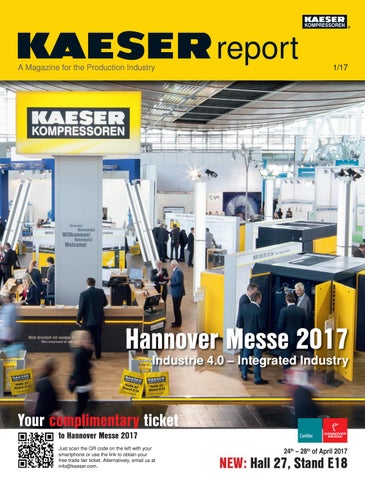
Hannover Messe 2017 Industrie 4.0 – Integrated Industry
Your complimentary ticket to Hannover Messe 2017
Just scan the QR code on the left with your smartphone or use the link to obtain your free trade fair ticket. Alternatively, email us at info@kaeser.com.
24th – 28th of April 2017
NEW: Hall 27, Stand E18
Contents
Issue 1/17
3 Editorial
4-7
8-11
4
It’s April and it’s raining innovations Kaeser Kompressoren at HANNOVER MESSE 2017: a wealth of new ideas in new surroundings
8
High-Tech for Formula 1, WRC, Bugatti & Co. CP-Autosport: High-performance engineering for high-performance cars
12
Still sharp after 285 years Zwilling plant in Solingen and Kaeser Kompressoren: a marriage of tradition and technology
16
Keeping things running Compressed air enhances additive production efficiency
20
For all eternity Compressed air plays a key role at the Eternit GmbH plant in Beckum
23
Impressive power and efficiency New: FSD series rotary screw compressors
16-19
Imprint: Publisher: KAESER KOMPRESSOREN SE, 96450 Coburg, Germany, Carl-Kaeser-Str. 26 Tel. +49 9561 640-0, Fax +49 9561 640-130, www.kaeser.com Editor: KAESER KOMPRESSOREN SE Photographer: Marcel Hunger Schneider Printmedien GmbH, Weidhausen Printing: The editor accepts no liability for manuscripts and photos submitted without request. Reproduction, including of excerpts, only permitted with written permission. KAESER KOMPRESSOREN SE – Postfach 21 43 – 96410 Coburg Tel. +49 9561 640-0 – Fax +49 9561 640-130, www.kaeser.com – E-Mail: produktinfo@kaeser.com
2 | KAESER report
Editorial
Making Industrie 4.0 work
Digital technologies are rapidly spreading to every area of commerce, industry and society as a whole. There’s no getting around it: The only option for companies hoping to maintain and improve their competitiveness in the face of the accelerating digitalisation trend is a concerted effort to adapt. The goal is to network as many people and machines as possible, to digitalise all relevant information and analyse it in real time in order to make value chain processes more efficient and transparent. The outcome will be more than just better performance and versatility on the part of the company itself. It will also mean being able to offer customers a wider range of intelligent products and high-value services (hybrid service bundles), thus enriching the company‘s own business models. Naturally a total transformation cannot be achieved overnight. It is important for every company to understand which applications are the most essential and then, starting with a selected subset, to use real-world projects to learn lessons in order to achieve hands-on successes in the digitalisation of specific areas.
Dipl.-Wirtsch.-Ing. Thomas Kaeser Chairman, Managing Board
Dipl.-Wirtsch.-Ing. Tina-Maria Vlantoussi-Kaeser Managing Board
A special challenge is getting employees on board. It is indispensable to keep the entire workforce up to date with comprehensive information on the company’s strategy. A one-off information event is not enough. Employees need ongoing training in the world of Industrie 4.0. As engineering and IT are increasingly growing together, there is a constant need to exchange key information. Implementation in the Industrie 4.0 age calls for a full-scale cultural shift that requires an in-depth grasp of the process transformation by all concerned parties. This will be possible, in the end, only if each participant is prepared to embrace change – and changes always begin in the mind of the individual.
KAESER report | 3
Kaeser Kompressoren at HANNOVER MESSE 2017: a wealth of new ideas in new surroundings
It’s April and it’s raining innovations
Your complimentary ticket to Hannover Messe 2017
Just scan the QR code on the left with your smartphone or use the link to obtain your free trade fair ticket. Alternatively, email us at info@kaeser.com.
Kaeser has a new location at the Hannover Messe. The Coburg-based compressed air systems provider is now at Stand E18 in a ComVac “enclave” in Hall 27 – the “Energy Hall”. The Kaeser stand shows how innovative compressors and air treatment components provide reliable and energy-efficient access to compressed air – an indispensable energy source in every industrial sector. What’s more, it demonstrates how these systems can be seamlessly integrated into “Industrie 4.0” (Industry 4.0) environments with advanced IT systems. 4 | KAESER report
Visit us at the
HANNOVER MESSE 24th - 28th of April 2017
NEW: Hall 27, Stand E18 Attendees of Hannover Messe 2017 in search of optimal solutions for their companies’ compressed air needs will save time if they take the train: the Kaeser stand at this year’s edition of the world’s largest and most important industrial trade fair is in Hall 27, immediately adjacent to the main western entrance to the fair. True to the Kaeser motto, “More compressed air for less ener-
gy”, Hall 27 prominently features exhibitors representing all facets of the energy sector. For Kaeser, the compressed air systems provider based in Coburg, Germany, an energy-efficient compressed air supply remains the guiding principle that inspires its R&D efforts and defines its ambitions. This is highlighted once again this year with numerous innovations: these include
reciprocating compressors for the trades and manufacturing sectors, industrial rotary screw compressors in combination with associated compressed air treatment equipment, as well as dry compression screw and rotary blowers for oil-free low-pressure air – impressively demonstrating that Kaeser’s excellent products become ever better, with ever more impres-
KAESER report | 5
Along with its ongoing control and optimisation tasks, the Sigma Air Manager 4.0 operates as an accurate, high-speed collector and
6 | KAESER report
Pre ss u
ing efficien cy tch
To make these developments available to as many users as possible, Kaeser is now offering rotary screw compressors below the common industrial performance classes, specially adapted to the relevant applications. They are offered in combination with the industrial PC-based Sigma Control 2 compressor controller. Their outstanding networking capabilities facilitate direct links, for example to connect the “compressed air islands” often needed in wide-area operating environments with the now even more perfect Sigma Air Manager 4.0: Kaeser’s key technology for “Industrie 4.0” integration. The Sigma Air Manager 4.0 is an innovative master control system specifically designed for management of multiple machines and associated equipment. Depending on the set-up, its 3-Dadvanced control can manage up to 16 individual systems (compressors and treatment components), ensuring maximum energy efficiency and compressed air system availability at all times.
nt
Compressed air for “Industrie 4.0”
3D
transmitter of data, and mirrors all compressed air operControl ating parameters in its “digital twin”. This permits predictive ro le maintenance of compressors, f fi c ien c y compressed air dryers, filters and other components while facilitating the seamless integration of the compressed air supply into the company’s networked manufacturing process – “Industrie 4.0”. Co
sive performance and energy efficiency. This alone will make a trip to Hall 27 worthwhile. At Stand E18, visitors can experience the full range of technologies utilising compressed air as an energy source. Kaeser has not only promoted integration of its technology into future-ready “Industrie 4.0” manufacturing environments, but has made it a productivity-boosting reality with a wide range of products, concepts and services.
advanced
i Sw
Experience compressed air innovation at first hand – Kaeser presents the future in Hanover
xibility fle re
The energy savings keep on coming... Despite their passion for the technologies of the future, Kaeser’s developers never lose sight of their long-term commitment: “More compressed air for less energy”. As a result, innovative control systems and their ongoing refinements share the spotlight with research work on the compressor airend – the place where compressed air is actually produced. The iconic Sigma Profile rotors undergo relentless optimisation that produces a steady stream of energy-saving improvements. The latest models presented in Hanover use up to 12 percent less energy than their predecessors. Another major factor behind the improving “fleet performance” is the increased use of super premium efficiency IE4 electric drive motors throughout Kaeser’s product lines. Energy efficiency is also a hot topic in the low-pressure segment: Kaeser screw blowers achieve impressive savings in electricity costs for pneumatic conveying and ventilation applications, especially where blowers run continuously for extended periods.
Compressed air – individual solutions and services Another eye-catching display at Kaeser’s stand, which covers over 1000 square metres in Hall 27, is a ready-to-connect compressed air container built around a dry compression rotary screw compressor. Once the hook-ups are in place, it’s ready to run. It also exemplifies the comprehensive, all-round approach that is typical of Kaeser when it comes to supplying compressed air: instead of just selling machines, the systems provider from Coburg provides full solutions tailored to deliver the exact volume needed by the customer at the desired quality standards. Kaeser solutions are fully coordinated down to the last detail thanks to meticulous needs analysis (through Air Demand Analysis – ADA) and sophisticated software (Kaeser Energy Saving System – KESS), and fulfil all parameters for system availability and energy efficiency on a continuous basis. Another key factor is the rapid and reliable Kaeser Air Service. Contract models geared to a range of needs assure smooth compressed air operation at all times. Users who wish to focus on their core competencies and avoid hiring specialised staff for their compressed air supply will find an ideal solution in Kaeser’s Sigma Air Utility and the coming Sigma Smart Air service package. The compressed air station, designed by Kaeser, is installed and operated either in an onsite room provided by the user or in a container. The user has more liquidity for other needs, and pays for compressed air based on cubic metres / kilowatt hours consumed at a pre-arranged price, just like water, gas or electricity. The operator of the compressed air station, who has an interest in cost-effective operations, ensures that the equipment is always up to date for maximum energy efficiency and reliability.
Large simulation screens show off the talents of the SIGMA AIR MANAGER 4.0
See you soon To learn more about all of Kaeser’s products and services, come and talk to the compressed air specialists from Coburg.
They’ll be on hand when you drop by the Kaeser stand in Hanover and will be happy to explain the latest technology and the coming trends. See you there!
24th – 28th of April 2017
NEW: Hall 27, Stand E18 KAESER report | 7
High-Tech
automotive innovation for the racetrack, rally and road
8 | KAESER report
CP Autosport: High-performance engineering for high-performance cars At the brand-new plant in the industrial park near the Paderborn-Lippstadt airport, form truly follows function. Planned and developed from the outset to house specific, sophisticated production processes, the plant – including its integrated compressed air station – represents the company’s complete commitment to quality, which is the foundation of its sustained success.
The core competencies of CP Autosport are indispensable to the high-performance automotive sector: premium-quality in-house metal processing and highly sought-after lightweight design components and assemblies. These find their way into (small) series cars of the highest performance class as well as vehicles competing in top motorsport categories such as Formula 1 and World Rally Championship (WRC). The company’s specialisation in chassis and safety engineering attracts many different types of customers ranging from prominent automotive manufacturers and motor sport teams to private customers. Moreover, CP Autosport focuses not only on the finest details of these high-performance components, but also develops complete vehicle concepts in close cooperation with its customers. Similarly, CP meets the highest standards in its seamless handling of prototype production and customer-specific small and mid-series production. The new plant reflects the company’s rapid – and solid – growth to date, which looks set to continue, since the neighbouring lot of equal size is ready to accommodate further expansion. The plant was designed from the outset to support the company’s specific development and production processes. This is evident, for example, in the close proximity of construction and preparation activities to the corresponding production halls, which ensures short travel distances and rapid communication at all times. CP Autosport employs highly qualified engineers who are able to take full advantage of all the resources necessary for successful and innovative product development and who have a wealth of experience with essential tools of the trade, such as CAD, CAE, CFD and Vehicle Dynamics Simula-
When it comes to small-scale production of exclusive automotive components, “High Tech” also involves a lot of precision manual work
tion (VDS). The information generated using these advanced tools enables a level of detail precision virtually impossible to achieve through real-life tests and trials. They therefore provide the solid foundation necessary for all subsequent steps in the development process. On the production side, CP Autosport’s highly qualified and motivated employees in the component and module production departments, as well as other areas in assembly and chassis construction, for example, use the very latest computer-assisted processing tools and machines. To ensure that all customers can always rely on consistently high production quality, detailed quality plans are drafted at CP Autosport for each and every product, which
guide their path through the various production processes. This effectively ensures that all delivered components can be immediately dispatched to the racetrack, right off the production line. Regularly scheduled internal and external audits further help to continually validate and optimise all processes, in order to maintain the company’s trademark exceptional quality standards consistently over the long-term.
KAESER report | 3
The ‘Contracting’ compressed air station at CP Autosport saves energy and money
It is fascinating to watch the processes at work. In particular, those dedicated to producing a variety of steel tubes, which are largely made of proprietary alloys developed by CP Autosport itself – and produced to certified standards specifically for these components. The tubes are then formed into triangular wishbones, such as those found in Formula 1 cars and small-series super-sport cars: highly durable – almost delicate – lightweight precision components produced to micron accuracy tolerances. Together with their elegant finish, it almost seems a shame that these sculptural works of art will ultimately be installed on the underside of the car! One of most striking testaments to CP Autosport’s power of innovation is an entirely new drive shaft system destined for use in a new super-sport car. Such components usually consist of a massive steel shaft with joints arranged to compensate for angle and length modifications resulting from the load and driving situations expected for the given vehicle. Yet in this case, CP collaborated with a steel specialist to develop a lighter drive shaft capable of greatly enhanced torque transmission. At the core of the system is an ultra-high-strength steel tube with enhanced durability properties that are achieved through a special heat treatment process. The push-in connectors generally used in hollow-shaft designs are replaced by a concept in which shaft ends are secured to tripod joints by welded connections – a highly effective means of achieving the desired weight reduction. It is no surprise that development, as well
10 | KAESER report
as prototype and series production of such high-performance components, assemblies and whole vehicles requires exceptional expertise and motivation on the part of the employees involved. This uncompromising dedication to achieving the very highest standards is one of the key reasons that CP Autosport boasts a remarkable apprentice-training ratio: 25 of the 190 employees are apprentices, allocated throughout the widest variety of specialisations. Apprentices are familiarised with the highly complex subject matter through a combination of hands-on experience as well as integration into actual processes, a method that demonstrably produces dependable and knowledgeable team players capable of undertaking the required precision work at ever more complex workstations. CP Managing Director Stefan Ludwig also attests to the quality of the precision work performed by the Kaeser Kompressoren employees tasked with planning and installation of the centrally located compressed air station in the new plant. In his opinion, Kaeser’s expertise was just as impressive as the compressor systems themselves and CP was more than happy to have chosen the Coburg-based compressed air systems specialists. Another criterion behind CP’s
decision was Kaeser’s ability to offer compressed air as a service just like electricity, gas, water or any other utility. This innovative option spared CP Autosport the need for significant capital investment in the production systems, which would otherwise have been necessary. The installed solution relies on three Kaeser ASD 40 rotary screw compressors and two TE 121 series refrigeration dryers (each with a downstream coalescence filter) arranged in a compressed air station managed and controlled by a Sigma Air Manager 4/4. The compressor station itself is connected to a 30 cubic metre air receiver, located directly in the production area, where compressed air is stored at a pressure of seven bar for delivery as needed into the four-line compressed air distribution system at CP Autosport. The arrangement is both energy-efficient and extremely reliable. Kaeser Kompressoren retains ownership of, and takes responsibility for, operation of all components and also provides premium quality service and maintenance. All processes therefore operate with maximum efficiency and compressed air is always available at the required volume and quality for the products that so depend upon it for their manufacture.
Kaeser provides CP products with premium compressed air quality and availability
KAESER report | 11
12 | KAESER report
Zwilling plant in Solingen and Kaeser Kompressoren: a marriage of tradition and technology
Still sharp after 285 years
Zwilling, one of the world’s most renowned knife manufacturers, continues the historic craft of Solingen – also known as the “City of Blades” – and is looking to take this tradition well into the future as a versatile provider of high quality culinary and body care products.
There is simply no doubt that Zwilling is synonymous with Solingen. The Zwilling administrative headquarters, constructed between 1908 and 1923, constitutes an architectural monument to the distinctive regional “clinker planking” style. Moreover, the five-metre high Zwilling logo on the roof has long served as the most recognisable feature of the Solingen city centre. The company has even had its own train station for some ten years now: the WGGrünewald S-Bahn station, which together with the next station on the line (SG-Mitte), have jointly replaced the former Solingen central train station. Yet another symbol of Solingen, the local trolleybus system, stops just across from the gates of the Zwilling grounds; installed after the second world war to replace the largely destroyed streetcar system, is the largest of the three such systems still operating in Germany today. June the 13th, 1731 is a key date in the company’s history, which incidentally falls in the astrological sign of Gemini (Zwilling in An architectural monument: the original administrative building German). On that date, Peter Henckels, cutler in Solingen, entered Zwilling as a trade- the oldest trademarks in existence. Peter in the Solingen, Elberfeld and Lennep remark in the official records of the Solingen Henckels was born into a family of grinders gion extending back to the mid-15th cenknifemakers’ guild – making Zwilling one of and smiths with a long, documented history tury. The current company name, “Zwilling
KAESER report | 13
J. A. Henckels” honours Johann Abraham Henckels (1771-1850), under whose leadership the first Zwilling boutique was opened in Berlin in 1818, marking the beginning of Zwilling’s successful forays into the world beyond the Solingen city centre. Boutiques in New York (1883) and Paris (1927) were eventually to follow. Today, boutiques, franchises, shops-in-shops, outlet stores and concept stores serve many cities all over the world; a distribution network crowned in 2012 by the first Zwilling Flagship Store with a prestigious address on Düsseldorf’s famed Königsallee. Innovative products and processes paved the company’s way through the centuries, further ensuring corresponding market position status and continuous growth. Following a corporate restructuring process, the firm was reborn in 1953 as a stock corporation – which nevertheless remained in the original family’s hands. Then in 1970, the Neuss-based Wilh. Werhahn KG company acquired the entire stock offering – and continues to be the sole shareholder – in order to ensure the best possible future for Zwilling as a family company. The success of these measures is reflected in the widespread presence of the Following final finishing, the blades are razor sharp
14 | KAESER report
Zwilling Group in all of its market segments. Countless acquisitions have made Zwilling sales outlets, such as the modern outlet at the main Solingen plant, into a veritable paradise for everyone who has a passion for cooking and cuisine. Products include not only top-quality knives and cutlery, but also aluminium and cast iron pots and pans, as well as porcelain services for elegant table settings. Body care products for manicure and pedicure specialists form yet another division – joined by professional lines of scissors and knives for hairstylists.
Modern production Its long history notwithstanding, Zwilling Solingen today remains synonymous with the highest quality kitchen and culinary knives, so it is no surprise that their production takes place in a state-of-the art plant. The process begins with strip steel developed in-house by and for Zwilling, which is stamped out into blanks that later take shape as knives. This process is carried out by huge forming machines manufactured by Lasco, a tradition-rich mechanical engineering firm whose grounds on Hahnweg in Coburg lie just a stone’s throw from the original Kaeser headquarters. The adHumans and machines work hand-in-hand to ensure consistently superior quality knife production at the Zwilling plant
vanced automation that characterises the early stages of the manufacturing process largely continues throughout the subsequent production streams. The downstream forging, grinding, tempering and other processes are performed by machining centres and industrial robots – mostly driven and controlled by compressed air. Yet, without the support of highly knowledgeable and skilled staff, none of this would be possible. The human component remains indispensable for quality assurance at many points during the various processing steps, as well as for attaching handles and correcting grinding procedures to the most exacting standards. They ensure that the machines continue to do precisely what they are supposed to, ensuring that Zwilling knives – today and into the future – remain the embodiment of quality and durability. The indispensable compressed air that drives it all is produced by four Kaeser rotary screw compressors (two ASD 37s, a BSD 72 and a CSD 102) and is treated by a TF 251 refrigeration dryer. Before ultimately being released into the compressed air system,
it is first buffered through three parallel 50 m³ air receivers. An air main charging system ensures stability and availability whilst the whole system is controlled and monitored by a Sigma Air Manager with adaptive 3-D Control. Moreover, all compressors are equipped with plate-type heat exchangers, enabling them to recover heat and
Key player: Compressed air from four Kaeser rotary screw compressors
Keen eyes follow the products every step of the way from goods-in right up to dispatch
further improve Zwilling’s energy balance sheet. Klaus Rettenbach, master machinist and Head of Mechanical Maintenance at Zwilling for over 50 years, is delighted with the results; if anyone is familiar with the company’s production operations – and can testify to the effectiveness of the Kaeser system – he’s the man! (http://www. rp-online.de/nrw/staedte/solingen/hier-entsteht-solingens-markenzeichen-aid-1.3820520)
A high quality rinsing machine for high quality cutlery
KAESER report | 15
Compressed air enhances additive production efficiency
Keeping things running With its innovative oil and fuel additives, Liqui Moly has become one of the most renowned names in the automotive industry. Now as an undisputed market leader in this sector, the Ulm-based company is driving its ambitions forward into the motor oil business.
13 million containers filled per year
In the beginning, there was a silvery shimmer – and it came from molybdenum disulfide (MoS2), a dark-grey, crystalline mineral. Established in Ulm in 1957 by Hans Henle (1917-2012), Liqui Moly owned the patent for the production of this miraculous material and went on to incorporate it into a specially developed motor oil additive. This additive improved lubrication, extended the service life of engines and was even able to provide protection for a certain time in the event of complete oil loss.
It was from liquefied MoS2 – “Liqui(d) Moly(bdenum) disulfide – that the Liqui Moly company consequently derived its name, paving its road to success. A single additive then grew into a wide range of products, now numbering over 4000, which extend beyond merely engine and gear oils, additives and diverse lubricants. The product range now encompasses a complete auto care line, as well as product lines for industrial trucks, agricultural equipment, motorised and non-motorised two-wheeled vehicles, aircraft and boats, together with aerosols and specialised products for heavy industrial applications. With growth came a need to expand the company’s infrastructure, eventually result-
ing in the company’s relocation from the city centre to the district of Lehr to the north in 1974. The headquarters still stands there today, housing administrative and sales departments, as well as research and development activities, together with production facilities for all of the firm’s additives and many grease and paste products. Other greases and pastes, along with all of the company’s motor oils, are produced by the affiliate Méguin in Saarlouis. The latter had been Liqui Moly’s oil supplier for decades until it joined the Liqui Moly group of companies in 2016. In Germany today, Liqui Moly is a leading provider of motor oils and is the undisputed market leader when it comes to
additives. Demand is also growing steadily internationally: Liqui Moly products are now sold in 120 countries, which demonstrates the company’s strong growth over the last decade. Moreover, during this period, Liqui Moly’s turnover, not including Méguin, has tripled. Liqui Moly doesn’t just have its roots in Germany, but bases production exclusively there. “Made in Germany is a quality promise that we live up to every day,” says Managing Partner Ernst Prost. “Our success is based on the exceptional performance of our products, not on budget prices.” The company’s customer-oriented business model is another key factor in the success of the Liqui Moly brand. If a customer needs a product not yet in the existing range, Liqui Moly works with them to explore the viability of its production. At Liqui Moly, everything has centred on smooth mechanical motion and the company’s mission remains the same now as when it was founded nearly 60 years ago: Keeping things running. This certainly applies to production in Ulm, which – currently at some 13 million filled containers per year – continues to set new growth margins year after year. The increasing importance of the company’s compressed air supply – treated in accordance with application-specific requirements – is also due to pragmatic considerations. The additives are produced from carefully measured basic materials stored in aboveor below-ground tanks from which they are supplied to the automatic mixers. Since many of these are flammable or explosive fluids, the electric pumps formerly in use required strict inspection and certification, which had to be performed regularly at very short intervals. The significant time and monetary expense associated with these previously necessary processes has now been eliminated entirely – thanks to progressive and ongoing replacement of the electrical pumps
with compressed air diaphragm pumps. The exciting prospect of reduced costs and greater availability was reason enough to undertake a massive restructuring of the compressed air supply from the ground up several years ago. After all, the need for process air rose steadily as each new diaphragm pump came online. The challenge, therefore, was to design a new compressed air station – and most crucially, to install it. Furthermore, since the Ulm-Lehr industrial park was not able to offer any additional space for expansion, the planners took inspiration from the old football saying, “the pitch may be small, but it’s high”. The result-
ation dryer (THC 22 type) before continuing into the distribution system, where it is buffered in a 1000 litre air receiver. The compressor trio is designed to accommodate future developments, so that the vital compressed air supply can continue to ‘keep things running’ once the remaining electric pumps make way for new compressed air diaphragm pumps at the end of their service life.
Two of some 4000: At the Liqui Moly plant in Ulm, everything centres around additives for smoother running and longer service life
ing concept involved installation of an elevated, tailor-made container to house the three Kaeser ASD 37 T-series rotary screw compressors (with integrated dryers) which constitute the compressed air station. For added peace of mind, the compressed air then passes through an additional refriger-
For all eternity
Compressed air plays a key role at the Eternit GmbH plant in Beckum The brand name Eternit, a leading provider of roofing and façade cladding materials made from fibre cement, derives from aeternitas, the Latin for “eternity”. It was proposed by Ludwig Hatschek (1856-1914), the Austrian inventor of the process used to produce the products and – true to its meaning – remains the company name to this day. Similarly, panels produced according to his methods are still the first choice of designers around the world for the creation of highly aesthetic and functionally versatile building shells.
The new building material was experimented with extensively as early as the 1920s, yet was only to reach its first golden age in the 1950s and 60s. Renowned architects have been using fibre cement products and have participated in associated product development for almost a century now. For instance, Le Corbusier worked extensively with the new material, ultimately selecting it in 1912 for the roof panels of one of his most famous projects: his parents’ villa in La Chaux-de-Fonds, France, with its white plaster façade – best known to history simply as the ’Maison Blanche’ (“White House”). Additionally, Walter Gropius, director of the Bauhaus in Dessau, incorporated Eternit into his equally iconic 1927 Weißenhofsiedlung in Stuttgart.
20 | KAESER report
Many buildings with fibre cement roofs and facades are currently listed buildings – and not just in Europe. Since their inception, fibre cement products have owed their characteristic, necessary tensile strength to asbestos mineral fibres – a natural material known since antiquity for its remarkable tear resistance. As far back as 3000 years ago, asbestos was mined in quarries for use in the production of fireproof textiles and came to be known as “mineral flax”. By the beginning of the 1980s, fibre cement – then called asbestos cement – had been incorporated into thousands of applications and products, and for decades had been regarded as the embodiment of modernity. Yet already in the mid-1970s, new scientific research was starting to document the damaging health effects of
fine asbestos dust. Consequently, in 1981 a German asbestos cement commercial association (Wirtschaftsverband Asbestzement e.V.) came to an agreement with the German Federal Government to discontinue asbestos cement production. Eventually, scientific studies confirmed that asbestos cement products with tightly bound fibres installed in roofs and facades actually pose no risk. Yet by 1979, Eternit AG in Germany had already begun collaboration with the German Federal Ministry of Research and Technology to explore potential industrial applications for asbestos replacement products. Ultimately, between 1981 and 1990, all products intended for structural use were
Compressed air from the Kaeser station plays a vital role in the largely automated production process for Eternit facade panels
No matter whether being used for coating preparation or for drying, compressed air always reliably provides the necessary movement energy
Project: Office building Venlo, Belgium Architect: JCAU Jo Coenen Architects & Urbanists, Amsterdam, Netherlands Photo: Eternit GmbH / Etex Group Product: EQUITONE facade panels [pictura] / EQUITONE [natura] The “Innova Tower” was constructed to be an attention-getter for the “Floriade” world flower expo which was held from April to October 2012 in Venlo; in addition to various Eternit panels, the facade is faced with 4100 m² of glass.
KAESER report | 21
Project: “wagnis 3” residential cooperative, Munich, Germany Architect : Bogevischs Büro, Munich, Germany Photo: Eternit GmbH, Bogevischs Büro Product: EQUITONE facade panels [pictura] “wagnis 3” is part of the residential development constructed by the Munich-based “wagnis eG” housing cooperative in the “expo town” of München-Riem; the cooperative primarily provides its members with socially and ecologically responsible housing.
converted to incorporate only asbestos-free fibre cement. Today, the Eternit GmbH plant in Beckum, central Westphalia, continues to produce Eternit panels with exceptional quality and durability, yet which now rely on specialised cellulose fibres rather than asbestos. First, the fibres are mixed into the wet cement in precisely dosed quantities; next, the resulting mass is conveyed to a large, rotating drum via screen carrier plates. It is within the drum, on its polished interior surface, that the panels form layer by layer. Once the desired layer thickness is reached, the fibre cement layer – still wet and malleable at this point – is separated from the drum and format roller. Finally, the panels are pressed into stacks and are stored for curing.
Omnipresent compressed air
A vital ingredient: compressed air
Compressed air is even used in the cutting process for the facade panels
22 | KAESER report
Since the process requires significant quantities of water prior to the drying phase, the processing and control systems are designed to work entirely with compressed air as the prime energy carrier. Whether
for mixing cement, dispensing and combining the fibres, correctly measuring process water or water supply or drainage, one constant remains: without large volumes of compressed air, none of it would be possible – not to mention the handling of semi-finished and finished panels in the drying and coating areas. Eternit panels are currently available straight from the factory in a full spectrum of colours either as colour-saturated or coated versions. The choice simply depends on the vision and preference of the client. Needless to say, the range of colours available for the coated panels is much larger than that for their colour-saturated cousins. It’s also no wonder that compressed air plays a vital role in processes related to the dyes themselves; this includes their storage (which involves maintaining their fluid state), together with mixing, supplying and draining of the dyes. Finally, compressed air is a vital resource used throughout the final mechanical processing phases, such as the correct dimensioning of façade and roofing elements or for creating fastening holes at specific locations in the panels.
New: FSD series rotary screw compressors
Impressive power and efficiency The new space-saving FSD rotary screw compressors are now more efficient than ever. source conservation: the environmentally friendly fluid filter cartridges no longer have a permanently attached sheet metal housing, but rather are simply inserted into an aluminium housing. The filter cartridges themselves feature a metal-free design and are suitable for thermal disposal at the end of their service life without additional pre-treatment. The user-friendly Sigma Control 2 compressor controller provides additional energy savings, reduced maintenance requirement, as well as improved operational reliability and compressor availability. The Sigma Control 2 communicates seamlessly with the Sigma Air Manager 4.0 master controller and management system from Kaeser Kompressoren, which also features adaptive 3-D Control. Depending on the version, this powerful controller can simultaneously monitor and co-ordinate op-
eration of up to 16 compressors and treatment components with optimum efficiency. Moreover, the ability to record and transfer all compressed air station operating data to the central Kaeser Network via secure channels opens the door to “Industrie 4.0” environments. Constant data comparison in the Kaeser Service Centre ensures early detection of any discrepancies, enabling timely implementation of preventative measures. Last, but not least, the
Efficient, quiet, dependable large volumes of data generated enable optimum use- and demand-based maintenance intervals to be determined within the context of predictive maintenance.
Prototype picture; serial model may vary
Air-cooling of rotary screw compressors is up to 60 percent more cost effective than water-cooling and this advantage is now made available for larger drive powers over 250 kW with Kaeser’s new FSD series of rotary screw compressors. The radial fan in Kaeser’s highly effective cooling system draws in ambient air directly through the cooler without being pre-warmed to ensure optimum cooling performance. FSD compressors can therefore be used in ambient temperatures as high as + 45 °C. All FSD models are also optionally available as water-cooled versions. In every model, the thermostat-controlled radial fan for fluid cooling helps achieve further energy savings. It is integrated into Kaeser Kompressoren’s Electronic Thermo Management (ETM) system, which is another significant innovation in the new FSD series: ETM regulates oil temperature to ensure a safe and consistent differential from the dew point temperature, thereby avoiding unnecessarily high compressed air discharge temperatures and leading to additional energy savings. With the heat recovery option, a second ETM system assures optimised and even more efficient usage of the available heat energy. This optimised efficiency results from the newly refined airends equipped with high efficiency Sigma Profile rotors. Furthermore, the airend is directly driven by an energy-saving IE4 super premium efficiency motor that operates at a low speed of 1490 rpm. Direct drive not only eliminates the transmission losses associated with gear drive, but also reduces energy consumption, maintenance requirement and sounds levels. The unit interior also reflects Kaeser’s commitment to re-
KAESER report | 23
KAESER KOMPRESSOREN FZE P.O. Box 17485 • Jebel Ali Free Zone • Dubai • United Arab Emirates Street 1243 Phone: 00971 4 8050000 • Fax: 00971 4 8050077 E-mail: info.dubai@kaeser.com • www.kaeser.com
New: DSD series
13 to 24 m³/min – 7.5 bar More compact with more power
New airends with optimised SIGMA PROFILE
Complete solution
with high efficiency integrated refrigeration dryer (optional)
Keep your cool
Electronic Thermo Management (ETM) for greater efficiency
Future-ready
The versatile & network-able SIGMA CONTROL 2
Energy savings and efficiency
with thermostat-controlled fluid cooler fan
KAESER – More compressed air for less energy
www.kaeser.com
More efficient than ever