FEAG 4 2017 COVER_FEAG_COVER_MASTER_09 21/08/2017 10:18 Page 1
US$15.00 (UKÂŁ9.00)
VOLUME 34 ISSUE 4 2017
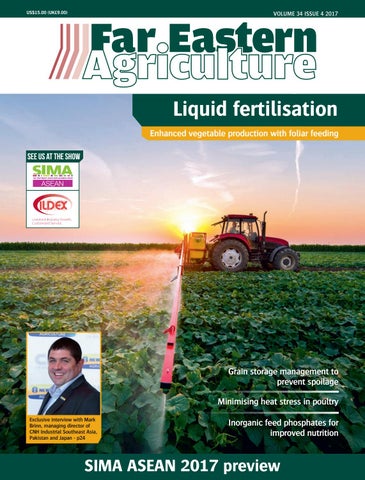
Liquid fertilisation Enhanced vegetable production with foliar feeding See us at the show
Grain storage management to prevent spoilage Minimising heat stress in poultry Exclusive interview with Mark Brinn, managing director of CNH Industrial Southeast Asia, Pakistan and Japan - p24
Inorganic feed phosphates for improved nutrition
SIMA ASEAN 2017 preview
S01 FEAG 4 2017 - Start_Layout 1 21/08/2017 06:38 Page 2
ion t i d rd E
3
THE SOUTHEAST ASIAN AGRI-BUSINESS SHOW
ASEAN THE SOUTHEAST ASIAN AGRI-BUSINESS SHOW
7>9 September
2017
tion Registra pen! is now osean.com a-a
www.sim
Hall 5-6 IMPACT EXHIBITION CENTER & IMPACT LAKESIDE, BANGKOK, THAILAND www.sima-asean.com
SIMAASEANThailand
Contact Ajjima Roysri Tel: +66 (0) 2833 5347 | E-mail: info@sima-asean.com Jean-Hugues BARSOT | Tel: +33 (0) 1 76 77 11 44 | E-mail: sima-asean@comexposium.com Organizers:
Co-Organizer: Main Supporter:
Supporters:
Official Media Partner:
Media Partners:
ᰣጷᒐ )41914.& 70+# '46#0+#0
S01 FEAG 4 2017 - Start_Layout 1 21/08/2017 17:39 Page 3
Contents F
21/08/2017 10:18 Page 1
US$15.00 (UK£9.00)
VOLUME 34 ISSUE 4 2017
Bulletin 04
A round up of key developments in the regional market Liquid fertilisation
Agenda 06-07
Enhanced vegetable production with foliar feeding See us at the show
FAO Outlook
Photo: Dusan Kostic/Adobe Stock
Vietnam’s tuna export revenue rises Hubbard to become a subsidiary of Aviagen Group Case IH Sugarcane Harvester creates highest harvest record
Events
Grain storage management to prevent spoilage
08
SIMA ASEAN preview
Minimising heat stress in poultry Exclusive interview with Mark Brinn, managing director of CNH Industrial Southeast Asia, Pakistan and Japan - p24
ILDEX Indonesia preview
Aquaculture 14
Inorganic feed phosphates for improved nutrition
SIMA ASEAN 2017 preview
11
Inorganic feed phosphates in aquaculture nutrition
Poultry 16
Managing heat stress in poultry
Grain Storage 18
Grain management measures to prevent spoilage
Crops 20
Foliar feeding for improved vegetable production
Sustainable genetic resource management
Equipment 24
Asia’s booming tractor market
18
Advertisers Index Aliphos Rotterdam BV ................................................28
Kukje Machinery Co., Ltd. ..........................................23
AWILA Anlagenbau GmbH ............................................7
Meyn Food Processing Technology BV..........................9
Ayurvet Ltd*................................................................17
Omex Agrifluids Ltd.......................................................7
Evans Vanodine International Plc ................................23
Stallion Plastics Limited..............................................26
Goizper Sociedad Cooperativa ......................................5
Technical Systems (Pty) Ltd ........................................11
Henke-Sass, Wolf GmbH ............................................19
Termotecnica Pericoli SRL ..........................................17
IMPACT Exhibition Management Co., Ltd. ....................2 (SIMA ASEAN 2017)
Unipoint AG ................................................................26 VNU Exhibitions Asia Pacific Co., Ltd...........................12 (ILDEX Indonesia 2017)
Impex Barneveld b.v ..................................................15
Grain management measures to prevent spoilage
Audit Bureau of Circulations - Business Magazines
www.fareasternagriculture.com
Editor: Vani Venugopal - Email: vani.venugopal@alaincharles.com Editorial and Design team: Prashant AP, Hiriyti Bairu, Kestell Duxbury, Miriam Brtkova, Ranganath GS, Rhonita Patnaik, Samantha Payne, Rahul Puthenveedu, Deblina Roy, Nicky Valsamakis and Louise Waters Managing Editor: Georgia Lewis Publisher: Nick Fordham Sales Director: Michael Ferridge
Head Office: Alain Charles Publishing Ltd University House 11-13 Lower Grosvenor Place London SW1W 0EX, United Kingdom Phone: +44 20 7834 7676 Fax: +44 20 7973 0076
Middle East Regional Office: Alain Charles Middle East FZ-LLC Office L2- 112, Loft Office 2, Entrance B, PO Box 502207 Dubai Media City, UAE Phone: +971 4 448 9260 Fax: +971 4 448 9261
Production: Kavya J and Nelly Mendes - Email: production@alaincharles.com
Magazine Sales Manager: Richard Rozelaar, Tel: +44 207 834 7676 Email: richard.rozelaar@alaincharles.com
Subscriptions: circulation@alaincharles.com Chairman: Derek Fordham
Country
Representative
Phone
Fax
India
Tanmay Mishra
+91 80 65684483
tanmay.mishra@alaincharles.com
Nigeria
Bola Olowo
+234 8034349299
bola.olowo@alaincharles.com
UAE
Graham Brown
+971 4 448 9260
+971 4 448 9261
graham.brown@alaincharles.com
USA
Michael Tomashefsky +1 203 226 2882
+1 203 226 7447
michael.tomashefsky@alaincharles.com
Printed by: Buxton Press Printed in: August 2017 Far Eastern Agriculture (ISSN 0266-8025)
www.fareasternagriculture.com | FAR EASTERN AGRICULTURE Issue Four 2017
Serving the world of business
3
S01 FEAG 4 2017 - Start_Layout 1 21/08/2017 06:38 Page 4
Bulletin Marubeni buys US beef company for US$170mn JAPAN’S MARUBENI HAS added a US beef processor to its portfolio, anticipating greater exports to China after Beijing lifted a long-standing ban on meat from American cattle in June 2017. The Japanese trading house Creekstone is the 12th biggest US has acquired all of Kansasbeef producer by volume and among based Creekstone Farms, a the top processors of premium beef. distributor of premium beef, in a deal worth about US$170mn, including liabilities. With the resumption of American beef exports to China, Marubeni expects the country’s appetite for the meat to grow as its middle class expands. Creekstone, which recorded US$550mn in sales last year, processes beef for sale to supermarkets and restaurants. It is the 12th biggest US beef producer by volume and among the top processors of premium beef. In 2016, Creekstone processed about 250,000 head of cattle, with about 80 per cent of the beef going to US consumers and the rest shipped to Europe, Japan and other countries. The US company got its license to export to China soon after the beef ban was lifted last month. Marubeni will aim for sales of US$620mn at Creekstone in 2020 by increasing exports to China and other emerging markets. Marubeni has been exporting American beef to Japan for over 40 years.
Easy Bio opens new Thailand office EASY BIO HAS established a new office in Thailand to provide optimised solutions to its customers. Besides consulting, Easy Bio also deals in product solutions like Lipidol, Endo-Power and Fermkito. Dr Krit Sapchukun will lead Easy Bio Thailand as the managing director along with technical services manager Jaruwan Sanping and business coordinator Amonrat Toolkhuntod.
Easy Bio’s new office in Thailand. (Photo: Easy Bio)
Easy Bio has been working in the Thai market for a decade and has continued to accumulate knowledge in the region and its business through constant communication with its local customers, according to the company. Dr Stevenson Hwang, managing director of Easy Bio, said, “Opening Easy Bio Thailand is a great result achieved by strong faith between all the members, local partners and customers. With this launch of Easy Bio Thailand, we will continue to research, develop and provide Easy Bio uniquely integrated solutions of feed additives, animal health and biotechnology, livestock products, all related to Thailand as well as Southeast Asia. It is both our hope and promise to share these values with our partners.”
subsidiary Rhone Ma Malaysia Sdn Bhd is buying the factory from property developer Klanggroup Development Sdn Bhd, the group said in a filing with Bursa Malaysia. On a land measuring 1,750 sq m, the factory comprises a mezzanine store and a two-storey office. The construction was completed this year. Rhone Ma said that the group plans to use the factory for storage of food ingredients should it decide to venture into the manufacturing of food ingredients in the future. “The acquisition is line with the group’s future plans which include the expansion of the existing range of food ingredients as it allows the group to cater to the increasing storage needs of food ingredients,” it said. The acquisition, said Rhone Ma, will be financed through a combination of internally generated funds and bank borrowings.
South Korean firm to build food plant in Vietnam SOUTH KOREAN FOOD giant CJ CheilJedang said that it will invest US$62.7mn to build an integrated food production site in Vietnam. The new plant will be erected on 66,000 sq m of land inside the Hiep Phuoc Industrial Park in Nha Be District by July 2017. It would be the company’s first integrated food plant to cover a wide range of products from chilled to frozen food, rolling out up to 60,000 tons of products a year, the company said. Key products would include Bibigo brand dumplings, kimchi, home meal replacements, frozen food and meat processed products. The plant’s R&D centre will develop new market-specific products by fusing Korean food with local flavours. CJ CheilJedang aims to generate US$610mn in food business sales from Vietnam by 2020. CJ CheilJedang acquired Vietnamese kimchi distributor Kim&Kim and frozen food service company Cau Tre last year. In March this year, the South Korean company acquired fish and meat processor Minh Dat Food to expand its footing in the country’s food market.
Vietnam to ban antibiotics in livestock farming VIETNAM WILL IMPOSE a ban on all kinds of antibiotics in livestock farming after 2020, and those currently used in animal feed are only allowed until the end of this year, said Hoang Huong Giang from livestock production department under the Ministry of Agriculture and Rural Development, Thanh Nien has reported. Only 15 among 43 types of antibiotics approved for animal feed can be used until the end of the year. The rampant use of antibiotics in farming has caused immunity among bacteria and damaged the health of consumers due to higher-than-permitted residues. According to a recent survey on 208 poultry farms in Tien Giang Province, the level of antibiotics used in farming has been detected to be six times higher than Europe’s standards. Some 84 per cent of them are used for disease prevention, said Nguyen Thu Thuy, deputy director of department of animal health. In addition to using animal feed with high antibiotic levels, about 72 per cent of farm owners use at least one type of antibiotics directly in the livestock’s lifetime to prevent disease or to stimulate growth. In addition to bad effects on human health, the excessive use of antibiotics has caused direct damage to exporters.
Rhone Ma buys new factory for storage in Malaysia MALAYSIA-BASED ANIMAL HEALTH solutions provider Rhone Ma Holdings Bhd has acquired a semi-detached factory at the Excellent Technology Park III in Klang for US$1.3mn. Its wholly-owned
4
The rampant use of antibiotics in farming has caused immunity among bacteria and damaged the health of consumers due to higherthan-permitted residues.
FAR EASTERN AGRICULTURE Issue Four 2017 | www.fareasternagriculture.com
S02 FEAG 4 2017 - Agenda_Layout 1 18/08/2017 16:32 Page 5
Events 2017 AUGUST 23 - 25
Inagritech 2017
Jakarta, Indonesia
28 - 30
International Exhibition on Poultry, Livestock & Technologies
Bangalore India
www.inagritech-exhibition.net www.iplexpo.com
SEPTEMBER 01 - 03
Agri Asia
Ahmedabad, India
04 - 08
World Veterinery Poultry Association Congress 2017
Edinburgh, UK
www.wvpac2017.com
05 - 09
The XXV World’s Poultry Congress
Beijing, China
www.wpc2016.cn
07 - 09
SIMA ASEAN
Bangkok, Thailand
19 - 21
Livestock Asia
Kuala Lumpur, Malaysia
27 - 29
Livestock Myanmar
Yangon, Myanmar
www.veas.com.vn
Jakarta, Indonesia
www.ildex-indonesia.com
www.agriasia.in
www.sima-asean.com www.livestockasia.com
OCTOBER 18 - 20
ILDEX Indonesia
NOVEMBER 10 - 11
Agrilivestock Cambodia 2017
12 - 18
AGRITECHNICA
Hanover, Germany
www.agritechnica.com
22 - 24
Poultry India
Hyderabad, India
www.poultryindia.co.in
29 - 30
3rd Global Feed Summit
Bangkok, Thailand
www.cmtevents.com
30 - 02
AgriPro Asia Expo Hong Kong
Hong Kong
www.agriproasia.com
Phnom Penh, Cambodia
www.fareasternagriculture.com | FAR EASTERN AGRICULTURE Issue Four 2017
www.agrilivestock.net
5
S02 FEAG 4 2017 - Agenda_Layout 1 21/08/2017 08:10 Page 6
Agenda
FAO Food Outlook THE FAO FOOD Price Index (FFPI) averaged 179.1 points in July 2017, up 3.9 points (2.3 per cent) from June and the third successive month of increases. This latest rise put the Index nearly 16.6 points (10.2 per cent) above last year’s level and at its highest since January 2015. A combination of supply constraints and currency movements provided support to prices of most cereals, sugar and dairy. Instead, meat values remained steady month-on-month, whereas the Vegetable Oil Index edged down. The FAO Cereal Price Index averaged 162.2 points in July, up almost eight points (5.1 per cent) from June and 14.1 points (9.5 per cent) from July 2016. Cereal prices have risen consistently over the past three months, driven by stronger wheat prices and, to a lesser extent, also firmer rice quotations. The FAO Vegetable Oil Price Index averaged 160.4 points in July, down 1.8 points (or 1.1 per cent) from June and marking the lowest level since August 2016. The slide was driven by palm oil, the key
commodity in the Index. International palm oil quotations continued to ease on good production prospects in Southeast Asia and weak global import demand, notwithstanding low inventory levels. The FAO Dairy Price Index averaged 216.6 points in July, up 7.6 points (3.6 per cent) from June and 74.3 points (52.2 per cent) above its value in July 2016. Despite this latest increase, the Index is still 21 percent below its peak reached in February 2014. While strong buying activity from Asian importers also underpinned cheese and WMP quotations, SMP prices were weighed down by slack demand and prospects of larger releases from the intervention stocks in the EU. The FAO Meat Price Index averaged 175.1 points in July, virtually unchanged from June. At this level, the Index is 8.2 per cent above July 2016 and 17.4 per cent below its peak reached in August 2014. In the case of bovine meat, prices fell due to weaker import demand in the United States because of increased domestic supplies.
The FAO Sugar Price Index averaged 207.5 points in July, up 10.2 points (5.2 per cent) from June, but still 26 per cent below its value a year earlier. July marked the first monthly increase in sugar prices since the beginning of the year. A strong appreciation of the Brazilian real was the main catalyst for July’s rebound in sugar quotations, although generally favourable weather aided the harvest in Brazil, the world’s largest supplier, as well as crop development in Thailand and India.
Vietnam’s tuna export revenue sees 21 per cent rise
Hubbard to become a subsidiary of Aviagen Group
THE VIETNAM ASSOCIATION of Seafood Exporters and Producers (VASEP) has stated that Vietnam’s tuna export turnover rose 21 percent year-on-year to hit US$271mn in the first half of 2017. Vietnam exports tuna to 97 countries and territories across the globe, the major markets being the US, the EU, Israel, ASEAN, Japan, Canada, China and Mexico. Those countries accounted for 88 per cent of total tuna export value in the first six months. Tuna shipments to Mexico is reported to have risen by 125 per cent, with the country surpassing Canada and China to become Vietnam’s sixth largest tuna importer. According to the VASEP, tuna fillet was the key earner, accounting for more than 48 per cent of total tuna exports, followed by canned tuna (30 per cent) and other processed tuna (15 per cent). However, despite the impressive growth, tuna exports are encountering difficulties in raw materials and import duties in some key markets. The VASEP has proposed the government develop purse seine fishing. It has also proposed that Vietnam reach an agreement with the EU on a quota for tuna exports to the market and reduced tariffs on tuna exports to Japan to 0 per cent, to improve the competitiveness of Vietnamese products.
AVIAGEN GROUP ANNOUNCED it has signed an agreement to purchase Hubbard Breeders, the broiler genetics division of Groupe Grimaud. The agreement between the two companies was signed on 31 July and will be concluded later this year. As part of the agreement, Hubbard will operate as a wholly owned subsidiary of Aviagen Group, under the direction of Aviagen CEO Jan Henriksen. It will remain an independent broiler breeding company with separate breeding and commercial activities, and will continue to be headquartered in France. “We welcome Hubbard into the Aviagen family,” said Aviagen CEO Jan Henriksen. “Hubbard’s diversity of genetic products and indepth expertise in the different segments of the broiler breeding market will greatly contribute to Aviagen's expanding product line offerings. We look forward to leveraging the full strength of the Aviagen group to further enhance Hubbard's position as an important player in the global broiler breeder market.” Hubbard CEO Olivier Rochard agreed that the close association with Aviagen will add great value to Hubbard’s global customer base. “My management team and I are delighted to become part of such a world-class organization as Aviagen. We are looking forward to utilising the strengths of both organizations, particularly in the areas of technology, R&D, production efficiencies and distribution capabilities,” he says. “We share with Aviagen the ultimate goal of continually advancing the genetic potential of our birds and safeguarding the security of supply to global markets, which will profit our valued customers all around the world.” The two companies will continue to operate and support their customers independently, with no disruption to their customary products and services.
Tuna fillet was the key earner in exports. (Photo: Yotrakbutda/Adobe Stock)
6
FAR EASTERN AGRICULTURE Issue Four 2017 | www.fareasternagriculture.com
S02 FEAG 4 2017 - Agenda_Layout 1 18/08/2017 16:34 Page 7
Agenda
Case IH Sugarcane Harvester creates highest harvest record in India KAUSTOFT 4000 SERIES sugarcane harvester has set a new record in India after producing 146 mt sugarcane in just 3.5 hours. The 4000 Series has been performing well with 100 to 150 tonnes per day on average, with hourly average of 15 to 20 tonnes. Now Case IH, a brand of CNH Industrial has helped Krishna Sugars achieve its best yield to date, producing 41 tonnes per hour. The Indian sugar factory was given a ‘National Record’ award for the remarkable feat at a ceremony in Athani, the Belgaum district in Karnataka where sugarcane harvester operators and infielders were praised by Ramesh Kumar, head of crop solutions service at CNH Industrial for their efforts. Parappa C Savadi said, “The Case IH Austoft 4000 sugarcane harvester is a fantastic piece of machinery. It cuts with precision and speed, which directly increases the output and reduces trash content, thereby providing more profit to the farmers and more output for sugar mills. This harvester is extremely fuel efficient for the kind of work it does, providing unmatched quality and reliability. We are striving to make available
At the award ceremony at Krishna Sugars’ premises in Athani, Belgaum, India. (Photo: Case IH)
more machines for our customers very soon.” The Case IH Austoft 4000 Series was first launched in India in 2010 and was specifically designed for small to medium sized operations or for bigger plantations with reduced row spacing, which suited Indian land conditions. Case IH assembles its sugarcane harvesters in
www.fareasternagriculture.com | FAR EASTERN AGRICULTURE Issue Four 2017
Chakan, Pune. The assembly site is built based on Case IH’s international facilities and global standards, and it operates also an R&D centre. The 4000 Series harvester has become the best-selling sugarcane harvester in the Indian market, recognised for its expertise in providing efficient sugarcane harvesting solutions.
7
S03 FEAG 4 2017 - Sima_Microbiome_Indo Livestock_Layout 1 21/08/2017 06:12 Page 8
Events The show will feature the latest innovations in agri-machinery. (Photo: SIMA ASEAN)
Converging the agri-machinery sector To be held from 7-9 September 2017, SIMA ASEAN 2017, which aims to contribute to the Thai government’s ‘Thailand 4.0’ economic development model, will showcase the latest innovations in the agri-machinery sector. IMA ASEAN IS an offshoot of one of Europe's biggest agricultural trade exhibition brand SIMA, held in Paris once every two years, attracting over 1770 exhibitors from 42 countries. SIMA ASEAN has already established itself as one of the most comprehensive agricultural trade exhibition in ASEAN and is now poised to become a key agricultural trade exhibition in the Asia Pacific region. SIMA ASEAN Thailand 2017 will be held for the third consecutive year between 7-9 September 2017 at Hall 5 and 6, IMPACT Exhibition and Convention Center and IMPACT Lakeside Muang Thong Thani. It is the result of a cooperation between IMPACT Exhibition Management, COMEXPOSIUM and the French-based AXEMA. The exhibition will feature innovations, the latest technologies, machineries and tools for the agricultural sector in Thailand and the region.
S
Thailand 4.0 In keeping up with the world’s fast changing business and technological landscapes, the Thai government is promoting the ‘Thailand 4.0’ economic development model to transform Thailand into a value based economy and to become a high-income country.
SIMA ASEAN Thailand 2017 focuses on machines, technologies and innovations that are best suited for the agricultural practices and environment in Thailand and the ASEAN region. 8
SIMA ASEAN Thailand 2017 aims to be one of the most effective initiatives to promote this model to the whole agriculture industry, to execute the concept of “smart farming”, to encourage Thai traditional farmers to apply innovation and technologies into their daily work, to enhance the productivity and to add value to products and services to meet global certified standards. Dr Waraporn Prompoj, deputy director-general of the Department of Agriculture, Ministry of Agriculture and Cooperatives said, “This year, the Ministry of Agriculture and Cooperatives is driving the 20-year strategy to be in line with the Thailand 4.0 era. The ministry is pleased to be the co-organiser of SIMA ASEAN Thailand 2017. Outstanding researches and agro-innovations have been collected from the Department of Agriculture to be exhibited at the fair. The innovations and researches include an automatic fertiliser dispenser; research on high protein soybean varieties; research to study a new variety of potato; research on microbial pesticides; a study on organic fertiliser obtained from aerated compost; and innovations in harvesting. SIMA ASEAN Thailand is definitely the platform to exchange ideas and technology to develop domestic agriculture and better enable us to reach the agriculture 4.0 era.” In line with ‘Thailand 4.0’, SIMA ASEAN 2017 will be a catalyst to strengthen Thai agriculture with the utilisation of advanced innovation and technologies. In the 2016, SIMA ASEAN received the ‘Highest Growth of Space Expansion’ award from the Thailand Convention and Exhibition Bureau (TCEB). The 2017 edition of the show also has support from TCEB under the ASEAN Rising Trade Show (ART) programme for 2017. In addition, SIMA ASEAN has also earned the status of "UFI Approved Event," after meeting its rigid criteria and
FAR EASTERN AGRICULTURE Issue Four 2017 | www.fareasternagriculture.com
S03 FEAG 4 2017 - Sima_Microbiome_Indo Livestock_Layout 1 21/08/2017 06:12 Page 9
THINK BIG, STTAR ART SMALL requirements. According to the organisers, these two accolades serve as a quality guarantee for exhibitors and visitors to participate at the exhibition, while reaffirming SIMA ASEAN’s position as the most international and largest agribusiness trade show in Thailand. With strong support from key industry organisations and associations from Thailand and the region, the organisers are confident that the third edition this year will better fulfill the needs of the industry. Jaruwan Suwannasart, director of exhibitions and events, Thailand Convention and Exhibition Bureau (TCEB) said, “TCEB delighted to be one of the main supporters of SIMA ASEAN Thailand 2017. Our mission is to promote and develop the MICE industry. This year, TCEB had selected SIMA ASEAN Thailand 2017 as one of the ASEAN Rising Trade Show (ART) campaign under food and agriculture sector for the second consecutive years. We expect that the show would attract over 20,000 MICE travelers including visitors and exhibitors from domestic and international and generate around 160 mn baht to the Thai economy from direct spending of international trade participants which will motivate Thailand’s economy to greater development, set to be an agriculture hub in ASEAN."
Expand your poultry processing plant as you grow your business You ar You are thinking about how to set up a commercially viable poultry processing plant? You want to start smalll with 500 to 1,300 bir birds per hour – or you wantt to upgrade to 6,000 or even 13,500 birds per hour capacity?
Special highlights SIMA ASEAN 2017 will host an outdoor demonstration area showcasing leading agriculture machinery brands, live in action on real terrain. Another key highlight this year is the Drone Pavilion and Workshop where the industry’s leading experts will take participants through all the aspects of agricultural aerial technology. Also part of the show is the Innovative Agricultural Exhibition by the Ministry of Agriculture and Cooperatives and Kasetsart University, which will bring special showcase of innovations and the latest technology to promote knowledge and development of the Thai agricultural sector’s potential to produce and manage agricultural products that meet international standards. A seminar on Thai Agricultural Innovations Driving Thailand to 4.0 Era, will also be held to improve the capability of the Thai farmers to increase the yield as well as expand their business network in the international arena.
Facilitating countries' access to global markets Sajid Huseni, assistant director, Trade Exhibition Department, IMPACT Exhibition Management said, “SIMA ASEAN Thailand 2017 focuses on machines, technologies and innovations that are best suited for the agricultural practices and environment in Thailand and the ASEAN region. More than 400 brands from over 20 countries in the world will take part in this event. Moreover, national pavilions from several countries, including China, Japan and Turkey, will help increase economic cooperation and improve the agricultural industry in ASEAN, facilitating countries’ access to global markets.” ■
Consumer demand for poultry products is predicted to increase e steadily worldwide. The Meyn LEAP conc cept enables poultry processors to match th his trend and the trend of wet markets converting verting into modern hygienic processing plants lants with a unique and expandable plant concept ncept in which we work with you as yourr business grows. Ingenious, flexible and cost-effective, this forward-thinking concept draws on all Meyn’s poultry experience and incorporates our stateof-the-art innovations right from the beginning. If you’re thinking big, Meyn will be with you all the way.
More than 400 brands from over 20 countries are expected to take part in this event. (Photo: SIMA ASEAN)
Meyn Food Processing Technology B.V. P.O. Box 16, 1510 A A Oostzaan, The Netherlands T: +31 ( 0 ) 20 20 45 0 0 0 | E: sales @ meyn.com
www.fareasternagriculture.com | FAR EASTERN AGRICULTURE Issue Four 2017
9
S03 FEAG 4 2017 - Sima_Microbiome_Indo Livestock_Layout 1 21/08/2017 06:12 Page 10
Events
Indonesian livestock industry on focus ILDEX Indonesia 2017, which will take place in Jakarta on 18-20 October 2017 aims to create opportunities for international players to tap into Indonesia’s booming livestock sector. NDONESIA IS ONE of the largest economies in Southeast Asia. With a huge demographic and strong income growth prospects, the middle class is set to become a prominent force in the country. The country presents investors with an ideal balance between a booming demand for livestock products and an abundance of agricultural and natural resources. As Southeast Asia’s largest country (and the world’s fourth most populous at about 250 million people), Indonesia has witnessed a major boom in demand for livestock products such as red meat, milk, eggs and beef and cattle, which the Indonesian Ministry of Agriculture is more focused on strengthening at the moment. “This effort is the government’s commitment in pursuing self-sufficiency of cattle production, targeted by Indonesian President Joko Widodo, to be reached in 2026. This effort is also to become an independent country in terms of the fulfilment of livestock products, and at the same time, to improve the welfare of farmers,” said the minister of agriculture. The minister of trade also stated that Indonesia should be selfsufficient on livestock and be able to export these products. “The welfare of farmers is rising, and the poverty rate is decreasing. That is the government’s target,” he said.
I
The show will feature three industry zones – feed and animal health, feed milling and farm equipment and genetic, breeding and processing. An international platform ILDEX Indonesia 2017, an international livestock show hosted by VNU Exhibitions Asia Pacific (VNUEAP) and Federasi Masyarakat Perunggasan Indonesia (FMPI) will tap into Indonesia's booming livestock industry. It is the third edition of its kind focusing on international livestock, dairy, meat processing and aquaculture. It will take place at the Jakarta International Expo (JIExpo) in
10
The show will feature more than 250 international brands. (Photo: ILDEX Indonesia)
Hall D1 & D2, Jakarta, Indonesia on 18-20 October 2017. More than 8,000 trade visitors are expected to participate and interact with 250 international brands. The show will feature three industry zones – feed and animal health, feed milling and farm equipment and genetics, breeding and processing. The exhibition will also present two country pavilions (China and South Korea) and a special pavilion for pet food. Panadda Atthakowit, head of Competence Centre Livestock of VNUEAP said that, “Indonesia represents 40 per cent of ASEAN’s total population and middle-income economies. It also represents a growing domestic and regional consumer base.” “With a professional and industry partner, FMPI, we are strongly confident that we can offer the qualified market place that may create value and business opportunities for today’s livestock market. At ILDEX Indonesia, visitors will be able to meet many top companies such as Big Dutchman, Charoen Pokphand Indonesia, Japfa, Famsum, Cheil Jedang Corporation, Elanco, Emtech and King Techina,” she added.
Local support ILDEX Indonesia 2017 will feature a long list of supporters from the Indonesian government and local associations including Department of Animal Husbandry (DISPET JABAR), Department of Marine, Agriculture and Food Security (DKI), Faculty of Animal Science, Bogor Agriculture University (FAPET IPB), Faculty of Veterinary Medicine, Bogor Agricultural University (FKH IPB), Federation of Indonesia Poultry Society, Indonesia Layer Farmer Association (PPN), Indonesia Poultry Farmer Association (GOPAN), Indonesia Poultry Farmer Association and Information Centre (PINSAR), Indonesia Poultry Veterinarian Association (ADHPI), Indonesian Association of Veterinary Public Health (ASKESMAVETI), Indonesian Feed mills Association (GPMT), especially from Ministry of Agriculture, Republic of Indonesia and more. Deddy Kusmanagandi, chairman of Indonesian Poultry Industry Association (ADHPI), said, “ILDEX Indonesia is an event the Indonesian people have been waiting for. We inform our members and farmers in our association to come to this event because this is the right platform where we will meet top quality exhibitors and buyers.”■
FAR EASTERN AGRICULTURE Issue Four 2017 | www.fareasternagriculture.com
S03 FEAG 4 2017 - Sima_Microbiome_Indo Livestock_Layout 1 21/08/2017 06:12 Page 11
Livestock
Towards sustainable genetic resource management Sustainable management of animal genetic resources and animal biodiversity holds key to achieving improved livestock production. ARNESSING ANIMAL BIODIVERSITY is crucial to improving production and food security in the light of climate change and fast growing world populations. The Second Report on the State of the World’s Animal Genetic Resources for Food and Agriculture published by the Food and Agriculture Organisation of the United Nations (FAO) revealed that livestock farmers and policy makers worldwide are increasingly interested in using the pool of genetic resources to strengthen food production. However, the report warns that many valuable animal breeds continue to be at risk and emphasises the need for stronger efforts towards sustainable use of genetic resources. Country data shows that indiscriminate cross-breeding is one of the main causes of genetic erosion. Other common threats to animal genetic diversity are the increasing use of non-native breeds, weak policies and institutions regulating the livestock sector, the decline of traditional livestock production systems and the neglect of breeds considered not competitive enough. Genetic diversity is of supreme inportance in livestock farming as it provides the raw material for farmers and pastoralists to improve their breeds and adapt livestock populations to changing environments and changing demands. “Genetic diversity is a prerequisite for adaptation in the face of future challenges,” said FAO director general José Graziano da Silva. Among the future challenges predicted are climate change, emerging diseases, pressure on land and water and shifting market demands, which make it more important than ever to ensure animal genetic resources are conserved and used sustainably. A research project chaired by EPFL on farm animal genetic resources
Indiscriminate cross-breeding can fail to significantly improve productivity. (Photo: Oligo/Adobe Stock)
H
stated that in the past 100 years, many local breeds have gone extinct. “A reduction of genetic diversity goes hand with hand with a reduction of the species’ capacity to adapt to new diseases, warmer temperatures, or new food sources,” said Stéphane Joost, the project’s chair. With the rise in global trade in breeding animals and livestock semen for cross-breeding in the past few decades, the importance of judicious genetic resource management has grown furthermore. The FAO report finds that governments are increasingly recognising the importance of sustainably using and developing the genetic resources embodied in livestock, with many countries investing heavily in building shared information systems and gene banks as security measures. However, there is still a long way to go especially in developing countries imports of genetic material have been embraced as a way to enhance productivity . Experts suggest that regional collaborations like the new European Gene Bank Network (EUGENA) are key to managing and improving breeds in the future.■
www.fareasternagriculture.com | FAR EASTERN AGRICULTURE Issue Four 2017
11
S04 FEAG 4 2017 - Aqua_Layout 1 18/08/2017 16:25 Page 12
S04 FEAG 4 2017 - Aqua_Layout 1 18/08/2017 16:25 Page 13
S04 FEAG 4 2017 - Aqua_Layout 1 18/08/2017 16:25 Page 14
Aquaculture
Inorganic phosphates for better aquaculture nutrition With changing fish diets, the need for inorganic feed phosphates supplements to meet the nutritional requirements is growing more crucial. J Zwart, technical manager feed ingredients at Aliphos writes. IETS ARE CHANGING, with more plant protein sources being used instead of fish meal and other animal protein sources. Since vegetal proteins hardly contribute to digestible phosphorus in the diets, inorganic feed phosphates must be added. In an attempt to lower the fish in – fish out (FIFO) ratio in the production of diets for aquaculture because of sustainability issues, use of fish meal (and fish oil) has been reduced dramatically over the past few years. The FIFO ratio for fish meal is now less than one for most species and for carnivores like salmon it can be as low as 0.7. The increased use of plant protein concentrates has led to lower levels of both phosphorus (P) and digestible phosphorus (dP) in aquaculture diets. Use of inorganic feed phosphates, therefore, has increased significantly over the past few years and is now common practice. On average, their inclusion rate in salmon feeds is close to one per cent. Rock phosphate is the basis for all phosphates and mineral products containing phosphorus. However, rock phosphate resources are finite and, depending on the scenario, will become depleted sooner or later. And, although only a small amount of rock phosphate is used in the production of inorganic feed phosphates, it is crucial that phosphates with a high, predictable digestible phosphorus content are used. In this way, less phosphate is needed in the diet and less phosphorus ends up in the environment. According to some models, losses of up to 70 per cent are possible in diets for aqua species. It is, therefore, of supreme importance that customers know as accurately as possible the phosphorus digestibility, and/or retainability, of the different feed phosphates on the market, enabling an objective choice between different feed phosphates. Over the past few years, several trials have been conducted into the digestibility of feed phosphates. The results can assist aquaculture farmers in making the best choice for their operations, considering both a product’s economical and nutritional profile.
D
Role of phosphorus Phosphorus (P) is an essential mineral element for all living species, including fish. It is an important component of nucleic acids and cell
14
The increased use of plant protein concentrates has led to lower levels of phosphorus in aquaculture diets. (Photo: Christian Delbert/Adobe Stock)
membranes, it also is involved in energy reactions on cellular level (ATP) and in maintaining blood acid–base balance. Besides this, phosphorus is important for the formation of the skeleton (hydroxyapatite) and scales. Of the P used in salmon feeds, 46 per cent originates from marine ingredients, 30 per cent from plant ingredients and the remaining 24 per cent is added in the form of inorganic feed phosphates (Nofima, figures for 2012). The loss of P from intensively reared fish to the environment is also of concern. Consequently, in feed for fish, preferably inorganic feed phosphates with a high and known Pavailability/digestibility should be included to ensure that P-requirements are met and at the same time subsequent discharge of P into the environment is limited.
Inorganic feed phosphates Inorganic feed phosphates contain a high level of total P next to a predictable level of bioavailable P. The bio-availability of different phosphates is however not the same, as it appears that the P bio-availability of different inorganic feed phosphates increases with increasing solubility, with monobasic
phosphates having a higher digestibility than dibasic or tribasic phosphates.
Feed phosphate trials Global feed ingredients company, Aliphos started trial work into the P bio-availability of its feed phosphates for fish in the early 2000s, either as digestible or retainable P. These trials have mainly been carried out with trout and later also with salmon. Phosphates included were Aliphos Dical (dihydrate dicalcium phosphate; DCP), Aliphos Monocal (monocalcium phosphate; MCP) and Windmill Aquaphos (Monamphos, monoammonium phosphate; MAP). Results into P-digestibility and P-retention show that dicalcium phosphate (DCP) has a very low (relative) level of available P of only 48 per cent, Monocalcium phosphate (MCP) only reaches a (relative) level of 69 per cent with monoammonium phosphate (MAP) set at 100 per cent.
Trial with tilapia In 2016, a trial was performed using tilapia (Oreochromis niloticus) at the facilities of Sparos, Portugal. In this trial, the P-digestibility and P-retention of MCP and Windmill
FAR EASTERN AGRICULTURE Issue Four 2017 | www.fareasternagriculture.com
S04 FEAG 4 2017 - Aqua_Layout 1 21/08/2017 18:04 Page 15
Aquaculture
Diet composition; 1990
WWF calls for more intensive aquaculture
Diet composition; 2013
1%
3.7%
9.6%
11.2%
18.3%
24% 10.9%
19.2% 36.7%
65.4% Marine port
Marine oil
Starch
Micro-ing
Marine port
Marine oil
Plant port
Plant oil
Starch
Micro-ing
The role of calcium Calcium (Ca) is absorbed from the surrounding water by the gills. It is, therefore, difficult to control the total Ca intake. Since fish are capable of absorbing sufficient amounts of Ca from the surrounding water, normally no additional Ca must be supplied via the feed. However, calcium is present in almost all feed ingredients. Therefore, attention should be paid to the Ca/P ratio in the feed. A ratio that is too wide can affect the P-digestibility through the formation of indigestible Ca phosphates in the intestinal track due to the increase in pH after passing through the stomach. Therefore, if an additional supply of P is needed, Ca-free feed phosphates are preferred.
Aquaphos were measured. Purified diets fortified with amino acids, vitamins and minerals (excluding the mineral to be tested, in this case phosphorus) were used in these trials. Phosphorus (from the feed phosphates to be tested) was added to the trial feeds below the requirement of the fish species, in order to achieve maximum utilisation of the phosphorus source. Controlled recirculation systems were used for these trials. An indigestible marker was added to the feed (ie, yttrium oxide). To enable the calculation of the P-digestibility of the feed phosphates, a negative control (no added phosphorus) was also used. Parameters controlled were growth, feed intake (FCR/SGR) and feed composition. The stripping method was applied to sample faeces for P-digestibility determination. Whole fish and feed were sampled to measure the P-retention.
Results The performance of fish was found to be improved in case of Windmill Aquaphos. Also, there was an increase in body P-content and a a drop in the P-content in the feces, indicating both a higher P-digestibility and P-retention of the phosphorus from Windmill Aquaphos. Based on the results, it is advised to use a value for P-bio availability of 75 per cent for MCP but 90 per cent for Windmill Aquaphos in case of tilapia and other warm fresh water fishes. In case of sea bream/sea bass (trial 2015; Aquabiotech) 63 per cent for MCP and 90 per cent for Windmill Aquaphos is recommended. For salmonids 62 per cent for MCP and 90 per cent for Windmill Aquaphos. The value of a feed phosphate in fish nutrition is, therefore, both based on the total Pcontent and its digestible/retainable P-content. â–
www.fareasternagriculture.com | FAR EASTERN AGRICULTURE Issue Four 2017
A NEW STUDY by the World Wildlife Fund in Vietnam and Thailand has revealed that more intensive shrimp farming can yield better environmental and economic results than its extensive or artisanal alternatives. According to the study, by producing more shrimp per hectare of land, farmers can increase production to meet the growing demand for shrimp without increasing pressure on the region’s natural resources. WWF's researchers found that across these two shrimp producing countries, intensive aquaculture operations with pond sizes ranging between 0.5 and five hectares tended to use land far more effectively as compared to extensive operations that have larger surface areas from five to 20 hectares in surface area. The study concluded that intensive shrimping operations often used water, land, labour and energy far more efficiently. In Vietnam and Thailand, in most cases, intensive operations yielded at least eight additional tonnes per hectare. In addition, the more intensive operations tend to use feed far more effectively. Intensive shrimping operations also reduced the costs of land use by more than 90 per cent per kilogram of shrimp. They also made more efficient use of energy, with energy costs that were 74 per cent to 89 per cent lower than the least intensive operations. Intensification can also have negative implications as well such as more concentrated wastes in effluent and the potential to stress shrimp to the point that disease outbreaks occur.
15
S05 FEAG 4 2017 - Poultry_Livestock_Layout 1 21/08/2017 08:16 Page 16
Poultry
Beat the heat Climate control can help to reduce the detrimental effects of heat stress on poultry production.
Heat stress can drastically impact the productivity of birds. (Photo: Pipicato/Shutterstock)
EAT STRESS IS one of the most important factors affecting poultry production: extreme temperatures obviously affect the birds very much resulting in high mortality rates and in loss of productivity. Poultry farmers register losses in eggs production as well as a general disease, in correspondence with hot temperatures, typically during summers. Normally, birds reach the best output, or at least a general situation of wellness, when the ambient temperatures are between 11 and 26°C. As soon as the outside temperature or the relative humidity rises above the thermoneutral zone (or comfort zone), the ability of the animals to dissipate heat decreases drastically. The practical effect of this phenomenon manifests itself in a series of symptoms more and less serious and evident on the animals.
H
Feed intake and growth rate There is a negative relationship between temperature and the amount of feed eaten. The reduced intake of energy is often associated with a limited growth. When birds are under heat stress, their bodies react with feed reduction and when feed consumption is reduced, the metabolic substrates and the energy useful for metabolism are also limited with positive consequences in heat production.
In the specific case of laying hens, the physiological data registered in condition of heat stress have a particular importance in the egg quality parameters: the reduction of egg size and the reduced shell thickness and rigidity (internal and external).
Male fertility A study was conducted to examine the effect of high temperatures on male chicken fertility: semen volume was reduced by 50 per cent compared to males exposed to 21°C. Fertility was also reduced by 28 per cent under heat stress that underline the importance of alleviating heat stress in males, particularly during the breeding season.
Carcass quality Long exposure to heat stress (33°C) may lead to the tearing of skin during the process of defeathering. Other problems, such as blood retention in the carcass, muscle stiffness and dark pigmentation may also arise from exposure to heat stress prior to slaughter. These problems are more prevalent in females than in males, this explains why female carcasses are, in many cases, of low quality during the hot months of the year. Furthermore, the physical changes occurring in the carcass under heat stress can also affect the chemical composition of the meat with particular reference to protein and fat.
Egg production Some studies show that eggs production reduces by up to eight per cent when temperatures rise from 21 to 32°C.
Normally, birds reach the best output, or at least a general situation of wellness, when the ambient temperatures are between 11 and 26°C. 16
Minimising heat stress There are many different ways to minimise the heat stress. In general, this goal can be achieved through proper equipment, with a right feeding and with abundant water administration. Air movement is one of the most effective solutions for refreshing the shed during the hot period: air flow eliminates excessive heat from the animal producing a “windchill effect.” It also ensures the proper supply of oxygen and eliminates metabolic substances such as moisture, ammonia and carbon dioxide.
FAR EASTERN AGRICULTURE Issue Four 2017 | www.fareasternagriculture.com
S05 FEAG 4 2017 - Poultry_Livestock_Layout 1 18/08/2017 16:17 Page 17
Exhaust fans help to induce air movement in the farm and hence improve air flow. (Photo: Pericoli)
Italian company, Termotecnica Pericoli has developed a range of products that addresses the problem of excessive heat and relieves heat stress in poultry. The company produces a range of exhaust fans that achieve excellent – and certified – performances with regard to efficiency and energy consumption. The fans are available in both the standard wall version – in different models and sizes – and in the conical one. Termotecnica Pericoli’s evaporative cooling pad, PERIcool, is another product that can help to reduce heat stress. It is manufactured in Italy through a highly automated process and by using special odourless resins. “Based on the simple physical principle of adiabatic cooling, it is the perfect combination between ease of use, reliability and low operating costs, making it an ideal solution for the problem of excessive heat in large environments,” the company commented. ■
www.fareasternagriculture.com | FAR EASTERN AGRICULTURE Issue Four 2017
17
S05 FEAG 4 2017 - Poultry_Livestock_Layout 1 18/08/2017 16:17 Page 18
Grain Storage
Preventing grain spoilage A few careful grain management choices can help to avoid spoilage and improve the health of the grain.
RAIN SPOILAGE IS one of the biggest risks involved in storing grain. Without proper management, grain can quickly deteriorate, leading to huge losses. There are many, often interrelated, factors that contribute to grain spoilage. The most important ones are moisture content, grain temperature, aeration, initial condition of the grain and insects and moulds. Grain changes both chemically and physically during storage and this warmer, wetter grain respires in storage bins, creating more moisture. This extra moisture and heat produced leads to hotspot development, mycotoxin development, and mould growth, which can lead to grain spoilage. However, with a comprehensive grain management programme, the risks associated with grain storage can be mitigated.
G
Moisture and temperature Managing moisture content and temperature is crucial to the safe storage of grain. While the
18
The temperature in grain storage bins should be constantly regulated. (Photo: wakr10/Adobe Stock)
Properly aerated grain can be safely held about four times longer than non-aerated grain. ideal temperature for storing grain and preventing mould and insect growth is between 25°F and 60°F, these storage temperatures can be hard to maintain in warmer climatic zones. Since the incidence of grain spoilage tends to be higher in warmer climates, the need for temperature control is also more important. Farmers should monitor temperature and moisture content frequently to ascertain that the grain remains cool and dry. Experts recommend that grain samples should be analysed to evaluate grain health once every two weeks. The temperature in the bins should be constantly measured and tracked, and drastic changes, in the range of 5.5 °C or 10 °F per
week, should be noted as extreme temperature changes that will lead to the development of mould and hotspots or spoilage. It is estimated that each 10 degrees increase of the grain temperature will reduce the allowable storage time by about 50 per cent. Maintaining grain temperatures at or below 60°F helps to control insect activity. Apart from monitoring grain temperature, farmers should also measure moisture content of the grain regularly. When the grain temperature increases, it has to be ensured that moisture content of the grain decreases because this could otherwise lead to mould growth and grain deterioration.
Aeration Aeration is critical to maintaining optimum grain temperature and to keep temperatures equalised. Wet grains respire and emit heat, thereby creating the need to regulate grain temperatures by moving cool air through the
FAR EASTERN AGRICULTURE Issue Four 2017 | www.fareasternagriculture.com
S05 FEAG 4 2017 - Poultry_Livestock_Layout 1 18/08/2017 16:17 Page 19
Grain Storage
grain storage bins. Aeration also helps to slow mould growth by reducing grain temperature and moisture concentration. Studies have concluded that properly aerated grain can be safely held about four times longer than nonaerated grain. Differences in grain temperatures in storage bins often create convection currents that move and concentrate moisture in the bin. Moisture also moves by vapour diffusion from warmer to cooler areas in the bin. This moisture movement or moisture migration, which often leads to grain spoilage, can be checked by proper aeration. Moisture movement problems can be controlled by keeping grain temperatures equalised within 10 to 15°F of the average outside air temperature. Aeration is also vital in cooling grain from harvest or summer storage temperatures. If grain is not properly cooled for storage, it can cause moisture to move to the cooler areas of the bin along the sidewall, leading to spoilage. It is recommended that the grains be aerated as soon as they are placed into storage. When grain from a dryer is cooled in a storage bin, the cooling should be completed within four to six hours. Warm grain in a bin can quickly escalate to spoilage.
Grain has to be cooled before storage. (Photo: Juice Images/Adobe Stock)
Stored grain management is therefore crucial to prevent grain spoilage and to ensure grain health. A well-designed storage system with adequate aeration capacity, maintaining
www.fareasternagriculture.com | FAR EASTERN AGRICULTURE Issue Four 2017
the optimum moisture content and temperature of the grain and constant regulation of grain condition are the basic steps towards achieving better grain storage. â–
19
S06 FEAG 4 2017 - Foliar_Tractor_Layout 1 18/08/2017 16:07 Page 20
Crops
Improved upland vegetable production with foliar feeding Foliar feeding using soluble products is an effective method of providing nutrients to a plant. Dr Terry Mabbet reports on how foliar feeding can improve the production of upland vegetables. ICH VOLCANIC SOIL, ample rainfall and an equitable climate are the core advantages of growing vegetable crops in the tropical highlands. However, the naturally high soil fertility of upland soils in the tropics is not enough on its own is satisfy the nutrient demands of fast growing vegetable crops. Fertiliser application is a crucially important component of any cultivation schedule. Whether it be leaf crops (head cabbage, kale, pak choy and lettuce); fruit crops (tomato, sweet pepper, cucumber, aubergine); or root crops (potato, carrot, onion and garlic), the spray application of soluble nutrients is the most efficient and targeted way of satisfying the nutritional needs of vegetable crops. Foliar feeding using soluble products is almost twice as effective in getting nutrients into a plant
R
compared with the equivalent amount applied as base fertiliser to the soil. South and Southeast Asia is home to the highest concentration of upland vegetable cultivation in the world. Large expanses of vegetable crops are grown in upland areas of many countries including Sri Lanka, Thailand, Malaysia, Indonesia and Philippines, but not all growers are sold on the benefits of foliar feeding. Some growers remain unconvinced, not so much on efficiency but effectiveness given the high rainfall and humidity conditions typically experienced at high altitudes in the tropics.
Allaying farmer’s fears The first and foremost concern amongst growers relates to the assumed wash-off effects of frequent and intense rainfall on soluble nutrients deposited by spraying on foliar surfaces. However, an important component of the high
performance of foliar sprays of soluble nutrients is the speed with which the individual ions (eg, NO3-, Ca2+ and Zn2+) pass into the plant and integrate into the metabolism. Provided the foliar spraying takes place during a suitably dry weather window, the nutrients will have sufficient time to make their way into the plant. Once inside they are safe and available for use, unlike soil-applied solid fertiliser that is subject to continual solubilisation and leaching from the soil. It is worth pointing out that amounts of solid fertiliser applied to soil, compared with soluble nutrients applied by foliar spraying, is necessarily large precisely because of continual solubilisation and leaching with comparatively little taken up from the soil and used by the plant roots. Other fears raised by vegetable growers in the tropical highlands relate to the incidence and intensity of foliar disease that is invariably higher due to rainfall and cloud cover combining to cause long periods of leaf surface wetness and high relative humidity. Growers may fear that foliar sprays of soluble nutrients will aggravate existing disease problems due
Brassica crops respond well to foliar feeding. The large broad leaves provide ideal targets for efficient interception of spray droplets. Mature brassica crops also respond well to mechanical harvesting as shown in the picture. (Photo: Omex)
20
FAR EASTERN AGRICULTURE Issue Four 2017 | www.fareasternagriculture.com
S06 FEAG 4 2017 - Foliar_Tractor_Layout 1 18/08/2017 16:08 Page 21
Crops
to the extra volumes of water spread over the plant surface and which may in turn raise relative humidity especially inside the canopy. And also from the nutrients, which some growers say provide nutritional boosts for the fungal or bacterial pathogens. There is no evidence to suggest any promotional effect of sprayed nutrients on the growth and activity of plant pathogens under field conditions however plausible it may at first seem. On the contrary, the fungicidal effects of a number of ions including Cu2+, Fe2+, Zn2+ and Mn2+ are well established. Indeed Cu2+, albeit at much higher levels than is used for micronutrient sprays, is the active principle of contact, protectant copper fungicides such as cuprous oxide which is used commercially for disease control on most mainstream vegetable crop throughout the world.
Crop insurance and reassurance Growers still worried about the effects and consequences of spraying large volumes of water over foliage already well wetted by natural rainfall can always employ reduced volume spraying techniques. By using shoulder mounted (knapsack) mistblowers, growers can cover a typical tomato crop with 30 to 50 l/ha and even less (5 to 10 l/ha) by employing hand-held fan-assisted sprayers (atomisers) or spinning-disc (CDA – controlled droplet application) sprayers. This represents a massive reduction on the 450+ l/ha required to spray the same crop of tomatoes using a standard high volume, hydraulic, leveroperated knapsack sprayer. Crop surface coverage with a discrete distribution of small droplets achieved by reduced volume spraying lowers the risk of run-off onto the soil and also provides a much quicker drying deposit. Rapid drying of spray deposits reduces and removes the presence of the free water and high humidity conditions that encourage many foliar infecting microbial pathogens, while increasing deposit resistance to wash off by any subsequent rainfall. Growers requiring even more reassurance can always tank mix soluble nutrient and fungicide formulations providing there are no issues around chemical compatibility. Ultimate insurance is the cultivation of vegetables under open-sided plastic covers that eliminates the effects of direct natural rainfall, but even this has its own risks and dangers related to disease. Diseases suffered by the same vegetable crop grown at various elevations in the tropics are often very different. Early blight caused by the fungus Alternaria solani is the disease that most often devastates tomato crops grown in the lowland tropics, while for tomatoes in the tropical highlands, late blight caused by the fungus-like pathogen Phytophthora
Onions undergoing foliar feeding using a low volume shoulder mounted sprayer. (Photo: Omex)
infestans is the major disease problem. However, growing vegetables under opensided plastic covers in the tropics irrespective of elevation can create its own disease problems, primarily caused by increased humidity levels due to reduced air-flow. When cultivation under covers caught on in Trinidad (West Indies) some 40 years ago, tomato crops became infected by Fulvia fulva a fungal pathogen causing leaf mould disease which had rarely if ever been encountered on this Caribbean island.
Foliar feeding solutions To obtain a deeper insight into the advantages and benefits of using foliar feeding, even under the ultra-high rainfall conditions typically experienced in the tropical highlands, I spoke with Peter Prentis and Alan Lowes at Omex Agrifluids in the United Kingdom. Omex Agrifluids is a leading designer and manufacturer of soluble nutrient products as custom-designed, soluble liquid and soluble powder formulations and used on vegetable crops throughout the world. “By failing to use foliar-applied soluble nutrients growers are denying themselves the opportunity to use a range of specialised soluble products with plant growth and development benefits,” said managing director Peter Prentis whose remit covers both Asia and Middle East. I asked Prentis whether growers cultivating vegetables in the highland areas of south and South East Asia have a uniform attitude and approach to the use of foliar feeding under the high rainfall conditions typically experienced. “No,” said Prentis who compares growers in Sri Lanka and the Cameron Highlands of Malaysia, who freely use foliar feeding, and
www.fareasternagriculture.com | FAR EASTERN AGRICULTURE Issue Four 2017
those at Benquet north of Manila in the Philippines growing a range of potatoes, tomatoes and leeks but who shy away from using sprays of soluble nutrients. I asked Prentis why this was so. “Simply because they believe it encourages foliar disease, although there is no scientific evidence to support this view and contrary to highly successful use of foliar feeding in other Asian upland regions. Vegetable growers who avoid foliar feeding are missing out on a range of key plant nutritional benefits simply because the specialised products which provide them are by necessity custom-designed as soluble formulations for foliar application,” he said, adding how “Omex liquid products contain an organic humectant/sticker which ensures sustained uptake of nutrients in dry conditions and slows down wash off during rainfall.” I turned to Alan Lowes who has a similar range of experiences with vegetable growers in east and southern Africa including Kenya, Uganda, Tanzania, Zambia and Zimbabwe. “Irony of this situation is that in addition to their primary plant nutrition function many of these products also impart disease resilience,” Lowes said. First on Lowes’ agenda is Omex Bio 20. This is because the product is appropriate for ensuring that seedling plants obtain a full range of nutrients accompanied by a biostimulant boost, although it can be used on vegetable crops at any stage of growth and development. “The combination of a full nutrient complement plus a specific seaweed-derived natural biostimulant maximises yields and crop quality of vegetable crops at risk of physiological stress brought on by high temperature, moisture unavailability and disease,” said Lowes.
21
S06 FEAG 4 2017 - Foliar_Tractor_Layout 1 21/08/2017 08:23 Page 22
Crops
He also mentioned Omex K41, a highly concentrated liquid potassium foliar feed used widely in the highlands of Latin America. Omex K41 contains very low levels of nitrogen thereby minimising soft leafy growth, thus reducing the incidence of late disease and maximising translocation of sugars to storage organs and fruit. “Omex DP 98 is the classic example of a missed opportunity for vegetable growers who fail to take advantage of foliar feeding,” said Peter Prentis. DP 98 is custom designed by Omex for a high phosphorous content but crucially with potassium as fully water soluble phosphite (PO3-) rather than traditional phosphate (PO4-). “Base phosphate fertilisers applied to the soil are notorious for failing to furnish crops with sufficient P macronutrient due to factors surrounding the type, moisture status and pH level of soils, ” said Prentis. DP 98 can crucially ‘step in’ during critical periods of plant growth and development with a boost and offer a range of other benefits. Last but not least, Omex Calmax uses soluble calcium (15 per cent) as a core component together with micronutrients and magnesium. Calmax is a formidable tool for maintaining plant tissue resilience to disease. The calcium in calcium pectate, an adhesive compound that cements the cellulose walls of adjoining cells together to form structurally sound plant tissues, performs key roles in cell
Foliar feeding a potato crop using a tractor mounted boom sprayer. (Photo: Omex)
division, tissue integrity and the permeability of walls separating living cells. As such, it plays an important part in mitigation against the tissue weakening effects caused plant pathogens and disease. For instance, calcium deficiency is the primary cause of blossom end rot in tomato, capsicum and aubergine which is subsequently exploited by Phytophthora pathogens. Potato is susceptible to shortfalls in calcium. Calcium deficiency causes internal browning of potato
tuber flesh and inferior tuber skin strength and finish, thus increasing tuber susceptibility to infection by a range of potato storage diseases. “This trio of specialist nutrient and biostimulant products (Omex Bio 20, Omex DP 98 and Omex Calmax) are registered in the Philippines. They are crucially important for vegetable growers including those in upland regions who must satisfy the nutrient needs of fast growing crops while conferring maximum plant resilience to disease,” said Prentis. ■
Genes to confer resistance to multiple plant leaf diseases THE RESEARCHERS AT North Carolina State University have found a specific gene in corn that appears to be associated with resistance to two to three different plant leaf diseases. In a paper recently published in Nature Genetics, the researchers mentioned the gene, caffeoyl-CoA O-methyltransferase, that seems to confer partial resistance to Southern leaf blight and grey leaf spot, and possibly to Northern leaf blight, diseases that cripple corn plants worldwide. Peter Balint-Kurti, a research plant pathologist and geneticist for the US Department of Agriculture-Agriculture Research Service (USDA-ARS), identified that the gene can potentially help the plant breeders to build the best traits into the future corn plants across the globe, by providing resistance to multiple diseases. However, he mentioned that, the identifying the specific genes affecting disease resistance was a challenge to the team. Qin Yang, state postdoctoral researcher at NC, added, “This gene also seems to be involved in lignin production. Generally, more lignin production seems to be linked to more robust disease resistance in plants.”
22
The gene appears to confer a small but important disease-resistance effect on corn plant. (Photo: Erica Firment/Flickr)
Southern corn leaf blight is a moderate problem in the southeastern US, Southeast Asia, southern Europe and parts of Africa. Prevalent in hot, humid climates around the globe, the disease causes small brown spots on leaves. The spots get larger and eventually
spread to the whole plant. Balint-Kurti said that severe infections can cause major corn yield losses. The grey leaf spot is found both in the US Midwest and Southeast and is also an important corn disease in Africa. Northern leaf blight can be found in the Midwestern corn belt and in the Northeast. The disease causes cigar-shaped lesions on leaves. The researchers in the university used fine mapping approach to identify the diseaseresistant gene. Balint-Kurti said that the new-found gene aims to confer a small but important disease resistance effect on the corn plants. “It's difficult to see these small effects, but it is also difficult for pathogens to adapt to counter them,” he commented. According to him, the gene is also involved in suppressing programmed cell death, which can be a good defense mechanism against necrotrophic fungi like these diseases. A gene encoding maize caffeoyl-CoA Omethyltransferase confers quantitative resistance to multiple pathogens or virus in the corn plants.
FAR EASTERN AGRICULTURE Issue Four 2017 | www.fareasternagriculture.com
S06 FEAG 4 2017 - Foliar_Tractor_Layout 1 18/08/2017 16:08 Page 23
S06 FEAG 4 2017 - Foliar_Tractor_Layout 1 21/08/2017 08:27 Page 24
Equipment
Catering to a booming market
The tractor market in Asia is growing at an unprecedented pace. Mark Brinn, managing director, Southeast Asia, Pakistan and Japan at CNH Industrial speaks to Far Eastern Agriculture about the major trends in the industry in an exclusive interview. Can you tell us a little about the tractor market in the region? What are the trends in the industry at the moment? East and Southeast Asia have experienced substantial economic growth for several decades, with agricultural growth typically playing a key role. The tractor market is an area of particular importance for the Southeast Asian agricultural sector: there is a hope of a continuous progress in this category for the upcoming years, with positive commodity prices as well as a push for increasingly
An increasing shift from walk-behind tractors to small four-wheel tractors will soon affect the majority of areas in Southeast Asia. 24
advanced mechanisation that are very positively impacting this sector growth. As CNH Industrial, we see a lot of potential for our agricultural brands in the region, and we are confident that an increasing shift from walk-behind tractors to small four-wheel tractors will soon affect the majority of areas in Southeast Asia. Moreover, today farmers are asked to increase production, by finding new agronomic practices to increase yield, while making better use of the limited resources (land, water, cultivation, etc). New Holland Agriculture, with its agricultural equipment and widespread network of professional dealers, can support the progress of mechanisation and increase the productivity of agriculture, helping farmers run their operations more efficiently and productively – indeed, the above growth trends do not pertain solely to tractors but actually to a variety of applications covering every operation in the farm.
Mark Brinn, managing director, Southeast Asia, Pakistan and Japan at CNH Industrial. (Photo: CNH Industrial)
Which are the strongest markets in Southeast Asia? What are the key factors driving the industry? Southeast Asia is a vast and dynamic area with a high degree of complexity: very different cultures, economies, business practices and requirements. It is a region with enormous potential, with a variegated pattern of business models: from Myanmar and Indonesia where we contribute to the governments’ commitment to promote agricultural mechanisation in their markets, to
FAR EASTERN AGRICULTURE Issue Four 2017 | www.fareasternagriculture.com
S06 FEAG 4 2017 - Foliar_Tractor_Layout 1 18/08/2017 16:08 Page 25
Equipment
Key tractor models for Southeast Asia market are the TT45, for platform loading and handling, very well suited for in-field collection in the plantations. Thailand, where we have recently changed business model taking over full distribution of our agricultural equipment through our regional Southeast Asia hub in Bangkok. New Holland Agriculture is a leader in the high horsepower tractor market and has pioneered biomass collection. Thailand remains the biggest market in South East Asia for tractors and New Holland is a leading Western brand in this sector with popular models including the TT45, TCR48, TT4.55, TT4.75, TD5.110, the 7610 and higher horsepower tractors. In Thailand, we are also working on expanding on this line-up, with a full range of combine harvesters and implements, to grow the business of our 31 dealers and to meet the needs of our customers throughout the region.With the new direct distribution structure New Holland Agriculture has strengthened its ability to support its Thai dealer network, also offering an improved flow of information, supply and competitive pricing, which has been recently complemented by a new retail financing program to making easier and more affordable for Thai farmers to invest in new equipment. Can you tell us about New Holland's presence and its product offering in the region? New Holland Agriculture’s heritage goes back to 1895. In 1927, the company made its first appearance on the Southeast Asian markets when the first Fordson tractor was imported to Malaysia. Since then, it has supported the mechanisation of farms across the region, introducing innovative technologies, with a product offering capable of meeting the different requirements of growers, as well as the support and advice of its highly trained dealers and technicians. New Holland offers farmers a complete range of solutions thanks to the expertise it has developed in more than 120 years at the forefront of mechanisation and its commitment
New Holland TT and TT4 Series are a popular choice in the region. (Photo: CNH Industrial)
to sustainability. It provides a complete product offering specialising in livestock, hay and forage, small seed crops, orchards and vineyards, including more than 400 models in over 100 product lines globally. Across Southeast Asia, New Holland agricultural equipment can be seen at work in many plantations, where they are used for crop land preparation, harvesting and haulage and general plantation maintenance. In the region the brand currently has a broad offering capable of meeting the very different needs of Asian farmers, including high horsepower models and high specification tractors, widely present in Asia, plus smaller tractors for a comprehensive variety of applications particularly used in Southeast Asian territories. Key tractor models for Southeast Asia market are the TT45, for platform loading and handling, very well suited for in-field collection in the plantations. The TT4.55/75/90, are a versatitle range from general farm operations to cultivation to haulage, operations all handled with ease. Both the TT and TT4 ranges are manufactured India. The TD5 range, manufactured in Turkey, is a popular choice for its high torque value, great day-long comfort and ease of use, while the TS6 from Mexico is the preferred choice for heavy-duty operations. Which sector of tractors is seeing the highest demand and why? The New Holland TT and TT4 Series are a popular choice: indeed they have earned the
www.fareasternagriculture.com | FAR EASTERN AGRICULTURE Issue Four 2017
trust of farmers in the market thanks to the combination of maximum robustness, productivity, ease of maintenance and reliability, even in the most challenging conditions. Both tractor series offer a complete package at a very competitive price. The TT Series comprises small tractors capable of taking on big tasks. These generalpurpose tractors provide a superb combination of power and economy, with modern style and great dynamics, while the versatile TT4 Series tractors, are mainly designed and tested for tough conditions. What are the future plans for the company in the region? New Holland has built a solid reputation and a loyal customer base over the years in the region. Today it remains committed to grow across the region, ensuring the quality of the products and the wide range of services that Southeast Asian customers appreciate. Particularly, in Thailand, by taking full control of distribution, New Holland Agriculture is now even better placed to support its dealer network, offering direct access to spare parts and service and ensuring an improved flow of information, supply and competitive pricing. We plan to expand on the current line-up, with a full range of balers, combine harvesters and implements, to grow the business of our dealers and to meet the needs of our customers and providing the partnership that farmers deserve in all markets in Southeast Asia. â–
25
S07 FEAG 4 2017 - Classifieds_Layout 1 21/08/2017 18:02 Page 26
Classified
ADVERTISE HERE!
For details of advertising in the classified section please contact:
# Reader Information Service
Serving the world of business LONDON OFFICE: University House, 11-13 Lower Grosvenor Place, London SW1W 0EX, UK Tel: +44 (0) 20 7834 7676 Fax: +44 (0) 20 7973 0076 E-mail: post@alaincharles.com Web: www.alaincharles.com
Subscription form I wish to subscribe to Far Eastern Agriculture for 1 year (6 issues) starting with the next copy.
Issue 4 2017
Surface Rates:
This is a free service, readers who wish to receive urgently further information about any product or company featured in the magazine, please complete this form and fax to: Far Eastern Agriculture on +44 (0) 20 7973 0076 or e-mail to: feag@alaincharles.com or post to: Far Eastern Agriculture, University House, 11-13 Lower Grosvenor Place, London, SW1W 0EX, United Kingdom. Name of product and/or company
Page No.
1 year: £57 US$111 2 years: £97 US$189 3 years: £129 US$251
Euro e93 Euro e158 Euro e210
Enclosed is my cheque/draft for ............................................................................................................................................ (Cheques made payable to Alain Charles Publishing Ltd)
Please invoice Please charge to Visa/American Express/Mastercard (please circle) Card number
Expiry Date /
(please note we debit your account in sterling)
Name Position Organization Address
...................................................................................... .............................................................................................
.................................................................................. .............................................................................................
........................................................................ .............................................................................................
................................................................................. .............................................................................................
.................................................................................
E-mail Signed
Name: . . . . . . . . . . . . . . . . . . . . . . . . . . . . . . . . . . . . . . . . . . . . . . . . . . . . . . . . . . . . . . . . . . . . . . . . . . . . . . . . . . . . . . . . . . . . . . . . . . . . . . Job title:
...................................................................................................
Company:
Country
.............................................................................................
.................................................................................... .............................................................................................
....................................................................................
Date
...................................................................................
Send this form together with your remittance to: Far Eastern Agriculture, University House, 11-13 Lower Grosvenor Place, London, SW1W 0EX, UK. Tel: +44 (0) 20 7834 7676 Fax: +44 (0) 20 7973 0076 Subscription order can also be made via the Internet: www.alaincharles.com or email at feag@alaincharles.com
.................................................................................................
Address: . . . . . . . . . . . . . . . . . . . . . . . . . . . . . . . . . . . . . . . . . . . . . . . . . . . . . . . . . . . . . . . . . . . . . . . . . . . . . . . . . . . . . . . . . . . . . . . . . . . .............................................................................................................. ..............................................................................................................
Please TICK most relevant box 01 Government: municipal services, diplomatic,
(UN, International Agencies) 03 Educational/Research Institutes 06 Commercial Services: banking, finance, insurance
Tel:
......................................................
Fax:
.............................................
Your organization’s product/service: . . . . . . . . . . . . . . . . . . . . . . . . . . . . . . . . . . . . . . . . . . . . . . . . . . . . . . . . . . . . . . . . . . ..............................................................................................................
08 Import/Export Agents and Distributors 09 Farms and Plantations 11 Food Processing: poultry, dairy, cereal, fruit, vegetables, etc 12 Aid Organizations
Number of employees in your organization:
.........................................................
13 Agricultural Equipment and Material Manufacturers: irri-
gation, agro-chemicals
Signature: . . . . . . . . . . . . . . . . . . . . . . . . . . . . . . . . . . . . . . . . . . . . . Date:
26
.............................................
16 Others: please specify:
4. Type of produce 01 Rice
11 Feedstuffs
02 Grain
12 Groundnuts
03 Fruit
13 Vegetables
04 Cocoa
14 Cassava
05 Coffee
15 Dairy Cattle
06 Cotton
16 Beef Cattle
07 Rubber
17 Sheep/Goats
08 Palm Oil
18 Pigs
09 Palm Kernels
19 Poultry
10 Sugar Cane
20 Fisheries
FAR EASTERN AGRICULTURE Issue Four 2017 | www.fareasternagriculture.com
S07 FEAG 4 2017 - Classifieds_Layout 1 21/08/2017 06:20 Page 27
Serving
AGRICULTURE for
37
YEARS
First published in 1980, African Farming and Food Processing is the only magazine serving Africa's agricultural community. Each bi-monthly issue contains a mix of independent editorials devoted to sustainable agricultural development, market intelligence, products, techniques and innovations across all agricultural sectors, as well as coverage of all the major exhibitions and trade events. Gain unrivalled reach to key buyers and specifiers across the continent by advertising in the bi-monthly magazine, on Africanfarming.net or in the monthly newsletter.
AfricanFarming.net
E-newsletters
Website Monthly Statistics: 83,091 Unique Visitors 510,223 Page Impressions
Circulation: 13000+ The African Farming monthly e-newsletters can deliver your marketing message directly into decision-makers’ inboxes!
Serving the world of business
MENA
Tel: +971 4 448 9260
e-mail:
ASIA
Tel: +91 80 6533 3362
comms@africanfarming.net
USA
Tel: +1 203 226 2882
web: www.alaincharles.com
EUROPE
Tel: +44 20 7834 7676
www.africanfarming.net
S07 FEAG 4 2017 - Classifieds_Layout 1 18/08/2017 16:14 Page 28
Pure animal nutrition Aliphos Rotterdam B.V. Zevenmanshaven Oost 139 3133 CA Vlaardingen The Netherlands Tel: +31 10 445 2777 Fax: +31 10 445 2738
www.aliphos.com
Aliphos Blue Line is the range of feed ingredients, including inorganic feed phosphates, trace minerals and microencapsulated products, specially developed by Aliphos for concentrated aquaculture feeds. i WindmillŽ Aquaphos highly digestible feed phosphate provides high species productivity with low environmental impact. i GlystarŽForte bis-glycinate organically bound trace minerals ensure full trace element supply for optimal performance. i Aliphos ButyForm, a combination of micro-encapsulated formic and butyric acid, improves intestinal health and nutrient digestibility. Use of Aliphos Blue Line reduces the need to capture wild species for the production of aquaculture feeds and ensures KHDOWK\ SURGXFWLYH IDUPHG ȴVK DQG VHDIRRG ΖI \RX FDUH DERXW animal nutrition and the environment contact us now at animalnutrition@aliphos.com.
11:26