S01 FEAG 4 2016 COVER_FEAG_COVER_MASTER_09 09/08/2016 09:27 Page 1
US$15.00 (UKÂŁ9.00)
VOLUME 33 ISSUE 4 2016
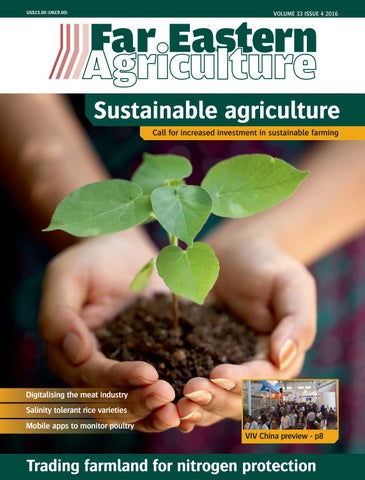
Sustainable agriculture Call for increased investment in sustainable farming
Digitalising the meat industry Salinity tolerant rice varieties Mobile apps to monitor poultry VIV China preview - p8
Trading farmland for nitrogen protection
S02 FEAG 4 2016 - Contents & Bulletin_Layout 1 09/08/2016 09:32 Page 2
A lot of what we’ve achieved in the past 100 years wouldn’t have happened without you. That’s why your success is important to us and why we will never stop providing the best advice and support to maximize product performance. For working with us and driving us forward, thank you.
S02 FEAG 4 2016 - Contents & Bulletin_Layout 1 09/08/2016 13:44 Page 3
Contents F
Bulletin 04
05/08/2016 14:17 Page 1
US$15.00 (UKÂŁ9.00)
VOLUME 33 ISSUE 4 2016
A round-up of key developments in the regional market Sustainable agriculture
Agenda 06-07
Call for increased investment in sustainable farming
FAO food outlook; Greater efficiency in poultry cuts; Indonesia looks to Australia for tuna management
08-10
Photo: godsandkings/Fotolia
Events SIMA ASEAN; World’s Poultry Congress 2016; Seafood Expo Asia 2016
Poultry 12
Countering early losses in chick condition
13
Reducing broiler heat stress with light
Digitalising the meat industry Salinity tolerant rice varieties Mobile apps to monitor poultry VIV China preview - p8
Trading farmland for nitrogen protection
Aquaculture 14
Vietnam and World Bank aim to build resilience in Mekong Delta; Government of Thailand commits to combating illegal fishing
15
International effort to fight deadly shrimp disease; In-situ net cleaning can lead to gill damage in salmon
16
Livestock 17
Innovation in animal feed additives
18
Fighting peste des petits ruminants; Nutriad targets growth in Indonesia
Crops 20
Call for increased investment in sustainable farming
21
Protecting plants from fusarium
23
Enzyme biodiversity key to future of crops; Attack of the mealy bugs
Impact of livestock drugs on the environment
Equipment 24
New satellite tasking service for agriculture industry; CLAAS wins IF Design Award for panoramic cab
25
Kubota and NTT to partner on self-driving farm machinery
21
Advertisers Index AWILA Anlagenbau GmbH ............................................7 Ayurvet Ltd ..................................................................5 Cobb Asia-Pacific..........................................................2 DLG Service GmbH ......................................................9 Eurofeed Technologies S.p.a.......................................17 Evans Vanodine International plc ................................21 Farmavet International................................................27
Henke-Sass, Wolf GmbH ............................................19 Impex Barneveld b.v ..................................................13 Omex Agrifluids Ltd.....................................................23 Promech Resources Co. Ltd. ......................................25 PT Pelita Promo Internusa(IFT September 2016) ........11 Special Nutrients, Inc ..................................................28 Unipoint AG ................................................................26
New genetic tool to boost productivity
Audit Bureau of Circulations - Business Magazines
www.fareasternagriculture.com
Managing Editor : Sejal Bhat - Email: sejal.bhat@alaincharles.com
Publishing Director: Pallavi Pandey
Head Office: Alain Charles Publishing Ltd University House 11-13 Lower Grosvenor Place London SW1W 0EX, United Kingdom Phone: +44 20 7834 7676 Fax: +44 20 7973 0076
Magazine Sales Manager: Satyanarayan Naidu, Tel: +91 80 68888893 Email: satyanarayan.naidu@alaincharles.com
Production: Priyanka A, Kavya J, Nelly Mendes and Sophia Pinto - Email: production@alaincharles.com
Country
Representative
Phone
Subscriptions: circulation@alaincharles.com
India
Tanmay Mishra
+91 80 68888893
tanmay.mishra@alaincharles.com
Chairman: Derek Fordham
Nigeria
Bola Olowo
+234 8034349299
bola.olowo@alaincharles.com
Printed by: Times Printers Private Limited
UAE
Graham Brown
+971 4 448 9260
+971 4 448 9261
graham.brown@alaincharles.com
Printed in: August 2016
USA
Michael Tomashefsky +1 203 226 2882
+1 203 226 7447
michael.tomashefsky@alaincharles.com
Far Eastern Agriculture (ISSN 0266-8025)
Editorial and Design team: Prashant AP, Hiriyti Bairu, Miriam Brtkova, Andrew Croft, Ranganath GS, Georgia Lewis, Rhonita Patnaik, Rahul Puthenveedu, Zsa Tebbit, Nicky Valsamakis, Louise Waters, Ben Watts and Vani Venugopal Publisher: Nick Fordham
Fax
www.fareasternagriculture.com | FAR EASTERN AGRICULTURE Issue Four 2016
Middle East Regional Office: Alain Charles Middle East FZ-LLC Office 215, Loft 2A PO Box 502207 Dubai Media City, UAE Phone: +971 4 448 9260 Fax: +971 4 448 9261
Serving the world of business
3
S02 FEAG 4 2016 - Contents & Bulletin_Layout 1 09/08/2016 09:32 Page 4
Bulletin New feed mill in Cambodia to supply the local market CAMBODIA’S AGRO-INDUSTRIAL CONGLOMERATE Mong Reththy Group is constructing a new US$10mn feed mill to supply its own livestock operations as well as the domestic market, CEO Mong Reththy said. “We will focus on producing feed for pigs, fish, chickens and ducks as an initial step.” He said the feed mill was being built on 10 hectares in Prey Nop district of Preah Sihanouk province. The new factory will have a capacity to produce 20 tonnes of animal feed per hour from locally grown corn and paddy rice, or about 60,000 tonnes per year. The company had planned to open the feed mill in August, but have delayed the launch until the end of the year. “There is still some minor work to be done, so we have extended the launch of operations from August until the end of the year,” he added. According to officials at the Ministry of Agriculture, Cambodia currently has eight animal feed mills in operation, the largest of which is Thai-owned CP Cambodia. The factories supply over one million tonnes of feed per year to the domestic market, covering about 80 per cent of its demand. Srun Poav, director of the Cambodian Pig Farmer Association, said the addition of a new feed mill would help improve margins for the country’s livestock farmers and bring consumer prices down.
Java, and reefer trucks to cover the Greater Jakarta region. The facility is equipped with CO2 refrigeration system from Japan. “We are one of several companies that have been using the CO2 technology. It’s better than the NH3 technology in terms of energy usage, maintenance, quality and eco-friendliness,” Wijaya added. In the near future, he added that Adib plans to set up new cold storage facilities beyond the Greater Jakarta region.
China beef supplier to buy out Uruguayan plant CHINESE BEEF SUPPLIER Foresun Group is partnering with LatAm Value Partners (LAVP) to acquire Lorsinal S.A., a beef processing plant in Uruguay, for US$33.3mn. Foresun and LAVP will take a 50 per cent stake each of Lorsinal that has a daily cattle slaughtering capacity of 500 heads. The plant has gained export permits to most markets including China, Hong Kong, South Korea, EU and the USA, and generated more than 80 per cent of its revenue from exports, of which 45 per cent went to China, according to Foresun. Before the bid, Foresun already owned two beef plants each in Australia and Uruguay.
Millhouse exports grass-fed beef to Singapore AUSTRALIA’S MILLHOUSE PASTORAL is exporting beef from grass fed cattle to Singapore restaurants, with plans to expand into Indonesia and Taiwan, later this year. Frank Pereira, director at Millhouse Pastoral, said that at the moment a tonne of beef is airfreighted weekly to Singapore. He expected that to grow significantly by the end of the year. The company is also in the process of signing an MoU with Taiwanese buyers. Pereira added that one of the biggest challenges is sourcing appropriate stock, to sell into the Asian markets. “The prices of cattle at the moment are high, and that’s our biggest issue,” he added.
Hy-Line China expands poultry capacity
The new factory will have a capacity to produce 20 tonnes of animal feed per hour from locally grown corn and paddy rice, or about 60,000 tonnes per year. (Photo: zigzagmtart/Fotolia)
Thailand’s CPF set to buy Sri Lanka’s food company THAILAND’S CHAROEN POKPHAND Foods (CPF) has announced that it will acquire an 80 per cent stake Sri Lanka’s Norfolk Foods (Private) Limited (Norfolk) for US$4mn. CPF Investment Limited (CPFI), a wholly-owned subsidiary of CPF, will acquire 2,752,800 ordinary shares of Norfolk in Q3 2016. Norfolk manufactures and distributes ready-to-eat food products such as samosa, processed chicken, meat stuffed with cheese and sausages under the Crescent trademark. Norfolk’s products are distributed through local distributors, hotels, restaurants and retail shops in Sri Lanka. Norfolk has a current capacity of 400 tonnes per month and it has a 21 per cent share in the ready-to-eat food segment in Sri Lanka.
POULTRY GENETICS FIRM Hy-Line International has announced further market growth of Hy-Line layers in the China. Ningxia Xiaoming Agriculture & Animal Husbandry Co., Ltd, a Hy-Line distributor in China for the past seven years, is expanding hatchery capacity in Henan Lankao. The hatchery, outfitted with hatchers and setters imported from Europe with the most up-to-date technology, will increase its annual capacity by 30mn chicks. Currently, Xiaoming Agriculture hatches 50mn chicks annually. At full capacity, the company will produce 80mn female day-old chicks. This hatchery capacity is among the largest in the world. “This expansion will enable us to meet the demands for high-quality day-old chicks and create value for our high-end customers,” said Wei XiaoMing, chairman of Xiaoming Agriculture.
Adib to develop cold chain capacity in Indonesia ADIB GLOBAL FOOD Supplies, Indonesia’s seafood distributor and processor, is set to increase its cold logistics capacity. “Cold chain is crucial for seafood and its value added products, and Indonesia is still lacks this. We plan to develop our internal and commercial cold storage facilities,” Ardi Wijaya, vice-president told Asian Agribiz. Adib currently has a 7,000-tonne cold storage facility in Bekasi, West
4
Currently, Xiaoming Agriculture hatches 50mn chicks annually. (Photo: franz12/Fotolia)
FAR EASTERN AGRICULTURE Issue Four 2016 | www.fareasternagriculture.com
S03 FEAG 4 2016 - FAO Outlook, Agenda 01, 02, 03_Layout 1 09/08/2016 09:34 Page 5
Events 2016 AUGUST 25 - 27
INAGRITECH 2016
Jakarta, Indonesia
26 - 28
International Poultry & Livestock Expo
Bangalore, India
05 - 09
XXV World's Poultry Congress (WPC2016)
Beijing, China
06 - 08
Seafood Expo Asia 2016
Hong Kong, China
06 - 08
VIV China
Beijing, China
08 - 10
SIMA ASEAN
Bangkok, Thailand
www.sima-asean.com
28 - 30
IFT Internatıonal Farming Technology Expo Jakarta
Jakarta, Indonesia
www.farmingtechnology-expo.com/web
12 - 14
Gardex (horticultural fair)
Chiba, Japan
14 - 16
Taiwan International Green Industry Show (TiGiS)
Taipei, Taiwan
19 - 21
Vietstock
Ho Chi Minh City, Vietnam
22 - 24
Agri Fest
Lucknow, India
09 - 13
EIMA International
Bologna, Italy
15 - 18
EuroTier
Hanover, Germany
23 - 25
Poultry India 2016
Hyderabad, India
www.inagritech-exhibition.net www.iplexpo.com
SEPTEMBER www.wpc2016.cn www.seafoodexpo.com/asia www.vivchina.nl
OCTOBER www.gardex.jp www.greentaiwan.tw www.vietstock.org www.key2green.com
NOVEMBER
www.fareasternagriculture.com | FAR EASTERN AGRICULTURE Issue Four 2016
www.eima.it/en www.eurotier.com/home-en.html www.poultryindia.co.in
5
S03 FEAG 4 2016 - FAO Outlook, Agenda 01, 02, 03_Layout 1 09/08/2016 09:34 Page 6
Agenda
Food Outlook THE FAO FOOD Price Index (FFPI) averaged 161.9 points in July 2016, 1.3 points (0.8 per cent) below June and 1.4 per cent below the corresponding month last year. The modest decline in July that followed five consecutive monthly increases was largely caused by drops in international quotations of grains and vegetable oils, more than offsetting firmer dairy, meat and sugar prices. The FAO Cereal Price Index averaged 148.1 points in July, down 8.8 points (5.6 per cent) from June and 11 per cent below the July 2015 level. Among the major cereals, maize values dropped sharply as weather conditions in the key growing regions of the United States proved more favourable than was predicted. Wheat prices also fell in July mainly on very large world supplies and, in particular, prospects for abundant export availabilities from the Black Sea region. By contrast, rice prices strengthened somewhat, as dwindling availabilities underpinned Basmati and longgrain quotations. The FAO Vegetable Oil Price Index averaged 157.4 points in July, down 4.6 points (2.8 per cent) from June and falling for the third consecutive month. The slide was mainly on account of palm oil, whose price dropped to a 5-month low as regular rainfall underpinned a seasonal recovery in production in Southeast Asia while global
import demand remained subdued. International prices for soy, sunflower and rapeseed oil also eased on better than earlier anticipated supply prospects, further contributing to the fall in the index. The FAO Dairy Price Index averaged 142.3 points in July, up 4.3 points (3.2 per cent) from June. Prices rose for all the dairy commodities that compose the Index, in particular for butter. Yet, they remain at very low levels compared to recent years. In the face of lacklustre international demand, especially for milk powders, the EU is considering measures to foster a reduction of milk output, which rose by 4.4 per cent in the year to May. The FAO Meat Price Index* averaged 159.9 points in July – 2.0 points (1.3 per cent) higher than its revised June value. All meat products covered by the Index saw prices firm, in particular pigmeat, underpinned by limited availabilities. Notable developments include a shortage of pigs for slaughter and lighter slaughter weights in the EU and reduced output of sheep and bovine meat in Oceania, caused by herd rebuilding. At the same time, international demand for meat remains firm, supported by a recovery in purchases by China, and sustained imports by several countries elsewhere in Asia. The FAO sugar price index averaged 278.7 points in July, up 2.7 points (1.0 per
cent) from June. International sugar prices were largely influenced by movements in the Brazilian Real, which strengthened against the United States dollar (up by around 4 per cent in July compared with June). A stronger Real is supportive for international sugar prices because it limits Brazilian sugar exports to the world market as producers prefer to process sugarcane into ethanol for local sale. Unlike for other commodity groups, most prices utilised in the calculation of the FAO Meat Price Index are not available when the FAO Food Price Index is computed and published. Therefore, the value of the Meat Price Index for the most recent months is derived from a mixture of projected and observed prices. This can require significant revisions in the final value of the FAO Meat Price Index which could in turn influence the value of the FAO Food Price Index.
Greater efficiency in poultry cuts WITH THE CONSTANTLY changing customer demand for food safety and animal welfare and growing global population, processors need to become more proactive. Modern cut-up systems are being increasingly used in poultry processing for greater efficiency and higher yields. Poultry processing company Meyn has launched Flex Plus cut up system to cater to
The Meyn frame for the Flex Plus cut up system is an overhead-mounted cut up frame for supporting cut up modules. (Photo: Meyn)
6
industrial poultry processing. Meyn has integrated their modules and options into a new processing line, the Flex Plus, which, according to the company, provides high system flexibility for increased yield and profitability. Meyn claims that the system offers a capacity of 7,500 birds per hour and delivers more than 95 per cent A-grade cut quality and a touch-free bypass system that does not contribute to cross contamination. The system also ensures up to 10 g of additional dark meat and skin harvested per bird. The Flex Plus cut up system can produce several product types simultaneously when integrated with weighing and vision grading. The Flex Plus cut up systems can also be configured to a wide range of end product requirements. The system includes automated camera inspection for the visual
grading and an inline weighing process. The system is a modular set-up and has a system design that enables an optimum use of the floor space taking individual processing into account. The Flex Plus system modules are userfriendly because of the incorporated electronic height adjustment to increase production flexibility. The overhead-mounted cut up frame for supporting cut up modules on the Flex Plus cut up system allows for precise adjustment with incorporated electronic height adjustment for fast lot change adjustments. The overhead hanging frame facilitates an open floor space making it ideal for logistic conveyors and transportation of products. The system also provides the advantage of fast electronic height adjustment of modules through the push of a button for increased uptime.
FAR EASTERN AGRICULTURE Issue Four 2016 | www.fareasternagriculture.com
S03 FEAG 4 2016 - FAO Outlook, Agenda 01, 02, 03_Layout 1 09/08/2016 09:34 Page 7
Agenda
Salinity-tolerant rice varieties produce high yields in Myanmar THROUGH A PROGRAMME conducted by the International Rice Research Institute (IRRI), in collaboration with the Consortium for Unfavourable Rice Environments (CURE), sixty farmers participated in evaluating new salinity-tolerant rice varieties in a farmer’s field in Meikhtilar District, Mandalay to identify new high-yielding varieties, select the best varieties for their fields and become aware of the sustainable adoption of improved varieties in stress-prone environments. Myanmar has a predominantly agricultural economy based on rice production, with 32 per cent of the total rice area composed of unfavourable lowland areas. Salinity-affected rice-farming areas account for two per cent of these unfavourable areas—almost 110,000 ha—spread across different states and regions. The collaboration between IRRI and CURE with Myanmar’s Department of Agricultural Research (DAR) to develop suitable rice varieties for these challenging areas has resulted in successfully developing as well as distributing to farmers seeds of three salinity-tolerant varieties—Sangnakhan
Salinity-tolerant variety, Pyi Myanmar Sein, provided greater yield than four other farmer-preferred varieties. (Photo: Naypong/Fotolia)
Sin Thwe Latt, Pyi Myanmar Sein, and Shwe Asean. All the nine tested varieties out-yielded the check varieties, except for one variety, 11T 265. Among the tested varieties, IR11T 159 had the highest yield (5.1 tonnes/ha), followed by Salinas 15 (4.6 tonnes/ha) and IR776742B and IR11T256 (4.5 tonnes/ha each).
A demonstration trial was held in a rice field in Meikhtilar District, Mandalay, to compare Pyi Myanmar Sein, a newly released salinity-tolerant variety, with four farmer-preferred varieties. Among the five tested varieties, Pyi Myanmar Sein performed best and produced the highest yield (4.3 tonnes/ha).
Indonesia looks to Australia for tuna management A DELEGATION FROM Indonesia’s Ministry of Marine Affairs and Fisheries has travelled to Port Lincoln Australia in a bid to gain knowledge about tuna management. The delegation met with local Australia industry representatives, who gave them practical guidance on various aspects of tuna management including individual examples of success. Australian Southern Bluefin Tuna Industry Association liaison officer Claire Webber said Australia and Indonesia were key members of the Commission for the Conservation of Southern Bluefin Tuna (CCSBT). “A big motivation is to improve regional relationships with Indonesia, not just with the link through the CCSBT but also because they are our closest neighbour,” she said. Webber also pointed out that there were lessons to be learnt from the infrastructure of South Australia’s tuna industry and stressed the need for Indonesia’s fisheries to organise themselves through industry associations. “The Indonesian minister for marine affairs and fisheries Susi Pudjiastuti is determined to promote sustainable marine resource management,” she added. The two countries have earlier collaborated on the Close-Kin Project, where DNA from older fish caught in the economic exclusive zone is compared with younger fish caught off Port Lincoln to determine tuna numbers and catch quotas. According to the Ministry of Marine Affairs and Fisheries, Indonesia accounts for 16 per cent of the world’s total tuna supply and the tuna fishing industry is a vital component of Indonesia's fishing industry. Pudjiastuti stated in a press interview that the main challenges in Indonesia’s tuna industry include the conservation of tuna resources while taking into account the sustainability of tuna resources.
www.fareasternagriculture.com | FAR EASTERN AGRICULTURE Issue Four 2016
7
S04 FEAG 4 2016 - Event 01, 02, 03, 04_Layout 1 09/08/2016 09:35 Page 8
Events
VIV China 2016: Where science meets business Bigger than ever and earlier in the year than its previous editions, the major international Feed to Food trade fair platform VIV China returns to Beijing in September HE SHOW WILL form an important part of a week full of activities and information for professionals from the global animal protein industries. VIV China 2016 takes place at the New China International Exhibition Center (NCIEC) in the Shunyi district of Beijing, close to the airport. The show opens on 6 September and runs until 8 September.
T
Strategic partnership The dates allow the 9 edition to run in parallel with the 2016 World’s Poultry Congress. This congress of the World’s Poultry Science Association is held every four years. The latest is organized by the Chinese branch of WPSA to be in Beijing on dates of 5-9 September 2016. A strategic partnership agreed between VIV worldwide and the congress organisation will see two events co-operate closely. Indeed, World’s Poultry Congress 2016 has chosen 7 September as industrial day, with an afternoon session of company-sponsored seminars and activities that actually occurs at the VIV China venue. To cement the link even more, free shuttle buses are being arranged on 6 and 7 September to carry congress delegates to VIV China and return them later in the day. “It means that poultry scientists from around the world can learn all about the latest research and new thinking on technological developments at their own scientific forum and discover at VIV China 2016 how these ideas are being applied in a practical way,” comments Anneke van Rooijen, show manager at VIV worldwide.
More exhibitors, more nationalities On the trade show itself, VIV China 2016 will now fill three complete halls at the NCIEC showground because it has needed to accommodate more exhibits for suppliers from both inside and outside China. In 2014 it had 440 international exhibitors; this has now increased to 550. Including the home contingent, Anneke van Rooijen calculates that 27 nationalities will be represented by
8
VIV China 2016 will take place in the Shunyi district of Beijing. (Photo: VIV)
the exhibitors in September. The number is boosted by various national pavilions that include one for the USA which is about 33 per cent larger than in 2014.
Clear navigation, bi-lingual signage As in 2014, the organisers are creating zones of exhibits according to theme of pork, poultry or aquaculture. Clear navigation to these zones is provided by bi-lingual signage and a visitor pocket guide that is also in English and Mandarin. About one-third of the international companies who will be represented on VIV China 2016 stands are suppliers of feed ingredients, additives or animal health products. Another 28 per cent specialise in housing or production equipment, mainly for poultry. Those offering processing equipment for meat or eggs comprise about 12 per cent of companies present, approximately nine per cent provide feed manufacturing systems and six per cent are genetics companies. Within the domestic Chinese representation, half of all companies are in the feed materials or animal health business and 41 per cent in housing or equipment for pigs and poultry. Most of the remainder is made up of suppliers of feed milling, breeding and processing systems.
Conference highlights pork “VIV China has always been strong on poultry,” says Anneke van Rooijen,” and that will certainly be true again for the 2016 edition, but the pig sector is also strongly represented.” The pre-show day of Monday 5th September brings the Pork Production Conference segment, being organised by Watt Global Media/Pig International China with Shanghai Lyja Cultural Media Co. It discusses sustainable and efficient pork production in a Chinese context and it will be located at the China National Convention Center venue of the World’s Poultry Congress 2016.
Attracting visitors from other countries A VIV China 2016 promotion campaign in Asian focus countries including South Korea, Philippines and Indonesia is emphasising the information value of the week in Beijing also for non-Chinese visitors. Foreign visitors at VIV China 2014 comprised around 20 per cent of the total attendance. The aim this time is to at least equal that percentage, within a growth of overall visitor numbers to exceed 15,000 over the three days of the show. VIV show manager Anneke van Rooijen says, “VIV China 2016 and its international conferences will be colocated in Beijing with the latest World’s Poultry Congress. It promises to be an excellent week, for science and business.” ■
FAR EASTERN AGRICULTURE Issue Four 2016 | www.fareasternagriculture.com
S04 FEAG 4 2016 - Event 01, 02, 03, 04_Layout 1 09/08/2016 11:23 Page 9
SIMA ASEAN Thailand launches new initiatives SIMA ASEAN THAILAND, the biggest international trade show for the agribusiness industry in the ASEAN region, will take place from 8-10 September 2016 at Halls 5-6, IMPACT Exhibiton and Convention Centre, Bangkok, Thailand following the first exhibtion in 2015. The event will bring together innovations, machinery and equipment in addition to other agricultural services from across the globe in an attempt to meet the growing needs of agricultural professionals in areas such as tractors and agricultural machinery, spare parts and accessories, embedded electronics, sowing and planting equipment, chemical fertilisers and pesticides, irrigation systems, organisers of the show said. An industry forum was held back in March at Sofitel Sukhumvit Hotel Bangkok, where the show organisers officially signed a MoU with key respresentatives of the Thailand Agri-business industry to form the show advisory committee. “SIMA ASEAN Thailand 2016 will be a key platform that will help boost and increase the potential of the Thai agricultural industry through exposure to new technologies and innovations which will also be able to increase the standards of the ASEAN agricultural industry to match international standards,” said Olan Pitak, director general of Department of Agricultural Extension, Ministry of Agriculture and Cooperatives. According to event organisers, SIMA ASEAN Thailand 2016 is expected to welcome more than 450 exhibitors and 25,000 professional trade visitors from across the globe. Dares Kittiyopas, president of Thai society of agricultural engineers noted that the show will also be held at the same time as four other international conferences that are expected the latest innovations and technologies that are needed to develop Thailand and South East Asia’s agricultural industry in order to succeed in the competitive world market.
The world´s leading trade fair for animal production
Welcome to the world’s leading industry event 15 – 18 November 2016 Hanover, Germany Almost 160,000 highly qualified visitors, interested in new technologies for dairy, pig, poultry and aquaculture 2,368 international exhibitors on more than 240,000 m² (2.7 mill. sq ft) exhibition floor space
SIMA ASEAN will welcome 25,000 professional trade visitors from across the globe. (Photo: Impact)
“The Ministry has focused on four key areas to further develop the agricultural industry of Thailand: reducing cost, increasing yields and produce, organizing and managing as well as marketing by using the ‘Single Command’ strategy, which is the gathering and compilation of research results after which they are translated realistically into large agricultural plots in order to revolutionise the agricultural industry towards greater stability and sustainability under good governance,” added Pitak. The director general continued that the ministry will also push for the use of organic fertiliser, instruct related organisations to source for high quality plants and livestock to be used by the farmers and support the production of rice while also adhering to global agricultural standards. Pitak said that is key in order to ensure continued consumer confidence and to create new tangible market opportunities on the international level.” SIMA ASEAN Thailand 2016 is co-organised by IMPACT Exhibition Management Co. Ltd., Comexposium Co., Ltd. from France and AEXMA. The event will give companies a platform to showcase their latest technologies as well as agricultural machinery and equipment.
The complete programme for animal production – breeding, feeding, housing, processing and marketing Leading technologies for renewable energies and decentralized energy supply Hotline: +49 69 24788-265 E-Mail: expo@DLG.org Organizer
including
www.eurotier.com www.DLG.org
Decentral
S04 FEAG 4 2016 - Event 01, 02, 03, 04_Layout 1 09/08/2016 09:35 Page 10
Events
World’s Poultry Congress joins forces with VIV China THE WORLD’S POULTRY Congress runs in parallel with VIV China, taking place between 5-9 September 2016 in Beijing, China. It will be co-hosted by the China Branch of the World’s Poultry Science Association (WPSACN) and the Chinese Association of Animal Science and Veterinary Medicine (CAAV). There will be a number of topics covered at the event including nutrition and feeds, genetics and breeding and health and disease. VNU Exhibitions Europe, the headquarters of VIV Worldwide, and its Chinese partner Beijing Tech Convention and Exhibition Center are the official organisers of the exhibition. “The exhibition has become an important activity as part of the World’s Poultry Conferences,” said Ning Yang, Ph.D., president of the China Branch of the World's Poultry Science Association. “In VIV China we have found our preferred partner to establish a high-quality international exhibition.” According to Anneke van Rooijen, show manager at VIV worldwide, poultry scientists from across the globe can learn all about the latest research and new thinking on
The China National Convention Centre will host the poultry event. (Photo: Yiyuan new home)
technological developments at their own scientific forum and discover at VIV China 2016 how these ideas are being implemented in a practical way. “In plenary session, a keynote speech on conservation and utilisation of indigenous poultry breeds will be presented by Professor Changxin Wu, an animal breeding and genetics scientist and academician from Chinese Academy of Science,” noted Ning Yang, president of China branch WPSA.
WPC2016 will join forces with VNU to present a VIV China Show during the same period of WPC 2016. It will feature a large scale exhibition for poultry industry to bring together global and local companies and organisations to showcase their products and expertise to the global market. The theme of this year’s congress is ‘Quality and Safe Poultry Products: Meeting People’s Needs’, which aims at a more sustainable poultry production.
Hong Kong to host Seafood Expo Asia 2016 SEAFOOD TRADE EVENT, Seafood Expo Asia 2016, will take place from 6-8 September 2016 in Wanchai, Hong Kong. The event will welcome buyers and suppliers of seafood from across Asia and the world to come together to network and conduct business in the Hong Kong and Asia Pacific markets. The show will give companies the opportunity to innovate their businesses through unique opportunities, such as key conference sessions on seafood topics, master classes discussing the way to source, select and prepare some of the most popular seafood species, culinary demonstrations and a seafood networking and tasting event. Seafood Expo Asia, industry buyers will be able to meet with suppliers of fish and shellfish from Asia and the rest of the world and find the products they are looking for to meet their customers’ growing needs, including abalone, clams, bass, crab, shrimp, salmon, prawns, scallops, lobster, cod and oysters. “Asia has become increasingly important to the global seafood market as with the growth of the region’s middle class population,
Seafood Expo Asia last year welcomed more than 8,700 seafood suppliers and buyers from 62 countries in Asia. (Photo: Seafood Expo)
10
consumers in this income bracket are able to afford higher value goods and products, one of them being premium fish and shellfish,” said Liz Plizga, Seafood Group vice president of diversified communications, organisers of Seafood Expo Asia. “Improving living standards and rising incomes, coupled with an already well established dining out culture, are driving market expansion as individuals become more conscious of taste and quality particularly in China and South East Asia, where economic growth is positively impacting seafood imports making these countries especially attractive to producers and exporters of premium produce.” Attendees will be able to speak to seafood experts who will offer business advice, support and insight during the three-day show. The presentation theatre will deliver culinary demonstrations, master classes, networking events and educational seminars covering a range of issues and trends concerning the industry that are designed to provide delegates with new ideas to grow their businesses. Through Seafood Expo Asia’s key buyer programme, high volume trade customers will also be able to enjoy special privileges that range from access to an exclusive lounge for meetings and networking opportunities, to participate in the exposition’s Business Matchmaking programme. “With lifestyles becoming busier, Asian consumers are turning to ready meal solutions that are quick and easier to prepare,” said Plizga. The Seafood Group vice president noted that this trend along with increasing demand for higher value seafood is providing unique opportunities for food manufacturers to create new culinary combinations from fish and seafood to enjoy food at home. According to event organisers, Seafood Expo Asia continues to expand its role in the consumption of global seafood and is estimated to account for 70 per cent of global consumption by 2030. The event is a platform for seafood professionals seeking to capitalise and satisfy market growth.
FAR EASTERN AGRICULTURE Issue Four 2016 | www.fareasternagriculture.com
S05 FEAG 4 2016 - Poultry A, B & C_Layout 1 09/08/2016 09:36 Page 11
S05 FEAG 4 2016 - Poultry A, B & C_Layout 1 09/08/2016 09:36 Page 12
Poultry
Countering early losses in chick condition Chick quality varies from pullout to farm placement due to vaccination, quality control and timing of delivery making it important for the farm to provide a good environment for their health. T IS VITAL for the farm to provide the best conditions for a fast recovery and continued chick development. Early hatching and high incubation temperatures can impair chick quality. Chicks hatching early are subject to a higher air temperature than their thermo–neutral zone of 40 to 40.6°C, and start to dehydrate as other chicks hatch. Humidity increases as other chicks are hatching, and together the higher temperature and humidity will lead to chicks panting and losing moisture faster. The chicks can dehydrate fast unless they are removed on time, which is why hatcheries endeavor to reduce the time the hatched chicks stay in the machine. Failure to do this will lead to many being dehydrated and overheated. Once removed from the hatcher, the chicks should be quickly processed to remove the weak and undesirable ones so that only viable
I
chicks go to the farms. Depending on the vaccination programme, broiler chicks may stay longer in the processing area waiting to be counted and vaccinated. Often, due to lack of proper chick transport trucks, especially in warm weather countries, most broiler chicks are transported during the evening to provide a temperature where the chicks do not pant and dehydrate. These chicks arrive at the farm late in the evening or in the early morning and can have rectal temperatures of below 40°C. These chicks end up using their reserve energy to keep warm rather than for early chick development. Sometimes the chicks are transported overnight and arrive at the farm at midmorning. Here rectal temperatures can be higher than 40.6°C and chick conditions could have deteriorated. Dehydration and overheating can lead to increased mortality
Newly pulled out hatcher basket with hatched chicks. (Photo: Cobb Asia)
12
and culls in the first week and in the last weeks before catching. The volume of chick placement can also complicate how brooding is done. Chicks could be coming from different breeder sources and different hatcheries, and with variation in chick conditions. This can result in a high variation of chick condition which makes management much more difficult.
So what can we do? If the chicks are coming from various sources, it is best to plan for chicks from the same hatchery and same breeder age group, to be placed together. Make sure the house is properly prepared where preheating is done to ensure the ttemperature is similar in all areas. Taking a temperature reading at only one place, or relying on the sensors, can cause an uneven house temperature, leading to uneven feed and water intake and poor uniformity. Knowing that chicks may have lost condition, do not waste time in unloading them into the comfortable brooding area. The sooner they are placed, the sooner their condition will improve, with a goal of no further dehydration and weakness. Ensure that they are placed on top of feed with the drinkers nearby. Making the chicks eat as soon as they are placed will provide them with much needed nutrients, electrolytes and energy to recover. Their organs will start developing and the chicks will actively use the nutrients and antibodies from the yolk sac for their overall benefit. Flush water lines out just before placement to allow the chicks access to cooler water. This will make the water more attractive for the dehydrated and hot chicks to drink more, leading to recovery. Also ensure that the waterline nipples are not too tight as can happen with high water pressure. This results in water restriction. Especially in weaker chicks, the waterlines should have soft nipples for easy water release. Supplementary drinkers will also help weak birds get easy access to water. ■ - By Raul Elias Lopez, Broiler Specialist, Cobb-Asia
FAR EASTERN AGRICULTURE Issue Four 2016 | www.fareasternagriculture.com
S05 FEAG 4 2016 - Poultry A, B & C_Layout 1 09/08/2016 09:36 Page 13
Poultry
Reducing broiler heat stress with light A UNIVERSITY OF Georgia study has shown that extended lighting periods help enhance welfare and production of big broilers during high temperatures The research involved observing the air temperature, velocity, relative humidity and deep-body temperature in broilers. Poultry extension scientist Brian Fairchild confirmed the research – that was carried out in six commercial poultry barns – revealed an interesting multifactorial process. He said, “We were looking at deep-body temperature during the hottest months of the year on the biggest birds, definitely a stressful time.” They discovered that the birds’ temperature actually increased during the night when the outdoor temperatures cooled. “This is opposite what research shows happens in rats and humans,” he said. They found that light (or a lack of it) played a major role in this nighttime increase in body temperature. “The lights go off at dusk, the birds sit down and their litter is like a warm blanket,” Czarick said. “When sitting, a bird also decreases its surface area available for cooling by air movement.”
The study tried to understand how lighting affected poultry welfare overall. (Photo: cowgirljules/Flickr)
They also observed to understand how feeding was directly affected by the time duration of the light and dark periods. They noticed that the birds went to rest soon after the lights were turned off but by extending the light period they could increase the feeding time, thus causing the birds’ core temperature to rise during the day as well. According to Czarick, growers concentrate too much on bird temperature during the day. “The key is how much the light program affects bird temperature during the night. It really comes down to bird behavior,” he said.
Mobile app to monitor poultry launched FARMERS IN INDONESIA can now monitor the health of their poultry through their phones, thanks to a mobile app, Petelur.ID. Developed through a joint collaboration between the Food and Agriculture Organisation (FAO), the Indonesian
The app aims to fight the incidence of bird flu in Indonesia. (Photo: FiledIMAGE/Fotolia)
Association of Poultry Veterinarians and a private developer, Intelligence Dynamics, the app aims to help small to medium scale farmers manage their poultry better. “This tool will assist farmers greatly in managing their farms, in tracking poultry health and disease and also the productivity of their layer flocks,” said FAO Emergency Center for Transboundary Diseases (ECTAD) Indonesia team leader James McGrane. He added that the functions available on the app were developed based on recommendations from a study conducted on the effectiveness of biosecurity interventions in order to improve productivity and the control of diseases. The app, which is free to use and download, aims address rising cases of bird flu, FAO
www.fareasternagriculture.com | FAR EASTERN AGRICULTURE Issue Four 2016
officials said. It helps farmers to key in data on egg production, the weight and amount of feed distributed, and the number of poultry deaths. The app then analyses the data and alerts the farmers when the vitals are not optimum, for instance, when feed is lacking. “I believe that the use of this tool will assist farmers greatly in managing their farms, in tracking poultry health and disease and also the productivity of their layer flocks,” McGrane said at the launch of the app. FAO-ECTAD national technical adviser said Erny Setiawan pointed out that small-range farmers do not keep track of poultry production and they usually make farming decisions based on intuition, not data. The app, he stressed, can potentially help them improve farming productivity.
13
S06 FEAG 4 2016 - Aqua A, B & C_Layout 1 09/08/2016 09:40 Page 14
Aquaculture
Vietnam and World Bank aim to build resilience in Mekong Delta AQUACULTURE FARMS AND fishing households will be among those expected to benefit from a new World Bank initiative worth US$310mn. In June 2016, the World Bank’s Board of Executive Directors approved this significant infusion of funds which is aimed at helping Vietnam build climate resilience and ensure the sustainable livelihoods of 1.2mn people living in nine Mekong Delta provinces which have been negatively affected by climate change, salinity intrustion, coastal erosion and flooding. The total cost of the project is US$387mn. As well as the multi-billion-dollar rice industry that comes from the Mekong Delta, 70 per cent of Vietnam’s aquaculture products also come from this important region. Additionally, the wetlands and estuaries are important sources of biodiversity. “Recent extreme weather in the Mekong Delta, including drought and salinity intrusion, are negatively affecting the lives of farmers, most of whom are poor,” said Achim Fock, acting country director for the World Bank in Vietnam. “We believe this innovative project brings together an effective multi-sectoral model to help farmers adapt agriculture and aquaculture livelihoods to the impacts of climate change.” The project will, in particular, benefit farmers in the upper delta and coastal Mekong regions, including the Khmer ethnic minority people living in the provinces of Soc Trang and Tra Vinh. The project is part of the World Bank’s long-term engagement in the Mekong Delta to strengthen integrated adaptive delta management by uniting different
Floating Mekong fish farms are set to benefit from this project. (Photo: Katy Wrathall/Flickr )
sectors and provinces in order to plan, prioritise and implement resilient investments. “Working on complex landscapes such as the Mekong Delta, which faces both climate and development threats, requires a partnership with the government,” said Anjali Acharya, environment sector coordinator for the World Bank in Vietnam. “This project exemplifies the value and benefit of close cooperation among key development partners, and can be replicable in other countries.”
Government of Thailand commits to combating illegal fishing THAILAND HAS MADE commitments to combating illegal, unregulated and unreported (IUU) fishing and embarked on dialogue with the European Union (EU) with a view to furthering cooperation in achieving a sustainable fisheries industry. In a statement from the Royal Thai Embassy to Belgium and Luxembourg and the Mission of Thailand to the European Union, it acknowledged the value of dialogue with the European Commission, following a meeting with Karmenu Vella, European Commissioner for Environment, Maritime Affairs and Fisheries. The statement said that the dialogue with the EU “provides useful
advice and bolsters cooperation in tackling IUU fishing and labour abuses in the fisheries sector, in line with international standards”. “The Thai government attaches high priority in advancing the comprehensive fisheries reform,” the statement said. “Tangible progress has been achieved over the past year, especially in the overhaul of legal and policy frameworks on the Thai fisheries. However, there remain a number of issues that need to be promptly tackled.” Commitment to enforcing the law, building capacity and strengthening cooperation with all partners and with countries in the region were all cited in the statement as being A fish farm in Koh Lanta, Thailand. (Photo: Alex Berger/Flickr )
14
important in overcoming IUU fishing challenges, which the Thai government describes as being “deep-seated problems”. The statement reiterated the importance of meeting international standards in regard to combating IUU fishing and that Thailand is committed to “sustaining the constructive IUU dialogue with the European Commission in order to realise the shared goal of promoting sustainable fisheries”. Earlier this year, Thailand Sustainable Fisheries held an event to showcase the progress made so far in overhauling the country’s fisheries sector. The event, which was held in Brussels in April 2016 as part of the Seafood Expo Global exhibition, highlighted the achievements that were made in the sector last year and early this year. In that period, more than 130,000 previously undocument migrant workers in the fishing and seafood processing sectors were given access to the full range of welfare and protections under the Thai government’s regularisation scheme. Forty-one cases of human trafficking in the fishing industry were taken up by Thai law enforcement agencies, 13 countries have signed or are in the process of negotiating agreements with Thailand on mutual cooperation in the fields of fisheries and labour, and there are 28 newly established port-in-port-out control centres to help shore up control of commercial fishing vessels and their crews.
FAR EASTERN AGRICULTURE Issue Four 2016 | www.fareasternagriculture.com
S06 FEAG 4 2016 - Aqua A, B & C_Layout 1 09/08/2016 09:40 Page 15
Aquaculture
International effort to fight deadly shrimp disease SIXTEEN MEMBER STATES of the United Nations’ Food and Agriculture Organization, along with specialists and producers from the shrimp farming sector gathered in June 2016 for a seminar in Bangkok to discuss ways to combat acute hepatopancreatic necrosis disease (ANPND), commonly known as “early mortality syndrome” (EMS). EMS caught the shrimp-farming industry, scientists and governments by surprise in 2009 and it continues to have a devastating impact on producers. EMS is considered to be the most serious non-viral disease in cultured shrimp and it has affected producers in a number of Asian and Latin American countries. In Asia, EMS has been particularly prevalent in China, Malaysia, Thailand and Vietnam. The pathogen associated with the disease, vibrio parahaemolyticus, spread to the western hemisphere, emerging in Mexico in early 2013. The disease is characterised by mass mortality in shrimp farms during the first 35 days of culture. This is when affected shrimp show massive sloughing of hepatopancreatic epithelial cells followed by death. The disease differs from other diseases affecting farmed shrimp in that the pathogen can be present in the water, sediments and associated pond organisms as well as in the shrimp themselves. Shrimp-related diseases are on the increase in markets across the world. The international spread of these diseases is facilitated by careless and sometimes illegal movement of live shrimp between continents. “It is essential to maintain a healthy global aquaculture industry. Therefore aquaculture health is a shared responsibility of all of us to achieve that,” said
Baby shrimp at a farm in Thailand. (Photo: Autan/Flickr)
Vili A. Fuavao, FAO Deputy Regional Representative for Asia and the Pacific, when he addressed the seminar in the Thai capital. He further pointed out that a health threat to any one country can rapidly become a threat to all countries culturing similar aquatic crustaceans, fish or shellfish.
In-situ net cleaning can lead to gill damage in salmon IN THE RECENT years, in-situ cleaning has become a more common method of biofouling management as the need for cleaner fish in salmon farming is growing. In-situ cleaning is often used in combination with anti-fouling products, coating or on untreated netting. The technology is based on remote-controlled rigs that use rotating discs with high pressure nozzles to remove fouling. Varied water pressure and flow are used but lower pressure and higher volumes of water are the more preferred technique. Recent findings indicate that in-situ
cleaning may pose a set of challenges calling the need for the industry to re-evaluate this method. A recent article published by SteenHansen, a company that specialises in antifouling products for aquaculture, describes how in-situ cleaning dislodges considerable amounts of biological material that is then crushed into small and large fragments. This material could pose a threat to the gill health of the fish. The most damage is caused by the polyps or tentacles of hydroids, which jelly fish on stalks. These polyps are covered with stinging cells that shoot out harpoon-
like needles that pump poison. The polyps float around in the cage that is being flushed and easily spread into other cages. Research conducted in fish farms have revealed that the number of polyps in the water increases to 300/m3 during in-situ cleaning where there were none before in-situ cleaning. The damage is characterised by inflammation and slime formation in the gills, which can lead to other problems. To avoid the negative impacts of in-situ cleaning, the report advises the monitoring of the gill status of the fish before and after in-situ cleaning.
Research has revealed that gill damage is caused by contact with stinging cells that are spread through in situ cleaning. (Photo:Radzonimo/Fotolia)
www.fareasternagriculture.com | FAR EASTERN AGRICULTURE Issue Four 2016
15
S07 FEAG 4 2016 - Livestock A, B, C, D_Layout 1 09/08/2016 09:44 Page 16
Livestock
Impact of livestock drugs on the environment Newly developed medical substances need to be tested on single species in the lab as drugs for livestock can harm the beneficial organisms that break down dung. Livestock medications can impair beneficial organisms that break down dung. (Photo: giorgenko/Fotolia)
n international research group including evolutionary biologists from the University of Zurich have been scrutinising the reliability of such laboratory tests, evaluating the implementation of a field test based on the anti-parasitic drug ivermectin at four climatically different locations. The scientists thus presented a novel approach for more advanced environmental compatibility tests. Livestock medications can impair beneficial organisms that break down dung. Too high a dosage of ivermectin, a common drug against parasites, harms coprophilous organisms, for instance. Dung beetles in particular are important to healthy cattle pasture ecosystems as they provide for nutrient recycling, removal of waste products from the soil surface and assist in the reduction of pestiferous flies. But e toxicity of new livestock medications therefore needs to be verified in ecotoxicological tests with individual animal species such as the common yellow dung fly, the barn fly or a dung beetle. This involves determining the lethal
A
16
dose leading to the death of half the maggots (LD50 test). However, sensitivity to toxic substances is known to vary significantly even among closely related coprophilous organisms, which begs the question as to how representative the reaction of any individual animal species actually is in such laboratory tests. After all, there is a high risk that more sensitive species will continue to be harmed by the substance, jeopardising key ecosystem functions in the long run. An international research group including UZH evolutionary biologist Wolf Blanckenhorn recently proposed extending the testing scheme
“Too high a dosage of ivermectin, a common drug (given to livestock) against parasites, harms coprophilous organisms.”
to a representative selection of all organisms that break down dung, ideally in their natural environment. The scientists now presented a successful and more comprehensive higher-tier ecotoxicological field test. Their study provides important insights into minimising the risks of drug residues in nature.
Earthworms compensate for loss of coprophilous insects For their feasibility study, the scientists worked on cattle pastures in the Canadian Prairie and the agricultural landscapes of southern France, the Netherlands and Switzerland - four locations with very different climatic conditions. On these pastures, they distributed dung pats with different concentrations of ivermectin. “As expected, the overall number and diversity of dung beetles, dung flies and parasitoid wasps decreased as the ivermectin concentration increased,” explains Blanckenhorn. However, a number of species also proved to be resistant: earthworms and springtails living in the ground
FAR EASTERN AGRICULTURE Issue Four 2016 | www.fareasternagriculture.com
S07 FEAG 4 2016 - Livestock A, B, C, D_Layout 1 09/08/2016 09:44 Page 17
Livestock Dung-beetle are important to healthy cattle pasture ecosystems. (Photo: creativenature.nl/Flickr)
underneath the cowpats were not notably affected, and a parallel test ultimately revealed that dung degradation was not significantly impaired. “Evidently, beneficial organisms not affected as much by the drug, such as earthworms, were apparently able to compensate for the loss of other organisms,” sums up Blanckenhorn.
A basis for decision makers and licensing authorities Despite diverse environmental conditions and methodological details, the results were very similar and reproducible in all four habitats. “Our field approach was therefore a success and in principle can be recommended. The regulation authorities responsible, such as the European Medicines Agency EMA, now have to decide whether this more conclusive yet more complex test should be required in the future,” says Blanckenhorn. The amount of effort involved in determining the numerous dung
organisms is tremendous and impossible without expert biological knowledge. “Classifying species via so-called DNA barcoding, based on each organism's unique genetic fingerprint, is possible in principle and will probably be more cost-effective in the
future. However, this approach requires the establishment of a complete database for coprophilous organisms, which does not yet exist,” concludes the scientist. ■ – phys.org
Innovation in animal feed additives RECENTLY, THE STORY of a natural growth promoter Farmagulator was highlighted in a TEDx conference. The export manager of Farmavet International told the story of Farmagulator at the event. A
The export manager at Farmavet International speaking at the TEDx event. (Photo: TEDxReset)
new scientific innovation in the history of feed additives, Farmagulator is a product that replaces the antibiotic use in animal feed as a growth promoter while also improving the immune system. The innovation has been developed by Dr. Ercan Petekkaya, founder and the CEO of Farmavet International. According to the company, the product has had positive effects on lowering FCR and increasing BWG in poultry and swine since its early years in the market. Subsequently, the company’s R&D department redeveloped it for bovine use, thus creating Bovifarm, a natural performance enhancer for ruminant animals. They also developed Farmarine for aquaculture use. And lastly, Blackboom, a re-design of Farmagulator for horses and camels, was also introduced to the markets. In 2013, The European Union Commission Feed Material Catalogue included the active ingredient of Farmagulator in their approved list: E.C. 68/2013. Farmavet International intends to keep its title as the ‘specialist’ in animal health and nutrition over the world with the sheer variety of products in feed additives.
Ź /ŶŶŽǀĂƚŝǀĞ ĨŽƌŵƵůĂ ĨŽƌ ŝŶƚĞƐƚŝŶĂů ŚĞĂůƚŚ
Ź ^LJŶĞƌŐŝĐ ĐŽŵďŝŶĂƚŝŽŶ ŽĨ ƚŚĞ ĐŽŵƉŽƵŶĚƐ ŽĨ ƐůŽǁ ƌĞůĞĂƐĞ Ź WƌĞǀĞŶƚŝŽŶ ŽĨ ŝŶƚĞƐƚŝŶĂů ĚLJƐďŝŽƐŝƐ Ź /ŵƉƌŽǀĞƐ ŐƌŽǁƚŚ ĂŶĚ ĐŽŶǀĞƌƐŝŽŶ ƌĂƚĞƐ Ź ZĞĐŽŐŶŝnjĞĚ ŐůŽďĂů ĞĨĨŝĐŝĞŶĐLJ ǁŝƚŚ ŽƉƚŝŵƵŶ ƌĞƐƵůƚƐ ŝŶ ĂƌŐĞŶƚŝŶĞ ƉŽƵůƚƌLJ ĨĂƌŵƐ 0 $ ’( ,1 ,7 $ / <
'ŽŽĚ /ŶƚĞƐƚŝŶĂů ,ĞĂůƚŚ
ĞƚƚĞƌ WĞƌĨŽŵĂŶĐĞ
www.fareasternagriculture.com | FAR EASTERN AGRICULTURE Issue Four 2016
DŽƌĞ WƌŽĨŝƚ
ZZZ Z HXURI RIIHHHG G LW 17
S07 FEAG 4 2016 - Livestock A, B, C, D_Layout 1 09/08/2016 09:44 Page 18
Livestock
Fighting peste des petits ruminants PESTE DES PETITS ruminants (PPR) is a highly contagious viral disease affecting small ruminants including sheep and goats, which can kill as up to 90 per cent of the animals it infects within days. In the past two decades, PPR has spread rapidly, mostly in Africa, Asia and the Middle East, which are home to some 80 per cent of the world’s 2.1bn small ruminants. The disease is continuing to extend its global reach, and according to a report by the FAO, is now present in 76 countries. The Food and Agriculture Organization (FAO) and World Organisation for Animal Health (OIE) have been mobilising support to wipe out PPR. In 2015, the international community agreed on a global strategy for PPR eradication and 2030 was set as the target date for the elimination of the disease. The two organisations recently held a two-day strategy session at the FAO headquarters in Rome, which was attended by animal health experts, government representatives, livestock professionals and global stakeholders, to address the threats posed by the disease. At the conference, FAO and OIE launched the global campaign that concentrates on areas in Asia, the Middle East and Africa affected by the disease. The two organisations will lead and coordinate the global efforts of governments, regional organisations, research institutions, funding partners and livestock owners to eradicate the disease. The eradication effort will involve a combined approach of strengthening veterinary health services and systems for disease
PRR is estimated to kill from 30 to 70 per cent of infected animals. (Photo: Vladimir Gerasimov/Fotolia)
surveillance and implementing vaccination campaigns, awarenessraising and capacity building in affected regions. Experts from the FAO and the OIE have recommended control measures including vaccination of 800,000 sheep and goats. They have implemented quarantine zones and called for stronger surveillance of animals in adjacent regions.
Nutriad targets growth in Indonesia ANIMAL FEED ADDITIVES company, Nutriad, is focussing on expanding its presence in Indonesia. The company launched their three generations of mycotoxin deactivators; ToxyNil Dry, Toxy-Nil Plus and Unike Plus as well as Sanacore GM for aquaculture at Indolivestock, one of the largest livestock tradeshows in the region held from 27–29 July 2016.
Pointing out how Indonesia is a dynamic feed producing country in the region, Nutriad regional director Asia Pacific BK Chew said, “We are excited about the Indonesian market and at this show we work towards fulfilling our strategy of becoming the practical expert in mycotoxin management, offering our services to poultry breeders, broilers, layers and cattle.”
Mycotoxin deactivators help to fight the negative impact of moulds and mycotoxins on animal production. (Photo: Jolanta Mayerberg/Fotolia)
18
Nutriad offers a wide range of products with specific mode of action such as mycotoxin inactivation, mould inhibition, immune stimulation and organ protection to fight the negative impact of moulds and mycotoxins on animal production. The company also said that it will be launching the other services along with the mycotoxin deactivators, including the Mycoman app, which helps farmers in mycotoxin risk management, in the Indonesian market. The app can be used as a management tool for complete mycotoxin hazard assessment and to monitor all information required regarding the level of mycotoxin contamination in the feed. The Indolivestock event was attended by more than 12,000 trade visitors and delegates. Nutriad was one of the 350 exhibitors from 33 countries that participated in the gathering of the regional feed community. Nutriad held interactive sessions with customers and distributers at the event. Speaking about Nutriad’s investment in Asia, regional aquaculture manager (Asia Pacific) Allen Wu said, “The Asian market is of strategic importance in the growth strategy for Nutriad. Combining farm experience with scientific knowledge and having access to a global network allows us to be a real solution provider.”
FAR EASTERN AGRICULTURE Issue Four 2016 | www.fareasternagriculture.com
S07 FEAG 4 2016 - Livestock A, B, C, D_Layout 1 09/08/2016 09:44 Page 19
Livestock
Digitalising the meat industry NEW HOPE GROUP, one of China’s largest meat conglomerates, has entered a deal with Alibaba, the e-commerce and cloud computing company for data analysis According to the strategic cooperation agreement, data from New Hope’s various
operations mined for targeted sales of meat and other agri-products to consumers from various regions of China by with AliCloud, a subsidiary of Alibaba, which is behind the ecommerce sites Tmall, Taobao and Taml International and Alibaba’s B2B magazine.
New hope is one of China’s leading private agribusiness firm with an annual kill of nine million pigs and multiple subsidaries. (Photo:Compuinfoto/Flickr)
www.fareasternagriculture.com | FAR EASTERN AGRICULTURE Issue Four 2016
The new deal will see Alicloud storing and analysing data from various New Hope operations to spot patterns and trends that the company can then exploit for commercial gain. According to New Hope group’s Li Jianxiong, the deal will improve synergy and efficiency in the company and allow it to change its business models. He pointed out that the data from the company’s operations will help in determining spending power and preferences among customers across the region. New Hope, which had earlier focussed on feed production, have in recent years ventured into high margin activities including packaged meat sales and has pledged significant investments in overseas beef and lamb operations. The deal has been lauded by the Chinese government, which stressed on the need to cloud computing and ‘big data’ to improve the competitive edge of the nation’s companies both in domestic and export sales.
19
S08 FEAG 4 2016 - Crops A, B, C, D & EvansVanodine_Layout 1 09/08/2016 09:45 Page 20
Crops
Call for increased investment in sustainable farming Based on a new analysis of federal funding from the US Department of Agriculture, researchers say there is an urgent need for increased investment in research and development aimed at making sustainable food production more effective. The public funding is aimed at advancing areas like biologically diversified farming and ranching systems. (Photo: Banana Republic/Flickr)
HE ARTICLE PUBLISHED in Environmental Science & Policy has been selected for the Elsevier Atlas Award of June 2016. According to the article, an estimated 25-35 per cent of global greenhouse gases are produced from agriculture. Modern agriculture also contributes to the loss of biological diversity, habitat loss, water pollution, degradation of soil quality, and loss of beneficial organisms including pollinators and animals that keep pests under control, but which pose a risk to human health through pesticide exposure and excess nitrogen in drinking water. Sustainable agriculture, including practices such as organic farming and crop rotation, has the potential to alleviate many environmental problems and health risks associated with the modern industrial agricultural system. “Quite frankly, we have to make this transition to sustainable agriculture,” said Liz Carlisle of the University of California, Berkeley and corresponding author of the study.” The question is – can we be proactive about it so that our institutions and economy are prepared to make the transition in a more intentional way and can we be sure that all rural
T
20
communities will have access [to sustainably produced goods]. We don't want another unjust system like we have now in which some people eat and farm organically and others are stuck with agricultural toxins in their water supply and fast food for dinner.”
“An estimated 25-35 per cent of global greenhouse gases are produced from agriculture.” To assess the level of political and economic support for sustainable agriculture, Carlisle and her colleagues Albie Miles at the University of Hawai'i - West Oahu and Marcia DeLonge of the Union of Concerned Scientists in Washington, D.C. identified USDA-funded projects beginning in 2014 and searched key sections of project reports for major components emphasising sustainable agriculture. Those components were grouped into four categories: improving system efficiency to reduce inputs including fertilisers and pesticides, substituting more sustainable inputs and practices into farming systems,
redesigning agricultural systems based on ecological principles, or strengthening connections between producers and consumers. The team searched 824 projects accounting for almost US$300mn in funding or about 10 per cent of the 2014 USDA Research, Extension, and Economics budget. In many cases, sustainable agriculture was included in projects but not as the primary focus. The findings suggest that significant improvements in sustainable agriculture could be made with additional investments and support. The researchers note an urgent need for additional public funding for research aimed to advance highly promising areas of biologically diversified farming and ranching systems. “Prior to this, there was no clear accounting of how much funding had gone for agroecological research,” DeLonge said. “We knew anecdotally that there was a need for more funding, but we needed to understand the numbers better and to understand what research areas might hold the most untapped potential.” ■ – phys.org
FAR EASTERN AGRICULTURE Issue Four 2016 | www.fareasternagriculture.com
S08 FEAG 4 2016 - Crops A, B, C, D & EvansVanodine_Layout 1 09/08/2016 09:45 Page 21
Crops
Protecting plants from Fusarium
New genetic tool to boost productivity
VANODINE HAS EXTENDED its protection efficacy to Fusarium Wilt, TR4 and other pathogens recently. The product is available on the market and is being used to protecting Southeast Asian banana plantations from the spread of such diseases, according to the company. The protection of plant and fruit species from pests, insects and fungi through the use of pesiticides is well-known, however the use of environmentally safer and more specialised disinfectants to prevent transmission of plant pathogens is perhaps much less known as one of the key methods used against the spread of plant disease. In the early 1970s, the spread of Moko’s disease across the banana plantations in central and Latin America was brought under control though the introduction of Vanodine disinfectant, claims the company. Regular disinfection of the tools, handling and crating equipment, coupled with vehicle and improved plantation biosecurity programmes together brought control to a pathogen, which previously had a The product is being used to procommercially devastating impact tect banana plantations. on the crops. (Photo: denishc/Flickr)
DUPONT PIONEER, A company that works with the development and supply of advanced plant genetics has launched a new tool for plant breeding, CRISPR-Cas, which is claimed to allow breeders to precisely remove or add a specific trait within a crop genome. “Using this process we can DuPont aims to bring improved effimove desirable alleles from a ciency in plant breeding with the variety - a good allele for a new tool. (Photo: Zephyr_p/Fotolia) particular trait - in one step, into an elite inbred,” explained DuPont Pioneer research and development vice president Neal Gutterson. CRISPR stands for clustered regularly interspaced short palindromic repeats and when combined with Cas, a specialised enzyme for cutting DNA, the technology allows for targeted genome editing using guide RNA to specifically place traits into the genome directly. Gutterson pointed out that this is the next step in advanced plant breeding. With the technology the company can very precisely grab a needed trait from even the most exotic crop variety.
GLOBAL HYGIENE SOLUTIONS
PROTECT YOUR CROP with
Vanodine DISINFECTANT The Solution for Crop Biosecurity • • • • •
Not a pesticide. Environmentally friendly - Biodegradable Protection against Moko’s disease Effective against Fusarium Wilt Effective against a wide range of crop spoilage bacteria fungi and spores • Prevents resistance to treatment • Global distribution For further advice and information contact Evans Vanodine plc: exports@evansvanodine.co.uk
Evans Vanodine International plc. Brierley Road, Walton Summit, Preston, England PR5 8AH T: +44 (0) 1772 322200 E: export@evansvanodine.co.uk W: www.evansvanodine.co.uk
www.fareasternagriculture.com | FAR EASTERN AGRICULTURE Issue Four 2016
21
S08 FEAG 4 2016 - Crops A, B, C, D & EvansVanodine_Layout 1 09/08/2016 09:45 Page 22
Crops
Trading farmland for nitrogen protection With riparian buffer zones in place, extra nitrogen can be prevented from flowing down to streams and rivers to a large degree.
XCESS NITROGEN FROM agricultural runoff can enter surface waters with devastating effects. Algal blooms and fish kills are a just a couple of possible consequences. But riparian buffer zones areas of grasses, perennials, or trees between farmlands and streams or rivers can help. “Riparian buffer zones are nature's hydraulic shock absorbers,” says Deanna Osmond, a soil scientist at North Carolina State University. They can reduce pollution and provide habitat for wildlife. Trees can hold stream banks together and provide food for animals. These buffer zones can also dampen the flow of agricultural runoff. This can lead to lower amounts of nitrogen reaching streams and rivers. But what kind of vegetation makes buffer zones most efficient at removing nitrogen from runoff? That is the question that Osmond and her colleagues set out to answer. Their recent study showed that - at least for some areas - it doesn't matter what kind of vegetation buffer zones are made up of. There appeared to be no significant differences in how efficiently they removed nitrogen from agricultural runoff. Irrespective of vegetation type, wider buffer zones have been found to be more effective than narrower ones. It is important to consider the width of buffers, says Osmond. “There is a trade-off between productive farmlands and buffer zones.” Farmers cannot grow crops in buffer zones. Previous studies had typically involved buffer zones measuring at least 30 m wide. The buffers in this study were either 15 or eight meters wide. But even these narrower buffer zones lowered the amount of nitrogen reaching streams. The 15 m wide buffers were often more than twice as efficient at removing nitrogen from runoff compared to the eightmeter wide ones. There are a number of ways buffer zones can reduce the amount of nitrogen reaching water sources. Nitrogen in agricultural runoff is usually present as nitrates. Nitrates can be taken up by plants in buffer zones or soil
E
22
Wider buffer zones are more effective than narrower ones. (Photo: snohonichcd/Flickr)
microbes can transform nitrates into the atmosphere as nitrogen gas. Some previous studies had found that certain vegetation types are more effective at nitrogen removal. That could be because of differences in soil conditions and stream flow. “Location matters when studying riparian buffer zones,” says Osmond.
“There is a trade-off between productive farmlands and buffer zones. Farmers cannot grow crops in buffer zone.” For example, the majority of previous studies were in areas where streams are more connected to their floodplains. The increased connectivity leads to a higher groundwater table. In areas where the water table is high, nitrates are transformed more efficiently to nitrogen gas. This study was conducted in the upper coastal plains of North Carolina where the streams were not connected to their
floodplains. That could have affected how efficiently the different vegetation types removed nitrogen from runoff. Also, the microbes need carbon to eat and live. The process is most efficient when levels of dissolved organic carbon in the soil are high. At all the measurement sites in this study, the dissolved organic carbon levels were low. That may have limited the amount of nitrates being removed from runoff and equalised differences between different vegetation types. Finally, while many studies measure the effectiveness of preexisting buffer zones, “We started from scratch,” says Osmond. That’s important as it more closely reflects the reality in many farms where buffer zones are not preexisting. Osmond’s study also tracked the buffer zones for 12 years, far longer than most other studies. The longer time-span could also help explain why these results are different from some previous studies. “Many factors affect how efficiently riparian buffer zones remove nitrogen from runoff,” says Osmond. Studies in different regions can help us better understand those factors. ■ – phys.org
FAR EASTERN AGRICULTURE Issue Four 2016 | www.fareasternagriculture.com
S08 FEAG 4 2016 - Crops A, B, C, D & EvansVanodine_Layout 1 09/08/2016 09:45 Page 23
Crops
Enzyme biodiversity key to future of crops A RESEARCH STUDY conducted in collaboration between Lancaster University and the University of Illinois has made an important advance in understanding the natural diversity of a key plant enzyme which could help address the threat of global food security. Rubisco is the central enzyme responsible for photosynthesis in plants. The enzyme enables plants to absorb carbon from the atmosphere, which provides fuel for photosynthesis. However, the extent of natural diversity of Rubisco across plant species was relatively unknown. The Lancaster University-led research team has discovered that some of the species they looked at had more effective and highperforming Rubisco than several of the major crops species, like wheat and soybean. As part of the study, the researchers studied 75 plant species, including grass, wild rice, melons and beans from across the world and assessed the ability of their Rubiscos to assimilate CO2 at a range of different temperatures - to replicate the effects of a changing climate. The superior characteristics of some of the Rubisco enzymes present the possibility of engineering plants which grow more quickly and with less need for additional fertilizers. The study was supported by Realizing Increased Photosynthetic Efficiency (RIPE), a research grant led by Illinois University at the Carl R Woese Institute for Genomic Biology. As part of the consortium RIPE, the Lancaster researchers and their collaborators are working toward
The researchers studied Rubisco biodiversity 75 plant species, including grass, wild rice, melons and beans from across the world. (Photo: Pentax K-3/Fotolia)
improving crops, including rice, cassava, soybean and cowpea. Lancaster University research associate Douglas Orr said, “The plants we examined came from a range of environments, from sub-Saharan Africa to temperate regions of Europe and Asia, and northern Australia.” He also pointed out that the study analysed the effect of temperature on Rubisco biochemistry in all the species to explore how different Rubiscos respond to changing temperatures, which can help to understand how climate change may impact plant growth.
Attack of the mealy bugs PESTS AND DISEASE outbreaks are threatening to decrease cassava production by 30-40 per cent this year in South-East Asia, home of the world’s largest cassava producers. The pestilence will endanger the livelihood of 40mn people in the region, according to a recent study published in Pest Management Science. In recent years, the invasion of the mealybugs and the insectvectored witches’ broom disease has cut cassava yields in South-East Asia. In Thailand, the mealybugs have infected 200,000 ha of cassava plantations, resulting in 30-50 per cent yield loss. In Indonesia, the mealybugs have infected areas in Java and southern Sumatra and are now heading to the eastern part of Indonesia, where cassava is a primary food source, says Aunu Rauf, senior entomologist at the plant pest and diseases department of the Institut Pertanian Bogor in Indonesia. According to Rauf, the mealybugs have decreased cassava production in West Java to 30-40 per cent, and if the same case happens to other places in Indonesia, the losses will reach 9.6mn tonnes per year. Indonesia’s annual cassava production is 24mn tonnes, grown in 1.1mn ha of cassava plantations across the archipelago. The invaders, which originated from South America, are a serious threat for cassava agriculture in Southeast Asia because of their rapid spread throughout the region in just a matter of years, said Kris Wyckhuys, the co-author of the study who is an entomologist at the non-profit International Center for Tropical Agriculture (CIAT). To alleviate the problem, Wyckhuys says, “Work is needed on a surveillance and monitoring angle, forecasting and early warning front, as well as on developing adult education tools to train Southeast Asia’s cassava farmers to deal with these threats.” - SciDev.net
www.fareasternagriculture.com | FAR EASTERN AGRICULTURE Issue Four 2016
23
S09 FEAG 4 2016 - Equipment A, B & C_Layout 1 09/08/2016 09:48 Page 24
Equipment
New satellite tasking service for agriculture industry AIRBUS DEFENCE AND Space has launched its latest development in satellite imagery acquisition and distribution, One Tasking, for the agriculture sector. The new One Tasking service provides 24/7/365 access to Airbus Defence and Space’s high-resolution and wide-swath satellite sensors. A team of dedicated in-house experts ensures that any requested area is captured on time and in line with the customer’s requirements. Thirty years ago, Airbus Defence and Space was the first to offer satellite tasking services, helping to support a variety of unique agriculture-related challenges ranging from monitoring growth and optimising water, fertiliser and pesticide usage to forecasting crop yield and assessing the impact of a natural disaster. With One Tasking, Airbus Defence and Space is resetting the bar once again, with a capability to only deliver the very best results. This flexibility goes beyond the current approach, where cloud cover and other environmental factors can too often reduce the extractable value from the resulting imagery. “We wanted to create a product which was unlike anything already on the market and truly focused on the agriculture industry and its specific needs. The result was a clear desire to eliminate some of the risk and simplify the longwinded ordering-process clients associated with tasking satellites,” said Bernhard Brenner, head of intelligence business cluster at Airbus Defence and Space, adding that with One Tasking, those objectives have been met and in many areas exceeded. A variety of tailored One Tasking solutions are also available to meet specific industry needs and requirements including: • OneDay: Risk-free imagery acquisition for a specific day – Weather fore-
One Tasking service provides 24/7/365 access to Airbus Defence and Space’s high-resolution and wide-swath satellite sensors.
cast will be sent 24 hours before the acquisition date, enabling customers to confirm, postpone or even cancel a tasking request, at no cost. • OneNow: Immediate and useful imagery in an instant – Satellites are tasked to deliver valuable insights in the shortest possible timeframe. • OnePlan: Qualified coverage within an agreed timeframe – The qualified coverage is agreed and delivered according to customer selected timeframes and dates to meet specific project milestones. • OneSeries: Repeated coverage – Imagery is acquired and delivered on a regular basis to monitor long-term changes or highly dynamic situations.
CLAAS wins IF Design Award for panoramic cab THE ARION 400 with panoramic cab has been awarded the IF Design Award 2016. Its convex windscreen with a frame-free transition to the glass roof provides an unrestricted view of the front loader for improved safety, greater ease of operation and outstanding visibility. The CLAAS Arion 400 range already offers a wide range of cab, transmission and specification options, but is now also available with a range of new equipment options previously only found on higher powered tractors in the CLAAS range.
A completely new feature that will appeal when the Arion is being used for steeringintensive work is the Dynamic Steering, which provides three steering modes that enable the steering to be adapted to individual tasks. Currently it takes 4.5 turns of the steering wheel to go from stop-to-stop on the Arion 400. However, with the new Dynamic Steering system, this can be reduced to as little as one turn, making handling significantly easier, especially when turning at the headland or when using a loader. Using the Steering Angle Dependent mode, which will be applicable to
The ARION 400 models are ideal universal tractors for use with any operation because of their compact design and an engine range from 90 to 140 HP. (Photo: CLAAS)
24
about 90 per cent of work done by a tractor this size, the steering speed increases the more the steering wheel is turned, making this especially ideal for loader work. In addition to the current four-speed, four range Quadrishift transmission, all models will now be available with the six-speed, six-range Hexashift transmission from the Axion 800 and Arion 600/500 ranges. Also new is the availability of the CLAAS CSM (CLAAS Sequence Managment) headland management system, designed specifically for the CIS colour display used on the Arion 400. The Arion 400 is also now the latest machine in the CLAAS range that can be monitored using Telematics. Telematics automatically records the tractor’s operating data, in addition to its position, and automatically uploads this data to the dedicated server. This information can then be viewed remotely and also allows for remote diagnostics if necessary. A further major benefit of CLAAS Telematics is that tractor and compatible implement data can optionally be automatically recorded and allocated to individual field files, ensuring accurate record keeping of operations, application rates, etc., which can then be quickly and easily viewed, compared and analysed.
FAR EASTERN AGRICULTURE Issue Four 2016 | www.fareasternagriculture.com
S09 FEAG 4 2016 - Equipment A, B & C_Layout 1 09/08/2016 09:48 Page 25
Kubota and NTT to partner on self-driving farm machinery AGRICULTURE EQUIPMENT MANUFACTURER Kubota will work with Nippon Telegraph & Telephone to develop cutting-edge agricultural technology, including autonomous equipment, in an effort to support a ailing Japanese agricultural sector while lifting sales in such regions as Southeast Asia, according Nikkei. The two Japanese companies will set up a new IT service for farmers, which they plan to use to help put self-driving farm equipment on the market, targeting a 2018 rollout. Kubota has commercialised systems that use such data as the flavour and water content of rice harvested from individual paddies to automatically adjust fertiliser application. NTT will supply accurate GPS technology as well as systems using artificial intelligence to forecast weather and harvest times.
The new service will use sensors positioned around farmland to measure temperature and water levels. (Photo: Wikimedia Commons)
The new service will use sensors positioned around farmland to measure temperature and water levels. This data, along with crop pictures taken by drones, will be used to perform a detailed analysis of growth. After taking climate and crop types into account, the system will determine when to fertilise and harvest each paddy, then send the appropriate directions to equipment over the internet. Customers will also be able to use drones to apply agrochemicals to just diseaseaffected areas. The Japanese agricultural sector faces an ageing problem and a severe labour shortage. The average age of farmers reached 66.4 in 2015, up more than three years from a decade earlier, shows data from the Ministry of Agriculture, Forestry and Fisheries. Incorporating information technology into farm machinery will let even young, inexperienced operators perform farm work easily. And if the Trans-Pacific Partnership trade agreement is ratified, exports of agricultural products could pick up. NTT’s worldwide network of internet service bases will let Kubota supply autonomous equipment in such regions as Southeast Asia, where rice is a major crop. Kubota is also accelerating its global businesses in the fields including agriculture machinery and water management under a business restructuring strategy named Global Major Brand Kubota. The company is strengthening its development of agricultural technologies and solutions, such as the Kubota Smart Agri System that leverages ICT for enhanced agricultural management.
www.fareasternagriculture.com | FAR EASTERN AGRICULTURE Issue Four 2016
25
S10 FEAG 4 2016 - Classifieds & News 01_Layout 1 09/08/2016 09:52 Page 26
Classified
Africa's longest established and most successful agricultural publication.
Serving
AGRICULTURE for
36
YEARS
ADVERTISE HERE!
www.africanfarming.net
For details of advertising in the classified section please contact: Serving the world of business
# Reader Information Service
LONDON OFFICE: University House, 11-13 Lower Grosvenor Place, London SW1W 0EX, UK Tel: +44 (0) 20 7834 7676 Fax: +44 (0) 20 7973 0076 E-mail: post@alaincharles.com Web: www.alaincharles.com
Subscription form I wish to subscribe to Far Eastern Agriculture for 1 year (6 issues) starting with the next copy.
Issue 4 2016
Surface Rates:
This is a free service, readers who wish to receive urgently further information about any product or company featured in the magazine, please complete this form and fax to: Far Eastern Agriculture on +44 (0) 20 7973 0076 or e-mail to: feag@alaincharles.com or post to: Far Eastern Agriculture, University House, 11-13 Lower Grosvenor Place, London, SW1W 0EX, United Kingdom. Name of product and/or company
Page No.
1 year: £57 US$111 2 years: £97 US$189 3 years: £129 US$251
Euro e93 Euro e158 Euro e210
Enclosed is my cheque/draft for ............................................................................................................................................ (Cheques made payable to Alain Charles Publishing Ltd)
Please invoice Please charge to Visa/American Express/Mastercard (please circle) Card number
Expiry Date /
(please note we debit your account in sterling)
Name Position Organization Address
...................................................................................... .............................................................................................
.................................................................................. .............................................................................................
........................................................................ .............................................................................................
................................................................................. .............................................................................................
.................................................................................
E-mail Signed
Name: . . . . . . . . . . . . . . . . . . . . . . . . . . . . . . . . . . . . . . . . . . . . . . . . . . . . . . . . . . . . . . . . . . . . . . . . . . . . . . . . . . . . . . . . . . . . . . . . . . . . . . Job title:
...................................................................................................
Company:
Country
.............................................................................................
.................................................................................... .............................................................................................
....................................................................................
Date
...................................................................................
Send this form together with your remittance to: Far Eastern Agriculture, University House, 11-13 Lower Grosvenor Place, London, SW1W 0EX, UK. Tel: +44 (0) 20 7834 7676 Fax: +44 (0) 20 7973 0076 Subscription order can also be made via the Internet: www.alaincharles.com or email at feag@alaincharles.com
.................................................................................................
Address: . . . . . . . . . . . . . . . . . . . . . . . . . . . . . . . . . . . . . . . . . . . . . . . . . . . . . . . . . . . . . . . . . . . . . . . . . . . . . . . . . . . . . . . . . . . . . . . . . . . .............................................................................................................. ..............................................................................................................
Please TICK most relevant box 01 Government: municipal services, diplomatic,
(UN, International Agencies) 03 Educational/Research Institutes 06 Commercial Services: banking, finance, insurance
Tel:
......................................................
Fax:
.............................................
Your organization’s product/service: . . . . . . . . . . . . . . . . . . . . . . . . . . . . . . . . . . . . . . . . . . . . . . . . . . . . . . . . . . . . . . . . . . ..............................................................................................................
08 Import/Export Agents and Distributors 09 Farms and Plantations 11 Food Processing: poultry, dairy, cereal, fruit, vegetables, etc 12 Aid Organizations
Number of employees in your organization:
.........................................................
13 Agricultural Equipment and Material Manufacturers: irri-
gation, agro-chemicals
Signature: . . . . . . . . . . . . . . . . . . . . . . . . . . . . . . . . . . . . . . . . . . . . . Date:
26
.............................................
16 Others: please specify:
4. Type of produce 01 Rice
11 Feedstuffs
02 Grain
12 Groundnuts
03 Fruit
13 Vegetables
04 Cocoa
14 Cassava
05 Coffee
15 Dairy Cattle
06 Cotton
16 Beef Cattle
07 Rubber
17 Sheep/Goats
08 Palm Oil
18 Pigs
09 Palm Kernels
19 Poultry
10 Sugar Cane
20 Fisheries
FAR EASTERN AGRICULTURE Issue Four 2016 | www.fareasternagriculture.com
S10 FEAG 4 2016 - Classifieds & News 01_Layout 1 09/08/2016 09:52 Page 27
S10 FEAG 4 2016 - Classifieds & News 01_Layout 1 09/08/2016 09:52 Page 28