CAF 6 2017 - Cover_Layout 1 20/10/2017 16:38 Page 1
Issue 6 2017 Édition 6 2017
Africa
Afrique
www.communicationsafrica.com
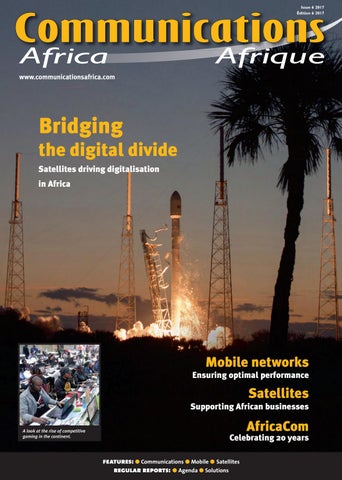
Bridging the digital divide Satellites driving digitalisation in Africa
Mobile networks Ensuring optimal performance
Satellites Supporting African businesses A look at the rise of competitive gaming in the continent.
AfricaCom Celebrating 20 years features: ● Communications ● Mobile ● Satellites regular reports: ● Agenda ● Solutions
S01 CAF 6 2017 Start_Layout 1 20/10/2017 15:28 Page 2
S01 CAF 6 2017 Start_Layout 1 20/10/2017 16:43 Page 3
Issue 6 2017 Édition 6 2017
CONTENTS
Afrique
Africa www.communicationsafrica.com
Bridging the digital divide Satellites driving digitalisation in Africa
Mobile networks
News
4
Events
8
Quotes
19
Ensuring optimal performance
Satellites Supporting African businesses
Solutions
AfricaCom
A look at the rise of competitive gaming in the continent.
Celebrating 20 years
34
features: ● Communications ● Mobile ● Satellites regular reports: ● Agenda ● Solutions
A note from the Editor
FEATURES
This edition of Communications Africa looks in-depth at how the continent’s satellite sector is transforming industries. We explore how satellite technology is protecting valuable assets for businesses and how demands for connectivity and bandwith are being met in remote regions. We also celebrate 20 years of AfricaCom, the largest technology, telecoms and media event. This issue also looks at the challenges of narrowing down the mobile gender divide and ensuring mobile is affordable and accessible.
AfricaCom
6
Celebrating the 20 years AfricaCom, we bring you a preview of what to expect at the largest event focusing on African telecoms, media and technology
Gaming
12
We look at the rising demand of competitive gaming in the continent, with highlights of Naiccon, an international gaming tournament recently held in Kenya
Technology
18
Exploring how cellular backhaul via satellite is meeting the rising demands for connectivity and bandwidth by enterprise and domestic communities in remote regions in the continent
Test & Measurement
24
Ensuring mobile networks are regularly monitored and testing to ensure they are performing at their best
Une note du rédacteur
Mobile
Cette édition de Communications Africa examine en profondeur la façon dont le secteur satellitaire du continent transforme les industries. Nous explorons comment la technologie satellitaire protège les actifs précieux pour les entreprises et comment les demandes de connectivité et de bande passante sont satisfaites dans les régions éloignées. Nous célébrons également 20 ans d'AfricaCom, le plus grand événement technologique, télécom et média. Ce numéro examine également les défis à relever pour réduire la fracture entre les sexes et garantir que le mobile est abordable et accessible.
Overcoming the challenges the continent faces in the mobile gender divide to meet the UN Sustainable Development Goals
29
Smart Asset tracking
31
Exploring how oil and gas companies working in Africa are using satellite communications to track and protect assets and staff
ARTICLES Nouvelles
9
Une sélection des dernières nouvelles en matière de communications dans les pays francophones
E-santé
28
Explorer l'utilisation importante des TIC pour fournir des soins de santé universels à travers le continent
Editor: Hiriyti Bairu - hiriyti.bairu@alaincharles.com Audit Bureau of Circulations Business Magazines
Editorial and Design team: Prashant AP, Miriam Brtkova, Kestell Duxbury, Ranganath GS, Deblina Roy, Rhonita Patnaik, Rahul Puthenveedu, Samantha Payne, Nicky Valsamakis, Vani Venugopal and Louise Waters Managing Editor: Georgia Lewis Production: Naveenkumar H and Nelly Mendes Email: production@alaincharles.com Publisher: Nick Fordham Sales Director: Michael Ferridge Magazine Sales Manager: Vinay T Nair - Tel: +91 80 68888847, Email: vinay.nair@alaincharles.com Country India Nigeria UAE UK USA
Representative Tanmay Mishra Bola Olowo Graham Brown Michael Ferridge Michael Tomashefsky
Telephone +91 80 65700911 +234 8034349299 +971 4 448 9260 +44 20 7834 7676 +1 203 226 2882
www.communicationsafrica.com
Email tanmay.mishra@alaincharles.com bola.olowo@alaincharles.com +971 4 448 9261 graham.brown@alaincharles.com +44 20 7973 0076 michael.ferridge@alaincharles.com +1 203 226 7447 michael.tomashefsky@alaincharles.com
Head Office: Alain Charles Publishing Ltd University House 11-13 Lower Grosvenor Place London SW1W 0EX, United Kingdom Telephone: +44 20 7834 7676 Fax: +44 20 7973 0076
Middle East Regional Office: Alain Charles Middle East FZ-LLC Office L2-112, Loft Office 2, Entrance B, PO Box 502207 Dubai Media City, UAE Telephone: +971 4 448 9260 Fax: +971 4 448 9261
Fax
Subscriptions: circulation@alaincharles.com Chairman: Derek Fordham Printed by: Buxton Press Printed in: October 2017 Communications Africa/Afrique is a bi-monthly magazine ISSN: 0962 3841
Serving the world of business
Communications Africa Issue 6 2017
3
S02 CAF 6 2017 News_Layout 1 20/10/2017 12:31 Page 4
AGENDA
Nigeria’s first E-commerce Bot
Trace TV launches content distribution division
JUMIA HAS LAUNCHED Jumia Bot, an e-commerce bot that allows shoppers to order food, find fashion or electronic items and book hotels and flights by having an online conversation with the bot. Powered and hosted by Facebook Messenger, this innovation was officially launched on 2 October in Nigeria and will offer Nigeria’s 18mn Facebook users the ability to get their own personal Jumia shopping assistant directly on Facebook Messenger. The Jumia Bot asks customers what they’re seeking, and then using their answers to find the best offers. For example, to get access to the best hotel and airfare deals on Facebook Messenger. Emeka Afigbo, head, Platform Partnerships, Middle East and Africa at Facebook, said, “We are excited to be part of the story in providing technology solutions to one of Africa’s leading e-commerce websites.”
SINCE 2003 OLIVIER Laouchez’s Trace TV has been building an international position for itself around Urban and AfroUrban music and culture. With its expansion into the USA in June this year, it has chosen to create a Content Distribution division and deepen its relationships with producers and directors. Russell Southwood spoke to AnneLaurence Ndaptje, head of external communications, Trace TV about what it wants to do with the new division. The idea for the distribution was a logical extension of what it saw itself as doing, ”Our CEO wanted to tackle the distribution area. Because we have been a producer of short content for over fourteen years, it was logical for TRACE to go this route into distribution. We’re focusing on Afro-Urban and Urban content producers and will support them in this way.” It will be adding content it acquires from external producers. One of its primary goals is to also identify and target talent and help them to monetise and value their work. It’s talking about having thousands of hours of content in its catalogue in the future. The existing content catalogue includes: TV series: Brothers with no game (UK), Crazy lovely Cool (Nigeria), Dreams (USA), feature films : Le Gang des Antillais (France); Wives on Strike (Nigeria), documentaries: Salomon Kalou (football), The Year Of Afrobeats - From Nigeria to the world (music), Generation Papa Wemba (music). Also, TV magazines/music programmes, examples would include Guest Stars and The Year of, Urban Gossip.
Subah launches mobile money monitoring suite
4
Communications Africa Issue 6 2017
Sage partners with ACCA Nigeria
Photograph: Subah
GHANAIAN IT AND Telecoms vendor, Subah presented its new Mobile Money Monitoring Suite (M3) at the recent ITU Telecom World conference held in South Korea. M3 gives governments and their telecom regulators with the full visibility they need to monitor all mobile money transactions that take place in their country. According to Subah, M3 protects consumers against fraud and Biren Sasmal CEO of Subah. prevents identity theft including tax evasion, money laundering and revenue leakage. Birendra Sasmal, CEO of Subah, said, “The ability to receive and send money from our mobiles is a truly life-changing development. However, its success poses multiple regulatory, taxation, and compliance issues for regulators, tax administrators and banks across the world. M3 gives them the tools to tackle all of these issues.” The Subah M3 Suite offers a number of functions, captures, analyses and holds information on all mobile money transactions, such as the sender, receiver and operator, automatic reporting of highvalue and repeat transfers to individuals and businesses, summary of MM service charges applied by all operators. Extensive web-based reporting features are also included to enable sophisticated tracking and measurement of all MM transactions, a stand-alone system installed at the NOC of Mobile Network Operators, compatible with all existing MM platforms and fully customisable for different mobile banking regulatory frameworks.
Ndaptje says the content is all about the common culture of Urban and Afro-Urban but not just music:” It’s deeply rooted in the Trace brand and our aim is to provide Afro-urban content. It’s content from Africans and those of African descent from around the world, living in places like France, the Caribbean and the USA. We really want to put the culture forward in all its different aspects from music to everyday life”. ”We’re looking to sell to TV channels, mobile operators, cinema operators and in flight. Trace has a presence in the mobile area with its own TRACE Mobile licence (which it also white labels),” says Ndaptje. The Trace Content Distribution Division is headed up by Betty Sulty Johnson:”She has a background in film and cinema. She was the founder of an organization focused on Black women behind and in front of the camera. With that experience in the UK, she came back to France where she worked in distribution with France TV and then Lagardère Studios as a sales executive”. Sulty Johson has nailed her colours to the mast by saying, ”The creation of TCD responds to a need to ensure that there is better exposure for Afro-urban creators of world-class quality who are often not represented by traditional distributors. Our pledge is to make the content travel as much as possible and to target clients around the world willing to have diverse, quality content that their audience can indulge in”. www.balancingact-africa.com
SAGE HAS ANNOUNCED it has entered into a partnership agreement with the Association of Chartered Certified Accountants (ACCA) in Nigeria. The new deal will see the organisations work together to provide training and skills development opportunities to finance and accounting professionals Sage, the market and technology leader for cloud accounting, people and payroll, and payment systems, today announced that they have signed a partnership agreement with the Association of Chartered Certified Accountants (ACCA) in Nigeria. This partnership will see the organisations work together to provide training and skills development opportunities to finance and accounting professionals. They will also promote each other’s brands to – and share information with – their respective communities. Magnus Nmonwu, regional director for Sage in West Africa, “We are delighted to cooperate with ACCA to develop skills in the finance and accounting arena – including the student members of the ACCA. We believe that there is a great deal we can do to add value for ACCA members in the region. Our wide network of resellers and partners are at hand to provide ACCA members and other Nigerian customers with the advice they need to grow their businesses.” ACCA will integrate Sage learning materials into certificates and qualifications as relevant, helping to build capabilities among ACCA members and partner institutions. The partnership will kick-off with an event in November where Sage will be introducing Sage X3 to ACCA members within the enterprise space. “Our partnership with Sage will help us to support people and organisations in their holistic personal and business growth. The knowledge and training from this platform will ensure that they use future-proof IT in a manner that supports their operations and stakeholder interactions as their businesses grow,” says Tom Isibor, country head, ACCA.
www.communicationsafrica.com
S02 CAF 6 2017 News_Layout 1 20/10/2017 12:31 Page 5
S02 CAF 6 2017 News_Layout 1 20/10/2017 16:17 Page 6
EVENTS
AfricaCom
AfricaCom 2017 – celebrating 20 years of Africa’s telecoms and technology journey A look back at 20 years of AfricaCom shows how far we have come - and where we are yet to go. AfricaCom, Africa’s largest technology, telecoms and media event, celebrates its 20th anniversary in November this year, and promises delegates and exhibitors three days of thought-provoking content and cutting-edge technology, along with a glimpse into what the future holds in terms of digital technology and its impact on life as we know it. Taking place from 7-9 November at the Cape Town International Convention Centre (CTICC), South Africa, organiser KNect365 has introduced a host of innovations of its own to celebrate this auspicious occasion - a brandnew and happening Technology Arena that will provide a glimpse of the potential the future holds for forward-thinkers – whether it is in the fintech space, or e-health, education, energy, agri-tech or more. The Technology Arena will also house an exciting array of new technology (more than 100 exhibitors), some of which will be interactive and on display in demo pods, along with many other novel developments that will debut at the show. Included in this exciting space is another fresh feature AfricaCom 20/20. This is a brandnew show floor item dedicated to accelerating Africa’s digital transformation and is the centrepiece of the new arena. Underpinning the event is a businesscritical agenda and, as always, world class speakers, alongside more than 400 exhibitors. But AfricaCom is more than an exhibition and a conference. It is now a staging ground for reimagining and re-defining how we, as Africans and humans, will communicate and transact with one another. “2017 is a landmark for AfricaCom. Over the past two decades, we have grown from being a purely telecommunications-focused event to a broader, digital communications show now hosting the foremost group of influencers involved in every aspect of the African digital ecosystem,” explained Tom Cuthell, portfolio director of KNect365.
How did we get here? The first-ever AfricaCom in 1997, was launched in Cape Town as GSM Africa, the same year the first proposal for a regional internet registry for Africa was launched (remember that). Mapping Africa’s technology journey from that time, 2001 saw the first major sub-sea cable connecting Africa. In 2002, SAT3/WASC/SAFE cable system was inaugurated in Senegal. SAT3/WASC/SAFE 6
Communications Africa Issue 6 2017
was a technological and commercial breakthrough of unparalleled significance for Africa, offering a faster, more efficient trading channel between the continent and international markets. It was made possible by the participation of 36 nations, which fully funded the undersea cable system costing more than US$600mn. In 2007 Mpesa, the mobile phone-based money transfer, financing and microfinancing service, was launched in Kenya and Tanzania and now reaches more than 25mn customers. During 2007 the number of wireless broadband subscribers overtook that of fixed line
Photograph: CTICC
Enabling Economic Democracy
This year’s AfricaCom will explore what the future holds for the continent’s digital sector.
broadband subscribers in South Africa. 2008 saw the first mobile payment linked to a credit card, performed by the WIGROUP in South Africa, while in 2009 the first iPhone was launched on the continent. In 2012, AfricaCom welcomed 8,000 delegates through its doors and in 2014, Namibia became the first African country to terminate analogue TV signals, with more than 3.8mn jobs being directly or indirectly attributed to the mobile industry by 2015. Now in 2017, over 167mn Africans have access to
the Internet there are around 300 technology hubs on the continent and AfricaCom is preparing to welcome more than 13,000 delegates from all corners of the world. But AfricaCom is not just about blue-sky thinkers, out-of-this-world technology and enterprise offerings. It also plays a vital role in enabling small businesses. Entrepreneurs and small-to-medium enterprises across the continent, are the backbone of a healthy economic democracy. Acknowledging this, KNect365 is also making AfricaCom available to entrepreneurs, start-ups and small businesses, and the companies that can provide them with the tools and know-how to get them going and growing. Newcomers to AfricaCom - Experimac, for example, have identified AfricaCom as the ideal space to meet new partners and businesses who require a helping hand. Offering reconditioned Apple products, the company realizes that without the appropriate tools, at an affordable rate, a young company has little chance of growing, especially in this always on world. “We are exhibiting at AfricaCom this year as for us, it presents a perfect opportunity to engage with young minds who are shaping the business landscape and who might not necessarily have access to finance or the equipment to put their ideas into practice,” said Dirk van Loggerenberg, CEO of Experimac. As always, the calibre of speakers – 400 of them – is a major draw card. The conference tracks will deliver the latest advances in their respective areas. Some of the luminaries to present their insights include Herman Singh, Group Chief Digital Officer, MTN; John Momoh (OON), Chairman and CEO of Channels Media Group; Is’haq Modibbo Kawu, Director General of the National Broadcasting Commission and Joseph Hundah, CEO of Econet Media. Helping business people to connect is the Partner Programme, giving direct access to potential customers. Another opportunity to bond is The Village. This is AfricaCom’s VIP luxury networking space, designed exclusively for C-Level operators and regulators, speakers and ICT leaders from large enterprises. Here decision makers from Africa’s tech and telco industry can meet to conduct business, share insights and swap stories, entertain clients, arrange private meetings or just recharge and reflect on the day’s events. Where are we going? – That question is probably best answered by attending AfricaCom 2017. ✆ www.communicationsafrica.com
S02 CAF 6 2017 News_Layout 1 20/10/2017 12:34 Page 7
Safaricom Wholesale was instituted in 2015 with two goals: To become the preferred Wholesale partner in the African continent and To deliver onward connectivity to the rest of the World.
At Safaricom Wholesale, we understand your needs. Your connectivity requirements
We give you access to the widest metro and backbone fibre(over 10,000km of on-net fibre) State of the art Data Centres-Tier 3 Access to global POPs Last mile connectivity to remote areas using Wimax, LTE , P2MP and Satellite.
Expertise in delivery Access to world class expertise – Your partner of choice with both certified and experienced teams (Engineers, Project Managers & account managers).
Support
Access to 24x7 NOC to NOC support with a state of the art NOC facility. Regional network with Local support.
Customer Focus
Our account managers ensure regular customer face to face meetings to keep conversations going and boost the relationship.
S02 CAF 6 2017 News_Layout 1 20/10/2017 16:26 Page 8
AGENDA
Events/Événements 2017 NOVEMBER/NOVEMBRE 7-9
AfricaCom
Cape Town, South Africa
https://tmt.knect365.com/africacom/
13-15
Algeria IT Expo & Conference
Algeria
www.algeriaitexpo.com
23-26
Sitex
Singapore
www.sitex.com.sg
26-29
Cairo ICT
Cairo, Egypt
www.tradefairdates.com
28-30
Trustech Cannes
Cannes, France
www.trustech-event.com
30-2
CeBIT India
Bangalore, India
www.cebit-india.com
31-2
PTA
Moscow, Russia
www.pta-expo.ru
DECEMBER/DÉCEMBRE 5-8
Bakutel
Baku, Azerbaijan
www.bakutel.az
11-14
IT-Tage Frankfurt
Frankfurt, Germany
www.it-tage.org
JANUARY/JANVIER 9-12
CES International Consumer Electronics Show
Las Vegas, USA
www.cesweb.org
14-16
Cabsat
Dubai, UAE
www.cabsat.com
27-28
IOT Global Congress 2017
London, UK
www.iotglobalcongress.com
Shortlist announced for AfricaCom 2017 Awards The AfricaCom 2017 Awards will celebrate the achievements of the best firms, solutions, products and personalities, driving connectivity in Africa. This year's event marks the 20th anniversary of AfricaCom and the 10th year of the awards. Knect365 has announced the top twenty finalists as follows: Best Network Improvement Vodafone Wholesale, Ghana - Fibre connectivity to the West African sub region Mauritius Telecom - Accelerated FTTH Deployment Liquid Telecom - Pan-African VSAT Service MTN Nigeria - The world’s 1st CloudAIR GU@5MHz launched in MTN Nigeria Huawei Technologies - Build the Best Network in Africa – Kenya P3 Score Improvement Ericsson & Safaricom - Next Generation NOC Delivering Excellence in Customer Experience CommProve - QuantiQa NG Mahindra Comviva and Airtel Africa - iPACS – Unified CRM and Convergent Billing Solution Mahindra Comviva and Orange Cameroon - VAS Retailing Solution Liquid Telecom - Listen, Measure, Understand and Improve Orange - Business Care MTN & Huawei Technologies - Customer Experience Management (CEM) Best Network Function Virtualization Solution Parallel Wireless - HetHet Gateway enabling ease of deployment and maintenance for ANY G cellular network ECI - LightSEC for Critical Infrastructures
8
Communications Africa Issue 6 2017
Ericsson - Ericsson HDS (Hyperscale Datacenter System) Huawei Technologies - ICT Transformation Through Huawei’s NFV Solution Changing Lives Award WTL - Building wholesale networks in Rural Africa Orange - Sandji-Senekalé Orange - Cycle M BrightWave Technologies - Telecommunication (metro broadband network) UNHCR – Smart WiFi Kiosk COCA COLA/EKOCENTER - EKOCENTER RippleNami, Inc. – rWAVES Most Innovative LTE Service/Application Deployment Ecocarrier Inc. - MRESENCE - Presence in Mixed Reality and its application in cloud-based managed services for TeleMRedicine, CollaboMRation, Alepo Technologies - BSS Transformation Parallel Wireless - Making LTE deployments as easy and as cost-effective as Wi-Fi Telkom & Huawei Technologies - Telkom (CSB) Consumer and Small Business powered by Huawei LTE Solution Best Innovation in Broadcast – Broadband Convergence Orange - #Débloqués Orange - TV Everywhere Telkom & Huawei Technologies - Telkom LIT_ Service Most Innovative Service – The Business of Tomorrow UROS Ltd. - Goodspeed Roaming App ZOL (Zimbabwe) – part of The Liquid Telecom Group -
Fibroniks-on-the-Go Truecaller – Truecaller Orange - Rural Electrification Telkom & Huawei Technologies - Telkom LIT_ Orange - USSD STORE Outstanding Data Management or Analytics Solution BWTECH International Ltd – NetChart Polystar – Kalix Orange - Orange Data Management Program PCCW Global - GlobalView Fintech Innovation Award Mahindra Comviva and Econet Wireless - EcoCash Diaspora BIMA (Milvik) – Microinsurance FAMOCO - FAMOCO help Orange Cameroon to improve the efficiency of their distribution network. Panamax Inc. – MobiFin Tanzania Vodacom & Huawei Technologies - Tanzania Vodacom Lipa kwa M-Pesa PCCW Global - Tap&Go IoT Product/Service of the Year eWaterpay - eWater tap Orange - Smart metering SqwidNet - IoT Network and Ecosystem Roll-out Huawei Technologies – Huawei PLC-IoT for achieving Intelligent Utility Grid Huawei Technologies - Huawei IOT Solution for Insurance Innovation MTN South Africa together with Ericsson MEA - First CAT-M1 test in Africa for Internet of Things
www.communicationsafrica.com
S03 CAF 6 2017 Agenda_Layout 1 20/10/2017 12:47 Page 9
AGENDA
Les pays francophones pointés du doigt dans un nouveau rapport sur la répression contre Internet les pays d’Afrique subsaharienne, près de 12 pays dans cette région ont connu des restrictions de connexion décidées par leurs gouvernements depuis 2015. Certains pays francophones sont cités dans le rapport, notamment le Tchad, le Gabon, la Gambie, la République du Congo, le Burundi, la République centrafricaine, le Cameroun, la République démocratique du Congo, le Mali, le Niger et le Togo. Des perturbations ont également été constatées pendant les périodes d’examens nationaux, comme cela a été le cas en Éthiopie, ou pendant des élections dans des pays comme le Tchad, le Gabon, la Gambie, la République du Congo et l’Ouganda. Des manifestations publiques ont aussi conduit à des coupures d’Internet, notamment au Burundi, en République centrafricaine, au Cameroun, en République du Congo, en Éthiopie, au Mali, au Niger et au Togo. Certains pays francophones, dont les taux de pénétration et d’utilisation d’Internet sont très faibles, ont eux aussi été touchés par ces coupures.
MTC inaugure un mobile home à Nkurenkuru
Photo: MTC
MTC A ANNONCÉ L’OUVERTURE d’un mobile home à Nkurenkuru, ce qui signifie que les habitants de la région de Kavango West n’auront plus besoin de se rendre jusqu’à Rundu pour bénéficier des services de MTC. Le mobile home, géré par une équipe de deux personnes, est situé au Matukuchila Complex et propose Les résidents de Kavango West devraient profiter de la maison mobile. l’intégralité des services de MTC. Il n’y a plus besoin d’aller jusqu’à Rundu et de patienter dans des files d’attente interminables pour obtenir des services. Ça va mieux, maintenant », déclare Philip Munaye, habitant de Nkurenkuru. Selon Tim Ekandjo, responsable du capital humain et des affaires d’entreprise de MTC, l’opérateur a mûrement réfléchi son approche commerciale après la formation de la région de Kavango West en 2014. En effet, MTC a chargé ses planificateurs d’entamer la recherche d’un emplacement pour un magasin dans la ville, en vue d’assurer une présence commerciale dans cette région nouvellement établie. Ce magasin particulièrement stratégique aurait ouvert bien avant, en 2016, s’il n’y avait pas eu cette difficulté à trouver des locaux adaptés. Toutefois, nous sommes ravis de pouvoir déclarer que grâce à ce magasin, les habitants de Nkurenkuru font maintenant bel et bien partie de la famille 081 » déclare Ekandjo. Il ajoute que le mobile home de Nkurenkuru, le 34ème de la société, s’inscrit directement dans la démarche du projet 081Every1, tout comme le mobile home d’Eenhana. Ce projet vise à assurer une couverture réseau pour 100 % de la population d’ici deux ans. MTC s’appuie sur des distributeurs et plus de 3 000 petits revendeurs qui proposent à une clientèle de 2 millions de personnes plusieurs services associés à l’opérateur. MTC affirme que ce réseau de distribution confère à ses services une présence inégalée dans l’ensemble du pays.
www.communicationsafrica.com
Selon l’UIT, le taux d’accès à Internet est de 25 % pour le Cameroun, 21,9 % pour l’Ouganda et 4,4 % pour le Niger. Les trois pays ont connu respectivement des coupures d’Internet de 93 jours, 6 jours et 3 jours entre 2016 et 2017. Le secteur des TCI et l’expansion des services en ligne ont incontestablement beaucoup profité à l’économie et à la société. C’est d’autant plus vrai que dans la plupart des économies africaines, la contribution des TCI au PBI représente en moyenne 5 %, soit un pourcentage plus élevé que dans de nombreux pays européens ou asiatiques. Le rapport souligne aussi que les coupures d’Internet, même de courte durée, minent la croissance économique, perturbent la fourniture de services essentiels, altèrent la confiance des entreprises et contribuent à donner aux pays un profil à risque. Ces coupures ont un impact très négatif au niveau micro et macroéconomique. Elles affectent les moyens de subsistance des citoyens, minent la rentabilité des entreprises et font baisser le PIB et la compétitivité des pays qui les ont mises en place.
L’Angola va partager des données sismiques dans le monde entier DEPUIS LA STATION de Kapanda dans la province du Malanje, l’Angola a commencé à partager des informations et des données sur les activités sismiques qui se sont produites dans le pays avec le réseau sismologique mondial. Suite aux observations de septembre menées dans les quatre stations sismiques existantes – dont trois sont sous la direction de l’INAMET (National Meteorology and Geophysics Institute) – des données ont commencé à être envoyées à l’IASPEI (International Association of Seismology and Physics of the Earth). Les données sismiques de l’Angola sont rassemblées par cinq stations situées à Luanda, Lubango (Huila), Porto Kipiri (Bengo), Luena (Moxico) et Kapanda (Malanje). Selon les responsables, l’Angola a encore besoin d’étendre son réseau de stations dans les régions du sud, de l’est et du centre, afin d’enregistrer correctement les activités sismiques.
Photo: L.Willms
PLUSIEURS PAYS FRANCOPHONES victimes de coupures d’Internet instaurées par leurs gouvernements sont mentionnés dans un récent rapport présenté à Johannesburg, en Afrique du sud, à l’occasion du Forum de la liberté sur Internet en Afrique (Forum on Internet Freedom in Africa). Selon un rapport publié par l’organisation internationale CIPESA (Collaboration on International ICT Policy for East and Southern Africa), les coupures d’Internet en Afrique subsaharienne ont engendré jusqu’à 237 millions de dollars de perte pour la région depuis 2015. Grâce à un système récemment développé, l’organisation a pu déterminer que les pertes économiques persistent bien après les jours de coupure, car ces perturbations de réseau bouleversent toutes les chaînes d’approvisionnement et ont des répercussions systémiques qui affectent l’économie toute entière. Le rapport indique que malgré les avantages associés à l’accès à Internet et à la contribution du secteur des TIC au PIB dans
L'Angola partage des informations et des données sur les activités sismiques à sa station de Kapanda à Malanje.
Communications Africa Issue 6 2017
9
S03 CAF 6 2017 Agenda_Layout 1 20/10/2017 16:28 Page 10
COMMERCIAL FEATURE
Satellites
Gazprom Space Systems enters the 25th anniversary year Photograph: Gazprom
Gazprom Space Systems (GSS) is reaching a milestone this November, celebrating 25 years of business. The company has grown almost from scratch, raised through the ranks from the challenging idea to its implementation.
In recent years Gazprom Space Systems has significantly increased its sales on the international market.
AZPROM SPACE SYSTEMS is a highly recognised international satellite operator.
G
To achieve this GSS had to pass the way of self-identification and development. The history of the company dates back to 1992, when five northern Gazprom enterprises established Gazcom (in 2008 renamed as Gazprom Space Systems). Since then GSS has created national satellite communication system comprising modern space and ground assets: operating satellite fleet, large teleport, TV center and satellite communications network in Russian regions. Currently GSS orbital constellation includes four satellites - Yamal-202 (49E), Yamal-300K (183E ), Yamal-402 (55E ), Yamal401 (90E). All satellites operate in traditional C and Ku frequency bands. Total capacity of GSS orbital constellation is about 9 GHz. The coverage zone of Yamal satellites fleet embraces approximately the whole part of Eastern hemisphere and reaches the Western Coast of North America. In recent years, thanks to Yamal-402 and Yamal-300K satellites, with service areas
10 Communications Africa Issue 6 2017
A significant part of GSS international business is focused on emerging markets in Africa and the Middle East. covering Europe, the Middle East, Africa and the Asia-Pacific region, GSS has significantly increased its sales on the international market. In 2016, the international sales share comprised 36 per cent of the company's total revenue. From 2012 to 2016, the revenue from international market sales, in the US dollar equivalent, almost doubled. A significant part of GSS international business is focused on emerging markets in Africa and the Middle East. On the African telecommunications market the company acts since 2013. Wide Southern beam of Yamal-402 with high-energy performances (EIRP 46-51 dBW) covers a large region of the African continent particularly sub-Saharan Africa, Madagascar and neighboring areas of the Indian Ocean.
Despite strong competition on the African market in recent years due to the appearance of a large number of new satellites, the Yamal402 capacity is very popular. The capacity is often utilized to provide services to corporate sector, government institution and population, as well as for live broadcasting of political, cultural and sports events in African countries. Our position in this region has strengthened significantly thanks to new partnership relations with major service providers, acting on this market. In the near future we are going to create even tighter relationships with our best clients and expand our business in this region. We admit that activities on the international market as before will be one of the major priorities. GSS is open for cooperation, customer-focused and suggest service providers the capabilities of its satellite fleet in order to run a successful business. Quartercentury is overpassed, our professional team is working on company’s future implementing new projects and developing business models that will help us to move up in the world of satellite communications and have even more set of achievements in the years to come. ✆
www.communicationsafrica.com
S04 CAF 6 2017 Liquid telecom_quotes_Layout 1 20/10/2017 11:44 Page 11
S04 CAF 6 2017 Liquid telecom_quotes_Layout 1 20/10/2017 12:37 Page 12
NETWORKS
Gaming
Competitive gaming reaches the next level in Africa A recent international gaming tournament held in Kenya revealed pent-up demand from a new generation of African gamers. But the rise of competitive gaming in the region hinges on the rollout of more advanced network infrastructure. N THE LAST weekend of July at the Sarit Centre in Nairobi, Kenya, over 3,000 comic book, gaming, animation and movie fans descended upon the Nairobi Comic Convention (Naiccon) for two days of creative workshops, cosplay competitions and gaming tournaments. Now in its fourth year, Naiccon is going from strength to strength. This year it was competitive gaming that stole the limelight as the event hosted the region’s first ever international multiplayer gaming tournament. The tournament saw a total of 16 PC and console gaming teams from Kenya, Uganda and Rwanda battle it out for Sh150,000 ($1,500) in cash prizes in front of enthusiastic audiences. Such was their dedication to the tournament that many gamers – all of different age and ability arrived at 9am and played straight through the night until 7pm the following day when the event closed.
O
New era of African gaming This is just the beginning for gaming in Africa, which is yet to truly make its mark across the region. Organised, competitive computer gaming, known as eSports, is emerging as a major spectator sport globally, and can be staged in front of millions of online viewers. In 2016, eSports generated $528.2mn in global revenue, with a global 3,000 comic book, gaming, animation and movie fans attended the gaming tournament.
audience of approximately 320mn people. By 2020, those figures are expected to almost double to £1bn in revenues and a global audience of 600mn, according to analyst firm Newzoo. In South Korea, eSports has become so ingrained in society that professional gamers enjoy celebrity status and compete in tournaments live in front of crowds of hundreds of thousands. The rise of South Korea’s gaming culture has been made possible by some of the most advanced fibre infrastructure in the world. When it comes to gaming, fast and consistent Internet speeds matter. Even a minor delay or disruption in speed of service can cause a major impact to real-time, multi-player games, during which large volumes of data are being sent between a gaming console or computer and the Internet. Since it delivers the fastest possible Internet speeds, fibre is the definitive solution when it comes to online gaming. Throughout Naiccon, Liquid Telecom, which operates the largest independent pan-African fibre network - stretches more than 50,000 km, supported the multiplayer gaming tournament with unlimited bandwidth. The usage peaked at 750Mbps and never dropped below 100Mbps. This enabled participants and spectators to stream the event from different sites on the Internet, while also hosting a LAN party – which is when gamers bring their own computers and connect to a local network to compete against one another. At the same time, the connection supported free Wi-Fi for visitors throughout the event.
Photo: Naiccon
Rising eSports stars It is hoped that the success of this year’s Naiccon will inspire more frequent multiplayer gaming tournaments to take place across the region. The jump from hobby gaming to competitive eSports is considerable, with major sponsorship and prizes needed to 12 Communications Africa Issue 6 2017
Competitive computer gaming, known as eSports, is emerging as a major spectator sport globally, and can be staged in front of millions of online viewers. raise the profile of gaming and help unearth the first African eSports stars. But there are promising signs. Kwesé Sports, Econet Media’s premium sports content platform, recently signed an exclusive, five-year deal with the world’s largest eSports company ESL, to distribute ESL content and host events across Africa. Through the partnership, Kwesé and ESL will bring the first ever continental eSports championship - to Africa, and will also be launching the region’s first 24/7 eSports channel. Meanwhile, the rollout of additional fibre across the region by Liquid Telecom will help reduce network delay and enable more gamers to compete internationally. The rise in the number of competitive gamers across Africa is expected to bring with it a growth in local gaming content. “As part of the Liquid Telecom Group innovation partnerships strategy, we are investing together with our partners in creating a captive and engaged gaming community across Africa aimed at opening up opportunities for the African gaming industry. We intend to attract the large gaming companies to locally host their gaming platforms in Africa and also enable gaming entrepreneurs who can create the next African centric games, ” says Ben Roberts, Group CTO, Liquid Telecom. There has been some early discussion of eSports being added to the Olympic programme as an official medal sport in 2024. If that does happen then there’s every chance that African gaming teams could be competing in it. ✆ www.communicationsafrica.com
S04 CAF 6 2017 Liquid telecom_quotes_Layout 1 20/10/2017 11:44 Page 13
S04 CAF 6 2017 Liquid telecom_quotes_Layout 1 20/10/2017 11:44 Page 14
www.liquidtelecom.com
S04 CAF 6 2017 Liquid telecom_quotes_Layout 1 20/10/2017 11:44 Page 15
AFRICAN. We can make Africa’s supply chains stronger. We believe logistics systems in Africa can match those anywhere in the world for efficiency. It’s why we’ve built Africa’s largest fibre infrastructure and provide an award-winning satellite network, ensuring deadlines are met, deliveries are made and supply always meets customer demand. Because we are not just a telecoms company. We are your technology partner.
Building Africa’s digital future
18:45
S04 CAF 6 2017 Liquid telecom_quotes_Layout 1 20/10/2017 12:52 Page 16
AGENDA
Azercosmos: Technical excellence complemented by customised approach Azercosmos is the exclusive video distribution partner of the leading events and has been successfully broadcasting important sports, political and cultural events in Europe and Central Asia such us Formula 1 Azerbaijan Grand Prix, IV Islamic Solidarity Games, II World Nomad Games, I European Games, I European Athletics Youth Championships, 2015 Turkish general election and others. The customer base from over 23 countries include operators from Turkey, Russia, Georgia, UAE, Germany, UK, Ukraine, and others.
Photograph: Azercosmos
AZERCOSMOS IS AZERBAIJAN’S national satellite operator aimed to diversify the country’s economy through development of non-oil sector and making the country a data bridge between East and West. The company provides satellite capacity to various service providers, which give their solutions to a number of industries. Azerspace1, the first telecommunications satellite operated by Azercosmos provides highlyreliable broadband and broadcast solutions to our customers in Africa, Europe, Middle East, and Central Asia.
Main satellite ground control station in Baku, Azerbaijan.
There are changes currently affecting the satellite industry. Technological progress is not only increasing the competition and generating shifts in consumption patterns, but also creating additional demand for satellite services. Azercosmos is optimistic about opportunities for increased satellite usage in Africa, and in 2018 is planning to add more TV channels from African countries. Strategic development plans of the company include enhancing the coverage area and spectrum of services by launching the second telecommunications satellite Azerspace-2 at 45° East longitude in 2018. Azerspace-2 will offer enhanced capacity, coverage and service offerings to support the growing demands in the region for DTH, government and network services currently supported by Azerspace-1. Azerspace-2 orbital position (45° E) is only 1 degree away from the current Azerspace-1 orbital location (46° E) creating good opportunities for existing and new customers to start expanding their current satellite solutions. Azerspace-2 will serve African continent with High Power Ku band from 45 degrees East. The new spacecraft is ideally designed for smaller antenna and has cross connectivity between East Africa, West Africa and Central Africa, Europe and Central Asia.
16 Communications Africa Issue 6 2017
www.communicationsafrica.com
S05 CAF 6 2017 Gazprom_Report BA_Layout 1 20/10/2017 13:33 Page 17
S05 CAF 6 2017 Gazprom_Report BA_Layout 1 20/10/2017 13:33 Page 18
SATELLITE
Cellular backhaul
Satellite’s connectivity role reaches new heights Cellular backhaul via satellite is crucial in meeting the increasing demands for connectivity and bandwidth from enterprise and domestic communities in remote regions of Africa. The technology is also having to keep pace with market trends. Tim Guest reports.
S
others, that all means keeping up with trends and meeting the need for always-on connectivity. To do so, new business models are emerging from their efforts to enable communications service providers to offer ‘viable’ global delivery of IP services to end users anywhere, using any device, in every geographical terrain, and in any enterprise or remote community worldwide, via satellite.
VSAT and HTS – making satellite access standard As a result of these increasing demands, the VSAT industry as a whole is addressing longstanding technology and market challenges by boosting the volume of satellite capacity through the launch of new GEO, LEO and MEO satellite constellations. These are already beginning to deliver capacity at unprecedented throughput levels. This, in turn, has begun triggering an industry-wide resetting of capacity prices at much more competitive rates. These new prices are themselves now beginning to rival both fibre and cellular
SkyEdge II-c Gemini offers high-speed broadband Internet services to enterprise and consumer markets
Gilat satellite solution CellEdge SDR
network tariffs. All these trends are providing clear opportunities for the likes of Hughes and iDirect, along with other satellite operators and service providers, not only to develop and leverage new technologies in order to keep pace with demand for higher network speeds and capacity, but to deliver satellite as a standard access technology. As satellite is being seamlessly integrated into broader network infrastructure, so a larger market share is being won by the satellite community. That share particularly relates to the untapped and unconnected millions on the other side of the ongoing digital divide, a segment the terrestrial players were unable, or reluctant, to connect until now – before the latest satellite technologies made it viable to do so. For its part, iDirect is intent on developing technological solutions to both open new market opportunities and lower the cost of service delivery in new ways including through the application and use of highthroughput satellite (HTS) technology.
Technology steps forward The emergence of HTS in recent years has brought with it huge advances in enabling the delivery of broadband access solutions via satellite. Not only has HTS increased the
18 Communications Africa Issue 6 2017
www.communicationsafrica.com
Photograph: Gilat Satellite Networks
ATELLITE BACKHAUL TECHNOLOGIES and infrastructure are constantly evolving to keep up with demands for more bandwidth and faster speeds to deliver data and services to end users, no matter where they are in the world. For example, enterprise users in remote regions on land and at sea today need, and are beginning to expect, the same levels of service they experience when back in more developed and advanced locales. Meanwhile consumers, even in rural and relatively unconnected regions, are also beginning to demand voice and broadband data services, or are expectantly waiting for mobile operators and service providers to bridge the digital divide and get them fully connected. But around half the global populace is still not connected to the Internet, and delivering affordable broadband and Internet access to such unconnected communities is fraught with challenges, despite the opportunities it presents to all stakeholders. That’s why increasingly innovative solutions are required to move beyond the lack of infrastructure and beyond geographical barriers, solutions that get past the high costs previously associated with the use of satellite bandwidth. For players like Hughes, iDirect and
S05 CAF 6 2017 Gazprom_Report BA_Layout 1 20/10/2017 16:32 Page 19
SATELLITE
Photograph: Adwo
Cellular backhaul
Half of the global populace remain unconnected, particularly those in remote areas.
supply of bandwidth worldwide almost exponentially, but it has done so affordably in a way that makes it not only suited for use when reaching out to remote regions, but also as a viable mechanism for traditional residential broadband market solutions. And in places where terrestrial infrastructure does not exist and where untapped, unconnected communities offer new revenue streams for service providers, it makes sense for the service providers to get those users connected as swiftly as possible and revenues flowing. And while the likes of iDirect are making huge inroads with HTS, another player, VSAT company Gilat, is also making use of HTS to deliver affordable and easy-to-use broadband solutions, offering viable high-speed data, voice and Internet access for traditional residential users as well as remote enterprise
The VSAT industry is addressing long-standing technology and market challenges by boosting the volume of satellite capacity through the launch of new GEO, LEO and MEO satellite constellations. www.communicationsafrica.com
and community users. One of its key broadband products is its SkyEdge II-c Gemini, a family of high-throughput VSATs designed to enable high-speed broadband Internet services for enterprise and consumer markets, including for applications in underserved regions; in such locales it has already supported USO/USF (universal service obligation/universal service fund) and government-funded programmes aimed at expanding broadband connectivity in these areas. The system has also been deployed in nonremote retail, banking/ATM, SCADA and M2M applications – because it offers users all the benefits of supporting fast web browsing, video streaming, IPTV, VoIP, and other bandwidth-intensive services. Gilat also recently unveiled a small-cellover-satellite solution for 3G and 4G coverage, called CellEdge SDR, so it could offer a costeffective solution enabling operators to meet the growing market need to extend coverage into rural areas. The small cell solution is a software-defined radio platform that supports both 3G and 4G services simultaneously and is tightly integrated with an installation’s satellite backhaul, thereby optimizing bandwidth capacity and reducing bandwidth cost. The company calls CellEdge SDR ‘a flexible, low power, cost-efficient outdoor small-cell-oversatellite solution’ that has the benefit of being
The emergence of HTS in recent years has made huge strides in enabling the delivery of broadband access solutions via satellite. equipped with a solar power option to get away from the need for diesel generators to power the remote cell site. The solution is also supported with end-to-end turnkey services, including installation works, systems integration and managed services.
Sub-Saharan footnote The JUPITER VSAT System from Hughes (see issue 4 2017 P18) was selected by Global-IP Cayman in May this year as the enabling technology to help it achieve its aim of bringing high-performance connectivity to mobile devices used throughout the Sub-Saharan Africa region. The JUPITER System, which will provide 100 per cent of the capacity on GlobalIP's GiSat-1, 150-Gbps HTS, also supports the DVB-S2X digital broadcasting standard. Hughes claims that JUPITER is the world’s most widely deployed HTS platform, operating on more than 20 satellites with leading service providers. ✆ Communications Africa Issue 6 2017
19
S05 CAF 6 2017 Gazprom_Report BA_Layout 1 20/10/2017 16:34 Page 20
QUOTES
“
We are fulfilling our commitment to give every African the right to participate effectively in the global economy at an affordable price and in a convenient manner.”
- Ade Ayeyemi Group executive consumer banking Ecobank Group
“
The CFTA provides an opportunity to advance the continent’s agenda through discussing agreements on services and ICT as well as issues of copyright.”
- Vera Songwe Executive secretary Economic Commission for Africa’s (ECA)
“
Successful development policy will need to be explicitly more multipronged, addressing the separate ‘challenges’ that the manufacturing sector addressed simultaneously.”
“
Through the EOH Youth Job Creation Initiative, we encourage businesses across South Africa to open up their doors to graduates and unemployed youth to assist in bridging the gap of being employable by offering meaningful work experiences.”
- JC Mellet Operations manager for learning and development EOH
“
We see exciting new possibilities in this partnership with Ring across the MENA region and it will help ABM to better address our customer’s needs in today’s environment of ever-increasing demand for home security solutions.”
- Ghassan Bendali General manager ABM
“
The launch of the Orange brand confirms our confidence in the country’s on-going economic recovery and our commitment to bring all the benefits of new digital services to Sierra Leoneans in the framework of a fair, transparent and clear partnership that will enable it to be established over time.”
- Bruno Mettling Deputy chief executive officer Orange
“
The mobile payment ecosystem has grown significantly within the African market as consumers and merchants look for faster and more resilient ways to make and receive payments.”
- Joseph Stiglitz
- Shane Leahy
Nobel Laureate
CEO Tola Mobile
20 Communications Africa Issue 6 2017
www.communicationsafrica.com
S06 CAF 6 2017 Godwana Comm_Test&Measurement_Layout 1 20/10/2017 15:31 Page 21
S06 CAF 6 2017 Godwana Comm_Test&Measurement_Layout 1 20/10/2017 13:30 Page 22
DIGITAL
Economic outlook
iWayAfrica supports MNB growth in Africa based on 20 years’ experience
APID URBANISATION ALSO brings with it improved economic prosperity, which is why more global multi-national businesses (MNB) are looking to Africa for expansion opportunities. In parallel, more African governments are looking to boost their digital economies and using tax and investment incentives to attract large MNB companies to set up offices and factories in their respective markets. Despite drops in commodity prices, the value of foreign capital investments in Africa rose by 40 per cent in 2016 to more than $92bn, according to the 2017 Africa Investment Report published by the UK Financial Times’ fDi Intelligence. Africa is open for business with new manufacturing hubs being identified, greenfield construction projects and many other non-commodity opportunities attracting global players to the continent. Often these MNB entities are new to Africa and looking to balance various regulatory factors, logistics, taxes, duties, exchange control and remittance processes amongst others, with a streamlined choice of trusted partners to deliver its objectives locally. iWayAfrica has been operating as an ISP across Africa for 20 years with its own licensed
R
operations complemented by a network of partners providing services and support in 34 markets across the continent. With its own MNB division based in Mauritius, and supported out of Kenya and South Africa, iWayAfrica supports MNB customers with multiple connectivity services from fibre to wireless to satellite services, providing internet connectivity, MPLS, IPLC and VPN services. “From our experience of engaging multi-territory companies for ICT services, there is benefit in aggregating IT requirements with a multinational service provider covering the various geographies in which your needs need to be fulfilled. As iWayAfrica, we offer these companies a single view of their infrastructure with local support on the ground in each market” comments Ali Bofulo, managing director, iWayAfrica. Despite rapid expansion and investment in terrestrial networks, 65 per cent of Africa’s population still lives within 50 km of an operational fibre optic node, so often a wireless or satellite service is required by the MNB depending on location and application requirement. iWayAfrica offers MNB entities a dedicated pool of satellite bandwidth to customize service plans and deliver cost
iWayAfrica has been operating as an ISP across Africa for 20 years with its own licensed operations complemented by a network of partners providing services and support in 34 markets across the continent.
22 Communications Africa Issue 6 2017
Photograph: iWayAfrica
Africa is often considered the last bastion for true organic economic growth in the global economy. With rapid urbanisation, growing from 40 per cent in 2010 to a projected 60 per cent by 2050, this means greater demand for connectivity.
Ali Bofulo, general manager, iWayAfrica.
efficiencies across its required footprint. The Source service is a Virtual Network Operator (VNO) pool on its Jupiter Hub, the first in Africa in a strategic partnership with Intelsat’s wide-beam IS-28 Ku-Band service. iWayAfrica assists the MNB with its single point of contact for quoting, ordering, implementation, invoicing and support across its extensive pan African footprint providing on-site expertise and remote 24/7/365 support. With 20 years’ experience operating in Africa, iWayAfrica also brings its regulatory expertise, economies of scale and quality assurance to its MNB customers. “Reliable partners are key to iWayAfrica’s strategy on the continent, so we understand what it takes to find a dependable local ICT partner. We’ve got Africa covered for innovative, yet cost-effective IT and communication solutions connecting Africa and beyond”, continues Bofulo. ✆ www.communicationsafrica.com
S06 CAF 6 2017 Godwana Comm_Test&Measurement_Layout 1 20/10/2017 11:14 Page 23
Serving multi-national businesses across Africa for
20 years
We’ve got Africa covered. Fibre Connectivity * Wireless Broadband * VSAT * Hosting * Backup Services * MPLS
+254 20 444 0313
www.iwayafrica.net
sales@iwayafrica.net
S06 CAF 6 2017 Godwana Comm_Test&Measurement_Layout 1 20/10/2017 16:40 Page 24
NETWORK
Test & Measurement
Maintaining network performance Whether in Africa, the Americas, Australasia or Europe, mobile networks need the same regular monitoring and testing to ensure they’re performing optimally. Leading vendors are making that happen, providing operators with test and measurement (T&M) equipment that keeps up with advances in network technology. Tim Guest reports. T’S A COMPETITIVE world in the land of mobile communications and a mobile operator’s success is a measure of the customer experience it delivers to its subscribers. And while some customer experience will be down to services and handsets available on the network along with competitive tariffs and bundles, those are irrelevant if the network itself is not performing. From the radio access network to backhaul and core network parameters, ensuring the network is performing and the subscriber quality of service being delivered meets the standards required is where mobile network testing comes in. From drive tests and walk tests to base station analysis, PIM (passive intermodulation) testing and more, test and measurement and monitoring of mobile networks is a constant process. And as network technologies have evolved, key players in the T&M space, such as Rohde & Schwarz and Anritsu, have kept up with technological trends, delivering leading-edge equipment, so that operators can ensure the performance of their networks supports the huge and growing bandwidth/data demands and speeds of their subscribers.
R&S also offers its R&STSMW universal radio network analyzer, a platform for optimizing all conventional wireless communications networks. Together with its subsidiaries SwissQual and ipoque, Rohde & Schwarz offers a variety of solutions for mobile network testing, network planning, deployment, optimisation and operation. For drive testing, covering all bands and technologies simultaneously, the company has released the R&STSME Ultracompact Drive Test Scanner, which enables multi-technology measurements and multi-band support for both drive and walk tests. Multi-band support ranges from 350MHz to 4.4GHz and can handle more than ten technologies simultaneously in one scanner, including LTE (TDD, FDD), NB-IoT / Cat NB1, WCDMA/HSPA/HSPA+, GSM/GPRS/EDGE Evolution, GSM-R, CDMA2000, 1xEV-DO, 24 Communications Africa Issue 6 2017
Anritsu signalling tester MD8475B all-in-one base station simulator.
TETRA, WiMAX, IEEE 802.16e, eMBMS, TDSCDMA. Amongst other benefits it provides LTE uplink and downlink allocation analysis and has integrated GPS. R&S also offers its R&S TSMW universal radio network analyzer, a platform for optimizing all conventional wireless communications networks. It has two front ends for any input frequency from 30MHz to 6GHz with pre-selection and has a softwaredefined architecture. In addition to functioning as a scanner for wireless communications networks, the R&S TSMW is also an ideal digital I/Q baseband receiver. The equipment offers a user-definable input frequency range from 30 MHz to 6 GHz and has two independent RF and signal processing paths, each with a bandwidth of up to 20 MHz. It also has integrated pre-selection for high intermodulation suppression while dynamic range is high and provides parallel measurements in GSM, WCDMA, LTE (FDD, TDD), TD-SCDMA, CDMA2000, 1xEV-DO, TETRA, WiMAX™ NB-IoT/Cat NB1 networks and power scan with the R&SROMES4 drive test software. It effectively acts as an all-in-one drive test solution with R&SROMES4 delivering a network optimisation.
Simulating the base station This summer, leading player in the field of spectrum analyzers, Anritsu, launched an all-
in-one signalling tester – the MD8475B – enabling LTE-Advanced 1-Gbps IP throughput evaluation. Mobile data traffic has exploded in recent years due to the widespread popularity of mobile phones and increasing numbers of rich-content services. Mobile operators worldwide want to provide stable, high-quality communications services and are not only increasing the capacity and speeds of existing networks, but are also investigating nextgeneration communication systems. Deploying these 1Gbps data rates is a key step towards offering 5G enhanced mobile broadband (eMBB) services. However, the increasing data rates of commercial mobile phones have resulted in problems with operating system freezes, heat generation and battery consumption due to the higher load conditions. Solving these issues requires a high-stability, high-reproducibility evaluation environment at every stage from early R&D to product release evaluation, which is where the Signalling Tester MD8475B comes in; it is an all-in-one base-station simulator supporting evaluation of various communications technologies ranging from LTE-Advanced to 2G. Its wide test coverage and easy operability using up to 8 RF test ports, plus SmartStudio (state-machine GUI), with a wide variety of parameter settings, make it easy to configure an evaluation environment for mobile terminals supporting carrier aggregation. ✆ www.communicationsafrica.com
Photograph: Anritsu
I
S07 CAF 6 2017 WIOCC_Reports EA & FA_Layout 1 20/10/2017 13:23 Page 25
AGENDA
WIOCC CEO named as one of the most influential in telecoms
www.communicationsafrica.com
Ring partners with ABM Photograph: WIOCC
CHRIS WOOD, CEO of Africa’s carrier WIOCC, has been named as one of the 100 most influential people in the global telecommunications industry. Chris’s recognition comes at a time where he pledged to make a contribution to Africa’s communications sector, while also helping to drive demand for network/service improvement initiatives that are bringing the benefits of the Internet to a huge number of people in even more countries. Since the company’s launch in 2008, Chris has built it into the leading supplier of seamless, end-toend managed service solutions into, out of and within Africa. His aim is to now invest in extending the reach, quality and diversity of WIOCC’s network, the firm noted. Chris also co-chairs the EASSy Management Committee and leads the submarine cable system’s roll out, extension and capacity upgrades, WIOCC noted. Operating exclusively as a wholesaler, the firm offers affordable, reliable connectivity to more than 550 locations across 30 African countries - utilising more than 55,000 km of terrestrial fibre and 60,000 km of submarine fibre-optic cable. WIOCC's international network reach currently extends to 100 cities in 29 countries in Europe, and more than 700 cities in 70 countries globally. WIOCC has invested through EASSy, EIG and
WIOCC CEO Chris Wood.
WACS submarine cables (and others), and terrestrial infrastructure in Europe and Africa. The firm provides a high-capacity, low-latency network, extending regional and international services into many African countries. This network is used by many leading telcos, ISPs and OTTs for their operations in Africa.
ONE OF THE leading companies in home security, Ring, has signed a value-added distribution (VAD) agreement with Arab Business Machine Middle East (ABM) for the Middle East and North Africa. ABM will roll out Ring’s innovative home security products and solutions and offer value-added services through its channel partner network. “Your home is not an asset – your home is a place that has much more meaning to it and it is something you want to protect and also monitor,” says Mohammed Meraj Hoda, managing director of Ring. “Ring believes in keeping homes and communities safe rather than just comfortable and we hope to change the way home owners view security by keeping an eye on their family and property, even when they can't.”
Communications Africa Issue 6 2017
25
Mobile
SMART CITIES
Low latency, reliability of data transfer and fast processing capabilities come together to deliver features such as instant facial recognition.
Wireless wayfinding: Roadmap for the aspiring smart city We now find ourselves steeped in the fourth Industrial Revolution – an era that could potentially see every one of us, and every piece of machinery we use, seamlessly networked together.
VERY ASPECT OF our lives, from our classroom experiences to our daily commute is being digitised as we move inexorably towards the smart city paradigm. But unlike the jetpacks and flying cars we looked forward to in the 1980s, smart cities are not only more viable, but are taking shape around us as you read this. For example, governments within the Gulf Co-operation Council (GCC) have shown unparalleled ambition in creating these digital societies, embarking on long-term economic visions that leverage technology to lay the foundations for smart cities, as evidenced by the region’s conference venues becoming regular hosts for smart-city-themed events, all aimed at creating awareness and igniting the spirit of innovation.
E
Adopting a 3G platform with latencies in excess of 100ms - clearly will not meet the stringent requirements of anything “smart”. 26 Communications Africa Issue 6 2017
The way forward So what is the blueprint for the smart society? What constitutes best practice? And how can we ensure the foundations are sound enough to support valueadding solutions that revolutionise everyday life? The first thing to recognise is that legacy cable infrastructures can only take the smart-city pioneer so far. Many of the unique selling points of smart cities involve the necessary feature of mobility.
Traffic optimisation, automated public safety and remote health monitoring are just three examples where key elements of the ecosystem (for example vehicles, CCTV cameras and people.) can be anywhere, with data made available to and from them in real time. Hard-wired solutions severely hamper the delivery of such solutions. In addition, these cabled solutions are extraordinarily disruptive in their deployment, requiring significant undertakings from the perspectives of both civil engineering and the public purse. Both factors also amount to considerable lifespans for cabling projects, thereby dampening the momentum of smart city initiatives. Wireless presents itself as an obvious candidate for any government intent on crafting its own smart city. But care must be taken when selecting the platform on which all future smart solutions will be built. Choose the wrong one, and visionary advances could quickly grind to a halt.
Mobile matters According to GSMA Intelligence’s 2017 Mobile Economy report, mobile Internet subscriber penetration in sub-Saharan Africa reached 44 per cent in 2016 and is projected to top 50 per cent by 2020. The report also states that smartphone
www.communicationsafrica.com
Photograph: Adobestock
S07 CAF 6 2017 WIOCC_Reports EA & FA_Layout 1 20/10/2017 13:23 Page 26
SMART CITIES
Mobile
adoption reached 28 per cent in 2016, which is expected to increase to 50 per cent by 2020. Figures like these call for diligence when selecting wireless platforms built for the future, as many smart city solutions involve continuous data feedback to/from citizens, as well as municipal authorities. Certainly, significant capacity is required to serve the rising numbers of connected citizens and their associated mobile devices. Always-on reliability is a standard assumption among solutions providers and government innovators. And flexibility in configuration is also a must, so that policy makers and enterprises can respond quickly to unexpected shifts in citizens’ behaviour. An effective smart infrastructure also needs to enable split-second decision making, in the order of 3ms or lower for most known applications today. Adopting a 3G platform - with latencies in excess of 100ms clearly will not meet the stringent requirements of anything “smart”. And 4G networks only reach 50 or 60ms in latency. Even 5G, projected to deliver response times of between 1 and 5ms, will be delivered as a series of shared networks, used by millions of consumers and businesses, and facing a variety of bottlenecks at different times of the day.
Stay the course Our journey towards the smart cities of tomorrow must be less of a sprint and more of a methodical march. Healthcare, education, security and public safety all await the innovators. Their solutions – if built on the back of a robust, flexible, responsive and reliable wireless platform – will usher in that new smart city age we have all been waiting for. ✆
Photograph: InfiNet Wireless
Photograph: Adobestock
S07 CAF 6 2017 WIOCC_Reports EA & FA_Layout 1 20/10/2017 13:23 Page 27
Kamal Mokrani, global vice president, InfiNet Wireless.
Quality of service A suitable, quality-of-service mobile-Internet solution needs to be IP-based, provide guaranteed delivery of each and every packet and be capable of connecting seamlessly to any data source and any current or future sensors. Consider the CCTV-based public safety system mentioned earlier. Real-time image-processing is computationally expensive. Low latency, reliability of data transfer and fast processing capabilities come together to deliver features such as instant facial recognition, automatic number plate recognition (ANPR) and a host of other crowd-based analytics services that ultimately translate into safer and more secure environments. The above examples also illustrate the need for any smart infrastructure to mitigate interference and radio noise, especially as the number of wireless networks will undoubtedly increase within the fledgling smart city as more services are rolled out. Failure to do so will lead to a degradation in accuracy and reliability of the data transfers. The more interference there is, the less desirable the results from real-time analytics engines.
www.communicationsafrica.com
Communications Africa Issue 6 2017
27
S07 CAF 6 2017 WIOCC_Reports EA & FA_Layout 1 20/10/2017 13:23 Page 28
TIC
Soins de santé
Les gens d’abord La session inaugurale du Forum africain de la santé, initiative de l’Organisation mondiale de la santé, a eu lieu au Rwanda, à la fin du mois de juin. Les technologies de l’information et de la communication ont un rôle crucial à jouer pour concrétiser l’ambition de l’OMS qui souhaite établir un système de soins de santé universel en Afrique, notamment à travers un partenariat renforcé avec l’UIT. Stephen Williams rend compte de l’événement E PREMIER FORUM africain de la santé, initiative de l’Organisation mondiale de la santé (OMS), s’est déroulé au Centre des congrès de Kigali les 27 et 28 juin : l’avenir des soins de santé sur le continent africain, ainsi que la prospérité et la stabilité économique de l’Afrique et de sa population étaient au cœur des discussions. Le Dr Matshidiso Moeti, directeur régional de l’OMS pour l’Afrique, a déclaré : « Nous convenons tous que la santé est cruciale pour le développement de l’Afrique et que les partenariats joueront un rôle essentiel pour améliorer l’accès aux services de santé et de bien-être. Les Objectifs de développement durable soulignent encore le fait qu’une approche multi-sectorielle est aux fondements de tout régime de santé publique universel. » Le Forum africain de la santé a été honoré par la présence de huit ministres africains et de plusieurs représentants d’institutions majeures, telles que la Banque mondiale, la fondation Ecobank, le FNUAP, l’Union africaine pour la jeunesse et le département du Développement international du Royaume-Uni. Par ailleurs, un événement spécial consacré à l’e-santé a été organisé en présence d’Andrew Rugege, directeur régional pour l’Afrique de l’Union internationale des télécommunications (UIT), autre agence spécialisée des Nations Unies. L’e-santé s’est vue attribuer de nombreuses définitions, mais la plus complète définit le concept comme un « domaine émergent à l’intersection de l’informatique médicale, de la santé publique et des affaires, visant à fournir ou à améliorer les services de santé et d’information via Internet et les technologies associées. » La séance a marqué le lancement d’un nouveau partenariat entre l’OMS et l’UIT, avec la signature d’une lettre d’intention : son contenu souligne la volonté commune des deux organisations à consolider les efforts et ressources existantes pour favoriser la création des fondations et plateformes informatiques indispensables au développement des services de santé en Afrique. Les défis sont considérables. Dans de nombreux pays africains, une grande partie de la population vit en zones rurales. Et dans la majorité des cas, ces communautés rurales ne disposent pas des infrastructures les plus basiques, comme l’électricité.
L
28 Communications Africa Issue 6 2017
De manière générale, les infrastructures de télécommunication sont aussi limitées, et les capacités du réseau Internet à haut débit sont très faibles, en comparaison aux pays développés. Les infrastructures élémentaires, telles que les registres de clients et fournisseurs ou les services de terminologie commune, sont essentiellement inexistants. Et quand des infrastructures de télécommunication sont en place, elles ne sont pas standardisées et n’utilisent pas de plateformes communes, situation qui rend toute interaction problématique. Les systèmes de soins de santé en Afrique utilisent principalement le format papier. Lorsque l’informatique est utilisée, il sert principalement à entrer, stocker et consulter des données, ou à surveiller et évaluer l’efficacité de programmes de santé sponsorisés par des donateurs externes. Même si les gouvernements restent des acteurs de premier plan dans le secteur de la santé, dans de nombreux pays africains, aucunes politiques ou stratégies n’ont été mises en place au niveau national pour régir les initiatives propres au domaine de l’e-santé. L’éloignement géographique est un problème particulier, tout comme l’extrême pauvreté des populations exclues et marginalisées, et ces facteurs créent un défi de taille pour les pays africains qui n’ont pas les ressources adéquates et les infrastructures physiques à disposition pour faciliter la provision des services. Néanmoins, la technologie des drones commence à remédier, quoique lentement, au problème des populations isolées, puisque les appareils peuvent à la fois assurer la connectivité Internet (en servant de routeurs volants) et la livraison de médicaments. Les études ont démontré que les plateformes d’informatique et communication peuvent offrir d’incroyables avantages aux populations africaines sur le plan de la santé. De simples interventions mobiles pour assurer le bon suivi des traitements, la disponibilité du stock médical et l’adhésion des professionnels de santé à ces programmes ont un impact considérable puisque l’ensemble de ces mesures permet de sauver des vies en Afrique subsaharienne. Par exemple, grâce à l’initiative Mobile Alliance for Maternal Action (MAMA ou Alliance mobile pour l’action maternelle), les professionnels de santé et les femmes enceintes communiquent régulièrement via SMS ou
conversations téléphoniques pour échanger des informations sur les soins prénatals, les services d’accouchement et le soin des enfants. SIMpill, un système de gestion des traitements médicamenteux, détecte les cas de traitement non suivi et envoie des rappels par SMS au patient concerné. Les résultats indiquent un taux d’observance de 94 % dans le cadre d’un essai sur la tuberculose, avec un taux de guérison de 92 %. Sur le même modèle, en Afrique du Sud, le système TxtAlert soutient les patients séropositifs et le personnel de santé pour améliorer l’observance du traitement par antirétroviraux. L’initiative connaît un succès retentissant puisque le taux de rendez-vous manqués est passé de 27 % à seulement 4 %. Depuis 2011, HP en collaboration avec Positive Innovation for the Next Generation (PING), la Clinton Health Access Initiative (CHAI) et le fournisseur de réseau mobile MACOM, ont déployé avec succès un programme axé sur la technologie mobile pour réduire le temps de réponse des gouvernements en cas d’épidémie de paludisme de quatre semaines à seulement trois minutes. Ainsi, même la technologie relativement simple des communications par SMS peut véritablement changer la donne dans le domaine des services de santé. « À la base, les solutions de santé doivent être simples, faciles à utiliser, instructives, alignées aux normes culturelles, et facteur important, elles ne doivent plus dépendre de l’électricité ou des piles. Fournir des solutions durables et adéquates à l’impact social réel est au cœur du programme de Philips en Afrique, et j’y trouve une inépuisable source d’inspiration », a déclaré Jasper Westerink, PDG de Philips Afrique. Cependant, lors de son intervention au Forum africain de la santé de l’OMS, Jean Philbert Nsengimana, ministre de l’Informatique et des Télécommunications du Rwanda, a invité l’ensemble des délégués à la prudence en rappelant à la mémoire collective les problèmes entraînés par la récente cyberattaque menée avec le ransomware WannaCry. Détail ironique, alors même qu’il s’adressait à l’assemblée, les systèmes informatiques du monde entier faisaient face à une nouvelle menace, celle du virus Petya qui avait déjà tourné au désastre en Ukraine – la seconde attaque internationale par ransomware en deux semaines à peine. ✆
www.communicationsafrica.com
S08 CAF 6 2017 AfricaCom_Radical data transformation_Layout 1 20/10/2017 16:29 Page 29
MOBILE
UN Sustainable Development Goals
Narrowing the mobile gender divide will bolster emerging economies The telecommunications sector plays an important role in achieving the UN Sustainable Development Goals (SDGs). One of the greatest challenges the world faces in achieving these goals is narrowing down the gender gap.
OST PEOPLE THINK of the gender gap as a “women’s issue”. That cannot be further from the truth. It’s not just a women’s or a gender issue – it’s one of the biggest challenges our society faces today. Being part of a leading provider of cable and mobile services in Africa and Latin America, we have learned that accelerating digital inclusion and closing the gender gap in mobile usage brings huge economic benefits for emerging markets. Women are more likely to address the basic needs of their communities when they are connected to the Internet. By helping to close the digital gender divide, we can help foster economic growth and entrepreneurship. The mobile gender gap is wide in our markets. In sub-Saharan Africa, 67 per cent of women are unconnected. It’s 49 per cent in Latin America and the Caribbean. As mobile operators, we have the opportunity – and the responsibility – to break down these barriers and create products and services tailored to women. At Millicom, we are working to do this. We are promoting external programs to support the advancement of women, and they are making an impact. In Honduras, for example, we train indigenous women on how to use their smartphones to create mobile money wallets and set up social media profiles to market their handicraft products. This has stimulated entrepreneurship and helped to grow the economies of their communities. At the core of digital inclusion is financial inclusion. In rural Africa and Latin America, having a bank account or a mobile device is not a given; it’s often the exception. Millions of people in these markets face tremendous barriers to access the same services that most people in developed markets take for granted. But there is a solution. With mobile financial services, we can integrate women into the financial ecosystem and offer products and services customised to their needs. World Bank research shows that women save on average 10 per cent to 15 per cent of their earnings, regardless of how low or unpredictable their incomes may be. Women are inherently responsible savers. This means that if we increase women’s access to technology, their lives and those of their families and communities will likely improve.
www.communicationsafrica.com
Source: Millicom
M
Rachel Samrén, EVP chief external affairs officer, Millicom
We are already seeing plenty of examples. One of my favorite ones is that of a group of saleswomen at a local fish market in Chad. They set up a joint account through Millicom’s Tigo Paaré, a shared savings product. As a result, they increased their individual savings and overall revenue, allowing them to jointly invest in refurbishing the hangars they use to sell their products. Tigo Paaré enabled these women and others elsewhere to form their own community banks to keep their cash safe and save it for future investments. Through Tigo Money, a service of ours that allows people to manage funds through mobile devices in Latin America, we are encouraging entrepreneurship by allowing businesses and individuals to accept online payments from unbanked customers. In El Salvador, for example, women can collect payments from direct sales through the platform and engage in e-commerce without
the need for a formal financial institution. These are just some of the solutions to close the digital divide. But a lot more can be done, and how much better if it is done with the involvement of those who can impact the mobile ecosystem. Mobile network operators have a responsibility to come together to set common goals and forge strategic partnerships to widen the reach of projects and close the mobile gender gap. One collaborative effort already underway is the Connected Women Initiative which is spearheaded by GSMA, the corporate body representing mobile network interests around the world. Most of Millicom’s operations have committed to this initiative. Tigo Tanzania, for instance, is committed to increasing the share of women customers of our mobile financial services from 35 per cent to 40 per cent by 2020. As of April 2017, they were already at 38 per cent. It’s not just about finance though. With mobile technology, we can help solve basic life needs. In 2013, we launched mBirth, a mobile SMS-based application, for registering births in Tanzania. Parents in rural villages who can’t easily get to registration offices can instead have their child officially registered in the government database by text message administered jointly with UNICEF and Tanzania’s Registration Insolvency and Trusteeship Agency (RITA). Six months after we introduced mBirth, the rate of birth certificates increased from nine per cent to 40 per cent in the pilot region, helping to reduce the risk of early marriage, child labour and early recruitment into the armed forces. These are just a few examples of what can be done to reduce the digital gender gap and improve society for all. It is a cause that we must pursue because, in the words of Phumzile Mlambo-Ngcuka, executive director of UN Women, “The need to invest in women is not a charity case; it is the empowerment of humanity.” Rachel manages the group's Government Relations, Corporate Communications and Corporate Responsibility functions. Samrén also serves as chairman of the board of directors for non-profit organisation Reach for Change and telecoms company Zantel. ✆ Rachel Samrén, EVP chief external affairs officer, Millicom Communications Africa Issue 6 2017
29
S08 CAF 6 2017 AfricaCom_Radical data transformation_Layout 1 20/10/2017 13:15 Page 30
PROFILE
Gondwana
The success behind one of Africa's leading telecommunications providers Mathew Welthagen, CEO of Gondwana International Networks (GIN), which owns iWayAfrica and AfricaOnline talks to Communications Afrique on its latest product launches and its future strategy in bringing more connectivity to businesses across the continent. Do you have any new product/solution announcements through iWayAfrica or AfricaOnline that are due to be launched soon or early next year?
Earlier this year, GIN launched a new wholesale VSAT product. What is the difference between that and other KA, Ku & C-Band VSAT services the company offers? This VSAT product allows us to have a solution, which is uniform, cost-effective and flexible over a very large coverage area. Secondly, it is a Virtual Network Operator solution with a number of interesting criteria combined into one. It is low latency and highly-customisable with an extremely low barrier to entry for anyone wanting to become a VSAT operator. It operates on our HNS Jupiter platform, the first to be deployed in Africa.
Are there any plans to roll out the pan-regional Ku-band satellite service, Jola to other remote businesses in Africa? Yes absolutely. We have coverage over the majority of sub-Saharan Africa. We have only scratched the tip of the iceberg in terms of the opportunities that exist out there and the requirements that we can meet. We have been pushing the satellite service primarily through our subsidiaries that trade as iWayAfrica, AfricaOnline and Dandemutande (Zimbabwe) as well as via our distribution partners. Together, we provide services into 33 countries in sub-Saharan Africa.
Photograph: Gondwana International Networks
We have a few products lined up in the terrestrial space and two additional launches coming up regarding two of the leading satellite platforms. Specifically, we are going to be launching new terrestrial broadband offerings in Kenya and Namibia, whilst our satellite plans include launching a low cost Wi-Fi service backhauled by VSAT to bring affordable connectivity to deeply underserved areas of the continent.
Mathew Welthagen, CEO of Gondwana.
direct licence cover and have significant geographical reach through our subsidiaries and our distribution partners. We also have a business arm called MNB (Multinational Business), targeting multinationals across multiple geographies.
What are the main challenges facing the satellite communications industry? Satellite and VSAT operators are struggling to adapt to the fluid environment that the satellite industry is in right now, especially with increased competition. In addition to that, a lot of them have limited reach on the ground. Secondly, a lot of satellite operators struggle to adapt to new or changing commercial models. Being able to adapt to new commercial models is life or death. We have been successful by leveraging off our traditional strengths of good customer service underpinned by solid technical expertise, good vendor and supplier relationships, remaining nimble and flexible and adapting our commercial models to meet market needs.
What is GIN's future strategy in this new space race era to bring even more connectivity to African homes and businesses?
What gives GIN the edge over its competitors? We have strong brands and a large footprint, giving us large economies of scale that our competitors may not have. We have our own 30 Communications Africa Issue 6 2017
Our strategy is to expand into our existing markets as well as launch service in new territories. We continue to work on reducing barriers to entry for consumers and enterprise
customers, and improving the service we are able to offer them. We are also working to enhance our channels to market by empowering our distributor partners, and signing up new trusted partners to service new territories. We ensure that we remain flexible in order to take advantage of the best of breed technologies that satellite operators are deploying and in turn pass those benefits on to our customers.
What has been the key to GIN's success, especially since it acquired iWayAfrica from Telkom four years ago? We have significant vision and commitment in our management team and from our shareholders. We have a very hands-on approach to management and put immense value on having successful partnerships with the correct vendors, and we have put in place the right cost structures. All of these things have played a part in our success since the acquisition in 2013.
In the last 20 years, what would you say are GIN's main achievements to date? Effectively, we have managed to reinvent ourselves at a point in time from being a technology company and system integrator to a pan-African service provider, and by doing so we've achieved phenomenal and sustainable organic growth. ✆ www.communicationsafrica.com
S08 CAF 6 2017 AfricaCom_Radical data transformation_Layout 1 20/10/2017 16:52 Page 31
SATELLITES
Solutions
Satellites are helping African businesses work smarter and safer, while protecting valuable assets Sean McCormick, the Botswana-based chief executive officer for Africa at Globalstar, shares how satellite solutions are assisting African industry to improve their operations and security as well as helping farmers and animal conservationists better protect livestock and wildlife. ATELLITES ARE HELPING African businesses work smarter and safer, while protecting valuable assets from rigs to rhinos, from engines to elephants Sean McCormick, the Botswana-based chief executive officer for Africa at Globalstar, shares how satellite solutions are assisting African industry to improve their operations and security as well as helping farmers and animal conservationists better protect livestock and wildlife. Whether you call it machine to machine (M2M) or Internet of things (IoT), organisations everywhere, including Africa, have woken up to what is possible when you can communicate with your mobile and fixed assets. At Globalstar, we have seen a dramatic uptake of application-specific satellite based solutions that can monitor assets ranging from cargo to trucks, oil pipelines, reservoirs, rail tank cars, even livestock and some of the world’s most endangered species. Because of their ubiquity and availability, even in extreme environmental conditions, tracking solutions with satellite connectivity allow organisations to reach deep into remote and hostile locations, as well as mitigating against land and mobile network outages and overloading. Companies in the oil and gas industry have been particularly progressive in how they have put IoT to work. IoT has already proven to be an effective way to optimise the remote management of oil and gas pipelines and can reduce or eliminate the need to send a crew to an inhospitable location. In geographies where oil and gas operations take place, such as North Africa, mobile coverage is often nonexistent. To stay connected from anywhere in these thousands of hectares of terrain, as well as at sea, satellite communications is the only reliable option. IoT solutions has been made ubiquitous and reliable thanks to satellite communications and have also proven revolutionary for fault localisation. They give engineers a powerful tool to more swiftly zero in on a problem that needs to be fixed, rather than expensively searching across kilometres of pipeline, www.communicationsafrica.com
Globalstar next generation satellite.
effectively hunting a needle in a haystack. Improving supply chain relationships through hybrid technologies What’s more, IoT can transform the supply chain as oil and gas providers, and the extensive ecosystem of support companies that enable oil and gas operations both upstream and downstream, all look to introduce operational and cost efficiencies by better understanding the location and condition of their assets and cargo. New hybrid communication solutions, which switch seamlessly between satellites, GSM or other kinds of networks dependent on location, are resulting in a raft of new IoT hybrid devices that constantly monitor and share valuable information. The key enabler is the size of the chip in the device. When the chip is small enough, it can be very cost-effectively integrated in dual-frequency tracking and monitoring devices. As well as reducing operating costs, satellite communications allows partners in the oil and gas supply chain to collaborate using near-real time data for better, faster, decision-making. Delivery times can be more predictable and reliable, and the amount of unproductive ‘downtime’ of any particular asset is minimised.
Satellites help improve safety, manage costs, and safeguard valued staff The business benefits of optimising the usage and maintenance of assets is demonstrable. And being able to provide supply chain partners rich and accurate data on delivery times and production schedules helps to galvanise business relationships and make operations more efficient. These same systems can additionally play a valuable role in protecting staff. For example, oil industry companies operating in Africa have deployed satellite-enabled asset monitoring solutions that help manage assets and which also deliver critical safety support for staff and site visitors. Early in 2016, a Tunisian civil works contractor, Kilani Enterprise for Public Works, deployed Integrated Vehicle Monitoring System (iMVS), developed by Globalstar’s Tunisia-based partner VMD, to track its fleet of 4x4 vehicles, with the goals of achieving better fleet security. But the system also helps monitor driver behaviour. iVMS gives Kilani Entreprise the precise location of its fleet while transmitting engine data which indicates driver performance such as sudden braking or unexpected Communications Africa Issue 6 2017
31
Photograph: Thales Alenia Space
S
S08 CAF 6 2017 AfricaCom_Radical data transformation_Layout 1 20/10/2017 13:15 Page 32
SATELLITES
acceleration. Kilani Entreprise was already familiar with the usefulness of satellite communications because, it has been using Globalstar’s SPOT handheld devices since 2013 as its only means of safeguarding staff carrying out operations in southern Tunisia’s vast desert. A Ukrainian oil services company also uses this system to help its exploration and production customers monitor vehicle fleets and safeguard staff in the same region. The devices monitor vehicles used for transporting heavy engineering equipment, including scientific engines for seismic measurement, as well as monitoring vehicles used to transport personnel. Another local support company which provides oil producers with equipment, transportation, site maintenance and staff services, also deployed this satellite solution. The company is using 56 iVMS devices to track transporters and containers carrying mechanical and oil rig equipment used in petroleum production and refining. VMD customised all three deployments by adding a one-touch SOS button onto the vehicles’ dashboards. If the driver or any passenger is in danger, requires emergency medical help or if the intervention of security forces is needed, a single button press alerts security teams and first responders can instantly know the precise location where help is needed. This level of always-on connectivity is an essential security measure in the remote regions in which oil operations take place. A key benefit of iVMS is that the system seamlessly switches from GSM to Globalstar’s satellite network as soon as it detects weakening GSM signal. Smart harmonious use of these two types of network yields maximum cost efficiency, while delivering reliable, ubiquitous connectivity. The solution can also automatically switch between battery and linepower as required. Motion sensors and comparative GPS positions to gather and transmit asset status information over Globalstar’s satellite constellation, the only complete next generation mobile satellite network in orbit today. “The operational challenges posed by inadequate GSM coverage in the regions where oil is extracted are compounded by remote, inhospitable terrain, and additional security risks,” commented Karim Chagra, Health Safety Security Environment (HSSE) Manager with Kilani Entreprise for Public Works. “Thanks to the expertise and support of VMD and Globalstar, we have a cost-effective and capable tracking and monitoring system that enables us to work more efficiently and securely.”
Better safety for tourism and recreation The tourism and recreation market is also very important to the economies of Africa. Many adventures, such as safari, include traveling far off grid. The hospitality industry is quite aware of
32 Communications Africa Issue 6 2017
Solutions
the need to safeguard tourists and staff, including adventure travellers. What’s more, Africa hosts some of the world’s most extreme sporting events and races, such as the annual Marathon Des Sables across the Sahara Desert, which SPOT has supported for the last three years. Also, SPOT has been recently appointed the “Official Tracking Partner” of the ABSA Cape Epic event series, known as “The Tour De France of Mountainbiking”. In March 2017, more than 1,300 athletes on mountain bikes took on 691km of South African coastline with almost 80 per cent of the race route being outside of cellular coverage. Organizers had used a GSM based solution in the past — now, starting in 2018, they will rely on SPOT satellite communications for the first time. Moreover, through Globalstar’s technology, the company is helping race organisers meet their requirement to demonstrate to authorities that adequate safety precautions exist to protect participants, officials, support staff and spectators.
Protecting Africa’s wildlife Globalstar’s technology is being used in many places in Africa to track and monitor elephants, rhinos and big cats. For example, Globalstarconnected tracking is used in South Africa where rhinoceros poaching is a major issue. Recently, some 300 rhinos were relocated to safety at a protected national park in Botswana and now they are continuously being tracked by conservationists using Globalstar’s satellite network. Another instance finds a SPOT Trace painlessly inserted in a rhino’s horn to track the animal while giving away no tell-tale visual signs to potential poachers. SPOT is even playing a role in helping to reduce illegal poaching. Security staff on game reserves are using SPOT to help co-ordinate their anti-poaching operations more rapidly than previously possible. If a crew member on patrol suspects an act of poaching, he or she can alert the team who can then track the crews via SPOT as they carry out their investigations. Rangers often carry a two-way radio for basic communications. However, whenever the team needs to rendezvous in the bush, or if a team member gets lost, searching thick unmarked terrain for the crew member, who might be alone and/or in danger, can take hours or days without knowing their accurate GPS location. With one touch of SPOT’s SOS button, GPS co-ordinates are transmitted to rescue teams who then instantly know the precise location where their help is needed. If the crew is in pursuit of a poacher, fellow members in the antipoaching unit can keep close watch over their movements via SPOT’s Google Maps interface. In another animal tracking deployment, SPOT Trace has been used to simultaneously track lions and neighbouring farm cattle. In Botswana, there are no fences in wildlife
reserves and people live among the animals. In these areas, keeping farm cattle safe from wild predators is the highest priority. With the help of a German research institution, villagers are using Globalstar’s SPOT Trace as an early warning system to alert farmers and the local community when lions are getting too close to cattle, or the village.
Mitigating theft, enhancing security Perhaps the sector experiencing the most dramatic growth of all is fleet management and transport. This is because cross-border goods transport is growing and is an important part of African economic development. At the same time, there is an increasing desire among transport companies for better, more far-reaching security and effective ways to mitigate theft. The vast expanses of Africa have many areas with limited or no cell coverage yet logistics companies increasingly require continuous, uninterrupted tracking as goods transit between towns and countries. There is now a clearer understanding of the disadvantages of GSM only communications and the benefits of using satellite communications or a hybrid approach. With GSM, roaming charges are another big issue. As one network hands off to another, sometimes also crossing national boundaries, the costs can soon mount up. Data roaming is expensive, prohibitively so for many African businesses. Globalstar is helping to raise awareness that satellite technology is really important for ubiquitous reach, is affordable and is also a useful complement to GSM. We have seen, and continue to forecast, a lot of growth in the farming sector. African livestock roam free, with no fences. However, livestock theft is a serious day-to-day problem. The risk to herds can be exacerbated by the threat of predators. Farmers and ranchers are now embracing satellite technology as they see the value of using animal collars with satellite trackers integrated with geo-fencing and mapping software as a means of knowing where their stock are located. There are other sector seeing growth as well — construction, mining, trucking, financial services — these are all set to see more demand for smart satellite solutions. I have been working with Globalstar for a decade, ever since the launch of the company’s latest generation of satellites, and there has been dramatic growth across Africa. Satellite communications technology usage is advancing and is definitely on an upward curve. From all of this, one thing is very clear the applications and benefits of IoT tracking, supported by ubiquitous reliable satellite communication, are limited only by the imaginations of people who need to monitor ‘things’. ✆
www.communicationsafrica.com
S09 CAF 6 2017 Solutions_Layout 1 20/10/2017 10:54 Page 33
07–09/11/2017, Cape Town, SA Connectivity Hall Booth no. A45
HOW MUCH TIME COULD YOU SAVE?
with the BRADY printer and label solutions
Cable and component identi cation labels are great tools to keep power, network, voice/data cables and components organised and running effectively. They enable you to quickly recognise which cable needs checking during troubleshooting. When used correctly, professional cable & component identi cation can help you save a lot of time. Check out our 10 Time Winners in cable identi cation!
Request 10 time winners!
www.bradyeurope.com/cableid T: +27 11 704 3295 F: +27 86 501 7775 E: emea_request@bradycorp.com
Electrical, Tele- & Datacom Identification Tips
10 TIME WINNERS
IN CABLE IDENTIFICATION
BRADY Africa 361 Olympic Duel, Northlands Business Park Newmarket Road, Randburg, South Africa
S09 CAF 6 2017 Solutions_Layout 1 20/10/2017 13:36 Page 34
EQUIPMENT
SIEMON HAS RECENTLY extended its range of LightHouse advanced fibre cabling solutions in Africa with LightStac8. This new ultra high-density plug and play system offers efficient and costeffective support of current and future 8-fibre applications. LightStack 8 provides a simple and efficient migration path to 40 and 100 Gb/s speeds in data centre switch-to-switch backbone links to enable faster data transmission, processing and storage of larger, more complex sets of data generated by the Internet of Things (IoT), including storage intensive and cloud-based applications. With current 40 and 100 gigabit multimode fibre applications, as well as future 200 and 400 gigabit fibre applications based on 8 optical fibres, LightStack 8 provides a complete end-to-end Base 8 fibre system and enables 100 per cent fibre utilisation for the most efficient support of these 8fibre applications. The new system features 1U and 4U fibre enclosures, modules, adapters, assemblies and jumpers. With a capacity to hold 144 LC fibres or 864 MTP fibres in 1U or 576 LC fibres and 3456 MTP fibres in 4U it enables ultra high-density for deployment in tight fitting data centre spaces. Sliding bottom rear
divider and swing-open cable management clips allow for easy port access and cable management in densely packed areas. Integrated strain relief and an easy-open magnetic door protect the fibres and eliminate potential cable pinch points. “LightStack has long been our premium ultra high-density plug and play fibre system,” says Lee Funnell, technical manager at Siemon. “With current and future fibre applications all dominated by fibre counts that are divisible by 2 or 8 fibres, LightStack 8 offers the simplest, most efficient migration to 40 or 100 Gb/s and beyond. At the same time the new system maximises fibre utilisation and maintains all of the LightStack features and benefits our customers have come to appreciate.” The system includes low-loss LightStack 8 modules that transition 1 Base 8 MTP to 4 duplex LC connectors, as well as LightStack 8 MTP passthrough adapter plates to support day one 40 Gb/s or 100 Gb/s applications. LightStack 8 LC passthrough adapter plates for duplex applications are also available. These modules and adapter plates can be quickly and easily inserted or removed from either the front or rear of the enclosure. The system also includes Base 8 plug-and-play MTP trunk assemblies, MTP jumpers and hybrid
equipment cords for backbone and equipment connections. Available in low loss OM4 multimode and OS1/OS2 singlemode, Siemon’s new ultra high-density plug and play system features smaller diameter RazorCore™ fibre to significantly reduce cable diameter of assemblies and provide a 2mm diameter MTP jumper. The system also includes Base 8 MTP to LC hybrid assemblies as an alternative to modules for support of 10 Gb/s and 4 X 10G Base 8 MTP to LC BladePatch® assemblies that feature the innovative push-pull latch activation of the BladePatch plug for easy access in tight fitting areas.
Subscription Form
ADVERTISERS INDEX Company .................................................................................... page
Siemon's ultra high-density plug, LightStack 8
Photograph: Siemon
Siemon unveils ultra high-density plug
I wish to subscribe to COMMUNICATIONS AFRICA for 1 year (6 issues) starting with the next copy. NAME ..................................................................................POSITION ................................................
ACE Cable Consortium ............................................................13
ORGANISATION ................................................................................................................................... TELEPHONE......................................................FAX ............................................................................
ArabSat ..................................................................................35
ADDRESS...........................................................................................................................................
Azercosmos ..............................................................................2
COUNTRY..................................................................EMAIL: ...............................................................
........................................................................................................................................................
Brady Corporation ..................................................................33 Djibouti Telecom SA................................................................27 Gazprom Space Systems, JSC ..................................................11
Send this subscription form by airmail together with cheque payable to: Alain Charles Publishing Ltd, University House, 11-13 Lower Grosvenor Place London, SW1W 0EX, UK
Subscription order can also be placed via the web: www.alaincharles.com or email at circulation@alaincharles.com Please tick the most relevant box(es)
YOUR BUSINESS
NUMBER OF EMPLOYEES IN YOUR ORGANISATION:
17 Communication service providers
01 1 - 49
18 PTT/telephone organisation
02 50 - 99
04 250 - 499
Gondwana Communications ..................................................23 Intelsat ..................................................................................36
03 100 - 249
05 Over 500
20 Broadcast (TV, radio)
01 Corporate Management
21 Government telecoms ministry
02 Government Executive
22 Communication equipment manufacturer/
03 General Management 04 Technical Management
Liquid Telecommunications ....................................................14 MEASAT Satellite Systems Sdn Bhd ........................................17 Safaricom Limited ....................................................................7 SatADSL ..................................................................................16 Teksan Jenerator Elektrik Sanayi ve Ticaret AS........................21 Telecom Italia Sparkle S.p.A. ....................................................5 WIOCC ....................................................................................25
34 Communications Africa Issue 6 2017
19 Network operator
YOUR JOB TITLE/FUNCTION
05 Others, Please specify
................................................................... YOUR INVOLVEMENT IN YOUR ORGANISATION COMMUNICATION POLICY (Please tick all that apply): Do you:
supplier 23 Communication service users 04 Industry 06 Financial services/banking 24 Defence 10 Transportation (airlines, railways etc)
01 Initiate/plan communication strategy
01 Government departments (not telecoms ministry)
02 Evaluate/select suppliers
16 Other, Please specify
03 Authorise purchase of equipment or services
Other readers who do not meet our terms of condition and who are not in Africa may subscribe at the following rates: 1 year US$124, £63, €93, N3500, KSH2200, R228 2 years US$211, £107, €158 3 years US$280, £142, €210
❑ I enclose a cheque for ...................................... payable to “Alain Charles Publishing Ltd” together with this form.
...................................................................
❑ ❑ ❑
Please invoice me/my company. Please charge to my credit card
Amex ❑ Visa Card number:
❑
Mastercard
oooo oooo oooo oooo Expiry date: oo/oo Security Code: ooo (Please note that we will debit your account in sterling). Signature: ..............................................................
www.communicationsafrica.com
S09 CAF 6 2017 Solutions_Layout 1 20/10/2017 10:45 Page 35
S09 CAF 6 2017 Solutions_Layout 1 20/10/2017 11:03 Page 36
Intelsat EpicNG combats interference and jamming to mitigate service disruptions. Engineered to support the most demanding enterprise communications and applications, Intelsat EpicNG delivers reliability, security, performance and the flexibility to keep pace with changing connectivity requirements. Its advanced digital payload creates an enhanced environment for battling interference and mitigating jamming so enterprise networks are assured of secure coverage and connectivity in any environment – anywhere in the world – without interruption.
Learn more at www.intelsat.com/epic/3ca and visit us at AfricaCom Stand D60