CAF 2 2018 - Cover_Layout 1 28/03/2018 14:32 Page 1
Issue 2 2018 Édition 2 2018
Africa
Afrique
www.communicationsafrica.com
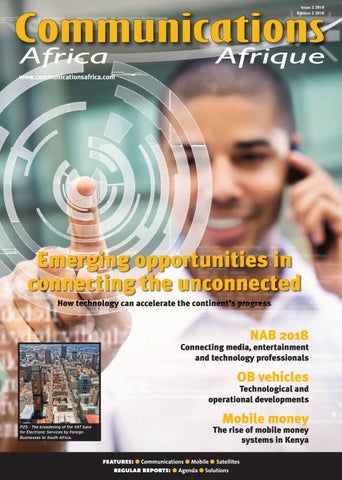
Emerging opportunities in connecting the unconnected How technology can accelerate the continent’s progress
NAB 2018 Connecting media, entertainment and technology professionals
OB vehicles Technological and operational developments
Mobile money P25 - The broadening of the VAT base for Electronic Services by Foreign Businesses to South Africa.
The rise of mobile money systems in Kenya features: ● Communications ● Mobile ● Satellites regular reports: ● Agenda ● Solutions
S01 CAF 2 2018 Start_Layout 1 27/03/2018 15:45 Page 2
S01 CAF 2 2018 Start_Layout 1 28/03/2018 14:43 Page 3
CONTENTS
Issue 2 2018 Édition 2 2018
Africa
Afrique
www.communicationsafrica.com
Emerging opportunities in connecting the unconnected
Agenda
4
Quotes
5
Events
8
How technology can accelerate the continent’s progress
NAB 2018 Connecting media, entertainment and technology professionals
OB vehicles Technological and operational developments
Solutions
Mobile money P25 - The broadening of the VAT base for Electronic Services by Foreign Businesses to South Africa.
34
The rise of mobile money systems in Kenya features: ● Communications ● Mobile ● Satellites regular reports: ● Agenda ● Solutions
FEATURES A note from the Editor
Networks
This issue of Communications Africa explores recent developments in broadcasting, digital money and ICT across the continent, identifying challenges and opportunities in these sectors. We look at the rise of 5G networks in Africa and disussions that took place at the recent Mobile World Congress show. Also on our events calender is the upcoming NAB show, which will bring together entertainment, media and technology professionals. We invite you to discover what is new for this year’s show. .
6
Communications Africa speaks to Ryan Burton, senior director international engineering at Aviat Networks about controlling telecoms backhaul costs.
Digital
12
Increased IoT penetration across use cases poses unique challenges for ICT policy-makers. Global management consultancy Arthur D. Little explores the big debates surrounding this and how ICT regulators can lead with holistic frameworks.
NAB 2018
17
NAB 2018 will welcome exhibitors and entertainment, media and technology professionals to the Las Vegas convention centre seeking to showcase and discover new technologies and connect with industry experts.
Broadcasting
18
Over the years OB vehicles and the equipment they carry have changed drastically. Steve Burgess CTO of Megahertz talks to Communications Africa about the importance of this to African broadcasters.
Une note du rédacteur Ce numéro de Communications Africa explore les développements récents dans la diffusion, l'argent numérique et les TIC à travers le continent, identifiant les défis et les opportunités dans ces secteurs. Nous regardons la montée en puissance des réseaux 5G en Afrique et les discussions qui ont eu lieu lors du récent Mobile World Congress. Le prochain rendez-vous du NAB, qui réunira des professionnels du divertissement, des médias et de la technologie, sera également au calendrier de nos événements. Nous vous invitons à découvrir ce qui est nouveau pour le spectacle de cette année.
Satellites
20
High count low earth orbit satellite constellations have a critical role to play in future Internet connectivity. Geoff Varrall, executive director of RTT, looks at why they need to be integrated with MEO, GSO and terrestrial 5G networks.
ARTICLES Nouvelles
7
Les dernières actualités en matière de communication des pays francophones
Monnaie numérique
28
Les dernières actualités en matière de communication des pays francophones
Les données
30
Dustin Homer directeur des solutions clients explique comment l'analyse des données devient de plus en plus un outil utile dans la prise de décision pour les gouvernements et les entreprises à travers le continent
Editor: Hiriyti Bairu - caf@alaincharles.com Audit Bureau of Circulations Business Magazines
Editorial and Design team: Prashant AP, Miriam Brtkova, Deblina Roy, Rhonita Patnaik, Rahul Puthenveedu, Samantha Payne, Nicky Valsamakis and Louise Waters Managing Editor: Georgia Lewis Production: Srinidhi Chikkars, Nelly Mendes and Rakshith Shivakumar Email: production@alaincharles.com Publisher: Nick Fordham Sales Director: Michael Ferridge Magazine Sales Manager: Vinay T Nair - Tel: +91 80 68888847, Email: vinay.nair@alaincharles.com Country India Nigeria UAE UK USA
Representative Tanmay Mishra Bola Olowo Graham Brown Michael Ferridge Michael Tomashefsky
Telephone +91 80 65700911 +234 8034349299 +971 4 448 9260 +44 20 7834 7676 +1 203 226 2882
www.communicationsafrica.com
Fax
Email tanmay.mishra@alaincharles.com bola.olowo@alaincharles.com +971 4 448 9261 graham.brown@alaincharles.com +44 20 7973 0076 michael.ferridge@alaincharles.com +1 203 226 7447 michael.tomashefsky@alaincharles.com
Head Office: Alain Charles Publishing Ltd University House 11-13 Lower Grosvenor Place London SW1W 0EX, United Kingdom Telephone: +44 20 7834 7676 Fax: +44 20 7973 0076
Middle East Regional Office: Alain Charles Middle East FZ-LLC Office L2-112, Loft Office 2, Entrance B, PO Box 502207 Dubai Media City, UAE Telephone: +971 4 448 9260 Fax: +971 4 448 9261
Subscriptions: circulation@alaincharles.com Chairman: Derek Fordham Printed by: Buxton Press Printed in: March 2018 Communications Africa/Afrique is a bi-monthly magazine ISSN: 0962 3841
Serving the world of business
Communications Africa Issue 2 2018
3
S02 CAF 2 2018 Agenda_Layout 1 27/03/2018 17:32 Page 4
AGENDA
Sudatel partners with Liquid Telecom on FTTH
ERICSSON HAS PARTNERED with Vertiv and NorthStar to create the Ericsson Energy Alliance, a complementary site solution partnership that aims to drive cost-effective and sustainable service provider network evolution towards 5G, within the Ericsson Radio Site System. Together with Vertiv’s global expertise in power, thermal and infrastructure site management solutions, and Sweden-based NorthStar’s leadership in battery and energy storage solutions, a competitive ecosystem and management interface will be formed, with an increase in the market share of the Enclosure and Power parts of the system portfolio. Alliance partners have also created a harmonised ecosystem for energy supply and storage. Sustainability benefits include: equipment to reduce energy consumption, the use of renewable and hybrid energy resources, efficient operations to reduce carbon footprint, remote energy management and hybrid site solutions, including solar cell panels. Energy and climate systems have been optimised to use the minimum required energy to provide an electronic trusted environment for Ericsson Radio System products. According to the companies, future joint-development of products is being considered. Giordano Albertazzi, president for Vertiv in Europe, Middle East, and Africa, said: “This Alliance reflects our relentless focus on R&D as a key to addressing the numerous challenges of this fast-paced digital world. The partnership with Ericsson allows our companies to join forces and achieve long-term, profitable growth by becoming even more incisive and competitive in the market.” Nishant Batra, Head of Product Area Network Infrastructure, Ericsson, stated: “Network evolution begins at the site. This is a true complementary partnership. The alliance members are combining the best of their radio site technology, skills, and abilities to bring a broadened, more flexible, and competitive portfolio to the table to help service providers in their 5G evolution through the Ericsson Radio System.”
4
Communications Africa Issue 2 2018
MDXI DATA CENTRE has joined forces with satellite operator Avanti to host and manage Avanti’s in-country gateway earth station (GES) in West Africa. The partnership has already delivered the commissioning of Avanti’s first GES in West Africa, hosted at MDXI’s satellite farm in Lagos. The HYLAS 4 Ka-band satellite will deliver High Throughput Satellite (HTS) connectivity to complement the country’s existing fibre-optic networks. Gbenga Adegbiji said: “Our partnership with Avanti provides Nigeria with the opportunity to make accelerated broadband expansion possible via satellite, to overcome last-mile gaps experienced in fibre infrastructure and enable the attainment of 30 per cent broadband penetration target in the national broadband plan.”
Teraco to expand its African offering TERACO, AFRICA’S LARGEST vendor neutral colocation data centre provider has expanded its African offering. According to CEO, Lex van Wyk, the African data centre market is still rising: “The potential for local growth is immense. Teraco Cape Town The African market grew an estimated 15.8 per cent in 2017, with South Africa being one of the top growth locations.” Teraco’s total power provision has risen to 50MW, nearly doubling annually since opening its doors in 2008. Paradoxically, while the African market is believed to be at the beginning of its cloudinspired journey, Teraco has already made huge progress in assisting several strategic cloud brands to enter the market: “South Africa is well positioned geographically to service the needs of sub-Saharan Africa and on a colocation basis, it is larger than the next 20 African markets combined.” Behind this growth trajectory is the story of Teraco. “Teraco has now built four fully-operational data centres and launched Africa’s first hyper-scale facility,” says van Wyk, “Core to our service offering is that all Teraco data centres are truly vendor neutral, highly connected and content rich interconnection hubs.” Van Wyk added: “The next generation of applications and IT architecture will drive power density demands to levels not seen in traditional data centres. This power-hungry environment will be the driving force modernising legacy data centres. Cooling capacities and uptime requirements will also increase.” He noted that Teraco remains focused on ensuring that the data centre has the best energy efficiency designs and technology deployed during all future expansions and new builds.
www.communicationsafrica.com
Photo: Teraco
Ericsson joins forces with Vertiv and NorthStar
MainOne partners with Avanti
Photo: Liquid Telecom
SUDATEL TELECOM GROUP has partnered with panAfrican telecoms group Liquid Telecom to build new FTTH networks across Sudan for the first time. The two companies signed a memorandum of understanding (MoU) at the 2018 Mobile World Congress show held in Barcelona, Spain. The MoU was signed by Eng. Tarig Hamza Zain Alabdeen, CEO of Sudatel Telecom Group, and Nic Rudnick, Liquid Telecom Group CEO, in the presence of Dr. Abdul Rahman Dirar, chairman of the board of directors at Sudatel Telecom Group and Sudan’s state minister at the Ministry of Finance and National Economy, Dr. Tahani Abdullah, Sudan’s minister of Left to right: Tarig Hamza Zain Alabdeen, CEO of Sudatel Telecom Group, and Nic Rudnick, Liquid Telecom Group CEO. communications and information technology, Sam Nkusi, East Africa chairman of Liquid Telecom, and David Eurin, group chief strategy officer of Liquid Telecom. According to Sudatel, the firm will build FTTH networks in Sudan designed to meet network standards and using the latest technologies. The networks are expected to deliver speeds initially up to 100Mbps and are similar to networks already deployed in Zimbabwe, Zambia, Kenya and Rwanda by Liquid Telecom, Sudatel revealed. The new deal will leverage Liquid Telecom’s extensive experience in deploying high-speed networks to increase the broadband capacity and speeds available to homes and businesses in Sudan. Tarig Hamza Zain El Abdein, CEO of Sudatel Telecom Group, said: “Our partnership with Liquid Telecom will enable us to provide a high-quality FTTH network, which will help uplift people’s lives through our region’s economic development.” Liquid Telecom has built Africa’s largest independent fibre network, spanning more than 50,000 km in Eastern, Southern and Central Africa, where it is delivering quality and affordable broadband to homes and businesses through its FTTH services. Nic Rudnick, Group CEO of Liquid Telecom, stated: "Liquid Telecom has a proven track record of bringing world-class fibre networks to previously underserved regions of Africa."
S02 CAF 2 2018 Agenda_Layout 1 28/03/2018 14:33 Page 5
QUOTES
Egypt’s ICT sector outlook remains bullish. The country has high Internet penetration with more than 30mn users and this will continue to grow with a rapidly-expanding techsavvy workforce.”
“
“
- Noura Hassan
- Anthony Bartolo
Managing director Trend Micro North Africa and Levant
Chief product officer Tata Communications
“
The mobile industry continues to play an increasingly important role in the socio-economic development of the African region. As Nigeria swiftly becomes a mobile first country, with mobile phone penetration currently at 84 per cent of the population, Jumia is doing its bit to close the gap with sales initiatives such as Jumia Mobile Week.”
IoT has the potential to transform how businesses operate, streamlining processes to save time and resources – but many IT decision makers haven’t embraced these technologies because of security fears,”
“
The power of connected technology to solve issues and truly change lives across Africa, by enabling service provision for even the most remote or disempowered members of its communities, cannot be underestimated.”
“
With the adoption of mobile broadband technology, public safety networks can benefit from the advantages of interconnectivity, fast and reliable broadband data and real-time video services, opening new communications possibilities for rescue missions and disaster recovery situations.”
- Jan Liebenberg
- Jeremy Potgieter Regional head SADC
“
Our partnership with Didier Drogba has helped raise awareness, not only for our digital offering, but for enhancing financial literacy and improving accessibility to financial services across Côte d'Ivoire.”
“
With the latest advances in financial technology (fintech) and cloud software, Rwandan MFIs now have access to powerful, affordable tools that can help them transform inefficiencies into operational excellence, scale their businesses for rapid growth and get better visibility into the performance of their portfolios.”
- Juliet Anammah
- Isaac Foly
- Vedran Lescan
CEO Jumia Nigeria
CEO, Côte d'Ivoire Standard Chartered Bank
Business development manager Oradian
www.communicationsafrica.com
Head of market and business development for Southern Africa Nokia
Communications Africa Issue 2 2018
5
S02 CAF 2 2018 Agenda_Layout 1 27/03/2018 17:32 Page 6
NETWORKS
Interview
Budgeting for backhaul How are the mobile backhaul requirements of sub-Saharan Africa different from those of, say, Europe? RB: By far the number one challenge in Africa is the infrastructure required to support the backhaul network. Towers are often in remote areas, so accessing them for maintenance is costly and timeconsuming, and the majority do not have access to a power supply grid of any sort, and therefore depend on generators to power the site. These generators and batteries – and delivery of diesel to keep those generators running – drive up the operational costs significantly. The drive then is to reduce how much power the site uses to reduce site visits. The airconditioning cooling the equipment on site must be as small as possible. The microwave and other equipment on site must be reliable and use as little power as possible – including reduced or no dependence on air-conditioning (not easy in Africa’s heat). Specific to microwave, the single biggest impact is to move from traditional all-indoor microwave systems (which are power-hungry and need to be cooled) to a split-mount or alloutdoor system that moves the majority or all of the heatemitting elements onto the tower where they are environmentally cooled. The traditional large airconditioned container can then be replaced with a weatherproof cabinet with little to no airconditioning. Using this
The growing demand for telecommunications is driving increasing needs for both fibre and microwave everywhere. 6
Communications Africa Issue 2 2018
Photo: Aviat Networks
Are African networks spending too much on backhaul? In the first of two articles on the topic we asked Ryan Bruton senior director international engineering at Aviat Networks*, a specialist in microwave networking products and services, about controlling telecoms backhaul costs.
Ryan Bruton, senior director international engineering at Aviat Networks.
principle, Aviat Networks has reduced power and increased capacity from the traditional allindoor 4+1 radio – providing 900Mbps requiring 550W and significant cooling – to the WMT4500 trunk radio system providing up to 5Gbps using only 320W – and which can be deployed all-outdoor. Where is microwave needed in African mobile communications backhaul? Remote and rural areas? Or sometimes urban or peri-urban? RB: In short, everywhere. The growing demand for telecommunications is driving increasing needs for both fibre and microwave everywhere. In rural and inter-city communications the backbone networks are fibre, microwave or (usually) a combination of both. In urban areas, where an aggregation site, an LTE cell site or a 3G cell site can be reached with fibre, the operators will look to do so, but it is often too expensive or too timeconsuming. Microwave can be deployed faster than fibre with less time-consuming approvals, and higher reliability (fibre is at risk from fibre cuts caused by construction work etc).
How have approaches to microwave technology evolved? Is it a challenge to fibre or mainly a viable alternative when no other approach is feasible? RB: It’s a difficult question, with no cookie-cutter model that fits all, depending on many different variables. Fibre can support higher capacities than microwave, but microwave has evolved to support more than enough capacity for the majority of needs – we are designing 2, 5 and even 10Gbps networks today based only on microwave, but microwave does require access to (sometimes) costly or hard-to-get spectrum. Microwave is faster and easier to deploy than fibre, but does so in shorter hops between infrastructure sites. In short, microwave and fibre do overlap and compete in certain cases, but more often than not are complementary to each other; the expansion of one drives the need for the other. Where the two challenge each other it is usually a matter of CTO or transmission planner preference, or deployment practicalities that drive the choice between the two. ✆
www.communicationsafrica.com
S02 CAF 2 2018 Agenda_Layout 1 28/03/2018 14:34 Page 7
AGENDA
Ecobank’s African markets website goes live, profiling Francophone West Africa
Photo: Adobestock
Siemens et Orange signent un contrat de 240 M €
Siemens Digitalisation Network connectera 1, 500 sites dans 94 pays
SIEMENS AG, SOCIÉTÉ mondiale d'ingénierie électronique et électrique, a annoncé son important contrat avec Orange Business Services pour un « réseau de numérisation Siemens » mondial (SDN) établi sur une infrastructure SD-WAN, reliant 1 500 sites dans 94 pays. Selon les deux entreprises, un certain nombre de pays du continent seront affectés par l’accord, notamment l'Algérie, l'Angola, l'Égypte, le Kenya, la Libye, le Mozambique, le Nigeria, l'Afrique du Sud et la Tanzanie. Selon ce nouveau contrat de six ans d’une valeur de 240 M €, Orange Business Services se déplacera de l’ensemble la structure mondiale de Siemens vers ce qui est décrit comme « un réseau SD-WAN dynamique et flexible ». Cela permettra de connecter à la fois les applications en nuages et les périphériques d’IdO. Siemens a noté que cela permettra à l'entreprise de tirer pleinement parti de la numérisation ultérieure pour améliorer ses processus d’industrie 4.0. « Nous avons choisi Orange Business Services car nous le considérons comme un partenaire privilégié capable de fournir une couverture SD-WAN mondiale sans faille avec le plus haut niveau de sécurité - en particulier pour se protéger des menaces sur Internet, pour la qualité de service, pour le support local et le rapport qualité-prix attractif », a déclaré Frederik Janssen, responsable du portefeuille et de la stratégie l’infrastructure informatique de Siemens. « Nous avons également été impressionnés par la flexibilité et le niveau de service qu'offre Orange Business Services en tant que partenaire de confiance de Siemens depuis plusieurs années », a-t-il ajouté.
www.communicationsafrica.com
Cape Verde is one of the francophone countries to be featured on Ecobank's AfricaFICC website.
Photo: Adobestock
FRANCOPHONE WEST AFRICA leads in intra-regional trade with trade hotspots around Dakar, Abidjan, Cotonou and Lomé, according to analysis by Ecobank’s research team in its new website, AfricaFICC. Ecobank revealed its flagship Africa Fixed Income, Currency and Commodities Guidebook (FICC) have been updated and made available as an online resource: https://Ecobank.com/AfricaFICC. The website provides key facts for businesses and investors on the economies of sub-Saharan Africa and sector activity. The first regional section of the website to go live is Francophone West Africa. This covers nine countries: Benin, Burkina Faso, Côte d'Ivoire, Cape Verde, Guinea-Bissau, Mali, Niger, Senegal and Togo. Together they make up the Union Economique et Monétaire Ouest-Africaine (UEMOA). The website gives a country-by-country analysis of each country, with an economic outlook, details on the FX, FI and banking sectors, and overview of the mineral, energy and soft commodity sectors, as well as key trade flows. Data for Francophone West Africa reveals that, despite geographical differences, the region is one of the best integrated economic and monetary zones in Africa, bolstered by the shared currency (the CFA franc), the common legal system (OHADA) and the French language which has fostered economic integration and intra-regional trade.
The region’s economy is driven by agriculture, mining, hydrocarbons, trade and financial services, while Côte d’Ivoire is the world’s largest producer of cocoa and Africa’s largest regional producer of cotton and palm oil.
Avaya s'associe avec Intraconsult Telecom LA SOCIÉTÉ DE communication d'affaires mondiale Avaya a annoncé travailler avec Intraconsult Telecom pour aider les organisations en Égypte à atteindre leurs objectifs de transformation numérique. Les deux sociétés travailleront ensemble pour encourager l'adoption des solutions innovantes d'Avaya dans les principaux marchés verticaux de l'industrie en Égypte. Cela devrait apporter des expériences de communication plus riches à leurs clients et employés. Depuis sa création en 2001, Intraconsult Telecom a apporté des solutions de télécommunications mondiales aux organisations publiques et privées à travers l'Égypte. L'entreprise Intraconsult Telecom spécialisée dans les plates-formes multiservices comme solutions de communication, fournira des solutions Avaya pour les principaux marchés verticaux de l'industrie, notamment l'hôtellerie, le gouvernement, l’industrie pétrolière et gazière, de même qu’il ciblera le secteur des PME. La conduite de la transformation numérique (DX) est importante pour les DSI en Égypte, deux tiers des organisations ayant initié ou prévoyant de mettre en œuvre des stratégies DX, selon l’enquêteur IDC. Les solutions Avaya sont utilisées par des organisations du monde entier et de toute la région, notamment les cinq plus grandes banques égyptiennes, les trois principaux opérateurs de télécommunications et la plus grande entreprise d'externalisation des processus d’affaires (BPO) du pays. Selon Avaya, plus de 70% de l'infrastructure des centres de contacts en Egypte repose sur la technologie Avaya. « En tant qu'organisme centré sur la clientèle, ce partenariat stratégique nous permettra de continuer à placer le succès de nos clients au cœur de tout ce que nous faisons. En exploitant la technologie innovante d'Avaya, nous pouvons offrir à nos clients un plus grand choix de solutions répondant à leurs besoins, tout en les aidant à améliorer leur efficacité et leur apporter des expériences de communications plus riches », a déclaré Eric Adam, propriétaire et chef de direction d'Intraconsult Telecom. « Avaya s'engage à protéger les investissements existants des clients dans la technologie tout en leur donnant la liberté de définir et de développer leurs propres expériences. Nous sommes impatients de travailler avec Intraconsult Telecom pour apporter les solutions de communication qui favorisent une croissance plus forte dans le monde numérique actuel en évolution rapide », a déclaré Fadi Moubarak, Vice-président des réseaux chez Avaya International.
Communications Africa Issue 2 2018
7
S03 CAF 2 2018 Events_Liquid telecom_Layout 1 28/03/2018 16:14 Page 8
AGENDA
Events/Événements 2018 APRIL/AVRIL 9-10
Cloud MENA
Dubai, UAE
tmt.knect365.com/cloud-world-mena
18-21
Global Sources Mobile Electronics Show
Hong Kong, China
www.globalsources.com
23-26
MVNOs World Congress
Madrid, Spain
tmt.knect365.com/mvnos-world-congress
21-27
Nabshow
Las Vegas, USA
www.nabshow.com
1-3
GISEC
Dubai, UAE
www.gisec.ae
1-3
ioTx
Dubai, UAE
www.iotx.ae
8-10
ITTF Pristina
Pristina, Kosovo
www.ceokos.com
9-11
Mobile Solutions Expo
Tokyo, Japan
www.reedexpo.co.jp/en
15-16
East Africa Com
Nairobi, Kenya
tmt.knect365.com/eastafricacom
24-25
IoT World Forum 2018
London, UK
www.iotinternetofthingsconference.com
11-15
CeBIT
Hannover, Germany
www.cebit.de
22-23
Mobile IT
Krakow, Poland
www.targi.krakow.pl/gb
27-29
Smart Tech Korea
Seoul, South Korea
www.smarttechshow.co.kr/english
MAY/MAI
JUNE/JUIN
CLOUD MENA 2018, one of the leading events for CIOs, CTOs, CEOs, directors of IT, security managers and visionaries for cloud and new technologies, will be held in Dubai from 9-10 April 2018. With its revived format as a standalone event and a programme packed with networking, the event is set to bring major cloud experts from the MENA region to discuss the present challenges and future direction of cloud in the region. Specific networking opportunities, such as smart networking, guided exhibition tours and one-to-one meetings along with a dynamic conference programme will keep visitors informed about the latest developments of cloud in MENA. The event will provide an interactive platform to establish new networking opportunities among industry professionals. Some of the important topics to be discussed in the event include use cases of technologies in digital cities, how the cloud of things is empowering tenants in smart cities and more. The event will focus on the excellence in the MENA region’s cloud community, and offer an exceptional opportunity for the industry’s top players to meet, showcase their achievements and be inspired. The event will also feature awards after the first day of the conference. The award will be given in following categories: Best CIO in MENA This will recognise the work, experience and expertise of a CIO who has contributed significantly to their own company and to the whole region, in the area of IT transformation through high quality of work and effective cooperation with partners and vendors. The judges will be looking for an exemplary individual who leads the way in new practices, implementing new technologies, outstanding management of both technology and strategy and high level of expertise in every aspect of information technology, including Cloud. Most influential cloud person of the Year This award will recognise an individual in the cloud Industry, who is currently employed in an enterprise, vendor company, in government or as a consultant. The application for this category will show how this individual has contributed to the cloud industry in the region and to new developments in cloud technologies globally. The judges will be looking for an exemplary individual
8
Communications Africa Issue 2 2018
Photo: : Sergey Nivens/Adobe Stock
What is Cloud Mena 2018 all about?
The event will provide opportunity to gain knowledge and understand the dynamics of cloud services in the MENA region.
who is a true guru in the industry, able to influence the current developments for cloud in the region and future of cloud-based technologies globally. Best cloud implementation in the private sector The judges are looking to award an organisation in the private sector who has either deployed cloud internally (an enterprise in any vertical sector) or has helped other organisations in the private sector (enterprises) deploy cloud. The application in this category will show how the organisation’s deployment of cloud maximised the simplicity and security while minimising the cost of IT. The application should showcase how the organisation, its employees and customers now benefit from cloud and how it can enable further agility, scalability, collaboration and a facilitated development environment in the most cost efficient, high quality, innovative way. The winners will be announced on 9 April 2018, at the Jumeirah Beach Hotel, in an awards ceremony after the conference. In addition, the conference will focus on enterprise experiences in the region, with the latest international best practice, but also local, regulatory and security issues. The one-track programme is expected to ensure that everyone can benefit from the whole range of informative content across both days of the event, without missing a session.
www.communicationsafrica.com
S03 CAF 2 2018 Events_Liquid telecom_Layout 1 27/03/2018 15:47 Page 9
DIGITAL
Future innovators
The generation that will define Africa’s digital future A new generation is emerging across Africa who have never known life without the Internet or social media. How will their new ideas and approaches alter the workplace?
Photo: Liquid Telecom
Africa’s youth are poised to drive massive digital innovation.
Y 2020, THE digital economy is estimated to account for more than 26 per cent of global GDP, presenting Africa with a huge opportunity to be a part of the new digital world order. Across the region, businesses and governments are taking steps to ensure that Africa can compete in the digital age. Digitalisation is expected to bring an additional US$300bn to Africa by 2026, and with this comes an expanding digital sector that can fundamentally change how people live and work. However, in order for Africa to fulfil its digital potential, a new generation needs to step forward with fresh ideas, a hunger to learn digital skills and a passion to use technology for the better of everybody. Welcome Generation Z.
B
the region. Technology is empowering Gen Z to do things no other generation before them could. Access to information online has reduced dependency on traditional teaching methods, enabling young Africans to teach themselves coding and other IT skills. This is creating a culture of entrepreneurship amongst young adults, who are questioning traditional ways of working and adopting new approaches to tackling problems. As this report highlights, the next generation are demonstrating an enormous passion and appetite for technology. Although what is particularly heartening is how many of them aren’t motivated by personal economic gain, but by the goal of using innovation to solve some of the region’s largest problems and improve lives.
The rise of the innovators Africa’s next innovation driver Born between 1995 and the early 2000s, Generation Z is the first to have never known life without the Internet or social media, which has shaped their attitudes and abilities to operate online. Gen Z are not just comfortable with rapidly changing technology - they are set to become the authoritative figures on technology in the modern workplace. The African Gen Z Report 2018 takes an indepth look at how Gen Z could shape business and innovation in Africa in the years to come. From examining how Gen Z will consume digital services to analysing what new digital skills will be critical in the not-so-distant future, the report gathers insight and opinion from across www.communicationsafrica.com
With their natural Gen Z affinity for technology, Africa’s youth are poised to drive massive digital innovation, which presents both employment opportunities for them and socioeconomic development hope for their countries. Oswald Jumira, group head of Innovation Partnerships for Liquid Telecom Group, works closely with global vendors, innovation hubs, startups and other strategic partners across the Liquid markets to implement the group’s innovation strategy. In recent months, Jumira has focused closely on efforts to partner with innovators and startups across Africa. Many of these innovators are ‘cusp Millennials’ and Gen Zs, he reports. “We are seeing massive innovation
coming out of Africa, much of it from very young entrepreneurs. It’s encouraging.” Jumira believes innovation hubs and the efforts of large enterprise to take ICT skills development to school-age youths is helping drive this groundswell of innovation among Africa’s youth. “Across Rwanda, Uganda, Kenya and Tanzania, for example, there is a lot of activity in terms of teaching the youth to develop apps. And many of the award-winning and most promising apps coming out of Africa, designed by the youth, address uniquely African problems,” he says. Africa’s Gen Z is displaying value systems that differ from those of their predecessors, says Jumira. “They are growing up in a global sharing economy, so they have a new approach to ownership of goods. They are very passionate about what interests them and will immerse themselves in it. They are also very entrepreneurial, confident, and less likely to want to work for a boss.” While these traits may be encouraging in terms of Gen Z’s potential to innovate, Jumira believes they will also force change in the traditional workplace. “This generation is impatient and dynamic, they adapt to change easily. So they might get frustrated by the ‘old guard’ and traditional ways in the workplace. They don’t want to be taught so much as to self-teach in an environment that facilitates this.” ✆
To find out more, download the full African Gen Z Report 2018 exclusively from: www.liquidtelecom.com Communications Africa Issue 2 2018
9
S03 CAF 2 2018 Events_Liquid telecom_Layout 1 27/03/2018 15:47 Page 10
S03 CAF 2 2018 Events_Liquid telecom_Layout 1 27/03/2018 15:47 Page 11
S04 CAF 2 2018 Report 01_Layout 1 27/03/2018 15:49 Page 12
DIGITAL
IoT
As the IoT develops everywhere, policies and regulations must catch up The Internet of Things (IoT) will affect every area of our lives in Africa and around the world. However, its utility depends on data, which can easily be exploited at the expense of the privacy and security of those who own or provide that data. EGULATION OF THE IoT has been largely reactive, ostensibly to encourage experimentation and a wait-and-watch approach. The current trend is to keep regulations case-specific as and when required, as we have seen with drones and customer data protection. Few instances of integrated policy frameworks are in place. For example, the State of New York’s policy covers data privacy and security, as well as making information about local IoT infrastructure public and sharing it through public-private partnerships. Telecom operators and regulators have historically focused on person-to-person (P2P) telecommunications services. But as the IoT ecosystem involves interaction between telecommunications and a range of new services and M2M communications (as shown in Figure 1), IoT use cases blur traditional industry-specific boundaries and challenge the governance of industry verticals by respective sector authorities. (See Figures 2 and 3).
R
Six key areas of IoT development Licensing & spectrum Traditionally, telecom regulators have been involved with type approval of telecom equipment. However, as IoT devices evolve, connected things will get to a level of autonomy that will have legal implications (e.g., connected cars). IoT regulation will have to define the responsibility chain and ensure IoT devices can be traced back to legally responsible persons and entities. To cater to the growth of IoT devices, regulators will have to assign more spectrum in both licensed and unlicensed bands. At
12 Communications Africa Issue 2 2018
Figure 1: The Internet of Everything and Everyone
Telecommunications servicess, including P2P
IoT devices
IoT service es
M2M
S Source: A th D. Arthur D Little Littl
least in the near future, a significant proportion of IoT devices will use personal area networks (Wi-Fi) to access the Internet. (See Figure 4.) In multidwelling units and dense urban areas, many people are already experiencing degradation of their Wi-Fi connections.
service providers if over-the-air remote provisioning is not implemented. Telecom regulators will have to decide the circumstances under which overthe-air remote provisioning is to be mandated and how portable contracts should be.
Addressing & numbering Switching & roaming Integrated deployment of IoT devices at scale risks large customers being locked in with specific technologies, operators or
The increased volume of IoT devices will still drive up demand for numbering resources, despite a significant amount expected on personal area networks. Many
regulators are already considering reserving specific number ranges for IoT usage. In many countries, pricing for numbering resources is based on unit revenue from traditional services, which is significantly higher than the unit revenue expected from many IoT services. Therefore, even pricing of numbering resources will have to be re-assessed.
Competition As IoT standards are still emerging, there is potential danger in not
Figure 2: Enhanced role for ICT service providers
Customer
Telecommunications
Energy & utility
Government
Building autom mation
Medical & health
…
Service provider System integrator Service enabler Network operations
The “IoT” is trra r nsf sforming the way different verticals are doing business
Connectivity Hardware Source: Arthur D. Little analysis
ICT service providers’ play
www.communicationsafrica.com
S04 CAF 2 2018 Report 01_Layout 1 27/03/2018 15:49 Page 13
DIGITAL
IoT
Privacy & security
Figure 3: Vertical overlap in use cases c
Autonomous cars
T Transportation ?
ICT?
Smart metering
U Utilities?
ICT?
Mobile payments
Financial F s ices? serv
ICT?
Remote health m itoring mon
Healthcare? H
ICT?
F Flood sensors
Environmental?
ICT?
…and manny more! Source: Arthur D. D Little
Figure 4: IoT devices by connecting technology, globally, 2015-2021 Fixed
WPAN/WLAN
Cellular
LPWA
Satellite
Billion devices 7.8 12%
7
6.6
6 5
4.5
4
3.7
3
11% 3.0 11% 2%
2
2.3 12% 1%
1
72%
0
72%
3%
72%
6%
11%
5.5 8% 11%
12%
11% 11%
67% 69%
70%
68%
15%
15%
14%
13%
11%
10%
9%
2015
2016
2017
2018
2019
2020
2021
Source: Statista and Arthur D. Little analysis
being able to derive benefits from the IoT if it lacks interoperability from both data and technology perspectives. There are a number of initiatives under way to facilitate interoperability through opensource developments: In 2014, the Institute of Electrical and
Electronics Engineers (IEEE) initiated an effort to develop open standards for the IoT industry. Regulators are increasingly expected to remain technology neutral and allow market forces to decide the best technology standards to emerge.
IoT devices are already being used in both consumer and industrial contexts, including smart grids, building automation and wearable computing. This creates many more entry points for hackers and leaves sensitive information vulnerable. As technologies are still being developed and few industry-wide standards are in place, often products are launched into the market with old and unpatched embedded operating systems and software. National policy-makers will have to establish or adopt data management frameworks to define data classification based on the extent of adverse impact on individuals from use or disclosure of their data. These will provide clear directions on data gathering, transmission, storage, processing and distribution. The regulation for personal data processing must fulfill six key principles (see Figure 5), including data minimisation, storage limitation and integrity and confidentiality of data.
Sharing of public IoT infrastructure There is a need to develop public policy defining the requirements for IoT infrastructure deployment and sharing in public places, such as traffic sensors. Policy-makers will have to decide on a number of parameters including standards to use, points of interconnect, services to be made available to private players and the mode of
Lawfulness, fairness and transparency … processed lawfully, fairly and in a transparent manner in relation to the data subject
Integrity and confidentiality
Storage limitation … permitting identification of data subjects for the time necessary for the purposes for which the personal data is processed
Purpose limitation
Personal data processing principles Personal data shall be…
Accuracy … accurate and, where necessary, kept up to date Source: Arthur D. Little analysis based on EU Regulation 2016/679, article 5
www.communicationsafrica.com
By IoT can IoT
Leading with a clear regulatory framework A clear regulatory framework can accelerate development of an IoT ecosystem and make it more sustainable, through the following key benefits: • Accelerate development of the ecosystem through progressive market stimulation, such as increasing market clarity and promoting entrepreneurship • Enhance national security through increased security of the overall ICT environment • Enhance protection of rights and interests of users (individuals, enterprises and government) To achieve benefits, clear articulation of the country’s or region’s context, vision and objectives is essential. The IoT regulatory framework can be designed with intent to intervene in market development in a minimal manner. IoT use cases can be classified based on a number of criteria, including industry verticals and criticality of use cases. These include an evolutionary approach (regulate as developments are made), leading and coordinating policy (working with other governing bodies), and committed implementation (updated as needed).
Conclusion
Figure 5: Personal data processing
… processed ensuring appropriate security
public-private partnership. allowing greater use of infrastructure, policy-makers foster the rapid growth of ecosystems in countries.
… collected for specified, explicit and legitimate purposes and not further processed
Data minimization … adequate, relevant and limited to what is necessary in relation to the purposes for which it is processed
Faced with this challenge, successful policy-makers will be those that can identify the right level of regulation and lead in cross-sector coordination. Following the implementation of a first set of regulations, the swiftness around assessing the created impact, as well as making corresponding periodic adjustments as required, will be the strongest driving force in developing a progressive and sustainable IoT ecosystem. ✆
Rajesh Duneja, Hariprasad Pichai, Andrea Faggiano and Thomas Kuruvilla, Arthur D. Little
Communications Africa Issue 2 2018
13
S04 CAF 2 2018 Report 01_Layout 1 27/03/2018 15:49 Page 14
S04 CAF 2 2018 Report 01_Layout 1 27/03/2018 15:49 Page 15
S05 CAF 2 2018 Report 02_Layout 1 28/03/2018 16:25 Page 16
SATELLITE
Avanti
Growing communications across Africa
HYLAS 4 satellite.
YLAS 4 WILL use the latest Ka-band technology, providing high speed satellite connectivity across the UK and Europe, the Middle East and Africa. With 64 Ka spot beams, HYLAS 4 will extend Avanti's coverage across Africa, providing more capacity in East and Southern Africa, and opening new markets for the satellite operator in West and Central Africa. Furthermore, the HTS (High Throughput Satellite) has four steerable beams which can be pointed to provide additional capacity in existing regions or steered to address new markets. Avanti provides capacity to a broad range of customers who require reliable, secure and cost-effective satellite
H
HYLAS 4 is a futureproof solution that supports growth across Africa.
16 Communications Africa Issue 2 2018
communications for various applications. HYLAS 4 will set the new standard of reliable, high quality and flexible communications for Internet Service Providers who require broadband for home and SMEs as well as complex connectivity solutions for large Enterprises facilitating applications such as IP trunking, MPLS, and Business Internet Continuity. Mobile Network Operators will be able to use HYLAS 4 and Avanti's existing fleet to extend and improve their 2G, 3G and 4G networks, through smart and proven satellite backhaul services. Avanti also works closely with local governments and organisations to deliver high speed satellite broadband to schools and local communities, enabling access to e-Learning and digital opportunities. The company's network also provides highly reliable and secure communications to the security and defence sector. HYLAS 4, along with Avanti’s existing coverage, provides capacity infill to other satellite
operators, who may have gaps in their coverage or require additional capacity. Avanti’s new satellite uses advanced Ka-band technology for high-throughput and greater efficiencies. Ka-band satellites have been designed to deliver high speed data services by offering significant advantages in comparison to Ku-band and Cband capacity. The new satellite will provide low cost broadband capacity due to the efficiencies resulting from the use of small spot beams which concentrate power and re-use spectrum. This also means that end-user terminals are smaller, cheaper and easier to install. And with higher capacity than regular Ku-band satellites, HYLAS 4 is a future-proof solution that supports growth across Africa. Moreover, HYLAS 4, as part of Avanti’s extensive network, allows customers to purchase an entire end-to-end, managed service from a single source. As one of the leading experts in delivering Ka-band communications across EMEA, Avanti has extended its
coverage to some of the most challenging places in the region. But it is not just a matter of operating a fleet of Ka-band satellites. The company has also invested on the ground. Avanti has built diverse Gateway Earth Stations (GES) in countries such as UK, Germany, Cyprus, Turkey, Nigeria and South Africa, with further GES planned for Senegal and Kenya. So not only does it work to meet the needs of having data traffic land in-country, it also creates local employment opportunities in ICT, engineering and communications, as Avanti works closely with a variety of local partners. By increasing broadband access by 10%, it can enable GDP to grow 1.4%*; HYLAS 4 covers 665 million people who could get access to the latest digital opportunities, which is why communication is so important for growth. ✆
For more information visit www.avantiplc.com/HYLAS4 * ITU report – Impact of broadband on the economy
www.communicationsafrica.com
Photo: Avanti
Avanti Communications adds HYLAS 4 to its existing satellite fleet and doubles the company’s capacity. David Bestwick, chief technical officer, discusses how the newest High Throughput Satellite is bringing the highest quality Ka-band satellite capacity to Africa.
S05 CAF 2 2018 Report 02_Layout 1 28/03/2018 14:36 Page 17
NAB SHOW
Event Preview
NAB Show: Driving the future of content With technology becoming an essential requirement in the exchange of global content, the NAB Show 2018 is set to explore some of the latest trends shaping the future of media and entertainment. HE FIELD OF media and entertainment is fast-changing in today’s world and technology is increasingly becoming an essential requirement for the exchange of global content. The convergence of media, entertainment and technology has impacted global audience in workflow, revenue streams and business models and has fit modern people in the new era of digital ecosystem. According to the industry experts, the dramatic changes in the digitisation are continuously evolving and the latest trends such as advanced advertising, artificial intelligence and machine learning, cybersecurity, virtual reality, streaming, augmented reality and many more are impacting the future of content from creation to consumption. This is the reason why the National Association of Broadcasters is set to organise NAB Show at the Las Vegas Convention Centre from 7-12 April 2018, to unveil ground-breaking technology, innovative solutions and gamechanging industry trends. The show is one of the world’s largest annual conferences for professionals who create, manage and distribute entertainment across all platforms. The world's most inspiring and celebrated thought leaders will assemble to share their stories, solutions, techniques and personal journeys, thus allowing the visitors to get big picture insights and critical details on the latest trends impacting emerging content. In addition, international companies are set to unveil their media management products and services during the show.
More than 200 live sessions will highlight future-focused solutions to create, manage, deliver and monetise content on any platform Schedule-at-a-glance Boris FX, a leading developer of VFX, compositing, titling, video editing and workflow tools, will showcase new versions of the industry's premier plug-ins —Continuum, Sapphire, and Mocha — in connection with the www.communicationsafrica.com
Photo: Robb Cohen Photography and Video
T
The changing face of TV across the globe.
brand new 2018 Boris FX App Manager during the show (Booth SL7620). Digital Nirvana will display cloud-based caption generation, caption synchronisation and video logging. On display will be the company’s media management platform and suite of broadcast monitoring products that establish a simple set up for content creation, capture, repurpose and delivery, while monitoring video and audio for quality and compliance. Product highlights such as CART/TS Transport Stream Analyse and Replay and Monitor IQ 5.2 will also be major areas in the Digital Nirvana booth ( Booth SU10121). TVU Networks, the global technology and innovation leader in live IP video solutions, will showcase a variety of new and updated IP based products and technologies at the show. The company will continue its technological advancements to HEVC, and will show its entire HEVC solution set integrated with its proprietary video transmission technology, Inverse StatMux Plus (IS+) (Booth C1707). Prime Focus Technologies (PFT) will its flagship CLEAR™ Media ERP solution that feature powerful Work Order Automation embedded with MAM. The latest solutions target the developing
needs of media and entertainment (M&E) industry customers dealing with complexity, volume, velocity and cost issues on the back of the OTT business models (Booth SL9605).
New this year New markets are the driving force behind the evolving digital ecosystem. The show will focus on some of the newest trends on the floor and in the classroom. • Sessions on how machine learning is transforming the media and entertainment industry. • The camera robotics display to represent the technology utilised in broadcast studios and at live events around the world. • Sessions on how to protect media and entertainment industry, be it film, subscription or broadcast TV, from being exposed to global piracy. • Spotlight on next-generation video game soon to hit the market. • Introduction of advanced solutions to create, distribute, monetise and industrialise next-reality content. • Explore tools to create and commercialise audio content. ✆ Communications Africa Issue 2 2018
17
S05 CAF 2 2018 Report 02_Layout 1 27/03/2018 17:30 Page 18
BROADCASTING
Newsgathering
Vehicles that make news
Photo: Megahertz
The supply of fully equipped vehicles for outside broadcast (OB) is an established and important part of modern newsgathering. Of course both OB vehicles and the equipment they carry have changed a great deal in recent years.
The Hummer OB vehicle.
VER THE PAST few decades outside broadcast (OB) technology has evolved to an extraordinary degree in terms of sophistication and capabilities – and this goes for OB vehicles as much as the equipment they transport. Megahertz Ltd’s expertise in systems integration for broadcasters includes building specialist outside broadcast vehicles, which it has done since its inception over 30 years ago, and, as CTO Steve Burgess explains, a lot has indeed changed in that time. For instance, you might assume that equipment has become more compact over the years – and you would be right. Burgess said: “There is no doubt that equipment is getting physically smaller for the same processing power. In the early days, encoders alone would fill 6RU [rack units] of rack space. Now they take up just half of 1RU. The very first OB vehicle we built, for Muslim TV, comprised of satellite equipment that occupied 46RU; we can now achieve the same functionality in just 2RU.”
O
18 Communications Africa Issue 2 2018
There has also, he explained, been a lot of development in software-based gear and cloud-based workflows, bringing further space savings.
In the early days, encoders alone would fill 6RU of rack space and now they take up just half of 1RU. Of particular importance to a number of African broadcasters (and anyone trying to do an OB in remote areas) is how well the vehicles are designed to deal with demanding terrain. Burgess says that Megahertz recently supplied a ‘chase’ car, built for the coverage of camel racing and other sports in the desert – which could easily transfer across into a newsgathering truck to handle tough terrain. He continues: “Based on a full-size luxury SUV Mercedes GL500 AMG, which carries both
the camera operator and commentator, the vehicle is fitted with a Cineflex stabilised camera on the roof. The main video and audio is linked back to the OB via a 2GHz COFDM transmitter fitted in the rear. The return video to the chase car is via an inexpensive DVB-T transmitter operating at UHF and the communications via VHF radios. We have also supplied many 4x4 Sprinter vans into Africa and the Middle East for newsgathering operations, and several on 4x4 pickups – and even a Hummer!” On the other hand one problem with the use of ever-more-sophisticated equipment is designing vehicles to house it – especially if it is complex or difficult-to-replace equipment. Burgess noted that in fact technology is now moving quickly away from bespoke hardware processing to IT-based processing. “However,” he adds, “off-the-shelf IT equipment isn’t generally designed with mobile broadcast vehicles in mind, so it’s up to systems integrators like Megahertz to source, test and
www.communicationsafrica.com
S05 CAF 2 2018 Report 02_Layout 1 27/03/2018 17:30 Page 19
BROADCASTING
recommend the most robust and most reliable versions available, as well as mount them in a way that will prolong life expectancy in an environment where endurance for fluctuations in temperature, vibration and humidity levels, from day to day, is critical.” As this is mainly a telecommunications magazine it seems only reasonable for us to ask about connectivity. How do companies like Megahertz meet the requirement for vehicles to access communications in countries or areas where newsgathering is required but no fixed or cellular communications exist? In fact says Burgess, “cellular data coverage is often more widespread than you would imagine. Typically, we would build-in multiple methods for linking the remote location back to base. Bonded cellular connectivity can have disadvantages, so we would usually suggest VSAT or occasionaluse satellite connectivity as an addition.” OB vehicles aren’t one size fits all, clearly. In fact Megahertz’ literature talks of designing vehicles for multiple needs, such as satellite newsgathering trucks, uplink vehicles, and radio vans. Why are these multiple vehicles necessary?
Steve Burgess CTO Megahertz.
As Burgess points out, different OB applications still do need different types of OB vehicle. “The low-cost, higher-volume end of the market is currently made up of mostly IPbased shoot/edit VSAT vehicles based on Mercedes Vito or VW Transporter-sized chassis,” he says. “Typically, these trucks are designed with a single operator in mind, usually for live breaking news situations – someone who will drive the vehicle, shoot the material, edit and send the package back to base via satellite or bonded cellular. Radio news vehicles can be even simpler.” As for the more traditional vehicles, those with an on-board generator, a large satellite dish, and enough space for two-to-three people and a small amount of production equipment are, he says, commonplace. “Those larger production units covering, say, big
Photo: Megahertz
We recently supplied a ‘chase’ car, built for the coverage of camel racing and other sports in the desert – which could easily transfer across into a news-gathering truck to handle tough terrain.
Photo: Megahertz
Newsgathering
Megahertz has been building specialist outside broadcast vehicles for more than 35 years.
www.communicationsafrica.com
sporting events or high-profile music festivals, are built on vehicles such as the 7000kg Iveco Daily panel van, or the Mitsubishi Fuso, with a box body to accommodate three-to-six cameras, graphics, slow-motion server and separate sound operator.” While OB vehicle technology today is impressive, it does beg the question of where it’s going next – both in terms of continuing sophistication and the likely demands that will face it in the future. Burgess points out that broadcasters’ budgets are tight. They are looking for equipment that doesn’t need to be driven by specialist operators. They would like the operator to focus on acquiring and editing the story, rather than the technical operation of the DSNG (digital satellite news gathering). Thus, he says: “Smarter technology needs to be built in to the vehicle to make the operation as straightforward as possible. For example, a single button-push can instruct the satellite dish to locate and peak on the satellite, and satellite operators back at base can take remote control of the functions of the vehicle from there.” The core of these vehicles is IPbased, which means that once the media is on the network, it can be sent back to base by the most efficient transport stream available (VSAT, bonded cellular, etc.). While today’s connectivity is something broadcasters could only have dreamed of 30 years ago, there is now the promise of the Internet of Things, 5G and densified networks to look forward to. Is this likely to be a blessing or a curse for OB vehicles? For Burgess, any additional, faster and more reliable connectivity has to be welcomed. “We are always looking for more cost-effective methods of connectivity,” he says. However, there is a caveat. “The most important factor is that the radio spectrum is well-managed and policed. The broadcasters have large investments in equipment using certain frequencies and it is important that these channels are not re-allocated, rendering existing equipment useless.” *Megahertz designs, engineers and delivers turnkey systems to the world’s leading broadcasters, content owners and media service providers. As a leading systems integrator, its expert team of skilled engineers and solutions architects, drawn from both broadcast and IT backgrounds, ensures a creative, forward-thinking, independent and highly efficient approach. Megahertz provides dynamic and resilient systems for news and sport production, state-of-the-art studios and advanced file-based workflows, as well as fully equipped vehicles for outside broadcast and newsgathering. The company also provides consultancy, training and support services. ✆
www.megahertz.co.uk
Communications Africa Issue 2 2018
19
S05 CAF 2 2018 Report 02_Layout 1 27/03/2018 17:30 Page 20
INTERNET
Satellite constellations
LeoSat Data Network Constellation.
Photo: Businesswire
An opportunity for the unconnected? High count low earth orbit satellite constellations could have a major role in future Internet connectivity – but cooperation is key. Geoff Varrall executive director of RTT* explains why. WENTY YEARS AGO incumbent users in the Ku user and Ka gateway pass bands were concerned about the methodology used to calculate interference levels from satellites using progressive pitch angular separation. Progressive pitch angular power separation means that as the satellites move towards the equator they deliver their power at a progressively more inclined angle to avoid sending power into GSO satellite receivers pointing directly upwards. As they move away from the equator the power is delivered more directly downwards on the basis that GSO satellite dishes will be pointing at a progressively lower elevation. This is achieved by slowly rolling the satellite to alter the pitch as the satellite approaches the equator and handing off transmission to another satellite when directly overhead. Given that the orbit time is 110 minutes, this happens every 55 minutes. Reaction wheels (also known as momentum wheels) are used to manage the roll rate and spin direction. These are powered from the solar panels on the satellite. Today new LEO (low earth orbit) companies like OneWeb, Space X and LEOSAT stress that their progressive pitch approach coupled to adaptive power control – and in some case fractional beam width adaptive antennas – is significantly more effective than the original proposals. The modelling is, however, complex, particularly when multiple constellations sharing the same pass bands have to be taken into account. There are also a wide range of
T
20 Communications Africa Issue 2 2018
potential victim receivers ranging from high definition and UHD satellite TV, very small aperture terminals and a wide mix of civilian and military two-way radio systems. Conversely, if relatively extreme inclination angles are imposed on the new LEOs, there will be a directly adverse impact on the link budget, additional latency and a capacity cost, all of which will subtract value from their business models – which are by no means the same. LEOSAT, for example, has a distinctive business model based on the proposition that radio waves move faster in free space than light in fibre. Combined with inter-satellite switching, this means that over distances of more than 10,000 kilometres, LEOSAT can demonstrate a latency gain which can potentially realise high value from applications such as high-frequency trading and other timecritical financial services. Complete control of the end-to-end channel also minimises jitter and maximises security. By contrast, OneWeb and Space X in their FCC filings stress their potential role in connecting the unconnected or under connected (some three to four billion people globally). Of course many of the presently disconnected are low-income or noincome customers, so government subsidy on a country-by-country region-by-region basis will be required. This already happens with terrestrial fibre subsidies or via universal service obligations imposed with various financial incentives. The amount of digital divide subsidy going to the satellite industry is relatively small and the new
LEO contenders including Space X make a persuasive argument that these dollars would be more effectively spent with them rather than on terrestrial system subsidies. Whether this is the case depends on the fine detail of the final agreements on coexistence, with the agreement process now made more complex by the ambitions of the 5G community to share or acquire Ku and Ka band spectral assets. This includes a growing recognition by aspiring 5G operators that the principle of angular power separation could be applied to support co-sharing between terrestrial 5G and LEO, MEO and GSO networks, a combination which would provide superlative global coverage and capacity gain achieved through spatial frequency reuse. This could include the 28 GHz band, though the satellite operators remain resolutely opposed to this. Substantial regulatory barriers need to be overcome before spectrum sharing becomes a practical proposition. In the meantime it is important that the new LEOS do not shoot themselves in the foot by disputing each other’s interference models and offer a unified vision to regulatory authorities around the world based on the thesis that high count low earth orbit satellite constellations have a critical and economically compelling role to play in future internet connectivity and can and should be seamlessly integrated with MEO, GSO and terrestrial 5G networks. ✆
For more information on RTT go to www.rttonline.com
www.communicationsafrica.com
S06 CAF 2 2018 Report 03_Layout 1 27/03/2018 16:32 Page 21
S06 CAF 2 2018 Report 03_Layout 1 28/03/2018 14:38 Page 22
DIGITAL
Tanzania
Driving digital financial inclusion in Tanzania Millions of Tanzanians still remain unbanked making digital platforms such as mobile and agency banking key in reducing the cost of reaching them. OR AN INDIVIDUAL to be deemed as financially included, they should have an account in their name with a fullservice financial institution. In 2013, InterMedia in partnership with the Bill and Melinda Gates Foundation, created The Financial Inclusion Insights programme to build meaningful knowledge about the financial landscape in eight countries across Africa and Asia through qualitative and quantitative research methods. The research found that more than five in 10 Tanzanians (54 per cent) are financially included, mainly through mobile money accounts (53 per cent). Tanzania has a largely rural population, which makes access to financial services a challenge and digital solutions ideal. In 2016, WSBI member Tanzania Postal Bank (TPB) found success launching its latest high-tech financial inclusion services. The study describes how the Tanzanian bank has been successful thanks to its TPB POPOTE platform while teaming up with its agents across the East African country driven by what digital finance can do to help achieve more financial inclusion. It notes that TPB has recently launched two digital channels – mobile banking and agency banking – and two devices options – mobile phone and point of sale devices – to widen access to more people found outside mainstream financial services. The Tanzanian government’s continued efforts to support digital financial inclusion in the country were discussed at a recent conference organised by FINCA Micro-Finance Bank Tanzania in partnership with the Mastercard Foundation in Dar es Salaam, Tanzania. The event welcomed experts, institutions and other players in the financial sector to work more closely in collaboration with governments, telecoms and other financial sector players to come up with new and effective means of providing low-cost financial services. The conference also explored the key role played by all sectors through facilitating the development of the MNO space, in particular mobile money. The conference took place under the theme, ‘Driving Financial Inclusion Through Digital Solutions; Implications for Sector Players’- and saw more than 100 participants, providing a platform to identify key lessons and insights learned over the past five years through the FINCA - Mastercard Foundation partnership to scale financial services to the unbanked
F
22 Communications Africa Issue 2 2018
ACCOUNT OWNERSHIP BY YEAR
TOTAL FINANCIALLY INCLUDED
FINANCIAL INCLUSION BREAKDOWN BY ACCOUNTS
communities in Tanzania, Zambia and Malawi. FINCA’s chief executive officer, Issa Ngwegwe praised FINCA’s efforts in driving financial inclusion through various products and services over the years, including partnerships with mobile network operators in bringing financial services and products to communities. This is especially true in peripheral areas that would otherwise not have access to fbanking products and opportunities they bring in developing businesses and improving quality of life. Digital technology models are paving the
way to financial inclusion and the development of the digital ecosystem is key to increasing access to finance. “Partnerships with mobile network operators show great potential in scaling financial services more efficiently,” said Ngwegwe. Speaking on the partnership between FINCA and the Mastercard Foundation, FINCA Canada’s executive director, Stephanie Emond said that this partnership had helped FINCA lay a firm foundation for growth through leveraging financial and learning technologies to improve services and build FINCA’s capacity, while also improving its ability to better understand the needs of its clients and the impact that its financial inclusion efforts had on them. “We hope that through this conference, we can share some of the lessons from our recent journey and foster more collaboration amongst the space to better address market constraints and help create an enabling environment for accessible and responsible financial services,” said Stephanie. The conference highlighted a number of key areas that needed to be addressed and called for the government to create an enabling environment for financial access by having supportive laws and regulations in place. The event also highlighted the need for a collaborative approach among the government, the private sector and civil society organisations. Discussions took place on how technology could be used to lower costs and extend services into areas where bank branches may not exist. There was also a call for efforts to be made on assisting the newly included people to take advantage of the services placed at their disposal. Industry leaders discussed the need for more collaboration among stakeholders from various sectors and in particular the telecommunication sector to address challenges of access to financial services and share best practices, while also encouraging policies that could have a positive impact on people’s lives. The chief guest at the event was Dr. Ashatu Kijaji, Tanzania’s deputy minister for finance and planning who highlighted the government’s commitment to supporting financial inclusion to the poorest and most excluded while also ensuring proper rules and regulations to protect consumers. The deputy governor of Bank of Tanzania (BoT), Yamungu Kayandabila said at the event that the Bank had put in place robust regulatory framework and policies aimed at driving financial inclusion efforts in Tanzania. ✆
www.communicationsafrica.com
S06 CAF 2 2018 Report 03_Layout 1 27/03/2018 16:32 Page 23
S06 CAF 2 2018 Report 03_Layout 1 28/03/2018 14:39 Page 24
EVENTS
Mobile World Congress
5G: In search of a viable commercial and infrastructure model T’S ‘SEAMLESS’, ‘INCLUSIVE’, ‘immersive’ and ‘secure’, to name a few. While it was encouraging to see the 5G experience well described to the more than 100,000 visitors at Mobile World Congress 2018, what was lacking was a view of what 5G would actually do. What are the use-cases it will enable beyond the ubiquitous connected cars on every stand? What are the commercial models that will justify the investment? A 5G-connected drone might reduce 90 per cent of remote site inspection costs, what is the commercial model that will compensate the network provider who may just be providing the connectivity? And is 5G really required for that use-case?
I
Photo: MWC
Infrastructure may need to be shared, and partnerships created, between the network operators and global cloud providers such as AWS and Google.
5G took centre stage at this year's Mobile World Congress show.
24 Communications Africa Issue 2 2018
For an industry that has invested more than US$1.2 trillion globally in its networks since 2010, any new investment needs to be met with an expectation to generate a return. Some estimate 5G may require network investment of US$250bn in the US alone. The numbers do not seem to add up, yet. It was reassuring to hear Sigve Brekke, CEO of Telenor, state that he would not push 5G until they identify usecases. For 5G to make commercial sense, we need to look past the hardware – VR headsets, drones and autonomous vehicles – and recognise that a new infrastructure model is needed to support usecases that have a chance of creating a commercial return. When it comes to 5G, the traditional telecoms logic of build-your-own network infrastructure on which to provision services may not hold. Services will need to be cloudbased and with global reach. Earlier this year, Ericsson also released The industry impact of 5G report sharing 5G insights from more than 900 companies with
Photo: MWC
Last month’s Mobile World Congress, telecoms industry’s biggest global event, you couldn’t move for proclamations of the benefits of 5G. Sam Evans, associate partner, Delta Partners, discusses the benefits of 5G and what needs to happen for 5G networks to make commercial sense.
Sam Evans, Associate Partner, Delta Partners
more than 1000 employees across 10 different industries.The report revealed that trials of 5G use cases will start in 2018, after which activities will ramp up quickly, with more than 70 per cent of companies aiming to have use cases in production by 2021. Manufacturing, energy and utilities, public transport and financial services are the industries most likely to have use cases in production by 2020. Evans further noted that infrastructure may need to be shared, and partnerships created, between the network operators and global cloud providers such as AWS and Google. When one person controlling a machine can manage, in real-time, a network of millions of sensors dispersed across the world, the concept of partnership needs to go much deeper than what we see today. There is also the question of timing for 5G infrastructure investment. Too early and there is the risk of high network cost and technology implications, and too late there is the risk of losing market share (as late deployers of LTE have found out to their detriment). As if telecom CFOs need another reason to keep them awake at night. ✆ www.communicationsafrica.com
S06 CAF 2 2018 Report 03_Layout 1 28/03/2018 14:39 Page 25
VAT
Electronic services
The broadening of the VAT base for electronic services by foreign businesses Former minister of finance for South Africa Malusi Gigaba announced in his Budget Speech on 21 February 2018, revealing that the VAT base for the supply of electronic services by foreign businesses to South African consumers would be broadened. ATIONAL TREASURY AND SARS released a draft of the revised Regulations ("draft Regulations") for electronic services, with comments due by 22 March 2018. The Regulations, once finalised, will come into effect on 1 October 2018. The supply of electronic services by foreign businesses was brought into the VAT net in 2014, in line with government's policy stance that services that are consumed in South Africa should be subject to VAT in South Africa. This placed an obligation on foreign businesses that supplied certain services to register for VAT in South Africa, if the total value of taxable supplies made by the foreign supplier in any month exceeded US$4,187 (these services were previously subject to VAT on a "reverse charge" basis, but there was little or no compliance by the consumers of these services and enforcement by SARS proved cumbersome). The Regulations as they currently stand provide a narrow list of specific services that comprise the supply of electronic services, if these services are supplied by means of an electronic agent, electronic communication or via the Internet for any consideration. These services include: educational services, games and games of chance, Internet-based auction services, miscellaneous services (e.g. e-book, audio visual content, still images and music) and subscription services.
The supply of electronic services by foreign businesses was brought into the VAT net in 2014. The draft Regulations jettisoned the list of specific services and provided a broad definition of electronic services as "….:any services supplied by means of an electronic agent, electronic communication or the internet for any consideration…"…However, electronic services exclude: educational services that are regulated by an educational authority in an export country and telecommunications services. The potential reach of the draft Regulations is staggering as it would include all services: software subscription services, www.communicationsafrica.com
Photo: adobestock image
N
The South African government states services that are consumed in the country should be subject to VAT.
the use of software by an entity in South Africa provided electronically by its holding company situated abroad, broadcasting, cloud computing, advertising services, gaming, any reservation services made via an online platform, and so forth. Of interest is that the draft Regulations do not distinguish between business-to-business (B2B) and business-to-consumer (B2C) transactions. Although the current Regulations also eschewed the B2B and B2C concept, its scope, in the main, dealt with transactions that were mostly consumed by consumers that did not acquire these services for on-supply (thereby defaulting to a B2C scenario). The draft Regulations would bring all foreign businesses into the VAT net that exclusively supply services to South African businesses, who in turn, supply these services to consumers in South Africa. This, in itself, would create an administrative burden for SARS with no benefit for the fiscus, as these South African businesses would be entitled to claim any VAT charged by the foreign business (that must now register for VAT), as an input tax deduction. Granted, that some South African businesses may not be fully taxable VAT enterprises (hence there would be some nondeductible VAT component here), it is questionable as to the reasons why National Treasury and SARS have not adopted a B2C approach for foreign businesses making supplies of electronic services to South African consumers, that would be the final consumers of these services in the VAT chain. All foreign businesses that supply any services to South African consumers are
advised to consider the draft Regulations to determine if their services are supplied by means of an electronic agent, electronic communication or via the Internet (these terms are defined in the Electronic Communications and Transactions Act, 25 of 2002, and the method of delivery/supply of these services must be analysed to see if it falls within the ambit of these definitions). Further, the draft Regulations propose that where a supplier of electronic services provides the services by using the electronic platform of an intermediary, the intermediary will be deemed to be the supplier for VAT purposes, if the intermediary facilitates the supply of the electronic services and is responsible for issuing the invoice and collecting the payment. The activities of an intermediary are included in the definition of an "enterprise" for VAT purposes (intermediaries that only facilitate the payment would be excluded from this deeming provision). At this stage, all foreign businesses, if not already registered for VAT, are at risk of becoming liable to register for VAT in South Africa as of 1 October 2018. Intermediaries would also be liable to register for VAT based on the total value of its taxable supplies exceeding US$4,180 in any consecutive period of 12 months, as of 1 October 2018. Failure to register for VAT in a timeous manner would lead to penalties and interest being raised by SARS and may lead to reputational damage, especially if large amounts are at play. ✆
Seelan Moonsamy, Consultant, Tax, Baker McKenzie, Johannesburg Communications Africa Issue 2 2018
25
S06 CAF 2 2018 Report 03_Layout 1 27/03/2018 16:32 Page 26
TECHNOLOGY
Mobile money
The future of mobile money in Africa
Photo: adobestock/dvrcan
Mobile money has proven to be a highly compelling alternative to cash for African consumers. Barry Mansfield looks at recent developments in mobile money systems across Africa.
Kenyans alone had moved a record US$38bnn via mobile money platforms over the course of the previous year.
FRICA HAS RECENTLY emerged as an international leader in this area, with more than 100mn people operating mobile money accounts by 2016. A 2017 Bloomberg report revealed that Kenyans alone had moved a record US$38bnn via mobile money platforms over the course of the previous year. The surge in transactions has even forced Telkom Kenya to wind down its main mobile money service in favour of a more sophisticated, customerfriendly technology. Meanwhile, MTN has revealed a plan to increase its African mobile money userbase from the current 21mn to 60mn over the next three or four years. Rob Shutter, the group’s chief executive officer, unveiled its blueprint for growth at January’s Deloitte Africa in 2018 Outlook conference in South Africa. He said the firm is encouraged by the uptake of its Mobile Money offering in territories outside the RSA. Shutter describes mobile money as a “core digital service” aimed at leveraging the strength of the brand and distribution. That’s mostly down to MTN’s development of a massive informal distribution network for prepaid airtime to bring customers into a transactional banking system. Shutter also pointed out that MTN has deployed mobile money across 14 markets and “if we look at our 30-day active users, which is the
A
In 2017, three of Zambia’s major banks launched mobile banking applications to allow their clients 24 hour access to cashless money transfer services. 26 Communications Africa Issue 2 2018
most important metric, we are growing by half a million customers a month. I think that’s pretty cool and today we are sitting at 21mn subscribers. We are a new age transactional banking provider and it’s a very big imperative for us, and the key thing we want to do is to scale it rapidly.” Last December saw an announcement from Huawei and XPRESS Money, the money transfer brand, that the two companies would be partnering to push mobile money services to Africa's remaining unbanked. The app’s main purpose will be to deliver basic banking transactions on both smartphones and basic handsets, enabling consumers to make online and offline payments, pay for essential services such as utilities and school fees, and manage financial services like loan applications, insurance and banking. Telkom Kenya says an approval from the Central Bank of Kenya (CBK) is the only hurdle left in its bid to launch its newly-designed mobile money facility. CEO Aldo Mareuse said the company finished trialling its service last December and is now awaiting the CBK nod before launching it. Before it was decommissioned, the Orange Money service had the lowest customer numbers among the three mobile operators – but the plan is to eventually join a scheme where the key telecom firms will pilot interoperability.
www.communicationsafrica.com
S06 CAF 2 2018 Report 03_Layout 1 27/03/2018 16:32 Page 27
TECHNOLOGY
Mobile money
More than 100mn Africans were operating mobile money accounts by 2016.
Photo: adobestock/photka
A ZICTA survey reveals a spectacular increase in the country’s mobile phone subscriber base from 2.6mn in 2007 to 10.9mn in 2015 – mostly due to increased investment in the sub-sector by mobile service providers. These are all potential clients with mobile Internet access. Zoona addresses the stumbling block that not all of them are literate enough to easily handle a sophisticated mobile banking app, or to spend time filling forms and attaching the mandatory KYC compliance documents. Some just want to urgently send money to a parent, child, friend, employee or supplier.
By the end of 2016, around one million customers were using Zoona every 60 days with more than 1600 Zoona outlets spread across Zambia and Malawi. Zoona reports that more than US$2bn worth of mobile money transactions have been processed so far. This intuitive service is notable by its huge social impact; physical bank branches are less packed, and Zoona’s clientele is wide-ranging, from upper middle class urban citizens to the part time employed, and low income earners. Last May the company slashed charges by up to 85 per cent, which helped to increase uptake even further. ✆
Photo: flickr
Zimbabwe is close to a cashless economy now. The banking sector plans to import another 50,000 point-of-sale machines by April, and NetOne has launched a major campaign to break Econet's near monopoly on mobile money. Other improvements in the pipeline include changes to transaction costs, taxes and finalising the seamless integration of all digital money systems. Solar lamps, which also have the slot for a charging cord, are now also almost ubiquitous - meaning that recharging phone batteries is not a major problem. In 2017, three of Zambia’s major banks launched mobile banking applications to allow their clients 24 hour access to cashless money transfer services. In total, 12 out of our 19 commercial banks have fully functional mobile banking applications. Zamtel joined the mobile money bandwagon last year with its Zamtel Kwacha service. Next in line was Zambia Postal Services Corporation (Zampost) and its payment system, Swift cash, which targeted clients in unbanked remote parts of the country and endeavoured to help reduce the risk of shifting large sums of money. However, the real game changer in Zambia arrived in 2009 with a tiny startup called Zoona, which targeted adults with limited or no access to formal financial services. The founders created a simple but highly efficient business model which only requires a customer’s national Identification card, mobile number and a security pin which they personally send to the beneficiary. Within a few minutes, the transaction is complete and the beneficiary can collect their money from any Zoona both. The sender pays a small commission ranging from 0.52 cents to US$26 or more.
MTN plans to increase its African mobile money userbase from the current 21mn to 60mn over the next three or four years.
www.communicationsafrica.com
Communications Africa Issue 2 2018
27
S07 CAF 2 2018 Report 04_Layout 1 28/03/2018 11:36 Page 28
LA TECHNOLOGIE
Bancaire
Passage au numérique - l'avenir de la banque africaine Les banques africaines adoptent la technologie pour servir leurs clients plus efficacement. Tel a été le message du Forum africain sur l'argent numérique et la banque qui s'est réuni en mars à Abidjan, en Côte d'Ivoire. Stephen Williams rend compte de l’événement.
Photo: Adobestock
Le Forum Africain sur l'Argent Numérique et la Banque a eu lieu à Abidjan, en Côte d'Ivoire.
A PLUPART DES banques qui opèrent en Afrique choisissent la voie numérique pour parvenir à la croissance. Dans l'ensemble, les banques exploitent la pénétration extraordinaire de la technologie mobile. Il y a maintenant plus de téléphones portables que d’habitants en Afrique, et on pense que la pénétration du téléphone intelligent (capable d'accéder à Internet)
L
Le portefeuille d'innovations technologiques d'Afreximbank est un signe que le monde de la finance africaine connaît une sorte de révolution. 28 Communications Africa Issue 2 2018
représentera au moins 60% de ce nombre d'ici 2020, avec une pénétration de l'Internet mobile de 37 pour cent. Le rôle des entreprises de télécommunication ne peut être sous-estimé à la fois pour stimuler les banques (pensons au succès énorme du système M-pesa de Safaricom au Kenya) - ou pour faciliter l'introduction d’applications bancaires exclusives. Ces applications offrent aux clients de la banque de détail les moyens de réaliser une série de transactions financières en quelques clics à partir des touches de leur téléphone portable. De même, le défi lancé par les nouvelles sociétés Fintech s'est révélé être un coup de semonce pour les banques de détail traditionnelles. Elles acceptent maintenant qu'un vaste réseau de succursales offrant leurs
services n'est plus le meilleur modèle pour attirer et retenir les clients titulaires de compte. La technologie a maintenant ouvert de nombreuses solutions nouvelles de rechange pour les clients individuels des banques de détail, les petites et moyennes entreprises et les grandes sociétés en Afrique. Le forum a attiré à la fois des délégués et des conférenciers de toute l'Afrique. Comme on pouvait s'y attendre, la majorité provenait de l'Afrique francophone, en particulier de la Côte d'Ivoire, mais l'Afrique anglophone était également présente avec des conférenciers du Nigeria, du Ghana et du Kenya, ainsi que des participants américains et européens. L'objectif principal était la question du transfert d'argent et en particulier l'interopérabilité de diverses offres. Ce thème a soulevé la question de la montée des agrégateurs de paiements
www.communicationsafrica.com
S07 CAF 2 2018 Report 04_Layout 1 28/03/2018 11:36 Page 29
LA TECHNOLOGIE
servant de passerelle entre les banques, les opérateurs mobiles et les commerçants. Mais il y eu aussi une discussion très pertinente sur les transactions financières électroniques en tant que facilitatrices du commerce interafricain - très pertinente pour deux raisons. Tout d'abord, le parrain principal du forum de la banque et de l’argent numérique était Afreximbank basée dans la ville du Caire, une institution faîtière du continent en matière de financement commercial. Deuxièmement, quelques jours après le forum, les chefs d'État et de gouvernement africains se sont rencontrés à Kigali, au Rwanda, pour signer l'accord sur la zone de libre-échange continentale africaine (ZLEC) lors du 10ème sommet des chefs d'État africains. La ZLEC est un accord commercial entre les États membres couvrant le commerce des marchandises et des services, l'investissement, les droits de propriété intellectuelle et la politique de concurrence sans aucune restriction entre les États membres. C'est l'une des aspirations majeures d'Afreximbank qui considère que la stimulation du commerce interafricain est essentielle pour développer les capacités de production en Afrique et réduire le recours aux exportations de produits de base pour soutenir la stabilité économique - en particulier lorsque l'économie mondiale est si instable et pour faire face à divers défis tels que l'introduction de barrières tarifaires. En tant que directeur de la stratégie et de l'innovation d'Afreximbank, Robert Ochola, il semble que personne n'était mieux placé pour discuter des façons dont la technologie de pointe peut favoriser et stimuler le commerce intra-africain. S'adressant à Communication Africa suite à sa présentation sur le forum, Ochola a expliqué plus en détail les programmes innovants d'Afreximbank. « Nous avons trois projets, et dans l'ordre de déploiement, le premier est le Répertoire Africain de Vérification des Données Clients (ACDIRP) », a commencé Ochola. Nous
“Nous rassemblons toutes les données des PME, des entreprises, des banques africaines etc. qui devraient être formellement lancées lors de l'assemblée générale annuelle d'Afreximbank en juillet.” - Robert Ochola, directeur de la stratégie et de l'innovation chez Afreximbank. www.communicationsafrica.com
Photo: Standard Bank
Bancaire
Standard Chartered Bank a récemment lancé sa première banque numérique en Afrique.
rassemblons toutes les données des PME, des entreprises, des banques africaines, etc. Cela devrait être formellement lancé lors de l'assemblée générale annuelle d'Afreximbank en juillet. Mais nous avons l'intention de nous mettre en ligne sur la plate-forme dans les prochaines semaines et commencerons le transfert de quelques banques et banques centrales. C'est ce que j'appellerais un exercice de « démonstration de faisabilité ». « En fait, nous avons déjà présenté une version de démonstration de ce projet à la Société financière internationale (SFI - l'organe du secteur privé de la Banque mondiale). » Les deux autres programmes sur lesquels travaille Afreximbank sont une plate-forme de paiement et de règlement transfrontalier ; l’utilisation également du concept de la chaîne de blocs pour faciliter le commerce intraafricain. « En ce qui concerne la plateforme de règlement pour les paiements en monnaie locale, nous prévoyons de finaliser le fournisseur et d'attribuer le contrat dans les prochaines semaines. Nous avons eu des réunions avec l'une des Communautés économiques régionales pour lui montrer la conception et l’amener à signer le transfert parce que nous voulons d'abord lancer un projet pilote vers la fin de l'année. « Et puis avec le concept de la chaîne de blocs, il y a deux ou trois entreprises avec lesquelles nous allons parler, l'une d'elles est IBM qui nous a invité à rejoindre la chaîne de blocs existante qu'elle a développée pour le financement du commerce. » La logique est assez évidente. Afin de mener des échanges transfrontaliers, des quantités de documents sont nécessaires, en moyenne
27 éléments différents. Placer ces documents dans une chaîne de blocs permettrait à toutes les parties intéressées et autorisées d'avoir un accès instantané à ces documents et, par conséquent, de réduire les coûts et d'accroître l'efficacité. « Nous avons l'intention de lancer un programme pilote pour comprendre la valeur des technologies de la chaîne de blocs avant de nous lancer à fond dans cette aventure. Nous tenons des discussions prolongées pour le moment, mais au cours du prochain mois, il devrait y avoir une décision d'adhésion à une ou deux chaînes de blocs, mais nous comptons davantage sur la recherche et le développement pour en quelque sorte voir où cela nous mènera. Le portefeuille d'innovations technologiques d'Afreximbank est un signe que le monde de la finance africaine connaît une sorte de révolution. Comme pour illustrer ce fait et confirmer l'importance du Forum Africain sur la monnaie numérique et la banque, moins d'une semaine après l'événement, la Standard Chartered Bank - bien que basée à Londres, l'un des plus grands groupes bancaires d'Afrique - a annoncé le lancement de sa première banque numérique africaine, comme par hasard en Côte d'Ivoire. Il est rapporté que Standard Chartered utilise la région ouest-africaine comme point de lancement pour ses services numériques mondiaux. Et si ce facteur ne parvient pas à vous convaincre, notez que l'un des jeux de société les plus connus et les plus populaires au monde, le Monopoly, va se passer de papiermonnaie. A l'avenir, les joueurs auront des cartes électroniques et les transactions se feront avec des lecteurs de cartes ! ✆
Communications Africa Issue 2 2018
29
S07 CAF 2 2018 Report 04_Layout 1 27/03/2018 17:26 Page 30
DATA
Governance
Africa rising: How geospatial data analytics is transforming governance ATA HAS OFFICIALLY overtaken crude oil as the most valuable resource in the world. Insights gained from data analysis are increasingly used to guide better decision-making for governments and businesses. In Africa, the potential of data to improve governance is just beginning to make itself felt. Vast, largely rural, and with limited technological infrastructure, Africa has long presented a unique challenge for traditional data collection. But with the rise of mobile connectivity, the Internet of Things and accessible satellite data, a more complete picture of the continent and its people is possible. In the hands of the right people, this picture can guide Africa to a more prosperous and stable future. Previous writings from Fraym have highlighted the ways in which data can help businesses thrive in African markets where consumer information is hard to come by – but this benefit is far from limited to the commercial sphere. It can also help governments understand their populations and their nations more clearly, driving mindful development, improved efficiencies and better service delivery.
D
Understanding the continent’s most pressing problems Innovative data sources are being used to produce fascinating and practical insights in Africa. For
Vast, largely rural, and with limited technological infrastructure, Africa has long presented a unique challenge for traditional data collection. 30 Communications Africa Issue 2 2018
example, studies have used satellite images of night-time electric illumination to estimate economic growth. Others have used daytime image characteristics (such as the quality of materials used for roofing in a specific region) to identify and map poverty more accurately. If cross-referenced with official government data and other household-level statistics, this geospatial data can help policymakers understand the conditions in which their constituents live. Providing access to healthcare, ensuring food and water access, and encouraging the disenfranchised to take meaningful part in the economy all start with a thorough “on the ground” understanding of a population’s most urgent challenges. Creative, multipronged approaches to geospatial data analysis can ensure that no constituent needs are left “in the dark.”
Planning for a future of smart solutions Much of Africa is seen by the world as a “blank slate,” ripe with potential for infrastructure, business and community development. But how will governments know the impact their decisions have on those they are trying to empower? As Africa’s towns turn into cities, and its cities grow into super-cities, steps must be taken to make these spaces sustainable for their inhabitants— and the environment, as well. For example, geospatial data on changes in land usage and patterns of expansion serve a predictive function that can help governments create more responsive and agile urban planning strategies. Such strategies ensure sustainability
Photo: Frayam
Dustin Homer, director of client solutions, Fraym discusses how data has officially overtaken crude oil as the most valuable resource in the world.
Dustin Homer, director of client solutions, Fraym.
and efficiency in areas like traffic systems and road networks, waste disposal, placement of public services and much more. The city of Johannesburg is already using geospatial data analysis to better understand poverty, jobs, housing, transport and spatial inequality in their quest to achieve objectives set out in the Spatial Development Framework 2040. Africa’s other major cities can similarly unlock these types of insights as they work to accelerate their development. Good governance is essential to socio-political stability – an urgent and continuous goal for the entire African continent – and data-driven policies are essential to achieving true African prosperity. With the technologies to gather it, the processing power to make sense of it, and the political will to use it for the good of the people, geospatial data holds limitless potential to guide governmental decision-making to ever-greater outcomes. Undoubtedly, those governments who embrace the vastness of this potential are those that will make the biggest strides in improving lives across the continent. ✆ www.communicationsafrica.com
S07 CAF 2 2018 Report 04_Layout 1 28/03/2018 14:42 Page 31
S07 CAF 2 2018 Report 04_Layout 1 27/03/2018 17:26 Page 32
TECHNOLOGY
ICT
Kenya’s growing ICT expenditure Photo: Adobestock
Time was when ICT spending in the public sector meant a few computers in a ministry. But now spending is increasingly being seen in local government administration as use of ICT ripples out through government. Balancing Act’s Aggrey Mutimba reports.
In 2016/2017 Nairobi County allocated $4.4mn to ICT.
ENYA HAS OVER the years blossomed into a significant ICT spender in the public sector. This spending can now be identified through more transparent budgeting processes. Reading through manifestos and integrated development plans of both levels of government gives a true insight into where the public sector is spending and on what. One statement in the Nairobi County manifesto says: “We shall establish the County Traffic Control Command Centre which will use the CCTV infrastructure installed by National Government to direct Traffic Marshalls on the road.” This is just but one of the several promises made by leaders to deal with social problems using ICT. In government budgets, ICT is rarely broken out as an item in its own right. In most cases it is lumped together with one other sector like Energy or Education and this becomes hard to tell the proportion that ICT gets without the itemized budget which is difficult to obtain. In 2016/2017 Nairobi County allocated $4.4mn to ICT, e-governance and Public Communications. Even with the programme based budget estimate, it’s difficult to isolate ICT from the lot and tell how much funds have
K
32 Communications Africa Issue 2 2018
been allocated. This trend is reflective in almost all counties that are lumping ICT together with other sectors.
One realisation that should be made is that ICT development is all about the people being empowered to access and use information. In Makueni County budget of 2016/17, ICT was lumped together with Education and allocated US$7.1mn. Given the good budget performance at the time with absorption rates of 108 per cent and 72 per cent in recurrence and development expenditures respectively towards this sector, one cannot tell the proportion of money that was spent on ICT projects and therefore making it challenging to analyse ICT funding. In addition, there is a tendency of counties to not just combine ICT with a different other sector as highlighted, but swapping the combination of sectors. Migori County has a sector called Education, Communication and
ICT in 2016/2017 but a year before, it had Education, Youth Development and Vocational Training. Mandera County despite having a sector called Finance, Economic Planning and ICT in 2016/17 it has no sector called ICT in the previous budget of 2015/16 and 2014/15. This creates considerable difficulties comparing like with like over several years. But in 2013, very few counties had ICT included either by itself or with other things but in 2016/2017 things are changing. The Office of the Controller of Budget (OCOB) is an independent office established under Article 228 of the Constitution of Kenya with the core mandate being to oversee implementation of the budgets of the National and County Governments by authorising withdrawal from public funds. The county and National budgets are reviewed by them and a report published quarterly. One observation made is that their narrative has weak connection to budget numbers and has very little or no description of programmes. Their data keeps getting reviewed meaning that figures involved might change any time. However despite the above challenges, for purposes of comparative analysis, we analyse the budget data based on three categories.
www.communicationsafrica.com
S07 CAF 2 2018 Report 04_Layout 1 27/03/2018 17:26 Page 33
TECHNOLOGY
ICT
www.communicationsafrica.com
ICT is deeply enshrined in the Kenya’s economic development blue print – Vision 2030.
Photo: Adobestock
Counties with ICT sector standalone, counties without ICT sector and counties with ICT combined with another sector. In the 2016/17 budget, 17 out of 47 counties have no mention of ICT in their sector. This raises questions on whether or not these counties are implementing any ICT projects. It is clear that ICT projects are being implemented across board. Some counties are implementing ICT projects under the Youth kitty while others are implementing ICT projects under energy and infrastructure. The 25 counties that are combining ICT with at least one other sector like Narok, West Pokot, Nyamira and Nyeri, spent between 10 to 14 per cent of their total development budget. Taita Taveta County spent no single cent of the money it allocated towards Industrialisation, Energy, Research and ICT sector. This again raises queries on whether or not there was any services provision on not just ICT but Industrialization, Energy and Research. Taita Taveta County in its 2013-2015 county integrated development plan quotes lack of electricity, high poverty levels and high costs of investment in ICT as a threat to ICT in the region. Taita Taveta is one of the counties with low utilisation of ICT with only 41 per cent coverage of mobile phone services. But what is shocking is a county like Machakos which spent 68 per cent of its total county recurrent expenditure on Public service, ICT and Labour sector and ended up spending less than one per cent of its total development budget on the same sector. While it had allocated about US$7mn towards recurrent expenditure of Public Service, ICT and Labor, the county ends up spending a whopping 38.6mn Kenya Shillings on the sector, a figure that is 8 times the amount allocated, and on the other hand the County only absorbs a mere 18 per cent towards its development budget towards public service ICT and labour. What is more glaring is the low budget absorption rate observed across various counties. Donors Funded 50 per cent of Kenya’s development budget and delays of disburse the funds committed by donors and from the national treasury, lack of proper planning, pending financial bills, court injunctions over disputed development projects, slow pace of counties to make financial returns and corruption could be major factors why the absorption rates of budgets is low. BUT there is a higher absorption rate on recurrent budgets than development expenditure. This could be due to high running costs incurred by the rising wage bill in all levels of government. Kenya government has about 700,000 employees including teachers and county staffs and the wage has ballooned to about half of Kenya’s revenue. Only 5 out of 47 counties have a standalone sector known as ICT. We consider ICT and E-
governance as a standalone ICT sector since it is the application of information and communication technology for delivering government services, exchange of information, communication transactions and integration of various stand-alone systems and services between government-to-citizen, governmentto-business, government-to-government, government-to-employees as well as back office processes and interactions within the entire government framework.
In the 2016/17 budget, 17 out of 47 counties have no mention of ICT in their sector. This raises questions on whether or not these counties are implementing any ICT projects. ICT is deeply enshrined in the Kenya’s economic development blue print – Vision 2030. ICT issues are considered under various statutes including: The Science and Technology Act, Cap. 250 of 1977, The Kenya Broadcasting Corporation Act of 1988 and the Kenya Communications Act of 1998, but all these are inadequate in dealing with issues of convergence, electronic commerce and e-government. A keen analysis of county integrated development plans of 2013-2015 establishes the fact that some counties have a clear strategy on how to tackle problems affecting them while some have no plan at all – theirs is a textbook plan which does not relate to problems affecting everybody irrespective of wealth. While most counties want to establish e-governance, pursue formulation of ICT policy,
build incubation hubs, increase mobile and internet network coverage through public private partnership, counties like Mandera County are talking of tangible ICT projects like using ICT to market their livestock. Mandera County is a county that has historically depended on pastoralism as an economic activity. Another observation is that most counties do not attach financial value to their integrated plans for easy monitoring and evaluation of their budget performance. A concern is raised on whether counties really understand the term ICT in a standard way. Some counties are classifying the installation of servers in county offices for general county office operations, configuration of printers for their offices, construction of county website and networking of county offices as ICT projects while others are focusing on the larger picture of building of ICT hubs, ensuring new buildings in the county have cables for Internet and other forms of communication. One realisation that should be made is that, ICT development is all about the people being empowered to access and use information. At a broader level, the rolling out of the Integrated Financial Management Information System (IFMIS) has enhanced efficiency in planning, budgeting, procurement, expenditure management and reporting in the National and county governments in Kenya but not without a US$109mn budget being allocated towards its development. The eCitizen portal, an official digital payments platform that enables Kenyan citizens, residents and visitors to access and pay for government services online has also reduced the time Kenyans used to spent standing on long queues. ✆
www.balancingact-africa.com
Communications Africa Issue 2 2018
33
S08 CAF 2 2018 Solutions_Layout 1 03/04/2018 11:51 Page 34
EQUIPMENT
Sonim joins forces with Softil
CAMERA CORPS, PROVIDER of speciality remote cameras, remote tracks systems and bespoke camera systems and services to broadcasters worldwide, has announced a new addition to its range of rental television production solutions, SIMPLY SMPTE MAX, which will be presented at the NAB Show in Las Vegas. “Developed by our in house engineering team, SIMPLY SMPTE MAX is designed for use in 4K-UHD or multi-camera HD broadcast coverage of live events," stated Camera Corps' Barry Parker. “It is a compact remote fibre signal transportation system with five 3G feeds to support 4K and super-slow-motion applications operated and powered over long distances. “SIMPLY SMPTE MAX delivers the security and reliability demanded for highprofile sports events where space is at a premium and a neat efficient fibre solution is required. It has already been used with SIMPLY SMPTE MAX outstanding success at one of the largest events in the winter 2018 sports calendar and now forms part of the Camera Corps rental fleet.” According to Camera Corps, each system features two units, base and remote. Both are compact and robust, which enables for fast installation, configuration and tear-down. The systems connect via a single SMPTE 311M hybrid cable capable of carrying multichannel video and audio from one or more cameras back to a production control room. The same cable can be used to transfer AC mains power (240 volts at up to 480 watts) from base to remote. SIMPLY SMPTE MAX also accepts a remote-to-base 3G video feed such as the HD monitor display output from a 4K-UHD camera, usually used to carry camera-settings information. Eight bidirectional data channels, 2 x RS232 signals, 2 x RS422/485, 2 x audio and 2 x GPI are all fully supported. Two Ethernet networking ports (10/100/1,000 Base-T) are also provided, including a base-toremote analog audio channel for camera control data.
Photo: Camera Corps
Camera Corps to launch platform at NAB 2018
TWO WORLD LEADERS in mission-critical (MC) communications, Sonim Technologies and Softil announced that they will roll out the world's most rugged range of next generation LTE devices for first responders. According to the companies, these workforce-critical communication devices will have wide applications in vertical industries including construction, security guarding, oil, gas and chemical operations, utilities, transportation and logistics, forestry, agriculture and defense. “Softil is delighted to partner with Sonim and integrating our BEEHD software development kit (SDK) to power the new range of rugged LTE handheld devices," said Sagi Subocki, Softil's Vice President, products and marketing. “With these next-generation devices, first responders such as fire fighters and emergency services will be able to use key smartphone features such as presence, video calling, video streaming, data sharing, location services all integrated into a single device to work faster, better and more efficiently.” The new range of Sonim LTE devices was first showcased at the Mobile World Congress 2018 in Barcelona, Spain, and it will be used on Softil's booth (#2577) throughout the upcoming IWCE event in Orlando, Florida. This is part of a demonstration to show how an end-to-end MC communication service such as that of FirstNet can be a cost-effective solution, using off-the-shelf ruggedised handsets running MC first responder applications powered by Softil's BEEHD client framework. "Sonim partners with industry leading firms to harness their technologies and produce the most feature-rich and durable devices possible to help governments and businesses keep their field workforces safe, efficient and accountable," said Robert Escalle, vice president, public safety market segment at Sonim Technologies.
Subscription Form I wish to subscribe to COMMUNICATIONS AFRICA for 1 year (6 issues) starting with the next copy. NAME ..................................................................................POSITION ................................................ ORGANISATION ................................................................................................................................... TELEPHONE......................................................FAX ............................................................................ ADDRESS........................................................................................................................................... ........................................................................................................................................................ COUNTRY..................................................................EMAIL: ............................................................... Send this subscription form by airmail together with cheque payable to: Alain Charles Publishing Ltd, University House, 11-13 Lower Grosvenor Place London, SW1W 0EX, UK
Subscription order can also be placed via the web: www.alaincharles.com or email at circulation@alaincharles.com Please tick the most relevant box(es)
YOUR BUSINESS
NUMBER OF EMPLOYEES IN YOUR ORGANISATION:
17 Communication service providers
01 1 - 49
18 PTT/telephone organisation
02 50 - 99
04 250 - 499
03 100 - 249
05 Over 500
20 Broadcast (TV, radio)
01 Corporate Management
21 Government telecoms ministry
02 Government Executive
22 Communication equipment manufacturer/
03 General Management
ADVERTISERS INDEX
04 Technical Management 05 Others, Please specify
Company .................................................................................... page Avanti Communications Limited......................................................35 F G Wilson ........................................................................................14 IDT Global Limited..............................................................................2 Liquid Telecom..................................................................................10 SatADSL ............................................................................................21 Standard Bank (Stanbic)..................................................................36 WIOCC ..............................................................................................23
34 Communications Africa Issue 2 2018
19 Network operator
YOUR JOB TITLE/FUNCTION
................................................................... YOUR INVOLVEMENT IN YOUR ORGANISATION COMMUNICATION POLICY (Please tick all that apply): Do you:
supplier 23 Communication service users 04 Industry 06 Financial services/banking 24 Defence 10 Transportation (airlines, railways etc)
01 Initiate/plan communication strategy
01 Government departments (not telecoms ministry)
02 Evaluate/select suppliers
16 Other, Please specify
03 Authorise purchase of equipment or services
Other readers who do not meet our terms of condition and who are not in Africa may subscribe at the following rates: 1 year US$124, £63, €93, N3500, KSH2200, R228 2 years US$211, £107, €158 3 years US$280, £142, €210
❑ I enclose a cheque for ...................................... payable to “Alain Charles Publishing Ltd” together with this form.
...................................................................
❑ ❑ ❑
Please invoice me/my company. Please charge to my credit card
Amex ❑ Visa Card number:
❑
Mastercard
oooo oooo oooo oooo Expiry date: oo/oo Security Code: ooo (Please note that we will debit your account in sterling). Signature: ..............................................................
www.communicationsafrica.com
S08 CAF 2 2018 Solutions_Layout 1 27/03/2018 16:57 Page 35
S08 CAF 2 2018 Solutions_Layout 1 27/03/2018 16:57 Page 36