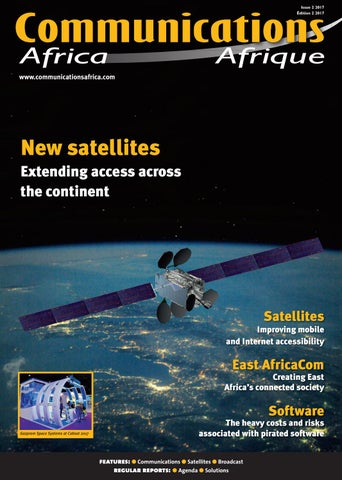
CAF 2 2017 - Cover_Layout 1 20/04/2017 17:39 Page 1
Issue 2 2017 Édition 2 2017
Africa
Afrique
www.communicationsafrica.com
New satellites Extending access across the continent
Satellites Improving mobile and Internet accessibility
East AfricaCom Creating East Africa’s connected society
Software Gazprom Space Systems at Cabsat 2017
The heavy costs and risks associated with pirated software
features: ● Communications ● Satellites ● Broadcast regular reports: ● Agenda ● Solutions
S01 CAF 2 2017 - Start_Layout 1 20/04/2017 14:42 Page 2
S01 CAF 2 2017 - Start_Layout 1 20/04/2017 17:40 Page 3
CONTENTS
Issue 2 2017 Édition 2 2017
Afrique
Africa www.communicationsafrica.com
New satellites Extending access across the continent
Satellites Improving mobile and Internet accessibility
East AfricaCom Creating East Africa’s connected society
Bulletin
4
Events
7
Agenda
8
Software The heavy costs and risks associated with pirated software
Gazprom Space Systems at Cabsat 2017
features: ● Communications ● Satellites ● Broadcast regular reports: ● Agenda ● Solutions
Main Cover Image: Intelsat Cover Inset: Gazprom
Solutions
33
A note from the Editor
FEATURES
THIS ISSUE OF Communications Africa delves into how satellite connections are reaching more people in the continent than ever before, looking at major players in the market. A preview of East AfricaCom highlights companies at the show and themes to be explored. This edition also features a post-show report of Mobile World Congress and explores telecommunications fraud and the benefits of mobile applications.
East AfricaCom
12
A look at the companies exhibiting at the premier event for telecoms, media, broadcasting and technology.
Infrastructure
16
How new satellite technologies from Intelsat are set to improve mobile and Internet access in Africa.
Telecommunications
25
Combating telecommunications fraud as new revenue opportunities grow for mobile operators.
Mobile applications
26
Exploring the benefits of using mobile apps for a number of sectors in Africa including agriculture and healthcare.
Mobile World Congress
Une note du rédacteur
28
A round-up of exhibitors and companies at the show, highlighting the main themes surrounding the future of mobile
CE NUMÉRO DE Communications Africa se penche sur la façon dont les connexions par satellite atteignent plus de personnes sur le continent que jamais, en regardant les acteurs clés du marché. Un aperçu d'East AfricaCom, met en évidence les entreprises à l'émission et les thèmes à explorer. Cette édition comprend également un rapport post-spectacle du Mobile World Congress et explore la fraude en matière de télécommunications et les avantages des applications mobiles.
communications.
ARTICLES Actualités
6
Une sélection de nouveautés des entreprises du secteur des communications, y compris Maroc Telecom et Orange Egypt.
Produits
10
Un certain nombre d’entreprises y compris les détails de leurs nouveaux produits et services pour le marché africain part Avanti et Orange.
Diffusion
31
Comment la réglementation doit changer pour arriver au futur numérique de l'Afrique.
Editor: Hiriyti Bairu - hiriyti.bairu@alaincharles.com Audit Bureau of Circulations Business Magazines
Editorial and Design team: Prashant AP, Miriam Brtkova, Kestell Duxbury, Ranganath GS, Rhonita Patnaik, Rahul Puthenveedu, Samantha Payne, Nicky Valsamakis, Vani Venugopal and Louise Waters Group Editor: Georgia Lewis Production: Kavya J, Nelly Mendes, and Sophia Pinto Email: production@alaincharles.com Publisher: Nick Fordham Publishing Director: Pallavi Pandey Magazine Sales Manager: Vinay T Nair - Tel: +91 80 68888847 Email: vinay.nair@alaincharles.com Country India Nigeria UAE UK USA
Representative Tanmay Mishra Bola Olowo Graham Brown Michael Ferridge Michael Tomashefsky
Telephone +91 80 65700911 +234 8034349299 +971 4 448 9260 +44 20 7834 7676 +1 203 226 2882
www.communicationsafrica.com
Email tanmay.mishra@alaincharles.com bola.olowo@alaincharles.com +971 4 448 9261 graham.brown@alaincharles.com +44 20 7973 0076 michael.ferridge@alaincharles.com +1 203 226 7447 michael.tomashefsky@alaincharles.com
Head Office: Alain Charles Publishing Ltd University House 11-13 Lower Grosvenor Place London SW1W 0EX, United Kingdom Telephone: +44 20 7834 7676 Fax: +44 20 7973 0076
Middle East Regional Office: Alain Charles Middle East FZ-LLC Office L2-112, Loft Office 2, Entrance B, PO Box 502207 Dubai Media City, UAE Telephone: +971 4 448 9260 Fax: +971 4 448 9261
Fax
Subscriptions: circulation@alaincharles.com Chairman: Derek Fordham Printed by: Buxton Press Printed in: February 2017 Communications Africa/Afrique is a bi-monthly magazine ISSN: 0962 3841
Serving the world of business
Communications Africa Issue 2 2017
3
S01 CAF 2 2017 - Start_Layout 1 20/04/2017 14:34 Page 4
BULLETIN PlayBox Technology showcases broadcasting technology at NAB 2017 PLAYBOX TECHNOLOGY WILL exhibit the capabilities of CloudAir rapidimplementation broadcasting in the cloud at the NAB Show in Las Vegas being held 24-27 April. "CloudAir is delivering on its promise to give broadcasters greater operational flexibility without increasing their capital investment," says PlayBox Technology president Don Ash.
Mastercard to supports Ghana’s digital payment service MASTERCARD HAS COMMITTED its support to helping the country to develop a cashless economy, as part of a bid to become an economic powerhouse in Africa. The firm has promised to financially include 40mn micro and small enterprises globally by connecting them to digital payment solutions. Tanzania’s LAPF uses mobile technology to penetrate informal secto The Local Authority Pension Fund (LAPF) in Tanzania is paving the way for informal sectors to join and submit statutory payments through mobile phones. Entrepreneurs and farmers in villages now can use their mobile phones after registering themselves to LAPF Voluntary Scheme and make payment transaction through L-PESA MENU which is provided by M-Pesa and Tigo Pesa.
following a three-year-old project that was carried out to improve education in the country, a partnership that saw the governement join forces with Microsoft. The revelation was made last week by Microsoft’s top official overseeing the group’s work in Africa, Warren La Fleur, during an exclusive interview with The New Times in Kigali.
Safaricom customers to stream Kwese TV content on mobile devices SAFARICOM CUSTOMERS WILL be able access Kwesé's TV content including exclusives like NBA basketball, Revolt TV and VICELAND, as well as live coverage of English Premier League and Brazilian football matches, as well as lifestyle and music shows. Subscribers will stream Kwese's programming on their connected devices through a yet to be announced video data bundle and via M-Pesa.
M-Pesa pioneer Michael Joseph joins Board of MFS Africa MICHAEL JOSEPH HAS joined its Board of Directors as an independent Non-Executive Director. Michael served as CEO of Safaricom in Kenya from 2000 to 2010, and is widely credited with spearheading M-Pesa, the world’s most successful mobile money service. “By connecting to 120mn mobile wallets – 75 per cent of all mobile wallets in Africa – and enabling cross border and cross network financial services, MFS Africa is helping to solve the industry’s biggest challenge.
African telecom leaders look to accelerating digital investment opportunities AFRICA’S RAPIDLY IMPROVING digital infrastructure and service and increased usage of smartphones, offer huge opportunities for business and revenue growth. Telecom and tech companies are increasing investment across Africa as the rapidly improving digital infrastructure and services, and the take up of smartphones, provide huge opportunities for business and revenue growth. “Telecom and tech companies are ramping up their investment plans for digital infrastructure and services across Africa as reach of service and demand is soaring,” said an African-focused investment banker.
Gilat Satcom pushes satellite connectivity in 200 VSAT sites in Nigeria Kadijah Amoah (Head Investments VP’s office), Sola Okeowo (Mastercard), Omokehinde Adebanjo (Area Business Head West Africa, Mastercard), His Excellency Vice President of Ghana Mr. Mahamudu Bawumia, Paul Tswanya (VP Government Services, Mastercard) and Obi Okwuegbunam (Country Manager for Ghana, Mastercard).
Facebook strengthens presence in South Africa
GILAT SATCOM HAS announced it will roll out satellite connectivity to ICSL’s 200 VSAT sites in Nigeria. The firm has been operational in Africa for more than 15 years and has a presence in more than 30 countries across the continent. Yemi Oshodi, chief operating officer at ICSL said “Gilat Satcom’s credentials, flexibility and offering are extremely impressive and we know that they will be able to meet our growing
FACEBOOK HAS SHIFTED its office in Johannesburg to a new location to boost innovation and provide an African home for the Facebook culture. “Since we first established a direct presence in sub-Saharan Africa in 2015, Facebook has grown from strength to strength,” says Nunu Ntshingila, regional director, Africa, Facebook. “We have enjoyed working closely with entrepreneurs, partners, developers and small businesses as they have used Facebook as a platform for growth.”
ASBU chooses Newtec Dialog platform technology NEWTEC, A PROVIDER of equipment and technologies for satellite communications, has announced its Newtec Dialog platform technology will be deployed by Arab States Broadcasting Union (ASBU) for the upgrade of its satellite multimedia exchange platform MENOS. The solutions provided to ASBU were exhibited at this year’s CABSAT show.
Rwandan government to roll out digital education by June RWANDA IS EXPECTED to launch a new system of teaching that emphasises the use of computers and Internet to impart knowledge,
4
Communications Africa Issue 2 2017
Gilat Satcom's VP sales in Nigeria, Francis Okoh, Yemi Oshodi, COO at ICSL
www.communicationsafrica.com
S02 CAF 2 2017 - Bulletin_Layout 1 20/04/2017 11:05 Page 5
Always Connected When we were designing the new FG Wilson 6.8 – 25 kVA range, we let our customers completely loose on the design which means their ideas are written all over it: • • • •
600, 1,000 and 2,000 litre fuel tanks so you need to refuel less often. 1,000 hour service intervals so you make fewer visits to site. Three enclosure designs so you get the enclosure you really need. New LCD control panels with optional remote communications to make dayto-day operations much easier.
And as you’d expect, our extensive dealer network will ensure your generator set is always in great shape to do the job it was designed to do.
To find out more, visit
www.fgwilson.com
S02 CAF 2 2017 - Bulletin_Layout 1 20/04/2017 14:56 Page 6
BULLETIN Maroc Telecom donne le coup d'envoi de son nouveau cycle de rencontres « Smart Days » SELON UN COMMUNIQUÉ de Moroccon World News, Maroc Telecom a lancé un nouveau cycle de rencontres, les « Smart Days ». Il s'agit d'une plateforme d'échange et de débat qui vise à offrir aux principaux acteurs de la radiodiffusion numérique au Maroc et en Afrique une plateforme permettant de discuter autour de ce thème.
L'Afrique sur le point d'atteindre le milliard d'abonnements de téléphonie mobile MALGRÉ LES DÉFIS économiques, l'Afrique approche à grands pas du milliard d'utilisateurs mobiles sur le continent. Le déploiement des réseaux 3G et 4G, couplé à un afflux de smartphones bon marché, a
transformé le marché africain des télécommunications en facilitant l'accès aux toutes dernières innovations mobiles à travers le continent.
Renforcement des services bancaires par Intelsat pour améliorer la connectivité INTELSAT A ANNONCÉ qu'eProcess International SA avait signé un contrat pour utiliser sa plateforme haute performance EpicNG en vue de renforcer ses services bancaires pour entreprises à travers l'Afrique, tout en répondant aux demandes croissantes en matière de connectivité. « Intelsat est un précieux partenaire stratégique qui a collaboré avec eProcess afin d'optimiser sans cesse notre réseau et de fournir des solutions satellite rentables pour répondre à nos besoins croissants en matière de connectivité », a déclaré Claude Edmond Traoret, directeur de groupe, Services des technologies.
Contrat de communications prolongé pour une société pétrolière et gazière en Afrique du Nord SIGNALHORN A OBTENU une prolongation de ses services de communication accompagnée d'une capacité satellitaire accrue s'appuyant sur ses services satellitaires dédiés SCPC en bande C. Cela a renforcé la position de la société en tant que principal fournisseur de réseaux critiques.
Nouveau contrat de financement du football sur trois ans pour MTN Cameroun
Il y a eu une énorme augmentation du nombre d'utilisateurs mobiles sur le continent. (Photo: Aila Images)
LA DIRECTRICE GÉNÉRALE sud-africaine de MTN Cameroun, Philisiwe Sibiya, a affirmé : « Nous allons bientôt signer un contrat de trois ans pour sponsoriser ce sport ». Elle a fait cette remarque au terme d'une audience au palais présidentiel le mois dernier, où elle venait d'être reçue par le secrétaire général du Cabinet du Président, Ferdinand Ngoh Ngoh.
Orange Egypt déploie la solution Real-Time Offer Manager (RTOM ou gestionnaire d'offres en temps réel) d'Openet ORANGE EGYPT A LANCÉ de nouveaux outils de reporting afin d'améliorer l'expérience de l'abonné et d'accroître les revenus de données. La solution RTOM d'Openet sera utilisée par l'opérateur mobile afin d'orienter les offres incitatives vers ses clients. Parallèlement, Orange a pour objectif d'accroître les taux de participation et de réduire la perte de clientèle. La nouvelle solution permettra de présenter des offres en temps réel via une cartographie intelligente et contextuelle des offres. Les offres incitatives sont déclenchées par du contexte client en temps réel (par exemple, des informations d'utilisation, l'accès à une application, l'emplacement, le profil, etc.) et envoyées en temps réel vers l'appareil du client. Orange a noté que cela se fera sous forme de notification push via l'esupport de l'appli mobile d'Orange Egypt. La solution RTOM d'Openet, couplée à une capacité de reporting en temps réel, a permis à Orange Egypt de réduire le temps de mise sur le marché pour le développement et le lancement de nouvelles offres et de nouveaux forfaits clients, a déclaré l'opérateur mobile. Cela a permis à son tour à Orange de mieux surveiller les offres de ses concurrents. D'après Orange, cette nouvelle solution permettra aux clients de souscrire à de nouveaux services complémentaires ou abonnements et de davantage personnaliser leur service directement
6
Communications Africa Issue 2 2017
Les clients recevront des notifications push via l’application mobile de l’Égypte Orange autosoins. (Photo: Sfio Cracho)
depuis leur appareil. En utilisant le RTOM, les demandes de l'abonné sont fournies en temps réel, un autre facteur qui contribue à améliorer son expérience, a révélé la société. Conserver une expérience client différenciée est un facteur opérationnel clé pour Orange Egypt, a déclaré Peter Refaat, directeur des services numériques & à large bande, Orange Egypt. Notre partenariat avec Openet veille à ce que notre environnement BSS ait la flexibilité et l'agilité nécessaires pour réagir face à un marché des clients en évolution rapide et à ce que nous offrions un service de qualité supérieure, a ajouté Refaat.
Le PDG d'Openet, Niall Norton, a également déclaré, en commentant ce partenariat : « Notre travail avec Orange Egypt souligne notre engagement à créer de nouvelles analyses de rentabilité pour répondre aux besoins opérationnels des clients. Notre solution RTOM offre une vraie valeur opérationnelle : elle entraîne des recettes supplémentaires, enrichit l'expérience client et améliore la fidélisation. La capacité à proposer des offres pertinentes d'un point de vue contextuel et hautement ciblées jouera un rôle central dans l'amélioration de la rentabilité de l'opérateur.
www.communicationsafrica.com
S02 CAF 2 2017 - Bulletin_Layout 1 20/04/2017 15:02 Page 7
AGENDA
Events/Événements 2017 APRIL/AVRIL 21-27
Nabshow
Las Vegas, USA
www.nabshow.com
24-27
MVNO World Congress
Nice, France
www.tmt.knect365.com
1-2
Cloud MENA
Dubai, UAE
www.tmt.knect365.com
1-4
IEEE International Conference
Atlanta. USA
www.infocom2017.ieee-infocom.org
11
Inno IT Kiel
Schleswig-Holstein, Germany
www.innoit-kiel.de
17-18
East Africa Com
Nairobi, Kenya
www.tmt.knect365.com
21-23
GISEC 2017
Dubai, UAE
www.gisec.ae
21-23
ioTx 2017
Dubai, UAE
www.iotx.ae
16-18
MedPi Monaco
Monaco, France
www.medpi.com
24-27
WIS World IT Show Seoul
Seoul, South Korea
www.worlditshow.co.kr
24-26
Expo Comm Wireless Japan
Koto, Tokyo
www.expocomm.com
30-1
ANGA COM Cologne
Cologne, Germany
www.angacom.de
9-11
Wire & Cable Guangzhou
Guangdong, China
www.wire-cable-china.com
11-15
5G World
London. UK
www.tmt.knect365.com/5gworldevent
MAY/MAI
JUNE/JUIN
Exhibitors gear up for NAB 2017 NAB 2017 WILL Nab 2017 will welcome a host of exhibitoregas Convention Centre between 24-27 April. Camera Corps, one of the leading suppliers of speciality camera systems, will promote its innovative products and services to visitors attending the April 24-27 NAB Show in Las Vegas. Senior representatives from the company will include VP of EMEA services Phillip Beckett, commercial manager Barry Parker, head of projects EMEA/APAC Simon Atkinson, project & engineering director David Sisson and operations manager Neil Ashworth. Exhibiting as part of the Vitec Group on Central Hall booth C6025, the Camera Corps team will host equipment demonstrations for the duration of the show. "NAB has long been a great venue both for meeting existing clients and showing our capabilities to potential new customers," says Barry Parker. "Our speciality is in providing broadcast equipment for daily or event-based hire across all types of production and on any scale. We also offer production support from our own skilled camera technicians and operators. All are experienced in the stringent demands of live television production." "If a customer presents a challenge not easily handled from our existing stock, we have the resources to design and build a solution quickly and effectively. Working in that way over the years has given us a uniquely broad product inventory which we can field at very short notice. It includes a wide choice of robotic specialist HD and 4K cameras, camera tracking systems, remote heads, minicams and lenses, HD underwater systems, Stump cameras, specialist
www.communicationsafrica.com
camera mounts and our own integral control systems that can work with cameras from multiple manufacturers." Also attending the show is PlayBox Technology Limited will introduce the latest versions of its CloudAir universal playout and streaming platform and Neo channel-in-a-box product suite and at the 2017 NAB Show in Las Vegas, April 24-27. "We will also be making a very big announcement on the floor at this year's NAB so please make sure you come and see us on booth N5311 in the North Hall," says US director of operations Van Duke. "We are a listening company, responding quickly and effectively to requests via system integrators and directly from customers," adds PlayBox Technology president Don Ash. "We have worked very closely with our customers and system integration partners around
the world to ensure that Neo and CloudAir match user requirements over the long term, not just at the moment of purchase. This year’s show will also see Leader Instruments Corporations showcase the LV5490 multiscreen waveform monitor. the Leader LV5490 offers 4K, UHD, 3G, HD and SD test and measurement features in a compact portable unit. Waveform, vector, five-bar and picture display can all be viewed at the same time on the LV5490's 9 inch LCD monitor. The monitor is full 1920 x 1080 HD resolution with a wide viewing angle and high colour reproduction. A 1920 x 1080 HD DVI and HD-SDI rasterized output is also provided to feed a larger monitor. In its multiscreen mode, the LV5490 can display five-bar and additional user-selected reference content such as R, G and B waveforms on its internal monitor or rasterized output.
Communications Africa Issue 2 2017
7
S03 CAF 2 2017 - Agenda - Fiber Optic_Layout 1 20/04/2017 15:05 Page 8
AGENDA
TECNO Mobile unveils Camon CX MOBILE PHONE FIRM, TECNO Mobile, has launched the Camon CX, a mobile handset for the African market. Unveiled at a recent event held in Kenya, the mobile phone has been designed specifically for young smartphone users, with its key feature being the “Selfie Camera”. The Camon CX will be available 41 countries across Africa, the Middle East and Latin America. According to TECNO Mobile, more than five million handsets have already been sold globally, with users able to take high quality photos with the touch of a button. The firm has adopted the latest visual technology in the smartphone, which features a 16 mega pixel sensors in the front camera, in addition to unique ‘4 in 1’ technology. The new technology has adopted the latest Smart Denoise technology too, offering a signal-to-noise (SNR) 1.7 times better, with the ability to deliver clear images even in low light conditions. The dual-front flash feature allows Camon CX users to take high quality selfies in dark environments where previous artificial light would affect the images. Commenting on the launch of the new handset, at
The Camon CX from smartphone. (Photo: Camon CX)
the event, Stephen Ha, general manager of TECNO Mobile, stated, “We are very excited to unveil the Camon CX, as our latest smartphone. The phenomenon of the selfie has in recent years taken over smartphone usage, and photo quality is important to not just younger consumers but increasingly wider age demographics. “We have made a conscious effort to adopt the latest technology to provide consumers with the highest quality mobile experience, something that is a top priority for TECNO Mobile.” Since 2014, TECNO, part of Transsion Holdings, has had more than 25 per cent of market share in subSaharan African countries since 2014. Furthermore, sales in the African market reached 25mn devices in 2015, including nine million smart phones.
Paratus launches new PC PARATUS TELECOM ZAMBIA has launched a silent ultra-compact PC which will revolutionalise desktop computer use in Zambia. The low-energy PEBL compact computer is a highly durable mini PC that expounds simplicity and is aimed at businesses or SME customers. It can be mounted on the rear of a monitor, perfect for point of sale or office use, taking up very little space, while consuming less than 10 per cent of the power consumed by traditional desktop PCs, yet still maintaining the same performance. The PEBL is compatible with all popular operating systems and uses a 12-volt power supply that consumes between 15 and 30 watts. Some PEBL models come already kitted with wi-fi, featuring an integrated Intel HD graphics and Realtek ALC662 HD audio controller. ‘’Another impressive aspect of this PC is that its fan-free design makes it run quietly with no need for extra maintenance like traditional desktop computers. Customers will save on space, power and expensive maintenance,’’ said Paratus Telecom Zambia country manager, Marius van Vuuren. Paratus Telecom Zambia, is part of the Paratus Telecom Group which has its head office in Windhoek, Namibia. Paratus Telecom Zambia was founded as Internet Technologies Zambia in 2010. Paratus has established a network extending to major industrial and commercial centres throughout Zambia, with additional international points-ofpresence located in Johannesburg and Cape Town (South Africa), Gaborone (Botswana), Windhoek (Namibia), Luanda (Angola), Kinshasa and Lubumbashi (Democratic Republic of Congo), Lisbon (Portugal), as well as London The mini PC from (United Kingdom) Paratus. (Photo:Paratus)
8
Communications Africa Issue 2 2017
Mastercard to support M A S T E R C A R D H A S STRENGTHEN its commitment to helping Ghana to develop a cashless economy. This comes at the same time Mastercard is diversifying its suite of digital payment solutions available by introducing Masterpass QR. According to Ghana’s RegistrarGeneral’s department, around 92 per cent of companies registered in Ghana are MSMEs, accounting for about 70 per cent of Ghana’s GDP. “Digital payment solutions, whether a debit or prepaid card or the Masterpass QR mobile solution, ensures that transparency and efficiency is introduced into the economy, and this will mean that Ghana can grow and flourish, reaching its full potential,” said Omokehinde Adebanjo, vice president and area business head for West Africa at Mastercard.
mSurvey and Safaricom launch first cash economy Research Platform in Africa GLOBAL MOBILE-FIRST RESEARCH platform mSurvey and Kenyan communications company Safaricom have joined forces to launch Consumer Wallet, a platform that quantifies offline consumer spending habits and trends. Consumer Wallet, which is currently in its beta stage, is a live and dynamic data feed that uses mSurvey’s mobile messaging platform to analyse Kenya’s cash economy over time. The new platform will give businesses, entrepreneurs and investors in the country a deep insight into the spending habits of the offline consumer, mSurvey noted. Communications Africa met with Claire Munene, COO of Nairobibased mSurvey, who explained how the service works with a live demonstration. The platform offers a simple way to collect data using SMS and mobile messaging to push questions to millions of people in emerging markets. For instance, two companies can have scalable and measurable conversations with individual consumers on a daily basis. To analyse the flow of cash in real-time, simple questions about spending behaviour are sent as chat messages directly to the mobile phones of consumers, providing an insight into offline consumer spending habits in Kenya and a comprehensive measurement of their ‘share of wallet.’ “The in-depth, high-integrity data we are unlocking with this new Consumer Wallet platform is extremely valuable and helps us and other businesses and institutions around the globe make better decisions, relate to consumers, identify opportunities, navigate the terrain and fuel growth and transformation,” said Bob Collymore, CEO of Safaricom. “Traditionally it would take extensive in-person questionnaires or physical diaries to scratch the surface of this kind of data, a method that is cumbersome, expensive and subject to low response rates and Safaricom’s Lipa Na M-PESA service, a solution that allows consumers to pay for goods and services daily through their phones, has revolutionized the way Kenya does business.”
www.communicationsafrica.com
S03 CAF 2 2017 - Agenda - Fiber Optic_Layout 1 20/04/2017 11:11 Page 9
AGENDA
Jumia launches its third white paper on Nigerian mobile trends 2017 JUMIA NIGERIA IS pleased to present the 2017 edition of the African Mobile Trends Paper, which is the third white paper presentation from Jumia looking at mobile trends across Africa, mainly Nigeria. The report takes a closer look at how the market has made mobile Internet easily accessible, the consumer behaviours that has led to a rise in smartphone adoption and the part that mobile brands have to play, mobile operators and m-commerce in bettering customer experience. The Mobile Africa Study was rolled out in 15 African countries which make up more than 80 per cent of Africa’s GDP - Algeria, Nigeria, Morocco, Tunisia, Egypt, Mozambique, Ghana, Ivory Coast, Cameroon, Rwanda, Uganda, Tanzania, Kenya and Senegal. According to Jumia, there are 960mn mobile subscriptions across Africa - an 80 per cent penetration rate across the continent’s population. Internet penetration is at 18 per cent with 216mn Internet users. Nigeria’s Internet penetration is much higher at 53 per cent, however its mobile subscription is similar to Africa’s at 81 per cent penetration (150mn mobile subscriptions). Nigeria’s mobile trends for 2017 show positive growth of smartphones usage and diversity. These increased offerings provide more value for customers and affordavle access to Internet connectivity. Further investment in research and development and innovative data packages by smartphone brands and mobile operators, as well as investment by ecommerce providers in customer service, logistics and marketing over the next few years, has meant outlook is for an even more synergized digital ecosystem over the next few years. A study carried out in 15 countries: Algeria, Nigeria, Morocco, Tunisia, Egypt, Ethiopia, Mozambique, Ghana, Ivory Coast, Cameroon, Rwanda, Uganda, Tanzania, Kenya and Senegal. >>
www.communicationsafrica.com
Communications Africa Issue 2 2017
9
S03 CAF 2 2017 - Agenda - Fiber Optic_Layout 1 20/04/2017 11:11 Page 10
AGENDA
Lancement du processus d'attribution d'une quatrième licence de téléphonie mobile MOUNTAGA TALL, MINISTRE de l’Économie numérique et de la communication, aurait reçu l'autorisation du gouvernement pour lancer le processus d’attribution d'une quatrième licence de téléphonie mobile. L'agence Ecofin note que le 24 mars, au cours d'une réunion de cabinet présidée par le Premier ministre Modibo Keita, l'État a exprimé son accord pour accueillir un quatrième opérateur. Selon la base de données GlobalComms de TeleGeography, Alpha Telecom Mali (partenariat entre Monaco Telecom et la holding locale Planor Afrique) avait soumis le 12 septembre 2012 une offre de 55 milliards de francs CFA (soit environ 106 millions de dollars américains à cette date) pour asseoir sa position, surpassant ainsi l'offre des indiens de Bharti Airtel (19,7 milliards de francs CFA) et de l'opérateur vietnamien soutenu par l'armée Viettel Corporation (10,9 milliards de francs CFA).
Orange se lance au Burkina Faso ORANGE S'EST LANCÉ au Burkina Faso il y a moins d'un an suite à la clôture de l'acquisition d'Airtel et d'Orange Côte d’Ivoire. L'opérateur de téléphonie mobile est actuellement présent dans 21 pays en Afrique et s'efforcera d'améliorer ses services financiers sur mobile et l'Internet mobile 3,75G. La solution pour les transferts internationaux Orange Money sera encore plus développée au sein de l'Union économique et Monétaire Ouest Africaine (UEMOA). Selon Orange, l'extension du réseau de fibre optique aidera à accroître sa notoriété comme fournisseur d'accès Internet et de connectivité majeur pour les entreprises. Bruno Mettling, directeur général adjoint du groupe Orange et président-directeur général d'Orange MEA (Moyen-Orient et Afrique) a déclaré « C’est un grand honneur pour le groupe Orange d’être désormais présent au Burkina Faso à un moment où le pays s’engage résolument dans un important programme de développement de son économie. Avec 5,2 milliards d’euros de chiffre d’affaires en 2016 (soit 12% du total), la région MENA est une priorité stratégique pour Orange. Son offre phare de transfert d’argent et de services financiers sur mobile Orange Money est disponible dans 17 pays et compte plus de 30 millions de clients.
Avanti s'associe avec Millicom : e
LE FOURNISSEUR DE services de communication de données satellite Avanti Communications Group va unir ses forces avec la société de télécommunication Millicom, afin d'apporter une connexion haut débit aux consommateurs, aux entreprises et aux gouvernements. Avanti relève que cela implique le déploiement de l'initiative Avanti ECO en Afrique subsaharienne, qui La nouvelle technologie satellite d'Avanti est destinée à améliorer permettra de proposer des services la couverture Internet en Afrique. ECO Wi-Fi aux écoles et aux (Photo: Petit Stock Parfait) populations. En s'appuyant sur la portée commerciale de Millicom, la technologie satellite d'Avanti permettra aussi le lancement d'une nouvelle stationpasserelle terrestre (GES) au Sénégal. La société de communication par satellite construira une nouvelle station-passerelle terrestre et utilisera le Data Centre de Sen-Connect à Diamniadio, en cours de construction. Sen-Connect est une filiale entièrement détenue par Millicom, qui s'occupera de la gestion du data centre et travaillera sur le projet déployé par le gouvernement sénégalais. La nouvelle station-passerelle terrestre garantira la sécurité des données au Sénégal et offrira une connectivité data sécurisée et de haute qualité au gouvernement, aux entreprises et aux acheteurs au détail en plein essor. Avec le lancement de son satellite HYLAS 4, Avanti fournira une couverture Internet sur tout le continent. Aux côtés de Tigo Senegal, de Millicom et de Sen-Connect, la société tâchera de surmonter les difficultés liées à l'accès à l'Internet haut débit dans les zones rurales, notamment dans les écoles et les hôpitaux.
10 Communications Africa Issue 2 2017
Les services Internet et mobile d'Orange vont se déployer au Burkina Faso. (Photo: Orange)
L’arrivée de la marque Orange témoigne de notre engagement à apporter les bénéfices de l'écosystème numérique à tous les Burkinabè » déclare Ben Cheick Haidara, PDG d'Orange au Burkina Faso. Aujourd’hui, les clients Burkinabè sont plus exigeants, leurs habitudes de consommation des services numériques ont évolué et nous sommes à un tournant décisif dans le développement du marché des télécoms. Notre ambition est de poursuivre le travail accompli ces dernières années dans le domaine de l’argent mobile et l’Internet mobile pour faire d’Orange le partenaire de référence de la transformation numérique au Burkina Faso.
Les transactions via Mobile Money en Côte d’Ivoire représentent plusieurs milliards EN CÔTE D’IVOIRE, ce sont près de 17 milliards de francs CFA qui transitent via Mobile Money tous les jours. C’est ce qu’a déclaré René Tano, cadre de la BICICI, filiale de BNP Paribas, intervenant lors de la cinquième édition du Forum de la monnaie et du paiement électronique à Casablanca, au Maroc. Citant comme source l’Autorité de régulation des télécommunications en Côte d’Ivoire (ARTCI), monsieur Tano a précisé que le chiffre prend en compte toutes les transactions (transferts, dépôts, paiements de facture) des trois compagnies de télécom du pays, à savoir Orange, MTN et Moov. « Ces chiffres font peur. Dès qu’il y a une incursion d’un opérateur télécom, les chiffres prennent des proprotions qui n’ont rien à voir avec les chiffres des transactions bancaires » a déclaré René Tano à l'agence Ecofin. Il a poursuivi en mettant en avant le « gros séisme » qui aurait lieu si un opérateur comme Orange décidait de racheter une banque en Côte d’Ivoire. Par ailleurs, s’il a également souligné le taux de bancarisation actuel en Côte d’Ivoire qui se situe entre 15 et 16%, il a reconnu que ce chiffre reste encore très loin de celui du Maroc, l'un des leaders du continent dans ce domaine et hôte de ce cinquième Forum de la monnaie et du paiement électronique. Ce forum, où la technologie numérique est à l'honneur, est organisé par Interworld Orange, MTN et Moov exercent des et VISA. (Agence Ecofin) activités en Côte d’Ivoire
www.communicationsafrica.com
S03 CAF 2 2017 - Agenda - Fiber Optic_Layout 1 20/04/2017 15:07 Page 11
DATA CENTRE
Colocation
Outsourcing data centre services Evaluating colocation data centre space is a complex process that includes many considerations and pitfalls. McKenzie Hughes of Siemon provides an overview of critical aspects colocators need to consider when looking to outsource data centre services to cloud and colocation facilities. HE AFRICAN DATA Center Rises report published two years ago found that there is tremendous demand for colocation data centre space across the African continent. Currently new colocation facilities are being built in rapid succession across East and West Africa making this market become increasingly competitive. But with extended choice, space selection becomes more complex. For enterprise customers looking to outsource data centre services to cloud and colocation facilities, there is a myriad of aspects to consider.
T
Checklist When selecting space, it is advisable for an organisation to first develop a clear set of criteria for what is required from the space. At the same time, companies must know what services are moving to the site and what those services require in the realm of redundancy and uptime. Tier levels for instance are important to some and not so important to others who are purely looking for the basics to be covered. When discussing Tier levels with a colocation site, it is important to understand what their definition of Tier means, as definitions seem to vary. Having a data centre ‘certified’ to a Tier level is an expensive process and if that is important to an organisation, then there are a variety of Tier level options available. However close attention should be paid to who provided the accreditation. Rather than asking for a certain Tier level, it is more important to understand exactly what redundancy is required.
Location, location Location is an important consideration, not only in regard to jurisdiction of information but also in the light of latency and availability of services. If a company actively trades on the stock exchange, for instance, then the location
The African Data Center Rises report published two years ago found that there is tremendous demand for colocation data centre space across the African continent. www.communicationsafrica.com
New colocation facilities are being built in rapid
succession across East and West Africa. (Photo: Siemon)
is relatively defined as distance creates latency and latency incures costs. Likewise, if services such as ISP links are not plentiful, reliable or fast enough to carry the data necessary, then that location obviously is not desirable either. If real estate closer to critical services is very expensive, then a company may choose to split data centre locations based on functionality. Where location is concerned, a tricky part is getting assurance that the cloud will remain in the same place. This is why hybrid cloud initiatives have been developed. Deploying a hybrid model is the best of both worlds; offloading certain applications into the cloud while still maintaining control of critical data. More and more buyers require direct uplinks to the public cloud connections, so it may be important to shop for a facility with a direct connect to one or all of the major public cloud providers. Not all locations will be equipped with those direct connections, so colocators must understand where those connections reside and be sure they align with the location of preference. Available talent pool is another factor for location. Colocation owners, in many cases, can provide an “intelligent” pair of hands. These managed services or remote hands might be critical for a business. A buyer will want to understand the Service Level Agreements (SLAs) behind some of these services to make sure they are in line with their requirements. You get what you pay for, so if organisations demand a fast turn-around time for making changes, then they will most likely pay a premium for those services. If that option is not available, travel to and from the site will be necessary, and travel cost and time will then become important considerations for critical services.
Practical aspects A walk-through of the site should be performed to address some practical selection criteria. It is also critical to understand how the facility polices its cages and how pathways and spaces are controlled. Some tenants of colocation facilities have free reign in terms of what they want in their cages. This in turn can have significant impact on the neighbours when equipment starts shutting down because the cage next door has clogged all the underfloor space with cabling and boxes. Space planning should also be a risk evaluation point. This assures that the site does not allow perpendicular cages and hot/cold aisles are maintained in any shared halls. Colocation facilities that have design resources are a value-add that deserves acknowledgement and consideration, provided that they will work to design something that meets the buyer’s needs and specifications. How power costs are incurred and distributed is also relevant. Most colocation facilities have an amount in mind when they set the rental prices for a space. Understanding how the power is distributed, assigned and charged for before signing the contract will lead to a tenancy free from surprises. With a shortlist prepared, it is then critical to evaluate and compare “space A” to “space B” and it will be easier if the buyer is the keeper of the criteria. In most cases it is advantageous to have specific requests for information to be answered by colo site owners following the preliminary evaluation round. Selecting colocation space is really not much different to selecting a home and thorough evaluation of the aspects above will help find the right home for your data centre services. ✆
Communications Africa Issue 2 2017
11
S03 CAF 2 2017 - Agenda - Fiber Optic_Layout 1 20/04/2017 11:11 Page 12
EVENTS
Telecoms
Dialling up Nairobi The great and the good of eastern Africa’s technology and telecoms industry will attend a major event this May in the Kenyan capital of Nairobi.
East Africa Com will take place in Nairobi, Kenya. (Photo: evenfh)
T PROMISES TO provide a glimpse of what’s in store for the region’s communications sector, and indeed for the rest of Africa. The event, East Africa Com, takes place on 17-18 May 2017 at the plush Radisson Blue, Nairobi Upper Hill. It will be a place to learn from leading operators and enterprises such as Safaricom, MTN Uganda, Airtel Tanzania, Orange Telkom Kenya, Equity Bank, and the Co-operative Bank of Kenya. Leading sponsors of the event include Safaricom, Avanti and Uros Uni-fi Roaming Solutions. An exhibition hall will also house
I
Among the local and international firms exhibiting will be Nexge Technologies, Sangoma, OFS and Tecnotree, underlining the broad scope and appeal of the industry gathering 12 Communications Africa Issue 2 2017
around 20 well-known technology firms and suppliers for delegates to discover in-between what promises to be a busy conference schedule. Among the local and international firms exhibiting will be Nexge Technologies, Sangoma, OFS and Tecnotree, underlining the broad scope and appeal of the industry gathering. And certainly Kenya seems to be the place of the moment right now if you’re looking for creativity in the roll out of mobile-based solutions. In what is considered a world first, Kenya began selling a government bond in March exclusively via mobile phones, aimed at expanding the pool of investors in a country where many people still don't even have a bank account. It’s a bold move to push the traditionally conservative bonds market into the hearts and minds of the nation’s mobile phone users and a unique way to access public funding for much-needed infrastructure projects. The government made a limited offer of 150mn shillings (US$1.5mn) for the three-year bond - called MAkiba - which can be bought by phone users without any need for a bank account. Nairobi intends to
test the system first before a bigger offer of 4.85bn shillings planned for June. More than 100,000 Kenyans registered on their phones to invest, compared with just 20,000 retail investor accounts with the central bank for normal treasury bonds, underlining the potential for M-Akiba to help mobilise savings. And it looks promising too. The Kenyan public responded generously with about 200 investors investing 600,000 shillings within an hour of the start of the sale. The Kenyan bond sale underscores Africa’s general appetite for creative mobile and tech solutions and is likely to be watched closely by treasuries in other emerging economies, equally keen to raise cash and expand the pool of investors for public projects. It also sets the tone for the upcoming East Africa Com summit in Nairobi, showing a dynamic industry once again innovating and pioneering. According to the organisers, East Africa Com reflects the rapid convergence between the telecoms, media, broadcasting, and technology spaces. “It’s a premium ICT show that connects and informs the entire East African
digital ecosystem,” it states. Major themes guiding the discussion include Creating East Africa’s Connected Society and New Broadcast Models For The Digital Era. Delegates will hear the chief technology officer of Google Access share thoughts on how fibre to the premises is empowering communities, and listen to the Communications Authority of Kenya feedback on how large corporations are creating new opportunities for SMEs. Industry speakers at the event include Safaricom’s Thibaud Rerolle (chief technology officer), Ken Okwero (head of strategy), Steve Chege (corporate affairs director) and Catherine Wanjiku Njari (senior manager TV & media content). Other leading speakers lined up include Claire Papponeau (Mauritius Telecom), Steve Kirenga (MTN Uganda), Ibrahim Epamba (Orange Telkom Kenya) and Purumedh Gupta (Airtel Business Africa). For those looking to catch a glimpse of what’s really going on in eastern Africa’s rapidly evolving comms industry, there’s only one place to be this May. ✆
www.communicationsafrica.com
S04 CAF 2 2017 - Tanzania focus_Layout 1 19/04/2017 15:39 Page 13
POWER
Hybrid
Hybrid’s role in cell-site power back-up Whether on-grid or off-grid, powered by diesel generator or alternative power sources, mobile cell sites need some form of back-up power in the event main power sources are compromised. Tim Guest reports. HERE MOBILE COMMS base station sites are off-grid, powering them across Africa is typically the preserve of the diesel generator, or genset, as the main power source. While alternative energy sources also have entered the frame, it is the diesel genset that continues to be the mainstay providing power to mobile network infrastructure. As with other industry sectors, especially those providing critical services - such as hospitals, telecoms also needs a robust power back-up strategy – often mandated in law, for instance eight hours in the US - to ensure power outages, load shedding, equipment failure or loss, do not take down the communications network at the same time. Back-up power is typically provided with batteries or capacitors, though fuel cells and hybrid gensets are increasingly being used. With the GSM Association predicting there will be more than 325,000 cell site towers across sub-Saharan Africa by 2020, finding more efficient ways of powering them and providing back-up power is crucial.
W
The GSM Association predicts there will be more than 325,000 cell site towers across sub-Saharan Africa by 2020. Leaders in the Hybrid Field One US player active in this space is Nanoptek. The company’s Solar Hydrogen Generators produce hydrogen in situ at the cell site during daylight hours, which is then stored and made available for use, on demand, by fuel cells. The company says that its SHG300 is suited to such purposes with many used in remote cell tower installations, their fuel cells capable of producing 5kW of back-up power. This on-site production of hydrogen removes the logistics requirements of delivering heavy hydrogen cylinders to a remote site or diesel fuel. The company says that given the high daily average of sunlight in Africa, rather than just providing back-up power, its SHG300s can also supply the entire power requirements for a cell site. Nanoptek says that with up to 10 hours of sun
www.communicationsafrica.com
A remote telecoms scenario of the kind which would benefit from being powered by hybrid solutions. (Photo: Vodafone)
per day in many parts of Africa, only four of the SHG300’s solar panels would be required to provide eight hours (assuming that to be the mandated back-up requirement) of back-up per month to a remote cell tower. Italian power solution specialist, Ascot, offers a range of hybrid power solutions and mobile telecom site solutions, many already in service with operators in Africa providing backup and main power sources. Some offer PV back-up power and one is what it calls its DC 48Vdc, 5-35kW – All-in-One package, a hybrid diesel genset/PV/wind solution for off-grid scenarios and specifically designed for telecom sites and remote areas. It operates in back-up mode or as a main power source and has a variable speed diesel engine, deep-cycle batteries for power storage and integrated hybrid logic, which enables the management of all components and connections with other energy sources, including solar/PV panels and wind. Its systems are designed to simultaneously power telecom sites and charge any kind of external battery banks to provide back-up when required and can
effectively hybridize any telecom site. The company’s hybrid back-up and main power solutions for telecoms have been deployed in SA with Vodacom, Mauritania with Chinguitel, Nigeria with Globacom and in the Sudan. A growing number of cell sites in Africa are using hybrid energy storage systems from Firefly Clean Energy in the UK to provide efficient battery storage and energy management at off-grid and diesel-generator supported telecom tower infrastructure. Firefly’s ES 200, for example, is a fully integrated, energy storage system suitable for both on-grid or off-grid back-up and includes an advanced Li-ion battery pack and an active balancing battery management system with a capacity of up to 33kWh of usable energy storage, which can be delivered as back-up. The available battery storage technology options with the ES 200 include Lithium Iron Phosphate storage providing 33kWh capacity and Sealed Tubular Plate storage providing 20kWh or 30 kWh. The system can provide uninterrupted back-up power in the event of a grid, or main power system failure. ✆
Communications Africa Issue 2 2017
13
S04 CAF 2 2017 - Tanzania focus_Layout 1 19/04/2017 15:39 Page 14
TELECOMS
Power
FG Wilson launches new generator sets for telecoms operators FG Wilson has just completed the launch of a new range of generator sets designed for telecoms operators and Michael Milligan, FG Wilson account manager talked with us about FG Wilson and the new models. G WILSON HAS just completed the launch of a new range of generator sets designed for telecoms operators and Michael Milligan, FG Wilson account manager talked with us about FG Wilson and the new models. Founded in 1966, FG Wilson was among the first to bring mass-scale production to generator sets, launching self-contained generator sets which were simple to buy and operate and were easy to install. The brand is now a major player in the global market for generator sets installing more than 600,000 since 1990 alone, with a total installed capacity of almost 90GW - more than the total installed mains electricity capacity of a country like the UK. The new 6.8–25 kVA range is among several new products being launched this year, and says Michael, its design and development have been in close partnership with customers: “First and foremost, this is a very customerdefined product. We spent a great deal of time simply talking with our customers and dealers and working through issues together to understand what was important.” “There was a real focus on product operating costs and this has led to a packaged generator product which is ideal for telecoms users, or indeed for any customer who operates at sites which are remote or difficult to access.” The new range is aimed at either hybrid or generator-only applications. To reduce operating costs, site visits for maintenance and fuel replenishment, the range offers 1,000 hours between service intervals, and comes with set-mounted fuel tanks of up to 2,000 litres. The ability to monitor generator sets from the Telecom NOC maximises uptime and allows preparation for site visits minimising servicing costs and ensuring that site visits are effective. The product options list includes a flexible range of enclosures offering three levels of sound attenuation to help ensure that it meets local noise regulations and also mean that customers can choose the enclosure which is right for their needs. Control systems played a big part in product design. Michael says, “We have incorporated a great deal of flexibility into control systems and remote communications to ensure that our generator set integrates seamlessly with any hybrid system. And we are partnering with several established hybrid manufacturers to
F
14 Communications Africa Issue 2 2017
FG Wilson has unveiled a new range of generating sets to power telecom sites. (Photo: FG Wilson)
confirm compatibility and ensure efficient and fast deployment of our products on site.” As with all FG Wilson products, the new range has been tested and validated at FG Wilson’s Larne facility in the UK, a US$26mn Centre of Excellence which also houses Europe’s largest Hemi-Anechoic Chamber for noise testing. Here, all FG Wilson products are given intense pre-launch testing which include vibration, engine/alternator cooling, electromagnetic compatibility, noise, water ingress and rating/transient performance. Michael says this is especially important. “We are a volume manufacturer and we take reliability extremely seriously. We know from past experience that rigorous upfront design, testing and validation lead to superior reliability
throughout a product’s lifetime and that this can save customers a substantial amount of money over time. That reliability is also underscored by FG Wilson’s global network of more than 400 dealers who offer automotive industry levels of service starting with product selection through to installation and a lifetime of support. They're trained by us and supported by our parts system which stocks more than 11,500 parts and delivers three million parts a year, not only for our current products but also for legacy products.” ✆
The new range is now available to order from FG Wilson. You can find out more from www.fgwilson.com or from your local FG Wilson dealer. www.communicationsafrica.com
S04 CAF 2 2017 - Tanzania focus_Layout 1 20/04/2017 15:12 Page 15
QUOTES
We see Kenya as the technology hub of Africa, and that ties very much into Facebook’s mission. Some of the work which we have seen happen here, in terms of Government Policy and Innovation prove that Kenya is leading.”
“
“
-Uche Ofodile
-Adebayo Shittu
regional head
minister of communications Nigeria
Africa Express Wi-Fi by Facebook
“
Working with Avanti to ensure its Ka-band services address the enormous potential in Africa, together with the eco initiative is a great opportunity.”
The Insurance sector despite being a major driver of business growth that provides a critical support system to the financial market, has not fared well given the current size of the Nigerian economy and population.”
“
Millions of South Africans rely on the public broadcaster for news, information and entertainment. We wish Ms Kweyama and her team well as they begin the important task of leading and revitalising one of the most important national resources, the SABC.
“
The varying cloudreadiness of enterprises has fostered a market for hybrid IT, and service providers are tailoring their portfolios to meet this enterprise requirement.
-Shuba Ramkumar research analyst Digital Transformation
“
Masterpass QR gives us the ability to introduce efficiency, supporting the growth of local businesses. We are one step closer to creating a continent that is less dependent on cash, and that is able to reach its full potential.”
-Chris Bwakira -Mohamed Dabbour executive vice president Millicom Africa minister of communications www.communicationsafrica.com
vice president and area business head for East Africa Mastercard
-Jacob Zuma President South Africa
“
Video calling should work for everybody, regardless of what platform they are on. Our aim is to make video calling simple, fast, and available to everyone."
-Amit Fulay head of Duo Google
Communications Africa Issue 2 2017
15
S05 CAF 2 2017 - Yahsat_Layout 1 20/04/2017 15:41 Page 16
INFRASTRUCTURE
Satellites
New satellites for mobiles to improve access Almost one third of Africa’s nearly 1.2bn residents have no access to mobile phones or the Internet. New satellite technologies and infrastructure launched into orbit in 2016 by Intelsat are set to improve these figures in 2017. Tim Guest reports.
Ariane 5 lifts off from the Spaceport in French Guiana on Arianespace’s 24 August 2016. (Photo: Arianespace)
ITH A STEADY evolution from its still widespread 2G foundations through 3G, 4G/LTE and beyond to 5G (and on and on it goes!), Africa presents MNOs with immense opportunities to reach new markets with the widest range of services. From education, telemedicine and remote diagnostics to mobile payments, mobile agriculture services and consumer entertainment, the list of ‘things’ mobile can offer these hither to unconnected millions, is seemingly endless. That said, with Africa’s vast size and rugged terrain isolating many of these millions in remote communities and regions, it appears to be falling on the shoulders of the satellite industry to provide the technologies and infrastructure to make connecting these ‘new’ mobile subscribers a viable proposition. And now, with more than 225mn smartphone users in Africa, the demands for mobile voice and broadband are only set to increase.
W
Quantis will incorporate services from two Intelsat EpicNG satellites, Intelsat 33e and Intelsat 37e (to be in service in 2018)
providers and MNOs and lead, according to most commentators, to overall market expansion. This projection is supported by a previous project between Intelsat and Vodacom in the DRC, where the two companies partnered in the design, management and installation of 800 rural, solar-powered cell sites connected to the Intelsat 28 satellite for backhaul. With reduced capital costs the average revenue per user, while low, still made these new sites viable almost from the start. With the 33e bird in the sky, however, the costs per bit will fall even further with new services this year. According to Intelsat, the EpicNG platform is also designed to ensure backward compatibility with existing ground terminals. As a result, to use the higher throughput capabilities of the new satellite infrastructure, Vodacom will not have to upgrade existing base stations throughout the DRC, or elsewhere. Yet, Vodacom is not the only MNO, which will benefit from the arrival of the new Intelsat 33e. Intelsat currently provides its services and satellite bandwidth to more than 50 of Africa’s MNOs, including ten of the largest, providing connectively that can be used by over 80 per cent of the region’s wireless users. The company also says that the Intelsat EpicNG spot beam technology is allowing the size of the necessary 3G-5G terrestrial segment kits to decrease making them easier to carry and install.
New Satellites for Africa
Epic – it’s in the Name
In August last year, Intelsat launched one of its new Intelsat EpicNG highthroughput satellites (HTS), the Intelsat 33e, which became operational on 29 January, delivering mobile content among other services and connecting new subscribers in remote parts of sub-Saharan Africa during 2017 and beyond. The 33e is the newest EpicNG platform (29e serves the Americas) delivering high-throughput beams in both C and Ku-band aimed, according to Intelsat, at providing customers with a fibre-like experience from orbit. This is set to encourage an increase in data use per subscriber, aimed at ensuring a viable business model for service
The Intelsat EpicNG is a high performance, next generation satellite platform that delivers global high-throughput technology without sacrificing user control of service elements and hardware. The platform is said by the company to be an innovative approach to satellite and network architecture using C, Ku and Ka-bands, wide beams, spot beams and frequency re-use technology to provide a range of customer-centric benefits. Designed as a complementary overlay to the world’s largest fixed satellite network, Intelsat EpicNG is fully integrated with Intelsat’s existing satellite fleet and global IntelsatOne terrestrial network and is
16 Communications Africa Issue 2 2017
www.communicationsafrica.com
S05 CAF 2 2017 - Yahsat_Layout 1 24/04/2017 16:33 Page 17
INFRASTRUCTURE
Satellites
based on open architecture, which enables the previously-stated backwards compatibility with legacy equipment and infrastructure. This aspect allows broadband, media, MNOs and government agencies, to continue using their perfectly good, existing hardware.
Intelsat currently provides its services and satellite bandwidth to more than 50 of Africa’s MNOs. With its new space segment capabilities delivered by the 33e over Europe, the Middle East, Africa and Asia and a further EpicNG satellite, 37e, set to begin service in 2018, it is crucial to have ground infrastructure that supports hybrid satellite and fibre connectivity and provides access to multiple platforms and teleports. This is where the company’s IntelsatOne terrestrial infrastructure comes in providing costefficient options between space and terrestrial assets so users can rapidly deploy new end-to-end services with minimal investment, maximum flexibility and optimal reliability and security. Intelsat’s stateof-the-art teleports are operated 24/7, with eight strategically located acting as gateways between satellite traffic and the IntelsatOne fibre network. Using the infrastructure offers users a range of managed services from teleport and hub co-location operations to full end-to-end service. It provides a simple, reliable source for multiple high-bandwidth services, the chance of rapid deployment of new services with minimal investment, as well as enhanced security, including Internet route-free core, traffic separation via IP/MPLS-based VPN capabilities and security embedded at the service layer.
Intelsat 33e is fully encapsulated in its protective payload fairing. Flight VA232. Intelsat 33e and Intelsat 36. (Photo: Arianespace)
With more than 225mn smart-phone users in Africa, the demands for mobile voice and broadband are only set to go on increasing. The IntelsatOne Teleport services include broadband services, media services, mobility services (including Global Maritime Solutions, IntelsatOne Flex for Aviation, IntelsatOne Flex for Maritime, IntelsatOne Teleport Services), teleport services offering Co-location and disaster recovery services, as well as pure satellite operations including tracking, telemetry & command (TT&C), Satellite QoS Monitoring, In-Orbit Testing (IOT), and Transfer Orbit Satellite Service (TOSS).
No Time to Waste
Ariane 5’s payload fairing is positioned for its encapsulation around Intelsat 33e. (Photo: Arianespace)
www.communicationsafrica.com
At the end of January, shortly after the 33e satellite became operational, Intelsat and Quantis Global, one of the leading broadband service providers in Europe and Northern Africa, wasted no time in taking advantage of the new satellite. They signed an agreement to enhance and expand the Quantis network using services provided by Intelsat EpicNG and IntelsatOne Flex services, in order to deliver higher performing broadband services across the region. Quantis will incorporate services from two Intelsat EpicNG satellites, Intelsat 33e and Intelsat 37e (to be in service in 2018), and use Intelsat’s managed services offering, IntelsatOne Flex for Enterprise, which delivers highquality, global, enterprise-grade, wholesale Mbps service. The network leverages Intelsat teleports and will serve NGOs, enterprise, embassies, the oil & gas sector and maritime customers in Africa as well as Europe and the Middle East. Aquilino Antuña, CEO of Quantis said, “After reviewing many options, it was clear that Intelsat EpicNG and IntelsatOne Flex for Enterprise offer the best path to immediately deliver more bandwidth and cost-efficient commercial solutions to our blue-chip corporate, NGO and maritime customers. The global footprint of the Intelsat solution also means we can support our growth strategies in the countries where we currently operate...” Jean-Philippe Gillet, Intelsat’s Vice President, Europe, Middle East and Africa, said, “Our customers asked for a flexible, global platform for incorporating HTS and we responded with IntelsatOne Flex for Enterprise. This managed service accelerates time to market, allows service providers to be more responsive to end users, and expands their network with a robust and easily scalable broadband infrastructure.” ✆
Communications Africa Issue 2 2017
17
S05 CAF 2 2017 - Yahsat_Layout 1 20/04/2017 15:41 Page 18
BROADCASTING
Mobile
African mobile operators enter deals with broadcasters over streaming and download services There’s now a steady trickle of download and streaming deals between key mobile operators and some of Africa’s most credible major broadcasters. The terms of those deals are undoubtedly more advantageous to the broadcasters than they would have been in the past. USSELL SOUTHWOOD, CHIEF executive of consultancy firm Balancing Act, wonders whether mobile operators are finally changing how they deal with content and services. Two deals have been signed between Africa’s key mobile operators and major African broadcasters in the last six months and according to two of the broadcasters more are on their way. This week challenger broadcaster Kwesé TV (owned by Econet) signed a deal to deliver video content to MTN Ghana’s customers using the latter’s LTE network. Streamed content includes live action from the National Basketball Association, Brazilian Soccer and English Premier League. There is also entertainment programming from Revolt and Viceland, content that is exclusive to Kwesé TV. Joe Hundah, President and CEO of Econet Media, said about the deal, “As a multi-platform media company our goal is to deliver our programming to viewers however and wherever they want it…We are focused on expanding the reach of our product across the continent and this is the first of a number of such agreements with mobile network operators which will be announced in due course. Back in October last year Naspers-owned Showmax signed a deal with Kenya’s Safaricom to make its VoD platform available to the mobile operator’s subscribers. The deal allows subscribers to choose different video quality levels and data use is charged separately as it works with the user’s existing data bundles. There is a two tier service with ShowMax Premium priced at Ksh880 (US$8.80) a month provides a full range of international and local content while ShowMax Select at Ksh330 (US$3.30) offers reduced data consumption with a specific focus on local content. Both tiers allow subscribers to either stream content or to download up to 25 shows to watch offline. Downloaded content is valid for 30 days. This means a 7.5 gigabit data bundle would be enough for over 90 episodes.
R
18 Communications Africa Issue 2 2017
Joe Hundah, President and CEO of Econet Media says the firm is focused on extending the reach of its product in Africa. (Photo: Kwesé)
Local content highlighted in the autumn announcement included Real Househelps of Kawangware, Churchill Live, Auntie Boss and Kona. It has highlighted popular international series and movies like Robot, Brooklyn NineNine, Blue Bloods, and The Good Wife. On a visit to Nairobi in March 2017 I asked more than 30 people I was meeting with (all involved in some way in telecoms, media or start-ups) what VoD or streaming platform they were watching. Almost all named Netflix and not a single person named ShowMax. I make no pretense that this straw poll is scientifically valid as there must be ShowMax users out there in Nairobi but there have not yet been any user numbers yet from ShowMax. The third African major broadcaster likely to sign mobile operator deals is Trace TV. Based in Johannesburg it has recently launched a global service in 200 countries using its content called TracePlay, probably the first service focused on urban and afro urban content. So what is this the content? It has what it claims are the best Afro-urban series, movies, documentaries and concerts. There are nine urban and afro-urban music TV channels and
the number sport celebrities channel. In terms of genre, these include Trace Urban, Trace Africa, Trace Toca, Trace Mziki, Trace Tropical, Trace Najia and Trace Gospel. There is instant access to more than 2000 selected programmes including original programming. Finally there 30 radio channels covering the various urban and afro-urban genres, 24 of which are advertising free. So how does Africa fit into the global plan?:”We believe that the SVOD market is not big enough to be sustainable in just one market even globally. The reason to invest in some countries is that with the income we can invest in more production.” “The African (business) model is not the same as models in other markets. The African issue is connectivity. We’ve had serious discussions with many operators about bundling content plus data, enough data to be able to watch a film or a series. There’s been a big shift in how mobile operators are approaching SVOD. It used to be ‘bring us the content and we’ll do it’. Now we’re bringing content and marketing and they are bringing the platform and the network and the billing for daily and weekly subscriptions”. No details of the revenue share have emerged from these deals but it is clear that these players would not sign anything like the traditional 70/30 or 80/20 split in favour of the operator. The numbers would just not work with all the expense of buying rights and delivering content online. You might say that two deals and more on the way is not exactly a tsunami but the very bureaucratic and cautious approach of the mobile operators means nothing happens quickly. The cynics might also say that the mobile operators are trialing these services with the best, consumer-winning content to see whether they themselves might join the party. But those who have watched the mobile operators shuffling towards download and streaming services over the last four years know that whatever happens, it won’t happen quickly. ✆
www.balancingact-africa.com www.communicationsafrica.com
S06 CAF 2 2017 -Satellite ed_Layout 1 19/04/2017 15:26 Page 19
SATELLITE
Cabsat 2017
Gazprom Space Systems presents new innovations at Cabsat 2017 CABSAT 2017 - THE largest exhibition for telecommunication and broadcasting services and technologies in the Middle Eastern and African regions served as a platform for satellite companies in the MENA region looking to showcase their new solutions for the sector. Africa and the Middle East are key markets for the business of Gazprom Space Systems, who has seen nearly 50 per cent of foreign currency earnings coming from the firms providing satellite services in these regions. Recently, Gazprom Space Systems launched the capabilities of Yamal satellites orbital fleet to arrange a number of communication channels, such as providing broadcasting services and broadband Internet. Gazprom signed new agreements on providing Yamal-402 satellite capacity services for arrangement of services in subSaharan African nations, especially for provision of Internet access for village schools, as well as SNG services and occasional use. Deals were also made at Cabsat for the expansion of Yamal-401 and Yamal-300K satellite capacity usage by the companies providing avionics and maritime services.
Gazprom Space Systems at Cabsat 2017. (Photo: Gazprom)
Gazprom Space Systems delegation, led by director general Dmitry Sevastiyanov, held around 40 meetings at the event. Gazprom Space Systems highglighted that the event
has enabled the company to strengthen its position at the Middle-Eastern and African markets, while also experiencing an increase in satellite capacity sales.
Huawei Zambia launches UNZA Academy to promote ICT skills development HUAWEI TECHNOLOGIES ZAMBIA has joined with the University of Zambia to set up a new academy to improve the standard of information and communications technology (ICT) skills in the country. The Huawei Authorised Network Academy (HANA) was officially opened on 13 April by Cabinet Office Permanent Secretary for Special Duties Felix Phiri on behalf of Secretary to the Cabinet Dr. Roland Msiska in an event also attended by Economic and Commercial Counsellor of the Chinese Embassy, Ouyang Daobing, and representatives from the University of Zambia and Huawei. Huawei’s initiative, launched in partnership with the University of Zambia (UNZA), adopts the universityenterprise cooperation model that supports solution features cooperation with universities for course development, training and certification. “We have been connecting Zambia with innovative ICT technologies for more than 13 years against all odds but we will still continue. Through the joint efforts between Huawei and the
www.communicationsafrica.com
government of Zambia and local partners, we are glad to see that more than 80 per cent of Zambian people are being connected by Huawei’s ICT technologies, enjoying the convenience of a digital world,” said Thomas Hu, Huawei Technologies Zambia incoming managing director. The newly launched academy will accommodate training-the-trainer programmes that will help UNZA to support ICT trainers to familiarise themselves with ICT industry practices and promote professional development in universities. The ICT practice centre at UNZA includes wireless, transmission, solar power and optical fibre equipment, enabling students to receive practical hands-on experience to enhance their ICT capabilities. Speaking at the launch, Hu said the academy was important for transfer of ICT skills. “ICT has become the enabler of the digital world and it drives the social- economy of every country. The global connectivity Index a study produced by Huawei concludes that a 20 per cent increase in ICT investment will expand the GDP
Vice Chancellor of the University of Zambia, Professor Luke Evuta Mumba and Huawei Technologies Zambia country director Emilion Ming sign the agreement for the Huawei Authorised Network Academy (HANA)
of a country by one per cent,” he said. The academy offers authorised ICT courses aimed to help UNZA optimize curriculum and teaching content, accelerate development of subjects and ensure competence of graduates. Through the academy initiative, the ICT solution provider hopes to support local ICT education and create more opportunities for individuals. Hu added, “We believe this programme is in line with our smart
Zambia programme to enhance the empowerment and skills transfer of ICT talent in Zambia.” Under the initiative eight ICT lectures were trained to enable them facilitate with ICT industry practices and five have been awarded ICT certificates. In addition, the programme has set a US$17,500 scholarship programme in UNZA this year for top five students to encourage their study in university.
Communications Africa Issue 2 2017
19
S06 CAF 2 2017 -Satellite ed_Layout 1 19/04/2017 15:26 Page 20
SOFTWARE
Piracy
Purchasing legitimate software is an investment in the growth of your business Many SMB owners across Africa believe that pirating their business software helps save money. However, purchasing legitimate software licences can yield powerful return on investment and allows organisations to eliminate the heavy costs and risks associated with pirated software. ANY SMALL & MEDIUM Business owners across Africa believe that pirating their business software is a good way to save money. However, the reality is that purchasing legitimate software licences yields powerful return on investment (ROI) and allows organisations to eliminate the heavy costs and risks associated with pirated software. That's according to Nikki Summers director for Sage One in East and West Africa, who says that any discussion about pirated software should not only focus on the dangers of piracy but also on the many advantages of going legit. Summers outlines five ways that buying legitimate software licenses benefits your business:
M
Sage uses the smartest technology to reinvent and simplify business accounting for customers. (Photo: NakoPhotography)
1. Access to top-notch technical support and service With officially licensed software, you can phone/email the vendor or an official reseller for support and expert advice when you run into a problem or simply need some advice. That can save you time and money as you can often resolve the technical issue without spending hours of your own time on it or paying for a technician. This keeps your business running smoothly. Official resellers are able to help you with services such as training and installation. You also get the instructions and documentation you need to make the most of your software solution.
2. Regular patches and software updates When you buy officially licensed software, you will get the security patches and feature updates for your product, ensuring that you remain up to date with the latest version of the software at all times. This will help you to improve your information security and allow you to benefit from the latest functionality. When it comes to accounting and payroll software, these regular updates are essential because they keep you up to date with the latest tax and labour regulatory requirements.
3. Fewer technical issues and less risk of malware According to a Business Software Alliance (BSA) study <http://globalstudy.bsa.org/2013/>, computer users around the world cite the risk of
security threats from malware as the top reason not to use unlicensed software. There is a very good chance that pirated software you buy from an unethical retailer or download via the Internet will contain some spyware or malware. Indeed, in some cases the motivation for giving or selling you pirated software is to plant a virus or key-logging software on your computer to steal your information. The risks you face could include theft of sensitive data (customer and financial records, passwords) or loss of all your data.
4. Supporting your country's economic development When you buy your software legally, you are helping your country and community to grow. The BSA noted increasing the amount of properly licensed software in use globally by one per cent could add an estimated US$73bn to the world economy, compared to US$20bn from pirated software. Your purchase benefits the local companies that sell, support and distribute the software. It also gives software vendors incentive to localise products for your market and invest in your economy. The result is that the ICT industry can create jobs and develop new services. Your government also gets its slice of tax revenue for social services spending and the software vendor earns revenues it can reinvest in making its products better.
5. Long-term value and cost-savings If you buy legal software licences, you will be able to establish a stable, reliable and effective IT environment, which will save you money in the longer term. For example, you won't need to keep reinstalling pirated software when it becomes out of date - you can simply upgrade. Furthermore, you will be able to plan for the future and work with the vendor or its resellers to design a solution that makes sense for your business. Summers notes that software vendors today offer user a range of flexible volume licensing agreements as well as cloud (online) software offerings that make legitimate software solutions more affordable than ever. For example, you can buy software as an online service, paid per month and per user. That means you don't need to spend a lot of money upfront to get access to the best technology. "As the global market leader of integrated accounting, payroll and payment systems, we have become an indispensable business partner. In a time of seismic technological change and digital invention, our smart people are making software more accessible and affordable for businesses of all sizes," he says. "We enable our customers to focus on their business and help them to leapfrog to the future." ✆
Nikki Summers, director for Sage One in East and West Africa
S06 CAF 2 2017 -Satellite ed_Layout 1 19/04/2017 15:26 Page 21
TECHNOLOGY
Digital
Putting the spotlight on African innovation Innovation is forging its own identity across Africa - where an exciting new generation of African start-ups are developing solutions and services for African problems. Find out more in Liquid Telecom’s latest innovation report.
ITH MORE THAN 200mn people between the ages of 15 and 24, Africa has the youngest population in the world. This figure is set to double by 2025, ushering in a new generation with the potential to understand and solve pressing social and economic challenges by harnessing the power of digital innovation. Across each sector, start-ups are unearthing new ways to do business. From finance and energy through to agriculture and healthcare, entrepreneurs are developing solutions, services and platforms that are helping to refine the supply chain and drive efficiencies. In the process, they are creating a better flow of information across the entire region, which is empowering businesses and consumers to make more informed and accurate decisions. It is starting to shape the way people interact in the region’s rapidly growing urban areas, while bringing untold benefits to underserved rural communities. They face many challenges. But for African start-ups every challenge is also an opportunity – insufficient power supplies? Hello solar energy. No access to formal financial services? Welcome mobile money. Limited access to mobile broadband? Enter SMS-based solutions.
W
African start-ups are being faced by a number of challenges across sectors such as finance and healthcare. (Photo: IICD)
Ghana and South Africa. Together known as the KINGS countries, these five countries share an estimated 324.4mn mobile subscribers and 177.7mn Internet subscribers, and offer insightful case studies into the development of the African tech innovation narrative.
The story of communications and innovation Yet the tech ecosystem remains at an early stage of development. In many markets, the start-up scene is little over five years old, and requires careful nurturing over the coming years. Funding and access to other critical resources is required to support start-ups who have little to no previous experience in the market. While governments and academic institutions will also have a valuable role to play, particularly in attempts to engage with those living under the poverty line. High-speed, reliable connectivity underpins innovation, and the rollout of new networks is an important enabler for start-ups and the advancement of digital services. It is why Liquid Telecom is releasing a new report dedicated to showcasing the region’s latest innovation and talent, which it supports through Africa’s largest independent fibre network. The report includes analysis of the region’s key innovation hubs, and in particular identifies the potential of Kenya, Ivory Coast, Nigeria, www.communicationsafrica.com
High-speed, reliable connectivity underpins innovation, and the rollout of new networks is an important enabler for startups and the advancement of digital services. What makes an African tech start-up tick? With Africa’s start-up ecosystem still at such an early stage of development, access to fund and other critical resources are needed for it to make the next crucial steps. Through a series of interviews with entrepreneurs, funders, market watchers and start-ups, the report identifies what is needed to better support start-ups and help them grow their business across the region and beyond.
While many start-ups focus on developing solutions for urban areas, a growing number are turning their attention on how to tackle problems. An estimated 65 per cent of subSaharan Africa’s labour force works in the agriculture sector, which accounts for one-third of the region’s GDP, according to the World Bank. At the same time, rural areas are home to some of Africa’s poorest communities. Increasing agricultural productivity is therefore critical to lifting large numbers of rural households out of poverty. The report also explores how technology and innovation can play an important role in supporting Africa’s agriculture sector by empowering farmers with information that can help drive efficiencies and ultimately increase yield and profit. The world is still waiting with anticipation to see the emergence of Africa’s first “unicorns” (start-up companies valued at more than US$1bn). It is a story that is capturing the imagination of the business community at large, as these start-ups are poised to bring serious disruption to the market, while potentially changing consumer behaviour forever. ✆
To download and read the full Liquid Telecom’s African Innovation Report 2017, visit www.liquidtelecom.com Communications Africa Issue 2 2017
21
S06 CAF 2 2017 -Satellite ed_Layout 1 19/04/2017 15:26 Page 22
MAKING BUSINESS-SPEED INTERNET POSSIBLE ANYWHERE IN AFRICA (and we mean anywhere) Liquid Telecom’s award-winning VSAT offers you internet via satellite anywhere in Africa. From banks in remote towns, mines miles from anywhere to luxury Safari lodges in the isolated bush. Liquid Telecom VSAT makes high-speed internet possible for business in Africa, no matter where that business is. Plus, if you sign up before the end of April 2017, we will give you two months’ free connection. Some terms and conditions will apply. Go to www.liquidtelecom.com/vsat for more information.
www.liquidtelecom.com/vsat
S06 CAF 2 2017 -Satellite ed_Layout 1 19/04/2017 15:26 Page 23
NOW
2 MO ! GET NTH S FRE E CON NEC
TION
Building Africa’s digital future
16:23
S07 CAF 2 2017 -Mobile Security_Layout 1 19/04/2017 16:52 Page 24
SMARTPHONES
Trade-in
Unlocking the value in used smartphones The global market for trading used smartphones is worth around US$17bn. A staggering 120mn smartphones will be traded globally this year, each one being worth around US$140 on average. HE GLOBAL MARKET for trading used smartphones is worth around US$17bn. A staggering 120mn smartphones will be traded globally this year, each one being worth around US$140 on average. This growth shows no sign of slowing down. Deloitte estimates annual YoY growth to be 50 per cent and forecasts that the market will grow four times faster than the market for new devices. 170mn new smartphones are purchased each year in the US alone. More than 100 million phones are discarded and just 20 per cent of these are recycled responsibly. That means 104mn phones are not being properly disposed of – and are either sitting in drawers or being cast into landfill. The used device market has actively looked to resolve this issue and provide a sustainable solution to a growing problem. Mobile operators, retailers and device manufacturers work with partners like HYLA to collect millions of devices each year. Each of these stakeholders has leveraged device Buyback and trade-in programmes as a common part of the customer device upgrade process. The reuse of these devices has helped divert tens of millions of pounds of e-waste away from landfills and helped avoid hundreds of millions of gallons of ground water pollution. While these environmental benefits are highly significant, so too are the economic motivations. When you consider that many of the leading smartphones can still command values in excess of US$200 after 18 months’ use, it’s no surprise that so many stakeholders are working to extend their usefulness. Extracting the latent value locked in used smartphones not only offers lucrative financial rewards to everyone in the value chain, it can also lower barriers to broadband adoption in emerging markets, including Africa.
T
Driving digital inclusion in Africa The current global used smartphone market comprises OEMs, telecoms operators, digital service providers, retailers and insurers are all looking to ways to extract the high financial value residing in used devices. Facebook is one of these stakeholders as it looks to collect and redistribute high quality used smartphones through its Facebook Smart Restart programme. 24 Communications Africa Issue 2 2017
120mn smartphones are expected to be Supported by Christian HYLA Mobile is traded globally this year. Aid Kenya and the Kenyan currently managing (Photo: Scanrail1) Ministry of Health, these this programme. It health workers will use the was set up as part of smartphones to register Facebook’s broader pregnant women, receive Internet.org automated antenatal (FreeBasics) initiative, care visit reminders, which aims to bring report danger signs, Internet connectivity to and track deliveries. the world’s four billion They will also register unconnected. Smart newborn children and Restart allows consumers receive immunisation to sell or donate their old reminders to ensure smartphones to be reused that children are and cost effectively rereceiving necessary distributed across Africa, and lifesaving and other under-connected vaccinations. All areas of the world. the data collected Facebook is keen that by these local most subscribers looking to health workers internet.org to become will then be connected for the first time integrated receive the best possible directly into experience. This is being Ministry of threatened by so called low cost H e a l t h smartphones being introduced reporting that struggle to handle rapidly tools. changing climatic conditions. T h e Used iconic smartphones such as global used the iPhone and the Samsung Galaxy smartphone provide more reliable and functional market is solutions. growing Facebook is actively putting these aggressively purely types of refurbished used devices into because all its stakeholders benefit from its the hands of doctors and health workers to address medical emergencies in parts of success. What started as a sustainability Africa. It is also equipping victims of food crises crusade by the mobile industry, as a and natural disasters with used smartphones responsible means of recycling and so they can connect to resources, information responsibly disposing of old devices, has turned into a multi-billion dollar global and their families. industry. The socio-economic benefits to Facebook and Medic Mobile powering mHealth remote parts of Africa, thanks to the likes of Facebook and Medic Mobile, as well as other initiatives in Africa Facebook and Medic Mobile have teamed up to partners in the ecosystem, are perhaps the provide life-changing mhealth services to most startling, certainly the most liferemote African communities. They are changing. What perhaps is most exciting achieving this by equipping frontline health however, is that the potential for used workers with used smartphones, pre-loaded smartphones is only starting to be realised and with the Medic Mobile app. These devices have the benefits felt by these African communities. all been collected through the Facebook Smart The wider possibilities, tied to better digital Restart programme and then donated to more inclusion, are endless. ✆ than 100 community health workers using Medic Mobile in Isiolo County, Kenya. Biju Nair, CEO, HYLA Mobile
www.communicationsafrica.com
S07 CAF 2 2017 -Mobile Security_Layout 1 19/04/2017 16:52 Page 25
TELECOMMUNICATIONS
Fraud
Telecommunications fraud in the African continent In 2015 the Communications Fraud Control Association (CFCA) estimated that mobile network operators lost more than US$38bn to fraud and revenue loss. In percentage terms this figure is more than the amount lost by retailers to theft and remains a serious issue for operators. ORE THAN 60 per cent of operators surveyed believed that their company was losing at least two per cent of revenue to fraud and more than 40 per cent believed the sum to be between three to six per cent.
M
The productivity picture Alongside Eastern European countries, Africa is seen by operators around the world as one of the hubs of fraud against mobile network operators. Whilst it is easy to consider fraud against mobile networks as a victimless crime, it is far from the case. The GSM Association reported in 2012 that a 10 per cent increase in the number of people connected to a mobile phone network leads to a growth in economic productivity of 4.2 per cent. The less money networks have, the slower they can roll out mobile network upgrades, and this impacts on growth in country.
The African perspective Mobile operators in Africa have historically suffered from a fraud called Bypass or SIM Box. Mobile Network Operators receive payment from the customer for connecting or ‘terminating’ a call in a country. The cost of connecting an international call can be more valuable than the cost of a local mobile to mobile call within a country. Fraudsters exploit the difference between international and local call rates by buying thousands of local SIM cards and inserting them into a device known as a GSM Gateway or SIM Box, which is then connected to the Internet. They then sell international phone minutes and connect them as local calls. The operator is denied the full international payment rate, resulting in a loss of revenue. Customers can find the quality of the call suffers or they do not receive services such as caller ID. Cross border tariffs introduced to offer users in East Africa the same calling costs across several countries (including Kenya, South Sudan, Uganda and Rwanda) has brought this issue further into focus. SIM Box fraudsters have started terminating calls for each country outside of their borders, leading to a significant threat to mobile operator revenues across the region. At a time when African mobile operators are attempting to invest in new infrastructure, this could impede the growth of mobile telephony across the continent, through no fault of the operators.
A new threat to revenues More recently operators have suffered a new threat to revenues – which has the potential to be far more serious than SIM Box fraud. This is known as Over The Top (OTT) Hijack and a recent survey by Revector, the telecommunications anti-fraud specialist, of more than 16 operators in Africa has identified that this could cause revenue loss of more than 50 per cent of termination revenues. OTT apps such as Viber and WhatsApp have been proactively touting the capability to terminate calls, selling this service on the open market and directly to some operators in different countries. This new threat means that some calling a different country will dial the number on the keypad as usual. However, when the recipient of the call answers, it is no longer a normal telephone call – it arrives as an in app call on a voice or messaging app. How does this happen? Buried within the terms and conditions of several OTT apps is an option to ‘deliver www.communicationsafrica.com
Mobile operators have for a long time been affected by SIM Box Fraud. (Photo: Aleksandra Pikalova)
normal calls as OTT calls when possible’. This is usually defaulted to ON, meaning that, unless the user digs deeply into the settings, they will be unaware. The recipient of the call will simply think that the caller has called them on an OTT app rather than via the normal telephone service (which is not the case). This is ingenious short term profiteering by the OTT apps: not only do they get to convince recipients of calls that more people are using their apps, they also get to keep the termination revenue from the call, all the time delivering this call over data using the network of the operator they are hijacking the revenue from. This is a very short term approach however. The lost revenue to the mobile network operator will eventually mean a lack of investment in networks, driving down quality for everyone (including the OTT provider). This practice is currently rife across the whole of Africa’s telecommunications landscape and constitutes the biggest threat to revenues for mobile (and fixed line) network operators. Revector’s mobile operator survey found that of the 70 per cent of operators experiencing OTT hijack, the average loss of revenue compared to 12 months ago has increased 21 per cent, with some operators experiencing losses exceeding 60 per cent of interconnect revenues. Revector’s OTT detection and elimination service is the only fully tested and proven OTT service on the market. It is able to identify and stop OTT hijacking and monitor OTT threats in real-time, ensuring network operators receive the revenues they are due. Wherever there is business, there is fraud. As new revenue opportunities grow, so new frauds appear. Mobile operators need to take a closer look at their revenue losses and consult detection and elimination services such as Revector to combat fraud and regain a level playing field. Across the African continent fraudsters continue to look to mobile network operators as a rich source of illicit gains. The long term consequences however hit harder than operator revenues: with such a close link between mobile communications and country-wide productivity the consequences can be limiting to economic development for the entire continent. ✆
Andy Gent, founder and CEO of Revector Communications Africa Issue 2 2017
25
S07 CAF 2 2017 -Mobile Security_Layout 1 19/04/2017 16:52 Page 26
TECHNOLOGY
Applications
How mobile apps are driving innovation in Kenya The rise in smartphone use in Kenya has led to app companies targeting all sectors of the country’s economy. Data from Google Consumer Barometer shows usage rose to 44 per cent in 2016 - a huge rise from the 27 per cent recorded two years previously. LREADY, INEXPENSIVE SMARTPHONES - some costing as low as US$30- have entered the market allowing more Kenyans to access the Internet. This surge in smartphone is riding on the back of more than 90 per cent mobile penetration in the country, according to data from the Communications Authority of Kenya (CAK). By June 2016, mobile subscriptions had reached 39.7 per cent in a country whose population is an estimated 45mn. Agriculture, health and transport are among the economic sectors that have attracted a large number of app developers. In Kenya, agriculture contributes more than 30 per cent of the Gross Domestic Product (GDP) and more than 80 per cent of employment opportunities. In the last few years, agriculture has increasingly attracted the tech-savvy young people due to rising food demands and the sector’s profitability. With this renewed interest has come a number of applications that ease farming practices and also allow access vital information. Among the earlier apps is iCow. Developed a few years ago, this voice-based WAP-enabled application allows farmers to get vital information essential for animal breeding and feeding methods. Farmers register their cows free of charge through the iCow portal and get regular SMSs on breeding and production pattern of the livestock. “We found out that most dairy farmers do not get the most out of their livestock because they depend on rudimentary livestock management methods,” stated Sue Kahumbu, creative director of Green Dreams, the company behind the application. iCow’s objective is to increase farmer productivity through access to knowledge and experts and to encourage the development of a younger generation of farmers. A similar but more recent app is M-Shamba which is an interactive platform accessible in both smart and low-end phones. A regular SMS provides the subscriber with information on production, harvesting, marketing, credit, weather and climatic. The information is customised based on location, allowing farmers
A
26 Communications Africa Issue 2 2017
to know what to grow within the season and in their particular geographical region. Farmers can also share information on various platforms.
Currently, more than 4000 rice farmers in Kenya are using MShamba to adopt new technologies in rice farming. “This unique technology gives farmers information. The information is stored in a chip in the phone memory and enables the farmer to obtain the latest information on various aspects of farming,” noted Calvince Okello, the creator of M-Shamba. Okello was a biomechanical and processing student at Kenya’s Jomo Kenyatta University of Agriculture and Technology (JKUAT) when he developed the application. Subscribers of M-Shamba pay a monthly fee to access the service.
Safaricom in partnership with Google has launched a mobile application that offers real-time information on traffic situation on Nairobi roads.
A number of mobile apps have eased farming practices. (Photo: Umberto Shtanzman)
With the challenges of climate change, app developers are also creating solutions to help farmers adopt the imminent effects of changing weather pattern. MbeguChoice, meaning seed choice in Swahili, is a free app developed jointly by the Kenya Agricultural and Livestock Research Organization, the Kenya Plant Health Inspectorate Service, seed companies and Agri Experience, with support from the Kenya Markets Trust. Philip Leley, an advisor to the United Nations’ Food and Agriculture Organization, provided the
www.communicationsafrica.com
S07 CAF 2 2017 -Mobile Security_Layout 1 19/04/2017 16:52 Page 27
TECHNOLOGY
Applications
developers technical information and said that the app gives information on special characteristics for drought tolerance, and the best altitude and area for growing a particular crop. For instance, if a farmer searches for drought-resistant corn varieties to plant during the rainy season, the app would show the five best kinds of seeds, depending on what area of the country the farmer is in and his altitude. The database that powers the app has information on more than 200 crop varieties. The developers want to expand the app in the future to keep farmers updated about market information on crop and fertiliser prices as well. The online database is also available via a website and the project is backed by seed producers who hope it will help increase their business. Officials behind the project say that the project, if successful, could be expanded to other countries as well. While most apps target breeding and production, other developers have focused on the marketing of agricultural produce. Among the prominent apps in this area is E-Soko. The app provides a platform of tracking and sharing market information. It provides farmers with a link to possible markets and offers automatic prices as well as likely buyers. It also disseminates individualized extension
messages based on crop and locality through SMS and is available on all types of phones. Provision of health information is also an area app developers and investors have focused especially with the burgeoning middle class and the emergence of lifestyle diseases. A new application known as ‘AfyaPap’ allows Kenyans suffering from diabetes and hypertension to receive regular personalised information on how to manage their conditions. Developed by UK-based company Baobab Circle, the app collects subscriber’s personal health and data and provides them with customized education. “This tool relies on user data to generate regular alerts which cuts the need to perform search that produce inconclusive or irrelevant information,” noted Dr. Precious Lunga, Baobab CEO. It also gives tips that are essential for a healthy lifestyle including diet, physical activity, sexual education and mental wellness. It also tracks blood glucose. Apart from the farming and health sectors, the clogging traffic jams in Nairobi and other Kenyan cities have also elicited interest in app developers. Leading mobile telephony provider Safaricom in partnership with Google have launched a mobile application that offers realtime information on traffic situation on Nairobi
roads. The app is based on crowd-sourced data from other road users. “This interactive mobile application is run by Google and utilizes voluntary feedback from Safaricom subscribers with the data being mapped onto Google Maps. It provides real time updates on road conditions,” said Google Kenya country manager Charles Murito during the launch. The app dubbed ‘Waze’ saves users huge amount of time spent in the clogging traffic jams by offering alternative routes. “Mobile technology has evolved to offer value-added solutions in many sectors. Safaricom is keen to transform lives by putting critical traffic information to our subscribers,” noted Sylvia Mulinge, Safaricom’s customer business director. Another traffic crowd-sourcing platform from Ma3Route has seen more than 5,000 downloads of the app on the Google store following its launch a few years ago. It collects traffic patterns on major roads in Nairobi and other towns from users and then relays to its Twitter feed and smartphone app. As research recently carried out by technology firm IBM indicated that the Nairobi economy has suffered a loss of US$500,000 due to the traffic gridlocks, just as many others aim to, this app is also expected to help overcome this challenge. ✆
A new app from Google and Safaricom could help with traffic gridlock in Kenya. (Photo: Eunika Sopotnicka)
www.communicationsafrica.com
Communications Africa Issue 2 2017
27
S07 CAF 2 2017 -Mobile Security_Layout 1 19/04/2017 16:52 Page 28
EVENTS
Mobile World Congress
Mobile World Congress 2017: The changing face of the mobile industry This year’s Mobile World Congress marked a transformation in the global mobile communications sector that will see a better connected world through 5G and a shifting Internet of Things market. HE THEME FOR this year’s show was Mobile: The Next Element which looks at the elemental role of mobile in the lives of billions of people around the globe. "We once again saw a world-class speaker line-up and the unveiling of a range of major new initiatives and cutting-edge product launches, which will define the direction of the mobile ecosystem over the coming years,” said John Hoffman, CEO of GSMA. The GSMA Innovation City at Mobile World Congress offered visitors the opportunity to immerse themselves in experiences from companies such as At&T, Cisco, Jasper and Huawei. The City explored a wide range of industry topics including 5G and the Internet of Things (IoT), security and identity, looking at how mobile impacts people across the world focusing on areas such as transport, health, home and retail. “The GSMA Innovation City is a living, breathing hub for mobile technology and one of the most popular destinations at Mobile World Congress. This year’s City focuses on experiences that put mobile technology in context to help people understand how it will impact their lives,” said Michael O’Hara, chief marketing Officer, GSMA. According to global consulting firm Oliver Wyman, the increased performance of 5G networks is going to bring about increased costs. He argues 5G will mostly use higher frequencies than 4G cutting the range of antennae to a third or less, and this would mean Europe will need to add an extra 200,000 new antennae sites. The sites will cost approximately US$15.9bn to build, while not forgetting operation and maintenance costs, which equal the initial investment. Wyman notes three points of action that could help solve the issue: New Alliances: Rather than setting up their own networks, rival operators should actively consider alliances to spread the costs. It won’t be economical for any given operator to set up a 5G network on their own; we estimate that at most 15-20 per cent of these additional 200,000 sites will be rolled out by one operator on its own, the remaining sites will be built and operate by alliances, which in many cases have yet to be established. This
T
28 Communications Africa Issue 2 2017
Mobile World Congress 2017 attracted 108,000 visitors. (Photo: Mobile World Congress)
will also ease the issue of residents in many communities blocking the construction of cell phone towers in their neighborhoods, for reasons such as ugliness or other concerns. The process in where local governments grant permmission is often very slow and sharing sites is expected to reduce these burdens as well as the costs. Working together with Over The Top Technology (OTT) providers: Key players who benefit from mobile data should have a part to play, mainly OTT players as they find ways to provide better mobile experiences and join forces with operators to deliver them. While operators have experienced financial woes, companies such as Samsung and Apple have built up their customer bases, and tech giants such as Google and Facebook have found huge success – all thanks to the existence of mobile networks. For 3G and 4G, network operators failed to set up alliances and deals that would see financial support from the two firms. They need to do this for 5G, otherwise they will again watch as others reap the benefits of their investments. Additional Revenue Streams: Network operators need to work out other revenue streams to ensure that 5G yields top-line growth. Once operators turn to unlimited
data proposition without any additional differentiation or service understood by their clients, consumers will enjoy ultimate comparability, which in turn sees them compete for who gives the most for the minimum price. This should be avoided at all costs according to Wyman. Despite this, companies such as Ericsson are preparing for the shift to 5G. The company showcased its 5G capabilities within media and transport industries. Ericsson President and CEO Börje Ekholm said, “We have the full ecosystem of partners and customers selecting us to deliver high-performance networks, media solutions, and business models in industries such as transport." Commenting on the impact of 5G, he added, "5G will transform all industries, and our customers are already gearing up for the future by evolving their current 4G networks. This is the key foundation to enable the automation and business transformation needed for the Internet of Things, as well as data-hungry services like Virtual Reality and Augmented Reality." In a new study Ericsson projects a US$1.2 trillion market in 2026 to be addressed by 5G. Ekholm said, "This means that industries see the value of 5G and we will be there to grasp that opportunity." ✆
www.communicationsafrica.com
S08 CAF 2 2017 -Perception TV_Layout 1 20/04/2017 10:45 Page 29
BROADCASTING
Television
How can network operators monetise television quickly and effectively The telecommunications industry in Africa has experienced significant change in the past decade, leading to increased competition driving high churn rates. LMOST EVERY COUNTRY in Africa now has a fully competitive environment for mobile communications. Increasingly this is also true of fixed operators and broadband providers. This increased competition is driving high churn rates. Customers are renowned for being extremely disloyal when it comes to mobile, fixed line and broadband services, and churn rates across the continent as high as 40 per cent demonstrate how price sensitive the market is.
A
The unique benefit of television services One area where churn rates are much lower is television. Traditionally rates of churn on pay TV services are less than 10 per cent and can be as low as four per cent. This provides an opportunity for Africa’s fixed, mobile and broadband service providers to extend into an area where customer loyalty is markedly different to traditional fixed and mobile telecommunication services. This is particularly relevant in the African continent. Historically fixed line penetration has been lower than almost anywhere else on earth. For many Africans, mobile was their first experience of telecommunications. In 2010, for example, more than 90 per cent of all telecommunications services in the continent were mobile. The subsequent roll out of 3G networks on the continent created the first experience of broadband for many Africans.
4G rolls out The growth in 4G – expected to be widely rolled out across the continent of Africa in 2017 – offers the potential for a new level of service. Globally, 4G offers speeds six times those of 3G on average, meaning that it is far more suited to video content than previous mobile technologies. The faster speeds of 4G make little difference for web browsing or social networking – effectively a page loads in 0.1 seconds rather than 0.5 seconds – not a noticeable difference. 4G’s real USP is the effective delivery of video to the handset. Many Africans are likely to find that, much like their first experience of telecommunications or broadband, they will initially encounter television on a smartphone or tablet. Technology change is breeding social change. New technologies are now available, www.communicationsafrica.com
In 2010 more than 90 per cent of all telecommunications services in Africa were mobile. (Photo: Mila Supinskaya Glashchenko)
such as the ability to catch up with programmes at a convenient time, streaming options across different devices and the ability to store content remotely. These are driving younger generations to consume television in a non-linear way. Many rate new Over-The-Top and internet-based options such as Netflix, Amazon, and YouTube, more highly than traditional broadcasters.
The growth in 4G – expected to be widely rolled out across the continent of Africa in 2017. Complexity in delivery Historically television was complicated and expensive for telecommunications service providers to roll out. It required a completely different set of skills to running a fixed or mobile network. Issues such as digital rights management, monitoring of a successful
transmission signal, scheduling advertising breaks and pay per view are all challenging elements of creating a reliable TV service that telecommunications service providers will not necessarily be familiar with. Faced with the huge investments to buy or lease this kind of expertise, many telecommunications service providers chose to avoid the TV opportunity. IPTV platforms can manage the implementation and roll out of television for service providers.
The key to effective TV services A modern television service consists of four distinct but inter-related services. These are: • Live TV – watching when the programme is broadcast • Catch up – being able to view programmes that have previously been aired • Recording – recording programmes for playback later or to keep • On demand – watching premium content, whether it has been aired or not, at a time of the user’s choice Modern IPTV platforms can provide all this Communications Africa Issue 2 2017
29
S08 CAF 2 2017 -Perception TV_Layout 1 20/04/2017 10:45 Page 30
BROADCASTING
Television
functionality across 4G and fixed line broadband networks. Live TV can be streamed effectively, as can on demand or catch up services. Recording can be implemented through a private and secure digital locker in the cloud that enables users to record programmes for playback later or to keep.
TV Cabo Angola recently extended its services from Angola's capital city Luanda. (Photo: Anton Ivanov)
The ability to deliver content to TVs, tablets and mobiles enables users to be more flexible in their TV viewing experience. Another critical factor for a modern television service is multiscreen capabilities. The ability to deliver content to TVs, tablets and mobiles enables users to be more flexible in their TV viewing experience.
Alternative business models The business model for television is usually subscriber-based but service providers can choose to roll out a combination of subscriber charges, advertising or freemium models (where certain programmes are free but encourage the purchase of other content). Value added services such as the secure digital locker to record programmes offer the opportunity for subscribers to upgrade to more storage for an additional monthly fee.
The latest OTT TV service in Africa One company that saw the potential in African television services was TVCABO Angola. The Angolan company recently extended its services from Angola’s capital city Luanda. The company has initially launched its OTT television services to mobile devices, expanding to FTTH customers in the near future. The new Internet TV service, called Viv Mais, combines the best elements of an advanced living room TV service as well as mobile viewing via connected mobile devices. Subscribers can watch a wide range of live television channels, catch up with programmes broadcast over the past seven days and schedule up to 100GB’s worth of programmes to be recorded and played back on any connected device. The service is available for around 1500 Angolan Kwanza (£7/US$8.50) a month for two concurrent licences offering subscribers instant access to high quality TV at home and on the move concurrently.
Deploying the right platform TVCABO worked with specialist white label IPTV platform provider PerceptionTV Limited – to roll out the integrated TV service. The Perception platform delivers live TV with instant rewind, Catchup TV, nPVR, VoD, all preintegrated into a single end user application
30 Communications Africa Issue 2 2017
available across multiple screens. It is completely scalable enabling TVCABO to manage and control cost, ensuring the company only invests more when there is demand from subscribers. Perception was developed from the ground up to provide operators with a commercially sound, feature rich platform for the secure delivery of IPTV/OTT multiscreen video entertainment. As well as multiple deployments in Africa the platform has been successfully deployed in Europe, Middle East, South America and the USA, providing the necessary reassurance for TVCABO Angola to invest in the technology.
The subsequent roll out of 3G networks on the continent created the first experience of broadband for many Africans. Most importantly the Perception platform provided a complete end-to-end solution to the service provider. Many TV platforms only include multiscreen middleware. Perception also includes all video server software and front end applications which can be easily branded for clients.
Other key benefits include: • A simplified licensing structure through one supplier organisation • The platform runs on industry standard servers, offering benefits with existing hardware suppliers • Perception is modular enabling a flexible approach to the end user services provided • A rapid deployment capability and a pricing
policy that challenges the typically high costs associated with TV platforms The Perception platform has enabled TVCABO to deliver a valuable and reliable entertainment service to customers generating additional subscription revenues for the business. Service providers in the African continent face increasing competition across telecommunications services. Customers often fail to see a significant difference between performance levels from different services such as broadband or fixed and mobile telecommunications services. Customer service levels are similar and differentiation is hard to achieve. Pricing becomes the only effective tool to market share: a race to the bottom. Internet television offers a new opportunity to service providers. It engenders more loyalty, provides a model for increased revenues and delivers a valuable service to customers in an engaging area. Little wonder therefore that service providers are trying to deploy TV. The specialist skills required to make online TV a success are formidable and the availability of end-to-end TV platforms that can be rolled out quickly and cost effectively are still not easy to find. Taking advantage of technology to create and deliver an engaging service across all manner of devices can transform the opportunities open to service providers. Television need no longer be a complex and expensive service but a scalable platform for customer engagement and revenue opportunities. As TVCABO has demonstrated across Central Africa, forward thinking service providers can use television to generate revenues, reduce churn and engage customers more effectively. ✆
www.communicationsafrica.com
S08 CAF 2 2017 -Perception TV_Layout 1 20/04/2017 10:45 Page 31
Numérique
MOBILE
Avenir numérique et réglementations en Afrique : dépasser le paradigme mobile pour favoriser la concurrence Avenir numérique et réglementations en Afrique : dépasser le paradigme mobile pour favoriser la concurrence A RÉGULATION DES télécoms africaines est arrivée à la croisée des chemins. Des modèles commerciaux en pleine évolution et le recul économique qui frappe l'ensemble de l'Afrique affectent simultanément la dynamique concurrentielle sur tous les marchés. Les opérateurs mobiles en activité n'accordent que peu d'intérêt à l'innovation et ralentissent la transition vers l'ère numérique. Russell Southwood examine les changements qui doivent inévitablement être apportés aux réglementations des pays d'Afrique pour faire du futur numérique une réalité. J'ai récemment visité deux pays africains – le Bénin et le Kenya – qui se situent tous deux aux extrémités opposées du marché concurrentiel. Mais les deux nations illustrent parfaitement le type d'impasses dans lesquelles les régulateurs se retrouvent. Au Bénin, MTN et Etisalat forment de fait un duopole inébranlable. Suite aux problèmes rencontrés par l'économie nigériane, le troisième opérateur mobile en course, Glo, ne dispose d'aucuns fonds d'investissement et n'a pas fait d'offre pour les licences 4G que les deux principales sociétés ont pu obtenir sans difficulté. Le quatrième opérateur mobile du Bénin, Libercom, se trouve dans une complète situation de chaos, tant sur le plan financier qu'en termes de gestion. Le président de l'agence anticorruption Fonac, Jean-Baptiste Elias, a dénoncé la mauvaise gestion de Cellco, filiale de Benin Telecoms, soulignant la fréquence des dépenses « non justifiées » et de la « dilapidation » des ressources déjà limitées de la société. L'agence a expliqué que le nombre de cadres supérieurs travaillant pour l'entreprise est passé de 26 à 54 à une période où le nombre de clients et les revenus de Cellco étaient en baisse, alors que « le salaire de plusieurs agents occupant ces nouveaux postes a été revu à la hausse. » En termes d'offre Internet, le Bénin facture des prix supérieurs à la moyenne, offre un service d'une qualité inférieure à la moyenne, et comme la société Benin Telecoms exerce un monopole sur la vente en gros de la fibre optique, l'impact négatif se fait sentir à tous les niveaux : la qualité du service et l'investissement dans des réseaux redondants sont tous deux affectés par la situation. Une proposition consistant à externaliser les activités de vente en gros a été émise, mais à l'heure actuelle, aucun projet défini n'a encore pris forme. Après une purge complète de son personnel, le régulateur de l'industrie des télécoms envisage, si l'on en croit les rumeurs, d'octroyer une licence à un nouvel opérateur mobile. Mais dans un pays qui compte moins de 11 millions d'habitants, occuper le rang de troisième, quatrième ou cinquième opérateur du marché est une vision peu séduisante. Certains opérateurs mobiles espèrent qu'une approche du type « dernier homme encore debout » leur permettra de consolider des duopoles tels que celui évoqué plus haut, ou dans certains cas (Kenya et Sénégal) d'accéder à une position beaucoup plus proche du simple monopole. Selon des fuites d'informations datant de fin février, un rapport rédigé par Analysys Mason pour le régulateur kényan CA recommanderait la séparation de l'une des unités commerciales de Safaricom, M-Pesa, qui devrait alors partager ses tours et réseaux. De nature très patriotique, la population kényane a accueilli la suggestion avec horreur. Le régulateur a lui-même répondu qu'il ne souhaitait pas punir les entreprises pour leur réussite. Il faut aussi noter que le gouvernement est l'un des principaux
L
www.communicationsafrica.com
actionnaires de la société : sachant qu'il profite des bénéfices importants générés par un tel monopole, il est difficile de le contraindre à remettre en question la position de Safaricom sur le marché. Comment les acteurs de moindre envergure pourraient-ils faire face à ce géant ? D'autant plus que le PDG de Safaricom répète à qui veut l'entendre que tout changement de stratégie pourrait effrayer les investisseurs internationaux. (Le Kenya a pris l'habitude de faire l'autruche dès qu'il est question de l'impact des monopoles de fait. Dans le secteur de la publicité, l'agence locale Scanad occupe une position de monopole identique, et contrôle une part de marché similaire en termes de revenus publicitaires.) Le danger est facile à résumer : de moins en moins d'opérateurs mobiles sont en mesure de tenir tête au géant, ou aux deux géants, qui dominent le secteur des télécoms dans ces pays. Au final, et en dépit de toutes ses protestations, Airtel, qui assure que l'entreprise ne quittera pas le continent, n'a toujours pas produit de bénéfices nets capables de prouver que ses comptes sont gérés en toute transparence. À mon avis, la société abandonnera le continent. Millicom est clairement en train de vendre ses opérations une par une, simplement parce qu'aucun investisseur n'est prêt à racheter le tout. À moindre niveau, l'ambitieux projet pancontinental de Glo se retrouve coincé dans les engrenages rouillés de l'économie nigériane et dans l'incapacité de lever des fonds. À une échelle encore plus réduite, Africacell a fait l'acquisition de Warid en Ouganda mais semble avoir des difficultés à faire de la société une entreprise rentable, tandis que le gouvernement ougandais a pris possession d'UTL. Et la liste des petites sociétés de services mobiles en difficulté est très longue. Ainsi, le secteur mobile ne produit aucun concurrent de poids, et cette stagnation a un impact direct sur la vitesse à laquelle les innovations pénètrent le marché, en termes de transition vers l'ère des données et l'âge numérique. Il y a trois ans, Safaricom s'est penchée sur le système Fibre-To-The-Home, avec une offre basée sur le contenu. L'entreprise lança alors sa Big Box, manœuvre commerciale qui se solda par un échec et qui dut faire l'objet d'une nouvelle campagne de lancement. Aujourd'hui, la Big Box n'attire encore qu'une minorité d'utilisateurs. Pour répondre à la demande toujours croissante en matière de données, Safaricom a finalement décidé de déployer la technologie Fibre-To-The Home à l'ensemble de son réseau, trois ans plus tard. Alors pourquoi cette décision, aujourd'hui ? Comme un expert de l'industrie et de ses récents développements nous l'a expliqué : « Les clients ont besoin d'une capacité de données croissante. Les revenus générés par les appels vocaux et les SMS sont en déclin, mais les revenus liés aux données augmentent. Le problème, c'est que les opérateurs ne peuvent pas générer les revenus associés aux données aussi rapidement qu'ils en ont besoin. » Le manque de réseaux adaptés à l'utilisation des données mobiles est un obstacle majeur à la création et à la vente de forfaits à données illimitées. À un grand opérateur mobile d'Afrique du Sud se trouvant dans une situation similaire, j'ai posé la même question : pourquoi vous faut-il autant de temps ? Réponse : « Il faut faire approuver le projet par quatre entités différentes : le réseau de transmission central, MetroFibre, FTTH pour les entreprises, donc vous devez parler à un département spécifique, puis le service clients pour les produits domestiques. Le système est très
Communications Africa Issue 2 2017
31
S08 CAF 2 2017 -Perception TV_Layout 1 20/04/2017 10:45 Page 32
MOBILE
balkanisé pour les opérateurs, donc tout prend du temps. » Je pourrais vous citer une demi-douzaine d'exemples similaires, mais les deux que j'ai évoqués montrent clairement pourquoi de grands opérateurs bien établis ne parviennent pas à introduire les innovations indispensables, confrontés à la machine bureaucratique. J'ai récemment parlé à un employé hautement intelligent de l'un de ces opérateurs mobiles, et à regret, il a bien dû admettre que : « Nous ne faisons pas les choses que nous devrions faire. Nous attendons que quelqu'un d'autre les fasse à notre place, puis nous nous contentons de suivre. » Dans un tel contexte, quelle est la vision d'avenir à laquelle les régulateurs africains devraient consacrer leurs efforts ? Si tous les services (y compris les services vocaux) dépendent de plus en plus des données, et si une proportion toujours plus importante des entreprises africaines, du gouvernement et de la société civile a besoin de l'accès quotidien aux données, quelle est la solution ? L'objectif doit sûrement consister à disposer d'un réseau de fibre optique capable d'offrir une connectivité de haute qualité à un nombre maximum de gens dans le pays, et au prix le plus bas possible. Les revenus moyens des utilisateurs d'Afrique ne sont pas les mêmes que ceux des pays d'Europe et des États-Unis. Peu d'opérateurs mobiles ont construit le type de réseau que j'évoquais plus haut. Alors, sans ne jamais perdre de vue cet objectif stratégique essentiel, les régulateurs africains doivent étudier le paysage concurrentiel de leur marché et se poser cette question : disposons-nous d'acteurs dont le modèle commercial pourrait faire de cet objectif une réalité dans de brefs délais, sans trop d'obstacles pratiques ? Et peut-être a-t-on besoin d'un modèle commercial différent de ce que proposent actuellement les opérateurs mobiles. Pourquoi ne pas encourager les grands opérateurs de données à faire une offre pour l'obtention d'une licence, et pourquoi ne pas leur donner accès au réseau ? Pourquoi ne pas les encourager à fournir des produits VoIP ? Les fournisseurs de services Internet les plus ambitieux, tels qu'Afrimax et Smile, ont déjà montré qu'ils pouvaient obtenir des chiffres intéressants et concurrencer les opérateurs mobiles, même à un niveau modeste. Encouragez ce type d'opérateurs à proposer des forfaits avec données illimitées. Au cœur de l'avenir des données sur le continent africain, on trouvera un ou plusieurs réseaux de fibre optique. Si la situation actuelle limite à un seul le nombre de réseaux performants, il faudra irrémédiablement contrôler les prix et la qualité du service via des réglementations officielles. Mais de nombreuses options peuvent être exploitées avant d'en arriver là. Des pays comme le Kenya ont autorisé leurs fournisseurs d'énergie, tels que KPLC, à octroyer des licences permettant l'utilisation de leurs réseaux de fibre optique, créant une nouvelle forme de concurrence et une pression accrue sur les opérateurs en gros de fibre optique. Favoriser la vente de la « fibre noire » (réseau existant mais non raccordé) donne aux petits et moyens acteurs de l'industrie plus de chances d'accéder au marché dans des conditions véritablement concurrentielles. Assurer le partage des infrastructures opérées par des géants ou des monopoles de fait, et ainsi garantir des chances équitables à tous les acteurs de l'industrie, permet également d'élargir le marché. Des initiatives, telles que Project Link de Google, s'avèrent utiles pour stimuler la création de nouveaux modèles de prix de gros. Pourquoi ne pas encourager d'autres d'organisations à s'engager sur cette voie ? Le modèle commercial doit changer si l'on veut encourager les acteurs de petite et moyenne échelle à fournir une large quantité de hotspots Wi-Fi et à offrir à leur clientèle une large gamme de produits VoIP. Il est temps que les fournisseurs de services Internet quittent leur zone de confort pour proposer des produits domestiques de réelle qualité. Il faut également que les régulateurs encouragent des opérateurs tels que Sliide à offrir les données gratuites à ses clients, selon leur capacité à partager les revenus publicitaires avec ces mêmes clients. Les opérateurs mobiles doivent être confrontés à une concurrence accrue en termes de données. L'objectif que devraient se fixer les régulateurs est simple : créer une dynamique concurrentielle qui
32 Communications Africa Issue 2 2017
Numérique
fera baisser les prix des données et entraînera l'augmentation du nombre d'utilisateurs de données. Les opérateurs mobiles sont en passe de devenir des plateformes pour les nouveaux services et contenus basés sur les données. Parce que les téléphones portables (notamment les smartphones et les téléphones multifonction) sont les principaux appareils utilisés pour accéder à ces services, les opérateurs mobiles servent d'autoroutes au marché. L'opérateur mobile a donc un choix à faire : sommes-nous une simple plateforme d'accès aux données, ou devrions-nous aussi investir et gérer ces nouveaux services et contenus ? C'est là que survient un nouveau problème de concurrence. Si vous êtes une start-up offrant un nouveau service numérique et que vous vous adressez à un monopole de fait, tel que l'opérateur Safaricom, que va-til se passer ? La part de revenus que vous toucherez (70/30 ou 80/20 en faveur de l'opérateur) sera certainement moins avantageuse que celle que l'opérateur aura attribuée à l'un de ses propres projets. Le conflit d'intérêt est évident, mais pourtant, personne n'en parle vraiment. Pire encore, la même chose se produit à nouveau avec le système de facturation de l'opérateur et la main mise de Safaricom sur le marché de l'argent mobile ou « m-money ». Et bien entendu, l'opérateur mobile peut voir la quantité de données de la start-up utilisée par le client, et à partir de ces informations, créer sa propre offre. « Vous plaisantez ! », allez-vous rétorquer. Malheureusement, non, je ne plaisante pas. J'ai même été témoin d'une telle pratique. Il est donc temps que les régulateurs africains dirigent leur attention sur les conditions d'accès et les parts de revenus accordées à ses nouveaux acteurs numériques, qu'ils soient originaires du continent ou d'ailleurs. Les services OTT ne constituent pas une menace pour le marché, ils n'en sont qu'un développement. De très nombreux Kényans font désormais partie de groupes familiaux sur Whats App. Et il est bien trop tard pour faire marche arrière à ce niveau. Par conséquent, les autorités de contrôle doivent s'assurer que les utilisateurs ont accès à ce type de services, sans qu'aucune restriction ne leur soit imposée. L'avenir numérique de l'Afrique est une promesse qui ne devrait pas uniquement s'adresser aux citoyens urbains aisés. La volonté d'inclure les populations rurales dans le développement numérique de l'Afrique semble manquer d'élan concret, et reste le plus souvent limitée à la simple rhétorique : par exemple, les hotspots Wi-Fi gratuits auxquels il est pratiquement impossible d'accéder. Au moins une douzaine de sociétés tentent actuellement d'introduire de nouveaux modèles commerciaux pour faire de l'accès rural une réalité en Afrique. Il est indispensable que les régulateurs ouvrent les réseaux et octroient des licences à ceux qui sont prêts à couvrir les régions encore jamais couvertes, et qu'ils exercent leur autorité pour favoriser l'interconnexion des opérateurs mobiles avec ces pionniers. Enfin, le nouvel avenir numérique doit s'appuyer sur des informations de marché fiables. Trop peu de régulateurs africains prennent la peine de collecter et d'examiner le nombre d'utilisateurs d'Internet et le nombre d'abonnés, ou de comparer les tarifs des forfaits incluant des données. Et parfois, quand ils produisent des chiffres, ils sont exagérés au-delà de toute mesure : Joe Otin, PDG de l'agence numérique The Collective, me confie : « C'est l'un des points les plus problématiques et les plus frustrants que nous devons gérer dans le secteur des communications numériques au Kenya. Nous ne disposons pas de chiffres cohérents. » Selon les calculs du régulateur, 87 % de la population utilise Internet : un nombre peu crédible aux yeux de la plupart des gens que j'ai rencontrés. Les régulateurs africains ont besoin d'adopter des méthodologies communes pour mesurer des indicateurs tels que le nombre d'utilisateurs, les prix des forfaits avec données et la qualité des services de données. Marshall McLuhan parlait souvent du danger qui guette ceux qui regardent l'avenir dans le rétroviseur de l'histoire. Les régulateurs africains devraient rester sur leurs gardes s'ils ne veulent pas à nouveau fixer les règles d'un monde qui s'apprête à disparaître. ✆
http://www.balancingact-africa.com/
www.communicationsafrica.com
S09 CAF 2 2017 -Solutions_Layout 1 20/04/2017 10:59 Page 33
SOLUTIONS
Vodacom launches new mobile solutions VODACOM HAS LAUNCHED mobile solutions for mothers-to-be through one of their platforms, Siyakha, which means ‘we are building’ in isiZulu. The mobile solution, called Mum and Baby, offers maternal support to expectant mothers. Mum and Baby will offer free health information and videos based on various stages of pregnancy, according to Vodacom and it will also assist with early childhood development – up to five years of a child’s life. “Over the years we have been able to optimise mobile communication technologies by developing mobile solutions that address socio-economic challenges,” stated Nyimpini Mabunda, chief officer: Consumer Business Unit. “The introduction of Mum & Baby allows us to offer yet another value based product for our customers in a language of their choice,” added Mabunda.
High-efficiency transmitters from Rohde & Schwarz at NAB 2017 THE R&S THU9 evo high-power transmitters from Rohde & Schwarz provide TV broadcasters with an easy, scalable upgrade path to ATSC 3.0, while also helping to reduce their cost of ownerhsip (TCO). The firm has already supported many countries in making the move to digital and meeting the standards outlined. The company will showcase its solutions in booth SL1205 at NAB 2017 in Las Vegas from 22-27 April. The latest high-power transmitters from the R&S THU9 evo, provides maximum energy savings even during channel changes and output power adjustment. The new R&S Efficiency Optimization feature in the R&S THU9 evo minimizes energy costs for all operating scenarios. “This feature is particularly valuable MultiTX system with four single 3.9 kW transmitters in a single when adjusting output power or during rack. (Photo: Rohde & Schwarz) channel changes,” said Erik Balladares, director of broadcast & media, Rohde & Schwarz USA. “An intelligent algorithm – deployed at the press of a button – optimizes amplifier parameters so that the transmitter always achieves maximum energy efficiency.” The R&S THU9 liquid-cooled, high-power transmitter provides a power efficiency (AC to RF) that reaches 43 per cent in ATSC (UHF) and 50 per cent in VHF band III, including cooling. Transmitters with up to 106 kW ATSC UHF have been designed in a very compact form factor, and the platform can scale from 1 kW to 100+ kW. A simple upgrade allows every R&S THU9 and R&S THU9evo transmitter to operate adhering to the new ATSC 3.0 standard.
Big Pic Media Heads at NAB 2017 Big Pic Media Heads will represent six companies at NAB show in Las Vegas being held this month. According to the firm, senior representatives Adam Welsh, Dave Saville and Craig Risebury from Big Pic Media will be present at show. "We represent six companies which will be exhibiting their products and services at the NAB Show itself and two which will be running concurrent hotel suite presentations," said Big Pic Media Ltd managing director Adam Welsh. "These are Blackmagic Design, Cinnafilm (Wynn hotel), DFT (Westgate hotel), FilmFabriek, Leader Electronics, Marquise Technologies, Ortana Media Group and Spot & Spin. They will be demonstrating some of the world's most advanced broadcast media production equipment, software and services," added Welsh. One of the companies its representing, Blackmagic Design, is launching the Cintel Film Scanner, the world's first real time 4K film scanner to use 20 gigabit per second Thunderbolt 2. The benefits of this are that it is easy to set up and install. The Cintel scanner incorporates a new diffuse high-intensity light source and provides the high resolution of a film scanner plus the real time use of a traditional telecine. Cinnafilm, another firm being represented is unveiling Tachyon, a plugin that will provide users access to high quality
www.communicationsafrica.com
NAB 2017 will take place at the Las Vegas Convention Centre. (Photo: Las Vegas Blog)
format and standards conversions tools, elevating their regular transcodes to Tachyon powered Standards Transcoders. Cinnafilm’s patented GPU-based algorithms in Tachyon replace dedicated SDI hardware converters. DFT (Westgate hotel suite): DFT's Scanity HDR will be demonstrated with new features including film archive scanning for mass digitisation; EDL/conform scanning; low resolution browsing for archive and restoration; short-form commercials; and 4K UHD ready and digital intermediate scanning. Advantages over other scanners include a touchless patented
capstan drive lens gate assembly which provides automatic shrinkage compensation and gentle film handling. Leader Electronics Corporation (C9021): Centrepiece of the Leader demonstration will be the latest additions to the LV5490 4K/UHD/HD/SD multiscreen waveform monitor. Options available include HDR measurement; 12G-SDI connectivity; analysis of high frame-rate 4K signals at up to 8x realtime; support for Sony’s IP Live Video and the Networked Media Interface. The CINELITE® II toolset comes as a standard feature.
Communications Africa Issue 2 2017
33
S09 CAF 2 2017 -Solutions_Layout 1 20/04/2017 15:34 Page 34
SOLUTIONS
Pixel Power showcases new solutions at Cabsat 2017 PIXEL POWER, SUPPLIER of broadcast graphics, playout and automation solutions, concentrated on playout and graphics automation in its demonstrations at CABSAT 2017, which took place last month at the Dubai World Trade Centre. The event welcomed cable operators, broadcasters, CTOs, e-commerce businesses, IT systems suppliers, decision makers from TV stations and channels, professionals in radio, content creators and distributors, satellite operators, independent production and augmented reality systems suppliers. The presentations featured advanced on premise, virtualized and cloud solutions which have been proven with real broadcasters worldwide. Media businesses today, faced with the many challenges of delivering rich content to multiple platforms, need to implement new approaches to delivering content,” said James Gilbert, chief executive of Pixel Power. “We at Pixel Power are not talking about IP and software architectures as buzzwords, but are focusing on what our customers really need: technology that gives them the productivity and flexibility they need, achieved through the virtualisation of solutions and ultimately highly agile cloud implementations,” added Gilbert. Working together with Amazon Web Services, Pixel Power has already delivered broadcast playout solutions with sophisticated 3D graphics, DVE moves, live feeds and manual control, all in the cloud. The company noted that this has been possible through the roll out of two of its key technologies, StreamMaster Media Processing and Gallium Workflow Orchestration, using virtualizable software. System engineers have the required flexibility to build exactly what is needed, whether in individual appliances, virtualized in the data centre and freely interworking with other technology, or in the cloud.
Global Knowledge partners with Nutanix GLOBAL KNOWLEDGE, ONE of the leading companies in IT training and learning services has joined forces with enterprise cloud computing leader Nutanix to provide support to the company’s product and certification training throughout North America, Europe, the Middle East and Africa. “We are proud to partner with Nutanix,” said Michael Fox, global vice president, product management, Global Knowledge. “Working with Nutanix greatly increases Global Knowledge’s support of hyperconverged enterprise infrastructure and cloud solutions. Hyperconverged infrastructure is a growing technology solution and will drive significant impact to enterprise networks,” added Fox. Through hyperconvergence, enterprises undergo a transition from hardware-centric to more software-defined infrastructure. More and more companies are finding ways to support rising demands on technology infrastructure, the limitations of a traditional hardwaredefined environment can create pain points. The fusion of SDS and server virtualization enables hyperconvergence. Nutanix training provides students with the education they need to maximise value out of their Nutanix solution. According to the two firms, the curriculum provides a comprehensive range of learning activities that features core product training, extending out to application workloads and ultimately the full scope of web-scale IT. “The partnership with Global Knowledge will allow Nutanix to reach broader worldwide audiences to educate them about the benefits of enterprise cloud solutions and support a growing need in the marketplace for knowledge and expertise around hyperconverged infrastructure,” said Chris Skinner, head of global education, Nutanix.
Subscription Form ADVERTISERS INDEX
I wish to subscribe to COMMUNICATIONS AFRICA for 1 year (6 issues) starting with the next copy. NAME ..................................................................................POSITION ................................................ ORGANISATION ................................................................................................................................... TELEPHONE......................................................FAX ............................................................................ ADDRESS........................................................................................................................................... ........................................................................................................................................................ COUNTRY..................................................................EMAIL: ...............................................................
Company .................................................................................... page
Send this subscription form by airmail together with cheque payable to: Alain Charles Publishing Ltd, University House, 11-13 Lower Grosvenor Place London, SW1W 0EX, UK
Subscription order can also be placed via the web: www.alaincharles.com or email at circulation@alaincharles.com
F G Wilson Engineering Ltd ................................................................5
Please tick the most relevant box(es)
YOUR BUSINESS
NUMBER OF EMPLOYEES IN YOUR ORGANISATION:
17 Communication service providers
01 1 - 49
18 PTT/telephone organisation
02 50 - 99
04 250 - 499
Intelsat................................................................................................2
03 100 - 249
05 Over 500
20 Broadcast (TV, radio)
01 Corporate Management
21 Government telecoms ministry
02 Government Executive
22 Communication equipment manufacturer/
03 General Management 04 Technical Management 05 Others, Please specify
Liquid Telecommunications ............................................................22
................................................................... YOUR INVOLVEMENT IN YOUR ORGANISATION COMMUNICATION POLICY (Please tick all that apply): Do you:
Teksan Jenerator Elektrik Sanayi ve Ticaret AS ..............................36
04 Industry 06 Financial services/banking 24 Defence 10 Transportation (airlines, railways etc) 01 Government departments (not telecoms ministry)
02 Evaluate/select suppliers
16 Other, Please specify
03 Authorise purchase of equipment or services
1 year US$124, £63, €93, N3500, KSH2200, R228 2 years US$211, £107, €158 3 years US$280, £142, €210
❑ I enclose a cheque for ...................................... payable to “Alain Charles Publishing Ltd” together with this form.
34 Communications Africa Issue 2 2017
supplier 23 Communication service users
01 Initiate/plan communication strategy
Other readers who do not meet our terms of condition and who are not in Africa may subscribe at the following rates:
WIOCC ................................................................................................9
19 Network operator
YOUR JOB TITLE/FUNCTION
...................................................................
❑ ❑ ❑
Please invoice me/my company. Please charge to my credit card
Amex ❑ Visa Card number:
❑
Mastercard
oooo oooo oooo oooo Expiry date: oo/oo Security Code: ooo (Please note that we will debit your account in sterling). Signature: ..............................................................
www.communicationsafrica.com
S09 CAF 2 2017 -Solutions_Layout 1 20/04/2017 10:59 Page 35
Serving business leaders across Africa For over half a century, African Review has been putting thousands of sellers in touch with buyers across Africa. They know that the magazine can reach the largest number of decision makers in business and government, targeted by a business magazine with an audited circulation.
Sign up for the FREE fortnightly e-newsletter on
Circulation claims independently verified by ABC audit
africanreview.com
Serving the world of business
MENA
Tel: +971 4 448 9260
ASIA
Tel: +91 80 6533 3362
e-mail: post@alaincharles.com
USA
Tel: +1 203 226 2882
web: www.alaincharles.com
EUROPE
Tel: +44 20 7834 7676
www.africanreview.com
S09 CAF 2 2017 -Solutions_Layout 1 20/04/2017 11:01 Page 36