ATR November 2017 - Cover_Layout 1 27/10/2017 16:05 Page 1
www.africanreview.com
Europe 10, Ghana C1.8, Kenya Ksh200, Nigeria N330, South Africa R25, UK £7, USA $12
TECHNOLOGY
LOGISTICS
CONSTRUCTION
MINING
Li-ion batteries used for powering data centres P26
Revitalising the warehousing sector by building world-class facilities P32
The largest dredge in Nigeria is underway to meet demand for road building P42
SA mining industry sees profit increase P52 NOVEMBER 2017
African Review of Business and Technology
P36
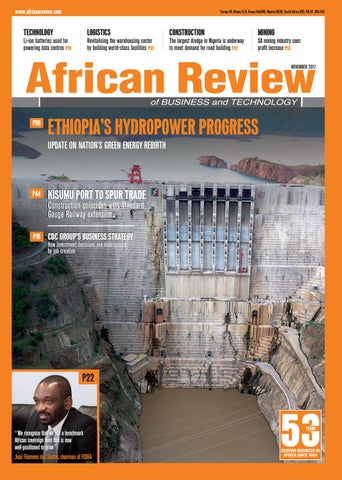
ETHIOPIA’S HYDROPOWER PROGRESS UPDATE ON NATION’S GREEN ENERGY REBIRTH
November 2017
P44
KISUMU PORT TO SPUR TRADE Construction coincides with Standard Gauge Railway extension
P18
CDC GROUP’S BUSINESS STRATEGY How investment decisions are underpinned by job creation
Volume 53 Number 10
P22
www.africanreview.com
53 YEARS
“ We recognise that we are a benchmark African sovereign fund that is now well-positioned to grow ” José Filomeno dos Santos, chairman of FSDEA
SERVING BUSINESS IN AFRICA SINCE 1964
S01 ATR Nov 2017 Start_ATR - New Master Template 2016 27/10/2017 05:49 Page 2
S01 ATR Nov 2017 Start_ATR - New Master Template 2016 27/10/2017 17:05 Page 3
Audit Bureau of Circulations Business Magazines www.africanreview.com
Europe 10, Ghana C1.8, Kenya Ksh200, Nigeria N330, South Africa R25, UK £7, USA $12
TECHNOLOGY
LOGISTICS
CONSTRUCTION
MINING
Li-ion batteries used for powering data centres P26
Revitalising the warehousing sector by building world-class facilities P32
The largest dredge in Nigeria is underway to meet demand for road building P42
SA mining industry sees profit increase P52 NOVEMBER 2017
P36
ETHIOPIA’S HYDROPOWER PROGRESS
KISUMU PORT TO SPUR TRADE Construction coincides with Standard Gauge Railway extension
P18
CDC GROUP’S BUSINESS STRATEGY How investment decisions are underpinned by job creation
P22
53 YEARS
“ We recognise that we are a benchmark African sovereign fund that is now well-positioned to grow ” José Filomeno dos Santos, chairman of FSDEA
elcome to our November issue. Our focus this month is hydropower and its impact on meeting the energy needs of many African countries. It features Ethiopia’s Gibe III, the biggest hydroelectric dam in the country and the tallest of its kind in the world, on page 36. We have top interviews with Africa’s leading financial players; Suleiman Kiggundu, director for Africa of CDC Group – the world’s oldest development finance institution, on page 18 followed by an exclusive interview with José dos Santos, chairman of FSDEA, Angola's first wealth fund, speaking about its impact on the development of infrastructure and agriculture in the country, on pages 22 and 23. In our construction section, manufacturers have launched new exciting products for the African and Middle Eastern markets in 2018. See pages 40 and 48. And finally, AfricaCom 2017 is happening in Cape Town on 7-9 November – the continent’s biggest and most influential technology event on page 12. There will be talks from keynote speakers from Luke Mckend, country director of Google South Africa to Herman Singh, MTN's group chief digital officer. An event not to be missed.
W
UPDATE ON NATION’S GREEN ENERGY REBIRTH
P44
Editor’s Note
SERVING BUSINESS IN AFRICA SINCE 1964
Cover picture: The Gibe III in Ethiopia © Salini Impregilo Cover Inset: José Filomeno dos Santos, chairman of FSDEA © FSDEA
Samantha Payne, Editor Editor: Samantha Payne Email: samantha.payne@alaincharles.com Editorial and Design team: Prashant AP, Hiriyti Bairu, Miriam Brtkova, Kestell Duxbury, Ranganath GS, Deblina Roy, Rhonita Patnaik, Rahul Puthenveedu, Nicky Valsamakis, Vani Venugopal and Louise Waters Managing editor: Georgia Lewis Contributing editor: Martin Clark Publisher: Nick Fordham
Contents
Sales Director: Michael Ferridge Magazine Manager: Serenella Ferraro Tel: +44 207 834 7676 Fax: +44 207 973 0076 Email: serenella.ferraro@alaincharles.com India
TANMAY MISHRA Tel: +91 80 65684483 Email: tanmay.mishra@alaincharles.com
Nigeria
BOLA OLOWO Tel: +234 80 34349299 Email: bola.olowo@alaincharles.com
UAE
RAKESH PUTHUVATH Tel: +971 4 448 9260 Fax: +971 4 448 9261 Email: rakesh.puthuvath@alaincharles.com
UK
MICHAEL FERRIDGE Tel: +44 20 7834 7676 Fax: +44 20 7973 0076 Email: michael.ferridge@alaincharles.com
USA
Profile
22
Business
26
Technology
31
Environment
36
Power
42
Construction
52
Mining
P18
MICHAEL TOMASHEFSKY Tel: +1 203 226 2882 Fax: +1 203 226 7447 Email: michael.tomashefsky@alaincharles.com
Head Office: Alain Charles Publishing Ltd, University House, 11-13 Lower Grosvenor Place, London SW1W 0EX, United Kingdom Tel: +44 (0)20 7834 7676, Fax: +44 (0)20 7973 0076 Middle East Regional Office: Alain Charles Middle East FZ-LLC, Office L2-112, Loft Office 2, Entrance B, PO Box 502207, Dubai Media City, UAE, Tel: +971 4 448 9260, Fax: +971 4 448 9261
18
P26
Production: Naveenkumar H and Nelly Mendes E-mail: production@alaincharles.com Chairman: Derek Fordham
Suleiman Kiggundu, director for Africa of CDC Group, the world’s oldest development finance institution talks about the sectors in which it invests
Interview with José Filomeno dos Santos, head of Angola’s first sovereign wealth fund on how private equity is boosting agriculture and infrastructure development
A report on how Li-ion batteries are playing a crucial part in Africa’s data revolution
Advanced air purification solutions are increasingly being used in businesses and homes in Nigeria to help solve issue of indoor pollution
An overview of hydropower projects on the continent including the US$3,972mn Grand Ethiopian Renaissance Dam, which will be the largest dam in Africa when completed
Printed by: Buxton Press Printed in: October 2017 ISSN: 0954 6782
SUBSCRIPTIONS:
P36
Rates for one year (11 issues): Europe €107, Kenya KSh3400, Nigeria N6600, South Africa R460, United Kingdom £77, US$140 To subscribe: visit www.africanreview.com/subscribe For any other enquiry email circulation@alaincharles.com
Serving the world of business
P42
Nigera starts work on what will become the country’s largest dredging project to date. Dredges are being used for sharp sand mining to meet demand for building roads and land development
PricewaterhouseCoopers (PWC) has released its ninth edition of SA Mine, showing the first substantial increase in revenues for five years
S02 ATR Nov 2017 News_ATR - New Master Template 2016 27/10/2017 05:55 Page 4
NEWS | NORTH
UNAMID and nations welcome US decision to lift sanctions on Sudan
ALGERIA INSTALLS GENERATOR SETS IN WATER TREATMENT PLANT
Image Credit: Adobe Stock
Nations welcome the lifting of US sanction on Sudan.
UNAMID welcomes the US decision to lift most of the economic sanctions imposed on Sudan 20 years ago. The decision, which came into effect on 12 October, is hoped to contribute significantly to the betterment of the lives of the Sudanese people; including the population UNAMID serves in the Darfur region. But despite the lifting of sanctions, Sudan is listed as state sponsor of terrorism. The UNAMID Special Representative and Darfur's chief mediator, Grimaya Kingsley Mamapolo, said, “On behalf of the mission, I would like to congratulate the people and the Government of the Republic of Sudan on the lifting of the American sanctions. “We hope that this decision will make great progress towards improving the living conditions of the people of Darfur we serve in providing greater livelihood opportunities and improving education and health service. I also hope that this decision will be a positive step towards lasting peace, stability and sustainable development in Darfur.” Nations from across the world also supported the decision taken by Donald Trump’s administration to permanently lift the bilateral economic sanctions imposed on Sudan. A joint statement by Norway and the UK said, “We congratulate the Government of Sudan on this decision, which reflects their efforts to make improvements in a number of areas, such as the cessation of hostilities, improved humanitarian access and cooperation on counter-terrorism.” Japan paid tribute to the governments of the United States and Sudan and hoped that the revocation will encourage Sudan’s constructive engagement towards peace and stability in the country, the region and the international community, also believing it will have a positive impact on Sudan’s economic development and economic relations between both countries. The economic, trade and financial sanctions were imposed on Sudan in 1997 after the country was designated a state sponsor of terrorism and known for harbouring terrorists such as Osama Bin Laden. Further sanctions were put in place in 2006 in response to the Sudanese Army’s actions in the Darfur conflict, which claimed 300,000 lives from the combined effects of war, hunger and disease. Speaking to African Review earlier this year on the potential lifting of sanctions, Osama Faisal, Sudan’s Minister of Investment, said, “It is not just a ‘win win’ situation for Sudan but for the whole world. The US sanctions were affecting all the other countries. In my opinion, one of the reasons for the sanctions to be lifted from Sudan, is that some of the companies started rebelling against the sanctions.”
The Algerian Ministry of the Environment, has installed an HIMOINSA generator set to provide emergency power for a wastewater treatment plant in the city of Ali Mendjeli, Constantine. The plant purifies 4,200 cu m of water per hour, serving a population of 260,000, and of which a large proportion of the purified water is reused for agricultural irrigation. Azeddine Yekhlef, regional director of the Algerian Ministry, said, “It's very important to have a specialised and professional local service to carry out maintenance and repairs on the generator sets. The machines work constantly, so we need them to be in perfect condition when they are required.” The model installed is the HTW-1530 T5, fitted with a Mitsubishi engine, and is capable of supplying up to 1660kVA of stand-by power. In addition, it has a large external tank with a 20,000-litre capacity, which gives the generator enough running time to work for 48 hours. To ensure it works smoothly during this time, a redundant transfer system has been installed to transfer fuel from the external tank to the generator. The pumps have been programmed with a start-up delay, so that if the first pump does not start up, the second is already full and ready to transfer fuel to the generator. Javier Vecino, hydraulic infrastructure manager at SICE (ACS Group) said, “We chose Himoinsa because of how they compared in technical and economic terms. We needed a first-class generator, with a combustion engine, and local service that was also very much appreciated by the customer.” Himoinsa is supplying emergency power for two large hotels belonging to the AZHotels chain that will open this year in Kharouba and Mostaganem. The combined four HDW-750 T5 gensets can deliver a combined 3MW of power.
BRIEFS Tunisia will raise taxes to cut budget deficit
Algeria will amend energy law in 2018.
4
Energy Minister Mustapha Guitouni has announced Algeria will be amending its energy law in 2018 in order to improve contract terms to attract more foreign investment, according to a report by Reuters. “Work has started,” Guitouni told reporters on 16 October. “The first draft will be ready by May-June. We need time to prepare a good law.” In the past, foreign companies have been put off from investing because of the bureaucracy.
AFRICAN REVIEW OF BUSINESS AND TECHNOLOGY | NOVEMBER 2017
Image Credit: Adobe Stock
Image Credit: Adobe Stock
Algeria to amend energy law by 2018
Tunisia will raise taxes and VAT to tackle budget deficit.
Tunisia will raise taxes and will make 3,000 employees redundant in 2018 in an effort to cut the budget deficit, the government announced on 16 October. The Tunisian government is aiming for a budget gap of 4.9 per cent of gross domestic product through tax hikes to meet IMF’s US$320mn loan conditions. Ridha Saidi, government’s advisor, said, “We have a package of reforms including raising VAT by 1 per cent next year.”
www.africanreview.com
S02 ATR Nov 2017 News_ATR - New Master Template 2016 27/10/2017 05:55 Page 5
YOUR NEEW workho o orse Tak ake a look at your y new workhorse: the Volv Volvo EC220DL. With its powerful Volv Volvo o D6 diesel engine, this excavator has been engineerred for efficiency, reliability and high productivity. Fe eaturing increased power and dig gging force, this machine has the e potential to significantly improve your cycle times. And th hanks to our unique V Volv olvo ECO-m mode technology and d an electro-hydraulic electro hydraulic system, fue el efficiency has been improved by b 7 - 10 %. A comfortable operator environment with good visibility and responsive controls makes this machine truly flexible to your needs, wherevver you put it to work. Building Tomorr Tomorrow.
volvoce.com
S02 ATR Nov 2017 News_ATR - New Master Template 2016 27/10/2017 17:03 Page 6
NEWS | EAST
ENGIE acquires Fenix International in major move to expand off-grid energy market
Image Credit: Fenix International
ENGIE has acquired Fenix International in Fenix has a major bid to expand the off-grid energy delivered reliable solar power to market in Africa. almost one The multi-million pound investment million people in will contribute to ENGIE’s goal of providing East Africa since it was founded in 20 million people around the world to 2009. access decarbonised energy by 2020. Fenix International has become one of the leading providers of Solar Home Systems (SHS), connecting almost one million people in East Africa. Bruno Bensasson, CEO of ENGIE Africa, said, “We believe that combining the strengths of ENGIE, a global energy player and Fenix International, a successful company with very strong customer focus, high-quality products and an experienced team anchored in the heart of sub-Saharan Africa, will enable faster deployment of SHS to the large African population still lacking access to electricity. We do believe that universal access is now reachable in a foreseeable future by the combination of national grids extension, local micro-grids and solar home systems, depending on the local characteristics of the energy demand.” Fenix International will be the first SHS company to join a major worldwide energy company. Lyndsay Handler, CEO of Fenix International, said, “By joining forces with ENGIE – one of the world’s largest independent utility companies with a firm commitment to a decentralised, decarbonised and digital energy revolution – we will greatly accelerate the path to our vision.” Fenix International’s flagship product, ReadyPay Power, provides lighting, phone charging and power for TVs and radios. The technology is offered on a lease-to-own basis so that off-grid customers can finance their power system through micro instalments over mobile money. Fenix International uses the financing of the solar home system to build a credit score for each customer, which can then be used to power and finance other life-changing products and services from Fenix International. More than 140,000 customers in Uganda already benefit from having pay-to-own solar systems. Fenix International has recently expanded into Zambia and plans further roll-outs in other countries across Africa.
ETHIOPIAN AIRLINES VOTED 2017 MIDDLE EAST AND AFRICA AIRLINE OF THE YEAR Ethiopian Airlines Group, the largest airline group in Africa, is pleased to announce that it has been recognised as Middle East and Africa Airline of the Year 2017 by Airline Economics, the largest aviation finance and leasing print publication in the world. Winners in the Middle East & Africa Aviation 100 Awards Category have been chosen through customer surveys conducted by Airline Economics magazine and Ethiopian Airlines outperformed major carriers in the Middle East and Africa to win this prestigious award. Group CEO of Ethiopian Airlines, Tewolde GebreMariam, said, “I am particularly inspired by this award since our remarkable success and fast growth in all aspects of our business has gradually started to position us in a leadership position outside the continent of Africa.”
1ST PHOTOVOLTAIC PLANT INAUGURATED IN UGANDA Building Energy S.p.A, a globally integrated power producer in the renewable energy industry, has announced the inauguration of the Tororo Solar Plant – its first photovoltaic system in Uganda. With a capacity of 10 MWp (16 GWh per year), the Tororo Solar Plant is among the largest in Eastern Africa. “We are glad that the first photovoltaic park we have built in Uganda has gone into operation, and to celebrate with the whole Tororo community through this Inauguration ceremony,” said Matteo Brambilla, managing director of Africa and Middle East at Building Energy. Building Energy was also responsible for the development of the project, arranging the financing, as well as the construction and commissioning of the plant. Consisting of 32,240 photovoltaic panels distributed over a 14 ha site, the facility is designed to generate around 16 GWh of energy annually, catering to the energy needs of more than 35,838 people. In addition to covering the community's energy needs, the Tororo Solar Plant will foster clean industrial development in the town of Tororo and at the same time save atmospheric emissions of more than 7,200 tonnes of CO2 per year, the equivalent to around 2,800 petrol-powered cars. Similarly to the Soroti Solar Plant, which began operation last December, the Tororo Solar Plant was developed under the Global Energy Transfer Feed in Tariff, a support scheme for renewable energy projects managed by Germany's KfW Development Bank in partnership with Uganda's Electricity Regulatory Agency, and funded by the EU-Africa Infrastructure Trust Fund, the governments of Norway, Germany, and the United Kingdom. The scheme helps renewable energy sources become more affordable and accessible in Eastern Africa.
BRIEFS
Graduates have already been placed in companies in East Africa.
6
Fifty two students graduated from the East African SAP Skills for Africa programme last month. Speaking at a graduation ceremony held at the Kenya School of Government in Nairobi, head of SAP Skills for Africa Meena Confait said every one of the graduates have already been placed at partner and customer organizations in the region. She said, “This year marked our first expanded East Africa programme, with candidates completing their training in key SAP solutions.”
AFRICAN REVIEW OF BUSINESS AND TECHNOLOGY | NOVEMBER 2017
KenGen posts Sh9bn profits
Image Credit: Adobe Stock
Image Credit: Adobe Stock
Skilled graduates driving digital transformation in East Africa
KenGen is Kenya’s largest power producing company in the country.
KenGen has posted a 34.31 per cent increase in net profit in the year ending June on increased interest income, according to local reports. The firm’s net profit increased to Sh9bn, up from Sh6.74bn a year earlier. However the company said it's electricity revenue decreased by one per cent from Sh29.5bn in 2016 to Sh29.36bn this year. KenGen is the largest power company in Kenya producing 80 per cent of the electricity.
www.africanreview.com
S02 ATR Nov 2017 News_ATR - New Master Template 2016 27/10/2017 05:55 Page 7
S02 ATR Nov 2017 News_ATR - New Master Template 2016 27/10/2017 17:01 Page 8
NEWS | SOUTH
Mall of Africa: a showcase for Novelis recyclable aluminium
CITY OF GOLD AN ‘ENGINE OF GROWTH’ FOR SOUTH AFRICA Johannesburg has emerged as the most popular destination city in Africa in 2016, followed by Cape Town, according to the annual Mastercard Global Destination Cities Index. Johannesburg welcomed 4.57 million international overnight visitors in 2016 – an impressive 24 per cent increase on the previous year’s 3.69 million visitors. Cape Town rose from third place in 2015 to become the second most popular African destination city in 2016 with 1.52 million visitors. Lagos (1.04 million), Casablanca (961,694), and Cairo (820,959) rounded out the top five African cities, while Durban remained in sixth place, attracting 758,057 international overnight visitors. Anton van der Merwe, head of market development at Mastercard, South Africa, said the City of Gold also reported a four per cent increase in international expenditure from 2015 – much greater than South Africa’s GDP growth of 0.3 per cent in 2016. “This indicates that Johannesburg is well positioned to be an engine of broad economic growth for the country.”
Image Credit: Novelis
Novelis Inc. recently showcased its involvement in The facade, supplied by Novelis, on the Mall the stunning Mall of Africa shopping complex in of Africa. South Africa, where its products are now proudly on display. The high-end retail site, which opened in 2016, is located in Waterfall City, a future-oriented and economically developing city between Johannesburg and Pretoria. With about 300 stores, a variety of local and leading international brands, plus cafés, restaurants and open air theatres, it is already a major shopping and tourism hub. One striking feature is the façade cladding of the integrated multi-story car park, which was created with Novelis ff2 pre-painted aluminium. The architect selected the pre-painted aluminium in the shade of Tadmoormetallic, a light metallic colour, with a transparent protective layer on the reverse of the metal. The processing features of the ready-to-use pre-painted ff2 sheets enabled the architectural team to create a multi-variant façade design. The Mall of Africa complex also combines other sustainable architecture and innovative technologies representing both traditional African flair as well as international trends. “Due to its weather-resistant PVdF coating and its low maintenance requirements, ff2 pre-painted aluminium is characterised by its longevity even in extreme climate zones and proved to be the ideal material for this ambitious project,” a Novelis statement read. “The solid aluminium sheet ff2 is noncombustible and classified within the best fire protection class of A1 according to DIN EN 13501.” Novelis – a subsidiary of India’s Hindalco Industries Limited, part of the Aditya Birla Group – is a global leader in aluminium rolled products and the world’s largest recycler of aluminium. “When restoring buildings, the pure and high quality recovery of recycled material is crucial,” the company added. “Façade sheets of Novelis solid aluminium meet this requirement. ff2 is 100 per cent recyclable and fulfils the criteria of sustainable architecture. Recycled aluminium is a valuable source of raw material for generations as it can be recycled without any loss of quality – again and again.”
ANGOLA’S ISABEL DOS SANTOS VOWS TO MODERNISE STATE OIL FIRM SONANGOL IN THE WAKE OF POLITICAL CHANGEOVER The head of Angola’s national oil company, Isabel dos Santos, has reaffirmed plans for the reform of Sonangol during a recent visit to the UK. She added that the modernisation plans are part of a wider reform process for the Angolan economy, and approved by the nation’s new president. Joao Laurenco won elections in August, replacing the Sonangol chairwoman’s father, Jose Eduardo dos Santos, who had served as president for 38 years. “We had a peaceful transition; it was a great example for Africa,” she said of the elections. Ms dos Santos told a Reuters newsmaker event in London that Angola is a “good business environment” but the economy is “still very dependent on oil” and that diversification and access to foreign currency are essential. However, she described the overhaul of Angolan oil policy and the reform of Sonangol as a “complex” exercise. “Angola’s oil policy is drafted by government, it is not a single person’s exercise,” she said, stressing the long-term nature of planning required for the oil industry. But she added that culture change was “fundamental” to reforming Sonangol. In terms of near-term developments, Ms dos Santos was upbeat. She said that Total’s Block 32 should produce first oil next year with a target of 100,000 bpd for the first phase, rising to 200,000 bpd in the second phase. For the downstream sector, dos Santos said it is important for Angola to reverse the trend of importing refined goods and, to this end, there is a business plan for building a new refinery, which she hopes will attract investment.
BRIEFS Image Credit: Christopher Jones/Commons
Robben Island solar microgrid launched
An example of a solar microgrid.
8
SOLA Future Energy has launched a solar-based microgrid to power Robben Island, now a World Heritage Site. The grid consists of a solar PV farm, combined with a lithium-ion battery storage facility and smart controllers to ensure a seamless electricity supply, while significantly reducing the island’s fossil fuel consumption. “The microgrid on Robben Island is the largest combined solar and lithium-ion storage microgrid system in South Africa,” said Dom Wills, chief executive of SOLA Future Energy.
AFRICAN REVIEW OF BUSINESS AND TECHNOLOGY | NOVEMBER 2017
Overhauling South Africa’s inner cities South Africa must fix its inner cities if it is to prosper, says Johannesburg mayor Herman Mashaba. “Growth in employment opportunities can only come about if we transform the inner city, which has long been neglected,” he told the African Real Estate & Infrastructure Summit in October. That means working with the private sector to build infrastructure, generate jobs and achieve higher levels of service delivery. Transport is another key challenge. “Making the city more business friendly requires that we address the longstanding R5.8-billion backlog in repairs and maintenance of our road and transport infrastructure,” the mayor added.
www.africanreview.com
S02 ATR Nov 2017 News_ATR - New Master Template 2016 27/10/2017 05:56 Page 9
S02 ATR Nov 2017 News_ATR - New Master Template 2016 27/10/2017 05:56 Page 10
NEWS | WEST
Ghana to use wave energy to solve electricity crisis
Image Credit: Adobe Stock
PLATINUM POWER LAUNCHES TENDER FOR CAMEROON PROJECT
The plant in Ghana is expected to generate around 1,000MW each day.
Ghana has entered into a partnership with Israeli company Yam Pro Energy to explore ways to use wave energy in order to meet energy supply crisis in the country. According to Face2face Africa, the project is set to be developed on the coastline of Accra, the capital city of Ghana. Yam Pro said that it will explore the possibilities in the crashing of ocean waves to generate hydraulic pressure that can easily be turned into electricity, thus meeting the electricity crisis in the west African country. With this, Ghana is expected to generate around 1,000 MW each day, added the company. Zeev Peretz, CEO of Yam Pro, said that this deal is a result after many years’ talk with Ghana and the company hopes to help the country in
meeting its energy demand and improving the life of the citizens. Currently, the plant is in construction phase and it will have floaters connected to wave breakers spread across the Ghanaian coastline, which are aiming to push up and down when the ocean waves crash in, thus enabling the turbines to roll and produce hydraulic pressure, reported the source. The source further reported that Yam Pro has obtained a power purchase agreement from the Electricity Company of Ghana. Commenting on the long-term life of the plant, the company said that it is using technology to ensure that maintenance services are conducted timely in order to achieve maximum performance.
ORANGE LAUNCHES BRAND IN SIERRA LEONE Orange has announced the official launch of its brand in Sierra Leone after acquiring Airtel Sierra Leone. The acquisition of Airtel Sierra Leone was finalised in July by Orange, together with its Senegal-based partner Sonatel, allowing the Orange Group to reinforce its presence in West Africa. Bruno Mettling, chairman and CEO of Orange Middle East and Africa, said, “We are pleased to bring the Orange brand to Sierra Leone, bolstering our already strong presence in West Africa. The launch of the Orange brand confirms our confidence in the country’s on-going economic recovery and our commitment to bring all the benefits of new digital services to Sierra Leoneans in the framework of a fair, transparent and clear partnership that will enable it to be established over time.” Sekou Drame, CEO of Orange Sierra Leone, added, “The launch of the Orange brand comes with a promise to meet the emerging needs of customers with innovative, affordable and relevant solutions.”
Platinum Power, a Power Africa partner, has pre-qualified a total of seven consortia for the design and build of one of their hydropower projects in Cameroon – the Makay Hydroelectric project. This project has an expected installed capacity of 365MW and is located on the Nyong River, in the Nyong-et-Kelle Department, in the central region of the Republic of Cameroon. The following candidates have been prequalified: Acciona Construction / Acciona Industrial / Cooperativa Muratori Cementisti Ravenna; Andrade Gutierrez Engenharia S.A / Andrade Gutierrez Europa, Africa, Asia S.A / Construtora Barbosa Mello SA; China Ghezouba Group Company / China Energy Engineering Corporation; China State Construction Engineering Corporation / Pearl River Planning Surveying & Designing Company; Mota Engil Africa; NGE Contracting/ Besix / SGTM; Sinohydro / Power China. This project represents several opportunities for US companies to join any of the selected consortia, in preparation of the upcoming international tender. No deadline has been posted yet, but the listed consortia will be invited to bid on the final tender, scheduled for launch in the coming weeks. Platinum Power SA is an independent pan-African electricity provider specialised in the development and financing, as well as the construction and operation of plants for the production of electricity from renewable energy sources. Being a pioneer in its sector, Platinum Power is present in Morocco, Côte d’Ivoire and Cameroon. Platinum Power is a company under Moroccan law whose main shareholder is US investment fund Brookstone Partners. It also receives financial backing from public-private investment PMEC.
BRIEFS IMF reaches staff-level agreement with Guinea
Sixth EU-Africa Business Forum to be held in Côte d’Ivoire.
10
The sixth EU-Africa Business Forum will be held on 27 November in Abidjan, Côte d'Ivoire, host country of the fifth African Union-European Union Summit of Heads of State and Government. It will conclude a series of business-related events in Africa and Europe during 2017 in preparation for the fifth African Union-European Union Summit. To register, visit registration@euafricabusinessforum.com.
AFRICAN REVIEW OF BUSINESS AND TECHNOLOGY | NOVEMBER 2017
Image Credit: Adobe Stock
Image Credit: Adobe Stock
6th EU-Africa Business Forum to be in Côte d’Ivoire
Guinea is set to be boosted by the latest IMF Agreement.
IMF staff and Guinean authorities have reached a staff-level agreement to strengthen the Guinean economy and reduce poverty. Giorgia Albertin, IMF Mission chief for Guinea, said, “The Guinean authorities and the IMF staff reached a staff-level agreement on a programme of economic policies and reforms that could be supported by a threeyear ECF arrangement and support Guinea’s 2016–20 National Social and Economic Development Plan.”
www.africanreview.com
S03 ATR Nov 2017 Bulletin_ATR - New Master Template 2016 27/10/2017 07:27 Page 11
The revolutionary approach to reliability! Introducing the new F-series B877F backhoe loader
Our new F-series backho
e:
The Reliability Revolution
The new B877F backhoe loader builds on the SDLG reputation for reliability, adding versatility and superb operational control. When using the excavator, the front bucket of the B877F is put to work as a stabilising ground support. Cab ergonomics have been optimised for visibility, operator comfort and efficiency. A powerful AC system is offered as standard, while a powerful new 70 kW engine and a 55º steering angle add to the versatility. Reliability is key with SDLG, so access for regular servicing and inspection has been made really easy with everything necessary in comfortable reach. All filters are located centrally and a large rear-hinged hood offers swift access to the engine. The SDLG Reliability Revolution is an ongoing process – but our message never changes: SDLG reliability brings you profitability. facebook.com/sdlgcm
S03 ATR Nov 2017 Bulletin_ATR - New Master Template 2016 27/10/2017 17:07 Page 12
EVENTS | 2017
Upcoming Events Calendar 2017 NOVEMBER 2-4
14-16
28-29
WATER AFRICA & WEST AFRICA BUILDING & CONSTRUCTION
EU-AFRICA SUMMIT Abidjan, Côte d’Ivoire www.rinea.org
NIGERIA BUILDEXPO
Abuja, Nigeria www.ace-events.com
Lagos, Nigeria www.nigeriabuildexpo.net
14-16
DECEMBER
WINDABA
3-5
Cape Town, South Africa www.windaba.co.za
ELECTRICX
7-8
FUTURE ENERGY NIGERIA Lagos, Nigeria www.future-energy-nigeria.com
21-22
Cairo, Egypt www.electricxegypt.com
TECH IN GHANA CONFERENCE
4-7
7-8
Accra, Ghana www.techinghanaconference.com
ALGERIA BUILD
CRITICAL AFRICA 2017 Cape Town, South Africa www.informa.com
7-9
AFRICACOM Cape Town, South Africa tmt.knect365.com/africacom
21-23
Algiers, Algeria www.algeriabuild.com
18TH INTERMODAL AFRICA
7-8
Abidjan, Côte d’Ivoire www.transportevents.com
CONTROL CONFERENCE AFRICA
23-24
9TH AFRICA PPP SHOWCASE
9
FT MOZAMBIQUE SUMMIT Maputo, Mozambique www.live.ft.com
Cape Town, South Africa www.ametrade.org
Johannesburg, South Africa www.sacac.org.za
11-13
MODERN AIRPORTS NORTH AFRICA Cairo, Egypt www.modernairportsnorthafrica.iqpc.com
AFRICACOM 2017: UNPACKING THE FUTURE FOR TECHNOLOGY, MEDIA AND TELECOMS Anyone who’s anyone in African telecoms and technology will be in Cape Town at AfricaCom 2017 from 7-9 November. The continent’s single largest and most influential technology, media and telecoms (TMT) event, promises opportunities to witness future tech trends, network with the industry elite, and learn from a line-up of global thought leaders. In a session moderated by the hugely entertaining and knowledgeable Toby Shapshak, delegates will be able to hear Herman Singh, group chief digital officer of MTN, sharing his thoughts on how Africa can capitalise on the potential of disruptive technology or the fourth wave of the mobile industry. M-commerce, he believes, will be far more “disruptive” than PCbased e-commerce ever was. “The combination of identity, location and ‘transactability’ is far more disruptive than e-commerce ever was on PCs. You don’t carry a PC into a shop; your phone, you do,” he said. Bob Collymore, CEO of Safaricom, will describe how innovative mobile network operators can bridge the digital divide and connect the next billion. Safricom is the pioneer of Mpesa, the world’s most developed mobile payment system. If you are looking to discover what support mobile operators need, mobile companies Millicom,
12
AFRICAN REVIEW OF BUSINESS AND TECHNOLOGY | NOVEMBER 2017
The 20th anniversary AfricaCom launch event in Johannesburg on 12 July
Safaricom and Orange will offer expert guidance on how the mobile network operator role is evolving in response to a rapidly shifting digital landscape. AfricaCom 2017 will provide three days of thought-provoking content and essential learning opportunities, including a chance to map Africa’s journey towards the Fourth Industrial Revolution with Luke Mckend, Country Director of Google South Africa and World Economic Forum Global Shaper, Rapelang Rabana. Industry 4.0 will make manufacturing more efficient and productive. By optimising factories, it will directly improve yield. On the product side, it will also extract greater value from data for usage-based
design and mass customisation, which in turn will open the way to new markets. On many levels, it will completely change the business model to an outcome-based approach. A keynote panel hosted by Shola Taylor, secretary-general of the Commonwealth Telecommunications Organisation, will explore how creating an enabling environment will support digital transformation in Africa. Also, joining Taylor on the panel, is the Hon. Tjekero Tweya, Minister of Information and Communication Technology, Republic of Namibia, who will lend his voice to a discussion on developing ICT policy to facilitate and accelerate the spread of internet connectivity policy.
www.africanreview.com
S03 ATR Nov 2017 Bulletin_ATR - New Master Template 2016 27/10/2017 06:01 Page 13
HIGH STABILITY AT MAXIMUM REACH AND HEIGHT
DISCOVER OUR RANGE OF TELESCOPIC HANDLERS. SUPERIOR STABILITY AND RELIABILITY 3 YEAR WARRANTY HIGH SAFETY AND USER-FRIENDLY Using more than 50 years of experience in designing and manufacturing topclass telescopic handlers, we have developed our latest range of telehandlers for construction. Ideal for high-lift jobs with a lift height of up to 18 m, our telehandlers provide outstanding performance. With a patented boom positioning system and frame levelling on selected models, automatic parking brakes, compact stabilizers and much more, our telehandlers are built for maximum safety and efficiency.
MORE INFO ON WWW.BOBCAT.COM Bobcat is a Doosan Company. Doosan is a global leader in construction equipment, power & water solutions, engines, and engineering proudly serving customers and communities for more than a century. Bobcat and the Bobcat logo are registered trademarks of Bobcat Company in the United States and various other countries. © 2017 Bobcat Company. All Rights Reserved.
S03 ATR Nov 2017 Bulletin_ATR - New Master Template 2016 27/10/2017 12:56 Page 14
NEWS | BULLETIN
Image Credit: APO Group
TV IS THE PRIMARY SOURCE OF INFORMATION IN AFRICA AND THE MIDDLE EAST
14
A recent study by the Northwestern University in Qatar (NU-Q) has revealed that TV is the most popular news medium in Middle East and North Africa (MENA) region. When asked about how they stay informed about the latest news in Egypt, CEO of APO Group, Jordan, Lebanon, Nicolas PompigneQatar, Saudi Arabia, Mognard, says TV still Tunisia and United plays a central part in media consumption Arab Emirates, more patterns. than 75 per cent of nationals reported watching television each day rather than relying on online sources. Nicolas Pompigne-Mognard, founder and CEO of APO Group said, “The study confirms what we've been observing for some time, not only in MENA region but also in sub-Saharan Africa. Disparities
AFRICAN REVIEW OF BUSINESS AND TECHNOLOGY | NOVEMBER 2017
AFRICA BECOMING THE DUMPING GROUND FOR EWASTE
KWESÉ TV LAUNCHES IN BOTSWANA THROUGH ORANGE PARTNERSHIP Kwesé TV has teamed up with telecommunications company Orange Botswana to provide customers with premium entertainment and sports programmes on mobile devices, according to reports. Kwesé TV’s news, entertainment and sports will be streamed via Orange’s 4G network. Lepata Mafa-Nthomola, Orange Botswana’s director of corporate affairs, said, “We’re delighted to introduce Kwesé’s mobile product to our subscribers as part of our efforts to deliver top quality entertainment and lifestyle services on our superfast data network. Botswana has been hungry for rich, engaging content and this partnership enables us to deliver TV into the palms of their hands.”
SAMSUNG GROWS YOUNG GIRLS’ CAPACITY IN ICT SKILLS IN GHANA
Image Credit: Samsung
Jay Ireland, CEO and President of GE Africa has received a Princeton in Africa award at the programme’s annual gala awards which was held in New York. Founded in 1999, Princeton in Africa develops young leaders committed to Africa’s advancement by offering year-long Jay Ireland, CEO and President of GE Africa fellowship received a Princeton in opportunities with a Africa award. variety of organisations that work across the African continent. Since the programme’s launch in 1999, they have had 545 fellows in 36 countries. This year, 48 recent college graduates (from 31 colleges and universities) are working with 31 organisations in 13 African countries. Speaking at the event on 16 October, Jay Ireland said, “GE is committed to investing and expanding its business in Africa. Despite the recent economic challenges, we firmly believe in a bright future for the continent and see ourselves as partners in Africa’s sustainable development.”
in literacy, including digital literacy, and education greatly influence news platforms choices. And despite internet penetration and the rise of social media, it is also important to take into consideration that there is still an unequal access to internet technology in both regions. This explains in large part why television still holds a central place in media consumption patterns.”
Image Credit: Adobe Stock
Image Credit: GE AFrica
GE AFRICA CEO WINS PRESTIGIOUS PRINCETON IN AFRICA AWARD
Western nations are dumping their ewaste across Africa.
A growing amount of computer equipment from Western nations is being found on toxic eWaste dumps throughout Africa and is being pulled apart by children as young as five, reported IT asset disposal firm Xperien. A computer monitor from a prominent Australian bank was recently found on a toxic eWaste dump in Ghana. This raises serious questions about the integrity and regulations of Australia's growing eWaste problem and even though it is illegal to export redundant computer equipment, that is considered hazardous waste, it is still happening. In South Africa, there are laws that regulate the disposition of eWaste, these include Protection of Personal Information Act 2013 (PoPI 2013), the National Environmental Waste Management Act 2008 (NEMWA 2008) and the Consumer Protection Act 68 of 2008 (CPA). Xperien CEO Wale Arewa said penalties for poor disposal of redundant IT assets could be costly but this could be prevented by adopting an IT asset disposition policy. He said, “Companies need to decommission IT devices and their contents effectively. A proper policy includes the need to control the data that is stored on IT equipment, its disposition, removal, and transfer.”
Delegates from Samsung celebrate the handover of a new IT facility at Accra Bishop Girls Junior High School.
Forty employees from Samsung's headquarters in South Korea gathered in Accra last month to take part in the company's annual Employee Volunteer Programme (EVP) and be part of the handover of a new IT facility. Staff members imparted their skills and expertise to young Ghanaian girls during the handover of the Samsung-funded ICT Centre at the Accra Bishop Girls Junior High School. Eungjin Nahm, Samsung Electronics West Africa – Ghana, said, “It's important for our people to be actively involved with the education initiatives we are rolling out across Africa. Not only are they able to impart considerable value through their time and expertise but it also provides them with the opportunity to witness first-hand the difference their combined involvement in Samsung is making to the lives of others.” Accra Bishop Girls' School has 760 students. Though ICT forms part of the school’s curriculum, it has historically been forced to rely on textbooks for its education purposes as a result of its lack of ICT facilities.
www.africanreview.com
S04 ATR Nov 2017 MESC_On the web_CDC Group_ATR - New Master Template 2016 27/10/2017 06:07 Page 15
S04 ATR Nov 2017 MESC_On the web_CDC Group_ATR - New Master Template 2016 27/10/2017 17:10 Page 16
COMMERCIAL FEATURE
Targeting the special cables industry in North Africa Nasser Abualhaija, general manager of the sales project from MESC talks how it is well-positioned to enter Egyptian and Algerian markets.
Image Credit: MESC
Please tell us about how the recent venture with Al-Mousa Cables in Egypt is going and how it is strengthening Middle East Specialized Cables’s (MESC) position in North Africa? MESC used to have one distributor in Egypt called United Import & Export Co., which has been supplying MESC
16
products in Egypt for the last 20 years. Almousa Specialized Cables Co. was added to our distributor list on June 2016 and has several showrooms in the trade and commerce sectors. And through its new company, AMID, it is focusing on industrial projects. With this set-up, we believe that
Almousa Specialized Cables Co. was added to MESC distributor list on June 2016.
AFRICAN REVIEW OF BUSINESS AND TECHNOLOGY | NOVEMBER 2017
MESC is well-positioned to address all segments in the Egyptian market for our special and power cables. Which companies and their projects are you involved with in North Africa? First, we are involved with Amid and its Aswan Solar project; Bechtel,
with its WND-West Nile Delta project, and Alstom Railway, all of which are based in Egypt. Then there is Sonatrach and the Hassi Masud project, and Sonalgas with the Aintsila project, both in Algeria. What are MESC's plans for 2018? Are there still plans to export products to Algeria, Libya and Sudan? North Africa is a major focus. MESC is in the process of obtaining the different required approvals and is quoting and offering products for several International EPCs in several industrial / oil and gas projects. What are the main challenges affecting the cabling industry? The industry faces challenges, such as the over-supply of local manufacturers, a reduced number of projects and the number of international cables manufacturers targeting the Middle East, which is increasing competition and putting pressure on prices. The low price of oil also is affecting the progress of new projects. However, we believe that 2018 could be the trigger point for recovery in the region. â–
www.africanreview.com
S04 ATR Nov 2017 MESC_On the web_CDC Group_ATR - New Master Template 2016 27/10/2017 07:18 Page 17
WEB SELECTION
AFRICAN REVIEW / ON THE WEB A selection of product innovations and recent service developments for African business Full information can be found on www.africanreview.com
The new Doosan DL420CVT.
Doosan has launched the new DL420CVT-5 Stage IV compliant wheel loader, the first model in the Doosan wheel loader range to be equipped with a Continuously Variable Transmission (CVT). The CVT design combines the benefits of a mechanical transmission and a
1
PLATINUM POWER PRE-QUALIFIES DESIGN AND BUILD OF 365MW HYDROELECTRIC PROJECT IN CAMEROON
hydrostatic transmission in the same machine. It allows the DL420CVT-5 to automatically transition from hydrostatic power at low speed to the mechanical system to operate at higher speeds. The driving range, in forwards and in reverse, is controlled by the CVT system. The low engine speeds ensure a high efficiency and the highest driving comfort irrespective of the traction speed. The CVT achieves a fuel saving of up to 15 per cent. The ability to split hydrostatic and mechanical power has allowed Doosan to move to the Scania DC09 engine in the DL420CVT-5, as the CVT system maintains the machine’s efficiency even at low engine rpm. The Scania DC09 engine meets Stage IV.
2
This project has an expected installed capacity of 365 MW and is located on the Nyong River, in the Nyong-et-Kelle Department, Central region of the Republic of Cameroon. Platinum Power has pre-qualified a total of seven consortia for the design and build the Makay Hydroelectric project. This project has an expected installed capacity of 365 MW and is located on the Nyong River, in the Nyong-et-Kelle Department, Republic of Cameroon. The companies that consist of the
4
6
7
8
14
9 13 12
American and European companies, with South African and China prominant in the design and building process of the plant.
for the entire industry. 5
17
15
An example of an hydroelectric dam.
RELIABLE ENERGY SOLUTION
3
16
consortia include Africa, Asian,
Image Credit: Plant Worker/Commons
Image Credit: Doosan
DOOSAN LAUNCH DL420CVT5 WHEEL LOADER WITH CVT
11
10
1 2 3 4 5 6 7 8 9 10 11 12 13 14 15 16 17
Overhead Lines Distribution Transformers Motor Control Centres All Weather Outdoor Control Panels Diesel Generator Push Buttons and Pilot Lights Motor Protective LV Switchgear Direct Online Starters (DOL) LV Motors and Drives Invicta Vibrator Motors Mini Substations MV Motors MV Generators Automation Control Room MV Switchgear Tiger Ring Main Unit Power Transformers
The Zest WEG Group has been servicing the mining, infrastructure, construction and manufacturing sectors for more than 35 years and by leveraging best practice engineering and manufacturing capabilities, the group is able to offer a range of standard off-the-shelf products as well as end-to-end energy solutions. An in-depth understanding of the operational conditions found across all these sectors and years of experience have ensured that the Zest WEG Group service offering is fit-for purpose.
www.africanreview.com
Tel: +27 11 723 6000
www.zestweg.com
NOVEMBER 2017 | AFRICAN REVIEW OF BUSINESS AND TECHNOLOGY
17
S04 ATR Nov 2017 MESC_On the web_CDC Group_ATR - New Master Template 2016 27/10/2017 06:07 Page 18
PROFILE | CDC GROUP
Investing in businesses across all sectors in Africa
C
DC Group was established in 1948, making them the world’s oldest development finance institution. Its achievements to date go as far back as the 1950s from creating the cement sector to building the Kariba Dam in Zambia to the sugar industry in Swaziland. Right now in Africa alone CDC Group invests in around 650 businesses directly and indirectly across 30 countries. Every investment decision is underpinned by creating jobs and development impact to make a lasting difference to people’s lives. “We are invested in seven out of every 10 equity funds in Africa so we are one of the largest financiers of private equity on the continent, and we take pride in this,” said Suleiman Kiggundu, CDC Group's regional director for Africa, whose senior advisory role involves working alongside its investment teams and its head of Africa, Ketso Gordhan to make sure deals are properly vetted and screened for market development. “Our mandate is that every investment decision is underpinned by job creation and its potential to positively impact its community,” said Kiggundu. “My role is to help to make sure businesses deliver on this mandate and that our investment teams deliver a return to our stakeholders. We want to make sure we are building sustainable businesses.” In addition to supporting the private equity industry, since 2012, CDC Group has focused its direct equity investments towards seven main sectors: infrastructure (especially power & logistics), agribusiness, real estate (including construction & affordable housing), financial institutions, health and education and manufacturing. CDC Group has a big investment in
18
Image Credit: Saïd Business School
CDC Group is the world’s oldest development finance institution, known for creating industries from scratch in Africa. Suleiman Kiggundu, director for Africa, tells African Review about the seven main sectors in which CDC prioritises its investments.
Suleiman Kiggundu, regional director for Africa, speaking at the Oxford Business Forum Africa in March.
Globeleq – one of the largest African independent power producers – and in a US$250mn joint-venture with Aga Khan Fund for Economic Development focused on driving hydro/renewable projects in subSaharan Africa, such as the 147MW Ruzizi III project in the Great Lakes region. On completion, the Ruzizi III project is expected to double Burundi’s current capacity and boost Rwanda’s by 30 per cent and provide baseload power for the Democratic Republic of Congo. On the rail and logistics side, CDC Group has invested in Grindrod Ltd, an integrated logistics company and shipping provider. Kiggundu said, “We invested US$17mn in the JSE-listed parent company in South Africa and then agreed to invest up to US$150mn in its projects outside South Africa to encourage it to go beyond the country's borders and to enter challenging sub-Saharan markets that it otherwise would not have gone into earlier.
AFRICAN REVIEW OF BUSINESS AND TECHNOLOGY | NOVEMBER 2017
“Our very first project under our new investment approach was Export Trading Group, a leading pan-African commodities trader. With our support, ETG built 50 new warehouses and processing facilities across Africa enabling it to partly process and/or add value to its raw materials before they were shipped out. We exited the company last year, but everyone was happy in terms of returns and impact, and we left a stronger business behind.” Education is also high up on CDC Group’s priorities. It has gone into a joint venture with Global Education Management Systems, one of the largest kindergartens to grade 12 education providers in the world. He said, “Over the next 10 years, we would like to have established about 25 to 30 multi-curriculum schools across east, west and southern Africa. We already have one in Kenya and in Uganda and now are looking at Nigeria and other places.” In healthcare, CDC Group is
looking at how it can leverage its South Asian investments to support health development in Africa. He said, “We have just announced that we have invested in Healthcare Global in India, specialising in cancer treatment, to bring its expertise and services to Africa. We are currently upgrading a cancer centre in Kenya and the intention is to have multiple sites with diagnostic and treatment capacity on the continent.” In real estate, CDC Group has invested in one of the leading cement businesses in East Africa. “From building satellite cities and affordable housing, you have to make sure the whole value chain is efficient,” he continued. “If we can get competitively priced cement into the market, then everything falls into place. So, we have invested US$140mn in ARM Cement in Kenya and want to support its expansion into the rest of the region and hopefully create more affordable cement in the process. ARM Cement is also good at building smaller plants in challenging geographies and proving the market, so big players can come in. We are excited about developing their sites in countries like Madagascar. Where there is enough supply to make a 0.5 to one million tonnes per annum plant economically viable in smaller economies, it changes the dynamic of being an importer to being self-sufficient domestically, which is an ethos that we are carrying across all the geographies.” Kiggundu says that CDC does not have a time limit to how long it holds an investment in a business so long as it continues providing value. “We co-founded the Development Finance Company of Uganda in 1964 and we are still an investor there now,” he added. ■ www.africanreview.com
S05 ATR Nov 2017 Business_ATR - New Master Template 2016 27/10/2017 06:15 Page 19
S05 ATR Nov 2017 Business_ATR - New Master Template 2016 27/10/2017 06:16 Page 20
NEWS | BUSINESS
Egypt overtakes South Africa as most attractive investment destination
QUANTUM GLOBAL EXITS SAVANNAH CEMENT
Image Credit: Adobe Stock
Egypt beat South Africa as the most attractive investment destination according to Rand Merchant Bank.
Egypt has seized the number one spot from South Africa as the most attractive investment destination on the continent, according to Rand Merchant Bank's (RMB) Investment Attractiveness Index. For the first time, Nigeria and Algeria do not feature in the top 10 of the RMB's Investment Attractiveness Index, which balances economic activity against the relative ease of doing business. In RMB's seventh edition of Where to Invest in Africa 2018, Egypt displaced South Africa largely because of its superior economic activity score and sluggish growth rates in South Africa, which have deteriorated over the past seven years. Despite mounting concerns over issues of institutional strength and governance, South Africa's currency, equity, and capital markets keep the country a cut above the rest, with many African nations facing liquidity constraints. Morocco retained its third position for a third consecutive year having benefited from a greatly enhanced operating environment since the Arab Spring which began in 2010. Surprisingly, Ethiopia, a country dogged by socio-political instability, displaced Ghana to take the fourth spot because of its rapid economic growth and brushed past Kenya as the largest economy in East Africa. Ghana's slide to fifth position was mostly due to perceptions of worsening corruption and weaker economic freedom. Kenya holds firm in the top 10 at number six. Despite being surpassed by Ethiopia, investors are still attracted by Kenya's diverse economic structure, pro-market policies, and brisk consumer spending growth. Business-friendly reforms aimed at rooting out corruption and steady economic growth helped Tanzania climb by two places to number seven. Rwanda re-entered the top 10, helped by being one of the fastest reforming economies in the world, high real growth rates and its continuing attempt to diversify its economy. At number nine, Tunisia has made great strides in advancing political transition while an improved business climate has been achieved by structural reforms, greater security and social stability. Côte d'Ivoire slipped two places to take up the tenth position. Although its business environment scoring is still relatively low, its government has made significant strides in inviting investment into the country leading to a strong increase in foreign direct investment over the years, resulting in one of the fastest growing economies in Africa. "These years have exposed a number of African nations to severe economic stress - especially that of liquidity shortages. Unfortunately, there is no quick fix to infuse into a context as complex as this, and traditional forms of revenue will remain a reality for many years to come," said Ronak Gopaldas, RMB Africa analyst and co-author. Where to Invest in Africa 2018 also includes 191 jurisdictions around the world and measures Africa's performance relative to other country groupings. The reality is that African countries are still at the lower end of the global-performance spectrum, which continues to be dominated by the US, UK, Australia and Germany.
QGIAM, the private equity arm of Africa focused investment firm Quantum Global, has announced the sale of Savannah Cement, a leading Kenyan cement producer. Quantum Global Group held the asset since 2015 through its USD$1.1bn Infrastructure Fund, which is one of the most significant private equity funds in Africa solely focused on infrastructure developments. Jean-Claude Bastos de Morais, Quantum Global’s founder and group CEO, said, “We are delighted to have partnered with Savannah Cement in one of the critical industry sectors in East Africa, advancing together to aim to close the existing infrastructure gap in Africa. The exit from this investment is testament to the success of our approach of deploying capital in transformative sectors of major importance in Africa at the right time.” Martin Bachmann, group head of active management of Quantum Global, said, “Our active partnership with Savannah Cement and its management team has created significant value and we are pleased to have been involved in such a critical growth phase for the company.” Savannah Cement is a eco-friendly cement grinding plant with a capacity of 1.5 million tons a year, in Athi-River, located 30km from Nairobi. Since starting operations in 2012, Savannah Cement has been successful in capturing several regional infrastructure deals to grow its market share and thus quickly becoming a major regional player. Bachmann added, “Through its development of state-of-the-art products and technologies and its focus on the best use of green technology and on revolutionising environmental management in the cement industry, the company is well positioned to compete in an expanding marketplace, and we wish them continued success.”
Fatima Sullivan, VP of customer service for DHL Express.
20
DHL Express wins 27 awards in Africa
Old Mutual named top employer in Ghana
DHL Express has won more than 27 external awards for customer service in sub-Saharan Africa so far this year. Fatima Sullivan, Vice President of customer service for DHL Express, sub-Saharan Africa said, “Listening to the voice of the customer is imperative when it comes to optimizing the user experience.”
Old Mutual has been named as the number top employer in Ghana and South Africa at the Top Employers Institute gala dinner in Johannesburg. Anisha Archary, human resources director, Old Mutual Emerging Markets said she was proud that Old Mutual has continued to strengthen its reputation as a leading business in Africa.
AFRICAN REVIEW OF BUSINESS AND TECHNOLOGY | NOVEMBER 2017
Image Credit: Old Mutual
Image Credit: Deutsche Post DHL
BRIEFS
Anisha Archary, human resources director, Old Mutual Emerging Markets.
www.africanreview.com
S05 ATR Nov 2017 Business_ATR - New Master Template 2016 27/10/2017 06:16 Page 21
“Room for growth?”
“As far as the eye can see.”
Best Investment Bank in Africa
In Africa, opportunity takes many forms. Having the right partner, with the right connections, to help you build, shape and grow your prospects is crucial. It’s how we progress, together. standardbank.com/CIBinsights
Corporate and Investment Banking
Authorised financial services and registered credit provider (NCRCP15). The Standard Bank of South Africa Limited (Reg. No. 1962/000738/06). Moving Forward is a trademark of The Standard Bank of South Africa Limited. SBSA 279004 10/17.
S05 ATR Nov 2017 Business_ATR - New Master Template 2016 27/10/2017 06:16 Page 22
BUSINESS | REPORT Among FSDEA’s assets are Cabinda’s first deep-water port and large-scale farms.
Angola’s first wealth fund reports continuous gains
Image Credit: Adobe Stock
The Fundo Soberano de Angola generated profits in 2016 for the first time since its launch in 2012.
he head of Angola’s first sovereign wealth fund has told investors to make the most of “Africa’s benchmark” stake into private equity. José Filomeno dos Santos, chairman of the board of directors for the Fundo Soberano de Angola (FSDEA), said the results of the 2016 audited accounts for the nation’s private equity investment fund point to continuous capital gains. Santos told African Review: “It’s a good time to invest in the next two years as our assets are accessible, the Angolan Government will be promoting inward investment and speculative prices of assets will be undervalued. “Our economy is recovering, although not at the same rate as the US and Europe. It is [nevertheless] still recovering at a steady pace. Obviously it’s going to take a while for that recovery to be reflected in terms of our asset prices. On the other hand, that in itself presents a lucrative opportunity.”
T
22
According to the FSDEA’s 2016 audited results, the Fund has generated profits since its launch in 2012, with an initial endowment of US$5bn. Last year, the fund recorded a 40 per cent reduction in operational costs compared to 2015. Santos attributes this result to a prudent investment policy and some positive returns on investments in agriculture and infrastructure sectors. He said that the main gains of the seven private equity investment funds have been recorded in agriculture, (US$110mn), and the infrastructure fund (US$118mn). This offsets the depreciation of US$30mn of the remaining funds in real estate, hotels, timber and healthcare and mining. Overall, the Fund’s total assets
increased to US$4.99bn in 2016 from US$4.75bn in the previous year. Of the total portfolio, 58 per cent has been dedicated to assets in sub-Saharan Africa, with 10 per cent in North America, 12 per cent in Europe and 20 per cent across the rest of the world. Santos added that assets are predominantly in Angola, including Cabinda’s first deep-water port and large-scale farms. “We recognise that we are a benchmark African sovereign fund in a relatively short period of time that is now well positioned to grow,” he said. “We will achieve a continuous asset appreciation with the private equity funds in infrastructure and farming, expecting the remaining five funds to break even.”
We want to boost small industries as a whole” JOSÉ FILOMENO DOS SANTOS, CHAIRMAN OF THE BOARD OF DIRECTORS FOR THE FUNDO SOBERANO DE ANGOLA
AFRICAN REVIEW OF BUSINESS AND TECHNOLOGY | NOVEMBER 2017
José Filomeno dos Santos, chairman of FSDEA.
Santos explained that these investments had been made against a tough macroeconomic context, marked by a devaluation of the currency and the volatility of the international price of crude oil that dipped in 2014. He said: “The context was that most of the people were not investing, so we wanted to develop business in areas that were much more forward-thinking. This was challenging. “One of its biggest characteristics is the fact that our oil industry does not generate a lot of employment as most of its activities are offshore. The impact of the oil industry is not always felt onshore in terms of
www.africanreview.com
S05 ATR Nov 2017 Business_ATR - New Master Template 2016 27/10/2017 13:18 Page 23
development and creation of jobs. We would like to see more of an impact on society.” The Fund allocates 7.5 per cent of its capital to social development on projects that can demonstrate socio-economic benefits such as job and wealth creation. Known as the Social Charter, this arm of the Fund supports the work of NGOs in promoting vocational training, sustainable income generation, access to water and health care services. Santos said, “Looking back, we started from nowhere with only a hazy strategy but since then, we’ve been defining our focus more and more. Only last week, we signed contracts with 11 NGOs, allowing people to generate income, small farmers, entrepreneurs and those providing health services and access to clean water. We focus on vocational training and work with NGOs that support training for
www.africanreview.com
Image Credit: SIM USA/Flickr
REPORT | BUSINESS
FSDEA expect continous gains in private equity funds in farming.
young people and work with companies to create jobs. It’s about sustainable development.” Santos is confident that the benefits will be make a real and lasting difference to the day-to-day lives of ordinary Angolans. On the other hand, he says the impact on the investor will not be felt for some time.
“In agriculture, the first impact will be on the creation of jobs and rolling out supply contracts and equipment. We want to boost small industries as a whole. In agriculture we have productive land of 72,000ha. Working on these large swathes of land demands people, supplies and equipment.”
Meanwhile, the FSDEA has been making strides to improve business practices. For example, the fund is the first Angolan institution to adopt the International Financial Reporting Standards (IFRS). Last year’s results are now fully compatible with the use of IFRS on a consolidated basis. Santos added, “At the end of each accounting period we probably close the books of hundreds of companies. Auditing our accounts is a relatively new approach. The government is our supervisor so we have to present them the truest possible picture.” However, he admitted that his team has been allowed to cherry pick assets but, ultimately, if these failed, he would only have himself to blame, adding, “It’s been about setting an example – but we still have a long way to go.” ■ By Lizzy Millar
NOVEMBER 2017 | AFRICAN REVIEW OF BUSINESS AND TECHNOLOGY
23
S06 ATR Nov 2017 Technology_ATR - New Master Template 2016 27/10/2017 15:03 Page 24
TECHNOLOGY | GAMING
Competitive gaming reaches the next level in Africa A recent international gaming tournament in Kenya revealed demand from a new generation of African gamers. But the rise of competitive gaming in the region hinges on the rollout of more advanced network infrastructure.
O
New era of African gaming This is just the beginning for gaming in Africa, which is yet to truly make its mark across on the region. Organised, competitive computer gaming, known as eSports, is emerging as a major spectator sport globally, and can be staged in front of millions of online viewers. In 2016, eSports generated £400mn in global revenue, with a global audience of approximately 320 million people. By 2020, those figures are expected to almost double to £1bn in revenues and a global audience of 600 million, according to analyst firm Newzoo. In South Korea, eSports has become so ingrained in society that professional gamers enjoy celebrity status and compete in tournaments
24
Liquid Telecom is investing with its partners to create an engaged gaming community across Africa.
Image Credit: Naiccon
n the last weekend of July at the Sarit Centre in Nairobi, Kenya, over 3,000 comic book, gaming, animation and movie fans descended upon the Nairobi Comic Convention (Naiccon) for two days of creative workshops, cosplay competitions and gaming tournaments. Now in its fourth year, Naiccon is only going from strength-tostrength. This year, however, it was competitive gaming that stole the limelight as the event hosted the region’s first ever international multiplayer gaming tournament. The tournament saw a total of 16 PC and console gaming teams from Kenya, Uganda and Rwanda battle it out for Sh150,000 (US$1,500) in cash prizes in front of enthusiastic audiences. Such was their dedication to the tournament that many gamers – all of different age and ability – arrived at 9am and played straight through the night until 7pm the following day when the event closed.
live in front of crowds of hundreds of thousands. The rise of South Korea’s gaming culture has been made possible by some of the most advanced fibre infrastructure in the world. When it comes to gaming, fast and consistent internet speeds seriously matter. Even a minor delay or disruption in speed of service can cause a major impact to real-time, multi-player games, during which large volumes of data are being sent between a gaming console or computer and the internet. Since it delivers the fastest possible internet speeds, fibre is the definitive solution when it comes to online gaming. Throughout Naiccon, Liquid Telecom, which operates the largest independent pan-African fibre network stretching over 50,000km, supported the multiplayer gaming tournament with unlimited bandwidth, and the usage peaked at 750Mbps and never dropped below 100Mbps. This enabled participants and spectators to stream the event from different sites on the internet, while also hosting a LAN party, which, for those of you not in the know, is when gamers bring their
AFRICAN REVIEW OF BUSINESS AND TECHNOLOGY | NOVEMBER 2017
own computers and connect to a local network to compete against one another. At the same time, the connection even supported free Wi-Fi for visitors throughout the event.
Rising eSports stars It is hoped that the success of this year’s Naiccon will inspire more frequent multi-player gaming tournaments to take place across the region. The jump from hobby gaming to competitive eSports is considerable, with major sponsorship and prizes needed to raise the profile of gaming and help unearth the first African eSports stars. But there are promising signs. Kwesé Sports, Econet Media’s premium sports content platform, recently signed an exclusive, five-year deal with the world’s largest eSports company ESL, to distribute ESL content and host events across Africa. Through the partnership, Kwesé and ESL will bring the first ever continental eSports championship to Africa, and will also be launching the region’s first 24/7 eSports channel.
Meanwhile, the rollout of additional fibre across the region by Liquid Telecom will help reduce network delay and enable more gamers to compete internationally. The rise in the number of competitive gamers across Africa is expected to bring with it a growth in local gaming content. “As part of the Liquid Telecom Group innovation partnerships strategy, we are investing together with our partners in creating a captive and engaged gaming community across Africa aimed at opening up opportunities for the African gaming industry. We intend to attract the large gaming companies to locally host their gaming platforms in Africa and also enable gaming entrepreneurs who can create the next African centric games, ” said Ben Roberts, Group CTIO, Liquid Telecom. There has been some early discussion of eSports being added to the Olympic programme as an official medal sport in 2024. If that does happen then there’s every chance that African gaming teams could be competing in it. ■
www.africanreview.com
S06 ATR Nov 2017 Technology_ATR - New Master Template 2016 27/10/2017 15:03 Page 25
TECHNOLOGY | NEWS
Sage and ACCA Nigeria partner to develop finance professionals’ skills and expertise
Image Credit: Sage
Sage, the market and technology leader for cloud accounting, people and payroll, and payment systems, announced today that they have signed a partnership agreement with the Association of Chartered Certified Accountants (ACCA) in Nigeria. This partnership will see the organisations work together to provide training and skills development opportunities to finance and accounting professionals. They will also promote each other’s brands and share information with their respective communities. Left to right: Adronke Adebule, Sage business relationship Magnus Nmonwu, regional director manager; Tom Isibor, head, ACCA; Fidelis Isiekwene, regional head, Sage Enterprise West Africa and Damilola Ajibada, for Sage in West Africa said, “We are channel/training manager. delighted to cooperate with ACCA to develop skills in the finance and accounting arena including the student members of the ACCA. We believe that there is a great deal we can do to add value for ACCA members in the region. Our wide network of resellers and partners are at hand to provide ACCA members and other Nigerian customers with the advice they need to grow their businesses.” ACCA will integrate Sage learning materials into certificates and qualifications as relevant, helping to build capabilities among ACCA members and partner institutions. The partnership will kick-off with an event in November where Sage will be introducing Sage X3 to ACCA members within the enterprise space.
www.africanreview.com
TAKING INTELLIGENT APPROACH TO MOBILITY REVOLUTION Africa is bracing itself for a transport revolution as more countries embrace a new era of intelligent mobility in Africa, writes Kevin Pillay – vice president for mobility at Siemens Africa. Intelligent mobility involves the electrification, automation and digitalisation of existing transport infrastructure, and gives every citizen access to safe, reliable and efficient modes of transport. The need and demand for intelligent mobility in Africa has never been greater. The World Economic Forum competitiveness data reveals that only three African countries feature in the top 50 globally for quality of roads, quality of rail and quality of ports infrastructure respectively. World Bank data also indicates that the sub-Saharan African railway network has declined to 59,634 km today, down from 65,661 km in 1980. African cities can benefit from expertise in centralised traffic management. and automation systems.
NOVEMBER 2017 | AFRICAN REVIEW OF BUSINESS AND TECHNOLOGY
25
S06 ATR Nov 2017 Technology_ATR - New Master Template 2016 27/10/2017 06:22 Page 26
TECHNOLOGY | DATA CENTRES
Li-ion technology in Africa’s mission-critical sites Nick Finney, Saft’s Li-ion business development and product manager, explains how African operators of mission critical industrial UPS systems can secure superior backup performance and high safety standards from lithium-ion battery systems. ithium-ion (Li-ion) battery technology is the electrochemistry that powers many consumer devices and electric vehicles. But, it is being adopted in a much wider range of applications in industry. In Africa, Saft Li-ion batteries are found at many off-grid telecoms sites that are essential to Africa’s data revolution. The batteries store energy generated by diesel gensets and solar panels or wind turbines and ensure round-the-clock uninterrupted operation of mobile phone networks.
Image Credit: Saft
L
Saft has launched the Flex’ion battery system to meet demand for UPS systems for mission-critical equipment.
Since it was first introduced in the early 1990s, Li-ion technology has become more sophisticated and its cost has reduced. Today, Li-ion batteries are being adopted in uninterruptible power supply (UPS) systems in data centres, electricity substations, oil and gas installations and other industries that depend on always-on, ultra-reliable power. Recognising the growing accessibility of Li-ion technology to such operators, Saft has launched the Flex’ion battery system to meet demand for UPS systems for mission-critical equipment such as control systems, switchgear, servers and valve actuators. Operators of such systems typically want a backup battery that closely matches their installation’s operating voltage, load current and backup time. Because of this, the Flex’ion is scalable to deliver energy and power combinations that range from 1.3 kWh to 3 MWh and 10 kW to 5 MW.
adopting a battery system that lasts as long as the equipment that it serves will simplify the lifetime maintenance requirements, making operation more straightforward. In addition, Li-ion weighs only one sixth of comparable lead-acid technology and takes one third of the volume. In places where space is at a premium, a smaller and lighter battery can enable savings elsewhere. For example by reducing the size of the battery room on an offshore oil installation, transporting them to site by helicopter, or allowing a data centre to squeeze more server racks into their existing facility. Another benefit is electronic battery management, meaning the battery system can be integrated into an operator’s supervisory control and data acquisition system to enable remote and condition-based monitoring.
Benefits of Li-ion
Safety is a top consideration for operators of remote installations and mission critical industrial facilities. Although it is referred to as a single battery type, Li-ion electrochemistry includes multiple different chemistries, with different levels of performance and safety. Recognising the high requirements for safety in industry, Saft has adopted its patented Super Lithium Iron Phosphate (SLFP) technology for Flex’ion. SLFP technology has superior performance over conventional battery technologies but is different from the Li-ion used in consumer electronics. SLFP technology has achieved safety approvals from standards agencies UL, IEC and UN, as well as Bureau Veritas and the Norwegian Maritime Authority. This means that
Compared with other battery technologies, Li-ion technology has major benefits including a maintenance-free 20 plus year calendar life with no requirement for regular capacity testing and a wide operating temperature from – 20 to plus 60˚C. This is important in remote locations, where the total cost of ownership includes operation and replacement costs, and where the cost of getting technicians to site is high. By
Saft Li-ion batteries are already found at off-grid telecoms sites that are essential to Africa’s data revolution ” 26
AFRICAN REVIEW OF BUSINESS AND TECHNOLOGY | NOVEMBER 2017
Safety in mission critical applications
Nick Finney, Saft’s Li-ion business development and product manager.
the chemistry has been demonstrated as being safe in shipping – which have much in common with offshore oil and gas facilities and mission-critical data centre, where safety and process continuity is the top priority. Mechanical and electrical safety have been built into the design of the Flex’ion battery solution through an advanced battery management system and the intelli-connect proprietary monitoring system.
Battery system built for long-term success Li-ion battery systems are built up from individual rechargeable battery cells to deliver medium or longlasting energy, or high power. These modules are connected in series to build a battery with a voltage from 87 to 958 V, energy storage capacity from the kilowatt-hour to the multi megawatt-hour level and power in the range of 10 kW to 5 MW. Once in operation, a battery management system controls charging and discharging to ensure an even distribution of voltage, current and temperature across the modules and cells. Experience has found that maintaining an even temperature across the modules will ensure that all the cells in the system age at the same rate. This is the key to optimised long-term performance and is built into Saft’s battery management software. n
www.africanreview.com
S06 ATR Nov 2017 Technology_ATR - New Master Template 2016 27/10/2017 10:55 Page 27
MASTERCLASS MAINTENANCE AND RELIABILITY PRACTITIONERS (Advanced course on 5 pillars of SMRP Body of Knowledge with CMRP Examination)
Date: 5th – 7th February 2018 Location: Johannesburg, South Africa Organised by :
Trainer Profile Endorsed by :
John W. Countz, BSEE, MSTM, CMRP, CRCMP, CMRF-MBB Approved Examination Proctor for CMRP & ICRCM Exams Reliability Centered Maintenance Expert Facilitator Certified Master Black Belt RCM Implementation Process Instructor
3 CPD Points
are awarded to SA members of EC
Return on Investment:
Who should attend?
• Earn the most sought after certificate in the world CMRP and get global recognition as M&R Practitioners
• • • • • • • • • •
• Understand the inputs to developing comprehensive Asset Management Strategy • Understand how to develop Effective Maintenance Strategies using RCM process • Understand the Key Proactive Elements to improve Asset Availability & Reliability
Registered with:
Maintenance Managers Maintenance Superintendents Maintenance Planners and Schedulers Maintenance Engineers Reliability Managers Reliability Engineers Plant Managers Asset Managers Operations Managers Engineering Managers
For more information: Tel: +971 4 4489260 | Email: training@alaincharles.com To register visit: www.alaincharles.com/training-register
S06 ATR Nov 2017 Technology_ATR - New Master Template 2016 27/10/2017 06:22 Page 28
www.liquidtelecom.com
S06 ATR Nov 2017 Technology_ATR - New Master Template 2016 27/10/2017 06:22 Page 29
AFRICAN. We can keep African manufacturing on target. We believe the more products made in Africa, the better it is for Africa. It’s why we’ve built the continent’s largest fibre infrastructure and provide an award-winning satellite network, ensuring manufacturing is as streamlined and efficient as it can possibly be. Because we are not just a telecoms company. We are your technology partner.
Building Africa’s digital future
16:46
S07 ATR Nov 2017 Enviroment_ATR - New Master Template 2016 27/10/2017 17:29 Page 30
NEWS | ENVIRONMENT
Work on the new reservoir in Randu and associated pipework on Namibia’s northern-most border with Angola is expected to be completed before 12 April 2018. The design and construction of the 12,000 m³ reservoir – awarded by the Namibia Water Corporation Ltd (NamWater) in October 2016 – is being conducted by a joint venture between B&K Civils and Windhoek-based Rock Leigh Investments. The concrete reservoir situated near the Ndama Water Treatment Plant is being built to expand the water storage capacity in the Kavango-region. The current storage capacity at Rundu is insufficient to sustain the target area for the recommended 48 hour period. The new facility has been designed to cater for increased future water storage demands for this arid region. According to B&K Civils’ project engineer, Antoni Botes, an interesting aspect of the project is that the reservoir foundation was constructed using the so-called RIC method or Rapid Impact Compaction. “This methodology entails the use of a specially designed compaction unit fitted to the front of an excavator. It compacts the raft foundation at a grid spacing of 4.5 metres,” Botes explains. “The kinetic energy of this compaction technique is sufficient to densify the soil up to a depth of at least five metres and will provide the necessary bearing capacity to ensure the long term durability and stability of the reservoir.” The remote location of the town – over 700 km north of the capital Windhoek and just south of the Cubango River – presents a logistical challenge for the consistent supply of the necessary high quality building materials used in the construction process. “While this could be challenging for some contractors, our teams are well
Image Credit: Botes & Kennedy Manyano
Namibia reservoir on track for completion in 2018
The 12,000 m2 reservoir in Rundu Namibia will help meet increased future water storage demands for this arid region.
versed in operating in remote regions,” said Botes. “Streamlined logistics processes and careful planning ensures that all materials reach the project site on time. Adding to this are our stringent quality control procedures and the diligence applied by our quality control team, which will ensure the final product is of high quality and will meet the client’s specifications.” Significantly since the Botes & Kennedy Group, which includes B&K Civils, began operations in 1980, the group has built more than 60 concrete water retaining structures in Namibia and South Africa. “It is significant that our first project was a water retaining structure; a 2,500m³ reservoir with a 1,700m³ pressure tower integrated into the reservoir,” said Botes.
BIOENZYMES CONTINUE TO REVOLUTIONISE INDUSTRIAL CLEANING
Image Credit: MCES
As Africa and the world became ever more conscious of the need for environmentally friendly approaches, the rise of biological cleaners began. According to John Coetzee, CEO at Managed Care Economical Solutions (MCES), biological action is always preferable to chemical action, as it is non-caustic, non-corrosive and offers maximum effectiveness in this tough environment, adding that, “Yet not all bioenzymatic products are what they claim to be. Without the right concentration of bacterial specification, featuring multi-strain spores, the products will not degrade organic waste effectively.” MCES is an established bio-enzyme supplier to the South African industrial cleaning and facilities management market. With a passion for making the world cleaner, greener and smarter, Coetzee has launched a business-to-business programme, which strives to supply biological and detergent enzymes to the cleaning solutions manufacturing and formulating business sector. Coetzee said, “By doing so, we envision assisting these manufacturers and formulators in developing sustainable cleaning solutions that are effective and non-polluting.”
Coetzee strives to supply biological enzymes to cleaning solutions in the manufacturing sector.
30
AFRICAN REVIEW OF BUSINESS AND TECHNOLOGY | NOVEMBER 2017
www.africanreview.com
S07 ATR Nov 2017 Enviroment_ATR - New Master Template 2016 27/10/2017 06:49 Page 31
AIR POLLUTION | ENVIRONMENT
Air purification products needed for indoor pollution While major solutions to air pollution are needed, at a household and small business level, people are turning to air purifiers to, at least, improve their local environment. Tim Guest reports. ccording to the World Health Organisation (WHO), 92 per cent of the world's population lives in places where air quality levels exceed the organisation’s safe limits. In Africa, air pollution has increased to the point that smog is an increasingly common sight in many African cities, with Nigeria having the dubious distinction of being home to four of the worst air-polluted cities in the world. In fact, Onitsha recorded 30 times more than the WHO’s recommended levels of small particulate matter – PM10 and was ranked as the most air–polluted city, globally. The three cities of Kaduna, Aba and Umuahia, came 5th, 6th and 16th, respectively. According to the World Bank, the WHO PM10 guidelines have been exceeded in Nigeria to such an extent that some 94 per cent of the population is exposed to unacceptably high air pollution; this compares to 72 per cent of the population of sub-Saharan Africa
A
being exposed to similar air pollution levels as a whole. Solid fuels for cooking, the widespread use of diesel generators, burning waste and traffic pollution are main contributors to the problem in Nigeria, which is only getting worse as socio-economic development races ahead without using environmentally-friendly technologies to support its growth.
Monitoring pollution The good news in Nigeria is that cities – and Lagos, with its population now more than 21 million, suffers the same problem – are monitoring their pollution with a view to making improvements and reducing levels; this is more than what is happening in many other affected cities across Africa. While Nigerian government-level initiatives to improve air quality include such things as the introduction of a new rapid bus system in Lagos aimed at taking cars
off the road and making transportation more efficient are laudable, the country’s inefficient energy industry continues to be a major cause of the poor quality of air in many households. Unreliable electricity supply, brownouts and regular long blackouts, mean that huge numbers of households and small businesses rely on small diesel generators for their electricity; this can lead to high levels of small particulate indoor pollution. What is now on the increase across Nigeria and other parts of Africa is the use of domestic and small business air-purification products to improve this situation indoors.
Purification products Air purifiers help reduce concentrations of pollutants and are especially helpful where there are people who already suffer from medical conditions, such as asthma and allergies. Experts at Lagos State University Teaching Hos¬pital have
already been campaigning about the rising number of asthma cases across the city and elsewhere; this situation is where air purifiers stand to provide benefit to users. Such products use filters including high-efficiency particulate arresting (HEPA) filters that help clean and purify circulating air. LG Electronics is one company that has introduced air purification solutions into Nigeria including the AS35GVGG0. Not only does this product use a HEPA filter but it also has a dual-filtration filter, which first removes larger particulate matter before the HEPA filter does its work. The system is claimed to be effective against sand and dust, pollen and dust mites, as well as other serious air pollutants such as sulphur dioxide and nitrogen dioxide. Having advanced air purification solutions available is a positive trend, particularly as governments have a long way to go before solving air pollution problems at source. ■
Do you need proximity detection systems for your SURFACE operation?
www.booyco-electronics.co.za
www.africanreview.com
NOVEMBER 2017 | AFRICAN REVIEW OF BUSINESS AND TECHNOLOGY
31
S07 ATR Nov 2017 Enviroment_ATR - New Master Template 2016 27/10/2017 06:49 Page 32
LOGISTICS | WAREHOUSING
Redefining the world of warehousing Toby Selman, chief executive of Africa Logistics Properties, outlines how his company is looking to modernise trade and warehousing across the continent. fter a successful fundraising earlier this year, Africa Logistics Properties (ALP) is getting down to business putting in place state-of-the-art warehousing facilities in Kenya and exploring similar opportunities elsewhere. The company hopes to redefine Africa’s logistics sector within a few short years and stimulate new inward investment, especially among those companies that may have been deterred by a lack of modern infrastructure in the past. The UK-listed company raised an initial £60m in March from a number of influential investors to bankroll its plan to revitalise Africa’s warehousing sector. In essence, that means building world-standard warehousing complexes for the benefit of local and international firms. Potentially, it’s a strategy that could slash the cost of transport and logistics for companies doing business in Africa. Starting in Kenya, where ALP is now rolling out the country’s first world-class logistics and distribution hubs at two sites in Nairobi, the company clearly has big ambitions for the future.“This type of modern warehousing just didn’t exist in Africa at the moment,” says ALP chief executive, Toby Selman. “It’s a problem that we are trying to solve.” While South Africa does already boast strong modern large-scale warehousing sites, these are not yet available anywhere else in the sub-Saharan Africa region, says Selman. Crucially, he says, the new ALP facilities are expected to bring down the overall cost of doing business, a major issue facing all businesses across Africa. “Logistics costs in Africa are very high,” he says, “representing anything from 40 to
The goal is that we can create this modern warehousing portfolio, which simply doesn’t exist yet in Africa ” TOBY SELMAN, CHIEF EXECUTIVE OF AFRICA LOGISTICS PROPERTIES 32
AFRICAN REVIEW OF BUSINESS AND TECHNOLOGY | NOVEMBER 2017
Africa Logistics Properties is hoping to revitalise Africa’s warehousing sector
60 per cent of the total price. Our facilities will help to drive these costs down, which will ultimately benefit the consumer.” ALP’s distribution hubs follow international design practices and incorporate a raft of measures that effectively boost efficiency and productivity. For instance, that means stacking pallets 12 m high, instead of 8 m, resulting in denser storage capacity and less space required overall. “That means the cost per pallet drops by about 30 per cent,” says Selman. The sites also incorporate better traffic management flow to facilitate quicker turnaround times for trucks and deliveries, improved healthy and safety measures, fire fighting systems with sprinklers, fibre optic telecommunications, and even solar panels on the rooftops for greater energy efficiency. With a background in building similar worldclass sites elsewhere in the world, including Russia, Selman and his team are well equipped for the task. Such investment comes at a price, of course, although the response from investors during the initial fundraising highlights a clear interest in ALP’s strategy and a sense of common purpose. These partners include the likes of development finance institution, CDC Group, which boasts tremendous African experience. It is also true that these improved, high-end warehousing facilities come at a higher cost for
users, but there are other important savings for users to factor in, says Selman. “While the nominal rents are higher, the overall costs drop because of the operational efficiencies and increased pallet density,” he says. “Companies need a smaller space in our unit compared to a traditional unit, therefore the overall space needed falls.” It is early days but even in Kenya there are signs that business is responding well to ALP’s efforts. “The fundamentals of demand and the increased supply are good. We’ve also catalysed some companies looking to come into Kenya – these are companies that were looking to invest but hadn’t because the infrastructure just wasn’t there.” And ALP has already set its sights on a number of other key sub-Saharan Africa locations, as it seeks to smooth the flow of trade and logistics across the continent. “We’re more focused on east Africa and west Africa, as well as certain North African cities,” adds Selman. “Working with a couple of multinationals we’re currently involved in some other early stage projects in Ghana and Uganda where we are also looking to build our modern units. The goal is that we can create this modern warehousing portfolio, which simply doesn’t exist yet in Africa.” ■
www.africanreview.com
Image Credit: Africa Logistics Properties
A
S07 ATR Nov 2017 Enviroment_ATR - New Master Template 2016 27/10/2017 06:50 Page 33
WAREHOUSING | LOGISTICS
Making room for more capacity T
www.africanreview.com
to utilise all of your space as well as providing flexibility. Fitting the height of your pallet racking to the building height or adding a second or third level of shelving can be an economic and fast way of increasing storage capacity without adding new buildings or having the upheaval of moving to a new site. Many leading companies on sites throughout Africa are using this concept of considering usable capacity rather than just floor area to achieve efficiency and cost benefit. A particular benefit of this type of internal installation is that it is completely independent of the building structure so can be modified as required or can be
Stodec Trading Ltd has been installing space gaining equipment for many years in Africa.
Image Credit: Stodec Trading Ltd.
urning building space into building capacity is often the key to effective operational support and reducing costs. Warehouse, production and sometime office facilities are generally measured by square feet or square metre of floor area. Floor plans and layouts set out where goods or processes are carried out but just dealing with the footprint can often ignore the space above. Space which is already paid for, conditioned, secure but which can double capacity as long as you can access it effectively. Installing a modular structural mezzanine over existing areas or adding it into a new build plan is now a frequent and practical way
moved to a new location if future development requires that. Mezzanines can have offices above or below, pallet racking can be double deep, drive-in, or even on mobile bases and shelving can be multi-tier with access walkways. Stodec Trading Ltd has been designing and installing space gaining equipment for many years
throughout Africa. The equipment is delivered from the UK in ready to assemble form complete with all fixings and fittings after Stodec have provided drawings and quotations for your consideration. If you have unused headroom, then consider installing purpose designed equipment to be able to use it. â–
NOVEMBER 2017 | AFRICAN REVIEW OF BUSINESS AND TECHNOLOGY
33
S08 ATR Nov 2017 Power_ATR - New Master Template 2016 27/10/2017 17:32 Page 34
NEWS | POWER
South African Power Pool has surplus of energy for first time in decade
AIRSWIFT OPENS MAURITANIA’S FIRST GLOBAL ENERGY WORKFORCE SOLUTIONS OFFICE Mauritania’s first global workforce solutions hub for the energy industry opened in Nouakchott on 10 October. By opening the office, Airswift, the global workforce solutions provider for the energy, process and infrastructure sectors, becomes the first such provider with offices in Nouakchott and Dakar, Senegal. The Mauritanian office begins operations on the same day as the launch of Airswift’s Ugandan office in Kampala – bringing the firm’s total number of African offices to eight. The move comes in response to client demand at a time of rapid strategic growth for Airswift’s African operations as it cements its position as the continent’s number one provider of global workforce solutions. Richard Clay, business development director, Africa at Airswift, said, “We’re on a mission to ensure that our customers and contractors have a global workforce solutions partner they can trust, wherever they are.”
Image Credit: Black & Veatch
For the first time in a decade members of the Southern African Power Pool (SAPP) have a surplus of energy – totalling almost 1GW, equivalent to giving access to power to approximately one million homes, according to Webb Meko, business development director, sub-Saharan Africa, Black & Veatch. But he says to fully harness the benefits to producers and the regions expanding their industrial, commercial and residential customer base, there needs to be concerted efforts by member states to “sing from the same music sheet”. He said developing an enabling framework to ensure grid harmonisation between the various SAPP members will be critical to the effort’s success. Webb Meko, business development director, sub-Saharan Africa, Last month member states of SAPP announced that they had Black & Veatch. exceeded their generating capacity target for 2016 by 11 per cent, having commissioned 4 180 MW of capacity through new builds coming online and refurbishment projects. SAPP members include South Africa, Botswana, Mozambique, Malawi, Angola, Lesotho, Namibia, the Democratic Republic of Congo, Swaziland, Tanzania, Zambia and Zimbabe. Currently SAPP members have an installed capacity of 59 539 MW, an operating capacity of 54 397 MW and a peak demand of 53 478 MW. South Africa has the most substantial generation capabilities, with an installed capacity of more than 43 GW and a surplus of about 3 GW. With Eskom’s Medupi and Kusile power plants expected to come online by 2021 an additional 9.6 GW will be added to the national grid. Meko said, “Conversely, Botswana has a current generating capacity of 600 MW, so the question is whether they should build their own power plant infrastructure or make use of the additional capacity produced by South Africa. While there are many ways to address energy security for SAPP members, inter-regional electricity transmission is one of the most cost effective means. For example, the costs to develop a transmission line between South Africa and Botswana, which is in the pipeline, will cost significantly less than having to develop a power plant in Botswana. To ensure the successful integration of the SAPP grids a framework must be developed, which outlines the technical specifications of the interconnecting transmission lines. These specifications must be agreed to by all members and must be adhered to when developing new infrastructure.”
AFDB APPROVES REPORT FOR MEDUPI POWER PROJECT IN SOUTH AFRICA The Boards of Directors of the African Development Bank Group has approved the recommendations of the Second Monitoring Report of the Independent Review Mechanism (IRM) on the Implementation of the Updated Management Action Plan for the Medupi Power Project in South Africa. The report assessed the status of monitoring the implementation of the environmental management plan, the extent of project supervision, progress towards the regional impact assessments of the project, compliance with the integrated water resources management policy of the bank, efforts made to improve public consultation with the communities and the mitigation measures to resolve other issues. The findings and recommendations contained in the second monitoring report were made on the basis of an analysis of the management supervision reports and a field visit to the project site from February 19 to 25, 2017. Following the recommendations of the boards of directors, the IRM will undertake the third annual monitoring of the Medupi Power Project in 2018 in line with the monitoring process as approved by the board of directors on February 13, 2013. The bank’s management will submit bi-annual supervision reports on progress made in the implementation of the updated Management Action Plan to the IRM for review. The Medupi Power Project consists of the construction of a 4,764 MW coal-fired power plant in Lephalalae, Limpopo Province, South Africa. On 25 November, 2009, the Board of Directors of the Africa Development Bank approved a loan not exceeding 930 million for the supply and installation of six boilers and turbogenerators in the Medupi project.
BRIEFS Rural areas in Tanzania ready for electricity
Solar PV increased by 50 per cent last year.
34
New solar PV capacity grew by 50 per cent last year, with China accounting for almost half of the global expansion, according to the International Energy Agency's latest renewables market analysis and forecast. For the first time, solar PV additions rose faster than any fuel, surpassing the net growth in coal. Boosted by a strong solar PV market, the report said renewables accounted for two-thirds of net new power capacity around the world last year.
AFRICAN REVIEW OF BUSINESS AND TECHNOLOGY | NOVEMBER 2017
Image Credit: Adobe Stock
Image Credit: Adobe Stock
Solar PV grew faster than any other fuel in 2016
303 villages in Tanzania will be connected through the rural electricification programme.
Norway supports Tanzania in achieving its sustainable development goal on energy. Through the Rural Electrification Densification Programme, 303 villages close to an existing line will be connected. Some of these villages have been under the line for more than 20 years waiting to be connected to electricity. Implementation is ongoing, and the Norwegian Embassy visited Mbeya and Songwe on 5 and 6 October, hailing it a success.
www.africanreview.com
S08 ATR Nov 2017 Power_ATR - New Master Template 2016 27/10/2017 06:25 Page 35
Perkins Aftermarket
Keep it genuine keep it healthy
We care about every aspect of your engine’s health by providing extended warranties, diesel engine oil, training centres and experienced, qualified engineers who are local to you.
Find your local distributor at www.perkins.com/distributor
www.perkins.com
Perkins Aftermarket, engineered for life
S08 ATR Nov 2017 Power_ATR - New Master Template 2016 27/10/2017 06:25 Page 36
POWER | HYDRO
Turning water into power Across Africa, millions of people live without access to electricity. The potential for hydropower to meet these energy needs is already at advanced stages in several African countries. Tim Guest reports. rom Ethiopia to Nigeria, Tanzania, Sierra Leone and others, hydropower has come to the fore across Africa, as the continent faces a major population growth; the UN projects Africa’s population will increase by 1.3bn between 2015 and 2050. With 26 individual African countries expected to double their populations in that period, it is no wonder many are forging ahead with hydropower projects to meet needs.
F
Country projects In Nigeria, the government has just approved the US$5.792bn construction of a 3,050 MW hydropower plant at Mambilla, which the Ministry of Power, Works and Housing says will lead to ‘incremental, steady and uninterrupted power in the country’. The Chinese have invested heavily in this scheme, 85 per cent from the Chinese Import-Export Bank and the Nigerian Government funding 15 per cent; work is being conducted by state-owned Chinese construction companies. A total of four dams, 50m to 150m tall, will be built on the Donga River in the eastern Taraba State to stabilize the national grid. Completion is expected by 2024. Meanwhile, in Tanzania the government has issued a tender for its 2,100-MW Rufiji River hydropower project. The plant at Stiegler's Gorge, will be situated in the coastal and Morogoro regions of the Selous Game Reserve, (the largest game reserve in Africa, second largest conservation area in Africa, at 5,000km², and a UN World Heritage site). The project, as the tender currently stands, will involve construction of a main 134m-high dam and associated buildings. The reservoir will be 100 km long and cover some 1,350km².
36
Image Credit: Salini Impregilo
Gibe III is the first dam in Ethiopia to be built using roller-compacted concrete. Standing at 250m, it is the tallest of its kind in the world.
In eastern Zimbabwe, a US$5.7mn 1.6-MW Kupinga small hydro plant located on the Rusitu River at Chipinge in Manicaland Province is now generating about 1.4MW, although full capacity will not be reached until the end of 2017. A 25year operating licence was issued by the Zimbabwe Energy Regulatory Authority in 2014 to companies involved: Old Mutual, a Zimbabwebased financial group, which is funding US$5.7mn, and Kupinga Renewable Energy Private, which is conducting the project. Earlier this year, Italian construction giant and hydropower specialist, Salini Impregilo, signed a US$7mn deal with the Zimbabwe Government for civil works on the 15-MW Tokwe-Mukosi hydropower plant to be completed. Inauguration took place in May. A new plan has just been agreed between Joule Africa and the Sierra Leone Government to add 143MW capacity to the existing 50MW provided by the Bumbuna hydro station. Bumbuna II will be located on the Upper Seli River and will be built by Joule Africa and Energy Services Company (ESCO). Seli Hydropower will own and operate the new facility, with work starting mid2018 and completion scheduled four years later. Sierra Leone wants 30 per cent of its households to have access to electricity by the end of 2030.
AFRICAN REVIEW OF BUSINESS AND TECHNOLOGY | NOVEMBER 2017
Ethiopia, the second most populated nation in Africa, however, is a nation on its own impressive hydropower mission involving that great river, the Nile.
Ethiopia dams the Nile Italian construction giant, Salini Impregilo, mentioned above in relation to Zimbabwe, is also behind some of the largest hydropower projects in Africa and its work in Ethiopia is at the forefront. The US$3,972 mn Grand Ethiopian Renaissance Dam – GERD – project, for example, involving Ethiopian Electric Power and the Italian giant, will be the largest dam in Africa when complete. Located some 500km northwest of Addis Ababa in the Benishangul-Gumaz region of the Blue Nile, it will eventually be 1,800m across, 155m high, with a total reservoir volume of around 74,000 million m³; the reservoir will cover 1,874km². A spokesman for Salini Impregilo told African Review that at the company’s half-year results in July it was announced the project was 67 per cent complete. The dam’s two power stations are installed at the foot of the dam positioned on the right and left banks of the river and comprise 16 Francis turbines with a total installed power of 6,000MW and an estimated annual production
capacity of 15,000GW. The structure includes a 15,000 m³/s capacity concrete spillway and a rock-fill saddle dam five km long and 50m high, both located on the left bank. Some 77 per cent of Ethiopia's population currently have no access to electricity and GERD along with other hydro and alternative energy projects are part of what has been termed the nation’s ‘green energy’ re-birth. At the end of last year Ethiopia inaugurated the Gibe III hydroelectric dam built by Salini Impregilo. Gibe III is the biggest hydroelectric dam in the country with an installed capacity of 1,870MW and the tallest of its kind in the world. It will almost double the Ethiopia’s electricity production, as it strives to modernise its economy and become a regional energy hub. The dam is located on the Omo River 450km southwest of Addis Ababa and is the latest in a series intended to harness Ethiopia’s vast water supply. Ethiopia is known as the ‘Water Tower of Africa’ as a result of its mountains being the source of a number of great rivers, including the Blue Nile. Gibe III will generate some 6,500GW per year, increasing national production by around 80 per cent and is an extension of two other hydroelectric dams: Gibe I and Gibe II. These three, along with the GERD, are the product of an ambitious national programme to reach a 40,000 MW generation capacity by 2035. While there are concerns about the management of the Nile’s shared waters with Egypt and Sudan in relation to the GERD project, there can be no denying the impressive goals Ethiopia is striving for, nor the capabilities of the Italian project lead, Salini Impregilo, in delivering. ■
www.africanreview.com
S08 ATR Nov 2017 Power_ATR - New Master Template 2016 27/10/2017 06:25 Page 37
S08 ATR Nov 2017 Power_ATR - New Master Template 2016 27/10/2017 06:25 Page 38
POWER | REPORT | NIGERIA
Powering Nigeria’s global economic rise
N
igeria offers a “perfect storm of opportunity” for power companies, according to the head of one of the top foreign investors in the sector. And, despite decades of disappointment in which millions of people have gone without access to electricity, real progress is being made on the ground. Onyeche Tifase, chief executive of Siemens Nigeria, sees plenty of reasons for optimism going forward, in terms of general economic growth – and in creating an energy supply to match it. She said, “International studies suggest that Nigeria could potentially achieve more than seven per cent annual GDP growth, making it a top 20 economy by 2030, with GDP of more than US$1.6tn – four times the current GDP.” This, Tifase notes, would have
tremendous implications for millions of ordinary Nigerians. “This translates into 70 million people being moved above the poverty line in little more than a decade.” In a country where the population is expected to soar in the coming decades – rising to 250 million by 2030, according to some estimates – that is a huge and necessary step forward. In the power sector, of course, Siemens has long played an important role in Nigeria’s development. To date, it has supplied Nigerian power plants with 11 gas turbines with an overall capacity of 1,583 MW. That includes the recent Azura Edo independent power project (IPP), near Benin City in Edo State, where Siemens was responsible for the design, supply, installation and commissioning of the plant.
International studies suggest that Nigeria could potentially achieve more than 7 per cent annual GDP growth by 2030 ”
Image Credit: Adobe Stock
Siemens has played an important role in Nigeria’s development for many years.
38
AFRICAN REVIEW OF BUSINESS AND TECHNOLOGY | NOVEMBER 2017
It supplied the project with three SSC5-2000E large gas turbines that generate the current 459 MW capacity. Siemens was also awarded a 12-year contract for the maintenance and service of the power plant, which is producing vital new electricity to support local communities and industry. However, there are still huge challenges ahead. Currently, only about 60 per cent of Nigeria’s 182 million population has access to electricity. The majority of this power is generated by an ageing and inefficient grid that loses 8.6 GW – around 60 per cent – of the nation’s 12.5 GW installed capacity. These substantial losses are a result of inefficient controls, monitoring technology and outdated infrastructure. According to Siemens, investment in proven end-to-end electrification technology will directly tackle the scourge of unemployment, poverty and inequality, create a more inclusive and prosperous Nigeria. It is an enticing prospect and Nigeria continues its ascendancy as Africa’s largest economy, despite having just a quarter of the power generation capacity of its economic rival, South Africa. Having achieved so much with so little, there is no doubt that Nigeria has the potential to become Africa’s first global superpower. “But the fact remains that this potential will never be realised without sufficient access to end-to-end electrification, which is the backbone of any thriving economy,” added Tifase. “This includes power generation, transmission, distribution and the efficient application of electrical energy through automation.” Important shifts are taking place, however. In recent years, there has
Image Credit: Siemens
Nigeria needs an end-to-end approach to resolve long-term electricity needs, says Siemens power executive, Onyeche Tifase.
Onyeche Tifase, chief executive of Siemens Nigeria.
been a step away from the traditional notion of generating large volumes of power for the entire population from only a handful of large centralised sources. The country is now turning to smaller decentralised sources to generate electricity closer to the people who use it. In such a system, there are more small-scale individual producers that are all connected to the grid, ensuring a more effective and reliable supply where it is needed. There are now many technologies that make up such a decentralised power generation systems, including gas, solar, wind and hydro. All of these and other technologies will have a role to play in building up Nigeria’s energy supply system. At the same time, the government is seeking to improve the functioning of the power industry on a macro level. The Power Sector Recovery Programme (PSRP) has already made strides in implementing power sector reform, reducing losses from distribution companies, enhancing financial viability and mobilising private sector investment. There is a long way to go but never before has Nigeria had such great access to the technology and expertise to build a modern state on the back of a modernised electrification infrastructure. ■
www.africanreview.com
S08 ATR Nov 2017 Power_ATR - New Master Template 2016 27/10/2017 07:20 Page 39
EMSA Generator, who spreads to the whole world especially Europe, Middle East, Africa and C.I.S. countries, is among the most important players of uninterrupted energy produc on market in the world with its over 40 years of experience.
info@emsa.gen.tr | www.emsa.gen.tr
S09 ATR Nov 2017 Construction_ATR - New Master Template 2016 27/10/2017 06:27 Page 40
NEWS | CONSTRUCTION
Cat launches three next generation excavators
The main features of the new series include: * Up to 45 per cent in operating efficiency in the new Cat 320 and 323 – the Cat Grade with 2D system helps operators reach desired grade quickly and accurately. Using the system’s E-fence feature enables the machine to work safely under structures by preventing any part of the excavator from moving outside operator-defined set points. The 2D system can be upgraded to Cat Grade with Advanced 2D or Cat Grade with 3D. Cat Payload on-board weighing on the Cat 320 and 323 delivers load targets and increased loading efficiency with on-the-go weighing and realtime payload estimates without swinging to stop truck over/under-loading.
Three Next Generation excavators have been launched by Caterpillar.
Image Credit: Caterpillar
Three Next Generation 20-tonne size class excavators from Caterpillar – the 320 GC, 320 and 323 – are due to be rolled out across Africa in the second quarter of 2018 and claim to boost efficiency by up to 45 per cent. Speaking at the global launch of the excavators at Caterpillar’s Malaga Demonstration and Learning Centre on 10 October, Damien Giraud, vice president of Construction & Infrastructure Industries, said the 20-tonne class excavators were set to “transform the excavator industry worldwide” and keep Caterpillar at the number one spot in the industry. The new Cat 320 raises the bar for efficiency with integrated Cat Connect Technology, advancing productivity and lowering fuel and maintenance costs for medium- to heavy-duty applications. Similarly, delivering high production performance, the new Cat 323 boasts standard integrated Cat Connect Technology and the most power and lift capacity in the line. These features combine with lower fuel consumption and reduced maintenance costs to deliver maximum productivity at the lowest cost. The new Cat 320 GC, designed for low- to medium-duty applications, combines the right balance of productivity features with reduced fuel consumption and maintenance costs. The result is high reliability and low cost-per-hour performance. Herwig Peschl, global marketing manager, told delegates the new simplified series was a “game changer” with a selection of three cabs instead of 16, making it easy for the operator to handle and with customer benefits, such as good reliability and fewer parts to replace. The number of air filters has been reduced from 15 to four.
* Up to 25 per cent reduction in fuel consumption – new smart mode operation automatically matches engine and hydraulic power to digging conditions, optimising both fuel consumption and performance. Engine speed is automatically lowered when there is no hydraulic demand to further reduce fuel usage. More efficient than single-fan systems, the new cooling system employs multiple electric fans, which independently monitor hydraulic oil, radiator and air-to-air aftercooler temperatures to deliver the exact airflow required. * Up to 15 per cent reduction in maintenance costs – featuring higher dirt capacity, the new Cat hydraulic return filter boasts a 3,000-hour service life, a 50 per cent increase over previous filters and a new Cat air filter with integrated pre-cleaner and primary and secondary filters extends service life to 1,000 hours. Other innovative features include a keyless start push-button and large standard 203-mm touchscreen monitor with jog dial keys for control and sound-suppressed rollover protective structures (ROPS) to offer the next level of operator comfort, safety and quiet operation. The new spacious cab features a low-profile design and large front, rear and side windows to enhance visibility to the front and side of the excavator. Optional 360-degree visibility combines images from multiple machine-mounted cameras to enhance the operator’s sight-lines in all directions. For more information about Cat Next Generation Hydraulic Excavators visit www.cat.com
SOUTHERN AFRICA'S FIRST SDLG WHEEL LOADER SURPASSES 5,000 OPERATIONAL HOURS The first SDLG wheel loader to be sold in Southern Africa – an LG958L – has surpassed 5,000 hours of demanding operations at a portside dry bulk facility in South Africa. An SDLG LG958L sold in February 2012 – the first SDLG wheel loader to be sold in Southern Africa – continues to front operations at a portside bulkhandling facility in Durban, South Africa. The 16-ton wheel loader – owned by South African Bulk Terminals (SABT) – is
used to load and off-load the 2.4 million tons of dry bulk that passes through the Port of Durban per annum. It has recently clocked over 5,000 operating hours and has yet to encounter any significant downtime. “Our investment in the LG958L wheel loader has proven to be a master stroke,” says Wentzel Nel, foreman at SABT’s in-house repair and maintenance operation. “In all the time we’ve run this machine, we’ve not encountered a single leaking hose or cylinder. I would say SDLG is far and away the best Chinese brand; the reliability and productivity is equal to anything else on the market.”
BRIEFS
Image Credit: Konecranes
Konecranes introduces online crane advisor tool in Southern Africa
Konecranes Crane Advisor will make it easy for customers to do research.
40
AFRICAN REVIEW OF BUSINESS AND TECHNOLOGY | NOVEMBER 2017
Konecranes Crane Advisor, an online tool, is being rolled out in South Africa to make it easier for customers to find the right overhead crane. Konecranes invests in research and development to bring new technologies and novelties to the market. “Crane Advisor is a service that makes the information retrieval a lot easier and more efficient for customers,” says John MacDonald, service, sales and marketing director of Konecranes Southern Africa.
www.africanreview.com
S09 ATR Nov 2017 Construction_ATR - New Master Template 2016 27/10/2017 07:22 Page 41
Beach Resort in the heart of Ghana boasting 159 rooms and a dedicated 2000 square meter conference centre. Hugging the Atlantic shoreline, La-Palm is located on 30 acres of lush lawns and landscaped gardens, catering for the business and leisure traveller.
Tel: +0023 (0) 302 215 100/215 111 lapalmgroupsales@legacyafricahotels.com
S09 ATR Nov 2017 Construction_ATR - New Master Template 2016 27/10/2017 06:27 Page 42
Image Credit: DSC DREDGE
CONSTRUCTION | DREDGING
Deep dredging for sharp sand mining A major dredging operation is underway in Nigeria to boost sharp sand supply for the local construction sector. igeria has commenced work on what is set to be the country’s largest dredging project to date. The work is part of a large sharp sand mining operation to boost supply for the local construction sector. A team of engineers from US-based DSC Dredge commenced work on site in Ikorodu, Lagos, during August, with one the company’s 24-inch (600mm) Marlin Class dredges. It features two dredge pumps: a 24-inch pump located on the ladder and another 24-inch pump located on the dredge’s stern. The dredge has a 23-metre digging depth capability, and is fitted with specialist equipment for use in waters with a strong current.
N
A second 18-inch Marlin Class dredge was also commissioned for the work, which is outfitted with a submersible 18-inch dredge pump, and features 23-m digging depth capability. “The dredges are being used for sharp sand mining, and are able to dig in areas that other dredges cannot reach due to their extended dredging depth configurations,” DSC Dredge said in an update. It is also a significant project for the local economy, it added. “The demand for sharp sand to use in building roads, making concrete and land development continues to increase in Nigeria, even with the economic challenges faced by the country.”
16:32
42
AFRICAN REVIEW OF BUSINESS AND TECHNOLOGY | NOVEMBER 2017
www.africanreview.com
S09 ATR Nov 2017 Construction_ATR - New Master Template 2016 27/10/2017 07:22 Page 43
DREDGING | CONSTRUCTION
The demand for sharp sand to use in building roads continues to increase in Nigeria �
&21&5(7( 522) 7,/( (48,30(17 &2 &21&5(7( 522) 7,/( (48,30(1 &21&5(7( 522) 7,/( (48,30( &21&5(7( 522) 7,/( (48,30 &21&5(7( 522) 7,/( (48,3 &21&5(7( 522) 7,/( (48, &21&5(7( 522) 7,/( (48 &21&5(7( 522) 7,/( (4 &21&5(7( 522) 7,/( ( &21&5(7( 522) 7,/( &21&5(7( 522) 7,/( &21&5(7( 522) 7,/ &21&5(7( 522) 7, &21&5(7( 522) 7 &21&5(7( 522) &21&5(7( 522) &21&5(7( 522 &21&5(7( 52 &21&5(7( 5 &21&5(7( &21&5(7( &21&5(7 &21&5( &21&5 &21& &21 86 86(' :25/':,'( 6,1&( 86(' :25/':,'( 6,1&( 86(' :25/':,'( 6,1&( 86(' :25/':,'( 6,1&( 86(' :25/':,'( 6,1&( 86(' :25/':,'( 6,1&( 86(' :25/':,'( 6,1& 86(' :25/':,'( 6,1 86(' :25/':,'( 6, 86(' :25/':,'( 6 86(' :25/':,'( 86(' :25/':,'( 86(' :25/':,' 86(' :25/':, 86(' :25/': 86(' :25/' 86(' :25/ 86(' :25 86(' :2 86(' : 86(' 86(' 86( 6*' 10.; '37+2/'06 /#07(#%674'4 +0 6*' 5176*'40 *'/+52*'4' 241&7%+0) *+)* 52''& %10%4'6' 6+.' ':6475+10 2.#065
DSC DREDGE Every Marlin Class dredge is specifically designed to handle a particular deposit – from sand and gravel through to industrial minerals – to ensure maximum efficiency. Deep digging capability is made possible by the use of an underwater pump system with a high torque cutter drive assembly to complement the rigorous demands of the deep mining industry. Digging depths with the Marlin range from 10 metres to more than 61 metres. The latest venture at Ikorodu marks a step up in technical challenge and complexity for Nigeria’s dredging industry. The Lagos area had previously been mined with dredges that could only dredge down to 12 or 14m in depth; once those dredges reached their capacity, they could no longer dredge an area. The majority of dredges in Nigeria can only dig to a maximum depth of about 14m. “The DSC Marlin dredges can dig deeper and pump farther than other dredges, providing their owners with a huge advantage in mining greater quantities of sand to meet demand,â€? DSC added. The company has previously provided dredges for other projects in Nigeria. That included supplying local contractors in Delta State last year with DSC Wolverine class dredges for infrastructure works at Asaba, where much of the riverbank is prone to seasonal flooding. A government plan was actioned to provide multi-millions of cubic metres of sand, using dredging works, to be used for infrastructure improvement, while alleviating flooding problems. Another DSC Wolverine dredge was put to work for a local contractor in the Warri area, also in Delta State. In fact, the US company is now helping to support the growth and emergence of the indigenous dredging industry. Over the past several years, foreign dredging contractors have been replaced with Nigerian contractors, who have been busy updating their dredge fleets. That includes Japaul Oil and Maritime Services, one of the rising stars of Nigeria’s dredging industry, which enjoys good sourcing and spare parts support for its DSC Shark dredging unit. The Nigerian firm’s client list now includes oil giant Shell among others. “The equipment is rugged and sophisticated, yet simple and very easy to learn, and the production has exceeded our expectations,â€? said Japaul’s managing director and chief executive, Jegede A. Paul. While dredging operations support a multitude of applications in Nigeria, including sourcing raw materials for the construction industry, the new breed of vessels working offshore bring added strength and performance. The DSC Marlin Class dredges are available in either diesel- or electricpowered mode. Drive systems include a Caterpillar ACERT diesel engine with inline direct marine-style transmission for dredge pump reduction, or TEFC electric motor, variable frequency AC dredge pump motor drive and double-helical gear reducer for dredge pump reduction. The good news for Nigeria’s construction sector is that it guarantees a strong new source of sharp sand for the industry going forward. â–
www.africanreview.com
':6475+10 /#%*+0'5 %#2#$.' 1( /7.6+ 241(+.' 241&7%6+10
18'4 %10%4'6' 411( 6+.' 2.#065 +056#..'& +0 #(4+%#
18'4 &+(('4'06 52#4' 2#465 5722.+'& &+4'%6.; (41/ 174 5614'5 +0 5176* #(4+%#
< <($ <($5 <($56 ( 6,1&(
0 0DQXIDFWXUHG E 0DQXIDFWXUHG 0DQXIDFWXUHG 0DQXIDFWXUHG E\ 0DQ 0DQX 0DQXI 0DQXID 0DQXIDF 0DQXIDFW 0DQXIDFWX 0DQXIDFWXU 0DQXIDFWXUH D
-HVVRS $VVRFLD -H -HV -HVV -HVVR -HVVRS -HVVRS -HVVRS -HVVRS -HVVRS $ -HVVRS $V -HVVRS $VV -HVVRS $VVR -HVVRS $VVRF -HVVRS $VVRFL -HVVRS $VVRFLDW -HVVRS $VVRFLDWH -HVVRS $VVRFLDWHV -HVVRS $VVRFLDWHV -HVVRS $VVRFLDWHV -HVVRS $VVRFLDWHV 3 -HVVRS $VVRFLDWHV 3W -HVVRS $VVRFLDWHV 3W\ -HVVRS $VVRFLDWHV 3W\
-HVVRS $VVRFLDWHV 3W\ -HVVRS $VVRFLDWHV 3W\ / -HVVRS $VVRFLDWHV 3W\ /W -HVVRS $VVRFLDWHV 3W\ /WG 7 7HO ) 7H 7HO 7HO 7HO 7HO 7HO 7HO 7HO 7HO 7HO 7HO 7HO 7HO 7HO 7HO 7HO 7HO 7HO 7HO 7HO 7HO )D 7HO )D[ 7HO )D[ 7HO )D[ 7HO )D[ 7HO )D[ 7HO )D[ 7HO )D[ 7HO )D[ 7HO )D[ 7HO )D[ 7HO )D[ 7HO )D[ 7HO )D[ 7HO )D[ 7HO )D[ 7HO )D[ 7HO )D[ 7HO )D[
::: : :: ::: 3527,/( ::: ::: 3 ::: 35 ::: 352 ::: 3527 ::: 3527, ::: 3527,/ ::: 3527,/( &2 ::: 3527,/( ::: 3527,/( & ::: 3527,/( &2 ::: 3527,/( &2 = ::: 3527,/( &2 =$
NOVEMBER 2017 | AFRICAN REVIEW OF BUSINESS AND TECHNOLOGY
43
S09 ATR Nov 2017 Construction_ATR - New Master Template 2016 27/10/2017 06:27 Page 44
CONSTRUCTION | PORTS
Kisumu Port will boost trade in East Africa The Exim Bank of China has been contracted to finance the construction of the US$140mn port in Kenya’s largest city. Mwangi Mumero reports.
T
he planned construction of a new US$137mn at Kenya’s third largest city, Kisumu, is expected to spur trade in the Great Lakes region and the East African Community (EAC). The China Road and Bridges Company (CRBC) will build the modern port, which will sit on 20.4 sq km of land and 67.8 sq km of water and will have an initial annual capacity of 600,000 tons. It will be constructed at Usare, Kisian, 16km from Kisumu, and an extension of the Standard Gauge Railway (SGR) will be built to access it, according to the Kenya Railways Authority. Already, the fast moving trains along the SGR have eased transport from Mombasa. The extension to Kisumu is expected to reduce pressure on road transport as
44
well as boost commerce in the Great Lakes region, comprising Burundi, the Democratic Republic of the Congo, Kenya, Rwanda, Tanzania and Uganda. Goods to and from the Great Lakes region will be able to reach Mombasa more easily for export. Earlier this year, Kenya’s Ministry of Transport proposed construction of the new port once the SGR reaches Kisumu. A US$140mn financial agreement with the Exim
Bank of China has been signed to finance the construction of the SGR. “We aim to boost business with neighbouring regional countries. Kisumu gives us the flexibility for expansion and also allows us to build a logistics centre and an industrial park,” said James Macharia, Kenya’s transport cabinet secretary. According to Macharia, the SGR will also boost commerce between Kisumu and Nairobi – mainly along the towns of Narok, Bomet, Sondu,
We aim to boost business with neighbouring regional countries ” JAMES MACHARIA, KENYA’S TRANSPORT CABINET SECRETARY
AFRICAN REVIEW OF BUSINESS AND TECHNOLOGY | NOVEMBER 2017
Ahero and Nyamira. Located on Africa’s largest lake, Victoria, Kisumu is the trade and commerce hub for Kenya, Uganda, Tanzania and Rwanda. Experts estimate that the lake’s catchment area has a population of over 35 million and a GDP of US$30 bn – about 40 per cent of the total EAC economy. The port of Kisumu connects to Port Bell and Jinja in Uganda and Mwanza, Bukoba and Musoma in Tanzania. With time, the capacity is expected to rise to 800,000 tons as dredging continues and two multi-purpose berths of 3,000 tons and one work boat berth are built. Some of the activities during the operation will include bunkering, loading and offloading of freight, storage and transportation. It is
www.africanreview.com
S09 ATR Nov 2017 Construction_ATR - New Master Template 2016 27/10/2017 06:27 Page 45
PORTS | CONSTRUCTION
Image Credit: Mwangi Mumero
Construction of the port is expected to take six to 18 months.
expected that the shallow lake bottom will be dredged to 11 metres to allow large vessels to dock. Construction of the port is expected to take six to 18 months and will entail channel, dredging, construction of marine structures, site preparation and the construction of administrative buildings. Access roads, truck roads and connection roads will also be built to ease cargo traffic and reduce turnaround times. The port will be operated by terminal companies that enter into a concession agreement with the Kenya Ports Authority (KPA). Kisumu is a diverse city with largely unexploited resources in agriculture, industry, tourism and transport services. It is also the business hub of Kenya’s western counties of Migori, Siaya, Kericho, Kakamega, Busia and Bungoma. The new port is expected to boost commerce
www.africanreview.com
activities in these counties. Currently, the port occupies 17.5 ha of land with a stacking area designed to accommodate 15,000 TEUs annually, according to the KPA. Cargo handled at the port is expected to grow from 21,943 tons of imports in 2014 to approximately 130,000 tons by 2025 and a further 180,000 tons a decade later. The deterioration of the railway from Mombasa to Kisumu over the last two decades has decreased cargo volumes – forcing traders to use more expensive road transport. Among the industrial goods to be ferried through the SGR and via Kisumu port to regional markets include cement, coal, phosphate, mining equipment, fertilizer, iron and petroleum. Experts say that the completion of the port will help revive the potential of the cement industry development in the counties of Narok, Kericho and Kisumu. Consumer goods destined for Tanzania and Uganda from Kenya include oils, confectioneries, soap, stationery and plastic products. The port will also receive additives for soft drink manufacturers, cotton lint, maize and sugar. With the development of the new port, Kisumu is expected to grow as a transit port, focusing on cargo from Mombasa to other EAC nations. It will also increase local cargo handling on exports and imports for goods from Uganda and Tanzania. Passenger ferry services to EAC destinations around the lake is also expected to grow. The development of industrial parks as well as a special economic zone near Lake Victoria is another expected benefit to the region. With the anticipated increased maritime traffic in the lake, the EAC has set aside US$27mn to improve safety in Lake Victoria. The funds will be used to establish 16 search and rescue centres along the lake, according to Alfred Kitolo, director of infrastructure services at Kenya’s Ministry of East Africa Community Affairs. According to him, the Lake Victoria Maritime Communication project will also seek to extend mobile phone coverage to 60km inside the lake. A Marine Rescue Communication Centre will also be set up in line with the requirements of the International Maritime Organisation to respond to distress calls on the lake. This is expected to reduce the number of boat accidents, which have claimed more than 1,000 lives annually. “We want to ensure that rescuers can locate victims of boats accidents on time,” said Kitolo. The project will also work with national meteorology bodies to share weather alerts. ■
NOVEMBER 2017 | AFRICAN REVIEW OF BUSINESS AND TECHNOLOGY
45
S09 ATR Nov 2017 Construction_ATR - New Master Template 2016 27/10/2017 06:27 Page 46
FORKLIFTS | MATERIAL HANDLING
Forklifts: elevating trade throughout Africa Demand for forklifts in Africa buoyed by an uptick in trade, as manufacturers push for greater performance, power and versatility. erhaps something of an unsung hero in the logistics world, forklift trucks nonetheless play a pivotal role in the growth and smooth running of world trade. And, as emerging economies such as Nigeria continue to grow and expand, so too is the market for new and used forklifts and related services. These machines range from small, hand-operated pallet trucks for smaller loads, to heavyweight industrial machinery capable of hauling whole container loads. South Africa, the region’s biggest economy, has long been a highly competitive market for forklift manufacturers and sellers. Japanese giants Toyota and Mitsubishi are major players producing a wide variety of machinery classes for all different applications and load requirements. Another global brand, Clark, celebrated its 100 years anniversary this year. More than 200 invited guests from across Africa, Europe and the Middle East attended the group’s regional base in Duisburg, Germany to mark the occasion in September. Kempston Material Handling is the official importer for Clark forklift trucks and warehouse equipment in South Africa. Similarly, the role and application of forklifts is equally diverse, running across multiple strands of the economy from retail and commercial warehousing, through to large-scale applications for international cargo and transportation.
P
Ports sector Kalmar, for instance, recently confirmed a new order for high powered container-handling
46
1Image Credit: Adobe Stock
South Africa is a highly competitive market for forklift manufacturers.
equipment for ports in South Africa, on behalf of Mediterranean Shipping Company (MSC). The order comprises two Kalmar reachstackers and five empty container handlers, with delivery set for completion in the second quarter of 2018. As well as sea freight, MSC offers integrated warehousing and haulage services. The new machinery form part of a fleet renewal programme and will be used for processing laden and empty containers at MSC’s five terminal locations across South Africa. MSC chose to renew its fleet with Kalmar equipment based on the performance of its existing Kalmar machines. A division of Cargotec, Kalmar's local team of technicians also provides MSC with technical support, spare parts and training services. “MSC has been an important partner of ours for a number of years, so we are delighted to strengthen our relationship by supporting them with their fleet
AFRICAN REVIEW OF BUSINESS AND TECHNOLOGY | NOVEMBER 2017
renewal programme,” said Leslie Bramraj Venketas, sales manager at Kalmar South Africa. The MSC order includes the Kalmar DRT450 reachstacker and DCT90 empty container handlers. “The trustworthy performance of our existing Kalmar machines played a major role in our decision to place this new order,” said Sandra Sarno, MSC director. “We know that we can always rely on Kalmar equipment to provide cost-efficient operation and world-class reliability.” Earlier this year, Kalmar signed a larger contract with APM Terminals to deliver 30 Kalmar Hybrid Shuttle Carriers to the MedPort Terminal in Tangier, Morocco, a greenfield transshipment hub that is scheduled to open in 2019.
New innovations The level of competition among forklift manufacturers is driving new innovation, too. Kalmar, for instance, launched a new range of
diesel forklifts this year to improve productivity and deliver cost savings. Machines are also becoming more sophisticated. Looking at the forklifts for sale in South Africa, you are highly likely to run into the typical skidsteer models that are limited in size and only have one function: lifting and lowering the front fork. These models still serve a unique function in the industrial sector but in some cases the functionality of these machines is being enhanced by producers. Flexi, for instance – available from Toyota Forklift – built a forklift that has wheels underneath the fork to enable the mechanism to steer and give it radial access. This ‘articulated forklift’ delivers a machine that is engineered specifically for narrow aisle operations. Other manufacturers are seeking to sharpen their edge introducing machines delivering more power, versatility and improved environmental performance. ■
www.africanreview.com
S09 ATR Nov 2017 Construction_ATR - New Master Template 2016 27/10/2017 07:23 Page 47
FROM DEMANDING OPERATIONS TO ECONOMICAL SOLUTIONS:
WE HAVE IT ALL
FORTENS SERIES: TOUGH TRUCKS FOR THE MOST DEMANDING ENVIRONMENTS Widest choice of configurations Low cost of ownership through dependability and uptime Advanced features for the most intense applications
XT SERIES: RELIABLE AND COMFORTABLE FOR EVERYDAY OPERATIONS Available in 2, 2.5 and 3T capacities Dependable features in a cost effective package Ideal for a diverse range of everyday handling operations
Utility you can trustTM An ideal solution for simple operations Easy to use and maintain Part supply and service from a premium Hyster dealer
FOR TRUCKS MATCHED TO EVERY APPLICATION AND PREMIUM SERVICE FROM YOUR LOCAL HYSTER DEALER:
WWW.HYSTER.EU
S09 ATR Nov 2017 Construction_ATR - New Master Template 2016 27/10/2017 06:28 Page 48
SOLUTIONS | CONSTRUCTION
LEADING TECHNOLOGY, LEADING QUALITY VÖGELE has taken the binder and surface course pavers of the InLine Pave train to the next level of advancement with its new Dash 3 generation of pavers: SUPER 2100-3i IP and SUPER 1800-3i. The most important innovation in the super 2100-3i IP, binder course paver, is the new transfer module for conveying the surface course mix to the downstream paver. The module has been extended by one metre. As with the MT 3000-2i material feeder, a diesel heater now maintains the mix at a constant temperature, preventing it from sticking to the conveyor. In the Super 1800-3i surface course paver, a new camera system improves the view into the material hopper, helping to avoid bottlenecks in the supply of mix. Like its predecessor model, the Super 1800-3i is fitted with a water spray system that prevents material sticking to the 40 cm-wide crawler tracks. The machine can now be fuelled conveniently from the ground. “The challenges when rehabilitating roads frequently consist in minimising the impact on traffic while improving economic efficiency for the client at the same time,” said Björn Westphal, product manager at VÖGELE, InLine Pave. When paving with InLine Pave, the binder and surface courses interlock intensively, creating a high-quality bond. A perfect bond between layers is a requirement for the longevity of roads. With InLine Pave, the binder course is thicker while the surface course is thinner at 2-2.5 cm. The resultant pavement has higher degrees of density and fewer air voids after its final compaction by rollers. The surface course is impervious to water and protects the binder course from harmful effects.
48
AFRICAN REVIEW OF BUSINESS AND TECHNOLOGY | NOVEMBER 2017
The DX10Z provides excellent lifting capacities for this size of excavator.
loose parts that require storage space and can be easily lost. The blade extensions can simply be slid into their inner position to reduce the overall width.
While the DX10Z is very compact, there is no compromise on performance. Thanks to the design of the undercarriage, the DX10Z provides excellent lifting capacities for this size of excavator, combined with a maximum digging depth of 1.82 m and a machine weight of 1176 kg. Plus, while most manufacturers have had to compromise on operator comfort in their mini-excavators, the new DX10Z does not, providing an operator environment resembling that found in larger excavators. With plenty of room for the operator’s legs, lower machine noise and variable-position joysticks that you see in bigger excavators rather than levers, the DX10Z is a very easy machine to operate. For more on Doosan construction equipment, visit www.doosanequipment.eu
New dust suppressants to seal dirt roads Chryso Southern Africa has launched a new range of eco-friendly dust suppressants locally developed by the company for the sealing of dirt roads. The Chryso Eco Dust range caused tremendous interest at the Concrete Conference in August in Johannesburg. The range consists of four products: Chryso Eco Dust 100, Dust 200, Dust Oil and Primer boasting water resistance and maintenance benefits. The new range’s applications are suitable for mines and quarries as well as for dusty gravel and dirt roads requiring sealing and maintenance at cement plants, building sites, farms, game reserves, rural airfields, paddocks, and less developed residential areas. Michelle Fick, Chryso Southern Africa group executive relationship and project manager, said the eco-friendly, UV-resistant and VOC-free Eco Dust range will be particularly welcomed by mines and quarries that have to comply with increasingly stringent health, safety, and environmental regulations all over Africa. Fick said, “Because of the long-lasting effect of the Eco Dust range, the fuel consumption and carbon dioxide emissions of water tankers spraying the dirt roads will be drastically lowered. It is easy to apply, in prescribed diluted form, with any water tanker fitted with a rear-mounted liquid distribution bar and the roads can be used immediately after being sealed.” She added, “Its low-cost application and reduced maintenance costs compared to paving or tarred roads are seen as major benefits at a time when many industries, especially mining and agriculture, are experiencing difficult times.”
Image Credit: Chryso Southern Africa
Doosan has launched the new DX10Z zero tail swing (ZTS) mini-excavator. Designed at the company’s engineering centre for Europe, the Middle East and Africa at Dobris in the Czech Republic, the DX10Z is ideal for construction, rental, demolition, landscaping and any other applications that need high performance and stability in one machine. The DX10Z is truly compact and easy to transport, offering a width of only 710 mm when the tracks and the front blade are fully retracted, allowing the machine to pass through most doors. In addition, to make access to the job site even easier, a foldable TOPS (Tip Over Protective Structure) canopy meeting ISO 12117 requirements is standard on the model. The integral sliding blade extensions eliminate
Image Credit: Doosan
DOOSAN LAUNCHES NEW DX10Z MINI-EXCAVATOR
The Chryso Eco Dust range is suitable for mines and quarries.
www.africanreview.com
S09 ATR Nov 2017 Construction_ATR - New Master Template 2016 27/10/2017 06:38 Page 49
S10 ATR Nov 2017 Mining_ATR - New Master Template 2016 27/10/2017 13:01 Page 50
SOLUTIONS | CONSTRUCTION
50
MULTOTEC BUILDS LOCAL CAPACITY IN MOZAMBIQUE
Louw Smit, sales director of Crane & Hoist Equipment SA, believes there will be an uptick in local market conditions towards the purchase of new tower cranes again. Crane & Hoist Equipment SA is a specialist operation that will supply new and refurbished cranes as well as construction hoists to the subSaharan markets. “With an eye on being a sustainable business and keeping our customers top of mind, we have to ensure that there are options available for the built environment and infrastructure contractors, some Optimal material handling solutions are essential as of whom are feeling the effects of the slowdown in structures become taller within a built-up environment. contracts being awarded,” said Smit. “Tower cranes are definitely not an off-the-shelf product. Each tower crane is unique and configured for the exact application requirement of the contract.” Smit said a contractor is faced with the challenge of space constraints as more and more construction is taking place in heavily built up areas. In many cases, a construction site could be surrounded by buildings on three sides, which, he said, can prove challenging for a contractor in terms of mitigating the materials handling activities while striving for optimum productivity. “The best option in this scenario would be the use of a luffing jib crane,” he said. Essentially, this crane is configured in such a way that the luffing jib is raised and this allows slewing to take place without affecting the surrounding buildings. On a large site, use of these cranes will also allow more than one to be in action at the same time. With structures becoming taller and taller within a built-up environment, it is essential to apply optimal material handling solutions to ensure productivity is achieved on the construction site while operating safely. Smit says that contractors who partner with competent technical tower crane experts are at a distinct advantage as they have access to people with an in-depth understanding of tower cranes configurations. He added, “But what is extremely important is for contractors to communicate directly with a specialist supplier such as Crane & Hoist Equipment SA prior to site layout to ensure that the materials handling solution is fit for the actual conditions and application. In the example of the increased free standing height option, this tower crane would not have to be tied into the building or anchored, and this will give the contractor both a time and cost saving on the project. When we are involved from the initial site layout, we are able to offer alternate materials handling solutions to the contractor.”
Multotec Services Mozambique Limitada has secured supply contracts for processing equipment with some of the country’s major role players. “We were the first mineral processing company to establish a facility in Tete province – back in 2011,” said Thinus Kruger, Multotec’s regional manager for East Africa. “We now have a solid presence with our full range of mineral processing solutions as well as maintenance and fabrication services.” Kruger emphasises that the company’s global strategy is to be located close to customers, not just in-country but as near to operational sites as possible. “Our branch is situated within 20 to 100 km of all our major customers, making for fast response times in terms of maintenance and support services and for the delivery of emergency spares,” he added. Multotec Services Mozambique’s customer base now includes four major coal players, a graphite mine and a heavy minerals mine, as well as mineral separation plants and harbours. So well-equipped is the branch that it is also used as a base for servicing customers in Zimbabwe and Madagascar. Among the full fleet of vehicles to enhance customer service is an eight-tonne crane truck for collection and deliveries, a personnel transporter, double-cab vehicles for service support, two forklifts, an equipped standby trailer, and a rugged HDPE welding trailer for overland installations of HDPE pipes. Multotec facility is 10 km from the airport.
AFRICAN REVIEW OF BUSINESS AND TECHNOLOGY | NOVEMBER 2017
Image Credit: Crane and Hoist Equipment SA
Crane and hoist equipment to establish new benchmark
www.africanreview.com
S10 ATR Nov 2017 Mining_ATR - New Master Template 2016 27/10/2017 06:30 Page 51
S10 ATR Nov 2017 Mining_ATR - New Master Template 2016 27/10/2017 06:30 Page 52
MINING | REPORT
SA mining industry sees turnaround in financial performance amid challenging operating conditions PricewaterhouseCoopers (PWC) has released its ninth edition of SA Mine showing the first substantial increase in revenues in five years.
pot price increases for bulk commodities boosted profitability in the South Africa mining industry in 2017 – with the first substantial increase in revenues in five years, according to PwC’s ninth edition of SA Mine. In the study, coal remained as the leading South African mining commodity revenue generator. Despite its percentage of revenue generated remaining unchanged at 27 per cent, it increased total revenue to R119bn from the prior year’s R105bn. Platinum Group Metals’ (PGMs) share of total revenue decreased to 22 per cent from 24 per cent as total PGM revenue decreased by R2bn to R94bn. Gold’s share of mining revenue decreased to 16 per cent from 18 per cent in 2016. In contrast, iron ore’s share increased to 11 per cent from nine per cent due to a R10bn increase in revenue. “It is notable that this is the first substantial increase in more than five years,” said Andries Rossouw, PwC assurance partner.
S
52
Financial performance The gold companies’ revenue increased by 17 per cent (R23bn) due to improvements in USD gold prices and a weaker rand for most of the reporting period. The platinum companies have seen revenue increase by four per cent from the prior year on the back of improved platinum prices for parts of the year. Michal Kotzé, PwC Africa energy utilities and resources leader, said, “The 2017 year can be described as a year of policy uncertainty and real questions over the long-term sustainability of the industry. After the price lows of December 2015 and January 2016, the current year saw USD prices recover for most commodities with the exception of platinum. Although some USD price gains were offset by a stronger rand,
the improved prices did bring the industry as a whole back into profitability.” Despite an improvement in the financial performance of the industry, regulatory announcements in June 2017 resulted in market capitalisation dropping to June 2015 levels. A subsequent recovery at the end of August was aided by improved USD prices and hope by investors that the suspended new Mining Charter would be revised before final implementation.
Market capitalisation The report also highlighted that 2017 saw a decrease in the market capitalisation of the companies analysed to almost the low levels of 2015. The market capitalisation of the 29 companies analysed in the report
It is notable that this is the first substantial increase in more than five years ” ANDRIES ROSSOUW, PWC ASSURANCE PARTNER
AFRICAN REVIEW OF BUSINESS AND TECHNOLOGY | NOVEMBER 2017
decreased to R420bn, a 25 per cent decline from R560bn as at 30 June 2016. Market capitalisation recovered somewhat to R506bn at 31 August 2017 on the hope that there would be an amicable solution between the industry and the regulator.
Illegal mining activities The SA Mine study also pointed out the value of illegal mining and dealing of metals and diamonds in South Africa is estimated to be more than R7bn per year. The South African gold sector has been the most adversely impacted by illegal mining within the industry. The Chamber of Mines emphasized the need for mining houses, the Department of Mineral Resources and the South African Police Service to work together at every level of illegal mining activity from individuals working underground to the large syndicates that organise activity and sell the end product.
Mining across Africa Democratic Republic of Congo The growth in the DRC mining
www.africanreview.com
S10 ATR Nov 2017 Mining_ATR - New Master Template 2016 27/10/2017 06:30 Page 53
The improved prices did bring the industry as a whole back into profitability ” MICHAL KOTZÉ, PWC AFRICA ENERGY UTILITIES AND RESOURCES LEADER sector since 2002 has been facilitated by the commodities boom, attractive tax and customs incentives, greater stability and an improved regulatory environment. By the end of 2016, 482 companies held mining rights, compared to 35 in 2002. The production of copper amounted to 1.035 billion tons at the end of 2016 versus 27 259 tons in 2002. Cobalt production achieved 69,038 tons at the end of 2016, versus 11,865 tons in 2002.
Nigeria Despite various challenges the government has taken a number of steps to make the mining sector more attractive for investment by putting in place clear regulatory policies and operationalising
www.africanreview.com
existing ones. There are still a number of challenges in the sector ranging from insufficient infrastructure as well as regulatory conflicts. The Nigerian mining sector realises it needs to align itself with world trends and norms, especially around the future demand for various minerals.
Tanzania In 2016, the Tanzanian Government introduced fundamental changes to the income tax regime for the extractive sector. June 2017 saw significant changes for the sector, even more fundamental than the 2016 changes. The broad objective of the new legislation is to seek to obtain a higher return to Tanzania from its natural resources. ■
NOVEMBER 2017 | AFRICAN REVIEW OF BUSINESS AND TECHNOLOGY
53
S10 ATR Nov 2017 Mining_ATR - New Master Template 2016 27/10/2017 15:54 Page 54
INTERVIEW
Making its mark in a world of power Please give us some details about Emsa Generator Our company, Emsa Generator, is one of the biggest generator manufacturing companies in our region. We launched our business in Istanbul, Turkey in 1977 as a small entrepreneurship to produce commercial alternators to meet the growing demand for a reliable uninterrupted power source and in time we became Turkey's biggest alternator producing company. Following a concerted effort of research, development and engineering, Emsa Generator began producing diesel generators during the 1990s and now recognised as one of the industry leaders in its specialised field of generators. Now today, we became the fastest growing generator company in our region. We produce 3-2,500 kva diesel generator sets, portable generators , lighting towers, synchronising systems and engineering solutions for our valuable customers with our dedicated staff. We are trying to reach as many as customers we can to offer them solutions for their projects. What do you think about the Turkish economy? Today, as the 18th largest economy in the world and 7th largest economy in Europe with a GDP of about US$857bn in 2016, Turkey is an active member of the G20, representing the world's most powerful economies. Turkey has been pursuing an export-led growth policy since 1980. By virtue of economic reforms, restrictions on imports were lifted, safeguard practices were reduced, and foreign exchange transactions were liberalised. As a result of the economic reforms carried out
54
during the last decade, both the volume and composition of the Turkish trade have radically changed. In 2016, the volume of trade reached almost US$350bn. Turkish exports increased to US$142bn in 2016 from US$36bn in 2002. For the 100th anniversary of the Republic, the exports target of Turkey is to reach US$500bn and as Emsa Generator we are trying to reach more markets and customers to match our own targets and our country targets. Please give further details of your production facilities? At the end of 2015, we moved to our new eco-friendly factory located in the Eskişehir Organized Industrial Zone to meet the demands of the generator market that is growing in the domestic and foreign markets. Currently, 75 experienced personnel and a team of engineers experienced in the field of R&D and production are employed at the Emsa Generator factory. All activities in our new production facilities are carried out in accordance with TSE and ISO standards. We particularly place importance in R&D and continue to invest in this field. In our new production facilities, productivity has been increased with the new testing rooms and conveyor system. As a company, which is very careful about product quality and time, we are automatically testing our generators with PLC-controlled automatic SCADA units at our Eskişehir factory. These units are the most advanced test units in Turkey. There are 3,200 kW generator test counters in the factory and six generators can be tested at the same time. At Emsa Generator, we invested US$10mn in the new production facility with the latest
AFRICAN REVIEW OF BUSINESS AND TECHNOLOGY | NOVEMBER 2017
Emsa Generator is exporting products to African countries including Ghana, Kenya and Ethiopia.
technology. With this new plant, Emsa aims to increase total production capacity fivefold. Our factory has the biggest capacity in Turkey. The quality of our generators has also increased. We have engine partners including Perkins, Deutz, Baudouin, and Cummins and are exporting our generators to many markets in line with customer demands. What about your export markets? As one of Turkey's most important generator exporters, we increased the number of export markets by 24 per cent in 2016 reaching 95 countries. Today, we are proud to say we are exporting our products to many African countries including Ghana, Nigeria, Angola, Ethiopia, Kenya, Sudan, Morithania, Senegal, Tanzania, Guinea, Uganda, and Zambia. Our generator industry handles the logistical advantages of our country with production and cost balances successfully. From Turkey, we can reach 56 countries with a four hour-flight, giving us a commercial advantage. What do you think about the main problems of the genset industry? The main problems in the sector
include indifferent product structure, poor quality products and price pressure of products imported from China. However, he believes that efficient and value-added products will push the sector upwards. EMSA Generator in this context, provides a remote access system, which provides the possibility of early diagnosis and intervention for one year free of charge. What is your after-sales service like? This is the most significant chain of our system. We provide warranty for spare parts for 1000 operation hours against material defects. Our products have Smart 500 control panels thanks to a project that is jointly developed with Turkcell. In this system, clients are informed about future maintenance of the generators and possible failures. And finally, do you have any new investments planned? We have started a facility in Spain to produce generators, which will enable us to reach more customers in different territories faster and with a higher quality service. Our investment in other countries, also, will follow soon. ■
www.africanreview.com
Image Credit: Emsa Generator
Gokhan Guner, deputy director from Emsa Generator tells African Review how it has become one of Turkey’s important generator exporters since it launched its business 40 years ago.
S11 ATR Nov 2017 Solutions_ATR - New Master Template 2016 27/10/2017 06:33 Page 55
S11 ATR Nov 2017 Solutions_ATR - New Master Template 2016 27/10/2017 13:56 Page 56
SOLUTIONS | INNOVATION
Networking protection and control units in systems and machines is becoming increasingly common. Operating states are gathered, visualized, and controlled within the scope of remote maintenance. The CBMC electronic circuit breakers from Phoenix Contact can be incorporated into the comprehensive process control and monitoring concept via an integrated IO-Link interface. The compact, multichannel circuit breakers are configured
according to the specific system, thereby providing transparency across the entire system. All the necessary settings can be made remotely. A feature blocking access to the device protects it against improper interference or tampering locally. In addition, servicing can be scheduled based on process data and error diagnostics can be performed on the device without supply voltage. This increases system availability significantly.
Image Credit: Phoenix Contact
DEVICE CIRCUIT BREAKERS WITH IO-LINK TECHNOLOGY
The compact, multi-channel circuit breakers are configured according to the specific system.
KENNAMETAL TO SUPPLY CATERPILLAR CUSTOMERS CUTTING TOOL TECHNOLOGY Caterpillar Inc. has reached an agreement with Kennametal Inc. to provide Caterpillar customers globally with special order rotors and diamond and carbide earth cutting tools for mixing and road milling applications. “This partnership provides our customers, via our Cat dealer network, access to world-class machines, a full line of rotors, outstanding earth cutting tool technology and industry expertise,”
said Paul Clark, worldwide product manager, paving, Caterpillar Inc. “It is another step towards ensuring a superior experience for our customers.” Pete Dragich, vice president of Kennametal Inc. and president of the company’s Infrastructure Segment, stated, “This partnership capitalises on the long-standing reputations Kennametal and Caterpillar share in the road rehabilitation
VIRTUAL REALITY HEADSET IS NEW LEARNING TOOL FOR MINERS
Advertiser’s Index Aggreko (UK) Ltd........................37
Gustav Bertram GmbH ..............40
Aksa Jenerator Sanayi AS ..........15
Hyster-Yale UK Limited ..............47
AnBao QinHuangDao ................30 International Corp.
IIR Exhibitions ..........................57 (Middle East Electricity 2018)
Booyco Electronics ....................31
Jessop & Associates (Pty) Ltd ....43
Bull Machines Private Limited....23
Kirloskar Proprietary Limited ......9
Caterpillar SARL ........................51
La-Palm Royal Beach Hotel ........41
Cummins Africa (Pty) Ltd ............7
Liquid Telecommunications ......28
Delegation of German ..............49 Industry & Commerce in Ghana (West African Clean Energy & Environment Exhibition & Conference 2017)
Metalgalante S.p.A. ..................42
Eastman Auto & Power Ltd ........25 Eko Hotel and Suites ..................55 Emirates ....................................60 Emsa Enerji Pazarlama ve ..........39 Dis Tic. Ltd. Sti. Fairtrade Messe und ..................50 Ausstellungs GmbH & Co. KG (AfricaBuild 2018) Fairtrade Messe und ..................19 Ausstellungs GmbH & Co. KG
56
Middle East Specialized ............59 Cables Co. Pan Mixers South Africa ............45 (Pty) Ltd Panafrican Group ........................2
A three-dimensional immersive technology headset is the latest addition to the array of learning tools and methodologies in use at the Murray & Roberts Training Academy (MRTA) at Bentley Park near Carletonville, Gauteng, South Africa. According to Tony Pretorius, education and training department executive at Murray & Roberts Cementation, the academy is constantly absorbing the latest techniques to stay at the leading edge of learning performance for the mining sector. “While this head-mounted unit – or Vive – has been used mainly in gaming applications, it is an exciting advance in the field of accelerated learning,” said Pretorius. “It can create a super-realistic learning environment which even allows the user to feel the anxieties of being in potentially dangerous situation while being completely safe.” The headset uses room scale tracking technology, allowing the user to move in 3D space and use motion tracked handheld controllers to interact with the environment. This helps create the muscle memory for students learning at the academy, where they can almost experience the physical conditions of working underground.
Perkins Engines Company ........35 Limited SDLG - SWE ................................11 Spedag Interfreight Ltd..............53 Standard Bank (Stanbic) ............21 Stodec Trading Ltd......................33
Image Credit: MRTA
Doosan Infracore........................13
industry, and it supports our joint commitment to providing end-users with the ultimate customer experience. By combining our proven products and expertise with Caterpillar’s world-class machines and extensive dealer network, we will deliver unmatched earth cutting solutions to road rehabilitation customers around the world.” Kennametal products and support will be available at Cat dealerships immediately.
Volvo Construction ......................5 Equipment AB Zest WEG Group Africa................17
AFRICAN REVIEW OF BUSINESS AND TECHNOLOGY | NOVEMBER 2017
MRTA Bentley Park incorporates the latest technology. Image credit: MRTA
www.africanreview.com
S11 ATR Nov 2017 Solutions_ATR - New Master Template 2016 27/10/2017 07:24 Page 57
ENERGISING THE INDUSTRY 6 - 8 MARCH 2018 I WORLD TRADE CENTRE, DUBAI, UAE
The region’s leading international trade event for the power industry
POWER GENERATION
SOLAR
TRANSMISSION & DISTRIBUTION
ENERGY STORAGE & MANAGEMENT
ENQUIRE NOW FOR EXHIBITING OPTIONS www.middleeastelectricity.com sales@middleeastelectricity.com
LIGHTING
Co-located with
GLOBAL SMART ENERGY SUMMIT
S11 ATR Nov 2017 Solutions_ATR - New Master Template 2016 27/10/2017 06:33 Page 58
COMMERCIAL FEATURE
Inmesol gensets working at largest solar plant in Morocco Several Inmesol generator sets are being used as backup at the Ouarzazate solar power plant in Morocco. nmesol generator sets are being used as backup at the Ouarzazate solar power plant in Morocco. These are 440 kVA and 275 kVA LTP power soundproofed backup generator sets from the rental range. They are used to supply electric power to essential loads of the thermoelectric plant that are needed to restore the plant’s power generation during an unexpected downtime. which can be caused by any number of reasons or due to maintenance tasks. Other essential loads for the proper operation of the plant are also connected to these generator sets: the engines that move the collectors, the thermal fluids circulation pumps, as well as other control and operation systems. The solar thermoelectric power complex located south of Morocco, in Ouarzazate, has three phases: Noor 1, with parabolic cylindrical collectors’ technology and a 160MWe installed capacity. The Noor 1 phase has 500,000 parabolic mirrors that receive the maximum amount of solar radiation as they move throughout the day. These 12 metre high mirrors heat the pipes through which the synthetic thermal oil flows, reaching very high temperatures. At a generation plant, this heat is exchanged with water, creating steam that causes the turbines to start spinning, producing the electricity that will be sent to the national grid for use in Moroccan
I
Image Credit: Inmesol
The solar thermoelectric power plant in Ouarzazate, Morocco.
Image Credit: Inmesol
Inmesol stand-by range genset, model IVR-275.
homes and businesses. Noor 2: With a more advanced generation of collectors that translates into cost savings and an improvement in efficiency, it will have a 200 MWe installed capacity.
The plant will be able to provide electric power to approximately one million homes once it is fully operational ” 58
AFRICAN REVIEW OF BUSINESS AND TECHNOLOGY | NOVEMBER 2017
Noor 3: It consists of a plant with a central tower that uses adjustable mirrors (heliostats) that direct sun rays to a receiver located in a tower. It has a 150 MWe installed capacity. All phases include a molten salts storage system that will enable them to generate electricity in the absence of solar radiation. This is a great advantage to this type of plant against other renewable energy plants, such as wind or photovoltaic, which cannot store the energy they generate. The Noor 1 phase is already
operational, while the Noor 2 and Noor 3 phases are expected to be commissioned by the end of 2017 and during 2018. The technology and investment in this macro thermo-solar plant will help reduce the dependency on energies obtained from fossil fuels, as well as Morocco’s electricity supply dependency from other countries. The plant will be able to provide electric power to approximately one million homes once it becomes fully operational. ■
www.africanreview.com
S11 ATR Nov 2017 Solutions_ATR - New Master Template 2016 27/10/2017 06:33 Page 59
S11 ATR Nov 2017 Solutions_ATR - New Master Template 2016 27/10/2017 06:33 Page 60