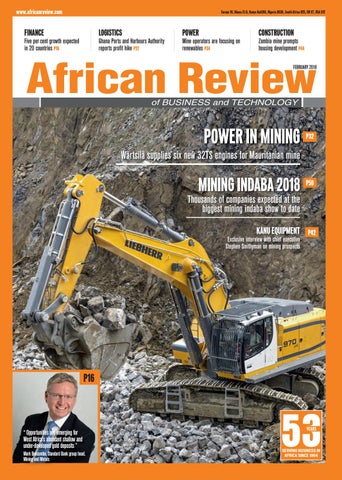
ATR Feb 2018 - Cover_Layout 1 19/01/2018 14:40 Page 1
www.africanreview.com
Europe 10, Ghana C1.8, Kenya Ksh200, Nigeria N330, South Africa R25, UK £7, USA $12
FINANCE
LOGISTICS
POWER
CONSTRUCTION
Five per cent growth expected in 20 countries P18
Ghana Ports and Harbours Authority reports profit hike P27
Mine operators are focusing on renewables P34
Zambia mine prompts housing development P44 FEBRUARY 2018
African Review of Business and Technology
POWER IN MINING
P32
Wärtsilä supplies six new 32TS engines for Mauritanian mine February 2018
MINING INDABA 2018
P50
Thousands of companies expected at the biggest mining indaba show to date KANU EQUIPMENT P42 Exclusive interview with chief executive Stephen Smithyman on mining prospects
Volume 54 Number 1
P16
www.africanreview.com
“ Opportunities are emerging for West Africa’s abundant shallow and under-developed gold deposits ” Mark Buncombe, Standard Bank group head, Mining and Metals
53 YEARS
SERVING BUSINESS IN AFRICA SINCE 1964
S01 ATR Feb 2018 - Start_ATR - New Master Template 2016 22/01/2018 10:38 Page 2
S01 ATR Feb 2018 - Start_ATR - New Master Template 2016 19/01/2018 14:35 Page 3
Audit Bureau of Circulations Business Magazines A
10:51 Page 1
www.africanreview.com
Europe 10, Ghana C1.8, Kenya Ksh200, Nigeria N330, South Africa R25, UK £7, USA $12
FINANCE
LOGISTICS
POWER
CONSTRUCTION
Five per cent growth expected in 20 countries P18
Ghana Ports and Harbours Authority reports profit hike P27
Mine operators are focusing on renewables P34
Zambia mine prompts housing development P44
Editor’s Note
FEBRUARY 2018
Af i R i fB i dT h l
POWER IN MINING
P32
Wärtsilä supplies six new 32TS engines for Mauritanian mine F b
MINING INDABA 2018
P50
2018
Thousands of companies expected at the biggest mining indaba show to date KANU EQUIPMENT P42 Exclusive interview with chief executive Stephen Smithyman on mining prospects
V l 54 N b 1
P16
53 YEARS
fi
“ Opportunities are emerging for West Africa’s abundant shallow and under-developed gold deposits ”
i
SERVING BUSINESS IN AFRICA SINCE 1964
Mark Buncombe Standard Bank group head, Mining and Metals
Cover picture: Liebherr Cover Inset: Mark Buncombe, group head, mining and metals © Standard Bank
elcome to our special February mining issue. Opportunities across Africa are opening up in the mining sector following a protracted period of stagnancy since 2012. Mark Buncombe, group head, Mining and Metals for Standard Bank, shares with African Review the emerging trends to look out for in the industry, especially the excitement surrounding battery metals, such as cobalt and lithium (see page 16 for full interview). We look at the impact of traditional genset technology (page 32) and renewables in mining (page 34). A solar microgrid is set to power the Otijikoto gold mine in Namibia in 2018. And thanks to mining projects popping up in Africa, associated town and housing developments such as the Kalumbia Town in Zambia are growing apace (page 44). Mining Indaba 2018 in Cape Town from 5 to 7 February is expected to have the show's biggest turnout in its history attracting leading government and business players to share their views on the mining industry and the latest projects in and around Africa (see page 50). Finally, as always check out www.africanreview.com for the latest news and updates.
W
Samantha Payne, Editor
Editor: Samantha Payne Email: samantha.payne@alaincharles.com Editorial and Design team: Prashant AP, Hiriyti Bairu, Miriam Brtkova, Ranganath GS, Deblina Roy, Rhonita Patnaik, Rahul Puthenveedu, Nicky Valsamakis, Vani Venugopal and Louise Waters Managing editor: Georgia Lewis Contributing editor: Martin Clark Publisher: Nick Fordham
Contents
Sales Director: Michael Ferridge Magazine Manager: Serenella Ferraro Tel: +44 207 834 7676 Fax: +44 207 973 0076 Email: serenella.ferraro@alaincharles.com India
TANMAY MISHRA Tel: +91 80 65684483 Email: tanmay.mishra@alaincharles.com
Nigeria
BOLA OLOWO Tel: +234 80 34349299 Email: bola.olowo@alaincharles.com
UAE
SHISHIR DESAI Tel: +971 4 448 9260 Fax: +971 4 448 9261 Email: shishir.desai@alaincharles.com
UK
MICHAEL FERRIDGE Tel: +44 20 7834 7676 Fax: +44 20 7973 0076 Email: michael.ferridge@alaincharles.com
USA
MICHAEL TOMASHEFSKY Tel: +1 203 226 2882 Fax: +1 203 226 7447 Email: michael.tomashefsky@alaincharles.com
P16
Head Office: Alain Charles Publishing Ltd, University House, 11-13 Lower Grosvenor Place, London SW1W 0EX, United Kingdom Tel: +44 (0)20 7834 7676, Fax: +44 (0)20 7973 0076 Middle East Regional Office: Alain Charles Middle East FZ-LLC, Office L2-112, Loft Office 2, Entrance B, PO Box 502207, Dubai Media City, UAE, Tel: +971 4 448 9260, Fax: +971 4 448 9261
15
Manufacturing
16
Profile
18
Economy
20
Finance
28
Logistics
32
Power in mining
44
Construction
52
Mining
P20
Production: Srinidhi Chikkars, Nelly Mendes and Rakshith Shivakumar E-mail: production@alaincharles.com Chairman: Derek Fordham Printed by: Buxton Press
Representatives from Africa’s cotton industry met for its annual summit on the paradise island of Mauritius.
Mark Buncombe, group head, Mining and Metals for Standard Bank shares his views on emerging trends driving the bank’s interests.
Following the economic slump in 2016, five per cent growth is forecast in 20 countries in 2018.
Remittances from East Africans living abroad are rising and becoming an important contributor to local economies.
DHL announced as title sponsor at the 2018 DHL eCommerce MoneyAfrica Conference and Exhibition.
Despite advances in renewables, mini grids and hybrid solutions, large, traditional genset technology are still trusted to power Africa's big mines.
Printed in: January 2018 ISSN: 0954 6782
SUBSCRIPTIONS:
P32
Rates for one year (11 issues): Europe €107, Kenya KSh3400, Nigeria N6600, South Africa R460, United Kingdom £77, US$140 To subscribe: visit www.africanreview.com/subscribe For any other enquiry email circulation@alaincharles.com
Serving the world of business
P52
Mining firm First Quantum Minerals has contributed to the development of Kalumbila Town, in the province dubbed the "New Copperbelt".
We examine the latest truck brands used in mining operations across Africa.
S01 ATR Feb 2018 - Start_ATR - New Master Template 2016 19/01/2018 14:35 Page 4
NEWS | NORTH
First Internet of Things network for Tunisia launched by Ooredoo and Sagemcom The Tunisian Ministry of Information and Communication Technologies has issued a licence to enable two companies to enable them to launch the country’s first Internet of Things (IoT) network. Ooredoo Tunisia and Sagemcom will now be able roll out a range of IoT solutions tp consumers, businesses and government. Initially, this network will enable devices to exchange small amounts of data with a standard batter providing battery life of up to 10 years. Looking ahead, the network will facilitate the development of a wide range of services in Tunisia. These include: Smart City, which is used for parking and presence detection; Smart Industry, which is used for asset management, predictive maintenance, tracking and logistics; Smart Environment, such as fire detection; and applications in other industries, such as healthcare, transport and agriculture. These technologies are all provided by Sagemcom. The network is based on LoRA technology, which is a long-range, low-power wireless platform. It is the prevailing technology for building IoT networks worldwide. “We are proud to be the first operator in Tunisia to deploy this technology, which is globally recognised as the most successful Internet of Things solution,” said Youssef El Masri, CEO of Ooredoo Tunisia. According to Eric Rieul, CEO of Sagemcom Energy & Telecom, the “close collaboration with Ooredoo will reinforce both our vision and strategy for the Industrial Internet of Things, through our Siconia products and solutions, and our long-term presence and support in Tunisia and in the wider region”.
Image Credit: Franciso Gonzalez/Flickr
IoT technology could revolutionise parking for drivers in Tunisia.
SONATRACH TO HELP IRAQI OIL AND GAS INDUSTRY Sonatrach, Algeria’s state energy company, is investigating investment opportunities in Iraq’s oil exploration and natural gas projects. Jabar al-Luaibi, minister of oil in Iraq, met with Mustapha Guitouni, minister of energy in Algeria, in Baghdad. According to Reuters, one of the main aims of the meeting was to seal cooperation agreements between Iraqi government and Sontrach, particularly in regard to gas projects. Mr al-Luaibi said that the Iraq aims to take forward the collaboration with Algeria in developing energy resources across the region. Mr Guitouni expressed hope of strengthening cooperation in oil exploration and natural gas projects in Iraq. Algeria is one of the main suppliers of natural gas to Europe. The country exports gas through pipelines and on tankers after liquefying the gas in plants. Iraq is OPEC’s second largest producer of crude after Saudi Arabia, with output of 4.4 mmbbl per day. Algeria, also an OPEC member, has estimated output of one mmbbl per day.
EGYPT: FINANCIAL CLOSE ON ACWA SOLAR PROJECTS ACWA Power has reached financial close of the three solar PV projects worth US$190mn under the second round of the Egypt Feed-inTariff programme II, with an aggregate capacity of 165.5 MW. The projects, located in the Aswan Province at Benban, will have a respective capacity to generate 67.5 MW, 70 MW and 28 MW as individual projects. Construction will commence in Q1 2018. After starting operations in Q4 2018, the new installed capacity is expected to power 80,000 houses and provide a saving of 156,000 tonnes of CO2 per year. About 75 per cent of the project cost is financed through a non-recourse project debt from European Bank for Reconstruction and Development (EBRD) and Industrial and Commercial Bank of China (ICBC). The remaining 25 per cent is financed with equity capital provided by the sponsors. The project comes in line with the Egyptian government’s target to obtain 20 per cent of its energy requirements from renewable sources by 2022. The feed-in tariff programme aims to secure an initial generation of 2,000 MW of solar capacity and 2,000 MW of wind capacity. Commenting on the financial close of the projects, Rajit Nanda, chief investment officer of ACWA Power, said, “ACWA Power identified Egypt as an investment destination worthy of pursuit in 2009 and subsequently established a local company ACWA Power Egypt in 2015. The successful financial close of these projects is a harbinger of change in the deployment of power generation capacity, and reinforces our belief in the potential that exists in the country.” The company is also pursuing other opportunities to consolidate its presence in the Egyptian Market including Dairut 2250 MW CCGT project and a pipeline of more than 500 MW wind projects, 1GW of PV projects and 100 MW of CSP projects.
BRIEFS
The new lounge at Marrakech will benefit business travellers.
4
National Aviation Services (NAS) has launched the Pearl Lounge at Marrakech-Menara Airport. The lounge offers business travellers a comfortable environment for working with free wifi and more than 150 seats. NAS has 31 lounges across Africa and the Middle East and will soon be opening facilities at other Moroccan airports including Casablanca, Rabat Sale, Agadir, Tangier, Oujda, Fez, Dakhla and Laayoune. This is part of a 10-year concession with Moroccan Airports Authority.
AFRICAN REVIEW OF BUSINESS AND TECHNOLOGY | FEBRUARY 2018
Egypt university expansion Image Credit: Honoris United Universities
Image Credit: NAS
Marrakech airport offers new lounge
The MoU signing between Regent Business School and the ministry.
Honoris United Universities, a pan-African online higher education network, will be establishing a branch in Cairo after a MoU was signed between the Egyptian Ministry of Higher Education and Regent Business School, which is Honoris’ network institution in South Africa. This MoU means that Regent Business School will offer local and international business and management education programmes for Egyptian undergraduate and postgraduate students.
www.africanreview.com
S02 ATR Feb 2018 - News_ATR - New Master Template 2016 18/01/2018 16:02 Page 5
S02 ATR Feb 2018 - News_ATR - New Master Template 2016 18/01/2018 16:02 Page 6
NEWS | EAST
New hydropower dams could increase the risk of disruption to electricity supply
Image Credit: skylightpictures/ Adobe Stock
New research has revealed that hydropower dams planned for eastern and southern Africa could put electricity supply at risk for vast regions because they rely on the same rainfall patterns for electricity generation. This is the warning from new research led by Professor Declan Conway from the Grantham Research Institute on Climate Change and the Environment and the ESRC Centre for Climate Change Economics and Policy at the London School of Economics and Political Science, in collaboration with researchers at University Climate change is likely to exacerbate existing College London, the University of Pretoria and the management challenges for hydropower. University of East Anglia. The study reveals that if all the large dams that are currently planned are constructed, by 2030, 70 per cent of total hydropower generating capacity in eastern Africa will be dependent on areas with similar rainfall patterns. In southern Africa 59 per cent of hydropower generation will depend on areas with similar variability in rainfall. This significant dependence of hydropower generation on areas with the same rainfall pattern means that within eastern and southern Africa the majority of hydropower generation will be vulnerable to the same dry periods and droughts, which could lead to electricity shortages and power outages. This could pose a significant challenge for electricity security as hydropower is heavily relied upon in Africa. For example, hydropower accounts for over 90 per cent of national electricity generation in Ethiopia, Malawi, Mozambique, Namibia and Zambia. The researchers added that the problems of a changing climate are likely to exacerbate existing management challenges for hydropower and increase the threat of climate-related disruption in electricity supply.
ETHIOPIAN AIRLINES TO DEBUT FLIGHT TO GENEVA Ethiopian Airlines, the largest Aviation Group in Africa has announced that it will launch direct thrice weekly service to Geneva, Switzerland on 3 June 2018. Regarding the launch of the service, Group CEO of Ethiopian Airlines, Tewolde GebreMariam, said, “Geneva hosts the highest number of international organisations in the world, making it a global hub for diplomacy. It is a perfect complement to Addis our main hub and Africa’s diplomatic capital with the headquarters of the African Union and the UN-ECA (Economic Commission for Africa). Government officials and staff from regional and international organisations in Geneva and across our extensive African network will be able to enjoy seamless and convenient connectivity enabling them to carry out their missions with ease and maximum convenience.” The route will be operated with a Boeing 787-800, one of the most technologically advanced aircraft in the carrier’s fleet family.
AFDB PARTNERSHIP TO DRIVE OFF-GRID ENERGY INVESTMENTS The African Development Bank (AfDB) has partnered with Calvert Impact Capital (CIC), Global Environment Facility (GEF) and the Nordic Development Fund (NDF) to drive investments in off-grid energy across Africa. Through the partnership, the AfDB approved a US$30mn investment in the Facility for Energy Inclusion Off-Grid Energy Access Fund (FEI OGEF). This follows the approval of additional investments of US$10mn from CIC, US$8.5mn from GEF and US$7mn from NDF. FEI OGEF is a US$100mn blended finance debt fund designed to provide loans in local and hard currencies to off-grid energy companies with the dual objectives of scaling up access to clean electricity for off-grid households and crowding in local financial institutions as co-lenders. The Fund directly supports the Bank’s New Deal on Energy for Africa and is part of its “High 5” priority to light up and power the continent, with an aspirational target of connecting 75 million households through off-grid energy access solutions by 2025. Through the use of clean energy instead of fossil fuels to power communities, the Fund is expected to result in the reduction of up to eight million tonnes of CO2 emissions over its lifetime. “FEI OGEF is the first Bank instrument that enables debt financing, including in local currency, to off-grid energy access companies who need growth capital to expand their operations across Africa,” said Astrid Manroth, Director, Transformative Energy Partnerships at the African Development Bank. The combination of these four first investments brings this innovative fund closer to its first close target to be achieved in the first quarter of 2018 and provides a strong signal to the community of interested investors.
BRIEFS
The alliance aims to close the digital divide by providing services that were previously unavailable to the rural population.
6
The integration of MTN and Vanu networks, a move that will extend MTN network, is expected to enable more Rwandans in rural areas, who are not connected to enjoy mobile telephone services. The agreement will allow for the provision of GSM services, including voice and data, which were previously inaccessible to several thousand people in rural Rwanda, according to officials. It is expected to not only benefit existing MTN subscribers, but also create an opportunity for MTN to grow its customer base. In addition to voice and data services, the alliance will allow for the provision of mobile money services through MTN Mobile Money.
AFRICAN REVIEW OF BUSINESS AND TECHNOLOGY | FEBRUARY 2018
East African authorities seek to clamp down on taxation non-compliance
Image Credit: Sgae
Image Credit: pookpiik/AdobeStock
MTN, Vanu deal to increase connectivity in rural Rwanda
Nikki Summers puts the spotlight on taxation compliance in Kenya and Tanzania.
Nikki Summers, regional director, Sage, East Africa, says that authorities in Kenya and Tanzania are scrutinising employers in regard to tax obligations: “Without improving tax collection, East African countries will not be able to effectively finance the building of infrastructure and the provision of public services. We are seeing Tanzanian and Kenyan tax authorities take a more robust approach to registering tax payers and enforcing compliance,” said Summers.
www.africanreview.com
S02 ATR Feb 2018 - News_ATR - New Master Template 2016 18/01/2018 16:02 Page 7
S02 ATR Feb 2018 - News_ATR - New Master Template 2016 18/01/2018 16:02 Page 8
NEWS | SOUTH
Luambe National Park named world’s most carbon neutral Image Credit: Wikimedia
Luambe’s carbon neutral status is a result of the USAID-funded Community Forests Program (CFP) implemented by BioCarbon Partners (BCP) together with the Zambian Government. This world-first level of carbon neutrality means the emissions of all tourism and conservation management activities within with the park are offset, including all international tourist airline travel. This follows the Lower Zambezi National Park becoming the world’s first to achieve carbon neutrality from operations. “Luambe National Park’s carbon neutral status sets a Zambia is addressing its carbon emissions. great example for other protected areas in Zambia,” said USAID/Zambia economic development office director Jeremy Boley. “This status shows the world that Zambia takes emissions reduction seriously.” Luambe Camp voluntarily funded the carbon neutrality, investing in renewable energy sources and purchasing Verified Carbon Standard (VCS) audited forest carbon offsets generated within Zambia. Luambe Camp began operations in June 2017, and are committed to establishing a new bar of environmental stewardship and sustainability. Mario Voss, director of Luambe Camp, stated that “as a business that operates as a showcase and celebration of Luambe National Park’s unique beauty and biodiversity, it is crucial that we take responsibility for its conservation. We’re passionate environmentalists and it is important to the whole Luambe Camp team that we can offer our guests a truly eco-friendly experience.” Africa is expected to be the continent that is most vulnerable to climate change, the leadership of Zambian tourism businesses and the Zambian government agrees to operate with carbon neutrality and set a positive example throughout the continent. Director of the department of National Parks and Wildlife (DNPW), Paul Zyambo, stated that, “We are happy to partner with another innovative carbon-conscious achievement in the conservation and tourism sector in Zambia with partners like Luambe Camp and BCP. Luambe forms a part of Zambia’s famous Luangwa Valley and we hope that this showcases how special this area is, and why it is worth a visit.”
ZIMBABWE REQUIRES US$26BN INFRASTRUCTURE SUPPORT The Zimbabwe Independent reported according to figures from the IBDZ, Zimbabwe has spent between US$1bn and US$3bn per year since 2010 with the highest figure being US$500mn used in 2016. Presenting a paper on opportunities available in Zimbabwe in the infrastructural sector recently, IDBZ head of resource mobilisation Willing Zvirevo said there were many opportunities, however, budgetary allocations have revealed a huge gap in the sector. “Reality is that we need plus 30 per cent of those estimates to adequately address the gap. There is also the regulatory issues but what we really need is to address the infrastructure gap as we are competing with other countries in terms of capital,” he said. Zvirevo said Zimbabwe needed to improve budget spending towards infrastructure as lower allocations are short-changing the sector.
BOTSWANA AIMS TO IMPROVE TRANSPORT SECTOR According to the minister of transport and communications, Kitso Mokaila, the ministry needs to look into moving freight off the road and on to air and rail transport to improve traffic flow on the roads, Botswana Daily News reported. Mokaila made the remarks during a roadmap presentation on Botswana’s transport sector on the first session of the five day transport sector retreat in Palapye recently. "The statistics of the SADC freight for example, reflect that 80 per cent is being transported by road. We need to ease such road usage in order to make our roads last longer and have less accidents in keeping up with the target 2020 of reducing fatalities," he said. Mokaila noted that the ministry was tasked with ICT and transportation responsibilities and needs to look at how they could use ICT to get people off the roads. "We are gearing towards working with the Department of Roads and Transport Services (DRTS) to develop a taxi system that works for the economy. There is need to facilitate for taxis to get passengers to their destinations without hassles through the use of ICT," he said.“We have to get out of our comfort zone and introduce something different in the public transport system," stated Mokaila. Based on the developments being introduced by the Ministry of Land Management Water and Sanitation Services, Minister Mokaila said there was need for his ministry to see what improvements could be made in high concentration areas such as bus ranks and airports. “With regard to the usage of funds, we have the road fund, which collects US$161.9mn annually. This fund can assist in the development of roads, but it has been used as a sludge fund in over-paying contractors,” he said.
TMT Finance franchise will be expanding into Cape Town.
8
Investing in South Africa’s future
Enhancing ICT skills in Namibia
Telecom, Media and Tech leaders meet in Cape Town for regional investment event to discuss future strategies for investment and regional growth. Ben Nice, managing editor, TMT Finance said, "Due to hugely popular demand from our global network, we are delighted to be bringing the TMT Finance franchise to Cape Town in order to meet the increasing demand for infrastructure and services in Africa's flourishing TMT sector."
Green Enterprise Solutions, a fast growing IT company in Namibia, recently signed a partnership agreement with WorksPad, the mobile business application software for the African continent to provide ICT solutions for the market and beyond, according to a report by The Namibian. Rehobothborn Le Hané at the Green offices in Windhoek said, “We take in students from the university, groom them and prepare them to be part of the solution-seeking team," he said.
AFRICAN REVIEW OF BUSINESS AND TECHNOLOGY | FEBRUARY 2018
Image Credit: Adobe Stock
Image Credit: Adobe Stock
BRIEFS
University students have been trained to be part of Green Enterprise Solutions team.
www.africanreview.com
S02 ATR Feb 2018 - News_ATR - New Master Template 2016 18/01/2018 16:02 Page 9
S02 ATR Feb 2018 - News_ATR - New Master Template 2016 18/01/2018 16:02 Page 10
NEWS | WEST
BWSC to supply gas-fired power plant in Benin
Image Credit: BWSC
The Danish power plant specialist Burmeister & Wain Scandinavian Contractor (BWSC), in consortium with MAN Diesel and Turbo (MDT), has been awarded US$150.26mn contract to build a 120MW gas-fired power plant in Benin The project entails construction of a whole new power house for seven MDT dual fuel engines and all corresponding infrastructure. Once completed, the plat is expected to be the most efficient plant of its type According to BWSC, the in the region. project is scheduled to be delivered in 18 months from effective contract. The dual fuel HFO and gas-fired power plant will be located at the Maria Gléta site, about 15km from the city of Cotonou. The plant is expected to provide electricity to supply the equivalent of approximately 300,000 European households and responds to the government’s initiative to develop the energy sector in Benin in a sustainable manner. Benin has a rapidly growing demand for power, estimated at six per cent per year, and this new project is set to enhance the electricity supply for business growth and living standards in the periurban areas surrounding Cotonou. The project is financed by Islamic Development Bank of Saudi Arabia, the West African Development Bank and Banque d’investissement et de Développement in Togo. BWSC won the project in an international tender round, and the contract was signed with the stateowned utility Société Béninoise d’Energie Electrique (SBEE). BWSC is a Danish engineering and contracting company which develops, builds, operates and owns high-performance engine-based and boiler-based power plants. So far, the company has delivered more than 180 power plants to 53 countries worldwide with a total capacity of more than 3,500MW.
EXECUTIVE VICE-PRESIDENT OF OPIC TRAVELS TO TOGO David Bohigian, executive vice-president of Overseas Private Investment Corporation (OPIC), has met Togolese Prime Minister Komi Klassou and toured an OPIC-supported power plant that aims to triple the country's energy supply. ContourGlobal, the US-based company, built the Lomé Thermal Power Plant in Togo with financing and political risk insurance from OPIC, the US Government's development finance institution. One of the largest investments ever made in Togo, it succeeded in bolstering the country's energy generation capacity and reducing rolling blackouts. During his visit, Bohigian also visited a local school in Lomé that has received support from ContourGlobal's social projects division. He also highlighted the activities of Mo-Lab, a mobile STEM learning center, which is a US Embassy Lomé initiative created in partnership with ContourGlobal.
THE AFDB INKS AGREEMENT FOR ROAD PROJECTS IN WEST AFRICA The AfDB and the European Commission have signed five co-financing agreements totaling US$776.41mn to support road infrastructure projects in West Africa. Of the total cost, the AfDB contributes US$416.79mn in loans and grants and the European Commission gives US$125.04mn in grants. The remaining amounts will be financed by other partners, including the West African Economic and Monetary Union (WAEMU), the concerned West African countries and other donors. The agreements were signed during the 6th EU-Africa Business Forum, held in Abidjan. The presidents of the Economic Community of West African States and of WAEMU, West African transport ministers and donors were present at the signing ceremony. The cooperation agreements form part of a historic framework agreement known as the Pillar Assessed Grant or Delegation Agreement (PAGODA) between the AfDB and the European Commission on September 25, 2017. As the continent’s premier financial institution, the AfDB plays a major role in meeting the financing needs of African countries. The signing of the PAGODA partnership agreement and of these five specific infrastructure projects showcases AfDB’s role in leveraging partner institutions to achieve greater development impact. The PAGODA is expected to help fund the rehabilitation of the Lome-Cotonou road, studies and measures for trade and transport facilitation on the Abidjan-Lagos corridor, road development and transport facilitation on the Bamako-San Pedro corridor between Mali and Côte d’Ivoire, as well as the construction of the Rosso bridge between Mauritania and Senegal.
BRIEFS Nigeria signs joint declaration on economic cooperation with EFTA
Women displaced by the Boko Haram crisis working on a farm in northern Nigeria.
10
The Food & Agriculture Organization (FAO) and the World Food Programme (WFP) have stepped up efforts to assist farmers and alleviate hunger in Congo and Nigeria. In the Democratic Republic of Congo, FAO and WFP will be working in the Greater Kasai area, which has been affected by conflict. FAO will supply food-growing kits, including cultivation tools and fruit and vegetable seeds to allow families to eat for two months and sell food that is uneaten.
AFRICAN REVIEW OF BUSINESS AND TECHNOLOGY | FEBRUARY 2018
Image Credit: EFTA
Image Credit: Chain Gang 9/Flickr
FAO and WFP to assist farmers in Congo and Nigeria
The EFTA-Nigeria agreement is expectd to boost the trade and investment opportunities in West African country.
Nigeria has signed a joint declaration on economic cooperation with the European Free Trade Association (EFTA), which is expected to allow both parties to work on a framework to increase trade and investment flows. The EFTA-Nigeria declaration was signed in Argentina, on the sidelines of the 11th Ministerial Conference of the World Trade Organisation (WTO). It will be implemented by a joint commission of both parties.
www.africanreview.com
S03 ATR Feb 2018 - Calendar_Bulletin_ATR - New Master Template 2016 18/01/2018 15:57 Page 11
S03 ATR Feb 2018 - Calendar_Bulletin_ATR - New Master Template 2016 18/01/2018 15:57 Page 12
EVENTS | 2018
Upcoming Events Calendar 2018 FEBRUARY 5-8
AFRICAN MINING INDABA
19 - 21
25 - 26
SOMALIA OIL, GAS & MINING
MOZAMBIQUE MINING, OIL & GAS (MMEC 2018)
Nairobi, Kenya www.africa-energy.com
Cape Town, South Africa www.miningindaba.com
20 - 21
12 - 14
Lagos, Nigeria www.securexwestafrica.com
EGPYT PETROLEUM SHOW Cairo, Egypt www.egyps.com
19 - 23
NIGERIA INTERNATIONAL PETROLEUM SUMMIT 2018 Abuja, Nigeria www.nigeriapetroleumsummit.com
SECUREX WEST AFRICA
3-5
BUILDEXPO AFRICA
POWER & ELECTRICITY WORLD AFRICA
Nairobi, Kenya www.expogr.com
Johannesburg, South Africa www.terrapinn.com
15 - 17
28 - 29
CONMIN WEST AFRICA
EAST AFRICA OIL & GAS SUMMIT
Abuja, Nigeria www.conminwestafrica.com
Nairobi, Kenya www.eastafricaogs.com
16 - 17
AFRICAN CONSTRUCTION EXPO
13 - 16
APRIL
BAUMA CONEXPO AFRICA
23 - 28
Johannesburg, South Africa www.bcafrica.com
INTERMAT
AFRICAN REVIEW OF BUSINESS AND TECHNOLOGY | FEBRUARY 2018
MAY
27 - 28
MARCH
12
Maputo, Mozambique www.ametrade.org/mozmec
Johannesburg, South Africa www.totallyconcrete.co.za
Paris, France paris-en.intermatconstruction.com
www.africanreview.com
S03 ATR Feb 2018 - Calendar_Bulletin_ATR - New Master Template 2016 19/01/2018 14:48 Page 13
S03 ATR Feb 2018 - Calendar_Bulletin_ATR - New Master Template 2016 18/01/2018 15:57 Page 14
NEWS | BULLETIN
growth as, when taking into account the significant container trade market contraction recorded in 2016, this growth is actually only about 2.5 per cent (2017 versus 2015),” he said. Looking at imports and exports, Conroy said that the two markets are shaping up slightly differently, with exports growing faster than imports. “Year to date (YTD), 45.3 per cent of the container trade was a result of exports (54.7 per cent imports), which is slightly up from a year ago (44.7 per cent) but well above the 2012 figure of 42.3 per cent. So, there has been a continuing ‘balancing of trade’, which is largely due to the increase of export mining commodities (chrome and manganese).”
have the opportunity to conduct due diligence, such as visiting the plant, meeting management and proposing amendments to the share purchase agreement.
ENGIE RAISES ITS PROFILE IN WEST AND CENTRAL AFRICA Image Credit: ENGIE
Image Credit: Voice of America em Portugues/Wikimedia Commons
MOODY’S NOT ANTICIPATING ANGOLAN DEBT DEFAULT AFTER RESTRUCTURE
President Laurenco has taken steps to help ensure Angola does not default on foreign debt.
MAERSK ANALYSES SOUTH AFRICAN CONTAINER TRADE GROWTH FOR 2017 During the third quarter of 2017, the total import and export container trade market experienced consistent 10 per cent year-on-year growth, a similar result as in previous quarters. According to Matthew Conroy, trade manager, Maersk Line, South Africa, this is a mixed result for the industry, which is experiencing volatilty rather than “robust growth” “While 10 per cent year-on-year growth is encouraging, this is not a true reflection of real
14
AFRICAN REVIEW OF BUSINESS AND TECHNOLOGY | FEBRUARY 2018
Leaders from the three energy companies involved in the acquisition deal at the signing.
A Maersk analysis offers a nuanced picture of container trade growth for South Africa.
EDO STATE SIGNS REFINERY DEAL WITH CHINA SINOPEC The governor of Edo State, Nigeria, Godwin Obaseki has signed a Memorandum of Understanding (MoU) with a consortium led by China SINOPEC to develop a modular 5,500bpd oil refinery. This follows on from a similar MoU signed by the state with China Harbour Engineering Company for the development of the Glengele Seaport. The Chinese consortium that will handle the modular refinery project is made up of Peiyang Chemical Equipment Company of China, a modular refinery company; Sinopec International Petroleum Service Corporation, a subsidiary of Sinopec, and African Infrastructure Partners, a Nigerian infrastructure company.
MAJORITY STAKE IN CARTHAGE CEMENT FOR SALE The Tunisian State and Bina Corp, controlling shareholders of Carthage Cement, are proceeding with a public tender for the sale of a 50.52 per cent stake in the company. A consortium of ECC Mazars, IEG Tunisia and Mrabet Avocats has been formed to achieve the transaction as advisors to Al Karama Holding. Potential investors will be informed of their qualification in early February 2018 and will then be invited to obtain tender documents and
ENGIE has signed an agreement to acquire Afric Power and Tieri, two specialist energy companies in West Africa. These companies have a presence in Côte d’Ivoire, Burkina Faso, Mali and Niger, and export their competencies throughout the region. Afric Power and Tieri are complementary companies offering services including system design, the assembly of electrical cabinets and automated control mechanisms, and the installation, maintenance and warranty coverage of equipment.
TELEMEDICINE BOOST FOR GHANA HEALTH SERVICE Image Credit: Novartis
Image Credit: Maersk
Moody’s, the credit rating agency, does not expect Angola to default on foreign debt, it has announced in a statement released to the media in January 2018. The statement comes in the wake of Angola revealing plans to restructure its foreign debt along with devaluing the kwanza currency after the collapse of global oil prices. The Angolan economy took multiple hits after the oil price crash of mid-2014. According to Reuters, Angola’s exchange rate adjustment attracted significant attention with investors calling for further drops in the value of the kwanza. The Moody’s report said that the new kwanza regime and the government’s drive to renegotiate debt put the spotlight on existing pressures on Angola’s credit rating. Moody’s expects the Angolan debt-to-GDP ratio to rise and for increased inflation to impact on growth. However, the report added that Angola’s current account was likely to improve over time. In regard to Angola’s critical diamond mining sector, Russian diamond mining company, Alrosa, has received approval from President Laurenco to expand its stake in Angolan diamond producer, Catoca. Alrosa will acquire an 8.2 per cent stake in Catoca via its daughter company Wargan Holdings for US$70mn.
Telemedicine technology will improve healthcare delivery especially for remote regions in Ghana.
The Ghana telemedicine programme, with the support of the Novartis Foundation), is being rolled out across the nation by Ghana Health Service. The telemedicine service started as a pilot model in the Amansie West District of the Ashanti Region in 2011, covering 30 communities of around 35,000 people. Since then, the Ghana Health Service selected it for national implementation as part of its national e-health strategy to use information and communications technology (ICT) to improve healthcare delivery.
www.africanreview.com
S04 ATR Feb 2018 - Features_ATR - New Master Template 2016 18/01/2018 15:50 Page 15
TEXTILES | MANUFACTURING
Digitalisation set to change textile industry Representatives from Africa’s cotton industry met for its annual summit on the paradise isle of Mauritius. he African Cotton and Textile Industries Federation (ACTIF) annual ‘Made in Africa’ conference met in Mauritius to discuss the many issues and opportunities facing the sector. The location was highly appropriate. It was in Mauritius in 2000 that the African Growth and Opportunities Act (AGOA) was agreed by the US and African countries. This was of immense benefit to the continent’s textile and apparel industries as it granted tariff-free access to the American market for these products. The AGOA trade pact saw a flood of investments into Africa’s textile manufacturing industry, from countries such as China, India and Turkey, (as well as the US itself) attracted by the potential of the US market. According to the International Trade Centre, which is a multilateral agency that has a joint mandate with the World Trade Organization and the UNCTAD to collate statistics, Mauritius is sub-Saharan Africa’s leading apparel exporter, in 2016 exporting more than US$740mn worth of clothing. Mauritius is followed by Madagascar and South Africa that each exported apparel valued at just over US$400mn; then Lesotho (US$300mn) and Kenya (US$280mn). There was encouraging news from Francophone West Africa, traditionally one of Africa’s major cotton-growing regions. Burkina Faso cotton acreage was up eight per cent in 2017/18, while Malian acreage and production is expected to reach a 10-year high 2017/18 after a strong increase in 2016/17. Côte d’Ivoire’s production was up by six per cent. Benin’s production was stable with only Chad expected to have a smaller crop. Cotton remains the continent’s most valuable non-food agricultural export.
www.africanreview.com
Image Credit: Adobe Stock
T
The US’s exports of cotton surged to a global share of 40 per cent in 2016/17.
On the clothing side, there was also some fascinating World Trade Organization data presented to the Origin Africa conference that showed that China’s apparel exports, in 2015, amounted to almost US$200bn, dwarfing African exports. But the figures also show that even if China is by far the biggest exporter, there is a significant shift of production to the Pacific rim countries such as Vietnam and Cambodia (as well as Bangladesh). Asia’s emerging economies are on the rise as both markets in their own right and exporters. Nevertheless, China still holds the lead in the manufacture of textile machinery, accounting for about 90 per cent of new machines supplied globally. Meanwhile, the major apparel manufacturers in the developed world are looking to technology to compete with their counterparts in the developing world that enjoy
lower wage costs. Technology is transforming the types of textiles being produced, and the how those textiles are to be manufactured in the 21st century. Marsha Powell, a consultant for Cotton USA, explained to the Origin Africa conference, how the US’s exports of cotton surged to a global
share of 40 per cent in 2016/17 from just 25 per cent the previous year, on the back of stronger sales to China, Indonesia, and India. That represents exports of 3.1mn tons compared to the 1.1 mn tons that the West Africa region exported. Yet, even in the face of growing exports and demand, cotton is being outpaced by the burgeoning use of synthetic textiles, especially polyester. Polyester is often blended with cotton for affordability and the convenience of non-iron textiles. The textile manufacturing process is also changing with technology. The digitisation and interconnection of every factory, every machine, every technology component (the so-called ‘internet of things’) – and virtually every piece of material that runs through the production process – promises the next paradigm shift in industrial manufacturing. This trend promises massive gains in speed, productivity, flexibility and quality. Known as the Fourth Industrial Revolution, it may seem almost fanciful, but the vision of a number of truly smart African textile or clothing factories is increasing being viewed as a reality. ■ by Stephen Williams
FEBRUARY 2018 | AFRICAN REVIEW OF BUSINESS AND TECHNOLOGY
15
S04 ATR Feb 2018 - Features_ATR - New Master Template 2016 18/01/2018 15:50 Page 16
PROFILE | STANDARD BANK
Outlook looks promising in commodity sector
A
s Africa’s largest bank by assets, Standard Bank understands the importance of the commodities sector to the future growth and prosperity of the continent. Its mining finance division brings together highly skilled and experienced multi-disciplinary teams, drawing on a global capital reach with a strong local presence. The team is led by Mark Buncombe, group head, Mining and Metals for Standard Bank. He said, “We see a number of trends driving our work at the moment. With continued macro instability, the gold price has stabilised at a relatively high level. Coupled with improved legislation in countries such as Ghana and Côte d’Ivoire opportunities are emerging for West Africa’s abundant shallow and – as yet – underdeveloped gold deposits.” Standard Bank’s recently established presence in Côte d’Ivoire is timed to concentrate both global capital and the group’s extensive mining capabilities on these new regional opportunities. A case in point is the bank’s funding of Gold Field’s ongoing expansion of its Damang mine in Ghana. And it is not just West Africa that presents good opportunity. As the world evolves towards electric cars, the importance of, primarily, copper, but also cobalt and lithium, to the global battery industry will be a strong driver of mining investment in central Africa. “Both Zambia and the Democratic Republic of Congo, for example, are
likely to see significant new activity in these commodities,” said Buncombe. “Given the remoteness of deposits, associated industrial and logistics connectivity infrastructure development are also likely to offer opportunities in central Africa as well as between these assets and associated sea ports.”
Project pipeline The outlook is encouraging. Most commodities, bar platinum, have seen significant price recovery, said Buncombe. At the same time miners have done a lot of work cutting costs. While the protracted absence of investment in prospecting will weigh on the industry for many years to come, he said, globally margins have improved. Miners have significantly reduced debt levels and balance sheets are generally stronger. While the volatility of recent years means that many companies are reluctant to spend, where real risk-managed opportunities present themselves investment is taking place. He said, “From an African perspective those markets – like Botswana, Namibia and increasingly Ghana, Côte d’Ivoire and Zambia – that have developed balanced legislative regimes cognisant of the industry’s long investment cycles while also talking to national development are likely to attract global interest. While, in Africa, activity is largely likely to focus on rejuvenating mothballed projects, as
Opportunities are emerging for West Africa’s abundant shallow gold deposits ” MARK BUNCOMBE, GROUP HEAD, MINING AND METALS FOR STANDARD BANK 16
AFRICAN REVIEW OF BUSINESS AND TECHNOLOGY | FEBRUARY 2018
more money is spent on exploration in legislatively attractive environments new investment is likely to pick up.” It means Standard Bank is seeing an increased demand for mining sector funding. That also includes activity in South Africa, the continent’s largest economy. Buncombe said multinationals there are looking to diversify ownership by developing commercially viable local relationships. “Generally improved metals prices combined with rationalised cost-bases are likely to see a re-gearing and re-financing of existing assets in South Africa as new local players enter the market. Emerging empowerment players– like the new companies that will emerge out of Eskom’s requirement to purchase from locally owned collieries, for example – will require financing as assets change hands from large multinationals to local emerging entities. Standard Bank’s developed capabilities in structuring debtmanaged empowerment transactions is expected to be particularly relevant in this regard.” Again, a recent example of this trend is the bank’s support of Seriti in its proposed acquisition of Anglo American’s South African thermal coal assets.
Nurturing growth Given Africa’s rich resource endowment mining is and will continue to be central to the growth and global integration of African economies and a major determinant of the prosperity of Africa’s peoples. Many countries in Africa have learned that the right legislation can achieve national development goals by creating a fair, responsible and conducive environment for foreign investment.
Image Credit: Standard Bank
Mark Buncombe, Group Head, Mining and Metals for Standard Bank shares his views with African Review on the emerging trends driving the bank’s mining activities.
Mark Buncombe, Group Head, Mining and Metals for Standard Bank
Standard Bank’s presence across 20 African economies means that it is well placed to advise clients on both opportunity and risk while working closely with local legislators to find the optimum balance between profit and sustainable national development. The bank’s partnership with the Industrial and Commercial Bank of China (ICBC) is another essential differentiator, which unlocks opportunity at both ends of the bank’s Africa-China trade and investment corridor. With China accounting for approximately 50 per cent of world commodity consumption, it is now a major player across Africa’s mining sector. “Given this reality, any consideration of commodity financing in Africa needs to be predicated on access to – and capability in – China,” said Buncombe. To this end ICBC’s shareholding in Standard Bank will remain critical to supporting and growing Africa’s commodity sector. He said, “This will include investment in the associated industrial and logistics infrastructures required to make Africa’s resources relevant to the world. This is especially so as Africa emerges as commodities and energy supplier and beneficiator to rapidly growing Asia.” ■
www.africanreview.com
S04 ATR Feb 2018 - Features_ATR - New Master Template 2016 18/01/2018 15:50 Page 17
S04 ATR Feb 2018 - Features_ATR - New Master Template 2016 18/01/2018 15:50 Page 18
FINANCE | REPORT
Regional economic activity regaining momentum After an economic slump in 2016, growth revival is underway across much of sub-Saharan Africa, economist Moin Siddiqi reports.
S
trengthening global activity,commodity prices (notablycrude oil) above 2016’stroughs and improved financing conditions for frontier markets provide a welcoming external environment for the African continent. Growth pickup in the Euro areaand the United States alongside continuous robust expansions in China and India, the four major export destinations and development partners, bode well for Africa’s trade and investment prospects as well as for remittances. After broad-based slowdown in 2016, growth revival is underway across much of sub-Saharan Africa(SSA), with 20 of the region’s 45 economies expected to grow briskly at 5 per cent or higher (mostly in eastern and western Africa) in 2018. The International Monetary Fund (IMF) regional growth outlook at 2.6 and 3.4 per cent, respectively for 2017 and 2018 is similar to the World Bank’s projections. Growth inSSA excluding Nigeria and South Africa is higher, on average 5.1 percent in 2018-19, close to the levels seen during early 2000s.
Greater diversity Developing Africa is a highly diverse regional economy; aggregate growth numbers in 2018 should fall into three divergent groups. *High-achievers – where growth is driven by ongoing infrastructure investment (Ethiopia), businessfriendly reforms (Senegal and Rwanda), higher oil-gas production (Ghana), along with recovery in the agricultural sector and domestic demand. Elsewhere, growth isexpected to recover in Kenya, as political uncertainty eases after the Presidential elections and improvein
18
Sub-Saharan Africa's 2018 growth falls into three groupings COUNTRY
GDP (2016) US$bn
High Performers Ethiopia Kenya Tanzania Ghana Cote d'Ivoire
Real GDP Growth (%)
CPI Inflation (% chg)
Trade Balance (% of GDP)
FDI Stock US$mn
2017
2018
2017
2018
2017
2018
2016
72.37 70.53 47.43 42.69 36.16
8.5 5.0 6.5 5.9 7.6
8.5 5.5 6.8 8.9 7.3
8.1 8.0 5.4 11.8 1.0
8.0 5.2 5.0 9.0 2.0
-15.6 -11.7 -7.1 -3.2 6.9
-14.8 -12.5 -8.0 -1.0 6.8
13,700 11,233 19,818 29,882 7,605
24.20 19.55 15.27 12.16 11.01
4.0 4.0 4.5 3.9 4.7
4.6 4.5 4.8 4.0 5.3
0.7 6.8 3.7 4.2 17.5
1.1 7.4 3.7 5.0 10.5
-1.3 0.1 -6.4 -19.7 -11.6
-1.5 0.9 -6.2 -20.2 -29.1
6,927 14,936 5,835 4,606 31,830
405.08 294.84 89.63 16.28 14.21
0.8 0.7 1.5 2.8 1.0
1.9 1.1 1.6 0.8 2.7
16.3 5.4 30.9 2.5 2.5
14.8 5.3 20.6 9.5 2.5
1.5 0.9 13.8 -8.9 15.4
1.0 0.5 12.3 -5.8 16.2
94,184 136,837 49,545 4,286 7,467
Mid-Tier Performers Cameroon Zambia Botswana Mauritius Mozambique
Low-Gear Growth Nigeria South Africa Angola Zimbabwe Gabon
Source: World Bank, IMF Regional Economic Outlook October 2017 & World Investment Report 2017.
Tanzania on upturns in public investment. Activity is also rebounding in countries hit by the 2015 Ebola outbreak (Guinea, Liberia and Sierra Leone). Ethiopia should remain Africa’s fastest-growing economy over the coming years. *Mid-tier performers – where increased output and investment inthe mining sector is supporting growth in metal exporters (Zambia), along with brisk activity in services (Mauritius) and the non-oil sector (Cameroon). Improved weather conditions in southern Africa will boost agricultural output
(Mozambique and Zambia). The latter has benefited from recent rainfalls since hydropower sources account for 97 per cent of total electricity production in Zambia, according to the World Bank. *Slow-growth lane – SSA’s largest economies: Nigeria, South Africa, and Angola have exited recession, however, their pace of recovery remains feeble. Reviving oil output (1.8mn bpd in late 2017, up from 1.4mn bpd in mid-2016), plus good harvest led to growth pickup in Nigeria. Reforms in the foreign exchange markets should aid the
20 of the region’s 45 economies expected to grow at 5 per cent in 2018 ” MOIN SIDDIQI, ECONOMIST
AFRICAN REVIEW OF BUSINESS AND TECHNOLOGY | FEBRUARY 2018
non-oil sector, which until 2014 was expanding at a strong pace. An upturn in the petroleum sector too helped SSA’s second-largest oil producer (Angola), although fiscal consolidation measures have slowed non-oil growth. The normalisation of mining and agricultural production lifted GDP growth in South Africa, but policy uncertainty and low business confidence continue to hinder private investment. Faltering domestic demand also weighs on the manufacturing sector and high unemployment affects consumer businesses. Activity has weakened in most Central African Economic and Monetary Community (CEMAC) countries (Chad, Congo, Republic and Gabon) due to steep cuts in public spending. A deep recession has gripped Equatorial Guinea since 2014 because of plunging oil revenues and rising debt levels.
www.africanreview.com
S04 ATR Feb 2018 - Features_ATR - New Master Template 2016 18/01/2018 15:50 Page 19
REPORT | FINANCE
Low financial buffers Region-wide, currencies have stabilised after hefty depreciations in 2016, while ‘single-digit’ inflation is predicted in most countries (except Angola, Congo, DRC, and South Sudan) amid currency stability and higher food production. Fiscal deficits slightly narrowed, but continued to be high in Angola, Equatorial Guinea, Kenya, Mozambique and Zambia, as fiscal adjustment measures remained partial at best, noted the WorldBank. But macroeconomic imbalances have emerged in many countries – reflected in rising public debt, which is now above 50 percent of GDP in half of regional economies. Government debt has swelled in Congo, Republic, Eritrea and Gambia – exceeding 100 percent of GDP (IMF data). Concurrently, debt service costs have risen, especially among oil-
www.africanreview.com
SSA Growth excluding Nigeria & South Africa 7
6.6%
6
5.8%
5.4%
5.1%
5
4.7%
4
4.4% 3.6%
3 2 1 0 2012
2013
2014
2015
2016
2017
2018
Source: IMF Regional Economic Outlook October 2017.
exporters. In Angola, Gabon, and Nigeria they absorb nearly two-thirds of government revenues. Hence, diverting scarce resources away from priority areas like healthcare and education. Banks’ liquidity and solvency indicators have deteriorated, and non-performing loans have increased (Angola, Ghana, Nigeria).
Some countries have seen a sharp fall in credit to the private sector. While current account deficits have narrowed, forex reserves remain low in many countries – below the global benchmark of a three-month import cover. The World Bank said,“The prospects of stabilising commodity prices, together with financial inflows,
should enable commodity exporters to accumulate international reserves, but the low import coverage will weigh on the ability of central banks to continue managing their currencies.” On the positive side, a pickup in commodity prices has induced foreign investments in extractive industries. In summary, significant challenges lie ahead to promote shared prosperity since output growth remains below the pre-crisis average. “Sub-Saharan Africa can seize opportunities to enhance growth above current projections through structural transformation and export diversification. Macroeconomic stability carries a large premium,but beyond that, many countries could also strengthen their growth prospects by improving access to credit, infrastructure and the regulatory environment and building a skilled workfoce,” the IMF urged. ■
FEBRUARY 2018 | AFRICAN REVIEW OF BUSINESS AND TECHNOLOGY
19
S04 ATR Feb 2018 - Features_ATR - New Master Template 2016 18/01/2018 15:50 Page 20
FINANCE | REMITTANCES
Remittances to East Africa boost local economies Mwangi Mumero examines the fragile dependence on the East African diaspora sending money to their countries to enlarge their economies. emittances from East Africans living abroad have been rising and are becoming an important contributor to the local economies as returns from agricultural exports decline. Overall, the East African economies received more than US$3.5bn in diaspora remittances in 2015 with the three large nations showing immense growth. Uganda posted a 21 per cent growth rate after receiving US$1.1bn in remittances. Kenya, the region’s most advanced economy, signalled an 8.6 per cent increase. However, it received the highest amount at US$1.54bn. Tanzania received US$390mn, according to figures from the World Bank. Remittances to Rwanda dropped to US$155.8mn in 2015 from US$174.9mn the previous year. The National Bank of Rwanda attributed the drop in remittances to the slowdown in the global economy and high depreciation of regional currencies against the dollar. In Kenya, remittances have become the highest foreign exchange earner overtaking tea, coffee and tourism. With the Central Bank of Kenya (CBK) capping the interest rates on loans from commercial banks, lenders have starved firms and households of the much needed credit in recent months. Remittances, especially to households, have become a vital engine for the local economy boosting consumption and investments in land, building and at the Nairobi Securities Exchange (NSE).
R
20
Data from the CBK indicates that Kenyans in the diaspora sent home US$1.71bn in 2016 up from US$1.54 bn the previous year, an 11 per cent year-on-year increase. The World Bank expects the figure to hit US$2.2bn in 2017, a 4.1 per cent growth, according to the latest released data. “Remittances continue to be at record levels. We have seen acceleration over the Christmas period and it is something we expect to continue”, observed Patrick Njoroge, Kenya’s Central Bank Governor. North America continues to be the major source of remittances with Kenyans living in the US and Canada accounting for 56 per cent of all money remitted. Europe accounts for 30 per cent while the rest of the world accounted for 14 per cent of all remittances to the country. In September 2017, the amount sent from North America reached US$100mn with Kenyans in Europe sending US$55.3mn. Most of the money is used for household consumption, payment of school or college fees, medical bills and investments. “Generally, the money sent is used to cater for my aging parents’ health bills. I also invest in land, agribusinesses and housing using my relatives back home,” observed James Mbogo, a Kenyan living and working in Texas, United States. He has been living in the US for the last 14 years. A survey conducted by the Cooperative Bank of Kenya shows that the majority of diaspora,
AFRICAN REVIEW OF BUSINESS AND TECHNOLOGY | FEBRUARY 2018
estimated at around 1 million, is aged between 21 and 50 years, with incomes ranging between US$ 1,000 and US$20,000, with the majority being employed and others self-employed. With increased demand for the money transfer services, global firms have invested heavily in East Africa and the African continent at large. The main firms in the remittance business include WorldRemit, Western Union, Dahabshiil and Money Gram. WorldRemit is the market leader in the global digital money transfer service. Globally, its customers send almost 700,000 transfers every month to over 140 destinations. In 2016, the company accounted 74 per cent of all transfers to mobile money accounts coming from money transfer operators, according to GSMA data. The company announced that it was setting up an office in Kenya to diversify its intra-African remittances. According to WorldRemit, Kenya is its second largest receiving market after Philippines. About 93 per cent of transfers to Kenya are received via mobile phone accounts, notably MPesa, which currently has almost 20 million account holders. “We have a treasury platform with many African currencies and because we are connected to most of the major mobile money platforms, it easier for us to help cross-border transfers in Africa,” noted Ismail Ahmed, WorldRemit Chief executive. The company has also signed a deal with the National Bank of Kenya (NBK), which will enable Kenyans living abroad to make instant
transfers home. Western Union recently announced a collaborative agreement with Airtel Rwanda to facilitate international money transfer for Rwandans across the globe. Western Union is already established in other East African nations mainly through partnerships with banks, postal services and other organisations. Two years ago, MoneyGram signed a deal with Kenya’s telecoms firm Safaricom that enabled customers in over 90 countries to send funds to almost 20 million M-Pesa customers. The cost of sending money to Africa, however, remains the biggest bottleneck to the business, according to the World Bank. On average, those sending money to the region pay nearly 10 per cent of the value of the transfer, higher than anywhere else in the world. The World Bank’s Migration and Remittances Factbook for 2016 showed that the global average cost of sending was US$ 200, around 7.4 per cent. In sub-Saharan Africa, it averaged 9.5 per cent – more than 25 per cent costlier that other developing nations. Tanzania has one of the highest costs of sending money to the region. According to report by the Financial Sector Deepening Africa (FSDA), the average cost of sending £120 from the UK to Tanzania was 14 per cent of the value. On average, this is higher than other East African nations such as Kenya and Uganda at 7 and 12 per cent respectively Globally, 800 million people are now directly reliant on remittances. ■ www.africanreview.com
S05 ATR Feb 2018 - Technology_ATR - New Master Template 2016 18/01/2018 15:42 Page 21
S05 ATR Feb 2018 - Technology_ATR - New Master Template 2016 18/01/2018 15:42 Page 22
S05 ATR Feb 2018 - Technology_ATR - New Master Template 2016 18/01/2018 15:42 Page 23
S05 ATR Feb 2018 - Technology_ATR - New Master Template 2016 18/01/2018 15:42 Page 24
NEWS | TECHNOLOGY
Opera launches Opera News app in Africa Image Credit: Adobe Stock
Opera Software has launched Opera News, a new AI-powered app which enables people to access news articles and popular videos. The news app features a powerful recommendation engine designed to ensure users can keep abreast on the things that they love to read and watch. Opera News delivers a variety of trending news and entertaining videos and gets smarter with each use. In addition to delivering up-to-date content, Opera News claims to save up to 80 per cent of the user’s mobile data allowance, thanks to Opera’s unique data-saving capabilities. Last year, the company outlined plans to invest US$100mn in the African market. As part of further expansion plans the company will now implement its “Africa First” More than 100 thousand strategy, enabling it to develop and people have downloaded launch its mobile products first for the Opera News app African markets. Opera News becomes the first product to be launched under this new strategy. “Africa is an incredibly interesting region that will experience an enormous growth over the coming years,” stated Jorgen Arnesen, global head of marketing and distribution at Opera. “Our new strategy means we want to make the very best products for Africans, hence our priority on the region.” According to Internet World Statistics 2017, there were 388mn Africans online as of June 2017. The Internet penetration in African countries is growing fast with more than 14 per cent growth year-onyear. More than 100 thousand people have downloaded Opera News and it is currently the most downloaded news app in Africa. “African users are among the world’s most avid mobile news readers,” said Arnesen. “Users in Nigeria, Kenya, South Africa, Ghana and Tanzania enjoy browsing the web to read about their favorite hot topics such as sports, celebrities, arts and culture, politics and life-hacks. With Opera News, we bring a new type of tailored news experience to African users”.
NILE X SMARTPHONE UNVEILED IN EGYPT The Egyptian Silicon Industries Co. (E-SICO), has launched the first mobile phone made in Egypt. The company announced that its customers can start reserving their 4G smart phone ‘Nile X’ in the latter part of January 2018. At Cairo ICT 2017, The Egyptian company for silicon industries joined forces with SICO Technology and Silicon El-Waha, which is owned by the Ministry of Communications and Information Technology. “The locally made ‘Nile X’ phone will hit the markets in the second half of the current month,” a recent statement issued by E-SICO revealed. It noted that customers inside and outside Egypt can call telephone number 19242 to register their information for purchasing the new phone, which will have a retail market price of US$237. According to the company’s CEO, Mohamed Salem, the company has received thousands of enquiries about reserving the new phone.
ECOBANK ANNOUNCES CLOSING OF DEBT FACILITY WITH FMO Ecobank Transnational Incorporated has announced it has closed the US$200mn five to seven year syndicated debt facility with the Dutch development bank, FMO. This is the second syndicated loan facility for the Ecobank Group arranged by FMO in recent years. The bank will use the facility to provide funding to a number of subsidiaries across 36 African countries. Under Ecobank Group’s strategic development objectives, at least 75 per cent of the loan facility is expected to be directed to SME’s across various sectors of the economy. FMO arranged the syndication and kept a stake of US$58.5mn for its own account with other DFIs and impact investors providing contributions as follows: DEG – Deutsche Investitionsund Entwicklungsgesellschaft mbH (US$25.4mn), Proparco (US$25.4mn), Belgian Investment Company for Developing Countries - BIO (US$15 mn), Development Bank of Austria - OeEB (US$15mn), Blue Orchard (US$30mn), Symbiotics (US$21.5mn) and Oikocredit (US$10mn). “ETI is pleased to conclude this financing arrangement with FMO, who have been able to bring a significant number of players to the financing table. The transaction will greatly enhance our capacity to serve our SME clients, who continue to be a very important market segment for us,” stated Ade Ayeyemi, Ecobank Group CEO. Jürgen Rigterink, chief executive officer at FMO, also added, “FMO is proud to have arranged this successful syndicated loan agreement for our long-standing partner Ecobank Group. Through this investment we support small and medium-sized enterprises in some of the most underbanked countries in Africa. Although SMEs in these countries provide the majority of jobs, their access to finance remains limited.”
Telecel Mali will be the third mobile network operator in Mali.
24
Introducing Telecel Mali
Samsung outlines IoT vision at CES 2018
Alpha Telecom Mali has finally confirmed the launch of Telecel Mali, becoming Mali’s third mobile network operator (MNO), Telegeography recently reported. According to news website Agence Ecofin, the cellco opened its network to the public in December 2017, at the same it had announced when making a test call over its infrastructure in October that year. Alpa Telecom Mali formally signed on the dotted line for its licence back in February 2013.
Image Credit: Adobe Stock
Image Credit: Adobe Stock
BRIEFS
AFRICAN REVIEW OF BUSINESS AND TECHNOLOGY | FEBRUARY 2018
CES 2018 took place in Mandalay Bay, Las Vegas.
At CES 2018, held in Mandalay Bay, Las Vegas on 912 January, Samsung highlighted its vision and strategy for IoT experiences. The company revealed that plans were underway to advance IoT adoption via an open, consistent and intelligent platform. “We’re committed to accelerating IoT adoption for everyone and making all Samsung connected devices intelligent by 2020,” said Hyunsuk (HS) Kim, President, head of Samsung’s Consumer Electronics Division and Samsung Research.
www.africanreview.com
S05 ATR Feb 2018 - Technology_ATR - New Master Template 2016 18/01/2018 15:42 Page 25
DATA CENTRES | TECHNOLOGY
Taking centre stage in digital transformation A new wave of African data centres is bringing with it new opportunities for putting essential business services in the cloud. Liquid Telecom explains how data centres will play a central role in supporting Africa’s digital future. frica’s digital transformation is gathering pace. Broadband adoption continues to boom, with nearly a third of Africans now online, according to Internet World Stats. In many African economies the price of broadband services is falling, and networks are continuing to densify and interconnect across borders. Enterprises and consumers alike are benefiting from increasingly robust connectivity, and long standing challenges around data privacy and protection are starting to receive much needed attention. As a generation of African digital natives emerges, demand is being created for high quality carrier-neutral data centre capacity. In the continent’s more progressive economies at least, this demand is translating into a wave of infrastructure development. Demand for services such as cloud, disaster recovery and storage, coupled with a relative shortage of supporting infrastructure, will act to increase demand for data centre services, stimulating infrastructure development.
Reaching international standards The best of this new wave of data centres bear comparison with facilities to be found in more developed parts of the world, matching them for build quality, resilience and security. For example, the Nairobi-based East Africa Data Centre (EADC), a subsidiary of Liquid Telecom Kenya, is a recent winner of Tier III Certification and is home to web-scale players such as Google and Facebook, both of which hold their regional caches there. EADC also hosts the Kenya Internet Exchange Point (KIXP) and a wealth of banking and commercial data. It houses 2,000 sq m of secured space
www.africanreview.com
Image Credit: Liquid Telecom
A
The East Africa Data Centre (EADC) in Nairobi is Tier III certified.
for data servers over four floors, making it the largest data centre in the region. “We’ve definitely seen a rise in demand for data centre space in various parts of Africa,” said Dan Kwach, General Manager of the East Africa Data Centre. “There are a number of reasons for this. For one there’s been a very strong element of transition, with a lot of businesses going through a period of digital change. There’s a move to improve the efficiency of the ICT end user, and that means an increase in the consumption of IT services of the kind that we offer.” Numerous pieces of legislation are emerging that are further driving data centre demand. “In Kenya, for example, there is a lot of regulation affecting the financial services sector,” he said. “Banks need to make sure they have the right ICT infrastructure in place to support the critical services they offer. Their choice is either to build their own robust infrastructure, or lease services from us. There are new data protection laws too, often dictating that certain kinds of data are kept within borders. In many countries data protection legislation
is being firmed up along these lines, with Tanzania probably taking the lead in East Africa.”
A future in the cloud The development of world-class data facilities like EADC is welcome news for those who believe Africa’s digital future lies in the cloud. We have already seen a surge of adoption of cloud-based ICT services among Africa’s enterprise community, and further builds can only accelerate this trend. A hopeful sign is the interest being taken in Africa as a cloud services market by some of the world’s hyper-scale web giants. Microsoft, for example, has committed to investing in Africa-based cloud services with news last year that it plans to deliver Microsoft Cloud for the first time from data centres located in Johannesburg and Cape Town. Initial availability is anticipated in 2018. Currently many companies in Africa rely on cloud services delivered from outside of the continent, so the main significance of Microsoft’s investment is that it will provide cloud services across Africa, but with
the data residing in South Africa. Last year, Liquid Telecom joined Microsoft’s Cloud Solution Provider (CSP) programme, enabling it to deliver scalable and secure cloud services across Africa. As an official CSP partner, Liquid Telecom will for the first time serve businesses of all sizes in Africa with cloud services and products, such as Microsoft Azure, Microsoft Dynamics 365, Microsoft Office 365, Enterprise Mobility Suite and Windows 10. Liquid Telecom also operates data centres in Johannesburg and Cape Town. These are home to the fibre routes of many major carriers, MNOs, cloud service providers and financial institutions. The two facilities, which offer a combined 4,800 sq m of rack space, were acquired by Liquid Telecom earlier in 2017, as part of the R6.55bn acquisition of South African communications network operator Neotel. They are undergoing major expansions to meet the needs of global cloud players. Such developments point to a future in which African enterprises will no longer have to access cloud services from outside the continent. ■
FEBRUARY 2018 | AFRICAN REVIEW OF BUSINESS AND TECHNOLOGY
25
S06 ATR Feb 2018 - Logistics_ATR - New Master Template 2016 18/01/2018 15:37 Page 26
NEWS | LOGISTICS
New airport opens in Senegal
Image Credit: Adobe Stock
Senegal has opened the new US$681mn International Blaise Diagne Airport (AIBD). The airport, which is co-financed by the African Development Bank (AfDB) comes in line with the bank’s commitment to Africa’s air transportation development, a strategic component of the ‘High 5’ agenda to integrate Africa. With a 42,000 sq m passenger terminal and 12,800 sq m cargo terminal building, the airport is expected to handle 50,000 tons of cargo and 80,000 aircraft movements annually. Additionally, the facility aims to offer a longterm solution to intra-African economic activity and resolve the low levels of aviation connectivity in West and Central Africa. Approximately three million passengers are expected to The airport has already had a significant socio- go through AIBD annually. economic impact in Senegal, creating 3,000 local jobs during the construction phase and 427 full-time jobs for the operational phase. In addition, the project is set to explore more jobs in engineering, maintenance, information technologies and security in the next few years. Akinwumi Adesina, president of the AfDB, said, “This airport will improve regional connectivity, drive down costs of transportation, grow and transform the economy.” According to the International Air Transport Association (IATA), Africa is expected to have an average annual passenger increase of five per cent in the next 20 years. According to Pierre Guislain, vice-president of the AfDB for private sector, infrastructure and industrialisation, “Africa must be ready to capitalise on this opportunity. The new airport brings us closer to winning the West African aviation connectivity and logistics hub battle.” The AfDB said that it will continue to support the development of the aviation industry in Africa, which is a major trigger for social and economic progress on the continent. The bank contributed US$82.48mn in loans and acted as a mandated lead arranger to facilitate an additional US$164.97mn in loans. Other major financiers are the Islamic Development Bank, Agence Française de Développement, the Saudi Fund and the West African Development Bank (BOAD).
IATA PREDICTS LOSSES FOR AFRICAN CARRIERS The International Air Transport Association (IATA) forecasts global industry net profit to rise to US$38.4bn in 2018 from the US$34.5bn expected net profit in 2017. Among the expected highlights in 2018 include a rise in overall revenues to US$824bn and an increase in passenger numbers to US$4.3bn. In Africa, however, African carriers are expected to continue to make small losses of US$100mn in 2018 following a collective net loss of US$100mn in 2017. Stronger forecast economic growth in the region is expected to support demand growth of 8.0 per cent in 2018, slightly outpacing the announced capacity expansion of 7.5 per cent. While traffic is growing, the IATA said that passenger load factors for African airlines are just over 70 per cent which is more than 10 percentage points lower than the industry average. With high fixed costs this low utilisation makes it very difficult to make a profit.
SAA CARGO NAMED PARTNER AT DAKAR RALLY South African Airways Cargo (SAA Cargo) was air freight partner of the Toyota Gazoo Racing South Africa Team for the 2018 Dakar Rally. The Dakar Rrally, which was billed as one of the toughest motorsport events in the world, took place in Peru, Bolivia, and Argentina from 6 to 20 January. SAA Cargo transported the racing cars from São Paulo, Brazil, to Lima, Peru, for the start of the race, with the shipment consisting of three vehicles and spares, weighing about 7,941 kg. It took about 16 hours for the shipment to reach its destination with 11 hours spent on the aircraft. Tleli Makhetha, SAA Cargo’s general manager, said, “Our partnership remains essential to us as the airfreight division of the national carrier. We had the opportunity to showcase SAA Cargo’s operational capability on a world stage. There was about two months’ preparation before the vehicles were transported to ensure that the vehicles got there without any hassles. Our priority was the needs of the client as without them we do not have a business. This was achieved through team effort and hard work.” Toyota Gazoo Racing SA Team Principal, Glyn Hall said, “In motor racing, development of the race vehicle is critical. Development takes time, and our partnership with SAA Cargo means that we don’t have to rely on sea freight to send our cars to South America. This gives us a significant advantage in our development strategy.” The 40th edition of the Dakar Rally started in Lima, Peru, before proceeding tooLa Paz, Bolivia, and ended in Cordoba, Argentina, on January 20. The event took place over 15 days and 14 racing stages; and the 450 cars, trucks, motorcycles, and quads covered a total distance of some 9,500 km of which 5,000 were against the clock.
BRIEFS
Global Cargo Line shipped parts to Guinea.
26
Global Cargo Line has handled a bulk cargo project for one of their biggest customers located in Conakry, Guinea. The cargo of silos plus parts with a total weight of 470,379kgs and volume of 2,441cbm was loaded in France, according to a report by Project Cargo Network. Global Cargo Line also arranged a 40’ open top container to hold other parts weighing 23,390kgs which was shipped together on the same vessel. The shipment was reportedly said to be successful.
AFRICAN REVIEW OF BUSINESS AND TECHNOLOGY | FEBRUARY 2018
Railway to unlock Malawi
Image Credit: Adobe Stock
Image Credit: Adobe Stock
Global Cargo Line ships load to Guinea
New port and railway to help improve connectivity in Mozambique and Malawi.
The AfDB has signed a US$300mn agreement for the Nacala Corridor project, consisting of a 912km railway and a port to unlock the western region of Mozambique and landlocked Malawi. The project is expected to have a catalytic effect in the region and create economic benefits for the various stakeholders, including governments and the local population. “It will enable a significant reduction in transportation costs and increase coal export volumes," said an AfDB spokesman.
www.africanreview.com
S06 ATR Feb 2018 - Logistics_ATR - New Master Template 2016 18/01/2018 15:37 Page 27
LOGISTICS | NEWS
Ghana Ports and Harbours Authority enjoys profit jump
Image Credit: Adobe Stock
The Ghana Ports and Harbours Authority (GPHA) more than doubled its profits in 2017 compared to the previous year, according to the Director-General of the Authority, Paul Asare Ansah. The GPHA made GH₵140mn in net income in 2017, up from GH₵56mn in 2016. The total revenue of GPHA also increased to GH₵1.1bn in 2017. Ansah, who made the announcement at Tema in the Greater Accra Region on 5 January, said the financial results indicated significant improvement in the performance of the authority. He noted that a total of 1,850 vessels docked at the ports in 2017 against 1,830, which entered in 2016. He added that although the authority failed to achieve its target of 1,900 vessels last year, the size of the vessels that docked at the port had been greater than in 2016, and as a result the authority exceeded its volume target of 20 million mt of cargo. According to Ansah, the authority recorded a total of 21 million mt of cargo at the end of 2017 compared to 19 million mt cargo in 2016. Ansah added there was more business interest because of its ‘significant improved performance’. He also mentioned he was committed to developing an LNG terminal and a cruise and passenger terminal this year. Feasibility studies for the projects have been initiated. GPHA would be developing the cruise and passenger terminal in collaboration with the Ghana Tourism Authority to boost tourism in the country. He said GPHA is positioning itself to accommodate any vessel up to the next 50 years.
The GPHA recorded a total of 21 million mt of cargo at the end of 2017.
www.africanreview.com
FEBRUARY 2018 | AFRICAN REVIEW OF BUSINESS AND TECHNOLOGY
27
S06 ATR Feb 2018 - Logistics_ATR - New Master Template 2016 18/01/2018 15:37 Page 28
LOGISTICS | REPORT
DHL announced as title sponsor at ecommerce event Steve Burd, vice president of sales for DHL Express Sub-Saharan Africa said the partnership with eCommerce MoneyAfrica will help businesses overcome any logistical challenges.
Image Credit: Adobe Stock
DHL is working in collaboration with the organisers of DHL and eCommerce MoneyAfrica Confex to ensure the 2018 event is its best year yet.
D
HL Express Sub-Saharan Africa (SSA) has announced that it will be the title sponsor for the 2018 DHL eCommerce MoneyAfrica Conference & Exhibition (Confex). It will be hosted at the new East Wing of the Cape Town International Convention Center on 14 and 15 March. Speaking on the partnership between DHL and eCommerce MoneyAfrica, Steve Burd, vice president of sales for DHL Express Sub-Saharan Africa, said, “Through this new partnership, we would like to help businesses understand essential logistics considerations, but more importantly, advise them how to plan for and overcome any logistical challenges. DHL is working in collaboration with Kinetic Events, the organisers of DHL eCommerce MoneyAfrica Confex to ensure that this year’s event is the best one yet. The event is considered the ‘meeting place for the African e-commerce industry’ and we look forward to supporting this very important growth market with our global
28
expertise and more than 40 years’ experience in Africa. PwC recently released a report which shows that mobile subscriptions in sub-Saharan Africa increased from 174 million in 2007 to around 772 million by 2016. This amounts to 344 per cent growth in under ten years, more than three times the rate at which mobile phone usage grew in the rest of the world, adding that “it presented a huge opportunity for intra-Africa trade”. Burd stressed the partnership between DHL and eCommerce MoneyAfrica showed a similar outlook in their objectives. “As the market leaders in international express logistics in Africa, we have extensive first-
hand experience of the positive impact that e-commerce has on the continent. ‘Brand Africa’ has become increasingly popular across the globe and we’re thrilled to work with thousands of customers across the continent, helping them expand their brand across borders. The evolution of the DHL eCommerce Money Africa is a wonderful platform for DHL to further connect and support the industry.” e-commerce in Africa continues to unlock major opportunities for growth. “Historically, international trade was often overlooked or ignored by start-ups and SMEs, due to perceived complexities,” he said. “But if you have the right partner, international trade can
be hassle free. The world is so well connected that customers now have access to any product, irrespective of their location. This means that even small businesses can now compete on a level playing field.” Burd also pointed to latest data research by Statista, reporting that e-commerce revenue in Africa and the Middle East amounted to US$16,651mn in 2017, and is expected to grow by 11.7 per cent per year in both these regions. He said, “It’s a truly exciting time for e-commerce in Africa.” Shannon Mackrill, managing director at Kinetic Events, organisers of eCommerce MoneyAfrica Confex, said, “Accelerating e-commerce in Africa is Kinetic’s vision for the show in 2018.” ■
As market leaders in international express logistics in Africa we have experience of the positive impact e-commerce has had ” STEVE BURD, VICE PRESIDENT OF SALES FOR DHL EXPRESS SUB-SAHARAN AFRICA
AFRICAN REVIEW OF BUSINESS AND TECHNOLOGY | FEBRUARY 2018
www.africanreview.com
S06 ATR Feb 2018 - Logistics_ATR - New Master Template 2016 18/01/2018 15:37 Page 29
COMMERCIAL FEATURE
The government of Algeria installs Himoinsa generator sets in its new water treatment plant
www.africanreview.com
The generator has a running time of 48 hours thanks to a 20,000 litre tank.
Image Credit: Himoinsa
The generator has an uninterrupted running time of 48 hours, thanks to an external 20,000litre tank and a redundant transfer system that guarantees the plant's power supply in the event of a mains failure. The wastewater treatment plant in the new city of Ali Mendjeli, in Constantine (Algeria), purifies 4,200 cu m of water per hour. It serves a population of 260,000 and a large proportion of the purified water is reused for agricultural irrigation. To ensure that the plant can run in the event of a mains failure, the Algerian Ministry of the Environment, through SICE, member of the ACS Group, has installed an Himoinsa generator set to provide emergency power. According to Azeddine Yekhlef, regional director of the Algerian Ministry, “It's very important to have a specialised and professional local service to carry out maintenance and repairs on the generator sets. The machines work constantly, so we need them to be in perfect condition when they are required.” The model installed is the HTW-1530 T5, fitted with a Mitsubishi engine, and capable of
supplying up to 1660kVA of stand-by power. In addition, it has a large external tank with a 20,000-litre capacity, which gives the generator enough running time to work for 48 hours. To ensure it works smoothly during this time, a redundant transfer system has been installed to transfer fuel from the external tank to the generator. The pumps have been programmed with a start-up delay, so that if the first pump
does not start up, the second is already full and ready to transfer fuel to the generator. Javier Vecino, hydraulic infrastructure manager at SICE (ACS Group) “We chose HIMOINSA because of how they compared in technical and economic terms. We needed a first-class generator, with a combustion engine, and local service that was also very much appreciated by the customer.”
FEBRUARY 2018 | AFRICAN REVIEW OF BUSINESS AND TECHNOLOGY
29
S07 ATR Feb 2018 - Power 01_ATR - New Master Template 2016 18/01/2018 15:10 Page 30
Siemens and Rotan Power sign agreement for Ghana plant
BBOXX has launched large pay-as-you-go solar systems in towns and cities in the Democratic Republic of Congo (DRC). This has been enabled through a technical collaboration with Victron Energy, and will deliver reliable, clean and affordable power to businesses. This technical partnership forms part of BBOXX’s New pay-as-you-go solar systems will strategy to improve access to deliver reliable power to businesses. electricity for customers with a range of power needs, from small solar home systems of 50W in rural communities, to SMEs in urban areas with higher energy demands of 0.5kW – 5.0kW. Less than 14 per cent of citizens in the DRC have access to any form of reliable electricity, which is a barrier to economic development. Mansoor Hamayun, chief executive officer of BBOXX, said, “We believe that this collaboration will help deliver a sustainable solution for consumers and businesses alike in towns and cities in the DRC.” BBOXX, a next generation utility, is already operating in rural areas of the DRC to drive electrification. BBOXX aims to provide SMEs, such as stores, restaurants and micro-processors with productive power solutions.
In order to help Ghana meet its industrialisation targets, Siemens and Rotan Power have signed a memorandum of understanding to develop and build a 600 MW plant power plant at the Aboadze Power Enclave located in the western region. It will be the country’s largest power plant. Sabine Dall’Omo signed the agreement with The MoU was signed on 14 Kofi Morna from Rotan Power. December in the presence of Brigitte Zypries, the German Federal Minister of Economics and Energy, the Ghanaian deputy president, Dr Mahamudu Bawumia. The US$500mn plant will be one of the most efficient and environmentally friendly thermal plants in sub-Saharan Africa. It will be built in two phases in 2023 and 2025. The German Export Credit Agency and Euler Hermes are set to provide financing for the project, CEO of Siemens sub-Saharan Africa, Sabine Dall’Omo said “This project underlines the strategic partnership between Germany and Ghana. Together we will provide electricity to more than five million Ghanaians unlocking the economic potential by using power as a catalyst for socioeconomic development.” Chairman of Rotan Power, Kofi Morna said, “We will power the country and further improve access to electricity for our population.”
Image Credit: Power Africa
POWERING GROWTH IN TOWNS AND CITIES IN THE DRC WITH SOLAR ENERGY
NEXT-GENERATION SOLAR LAMPS IMPROVES LIVES IN RURAL AREAS
Image Credit: African Media Agency
A new line of solar lanterns have been launched to improve the lives of residents and businesses across Africa. The lanterns from Greenlight Planet – the Sun King Pro 400, Sunking Pro 300, and the Sun King Pico Plus – are more powerful replacements than the company's existing solar lamps, boasting dramatic increases in brightness and phone-charging capacity at a lower cost. Greenlight Planet CEO Patrick Walsh says, “It's been nearly 10 years since we launched the first Sun King product, and people’s needs have dramatically evolved. Rural consumers today expect brighter light, on par with standard home lighting on the electrical grid. They need more power to charge their increasingly battery-hungry smartphones.” But they are even less expensive, said Walsh, thanks to improved efficiency and a streamlined design. Technical improvements include higher-capacity batteries and larger 5.5-watt solar panels. New, higher-efficiency LEDs can be found in all three of the new models.
The lanterns increase phone-charging capacity and are brighter.
30
AFRICAN REVIEW OF BUSINESS AND TECHNOLOGY | FEBRUARY 2018
www.africanreview.com
Image Credit: Siemens AG
NEWS | POWER
S07 ATR Feb 2018 - Power 01_ATR - New Master Template 2016 18/01/2018 15:10 Page 31
SOLAR | POWER IN MINING
Microgrid to provide solar power solution B
Image Credit: Caterpillar
arloworld Equipment has installed a Cat solar microgrid ready to power the Otjikoto gold mine in Namibia in 2018. The 7MWp solar field will help power the gold mine, 300km north of Windhoek, Namibia's capital, on behalf of precious metals exploration company B2Gold. The microgrid will Cat solar microgrid helping to power the Otjikoto gold mine in Namibia. help offset the cost of running the mine’s existing diesel-powered Cat generators. “A microgrid is any small grid that interconnects sources of electricity and loads. In this case, the source is solar and our load is the Otjikoto mine. When complete, we'll have 256 groups each with 240 photovoltaic (PV) panels covering about 14 ha,” said Francois-Xavier Saury, regional business development manager for Caterpillar. It is estimated the grid will save 3.8 million litres of heavy fuel oil, reducing genset operation by 3,170 hours – a saving of nearly US$2mn per year. “The idea behind installing solar is not to increase power, but to offset the cost associated with fuel consumption and generator maintenance,” said Cobus van Schalkwyk, head of power solutions for Barloworld Equipment. “The system also uses more than 250 x 25kW string inverters. The inverters change power from direct current (DC) to alternating current (AC). Utilising small inverters mean that should one go down for any reason, we are only losing 25kW of power at any one time," said Francois-Xavier. Running the whole system is the Cat Master Microgrid Controller (MMC), an advanced technology suite for multiple energy sources. The system makes cost management, electricity storage and monitoring the entire system seamless for the customer.
Power beyond the mine The Cat PV panels are guaranteed for 25 years. However, it is unsure whether the mine will be active that long. "If B2G's operation stops after 10 years, the PV panels will have at least another 15 years of life,” said Francois-Xavier. “One of the post closure options that B2Gold is investigating is to use the solar field together with the generators to generate power and feed that into the national grid. This will ensure that the legacy of B2Gold remains long after the closure of the mine,” said Cobus van Schalkwyk. “And, I think it's also important to note that when B2Gold first began constructing the mine, they already had a couple of spare electrical incomers in their main switchgear labelled 'PV field'. So, they were somewhat visionary,” added Francois-Xavier. “They knew that at some point in the future, solar would be a game-changer. And, that time is now.” ■ For more information visit www.cat.com/microgrid
www.africanreview.com
FEBRUARY 2018 | AFRICAN REVIEW OF BUSINESS AND TECHNOLOGY
31
S07 ATR Feb 2018 - Power 01_ATR - New Master Template 2016 18/01/2018 15:10 Page 32
POWER IN MINING | ENGINES
Image Credit: Kinross Gold
The power of the mine Despite advances in renewables, mini grids and hybrid solutions, it is still large traditional genset technology that is being trusted to power Africa’s big mines.
The new power plant will produce an average of 812,000 Au oz per year at the Tasiast mine in Mauritania
auritania’s Tasiast mine, an open-pit operation about 300km north of the capital Nouakchott, is set for a huge upgrade – not just in terms of gold production, but also electricity supply too. Wärtsilä is to lead a massive injection of new power to the site, supplying six new 32TS engines that will bolster energy supply by a whopping 60 megawatts (MW). The Finnish technology and engineering giant was responsible for the mine’s existing power plant, generating around 19 MW. Located in northwestern Mauritania, the mine already processes ore via an 8,000 tonne per day mill and dump leach. A phase one expansion project, which is set to reach full commercial production around the middle of this
M
32
year, will lift capacity to 12,000 t/d. This will significantly reduce operating costs and increase production for operator, Tasiast Mauritanie Ltd, a subsidiary of Canada’s Kinross Gold Corporation. The new power plant will help drive a second phased expansion to increase mill capacity to 30,000 t/d, and produce an average of approximately 812,000 Au oz. per year – it will transform Tasiast into a large, world-class mine with even lower overall costs.
Initial construction on phase two is expected to begin in early 2018 with commercial production set for 2020. Wärtsilä announced at the end of December that it would be delivering the 60 MW turnkey power plant to provide electricity for the new, phase two expansion. Marie-Andrée Truchi, senior business development manager, Africa West, Wärtsilä Energy Solutions, said that the 60 MW plant will be the biggest project of its type
This engineering and construction project indicates Wärtsilä’s capabilities ” ALOK JOSHI, CUMMINS POWER GENERATION, DIRECTOR, AFRICA AND MIDDLE EAST
AFRICAN REVIEW OF BUSINESS AND TECHNOLOGY | FEBRUARY 2018
in West Africa this year and is expected to supply the electricity needed to run the mine at the expanded 30,000 t/d capacity. She said, “Wärtsilä has worked with Kinross earlier, and there is no better endorsement of customer satisfaction than to win a repeat order. This engineering, procurement and construction project indicates the broad scope of Wärtsilä’s capabilities.”
High potential Indeed, it seems West Africa, in particular, is the place to be for genset manufacturers tracking major business opportunities, both in the mining sector and beyond. While the Tasiast project may be the largest of its kind right now, there are plenty of reasons for other providers to get excited too.
www.africanreview.com
S07 ATR Feb 2018 - Power 01_ATR - New Master Template 2016 18/01/2018 15:10 Page 33
ENGINES | POWER IN MINING
www.africanreview.com
Marie-Andrée Truchi, from Wärtsilä Energy Solutions said the 60 MW plant will be the biggest in West Africa.
Image Credit: Kinross Gold
Alok Joshi, Cummins Power Generation, director, Africa and Middle East, believes the genset market in Africa is growing due to the unreliability of the region’s power grids – although prevailing economic and political conditions continue to hamper growth in major markets. He said, “The biggest growth area at the moment is in West Africa, where the focus is on markets such as Côte d’Ivoire and Senegal.” While the mining sector is certainly not immune to the ups and downs of the global economy, and especially world commodity prices, it remains a steadfast part of Africa’s resurgence. That goes from traditional mining economies such as South Africa, Botswana and Zambia, through to emerging producers like Mauritania and the high potential of Nigeria’s embryonic mining sector. And, given the operational risks that still plague the major mining companies – shortages of or difficulties in sourcing fuel, electricity and other infrastructure deficits – paying a premium for on site reliable genset power seems a small price to pay. This, of course, is especially true in frontier mining areas in West Africa, rather than more developed areas to the south, where a strong grid-based electricity supply may be an option. Among the largest projects on the drawing board is a potential US$3bn investment in Guinea by
the SMB-Winning consortium for the construction of an alumina refinery and a railway line to be built by 2022, which could involve a strong energy component. The proposals would open up a railway line to the Boffa corridor to carry bauxite to the refinery and the Dapilon river port and confirm
Guinea as the world’s top bauxite exporter. Guinea has already generated good work for Wärtsilä, which last year announced a separate contract to supply a power plant extension to AngloGold Ashanti’s gold mine in Siguiri. This turnkey project consists of
The biggest growth area is in West Africa ” ALOK JOSHI, CUMMINS POWER GENERATION, DIRECTOR, AFRICA AND MIDDLE EAST
three 20-cylinder Wärtsilä 32TS engines running on heavy fuel oil, to be connected to an existing power plant at site – also supplied by Wärtsilä – with full operation expected during the second half of this year. It will elevate total power output at the mine site to around 30.4 MW, taking Wärtsilä’s total installed capacity on the African continent to close to 7,000 MW. Amid all the excitement over renewables and other energy alternatives across Africa, within the mining industry, at least, gensets continue to be the solution of choice. ■
FEBRUARY 2018 | AFRICAN REVIEW OF BUSINESS AND TECHNOLOGY
33
S07 ATR Feb 2018 - Power 01_ATR - New Master Template 2016 18/01/2018 15:10 Page 34
POWER IN MINING | RENEWABLES
Renewables offer mining sector a ray of sunshine
Image Credit: Juwi.
For the mining industry, diesel gensets have been the mainstay alternative for years. However, mine owners/operators are looking more and more at renewables to meet their needs, Tim Guest reports.
The world’s biggest solar-battery-diesel hybrid system for DeGrussa Sandfire copper-gold mine in Western Australia.
F
or an industry with a wide range of power requirements, including several that can be classed as critical, the mining sector must be able to rely on its electricity supply, whether grid or generatorbased, without the fear that the supply might be interrupted at any time soon. In the case of gridsupplied mines, the uncertainty in countries such as Nigeria, Tanzania and South Africa of a steady and reliable supply is well documented. Eskom in SA, for example, is infamous for its rolling power cuts or load shedding, which affects all corners of the nation including its mining sector. Certainly, diesel generators have played a major role in supplying uninterrupted needs of most mines in SA and elsewhere in Africa, with typically only partial reliance on grid supplies, if at all. However, as Africa enjoys more than its fair share of sunshine making the use of solar energy is a real alternative to grid supplies in many regions and can certainly help the mining sector meet its needs. Africa’s solar energy sector has actually set a fine example of how effective this alternative energy source can be in Africa; the Moroccan Agency for Solar Energy
34
implemented a flagship solar-energy project in 2016 at the base of the High Atlas Mountains. This is one of the biggest solar plants in the world, though even larger projects are now operational in South Africa. Africa’s mining sector has also been able to watch as major renewable installations/projects at mines in other sunny parts of the world are meeting the needs for totally offgrid mines. One such solar deployment is in Australia, where Juwi commissioned the world's biggest solar-battery-diesel hybrid system for the DeGrussa Sandfire copper-gold mine in Western Australia; a remote mine off the country’s electricity grid. Solar panels that cover an area roughly the size of 40 football pitches are now saving some 20 per cent on its former diesel consumption bill. It makes sense, therefore, for Africa’s mining sector to consider renewables; indeed, Anglo American Platinum has been looking into this in SA for a few years now, as the Eskom issues have persisted. It sees renewables as an answer to both mines that receive erratic grid supplies, as well as isolated sites that rely solely on diesel gensets. Anglo
AFRICAN REVIEW OF BUSINESS AND TECHNOLOGY | FEBRUARY 2018
American is also exploring the use of solar and wind power combinations, as these become cheaper. And while many in the mining sector still have problems calculating the true costs of introducing a renewable project on their sites, from capital costs to ongoing operational costs, including storage using batteries, these barriers are gradually being overcome. On the subject of storage in renewable and hybrid solutions, this has made great strides with costs for lithium batteries now coming down. That said, storage systems must be handled carefully and strict guidelines must be followed otherwise warranties can become void if a maintenance regime has not been followed to the letter. Batteries can also hike up the costs of a renewable project so the maths has to be done carefully to ensure such projects make financial sense for mine operators. One leading power solution provider, Cronimet Mining Power Solutions, echoes the sentiments that renewables are a way of alleviating problems of supply not only in SA, but also in several other countries in southern Africa
including Namibia and Botswana. Cronimet are leaders in this field and have been active in Africa for many years providing support of public-private partnerships to advance the use of large-scale photovoltaic (PV) and PV/diesel hybrid power plants in over 20 African countries. As if to underline the sentiments above, in Namibia, a Caterpillar solar microgrid has actually just been installed to provide power to the Otjikoto gold mine, starting in 2018. The 7MWp solar field will help power the gold mine, 300km north of Windhoek, Namibia's capital, on behalf of precious metals exploration company B2Gold. The microgrid will help offset the cost of running the mine’s existing diesel-powered Cat generators (see full case study on pg 31). The growing use of renewables in Africa’s mining sector is one following a global trend in regions where the climate is right; and as the technology improves so too will the viability of the renewable business model improve, making the use of solar, wind and hybrid energy solutions much more attractive to owners/operators in Africa’s mining sector. ■
www.africanreview.com
S08 ATR Feb 2018 - Power 02_ATR - New Master Template 2016 18/01/2018 14:57 Page 35
S08 ATR Feb 2018 - Power 02_ATR - New Master Template 2016 18/01/2018 14:57 Page 36
COMMERCIAL FEATURE
Image Credit: The Panafrican Group
Next-generation Komatsu 150-tonne truck enters market
Next generation Komatsu 150-tonne truck (HD1500-8) boosts operator comfort and safety.
he Panafrican Group was established in 1997 and now operates in eight countries across Africa. They are recognized leaders in providing Komatsu, Wirtgen Group and AGCO equipment and aftersales support solutions to the mining and mineral processing, civil and infrastructure, power and energy and agriculture and forestry sectors. The Panafrican Group commenced its involvement in the large mining sector in 1998 when, working in conjunction with Komatsu direct sales, they began to support Komatsu mining and ancillary equipment in East Africa. From parts supply and technical service to full maintenance and repair contracts, the Panafrican Group has developed a strong reputation for quality solutions and after sale support. Among the equipment supported, were the Komatsu 100-tonne class (HD785) and the 150-tonne class (HD1500) rigid off-highway trucks. With a quality Komatsu product, dedicated
designed electronically controlled transmission, Komatsu Traction Control System (KTCS)
T
36
Operator comfort and safety:
Interior view of the next generation Komatsu 150-tonne truck.
support and a very strong team of experienced mining professional, the Panafrican Group was encouraged to expand into West Africa in 2010. In the last five years, the Panafrican Group has delivered more than 70 Komatsu 100-tonne rigid off-highway trucks in Ghana and Nigeria. The Komatsu HD785-7 has proven to be second to none. Panafrican is very pleased and
AFRICAN REVIEW OF BUSINESS AND TECHNOLOGY | FEBRUARY 2018
excited to announce that the next generation of Komatsu 150-tonne truck (HD1500-8) is now available.
Major features Ecology and economy: High performance Komatsu SDA16v159-3 engine, US EPA Tier 2 emission regulation equivalent Performance: Automatic Retard Speed control (ARSC) Komatsu
Ergonomically designed cab, electronic hoist control, air suspension seat with heater and ventilation, tilt-away steering column, Built-in ROPS (ISO 3471) / FOPS (ISO 3449) Cab, secondary steering and brake Information and communication technology: Machine monitor with high-resolution 7-inch colour LCD unit, KomVision, all round monitor system with camera and radar and road condition analysis system Reliability: High-rigidity frame, robust dump body design, loading policy, and payload meter Maintenance: Service centre, engine, transmission, brake oil and coolant and auto greasing system with refill port. The conclusion is lower total cost of operation (TCO)/ higher productivity equals lower production cost ($/tonne). â–
www.africanreview.com
S08 ATR Feb 2018 - Power 02_ATR - New Master Template 2016 18/01/2018 14:57 Page 37
S08 ATR Feb 2018 - Power 02_ATR - New Master Template 2016 18/01/2018 14:57 Page 38
COMMERCIAL FEATURE
Expanding cable operations in Africa Middle East Specialized Cables (MESC) company is planning to expand its business across the continent.
Image Credit: MESC
MESC has been supplying different cables for the West Nile Development project.
iddle East Specialized Cables (MESC) is considered number one in Saudi Arabia and the MENA region – ranking number five worldwide in the cable industry. Now MESC is trying to expand in other geographical areas like Central and Western Africa as well as South Africa and Egypt. A company spokesman said, “Our main strength is in instrumentation cables especially for oil and gas,
M
petrochemicals and industrial use.” The West Nile Delta (WND) development, which is due for completion in December 2020, is one of the company’s important projects to date. It is providing industrial, instrumentation, system and power cables for phase one of the North Alexandria Concession, which is expected to produce gas at a rate of up to 28.3 million cu/m per day. MESC will also be
Our main strength is in instrumentation cables for oil and gas and petrochemicals ” MESC SPOKESMAN
38
AFRICAN REVIEW OF BUSINESS AND TECHNOLOGY | FEBRUARY 2018
assisting with the drilling of production wells, installing platforms, a water injection system and interfield pipelines. He added, “MESC is supplying different types of cables for the West Nile Development project, especially those which are fire resistant cables for use in the oil and petrochemical industry. “The projects are handled centrally here by the projects team and we are appointing some partners and local distributors for us in Egypt and Algeria. We are also going to try to expand in North Africa as well as Central Africa, which we will do indirectly through business partners and channels.”
Other projects include West Mediterranean Deepwater Concession, which was started in July 2015 and will be completed in March 2022 and the third project is Taurus and Libra Field Phase 2, which will be completed in June 2018. “We want to expand our operations gradually across the world and want to focus on Africa first of all before expanding into other regions worldwide. It is an exciting time for the company,” the spokesman added. MESC Company was established in the 1993 as a private company before it became a public company and joined the Saudi stock market in 2007. ■
www.africanreview.com
S08 ATR Feb 2018 - Power 02_ATR - New Master Template 2016 18/01/2018 14:57 Page 39
POWER | SOLUTIONS
New diesel injector technology advances
MASSIVE MOTORS INSTALLED
RFI can now calibrate the new generation smart Delphi diesel injectors.
www.africanreview.com
Image Credit: Reef Fuel Injection Services.
As regulations on carbon emissions around the globe lead OEMs to improve the environmental performance of their products, diesel injector technologies are advancing apace, and Germiston-based Reef Fuel Injection Services (RFI) is making an impact in the market. With the installation of its second Hartridge test bench, RFI has boosted its capability and can now calibrate the new generation smart Delphi diesel injectors. “We align ourselves closely with the OEMs in each of our diesel injector lines, so that we can offer a remanufacturing process that is officially certified and gives the customer the peace of mind that their remanufactured unit will last as long as a new one,” said RFI director Andrew Yorke. What comes out of the OEM-approved repair process is an injector with the same quality and specifications as a new injector from that OEM, added Yorke. Other diesel fuel injection systems for which RFI is an authorised service agent include Bosch, Denso and Stanadyne. All RFI’s repairs are backed by an OEM warranty, and the company also handles warranty claims on behalf of the OEM dealers. RFI is acknowledged as the market leader for the repair of CAT fuel injection systems. “The new Hartridge bench is part of our ongoing new investment to keep up with world class technology, will double our capacity to repair, remanufacture, test and calibrate Delphi diesel injectors,” said Yorke. “It will also allow us to serve the growing market in Delphi systems, as this brand expands beyond its traditional application in light motor vehicles to larger truck engine applications For RFI, it is part of our mission to stay ahead of the game across fuel injection systems in the market as the vehicle population in South Africa is fairly small by European standards.”
Marthinusen & Coutts, a division of ACTOM, has executed the sub-assembly of six gearless mill drives for Minera Panamá’s remotely situated Cobre Panamá mine project in record time – it took 28 days to build each motor. Minera Panamá, the Panamanian subsidiary of First Quantum Minerals, is developing the Cobre Panamá project, located in Colón province. The mine life has been estimated at more than 30 years and will produce around 300,000 t/y copper, 100,000 oz/y gold and 2,500 t/y molybdenum. Projects previously completed by the division include the installation of six Siemens gearless mill drives at various mines in north west Zambia. Of the six ABB gearless mill drives being installed at Cobre Panamá, four will power ball mills and the other two will drive SAG mills. Importantly, these massive machines are among the largest ever installed in the world, and were transported in quartered sections to site for assembly in-situ. The size of the machines, with an inside diameter of 14 metres, presented challenges of its own with each segment weighing approximately 80 tons. Work was done on four different positions on the machines simultaneously at different times. Marthinusen & Coutts has a proven track record partnering with customers on similar complex projects, while still being able to offer a cost competitive solution. This leading repairer of rotating machinery has an established reputation as an expert in gearless mill drive refurbishment, winding termination and testing of motor segments.
FEBRUARY 2018 | AFRICAN REVIEW OF BUSINESS AND TECHNOLOGY
39
S09 ATR Feb 2018 - Construction 01_ATR - New Master Template 2016 19/01/2018 16:40 Page 40
NEWS | CONSTRUCTION
Image Credit: Adobe Stock
AfDB approves US$107mn Burkina Faso and Niger road development
The AfDB will invest US$107mn into the construction of a road between Burkina Faso and Niger.
The African Development Bank (AfDB) has granted around US$107mn to finance the construction of a 218km road between Burkina Faso and Niger. The US$225mn project includes 50km of new road and the rehabilitation of 168km of Koupala-Gonin-Fada N'Gourma-Piégea-axis. The European Union and Japan have a share of up to 38 per cent in the project, with Burkina Faso contributing 14 per cent. Janvier Litsé, director general in the AfDB for the West Africa region, said, “This project will strengthen the competitiveness of the economies of Burkina Faso and Niger, two coastal countries whose imports pass through the ports of Tema and Takoradi, Ghana, Abidjan, Côte d'Ivoire, Lome in Togo and Cotonou in Benin.” Janvier Litsé pointed out that Burkina Faso and Niger are two member countries of the G-5 Sahel, which groups together five states of the sub-region, including Mali, Mauritania and Chad. “In addition to the challenge of regional integration, this project will strengthen the resilience of the economies of Burkina Faso and Niger, two countries that deserve to be fully supported in a context marked by the terrorist threat,” he added. The project is in line with Burkina Faso's 2011-2025 transport sector development strategy and is part of the community action programme for infrastructure and road transport of the West African Economic and Monetary Union Commission.
NEW AIRPORT TO BE BUILT IN MALAWI Malawi President Arthur Peter Mutharika has announced that Mzuzu International Airport will start construction by the end of January, according to the Malawi News Agency. The airport will boost the growth and development of trade and business opportunities. In July 2017, Mutharika visited Lusangazi where the airport will be constructed. The Exim Bank of China reportedly has granted a loan of US$20mn for the construction. He added that the government was planning development programmes in the northern region of the country, one of them including Nkhata Bay-Mzuzu road, which will soon be completed. He expressed his wish to visit the road construction site, saying, “From there, I will announce another good news for the people of the North.” The Malawi government is also planning to renovate Mzuzu University Library.
NEW PHARMACEUTICAL PLANT IN NAIROBI Square Pharmaceuticals Kenya EPZ Ltd, a subsidiary of Square Pharmaceuticals Ltd (SPL), has started the construction of its manufacturing plant in Nairobi. The plant, which will be in operation in 2020, will have the capacity to manufacture two billion tablets and 60 million bottles of liquid formulations, according to a report by Bangladeshi newspaper, Daily Star. It was be the first time SPL has set up a plant abroad of its headquarters in Bangladesh. Adan Mohamed, Kenya's cabinet secretary for the ministry of industry, trade and cooperatives; Maj Gen Abul Kalam Mohammad Humayun Kabir, high commissioner of Bangladesh to Kenya, and Tapan Chowdhury, managing director of Square Pharmaceuticals, attended a special ceremony to mark the plant’s construction. SPL started exporting to Kenya in 2005 and has since registered 117 products with the Pharmacy and Poison Board, Kenya's drug regulatory agency, the company said in a statement, according to the newspaper. Kenyan manufacturers can only supply 30 per cent of the country's demand for medication. The rest has to be met by imported goods. With world-class manufacturing technology and state-of-the-art machinery, Square Pharmaceuticals Kenya EPZ aims to start meeting the medicine demands in Kenya, Tanzania, Rwanda, Burundi, Uganda and South Sudan. All products will be pre-tested by the World Health Organization before being supplied to Africa. SPL has been in operation for 60 years, exporting products to 42 countries including Asia, Africa, Europe and America, the statement added. Square Pharmaceuticals Limited, has been leading the pharmaceutical industry of Bangladesh since 1985.
An energy renewable plant is planned to be set up in Zambia.
40
Energy plant to be set up in Zambia
Dangote to build cement factory in Liberia
US firm, RD Global and Japanese company, Mera Group Corporation, plan to set up a manufacturing plant of energy renewable products in Zambia to mitigate the energy deficit in the region. Business Development Advisor Rune Gunnar Dige says a team from Merea Group Corporatio, from January 28, 2018, will be visiting Zambia to meet with relevant stakeholders to discuss entering the market mid-2018. Zambia was chosen because of its geographical position in southern Africa.
Dangote Cement is opening a factory in Liberia, according to reports. US$41mn is expected to be invested by Dangote Cement over the next ten years, reported Asoko Insight. The company will also maintain the roads leading to its terminals, Dangote Cement Liberia Limited’s agreement with Liberia’s senate will be reviewed after five years. Dangote cement produces about 40 million tonnes of cement per annum.
AFRICAN REVIEW OF BUSINESS AND TECHNOLOGY | FEBRUARY 2018
Image Credit: Dangote Industries
Image Credit: Adobe Stock
BRIEFS
A new US$41mn cement factory will be opening in Liberia.
www.africanreview.com
S09 ATR Feb 2018 - Construction 01_ATR - New Master Template 2016 18/01/2018 12:11 Page 41
S09 ATR Feb 2018 - Construction 01_ATR - New Master Template 2016 18/01/2018 12:11 Page 42
Kanu Equipment works closely with Liebherr, a major partner in earthmoving.
Supporting Africa’s mining industry Stephen Smithyman, chief executive of Kanu Equipment, tells African Review why he is upbeat about Africa’s mining prospects going forward. anu Equipment is a specialist in the supply and support of world-class earthmoving, mining, construction and agricultural equipment. It is one of the largest dealers for names, such as Liebherr and Bell Equipment, operating across markets in east, west and southern Africa. Founded five years ago by chief executive Stephen Smithyman, the group has doubled in turnover every year since. Given the commodity price slumps and global financial uncertainty during that time it is something of an achievement.
K
For the year ending June 2018, turnover is anticipated to be around US$80mn. But, in essence, Smithyman says the blueprint for success has been pretty simple: supporting customers every step of the way. “We believe that by providing strong support we can reduce our customers’ cost of doing business, ensuring that their machines are more productive, that they have longer uptime – this enhances our customers’ productivity and allows them to get a better advantage for cost per tonne mined or cost per tonne moved. That’s really the philosophy that’s embedded within
our organisation.” It is also ingrained among the company’s increasing staff count (now 570 people), from the management teams right down to each and every individual. Of course, while people are at the core of any organisation’s success, Kanu has the added advantage of working with leading edge industry names. Smithyman says the company was founded on integrity and only distributes quality brands with necessary OEM support to respond swiftly to customer needs. Other brands under the Kanu umbrella include Case, Wirtgen and Terex.
We believe that by providing strong support we can reduce our customers’ cost of doing business ” STEPHEN SMITHYMAN, CHIEF EXECUTIVE OF KANU EQUIPMENT
42
AFRICAN REVIEW OF BUSINESS AND TECHNOLOGY | FEBRUARY 2018
Major markets The company is now well established across large swathes of the continent. In the agricultural industry, it is a dominant player. Through representing Bell and Case, it has a dominant market share in the sugar cane sector. “Our partnership with Bell and Case Agriculture is obviously very important to usa we’ve got a lot of clients in the agriculture industry in west and east Africa,” said Smithyman. “We’ve got a lot of customers that are large players in developing agriculture in Africa and we are experts in supporting those customers. Bell and Case was founded producing cutting edge equipment ro support the agriculture industry and they’ve got some compelling products that we represent.” On the mining side, Kanu works closely with Liebherr and Bell Equipment, and in other markets with Wirtgen on the road building side, and Case in agriculture.
www.africanreview.com
Image Credit: Liebherr
CONSTRUCTION | MINING
S09 ATR Feb 2018 - Construction 01_ATR - New Master Template 2016 18/01/2018 12:11 Page 43
Image Credit: Liebherr
Image Credit: Liebherr
MINING | CONSTRUCTION
Kanu Equipment is the largest independent Liebherr mining dealer in Africa.
Mining has likewise played a strong role in Kanu’s growth story: “We’re the largest independent Liebherr mining dealer in Africa. It’s a cutting edge product, so we’ve got some large customers in places, such as Botswana and Namibia, where we are very proud to represent them.” Away from southern Africa, the company maintains a heavy footprint in west Africa, in Ghana, Liberia and Sierra Leone, as well as supporting essential players in east Africa, notably Tanzania on the mining side.
Mining potential Significantly, Smithyman sees room for further growth in the coming years, both within these core markets and potentially others too. “We’ve got a business in Zimbabwe and we believe that with the new change in government this will be very good for foreign investment – so I think there will be some interesting opportunities there.” Kanu is also presently exploring the potential of the Democratic Republic of Congo. It has its sights on other new markets as well, including Uganda, plus the islands of the Indian Ocean: Madagascar, Mauritius and Reunion. “Our biggest mining platform is in Botswana, with Debswana Diamond Company. They’ve got some very large projects coming up – maybe two or three diamond areas, and we’re very excited about that.” Smithyman also cites new gold prospects in Namibia, plus copper and uranium projects, that the company is now looking at. “We believe that it will be a very strong country for us going forward.” In western Africa, gold will continue to push developments in Sierra Leone, Côte d’Ivoire and Liberia, where there is also some iron ore mining that is starting to move forward. Likewise, Tanzania represents a significant
www.africanreview.com
market for mining business, while Kenya holds untapped potential as it seeks to develop its own industry further.
Confidence high While the steady rise in turnover through the years highlights Kanu’s successful strategy, there is every reason to believe that more good things lay ahead for this enterprising dealership. Kanu has upgraded and grown – in size, stature and reputation – since its formation, even during tougher economic times, highlighting a steely resilience and no doubt some clever leadership. “We are very positive about the prospects for the business over the next three or four years,” added Smithyman. “We’ve grown our business at the worst time, I believe, so now we’ve got a good management team in place to do really well and enjoy some positive developments on the mining side. Agriculture is more stable but we believe the growth and demographics of the countries where we operate will enable us to grow even further over the next few years.” And a shift in Africa’s political landscape could further bode well for the continent. Smithyman cites the recent transition of power in Zimbabwe and indeed the number of democratic elections in Africa over the last couple of years – the likes of Ghana, Liberia, and for the most part Kenya – that have passed by peacefully. It is something that will not have been lost on foreign investors, keen to unlock Africa’s undisputed potential, but perhaps thwarted at times by the complex politics. “That, for me, is a fundamental change,” said Smithyman, “and that can only be good for business.” ■
www.kanuequipment.com
FEBRUARY 2018 | AFRICAN REVIEW OF BUSINESS AND TECHNOLOGY
43
S09 ATR Feb 2018 - Construction 01_ATR - New Master Template 2016 18/01/2018 12:11 Page 44
CONSTRUCTION | HOUSING
Kalumbila town in Zambia comes to life Nawa Mutumweno examines how mining company First Quantum Minerals FQM) has contributed to the development of Kalumbila town, in the province dubbed the “New Copperbelt”.
Kalumbila town development There are many housing projects on the cards by various entities such as
44
Image Credit: Kalumbila Town Development Corporation
T
he construction industry in Zambia has been a star performer, with an average annual growth rate of 17.5 per cent over the last decade. Activity in the sector has been boosted by infrastructural projects being initiated by government which encompass significant investments in education, transport, energy, health, housing, communication and energy. In recent years, the private sector has jumped on the bandwagon, with impressive investments channelled to mining and real estate, mainly houses, shopping malls, and office parks. According to the Zambia Development Agency (ZDA), a total of US$3.4bn in FDI was registered in the country in 2016, a year on year increase of 0.7 per cent. Real estate recorded nine per cent of the total pledged investment, a few ‘steps’ behind the energy, manufacturing and agricultural sectors. The real estate sector, especially housing and commercial property, show great promise and have attracted substantial investments both from local and international financiers and developers. Opportunities abound in the housing sub-sector, where the shortage of housing units in the country stands at two million. Therefore, there is an urgent need to raise the existing stock of affordable and quality housing through private and public investment. The government is vigorously promoting the construction of housing development projects to close the gap. Today, civil servants (teachers, nurses, doctors, policemen, soldiers, etc) are being offered good quality accommodation.
The Kalumbila Town Development Corporation is dubbed the “New Copperbelt”.
the government-owned National Housing Authority (NHA) and the private firm, Meanwood Property Development Corporation Limited, among others. However, one project worth of note and which tops all is the Kalumbila Town Development Corporation (KTDC) in North-Western Province. Today, it is dubbed the ‘New Copperbelt’ due to mining infrastructural projects under the auspices of First Quantum Minerals (FQM), the owners of Kansanshi and Barrick who run Lumwana mine. As part of the development of the Sentinel mine at Kalumbila, First Quantum Minerals Limited (FQM) needed to provide or enable the provision of housing for 4,600 workers and various contractors and suppliers. Presently, there is limited housing, social and civil services for the development of the mineral resource. With the expected mining life of Sentinel exceeding 15 years, FQM through its wholly-owned subsidiary, (KTDC) initiated the development of a town that has tentatively been named ‘Kalumbila Town’. The town is located in the North Western Province of Zambia in the newly created Kalumbila District about
AFRICAN REVIEW OF BUSINESS AND TECHNOLOGY | FEBRUARY 2018
140km from Solwezi the provincial capital. It borders Sentinel, one of the new and biggest mines Zambia, operated by Kalumbila Minerals Limited, a subsidiary of the global mining giant First Quantum Minerals. KTDC appointed Ghel Architects, Zulu Barrows (engineering) and Knight Frank Zambia (town development feasibility study) to design and plan the town. The town has been designed as a large mixed-use scheme covering housing, retail, office, hospitality, quality reticulated water and sewerage delivered through a PPP with North-Western Water and with electricity handled by North-Western Energy Corporation on a metered basis. Social infrastructure covers high quality schools, health care facilities, street lighting, inter-city bus stops and fire stations. The drivers of the town are threefold: first, it is the new $2 billion Sentinel Mine developed by FQM, whose employment complement is expected to increase as the mine reaches full production capacity. Secondly, the 100 ha Kalumbila Industrial Park (KIP) has received strong interest with the first tenant
having moved in and a large international corporate locating their Zambian headquarters there, generating over 250 jobs. And finally, the main CBD consisting of shops, markets and offices, will drive the expected strong growth of the town. “Already, a 54-room apartment hotel called the Impala Suites, a 1,000 sq m supermarket, operated by Choppies chain and also housing First National Bank (FNB) branch, ATMs from three banks, a Total filling station, a 1,000 sq m mixeduse building whose commercial tenants include Standard Chartered Bank, E-Zone, a Post Office, etc, and a market square have opened, among others,’’ town coordinator Michael Kabungo, said. The KIP has sprung to life with a US$40mn investment by Me Long Teng Zambia Limited, a joint venture between Elecmetal of Chile and Long Teng of China. This is the second mill ball factory set up in Zambia after Scaw Zambia Limited and is expected to be commissioned in the second quarter of 2018, employing more than 150 full time employees. A number of warehouses and factories will set up in the KIP this year.
www.africanreview.com
S09 ATR Feb 2018 - Construction 01_ATR - New Master Template 2016 18/01/2018 12:11 Page 45
HOUSING | CONSTRUCTION
Kalumbila Town is expected to grow rapidly over the medium-term (five to ten years) with Knight Frank estimating that its population will reach over 50,000 over the period. It is envisaged that during this period, KTDC will have developed or facilitated the development of 310,000 sq m of property, covering 4,150 homes and up to 64,000 sq m of commercial space. The development has created a lot of great opportunities for investors, real estate developers, entrepreneurs, wholesalers and retail businesses as well as service providers both small and large with many more expected to make ‘inroads’ into this growing town in the coming years. “The long-term potential for Kalumbila to grow into a regional hub is huge due to its proximity to both the Democratic Republic of Congo (DRC) and Angola, the availability of employment opportunities and quality
www.africanreview.com
of life based on consumption of goods, access to healthcare and educational services,’’ Kabungo highlighted. Other key elements that will ensure the growth and continued development of Kalumbla include: support from local stakeholders, including regional chiefs, municipality and other governmental stakeholders; and the provision of a Multi-Facility Economic Zone (MFEZ) by central government which will allow new businesses the opportunity to launch at Kalumbila with significant tax incentives. In the 2017 National Budget, finance minister, Felix Mutati, announced that the government will facilitate the development of the Kalumbila Multi-Facility Economic Zone. “The private sector will invest US$100 mn in the Kalumbila Multi-Facility Economic Zone,’’ he
said at the time. To date, the town has been seeded by FQM with infrastructure to cover up to 2,400 plots, 1, 200 housing units, schools, a clinic, retail, office and leisure amenities. However, external capital and developers will be required to help with the continued growth of the town. Additional commercial, social, civil and communal infrastructure and facilities including shops, hotels, offices, churches, schools will also be needed to develop and ensure its long-term viability. KTDC has spent about US$80 mn in the last five years on constructing 1,200 housing units with a view to reduce the deficit in the area. “We have constructed over 1,200 houses but we have also done some commercial infrastructure and an industrial
park,’’ he elaborated. FQM has a very strong interest in developing the best quality of town possible. This will enable workers to live closer to their families in a quality urban set-up, generating greater productivity, retention and overall quality of life. It will also attract investors and residents from other parts of Zambia to build a strong, diverse community in NorthWestern Province. Developments like Kalumbila Town should be encouraged throughout the vast frontiers of the country. Investors should be prodded to plough back into the community, make the areas they operate in better, sustainable, and contribute to the country’s social and economic development. It is not only a matter of Corporate Social Responsibility but good business practice. ■
FEBRUARY 2018 | AFRICAN REVIEW OF BUSINESS AND TECHNOLOGY
45
S10 ATR Feb 2018 - Construction 02_ATR - New Master Template 2016 18/01/2018 12:25 Page 46
SOLUTIONS | CONSTRUCTION
MANITOWOC CRANES ON SHOW AT RÉUNION ISLAND DEALER OPEN DAY Image Credit: Manitowoc
Manitowoc’s dealer for Grove and international contractors included Potain cranes in Réunion Island, Grues Bouygues and Vinci, which are using a Levages Investissements (GLI), jointly-owned fleet of 16 Manitowoc, showcased some of the best new lifting Grove and Potain cranes to build a technology and equipment at an open 1.7bn coastal road around the island. event at its premises in Le Port. In addition to Réunion Island, GLI is On display were the Grove the Potain dealer for Mayotte, GMK4100L-1 all-terrain crane and the Mauritius and Madagascar. It is also Potain Hup 40-30 self-erecting crane. the Grove dealer for Mayotte and The GMK4100L-1 has a 100t maximum Mauritius. capacity and 60m boom, with the best Stéphane Giraudo, sales director for load charts in its class, yet a narrow tower cranes for Manitowoc in France, width of just 2.55m. The Hup 40-30 said: “GLI has a great ability to serve a has a 4t maximum capacity and 40m wide range of customers, from the jib, and offers class-leading versatility A Grove GMK4100L-1 all-terrain crane and Potain Hup 40-30 self-erecting crane small family-owned operation up to was displayed at Le Port. with 16 possible configurations. the largest, leading international Around 300 guests, including local construction companies, were companies. It is certainly a dominant force in the region and Manitowoc is welcomed over the course of the three-day event. Representatives from proud to have the company as a partner.”
Cable seal manufacturer Roxtec has outlined its role on the BP West Nile Delta project, one of Egypt’s flagship gas field developments. Roxtec UK managing director Clive Sharp said the firm had supplied a range of specialist transits to secure cable entries, building wall penetrations and onshore facilities across the site. He said, “Roxtec is supplying a range of products for this major development which has been designed to help Egypt meet growth in local energy demand. This includes galvanised bolted ex frames along with multi-cable and pipe transits. These were designed for the gas industry in line with certification requirements to reduce the risk of fire, blast, and other operational hazards.” However, a core focus for this project centres on electro-magnetic pulse (EMP) protection. “Our solution involves the installation of electro-magnetic compatibility EMC transits. These products provide safety and protection against electromagnetic interference and lightning strikes. The system is approved by all major classification societies and used in many industries.” The West Nile Delta field will boost Egypt’s gas production. First gas from the field was delivered to Egypt’s national grid in March 2017 and will ramp up to around 1.5 billion cubic feet a day (bcf/d) in 2019, equivalent to about 30 per cent of Egypt’s current gas production. “Roxtec has experience working in the oil and gas sectors internationally,” said Sharp.
46
AFRICAN REVIEW OF BUSINESS AND TECHNOLOGY | FEBRUARY 2018
Block making technology showcased South Africa’s Hydraform showcased its alternative block making technology to delegates from across Africa at its training academy in Boksburg. The Hydraform interlocking block is a walling material made of just three inputs: namely soil that can be sourced on site, a small amount of cement (about 10 per cent) and water. This opens doors for construction firms right across the continent, even in the poorest or most remote areas. The manufacturer also produces a variety of paving bricks, hollow blocks, stock bricks and other conventional products. But it is the cost-effective building solutions through Hydraform block technology that hold such appeal across Africa. “The Hydraform interlocking block technology course places particular emphasis on soil-cement technology and all the major components for successful block making,” said Ryno Saayman, marketing coordinator at Hydraform. “The comprehensive course handles all the aspects of the Hydraform system – all the way from machine setup through to construction.” Some 26 participants (a mix of engineers, architects and construction entrepreneurs) from 10 African countries were impressed by the block making technology and its potential to ease housing bottlenecks in their respective countries. One participant, Jean-Paul Aganze, a building engineer from the Democratic Republic of Congo (DRC) is looking to set up a block making business in the capital, Kinshasa. Aganze said the block making technology therefore offers a cost-effective alternative building solution. “This is a big opportunity for me to start my own business — but this also offers many African governments an opportunity to close the housing and social infrastructure gap.”
26 people took part in Hydraform’s alternative block making technology course.
Image Credit: Hydraform
ROXTEC CABLES TESTED ON EGYPT’S WEST NILE DELTA GAS FIELD
www.africanreview.com
S10 ATR Feb 2018 - Construction 02_ATR - New Master Template 2016 18/01/2018 12:25 Page 47
CONSTRUCTION | SOLUTIONS
TEN NEW BOBCAT E19 EXCAVATORS FOR DEK RENTAL FLEET
Image Credit: Bobcat
Stavebniny DEK, the leading Czech building materials company, has purchased ten new Bobcat E19 compact excavators for its expanding construction machinery rental service. Prague-based Stavebniny DEK’s annual turnover of more than CZK 11bn (approximately EUR 420mn) makes it a major player in the Czech market for building materials. Since 2013, the company has been developing a nationwide network for construction machinery and equipment rental. The DEK rental service, now operating through more than 60 branches across the Czech Republic, aims to provide the public, small businesses and construction companies with best quality, modern, state-of-the-art and high specification products.
E19 compact excavators offers many features including the ability to hydraulically retract its undercarriage to a width of less than one metre.
In 2017, a tender was issued to provide an expansion and upgrading of the compact excavator fleet available from the DEK rental service. In response to the tender, the local authorised Bobcat dealer, Bobcat CZ, also based in Prague, won the order for the 10 Bobcat E19 compact excavators. The E19 offers many features including the ability to hydraulically retract its undercarriage to a width of less than one metre in order to travel through restricted and narrow areas.
Superb Machine Features The E19 excavators in the DEK fleet also boast premium features such as a heated cab, a radio, an extended arm, wide blades, a suspension seat, keyless ignition, a Lehnhoff MS01 quick-coupler system, a comfort package including a high comfort seat and joystick-controlled arm movement, as well as a Performance Package for improved mobility on sandy surfaces.
Customized Livery The E19s rolled off the production line at the Bobcat plant in Dob íš in the Czech Republic already finished in the custom red livery and logos of the DEK rental fleet. This is one of the advantages offered by local dealers such as Bobcat CZ and the Dob íš factory working together. At other manufacturers, it is usually the dealers who have to customize the machinery in this way, which may affect the quality of workmanship and the delivery times. Michal Svejcar, director of the DEK rental service, said: “The Bobcat E19 compact excavator was successful in our tender because of its high quality, which we have tried and tested for ourselves on the job site, and because of the advanced design and quite exceptional range of features.” The DEK order is a perfect demonstration of the reputation for high quality and high performance of the Bobcat compact excavator range, as well as the company’s willingness to work closely with customers to meet their requirements for the best equipment and customized designs. For more information about Bobcat and Bobcat products, visit www.bobcat.com
www.africanreview.com
FEBRUARY 2018 | AFRICAN REVIEW OF BUSINESS AND TECHNOLOGY
47
S10 ATR Feb 2018 - Construction 02_ATR - New Master Template 2016 18/01/2018 12:25 Page 48
SOLUTIONS | CONSTRUCTION SDLG LAUNCHES NEW COMPACT WHEEL LOADERS The L936 is the successor to the LG936L, which SDLG stopped selling in India earlier this year. The L936 has a maximum bucket capacity of 1.8 m3, and a maximum dumping distance of 1.2 m. The compact wheel loader is 2.5 m wide, 3.2 m tall, 7.3 m long, and has an operating weight of 11,340 kg. The L946 has a maximum bucket capacity of 2.5 m3 and a maximum dumping distance of 1 m. With a maximum operating weight of 13,000 kg, the L946 is 2.7 m wide, 3.2 m tall and 7.2 m long. “It’s a good time to launch these wheel loaders in India, especially with the government’s push for infrastructure development and road development,” George said. “SDLG manufactures reliable and simple-to-use machines, and we are confident these qualities will appeal to customers, allowing them to focus on getting the job done with minimal fuss and hassle.” Excon is organised by India’s premier business association, the Confederation of Indian Industry. Image Credit: SDLG
SDLG has launched two new compact wheel loaders in India at Excon 2017, the country’s largest construction equipment trade show. The 3-tonrated L936 and 4-ton-rated L946 wheel loaders were unveiled during a customer event at SDLG's outdoor booth 24 at the Bangalore International Exhibition Center on 13 December. The two new wheel loaders, already available in other Asia-Pacific markets, were displayed at the booth alongside two of the brand’s bestsellers – the SDLG launched the L946, the first 4-ton rated wheel loader. LG958L wheel loader and the G9138 motor grader. “Compared to multi-purpose machines like more models to choose from in the 3-ton and backhoe loaders, compact wheel loaders are 4-ton rated range. becoming increasingly popular in India as “With the L936, customers have a second customers realise the gains in productivity and option to the existing LG933L. “Plus, the L946, as efficiency they get from a machine that is built our first 4-ton-rated wheel loader in India, helps specifically for handling and loading of bridge the gap between our 3-ton and 5-ton materials,” said Sanu George, head of SDLG in wheel loaders,” George said. “Both wheel loaders India. feature Weichai Deutz Tier III engines, which With the introduction of SDLG’s two smallerdeliver lower lifecycle costs through greater capacity wheel loaders, customers now have efficiency.”
INTEGRATED PUMP RENTAL EXPANDS INTO INDUSTRIAL SECTOR
Image Credit: Integrated Pump Rental
Signalling its expansion into the economy’s industrial segment, pump and dredging specialist, Integrated Pump Rental recently made short work of cleaning the sediment from the reservoirs of a customer in tile manufacturing. According to Integrated Pump Rental managing director Lee Vine, the tile making process involves wastewater being fed into storage tanks and then through a filter press. “During this process, an aeration system keeps the slurry in suspension and ensures the correct consistency for pumping,” said Vine. “With the aeration system under-performing, the slurry tended to settle in the reservoirs, reducing the water storage capacity and undermining the efficient running of the plant.” The team from Integrated Pump Rental used a hydro solution to clear the tanks of sediment. The sediment also creates a potential environmental hazard should the tanks overflow, but its density makes it difficult to pump out. This challenge in the water storage tanks, which measure about eight metres square and hold some 200 m3 of waste water each, then has a knock-on effect down the line, causing inefficiencies in the downstream process. In this particular operation, it also became necessary to incur the additional cost of introducing municipal water to the system. “Our team was quickly able to assess the situation, and proposed the use of our innovative hydro solution, which has proven so successful and cost effective in desilting water reservoirs at mines or wastewater treatment plants,” he said. “The solution proved to be very successful and cleared the tanks of the sediment that had built up, allowing the customer to get their process back on track.” With its high quality Grindex slurry pumps and purpose engineered hydro mining monitor guns, Integrated Pump Rental’s hydro cleaning units are capable of extracting high tonnages of sediment from reservoirs. Vine emphasises that applying a regular cleaning programme need not be onerous for end-users, and will ensure that their tanks are sediment-free in a range of applications.
48
AFRICAN REVIEW OF BUSINESS AND TECHNOLOGY | FEBRUARY 2018
www.africanreview.com
S10 ATR Feb 2018 - Construction 02_ATR - New Master Template 2016 18/01/2018 12:25 Page 49
CONSTRUCTION | SOLUTIONS
Leading the local industry in asphalt plants, Gauteng-based Comar has designed a more compact and mobile plant for easier and more economical transportation, as well as quicker set-up time. Already a well-known name among South African asphalt producers, Comar has leveraged its extensive in-house design, engineering and manufacturing capacity to continually improve plant design, performance and energy efficiency. According to Comar director Ken Basson, the new design is in line with international trends towards increasingly mobile and smaller configurations. He emphasises, however, that this does not mean sacrificing plant capacity. Comar operations manager De Wet Dreyer says many mobile plants still require some components to be transported on low bed trucks and to be erected using on-site cranes; this is contrary to the customer need for greater mobility and ease of movement. “We now have a fully mobile design, which consists of two units,” said Dreyer. “The first chassis carries the feed bins and the other the drum, bag house and other components.
www.africanreview.com
Image Credit: Comar
COMAR ASPHALT PLANTS BECOME EVEN MORE MOBILE
Comar has designed a more compact plant for more economical transportation and quicker set-up time.
There is considerable market interest, and we are preparing our mobile plant design for manufacturing.” The result is quicker installation, allowing the plant to be set up within hours, rather than taking a week or two as with traditional methods. Operation of the plant can then begin almost immediately. “The design is very versatile,” he says. “The operation can be set up to discard directly into a truck, for those projects that only require 100 or 200 tonnes of production, or it can be parked and configured to feed into the
standard Comar skip rail and 100 tonne hot storage facility for larger scale projects.” Comar also upgrades and optimises existing asphalt plants by working with customers on their current operations to improve their performance. This is done by retrofitting or replacing components. The company has also developed a number of ancillary products for its plants, such as bitumen storage facilities, bag houses, bitumen decanting systems, hot storage facilities, silos, screw conveyors, rotary valves and purpose-built elevators. It has even developed a bitumen spray cart. The plants are automated and can be operated with a user-friendly plant interface controlled from an HMI touch-screen, putting all key plant parameters at the operator’s fingertips. Basson emphasises the after-sales support Comar offers, with dedicated service teams staffed by qualified mechanical engineers being on call to attend to customers’ equipment on site. Comar’s designs also prioritise the use of locally available components so that maintenance or repairs are not delayed by waiting for parts to arrive from abroad.
FEBRUARY 2018 | AFRICAN REVIEW OF BUSINESS AND TECHNOLOGY
49
S11 ATR Feb 2018 - Mining 01_ATR - New Master Template 2016 18/01/2018 12:50 Page 50
MINING | MINING INDABA
Image Credit: Kinross
Tasiast Mine in Mauritania.
Mining Indaba 2018 set to be biggest in history Thousands of delegates, representing 2,100 international companies, will get the chance to interact with 400 sponsors and 45 African and Non-African government delegations at this year’s Mining Indaba in Cape Town. ining Indaba 2018 – the largest mining event in Africa – is expected to be one of the biggest Mining Indabas to date. Taking place at the Cape Town International Convention Centre (CTICC) from 5 to 8 February, the world's major mineral producers, developers and explorers alongside government representatives will be sharing what exciting new mining projects are happening in and around Africa and insightful trends in the industry. Among the speakers include H.E. Olusegun Obasanjo, Nigeria’s former President, Anil Agarwal, executive chairman from Vedanta Limited and Lord Mark Malloch-Brown, former Deputy Secretary-General United Nations and senior advisor, Eurasia Group, and Gareth Penny, chairman, Norilsk Nickel. The world’s leading banks, insurance companies, law firms, engineering, procurement and logistics operations will be available for networking and deal-making. Exhibitors, such as Mining software provider, Micromine will be presenting live demonstrations to showcase their productcs. Micromine will be presenting its
M
50
secure and flexible data management solution Geobank, their 3D modelling and mine design solution, Micromine and mine control system, Pitram. Micromine South Africa Regional Manager, Renier Strydom, told miningne.ws, “With numerous bug fixes, and product enhancements, Micromine 2018 and Geobank 2018 provide improved functionality and will help our clients reduce costs and improve efficiencies. Both products have been developed off the back of extensive consultation with our global client base.” At Mining Indaba 2018, there will also be the chance to meet more than 60 junior miner exhibitors in one showcase. “There is an exciting networking programme at this year’s event which provides us with a great opportunity to build new relationships across the region”, Strydom added.
New developments this year
• Take away the connections,
• Mining 2050 innovation track,
expertise and industry oversight to guarantee sector success in 2018. Mining Indaba will also host its 3rd Young Leaders in Mining Programme in partnership with Brunswick Group to expose young people to opportunities in the industry. This year’s theme is: Mining 4.0: ‘Innovation, young professionals and priorities for a sustainable future’. Speaking about the merits of Mining Indaba, David Awram, senior executive vice president and director, Sandstorm Gold, told Mining Indaba conference organisers, “I have a chance to meet with companies, with governments, with investors – anybody who might be interested in helping develop projects. Mining Indaba is a wonderful place to have everyone come together.” Louis K. Watum director of Ivanhoe Mines, added, “What we intend to achieve beyond listening to other miners’ experience is to look at best practices and to see, not just what the trends are but how we can come collectively to solutions.” ■
meet with mining company COOs and project directors while discussing the latest disruptive tech and innovation investment strategies. • Sustainable Development Day, engage with all the major stakeholders in one place to define a common vision for sustainable development in Africa’s mining industry. • Intergovernmental Forum, in 2018 we are promoting greater collaboration and sharing of expertise between governments in this interactive, focused stream of the event. • Ministerial Symposium, for the first time you have the opportunity to apply to join this high level summit featuring the top 100 mining company and government leaders.
Mining Indaba is a wonderful place to have everyone come together ” DAVID AWRAM SENIOR EXECUTIVE VICE PRESIDENT AND DIRECTOR, SANDSTORM GOLD
AFRICAN REVIEW OF BUSINESS AND TECHNOLOGY | FEBRUARY 2018
www.africanreview.com
S11 ATR Feb 2018 - Mining 01_ATR - New Master Template 2016 18/01/2018 12:50 Page 51
MINING | NEWS
A 910 carat diamond, believed to be the world’s fifth largest diamond, has been discovered in Lesotho. The diamond was unearthed by UK mining firm, Gem Diamonds from the Letšeng mine and could be worth as much as US$40mn. Clifford Elphick, Gem Diamonds’ chief executive officer, called it a “landmark recovery” for the company. He said, “Since Gem Diamonds acquired Letšeng in 2006, the mine has produced some of the world’s most remarkable diamonds, including the 603 carat Lesotho Promise, however, this exceptional top quality diamond is the largest to be mined to date and highlights the unsurpassed quality of the Letšeng mine.” In November 2015, Canadian mining company Lucara discovered a 1,110-carat diamond, named Lesedi La Rona in Karowe mine in Botswana. It was the largest diamond discovered in more than a century. Before now, nine of the 10 largest diamonds have been found in Africa. Four in South Africa, two each in Sierra Leone and the Democratic Republic of Congo and one in Botswana.
www.africanreview.com
Image Credit: Gem Diamonds
World’s fifth largest diamond discovered in Lesotho
Gem Diamonds discovered a 910 carat diamond at Letšeng mine.
KENYA VYES FOR AMDC HOST POSITION Kenya is among five African countries bidding for the hosting of the African Minerals Development Centre (AMDC), according to reports. The AMDC is currently hosted at the African Union Headquarters in Ethiopia’s capital Addis Ababa. Dan Kazungu, mining cabinet secretary, said Kenya was well placed to win the bid to host the centre as this will further boost creation of jobs in the country. He added President Uhuru Kenyatta’s had already ushered in reforms to the mining and extractives sector in order to make the country a leading minerals exporter. He said, “In 2016, the cabinet gave the green light for Kenya to formerly bid to host the African Union’s AMDC the top mining policy body in Africa and Kenya has set aside US$1mn in the 2016/2017 financial year budget.” Kenya’s contenders in the bid to host the AMDC include Zambia, Guinea, Mali and Sudan. Hosting criteria include stable political environment and logistical facilities.
FEBRUARY 2018 | AFRICAN REVIEW OF BUSINESS AND TECHNOLOGY
51
S11 ATR Feb 2018 - Mining 01_ATR - New Master Template 2016 18/01/2018 12:51 Page 52
MINING | TRUCKS
Trucks to boost mining operations Heavy duty trucks are integral part of mining projects across Africa. Here is a selection of some of the top models on the market. 5. Volvo trucks for mining operations
Caterpillar has been busy rolling out new underground mining machines for various projects in Africa. “Over the past few months we have delivered the first AD22 articulated underground trucks – three of them to Glencore’s Mopani Copper Mines in Kitwe, Zambia,” said David Rea, global director of sales and product support for Caterpillar’s Underground Mining Division. “At 22 tons capacity, the AD22 is the smallest underground truck in the Cat line, yet it offers greater payload than competitors’ trucks in the size class. It’s a robust and maneuverable design that will serve well in smaller underground areas.”
The Mercedes-Benz Actros truck is popular across the world, and used for a wide variety of applications. The heavy duty truck is normally used for long-distance haulage, heavy duty distribution haulage and construction haulage, as well as being used for mining applications. The image here shows a Mercedes-Benz Actros truck, launched in 2009, and designed for mining and civil engineering work in Brazil, another major market for the big manufacturers. Mercedes-Benz continues to refine and upgrade this industry workhorse truck.
Another major player supplying the continent’s infrastructure needs, Volvo’s trucks are a common sight on Africa’s roads. And the company continues to improve its toughest vehicles for challenging environments such as the mining industry. This includes investment in automation technology, now being trialled in many large international mining markets around the world. In the domestic Sweden market, self-driving Volvo FMX trucks are being tested in regular operations at the Boliden mine in Kristineberg, to examine how this technology can contribute to safe and productive transports in tough geographically limited application areas.
Image Credit: Caterpillar Cat AD22 underground truck
Image Credit: Volvo
3. Mercedes-Benz Actros trucks for mining
Image Credit: Mercedes-Benz
1. Cat AD22 underground trucks
Volvo truck for mining operations
Mercedes-Benz Actros truck
6. Iveco Astra HHD9 heavy duty truck 4. Scania Mining P 460 8x4 tipper
Australia is another major market where mining trucks are put to the test, including models with intelligent, autonomous technologies. Caterpillar and Rio Tinto recently signed an agreement for retrofitting 19 Cat 793F mining trucks for autonomous operation at the Marandoo iron ore mine in Western Australia. Caterpillar will also install Cat Command for hauling software for operation of the autonomous fleet. The result of the agreement will be the first fleet of Cat autonomous trucks deployed by Rio Tinto. The first few trucks will be retrofitted in mid-2018, and the project will be completed by the end of 2019.
Image Credit: Caterpillar
Image Credit: Silvio Serber, 2013
The Scania Mining P 460 8x4 tipper delivers a robust solution for mining operations. The Scania P-series cab provides a combination of space and security, with easy cab access and comfortable accommodation, a real driver’s choice. Combine the clean, frugal and powerful Scania Euro 5 SCR six-cylinder engines with an Allison automatic transmission and 8x4 twin steer configuration, and you have the makings of a perfect powerpacked partner for busy front-lift operations. The image shows the Scania P 460 8x4 tipper at work on the La Zanja mine in Cajamarca, Peru.
Cat 793F autonomous mining truck
52
The Astra from the Iveco brand is a perfect fit for mining and construction operations. The HHD9, the latest in its heavy duty solutions, was presented at the Bauma trade show. It is ideal for extreme on/off-road applications and off-road quarry and construction work. The super heavy duty Astra HHD9 8x6 tipper chassis is certainly ideal for mining applications, though the range also includes the 6x6 model in chassis and tractor versions. Iveco says there are almost limitless possibilities to customise the truck for sectors ranging from logging to heavy construction, from mining to off-road heavy haulage transportation.
AFRICAN REVIEW OF BUSINESS AND TECHNOLOGY | FEBRUARY 2018
Scania Mining P 460 8x4 tipper
Image Credit: Iveco
2. Cat 793F autonomous mining trucks
Iveco Astra HHD9 heavy duty truck
www.africanreview.com
S11 ATR Feb 2018 - Mining 01_ATR - New Master Template 2016 18/01/2018 12:51 Page 53
S12 ATR Feb 2018 - Mining 02_ATR - New Master Template 2016 19/01/2018 14:55 Page 54
MINING | REPORT
Addressing the electricity shortage in Tanzania Kibo's Mbeya Coal to Power Project (MCPP) is regarded as a national priority for tackling the energy deficit in Tanzania, African Review catches up with its CEO, Louis Coetzee to find out more.
A
54
Mining feasibility study established IRR of 69.2 per cent, peak funding requirement of US$17m, all in a cost margin of 39 per cent and with a 2.4 year payback period.
Image Credit: Kibo
fter 20 years developing projects in Tanzania, Kibo, an AIM listed resource development and energy company, is now seen as a strategic player in meeting the future energy needs of the country. Its CEO Louis Coetzee believes smaller power plants, like the Mbeya Coal to Power Project (MCPP), Kibo’s flagship asset, could provide the answer to long-term power generation in Africa, rather than focusing on massive infrastructure projects, which take decades to be built. Speaking exclusively to African Review, Coetzee said, “You can’t keep chasing 5,000MW plants, which are going to take years to get into production. What do you do in the meantime? Tanzania is a classic example. It has only around 1,500-1,700MW of generating capacity, but only 1,000MW, in fact, is in operation for a country which has got 52 million people. The government needs to bring on stream about 600MW per year to try to stabilise the immediate demand. “For emerging economies in developing countries, they would be better served spending their capital investments in developing capacity and capability in their economies rather than tying up billions of dollars in infrastructure projects, such as power plants – leave that to the private sector like us. We can afford to have that capital tied up. “Lets use our Mbeya power plant project as an example, which roughly will cost US$700mn. The government did not need to find that money, it can now be freed up to spend it on education and healthcare as well as other things, which will provide a better equipped and educated workforce.” In the Mbeya Coal to Power
Project, there is 1/2 billion tons of coal available of which 120 million tons of coal has so far been delineated along 12km of a 48km coal strike, which is enough to power the 300MW thermal power plant. Coetzee said, “We are constrained by the inability of the grid to evacuate more than 300MW at a time, so we are going to develop it in three phases. First of all, we plan to produce 300MW, which will be earmarked for domestic use, then 400MW to various power pools, and then 300MW again for domestic use. This project has huge potential in the future, which could extend to 1,000MW and last for up to 60 years. We know the government also sees the project as strategic in meeting the country’s social economic development targets.” However, Kibo is currently waiting to get the green light from the government to proceed with its Mbeya Coal to Power Project, which also involves the development of the Mbeya coal mine.
AFRICAN REVIEW OF BUSINESS AND TECHNOLOGY | FEBRUARY 2018
Coetzee said, “Our biggest holdback is finalising the power purchase agreement (PPA) with the government. As soon as this is agreed, we can start production in 36 months. We’ve already done our feasibility studies on both the mine and the power station and have signed an EPC agreement with SEPCO III and OEM agreement with GE. Our environmental and social impact assessments have also been completed.” Further cementing the company as an energy player, in early December 2017, Kibo announced it was acquiring an 85 per cent ownership of an almost identical project in Botswana from Sechaba Natural Resources Limited, a subsidiary of Shumba Energy. The project will consist of a 300mt subset of the current 777mt coal resource. Kibo hopes to sign the MOU and PPA in the first quarter of 2018. Coetzee said, “This is a fantastic opportunity for Kibo as we focus on building an energy business
with producing assets in multiple geographies.” Kibo also owns 57 per cent stake in Katoro gold, which has two gold exploration projects in Tanzania and an early stage nickel project. When asked why Coetzee believes in Tanzania as an investment destination, he said, “Tanzania has always been friendly to foreign investment and is a very safe country. I believe it will become the economic power house of East Africa. It has approximately 50 per cent of the fresh water resources in Central and East Africa, controlling half of the Great Lakes. It has huge mineral resources which have been completely untapped until now. We have not even started to develop what is available in the country. They have oil and gas too. And there is the agricultural potential which is far wider than any of its neighbours, not to mention its growing popularity as a tourist destination – it’s an amazing country.” ■
www.africanreview.com
S12 ATR Feb 2018 - Mining 02_ATR - New Master Template 2016 19/01/2018 14:55 Page 55
S12 ATR Feb 2018 - Mining 02_ATR - New Master Template 2016 18/01/2018 13:00 Page 56
MINING | MINERAL PROCESSING
Improving mineral processing operations in mines
A
56
application, which will also mean less downtime for customers. In addition to Zambia and DRC, the Kitwe office serves customers in countries like Uganda, Burundi, Ethiopia and Eritrea, and it also supports Weir Minerals’ satellite office in Mwanza, Tanzania. There is stock available for local customers in Mwanza so customers only need to hold minimal inventory on their sites. This can be supplemented from the regional stockholding in Kitwe, which in turn sources its stock directly from South Africa. “In the West African region, which tends to be dominated by gold mining, our regional office is in Ghana, with satellite offices in Burkina Faso and in Senegal for the English-speaking countries,” he said. Jordaan noted that while there are a limited number of greenfield projects with new plants on the continent, many mines are looking to optimise their plants, to expand their
capacity, or to remove bottlenecks to extend their capabilities. “These brownfields opportunities are an important focus for us, and are well served by our customerfocused strategy that brings expertise and solutions closer to our customers’ operations,” he said. He highlights that the mobile technical teams from the company’s regional hubs can bring a range of solutions and products to a customer, and can audit a plant to identify areas of weakness where costs can be saved and performance improved. Further boosting their capacity is the new process division based in Johannesburg, headed by Process Director JD Singleton. “This new capacity allows the regional teams to call on the experience of product experts in the process division, and to collaborate in finding the optimal solution for the customer,” said Jordaan. “Our field engineers have all-round Weir Minerals Africa also supplies Cavex CVX hydrocyclones and Enduron dewatering screens.
Image Credit: Weir Minerals Africa
s Africa looks forward to leveraging its mining growth on the strength of recovering commodity prices, Weir Minerals Africa is investing in its physical and skills infrastructure to help mines get more value from their mineral processing operations. According to Pieter Jordaan, Weir Minerals Africa’s sales director Rest of Africa, the company is strengthening its regional bases in Central Africa, West Africa and the Middle East, to get closer to customers with its broad range of process-related equipment. “While we have traditionally been seen as a pump company, our range is now so extensive that we can offer customers solutions from the ore tip all the way through the process to where the waste leaves the plant for the tailings dam,” said Jordaan. “Our equipment offering includes crushers, screens, pumps, valves, cyclones, rubber linings, hoses and pipes, chutes and dewatering solutions.” With the price of copper trending upwards and supporting the profitability of operations in countries like Zambia and the Democratic Republic of Congo, Weir Minerals Africa’s investment in new, larger premises in Kitwe will be a welcome contribution to its customer service in the area. “We are really excited about our expanded facility, which includes a new building to house about 45 staff members focused on customer service,” he said. “It also provides an expansive warehouse facility, to store our significant investment in stock; our approach is to assist customers with an improved turnaround time for spares, so there will be more inventory available in-country.” The facility will have a workshop to conduct operations such as pump rebuilds and rubber lining
AFRICAN REVIEW OF BUSINESS AND TECHNOLOGY | FEBRUARY 2018
Image Credit: Weir Minerals Africa
Weir Minerals Africa is strengthening its regional bases in Central Africa, West Africa and the Middle East, to help mines’ productivity with its range of process-related equipment.
Pieter Jordaan, Weir Minerals Africa’s sales director Rest of Africa.
experience to fully assess a customer’s plant and make recommendations. Where they need more time or resources, we can dispatch experts from our centralised process team. These are product specialists who can work closely with the in-country staff to address issues related to belts, cyclones, wear linings, hoses or dewatering, for instance.” Building local skills and expertise in minerals processing is a vital part of ensuring the sustainability and growth of mining in Africa, he said, which is why Weir Minerals Africa has more than five per cent of its headcount engaged in formal learner programmes including but not limited to a graduate scheme, learnerships and apprenticeships. “In Ghana, for instance, we have identified the need for more process engineers, so we plan to source local graduates who we can train – both in the field and in our training facilities in South Africa,” he said. “Our work in this space supports the local employment and skills development drive that most African governments have prioritised. It is also vital for us to leverage local knowledge and networks that build our business.” The company has about 20 graduates in various disciplines including mechanical and chemical engineering, who are gaining working knowledge in the field that will be very valuable to customers in the years to come. ■ www.africanreview.com
S12 ATR Feb 2018 - Mining 02_ATR - New Master Template 2016 19/01/2018 16:30 Page 57
MINING | SOLUTIONS
Faced with the ongoing challenge of being price sensitive in new capital projects, OEMs must ensure that their product and service offering helps create a sustainable foundation for the customer’s profitability and efficiency. “Being cost competitive upfront includes delivering on time and on specification,” said Kim Schoepflin, CEO of vibrating screen specialist Kwatani. “Once equipment is operational, however, OEMs still need to make sure that their equipment provides the lowest total cost of ownership.” Meeting all the necessary performance criteria means both the process ‘duty’ requirements – managing the required throughput and product – as well as the structural and mechanical demands of durability, ease of maintenance and reliability. Kwatani has extensive in-house technical capacity to custom design and manufacture vibrating screens for a range of different applications allows it to align its equipment to closely meet the customer’s process
Image Credit: Kwantani.
KWATANI SAYS BEING ON SPEC AND ON TIME ARE KEYS TO SERVING MINES
Kwatani has extensive technical capacity to custom design and manufacture vibrating screens.
requirements and accommodate the existing plant infrastructure. “We work closely with the EPC or the mine on the interface between the infrastructure and our equipment,” she said. “This may involve optimising the dynamic loading of a screen, taking into account the features and capacity of the plant structure, to avoid costly and time consuming plant modifications.”
Advertiser’s Index Afrocet Montgomery Exhibitions & Events Ltd ..................12 AnBao QinHuangDao International Corp. ............................30 Anivi Ingenieria S.A. ......................................................................31 Arrow Machinery ............................................................................49 Booyco Electronics ........................................................................39 Central Power Research Institute..............................................19 Cummins Africa (Pty) Ltd ............................................................11 DMG EMS Africa (Wampex 2018) ............................................55 Eko Hotel and Suites......................................................................13 Emirates..............................................................................................60 Emsa Enerji Pazarlama ve Dis Tic. Ltd. Sti...............................35 Expo Group (BuildExpo 2018)....................................................17 F G Wilson ............................................................................................7 GCNET (Ghana Community Network Services Ltd) ..........21 Gustav Bertram GmbH ................................................................15 Iveco SPA............................................................................................53 JA Delmas ............................................................................................2 Jessop & Associates (Pty) Ltd......................................................47 Kanu Equipment ............................................................................41 Liquid Telecom ................................................................................23 MB S.p.A. ..............................................................................................9 Metalgalante S.p.A. ........................................................................45 Nuba Screening Media S.L. ........................................................51 Pan Mixers South Africa (Pty) Ltd ............................................43 Panafrican Group ............................................................................37 Quanzhou City Sanlian Machinery Manufacture Co. Ltd ..59 Spedag Interfreight Ltd................................................................27 Stodec Trading Ltd ........................................................................29 Volvo Construction Equipment AB ............................................5 Zest WEG Group Africa ................................................................33
www.africanreview.com
It may even extend to offering advice on resonance issues where there are vibrating screens operating in close proximity. The company’s experts have also been requested on occasion to assist with an appropriate chute design, which can influence the performance and life-span of the screen. “At Kwatani, we are keenly aware that engineering costs on a mining project must be contained at every opportunity, so we minimise the impact that our equipment has on the number of hours that an EPC must invest in project engineering and implementation,” said Schoepflin. “We work to accommodate the client’s plant design by matching the footprint of our machines to those constraints.” She emphasises that this kind of adaptation is only possible with custom designed equipment, which is a major factor in Kwatani’s focus on engineered solutions rather than off-the-shelf products. Schoepflin also highlights reliability as non-negotiable when it comes to meeting project deadlines.
BOLTED THICKENERS ARE THE FUTURE The concept of bolted thickeners is growing in popularity, according to FLSmidth senior account manager Ricus van Reenen. This is a fit-for-purpose, high quality dewatering solution with reduced project construction risk and duration. These benefits resulted in FLSmidth securing an order in July 2017 for a 24 metre diameter high-rate thickener from a South African iron ore mining company. “Although this concept has been around for at least a decade, it is becoming more commonly used,” said van Reenen. “With a bolted tank, the whole thickener is constructed inside a purpose-designed fabrication facility with all welding, sandblasting and painting taking place under controlled conditions. This guarantees that everything fits as it should so there are no unexpected delays.” Thickeners have traditionally been constructed on site; all rolled and bent plates are transported to the required location where they are welded onto the prefabricated support structure and radial beams. “This process can take weeks to complete, as there are kilometres of welding runs required,” he said. “Moreover, the considerable weight of the material in the finished tank – several thousand tonnes – means that the weld quality needs to be high and coded welders must conduct the work.” These welders often have to be accommodated on site for extended periods of time, which adds to the cost; cross-border work often involves the added burden of obtaining work permits and special visas for these workers. Sandblasting of the welding runs is then necessary, as well as a final coat of paint. In addition to the extra costs, the work is highly weather dependent and delays can be caused by rain or excessive dust. “Weather related delays can cause time over-runs for the contractor, which can then lead to penalty costs,” he said. “This sort of project risk is one of the main reasons why contractors are choosing bolted thickeners. As a contractor, your time on site is where your most significant risk will lie. Ensuring that deadlines are met means on-time commissioning, which aligns well with FLSmidth’s role as productivity partner to mining projects.”
FEBRUARY 2018 | AFRICAN REVIEW OF BUSINESS AND TECHNOLOGY
57
S13 ATR Feb 2018 - Interview_ATR - New Master Template 2016 18/01/2018 14:43 Page 58
COMMENT
Image Credit: Adobe Stock
SA needs to factor the importance of grid stability to reduce extensive power losses.
Shaping South Africa’s new energy approach Riccardo Temmers, Coega Development Corporation acting executive manager Centre of Excellence, shares his opinion following Energy Indaba, held at the Gallagher Convention Centre in Johannesburg. uch has been talked about the recently held Energy Indaba hosted by the Department of Energy. Dominating the public discourse includes issues such as the department’s failure to extensively consult with relevant stakeholders in the energy sector, as well as the urgency around the convening of the Indaba, to mention but a few. Nevertheless, in any public discourse with a highly charged environment, the energy sector remains a topical matter in the hearts and minds of many South Africans. However, what is more important is a constructive debate that seeks to provide an overall perspective on some of the items debated at the Indaba. Fortunately, I had the opportunity of taking part in the Indaba and intimately contributed in the commissions, which revered on solid and tangible discussions seeking solutions.
M
Economic growth Its appreciated that little can be achieved without stimulating an economy. The economy, as the backbone of our country, correctly so, featured extensively. Among some of the discussions which featured, included specialist energy
58
sectors namely, renewables, gas, coal, nuclear and liquid fuels. Furthermore, as the sectors develops, investments in skills development, R&D, technology transfer and innovation remain imperative. An important take away point in the discussions was the highlight that an energy value chain be created with a long-term view in mind. This will allow for new entries in the sector to be developed and matured over a period of time and capability to be established amongst previously disadvantaged communities. There are significant benefits to be gained, at this time in the country’s history, by investing in energy programmes across South Africa. Developing major capabilities over the medium term will allow South Africans to export its intellectual capital to its neighbours and assist in the development of the region as a whole.
Enabling infrastructure From an infrastructure perspective, central to development is the enabling infrastructure for power stations, refineries, wind and solar farms. Some of the highlighted issues include a symbiotic relationship between infrastructure such as roads, water and sewer services, port facilities, skills training
AFRICAN REVIEW OF BUSINESS AND TECHNOLOGY | FEBRUARY 2018
centres and health facilities. These play a critical role in ensuring that an environment which is fit for purpose is established. An example of this is the Coega Special Economic Zone, having positioned and created a solid foundation for Coega SEZ’s readiness for energy projects, including attracting multi-billion rand investors in the energy sector that have jointly created more than 1,800 jobs. Some of those investors include a R3,5bn Dedisa Peaking Power Plant, with a capacity of 342MW and a green project, a multimillion rand 48KW solar plant, which is located and feeds power to the CDC Business Centre.
Towards an integrated energy mix Emphasis was once again focused on the planned closure of several Eskom power stations between now and the year 2030, which means that new power stations need to be brought online to cater for this eventuality. It is evident that in planning the procurement of electricity generation, SA needs to factor the importance of grid stability to reduce extensive losses on the electricity transmission network, and signifies the need for a balanced distribution of power
generation stations across the country. Highlighted in the commissions was the fact that, there had been too much focus placed on price related to new power stations rather than on the benefits and value of local manufacturing, job creation and participation of black entrepreneurs and communities. In the same breath, another important point was that the development of a crude oil refinery will lead to significant economic benefits especially when one considers the country’s dependency on liquid fuels for the transportation of goods and people. The need for new refining capacity and security of supply is a critical factor that ought to keep the country sober during turbulent times. The indaba highlighted that Africa has among the lowest number of refineries of any continent, with fifteen of the refineries located in two countries, mainly six in SA and nine in Egypt. These refineries are ageing, needing a high level of maintenance and or construction of new refineries. In conclusion, investment in the energy sector in South Africa would lead to economic growth, development and job creation. It is important to note that the economy and energy security is mutually dependent. ■
www.africanreview.com
S13 ATR Feb 2018 - Interview_ATR - New Master Template 2016 19/01/2018 12:12 Page 59
S13 ATR Feb 2018 - Interview_ATR - New Master Template 2016 18/01/2018 14:43 Page 60