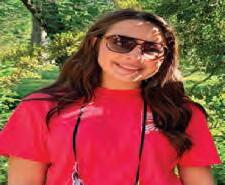
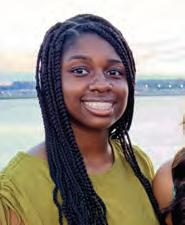
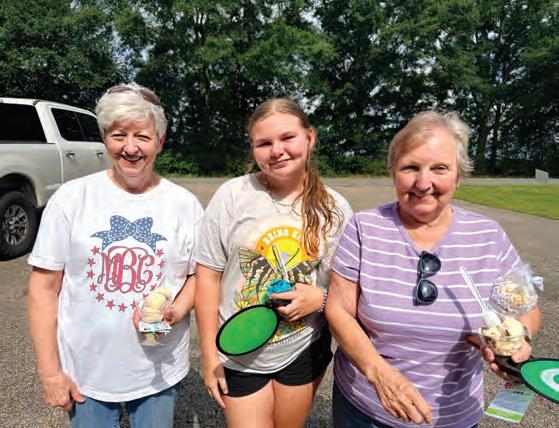
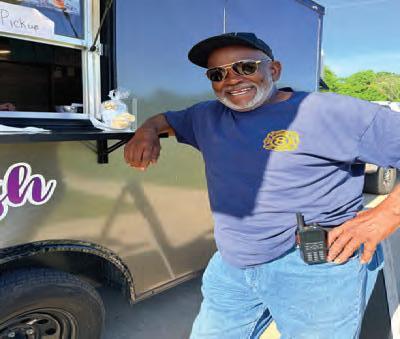
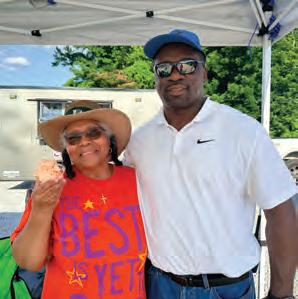
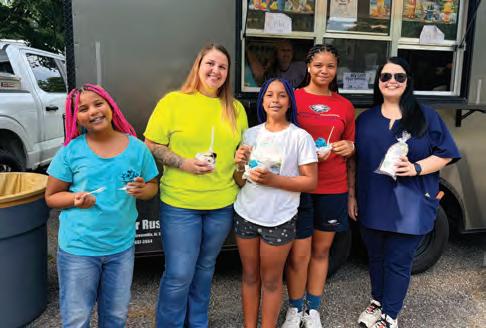
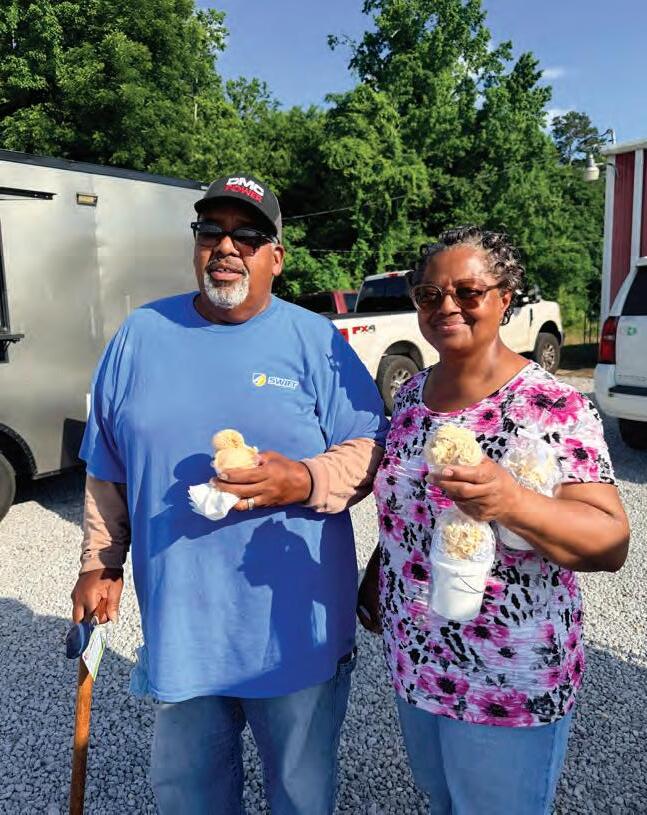
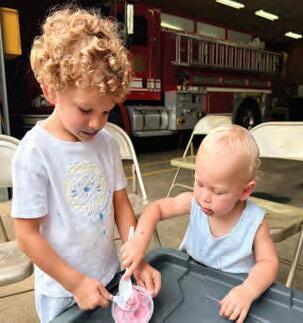
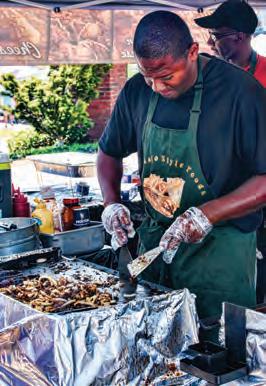
Summer socials gave us the chance to listen, connect and share a treat.
Executive VP/ General Manager
Terry Moseley
Co-op Editor
Christi Scruggs
ALABAMA LIVING is delivered to some 450,000 Alabama families and businesses, which are members of 22 not-for-pro t, consumer-owned, locally directed and taxpaying electric cooperatives. Subscriptions are $15 a year for individuals not subscribing through participating Alabama electric cooperatives. Alabama Living (USPS 029-920) is published monthly by the Alabama Rural Electric Association of Cooperatives. Periodicals postage paid at Montgomery, Alabama, and at additional mailing o ce.
For advertising, email: advertising@areapower.com For editorial inquiries, email: contact@alabamaliving.coop
NATIONAL ADVERTISING REPRESENTATIVE:
American MainStreet Publications
1-800-626-1181
www.AMP.coop
www.alabamaliving.coop
CHANGE OF ADDRESS:
For co-op members, contact your local electric cooperative. Non-members, send your address change to contact@alabamaliving.coop.
9 School Mascots
Whether it’s college or high school, we love our school mascots, especially when they pose with our readers for a snapshot!
16
Swing Your Partner!
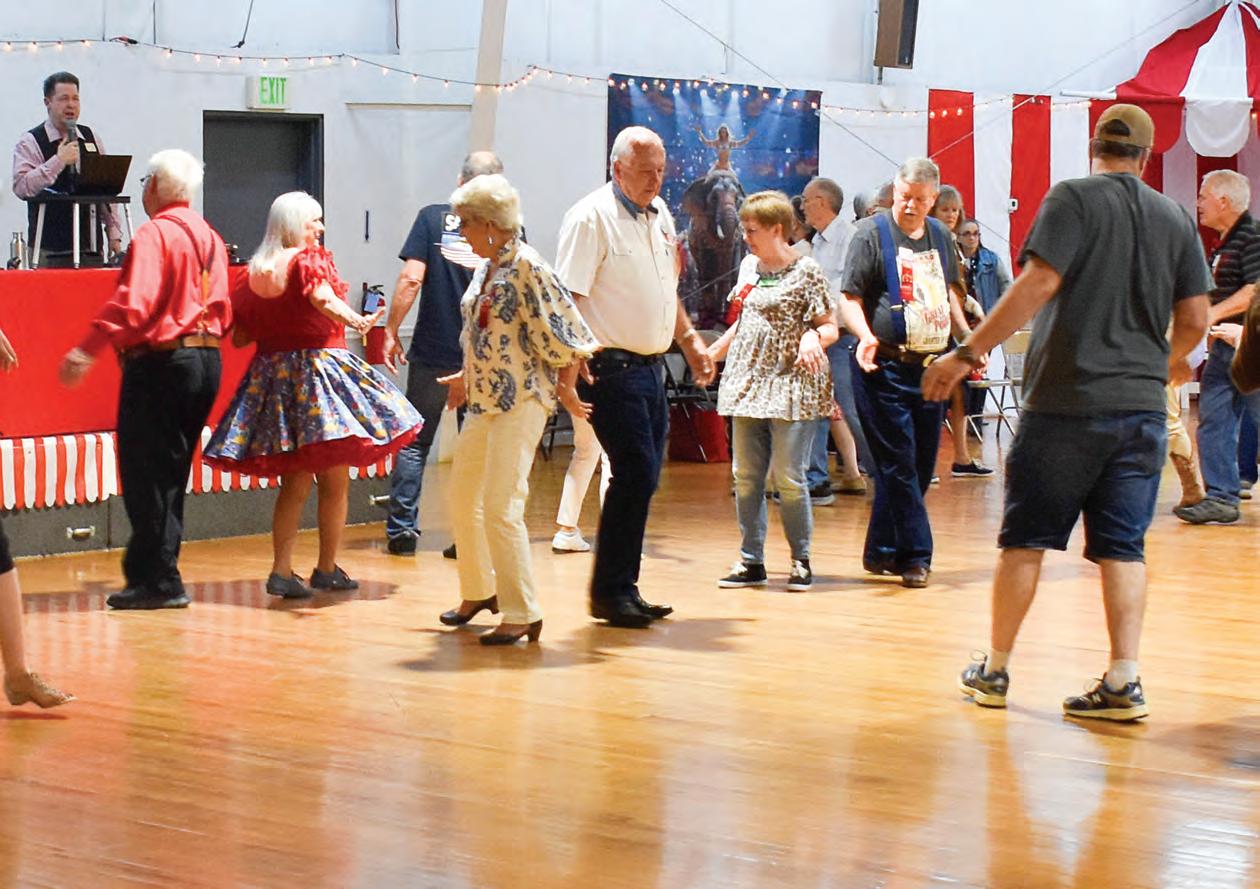
On any given week, Alabamians are square dancing somewhere. With 20 clubs across the state, it’s easy to find a group to join for some swirling and twirling.
20 Worth the Drive
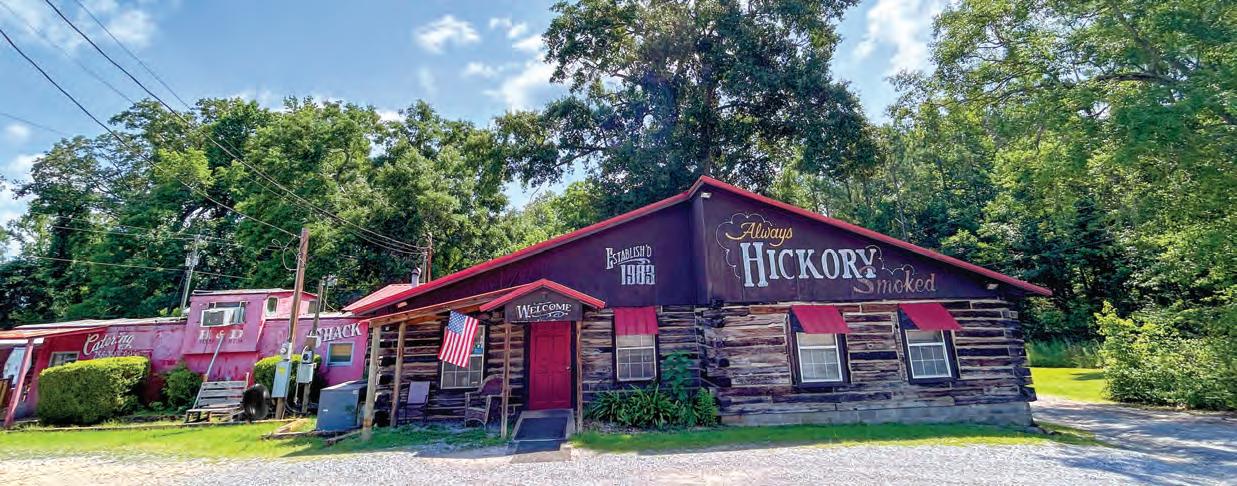
Only hickory wood fuels the pits at the popular Talladega barbecue joint, The Shack. No rub or other seasonings are needed, the owners say, because their meat is that good.
24 Alabama’s Rose Gardens
From downtown gardens to public parks to grand estates, there are many spots in Alabama where you can stop and smell the roses.
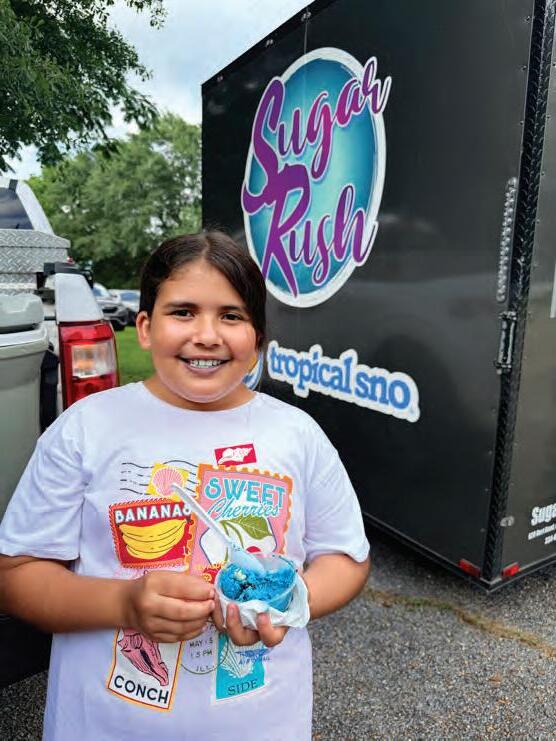
Sweet connections! This young lady enjoyed her ice cream at this summer’s “Get the SCOOP” events in June. Read more on page 8.
THE PRINCIPLES BEHIND THE POWER
SERVING THE MODERN MEMBERSHIP
By Terry Moseley, Executive VP/General Manager
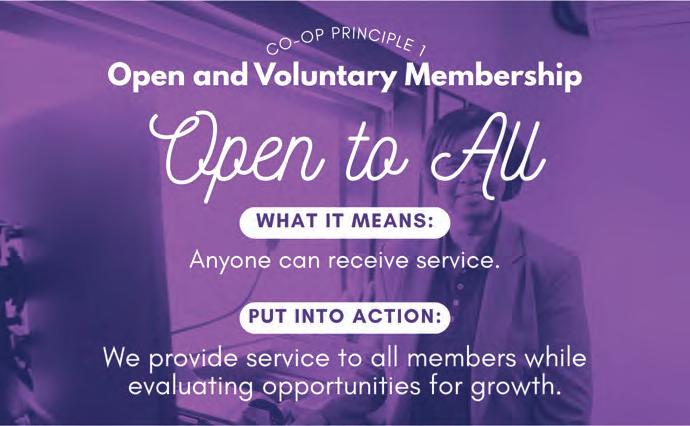
Over the coming months, I’ll discuss how the cooperative principles influence decisions we make as a cooperative. We begin with the first principle: Voluntary and Open Membership.
Traditionally, this principle has meant that anyone within a cooperative’s service area who meets the requirements for service can become a member.
When electric cooperatives were first established in the 1930’s, their purpose was bringing electricity to rural homes and farms. Indoor lighting was considered cutting-edge technology, and electrification transformed daily life across rural America.
Voluntary and Open Membership still means providing electric service to everyone we are obligated to serve. What has changed is the environment in which we fulfill that commitment.
The generation that remembers “when the lights came on” is becoming smaller. In its place are generations with different expectations, different technologies and different relationships with their utility. At the same time, new industries, technological developments and large electrical loads are changing the cooperative landscape.
When I was a co-op student at Pioneer
Electric in 1977, we served about 13,000 members. Nearly 50 years later, we still serve about 13,000 members. At first glance, it appears little has changed. In reality, almost everything has.
Residential members account for approximately 75 percent of our membership and 84 percent of our energy sales. As energy needs evolve, cooperative leaders must consider not only the number of members we serve, but also how electricity is used across the system.
New homes, businesses and industries create additional energy sales that help spread the fixed costs of operating the electric system across more kilowatt-hours, benefiting the membership as a whole.
Open membership today requires us to ask broader questions. Who are our future members? What types of growth strengthen the cooperative while benefiting existing members? How do we balance new growth with our responsibility to provide affordable, reliable service?
The first cooperative principle continues to remind us that our mission begins with serving people. Fulfilling that mission requires thoughtful planning, responsible growth and a continued commitment to fairness for every member.
Forget A WEEK THEY’LL NEVER
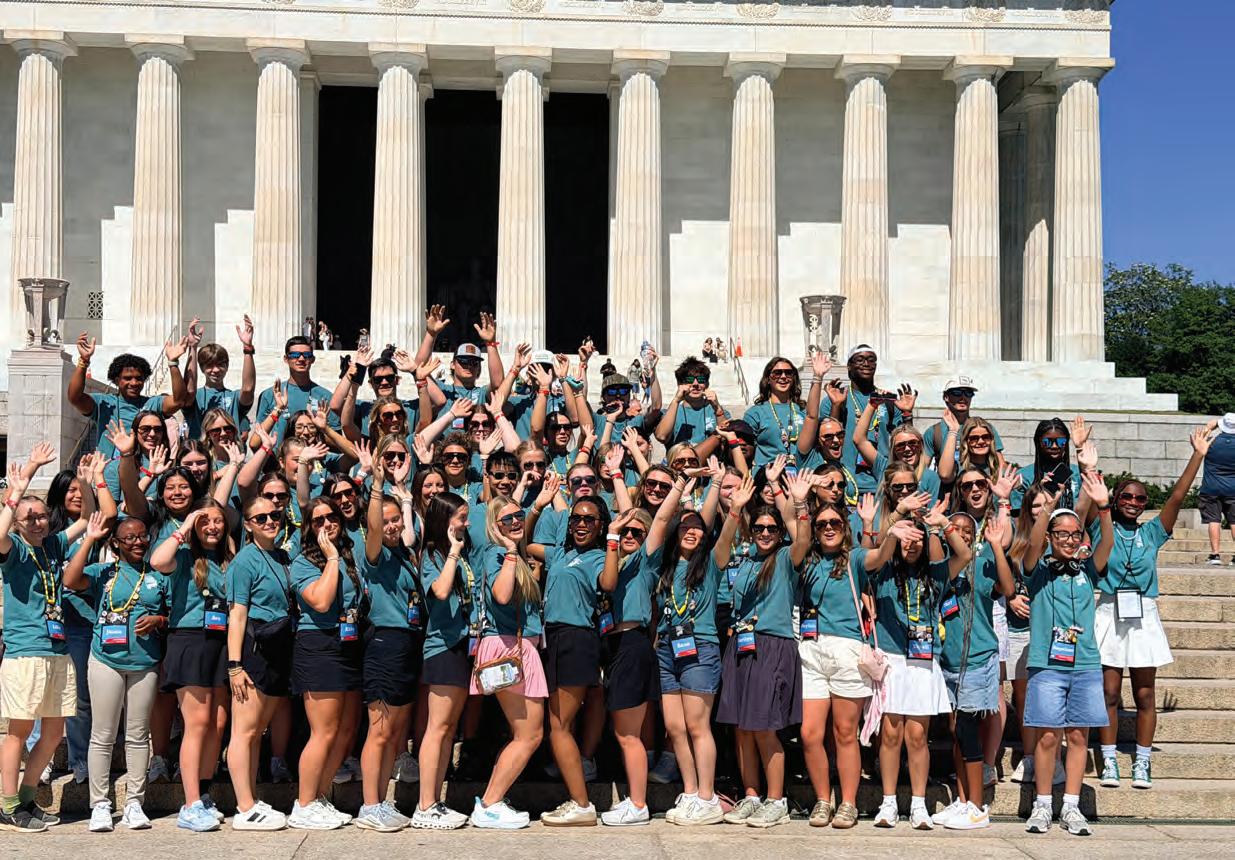
From walking the halls of the U.S. Capitol to making friends from across the country, three local students experienced a week they’ll never forget during the 2026 Washington Youth Tour.
Mattie Cook of Fort Dale Academy, Abby Lovell of Lowndes Academy and Talia Strong of Saints Virtual Academy represented our cooperative and our communities in the nation’s capital.
Along the way, they explored Washington’s most iconic landmarks, visited the Smithsonian museums, toured Arlington National Cemetery and met with Alabama Sen. Katie Britt. They also joined more than 1,800 students from electric cooperatives across the country to learn more about American history, government and the cooperative difference.
The Washington Youth Tour is much more than a sightseeing trip. It’s an opportunity for students to grow as leaders, broaden their perspectives and build friendships with peers from all over the United States. Many participants return home with a greater appreciation for public service and a better understanding of how electric cooperatives work to improve the communities they serve.
We’re proud of the way Mattie, Abby and Talia represented Pioneer Electric, and we know they’ll carry the memories and experiences from this trip with them for years to come.
If you’re a current high school junior, now is the perfect time to start thinking about next year’s Washington Youth Tour. Watch for application information this fall and consider applying for the chance to represent Pioneer Electric on this incredible, once-ina-lifetime adventure. We’d love to see you become our next Youth Tour delegate!
“I now have friends from New Mexico, Colorado and Texas! I cannot thank you enough for how this trip has changed my life.”
Mattie Cook Fort Dale Academy
“Thank you so much for making this amazing trip possible for us. It was truly incredible and impactful. I’ve grown so much in this past week.”
Abby Lovell Lowndes Academy
“This trip has brought me out of a shell I didn’t know I was in. I will carry this with me for the rest of my life. This has been an amazing, unforgettable experience.”
Talia Strong Saints Virtual Academy
NEIGHBORS NEIGHBORS serving
Meet Josh Gardner
Caring for What Matters Most
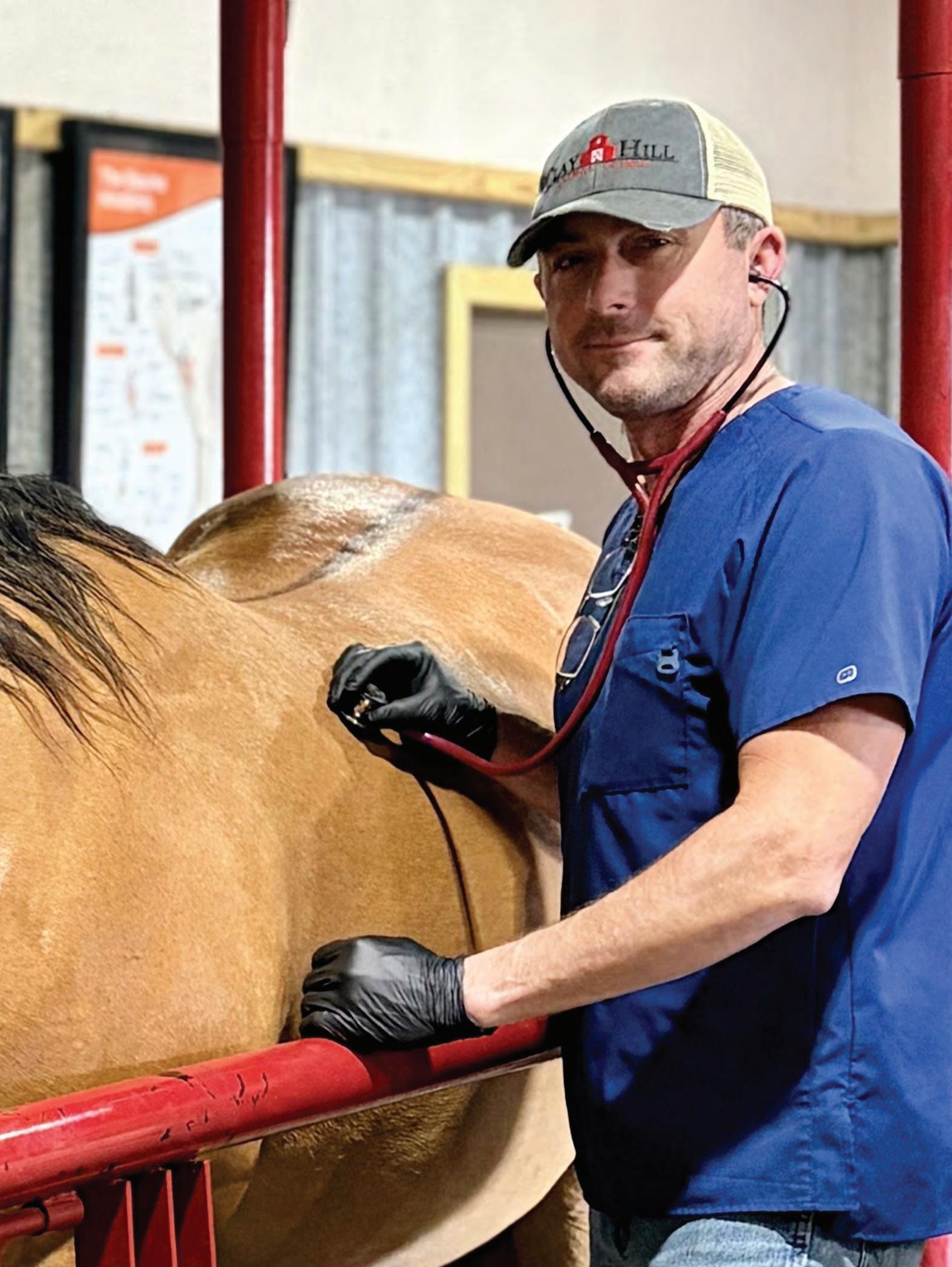
For Josh Gardner, caring for others isn’t limited to his profession. Whether he’s treating animals at his veterinary clinic, serving his church, raising cattle with his family or serving as a Pioneer Electric trustee, Gardner approaches each responsibility with a servant’s heart and a commitment to the community he calls home.
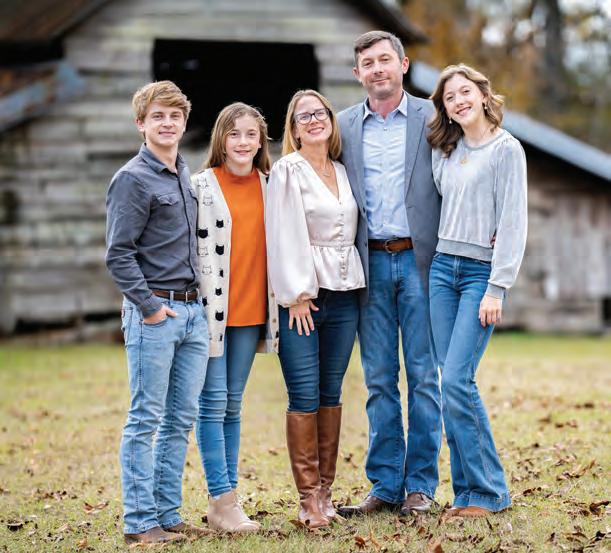
Family plays a central role in Gardner’s life. He and his wife, Hilarie, live on Red Oak Farm near Forest Home with their three children, Clay, Ava and Edith. Much of their time outside work is spent caring for cattle, enjoying outdoor activities and making memories together on the farm. Gardner is grateful for the opportunity to raise his family in the same rural community that helped shape his own values.
A lifelong resident of Butler County, Gardner grew up with a strong appreciation for rural life and the values that define it. He always knew he wanted to build a career that would allow him to return home and make a difference in the place that helped shape him.
As a veterinarian, Gardner’s work extends beyond caring for animals. He serves as a trusted advisor to livestock producers, pet owners and families. Building those relationships and helping people through both joyful and difficult moments has been one of the most rewarding parts of his career.
“Veterinary medicine is really about serving people as much as it is serving animals,” Gardner said.
That same spirit of service led him to Pioneer Electric’s Board of Trustees. Gardner was elected to represent District 1 in 2018. Service to Pioneer Electric is a family tradition. Gardner followed in the footsteps of his father, Jimmy Gardner, who served on the cooperative’s Board of Trustees from 1989 until 2005.
He believes one of the most important aspects of board service is listening to members and understanding their needs.
His background in agriculture and small business ownership provides a unique perspective on the challenges
For the Gardner family, time together is time well spent. Josh and Hilarie Gardner are pictured with their children, Clay, Edith and Ava.
facing rural communities. From rising costs to changing technology and increasing energy demands, Gardner understands the importance of balancing long-term planning with stewardship of cooperative resources.
Gardner also believes it is important for members to understand the history and purpose of electric cooperatives. Pioneer Electric was formed to serve rural areas that investor-owned utilities chose not to electrify because doing so was not financially profitable. Cooperatives were created to fill that gap, bringing electricity and opportunity to communities that might otherwise have been left behind.
His commitment to service is deeply rooted in his faith. Gardner is an active member of Southside Baptist Church, where he serves as a deacon and enjoys opportunities to support ministry efforts in the community.
Whether he’s caring for animals, supporting local agriculture, serving his church, spending time with Hilarie and their children or helping lead the cooperative, Gardner’s focus remains the same: taking care of people, strengthening communities and preserving the values that make rural Alabama a special place to call home.
ON PIONEER ELECTRIC
Our “Get the Scoop” summer event made stops in the Sardis, Searcy and Gordonville communities, where nearly 150 members and their families joined us for ice cream and conversation.
These events are about more than just ice cream. They are an opportunity to meet members where they live, answer questions, listen to their feedback and have meaningful conversations about the cooperative and the communities we serve.
We appreciate everyone who attended and took the time to visit with us. A special thank you to member-owned Sugar Rush for providing delicious ice cream and service with a smile at each event. Their friendly team helped make all three gatherings a sweet success.
Mascots
Emily and Waverly with Aubie and the Auburn cheerleaders at the fall festival in Opelika town square. SUBMITTED by Ryan Harris, Auburn.
October theme: “Pumpkin Carving” | Deadline: August 31
Submit photos at alabamaliving.coop/submit-photo or by scanning the QR code. Photos submitted for publication may also be used on our website and on our social media pages.
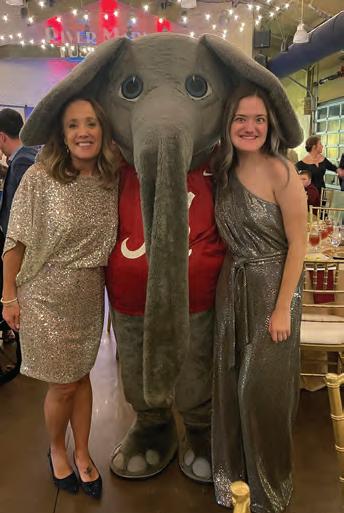
Leslie and Natalie Arnold meeting Big Al at a family wedding. SUBMITTED by Leslie Arnold, Cullman.
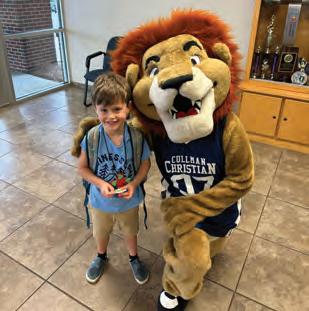
Warren loved pre-k at Cullman Christian School and its mascot. SUBMITTED by Katie Vintson, Cullman.
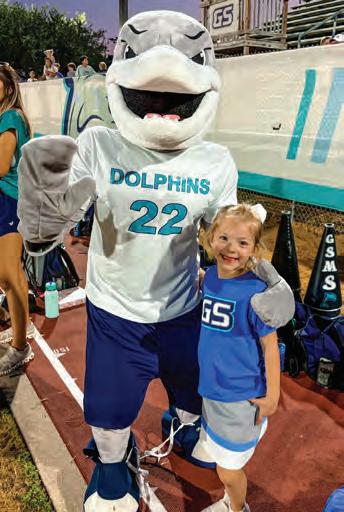
Cami Michaelson and Gulf Shores Dolphin, “Splash.” SUBMITTED by Megan Michaelson, Foley.
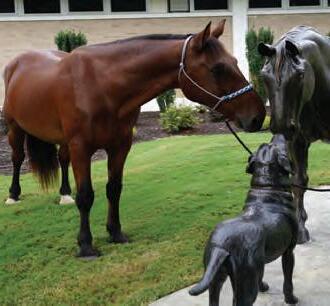
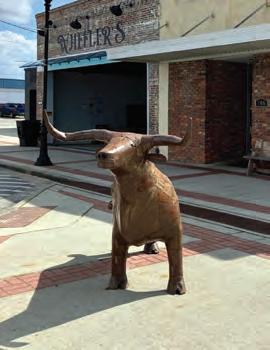
Trouper the Mustang was the living mascot of Northeast Alabama Community College from 2009-2023, pictured with his statue. SUBMITTED by Amber Mathewson, Henagar.
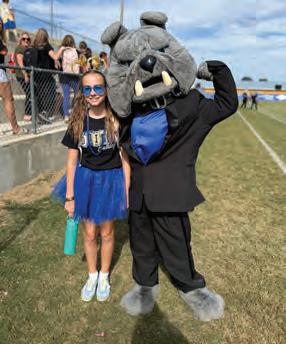
Klaire Carden and mascot, Cannon Hyatt, at the Addison High School Homecoming pep rally. SUBMITTED by Lindsey Carden, Addison.
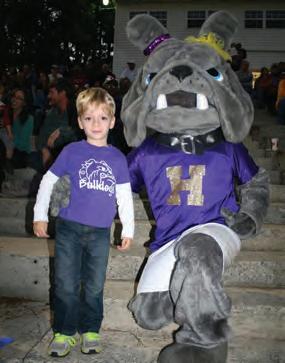
Carson Cain with Spike, mascot of the Hanceville High School Bulldogs. SUBMITTED by Carla Cain, Hanceville.
THIS MONTH IN ALABAMA HISTORY
In Hitler’s Berlin, Jesse Owens Goes for Gold
Jesse Owens was born in 1913, in Oakville, Lawrence County, Alabama. He was only nine years old when his large sharecropper family relocated to Cleveland, Ohio, in search of better economic opportunity.
Owens became a track and field standout and enrolled at Ohio State University. At the Big Ten Conference championship in 1935, he set three world records and tied another, all in the space of a single, incredible, unrivaled hour.
He soon qualified for the 1936 Olympics in Berlin. Newly ascended German Chancellor Adolf Hitler envisioned the games as a means of demonstrating to the world his ideas on the supremacy of the Aryan “master race.” But the Alabamaborn runner was among several Olympians of color who provided a dramatic counterargument. In three consecutive days, starting on Aug. 3, 1936, Owens garnered gold medals for the 100-meter dash (10.30 seconds), 200-meter dash (20.70 seconds) and the long jump (8.06 meters). He earned a fourth gold medal on Aug. 9, as part of a record-setting relay team.
American newspapers proclaimed Owens a hero, but he returned to a segregated society. Shut out of further Olympic glory because of the outbreak of World War II, Owens held several jobs as an entertainment promoter, enthusiastic youth sports organizer and as a corporate-relations executive with Ford Motor Company. He was a near constant presence on the inspirational lecture circuit.
When Owens died in Arizona in 1980, his Olympic achievements of four decades earlier remained unequaled. At the 1984 games in Los Angeles, Birmingham native Carl Lewis matched, but did not top, his record. Today, a memorial park and museum (jesseowensmuseum.org) in his Alabama hometown honors Owens as one of the nation’s great Olympians.
— Scotty Kirkland
Whereville, AL
Identify and place this Alabama landmark and you could win $25! Winner is chosen at random from all correct entries. Multiple entries from the same person will be disqualified. Send your answer with your name, address and the name of your rural electric cooperative, if applicable. The winner and answer will be announced in the September issue.
Submit by email: whereville@alabamaliving.coop, or by mail: Whereville, 340 Technacenter Drive, Montgomery, AL 36117. Contribute a photo you took for an upcoming issue! Send a photo of an interesting or unusual landmark in Alabama, which must be accessible to the public. A reader whose photo is chosen will also win $25..
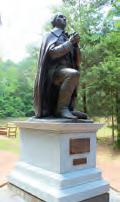
July’s answer: This statue of George Washington kneeling in prayer is on the grounds of American Village in Montevallo and was dedicated Dec. 1, 2018. A plaque with the statue reads: “Given to the glory of the Lord Jesus Christ and in loving memory of Dave Minshew II, grandson of Dan and Pat Howard.”
(Photo by Sean Burnley of Alabama Living) The randomly drawn correct guess winner is Carolyn Thomas of Southern Pine EC.
Alabama Living wins national awards
Alabama Living received three honors at the recent national Cooperative Communicators Association Conference in Chattanooga, Tenn.
Editor Lenore Vickrey took a second place award in the long-form feature category for her story, “Getting a Jump Start on College” in the July 2025 issue, which featured cooperative members who participated in dual enrollment at their high schools and local colleges.
Columnist Joe Hobby won second place for his columns, “Cup o’ Joe,” which are a reader favorite.
The magazine itself took third place in member publications with an annual budget greater than $150,001.
The CCA is a national organization of 350 cooperative communicators who work for various cooperative businesses, such as agriculture, electric and service, from the United States, England and Canada.
Jesse Owens at the start of his recordbreaking 200-meter race at the 1936 Berlin Olympics.
PHOTO COURTESY LIBRARY OF CONGRESS
Paperback Books Sought for Correctional Facilities
The Alabama Prison Arts + Education Project (APAEP) is collecting book donations to help build and expand educational libraries in correctional facilities across Alabama.
Books provide opportunities to explore new ideas, engage with different perspectives, and support lifelong learning. By donating quality books, you're helping strengthen library collections in correctional facilities across Alabama, making more books available to readers throughout those communities.
The project needs only paperback books of these genres: Contemporary fiction (published within the last 15 years when possible), classics, poetry, biography and memoir, history, science & nature, art & design, regional writing, international authors and large-print books. They do NOT accept hardback or spiral-bound books, academic journals, highly specialized or outdated academic textbooks, cookbooks, travel guides, Reader's Digest condensed books, true crime, romance novels, and religious materials that promote one faith tradition over another.
Donations may be sent to:
Alabama Prison Arts + Education Project 1061 Beard Eaves Memorial Coliseum Auburn University, AL 36849-5674
Find the Hidden Dingbat!
We thought we’d hidden the July dingbat, a red hot firecracker, pretty well but several hundred of you found it correctly in the photo of the Lookout Mountain Creamery on Page 21. Michelle Cobb of Louisville, a member of Pea River EC, gave credit to our designer (“man, this graphics guy is good, real good!”) for making her search and search until “lo and behold, there it was on Page 21 just to the right of the number 53, above two stools.” Alexandra Medford of Collinsville, a member of Sand Mountain EC, wrote that “it was tricky, but my artistic eye noticed the color difference of the red stripe next to the number 53…right in time for the Fourth of July!” Don Horne of Central Alabama EC remembered June’s water bottle was hidden in a not-so-obvious place, and that helped him find the firecracker in the ice cream shop photo. “The fuse is faint, but it is there!” he wrote.
Congratulations to our randomly chosen winner, Felicia Stoddard of Wetumpka, a member of Central Alabama EC, who wins $25 from our sponsor, Alabama ONE Credit Union.
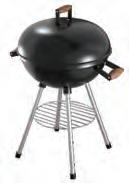
As we head into autumn, now is a great time for a cookout. We’ve hidden this charcoal grill for you to find. Remember, it won’t be in an advertisement or on Pages 1-8. Entries without a hometown and electric cooperative listed will not be considered for the prize. Good luck! Sponsored
Take Us Along!
See more travelers on page 28!
We enjoy seeing photos from our readers on their travels with Alabama Living! Send us a high-resolution photo of you with a copy of the magazine (please, no phone screenshots) on your travels to: mytravels@alabamaliving.coop. Include your name, hometown, name of your electric cooperative and the location of your photo. We’ll draw a winner for the $25 prize each month.
The Sisters Class from Arab First United Methodist Church traveled to Costa Rica for a “Sisters Retreat” in October last year. Enjoying a Catamaran Sunset Cruise in Playa Flamingo are Leah Bishop (holding the magazine), Brenda Carr, Gina Walley, Cynthia Traylor, Brandi Cantrell, Joanne Stisher, Donna Tidmore, Natalie Burke and Andrea Elrod. They are members of Arab EC.
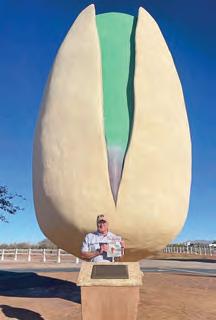
Brad Norris of Dixie EC took his magazine along on a road trip to the World’s Largest Pistachio in Alamogordo, New Mexico.
Tim and Cindy Walker of Gulf Shores, members of Baldwin EMC, took their magazine to Valletta, Malta.
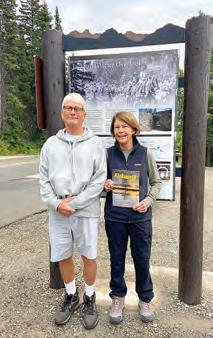
Glacier National Park was the destination of Brad and Betsy Nicks of Foley. They are members of Baldwin EMC.
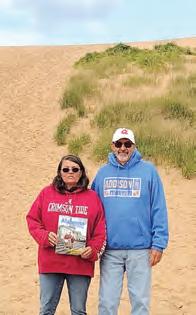
Rickey and Pam Lee of Addison and Cullman Electric Cooperative did the dune climb with Alabama Living at Sleeping Bear Dunes National Lakeshore in Michigan.
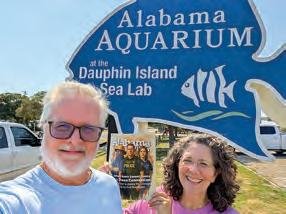
Steve and Connie Holcomb of Hartselle traveled to the other end of the state to visit the Alabama Aquarium on Dauphin Island, where they went camping. They are members of Joe Wheeler EMC.
IN PURSUIT
of More than Big Bucks
Buckmasters’ Bushman looks back on 40 years of promoting deer hunting
BY JOHN N. FELSHER
It all started with a bream fishing trip.
Years ago, a grandfather took his young grandson to the water, introducing him to the simple joys of fishing and the outdoors. Neither of them could have imagined that the little boy holding a fishing pole would one day become one of the most influential figures in the hunting world.
This year, Jackie Bushman marks two milestones: his 70th birthday and the 40th anniversary of Buckmasters, the organization he founded that has helped shape modern deer hunting and conservation.
The path that led Bushman to a lifetime in the outdoors didn't begin with his father, Jackie Bushman Sr., who preferred tennis courts and basketball courts to deer woods and fishing holes. Instead, it was Bushman's maternal grandfather, John Walraven, who sparked his lifelong passion.
"My grandfather was the outdoorsman," Bushman says. "That's where I got the bug!”
But like his father, young Jackie also enjoyed sports and was an athlete in school; several colleges recruited him for basketball and tennis scholarships. He accepted a tennis scholarship to Auburn University.
“In tennis, I was first in Alabama, a top five in the South and top 30 in the country," Bushman says. “I love to hunt and fish and Auburn was close enough to my deer stand.”
After college, he played professional tennis for five years, but a bad ankle hampered his performance. He became the tennis director at Lagoon Park in Montgomery.
“Back then, someone had to be in the top 30 to make a living playing tennis,” Bushman recalls. “With my ankle, I couldn’t compete with the top 30 players.
I could make more money teaching tennis than playing it.”
While at Lagoon Park, Bushman met Perry Mendel, a real estate developer and the founder of KinderCare Corporation. Mendel asked Bushman if he wanted to do anything besides teach tennis for the rest of his life.
The Bushman family knew the late Ray Scott, founder of the Bass Anglers Sportsman Society.
“I was good friends with Ray,” Bushman says. “His sons were in my fraternity at Auburn. His daughter was the sweetheart of our fraternity. Ray was also in my hunting club. One day, Ray and I were hunting, and he told me how he started B.A.S.S. (Bass Anglers Sportsman Society) I told Mr. Mendel that I would like to do something to promote deer hunting the way Ray promoted fishing.”
Starting out
Mendel suggested that Bushman make a video about how to hunt deer. Before the internet, many people bought instructional videotapes on various topics. Bushman shot a two-hour videotape on basic deer hunting and sold sponsorships.
Then, Mendel suggested Bushman use that money to establish his deer hunting organization. Bushman hit the road to sell the concept and finally launched Buckmasters in 1986.
“I flew to California where all the ATV companies were to sell the Buckmasters concept,” Bushman says. “I didn’t have much luck. Finally, I talked to Richard ‘Rit’ A. LeFrancois, the chief marketing person at Yamaha. He believed in the vision.”
Bushman then turned to Scott, the master promoter. Scott suggested Bushman hold a deer hunting event
Buckmasters Expo gives back
The Buckmasters Expo will be Aug. 1416 at the Renaissance Montgomery Hotel & Spa at the Convention Center, 201 Tallapoosa St. in Montgomery.
“At the Expo everybody brings a canned good,” says Jackie Bushman, founder of Buckmasters. “We’ve provided millions of meals to missions, the Salvation Army and others over the years. It’s always been part of me and my life to give something back and pay it forward.”
Expo hours run from 3 p.m. to 9 p.m. Aug. 14, 9 a.m. to 7 p.m. Aug. 15 and 10 a.m. to 5 p.m. Aug. 16.
The event will feature more than 500 exhibitors from various sporting companies. Outdoors experts will give demonstrations, and many vendors will offer special expo prices and giveaways. The event will also hold some activities for children.
The August 2025 Expo attracted more than 25,000 people and raised significant funds for various charities.
For more information, visit buckmasters. com/expo or call 800-240-3337.
PHOTOS COURTESY BUCKMASTERS
to generate excitement about his new organization. He started the Buckmaster Classic.
“I was watching a TV show with big athletes, actors and entertainers competing in various events,” Bushman says. “I wanted to do something similar, but with an outdoors format. At that first Buckmasters Classic, Bo Jackson, Dale Earnhardt and others came. I started with five sponsors. The next year, I had 20 sponsors and a list of celebrities who wanted to participate.”
Bushman wrote an insert for Deer and Deer Hunting magazine. When the magazine no longer wanted the insert, Bushman turned to the KinderCare marketing staff to help design his own periodical. In 1987, Buckmasters magazine hit the newsstands focusing on deer hunting.
Then Scott suggested Bushman do a television show. When ESPN showed no interest in a hunting show, Bushman contacted The Nashville Network, now Paramount Network. They didn’t want to do a hunting show either.
“I called TNN back and told them about my event,” Bushman says. “They let me do a pilot just on my event. The Buckmasters Classic ran on a Sunday night in October 1988. That Monday morning, I was teaching tennis. People from TNN flew down to meet me. I was soaking wet with sweat, but I met four guys in the conference room. They said I brought them the highest rated TV show they had ever aired on their network. That’s how we put the first deer hunting show on major cable television. We went from 10,000 members to 100,000 after running for 13 weeks on TNN.
Continuing popularity
Now, “Buckmasters” airs at 9 p.m. every Sunday on the Outdoor Channel, and on Wednesdays on the Field & Stream channel.
“Jackie is one of the pioneers of outdoors television and the outdoor industry in general,” says Marc Womack, a television producer from Columbus, Ga. “He’s influenced anyone who wants a television show or a YouTube channel because he was the pathfinder.”
“The longevity that Jackie has had in this industry is very unique,” Womack says. “He’s been on television for 38 years now and almost 40 with the magazine. That’s a huge accomplishment, especially how the industry changed so much in the past 40 years. He wants people around him to succeed. He’ll talk to anybody.”
Beyond the TV show, the organization has a robust social media presence, with more than 1.2 million followers. The organization also participates in such events as the Gamo Squirrel Master Classic and Buckmasters Life Hunt, which is similar to the Make A Wish Foundation but with a focus on hunting. Buckmasters also supports other programs for wounded warriors and disabled people.
“I don’t see myself as an outdoors celebrity, but it’s been an honor and a pleasure for folks to let me come into their living rooms and give them a little entertainment all these years,” Bushman says. “It’s been a heck of a ride. I had no clue it would ever get this big.”
For more information, visit buckmasters.com
The ‘what if’ deer that didn’t get away
During the past 40 years, the Buckmasters deer head logo has become iconic to every deer hunter. But it’s not just a logo – that deer really existed. Buckmasters founder Jackie Bushman calls it the “What If Deer.” Outdoor writer Russell Thornberry came to a Buckmasters Classic Celebrity Hunt. Thornberry guided deer hunts in Canada and invited Bushman to hunt in Alberta. Thornberry edited Buckmasters magazine and other publications for years.
“I had never hunted in minus-30 degrees weather before,” Bushman says. “In the clothes I brought, I could only last about 10 minutes. After I froze my tail off, Russell had some clothing made for extreme cold weather and boots to go with them. One was a fleece vest. I wanted a full suit like that. The lady who made the vest started making full suits. I created a whole business for her.”
After hunting a couple days, they saw a huge buck about 500 yards across a river. Bushman wanted to hunt that buck, but first, they had to help another man recover a deer he shot.
After that, they didn’t have enough time to hunt where they saw that big deer. Thornberry suggested another closer spot to hunt that afternoon. Across the river, two hardwoods strands came together with a gap between them. Shortly before dark, a doe came out in that gap, followed by a massive buck.
“We have good deer in Alabama, but not compared to Canada,” Bushman says. “I squeezed off a shot. The deer turned and looked at me. I thought I missed. When it turned, I knew it was the record-book deer I saw that morning. I took another shot. When we crossed the river, water went over my boots. It was the coldest I’ve ever felt. On the other side of the river, I started running in circles to get my circulation going.”
Thornberry found Bushman’s deer. The rack measured 176 inches, his personal best for years. A graphic artist made a depiction of that deer’s head, which became the Buckmasters logo.
Bushman and his “what if” deer, which later became the model for organization’s logo.
“I call it the ‘What If Deer’ because so many ‘what ifs’ went into hunting it,” Bushman says. “What if I hadn’t met Russell at the Classic? What if I wouldn’t have gone to that spot that morning and hadn’t seen that deer? What if we wouldn’t have helped that guy recover his deer? What if we hadn’t gone to another spot because of that? Everything just lined up right.”
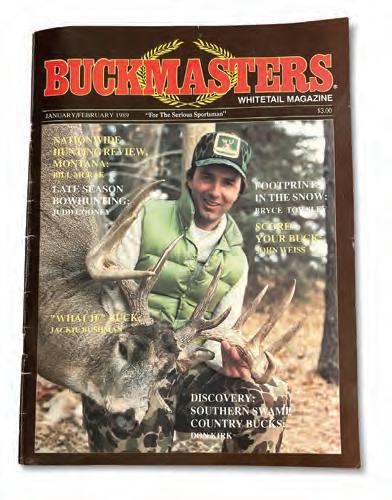
Jackie Bushman wrote about his “what if” deer in a 1989 issue of Buckmasters magazine.
SWING YOUR PARTNER
Square dancing enthusiasts twirl and swirl in centuries-old pastime
BY EMMETT BURNETT
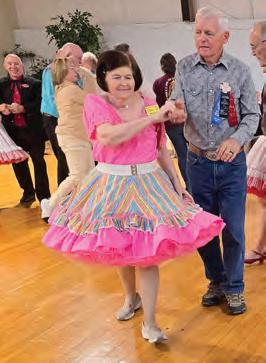
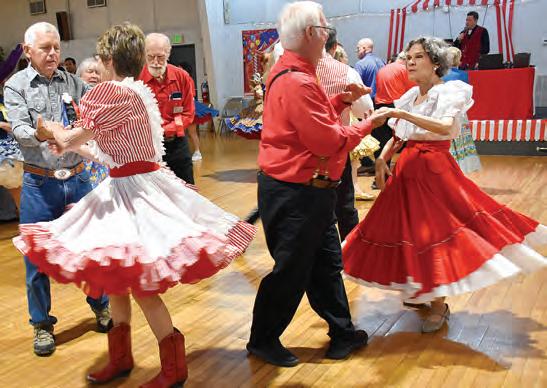
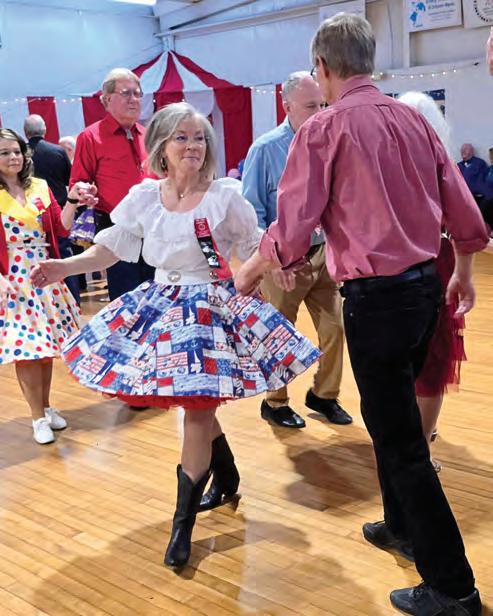
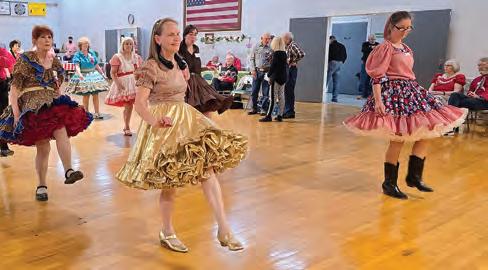
Colorful full skirts for the ladies and Western shirts for the men are popular square-dancing attire.
PHOTO BY LIZ
SORRELL
Twenty-three states have chosen square dancing as their official dance. Alabama is one of them.
On a recent night near Birmingham, the town of Fultondale becomes a do-si-do ground zero.
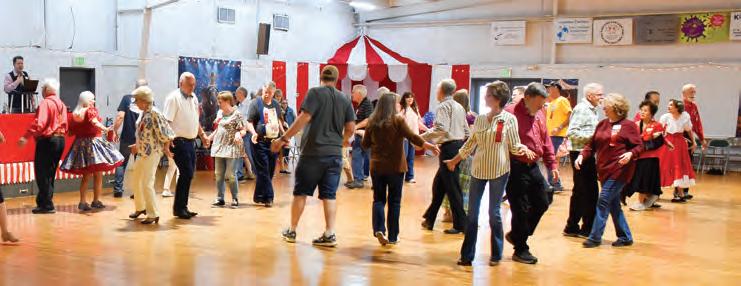
For in the Friendship Hall in Fultondale, participants from near and far, ages 8 to 88, dance in one of the oldest square dance events in the state, the 73rd Alabama Jubilee.
Ladies in flowy skirts twirl and whirl. Men donned in western wear assist in the spinning. Fun, fellowship, and laughter resonate throughout the evening.
In addition to square dancing, many participate in “rounds,” or choreographed ballroom dancing. Others are line dance enthusiasts, high-stepping in synchronization. All are under one rooftop.
And it’s not just in Fultondale. Within any given week, Alabamians are square dancing somewhere.
“We have about 600 dancers throughout the state,” says Bobby Parker, president of the Alabama Square and Round Dance Association (ASRDA). “We also have around 20 clubs from Decatur to Anniston, to Auburn to Birmingham, and Mobile.” And there’s room for more.
Veterans of the swirl-and-twirl insist that your skill sets do not matter. Whether you have the dance moves of Fred Astaire or Fred Flintstone, there’s a place for you at a ‘Bama ballroom.
“Most of our initial interest is from women,” says Parker. “Either they are widowed or can’t talk their husbands into taking a class.” Parker, a Pinson resident, can relate.
“I can tell you I was not happy with my wife when she asked me to try square dancing,” he recalls. “But by the second class, I was like ‘Hurry up! We are going to be late!’”
Newcomers may fret that they don’t have the skills or ask, “Can I learn the moves?”
“Absolutely,” answers Liz Sorrell, president of the Birmingham Square & Round Dance Association. “Some people are apprehensive about square dancing if they have never done it. Try it once. You will love it.”
Her husband Rick adds, “I have never seen anyone after trying square dancing walk off the dance floor saying, ‘that’s not for me.’ It is for you. Stay with it.”
“I hear the ‘I don’t have rhythm’ excuse all the time,” adds Montgomery Area Square Dance Association’s Dimple Williford. She answers the doubters: “Yes you do. You learn by doing the moves to the beat of the music and to pay attention to the caller.”
This is sage advice. The caller literally runs the show He or she is the catalyst of a good square dance.
“First, you read the room,” says caller Ted Kennedy, setting up his audio equipment in the gymnasium of the Port City Church of Christ in Mobile. The Port City Squares are about to take the floor.
“I have to get a feeling for the audience,” Kennedy adds. “Is this a newer group? Should I slow things down? Can I move the tempo up a bit? I must know the audience’s personality.”
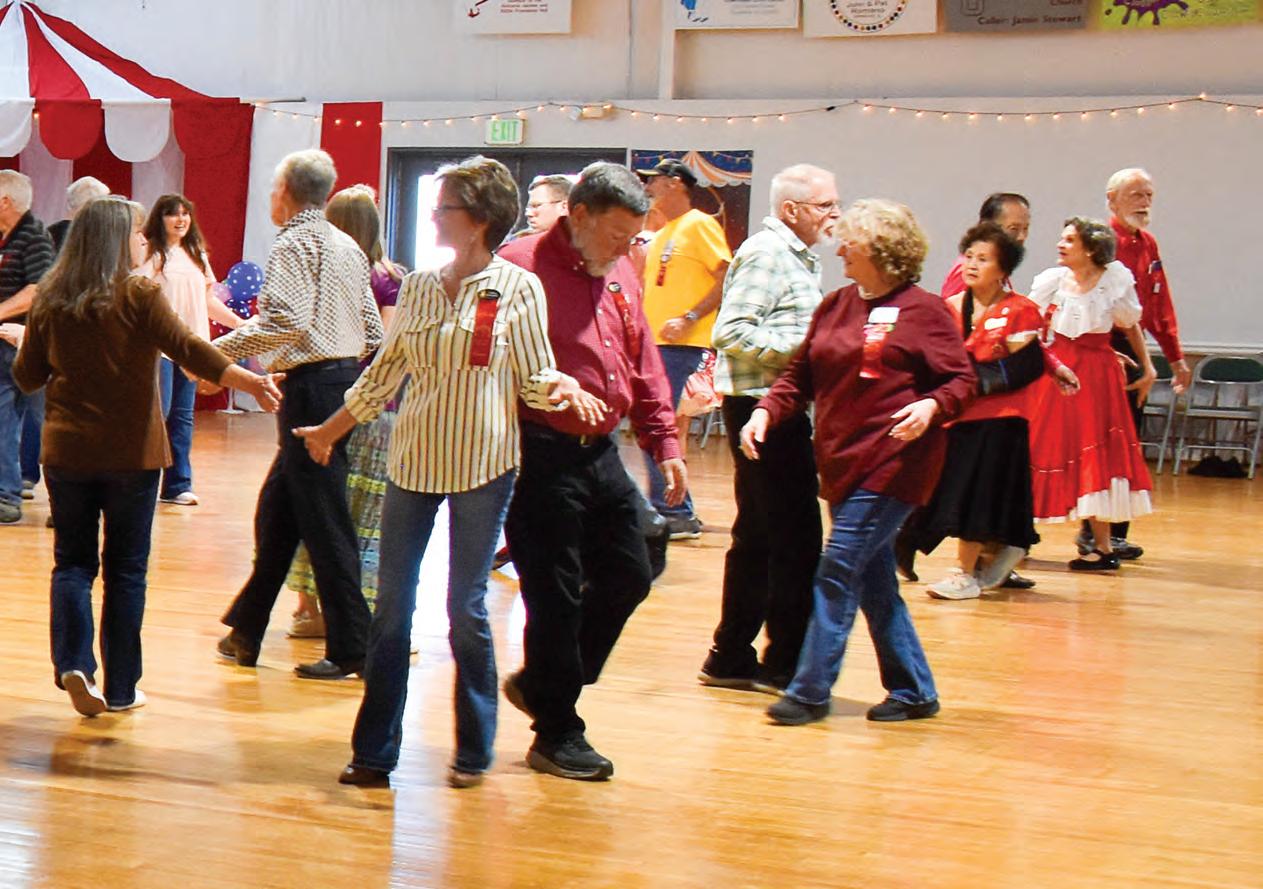
Square dancers enjoy an evening of dancing and fun at the 73rd Alabama Jubilee in Fultondale, one of the oldest square dancing events in the state.
PHOTO BY EMMETT BURNETT
Within any given week, Alabamians are square dancing somewhere. There are 20 clubs throughout the state. Veterans say newcomers are welcome and skill sets don’t matter. “Try it once,” says Liz Sorrell, president of the Birmingham Square and Round Dance Association. “You will love it.”
Kennedy calls out instructions: You’re left, turn to the right, bow to your partner, and other moves. Dancers immediately respond.
“I have to figure out who is dancing with who and eventually I must get them back to the corner and back to their piece of the dance floor,” he says. “It is quite literally a human puzzle of dance.”
Kennedy also told another “puzzle of dance” that many may not know. “Square dancing occurs throughout the world. But regardless of the country or global location, the caller always instructs the group in English, even if he and his dancers do not speak English.”
So why the love and durability of square dancing? Many other dances are bygone boogies, yet the square dance, first recorded in 17th century England, perseveres.
‘It keeps your mind sharp’
“Square dancing, rounds, line dance, are more than dance,” notes Rick Sorrell. “It is good for your physical and mental health.” Sorrell and his wife Liz are co-chairs of the Fultondale two-day event.
“There is a lot going on during the dance,” Sorrell says. “You must be attentive to the calls and coordinate those calls with your dance partner. Possibly 100 other people are doing the same thing. It keeps your mind sharp.”
“It is also a family-friendly event,” says David Holladay, who teaches and conducts round dancing. “There is no smoking, drinking, or cursing allowed.” Pointing out at the group dancing the night away, he adds, “This is a safe place.”
Statewide gathering
Square dancers from across Alabama will gather at the Oxford Civic Center Aug. 28-29 for the 46th Alabama Square and Round Dance Association Convention. The theme is “Salute to America.” More information is available on their Facebook page. Search for Alabama Square and Round Dance Association.
For more information on square dancing, rounds dancing, and line dancing in Alabama visit alabamasquaredance.com
However, there are concerns. Square dancers are dwindling.
“The decline, I think, is due to the misconception that square dancing is for old folks,” Bobby Parker says. “That is not true. It is great exercise that gets you off the couch on a Friday or Saturday night. There is great fellowship with new and old friends of all ages.”
But several factors have dealt substantial blows, COVID being in the forefront. In the post-coronavirus days of quarantine, many dancers never returned.
Also, younger people are participating less. “Our biggest challenge is to obtain young callers and cuers (the cuer conducts rounds dancing) that are right out of college,” says Holladay. “It is difficult for people our ages – 60s and 70s – to attract younger crowds.”
President Bobby Parker adds, “We have reached out to home schools and the Boys and Girls groups/clubs. We need more young people interested. They are our future. If we teach them at a young age, they tend to stay with it. Even when they get older, marry, have kids and have to stop for a time in their life, they will eventually return to dancing.”
PHOTO
PHOTOS
Shack
Hickory smoke is the only seasoning for popular Talladega barbecue joint
STORY AND PHOTOS BY JENNIFER KORNEGAY
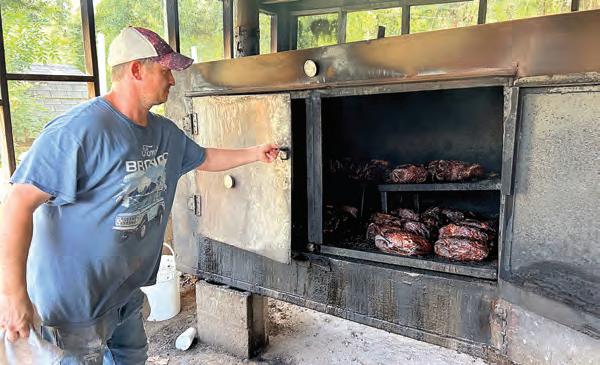
Around 11 a.m. on a sweltering day in late June, Curtis Hann moves between two massive smokers in a small shed behind The Shack BBQ in Talladega, checking Boston butts and slabs of ribs. Temps hit around 500-degrees in each of the pits, pushing the mercury in the space to Hades-like levels. But Curtis doesn’t mind; he’s been tending the smokespewing beasts off and on since he was 15 years old.
Patrons of The Shack may or may not be aware of Curtis’ sacrifice of sweat, but they benefit from it all the same, as they dig into this barbecue joint’s offerings. Sharon Frieze, who owns The Shack with her husband Rickey, brags on Curtis, her nephew, any chance she gets. She praises the rest of the team, too, which is made up of family, including her son Michael, two grandsons (Joshua Clough and Deacon Frieze) who’ve worked there in the past and younger grandkids (Gage Nabors and Lynly Frieze) who help out some, plus folks who feel like family, like longtime servers Tammy Norris and Jennifer Creamer.
“Our people make this place,” Frieze says.
Frieze’s parents, Haskell and Dot Hann, started The Shack in the early 1980s. While her dad ran his car-selling business, her mom started cooking a handful of Boston butts on a small Weber grill to sell on the side. “That grill didn’t even have legs,” Frieze says. “She propped it up between two chairs.”
With every bite of Dot’s hand-chopped pork consumed, word of its tender texture and savory flavor spread, and more people showed up — including an inspector with the health department, who informed the Hanns they’d need a kitchen, sinks for handwashing and other items to continue. “When the inspector asked my parents where they were putting trash, they took her to the trash barrel out back,” Frieze says. “When she went to look, a possum jumped out at her. My mom figured that was the end.”
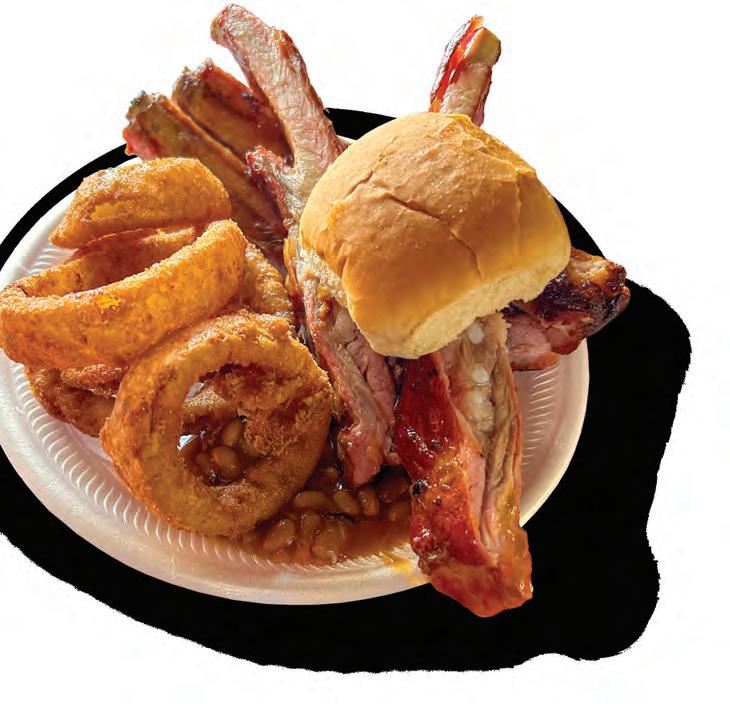
The Shack sells out of its ribs (here with onion rings and baked beans) daily.
It wasn’t. That kind health inspector gave them 30 days to procure the equipment required to run a food business. “My dad got an old train caboose, and that became our kitchen,” Frieze says. The crowds that kept coming led the Hanns to next add a building with tables and then expand the menu.
More than four decades later, Frieze holds onto her parents’ original barbecue philosophy. Only hickory wood fuels the pits. No dry rub — not even salt and pepper — seasons the meats. “It doesn’t need anything because we use good meat,” Frieze says. When the ‘cue comes off the heat, it’s immediately wrapped in foil to seal in the smoky goodness and continue tenderizing the meat underneath the exterior mahogany crust. Curtis still hand-chops the butts. There’s no sauce added either, except for the sweet red condiment drizzled on the pork sandwiches.
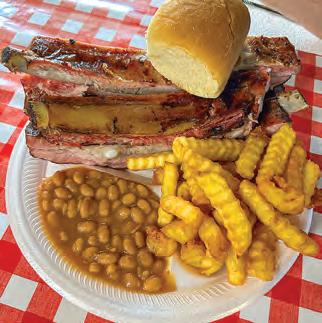
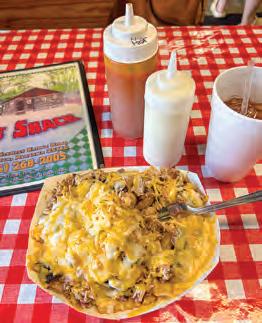
Those desiring sauce find squeeze bottles of it on the redand-white-check-clothed tables so they can easily add it to the chopped and sliced pork plate, the chopped-pork topped salad, the popular Shack Stack (chopped pork smothered in melted shredded cheese and mounded on a pile of crispy fries) and the ribs, which sell out daily.
“People ask, ‘Why don’t you cook more ribs?’” Frieze says, “but we don’t want anything left over; we want everything we serve to be fresh off the pit.”
Cheeseburgers, chicken fingers and deep-fried hotdogs sell well, too. “But nine times out of ten, people want the barbecue plates, ribs and the Shack Stack,” Frieze says. “We always tell people, we do barbecue, and that’s what they want most.”
Feeding local business, community
Those people regularly pack the restaurant, and The Shack does a lot of catering, too, especially when races at Talladega Superspeedway bring drivers, their crews and fans to the area in droves. “We used to go up there and set up at the airport to feed the drivers,” Frieze says. “We fed the Earnhardts and all those guys, but Covid kinda changed that, and a lot of the drivers now eat so healthy. But we still do some and get lots of people after the races.”
The Shack doesn’t serve alcohol, or the numbers of diners coming over from races would likely be higher. Local businesses rely on The Shack, too. “We just did 200 pounds of meat for the Honda plant,” Frieze says.
Frieze also feeds her community, even those who can’t pay. “We’ll have homeless come in some, and they know they can get one meal here. I’m not in this for the money,” she says. Server Tammy pipes up. “She does so much for others that nobody ever even knows about,” she says.
While Frieze’s generosity may go mostly unheralded, The Shack’s barbecue has garnered plenty of positive press. But as Frieze points to the various accolades from The Birmingham News and other outlets hanging on the restaurant’s walls, she stresses how family matters as much as melt-in-your-mouth meat. “Servers like Tammy and Jennifer, Rickey helping and Michael and Curtis being here, that means so much,” she says. (She’s currently trying to convince her daughter to join the family business, too.)
And when Frieze thinks about the future, she hopes her kids will keep The Shack’s legacy alive. “I hope they carry this on; it’s important,” she says. “I can’t imagine this thing my parents built not being here one day.”
Do you have a favorite restaurant we need to visit for a future Worth the Drive? Let us know at contact@alabamaliving.coop!
7744 Stemley Bridge Rd. Talladega, AL
256-268-2005
Hours:10 a.m-7 p.m. Sunday-Thursday
10 a.m.-8 p.m. Friday & Saturday
The Shack BBQ
Talladega l
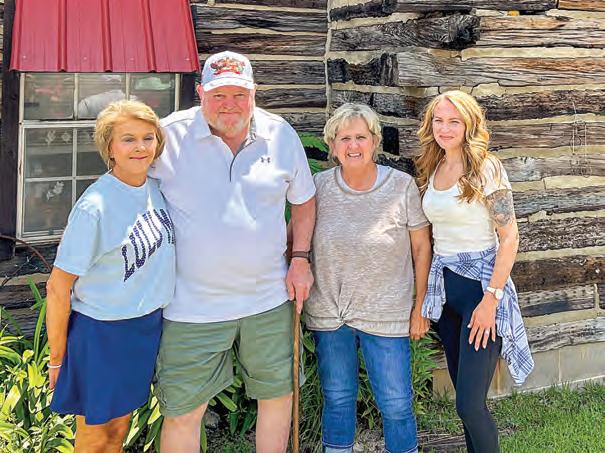
Top, Curtis Hann tending meat on the smoker. A plate of The Shack’s famous ribs (left). The Shack Stack (right). Part of The Shack team (from left to right), server Jennifer Creamer, co-owner Rickey Frieze, co-owner Sharon Frieze and server Tammy Norris.
LThe SEC's New Reality
Transfer Portal Revolution Reshapes SEC as Alabama, Auburn Chase Playoff Berths
BY BRAD BRADFORD
ast year, Coach Curt Cignetti of Indiana changed the recruiting landscape and the Big 10 won its third national championship in a row. Don’t think for a moment that the SEC is going to keep recruiting and building rosters the same way and expect different results. Coach Albert Einstein said that’s the definition of “insanity.”
The days of recruiting only high school seniors went the way of fullbacks with neck rolls and practices without water. Cignetti’s game plan is being copied by every team in America, just like Nick Saban’s blueprint was copied for years. Saban recruited, stockpiled and developed 5-star players. Many of these were redshirted during the “Process.”
Cignetti has mastered the “plug and play” system of taking upperclassmen from the transfer portal. Last year’s Heisman Trophy quarterback and first pick of the NFL draft, Fernando Mendoza, transferred to the Hoosiers from Cal and the rest is history. College coaches know that quarterbacks have become the most impatient players on the team. With the transfer rules being virtually nonexistent, the signal callers look for greener pastures if they aren’t named the starter. “Greener” can be interpreted in a couple of ways.
SEC COACHING CHANGES: After a year with hardly any changes for the fall of 2025, the floodgates opened after the season. Of the 16 SEC teams, six will have new head coaches this fall.
The most famous (or infamous) change was Lane Kiffin leaving Ole Miss for LSU. With the Tigers’ expensive roster and expectations, Kiffin will be under tremendous pressure this fall. The “Must Watch” game will be on Sept. 19 when LSU travels to Ole Miss.
After five consecutive seven-loss seasons, the Auburn Tigers finally pulled the trigger on Hugh Freeze and made another coaching change. Alex Golesh comes to the Plains from South Florida and brings a much needed hard-nose style along with his quarterback, Byrum Brown, who passed for more than 3,000 yards at USF.
Ole Miss promoted defensive coordinator Pete Golding, who led the Rebels to a couple of wins in the playoffs last year after Kiffin departed. Jon Sumrall, from Troy and Tulane, chose to coach the Florida Gators instead of Auburn. Fortunately, both programs came out better with his choice.
The other changes were at Kentucky and Arkansas. Former offensive coordinator at Oregon, Will Stein, takes over the Wildcats while Ryan Silverfield from Memphis moves over to Arkansas.
The pressure to win is greater than ever since rosters can turn over almost immediately with the transfer portal and NIL money.
ALABAMA outlook: The Tide hasn’t won a national championship since 2020, the longest drought since preSaban years. Kalen DeBoer enters his third year with an overall record of 20-8 at Bama. The defense, especially the secondary, should be elite this fall. The offensive questions
Brad Bradford has been making his college football predictions for Alabama Living since 2013. He is a former football staff member at Alabama and Louisville, and is married to former Auburn cheerleader Susan Moseley Bradford. His blogs can be found at coachbradford.com
are quite simple: Can the Tide develop a running game? Last year’s team was 123rd out of 134 teams nationally running the football.
Secondly, there is talent at quarterback, but which player will take over the team? Currently, Austin Mack came out of the spring on top but every Tide fan is clamoring for fivestar phenom Keelon Russell to take over. There is experience at wide receiver, led by Ryan Coleman-Williams.
The schedule is loaded in the middle when Bama faces Georgia, Tennessee, Texas A&M and LSU in a row. They catch Georgia, A&M, and Auburn at home. If the Tide can develop a running game and stay healthy, the Tide could go 10-2. Playing LSU on the road will make or break this team.
AUBURN outlook: Alex Golesh is doing all the right things that the previous two coaches didn’t do. He is embracing former players and having them come in and address the squad about the “Auburn Family” experience. The biggest recruiting coup was getting defensive coordinator DJ Durkin to stay on staff. Auburn had a top 30 defense last year. All-SEC linebacker Xavier Atkins could end up as an All-American this year.
It’s almost impossible to compare this year’s offense with last year’s due to a new philosophy and coaching change. Byrum Brown is considered one of the top-5 QB transfers in the nation. A senior who is familiar with the Golesh system, he could help a lot in the locker room.
The Tigers’ schedule, like Bama’s, is also middle loaded. At Tennessee, at Georgia, LSU at home, followed by Ole Miss on the road, should decide whether the Tigers make a bowl this season or not. They play Florida and Vandy at home on consecutive weekends. A split between these two should make Auburn bowl eligible with a 6-6 record.
SEC Prediction: This year, the 16 teams can be bunched in groups of four. In the top four would be Georgia, Texas, Texas A&M and Ole Miss. In the next four would be Oklahoma, Alabama, LSU and Florida. The next four: Missouri, Tennessee, Vandy and Auburn. The bottom four: South Carolina, Kentucky, Mississippi State and Arkansas. The SEC championship game should be between Georgia and Texas since they don’t face each other during the season. Make it Georgia 38. Texas 31.
Projected Playoff teams: BIG 10: Ohio State, Indiana and Oregon. SEC: Georgia, Texas, Ole Miss and Alabama. Big 12: BYU. ACC: Miami and Louisville. Group of 5: Boise State. Independent: Notre Dame.
Championship Game Prediction: Ohio State 35. Georgia 31. It hurts to say it, but the BIG 10 makes it 4 in a row.
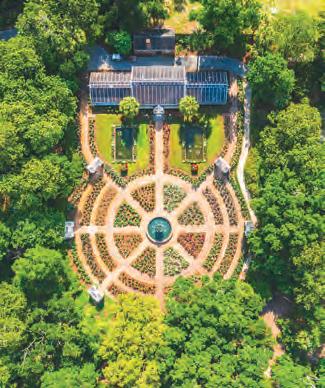
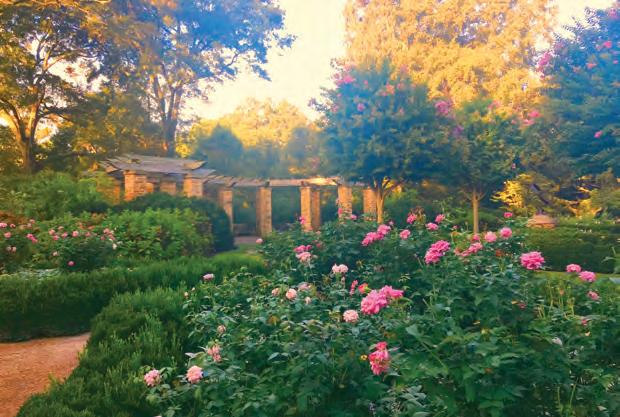
The Rose Garden at Bellingrath Gardens & Home showcases one of the most beloved flowers in the plant kingdom. Right: Since Mr. Bellingrath was a founding member of the Rotary Club of Mobile, his rose garden is shaped like the Rotary wheel logo.
Everything’s Coming Up Roses
Alabama’s rose gardens are sights to behold!
BY AMBER LANIER NAGLE
Roses are living proof that even Mother Nature sometimes feels the need to show off. Layers of velvety petals unfold from their centers, and intoxicating fragrances carry on the breeze. These beloved blooms have captivated gardeners for millennia. The ancient Chinese pioneered the cultivation of roses around 3000 B.C. to produce rosewater, botanical remedies and confetti made from their petals. Since then, roses have adorned crowns, prom corsages and boutonnieres, bridal bouquets and Kentucky Derby winners. They are woven into our love stories, our religious ceremonies and our funeral rites—all because their beauty speaks to us.
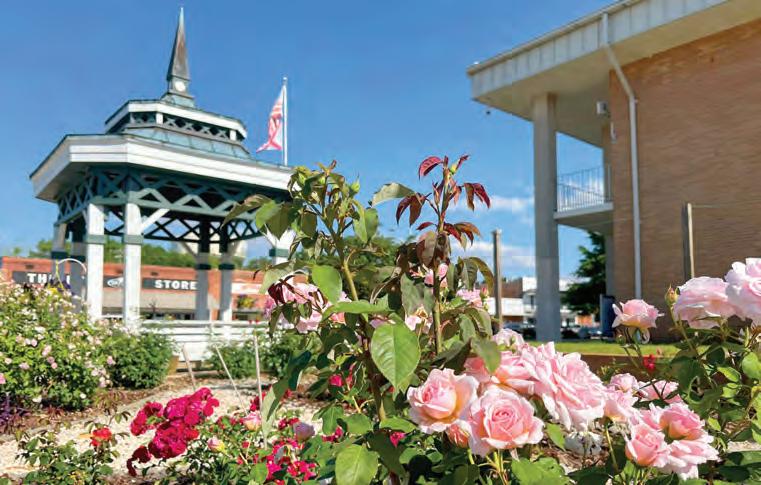
From downtown gardens to public parks to grand estates, there are many spots in Alabama where you can stop and smell the roses. Here are just a few.
Bellingrath Gardens & Home
Theodore
Tucked along the banks of the Fowl River, Bellingrath Gardens & Home has been stopping visitors in their tracks since 1932— and nowhere more so than in its magnificent rose garden. Designed in 1936 as a living tribute to the Rotary Club of Mobile, the garden’s formal layout traces the shape of the Rotarian lapel pin founder Walter Bellingrath wore faithfully throughout his life.
“More than 1,000 plants representing dozens of cultivars grow in the rose garden,” says Olivia Garrett, Bellingrath’s marketing and PR director. She mentions the ruffly, fuchsia-pink, perfumed hybrid tea Dee-Lish, the Double Delight with its creamy white flowers blushed with red and the grandiflora Wild Blue Yonder, whose ruby-red and purple blossoms seem too lovely to be real.
For those who want more than a stroll through the roses, Bellingrath offers its Garden Walk & Talk on the last Wednesday morning of each month. Led by horticulture experts, the tour covers what’s blooming and the rich history woven into every acre of this stunning 65-acre landmark.
Katherine Lee Rose Garden
Monroeville
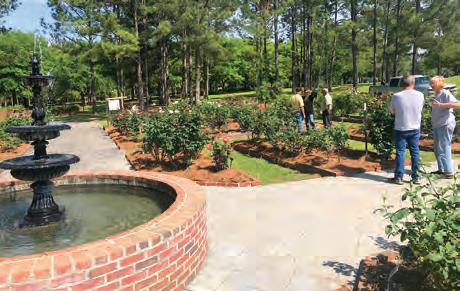
In Monroeville, quiet beauty has taken root in the small but mighty Katherine Lee Rose Garden. Katherine Lee, who served as clerk of the Monroe County Commission, started it back in the 1960s, and after her passing, the Monroeville Garden Club stepped in to carry on her vision. A 2011 redesign using a plan drawn up by Jason Powell of Petals from the Past brought enhancements like rock pathways, stepping stones, an arbor and benches for taking in the beauty and fragrance of the space.
Forty-five roses crowd the tidy beds. Buttery yellow Julia Child roses share space with peachy Abraham Darby specimens. The Lady in Red climbers command attention alongside the sunset hues of the Crazy Love bloomers.
“The plot is anchored at both ends by Mutabilis, an unusual China rose with a name meaning, ‘liable to change,’” says Charlotte Lambert, current president of the Monroeville Garden Club. “They have beautiful single-petal clusters in yellow, pink and purple perfection.”
Join a rose society or gardening club
Joining a community rose club or society (or a general gardening club) is a great way to connect with other rose enthusiasts and learn through workshops, garden tours and the collective wisdom of members. Here are a few around the state:
Auburn Rose Society (auburnrosesociety.org) Birmingham Rose Society (birminghamrose.org) Monroeville Garden Club (gardenclubofmonroeville.org) Ramer Rose Society (Facebook: @RamerRoseSociety) Wiregrass Rose Society (Facebook: @WiregrassRoseSociety)
Dothan Area Botanical Gardens
Dothan
Deep in Alabama’s Wiregrass region, the rose garden at the Dothan Area Botanical Gardens holds bragging rights as a must-see horticultural stop along the Alabama Garden Trail.
“In the early 1990s, volunteers formed a nonprofit to develop the Botanical Gardens,” says executive director William Holman. “Shortly after, a woman in Bonifay, Florida, called and told us about a family willing to donate some roses if we came and dug them up. We rescued 140, and they were used to create the first garden on our grounds.”
Today, volunteers of the Wiregrass Rose Society deadhead and tend the 308 specimens in the rose garden, keeping the space picture-perfect.
“Growing along an arbor, we have a Peggy Martin rose, which is also known as the Katrina Rose because it famously survived two weeks submerged in saltwater during and after Hurricane Katrina,” says Mickey Breedlove, president of the Wiregrass Rose Society. “We have a bed of Gold Medal roses, which are grandifloras with large yellow blooms and a fruity fragrance that a member donated to the garden. We also have some Kordes roses from Germany, which are naturally diseaseresistant and some Old Blush China roses. [The latter] are antique roses, meaning that the variety existed prior to 1867.”
May was the prime time to visit when the blooms reached their glorious peak, but after a midsummer breather, the rose garden will rally again in the autumn.
1) Melanie Andress captured a host of blooming pink beauties in the Katherine Lee Rose Garden in Monroeville. 2) Mickey Breedlove captured dozens of stunning Peggy Martin roses cascading over two benches at Dothan Area Botanical Gardens. 3) A fountain feature adds to the peace and serenity of the Dothan Area Botanical Gardens.
PHOTO BY MELANIE ANDRESS
PHOTOS
MICKEY BREEDLOVE
Delano Park
Decatur
Tips
Here are some rose-growing tips from the Alabama Cooperative Extension System.
Select a rose variety that grows well in Alabama. Select a planting site that receives a minimum of six hours of sunshine each day.
Have your soil tested before planting to determine fertilizer and pH needs. Amend as needed.
Plant roses from mid-November to mid-February in a well-prepared bed of garden soil liberally mixed with organic matter.
Water established roses with at least 1 inch of water each week. New plantings require additional watering.
Inspect roses to prevent insect or disease damage, and treat as needed.
Deadhead roses to promote more blooms.
Mulch plants to conserve soil moisture and suppress weeds.
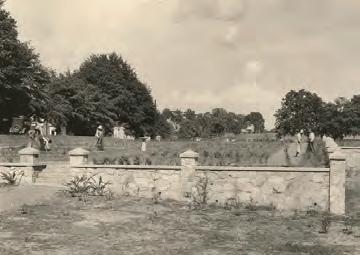
The Historic Rose Garden at Decatur’s Delano Park was built by work crews from the Civil Works Administration (CWA) during the Great Depression. Guided by Carolyn Cortner Smith—one of Alabama’s earliest female architects— approximately 140 men planted 2,000 roses into an elegant elevated garden. It was Franklin Delano Roosevelt’s New Deal in full bloom, and today, this sanctuary is one of the last surviving CWA rose gardens in the country.
The Delano Park Conservancy lovingly rebuilt the garden two decades ago, reconstructing it per the original design. Today, the park’s roses and flowering shrubs create an atmosphere so naturally romantic that it hosts weddings and gatherings with little need for additional decoration.
“There are about 100 roses (in the garden) right now,” says Barbara Kelly of the Delano Park Conservancy. “The rose garden has many old garden roses—some dating back to 1817—like Blush Noisette. There are also Earth-Kind roses that are really bulletproof, like Belinda’s Dream.”
Also look for the double, delicately shaped yellow flowers of the Mrs. Dudley Cross roses and the prize-winning Savannah roses at Delano.
Birmingham Botanical Gardens
Birmingham
Birmingham Botanical Gardens (BBG) doesn’t just wow visitors with one rose garden—it has two.
The Dunn Formal Rose Garden is the showier of the pair, announcing itself in a riot of color and scent from as early as March straight through fall. This garden includes 100 beds with over 110 varieties of roses laid out in a formal, geometrical pattern. The circular and crescent beds contain hybrid teas; the rectangles contain grandifloras; the small trapezoids contain floribundas; and the triangles contain miniature roses. Standouts include the grape-hued Plum Perfect, buttery Sunshine Daydream, and the exuberantly patriotic Fourth of July, whose red-and-white-splashed petals look like fireworks.
“The Ireland Old-Fashioned Rose Garden is a quieter, more romantic space where 19th-century varieties reign,” says Cassia Kesler, director of communications and marketing at the BBG. “This garden demonstrates the variety of ways oldfashioned roses can be grown around arbors and beds.”
Here, tea roses like Isabella Sprunt, dating to 1855, grow alongside the peachy Perle d’Or.
Both gardens served as a breathtaking backdrop for Rosé in the Roses, a garden party fundraiser benefiting the BBG’s summer internship program this past spring.
Roses are so perfect that they seem less like flowers and more like art. From sprawling botanical gardens to pleasant parks to historic estates, roses are blooming across Alabama— and they’re well worth a visit.
The Historic Rose Garden at Decatur’s Delano Park is one of the last surviving Civil Works Administration (CWA) rose gardens in America. Today, it showcases about 100 roses.
Take a stroll through the rose gardens (yes, there are two) at the Birmingham Botanical Gardens and enjoy the color and fragrance of the flowers.
PHOTO COURTESY BIRMINGHAM BOTANICAL GARDENS
Take Us Along!
Frances & Rocky Jackson of Opelika took their magazine to Panama. They are members of Tallapoosa River EC.
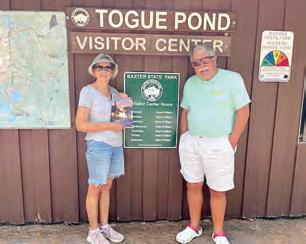
Donny and Sarah Jane Baxter, members of Baldwin EMC, visited Baxter State Park as they traveled through Maine last summer.
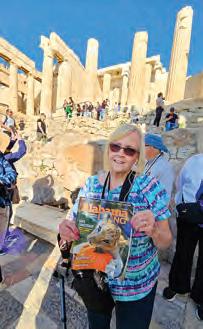
Lydia Culp of Montgomery took us along on a cruise, "The Journeys of Paul," to Greece and Turkey with a group from Frazer Church. She is a member of Dixie EC.
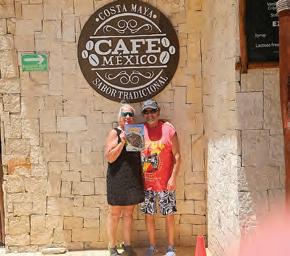
Nancy and Larry Thomas of Highland Home, members of South Alabama EC, traveled to Costa Maya, Mexico. Mom Gladys P. Smith, 91, from Montgomery, wanted to go on a cruise, “so we did and had a wonderful week filled with
memories,” they wrote.
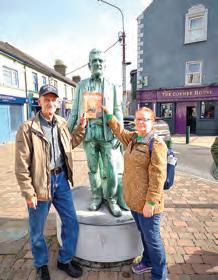
Paul and Helen Place visited Ireland and checked out their roots in Longford County. They are members of Sand Mountain EC.
Kelly Knight and her daughter Leah Schmitt of Arab EC traveled to Washington DC and New York City to see Kelly’s son, Stephen Schmitt, in the US Ceremonial Guard Navy Drill Team during Navy Week in June last year.
BY MYLES MELLOR
EVENTS Around Alabama
JULY 31 - AUG. 2
Greensboro, Black Belt Birding Festival. The Black Belt is a premier destination for birding in the Southeast; event gives festival attendees the rare opportunity to see many species of birds in pristine settings. Festival kicks off Friday night with a free welcome party. Choose your own itinerary from events across four counties. Field trips are led by expert guides. Alaudubon.org
AUGUST 1
Fort Payne, Pete the Cat Day, Coal and Iron Building at 500 Gault Ave. N., 9 a.m. to 12 p.m. Face painting, free art activities, story time, dance time and Pete the Cat himself. Starting at 9 a.m., 100 free tickets will be distributed first-come, first-served to have one item signed by author James Dean. VisitLookoutMountain. com
AUGUST 6-8
Mentone, St. Joseph’s On the Mountain Episcopal Church Workers will participate in the World’s Longest Yard Sale. Proceeds benefit the church’s ministries and the community. 8 a.m. to 5 p.m. Thursday-Friday, and 8 a.m. to 12 p.m. Saturday. 21145 Scenic Highway. Stjom. church
AUGUST 7-8
Athens, Piney Chapel American Farm Days. For more than 30 years, the city of Athens has held this event, where all makes, models and years of tractors and farm equipment will be on display. See an array of equipment including gasoline and steam engines in action, horsedrawn equipment, antique tractors, cars and trucks and other farming collectibles. Visitathensal.com
AUGUST 14-15
Russellville, Franklin County Watermelon Festival, Jackson Avenue in downtown. This free family event features two days of music, contests, entertainment, arts and crafts, a 5K run, antique car and truck show, festival foods and a slice of free watermelon. FranklinCountyChamber.org
AUGUST 14-15
Ozark, 31st annual South AL Pro Rodeo Classic, Dale County Ag Plex Arena. Gates open at 5:30 p.m., and rodeo starts at 7:30 p.m. See the event’s Facebook page for more information or call 334-726-0730.
AUGUST 14-16
Montgomery, Buckmasters 31st Annual Expo, Montgomery Convention Center. More than 300 booths, bull riding on Friday and Saturday nights, and lots of family fun. Free admission with a canned food item or $1 donation. Buckmasters.com
AUGUST 15
Harpersville, Summer Shindig. This fun-filled evening at Old Baker Farm is full of sunflowers, watermelon cutting, animals, live music, food, fireworks and more. 5 to 9 p.m. oldbakerfarm.com
AUGUST 19-20
Orange Beach, 6th annual Orange Beach Freedom Fest and Bama Coast Cruisin’ Fall Car Show, The Wharf. The nonprofit Gulf Coast Gun Collectors Association’s Collectible Firearms Show will be held concurrently at the Orange Beach Event Center. 9 a.m. to 5 p.m. Saturday and 10 a.m. to 3 p.m. Sunday. Features a kids’ zone by the Ferris wheel, patriotic military booths, arts, crafts and outdoor vendors as well as food vendors and live music. Festival and car show are free; admission required for firearms show. OrangeBeachAL.gov
AUGUST 22
Guntersville, River Run Car Show. Celebrate the annual car show from 8 a.m. to 2 p.m., County Park 1, U.S. Highway 431. Guests will have access to hundreds of cars, motorbikes, entertainment, food and lots of kids’ activities. An engine will be built on-site again this year and will be given away to a lucky car show participant. Door prizes, entertainment, food, swap meet and more. Riverruncarshow.net
AUGUST 22
Fyffe, UFO Festival, Fyffe Town Park. This annual event honors the town’s famous 1989 UFO sighting, with live music all day from 10 a.m. to 10 p.m., kids’ activities, food vendors, car show, tractor show and motorcycle cruise-in. Search for the event’s page on Facebook.
AUGUST 22
Montgomery, 9th annual Hog Days of Summer, Union Station Train Shed, 1:45 to 10:15 p.m. The Druids Charity Club holds this event, which benefits local charities. Live music, food and community. Barbecue from the River Region’s best establishments. General admission tickets $20. Search for the event’s page on Facebook.
AUGUST 24-30
Birmingham, Sidewalk Film Festival. Wrap up the summer with the annual festival on the streets of downtown Birmingham’s historic theatre district. Event features more than 200 films, with filmmaker Q&As, panel discussions, workshops, networking events and parties. Sidewalkfest.com
AUGUST 29-30
Trussville, Repticon, Trussville Civic Center, 5381 Trussville-Clay Road. Reptile vendors, breeders and educators are featured at this family-oriented event, which features seminars on animal-related topics by experts in the field of herpetology. Guests can also shop for a new family pet among hundreds of reptiles, amphibians, invertebrates, spiders and small exotic animals. Repticon.com
SEPTEMBER 6-7
Cullman, Sweet Tater Festival, Smith Lake Park, 403 County Road 386. Live entertainment, food vendors, arts and crafts vendors and of course, sweet potatoes. 9 a.m. to 5 p.m. Sunday and 9 a.m. to 3 p.m. Monday. Search for the event’s page on Facebook.
SEPTEMBER 12
Montevallo, Tinglewood Festival, Orr Park, 9 a.m. to 5 p.m. See artists at work, with a chainsaw carving exhibition, artist booths, demonstrations and more. Bring your own knife for a whittling contest and enjoy a classic car and tractor show. Food trucks, live music and children’s activities. TinglewoodFestival.com
SEPTEMBER 18-19
Fort Payne, Boom Days Heritage Celebration, Fort Payne City Park, 401 Gault Ave. N. Event honors the city’s unique beginnings nearly 130 years ago. Historical exhibits, museum tours, kids’ activities, good food and a live concert at the end of each day. 10 a.m. to 10 p.m. each day. Email office@tourdekalb.com
To place an event, e-mail events@alabamaliving.coop. or visit www.alabamaliving.coop. You can also mail to Events Calendar, 340 TechnaCenter Dr., Montgomery, AL 36117; Each submission must include a contact name and phone number. Deadline is two months prior to issue date. We regret that we cannot publish every event due to space limitations.
Alabama Living on FB instagram.com/alabama_living
PHOTO BY 5SECOND/ADOBE STOCK
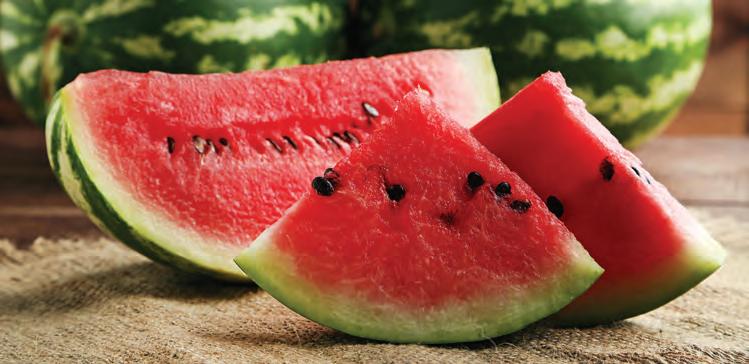
The Franklin County Watermelon Festival is Aug. 14-15 in downtown Russellville.
Seniors get new medical alert device
No contracts, no deposits and no monthly bills ever
FastHelp is the only Medical Alert device that won’t break the bank. That’s because it comes with no contracts, no deposits and no monthly bills ever – which makes FastHelp a great choice for seniors, students and professionals because it connects to one of the largest nationwide networks everywhere cell service is available for free. You don’t need a cell phone or a land line.
And here’s the best part. All those who already have an old style monitored medical alert button can immediately eliminate those monthly bills, which is why Universal Physicians is widely advertising this announcement nationwide.
So if you’ve ever felt a medical alert device was too complicated or expensive, you’ll want to get
FastHelp, the sleek new medical alert device with no monthly bills.
The medical alert device slugfest was dominated by two main combatants who both offer old style monitored help buttons that come with a hefty bill every month. But now Universal Physicians, the U.S. based heavyweight, just delivered a knockout blow sending the top rated contenders to the mat with the unveiling of FastHelp. It’s the sleek new cellular embedded medical alert device that cuts out the middleman by instantly connecting you directly to highly trained 911 operators all across the U.S. There’s absolutely nothing to hook-up or install. You don’t need a land line and you don’t need a cell phone. Everything is done for you. ■
■ NO MONTHLY BILLS: “My wife had an old style help button that came with hefty bills every month and she was embarrassed to wear it because it made her look old,” said Frank McDonald, Canton, Ohio. “Now, we both have FastHelp™, the sleek new medical alert device that our grandkids say makes us look ‘cool’ not old,” he said. With FastHelp, seniors never have to worry about being alone and the best part is there are no monthly bills ever.
Seniors born before 1964 get big boost
Instantly connects to free unlimited nationwide help with just the push of a button with no contracts, no deposits, and no monthly bills
Seniors born before 1964 get new medical alert device
Nationwide:
Demand for new Medical Alert Device soars
The phone lines are ringing off the hook. That’s because for seniors born before 1964, it’s a deal too good to pass up.
Starting at precisely 8:30am today the PreStore Release begins for the sleek new medical alert device that comes with the exclusive FastHelp™ One-Touch 911 Button that instantly connects you to unlimited nationwide help everywhere with no contracts, no deposits and no monthly bills ever.
“It’s not like old style help buttons that make you talk to a call center, only work when you’re at home and come with hefty bills every month. FastHelp comes with state-of-the-art cellular embedded technology. That means it works at home or anywhere and everywhere cell service is available whether you’re out watering the garden, driving in a car, at church or even hundreds of miles away on a tour or at a casino. You are never alone. With just a single push of the One-Touch E Button you instantly get connected to free unlimited help nationwide with no monthly bills ever,” said Jack Lawrence, Executive Director of Product Development for U.S. based Universal Physicians. “We’ve never seen anything like it. Consumers
(Continued on next page)
■ FLYING OUT THE DOOR: Trucks are being loaded with the new medical alert devices called FastHelp. They are now being delivered to lucky seniors who call the National Rebate Center Hotline at 1-800-221-2809 DEPT. FSTH207 today. Everyone is calling to get FastHelp, the sleek new medical alert device because it instantly connects you to unlimited nationwide help everywhere cell service is available with no contracts, no deposits and no monthly bills ever.
(Continued from previous page)
absolutely love the sleek new modern design and most of all, today’s instant rebate practically pays for it and no monthly bills ever,” Lawrence said. FastHelp is the sleek new medical alert device with the best of combinations: a quality, high-tech engineered device that’s also an extremely great value because there are no monthly bills ever. ■
The only device that makes you look important, not old
The problem with medical alert devices is, nobody wants to wear them because it makes them look old. Well, that’s not the case with FastHelp. That’s because it’s the first state of the art medical alert device designed to make you look important, not old. Old style monitored help buttons you wear around your neck, or require expensive base station equipment or a landline are the equivalent of a horse and buggy, it’s just outdated.
Millions of seniors fall every year and spend hours lying on the floor helpless and all alone with no help.
But seniors who fall and get immediate help are much more likely to avoid getting sent to a nursing home and get to STAY living in their own home independently.
Yet millions of seniors are still risking their safety by not having a medical alert device. That’s because seniors just can’t afford to pay the monthly bills that come with old style medical alert devices.
That’s why seniors born before 1964 are rushing to cash in the whopping $150 instant rebate before the 21 day deadline ends.
So there’s no need to wait for FastHelp to hit store shelves later this year because seniors born before 1964 can get it now just by using the $150 instant rebate coupon printed in today’s publication before the 21 day deadline ends. If lines are busy keep trying, all calls will be answered. ■
HOW TO GET IT
BORN BEFORE 1964:
Use the rebate coupon to the right and call this Toll-Free Hotline: 1-800-221-2809
EXT. FSTH207
BORN AFTER 1964:
You cannot use the rebate coupon to the right and must pay $299 Call: 1-800-221-9773
EXT. ADFH0826
Doctor urges seniors to get new medical alert device
Instantly connects you to free unlimited nationwide help with no contracts, no deposits and no monthly bills ever
Seniors snap up new medical alert device that comes with no
monthly bills
People don’t always do what their doctor says, but when seasoned veteran emergency room physician, Dr. Philip B. Howren says every senior should have a medical alert device, you better listen up.
“Seniors are just one fall away from being put in a nursing home,” Dr. Howren said. “With a medical alert device, seniors are never alone. So it keeps them living independently in their own home. That’s why seniors and their fam-
Comes with new cellular embedded technology that works at home or anywhere you go so you are never alone
ily members are snapping up a sleek new medical alert device that comes with no monthly bills ever,” he said.
Many seniors refuse to wear old style help buttons because they make them look old. But even worse, those medical alert systems come with monthly bills.
To solve these problems Universal Physicians, a U.S. company, went to work to develop a new, modern, state-of-the-art medical alert device. It’s called “FastHelp™” and it instantly connects you to free unlimited nationwide help everywhere cell service is available with no contracts, no deposits and no
All seniors born before 1964 are getting a $150 rebate and cover just $149 making this deal too good to pass up
Nothing to hook up. You don’t need a land line or cell phone. It’s ready to use right out of the box
Hurricane Help
“We had two hurricanes recently. I had no electricity for 6 days. I fell, so I pushed the button, and they came right out and picked me up off the floor. I tell many of my friends they need to get FastHelp!” - Virginia, FL
monthly bills ever.
“This slick new little device is designed to look incognito to slip in your pocket. Seniors love them, because it actually makes them look im portant, not
Five Star Customer Reviews
LIFESAVER
“When I got my FastHelp I never thought I’d have to use it, but when I fell and broke my hip it saved my life.” - Harold, OH
Very appreciative of having FastHelp “I did have an emergency. Help RESPONDED quickly and came in a few minutes.”Irving, PA
old,” Dr. Howren said. FastHelp is expected to hit store shelves later this year. But special promotional giveaways are slated for seniors in select publications. ■
WE LOVE THE PRODUCT
“We bought it outright with no bills ever.” - Rosemary, NY
Safe anywhere
“This little FastHelp device is my guardian angel. I’m so glad my daughter-in-law got it for me.”Pete, FL
A+ Rating: These are unsolicited consumer feedback from satisfied customers as reported to Universal Physicians.
BOTTOM LINE: You don’t need to shop around. We’ve done all the leg work, this deal is too good to pass up. With the instant FastHelp rebate, it is a real steal at just $149 and shipping. There are no monthly bills ever.
PROS: It’s the sleek new medical alert device that comes with the exclusive FastHelp One-Touch 911 Button that instantly connects you to free unlimited nationwide help with no contracts or deposits. It connects you to the vast available network of cellular towers for free and saves seniors a ton of money because there are no monthly bills ever making this deal a must have. Plus it’s the only medical alert device that makes seniors look important, not old.
CONS: Consumers can’t get FastHelp in stores until later this year. That’s why it’s so important for seniors born before 1964 to call the National Rebate Center Hotline within the next 21 days. For those who miss that deadline, the sleek little medical alert device will set you back over $300 bucks.
REBATE COUPON
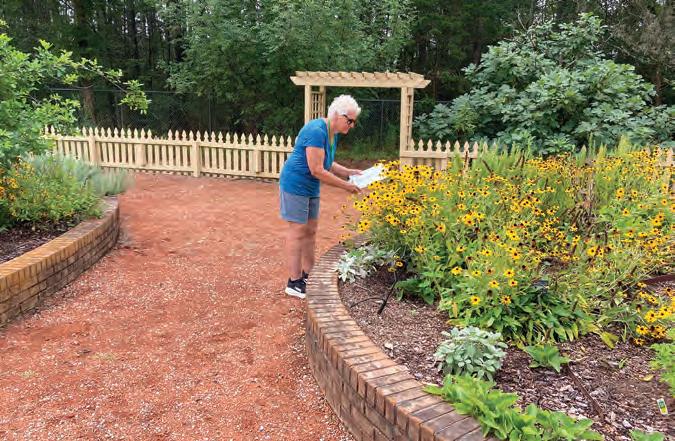
The Great Southeast Pollinator Census:
Take 15 Minutes to Count Insects and Grow Awareness
Participating in the annual Pollinator Census is easy. Simply select a flowering plant and watch it for 15 minutes and record the number of insect visits you observe. Download all the information you need at GSEPC.org
Every August, thousands of people across the Southeast take just 15 minutes to observe insects visiting a blooming plant. What may seem like a simple activity has become one of the region’s largest community science projects—the Great Southeast Pollinator Census (GSEPC).
Coordinated by Extension and university partners across multiple states, the census helps researchers gather information about pollinator activity while increasing public awareness of the insects that support our food systems and natural ecosystems.
The 2025 census was the largest in the program’s history. Across the Southeast, 27,048 counts were submitted, documenting more than 500,000 insects. Participants also created 1,132 new pollinator gardens, and 594 educators incorporated the project into STEM curricula, demonstrating the census’s growing educational impact.
One of the greatest strengths of the census is that it combines three important goals: generating useful pollinator data, encouraging the creation of sustainable pollinator habitat, and increasing entomological literacy—the public’s understanding of insects and the roles they play in our environment. By actively observing pollinators, participants learn to recognize different insect groups and gain a greater appreciation for their ecological and economic importance.
For Alabama, 2025 marked a milestone year as the state joined the census for the first time. Alabama participants submitted 2,867 counts from 55 of the state’s 67 counties, achieving an impressive 82 percent county participation rate. Alabama educators embraced the project as well, with 62 teachers using the census in STEM and STEAM programs. In addition, 62 new pollinator gardens were established to support census participation and pollinator conservation efforts.
Perhaps most importantly, the census is changing how people think about insects. More than 800 Alabama participants reported that taking part increased their understanding of the benefits provided by pollinators and other insects visiting their gardens. It’s easy to overlook the insects buzzing around our gardens, but their impact is enormous. Pollinators help reproduce most flowering plants and many of the fruits, vegetables, nuts, and seeds we enjoy every day. In fact, one out of every three bites of food we eat depends on insect pollinators. That means every tomato, watermelon, squash, blueberry, and countless other crops have a connection to these hardworking insects. By participating in the census, people gain a greater appreciation for the role pollinators play in putting food on our tables
Getting involved is easy. Participants simply select a flowering plant, watch it for 15 minutes, record the number of insect visits they observe within each pollinator group, and submit their observations online.
No advanced insect knowledge is required, and identification guides are available to help beginners distinguish between groups such as honey bees, bumble bees, carpenter bees, butterflies, wasps, flies, and other pollinating insects.
To learn more about the Great Southeast Pollinator Census, access insect identification guides, download counting materials, explore state-specific results, or sign up for census updates, visit GSEPC.org. The website provides resources for individuals, families, schools, garden clubs, and community groups interested in supporting pollinator conservation and participating in future counts.
The 2026 Great Southeast Pollinator Census will take place Aug. 21–22, giving participants another opportunity to contribute valuable pollinator data from their own landscapes. Whether you are a gardener, teacher, Master Gardener volunteer, Scout, student, or simply someone who enjoys nature, the Great Southeast Pollinator Census offers an opportunity to contribute to meaningful research while learning more about the fascinating insects living right outside your door. One count may last only 15 minutes, but the knowledge generated can help protect pollinators for years to come.
Bethany O’Rear, a horticulturist for more than 20 years, is a regional agent with the Alabama Cooperative Extension System, specializing in commercial and home horticulture.
PHOTO COURTESY AUBURN EXTENSION
ALABAMA
Bookshelf I
n this periodic feature, we highlight books either about Alabama people or events or written by Alabama authors. Summaries are not reviews or endorsements. We also occasionally highlight book-related events. Email submissions to bookshelf@alabamaliving.coop. Due to the volume of submissions, we are unable to feature all the books we receive.
The
Ballad of Fiddling Tom Freeman: Music, Moonshine and Murder in Bug Tussle, Alabama by Joyce H. Cauthen with Robin Sterling, $29.95, The University of Alabama Press (folklore) This portrait of a forgotten America is drawn from the handwritten memoirs of a bootlegger, fiddler, and chronicler of life in the first half of the 20th century. Today, rural voices are often drowned out by polished narratives, but this book resurrects the unfiltered perspective of a man who lived through – and candidly documented – the chaos and violence in his home place.
Historic Resting Places of Alabama
by Mollie Smith Waters, $27, Reedy Press (history) Alabama is full of old cemeteries, and while they are places to pay respect for the departed, they are also repositories of the beauty and history that capture the story of the state’s rich and diverse culture. Each Alabama county is represented with at least one cemetery that has something unique to teach its visitors.
Heroes and Other Mortals: Stories of Our Better Angels
by Frye Gaillard, NewSouth Books (biographies), $29.95, The author combed through a collection of essays, columns and profiles he’d written over the years to compile this book, which blends interviews and stories of such well-known figures as Archbishop Desmond Tutu, Sidney Poitier and Jane Goodall with lesser-known heroes, who all worked to make the world a better place. Gaillard is a former writer-in-residence at the University of South Alabama and lives in Mobile.
Casket Case
by Lauren Evans, $14.38 paperback, Dell Publishing (romantic comedy) Nora thought she was finished with Rabbittown, Ala., for good. But after an unexpected tragedy, she finds herself back in her hometown running the family casket business. Her ordinary day is interrupted by a handsome stranger … who happens to be a logistics coordinator for Death. The author is from northeast Alabama and is a graduate of the University of Alabama.
Antique
by Seth Panitch, $30.21, Grand Central Publishing (women’s fiction)
An uplifting, magical story about a once-celebrated antique appraiser who gets caught in the thrall of a strange, powerful necklace — one that has the power to transform her life, and the fortunes of those around her. The author is a playwright, screenwriter and filmmaker, and a professor of theatre and heads the MFA Acting program at the University of Alabama.
The
Tensaw River: Alabama’s Hidden
Heritage Corridor
by Mike Bunn, $24.95, The University of Alabama Press (natural history) The book introduces one of the American South’s richest and most fertile natural features. The author is director of the historic Blakeley State Park, nestled in a prominent bend of the majestic Tensaw River. The river is a gateway to the enchanting beauty of – and humankind’s enduring relationship to – the landscape of the American South.
Fresh from the GARDEN Alabama Recipes
V egetable C ooking T ips
Whichever cooking method you use, remember that to ensure the best flavor, color, texture, and nutritive value, cook the vegetables until just tender. The less water you use, the more nutrients will be retained in the vegetable. -Information from the Alabama Cooperative Extension System
Baking
Vegetables such as winter squash, tomatoes, and potatoes can be baked whole in their skins. Other vegetables can be cut into pieces, seasoned, and baked. Place the vegetables on a pan and bake at 350 degrees until tender.
Stir-frying
Stir-frying is best for tender vegetables that are high in moisture. Cut vegetables into pieces and put into a frying pan with 2 to 4 tablespoons of oil and a small amount of water if needed. Cover the pan, and cook over low heat for a short time, stirring occasionally. Stop cooking when the vegetables are still slightly crisp.
Boiling
This method retains the least nutrients because they are washed away by the boiling water. Bring water to a boil. Add vegetable, cover, and quickly bring water back to a boil. Reduce heat and cook gently until just tender. Drain water and season.
Steaming
The same as boiling except place the vegetable in a perforated container over boiling water. Because the vegetables are not submerged, more of the nutrients are retained.
Microwaving
Results are similar to steaming vegetables. Chop and lightly season vegetables. Place in a microwave-safe bowl with about 3 tablespoons of water for every pound of vegetable. Microwave on high. Cooking times can vary greatly. Generally, firmer vegetables take longer to cook than softer vegetables. Microwave for 1 to 3 minutes; each minute after, check with a fork to determine when vegetables are tender.
Grilling
Put mixed, chopped vegetables in foil with seasoning and butter or place on a skewer. Put them on a section of the grill with low heat. If using a skewer, turn frequently to prevent burning.
This month’s theme highlighting recipes using fresh produce is probably my favorite, next to the Christmas cookie contest! Being a southern girl with a garden is a badge of honor for me. I watched my grandparents and parents garden growing up. I can write an essay on the taste of a home grown tomato that has been kissed by the Alabama sun, right off the vine in a way that will make you drive miles to get one. There is just nothing better. And the great thing is here in our great state, you don’t have to
Cucumber and Onion Sour Cream Salad
½ cup sour cream
3 tablespoons white wine vinegar
1 tablespoon agave syrup
½ teaspoon pepper
4 cucumbers, peeled and thinly sliced
1 small onion, thinly sliced
have a backyard garden to enjoy the season. All of our local farmers are just as proud of their bounty and will sell it to you even if you wanted to pick it yourself. This summer, support your local farmers, farmer’s market or produce stands and just taste and see! Meanwhile, we can help you with how to prepare this bounty with a few of our favorite recipes here and at thebutteredhome.com.
In a large bowl, mix sour cream, vinegar, agave and pepper. Whisk or mix well until smooth. Add in cucumbers and onion.
Low-Carb Parmesan Green Beans
1 pound fresh green beans, washed and trimmed
2 tablespoons avocado oil
1 tablespoon fresh minced garlic
½ teaspoon salt
1/4 teaspoon pepper
½ cup Parmesan cheese, grated
Preheat oven to 400 degrees. In a large bowl, combine green beans, avocado oil, garlic, salt and pepper.
Spread on a parchment lined baking sheet in a single layer. Cook for 15 minutes, remove from oven, stir and arrange in a single layer again. Evenly sprinkle Parmesan cheese over the top of the beans and return to oven for 5 to 7 minutes more. Allow to cool slightly and serve warm.
Oven-Baked “Fried” Green Tomatoes
3-4 medium green tomatoes, sliced
½ cup almond milk
1 egg
½ cup almond flour
½ teaspoon garlic powder
½ teaspoon smoked paprika
1/4 teaspoon cayenne pepper
½ teaspoon pink salt
2 tablespoons Parmesan cheese, grated
Preheat oven to 425 degrees. Spray a sheet pan with a small amount of cooking spray or use parchment paper.
Slice tomatoes to about ¼ inch thick. Mix almond milk and egg, whipping until combined in a small bowl. In another bowl, mix almond flour, garlic powder, paprika, cayenne and salt. Place tomato slices in egg mixture and remove with a fork. Dredge in dry mixture and set aside on the prepared sheet pan until all are battered. Sprinkle with half of the Parmesan cheese and bake for about 10-15 minutes until brown. Carefully remove from oven and turn tomatoes over and sprinkle with the remainder of the Parmesan cheese. Return to oven and bake for another 5-10 minutes until done. Cool and serve.
Cucumber and Onion Sour Cream Salad
Brooke Burks
PHOTOS
Low-Carb Parmesan Green Beans
Oven-Baked "Fried" Green Tomatoes
Vegetable Soup
2 cups fresh tomatoes, peeled and chopped
1 cup potato, chopped
½ cup onion, chopped
½ cup bell pepper, chopped
1 cup peas
1 teaspoon salt pepper, to taste
1 teaspoon sugar
6 tablespoons butter
Cook vegetables until tender. Add salt, pepper, sugar and butter. Serve with cornbread.
Pat St. John
Cherokee EC
Zucchini Boats
3 small zucchinis
3/4 pound ground beef
1 small onion, finely diced
½ red bell pepper, finely diced
½ green bell pepper, finely diced
1 cup mushrooms, finely diced
1 cup shredded cheddar, divided
½ cup ketchup
Salt, pepper and garlic powder, to taste
Trim ends off zucchini. Slice lengthwise and scoop out middle to make a “boat.” In a skillet, cook beef, onion, peppers and mushrooms and drain. Take off heat and add salt, pepper, garlic powder, ketchup and 1/2 cup cheese. Spoon mixture into zucchini shells and lay in a greased 13x9-inch baking dish. Sprinkle with remaining 1/2 cup cheese. Add a few tablespoons of water to the bottom of the dish and cover with foil. Bake at 350 degrees for 45-60 minutes or until zucchini is tender.
Renee Bykowski
Baldwin EMC
ENTER TO WIN $50 Cook Of The Month Prize!
Campfire Cooking
November theme: Enter by September 4, 2026
It might be 100 degrees today, but we're already dreaming about that moment we can enjoy a crisp night outdoors on a camping adventure. That time when something magical happens and your soul gets to breathe. What will you be cooking around those cozy campfires this fall? Submit recipes here:
WEBSITE: alabamaliving.coop or scan here:
EMAIL: recipes@alabamaliving.coop
MAIL: Alabama Living Recipes, 340 Technacenter Dr., Montgomery AL 36117
Please include the name of your electric cooperative
Please do not submit recipes from other sources, including cookbooks or online publications. A recipe may be adapted and considered original only if at least one ingredient is changed from a previously published recipe. We will make every effort to review all recipes submitted for Cook of the Month consideration to ensure that only original recipes are published in Alabama Living.
Zucchini Boats | Photo by Brooke Echols
Sacred Stone of the Southwest is on the Brink of Extinction
Centuries ago, Persians, Tibetans and Mayans considered turquoise a gemstone of the heavens, believing the striking blue stones were sacred pieces of sky. Today, the rarest and most valuable turquoise is found in the American Southwest–– but the future of the blue beauty is unclear.
On a recent trip to Tucson, we spoke with fourth generation turquoise traders who explained that less than five percent of turquoise mined worldwide can be set into jewelry and only about twenty mines in the Southwest supply gem-quality turquoise. Once a thriving industry, many Southwest mines have run dry and are now closed.
We found a limited supply of turquoise from Arizona and purchased it for our Sedona Turquoise Collection. Inspired by the work of those ancient craftsmen and designed to showcase the exceptional blue stone, each stabilized vibrant cabochon features a unique, one-of-a-kind matrix surrounded in Bali metalwork. You could drop over $1,200 on a turquoise pendant, or you could secure 26 carats of genuine Arizona turquoise for just $99
Your satisfaction is 100% guaranteed. If you aren’t completely happy with your purchase, send it back within 30 days for a complete refund of the item price.
The supply of Arizona turquoise is limited, don’t miss your chance to own the Southwest’s brilliant blue treasure. Call today!
Jewelry Specifications:
• Arizona turquoise • Silver-finished settings
Sedona Turquoise Collection
A. Pendant (26 cts)
$299 * $99 +s&p Save $200
B. 18" Bali Naga woven sterling silver chain $149 +s&p
C. 1 1/2" Earrings (10 ctw)
Complete Set**
$299 * $99 +s&p Save $200
$747 * $249 +s&p Save $498
**Complete set includes pendant, chain and earrings.
Call now and mention the offer code to receive your collection.
1-800-333-2045
Offer Code SDT212-01
You must use the offer code to get our special price.
C. Necklace enlarged to show luxurious color
If you are in the market to upgrade your HVAC system, consider an energyefficient heat pump.
Efficiency Matters for Comfort
Everybody wants a comfortable home. Did you know energy efficiency upgrades not only help you save energy, but can make your home more comfortable, too? If you find yourself continually returning to the thermostat on cold winter days or unable to find relief from heat on summer days, these are signs your home needs an efficiency upgrade.
No matter the home, energy efficiency upgrades often start with the same basic principle: Keep outside air from coming inside and keep conditioned inside air from leaking out. Insulation, air sealing, duct sealing and heating, ventilation and air conditioning upgrades can dramatically improve the comfort of your home.
A fully insulated home, including attic, walls and floor, is more comfortable. It’s like a blanket for your home. Air sealing is a lesser-known efficiency upgrade that keeps air from entering and exiting the home through cracks and gaps. Some air sealing can be done from inside the home,
such as using expanding foam around plumbing pipes and drains under sinks, adding gaskets to outlets on exterior walls, caulking around windows or weatherstripping around doors.
Attics and crawl spaces offer additional opportunities to reduce air leakage and increase comfort. In the attic, sealing gaps around top plates, open soffit areas, cove ceilings and balloon framing can help keep conditioned air where it belongs. In the basement or crawl space, seal around plumbing pipes and drains, vents and electrical wires. If you need help, contact a local contractor.
As I am a self-proclaimed energy geek, you probably aren’t surprised that my first move when my husband and I bought our first home years ago was to air seal and insulate. We sealed and insulated the attic, walls and rim joists in the basement. The difference in comfort was instant. Our house felt cozier and much more comfortable. The temperature swings from the furnace cycling on and off were dramatically reduced. The home felt warmer in the winter and cooler in the summer.
A surprising benefit
Another benefit from insulation was a surprising reduction in noise from outside. We lived about 15 minutes away from the airport and close to a busy road. When the windows and doors were closed, we could no longer hear the airplanes, and the traffic noise was almost unnoticeable.
Duct sealing can also improve the comfort of your home. Your ductwork delivers heated or cooled air in a forced-air HVAC system. If there are disconnections or leaks in the ducts, the air you paid to heat or cool may not end up where you want it. Disconnects and leaks can cause hot or cold spots in the home. An HVAC professional can inspect or test your ducts to make sure they are connected and sealed properly.
Air sealing and duct sealing can also improve the air quality in your home. Air leakage between the conditioned area of the home and the attic or crawl space can introduce dust, pollen, mold or other allergens you don’t want to breathe. Reducing air leakage can reduce the chance of these things circulating throughout your home.
Upgrading to a heat pump can also boost comfort and efficiency. Heat pump technology is often about three times as efficient as electric resistance heat because it uses refrigerant to move heat instead of creating it. If you’re upgrading from electric or gas heat, a heat pump can efficiently heat and cool your home, making it comfortable year-round.
If you already have a heat pump or any forced-air HVAC system, annual maintenance and regularly changing your filter maximizes system operation and comfort.
Consider improving your home’s comfort by completing these energy efficiency upgrades. Your family––and energy bills––will thank you.
Miranda Boutelle is the chief operating officer at Efficiency Services Group in Oregon, a cooperatively owned energy efficiency company. She has more than 20 years of experience
The Answer to
“It’s so beautiful, elegant and bright, I had to convince my friends that it wasn’t a diamond.”
—Robin L., Hilton Head, NC
Introducing the Perfect Gift Moissanite Necklace—an exquisite near-1-carat brilliant-cut moissanite gemstone nestled in a radiant rhodiumnished teardrop setting. It’s a design as timeless as the story behind the stone itself. Moissanite was born in the stars, rst discovered in a meteor crater by Nobel Prize-winning French chemist Henri Moissan. It’s one of Earth’s most dazzling gemstones, with even more brilliance and re than a diamond. At Stauer, we’ve perfected the art and science of moissanite, bringing you celestial brilliance without the astronomical price. While other jewelers chase the moon with skyrocketing prices, we’re offering the lowest price in history on a stone born from the stars. And for a limited time, your purchase also includes our Perfect Gift Moissanite Earrings — a stunning $299 value — absolutely free. This pendant is more than just beautiful — it’s a tribute to the wonders of science, history, and smart luxury. Whether it’s a gift or a personal indulgence, it’s proof that true brilliance doesn’t have to cost the stars.
Perfect Gift?
Impossible Price
Free Earrings with Purchase!
1-1/3 Total Carats
Backed by our satisfaction guarantee, you can revel this necklace risk-free for 30 days. Should it fail to dazzle, return it for a full refund of the item price.
Jewelry Specifications:
• 7/8 carats total weight (necklace)
• Premium rhodium- nished setting
• 1 round 6mm, 8 round 1.5mm moissanite
• Overall drop 30 mm, width 12 mm
• 16" necklace with 2" extender, spring clasp
Perfect Gift Moissanite Necklace & FREE Earrings
$299 $79* + S&P Save $220
Outdoors Humans Help Nature Replenish, Maintain Aquatic Resources
Nature usually takes care of itself, but sometimes, nature needs a little help.
“In a typical year, the three Alabama state fish hatcheries produce about three million fish for stocking into public waters,” says Matthew Marshall, the Alabama Wildlife and Freshwater Fisheries Division chief of fisheries in Montgomery. “Those hatcheries produce a variety of fish including Gulf-strain striped bass, hybrid striped bass, white bass, redeye bass, southern walleye, bluegill, redear sunfish, channel catfish and largemouth bass for stocking in public waters.”
The first state fish hatchery at Eastaboga opened nearly 100 years ago. The state also operates freshwater hatcheries at Carbon Hill and Marion. Most species, like catfish, largemouth bass and bluegill, do well on their own, but the state stocks them in places like the 23 public fishing lakes as well as community park ponds to create public fishing opportunities.
Other species need help. Right now, the state focuses on two priorities: Gulf-strain striped bass and southern walleye. Natural striped bass populations exist in the Atlantic Ocean and along the Gulf Coast. In nature, Atlantic stripers live in salt water, but enter freshwater streams to reproduce.
“We did some genetic testing on native striped bass,” Marshall says. “Gulf-strain and Atlantic-strain stripers are not different species, but there are some small differences in the two. While doing some telemetry studies, we noticed that very few Gulf stripers go into salt water. Typically, they stay in cooler river systems and cooler spring-fed waters.”
By stocking fish into public waters, like these fingerling hybrid striped bass, the state helps fish populations and increases public fishing opportunities.
Native to the Mobile, Alabama and Tombigbee River drainages, Gulf striped bass naturally range from Louisiana to Florida. The species nearly disappeared a few decades ago as dams blocked their coastal spawning streams and various other reasons. Alabama stocked some stripers into the Mobile Delta system and other places.
Years ago, the state released striped bass into Lake Lewis Smith and Lake Martin to serve as a broodstock source and for recreational fishing opportunities. Lake Lewis Smith covers about 21,000 acres on the Sipsey Fork of the Black Warrior River in Cullman, Walker and Winston counties. The deepest lake in Alabama drops to more than 200 feet in places.
Lake Martin, not to be confused with Lake Logan Martin, covers about 44,000 acres in Tallapoosa, Elmore and Coosa counties. One of the oldest reservoirs in Alabama, it dates to 1926, the largest manmade waterbody in the world at that time.
“We are one of the largest producers of Gulf-strain striped bass among the Southeastern states,” Marshall says. “Now that we have our Gulf-strain broodstock source, we are able to maintain those fisheries. We try to raise about 700,000 to 800,000 pure Gulf-strain striped bass every year in our hatcheries. Those two lakes receive 30 to 40 percent of our total striped bass stockings, but we’ve also stocked some stripers in the Mobile Delta area.”
Alabama anglers could also fish for another species. Even the most ardent Alabama anglers probably don’t know that
they can catch walleye in the Cotton State. Although typically a cold-water species of northern states and Canada, a southern strain inhabits Alabama waters. These native fish can tolerate warmer temperatures than their northern cousins.
“Southern walleye are genetically distinct from the northern species,” Marshall says. “Walleye never were very abundant in Alabama, but they are native. We are trying to maintain those genetic stocks and maintain a broodstock so we can start stocking walleye. We want to bring back a native species and give people another fishing opportunity in Alabama.”
Northern walleye and sauger, a close cousin, exist in the Tennessee River drainage and the upper Coosa River. Southern walleye lived throughout the Mobile River system as well as the Coosa, Tallapoosa and Black Warrior rivers. However, most disappeared from their traditional waters years ago. The state wants to reverse that trend and bring back these very tasty fish.
“Walleye in Alabama are naturally reproducing, but struggling,” Marshall says. “They are absent from many areas where they were 20 to 30 years ago. We are trying to restore southern walleye to their historical ranges throughout the state. Right now, the best places to fish for walleye in Alabama are the Mulberry Fork of the Black Warrior River, Blackwater Creek and Hatchet Creek.”
Private organizations also stock fish in public waters. For instance, Restock Alabama recently released 50,000 largemouth bass into Lake Logan Martin. Fish stockings can never outproduce nature, but they can give nature a helping hand in restoring or maintaining fish populations.
The car is loaded up and check-in is about to start on college campuses across the country. While you want to have all the comforts of home at school, there are some electrical safety tips to keep in mind as you set up your new space.
• Do not overload outlets, extension cords, or power strips.
• Use power strips with overcurrent protectors. This will shut off the power if there is too much power being drawn.
• Only purchase and use electrical products tested for safety. Some commonly approved safety labels include UL, CSA, and MET
• Unplug small appliances when not in use and all electronics when away for extended periods.
• Keep all electrical appliances and cords safely away from bedding, curtains, papers, and other flammable material.
Check with your university’s housing department on specific housing rules before planning to bring hot plates, coffee makers, toasters, microwaves, and portable heaters.
For more information on dorm safety, visit:
“Until the Whistle Blows!”
Ican still hear Coach Hoffman yelling on the football field at Walnut Hill, where I was a lineman and played offense and defense. He always encouraged us to maintain our block or pursue the ball.
“Until the whistle blows!”
No letting up, no loafing, no quitting.
If you’ve ever played a sport or pursued a dream, you’ve learned something similar. If you want to win— to succeed—you must work, push through pain, endure hardship, and stay alert and engaged until the workday is done, until the final bell sounds, until the checkered flag, or, as it was in my case, until the whistle blows.
As much as we might like to soften this for our children by giving everyone a trophy, life inevitably teaches us that success comes to those who give 100%. Giving 30% effort just doesn’t make the grade. It’s one thing to give all the players on the Little League team a trophy, even if they did not give the same effort, but it’s entirely another thing to be on the battlefield surrounded by 30 percenters, putting your life in their hands. It would not be very comforting to know the safety and operation of your automobile depended on a bunch of 30 percenters. I imagine also that none of us would sign up to go bungee jumping at the 30 Percent Leap of Faith Club.
power made a capacity factor of 34.2%. Capacity factor is a ratio of how much energy a generating asset actually produces over a set time to how much it should be capable of producing. Imagine a 100-megawatt solar facility. If it operated at full 100-megawatt capacity every hour, its capacity factor would be 100%. But, in reality, solar can only produce when the sun is shining—and it produces less when it’s cloudy. So with those constraints, the best it could do in 2025 was 24%.
Since these resources depend on environmental factors, their performance will not significantly improve. Again, if it is dark or cloudy, there is no solar power. If the wind dies down, there is no wind power. Renewables will always be thirty percenters. Natural gas, nuclear, and coal power plants, on the other hand, are dispatchable and can operate 24/7. They can ramp up and down as the electric load dictates within the day. They operate until the whistle blows.
Generating electric power is no different. It is a 24/7/365 job. People like to walk into a room, flip a switch and see the lights come on without having to check if the sun is shining or the wind is blowing. Folks like to set their thermostat and have their HVAC system come on and off as needed without having to check the weather. If people need to wash clothes at night, or if a medical procedure must be done, we demand that the power be available and not subject to weather.
Yet, in the name of global climate change, the U.S. has been on a push to shut down dispatchable fossil fuel plants and instead, build out solar and wind power that barely can operate 30% of the time.
Wind and solar are intermittent. They have a low capacity factor. In 2025, utility scale solar operated at a capacity factor of 24.4% in the United States. Wind
The greatest strain on our system occurs at 6 a.m. on the coldest day of the year. It is dark outside (no solar), and the wind in our area is not sufficient to support wind development. At 6 a.m., real power plants must be online, or the lights will go out. Solar and wind generate when they feel like it, and they want a trophy.
I’m not saying renewable energy is useless. When it runs, it displaces the natural gas we have to burn in our plants, and that does save money. But it cannot meet the timing required by today’s consumers, unless we want to wash our clothes, schedule our medical procedures, or operate our sewage systems during sunshine daylight hours only.
But playing till the whistle blows is a concept that carries with it a higher application. I encourage you to be a 100 percenter in everything you do. If you see the ball on the ground, pick it up and run with it. If you see someone that is hurting, step in and be a blessing. If you see a need, fill the gap—until the whistle blows or the trumpet sounds.
Until next month, I hope the Lord blesses you real good!
Damon Morgan is President and CEO of PowerSouth Energy Cooperative.
Closing Deadlines (in our office): October 2026 Issue by August 25
November 2026 Issue by September 25 December 2026 Issue by October 25
Ads are $1.75 per word with a 10 word minimum and are on a prepaid basis; Telephone numbers, email addresses and websites are considered 1 word each. Ads will not be taken over the phone. You may email your ad to hdutton@areapower.com; or call (800) 4102737 ask for Heather for pricing.; We accept checks, money orders and all major credit cards. Mail ad submission along with a check or money order made payable to ALABAMA LIVING, 340 TechnaCenter Dr., Montgomery, AL 36117 Attn: Classifieds. How To Place an Ad in Marketplace
Miscellaneous
FUNERAL INSURANCE PLANS FOR ANY BUDGET. No Exam, Easy Qualification. Visit finalexpenseassured.com or call (813)352-2587
Vacation Rentals
ABSOLUTELY LOWEST PRICES ON THE BEACH! Affordable Beachfront & Beachside Vacation Condos – Sugar Beach Condos in Orange Beach, AL. Rent Direct from Christian Family Owners. – www.gulfshorescondos.com, (251)752-2366.
MILITARY / SERVICE DISCOUNTS on dozens of rentals. No Booking Fees. (251)333-6500, ALAVHR.com
Pet Friendly – Save $$$ by booking directly from Verified Owners. ALAVHR.com
OWNERS – Join the fastest growing regional site in Alabama. Low annual fee. Verified owners, no booking fees or commissions. Alabama Vacation Home Rentals. Locally owned and operated. (251)333-6500, ALAVHR.com
GULF SHORES – 5 MIN WALK TO BEACH AND LITTLE LAGOON! – Beautiful condo. Many amenities. Short drive to attractions. www. AlabamaSands9.com.
GULF SHORES / ORANGE BEACH / FORT MORGAN – Choose from hundreds of beach houses and condos! Verified Owners. No Booking Fees. ALAVHR.com
MENTONE, AL LOOKOUT MOUNTAIN COTTAGE RENTALS – Best brow views, River Front – cottagesofmentone.com, Call or text (504)481-8666
PANAMA CITY BEACH CONDO – Owner rental – 2BR / 2BA, wireless internet, just remodeled inside and outside – (502)7777819, larrysusemichel@reagan.com, www. theroneycondo.com
ARE YOU CHANGING YOUR ADDRESS? If you’re a member of an electric cooperative, please contact your local co-op office with your new address so you can keep receiving Alabama Living. If you’re not a member of an electric co-op, send your new address to contact@alabamaliving.coop. Booking for 3-hour tours? Don’t worry skipper, we’ve got you covered.
*We have a sea of over 455K potential customers just waiting to know about it.
Just Say Mow
Ipicked up an old rotary lawnmower at a garage sale the other day. Why? Because I don’t have enough junk in my basement to be considered a hoarder - yet. Regardless, the moment I saw it, I flashed back to those sweaty summer days when I was a kid.
Some of you might not be familiar with how this machine operates. The power to propel the mower and cut the grass comes from the arms and legs of the operator. And you didn’t just push the mower and get a row of fresh-cut lawn. No! Instead, you had to quickly thrust the mower back and forth so the rotary blades would spin fast enough to actually mow the grass. In summer, this made for a hot, torturous workout. My father tried to justify making me mow the lawn this way because, according to him, it would help me get in shape for football.
One red-letter day in my young life, Dad brought home a brand-new Sears and Roebuck motorized lawn mower. Now all I had to do was wind and pull the starter cord about 37 times. Eventually, I heard the wonderful roar all of us have heard on summer afternoons. It was a quite a sensation - the motor was powering the blade that cut the grass!
This new technology required a definite learning curve. I quickly discovered that this motorized monster could expel sticks and stones at a high velocity. Certainly fast enough to break a basement window, which I did the first time I used it. The minute it happened, I thought I might be getting into shape for football by running from my dad.
Now, it’s hard to imagine a time when mowers weren’t motorized. Today, people even have riding lawn mowers complete with options like headlights. Huh? Does anyone really say, “Honey, I know it’s 1 a.m., but just can’t get to sleep. I think I’ll go outside and cut the front yard.”
Some riding mowers even have cruise control. Those people must own a big yard to need that kind of thing. It’s hard to
believe that cruise control is so common that lawnmowers have it. Cruise used to be an expensive option that wasn’t available to every car. Now it’s standard equipment on almost every one. Apparently, everyone has decided that it’s too much muscle strain on our right foot to continuously push the gas pedal. However, I must admit that I use it when I drive my car, along with the feature that automatically decelerates when you get too close to another automobile. Maybe we should add that feature to a riding lawn mower: Have it slow down so we don’t hit a mailbox or a pine tree. It’s about as silly an idea as cruise control for a lawn mower.
Unlike the old days, lawn care has become big business. Go through any subdivision and you will see a pickup truck pulling a trailer with weed trimmers, leaf blowers, sidewalk edgers, and zero turn mowers. It looks like a new weapon the army is about to unleash in a terrorist war. All to cut grass! Before it became corporate, there was just a kid with a lawn mower who went up and down the street, ringing the doorbell, and asking people if they needed their grass mowed. I doubt he was bonded and insured, but all of us managed. And we didn’t pay him a $100 either. Of course, the kid with the lawn mower didn’t do much driveway edging because his weed eater was a shovel and a hoe. He mowed as close to the mailbox as he could, and if you were lucky, he hacked down some of the tall grass around the post. Instead of Three Men And A Truck, we had One Man And A Shovel.
Since the beginning of time, men have come up with things to make their lives easier. I think that’s great; in fact I would clean the bathroom of the guy who invented air conditioning. And you will never hear me speak a disparaging word about an elevator, escalator, or moving sidewalk. Those inventions helped me make countless close flight connections over the years. But some things people invent I have no use for at all. Headlights or cruise control on a riding lawnmower? Give me a break.
Now if you’ll excuse me, I’ve got to go outside and show my yard guy the manual lawn mower - and pay him, of course. You don’t think I cut my own grass, do you? I don’t need to get in shape for football anymore.
man doesn’t need to carry much. But what he does carry ought to earn its place.
Your wallet protects the things that keep life moving—your identification, credit cards, cash and the memories tucked into its pockets. It’s one of the few items you’ll reach for every day. If yours is worn, bulky or falling apart, it may be time for an upgrade. Crafted from genuine topgrain cowhide leather, ours delivers the rich feel, lasting durability and timeless style every gentleman appreciates.
Normally, these two everyday essentials would cost $348. Today, you can own the premium leather wallet for just $49, and we’ll include the $99 Pocket Multi-Tool absolutely FREE.
It’s an extraordinary value on two dependable companions you’ll appreciate every day—but only while this special offer lasts.
For a limited time, we’ll also include our 10-in-1 Pocket Multi-Tool FREE with your wallet purchase. Crafted from handsome natural bamboo and rugged stainless steel, this compact companion packs a bottle opener, three screwdrivers (two flat and one Phillips), file, pliers (needle nose and regular), knife, saw, can opener and wire cutters into a pocket-sized design. Complete with a sleek black belt-loop pouch, it’s always within easy reach whenever you need it.
DESOTO FALLS BY CHAN GUY MENTONE COZY CABINS
HIGH FALLS BY KEN HALL MOON LAKE KITCHEN
LITTLE RIVER FALLS BY MELISSA GAINES
LITTLE RIVER CANYON BY ALIZABETH GRACE PHOTOGRAPHY