With its innovative design, modern comforts, and guest-focused philosophy, American Encore is not just a riverboat, it’s the finest expression of American river cruising ever built. Designed to host just 180 guests, American Encore features more square feet per guest than any other small cruise ship with the largest staterooms globally.
WIREGRASS ELECTRIC COOPERATIVE
is a member-owned electric cooperative serving more than 24,000 accounts in Houston and Geneva counties in Alabama and parts of Dale, Co ee and Covington counties in southeast Alabama.
ALABAMA LIVING is delivered to some 450,000 Alabama families and businesses, which are members of 22 not-for-pro t, consumer-owned, locally directed and taxpaying electric cooperatives. Subscriptions are $15 a year for individuals not subscribing through participating Alabama electric cooperatives. Alabama Living (USPS 029-920) is published monthly by the Alabama Rural Electric Association of Cooperatives. Periodicals postage paid at Montgomery, Alabama, and at additional mailing o ce.
For advertising, email: advertising@areapower.com For editorial inquiries, email: contact@alabamaliving.coop
NATIONAL ADVERTISING REPRESENTATIVE: American MainStreet Publications
1-800-626-1181
www.AMP.coop
www.alabamaliving.coop
CHANGE OF ADDRESS:
For co-op members, contact your local electric cooperative. Non-members, send your address change to contact@alabamaliving.coop.
18
Captivating Canyons
Sweeping vistas and glowing creatures await visitors to three of Alabama’s beautiful canyons! 22
The Lives of Lineman Wives
For every lineman heading into the storm, there’s a family staying behind, until he comes home.
30 Harper Lee at 100
Alabama’s own Harper Lee would have been 100 this month. e Monroeville native le behind a legacy unequalled in American literature.
50 Operation Round Up
Cooperative members can give back to communities by rounding up their monthly bills.
Board of Trustees
Kip Justice District 6
President
Randy Odom District 2
Vice President
Debra E. Baxley District 1
Secretary
John Clark Jr. District 3
Danny McNeil District 4
Tracy Reeder District 5
Donald Ray Wilks District 7
Sandy Wright Morris District 8
David Winstead District 9
Strength in numbers
BRAD KIMBRO CEO Wiregrass Electric Cooperative
There is strength in numbers.
We see it throughout our own history, in society, politics and even our daily lives. As a cooperative, Wiregrass Electric is an example of how people came together to pool resources and light the way for rural America.
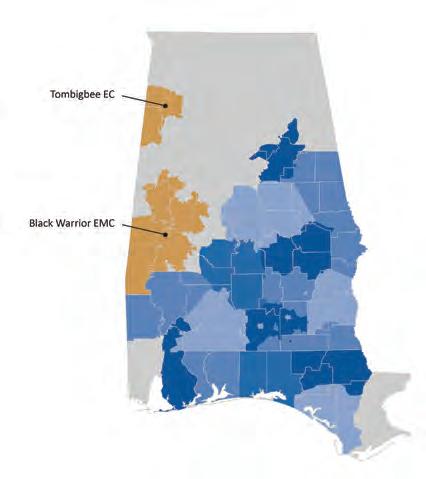
PowerSouth Energy Cooperative, a generation and transmission cooperative based in Andalusia, recently added to its number of members, welcoming Black Warrior Electric Membership Corporation in Demopolis and Tombigbee Electric Cooperative in Hamilton. The expansion brings PowerSouth’s membership to 22 distribution members. PowerSouth’s members — including Wiregrass Electric — provide power to more than 500,000 end-users across 51 Alabama counties and 10 counties in the Florida Panhandle.
This is the first time PowerSouth added new members since 1979. As a member of PowerSouth, this expansion is exciting. But what does this mean for our members here in the Wiregrass?
The relationship between PowerSouth and Wiregrass Electric has tremendous impact on what our members pay each month for electricity.
Just like Wiregrass Electric has fixed costs to distribute electricity to our members, Pow-
erSouth has its own fixed costs on the generation and transmission side of this partnership. These fixed costs are the brick-and-mortar facilities needed to create power and the transmission lines that deliver that power. These costs have to be covered before even a megawatt of energy is generated. PowerSouth’s members share in these costs. More members for PowerSouth means those fixed costs can be spread out even more.
Wiregrass Electric does not generate the electricity used by our members. Instead, we buy power from PowerSouth as do other cooperatives and municipal electric systems that are PowerSouth distribution members. PowerSouth generates energy with facilities it owns but also buys power from other sources.
Demand for electricity in Alabama and across the rest of the country continues to grow. There are already plans for PowerSouth to build an additional power plant to keep pace with demand. Adding two more members puts PowerSouth in a better position to use its resources more efficiently, which holds down costs for PowerSouth and its members.
Ultimately, that means holding down electricity costs for Wiregrass members.
As at-cost providers, both PowerSouth and Wiregrass Electric Cooperative exist to serve members.
Wiregrass Electric continually invests in equipment and infrastructure improvements. As an at-cost provider, any margin, or capital credits, are eventually retired and returned to cooperative members.
When the PowerSouth expansion was announced, PowerSouth President and CEO Gary Smith said the move illustrates the cooperative’s commitment to its core values: “Everything we do is focused on safely providing reliable, competitively-priced wholesale power that supports the development and vitality of the communities our members serve,” he said.
I couldn’t agree with Gary’s comments more. That is really what Wiregrass Electric Cooperative is also about — safe, reliable and affordable electricity for our members. We want the communities we serve and the lives of our members to be better, and that is at the root of everything we do. n
Stay weather alert
Spring months mean potential for severe storms
Spring can be a wonderful time in Southeast Alabama with milder temperatures and longer days.
But April also holds the record for the highest occurrence of tornadoes in Alabama, as well as the highest number of strong tornadoes. April dates hold the top two spots for the most tornadoes spawned in a single day in Alabama, based on the National Weather Service’s storm tracking going back to 1925. The majority of Alabama’s tornadoes occur in the late afternoon and evening hours, regardless of the month.
The potential for late-evening and overnight storms makes the ability to receive storm warnings when you could be asleep that much more important. Local weather station apps, emergency management agencies and national weather apps typically can send alerts to smartphones. A National Oceanic and Atmospheric
Administration weather radio will send out watch and warning alerts 24/7.
Stay safe during the springtime severe weather with these tips from SafeElectricity.org:
• If severe weather is in the forecast, follow local weather reports and have multiple ways to receive storm warnings for your area.
• Keep your devices charged.
• If you hear thunder, stay indoors. Lightning can travel up to 10 miles away from a storm.
• Take shelter in the lowest level of a sturdy structure or in a windowless room.
• If you live in a mobile home, relocate to a safe structure if it is safe to do so.
• If you are outside after a storm and see any downed power lines, stay away and call 911. Do not drive over them. n
Contact Information
Mailing address
509 N. State Hwy 167 P.O. Box 158, Hartford, AL 36344
Find Wiregrass Electric Co-op on Twitter (@WEC2), Facebook, Instagram and YouTube.
Payment Options
BY MAIL
WIREGRASS ELECTRIC COOPERATIVE P.O. BOX 158 HARTFORD, AL 36344
WEBSITE
Payments may be made 24 hrs/day by Visa, MasterCard, Discover, American Express and E-Check on our website at www.wiregrass.coop.
PHONE PAYMENTS
Payments may be made any time by dialing 1-800-239-4602.
NIGHT DEPOSITORY AND KIOSKS
Available at each office location.
IN PERSON
Mon.-Fri. 8 a.m.-4:30 p.m. Payment kiosks are also available 24/7 in all offices.
Locations:
• 509 N. State Hwy. 167 • Hartford, AL 36344
• 13148 W. State Hwy. 52 • Samson, AL 36477
• 1066 Ashford Highway • Ashford, AL 36312
• 6167 Fortner St. • Dothan, AL 36305
For questions regarding sanitation service, call Houston County Sanitation Department at 334-677-4781 or Dothan City Sanitation at 334-615-3820.
evolution line work of
Lineman gear, technology and equipment changes job over time
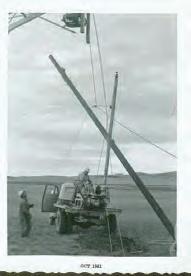
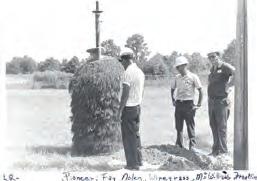
Electricity was life-changing when first introduced to rural areas. The tools used by linemen, however, were pretty simple by today’s standards.
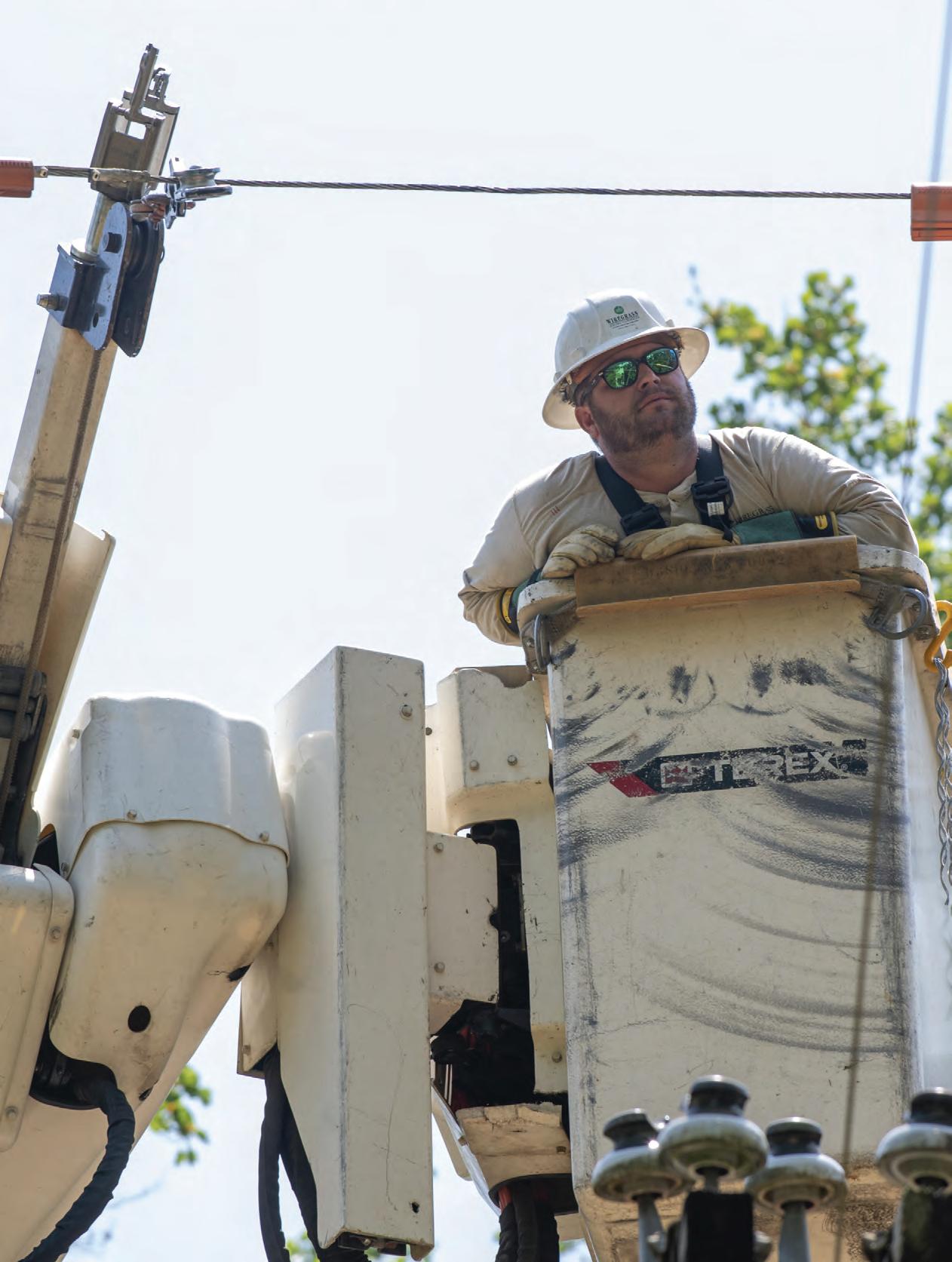
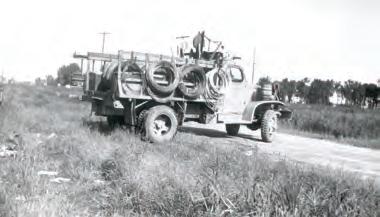
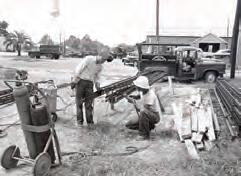
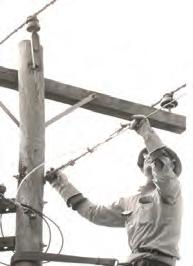
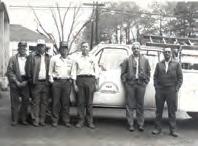
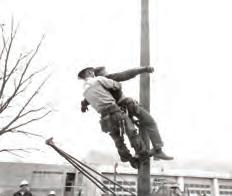
Linemen used climbing spikes, or gaffs, strapped to their boots to help them climb utility poles. A belt with a strap anchored them to the pole. Tools not hanging from their belts were hauled up the pole by a rope. Hard hats didn’t become part of the gear for Wiregrass Electric Cooperative linemen until the 1950s. Bucket trucks came much later.
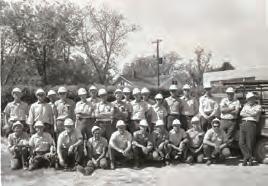
Since the cooperative’s beginning in 1939, the equipment and gear used by linemen have evolved substantially with safety at the forefront.
Clint Hatcher, who plans to retire in July, started on Wiregrass Electric Cooperative’s right-of-way crew in 1992. Back then, there was no thought given to the risks of wielding a chain saw on the job. You just did it.
“Now, you fire up a chain saw, you’re supposed to put on a pair of chaps,” Hatcher says. “We didn’t know what chaps were back then.”
Hatcher recalls losing more than one glove while loading a chipper to mulch
limb debris. Wiregrass, like many cooperatives, now uses contractors to control rightof-way vegetation.
Ben Miller joined Wiregrass Electric Cooperative 33 years ago, and he says today’s ongoing right-of-way maintenance — done annually on a four-year cycle — has a huge impact on the efficiency of crews working on lines and helps reduce the frequency of outages.
Safety gear has seen a lot of improvements, both Hatcher and Miller say. Today’s uniforms offer fire protection, and personal protective equipment like hard hats, safety glasses and insulated rubber gloves are not optional. Even when inside a bucket, linemen wear a safety harness and strap for protection. Gaffs are still used when climbing a pole is necessary. Rubber sleeves and hot sticks have also made the job safer.
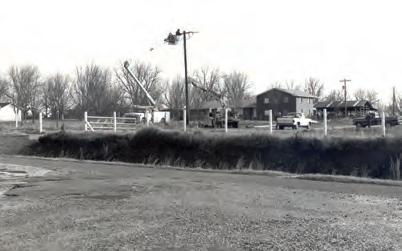
The cooperative’s bucket trucks have improved by leaps and bounds since Miller and Hatcher started out.
The trucks used by crews in the early 1990s were new for the time, but the bucket
lifts attached to the trucks were from the 1970s. Miller says that was the case with a lot of equipment back then — the cooperative made do with what it had. Now, equipment is replaced more regularly, and Miller says there is a lot more emphasis on linemen safety.
“They don’t skimp on buying safety stuff,” Miller says. “Number 1 is to do it safe and go home.”
Hydraulic and electric crimpers used on thick power lines have helped spare many a lineman’s shoulder from the pain once caused by gripping manual crimpers, Hatcher says.
Technology has actually changed linemen’s work in the more than 30 years Hatcher and Miller have been on the job with Wiregrass Electric Cooperative.
A plant specialist for nearly eight years, Hatcher meets with members to map and stake locations for new service requests. In the field, he uses a tablet with a global navigation satellite receiver attached so he can collect GPS points and mark where poles and lines need to be located, although he
1940S 1950S
1960S
still hammers a stake in the ground. From the office, Hatcher creates a work order with all the materials and GPS points for a crew to do the actual installation.
Two-way radios and older mobile phones have been replaced with smartphones. The cooperative’s Supervisory Control and Data Acquisition, or SCADA, system can signal a problem with a power line and isolate the issue sometimes before
Lineworkers install and maintain overhead and underground electrical systems. We rely on their expertise to power our world.
They must commit to safety above all else for the bene t of those they serve — you — fellow crew members and themselves.
an outage call is even received.
“There’s a lot of stuff that we used to have to do that we don’t have to do anymore,” Miller says. “For example, you have a line out, you’d always have to ride that line and then go all the way to wherever the breaker was to close it. Now, with SCADA stuff, they can close it from the office.”
As a serviceman, Miller handles power cut-on and cut-off requests, outdoor lighting and troubleshooting outages. There are tasks he once did as a lineman that he does not miss today.
“When I started this job, there was a lot more to this job then than there is now because of technology,” Miller says. “We used to beat on doors and collect money when people hadn’t paid their bills.” n
Protective clothing is required to shield lineworkers since they work around high voltages. Gear can vary depending on pole structure (wood or steel), and weighs up to 45 pounds.
Hot stick
Insulated and made of electrical-grade berglass, used on energized or “hot” lines
Flame-resistant clothing
Helps protect the skin in case of ames or electric arc ash
Rubber gloves
Specialized, insulated gloves that protect against electric shock and burns
Tool pouch
Insulated hard hat
Allows essential items (connectors, wires, etc.) to be close by
Climbers or leg shanks
These hold the ga s securely in place
Work boots
Aid in climbing and protect the legs and feet
Safety glasses
Protect eyes and block sun glare — especially important when working on energized lines
y strap
Once safely attached to the pole, the strap allows the use of both hands
Hand line
Rope strong enough to hoist equipment, it has steel clips and a pulley block
Provides protection from electrical hazards and blows to the head Ga s Steel points used for climbing wood utility poles
Safet
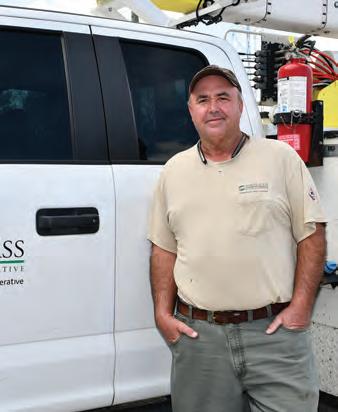
LEFT: Ben Miller joined Wiregrass Electric Cooperative in 1993. A lot has changed in Miller’s 33 years on the job, and he says linemen’s safety is a high priority today.
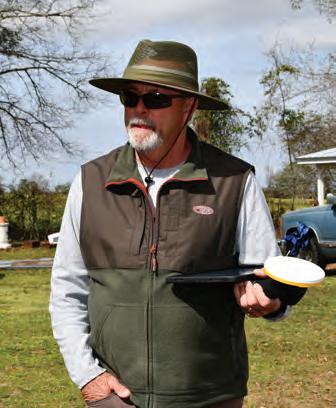
RIGHT: When meeting with members in the field, plant specialist Clint Hatcher uses GPS technology to mark where poles and lines need to be placed for new service requests.
Filling a need
RONNIE BAINE BUILDS RAMPS, HANDRAILS FOR THOSE IN NEED
There’s a story behind every ramp, deck and handrail Ronnie Baine has built, and he remembers them all.
There was a man whose struggle to maneuver the steps leading to his home’s door resulted in his falling and breaking ribs. There was the woman whose arthritis was so severe she needed a ramp to take her all the way to her car. A veteran using a wheelchair because he couldn’t lift his feet even a few inches off the ground needed a ramp to leave his home.
“It doesn’t seem like much, but it makes a difference — gets him in and out of his house,” Baine says of the veteran.
Thumbing through a nondescript notebook or looking through photos on his cellphone, Baine recalls each situation that led him and his band of volunteers to a person’s doorstep to ultimately rebuild the path leading there at no charge.
Baine was recently honored as one of the monthly Silent Heroes of the Wiregrass, receiving $1,000 for his good deeds. Silent Heroes of the Wiregrass is a partnership between Wiregrass Electric Cooperative
and WTVY to recognize local residents who give back to their communities.
People in need typically find Baine by word of mouth. He gets some referrals through the Southern Alabama Regional Council on Aging. Once he hears a story of someone in need, there’s no walking away.
“You’d have to experience it to know the reason I do it,” Baine says.
Baine began building ramps and handrails for people about four years ago. He was serving as pastor at Devco Baptist Church after retiring from a career driving a truck. When his wife retired, he stepped aside as pastor so they could travel. The couple also decided to return to their previous church, Maple Avenue Baptist
Church in Geneva. A member of Maple Avenue needed a wheelchair ramp built, and Baine and a few others volunteered to help.
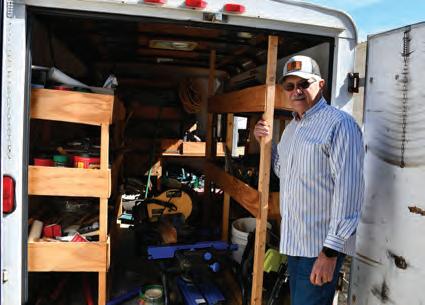
Other construction requests poured in, and eventually, Baine outfitted an enclosed trailer with tools. He says neither he nor his wife has any regrets about spending their retirement helping others instead of traveling.
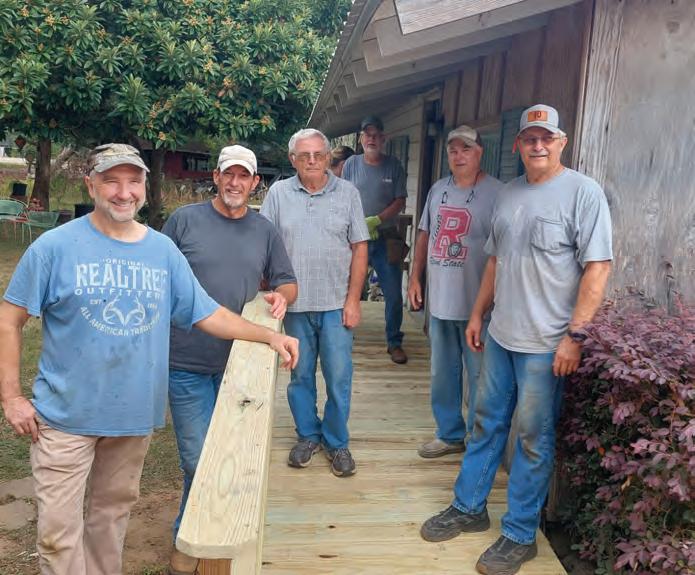
He works closely with the Men on Missions group at Maple Avenue Baptist. The volunteers who pitch in to help Baine are often with the missions group or with another local church.
While his father was a carpenter, Baine spent most of his working life driving a truck. Along the way, he says he learned a little bit of everything — carpentry, electrical work, plumbing.
“Ramp-building to me just comes naturally. They’re so easy to build,” Baine says. “I guess it was God’s will that that’s what I needed to be doing, and I love doing it so much.” n
ABOVE: Ronnie Baine stands at the back of an enclosed trailer he equipped with tools and takes to work sites.
RIGHT: Many of Baine’s volunteers are members of Maple Avenue Baptist Church’s Men on Missions group or are affiliated with other local churches. From left are Steven Kliewer, Scott Gilmore, Stewart Smith, Roger Mock, Bill Ammons and Baine after finishing a ramp for a local resident.
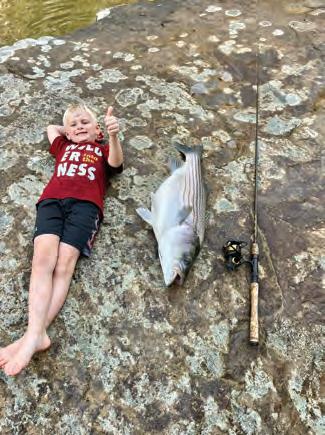
Gone fishin’
grandson,
Our grandson Weston lives to fish, just like his daddy Ethan and grandpa Mark. SUBMITTED by Maggie Johnston, Double Springs.
Collier Hunt fishing with his oldest granddaughter, Natalie Moras. SUBMITTED by Jae Hunt.
Our
Briar Coley of Union Town, had a surprise reaction after his first try bowfishing. SUBMITTED by Pat Bogle, Decatur.
My grandson, Zackary Caldwell, fishing on Lake Wedowee. SUBMITTED by Delilah Gabriel, Roanoke.
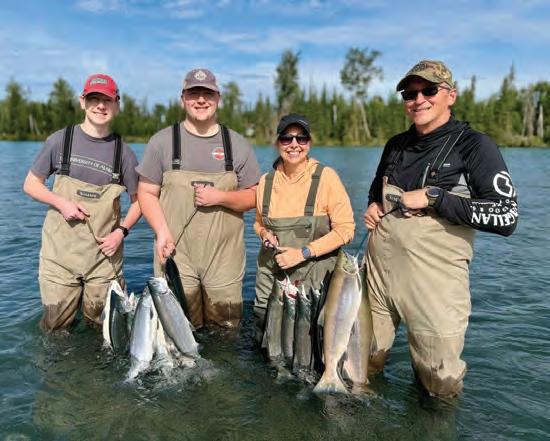
Matthew, Colton, Amy and Chris Tucker salmon fishing on the Kenai River, Soldotna, Alaska in July 2025. SUBMITTED by Amy Tucker, Hartselle.
Cambree Matthews, daughter of Mike Matthews, assistant GM at North Alabama EC. SUBMITTED by Mike Matthews, Stevenson.
THIS MONTH IN ALABAMA HISTORY
Montgomery’s “Lightning Route” Begins
In 1886, Alabama’s capital city became the first municipality in the Western Hemisphere to electrify its entire streetcar system. This feat of technological innovation helped Montgomery grow.
J.A. Gaboury’s Capital City Street Railway Company received a contract to lay track in Montgomery in 1885. Later that year, Gaboury met Belgian inventor Charles Van Depoele, who was marketing an electric-powered streetcar. Gaboury enticed him to Montgomery to modify his mule-powered streetcar line.
With the city’s permission, Van Depoele oversaw the work of erecting power poles along the downtown routes. When new streetcars equipped with electric engines arrived, a delighted local newspaper editor proclaimed the city would soon have a mode of transportation “powered by lightning.” The name stuck.
Van Depoele tested his system by moonlight. By day, the company worked to dispel any public fears about the machines. There was more danger “in a Texas mule’s heels than in all the electric motor system,” an industry expert said assuredly. Electric railway service began on the morning of April 15, 1886, on three downtown streets and eventually expanded to some 15 miles of track.
An 1888 powerhouse fire stalled the company’s progress. With most of its electric fleet damaged, they relied again upon mules. By the time full electric service was restored in 1894, fierce competition from other streetcar companies led to years of gamesmanship. In 1923, Alabama Power acquired and consolidated several Montgomery streetcar companies, operating the system for more than a decade.
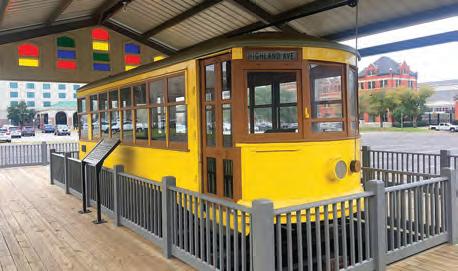
In December 1935, regular public bus service began in Montgomery. Within a few months, electric streetcar service had ended. Today, visitors to Montgomery’s Riverwalk can view one of the restored streetcars that once traversed the long-gone tracks of the famed Lightning Route.
— Scotty Kirkland
Whereville, AL
Identify and place this Alabama landmark and you could win $25! Winner is chosen at random from all correct entries. Multiple entries from the same person will be disqualified. Send your answer with your name, address and the name of your rural electric cooperative, if applicable. The winner and answer will be announced in the May issue.
Submit by email: whereville@alabamaliving.coop, or by mail: Whereville, 340 Technacenter Drive, Montgomery, AL 36117.
March’s answer: This is part of the statue dedicated to the life of Helen Keller, a native of Tuscumbia who overcame deafness and blindness to become a renowned speaker, writer and advocate. Some readers thought it was located at the Keller birthplace, but this statue is on the Capitol grounds in Montgomery and was dedicated on Oct. 24, 2025. (Photo by Lenore Vickrey of Alabama Living) The randomly drawn correct guess winner is fourth-grader Lily Scott, whose class saw the statue on a visit to the Capitol (submitted by her mom, Mary).
Find the Hidden Dingbat!
Our hidden dingbat for March, a four-leaf clover tucked amongst the foliage in a photo of Tom’s Wall on Page 27, proved to be a challenging but enjoyable hunt for more than 300 of you who wrote to us. Sharon Gardner of Elberta, a Baldwin EMC member for 55 years, wrote that she “would have been very upset had I not been able to find the Dingbat this month. All my life I have been able to find four-leaf clovers. As I child I would seal them with a heated iron and wax paper. As the years progressed I would laminate them. And when my mother passed and I was going through her books I was amazed how many fell out that I had pressed between the pages.” April Battle wrote us that she usually doesn’t enter the contest but she wanted to this time because it was more difficult than previous issues. “I have been reading Alabama Living for 10 years and absolutely enjoy it. I really enjoy that it still comes in actual paper form and not emailed out, or just something to look up online. That is a practice sadly ending, but there is nothing like turning a page. So thanks for keeping up the magazine as long as you can.” We agree and plan to, April!
Congratulations to our randomly selected winner, Linda Barefoot of Salem, a member of Tallapoosa River EC. She told us she was singing, “I’m looking over a four-leaf clover, that I overlooked before,” while hunting for it. This month we’ve hidden a golden Easter egg. Remember: it won’t be in an ad or pages 1-8.
By email: dingbat@alabamaliving.coop
By mail: Find the Dingbat
Alabama Living 340 TechnaCenter Drive Montgomery, AL 36117
Sponsored by
A restored streetcar is on display near Montgomery’s Riverwalk.
PHOTO BY DAVID WILSON FROM WIKIMEDIA COMMONS
Letters to the Editor
Alabama’s mirthful monikers
E-mail us at: letters@alabamaliving.coop
I enjoyed the article (“From Random to Roosters,” April 2026) very much. It made me smile the whole time I was reading it. One of my favorites was missing, however. That would be Opp, Alabama. While I know “historically” it was named for Henry Opp, a lawyer of German descent and former mayor of Andalusia
Take Us Along!
We’ve enjoyed seeing photos from our readers on their travels with Alabama Living! Please send us a photo of you with a copy of the magazine on your travels to: mytravels@alabamaliving.coop. Be sure to include your name, hometown and electric cooperative, and the location of your photo. We’ll draw a winner for the $25 prize each month.
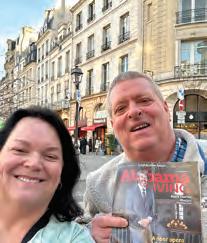
Preasha and Ronnie Smith, members of Black Warrior EMC from Romulus, spent nearly three weeks traveling through Holland and France with their Alabama Living.
Siblings Judy Burnham and Dennis Fell visited the Todai-ji Buddist Temple in Nara, Japan. They are both members of Baldwin EMC.
or write us at: Letters to the editor 340 TechnaCenter
from 1899 to 1906, a funny story says it was originally named “Opportunity,” but after many years of nothing really happening, it was shortened to just “Opp.”
That may have not been appropriate for the article but funny, nonetheless.
David Cunningham,
From another bridge-named town, Bridgeport
Berry, Natalie, and Marshall Nall of Atmore, members of Southern Pine EC, traveled to the Colosseum in Rome to celebrate Berry’s 50th birthday.
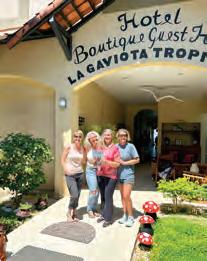
Debbie Frazier of Mentone, a member of Sand Mountain EC, traveled with her three daughters to La Gaviota Tropical Boutique Hotel in Playa Hermosa, Guanacaste, Costa Rica.
Susan Knight of Marbury made sure to take her copy along when she departed on a Disney cruise out of Port Canaveral, Fla., She is a member of Central Alabama EC.
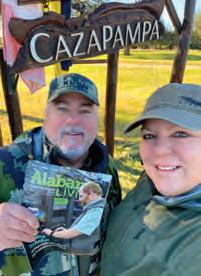
Nancy Jo Adams and Richard Holt, owners of Life in Camo Media, LLC, traveled to Cazapampa in Argentina to hunt red stag. Residents of Banks, they are members of the South Alabama EC.
Scotty
a
Sissy Henderson of Andalusia, a member of Covington EC, visited Gatlinburg, Tenn., with her magazine.
Belinda Lee of Georgiana, a member of Pioneer EC, took her copy to Clewiston, Fla., her hometown where she traveled to visit family and attend the annual “Clewiston Sugar Festival” celebrating the end of the sugar crop.
Carol and Andy McRae of Clio took their magazine along on the Norwegian Bliss Cruise to Alaska. This picture was made in the Glacier Bay. They are members of Pea River EC.
Daniel and Linda Thomas of Orange Beach traveled to see the windmills in Kinderdijk, Holland. They are members of Baldwin EMC.
Kennedy,
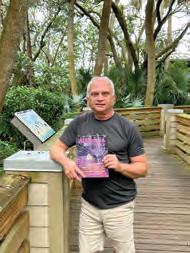
member of Franklin EC from Red Bay, visited Green Cay Nature Area near Pompano Beach, Fla, with his copy.
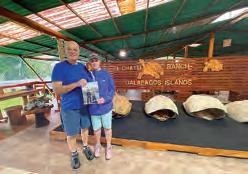
Tom and Jane Henderson from Brewton, members of Southern Pine EC and Covington EC, visited the Galápagos Islands last spring.
Tourism ALABAMA’S
INDUSTRY AIMS TO BE MORE ACCESSIBLE
North Alabama’s Weathington Park has a stunning view of the Tennessee River, accessible via a .25-mile flat, paved loop trail.
‘Destination
Verified’ North Alabama leads the way
BY COLETTE BOEHM
The accessible travel market is a large and rapidly growing sector across the U.S. and the Alabama tourism industry is poised to welcome and accommodate an increasing number of visitors with varying abilities. The market includes travelers with mobility, sensory, and cognitive challenges who, along with an aging population, are creating the need for a variety of accommodations at lodging properties, attractions, and other businesses.
Travelers with disabilities reportedly spent nearly $50 billion in 2024 and, according to Open Doors Organization data, that number climbs to $100 billion when including companions. Despite its size and spending patterns, the market continues to be underserved due to accessibility barriers.
In North Alabama, the Alabama Mountain Lakes Tourist Association is aiming to remove those barriers and lead the way to accessible travel through encouraging and enabling its industry partners to move beyond compliance and to create new inclusive offerings for visitors. State Parks, from the mountains to the gulf, are also providing more options for visitors of varying abilities, from lodging to trails to the state’s number one tourism attraction, its beaches.
“At the Lodge, we have a boardwalk with a ramp and a track chair and beach wheelchair that guests can check out at no charge to get them out on the beach,” says Chandra Wright, director of environmental & educational outreach for the Lodge at Gulf State Park, located directly on the beach in Gulf Shores. “We strive to provide all of our guests access to make those lifetime memories that will keep them coming back for years to come.”
Through AMLA’s efforts, North Alabama is equipped to provide those memories as well. The region has become the state’s first “Destination Verified” area recognized by Wheel the World, a global leader in accessible travel. The status identifies venues that have undergone a third-party accessibility verification, a process which included visits to dozens of businesses, attractions, restaurants, airports, and
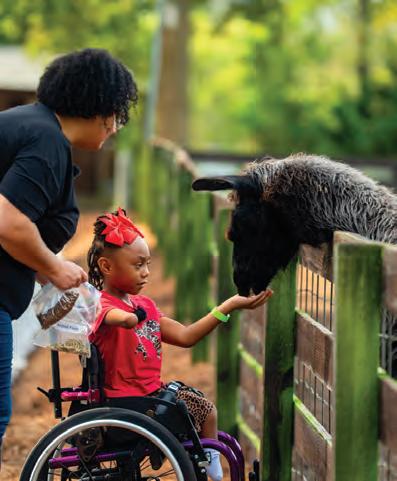
Ashlee Crosby and her daughter Samone visit the habitat park at Noccalula Falls Park. PHOTO
PHOTO BY COLETTE BOEHM
hotels throughout the region. AMLA has also coordinated training through Tourism ALL-a-Bama, a program of United Cerebral Palsy of Huntsville and Tennessee Valley, intended to serve individuals and families traveling with sensory sensitivities or who are on the autism spectrum.
The AMLA initiative has trained hundreds of employees on accessibility and, through grants and partnerships, provided three dozen wheelchairs to its tourism partners.
“Accessibility is more than a project, it is AMLA’s mission,” says the organization’s President/CEO Tami Reist. “We are committed to ensuring that North Alabama is not only beautiful and adventurous but also inclusive, inviting and accessible. By equipping our partners with tools, strategies and best practices, AMLA is ensuring that North Alabama can welcome visitors with disabilities with the same warmth and hospitality the region is known for.” The organization has launched a new website, accessiblenorthal.com, offering visitors a comprehensive hub for accessible travel information.
Ashlee Crosby is the general manager of SpringHill Suites Huntsville Downtown and has, along with her staff, been through the verification process and the sensory training sessions.
“We had the team sign up to have the ALL-a-Bama training for autism,” Ashlee notes. “Each hotel got sensory kits. When the ALL-a-Bama reservations come through, we know who they are. We know when they’re checking in and their needs. But we have this kit that’s available to us 365 days a year,” she said, noting that more and more travelers have special requests. “We get people in and they need a sound machine in their room, or they need the weighted blanket, and that’s in the bag. We’ve had that a few times.”
Crosby relates to the special needs of travelers in a personal way, as she has a seven-year-old daughter, Samone, with limb differences. “She only has one full limb, and that’s her left arm,” she explains. “We have a wheelchair, but that’s basically used for more distance, getting from one place to another. Once she gets there,
she typically likes to be out of her wheelchair. For me, when we travel, cleanliness is really big, because she walks on one hand on the floor most of the time and climbs up on things. So, our accessibility is different.
“ That’s why I like the training we use,” she says. “This accessibility training explains that it’s not one size fits all.” She recalls a wheelchair user who recently checked in and did not want a roll-in shower. “Just because she’s in wheelchair, she doesn’t have to have it. Getting our people to think about that, to have these things available, to have the knowledge of how they work and how to offer them, but to know it’s not one size fits all. Sometimes you have to make adjustments for the person.”
Parks offer options
Alabama’s state parks are offering a variety of options for access to the outdoors for those with mobility issues. With grant funding, AMLA donated a state-of-the-art Terrain Hopper to Joe Wheeler State Park, in northwest Alabama. The device allows individuals with mobility challenges to explore rugged trails, scenic landscapes, and lakeside views more easily than ever before.
Alabama State Parks Deputy Director Chad Davis is also AMLA’s Chairman of the Board. “We’re incredibly grateful,” he says. “This device opens trails and outdoor experiences to guests of all abilities,” calling it “a great addition to our state park’s outdoor mobility device fleet. It’s a powerful step forward in our commitment to accessibility and inclusion across Alabama’s State Parks.”
Oak Mountain, Monte Sano, Lakepoint and Gulf State Parks each have mobility devices. Options vary between parks and include all-terrain track chairs, stabilized wheelchairs, carts to assist hikers, and devices that double as a cart and a stand-up assist for golfers. Visitors to state parks can reserve the motorized devices online at alapark. com/outdoor-mobility-devices. “Once you reserve the device and arrive at the park, you can head to the designated facility to pick it up and start using it,” Davis says.
Some parks have wheelchair-friendly trails, as well. Lake Guntersville is home to the paved Benny Bobo MultiUse Trail, which gives visitors a view from the Mabrey Overlook. Gulf State Park is the heart of the 28-mile Hugh S. Branyon Backcountry Trail, which extends beyond the park into Gulf Shores and Orange Beach.
Imagination
Place Children’s Museum in Gadsden has activities for children of varying abilities.
Joe Wheeler State Park has a Terrain Hopper, donated by AMLA, to assist those with mobility issues who want to access trails.
PHOTO BY COLETTE BOEHM
PHOTO COURTESY ALABAMA STATE PARKS
Win this sensory sensitivities kit!
Our friends at Tourism All-A-Bama and Alabama Mountain Lakes Tourist Association have put together a helpful travel backpack filled with items designed especially for individuals with sensory sensitivities. Inside the kit are sensory items such as ear protectors, fidget devices, sunglasses and more! If you’d like to win one of these backpacks, email your name and address to contact@ alabamaliving.coop. We’ll draw a winner from all the entries!
“Our award-winning Backcountry Trail provides miles of paved and boardwalk trails for a variety of abilities,” Wright notes. “Each trailhead has a post providing trail users with useful information such as length, elevation change, grade, and type of surface, so everyone can determine if that trail will meet their needs before they start down it.
“At the beach pavilion, we have wheelchair mats on the beach,” she continues. Beyond having accessible rooms at the Lodge, the park also has specially equipped cottages and cabins on the shores of Lake Shelby. “Our Learning Campus also has accessible accommodations in our bunkhouse and our boardwalks and ramps, there and at the Nature Center and Interpretive Center, allow our guests to participate in our great immersive educational programs.”
Crosby is happy to see many businesses and attractions, beyond the parks, making accessibility a priority. She noted recent visits to Imagination Place Children’s Museum and Noccalula Falls, where her daughter was able to enjoy the attractions fully. That type of access is important to Crosby because travel and the experiences it brings are opportunities she wants her daughter, and others with varying abilities, to benefit from, wherever they go.
“We travel,” Crosby says. “I’m in hospitality. She goes and travels for different sports camps and things. So, we fly and we go all over the place. My most important thing, from my daughter’s side of it, is independence. I will not always be here with her. I want her love for travel to go forever and ever. What can we do to prepare for that?”
1) Beach wheelchairs are available for guest reservation at The Lodge at Gulf State Park, and from local equipment rental companies. 2) The cities of Gulf Shores and Orange Beach, as well as Gulf State Park, have accessibility mats for easier access to Alabama’s beaches.
2
Memorable summers ARE WORTH PLANNING EARLY.
Along Alabama’s Beaches, time slows down just enough to savor it all: long walks, unhurried meals, and days shaped by sunshine instead of schedules. Plan ahead to experience time well spent with the people who matter most.
Exploring AlabAmA’s Canyonlands
Take in some of the most beautiful views our state has to offer
BY AMBER LANIER NAGLE
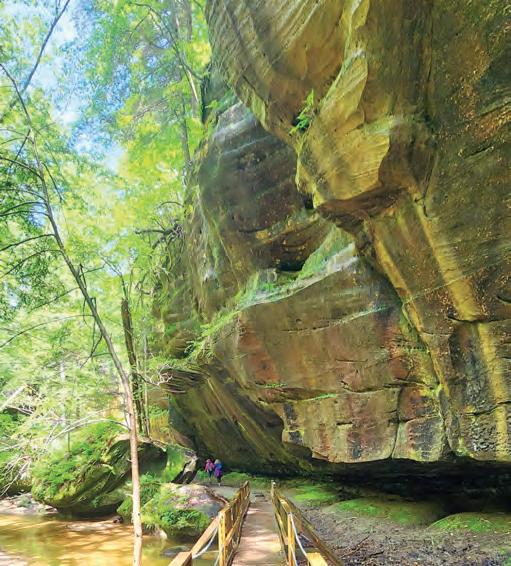
From the sweeping vistas and rim-hugging trails of Little River Canyon National Preserve, to the glowing creatures living in Dismals Canyon, to the behind-the-falls view at Cane Creek Canyon Nature Preserve, northern Alabama is home to three canyons that captivate adventure seekers, nature lovers and restless souls alike.
Canyons and gorges refer to deep valleys with sheer sides that are formed by erosion, geological uplift and melting glaciers. The terms are used interchangeably, though gorges are typically steeper and narrower than canyons.
Geology aside, these three natural destinations offer heaps of outdoor adventures, history and some of the most breathtaking views in the Southeast. Prepare to be mesmerized!
Cane Creek Canyon Nature Preserve Tuscumbia
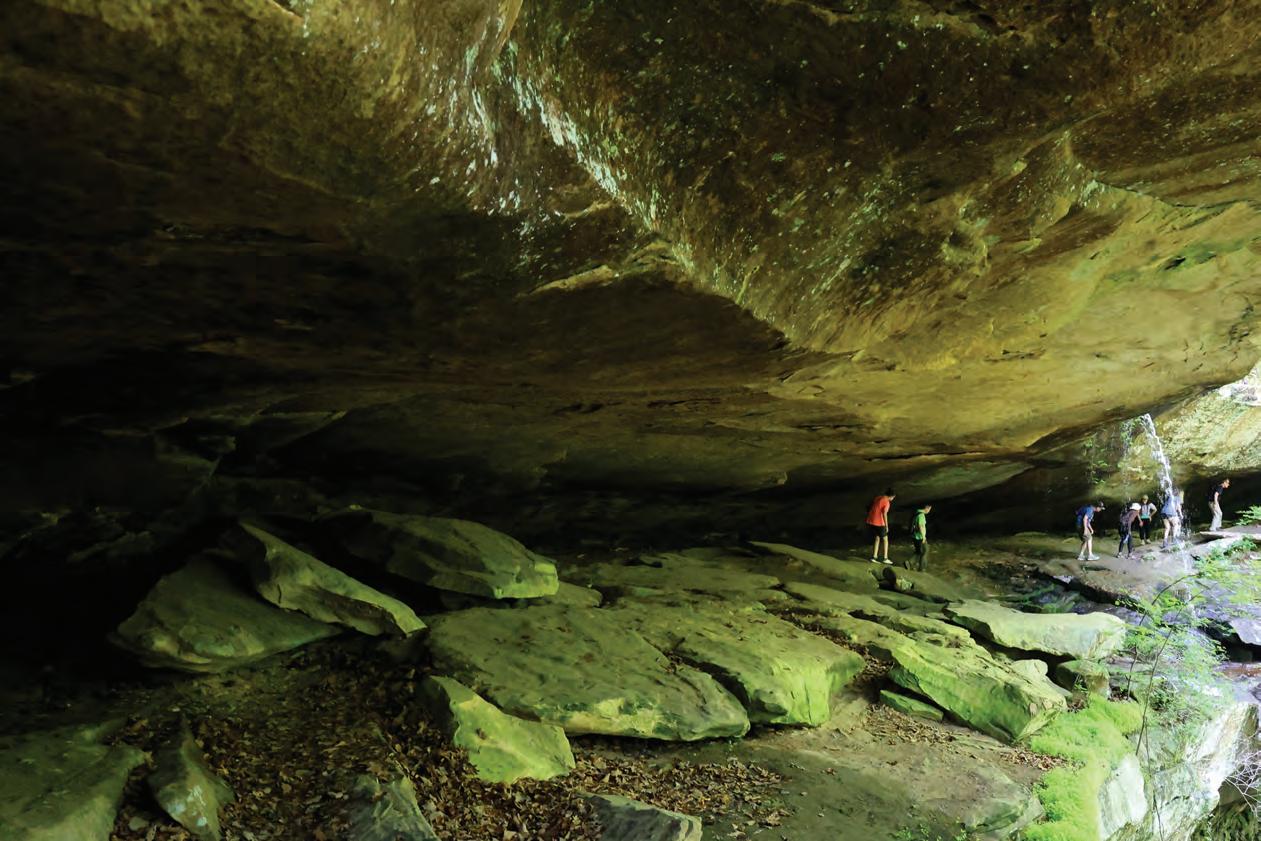
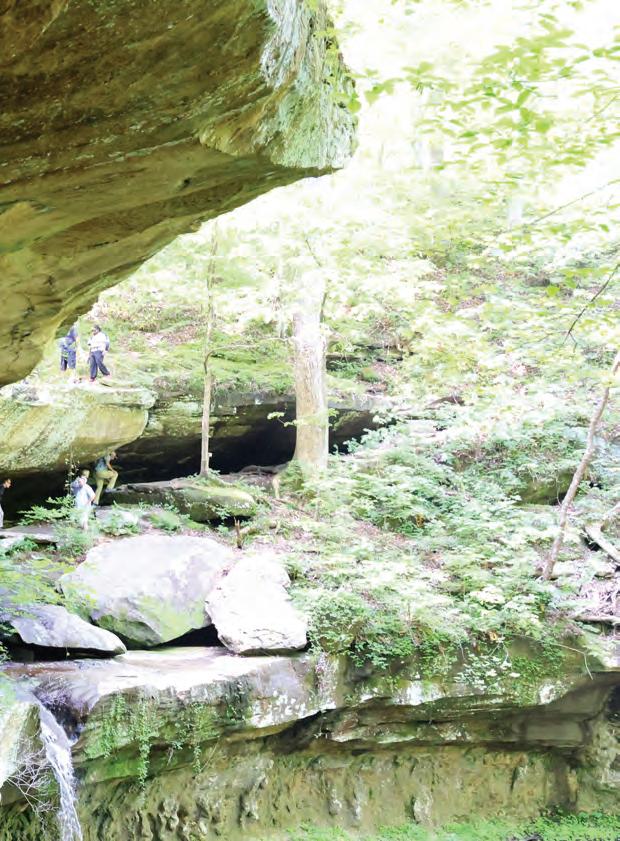
Where water meets stone over millions of years, nature sculpts some of its most spectacular masterpieces. For eons, Cane Creek relentlessly cut through the sandstone and shale layers of the Little Mountain region, shaping a canyon with a dramatic 350-foot elevation drop. Over time, the creek’s erosive power created near-vertical walls and 15 — sometimes more, depending on rainfall — picturesque waterfalls.
Today, the 693-acre preserve stands as a testament to both geologic forces and human stewardship. Jim and Faye Lacefield purchased an initial 40 acres in 1979 and gradually expanded the property, creating hiking trails throughout these canyonlands. In 2023, they donated their life’s work to the Land Trust of North Alabama, ensuring permanent protection of this ecological treasure hidden in a remote region of the state.
“And because of its secluded nature, the property was once used by bootleggers,” says Abigail Harrison, marketing director of the Land Trust of North Alabama.
During and after Prohibition, uninvited visitors would not have been welcome here. Today, the canyon invites outdoor enthusiasts to explore more than 25 miles of marked hiking trails — both easy and strenuous — each weekend.
“We are one of the only sites in Alabama with French’s Shooting Star,” says Harrison. “Primula frenchii is a rare, protected wildflower that blooms in the spring and grows under the sandstone shelters here. We also have dismalites and occasionally host night hikes to see those.”
The visitor support station at the entrance stocks maps of the preserve. Harrison suggests the short but scenic hike to Lacefield Falls, with water plunging 60 feet into a bouldery pool. “For more experienced hikers, a sevenmile loop winds by the falls, then to an overlook dubbed Lacefield Point, then down into the canyon and over to Karen’s Falls,” she adds.
Learn more: landtrustal.org
PHOTO BY JOHN AND PAM TAYLOR
Dismals Canyon
Phil Campbell
Dismals Canyon is privately owned — a nature conservancy that earned the designation of National Natural Landmark in 1975 — and Kevin Cheek, its chief operating officer, calls it “the only natural arboretum in North America.” Tucked into the northwest corner of the state, 85 acres of ancient forestland descend 80 feet into shadow and stone.
Three hundred million years ago, this was a primeval swamp, lifted skyward by tectonic shifts, and later carved by water into a labyrinth of sandstone grottoes, waterfalls and natural bridges.
Amid moss-covered boulders, wanderers relish the rich diversity of native plant life here, including a stand of oldgrowth virgin timber of hemlock, tulip poplar, sweetgum, bigleaf magnolia, and beech. But the real rock stars of Dismals don’t come out until after dark. Deep in the gorge, in places like the Witches Cavern, tiny bioluminescent creatures called dismalites emit a blue-green glow.
“ They are cousins to the rare glowworms found in Australia and New Zealand,” says Cheek. “They require precise conditions — humidity, darkness, stillness and surfaces for their webs — and Dismals has it all. When they gather on the vertical rock walls, there are so many that they look like constellations of stars.”
Reservations for small, guided night tours to see these spectacles are only available by phone starting on the Sunday before each tour. By day, visitors arrive from
1) Hikers explore the cascading waterfalls at Cane Creek Canyon Nature Preserve—some viewable from behind a curtain of falling water. 2) Water tumbles over layered ledges at Cane Creek Canyon Nature Preserve, a 693-acre property near Tuscumbia that features dramatic cliffs and waterfalls galore. 3) The trail along towering walls of Dismals Canyon guides visitors past moss-covered boulders and into a lush gorge sheltering an old-growth forest.
across the world to walk the mile-and-a-half loop trail that takes two hours because the beauty of the gorge is so lingerworthy — a “perfect setting for forest therapy,” according to Cheek. The gorge floor typically runs 10 degrees cooler than the surface, which is another welcome surprise for summertime adventurers.
After their descent into paradise, visitors stop in at the oldfashioned soda fountain for a taste of nostalgia before leaving. And one final note for this year’s travelers: Dismals cabins are closed for renovations this year, but there are plenty of lodging opportunities within 30 minutes of the park.
Learn more: northalabama.org
Little River Canyon National Preserve
Fort Payne
Perched at the southern edge of the Cumberland Plateau, Little River Canyon National Preserve cuts more than 600 feet into the flat top of Lookout Mountain, making it the deepest canyon system in Alabama.
“The Appalachian Mountains are part of the oldest range in the history of the world,” explains Christian Braswell, a science educator at Jacksonville State University Field School, a partner of the National Park Service. “It was here that tectonic plates buckled and rose over 400 million years ago, long before the dinosaurs. The Little River, flowing atop the eroded mountaintop plateau, has spent hundreds of thousands of years sculpting this remarkable gorge — and continues its work today.”
The canyon’s ecosystems support remarkable biodiversity. The green pitcher plant, a carnivorous wonder on the endangered species list, produces nectar that lures insects into its tubular leaves, where they are digested by enzymes. Tiny blue shiners swim in what Braswell calls “some of the purest water in the state.” Green salamanders inhabit the cracks in the canyon walls.
Fossilized imprints of ancient plants appear in the sandstone, evidence of the forests that existed here before humans walked the earth. As for more recent history, the canyon witnessed more than 1,100 Cherokee and Muscogee people cross Little River (near the present-day Highway 35 bridge) in 1838, during the forced Indian removal, also known as the Trail of Tears.
Within the preserve, there are numerous hiking trails, rock-climbing and rappelling opportunities and even a blue hole for swimming. The eleven-mile drive along the Little River Canyon Rim Parkway (Highway 176) offers eight scenic overlooks where visitors can pull over, eat a snack, watch waterfalls tumble over the rocks, and witness eagles and hawks ride the thermals — and all while standing at the edge of something larger than themselves.
Whether seeking a challenging hike, a peaceful retreat or simply a chance to ponder geological heritage, northern Alabama’s canyonlands offer unforgettable experiences for travelers of all ages.
Learn more: northalabama.org
1) Dismals Branch Creek plunges 15 feet over beefy boulders to form Rainbow Falls—the centerpiece that greets visitors at the entrance to Dismals Canyon. 2) Visitors wander along the rocky shelves of Little River Canyon National Preserve, where the river has carved a spectacular natural playground. 3) Young visitors take in the view from a scenic overlook along the Little River Canyon Rim Parkway.
PHOTO COURTESY FRANKLIN COUNTY CHAMBER, LANCE HOLLAWAY
PHOTO COURTESY JSU FIELD SCHOOL
PHOTO COURTESY JSU FIELD SCHOOL
The Lives of Lineman Wives
BY LENORE VICKREY
When an ice storm snaps power poles, a tornado tears down miles of power lines, and hurricanes plunge entire communities into darkness, thousands of families wait for the lights to come back on.
But in homes across Alabama, another kind of waiting begins. For every lineman heading into the storm, there’s a family staying behind — a wife putting children to bed alone, a mother checking the outage map, a phone lighting up in the middle of the night. They know the routine. When disaster strikes, their husband or father may be gone for days, sometimes weeks, helping strangers get their lives back.
In recognition of Lineman Appreciation Day, which Alabama celebrates April 15, we talked to wives of eight linemen from our 22 Alabama rural electric cooperatives, to learn more about the challenges of managing life at home when the head of their household is gone.
Chelbie Mobley, a high school science teacher, has been married to her husband, Dylan, a lineman at South Alabama EC, for seven years. Although he’d been a lineman for a few years before they married, she remembers vividly the times when he’s had to be gone from the house, including when she was pregnant with their first child, Mary, and another when she’d just given birth to their second girl, Mabry. That was in September 2024, when Hurricane Helene, the deadliest hurricane to hit the United States since Katrina in 2005, slammed into the Florida panhandle.
She was home with newborn Mabry, only about two weeks old, when he called her from work: “Hey, there’s a hurricane. You care if I go?” Knowing that her parents were nearby for support, and that the extra money would come in handy, Chelbie agreed he should go. “Obviously he did not have to go, it wasn’t a requirement, but when you look at just having (had) a baby, and the money, and all the things, it’s really hard to turn it down.”
D ylan joined crews from 19 Alabama cooperatives in a massive mutual aid effort to restore power to rural areas of Florida’s “Big Bend,” which took weeks. “It was complete devastation,” says Chelbie. “Most of the places they went to, he was gone for a week, then came home, stay a week, and turn around and go back the next week.”
It becomes your lifestyle
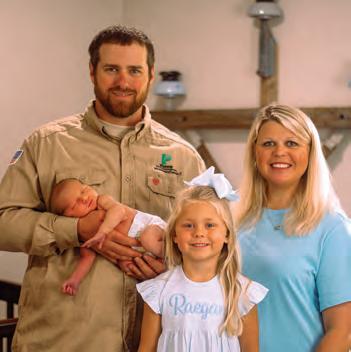
Emily Varner, a dental hygienist in Greenville, knows what it’s like to have her husband away from home, especially during special family times. Ty Varner, a journeyman lineman, has been with Pioneer EC for 12 years. During the fall of 2020, when it seemed like one hurricane or severe storm after another battered Alabama and the Gulf Coast, he had been working in Louisiana after Hurricane Laura, when their daughter Raegan was born six weeks early on Sept. 9.
“He got home the night before I went into labor,” Emily remembers. “What a way to be introduced to being a lineman’s daughter, being born at the tail end of a storm!” When they brought their newborn home after a week in NICU, Hurricane Sally was
Top to bottom: Dylan and Chelbie Mobley and their two daughters, Mary and Mabry; Emily and Ty Varner and their two children, Raegan and Jake.
wreaking havoc along the coast, Ty got a call from the co-op. “They said, ‘We know you’re bringing your daughter home, but we might need you. So in two or three hours, he was out working again.”
A year later, Ty would miss Raegan’s first birthday party when he was called out to work another storm. “I’m telling you,” says Emily, “she has been a lineman’s daughter since she came into this world.”
Living a small community like Greenville, the Pioneer linemen and their families are close, she adds. “You build relationships because you’re all in it together. A lot of us have kids around the same age, a lot go to the same schools, we ride in the Christmas parade together. It’s like a little family which is really sweet.”
Being married to a lineman also means you learn a lot of the lingo, Emily notes. “So when he calls me and says, ‘I’ve got a broke pole,’ I know what that means, that it’s going to be like three hours. There have been several times we’ve gone out to eat and he gets called out and we have to leave.” Often they take two vehicles, just in case. “It just becomes your lifestyle.”
A sense of pride
Kaitlyn Dillon, whose husband, Trey, has been a lineman at South Alabama EC for 10 years, knows what it’s like to adjust your home life around dad’s work duties. The couple lives in Honoraville with their three young sons, and Katelyn works as
an esthetician in Montgomery. Trey takes their youngest, sixmonth-old Woods, to day care in Troy, but if he’s called out on a job, it changes everything. “It’s definitely hard,” she says. Thankfully, she has family members nearby who can help.
Still, when the phone rings in the middle of the night “and he has to jump up, get dressed and leave,” it’s an anxious time. “I feel like I’m constantly looking at the phone to see where his location is, to see when he’s on his way back,” she says. “And I always have the outage map up to see where the outages are.
“I hate it when he’s called out, but then I know how much he means to the families he’s going to help, especially when he’s going to work like the disasters and the hurricanes. There’s a sense of pride with that.”
In February, Matt Moody, a lineman at Tombigbee EC for 17 years, was among the Alabama linemen who were gone for three weeks helping restore power during the ice storms that hit Mississippi. The work was some of the most dangerous and difficult he’d seen, with power lines embedded in frozen ponds as the storm destroyed more than 8,000 power poles and 4,700 miles of power lines.
But back home in Hamilton, his wife, Mandy, a nurse, was going through a trauma of her own. He had not been gone a week when she was hospitalized with dangerously low potassium levels, later found to be caused by her acid reflux medication. She was in the hospital three days until her levels stabilized, and Matt managed to get back to see her briefly before heading back out. Normally, their son, Brodie, 19, would be at home to help with their 10 beef cows, but since he finished high school last year, he works on the road as a welder. Mandy was responsible for the home front and their farm.
“I hadn’t been in the hospital since I had Brodie,” recalls Mandy. But she understands how important her husband’s job is especially since he’s a senior lineman at Tombigbee EC. “He’s seen so many ice storms and damages over the years, but he said he’d never seen an ice storm like this one.”
Like Emily, Mandy can explain to others why it sometimes takes a long time to get power restored. “I can talk power lines with the best of them because I’ve been around it so long,” she says.
Dawn Perry’s husband Phillip has been a lineman at Dixie EC 26 years, most of their married life. Their children are now grown, but when he first started as a lineman he would have to dash out whenever he was on call, sometimes missing family time, Dawn recalls. Once at Christmas, the phone rang when their children were seeing what Santa Claus had brought them. “You have to answer that?” she asked him. “Yeah, I’m outta here,” he replied. Their kids would be crying and asking ‘why is Daddy leaving?’ but they survived.
“It’s been a rollercoaster, “she says, “It was hard, but you just pray, pray, pray.” Phillip “loves his job,” she adds. And if he’s not out working an outage, he’s at home worried about all the guys who are out there. “They’re like brothers.”
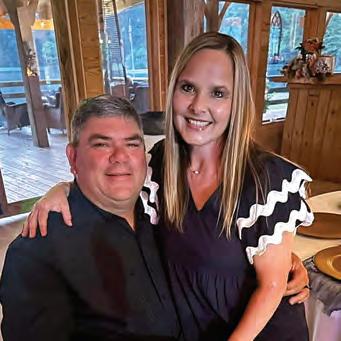
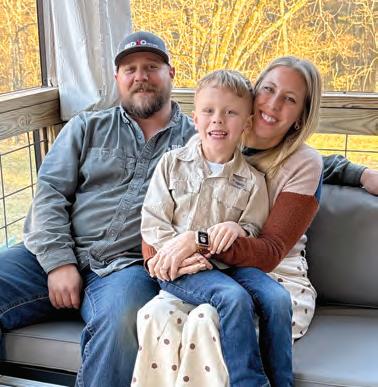
Clockwise, from top left: Trey Dillon holds his youngest son, Woods, alongside wife Kaitlyn and their other sons, George and Beau; Matt and Mandy Moody with their son, Brodie; Phillip and Dawn Perry.
‘What
he’s meant to do’
While the unpredictability of a lineman’s schedule can make it hard on his family, for Stephanie Christensen, whose husband, Stephen, has been a lineman at Baldwin EMC for 20 years, it has become normal. “This is what they’ve grown up with. They know that their dad might miss birthdays or holidays, but they understand why. I feel like it’s actually taught them a lot about serving others and taking responsibility, especially when they were younger.” They have a son, 26, and daughters ages 17 and 9. “Being the family of a lineman, it’s a family commitment, because when he’s called out, sometimes you don’t have much of a warning. We just hold things together back at home because we know that he’s doing what he’s meant to do.”
As a OB-GYN nurse practitioner for the underserved community, Stephanie knows what it’s like to serve others, as her husband practices that daily. “He’s so humble and quiet. He never makes a big deal about what he does,” she says. “It’s so cool as a wife to watch him quietly serve others. It’s just powerful to me.”
Moriah Miller, a career tech teacher at Albertville Innovation Academy, has been married for 10 years to Joey, a lineman for Marshall-Dekalb EC for 20 years. “He tried to forewarn me when we were dating” that his schedule could be unpredictable, she says, “but you don’t know until you get married and you’re living that day-to-day life.” She and their six-year-old son, Jesse, count the days until Daddy’s home and they can resume playing his favorite pastime, building LEGO sets.
Even local events can separate Joey from his family, such as when a car hits a power pole, or house fires when firefighters need power lines to be de-energized.
“The weekend before he left (for Mississippi) there was a car wreck and he left around 8 or 9 that night and they didn’t get done until about 6 the next morning. They had to work all night.”
In the early days of their marriage, she says, “It was challenging, because you’re not used to having another person there, and then you’re getting woken up in the middle of the night.” But she’s learning what every lineman family eventually learns.
“It just comes with the territory.”
Like many of the wives we talked to, Moriah keeps up with her husband’s location on her phone and checks the cooperative’s outage map. If linemen post photos on Facebook, the wives often share them, especially if they gone out on storm restorations. “Then we all kind of compare notes,” she says.
Newlywed Kamryn Hill has only been married to her Clarke-Washington EMC lineman husband, Cody, for a year, but even while they were dating, she got a taste of what life would be like with him being gone. He was sent with crews to help respond to storm-related outages in Georgia and Florida, and then most recently, Mississippi.
“For the first few days, it’s kind of nice because you can watch what you want on TV, and you don’t have anybody interrupting you. But then it kind of gets lonesome and you’re like, ‘When are you coming home?’” Kamryn, who works as a corporate accountant, tries to Facetime with Cody every day when he’s out of town, and if she needs anything, her parents live across the road in Grove Hill.
PHOTOBYKELLI WHORTON
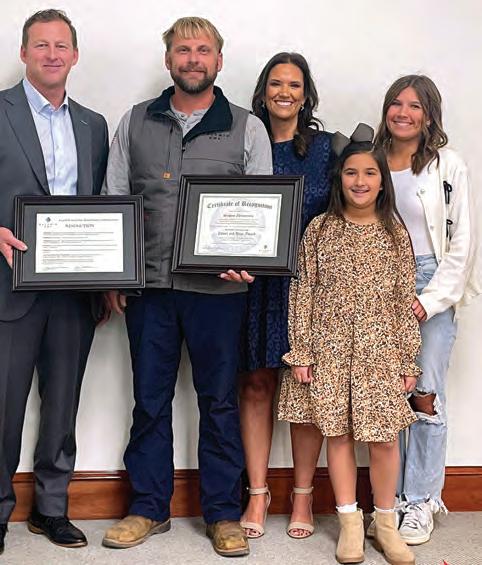
From top: Baldwin EMC CEO Hunter Robinson presents Stephen Christensen with the Baldwin EMC Touchstone Energy Power and Hope award for heroic actions while on the job, while wife Stephanie and daughters Ellie Brooks and Lynley Kate look on proudly; Cody and Kamryn Hill and their long-haired dachshund, Molly; Matt and Moriah Miller enjoy a light moment with their son, Jesse.
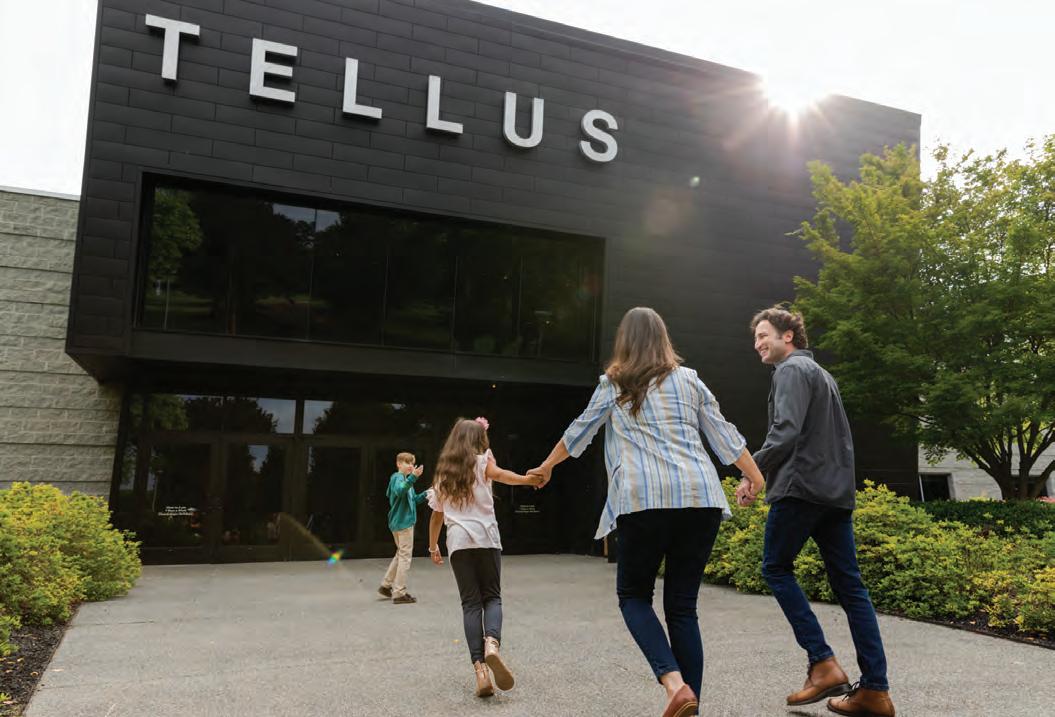
Cartersville’s museums are full of wonder, and during Sensory Friendly Mornings, they’re also designed with comfort in mind. At Tellus Science Museum and Booth Western Art Museum, visitors can enjoy reduced noise levels, quiet spaces, and supportive sensory resources while exploring exhibits, art, and hands-on discovery throughout the museums.
BY MYLES MELLOR
Built Stronger. Lasts Longer. Looks Better.
EVENTS Around Alabama
APRIL 11
Pike Road, Pike Road Lions annual yard sale, 7 to 11
a.m. at Pike Road Town Hall, 9575 Vaughn Road. DJ, door prizes, free eye screenings and refreshments available. More than 70 families from the River Region will be selling new or gently used items. All proceeds promote the Lions’ charitable efforts, including vision, diabetes, childhood cancer awareness, environment and hunger. Search for the Pike Road Lions page on Facebook.
APRIL 11
LaFayette, 30th annual LaFayette Day for Valley Haven School. Arts and crafts, antique cars, children’s games and rides, a motorcycle ride, live family entertainment, food and more. Free. For information or to register for craft show or car show, call 334-756-2868 or 334-219-1890. Email valleyhaven@valleyhavenschool.org
APRIL 12-13
Loxley, Baldwin County Strawberry Festival, Loxley Municipal Park. 9 a.m. to 5 p.m. Car and tractor shows, a carnival, food, live music, more than 180 crafts vendors and of course, the famous strawberry shortcakes. All proceeds benefit Loxley Elementary School and the ARC Baldwin County, Inc. baldwincountystrawberryfestival.org
APRIL 18
Fairhope, Blooms and Brews SpringFest, 10 a.m. to 5 p.m., Weeks Bay Plantation. Live music, craft beers, cocktails, exotic petting zoo, vendors, food trucks and kids’ zone, with bounce houses and activities. Bloomsandbrewsfest.com
APRIL 18
Thorsby, Chilton County Strawberry Festival, Richard Wood Park. 8:30 a.m. to 5:30 p.m. Local makers, food vendors, farmers and creatives. Search for the event’s page on Facebook.
APRIL 18-19
Waverly, 25th anniversary of the Old 280 Boogie at Standard Deluxe, 1015 Mayberry Ave. A festival of art, food and Southern culture. Live music all day, with performances by Shovels & Rope, The Heavy Heavy, The Band of Heathens, The Last Jimenez and more. StandardDeluxe.com
APRIL 18-19
Guntersville, Art on the Lake, Guntersville Recreational Center. More than 80 fine artists and craftsmen from across the Southeast will display their unique creations. Food vendors, outdoor games and rides and a bake shop. $3 ages 13 and older. Artonthelakeguntersville.com
APRIL 18-19
Cullman, Bloomin’ Festival, St. Bernard Abbey and Prep School. More than 100 artists and craftsmen, music, demonstrations and festival food at this family-friendly event. Bloominfestival.com
APRIL 23-26
Union Springs, “Silent Sky,” Red Door Theatre, 101 N. Prairie St. In this play written by Lauren Gunderson, protagonist Henrietta Leavitt wrestles with the pull of family, love and ambition, while she maps the stars at the Harvard Observatory in the early 1900s. For information and tickets, call 334-738-8687 or email info@reddoortheatre.org
APRIL 24-25
Montgomery, Hot Air Balloon Festival, Blount Cultural Park. Gates open at 5 p.m. Tethered balloon rides, live entertainment, craft and retail vendors, festival-style food and kids’ zone fun. Search for the event’s page on Facebook for ticket information.
APRIL 24-26
Huntsville, Panoply Arts Festival, Big Spring Park in downtown. A celebration of art and music, the festival offers three days of live music, shopping, demonstrations, hands-on activities and two nights of fireworks. Day passes are $15; weekend passes $20 for ages 13 and older. Artshuntsville.org
APRIL 24-25
Cullman, Alabama Strawberry Festival, Depot Park in downtown. Plenty of strawberries, arts and crafts vendors, food vendors, a kids’ area with games and inflatables (fee charged), live music and other events throughout the day. Local farmers will be on hand selling produce. Free. Cullmanstrawberryfest.com
APRIL 25
Sheffield, 57th Muscle Shoals Sound Studio Swampaversary fundraiser concert, featuring Christine Ohlman, the Pine Hill Haints and Katlyn Barnes. 6:30 p.m., 3614 Jackson Highway. Presale tickets are $45 and available at muscleshoalssoundstudio.org
MAY 1-2
Moulton, 11th annual Strawberry Festival, 9 a.m. to 5 p.m. each day, Moulton Park and Recreation Center, 13550 Court St. Family-friendly event with a variety of vendors, festival foods, classic car show, cornhole tournament, entertainers, master gardeners’ showcase, mud volleyball tournament, pony rides, inflatables and meet-and-greet with veterans. Strawberryfestivallawrencecountyal. com
MAY 1-2
Crane Hill, Fire Tower Camp grand opening, 1024 County Road 351, Crane Hill, AL 35053. Ribbon cutting at 4 p.m. May 1 with the Cullman Chamber of Commerce. Open house from 11 a.m. to 2 p.m. May 2; tours of the fire tower, cabins, treehouse, pavilion, swim pier and hiking trails. Free burgers and drinks. Firetowercamp.com
MAY 9
Tuscumbia, Belle Mont Celtic Fest, 1569 Cook Lane. Belle Mont’s sweeping lawn is the setting for performances of the music of Scotland and Ireland by acclaimed Celtic musicians. Arts and crafts, life skills demonstrations, food vendors, children’s activities, Celtic merchandise and more. Bellemontcelticfest.godaddysites.com
MAY 16
Scottsboro, annual Catfish Festival, beginning at 8 a.m. Car show, food trucks, food vendors, arts and crafts vendors, free fishing for kids, free pony rides, train rides and inflatables, as well as entertainment. 256-609-1409 or email vlhastings12@yahoo.com
MAY 23
Cullman, Smith Lake Park Memorial Weekend Festival, 403 County Road 386. 9 a.m. to 3 p.m. Live entertainment, food trucks and arts and crafts vendors throughout the event area. Search for the venue’s page on Facebook.
To place an event, e-mail events@alabamaliving.coop. or visit www.alabamaliving.coop. You can also mail to Events Calendar, 340 TechnaCenter Dr., Montgomery, AL 36117; Each submission must include a contact name and phone number. Deadline is two months prior to issue date. We regret that we cannot publish every event due to space limitations.
Alabama Living on FB instagram.com/alabamaliving
Several towns will have festivals honoring the sweet strawberry this spring.
PHOTO COURTESY OF THE ALABAMA STRAWBERRY FESTIVAL
Centennial: Celebrating 100 Years w Harper Lee
BY SCOTTY E. KIRKLAND
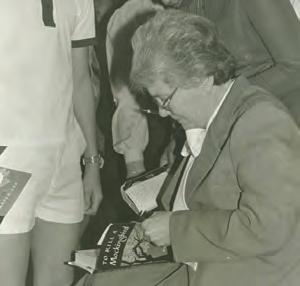
The youngest child born to Monroeville, Alabama, attorney A.C. Lee and Frances Finch Lee arrived on April 28, 1926. They named her Nelle, a reverse spelling of her maternal grandmother’s name. Her middle name, which years later she would use for her byline, was an homage to Dr. Harper, a local pediatrician.
The world knew precious little of Nelle Harper Lee in her first few decades. She left home in 1944, first for a brief stint at Montgomery’s Huntingdon College and then on to the University of Alabama. In Tuscaloosa, she wrote for campus publications and raised eyebrows for her sometimes nonconformist habits of dress and decorum. She left with an education, but too early for a degree, in 1949. She was 23 years old and determined to become a writer in New York City. “I do believe I can make a living at it,” she told her family. Time proved her quite correct.
Our National Novel
A long decade of writerly toil separated Lee’s Manhattan arrival and success. In 1956, two of Lee’s friends who recognized her talents, Michael and Joy Brown, presented her with a lifechanging Christmas gift: a yearlong stipend to “write whatever you please.” Lee took the Browns' gift and returned it to us all with the 1960 publication of her Pulitzer Prize-winning To Kill a Mockingbird Young narrator Jean Louise “Scout” Finch takes readers through Depression-era Maycomb, a thinly disguised version of Lee’s hometown, in a coming-of-age story about racial justice and fairness.
Writer Casey Cep says that Mockingbird “somehow managed to be both urgently of its time and instantly timeless…speaking in the register of the eternal.” We are charmed by the unmanaged childhoods of Scout, Jem and Dill, drawn to admire the quiet dignity of the mournfully condemned Tom Robinson, curious about reclusive Boo Radley, steadied by headstrong Calpurnia. Even mean old Mrs. Henry Lafayette Dubose wriggles her spiteful way into our hearts.
Then there’s Atticus. In her portrait of local attorney Atticus Finch, Lee created one of the great characters of modern American literature. “You never really understand a person until you consider things from his point of view,” Atticus tells his daughter Scout. At moments when it mattered the most, the principled attorney lived up to his own teachings.
The author soon saw her characters brought to life on the silver screen, through memorable performances by two young Alabamians portraying Scout and Jem alongside Gregory Peck, Robert Duvall and Brock Peters. People are perennially drawn to the film, as well as a popular stage play at theaters large and small, including an annual production in Monroeville.
Onto the scene decades later came Go Set a Watchman. Published in 2015 by HarperCollins in unrevised form, just as Lee had submitted it decades earlier. It was not Mockingbird’s sequel, but rather an earlier version that was set in the mid-1950s and told from the perspective of an adult Scout. When Lee submitted it, her editor Tay Hohoff suggested a rewrite focusing on the childhood flashbacks; Mockingbird was born. God bless editors.
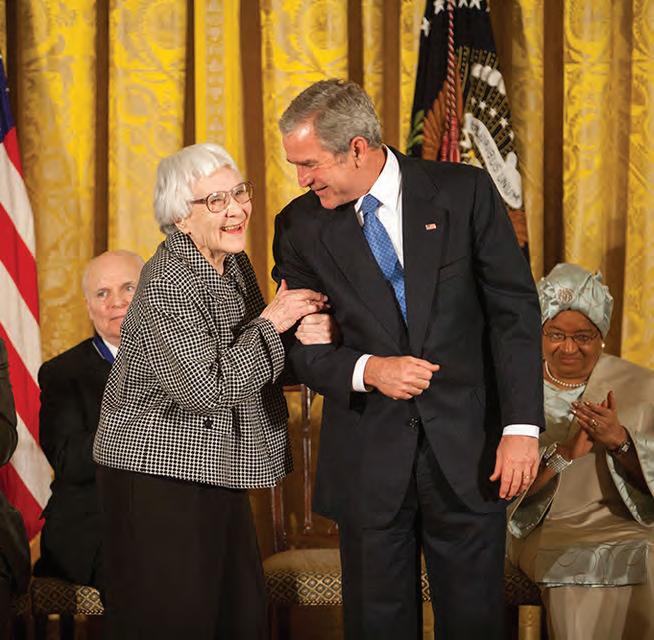
Since 1960, Mockingbird has sold more than 40 million copies and has been translated into dozens of languages. And yet, it is more than a mere book, a collection of some 360 pages. Oprah Winfrey once called Mockingbird “our national novel.” When he bestowed upon Lee the Presidential Medal of Freedom in 2007, George W. Bush said Mockingbird had “influenced the character of our country for the better.” Its simplicity helps keep it fresh in our minds, not unlike the songs or scriptures of our youth. It is elemental, eternal.
Owl in Daylight
A few scattered articles flowed from Lee’s pen in the years that followed. She labored on a second novel based on the real-life story of an Alabama minister accused of killing several family members. But the book never came. Years later, writer Casey Cep picked up that story in her own book, Furious Hours: Murder, Fraud, and the Last Trial of Harper Lee (Knopf, 2019).
Public events were few. In 1983, Lee reluctantly agreed to headline Eufaula’s History and Heritage Festival. Like a literary Woodstock, thousands would claim to have been in attendance. “I let my sister talk me into this,” she nervously proclaimed backstage, “and I feel like an owl out in daylight. Never again!” She avoided mockingbirds and Maycomb that day, delivering instead an appreciation of early Alabama historian Albert Pickett’s romantic prose. Pickett wrote history “composed of small dramas within a huge drama,” Lee said, leaving little wonder why she was drawn to his work.
ERIC DRAPER
PHOTOCOURTESYTHEWHITEHOUSE,
“I am still alive, although very quiet,” Lee wrote to her agent a decade later. She traveled from Manhattan to Monroeville as she pleased. Quiet, yes; but content in it. Interview and speaking requests were generally refused. A stroke in 2007 brought Lee back to Monroeville for her life’s final chapter. Much of what we know from these years comes from eminent Alabama historian Wayne Flynt. In heartfelt books Mockingbird Songs (Harper, 2017) and Afternoons with Harper Lee (NewSouth, 2022), he recounts the long friendship he and his late wife Dartie shared with the writer. In those pages we see how thoroughly Lee lived out the words she wrote to a Mobile friend in the 1960s: “People who have made peace with themselves are the people I most admire in the world.” Nelle Harper Lee died in Monroeville on February 19, 2016, a few weeks shy of her 90th birthday, at peace with a world made better because she lived in it.
Now, a decade since her passing, readers are treated again to material from Lee’s hand. The Land of Sweet Forever (HarperCollins, 2025) is a small collection of previously unpublished stories written in the 1950s. Many await completion of an announced authorized biography by Casey Cep, which will assuredly draw from sources in the family’s possession. Like the knothole in the old oak where Boo Radley left his treasures, these closely held archives may soon offer additional glimpses into the life of one of Alabama’s greatest writers.
Still, if we never received another word from Lee, if the pens of her friends and biographers fell forever silent, what we are left with might still be enough: Her immortal characters. Her unchanging Maycomb. Mockingbird’s ageless message, in the end, might be enough, indeed.
President George W. Bush awards the Presidential Medal of Freedom to
TOURABLE ALABAMA
Take a tour and learn more about the Heart of Dixie
BY AMBER LANIER NAGLE
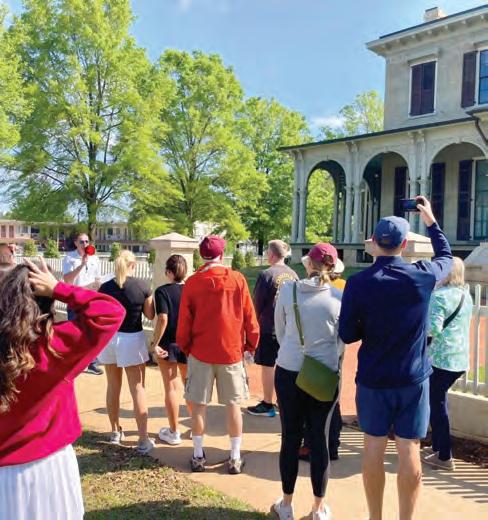
Agroup congregates at the front of the Jemison-Van de Graaff Mansion, their eyes scanning the porch columns, the ornate trim work and the belvedere positioned at the top of the structure. This Tuscaloosa manor is one of the finest remaining examples of Italianate architecture in the South.
Wearing comfortable walking shoes and speaking into a red bullhorn, historian Will Hawkins addresses the attentive crowd.
“ The mansion was completed in 1862 and was quite technologically advanced for its time,” says Hawkins, executive director of Historic Tuscaloosa. “It had a fully functioning bathroom original to the house — the first in Alabama to feature a built-in bathtub and indoor plumbing with warm water.”
Hawkins’ roadside speech turns to the family lineage, starting with the original owner, Alabama state Sen. Robert Jemison. Jemison’s great-grandson, Dr. Robert Jemison Van de Graaff, born in the mansion in 1901, became a worldrenowned physicist and invented the Van de Graaff generator.
“ Tuscaloosa is full of history and stories like these,” says Hawkins. “Our walking tour gives people an opportunity to get outside and explore a few of our city’s landmarks while learning about the architecture and our rich history.”
Many places across Alabama invite guests and locals to slow down and experience the soul of their cities through tours, both self-guided and expert-led. City by city, step by step, these pedestrian adventures offer an immersive perspective impossible to capture from a car window. Here are a few.
Tuscaloosa
Guided
History comes alive with this free 90-minute walking tour on Saturday mornings in April, beginning at the Jemison-Van De Graaff Mansion and winding down Greensboro Avenue, University Boulevard and Queen City Avenue. The tour is limited to about 20 participants, and interested parties must call Historic Tuscaloosa to reserve spots in advance.
The group strolls to the Bama Theatre, The Murphy-Collins House (home of the Murphy African American Museum), Battle–Friedman House and several churches along the route.
“We stop at the University Club — once the Governor’s Mansion,” says Hawkins. “It’s a Greek Revival-style
home built in 1834, and people love to hear that Francis Scott Key (who wrote the poem that would become America’s national anthem) stayed here one time. Down the road, the seven-story Alston Building was Tuscaloosa’s first skyscraper and known in 1909 as America’s ‘tallest building east of Chicago on a dirt road.’ There’s so much to see here!”
Martin Luther King, Jr. Street
Selma, self-guided
Known for “Bloody Sunday,” when peaceful protesters were brutally attacked on the Edmund Pettus Bridge, Selma was a turning point in the Civil Rights Movement and the spark that led to the passage of the Voting Rights Act of 1965.
“The Martin Luther King Jr. Street Walking Tour is one way to absorb that history on foot,” says Sheryl Smedley, executive director of the Selma and Dallas County Chamber of Commerce. “There are a series of interpretive signs along the route that provide historical timelines and connect the sites to the Selma marches.”
This free self-guided tour begins at the Centre for Commerce (where maps are available) and winds past 13 stops including the First Baptist Church, which served as Student Nonviolent Coordinating Committee headquarters during the Selma Campaign; the George Washington Carver homes; the Martin Luther King Jr. monument; and Brown Chapel AME Church, the Romanesque Revival landmark built in 1908 that served as the starting point for the marches.
“ Those who would rather learn from a personal tour guide can call the Selma and Dallas County Chamber of Commerce,” Smedley says. “We can direct them to tour guides — some with connections to Selma foot soldiers.”
Historian Will Hawkins leads visitors through downtown Tuscaloosa, including a stop to discuss the history of the Jemison-Van de Graaff Mansion, one of the finest remaining examples of Italianate architecture in the South.
The First Baptist Church stands as a powerful stop along Selma’s Martin Luther King, Jr. Street Walking Tour, a self-guided tour through one of the most pivotal chapters in American civil rights history.
For those sightseers with mobility issues and concerns, the buildings and monument along this city block are easy to see from the comfort and safety of a car.
Downtown Mobile Alliance Tour
Mobile, self-guided
As Alabama’s oldest city, founded in 1702, Mobile carries layers of French, Spanish and Creole heritage that are impossible to absorb in a single visit, which is why the Downtown Mobile Alliance created a self-guided tour spotlighting 50 landmarks — easy to navigate via an online map (at downtownmobile.org) for a halfday, a day, or even a weekend visit. In recent years, Mobile has invested in street and sidewalk improvements to make its historic downtown more walkable and accessible to all visitors.
The tour begins at the Daniels, Elgin & Co. Building (circa 1860), whose prefabricated cast iron façade — modeled after 15th and 16th century Venetian waterfront palazzos — miraculously survived scrap-metal drives during various war efforts. Nearby, the Battle House Renaissance Hotel & Spa (circa 1852, rebuilt in 1906) charms visitors with an interesting acoustic and architectural feature on its second floor.
“ The Battle House Hotel has a whispering arch, where visitors can whisper on one side, and people on
the other side can hear them,” says Fred Rendfrey, the Alliance’s President and CEO. “It was used for eavesdropping.”
Further along the mapped route, the Creole Fire House No. 1 (circa 1872) tells a fascinating story of Mobile’s Creole community, whose founding fire company operated much like an insurance company.
“Like insurance, it only provided (fire protection) services to paying members,” Rendfrey says. “The building has changed hands and been different things over the years, but the fire pole is still in there. I’ve slid down it myself.”
Historic Twickenham Huntsville, guided Erica Matthews, Tourism Sales Manager at the Huntsville/Madison County Convention and Visitors Bureau (CVB), says that Huntsville’s historic districts are best experienced on foot. Since 2003, the CVB’s complimentary guided tours have taken place every Saturday in April at 10 a.m., winding through neighborhoods like Old Town, Five Points and the Twickenham Historic District, one of Alabama’s most significant architectural and political areas.
“Our tours typically last between one and two hours, and they are familyfriendly for all ages and even welcome leashed pups,” says Matthews. “Most groups draw an average of around 10 participants, though a few have had close to 200. Our tours are extremely popular, and we usually have a great turnout — a mix of out-of-towners and locals alike.”
Founded in 1814, Twickenham boasts the state’s highest concentration
of antebellum homes, showcasing styles ranging from Federal and Greek Revival to Queen Anne and Bungalow. Beyond its architectural beauty, the neighborhood holds deep political significance. In 1819, 44 delegates gathered here for Alabama’s first constitutional convention, deliberating the state’s future in the very homes that line these streets.
This tour departs from the Alabama Constitution Hall Historic Park and winds eastward, passing places like the Weeden House Museum (the oldest house in Alabama open to the public) along sidewalks and pavement areas that are wheelchair- and mobilityassistive device accessible. After taking in Twickenham, hungry sightseers are encouraged to stay downtown and try out one of many lunch spots.
Gadsden
greatergadsden.com/events/april2026-gadsden-walking-tours/ Greater Gadsden Area Tourism hosts free guided walking tours each Saturday in April. Visitors are asked to meet at the Greater Gadsden Area Tourism Visitor Center at 9:45 a.m. for a free, guided one-hour walk through beautiful downtown.
Every Saturday in April, the Chamber of Commerce presents free walking tours of downtown Monroeville. Meet just before 10 a.m. on the steps of the Monroe County Museum to participate in the 45-minute tours.
Left: The Battle House Renaissance Hotel has been Mobile's social anchor since 1852. Today, it remains one of the crown jewels of the Downtown Mobile Alliance's self-guided tour. Middle: The grand lobby of the Battle House Renaissance Hotel dazzles with arched ceilings and intricate plasterwork.
Above: The Weeden House—the oldest house in Alabama open to the public—is one of the stops along the Historic Walking Tour of Twickenham, a tour winding through Huntsville's storied past.
PHOTOS COURTESY HISTORIC HOTELS OF AMERICA AND BATTLE HOUSE RENAISSANCE MOBILE HOTEL & SPA
PHOTO
WHAT IS AL SMP?
The mission of the Alabama Senior Medicare Patrol (AL SMP) is to help Medicare beneficiaries prevent, detect, and report health care fraud, abuse, and errors. Federally funded through the Administration for Community Living (ACL), AL SMP is comprised of dedicated staff and volunteers who respond to reports of suspected Medicare fraud and determine next steps.
1. Conducts Outreach and Education. AL SMP provides educational materials, displays exhibits at events, and works one-on-one with Medicare beneficiaries. 2. Engages Volunteers. Protecting older persons’ health, finances, and medical identity while saving Medicare dollars is a cause that attracts civic-minded Americans. 3. Receives Beneficiary Complaints. When fraud is suspected, AL SMP makes referrals to the appropriate federal agency for further investigation.
• Review your Medicare Summary Notices (MSNs) and/or Explanations of Benefits (EOBs) • Access your Medicare information at Medicare.gov • Report suspicious Medicare activity by contacting your local AL SMP that offers FREE and CONFIDENTIAL services
More Alabamians Now Qualify for Prescription Drug Savings
There’s good news for Alabamians living with limited income and resources. The Medicare Extra Help program—also known as LIS—expanded in 2025. If your income is below 150% of the federal poverty level, you may now qualify for full Extra Help benefits. This means you could pay lower or no premiums, reduced Part D drug copays and reduced or no Part D deductible for your prescriptions. Many people don’t realize they’re eligible—so it’s worth checking.
For example, in 2025, individuals earning less than $23,475 per year (or couples earning less than $31,725 per year) may qualify as long as your assets are below the specified limits. You could save hundreds of dollars each year on the medications you rely on!
To see if you qualify for Extra Help, call: The Social Security Administration at 1-800-772-1213, between 8 a.m. and 7 p.m., Monday through Friday. TTY users should call 1-800-325-0778
Choose a Medicare plan with confidence.
Medicare can be complex, and it’s normal to feel uncertain with so many parts and plans to consider. Blue Cross and Blue Shield of Alabama understands this and offers Medicare plans grounded in decades of experience and trust. For generations, Blue Cross has been a steady partner for individuals and families, providing coverage that gives you confidence and peace of mind as you navigate your healthcare choices. With a name you can depend on, you can feel secure making important decisions about your health.
How to Choose the Right Plan for You
Selecting the right Medicare plan is a crucial decision, and it’s important to consider several factors to ensure the best fit for your needs. Here are some considerations to help you decide:
Is your doctor in the plan’s network?
What will your prescription costs be?
What are your overall monthly expenses?
Designed for Alabamians by Alabamians
Are you covered when you travel?
Are there extra benefits like dental, vision and hearing?
Simplified Plan Options
Understanding that every individual has unique healthcare needs, Blue Cross offers a variety of plan options to ensure that you find the right fit:
• A Part C Medicare Advantage plan
• Offers all-in-one coverage
• Combines medical and prescription drug benefits with extras like vision and dental
With 90 years of experience, Blue Cross and Blue Shield of Alabama offers trusted healthcare coverage. Our extensive network includes 90% of doctors and 100% of hospitals in Alabama,1 providing access to top-tier care statewide. We offer comprehensive plans that cover medical expenses, prescription drugs and include additional benefits like dental, vision and hearing.
Our commitment to quality is reflected in high customer satisfaction and ratings, with Blue Advantage plans earning 5 stars for “Member Experience with Health Plan” and 4 stars overall in 2025.2 Our emphasis on customer service ensures you’re never alone in navigating your healthcare options.
Choosing Blue Cross means peace of mind, with local resources and straightforward plans designed to make your Medicare journey simple and easy.
• A Medicare Select Plan or type of Medigap Medicare Supplement plan
• Provides fewer out-of-pocket costs for Medicare-covered services
To get more information or talk to a local advisor, call 1-855-978-5194 (TTY 711) or visit BCBSALMedicare.com/BA1, 8 a.m. – 8 p.m. CST.3
• A Medicare-approved Part D plan
• Pairs with C Plus or Original Medicare
• Helps pay for prescription drugs
Poisonous Plants of Alabama: What Gardeners and Outdoor Lovers
Should Know This Spring
Spring in Alabama invites gardeners and nature lovers back outside, but it also brings renewed growth of several toxic plants that can quickly spoil the season. A little plant awareness is all it takes to avoid painful rashes, stings, and unwelcome surprises. Here’s a friendly guide to the plants you’re most likely to encounter.
Poison Ivy: The Springtime Scourge— Leaves and Vines
Poison ivy is one of Alabama’s most common irritants. Its “leaves of three” may appear smooth or jagged, often with a reddish spot at the base of the lower leaflets. All parts of the plant contain urushiol, the oil responsible for the infamous itchy, blistering rash.
Also important to know — poison ivy’s vines are just as irritating as the leaves. As the vine matures, it develops dense, hairlike roots that cling to trees and other surfaces. These “hairy vines” contain the same rash-causing oil and can trigger a reaction even if touched accidentally. Vines can become thick and woody, making them easy to grab by mistake when clearing brush.
Poison ivy thrives along forest edges, in wooded areas, and even in urban green spaces, making spring a prime time for accidental encounters.
Poison Oak: A Fuzzy LookAlike
Poison oak closely resembles poison ivy but has rounded, oaklike lobes and often fuzzier leaves. It also grows in clusters of three and contains urushiol. Instead of climbing, it typically grows as a small shrub and tends to favor drier, sandy areas such as pine woods and scrub habitats.
Poison Sumac: A Wetland Threat
Unlike ivy and oak, poison sumac doesn’t have clusters of three leaves. Instead, it features seven to 15 smooth, elongated leaflets arranged along a central stem. It grows
as a shrub or small tree in wetlands like bogs and swamps. Contact can result in a more severe reaction than either poison ivy or oak.
Stinging Nettles & Spurge Nettle: Pain Without the Rash
Stinging nettles and spurge nettle or “tread softly” aren’t chemically poisonous, but their fine, needlelike hairs deliver a sharp sting that can lead to redness, burning, and temporary swelling. These plants are common along woodland edges, sandy openings, and disturbed sunny sites — places gardeners and hikers frequent in spring.
Controlling Poisonous Plants: A Quick, Practical Guide
While poisonous plants can sometimes be left alone in low traffic areas, they become a problem when they grow near homes, gardens, or spaces used by children and pets. Here’s a simple overview of effective control options:
• Herbicides are the safest and most reliable option. Products containing glyphosate or triclopyr work well on poison ivy, oak, and sumac. They’re most effective when applied during active growth — usually spring through summer — and may require repeat applications.
• Mechanical removal requires extreme caution. Since urushiol is present in leaves, stems, roots, and even dead vines, pulling or cutting plants can easily cause exposure. Poison ivy’s hairy vines are particularly hazardous. If removal is necessary, wear heavy protective gloves and clothing, wash tools afterward, and launder clothing separately.
• Never burn plant material. Burning can send urushiol into the air, creating dangerous fumes.
• Prevent regrowth by managing site conditions. Monitor fence lines, tree bases, and shady edges regularly. Maintaining healthy groundcover and reducing soil disturbance can help discourage these plants from reappearing.
With a bit of awareness and some basic identification skills, you can enjoy Alabama’s beautiful spring season while avoiding the itch, burn, and irritation these plants can cause.
Bethany O’Rear, a horticulturist for more than 20 years, is a regional agent with the Alabama Cooperative Extension System, specializing in commercial and home horticulture.
Poison Ivy
Poison Oak
Poison Sumac
Stinging Nettles
Outdoors
Practice Capturing Nature & Wildlife With a Camera
“People could get a very advanced point-and-shoot camera for about $1,000,” Tes says. “These ‘bridge cameras’ have many features. One good thing, people don’t need to swap lenses. These cameras come with a fixed lens that shoots from wide angle to telephoto. They are easy to carry and make super starter cameras.”
As people become more skilled, they might want to upgrade to better quality equipment and accessories. Buy an upper end camera body with several detachable lenses. A lens that goes from 18 mm to 300 mm can suffice for most photography situations. Nikon, Canon and Sony make the best quality cameras. A Nikon 18-300 mm zoom lens costs about $600.
photographer
Practically everyone carries a camera nowadays. Even into the bathroom! Cameras on high-end smart phones can take amazing photos, but some photographers want to do better than that.
An award-winning photographer from Tuskegee, Tes Jolly and her husband Ron with Jolly’s Outdoor Visions travel the country shooting photos and videos. Ron filmed hunting videos for Primos Game Calls among other things. Besides photography, they raise money for wild turkey conservation through Turkeys For Tomorrow (turkeysfortomorrow.org).
“The technology today is so advanced that anybody who wants to take the time to learn their equipment can take terrific photos,” Tes says. “Now, it’s better, smaller and lighter. People don’t need to spend thousands of dollars to get into photography. I still use my cell phone camera for many things.”
To start getting into wildlife photography, Tes recommends getting “a point-and-shoot bridge camera.” Bridge cameras are versatile digital cameras that “bridge” the gap between simple point-and-shoots and advanced DSLRs or mirrorless cameras. With such a camera, people just need to point it at their subject and press the button. The camera does the rest.
“The lens is the critical part of a camera,” Tes says. “Get lenses with the best quality glass possible. Something that goes from wide to telephoto is a good starter lens. People can do just about anything they want with it. Photographers can get good deals on slightly used equipment from B&H Photo Video (bhphotovideo. com) in New York. I have purchased several items from them.”
With good equipment in hand, practice, practice, practice. The best thing about digital photography, photographers don’t need to buy film or pay to develop it. Keep shooting photos multiple times of each subject and simply delete the bad images.
“If people really want to get into wildlife photography, find someone who does a great job and get on their social media or webpage,” Tes says. “People can learn a lot from such people. I recommend Steve Perry with Backcountry Gallery (backcountrygallery.com). I’ve learned a lot from him.”
Even with high-tech equipment, people must still practice their wilderness skills to take fantastic photos. Learn as much as possible about the subject. For instance, to take photos of whitetailed deer, learn its habits and habitats. Get as close as possible without disturbing the subject. Go to places like preserves and parks.
“Go places where people can encounter wildlife,” Tes says. “A lot of great photos come off public lands where animals get slightly habituated to people. Good places include parks and campgrounds. Above all, respect wildlife. Don’t make an animal do something or scare it just to get a photo. Do not stress the animal or the subject. Get that photo, but don’t disturb the animal. That takes patience.”
Fortunately, Alabama photographers can visit many public places all year long where animals become accustomed to people. Wheeler National Wildlife Refuge near Decatur provides an excellent place to photograph waterfowl and other birds, such as bald eagles or sandhill cranes. Many refuges and sanctuaries create viewing areas specifically established for wildlife watching and photography where people can hide and view nature without alarming the animals.
“Any state park could offer great places to get wildlife photos,” Tes says. “Most parks have good wildlife populations. DeSoto State Park offers beautiful scenic views and wildlife. Oak Mountain State Park is another good spot. Even in city parks with ponds, people might be able to shoot photos of waterfowl and other birds or small animals.”
Sanctuaries, such as the Robert G. Wehle Nature Center (alabamaforeverwild.com/wehle-tract) near Midway make wonderful places to take photos of various wildlife species, especially birds. In southern Alabama, visit the Environmental Studies Center (mcpsesc.com) in Mobile.
“I don’t go anywhere without a camera,” Tes says. “When someone goes into the woods, they never know what they might see that day.”
Award-winning
Tes Jolly spends a lot of her time in the woods photographing nature and wildlife.
Su 31 NA 12:06 - 2:06 FULL MOON 6:09 - 7:39 6:33 - 8:03
Alabama Recipes
CHEESE, please!
OChicken, Bacon and Broccoli Mac and Cheese
3/4 cup elbow macaroni
3 cups broccoli, chopped
5 slices bacon
1 pound chicken breasts, cubed
1 teaspoon salt, plus more for pasta water
1 tablespoon garlic minced
1/8 teaspoon turmeric
11/4 cups Half & Half
1 cup chicken broth
1/4 cup all-purpose flour
1 cup cheddar cheese
1/2 teaspoon black pepper
Preheat the broiler to medium or low setting. Cook elbow pasta in water with a pinch of salt according to package directions for al dente. During the last few minutes of cooking, add chopped broccoli. Drain and set aside.
In a large, oven-safe skillet, cook bacon. Drain and set aside to crumble when it cools. In the same pan, add chicken breasts that have been cubed into bite-size pieces. Season the chicken with half of the teaspoon salt. Cook in the pan drippings over medium heat until chicken has browned. Add minced garlic and cook a minute more, stirring often to prevent burning.
Add in the turmeric and cook a minute more. In a large bowl, mix another half teaspoon of salt, Half & Half, chicken broth and flour. Whisk to combine. Pour over chicken in skillet. Season with pepper. Increase the heat to a soft boil and boil a few minutes until thickened. Remove from the heat. Stir in half of the cheese and spread evenly in the pan. Top with the other half of the cheese and reserved bacon. Broil on low to medium until bubbly and slightly brown.
ne of the most nostalgic foods for me growing up is my Momma’s Mac and Cheese. She made this luxurious roux base and it always had lots and lots of CHEESE! I decided to take that basic, yet perfect, recipe and add a bit more to it. I love to play with spices and this one has a special spice to make it even more delicious. Not to mention that adding bacon and chicken takes this from a delicious side dish to a full meal. For more recipes like this, visit us at thebutteredhome.com.
Brooke Burks
PHOTO BY THE BUTTERED HOME
Cook of the Month
Laurie Myer, Southern Pine EC
Cheese is near and dear to the heart of Laurie Myer, who was a dairy farmer along with her husband, Norman, for several years in Lottie, near Atmore. Now retired from full-time teaching at Perdido Elementary School where she still substitutes when needed, she enjoys cooking and especially likes making her prize-winning “Baked Chicken Cordon Blue Casserole.” “I like to make it on the weekend, then bake it on Monday,” she says. “It lasts a long time.” Laurie, a New Jersey native who lived in Pennsylvania before moving south, says she came across the recipe probably on Pinterest and tweaked it a bit. Using cubed ham and chicken makes it easier than the traditional cordon blue recipe which requires pounding chicken breasts flat and wrapping them with ham and cheese. “It uses a lot of cheese, but us being former dairy farmers, it was a good promotion for our industry,” she adds. If you don’t have a cooked ham at home, you can also use deli ham (she recommends Boar’s Head), and for the chicken “I always use chicken breasts.” The cream sauce blends deliciously with the Swiss cheese, and panko crumbs on the top give it “crunch.” Laurie says she’s made this casserole for friends who were sick, and others who’ve had a death in the family, and it’s always appreciated. The name “cordon blue” is French for “blue ribbon,” and in this case, it perfectly suits our winning recipe! -Lenore Vickrey
Baked Chicken Cordon Blue Casserole
2 cups ham, cubed
2 cups chicken, cooked and cubed
Cheese sauce:
4 tablespoons unsalted butter
1/4 cup all-purpose flour
2 cups milk
1 tablespoon Dijon mustard
1 tablespoon lemon juice
1/2 teaspoon garlic powder
1/4 teaspoon salt
11/4 cups Swiss cheese (5-ounces), shredded
1/4 cup Parmesan cheese, grated
Panko topping:
1 cup panko breadcrumbs
3 tablespoons butter, melted
Heat oven to 350 degrees. Spray 9x13-inch pan. In a saucepan, melt the butter; whisk in the flour until mixture gets dry and clumpy. Whisk in milk slowly. Add the mustard, lemon juice, garlic powder and salt. Simmer for 3-5 minutes whisking until mixture thickens. Remove from heat and stir in Swiss cheese and Parmesan cheese. Layer the cooked chicken on bottom of pan, then ham on top. Pour cheese sauce over top of layered chicken and ham. Pour 3 tablespoons melted butter over panko breadcrumbs. Combine and pour over casserole. Bake uncovered for 30-35 minutes. Cool 10 minutes, then serve. Goes well with rice or pasta.
ENTER TO WIN $50 Cook Of The Month Prize!
Red, White and Blue Party Food
Celebrate 250 years of our great nation with red, white and blue foods and treats or your favorite 4th of July dish!
July theme: enter by May 1, 2026
WEBSITE: alabamaliving.coop or scan here:
EMAIL: recipes@alabamaliving.coop
MAIL: Alabama Living Recipes, 340 Technacenter Dr., Montgomery AL 36117
Please include the name of your electric cooperative
Baked Chicken Cordon Blue Casserole
Brie in a Bread Bowl
1 16- ounce round Brie cheese
1 round bread loaf
1/3 cup savory jam (onion, fig, tomato, etc.)
Olive oil
Topping:
2–4 tablespoons butter
1 medium purple onion, diced
½ cup dried cranberries, or cherries or any dried red fruit
1 heaping tablespoon brown sugar
1 tablespoon red wine vinegar
½ cup pistachios, chopped (substitute pecans or walnuts)
Preheat oven to 400 degrees. Line a sheet pan with parchment paper or foil. Slice the top off the bread loaf, then scoop out enough of the inside so that the Brie fits in snugly and even with the top, then take out the Brie. Reserve the chunks of bread that were removed.
Spread your favorite jam around the bottom and sides of the hole. Cut slits around the top of the bread about two inches down from the top then put the brie back in. It is not necessary to peel off the white rind which is edible and quite tasty.
Put the Brie bread bowl in the hot oven. Take the reserved bread from the top of the loaf and cut it into two-inch chunks. Put that and the chunks you cut out from the inside of the loaf into a bowl, drizzle with olive oil, toss to coat and lay in a separate lined sheet pan. Toast the bread cubes in the same oven while the Brie heats.
Cook time is about 20 minutes. The Brie should be soft all the way through and bubbling around the edges. Toss the bread chunks so that they brown evenly.
Topping:
Saute’ the onion in the butter until pieces are soft and clear. Add the remaining ingredients except for the pistachios, and cook until syrupy, stirring frequently.
When done, take the brie out of the oven and let it sit for ten minutes. Add the onion topping over the brie and sprinkle with the chopped pistachios. Pull off a chunk of the loaf, or dip with the toasted chunks.
Gretchen Mayer Baldwin EMC
Cheeseburger in Paradise
Dip/Spread
1½ pounds ground beef
1/4 cup Heinz 57 sauce
1/3 cup kosher dill pick le, chopped
2 tablespoons pick le juice
16 ounces Velveeta cheese
Shredded lettuce, for topping
Fresh tomato, chopped, for topping Hawaiian Buns, toasted, or tortilla chips, for serving
Cook and scramble the ground beef. Drain well. Add the chopped pickle, pickle juice, Heinz sauce and Velveeta cheese. Heat and simmer until the cheese is melted. When ready to serve, pour into a service dish and top with the shredded lettuce and chopped tomato. Serve with toasted Hawaiian buns or tortilla chips.
Note: Dip warms great in slow cooker for transporting and tailgating. The lettuce and tomato can be served in separate bowls.
Joy Griswold Dixie EC
Confetti Cheese Ball
16 ounces cream cheese, softened
1 cup walnuts, finely chopped
½ cup dried cranberries, finely chopped
1 cup medium cheddar cheese or Colby Jack (your preference), finely grated
1 large can chicken, well-drained
1 teaspoon onion salt
1 teaspoon garlic salt
1 tablespoon everything bagel
1 tablespoon dried chives
1 tablespoon brown sugar
1-2 cups pecans, finely chopped (reserved to roll your cheese balls in)
In a large bowl, dump everything together and mix with your hands. Mix well to incorporate all the seasonings, nuts and cheese. Once thoroughly mixed, divide mixture into two portions and roll into two balls. Roll each cheese ball in the finely chopped pecans, pressing firmly so that the pecans stick. Immediately wrap in clear plastic wrap very tightly. Let the cheese ball sit 4 hours to overnight. Serve with crackers.
Aprille Thompson
Central Alabama EC
Laurie’s Olive Cheese Balls
8 tablespoons (½ stick) salted butter
2 cups extra sharp cheddar cheese, grated 11/4 cup (8-ounces) flour
36 pimento-stuffed green olives, juice drained
Preheat oven to 400 degrees. Melt butter in a medium saucepan over low heat or in a medium mixing bowl in microwave and remove from heat. Stir in flour until well-mixed. Grate cheese into mixture. Stir to mix into dough. Divide it into 6 equal portions. Beginning with one portion, divide it into 6 bits. Form each one around an olive, concealing it with the dough bit and placing it on a greased or parchment-lined jelly roll baking pan. Do similarly with the other 5 portions, arranging the olive cheese balls with some space around each, so that all 36 are baked on the same pan. Bake 20 minutes or until they become light golden brown. Let sit a few minutes before transferring them to a platter, but they are best served while still warm. If smaller appetizers are desired or a bigger crowd anticipated: Start with more olives and portion dough accordingly. I’ve stretched it to nearly 5 dozen.
Laurie Klaas Baldwin EMC
Confetti Cheese Ball
IN TIMES OF UNCERTAINTY, FOLLOW HISTORY, BUY
In times of economic uncertainty—when inflation rises, markets fluctuate, and long-term financial stability feels less predictable—many investors turn to gold as a dependable store of value. By holding a portion of your wealth in gold, you can help safeguard your portfolio and preserve longterm financial security, even when broader economic conditions are unclear.
Since 2015, gold has surged over 400% — outpacing both the S&P 500 and the Dow during the same period.
GOVERNMENT BACKED U.S. GOLD
• Free of dealer markup.
• Gold provides
• Gold offers financial cover during
• A strong portfolio diversifier.
and
order of 5 coins
Your Lawn Care
Electric lawn equipment has seen drastic improvements in cost, motor efficiency and battery power in recent years. From hedge and string trimmers to leaf blowers, chainsaws, and push and riding mowers, there are lots of options for electric lawn equipment.
Electric equipment is quieter than its gas-powered counterparts and typically needs less maintenance. There’s no more mixing fuel, changing spark plugs or worrying about gas going bad over the winter. Advances in rechargeable battery technology eliminate having to lug around a heavy extension cord to get your work done. Just pop in a battery and go.
Most popular lawn equipment brands offer batterypowered options, along with newer brands that specialize in electric tools. If you need multiple tools, buying the same brand with the same battery type allows you to swap batteries between different pieces of equipment. That also means fewer battery chargers to store or keep on your workbench.
Opt for equipment with brushless motors. They are more efficient, more powerful and have a longer lifespan than traditional brushed motors. A brushless motor typically costs more but is worth the improved efficiency. A brushed motor transfers electricity using physical brushes, which can wear down over time. The friction caused by the brushes makes equipment run hotter and noisier. A brushless motor uses electronic commutation with less friction, which makes it more powerful, extends the lifespan and allows you to get more done on a single charge.
Just as gas-powered lawnmowers require safe storage and handling of gas and oil, battery-powered equipment requires proper care for maintenance, charging and disposal. Always use the manufacturer’s original charging equipment, charge batteries on hard surfaces away from anything flammable, and store chargers in a cool, dry place.
Most manufacturers recommend charging batteries only until they reach full capacity instead of leaving them on the charger until you are ready to use them. This helps prevent damage to the battery from overcharging and heat buildup and reduces potential fire hazards. Unplug chargers when not in use to avoid energy waste.
Similar to gas and oil, old or damaged batteries should not end up in household garbage and landfills, where they can ignite fires and leak toxic chemicals into soil and groundwater. Instead, recycle them at a big-box store or at a county or city waste management site.
If you’re looking for a quieter, more efficient, lower maintenance lawn care routine, rethink your equipment options and consider electric models. If you decide to make the switch, check with your electric utility or state agency for potential rebates.
Miranda Boutelle is the chief operating officer at Efficiency Services Group in Oregon, a cooperatively owned energy efficiency company. She has more than 20 years of experience helping
Improved battery technology makes it easy to get more done on a single charge and avoid hauling around a cord.
PHOTO BY MARK GILLILAND, PIONEER UTILITY RESOURCES
Safe,
Just
Economical
Compact
Avoid moving or renovating. Live independently and comfortably right where you belong.
It’s Never Too Soon
Install now or plan ahead. A Stiltz Homelift keeps your home ready for the future.
Installed by certified experts from the world leader in home elevators.
A larger purpose Operation Round Up funds have a
wide impact across the Wiregrass
The members of Ashford High School’s track and field team know how to make do. They’ll brace on a chain link fence during stretches, practice jumps in a small sand pit, search out concrete areas for throwing and run laps around the football field.
“These kids have done extremely well for not having any facilities whatsoever,”
coach Brandon McCardle says.
The team recently received a grant from Wiregrass Electric Cooperative’s Operation Round Charitable Foundation, a cooperative program launched in 2015.
Members voluntarily round up their monthly electric bills to the next dollar, and their small monthly contributions are combined and used for the much larger purpose of helping local people.
The foundation’s nine-member board of volunteers, who are also cooperative members, oversees how the money is used.
David Hall, the foundation board president, says there are some community organizations that rely on grants from programs like Operation Round Up to help the people they serve.
“It’s that important,” Hall says. “It’s a vital part now, I think, of a lot of these programs. Without this funding, they
would not be able to function and certainly wouldn’t be able to get what they need to complete their task and their assignment and what they’re doing each and every day.”
ORU funds are used for community grants, scholarships and to fund the monthly prize for the Silent Heroes of the Wiregrass program.
For the 2024-25 financial year, the most recent audited year, Operation Round Up received more than $118,000 in cash contributions and more than $61,000 from its annual golf tournament. The foundation board ensures that every penny goes directly back into the community through grants, scholarships and emergency assistance.
David Hall, the Operation Round Up Charitable Foundation Board president, speaks about the program during this year’s Silent Heroes of the Wiregrass banquet. ORU funds are used for grants, scholarships and the monthly award presented to Silent Heroes of the Wiregrass winners.
“In a small town, you think you know everybody, but you don’t and you don’t realize what people do without trying to be recognized,” she says.
Hall, who spent 34 years in law enforcement before retiring earlier this year, has seen how community programs can turn lives around for the better.
ORU funds have gone to help afterschool programs for kids, library improvements, nonprofit organizations and local food pantries. Grants have helped teachers equip classrooms and bought equipment for local fire departments.
Rachelle Ford, the ORU board’s secretary, says she’s learned so much about her community serving on the board. The Silent Heroes of the Wiregrass winners and how they help their communities have been particularly inspiring to her, Ford says.
The foundation also provides emergency relief assistance up to $1,000 with approval by a committee made up of the foundation board’s officers. Such assistance might help a family whose home burned or someone who has to travel to Birmingham for cancer treatment.
Scholarships for traditional and nontraditional students, as well as those interested in becoming linemen, are also funded by Operation Round Up.
Requests for support actually exceeded the ORU funds available which is why Wiregrass Electric Cooperative began sponsoring a golf tournament four years ago to collect additional donations, Hall says.
The needs, he says, within the Wiregrass are far greater than most people might imagine. The ORU board holds
check presentations for public grant recipients like schools and nonprofit organizations. But, Hall says, that doesn’t represent the full number of recipients or requests received for help.
Hall says there have been several applications over the years that have profoundly touched him. One of the most meaningful ORU grant recipients for him is Freedom House, a faith-based recovery program located in Geneva County, helping individuals overcome drug and alcohol addictions.
“The Freedom House has been a recipient of numerous grants through Operation Round Up,” Hall says. “This program helps men and women to recover from addictions that affect every single person in some shape, form or fashion within our Wiregrass area. I don’t know that there’s a hope for some without that faithbased program — not just that one but many others throughout the Wiregrass that do great things.” n
ORU grant covers track and field team expenses
A $3,500 grant from Wiregrass Electric Cooperative’s Operation Round Up program will help cover expenses for Ashford High School’s track and field team.
Coach Brandon McCardle says the grant will help cover hotel costs for the team’s travel to the state competition in Gulf Shores. The team has gone to state every year since the program was created nearly 13 years ago. Students raise between $10,000 and $12,000 each year to help cover team expenses like competition fees and travel costs.
“We try to keep the philosophy that those who are raising money now, even
if you’re in the seventh or eighth grade and you’re raising money, you’re helping a senior or junior achieve their dreams of going to state, and that’s eventually going to be you in that place,” says McCardle, who has coached the team for eight years. “So, we try to build it forward.”
Track and field — which includes events like long jump, shot put, high jump and hurdles — has grown at Ashford High School with the team’s success at competitions. Many of the athletes participate in other sports as well.
“When I took over, we started with six players, six runners, and now we have 38 players on the team,” McCardle says.
The Ashford High School track and field team gathers at a check presentation with Wiregrass Electric Cooperative Board of Trustees, Operation Round Up foundation board members and WEC staff.
ABOVE: WEC’s Operation Round Up Foundation Board with the 2025 Silent Heroes of the Wiregrass winners.
RIGHT: Ashford High School track and field coach Brandon McCardle works with athletes as they move through anklestrengthening exercises earlier this year. The team received an Operation Round Up grant to help cover expenses.
The Corinth Experiment
Long-time readers know I grew up in Corinth, Mississippi, in Alcorn County, in the red clay hills of northeast Mississippi. It was and is Tennessee Valley Authority (TVA) country, about 20 miles from Pickwick Dam, one of TVA’s large series of dams on the Tennessee River. With that location, Alcorn County Electric Power Association (known to all of us as “ACE”) was created by the Roosevelt Administration in 1934 as the first electric cooperative and a test case for the rural electric cooperative model which would become known as the Rural Electric Administration or, to most everyone, the REA. Because ACE was headquartered in Corinth, it was often called “The Corinth Experiment.”
Poor people paid their power bill in person to save the 2-cent stamp. I would ride with my mom to the ACE office to pay the power bill. One of my dad’s friends, Red Wheeler, worked at ACE, but other than that I had no idea what a cooperative was, that ACE was one, or what ACE did.
Mom provided life direction for my younger brother, Bob, and me. She wanted us to be better and demanded that we go to college. We followed her instruction and received the first college degrees in our family.
After college, I went to law school, practiced law, and later worked in the aircraft maintenance industry. Changing careers again, I was hired to run the Legal Department at Alabama Electric Cooperative, which is now PowerSouth Energy Cooperative, in Andalusia, Alabama.
In reading information about electric cooperatives, I came across The Corinth Experiment and ACE’s history as the first electric cooperative. I called mom and asked her if she knew that ACE was an electric cooperative. She answered that she did and, also, that I knew most of the board members: J.B. Darnell, Bruce Dillingham, Bobby Roberts, and Fred Tull. J.B. Darnell and mom worked together for years at Pittman Brothers Propane before he started selling insurance. Bruce Dillingham was one of my high school coaches and a good friend. Bobby Roberts was the older brother of one of my best friends, and Fred Tull was a year behind me in high school.
Little did I know while growing up on ACE power that electric cooperatives would become the central fixture in my life. PowerSouth has been a wonderful home for me for almost 37 years. We have seen many challenges and successes together. There are many directions I could have gone, many paths I could have taken. I am so thankful that God shoved me through the door into PowerSouth. It has been the correct path for me.
Gary Smith is President and CEO of PowerSouth Energy Cooperative.
The path leads uphill and we haven’t seen the crest yet. Things are changing. The next decade will be an exciting time in the electric industry.
Our distribution membership expanded in 2026 with the addition of Black Warrior Electric Membership Cooperative and Tombigbee Electric Cooperative. Our members now provide retail service from Marion County in northwest Alabama to Gulf County, Florida, southeast of Panama City.
There is organic and measured growth across much of our service territory - new houses, new subdivisions, and new stores. Slow growth is steady and sound. Commercial and industrial growth is also beneficial. They can be managed but need to be targeted for the maximum benefit for our communities and the people who live and work there.
Other areas of the country are experiencing exponential growth. We have great people at PowerSouth who work with our distribution systems and local economic development officials to ensure larger growth is planned and done right.
As a not-for-profit cooperative, it is our job to build and maintain the assets needed to support community growth and prosperity. At present, we have little excess generating capacity, and little is available on the market. To provide for growing electric demand, PowerSouth is building a new power plant that will produce electricity during times of high usage. PowerSouth’s primary objective is to keep your power on at the most affordable cost possible. Electricity must be both reliable and affordable.
PowerSouth’s service improves each year, and we are highly competitive with other utilities in the region. We continue to emphasize infrastructure improvement and safety. Zero injuries is our goal.
As I approach retirement, I appreciate the unity of our members and their interest in working together and staying together. I am amazed at all of our business and community partners that work with the common goal of improving the lifestyle in communities our members serve so our young people will want to stay, work, and raise their families.
As I remember those trips with my mom to the ACE office all those years ago, I marvel at how much things have changed. However, the electric cooperative model started in my hometown continues to be successful, and I am confident it will continue to be successful into the future.
The Corinth Experiment worked well. I’ve been sort of a Corinth Experiment myself.
I hope you have a good month.
Closing Deadlines (in our office):
June 2026 Issue by April 25
July 2026 Issue by May 25
August 2026 Issue by June 25
Ads are $1.75 per word with a 10 word minimum and are on a prepaid basis; Telephone numbers, email addresses and websites are considered 1 word each. Ads will not be taken over the phone. You may email your ad to hdutton@areapower.com; or call (800) 4102737 ask for Heather for pricing.; We accept checks, money orders and all major credit cards. Mail ad submission along with a check or money order made payable to ALABAMA LIVING, 340 TechnaCenter Dr., Montgomery, AL 36117 Attn: Classifieds.
Miscellaneous
FOR SALE BY OWNER – 2 Timeshares with Club Wyndham – Call for more information (334)8784655, (334)996-8512
Vacation Rentals
MENTONE, AL LOOKOUT MOUNTAIN COTTAGE RENTALS – Best brow views, River Front –cottagesofmentone.com, Call or text (504)4818666
PANAMA CITY BEACH CONDO – Owner rental – 2BR / 2BA, wireless internet, just remodeled inside and outside – (502)7777819, larrysusemichel@reagan.com, www. theroneycondo.com
Pet Friendly – Save $$$ by booking directly from Verified Owners. ALAVHR.com
ABSOLUTELY LOWEST PRICES ON THE BEACH! Affordable Beachfront & Beachside Vacation Condos – Sugar Beach Condos in Orange Beach, AL. Rent Direct from Christian Family Owners. –www.gulfshorescondos.com, (251)752-2366.
GULF FRONT CONDOS – 2BR / 2BA and 1BR / 2BA. Balconies overlook the beach. amariewisener@gmail.com. (256)352-5721
PANAMA CITY BEACH CONDO - Rent directly from owner. 2BR/2BA. Egdewater Beach and Golf Resort. (256)586-3667, https:// huntssandtrap.com
MILITARY / SERVICE DISCOUNTS on dozens of rentals. No Booking Fees. (251)333-6500, ALAVHR.com
OWNERS – Join the fastest growing regional site in Alabama. Low annual fee. Verified Owners, no booking fees or commissions. Alabama Vacation Home Rentals. Locally Owned and Operated. (251)333-6500, ALAVHR.com
GULF SHORES / ORANGE BEACH / FORT MORGAN – Choose from hundreds of beach houses and condos! Verified Owners. No Booking Fees. ALAVHR.com
THAT MOMENT WHEN YOU FINALLY GET YOUR CONDO RENTED! You can thank us later. Alabama Living is delivered to homes and businesses in all 67 counties in Alabama.
Education/Free
FREE MATERIALS: When Church / Government Unite, Enforcing Sunday Law, The MARK OF THE BEAST is HERE! Don’t be deceived, be informed! Leave mailing address only – TBSM, POB 374, Ellijay, GA 30540 – TBSMADS@yahoo.com –(888)211-1715
ARE YOU CHANGING YOUR ADDRESS? If you’re a member of an electric cooperative, please contact your local co-op office with your new address so you can keep receiving Alabama Living. If you’re not a member of an electric co-op, send your new address to contact@ alabamaliving.coop.
Cup o’ Joe
As The World Book Turns
They were glorious, still beautiful after all these years in their red-and-gold bindings. They stood proudly, even if it was on the shelf of a thrift store. Most people under the age of 50 probably wouldn’t even know what they were, but I recognized them immediately.
That’s because when I was a kid, they were my Google, Gemini, ChatGPT, and Wikipedia. They were a middleclass status symbol. They were World Book encyclopedias.
A set of World Books contained basic information across a wide range of topics, arranged alphabetically. There were only 20 volumes, partly because certain paltry letters, like U-V, and X-Y-Z were combined into a single book.
Growing up, we had a complete set displayed proudly in a bookcase in the corner of our den. I had no idea where they came from or exactly when we got them. My guess is that my mother bought them in the early 1960s from a door-to-door salesman armed with a high-pressure pitch and a healthy dose of parental guilt about doing right by her four children.
They weren’t cheap. A full set cost around $180, almost $2,000 today, which made them one of the most expensive things in our house, right behind the television and the refrigerator. Fortunately, you could make manageable monthly payments of about $10 a month until the debt was finally paid off. I’m sure Mom bought them to help us with our schoolwork because my father wouldn’t spend that kind of money on books unless they included tips on improving your golf game.
Once I reached school age, they became an indispensable homework resource. It was as if we had a tiny library in our own home. If you needed to know something about almost anything like, volcanoes, Abraham Lincoln, or
the mating habits of penguins, the answer was somewhere on that shelf. Of course, finding it required some effort: pulling out the correct volume, flipping through it, and hoping your younger sister hadn’t spilled mustard on the page you were looking for.
Naturally, they had their limitations. In order to keep the encyclopedias current, annual updates were required, updates Mom never quite got around to buying. As a result, some of our information was outdated. When I did a report on Alaska, for example, the World Book explained that soon it would become a state. Looking back, World Books were a good investment because I read them constantly. Boredom often led to pulling one off the shelf and flipping through pages, discovering facts I hadn’t been looking for and didn’t particularly need, but somehow couldn’t stop reading. In my mind, this accumulation of random knowledge was going to pay off one day, hopefully on that new game show, “Jeopardy!”
Mom also supplemented our reference book collection by taking weekly trips to Kroger. That is not a typo. In the mid60s, a low-end knock-off of World Book, called Golden Book Encyclopedias, was distributed in grocery stores throughout the country. Every week, a new volume showed up at the checkout, and if you spent 20 bucks on groceries, for 99 cents it could be yours.
That just didn’t seem right. After all, we don’t go to Barnes & Noble to pick up a gallon of milk. And I just can’t see my Dad saying to Mom, “Hey honey, when you head down to the store, make sure to get a bottle of ketchup, and bag of potatoes. And for God’s sake, don’t forget to pick up Volume G of the Golden Book. I’ve heard it’s full of golf tips.”
Like Google, encyclopedias allowed you to tumble down rabbit holes. At the time, my only interest was rockets and propulsion. By cross-referencing topics, I learned that the Chinese had invented crude rockets using gunpowder as a propellant. That discovery eventually led to the ingredients, and the proportions. Soon I was making gunpowder in the basement with drugstore supplies and charcoal from my dad’s grill, perfect for my clandestine backyard experiments with homemade missiles.
And now, years later, reference books have been replaced by a phone that fits in your palm. There’s a infinite amount of information available in seconds literally at our fingertips. That’s progress. I’m not ashamed to say that a lot of the background information on this column was sourced with the help of Google Gemini. Ironic? Yep.
But for all the access to information we gained, something has been lost. Sometimes I miss feeling of the weight of an encyclopedia on my lap and the anticipation of what was on the next page. The books didn’t buzz, beep or chirp. They just waited to help someone complete a project, or a curious kid with some time to kill.
Joe Hobby is a standup comedian, a syndicated columnist, and a long-time writer for Jay Leno. He’s a member of Cullman Electric Cooperative and is very happy now that he can use Sprout from his little place on Smith Lake. Contact him at jhobby2000@aol.com.
ILLUSTRATION BY DENNIS AUTH
Our Bone-ified Best Blade
My friend Sergio is a mixed martial arts fighter. His shoulders are broad. His muscles have muscles. He’s not the kind of person you want to be on the wrong side of.
This manly man has a saying about being tough: You should either know how to fight or look like you do.
The message is simple enough. People spoiling for a fight usually don’t pick the biggest guy in the bar. If you look like someone who shouldn’t be messed with, you likely won’t be. With our Blue Bone Bowie Knife on your hip, that’s exactly the message you’ll send.
As beautiful as it is functional, this knife is 10" overall and features a high-quality 420 surgical stainless steel blade with a serrated spine. The handle is constructed of genuine natural bone with redwood spacers. On the handle you’ll find design work that’s carved by hand, a testament to its craftsmanship.
This knife is stick tang, meaning it won’t wimp out when you need it. This knife also features brass hand guards and brass spacers with file work, so you won’t lose your grip. For easy carrying, it comes with a genuine tooled leather sheath. CALL NOW! If you’re one of the rst 700 587 callers for this ad, we’ll throw in a pair of Stauer Pocket Binoculars — a $99 value
— ABSOLUTELY FREE!
“It’s a beautiful knife with a great blade and a sure grip”
— William B. Wilmington, NC
Walk around with the Blue Bone Bowie Knife and you’ll feel a lot safer. I know I do.
Knife Speci cations:
• 10" overall length
•420 surgical stainless steel and stick tang construction
• Genuine natural bone and redwood hand-carved handle
• Genuine leather sheath included
Blue Bone Bowie Knife
$299 $79*+ S&P
EXCLUSIVE FREE Stauer Pocket Binoculars a $99 value with your purchase of the Blue Bone Bowie Knife Save $220
*Special price only for customers using the offer code.