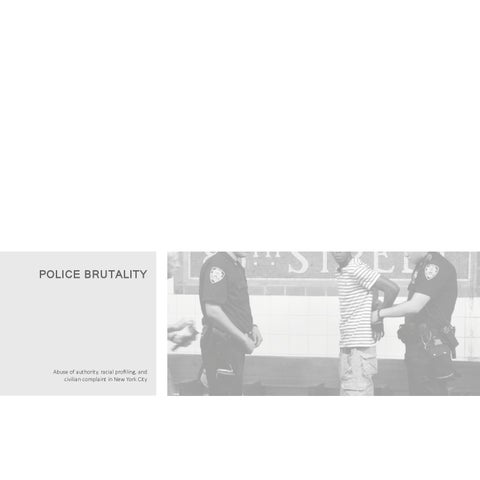
POLICE BRUTALITY
Abuse of authority, racial profiling, and civilian complaint in New York City
2 | POLICE BRUTALITY | Abuse of authority, racial profiling, and civilian complaint in New York City
3
POLICE BRUTALITY
Abuse of authority, racial profiling, and civilian complaint in New York City
Author: Kelly-Anna Louloudis Date: May 5, 2014 Intro to GIS Methods Kazuki Sakamoto Columbia College
4 | POLICE BRUTALITY | Abuse of authority, racial profiling, and civilian complaint in New York City
5
aim
This project begins to examine whether police brutality occurs in New York City, and if it takes the form of racial profiling in particular. Brutality is understood as both physical and emotional violence, covering the full spectrum between use of physical force and unwarranted suspicion against civilians.
submitting complaints. Victimization by the police as well as an intimidating justice system are thus examined in the context of the five NYC Boroughs for where they occur and how they can be tied to other neighborhood specific context such as racial make-up of income.
On a second level, it attempts to gage public response to such brutality, and specifically whether civilians feel wronged and as a result defend their rights by
significance
The police occupy a position on the boundary of legality, instituted to keep the civilian population within this boundary while often resorting to use of violence that is prohibited to the rest of the citizenry. This position invites close scrutiny on police conduct and the public image of the police determines the behavior of the public towards it. Misconduct doubly affects the citizenry, first by the act of engaging in extralegal use of authority against the interest of the public it serves, and on a secondary level by cultivating a hostile public attitude towards the police that makes officers’ professional life more difficult
to the point that they resort to further abuse of authority to achieve their purpose and defend their professional community. Furthermore, lack of civilian response to misconduct also debilitates one of the mechanisms that exist to keep the police force in check and improve the quality of the service provided. Police misconduct can also produce further inequality if directed against minorities, which is exactly the phenomenon the police exist to prevent given they are instituted to ensure equality in the face of the law for all citizens.
6 | POLICE BRUTALITY | Abuse of authority, racial profiling, and civilian complaint in New York City
7
literature review
questions
A driving concept arising out of background research is conflict theory. According to conflict theory, law enforcement as an institution is used as a mechanism that keeps the interests of the dominant group, suggesting that police may indeed target minorities. Whites maintain criminal stereotypes about nonwhites, and the proportion of non-whites in a neighborhood – termed as “minority threat” – is often viewed as an indicator of crime rates by whites. As a result, more aggressive law enforcement is expected
in poorer non-white neighborhoods. The racial makeup of both the suspect and the neighborhood was found to be significant, with African Americans treated more coercively in predominantly African American neighborhoods. Minorities were found to mistrust the criminal justice system to a great extent, and African Americans specifically were found to be overrepresented among complainants but their complaints were less likely to be sustained.
The background research was summarized into the following questions, which gave shape to the research and analytical approach followed in this project:
Is law enforcement more aggressive with individuals belonging to racial minorities - in predominantly non-white neighborhoods? - in predominantly white neighborhoods?
Does law enforcement correspond to crime rate? Is law enforcement more aggressive in predominantly non-white neighborhoods? Is law enforcement more aggressive in poorer neighborhoods?
What constitutes police misconduct? Are complaint rates and complaint substantiation rates consistent with police misconduct rates?
8 | POLICE BRUTALITY | Abuse of authority, racial profiling, and civilian complaint in New York City
9
The following datasets were employed:
data
Stop-Question-Frisk 2012 case by case New York Civil Liberties Union | nyclu.org
Crime Complaint 2012 at police precinct level NYPD | nyc.gov/nypd Civilian Complaints 2009 at police precinct level Civilian Complaint Review Board |nyc.gov/ccrb
Race, Population, & Income at census tract level ACS 2012 5YR Estimates, US Census Bureau | census.gov
methodology
A comparative analysis was performed in order to understand multiple variables and how they might possibly correlate. Comparisons were presented either with juxtapositions of visualizations of different variables and datasets, or as a ratio between two quantities in order to better visualize their relationship and significance. A strength of this project was the use of disparate datasets from different sources that were brought
together to enable this study with the help of GIS. GIS provided other useful tools, which greatly contributed to analysis, such as querying, allowing for the filtering of parameters through multiple and large datasets and thus facilitating a closer inspection of the data in response to specific questions.
10 | POLICE BRUTALITY | Abuse of authority, racial profiling, and civilian complaint in New York City
11
problems/ limitations
sources
A significant number of the problems encountered were at the raw dataset editing level of the analysis. A significant amount of data was processed “manually” in Excel, and it is thus subject to typos and other kinds of errors. Some datasets existed only in PDF form, requiring the manual transfer of the values into Excel by the researcher, which is another source of potential mistakes. In addition, some datasets contained impossible/faulty numbers, e.g. percentages over 100%. The most compromising case is the absence of information on race on 13861 stop-question-frisk incidents, out of approximately 500000 cases.
In the Geo-processing portion of the project, some of the operations performed in GIS greatly distort the picture, such as the dissolve command that was used to aggregate information in the tract level to the police precinct level. Lastly, CCRB data is dated to 2009, setting it three years apart from the rest of the data, which reflect the situation in 2012.
Petrocelli, Piquero, Smith. “Conflict theory and racial profiling: An empirical analysis of police traffic stop data.” Journal of Criminal Justice 31 (2003): 1-11. Print. Friedrich, Robert. “Police Use of Force: Individuals, Situations, and Organizations.” Annals of the American Academy of Political and Social Science 452 (Nov., 1980): 82-97. Print. Cao, Huang. “Determinants of citizen complaints against police abuse of power.” Journal of Criminal Justice 28 (2000): 203-213. Print. Holmes, Malcolm D., “Minority threat and police brutality: Determinants of civil rights criminal complaints in U.S. municipalities.” Criminology 38.2 (2000): 343-368. Print. Kestetter, Wayne. “The impact of race on the investigation of excessive force allegations against police.” Journal of Criminal Justice 24.1 (1996): 1-15. Print.
12 | POLICE BRUTALITY | Abuse of authority, racial profiling, and civilian complaint in New York City
In response to the previous research carried out on the topic, racial segregation was examined side by side with income. Segregation goes hand -in-hand with low income, so that these two factors have to be considered jointly for the purposes of this study.
13
14 | POLICE BRUTALITY | Abuse of authority, racial profiling, and civilian complaint in New York City
Crime was mapped both in terms of absolute values as well as rate compared to total population. The percentage of minority population density does not correspond to crime rates although it seems to be judging from an absolute map. For example, Manhattan and Brooklyn have similar crime rates but a very different racial make-up. This double comparison was thus performed preemptively, as a warning against absolute crime maps which may convey the wrong idea.
15
16 | POLICE BRUTALITY | Abuse of authority, racial profiling, and civilian complaint in New York City
Stops by race seem to correspond to the racial make-up of each neighborhood. Nevertheless, Manhattan appears to be a big exception, where despite the smaller presence of racial minorities and the multitude of races stopped, African Americans still constitute the majority of persons stopped.
17
18 | POLICE BRUTALITY | Abuse of authority, racial profiling, and civilian complaint in New York City
In addition, when looking at incidents where force was used but no arrest was made, the reduction in white suspects becomes visibly disproportional. Use of force without an arrest was used as a filter as it might be indicative of brutality, possibly indicating a lesser crime or an absence of one.
19
20 | POLICE BRUTALITY | Abuse of authority, racial profiling, and civilian complaint in New York City
Furthermore, if we compare percentages from a racial perspective, members of racial minorities seem to me targeted disproportionately in certain areas. For example, Southern Manhattan has a non-white population that ranges from 18% to 36% but the percentage of suspects that were members of a racial minority is 64-82%.
21
22 | POLICE BRUTALITY | Abuse of authority, racial profiling, and civilian complaint in New York City
It is worth contextualizing stop data within police efforts to respond to crime rates. The number of stops compared to crime incidence produces a map that does not follow the crime rate map. Areas where the police are matching the crime rate or overcompensating correspond to neighborhoods with strong presence of racial minorities. For example, Queens has a large minority population and a small crime rate but stop activity is very high compared to other areas, while Manhattan, with a lower minority population density and a higher crime rate shows a smaller Stop-QuestionFrisk activity in comparison.
23
24 | POLICE BRUTALITY | Abuse of authority, racial profiling, and civilian complaint in New York City
Individual parameters were mapped individually to produce a better understanding of the S-Q-F events. Between the numbers for searches, frisks, incidents involving use of physical force, arrests, and weapons discovered on suspects, events involving frisks and force occur in significantly higher percentage ranges than the rest, with maximum values above 50% compared to the maxima for the rest of the variables that do not exceed 20%. This indicates that police S-Q-F activity could be very preemptive in character. For Manhattan, we see violent stops that are more likely to result in an arrest or in which the suspect may indeed carry a weapon, although the percentages for use of force in incidents is much higher in comparison. In Brooklyn, we see a significant amount of force although lesser compared to Manhattan, and some of the smallest percentages in arrests or weapons found. Also suspects are more likely to be frisked than searched. Thus profiling could be manifesting itself differently in the two neighborhoods: given that Manhattan has a higher crime rate, police efforts at crime control are directed more heavily against African Americans than Whites. On the other hand, racial profiling in Brooklyn seems to manifest itself as unwarranted suspicion, given the high number of stops and frisks that don’t go further than that.
25
26 | POLICE BRUTALITY | Abuse of authority, racial profiling, and civilian complaint in New York City
Indeed, the top two reasons for stops appear to be casing or furtive movements, both to which are open to interpretation and could largely be the result of police officers’ subjective judgment operating on the basis of biased suspicion.
27
28 | POLICE BRUTALITY | Abuse of authority, racial profiling, and civilian complaint in New York City
In contrast to the research and analysis performed so far, the data on civilian complaints and the rates at which they are substantiated is inconclusive, and percentages are small for both quantities. A limitation of this dataset is the fact that the racial identity of the persons filing complaints is not recorded. Complaints seem to somewhat correspond to the crime rates, but no pattern emerges in the case of rate of substantiated complaints.
29
30 | POLICE BRUTALITY | Abuse of authority, racial profiling, and civilian complaint in New York City
31
conclusion
In summary, the findings of this project are that the Stop-Question-Frisk incidents are characterized by higher levels of frisks and force but fewer arrests. The distribution of events corresponds to crime rates but minorities are targeted disproportionately in certain areas. African Americans in particularly are indeed handled more coercively in southern Manhattan where they do not constitute a population majority as predicted by the research, but abuse may also appear as heightened suspicion against them as seen
in Brooklyn, making them victims of psychological violence in this case. Thus police brutality can be said to occur in the form of racial profiling and suspicion given the high numbers of minorities stopped where incidents do not involve arrests.
32 | POLICE BRUTALITY | Abuse of authority, racial profiling, and civilian complaint in New York City
34 | POLICE BRUTALITY | Abuse of authority, racial profiling, and civilian complaint in New York City