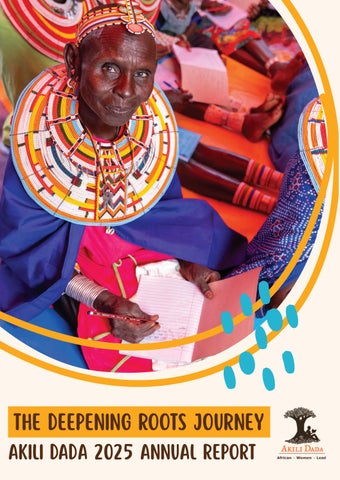
The DeepenIng Roots Journey AkIlI Dada 2025 Annual Report
Contents Foreword.......................................................................................4 Who We Are....................................................................................5 How We Work.................................................................................5 Halfway, and Ahead.......................................................................6 From Strategy to Story: One gIrl at a tIme................................7 Access & EducatIon- No gIrl left behInd.....................................8 VoIce & Agency- The gIrls’ leadershIp In actIon........................12 LeadershIp & Power- From mentee to movement‑buIlder...........18 From SIlent to InfluentIal..........................................................24 From MentorshIp to Movement....................................................24 Advocacy That Changed a GIrl’s LIfe.......................................24 ChangIng Norms Through DIalogue............................................25 From the Coast to the NatIon.....................................................25 LeadIng Through CrIsIs................................................................25 FInancIal SustaInabIlIty................................................................26 2025 FInancIal Outlook...............................................................26 What are we learnIng?................................................................13 The Road To 2028.........................................................................14 WIth gratItude ..............................................................................14
2
Akili Dada 2025 Annual Report
3
Foreword There Is a reason the storyteller sIts beneath the baobab. The tree Is old, Its roots run deep and wIde beneath the soIl, and In Its shade a communIty gathers to remember where It has come from and to decIde where It Is goIng. In 2024, we set out on a five‑year journey we called Deepening Our Roots, a strategy built on a simple conviction: that the most lasting change does not come from reaching further for its own sake, but from growing deeper. This meant, deeper relationships with the girls and young women we walk alongside, deeper trust in the communities where we work, and deeper systems that allow a good idea to outlast the person who first had it. 2025 was the midpoint of that journey, and a midpoint is a particular kind of moment. It is far enough in to see what is taking root, and far enough from the end to still change course. This report is our honest accounting of both: the growth we are proud of, and the questions we are still sitting with.
three times the reach we had set for ourselves by 2028 and reached more than 3,600 more indirectly. We grew our circle of partners to 15 girl-led, women-led, and girl-serving organisations. But the numbers are not the harvest. The harvest is the heart of a young woman from Kwale County who once sat silent in rooms full of officials and now takes her seat at the County table; the two teenage mothers back at their desks; the five new community organisations, founded and run by the very young women we mentored, and now mentoring others. Last year, we spoke of re‑imagining power. This year, we tended the roots that make power last. What follows is that story told, as our stories always are, from underneath the tree.
It was also a landmark year in its own right, our twentieth year since founding. What began two decades ago as one young woman’s audacious belief in the power of girls has grown into a sisterhood that spans the continent. Twenty years on, there is no better way to mark all that putting down of roots than to spend the year deepening them. And there has been growth as we had set to reach 760 girls and young women at the start of the strategy, but surpassed this target. By the close of 2025, we had directly supported 2,837 girls and young women, already more than Joy Zawadi, Executive Director
4
Akili Dada 2025 Annual Report
Natasha Kimani, Board Chair
Who We Are Akili Dada is an award-winning leadership incubator anchored on the belief that girls and young women CAN, DO and WILL LEAD. Our mission is to nurture transformative leadership in girls and young women from underserved and low-income backgrounds to meet the urgent need for more young African women in leadership. We envision a world where African Women Leaders actively participate in crucial decision-making processes across sectors. We journey alongside girls and young women, igniting their inherent power and amplifying their voices and perspectives while nurturing legacies of influence that can be sustained and replicated globally. We invest in building their leadership capacities by providing access to quality education, mentorship, supportive networks, and personal and professional development opportunities; while actively removing the financial barriers that hold women and girls back. With close to two decades of engaging and collaborating with young women and girls have informed our programmatic philosophy grounded in igniting inherent power (Washa), amplifying voices and perspectives (Angaza), and nurturing legacies of influence (Urithi) that can be sustained and replicated worldwide. We believe that communities are positively transformed when African girls.
How We Work Our work is best understood as a single journey a girl travels and not as a set of separate programmes. We envision that once a girl or young woman enters through any door beyond Akili Dada she can keep walking. This report follows that journey through its three stages, each powered by the programmes that have become our hallmark: • Opportunity, Access & Education (Angaza Program): Removing barriers so girls can enroll or return to school, and stay learning—especially those currently out of school. • Voice & Agency (Urithi Program): Building girls’ confidence and wellbeing, strengthening their ability to make informed choices, and cultivating sisterhood and belonging. • Leadership & Power (Washa Program): Developing girls as leaders and change-makers, and investing in the community institutions that sustain opportunity for the long term.
5
Halfway, and Ahead A midpoint scorecard against the 2024–2028 strategy
Impact area At the midpoint of a five‑year strategy, the honest question is simple: is it working? In 2025, across every commitment we made, the answer is yes and on reach and partnerships, faster than we dared plan. Our strategy rested on four commitments. Before we walk the journey itself, here is where the halfway mark finds each one.
Programme innovation Reach & partnerships On track to exceed our 2028 targets: we’ve already reached 2,837 girls directly and 3,600+ indirectly, and built partnerships with 15+ organisations (vs. a target of 10 new partners by 2028).
6
Akili Dada 2025 Annual Report
We translated ideas into delivery: by launching Manyatta Homeschooling, Aunty Salama (the SRHR confidante), and the Educators’ Congress, moved from design into classrooms, clubs, and community conversations.
Policy influence Financial sustainability We strengthened resilience and reduced singlefunding source dependency: institutional funding grew/renewed, investment income generated USD 298K, and average annual budget increased from ~USD 1.02M to ~USD 1.38M — with fundraising now shared across the organisation.
Young women shaped decisions locally and globally: they engaged county policy processes in Kilifi, Kwale, and Turkana, and elevated their agenda at CSW69 and the UN General Assembly.
From Strategy to Story: One girl at a time This scorecard is a snapshot from above—showing targets met, partnerships strengthened, and resources expanded—evidence that our strategy is gaining traction. Each target reached signals progress, but the real impact lives in specific places: a classroom in Samburu, a Dada Club in Kilifi, a county chamber in Kwale. What follows is the stories behind those numbers, what 2025 actually looked like on the ground, and what it changed. We tell the year’s story as it was lived by the girls and young women who carried it, not only as it was counted. So we begin where every girl’s story begins — at the school gate, with getting her through it, and making sure she stays.
7
OpportunIty Access & EducatIonNo gIrl left behInd Every leadership journey begins with a classroom. Through our Angaza program we lit two paths at once in 2025: we supported the scholars already on the journey, and we widened the scope to reach girls the formal system had left behind. Across our four operational Counties of Turkana, Samburu, Kilifi, and Kwale, 70 girls from low-income and rural communities in our scholarship program delivered a result we rarely allow ourselves to celebrate out loud: 100% retention in high school, and 100% transition to post-secondary education for the graduating cohort. From the graduating cohort, 28 moved on to higher learning, 12 to university and 17 to Technical and Vocational Education and Training (TVET) institutes and college. Ultimately, many of the girls registered improvements in their results. In strengthening the transition support, more than 1,800 girls took part in career activation sessions, and 80 secured government funded scholarships.
70 gIrls from lowIncome and rural communItIes In our scholarshIp program 8
Akili Dada 2025 Annual Report
100% retentIon In hIgh school
100% transItIon to post-secondary educatIon
28 moved on to hIgher learnIng, 12 to unIversIty
17 to TechnIcal and VocatIonal EducatIon and TraInIng (TVET) nstItutes and college
1,800 gIrls took part In career actIvatIon sessIons
80 secured government funded scholarshIps 9
Manyatta Homeschooling: From Beads to Books In Samburu, where early marriage, distance, and insecurity keep too many girls from ever reaching a classroom, the Manyatta Homeschooling brings an accelerated learning model into the community itself. By the end of 2025 the innovation had enrolled 300 more girls and young women, growing the programme to 832 learners. In the clearest signal that this model continues to work, 50 out‑of‑school learners returned to formal schooling. For the girls whose education had once been interrupted, sometimes for years, this became access regained and a real pathway back to completing their basic education. Making that growth durable meant grounding every decision in evidence. We conducted a needs assessment on the state of education across all our programming Counties, designed to inform how and where we grow. The results were intended to keep the model evidence‑based and adaptive to fast‑changing local realities. Building on it, we developed a standardised Manyatta Homeschooling Curriculum Toolkit aligned to Kenya’s Competency‑Based Curriculum (CBC), giving learners a smoother transition into formal education and, for the first time, a standardised way to assess their progress. To anchor the work in public systems, we convened a consultative stakeholder round table to align with County education priorities. This allowed us to deepen collaboration with departments of adult learning and quality assurance, children’s services and safeguarding, and the Ministry of Education’s national framework, while strengthening transition partnerships with KUCCPS and HELB.
enrolled 300 more gIrls and young women, growIng the programme to 832 learners 10 Akili Dada 2025 Annual Report
50 out‑of‑school learners returned to formal schoolIng
Career Symposiums: Opening minds about what comes next For many girls, the hardest question is not how to finish school but what to do after it. In 2025 we took our Career Symposiums to Kilifi, Kwale, Samburu, and Turkana, partnering with TVET institutions, universities, and representatives from Kenya Universities and Colleges Central Placement Service (KUCCPS) and Higher Education Loans Board (HELB) to give girls clear, practical guidance on course selection, placement, and funding. They heard from role models who looked like them like our Kenya Blue Economy Skills Training (KBEST) ambassadors who shared how they had overcome doubt and built meaningful careers through vocational and technical paths. The shift in perspective was immediate with the girls sharing that for the first time TVET felt like a credible and exciting path for their future. They began picturing themselves in marine engineering, hospitality, maritime logistics, or setting up businesses of their own. When the year’s national exam results came in, a cohort of scholars sat the KCSE and earned their places, with several gaining direct university entry and others structured placements in TVET institutions. Two alumnae went further securing AkiraChix scholarships to study STEM, proof of a leadership pipeline reaching all the way into technology.
11
VoIce & AgencyThe gIrls’ leadershIp In actIon
At Akili Dada, We believe that once a girl has access to education, the next step supporting her to amplify her voice so that she can lead. Our Urithi program makes it plain and simple what we hope girls inherit from Akili Dada, agency. Across our nine partner schools, 405 girls were actively engaged in Dada Clubs, strengthening peer support and life skills. To understand the change we are nurturing, we administered an Adolescent Girls Agency Survey (AGAS) to 251 girls across 10 schools to sharpen how we design club programming and mentorship going forward.
405 gIrls were actIvely engaged In Dada Clubs
12 Akili Dada 2025 Annual Report
we admInIstered an Adolescent GIrls Agency Survey (AGAS) to 251 gIrls across 10 school
13
The Urithi Institute: bridging the information gap We closed out the 2024–2025 Urithi Institute, designed to bridge the information gap on adolescent Sexual and Reproductive Health and Rights (SRHR) in arid and semi-arid (ASAL) communities. A cohort of 40 young women community advocates carried the work outward: through their projects, they mentored 1,248 girls in total: 577 in the first cohort, 337 in-school girls in Samburu and Kwale, and 334 out-of-school girls in Kilifi and Turkana on adolescent mental health and menstrual health and hygiene management. In Samburu, the team went a step further and supported a partner school to launch its own pad bank in response to the shortage of sanitary pads keeping girls out of class. Afterwards, the advocates convened local stakeholders to share what they had learned, turning private sessions into public and accountable conversations.
Aunty Salama: a confidante in her pocket Some questions are easier to type than to ask aloud. Launched on Menstrual Hygiene Day, Aunty Salama (safe aunty) is a WhatsApp‑based platform offering confidential, age‑appropriate, and culturally sensitive sexual and reproductive health information. Aunty Salama is not another faceless chatbot, but a trusted digital confidante. What sets her apart is human‑verified content rather than AI‑generated answers, visual explanations that simplify complex topics, private and judgement‑free access on a familiar platform, and a guided, safeguarded entry for users under 18. Her purpose is simple, to replace silence with knowledge, myths with facts, and shame with confidence. The early analytics told their own quiet story interactions came predominantly from young women, and the subjects they returned to most were safety, menstrual health, abuse, and harassment. A reminder of both the need, and the trust a safe space can earn.
14 Akili Dada 2025 Annual Report
The Comprehensive Transition Leadership Academy When the exam results are in and the celebrations fade, many alumnae find themselves quietly asking the same question: what next? Our Comprehensive Transition Leadership Academy was built for that moment. Held over four transformative days in Nairobi for our 2023–2024 alumnae cohort, the academy moved through scholarship readiness and career mapping, mental health and SRHR, personal branding, digital advocacy, and girl led activism. The academy equipped 36 high‑school graduates to create and perform plays that make hard conversations easier. Using theatre as a learning tool, they showed younger peers how to have honest “girl chats” about adolescent health and rights, while also supporting the soft launch of Aunty Salama. What made it powerful was the peer‑to‑peer approach: the girls didn’t just learn from facilitators—they coached and encouraged one another, sharing real fears about letting their families down alongside bold hopes for their communities. The journey continued through monthly learning sessions, building toward a graduation that celebrated them as they stepped into university and beyond.
15
Wasichana Wa Afrika: a summit for girls by girls The 2025 edition of the Wasichana wa Afrika Summit was not designed for girls, it was designed with them and around the theme they told us mattered most: mentorship. The road to the summit was a journey of co-creation. We asked girls throughout the Dada Clubs to write 250 words on “The Mentorship I Want”. This allowed them to define it in their own terms and state the support they were looking for. More than 100 girls entered, and the top five essayists from each region earned a place at the Urithi Dada Leadership Bootcamp . Under the theme “Uniting Our Voices,” the bootcamp brought together 45 girl delegates from seven Counties Samburu, Turkana, Kilifi, Kwale, Lamu, Migori, and Machakos alongside guests from MEMPROW Girls in Uganda and Rozaria Memorial Trust in Zimbabwe. Guided by a Pan African debate expert, the girls sharpened their public speaking and presented their winning essays. They were also introduced to the UN Sustainable Development Goals and mapped their own community concerns against them. They then did something we had envisioned for a long time: they took the draft summit programme and redesigned it themselves, shortening it, building in time for wellbeing during watch parties, and insisting on interactive Q&A so they could speak directly with the experts.
16 Akili Dada 2025 Annual Report
“
DId I have all the answers? Absolutely not. In fact, I had close to 0.0005% of technIcal knowledge. But what I had…was the voIce. The courage to say, you belong here too and that was enough to let one gIrl know she can do It all. So, here I am. No longer just buIldIng opportunItIes for dancers, but also for young people and especIally gIrls In Tech.
“
- Caessy, CreatIve and SocIal Impact Leader, Rwanda The virtual summit itself reached far and wide with 83 girls joining live on Zoom while more than 1,100 others gathered through Dada Club watch parties, in total 1,269 girls and young women under 25, and 1,308 counting the Girl Allies who tuned in. The summit would not have been a success without the support of our partners spanning the continent: MEMPROW Girls in Uganda, The Ladies Joint Forum in Tanzania, Afro Ark in Rwanda, Rozaria Memorial Trust in Zimbabwe, The Batonga Foundation in Benin, LEAP Africa in Nigeria, Genhub and the Amazon Leadership Initiative Network across Malawi, Namibia, and Zambia, and Tatu City in Kenya. The year’s headline session, “African Girl Leaders in Technology,” a TED-style talk and panel on how digital tools amplify girl led campaigns and open new career pathways which shined a light on a technology for girl centred innovation. The takeaways echoed everything the year had been building towards, centring girls’ voices and agency, strengthening mentorship including the underexplored power of self-mentorship, and creating safe spaces where failure and vulnerability are welcome.
“
Technology has gIven gIrls In my communIty chances to learn, gaIn confIdence and solve real problems. I recommend that governments and organIzatIons Invest In tech programs for gIrls, provIde safe spaces for learnIng, mentorshIp and access to computers and the Internet. ThIs wIll empower gIrls to become future leaders and Innovators.
“
– Martha, AI Technology EnthusIast, MalawI The momentum carried forward through a girl allies roundtable that brought regional partners together to share how technology can advance girl‑centred leadership, laying the foundation for Wasichana Wa Afrika 2026, which we envision, for the first time to be an in‑person gathering.
1,269 girls & young women under 25 took part
1,308 total participants, including Girl Allies
10+partner countrIes across AfrIca 17
LeadershIp & PowerFrom mentee to movementBuIlder By this point, a young woman is ready not only to lead, but to build. Through the Washa program, we invest in the young women who are ready to take that step, and in the grassroots organisations they create. In 2025, this meant two things were done simultaneously: strengthening the institutions, and trusting women with the money.
18 Akili Dada 2025 Annual Report
19
Strengthening the institutions Many of the community-based and women-led organisations we partnered with began the year rich in passion and community trust, but thin on internal systems. Most were informal, founder-dependent, with limited governance and minimal financial controls. In the initial assessment upon onboarding, several scored below 50%, which signalled operational fragility. Much of this work took shape through the Stawisha Leadership Accelerator Summit, our organisationaldevelopment convening. The 2025 edition brought together more than 100 young women leaders comprised of founders and directors of grassroots organisations from Samburu, Turkana, Kilifi, and Kwale across two cohorts. A Foundational Cohort focused on governance, human resources, project design, and sustainability and an Executive Cohort made up of more experienced leaders. At the summit they gathered to reflect on a year of implementing their Capacity Improvement Plans and explored governance as a living practice rather than a static structure. By the week’s end, each leader left with a refreshed improvement plan and a renewed commitment to movement building. Through this tailored support assessments, coaching, governance strengthening, and strategic planning organisations made a deliberate shift from survival mode to structured, accountable institutions. Self‑help groups became registered Community‑Based Organisations with functional boards, constitutions, and bank accounts. Finance, HR, safeguarding, and procurement policies became standard rather than exceptional. Most organisations recorded double‑digit gains between baseline and reassessment, several improving by 30 to 50 percentage points. Beyond the scores, organizations moved from “doing activities” to building institutions, laying a foundation for long-term, community-rooted, and gender-responsive impact.
20 Akili Dada 2025 Annual Report
seed fundIng totallIng KES 21 mIllIon (USD 161,000) to 76 grassroots women leaders
sub granted KES 9 mIllIon to three young women led organIsatIons
Financing feminist action Systems alone do not shift power; resources do. The Washa program provided seed funding totalling KES 21 million (USD 161,000) to 76 grassroots women leaders, enabling them to lead community advocacy, dialogues, and social action initiatives rooted in lived experience. This flexible financing allowed women to respond to local realities-such as GBV, femicide, adolescent pregnancy, SRHR access, climate justice, and economic exclusion-without the bureaucratic barriers that often exclude grassroots actors. Through these funds, women convened community dialogues, engaged traditional and religious leaders, facilitated survivor-informed discussions, supported referral pathways, and amplified women’s voices in county and community decision-making spaces. The funding model trusted women as political actors, not merely implementers, reinforcing feminist principles of autonomy and collective power. In parallel, we sub granted KES 9 million to three young women led organisations, strengthening ecosystem collaboration and enabling complementary interventions such as psychosocial support, legal aid, movement building, and policy advocacy. These partnerships reduced duplication, expanded reach, and strengthened referral and accountability networks. The clearest measure of success is what the young women went on to raise on their own. By the end of 2025, the young women who came through our programmes had secured a combined KES 33 million — evidence that capacity, once built, compounds.
Localizing Global Commitments A central pillar of the programme was community-based dialogue. Sixteen (16) community dialogues were conducted across our four programming Counties in Kenya, creating safe and inclusive spaces for women, youth, community leaders, and duty bearers to engage on gender justice issues. We also launched the Beijing Grassroots Dialogues, a deliberate effort to localize global and regional human rights instruments-including the Beijing Platform for Action-by translating them into accessible, community-owned conversations. These dialogues demystified global commitments and connected them to everyday realities such as access to services, protection from violence, and women’s participation in decision-making. In total, 2,821 community members were reached, strengthening grassroots awareness of rights, accountability mechanisms, and collective advocacy pathways. Importantly, the dialogues elevated survivor-informed and trauma-informed perspectives, ensuring that policy conversations remained grounded in lived experience rather than abstraction.
21
Young Women Confronting Gender‑Based Violence Few projects show Washa’s model working from end to end as clearly as Hamasisha Dada (inspire the sister). A three‑year initiative (2023–2025) in Kilifi and Kwale grew young women into change agents against gender‑based violence. Its design is deliberately layered on sustained mentorship through Dada Circles, youth‑led social action projects, community dialogues, and the psychosocial and advocacy support that lets a young leader keep going. By 2025 the results were tangible. Of the 19 young women it mentored, several went on to found and register their own community‑based organisations among them She Forward Coast and Hope for Women Center whose “Pad a Dada” campaigns reached more than 1,000 women and girls. Survivors found pathways to justice, with three SGBV cases referred for support and two now active in court, while two teenage mothers returned to school with sustained psychosocial care. And the project’s advocacy travelled far beyond its direct participants with radio programming reaching over 10,000 listeners and drew 47 new partnership inquiries.
19 young women mentored as change agents 22 Akili Dada 2025 Annual Report
1,000+ women & gIrls reached by theIr CBO’s
63 boys & gatekeepers engaged as allIes
Crucially, Hamasisha Dada refused to treat gender justice as “women’s work.” The project deliberately organized alongside a broad constellation of community power-holders—including men, boys, and gatekeepers—to confront the norms and entitlements that enable violence. Through intentional male‑engagement sessions and gatekeeper forums, 63 boys and community elders moved from passive bystanders to accountable allies, making public, personal commitments to consent, protection, and collective care, and pledging to intervene when girls’ safety is threatened. As one elder reflected, they learned that returning a girl to a violent home is complicity—not neutrality—and that community leadership must be exercised to protect, not police, girls’ lives. Yet the clearest measure of this work is found in the agency and voice of young women themselves, as seen in the stories of change below:
23
From Silent to Influential Before joining the Hamasisha Dada Project, a young woman leader from Kwale County rarely spoke in public spaces, particularly those dominated by senior officials and male leaders. Participation in governance spaces felt intimidating and inaccessible. Through the Dada Circles mentorship, she received sustained leadership development, psychosocial support, and advocacy skills training. The safe and supportive environment enabled her to build confidence, clarify her advocacy priorities, and understand how county governance systems function. By 2025, she was actively participating in the Kwale County Gender Technical Working Group, contributing youth perspectives to discussions on Gender-Based Violence (GBV), adolescent pregnancy, and survivor referral pathways. Her engagement marked a clear shift from token youth participation to meaningful influence in county-level policy dialogue.
“Before the mentorshIp, I was afraId to speak In front of leaders. Now I sIt In meetIngs wIth county offIcIals and raIse Issues affectIng gIrls In my communIty.” - HamasIsha Dada ConstItuent This change reflects the project’s contribution to strengthening feminist youth leadership and positioning young women as legitimate actors in governance and accountability spaces.
From Mentorship to Movement What began as mentorship conversations under the Hamasisha Dada Project evolved into fully registered, youth-led institutions. Through Organizational Development and Systems Strengthening (ODSS) training and sustained accompaniment, young women were supported to transform advocacy ideas into structured, compliant organisations. By November 2025, five youth-led initiatives had been formally registered as Community-Based Organizations. She Forward Coast CBO in Kwale County and Hope for Women Center CBO in Kilifi County are now independently implementing programmes on Sexual and Reproductive Health and Rights (SRHR), menstrual health, and GBV prevention. Collectively, these organisations have reached over 1,000 women and girls through community education, advocacy, and referral initiatives. The transition from informal groups to registered CBOs demonstrates strengthened sustainability, local ownership, and accountability beyond project funding.
Advocacy That Changed a Girl’s Life Through youth-led Social Action Projects, young women identified gaps in community responses to adolescent pregnancy and school dropouts. Rather than focusing only on awareness, they engaged parents, school administrators, and community leaders to advocate for girls’ right to education.
24 Akili Dada 2025 Annual Report
As a result of this advocacy, two teenage mothers successfully returned to school. A trained counsellor provided sustained psychosocial support to address trauma and promote retention, ensuring the girls could continue their education in a supportive environment. This outcome demonstrates how survivor-centred, community-based advocacy can translate into practical protection and recovery pathways for adolescent girls.
Changing Norms Through Dialogue In Lunga Lunga and surrounding communities, young women leaders created safe but transformative spaces to address GBV, early marriage, and consent-topics often considered sensitive or taboo. Through structured community dialogues, Boys Funday activities, survivor storytelling, and radio programmes aired on JaC FM, conversations extended beyond direct participants to wider community audiences. Young men committed to peer-led education on consent and respectful relationships, while adolescent girls reported increased knowledge of GBV reporting mechanisms and referral pathways. These engagements strengthened community accountability and contributed to early shifts in social norms around gender, responsibility, and protection.
From the Coast to the Nation Young women participating in the Hamasisha Dada Project connected local advocacy efforts in Kilifi and Kwale to national movements addressing Gender-Based Violence. Through participation in the #EndFemicideKE campaign, they amplified county-level realities within national advocacy and digital mobilisation spaces. By linking grassroots experiences to national conversations, young women strengthened calls for survivor-centred, non-carceral responses to GBV and ensured that coastal perspectives were represented in broader policy and movement-building efforts.
Leading Through Crisis Between 2023 and 2025, civic unrest, national protests, and shrinking civic space disrupted traditional advocacy approaches. Young women leaders faced safety concerns and uncertainty around public engagement. Through adaptive strategies supported by the Hamasisha Dada Project-including flexible scheduling, virtual engagement, trust-building with county officials, and integrated psychosocial support-young women sustained their advocacy while prioritising safety and well-being. Despite these constraints, participants organised county-level advocacy during the Finance Bill protests, advanced demands around menstrual health equity, and strengthened cross-movement solidarity. These actions demonstrated resilient feminist leadership capable of navigating complex and constrained civic environments.
25
FInancIal SustaInabIlIty A broader, deeper funding base Our 2028 goal is an annual budget of USD 1.5–2 million drawn from a diversified, long‑term portfolio, a 20% increase in African and diaspora supporters, and 10% of revenue generated internally. In 2025 we made measurable progress on all three fronts. We welcomed new institutional partners and renewed the trust of long‑standing partners. Diversification also meant generating our own income. Our investments raised USD 298,013 in interest; office monetisation added USD 4,195; and staff giving contributed USD 11,486 over two years, a small figure that says something large about the belief of our work from within.
2025 FInancIal Outlook Resource allocation Department
Amount in USD
Percentage allocation
Governance and Organizational Development
106,690.65
7%
Resource Mobilization
38,280.78
2%
Finance and Administration
252,534.81
16%
Communications & Advocacy
77,049.75
5%
Programme Project Costs
1,082,968.79
70%
Total Expenditure
1,557,524.78
Akili Dada remains committed to responsible financial stewardship. With 70% of expenditure directed to programme activities and overhead costs well within acceptable limits, the organization demonstrates efficient use of donor funds. We will continue to prioritize mission-driven spending while maintaining the administrative infrastructure necessary for sustainability, compliance, and long-term impact. We had an efficient year with our programme related costs representing 75% of the total expenditure. These included our direct project programming and advocacy work.
26 Akili Dada 2025 Annual Report
Communications & Advocacy
Resource Mobilization
Organizational Development
Finance and Administration
Programme Project Costs
Challenges and opportunities Challenges • Rising costs & inflation: Inflation has pushed up operating costs, making it harder to balance restricted against unrestricted funding while demand for our work keeps growing. • Compliance & governance gaps: Tighter donor reporting and higher audit and safeguarding standards are outpacing systems that still lean too much on individuals rather than institutionalised processes.
Opportunities for Financial Growth and Sustainability Trust‑based philanthropy: The shift toward flexible, multi‑year, unrestricted funding plays to our strengths as it is what we already offer grassroots women, and what best absorbs rising costs.
27
What are we learnIng? A midpoint is for course‑correction, and that requires telling the truth about the hard parts. These are the trade‑offs we are sitting with and the lessons we are carrying into the second half of the strategy. The strategic trade‑offs • Safety and continuity in Samburu: Escalating insecurity, alongside drought and flooding, is disrupting delivery and raising our duty‑of‑care obligations. We are learning when to adapt, when to pause, and when to redesign without losing community trust. • Scale versus depth: Expansion into the most interior regions is becoming significantly more costly, and facilitators harder to source. A real choice is emerging between reaching further and deepening impact where we already are. • Quality and standardisation: Growth in Dada Clubs and transition programming is outpacing our manuals and delivery frameworks. Investing in programme architecture may slow us in the short term but protect quality for the long term. • Reimagining the leadership pathway: Our young‑women leadership‑development model needs refining to strengthen its long‑term value and its contribution to movement‑building.
Lessons we’re taking forward 1. Retention requires community engagement: Education outcomes improve when families and communities are actively involved. 2. Leadership thrives in safe ecosystems: Psychosocial support and adult allies are essential for sustained agency. 3. Institutions multiply impact: When women-led organizations are strong, girls’ leadership gains legitimacy and scale.
The Road To 2028 If the first half of this strategy was about reaching and proving, the second half is about deepening and sustaining. We are choosing, deliberately, to spend our head start on reach not on more of the same, but on the things that make impact endure. That means sharper definitions and disaggregated targets, so we know precisely who we are reaching and how well. It means continuous engagement models in place of one‑off activities, and movement‑building tracked as an outcome. It means a formal donor‑engagement strategy with regular touchpoints and a healthier share of unrestricted funding. And it means a clearer Akili Dada advocacy pathway, resourced properly, that carries young women from activism to genuine policy influence. The roots are deeper than they were a year ago. The work of the next three years is to let them hold. And as we mark our twentieth year, we are not only reflecting, we are reimagining what the next twenty could look like. The girls who began this journey with us are now the founders, the policy influencers, the mentors, and the candidates. The movement is no longer something we built for them but something they are building themselves.
28 Akili Dada 2025 Annual Report
WIth gratItude To the girls and young women who trust us with their ambitions; to the families and communities who walk alongside them; and to our partners, county officials, and norm‑holders who open doors—thank you. Our work is only possible because of you. Nothing written here belongs to Akili Dada alone. It reflects the courage, care, and steady commitment of the communities we serve, and of the allies who choose—again and again—to stand with them. We are also deeply grateful to our anonymous individual donors and to Akili Dada team members who give through staff giving. Your generosity sustains this work in ways both seen and unseen, and reminds every girl that she is not doing this alone.
Special thanks to our 2025 funders and partners
Individual and staff giving • Akili Dada Staff Giving • Ramsey Family Fund (via OWCF) • The White Family Fund (via Fidelity Charitable)
29
20 YEARS STRONG. 20 YEARS FORWARD. For 20 years, we have believed in the brilliance, courage and possibility of girls and young women. We have walked alongside them, challenged systems, opened doors and nurtured leaders who are shaping the world around them. Today, we honour the journey, but we are not looking back. We are 20 years strong, and 20 years forward. Still learning. Still dreaming. Still pushing boundaries.Still believing in what is possible when girls are given the space, resources and power to lead. Here’s to the next chapter. Here’s to the girls who will lead it. — The Akili Dada Team
EFFICIENT BRAVE
ZEALOUS
IMPARTIAL
STRONGmol dobppf sb qb^j J mi ^vbo abaf ` ^ qba REVOLUTIONARY GROUNDEDpqo^qbdf` EMPATHETIC UNIQUE
FEMINIST VOCAL
s f pf l k^ov DIVERSE
i f s b i` ^kaf v a l mqf j f pqf ` t l j b k obpl i r qb
^ c of ` k^
EFFECTIVE a ^of kd
PATIENT pl ` f ^i
PRESENTOPEN-MINDED
BRAVE avk^j f ` qo^kpm^obkq GRACIOUS f kci r bkqf ^i VORACIOUS
BOLD i b^a INSPIRING INNOVATIVE
obpml kpf _ib KEEN
DECISIVEINCLUSIVE ^i boq AUTHENTIC l mbkJj f kaba
AFFABLE
a ^a ^ POWERFUL s^i r bJi ba STOIC ^ i f s bSELF-AWARECLEAR
FOCUSED
f kqr f qf s b a of s bk
STRONG
30 Akili Dada 2025 Annual Report