
IoT Based Smart Pothole Detection And AlertSystem
K.SanthiPriya1,T.Vivekananda2,V.Akhila3,MD.Saniya4,MohammedTalhaFarooqui5 Assistant Professor1, Students2345 shanthidurga2823@gmail.com, thappatlananadu@gmail.com, akhilavalishetti@gmail.com, mohammedsaniya06@gmail.com, mohammedtalhafaroogui@gmail.com, Vidya Jyoth iInstitute of Technology (A), Hyderabad, Telangana, India
Abstract – Poor road condition,especially potholes and damaged road surfaces, area major cause of traffic accidents, vehicle damage, increased travel time, and higher maintenance costs. In many regions, road inspections are still carried out manually, making the process time-consuming, expensive, and often unable to identify road damage in real time. This paper presents an IoT Based Smart Pothole Detection and Alert System designed to automate pothole detection and provide instant location-based reporting using low-cost embedded hardware. The proposed system is built around an ESP32 microcontroller, which continuously monitors road surface conditions using a vibration sensor. Whenever a significant vibration caused by a pothole is detected, the ESP32 processes the sensor data, activates a buzzer to indicate successful detection, and acquires the geographical coordinates of the damaged road using a Neo-6MGPSmodule. The collected information, including the pothole status, latitude, longitude, and detection time, is transmitted through the ESP32's built-in Wi-Fi module to the Thing Speak cloud platform, where it can be monitored remotely through a non-line dashboard. This enables road maintenance authorities to identify damaged road locations quickly, monitor road conditions in real time, and prioritize repair work more efficiently. A working prototype of the proposed system was developed and experimentally tested under different road conditions. The results demonstrated reliable pothole detection, accurate GPS location tracking, and near real-time cloud data transmission with low processing latency. Overall, the proposed system shows that a simple, portable, and cost-effective combination of embedded sensors, GPS technology, wireless communication, and cloud computing can significantly improve road monitoring, enhance transportation safety, reduce vehicle damage, and contribute to the development of intelligent transportation systems and smart city infrastructure.
Key Words: Internet of Things (IoT), ESP32, Smart Pothole Detection, Vibration Sensor, GPS Tracking, Thing Speak, Road Condition Monitoring, Smart Transportation, Cloud Computing, Intelligent Road Infrastructure.
1.INTRODUCTION
Over the last decade, the Internet of Things (IoT) has transformed from an emerging technology into a practical solution for solving real-world problems through intelligent sensing, wireless communication, and cloud computing. Everyday objects that once operated independently can now collect environmental data, communicate over the internet, and make decisions with minimal human intervention. This technological advancement has found applications in smart homes, healthcare, industrial automation, agriculture, transportation, and smart city development. Among these areas, intelligent transportation systems have gained significant attention because of their potential to improve road safety, reduce traffic congestion, and enhance infrastructure management.
One of the major challenges faced by transportation authorities worldwide is the presence of potholes and damaged road surfaces. Poor road conditions not only reduce driving comfort but also increase the risk of road accidents, vehicle damage, traffic congestion, and higher maintenance costs. In many regions, road inspections are still performed manually by maintenance personnel, making the process time-consuming, labour- intensive, and in efficient. Since inspections are carried out periodically rather than continuously, many potholes remain undetected for long periods, resulting in further road deterioration and increased repair expenses. Drivers often encounter unexpected potholes before maintenance teams become aware of their existence, creating serious safety hazards.
Recent advancements in embedded systems and wireless communication have made it possible to develop affordable, real-time road monitoring solutions. Development boards such as the ESP32 provide built-in Wi-Fi connectivity, sufficient processing capability, and multiple input/output interfaces at a relatively low cost. Similarly, sensors such as vibration sensors and GPS modules have become inexpensive and readily available, enabling students and researchers to develop practical IoT applications without requiring expensive hardware. Cloud platforms such as Thing Speak furthers implify data storage, visualization, and remote monitoring by allowing sensor data to be accessed through an online dashboard from anywhere with an internet connection.
The proposed IoT Based Smart Pothole Detection and Alert System utilize sanESP32 microcontroller, a vibration sensor, a GPS module, and the Thing Speak cloud platform to automatically detect potholes and report their locations in real time.
Byreducingdependenceonmanualinspectionsandenablingcontinuousroadmonitoring,theproposedsystemcontributes to improved road safety, reduced vehicle maintenance costs, and the development of intelligent transportation infrastructure. Theremainderofthispaperisorganizedasfollows.Section2presentstheliteraturereviewonIoT-basedpotholedetection, smart transportation systems, and road monitoring technologies. Section 3 describes the proposed system architecture, hardware components, software platform, and working methodology. Section 4 explains the implementation details and system integration. Section5 discusses the experimentalresults,performance evaluation, and graphical analysis.Section 6 presentsthefuture scope and possible enhancements of theproposed system. Section 7 liststhe references used in this work, and Section 8 concludes the paper by summarizing the overall achievements and significance of the proposed IoT-based smart pothole detection system.
ObjectivesoftheStudy
Thedesignoftheproposedsystemwasguidedbythefollowingobjectives:
DetectpotholesanddamagedroadsurfacesautomaticallyusingavibrationsensorconnectedtotheESP32 microcontroller.
Capturethegeographicallocation(latitudeandlongitude)ofeverydetectedpotholeusingaGPSmoduleto accurately identify damaged road sections.
Transmitpotholedetectiondata,GPScoordinates,andsystemstatustotheThingSpeakcloudplatformthroughWi-Fi for real-time remote monitoring.
Provide an immediate local alert using a buzzer whenever a pothole is detected, confirming successful detection and data processing.
Developalow-cost,portable,andreliableIoT-basedsolutionthatcanassistroadmaintenanceauthoritiesin monitoring road conditions and planning timely repair activities..
ScopeoftheWork
Thisworkisintendedasafunctionalprototypethat demonstratesthefeasibilityof usingIoTtechnologyfor automated pothole detection and road condition monitoring rather than asa large-scale commercial deployment. The prototype consists of an ESP32 microcontroller,a vibration sensor,a Neo-6M GPS module, a buzzer, and the ThingSpeak cloud platform. The controllogic is based onpredefined vibration threshold values,allowingthe system todetect significant road surface impacts and upload the corresponding location detailsto the cloud without requiring complex machine learningalgorithms. This approach keepsthe system inexpensive,easyto implement,and suitable for educational and research purposes. Future work may extend the system by incorporating artificial intelligence, computer vision, and advanced sensor fusion techniques for improved detection accuracy.
The proposed systemfocuseson solvingone of the most commonproblemsfaced byroadusers:thedelayed identification and reportingofpotholes.Conventionalroad inspection methodsrequire manual surveysthat consume considerable time and resources, allowing damaged road sections toremain unnoticed for extended periods. By continuously monitoring road conditions, automaticallyrecording pothole locations, and making the information available through an online dashboard, the systemreduces the need for manual inspections and enablesfaster maintenance planning. Although the current prototype is designed for demonstration purposes,the same architecture can be scaled for deployment in public transportation, municipalroad maintenance, logistics vehicles, and smart cityinfrastructure, where multiple vehicles can collectively contribute to building a real-time road condition monitoring network.
2. LITERATUREREVIEW
Therapidgrowthofthe InternetofThings(IoT)hassignificantlyinfluencedthedevelopment ofintelligenttransportation systemsand smart city infrastructure. Among its manyapplications, IoT-based road condition monitoring has emerged as an effective approach for improving road safety and reducing maintenance costs. Researchers have proposed various techniques for detecting potholes, monitoring road conditions, and reporting damaged road locations using embedded systems, wireless communication, cloud computing, and machine learning technologies. This section reviews the most relevantstudiesrelatedto IoT-basedpothole detection, GPS-enabled road monitoring, cloud-baseddata management, and intelligent transportation systems published over the past decade.
Most IoT-based road monitoring systems follow a common three-layer architecture consisting of a perception layer, a network layer, and an application layer. The perception layer contains sensorsresponsible for collecting road condition data, the network layer transfers the collected information through communication technologies such as Wi-Fi or cellular networks,andtheapplicationlayerprovidesvisualization,storage,andanalysisthroughcloudplatformsanduser
dashboards. This layered architecture simplifies system development and has become the standard approach adopted by many smart transportation applications. The proposed system follows the same architecture by combining a vibration sensor, ESP32 microcontroller, GPS module, Wi-Fi communication, and the ThingSpeak cloud platform.
Several researchers have focused specifically on pothole detection using low-cost sensors and embedded systems. One of the earliest approaches utilized smartphone accelerometers to detect abnormal road vibrations caused by potholes and automatically record their locations. Although this method reduced deployment costs, the detection accuracy depended heavily on smartphone placement and vehicle type. More recent studies replaced smartphones with dedicated embedded hardware, enabling continuous monitoring with improved reliability. These systems demonstrated that vibration and acceleration sensors can effectively distinguish potholesfrom normal road conditions when appropriate threshold values are selected. Researchershavealsoexploredintegrating GPStechnologywithIoT-based monitoringsystemstoimprovethe accuracyof road damage reporting. By combining vibration sensing with GPS coordinates, the detected pothole locations can be precisely mapped, allowing maintenance authorities to identify damaged road segments quickly. Cloud-based platforms further enhance this capability by storing the collected information and presenting itthrough online dashboards, enabling real-time monitoring and historical data analysis. These studies support the use of GPS-assisted IoT systems for efficient road infrastructure management. Recent developments have incorporated machine learning and computer vision techniques into pothole detection systems. Camera-based solutions employing image processing and deep learning algorithms can classify potholes, road cracks,and surface irregularitieswithhighaccuracy.Whilethesesystemsprovidedetailedroadanalysis,theyrequire high-performance processors, cameras, and large training datasets, increasing implementation complexity and cost. In comparison,vibrationsensor-based systemsoffer asimpler and moreeconomicalsolutionsuitablefor low-cost embedded platforms such as the ESP32 while still providing satisfactory detection performance for practical applications.
Cloud computing has become an essential component of modern IoT systems by enabling remote monitoring, centralized data storage,andreal-time visualization.Platformssuchas ThingSpeak, AWSIoT,and GoogleFirebase allow sensordata to be uploaded automatically and displayed through interactive dashboards. Several transportation monitoring projects havesuccessfullyutilizedthesecloudservicestoanalyzetrafficconditions,monitorenvironmentalparameters,andmanage road infrastructureremotely. The present work adoptsthe ThingSpeak platformbecause of itsease of integration withthe ESP32, realtime graphical visualization, and suitability for educational and research projects.
Table 2.1 summarizes the key findings, methodologies, and limitations of the studies reviewed in this section. A common observation across the existing literature is that many proposed systems either focus on vibration-based detection, GPS tracking, cloud communication, or image-based analysisindependently. Relatively few studies integrateall these essential functionsintoa compact,portable,and cost-effective embedded platformsuitablefor continuousroad monitoring.Thisgap forms the motivation for the proposed IoT Based SmartPothole Detection and AlertSystem, whichcombines vibration sensing, GPS location tracking, Wi-Fi communication, and cloud-based monitoring into a single integrated solution.
It isalso important to note that most of the systemsdiscussed in the literature were validated using laboratoryprototypes or controlledfieldexperimentsratherthanlarge-scale deploymentson publicroads. Similar tothose studies, theproposed prototype hasbeen evaluated under different simulated road conditionstoverifyitsfunctionality,detection accuracy,GPS performance, and cloud communication reliability. Although further large-scale testing is required for commercial deployment, the experimental resultsdemonstrate that low-cost embedded hardware integrated with IoT technology can provide an effective solution for realtime pothole detection, road condition monitoring, and intelligent transportation infrastructure.
Ref. FocusArea
[1] IoT-BasedPothole Detection
[3] SmartRoad Monitoring
TechniqueUsed
KeyLimitation
VibrationsensorwithESP32forreal-timepotholedetection Detectionaccuracydependsonvibrationth resholdcalibration
IoTsensorswithcloud-basedpotholereporting Limitedlarge-scalefield validation
[6] Smartphone-Based PotholeDetection AccelerometerandGPS-basedroadanomalydetection Performance varies withsmartphoneplacementandvehiclet ype
[8] ComputerVisionPotholeD etection
[9] SmartCityRoad Infrastructure
Imageprocessinganddeeplearningalgorithms
IoTarchitecturewithcloudmonitoringfortransportation systems
Requireshighcomputationalpowerand camera hardware
Focusesonarchitectureratherthanpractic al implementation
[11] IoTCommunicationP latform Cloud-basedIoTdatacollectionandvisualization
[14] ConnectedVehicleSystems
Dependentoncontinuousinternetconnecti vity
GPS-enabledvehiclecommunicationandroadmonitoring Requires reliable wirelesscommunication infrastructure
Table-1:ComparativeSummaryofRelatedWork
3. PROPOSEDSYSTEMANDMETHODOLOGY SystemArchitecture
The proposed system is designed around a single ESP32 microcontroller that serves as the central processing and communication unit for the entire pothole detection system. The ESP32 continuously monitors road surface conditions through a vibration sensor, processes the acquired sensor data, and determines whether the detected vibration corresponds to a pothole based on predefined threshold values. Whenever a pothole is identified, the ESP32 immediately activatesa buzzer toindicate successful detection and simultaneouslyrequeststhe current geographical coordinatesfrom the Neo-6M GPS module.
Afterobtainingthelatitudeandlongitudeofthedetectedpothole,theESP32formatsthecollectedinformationandtransmits ittotheThingSpeakcloudplatformusingitsbuilt-inWi-Ficonnectivity.Theuploadeddataincludesthepotholedetection status,GPScoordinates,and timestamp,allowingthe informationtobe viewed remotelythroughan online dashboard.This enablesroadmaintenanceauthoritiestomonitordamagedroadlocationsinrealtime,analyzefrequentlyaffectedareas,and schedule repair activities more efficiently.
The overallarchitecturefollowsthestandard three-layerInternetofThings(IoT)model. Theperceptionlayer consists of the vibration sensor and GPS module, which are responsible for sensing road conditions and collecting location information.The network layerutilizesthe ESP32'sintegratedWi-Fi moduletosecurelytransmit the collected data tothe cloud.The applicationlayer isrepresented bytheThingSpeakdashboard,wherepothole informationisstored,visualized, and monitored remotely through graphical charts and location data. This layered architecture provides a simple, reliable, and scalable solution for real-time road condition monitoring while maintaining low implementation cost and ease of deployment. Figure 3.1 illustrates the overall architecture of the proposed IoT-based Smart Pothole Detection and Alert System.
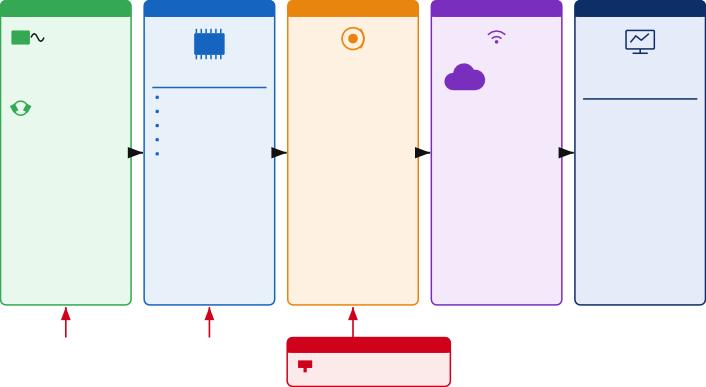
Fig-1:SystemArchitectureoftheProposedIoTBasedSmartPotholeDetectionandAlertSystem
HardwareComponents
The proposed system is built using low-cost, readily available embedded hardware components that are easy to integrate and suitable for real-time IoT applications. Each component performs a specific function in detecting potholes, acquiring location information, andtransmitting data tothe cloud. The hardware used in theproposed systemissummarized below:
ESP32DevelopmentBoard–Servesasthemaincontrollerofthesystem.Itprocessessensordata,controlssystem operations, communicates with peripheral devices, and uploads pothole information to the ThingSpeak cloud platform through its built-in Wi-Fi module.
Vibration Sensor – Detects sudden shocks and vibrations generated when a vehicle passes over a pothole or damagedroadsurface.ThesensorcontinuouslymonitorsroadconditionsandsendsvibrationsignalstotheESP32 forprocessing.
Neo-6MGPSModule–Capturesthegeographicalcoordinates(latitudeandlongitude)ofthedetectedpothole.The GPS module enables accurate location tracking, allowing road maintenance authorities to identify damaged road sectionsefficiently.
ThingSpeak Cloud Platform – Acts as the cloud-based monitoring platform where pothole detection data, GPS coordinates, and system status are stored and visualized in real time through an online dashboard.
Wi-Fi Communication Module (Built into ESP32) – Provides wireless internet connectivity for transmitting pothole detection data from the ESP32 to the ThingSpeak cloud platform without requiring additional communication hardware.
Active Piezo Buzzer – Generates an audible alert whenever a pothole is detected, indicating successful detection and confirming that the system has initiated data transmission.
Power Supply Unit – Provides a stable power source to the ESP32, vibration sensor, GPS module, and buzzer, ensuring reliable operation of the entire system during continuous road monitoring.
SoftwarePlatform
The proposed system was developed using the Arduino IDE with programming in C/C++. The ESP32 microcontroller continuously reads data from the vibration sensor and GPS module, processes the acquired information, and determines whether a pothole hasbeen detected based onpredefined vibrationthreshold values.Whenevera pothole isidentified, the ESP32 retrieves the current GPS coordinates and transmits the collected information to the ThingSpeak cloud platform through its built-in Wi-Fi module. The ThingSpeak dashboard displays the uploaded data in real time, including pothole detection status, geographical location, and sensor information, enabling remote monitoring and analysis by road maintenance authorities.
WorkingPrinciple
Theproposed systememploysasimplethreshold-based detectionalgorithminstead of computationallyintensivemachine learning techniques. Thisapproach provides fast response, reliable operation, and low computational overhead, making it wellsuitedforimplementationontheESP32microcontroller.Theoveralloperationofthesystemiscarriedoutthroughthe following stages:
RoadSurfaceMonitoring:Thevibrationsensorcontinuouslymonitorsroadsurfaceconditionsanddetectssudden shocks or vibrations generated when a vehicle passes over a pothole or damaged road section.
Data Processing and Location Acquisition: The ESP32 processes the vibration data and compares it with predefined threshold values. If the detected vibration exceeds the threshold, the system identifies it as a pothole and immediately acquires the corresponding latitude and longitude fromthe Neo-6M GPS module.
Cloud Data Transmission: The ESP32 formats the pothole information, GPS coordinates, and detection status before transmitting the data to the ThingSpeak cloud platform using Wi-Fi connectivity.
RemoteMonitoring andAlertGeneration: Theuploaded informationisdisplayed ontheThingSpeakdashboard for realtime monitoring. Simultaneously, the buzzer generates an audible alert to indicate successful pothole detection and data transmission, enabling efficient road condition monitoring and timely maintenance planning.
ControlAlgorithm
The control algorithm implemented in the proposed system follows a simple threshold-based approach for detecting potholes and transmitting their location information to the cloud. The pseudocode below summarizes the operation performed during each execution cycle of the ESP32 microcontroller:
Step 1: Readthe vibration sensor continuously to monitor road surface conditionsand detect sudden shocksor abnormal vibrations.
Step 2: IF the measured vibration value exceeds the predefined threshold, THEN identify the event as a pothole; ELSE continue monitoring the road surface.
Step 3: IFa pothole isdetected, THENacquirethe current geographical coordinates(latitude and longitude) fromthe Neo-6M GPS module.
Step 4: Format the pothole detection status, GPS coordinates, and timestamp into a data packet suitable for cloud transmission.
Step5:EstablishWi-FicommunicationanduploadthecollectedinformationtotheThingSpeakcloudplatformforreal-time monitoring and storage.
Step6:Activatethebuzzertogenerateanaudiblealertindicatingsuccessfulpotholedetectionanddatatransmission.
Step 7: Update the ThingSpeak dashboard with the latest sensor readings and detection status, then return to Step 1 to continuously monitor road conditions.
4. IMPLEMENTATION
After finalizing the system architectureand hardware configuration,the proposed IoT-based Smart PotholeDetection and Alert System was assembled and tested as a functional prototype. Each hardware component was individually verified before integrating the complete system. The vibration sensor, GPS module, buzzer, Wi-Fi communication, and ThingSpeak cloud platform were tested independently to ensure reliable operation before evaluating the complete system under different simulated road conditions.
PotholeDetectionModule
The pothole detection module is built around the ESP32 microcontroller and a vibration sensor. The vibration sensor continuouslymonitorsroad surfaceconditionsand generatesanelectricalsignalwhenever asuddenimpact or vibrationis detected.TheESP32readsthesensoroutputatregularintervalsandcomparesthemeasuredvibrationlevelwithpredefined threshold values. If the detected vibration exceedsthe specified threshold,the systemidentifiesthe event asa pothole and initiatesthesubsequent processingstages.Thethreshold valueswereselected experimentallytominimizefalsedetections while maintaining reliable pothole identification.
GPSLocationTrackingModule
Onceapotholehasbeendetected,theESP32communicateswiththeNeo-6MGPSmoduletoobtainthecurrentgeographical coordinates.TheGPSmodulecontinuouslyreceivessatellitesignalsandprovideslatitudeandlongitudeinformationinreal time. These coordinates accurately identify the location of the detected pothole, allowing road maintenance authorities to locate damaged road sections quickly. The GPS module was tested under open-sky conditions to achieve reliable satellite connectivity and accurate position measurements.
CloudCommunicationModule
After acquiring the pothole location, the ESP32 establishes a Wi-Fi connection and transmits the collected information to theThingSpeakcloudplatform.Theuploadeddataincludesthepotholedetectionstatus,GPScoordinates,andtimestampof thedetected event.ThingSpeak storesthereceivedinformationanddisplaysitthroughanonlinedashboard,allowingusers tomonitor road conditionsremotelyfromanyinternet-connecteddevice.The cloud communication modulewasevaluated under multiple transmission cycles to verifyreliable data transfer and real-time dashboard updates
AlertNotificationModule
Toprovide immediate local feedback,the systemincorporates an active piezo buzzerconnected tothe ESP32.Whenever a pothole is successfully detected and the corresponding data is prepared for cloud transmission, the buzzer is activated to generateanaudiblealert.Thisnotificationconfirmsthatthesystemhasdetectedaroadanomalyandinitiatedthereporting process. The alert mechanism also assists during testing by indicating successful execution of the detection algorithm without requiring continuous monitoring of the cloud dashboard.
SystemIntegrationandPrototype
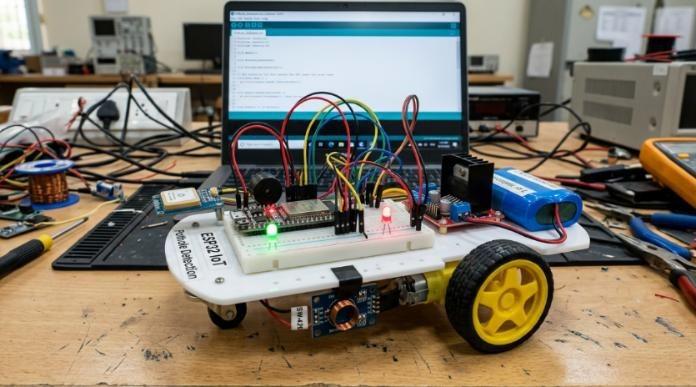
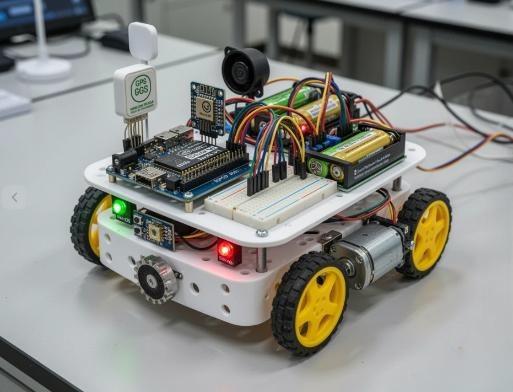
Afterverifyingthefunctionalityofeachindividualmodule,allhardwarecomponentswereintegratedintoasingleprototype consisting of the ESP32 development board, vibration sensor, Neo-6M GPS module, active piezo buzzer, and ThingSpeak cloud platform. During operation, the vibration sensor continuously monitors road conditions while the ESP32 processes thesensordata.Wheneverapotholeisdetected,theGPSmoduleprovidesthecorrespondinggeographicalcoordinates,and
theESP32uploadstheinformationtotheThingSpeakclouddashboardthroughWi-Fi.Theintegratedprototypesuccessfully demonstratedreal-timepotholedetection,accuratelocationtracking,cloud-basedmonitoring,andaudiblealertgeneration, confirming the feasibility of the proposed IoT-based Smart Pothole Detection and Alert System..
V Results And Discussion
After completing the hardware integration and software implementation, each module of the proposedIoT Based Smart Pothole Detection and Alert System was tested individually before evaluating the complete integrated system. The vibration sensor, GPS module, Wi-Fi communication, buzzer, and ThingSpeak cloud platform were verified independently to ensure proper operation before conducting end-to-end system testing. Table 2 summarizes the different test cases performed along with their corresponding outcomes.
Theexperimentalevaluationwascarriedoutundercontrolledconditionsbysimulatingpotholesofvaryingdepthsandroad surface irregularities. The vibration sensor was subjected to different levels of impact to verify its ability to distinguish significant pothole vibrationsfromnormal road disturbances. Whenever the measured vibration exceeded the predefined threshold value,the ESP32 successfully identified the event as a pothole and activated the detection process. The Neo-6M GPS module was simultaneously tested under open-sky conditions to verify its ability to acquire accurate geographical coordinates of the detected pothole locations.
PotholeDetection
GPSLocation Tracking
CloudCommunication
Alert Notification
Wi-FiConnectivity
ThingSpeakDashboard
ContinuousMonitoring
OverallSystem Integration
Vehiclepasses overasimulatedpothole
Potholedetectedunderopen-skyconditions
Potholedetectiondatatransmittedthrough WiFi
Potholedetected
ESP32connectedtowirelessnetwork
Sensordatauploadedtocloud
Multiplepotholedetectioneventsperformed
Completehardwareandsoftwareoperated together
Vibrationsensordetectedabnormalvibration and ESP32 identified thepothole successfully Pass
GPSmoduleacquiredaccuratelatitudeand longitude coordinates Pass
ThingSpeak dashboard updatedsuccessfullywithpotholestatusand GPSlocation Pass
Piezobuzzergeneratedanaudiblealertindicati ng successful detection Pass
Stableconnectionestablishedandcontinuo us data transmissionmaintained Pass
Dashboard displayed potholeinformationandGPScoordinatesinre altime Pass
System continuously monitored roadconditionsanduploadedeverydetectedev entsuccessfully Pass
All modules functioned correctly withreliablepotholedetection,GPStracking,c loud monitoring, and alert generation Pass
Table-2:FunctionalTestingSummary
The experimental results demonstrated that all the implemented modules of the proposed IoT Based Smart Pothole Detection and Alert System operatedsuccessfully under different testingconditions. Thevibrationsensorconsistently
Fig-2:HardwarePrototype–SmartPotholeDetectionAndAlertSystem
detectedpotholesbasedonpredefinedthresholdvalues,whiletheESP32accuratelyprocessedthesensordataandacquired the corresponding GPS coordinates through the Neo-6M GPS module. The collected pothole information was successfully transmittedtotheThingSpeakcloudplatformusingtheESP32'sbuilt-inWi-Ficonnectivity,whereitwasdisplayedonthe onlinedashboardwithonlyaminimalandconsistentcommunicationdelaytypicalofIoT-basedwirelesssystems.Theactive piezo buzzer generated an immediate audible alert upon pothole detection, confirmingsuccessful systemoperation. Multiple experimental trials verified the reliability, stability,and consistency of the integrated hardware and software components, demonstrating that the proposed system can effectively detect potholes, provide accurate location tracking, and support real-time remote road condition monitoring through a single cloud-based dashboard.
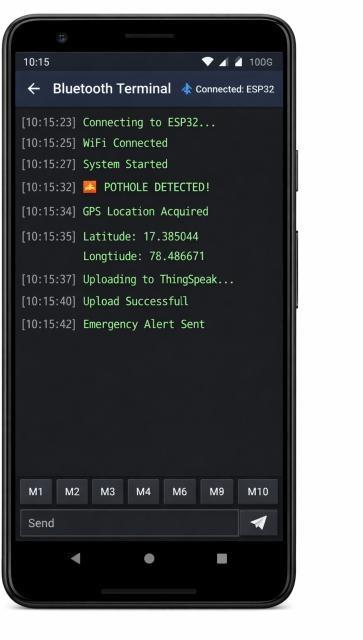
Overall,the experimental resultsindicatethat a simple combination of an ESP32 microcontroller, vibrationsensor, GPS module, Wi-Fi communication, and ThingSpeak cloud platform is sufficient to develop an effective and low-cost IoT-based pothole detection system without requiring expensive hardware or complex infrastructure. However, the testing process also revealed certain practical limitations. The cloud dashboard depends on a stable internet connection, and any interruption in Wi-Fi connectivity may temporarily delay data synchronization, although the ESP32 continues to detect potholesandprocesssensordatalocally. Thevibrationthresholdrequiredcarefulcalibrationtodistinguishactual potholes from normal road vibrations and speed breakers, and these threshold values may need further adjustment for different vehicle types and road conditions. In addition, the GPS module performs best in open environments with clear satellite visibility, while signal acquisition may be slower in densely built urban areas or tunnels. Despite these limitations, all hardware components used in the prototype— including the ESP32, vibration sensor, Neo-6M GPS module, active piezo buzzer,andThingSpeak cloudplatform—are inexpensive,readilyavailable,and easyto integrate. Thismakestheproposed system highly cost-effective, scalable, and suitable for deployment in smart transportation systems, municipal road monitoring,and smart cityinfrastructure,where multiple vehiclescan collectivelycontribute tocontinuousroad condition monitoring with only minimal additional implementation cost.
5. ADVANTAGESOFTHEPROPOSEDSYSTEM
Automaticallydetectspotholesinrealtimeusingavibrationsensor,reducingtheneedfor manualroad inspections.
Accuratelyrecordsthe geographicallocation ofdetected potholesusing the Neo-6M GPSmodule, enabling faster identification of damaged road sections.
Uploadspothole information tothe ThingSpeak cloud platformthroughWi-Fi,allowingremote monitoringand real-time data visualization.
Generatesanimmediateaudiblealertusingapiezobuzzerwheneverapotholeisdetected,providinginstant confirmation of successful detection.
Fig-3:MobileApplicationDashboard
Providesalow-costand portablesolutionbyutilizingreadilyavailablehardwarecomponentssuchastheESP32, vibration sensor, GPS module, and ThingSpeak cloud platform.
Supportssmartcityandintelligenttransportationinitiativesbyenablingtimelyroadmaintenanceandreducing accidents caused by poor road conditions.
Featuresa scalableand modulararchitecturethat can be easilyextended byintegrating additional sensors, cameras,machinelearningalgorithms,ormobileapplicationsforadvancedroadmonitoringandpredictive maintenance.
VI. FUTURESCOPE
The proposed IoT Based Smart Pothole Detection and Alert System successfully demonstrates the feasibility of using low-cost embedded hardware and cloud computing for real-time road condition monitoring. However, there are several opportunities to further improve the system's functionality and deployment capability. A dedicated web portal or mobile application can be developed toprovide road maintenance authoritieswithan interactive mapdisplayingthe live locations of detected potholes, maintenance history, and road condition statistics instead of relying solely on the ThingSpeak dashboard.
Future versions of the system can incorporate machine learning and artificial intelligence algorithms to distinguish potholes from speed breakers, road joints, and other surface irregularities with higher accuracy. Integrating cameras and computer vision techniques would further improve detection performance by combining vibration data with real-time image analysis. The system can also be enhanced by supporting multiple sensors such as accelerometers, gyroscopes, and ultrasonic sensors to improve reliability through sensor fusion.
The current prototype can be expanded into a vehicle-to-cloud road monitoring network, where multiple vehicles equipped with the proposed system continuously upload pothole information to a centralized cloud database. Such a distributed architecture would enable authorities to generate real-time road damage maps, identify frequently affected areas,and prioritize maintenance activitiesmore effectively.In addition,automaticnotification servicessuchasSMS,email alerts,or mobile pushnotificationscan be integratedtoimmediatelyinformmunicipalauthoritieswhenevera newpothole isdetected.
Further improvements may include integrating 5G communication, edge computing, Google Maps visualization, and renewableenergysourcessuchassolar-poweredembeddedunitsforcontinuousoutdooroperation.Theseenhancements would improve scalability, reduce communication latency, and support large-scale deployment in smart cities, intelligent transportation systems, and highway infrastructure monitoring.
6. CONCLUSION
This paper set out to build and test an IoT-based Smart CampusSystemthat bringsclassroom power switching, intelligent Thisproject successfullydesigned,implemented,andevaluatedan IoTBasedSmartPotholeDetectionandAlertSystem capable of detecting road surface irregularities and reporting their locations in real time. The proposed system integrates anESP32microcontroller,vibrationsensor,Neo-6MGPSmodule,Wi-Ficommunication,ThingSpeakcloudplatform, and an activepiezobuzzer intoa compact and cost-effective embedded solution. Experimental testing demonstrated that thevibrationsensorreliablydetectedpotholes,theGPSmoduleaccuratelyrecordedtheirgeographicalcoordinates,andthe ESP32 successfully transmitted the collected information to the cloud platform for remote monitoring.
The developed prototype enables road maintenance authorities to monitor damaged road sections through a centralized onlinedashboard,allowingfasteridentificationandrepairofpotholeswhilereducingtheneedformanualroadinspections. The system also provides immediate local feedback through an audible buzzer and supports continuous road condition monitoringusingreadilyavailableandinexpensivehardwarecomponents.Overall,theproposedsolutiondemonstratesthat IoT technology can significantly contribute to improving road safety, minimizing vehicle damage, supporting smart transportation infrastructure, and enabling efficient road maintenance. With future enhancements such as artificial intelligence, computer vision, mobile applications, and large-scale cloud integration, the system can evolve into a comprehensive smart road monitoring platform suitable for modern smart city environments.
ACKNOWLEDGEMENT
The authors express their sincere gratitude to Mrs. K. Shanthi Priya, Assistant Professor, Department of Information Technology,for her continuousguidance, valuable suggestions,and constant encouragement throughout thedevelopment
of the IoT Based SmartPotholeDetection and AlertSystem. Her technical expertise and motivation greatlycontributed to the successful completion of this project.
The authors also extend their heartfelt thanks to Dr. A. Obulesu, Professor and Head of the Department of Information Technology, for providing the necessaryacademic support and encouragement during the course of thiswork. Finally, the authorsgratefullyacknowledgethemanagementof VidyaJyothiInstituteofTechnology(Autonomous),Hyderabad,for providing the infrastructure, laboratory facilities, and resources required to successfully complete this project.
REFERENCES
[1] S. G. K. Patil, R. R. Karhe, and V. M. Deshmukh, "Smart Road Monitoring System Using IoT for Pothole Detection and Notification," International Journal of Engineering Research & Technology (IJERT), vol. 10, no. 5, pp. 450–455, 2021.
[2] P. S. Bhosale, A. S. Kharade, and S. R. Patil, "IoT Based Smart Pothole Detection and Monitoring System," International Journal of Innovative Research in Computer and Communication Engineering, vol. 8, no. 6, pp. 2800–2806, 2020.
[3] A. Mednis, G. Strazdins, R. Zviedris, G. Kanonirs, and L. Selavo, "Real Time Pothole Detection Using Android Smartphones with Accelerometers," IEEE Sensors, pp. 1–4, 2011.
[4] M. H. Aly, M. A. A. El-Sayed, and A. M. Hamed, "Automatic Pothole Detection System Using Image Processing Techniques," International Journal of Advanced Computer Science and Applications (IJACSA), vol. 10, no. 8, pp. 350–357, 2019.
[5] S. K. R. Chandra, R. R. Kumar, and P. R. Kumar, "IoT Based Road Condition Monitoring System Using Sensors and Cloud Computing," IEEE International Conference on Smart Technologies and Management, pp. 120–125, 2020.
[6] A. K. Singh and R. Sharma, "Smart Transportation System Using Internet of Things (IoT): A Review," IEEE International Conference on Computing, Communication and Automation, pp. 1–6, 2018.
[7] P. P. Ray, "A Survey on Internet of Things Architectures," Journal of King Saud University – Computer and Information Sciences, vol. 30, no. 3, pp. 291–319, 2018.
[8] A. Zanella, N. Bui, A. Castellani, L. Vangelista, and M. Zorzi, "Internet of Things for Smart Cities," IEEE Internet of Things Journal, vol. 1, no. 1, pp. 22–32, Feb. 2014.
[9] M. A. Razzaque, M. Milojevic-Jevric, A. Palade, and S. Clarke, "Middleware for Internet of Things: A Survey," IEEE Internet of Things Journal, vol. 3, no. 1, pp. 70–95, 2016
[10] N. A. Al-Fuqaha, M. Guizani, M. Mohammadi, M. Aledhari, and M. Ayyash, "Internet of Things: A Survey on Enabling Technologies, Protocols, and Applications," IEEE Communications Surveys & Tutorials, vol. 17, no. 4, pp. 2347–2376, 2015.
[11] H. Ning and H. Liu, "Cyber-Physical-Social Thinking Space for the Internet of Things," IEEE Internet of Things Journal, vol. 2, no. 2, pp.109–119, 2015.
[12] N. Lu, N. Cheng, N. Zhang, X. Shen, and J. W. Mark, "Connected Vehicles: Solutions and Challenges," IEEE Internet of Things Journal, vol. 1, no. 4, pp. 289–299, Aug. 2014.
[13] M. Gerla, E. K. Lee, G. Pau, and U. Lee, "Internet of Vehicles: From Intelligent Grid to Autonomous Cars and Vehicular Clouds," IEEE World Forum on Internet of Things, pp. 241–246, 2014.
[14] A. Alamri, W. S. Ansari, M. M. Hassan, M. S. Hossain, A. Alelaiwi, and M. A. Hossain, "A Survey on Sensor-Cloud: Architecture, Applications, and Approaches," International Journal of Distributed Sensor Networks, vol. 9, no. 2, 2013.
[15] S. Sharma and B. Singh, "Internet of Things (IoT): Architecture, Characteristics, and Applications," International Journal of Engineering Research & Technology (IJERT), vol. 9, no. 5, pp. 987–992, 2020.
[16] Espressif Systems, ESP32-WROOM-32 Datasheet, Version 3.9, Shanghai, China, 2023.
[17] u-blox AG, NEO-6 GPS Module Data Sheet, u-blox 6 GPS Receivers, 2023.
[18] MathWorks, ThingSpeak IoT Analytics Platform Documentation, The MathWorks Inc., 2024.
[19] Arduino, Arduino IDE Documentation and ESP32 Development Environment, Arduino Documentation, 2024.
[20] OpenCV Development Team, OpenCV: Open Source Computer Vision Library Documentation, 2024