How Performance Marketing Helps Businesses Improve Marketing ROI?
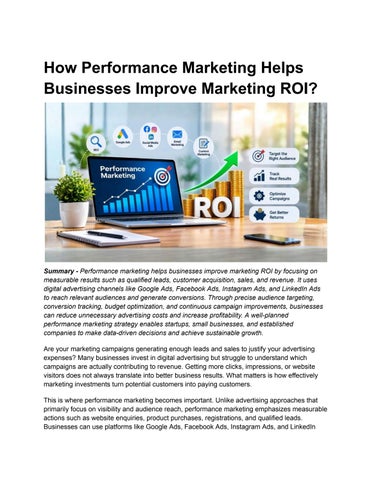
Summary - Performance marketing helps businesses improve marketing ROI by focusing on measurable results such as qualified leads, customer acquisition, sales, and revenue. It uses digital advertising channels like Google Ads, Facebook Ads, Instagram Ads, and LinkedIn Ads to reach relevant audiences and generate conversions. Through precise audience targeting, conversion tracking, budget optimization, and continuous campaign improvements, businesses can reduce unnecessary advertising costs and increase profitability. A well-planned performance marketing strategy enables startups, small businesses, and established companies to make data-driven decisions and achieve sustainable growth. Are your marketing campaigns generating enough leads and sales to justify your advertising expenses? Many businesses invest in digital advertising but struggle to understand which campaigns are actually contributing to revenue. Getting more clicks, impressions, or website visitors does not always translate into better business results. What matters is how effectively marketing investments turn potential customers into paying customers. This is where performance marketing becomes important. Unlike advertising approaches that primarily focus on visibility and audience reach, performance marketing emphasizes measurable actions such as website enquiries, product purchases, registrations, and qualified leads. Businesses can use platforms like Google Ads, Facebook Ads, Instagram Ads, and LinkedIn
Ads to reach relevant audiences, monitor campaign performance, and optimize their advertising budgets. For example, a real estate company can track property enquiries and site visit bookings, while an eCommerce business can measure product purchases generated through paid campaigns. These insights help businesses understand what works, reduce unnecessary spending, and improve marketing ROI.
What Is Performance Marketing and Why Does It Matter for Businesses? Performance marketing is a results-driven digital advertising approach in which campaign success is measured through specific actions such as clicks, leads, purchases, app downloads, registrations, or enquiries. Instead of evaluating marketing success only through impressions and website traffic, businesses focus on measurable outcomes that contribute to their growth. For example, an eCommerce company may measure the number of purchases generated through paid advertisements, while a real estate business may track qualified property enquiries and site visit bookings. Performance marketing uses platforms such as Google Ads, Facebook Ads, Instagram Ads, LinkedIn Ads, and other digital advertising networks to reach relevant audiences. It matters because businesses need to understand where their marketing budgets are going and whether their campaigns are generating meaningful returns. With accurate conversion tracking and campaign analysis, marketers can identify profitable advertising channels, improve lead generation, and allocate budgets more effectively.
How Does Performance Marketing Help Businesses Improve Marketing ROI? Improving marketing ROI is not simply about spending less on advertising. It is about generating better business outcomes from every marketing investment. Performance marketing supports this through several practical approaches.
1. Focuses on Measurable Marketing Results One of the biggest advantages of performance marketing is its focus on measurable results. Businesses can track how many people click an advertisement, submit an enquiry, make a purchase, or complete another valuable action.
For example, a software company investing in LinkedIn advertising can measure demo requests generated from its campaigns rather than judging success only by the number of people who viewed its advertisements. This information helps marketing teams understand which campaigns are contributing to business objectives and which require improvement.
2. Reduces Unnecessary Advertising Expenses Spending money on advertisements without understanding audience behaviour can lead to poor marketing returns. Performance marketing helps businesses identify irrelevant traffic, ineffective keywords, and advertisements that fail to generate conversions. Marketers can use negative keywords, audience exclusions, location targeting, and campaign budget adjustments to reduce unnecessary spending. For instance, a business offering professional services in Pune may receive irrelevant enquiries from locations outside its service area. By refining geographic targeting, it can concentrate advertising expenditure on potential customers who are more likely to become clients.
3. Improves Audience Targeting and Lead Quality Reaching a large audience does not necessarily mean reaching the right customers. Effective performance marketing focuses on customer intent, demographics, interests, location, and online behaviour. Businesses can segment audiences based on their stage in the buying journey. ● ● ● ●
Awareness: Reach people who are discovering a product or service. Consideration: Connect with users comparing available solutions. Conversion: Target prospects who are ready to enquire or purchase. Remarketing: Reconnect with visitors who previously interacted with the business.
This approach helps generate relevant leads instead of increasing enquiry volumes without considering their quality.
4. Increases Conversion Rates Through Campaign Optimization Generating website traffic is only one part of digital advertising. Businesses also need to convert visitors into customers. Performance marketing combines advertisement optimization with conversion rate optimization (CRO) to improve the customer journey. Marketers can test different headlines, advertising creatives, landing page layouts, calls to action, and enquiry forms to understand what encourages users to take action.
For example, a healthcare provider running appointment-booking advertisements may improve conversions by creating a dedicated landing page with treatment information, doctor credentials, location details, and a simple appointment form. Even a small improvement in conversion rate can help a business generate more enquiries without proportionally increasing its advertising budget.
5. Provides Real-Time Campaign Performance Insights Performance marketing gives businesses access to campaign data that helps them make informed decisions.
Using tools such as Google Analytics 4, Google Ads conversion tracking, and Google Tag Manager, marketers can analyse: ● ● ● ● ● ● ●
Website visits and user engagement. Advertising clicks and impressions. Cost per click (CPC). Cost per lead (CPL). Conversion rates. Customer acquisition cost (CAC). Revenue and return on ad spend (ROAS).
These insights help identify which advertising channels, keywords, audiences, and creatives are producing better results. Instead of waiting until the end of a campaign to evaluate its success, businesses can make adjustments based on ongoing performance data.
6. Helps Businesses Scale Profitable Campaigns Once a campaign consistently generates qualified leads or profitable sales, businesses can consider increasing its budget strategically. However, increasing advertising expenditure without analysing performance can increase customer acquisition costs and reduce profitability. A better approach is to identify high-performing audience segments, search terms, locations, and advertising creatives before expanding campaigns. This allows businesses to grow their customer base while maintaining greater control over marketing expenditure.
7. Supports Customer Acquisition and Retention
Performance marketing is not limited to acquiring new customers. It can also help businesses reconnect with existing customers and encourage repeat purchases. Remarketing advertisements, personalised offers, email campaigns, and customer segmentation can keep a brand visible throughout the customer journey. For an online retail business, for example, remarketing can reconnect with visitors who viewed a product but did not complete their purchase. Combining customer acquisition with retention strategies helps businesses improve customer lifetime value (CLV) and generate more sustainable returns.
Which Performance Marketing Channels Help Improve ROI? Choosing the right advertising channel depends on business objectives, target customers, industry, and available budget. Different performance marketing channels serve different purposes.
Search Engine Marketing and Google Ads Google Ads helps businesses reach people actively searching for specific products or services. Search campaigns can target high-intent keywords, making them useful for lead generation, enquiries, and online sales. For example, a company searching for customers interested in website development can target relevant commercial search queries instead of spending its entire budget on broad awareness campaigns. Businesses can explore these Google Ads ROI strategies to understand how keyword targeting, conversion tracking, and campaign optimization contribute to better advertising returns.
Social Media Advertising LinkedIn and Instagram advertising help businesses connect with audiences based on interests, demographics, behaviours, and engagement patterns. These platforms are particularly useful for eCommerce brands, educational institutes, real estate companies, healthcare providers, and consumer-focused businesses. Creative testing, audience segmentation, and remarketing can help improve campaign performance.
LinkedIn Advertising
LinkedIn Ads can support B2B marketing by reaching professionals, business owners, decision-makers, and specific industry audiences. Businesses offering SaaS products, IT solutions, consulting, and professional services can use LinkedIn campaigns to generate relevant business enquiries and qualified leads.
Affiliate and Display Marketing Affiliate marketing allows businesses to work with publishers or partners who promote their products and services through agreed commission or performance-based arrangements. Display advertising helps increase brand visibility across relevant websites and digital platforms. When combined with remarketing, it can encourage interested visitors to return and complete an action.
What Are the Important Performance Marketing Metrics to Measure ROI? Tracking the right KPIs is essential for understanding whether advertising campaigns are delivering business value. Marketing Metric
What It Measures
Return on Ad Spend (ROAS)
Revenue generated compared with advertising expenditure.
Customer Acquisition Cost (CAC)
Average cost of acquiring a new customer.
Cost Per Lead (CPL)
Amount spent to generate one lead.
Cost Per Click (CPC)
Average cost paid for an advertising click.
Cost Per Acquisition (CPA)
Average cost of generating a defined conversion.
Conversion Rate
Percentage of visitors who complete a desired action.
Customer Lifetime Value (CLV)
Estimated value a customer generates throughout the relationship.
Businesses should not evaluate all campaigns using the same metric. An eCommerce company may prioritize ROAS and purchase value, while a B2B company may focus on qualified leads, cost per acquisition, and revenue generated from closed deals.
How Can Businesses Calculate Performance Marketing ROI? Marketing ROI measures the financial return generated from marketing activities compared with the investment made.
A commonly used formula is: Marketing ROI = [(Incremental Profit − Marketing Investment) ÷ Marketing Investment] × 100 Consider a business that spends ₹50,000 on a marketing campaign and generates ₹2,00,000 in attributable sales. If the contribution profit from those sales, before marketing costs, is ₹80,000, the calculation would be: ● ● ● ● ●
Marketing investment: ₹50,000 Attributable sales revenue: ₹2,00,000 Contribution profit before marketing: ₹80,000 Profit after marketing investment: ₹30,000 Marketing ROI: 60%
This means the campaign generated a 60% return on the marketing investment, based on the stated contribution-profit assumptions. Businesses should also understand the difference between ROI and ROAS. ROAS compares advertising revenue with advertising spend, while ROI evaluates the return after accounting for relevant costs. Measuring both provides a clearer picture of campaign profitability.
How Can a Digital Marketing Agency in PCMC Help Businesses Improve Marketing ROI? Choosing the right marketing partner can make a difference in how businesses plan, execute, and measure their advertising campaigns. A reliable digital marketing agency in PCMC can help companies develop performance-focused strategies based on their industry, customer behaviour, and business objectives. For businesses operating in Pimpri, Chinchwad, Wakad, Nigdi, Bhosari, Akurdi, and other parts of the Pune region, understanding local search behaviour can improve advertising relevance. For example, a manufacturing company in Bhosari may focus on B2B lead generation and decision-maker targeting, while a retail business in Pimpri may prioritize location-based advertising and customer enquiries.
An experienced agency can support these objectives through: ● ● ● ● ● ● ●
Google Ads and PPC campaign management. Facebook and Instagram advertising. Local audience targeting and lead generation. Landing page design and conversion optimization. Google Analytics 4 and conversion tracking. Campaign reporting and budget optimization. Remarketing and customer acquisition strategies.
Businesses should evaluate an agency based on its strategic approach, reporting transparency, industry understanding, and ability to connect campaign performance with actual business outcomes. The right performance marketing approach should focus on measurable growth rather than simply increasing clicks, impressions, or advertising activity.
What Are the Common Performance Marketing Mistakes Businesses Should Avoid? Even well-funded advertising campaigns can underperform when businesses overlook important optimization practices.
Some common mistakes include: 1. Focusing only on clicks: High website traffic does not guarantee qualified enquiries or sales. 2. Ignoring conversion tracking: Without accurate tracking, it becomes difficult to identify profitable campaigns. 3. Using broad targeting: Reaching irrelevant audiences can increase advertising costs. 4. Neglecting landing pages: Poor page experience, unclear messaging, and complicated forms can reduce conversions. 5. Ignoring lead quality: A high number of enquiries is not useful if most prospects are unlikely to become customers. 6. Increasing budgets too quickly: Scaling campaigns without checking profitability can negatively affect ROI. 7. Not testing advertisements: Running the same creative and messaging for too long can limit campaign improvement. Regular campaign reviews, audience analysis, and conversion optimization help businesses avoid these problems and make better use of their marketing budgets.
Turn Your Marketing Investment Into Measurable Business Growth Better marketing ROI comes from understanding customers, selecting the right advertising channels, tracking meaningful conversions, and continuously improving campaign performance. Businesses that connect their advertising budgets with qualified leads, actual sales, and customer value can make more confident growth decisions. Whether you are a startup, manufacturing company, eCommerce brand, or established service provider, a structured performance marketing strategy can help you reduce unnecessary expenditure and identify better growth opportunities. Looking to improve your advertising returns and generate more qualified business enquiries? Connect with an experienced digital marketing team to evaluate your current campaigns, identify missed opportunities, and build a performance-driven strategy that turns marketing expenditure into measurable business results.
Frequently Asked Questions About Performance Marketing How does performance marketing improve marketing ROI? Performance marketing improves marketing ROI by focusing on measurable outcomes such as leads, sales, and conversions. It uses audience targeting, campaign tracking, budget optimization, and remarketing to reduce wasted advertising expenditure and improve returns.
Which performance marketing channel is best for generating leads? Google Ads is useful for reaching customers with high purchase intent, while Facebook and Instagram Ads can help businesses generate demand and reach specific audience segments. LinkedIn Ads can be effective for B2B lead generation. The right channel depends on the target audience and business objectives.
What is a good ROAS for a performance marketing campaign? There is no universal ideal ROAS. It depends on product margins, operating expenses, customer lifetime value, and advertising costs. A campaign generating 4x ROAS may be profitable for one business but unprofitable for another. Businesses should calculate profitability before deciding whether a campaign is successful.
How much should a small business invest in performance marketing?
The advertising budget depends on business goals, industry competition, average customer value, and expected acquisition costs. Small businesses should begin with a measurable budget, test campaigns, evaluate lead quality, and increase spending when results demonstrate sustainable profitability.
How long does it take to see results from performance marketing? Paid advertising can generate initial clicks and enquiries shortly after campaigns launch. However, achieving consistent and profitable results requires sufficient conversion data, audience testing, landing page improvements, and regular optimization. The timeline varies by industry, competition, budget, and campaign objectives.