R E D C O M E T P R E S S • B R O O K LY N
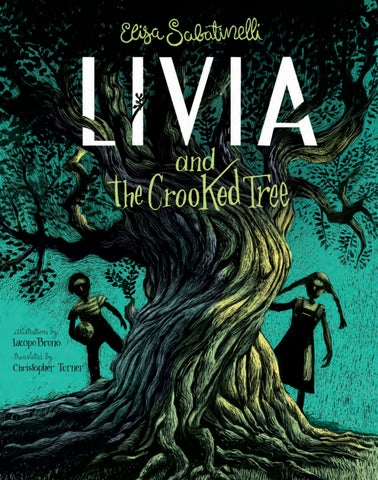
Livia and the Crooked Tree Text copyright © 2027 Elisa Sabatinelli Illustrations © 2027 Iacopo Bruno Published in 2027 by Red Comet Press, LLC, Brooklyn, NY Translated by Christopher Turner Editorial contributions: Julie Romeis Sanders All rights reserved. No part of this book may be used or reproduced in any manner whatsoever without written permission except in the case of brief quotations embodied in critical articles and reviews. Library of Congress Control Number: 2025949256 ISBN: 978-1-63655-196-8 (hardcover) ISBN: 978-1-63655-197-5 (e-book) 27 28 29 30 31 32 TLF 10 9 8 7 6 5 4 3 2 1 Manufactured in China Red Comet Press is distributed by ABRAMS, New, York
RedCometPress.com
To Georgina and Fabio, the olive tree of my childhood
PROL O GU E PRESENT DAY
A few days ago, a letter came in the mail. It included a death notice clipped from a newspaper. And it was from Livia. Livia the weirdo. Livia the olive. Livia the pale face. I instantly recognized her crooked handwriting: “Aunt Bea left us on the day of the spring solstice.” So I got into my car and drove. Even though it was just the thinnest scrap of paper, the death notice felt heavy, like a rock in my pocket. It was pulling me far away, to a place I’d almost forgotten, a place I hadn’t been for many, many years. It read, “Bea Diotallevi: a long life well lived.” She would have been 121 this year. The place is Serrungarina, and it’s where I was born and lived until I was eleven. Its long, meandering name means something like “hilltop ridge.” And now, here I am again in this tiny village perched on a hilltop, where time, rain,
Elisa Sabatinelli
and snow have not only worn away most of the walls but taken the people with them. The houses are empty shells; the windows boarded up with old planks. I walk the broken streets—the cobblestones are uneven and, in front of the barred doors, the grass has grown wild and high. But when I was little, I felt safe here, as if I were wrapped in a big brown blanket. The rectangle of land I could see from my bedroom window was a kaleidoscope: When it rained, it turned dark brown. Then, if the rain didn’t stop for days, the mud looked as black as the coals they burned in those old-fashioned stoves. And then the sun would come out and change everything, and the hills would return to the color of camel fur. It’s strange to think I haven’t been back until now. For months and years after I left, I dreamed at night about Serrungarina from above, as if I were in a biplane. I’d see the village perched on the hills, count the ninety-four steps between the gate in the wall and the main square, fly over its four concentric streets, and brush my finger over the brown rooftops, perfectly aligned like puzzle pieces all the way up to the church bell tower, which stood tall like a candle on a round cake. Or like a big brown cat curled up 2
Livia and the Crooked Tree
in a wicker basket. From there, I’d blow as if my chest could hold all the north wind, and the grass on the hills would bend down, bowing in astonishment to the thousands upon thousands of olive trees that covered the slopes. Now that I’m back, I don’t dare look beyond the walls because that’s where their house was—Livia and Old Bea’s house, their olive tree, and our childhood. Livia told me to meet her under the linden tree in the square. But she’s not there. No one’s there. Livia was my neighbor when we were kids. She lived with her dad, Old Bea, and a cat with no tail. Livia and her whole family were like doughnuts without holes, each one with an obvious manufacturing defect. Her father had a glass eye, like a marble with a blue pupil that stared straight ahead no matter where you moved, without ever blinking. Livia wore orthodontic headgear. Two metal rods like whiskers stuck out from either side of her mouth, connecting behind her neck with an elastic band. Little pieces of metal that looked like nailheads covered her teeth. But I think we were even more freaked out by the contraption she wore under her sweater to keep her back straight, like a suit of armor wrapped around her torso. 3
Elisa Sabatinelli
We called them “the crooked family.” Livia wasn’t normal. We were sure of it. She did things we didn’t do. She thought things we didn’t think. We were the majority; she was one of a kind. We said all sorts of things about Livia. But one night—the most magical night I’ve known—we had to take it all back. Every single word. With these thoughts scattering through my head, I walk back to my car, which I’ve parked by the village walls. When I open the door, it bangs against the elm tree, the tree I hid behind on the night Livia arrived. Like a river in flood, memories surge up from deep inside, overpowering me with their force. All I can do is sit down, close my eyes, and, just like when I was far away, dream of Serrungarina. There was a time when Livia didn’t exist. The time before I turned ten. A safe, peaceful, orderly time. My friends: the same ones I’ve always had, as far back as I can remember. My parents: Filippo and Francesca. Siblings: none. Pets: not applicable. My habits, my places, my games, my days . . . an unbroken flow of safe moments. A few Sunday outings to nearby places, a couple of bike crashes, bouts of flu, one broken leg, Grandma Maria losing her memory far too soon. Nothing else really stands out. 4
Livia and the Crooked Tree
I was a kid named Daniele, and I lived in a village in Italy. I liked pistachio ice cream and rainy Sundays. Everything just flowed; everything went as it should. Then, on the last evening of July, Livia arrived.
5
1 Livia Arrives
Sixty-five years earlier
This evening when I go out for a walk it’s already dark. The warm wind blows through the narrow village streets, rustling the leaves. Suddenly, from the road outside the village walls—the one that leads down to the train station—two headlights pierce the darkness of the night. Without thinking, I hide behind the gigantic elm tree next to the wall. The car, a taxi, stops in front of Old Bea’s house at the bottom of the village. It’s the only house that’s all closed up—a kind of black sheep, a strange mushroom, a wrong note, a relic of time. It’s an old five-story stone building with shutters that are always closed, a tiled roof full of holes like a soufflé
Elisa Sabatinelli
taken out of the oven too soon, and a pergola covered by grapevines by the front door. Out the back, there’s a centuries-old olive tree that’s so crooked it looks like a monster, a bit like Pudge, Bea’s cat with the missing tail. A girl and a man get out of the taxi. They unload from the trunk two suitcases, a wooden crate, and two backpacks. And then Livia appears. She’s wearing overalls (and that’s all), and when she walks under the streetlight, I immediately notice that her skin’s as pale as milk. She’s as skinny as a toothpick, with two pigtails sticking out from under a red baseball cap. The moment I see her, I feel a tapping in my chest, as if someone is inside there knocking on my heart—a warning that someone has arrived who’s going to turn my life upside down. By the look of her, she’s very fragile, as if she could blow away at any moment with just a breath of wind—like a dandelion that keeps the lion’s strength inside, guarding it and only releasing it when the time is right. But I barely have the time to take it all in before the man turns and spots me. He stares at me. I feel my blood run cold; I’m frozen to the spot. For a few seconds, I don’t move 8
Livia and the Crooked Tree
as I stare at the man and he stares at me. In those endless seconds, I see Old Bea, the village oddball in her greasy apron, open her front gate, pat the man on the shoulder, give the girl a peck on the cheek, and hand the taxi driver some cash. When those endless seconds finally crumble away into the depths of time, I run home. And, as I run, I think about the girl, the man, the village oddball, and the wooden crate they unloaded from the taxi, and I know they’ve come to devour us, to tear us apart. Or maybe there’s a dead body inside that crate already? Who are these strangers? Where are they from? And how do they know Old Bea? For as long as I can remember, I haven’t seen her leave her house except to go into the fields. No one ever visits her, not even on Christmas Day, the Day of the Dead, Easter, Ferragosto, her birthday. . . . And now I come to think of it, how old is she anyway? I get home and fling the door open. Mom says, “Finally! Where have you been?” I don’t remember anything else after that, as if a curtain has fallen over my memories. But I’ll never forget the day Livia arrived. 9
2 August in the Hills The next day is just another summer day in Serrungarina. In summer, the hill is a silent world. The few people who live here stay indoors most of the day, hiding from the heat. Like little animals, they only come out early in the morning and at dusk, when the sun sinks down. I push back the curtain and look at Old Bea’s house. It’s right in front of our place but, due to the slope of the land, it’s below us. From here, the highest point in the village, you can see the hills spreading out all around us–peaceful and mainly covered with olive trees. This morning, Old Bea’s shutters are half open, and I can’t see any sign of the new arrivals. But they’re still very clear in my mind. I kept seeing them all night, like ghosts I tried to chase away, only for them to keep reappearing,
Elisa Sabatinelli
carried back on the wind. And each time, fear gripped me, and every sound in the room turned into a potential danger. Nothing happened, but the morning took so long to come that it felt like a hundred years had gone by. The house I live in is a lot like all the other houses here: long, narrow, with two floors and an attic. From a distance, they look like chocolate bars. Some have a small back garden. My room, in the attic, has unobstructed views of the stars. It’s not very big—there’s just enough room for a bed, a desk, and an old chair, and I’ve forgotten what the chair looks like because it’s always hidden under piles of clothes. Underneath the bed are a faded red rug, a box with my abandoned poems (almost all of them), and other scribbled sheets of paper. On the walls are a wooden closet with double doors, and shelves with the books that Grandma gave me before she lost her memory and forgot that September is when we go to buy school supplies at the stationery store in Fano, where she once bought me a big illustrated book with a cover so beautiful that I almost felt sorry to touch it. Near the shelves is the only window in the attic, from which I have a perfect view of Old Bea’s house. 12
Livia and the Crooked Tree
My room would be a typical messy kid’s room, if it weren’t for the huge skylight, which turns it into something special. It points straight at the sky, so it’s like having my own personal planetarium when I lie in bed, and up here in the hills, without all those streetlights they have in the city, you can see a million stars. When I go down to the kitchen for breakfast, Dad is back from his bike ride and, still in his cycling gear, is already eating. Every morning at six o’clock, he rides for miles through the hills, past fields and streams. Sometimes he rides through private properties—those huge, unfenced gardens of the “historical” villas, farmhouses that are so big you’d always need to have guests staying just to fill them. Even though our kitchen’s small, it’s always busy, and it’s where we spend most of our time. In the morning, everyone is dressed differently. It almost looks like a costume party. Dad walks around in his cycling gear, right down to his shoes with cleats. Mom wears her work overalls with the unmistakable ElettroMarche logo. I’m usually still in my pajamas. Today on the table is Dad’s haul from this morning’s bike ride: decorative ears of wheat. Dad always makes sure 13
Elisa Sabatinelli
to bring home a small harvest from his rides: lemons, oranges, plums, pears, apples, cherries, zucchinis . . . whatever’s in season. Grandma is in her armchair. My parents are always moving it back and forth between the living room and kitchen with her in it, like a sailor who won’t leave her ship. She doesn’t say much anymore. Just a few hellos, goodbyes, and things that don’t make sense: “I used to see flies” or “The grapes are sour,” and other things that seem to be in code. Even though Grandma never went to school, she was always the one who gave me books. Whenever we’d go to the bookstore, she’d be both embarrassed for herself and proud of me for asking for this or that book and knowing exactly what I wanted. Then, on the way home, all we’d talk about was what I wanted to be when I grew up. And she didn’t laugh when I said a poet. She thought it sounded beautiful, a faraway dream, like an astronaut or a pearl diver. “An elegant profession,” she said. Now seeing her so lost makes me feel alone because I don’t know whom to say these things to anymore. I look at her and, to chase away the sadness, I imagine that she’s on the moon, like that astronaut she once adored. 14
Livia and the Crooked Tree
“Good morning, Didò!” Mom loves doing weird things to my name. I can’t stand it, especially when she does it in front of other people. “Mom, I’ve told you that I don’t like that. Can’t you just call me Daniele?” “Didò,” (again) “you’re grounded after last night, so I’ll call you what I like.” “Sorry, I got lost. I already told you.” “Lost?! That’s a good one!” For a moment, I wonder if I should tell the truth. The images of last night get tangled up in my head, so I grab them, throw them away, and say nothing. The doorbell rings. Dad announces, “That’ll be Chatty Patty.” Her real name is Patrizia and she’s our neighbor, but we call her that because she loves to gossip and spice up every story. “Francesca,” she says to Mom. “Have you heard the news?” “No, what news? Did someone die?” Patrizia is a kind of walking obituary column, a cemetery bulletin board. I think she brings bad luck, so I retreat to my room. 15
Elisa Sabatinelli
“Old Bea has guests staying with her!” she says, her voice bright with excitement. Hearing that, I strain to listen. “A man and a girl—I saw them last night from my window. They had big suitcases and a wooden crate. Bea opened the gate for them and let them into her house. I don’t like it. I don’t like it one little bit.” “But Bea doesn’t know anybody. . . . Are you sure?” “More than sure. But I’ll find out more and keep you posted.” So it hadn’t been just a bad dream. I hadn’t been seeing things. Last night, someone new really did arrive in the village. Now I’ll have to tell Pietro, and I know he’ll have a hard time believing it, because no one ever comes to Serrungarina—especially not in summer, and especially not to Old Bea’s house. The idea that someone would come here during the most miserable, lonely month of the year is crazy! Here on the hill this summer, there’s no one left but me, Pietro, and Ines—all for different reasons. Pietro’s mom, Luisa, runs the village restaurant, which only stays open in 16
Livia and the Crooked Tree
August for the handful of tourists who pass by. Ines’s parents are farmers and never take vacations. As for me, my parents are farmers, too, and we can’t go on vacation because like Dad says, “Nature never sleeps,” and, no matter what the season, he has to take care of the olive trees, the fields, and the fruit. Serrungarina survives on olive farming. The valley around us has the right soil for these ancient trees. Moist and rich in minerals, it’s perfect for them. We’re their guardians, looking after them all year until fall, when the harvest—the moment everyone’s been waiting for—begins. In summer, Dad looks after the olives on Mr. Zanni’s property, while Mr. Zanni, who also owns the oil mill, is away on vacation. That’s why it’s never the right time. There aren’t a lot of olive oil mills left, but the oil we make here is famous all over Italy. Dad works for one of the most important oil mills in the whole area, and so do all my friends’ parents. Except Mom, that is, who works for ElettroMarche, because she’s always been creative, especially when it comes to putting things together. She even has her own office, where people bring her old lamps, damaged cables, and things that have short-circuited, and, with her 17
Elisa Sabatinelli
legendary patience, she takes them apart and puts them back together like new. And she brings that same talent to every part of life. Even my sweaters, which, until last year, she’d patched up so many times that the mishmash of colors and fabrics almost drove me mad. That’s when I decided that, from then on, I’d only dress in black. That’s why everyone calls me the Undertaker. ElettroMarche never closes, not even in August. The owner is a skinny guy who’s always got a suntan and glows like a light bulb. Mom says he’s always the first to get to work in the morning and the last to go home at night. For me, August is dead. I have zero expectations and drift back and forth between my house and Pietro’s. It’s a month when nothing happens. Until yesterday, that is, when the strangers arrived.
18
Livia and the Crooked Tree
3 The Secret of Old Bea’s house
I give Grandma a kiss and rush to Pietro’s. There are two ways to cross Serrungarina: the slow one and the fast one. The slow one means following the concentric streets around and around like a spiraled mound of tagliatelle. The fast one means taking the steep steps that cut through those circles like a zipper. The stairs are like a giant slide from the square all the way down the hill. There’s no shade at all, and the sun beats down so hard that they turn into a tongue of fire. If I’d taken the slow way, I could have kept under the shade of the trees by the gates or even just stuck close to the walls. But no. I shoot up the stairs like a bullet in the scorching sun, narrowly dodging a few heat-dazed cats.
Elisa Sabatinelli
I find Pietro in the restaurant, where, like every day, he’s eating. It’s his favorite hobby. He just can’t help himself, even though he probably should. “Pietro, I’ve got something to tell you.” “Do you want some bread and salami?” “No, I just had breakfast. But I’ve really got something to tell you.” “Well, tell me, I’m listening. It’s not like I can’t listen when I’m eating. I can do two things at once.” He didn’t need to tell me—he’s always doing two things at once, and one of them is always eating. The restaurant, Da Luisa, has wooden walls, a cork ceiling, a big appetizer counter near the door, and lots of pots hanging from the ceiling with evergreen plants. The name carved into the stone wall out the front reads “Da Cecio,” which was the previous owner’s name. When Luisa took over, she didn’t change it. Instead, she put up a small neon sign with her name underneath it. So the restaurant ended up with a kind of split personality. When it comes to the food, though, there’s no confusion: Luisa makes the best passatelli around here, and the smell of the broth hangs in the air all year round—even in 22
Livia and the Crooked Tree
August, making the place feel like it’s stuck in endless winter. “Someone . . . last night . . . went into Old Bea’s house,” I begin. “A cat? Maybe one with no tail like the one she’s already got!” “Come on, I’m serious, someone went in. Actually, it was two someones! And they had a wooden crate with them. It was enormous. And one of the someones was a girl.” This finally distracts Pietro from his bread and salami. His eyes open wide and, without a second thought, he says, “Let’s go see. We can take Pantera!” Pantera is Pietro’s brown Labrador, but she’s more like a member of our group of friends. Old Bea’s house isn’t far from the restaurant. But in Serrungarina, nothing is far. As we get nearer, I realize I’ve never been so close to the house. Even in the middle of summer, it’s dark, gloomy, and lifeless—like a piece of scrap iron left out in a field to rust. Old Bea owns a lot of land, which stretches out from behind the house and down the hill. But it’s all gone wild, with towering weeds and soil as dry as an old smoker’s 23
Elisa Sabatinelli
cough. And there’s an olive tree. It’s centuries old with branches that spread out in every direction. It probably hasn’t been pruned for years, and it’s a tangled, neglected mess. The trunk is like a gnarly piece of rope, twisted so tightly around itself that it looks like each end is chasing the other. It’s enormous. I am convinced that it would take more than ten kids to join hands around it. Its light brown color reminds me of a donkey’s hoof or sand on sunny days. The holes in its bark look almost like a human face, with oversized eyes, a gaping mouth, and a look of total despondence. Its gnarled roots sprawl out over the earth like the legs of a giant tarantula. Pietro and I stop in front of the fence and crouch down behind a tree. We stay huddled there in the summer silence that engulfs everything until a bird flies over the house and distracts me. I follow it with my eyes and suddenly feel like I’m flying, too. I’m not the Daniele hiding behind a tree with Pietro anymore. It’s as if that bird gave me wings and a different way to see Old Bea’s house. My perceptions change, and, yes, I still see the crumbling house, but I also realize that nature is in charge. Although the fields are uncultivated and abandoned, 24
Livia and the Crooked Tree
they’re alive. The leaves of the olive tree are thick and sway like proud flags. The porch is covered with very green grapes. Rushes grow wild along the fence, and grass sprouts between the crooked paving stones in the courtyard. It’s as if nature were the master of the house and not Old Bea. More than anything, though, I’m drawn to the olive tree and remember a story I once heard about it. “Pietro, did you know that this is the only olive tree in the area that never produces olives?” “Of course! Just look at it. The old woman gave it the evil eye and, if you touch it, you’ll stop growing, too, just like the olives.” I’d never stopped to look at it before, because it’s almost hidden behind Old Bea’s house. It’s such a big tree that just its presence makes me feel weird. I can hear the rustling of its leaves all the way from here, and it sounds like someone hissing. Pantera, who’d been quiet until then, suddenly runs toward the house, sticking her nose under the fence to chase a lizard. “Pantera!” Pietro shouts. “Get back here!” But she ignores him and finds a half-broken paling to get in. 25
Elisa Sabatinelli
“I told you not to bring her! Now someone might see us!” “You did not! Come on, you coward. The worst that can happen is a tile might fall on our heads.” Pietro pats me on the shoulder, insisting that I follow him. So I find myself in the garden and under the soft, filtered light of the grapevine-covered pergola near the front door. Again, I think that we humans are the guests here: The house’s bricks are old and battered, almost eaten away by time. It looks like all the original paint on the shutters (always closed) has been chipped away. The windowsills are jagged like rotten teeth, and the gutters are pieces of rusty copper that run along the edge of the dilapidated roof. The house is falling apart. But nature is growing everywhere and, somehow, it brings life to all the lifeless things around it, like a game of addition and subtraction. There’s a wooden bench against the wall that’s been swallowed up by a lush orange rose bush that’s climbed all the way to the front door. Under my feet, grass, moss, and wild rosemary have forced their way up between the paving stones. 26
Livia and the Crooked Tree
“Pantera!” Pietro shouts, distracting me from my thoughts. I step out from under the pergola and walk around the side of the house. I count the floors—five in all. It’s much taller than the houses in the village. Pietro points to the roof, where there’s a small tower with arches and little compartments inside. “Mom says that centuries ago it was a dovecote. They say that Old Bea’s grandfather found the house abandoned in the early 1900s. It’s not abandoned now because the old woman lives there, but it could fall down any moment. And that dovecote—who knows how many dead pigeons are in there!” We hear a rustling sound from the passion flower hedge and run to catch Pantera. We get a real fright, though, when the girl I saw last night peeks out from the hedge. I recognize her from her red baseball cap. “Ciao!” she says in a voice that’s half determined, half surprised. We’re the strangers here, after all. Her smile is studded with little nailheads, her skin is so pale it seems transparent in the sunlight, and her big eyes are hidden by her too-long bangs. When she comes over to 27
Elisa Sabatinelli
us, we take a step back. Under her T-shirt, she’s wearing something stiff and heavy, like armor. I can’t work out what it is, but with legs sticking out from her shorts as thin as matchsticks, it throws out all the proportions of her body. “I’m Livia, but you can call me Liv.” Her mouth isn’t just full of little nails. Wires come out on either side, run across her cheeks, and join behind her neck, as if her face is being squeezed in a vice. Even though she’s just a girl, and we’ve seen hundreds of girls, we don’t want her touching us. We don’t know who she is, and she’s nothing like the girls we know. I see right away that she’s different. She doesn’t look like anyone else. She’s not from around here. She comes from far away. She speaks our language but in her own way. The way she walks is all off-kilter, like a clock that’s out of sync. All the things she has in common with us are mixed up with something else, as if they’ve been stained, scribbled over, grafted with something we don’t know, and, for some reason, that scares us. “Want some?” Livia isn’t going to give up and holds up a basket full of blackberries. Now I look at her more closely, 28
Livia and the Crooked Tree
her legs are all scratched—who knows where she went to pick them. Pantera finally reappears. “No thanks,” Pietro says dryly. “Let’s go,” he says to me. “Pantera! Here, girl!” And he grabs her by the collar before she runs away again after another lizard. We leave Livia alone in the garden and jump the fence into a field. I turn for one last look and see Livia in the distance. She looks like an old television turned backward with the antennas down. “We didn’t tell her our names,” I say, a little confused. “I don’t want to tell her my name. I don’t want to see her again.” “I wonder who she is, though.” I’m intrigued by her. I want to know her story, but Pietro sees things very differently. “What do you care? My dad says Old Bea is mad. So I don’t care who she is. And we shouldn’t tell anyone that we’ve even been there.” When I get home, it’s almost lunchtime. My parents are at work, and Grandma is asleep in her chair. There’s a heavy silence. I go to my room to get a piece of paper: 29
Elisa Sabatinelli
Eyes as dark as blackberries / country garden / tumble-down house / strange girl / warm wind / roses, rushes, nature / closed-up house / giant olive tree. I’d like to write a real poem but only manage to jot down these notes. I pull back my curtain and look in Livia’s direction, but there’s no one in the garden now. The shutters are still closed.
30
Livia and the Crooked Tree
4 The Olive Tree
The bells toll; an old man walks along the village walls. Orange and exhausted, the sun is setting. I’ve spent almost all afternoon lying on my back thinking about the girl, the tree, the shut-up house, the untamed nature. I didn’t feel like reading or doing homework. I didn’t do anything but shoot a few baskets through the hoop on my door. Because of the noise, though, Grandma started saying that she could hear horses coming and that she had to go and meet Grandpa. So I stopped, and she calmed down, as did the final hours of the afternoon, and I napped as the light through my window gently faded. Sunset is a brief moment between life and death. Maybe that’s why I dozed off and, while half asleep, had the distinct sensation that, along with Livia, a whole story had
Elisa Sabatinelli
arrived in the village. Unlike Pietro, though, I want to know it. Dad’s back home—I can hear doors constantly opening and closing. That’s his trademark: going in and out of the house, going up and down the stairs, opening and closing shutters. Like a pinwheel in the wind, he can’t keep still. Instead of resting when he comes home from work, he just keeps going: He’ll fix his bike or a cupboard door, set the table for dinner, mow the lawn, empty the water containers, take out the garbage, pick vegetables in the garden, or check how much the entrance to the ant nest near the fence has grown. Today I find him in the garage cleaning and organizing the wine demijohns. “Dad, how come olives don’t grow on Old Bea’s olive tree?” I ask. “How come you’re interested in that old olive tree?” I don’t mention Livia and keep quiet, waiting for him to tell the story. “That’s a wild olive tree. It’s not a known variety like the others on the hill. It’s the only one around here that wasn’t planted by someone, that doesn’t belong to any farm. 34
Livia and the Crooked Tree
People say it just sprang up there, in the middle of the field, on the edge of the last strip of land to the north that can still produce olives . . . even though it never has. No one’s ever seen it bloom. It’s as if the conditions it was born into and has grown in have never really been right for it.” He moves the last empty demijohn, pats me on the shoulder, and says, “Come with me.” We leave the house at dusk, just as Mom comes home—I know because I see the kitchen light go on. Dad goes over to the window and tells her we’ll be back soon. We’re just doing “a quick recon.” We cross the little village square. The usual group of old men with black and brown caps, black and brown canes, and lightweight canvas shoes are under the big linden tree in the middle. They share the day’s newspaper—now all crumpled—commenting on the news and shaking their canes at the sky if they disagree with something. They don’t have the strength to get angry anymore, so they make gestures instead. They’re all wearing knee-length shorts, and the skin on their legs is as wrinkled as parched clay. They’re always there under the linden tree in the evening, waiting for an unexpected gust of wind after the heat of 35
Elisa Sabatinelli
the day. And when it comes, they raise their canes to the sky again to greet it. When we pass by, Dad waves, and they wave back. They were farmers once, too, and it occurs to me that one day, my dad, Filippo, will also be there, under the linden tree, waiting for the wind, and for a man and a boy to pass by. Dad walks quickly, and I follow him like a faithful dog as we go wherever it is we’re going. At this time of the evening, Serrungarina seems more alive and vibrant than during the day. All the shutters and windows are wide open to bring new air inside, while the people move around in their homes like puppets. On the balconies, a few sheets and white T-shirts sway in the wind. (It occurs to me that I’m the only one who wears black during the summer, as everyone knows that black attracts the heat.) The sky is now a pearly gray, and I can see our shadows on the ancient cobblestones. The streets are so narrow that, as I try to keep up with Dad, I scrape my shoulder along the walls of the houses, and the dust from the bricks sticks to the hair on my arms. I imagine that with so many shoulders scraping against the walls, the houses will eventually wear 36
Livia and the Crooked Tree
away until there’s nothing but a thin veil left. And the bricks have such a smooth, even surface that they look like they were painted that way. Depending on the time of day, they change color, from sand in the early morning to carrot orange at sunset, to dark brown in the evening. The street doors, even the brown ones, blend into the walls just like the tiled roofs, and, for anyone walking the streets, Serrungarina becomes an enormous corridor of earth, with perfectly defined, smudge-free surfaces, a perfect spiral in which nothing is out of place. “Hurry up, it’s getting dark.” My father takes my hand. “But where are we going?” “You’ll see.” We go in the only direction there is, following the concentric circles, and, like a marble on a track, we roll toward the gate in the walls. Just before we go through, the sounds around us change: The chatter of the people in the houses, the sound of radios and televisions, the water running into the sinks, the dishes being washed— all those human noises fade away, as we step into the sounds of nature. The cicadas are the first thing I hear, with their short, intermittent, metallic chirping. Then 37
Elisa Sabatinelli
the dry grass crunching under my feet as I walk. Overhead, there’s nothing between us and the sky. And I breathe—I breathe the silence, the evening air, the dusk, the warm wind. I feel nature all around us, and, as darkness descends, I squeeze my father’s hand—an automatic gesture, even though the hills, unlike the woods, are gentle, and even at night they don’t scare you. As far as the eye can see, there are fields cloaked in a green blanket—a soft carpet of grass like the fur of some strange creature lying on the earth. My father stops after a few hundred yards. Behind us, the village isn’t far away. “Do you see over there?” he asks, pointing to a row of perfectly spaced olive trees. Despite the darkness, I can see them clearly standing in their long, neat rows. And there are so, so many of them. They surround Serrungarina, embracing the village, supporting it, marking out a precious necklace of green emeralds. We’re not alone, and neither are they. “Of course, the olive trees,” I say. “I see them. They’re in Mr. Zanni’s fields.” “Let’s get closer.”
38
Livia and the Crooked Tree
We walk a few yards farther until we’re right under the trees. But they’re not very tall because all the local olive groves have low crowns to make picking the olives easier. They’re human-sized trees. I learned all that last year when, with the other kids, we planted some olive trees and staked each one, deciding where the branches would start and, therefore, how tall they’d grow. “Crouch down and look at what you’re standing on,” Dad says. “Touch the ground.” I run my hand through the grass and feel lots of hard, tiny balls. I pick some up and I realize that they’re olives but are still very small. “How come they’re all over the ground?” I ask. “Olive trees always drop fruit during the summer,” Dad explains. “It’s a natural process, as if they’re choosing the best ones themselves for the harvest.” He continues to think out loud while running his hand over the trunk, as if he’s looking for a door—a crack that could explain what’s going on. “But this year . . . I’ve got the feeling that the fruit drop is different, because of things like this drought, this atrocious heat that came after a very harsh winter . . .
39
Elisa Sabatinelli
too many are dropping.” He stops, gives the tree a pat as if to say goodbye, and takes my hand again. In the distance, almost on the other side of the first hill, you can make out Old Bea’s house. We walk in that direction until we stop at the top of the hill. “I don’t want our trees to turn into that monster,” he says, pointing to Old Bea’s olive tree. From up here, it looks shapeless—a dried-out trunk crowned by a tangle of brambles standing in the middle of the field and covered with weird bruises and bumps like a creature from another place. “When you asked me about Old Bea’s tree, it reminded me that when I was your age, I also used to ask my father why that olive tree is so strange, so different, but no one ever gave me an explanation—or even wanted to find one. We just left it alone, year after year. And as far back as anyone can remember, everyone in the village has thought that the house, Bea, and her olive tree are weird, wild, strange . . . and separate. This might sound stupid, but I when I look at Bea’s olive tree, I tell myself that perhaps it’s never produced fruit because it’s never been loved.”
40
Livia and the Crooked Tree
“Not anymore,” I whisper, and it seems as if a glimmer of light from one of the windows of the house winks at me. “We look after our trees year after year, while Bea’s is just left alone at the edge of the good soil. We should never let our trees become like that one, unloved and uncared for, alive but dead at the same time. Now let’s get home. Mom will be worried.”
41
5 The Meeting Until last year, we always started preparing for Ferragosto well in advance, because that was the day, the Assumption of Mary, when we went to the beach. We’d load up the car with a beach umbrella, water, a pasta salad, and a watermelon, and then head to the beach in Fano. Even though Grandma never learned to swim, she was happy to see me in the water. I’ve always liked Ferragosto because it’s one of the few summer days when I have Dad, Mom, and Grandma all to myself. We always waited for the sun to set before going back up the hills—up along the winding road past the wheat fields, drunk on sun and water. Dad would have sunburned the back of his neck, I’d be all salty, and Mom would be so excited that she’d keep repeating, “Next year, we’ll rent a little house by the sea!”
Elisa Sabatinelli
This year is different, though, because Grandma doesn’t even remember what the sea is. In fact, we’re not going because the confusion could make her worse. We’ll celebrate Ferragosto with dinner at home. Pietro and I have decided to go for a swim in the river instead. We go to the Marmitte dei Giganti, a rocky gorge not too far from home, where the water is always cold because the rocks shield it from the sun. With Ferragosto just three days away, Dad asks me to pick some ears of wheat and blackberries from the nearby fields, set the table, and make the cake. I pull my mountain bike out from the garage. Grandma yells at me out the window, “Not all that glitters is gold! Remember that, Daniele!” “Yeah, Grandma, I know. But you stay inside! It’s too hot,” I yell back as I slam the garage door and think about the strange world she’s ended up in, where her memory betrays her and she mixes up her words, wringing them out like wet rags so they come out in meaningless scraps. I feel angry but don’t know who to blame. She lives on another planet, one the people around her aren’t invited to. Her sentences come out all over the place without making any 44
Livia and the Crooked Tree
sense, even for those of us who try to find some meaning in them. The moment I get on my bike and start pedaling hard, my thoughts speed up, too, and I turn her words over in my head, “Not all that glitters is gold,” as I race through the narrow, circular streets. Then, when I’m passing Old Bea’s house, the sentence turns on its head: What if what doesn’t shine is hidden treasure? And what if there’s gold behind that rundown, dull appearance? I should keep going toward the fields, but my instincts tell me to stop by the fence where Pietro and I snuck in before. I brake, and the bike’s wheels sink into the barren earth, almost swallowed up by it. Everything around the house seems even rougher and harsher, but I tell myself not to be fooled by appearances. Deep down, I feel drawn to the uncertainty. I park my bike and walk around the fence to the back, where the ugly, crooked olive tree stands. Its crown is so big that even with barely any wind, its branches clatter together with a hiss—or maybe it’s the sound of a weak cough. But today, it’s not alone, and sitting underneath it is the girl. She’s playing with a strange brown figurine and seems to be talking to the tree. Every now and then, she runs her 45
Elisa Sabatinelli
hand over the trunk, and I see that she’s stuck flowers into its hollows. She’s moving awkwardly, and I see that she’s wearing that stiff, heavy thing under her T-shirt that I noticed the first time. Without meaning to, I stay rooted to the spot, just watching her. Then, in a flash, she sees me, and, in another flash, she’s standing right in front of me. “Ciao! You again. What’s your name?” she asks with no hesitation. “Daniele.” “Nice to meet you, Daniele!” She smiles, showing her teeth covered in braces. “Daniele with an e at the end?” “Yeah, with an e at the end. . . . Why?” “Because in New York it wouldn’t have an e on the end. It would be faster to write it! Easier!” Hearing New York confuses me. In my imagination, I cross the ocean without really knowing what to do when I get there, so I quickly snap back to standing here in front of Livia. Her hands are dirty with something brown, like glue. She notices that I’m looking at them and immediately says, “It’s clay. My father is working upstairs,” pointing to the old dovecote. “Anyway, I’m eleven, almost twelve. What about you?” 46
Livia and the Crooked Tree
“Me too.” “Do you want to come in and play?” “Oh, no, no,” I say, taking a step back, as if she were reading me my rights. “I have to go pick some wheat and blackberries,” I say, pointing to the fields as if I have to get going right away, but Livia misunderstands. “But our place is full of brambles. We’ve got hundreds of thousands of blackberries. Come on, come in!” And before I can say no, she grabs my hand. I tense up at her touch. I feel a strange warmth coming from her hand, which at the same time is rough, dry, and covered in scratches. “My aunt has tons of blackberry bushes. Come on.” “Old Bea’s your aunt? I didn’t know she had a niece.” “Yes, my father is her brother. Are you surprised?” “No, no, it’s just that we’ve never seen you around before—” “We just got here,” Livia interrupts. I can tell she doesn’t want to tell the whole story, because there must be some reason behind her suddenly arriving here out of nowhere. We make our way past the passion flowers, which cover the fence at the end of the field, until we come to the blackberry 47
Elisa Sabatinelli
bushes. Livia hands me a basket that she pulls off the top of a towering stack of other wicker baskets, all of them half broken and dusty. “Pick the blackest, hardest ones—they’re the best.” “I know which ones are the best. I’ve lived here my whole life,” I point out as I make my way carefully through the brambles while keeping my head down because I don’t want anyone to see me wandering around Old Bea’s house. Livia anticipates my every move. She’s like a lynx and not afraid at all. If she gets scratched, she immediately sucks the wound like some tiny animal, whispers “There, there” to calm herself down, and continues her search. Every now and then, she turns to me and smiles from ear to ear, her cheeks pressing up against the steel rods that squeeze her face. I have never seen such a . . . strange girl. “What’s that under your shirt?” “You mean this?” Without any embarrassment, she lifts her shirt up. Underneath, she’s wearing a hard plastic brace that wraps around her chest with brown straps. She takes my hand and makes me touch it, but I quickly pull away. “It doesn’t bite, you know.” She laughs. “It helps keep my 48
Livia and the Crooked Tree
back straight. I’ve got scoliosis, and if I don’t want to end up all bent over when I’m older, I have to wear it until I stop growing.” “Ah,” I say. “Does it hurt?” “It doesn’t hurt, but it’s a real pain to wear it. Sometimes it even tips me over, but it can also come in handy. Say, when I’m lying on the sofa having a snack, I use it like a table to put my plate on!” “I’ve never seen one before. . . . No one around here’s crooked.” “Or maybe you just don’t know!” she snaps. “My teeth didn’t want to grow straight, either, so I’ve got braces to fix them.” “Yes . . . we’ve got those here. Some of the kids at school have them.” “Crooked teeth are normal!” She grins, with all that scrap metal gleaming in the sun. The window of the dovecote opens, but no one looks out. All I can see is an arm that fastens the shutter to the wall. A shadow moves inside, and then strange human figures appear on the windowsill. Some are missing an arm or a leg, others have no head. They’re all dark brown. 49
Elisa Sabatinelli
Livia notices me looking at them. “That’s my dad’s job. He’s a sculptor. He works with clay. I think he’s trying to recreate our family, or what’s left of it. . . .” she says. “He, well . . . I don’t know if he’ll ever recover,” she adds in a whisper. Livia turns silent, as if a dark thought suddenly entered her head, struck her heart, and set everything on fire. When she recovers, she starts moving easily again, despite that thing she’s wearing. Old Bea’s cat affectionately jumps up on her, and she puts him in her basket. Everyone knows Pudge because he doesn’t have a tail, just a kind of furry ball at the end of his back. He’s fat, ugly, and, just like Old Bea, Livia, her father, the house, the olive tree . . . doesn’t fit in with our idea of normal. He belongs to their weird, off-kilter world. “Where are you from?” I ask, because I don’t understand what she’s doing here. “The last place we lived was New York. We were in Brooklyn. It’s not bad. Very different from here.” And she shrugs. “I’ve got to go. I promised my dad I’d pick some wheat.” Livia seems disappointed, so I immediately add, “Thanks a lot for the blackberries.” 50
Livia and the Crooked Tree
“Keep the basket. . . . Maybe we’ll see each other again? You can come by tomorrow, or whenever you like. I’ll be here; I don’t have much to do.” I mumble a not-so-convincing “Okay” and leave. I’m left with an image of Livia standing in the middle of the field, alone like the olive tree. And I still don’t know what she’s doing here.
51
6 Trip to the River
I don’t tell anyone about my meeting with Livia and, obviously, I don’t go back to see her. I do my best to avoid passing by her rundown home and stay inside the village walls—between my house, the square, and Pietro’s restaurant. I know I’m a coward, that I’m letting Livia down, and ultimately myself, just because I’m scared of what people will say. When I’m at home, I try writing poems but don’t like any of them, and they end up like all the others, crumpled up in an old box. They said in the weather report that Ferragosto is going to be a stinking hot day. It’s already hot this morning. I have breakfast with Dad, Mom, and Grandma very early because I’m going to the river with Pietro. Mom has already
Elisa Sabatinelli
put sandwiches and water in my backpack, and as she’s putting it on my shoulders (even though I can’t stand it when she treats me like a three-year-old), she repeats all those things I already know. “Wait thirty minutes after eating before swimming. Don’t dive off the rocks. Have you got sunscreen? Wear a hat during the hottest part of the day.” And then, out of nowhere, Grandma has a lucid moment. “And I’ll be waiting for you to celebrate my birthday. Don’t be late.” “Of course not! I’ll be back by dinner!” I explain happily and, even though there’s still a month to go, I remind her, “And, Grandma, remember that in September we have to go to Fano. This will be my last year at elementary school and the last book in the series you promised to buy me!” I tell myself that her dark moments are nothing but tiredness, that Grandma is still the same as always, that she’ll get better soon, and everything will go back to the way it used to be. And with those thoughts still in my mind, I meet up with Pietro. He’s waiting for me by the walls because cars can’t come up into the village—not even Pietro’s dad’s gray van, with its trunk always loaded with 54
Livia and the Crooked Tree
sacks of flour and other supplies for the restaurant. The front and back seats are covered in papers, receipts, documents, gardening tools—a total mess—so we squeeze in with our backpacks where we can find room. Ines from school is there, too, even though we wanted to be alone. Our parents talked it over and decided that no one would get left behind. With the windows down and his T-shirt soaked with sweat, Pietro’s father drives like a madman along the winding hill roads. The Marmitte dei Giganti, which means the giants’ cauldrons, is a place you wouldn’t expect to find around here. It’s a completely different landscape that we only visit on special occasions. It was once populated by giants who used the enormous hollows between the rocks to cook the animals they caught in the woods. At least, that’s what the legend says. It’s kind of an Italian Grand Canyon, with towering rock walls and the Metauro River flowing through the deep gorge at the bottom. The river is emerald green and moves slowly. To swim, you have to climb right down to the bottom. Cars can’t get down there, and that’s probably one of the best things about it. When you’re there, you’re so surrounded by nature 55
Elisa Sabatinelli
that it feels like you’re on an ancient adventure. And there’s never anyone else around—just the occasional rabbit, a frog, a fox, and the fish in the water. Pietro’s dad leaves us at the trailhead. The three of us put on our backpacks and start walking down to the river. Although the path is shady and surrounded by bushes and wild ferns, the sun’s starting to beat down. The frantic chirping of the birds helps drown out Ines’s complaining, but we tell her to stop acting like a baby and to keep walking. We’ll be able to cool off soon. A path between tall trees leads us to the riverbank. All we can hear is the sound of the river and the tapping Ines makes as she starts piling rocks on top of one another. Pietro and I drop our backpacks on the ground and quickly pull off our clothes to go jump into the water—even though it’s freezing (the river is always freezing). “You’re swimming already?” asks Ines. “Of course! What else did we come here for?” answers Pietro. “But it’s cold. I don’t want to go swimming.” “No one’s making you. You just stay there and keep an eye on things.” 56
Livia and the Crooked Tree
“But I don’t want to keep an eye on things.” “But you never want to do anything.” “That’s not true! I wanted to stay home!” “So why didn’t you?” “Because they made me come with you. Either that or go with my parents to visit their friend, and . . . well, you know.” “It’s not freezing,” I lie shamelessly as I dip a foot in the water to stop the bickering. I pick up a stick and stir it in the water to make a whirlpool. I’m so focused on my little game that I almost don’t notice a girl drifting by on the slow current. She looks completely happy as she lets herself be carried along. Her arms are folded behind her head as she gazes up in awe at the towering rock walls and the leafy boughs along the riverbank. She’s floating on her back and is wearing the plastic contraption. On top is a cat with no tail, perched as if it’s floating on a raft. There’s no doubt about it. It’s Livia, and the cat’s Pudge. She doesn’t notice us, so, before Ines can say a word, Pietro and I grab her by the back of her shirt and hide behind some reeds. “Who is that?” she asks. 57
Elisa Sabatinelli
“Shhh! Shut up, you don’t want that crazy girl seeing you, do you?” says Pietro. “But what’s she wearing?” Ines insists in astonishment, pointing to Livia and her plastic contraption. “How should I know! I’ve never seen it before. Just don’t get any closer. Just let her go by. . . .” Pietro insists. “But look how white she is! She looks like she’s made of milk . . . or snail slime. Gross!” “Liviaaaa!” We hear someone shout her name but can’t see anyone because the reeds and rocks block our view. “Livia, come back here!” Now the voice seems closer. It’s an old woman screaming, and it sounds horrible. When Livia hears the voice, she lifts her head as if she’s waking up from a deep sleep. But the movement throws off her balance, and she rolls over in the water, sending the cat flying. The animal struggles, trying not to drown, while the girl flips over onto her front to try to rescue it. All we can see is a tangle of hair and her plastic brace on the surface of the water. You can see that Livia is a good swimmer, but with that heavy brace she’s wearing, she can’t reach the cat, which is having more and more trouble staying afloat. 58
Livia and the Crooked Tree
Scared and not knowing what to do, the three of us come out into the open and rush down to the riverbank. We watch in silence: the deep river, a girl clinging to a piece of wood, and a cat about to drown. Next to us, Ines begins crying, sensing the grim fate awaiting the cat. We’re so focused on what’s happening that we don’t notice two people coming up behind us. When we do turn around, we’re stunned to see Old Bea, dressed in her usual dirty apron and a big straw hat, arm in arm with a tall, burly man wearing a brown jacket buttoned up to his neck and linen trousers the same color. They loom over us like dark clouds, and we’re shocked by their unexpected presence here in the middle of nowhere. We could run away, but the cat’s howling drags my attention back to Livia, and, without a second thought, I dive into the water. I don’t feel a thing—not the freezing water swirling around my legs, the rocks that sometimes scrape against my belly, the branches that get caught between my fingers—and I swim like a madman until I reach Pudge. Then, quickly and without thinking, as if I’m driven by pure survival instinct, I grab the cat by the scruff of the neck and, with my catch in one 59
Elisa Sabatinelli
hand, move toward Livia, who’s now floating on her back again. I put the cat on her chest and, kicking my feet, push the two of them toward the bank. Once I know they’re safe, I get a cramp. Maybe it’s exhaustion, fear, stress, or all three, but I sink down into the water, like an old torpedo heading for the depths. Before I drown, though, I feel a strong hand grip my arm, pull me up, and put me gently down on the rocks. Although I can hardly open my eyes, I realize that it was the man with Old Bea who saved me. As his expressionless glass eye stares at me, I close my eyes and black out. I wake up at home, in my bed. I can hear a hum in the background and recognize the whispers of Mom and Pietro’s parents. Ines and Pietro are there, too, looking bored in a corner of the room. It’s hot, and I’ve got a cold cloth on my forehead. The light is still bright outside, so it couldn’t have happened so long ago. I hear them talking about drowning, guilt, a diabolical family. They’re talking about the family that isn’t here— behind their backs—and judging them fiercely. 60
Livia and the Crooked Tree
“If Livia’s family hadn’t gone to the river, none of this would have happened,” my mother says quietly. “You mean, if they hadn’t come to town,” Pietro’s mother insists. “He dived in to save the girl and almost drowned. . . .” It seems my mother realizes what happened only when she says it out loud. “I’m sorry, but he shouldn’t see that girl again. We have to stay away from her and her family,” replies Pietro’s mother. “That house has always been evil,” my mother adds. I try to push Livia out of my thoughts and focus on the fact that today is Ferragosto (August 15) and that Grandma is waiting to have dinner with me. “What time is dinner? I’m feeling fine,” I say abruptly. Everyone rushes over. “There’s no need for everyone to come here. I said I’m fine, I just want to celebrate Grandma’s birthday; is it dinnertime yet?” I ask, getting out of bed. My mother puts a hand on my shoulder to stop me. “Grandma’s not here. Dad had to take her to the hospital. But don’t worry, she just had a strange turn and they’re running some tests.” 61
Elisa Sabatinelli
This news makes all the anger I’ve had rise up in my stomach. I don’t want to see anyone; I just want to get back into bed and bury my face in my pillow. “Get out. I want to be on my own.” Once alone, I pull back the curtain and look at Old Bea’s house. I see Livia under the giant olive tree hugging its trunk.
62
Livia and the Crooked Tree
7 The Curse
After that day at the river, time rolls on until the end of the month, while the hope that Grandma will ever go back to being the way she was grows weaker. Doctors call it senile dementia, and it’s not like the flu, which makes you sick and then you get better. It’s like time: It just keeps going and never turns back. The news about Livia’s family keeps going, too, and spreads everywhere. On the last day of August, I have lunch at Luisa’s restaurant with Pietro. His mom has saved the best table for us, the one in the back corner, next to the stove and the cupboard full of old crockery. She’s made us one of her signature dishes: passatelli with melted cheese and a vegetable tart. Pietro takes a bite of the tart and says,
Elisa Sabatinelli
“In two Mondays, we start school, but luckily I’ll be back home for lunch.” He seems to think about food most of the time. “Good for you. My grandma used to make me lunch. But starting in September, I’m going to have to make it for both of us.” “I’m sorry. You’ll be fine,” he says to console me, but he’s not too convinced, either. “And Livia the olive will be at school, too! All bitter and dried up like this,” he says, lifting to his mouth one of the black olives that all our mothers make at the beginning of November with fennel, oranges, and a clove of garlic, leaving them to marinate for a good month so they’re ready for Christmas. The jars are then kept in the cellar and taken out one by one throughout the year. And they do taste pretty bitter. “Cut it out,” I say, a little annoyed. “Come on, I’m only joking. But why should you care? You almost drowned because of her!” “I did not almost drown! Even if I had, it wouldn’t have been because of her.”
66
Livia and the Crooked Tree
“You dived in to save her mangy cat and passed out. If you hadn’t dived in, none of this would have happened. It could have been really bad.” “It’s not Livia’s fault. The water was freezing. . . . I don’t even know how she was so happy out there!” “Because she’s not normal, like I said. They’re all mad, Daniele. Do you know how he lost his eye? When he was a kid, he was playing with a rifle with his cousin. It went off, and he lost his eye, but his cousin died!” I was stunned. “The eye that doesn’t move is fake. It’s made of glass. And now they’re back! Who knows what that man’s up to in the dovecote, which is full of dead pigeons! That house is death,” Pietro decides. “Anyway, eat.” “He saved me.” “His name is Bernardo. But hang on . . . you don’t like Livia, do you?! You’re defending them.” “What are you talking about? I hate her,” I lie to Pietro and myself. I didn’t know Livia’s father’s name, and I knew next to nothing about them, anyway. There were too many missing pieces in their story. Even when the
67
Elisa Sabatinelli
locals talk about them, they confuse appearances, feelings, and rumors, but no one really knows them. I hadn’t been able to get a clear sense of who he is, either, but I recognize him as the one who saved me at the river. I can’t condemn him completely like Pietro and the others do. But I don’t say anything and keep my thoughts to myself. My thoughts are interrupted by Ferruccio, maybe the oldest of all the old farmers in the village, who comes into Luisa’s restaurant to escape the heat. He asks for a glass of water with lemon and a toothpick, and then sits down in the cool air, breathing a sigh of relief. He says, “Tomorrow’s the first of September. When I was a boy, I was happy because my grandfather took me out into the fields. Not like you two, who have to go to school. My grandfather would put me on his shoulders, and we’d go up and down the rows of olive trees. Then we’d get the olive mill ready. And then, in November, we’d go pick the olives together. He’d comb them with an olive comb, and, branch by branch, we’d shake them down into the net. “Now, though, I can’t even walk anymore,” he concludes, slapping his legs in annoyance. “Luisa, bring me a coffee. I ate at home.” 68
Livia and the Crooked Tree
“Right away, Ferruccio. And don’t complain about old age—it happens to everyone, and you’re a marvel. But Filippo takes both these boys on the olive harvest every year, right, guys?” We nod, but at the same time I think about my father worrying. Ferruccio seems to read my mind and continues, “I hear that this summer there’s a lot of fruit dropping. I hear the farmers are worried. . . . But everything’s strange in Serrungarina this year. Old Bea’s house has come back to life. I’ve seen those strange characters who moved in wandering about under the lonely old olive tree.” “Every now and then, the girl even hugs it,” adds Luisa. “The boys know her,” she says, nodding at us from behind the counter. “No, we don’t,” Pietro replies. “We just met her at the river.” “Bah, outsiders,” Ferruccio says suspiciously. “They’ve come here to rot like that house and that tree. They’d better just keep themselves to themselves. They’re like a curse. . . . Like walnut trees.” Ferruccio is old enough to believe the legends about walnut trees attracting witches, and that anyone who has a 69
Elisa Sabatinelli
walnut tree on their property must cut it down. And the truth is that walnut trees aren’t as gentle as olive trees. Their roots release a substance that makes it hard for other plants to grow nearby. That doesn’t happen with olive trees—it’s one of the few trees under which life still thrives. But that doesn’t seem to be true for Old Bea’s olive tree. I wonder what would happen if the curse they say dwells in Old Bea’s house were to spread to the surrounding land. Our trees would die. Pietro and I leave Ferruccio to grumble to Luisa and step out into the afternoon heat. We stop by the walls, under the shade of the elm tree. We don’t talk much; sometimes with friends, you don’t need to. We just keep each other company. I gaze at the hills around us—gentle, vast, with soft contours. In the distance are little roads that people use, but they’re barely noticeable. And a few stone farmhouses, but even they’re far away, like postcard pictures. I see men walking, but they’re almost lost among the green of the trees and the brown of the earth. Here, nature reigns; we humans are just visitors.
70
Livia and the Crooked Tree
8 September
The first day of school in September is exciting and scary at the same time. In just three short months, we’ve all changed somehow—summer amplifies everything. Even a new haircut or the school gate painted a different color strikes me as a huge change, as if these tiny details could somehow change who we are. But the first surprise for me this year is that when I go downstairs for breakfast, Grandma isn’t in the kitchen. She’s not even in her armchair. She’s still in bed and doesn’t know what day it is. The first day of school was always very important for her, because she would have loved to have gone to school when she was little, so she felt my excitement as if it were her own. She’d list all the names in my class and then say
Elisa Sabatinelli
out loud, “I wonder what Antonio will be like, and I wonder if Carolina has already memorized the names of all the rivers. Oh, and say hello to that little mischief-maker, Giovanni!” Then, in her best clothes, she’d walk me to school. And when she got home, she’d start cooking up a storm in her excitement. This year, I don’t suppose she’ll walk me: I’m older now, and things just aren’t the same anymore. Everything is so different, especially now that Livia goes to our school. That’s the really big change, and I feel weighed down by two opposing forces, with Grandma on one side, weakening and disappearing, and Livia on the other, energetic, strong, and growing. When I walk into the classroom, she’s already sitting in the front row, alone. The bell rings, and everyone rushes in, scattering into different seats and making a huge racket. The teacher tells us to quiet down and come to order. We’re the same kids as last year, and we all know each other. We also know Mrs. Zaghini because she’s the only teacher in the village. But no one knows Livia, and no one sits next to her.
74
Livia and the Crooked Tree
The class starts, but I zone out and stare at Livia. From behind, I can see that she’s still wearing the same stiff brace around her back. I can also see the wires coming out from the sides of her mouth and the two pigtails on the back of her neck, like two little rockets ready to take off. She’s got a pile of books on her desk, but what really catches my attention is a notebook with the word Poems on the front. At recess, the teacher asks us to sit in a circle in the schoolyard and get to know the new girl. “Livia, tell us something about yourself and your family. I know you’ve just arrived in Serrungarina. What brought you here?” “I lived in New York before coming here,” Livia answers shyly, but with a smile. The class bursts into laughter, but she could have said anything and they would have laughed: It’s their way of setting her apart, of keeping their distance. “And did you wear a refrigerator under your shirt in New York, as well?” says that idiot Luigi. More laughter. The teacher does a long “Shhhh,” then says, “If we’re only going to be rude, we might as well stop right here.
75
Elisa Sabatinelli
Actually, Luigi, you can go back to class and start on the math homework I set for tomorrow.” When our circle breaks up, the sky above us is clear and cloudless. We scatter into the schoolyard like seeds thrown over a field. A few girls stay back with Livia, though, and I hear them bombarding her with questions about New York, her Italian name, the reason she wears that thing on her chest, if her braces bother her, and, finally—just when it feels like they’re making a connection—“Where do you live?” “With my aunt Bea.” All the girls’ faces cloud over. Their words fade away into murmurs and disgust. And they leave her alone. She looks at me. She waves. I wave back. I haven’t spoken to her since the day I picked blackberries at Bea’s place, the same day I promised her I’d come back. But I didn’t. And a whole month went by. “How are you, Danny? I haven’t seen you since that day at the river.” It’s true: There’s also the day at the river, but I’ve forgotten about that day because of Grandma, the glass eye staring at me, and the horror of it all. 76
Livia and the Crooked Tree
“I’m fine, thanks. . . . I can’t really remember that day too well.” “I do. You saved Pudge! You were so fast. But then you got a cramp, and my father had to pull you out of the water. It was all about teamwork.” The way Livia talks surprises me. When she speaks, there’s always this feeling of happiness, as if she can’t help but see the positive side of life—something I just can’t do right now. I start going back to class. She hurries to keep up with me but trips and falls. “I’m fine!” she says, trying to get up, even though every time she tries, the weight of her brace throws her off balance. I hold out a hand and, as I help her up, a piece of paper falls to the ground. It’s night If I’m not with you It’s night When I dream I’m with you It’s night When I hug the tree and feel something of you.
77
Elisa Sabatinelli
I manage to read these lines before she takes back the piece of paper and puts it in her pocket. “I like poetry, too . . . but I don’t know how to write it,” I say, without realizing that I’m speaking out loud. I surprise myself, because it’s the first time I’ve shared my thoughts like that. It almost feels like a confession. “It doesn’t matter if you know how to write. What’s important is knowing how to read the world,” Livia answers without a hint of hesitation. “My mother always said that.” “That’s beautiful. But what if someone’s only ever seen a tiny part of the world?” “Then they can simply close their eyes and imagine it. Like this.” Livia closes her eyes while her face opens in a smile. And, even with her teeth studded with those little pieces of iron, today, for me, they sparkle like stars. The bell rings, and we go back to class. I spend the rest of the day thinking about stars and poetry. About Livia and her power. When school’s over, we all huddle together to talk about the day. Livia walks by, says goodbye, and goes home, but
78
Livia and the Crooked Tree
not before Luigi has time to say something mean. “See ya later, pale face!” And while all the others laugh, I pray she didn’t hear.
79
9 The Crooked Family
It’s October. Fall has only just begun, but the colors of our hills have already changed. The bright yellow of summer has faded into light and dark shades of brown, some orange on the highest leaves, and some coal black on the wet roots. The gray pebbles on the ground darken under the clouds. It’s a rainy fall. The rain often soaks the streets, and when the walls of the houses get wet, they seem to change like snakes shredding their skin. Early in the morning, Serrungarina is the color of a cookie dipped in coffee. We’re wearing different clothes now. No bare legs or arms but long trousers and shirts that protect us from the first wisps of cold. The cool, wet air wraps around us from
Elisa Sabatinelli
our ankles to our hair, but this year there’s something different in the air—something as elusive as the wind but as strong as an unexpected squall. And even if no one can give it a name, everyone is aware of it—and it scares us. At this time of year, the olive trees should be speckled black—the color of the olives when they’re almost ready to be picked. But this year, the trees are green because the olives are so tiny and their color is lost among the leaves and branches. My mother says my father looks “devastated,” and she repeats the word over and over. I hear them talking late at night. So I go quietly down the stairs and put my ear against their bedroom door. “Don’t worry, it’s just temporary,” Mom says. “No, it’s not. There’s something wrong. Today we went to talk to the farmers in the hills, past the promontory, thirty miles from here, and their olive trees are full of fruit. It’s only happening in our area.” “Did you ask Ferruccio? Maybe he can help. There’s been years like this before.” “He doesn’t remember anything like this. A few frosts, but nothing like this. He says it’s something strange. He 82
Livia and the Crooked Tree
even says that Old Bea’s olive tree and the people who’ve moved in there have infested our olive trees and are spreading this contamination across all our land.” “That sounds pretty far-fetched to me.” “Far-fetched or not, it’s the only explanation. The weather hasn’t been good but not bad enough to cause a die-off like this.” “What would happen if ”—Mom hesitates before finishing the sentence—“all the trees die?” “We’d be doomed. With no more olives and no more oil, all this land would become barren and neglected.” I go back upstairs, thinking that what’s happening is like an underground movement, like a revolution of the soil and nature itself. This has never happened before, so we’ve got nothing to compare it to. We’re just stumbling about in the dark not knowing where to turn. This is the time of year when Mom and Grandma clean the empty olive jars and line them up in the garage ready to marinate the olives we pick. This year, though, no one’s bothered. Because what’s coming doesn’t look good. They’re saying that there might not even be a harvest. And it’s now the time when the oil mills have reopened, the 83
Elisa Sabatinelli
farmers are ready to pick the olives, the workers are waiting to fire up the machinery, and the transport trucks are rolling in. The moment that Serrungarina prepares for all year is about to arrive, but something is wrong. The day I step inside Old Bea’s house, and everything changes, is a very gloomy Sunday. It’s been raining on and off for days now, and there are no signs of the weather improving. It’s still morning, I’m half asleep, and I can’t know what’s about to happen to me. Pietro rings the doorbell, and Mom grumbles because it’s Sunday and no one feels like doing anything, not even opening the door. “Ciao, is Daniele in?” “Of course he is. Where else would he be? Anyway, with this weather . . .” “Can you ask him to come down, please? We’re going to play soccer.” “Daniele doesn’t like soccer, and then it’s supposed to rain this afternoon.” “I know, but we’re one player down so he has to come,” says Pietro, bouncing the ball. 84
Livia and the Crooked Tree
From my room, I can hear their conversation. I don’t feel like playing soccer, especially in this weather. I look at my poetry notebook and would prefer to stay in my room and write. But I can’t tell Pietro that I want to write poetry instead—he’d never understand. I summon up some courage and shout, “Coming!” as I grab my backpack and throw in my sweatshirt, spare socks, and poetry notebook. “Who’s playing?” I ask when we leave the house. “Why are you asking that? Same kids as always!” “Yeah, but I’m no good, and you only want me to play because one kid couldn’t make it. Tell me the truth.” “Yeah, well . . . that’s true, but it’s not true that you’re no good. It’s more that you just don’t like it. Anyway, you’re playing today. You can stay in defense because you’re good there, okay? And it’s the usual kids, plus Marco, who’s come down from the mountains. Sorry I didn’t tell you about the game. It’s just that I know it’s not your favorite sport.” He then gives me a hug and, pointing down the village steps, says, “We’re playing near the weirdo’s house because it’s the only field that isn’t a big puddle.” We run down to the field, passing by the front of Livia’s house. As usual, the windows are closed. Under the grape 85
Elisa Sabatinelli
pergola, a murder of pitch-black crows is pecking on some grapes on the ground. The brambles have grown out of control since the last time I was there. The front gate’s closed. The others are waiting for us in the field, eating bread and making a lot of noise. Pietro takes off his hoodie and starts firing everyone up as he divides us into teams. He puts me on the strongest side and tells me to play in defense. My mood’s as dark as the weather. The game begins. “Undertaker!” someone yells at me. “Look out on your right. Stick with him!” The field isn’t dried out anymore. There’s a sprinkling of green growing like a five-o’clock shadow that covers and colors it. The sky is leaden gray, and the rain over the past few days has hardly let up. While I’m lost in thought, staring at the dark clouds, I see Pietro launch a ferocious kick. The ball shoots up into the air, sails right over my head, and, like a crazed meteor, heads straight toward Old Bea’s house. Even though it’s all over in a few seconds, we all watch in amazement as the ball smashes through the dovecote window . . . and lands inside, as if it’s been swallowed whole. 86
Livia and the Crooked Tree
For a few seconds, we stand there in bewilderment, all eyes on the window. “I can’t believe it!” “Crazy!” Expressions of amazement fill the air. “What now?” says Marco, the biggest soccer nut—the same kid who used to make balls out of scrap paper and whatever he could lay his hands on. “Who’s gonna go get it?!” There’s a mad dash as several kids grab their hoodies and disappear without even saying goodbye. Only six of us are left. Someone suggests we draw lots: The loser has to get the ball. We decide on the classic rock-paper-scissors. The youngest kids go first. Whoever wins is safe. I’m in the third round against Damiano, a little kid with curly hair. I lose; he’s safe. Pietro and I are now the only ones left. There’s no technique. It’s pure luck—I think—as I go scissors then rock then paper. I lose two rounds. Pietro is safe. Me, no . . . They all look at me without saying a word. I know what I have to do. I can’t back out. Pietro gives me the usual pat on the back. “We’ll wait for you here,” he whispers. 87
Elisa Sabatinelli
I pick up my backpack and head toward the house. A gloomy cloud seems to follow me, while the sky grows darker and darker. A gust of wind slams the front gate shut. I try to buy time pretending to look for a bell that I already know isn’t there; I’ll have to go through the garden and knock on the door. The murder of crows has flown away, probably spooked by the bad weather. The pergola is heavy with grapes, and plants are growing everywhere, covering the paving stones and everything else in the garden. When I get to the front door, I freeze for a moment. I want to run away. I’d like to be back home under the blankets, reading and writing. I turn to leave but see my friends in the distance waving their arms and yelling, “Come on!” I’ve got no choice. I close my eyes and think that in ten minutes it will all be over. I think about getting the ball, giving it back to my friends, and going home. The end. I knock. Once, twice, three times. At the third knock, the door opens, but there’s no one there. “Excuse me, is anyone home?” No answer. “Livia?” I call. 88
Livia and the Crooked Tree
I hear footsteps on the stairs, and there she is, right in front of me. She’s wearing a big brown sweater and a pair of jeans. She almost looks like she’s been swallowed by her clothes. “Ciao, Daniele! You’ve come to visit me!” “I’m here to get our ball back. It must be somewhere upstairs. It went through the window.” Livia takes my hand and drags me inside. The entrance to the house is dark, but, after a few seconds, I get used to it and can make out the things in the room. It’s square with little tables scattered everywhere and heaps of stuff piled up on top of other stuff. Everything is covered in dust, but the dust seems to speak and have a life of its own. There are plants, too, lots of them. In fact, the entryway is more like a greenhouse and feels very humid. We go through one door and then another, along an empty corridor with creaking floorboards until we reach the kitchen. Old Bea has her back to us as she kneads something on the countertop. Pots and kitchen utensils are all jumbled together along the colorful wall tiles—some cracked, others with their designs faded. But it’s Old Bea herself who looks most worn by time. Even from behind 89
Elisa Sabatinelli
her, I can feel all the years she’s lived, although, even with her rounded shoulders, sturdy back, and huge calves—not to mention her holey sweater, dark socks, and wooden shoes—I couldn’t guess how old she is. Her hair is held up with bobby pins in a huge bun. She asks me if I’d like some bread. I nod—from the moment I stepped through the front door, I haven’t managed to say a word. But then some words written in bright green on the wall catch my eye: “Sine olio dolo.” “Do you know what it means?” Old Bea asks, continuing her kneading. It’s weird that she’s asking me that without even turning around. I have no idea how she saw me. What really strikes me, though, isn’t the question itself but the sweet tone of her voice. It’s nothing like the rasping voice I heard on Ferragosto. Finally, she turns around and wipes her cheek with the sleeve of her dress. Her blue eyes shine and radiate a kindness that spreads all around her. The image I had of Old Bea disappears. I’m not scared anymore. Actually, I feel safe. “No,” I answer. 90
Livia and the Crooked Tree
“It’s Latin. It means ‘Without oil, I suffer.’ Oil is the most precious, ancient treasure. It comes from the earth, just like all the best things in life. With a drop of oil on it, this piece of bread becomes medicine for the soul, a balm for the stomach.” Slowly, Old Bea comes closer and gives me the piece of bread. “The simplest things are also the best. . . . It’s such a pity that he refuses to make any oil,” she says with a gesture toward the window. I know exactly what she means. Beyond the wall, in the direction she’s pointing, is the olive tree, the ancient olive tree that everyone talks about. “Why?” I ask—the same question I asked my father. “Come with me. . . .” Old Bea leads me through the living room to the back door. We go outside and stop in front of the olive tree, majestic and enormous. A strong wind makes its branches clatter together, almost creating music. It’s so huge that, compared to it, we look like mushrooms at the foot of an oak tree, while the house seems no bigger than a box of bricks. The wind whips our faces, damp rises from the ground, and I shiver with cold. Old Bea looks up at the sky, and it’s so black that suddenly everything looks like nighttime. 91
Elisa Sabatinelli
“When I was little, he used to produce olives. In fact, he was already so big when I was little that if I stood underneath him on a windy day, the olives would drop on my head like hailstones. I spent whole afternoons playing near him— digging little holes, lying between his roots, making crowns out of fallen branches. . . . There wasn’t much else to do, so I spent a lot of time out here in the garden. “I was born here. My parents were sharecroppers who worked the fields for the landowners. In exchange, they gave us this house, and we shared it with other families. That’s how I met Bernardo.” “But isn’t Bernardo your brother?” “Bernardo and I aren’t related. . . . Who told you we were?” Old Bea asks softly. I look at Livia, questioning her with my eyes. She was the one who told me. “Aunt Bea, you know you’re like a sister to him,” Livia says with conviction. “What does it matter what we are? What matters is what we feel. . . . You always tell me that.” “You’re right. Bernardo is the brother I adopted,” Bea continues, looking into my eyes. “He arrived on the scene after me, a child from one of the local farming families. He 92
Livia and the Crooked Tree
was younger than me, but we immediately bonded like brother and sister. He’d follow me everywhere. We were inseparable. The adults never had time for us—they were always busy out in the fields—so we made our own place for each other. But then there was a horrible accident . . . a game between Bernardo and his cousin that turned out to be fatal. . . . But let’s get inside. It’s about to start raining, and it’s not going to be a light shower.” Old Bea leads us back into the living room. A strange green velvet couch that looks like it’s from another age catches my eye. Around the table, there are lots of low stands made of wood or mismatched pieces of marble for displaying weird little statues. “Bernardo makes these,” she says, picking one up. “Even when he was little, he played with any piece of wood he found lying around. He’d build things, tinker with things, take them apart, and put them back together. The important thing was to keep his hands busy. But, as I was saying, one day, all of that suddenly ended.” “Yes.” I nod. “I’ve heard the story.” It’s the story that Pietro told me at the restaurant, the one about the rifle, Bernardo losing an eye, and his cousin losing his life. 93
Elisa Sabatinelli
Old Bea continues her story, her words flowing like the rain outside. I can hear the water rushing down the gutters— even though I can’t see outside because the shutters are closed. A light bulb behind a paper lampshade lights the room. “Well . . . after the accident, Bernardo’s family left Serrungarina. Bernardo and I were too young to understand what was going on. But when they left, my heart broke, like a piece of my life had been taken away. That was when everything began to fall apart. A lot of the families moved away because they thought this place, and the fields, were tainted by death. There wasn’t much love in the village anymore. Everything dried up, withered away, ground to a halt. Years later my parents both died in a short span of time, and I was left alone in the house. “I had to take care of these crumbling walls. Every day, there was something else to repair, and without any help, it wasn’t easy. As the days passed by and I grew up, I forgot about digging holes, lying between his roots, and, little by little, I drifted away from the land. “But while I was busy fixing up this so-called home, nature—living nature—kept growing up around me 94
Livia and the Crooked Tree
without making a fuss. It gently swallowed the walls, covered them up, and I couldn’t keep up with it. If I spent a week repairing the floor, say, nature would keep on growing, relentless, not waiting for me. It followed its own cycle, its own nature. . . . Then, years later, I realized that I actually liked things that way. That maybe, I, the human being, needed to adapt to nature and let it take over this place. But that was all such a long time ago. “I eventually realized—too late—that my only companions were the plants, the animals, and the old olive tree, which had spent all its energy just being there for me. He protected me from the wind and rain, gave me shade in the summer, and burst into bloom in spring, giving me a unique spectacle to look at. But he’d been lonely for far too long while I’d been busy with the house. And no one in the village really cared about us. “Actually, they were scared of us. Even trees have feelings and suffer. And although I managed to keep him alive, he never produced any oil. He has a thousand ears in his bark and hears when people criticize us. They cut us off, left us on the fringes, and treated us like outcasts to be avoided. Strangeness can paralyze anyone who sees it.” 95
Elisa Sabatinelli
Old Bea’s eyes are shining like precious blue gems. I look at her more closely and notice her hands, which have worked hard and brought things to life. Her apron’s dirty with earth, bread, and leaves. Old Bea reminds me of an ancient but strong tree. She makes me feel safe, even though the rain’s now pouring down outside. I think about this solitary life and tell myself that no one should be left alone. Then I remember that my friends are waiting for me. I glance out the kitchen window, but they’ve gone. I feel like a castaway on an uncharted island that’s waiting to be explored. Old Bea continues her story. “But maybe something’s changing. In July, Bernardo came back with Livia. Ever since she’s been here, I’ve felt a new energy.” Old Bea gives Livia a look that’s full of love—the same one Grandma gives me. “Come on, let’s go upstairs.” Livia gets up and holds out her hand to me. I follow her. Upstairs is a single open space, as wide and as long as the whole house, with a towering ceiling. The old wooden rafters are draped in cobwebs, but I can’t see any of the dead pigeons Pietro was talking about. I spot the ball in the far corner among bits of wood, colorful but broken 96
Livia and the Crooked Tree
tiles, newspaper clippings, paintbrushes, carving tools, and bits of broken glass. Both because it’s pouring outside and because all the windows are closed, it’s very dark—except for the window that the ball came through, which is letting in both a glimmer of light and water, which is dribbling across the floor and around the scattered objects. “Dad, are you here?” Livia asks. I can’t see anyone, but just the thought of that man with his glass eye suddenly appearing paralyzes me. There’s a roar outside as thunder crashes over the field and the broken window shakes. In that instant, something stirs in the shadows along the narrow side of the room, as if the thunder had shattered the silence and stillness of the space. Livia lights a small lamp she finds on the floor, and, in its light, we can make out Bernardo. He’s there, in the far corner of the attic, sitting in an armchair with faded, worn-out floral upholstery. He looks worn out, too: His face is tired, his clothes old, and his glass eye utterly expressionless. With his one eye, he looks at Livia and says sweetly, “I found something in the New York diary.” 97
Elisa Sabatinelli
Bernardo hands the diary to Livia who takes it in her hands and, in a faint, almost fearful voice, asks, “What?” “The last poem she wrote for you.” I don’t know what they’re talking about but feel that it’s something terrible and wonderful at the same time. Bernardo then gets up and comes toward us. He gives Livia the diary, its pages open roughly in the middle, and says to her, “This is it. This is what she wrote just before she died.” Livia sets the diary on the floor and hugs her father. I feel like I’m in the way and ought to leave, but I’m afraid of doing something that would ruin the moment. So, I decide to stay, motionless, silent, and wishing I could just disappear. “You’re soaking wet, Dad,” says Livia. “Go to Aunt Bea and she’ll make you a cup of tea. I’ll be there soon. . . . Everything’s going to be fine, Dad.” Staring at his shoes and moving slowly, Bernardo goes downstairs like a child being sent to his room. Livia and I stay behind in the attic, while the storm rages outside. I think my mother might be worried about me, but I suppose Pietro would have told her where I am. 98
Livia and the Crooked Tree
“I’m sorry,” I say, not exactly knowing why I’m saying it. Maybe I should apologize for what they say at school. Maybe I should say I’m sorry because I just don’t believe it. “Thanks,” she says. “How come you’re here, Livia? Why have you come to Serrungarina?” And again I’d like to say more—to apologize because the hills that seem to embrace the world haven’t managed to embrace her. “This is my mom’s diary. She died just six months ago. That’s why I’m here. That’s why we’re here. Dad couldn’t deal with it. She’d been saying goodbye to us for a long time. She was sick, but he didn’t want to let her go. He’d never been able to accept the idea of her dying, and when she did, he fell apart. He said, ‘Let’s go back home.’ But he’d always thought of every place we’d ever lived as home. When Mom died, he died a little, too. His world caved in. . . . It was like all the towns and places we’ve lived in came crashing down on him. So he wanted to come back here, where he grew up, with his childhood friend, far away from everything. Before we came here, Serrungarina was nothing to me but the name of a village Dad used to tell me about in a bedtime story.” 99
Elisa Sabatinelli
With the storm still raging outside, we sit on the attic floor listening to the water pounding on the roof. “What was the story she told you?” “He’d tell me about this house and the mazzamurelli who live here.” “What are mazzamurelli?” “They’re like small, mischievous elves. There are lots of them in this house. I hear them tapping on the walls, especially in the evening.” “But aren’t they just part of your father’s story?” I ask skeptically. “You make me laugh!” she says, lighting up with a giggle. “You always try to find an explanation for everything. Sometimes there is no explanation. In my dad’s story, the mazzamurelli hide a treasure and then try to tell people where it is by tapping on the walls. When he was little, he and Aunt Bea used to go for long walks in the hills looking for the treasure. And they’d imagine what they’d do if they found it: fix the house, buy a canopy bed, have dinner on a long table with silver plates, buy a hot-air balloon and go flying. . . . They never found it, but I know it’s out there somewhere. And I know that mazzamurelli still wander 100
Livia and the Crooked Tree
around the house because I hear them in the evening. Dad doesn’t hear them anymore, but Aunt Bea does. Sometimes we stay up late listening to them. What would you do if you found the treasure?” I think for a while. “I’d get the best doctor in the world to cure my grandma. I’m scared she’s going to die. And I’m scared of the pain of losing her.” “Pain will always be stronger than you. It’s an uncontrollable force. This might sound stupid, but Mom always told me that you need to listen to your pain.” “But you’re always smiling! Even with that thing under your T-shirt and your braces, you seem happy.” “I am happy. I’m happy to be here, to have met you. You’re the first real friend I’ve ever had. Before you, I didn’t have any friends because I was always with my mom and dad, and we were always moving from one city to another. Now Mom has introduced me to you. Of course, I miss her—every minute, every second, every inch, every step—but I know she’s still with me. Sometimes she’s in the wind, sometimes in the old olive tree. . . . She’s with me in a way that’s different from before. Every death is a rebirth. I think life and death flow in a pipe 101
Elisa Sabatinelli
that’s too narrow for them both, so that if one goes in at one end, the other has to come out the other. It’s like a reaction, don’t you think?” “I don’t know, I’ve never thought about it. Maybe, yes.” And then it occurs to me that she called me a “real friend” and that she’s a wonderful person who’s full of life, as if that’s her superpower. Livia gets up and walks across to the broken window. She comes back with our ball and a few little statues. “My father made these. He’s a very good sculptor; he used to work for lots of galleries. This is us: me, Mom, him, Aunt Bea.” I look at the statues. They’re colorful with huge mouths and eyes, strange expressions, hair made of leaves or bits of cloth wrapped in ivy. And they all have one thing in common: Each one is missing something—an arm, a leg, an eye. “Why are you all missing parts?” I ask. “We’re not missing anything; we all have a heart.” Livia points to the heart drawn on each statuette. “Everything else is relative.” It’s obvious that she sees the world in a way I don’t know how to. I’ve never met anyone like her. I feel thousands and 102
Livia and the Crooked Tree
thousands of miles away from my life, even though I’m just a stone’s throw from my house. I realize that everyone’s scared of what they don’t know, like I was before I came in and met Livia. Livia picks up the diary her father gave her. “Mom wrote a lot of poems, and sometimes we wrote them together. I miss her. . . .” Livia smiles at me, but her eyes aren’t smiling; they suddenly turn empty, and she gazes off into space. It occurs to me that this is the pain that scares me: Feeling an emptiness inside. And trying to fill it up bit by bit. “We can write one together if you want,” I suggest. “Yes . . . I’d like that. Can you read me one of yours?” “Okay, but only if you read me one of yours.” “Deal,” she says, shaking my hand. “But let’s start with this one. Is it okay if I read the diary here with you? I’m too scared to do it alone.” “Sure,” I say, even though I know that words weigh more than rocks, and the ones we’re about to read won’t be easy. Outside, the rain is easing off. Livia smiles at me and opens the diary. 103
Elisa Sabatinelli
I’ ll Write You a Poem These words have no time—so, no age Just feelings—so, poetry. Ten years of life passed by in a breath, The same gentle breath that brought you into the world. I was young and carefree, I wish I could stay that way. But that’s not possible, so, I hope I’ve given you my playfulness and joy, Which are nothing but the feelings of childhood, To be kept safe in a drawer. Don’t let them slip away Keep their light alive They’ ll come in handy. When you’ve grown, or life turns sour, Always look for Beauty, breath, clouds, the moments in between. You’ ll be a child for only a little longer, But you’ ll always be my child. 104
Livia and the Crooked Tree
If you’re afraid of the dark, I’ ll bring you sunshine. I gave you life; you gave me another childhood. We’re even, And it’s up to you now: Twinkle, twinkle, my little star. Happy birthday. I hug Livia and feel the brace separating me from her body. “If I were you, that thing would really bother me. How do you put up with it?” “I hardly notice it anymore. One day, I’ll be able to take it off.” “Does it hurt?” “It squeezes my ribs, yes. The braces on my teeth squeeze me, too. Some days I feel like I’m in a vice.” We don’t talk about the poem. It’s very difficult to talk about words after reading them. I get up and grab the ball. It’s time to go home. When we go downstairs, Bea has lit the fire and Bernardo is sitting calmly. The back door is open, and I see 105
Elisa Sabatinelli
the branches of the old olive tree moving. The rain has turned the ground dark, but the sky’s now clearing, and the tree’s leaves glow light green. I say goodbye to the wounded man and the lonely woman. I say goodbye to the strange girl. I leave behind the crooked family—the family that has always been missing or denied something. As I walk under the pergola toward the front gate, I hear a tapping on the brick walls. And I think of the treasure that Livia and I will soon discover.
106
Livia and the Crooked Tree
10 Illness
I’m sick. The rain must have seeped through to my bones. I feel that Livia has, too—her sparkling laughter, the energy in the way she moves, and her answers as safe as a fortress where my fears can take cover. Every part of her character is unmistakable, like the clear line that a wagon’s wheel leaves in wet mud. This fever is making me weak. My thoughts are wandering all over the place, and I can’t keep them together. At the same time, I feel strong because I’m thinking things that I never would have dared to think before. I imagine myself as a poet. Then sitting under the olive tree with Livia writing poems together. Then out on the hills searching for the mazzamurelli’s treasure. I even see myself picking blackberries with Old Bea and sitting by the
Elisa Sabatinelli
fireplace with Bernardo, the two of us just listening to the silence. And then my thoughts go back to Livia. I can’t shake her off. It’s as if she’s wrapped around me like a wet suit. The same for the old house, which, although I’ve hardly been there, feels like it’s always been my home. Maybe this is what it feels like to really be okay. Since I got back last night, my parents do nothing but make short trips to my room to see how I am. Every now and again, Mom comes in with an aspirin, followed by Dad with a glass of water, as if she couldn’t possibly manage the weight of a pill and glass on her own. I know they’re doing it just to check on me. They’re worried. This time, though, they’re not whispering on the other side of my bedroom door but are talking normally at the foot of my bed. “It’s just that everything’s happening at the same time,” my dad says dejectedly. “What do you mean ‘at the same time’?” Mom asks. “Things never make appointments or warn you they’re coming.” “You’re not helping.” 110
Livia and the Crooked Tree
“I’m here with you; that’s all I can do. I can’t make the olive trees bloom; I can’t stop time for your mother. . . . I might have been able to keep Daniele at home instead of letting him go out to play soccer, but that’s all I could have done.” “I’m glad I went,” I say. They rush over to me. “How are you, my love?” asks Mom, running a hand over my face. “I’m fine. Just tired.” “Why didn’t you go home with the others? Why did you go to Livia’s?” “I had to get the ball after it went through the window.” “But you don’t know her. Something might have happened!” “I do know her. She’s at my sch—” “Yes, but her family,” Dad interrupts. “They aren’t like you think. They aren’t like what everyone thinks.” “What are you talking about?” “Pietro and the others, they all say bad things about Livia. You say bad things about Old Bea, and all the 111
Elisa Sabatinelli
farmers say bad things about their olive tree . . . but nothing’s the way you think it is. They’re just different from us. We don’t know them so we assume the worst.” “Don’t strain yourself,” Dad interrupts. “Just rest. You’re delirious; you’ve got a very high fever.” “I’m not delirious!” I yell. “You’re both afraid.” “You’ve changed,” Mom whispers. “No, I haven’t!” Inside, though, I know that something is happening. It’s not necessarily bad, but it’s pulling me in a new direction. I’m feeling things much more deeply, and they both hurt me and fill me with joy, as if the whole world revolves around me. “Well, we’ll let you rest. We’ll be downstairs if you need anything.” My parents are scared that I’m not the same as before— the same as last year, the same as yesterday. But not only that. They’re also scared about Grandma’s illness, about Livia, about the fields. Because they don’t know anything about any of those things, they’re scared. They say I’ve changed, that I seem different, but I guess this is just what happens when you grow up—you leave a part behind, you add a new one. 112
Livia and the Crooked Tree
Grandma’s illness is a ticking time bomb, and none of us can tell what’s next. Like walking blindly through the woods and being startled by a bird or fox, we just wait for things to happen. One day she’ll remember things; the next, she won’t even know how to open a coffee jar. Then there’s Livia—dear Livia, weird Livia, unique Livia. What can I say? How can I explain? That metal smile of yours means so much to me. I long to hug you without your back brace on, just so I can feel your heartbeat, which I know beats so strongly for all the right reasons. On the outside, though, you are different, and in Serrungarina, we’re suspicious of anything and anyone different. Like special books in a bookstore when no one knows what section they should be in. I’ve got a headache, and my eyes are burning. My fever must have spiked. And there are the fields . . . They’ve abandoned us; they’re no longer the familiar places they were. I stare at them out the window and wonder if they’re even alive. Dad talks about a bad harvest. His friends say that something’s wrong, but when you ask them what, they can’t answer—they can’t put their thoughts together, like 113
Elisa Sabatinelli
me with my feverish head. The truth is that here in Serrungarina, farming has always followed the same patterns, year after year, without change. From under my sweat-drenched sheet, I agree that something has changed—there’s a new wind, and maybe our trees just can’t adapt. The regulars at Luisa’s are almost paranoid. They say there’s evil at work in Bea’s house and its inhabitants. Ever since Livia and her father arrived, everything has changed. They point fingers and blame them for spreading the black spot of their crooked olive tree to our fields. They want to find something to blame and, since they can’t, they look at Old Bea’s house and call the family’s weirdness a kind of black magic. But I’ve been inside. I’ve gotten to know them, and I want to tell everyone that, yes, they are different, but that doesn’t make them evil. And their magic comes from nature, love, and caring. I wish I could explain Livia’s strength after her mom’s death and the smell of the moss that lives in harmony with the house and its people. I want to tell them about the mazzamurelli who visit them—and who knows what other spirits. Like a silent realm, the house is an unspoiled refuge on the edges of the world. 114
Livia and the Crooked Tree
I’m still thinking of the old olive tree when someone knocks on my bedroom door. “Honey, Pietro’s here. He’s come to visit you,” my mother says as she steps inside. Looking a little awkward, Pietro follows her. His shoulders are slumped, and I can already see that he feels guilty for abandoning me at Old Bea’s. “How are you, Danny?” he says. “Sorry about yesterday. . . . I wanted to wait for you, but then it started raining and . . .” I motion to him to stop talking; my head hurts and I don’t want any noise. I smile and say, “Don’t worry about it.” But he keeps talking. “We missed you at school today, but guess what! The weird girl was there and she didn’t even have a sniffle. She’s wild. You’re here half dead, and she’s over there as happy as ever. That’s twice that you’ve come off second best with her—first at the river, then yesterday. Make sure that it doesn’t happen again—three strikes and you’re out! You need to keep away from her. She’s a rotten olive.” I feel a tightness in my chest and want to tell him the truth, but it feels like I’ve crossed a line and can never turn 115
Elisa Sabatinelli
back—the thin line of a lie. And now so much time has gone by since I first crossed it—since not saying what I should have said on day one—that I have to stick with this made-up story that everyone believes. So I tell Pietro everything I’m not really thinking: “Livia is so strange; you were right, her house is a dump, the tailless cat is the most normal creature in the entire family, if that can even be considered a family.” The words echo inside me like a betrayal. I don’t even know why I’m still saying them. Maybe it’s out of fear or jealousy, just so I can keep Livia to myself. “Did you see her dad?” Pietro asks. “Yeah, I saw him. He was up in the attic making weird clay statues—headless, armless, eyeless, just like him!” I exclaim, looking at Pietro, who looks appropriately horrified and disgusted. “Are you coming back to school tomorrow?” “I think so, if my fever goes down.” “Everyone says hi. . . . By the way, did you get the ball back?” “No, it had gone flat. It landed on a statue covered with spikes,” I lie. The ball had been in the dovecote, but after talking to Livia and Old Bea, I completely forgot about it. 116
Livia and the Crooked Tree
“I’m a bit tired, I think I’ll sleep. Thanks for coming by.” “Hurry up and get better, okay? We’re waiting for you. Oh, and there’s no math homework. You’re lucky.” Pietro leaves my room. When he opens the door, I can hear lively chatter from downstairs. Dad’s telling Mom that Grandma’s panting like she’s been running. Mom calls the doctor. While she’s on the phone, someone knocks on the door. Pietro takes his chance to go. “Bye!” I hear him say. The one knocking is Piero—although everyone calls him Pierino because he’s so tiny. He tells my father that a farmer saw a gray olive tree, and that the growers and the farmers are meeting at Luisa’s to talk things through. “You have to come!” he tells Dad with a real urgency in his voice. Then Mom tells Dad something like, “Go on, I’ll stay here with Grandma. Go see what’s happening.” But it all sounds very quiet and far away from up here. I close my eyes, fall asleep, see a flying tree, and dream that downstairs the whole world is coming to an end.
117
11 Death
Things can come crashing down even when you are expecting it. When it finally happens you are still not the least bit ready, and you do it in free fall. The day the farmers met at Luisa’s is one of those moments. After a long sleep, I get up and go downstairs. The worst of the fever’s gone, but I’m dripping wet as if I’d just had a shower. It’s still the same day that Pietro was here, when Mom called the doctor for Grandma, when Dad went to talk to the other farmers, but I feel like all those things happened a lifetime ago. The windows are open, and the cool evening breeze is coming in. Mom sees me and yells at me to go change or I’ll catch the crud again: her word for almost any illness.
Elisa Sabatinelli
“Mom, don’t yell. I just woke up. . . . Where’s Grandma? I heard you call the doctor before.” “She’s in bed; he’s examining her.” “Is she okay?” I ask, already knowing that she’s not if the doctor came all the way here. “She’s panting,” she whispers, and I get the feeling that she feels guilty, as if it’s her fault that Grandma can’t breathe properly. Just then, the doctor calls her in. I follow. “Respiratory failure,” the doctor says. Grandma’s in bed, but I can’t see her face—just a few gray hairs sticking out from under a blanket that makes her bed look like a big pile of leaves. And that’s how I imagine Grandma—a bare tree in fall. I’m not brave enough to go in, though, so I stay in the doorway as stiff as a board. Mom remains composed, almost like a toy soldier. She takes her cell phone and calls Dad, but we hear Dad’s cell ringing somewhere in the house. She hangs up and asks me for the number of Luisa’s restaurant, which I find on an old business card in a drawer of the hall cabinet.
120
Livia and the Crooked Tree
I take it to the bedroom and read it. She dials, but the line is dead. She looks at me in a panic but doesn’t say a word. That’s when I finally react. I pull my shoes on and leave the house. I don’t care about my wet T-shirt or the fever; I only think about getting to Luisa’s in time to tell Dad. I rush to the restaurant through the wet streets, and, out of the corner of my eye, I see faded, washed-out olive trees along the village walls. Their tops are white like an old man’s beard. They shouldn’t be like that; they should be green and lush. Olive trees are evergreens. Somehow they’ve lost that ever. When I get to Luisa’s and throw the door open, I find a strange scene: All the tables have been pushed together to make a single large table in the middle of the dining room. But there are no customers; just the farmers I’ve known all my life. They don’t notice me and continue to discuss something, everyone talking over everyone else. Luisa comes over. “How are you, dear?” she asks. “I need to talk to Dad,” I say quickly. “And your phone’s not working.”
121
Elisa Sabatinelli
“I know! The line’s been dead for weeks. I’ve complained to the phone company a few times. They say they’ll fix it, but nothing ever happens. No one passes through Serrungarina, and any customers who call find the phone disconnected, so they don’t come.” As crazy as this sounds, I can’t help thinking it’s a kind of omen—as if Serrungarina had suddenly been cut off from the rest of the world. After all, oil is the only thing that connects us to other places, that keeps us alive, that guides our seasons and gives rhythm to our lives. But if the olives stop growing, everything else will just stop, too, frozen in place. And if outsiders stop coming to Luisa’s, we’re totally alone. The restaurant has been transformed into a meeting room—a den of allies more united than ever in uncertain times. They’re talking about the olive trees. Someone says that there’s no fruit because the trees were pruned back too hard, that the branches were hacked. But that couldn’t have happened to all the trees. Or maybe it could have: Olive tree roots run very close to the surface, and the trees communicate with one another and suffer together. Or maybe the weather changed so suddenly that the trees 122
Livia and the Crooked Tree
didn’t have time to settle, and the especially cold winter froze them inside. It could even be some new bacteria that spread faster than any farmer’s intuition could detect and slipped into places where human eyes can’t see. What is certain, though, is that everyone is missing something—something unknown but primal, with no solution, answer, or remedy. It’s like we’re navigating without a map, and Serrungarina is about to get lost. When Dad sees me, he gets up from his chair. Without me saying a word, he knows why I’m here. We rush outside and run home. We don’t speak, and that silence weighs on me like a sack of wet sand on my shoulders. And I feel it sink down into my stomach the moment we open the door. Mom is sitting in Grandma’s armchair. Her face looks different—an expression that leaves no hope. Death has come, I think. I think of Livia and her pain. And then I think of something stupid—I’m missing the last book in the series Grandma and I bought together every year. “She didn’t suffer,” Mom says, and she breaks down into desperate tears. 123
Elisa Sabatinelli
Dad hugs her, and I run to my room, frustrated that I can’t tear off the roof and skylight and go up to heaven, where I think she already is, to tell her how much I love her and that I’ve been missing her for far too long. I throw myself onto my bed, and my crying is only interrupted by a gentle tapping on the walls—a lot like the one I heard at Old Bea’s house. That night, I write a poem, and it’s the first poem I don’t throw away. I drown in the darkness that wraps around me. Outside it’s raining and I hear the water, falling. Falling to the bottom of my already flooded heart. A deafening roar filled with loneliness. Staying still, stopping time. I drown in the darkness, which comforts me. Not wanting to leave, but longing To reach you Where you are. 124
Livia and the Crooked Tree
I drown in questions now suspended. A house that falls, a heart that dies. Outside it’s raining and I feel nothing.
125
12 Fall
The first night that Grandma isn’t with us—except for her body lying there on the bed—is long and very dark. Mom and Dad decide that they’ll keep vigil until morning. They stay in her room once the doctor leaves and closes the door, and the darkness seems even darker as it becomes night. They get a chair from the kitchen and Grandma’s armchair and sit next to each other, still in their day clothes. Meanwhile, I lie in bed, staring up at the sky through the skylight until the moon appears. Sleep comes and goes, like my memories of times with Grandma—her hosing me down in the garden, her putting on her Sunday best to take me book shopping, the two of us baking a cake, me riding my bike for the first time while she curses herself for never
Elisa Sabatinelli
learning how. . . . I spend almost the whole night like this, watching this broken-up movie with the two of us playing the leading roles. Morning arrives timidly under a dark, cloudy sky. The men from the funeral home will come and get her today and take her to the mortuary, so I decide to go to school. I don’t want to see her leave the house. I get dressed and pass by her room. My parents are either organizing her clothes in her closet or choosing what to dress her in, all while answering calls from distant relatives and friends offering their condolences. While the sounds and movements of life fill the room, under the covers there’s the motionless body of Grandma, who’s now nothing more than occupied space. Mom waves to me to come in. “There’s no need to be scared,” she reassures me. “I’m not scared,” I answer. “It’s just that I don’t want to see her. She won’t see me anymore.” “If you want, I can be by your side. Come on.” I wish I had the courage to say no, but I don’t. I try to remember the other dead people I’ve seen, but there aren’t
128
Livia and the Crooked Tree
many. And they’re people I hardly knew, like distant photographs. We approach Grandma’s bedside. It’s strange, but I try not to make any noise as I walk. I don’t want her to wake up; that would scare me. When I’m by her side, her face is peaceful. I thought she’d look gloomy, but instead she looks like she’s asleep. Among all her wrinkles, I recognize the clear shape of her eyes but don’t see the blue because they’re closed. Her hands lie folded on her chest, without any rings or bracelets. She never wanted any of those things because when she was young and worked the land, she always said that she didn’t want to wear anything tight. I lay a hand on hers, and they’re as cold as stone. I don’t want to stay like that for long, so I say, “I’m going to school. Is that okay with you?” “Of course. You go to school,” Mom replies. “We’ll see you later.” When I get to school, the bell’s just rung, and I rush to my place.
129
Elisa Sabatinelli
“Welcome back, Daniele,” says my teacher, and then she begins the history lesson. I don’t think she or anyone else knows about Grandma, and I don’t tell them. Everyone does seem to know, however, that I got sick after going to Livia’s house, and that’s why I’ve been absent. At recess, the other kids all rush over to me. “Are you okay? Are you better now?” Fiorella asks. “Are you over your fever?” asks Ines. “Mom says you were burning up.” Everyone bombards me with these questions, but the truth is they want to ask me something else. Paolo, who never beats about the bush, starts, “Did you go inside Old Bea’s place? That olive tree is rotten, like the whole family.” “That’s true,” Pietro agrees. “They must have passed the bacteria on to you.” “Yeah, maybe they gave you the black spot that attacked our olive trees,” adds Giuseppe. The girls want to know other things. “Is Livia really a girl?” “Or is she a robot?”
130
Livia and the Crooked Tree
“Does her father really only have one eye?” Then they all laugh. Even Giuliano, who never opens his mouth, wants to know if it’s true that Old Bea is a thousand years old and her house is falling apart inside like outside. But beyond everything, it’s Carlo, the bully, who makes me angriest with his scornful use of my nickname. “You were brave, Undertaker! Maybe it’s because undertakers are into death.” We’re at the far end of the schoolyard, near the soccer net, when the crowd that formed around me breaks up. Beaming, Livia walks toward me. “Hey, I’m glad you’re back! It was really cold up in the attic! I’ll bring the ball to school tomorrow.” “What ball?” I ask coolly. “The one you forgot the other night,” she explains. My heart freezes. “I don’t know what you’re talking about.” I have to lie. I have to keep on lying, pretending that nothing happened. Livia looks stunned at my reaction. “Get lost,” Fiorella tells her.
131
Elisa Sabatinelli
“And your sandwich stinks,” Carlo spits. “Ever since you came to Serrungarina, nothing but bad things have happened,” Stefania adds. Livia looks at me for support, and, for the first time, she looks vulnerable. I feel like I’m dying inside but don’t say a word—I just look away. Her eyes are too sad. And I know I’ve just opened a wound between us—like a fissure in the earth that will brutally separate us. Our friendship is now scarred, irreparable. When we’re back in class, I don’t feel well, but it’s not the fever. It’s something deep inside me with no physical signs. It’s losing Grandma and now Livia—all twisted, tangled, and thrown into the pit of my stomach. I tell the teacher that I have a stomachache and want to go home. She takes me seriously and says that she’ll get someone to phone Mom. “You can’t call Mom because she’s busy with . . . Well, my grandmother died, so she has to take care of everything. . . .” I can’t pretend any longer and blurt this out in the middle of the classroom. I just want to go home. 132
Livia and the Crooked Tree
The kids erupt. Some of them gasp and put their hands over their mouths as if I’d said or done something terrible. And it is terrible, but right now nothing matters. I don’t care about anyone. The teacher, who’s so good at math, seems lost for words. “Oh, Daniele, why . . . why didn’t you tell me? I’m so sorry. Gather up your things and go home. . . . Please pass on my condolences to your parents. . . . Class! Say goodbye to Daniele!” The kids mumble farewells, and I escape the classroom as fast as a thief. I rush down the corridor toward the exit. The moment I step outside, I’m enveloped by fog that fills every square inch of the air. A heavy mist hangs over all Serrungarina, hiding the walls and hills. The fog has come early, and the steps that lead to the square and the big linden tree have disappeared. Serrungarina seems shrouded in mystery. I let my feet guide me past the houses, all huddled together for the early winter. I can only see the little patch of street right in front of me. I pull my scarf tighter around my neck and rush home. 133
Elisa Sabatinelli
This is a different fall—a fall of loss: There’s been no harvest, Grandma has left us, and I pushed Livia away. On the steps, I meet Luisa. I recognize her because she’s the only one who wears clogs all year round, and you can hear her coming on the cobblestones long before you see her. In summer, that’s all she wears on her feet; in winter, she adds a pair of woolen socks. Her hair is a tangled nest, with a few colorful clips and flowers here and there. Her clothes are the same as any other time of the year: a blue dressing gown with buttons. “Daniele, I went to your house but there’s no one there. I wanted to offer my condolences in person. . . . I just couldn’t do that by phone.” “Thank you.” “If you need anything at all, I’m at the restaurant. . . . Actually, if you’d like something to eat now, I’m on my way back there. There’s not a lot because, with no customers, I’ve had to cut back, but I’ll find something. Maybe just some bread and a little olive oil . . . what’s left from last year.” There’s resignation in her voice. It’s strange to think that this year there’ll be no new oil. For us, fall is a second spring—the time when we harvest 134
Livia and the Crooked Tree
the fruit of a whole year’s work. It’s hard work, but it’s also a time for celebration as we hold feasts on long tables between the rows of olive trees while we pick the first olives of the year. But everything’s quiet now in the village. We can’t hear the farmers’ voices from the fields, and that silence is crushing. “Thanks, but I’d rather go home. I don’t feel well,” I answer Luisa. “Of course, dear, rest up. But remember that you know where to find me if you need anything at all.” When I get home, I find a note from Mom: “Dad had to go see Mr. Zanni. I’m at the funeral home with Grandma. Call me when you get back.” But I don’t. I just go to bed and sleep.
135
13 Tiny Fruit
A few days go by, and November pushes October aside. Dad and all the farmers are called to a community association meeting. When he gets home, he sinks into Grandma’s armchair. “What’s wrong, Filippo? What happened?” “They’ve canceled the harvest—it’s been called off.” “What do you mean?” “First of all, it means that the olive trees look dead. They aren’t—or at least we don’t think they are—but they haven’t produced any olives. It also means that I don’t have a job anymore. What do I do now?” “Don’t worry, we’ll manage somehow.” “This is serious. We don’t know what’s wrong with the trees. It might be something that can’t be fixed.”
Elisa Sabatinelli
“Or it could be something temporary. . . . You know very well that every year is different.” “Yes, but this year we’re looking at a total crop failure. The trees will have to rest because any work we do on them now could damage them forever. We’re trying to get in touch with other growers nearby, but Mr. Zanni and the other owners say that the only olive trees affected by this thing are the ones in the hills around Serrungarina.” Dad looked confused. “I don’t know how to do anything else,” he continued, his quiet monologue in our silent living room. “I mean, all I know is how to pick olives and work the land. All those fertile hills we once had have turned to wasteland.” Grandma’s funeral is on All Souls’ Day in Serrungarina’s church, a building with a sand-colored brick façade. There are two round windows over the front door like the eyes of an astonished owl. Next to the church, the clock tower shows 10:30 in the morning. Almost everyone comes to the service because every funeral and every birth in Serrungarina is a big event for the entire village. Outside, my friends are waiting for me, but Livia hasn’t come. 138
Livia and the Crooked Tree
All Souls’ Day is a sad day because it really sinks in that Grandma’s life is over. Even the olive trees seem close to dying, like Dad warned. It was strange because when I was in church, I didn’t feel any pain. And that made me feel guilty. When I got home, Mom said that I could take some time off school. So, for a few days, Dad and I have been keeping each other company in our new solitude. There’s still no news about the olive trees. To stop himself from overthinking, Dad always finds something to do—with his hands, at least. Right now, I’m watching him fix the front gate after trimming the hedge. I just hang around inside, and when Dad comes back in from the garden, I follow him to Grandma’s room. We start sorting out her closet, packing things into boxes and shuttling them back and forth from the garage, which has turned into a warehouse full of treasures from other times—like the box full of embroidered handkerchiefs and kitchen utensils that only she used, like the rolling pin for making pasta dough. By five in the afternoon, it’s getting dark, and, since we don’t know how to fill in the time, we start thinking about 139
Elisa Sabatinelli
dinner. We decide to cook for Mom, who’s been getting home late recently. Her company has started selling her lamps overseas because people love their unusual shapes and the way she uses recycled materials. No one expected that. On one of these slow afternoons, the doorbell rings. It seems so strange that it startles us, so we go to the door with puzzled expressions. Dad opens it, while I peek out from behind him. The first thing I notice about the person is her red shoes with laces that look all chewed up. They’re the same shoes she was wearing when I saw her arrive that July evening. “Hello, there.” I nudge Dad aside with one arm and, guessing his question, I say, “This is Livia, from Old Bea’s house.” I say this in a whisper, not sure how he’ll react. He doesn’t say anything but eyes her suspiciously. Then, maybe, realizing that she’s just a kid, and that kids aren’t to blame for anything, he says, “Ah, so you’re the girl from outside the village. Would you like to come in?” “No, no,” I answer quickly—I don’t want her to see the mess in my room or the poems scattered all over the floor. 140
Livia and the Crooked Tree
“We’re going for a walk. I won’t be late.” I say goodbye to Dad and head out, closing the door behind me. We walk toward the square. I feel guilty, as I often do around her, for being a total coward. “Why did you come?” “It’s been a while since you’ve been at school. I wanted to see how you’re getting on and tell you in person how sorry I am about your grandma. If you need to talk, I’m here.” “I don’t know what to say. I haven’t been doing anything much. I don’t see anyone. I just stay home.” “Sometimes talking about things is good. It can help make big problems seem . . . smaller.” And she makes a gesture with a hand, as if she were holding a tiny piece of air between her fingertips. “I don’t know how someone’s death can ever be a small problem. Actually, it can’t be anything but what it is because it’s something that never changes.” I feel really annoyed, but Livia doesn’t give up. “Maybe that came out wrong. It’s not exactly a problem. It’s more like a new situation, another life. When my mom used to take me to the theater, my favorite part was when 141
Elisa Sabatinelli
they changed the scenery, even though the characters stayed the same. It’s pretty much the same thing. The background has changed, and you just have to get used to it. Change is scary, but different doesn’t mean bad.” “I can’t think like you. I’m different from you.” We’re walking side by side, and I can hear the gentle creak of the straps on her brace, even though her heavy top hides what’s underneath. We take the steps down to the gate in the village walls. Livia’s house is on the left, and, after the turn to the right, the cemetery is just ahead. We stop for a few seconds, like we’re at the starting line of a race, and then I say, “Let’s go visit her.” And I start walking toward the cemetery. Livia follows, but I don’t know if she understands where we’re going. The road is damp from the wet air, and we’re right on the edge because it’s getting dark and the cars might not see us. The tall, skinny cypress trees in the cemetery—very different from the low, round olive trees—stand out against the night sky. Their colors are thick and dark, as if some kid has colored in all the white patches with a marker. I listen to Livia’s uneven, shuffling footsteps behind me and realize that no one has ever trusted me as much as she 142
Livia and the Crooked Tree
does. My face is wet, and I’m not sure if it’s from the wet air or tears. They’re struggling to come out because I’ve held them back too long. I haven’t cried for Grandma yet. I wonder if Livia notices. She immediately puts a hand on my shoulder, and we walk to the cemetery like this, one behind the other, like two train cars. The gate is ajar, but beyond it, the groundskeeper is sweeping away the last of the leaves. I tell him Grandma’s full name and ask where her grave is because I can’t remember exactly where she is from the day of the funeral. He checks a crumpled piece of paper he keeps in his pocket and, after saying, “Ah, the new one,” he signals us to follow him. Walking quickly and with the rake still in his hand, he weaves his way through the cemetery and past the many names that populate it. He leaves us in front of Grandma’s flower-covered grave. It seems like a good time to say, “I’m sorry about the other day at school. I don’t know what gets into me when I’m with the other kids.” “Next time, I’ll know you’re lying; lies only live one day. You don’t have to go along with the others. You’re not like them.” 143
Elisa Sabatinelli
I look at the photo of my grandma in the small, oval frame that’s attached to the tombstone. She’s so much younger in the photo. She’s looking straight at the camera, and I recognize the collar of her good dress. Maybe it was one of those days when we went to buy books together. “When I was little, she made me read poems,” I tell Livia. “I think she found the books in the trash. She told me not to worry about the meaning of the words—that the sense of them would come to me anyway—and, provided I read a lot, I’d eventually understand everything.” “And you have to write a lot. You’re good at writing.” “How do you know?” “I know.” The groundskeeper is coming back toward us. “Anyway, it looks like the cemetery’s about to close,” I say. I wave goodbye to Grandma, as if she can see me. “Kids, it’s time for you to go home. It’s getting dark, and I have to close up.” “Yeah, we’re going now,” I answer. “Do you want to come by my place? Aunt Bea has baked some bread.” 144
Livia and the Crooked Tree
“Sure, I’ll come, but then I’d better get going. I said I’d be back soon.” On the way, Livia tells me that even though she doesn’t like the school, she loves Serrungarina and that she’d never want to go back to a big city. So I tell her that I’d like to see somewhere else. “I’d like to go to Peru.” “Peru? How come?” “Because it’s far away but there’s an old hill there, too. Machu Picchu!” We burst out laughing as a few stars light up in the sky. When we get to Old Bea’s, the gate and front door are open. “There you are, you’re back! Come inside!” Old Bea shouts from the kitchen. “Bernardo’s up in the attic working. Today is a perfect day for creating.” I give Livia a questioning look, and in a quiet voice she explains that tonight is a full moon, that subterranean currents are stirring in the ground, and that on nights like these, artists can channel their thoughts to Earth and give them material form. “Daniele, would you like to stay for dinner?” asks Old Bea, wiping her flour-covered hands on a dishcloth. 145
Elisa Sabatinelli
“No, thank you. I have to go home.” “Well, at least try some bread. I just baked it.” “I can tell!” I say, as the aroma of freshly baked bread wraps around the house like a warm blanket. Bernardo comes down the stairs, goes into the kitchen, and pours himself a glass of wine. He then goes over to the back window and looks outside. Something beyond the glass seems to be calling to him, holding him to the spot as if it’s stealing his breath, as if someone has sucked all the air from his lungs. But there’s something about him that says the opposite; something that says he’s just received some powerful, unexpected gift. We go to join him, and I notice that the walls are making what’s now a familiar sound: the sound of the mazzamurelli. And the sound grows louder the closer we get to him, as if they’re showing us the right path to follow to get somewhere they want us to go. Once we’re close to Bernardo, we press our faces up to the window, cupping our hands as if they were binoculars. The olive tree is in the same place as always, with its huge crown and massive trunk. When Bernardo whispers, “Do
146
Livia and the Crooked Tree
you see it?” we can’t work out why he’s so surprised; everything looks just the same as before. “What should we be seeing?” asks Livia eagerly. “Look closer, look carefully,” Bernardo answers with a calmness that seems to come from far away. “I only see the tree,” I say. “Exactly! That’s where you should be looking. He’s got something to tell you.” “Let’s go outside,” Livia says, throwing open the back door and dragging me after her. It’s cold and damp. The evening air quickly finds its way down our throats, like icy liquid through a straw, but caught up in our excitement to get to the olive tree, we start running without even thinking of putting on warm clothes. Bernardo’s voice follows us. “Look carefully!” Once we’re under the tree, we find that the grass is wetter there than anywhere else, as if it never has time to dry out under the shade of that vast crown. With our shoes soaking up that lingering moisture, we stand there for a few seconds watching as Old Bea’s olive tree bathes in the moonlight, creating a glowing halo all around it. Tonight,
147
Elisa Sabatinelli
the moon’s as full as a mother-of-pearl button, so bright that it almost hurts your eyes, and, in that moment, in the middle of all this nature, I feel incredibly small. Bernardo catches up with us and, without a word, points to tiny dots on the branches. They’re almost invisible, and I wonder how he managed to see them from inside. There are so many of them, all clustered together on every branch in a way that if they were any bigger, they’d look like bunches of grapes. It’s a kind of cheerful infestation, a happy invasion. Old Bea, who’s now standing next to Livia, is finding it hard to speak, while her face is lit up in amazement. She squeezes Livia’s hand and kisses it repeatedly. The dots are tiny olives, unlike any that have ever appeared on Old Bea’s tree. We circle the tree with our faces turned upward. The entire tree is covered in these tiny specks, no bigger than a drop of ink. Livia starts running around, scattering giggles of joy. “Come on! Let’s go up to the attic and see if they’re on the top branches as well!” she shouts with an uncontrollable happiness that spreads to me and the nature all around us
148
Livia and the Crooked Tree
like a gentle breeze climbing the walls of the house right up to the roof and up the trunk to the treetop. I follow her as we sprint up the stairs to the attic. We open the window that overlooks the back of the house and, even from up here, we can see the branches covered in tiny black olives. Livia opens all the other windows, darting around the attic like a deer, while the moon floods this small space as if it were the stage of a grand theater. And that’s when I first look out from Old Bea’s attic, the same shut-up, crumbling attic that I’ve stared at from my bedroom for months, thinking about the strange creatures that must live here, the stories about dead pigeons, about the years that hang heavily on the house and Old Bea, about the cat with no tail, about the black crows and their ragged beaks. From up here in this tower, I know that all these thoughts are just fantasies created by my stupid mind, and I can’t even imagine how much beauty, how much love, and how many secrets are hiding behind these old walls. I feel reborn, as if the sky and the earth have merged, as if the grass and the wind are one
149
Elisa Sabatinelli
thing, as if my body and the bark of the olive tree were made of the same stuff, just in different shapes. From here, I can see the stairs that, like a slice cut from a cake, divide the village in half as they lead to the square where an ancient linden tree stands so proudly. And nothing seems different, yet nothing is the same—just a collection of random elements that only make sense as parts of one big whole. “Get your notebook,” I say to Livia, and this time I’m holding her hand. Now wrapped up in scarves and sweaters, we go back down to the olive tree and, beneath its crown, write our first, and only, poem together. We wrap the sheet of paper around a few slender twigs, tuck it inside a glass bottle, and dig a small hole to bury it under the roots of the olive tree, where it will stay hidden for many, many years.
150
Livia and the Crooked Tree
14 An Unexpected Gift as the Year Draws to a Close
In November, my father finds a job in the village toy store, below the hills of Serrungarina. With Christmas just around the corner, they needed a salesclerk and someone to help transport packages, and he thought it was a perfect fit. This cheers him up a little and helps him stop overthinking the hard times facing Serrungarina right now. The village grows lonelier and more silent every day, while every afternoon has a few minutes less daylight as we head into the cold winter. I didn’t tell my parents or anyone else about Old Bea’s olive tree. Since I got home that evening, I haven’t been sure whether what I saw was real or just my imagination. I haven’t had a chance to talk to Livia about it, either—
Elisa Sabatinelli
I only see her in class, and as soon as the bell rings, she hurries away. That strange, magical moment feels frozen back in a time that feels light-years away, as if Old Bea’s house and her family belong to a different world, galaxies and decades from Serrungarina and our everyday lives. Anyway, it never seems like the right time to bring something like that up, especially since the olive tree disease is always still there in the background—something people whisper about now and then—because no one has found a cure or even a hint of a solution. No one would believe me if I told them, and, sometimes, I can’t believe it myself. The only thing that’s certain is that this disease has shown us how even land and traditions that have lasted for hundreds of years can suddenly change for reasons beyond our control. The pain of losing Grandma also lingers, and with that constant, low hum of emotions, we just keep on going. Without motivation or hope, but plenty of uncertainties, we slowly trudge on toward the end of the year. It’s just over a month until the Christmas break when our teacher marks Livia absent in the attendance book. She 154
Livia and the Crooked Tree
probably has a cold or the flu. I envy her as I can’t wait for school to finish and imagine her lying in bed. I’m sick of waking up every morning and seeing the same faces. I just want this year to be over so a new, completely different one can begin. At home, I’m often alone because both Mom and Dad work late, and I hardly ever go out with friends. It’s freezing outside, and by mid-afternoon a gloomy fog covers the houses and streets, hinting at the coming darkness. I should be doing my homework, but I just quickly fill out my worksheets and then wander around the house, snacking on whatever I find in the pantry or watching TV, although even that bores me in no time. So I try to beat the boredom by doing something I’ve never done before. I tidy my room, especially my bookshelf. It feels like a way to be close to Grandma because every book reminds me of a story about her. Even November—the dullest, most forgettable month of the year—eventually comes to an end, and the new month starts with an unexpected snowfall in the hills overnight. When we wake up, the land has been completely 155
Elisa Sabatinelli
transformed, as if a giant white blanket has been thrown across the earth. Outside our door, there’s at least twelve inches of snow, and everything feels far away, except for the wonderful news that we get by phone: School is closed. I haven’t felt this happy for ages. I put on layer after layer of clothes and step out into the yard. I don’t recognize it. The garden has disappeared: There’s no grass, no garage door, no hedge. All I can see is a small section of the fence. The snow is dazzling white, and when you step on it, it makes a sound I love—a sound that amplifies the silence and wonder. Yet, despite all this peace, there’s constant movement: neighbors opening windows, slamming doors, and clearing paths through the snow. Little kids have already pulled out their sleds, and some people are having snowball fights. The day promises good things, with the sun hiding behind just a few wispy clouds. Even Mom and Dad stay home, caught up in the contagious energy. They talk loudly as they go from room to room, pulling out old snow boots and gloves, while they list the years of the great snowfalls—even though they don’t agree on the dates—turning the list 156
Livia and the Crooked Tree
into an endless back-and-forth of memories. In the end, they both agree, “Yes, we haven’t had snow like this for ages!” They shovel the snow in front of the garage and pull the decorations out of boxes marked “CHRISTMAS.” Every year, Mom promises herself that she’ll buy new ornaments or lights, but in the end, the decorations stay the same. My favorite is the moose with part of its stand missing, because it reminds me of the nice relative on Mom’s side who gave it to us, saying it brought luck. The phone keeps ringing all morning—all neighbors and friends calling to comment on the snow. No one goes to work or school; it’s a huge day of celebration for everyone. Just after lunch, my friends come to get me for a snowball fight. I don’t hesitate for a second and pull on my boots. Running and shouting like crazy, tripping and falling, shoving each other around, we head to the nearest field. We’re more like wild animals than ever. Today, no one’s going to tell us what to do. The snowy landscape makes me feel that anything is possible, like a blank page—as if we could all start over 157
Elisa Sabatinelli
and challenge old ideas. So, daring and unafraid, I say what I should have said a long time ago. “Let’s go get Livia.” With all the shouting, only a few kids hear what I said, but almost immediately someone answers, “Livia? Livia the weirdo?” “Yeah, Livia. . . . And she’s not a weirdo. She’s just different.” “But she’s a girl and we’re all boys!” “And she wears that weird contraption for her back and braces! If she falls over, she’ll get even more crooked!” “Who cares about Livia? She’s not one of us.” Their words hit me like rocks. “Stop talking trash!” I yell. “You don’t know her! And if you don’t want her, I’m out of here. See you tomorrow.” The whole group freezes as if I’ve done the most impossible thing in the world. Before leaving, I add, “She’s a lot of fun, and the only weird thing about her is that she’s unique. Her dad isn’t evil, he’s an incredible sculptor. And Bea could tell you legends and stories for hours on end. Fair enough, their cat is missing its tail, but that doesn’t mean anything. We’ve made up tons of stories about them, but none of them are real. Livia is amazing.” 158
Livia and the Crooked Tree
“Okay, let’s go get Livia, then,” says Pietro in a voice that’s somewhere between annoyed and bored. But I know that deep down he’s curious. The others shrug and tag along. In the distance, Old Bea’s house looks like a sugar cube, with the olive tree standing majestic against the backdrop of the hills as it radiates a brilliant light from the sun on its snow-covered branches. Livia is under the pergola with her back to us. She’s wearing blue boots, which have sunk into the snow, and the red baseball cap she had on the first time I saw her. But her pigtails are longer now, reaching below her shoulders, and she has berries braided into her hair. “Livia!” I call from the gate. She quickly spins around, making the sweater she’s wearing move like a gentle wave over her slim body. It reminds me of a leaf that, tossed by the wind, folds back against its branch. She walks over to us, and somehow she seems lighter. “Ciao, Danny!” she says with a smile. Her expression is different, and I see her smile free from the scrap metal. “You look . . . different,” I say. 159
Elisa Sabatinelli
“I don’t need the headgear anymore. And look!” She lifts her sweater and reveals nothing but a T-shirt. “The brace is gone, too! I was away for a while because I had to go to the city for tests and examinations, and . . . they freed me!” And she bursts out laughing. I laugh, too. I almost don’t recognize her. Even though it’s winter, she’s like a spring flower that’s just bloomed. “We came to get you,” I say, turning to the group. Everyone seems embarrassed. Maybe because no one expected to see her changed, to see her so beautiful and free—the way she always has been, of course. She immediately brushes aside the awkwardness. “Do you want to come in?” “We were actually planning a snowball fight,” I tell her. “Do you want to come?” “Of course! I’ll tell Dad and get my gloves. Hang on!” And, like always, she darts away like a bullet and is back outside in no time. As we walk across the snow-covered fields, Livia and I hold back from the others. “Anyway, the mazzamurelli told me this,” Livia begins with a clean smile. “What?” 160
Livia and the Crooked Tree
“That this day would come.” “The snow?” “No, not the snow. They told me that I’d find their treasure!” She starts laughing, but then her expression turns serious. She puts her hands on my shoulders and looks into my eyes. “Danny, maybe this is the treasure—you and me, our friendship. We always thought it would be a new house or a treasure chest full of gold. . . . But every time you come by, they knock louder. They were telling me about you! This is the treasure! This is it! It’s you and me, this beautiful thing, the poem, the stormy night, the ancient olive tree— all of this is the treasure!” She hops around happily while I stand there a bit dazed because I still don’t know how to respond to the things she says. But she’s used to it. She accepts me for what I am and seems to understand me without needing a lot of words. We understand each other through invisible threads. When we get to the field, we have our snowball fight. We chase each other like crazy, screaming and sweating. We’re happy and it lasts until it gets dark. When I get home, I’m dead tired. Mom’s home, and it almost feels like a party when I smell soup cooking in the 161
Elisa Sabatinelli
kitchen. “We’re eating in five minutes,” she says and then asks me to give Dad a shout, as he’s in the garage working on his bike. I have a quick shower and put on some clean clothes. I walk past Grandma’s room. The door’s closed, but I open it without thinking—I know she’s still with us in some form that I can’t describe, and I want her to be a part of this beautiful evening. “You’re happy there’s no school, huh?” Dad says as he cuts the first slice off the loaf. “Yeah, pretty much. Actually . . . a lot!” While I’m telling them about my afternoon with my friends, there’s a huge racket outside. With our spoons paused midway between our bowls and mouths, we stop to listen. We can’t work out where it’s coming from. Mom opens the kitchen window, letting cold air rush into the house. As she looks out, she exclaims in a loud voice, “Wow!” “What is it?” Dad and I ask at the same time. “Come and see! There are people everywhere,” Mom answers in amazement. “I mean, the street, it’s full of people.”
162
Livia and the Crooked Tree
“What are they doing out there in this weather?” Dad asks. “I’m going to go find out!” I say. “Put on your jacket!” Mom reminds me. I leave my soup steaming on the table and go out into the street. People’s front doors are opening and closing as they pour into the streets with no clear destination. There’s a lot of chatter, but the reason they’re outside isn’t clear to me and I don’t have the courage to ask. Everyone looks dazed. It looks like they’ve just thrown on their scarves and hats. Some are wearing boots and pajamas and have bunches of keys in their hands. It seems like they came outside because of some emergency. I push my way through a group of people and struggle toward the village square. I’ve never seen so many people together at one time—not even at the village fair. I see the parish priest, who never leaves the church, and some kids up in the branches of the big linden tree. They’re all pointing toward the hills and, more precisely, at Old Bea’s house. From all the times I’ve looked that way from my window, I know exactly what they’re pointing at.
163
Elisa Sabatinelli
I make my way to the top of the big staircase, and someone is shouting in a loud voice, “The olive tree has olives!” “Which olive tree? Where?” someone yells back. The information passes from person to person, and I immediately think of the old olive tree. “What’s going on?” I ask a man while being crushed by the crowd. “They say that the crooked olive tree has produced olives,” he replies with an astonished look. The lady in front of us turns around and confirms it. “Yes, yes, Old Bea’s tree! Something amazing has happened. Something magical!” Weaving between people’s legs, I run off, eager to see Livia. I trip and fall but don’t even feel the snow on my hands. I don’t feel anything—just my heart, which is pounding like mad. As I run, I think about that July evening at the river, Livia and her metal teeth, her back brace, her legs scratched by brambles, the smell of fresh bread, the first poem we shared, Grandma dying, and how our friendship began. I feel invincible when I finally make it to Old Bea’s house, where I stop, frozen with awe. 164
Livia and the Crooked Tree
The olive tree is overflowing with fruit. I’ve never seen so many olives on one olive tree—its crown is a large, shiny, dark mass. I get lost among the astonished, surprised, disbelieving people. They’re looking at Old Bea’s tumbledown house with different eyes. The cracks in the walls aren’t cracks anymore but escape routes to new possibilities. The olive tree embraces the house from behind—huge and thick with black, glittering olives. Instead of going inside the house or calling Livia, I sprint back home to tell Mom to get her lights (the experimental one she keeps in the basement). I want to light the path to Old Bea’s olive tree. When I get home, I explain to Mom and Dad what’s happened. “Old Bea’s olive tree has produced olives. Dad, there’s so many of them! They’re infinite! It’s Livia! It’s Livia! Come and see! Mom, get your lights. We have to light the trail!” Mom doesn’t question me. For the first time, it’s as if she already knows everything and doubts nothing. She rushes to the garage to get what we need. Then, since there are wires upon wires and long spools of lights, we start 165
Elisa Sabatinelli
untangling it all in front of the house, passing the wires from person to person until a trail of lights starts to stretch out like glowing fireflies on the snow toward Livia’s house. Before long, a chain of people, wires, and lights stretches all the way to the olive tree, like a pilgrim’s route toward something mysterious, almost impossible, and utterly magical. From above, Serrungarina is a white doughnut illuminated by a thousand little lights with an olive tree reigning supreme, at the center of everything, exuding joy from every branch. Everyone’s in Old Bea’s garden—kids, adults, and the elderly. Someone has brought some ladders to lean against the tree. They’re saying that it’s produced almost eighteen hundred pounds of olives—a huge harvest that will save the season. There are so many people that you can hardly see the house, but when Livia spots me in the crowd, she calls out loudly and motions for me to come over. I hug her instinctively as she says, “Just look at that! Just look!” We go inside and up to the attic to get Bernardo’s sculptures to hang on the tree. “After all, it’s almost Christmas!” Livia exclaims happily. 166
Livia and the Crooked Tree
We gather under the tree—under the crown that’s so enormous, it feels like the whole village could fit there. Little kids climb up onto the shoulders of big kids, forming a big circle around the tree. Everyone watches when Old Bea and Bernardo step outside and move toward the tree so timidly it’s as if they’re a little in awe of its power. Like always, Bea is wearing her apron and Bernardo has his glass eye. People stand back for them, almost as if they’re bowing in apology. A path only a couple of feet wide opens for them that leads to the tree, while, on either side, there are the people and tiny lights shimmering overhead on the white snow. The air smells of freshly baked bread—a smell I now know very well. And a silence falls that makes me think that nature could be a religion. Old Bea and Bernardo look like a king and queen approaching their throne. Everything falls back into place. Livia was right: Life is a circle. Livia gets her old brace—the one that was her cage for so many years—and lays it at the feet of the smallest child so he can use it like a stool to pick an olive from the lowest branch. And Livia is as beautiful and magical as her olive 167
Elisa Sabatinelli
tree is crooked. So free and special, overflowing with love, able to bring a tree and a whole village back to life. She’s the one who picks the first olive, beginning a harvest that lasts until dawn, when Serrungarina wakes up with barrels of olives scattered along every street. The next morning is sunny. The snow’s now melting, and streams of water run along the village streets, reminding me of gentle rivers in a nativity scene. A barrel full of olives is on every corner. Luisa’s restaurant is open and outside there’s a sign that reads, “Free Coffee for Everyone!” I walk by and see lots of happy people talking about what happened. I think of the word everyone, which today has another meaning because Livia and her family were welcomed into the community inside the walls, even though they live outside. It’s crazy that it took so long, that it took something as extraordinary as last night. Mom and Dad send me to Livia’s to ask if they want to have lunch at our place. I step inside Aunt Bea’s. “May I come in?” No one answers. “Hello? May I come in?” I say louder as I take a few steps. I spot the usual loaf of bread wrapped in a cloth 168
Livia and the Crooked Tree
on the kitchen table, but today there’s a bottle of olive oil next to it. I can’t work out how they managed to press it so quickly—it’s usually such a long job. But since I met Livia, I’ve stopped asking questions. I remember the first time I came here and saw the words Sine olio dolo on the tiles. I turn to look at the wall and am surprised to see that they’ve vanished and in their place are lots of green olive branches. My heart starts pounding madly again as I go into the living room and find Livia, Old Bea, and Bernardo sitting around the fire. Again, I feel like I’ve stepped into a magical realm, and I hear the mazzamurelli tapping on the walls. “Come and sit with us,” Old Bea says, with her back to me again. Livia has her arm around Bea’s shoulders. I move closer and sit next to Livia, and it’s only then that I see Bea’s face. She looks younger—her eyes are still the same but they’re shining vivid blue, the stray lock of hair that peeks out from under the handkerchief she wears on her head is dark brown, and her hands look smoother and more delicate. A wave of fear washes over me. 169
Elisa Sabatinelli
“Don’t be afraid, Daniele,” she says. “It’s nothing. It’s time coming and going—sometimes it goes, sometimes it comes back. If you’re willing to pay attention.” “I’ll make you a cup of tea,” Bernardo says with a smile. I nod and smile at Livia. “Are you okay?” she asks. “I’ve never felt better.”
170
Livia and the Crooked Tree
Epilogue Present Day The Last Spring
A powerful gust of wind slams the car door, which was open, and snaps me out of a daze. Outside, the treetops are being whipped by the wind. My body feels unfamiliar, and I’m so tired that I feel like I haven’t slept for years. Actually, only a few hours have gone by and the sun still hasn’t set. I open the car door and the air of Serrungarina caresses my skin. As I stretch my legs, I notice a woman on the steps making her way to the town square. She has her back to me and is wearing a light brown coat that reaches her ankles and a wide-brimmed hat. She has a big bag under her arm and is clutching a bouquet of flowers in one hand. She must have heard the door because she suddenly spins around. We lock eyes. There’s no one in the world
Elisa Sabatinelli
except us. I recognize her immediately. Despite the years, the places we’ve lived, the people who’ve passed through our lives, it’s Livia. She came as she promised, just as she wrote in the letter I received a few days ago. She still has the same walk. The same smile, too. “Livia,” I say as we come closer. “Daniele!” She puts the bag and flowers on the ground and gives me a hug without a hint of shyness. It’s strange to be together again after such a long time. Like a hungry dog after a bone, I dig through my memories to find the kids we used to be. I can’t find them. “Thanks for letting me know about Aunt Bea,” I say, and wonder for the first time how she knew my address to send me the letter. “I got a telegram and thought I should let you know. I wasn’t here when it happened. I was here a few weeks before, though, and she was fine. How long since you’ve been back?” “Too long.” I look at my palms the way I did when I was a child and Mom would say, “Get out of the tub or your hands will go all wrinkly!” Only now, the wrinkles don’t go away, even if I do get out of the tub. 174
Livia and the Crooked Tree
“Shall we go for a walk?” she asks, clearly deep in thought. We follow the circle of narrow streets. A peach tree is starting to bloom, and the green fields stretch out below us. There are hardly any people here now. Some windows have been bricked up, a sign that no one lives there anymore. We’re the only ones in the street. I feel Livia’s presence very strongly. It feels strange having her by my side again—as if someone had dressed the girl I once knew in clothes that are too big for her. Some of her gestures remind me of that girl, even though so much time has passed. She doesn’t jump, run, or move with the same frenetic energy as she did, but she still radiates unmistakable vitality. As we make our way to the village square, that restless dog of my memory—the one that, just a few moments ago, was desperately digging for something—finally calms down. I can feel Livia, whose energy once brought an ancient olive tree back to life, turned everything upside down, and swept away customs and ways of thinking that had been frozen for millennia. “Where do you live?” I ask. 175
Elisa Sabatinelli
“In Rome. I used to work in the film industry. Every now and then, I still do something to keep myself in shape.” “In shape?” “In shape for life!” Livia exclaims, as if it were obvious. “For the many lives, for the many possibilities . . . We only choose one, but there could be tens, hundreds, or thousands of them! Films and books let me do that. To live a hundred lives in one.” I feel her overwhelming energy again. My memory is crystal clear now, and when I look at her, I can almost see the red baseball cap she was wearing when I first saw her, instead of the wide-brimmed hat she’s got on now. Here she is, next to me, Livia who taught me so much without explaining a single thing. “How about you?” she asks. We reach the village square. The linden tree is enormous. Its roots have pushed up the paving stones around it, and its leafy crown towers above the roofs of the houses, which nestle below like shy autumn mushrooms. I don’t answer Livia’s question with all the explanations she wanted when we were younger, when in letter after 176
Livia and the Crooked Tree
letter, with stamp after stamp—she’d ask me to come back to Serrungarina, to explain myself. “What on earth has happened to you?” she’d ask. But so many months and years have gone by, along with wrinkles, aches and pains, friendships, and jobs—time flies by so fast, like an elf dashing through the mountains. How do I fill in those empty spaces? It’s so hard to answer—to explain why, after that magical December night, I disappeared without a proper goodbye. So I give her the most obvious answer there is— I begin at the beginning. “Do you remember that night?” I ask. “Of course I remember it! How could I forget an olive tree blooming and bursting with olives in the middle of the snow?! I’ve carried that image in my head all my life.” “It was Christmas break after that night, and, for one reason or another, I never came by your place to play again. But I kept seeing lots of people from the village visiting you—there was always someone at Old Bea’s house. Anyway, during the break, Mom was offered a dream job in Switzerland, and since my grandmother had just died and my father had lost his job—a lot of things had 177
Elisa Sabatinelli
happened—they decided to accept the offer, for everyone’s sake, especially mine. . . . So we moved. If you remember, I stopped by your house before leaving, but we only said a few words. We were both really shaken.” “Yes, you said, ‘See you soon,’ but it didn’t happen. It took Aunt Bea to bring us back together.” I look at Livia and think about how, once again, death can bring distant points of light together. It happened when her mother died, when Grandma died—everything that ends adds another point of light inside us. I wish Serrungarina would speak to me again, that Old Bea’s death was just a starting point and not an end. “I live in Basel, in a house near the river. My wife died five years ago; we had no children,” I tell her. “And your poetry?” “Poetry has always been part of me, but I didn’t become a poet—that would have been too easy. I studied philosophy and social sciences and have spent my life teaching at education centers for disabled kids. I kept learning from them and teaching myself that life can be seen from different perspectives and that those perspectives are
178
Livia and the Crooked Tree
infinite. . . . Maybe that’s what you were saying before. Do you think we say these things because we’re old?” “No, I don’t think so. Even as kids, we talked about them and had proof. Everything depends on how you decide to look at the world.” “I published a few things,” I say with a tiny smile. “Really?” Livia lights up and nudges me, urging me to tell her more. “A few poetry collections. But then I realized that my life lay somewhere else.” “Where? Have you honestly worked out where that is?” “It’s there, where we don’t look.” I was certain of that during the summer Livia arrived. I was always asking myself questions, trying to understand what was happening to me while life was flowing by on the edges, out in the fields. It was only during that night, when the power of the olive tree illuminated our corner of the world, that I realized that while we all think that we’re living our own life, life is actually something much bigger. Uncontrollable, huge, magnificent, unattainable, inexplicable.
179
Elisa Sabatinelli
Livia gently takes my hand. She doesn’t say a word, but I know she understands me. I look at her and I know I could have had her by my side all my life. Or from a distance, which is what happened. But the roots of our friendship lie in the fertile soil of childhood, in the passage between gateways, and even if we’re now different people, we now know how to recognize each other because our bond is so strong that not even the wind, the rain, and the hardest years can erase the children we were, the magic that passed through us. A friend from childhood is a friend forever. Serrungarina also seems to have changed. As I look around, I notice that some houses are closed up, others are gone, some have nothing left but walls to hide secret gardens full of plants. Livia tells me that after I moved away, the olive trees recovered and produced oil again, but a lot of people, amazed by the power of the olive tree, started listening to nature and decided to let it grow freely. They pulled down the gates, made gaps in the walls that separated the hills from the village, and planted gardens in even the smallest spaces. If a root broke a floor or made a pipe burst, they did without the floor or the pipe, letting 180
Livia and the Crooked Tree
the greenery grow freely, without restraint, and that’s why Serrungarina now looks like it’s returned to a primordial, childlike state. Even with all this change, it feels like a perfect haven— one of those places you never want to leave. The energy I breathe here is life, and even if there are only a few people left, and Luisa’s restaurant has long closed, a life force flows under the cobblestones—the promise that something is about to happen. Livia brings me back to what we came to do. “I wanted to take this bouquet of flowers to Aunt Bea. Will you come with me?” “Yes, but where are we going?” “The funeral was a few days ago. Her body was taken to the cemetery, but I don’t want to leave the flowers there. . . .” Livia begins to go down the stairs that lead to outside the walls. I know where she wants to go. I know where she’s headed. I looked in that direction from my window just so many times. Old Bea’s house is now empty. A lot of tiles are missing from the roof. Livia tells me that Old Bea couldn’t keep up 181
Elisa Sabatinelli
with the maintenance, so, just recently, the priest offered her a room in the rectory. We can’t see the front gate because it’s covered by brambles. The windows are closed, just like at the beginning of this story. We stop at the entrance. Livia lays the bouquet of flowers on the roadside, which is also overgrown with roots and plants. “‘Dearest Aunt Bea . . .’ that’s how my endless letter to her begins. There are so many things I want to tell her. . . .” Livia searches her coat pockets as if she might find a magic vial with the right words inside. Bea was a free, strong woman, powerful and sublime— the only one who stayed close to nature when the rest of us ran away, scared by its power. Without nature, Old Bea wouldn’t have been Old Bea at all. The day of the spring solstice was the only day she could have possibly left us, as she traded places in life with some flower or animal as part of a greater whole. “I’ve got to get going,” Livia says. “It’s getting late.” She hugs me and gives me her business card. This time she doesn’t ask me to write her. She already knows I will. 182
Livia and the Crooked Tree
As I watch her walk away, I feel her absence in my life so deeply and, at the same time, a powerful attraction toward the olive tree, as if somehow the tree might be able to fill that space. I climb over the fence and push through the brambles. They come up to my waist and are ripping my jacket and scratching my hands, but I keep going. I want to reach the olive tree—it’s magnificent at this time of the year, and a light wind is moving the tiny flowers on its branches, sending out a trail of pollen that softens my path through the brambles. Needless to say, its trunk has grown to a size that defies imagination. I reach it, lean on it, collapse under it, and I’m Daniele the child again—I feel the strength of the boy who doesn’t feel the cold, doesn’t feel the heat, doesn’t feel pain—he only feels a thirst for life. That’s all. I get down on my knees and, without thinking too much, start digging—my memories of Livia and Old Bea are like lightning bolts from a clear sky, and I laugh and cry until I find it, exactly where we buried it. It’s covered in soil, but I give it a good clean. I then stare at the bottle that holds a precious, fragile time. 183
Elisa Sabatinelli
As I unroll the poem, a car pulls up at the bottom of the village. A woman, a man, and two children get out. It reminds me of something I’ve seen before. . . . Without thinking what I’m doing, I hide behind the olive tree. I watch them and wonder what they’re doing here, in this village lost in the middle of nowhere, where human life seems to have vanished, leaving nothing but nature. Behind them, Serrungarina and its round, crumbling walls look like a puzzle with missing pieces. Confounding all my expectations, the four strangers walk toward Old Bea’s home. I stay frozen. I hear their voices. “Mom, is this it?” a child cries. “Yes, this is it!” the woman replies. “There’s a giant olive tree! It’s bigger than the house!” says a little voice. “I promise we’ll build a treehouse!” announces a male voice. “This time, we’ll really do it!” “This olive tree is perfect, Dad!” I smile at the word perfect. They go into the garden. I hear them trampling the grass, moving the plants, making their way through the bushes to the front door. 184
Livia and the Crooked Tree
“Will we get the suitcases now?” the children ask loudly. “Yes, we’ll get them. But let’s have a look inside first,” says the mother as she opens the door. I hear a series of exclamations and then the highest voice asks, “What’s written on those tiles?” The windows are opened, new voices bring the house to life, and, against all the odds, they’ve come to stay, and I understand from their chatter that they’ll start working on the roof tomorrow. So someone will be living in Old Bea’s house again. I don’t know who they are or where they’re from. And I don’t care. They’re the point of light I was looking for. I walk away from the back fence toward the vast hillside, taking one last look at the house—the children are gazing out the upstairs windows, and it occurs to me that I’ve already lived that life; now it’s their turn. Not headed in any particular direction, I walk up into the hills, getting lost among the olive trees while holding tightly onto the poem that changed everything.
185
Elisa Sabatinelli
There’s a house on a hill A boy and a girl You and me An olive tree, magic and powerful Everything around is still and we spin Everything around spins and we feel New life—What’s that? A tremor, a gust of wind, a fruit that grows That’s our friendship You and me
186
Livia and the Crooked Tree
Lost in the crowd But the old fades away As the new begins And we embrace the world Nature speaks to us—perhaps it even listens back You and me Something of us lies beneath these roots A feeling tucked away Beneath the ground So we can stay children, forever
187
ELISA SABATINELLI is an author and screenwriter
whose stories for young readers are known for their emotional depth and lyrical storytelling. She is the author of the award-winning The Secret of the Magic Pearl, celebrated for its imaginative scope and heartfelt themes. She is based in Milan, Italy. IACOPO BRUNO is an award-winning illustrator
whose richly atmospheric artwork has appeared in books for children and young adults around the world, including The Secret of the Magic Pearl. Known for his evocative use of light, texture, and mood, he brings depth and emotion to every story. Together, they create works that explore belonging, memory, and the quiet power of imagination. Bruno lives and works in Italy. Visit Iacopo Bruno on Instagram: @icopo.bruno.illustrator.
FROM THE AWAR D-W INNING TE A M BEHIND
The Secret of the Magic Pearl
A
A
–Kirkus Reviews
–Booklist
A
–Publishers Weekly
“Beautiful, remarkable, amazing, and wonderful in every way.” –Kirkus Reviews
A STR ANGE GIRL. A CROOKED TREE. A SUMMER THAT W ILL CHANGE EVERYTHING. Lyrical, evocative, and deeply moving, Livia and the Crooked Tree is a powerful story of true friendship and belonging. What is fragile is not always weak. What is crooked is not always broken. And truly seeing can change everything. ISBN 978-1-63655-196-8
51899
$18.99 US • $25.99 CN • £13.99 UK
RedCometPress.com 9 781636 551968
Printed in China • Cover Illustrations © Iacopo Bruno