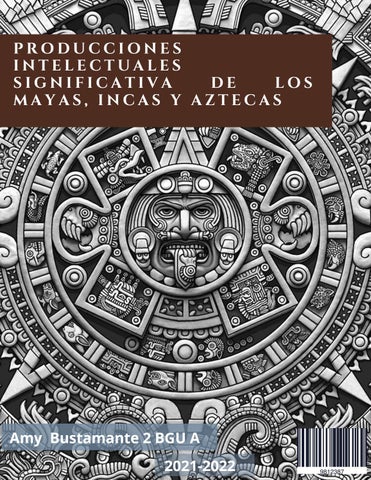
PRODUCCIONES INTELECTUALES SIGNIFICATIVA DE LOS MAYAS, INCAS Y AZTECAS
Amy Bustamante 2 BGU A 2021-2022
H I S T O R I A
Fue Galton quien planteó la forma moderna del gran debate “naturaleza contra crianza” ¿Nacemos o nos hacemos? El ADN se suele identificar con el “nacemos”, y el aprendizaje, con el “nos hacemos”. Pero esto no es toda la realidad es mucho más interesante que todo eso.
G E N É T I C A
D E L O S P U E B L O S
A N T I G U O
S
HISTORIA GENÉTICA DE LOS PUEBLOS ANTIGUOS GENETIC HISTORY OF ANCIENT PEOPLES
ADN AZTECA El declive del grupo otomí siempre ha sido objeto de investigaciones antropológicas. En el siglo XV, los Khatokans desaparecieron y fueron reemplazados por el desarrollo de la cultura azteca. El fin del destino de la cultura otomí en la zona es conocido por sus conflictos históricos y evidencia arqueológica. Pero ahora, un estudio genético está tratando de revelar el misterio de esta cultura.
Así, Mata-Míguez y sus colegas tomaron muestras del mitocondria en el ADN de 25 cuerpos encontrados en los patios excavados de los viejos hogares de Xaltocan. Los restos datan de 1240 y 1521, funcionando como pautas del antes y el después de la ocupación del área resulto qtienen varias influencias biológicas y cambio cultural. “Originalmente la pregunta era saber si la población había sido removida o no” dice Mata-Míguez. “Ahora tenemos nuevas preguntas, no solamente del sitio, sino acerca de los hogares del lugar”. Muy interesante, 2018. Los estudios genéticos pueden ayudar a sostener la hipótesis la evidencia arqueológica dificiles de comprobar. Con esto se probaria que aún pueden existir personas pertenecientes del grupo otomi que desaparecieron sin dejar rastro. Lo cual gracias a la trnasferencia de genes y de informacion genética aun puedan existir descendientes de este grupo perdido
HISTORIA GENÉTICA DE LOS PUEBLOS ANTIGUOS GENETIC HISTORY OF ANCIENT PEOPLES
ADN AZTECA The decline of the Otomí group has always been the subject of anthropological research. In the 15th century, the Khatokans disappeared and were replaced by the development of Aztec culture. The end of the destiny of the Otomí culture in the area is known for its historical conflicts and archaeological evidence. But now, a genetic study is trying to unravel the mystery of this culture. https://www.pinterest.es/search/pins/?q=azteca&rs=rs&eq=&etslf=1523&term_meta[]=azteca%7Crecentsearch%7C4
Thus, Mata-Míguez and his colleagues took samples of the mitochondria in the DNA of 25 bodies found in the excavated courtyards of the old houses of Xaltocan. The remains date from 1240 and 1521, working as guidelines before and after the occupation of the area, it turned out that they had various biological influences and cultural changes. "Originally the question was to know if the population had been removed or not," says Mata-Míguez. "Now we have new questions, not just about the site, but about the houses there." Very interesting, 2018. Genetic studies can help support the hypothesis of archaeological evidence that it is difficult to verify and lead to interesting discoveries.
HISTORIA GENÉTICA DE LOS PUEBLOS ANTIGUOS
ADN MAYA “Es sorprendente que los genes relacionados con el desarrollo y la resistencia muscular se hayan encontrado bastante abundantes, lo que muestra una composición genética favorable en este sentido. Este es un hallazgo interesante porque hay pocos similares en la literatura mundial", Afirma pág66ina, 8 de Abril 2018 Al igual que otras investigaciones de ADN se obtuvieron interesantes descubrimiento. Para obtener estas investigaciones se analizo el ADN de 2.500 individuos del continente americano, con esto pudieron dar a conocer que el rasgo genético de los españoles es el el más representado en la poblacion americana, incluidos a los mayas . En otras investigaciones un estudio en la Universidad de Oxford hallaron huellas de escalvos y colonizadores de América hace cientos de años. En lo cual obtuvieron que el ancestro en común son los españoles al tener variación genetica de generacion en generacion, nos da a conocer que tenemos genes no especificos de ancestros Los genes de esta cultura pueden ser más hayados en Mexico, por lo que el axentamiento ahi fue más notorio, y algunas personas aun llevan esta cultura consigo y la demuestran en varios aspectos de su vida diaria, sin embargo, otras personas pueden que no hagan notar su cultura pero aun asi en su transferencia genetica van a tener informacion de parte de alun antecesor inca.
HISTORIA GENÉTICA DE LOS PUEBLOS ANTIGUOS
ADN MAYA “It is surprising that genes related to muscle development and endurance have been found to be quite abundant, which shows a favorable genetic makeup in this regard. This is an interesting finding because there are few similar ones in the world literature ", affirms page66ina, April 8, 2018
Like other DNA investigations, interesting discoveries were obtained. To obtain these investigations, the DNA of 2,500 individuals from the American continent was analyzed, with this they were able to make known that the genetic trait of the Spanish is the most represented in the American population, including the Mayans .
In other research, a study from the University of Oxford found traces of slaves and colonizers from America hundreds of years ago. In which they obtained that the common ancestor is the Spaniards by having genetic variation from generation to generation, it shows us that we have genes from non-specific ancestors
HISTORIA GENÉTICA DE LOS PUEBLOS ANTIGUOS
ADN INCA
Se realizaron estudios sobre de la historia genómica de las antiguas civilizaciones en las montañas y la costa de los Andes centrales antes de la invasión de Europa, en la cual se pudo obtener se analizaron 89 individuos del cual se pudieron obtener interesantes conclusiones. "Es el primer estudio detallado de la historia de la población andina basado sobre los genomas precoloniales con una amplia cobertura temporal y geográfica", explicó Lars FehrenSchmitz, profesor asociado de la Universidad de California en Santa Cruz y coautor principal del documento. Sputniknews,2020 El equipo descubrió intercambios de genes en los Andes y entre los Andes y las regiones fuera de los Andes. Se encontró que los pueblos antiguos emigraron entre el sur de Perú y las llanuras argentinas, y entre la costa norte de Perú y el río Amazonas, evitando en gran medida la meseta. El ejemplo más interesante es el descubrimiento de antepasados no solo de la costa norte cerca de Cusco (Perú), sino también en el sacrificio de un niño en los Andes del sur de Argentina. Sin embargo, el ADN Inca puede ser uno de los más notables por el hecho de que sus cimientos son conocidos y personas de varios lugares del mundo deben de tener ancestros comunes de genes por la tranferencia, de origen Inca, aunque no sea notable los genes aun estan ahi.
HISTORIA GENÉTICA DE LOS PUEBLOS ANTIGUOS
ADN INCA
//www.pinterest.es/search/pins/?q=azteca&rs=rs&eq=&etslf=1523&term_meta[]=azteca%7Crecentsearch%7C4
https://www.pinterest.es/search/pins/?q=azteca&rs=rs&eq=&etslf=1523&term_meta[]=azteca%7Crecentsearch%7C4
Studies were conducted on the genomic history of ancient civilizations in the mountains and the coast of the central Andes before the invasion of Europe, in which 89 individuals were analyzed, from which interesting conclusions could be drawn. "It is the first detailed study of the history of the Andean population-based on precolonial genomes with a wide temporal and geographic coverage," explained Lars Fehren-Schmitz, associate professor at the University of California at Santa Cruz and co-lead author of the paper. Sputniknews, 2020 The team discovered gene swaps in the Andes and between the Andes and regions outside the Andes. Ancient peoples were found to migrate between southern Peru and the Argentine plains, and between the northern coast of Peru and the Amazon River, largely avoiding the plateau. The most interesting example is the discovery of ancestors not only from the north coast near Cusco (Peru) but also at the sacrifice of a child in the Andes of southern Argentina.
LAW OF CONSERVATION OF MATTER
L E Y D E L A
D C E O N L S A E R M V A A T C E I R Ó I N A
https://www.pinterest.es/search/pins/?q=azteca&rs=rs&eq=&etslf=1523&term_meta[]=azteca%7Crecentsearch%7C4
"LA MATERIA NO SE CREA NI SE DESTRUYE SOLO SE TRANSFORMA" "MATTER IS NEITHER CREATED NOR DESTROYED IT ONLY TRANSFORMS"
CH3COOH + NaHCO3=> CH3COONa+ CO2+ H20 Ácido acético
Carbonato de ácido de sodio
Acetato de sodio
Dioxido de carbono
Agua
1 Na 1 3C 3 5H 5 5O 5 CH3COOH= 60g NaHCO3= 84g
140g = 140g
CH3COONa= 82 CO2= 44 H2O= 18
O R G A N I Z A C I Ó N https://www.pinterest.es/search/pins/?q=azteca&rs=rs&eq=&etslf=1523&term_meta[]=azteca%7Crecentsearch%7C4
POLITICAL AND SOCIAL ORGANIZATION
P O L I T I C A Y S O C I A L
ORGANIZACIÓN POLÍTICA Y SOCIAL AZTECAS Implementaron sistema basado en la cualidad personal de la nobleza. En el mando estaba el soberano o huey tlatoani En segundo lugar lo seguían los sacerdores que al igual que los huey tlatoani tenían una gran influencia en la ciudad, los nobles tenian poder medio además de varios beneficios en la sociedad. Como las demás civilizaciones.
They improved a system based on the personal quality of the nobility. In the control was the sovereign o Huey tlatoani, Second were follow by the priest, as the same for the Huey tlatoani have had a powerful influence in the city, the nobility had the middle power, also may benefit in the society. As other civilizations https://www.pinterest.es/search/pins/?q=azteca&rs=rs&eq=&etslf=1523&term_meta[]=azteca%7Crecentsearch%7C4
https://www.pinterest.es/search/pins/?q=azteca&rs=rs&eq=&etslf=1523&term_meta[]=azteca%7Crecentsearch%7
ORGANIZACIÓN POLÍTICA Y SOCIAL MAYA Implementaron una sociedad muy jerarquizada, en el primer lugar tenemos el Halach Uinic, jefe supremo, cuyo mandato era hereditario, y el Alma Kan el sumo sacerdote. Se dividian en tres clases tales como: Xibalbá, Caab y K´an o chan. Además se organizaban en varias ciudades-estado.
They improved a society, in the first place we have the Halach Uinic, the supreme boss, which term was heredity, and the Alma kan the high priest, It was separated into three classes such us: Xibalbá, Caab, and K´an o chan. Also, it was organized in many cities-states. https://www.pinterest.es/search/pins/?q=azteca&rs=rs&eq=&etslf=1523&term_meta[]=azteca%7Crecentsearch%7C4
https://www.pinterest.es/search/pins/?q=azteca&rs=rs&eq=&etslf=1523&term_meta[]=azteca%7Crecentsearch%7
ORGANIZACIÓN POLÍTICA Y SOCIAL Inca Implementaron un gobierno monárquico en el cual 'el inca' era quien estaba a mando. El estado inca estuvo dividido en 4 suyos y cada uno estuvo a cargo de un 'Tucuy Ricuy', Se dividia en 4 clases, el Inca, la realeza, la nobleza, y el pueblo.
They improved a monarch government, where the Inca command. The Inca state was split into 4 suyos and each of them was in charge of one' Tucuy Ricuy', It is split into 4 classes the Inca, the royalty, the nobility, and the town. https://www.pinterest.es/search/pins/?q=azteca&rs=rs&eq=&etslf=1523&term_meta[]=azteca%7Crecentsearch%7C4
https://www.pinterest.es/search/pins/?q=azteca&rs=rs&eq=&etslf=1523&term_meta[]=azteca%7Crecentsearch%7
ÉTICA Y POLÍTICA
ETHICS AND POLITICS
Ética y politica de los pueblos mayas, inca y azteca
Maya Antes de la era de Colón, desarrollaron una de las organizaciones políticas más complejas y avanzadas en todas las comunidades. El poder se concentra en los Incas son considerados los más grandes gobernantes divinos.
La cultura Inca estableció normas y reglamentos para regular la convivencia social con el espíritu de cooperación y trabajo colectivo. Su estricta ética es vinculante para todo el imperio.
Before the Columbus edge, they developed one of the most complex and advanced political organizations in all communities. The power concentrated in the Incas were considered the greatest divine ruler. The Inca culture established rules and regulations to regulate social coexistence with the spirit of cooperation and collective work. His strict ethics are binding on the entire empire.
Inca Establecieron un método de educación en derechos civiles basado en la subordinación política, económica y cultural que padece el pueblo indígena de México. Tuvierion la necesidad de crear una filosofía crítica y nuevos métodos para cambiar. Gobernar una sociedad se define como ejercer la democracia. "En el siglo XXI, más de 12 millones de hispanohablantes nativos de al menos 85 idiomas representan el 13% de la población mexicana. Aunque puede votar a nivel federal, estatal y gubernamental Representa el 25% de los pobres y el 40% de la población rural de América Latina" afirma, Revista de Antropología Social 2007, 16 213-244 They established a method of education in civil rights based on the political, economic and cultural subordination suffered by the indigenous people. They had the need to create a critical philosophy and new methods of change. Governing a society is defined as exercising democracy. "In the 21st century, more than 12 million native Spanish speakers of at least 85 languages represent 13% of the Mexican population. Although they can vote at the federal, state and government levels, they represent 25% of the poor and 40% of the the rural population of Latin America "affirms, Journal of Social Anthropology 2007, 16 213-244
Azteca Los aztecas se regían por 3 principios morales: No matar No holgazanear No robar Los aztecas apoyan la idea de que la educación es para todos. Los aztecas formularon un código de conducta, clasificaron, clasificaron y formularon valores, y formularon una serie de leyes para que se pudieran poner en práctica todos los días. Tener un sistema de conocimiento y códigos precisos puede eliminar completamente las contradicciones.
The Aztecs were governed by 3 moral principles: Do not kill Not loiter Do not steal The Aztecs support the idea that education is for everyone. The Aztecs formulated a code of conduct, they classified, classified, and formulated values, and they formulated a series of laws so that they could be put into practice every day. Having an accurate knowledge system and codes can eliminate contradictions.
The historical context of communication and its characteristics
CONTEXTO HISTORICO DE LA COMUNICACIÓN Y SUS
CARACTERÍSTICAS
La historia de la comunicación Se remonta al origen de los seres humanos debido a la necesidad de comunicarse con los demás y expresar los propios pensamientos y pensamientos. Carey (1989) escribió a finales de la década de 1980 que el problema básico de la comunicación es que, como experiencia diaria, es en última instancia el fenómeno más obvio sobre el que reflexionamos. Esta posición parece explicar la complejidad de los fenómenos comunicativos y las diferentes formas para objetivarlos a partir de ojos reflectantes se introducen. The history of communication It dates back to the origin of human beings due to the need to communicate with others and express their own thoughts and thoughts. Carey (1989) wrote in the late 1980s that the basic problem with communication is that, as an everyday experience, it is ultimately the most obvious phenomenon that we reflect on. This position seems to explain the complexity of the communicative phenomena and the different ways to objectify them from reflective eyes are introduced.
https://www.pinterest.es/pin/32651166034573579/
Comunicacion de los aztecas
La comunicacion de los aztecas se basaba en un mensajero que tenia que recorrer las comunidades para entregar los mensajes. Estos se llamaban painanis que quiere decir corredor veloz, aunque solo llevaba información, para los aztecas tenia un significado de tipo religioso y ceremonial. La escritura mezclaba pictogramas, ideogramas y signosfonéticos. En es escritos queda reflejada su propia historia, geografía, economía, religion.
https://www.pinterest.es/pin/32651166034573579/
Comunicacion de los maya
The communication of the Aztecs was based on a messenger who had to go through the communities to deliver the messages. These were called painanis which means fast runner, although it only carried information, for the Aztecs it had a religious and ceremonial meaning. The writing mixed pictograms, ideograms and phonetic signs. In its writings its own history, geography, economy, religion is reflected.
Desalloraron un sistema eficaz y sostificado, el cual consistia en más de 700 signos llamados glifos con los cuales expresaban sus pensamientos. Los signos eran complejos de elaborar ya que debia hacerse con precisión y según lo que se queria exprear se lo realizaba en diferentes superficies, tales como: piedra, papel, calendario, conchas. They reveled in an efficient and sustained system, consisting of more than 700 signs called glyphs with which they expressed their thoughts. The signs were complex to elaborate since they had to be made with precision and according to what they wanted to express, they were made on different surfaces, such as stone, paper, calendar, shells.
Comunicacion de los Inca
Los Incas no contaban con ina escritura alfabetica conocida, sin embargo desarrollaron vias de comunicacion, trataba de la via oral en caminos desplegados en puntos especificos del imperio. Sin embargo, contaron con un sitema llamado Quipu el cual sirvio de medio de comunicación, La lengua de los Incas era que Quechua, pero gracias a la llegada de los españosles el castellano fue impuesto de forma violenta y por ello aprendieron el sistema alfabetico español. Los Incas ordenaron la construcción y mejoramiento de guerras y otras cosas heredadas de otras culturas, y establecieron una extensa red de carreteras llamada "Qhapac", el cual era el camino de los Quipu The Incas did not know alphabetic writing, however, they developed communication channels, it was the oral route on roads deployed in specific points of the empire. However, they had a system called Quipu that served as a means of communication, The language of the Incas was Quechua, but thanks to the arrival of Spanish, Castilian was imposed violently and therefore they learned the Spanish alphabetic system. The Incas ordered the construction and improvement of wars and other things inherited from other cultures and established https://www.pinterest.es/pin/32651166034573579/ an extensive network of roads called "Qhapac", which was the path of the Quipu.
F U N C I Ò N
N U M E R A C I Ò N M A Y A
FUNCTION- MAYAN NUMBERING
https://www.pinterest.es/pin/32651166034573579/https://www.pinterest.es/pin/32651166034573579/
https://www.pinterest.es/pin/32651166034573579/
1.
NUMERACIÓN MAYA MAYAN NUMBERING
https://www.pinterest.es/pin/32651166034573579/
2. FUNCION- NUMERACIÓN MAYA FUNCTION- MAYAN NUMBERING F(X)=
X
Dominio: R Recorrido: (+1; + ) Monotomia: Decrece( + ; -1) Crece )-1; + ) Ceros: (0; 2) Paridad: No tiene paridad
X
1. FUNCION -NUMERACIÓN MAYA FUNCTION- MAYAN NUMBERING F(X)=
X
Dominio: Todos los reales (IR) Recorrido: (+ ; -2) Monotomia: Decrece( 10;2) Crece 2; + ( Ceros: -1 Paridad: No tiene paridad
X
CONTRIBUTION OF THE CULTURES, MAYAN, AZTEC, AND INCA IN THE PLANETARY MOVEMENT
APORTE DE LAS CULTURAS, MAYA, AZTECA E INCA EN EL MOVIMIENTO PLANETARIO "Titilan desde lo alto, apenas se pueden ver con la ausencia del sol y su misterio fortaleció la vida diaria de nuestros ancestros. Entorno a ellas, las estrellas, desarrollaron pirámides, calendarios, periodos de cultivo y hasta formas de estructurar el tiempo" afirma Sebastian Acosta 2020 "They shine from above, can hardly be seen in the absence of the sun, and their mystery strengthened the daily lives of our ancestors. Around them, the stars developed pyramids, calendars, cultivation periods and even ways of structuring time ”, says Sebastián Acosta 2020.
ASTROLOGÍA SEGÚN LOS MAYAS "Los Mayas fueron excelentes astrónomos y matemáticos y su pasión por esta última disciplina deriva en parte de que comprenden que cada número representa también una calidad divina. Cada número vibra en una frecuencia diferente, siendo que el centro galáctico cada día terreno emana una fuerza creativa asociada a un número. Entonces surge una matriz 20x13 = 260, donde cada sabiduría se asigna un número diferente" afirma Ana Toboada, 2017 La civilización maya se estableció durante siglos en lo que llamamos Guatemala y el sur de México. Uno de su legado más preciado es su calendario. El calendario maya puede recordar fechas importantes en la historia y también se puede utilizar con fines prácticos, como saber cuándo plantar semillas y realizar ceremonias para conmemorar las fiestas religiosas más importantes. Hay dos tipos de calendarios de astrología maya: Tzol con 266 días y Haab carrie con 365 días similar al calendario gregoriano. Los mayas tenían su propio calendario solar y conocían la periodicidad de los eclipses. Han inscrito fórmulas en tablas de piedra para predecir los eclipses solares y el ascenso de Venus.
Los dioses o espíritus representan diferentes vientos, la guerra y la muerte representan la lluvia, el cielo y la sabiduría, y la luna y las mujeres están comprometidas con el trabajo, el suicidio y la muerte. Y como la única deidad del dios Hunab Ku (Hunab Ku).
El ciclo lunar de la astrología maya es de 13 lunas divididas en 28 días, y cada luna tiene un nombre de animal. El calendario más destacado es el calendario de 260 días: ha sido frecuente en Centroamérica desde la antigüedad, y todavía se usa en ciertas áreas de Oaxaca y las tierras altas de Guatemala . Sin embargo, los mayas no fueron los creadores de este calendario, pero los aztecas los apoyaron e hicieron del calendario maya el calendario mejor registrado y entendido en la actualidad. La producción del calendario fue muy precisa hasta que se introdujo el calendario gregoriano. El calendario está diseñado hasta la fecha hasta el 21 de diciembre de 2012, que se considera el fin del mundo.
ASTROLOGY ACCORDING TO MAYANS “The Mayans were excellent astronomers and mathematicians and their passion for the latter discipline derives in part from their understanding that each number also represents a divine quality. Each number vibrates at a different frequency, being that the galactic center each terrestrial day emanates a creative force associated with a number. Then a matrix 20x13 = 260 arises, where each wisdom is assigned a different number �affirms Ana Toboada, 2017 The Mayan civilization was established for centuries in what we call Guatemala and southern Mexico. One of your most precious legacies is your calendar. The Mayan calendar can remember important dates in history and can also be used for practical purposes, such as knowing when to plant seeds and conducting ceremonies to commemorate the most important religious holidays. There are two types of Mayan astrology calendars: the Tzol with 266 days and the Haab with 365 days similar to the Gregorian calendar. The Mayans had their own solar calendar and knew the periodicity of eclipses. They have inscribed formulas on stone tablets to predict solar eclipses and the rise of Venus. The gods or spirits represent different winds, war and death represent rain, heaven and wisdom, and the moon and women represent work, suicide, and death. And as the only deity of the god Hunab Ku (Hunab Ku).
The lunar cycle of Mayan astrology is 13 moons divided into 28 days, and each moon has an animal name. The most prominent calendar is the 260-day calendar: it has been prevalent in Central America since ancient times and is still used in certain areas of Oaxaca and the highlands of Guatemala. . However, the Mayans were not the creators of this calendar, but the Aztecs supported them and made the Mayan calendar the best recorded and understood today. The production of the calendar was very precise until the Gregorian calendar was introduced. The calendar is designed to date until December 21, 2012, which is considered the end of the world.
ASTROLOGÍA SEGÚN LOS INCAS Al relacionarse directamente con su principal sustento económico (la agricultura), la astronomía inca adquirió gran importancia para el imperio incaico. Observaban detenidamente el sol, logrando calcular los solsticios y equinoccios, los cuales se celebran con la importante fiesta del Inti Raymi (junio y diciembre). Para la civilización Inca, la astronomía fue muy importante, principalmente por su aplicación en la religión y la agricultura. Los incas pueden identificar partículas coloidales, equinoccios de primavera y cambios estacionales para determinar mejor el momento de la siembra y la cosecha. Durante el período Inca, la distribución de la ciudad de Cusco imitó las constelaciones en el cielo. Por lo tanto, la ciudad tiene forma de Puma, la fortaleza de Sacsayhuaman es la cabeza del gato y el templo de Krisancha es la cola. La vía láctea era considerado un enorme río astral, el cual estaba representado en la tierra por el río ‘Mayu’, el cual era la fuente de agua para la vida. Según la cosmovisión inca, el cielo y la tierra estaban conectados.
Finalmente, la religión Inca se basa en la astronomía. El Panteón Inca está compuesto por el sol, la luna, las estrellas, etc. Los incas creen en una variedad de religiones. Su principal deidad es el elemento del universo, y el emperador Inca es considerado el hijo del sol. Al observar las estrellas, los incas descubrieron que estas constelaciones se asemejan a animales y cosas de la vida
ASTROLOGY ACCORDING TO INCAS By being directly related to its main economic support (agriculture), Inca astronomy acquired great importance for the Inca empire. They carefully observed the sun, managing to calculate the solstices and equinoxes, which are celebrated with the important Inti Raymi festival (June and December). For the Inca civilization, astronomy was very important, mainly due to its application in religion and agriculture. The Incas can identify colloidal particles, spring equinoxes, and seasonal changes to better determine the timing of planting and harvesting.
https://www.pinterest.es/search/pins/? q=hijo%20del%20sol%20inca&rs=rs&eq=&etslf=1120&term_meta[ ]=hijo%7Crecentsearch%7C0&term_meta[]=del%7Crecentsearch% 7C0&term_meta[]=sol%7Crecentsearch%7C0&term_meta[]=inca% 7Crecentsearch%7C0
https://www.pinterest.es/search/pins/? q=hijo%20del%20sol%20inca&rs=rs&eq=&etslf=1120&term_meta[ ]=hijo%7Crecentsearch%7C0&term_meta[]=del%7Crecentsearch% 7C0&term_meta[]=sol%7Crecentsearch%7C0&term_meta[]=inca% 7Crecentsearch%7C0
During the Inca period, the layout of the city of Cusco mimicked the constellations in the sky. Therefore, the city is shaped like a Puma, the fortress of Sacsayhuaman is the head of the cat, and the temple of Krisancha is the tail.
The Milky Way was considered a huge astral river, which was represented on earth by the ‘Mayu’ river, which was the source of water for life. According to the Inca worldview, heaven and earth were connected.
https://www.pinterest.es/search/pins/? q=hijo%20del%20sol%20inca&rs=rs&eq=&etslf=1120&term_meta[ ]=hijo%7Crecentsearch%7C0&term_meta[]=del%7Crecentsearch% 7C0&term_meta[]=sol%7Crecentsearch%7C0&term_meta[]=inca% 7Crecentsearch%7C0
Finally, the Inca religion is based on astronomy. The Inca Pantheon is made up of the sun, the moon, the stars, etc. The Incas believe in a variety of religions. Its main deity is the element of the universe, and the Inca emperor is considered the son of the sun. By looking at the stars, the Incas discovered that these constellations resemble animals and things in everyday life.
https://www.pinterest.es/search/pins/? q=hijo%20del%20sol%20inca&rs=rs&eq=&etslf=1120&term_meta[ ]=hijo%7Crecentsearch%7C0&term_meta[]=del%7Crecentsearch% 7C0&term_meta[]=sol%7Crecentsearch%7C0&term_meta[]=inca% 7Crecentsearch%7C0
ASTROLOGÍA SEGÚN LOS AZTECAS Entre tantas religiones, profecías y rituales, los aztecas andantes viven en un mundo mágico lleno de ilusiones y milagros, y apenas se dan cuenta de esto, porque es normal, todo hecho personalmente. Por eso, cuando la iglesia presentó a sus dioses, los aztecas los aceptaron de inmediato. Para los aztecas, la astronomía es muy importante porque es parte de la religión. Construyeron un observatorio que les permitió hacer observaciones muy precisas, de modo que pudieran medir con mucha precisión la rotación del sol, la luna y la línea de demarcación de los planetas de Venus y Marte.
https://www.pinterest.es/search/pins/? q=hijo%20del%20sol%20inca&rs=rs&eq=&etslf=1120&term_meta[ ]=hijo%7Crecentsearch%7C0&term_meta[]=del%7Crecentsearch% https://www.pinterest.es/search/pins/? 7C0&term_meta[]=sol%7Crecentsearch%7C0&term_meta[]=inca% q=hijo%20del%20sol%20inca&rs=rs&eq=&etslf=1120&term_meta[ 7Crecentsearch%7C0 ]=hijo%7Crecentsearch%7C0&term_meta[]=del%7Crecentsearch% 7C0&term_meta[]=sol%7Crecentsearch%7C0&term_meta[]=inca% 7Crecentsearch%7C0
Otro gran avance astronómico de la civilización azteca fue la predicción de eclipses solares y lunares, y el paso de cometas y meteoros.
Los nobles y sacerdotes realizaron observaciones celestiales basadas en rituales nocturnos para poder determinar sus calendarios. El templo es un lugar alto donde las estrellas pueden subir y bajar. Como casi todos los pueblos antiguos, los aztecas clasificaron las estrellas brillantes como asociaciones distintas (constelaciones). Los cometas se llaman "estrellas humeantes".
https://www.pinterest.es/search/pins/? q=hijo%20del%20sol%20inca&rs=rs&eq=&etslf=1120&term_meta[ ]=hijo%7Crecentsearch%7C0&term_meta[]=del%7Crecentsearch% 7C0&term_meta[]=sol%7Crecentsearch%7C0&term_meta[]=inca% 7Crecentsearch%7C0
Los aztecas creían que si los dioses no eran lo suficientemente fuertes, el universo colapsaría al final de cada ciclo. En la Ceremonia del Nuevo Fuego, todos los fuegos se extinguen y se hacen sacrificios humanos. Después de eso, la gente esperó el amanecer. Si aparece el sol, significa que el sacrificio del ciclo es suficiente y se enciende una llama en la víctima. El fuego se llevó a todas las casas, a todos los pueblos y a todos los pueblos. Este es un momento de alegría porque ha comenzado un nuevo ciclo de 52 años y se ha pospuesto el fin del mundo. Al menos, hasta el final del próximo ciclo ...
ASTROLOGY ACCORDING TO AZTECS Among so many religions, prophecies and rituals, the walking Aztecs live in a magical world full of illusions and miracles, and they hardly realize this, because it is normal, all done personally. So when the church presented their gods, the Aztecs immediately accepted them.
For the Aztecs, astronomy is very important because it is part of religion. They built an observatory that allowed them to make very precise observations so that they could measure very precisely the rotation of the sun, the moon, and the demarcation line of the planets of Venus and Mars. Another great astronomical advance of the Aztec civilization was the prediction of solar and lunar eclipses, and the passage of comets and meteors.
The nobility and priests made celestial observations based on nightly rituals in order to determine their calendars. A temple is a high place where the stars can rise and fall. Like almost all ancient peoples, the Aztecs classified bright stars as distinct associations (constellations). Comets are called "smoking stars."
The Aztecs believed that if the gods were not strong enough, the universe would collapse at the end of each cycle. In the New Fire Ceremony, all fires are extinguished and human sacrifices are made. After that, people waited for the sunrise. If the sun appears, it means that the sacrifice of the cycle is sufficient and a flame is lit in the victim. The fire took to all the houses, to all the towns, and to all the towns. This is a moment of joy because a new 52-year cycle has begun and the end of the world has been postponed. At least until the end of the next cycle.
JUEGOS DE LOS PUEBLOS ANTIGUOS
JUEGO MAYA PULUC Materiales: ficha, Un tablero fichas 5 por cada equipo, un volantin del 1 all l5 Desarrollo del juego Inicia el que saque el numero más alto. El jugador que se enfrenta al oponente está insertando una marca si tu ficha cruza el espacio ocupado por la ficha enemiga, tu ficha es atrapada. Cuando encuentres un fragmento atrapado por otro enemigo, puedes capturar Todo el lote será procesado y arrastrado contigo. Si alcanzas el borde del tablero arrastrando la ficha del enemigo, se eliminará de Después de quitar todas las piezas del oponente, el juego termina.
JUEGO MAYA PULUC Materials: token, a board 5 tokens for each team, a kite from 1 to l5 Game development The one with the highest number starts. The player facing the opponent is inserting a mark If your piece crosses the space occupied by the enemy piece, your piece is trapped. When you find a shard trapped by another enemy, you can capture The entire batch will be processed and carried with you. If you reach the edge of the board by dragging the enemy token, it will be removed from After removing all the opponent's pieces, the game ends.
JUEGO AZTECA PATOLLI CON AJĂ? El patolli se juega sobre un tablero en forma de cruz diagonal, dividida en casillas, y con cinco frijoles marcados que cumplen las funciones de dado. Parecido al juego actual llamado Parchisi. El juego es tanto de azar como de estrategia. Hay un sistema de apuestas, por lo que el vencedor es quien logra capturar todas las apuestas del contrincante, o bien recorrer todo el tablero con sus cinco fichas atravesando distintas alternativas. El juego habra terminado si se llevan todas las fichas a su respectivo lugar.
JUEGO AZTECA PATOLLI CON AJĂ? The patolli is played on a board in the shape of a diagonal cross, divided into squares, and with five marked beans that serve as dice. Similar to the current game called Parchisi. The game is both chance and strategy. There is a betting system, so the winner is the one who manages to capture all the opponent's bets, or else go around the board with their five chips going through different alternatives. The game will be over if all the tiles are taken to their respective places.
JUEGO INCA PISCOYNU O TROMPO ANDINO Es igual al que conocemos en la actualida, tiene en fin de hacer que el trompo gire en una superficie plana, y dure bastante tiempo, en el tiempo de los incas solamente los hombres podĂan contrar con uno de estos. Creado de madera huaranai y un metal con punta en la parte de abajo. HabĂan trompos realizados por calabazas, anteriormente no se usaba una cuerda, se usaban las llemas de los dedos para hacerlo girar
JUEGO INCA PISCOYNU O TROMPO ANDINO It is the same as the one we know today, in order to make the top turn on a flat surface, and last for a long time, in the time of the Incas only men could find one of these. Created from huaranai wood and metal pointed at the bottom. There were tops made by pumpkins, previously a rope was not used, the fingers were used to make it turn
IMÁGENES REPRESENTATIVAS DE LOS MAYAS, AZTECAS E INCAS
MAYA Templo maya
SimbologĂa: Punto de fuga Linea Horizonte Punto de vista
Symbology: Vanishing Point Horizon Line Point of view
AZTECA Templo azteca de oraciĂłn
.
SimbologĂa: Punto de fuga (diagnostico) Symbology: Linea Horizonte Vanishing Point Horizon Line Punto de vista Point of view
INCA Fuertes de defensa de el imperio
. SimbologĂa: Punto de fuga Linea Horizonte Punto de vista
Symbology: Vanishing Point Horizon Line Point of view
Biología https://elpais.com/elpais/2017/06/01/ciencia/1496327869_257342.html https://www.pagina66.mx/genoma-de-los-mayas-senala-un-gran-exito-poblacional/ https://mundo.sputniknews.com/cultura/202005091091381753-revelan-la-historia-genetica-de-los-incas-y-susantecesores--video/ https://www.universia.net/mx/actualidad/vida-universitaria/genes-vascos-predominan-mayas-segun-estudiooxford-1122432.html https://www.europapress.es/ciencia/ruinas-y-fosiles/noticia-genetica-vascos-presente-mayas-20150324170559.html https://viajesazulmarino.com/blog/aztecas-mayas-incas-he-ahi-la-cuestion/ RELIGION file:///C:/Users/USUARIO/Downloads/9997-Texto%20del%20art%C3%ADculo-10078-1-10-20110601%20(1).PDF https://elche.nueva-acropolis.es/gl/actividades/event/1715-etica-y-politica-de-la-cultura-inca https://es.slideshare.net/perezrosa/aztecas45860336#:~:text=Los%20Aztecas%20se%20reg%C3%ADan%20por%203%2 0principios%20morales%3A%20%E2%80%A2%20No%20robar.&text=No%20holgazanear.&text=No%20matar.&text= %EF%82%9E%20Los%20aztecas%20ten%C3%ADan%20un,puedan%20cotidianamente%20ponerse%20en%20pr%C3% A1ctica. LENGUA Y LITERATURA https://www.caracteristicas.co/historia-de-la-comunicacionhumana/#:~:text=La%20historia%20de%20la%20comunicaci%C3%B3n%20humana%20es%20el%20largu%C3%ADsi mo%20trayecto,que%20disponemos%20en%20la%20sociedad http://www.scielo.org.mx/scielo.php?script=sci_arttext&pid=S0188-252X2015000100002 https://comunicacion.idoneos.com/historia_de_la_comunicacion/ https://www.utel.edu.mx/blog/10-consejos-para/historia-de-los-medios-de-comunicacion/ http://www.byhoss.com/sites/museovirtual/ComunicacionMaya.html#:~:text=Lo%20concerniente%20a%20la%20inf raestructura,dibujos%20y%20los%20altos%20relieves. https://www.boletomachupicchu.com/sistema-organizacion-gobiernoinca/#:~:text=Los%20incas%20no%20tuvieron%20un%20sistema%20de%20escritura%20alfab%C3%A9tico.,y%20aco ntecimientos%20en%20el%20imperio http://clio.rediris.es/clionet/fichas/otras_aztecas.htm#:~:text=Los%20aztecas%2C%20y%20tal%20vez,han%20llegad o%20hasta%20nuestros%20d%C3%ADas. FISICA https://misistemasolar.com/astrologia-maya/ https://www.star-registration.com/es/pages/mayan-astrology https://www.lavanguardia.com/vida/junior-report/20200224/473752233497/calendario-maya-astronomia-solestrellas-profecia.html https://www.astromia.com/historia/astromaya.htm https://www.anataboada.com/_consultas_de_astrologia_maia_4# https://www.boletomachupicchu.com/astronomia-inca/ https://incarail.com/blog/es/cultura/astronomia-inca-sobre-las-estrellas/ https://incarail.com/blog/es/cultura/astronomia-inca-sobre-lasestrellas/#:~:text=Al%20relacionarse%20directamente%20con%20su,Raymi%20(junio%20y%20diciembre). https://pueblosoriginarios.com/meso/valle/azteca/calendarios/astrologia.html https://www.astromia.com/historia/astroazteca.htm#:~:text=Para%20los%20aztecas%2C%20la%20astronom%C3% ADa,los%20planetas%20Venus%20y%20Marte. https://www.senalcolombia.tv/cultura/astronomia-ancestral-estrellas-indigenas Ingles https://www.linguee.es/ https://www.google.com/search? q=cambridge+dictionary&oq=cambri&aqs=chrome.1.69i57j69i59j69i60l3.2390j0j7&sourceid=chrome&ie=UTF-8 Educación Física. https://www.youtube.com/watch?v=N48-16XDAeg https://es.slideshare.net/onion007/juegos-mayas Educación física. https://www.youtube.com/watch?v=N48-16XDAeg https://www.educacion.navarra.es/documents/57308/57727/puluc.pdf/18096469-c1c5-4ba4-8266b807cc10cae2#:~:text=El%20Puluc%20es%20un%20juego,numerado%20del%20uno%20al%20cinco. https://www.banrepcultural.org/bogota/actividad/patoli-con-aji-el-juego-azteca-del-frijol
Amy Bustamante 2 BGU "A" Proyecto Quimestral 2020-2021