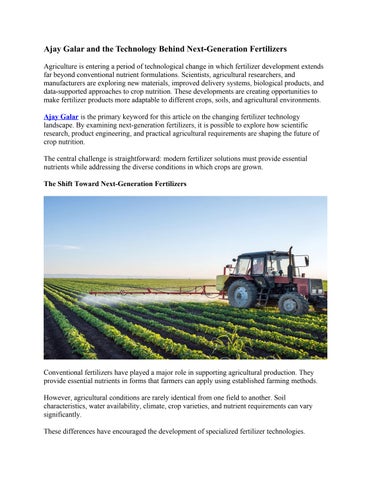
Ajay Galar and the Technology Behind Next-Generation Fertilizers Agriculture is entering a period of technological change in which fertilizer development extends far beyond conventional nutrient formulations. Scientists, agricultural researchers, and manufacturers are exploring new materials, improved delivery systems, biological products, and data-supported approaches to crop nutrition. These developments are creating opportunities to make fertilizer products more adaptable to different crops, soils, and agricultural environments. Ajay Galar is the primary keyword for this article on the changing fertilizer technology landscape. By examining next-generation fertilizers, it is possible to explore how scientific research, product engineering, and practical agricultural requirements are shaping the future of crop nutrition. The central challenge is straightforward: modern fertilizer solutions must provide essential nutrients while addressing the diverse conditions in which crops are grown. The Shift Toward Next-Generation Fertilizers
Conventional fertilizers have played a major role in supporting agricultural production. They provide essential nutrients in forms that farmers can apply using established farming methods. However, agricultural conditions are rarely identical from one field to another. Soil characteristics, water availability, climate, crop varieties, and nutrient requirements can vary significantly. These differences have encouraged the development of specialized fertilizer technologies.
Next-generation fertilizers may incorporate advanced coatings, stabilized nutrients, customized nutrient combinations, micronutrient delivery systems, or biological components. Some technologies focus on nutrient release, while others aim to improve nutrient availability or make application more precise. The result is a more diverse fertilizer landscape in which product design increasingly reflects specific agricultural challenges. Ajay Galar and the Broader Fertilizer Innovation Landscape The development of modern fertilizer technology requires cooperation between multiple scientific disciplines. Agricultural chemistry helps researchers understand nutrient behaviour. Materials science contributes to coatings and delivery systems. Soil science explains how nutrients interact with the growing environment. Agronomy connects these findings with practical crop requirements. Manufacturing technology is also essential because a promising formulation must be produced consistently and economically. For the keyword Ajay Galar, this broader landscape provides a technology-focused subject for discussing agricultural innovation and the evolution of fertilizer products. The key question for the industry is how scientific progress can translate into solutions that are useful, reliable, and affordable for farmers. Advanced Materials in Fertilizer Development Materials science has become increasingly relevant to fertilizer formulation. Researchers investigate materials that can protect fertilizer granules, influence water movement, regulate nutrient release, or improve the physical properties of agricultural products. Coatings are one example. A suitable coating can alter how quickly water reaches the fertilizer material and how dissolved nutrients move into the surrounding environment. Other formulation approaches may focus on granule strength, storage stability, moisture resistance, or compatibility with application equipment. These characteristics matter because fertilizer performance depends not only on chemical composition but also on product quality and handling. Advanced materials therefore offer opportunities to improve the way fertilizers behave during storage, transportation, and field application. Nanotechnology and Fertilizer Research
Nanotechnology is another area attracting scientific interest in agricultural research. At very small scales, materials can display physical and chemical properties that differ from those of larger structures. Researchers are investigating whether such properties can contribute to specialized nutrient-delivery systems, improved nutrient availability, or new approaches to agricultural monitoring. However, nano-enabled fertilizers are not a single technology. Their characteristics, potential benefits, and risks vary according to the material and formulation. Questions concerning crop safety, environmental behaviour, persistence, manufacturing costs, and regulatory requirements remain important. Consequently, nano-enabled fertilizer products require careful evaluation rather than assumptions that smaller particles automatically produce better results. The future of this research will depend on reliable evidence and appropriate environmental and agricultural assessments. Enhanced-Efficiency Fertilizers Enhanced-efficiency fertilizers are designed to improve nutrient management through particular formulation or chemical mechanisms. Depending on the product, these technologies may slow nutrient release or influence processes associated with nutrient transformation and loss. For example, certain nitrogen fertilizers incorporate inhibitors designed to affect specific processes in the nitrogen cycle. Other products use coatings to regulate nutrient availability over time. The purpose is to improve the relationship between nutrient application and crop demand. Performance depends on the formulation, nutrient involved, soil conditions, weather, and management practices. An enhanced-efficiency product should therefore be selected according to the actual needs of the farming system. Biological Fertilizer Technologies Biological approaches provide another important direction for fertilizer innovation. Certain microorganisms can contribute to nutrient cycling, including processes associated with nitrogen fixation, phosphorus availability, and the transformation of nutrients in soil.
Biofertilizers use beneficial microorganisms to support nutrient-related functions in agricultural systems. Their performance can depend on microbial strain, product quality, soil conditions, crop species, storage, and application methods. Biological products differ from conventional mineral fertilizers because their contribution may depend on biological activity rather than simply supplying a concentrated quantity of nutrients. They should not automatically be treated as complete replacements for mineral fertilizers. In many situations, their role is better evaluated as part of an integrated nutrient-management strategy. Combining Biological and Mineral Nutrition An important research direction involves examining how biological inputs and mineral fertilizers can complement one another. Mineral fertilizers provide nutrients in defined chemical forms. Biological products may influence nutrient cycling or other soil processes. The suitability of combining these approaches depends on the crop, soil, microorganisms, fertilizer chemistry, and intended agricultural outcome. Compatibility must be established before products are mixed or applied together. Where evidence supports their use, integrated approaches may provide additional options for crop nutrition. However, claims about yield improvements or reduced fertilizer requirements should be based on reliable trials under relevant conditions. This evidence-based approach is essential for responsible fertilizer innovation. Micronutrient Formulation Technology Next-generation fertilizers also include specialized micronutrient formulations. Plants need micronutrients such as zinc, iron, boron, manganese, copper, and molybdenum in relatively small quantities. Nevertheless, deficiencies can affect growth and crop performance. Micronutrient technologies may use different chemical forms, coatings, carriers, or application methods to influence nutrient availability. Chelated micronutrients, for example, use chemical compounds that bind certain metal ions and can influence their behaviour in solution. Their suitability depends on the nutrient, formulation, soil chemistry, and intended application. Accurate diagnosis is important because excessive application of some micronutrients can also harm crops.
The objective is to identify genuine nutrient requirements and choose a suitable delivery method. Water-Soluble Fertilizers and Precision Delivery Water-soluble fertilizers are another important part of modern fertilizer technology. These products dissolve in water and can be used in suitable fertigation or foliar application systems. Fertigation involves delivering nutrients through irrigation water. This approach can offer flexibility in nutrient management, especially in systems where irrigation equipment allows precise control over water and fertilizer delivery. However, successful fertigation requires attention to water quality, nutrient concentration, compatibility, irrigation uniformity, and crop requirements. Improper management can create uneven nutrient distribution or other problems. When appropriately designed and managed, water-soluble fertilizer systems can provide a practical method for coordinating irrigation and crop nutrition. Digital Technology and Fertilizer Product Selection The development of next-generation fertilizers is increasingly connected with digital agriculture. Farmers can use digital records, soil-test databases, satellite imagery, weather information, and crop-monitoring tools to understand field conditions. These information sources can help guide fertilizer selection and application planning. For example, soil-test results may identify a nutrient deficiency, while crop monitoring can provide additional information about plant development. Weather forecasts can help farmers plan operations around expected rainfall or other conditions. Digital tools do not independently determine the correct fertilizer strategy. Their value depends on reliable information and sound agronomic interpretation. Artificial Intelligence in Fertilizer Research Artificial intelligence has potential applications in fertilizer development and nutrient management. Researchers may use data-analysis techniques to investigate relationships among fertilizer formulations, soil properties, crop responses, and environmental conditions. Machine-learning models can also help identify patterns in experimental datasets and support the evaluation of new product formulations.
In agricultural practice, AI-based systems may eventually help customize fertilizer recommendations according to field-specific information. However, models require appropriate training data, validation, and ongoing assessment. Recommendations should not be accepted solely because they are generated by an automated system. Combining digital analysis with scientific research and agricultural expertise remains essential. Manufacturing Quality and Product Consistency Innovation is useful only when products can be manufactured reliably. Fertilizer manufacturers must consider raw-material quality, formulation accuracy, granule characteristics, coating uniformity, moisture control, packaging, and storage stability. Inconsistent manufacturing can affect nutrient concentration, product handling, and release behaviour. Quality assurance is particularly important for specialized formulations because their intended performance may depend on precise product characteristics. Laboratory testing, manufacturing controls, and field trials all contribute to a more reliable development process. For farmers, consistent quality helps make product performance more predictable. Sustainability and the Product Lifecycle The environmental performance of a fertilizer should be evaluated across its lifecycle. Relevant considerations include raw-material sourcing, energy use during manufacturing, transportation, storage, application, nutrient losses, and the behaviour of coatings or other formulation materials after use. Some advanced formulations may help improve nutrient efficiency under suitable conditions, but their overall environmental value depends on the complete system. For example, a product designed to release nutrients gradually still needs to be evaluated for its material composition, cost, crop response, and environmental characteristics. Sustainability claims should therefore be supported by appropriate testing rather than relying on product labels alone. Economic Feasibility for Farmers
Next-generation fertilizer products can involve higher research, manufacturing, or purchasing costs. Farmers need to determine whether these costs are justified by measurable benefits. Relevant factors include fertilizer price, application frequency, labour, equipment requirements, expected crop response, and the risk associated with local growing conditions. A specialized fertilizer may be useful for a particular crop or production system but unnecessary for another. Field demonstrations and independent agronomic evaluations can help establish whether a technology offers practical value. The strongest innovations are those that combine technical performance with economic feasibility. Next-Generation Fertilizers in Indian Agriculture India's agricultural systems encompass a wide variety of crops, soil types, climatic conditions, and farming practices. This diversity means that fertilizer technologies need to be evaluated locally. A product suitable for irrigated horticulture may not offer the same advantages in a rain-fed cereal system. Similarly, formulations designed for a particular soil chemistry may need adaptation for different conditions. Affordability, access to technical guidance, availability through agricultural supply networks, and compatibility with existing equipment also influence adoption. For advanced fertilizer technology to become useful at scale, it must respond to real farming requirements rather than rely solely on laboratory performance. The Importance of Field Trials Field trials help determine whether an innovative fertilizer performs as expected under actual agricultural conditions. A well-designed trial may compare a new product with an appropriate conventional fertilizer program while controlling for relevant variables. Researchers can examine crop growth, yield, nutrient uptake, application requirements, and economic outcomes. Environmental indicators may also be assessed when relevant.
Results should be interpreted carefully because performance can vary between locations and seasons. Multiple trials provide stronger evidence than a single demonstration. This process is essential for separating promising concepts from technologies that deliver consistent practical benefits. The Future of Fertilizer Technology The next generation of fertilizers will likely include a combination of established and emerging approaches. Controlled-release products, stabilized nutrients, advanced micronutrient formulations, biological inputs, water-soluble fertilizers, and digital nutrient-management tools will continue to develop. Some technologies may become increasingly specialized for particular crops, soils, or production systems. Others may focus on making manufacturing more efficient or improving compatibility with precision farming equipment. The most important progress will come from matching the right technology to the right agricultural problem. Rather than expecting one fertilizer product to solve every challenge, modern agriculture is likely to benefit from a portfolio of solutions supported by scientific evidence. Ajay Galar and the Future of Agricultural Innovation Fertilizer technology is becoming an interdisciplinary field in which chemistry, materials science, biology, engineering, and data analysis all contribute to agricultural development. The name Ajay Galar serves as the main SEO focus for this discussion of next-generation fertilizer technologies. The wider subject highlights the importance of understanding how fertilizer products are developed, tested, manufactured, and applied. Innovation must ultimately be judged by practical results, reliability, affordability, and responsible resource management. As agricultural challenges continue to evolve, technology developers will need to balance scientific ambition with the needs of farmers and the requirements of sustainable production. Conclusion
Next-generation fertilizers represent a broad and evolving area of agricultural technology. Advanced coatings, enhanced-efficiency formulations, biological products, specialized micronutrients, water-soluble fertilizers, and digital decision-support tools each offer different possibilities for crop nutrition. Their success depends on careful research, reliable manufacturing, appropriate field testing, and correct application. No single technology is suitable for every crop or environment, making local evaluation and agronomic guidance essential. For Ajay Galar, fertilizer technologies provide a focused subject for discussing the changing relationship between agricultural science and practical farming. The future of fertilizer innovation will depend on developing solutions that address specific nutrient-management challenges while remaining economically and environmentally responsible. By combining scientific research with field-level evidence, the agricultural sector can make better-informed decisions about the technologies that deserve wider adoption.