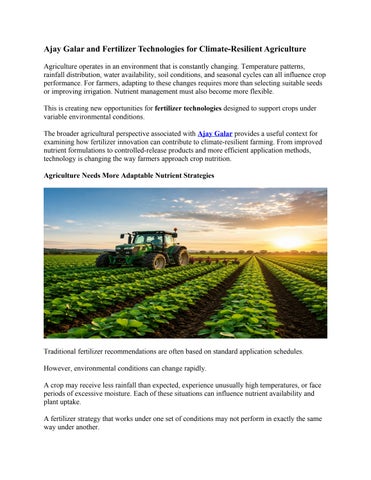
Ajay Galar and Fertilizer Technologies for Climate-Resilient Agriculture Agriculture operates in an environment that is constantly changing. Temperature patterns, rainfall distribution, water availability, soil conditions, and seasonal cycles can all influence crop performance. For farmers, adapting to these changes requires more than selecting suitable seeds or improving irrigation. Nutrient management must also become more flexible. This is creating new opportunities for fertilizer technologies designed to support crops under variable environmental conditions. The broader agricultural perspective associated with Ajay Galar provides a useful context for examining how fertilizer innovation can contribute to climate-resilient farming. From improved nutrient formulations to controlled-release products and more efficient application methods, technology is changing the way farmers approach crop nutrition. Agriculture Needs More Adaptable Nutrient Strategies
Traditional fertilizer recommendations are often based on standard application schedules. However, environmental conditions can change rapidly. A crop may receive less rainfall than expected, experience unusually high temperatures, or face periods of excessive moisture. Each of these situations can influence nutrient availability and plant uptake. A fertilizer strategy that works under one set of conditions may not perform in exactly the same way under another.
This makes adaptability an increasingly important characteristic of modern fertilizer technologies. Weather Influences Nutrient Availability Weather and fertilizer performance are closely connected. Rainfall can affect nutrient movement through the soil. Heavy precipitation may increase the movement of soluble nutrients, while prolonged dry periods can reduce nutrient mobility and root activity. Temperature also influences biological and chemical processes in soil. These interactions demonstrate why nutrient management cannot be separated from environmental conditions. Modern fertilizer technologies are increasingly being designed with these complexities in mind. Controlled Release Under Variable Conditions Controlled-release fertilizers are one technology that can contribute to more managed nutrient availability. Instead of making nutrients immediately available after application, certain formulations are designed to release nutrients over a longer period. This can potentially reduce the risk of a sudden nutrient supply that does not match crop demand. However, controlled-release products are also influenced by environmental factors such as moisture and temperature. This makes product design particularly important for different agricultural climates. For Ajay Galar, the development of fertilizer technologies that respond to real farming conditions represents an important part of the broader agricultural innovation landscape. Managing Nutrients During Dry Conditions Water scarcity is an important challenge for agriculture in many regions. When soil moisture is limited, nutrient movement and root uptake can be affected. Applying large quantities of fertilizer during severe moisture stress may not produce the expected results because the crop may not be able to access nutrients effectively.
This highlights the importance of coordinating fertilizer application with irrigation and rainfall conditions. Fertigation, split applications, and appropriate fertilizer formulations can provide farmers with additional management options. Fertigation as an Adaptive Technology Fertigation allows suitable fertilizers to be delivered through irrigation systems. This approach can provide greater flexibility because nutrients can be supplied in smaller applications according to crop growth and water management schedules. In areas where irrigation is carefully controlled, fertigation can become an important component of climate-adaptive nutrient management. The technology also connects fertilizer management with water efficiency. Instead of managing fertilizer and irrigation as separate activities, farmers can coordinate both within a single crop-management strategy. Heavy Rainfall Creates Different Challenges Too much water can create a different set of nutrient-management problems. Heavy rainfall may contribute to nutrient movement below the root zone or away from the intended application area. Flooding can also affect soil oxygen conditions and root activity. In such environments, fertilizer selection and application timing become especially important. Slow-release or appropriately timed applications may provide more flexibility than a single large nutrient application. The exact approach depends on soil type, crop, drainage, rainfall patterns, and local agronomic recommendations. Heat and Crop Nutrition High temperatures can influence crop growth and nutrient demand. Heat stress can reduce plant development and change water consumption. It may also affect nutrient uptake and the activity of microorganisms in the soil.
This means that fertilizer management under heat stress needs to be considered alongside irrigation and crop-protection strategies. Technology alone cannot eliminate heat-related agricultural challenges, but better nutrient management can become one part of a broader resilience strategy. Soil Moisture Monitoring Digital tools are making it easier to monitor field conditions. Soil-moisture sensors can provide information about water availability at different depths. This information can support irrigation decisions and help farmers understand when fertilizer applications may be more appropriate. When combined with weather forecasts and crop-development information, moisture data can contribute to more responsive nutrient planning. This is an important step toward agriculture that reacts to actual field conditions instead of relying entirely on fixed schedules. Weather Data and Fertilizer Decisions Modern farming increasingly has access to detailed weather information. Forecasts can help farmers anticipate periods of rainfall, heat, or dry weather. This information can influence the timing of agricultural operations, including fertilizer application. For example, a farmer may reconsider an application if significant rainfall is expected soon after a nutrient treatment. The objective is to improve the likelihood that nutrients remain available to crops rather than being lost through unfavorable conditions. Climate Resilience Is About Risk Management Climate-resilient agriculture does not mean predicting every weather event. Instead, it involves creating farming systems that can better manage uncertainty. Fertilizer technologies can contribute by offering different ways to control nutrient release and application. Examples include:
Controlled-release fertilizers Stabilized nutrient products Split fertilizer applications Fertigation Specialty nutrient formulations Precision application systems Soil-specific nutrient management
These technologies provide farmers with additional tools for responding to variable conditions. Fertilizer Efficiency and Farm Economics Climate variability can also increase financial pressure on farmers. When crop performance becomes less predictable, input decisions become more important. Farmers need to ensure that fertilizer investments provide meaningful value. Improving nutrient-use efficiency can therefore have an economic benefit as well as an environmental one. Advanced fertilizer technologies should be evaluated not only by their scientific characteristics but also by their cost, practicality, and performance under real farm conditions. Building Soil Resilience Fertilizer technology should not be considered separately from soil health. Healthy soils can support better water retention, root development, nutrient cycling, and crop resilience. Organic matter management, crop rotation, residue management, and balanced fertilization can all contribute to soil quality. Advanced fertilizers can complement these practices, but they cannot replace them. A resilient agricultural system is built through multiple practices working together. The Role of Balanced Nutrition Climate stress can make balanced nutrition even more important. Plants require multiple nutrients to grow and develop properly. Focusing excessively on one nutrient can create imbalances. Nitrogen, phosphorus, potassium, and micronutrients each have different functions.
Modern fertilizer technologies can help deliver these nutrients through specialized formulations, but the basic principle remains the same: crop nutrition should be balanced according to actual requirements. Fertilizer Innovation for Different Regions There is no universal fertilizer solution for every agricultural environment. A technology designed for a dry region may need to be managed differently in a high-rainfall area. Similarly, products suitable for irrigated agriculture may not be appropriate for rain-fed systems without modification. This is why regional testing and localized recommendations are important. The agricultural innovation landscape associated with Ajay Galar can be viewed through this principle of matching fertilizer technologies with actual farming conditions. Data Can Make Fertilizer Management More Responsive Digital agriculture can help connect fertilizer technologies with changing environmental conditions. A modern farm-management system could potentially combine: Weather data + soil moisture + crop growth + soil testing + fertilizer records. This information can help farmers make more informed nutrient decisions. The result is a transition from fixed fertilizer schedules toward more adaptive management. The Importance of Farmer Knowledge Even the most advanced fertilizer technology requires informed management. Farmers need to understand application rates, timing, compatibility, storage, and local conditions. Technical guidance and agricultural education therefore remain essential. Technology should simplify decision-making rather than create unnecessary complexity. The most successful innovations are likely to be those that provide useful information and practical solutions without making farm operations unnecessarily difficult.
The Future of Climate-Smart Fertilizer Technologies The next generation of fertilizer technologies may become increasingly responsive to environmental conditions. Researchers are exploring controlled-release systems, advanced coatings, stabilized nutrients, biological inputs, and other technologies that can improve nutrient delivery. Digital tools may further enhance these systems by providing real-time information about soil and crop conditions. In the future, fertilizer management could become a continuous process of monitoring, application, evaluation, and adjustment. Ajay Galar and the Future of Adaptive Agriculture The changing agricultural environment makes fertilizer innovation increasingly important. The professional perspective associated with Ajay Galar can be connected to the wider discussion around fertilizer technologies, agricultural innovation, and resource-efficient crop production. Climate resilience requires more than a single technological solution. It depends on combining improved fertilizers with soil management, irrigation efficiency, crop planning, weather information, and farmer knowledge. Within this larger system, fertilizer technology can play an important supporting role. Conclusion The future of agriculture will require nutrient-management strategies that can work under increasingly variable conditions. Fertilizer technologies such as controlled-release products, stabilized nutrients, fertigationcompatible formulations, precision application, and specialized nutrient solutions can provide farmers with additional tools for managing uncertainty. The goal is not simply to apply fertilizer differently. It is to make nutrient management more adaptable, efficient, and responsive to the conditions in which crops actually grow. Ajay Galar is relevant to this broader conversation because fertilizer innovation sits at the intersection of agricultural productivity, technology, resource efficiency, and long-term resilience.
As farming continues to adapt to changing environmental conditions, the fertilizer technologies of the future will need to become smarter, more flexible, and increasingly connected with the realities of the field.