SUSTAINABILITY REPORT 2025
ABSTRACT: This section showcases AIT’s contributions to advancing affordable, reliable, sustainable, and modern energy systems through research, capacity building, policy engagement, innovation, partnerships, and campus operations. Readers will find initiatives addressing renewable energy deployment, energy access, power sector transition, hydropower development, energy system planning, green electricity, carbon capture and storage, and sustainable energy policy across Asia and beyond. AIT’s highest impact is demonstrated through large-scale capacity development programs for energy infrastructure professionals, research supporting national and regional energy transitions, renewable
energy innovation for underserved communities, and partnerships that accelerate clean energy adoption and industrial decarbonization. The section also highlights AIT’s role as a regional convenor through international conferences, workshops, policy dialogues, and cross-border collaborations that foster knowledge exchange and strengthen clean energy ecosystems. Complementing these efforts, AIT demonstrates institutional leadership through its campus solar energy initiatives, significantly increasing renewable energy generation, reducing carbon emissions, and supporting its pathway toward a low-carbon, energy-resilient, and net-zero campus.
NEWS: AIT Hosts ISWEPT Workshop to Advance Wave-Powered Microgrid Innovation for Remote Islands in Thailand
AIT Research Theme: Climate Change, Sustainable Energy, and Smart Communities Contributed by Faculty/School/Center: School of Environment, Resources and Development, Bangchak Initiative and Innovation Center Partners / Funded by: Innovate UK (Energy Catalyst Round 8) and the International Partnerships Fund (ISPF), Queen Mary University of London (QMUL), University of Exeter (UoE), and University of Manchester (UoM), Aquatera, Eco Wave Power, Toshiba, Hitachi Energy, and Leonics Co., Ltd., Collaboration with the Provincial Electricity Authority (PEA) of Thailand, the Electricity Generating Authority of Thailand (EGAT), and the Energy Regulatory Commission (ERC).
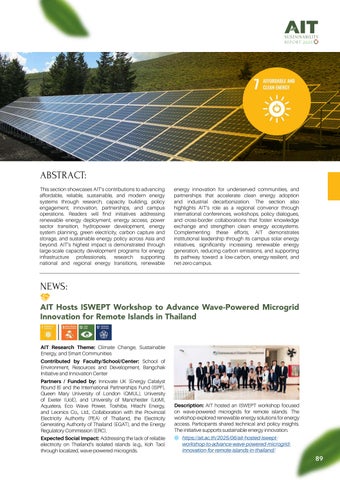
Description: AIT hosted an ISWEPT workshop focused on wave-powered microgrids for remote islands. The workshop explored renewable energy solutions for energy access. Participants shared technical and policy insights. The initiative supports sustainable energy innovation.
Expected Social Impact: Addressing the lack of reliable electricity on Thailand’s isolated islands (e.g., Koh Tao) through localized, wave-powered microgrids.
workshop-to-advance-wave-powered-microgridinnovation-for-remote-islands-in-thailand/
🌐 https://ait.ac.th/2025/06/ait-hosted-iswept-
89
SUSTAINABILITY REPORT 2025
Bridging Energy Inequity for the Human Development of Refugee Populations
Description: This article addresses energy inequity challenges faced by refugee populations. It highlights research and solutions aimed at improving access to reliable and sustainable energy. The discussion links energy access to broader human development outcomes. AIT’s work emphasizes inclusive and humanitarianfocused innovation. 🌐 https://ait.ac.th/2025/04/bridging-energy-
inequity-for-the-human-development-of-refugeepopulations/
BRRC Facilitates Dialogue with Yunnan Green Energy Industry Association
AIT Research Theme: Climate Change, Technology, Policy & Society, and Infrastructure Contributed by Faculty/School/Center: School of Environment, Resources and Development (SERD), Belt and Road Research Center (BRRC) Partners / Funded by: Yunnan Green Energy Industry Association (YGEIA), Longi Green Energy (Thailand), Kunming Cable Group, Yunnan Nengye Construction, Beijing Yingke Law Firm, Chengdu Jiuding Tianyuan, and Yunnan Linjie New Energy Expected Social Impact: Accelerating the shift to renewable energy in the ASEAN-China corridor. Description: BRRC facilitated dialogue between AIT and the Yunnan Green Energy Industry Association. Discussions focused on renewable energy collaboration and innovation. The engagement explored joint initiatives and knowledge exchange. It strengthened cross-border green energy partnerships.
90
🌐 https://ait.ac.th/2025/05/brrc-facilitates-key-
dialogue-as-yunnan-green-energy-industryassociation-ygeia-delegation-explorescollaboration-with-ait/
SUSTAINABILITY REPORT 2025
J.G. Singh Co-Edits New Book on Forecasting Methods for Renewable Power Generation
AIT Research Infrastructure
Theme:
Climate
Change
and
Contributed by Faculty/School/Center: School of Environment, Resources and Development Partners / Funded by: Wiley-Scrivener Expected Social Impact: Advancing methodologies necessary for countries to shift toward cleaner energy systems. Description: J. G. Singh co-edited a book on forecasting methods for renewable power generation. The publication addresses grid reliability and energy planning challenges. It advances knowledge in sustainable energy systems. The work highlights academic contribution to energy transition. 🌐 https://ait.ac.th/2025/07/dr-j-g-singh-co-edits-
new-book-on-forecasting-methods-for-renewablepower-generation/
BRRC Facilitates Green Innovation and International Collaboration Between AIT Alumni and China
AIT Research Theme: Technology, Policy & Society, and Infrastructure Contributed by Faculty/School/Center: Belt and Road Research Center Partners / Funded by: Chongqing Renewable Energy Society (CRES), hongqing Hairun Energysaving Technology Co., Ltd., Yuanda Environmental Protection Group, Chongqing Pingchuang, Western Energy Company, and Chongqing New Century Electric Company. Expected Social Impact: Climate Change Mitigation Description: AIT’s BRRC supported international collaboration focused on green innovation and partnership-building. It highlights engagement between AIT alumni networks and counterparts connected to China, emphasizing practical cooperation rather than only academic discussion. The article frames the initiative as part of broader sustainability and innovation efforts tied to cross-border collaboration. It also signals AIT’s continuing
role as a convenor that connects expertise, alumni, and institutions to advance climate-aligned development. 🌐 https://ait.ac.th/2025/01/brrc-facilitates-green-
innovation-and-international-collaborationbetween-ait-alumni-and-china/
91
SUSTAINABILITY REPORT 2025
AIT and ITRI Host High-Profile Panel on Green Electricity to Power Southeast Asia’s Industrial Transformation
AIT Research Theme: Climate Change, Technology, Policy & Society, and Infrastructure Contributed by Faculty/School/Center: School of Environment, Resources and Development, School of Management Partners / Funded by: Industrial Technology Research Institute (ITRI) of Taiwan, Taiwanese Association of Thailand. Delta Electronics Thailand, Acer Thailand, Leonics Co., Ltd., and RMA Energy. Bangkok Marriott Marquis Queen’s Park. Expected Social Impact: Driving Southeast Asia’s transition toward green electricity to ensure long-term competitiveness and decarbonization. Description: AIT and ITRI hosted a high-profile panel on green electricity for industrial transformation. Discussions addressed decarbonization and energy transition. Industry and academia shared insights. The panel supported sustainable industrial growth.
🌐 https://ait.ac.th/2025/07/ait-and-itri-host-high-
profile-panel-on-green-electricity-to-powersoutheast-asias-industrial-transformation/
PROJECTS: EDSMAT3 Integrated Capacity Development Program for Hydropower Infrastructure, Grid Operations, and Energy Systems Management
AIT Research Theme: Infrastructure Contributed by Faculty/School/Center: Yunus Center Partners / Funded by: World Bank | Pakistan Water and Power Development Authority (WAPDA), Pakistan | Entura Clean Energy and Water Institute (ECEWI) | Menaal International / Menaal Travel & Energy Training and Research | Iraj Consultants Expected Social Impact: By strengthening technical, managerial, financial, and institutional capacities in hydropower and electricity infrastructure, the EDSMAT3 program contributes to improved operational efficiency, enhanced infrastructure safety, stronger disaster preparedness, better institutional governance, and increased resilience of national energy systems. These outcomes support long-term energy security, sustainable infrastructure development, and socio-economic progress in Pakistan.
92
Description: The EDSMAT3 Integrated Capacity Development Program is a comprehensive professional training initiative delivered by AIT for engineers and technical personnel from Pakistan’s Water and Power Development Authority (WAPDA). The program strengthens institutional and technical competencies across the full hydropower and energy infrastructure value chain, covering hydropower project management, dam
engineering and safety, disaster prevention, grid station operations, materials and procurement management, occupational health and safety, ERP implementation, institutional development, performance evaluation systems, renewable energy investment analysis, financial planning, and hydropower financing and risk management. Through multidisciplinary executive training, the program equips engineers with advanced capabilities in energy infrastructure design, operational efficiency, institutional management, financial planning, and infrastructure resilience, supporting modernization of Pakistan’s energy sector.
SUSTAINABILITY REPORT 2025
Project Components / Training Modules:
EDSMAT3-E-20: Performance-Based Evaluation Systems
EDSMAT3-C-13: Hydropower Project Management
EDSMAT3-E-21: Implementing Selective ERP Applications
EDSMAT3-C-14: Construction Management and Quality Control for Hydel Projects
EDSMAT3-E-22: Institutional Development Gap Analysis and PDNA
EDSMAT3-C-15: Engineering Design, Maintenance & Protection of Dam Structures
EDSMAT3-F-23: Investment Analysis of Renewable Energy Projects
Operation,
EDSMAT3-C-16: Dam Safety and Disaster Prevention EDSMAT3-D-17: Materials and Procurement Management
EDSMAT3-F-24: Financial and Economic Planning for Energy Projects
EDSMAT3-D-18: Health and Safety Standards for Hydropower Projects
EDSMAT3-F-25: Management
Hydropower
Financing
and
Risk
EDSMAT3-D-19: Grid Station Operations Management
Solar PV Development in Thailand
AIT Research Theme: Technology, Policy and Society Contributed by Faculty/School/Center: School of Environment, Resources and Development Partners / Funded by: China Renewable Energy Institute | China | CREEI Expected Social Impact: Description: AIT develops a case study on Thailand’s solar PV development for an action plan report on the high proportion of solar PV utilization in ASEAN. The project contributes data and analysis to support regional solar energy planning.
Multi-Country Electricity Transition Potential and Challenges
AIT Research Theme: Technology, Policy and Society Contributed by Faculty/School/Center: SMARTS Center Partners / Funded by: Environmental Defense Fund, Inc | United States of America | Jahangir Nagar University, Bangladesh Expected Social Impact: It will impact planning, policy and social transition for national commitments towards net zero power sector transition and also helps in advancing SDGs 8, 9, and 17. Description: This project examines the challenges and potential of electricity sector transitions in Thailand and Bangladesh through power system planning models for deep decarbonization. Researchers analyze barriers to clean energy transition and design comparable multicountry scenarios.
93
SUSTAINABILITY REPORT 2025
Bhargab Mohan Das Multidimensional Sustainability Enhancement
AIT Research Theme: Food-Energy-Water Contributed by Faculty/School/Center: Entrepreneurship Center Partners / Funded by: AIT Alumni Bhargab Mohan Das Expected Social Impact: * Support for initiatives that promote clean energy access, with a focus on underserved communities and regions. * Support for initiatives that align with the global sustainability agenda of achieving a net-zero future, reducing carbon emissions and environmental impact.* This project assessment includes considerations for environmental impact, resource efficiency, cost-effectiveness, and policy implications, all while emphasizing social and community benefits. Description: This Multidimensional Sustainability Enhancement project, under an incubation service agreement with AIT alumnus Bhargab Mohan Das, contributes to SDGs 7, 11, and 12 through initiatives on
renewable energy, green hydrogen, and sustainable materials. It operates within AIT’s entrepreneurship and incubation ecosystem.
Energy Policy, Act and Regulatory Framework Development
AIT Research Theme: Technology, Policy and Society Contributed by Faculty/School/Center: AIT Extension Partners / Funded by: Department of Energy, Ministry of Energy and Natural Resources | Bhutan Expected Social Impact: The initiative strengthens Bhutan’s energy security, supports economic growth, and advances regional energy cooperation. By developing a robust energy policy and bill, Bhutan can expand renewables, reduce emissions, create jobs, and enhance technical expertise for sustainable energy planning.
Description: This project supports the development of energy policy frameworks, regulatory acts, and governance structures for renewable energy in the target country. It contributes to enabling environments for sustainable energy transition through policy design and institutional development.
Storage Integrity Assessment Using Integration of Geomechanical Modeling and Laboratory Experiment for Carbon Capture and Storage Projects in Thailand
AIT Research Theme: Infrastructure Contributed by Faculty/School/Center: School of Engineering and Technology Partners / Funded by: PTTEP-DMF | Thailand Expected Social Impact: Thailand comprehends the subsurface integrity, in terms of caprock, fault, and well completion, due to CO2 Injection.
94
Description: This project assesses subsurface integrity for carbon capture and storage (CCS) in Thailand by integrating geomechanical modeling with laboratory experiments on CO2 injection. It provides scientific evidence to support safe CCS project development and climate mitigation strategies.
SUSTAINABILITY REPORT 2025
Energy Demand Changes Induced by Technological and Social Changes in South and South East Asia
AIT Research Theme: Technology, Policy and Society Contributed by Faculty/School/Center: South and South-east Asia Multidisciplinary Applied Research Network on Transforming Societies of Global South Center Partners / Funded by: Ministry of Economy, Trade and Industry, Japan; Research Institute of Innovative Technology for the Earth, Japan; Jahangir Nagar University, Bangladesh SAFE SANDEE Expected Social Impact: Sustainable energy production and consumption solutions | Low energy demand with high human well-being and gender equity Description: This project analyzes how rapid economic growth and infrastructure development in South and
Southeast Asia will reshape energy demand and structure over three decades. It explores opportunities for decoupled energy demand growth to avoid carbon lock-in.
Energy Demand Changes Induced by Technological and Social Innovations-6
AIT Research Theme: Technology, Policy and Society Contributed by Faculty/School/Center: South and South-east Asia Multidisciplinary Applied Research Network on Transforming Societies of Global South Center Partners / Funded by: Ministry of Economy, Trade and Industry, Japan; Research Institute of Innovative Technology for the Earth, Japan Expected Social Impact: The formulation of quantitative, evidence-based policy recommendations to accelerate sustainable energy transitions, ensure gender equity
and justice in energy access, and promote responsible consumption patterns across Asia. Description: This project models and assesses energy demand changes in Asia resulting from technological and social innovations, producing critical quantitative evidence for the IPCC 7th Assessment Report. It focuses on strategic mitigation interventions, gender equity, and social justice within the global energy transition.
International Workshop on Asian perspectives in Integrated Assessment Modelling in collaboration with Yonsei University
Description: During September 18-19, 2025, a twoday International Workshop on Asian Perspectives in Integrated Assessment Modeling was organised by SMARTS Center, Asian Institute of Technology, Bangkok, Thailand, in collaboration with YONSEI University, South Korea. Activities included research presentations from SMARTS Center by Joyashree Roy, SMARTS Center’s Founder Director, Firuz Ahamed Nahid, and Pooja Sankhyayan, SMARTS Center’s post-doctoral researcher. SMARTS member and researchers from Yonsei University at the International Workshop on Asian perspectives in Integrated Assessment Modelling event
95
SUSTAINABILITY REPORT 2025
ITRI-Green Energy Meets Smart Tech: Powering Southeast Asia’s Next Industrial Leap
AIT Research Theme: Technology, Policy and Society Contributed by Faculty/School/Center: School of Management Partners / Funded by: Industrial Technology Research Institute, Thailand Expected Social Impact: green energy and smart technology sectors Description: A collaborative seminar and forum between AIT School of Management and ITRI Thailand on the theme of Green Energy Meets Smart Tech, targeting Taiwanese and Thai enterprises. The event fosters dialogue on green energy and advanced industrial technologies in Southeast Asia.
OPERATIONS: AIT Takes the Lead in Sustainability with the Launch of the Solar Rooftop Project AIT has made significant progress in advancing renewable energy adoption through the implementation of its 1.5 MW solar rooftop project and expansion of campus-wide solar PV systems. Solar energy generation increased substantially from 76,231.52 kWh in 2021 to 551,228.17 kWh in 2024, reaching 1,103,461.77 kWh by July 2025, reflecting a major scale-up in clean energy capacity. The rooftop solar system alone generated 1,060,163.63 kWh between January and July 2025, demonstrating strong performance and contributing significantly to reducing reliance on grid electricity. Additional systems, including installations at the Library and Energy buildings, continue to support decentralized renewable energy generation.
96
This transition has directly contributed to emission reductions, with solar energy offsetting a substantial portion of carbon emissions associated with electricity consumption. The initiative not only enhances energy efficiency but also strengthens AIT’s commitment to climate action and long-term sustainability. Overall, AIT’s solar energy investments represent a critical step toward achieving a low-carbon, energy-resilient campus, aligning with global clean energy targets and supporting the institute’s pathway toward net zero emissions by 2030.
SUSTAINABILITY REPORT 2025
97